
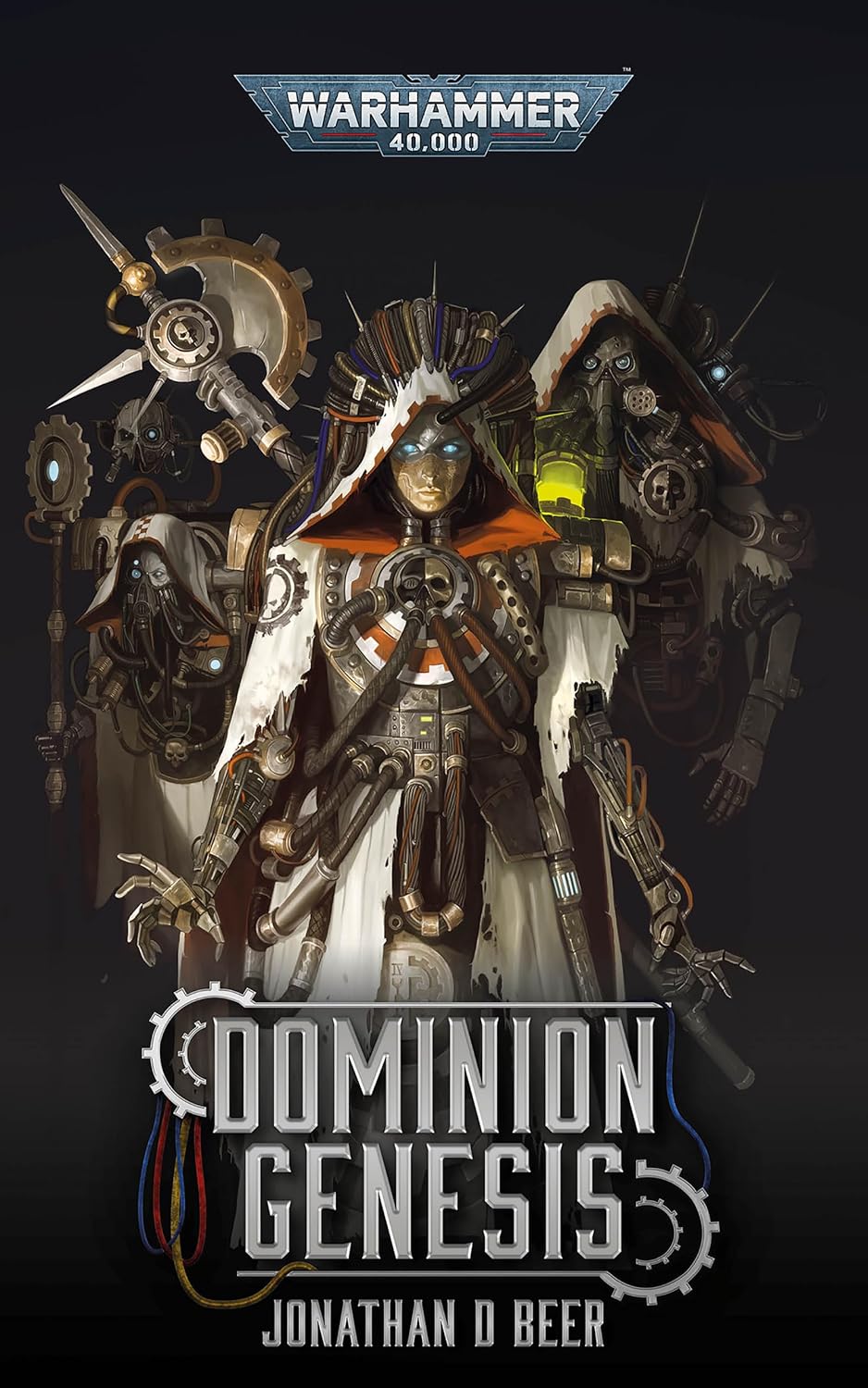
Warhammer 40,000: Dominion Genesis by Jonathan D. Beer

Publisher: Black Library (Audiobook – 21 September 2024)

Series: Warhammer 40,000

Length: 10 hours and 47 minutes

My Rating: 4.5 out of 5 stars

Amazon

Destitute tech-priests of the Adeptus Mechanicus embark on a massive quest for redemption in the excellent 2024 Warhammer 40,000 novel, Dominion Genesis by Jonathan D. Beer.

Beer is a talented rising author in the Warhammer 40,000 fiction space who has so far impressed with two interesting books covering unique spheres of the fandom’s canon.  I deeply enjoyed his first novel, The King of the Spoil, which was a particularly epic entry in the Warhammer Crime sub-series, and which ended up being one of my favourite debuts of 2023.  Beer followed up this debut last year with his second novel, Dominion Genesis, an intriguing read that takes place in a very different Warhammer 40,000 setting.  I had an excellent time with Dominion Genesis, although I spectacularly failed to write a review for it last year.  However, with Beer’s third Warhammer 40,000 novel just released, I felt that this was a good time to finally write something about Dominion Genesis, which honestly was an awesome read.

Plot Synopsis:

Gryphonne IV is dead – one of the mightiest forge worlds in the arsenal of the Adeptus Mechanicus, succumbed to the relentless hunger of Hive Fleet Leviathan. Devoured. Lost.

The few magi that survive drift in idleness, robbed of purpose and direction. But there is one who rejects that fate.

READ IT BECAUSE
It’s the gripping tale of an Explorator desperately seeking ancient technologies from humanity’s past as she races against time to restore one of the mightiest forge worlds in the Imperium.

THE STORY
Explorator Talin Sherax seeks ancient and miraculous technologies from humanity’s distant past. When she learns of a fabled relic that could restore all that has been lost, Sherax embarks on a journey, the outcome of which could change everything. Nothing will stand in her way… even if the quest brings her to the brink of heresy.

Dominion Genesis was a particularly intense and compelling entry in the Warhammer 40,000 canon that proves quite enthralling to read.  I like how Beer managed to achieve quite a few things with this book, as he produced an excellent quest narrative with a focus on obsession, trauma and survival, while also cleverly showcasing several different factions of the Warhammer 40,000 universe.

Beer came up with a very awesome story that hits a lot of highly emotional story notes early on.  The start of Dominion Genesis was one of the more striking sequences of Warhammer fiction I have read, as the protagonist, Explorator Talin Sherax, is forced to witness the destruction of their home world.  Moving quickly into a time skip, you see a very different version of Sherax several years in the future, as she still attempts to make sense of the destruction while searching for valuable lost technology.  After a great sequence aboard a derelict spacehulk, Sherax finds a clue about a potential artifact that could help to restore her planet.  Going against the orders of her superiors, Sherax leads a crew of human soldiers and Adeptus Mechanicus forces on a quest to several deadly and hidden locations in the galaxy.  Along the way, the protagonists examine their humanity in several different forms, while also being stalked by dangerous alien fighters determined to stop them achieving their goal.

There are some great sequences in the middle of this book, as the protagonist desperately follow the clues into a trap, which shakes all the characters to their core.  After a gruelling sequence of events that help to highlight and move along several, well-constructed character development arcs, the adventure moves to its destructive conclusion.  After another disaster, the protagonists are dropped in amongst a war between rival xenos forces and must journey into the fray to achieve their goal, resulting in a brutal series of battles and the intense conclusion to the narrative.  Beer wrote in some great tragic moments as the protagonists are outmatched at nearly every turn, although many of these sequences work well to provide closure to some of the book’s various character arcs.  The conclusion to Dominion Genesis was as bleak as you would hope for a novel in the grimdark Warhammer 40,000 universe, but it provides some great closure for the main character and will keep readers very satisfied.

I felt that Dominion Genesis was a particularly good addition to the Warhammer 40,000 canon, as Beer provides a thoughtful and complex novel loaded with unique action and damaged characters trying to survive the inherent darkness of the war-torn universe.  Beer ended up producing an intense character-driven story for Dominion Genesis, and I loved the great balance between action, exploration and interaction between certain unique Warhammer races, and the focus on character elements.  I personally really enjoyed the deep dive into the Adeptus Mechanicus, with various character perspectives diving into their culture and thought processes, even though certain sections of the plot need to be altered to emulate the machine nature of the tech-priests.  Beer tried to showcase a more emotional side to the Adeptus Mechanicus in this book, especially through his protagonist which, while different from other portrays of this faction, fits the trauma-rich narrative as all these characters struggle with the loss of their home.  The author also has fun fitting in several of the main alien races of the Warhammer 40,000 universe into the story, including orks, Tyranid, Aeldari and Necrons.  While not a lot of focus is given to understanding them, they serve as good foils to the obsessed protagonists, and it was interesting to see the Mechanicus takes on these different enemies.  In the end, Dominion Genesis proved to be a compelling, and impressive standalone novel that makes great use of its Warhammer 40,000 elements.  However, be warned that this novel is probably better read by more established fans of the franchise, rather than newer readers, as Beer covers a lot of complex lore in a short period of time.

One of the key things I liked about Dominion Genesis was the rich array of compelling characters featured throughout the plot.  Beer does an outstanding job introducing and following several very damaged figures, including the protagonist Explorator Talin Sherax, who finds herself in a depressed state following the opening sequence of book.  Cutting herself off from the technological hivemind used by the rest of Adeptus Mechanicus brethren, Sherax proves to be a brilliantly complex figure in Dominion Genesis, and Beer’s take of her as the depressed member of a group known for having no emotions was really fascinating.  The author also features an interesting array of other Adeptus Mechanicus members who provide great alternate viewpoints to that of Sherax.  I really enjoyed how Beer managed to include a lot of intriguing individualism in these machine-like Adeptus Mechanicus characters, and the range of different opinions and feelings around Sherax and her mission added some interesting drama to the story. 

Finally, I must highlight the human members of the Dominion Genesis cast, who provide intriguing alternate viewpoints to cybernetic protagonists. I particularly enjoyed the focus on a depressed former Imperial Knight pilot, who, after losing his ancient war machine, decides to join the crew of Sherax’s ship.  There are some fascinating focuses on his parallel grief to that of the Adeptus Mechanicus characters, as well as his own self-anger, especially while forced to pilot a seemingly lesser machine.  Beer writes some interesting side plots around this more human character, including his relationship with an Imperial Guard regiment also aboard the ship, and he must balance his need for human contact with his own grief and arrogance.  I felt this compelling collection of distinctive characters helped to make Dominion Genesis really stand out, and I enjoyed seeing their unique interactions.

As with most Warhammer 40,000 novels I review, I ended up listening to Dominion Genesis on audiobook, which is pretty much the best way to enjoy this series.  The Dominion Genesis audiobook ended up being a lot of fun to listen to, and I managed to get through it’s near 11-hour runtime quickly.  It helped that Dominion Genesis was narrated by the very talented Colleen Prendergast, who is becoming the go-to narrator for any Warhammer 40,000 audiobook that features a human female protagonist, such as Justin D. Hill’s Cadia series, or standalone books like Creed: Ashes of Cadia by Jude Reid or Longshot by Rob Young.  Prendergast did an outstanding job bringing the various complex cast members of Dominion Genesis to life, and I particularly appreciated the skill need to voice a variety of cybernetic humans with altered or robotic voices.  This great voice work turned Dominion Genesis into a fantastic listen, and it was very easy to enjoy Beer’s outstanding and lore-heavy story when it was being read out.

Overall, Dominion Genesis was an amazing second novel by Jonathan D. Beer, who did an outstanding job pivoting to a different area of Warhammer 40,000 fiction.  I loved the complex character-driven narrative contained within Dominion Genesis, and this was one of the more enjoyable Warhammer 40,000 novels that came out last year.  I cannot wait to see how Beer continues to develop as a writer in the future, and I currently have a copy of his latest book, Tomb World, in my audiobook queue to listen to.

Amazon

Warhammer 40,000: Lazarus: Enmity’s Edge by Gary Kloster

Publisher: Black Library (Audiobook – 9 March 2024)

Series: Warhammer 40,000

Length: 11 hours and 47 minutes

My Rating: 5 out of 5 stars

Amazon

Secrets, lies and devils from the past converge around the Dark Angels in this exceptional Warhammer 40,000 novel from Gary Kloster, Lazarus: Enmity’s Edge.

I have been on a real roll with Warhammer 40,000 fiction this year, as books like Da Big Dakka by Mike Brooks, Deathworlder by Victoria Hayward, Oaths of Damnation by Robbie MacNiven and Renegades: Lord of Excess by Rich McCormick have all proven to be exceptional additions the Warhammer canon.  But despite how awesome the above books and others have proven to be, I am still keen for more.  That is why I made sure to listen to a copy of the early 2024 novel, Lazarus: Enmity’s Edge by new-to-me author Gary Kloster.  An interesting entry that follows members of the iconic Dark Angels chapter, Lazarus: Enmity’s Edge was a book I nearly didn’t read this year, but I was sure glad that I did.

For over 10,000 years the Space Marines of the Dark Angels chapter have defended the Imperium of Man from all manner of insidious threats, all while keeping their own terrible secrets hidden.  Maintaining watch for fallen members of their order, the Dark Angels are forced to balance their Chapter’s need for secrecy and revenge with their solemn duty to keep humanity safe from the monsters and heretics stalking the stars.  But not every member of the Dark Angel’s inner circle believes that the battles of the past should impact the Chapter’s future.

Lazarus, Master of the Dark Angels Fifth Company, knows the burden that history can have on the soul.  The first Primaris Marine to hold rank within the chapter’s inner circle, Lazarus finds himself haunted by the battle that killed him and forced him to undergo the Rubicon surgery.  Determined to rid the universe of all psykers and the foul forces of Chaos behind them, Lazarus is a dedicated warrior, although one that questions the secrets that impact his ability to fulfill his duty.  That is why, when an ancient beacon located on the planet Reis is activated, the Supreme Grand Master of the Dark Angels, Azrael, summons Lazarus and his Fifth Company to fulfill an old debt of honour.

A thousand years before, the Imperial Knight world of Reis was nearly overwhelmed by a rampaging army of daemons, resulting in the destruction of the planet’s war machine guardians, and only through the intervention of the Dark Angels was Reis saved.  But now, after years of peace, Reis finds itself under attack from a new foe, one that may cause another daemonic incursion.  Determined to ensure the daemons stay in the warp, Lazarus arrives to assess the situation on Reis, but soon discover that not everything is as it seems.  The planet is a hotbed of sinister politics, ancient grudges, and long-buried secrets, all of which conspire to drag Reis closer to destruction.  Forced to navigate the planet’s complex history, Lazarus discovers a terrible enemy hiding deep within the planet’s jungles, one that, like Lazarus, refuses to die.  To save Reis and his brothers, Lazarus must uncover the true hidden past of the planet and understand the origin of the grudge that could turn the Dark Angels against the Imperium they are sworn to protect.

Wow, Warhammer 40,000 fiction is in peak form in 2024 as Gary Kloster deeply impressed me with Lazarus: Enmity’s Edge.  Featuring a particularly complex and captivating narrative that blended awesome action and great characters with a clever and well-written plot, Enmity’s Edge proved to be extremely addictive, and I found myself irreversibly hooked.  Exciting, intense and loaded with all manner of intrigue, Enmity’s Edge is one of the best Warhammer books of 2024 and gets a full five-star rating from me.

I must admit that when I first decided to check out Enmity’s Edge, I didn’t quite know what to expect.  Space Marine focused Warhammer 40,000 novels can sometimes be an overloaded, action slog colloquially known as “Bolter porn”, and I was initially slightly worried that was the direction Enmity’s Edge was going, especially as it started off with an intense war sequence against orks.  However, Kloster instead showcased a remarkably compelling and layered Warhammer 40,00 novel that made excellent use of its Dark Angel protagonists and a unique, secret-laden background setting.  The initial battle serves as a great introduction to the main protagonist, Lazarus, and his command staff, and you get a sense of his tactical skills, as well as his dislike of psykers and the secrets of his order.  This leads nicely to the more complex part of the book, as the reader is introduced to some interesting side characters, as well as the world of Reis, where Lazarus and his company are sent to.

Arriving on Reis, Lazarus discovers a unique world of secrets, lies and hidden history, with the populace attacked by a mysterious fungal infection that has taken over various host bodies.  Quickly diving into the fray to determine the full extent of the threat, the first half of the book sees the Dark Angels essentially taking on the zombies from The Last of Us with an intelligent malevolence behind them, and these unique antagonists prove an interesting alternative to the classic villains of the franchise.  From there the story devolves into an intriguing combination of sequences, as Lazarus attempts to uncover his true opponent, while also dealing with attacks on multiple fronts.  This leads to some compelling and occasionally brutal scenes, including a continued conflict inside an Adeptus Mechanicus base, as well as some other great sequences scattered throughout the planet.  The author spends some substantial time building up some impressive and moving character arcs, as various figures deal with the chaotic events in different ways.

The author does an excellent job building up a great hidden villain who the protagonist must uncover, and the secrets and mysterious surrounding the figure really adds to the intrigue of the story.  While the identity of some of the antagonists are a little predictable, the journey getting there is impressive, and I loved the setup to the answers that Kloster subtly hid through the earlier parts of the book, with the reliance on understanding the past to survive the future being a great recurring theme.  This leads up to a particularly intense and dark final third as the antagonist’s very long-term plot comes to dramatic fruition.  Kloster does a masterful job of building up tension and substantially upping the stakes in the leadup to this, and you find yourself deeply engaged as you wait to see how everything will unfold.  There are some brilliant moments here, including a ton of over-the-top action, some fantastic plot resolutions, and several particularly tragic moments as the protagonists face overwhelming foes.  The overall resolution is very clever and builds on some excellent prior story inclusions and character growth, that Kloster wraps up perfect.  The end result is an awesome, memorable and particularly enthralling standalone story, that really showcases just how cool and complex a Warhammer 40,000 story can be.

I really enjoyed how Enmity’s Edge came together, and I felt Kloster had a great writing style the ensured a powerful and intense story.  His entire complex narrative was a ton of fun from start to finish, and it proved to be well showcased through several compelling protagonist perspectives.  While there is a ton of awesome and intense action in this book, as is required for a Warhammer 40,000 novel (war is in the name for a reason), the focus on a more subtle threat ensured that Enmity’s Edge stood out from the pack.  I particularly appreciated how subtly Kloster set up a lot of key story elements early in the book and they all paid off extremely well, with a great theme on the lessons of the past recurring in an excellent way.  I also must highlight the great new setting of the planet Reis, which Kloster made fantastic use of.  The Warhammer 40,000 universe is home to a multitude of intriguing and unique worlds, but Reis really stood out to me thanks to Kloster’s vibrant descriptions and the clever way the planet’s complex history and disposition played into the narrative.  An Imperial Knight planet (a feudal world governed by mech pilots who take the whole knight thing way too seriously) that has fallen on hard times thanks to the destruction of the ruler’s battle suits, Reis is a hotbed of dark history, lingering secrets, and intense rivalries, covered with useful fungus.  Kloster perfectly introduces and then utilizes this planet throughout the narrative, and you find yourself getting really drawn into the revealed history, especially as it produces a particularly effective and dark antagonist.  These writing elements ensure that Kloster’s captivating narrative pops in the reader’s mind, and I was really impressed with how he presented this excellent Warhammer novel.

In addition to being an outstanding read, I also felt that Enmity’s Edge was an excellent piece of Warhammer 40,000 fiction, and one that really emphasizes how clever and compelling a story in this canon can be.  Focusing on the Space Marine chapter, the Dark Angels, Kloster presents a gripping standalone narrative that makes great use of the franchise’s unique features and history without getting too bloated or lore heavy.  Thanks to how effectively the author covers these franchise inclusions, I felt that readers unfamiliar with Warhammer fiction could easily jump into Enmity’s Edge without too much pre-knowledge and still deeply enjoy the plot, especially as it really showcases how cool the iconic Space Marines can be.  More established Warhammer 40,000 fans will naturally get a lot more out of the story, especially as Kloster explored some particularly awesome aspects of the universe.  I personally loved how well he showcased the various squads featured within a specific Space Marines company, and it was fun to have a mixture of troop specializations and vehicles which reminded me of tabletop gameplay at times.  He also does an outstanding job showcasing the Dark Angels, who are one of the more popular Space Marine chapters for a reason.  This proved to be a very strong book for Dark Angels fans, and I appreciated how he veered away from the typical topics you’d expect for a Dark Angels novel (completely focused on the Fallen), and instead showed them facing a fresh foe with some excellent motivations to hate them.  As such, this is a highly recommend read for all Warhammer fans that might also attract a few new readers to the franchise.

One of Enmity’s Edge’s real strengths was the excellent batch of characters that Kloster set the narrative around.  This includes the titular protagonist, Lazarus, Master of the Dark Angels Fifth Company, who proves to be an intriguing central character.  A well-known tactician, secret holder, and one of the few commanding Primaris marines (an upgraded Space Marines) in the Chapter, Lazarus proves to be a great main figure for the plot.  While some Space Marine characters in fiction can be a little one-dimensional, I felt that Kloster did an excellent job turning Lazarus into a complex figure, haunted by his previous battles, concerned about the future of his chapter, and bitter about those friends he has lost to psykers.  There are some great scenes featuring Lazarus throughout Enmity’s Edge, especially as he showed a lot of humanity to a certain point-of-view character, and it was intriguing to see his tactical mind in action.  He also proves to be an excellent foil to the excellent main antagonist of the plot, and they had some compelling scenes together.

Aside from Lazarus, Enmity’s Edge featured a raft of notable support characters, including several major members of the Dark Angels Fifth Company.  I particularly enjoyed the imposing and unfailingly honorable figure of Ancient Jequn, the Fifth Company’s veteran standard bearer.  Jequn has a particularly tragic arc in this book, and I really grew attached to him and his resolve throughout the run of Enmity’s Edge.  Other enjoyable characters included members of Lazarus’s command squad, an Adeptus Mechanicus tech-priest whose technology reflects their obsession with birds, and the various key rulers of Reis.  The antagonists of Enmity’s Edge are also well set-up and utilized, and while I won’t got into too much detail of them here, they had some brilliant sequences, and really enhanced the overall narrative.

However, I felt that one of the best characters in Enmity’s Edge was Learned Ysentrud, an enhanced human of a type found only on Reis called a Wyrbuk, who finds themselves helping the Dark Angels.  Essentially a living repository of knowledge, Ysentrud becomes a key figure in the plot as she provides the Dark Angels with history and insights into Reis that allow them to uncover the plot’s big mystery.  Probably the book’s main point-of-view protagonist after Lazarus, Ysentrud had one of the more relatable character perspectives in Enmity’s Edge, as she finds herself surrounded by the demi-god figures of the Space Marines as they engage in combat.  Not only does Ysentrud’s perspective help to bring readers a little more into the plot, but I really enjoyed the compelling story arc Kloster wove around her as she attempted to find her courage and prove her worth to the Dark Angels.  Kloster’s entire arc around Ysentrud was really well written, and I felt that her complex personal narrative was a particularly strong part of the book.

Those familiar with this blog will be unsurprised that I chose to enjoy Enmity’s Edge on audiobook, which is how I primarily check out all my Warhammer content.  As with most Warhammer 40,000 books, Enmity’s Edge came across extremely well in this format, and you are in for a really good time listening to it.  Coming in with a runtime just short of 12 hours, listeners can get through Enmity’s Edge’s audiobook in no time at all, especially once you get caught up in its fantastic story.  The intense action, elaborate sequences and deep intrigue of the plot is perfectly enhanced by having it read out to you, and I loved hearing the elaborate descriptions of the setting and the unique characters within it.  I was also very impressed by narrator John Banks, who has lent his voice to several Warhammer audiobooks over the years.  Banks did a remarkable job diving into the various characters featured within Enmity’s Edge, and I also felt that his amazing voice lent a lot of gravitas to these figures.  While all the characters are given excellent and fitting voices, I particularly loved his take on the various Dark Angels characters featured throughout the plot.  He gives these genetically enhanced, ancient warriors the booming and commanding voices you would expect, and their emphatic declarations sound really cool here.  I absolutely powered through this excellent audiobook, and I would strongly recommend it as the very best way to enjoy Enmity’s Edge.

Lazarus: Enmity’s Edge by Gary Kloster was another excellent 2024 Warhammer 40,000 novel that I could not get enough of.  Featuring a complex and intense plot of betrayal, secrets and dark history, Enmity’s Edge grabs your attention early and ensures you can’t put it down as you rush towards the end.  One of the best Warhammer 40,000 novels of the year, Enmity’s Edge is a must read of all fans of the franchise, and I really loved its brilliant story.

Amazon

Throwback Thursday – Warhammer 40,000: Kingsblade by Andy Clark

Kingsblade Cover

Publisher: Black Library (Paperback – 1 February 2017)

Series: Imperial Knights – Book One

Length: 365 pages

My Rating: 4.5 out of 5 stars

Amazon

Welcome back to my Throwback Thursday series, where I republish old reviews, review books I have read before or review older books I have only just had a chance to read.  In my latest Throwback Thursday post I look at an exciting novel about mecha fights in the Warhammer 40,000 universe with Kingsblade by Andy Clark.

I have been having so much fun with the Warhammer 40,000 books recently, especially in my Throwback Thursday columns, as I recently published reviews for Ghostmaker, Xenos, Malleus and Hereticus by Dan Abnett, and Deus Encarmine by James Swallow.  However, the fun is not over yet as I recently read the cool 2017 novel, Kingsblade by Andy Clark, who previously impressed me with his 2022 book, Steel TreadKingsblade, a lucky find I managed to pick up in a secondhand bookshop, was an outstanding read which frankly has one of the best Warhammer covers out there, as well as a great story to match it.

War is a certainty in the far future, and the Imperium of Man is constantly under threat, especially from the fell influence of Chaos.  When a planet falls, the Imperium have many forces that can be deployed to fight the invasion, but few armies are as feared or revered as the legendary Imperial Knights, giant, ancient suits of mechanised armour that support brave pilots of regal, knightly backgrounds.

When the Imperial world of Donatos falls to heresy thanks to the disruptive influence of the Word Bearers Chaos Space Marines, the Knights of the nearby planet of Adrastapol heed the call.  Leading five noble houses of Imperial Knights, as well as substantial forces from the Astra Militarum, High King Tolwyn Draconis hopes to swiftly end the insurrection and save Donatos’s soul.  However, when a great betrayal rips the very heart out of the king’s host and the flower of Adrastapol’s Knights falls, all hope looks lost.

As the battered remnants of the Imperial Knights attempt to recover, it soon becomes clear that the fate of both Donatos and Adrastapol will lie with two unblooded Knights Errant, Danial Tan Draconis and Luk Tan Chimaeros, both of whom are reeling from the actions of their parents.  On the run, outnumbered and unsure who to trust, Danial, Luk and their comrades need to find a way to strike back against the enemy especially as the World Bearers begin a massive unholy ritual, one that threatens everything.  But can these two young Knights defeat the enemy and redeem their world, or do the betrayals of their family and former comrades run too deep?

Kingsblade was an epic and incredible Warhammer 40,000 read by Clark that I had a ton of fun with.  Featuring a mecha-laden novel that contained awesome action sequence after awesome action sequence, this was a great addition to the wider Warhammer 40,000 canon and a must read for all fans of the franchise.

I had an amazing time getting through Kingsblade’s great story, especially as Clark clearly has a lot of fun fitting in as much action and mayhem as possible.  Starting with the classic Warhammer 40,000 war story, with the brave Imperial defenders arriving to save the world of Donatos, the narrative primarily focuses on several of the Imperial Knights who arrive, especially the young bloods Danial and Luk, who are thrust into the fires of war.  The first half of the book features the typical early battles and set-up you would expect, and Clark lays down some clever hints of what is to come.  Things of course take a turn for the worse after a massive betrayal, and the protagonists soon find themselves on the run, unsure of who to trust.  The major battle that follows this betrayal is pretty damn epic, especially as there is a real sense of desperation and confusion surrounding the characters, and the chaotic fallout of this pushes the protagonists in some intriguing new directions.  The second half of the novel sees the traumatised characters attempting to fight back whilst on the run, while also dealing with the many personal issues that have arisen.  Clark does a good job of blending the enjoyable action sequences with some intense character moments during this second half, and the powerful tale of camaraderie and honour that follows is one any Warhammer fan can get behind.  Everything leads up to the big, brutal and extended final battle sequence, as the characters find themselves wrapped up in a multi-sided fight to the death.  The action flies thick and fast during this last major confrontation, and the reader finds themselves on the edge of their seat the entire time, especially as there are some lethal fights and major risks to everyone involved.  The entire story comes together in a fantastic and enjoyable way, which also remains open for the sequel, and I absolutely powered through Kingsblade, especially in that epic second half.

I think that Clark presented this exciting and powerful story in a great way, and I honestly found myself pretty hooked the entire way through.  The faster pace of the story and the constant fun action sequences are very enticing, and I felt that Clark was able to balance this well with some universe building and clever character work to create an exceptional read.  The compelling range of different character perspectives is extremely effective, and I liked seeing the variety of insights and motivations that the various characters had, especially as that gives you some very deep and compelling insights into the mindset of the Imperial Knight characters.  I also liked the additional perspectives from some of the main antagonists, especially as it allowed Clark to highlight the various plots and subterfuges that the protagonists are about to walk into and attempt to disrupt.  However, the true highlight of Kingsblade is the battle sequences, especially when it comes to the Imperial Knights.  I already knew that Clark had some great ability when it came to showcasing vehicle on vehicle combat, but Kingsblade dials that up even further by showing the Imperial Knight mecha suits in action.  The action is always fast and ferocious, and you really appreciate just how crazy and brutal the fights involving the Knights are, especially as they face a range of deadly opponents.  The complex duels between rival Knight suits are particularly impressive, and you get the full sense of their intense fights thanks to Clark’s writing style, and every thrust, blast and explosion is recorded in epic detail.  I deeply appreciated how Clark wrote this epic story, and you are guaranteed to have an exciting and fun time as you get through this amazing book.

Kingsblade also proved to be a very fun addition to the wider Warhammer canon, as Clark dove into one of the more intriguing human sub-factions, the Imperial Knights.  I have always loved the Imperial Knights in Warhammer fiction, and I read a particularly good book about them last year (Assassinorum: Kingmaker by Robert Rath), that showed one of their feudal planets.  As such, I was very excited to see more of them in another book and Kingsblade delivered that in spades.  Not only does Clark perfectly showcase the over-the-top power of the Imperial Knights in combat (so much epic mecha combat), but there is an intriguing dive into the history and society surrounding this faction.  The blend of advanced technology and historical knightly values is particularly fun, and you really get a sense of what the knights believe and how they fight as the book continues.  This intriguing and compelling focus on Imperial Knight lore is expertly featured throughout the plot and I loved seeing the ritual, pomp and knightly codes helping to drive the protagonists forward.  I also thought Clark did a good job of introducing some of the general concepts and elements of the wider Warhammer 40,000 universe into this book, and you get a good sense of what is happening and the history surrounding the franchise.  Due to this, and the fact that the history of the Imperial Knights is explored strongly throughout the plot, I felt that Kingsblade would make a pretty good introductory novel to the Warhammer 40,000 universe, especially as it showcases just how fun and over-the-top the franchise can be.  I look forward to seeing how Clark expands upon this Imperial Knight lore in future books, especially if he balances it with some more awesome mecha-on-mecha combat.

The most moving and compelling parts of Kingsblade were the excellent characters that Clark introduced and featured throughout the narrative.  While there are a ton of brilliant figures utilised in the plot, most of the focus was on the younger characters of Danial Tan Draconis and Luk Tan Chimaeros, two rookie knights and best friends in their first war.  Clark does a wonderful job of setting both these characters up early in the plot, and the two friends have very different personalities, with Danial being a cautious and seemingly unready knight, while Luk is impatient and headstrong.  However, both characters are pushed to their absolute limit after the pivotal early events of Kingsblade’s narrative which result in Danial becoming king, while Luk is considered to be a heretical traitor.  This results in some outstanding character-driven plot, as Danial attempts to find his inner courage and sense of duty, while Luk is forced to redeem himself and his name after those he trusted the most turned on him.  Clark ensures both character arcs are pretty damn powerful, and they are woven into the large plot extremely well, ensuring that victory is only obtained after these figures finally get their acts together.  I really liked the wonderful and moving narrative that was wrapped around Danial and Luk, and it will be interesting to see how that alters further in the series.  The rest of the characters in Kingsblade are also really cool, and I particularly enjoyed seeing events through several of the Chaos character’s perspective, especially once separate factions emerge and go to war.  An overall epic group of characters that are seamlessly fitted into the wider tale.

Andy Clark continues to impress me with his outstanding Warhammer fiction work as his 2017 release, Kingsblade, proved to be another smash hit.  Perfectly blending intense action with cool universe elements and complex characters, Kingsblade was pure fun from start to finish and a real pleasure to read.  I had an epic time getting through this book and I cannot recommend it enough for all fans of the Warhammer 40,000 universe.  I will have to try and get a copy of the intriguing sequel, Knightsblade, and I cannot wait to see how Clark continues this compelling and powerful narrative.

Amazon