
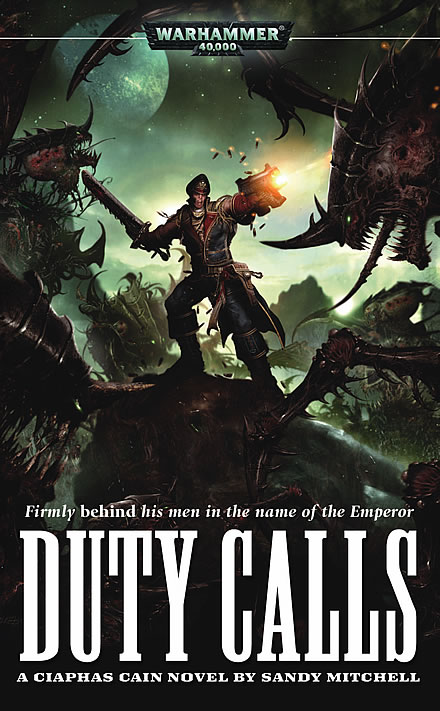
Warhammer 40,000: Duty Calls by Sandy Mitchell

Duty Calls Cover

Publisher: Black Library (Audiobook – 22 May 2007)

Series: Ciaphas Cain – Book Five

Length: 9 hours and 37 minutes

My Rating: 4.5 out of 5 stars

Amazon

One of the most entertaining authors of Warhammer fiction, Sandy Mitchell, continues to shine with the fifth book in his excellent Ciaphas Cain series, Duty Calls.

I doubt anyone is too surprised to hear that I broke a recent lull of reading by resuming the Ciaphas Cain series.  The Ciaphas Cain books, written by Sandy Mitchell (the alternate penname of author Alex Stewart), are an outstanding series that aims to bring a little humour to the crazy and dark battles of the gothic Warhammer 40,000 universe.  I have deeply enjoyed the first four books in this series, For the Emperor, Caves of Ice, The Traitor’s Hand and Death or Glory, and this honestly is one of the very best Warhammer 40,000 series out there.

Commissar Ciaphas Cain, hero of the Imperium and self-confessed self-serving coward, continues his exciting and deadly adventures when a new dark threat rises to destroy humanity.  After his last harrowing adventure with the Valhallan 597th, Cain is keen for a less deadly experience, and his new deployment to help crack down on civil unrest on the planet of Periremunda seems to be the ticket.  However, nothing is ever simple when Cain is involved.

Upon arriving on Periremunda, Cain quickly finds his life in danger as a series of assassination attempts are made against him.  Realising that his assailants are genestealers, the deadly scouts of the Tyranid swarm, Cain begins to understand the true danger Periremunda is in, as the genstealers herald the approach a Hive Fleet.  But unstoppable hordes of alien creatures are the least of Cain’s worries as he is reunited with his old flame, Inquisitor Amberley Vail.

Ostensibly on Periremunda to help the Imperial Guard stave off the Tyranid invasion, it soon becomes apparent that Vail is there for a darker reason.  Something incredibly important has been hidden on the planet that has the potential to change the entire Imperium.  Forced to assist Vail, Cain and his trusty aide, Jurgen, find themselves thrust into the deadly intricacies of a battle between hidden underground factions.  But with hungry Tyranids all around, deadly assassins gunning for Cain and a mysterious Chaos cult causing mischief, can Cain survive his deadliest encounter yet?

Duty Calls was an awesome addition to the Ciaphas Cain series that builds on several of the prior adventures, while also testing the protagonist in some fun new ways.  I loved the interesting story contained with Duty Calls, and this was one of Mitchell’s stronger additions to the series.

This fifth Ciaphas Cain novel had a great story behind it, although I am sure that prior readers will be familiar with the overall thrust of the narrative, with the seemingly cowardly Cain arriving on a new planet to face one threat, only to discover a much more dangerous enemy hiding beneath the surface that he is forced to reluctantly face and defeat, once again accidentally proving that he is a hero.  While Mitchell does try to break this story premise up throughout the series, this is a recurring story format, which can get a little too repetitive.  However, I think that Duty Calls stands on its own feet and Mitchell does a good job distinguishing it from the previous entries in the series.  The initial hidden threat of genestealers transforms into a massive Tyranid invasion, and it proved intriguing to see the protagonist face off against the ravening alien forces.  Tyranids are easily one of the best antagonists in the entire Warhammer 40,000 canon, and while they lose a little of their fighting ability in the face of Cain’s plot armour, they proved to be a great threat in Duty Calls.

While Mitchell could have probably left Duty Calls as simply a military novel, the inclusion of major recurring character Inquisitor Amberley Vail ensures that Cain is thrust into a much more subtle form of danger alongside the Tyranid invasion.  Caught between warring factions of the Inquisition and Adeptus Mechanicus, Cain is used as a pawn in the resulting shadow war, and there are some great scenes as Cain dodges assassination attempts, hidden Chaos cults, and other unseen dangers, all while trying to work out what the elaborate conspiracy is.  Novels that focus on the plots and conspiracies of Inquisitors are always very cool in the Warhammer 40,000 universe (see my reviews for Xenos, Malleus and Hereticus by Dan Abnett), and Mitchell fits Cain into this intrigue laden story arc extremely well.  It helped that there was some excellent set-up for this in the previous novel, and it was good to get a continuation here.  The resulting combination of storylines comes together really well, and Duty Calls has a really impressive and addictive narrative that will appeal to all fans of Warhammer 40,000 fiction.

As with the previous Ciaphas Cain novels, Mitchell does a great job of balancing the various elements of Duty Calls perfectly.  While primarily a military focused science fiction read, Duty Calls also has some great elements of intrigue and espionage, which ensures extra levels of excitement and danger.  However, I feel that the best part of Duty Calls is the inherent humour that Mitchell produces, which is a real rarity in Warhammer fiction.  Most of this is due to the hilarious and cynical narration of the main character, who pulls no punches when it comes to describing how ridiculous events are and the fact that he’s caught in the middle of them.  Extra humour is also built in due to the contained chronicle format that Mitchell has set the series out in, with the protagonist’s journal entries enhanced by extra documentation, descriptions, references and notes from Cain’s associate, Inquisitor Vail.  Vail’s sarcastic take on Cain’s description of events throughout these extra notes is a lot of fun, and the additional in-universe texts and broadcasts seek to showcase just how ridiculous humanity and the Imperium has gotten in the war-torn future, with over-the-top bits of propaganda and biased historical documents.  All this adds to quite a funny book, and this built-in comedy pairs remarkably well with the more serious parts of Duty Call’s narrative to create a truly addictive and fun read.

I felt that Duty Calls was a strong entry in the Ciaphas Cain series, especially as it builds nicely off the events of the preceding novel, Death or Glory.  Due to the series looking at different time periods of Cain’s career, Duty Calls is set between the second and third books, although it makes a lot of references to the first novel, and the events of Death or Glory, which took place many years before.  While the jumps around the timeline are a little confusing, Mitchell makes it work, and I liked seeing the return of several recurring characters, as well as a continuation of some mysterious storylines from the previous book.  Despite these connections, Duty Calls also works quite well as a standalone novel, and new readers can jump into the series here without too many issues.  Indeed, Duty Calls is a good introduction to both the Tyranids and the Warhammer 40,000 universe, and the Ciaphas Cain books are very much engineered for new Warhammer fans.  I will say that after reading several Ciaphas Cain books in a row, Mitchell’s proclivity for repeating elements from his other novels is a bit more obvious, and you do get a little weary of hearing the same phrases, descriptions and character depictions again and again.  Still, Mitchell ensures that Duty Calls is a particularly entertaining read, so its easy to really get stuck into it, and I deeply enjoyed seeing this unique series continue.

As always, I must mention the great characters featured within Duty Calls.  The most prominent of these is series protagonist Ciaphas Cain, who might be one of the more complex and debated figures in the Warhammer 40,000 canon.  Shown by his own admission to be a coward and a false hero, Cain spends most of the book trying to come up with ways to avoid combat and surviving the inevitable battles that his reputation and own bad luck force him to participate in.  His memoirs are filled with cynical allusions to the methods he utilises to survive, and you can see that Mitchell is trying to emulate classic characters like Flashman or Blackadder.  However, despite the character’s constant assurances that he is no hero, you see time and time again that there is far more to Cain, as he routinely defeats the enemy, often thanks to his own caution, survival instincts and ability to inspire his fellow troops.  I love how you are constantly rooting for Cain, despite his attempts to weasel out of trouble, and his self-deprecation about his actions really makes you feel for him, especially as its apparent that he is just one filled with self-doubt after not being an over-the-top martyr like the other heroes in the Warhammer 40,000 universe.  At the same time, Cain also provides a lot of the book’s humour, as you are bombarded with his fun comments and cynical attitude about everyone he encounters.  As such, I really appreciate Cain as a central character in this series, and it is always so much fun to follow him throughout his adventures.

Aside from Cain, there is an interesting array of characters featured in Duty Calls who I had a lot of fun with.  Many of them are recurring from the previous novels, and it was good to see various familiar faces again.  This includes Cain’s faithful aide, Jurgen, who Mitchell portrays in a manner like Baldrick from Blackadder, due to his apparent gormless attitude and poor personal hygiene.  However, in many ways Jurgen is just as much a hero as Cain, often being the one to save the day with his skills and big gun, and he forms a great team with Cain, especially as his Commissar is usually the one drawing the enemy’s attention from his aide’s attacks.  I also really enjoyed seeing the return of Inquisitor Amberley Vail, both as a character in Cain’s adventures and the person publishing his memoirs.  Vail proves to be the perfect foil to Cain for many reasons, and I like how she’s the only person who can effectively manipulate Cain and doesn’t fall for his lies and schemes.  Vail constantly calls out Cain, both in person and through the footnotes she amends to his chronicles, and I love how she has his number, while also clearly caring for Cain as a partner.  Duty Calls really shows just how dangerous Vail can be though, especially as she gets into the fight and makes some tough decisions.  Other interesting characters include several familiar soldiers from the Valhallan 597th, the outrageous members of Vail’s inquisitorial retinue, and a several intriguing antagonists who prove to be great and over-the-top opponents to the sensible Cain.  All these characters added a lot to the impact of the book, and I cannot wait to see how they fit into Cain’s adventures again in the future.

Readers who have seen my previous Ciaphas Cain reviews know that the only way I am going to enjoy this series is through its audiobook format.  All Warhammer novels make awesome audiobooks, but the Ciaphas Cain audiobooks are something particularly special thanks to the use of multiple narrators.  Duty Calls features six separate narrators who add a great deal to the production thanks to their fantastic voices and entertaining takes on the characters and universe.  Most of this narration is done by the superbly talented Stephen Perring, who lends his voice to all the chapters told from Cain’s perspective.  As such, he covers most of the first-person action and adventures of the main character, and his take on the complex Cain and his colleagues is exceptional.  The way he captures the various aspects of Cain’s character through his voice work is impressive, and you really get a sense of the multiple layers surrounding his motivations.  Perring also does a really good job of capturing the other intriguing characters Cain interacts with, including his aid Jurgen, and the eclectic members of the Inquisition that crosses his path.

After Perring, the most prominent narrator is Penelope Rawlins, who provides narrations for the various inclusions written by Inquisitor Vail.  As such, Rawlin’s voice is constantly interjected into the audiobook at various points as she reads out the footnotes, context pages, and personal remarks from Vail, as she attempts to make Cain’s story more readable.  Rawlins has really perfected her Vail voice over the course of the series, and it is always great to have the playful, informative, and often gently exasperated tones of a chronicling Inquisitor come through the plot.  There is also some good contrast between Perring and Rawlins, especially as both voice the character of Vail throughout Duty Calls, and they serve as a winning main team.

The other four narrators, Emma Gregory, Richard Reed, Tara Rawson and Andrew James Spooner are also very fun, even if they are used a little sparingly.  These four narrators’ voice extracts from various in-universe texts, chronicles and new casts that Inquisitor Vail has added to Cain’s manuscripts to give them more context.  These talented narrators go all out in voicing these intriguing and often over-the-top inclusions, and I love the humorous spin their excellent narration adds to them as a result.  Gregory is particularly noteworthy, especially as she once again voices the ridiculously patriotic memoirs of an officer fighting alongside Cain, but all these extra narrators do such a great job.  This excellent and entertaining combination of voice actors and audiobook narrators turns Duty Calls into a real treat to listen to, and I honestly cannot recommend this format enough to anyone interested in checking out the Ciaphas Cain series.

I continue to fall further in love with the Ciaphas Cain series as Sandy Mitchell produces another amazing and fun story in Duty Calls.  Loaded with action, humour, and a particularly complex protagonist, Duty Calls had everything I’ve come to expect from the Ciaphas Cain series, and I deeply enjoyed how Mitchell continues to showcase the Warhammer 40,000 universe in his own distinctive way.  I can think of no better way to highlight just how much of a great time I had with Duty Calls than to reveal that I automatically started listening to the sequel Cain’s Last Stand, the moment I finished it.  Highly recommended to all Warhammer fans and new readers wanting some fun science fiction adventures.

Amazon

Throwback Thursday – Warhammer 40,000: Hereticus by Dan Abnett

Warhammer 40,000 - Hereticus Cover

Publisher: Black Library (Audiobook – 30 July 2022)

Series: Eisenhorn – Book Three

Length: 9 hours and 48 minutes

My Rating: 5 out of 5 stars

Amazon     Book Depository

Welcome back to my Throwback Thursday series, where I republish old reviews, review books I have read before or review older books I have only just had a chance to read.  For this latest Throwback Thursday, I finish off the outstanding and iconic Eisenhorn trilogy by legendary Warhammer author, Dan Abnett, by reviewing the exceptional novel, Hereticus.

I have mentioned several times in the last few weeks that one of my absolute favourite authors of Warhammer fiction lately is the amazingly talented Dan Abnett, whose works have shaped a generation of lore and extended fiction.  I have really enjoyed several of the books in his excellent Gaunt’s Ghosts novels, such as First and Only, Ghostmaker and The Vincula Insurgency, which provide some captivating depictions of the common soldier in the Warhammer 40,000 universe.  However, based on what I have read so far, Abnett’s best series is the epic Eisenhorn trilogy, which follows titular character Inquisitor Eisenhorn as he attempts to protect humanity from a range of diabolical threats.  The first book, Xenos, served as an excellent introduction to Eisenhorn and his major supporting characters, while Malleus showed an older Eisenhorn as he attempts to unravel a massive conspiracy painting him as the villain.  I absolutely loved these outstanding novels and they both got a full five-star rating from me, and I immediately dove into the third and final book, Hereticus, as I really wanted to find how everything ended.

For over 150 years, Inquisitor Gregor Eisenhorn has loyally served the Imperium of Men, disrupting and ending multiple conspiracies and plots by heretics, daemons, and malicious xenos.  Throughout all this time, Eisenhorn has always tried to avoid the lure of the radical path that many of his fellow inquisitors tread, determined not to be corrupted by the forces he has sworn to destroy.  But desperation can drive even the best man towards the brink and Eisenhorn’s previous deal with a dark figure is coming back to haunt him.

Overseeing a Inquisitorial examination of the planet of Durer, Eisenhorn receives news that an old foe, one who cost him the life of a dear friend, is active on world.  Assembling his forces, Eisenhorn is unprepared for the full horror that awaits him, as his enemy unleashes an ancient evil capable of destroying worlds.  Facing tragedy and near death, Eisenhorn is forced to do the unthinkable and use foul rites to summon forth a greater evil in the form of the daemonhost Cherubael to survive.

Shocked and disgusted by his actions, Eisenhorn attempts to recover and atone for his mistakes.  However, before he can begin, his manor house is raided by a dangerous army of mercenaries and all his forces throughout the sector are brutally destroyed in an instant.  On the run with only a few loyal followers left, Eisenhorn needs to discover the identity of whoever is orchestrating his downfall before it is too late.  But to defeat his enemy, Eisenhorn is forced to dive deeper into heresy and call upon dark forces that are best left untouched.  Can Eisenhorn retain his sanity and soul, or is the price of his victory his own utter damnation?

Wow, just wow.  After how epic Xenos and Malleus proved to be, I knew that there was no way that I wasn’t going to love Hereticus.  However, I was unprepared for just how brutal and intense Abnett made this final book in the Eisenhorn trilogy, as Hereticus ended up being an exceptional read that perfectly ends his great series on a very high note.  Loaded with action, intrigue, and some amazingly complex characters, Hereticus gets another five-star rating from me, and this is honestly one of the best trilogies I have ever read.

Part of the reason why I enjoyed Hereticus so much is because it has an exceptionally epic story to it that really drags you in from the offset.  Set 50 years after the events of Malleus (150 years since the start of the series), Hereticus starts off big and never really slows down.  The book has a calamitous introduction that sees Eisenhorn and his comrades forced to confront a Chaos Titan which decimates them and forces Eisenhorn to call upon his captured daemonhost Cherubael.  This fantastic introduction not only perfectly continues the story from Malleus but also shows Eisenhorn’s progression towards radicalism as he uses his new knowledge in some pretty dark ways.  Following this introduction, which splits his main team up, the story continues strongly, as there is a major and extended battle sequence in the heart of Eisenhorn’s sanctum, which sees him forced out on the run.  Becoming a fugitive from new enemies, old foes, and the Inquisition itself, the rest of the novel is a very captivating and intense character-driven read that shows a desperate Eisenhorn continue to make radical decision after radical decision, all in the name of defeating his enemies, no matter the cost.  There are some extremely moving and powerful scenes scattered through the second half of the book, as Eisenhorn comes to terms with many of his long-running comrades, many of whom do not agree with his methods, as well as some deadly confrontations.  Everything leads up to a trippy and action-packed finale, as Eisenhorn finally faces down an old enemy.  While the ultimate confrontation is short and the main antagonist only has a brief appearance in the book, the real joy of the story is the hunt to find out who they are and what they are after, with a focus on investigation, intrigue, and ethics.  The conclusion leaves everyone extremely satisfied, and Abnett leaves the series open for follow-up, even if a ton of character-centric storylines are permanently closed by a series of deaths and destruction.

The author once again does an amazing job presenting the complex story contained within Hereticus and I have a lot of love for the writing style that Abnett utilised in this series.  Blending tense galaxy-spanning intrigue with the hunt for dark forces, massive mysteries, complex revenge plots, and a focus on the corruption of the spirit, there is a ton of fun for a lot of readers in this book, and I loved the elaborate conspiracy that was the fantastic focus of the plot.  I especially enjoyed the overall theme of Hereticus that saw Abnett try and bring a lot of storylines and character arcs full circle back to the original novel in the trilogy, Xenos.  The history of all the characters in the book, as well as multiple prior events, are essential parts of Hereticus’s plot, and I loved how the author was able to tie together a ton of compelling overlying storylines that really highlights the importance of the first two novels.  The primary storytelling method, a chronicle style from Eisenhorn’s perspective, adds a lot of power and flair to the overall book, especially as it enhances the character-driven aspect of the story and gives you some intriguing insights into the conflicted protagonist’s mind.  There are a ton of great scenes showcased as result of this first-person perspective, from multiple massive battles, to intimate conversations and even a very well-written psychic interrogation sequence.  Abnett has a great eye for detail and some of the resulting action sequences and unique locations are painted in such a way that the reader fully grasped every action or cool element of the setting.  This, and so much more, really helps Hereticus’ exceptional story shine through and I had so much fun seeing how this entire novel unfolded.

Like most of Abnett’s books, Hereticus can be read as a standalone novel, especially as the author does an exceptional job of recapping key events, characters, and relationships from the previous Eisenhorn entries.  However, to get the full emotional impact of epic narrative, I would strongly recommend checking out Xenos and Malleus first, as you really understand how the character has changed over the course of the series, as well as how well the storylines have continued.  I also felt that Hereticus proved to be a particularly good entry into the wider Warhammer 40,000 canon as Abnett continues to explore some of the most intriguing parts of this grim universe, including the dark cults that are constantly a threat to the Imperium’s stability and the Inquisitors who hunt them.  The fantastic dive into the different types of Inquisitors and their different ways of fighting the enemy is pretty cool and I loved seeing the various rivalries and discussions that eventuated, especially as Eisenhorn has an opinion on everything.  This book also takes the reader to a variety of unique locations within the Warhammer universe, with several unique planets becoming key settings for the plot.  I loved seeing the variety of worlds out there in this massive universe, and Abnett has fun tying the events of this book into some of the wider canon aspects of the franchise.  I would say that overall the Eisenhorn trilogy really is one of the best series to start reading Warhammer 40,000 fiction with, especially as you get a completely different and more elaborate story than the classic military fiction plots that make up the majority of the genre.

As always, I can’t go away from an Eisenhorn book without talking about the exceptional character work that Abnett brings to the table.  This is especially true in Hereticus, as Abnett brings so many compelling character arcs to a tragic and moving end, while also ensuring that his impressive protagonist is changed forever.

As you would expect, the focus of Hereticus is on protagonist Gregor Eisenhorn, who serves as the book’s primary narrator.  I mentioned during my previous reviews of these books that I have loved the complex and powerful story that Abnett has woven around Eisenhorn.  Starting off as a relatively innocent and uncontroversial Inquisitor who was just trying to do what is right, Eisenhorn has slowly slipped down the path of the radical by employing the methods and powers of his heretical foes.  Abnett has showcased this gradual fall perfectly in the first two books, and while he made some questionable decisions out of desperation in Malleus, you still believed that he could be redeemed.  Hereticus really has you doubt this as he begins to employ darker methods during this book, which not only cost him but impact the people around him.  However, this is not entirely his fault, as forces outside of his control drive him to do so.  Pretty much every mistake that Eisenhorn has made in his past seems to come back to bite him in Hereticus, and these events, and more, force him to make hard decisions to survive and defeat foes who are even worse than him.  While he does bad things, you can fully understand and appreciate why he feels he needs to do so, even if you don’t agree with them.  Despite these bad things, Eisenhorn remains a sympathetic character for most of the book, and his own realisation that what he is doing is wrong just makes the entire story that much sadder.  However, there is a layer of arrogance over this that makes you slightly concerned about Eisenhorn’s actions, and you’re never quite sure just how far he has truly fallen.  Abnett covers Eisenhorn’s overall character arc pretty damn perfectly, and while the author throws the protagonist’s decline into overdrive in this book, it felt pretty natural and showcases just how destructive desperation is as his good intentions lead him to hell.

On top of Eisenhorn, Hereticus features a bevy of compelling supporting characters who add their own complex spin to the story.  Many of the supporting characters from the first two books are once again featured in this third Eisenhorn novel, and I really appreciated how Abnett sought to bring many of their arcs and storylines full circle here.  Unfortunately for fans of the series, wrapping up their storylines results in most of the supporting character’s deaths or severe injury, and quite a substantial number of supporting figures from the first two books have their final appearance here.  While I won’t go into too much detail, several of these deaths are pretty damn tragic, especially after they follow on from some noble self-sacrifices or major character moments.  I was honestly shocked at how brutal Abnett was when it came to killing off his supporting characters, but all of these instances really worked in the context of the story and ensured that Hereticus ended up being particularly memorable.  Before these major deaths, though, the author dives into the powerful relationships that each of these supporting characters has with Eisenhorn, and there are some deeply emotional moments scattered through, especially as each of them have their own opinion about Eisenhorn’s recent actions and whether he has gone too far.  Watching his oldest friends become disgusted or outraged by his actions really hammers home how far Eisenhorn has fallen, especially as he drags several characters down with him.  Throw in some outstanding central antagonists, all of whom have a complex history with Eisenhorn, and some intriguing cameos from the previous novels, and this was an exceptionally character rich novel designed to hit you in the feels.

As with all of Abnett’s books to date, I grabbed the audiobook version of Hereticus, which was once again an exceptional way to enjoy this amazing novel.  Coming in at just under 10 hours and featuring the impressive narration of Abnett’s go-to audiobook narrator, Toby Longworth, this format was an excellent way to enjoy this book, and I managed to power through this entire story in no time at all.  Longworth really brings the entire story to life with his excellent narration, and he makes sure to infuse all the characters with a ton of personality, while also tailoring their voices to match their history and physical (or metaphysical) attributes.  I also thought that several of the best scenes of this book, including some desperate battles, a cool interrogation scene, and some particularly poignant character interactions, were made even more epic in this format, as the exceptional acting from Longworth showcased them in a way they truly deserved.  I was utterly enthralled the entire way through Hereticus’s audiobook and this was easily the best way to experience Abnett’s compelling tale.

Overall, I felt that Hereticus was a pretty amazing book and a suitably epic finale to Dan Abnett’s original Eisenhorn trilogy.  Bringing together a powerful story with some unique Warhammer 40,000 elements and an exceptional dive into the mind of a fallen inquisitor, Hereticus was utterly addictive and ended up being one of the best Warhammer books I have ever read.  I was really impressed with how Abnett concluded this incredible trilogy, and I felt that Hereticus was an excellent final entry that tied together some of the complex storylines from the first two books.  I cannot recommend this entire trilogy enough; it truly is one of the cornerstones of Warhammer 40,000 fiction.  I look forward to reading more from Abnett in the future, especially as there are several spin-offs associated with this trilogy, as well as a recently released fourth Eisenhorn book in The Magos.  However, I think I will try and get through some Gaunt’s Ghosts books first, before diving back into Abnett’s Inquisitor stories, although if I ever want a powerful Warhammer thriller, I know where to look.

Amazon     Book Depository

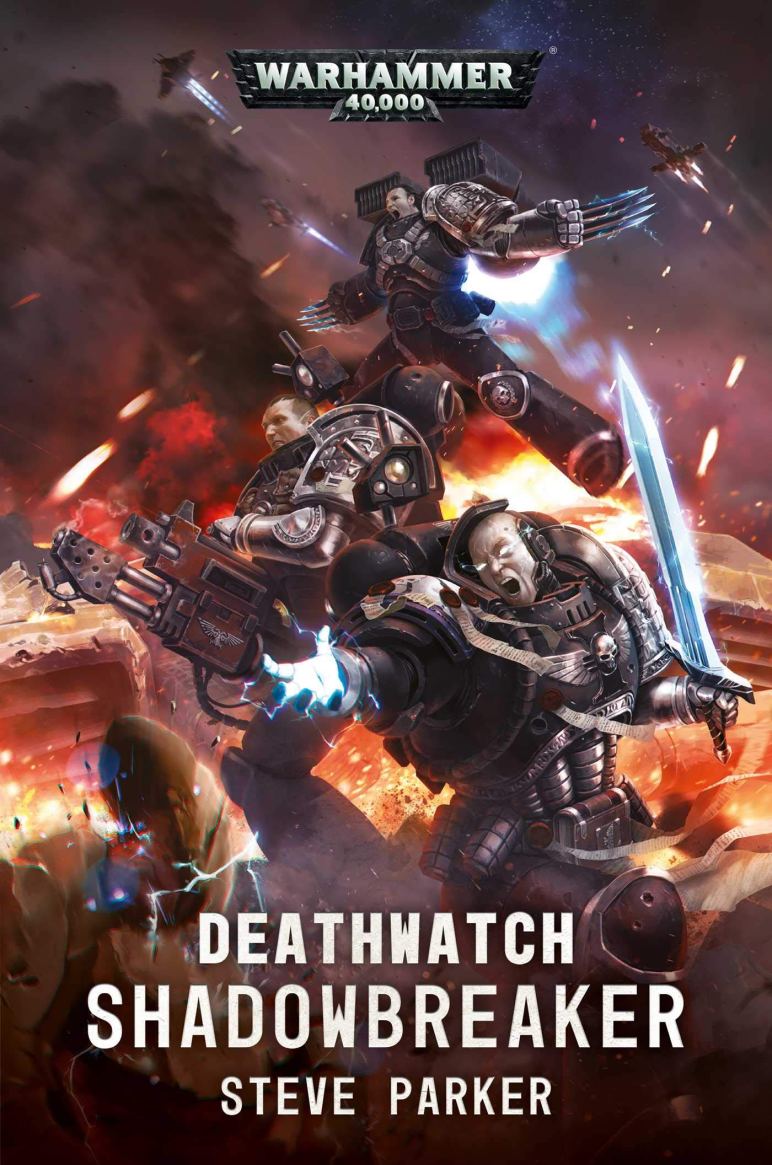
Deathwatch: Shadowbreaker by Steve Parker

Deathwatch Shadowbreaker Cover

Publisher: Black Library (Audiobook – 25 April 2019)

Series: Warhammer 40,000/Deathwatch – Book Two

Length: 16 hours and 37 minutes

My Rating: 4.5 out of 5 stars

Amazon

Prepare to dive into the extended universe of Warhammer 40,000 (Warhammer 40K or 40K), as science fiction author Steve Parker presents Deathwatch: Shadowbreaker, an action-packed and exceedingly exciting sequel to his 2013 novel, Deathwatch, which pits the deadly Deathwatch Space Marines against an entire planet full of T’au.

Thousands of years in the future, the galaxy is constantly at war. Humankind has survived as the massive Imperium of Man, under the divine protection of their long-dead Emperor. However, this beacon of humanity is under constant threat from all sides. Destructive alien races, demons from the warp and the traitor forces of Chaos continuously assault its borders, whilst heretics, mutants and witches attempt to destroy it from within. Over the millennia, the Imperium has created many different forces to protect their worlds from these threats; however, none is more feared or revered than the Adeptus Astartes, the Space Marines. Space Marines are legendary warriors genetically modified to become significantly stronger, larger and faster than a normal man. Swathed in power armour and armed with the deadliest of weapons, the Space Marines are a force to be reckoned with on the battlefield, bringing the Emperor’s wrath down on all who oppose them.

But even amongst these deadliest of soldiers, there is one organisation of Space Marines who are respected above all others for their fighting ability and skill, Deathwatch. Deathwatch is an elite group made up of best Space Marines veterans from across the Chapters, trained to become the ultimate tools in one of the Imperium’s holiest missions, the extermination of the xenos, the alien. Utilising the most advanced technology in the Imperium and receiving specialist instruction in the strengths and weaknesses of their foes, Deathwatch work in small kill-teams under the Ordo Xenos of the Imperial Inquisition in order to hunt down and destroy the most dangerous xenos threats in the galaxy.

Lyandro Karras, Codicier of the Death Spectres, is a powerful Space Marine Librarian serving in the Deathwatch as the leader of the kill-team, Talon Squad. Barely recovered from the disastrous events of their last mission, Karros and Talon Squad once again find themselves under the command of the mysterious Inquisitor Sigma. Their new mission takes them to a former Imperial world that has been conquered by the alien T’au, who have indoctrinated the majority of the human population into their society and philosophy. An Imperial Inquisitor, Epsilon, has gone missing in T’au space, and Sigma believes that she is being kept prisoner on the planet. Desperate to free her before the T’au extract vital secrets about the Imperium from her, Talon Squad and a force of Ordo Xenos Storm Troopers are deployed to find her. Working with the local human resistance, Talon Squad identify the prison she is located in and must work to release her before the massive T’au garrison knows they are on planet. But what happens when Epsilon refuses to accompany Talon Squad back to the Imperium?

Deathwatch: Shadowbreaker is part of the massive extended universe which has formed up around the Warhammer 40K tabletop miniature game produced by Games Workshop. Warhammer 40K, which was first released in 1987 and pits armies of science fiction miniatures against each other, has always contained an interesting and grim science fiction narrative to serve as a background to the game. With every new edition of Warhammer 40K that was released, this background narrative got more and more detailed, resulting in an extremely deep, compelling and gothic-themed fictional history surrounding all of the different races, armies and characters featured within this tabletop game. Due to the popularity of the Warhammer 40K universe, a huge amount of expanded material has also been released over the years, including several videogames, comics, board game spinoffs, an animated movie (with a remarkably good cast of British actors) and there is currently a television series in production. However, the main medium that has been utilised as part of this expanded universe is books.

Over the years, there has been a tremendous amount of Warhammer 40K books produced, featuring the works of a number of skilled and talented science fiction authors. There are now hundreds of Warhammer 40K books currently published, covering the different periods and races featured in the tabletop game. In 2019 alone there were nearly 20 different novels, anthologies and audio dramas associated with Warhammer 40K. This is a very impressive amount of material, and I have not even mentioned the multiple book releases associated with the separate Warhammer Fantasy universe.

While I am a man of many, many different fandoms, the products of Game Workshops are among the earliest fantasy and science fiction products that I was a major enthusiast of. I was extremely into Warhammer Fantasy when I was a kid and I have many fond memories of painting and battling with the models, reading the company’s monthly White Dwarf publication and playing some of the Warhammer 40K computer games, such as Dawn of War. While I was solely playing with Warhammer Fantasy models, I did learn a lot about Warhammer 40K at the same time, especially as I really enjoyed reading all the lore and background of the various Games Workshop products. I have been meaning to read some Games Workshop fiction for a while now, and I have previously mentioned that I want to read the cool-sounding Gaunt’s Ghosts series. However, I ended up reading the recently released Deathwatch: Shadowbreaker instead, mainly because it featured two of my favourite groups from the Warhammer 40K lore, Deathwatch and the T’au, facing off. Shadowbreaker is the latest book from Steve Parker, a science fiction author, who has primarily written Warhammer 40K fiction. Shadowbreaker is his first release since 2016, and it is actually a sequel to his 2014 novel, Deathwatch, which featured the same group of primary characters.

I am actually really glad that I chose to read and review Shadowbreaker, as this excellent 40K novel contains an awesome and extremely entertaining story that features all manner of action, adventure and intrigue, while also diving deep into several fascinating parts of 40K’s lore. Shadowbreaker is an excellent sequel to the author’s previous book, Deathwatch, and Parker does an amazing job of continuing the story that was started in this prior book, while at the same time setting up some intriguing potential directions for the series to go next. Prior knowledge of the events of Deathwatch is not a necessity to enjoy this book, as Parker does a good job of re-introducing all the relevant events of the previous novel, and readers should be able to follow Shadowbreaker’s story without any real issues. Parker has created a rich narrative for this book that utilises a huge number of character viewpoints to not only examine the development within several characters but also explore a number of different angles and features of the harsh gothic universe in which this book is set. These multiple viewpoints work especially well during Shadowbreaker’s extended action sequences, as they allow Parker to show off every aspect and side of the brutal battles, resulting in some exciting and detailed combat set pieces. Shadowbreaker’s story ends up going in some rather intriguing directions, featuring some fun twists and reveals, and this was an overall fantastic and exciting story to check out.

While Shadowbreaker is an amazing novel, it might not be as appealing to those readers who are not familiar with the Warhammer 40K universe. This book is pretty lore heavy, containing a whole lot of references to history, technology, alien races and other unique aspects of this fictional universe. While I felt that Parker did a great job of explaining most of the Warhammer 40K elements that are relevant to the story, a certain amount of prior knowledge about this massive universe will really help readers understand what is going on. Do not get me wrong; readers unfamiliar with the franchise will easily be able to follow and enjoy Shadowbreaker’s story, but they may have trouble appreciating all the interesting lore references or depictions from the miniatures game. As a result, I would probably recommend this book more to established fans of the 40K universe, although casual science fiction readers are definitely going to have a good time reading this. That being said, I note that some other readers of this book who are more familiar with the actual tabletop game than me were put off by a couple of apparently incorrect depictions of weapons, armour and vehicles. While these apparent anomalies in no way impacted my enjoyment of the book (honestly, I am not knowledgeable enough about battle gear to have really picked up on this), I can imagine that this could annoy some hardcore 40K fans, so fair warning about that.

For me, one of the major appealing aspects of this book was its excellent examination of fascinating elements from the Warhammer 40K universe. As I mentioned above, the universe of the 40K games are filled with all manner of fantastic, complex and unique features which are all backed up with a ton of lore and fictional history. Parker does an awesome job of setting Shadowbreaker within this universe and he ends up utilising quite a lot of detail from the games in the story. There is actually quite a lot going on within this book. Not only do you have the primary storyline of Space Marines versus T’au but you also have storylines that relate to infighting and intrigue within the Ordo Xenos, examination of the constant threat that is the Tyranid, the machinations of the Eldar, and the long-term plots of a demon lord thrown in on top. All these various storylines actually come together really well into an outstanding story, and fans of the 40K franchise are almost guaranteed to have some mention or discussion about their preferred army or race in the game (with a couple of exceptions).

However, the thing that really excited me the most about this book was the central conflict between Deathwatch and the T’au. I am a major fan of both of those groups and have always been really intrigued by the cool lore and background that surrounds them. When I started reading this book, I was half-expecting the story to be shown purely from the perspective of the Deathwatch characters. If this had been the case, the author would have been forced to do a classic humans versus aliens storyline, where aliens are automatically the bad guys due to the Space Marines’ inherent hatred of all things alien. Therefore, I was pleasantly surprised when Parker presented a much more complex storyline which showed neither side as “good” or “evil”. Instead, thanks to the author’s excellent use of multiple perspectives, it is shown that both sides of this conflict are dominated by dangerous fanatics driven by their beliefs, either in the purity of destroying all things alien or the defining T’au philosophy of the “Greater Good”. This belief results in both sides doing some very questionable things in order to achieve their objectives, most of which result in large amounts of destruction and death. Interesting enough, it is Lyandro Karras and some of the members of Talon Squad who are the most reasonable characters in this book, and all of them have been heavily indoctrinated about the evils of the alien. This all makes for a much more intriguing and clever story, and I loved how it helped highlighted how complex this universe can get.

Shadowbreaker contains quite a bit of information about how the legendary Deathwatch operates, which is just downright fascinating, and I can imagine a lot of readers would be really interested to learn more about. While there was a lot more about the layout of the organisation and their training in the initial Deathwatch book, readers of Shadowbreaker learn a lot about them in this book. For example, Shadowbreaker contains information about Deathwatch’s unique relationship with the Inquisition, their skills in battle, their knowledge of the aliens they fight and the fact their ranks consist of Space Marines from various chapters. All of this is really cool, and there were a fantastic central organisation to centre the book on.

I also quite enjoyed the examination of the different Space Marines that make up the various Deathwatch kill-teams featured within this book. Thanks to the author’s use of multiple character perspectives, the reader gets to see through the eyes of a number of Space Marine characters. Parker cleverly utilises this to show off the varied personalities of the Space Marines, and it was interesting to see how diverse these genetically enhanced and indoctrinated killing machines can really be. A lot of this is due to the specific Chapters that they come from, as each character seems to reflect the traits of their Chapter and their founding father. I liked how the multiple perspectives helped highlight he different fighting styles of the various members of the Deathwatch kill-team, especially as each of them utilises different weapons and tactics to achieve their goals, reflecting the defining skills of their original Chapter. For example, the Raven Guard character continuously utilises a jump pack and lightning claws in his fights, while the Imperial Fist preferred to use heavy weapons. These different combat techniques add an extra layer of spice to the various fight sequences, and I really liked seeing the different characters in action. I was also really intrigued by the author’s deep dive into the history and peculiarities of two of the lesser-known Space Marine chapters, the Death Spectres and the Exorcists. Parker reveals some really interesting facts about these two Chapters, mostly when these respective characters think back on their past or their Chapter. I really didn’t know that much about these two Chapters before this book, and I really enjoyed learning more about them, especially as they have some very cool and unique traits (one summons and betrays demons for an initiation test; the other has a mysterious glass throne hidden on their home planet). As a result, fans of Space Marine history and lore are really going to love this book, and even non-fans will appreciate the world-building associated with them.

In addition to the intriguing examination of Deathwatch and other Space Marine Chapters, Parker also features an excellent look at one my favourite races in the Warhammer 40K universe, the T’au (or Tau). The T’au are probably the newest race in 40K canon (although that was quite a few years ago) and have been featured in a couple of books and have even had their own video game, Fire Warrior. T’au are a young race of aliens whose empire has quickly expanded in recent years thanks to their advanced technology and wiliness to incorporate alien races into their empire. Their sudden expansion has made them a real threat to the stagnant Imperium of Man. Parker does an amazing job incorporating the T’au into this book, and there are some fantastic depictions of their technology and unique physiology. The T’au serve as excellent primary antagonists for this book, and Parker takes an interesting view of them, diving into the darker side of their empire. Thanks to the various character perspectives contained within Shadowbreaker, the reader gets to see more than their typical depiction as a beatific race who merely wish to share their technology and their message of the “Greater Good” throughout the universe. Instead, you get to understand how slavishly devoted to their philosophy they really are, and the lengths that some of them will go to achieve their race’s goals. There are some really interesting discussions about how they control the populations they conquer, as well as some brief but curious mentions of T’au who do not follow the Greater Good and are persecuted or punished for this. I also really liked the detailed examination of a human world that is being ruled by the T’au, especially as you get to see all the various benefits and downfalls of this control. The fact that neither the T’au nor the Imperium actually care about the planet or its people is a bit of a dark spot in the novel, and some of the conclusions of the book reveal just how much better off this planet would have been on its own. If I had one complaint about Parker’s depiction of the T’au, it would be that they went down way too easily in a fight. While a couple of their units and commanders were able to hold their own for a bit, the rest of the T’au forces were pretty much slaughtered in one-sided battles throughout the book. While I appreciate that the author was probably trying to demonstrate Deathwatch’s skill at killing aliens, I think he could have perhaps added in a bit more of a fight from this popular race. Still, I really enjoyed this inclusion of the T’au, and I need to check out some other books that feature them.

I ended up listening to the audiobook format of Shadowbreaker, which was narrated by Andrew Wincott. Shadowbreaker clocks in at just over 16½ hours, so it is a fairly substantial audiobook which takes a little bit of effort to get through. I was very impressed by this format of the book, and I personally found it a great way to absorb all the amazing things occurring in the story. Wincott is a really good narrator, coming up with some distinctive and appropriate voices for the huge raft of characters that were featured in this book. I really liked how Wincott was able to capture the emotion and mood of the various characters, and I was especially impressed with the harsher tone that he took for many of the Imperial characters, which fitted perfectly into the gothic style of the Imperium. As a result, I would highly recommend the audiobook format of Shadowbreaker to anyone who is interested in checking this book out, and it is a wonderful way to enjoy this great piece of Warhammer 40K fiction.

Deathwatch: Shadowbreaker by Steve Parker was an incredible read which I found to be extremely entertaining and which proved to be a perfect reintroduction for me to the Warhammer 40,000 franchise. Parker presents an exciting and compelling story that dives deep into the universe’s lore while also exploring some of the complexities of the various featured races and armies. Overall, this is an outstanding novel and I am really glad that I checked it out. I fully intend to read more Warhammer 40K fiction in the future, especially after enjoying this book so much, and I hope that Parker continues his Deathwatch books in the future as well.

Amazon