
Warhammer 40,000: Daemonbreaker by Jude Reid

Publisher: Black Library (Audiobook – 24 August 2024)

Series: Warhammer 40,000

Length: 7 hours and 27 minutes

My Rating: 4.25 out of 5 stars

Amazon

Gird yourself in faith, fury and fire, as fantastic author Jude Reid presents her latest Warhammer 40,000 novel, Daemonbreaker, which follows a complex figure as she blazes forth into the darkness of the Warhammer 40,000 universe.

After having a wonderful time with Warhammer 40,000 novels like Deathworlder by Victoria Hayward, Lord of Excess by Rich McCormick, Siege of Vraks by Steven Lyons and Oaths of Damnation by Robbie MacNiven, there was no way I was going to stop loving this franchise this year, so I eagerly dove into the cool new audiobook, Daemonbreaker by Jude Reid.  Reid, who really impressed me last year with Creed: Ashes of Cadia (one of my favourite debuts of 2023), presents an intriguing and dark novel that follows members of the Adepta Sororitas, the Warhammer 40,000’s resident nuns-with-guns.

On the battlefields of faith and fury, few warriors in the Imperium of Man can match the battle prowess of Celestian Sacresant Aveline of the Order of the Sacred Rose.  A deadly sister of the Adepta Sororitas, devoted to killing the mutants, witches, heretics and daemons that oppose the Emperor, Aveline is always eager for greater combat, and soon finds the ultimate opportunity she has been waiting for, defending the fortress world of Cadia from the ravening forces of Chaos as they embark on their 13th Black Crusade.

However, before Aveline can join her sisters in the massive battle for Cadia, she has been assigned final sacred duty.  Sent to Orrison VIII, a minor shrine world in the Cadia Gate system, Aveline is tasked with securing the desert world for the Emperor and scouring the forces of Chaos from its surface.

Desperate to find glory on Cadia, Aveline chafes at the slow speed of the mission on Orrison VIII, especially as their primary target, a deranged Chaos sorcerer, is content with playing a slow game of cat-and-mouse with her.  However, when Aveline finally gets her chance to face the enemy, she finds herself confronting a dark foe who knows her name and has a sinister scheme to destroy her and her sisters through her own arrogance.  If Aveline is unable to stop the dark Chaos forces before her, a deadly foe will be unleashed upon Holy Terra that could destroy the heart of humanity as it faces its darkest moment.

Daemonbreaker was a fantastic and compelling Warhammer 40,000 novel that expertly features an iconic faction and looks at the faith and emotions lying beneath their militant surface.  Jude Reid continues to impress with this cool novel and I had an excellent time getting through the intense and exciting story, which seeks to bring to life the figure of Celestian Sacresant Aveline who recently got her own model in the game.

I must admit, before diving too far into this review, that I sometimes found it a little hard to connect with Daemonbreaker at times, primarily because I’ve never been a massive fan of the Adepta Sororitas as a faction.  They’re honestly a little too one-note for me at times, and I never been especially drawn to their fiction as a result.  However, I felt that Reid was able to lift her narrative above some of the inherent limitations of this faction throughout the course of the book.  It helped that Daemonbreaker was a relatively shorter Warhammer 40,000 novel, so Reid sped up the plot, which in turn kept the reader from getting bogged down.  The resulting story is exciting and intriguing, as author quickly sets up the primary plot of the hunt for Chaos on Orrison VIII, while some initial compelling action set pieces help grab the reader’s attention.

The main narrative moves at a quick pace, with the protagonist leading her force into several encounters out in the desert while battling her own emotional turmoil and disappointment.  However, everything in the story changes around the halfway point of Daemonbreaker, when the author decides to throw the entire status-quo of the book on its head.  Thanks to a combination of the protagonist’s mistake and a major Warhammer 40,000 universe event, everything gets substantially more desperate for the protagonists, and Reid goes a little nuclear stacking the odds against them.  While there are a few gaps in the storytelling, the second half of Daemonbreaker is extremely fun and exciting, as the protagonists face impossible odds and encounter the very worst the universe has to offer.  There is a ton of tragedy and some horrifying moments as the reader races towards the end of the book, and it proves harder and harder to put it down as you near the conclusion.  Reid loads up some big final battles that showcase just how grim things can get in this universe, before the expected miracle brings things to a close.  Readers come away from Daemonbreaker feeling pretty satisfied with how things come to an end, although I did feel that part of the plot was a bit thin in places.

Reid has a great handle on writing Warhammer 40,000 fiction, and this is on display again in Daemonbreaker.  There is a notable cutdown in the exposition and Reid brings the reader right into the action and carnage which made it an easier book to get through, especially considering the faction focus.  The various action sequences come across as gritty and powerful, and you can feel the raw emotions of the protagonists as they encounter their dark opponents and the dreadful things they need to overcome.  Reid ensured that this was a concise and well-contained narrative through her use of two point-of-view characters, and I appreciated the excellent alternating perspectives.  Both protagonists were very well written, with the main story around Celestian Sacresant Aveline being the most prominent.  A deadly, if arrogant, sister of the Emperor, Aveline finds her devotion challenged by her own selfish desires and issues, which leads to dark things in the middle of the book.  While I didn’t always connect with Aveline as a character, I felt that Reid wrote a rather good redemption arc around her, and she becomes a lot more likeable and relatable in the second half of the book, especially as she comes to recognise her hubris and flaws.  Recognising these things allows her to fully appreciate her fellow sisters and leads her into the right place for the final arc of the plot to unfold.

Aveline is well balanced by the second perspective character, Novitate Gwineth, a young, keen and determined figure, whose eagerness to become a member of the Adepta Sororitas is drawn from her impending doom.  Reid writes an interesting and unique Warhammer storyline around Gwineth having haemophilia, which ensures that her days on the battlefield and in life are limited.  Wishing to die as a full sister, Gwineth’s keenness becomes a key part of the plot, and I loved seeing her grow into the role she wishes, especially as her innocence and determination are a driver for the rest of the cast.  The rest of the characters within Daemonbreaker are also very fun, if sparingly used.  I do perhaps wish that the author had added in additional perspective, preferably from a villain’s point of view, as I feel that would have enhanced the narrative to a degree, especially to provide some missing plot answers or explain the motivation and plans of the antagonists.  However, for the most part, this was a very well-written story with some intriguing protagonists, and one that I had an excellent time getting through.

The author has really gotten the hang of showcasing the grim and intriguing Warhammer 40,000 universe, and I loved some of the directions and figures that she featured within Daemonbreaker.  I especially felt that Reid does an excellent job examining Adepta Sororitas faction, the Sisters of Battle, within the book.  The various different units and figures of the faction are dropped into the plot fairly seamlessly, and even someone unfamiliar with the Adepta Sororitas unit types can easily appreciate their role in the plot.  I must also once again emphasise that Reid was able to overcome my disinterest in the classic Adepta Sororitas depictions with her clever narrative and compelling writing.  While this was a great Warhammer 40,000 novel, I feel that Daemonbreaker is perhaps a book best left to established Warhammer fans, as Reid does feature some heavy lore elements, and Adepta Sororitas players will probably get the most out of it.  Still, a new reader can easily come along and have a lot of fun with Daemonbreaker, as Reid’s story gets quite intense, personal and brutal.  You may have to ignore the fact that Daemonbreaker mainly written to promote a new model released in the tabletop game, but if you can get past that, this is a book well worth checking out.

Naturally, I ended up grabbing Daemonbreaker on audiobook, as this format is the absolute best way to enjoy a Warhammer book.  I really cannot emphasise how much more epic a Warhammer 40,000 tale comes across when it is read out to you, and I always have so much more fun listening to it.  This is particularly true when it comes to all the epic action, and I felt that the carnage in Daemonbreaker was very strongly enhanced by the audiobook format, with listeners also able to appreciate the compelling characters and intriguing lore while it’s being read out to you.  With a runtime of around seven and a half hours, this is a relatively short audiobook, and one that listeners can really power through, especially when they get caught up in the action and compelling character arcs.

One of the big highlights of this audiobook for me was the fact it was narrated by the appropriately named Faith Alabi, who really dives into the complex Adeptus Sororitas characters with her voice.  Each of the key protagonists is given their own unique voice, and I liked how well Alabi expressed their holy rage, and personal issues.  Alabi’s excellent voice work is cleverly supported by some fun additional audio enhancements, which I thought was a fun way to express some unique elements of the Warhammer 40,000 canon.  For example, the cybernetic figures, such as members of the Adeptus Mechanicus, have a noticeable robotic voice modulation that really tries to capture their machine nature, while communication occurring over vox-casters (radios), are filled with static and sound effects to emulate how the voices would sound in real life.  In addition, certain audio effects give dark and otherworldly voices to the antagonists, such as a particularly booming tone that makes the dialogue of a Chaos sorcerer antagonist that more impactful, or freaky vocal effects that make a major daemon seem even more powerful.  These audio effects work extremely well alongside Alabi’s narration, and I really appreciate the effort the producers made to drag listeners further into the story.  As such, those who decide to check out Daemonbreaker on audiobook are in for a very fun treat and this is such an awesome way to enjoy this fantastic addition to the Warhammer 40,000 canon.

Daemonbreaker was another amazing Warhammer 40,000 outing from Jude Reid, and one I was very glad I checked out.  The author effectively brings the main character to life in this book while also showcasing a compelling and intense Warhammer narrative of sacrifice, tragedy and holy war.  As such, Daemonbreaker is an excellent read for all fans of Warhammer 40,000 fiction, and I cannot wait to see what Reid takes on in the future.
Amazon

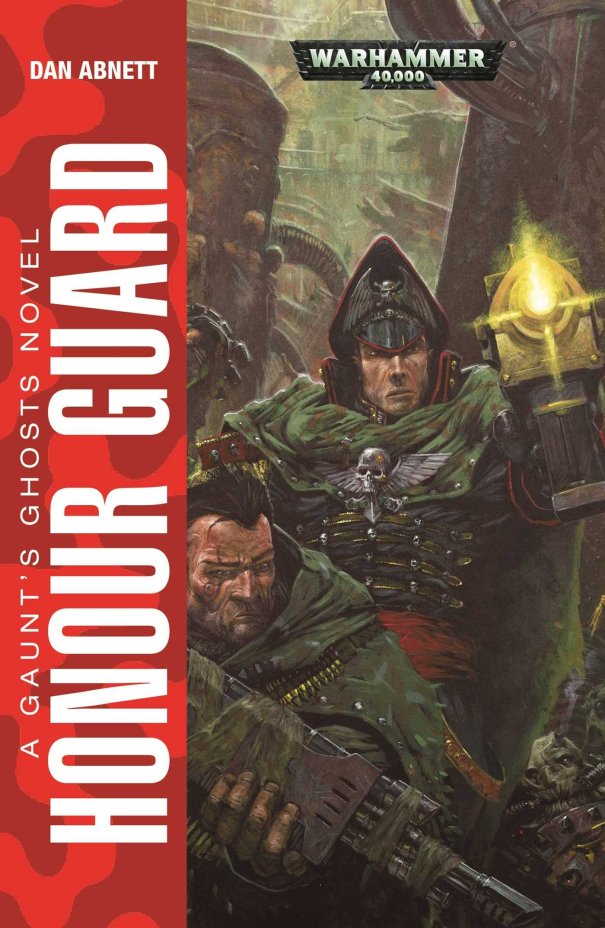
Throwback Thursday – Warhammer 40,000: Honour Guard by Dan Abnett

Warhammer 40,000 - Honour Guard Cover

Publisher: Black Library (Audiobook – July 2001)

Series: Gaunt’s Ghosts – Book Four

Length: 10 hours and 12 minutes

My Rating: 4.5 out of 5 stars

Amazon

Welcome back to my Throwback Thursday series, where I republish old reviews, review books I have read before or review older books I have only just had a chance to read.  For this week’s Throwback Thursday I’m still in a Warhammer 40,000 mood, so I decided to dive even further into Dan Abnett’s classic Gaunt’s Ghosts series with the fourth book, Honour Guard.

Readers of this blog will no doubt have noticed a fair increase in the number of Warhammer 40,000 novels I’ve highlighted this year, as this entire grim expanded universe has quite an addictive quality to it.  Foremost amongst these books have been the compelling works of veteran author Dan Abnett, who has written so many impressive and key parts of the Warhammer canon over the years.  I deeply enjoyed his Eisenhorn trilogy (Xenos, Malleus and Hereticus), all three of which were given pride of place in my recent post listing my favourite Warhammer 40,000 novels.  However, his best-known works are his Gaunt’s Ghosts series of books, which catalogue the adventures of the Tanith First and Only regiment of Imperial Guard, better known as Gaunt’s Ghosts.  I have had a wonderful time with the first three novels, First and Only, Ghostmaker and Necropolis, as well as the prequel novel The Vincula Insurgency, which showcased the bloody lives of the common soldier in this war-torn universe.  I have really gotten attached to this series and when I wanted a quick read, there was nothing I would rather turn to then the next Gaunt’s Ghosts book, Honour Guard.

Throughout the extended, system-spanning Sabbat World crusades, the men of the Tanith First and Only have fought against the dark forces of Chaos in every way imaginable.  Led by their heroic commander, Colonel-Commissar Ibram Gaunt, the Tanith soldiers, known colloquially as Gaunt’s Ghosts, have had many victories, but few failures.  So, when fighting on the holy Shrine World of Hagia, the Ghosts are devastated when they trigger a disastrous enemy trap that destroys a holy city and creates a psyker beacon that will draw a massive Chaos fleet down on their position.

Troubled by his failures to protect one of the most important planets in the Sabbat Worlds and made a scapegoat by his commander, Gaunt is left a broken man.  His one chance to save his career and his regiment is to lead the Tanith and an armoured company as an honour guard to a sacred shrine to recover the holy relics of Saint Sabbat.  If he can recover the relics and evacuate them from the planet before the Chaos fleet arrives, he may be able to keep the Ghosts under his command.

Beginning the arduous pilgrimage, Gaunt and his men soon discover that the road to the shrine isn’t as clear as their intelligence indicated.  A vast enemy army lies in wait for them, and the Ghosts will have to fight every step of the way to secure their objective and make their escape.  However, there are far more mysterious forces at work behind the scenes as Gaunt and some of his men soon find themselves being driven on by religious visions of Saint Sabbat herself.  Is the holy saint talking to them, or is something more sinister manipulating them?

Honour Guard was another epic science fiction military adventure that I powered through in no time at all.  Skilfully continuing the intriguing Gaunt’s Ghost story, Abnett has produced a thoughtful and intense read that throws the protagonists into a captivating action-packed scenario that really showcases the gritty nature of the Warhammer 40,000 universe.

Honour Guard has a somewhat typical Gaunt’s Ghosts story to it, and if you’ve read the series before then you know that means great characters, intense fights with big set-piece battles, and a compelling look at the common soldier in the Warhammer 40,000 universe.  This fourth book follows on from the events of Necropolis, and Abnett quickly and ably shows the changes to the regiment that the previous adventures have wrought, especially with all the new Verghastite recruits.  Abnett starts things off with an epic series of battles as the Ghosts attempt to take a Chaos controlled city.  This opening sprawl of fights is not only intense but it expertly introduces the new setting, sets up several key story points, and lets the reader know who the main characters of Honour Guard are going to be.  From there, the characters, especially the main protagonist, Gaunt, face a major setback as the city is destroyed, their allies are killed, and a massive Chaos fleet has been summoned to destroy the holy planet they are on.  There are some great moments in this early bit of the book, especially as Abnett really dives into the impacts of the failure on Gaunt.  It also sets up the intriguing story element that Gaunt is likely to lose his command and the Ghosts will be broken up as a result.

With that set up, Abnett then drives into the meat of the story, with Gaunt leading the Ghosts and an armoured regiment as an honour guard to retrieve the sacred relics of one of the Imperium’s most important saints before the enemy fleet arrives.  Framed as an easy mission to give Gaunt an honourable send off, the mission naturally goes to hell when the Ghosts discover a vast enemy army between them and their goal.  This results in several major battles on the road, and Abnett has a lot of fun combining infantry fighting with tank warfare to make the conflicts even more impressive.  Each battle is extremely fun in its own regard, and fans of action and military combat really won’t be disappointed by Honour Guard as a result.  At the same time, there is a real focus on the characters, as several of the protagonists are going through different personal struggles, especially Gaunt.  Abnett also introduces an intriguing and moving side storyline that sees several long-running Gaunt’s Ghosts characters, who were wounded and left behind, attempt to make their own way to the conflict, guided by religious visions.  Everything leads up to a final battle sequence at the objective as the honour guard are trapped with a massive enemy force coming towards them.  Abnett naturally spends pages detailing all the bloody fighting, which serves as a great backdrop to the main story elements.  While I did think that the big finale of the book was too sudden and coincidental, it did fit into the general theme of faith and miracles that were covered in a lot of the plot.  Overall, this was another great, action-heavy narrative that I was able to sit back and enjoy.

As with all Abnett’s work, Honour Guard is extremely well written, and readers who have enjoyed any of the author’s previous books will be aware of what they are in for with this fantastic novel.  The author features a great blend of action, universe building and character development throughout his novel, and readers are ensured of constant excitement or intense, character-driven moments.  The entire story is told from multiple character perspectives, as the entire cast is well represented.  Not only does this allow the reader to get interesting updates from all the intriguing characters, many of whom have been built up in previous books, but it also ensures that you get a wide view of events featured throughout the novel, including several different perspectives of each battle.  I do think that the book was lacking a good antagonist perspective (or honestly a real antagonist character), and if Abnett would have included that, the entire story would have felt a bit more complete.  Still, the sheer number of perspectives and supporting characters ensures that the reader sees every angle of the action.  That is really great, as the battle scenes are some of the best parts of the book.  Abnett never holds back when it comes to the carnage, and every massive fight, armoured vehicle engagement and or infantry push is covered in high detail.  The author really tries to highlight the brutality and trauma of war, as well as the hell each of the soldier characters goes through, and you ended up riveted to the plot as a result, especially as no side character is safe.  I am glad that Abnett keeps up his outstanding writing throughout the Gaunt’s Ghosts series and I ended up getting really caught up in Honour Guard as a result.

This proved to be another interesting addition to both the Gaunt’s Ghosts series and the wider Warhammer 40,000 universe, and fans of both are going to have a pretty great time with this new novel.  As with most of the books in the series, Honour Guard can be read as a standalone novel, although starting with the earlier books does give the reader more insight into the characters.  Abnett really tries to make each of his novels as accessible as possible, and readers new to the series or Warhammer fiction in general can easily dive in here and have a fun time with all the military action.  However, Abnett also has a lot of fun expanding out the canon in Honour Guard, especially as you get to see more regiments of the Imperial Guard in action against the forces of Chaos.  One of the most intriguing lore aspects of Honour Guard is the examination of key elements of the Sabbat Worlds, which have been the overarching focus of this series.  In particular, there is a focus on the legendary figure of Saint Sabbat, who is a personal hero of many of the characters.  This sends the story down an interesting spiral of faith and devotion in the Imperial Cult, as many have their religious beliefs tested due to the earlier events of the story.  As such, there are some great examinations of the Imperial religion, and it is fascinating to see the potential spiritual ramifications of several events throughout the novel.  I also quite enjoyed the main setting of the planet of Hagia, which is only really featured in this novel.  Abnett sets the entire world up very quickly and you soon find yourself caught up in the fight for this religious planet which is completely dedicated to worship of the Emperor and his saints.  Abnett works several religious elements of the planet into the story extremely well, and it proves to be quite fascinating backdrop for this awesome novel.

One of the best things about Abnett’s writing is his ability to construct multiple complex and intriguing characters who all go through some great development.  This is particularly true in the Gaunt’s Ghosts books, as he has constructed a pretty massive cast of characters throughout the first three books in the series who all come into play in Honour Guard.  I really enjoyed all the amazing characters in this fourth novel, especially as there is a very interesting change of dynamics due to the Verghastite recruits joining at the end of the previous novel, Necropolis.  Not only does that mean that some of the best new characters from the previous book are once again featured here, but it builds some fantastic rivalries between the soldiers as the new Ghosts attempt to gain acceptance from the men of Tanith.  Honour Guard ended up being a fantastic litmus test for Abnett’s expanded cast, especially as it introduces some compelling cultural and gender divides to the regiment, while also ensuring that all the fantastic characters the author utilised in Necropolis don’t go to waste.

Many of these great characters really stood out to me in Honour Guard, but of course most of the focus was once again on the central protagonist of Colonel-Commissar Ibram Gaunt.  This was a pretty significant novel for Gaunt, as readers get to see him at his very lowest point after he suffers a devastating defeat.  This pushes him into a depressive spiral, which is very surprising after how controlled and confident he has been in the previous novels.  Abnett really does a great job of showcasing Gaunt’s lost confidence and internal anger, and watching him overcome it becomes an intense part of the book.  The author really dives down deep into Gaunt’s motivations throughout Honour Guard, and you come away feeling a lot closer to the character as a result.  It isn’t always easy for an author to show their main protagonist dealing with defeat and loss, but Abnett did a wonderful job of it in Honour Guard, and I think it makes Gaunt a much stronger figure as a result.

Aside from Gaunt, a lot of the other characters are really well utilised throughout Honour Guard, with some great side storylines and adventures.  Colonel Corbec’s adventure with long-running Gaunt’s Ghosts characters Dorden, Brin Milo and Bragg, had some excellent moments to it, especially as many of them are still dealing with the loss of loved ones or their planet.  Abnett also makes great use of several notable characters introduced in Necropolis like Gol Kolea, Captain Ban Daur and Ana Curth in Honour Guard.  It was great to see the author spending time developing storylines around them which will continue to build throughout the series, and I enjoyed seeing them attempting to integrate into the Tanith regiment.  Even new characters like Viktor Hark, the regiments new Commissar, the slippery and entertaining killer Cuu, and troubled Trooper Vamberfeld, all added some awesome elements to the overall story.  I liked how Hark proved to be a compelling reflection of Gaunt, while Vamberfeld showcased the traumas war can have on a soldier’s mind, while also placing him right in the middle of key events.  However, some of the best character work in Honour Guard occurred around the always entertaining Major Rawne.  Rawne, who has sworn multiple times to kill Gaunt, bears witness to his commander’s fall from grace after his defeat.  However, rather than revelling in it, Rawne ends up having a big confrontation with Gaunt towards the end of the book to snap some sense in him.  Watching this cynical character be the voice of reason to Gaunt was just brilliant, and the resulting exchange added some fantastic layers to Rawne that I deeply enjoyed.  While I really would have loved some more named antagonists, the characters overall in Honour Guard were pretty exceptional, and I really loved how Abnett worked their unique personal narratives into the wider plot.

I doubt anyone is going to be too surprised that I checked out Honour Guard on audiobook, as that has been my preferred format for all Abnett’s books.  This is mainly because the action, characters, and grim setting are always translated across so effortlessly on the audiobook, and you can really appreciate all the cool detail that Abnett includes as a result.  Coming in a just over 10 hours, the Honour Guard audiobook has a pretty typical length for a Warhammer book, and I was able to quickly power through it.  As usual, I need to highlight the amazing narration of Toby Longworth, who has lent his voice to all of Abnett’s previous books.  Longworth has an outstanding voice that really captures the tone of the story and ensures that the reader can envision every single battle taking place.  His real talent is his ability to dive into every single character Abnett comes up with and give them a fitting voice that captures their personality and emotions.  There is some impressive continuation from the previous Gaunt’s Ghosts audiobooks as Longworth brings back all the voices he previously featured there, which I deeply appreciated.  He also employs an intriguing range of accents, which help to emphasise the different planets of origin for the various characters and regiments featured in the book.  This attention to detail and impressive voice work helps to make Honour Guard, and indeed all the Gaunt’s Ghosts audiobooks really stand out, and I had a wonderful time listening to the book in this format.  Easily the best way to enjoy this fantastic novel.

Honestly, there was no question about me enjoying Honour Guard, considering how much fun I have been having with the previous Gaunt’s Ghosts books.  This fourth entry has a great story and some brilliant writing by Abnett, and readers are in for an exceptional experience of bullets, blood and explosions in some the best military fiction in the Warhammer 40,000 universe.  This was an outstanding read, and I can give no higher compliment than to say that the moment I finished off Honour Guard, I started listening to the next novel in the series, The Guns of Tanith.  I honestly cannot get enough of this incredible Warhammer 40,000 series and it will be very interesting to see what unique storylines Abnett cooks up next.

Amazon