
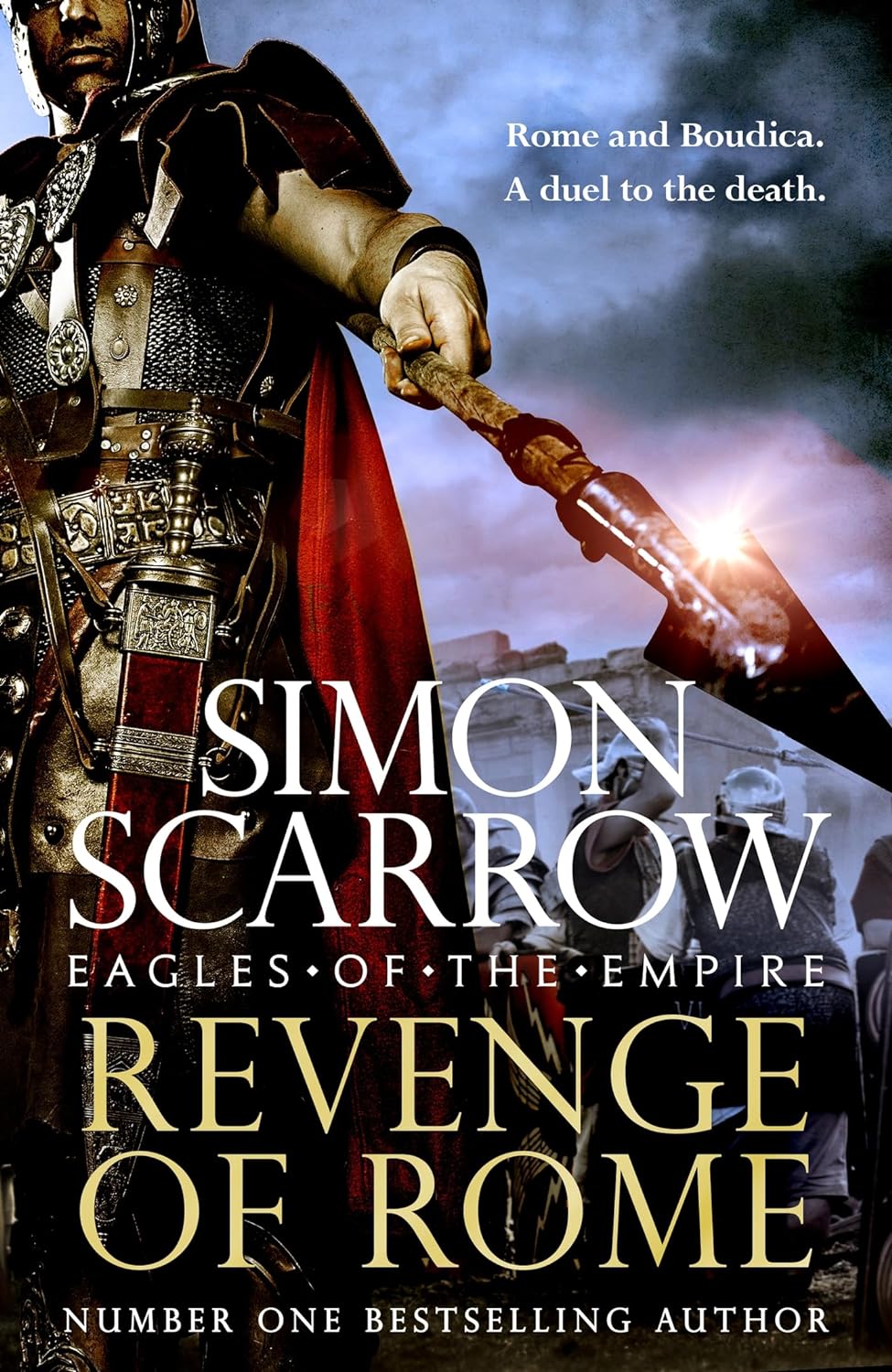
Revenge of Rome by Simon Scarrow

Publisher: Headline (Trade Paperback – 12 November 2024)

Series: Eagles of the Empire – Book 23 

Length: 411 pages

My Rating: 4.5 out of 5 stars

Amazon

The action continues in one of my favourite Roman historical fiction series with the outstanding and captivating read, Revenge of Rome by Simon Scarrow.

I have long extolled the ability of Simon Scarrow, who is one of the top current authors of historical fiction, as well as a personal favourite writer of mine.  I have had a blast reading and reviewing many Scarrow books over the years, including his Berlin Wartime Thriller series (see my reviews for Blackout and Dead of Night), as well as several great standalone reads.  However, his main body of work is the exceptional Eagles of the Empire series.  One of the premier Roman historical fiction series, the Eagles of the Empire books follow two elite Roman officers as they fight their way across multiple wars, provinces and battlefields.  I have been a fan of this series from the beginning, and the books within it have been a key part of my yearly review schedule, including The Blood of RomeTraitors of RomeThe Emperor’s ExileThe Honour of RomeDeath to the Emperor and Rebellion.  As such, the latest book in the series, Revenge of Rome, has been a highly anticipated read for me, and I have been very keen to get my hands on it.  The 23rd novel in the series, Revenge of Rome, follows on immediately after the events of Death to the Emperor and Rebellion, which covered the main events of Boudica’s uprising, and deal with the deadly aftermath of this massive conflict.

Britannia, 61 AD.  Following the final stand of the Roman army that broke the massive rebel horde, the uprising against Rome has ended but there is still no peace in Britannia.  Boudica, the warrior queen who sparked the rebellion, has escaped and still holds the eagle standard of the defeated Ninth Legion.  With the eagle in hand, Boudica and her Iceni tribe are living proof that Rome can be beaten and while she survives the flames of rebellion continue to smoulder.

Desperate to hunt Boudica down and make her pay for her crimes, Rome assigns two veterans to end the threat she poses, Prefect Cato and Centurion Macro.  Survivors of countless battles and campaigns Cato and Macro are the perfect soldiers to take down Boudica, especially as they share a long history with her.  Determined to do their duty, even with their conflicted feelings, Cato and Macro lead their troops into the lands of the Iceni to either capture or kill Boudica.

However, Boudica is no easy prey to capture.  Despite her defeat, she still has many skilled warriors fighting under her banner, each of whom holds great hatred for the Romans.  Worse, the war has made Boudica both cruel and cunning, and she soon engages in a brutal war of attrition, determined to break the Romans before they can overwhelm her.  To succeed, Cato and Macro will need all their cunning, grit and experience to finally bring Boudica down.  But can even these wily Roman officers contend with the wrath of an entire nation and their vengeful queen, or will Britannia rise once more to destroy the Roman invaders?

Revenge of Rome was another excellent and exciting entry in the Eagles of the Empire series that proved to be an absolute blast to get through.  A very intense, character driven read that focuses on an interesting period of Roman history, Revenge of Rome was an outstanding book that really drew me in.

Scarrow did an amazing job continuing the intense story from the last two books, and I frankly feel that this has been some of his best writing in years.  Starting off with a cool alternate look at the main battle from Rebellion, Revenge of Rome primarily explores the events immediately following the massive uprising and the destruction wrought on the Roman settlements.  Once again following Cato and Macro as they are given an impossible task, Scarrow presents a back-to-basics narrative as the two officers train up a new regiment (from the Second Legion, which was a nice callback to the first few books), to lead it into combat against the rebelling tribes.  The first half of the book follows Cato’s initial strategy of diplomacy and scouting, as he tries to figure out how to defeat Boudica with limited troops.  At the same time, Boudica works to reignite her rebellion, causing chaos amongst the other tribes and scoring some early victories.  This proves to be an intriguing first half of the book, especially as it nicely sets up the rest of the narrative, while also examining the aftermath of the rebellion, and the initial attempts of the Romans to regain control.

While the first half of Revenge of Rome was exciting, the best action occurs in the second half as Cato and Macro lead their troops against the Iceni and attempt to find their hideout.  There are some great small-scale conflicts the further we get along and Scarrow did an effective job showcasing Boudica as a truly dangerous foe.  Everything nicely leads up to the final battle, where the protagonists discover the Iceni’s fortress in the swamps (thanks to an excellent plot line about Cato trying to win back the hearts and minds of the locals) and engage in a deadly siege.  The action flies thick and fast here, and there are some awesome fight sequences as both sides initiate some clever tactics.  I really got caught up in the final battles and flew through the last 100 pages or so which detailed the siege.  While there is a natural focus on the brutal combat, Scarrow also provided some powerful character moments which helped to make Revenge of Rome even more intense and moving.  Scarrow ends everything on a final, if hopeful, note and it looks like the Eagles of the Empire series will be entering a new phase.  It will be interesting to see where Scarrow goes next, and I look forward to seeing how a certain new character is worked into the plot.

Scarrow always utilises a great and consistent style with the Eagle of the Empire books, which allows for some fantastic and exciting stories.  Revenge of Rome is no different, as we are presented with a compelling tale that sees the Romans taking on the local tribes of Britannia in a deadly game of cat and mouse.  I felt that Scarrow did a great job amping up the character emotions in Revenge of Rome, especially as we get some great alternate views of the main antagonist, Boudica, and her vengeful crusade.  The resulting carnage is well-written and intense, and Scarrow is very effective at portraying historical combat through his writing.  I really love the detail in which Scarrow showcases both the Romans and the Britannia tribes, and the compelling action sequences make for some brilliant reading.  The historical period featured within Revenge of Rome also proved to be very interesting, as Scarrow dives into the aftermath of Boudica’s rebellion and the state of Britannia at the time.  I really appreciated this fascinating focus; especially as most historical fiction authors tend to only portray the main rebellion and leave it at that.  I felt that Scarrow also did an outstanding job capturing the emotions of both the Roman soldiers and the surviving tribes throughout the book, and it was really intriguing to see some of the politics and logistics involved in the aftermath of the deadly occurrences of the previous novels.  Like most books in the series, Revenge of Rome can easily be read as a standalone novel, as Scarrow writes an inclusive narrative that cycles back to key events of previous books when necessary.  However, to get the full emotional impact of Revenge of Rome I would recommend first reading the prior two novels, Death to the Emperor and Rebellion, as their stories are extremely well linked.  However, even if you only read Revenge of Rome, you are in for a great historical adventure with some intriguing features.

I also felt that Revenge of Rome had some very strong character work in it as Scarrow brings back his classic protagonists alongside a few intriguing additions.  After 23 books, Cato and Macro are still the same characters we’ve come to know and love, although Scarrow does find ways to keep them fresh.  While Cato is his usual tactical and empathetic self, especially when it comes to finding ways to defeat the enemy, Macro is in his full-on non-commissioned officer mode, serving as the hard-boiled soldier’s soldier.  Thanks to some over-the-top drill sergeant scenes, Macro quickly steals focus, and he is the more entertaining of the two protagonists.  Scarrow also throws in some especially emotional sequences for Macro, as he deals with the continued conflict against his former love interest, Boudica, his guilt for the damage she caused, and the secrets she revealed to him in the previous novel.  One of these secrets comes to fruition nicely in the final part of the book, and it will be interesting to see how the evolves going forward.

Aside from Cato and Macro, there is a great array of additional interesting characters scattered throughout the novel who have their moment to shine.  This includes multiple Roman figures, many of whom previously appeared in previous novels.  Of these, I particularly enjoyed Scarrow’s portrayal of a young Tribune Agricola.  Agricola, a real historical figure destined to become a famous general, is shown here as a brash young officer eager for command.  His ongoing storyline of learning the ropes under Cato and Macro proves to be a lot of fun, and I liked the inference that Agricola’s later success can be attributed to the harsh early tutorage of the protagonists.  However, out of the all the supporting characters, I felt that Scarrow did his best work with Boudica.  Boudica, who has appeared in several earlier Eagles of the Empire books, has one of her best outings in Revenge of Rome.  Despite losing in Rebellion, Boudica is still a determined revolutionary, turned vengeful from the Romans treatment of her and her daughters.  As such, she is unrecognisable compared to her previous appearances as an ally to Cato and Macro, and she proves to be one of their most dangerous enemies.  I felt that Scarrow really captured her revenge-darkened heart in Revenge of Rome, and there are some great scenes where she continues to take her war up another notch.  It was honestly really moving to see her in this final showdown against the protagonists, and I appreciated how effectively Scarrow focused on this iconic historical figure in this latest book.

Simon Scarrow once again deeply impressed me with an Eagles of the Empire novel as Revenge of Rome was another captivating and exciting novel, loaded with awesome historical action.  An excellent addition to the series that provides an outstanding wrap-up of one of Scarrow’s best storylines, Revenge of Rome comes very highly recommended, and I look forward to seeing where the author takes the series next.  In the meantime, we have A Death of Berlin to look forward to from Scarrow early next year, which should be another dark and complex Berlin Wartime Thriller.

Amazon

Rebellion by Simon Scarrow

Rebellion Cover

Publisher: Headline (Trade Paperback – 14 November 2023)

Series: Eagles of the Empire – Book 22

Length: 398 pages

My Rating: 4.5 out of 5 stars

Amazon

One of my favourite historical fiction authors of all time, Simon Scarrow, returns with another epic adventure that places his long-running Roman protagonists right in the middle of the deadliest fight imaginable with Rebellion.

I have made no secret of the fact that I am a massive fan of Simon Scarrow, especially when it comes to his main Roman historical fiction series.  While I have deeply enjoyed Scarrow’s books set in other periods, such as his awesome Berlin Wartime thrillers Blackout and Dead of Night, it is Scarrow’s Eagles of the Empire series that I come back to every time.  Following two veteran Roman officers who manage to find themselves sent to every battlefield imaginable, the Eagles of the Empire books have dominated the historical fiction market for over 20 years, and I have had such an incredible time reading every entry in this series.  Eagles of the Empire has been a staple series for this blog ever since I started The Unseen Library, and I have reviewed multiple entries, including The Blood of Rome, Traitors of Rome, The Emperor’s Exile, The Honour of Rome and Death to the Emperor.  Due to how much fun I have with these fantastic historical adventures, I always make time to read the latest Eagles of Empire book each year, and I finally managed to read the late 2023 entry, Rebellion.  The 22nd book in the series, Rebellion was an exceptional and bloody read that places Scarrow’s protagonists in their most dangerous battle yet.

AD 60, Britannia.  The Roman province of Britannia is in utter turmoil as the queen of the Iceni tribe, Boudica, leads her people in total rebellion after suffering the greed and cruelty of Rome too long.  Despite the best efforts of retired centurion Macro, Boudica’s growing force of Britons managed to destroy the veteran’s colony of Camulodunum, and now her army is emboldened to take back the entire province in a bloody spree of vengeance.

Campaigning on the other side of the province, Governor Suetonius desperately attempts to lead his army back to Londinium as soon as word reaches him about the uprising.  Forced to move ahead with a smaller force, led by Prefect Cato, Suetonius hopes to rally the rest of the troops in Britannia to make time for his army to arrive.  However, Suetonius is unprepared for the savagery of the desperate rebels and the incompetence of the officers he left behind, and he soon finds himself hopeless outnumbered.

As the Roman forces attempt to salvage the situation, Cato finds himself lost without his longtime comrade Macro beside him.  Convinced that Macro died at Camulodunum, Cato is determined to avenge his friend no matter the cost.  But Macro’s fate is far more complicated than the Roman’s realise, as he has been taken prisoner and is trapped in Boudica’s camp where everyone wants him dead.  As the Roman host desperately makes their final stand against the rebelling tribes, can these two grizzled soldiers survive this bloody battle, or has their luck finally run out?

Scarrow once again presents a fast-paced and powerful piece of historical fiction that proves impossible to put down.  Focusing on a particularly fascinating and iconic piece of history, Rebellion is an outstanding novel that once again thrusts Scarrow’s beloved protagonists right into the middle of the carnage.

The author had to achieve a lot in Rebellion, especially after the epic cliffhanger the prior novel, Death to the Emperor, left us on.  The events leading up to Boudica’s rebellion have been in play since the author’s very first book, and it was only a matter of time before Scarrow showcased it in this series.  Death to the Emperor did a really good job setting the rebellion in motion, and Scarrow needed to majorly capitalise on that in this latest novel.  Luckily, he was more than up to the task, presenting a captivating story that covers the key events of the rebellion.

After starting with a fun and bloody introduction that helps to highlight just how much trouble the Romans are in, Rebellion swiftly returns to the protagonists.  The first part of the book is told primarily from Cato’s perspective, as he accompanies the Roman general and a small force back to the imperilled capital in a desperate march.  This sets up a lot of the later narrative, especially as you get a sense of how out of position the Romans are and how desperate events have become.  Rebellion’s plot got even more interesting when the story spent several chapters focussing on Macro.  Now, I never for a second believed that Macro had been killed in the previous book, so I do not consider it a spoiler to mention that he was a major part of Rebellion.  His scenes were easily the highlight of the first half of Rebellion, especially as he endured being a prisoner of the rebelling tribes and his former lover, Boudica.  These scenes are so tense and emotionally charged, as Macro is forced to watch his comrades be butchered all around him, while also learning some surprising secrets.  Despite the horrors he witnesses, Macro still manages to be a bullish and utterly frustrating figure for his captors, and I loved seeing the various ways he tries to fight back.  Naturally, these two separate storylines converge as the book continues, although things only get darker once Cato and Macro are back together.

The second half of Rebellion is so damn fast-paced, exciting and intense that I honestly read the whole thing in a single night.  Everything about this second half is very impressive, as the characters go through hell time and again.  Much of this involves an extended chase sequence as the Romans are forced to flee the advancing wrath of Boudica.  The sheer desperation, despair and sacrifice involved in many of these scenes is extremely moving, and Scarrow did not sugarcoat just how brutal and bloody things got at the hands of the rebelling Britons.  The continued perspective spilt between Cato and Macro during these sequences works great, and Scarrow really captures just how fraught the situation is.

While I loved this long chase sequence and the brawls involved with it, the main highlight of Rebellion was always going to be the final battle between the Romans and Boudica.  Scarrow takes his time setting up this battle, which really heightens the anticipation, as the characters make their preparations and reflect on the fight to come.  The conclusive battle was everything you would hope it to be, and Scarrow showcases the epic confrontation, one of the bloodiest in Roman British history, in fantastic detail.  The action is intense, fast and shocking, and you are constantly on the edge of your seat waiting to see how events would unfold and whether the protagonists would survive.  Everything comes to a powerful and desperate finish, and readers will be thrilled by how this entire novel comes together.

As with most books in Scarrow’s Eagles of the Empire series, Rebellion can be read as a fun standalone novel, although in this case reading one or two of the previous entries might be beneficial.  This is because most of the storylines from the last few books have involved the events that led to Boudica’s revolt, and it was great to see it finally see this ongoing arc finally come to fruition.  At the very least, I would advise people to read the prior novel, Death to the Emperor, before getting into RebellionDeath to the Emperor was one of Scarrow’s best recent book in the series, and it ends with the battle for Camulodunum and a cliffhanger regarding Macro.  The two books form a powerful pairing, and I strongly believe that the impact of Rebellion was enhanced by reading the events of Death to the Emperor first.  However, if you choose to dive into Rebellion as a standalone, you will still be in for a good time because Scarrow ensures that the plot is very accessible and easy to follow for new readers.  This proves to be an awesome Eagles of the Empire book as a result, and I look forward to the next entry in the series, especially after some of the cool revelations that came out in this impressive novel.

I loved the historical aspects of Rebellion as Scarrow does an amazing job of exploring the events of Boudica’s revolt in detail.  As I mentioned above, the set-up for the revolt was handled flawlessly in Death to the Emperor, and Scarrow did a great job following it up with the main event here in this sequel.  Many of the key aspects of this conflict, including the sacking of Londinium, the forced march of the Roman army, and the general panic of the citizens in Britannia are shown in impressive detail, and Scarrow does a great job of setting the scene and showing just how close the Romans were to defeat.  The author does not pull any punches when it comes to how bad things got, and the inhuman actions both sides committed really raised the stakes of the book.  Scarrow also does an outstanding job of filling in historical details that were not effectively covered by the surviving sources.  For example, I liked his take on the destruction of the Ninth Legion at the start of the book, which was reminiscent of the Teutoburg Forest massacre.  Scarrow further enhances the story by providing an intriguing potential viewpoint on both sides of the revolt.  Interactions between Cato, Macro, and several different Briton characters really highlight how both sides thought they were in the right, and the differing views around the conflicts amped up the emotions of the story.  However, it was his fantastic depiction of the final battle that I particularly enjoyed.  Despite its fame, reliable details about this battle are scarce and I think that Scarrow presented a very reasonable depiction, showing the tactics the desperate Romans likely used.  This battle really came to life thanks to Scarrow’s outstanding storytelling, and you can just envision the fight between the tightly formed Roman legionaries and the massed hordes of Britons.  All this historical detail was just superb, and I loved how authentic and brutal it helped to make Rebellion.

In addition to the amazing and compelling historical elements, Rebellion also featured some moving character work.  The plot of Rebellion featured an interesting combination of long-running protagonists, real-life historical figures, and new characters introduced for this book.  I think this cool combination of characters worked extremely well, and it helped to tell an amazing and complex story.  Naturally, most of this focus goes towards the characters of Prefect Cato and Centurion Macro, who we have had so many adventures with over the years.  Cato is again showcased as the young but tough veteran campaigner and tactician, and I liked his intriguing storylines in Rebellion as he was involved in all the major battles and conversations.  While I am not sure that every key idea for Rome’s victory needed to come from Cato, it did allow him to serve a vital role in Rebellion, providing the reader with the best overview of Rome’s tactics and strategies during the war.

Due to Cato’s role as the leader, much of the more emotionally charged character work was left to the usually impassive and unflappable Macro.  Macro actually goes through a lot in Rebellion, as after losing several friends in Death to the Emperor, he is captured by the Britons.  Despite his steely resolve and fighting spirit, this imprisonment leaves its mark on Macro, especially when as he learns some disturbing secrets.  Macro also bears a certain amount of guilt in Rebellion, as he feels responsible for Boudica’s uprising, and he worries about all the deaths he seems to have caused.  I love this moving and powerful look at Macro, and it was great that Scarrow can still give him some additional depth this far into the series.  Throw in compelling and intriguing looks at the two opposing leaders of this war, Boudica and Roman Governor Suetonius, as well as some other great characters, many of whom do not survive the entire book, and Rebellion proved to be an exception novel that expertly showcased its amazing cast.

Simon Scarrow once again wows me with his outstanding Roman historical fiction novel, Rebellion.  This latest exceptional Eagles of the Empire book was everything I hoped it would be as Scarrow expertly places his protagonists in bloody heart of Boudica’s revolt.  Loaded with action, intriguing historical detail, and fantastic emotionally charged character moments, Rebellion had me hooked from the very beginning, and I loved every second I spent reading it.

Amazon