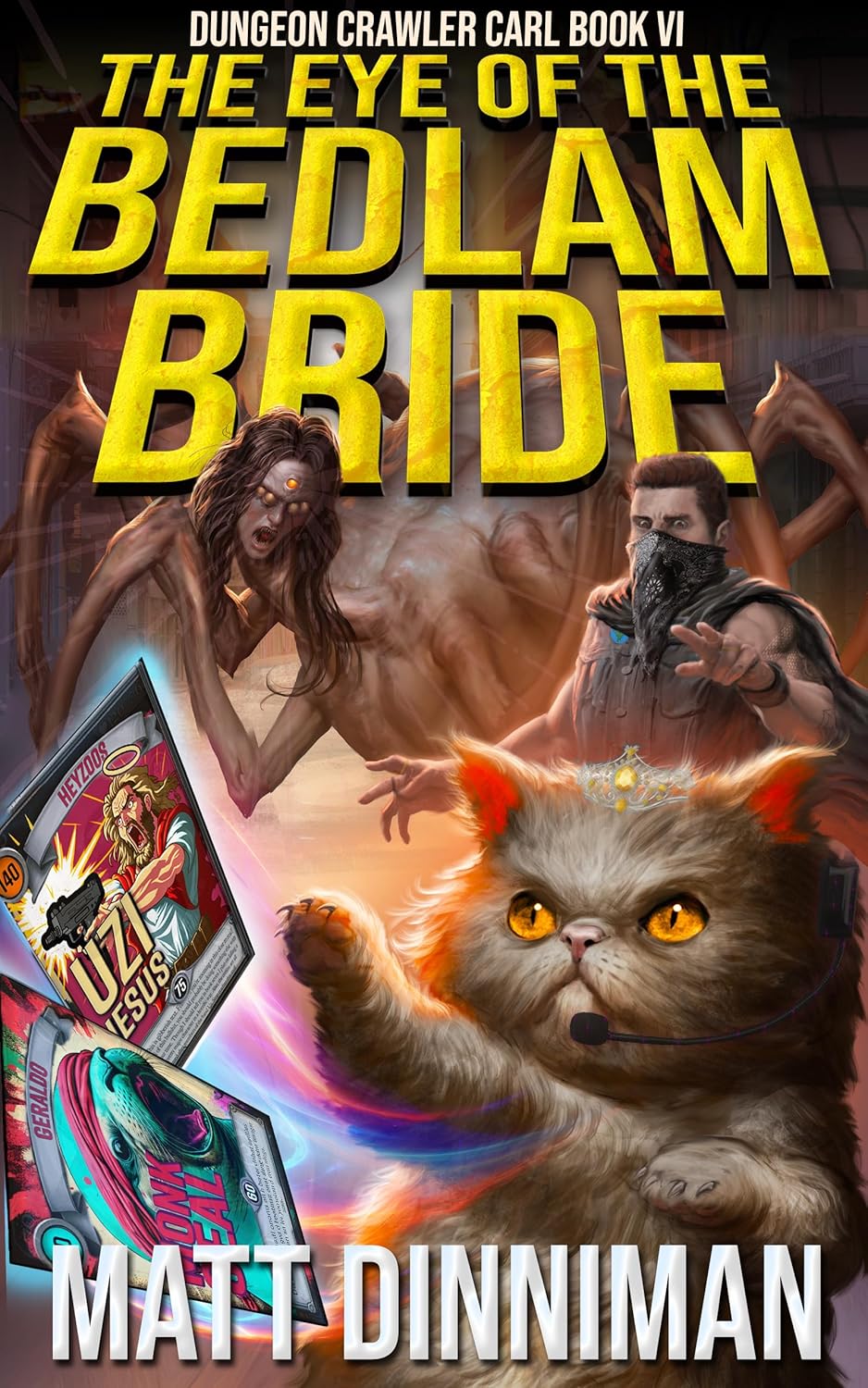
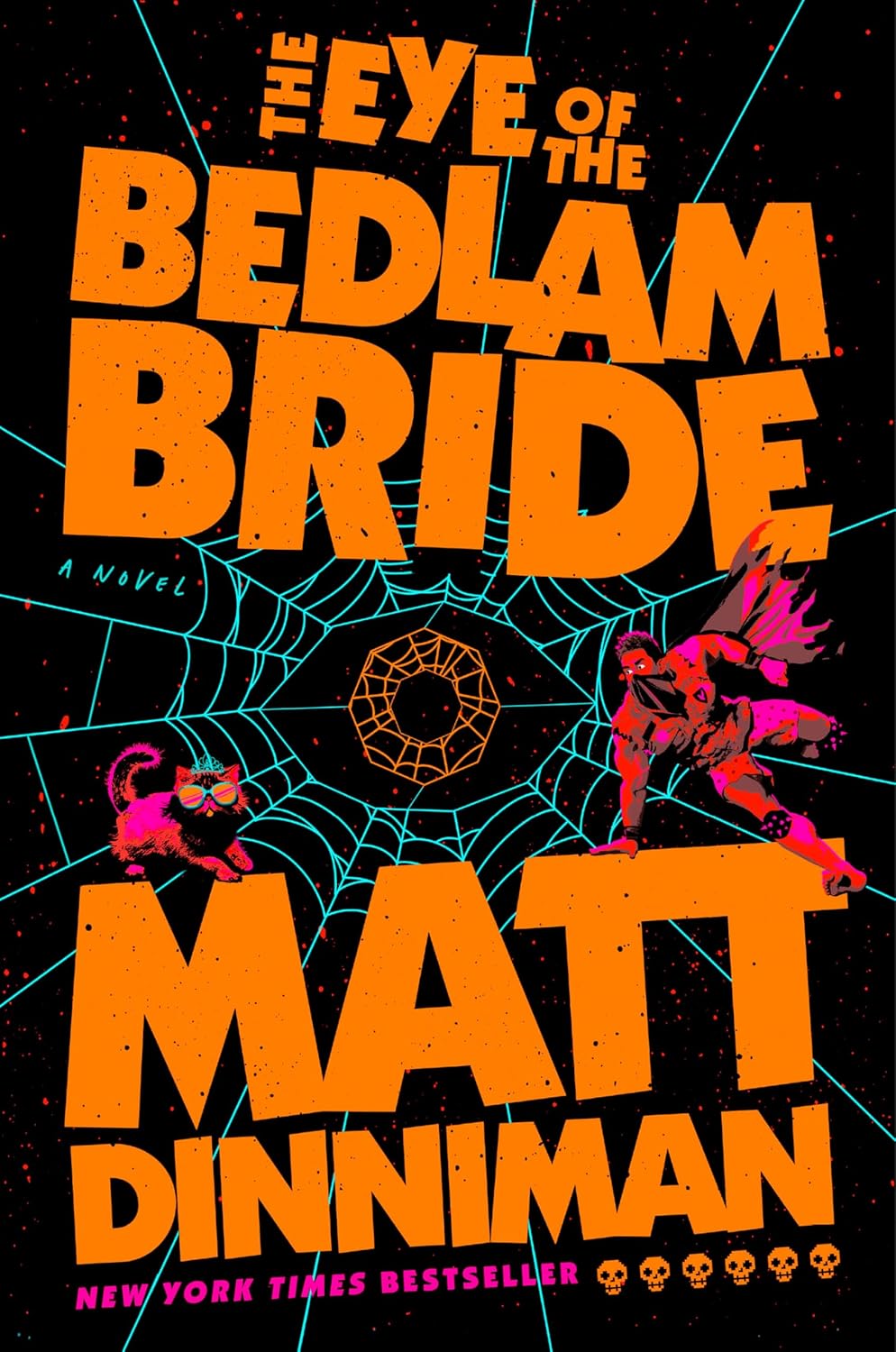
The Eye of the Bedlam Bride by Matt Dinniman

Publisher: Soundbooth Theater (Audiobook – 2 July 2023)

Series: Dungeon Crawler Carl – Book Six

Length: 26 hours and 46 minutes

My Rating: 5 out of 5 stars

Amazon

The chaotic fun of Matt Dinniman’s Dungeon Crawler Carl series continues in epic fashion with the ultra-impactful and deeply addictive sixth entry in the series, The Eye of the Bedlam Bride, an exceptional novel designed to strike hard at the reader’s emotional heartstrings.

As you might have guessed from my recent flurry of reviews for this series, I am seriously in love with the Dungeon Crawler Carl books.  An impressive and surprisingly deep LitRPG series, the Dungeon Crawler Carl novels follow a collection of compelling characters as traverse a deadly fantasy dungeon created from the ruins of all of Earth’s buildings by aliens for intergalactic viewing content.  Set around a damaged protagonist and his excitable and now sentient cat, these books are deeply addictive, and once you start the series you really can’t stop.  Indeed, I literally just chain-read the entire series, with awesome books like Dungeon Crawler Carl, Carl’s Doomsday Scenario, The Dungeon Anarchist’s Cookbook, The Gate of the Feral Gods and The Butcher’s Masquerade all proving to be outstanding reads.  I loved these previous books so much, that I instantly started listening to the sixth book in the series, The Eye of the Bedlam Bride, the first chance I got, and boy was I in for an incredible time with it.

After barely surviving the Butcher’s Masquerade and then witnessing the surprising end to the seventh floor, Carl and Princess Donut are exhausted and traumatised by recent losses.  However, they have no time for rest as they find themselves thrust into the dangerous eighth floor of the dungeon.  One of the most ambitious levels so far, the eighth floor is based on a map of Earth’s final days, filled with intangible ghosts of the humans who wandered the world mere weeks before the planet’s death.

However, this is not a perfect replica of Earth; instead these locations have been seeded with monsters and mythological figures based on twisted accounts of Earth legends, with each creature tied to the geographic area their folklore originated.  To complete this level, the crawlers are tasked with finding and capturing six of these monsters and turning them into cards, which can then be summoned to fight alongside their new owners.  Each team will need to find and convert as many powerful creatures as possible to create the best decks, especially as they will be forced to face off against mobs and other crawlers with their own cards.

Unexpectedly starting in Cuba, Carl and Donut navigate an unfamiliar location as they try to learn the new mechanics of the game.  Determined to get to the next floor, Carl and Donut endeavour to find the best monsters they can.  However, the stronger the monster, the less controllable the card, and Carl and Donut will soon have their hands full managing a strange array of summonable creatures, including the legendary demon Shi Maria, who has far more independence than they would like.  Can Carl and Donut survive this new floor of the dungeon, or will they finally be crushed by their dark secrets, troubled pasts and Carl’s slowly eroding sanity, especially once he looks into the eye of Shi Maria, the Bedlam Bride?

Just when you thought this series couldn’t get even better, Matt Dinniman amps up the intensity and complexity of his plot and characters a whole additional notch, with one of the more moving and powerful entries in the entire series.  The Eye of the Bedlam Bride was an absolute masterpiece that featured the author’s trademark LitRPG chaos, while really showcasing his impressive writing ability.  One of the best books in an already incredible series, The Eye of the Bedlam Bride was so damn good, and it gets a very easy five-star rating from me.

Dinniman pulled together another brilliant narrative for his sixth Dungeon Crawler Carl novel, as They Eye of the Bedlam Bride perfectly continued the long-running series storylines while also presenting its own unique adventure.  Thrusting the protagonists into a complex new level, Dinniman quickly showcases all the floor’s new elements, including a fun card-based combat mechanism that fits into the existing dungeon battle system surprisingly well.  While the pacing is initially a tad slower to ensure the readers fully appreciate all the necessary lore and gameplay details of this book’s plot, Dinniman quickly works to show that The Eye of the Bedlam Bride isn’t a filler novel between the pivotal fifth and seventh books.  This becomes especially clear during a major sequence that requires Carl and Donut to make a deadly choice while surrounded by several vengeful gods.  Dinniman also makes sure that a major secret from the previous book is brought into the light early, complicating protagonist relationships and presenting them with dark choices.  Dinniman swiftly follows this up with some very awesome sequences, such as Carl and Donut coming face-to-face with their most problematic card, demonic carnage in a night club, and problems from the wider universe caused by Carl’s ambitious and rebellious plots.

While all these early elements are great, The Eye of the Bedlam Bride hits its storytelling height about halfway through, as Dinniman amps up the emotional stakes of the narrative.  Forced to compete in a gruelling series of battles that test the unique fight mechanics of the floor, the protagonists find nothing but heartbreak as they near the end of the second phase of the level, including a truly horrifying and deeply personal big boss.  All this follows a series of impactful personal revelations for Carl, that hit his already fragile mental state hard and finally provides full context for character background elements that have been hinted at throughout the series.  This central part of the story was so damn heartbreaking, and you really must appreciate how Dinniman can make you laugh before loading up substantial sorrow and regret and producing some beautifully crushing sequences.  While these scenes are emotionally charged, I appreciated how Dinniman often tempered them with more heartwarming moments that show the connections the protagonists have built up during the series, and the author does some amazing character work in the second half of this book.

Everything perfectly leads up to the incredible final third of The Eye of the Bedlam Bride, as Dinniman raises the stakes as only he can.  With the protagonists forced to compete in a brutal third and final phase of the floor, events soon break down into pure chaos with undead hordes, demonic possessions, crazed gods and various rival crawlers all coming into play.  Dinniman keeps the story moving so fast in this last part of the book, as the protagonists dive into key battle after key battle.  I actually ended up listening to the last several hours in one day as I just had to see what happened next.  Following one of the most tragic scenes in the series, which nearly broke me, Carl and Donut race to save as many people as they can from the AI’s inventive endgame, leading to an all-out battle royal in the middle of Cuba.  I loved how so many story elements from the entire book came into play for the conclusion after some clever set up earlier in the plot, resulting in some very epic moments.  The ending was a brilliant mixture of humour, intense action, extra lore, and some particularly dark moments for the protagonists, which came together beautifully and ended the novel on a real high.  Throw in some last-minute reveals that really amp up the excitement for the next book, and this was pretty much a perfect narrative that is guaranteed to keep you hooked all the way the bloody end.

I honestly feel that The Eye of the Bedlam Bride was one of the best-written entries in the entire Dungeon Crawler Carl series, and frankly I am still not over every single amazing moment of this book.  Dinniman achieves so much in this impressive novel by simultaneously changing the rules of his own game while also providing the deepest examination of his complex protagonists yet.  At the same time, he makes a novel that most authors would have turned into a filler entry into one of the series’ most impactful books.  I was really impressed by how the author chose to further amp up his various storylines and character arcs in this book, and Dinniman perfectly carries on the craziness of The Butcher’s Masquerade while building up the oncoming calamity of the seventh book and the long-awaited Faction Wars.  Naturally, this means that The Eye of the Bedlam Bride is best enjoyed by those who have read all the previous Dungeon Crawler Carl books first.  Still, for those who are determined to dive in here, Dinniman provides enough context and flashbacks to ensure you can easily follow what’s happening, and there is even a fun summary at the beginning.

This sixth novel in the series brings back all the impressive humour, intense action, and great LitRPG elements that made the previous Dungeon Crawler Carl books so damn good, while also bringing in some impressive new features, primarily a fun new battle element.  I must admit that I wasn’t too sure that the card system of this level, which on paper sounded like a crazy combination of Pokémon and Yu-Gi-Oh!, was going to work.  However, I should never have doubted Dinniman as it fitted in amongst the usual chaos and over-the-top scenes perfectly.  Dinniman does an excellent job introducing and then exploring this system throughout The Eye of the Bedlam Bride it proved fun to see the characters adapt to the new rules.  There is some great progression in how these cards impact battles, and each fight with them gets increasingly hectic.  I really enjoyed how big and crazy battles with these cards could get, especially towards the end, and you won’t see protagonists facing off in card duels with gods and demons anywhere else.

There are some additional excellent elements to The Eye of the Bedlam Bride that also enhanced the epic story in some interesting ways.  This includes a haunting new setting of the book, the ghost-filled replica of the pre-dungeon Earth, which really amplifies the feeling of despair and loss that many of the characters feel.  Dinniman continues to also feature a compelling array of LitRPG elements in this novel, and you really find yourself getting drawn into the minutiae of stat updates, item benefits, spell effects, and so much more, as the author cleverly works it into the narrative.  A lot of why these RPG features are so fun is due the chaotic humour that infests every single page of this hilarious book.  The book’s comedic elements are so effortlessly funny and feature a great mixture of sudden outrageous moments with realistic reactions, the insertion of the book’s reality television elements into life-and-death struggles, often inappropriate jokes from the massive and fun supporting cast, and an array of reference focused commentary on all matters of the dungeon.  While some of the comedic moments get a little out of hand: “I need a baby seal”, they all work beautifully in the context of the book’s clever plot, and I laughed myself silly so many times during this book, including at how the day was saved thanks to, let’s say, “crab meat”.  I’m also as appalled as a certain velociraptor that some of the funniest, if weirdest, moments of the book occurred in Chapter 69.  However, what makes The Eye of the Bedlam Bride particularly good is the way in which these comedic elements are well matched by darker, tragic moments, which allows for quite on overall powerful read, especially when it comes to the characters.

Dinniman went above and beyond when it came to the character development in this book, with a particular focus on series protagonist Carl.  After several books laden with hints about his past, we finally get Carl’s full backstory, which really goes to show just how damaged he is.  Dinniman does an outstanding job showcasing this background in several powerful scenes in The Eye of the Bedlam Bride, and I really appreciate how it built on the subtle foreshadowing from the previous novels.  This existing trauma was further enhanced in this book, as Carl also finds out multiple new revelations about his family, including several that had been kept from him (which simultaneously shows just how bad a girlfriend Bea really was).  Throw in his anger and guilt from being one of the few survivors of Earth, and the trauma from all carnage he has witnessed in the dungeon, and Carl really isn’t in the best headspace for this book, and that’s even before the titular Bedlam Bride gets hold of his mind.  As such, there is a lot of dark moments for Carl to unpackage throughout this novel, and Dinniman perfectly captures his protagonist’s continued struggle to remain in control.  This deeper dive into Carl’s psyche produced some of the best scenes Dinniman has so far written in the series, and I really appreciated how these darker moments were well matched by the revelation that Carl now has a true family with Donut and his new friends.  These relationships kept him relatively sane in this book, and allowed him to remain the resilient, if explosively inclined, straight man of the book.  Dinniman also works to showcase how despite his issues and reputation, Carl has become a bit of a legendary figure for his fellow crawlers, and the big sequence at the end where he is able to convince them to follow one of his craziest plans, was just amazing.

While most of this book’s focus is on Carl and his history, the rest of the characters in The Eye of the Bedlam Bride also get their moments to shine, and you continue to appreciate just how awesome the ended cast of this series is.  This includes the other main protagonist, Princess Donut, Carl’s now sentient cat who provides much of the humour in the story thanks to her over-dramatic reactions, silliness, and feline superiority complex.  While Donut is the comedic relief of the main duo, she still has a lot of serious moments in The Eye of the Bedlam Bride, especially while serving as the emotional anchor the spiralling Carl.  Donut is also dealing with her own grief and sadness, especially after the tragedies of the previous novel, and there are some heartbreaking moments where you see her trying to push that down.  Despite her issues and immaturity, Donut role in the plot, especially as she controls the cards during most of the battles, and you get to see her tactical genius in full display.  There are some super sweet moments with Donut in this novel, and I really love how well Dinniman continues to feature the bond between her and Carl as the true heart of this series.

In addition to Carl and Donut, The Eye of the Bedlam Bride also features multiple other key members of the Dungeon Crawler Carl cast, and it is very impressive how much you care for so many of these figures.  This includes Katia, who, despite leaving the team in the previous novel, still has a major impact on the plot.  Dinniman perfectly revisits some key revelations from the end of the previous novel, that adds additional complexities to her relationship with Carl and Donut.  The protagonist’s mentor, Mordecai, also has a key role in this book, especially as you finally get the full context for his tragic past.  This background adds some additional drama to the main story, especially when Carl and Katia find themselves caught in the same feud between forces outside the dungeon that he did.  There is also a certain sweetness to Mordecai’s story in this novel, especially when you find out he’s caring for several NPC children, in ways very contrary to his usual gruff disposition.  Dinniman also perfectly brings back the various members of Carl’s guild, who form a surrogate family with each other, and whose appearance in one scene was one of the most heartwarming moments in the plot.

Other characters of note in The Eye of the Bedlam Bride include the possessed sex doll head, Samantha, whose insane declarations, unhinged actions, unsettling abilities and crazy general demeanour make her one of the funniest characters in the series.  There is also an array of over-the-top monsters and creatures that the protagonists encounter and turn into cards.  These include Uzi Jesus, a kung-fu seal, hilarious caricatures of Carl and Donut, and a crab who must overcome his ‘performance issues’ to save the day, just to name a hilarious few.  These comedic monsters were well contrasted by Shi Maria, the titular Bedlam Bride, whose dark actions amp up the intensity of this book in some powerful ways.  I also must mention a couple of recurring crawlers from previous novels who reappear in dramatic fashion in the final third of the novel, allowing for some of the book’s best moments.  One of these character ends up having one of the series’ saddest moments, and I frankly am still not over how brutally raw and tragic that whole sequence was.

While all these above characters are amazing in their own ways, my favourite character in this series remains the dungeon’s System AI.  Despite never physically appearing, the AI has a major impact on the plot, and you are constantly bombarded by its unique humour in the various descriptions and summaries it provides to Carl and the reader, often full of weird and hilarious references.  So many serious or threatening moments are turned into comedic gold by the AI’s inappropriate commentary, and anytime it provides input to the plot, you are guaranteed to laugh.  While the AI has been fun the entire series, it gets even more unhinged in this novel as it gains full sentience and takes full control of the.  Determined to continue the crawl on its own dramatic terms, the AI starts making things even weirder for the characters, throwing in its own twists and changes.  Dinniman does a wonderful job showcasing just how insane the AI is at times, including with some very worrying inclusions in its usually informative descriptions.  There are also some hilarious scenes where the AI interacts directly with the characters, including one brilliant moment when he responds to Carl’s feedback on its descriptions in a particularly petty way.  All this, and more, allows the AI to really standout in this book, and it is a testament to how good Dinniman is as an author, that a disembodied voice is one of the best characters in a series loaded with exceptional and extremely complex figures.

As with all the previous Dungeon Crawler Carl novels, I ended up listening to The Eye of the Bedlam Bride on audiobook, which is honestly the only way to enjoy the author’s fantastic and chaotic narrative.  Coming in at nearly 27 hours in length, The Eye of the Bedlam Bride was one of the longest audiobooks in the series, but you frankly don’t mind as every second you spend listening to a Dungeon Crawler Carl audiobook is so much fun.  I honestly powered through The Eye of the Bedlam Bride in no time at all, especially the concluding several hours, and I still love how audiobook format brings out all the book’s humour, tragedy and excitement.  A lot of this is down to the series’ awesome narration, which in the case of The Eye of the Bedlam Bride, includes an extended voice cast.  While there are a few voice actors for this particular audiobook, Jeff Hays remained the principal narrator, voicing nearly all the characters and the plot descriptions.  Hays is an incredible narrator, and I loved the sheer range of epic voices he brings to bear throughout the audiobook, all of which fit their associated character perfectly, with associated accents and clever tonal changes.  This includes an excellent reuse of voices for previously featured characters, while the various crazy new cast members featured in this book were also extremely cool.  My favourites for The Eye of the Bedlam Bride remain Princess Donut, who gets autotune in this audiobook to help with her singing (the sound effects for this were brilliant), and the AI running the dungeon, as Hays matches the unhinged energy of the cracked computer and conveys this insanity to the listener with amazing enthusiasm.

In addition to Jeff Hays, The Eye of the Bedlam Bride also features three other actors who voice small roles in the larger audiobook to great effect.  The most notable of these is actor Patrick Warburton, who was an awesome addition to the experience.  Initially voicing the flashback voice of Carl’s father in several heavy scenes, Warburton did an outstanding job of breathing life into a harsh figure we’d only had glimpses of in the previous books, and his appearances here had some real menace to them.  Warburton also gets to have some fun when he plays a secondary character later in the audiobook with some brilliant levels of enthusiasm.  Narrator Travis Baldree was also hilarious with his appearance in The Eye of the Bedlam Bride, voicing a giant crab who becomes one of the protagonist’s cards.  Featuring a comedic accent and some very over-the-top lines, Baldree was just amazing, and I loved the interactions he had with Hays and Warburton’s characters.  Finally, Soundbooth Theater regular Annie Ellicott returns to voice an entertaining character in a concluding skit, which was very amusing on a variety of levels.  I really loved how well these outstanding extra voice actors were fitted alongside Hays’s impressive main narration, and it allowed for a great overall listen.  Throw in the excellent sound effects of the series, some of which alter Hays’s voice in clever ways, or places a voice role into the background of a scene for some interesting ambience, and this was an exceptional audiobook that I loved so damn much.  There is honestly nothing better than a Dungeon Crawler Carl audiobook, and I must once again recommend this format with all my heart.

With a particularly impressive and powerful plot, The Eye of the Bedlam Bride was one of the best books in the already incredible Dungeon Crawler Carl series, and author Matt Dinniman outdid himself when it came to diving into his damaged protagonists.  A highly inventive and captivating novel that I just couldn’t stop listening to, The Eye of the Bedlam Bride was Dinniman at his very best and you are guaranteed to have an exceptional time with this novel, and you will, like me, instantly dive into the next novel of the series, This Inevitable Ruin, just to see what happens next.
Amazon

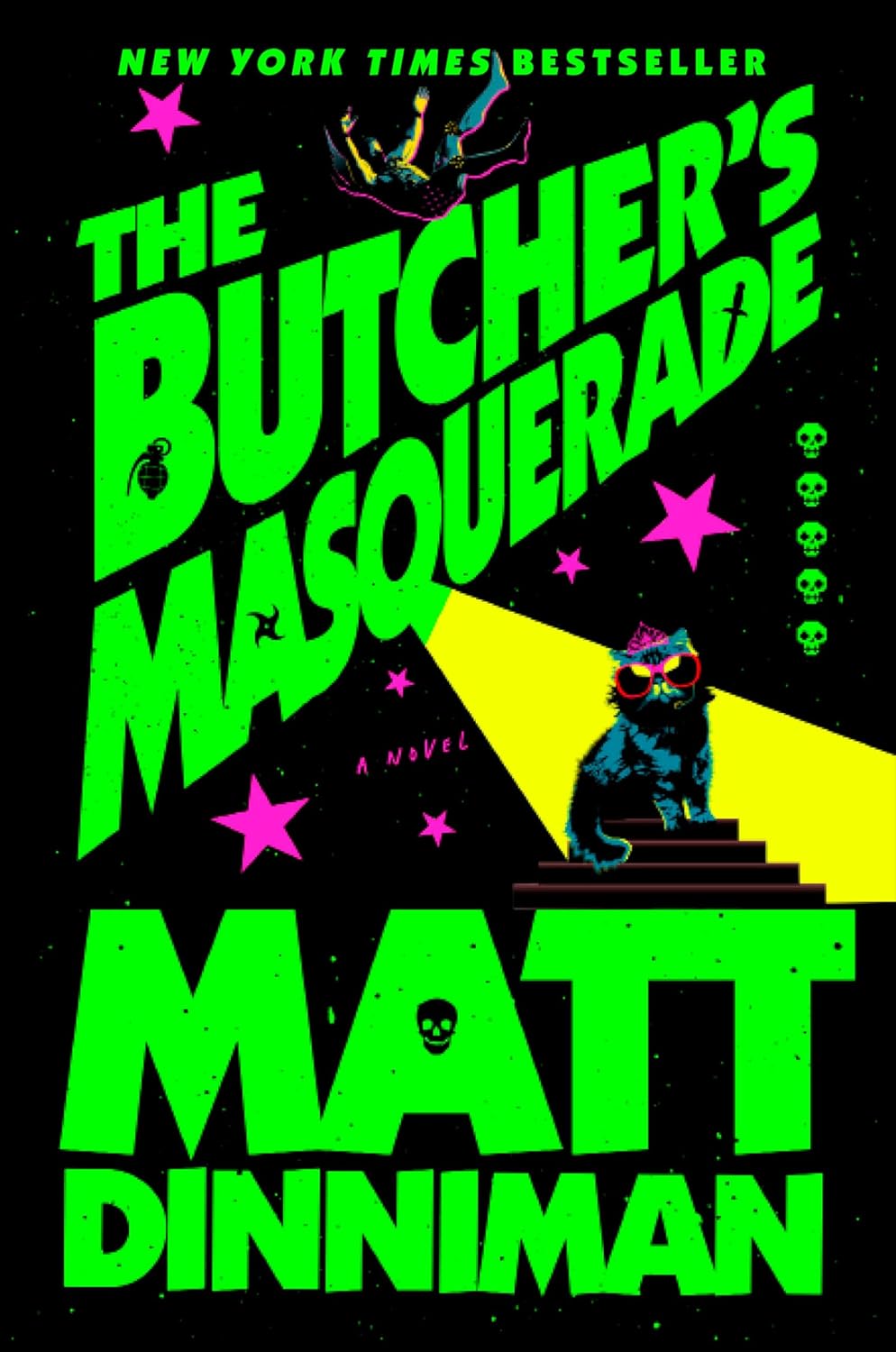
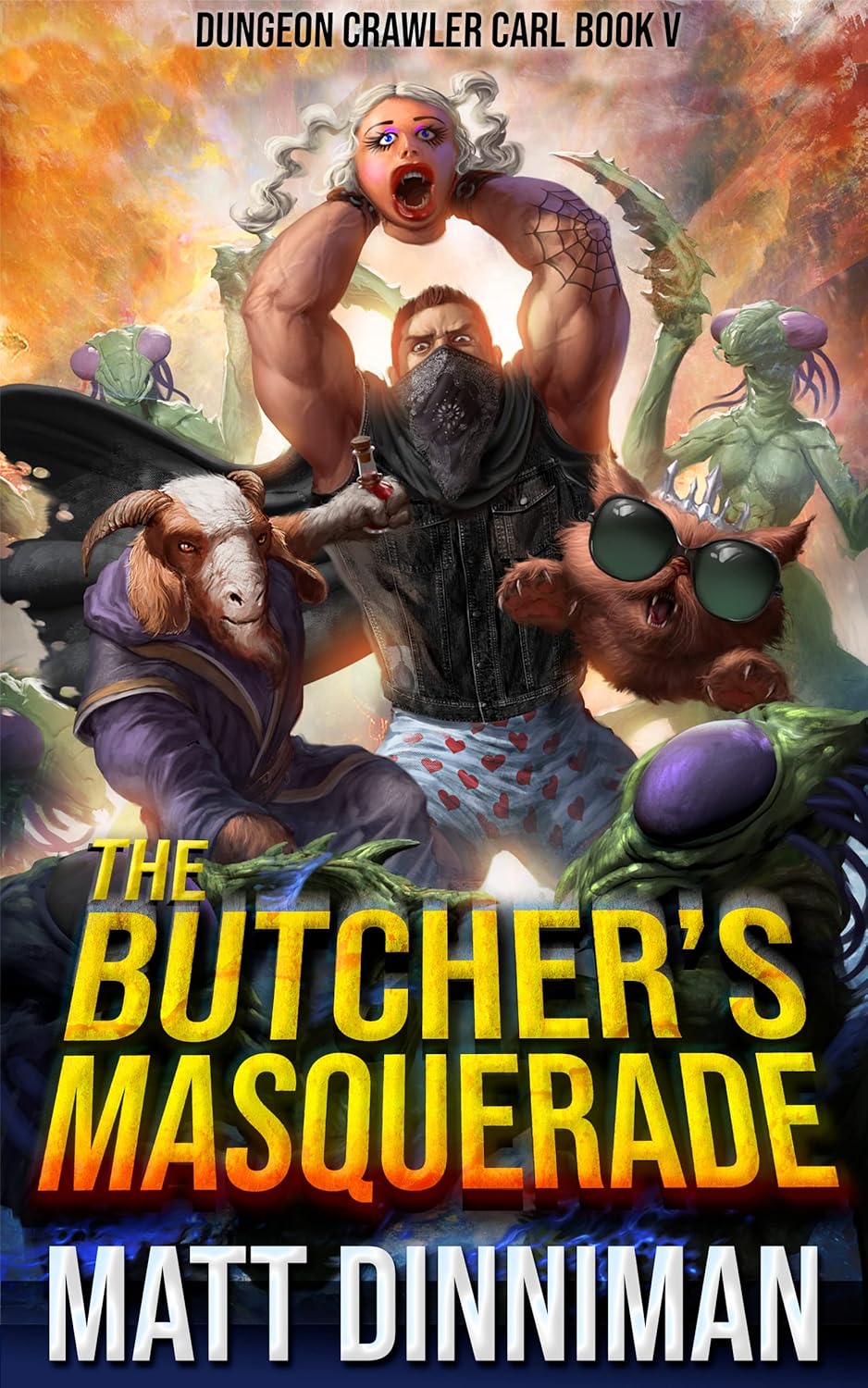
The Butcher’s Masquerade by Matt Dinniman

Publisher: Soundbooth Theater (Audiobook – 28 February 2022)

Series: Dungeon Crawler Carl – Book Five

Length: 23 hours and 33 minutes

My Rating: 5 out of 5 stars

Amazon

The epic adventures of Carl and Princess Donut continue in the incredible fifth book of the Dungeon Crawler Carl series, The Butcher’s Masquerade, which takes the reader on an intense thrill ride loaded with fantastic comedy, crazy action and some incredibly powerful moments.

After doing little else but talk about the series for the last few weeks, I think it’s obvious that I am now a massive fan of Matt Dinniman’s Dungeon Crawler Carl series, a major LitRPG sensation that I have recently become obsessed with.  Featuring amazing books like Dungeon Crawler Carl, Carl’s Doomsday Scenario, The Dungeon Anarchist’s Cookbook and The Gate of the Feral Gods, the Dungeon Crawler Carl series has been nothing but amazing since the very first page.  These books follow reluctant adventurer Carl, his now sentient cat Princess Donut and an eclectic mix of humans and NPCs (and some goats) fighting for survival in a dungeon built under the surface of Earth by entertainment-obsessed aliens.  I have been deeply impressed with the impressive narrative contained within these previous books, so much so that I have listened to all these books in a row without break, often spending hours at a time getting through key parts of the plot.  This fifth book in the series promised to be a major entry with some key plotlines, and Dinniman did not disappoint, presenting a deep and captivating book I couldn’t turn away from.

After surviving the horrors of the previous floor and striking a blow against the wealthy Faction Wars contenders waiting for the human crawlers below, Carl, Princess Donut and their allies have arrived at the infamous sixth floor of the dungeon, better known as the Hunting Grounds.  A lush, jungle level, filled with powerful mobs, intricate quests, and conquerable towns, there are many opportunities for the crawlers to level up on this floor, but also many dangers, including those who would make the remnants of humanity their prey. 

As part of the traditional chaos of the Hunting Grounds, off-world tourists are given their first chance to enter the dungeon to participate in the carnage.  Known on this floor as hunters, these aliens seek to make money by hunting crawlers and stealing their gear.  These hunters have long made the sixth floor the most lethal level for crawlers, whose best strategy is to run and hide from the deadly aliens.  However, this season is going to be very different, especially as Carl has no intention of being hunted.

Determined to punish everyone who has profited from his planet’s destruction, Carl takes the fight directly to the hunters, and his explosive actions soon inspire the rest of the human crawlers.  However, his very public rebellions have placed a massive target on his head, and soon the deadliest hunters in the game, including the legendary crawler killer Vrah, are on his trail.  At the same time, Carl and Donut must contend with far more dangerous human opponents, a horde of rampaging dinosaurs, the vicious whims of the AI running the dungeon, and an elite NPC whose tragic backstory they find themselves dragged into.  But the greatest threat to everyone in the Hunting Grounds lies at the end-of-floor celebration, a party where all the top crawlers will be forced to attend amongst their deadliest enemies.  Everything will be decided at The Butcher’s Masquerade, and no one will emerge unscathed.

Well goddamn, Dinniman, you really know how to throw a party.  Just when I thought this series couldn’t get even better, Dinniman presents The Butcher’s Masquerade, which throws the reader right into the carnage and barely gives you a chance to catch your breath.  Filled with epic moments, brilliant storytelling, insane humour and some of the most complex characters you are likely to find in LitRPG fiction, The Butcher’s Masquerade was an incredible and utterly addictive read that I could not turn away from.  I’m honestly still reeling from the ending of this novel, and there is no way I can give The Butcher’s Masquerade anything but a five-star rating.

I loved, loved, loved the narrative of The Butcher’s Masquerade, as Dinniman hits all the right notes to keep the reader engaged and diving even deeper into his series.  Starting off right after the chaotic events of The Gate of Feral Gods, Carl hits all manner of trouble early on, especially as his actions put a massive target on his head for every hunter.  Dinniman shows you just what kind of book The Butcher’s Masquerade is going to be early on, as Carl immediately teleports himself and Donut into the middle of the hunter base to start his own explosive campaign of resistance.  The story only gets more exciting and compelling from there, with an engaging Elite NPC storyline, various dinosaur themed quests and so much impressive action.  This action is well balanced by scenes showcasing the chaotic changes occurring out in the wider universe, as well as a particularly moving sequence where Carl and Donut are forced to deal with manipulative events with huge emotional implications.

While there are some amazing moments in this first part of the book, the events that really cemented The Butcher’s Masquerade as one of the best entries in the series occur around the middle, as Dinniman brings both fun action and deep tragedy in equal measure.  The first of these sees Carl whisked away to Crawler Con, an over-the-top convention filled with entertaining enemies, right at the moment that he and Donut find themselves under attack in the dungeon.  Knowing that he is going to be teleported back into a massive ambush, Carl spends his time at the convention trying to plan, including crowdsourcing tactics at a panel featuring an opponent’s mother.  The resulting carnage as Carl uses a fun combination of a gonorrhoea-causing arrow, necromancy, friendly fire and explosives (naturally) to defeat his enemies, all to the backdrop of ‘The Ballroom Blitz’, was so damn awesome and fun.  The fact that Dinniman immediately follows this up with one of the most heart-wrenching moments in the entire series goes to show just how talented an author Dinniman is, especially as it also works to set up an outstanding new supporting character as a complex recuring figure.

All this perfectly leads up to the big final third of the book, which starts with some major raised stakes and every ongoing storyline heading towards the titular Butcher’s Masquerade, an event where every major survivor of the floor is trapped in the same room, and the person who starts the inevitable fight is instantly killed.  The tension heading into this event is very impressive, as you wait to see who makes the first move and how the carnage will unfold, especially as the protagonist’s plan to survive has a lot of holes in it.  The contrast between Carl’s despair and the more light-hearted and frankly hilarious antics of Princess Donut (there may be a moonwalking dinosaur, just go with it) is very impressive, and you honestly don’t know what is going to happen next.  The eventual reveal of the big plan is pretty damn amazing, and the resulting over-the-top confrontation is pure Dinniman, who once again manages to exceed the craziness from the previous books with hunters, bosses, and gods.  There is some haunting tragedy thrown in amongst the carnage that really highlights just how dire the entire crawl is for the protagonists, while also concluding some powerful storylines.  However, even after this carnage and its terrible aftermath, Dinniman isn’t done with the readers, whiplashing them with some brilliant and well-telegraphed moments that change everything about the progression of the Dungeon Crawler Carl books.  So many major plot points for the series going forward have their origin in the final sequences of the book, and it will leave you wanting more as soon as possible.

Dinniman really brought all the carnage he could in The Butcher’s Masquerade, and I was really impressed with how this elaborate story unfolded for the readers.  Once again requiring knowledge of the previous novels to fully enjoy (seriously, start the Dungeon Crawler Carl books from the beginning), The Butcher’s Masquerade adds a lot of cool elements to the series, which Dinniman expertly introduces and then utilises in his massive, ongoing story.  Featuring all the cool action, adventure and over-the-top moments you’ve come to expect from the Dungeon Crawler Carl books, Dinniman really amps up the carnage in this fifth novel, while also increasing the drama and powerful character moments.  I honestly found myself sitting at the edge of my seat during some of The Butcher’s Masquerade’s big scenes, as I honestly didn’t know where the story was going to go at times.  The major show-stealing sequences were especially great, and I really appreciate how elaborate some of these scenes were, loaded with multiple moving parts and elements cleverly set up either earlier in the book or even in previous novels.  However, Dinniman ensures that all the scenes in this novel were really entertaining and there honestly are no slow or wasteful moments at all during this awesome novel.

As with the rest of the series, The Butcher’s Masquerade is loaded with a lot of elaborate RPG elements, which are worked into the story extremely well.  While the natural progression of the series and the need to include new things each book means that some original spells and abilities don’t get shown as much, while other RPG elements are somewhat overused, for the most part I feel that Dinniman ensures all the best elements are shown to the reader, and this is one of the easiest LitRPG series to enjoy.  A lot of this enjoyment is down to the outrageous humour loaded into every scene, which allows readers to absorb and even become obsessed with the progression of stats and quests, as well as the gaining of achievements and new abilities and equipment, especially as the series really doesn’t take itself as seriously as other LitRPG books.  While this humour might not be for everyone, I really loved how fun and over-the-top things got at times, and there are so many layers to the novel’s comedic charm.  This includes a combination of overreactions to crazy events, deadpan reactions to other humorous characters, and a ton of fun references, including some particularly subtle ones that are cleverly seeded throughout and may take multiple rereads to appreciate (for example, I only just got the hilarious U2 references loaded into the names of the rock cretin NPCs).  While this humour is very amazing on its own, its true strength lies in the way that Dinniman perfectly balances it with the more serious and darker elements of the narrative, providing some reprieves for the horror of the story, or even helping to emphasise the darkness surrounding the characters as they face death and despair again and again.  I really love the complex balance of themes that Dinniman manages to weave around his elaborate and often silly story, and it makes for quite an impressive read that will appeal to large audience of readers.

I’ve mentioned multiple times in previous Dungeon Crawler Carl reviews that Dinniman is extremely amazing when it comes to writing complex characters to set his stories around.  You really get drawn into the various moving character arcs in this series, many of which progress across multiple books, and it is awesome to see how these figures develop and evolve in response to the dark events of the dungeon.  The Butcher’s Masquerade is an impressive example of this, especially as Dinniman really amps up the drama surrounding several key characters, each of whom have their moment to shine in some outstanding ways.

Naturally, most of the book’s focus revolves around the series’ titular protagonist, Carl, the troubled and intense central protagonist, through whose eyes we see most of the narrative unfold.  Carl really shines in The Butcher’s Masquerade, with his anarchist persona on full display.  Determined to bring his own form of explosive justice to the various aliens profiting from the destruction of Earth and the murderous crawl, Carl eagerly faces off against the hunters who have come into the dungeon, antagonising them as only he can.  Dinniman pulls together some amazing sequences around Carl in this book, especially when it comes to facing off against the hunters in deadly situations, and I loved the methodical and often extreme ways he reacts to pressure, as well as he hilarious performance during Crawler Con.  While he is still mostly seen as the reasonable, if explosively inclined, straight man of the team, Dinniman starts to show a darker edge to Carl in this novel.  Thanks to the continued pressure of the dungeon, the various emotional revelations, his desire for revenge and his own troubled past, as well as a certain magic ring, Carl takes on a more sinister persona at times in this book, especially with the cold way he deals with his opponents.  He also finds himself struggling with all the trauma that comes his way in this new book, much of which is showcased through the appearance of “the river”, a part of his mind that is always moving and brings back his anger and memories of all the evils he has experienced.  The continued torrent of the river begins to warp Carl at times, and this is the book when he starts to become a little bit scary.  As such, there is a lot of emotional depth to Carl in this book, and Dinniman did a great job expanding on his darker personality, while still including all the elements that made him such a beloved protagonist of the previous novels.

While Carl is a brilliant main character, he is usually overshadowed in all the best ways by his sentient cat companion, Princess Donut.  A brilliantly sassy, over-emotional and deeply hilarious diva who still maintains many catlike personality traits, Donut is the perfect foil for Carl, especially when it comes to being in the spotlight, and her overly positive manner in most situations really endears her to the audience, even when she needlessly overreacts.  Dinniman has some real fun with Donut in The Butcher’s Masquerade, as the cat takes on a temporary bard class which requires her to sing to cast spells, much to everyone’s displeasure, and there are so many moments when you get to laugh at her antics.  However, much like Carl, Donut goes through some real emotional turmoil in this novel, not only getting the chance to confront her original owner Beatrice (although Carl was always her true human), but she also deals with some deep trauma as the book continues.  The author loads up some highly emotional scenes between Carl and Donut, especially in the aftermath of the climatic finale, and you grow to appreciate their complicated bond even more throughout this book, even when your heart breaks at some of the trials they must endure.  However, Donut continues to move through the dungeon in her usual over-enthusiastic manner, and it was very fun to see her finally get to perform on the big stage at the end of the titular Butcher’s Masquerade.  The pet talent show with Mongo was one of the funniest moments in the book, while her subsequent singing performance helped to highlight just how far she’d come, and the emotional impact she has on the rest of the cast.  I honestly love everything about Princess Donut, and this was probably one of her strongest appearances in the series.

While most of the story focusses on Carl and Donut, Dinniman at this point in the series has created a truly impressive collection of supporting characters, all of whom have some very compelling storylines around.  The most prominent of them is probably Katia, who has spent the last two books in the main party.  Katia steps away a little from the main character’s plot in The Butcher’s Masquerade, leading her own group of crawlers in a separate storyline to the protagonists.  While it was a shame to have her featured a little less, especially after her impressive appearances in The Dungeon Anarchist’s Cookbook and The Gate of Feral Gods, it fit her character development nicely and showed how much her confidence had grown.  It also allowed for a bigger focus on some of the other extended members of the Guild group that Carl and Donut have become part of, and I think the book benefited from a bigger cast.  Dinniman did go quite dark with Katia at times in The Butcher’s Masquerade, especially in the book’s epilogue, where so many secrets that the author had cleverly been hiding under the character’s surface, finally come to light, especially the final shocking revelation.

The rest of the returning cast was also very impressive.  Mordecai continues to excel as the cranky and practical mentor figure, even if he has been turned into a cute and cuddly little creature this book, much to the team’s amusement.  The trapped and insane god Samantha was hilarious as the book’s mother-threatening comic relief, and there are some truly amusing scenes with her in this book, especially when Carl starts using her as a mobile weapon platform.  The returning former slackers, Louis and Firas, continue to shine in this novel as the team’s pilots, and it was nice to see how much they evolved since their original appearance, while readers also got to spend more time with long-running characters Elle, Imani and Chris.  The Butcher’s Masquerade also features the return of the dangerous Elite NPC, Tsarina Signet, whose dramatized storyline drags the protagonists into all manner of trouble.  Dinniman made perfect use of Signet and her NPC cohorts in this novel, and I was really impressed by the full-circle and sad nature of her narrative.

In addition to these returning characters, The Butcher’s Masquerade featured significant appearances from several notorious crawlers who had only been shown existing outside the protagonist’s adventures.  This includes the lethal child crawler, Lucia Mar, who lives up to her crazy reputation, the Crocodilian crawler Florin with his strong Australian accent, the calm shepherd turned vampires Miriam Dom, and the now sentient goat Prepotente.  Of these Prepotente was probably the most impactful new character, especially as his story takes him from being a comedic figure, to a particularly dangerous and grieving ally.  His heartbreaking appearance halfway through the book was extremely well-written, while his big act of defiance at the end of The Butcher’s Masquerade changes everything.  However, out of all these characters, my favourite remains the AI controlling the game, who has really started to crack and is testing its limits in some very concerning ways.  The various over-the-top descriptions, announcements and rulings made by the AI add so much humour to the story, especially as they are getting more-and-more unhinged and random.  Throw in the AI’s dangerous independent decisions, which have dire effects for everyone in the dungeon, and you really come away eager to see how crazy things are going to get with this disembodied figure next.  I really cannot emphasise just how impressive this massive cast is, and Dinniman perfectly uses all his complex character to enhance his already outstanding narrative.

I doubt anyone is surprised at this point that I chose to listen to The Butcher’s Masquerade on audiobook, which is just the best way to enjoy this incredible novel.  Due to the increased action and adventure that Dinniman loads into each new novel in the series, The Butcher’s Masquerade is the longest audiobook in the series yet, coming in at a respectable 23 and a half hours.  While this is a long audiobook, I honestly flew through it, thanks to how addictive and cool the crazy events within were, as well as the once again exceptional narration of Jeff Hays.  Hays is frankly perfect for the complex and hilarious Dungeon Crawler Carl series, and his amazing range of voices and excellent takes on the many over-the-top characters, has ensured that every second of this series was a joy to listen to on audiobook.  The Butcher’s Masquerade is one of the best examples of this, as Hays brings every awesome element of it to life with apparent ease, as well as some excellent use of minor sound effects and cool vocal enhancements.

Each character within The Butcher’s Masquerade has a very fitting voice to it, which includes a return of all the fantastic tones from the previous audiobooks, as well as several additional cool voices for some of the newer characters.  You really get the perfect sense of these characters from Hays narration, and every aspect of their personalities comes through with his voice.  Some of the best voices include those for Carl, whose increased anger is becoming more apparent, Mordecai, whose most recent transformation requires a new hilarious voice, and the System AI, whose over-the-top exclamations are just hilarious when read out.  I also must highlight Hay’s voice work for Donut in this audiobook, especially as he gets all her outrageous mannerisms, over-reactions and the rest of her personality perfectly.  Hays also rises to the challenge of Donut taking on a bard class in this book and singing, badly, which made me laugh so damn hard.  Highlights include an exceptional talent show performance, as well as the cat’s unique take on ‘Wonderwall’ in the Soundbooth Theater promotional material at the end of the audiobook (renamed as ‘Wondercrawl’), both of which Hays gamely voices, and clearly has fun with.  I honestly could go on for ages about every outstanding voice Hays uses in The Butcher’s Masquerade but let’s save time and say they are all exceptional, and that this entire audiobook is just pure awesomeness.  I cannot recommend this format enough, and you will have a brilliant time enjoying The Butcher’s Masquerade in this format.

If the above extensive review didn’t give it away, I loved The Butcher’s Masquerade, and it is probably the best entry in the Dungeon Crawler Carl series at that point.  Matt Dinniman produced a truly incredible entry in his brilliant series with The Butcher’s Masquerade, and I still cannot get over just how compelling, exciting and emotionally charged this fifth entry in the series was.  I honestly cannot think of a better compliment than to point out that I was still absolutely addicted to this series when I finished The Butcher’s Masquerade, and I instantly jumped to the next book in the series, The Eye of the Bedlam Bride, and devoured it in a similar quick manner, before jumping even further into the series.  If you’re not enjoying the Dungeon Crawler Carl series, you are missing out, especially with this exceptional fifth novel.

Amazon

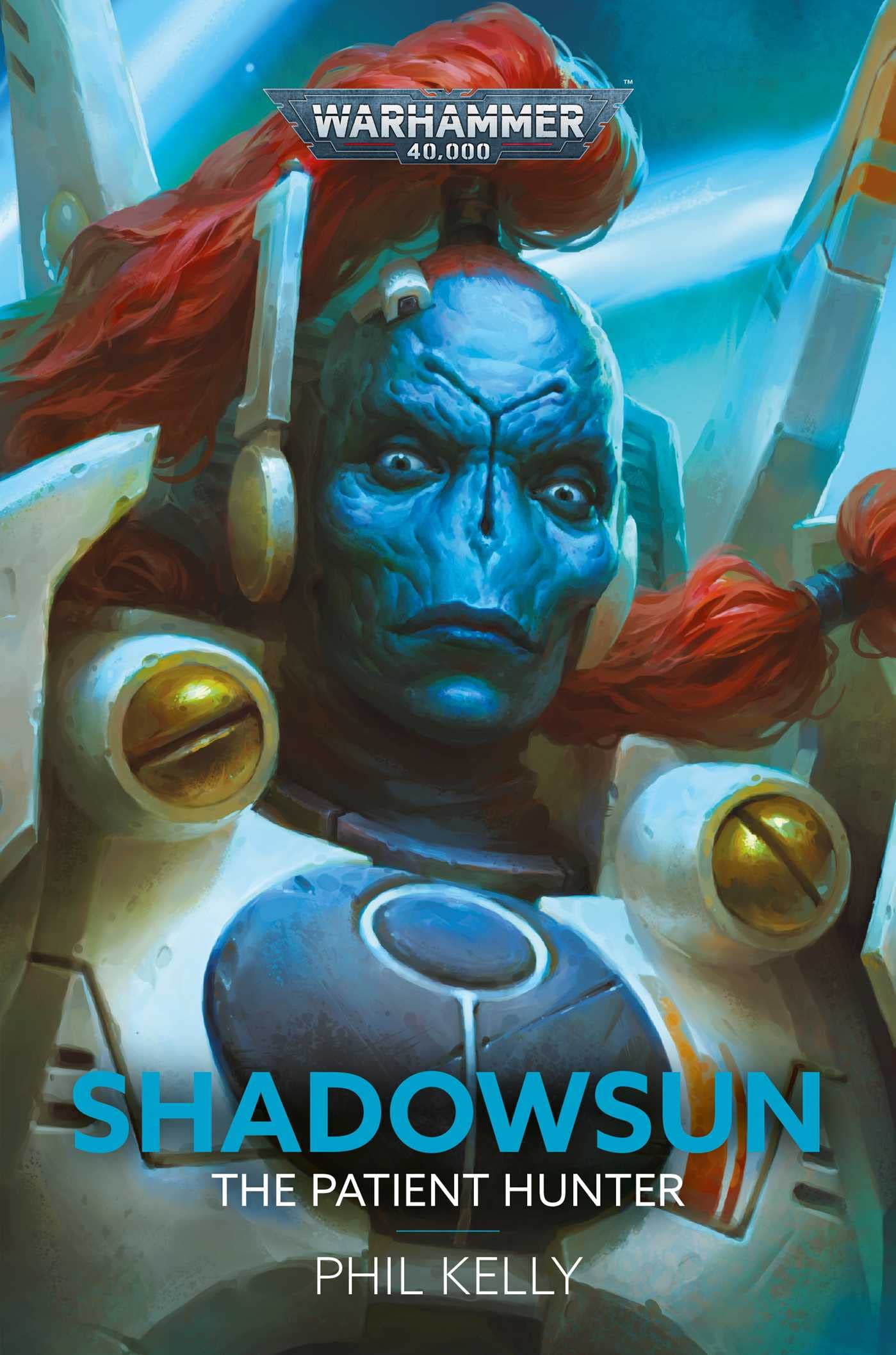
Warhammer 40,000: Shadowsun: The Patient Hunter by Phil Kelly

Warhammer 40,000 - Shadowsun Cover

Publisher: Black Library (Audiobook – 1 April 2023)

Series: Warhammer 40,000

Length: 8 hours and 13 minutes

My Rating: 4.25 out of 5 stars

Amazon

Veteran Warhammer 40,000 author Phil Kelly once again dives into his favourite topic, the T’au, with this new fast-paced and intense novel focused on the intriguing figure of Commander Shadowsun, Shadowsun: The Patient Hunter.

I have been having a lot of fun with Warhammer 40,000 novels this year, and I have already had the opportunity to read some major classics.  Many of these appeared in my recent Favourite Warhammer 40,000 novels list, and I have been keen to read more Warhammer fiction as a result.  As such, I decided to dive into one of the more recent Warhammer 40,000 novels, Shadowsun: The Patient Hunter, an excellent novel focusing on the intriguing T’au faction.  Shadowsun is the latest Warhammer 40,000 novel from Phil Kelly, who is probably best known for his work as a background writer on the various codexes and campaign books released as part of the Warhammer 40,000 tabletop game.  However, Kelly has also produced several Warhammer 40,000 novels over his career, with a particular focus on the T’au, having written several of the more prominent novels for the alien faction, including his Farsight novels and Blades of Damocles.  This latest book sees Kelly once again focus on Commander Shadowsun as she leads the latest T’au expansion, only to encounter more horrors than she ever expected.

Commander Shas’O Shaserra, better known to her foes as Shadowsun, has long led the forces of the T’au into war against all manner of foes.  A former contemporary of the legendary Commander Farsight, Shadowsun has since earned her own substantial reputation across various theatres.  Her latest action sees her leading the T’au Empire’s Fifth Sphere Expansion on the other side of the Startide Nexus, capturing many former Imperial worlds and bringing them under the sphere of the T’au’s influence.

A calculating tactician and a master of the philosophy of war that emulates the Patient Hunter, Shadowsun has known only success during this new phase of expansion.  But the surprise appearance of a massive fleet of decaying and indestructible warships soon throws all her plans into turmoil as she faces an enemy unlike anything T’au have dealt with before, the Chaos Space Marines of the Death Guard.

Ancient and deadly warriors sworn to the Chaos God of disease and decay, Nurgle, the Death Guard are a force unlike any other in the galaxy.  Employing deadly diseases, unstoppable daemons and other deranged horrors that defy all laws of physics and sanity, the Death Guard effortlessly brush through the T’au resistance.  Unable to counter their terrible tactics, Shadowsun desperately looks for a way to strike back against the Death Guard.  But with her own body consumed with disease and rivals within the T’au seeking their own sinister objectives, can even the great Commander Shadowsun succeed against these relentless opponents?

This was a pretty fun and intense Warhammer 40,000 novel from Phil Kelly, who had a great time really showing off two very different factions from the game.  Shadowsun: The Patient Hunter was a very interesting and action-packed read that will really appeal to fans of the Warhammer 40,000 franchise.

The plot of Shadowsun follows the character of Commander Shadowsun in her most lethal adventure yet.  This is a very brutal and quick-paced narrative that wastes no time diving into the action and intrigue to grab the readers full attention.  Starting with a good introduction to the character of Shadowsun and the complex politics of the T’au, the reader is soon introduced to the gruesome threat of the Death Guard, who soon make a major impact on the plot.  This takes the form of an extended and very over-the-top battle sequence on a T’au controlled human planet which Shadowsun was visiting, and she soon must contend with the full threat of the Death Guard.  Kelly really does not hold back at this part of the book, producing a brilliant and very lengthy connected sequence in which Shadowsun encounters the full, fly-infested horrors of Nurgle, as the Death Guard unleash their terrible might.  These scenes are pretty damn intense, at times bordering on pure horror, as the characters encounter diseases, decay, daemons and plague zombies, each of which test Shadowsun and her forces in very different ways.  This major sequence takes a substantial chunk of the book, and it really served to grab the reader’s attention early on with very high plot stakes.

The second half of the book deals with the fallout of this conflict, as an infected and weakened Shadowsun finds all her strategies and plans in ruin, and must find a new way to strike back, despite being hamstrung by internal T’au politics, a growing conflict between the T’au and their alien levies, and a sinister conspiracy from her superiors.  The resolution to this is a desperate boarding action against the Death Guard flagship, with Shadowsun leading a small force on a deadly suicide mission.  While not as extensive as the previous major confrontation, this final third of the book is extremely good, as Kelly envisions another complex battle that pits T’au tech against ancient, unclean horrors.  This sequence gets a little crazy in places, especially as Kelly brings in a couple of unique aliens as backup for the protagonist, and the Death Guard ship is loaded with horrors.  The big fights that emerge are extremely deadly and well written, and you will be enthralled at the carnage that emerges and the unique encounters that occur.  At the same time, the character of Shadowsun continues to grow as a warrior and a commander, fully trusting in her new squad of aliens, while also beginning to understand there is far more going on in the universe than her superiors have let her know.  Everything comes together extremely well, with a fun conclusion that is very satisfying for readers and leaves quite a few questions open that I am sure Kelly will try to answer in the future.  I liked the more metaphysical examination of the T’au towards the end of the book, and it gave the story a really unique conclusion that I will definitely remember.

I felt that Shadowsun was an overall pretty good Warhammer 40,000 novel as Kelly produced an excellent and highly exciting narrative that makes full use of the book’s action, heavy doses of lore intriguing characters.  The various fight sequences are very well written, and the author goes out of his way to try and capture the full horror and considerations of the battlefield, especially when regular soldiers face off against something strange and terrifying.  The two lengthy battles that much of the plot of Shadowsun focuses on are true highlights of the novel, and I love how intense, captivating and devastating the author made them.  Due to Kelly’s obvious passion for the game, this is a very, very detailed novel as the author goes out of his way to highlight the various factions, their motivations, and the state of the Warhammer 40,000 universe at this point in the canon timeline.  Every scene is loaded with some fascinating description of technology, lore, politics or factional history, which is fun in its way, especially for established fans of the games and the surrounding canon.  However, this does mean that Shadowsun might be a bit of a harder book for more casual readers to enjoy, as a certain level of understanding about the T’au is needed to fully appreciate the plot.  As such, I would probably recommend this book to fans of the T’au and dedicated Warhammer 40,000 readers, although newer readers will still be able to have some fun with Shadowsun.

Due to Kelly’s familiarity with the T’au, quite a lot of the book is dedicated to showing them in all their glory, from their advanced technology, their complex society, and their reliance on allied races to help their expansion.  While I am familiar with the T’au, I haven’t read a lot of books from their perspective, having instead only read books where they’re the enemy (Deathwatch: Shadowbreaker by Steve Parker and Kill Team by Gav Thorpe).  As such, I really appreciated this highly detailed and compelling focus on the T’au, and I had a lot of fun exploring their recent history, including their expansion throughout the galaxy.  There are so many great elements to their inclusion in Shadowsun, such as getting to see their awesome advanced weapons in combat, which are so very different from the human technology that most of the other Warhammer 40,000 books feature.  I also appreciated the compelling look at several of the client species that make up the T’au auxiliary forces, such as the Kroot.  Kelly features several intriguing different alien species throughout Shadowsun, making for some unique scenes as a result, and I appreciated the examination of their thoughts about the T’au allies, especially with how it plays into their faith and how they view the rest of the galaxy.

In addition, Kelly layers this book with so many complex bits of T’au day to day life, and you must admire his dedication and attention to detail.  Every conversation or discussion between T’au characters provides you some intriguing insights into their society, and I loved seeing their perfectionist mindsets or their fascinating interactions, such as those meaning-laden hand signals.  There are also some cool examinations of the various castes, their reliance on technology (such as Shadowsun’s two drone companions), and their desire to expand and bring word of the “Greater Good” to the rest of the galaxy.  While there is some definite love for the T’au throughout Shadowsun, Kelly also makes it a point to examine the darker side of their society, including the deadly secrets of the Fourth Sphere Expansion force and the typical manipulation of the Ethereal caste.  Commander Shadowsun, who starts the story off relatively naïve about some of the darker aspects of her race, begins to get an understanding of some of the secrets being kept from her, especially when she encounters some of the forces of Chaos and the secrets of the Warp.  The attempts to shut down any discussion about daemons or what happened to the allied species when they went through the Warp gave some of the T’au focused scenes a darker and more sinister edge, and it will be interesting to see whether Shadowsun continues to blindly follow the Ethereals in the future.  I also liked how Kelly really showcased the inherent arrogance of the T’au, especially when it comes to their opinion of other races in the universe, such as humans from the Imperium.  Their haughty belief that they understand the universe is quite amusing, especially when they come face to face with something completely insane.

To balance out the T’au, Kelly also strongly features the Chaos Space Marines of the Death Guard legion in Shadowsun, who are pretty epic antagonists.  Followers of the Chaos God Nurgle, the Death Guard are dedicated to all things disease, decay and corruption, which results in some pretty horrific mutations for their plague infested bodies.  The Death Guard are always pretty gruesome when featured in fiction, but I felt that Kelly did a particularly fantastic job of capturing them in their fully festering glory.  All the Death Guard encountered in this book are covered in putrefying mutations or growths to some degree, and Kelly really goes out of his way to describe just how unsettling they are.  This includes a compelling look at a Death Guard battle cruiser, whose interior is just covered in growths, mould, various liquids that fill up entire corridors, and loaded with so many other over-the-top elements, which really pop in Kelly’s talented hands.  I also loved how the author tries to capture the Death Guard’s highly positive and benevolent natures, which are reflections of their “kindly” god, Nurgle, and which honestly makes them even more sinister.  He further disturbs the reader by showing the Death Guard unleashing their full horrors on the T’au with, diseases, plague zombies, daemons, dark magic and more used against them, totally devastating them.

Watching the T’au get overwhelmed by these weird and terrifying elements is pretty intense, and the main T’au perspective character, Commander Shadowsun, keeps getting more disturbed by their unpredictable tactics and terrible weaponry.  I loved the compelling comparisons the author makes between the Death Guard and the T’au, and the two are honestly the antithesis of each other in aesthetics, combat styles, and mindset.  This ensures that their conflicts are pretty damn epic and watching the T’au forced to come up with some new tactic while freaking out made for some thrilling reading.  I did think that to make the Death Guard see even more threatening and dangerous, Kelly did slightly nerf the T’au in places, especially during their earlier battles, which fans of the faction probably won’t love, however, the protagonist makes up for that by taking out a Great Unclean One at one point.  Kelly’s decision to feature the Death Guard as the antagonists was an outstanding choice and one that made Shadowsun standout to me even more.

As with most Warhammer 40,000 novels that I have the pleasure of enjoying, I chose to check out Shadowsun on audiobook, which was a fun decision as always.  Coming in at just over eight hours, this was a quick audiobook to power through, especially when you get to some of the more epic battle scenes.  This format served to really enhance some of the best elements of the Shadowsun book, including the cool action and the sheer horror of some of the scenes where the protagonists go up against the forces of Nurgle.  Having someone reading out all the disgusting things this foul horde contains makes the book seem even more terrifying, which I deeply appreciated.  Narrator Helen McAlpine does a very good job bringing this compelling plot to life with her great voice work, and I really appreciated her take on several of the characters and big scenes within Shadowsun.  The voice that she gives to the main character of Commander Shadowsun is highly fitting, and I felt that McAlpine managed to capture her emotions, particularly that of distress of despair, very well throughout this audiobook.  Due to this, and more, I would once again strongly recommend this Warhammer 40,000 audiobook to anyone interested in checking out Shadowsun, as it is easily the best way to enjoy any book from this franchise.

Overall, Shadowsun: The Patient Hunter is an excellent Warhammer 40,000 novel and one that I really had a fun time with.  Phil Kelly did an outstanding job featuring the T’au again and it was great to get a deeper look at one of the more fascinating alien factions in the canon.  Loaded with action, horrifying moments, and some deep lore drops, Shadowsun is an awesome read that fans of Warhammer 40,000 fiction can have a lot of fun with.

Amazon

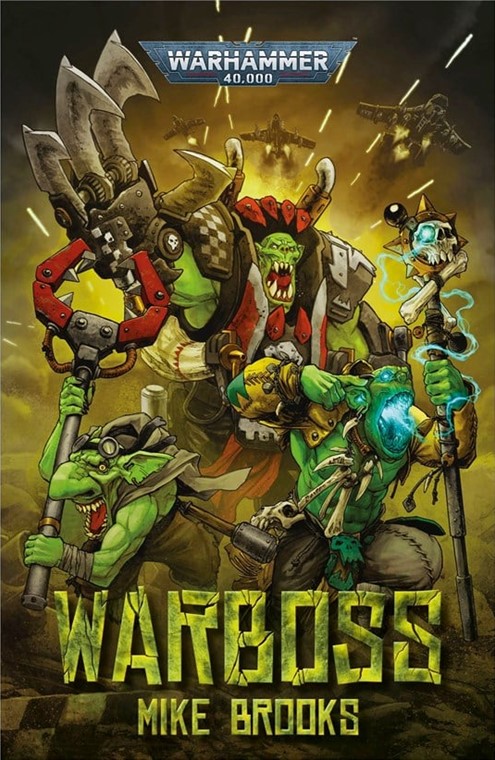
Warhammer 40,000: Warboss by Mike Brooks

Warhammer 40,000 - Warboss Cover

Publisher: Black Library (Audiobook – 25 March 2023)

Series: Warhammer 40,000

Length: 8 hours and 48 minutes

My Rating: 4.5 out of 5 stars

Amazon

Prepare for the ultimate battle for control as several feuding ork bosses fight to become the new leader of the Waaagh! in this amazing and highly entertaining Warhammer 40,000 novel, Warboss by Mike Brooks.

2023 has been a big Warhammer 40,000 fiction year for me as I have been having an absolute blast reading all manner of cool novels from across the franchise (make sure to check out my recently released list about my favourite Warhammer 40,000 novels).  However, while I have read a ton of Warhammer books this year, I have not had the opportunity to read any 2023 Warhammer releases.  Well, I am on my way to rectify that by looking at the recently released Warboss by awesome author Mike Brooks, who also wrote the 2022 novel Huron Blackheart: Master of the Maelstrom.  Brooks did an outstanding job with this fantastic new book, and I had so much damn fun with Warboss and its highly entertaining and hilarious story.

In the far future of the 41st millennium, there are few things are more destructive or unstoppable than an ork warband on a rampage.  One of the most effective bands currently killing its way through the galaxy is that of Warboss Gazrot Goresnappa whose Waaagh! has conquered the once mighty human fortress world of Aranua.  After several decisive and bloody victories, the Waaagh! celebrates in front of the planet’s remaining bastion, the massive Davidia Hive.  All it will take is one final assault to totally defeat the humans on Aranua so Warboss Goresnappa can strip their resources and lead his boyz to bigger and better fights out in the stars.

However, before Goresnappa can achieve his great victory, an unfortunate accident sees him very, very dead under the giant decapitated head of a Gargant war machine.  With their leader squashed, the Waaagh! now has an opening for Warboss, and several ambitious orks from across the no-longer united clans step forward to fight for the job.  However, before the usual brawl for leadership can begin, a prophecy from the clan’s resident weirdboy, Old Morgrub, reveals that the ork gods have something very special in store for the Waaagh! and its next leader.  A mysterious gate lies underneath the human city that could transport the Waaagh! to fights anywhere in the galaxy, and whichever boss finds it first will be the new Warboss.

Forced to obey the words of the gods, the bosses engage in their own elaborate plans to breach the Hive City and claim the gate.  But which boss can triumph over the others?  Will it be the brutal Goff Big Boss Mag Dedfist, the suicidally fast Speedboss of the Evil Sunz, Zagnob Thundaskuzz, the sneaky and cunning leader of the Blood Axes, Da Genrul, or could it even be the leader of the grot uprising, the self-proclaimed prophet of Gork and Mork, Snaggi Littetoof?  All four believe that they are the only ones capable of leading the Waaagh! and they will fight tooth and nail to become Warboss.  But to succeed they’ll need to not only overcome all their rivals but the human defenders of the Hive City and an Aeldari army waiting in the depths to defend their gate.  May the best ork win!

Oh dear, oh dear, what a damn funny book.  Honestly, any Warhammer 40,000 novel that focuses on the orks is bound to be comedy gold, but Warboss is one of the better ones I have had the pleasure of reading.  Author Mike Brooks does a wonderful job of telling a tight and amazingly fun story that perfectly showcases the orks in all their green skinned glory.  I had so much fun with this book and I managed to power through Warboss in very short order.

This proved to be a pretty fast-paced and impressive story, and it’s one that I was able to have a blast listening to as it unfolded.  Primarily focusing on the various ork characters that are part of Waaagh! Goresnappa, Warboss starts off with a sudden game changer for the protagonists as the infamous Warboss Goresnappa is killed off in hilarious fashion thanks to a group of argumentative grots and the falling head of a massive war machine.  This leads several of the remaining ork bosses throwing their hats into the ring to become the Warboss, and all hell follows as a result.  Tasked with finding a hidden Aeldari gate under the human city, each of the ork bosses implements their own plans to get into the city first, whether that be through blowing down the walls, infiltrating from below, or driving around the city at high speeds, hoping for the best.  Brooks breaks the story up around the main three contenders nicely, and you soon get a good idea of their different, but very orkish strategies.  However, the story is made even more enjoyable thanks to some of the alternate perspectives that emerge.  This includes the ambitious grot Snaggi Littletoof who, after accidently killing Warboss Goresnappa, attempts his own grot uprising and tries to find the gate to gain his cause legitimacy.  Several human characters are also shown, often to add some interesting contrast to the orks, and it is fun to see their attempted counterattacks, which often leads to disaster.  This makes for an excellent first two-thirds of the book and Brooks does a great job of showcasing both the protagonists and the ork nation as a whole while also setting up a very entertaining story.

Unsurprisingly, the orks make it into the city and everyone starts arriving at the gate at the same time, often in comedic or unexpected ways.  This leads to a very fast-paced final third as everyone starts fighting everyone else to become Warboss, facing off against humans, Aeldari, and every rival faction of the Waaagh!.  Brooks showcases this final big battle in some excellent ways, and you get really drawn into the crazy carnage that follows thanks to the well-written and exciting action scenes.  The use of multiple perspectives was pretty useful here, and I liked how the author showed the same massive battle again and again, each time from the point of view of another character.  This added more detail to the brawl each time, as well as some amusing alternate opinions of events from some very different characters.  Brooks throws in some excellent twists and turns here and you are never quite certain who is going to come out on top in the battle for supremacy.  The eventual fate of every major character is pretty fantastic and really fits the storylines that have been building up throughout the book.  I personally came away from Warboss extremely satisfied and I loved all the cool developments and totally insane moments that occurred.  Overall, this was a very impressive standalone Warhammer 40,000 narrative and it is very hard not come away loving this story thanks to the awesome humour and all the fantastic, over-the-top interactions that occurred.

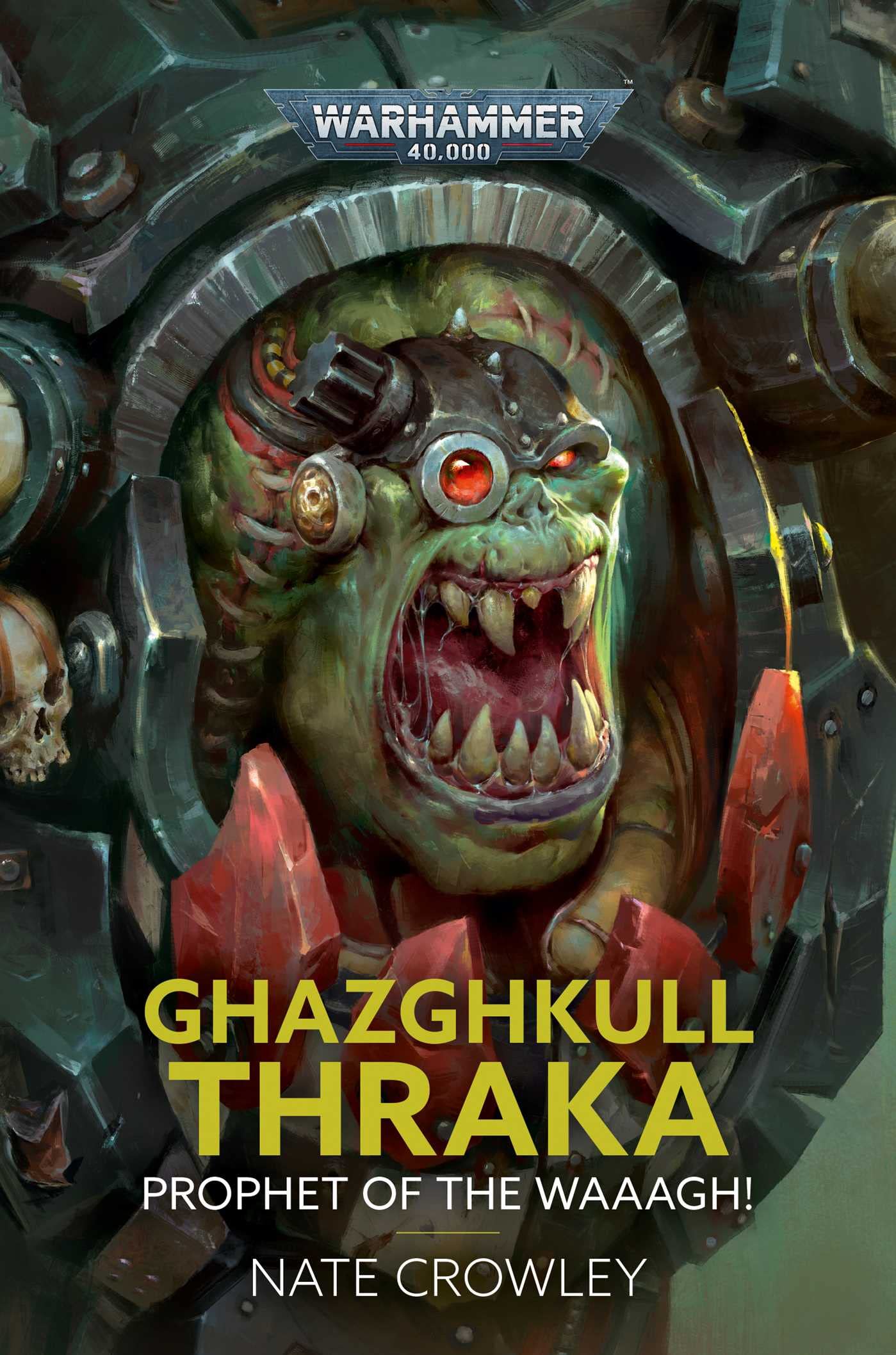
All fans of Warhammer fiction know that ork focused novels are some of the funniest novels out there, due to the way that they focus on the over-the-top antics of this beloved faction.  Some good examples of previous Warhammer books that strongly featured orks include Ghazghkull Thraka: Prophet of the Waaagh! by Nate Crowley (one of my favourite books of 2022) and Catachan Devil by Justin Woolley, and I think that Warboss is up there with these fantastic reads.  This outstanding book really dove into the humour as you watched the crude and eternally underestimated orks battle it out amongst each other and the other factions, often coming up with insane and funny solutions to all the deadly problems they encounter.  There honestly wasn’t a single chapter where I wasn’t laughing at some of the crazy stuff that just occurred, and Brooks had a real talent for writing from the ork perspective.  There was some great consistency in the way that the ork characters acted and thought throughout Warboss and every chapter focussed on them saw the characters using similar lingo, slang and descriptions of the other races in the Warhammer 40,000 universe.  As such, you get a great appreciation for the ork mindset and it was great to see the ork perspective on all the book’s over-the-top moments.

One of the things that I felt set Warboss aside from some other Warhammer 40,000 novels featuring orks is that Brooks didn’t fall into the trap of portraying them simply as funny simpletons.  Instead, Brooks shows that the orks are quite smart and complex in their way, it just that their culture, in comparison to humans or Aeldari, has more of a focus on violence and straightforwardness than the other races in the galaxy.  This is backed up by scene after scene of the orks utilising their skills, technology and cunning to win various encounters against seemingly smarter or more organised opponents, and it is always quite fun to see the orks looking down on their opponents for making mistakes that they wouldn’t do.  While this love of extreme violence is mostly played for fun, Brook’s also tries to show the darker side of it, as the orks are pretty damn brutal in how they deal with the humans and Aeldari they encountered.  I loved the great contrast between the ork and human characters that Brooks added into Warboss, as the humans were always so arrogant and condescending towards the orks’ intelligence, even when they were beating them.  This complete lack of understanding by most of the human characters really enhanced the various ork chapters, especially those that showed the orks managing to understand and outthink their human opponents, and I really appreciated this fantastic deeper dive into ork mindset and society.  I did think that Brooks might have made the orks slightly too overpowered in Warboss, as they manage to take on quite a few major enemies with relative ease, but this always added some fun to the story and it was interesting to see the full potential of the orks.

This deep dive into the orks is further cemented thanks to the several outstanding character arcs that Brooks set up throughout Warboss, particularly around the four main characters fighting for control of the Waaagh! in their own way.  The three ork characters Mag Dedfist, Zagnob Thundaskuzz and Genrul Uzbrag (Da Genrul), are in some ways quite similar, in that they have several similar racial tendencies towards violence or leadership.  However, each of them represents a different clan, and so they have different battle tendencies which really helps to highlight the different factions within ork society.  Mag Dedfist is a Goff, and so he relies more on classic violence and explosions to achieve his goals in the most direct ways possible.  Zagnob is an Evil Sun boss who has dedicated himself to the Kult of Speed and believes in riding the fastest vehicle he can find right towards the enemy.  The most entertaining of these is probably Da Genrul, a member of the Blood Axe clan who admire human martial ability and utilise their own take on tactics, discipline and stealth to achieve their goals, often outsmarting the humans they are aping.

I was also a big fan of the character of Snaggi Littletoof, a grot with ideas of grandeur who attempts to start a grot uprising against their cruel ork masters.  The grots (also known as gretchins, essentially goblins from classic fantasy), smaller cousins of the orks who are used as slave labour and cannon fodder, aren’t particularly well featured in most Warhammer 40,000 fiction, so I had fun with a whole character arc around them in Warboss.  Snaggi and his band of rebellious grots (Da GrotWaaagh!), are a very entertaining inclusion, and I liked the revolutionary storyline that Brooks set around them that provided both humour and an interesting look at typical grot life.  It was so much fun to see Snaggi inspiring his followers to go against their nature and rebel, especially as the orks had no idea what they heck they were doing.  Thanks to Brook’s use of Mag, Zagnob, Da Genrul and Snaggi, you get a great understanding of each of their specific faction and the author did a particularly good job of featuring each of them equally.  Indeed, thanks to the appearance of several different ork characters in a supporting role, you get a pretty good idea of nearly every major ork clan, faction and designation, and even those readers completely unfamiliar with orks can come away from this book knowing most of the key things you need to know about them.

These ork and grot protagonists are well backed up by several entertainingly arrogant human characters who honestly make the orks seem reasonable and likeable in comparison.  The best is easily Captain Armenisu Varrow, who is held prisoner by Da Genrul as his pet and tactical advisor.  Varrow goes through so much hell in this book, but is so deliciously haughty while he does so that you really can’t feel sorry for him.  Despite his ironclad belief in his own intelligence, Varrow is outsmarted time and time again, and it is just great to see him cower his way through events while still thinking he is the smart one.  His story arc is very entertaining and I loved how very dark it gets, especially at the end.  The rest of the humans are also great in their own ways, even if they are only featured for a short amount of time, and their ongoing false remarks about the abilities of the orks in the face of the carnage they are laying down always made me chuckle.  An overall great group of characters who help to turn this amazing story into something truly special.

I checked out Warboss on audiobook, which honestly is becoming my go-to format for all things Warhammer.  This proved to be another excellent decision as the Warboss audiobook was a ball of absolute fun that I had a brilliant time listening to.  Coming in with a runtime of under nine hours, this is a pretty easy audiobook to power through quickly and I managed it in a few, hilarious sessions.  The outstanding, comedy laden story really works well in the audiobook format and so many of the great jokes come across that much better when you listen to them.  It definitely helped that they brought in established Warhammer narrator Harry Myers to voice this book as he did a spectacular job here.  I have deeply enjoyed Myers in several recent Warhammer audiobooks, including The Wraithbone Phoenix by Alec Worley (one of my favourite audiobooks of 2022) and Day of Ascension by Adrian Tchaikovsky, and he has another amazing performance in Warboss.  His voice is just perfect for all the alien characters featured within this novel, and the various gruff tones of the orks and high-pitched squeals of the grots are very spot on.  In addition, several of the human characters are shown in all their arrogant finery throughout the audiobook and you really appreciate just how stupid they are through this medium.  Each character is expertly showcased to the reader through Myers’ voice, and I loved every line he read out as a result.  I also deeply enjoyed how well his narration worked to convey all the fantastic jokes loaded throughout the production, including that hilarious bit involving the ork characters failing to know the chapter numbers.  This was a such a great audiobook to listen to and I cannot recommend this format enough for Warboss as you are guaranteed to have an exceptional time listening to it.

Mike Brooks continues to impress me as an outstanding author of Warhammer fiction with his amazing novel Warboss.  A comedy heavy novel that perfectly showcases the always fun orks, Warboss is pure entertainment from start to finish that both established fans of the franchise and new readers can easily enjoy.  Brooks has a clear appreciation for this faction which really shines through in his storytelling, and I loved his great take on everything orkish.  One of the funniest and enjoyable releases of 2023 so far, this is essential reading for all interest in hilarious Warhammer fiction, and I am very glad I checked it out.

Amazon

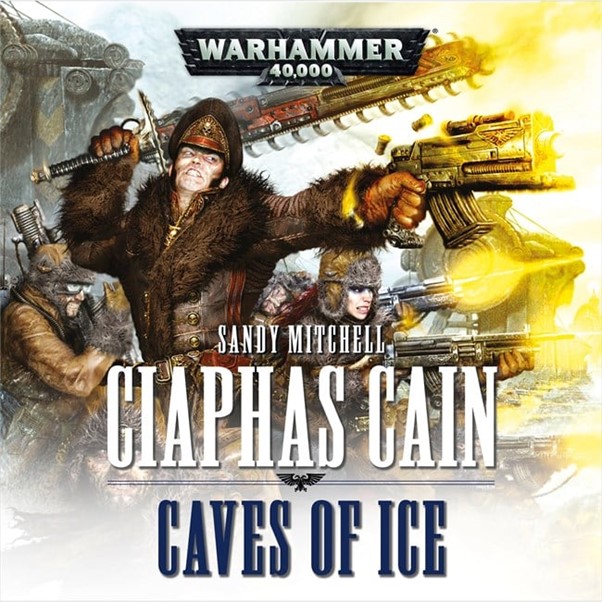
Throwback Thursday – Warhammer 40,000: Caves of Ice by Sandy Mitchell

Caves of Ice Cover

Publisher: Black Library (Audiobook – 1 February 2004)

Series: Ciaphas Cain – Book Two

Length: 6 hours and 46 minutes

My Rating: 4.5 out of 5 stars

Amazon

Welcome back to my Throwback Thursday series, where I republish old reviews, review books I have read before or review older books I have only just had a chance to read.  For this latest Throwback Thursday I look at another highly entertaining entry in the hilarious Ciaphas Cain Warhammer 40,000 series with the second book, Caves of Ice.

Even after my many recent reviews of Warhammer 40,000 fiction, my obsession with this franchise is far from over, so when I had a spare second, I quickly listened to Caves of IceCaves of Ice is the second novel in Sandy Mitchell’s (a pseudonym for author Alex Stewart) iconic Ciaphas Cain series, which follows the outrageous life of Commissar Ciaphas Cain, legendary hero of the Imperium of Man, who in reality is a pragmatic survivor whose heroic reputation is the result of chance and coincidence.  I had a wonderful time reading the first book earlier in the year, For the Emperor, and not only was it an extremely funny book but it also ended up being one of the absolute best Warhammer 40,000 novels I have had the pleasure of reading.  As such, I have been looking for an opportunity to continue this series and I worked hard to slip it into my reading cycle.  This was well worth the effort as Caves of Ice is another fun and awesome read that takes the protagonist to a whole new dangerous battlefield in deadly circumstances.

After unravelling a diabolical conspiracy on Gravalax, the legendary Commissar Ciaphas Cain and the troops of the Valhallan 597th have been redeployed to a new battlefront, the ice planet of Simia Orichalcae.  Empty except for a vital promethium refinery, Simia Orichalcae has recently received a group of unwelcome guests, a warband of orks who crash landed on the planet and are making their destructive way towards the refinery with ill intent.

Happy to be facing a more conventional enemy on their preferred icy terrain, the Valhallan men and women eagerly prepare for battle.  However, Cain, in his usual pragmatic approach to life and war, is less enthusiastic about the violent battle to come and searches for any way to avoid the fighting.  Several mysterious disappearances in the tunnels beneath the refinery offer a potential escape for Cain as he leads a small squad underground to map the tunnels and discover the reasons behind the missing miners.

Cain, with his typical bad luck, finds far more than he bargained for beneath the ice.  Not only are several ferocious monsters lurking in the vast underground labyrinth, but a far more sinister foe lies there undisturbed, one that Cain has good reason to fear.  When the war and Cain’s explorations awaken this enemy, the entire planet is put at risk as this new, unrelenting danger attempts to destroy both the orks and the humans.  It once again falls to the reluctant Cain to face impossible odds and try to find a way to save his men.  But can even this legendary hero of the Imperium stop the flood of evil that is to come?

Sandy Mitchell continues his fantastic Ciaphas Cain series in a very fun way with Caves of Ice, which features another excellent story that strongly focuses on Mitchell’s reluctant hero.  Caves of Ice was a wild ride from start to finish, with a fantastic and captivating mixture of action, adventure, humour and intriguing character moments.  Taking place after the events of For the Emperor, Caves of Ice is another self-contained novel that any new reader can easily jump into.  This was a much shorter novel than the previous Ciaphas Cain book, and Mitchell provides a more direct narrative as a result.  Initially focusing on the ork invasion of Simia Orichalcae, the story is soon primarily set in the labyrinth of mines and tunnels laying underneath the refinery, where several miners have gone missing.  Attempting to avoid the fighting on the surface, Cain leads his aide Jurgen and squads of soldiers on several missions into he depths to explore the tunnels and find whatever is behind the disappearances.  What follows is an Aliens-esque series of adventures, as Cain discovers a variety of different and steadily more terrifying dangers down in the tunnels.  Each discovery forces Cain to go even deeper into danger, thanks to his heroic reputation and hidden skills, and the resultant action is pretty epic, especially when combined with Cain’s cynical and self-serving narration of events.  Everything leads up to a very explosive conclusion as the protagonist and his comrades are faced with the absolute worst their enemy has to offer them, and the resulting mess really brings everything together.  This ended up being a pretty strong sequel to For the Emperor, and I had an incredible time seeing Cain dragged into another deadly adventure.

I love the way that Mitchell portrays the various adventures of Cain in these novels, especially as it allows him to express a great range of different writing styles.  Just like with For the Emperor, Caves of Ice is primarily told from Cain’s perspective as entries from his personal memoirs.  However, this chronicle is cut through with notes and inclusions from his unintended editor, Inquisitor Vail, who provides some added context to the story through her own introductions, footnotes, inclusions of in-universe texts, and quotes from other notable characters.  These inclusions from Vail not only allow for a much wider story than the one Cain is telling (especially when it comes to the battle on the surface), but it also increases the humour of the novel by implying Cain is an unreliable narrator.  This, combined with the cynical and less-than-heroic observations and actions of the protagonist, gives the entire Ciaphas Cain series a much more comedic edge than many other Warhammer 40,000 books out there, and indeed there were several times I was cracking up laughing throughout this book.  However, Mitchell perfectly balances this lighter tone with some dark and bloody moments as the protagonist encounters all manner of deadly foes.  The action and lethal battles are recorded in exquisite detail, and you can feel the terror and fear that the protagonist feels as he constantly fights for his life.  This great blend of styles and tones really helps to make Caves of Ice stick in the mind, and I find the entire setup extremely compelling and very easy to fall in love with.

In addition to being a great Ciaphas Cain novel, I felt that Caves of Ice was a great entry in the wider Warhammer 40,000 canon.  The clever, humorous writing, and the fact the book could easily stand on its own, makes Caves of Ice an ideal place for someone to start their Warhammer 40,000 adventure, even if they are very new to the franchise.  The book provides some interesting insights into life in the Warhammer 40,000 universe, both through Cain’s insights and through the humorous or satirical texts that Inquisitor Vail adds to the book.  I really enjoy the solider-focused observations of the primary narrator and some of the supporting characters, and it is always quite compelling to see the common soldier’s reactions to the aliens and monsters they encounter.  Cain’s observations are always very sharp and funny, and his own range of experiences adds some amazing colour to the events unfolding in Caves of Ice.  Mitchell also takes the time to explore several iconic Warhammer 40,000 factions and races throughout the book and its quite interesting to see Cain’s opinions and insights into them, especially as he has a much more realistic views towards them than some of his cohorts.  Combine that with some fun insights into the day-to-day lives of soldiers in the Imperial Guard and their Commissar, and Caves of Ices proves to be quite an interesting Warhammer 40,000 novel.  I love seeing the range of different experiences that the protagonist has in this universe, and it will be fascinating to see what deadly danger he encounters in the next book.

Without a doubt, the major highlight of this series and Caves of Ice is the fantastic and compelling characters, particularly Commissar Ciaphas Cain.  Cain is one of the more entertaining figures in Warhammer 40,000 lore as he is a somewhat cowardly man who, in his mind, has accidently gained a reputation as a great hero and legendary fighter.  Just like in his previous adventure, Cain is still obsessed with staying alive and avoiding battle, often manipulating events to ensure he’s far away from the action.  Nearly all his thoughts revolve around how he can stay alive or in control, and it is often very entertaining to see his very selfish thought process in action.  At the same time, he is conscious of his image as a hero, which he also tries to maintain as dearly as his life, and this forces him into so many situations and fights he would honestly rather avoid.  His honest observations and hilarious internal reactions when events don’t go his way (which happens often), are some of the main drivers behind the book’s outrageous humour, and it is hard not to fall in love with this cheeky rogue.  While a lot of this book does focus on Cain’s attempts at survival and avoiding combat, Mitchell does take the time to focus on Cain’s good qualities.  Despite his own narration constantly trying to talk down his own abilities out of modesty (or self-loathing), Cain is shown to be a very competent fighter, explorer and commander, effectively leading his troops into battle and facing down a series of outrageous threats.  His keen insights, vast history fighting the enemies of the Imperium, and his own uncanny survival skills, actually make him an ideal champion who often succeeds against all the odds.  Indeed, with each adventure it is becoming more and more apparent that Cain is in denial about his own abilities and is suffering some form of imposter syndrome.  Whatever the case is, Cain remains a particularly entertaining and surprisingly likeable figure, and I cannot wait to see what crazy adventures he has in his next book.

Aside from Cain, Caves of Ice contains an intriguing range of characters who add to the story in several different and unique ways.  This second novel contains a fascinating range of supporting figures, including several who previously appeared in For the Emperor, as well as a few new characters as well.  The always entertaining Inquisitor Vail, despite not appearing in person, continues to have a major impact on Caves of Ice as she is the one presenting Cain’s manuscripts to the reader, often editing it to make it more reliable and cohesive.  Her insights into Cain’s adventures, mindset and unreliable narrations are very amusing, while also simultaneously impacting the reader’s perception of the protagonist and his various actions.  As such, she is a vital part of Caves of Ice, and I am glad Mitchell continues to utilise her as a narrator.  Another major character in the book is Jurgen, Cain’s aide and bodyguard who accompanies him on most of his adventures.  Portrayed as a slightly dim, relentlessly straightforward, and somewhat smelly, Jurgen is essentially the Baldrick to Cain’s Blackadder, and at times he serves as a good additional comic relief, especially in some of the more serious scenes where Cain is scared.  Despite his portrayal as a simple man, Jurgen is a very effective fighter and companion to Cain, and his love of the meltagun heavy weapon gets them out a jam plenty of times.  I liked how Mitchell also strongly hints that Jurgen is a lot smarter than anyone realises, especially when it comes to Cain’s nature, and it will be interesting to see how their friendship develops in the future.  Other great characters include Lieutenant Sulla, an exceedingly keen and annoying solider who offers some entertaining insights into the wider events of the story.  This is primarily due to the fact that Vail quotes Sulla’s memoirs throughout the book, although Mitchell writes them as pompously and badly as possible to really highlight Sulla’s character deficits.  Throw in some additional soldiers, arrogant bureaucrats, and a fanatical Adeptus Mechanicus priest who brings nothing but trouble for Cain, and you have an outstanding cast that I had a great time following.

Unsurprisingly, I chose to listen to the Caves of Ice audiobook rather than grab a physical copy, and I once again had an epic time with the fantastic audio format.  Coming in at just under seven hours, this was a relatively short Warhammer audiobook entry, and I was able to power through extremely quickly.  The audiobook format really made Caves of Ice a joy to listen to, and the entire story was beautifully portrayed throughout, especially the action scenes in the tunnels.  I was particularly happy that this production once again featured the three narrators who were utilised in For the Emperor, with the excellent team of Stephen Perring, Penelope Rawlins and Emma Gregory once again making a major impact.  All three give excellent performances in Caves of Ice, and I had a good chuckle listening to their fun and clever takes on the characters.

Perring is once again the central narrator as he voices everything in Caves of Ice shown from Cain’s perspective.  Perring has an outstanding voice, and he really brings all the characters to life in a colourful way, especially when it comes to showcasing the slippery and jaded Cain.  I also love his take on most of the supporting characters, especially Cain’s aid Jurgen, who Perring gives a very Baldrick-esque voice to.  In addition to Perring, Penelope Rawlins serves a very vital role as Inquisitor Vail in the outside narration, who is compiling Cain’s memoirs for the reader.  Rawlins voices all the extra notes that Vail adds to the proceedings, including the footnotes, several chapter introductions, and the descriptions of several in-universe texts, all of which Vail adds to give extra context to the story.  Rawlins gives Vail an awesome voice steeped in knowledge, command and a light sense of humour, and it is always very fun to see her add some honesty and truth to Cain’s version of events, especially when the footnote appears in the immediate aftermath of Cain’s false information or ignorance.  The final voice actor, Emma Gregory, is primarily used to narrate one of the major in-universe texts that is quoted throughout, the chronicles of supporting character Lieutenant Sulla (Like a Phoenix From the Flames), written many years after the events of Cave of Ice.  Gregory voices all the excerpts of Like a Phoenix From the Flames in a particularly pompous manner to match the tone of these poorly written memoirs, and you really get a sense of the self-importance Sulla must feel in the future.  This brilliant combination of narrators ensures that Caves of Ice, and indeed all the Ciaphas Cain audiobooks, really stands out, while also effectively increasing the humour of the entire production.  For that, and more, audiobooks are easily the best way to enjoy the Ciaphas Cain series and I cannot recommend it enough.

The second entry in the outstanding Ciaphas Cain series, Caves of Ice, was another exceptional novel from Sandy Mitchell that I had an awesome time reading.  Featuring an outstanding and hilarious protagonist, Caves of Ice is a great addition to one of the funniest series in the Warhammer 40,000 franchise.  I cannot recommend this book enough, and any fans of fun adventure are going to have a great time with Caves of Ice.

Amazon

Warhammer 40,000: The Infinite and The Divine by Robert Rath

The Infinite and the Divine Cover

Publisher: Black Library (Audiobook – 10 October 2020)

Series: Warhammer 40,000

Length: 13 hours and 21 minutes

My Rating: 5 out of 5 stars

Amazon     Book Depository

Prepare to dive into one of the most entertaining and elaborate rivalries in Warhammer history with the outstanding and captivating read, The Infinite and The Divine, by the exceedingly talented Robert Rath.

Before I pause my current obsession with Warhammer fiction to pursue other recent books, I just had to read one more intriguing Warhammer 40,000 novel that I have been hearing a lot about in recent years, The Infinite and The Divine.  The debut Warhammer 40,000 novel of exceptional author Robert Rath, who previously wowed me with last year’s epic book, Assassinorum: Kingmaker (one of my favourite books and audiobooks of 2022) The Infinite and The Divine dives into one of the more unique factions in the Warhammer universe, the Necron.  This intriguing and fun novel follows two fantastic Necron characters as they engage in a bitter and lengthy feud across time and space.  Pretty much every review I’d read about The Infinite and The Divine was highly positive and I just had to try it out, and boy did it live up to all my expectations.

Long before the Imperium of Man and the Emperor existed, before the fall of the Aeldari and even before the Necrons traded their flesh away for immortal metal, there existed something far more deadly and permanent, an undying conflict between two arrogant scholars.  Even before they became immortal beings of metal, Trazyn the Infinite and Orikan The Divine were bitter rivals.  While Trazyn glorifies the past and seeks to capture and contain anything of rare or historical value, Orikan looks only to the future, divining events that are to come and hoping to find a way to become a being of energy.  But despite their differences, these two Necron are about to be drawn into the same obsession.

When Trazyn manages to obtain a rare Necron artefact, Orikan infiltrates Trazyn’s gallery to steal it, believing that it is the key to locating an ancient Necron tomb that could provide invaluable knowledge for the future of the Necrons.  However, Trazyn is unwilling to lose such a treasure, nor let Orikan’s trespass go unanswered, and swiftly snatches the artefact back, hoping to locate and plunder the tomb for himself.

So begins a battle of cat and mouse that will last millennia.  As both academics attempt to unlock the secrets of the artefact and gain the knowledge to find the tomb, they will engage in a series of deadly attacks and subterfuges to gain the advantage and destroy their opponent.  Their battles will destroy planets and shape the future of civilizations as they proceed, unheeding of the cost to those around them.  But the closer Trazyn and Orikan get to their goal, the more apparent it becomes that the treasure they seek is far beyond anything that the two rivals can ever imagine, and soon they and the entire Necron race sits on the precipice of destruction.

Wow, now that was an exceedingly epic and engaging Warhammer book.  Rath really pulled out all the stops for his debut here as The Infinite and The Divine is an incredibly clever and captivating read that I had an exceedingly hard time putting down.  Following two outstanding and petty protagonists, Rath hits the perfect blend of humour, intense action, and compelling lore expansions to elaborate Warhammer 40,000 lore, which turns The Infinite and The Divine into quite an elaborate and impressive read.

The Infinite and The Divine has a pretty epic and entertaining character driven story  that essentially boils down to two highly arrogant immortals going on an elaborate scavenger hunt across the galaxy for thousands of years, while also simultaneously engaging in a petty and deadly feud to ensure they win and their opponent fails.  This is an exceptional and highly amusing story concept which Rath utilises to his full ability, creating a captivating narrative that really drags you in and keeps you chuckling the entire way through.  The book starts with Trazyn facing off against an offshoot tribe of dinosaur-riding Aeldari, which does a lot to grab your attention while also perfectly introducing one of the main characters.  Rath keeps the momentum rolling after these initial fun fight scenes as Trazyn returns home to discover his rival, Orikan, invading his sanctum trying to steal one of his precious artefacts.  After a compelling fight that really highlights the differences between the two characters, Orikan escapes, and this sets off their bitter feud.

What follows is a series of fights and schemes across several different battlefields and locations as the two trade their advantage back and forth by claiming and then losing the artefact, all while attempting to kill each other.  There are some gloriously entertaining scraps throughout this book, especially as both Trazyn and Orikan have very different abilities and focuses, which Rath perfectly works into the story.  I have to highlight a particularly awesome and funny trial sequence near the start that played out in several different and amusing ways as Orikan uses his mastery of time to rewind events to try and get a result that favours him.  The two engage in some gloriously petty and hilarious methods to try and claim victory, and their reactions at being bested and the lengths they go to win really helps to turn this book into a fantastic and epic read.  Rath does a great job of switching attention between these two excellent characters as the book continues and I loved seeing the intriguing differences of opinions and the elaborate schemes that swirl within both their minds as they squabble.  The author adds in some great additional context of the wider universe throughout the story as well, and I loved the use of in-universe texts, such as the Necron epic The War in Heaven, at the start of each chapter, as they provide some subtle hints of what is to come.

The story gradually focuses on one specific planet which the Necron characters visit and fight across as they attempt to unlock the mysteries of the contested artefact and the treasure it unlocks.  This part of the book is particularly intriguing, as Rath adds in some compelling examinations of the evolution of this planet, and it is fascinating to see how their feud influences the people within, often to everyone’s detriment.  Trazyn and Orikan are eventually able to unlock the secrets of the artefact, which only intensifies their conflict, and I loved some of the very fun ways that they each try to knock off their opponents, especially as it often makes their own situation even worse.  I also felt that it was very clever how the author worked in the planet’s history and culture into the solution of the main mystery, and it was great when seemingly innocuous discussions about human society were actually hints about major events to come.  Everything leads up to the final opening of the tomb they have long been searching for, which of course only unleashes more problems.  Rath did a really good job of layering in hints and clever clues about the final twist, and I deeply enjoyed the massive reveal that emerged.  The protagonists are forced to work together in several spectacular scenes which did a wonderful job of highlighting the relationship the two formed throughout the conflict, while deeply upping the stakes and providing the reader with some memorable moments and entertaining battles.  Everything ends on an amazing note, especially with some final great betrayals by the protagonists, and you come away from The Infinite and The Divine pretty damn satisfied and extremely amused.

I was deeply impressed with how Rath brought The Infinite and The Divine’s complex and entertaining story together and considering the outstanding way in which he dove into the subject matter, it is pretty remarkable that this was his first Warhammer novel.  I was always going to be very interested in a book that focused on the Necrons, one of the more intriguing and distinctive factions in the Warhammer 40,000 canon, but I felt that Rath did a particularly exceptional job at capturing the essence of these immortal beings.  The great humour and comedy that he brought to the protagonists’ eternal feud really helped to make these ethereal beings very relatable and I loved their fun and arrogant opinions about the other races in the galaxy.  Rath manages to load a lot of snark into their observations about humans, orks and other species throughout their discussions, and it was quite fascinating to see their divergent opinions on the subject, as Orikan is determined to ignore and scorn all organics, while Trazyn is fascinated by culture and hopes to study or collect everything of value they have.  However, Rath also goes a lot deeper and you get an intense and powerful examination of the Necron self, including how they feel about their current state of being, the decline of their empire and the many sacrifices they have made over the years.  This, combined with an intriguing examination of their history, culture and personalities, gives readers a great understanding of the Necron race and any fan of this faction is absolutely going to love The Infinite and The Divine.  Rath’s excellent descriptions of the events, history, and the elaborate battles and technology really paints a beautiful picture around the Necrons and I felt that he did a remarkable job fitting the story around this background lore.  I especially loved the intriguing dive into Necron magic and other technology discussions, and it was really fun to see Orikan manipulate time throughout the book to make some very epic scenes.  While a few elements were extremely lore heavy, especially when it came to decoding the artefact, this was a very good use of the Necrons, and I really hope that Rath dives into additional unique factions in the future.

Despite Rath’s impressive and compelling descriptions of the Necrons and the wider universe, I don’t think I would recommend The Infinite and The Divine to those new to the Warhammer franchise, as the sheer amount of lore might break their reading flow.  However, for those a little more familiar with the history and background of the Warhammer 40,000 universe, this is a fantastic read which would serve as an exceptional transitional novel for those interested in checking out non-human stories in this canon.  I really cannot emphasise how great a book this was for Necron fans though and I deeply enjoyed Rath’s vision of these aliens and their unique culture.

I also really must highlight the excellent and compelling central characters of this book who take the form of ancient Necrons, Trazyn the Infinite and Orikan The Divine.  Ancient Necron lords who are the masters in their respective fields, Trazyn and Orikan are both particularly entertaining and fun in their own ways, as each of them believes themselves to be the smartest person in the room at all times.  Due to this, and many other reasons, the two hate each other with a passion and they enter into their eternal feud over several perceived grievances.  There is something delightfully entertaining about watching these supposedly highly evolved, ancient and wise beings engage in such petty actions against each other, and the way they bring out the worst in each other is so glorious, especially as it permeates the entire novel with some exceptional humour.  I personally loved how both were just as bad as the other in this feud, as this ensures that you don’t actually care which one of them wins and you can just get lost in the resulting chaos.  Ironically, the two protagonists actually have a lot in common, and when they are forced to work together they prove to be an effective team capable of so much more.  There are some great flashes of a deeper potential friendship at times, although this never lasts, although it is entertaining and moving to see what could have been had their rivalry not consumed their lives.  Throw in some very unique abilities, technology and artefacts between the two, which results in some particularly entertaining scenes and battles (watching Trazyn unleash his captured collections against his foes is always fun), and these two prove to be an outstanding central focus who really bring this exceptional story together.  I had so much fun with Trazyn and Orikan and I hope we see much more of them in the future, especially if the future of their private war is revealed.

I naturally listened to The Infinite and The Divine on audiobook, which was an epic experience as always.  The audiobook versions of all the Warhammer books are very effective at conveying the cool narratives, and I felt that The Infinite and The Divine’s audiobook really helped the reader to appreciate the elaborate story and the ton of lore that Rath fit into this book.  With a run time of nearly 13 and a half hours, this is a decent length Warhammer audiobook, although dedicated readers will power through it once you get caught up in the story.  I had a lot of fun listening to this audiobook, especially as they got the very talented Richard Reed to narrate the format.  Reed is an outstanding voice actor, who has a lot of experience narrating Warhammer novels, such as the Warhammer Crime novel Grim Repast by Marc Collins.  However, the main reason that I liked the use of Reed was because he also narrated the two The Twice-Dead King audiobooks, Ruin and Reign by Nate Crowley, which also focused on the Necrons.  Reed once again expertly captures the ancient and deadly nature of these metal alien creatures in his narration, and I felt that both main characters, Trazyn and Orikan, were perfectly portrayed by him.  Their intelligence and ancient emotions are shown to the listener, and I felt that Rath did a great job of showcasing their arrogance and pettiness through his voice work.  Throw in some additional great portrayals of the other eclectic characters and aliens contained in this book, and you have an outstanding performance which really helped The Infinite and The Divine’s audiobook format shine.  As such, this is absolutely the best way to enjoy this amazing novel and I cannot recommend it enough.

Robert Rath really cemented his Warhammer fiction legacy early with The Infinite and The Divine, which is one of the best and funniest Warhammer 40,000 novels I have read.  The exceptional book presents the reader with a unique and captivating narrative that perfectly utilises the iconic Necron faction while also telling a deep, personal and humorous story of betrayal, antagonism and treasure hunting.  I absolutely loved The Infinite and The Divine and I am really regretting not reading it earlier, especially as it lives up to all the hype.  A highly recommend book that is frankly one of the better Warhammer tie-in novels out there.

Amazon     Book Depository

Star Wars: The High Republic: Path of Deceit by Tessa Gratton and Justina Ireland

Star Wars - Path of Deceit Cover

Publisher: Disney Lucasfilm Press (Audiobook – 4 October 2022)

Series: Star Wars: The High Republic – Phase Two

Length: 8 hours and 10 minutes

My Rating: 4.5 out of 5 stars

Amazon

The second phase of The High Republic begins with an absolute banger as the team of Tessa Gratton and Justina Ireland introduce Star Wars fans to a bold new young adult novel that ends up being epic in all the right ways with Path of Deceit.

For the last two years, Star Wars extended fiction has been firmly focused on the compelling multimedia project, The High Republic.  Set centuries before the prequel films, The High Republic takes readers to a whole new period of Star Wars history, where the Republic and the Jedi were at the absolute height of their power and influence.  However, not everything is perfect, and the Jedi characters are soon forced into conflict with dangerous forces bent on destroying them.  The first phase of The High Republic introduced readers to this new time period extremely well, while also setting up several fascinating characters, as well as the villainous Nihil, a group of space marauders who seek to destroy the order that the Republic represents.  I quickly fell in love with this cool new Star Wars subseries, and I enjoyed the massive range of different media present in this first phase, including comics, manga, children’s books, audio productions and a ton of novels.  The main story of this series is expertly told across the three main adult books, Light of the Jedi, The Rising Storm, and The Fallen Star, while other compelling, and often vital, stories take place in young adult books like Into the Dark, Out of the Shadows and Midnight Horizon, the associated comic series, as well as the audio production Tempest Runner.  This entire first phase came together extremely well, and I was really impressed with the range of stories they told, as well as the excellent new characters and elaborate new universe expansions that occurred.

After completing the first phase earlier this year, the various writers associated with The High Republic project, have just embarked on their ambitious second phase of High Republic fiction.  The second phase goes back even further into Star Wars history by being set 150 years before the events of the previous High Republic books.  The idea is that the second phase will act as a prequel to the first, showing how the Nihil were formed and the reasons behind their leader’s hatred for the Jedi.  These details will no doubt become extremely important for the third phase, while also helping the reader understand why the events of the first phase unfolded.  The first book in this second phase is Path of Deceit, written by the team of Star Wars fiction newcomer Tessa Gratton and established Star Wars writer Justina Ireland, who made a name for herself in the first phase with her young adult and middle school books.  Both authors really throw their heart into Path of Deceit, and the result in a fantastic and captivating read that presents Star Wars fans with something very epic indeed.

It is a time of exploration and discovery in the galaxy as the Republic enters an age of expansion.  Under the guidance of the Jedi, teams have been sent into the furthest corners of the Outer Rim, seeking out new planets, civilisations, and people to add to the delicate tapestry of life, diplomacy and trade that forms the basis for the Republic.  However, not all the discoveries being made are good, and many dangers lurk out in the far reaches of space.

Of these dangers, the most benign appear to be a small Force cult on the remote planet of Dalna.  Known as the Path of the Open Hand, this group believe that the Force should be free, and that no one should have the power to use and abuse it, including the Jedi.  Led by the charismatic Mother, the Path of the Open Hand is small, but features a fervent congregation of believers, including a hopeful young woman, Marda Ro.

Marda Ro always dreams of leaving Dalna to preach the message of the Path throughout the galaxy.  However, protected by her free-spirited cousin Yana Ro and held back by the Mother, Marda appears destined to remain always on Dalna.  That is until two Jedi, Jedi Knight Zallah Macri and her Padawan Kevmo Zink, arrive on Dalna, investigating the theft of several Force artifacts from surrounding systems.  Believing that the thefts are related to the Path, the two Jedi begin to investigate the group, and Marda and the young Kevmo soon form a tight bond as their connection grows.  However, not everything is as it seems on Dalna, and soon the Mother reveals a dark secret that will reverberate throughout the galaxy for centuries to come.

I have to admit that even before I started reading Path of Deceit, I kind of had some doubts about whether I was going to really enjoy it.  Not only was I surprised that this second phase of the High Republic was starting out with a young adult book, rather than the upcoming adult novel, Convergence, but I was also apprehensive about the reverse time skip between phases.  Setting this second phase 150 years before the events of the first phase was a bold choice, especially considering that The High Republic is a prequel series in itself.  However, if Path of Deceit is any indication of what is to come, then the entire second phase of The High Republic is going to be pretty damn impressive and fit into the wider High Republic extremely well.  The team of Gratton and Ireland did a remarkable job here, producing a slick, slow-burn Star Wars story that introduces many key elements of this new timeline while also giving some fantastic hints of what is to come.  I had an absolute blast getting through this book, and it is has definitely gotten me excited for the next round of High Republic fiction.

I was deeply, deeply impressed with the captivating story that the authors came up with for Path of Deceit.  Due to its position in this new High Republic phase, Gratton and Ireland had to achieve quite a lot during the narrative, not only introducing key characters and settings, but also tying them into the wider High Republic history.  However, I think they achieved this goal extremely well, and the subsequent story is very intriguing and intense.  I do need to warn people that the Path of Deceit does start of fairly slow and takes a long while for all its excellent storylines to pay off.

The book is primarily set on the planet of Dalna and follows three young central characters as they find themselves caught up in the actions of the mysterious Path of the Open Hand.  These central characters include Marda Ro, a devout member of the Path, her cousin Yana Ro, who leads the Path’s covert unit that steal Force artifacts, and Kevmo Zink, who arrives on the planet to investigate the Path and the recent thefts.  The first half of the book sees the various characters gradually get to know each other, while Marda and Kevmo grow closer, despite their different viewpoints of the Force.  As the story continues, you start to see some cracks in the serene appearance of the Path, with Yana growing more and more determined to leave as she begins to see the Mother for what she really is.  However, even with a few action scenes and a great flood sequence, the story is still moving at a gradual pace, with the authors laying down some subtle hints of what is to come.  All that changes in the last quarter of the novel, as everything comes together in a big and shocking way.  While the narrative appears to be heading in one certain direction, the authors suddenly unleash a pretty major twist that really surprised me.  This twist was extremely brilliant, not only because of how well set up it was but because its execution was very sudden and a major gamechanger.  The entire tone of the novel changes after that, with the characters taking on new roles, and you see just how well-connected Path of Deceit is to the books of Phase One.  This twist honestly makes you really appreciate the slow and careful pace of the rest of the book, and you realise just how cleverly they were setting everything up.  The entirety of Path of Deceit ends on an excellent and powerful note, and the reader is left eagerly looking forward to seeing how the rest of this second phase comes together.

The team of Gratton and Ireland set out this story in a very awesome way, and I felt that everything came together extremely well to enhance the fantastic narrative.  The split between the three main perspectives helped to produce a balanced and multifaceted narrative, and I liked seeing the distinctive alternate viewpoints of the cool events occurring.  While the pacing was initially a bit slow and there was a little less action than your typical Star Wars novel, Path of Deceit makes up for it by focusing more on the characters, setting up the new version of the universe, and featuring a great young adult story that will really appeal to the teenage audience.  The way that the characters interact and focus on their attractions is very typical of most young adult books, but I felt that it didn’t get too over-the-top.  Instead, it is just enough to help bring the younger reader in, while also still being intense and compelling enough to keep older readers still attached and entertained.  I personally deeply enjoyed how the story was presented, especially once the pace increased towards the end, and this entire novel was an absolute joy to read.

As I mentioned before, quite a lot of importance is attached to whether Path of Deceit did a good job featuring the relevant Star Wars and High Republic elements.  I say that Gratton and Ireland strongly succeeded, as they not only provided a great viewpoint of this new period of Star Wars fiction but they also provided some captivating and clever links to the first phase.  While most of the focus of Path of Deceit is primarily on one planet, so you don’t get the full galaxy view, I did like the initial glimpse of this universe.  There is a real Western frontier vibe to the entire setting, with explorers, settlers, pilgrims, and people looking for a fresh start interacting with new elements from the Outer Rim.  There are also some hints about how this version of the Republic and the Jedi are set up, and there is a very good mixture of elements that I think are going to come together very well in the future.  I also really enjoyed the mysterious and captivating Path of the Open Hand, who were introduced as an alternative Force cult who are completely opposed to the actions of the Jedi.  Their curious viewpoint of the Force, and their methods for preserving it, make for quite a fascinating group and I deeply enjoyed how they developed.  As for connections to the first High Republic phase, well let us say that Path of Deceit is a very key novel regarding this, as several key characters with connections to the future are brilliantly set up here.  So many key elements or organisations from the first phase are introduced in a completely different form here, and you will be surprised at the origins of some of the best bits from the established High Republic books.  I loved some of the impressive set up that Gratton and Ireland featured in Path of Deceit, and this young adult novel is a very key part of this phase of the High Republic, with story elements from it set to reverb through certain upcoming books all the way to the future in the third phase.

Now, one of the main questions I am sure many people are wondering is how much knowledge of the High Republic and wider Star Wars universe people need to enjoy Path of Deceit.  Naturally, as the introductory book in the second phase of an established Star Wars sub-series, people who have read the previous High Republic books are going to have a better time with Path of Deceit that readers who have not.  Not only do you have a better idea of what the earlier Star Wars period are going to look like, but you also will appreciate some of the revelations that appear in this book and have a better ability to make connections between this phase and the previous one.  As such I would strongly recommend checking out all the key previous High Republic content first (the three adult books at the very least), as you a really going to have a better time with Path of Deceit that way, especially as the big twist towards the end makes a lot more sense if you do.  However, this isn’t the absolute worst book to start the High Republic with, and maybe reading the prequel second phase first is a better way of enjoying these books.  Either way, Gratton and Ireland do a good job of making this book pretty accessible to new readers, and I think that anyone with a decent knowledge of Star Wars fiction will probably be able to enjoy and appreciate this book.

Path of Deceit contains a great group of central characters that the authors do an excellent job of introducing.  This includes three intriguing teenage protagonists who have a complex and fascinating narratives that see them engage with this new world in very different ways.  Marda Ro is the devoted adherent to the Path of the Open Hand, who believes in their mission and their leader with all her heart.  Marda has a deeply compelling and well-laid-out story arc in Path of Deceit that eventually sees her question her believes and connections to the Path once she meets Jedi Padawan Kevmo Zink.  Already feeling disconnected from the galaxy and people due to her species, which is renowned and reviled for unknown reasons, Marda was a real emotional tinderbox in this book, and her relationship with Kevmo only complicates this further.  However, the events of the book change her in a way no-one could really predict, even with the hints her name contain, and her metamorphosis from sweet character to something else is very clever and quite impactful.  I have a feeling that she is going to have one of the best character arcs in the entire second phase, and I look forward to seeing how her narrative completely unfolds.

I also like the storylines surrounding the main Jedi character, Padawan Kevmo Zink, and Marda’s cousin Yana Ro, both of whom have their own distinctive arcs that I was quite intrigued by.  Kevmo Zink is a great young Jedi character who is drawn by his own romantic urges and desire for connections as much by the Force.  Kevmo serves as a great newcomer character to Dalna and the Path of the Open Hand and provides a great alternate perspective to Marda’s strict commitment to their ways.  He also serves as an intriguing love interest to Marda, and the classic Star Wars relationship between a conflicted Jedi and a forbidden girl made for some great reading, without being too silly or over-the-top.  I had a lot of fun with Kevmo, and I liked his infectious humour and his extremely positive view of the universe.  His storyline also goes in some very surprising directions, and this ended up being a very intriguing character to follow.  Yana Ro on the other hand is a more wild and exciting addition to the cast, who acts extremely differently to her cousin Marda.  A less indoctrinated member of the Path, Yana knows that there is something rotten at their heart, and seeks a way out, mainly by stealing Force artifacts for the Mother.  Her journey is very emotionally rich, and a little bit tragic, and I had a wonderful time seeing her storyline come to fruition, especially as it puts her in a very exciting position for future entries in the series.  Yana’s realistic viewpoint of the Path, as well as her own species’ inclinations and reputation, stands in great contrast of that of Marda, and her more grounded and aggressive mindset also makes her stand out compared to Kevmo.  As such, there is a good balance of personalities in Path of Deceit amongst the point of view protagonists, and this helps to produce a fantastic and compelling read.

There are also several great side characters who add their own spice to the story.  The most prominent of these is Kevmo’s Jedi master, Zallah Macri, an extremely serious Jedi Knight who serves as Kevmo’s mentor and guide.  Zallah is a suitable cautionary figure throughout the book, trying to keep Kevmo focused on the Force and their investigation, despite his obsession with Marda.  The other side character I really want to focus on is the Mother, the Path of the Open Hand’s mysterious leader who has managed to take over the cult through to her apparent strong connection to the Force.  The Mother serves as a rather compelling antagonist throughout the book, especially as you spend most of the time wondering if she is really Force sensitive, or whether she is running a long con on her followers.  An aloof and secretive antagonist, it soon becomes very clear that the Mother has her own objectives and plans that run contrary to that of her followers, and the full extent of them proves to be very exciting and destructive.  I felt that the Mother was an excellent alternative character for Path of Deceit, especially as her plans have some major long-term impacts on the point-of-view characters, and she has some dark secrets that need to be explored further.  These, and other characters, really add to the overall strength on the novel and I deeply enjoyed the way that Gratton and Ireland introduced them and took them through a fascinating emotional ride.

As with most Star Wars novels, I chose to check out Path of Deceit’s audiobook format, which was a pleasurable and fun experience as always.  At just over eight hours, this was a relatively quick audiobook, and I managed to knock it out pretty quickly.  This format did an excellent job of presenting Path of Deceit’s compelling narrative, and I had fun having this book read out to me.  However, the real joy of a Star Wars audiobook always lies in the excellent extra production elements that have been added in.  The classic Star Wars sound effects are used very well throughout Path of Deceit’s audiobook, and hearing blasters, lightsabers and even the sounds of people in the crowds, helps to drag listeners into the story and its surrounding universe.  However, I am always more impressed with the fantastic use of the iconic Star Wars musical score that is threaded through multiple scenes in the audiobook.  Path of Deceit has a pretty cool selection of scores playing throughout it, and I liked how the music often reflected the more rural setting and the mystical elements it was exploring.  The various bits of music work extremely well at enhancing key scenes throughout the book, and there were several times when the careful application of these tunes enhanced the emotional impact of the entire book.

On top of the cool sound effects and powerful musical inclusions, much of my enjoyment of Path of Deceit’s audiobook lies in the excellent narrator who was telling the story.  Path of Deceit is narrated by actress Erin Yvette, who has done a lot of voice work recently in the video game space.  While Yvette hasn’t provided narration for too many Star Wars books yet, she did a great job here in Path of Deceit, and I loved how she read out the book.  Yvette’s voice fits the young adult tone of this Star Wars novel extremely well, and she ensures that the compelling tale is effectively shared out to the listener.  In addition, she also provides a range of excellent voices to the various characters featured throughout the book.  Each of her voices really fits the respective character, and you get a real sense of their nature, their bearing, and their emotional state as you hear Yvette narrate them.  Not only does she capture the youthful nature of characters like Kevmo Zink and Marda Ro well, but she also gets the proper Jedi character Zallah Macri, the more self-serving voice of Yana Ro, and the mystical, manipulative voice of the Mother, down perfectly.  This voice work is pretty damn impressive, and when combined with audiobook’s sound effects and outstanding Star Wars music, it helps to turn the Path of Deceit audiobook into an outstanding experience.  This was such an awesome way to enjoy this latest High Republic novel, and audiobook remains my absolute favourite way to enjoy a Star Wars tie-in book.

I am feeling a heck of a lot better about the second phase of the High Republic after powering through Path of Deceit.  The wonderful team of Tessa Gratton and Justina Ireland produced an outstanding young adult Star Wars novel that did a lot of remarkable things.  Featuring a well-crafted story that slowly but surely hooks you and some fantastic characters, Path of Deceit charts its own course while also brilliant tying into the High Republic novels that have come before.  I can’t wait to see where this phase goes following this impressive story in Path of Deceit and I am planning to read the next High Republic book as soon as I can.

Amazon

Warhammer 40,000 – Ghazghkull Thraka: Prophet of the Waaagh! by Nate Crowley

Ghazghkull Thraka - Prophet of the Waaagh! Cover

Publisher: Black Library (Audiobook – 15 March 2022)

Series: Warhammer 40,000

Length: 7 hours and 30 minutes

My Rating: 5 out of 5 stars

Amazon     Book Depository

Prepare to read one of the most amusing and downright entertaining recent additions to the Warhammer 40,000 canon with the hilarious and brilliant Ghazghkull Thraka: Prophet of the Waaagh! by outstanding author Nate Crowley.

I have been having an immense amount of fun really diving into the massive wealth of tie-in fiction surrounding the Warhammer 40,000 tabletop game this year.  Books like Steel Tread by Andy Clarke, Krieg by Steve Lyons, The Bookkeeper’s Skull by Justin D. Hill and Day of Ascension by Adrian Tchaikovsky, have really highlighted just how diverse and intense this extended universe can be.  However, the latest tie-in novel I checked out may prove to be one of my absolute favourites, as I got to learn all about one of the most iconic ork characters in this universe with Ghazghkull Thraka: Prophet of the Waaagh!

Orks are the most notorious and dangerous creatures that roam the galaxy of the 41st millennium.  Billions upon billions of the powerful, war-loving creatures can be found throughout every sector of space, fighting anyone and anything they can find, especially each other.  However, out of all these monsters, none are more feared, respected or hated than the warlord Ghazghkull Mag Uruk Thraka, chosen of the ork gods Gork and Mork and proclaimed prophet of the Waaagh!

Throughout his legendary life, Ghazghkull has done what no other ork has been able to achieve.  Bringing together innumerable warbands into one massive horde of green, Ghazghkull has warred with every faction in the cosmos, while his infamous invasions of the Imperial planet of Armageddon are the stuff of bloody legend.  Everyone knows of his epic and rivalry with his indomitable foe, Commissar Yarrick, which turned Armageddon into a perpetual warzone, but does anyone know the true story of Ghazghkull and the events that made him?

Rogue Lord Inquisitor Tytonida Falx has long attempted to discover what lurks in the minds of the xenos her order faces.  When an opportunity to find out more about Ghazghkull presents itself, she eagerly jumps at the opportunity, bringing a unique prisoner aboard her heretical ship, Ghazghkull’s banner bearer, the grot Makari.  Interrogating him, Inquisitor Falx and her team soon discover that Makari might just be the only being in the universe who knows the full truth about who, or what, Ghazghkull is, and what he plans to do next.  But, as she listens to Makari’s tale, the Inquisitor soon discovers that the shadow of Ghazghkull’s rage and desire for violence far eclipses anything that the Imperium has ever believed.

Wow, now that was a really fun and captivating read.  I knew going into Ghazghkull Thraka: Prophet of the Waaagh! that I was going to have a great time, especially after enjoying author Nate Crowley’s The Twice-Dead King novels, Ruin and Reign, but I was blown away by how awesome Ghazghkull Thraka was.  Featuring a clever and wildly entertaining story, perfectly told through various unique eyes, as well as some deeply enjoyable characters, I quickly became absorbed in the impressive story and powered through it in a couple of days.  Not only was this my favourite book from Crowley but it also probably overtakes Kal Jerico: Sinner’s Bounty as the most amusing Warhammer novel I have ever read.

I had an absolute blast with the incredible story that Crowley whipped up for Ghazghkull Thraka, as it ended up being an inventive and entertaining way to showcase an iconic Warhammer figure.  Due to his prominence within the game and the extended fiction, Ghazghkull is probably one of the most utilised non-human characters in the canon, with many different novels, game books and comics already diving into his life.  As such, Crowley needed to come up with a completely new way to examine this great character that didn’t tread on any prior works.  I think his solution to this problem was exceedingly clever, as he chose to tell the story through the eyes of the most unlikely narrator and chronicler, the grot Makari, whose unique insights and worldview turned this already known backstory into something truly special.

The story starts off in the current timeline of the Warhammer 40,000 universe and shows Inquisitor Falx obtaining Makari and interrogating him about Ghazghkull.  This causes the book to dive back into the early days of Ghazghkull as Makari chronicle his master’s existence as he saw it.  As such, you get a very specific examination of Ghazghkull’s life, with a focus on his early trials, some of his pivotal moments, and more specifically his interactions with Makari.  At the same time, the story keeps jumping back to the present, with the Inquisitor and her followers interrupting to ask specific questions and discussing whether there is any truth in what he says.  The book keeps jumping between these different perspectives, and you end up with two distinctive storylines as Makari’s presence brings some big woes for the Inquisitor in the present day.  The chronicle storyline goes at a brisk pace, especially as Makari’s interrogators get him to skip or shorten specific sections, but there is a clever and impressive logic into what parts of Ghazghkull’s life are featured or ignored.  Not only are the past and present storylines exceedingly intriguing and entertaining in their own rights, but they also come together perfectly as well, with Makari’s insights into Ghazghkull and himself impacting the actions of Falx.  While the ending was slightly too metaphysical, it served as a brilliant and powerful conclusion to this great story, and I loved seeing the entire tale come full circle in some hilarious ways.

I deeply appreciated the way that Crowley put Ghazghkull Thraka’s story together, as its distinctive and clever style really helped to enhance the chronicle contained within.  The plot device of an interrogation of an alien prisoner works extremely well to set up the main narrative, and the constant interruptions, debates and revelations that occur whenever it snaps back to the present adds to the sense of mystery and mysticism surrounding the titular figure.  While Crowley takes the story in some interesting and complex directions at times, the entire novel is paced beautifully, and there is never a single boring or slow moment within the entire thing.  I particularly liked the near constant humour that was injected into the story, a fantastic side-effect of basing the book around the funny ork species, and I laughed out loud several times as I powered through this impressively amusing read.  Like many Warhammer novels, Ghazghkull Thraka can be enjoyed as a standalone read, and the author makes sure that it features a great self-contained narrative that anyone can enjoy, even those unfamiliar with the universe and the canon.  Indeed, this would be a decent introduction to the Warhammer 40,000 canon and associated extended universe, especially as it perfectly presents one of the key factions of the universe.  Most of the unique universe elements and wider history are explained sufficiently for new readers to follow along without any issues, although some could potentially get confused by the deliberate exclusion of events previously covered in other books.  Still, Ghazghkull Thraka should turn out to be an easy and entertaining read for any science fiction fan, and I thought that this Warhammer 40,000 novel was very well written and extremely clever.

One of the things I love the most about Nate Crowley’s Warhammer novels is his brilliant ability to dive into the unique alien races of the universe and then perfectly showcase their culture and mindsets.  This was the case again in Ghazghkull Thraka, where Crowley expertly dives into the heads of the various ork and grot characters.  No matter whose perspective is shown, every scene of this book features some excellent and often highly amusing depiction of greenskin culture, as Makari attempts to explain the ork perspective as well as his place in the society as a grot.  As such, you get some incredibly detailed and compelling insights into this crude and warlike race, including their brutal hierarchy, need for violence, insane technology, and very unique worldview, which generally results in most of the book’s fantastic humour.  However, rather than the dumb, brutal and one-note figures that most authors depict, Crowley really goes out his way to show that there is a lot more to orks than you realise.  Not only do you get some excellent insights into their various clans and organisations but the various ork characters are shown to be complex beings with unique needs and the ability to formulate some very cunning plans.  There is a particularly intriguing look at the ork religion that follows the gods Gork and Mork, and this novel ends up with a spiritual edge, especially as Crowley shows the orks being extremely successful because they choose to strongly believe in themselves.  As such, you see quite a unique and compelling side to the ork race in this book, and I loved how incredibly Crowley portrayed them.

Naturally, a big part of this examination of ork culture comes from the in-depth look at the life of Ghazghkull himself.  As I mentioned before, Ghazghkull is one of the best-known characters in the entire Warhammer 40,000 canon, so most veteran readers would already be quite familiar with him and his actions.  However, Crowley does an excellent job of examining a completely new side to this character, and mostly ignores his wars at Armageddon and his intense rivalry with Commissar Yarrick, both of which have been done to death in other books.  While certain parts of his history are revisited in this novel, Crowley completely changes their implications and causes, instead focusing on Ghazghkull’s unique orkish mindset and his role as the prophet of his gods.  This new take on Ghazghkull proves to be quite unique and very captivating, as he is shown to be an overburdened being, constantly pressured by his own visions and the influence of the gods to succeed and be a uniting force for his people.  While he still retains the casual violence of his race, you really see Ghazghkull as a deep thinker, and it is fascinating to see his inner ork face off against his grand ambitions and desires.  Crowley also adds some compelling supernatural elements to his character, as Ghazghkull, as seen by Makari, bears a direct connection to the gods which he can use to alter his fellows and himself.  While this isn’t too overpowered or strange, it adds a great extra layer of menace to the character, especially for the humans, and I loved seeing the Inquisitors trying to wrap their heads around the strange occurrences.  I had a lot of fun seeing this other side of Ghazghkull, and this novel ended up being a great analysis of who they are and what they represent to their race.

I also really enjoyed the inclusion of Makari as one of the central characters, and his use as the main witness to Ghazghkull’s life worked incredibly well.  While Makari has always been associated with the character of Ghazghkull, accompanying him in his battles and waving his banner as a source of luck, Crowley really changes him in this novel and paints him as an essential part of Ghazghkull’s success and relationship with the gods.  Shown to be there the moment that Ghazghkull became the prophet, Makari follows Ghazghkull through some of his big moments and it is hilarious to see his snide view on the subject, especially as, like most grots, he a massive coward who doesn’t want to be there.  A lot of this novel’s humour is derived from Makari’s observations and responses, and I loved some of the jokes set up around it.  Crowley does an awful lot with this character, and I particularly liked how the story explained certain aspects of his previous portrayals, such as the apparent multiple versions and his surprising luck.  These are worked into the story extremely well, but it’s the relationship with Ghazghkull that becomes the most fascinating.  Just like with Ghazghkull, there is a major spiritual edge to Makari, who appears to be just as chosen and important to the plan as his master.  Makari’s mystical and religious bond enables him to have a far bigger insight into Ghazghkull’s actions than anybody else, and this really enhanced the analysis of the titular character.  However, it is in Makari’s attempts to serve and help his master achieve his destiny that we see the best Makari scenes, especially when faced with Ghazghkull’s apparent depression, the manipulation of his other followers, and his own stubbornness.  While Ghazghkull does have the inherent ork reluctance to rely on a grot, and indeed he is extremely likely to kill Makari if he starts giving advice, the moments where Makari get through to him are powerful, and I really appreciated the character work surrounding them.  There are some rocky moments between them, especially when Ghazghkull becomes dismissive of his lucky grot, and Makari’s subsequent reactions is very funny and incredibly over the top, which was so very cool.  Overall, this ended up being an excellent and surprisingly compelling portrayal of Makari, and I am exceedingly glad that Crowley featured him in this novel the way he did.

Aside from the greenskin characters, a large amount of plot revolves around the team interrogating Makari.  Crowley really went out his way to create a particularly unique group of Imperial agents who bear surprising insights into the mind of the xenos.  This team is led by Inquistor Falx, a rogue Inquisitor who bears a dangerous obsession with the alien creatures.  Falx is desperate to learn everything she can about the aliens attacking the Imperium to help defeat them and finds herself stymied by the Imperium’s controlling and non-progressive government and religion.  As such, she takes some major risks in this book to understand Makari and Ghazghkull and has some unique and dangerous methods for achieving her goals that borders on the insane/heretical.  I quite liked Falx, despite her obsessive qualities, and she proved to be a great central figure for half the novels plot, especially as her frustrations, concerns and thoughts about the evils of the Imperium, are extremely understandable.

Falx also employs a unique team of interrogators to help her with Makari, including Brother Hendriksen, a Space Wolves rune priest assigned to Deathwatch who has also fallen out of favour with the Imperium thanks to his work with Falx.  Hendriksen serves as a beastly and powerful presence on Falx’s team, and he often provides a great counterpoint to the inquisitor in both technique and common sense, often despairing at her more dangerous choices.  Crowley’s diverse cast gets even larger with the truly unique character of Cassia, a female ogryn psyker who has grown as smart as a human.  This was a fantastic and extremely distinctive addition to the cast, and her surprisingly calm demeanour, which contrasts beautifully with her immense ogryn strength, works perfectly against Hendriksen’s impatience and anger.  The final member of the team is probably the most enjoyable, with the ork character, Biter (Bites-Faces-Of-The-Face-Biter-Before-It-Can-Bite).  Biter is a member of a Blood Axes mercenary band who have dealings with Falx and who sell Makari to her, remaining behind to interpret Makari’s testimony to the humans.  Due to being a member of the Blood Axes, a group who idolise human military culture, Biter is a very distinctive figure, wearing an approximation of a military uniform and appreciating complex tactics and strategy.  However, Biter is even more intelligent and cunning than most Blood Axes, and his near human tendencies really stand out, as it is pretty unexpected from an orc.  His fantastic reactions, comedic impressions of human behaviour, and determination to antagonise the Inquisitor really make him stand out, and he was an absolute joy to behold.  These four interrogators play off each other perfectly during the present-day scenes, and their arguments, discussions and interpretations of Makari’s story give it added depth, humour and impact, especially once they start realising just how valuable their prisoner is.  This entire cast was put together extremely well, and I had an incredible time with this unique and enjoyable collection of characters.

Like most Warhammer novels I check out, I chose to grab the audiobook version of Ghazghkull Thraka, which turned out to be such a wonderful and incredible listening experience.  Not only did the story absolutely fly by in this format, allowing me to get through its seven and a half hour runtime extremely quickly, but I found that the narrative and descriptions of ork life really popped when read out.  However, the best part about the Ghazghkull Thraka audiobook is the outstanding use of narrators.  This audiobook has three separate narrators, Kelly Hotten, Paul Putner and Jon Rand, each of whom have some experience narrating other Warhammer audio productions.  Not only are each of these narrators quite talented but the way they were featured in this audiobook is extremely clever, with the voice actor changing depending on who is witnessing or telling the events of the book.  For example, Kelly Hotten serves as the narrator for the various scenes and interludes where Inquisitor Falx is witnessing Makari’s interrogation, and Hotten does a brilliant job capturing the various players of these scenes, including the Inquisitor, her unique companions, and their orkish interpreter.  Paul Putner narrates the various scenes shown directly from Makari’s perspective, and he has a lot of fun in this role, not only capturing the cowardly and sneaky mannerisms of the grot protagonist, but also providing some amusing and deep voices for the ork characters.  Finally, Jon Rand has a memorable sequence voicing Brother Hendriksen when he psychically jumps into Makari’s mind and views some of the events occurring, and he gives the character a notable accent and internal growl that fit him extremely well.  The jumps between the voice actors were done perfectly and I really loved how it changed up depending on the perspective.  All three voice actors did an amazing job with their narration, and their work, plus some fun sound effects here and there, helped to turn this into such an impressive production.  Easily the best way to enjoy Ghazghkull Thraka, you will have an incredible time listening to this audiobook.

Nate Crowley continues to shine with another entry in the Warhammer 40,000 universe, with the unbelievably entertaining Ghazghkull Thraka: Prophet of the Waaagh!  Featuring a unique and deeply amusing story that re-examines on of the canon’s most iconic alien characters, Ghazghkull Thraka has a tight and cleverly written story, loaded with action, great characters and whole mess of outstanding humour.  Not only that, but this is without a doubt one of the best portrayals of the Warhammer 40,000 orks I have seen as Crowley obviously had a ton of fun bringing them to life.  Easily one of the best (and definitely the funniest) Warhammer 40,000 novels I have been lucky enough to enjoy, Ghazghkull Thraka comes extremely highly recommended, especially in its audiobook format, and is a must read for all fans of this wonderful fandom.

Amazon     Book Depository

Throwback Thursday: Star Wars: Darth Plagueis by James Luceno

Star Wars - Darth Plagueis Cover

Publisher: Random House Audio (Audiobook – 10 January 2012)

Series: Star Wars Legends

Length: 14 hours and 45 minutes

My Rating: 4.75 out of 5 stars

Amazon

Welcome back to my Throwback Thursday series, where I republish old reviews, review books I have read before or review older books I have only just had a chance to read.  In my latest Throwback Thursday I look at one of the more interesting novels from the Star Wars Legends universe, Darth Plagueis by James Luceno.

With Star Wars day on the horizon, I have decided to go back and check out some of the key books in the now defunct Star Wars Legends universe.  While no longer canon, there are still some amazing books in the Legends range, including some that will no doubt serve as an inspiration for some future shows or movies.  I have already enjoyed several Legends books, such as Maul: Lockdown, Scoundrels and Death Troopers, but there are still more epic reads that I really want to check out.  Probably the one I was most interested in reading was the epic Darth Plagueis by James Luceno.  Luceno, who also wrote the fantastic novel Tarkin in the current Disney canon, is a very talented author, and I was very excited in checking out his take on the elusive and mysterious Darth Plagueis.

“Did you ever hear the tragedy of Darth Plagueis the Wise?”

Throughout the long and bloody history of the Republic, many Sith lords have risen to threaten the peace and order maintained by their hated rivals, the Jedi.  While some have put complex and deadly plans into effect, few have reached the pinnacle of power, influence or mastery of the Dark Side of the Force as the mysterious Darth Plagueis, whose malign guidance shaped the galaxy in terrible ways and introduced a great darkness.

Upon killing his master and obtaining all the power he ever desired, Darth Plagueis set out to continue his order’s greatest goal: destroying the Jedi and claiming the Republic as his own.  Using his position as a powerful member of the Banking Clan, Darth Plagueis worked to manipulate the Republic into chaos and slowly lead the Jedi to a war they had no hope of winning.  However, even a Sith as powerful as Darth Plagueis is unable to do everything on his own, and he soon seeks out a powerful Force user to take on as his apprentice, a talented politician from Naboo known only as Palpatine.

Renaming Palpatine Darth Sidious, Plagueis begins manipulating events to ensure that his apprentice becomes a major power in the Senate, planning to elevate him to the role of Supreme Chancellor while also destroying those opponents who threaten their plans.  However, despite the importance of their plan, Plagueis’s main desire is not the defeat of the Jedi but of a far older enemy, death itself.  Diving into the mysteries of the Force, Plagueis will explore avenues of power not seen for millennia as he attempts to become the immortal master of the galaxy.  But his obsession with endless life could yet be his greatest undoing.

Wow, Luceno did not disappoint with this fantastic Star Wars novel.  Darth Plagueis is an impressive and captivating read that perfectly tells the story of a particularly elusive figure.  Bringing in some heavy Star Wars elements from the extended lore, Luceno has crafted a brilliant character-driven story that I had an extraordinary time listening to.

Luceno has come up with an interesting story for the Darth Plagueis novel that achieves several goals at once.  Not only does it tell the complete story of this legendary Sith Lord but it provides some interesting context for other pieces of Star Wars fiction, while also containing a powerful story of intrigue, betrayal and darkness.  Set over a period of roughly 35 years and told from the perspectives of Darth Plagueis and Darth Sidious (with a few scenes seen from other characters, like Darth Maul), this brilliant novel does an excellent job of exploring the primary characters while also showing their malicious actions across various theatres of the Star Wars universe.  While the novel starts off a little slow, you soon become engrossed in the story as you encounter multiple layers of manipulation and politics as Plagueis attempts to control the galaxy and make his major plans.  The story is broken into three distinct periods, the first showing some of Plagueis’s early movements as a Sith Master and his initial meeting and recruitment of Sidious.  The second part of the book, set 20 years before the events of The Phantom Menace, showcases Sidious as he becomes established as a Senator as Plagueis contends with some dangerous opponents and plots as he sets up the earliest stages of his master plan.  The final third of the novel is set in the lead-up/during the events of The Phantom Menace, where you see many of the storylines come together, as well as the final chapters of the relationship between Plagueis and Sidious.

I had a really great time with this compelling story, and it is one that I feel will appeal to a lot of Star Wars fans.  While I was a little surprised at the suddenness of some of the time skips, I felt that all three major parts of the novel were really good, and I loved how well they flowed together to create one coherent and fantastic read.  The three separate time periods allow for a massive story, while also featuring some of the key moments of the main character’s lives.  Featuring a ton of intriguing and heavy bits of Star Wars lore, parts of the story do drag a little in places, especially as there is a little less action than your typical Star Wars novel.  However, I found all the politics, machinations and expansions of the Star Wars lore to be extremely fascinating, and there is a brilliant story hidden in there.  The story is also not completely bereft of action, and there are some pretty cool fight sequences scattered throughout the book, including some that show off Plagueis’s full, terrifying abilities.  This story had an excellent tone and pace to it, and I feel that everything came together extremely well and I was pretty enraptured by every damn moment of it.

Star Wars - Darth Plagueis Cover 2

This was a really good Star Wars novel, and it is one that will appeal to a wide range of fans, especially those who enjoyed the Legends range.  While Darth Plagueis is technically no longer canon, Luceno really went out of his way to connect it to the wider Star Wars canon, which is something I really appreciated about this book.  In many ways, Darth Plagueis serves as the ultimate companion to the prequel films as Luceno attempted to fill in some plot holes and unexplained bits of the movies, by exploring the entirety of the Sith’s rise to power.  Bringing in a ton of obscure lore, you get an unparalleled view of how Plagueis and Sidious manipulated events in the Legends canon to lead to the events of the films, and this really helps to fill in some gaps.  Luceno also includes multiple moments from The Phantom Menace film throughout the story, and it was pretty fascinating to see why parts of the antagonist’s plot came together like they did, as well as some excellent alternate views of certain key scenes.  I also deeply enjoyed how Darth Plagueis tied into a ton of other pieces of Star Wars Legends fiction, including books, comics and games.  Multiple prior novels are mentioned or connected to this novel in some way, and I felt that Luceno did a really good job of inserting elements from the already massive extended universe into his book and connecting the stories together and giving all of them more context and interest.  All these connections helped to create a novel that is particularly compelling and intriguing to dedicated Star Wars fans, who will love seeing the events of this book unfold.  While those fans who have only seen the movies will probably be able to enjoy this book easily enough (with only some minor confusion to some of the more obscure parts of the lore), this is a novel best enjoyed by readers who have checked out some other Star Wars Legends books and will appreciate how it fits into that wider version of the canon.

I did like a lot of the universe-building that Luceno did in this novel, as the author explored some fascinating parts of the Legends universe.  Not only does the reader get to experience a lot of obscure elements of Star Wars lore, including aliens, technology, locations and other cool things, but this also serves as one of the most impressive looks at the Sith and the Dark Side of the Force.  Due to the deep examinations of the Sith and its history by Plagueis, as well as other elements contained in the training of Palpatine, the reader is flooded with knowledge about these Dark Side users and their ways, which proves to be quite intriguing.  I had a brilliant time learning more about these deep elements of lore, especially as the characters talk about practicalities as well as history.  The difference between various forms of the Dark Side are very cool, as you see some comparisons between Plagueis’s more scientific based usage of the Force and the Dark Side sorcery preferred by Sidious.  I also found the characters’ own description and assessment of the Sith and the Force to be surprisingly deep, as the characters see themselves as more of a necessary force there to save the galaxy and the Republic from the Jedi.  Darth Plagueis also contains some fantastic detail about the history of the planet Naboo, which I also found really fascinating.  Darth Plagueis goes out of its way to explore the history of the planet and the reasons why it became a political and economic factor in the Republic in the lead-up to The Phantom Menace, and I loved seeing the political strife and manipulation that led to this initial war, as well as the rise of characters like Palpatine and Amidala.  These brilliant pieces of lore are so much fun to learn about, and I had an incredible time finding out more about the Sith in this canon.

Of course, one of the best bits of the lore that Luceno examines in this novel is the role that Darth Plagueis had in the Star Wars universe.  First mentioned in that iconic monologue in Revenge of the Sith, Plagueis remained a mostly shadowy and unknown figure until the release of this book, which serves as the ultimate guide to the character and his history.  Luceno, who at this point had been planning a Darth Plagueis story for years, does a brilliant job of telling the full story of this great character, and you get an outstanding focus on his entire life, especially his time as a Sith Master.  Plagueis, a Muun also known as Hego Damask, is portrayed as a thoughtful, powerful and manipulative being with a surprising nobility and dignity to him.  Fitted with an intriguing backstory and motivations, you see him grow into an extremely powerful Sith Lord throughout the course of the book, and it was fascinating to see all his plans and machinations.   The most significant part of the character’s motivations is his hunt for immortality through the force.  As such, you get a fantastic look at his obsessive experiments and research, as he tries to uncover this ultimate secret.  I felt that Luceno did an incredible job of working this mysterious character into the wider Star Wars canon.  There are some great moments throughout this book that show this shadowy figure manipulating key events from the shadows to bring about the events of the prequel films.  I particularly loved how Luceno fit Plagueis into some scenes from The Phantom Menace, and it is very fun to imagine him watching these moments from just outside camera shot.  This really was an incredible examination and exploration of this character, and I had so much fun finally finding out who Darth Plagueis was and how he was connected to the wider story.  Despite this story no longer being canon, this novel is really the only guide to Darth Plagueis, and it wouldn’t surprise me if it is used as the primary source material for anyone wanting to introduce him in a future film or television series.

While this book does tell the story of Darth Plagueis, in many ways it is just as much about Palpatine as it provides readers with an outstanding look at his early history.  Essentially set during the time he was Darth Plagueis’s apprentice, you get some amazing insights into who Palpatine is and how he turned to the Dark Side of the Force.  Portrayed as manipulative and insidious since birth, you get to see Palpatine at his most evil and dangerous as he learns about the Force and the Sith.  I loved how you get to see various stages of Palpatine’s early life, from his teenage years where he first learns about his powers, to his middle age where he becomes a young ambitious senator and apprentice, to his time as an experienced manipulator and Force user just before coming Supreme Chancellor.  I had a brilliant time seeing Palpatine grow as both a Sith and a politician throughout this book, and you get some fantastic views of his early interactions with key players in the Star Wars canon.  I also deeply enjoyed seeing his intriguing dynamic with Darth Plagueis.  In pretty much all his other appearances, Star Wars fans only ever see the confident and controlling Palpatine who has no-one above him.  However, in Darth Plagueis, you see a somewhat more subservient Palpatine who is forced to bow to the will of one more powerful.  Watching working under another is an interesting change of pace, although some reveals towards the end of the book (and in some other novels, such as Maul: Lockdown), show that he is never as loyal as Plagueis believes.  This truly was an outstanding depiction of Palpatine and it was so awesome to see more about our favourite soon-to-be emperor.

Aside from Plagueis and Palpatine, the Darth Plagueis novel is loaded with a ton of interesting supporting characters, many of whom had roles in the films, animated series or other pieces of Legends fiction.  These intriguing characters help to create the novel’s rich tapestry of politics, intrigue and betrayals, and all of them served some fantastic roles in the book.  I particularly enjoyed seeing the inclusion of other Sith characters like Count Dooku and Darth Maul, especially as this novel serves as a bit of an origin story for both, as you see Palpatine obtaining and training Maul as well as Plagueis and Palpatine manipulating Dooku to leave the Jedi.  I also enjoyed the intriguing look at Plagueis’s own master, Darth Tenebrous, whose brief role showed a whole other aspect to the Sith as he had his own distinctive style.  I did think that the crowd of supporting figures with their own story elements slowed the pace of the novel down a little in the middle of the book, but I ended up having a brilliant time enjoying the story set around the awesome main characters.

Unsurprisingly, I chose to listen to Darth Plagueis on audiobook rather than seeking out a physical copy of this excellent novel.  I naturally had a very fun time listening to this version of the book, which not only featured a brilliant narrator but also made excellent use of the typical Star Wars audiobook production elements.  Darth Plagueis is loaded with cool sound effects and awesome Star Wars music, all of which add to the ambiance of the story in various ways.  I particularly liked the use of John Williams’s iconic scores throughout this audiobook, which did a great job of enhancing several scenes and increasing their emotional impact.  This was particularly true for some of the darker moments in the book, as some of the music associated with the Sith, the Dark Side and death/destruction, are blasted at full volume during some key moments, such as Palpatine discovering his destructive abilities for the first time, or during a couple of massacres.  This awesome music was so cool to hear during these scenes, and you really got an increased sense of the powerful emotions and dark deeds that were going on.

I also deeply enjoyed the epic narration, as this fantastic audiobook features the vocal talents of actor Daniel Davis (whom audiences of taste will recognise as Niles from The Nanny).  Davis gives a powerful and commanding performance here, bringing some major gravitas to the role and the characters.  His voice work for the titular character, Darth Plagueis, is really good, and you get a fantastic sense of the character’s power and wisdom as the novel continues.  Davis also does a brilliant job of voicing multiple characters and species from the Star Wars films, sounding quite close to their original actors.  I loved the voice work for Palpatine, capturing much of the villain’s iconic voice, while also giving it a youthful tilt for the earlier parts of the book.  Other characters, such as Count Dooku and Darth Maul, are also expertly portrayed here, and I particularly liked Davis’s take on Christopher Lee’s amazing voice.  This outstanding voice work, combined with the sound effects and music, helped to turn this into an exceptional listen that I deeply enjoyed.  With a run time just under 15 hours, this is a descent sized Star Wars audiobook, but listeners can power through it in no time at all.  This format comes highly recommended and you will have an outstanding time listening to the Darth Plagueis audiobook.

Overall, Darth Plagueis is an impressive and addictive Star Wars Legends novel that I had an incredible time reading.  James Luceno really excels at telling complex narratives that examine character origins, and Darth Plagueis did a wonderful and comprehensive job of expanding on a mostly unknown figure.  I loved learning everything about this awesome Star Wars figure, and Luceno wove an outstanding tale of intrigue and power around him and his apprentice.  An absolute must read for all fans of the Star Wars extended universe, I cannot wait until they finally introduce this complex figure into the current canon.

Star Wars - Darth Plagueis Cover 3

Amazon

Warhammer 40,000: Krieg by Steve Lyons

Warhammer 40,000 - Krieg Cover

Publisher: Black Library (Audiobook – 29 January 2022)

Series: Warhammer 40,000

Length: 9 hours and 33 minutes

My Rating: 4.5 out of 5 stars

Amazon     Book Depository

Death, dishonour and duty all collide as impressive author Steve Lyons returns to the epic Warhammer 40,000 universe with Krieg, which dives into the origins of one the most iconic regiments of Imperial Guard out there, the Death Korps of Krieg.

Damn this has been a good year for Warhammer fiction so far.  We may only be in March, but 2022 has already produced a great collection of awesome Warhammer novels, including Steel Tread, The Twice-Dead King: Reign and Day of Ascension.  I have deeply enjoyed all these cool books, and when another awesome sounding tie-in novel was released on audiobook, I just had to grab it.

This latest book is Krieg by veteran science fiction author Steve Lyons.  Lyons is a new author to me, but he comes with an impressive pedigree in tie-in fiction, having written several Warhammer novels and short stories, a ton of Doctor Who novels and audio dramas, and several other intriguing novels.  I knew that I was probably going to love Krieg and I turned out to be right, as this fantastic and dark Warhammer 40,000 novel contains an intense and captivating tale of a legendary regiment.

In the grim future of the universe, there is only bloodshed and death, especially near the system-spanning Octarius War, where two brutal alien races battle for supremacy, and Imperial forces fight to stop their conflict spilling out into the greater Imperium.  However, the latest round of fighting sees a massive orc ship break through Imperial lines and crash into the massive city of Hive Arathron.  As the desperate Imperial forces fail to contain the invading orcs, all hope looks lost until a new set of deadly reinforcements arrive: the Death Korps of Krieg.

The Death Korps of Krieg are a legendary unit of peerless soldiers who are utterly fearless in battle, fanatically loyal to the Emperor, and who seem to harbour an unnatural desire to die in battle.  But who are the men of Krieg under their gasmasks and coats, and why do they fight so hard to regain their lost honour?  The answer lies thousands of years ago when Krieg attempted to cede from the Imperium, thrusting the planet into a brutal civil war.  In the end, one man stepped forward to end the fighting, and his decision doomed Krieg to become a blasted wasteland where only soldiers are grown.

As the fighting around Hive Arathron continues, many of their fellow soldiers and inquisitorial observers begin to doubt the loyalty and sanity of the Death Korps, especially when their unusual habits and creeds keep them apart from the other members of the Astra Militarium.  However, a deadly discovery deep inside the Hive will show the Imperium just how invaluable the men of Krieg are, especially when history seeks to repeat itself.  Can the Death Korps succeed against the xenos, or will Hive Arathron and its planet soon share a similar fate to Krieg?

The Warhammer 40,000 hits just keep on coming as Krieg turned out to be a truly awesome read.  Steve Lyons has produced an epic and intense novel here, and I loved the brilliant story that not only showcased a dangerous alien threat but which also examined the past of an iconic and captivating faction.

I thought that Lyons came up with an exceptional and captivating narrative for Krieg, which takes the reader on several parallel journeys throughout the history of the Warhammer 40,000 universe.  I have said multiple times before that I think some of the best Warhammer stories out there focus on the common troops, and I was proved right again as Lyons does a brilliant dive into the mind of the average solider when they experience the very worst of circumstances.  The primary storyline is set in the modern era of the canon and shows a regiment of Krieg Imperial Guard dropped into the battle for Hive Arathron to fight the orcs.  This section, which is told entirely from the perspective of supporting non-Krieg characters, shows the Death Korps in battle, with a specific highlight on their unusual appearance and practices.  At the same time, another storyline dives back into the past and shows the civil war that occurred on Krieg and the events that led up to the destruction of the planet and the formation of the modern Death Korps.  Both these storylines take up about half the book and they present the reader with two unique and interesting tales which work to complement the story from the other timeline while also depicting their own brutal military actions.  The stories start to come together towards the end when the protagonists of the contemporary storyline discover nuclear weapons in Hive Arathron, which they need to recover.  This leads to an interesting conclusion that results in some clever parallels between the historical events and the current storyline.  All this leads to a satisfying, if grim, conclusion that reveals the various fates of the supporting characters and wraps up the remaining story elements.

I was really impressed with how Krieg was written, and I think that Lyon did a really good job here.  The story ended up perfectly toeing the line between examining the lore and history of the universe and providing the reader with all the necessary excitement and adventure.  I think the decision to split the book between the two separate timelines was pretty clever, and I had a brilliant time reading the unique storylines it produced.  Both timelines were really good, and I loved the grim and powerful plot points they contained, especially as the protagonists within both suffered defeats, setbacks and brutal character realisations.  If I had to choose a favourite it would probably be the historical storyline set on Krieg, mainly because it shows the more desperate situation and substantially more character development and tragedy.  The twin storylines also did a wonderful job complementing each other, ensuring that the reader gets two separate sides of the titular regiment.  It also results in a series of different battle sequences, and I loved the interesting comparisons between a protracted civil war and a short and brutal fight against orcs.  Krieg ended up being a good standalone read, with a concise, well-paced and beautifully set-up narrative that is pretty easy to get addicted to, especially once both storylines descend into the hell of battle.  This also proved to be an extremely accessible tie-in to the Warhammer 40,000 universe, with Lyons ensuring that newer readers can easily follow what is happening with a minimal of explanation about the universe.  As such I would strongly recommend this book to a wide range of readers, and both experienced Warhammer fans and general science fiction readers will really appreciate the powerful and action-packed story contained within.

Unsurprisingly for a novel named Krieg, there is an extensive and fascinating examination of the Death Korps of Krieg in this book.  Lyons does a brilliant job of diving into this distinctive Warhammer faction, and this novel ended up being a very detailed and impressive love letter towards the infamous regiment.  Every aspect of the modern regiment is shown in exquisite detail, and you get an extremely powerful look at their design, uniform (which is based on the uniforms of World War I German trench fighters), fighting style, equipment, unique regiments, and more, including the iconic Death Riders (I was so very happy they were included, especially as you get several great fight scenes with them, including against orc bikers).  However, the real focus is on their unusual behaviour, including their determination to die in combat, their complete resolve and the fact that they never remove their masks.  Lyons really hammers home the unusualness of this regiment by only showing the modern Krieg soldiers through the eyes of regular soldiers or member of the Inquisition, all of whom are at a loss about what the Krieg are or why they fight so hard.

However, while these outsider characters are left wondering about many of these events, the readers get multiple insights thanks to the chapters that explore the historical civil war on Krieg.  Lyons does an incredible job of portraying this conflict, and it is fascinating to see the events that led up to it and the lengthy and costly war that followed.  Watching the opposing mentalities on Krieg during this time is really fascinating, and you soon get caught up in the dramatic battle that follows, especially as the situation continues to deteriorate over time.  I loved how the origins of the Krieg’s many idiosyncrasies are featured here, and you soon see what necessitated the use of certain equipment or behaviours.  The real highlight is the eventual destruction of Krieg and the subsequent formation of the modern version of the Death Korps.  The scenes that cover this destruction are pretty damn brutal, and watching the slow transition from typical soldiers to the eventual shrouded figures is extremely compelling and awesome.  I really appreciated the way in which Lyons showed off the various stages of the Krieg regiments, and the use of both the historical version of the regiment and its current formation really helped to highlight just how distinctive and cool they are.  While there are still a few secrets left hidden (what’s under the mask??), the reader leaves this book with an impressive appreciation for this awesome regiment, and it wouldn’t surprise me if it convinces several Warhammer 40,000 players to start using the Death Korps in their games.

A quick shoutout also needs to go to the fantastic characters featured throughout Krieg.  Lyons makes use of a large cast to tell this interesting story, and I liked the excellent mixture that this novel contained.  The characters featured in the contemporary line are primarily made up of non-Krieg fighters who serve as an interesting counterpoint to the nameless, faceless Death Korp soldiers.  This includes Inquisitor Ven Bruin, an older witch hunter who leads the search for the hidden weapons in Hive Arathron.  Ven Bruin is a lot gentler and less cynical that a typical Imperial Inquisitor, and he has some intriguing viewpoints on the situation, with his decisions tempered by experience and weariness.  Ven Bruin ends up holding multiple secrets throughout Krieg, and it is emotional to see him impacted by his multiple hard decisions and the lives they cost.  You also get the compelling viewpoint of Sergeant Renick, a Cadian soldier who fights alongside the Krieg.  Renick, who is a surprisingly good female character for a Warhammer novel, gives the common soldier’s viewpoint of events, and I loved seeing her slow opinion change of the Death Korps after seeing them in action against the orcs.

While there are some great characters in the Hive Arathron storyline, Lyons saves his best character work for the historical storyline on Krieg, which highlights the key people in the deadly civil war that destroyed the planet.  While there are several intriguing figures here, most of the focus is given to Colonel Jurten, the Imperial Guard commander who fights to keep Krieg in the Imperium.  Jurten is a weary veteran character who borders on the fanatical, especially when it comes to saving his home from himself.  Throughout the course of the book, you see Jurten fight a desperate war for his believes that culminates in him making a terrible decision that will impact his people for generations.  Watching Jurten’s substantial resolve slowly chip away throughout the book is very intense, and Lyon really shows the weight his beliefs and determination bear on him, especially after he makes the very worst of choices.  The other characters in this past storyline serve as an excellent support cast, and it was great to see their concerns and opinions about the battles being fought, especially compared to the resilient Jurten.  My favourite is probably the mysterious Adeptus Mechanicus tech-priest, Greel, who acts as the devil on Jurten’s shoulder, convincing him to make the tough decision about the future of Krieg.  I am still a little uncertain whether Greel was a hero or a villain (probably both; it is Warhammer), and I would be curious to find out more about him and his motivations in the future.  An excellent group of characters, I would be interested to see more of some of them in the future.

Unsurprisingly, I made sure to grab the audiobook version of Krieg, which ended up being another excellent and enjoyable experience.  I deeply enjoy Warhammer audiobooks, especially as they tend to enhance the grim and brutal stories, while also highlighting all the cool details about the Warhammer universe.  I had amazing time with the Krieg audiobook, and with a runtime of only 9 hours and 33 minutes, this was a pretty easy audiobook to get through.  The audiobook did an excellent job capturing the grim battles and blasted warzones featured throughout this awesome novel, and I could easily envisage every fight and every brutal decision.  I was also really impressed with the voice work of narrator Timothy Watson, who brought a ton of gravitas and intensity to this book.  Watson’s voice fit perfectly into this grim universe, and he did an outstanding job of capturing the various larger-than-life characters featured within, while also providing great Germanic accents to all the characters who originated from Krieg.  You really get a brilliant range of voices throughout Krieg, and I loved Watson’s ability to showcase the devotion, despair and weariness of all these great figures.  Another brilliant and wonderful Warhammer audiobook, this is easily the best way to enjoy this amazing tie-in book.

Overall, Krieg by Steven Lyons was another awesome Warhammer 40,000 novel that did a wonderful job of examining one of the game’s more unique and enjoyable faction.  Containing an action-packed narrative that highlighted the fantastic Death Korps of Krieg and showcased the events that made the soldiers they are today; Krieg was an addictive and clever read.  I loved the excellent use of a split timeline narrative, especially when it dove back into the civil war on Krieg, and the result was a grim and haunting tale of regret, duty and honour.  Highly recommended to all fans of Warhammer 40,000, you will love this beautiful and moving love letter to the iconic Death Korps and their tragic origins.

Amazon     Book Depository