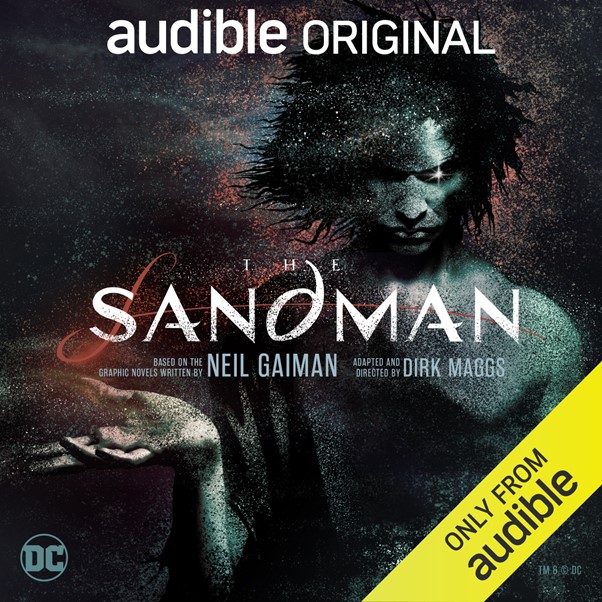
The Sandman – Act 1 (Audiobook) by Neil Gaiman and performed by a full cast

Sandman Act 1 Cover

Publisher: Audible Original (Audio Drama – 15 July 2020)

Series: The Sandman

Script: Neil Gaiman and Dirk Maggs (script adapter)

Director: Dirk Maggs

Cast: Neil Gaiman, James McAvoy, Kat Dennings, Taron Egerton, Riz Ahmed, Samantha Morton, Bebe Neuwirth, Andy Serkis, Michael Sheen, Justin Vivian Bond, Arthur Darvill, William Hope, Mathew Horne, Reginald D. Hunter, Sue Johnston, Paterson Joseph, Josie Lawrence, Anton Lesser, Joanna Lumley, Miriam Margolyes, Tom Alexander, Stephen Critchlow, Blake Ritson, Oris Herhuero, Karen Batke, Ray Porter, Michael Roberts, Kerry Shale, Andrew James, Simon Vance, Sandra Dickinson, Ellen Thomas, Cathy Tyson, Sandra-Mae Luyx, Amaka Okafor, Shey Greyson, Laurel Lefkow, Harry Myers, Mack Keith Roach, Laurence Bouvard, Toby Longworth, Daniel Weyman, Samantha Beart, Cliff Chapman, Felicity Duncan, Julia Winwood, Nicholas Boulton, John MacMillan, Tracy Wiles and Adam Thomas Wright.

Length: 11 hours and 2 minutes

My Rating: 5 out of 5 stars

Amazon

Thanks to a lengthy and productive road trip, I have finally breached the realm of dreams and explored the iconic and powerful creation that is Neil Gaiman’s The Sandman.  In this review I check out the first act of its impressive full-cast audiobook adaptation.

Back in 1989, mind-bending author Neil Gaiman unleashed his most iconic comic creation when he introduced the complex and dark The Sandman.  Centred on the mysterious character of Dream, the anthropomorphic personification of dreams, The Sandman was a clever and intense hybrid of horror, fantasy and superhero storylines released as part of the Vertigo comic imprint, which was associated with the DC Comics universe.  This series was considered a revolutionary success and its unique and colourful story cemented Gaiman’s legacy in comic circles, as The Sandman and its spinoffs are still very highly regarded.

Now I must make a bit of a confession: I have never actually read The Sandman and it is a bit of a gap in my comic book knowledge.  I just never seemed to be in a position to read these comics despite hearing how good they were.  However, with the upcoming television adaptation of The Sandman set for release later this year, I thought that it was about time that I tried to check it out.  Luckily, the good folks at Audible decided to make this rather easy for me as they recently released a full-cast audiobook adaptation of The Sandman.  Not only was this a great opportunity for me to check out this cool comic in my favourite format, but this adaptation featured a truly remarkable cast of actors, with the production pulled together by the highly acclaimed Dirk Maggs.

There are many strange, unusual and powerful creatures inhabiting the universe, but only seven siblings, known as the Endless, are truly immortal.  The Endless, each a personification of a human concept, have their own realms and powers, with the most mysterious and unique belonging to Dream.  Known by many names, including Morpheus, he is the manifestation of all dreams and stories, and governs the Dreaming, the vast realm made up of creation’s collected dreams.  Unchanging since the dawn of time, Morpheus’s eternal life is about to get more complicated than he ever believed.

Summoned by a mystical cult seeking to capture his sister, Death, Morpheus finds himself trapped and powerless on Earth.  Stripped of his tools of office and placed within a magical cage, Morpheus is kept as a prisoner for over 70 years.  When he eventually escapes from his captors, Morpheus returns to his realm only to find it in tatters, with several of his servants missing and his own powers greatly weakened.  To ensure the continued stability of the Dreaming, Morpheus must endeavour to regain his full strength by recovering his lost tools of power.

However, this is no easy task as all three items have been scattered across the world and are now in the hands of several dangerous foes.  To obtain them, he will have to contend with human magician John Constantine, face down Lucifer and battle the malicious Justice League foe known as Doctor Destiny.  From dangerous demons to rogue dreams and even his own siblings, Morpheus will face great challenges and unique creations on his road back from capture.  But even if Morpheus does succeed, is he prepared for the full chaos his absence has wrought on the world?

I’ve been exceedingly foolish by neglecting The Sandman for so long.  This is such a unique and epic tale that contains powerful looks at revenge, change, human perception and the power of dreams and stories, and so much more, as Gaiman cleverly examines elements of the human psyche through the eyes of an elusive immortal.  The impressive and exceedingly memorable story contained within these early entries of The Sandman, are deeply captivating and I found myself really getting drawn into the amazing narrative and distinctive characters.  Throw in an exceptional voice cast and a brilliant audiobook production, and I honestly have no choice but to give this a full five-star review.

When I first heard about The Sandman audiobook I did wonder if it would provide a more abridged version of the narrative.  However, it appears that this production was a pretty faithful and full adaptation of issues #1-20 of The Sandman comic.  As such you get an intense and fully developed story that is guaranteed to grasp your attention and send your imagination into overdrive, especially by the two major storylines contained within these first 20 issues.  The first of these, the “More than Rubies” storyline, examines Morpheus’s capture by human occultists in the early 20th century, his decades-long imprisonment, his eventual escape, and his subsequent attempts to recover his tools of office to regain his lost power.  This storyline serves as a pretty awesome and captivating start to the entire production and it contains several distinctive and addictive chapters.  The initial chapters that deal with Morpheus’s imprisonment set up a lot of major storylines for the rest of the series, give you some fantastic early impressions of this world, introduce some key concepts and provide readers with their first compelling look at the main character.  From there, the story gets even more exciting as you follow Morpheus as he attempts to recover his items of power from some dangerous individuals.  This sets up some brilliant chapters as he deals with everyone’s favourite magician, John Constantine, in a horrific tale that provides readers with their first glimpse at the true danger of dreams.  From there, Morpheus goes straight to hell as he attempts to retain his helm from an army of demons while also dealing with the nefarious Lucifer in what is possibly one of the most entertaining parts of the entire production.  That is then followed by a particularly dark storyline that sees Morpheus forced to contend with damaged DC comics supervillain Doctor Destiny, who is using Morpheus’s own powers to destroy the world.  This initial main storyline is particularly good, with an amazing and captivating flow to it that is guaranteed to make you a fan of The Sandman.

The other major storyline of this first act of The Sandman sees Morpheus attempt to contend with a new dangerous threat impacting the Dreaming.  This threat turns out to be young woman, Rose Walker, who is a powerful Dream Vortex.  To fully understand her, Morpheus finds himself getting involved in her hunt for her missing brother, and soon finds himself in conflict with several of his missing creations, each of whom has their own agenda in the real world.  At the same time, Morpheus must contend with the machinations of his powerful siblings as they attempt to manipulate him for his own ends.  This second major storyline, The Doll’s House, is an extremely good follow-up to the introductory issues and continues several plot points, with several characters returning in interesting ways.  Indeed, as you traverse through this storyline, it becomes apparent how much the author set up in the initial major storyline, and this helps to make The Doll’s House flow extremely well.  This major storyline itself is pretty damn fun, and I liked how it split between Morpheus and several of the other major players, particularly Rose Walker and The Corinthian.  The entire thing goes in some rather interesting directions, from the traumatised dreaming mind of a young boy also containing several lost superheroes, to a serial killer convention where some of Morpheus’s most dangerous creations have arrived.  This entire storyline is pretty damn twisty and trippy in places, but it comes together extremely well and has some amazing high points to it.  I particularly enjoyed the sequences depicting the serial killer convention, which was both entertaining and disturbing in equal measures but which also has an outstanding payoff to it.  The Doll’s House ends the major storylines on an extremely high note and it will ensure that you will come back for the second act desperately wanting more.

Aside from the two main storylines, The Sandman also contains several filler arcs that take place around the main storylines, including all the stories contained in the collected volume Dream Country.  While I would usually be a little disappointed to have a gap occur between some of the main storylines like this, it worked really well.  Not only do these filler chapters serve as a bit of a palate cleanser, breaking up the major storylines, but they also provide a lot of additional context for the wider The Sandman universe by expanding on many of the supporting characters, such as Morpheus’s relatives or some of the strange people he encounters through his travels.  Each of these storylines lasts for a single chapter (an issue from the comic), and are fairly self-contained, coming together and concluding in short order.  Each of these filler stories is quite intriguing in their own right, especially as these stories are a little more metaphysical and often contain a dark, thought-provoking cautionary tale.  There is also an interesting range of settings and time periods for many of these stories, as some occur many years before the events of the major storylines, due to the immortal nature of Morpheus and his siblings.  I honestly enjoyed each of these separate storylines, not only because of the fantastic ways that they expanded The Sandman universe but because of the way that each story hit a different emotional note.  My favourite was probably Men of Good Fortune (issue #13 of the comic), a brilliant story that sees Morpheus and Death encounter a man, Hob Gadling, who is certain of his desire never to die.  Intrigued, Morpheus ensures his immortality and arranges to meet him once every 100 years in the same tavern.  So begins a fantastic story that skips across centuries as you see Hob continue to exist and change through the centuries.  Watching him achieve the highs and lows of an immortal is deeply fascinating, as is his compelling and deeply personal interactions with Morpheus as they discuss his experiences and his desires to stay alive.  The conclusion of this story proves to be particularly moving, and it helps to humanise Morpheus after several issues of him being emotionally distant.  Other interesting filler arcs include Morpheus meeting with Death and following her around in her complex and sad duties, another sees William Shakespeare, who years earlier made a Faustian bargain with Morpheus, debut A Midsummer’s Night Dream to a host of elven nobility in a touching performance.  All these filler arcs, and more, add a certain gravitas to the overall book, and I think that they really helped to enhance the major storylines they were set around.

I was really impressed with all these major and minor storylines, especially as the writing behind them was particularly powerful and brilliant.  Everything flows together extremely well and you can see that Gaiman is setting up a ton of fascinating storylines for the future, while also ensuring that the current plot points stand on their own and are extremely fun.  Everything about this story is interesting, and while the author does occasionally go in some zany, grotesque and unique directions, it generally proves to be entertaining and eventually fits back into the major storylines in a great way.  Gaiman seeks to create a massive and powerful epic that not is not only filled with action and excitement but which causes the reader to stop and think about certain states of being or metaphysical aspects such as dreaming.  This is often achieved, especially in the audiobook format, with distinctive and powerful dialogues that showcase the unique attributes of the characters and the dramatic and dangerous situations they find themselves in.

I personally loved how there were a range of different styles and elements featured throughout the plot as The Sandman didn’t conform to one particular genre.  The story could at any time jump from unique fantasy adventure to a deep character driven narrative or end up being a bleak and deeply disturbing horror tale.  For example, one of the best chapters in this act of The Sandman was a dark, disturbing and somewhat detached horror narrative they fit in right after a chapter involving the Justice League and certain Batman villains.  In this story the deadly Doctor Dee, having stolen Morpheus’s dream stone, holds several people hostage in a diner over the course of a day.  Throughout this day (which is counted down hour by hour for some impressive dramatic impact), Doctor Dee toys with his pets, diving deep into their personal lives and using disturbing elements from their past to manipulate their emotions and their reactions.  This results in several extremely disturbing hours as the bad doctor makes them experience lust, despair, hatred, animalist urges, religious zeal and more to entertain him as he waits, and it turns this chapter into a horrific experience in between some more action packed or fantasy issues.  This frequent change in genre really helps to make this first act stand out, and all the different storylines and elements work well with the overall dark gothic theme of The Sandman.  It also helps to make The Sandman a bit more accessible to different readers as there is something here for all fans of horror, fantasy and comics, although some basic knowledge of DC and Vertigo comics may be somewhat helpful.

This story is greatly helped by the complex and exceedingly memorable characters featured throughout.  The most notable of these characters is the titular Sandman himself, central character Dream/Morpheus, an immortal anthropomorphic personification who lives in creation’s dreams and serves as their lord and master.  I loved how Morpheus is portrayed in this first act as the reader really gets to sink their teeth into the character and find out what makes him tick.  Gaiman ensures you get the most out of Morpheus by immediately showing him at his worst, imprisoned for decades by humans with his powers stolen from him.  While you don’t get a lot of insight into who or what he is at the beginning, once he escapes you find out everything you need about his motivations, responsibilities and personalities.  Gaiman initially paints Morpheus as a callous and detached being, removed from humanity and more concerned with his own needs and realm than the people he interacts with.  While it does make it a little harder to root for him in some of the earlier storylines, I think this coldness helped to stoke some real mystery around the character and you wanted to find out more about him and his past.  Once the first major story arc ends and you get into some of the filler stories, especially the one involving the interaction with his sister Death, you start to understand him a lot better and soon see that his a basically good person, just with some major personality flaws brought on by his immortal existence and purpose.  Don’t get me wrong, at times he is still a pretty hard character to like, especially when details about his love life are revealed, but he is generally a lot more likeable than most of the other immortal or non-human characters you encounter, and you get really invested in his continual struggles.  By the end of his first act you will become extremely addicted to his story arc, and I cannot wait to see how Morpheus’s narrative continues in the future.

Gaiman has come up with an eclectic and distinctive group of characters to support the story, with a fantastic combination of original characters, mythological figures and even a few established DC and Vertigo comic characters.  These great characters are featured to various degrees throughout the story, with some being continuously used, while others only get brief flashes.  All of them are pretty fantastic, and I loved seeing how Gaiman worked them into his brilliant narrative.  There are so many notable characters throughout this first act to talk about, especially as they were portrayed by some outstanding actors (more on that later), and I could honestly spend pages talking about all of them, however, in the interests of saving time I might just limit it to my absolute favourites.  I must highlight Dream’s sister Death; rather than a traditional mournful or skeletal figure, Death is shown as a cheerful young woman who bears great compassion and kindness to those she reaps.  This is a really interesting change to the usual personification of Death you see in fiction, and it works really well, especially as Death here serves as a great positive foil to her dour brother Dream and the other Endless.  As such, she swiftly becomes a favourite character to follow, especially with her many different appearances.  I also must mention Gaiman’s great use of John Constantine, everyone’s favourite drunk English wizard, who has a notable chapter towards the start of the story.   Lucifer himself is also brilliant as a brief secondary antagonist, and Gaiman lays some interesting story seeds here for him.  The comedic duo of Cain and Abel brings some fun to several stories, as does Morpheus’s servant, Matthew the Raven.  Rose Walker serves as an excellent protagonist of the second major storyline, and I enjoyed her very English protector, Gilbert, who has some intriguing scenes.  Finally, I was rather impressed with the great early antagonist Doctor John Dee, better known as the Justice League villain Doctor Destiny.  Gaiman went out of his way to make Doctor Dee as creepy and deranged as possible in this comic and he has some outstanding, if shockingly horrifying, scenes throughout the More than Rubies storyline.  He, and other great villains like The Corinthian, add some intriguing danger and a ton of depravity to the story, and I had an absolute blast getting to know all these great characters.

As I mentioned before, I chose to check out the full-cast audio adaptation of The Sandman rather than reading the original comics, and this greatly impacted my experiences of how I absorbed this unique story.  However, while I probably missed out on some brilliant artwork, I think that this audio adaptation was the perfect way to enjoy this elaborate and massive story.  As far as I can tell, the audio production faithfully adapts all the comic storylines throughout its run, with the movement and action of the comic page replaced with narration, sound effects and probably altered dialogue where necessary for the benefit of the listener.  While this is probably a little different than the comic, I think that it captured the tone, characters, and intent of The Sandman exceedingly well, and the resulting production is pretty damn impressive.  Not only does it feature some brilliant acting, but the production team makes outstanding use of a ton of cool sound effects and some moving music to create something extremely special.

While this audio production has many great features, without a shadow of a doubt its most defining aspect is the incredibly stacked voice cast who bring the various characters to life.  Someone clearly sold their soul to get the eventual cast for The Sandman, as some exceedingly talented actors are featured here giving some intense and powerful performances.  These great performances deeply enhance the entirety of The Sandman and turn this already outstanding story into something that you will listen to again and again.  This voice cast is led by the insanely talented James McAvoy, who voices main character Morpheus.  McAvoy is extremely good in this production, showcasing all his acting range to bring this complex character to life in all his dark, gothic and detached glory.  Thanks to the way he voices the character, listeners really get a sense of how ethereal and distant Morpheus can be, as well as the intense weight of the events of this story and the relationships he has formed.  You really get the full gambit of Morpheus’s emotions during this first act and McAvoy covers them all perfectly, embodying the character’s rage, sorrow, impatience and intense regret extremely well.  This performance really serves to enhance the character of Morpheus in this production of The Sandman, and McAvoy was the perfect actor to helm this entire series.

The rest of the voice cast is just as impressive, with several major celebrities featured here.  Taron Egerton has a notable time voicing the iconic John Constantine and his pretty damn good here, bringing the distinctive magician to life extremely well.  Edgerton brilliantly brings forth Constantine’s full emotional range throughout The Sandman, and you get a great sense of his cheeky demeanour which overlays his insane amount of guilt and despair.  This was a very good version of Constantine, and indeed after listening to this production, Edgerton would be my choice for Constantine if they chose to do another major movie with him.  In addition, Kat Dennings has a major role in this audiobook as Death.  Dennings is pretty amazing here, and she brings some real life (pun intended) to this major role, showcasing this character’s intense warmth and friendliness, as well as her exasperations when it comes to her brother.  Dennings really made this unique character her own, and I deeply enjoyed her performance.  I also had a lot of fun with Andy Serkis who voices Matthew the Raven, Dream’s messenger and servant.  Matthew is a fairly comedic role which Serkis fills perfectly, giving the raven a sarcastic and everyman feel that fit the lines really well and helped to make him a very distinctive and fun figure.

Other big-name actors include Bebe Neuwirth, who perfectly voices a prophetic cat with aspirations to change the world through dreaming.  Riz Ahmed is pretty terrifying as The Corinthian and you get some major serial killer vibes from his performance.  Arthur Davill has a great couple of appearances as William Shakespeare, while the legendary Joanna Lumley has an unfortunately short appearance as Lady Johanna Constantine, although she gets her time to shine in future productions.  Likewise, Michael Sheen has only a short appearance as Lucifer Morningstar, although he brings some incredible flair to the character, dripping style, venom and power.  Like Joanna Lumley, Sheen will get his time to shine in future instalments of this audio series, so don’t be too disappointed with his limited appearances here.  I loved William Hope as Doctor Dee, as he gives the villain some deep malevolence and insanity.  Michael Roberts and Kerry Shale are fun as Cain and Able respectfully, while Paterson Joseph has a great sequence as The Demon Choronzon.  I was also very happy to see that one of my favourite audiobook narrators, Ray Porter, was featured here, voicing multiple supporting characters.  All of Porter’s portrayals were very fun, although I think he was best as Gilbert, providing some fun British pomp to the character.  Finally, Neil Gaiman himself has a massive role in this production as the Narrator, which is pretty damn appropriate.  Gaiman is great as the narrator, with his distinctive voice perfectly moving the story along, as he describes events, actions and settings, as well as providing a massive dose of exposition.  I was really impressed with Gaiman’s continued performance here, and I honestly don’t know if anyone else could have done such an impactful and meaningful job of it.  I am honestly only just scratching the surface of this cast, as there are a ton of other actors featured throughout The Sandman in some way.  However, all of them are extremely good and their work on this show is just superb.

As you can no doubt tell from the elaborate and long-winded review above, I had an outstanding time with this audio production of The Sandman, and I am so very happy that I got to finally experience Neil Gaiman’s amazing series.  Everything about this audiobook was impressive, with an elaborate and dark narrative, gritty characters, fantastic performances and some incredible world building.  There is truly something for everybody here, as readers unfamiliar with The Sandman can easily jump in and learn everything they want to know about the series (I’m now ready for that upcoming Netflix series), while established fans will no doubt enjoy it performed by such a talented team of actors.  I had such a good time listening to this first act that once I finished, I immediately jumped into listening to the second act, which has an even better and expanded voice cast.  I will hopefully review that in a few weeks, but in the meantime do yourself a favour and listen to this incredible audio production of The Sandman, as you will not regret it.

Amazon

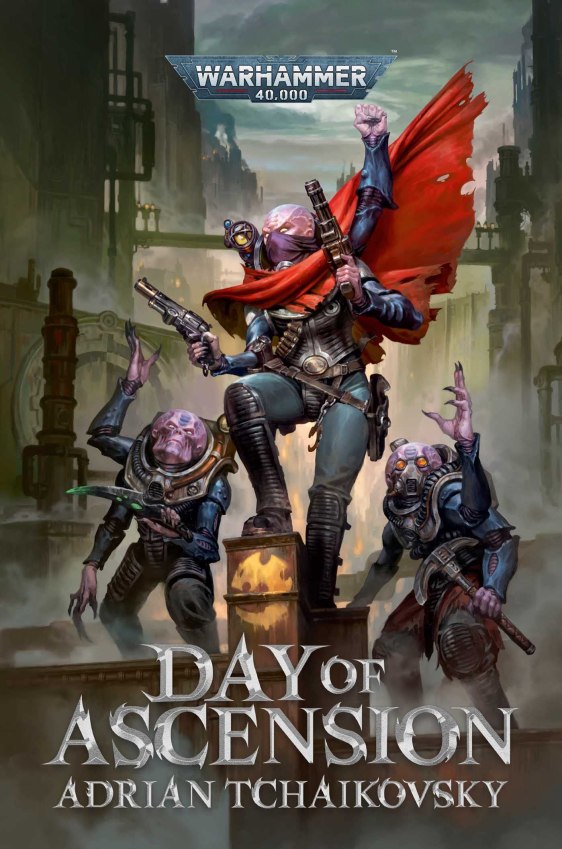
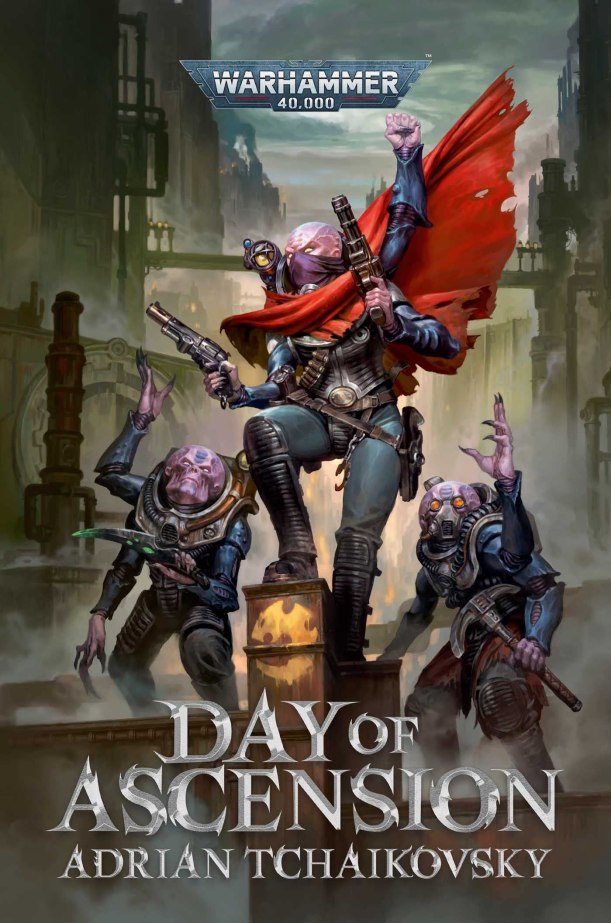
Warhammer 40,000: Day of Ascension by Adrian Tchaikovsky

Day of Ascension Cover

Publisher: Black Library (Audiobook – 29 January 2022)

Series: Warhammer 40,000

Length: 5 hours and 38 minutes

My Rating: 4.5 out of 5 stars

Amazon     Book Depository

Legendary science fiction and fantasy author Adrian Tchaikovsky has arrived in the Warhammer 40,000 universe with the awesome and clever novel, Day of Ascension, a deadly and wildly entertaining read that sets two brilliant factions against each other.

2022 has so far proven to be an amazing year for Warhammer fiction, with several impressive novels already released, including Steel Tread by Andy Clark and The Twice-Dead King: Reign by Nate Crowley.  However, the Warhammer 40,000 novel I have been most excited for is Day of Ascension, an awesome and unique read written by acclaimed author Adrian Tchaikovsky.  Tchaikovsky has been wowing science fiction and fantasy audiences for years, producing several impressive novels across various genres.  Not only has he written some fantastic standalone novels but he also produced highly regarded series, such as the Shadows of the Apt and Children of Time books.  I have really liked the sound of his cool novels, but I had not had a chance to read any of them yet.  Once I saw that Tchaikovsky was contributing to the extended Warhammer 40,000 universe, I knew that this would be the year I finally read something from him.  Day of Ascension is Tchaikovsky first full novel in the Warhammer universe (he previously wrote the short story Raised in Darkness), and I was deeply impressed by the brilliant and captivating story he came up with.

On the forge world of Morod, the life and soul of every human belongs to the Adeptus Mechanicus, the Imperial machine cult who provide the armies of mankind with their weaponry and war machines.  However, while the tech-priests of the Adeptus Mechanicus live in comfort and prosperity, constantly delving into the secrets of the machine, the common people of Morod have been worn down by millennia of servitude, exploitation and conscription, doomed to either die young in the mines and foundries or be turned into mindless mechanical soldiers.  In their grief and anger, the civilians of Morod have turned to a new faith that offers salvation from the harsh rule of the Mechanicus, although that devotion comes with a dark price.

In the hierarchy of Morod’s Adeptus Mechanicus, Genetor Gammat Triskellian is considered a joke due to his focus on improving the flesh rather than replacing it with machinery.  Constantly overlooked by his superiors and given the most menial of tasks, Triskellian looks to find a way to advance his research and end the corruption he sees holding the order back.  When he uncovers a particularly interesting genetic strain in the populace of Morod, he thinks it could be the answer to all his prayers, one that could enhance his science and revolutionise the advancements of his order.

Digging further, he finds evidence of an unusual and twisted religious congregation operating throughout the planet, preaching rebellion and the destruction of the tech-priests, while awaiting the return of long-gone angels who will turn the planet into a paradise.  Seeking to use this congregation to his own advantage, Triskellian captures young, idealistic infiltrator Davien to find out more about her mutated family.  But as his plans begin to come into effect, Triskellian is about to discover that not everyone is meant to rule, and that the forces he seeks to control are far more dangerous and hungrier than he could possibly know.

What an epic and impressive read!  Tchaikovsky has dived into this franchise with great relish, producing an exceptional and powerful piece of Warhammer 40,000 fiction that is not only exciting and action packed, but also extremely thought provoking as the author examines some of this universe’s most complex and intriguing factions.

I had a lot of fun with the incredible story contained within Day of Ascension, as Tchaikovsky takes the reader on an intense and dark journey.  The main premise of this book is a fun one: what if an ambitious Imperial tech-priest attempts to utilise the deadly power of a Genestealer Cult for his own machinations?  The answer: absolute chaos as an entire world implodes in the fires of revolution, destruction and religious zeal.  This was a great story that Tchaikovsky sets up brilliantly in the early stages, quickly introducing the corrupt world of Morod, the choking hierarchy of the Adeptus Mechanicus, and the malignant underlying Genestealer Cult attempting to manipulate events from the shadows.  After this great introduction, the remaining story happens at a very fast pace, especially as this overall novel is fairly short (193 pages, or just over five and a half hours on audiobook).  The political and scientific intrigue of point-of-view character Triskellian runs straight into the revolutionary aspirations of the Genestealer Cult’s Davien with the expected destructive results.  I loved the brilliant clash of styles that occur between these two groups, and all the betrayal, manipulation and alien influences melds perfectly with the non-stop action and revolution.  This quickly leads up to a destructive and powerful conclusion that I deeply enjoyed and will leave you reeling in multiple ways.  There were some absolutely amazing twists towards the end, and I loved the resultant terrifying consequences to the wider universe which were really cool and deliciously ironic.  Tchaikovsky ends everything on a captivating and dark note which will leave readers extremely satisfied after getting engrossed in the impressive story.  This is an epic narrative that drags you right into the very heart of the worst parts of the Warhammer 40,000 universe.

I really must commend Tchaikovsky’s first dive into the Warhammer 40,000 universe as the author has a noticeable appreciation for this franchise and canon.  I loved how he expertly focused the story on two particularly sinister factions within this universe, while also making excellent use of an Imperial Forge World as the main setting of this book.  The two main factions of this novel are the tech-priest of the Adeptus Mechanicus and an undercover Genestealer Cult, the dangerous human/alien hybrids who act as infiltrators and forerunners of the Tyranids.  Tchaikovsky ensures that the reader gets an exceptional and detailed look at both factions, and you are soon immersed in their lore, politics, and motivations, which is just so fascinating.  There are so many cool things about this, from the unique interactions of the cybernetic tech-priests and the mechanical soldiers to the slow infiltration and incorporation of the Genestealers who spark revolution throughout the planet.  However, the best thing about this is the way in which Tchaikovsky’s expertly showcases one of the most inescapable facts of the Warhammer 40,000 universe: there are no actual good guys here; just self-serving fanatics with their own terrible agendas formed from a universe constantly at war.  This is so brilliantly highlighted in the fact that halfway through the book you find yourself on the side of the alien infiltrators, who are taking advantage of the terrible conditions on Morod to spark a revolution.  However, no matter how beneficial and beatific they may appear, preaching about angels and the better days ahead, there is still an amazing sinister edge to them, especially if you know what horrors they are actually referring to.  I loved how brilliantly these two unique and corrupt Warhammer factions are played off each other, and it proves to be an excellent background to this awesome novel.

Like most Warhammer tie-in novels, Day of Ascension is probably best enjoyed by those fans of the franchise, especially as Tchaikovsky looks at some obscure and unique parts of the canon.  While maybe a little too-lore heavy to serve as the best introduction to the Warhammer 40,000 universe, I felt that this is an easy enough book for new fans to get into, especially if they are established science fiction fans.  Tchaikovsky ensures that the various story elements feature the right amount of detail and I the various factions are introduced extremely well especially to new readers.  I do feel that readers who don’t quite understand what the Genestealers and their Tyranid masters are might not get the true horror of this book and its conclusion, and I personally enjoyed the novel more because I knew what the true nature of the Genestealer’s plans were.  However, new readers probably will get the full benefit of this as it is made pretty clear from the context.  As such, I would probably recommend this to both established Warhammer fans and general science fiction readers, especially if they have enjoyed Tchaikovsky’s writings in the past, and I know a lot of people with have a great deal of fun with this.

I deeply enjoyed the cool and over-the-top characters featured throughout Day of Ascension, especially the main two characters, Triskellian and Davien, who act as the point-of-view characters for the novel.  Both are fantastic figures who are fully enveloped in the massive machines of their organisations, whether they like it or not, and who spend much of the book trying to battle what they see as their oppressors.  As such they form a brilliant tandem of opposing views, which perfectly shapes the morally grey nature of the narrative and makes it very unclear which one of these inherently terrible people you should be rooting for.  I particularly liked the character of Triskellian as the author envisions him as a thoroughly underappreciated middle management figure who is ignored and ridiculed by his superiors who fail to understand his work.  This constant mistreatment causes Triskellian to snap in this novel and he starts doing some darker deeds to gain what he believes is rightfully his.  I loved seeing this brilliantly portrayed figure, who will be clearly understood by anyone whose worked under an idiot boss, slowly slip off the deep end and attempt to use an evil alien cult to fulfil his objectives.  This character has some amazing moments, and it was so much fun seeing him try to manipulate events around him, only to be surprised that nothing goes to plan.  I also found his focus on genetics and biology to be quite fascinating, especially for a tech-priest, and his obsession with alterations on the flesh ended up having some intriguing parallels with the objectives of the Genestealer cult.

Davien, on the other hand, is an oppressed member of Morod’s population who acts as an infiltrator and spy for the Genestealer Cult she is a part of.  Frustrated by the slow pace of the promised revolution and the eventual appearance of their “saviours”, Davien has some outstanding scenes throughout Day of Ascension as she tries to save her loved ones from the machinations of the tech-priests.  Her rise in status and closeness to the powers that guide her family occur at the exact same time that she starts to have doubts about her organisations purpose, and the subsequent internal battle is extremely powerful and captivating, especially if you know just how right she is to be worried about the future.  Davien goes through a lot of growth, and it is fascinating to see what happens during her character arc, especially when it comes to her interactions with Triskellian and the influences of the beings guiding the cult.  Day of Ascension also has several great supporting characters who get their moments to shine throughout the book.  While most of them are a bit over-the-top in their appearance and personality, they prove to be very entertaining and I loved the outrageous and mechanically deformed highly ranked tech-priests who so badly enrage the protagonists.  There is a particularly good twist surrounding one of the minor support characters that I thought was extremely brilliant, especially as there is some subtle set up for it earlier on, and it results in an outstanding ending for the entire book.  An overall excellent cast of characters make this shorter Warhammer novel really shine.

Just like most of the Warhammer novels I have had the pleasure of reading, I chose to check out Day of Ascension in its audiobook format, which was an impressive and enjoyable experience.  As I mentioned above, this audiobook has a very short runtime and you can quickly power through it, especially once you get stuck into the intriguing and clever story.  I deeply enjoyed how this format enhanced this great narrative, and it was a lot of fun to hear all the chaos and destruction being read to you.  I must commend the narrator of Day of Ascension, actor Harry Myers, who did an exceptional job here.  I loved Myers’ great voice, which at times strongly reminded me of Stephen Fry, which is a definite plus.  Myers really dives into the various characters here, and I loved the brilliant edges he gives to them, especially the main character Triskellian.  You can really sense Triskellian’s frustration, ambition and internal outrage as the events of the novel proceeds, and this helps you to get into the mind of this entertaining figure.  An extremely cool way to enjoy Day of Ascension, I would strongly recommend this format to anyone interesting in checking out this great Warhammer 40,000 novel.

With this clever and exciting novel, Adrian Tchaikovsky has a brilliant debut in the Warhammer 40,000 universe.  Day of Ascension is an epic and intriguing novel that takes a fascinating look at two exceptional factions from the Warhammer canon and brings them together in a dark and entertaining battle of wills and manipulation.  Containing a tight, addictive story, some great characters, and a deep examination on some of the best parts of the Warhammer 40,000 universe, Day of Ascension is an outstanding read.  I really hope that Tchaikovsky writes more Warhammer fiction in the future as he absolutely killed it here.

Amazon     Book Depository