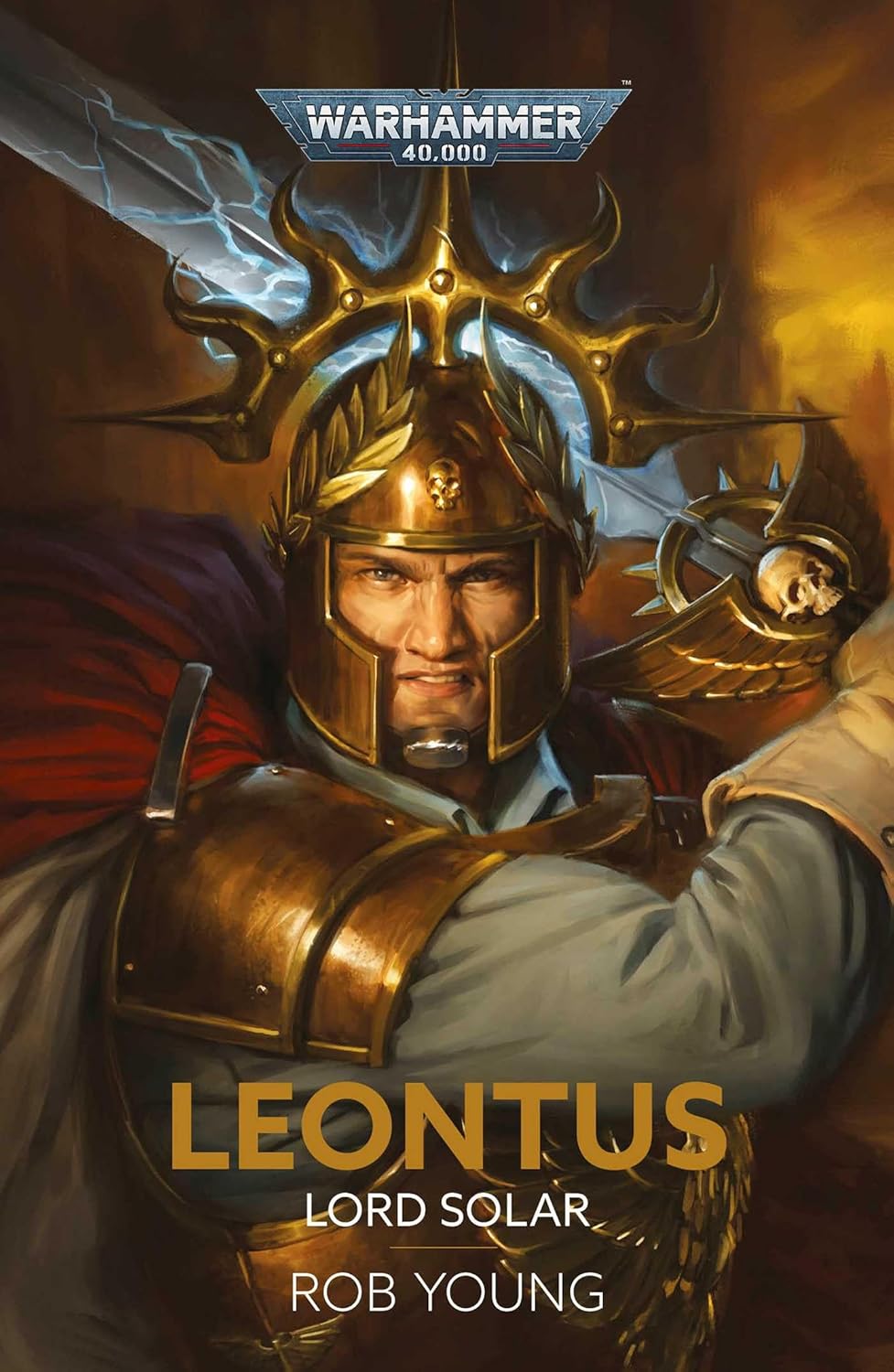
Warhammer 40,000: Leontus: Lord Solar by Rob Young

Publisher: Black Library (Audiobook – 25 January 2025)

Series: Warhammer 40,000

Length: 5 hours and 44 minutes

My Rating: 4.5 out of 5 stars

Amazon

Warhammer 40,000 fiction in 2025 starts off strong with the compelling, character-focused novel, Leontus: Lord Solar by Rob Young.

Back in 2023 I had the very great pleasure of reading my first book from Rob Young, Longshot.  A cool and intense character-driven Warhammer 40,000 novel that followed a sniper war on a T’au held world, Longshot was a fantastic first book from Young, and it ended up being one of my favourite debuts of 2023.  As such, I have been very intrigued to see how Young would continue his Warhammer fiction career, and his next novel, Leontus: Lord Solar, proved to be an excellent new entry to the Warhammer 40,000 canon.  Focused on a legendary human leader, Leontus: Lord Solar was an impactful read that I shot through very quickly.

On the world of Fortuna Minor, an Astra Militarum taskforce of soldiers from various Imperial Guard regiments encounters grave disaster.  Sent to eliminate an invading ork horde, the Astra Militarum soldiers find themselves overwhelmed on the landing fields of Fortuna Minor and are slaughtered, while their reinforcements are forced to retreat into space thanks to the orks’ fighters and spacecraft.  Surrounded, outnumbered and lacking resources, only a few humans manage to escape the massacre, including legendary hero of the Imperium of Man, Arcadian Leontus, Lord Commander of the Segmentum Solar.

One of humanity’s most dedicated defenders and a master tactician, Leontus has no intention of giving up in the face of the ork invasion, even with his armies lost and devastated.  Determined to not only survive but complete the objective of reclaiming Fortuna Minor, Leontus rallies a small group of survivors and prisoners liberated from the ork camps to his cause and begins a desperate campaign to fight ensure that the armies of the Imperium can triumph on this latest battlefield.

Effectively welding his scattered force of mismatched and poorly armed soldiers into a coherent army, Leontus soon finds success against the orks, bringing hope to his demoralised troops.  But in the face of overwhelming odds, a determined and dangerously intelligent opponent, and his own lack of resources, can even the brilliant Leontus succeed, especially when his own men begin to question his tactics and motivations?

Leontus: Lord Solar was an excellent and fun Warhammer 40,000 novel that allowed Young to bring an iconic figure from the game to life.  A compelling and exciting read, Leontus: Lord Solar was a real blast to check out, especially as Young presents an impressive and direct narrative that you quickly sink your teeth into.

This was a very fast-paced and exciting Warhammer 40,000 novel that quickly throws you into the fray and successfully keeps your attention the entire way through.  Starting off with fire and blood as the Imperial Guard regiments are devastated by orks as they land, the story sets itself around some of the main supporting characters, particularly Belgutei, an Attilan Rough Rider, and Keori Arnetz, a Catachan medic.  Fighting there way out of the killing fields, Belgutei and Arnetz, as well as a handful of other survivors, link up with the titular Leontus, who leads them to safety and initiates a desperate guerrilla campaign against the orks, bringing together scattered troops, rescuing prisoners and ambushing ork convoys.

The resulting narrative is highly compelling and action-packed, as the brilliant yet practical Leontus proves to be a skilled commander, inspiring his disparate and demoralised troops, while also engaging in some risky and intense actions.  Young does an excellent job balancing the narrative amongst the three main protagonists, as well as a couple of interesting supporting figures, and I liked how the author tended to focus more on Belgutei and Arnetz, which allowed for an intriguing outsider perspective of Leontus and his actions.  There are some powerful character interactions, especially between Leontus and Belgutei, as the two clash over strategy and the fate of the survivors, which adds some dramatic spice to the overall exciting dish.  The action scenes flow fast and heavy as the book nears its end, including some dark sacrifices, and everything leads up to a massive and intense final battle, where so many of your favourite characters are in peril.  The book ends on a complex note, as Leontus proves his status as a tactician and hero, although the reader is left to decide on his humanity.  An outstanding overall Warhammer 40,000 narrative that is guaranteed to quickly hook you and keep your attention to the end.

Young once again shows his impressive ability when it comes to writing Warhammer 40,000 fiction, and I loved the short, brutal and captivating way Leontus: Lord Solar was presented.  While I was initially worried that it would be too similar to the Ciaphas Cain book, Death or Glory, which also featured a human hero marooned on an ork-held world, Young ensured that Leontus: Lord Solar stood out on its own feet.  The quick-fire narrative, intense and tactical action sequences, and cool scenario ensured this was a distinctive read, and one guaranteed to keep your attention the entire way through.  Primarily a character-focused story around the iconic in-game figure of Arcadian Leontus, Lord Commander of the Segmentum Solar, Young does an excellent job of highlighting the protagonist and showcasing him in a compelling way.  The author chose to primarily show Leontus through the eyes of his supporting characters, which allowed for a more nuanced take on the titular protagonist, while the occasional scene shown from Leontus’ perspective hinted at plans the character is hiding from his soldiers.  Throw in some excellent supporting characters and a memorable, if somewhat underutilised antagonist (who was simultaneously awesome and freaky), and this proved to be an amazing novel with some excellent character-driven strife and complexity at its core.

As with Young’s previous book, Longshot, Leontus: Lord Solar is an outstanding piece of Warhammer 40,000 fiction, and one that would serve as a good introduction to the wider universe for new readers.  The quickfire storytelling, classic action between humans and orks, and lack of excessive lore makes Leontus: Lord Solar a very accessible read, especially as Young doesn’t excessively dive into the history of his main protagonist.  Established readers of Warhammer fiction will naturally get a little more out of this book, especially as it was very cool to see the titular character in action in all his tactical glory, and I felt that Young did an exceptional job capturing and presenting this figure.  In addition, the book also features some intriguing unit makeups as Leontus bands together an irregular force of surviving Cadians, Catachans, Kreig troopers and Attilan Rough Riders.  The interactions between the groups and Leontus was pretty fun, and I liked the mixtures of styles of battle strategies.  Of them, I felt that the Attilan Rough Riders were shown off the best, and their explosive cavalry charges were awesome to read and reminded me of Warhammer Fantasy fiction at times.  All of this and more ensured that Leontus: Lord Solar was a very cool Warhammer 40,000 novel, and it is one I would recommend to all fans of the franchise.

As I tend to with most Warhammer novels I enjoy, I decided to check out Leontus: Lord Solar on audiobook, which was another fantastic experience.  As I have stated innumerable times, Warhammer fiction really lends itself to the audiobook format, and having talented narrators read out the over-the-top stories allows for all the best bits of the universe and its grim dark themes to come to life.  This was particularly true for Leontus: Lord Solar, whose compelling character focused storylines and intense action sequences proved to be a lot of fun to listen to.  Coming in with a relatively short runtime under six hours long, dedicated listeners can really fly through Leontus: Lord Solar, and I enjoyed how quick the pace turned out to be.  I also really appreciated the choice in narrator as David Seddon is a skilled voice actor who really impressed me in previous Warhammer 40,000 audiobooks Dredge Runners and Kasrkin.  Seddon did an excellent job with Leontus: Lord Solar, as not only did he move the story along at a fantastic and enjoyable pace, but he also provided some excellent voices for the various characters.  His take on the titular Leontus was extremely good, and you get a real sense of the character’s nobility, as well as his determination to win, through the performance.  The rest of the human characters also came across extremely well, and Seddon expertly gifts them accents that cleverly corresponded to their regiment and their real-world military influence.  This great voice work really enhanced the already exciting narrative, and I found myself getting really engrossed in this audiobook version as a result.

With this fantastic second book, Leontus: Lord Solar, Rob Young has nicely set himself up as a rising author of Warhammer fiction, especially as he brings a compelling figure from the game to life.  Featuring some awesome action, compelling characters, and an entertaining narrative, Leontus: Lord Solar was an outstanding Warhammer 40,000 novel to start the year with, and I look forward to seeing what amazing adventures Young brings to the franchise in the future.
Amazon

Quick Review – Tiger Chair by Max Brooks

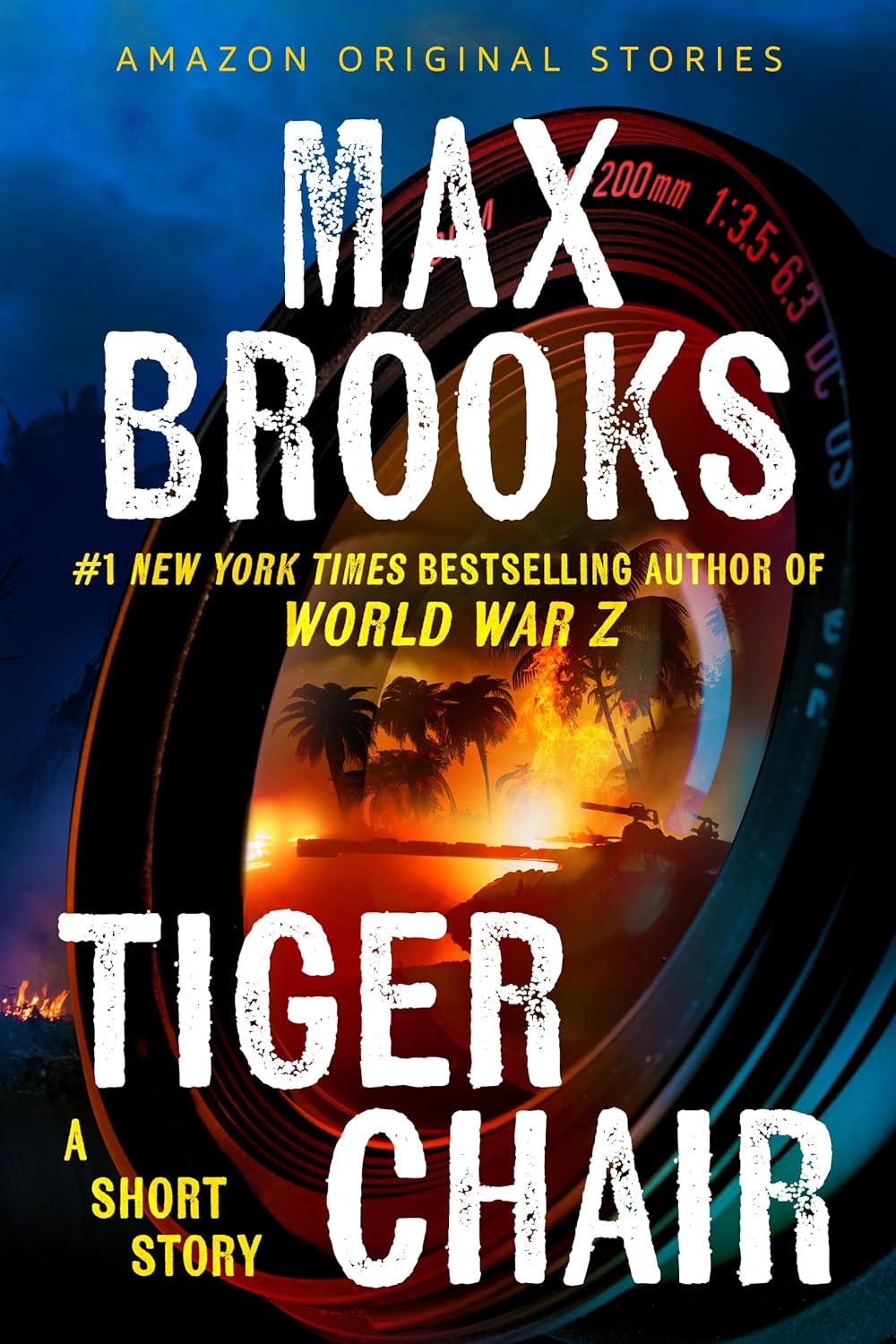
Tiger Chair Cover

Publisher: Amazon Original Stories (ebook – 1 June 2024)

Series: Standalone

Length: 50 pages

My Rating: 4 out of 5 stars

Amazon

I was recently lucky enough to receive a copy of the new short story from acclaimed author Max Brooks, Tiger Chair, which instantly grabbed my attention.  Brooks is an author I have a lot of love for, especially as his two main novels are huge favourites of mine.  This includes his most iconic work, World War Z, which I had an exceptional time listening to a few years ago due to its complex story and the impressive array of celebrity narrators associated with the audiobook version of it.  Brooks followed this up a couple of years ago with the compelling horror read, Devolution, that saw an isolated community attacked by sasquatches in an outstanding and exciting read.  Devolution ended up being one of my favourite books of 2020 and ensured that I would check out anything else that came my way from Brooks.  As such, I made sure to read through Tiger Chair as soon as a got it, as I was intrigued by the content.

Plot Synopsis:

When China invades America, guerrilla warfare explodes on the streets of Los Angeles in this provocative short story about the future of war from Max Brooks, the #1 New York Times bestselling author of World War Z.

China thought it would be a quick war, an easy war. But now, years later, as the insurgency on the streets of Los Angeles escalates but the propaganda never changes, a Chinese officer can’t keep silent any longer. Torn between loyalty to his country and loyalty to his troops, he writes a brutally honest—and possibly suicidal—letter home to unmask the truth.

Brooks combines his signature meticulous research with unforgettable characters in this landmark work of speculative fiction.

This was a very interesting read from Brooks that I was able to power through in a short amount of time.  Set in the future, Tiger Chair is written as a secret letter from a Chinese officer involved in a fictional invasion of the United States to a friend back home.  In this letter, the officer describes the various hardships of the invasion, including the escalating insurgency in Los Angeles, who are pushing his soldiers to the limit with their intense attacks and low-tech strategies.  However, his priority in writing this potentially treasonous letter is to highlight his despair at the ineffective and inflexible strategies of his side, which care more for propaganda than the lives of their soldiers and the civilians, and his desire to see the war come to an end.

I felt this was a rather interesting choice of story for Brooks to write, and it reminded me of the cynical memories of a professional soldier during the zombie wars of World War Z.  Brooks paints a grim and gritty story of survival and duty in the Tiger Chair, and you can easily feel the frustration and fear of the protagonist as he attempts to highlight his feelings about how the war is being run and the various lies he and his soldiers have been fed by their superiors.  The author really captures the way that the protagonist is caught between loyalty to his country and his anger at how events have unfolded, especially as he is powerless to impart any effective change to the situation.

I was quite impressed by the various scenarios that Brooks imagined for this future war in Tiger Chair, and his vision for how events might unfold in this scenario, as well as the technology that would be utilised for it, is very fascinating.  While I am sure that there will be some criticism of Brooks trying to imagine the feelings of Chinese soldiers in a war they might not even undertake, I felt that the Tiger Chair was more of a general warning about the futilities of war, and the frustrations of the lower ranks at the mistakes of their politically motivated superiors.  Indeed, many of the issues the protagonist raises could be applied to many other historical or current wars, and there are several allusions to them in the plot.

Brooks does also attempt to get into the Chinese mindset, which I honestly think he did a good job of considering he had less than 50 pages in which to do so.  There is an interesting examination of the national identity and how their history and culture would influence them into going to war, and the various opinions people within the country would have about these battles.  Brooks also includes some commentary of recent well-known events and controversies involving China, which is more geared towards central criticism than specific critiques of the Chinese.  For example, while he mentions the way in which China influences American media and movies for their own purposes, the protagonist’s resulting criticism are more directed towards the media companies that allowed them to happen as they sacrificed their principles for money.  These and other observations an about current society are quite interesting and make for quite a compelling story.

Overall, I felt that Tiger Chair was a compelling and intense short story from Brooks that brings together some intriguing ideas and predictions.  While I probably would have avoided Tiger Chair if it weren’t Brooks writing it, mainly because I prefer full-length novels to short stories, I’m glad I checked this out, and it ended up being a fascinating and powerful read.

Amazon

The Queen’s Captain by Peter Watt

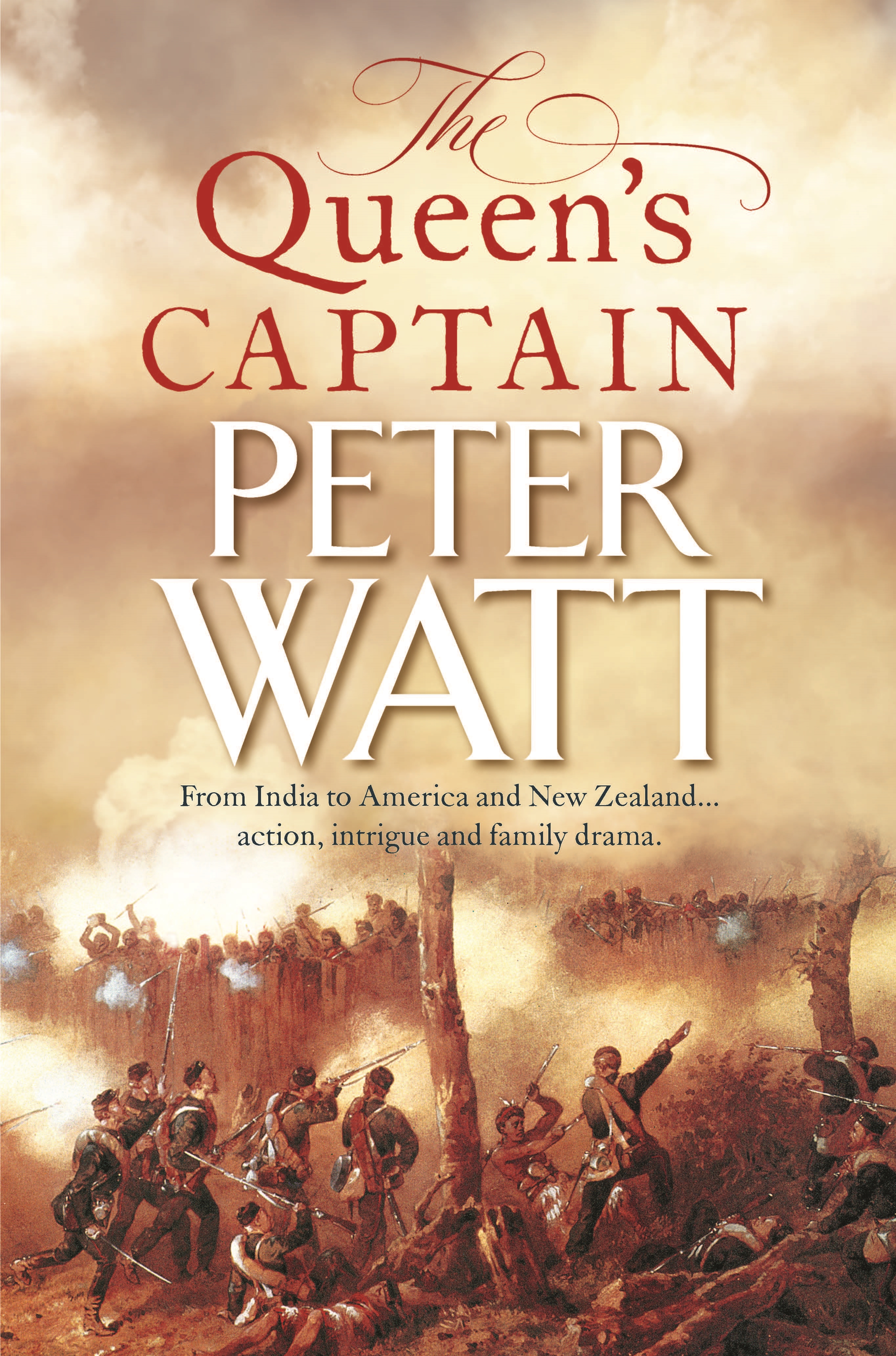
The Queen's Captain Cover

Publisher: Macmillan (Trade Paperback – 10 November 2020)

Series: Colonial series – Book Three

Length: 358 pages

My Rating: 4.5 out of 5 stars

Amazon

One of Australia’s top historical fiction authors, Peter Watt, wraps up his ultra-exciting Colonial series with the third and final novel, The Queen’s Captain.

Watt is a fantastic Australian author who has written a huge collection of amazing historical fiction novels, most of which are set in Australia or feature Australian characters.  I have been a fan of Watt’s books for several years now and I have been particularly enjoying his current body of work, the Colonial series.  The Colonial books, which started back in 2018 with The Queen’s Colonial, follow the adventures of Ian Steele, a colonial blacksmith who manages to enlist as an officer in the British army under the name Captain Samuel Forbes, taking the identity of a friend who wished to sit out his military service.  While the real Samuel leaves to go to America, Ian fights in his place for a period of 10 years, which will allow Samuel to claim a substantial inheritance from his ruthless family.  This has so far been a really fun series, and I enjoyed reading The Queen’s Colonial and The Queen’s Tiger.  I have been looking forward to reading this third novel in the series for some time now and I was very excited when I received my copy, especially because the back cover quoted my Canberra Weekly review of The Queen’s Tiger.  I ended up having an awesome time reading this book, and it proved to be another fast-paced and compelling read.

In October 1863, Ian Steele is still fighting for the British crown as Captain Samuel Forbes, known to his men as the Queen’s Colonial.  After helping to put down the Indian Mutiny, Samuel and his comrades, including his long-time friend Sergeant Major Conan Curry, are fighting the Pashtun in the treacherous mountain passes on the north-western frontier of India.  With only a few months left until the 10-year deal with the real Samuel Forbes concludes, Ian is determined to survive so he can claim his reward and finally settle down.  However, with his typical bad luck, he finds himself drawn into several high-profile missions, including a dangerous operation to eliminate a murderous rebel army camped in the jungle.

As Ian fights for Queen and country, his friends are engaged in their own adventures.  In America, the real Samuel Forbes has followed the man he loves into battle, become a lieutenant in the Union army to fight the Confederates.  Back in London, Ella, the women Ian loves, has entered into an unhappy marriage to Russian Count Nikolai Kasatkin.  Determined to have one piece of happiness, Ella attempts to reclaim the son she had with Ian, but the jealous Nikolai will do the unthinkable to spite her.  At the same time, Samuel’s ruthless older brother, Charles Forbes, continues his relentless bid for power and money, while still determined to prove that the Samuel serving in the British army is an imposter.

All of this will come to a head down in the colonies in 1864.  As Ian is transferred to New Zealand to provide advice to the soldiers fighting against the determined Maori, he will come face to face with an old enemy, and the final chapters of his story will be told.  Friends will die, people will be changed in unexpected ways and the Queen’s Colonial will fight his last battle.  How will the story end?

The Queen’s Captain was another excellent novel from Watt, who has produced an exciting and fascinating conclusion to his latest series.  Like the rest of the books in the Colonial series, The Queen’s Captain is an extremely fast-paced story told from a series of different character perspectives around the world.  The book is broken up into two distinctive parts (although the second part only contains the last 100 pages) and features a number of compelling action and intrigue orientated storylines.  This is an extremely easy novel to get into, even for those readers who have not previously enjoyed the Colonial series, and I was able to finish it off in a short period of time as I got caught up in the various battles and double-crosses.  Watt really took this final entry in his series in some interesting directions, and readers will be intrigued by the various ways he finishes up the Colonial books.  There was a real focus on wrapping up every single storyline and character arc throughout The Queen’s Captain, and I really enjoyed the way in which Watt brought the series to end, especially as the overarching narratives comes full circle.  Overall, I felt that The Queen’s Captain was a fantastic way to conclude the Colonial series and readers are in for a real treat with this book.

Like all of Watt’s novels, The Queen’s Captain makes use of a substantial number of point-of-view characters to tell the story.  This is a combination of some of the established characters from the previous Colonial novels as well as several new characters.  This makes for a rather intriguing, character driven novel, especially as Watt was apparently determined to wrap up as many character arcs as possible for this final entry in the series.  There is a particular focus on the characters of Ian, Samuel, Ella, Charles, and Ian and Ella’s child, Josiah, although many of the other point-of-view characters get their time to shine and Watt ensures that they have a decent backstory.  I have really enjoyed seeing several of these characters develop over the course of the series, and it has been rather heart-warming to see how the hard events of their lives has changed several of them.  I was particularly impressed with the characterisation of the real Samuel Forbes in The Queen’s Captain, as he had a fantastic arc in this book.  Samuel, whose hatred of war is a major plot point of the series, actually joins the Union army in this book, following his love James Thorpe into battle, and while he still detests being a soldier, he shows some natural flair as an officer.  I thought that this inclusion in the book was extremely fascinating, and I loved how Samuel’s arc in this book mirrored that of his body-double Ian, with both of them gaining a reputation for courage and bravery from their soldiers, and both gaining an affectionate nickname from their men, with Samuel becoming known as “the Limey Officer”.  Samuel’s storyline in this book is really good, full of all manner of tragedy, heartbreak and dramatic moments, and readers will be deeply surprised how it ends up.  I also have to highlight the character of Charles Forbes in this book.  Charles serves as the series’ main antagonist, as he is determined to bring down both Ian and Samuel while gaining as much power as possible.  Charles is an extremely slimy villain who the reader cannot help but dislike, and I know I had a rather good time seeing him gradually get some comeuppance in this book.  I also quite enjoyed the various ways in which Watt provided conclusions to nearly all the side-characters featured in the series.  Some of these are rather entertaining (I had a good laugh at one in particular), and it was great to get some closure on all of these excellent characters at the end. 

The major highlights of this book are the awesome and thrilling action sequences as The Queen’s Captain’s characters journey through several intense and dangerous battlefields around the world.  The Queen’s Captain features several interesting and impressive battle scenes from around the world and possibly has the greatest variety out of all the books in the Colonial series.  Not only do you have a number of great sequences in India as Ian fights both the Pashtun in the mountains and a group of rebels in the jungle, but you also have battles from the American Civil War as Samuel fights against the Confederates.  There are also some sequences that feature the Maori fighting against the British and the New Zealand settlers which really stand out, despite the fact that this particular conflict only occurs for a short while towards the end of the novel.  Watt has clearly done his research around these battles, as they are loaded with historical detail about the typical combatants and the weapons and tactics they utilised.  The author does an amazing job bringing these sequences to life, and you get a real sense of the desperation and the horror that the participants would have felt on these fields.  I particularly enjoyed the author’s examination of the differences between small-scale guerrilla skirmishes (several of which occur throughout The Queen’s Captain), compared to the larger-scale battles of the past, and Watt includes several hints about how combat was likely to occur in the future.  All these action scenes are extremely awesome to read and they are a great part of The Queen’s Captain, especially as they help the plot to move along at a faster pace.

The Queen’s Captain by Peter Watt was another amazing and enjoyable historical fiction novel that takes the reader on a series of fast-paced adventures around the world.  Watt has done an awesome job wrapping up his Colonial series and readers will have a fantastic time seeing how he has concluded the various storylines and character arcs he has set up over the previous two novels.  A fun and exciting read, The Queen’s Captain comes highly recommended and I look forward to seeing what cool series Peter Watt comes up with next.

Amazon

War of the Bastards by Andrew Shvarts

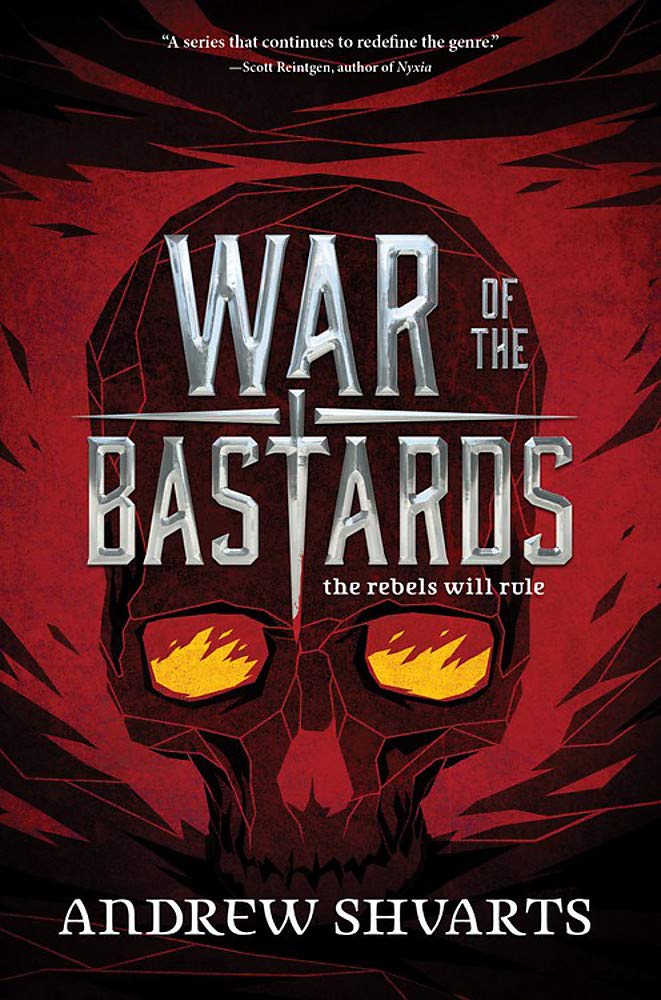
War of the Bastards Cover 2

Publisher: Hyperion (Hardcover – 4 June 2019)

Series: Royal Bastards trilogy – Book 3/Final

Length: 392 pages

My Rating: 5 out of 5 stars

Amazon     Book Depository

War, rebellion, magic and one hell of kickass story! Shvarts brings the outstanding Royal Bastards trilogy to an end with War of the Bastards, the relentlessly entertaining conclusion that rounds out the series with an epic bang. The Royal Bastards trilogy is the debut work of author Andrew Shvarts, who has produced an incredible young adult fantasy series that has been an absolute delight to read over the last three years. Set in the fantasy nation of Noveris, the series follows the adventures of its protagonist, Tilla, and her friends as they try to navigate the treachery and war that has engulfed their nation.

I had an absolute blast reading the second book in the trilogy, City of Bastards, last year. Not only did the book feature a compelling story style and an amazingly captivating plot, but it ended with an outstanding cliff hanger with the protagonist failing to stop the antagonist’s sinister plot, which results in the entire royal family being killed off and the enemy gaining control of the throne. This was such an epic ending, especially because the massacre of the entire royal family was just so unexpected (I really was expecting a last-minute rescue from the protagonists), and I have been extremely curious to see how this story ended for quite a while.

It has been a year since the destructive events that changed Noveris forever. After orchestrating the explosion that decimated the royal court of Noveris, killing the King and Queen and most of Noveris’s nobles, Lord Elric Kent has assumed the throne. With a huge number of powerful bloodmages under the command of his ruthless Inquisitor, Miles Hampstedt, Kent’s rule over Noveris looks to be nearly absolute. However, many are still fighting back against the despotic new rule, including Kent’s bastard daughter, Tilla.

Tilla is a member of the resistance group known as the Unbroken, which fights to return Tilla’s friend, the rightful Queen, Lyriana Volaris, back to the throne. With the help of her lover, Zell, and Lyriana’s cousin, Ellarion, Tilla and the Unbroken are engaged in a brutal guerrilla war against the new regime. However, the situation looks dire and victory near impossible to achieve, until a mission to rescue a major source of rebel intelligence reveals that their informant was none other than King Kent himself. Kent’s rule has been usurped by Miles, whose absolute control over the bloodmages has allowed him to take over Noveris without anyone noticing. While attempting to deal with the implications of capturing Tilla’s father, the Unbroken also free Syan Syee, a young woman from the Red Wastes with mysterious magical powers, who brings an urgent message to the people of Noveris. Syan warns of a coming apocalypse and believes that defeating Miles is the key to stopping it. Needing new allies, Tilla, Lyriana, Zell, Ellarion, Kent and Syan journey to the Red Wastes, hoping to recruit Syan’s people to their cause. However, what they discover in the Red Wastes will change everything. With this new knowledge, can Tilla and her friends save Noveris, or will Miles’s lust for power and control tear their world apart?

Before I started reading this book, I honestly thought that Shvarts was going to have an extremely hard time matching the awesomeness of City of Bastards. However, I am pleased to report that War of the Bastards is an incredible and massively compelling read that I enjoyed just as much as the second book in the series. While it may lack the shocking cliff hanger ending of City of Bastards, War of the Bastards has an excellent fast-paced story that proves extremely hard to put down once you start.

I really loved the story contained within War of the Bastards and felt that it was an amazing conclusion to the trilogy. The tale of an epic battle to free a kingdom is a classic, but the author has put some fantastic modern twists on it, and his entertaining writing style and dedication to bringing out huge moments, really turns this into something special. Shvarts has included a number of cool twists and turns throughout this book, and I really liked where the story went at times. There was also a slight turn away from fantasy towards another genre about two-thirds through the story that proved to be a bit surprising, but I found it to be an interesting addition to the story. Without giving too much away, I was very satisfied with the clever way that the antagonist was taken down at the end of the book, and it was a nice call-back to earlier events in the series. I really enjoyed how this story turned out, and it was an outstanding conclusion to the epic tale that had been told throughout the Royal Bastards trilogy.

In the previous books in the series, the author tended to only set the story in one general setting, such as the West for the first book and the Lightspire for the second book. In War of the Bastards, Shvarts continues to expand on his fantasy world, but this time he takes his characters to several new locations that had been alluded to in the other books. The story starts in the Heartlands and focuses on the characters fighting their guerrilla war there. This land has been transformed by the oppression of Kent and Miles, and it was intriguing to see how bad things had gotten under their rule. The protagonists also journey through the Southlands and the Red Wastes, both of which are pretty fascinating and distinctive locales. The Red Wastes was definitely the most unique location, ravaged by terrifying magical storms and featuring interesting new civilisation. Overall, these new locations are pretty cool, and readers will enjoy exploring more of this great fantasy world.

One of the major strengths of Shvarts’s previous books has been the excellent character work. Each of the major characters has gone through tremendous growth through the course of the first two books, and this growth has continued through the course of War of the Bastards. Tilla has gone from being two different types of social outcast (a bastard in the first book and a traitor’s daughter in the second) to a respected rebel warrior fighting the good fight. However, despite knowing she is fighting for what is right, Tilla is not natural killer and has to constantly deal with the guilt of her actions, keeping a running mental count of all those she has killed. She also has to finally come to terms with her strained relationship with her father once he joins them on their quest. Due to her status as a bastard, her father has always kept a certain distance with her. Now, with him joining their band, Tilla is forced to have several emotional confrontations with him over the terrible things he has done in previous books and how he treated her in the past. This results in some dramatic moments within the book, and the exploration of their relationship makes for great reading. Tilla still serves as the book’s narrator and point-of-view character, and it is through her eyes that we see the story unfold. This is extremely fortunate, as her sassy and sarcastic outlook on the events occurring around her leads to a lot of the book’s humour. All in all, I have always found Tilla to be a pretty awesome main character, and it was great to see how her story ended.

In addition to Tilla, the other three main characters from the previous Royal Bastards books all get great character arcs within this book. Lyriana spends this book as the Queen in exile of her people and is burdened with the responsibility of being a figurehead. However, she rises to the challenge and proves herself to be powerful badass and war leader thanks to her epic magical abilities. This was a massive change in her character from the second book, where she was devastated with loss and trauma, and it was great to see her at her full potential. Readers will also like the new relationship she finds herself in, and it was nice to see her finally get some emotional happiness. I would say that Zell is character least utilised in this book, but we do get to witness him trying to come to terms with guilt from the previous book thanks to the inadvertent role he had in facilitating the massacre. The character most impacted by the events of the previous book is Ellarion, Lyriana’s cousin and the most powerful magician in the lands. He lost his hands at the end of City of Bastards when defending his friends from the massive explosion and must now learn how to live without them and, more importantly, the magic they allowed him to perform. Shvarts did an amazing job portraying Ellarion’s despair at his situation and the longing he has for his lost magical arts. Some interesting things happen to him in this book and he has a major moment that readers will absolutely love.

Two new characters join the main characters in this book: Syan from the Red Wastes and Tilla’s father, Lord Kent. Syan is a pretty cool lesbian character who has some significant secrets in her past. Shvarts does a great job telling her entire story within this one book, and I found her to be quite an enjoyable character. Lord Kent was another fantastic addition to the main group of protagonists. While he has appeared in both of the previous books in the trilogy, we have never really gotten his side of the story before. In addition to all the drama surrounding his relationship with Tilla, we also get to see his motivations for his actions, as well as the regret for what he has brought about. I really liked the inclusion of Kent in War of the Bastards and thought it was a clever touch from Shvarts because of all the extra emotional complexities and drama he brings to the story.

I should quickly mention the main antagonist of this book, Miles. Miles has always been a pretty unlikeable character, especially after betraying the group in the first book due to his jealousy over Tilla choosing Zell. Shvarts really makes him even more despicable in War of the Bastards by showing him as the facilitator of all the worst things that have been done in Noveris in the last year. Later confrontations with him reveal that he has no remorse and really does not see himself as the bad guy. His continued obsession with Tilla is pretty messed up (cough, harem, cough), but I do like how that was used against him at times. Overall, Miles makes for an excellent series villain, and Shvarts did an amazing job utilising him in this final book.

The author has a very creative mind when it comes to the magic and fantasy elements contained within this series. The magical abilities and rules that govern the lands of Noveris are extremely interesting and have led to some impressive magical destruction and battles in the past. Shvarts continues to do this in the final book, and the exploration of the origins of magic and the devastating consequences of using it are really fascinating. Shvarts came up with some cool and unique new magical abilities in War of the Bastards, especially for the magic utilised by the people of the Red Wastes. The author has been really creative in this final book, and I am sure readers will like some of the ideas he comes up with.

Like the previous books in the series, War of the Bastards is being marketed towards the young adult audience. However, it should only really be read by the older teen audience, as it features a lot of adult content. While it does not have as much sex, drugs and drinking as City of Bastards did, it does feature a heck of a lot more violence, and some of the action scenes are pretty gruesome. This does mean the book is really easy for older readers to enjoy, and I would strongly recommend this to all adult fantasy readers.

While I am sad to see the Royal Bastards series end, War of the Bastards was such an incredible conclusion to the story that it does not seem too devastating. Due to its near perfect blend of electrifying story content, excellent characters and entertaining writing style, I found that it was near impossible to put War of the Bastards down, and I had an amazing time reading it. This is easily a five-star read, and I reckon this is my favourite young adult book of 2019 so far. With his debut trilogy, Andrew Shvarts has shown himself to be an extremely talented author, and I will be eagerly keeping an eye out for his next series.

Amazon     Book Depository