
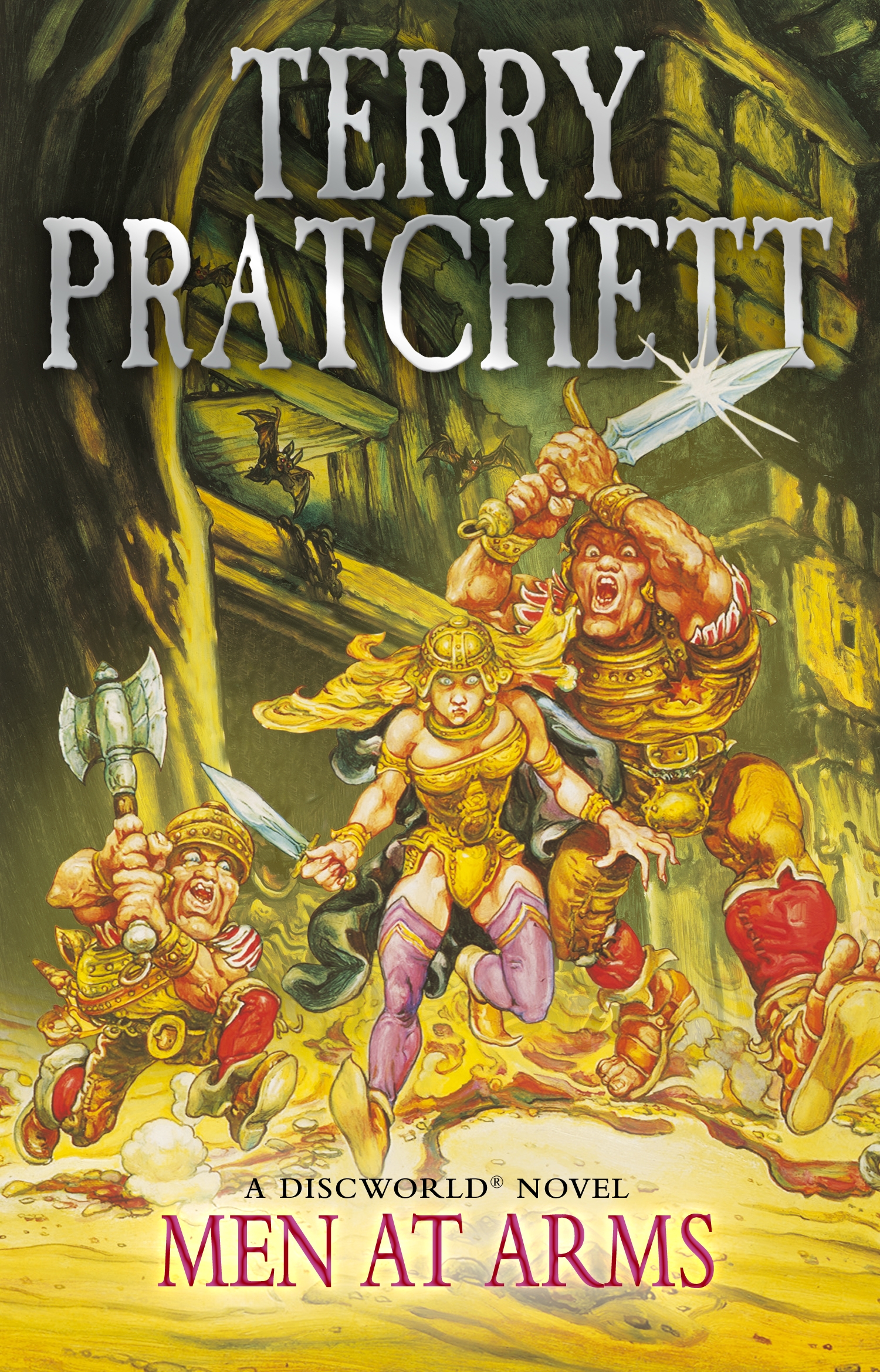
Publisher: Gollancz/Penguin Random (Audiobook – 1993)
Series: Discworld – Book 15/City Watch – Book Two
Length: 12 hours and 58 minutes
My Rating: 5 out of 5 stars
After yet another re-read, the classic fantasy satire novel, Men at Arms remains as one of my favourite Discworld novels by the late, great Terry Pratchett, especially as its new audiobook version breaths fresh life into the always impressive novel.
Readers of this blog will have noticed that I have been on a real Discworld rampage lately, having re-read several books from my absolute favourite fantasy series. Much of this is due to the recent release of a cool new audiobook version of all the Discworld books, featuring an awesome array of new narrators and vocal talents. This new format has proven particularly awesome for books like Pyramids, Moving Pictures and Small Gods, and I have been eager to see how some of the books in my favourite Discworld sub-series, the City Watch books, come across with the new narrators.
While I have a lot of love for all the books in Terry Pratchett’s Discworld, my absolute favourites come from the City Watch sub-series. Following the unlikely members of the Ankh-Morpork City Watch, a rag-tag team of guards generally looked down upon by the entire city, the City Watch books features an exceptional combination of fantasy and crime fiction elements, wrapped up in Pratchett’s usual satirical humour, as the protagonists investigate a series of dastardly crimes in the supernatural Discworld. The series started perfectly with the awesome novel Guards! Guards!, which I reviewed last year, and Pratchett did an outstanding job following this up with the brilliant sequel, Men at Arms.
After saving the sprawling and eternally crime-ridden city of Ankh-Morpork from a fire-breathing dragon, the men of the Night Watch are still at work protecting the city, even though most of the city wishes they didn’t exist. Despite their previous escapades, it’s a bad time to be a copper in Ankh-Morpork, with species tension between the dwarfs and the trolls at boiling point, while the powerful guilds disregard the Watch’s non-existent authority. Worse, the Night Watch has been forced to accept three diversity hires, and must now contend with a mad dwarf, a thick troll and a woman (gasp) amongst their ranks.
Despite this, when an explosion at the Assassin’s Guild literally rocks the city, it falls to Captain Samuel Vimes and his small squad to investigate the heist hidden by the blast, despite the deliberate orders of the city’s tyrannical ruler to stop. Determined to wrap up the case before his impending marriage and retirement, Vimes is soon forced to contend with a series of unusual, but seemingly linked murders, many of which have been caused by a lethal weapon never seen on the Disc.
With riots on the streets, and assassins and fools dodging their questions, all the members of the watch, including their contentious recruits, will need to work together to solve the murders before the city descends into chaos. But how will they fare when going up against the most dangerous criminal mind the city has ever seen, one determined to bring back the Ankh-Morpork’s ancient kings, while wielding a dangerous new weapon that could change the entire Disc forever?
Even after many, many re-reads, Men at Arms continues to shine as one of Pratchett’s better books. Featuring an epic crime fiction narrative, loaded with impressive characters, fantastic humour and great use of Pratchett’s iconic Discworld setting, Men at Arms is a complex, emotionally charged and deeply moving read that I could honestly read 100 times and still not get bored with. A brilliant novel that unsurprisingly gets an instant five-star rating from me.
Pratchett wrote some exceptional narratives throughout his career, but few stand up to Men at Arms in terms of complexity, cleverness and emotional impact. Expertly reintroducing the cast of Guards! Guards!, while also bringing in some impressive new support characters, Men at Arms starts off an excellent pace, as Pratchett cleverly examines the changes to the characters, sets up the new case, while also showcasing the motivations of the apparent main antagonist. From there, it doesn’t take long for a dark series of crimes to take place, with Vimes and his squad investigating despite the apathy of the rest of the city. Pratchett does a lot of excellent set up in the early part of the book, and the reader soon becomes invested in the investigation, especially as the book begins to follow a series of deaths, some of which were caused by a particularly deadly weapon that modern readers will be all-too familiar with. Some great character arcs are also introduced here, as the extended cast all hit their own various problems they are forced to overcome, with Vimes dreading his eventual retirement, Carrot feeling the added responsibility, the fun buddy-cop arc between Detritus and Cuddy, and Angua dealing with her own problems. The author sets up and expands on these arcs throughout the book perfectly, providing additional emotional impact, as well as some interesting side angles on the main storyline.
While the first half of the novel sets everything up perfectly, it is in its second half where Men at Arms truly shines. Pratchett keeps raising the stakes of the story, with more victims, run-ins with the shadowy antagonist, and the Watch characters attempting to understand the nature of the weapon that has been turned against the city. The author throws in some interesting wrinkles to the case, which shadow who the true villain is, while other events throw emotional shade across several of the characters. The various connected character arcs start to come together perfectly as the book continues, and you go into the final stretch with a range of emotions around you. While ostensibly a comedy, Pratchett chooses to hit the tragedy element of the plot really hard in the lead up to the finale, with some big moments that will leave you speechless. The big end reveal and confrontation is exceptional, and I loved how well all the storylines and cleverly setup plot points came together. Everything leads up to a very desperate struggle that helps to define some of the main characters in some very powerful ways. Pratchett chooses to leave the book on a hopeful note that sets the expanded course for the future City Watch books, while also providing some interesting insights into one of the main characters and his role in the city. An overall epic narrative that twists, turns and keeps you guessing, while constantly entertaining and emotionally charged.
As with his other books, Pratchett perfectly sets out Men at Arms with impeccable writing, and I loved how this complex novel came about. Featuring his usual impressive blend of fantasy and humour elements at its base, Men at Arms is both intriguing and quite funny in equal measures, and I love the subtle comedy that runs through it. Many of these scenarios involve classic fantasy scenarios being seen through the eyes of self-aware characters, allowing the situation to be taken up to an 11, with sarcastic commentary from the witnesses. This humour is well enhanced by several of its best characters, including a fantastic new buddy cop routine, with members of two separate and historically antagonistic species forced to work together and eventually becoming friends. Some of the other hilarious moments in the book include unlikely members of the city’s population being conscripted into the Watch, unfunny clowns, unconventional investigation methods, and other subtle humour. You also have to love the brilliant footnotes that seek to enhance the story and showcase just how ridiculous the Discworld is by providing additional details about the universe and the people within it. All this results in a brilliant and highly entertaining fantasy read, and that’s before you even get to the great crime fiction elements of the story.
As with Guards! Guards!, Men at Arms stands out from the rest of the Discworld series due to the way that Pratchett provides a complex and compelling crime fiction narrative. Focused on an explosive heist that eventually results in a series of brutal murders, Men at Arms tries to envision how firearms would disrupt the Discworld. This allows for quite a captivating crime fiction narrative, which I feel was a much better mystery than Guards! Guards!. Advancing more into police procedural territory than its predecessor, the mystery of Men at Arms proves to be top rate, with the protagonists going after an already known villain for much of the book. Much of the early story involves the protagonists trying to unfurl the antagonist’s plan and discover how he committed the crime, which allows for some great scenes as the Watch inexpertly investigate. Pratchett cleverly twists the fact that think you know who the antagonist is towards the end of the book, and I love how well he switched this key story element, especially as the implied true villain of the story is far more sinister than just evil humans. I really enjoyed how well Pratchett sets up this mystery in Men at Arms, and even after so many re-reads there are still additional subtle clues and foreshadowing that I’m only just picking up on. The police procedural elements of the story are also extremely well handled, with a lot of humour focused around three very unlikely recruits joining the already scruffy outsiders who make up the Watch. All these elements come together extremely perfectly and allow for readers of various genres to come into Men at Arms and have an incredible time.
Due to Pratchett’s excellent writing style, Men at Arms does work quite well as a standalone novel, and new readers can generally enjoy this book without any prior knowledge of the Discworld series, especially once they get caught up in the cool story and amazing humour. However, I do feel that to get the best experience with Men at Arms, readers really do need to have checked out Guards! Guards! first. The continuing storylines, history of the city and character arcs all come into play extremely well in Men at Arms, and you get a much more complete experience viewing all City Watch novels in order. There is also a continuation of some character arcs from the standalone novel, Moving Pictures, especially as a few major characters from there get a recurring role in this new sub-series. As such, I would say that Men at Arms is a novel more aimed towards Pratchett’s established fans, with those who loved Guards! Guards! guaranteed to enjoy its impressive sequel and the compelling direction Pratchett starts to take the City Watch books in. It helps that the author continued to explore the crumbling and crime-ridden city that is Ankh-Morpork in this Men at Arms, providing even more details about its governance, mindset and people. This includes really expanding on the species tension between the dwarfs and trolls and showcasing it as a major plot point while also paralleling real-life racial tensions. This focus on dwarf and troll conflict becomes a major plot point of the Discworld going forward (especially in the later City Watch books), and its setup here was spectacular. Combine that with the changes that happen to the Watch at the end of the book, and Men at Arms is an important entry in the wider Discworld context, especially as so many key City Watch storylines start here.
While there are so many amazing writing elements to Men at Arms, few things top the exceptional character work that ensured that this novel was far more than just a funny fantasy novel with crime fiction elements. Instead, the complex and heartfelt dives into its extensive main cast ensured that Men at Arms was one of the more powerful and emotionally charged entries in the Discworld (a very impressive feat). The combination of returning protagonists from previous books, as well as a few outstanding new characters, allows for a range of different plot perspectives and personal storylines, and Pratchett effortlessly works to make you invested in all these character arcs before hitting you with intense tragedy and powerful moments.
At the centre of the plot lies main character Captain Samuel Vimes, the cynical veteran leader of the Night Watch, who has finally found happiness and romance in his life. Now on course to retire and become a man of leisure, Vimes must deal with the horror of becoming the thing he hates most: a rich civilian. Dealing with it by diving into one last investigation, Vimes finds himself facing everything he hates about his job, including bureaucracy and the whims of powerful people, resulting in some brilliantly chaotic scenes. While it does seem that Vimes’s role in this story is slightly diminished compared to in other City Watch books, especially in the centre, he is still a major part of the book, and Pratchett writes some excellent storylines around him being the dogged and worn-down investigator pushing against authority and trying to solve one more crime. The focus on his identity as a copper, the sacrifices he makes for his fellow officers, as well as the horror at having to give up the job are major parts of his character arc, and there are some truly heartbreaking moments when he realises he must give it all up. This is well balanced with his heartwarming romance with his unlikely partner, Lady Sybil Ramkin, whose well-meaning support and determination help to make Vimes a better person. However, it is the major sequence when Vimes finally encounters the antagonist which really provides the best look at the character. Forced to decide between being a good cop or a figure of vengeance (a battle that rears its ugly head for Vimes many times during the series), Vimes truly hits his mental and moral limit as he faces down his adversary, and it is one of the most powerful scenes in the entire Discworld series.
While Vimes is the main character of the City Watch series, the focus of Men at Arms is a little more skewed more towards Corporal Carrot Ironfoundersson, as Pratchett expands on his excellent introduction in Guards! Guards!. Now firmly a part of Ankh-Morpork society, Carrot has evolved from naïve newcomer to a seasoned police officer who knows literally everyone in the city. Fully utilising his natural charisma, Carrot proves to be a major force for law and order in the city. I loved how much Pratchett enhanced Carrot in this sequel, as his personality evolves due to his role and responsibility, and despite still appearing quite naïve and obedient, Carrot showcases some impressive intelligence driving much of the investigation. I especially appreciated the various scenes where Carrot managed to outfox many of the city’s more dangerous figures who fall for the dumb copper routine. Despite his new confidence and ability to bring out loyalty in others, Pratchett makes sure to show that Carrot isn’t infallible, and you see some vulnerability at times. Carrot also serves as the moral centre of the book, bringing out the best in the other members of the Watch. His interactions with Vimes in the final confrontation were very heartfelt, especially as he keeps the man he admires most from doing the wrong thing, while the way he handles the antagonists goes to show that he is truly a good man, who you better pray you never face. I also think that his talk with Vetinari at the end of the book was one of the best scenes in Men at Arms, especially as he truly surprises the Patrician, while also dancing around the tricky subject of Carrot’s potential position as heir to the throne. His decision to refuse power and ensure that Vimes will be there instead really helps you keep faith in the good of people, and this was frankly Carrot’s best book.
I also have to highlight the fantastic and fun duo that was the newly instated watchmen, Cuddy and Detritus, the later of whom previously appeared in Moving Pictures. An unusual dwarf and the thickest of trolls, the two make for a particularly unlikely and chaotic duo, which Pratchett uses to full effect as the book continues. Thanks to the enmity that exists between their respective species, Cuddy and Detritus spend much of the early part of Men at Arms bickering with each other, including in one scene in the middle of a riot. However, after being forced to work together, the two form a grudging bond, especially when Cuddy stops seeing Detritus as a dumb troll. I loved how well Pratchett took the classic odd-couple police partner trope and twisted it around the compelling species-rivalry theme of the book, and the fun dynamic that forms between the new friends is a major highlight of the book. The various sequences that follow the big scene that defines these two partners are some of the most powerful in the entire Discworld.
Following on the heels of Cuddy and Detritus is Angua, the other new recruit to the Night Watch. Angua is an interesting figure in the story, mainly because she’s one of the few people able to see how ridiculous the entire Night Watch is. The subsequent storylines surrounding her potentially doomed romance with Carrot and her desire to keep her status as a werewolf secret from everyone, add some excellent alternate perspectives to the plot, and Pratchett did an outstanding job setting her up as a compelling figure for the rest of the series. It helped that for this first book she worked as a bit of a double act with the small talking street dog, Gaspode, who also previously appeared in Moving Pictures. Gaspode proves to be a fantastic wise-cracking counterpoint to Angua, and it was hilarious to watch him mess with the various human characters who refuse to believe he can talk. Their resulting storylines about investigating the crime as canines, as well as the unlikely dog rebellion brewing within the city, works well with the other character focused arcs, and it was fun to get a little more closure on Gaspode’s story after his previous appearance.
Other great supporting characters in Men at Arms includes the returning members of the City Watch, Sergeant Colon and Corporal Nobbs. While not as well utilised in this book as the rest of the City Watch series, they still prove to be a fantastic addition to the supporting cast. Entertaining backers to the various other character-driven storylines, both show interesting depths in this book, whether it’s Colon acting as a put-upon drill sergeant, or Nobby’s use of his quartermaster past to obtain a collection of weapons. Other members of the city also prove to extremely entertaining, with the tyrannical Lord Vetinari being the highlight. The way in which Vetinari manipulates Vimes throughout the entire novel, while also understanding the true nature of most of the city’s residents is highly impressive, and I love that he stayed on as a major character after Guards! Guards!. Throw in a complex arrangement of well-hidden antagonists, including an idea of violence that takes on a familiar form, and the cast of Men at Arms proves quite exceptional. I really cannot emphasise just how much these carefully written character arcs and complex personal storylines increased the impact and emotional power of this novel, and you will come away loving everything about them.
I doubt anyone will be too surprised that I am about to write several paragraphs about Men at Arms’s epic audiobook formats, which I have long described as the very best way to enjoy Pratchett’s stories. I honestly love all the Discworld audiobooks and luckily for connoisseurs, there are two outstanding versions of the Men at Arms audiobook that you can check out.
The first of these is the classic edition that was released back in 1996 and which is read by Nigel Planer. Planer, who is one of my favourite audiobook narrators, lent his voice to most of the early Discworld novels, and is a key reason why I love Discworld books in this audio format. Planer unsurprisingly does an amazing job with Men at Arms, especially as he perfectly captures Pratchett’s complex humour and intense story arcs with his brilliant narration, with every element of the book coming across in an exceptional and addictive manner. This includes the brilliant characters, many of whom Planer previously voiced in other Discworld books. Planner does an amazing job once again diving into these unique characters throughout Men at Arms, and the way he effortlessly portrays each character and shows their full personality and emotional range is just amazing. He frankly provides the definitive portrayal for all the City Watch characters, and I honestly love the passion he brings to the Men at Arms audiobook.
While the Nigel Planer audiobook version is always going to be a favourite of mine, I also have come to deeply appreciate the latest Men at Arms audiobook. Part of a newly released collection of Disworld audiobooks that feature an interesting array of British talents bringing their vocal skills to Pratchett’s classic tales, this new Men at Arms audiobook is very impressive and is just as easy to get lost in at the classic Planer version. Featuring the amazing cast of Jon Culshaw, Peter Serafinowicz and Bill Nighy, this Men at Arms audiobooks has a runtime just short of 13 hours, which is a few hours longer than Planer version. However, the excellent array of narrators really makes it worth a listen.
The heart of this new Men at Arms’ audiobook is British radio and television personality Jon Culshaw, who dove into this role in a very impressive manner. Culshaw really makes the story his own with his take on the novel and the characters, resulting in a very different feel that fans of the original Planer version will really appreciate. Part of the reason why it was so good was that Culshaw brought back the excellent character voices and tones he previously used in Guards! Guards!, many of which provide great and often gritty new takes on some classic characters. This includes a much rougher and despair filled Vimes, which fits the darker places Pratchett took the character in Men at Arms, especially when he goes up against the system. His voice for Carrot captures the same keenness and naiveté that we saw in the previous book, however Culshaw’s vocal work also backed up Carrot’s excellent character development as the protagonist came into his own. His voices for Lord Vetinari and Nobby Nobbs were also a ton of fun, with the dark and insister tones of Vetinari stealing every scene he is in, while Culshaw’s Nobby voices sounded appropriately similar to David Bradley or Jon Pertwee, which is just hilarious. Culshaw also did an excellent job with several newly introduced City Watch characters, and I felt he got ever new additional cast members’ voice down perfectly. My favourite was probably the troll Detritus, as Culshaw worked hard to showcase his massive and rocky troll nature, as well as his serious and slow personality. This excellent vocal work from Culshaw ensured that the core of this Men at Arms audiobook was extremely impressive, and I really could listen to Culshaw’s take on these epic characters all day long.
As with all books in this new collection of Discworld audiobook’s, Culshaw’s main narration was perfectly backed up by recuring voices of Bill Nighy and Peter Serafinowicz. Both play key parts in this audiobook, with Nighy providing the narration for the footnotes, while Serafinowicz was the voice of Death whenever he appeared. These performances were once again perfect, and I especially loved Nighy’s excellent work with the vital, comedic footnotes. Nighy really enhances the impact and value of these footnotes with his calm and impressive voices, and I especially loved his take on some of the more entertaining footnotes, including one where he partially sings a bad folk song. Serafinowicz’s role in Men at Arms is also very fun, as he brings the fan-favourite character of Death to life. Death has several great appearances in Men at Arms, and hearing Serafinowicz’s excellent voice suddenly appear amongst the general narration really increases the impact of the character. Both Bill Nighy and Peter Serafinowicz’s inclusions were extremely fun, and I felt that they were combined with Culshaw’s main narration in a very impressive way. These three brilliant British talents ensured that the new version of Men at Arms was particularly impressive, and while the original audiobook will always remain one of my favourite ways to enjoy Men at Arms, this new version is very much worth a listen and will likely inspire a new generation of Discworld fans.
Well, I think that my above excessive ramblings have probably made the point by now that I deeply enjoyed Men at Arms by Terry Pratchett. One of the best Discworld and City Watch novels, Men at Arms was a glorious, captivating and moving read that perfectly blended crime fiction, fantasy and satire into one truly addictive and impactful book. Clever, sharp and loaded with truly exceptional characters, Men at Arms was Pratchett at his very best, and I cannot recommend this book enough, especially on audiobook. I can think of no higher praise for Men at Arms than to once again state that I will never get bored with this exceptional book, and it inspired me to continue the series and re-listen the next City Watch book, Feet of Clay.

 The Unseen Library