Warhammer 40,000: Catachan Devil by Justin Woolley

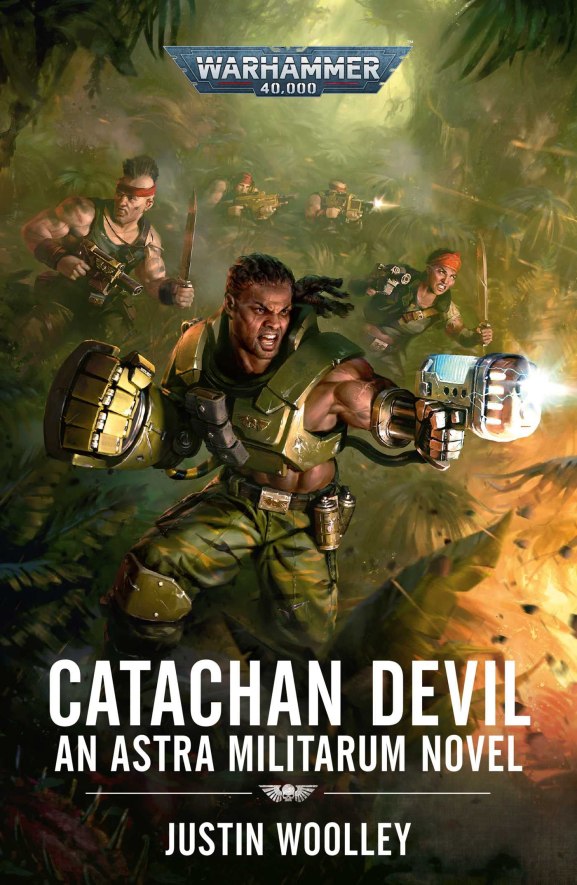
Catachan Devil Cover

Publisher: Black Library (Audiobook – 29 March 2022)

Series: Warhammer 40,000/Astra Militarum – Book Two

Length: 9 hours and 14 minutes

My Rating: 4.5 out of 5 stars

Amazon     Book Depository

Another iconic regiment of the Astra Militarum is on full display in the new Warhammer 40,000 novel by talented author Justin Woolley, with the intense and action-packed read Catachan Devil.

2022 is shaping up to be a particularly epic year for Warhammer 40,000 fiction, with a ton of brilliant novels coming out that cover a range of factions and sides of the surprisingly massive and highly compelling extended universe surrounding the famous tabletop games.  Some of the best Warhammer books of the year include Ghazghkull Thraka: Prophet of the Waaagh! by Nate Crowley and Assassinorum: Kingmaker by Robert Rath, which both got five-star ratings from me.  However, I have also been really drawn to the impressive novels that examine the basic human troopers of the Imperium of Man.  These soldiers, members of the Astra Militarum, better known as the Imperial Guard, come from many different planets, and are forged into unique fighters by the harsh conditions of their worlds.  I have had a great time reading some of the recent books about them, such as Steel Tread, Krieg and The Vincula Insurgency, especially as the authors dive deep into the psyches of the regiments and their members to unearth their history, mentality, and their opinions of the deadly wars they are fighting.  As such, I was excited when I saw that there was a cool book coming out that followed the legendary Catachan Jungle Fighters, Catachan Devil by Justin Woolley.

Deep in the 41st century, where war and death surrounds the fragile Imperium of Man, many serve the Imperium as soldiers of the Astra Militarum.  However, not all Imperial Guard are created equal, as Trooper Torvin of the newly formed Skadi Second Infantry is about to find out.  Conscripted to fight in the Emperor’s wars, the poorly trained and terrified Torvin suddenly finds himself on the jungle world of Gondwa VI, expected to go up against the brutal and ever-growing greenskin threat.  However, fate is about to place him in the path of a far more dangerous group of fighters.

The lone survivor of his regiment after their vital outpost is overrun and captured by orks, Torvin is accused of cowardice and faces death by firing squad.  However, he is given a chance at redemption by joining up with the men chosen to retake his fallen outpost, the legendary and lethal men of the Catachan 57th Jungle Fighters.  Led by Colonel Haskell ‘Hell Fist’ Aldalon, the Catachans are masters of stealth and jungle fighting, and the 57th Jungle Fighters have a particular grudge to bear against the orks.

Accompanying a small detachment of Catachan Devils to the fallen fortress, Torvin is in awe of the Catachan’s skill and lethality, while they view him with nothing but disdain.  Forced into the fight, Torvin soon discovers that the Catachans are just as likely to turn on him for his incompetence as they are to kill the orks they are hunting.  If he wants to survive, Torvin will need to forget his standard training and fight his hardest to gain the respect of the Catachans.  However, not even the Catachans are fully prepared for the opponents waiting for them; these orks are aware of their strengths and have taken to emulating their tactics and style.  May the best commandos win!

Woolley’s first full Warhammer 40,000 novel was a real hit, and I loved how Catachan Devil provided the reader with a powerful and deeply exciting science fiction tale that also highlights one of the more distinctive factions from the tabletop game.  Catachan Devil has a brilliant and deeply compelling story to it that I found myself powering through in only a few days.  A standalone Warhammer 40,000 book, Catachan Devil takes the reader into heart of the action quickly by introducing two of the main protagonists in the early goings of the book and showing their arrival on Gondwa VI.  These initial chapters primarily focus on the character of Trooper Torvin and show his initial attempts at being an Imperial Guardsman and his unfortunate first encounter with the orks and their fun point-of-view character.  Following this, you are introduced to the Catachans and their leader, Colonel Aldalon, who are brought in to clean up the mess made by Torvin’s regiment.

While it was a tad surprising not to see any Catachan characters until a third of the way in, I think it worked, as all the previous events set up the main narrative extremely well, while also showcasing the dearth in skill of the human soldiers at that point.  The rest of the book follows at a brilliant pace, taking the various characters on an intense and ultra-exciting adventure.  The rest of the story has a great blend of combat, universe building and character development splattered throughout it, as the three central characters all evolve in different ways as they fight against their own issues and their various opponents.  Woolley takes Catachan Devil’s narrative in some interesting directions, and I enjoyed the examination of the Catachan mission and the work done to build up a worthy set of adversaries.  This all leads up to some brilliant and highly exciting final confrontations between the Catachans and their foes, and I loved the fantastic way that Woolley was able to wrap up the main narrative of this book, as well as the three central character storylines.  Everything comes together extremely well, and readers will come away very satisfied, although if they are anything like me, they will be wanting more, even if that is a tad unreasonable.  While Catachan Devil does work as a standalone narrative, Woolley does leave some options for a sequel open in the future, which I personally would be quite interested to see.  An awesome and highly addictive narrative that was really fun to get through.

I enjoyed the way that Catachan Devil was put together as Woolley wrote it in an enjoyable and captivating way.  While this book is primarily designed to highlight a specific regiment of Imperial Guard, something that Woolley does really well, it still contains a brilliant and extremely fun narrative that can be easily enjoyed by anyone familiar with Warhammer 40,000.  However, Catachan Devil would serve as a rather good introductory novel for new readers of the franchise.  Catachan Devil contains an excellent blend of damaged characters, impressive action sequences and entertaining humour that anyone can have an awesome time with this book, and I personally found myself laughing myself silly at times (there is a fun scene where some orks are trying to lure the Catachans out), while also getting drawn into some powerful character arcs.  The entire book is very well paced out, and I particularly enjoyed how Woolley perfectly utilised three central character perspectives to tell a layered and intriguing tale.  Seeing three very different perspectives of the events occurring in Catachan Devil adds to the humour and complexity of the tale, and the three unique main characters play off each other extremely well to create an outstanding book.  I had such a great time getting through Catachan Devil and it was an exceptional addition to the Warhammer 40,000 canon.

Without a doubt the highlight of this book is the focus on the iconic Imperial Guard regiment, the Catachan Jungle Fighters.  The Catachans are a fan-favourite regiment with a distinctive look strongly based on Green Berets in Vietnam (or more likely around Rambo).  Portrayed as tough, disrespectful, and extremely deadly warriors whose fighting ability is a result of their upbringing on a jungle Death World, the Catachans have long captured the imagination of the Warhammer fandom, and they have some of the coolest models in the game.  Due to their popularity, the Catachans have featured in multiple tie-in novels and comics before, but I felt that Woolley did a particularly good job of examining this iconic faction throughout this book.  Indeed, the author really goes out of his way to showcase just how cool and impressive the Catachans are, and the reader gets an intriguing deep dive into their history, mentality and deadly ability in combat.

I felt that the way Woolley set out Catachan Devils really helped to highlight just how skilled and different they are from typical Imperial Guards.  Woolley ensures that there is a very fun and compelling comparison between the Catachans and the other Imperial Guards by first showing a normal regiment of troopers getting slaughtered by the orks while relying on their standard training.  From there, the Catachans are shown from various perspectives: an insider one from their commander, and two outsider perspectives, including from a poorly trained guardsman, which really helps to highlight the differences between the typical soldiers and these badass Jungle Fighters.  Watching the Catachans’ various ambushes, sneak attacks and brutal close combat fights was pretty amazing, and I loved the way that Woolley worked to highlight the practical aspects of their skills and techniques.  You learn a lot about the Catachans throughout this book, as all the point-of-view characters learn or reminisce about the things that drive them and the full applications of their skills and training.  I definitely came away from Catachan Devil with a new appreciation for this faction, and I loved how well Woolley focused the book on them.

To tell Catachan Devil’s fantastic story, Woolley centred the narrative on three point-of-view characters who each have multiple chapters told from their perspective.  These three characters proved to be a winning narrative combination, and you get a powerful and intriguing story as a result.  While each of them has their own distinctive personal narrative, their stories come together throughout the book, and it proves very entertaining to see their different takes on the same events.  This use of three characters was very effective, especially as you get drawn into their personal stories in some powerful ways.

The first character is Trooper Torvin, a rookie Imperial Guard from the ill-fated and newly formed Skadi Second Infantry.  Torvin, who was drafted into the Imperial Guard against his will, is thrust into the deep end on this book and soon finds himself forced to work with the Catachans, even though his inexperience and lack of any jungle training make him a major liability.  Woolley makes good use of Torvin throughout Catachan Devil, and he is the primary example used to show the differences between the common solider and the Catachans.  There are a ton of great examples scattered throughout the book that showcases the difference between a draftee like Torvin and the Catachans, who are raised from babies to be tough soldiers, from the lack of training, the bad information about opponents, and the way he lugs around a ton of unnecessary gear.  I particularly enjoyed the way in which several exerts from The Imperial Infantryman’s Uplifting Primer, an in-universe propaganda document, are quoted throughout Torvin’s chapters, often with ridiculous and untrue information that leads the character astray.

While much of Torvin’s story arc is used to highlight the Catachans, Woolley also inserts a compelling and emotionally rich narrative around Torvin as you witness his experiences as a newly minted Imperial Guard.  I felt that Woolley did an amazing job capturing the fear and uncertainty that a draftee like Torvin would experience.  The hesitation and reluctance that Torvin goes through feels very realistic, and the subsequent reactions from his superiors, most of whom would kill him if they knew what he was feeling, really got me to care for Torvin early on, and it was a great portrayal of a common man in the insane Warhammer 40,000 universe.  Naturally, Torvin develops as the book continues, especially once he is with the Catachans, and there are several great scenes as he slowly works to emulate his new comrades and gain their respect.  While it is slow going, Torvin eventually finds his courage and comes to terms with the fact that he is going to be an Imperial Guardsman for the rest of his life, and he really develops in a realistic manner.  Woolley did some brilliant character work here in Torvin, and I really appreciated how his character arc turned out.

The second major character in Catachan Devil is Colonel Haskell Aldalon, the Catachan commander known as Hell Fist due to the Power Fist he wields.  Aldalon is a lifelong soldier who has spent his entire life surviving and fighting in jungle warfare.  Portrayed as a gruff and unforgiving figure who fits the mould of the tough, impossibly muscled Catachans extremely well, Aldalon is Torvin’s polar opposite and is an interesting character as a result.  While Aldalon doesn’t change much in the book, he is dealing with some deep emotional issues after a big loss in his unit’s last battle.  He spends most of Catachan Devil keeping his emotions in check, and he ends up making several mistakes and fighting in a very un-Catachan way, just so he can kill some orks.  Aldalon is the most damaged figure in the entire novel, and it proves to be quite moving to witness him come to terms with his grief and despair to regain his old mindset.  I really grew attached to this old soldier as the book progressed and his impressive viewpoint added a lot to the quality of the entire narrative.

It is a little ironic that in a book all about the Catachans, one of my favourite characters is an ork.  Readers will be blown away by the incredible figure of Nogrok Sneakyguts.  Nogrok serves as the book’s primary antagonist and third point of view character and is a rather interesting figure that offers a fantastic alternate perspective on events.  Rather than the ultra-violent orks you typically see in Warhammer fiction, Nogrok is something special as he is a Blood Axe Kommando, an ork who has grown enamoured with human ideas of tactics and battle strategy, and who attempts to emulate these ideas in battle.  In particular, Nogrok has spent time observing the Catachans in combat and starts to use their ideas of infiltration, camouflage and sneaky kills, rather than the standard ork strategy of running towards the enemy screaming “WAAAAAAGH!”  Unfortunately for Nogrok, he is currently under the control of a warboss from another clan who doesn’t believe in tactics and is constantly berating Nogrok for his human ideas and suggestions.  I loved how Nogrok spent the entire book idolising the Catachans, and it was impressive to see an antagonistic perspective on them, especially as Nogrok acted more like a demented fanboy than anything else.  The comparisons between Nogrok’s opinions about the Catachans and his fellow orks are very entertaining, and it was so much fun seeing the long-suffering character trying and failing to talk sense into his stronger boss.  Woolley writes some interesting character development into Nogrok throughout Catachan Devil, and he ends up serving as an outstanding foil to Aldalon, especially as there is some major history between them.  Between all of this, and all the hilarious scenes featuring ork society and the hilarious discussions he becomes involved with, Nogrok’s chapters quickly ended up being a favourite of mine, and I loved how Woolley was able to build up the Catachans from this enemy viewpoint in a very funny way.

Like I have with most of the Warhammer 40,000 novels, I listened to Catachan Devil on audiobook, and I felt that this was the superior format to experience it in.  Catachan Devil ended up being a pretty exciting and fun audiobook experience, and the format works really well to enhance the action sequences and ensure that listeners can quickly power through its enjoyable narrative.  With a run time of over nine hours, this is a relatively easy audiobook to get through, and I managed to polish it off in only a few days.  I was particularly impressed with the narration by Joe Shire, who did a remarkable job with Catachan Devil.  Not only does he bring all the action and excitement to life with his excellent tone, but he also provides some fantastic voices to the various characters featured within.  All the key characters are given distinctive and very fitting voices for their dialogue, and you can really feel the emotion, anguish and bloodlust that the various figures felt.  I especially loved the various ork voices that Shire came up with throughout the book, and he captured the hilarious and vicious nature of these extremely fun characters, ensuring that all their jokes are delivered to the listener perfectly.  I had so much fun listening to Catachan Devil on audiobook and this format comes highly recommended as the best way to enjoy this epic read.

Catachan Devil by Justin Woolley was an impressive and highly entertaining Warhammer 40,000 novel that I had an incredible time reading.  Featuring a fantastic central cast, some awesome humour, compelling action and three outstanding central characters, Catachan Devil really grabbed my attention, and I had a wonderful time getting through it.  A guaranteed fun read that will appeal to both established Warhammer fans and general science fiction readers alike.
Amazon     Book Depository

Warhammer 40,000 – Ghazghkull Thraka: Prophet of the Waaagh! by Nate Crowley

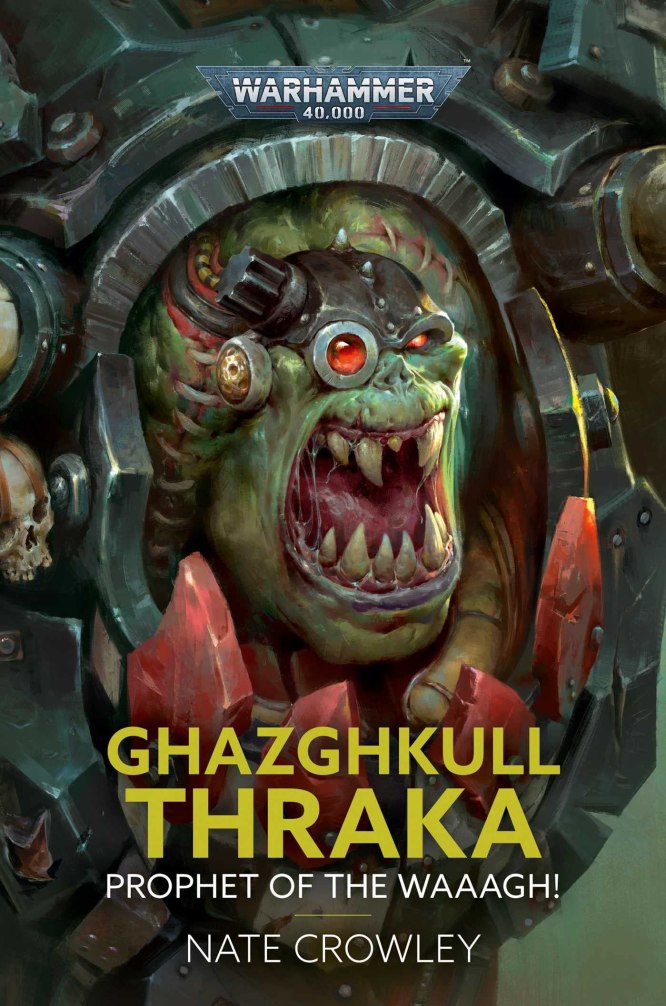
Ghazghkull Thraka - Prophet of the Waaagh! Cover

Publisher: Black Library (Audiobook – 15 March 2022)

Series: Warhammer 40,000

Length: 7 hours and 30 minutes

My Rating: 5 out of 5 stars

Amazon     Book Depository

Prepare to read one of the most amusing and downright entertaining recent additions to the Warhammer 40,000 canon with the hilarious and brilliant Ghazghkull Thraka: Prophet of the Waaagh! by outstanding author Nate Crowley.

I have been having an immense amount of fun really diving into the massive wealth of tie-in fiction surrounding the Warhammer 40,000 tabletop game this year.  Books like Steel Tread by Andy Clarke, Krieg by Steve Lyons, The Bookkeeper’s Skull by Justin D. Hill and Day of Ascension by Adrian Tchaikovsky, have really highlighted just how diverse and intense this extended universe can be.  However, the latest tie-in novel I checked out may prove to be one of my absolute favourites, as I got to learn all about one of the most iconic ork characters in this universe with Ghazghkull Thraka: Prophet of the Waaagh!

Orks are the most notorious and dangerous creatures that roam the galaxy of the 41st millennium.  Billions upon billions of the powerful, war-loving creatures can be found throughout every sector of space, fighting anyone and anything they can find, especially each other.  However, out of all these monsters, none are more feared, respected or hated than the warlord Ghazghkull Mag Uruk Thraka, chosen of the ork gods Gork and Mork and proclaimed prophet of the Waaagh!

Throughout his legendary life, Ghazghkull has done what no other ork has been able to achieve.  Bringing together innumerable warbands into one massive horde of green, Ghazghkull has warred with every faction in the cosmos, while his infamous invasions of the Imperial planet of Armageddon are the stuff of bloody legend.  Everyone knows of his epic and rivalry with his indomitable foe, Commissar Yarrick, which turned Armageddon into a perpetual warzone, but does anyone know the true story of Ghazghkull and the events that made him?

Rogue Lord Inquisitor Tytonida Falx has long attempted to discover what lurks in the minds of the xenos her order faces.  When an opportunity to find out more about Ghazghkull presents itself, she eagerly jumps at the opportunity, bringing a unique prisoner aboard her heretical ship, Ghazghkull’s banner bearer, the grot Makari.  Interrogating him, Inquisitor Falx and her team soon discover that Makari might just be the only being in the universe who knows the full truth about who, or what, Ghazghkull is, and what he plans to do next.  But, as she listens to Makari’s tale, the Inquisitor soon discovers that the shadow of Ghazghkull’s rage and desire for violence far eclipses anything that the Imperium has ever believed.

Wow, now that was a really fun and captivating read.  I knew going into Ghazghkull Thraka: Prophet of the Waaagh! that I was going to have a great time, especially after enjoying author Nate Crowley’s The Twice-Dead King novels, Ruin and Reign, but I was blown away by how awesome Ghazghkull Thraka was.  Featuring a clever and wildly entertaining story, perfectly told through various unique eyes, as well as some deeply enjoyable characters, I quickly became absorbed in the impressive story and powered through it in a couple of days.  Not only was this my favourite book from Crowley but it also probably overtakes Kal Jerico: Sinner’s Bounty as the most amusing Warhammer novel I have ever read.

I had an absolute blast with the incredible story that Crowley whipped up for Ghazghkull Thraka, as it ended up being an inventive and entertaining way to showcase an iconic Warhammer figure.  Due to his prominence within the game and the extended fiction, Ghazghkull is probably one of the most utilised non-human characters in the canon, with many different novels, game books and comics already diving into his life.  As such, Crowley needed to come up with a completely new way to examine this great character that didn’t tread on any prior works.  I think his solution to this problem was exceedingly clever, as he chose to tell the story through the eyes of the most unlikely narrator and chronicler, the grot Makari, whose unique insights and worldview turned this already known backstory into something truly special.

The story starts off in the current timeline of the Warhammer 40,000 universe and shows Inquisitor Falx obtaining Makari and interrogating him about Ghazghkull.  This causes the book to dive back into the early days of Ghazghkull as Makari chronicle his master’s existence as he saw it.  As such, you get a very specific examination of Ghazghkull’s life, with a focus on his early trials, some of his pivotal moments, and more specifically his interactions with Makari.  At the same time, the story keeps jumping back to the present, with the Inquisitor and her followers interrupting to ask specific questions and discussing whether there is any truth in what he says.  The book keeps jumping between these different perspectives, and you end up with two distinctive storylines as Makari’s presence brings some big woes for the Inquisitor in the present day.  The chronicle storyline goes at a brisk pace, especially as Makari’s interrogators get him to skip or shorten specific sections, but there is a clever and impressive logic into what parts of Ghazghkull’s life are featured or ignored.  Not only are the past and present storylines exceedingly intriguing and entertaining in their own rights, but they also come together perfectly as well, with Makari’s insights into Ghazghkull and himself impacting the actions of Falx.  While the ending was slightly too metaphysical, it served as a brilliant and powerful conclusion to this great story, and I loved seeing the entire tale come full circle in some hilarious ways.

I deeply appreciated the way that Crowley put Ghazghkull Thraka’s story together, as its distinctive and clever style really helped to enhance the chronicle contained within.  The plot device of an interrogation of an alien prisoner works extremely well to set up the main narrative, and the constant interruptions, debates and revelations that occur whenever it snaps back to the present adds to the sense of mystery and mysticism surrounding the titular figure.  While Crowley takes the story in some interesting and complex directions at times, the entire novel is paced beautifully, and there is never a single boring or slow moment within the entire thing.  I particularly liked the near constant humour that was injected into the story, a fantastic side-effect of basing the book around the funny ork species, and I laughed out loud several times as I powered through this impressively amusing read.  Like many Warhammer novels, Ghazghkull Thraka can be enjoyed as a standalone read, and the author makes sure that it features a great self-contained narrative that anyone can enjoy, even those unfamiliar with the universe and the canon.  Indeed, this would be a decent introduction to the Warhammer 40,000 canon and associated extended universe, especially as it perfectly presents one of the key factions of the universe.  Most of the unique universe elements and wider history are explained sufficiently for new readers to follow along without any issues, although some could potentially get confused by the deliberate exclusion of events previously covered in other books.  Still, Ghazghkull Thraka should turn out to be an easy and entertaining read for any science fiction fan, and I thought that this Warhammer 40,000 novel was very well written and extremely clever.

One of the things I love the most about Nate Crowley’s Warhammer novels is his brilliant ability to dive into the unique alien races of the universe and then perfectly showcase their culture and mindsets.  This was the case again in Ghazghkull Thraka, where Crowley expertly dives into the heads of the various ork and grot characters.  No matter whose perspective is shown, every scene of this book features some excellent and often highly amusing depiction of greenskin culture, as Makari attempts to explain the ork perspective as well as his place in the society as a grot.  As such, you get some incredibly detailed and compelling insights into this crude and warlike race, including their brutal hierarchy, need for violence, insane technology, and very unique worldview, which generally results in most of the book’s fantastic humour.  However, rather than the dumb, brutal and one-note figures that most authors depict, Crowley really goes out his way to show that there is a lot more to orks than you realise.  Not only do you get some excellent insights into their various clans and organisations but the various ork characters are shown to be complex beings with unique needs and the ability to formulate some very cunning plans.  There is a particularly intriguing look at the ork religion that follows the gods Gork and Mork, and this novel ends up with a spiritual edge, especially as Crowley shows the orks being extremely successful because they choose to strongly believe in themselves.  As such, you see quite a unique and compelling side to the ork race in this book, and I loved how incredibly Crowley portrayed them.

Naturally, a big part of this examination of ork culture comes from the in-depth look at the life of Ghazghkull himself.  As I mentioned before, Ghazghkull is one of the best-known characters in the entire Warhammer 40,000 canon, so most veteran readers would already be quite familiar with him and his actions.  However, Crowley does an excellent job of examining a completely new side to this character, and mostly ignores his wars at Armageddon and his intense rivalry with Commissar Yarrick, both of which have been done to death in other books.  While certain parts of his history are revisited in this novel, Crowley completely changes their implications and causes, instead focusing on Ghazghkull’s unique orkish mindset and his role as the prophet of his gods.  This new take on Ghazghkull proves to be quite unique and very captivating, as he is shown to be an overburdened being, constantly pressured by his own visions and the influence of the gods to succeed and be a uniting force for his people.  While he still retains the casual violence of his race, you really see Ghazghkull as a deep thinker, and it is fascinating to see his inner ork face off against his grand ambitions and desires.  Crowley also adds some compelling supernatural elements to his character, as Ghazghkull, as seen by Makari, bears a direct connection to the gods which he can use to alter his fellows and himself.  While this isn’t too overpowered or strange, it adds a great extra layer of menace to the character, especially for the humans, and I loved seeing the Inquisitors trying to wrap their heads around the strange occurrences.  I had a lot of fun seeing this other side of Ghazghkull, and this novel ended up being a great analysis of who they are and what they represent to their race.

I also really enjoyed the inclusion of Makari as one of the central characters, and his use as the main witness to Ghazghkull’s life worked incredibly well.  While Makari has always been associated with the character of Ghazghkull, accompanying him in his battles and waving his banner as a source of luck, Crowley really changes him in this novel and paints him as an essential part of Ghazghkull’s success and relationship with the gods.  Shown to be there the moment that Ghazghkull became the prophet, Makari follows Ghazghkull through some of his big moments and it is hilarious to see his snide view on the subject, especially as, like most grots, he a massive coward who doesn’t want to be there.  A lot of this novel’s humour is derived from Makari’s observations and responses, and I loved some of the jokes set up around it.  Crowley does an awful lot with this character, and I particularly liked how the story explained certain aspects of his previous portrayals, such as the apparent multiple versions and his surprising luck.  These are worked into the story extremely well, but it’s the relationship with Ghazghkull that becomes the most fascinating.  Just like with Ghazghkull, there is a major spiritual edge to Makari, who appears to be just as chosen and important to the plan as his master.  Makari’s mystical and religious bond enables him to have a far bigger insight into Ghazghkull’s actions than anybody else, and this really enhanced the analysis of the titular character.  However, it is in Makari’s attempts to serve and help his master achieve his destiny that we see the best Makari scenes, especially when faced with Ghazghkull’s apparent depression, the manipulation of his other followers, and his own stubbornness.  While Ghazghkull does have the inherent ork reluctance to rely on a grot, and indeed he is extremely likely to kill Makari if he starts giving advice, the moments where Makari get through to him are powerful, and I really appreciated the character work surrounding them.  There are some rocky moments between them, especially when Ghazghkull becomes dismissive of his lucky grot, and Makari’s subsequent reactions is very funny and incredibly over the top, which was so very cool.  Overall, this ended up being an excellent and surprisingly compelling portrayal of Makari, and I am exceedingly glad that Crowley featured him in this novel the way he did.

Aside from the greenskin characters, a large amount of plot revolves around the team interrogating Makari.  Crowley really went out his way to create a particularly unique group of Imperial agents who bear surprising insights into the mind of the xenos.  This team is led by Inquistor Falx, a rogue Inquisitor who bears a dangerous obsession with the alien creatures.  Falx is desperate to learn everything she can about the aliens attacking the Imperium to help defeat them and finds herself stymied by the Imperium’s controlling and non-progressive government and religion.  As such, she takes some major risks in this book to understand Makari and Ghazghkull and has some unique and dangerous methods for achieving her goals that borders on the insane/heretical.  I quite liked Falx, despite her obsessive qualities, and she proved to be a great central figure for half the novels plot, especially as her frustrations, concerns and thoughts about the evils of the Imperium, are extremely understandable.

Falx also employs a unique team of interrogators to help her with Makari, including Brother Hendriksen, a Space Wolves rune priest assigned to Deathwatch who has also fallen out of favour with the Imperium thanks to his work with Falx.  Hendriksen serves as a beastly and powerful presence on Falx’s team, and he often provides a great counterpoint to the inquisitor in both technique and common sense, often despairing at her more dangerous choices.  Crowley’s diverse cast gets even larger with the truly unique character of Cassia, a female ogryn psyker who has grown as smart as a human.  This was a fantastic and extremely distinctive addition to the cast, and her surprisingly calm demeanour, which contrasts beautifully with her immense ogryn strength, works perfectly against Hendriksen’s impatience and anger.  The final member of the team is probably the most enjoyable, with the ork character, Biter (Bites-Faces-Of-The-Face-Biter-Before-It-Can-Bite).  Biter is a member of a Blood Axes mercenary band who have dealings with Falx and who sell Makari to her, remaining behind to interpret Makari’s testimony to the humans.  Due to being a member of the Blood Axes, a group who idolise human military culture, Biter is a very distinctive figure, wearing an approximation of a military uniform and appreciating complex tactics and strategy.  However, Biter is even more intelligent and cunning than most Blood Axes, and his near human tendencies really stand out, as it is pretty unexpected from an orc.  His fantastic reactions, comedic impressions of human behaviour, and determination to antagonise the Inquisitor really make him stand out, and he was an absolute joy to behold.  These four interrogators play off each other perfectly during the present-day scenes, and their arguments, discussions and interpretations of Makari’s story give it added depth, humour and impact, especially once they start realising just how valuable their prisoner is.  This entire cast was put together extremely well, and I had an incredible time with this unique and enjoyable collection of characters.

Like most Warhammer novels I check out, I chose to grab the audiobook version of Ghazghkull Thraka, which turned out to be such a wonderful and incredible listening experience.  Not only did the story absolutely fly by in this format, allowing me to get through its seven and a half hour runtime extremely quickly, but I found that the narrative and descriptions of ork life really popped when read out.  However, the best part about the Ghazghkull Thraka audiobook is the outstanding use of narrators.  This audiobook has three separate narrators, Kelly Hotten, Paul Putner and Jon Rand, each of whom have some experience narrating other Warhammer audio productions.  Not only are each of these narrators quite talented but the way they were featured in this audiobook is extremely clever, with the voice actor changing depending on who is witnessing or telling the events of the book.  For example, Kelly Hotten serves as the narrator for the various scenes and interludes where Inquisitor Falx is witnessing Makari’s interrogation, and Hotten does a brilliant job capturing the various players of these scenes, including the Inquisitor, her unique companions, and their orkish interpreter.  Paul Putner narrates the various scenes shown directly from Makari’s perspective, and he has a lot of fun in this role, not only capturing the cowardly and sneaky mannerisms of the grot protagonist, but also providing some amusing and deep voices for the ork characters.  Finally, Jon Rand has a memorable sequence voicing Brother Hendriksen when he psychically jumps into Makari’s mind and views some of the events occurring, and he gives the character a notable accent and internal growl that fit him extremely well.  The jumps between the voice actors were done perfectly and I really loved how it changed up depending on the perspective.  All three voice actors did an amazing job with their narration, and their work, plus some fun sound effects here and there, helped to turn this into such an impressive production.  Easily the best way to enjoy Ghazghkull Thraka, you will have an incredible time listening to this audiobook.

Nate Crowley continues to shine with another entry in the Warhammer 40,000 universe, with the unbelievably entertaining Ghazghkull Thraka: Prophet of the Waaagh!  Featuring a unique and deeply amusing story that re-examines on of the canon’s most iconic alien characters, Ghazghkull Thraka has a tight and cleverly written story, loaded with action, great characters and whole mess of outstanding humour.  Not only that, but this is without a doubt one of the best portrayals of the Warhammer 40,000 orks I have seen as Crowley obviously had a ton of fun bringing them to life.  Easily one of the best (and definitely the funniest) Warhammer 40,000 novels I have been lucky enough to enjoy, Ghazghkull Thraka comes extremely highly recommended, especially in its audiobook format, and is a must read for all fans of this wonderful fandom.

Amazon     Book Depository

Throwback Thursday – Trollslayer by William King

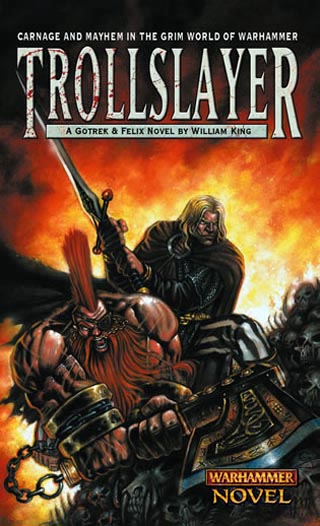
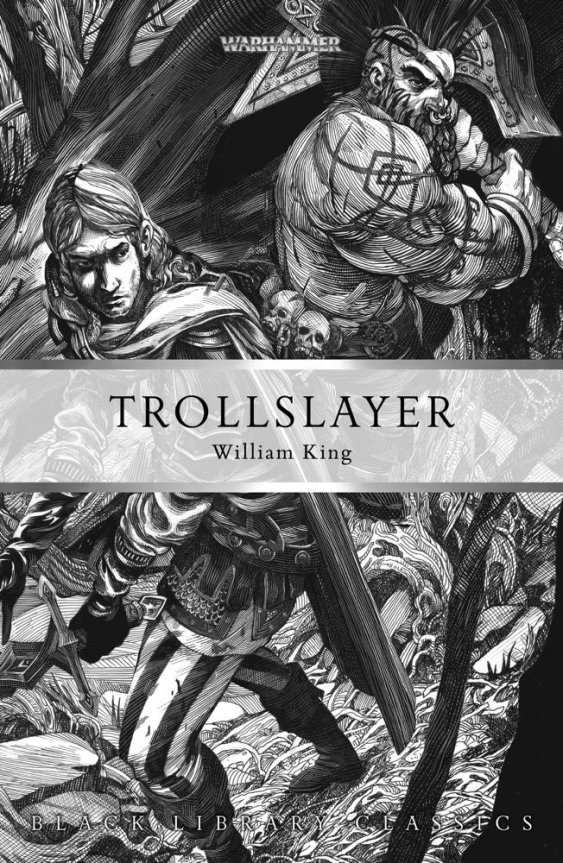
Trollslayer Cover 2

Publisher: Games Workshop (Audiobook – August 1999)

Series: Gotrek and Felix – Book One

Length: 9 hours and 55 minutes

My Rating: 4.5 out of 5

Amazon     Book Depository

Welcome back to my Throwback Thursday series, where I republish old reviews, review books I have read before or review older books I have only just had a chance to read.  In this latest Throwback Thursday article, I review a classic Warhammer Fantasy novel, the iconic Trollslayer by William King.

Over the last year or so, I have started to get back into the exciting and captivating extended universe that surrounds the Warhammer tabletop game franchise.  The Warhammer games are a lot of fun to play, but I have always deeply enjoyed the rich and extensive universe that has formed around it.  This is particularly true when it comes to the extensive literary world that has been created, with a huge collection of unique novels added every year.  I personally have barely scratched the surface of this franchise, having only recently read the exciting Space Marine novel Deathwatch: Shadowbreaker, and the fun crime novel Kal Jerico: Sinner’s Bounty.  For this review, however, I veer away from the science fiction based Warhammer 40,000, and instead look at a book in the Warhammer Fantasy universe.

The Warhammer Fantasy universe is set on a fantasy world where various races and factions fight for power, immortality, dark deities, and a general desire for bloodshed (Blood for the Blood God, Skulls for the Skull Throne!) in both large-scale battles and smaller skirmishes.  I love the fantastic and thrilling world of Warhammer Fantasy, especially as I used to play (my preferred factions were the Empire and the Lizardmen).  While there are many great novels set in this universe, the most recognisable and well-established series are the Gotrek and Felix books.

The Gotrek and Felix novels are some excellent dark fantasy books that follow the titular heroes, Gotrek Gurnisson and Felix Jaeger, as they traverse their world, facing every single monster, demon or villain they can find.  Created by William King, this long-running series has also been authored by fellow writers Nathan Long, Josh Reynolds and David Guymer, the last of whom has just released the latest entry, Gitslayer.  I have always heard good things about this series over the years, and I have previously enjoyed some of the short stories featured online or in the White Dwarf magazine.  As a result, when I had the brainwave to expand my knowledge of the Warhammer canon, this is one of the main series I wanted to check out, and to do so properly, I had to start with the original novel, TrollslayerTrollslayer, which was originally released in 1999, is an interesting novel that features seven original Gotrek and Felix short stories, including Geheimnisnacht, which was originally written as a one-off in 1988.  These seven stories have been bundled together into one continuous narrative, which proves to be an excellent and entertaining fantasy adventure.

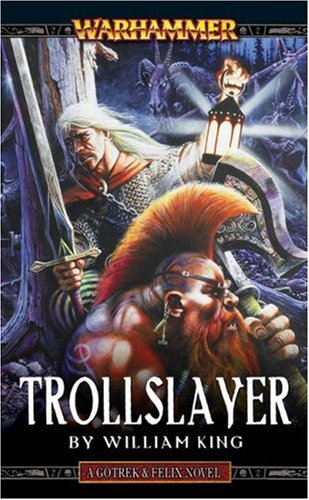
Trollslayer Cover

Felix Jaeger, the son of a wealthy merchant and student in the Imperial capital Altdorf, used to live a blameless and dull life until he met the deranged Gotrek Gurnisson.  The son of a wealthy merchant and student in the Imperial capital Altdorf, Felix’s life was changed forever when Gotrek saved his life.  Gotrek is a Slayer, a dwarf who, after committing a terrible crime, has sworn to seek out a glorious death in battle, and who now wanders the world to find a foe worthy of killing him.  After a particularly damaging night of drinking, Felix drunkenly swears to follow him on his adventures to compose an epic ballad about Gotrek’s glorious death.

Bound by his oath, Felix now reluctantly accompanies Gotrek wherever he goes.  Their latest adventures will take them far and wide, as they venture throughout the Empire and beyond, travelling to the notorious holdings of the Border Princes, the mountainous realms of the dwarves and even under the halls of the conquered dwarf city of Karak Eight Peaks.  While they experience many unique discoveries and locations, one thing remains the same: enemies lurk around every corner, and Gotrek and Felix are forced to battle against some of the most dangerous creatures in existence, including orcs, goblins, trolls, the undead, mutants, beastman and more.

However, the most dangerous foe they face may be something far more insidious and unknowable.  The fell powers of Chaos are gathering throughout the land, and Gotrek and Felix seem to constantly become wrapped up in their plots and vile missions.  With danger and deadly foes all around, will Gotrek find the glorious death he seeks, and will Felix be able to survive whatever might foe eventually manages to kill his companion?

Wow, that was a cool novel I really should have read years ago.  Trollslayer was a fantastic and exciting novel that does a great job exploring some of the more dangerous settings in the Warhammer Fantasy world with two amazing characters.  Featuring seven dark and compelling short stories, Trollslayer is an outstanding book, and I had an incredibly fun and entertaining time getting through its audiobook format.  Banded together by some journal entries which bring the separate stories together, Trollslayer has a fantastic joint narrative that presents the reader with a collection of epic adventures.

TrollSlayer-john-gravato-Gotrek-and-Felix-1st-edition-cover

The book begins with the original Gotrek and Felix short story, Geheimnisnacht (Night of Secrets).  The two companions are stuck out in the dangerous forests of the Empire during Geheimnisnacht, an auspicious night of the year.  After nearly being run over by a dark carriage on the road, Gotrek and Felix investigate the actions of a dangerous Chaos coven out in the woods, and find more than they bargained for.  This is a rather entertaining and short entry in Trollslayers that serves as a fun introduction to the main protagonists and their quest.  King does a great job setting up both characters and you soon get a fantastic glimpse into their compelling personalities.  The author presents a very dark story within this first tale, as the heroes discover and fight the true horrors of chaos.  An excellent and intense opening story that will get you pumped up for the rest of the book.

The next entry contained within Trollslayer is called Wolf Riders, which sees Gotrek and Felix at the very edge of the Empire with plans to venture to the fallen dwarf stronghold of Karak Eight Peaks.  After encountering a beautiful young woman, Felix convinces Gotrek to join the doomed expedition of a cursed, banished noble family as they journey to the Border Lands to set up their own settlement.  Hired on as guards, the two heroes are forced to protect the caravan against a ravenous Greenskin horde, who are determined to destroy every one of them.  However, the true threat may lie within the convoy, as it soon becomes clear that someone has their own nefarious plans to kill everyone journeying with them.  Wolf Riders is an incredible second entry in the collection of stories, and it is easily one of the best tales in Trollslayer.  Not only does it reinforce the likeability of the two protagonists, but it also contains its own compelling and impressive narrative.  King manages to achieve a lot in Wolf Riders, introducing a cohort of great characters, showing several intense action sequences, and even presenting a clever and malicious mystery.  The entire narrative comes together extremely well, and readers are soon wrapped up in the compelling tale of redemption and bloodshed, which culminates in a tragic and memorable ending that forever changes one protagonist.

The third story is The Dark Beneath the World, which follows on immediately after Wolf RidersThe Dark Beneath the World sees Gotrek, Felix and some new companions journey into the dwarf stronghold of Karak Eight Peaks, which was infamously conquered by greenskins and Skaven in ages past.  Seeking treasure, holy relics and a glorious battle, the adventurers will face untold horrors in the halls beneath the city.  However, nothing will prepare them for the true dangers of Karak Eight Peaks, as the restless dead are stirring in response to a monstrous presence.  This was another great story that really highlights have exciting and action packed one of these stories can be.  I love how King takes his great characters right into the heart of one of the most iconic and dangerous settings in the entire Warhammer canon, and it proves to be an amazing backdrop to this compelling story.  A brutal hack and slash epic with some very intense moments, this is an excellent and fast-paced addition to Trollslayer that was an extremely thrilling read.

From powerful action to great humour, the next entry is the slightly shorter The Mark of Slaanesh.  This story sees Gotrek and Felix return to the Empire, where they encounter some malicious cultists of the Chaos god Slaanesh in a small town.  Unfortunately for Felix, Gotrek is suffering from amnesia after a blow to the head.  Forced to shepherd a docile Slayer through the town’s many dangers, Felix takes drastic action to bring his friend back to his senses.  The Mark of Slaanesh represents a very intriguing change of pace, with more of a focus on humour, as a weary Felix is forced to contend with a pacifist Dwarf Slayer, an eccentric doctor, and comedic mutants.  There are several extremely funny moments in this short story, which helped to turn The Mark of Slaanesh into one of the most entertaining entries in the entire novel.  I particularly appreciate how King was able to craft together such a despicable central antagonist in quite a short period of time, and it was great to see his implied comeuppance towards the end of the story.

King again rapidly switches gears with the next entry in the book, Blood and Darkness, a grim war story set in the darkest forest in the Empire.  This story sees Gotrek and Felix come across a ravished village within the Drakwald Forest, which has been utterly destroyed by beastmen.  Finding a young survivor, Kat, Gotrek and Felix escort her through the woods to the next village.  However, a vengeful and ambitious champion of Chaos is close behind them, with unholy plans for Kat and anyone else she comes across.  Blood and Darkness is another exceptional entry in the series, which is probably my overall favourite Trollslayer story.  Loaded with action, fantastic new characters and a particularly gruesome premise, Blood and Darkness really stands out from some of the other stories in this book, and I was blown away by how dark King made the narrative.  I really loved the story’s complex antagonist, and the entire plot surrounding Kat comes full circle in a great way.  While it is a tad creepy to see just how young Kat is in this story, especially as Felix apparently falls in love with her in a future novel (she gets aged up like 20 years before this happens, but it is still weird), this was an impressive and powerful story that really showed how complex, powerful and mature a Warhammer story can be.

The penultimate story in Trollslayer is The Mutant Master, which again switches pace and has a more humorous tilt to it.  After being attacked on the road by a swarm of mutants, the protagonists arrive at a struggling village and soon discover that the mutants are being controlled by a sorcerer in a nearby tower.  Betrayed by the villagers, Gotrek and Felix find themselves as prisoners and soon must deal with an insidious sorcerer who shares a history with Felix.  This was another great short story that places the protagonists into a uniquely dangerous position.  King includes some excellent humour in this novel, especially in the scene where Felix and the sorcerer have a very entertaining encounter, which proves that everyone, even dark sorcerers, fall to pieces when encountering former classmates.  While much of this story is dedicated to humour, the author fits in a particularly dark moment towards the end of the novel, which pushes one protagonist further than ever.  Another awesome and memorable story, I powered through this one extremely quickly.

The final entry in this book is the intense Ulric’s ChildrenUlric’s Children sees Felix trudging through a snowed-in forest, attempting to escape the cold and the wolves.  When they hear the sounds of a fight up ahead, Felix gets separated from Gotrek, and ends up getting captured by a dangerous group of soldiers.  The soldier’s leaders end up being revealed as cultists of the Chaos god Tzeentch, who are desperate to capture a mysterious family living nearby, who have strange powers and strengths.  Caught up in their conflict, Felix soon finds himself trapped in a manor house with two very different monsters and must try to overcome the powers of Chaos that threaten to consume him.  This was another fantastic story that serves as a great conclusion to the entire novel.  While I think that Ulric’s Children was one of the weaker stories in Trollslayer, it was still a compelling and thrilling tale which readers will enjoy.  I loved the inclusion of werewolves in this novel and it was fun to see Felix attempt to overcome a dangerous foe without Gotrek’s determined backup.  With some intriguing foes and an exciting story, this is a fun and fantastic entry in the book which will leave readers wanting more Gotrek and Felix in the future.

King really has loaded Trollslayer with an amazing range of different stories that highlight the gritty adventures of two memorable and loveable characters.  I had a great time getting through each of the short stories contained within this novel, and I think that the author did a good job combining seven shorter stories together into one cohesive tale.  I love how each of the stories has some impressive action set pieces, and readers are given an in-depth look at the true dangers and darkness that inhabits the Warhammer world.  King has also ensured that each tale contains a compelling blend of humour, dramatic character development and dark fantasy elements, all of which produce an outstanding overall narrative.  It was also very cool to see just how dark and gruesome King could make his narratives, and quite a few elements of this book closely bordered the horror genre.  Since the stories were originally published in instalments, readers are in for some repetition, especially as King rehashes Gotrek and Felix’s origin in every entry, and you also get quick summaries of their prior adventures.  While this and other pieces of repetition (for example, Gotrek runs his finger over his axe blade in every tale) can be a bit annoying at times, I personally thought it was a small price to pay for such an awesome and epic book.

One of the most impressive things about Trollslayer is the complex and distinctive characters.  Naturally, the main characters are series protagonists Gotrek Gurnisson and Felix Jaeger, both of whom prove to be really fantastic and exciting characters.  King has come up with an exceptional pairing in these two characters, and I absolutely love the combination of a doomed dwarf Slayer and a disgraced human with a penchant for poetry.

As the primary narrator of the separate stories in this book, Felix gets a great deal of attention, and you really get to grips with his superb character throughout the book.  I loved the depiction of a former arrogant dandy who finds himself in a situation well over his head, and Felix has a “fun” time facing off against all sorts of monsters in this book.  While most of the novel depicts him as a bit of a coward, Felix does manage to achieve some major heroics and you cannot help but sympathise with the terrible situations he finds himself in.  While the use of multiple short stories does tend to backslide Felix’s character at times (he reverts to a coward at the start of each story), I did enjoy seeing some of the excellent development that occurs around Felix.  Not only does he grow more confident in his own abilities, but he also becomes harder with each adventure, especially as he experiences tragedy and despair around every corner.  It was actually hard to see how some of the more tragic events of the book affected him, but I really appreciated the amazing character work that King worked around him.

The titular Trollslayer, Gotrek Gurnisson, is one of the most beloved figures in Warhammer Fantasy lore, and a magnificent character who I really enjoyed.  Much of Gotrek’s past is shrouded in mystery, and all you really know is that he is a mighty warrior who previously committed some great crime that still haunts him to this day.  Determined to find a glorious death, Gotrek willingly walks into the most dangerous of places, but always survives, much to his displeasure (even doomed dwarves are far too stubborn and proud to simply let an enemy kill them).  King mostly paints Gotrek as a crude, rude and bloodthirsty being, which is a lot of fun to see.  However, there is so much more to Gotrek than killing and fighting, and you see several glimpses of his true inner self in this book, especially when he thinks about the past.  I loved how King keeps Gotrek as a mostly enigmatic figure, mostly by not showing any of the story from his point of view, and the reader is never quite sure what he is thinking or planning.  All of this results in an excellent and memorable protagonist, and I am deeply intrigued to see what sort of adventures he has in the future, as well as any revelations about his past.

Aside from Gotrek and Felix, Trollslayer contains a range of interesting and compelling characters, several of whom act as point-of-view figures at various parts of the book.  King does a really good job of introducing and utilising so many unique figures throughout his various stories, and it is simply amazing how well he can develop and establish his character in such a short amount of time.  Even though you only see some characters for a few pages, you quickly become quite invested in their stories, which is the sign of a really good author.  However, readers are advised not to get too attached to anyone, as most of the side characters will come to a gruesome and tragic end.  Still, these supporting characters are really fun, and I look forward to seeing what unique figures are introduced in future Gotrek and Felix books.

Trollslayer also features the dark and well-established background setting of the Warhammer Fantasy world, with the protagonists adventuring through many iconic locations.  King makes excellent use of this fantastic background throughout his story, and I loved seeing all the cool locations, interesting factions and dangerous monsters contained within the story.  This actually serves as a really good introduction to the Warhammer Fantasy world, and readers unfamiliar with the various aspects of Warhammer will learn a lot here.  King can really craft together some dark and dangerous locations with his writing, and I love how spooking and claustrophobic some of his settings felt, especially the ancient dwarven catacombs and the haunted, monster infested forests.  I also loved the sheer range of different creatures and races featured within Trollslayer, as the author includes as many foes as possible.  It was extremely awesome to see Gotrek and Felix cut their way through various greenskins, monsters, and servants of Chaos, and there is something for all fantasy fans within this book.  I am extremely keen to see what other monsters and races are utilised in the future novels, and I am sure they will be pretty amazing.

I ended up listening to the Trollslayer audiobook format, which was an outstanding way to experience the awesome adventures contained within this book.  With a decent run time of just under 10 hours, I powered through this audiobook in a matter of days, especially once I got caught up in the fantastic depictions of intense action and dark creatures.  I was also really drawn in by the impressive narration of Jonathan Keeble, who has lent his voice to all the Gotrek and Felix audiobooks, as well as several other Warhammer projects and some of my favourite historical fiction novels, such as the Eagle of the Empire series.  Keeble has an epic voice, and the sheer passion that he brings to Trollslayer is immediately obvious, especially during the action scenes, where his excited voice captures the intensity and movement of the fights.  I also felt that Keeble did an exceptional job bringing all of the characters to life in an impressive way.  I particularly loved the gruff voice that he used for Gotrek, which fit the doomed dwarf warrior perfectly, and he also does a really good job voicing the often terrified Felix.  I also found some of the voices that he used for the supporting characters to be really fun and fitting, and I had a lot of love for a couple of the crazed sorcerers/alchemists they encounter, which were quite amusing.  All of this helps to turn the Trollslayer audiobook into an outstanding experience, and I think that this will be the format I check out the future Gotrek and Felix novels out in.  I might also have to consider listening to some historical fiction novels on audiobook in the future, especially as I know that Keeble will do a wonderful job narrating them.

Trollslayer by William King is an exceptional and clever Warhammer Fantasy novel that showcases the exciting and powerful adventures of the iconic Gotrek and Felix.  Serving as the main introduction to these two iconic heroes, Trollslayer contains seven outstanding and wildly entertaining short stories with some fantastic and wacky plots.  Readers who check out Trollslayer are in for a heck of a lot of fun and will swiftly become fans of this great duo and their outrageous adventures.  A highly recommended read, I suddenly have some major plans to check out more Gotrek and Felix novels in the future.

Amazon     Book Depository