Throwback Thursday – Justice League: The Flashpoint Paradox

The Flashpoint Paradox Poster

Studio: Warner Bros. Animation and DC Entertainment

Series: DC Universe Animated Original Movies – Film 18 / DC Animated Movie Universe – Film One

Director: Jay Oliva

Writer: Jim Krieg (Based on the comic by Geoff Johns and Andy Kubert)

Producer: James Tucker

Length: 81 minutes

My Rating: 5 out of 5 stars

Welcome back to my Throwback Thursday series, where I republish old reviews, review content I have enjoyed before or review older books I have only just had a chance to read.  For this week’s Throwback Thursday, I dive into a pretty damn awesome DC Comics animated film that is highly relevant at the moment with the awesome Justice League: The Flashpoint Paradox.

Like many comic book fans in the world, I went out last weekend for the epic new film offering, The Flash, which ended up being pretty damn good.  The film had a lot of great elements to it, including the return of Michael Keaton as Batman, the introduction of a great new Supergirl, and a fantastic examination of the Flash mythos.  I was also very happy to see a fresh new take on the iconic Flashpoint comic, and it will be interesting to see how that impacts any upcoming live action DC films.  While I liked what they did with the Flashpoint story, I don’t think that The Flash was the absolute best adaptation of the Flashpoint comic; instead that honour goes the focus of this article, the 2013 animated film, Justice League: The Flashpoint Paradox.

Before we talk about the film, I should give a little background about the Flashpoint comic.  Flashpoint was a major 2011 comic event, written by Geoff Johns, whose work I have deeply enjoyed in comics like Rogues’ Revenge and Teen Titans, and pencilled by Andy Kubert.  Flashpoint was a compelling alternate timeline story that ended up resetting the main DC Universe in a big way.  While I honestly have very little love for the resulting changes it caused (I will never forgive DC for The New 52), the Flashpoint comic itself is pretty good, featuring some unique and stunning ideas within it.

Flashpoint has been adapted a few times in recent years, including in several seasons of The Flash television series, and the current The Flash film takes a lot from it.  While these other adaptations are pretty good, I think that The Flashpoint Paradox did the most with it, mainly because it sticks a lot closer to the source material and provides a very gritty animated film with a brilliant cast behind it.  Directed by veteran animated film director Jay Oliva (who has directed several of my favourite animated comic book films) and written by Jim Krieg, The Flashpoint Paradox is pretty damn awesome film and it is one that I have rewatched multiple times over the years.

Barry Allen is the Flash, founding member of the Justice League, the fastest man alive and the greatest hero Central City has ever known.  However, despite all he has done and everyone he has saved, Barry still cannot shake the trauma of his mother’s murder, a tragedy that has haunted him since his childhood.  After defeating several of his greatest foes, including his archenemy, the Reverse-Flash Eobard Thawne, Barry awakens to find himself in a new world, one where his mother is still alive and the Flash never existed.  Despite the joy he feels about his mother, this new world is no paradise, instead it is on the brink of ruin.  The Atlanteans, under the command of Aquaman, and the Amazons, led by Wonder Woman, are at war, and their relentless battling and disdain for humanity, has seen the destruction of much of Europe and the death of hundreds of millions of people.

Determined to find out what is happening and to stop the war between the Atlanteans and the Amazons before it destroys the world, Barry seeks out the one man who he thinks can help him, Batman.  However, the Batman he encounters is far different from the one he knows and has very little desire to save the world.  Worse, it soon becomes apparent that the changes to the world have been caused by Thawne, whose obsession with destroying the Flash could lead to unbelievable destruction.  To save the day, Barry needs to find a way to regain his powers and unite the scattered heroes of this reality.  But with all-out war in front of him, and his own trauma catching up behind, can the Flash stop Thawne before it’s too late?  And even if he succeeds, is he truly ready for the revelations that await him?

The Flashpoint Paradox was a pretty epic film that I have a lot of love for, especially as it blends a compelling story with great aesthetics, slick animation and a brilliant cast to produce something pretty damn awesome and a lot of fun to check out.

The creative team behind The Flashpoint Paradox did an outstanding job bringing this film together and one of the main reasons it works is the fantastic and intense story behind it.  The film itself is an exceptional adaptation of the original Flashpoint comic and much of it is a close and deliberate match to the source material.  That being said, it’s not a straight adaption as they needed to make it more accessible and take the story out of the main comic universe.  The film starts off with an exceptional sequence where the Flash faces off against the Rogues and the Reverse-Flash, who ambush him at the Flash Museum.  This scene, which sees a series of bombs threaten Flash and Central City, manages to achieve a lot of essential story points, including introducing Flash, showcasing his bitter rivalry with the self-destructive Thawne, and presenting the established version of the various Justice League characters who will later appear in the alternate timeline.  It’s also a very entertaining scene in several great ways, not only because the banter between Flash and Thawne is pretty brutal, but because it shows each member of the Justice League in action as they disarm a bomb in their own unique way.  This great intro really sets up the rest of the film, especially thanks to the clever references to Barry’s mothers’ death, and while it does make it a little more obvious whose ultimately responsible for events, it was a pretty damn epic start.

The middle part of the film is where the meat of the story is developed, as Barry arrives in the alternate universe and attempts to find out what is going on.  This part of the film resembles the source material the closest as they are pretty much doing a straight adaptation of the Flashpoint comic at this point.  However, they manage to really show off the grim reality of this new timeline very effectively in a short amount of time, and you really get to appreciate just how murderous the Amazons and the Atlanteans are, as well as how dark a world without the Justice League can be.  The creative team tell a very impactful story in this part of the film, and you must love the powerful interactions between Barry and the new Batman, as well as the emotional impacts of Barry realising just how much his universe has changed.  Everything is well capped off by the infiltration into the lab holding Superman, which is honestly way darker than what they did in the recent Flash film, especially with the horrifying aesthetics around the captured Superman.  At the same time, the growing sense of doom in the world is intensifying as the two superhuman armies prepare for war in London, and the tension is well and truly ratcheted up before the final phase of the film.

Everything leads up perfectly to the final act of The Flashpoint Paradox, which frankly is the best and most impactful part of this entire exceptional film.  The final third of the film is essentially an all-out war sequence, as the various characters descend into a three-way battle in the ruins of London, with the Atlanteans, the Amazons, and the human resistance, which includes the protagonists, fighting to kill as many enemies as possible.  This sequence is dominated by several excessively brutal fights between the heroes, and so many characters end up dead in some pretty horrible ways.  Not only are these action scenes highly polished and exciting, but they are also emotionally powerful, as the various character arcs and elements come full circle.  The best scenes are probably shared between Barry and Thawne, as they fight through the battle, debating what has happened to the world.  There are some outstanding revelations here, especially if you aren’t familiar with the source material or the other Flashpoint adaptations, and the moment when Barry figures out what truly happened is just heartbreaking, especially with Thawne’s taunting.  There is so much dramatic tension floating around, especially as Barry witnesses the full onslaught of the battle in front of him, and everything tilts on the edge of destruction.  The final brutal moments of this fight are so damn epic, and it leads up to some painful farewells and some tough decisions from Barry that will shake him forever.  This built-up emotion remains to the very end of the movie, especially as Flash manages to get closure for himself and others, and I really appreciated just how well the film ended.

On top of the epic plot and amazing concluding third, I also need to really highlight the impressive animation, stylistic choices, and fantastic musical score that accompanied it.  The animation in particular is awesome, and I loved the brilliant and iconic character designs that it depicted, especially as there is a mixture of classic character depictions, and the alternate versions that appeared in the Flashpoint universe.  The grim nature of the Flashpoint timeline serves as a powerful backdrop to the plot of The Flashpoint Paradox, and it was fantastic to see the DC universe in an even darker and more desperate light.  The best animation is naturally saved for the multiple impressive fight sequences scattered throughout the film, especially in the big war sequence at the end, and the brutality and sheer ferocity of the fights and battles are quite distinctive.  The animators honestly show no hesitation in showing blood, gore, death and even brains throughout this film, and it is even more brutal than The Flash film or the original comics, as there is barely a second in the final war where someone isn’t dying in some dramatic fashion.  There is some outstanding attention to detail during these various battles, whether it be a brutal fight in the sky, an intense duel between Cyborg and Aquaman in the middle of a warzone, or a high-speed fight through the midst of over combatants, and these are expertly portrayed and guaranteed to keep your interest with its high concept impact.  The cool time travel sequences are also a great highlight, and the clever animation around them really dial up the intensity of the film, especially during certain seminal scenes.  I’m also a big fan of the way that the major characters are presented throughout this film, and I appreciated how their designs change at various points of the film depending on which timeline is being watched.  The alternate costumes or depictions are well contrasted by the classic costumes shown at the start of the film, and I also love the subsequent subtle changes that appear at the end of the film to represent the further changes that have been created.

I also must talk about the fantastic use of music throughout this film, which works perfectly in concert with the animated sequences.  There are some great orchestral scores and tunes that are featured throughout the film, often in the most impact scenes, and I really liked how well they were used to enhance emotion or drama in a very powerful way.  Some of the very best scenes, including several particularly tense or pivotal sequences at the end come across as so much better thanks to the music that was overscoring it, and this really drew me further into the plot.  Combined this great music with the excellent graphics and The Flashpoint Paradox turns out to be an exceptional watch that I cannot get away from.

While the adapted plot and amazing stylistic choices help to turn this film into something special, I cannot walk away from this review without talking about the incredible cast of actors who bring this elaborate story to life.  The Flashpoint Paradox features a pretty hefty and impressive group of voice actors who each dive into their respective characters and bring forth some of the more iconic figures from the DC universe, as well as their alternate versions, in some pretty epic ways.  There is a great combination of classic character depictions, as well as the more nuanced and, in many cases, evil versions from the alternate timeline, that are featured in The Flashpoint Paradox, and the creative team brilliantly balanced the two throughout the plot.

At the centre of The Flashpoint Paradox is the Barry Allen version of the Flash, who embarks upon one of the most important missions of his life.  Expertly voiced by Justin Chambers (of Grey’s Anatomy fame), this version of the Flash is much more closely related to the classic comic portrayals (rather than Ezra Miller’s quirky version) and is an experienced and competent crime fighter.  Despite being one of the more stable superheroes out there, Barry is still haunted by the murder of his mother and his failure to save her.  Chambers really dives into this role and perfectly voices the full emotional spectrum out of Barry, showing all the deep inner pain, as well as his inherent hope, all of which really comes out throughout the film.  There are so many powerful scenes featuring Barry in the film, from his initial confusion over the new timeline, the emotional meeting with his mother, the despair at how the world turned out, and his absolute shocked resignation at who is responsible.  I also felt that the writers did an outstanding job of capturing the entire personality, key history and mythos of the Flash within this film, and you really understand his decisions and how he interacts with the other heroes.  I particularly loved his shock and pain at seeing what his friends have become in this alternate timeline, and it is so damn compelling.  Honestly, there are so many powerful moments here and I have a whole new level of respect for Chambers thanks to this film as he honestly was just magical here.

On top of the Flash, I really need to highlight two figures from the new timeline who perfectly mesh with the main character and show off just how dark events are.  The most prominent of these is easily this universes Batman, who was voiced by another Grey’s Anatomy alumni, Kevin McKidd.  Rather than being an older version of Bruce Wayne, this version of Batman is his father Thomas Wayne, who took on the cowl after Bruce was killed in Crime Alley and Martha became this universe’s Joker.  McKidd goes full on growly here for Batman, and the result is a grizzled, violent, and very murderous Dark Knight who has given up on the world in many ways.  I loved this fantastic and clever take on Batman in The Flashpoint Paradox, and it is so damn epic to watch Barry attempt to work with this very different Batman.  The shared connection of knowing Bruce gives these characters a powerful emotional bond, and McKidd kills it in several emotionally charged scenes, showcasing this Batman’s hidden heart.

I also have a lot of love for the cool version of Cyborg that appears in The Flashpoint Paradox, and honestly this is probably the grimmest and most powerful portrayal you are likely to see.  Voiced by a young Michael B. Jordan, this Cyborg is the only real superhero left in America and has been modded out into a massive tank figure who runs national security.  Out of all the figures in the film, Cyborg has the most impressive change in characterisation between timelines, especially as he goes from teenage figure to actual adult, and this is one of the first animated films that really showed what he could offer the wider DC universe.  Jordan provides a pretty good and slightly robotic voice for Cyborg here, and I loved how he was portrayed as a level-headed peacemaker, trying to save the world.  While still a little naive and idealistic, he really lives up to all the hype surrounding him in his initial introductions, especially during the final bloody battle scenes.  He honestly goes full out in this war, and it was so damn cool to see just how dangerous he could be.

While the more heroic (or anti-heroic for Batman) characters above were great, this film would be nothing without its villains.  The most prominent of these is easily Flash’s archnemesis Eobard Thawne, better known as the Reverse Flash.  Voiced by the very talented C. Thomas Howell, Thawne is a brilliant and powerful figure in The Flashpoint Paradox, mainly because he has such a tangible hatred for Barry and his legacy.  While he is the main villain of the story, he only appears in a few short scenes, but Howell makes each and every one of them count.  The sheer contempt and bile that drips from every sentence is so important for the performance, and you quickly understand just how much he wants to destroy him, even if that means losing his own life.  Thawne’s best sequence occurs at the end of the film when he finally appears to mock Barry and reveal everything that has been done.  The joy, satisfaction and mocking appreciation for Barry is just perfect, and he has such a great villain monologue here.  Howell has one of the strongest performances in The Flashpoint Paradox and I deeply appreciated how he brought such a fun and compelling villain to life.

In addition to Thawne, The Flashpoint Paradox features two other outstanding and particularly unique antagonists in the form of militarised and anti-human versions of Aquaman and Wonder Woman.  Both characters have been twisted by a failed romance and the hatred that followed Wonder Woman’s slaying of Aquaman’s wife, and they are now brutally engaged in war to kill each other and the rest of the world.  I loved these darker and more murderous forms of these iconic characters, especially after they are shown in their more heroic guises at the start of the film, and their complex war is a destructive backdrop to the intense narrative.  Like Reverse-Flash, both are consumed by hatred, and they are willing to destroy the world rather than lose.  Despite that, there is still an obvious, if twisted, love between them, which makes their fight even more tragic.  I loved how both characters are portrayed, although I especially like how badass they make Aquaman here, especially as this was released in the pre-Jason Momoa days when Aquaman was still a bit of a joke.  Watching him destroy everyone in The Flashpoint Paradox really sets him up as a massive threat, and I deeply appreciated this fantastic change to the character.  I also loved the great casting behind these characters as well.  Aquaman is portrayed by legendary actor Cary Elwes, who honestly disappears into the role, providing a much more gruff and commanding voice than I have heard in his previous works.  The voice of Wonder Woman is provided by veteran voice actor Vanessa Marshall (Hera Syndulla from Star Wars Rebels), who is reprising the role she previously portrayed in Justice League: Crisis on Two Earths.  Both actors really get these iconic characters down perfectly, especially in their darker moments, and I loved how well they were utilised in the film, especially as they enhance the emotional power and looming threat of the narrative.

On top of the great performances above, I also must commend the use of several excellent supporting actors in smaller roles who did an outstanding job.  I as particularly happy that several actors who had previously voiced certain characters in other films and shows revisited their roles here, including some big names.  The most noticeable of these is the late great Kevin Conroy, who does an exceptional (as always) job of voicing the Bruce Wayne Batman at the beginning and end of the story.  Conway has several amazing scenes, including a particularly emotional sequence at the end that will have you in tears.  Other performers include Nathan Fillion providing a cocky voice to the Hal Jordan Green Lantern, Dana Delany once again voicing Lois Lane after voicing her the DC Animated Universe (Superman: The Animated Series, Justice League and Justice League Unlimited), and Ron Perlman revisiting his epic Teen Titans performance as Deathstroke for a short scene.  Other notable actors and characters include Danny Huston doing a quick dash as General Sam Lane and Dee Bradley Baker (the voice of all the clones in Star Wars animation, as well as several hundred other credits) doing a fantastic Etrigan the Demon.  However, my favourite of these side characters is Danny Jacobs’s portrayal of the Wildstorm Comics character Grifter.  Grifter is a brutally effective figure in the final third of the film, and he has some outstanding interactions with other characters like Batman.  This cast, and more, all add so much to the film with their brilliantly portrayed characters, and I am still blown away by the calibre of the cast that was brought together here.

I think it is pretty obvious from the lengthy rant above that I have a lot of love for Justice League: The Flashpoint Paradox, and it is one of those animated films that I have watched so many times.  Thanks to its amazing cast, fantastically adapted story, intense animation and general darker vibe, The Flashpoint Paradox is a pretty spectacular animated film, and I honestly think it has the best execution of the Flashpoint comic.  It also has an awesome legacy, especially as it sets up the DC Animated Movie Universe and has impacts that range all the way to the final film, Justice League Dark: Apokolips War.  As such, I really must give this film a full five-star rating and it is a must-watch for all comic fans, especially those who like their animation a little more adult and emotionally charged.

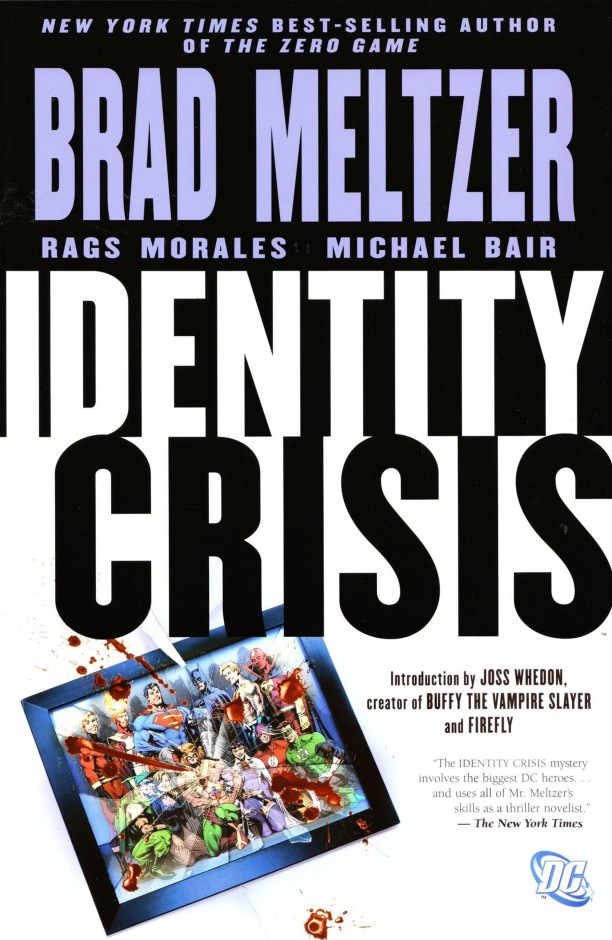
Throwback Thursday – Identity Crisis by Brad Meltzer, Rags Morales and Michael Bair.

Identity Crisis Cover

Publisher: DC Comics (Paperback – 1 October 2005)

Series: Identity Crisis Limited Series

Writer: Brad Meltzer

Penciller: Rags Morales

Inker: Michael Bair

Letterer: Ken Lopez

Colorist: Alex Sinclair

Length: 288 pages

My Rating: 5 out 5 stars

Amazon     Book Depository

Welcome back to my Throwback Thursday series, where I republish old reviews, review books I have read before or review older books I have only just had a chance to read.  For this week’s Throwback Thursday I take a look at one of my absolute favourite comic book limited series, the epic 2004 DC Comics event, Identity Crisis.  (Quick warning, there are spoilers ahead).
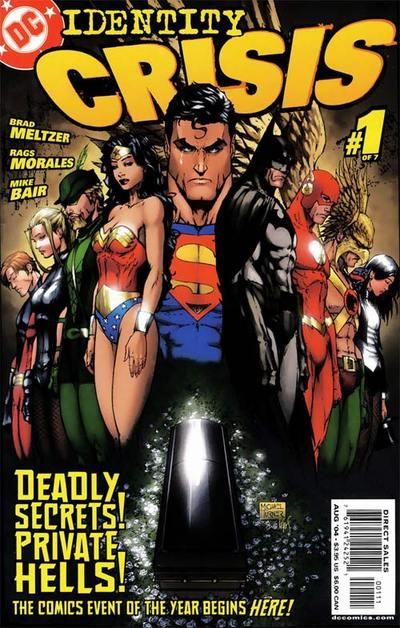
Identity Crisis #1

It is fair to say that the early to mid-2000s was one of my favourite periods of comic books, with some truly cool and epic ongoing and limited series being released.  This was particularly true for DC Comics, who produced some of their best work during this time, many of which rank amongst my all-time favourite comic series.  This easily includes the exceptional and brilliant crossover event, Identity Crisis, which to my mind is one of the best limited series ever written.

Made of seven issues, Identity Crisis combines the unique writing talent of thriller author Brad Meltzer with the artistic stylings of veteran DC Comics collaborators Rags Morales and Michael Bair.  This ended up being a near perfect combination of talents and skill, and I have a lot of love for the exceptional story, which absolutely hooks me every time, and its outstanding associated artwork.  I particularly impressed with the addition of Meltzer, who, despite his more literary background has written some of the absolute best and most human comics I have ever had the pleasure of reading, including Green Arrow: The Archer’s Quest and the two Justice League of America storylines, The Tornado’s Path and The Lightning Saga.  However, his story in Identity Crisis is particularly powerful and thought-provoking, and it ends up being a comic that completely changes everything you knew about your favourite heroes.

For years the members of the Justice League of America have protected the world from all manner of evil and destruction, always prevailing no matter the odds.  But who can protect them when someone goes after those closest to them?  And what if they actually deserve the punishment being visited upon them?

On an unremarkable night, a mysterious attacker breaks into the home of long-serving Justice League associate, Ralph Dibny, the Elongated Man, and commits a terrible crime, the murder of Ralph’s beloved wife, Sue Dibny.  With no evidence about who the killer is and no idea how they breached the Dibnys’ impressive security, the superhero community rallies behind their bereaved friend and seeks to find the killer by any means necessary.

As the rest of the heroes seek answers at any potential suspect within the supervillain community, the Elongated Man and a small group his closest friends hunt for a minor villain, Dr Light, whose secret connection to the League’s darkest moment may hold the answers they seek.  However, when a second attack occurs on another publicly known relative of a superhero, Jean Loring, the former wife of the Atom, it soon becomes clear that someone else is targeting the heroes and their loved ones.
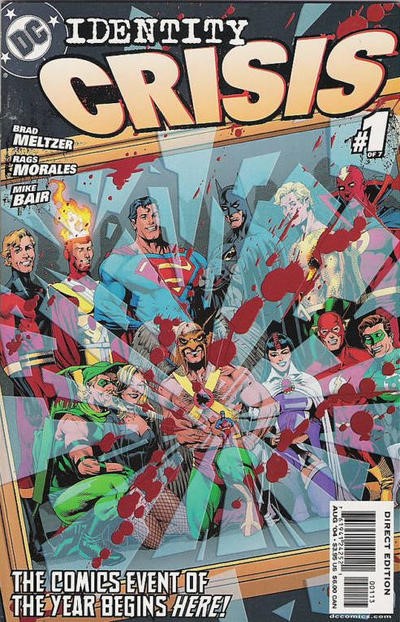
Identity Crisis #1b

As Batman, Superman, Green Arrow and others attempt to get to the bottom of the case, cryptic threats to one hero’s relative reveal that whoever is targeting them knows all of the League’s secrets, including their hidden identities.  As even more tragedies befall the superhero community, dark secrets from the League’s past are brought into the light and no-one will be prepared for the terrible truth behind these brutal murders.  Can the League weather this latest attack, or is this the beginning of the end for the world’s greatest heroes?

Damn, no matter how many times I read this comic, the tragic and powerful events of Identity Crisis still really get to me.  This exceptional comic contains one of the most impressive narratives I have ever seen in a limited series, taking the reader on a captivating and emotional dive into the world of your favourite heroes.  Perfectly combing a dark, mysterious narrative with incredible character work and some truly amazing artistic inclusions, this comic gets an extremely easy five-star rating from me.

For Identity Crisis, Brad Meltzer really went to the well, producing an insanely compelling and moving story that relentless drags you in and introduces you to a completely new side of your favourite heroes.  Utilising his experience as a crime thriller writer, he produces a powerful, character driven superhero narrative with detailed crime fiction elements to create an exceptional and unique story.  Identity Crisis has an amazing start to it, which not only carefully introduces several key figures but also installs some dark tragedy, as the wife of a superhero is killed off.  The subsequent investigation into her murder by the enraged superhero community is extremely compelling and intense, as the emotional heroes turn over every rock and stone, much to the horror of the villains.  However, it is soon revealed that several members of the Justice League are harbouring a devastating secret, one that could reveal the identity of the killer.  This secret becomes one of the most important parts of the first half of the series, and it leads to an epic, action-packed fight sequence against a particularly dangerous foe.
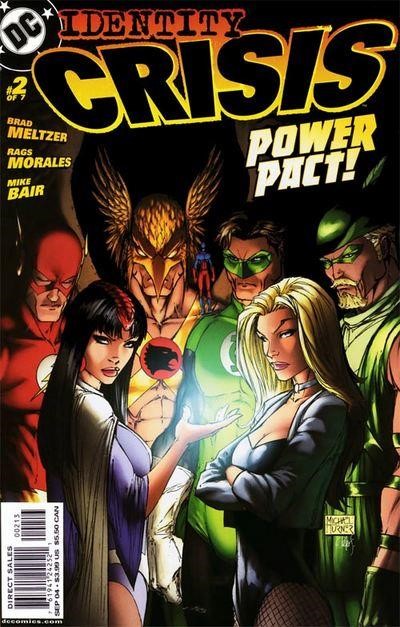
Identity Crisis #2

The story starts to go in a bit of a different direction at this point, with the above secret not really panning out regarding the investigation.  However, other superhero relatives, both public and secret, are targeted, resulting in pandemonium around the characters.  I loved the narrative’s move to a more classic investigation at this point, as the heroes start following every lead they can, while more character development and big moments are explored.  This all leads up to the defining moment when another superhero loses a loved one and the identity of the killer is seemingly revealed.  However, this turns out to be a bluff, as the real killer is still hidden.  The reveal of who did it and why are revealed pretty suddenly towards the end, with some curious and clever motivations exposed.  This leads to a tragic and heartbreaking conclusion, as more secrets are revealed, dangerous lies are uncovered, and several characters leave the story more broken and destroyed than ever before.  You will be thrown through the emotional wringer as you check this comic out.

I deeply enjoyed the way that Meltzer told Identity Crisis’s excellent story, especially as it quickly and effectively engrosses the reader and ensures their undivided attention.  The author utilises a mass-character narrative that follows a substantial collection of heroes and villains, many of whom have distinctive or semi-separate storylines.  This works to tell an intriguing, rich narrative that not only has some clever dramatic components but also allows for some intriguing and compelling retcons and expansions to the already elaborate DC universe.  It is very cool how the story developed into more of a murder mystery/thriller story as the comic progressed, and this really played to Meltzer’s strengths.  The investigation is handled very well, and I liked how the superhero elements altered and enhanced it in some clever ways.  The mystery itself is complex and clever, with Meltzer adding in some great twists, false leads and compelling surprises to keep the reader guessing.  The twist about the actual killer is pretty good, and Meltzer did a great job layering in hints and clues throughout the rest of the story while also introducing a few good alternative suspects.  While the motivations and complexities surrounding the killer’s actions are great, I did think that how the protagonists worked it out was a little abrupt, and it might have been a little better if they worked it out from some earlier clues.  The use of female characters wasn’t the best either, especially as most of them are there simply to be victims in one shape or another.  Having a long-established character getting both raped and murdered in a comic as a plot device is pretty unfortunate, and some stronger female figures might have helped balance this out.  Still, this ended up being an awesome read and I deeply enjoyed how it turned out.

One of the things that I really enjoy about Identity Crisis is the interesting examinations that were included as part of the plot.  Meltzer and the artistic team obviously had a lot of fun exploring or introducing some cool aspects of the DC Universe in this series, especially when it comes to the secret or hidden lives of superheroes and supervillains.  I particularly loved the in-depth examination about how both groups are officially or unofficially organised, and there are some very intriguing views of them socialising or working together.  The inclusion of a highly organised superhero death investigation squad, made up of a range of random heroes (the Ray, the Atom, Animal Man, Mister Miracle and two of the Metal Men) is particularly clever, as is the way the various heroes organise into a vengeful posse to question potential suspects.  The deep dive into the importance of a superhero secret identity also becomes an important part of the story, especially as the loss of the secret brings pandemonium thanks to the killer stalking them.  I also loved the counterbalance look at organised villainy, and there are some excellent scenes that see the villains gathering to socialise or talk shop.  Having an organising force like the Calculator, as well as a secret space station hangout, is pretty elaborate, and the deeper look at the villains of this universe, definitely gave Identity Crisis a compelling and intricate edge.
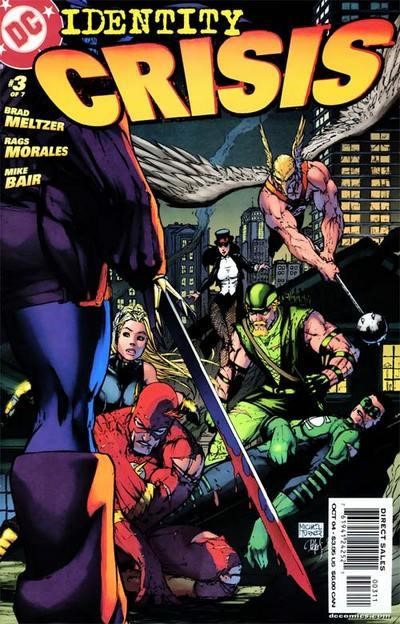
Identity Crisis #3

However, easily the most groundbreaking and compelling new inclusion to the universe is the reveal about the unofficial league within the Justice League who have some dark secrets.  Made up of heroes Green Arrow, Black Canary, Hawkman, Zatanna and Atom, as well as the Silver Age Green Lantern and Flash, this group of heroes apparently operated separately of the main Justice League during their classic Silver Age adventures, acting as their clean-up crew.  This retcon by Meltzer provides an interesting explanation for why villains never remember the secret identities of the heroes they switch minds with or whose dreams they invade, namely they have their mind erased by Zatanna’s magic after being captured by this inner-League.  While this is already a dark move by these established heroes, it gets even worse when they are forced to reveal that they intentionally destroyed Dr Light’s brain to make him less of a threat.  This and other revelations, acts to make many of your favourite heroes appear much more morally grey and fallible, and it was a particularly impressive and monumental inclusion, that will have grave consequences down the line for the entire universe.

Unsurprisingly for something written by Meltzer, Identity Crisis contains some insanely complex and impressive characters who form the heart of the tale.  Due to the way the story is told, Identity Crisis follows a massive cast of comic characters, including several obscure or underappreciated figures.  Meltzer does a brilliant job of utilising all these established characters throughout his story, with nearly every major cast member getting a moment to shine in some way or another, and multiple figures who were underutilised or unappreciated before this comic were given brilliant and defining second chances here.  While the use of multiple focus characters had the potential for a scattered narrative, Meltzer was able to direct the flow of the story around all these various protagonists and antagonists perfectly, and you still get a tight and concise story, which also takes the time to dive into each of these figures and showcase them to their greatest degree.  As I mentioned before, there is a real focus on highlighting the darker side of the superhero characters throughout Identity Crisis, and you end up really seeing these fantastic figures in a whole new scary light.

Let’s start with Ralph and Sue Dibny.  I must admit that the very first time I ever read Identity Crisis, many years ago, I honestly had no idea who Elongated Man and his wife were, as they were a little obscure.  However, Meltzer really goes out of his way to feature them in this story (even adding in a few retcons) and you are given a great introduction to them at the start.  In just a few panels, you understand who these characters are and what they mean to each other and the other superheroes, as well as some unique characteristics and relationship quirks.  This excellent introduction makes you start to care about them just as Meltzer brings the hammer down and kills Sue.  The subsequent grief, rage and despair from Elongated Man is just heartbreaking, and you go through the rest of the comic seeing him attempt to recover from these terrible events.  This amazing use of characters at the start of the comic has a great flow-on effect to the rest of the story, and you become exceedingly invested in finding the killer as a result.
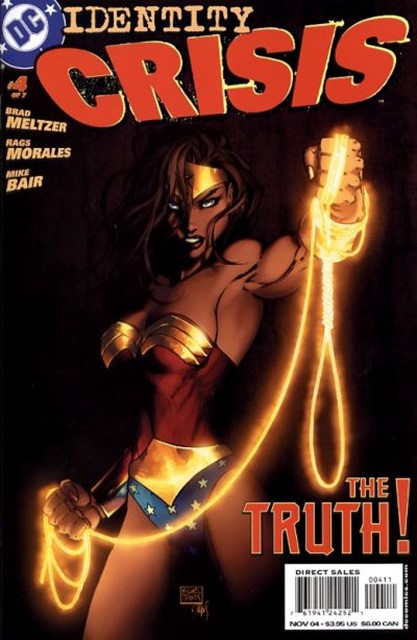
Identity Crisis #4

From there, a lot of the superhero focus goes to the surviving members of the Justice League who formed the league within the League I mentioned above.  There is some exceptional character work around some of these team members, especially as they come to terms with the decisions they made in the past and how they are impacting them now.  I loved seeing them attempt to justify their actions to the other heroes, even their darkest decisions, especially as you can understand why they did what they did, while also feeling disappointed in them.  You really get a sense of determination and shame from them as the story continues, and you see all of them go through a lot in both the past in the present story.  Despite multiple differences, this team are still friends and comrades, and watching them come together to brawl with some of the most dangerous characters is pretty heartwarming, even if darker elements lie just beneath the surface.

While there is a focus on these inner-Leaguers, some of them are utilised a lot more frequently than others, particularly the original Green Arrow, Oliver Queen.  Green Arrow is an excellent figure in this comic and is probably the closest thing to a heroic narrator/central protagonist the story has.  His unique perspective on the events acts as a good foil to many of the other characters, such as Batman and Superman, and he proves to be a calm, if potentially vengeful figure for much of the story, organising many of the League actions and forensic investigations.  He also proves to be the voice of reason for the inner League, calmly justifying many of their actions and serving as a bridge between this existing group and the newer Flash and Green Lantern.  Despite his belief that they are doing the right thing, you can see some real emotion and regret in his face, especially when the further revelations about Dr Light and Batman come out.  I also appreciated the deeper look into his antagonistic relationship with Hawkman, which partially originated in the past events mentioned here, and it is interesting to see how the events of this comic impact future Green Arrow storylines.

Aside from Green Arrow, other members of this secret League who get an intriguing focus include the Atom, Ray Palmer, and his ex-wife, Jean Loring.  Due to his status as another public hero, Atom and Jean are also targeted throughout the story, and you end up getting a rather intense and fascinating look at both.  Watching their failed relationship rekindle is a nicer part of most of the comic, although eventual reveals and tragedies naturally ruin it and smash everything around.  Still, their complicated emotions and issues surrounding their fractured relationship make for some of the best parts of the comic.  I liked the interesting look at Zatanna throughout the comic, especially as she is largely responsible for some of the worst moments of this group of heroes, as she clearly feels guilty about her magic messing with the villain’s minds.  I also need to highlight the younger Flash, Wally West, who finds out about the actions of the other characters during the current events of the comic.  It is absolutely heartbreaking to see Wally learn that his mentor and predecessor, Barry Allen, was not as perfect as he imagined, and actually participated in some of the team’s worst events.  The distress he exhibits with every subsequent reveal is showcased through the comic’s art extremely well, and his subsequent guilt as he is forced to keep it secret from other Leaguers like Batman is quite noticeable.
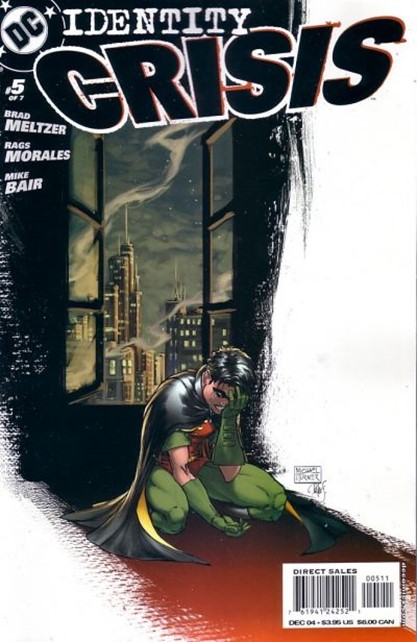
Identity Crisis #5

As you can expect from any major DC Comics crossover event, members of DC’s Big Three are strongly featured throughout Identity Crisis.  While Wonder Woman only has a few intriguing scenes, in which you get to see both her ferocity and her kindness, there is much more of a focus on Superman and Batman.  Superman gets some great sequences throughout Identity Crisis, especially as the creative team sinisterly focus on his family and friends, all of whom are potential targets.  Watching Superman slowly get frustrated with the investigation, especially when Lois is threatened, helps to enhance the seriousness of the story, and he has some powerful moments here.  I did appreciate the way in which Meltzer attempted to paint the big blue Boy Scout in a darker light, as it is revealed that even the supposedly righteous Superman is not as innocent as you’d believe.  It is subtly implied that Superman always knew what the inner League was up to (yay for super hearing), and chose to ignore it for convenience.  This brilliant and dark suggestion that even Superman isn’t infallible is a pretty weighty one that  helps to enhance the weight and power of Identity Crisis’s narrative.

Batman is a lot more involved in the story and leads his own investigation into who is behind the killing.  Even though he does not actually appear until halfway through the comic, he is a heavy presence throughout Identity Crisis, both because of his brusque, loner ways of trying to solve the crime, but because of the dark shadows of the past.  There are multiple moments that revisit his childhood and the death of his parents, which parallels some of the other losses in Identity Crisis, and you get to see the human side of grief impacting this usually stoic character.  Batman’s storyline gets even more intense when it is revealed that part of his memory was erased by his fellow Leaguers to cover up their actions surrounding Dr Light, which is a very haunting inclusion.  Meltzer makes this even more intriguing by having Green Arrow suggest, mostly out of guilt, that Batman likely has done something similar in the past, while also acknowledging that he has likely already deduced that his memories were erased.  This really makes you consider Batman’s relationship with the rest of his heroes, and it certainly has a big impact on future Batman storylines.

The Batman impact on this story is also felt through the great focus on the current Robin, Tim Drake, who plays a surprisingly big role in the events of Identity Crisis.  At the start of the comic, Tim is one of the few members of the Bat-family who still has a father, which puts him at odds with Batman and the Robin predecessors.  As his father has only just discovered his dual identity as Robin, he becomes one of the more interesting protagonists, as the comic explores the stress of the superhero lifestyle on family.  Tim’s storyline ends up being extremely tragic when his father is murdered.  Watching Robin talk to his father over the phone as he’s about to die is just damn horrific, and your heart can’t help but break during that epically drawn-out scene where he and Batman arrive too late.  The subsequent parallel between him, Bruce Wayne and previous Robin Dick Grayson during this moment is particularly poignant, and it results in a whole new chapter of this amazing incarnation of Robin.
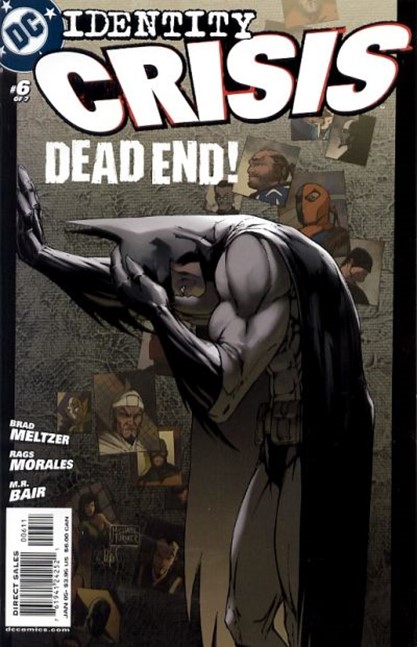
Identity Crisis #6

While there are a few other interestingly featured heroes in Identity Crisis, I’m going to start talking about the villains, as many of them have a brilliant role in this comic.  Thanks to Meltzer’s fantastic writing, Identity Crisis proves to be just as much about the villains as the heroes, as many of them are deeply impacted by the events disclosed here.  While I won’t reveal the identity of the killer here (I’m keeping some spoilers locked up), I will say that their motivations are pretty fascinating and provide a compelling insight into the super lifestyle.  The rest of the villains in Identity Crisis are fair game for discussion, though, and I deeply loved the creative team’s excellent examination of them.

Easily the villain I need to talk about the most is Dr Light, an old school Justice League villain who had not been really utilised in recent years.  Mostly known before this comic as the Teen Titans’ punching bag, Meltzer completely revitalised the character in Identity Crisis and, with a stroke, turned him onto one of the most deranged and dangerous figures in the entire universe.  It is revealed throughout the comic that Dr Light used to be an extremely powerful villain, but after invading an empty Watch Tower and raping Sue Dibny, the League brutally took him down, erased his memory of the event and then magically lobotomised him.  This resulted in him becoming the moronic and weakened villain who was routinely taken down by the teenage heroes and other embarrassing foes.  This entire reveal is pretty damn epic and horrifying at the same time.  Not only does Dr Light seem excessively evil and deranged in the flashback scenes, but the shocking revelations of his actions immediately make you hate him.  Meltzer’s explanation for why he turned into such as pathetic creature (aside from the real reason of capricious authors) really hits home hard, and even though Dr Light is a terrible person, you can’t believe that members of the Justice League went so far.  The subsequent scenes where Dr Light regains his memories and his powers feature some of the best artwork in the comic, and while he doesn’t do much here, the scenes with him brooding and plotting hit at his returned and future malevolence.  I deeply appreciated how much Meltzer was able to morph this villain, and while the reliance on rape for antagonist purposes is a bit low, he succeeded in making him a very hateful and despicable figure.

Aside from the killer and Dr Light, several other villains hold interesting and significant roles in Identity Crisis, and I deeply enjoyed how they were portrayed.  This includes Green Arrow villain Meryln, who serves as an interesting shadow to Oliver Queen throughout the comic (more so than usual).  While Green Arrow provides the superhero community’s viewpoint on events, Merlyn’s narration examines the supervillain community and their various reactions.  I loved his fun insights into his fellow villains, and he ends up being an interesting inclusion to the cast.  The same can be said for the Calculator, a formerly silly figure who has turned himself into a non-costumed villain who acts as an anti-Oracle, providing the villain community with tech support and intelligence by charging them $1,000 per question.  I loved this interesting revamp of this minor character, especially as this suave, behind-the-scenes information broker became his default look for years.  Calculator’s conversations and business dealings offer some compelling insights into the superhero community, and I loved the occasional jokes about his old costume.  Meltzer also makes exceptional use of one of my favourite villains, Deathstroke, who once again shows why he is the DC universe’s ultimate badass.  Hired by Dr Light to protect himself from the League, Deathstroke takes on an entire team of heroes single handily and essentially spanks them.  I love how the creative team not only showcase his insane physical abilities, but also his tactical knowhow, as he expertly takes down major heroes in brilliant ways (he takes down the Atom and Hawkman with a laser pointer, true story).  His scene in the centre of the comic is the best action sequence in Identity Crisis, and it perfectly showcased this awesome villain (seriously, give this man a movie), while also hinting at some future grudges.
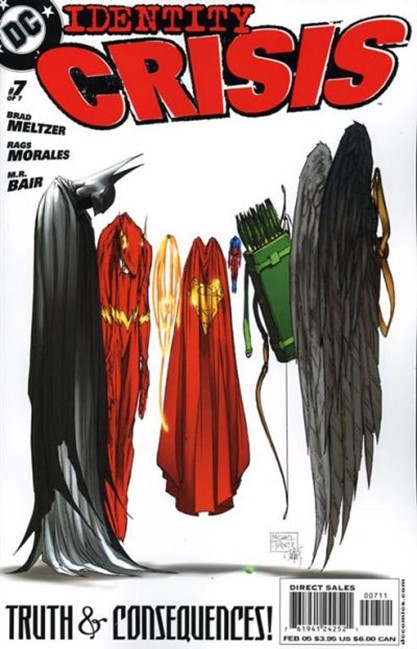
Identity Crisis #7

The final character I want to talk about is the lecherous and always entertaining Captain Boomerang, who has a major role in the plot.  I absolutely loved the exceptional story that Meltzer wrote around this infamous villain, and it is easily one of his most defining depictions.  Captain Boomerang has always been shown as a bit of a joke, but this comic shows him as a fat, washed up has-been, who leaches off his fellow villains and is generally looked down upon by them.  However, he gets a very intense and emotional story in this comic, as he meets his long-lost son and starts to develop a relationship with him.  The father/son moments add a rather interesting and nice edge to the main story and seem slightly disconnected from the rest of the plot.  That is until the final killing, when it is revealed that Captain Boomerang has arrived to kill Robin’s father.  The implied suggestion that Captain Boomerang of all people might be behind the killings is pretty iconic, and I loved the split panels that contrast his phone call to his son with the phone conversation between Robin and his father.  The subsequent results of the attack, as well as the reveals in the aftermath are pretty awesome, and I really appreciated the fun second chance that Meltzer and the artistic team gave to this iconic, old-school villain.

While I have gone a lot about story elements and characters, I also really need to highlight the incredible artwork featured in Identity Crisis.  The artistic team of Rags Morales and Michael Bair did an outstanding job in this limited series, producing some of the absolute best artwork from this era of DC Comics which perfectly enhances Meltzer’s epic storytelling.  There are so many impressive and memorable artistic moments and sequences throughout Identity Crisis, and I loved the various ways in which the artists convey movement, action, and emotion in their detailed and captivating panels.  There are so many brilliant action sequences in this comic, with my favourite being the Deathstroke vs Justice League fight I mentioned above, although a few others are also very cool to see.  I also loved the character designs featured throughout Identity Crisis, especially as the creative team took the opportunity to seriously reinvent several heroes and villains.  The streamlined look of the Calculator is particularly fun, and I also loved the balding and fat version of Captain Boomerang.  While I didn’t love how a couple of characters looked (what was with the hair on Connor Hawke?), most of it was pretty exceptional, and I love how it was later reutilised by other artists.

There are multiple truly brilliant and eye-catching artistic highlights of Identity Crisis that I must highlight, including the massive and powerful funeral sequence that takes place in the early part of the series.  There is an incredibly elaborate double-page public funeral spread that shows every single emotional superhero in attendance, with the various heroes organised by team or connection to the grieving family.  The use of the multiple heroes and associates is pretty awesome, especially as there are a range of character-appropriate reactions, and I loved seeing the whole costume crowd surrounded by members of the press and public as they mourn.  You also get also some excellent and heartfelt sequences in the subsequent scenes which show the eulogies, especially when Elongated Man starts to literally deteriorate due to his grief, which is just so powerful.  Other great examples of the artist’s work include the fun flashback scenes that allowed them to draw events in various classic comic styles, that offer a little bit of simplicity compared to the darker modern spread.

I particularly loved some of the brilliant sequences that are set around Dr Light, as not only do you see him at his most dangerous in the past but you also have some outstanding scenes when he regains his memories and powers.  The excellent parallels between the Justice League’s takedown of Dr Light and their attack on Deathstroke are incredible, and the subsequent massive panel of blinding light around Dr Light’s face is perfection.  However, the absolute best-drawn sequence in Identity Crisis must be the panels leading up to the death of Robin’s father.  Watching the insane amount of emotion on Batman and Robin as they realise that Robin’s father is about to die is so damn moving, especially the anguish on Robin.  The most moving of these panels is the one that focuses on Batman’s face after Robin begs his mentor to save his father.  The look of pure dread, fear and despair on Batman’s face takes my breath away every single time I look at it, and it perfectly conveys all of Batman’s repressed feelings as he realises that history is once again going to repeat itself.  While there are some other great scenes, the above are easily the cream of the artistic crop and definitely make this comic stand out.  I have so much love for the artistic work of Morales and Bair here, and it markedly enhances the already exceptional story, turning Identity Crisis into a true epic classic.

Well, that’s pretty much everything I have to say about Identity Crisis here.  As you can no doubt guess from the excessive way I have waffled on, I have a lot of love for this exceptional comic and I’m not afraid to show it.  The brilliant creative team behind Identity Crisis did an incredible job with this comic and they really turned out something special.  Perfectly bringing together a deep and clever story with impressive artwork, amazing characters, and so much damn emotion, this comic has something for everyone and is so very highly recommended.  I deeply enjoy everything about Identity Crisis, especially how it leads to some other epic comic books (the continuation of the mindwipe stuff in Justice League of America, Green Arrow, Teen Titans and more is particularly good).  One of the most distinctive and amazing comics ever and a must read for all DC Comics fans.

Amazon     Book Depository

Throwback Thursday: Green Arrow (2001): Volume 3: The Archer’s Quest by Brad Meltzer, Phil Hester and Ande Parks

Green Arrow Archer's Quest

Publisher: DC Comics (Paperback – 1 September 2004)

Series: Green Arrow Vol. 3 – Volume Three

Writer: Brad Meltzer

Penciller: Phil Hester

Inker: Ande Parks

Colourist: James Sinclair

Letterer: Sean Konot

Length: 175 pages

My Rating: 5 out of 5 stars

Amazon

Welcome back to my Throwback Thursday series, where I republish old reviews, review books I have read before or review older books I have only just had a chance to read.  For this week’s Throwback Thursday I check out an all-time favourite comic of mine, the third volume of the epic 2001 Green Arrow relaunch, The Archer’s Quest.

The late 1990s and early 2000s were an outstanding time for DC Comics, who produced an amazing number of epic and fascinating comic series that combined brilliant storytelling with fantastic artwork.  While there are several great series I enjoy from this period (Teen Titans comes to mind), one of my absolute favourites was the awesome 2001 relaunch of Green Arrow.  Also recorded as Green Arrow Vol. 3, this series resurrected the original Green Arrow, Oliver Queen, some years after his death.  I have an amazing amount of love for this comic; not only was it one of the first series I ever really got into but it still really stands up after all this time.  This is easily one of my all-time favourite comic book series, and the absolute pinnacle of this series was the simple, yet amazingly effective fourth volume, The Archer’s Quest.

While I probably should review some of the proceeding volumes of this series first before talking about The Archer’s Quest (such as the first volume, Quiver by Kevin Smith), I recently re-read this fantastic comic, so it has been on my mind all week.  Containing issues #16-21 of this outstanding series, The Archer’s Quest is a brilliant and captivating comic tale that really gets to grips with the protagonist as he embarks on a journey vital to his identity and history.  Featuring the brilliant writing of bestselling author Brad Meltzer (author of several amazing thriller novels, as well as some impressive DC Comics), and the artistic stylings of Phil Hester and Ande Parks, this is an exceptional comic which gets a five-star rating from me.

Green Arrow - #16

Following his unexpected resurrection after his violent death, Oliver Queen, the Green Arrow, has been returned to Earth, ready to continue the good fight.  However, no man can come back from the grave without a heavy heart, and Oliver Queen has more skeletons in his closet than most of his fellow heroes.  A chance discovery that the villain, Catman, attended his funeral leads Oliver back to his old friend, Shade, the immortal being Green Arrow trusted to round up certain artefacts of Oliver’s superhero career that could reveal his secret identity. 

Discovering that Shade failed to get several of Oliver’s most precious keepsakes, Oliver embarks on a cross-country road-trip to recover them himself.  Accompanied by his former sidekick, Roy Harper, Oliver begins visiting some of the locations most important to himself and his career as a superhero.  From the ruins of the Arrowcave to the Justice League’s orbiting Watchtower and even the Flash Museum in Central City, Oliver and Roy will attempt to find these items from the past in order to safeguard their future.

However, this will be no simple road trip, as the two heroes encounter some unexpected dangers and surprising opposition, including fellow hero the Flash and the angry zombie Solomon Grundy.  Worse, this journey will uncover some dark secrets from the past that Oliver has long hoped to keep quiet.  Can Oliver recover his treasures without his friends and family discovering who he really is, or has the past finally come back to destroy this resurrected hero?

Green Arrow - #17

The Archer’s Quest is a fantastic and powerful Green Arrow comic that takes the protagonist and his former sidekick on a wild and extremely personal adventure.  Before reading this, if you had ever pitched me a comic based around the idea of a recently resurrected superhero going on a road trip, I might have been a little dubious.  Well, it turns out that I would have been dead wrong, as Brad Meltzer produced an intense, captivating and emotionally rich narrative that is not only extremely entertaining but which contains some excellent character work, some brilliant references to the classic Green Arrow comics, and which dives deep into the psyche of a troubled and complex protagonist. 

The narrative of The Archer’s Quest starts extremely strong, with Green Arrow meeting Superman at Oliver Queen’s grave.  This is a fantastic opening scene, especially once Superman hands over a series of photographs of the funeral, and I loved the focus on the harrowing realities following a resurrection.  The sombre mood is broken when Green Arrow notices a stranger in his photo amongst his closest friends.  This leads him to hunt down Catman, which also reveals the hand of Shade and the revelation that certain items from Oliver’s past are still out in the open.  This forces Green Arrow into a road trip, hunting for his artefacts and dealing with friends, enemies and family.  The first chapter packs in some much-needed action, as Green Arrow goes toe-to-toe with Solomon Grundy in an epic and brutal fight, that ends with a surprising, and gruesome, win from the protagonist.  From there, Meltzer and the artists pile up the emotional and the feels by having Oliver encounter several fellow heroes who he has complex relationships with, while also building up the nostalgia factor, with the reveal of classic Green Arrow items, locations and characters.  All this leads to some major moments, from an attempted proposal to a moving and long-awaited conversation between father and son.  However, Meltzer saves the absolute best for last with a startling revelation about the past that shows Oliver’s true character and serves as a powerful end to the entire story.  This was a beautiful, character driven story, and I think Meltzer hit all the right notes.  The pacing is perfect and there is a fantastic blend of action, character development and emotional discovery, which all comes together into one outstanding story.  The Archer’s Quest is addictive and dramatically intense from start to finish, I can read and re-read this comic for years (and I probably will).

Green Arrow - #18

One of the things that I really enjoyed about this amazing comic is the way in which Meltzer and the artists turned it into a homage to the Green Arrow comics.  The creative team spend a substantial amount of time diving back into the history and lore of the character and his comics, working them into the story in very meaningful ways.  So many key aspects of the Green Arrow comics are referenced or alluded to in some way, as the characters journey around some iconic locations, including the Arrowcave, to obtain the artefacts.  Through this dive into the past, the creative team manage to perfectly capture the various eras of Green Arrow, including the classic Golden Age comics, the grittier Silver Age comics, the road trip era with Green Lantern (which this comic really tries to emulate), and The Longbow Hunters period.  This wide range of references makes for a very intriguing and compelling comic, and it helps turn The Archer’s Quest into a must-read for all Green Arrow fans.  I loved the clever range of different artefacts that protagonists are trying to recover, including the diamond-tipped arrow from Green Arrow’s first appearance in Justice League of America, his official invitation to the Justice League, and the truck that he and Green Lantern used in their iconic road trip.  These cool artefacts really help to ramp up the nostalgia while simultaneously including key modern story elements hidden within.  The cool funeral sequence at the start of the comic also allows the creative team to reference and include a vast range of supporting characters and allies from the original comics, with a range of different figures from Oliver’s career appearing to pay their respect.  I deeply appreciated the modern analyses and descriptions of the items, locations, complex relationships, character designs, weaponry (why all the boxing gloves?) and prior adventures included in this comic, and it helps to produce a comprehensive account of these iconic events, while also bringing them up to speed with more modern comic lines.  You can really tell that the creative team behind The Archer’s Quest had a lot of affection for the preceding Green Arrow comics, and this outstanding comic proves to be an amazing and captivating love-letter to the Emerald Archer.

I deeply enjoyed the epic characters that this amazing comic followed, especially as Meltzer uses this story to dive deep into the psyche and relationships of the protagonists, especially Oliver Queen, the titular Green Arrow.  This version of the character is only recently returned from the grave, and this becomes a major part of his identity throughout the comic, driving him to fix some of the mistakes of his past while also ensuring that he never hurts his family again.  Thanks to the entire comic being narrated by Oliver, you get some very intriguing insights into Green Arrow’s mindset during this period, and you really get to know who he is and what his motivations are.  Rather than some of the typical portrayals of him as a liberal, generic arrow slinger, the creative team attempt to show him as a complex veteran hero, still deeply impacted by his resurrection and uncertain about his place in the world.  A lot of The Archer’s Quest’s narrative involves Green Arrow attempting to find pieces of his past that are significant or potentially damaging to him, and as such you get an amazing look into key events of Oliver’s past, as well as his current priorities and concerns.  I really enjoyed the storylines involved with him trying to reconcile or repair relationships with his former friends and allies, as well as an interesting development in his romantic partnership with Black Canary.

Green Arrow - #19

One of the best things about this comic is the way that Meltzer portrays Oliver as a more morally ambiguous figure, willing to make a deal with a supervillain, lie to those closest to him, and initiating undercover actions to protect identities.  There is also some great evidence of the self-destructive tendencies that would be a major defining feature of this series, as well as the complex decisions that affect those closest to him.  As such, he keeps many secrets, even from his former sidekick, such as his main motivation for recovering his old truck is to secure the Green Lantern ring Hal Jordan hid in there years ago.  However, the biggest secret involves the revelation that he always knew that his son, Conner, existed, and that he pretended he did not know who he was when they first met.  This revelation is slowly and cleverly revealed throughout the comic, first with Oliver subtly making the recovery of its hiding place his main priority, and then in the final scenes after he has a heart-to-heart with Conner, when he reveals the secret photo.  The narration during this scene sums up Green Arrow in this series perfectly: “You’re a bastard Oliver Queen.  You knew.  You always knew.  And the worst part is…. it’s still your secret.” and the entire sequence ensures you will never look at this character again in the same way.  I also musty highlight the great inclusion about Green Arrow secretly coming up with plans to protect secret identities if a hero died.  Not only is this vital to the plot of The Archer’s Quest, but it also hints at the great storyline that Meltzer would eventually use in his epic Identity Crisis, which features a proactive team of heroes mind-wiping villains and destroying personalities.  This outstanding and layered portrayal of Green Arrow in this comic is one of the defining characteristics of The Archer’s Quest, and I am blown away with this brilliant character work every time I read this volume.

The other major character of this novel is Roy Harper, his former sidekick (now Arsenal), who Oliver calls in to help him hunt down Catman.  I really enjoyed the inclusion of Roy in this comic, especially as he had been overly featured in this series (he was mostly appearing in Titans).  As such, we had not really gotten a glimpse at the current relationship between former mentor and sidekick, which has always been strained since the infamous heroine incident.  The Archer’s Quest did an amazing job bringing them back together again, and Roy really gets into the swing of the adventure, with the two characters getting back into their adventuring groove.  However, the comic also deals with the inherent mistrust between the two characters, with Roy upset that Oliver trusted Shade more than him to protect his identity after his death.  The two end up working through these issues throughout this comic, and it ended up being a fun and powerful reunion that long-term Green Arrow fans will deeply enjoy.

Green Arrow - #20

Aside from Green Arrow and Roy Harper, this comic also makes great use of several other supporting character who either bring the protagonist back to his past, or help to add some emotional weight to the story.  This includes brilliant inclusions of two fellow superheroes, Kyle Rayner and Wally West, the versions of Green Lantern and the Flash who were active at the time.  Both these younger heroes bear a major legacy that results in some complicated and moving interactions with Oliver.  One of the most important is Kyle Rayner, who has taken over the mantle of Green Lantern following the corruption and eventual death of Green Arrow’s best friend, Hal Jordan.  Since Oliver’s resurrection, their relationship has been strained, with Oliver having trouble accepting him.  This all finally comes to a head with Oliver travels to the Watchtower and encounters the young Lantern, and they have a massive heart-to-heart.  The revelations that Oliver has trouble accepting a new Lantern instead of his best friend, as well as the emotional burden Kyle also bears, especially around his first loss as a superhero (women in refrigerators man, that stuff will mess you up), all comes out, and leads to an amazingly moving scene.

I also loved the great interaction that Oliver had with Wally West outside the Flash Museum, after Wally is warned that Oliver is planning to break into it.  The two characters have a great stare-down, which sees the usually jovial Flash incredibly serious at Oliver’s attempted trespass.  Oliver’s narration about this event is pretty great, especially noting that Wally’s usual short attention span is overridden by his love of Barry Allen’s memory.  These two interactions with Green Lantern and Flash are short but extremely powerful, and it was amazing to see the strain on Oliver at being still alive, while the roles of his friends have been passed on to the next generation.  Despite the serious nature of these scenes, both had an entertaining ending with Oliver managing to outsmart his younger colleagues: “That old, lying son of a b…”.  I also liked the inclusion of Superman at the start of the comic, which was both entertaining, and played into the resurrection storyline perfectly with Superman feeling guilty about not being able to save Oliver when he died, while also being a bit of an expert on coming back to life himself.  I also enjoyed the fantastic conclusion of the Flash arc, especially as the entire break-in was to retrieve a costume-filled ring that the Flash made for Green Arrow years before, and which was a nice nod to the great friendship they used to have.

While this volume of Green Arrow does not have an antagonist per se (except for Solomon Grundy and Oliver’s self-destructive behaviour), it does feature a couple of great supervillains in a supporting role.  The first of these is Shade, the immortal shadow-powered gentleman who, despite being a villain, gained Green Arrow’s trust years ago, and was entrusted by Oliver to fulfil his post-death wishes (always chose an immortal).  Shade is a fantastic inclusion to this comic, especially as his inclusion enhances the implication that Green Arrow is a much more morally grey hero than you would initially believe.  The interactions between Shade, Green Arrow and Roy Harper are really good, and I liked the explanations for why he was unable to fulfil all his duties (I wouldn’t want to annoy Jay Garrick either).  I also really need to highlight the excellent inclusion of Thomas Blake, better known as Catman, in his first appearance in comic form in years.  Catman has always been a bit of a joke character due to his gimmick (which simultaneously rips off Catwoman and Batman at the same time), but in this comic he is shown to be a shell of even his previous ridiculous self, who is looked down on by the entire supervillain community.  Hired by Shade as his agent, Catman is hunted down by Green Arrow after attending his funeral, only to show him as an overweight and unthreatening loser.  This entire comic paints him as quite the pathetic figure and shows the downsides of being a fourth-rate villain who turned on some very powerful people.  While his appearance in this comic was more entertaining than deep, it does beautifully set up his later appearances in such comics as Villains United and Secret Six and serves as his inspiration for becoming the ultra-badass we see there.  These two villains perfectly rounded out the main cast of The Archer’s Quest, and both inclusions were fantastic and intriguing additions to the overall plot.

Green Arrow - #21

This amazing and complex narrative is perfectly backed up by some excellent artwork from the team of Hester and Parks, who really bring this story to life in exquisite detail.  This entire comic is drawn in fantastic detail with some beautiful scenes, fantastic backdrops (including some iconic Green Arrow locations, lovingly brought to life) and entertaining sequences.  This includes some brilliant and powerful action sequences, and the artists pay particular attention to the flight, movement, and destructive potential of the arrows.  I particularly liked the awesome fight scene between Green Arrow and Solomon Grundy, which was filled with some brutal action in the tight confines of the former Arrowcave and featured some great narration from the protagonist.  I loved the character designs featured in the comic, and the classic look of Green Arrow and his companions was great.  The artists do a great job portraying emotion on the face of the characters, especially surrounding Oliver and his multiple examples of anguish and conflict.  I also appreciated the play of emotion on some of the other characters faces, especially Flash when Oliver arrives at the Flash Museum.  Seeing the grim and dark look on Flash’s face as he tries to stop Oliver is really surprising and impactful, and the artists do a fantastic job of showcasing a tense stare-down between the two as the sun starts to rise.  However, in my opinion, the best drawn sequence in the entire comic occurs at the front of the volume, when Oliver contemplates his funeral.  Shown in a series of polaroids, you see the various grieving mourners and it was fantastic to see several obscure figures from Oliver’s past appear to pay their respect.  This beautifully drawn scene is short, but it sets the scene for the rest of the volume extremely well and is an excellent way to start this fantastic comic.  I loved the way the comics in The Archer’s Quest were drawn, and they ensured that the outstanding story reached its full potential.

Overall, I have an insane amount of love for this third volume of this classic Green Arrow series, and it comes highly recommended.  The Archer’s Quest is a brilliant and powerful comic arc that perfectly combines a clever and nostalgic story, with some intense character development and a fun and enjoyable art style.  Meltzer’s narrative in this fantastic Green Arrow comic so damn amazing, and I deeply enjoyed his take of this iconic character.  I deeply enjoyed The Archer’s Quest, and it easily one of my favourite comic volumes of all time.  I am hoping to review the rest of this Green Arrow series in some future Throwback Thursday series, and I look forward to highlighting all the amazing storylines that were contained in this incredible run.

Amazon

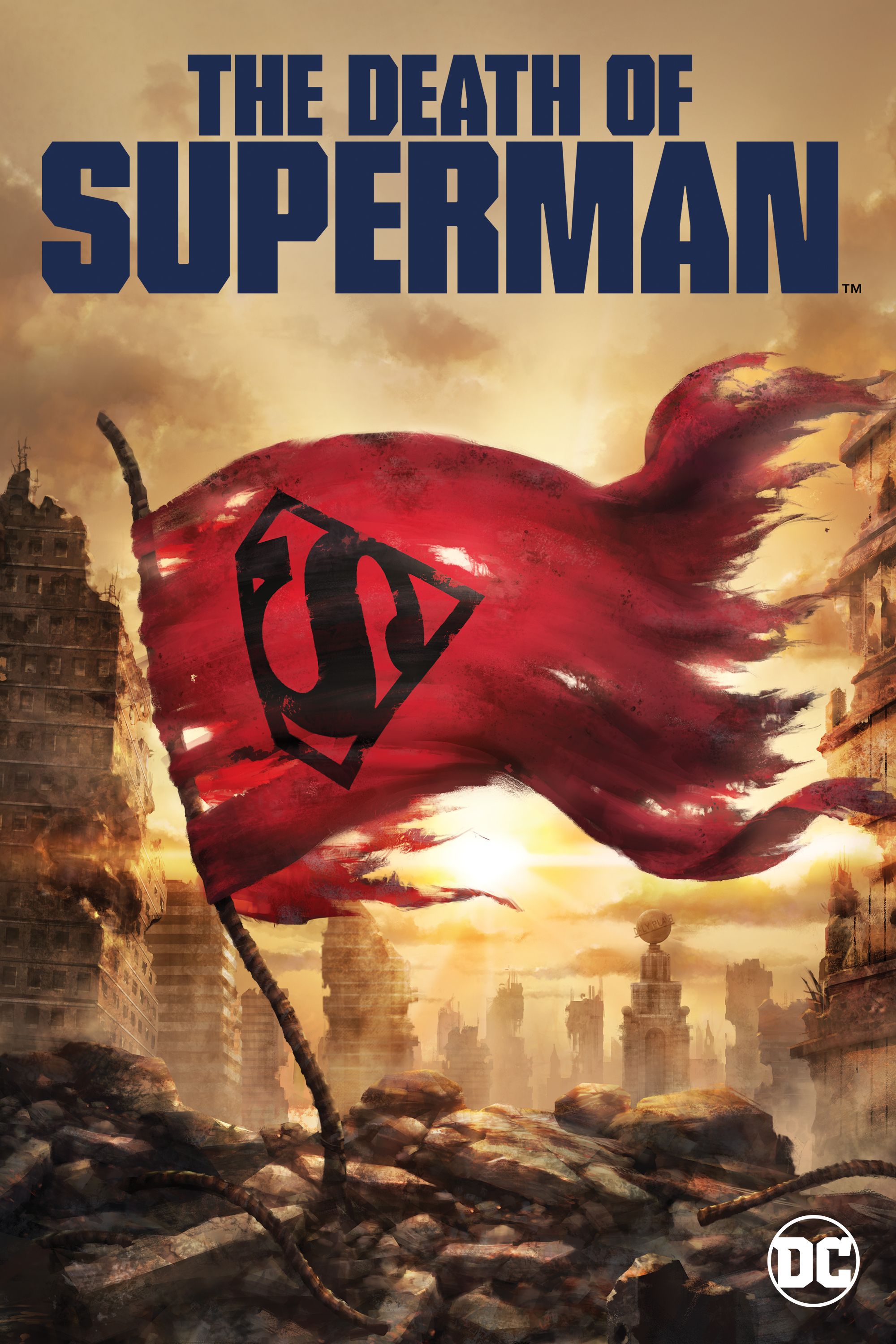
Throwback Thursday – The Death of Superman

Death of Superman Poster

Studio: Warner Bros. Animation and DC Entertainment

Series: DC Universe Animated Original Movies – Film 32 / DC Animated Movie Universe – Film 11

Directors: Sam Liu and Jake Castorena

Writer: Peter J. Tomasi

Producers: Sam Liu and Amy McKenna

Length: 81 Minutes

My Rating: 5 out of 5 stars

Welcome back to my Throwback Thursday series, where I republish old reviews, review content I have enjoyed before or review older books I have only just had a chance to read.  This week, after the fun I’ve had recently reviewing Batman: Assault on Arkham and Batman: Under the Red Hood, I continue to check out some awesome DC comic book animated features, with the impressive and powerful The Death of Superman.

Easily one of the most iconic comic book arcs of all time is the 1992/1993 storyline, The Death of Superman, which (spoiler alert) saw Superman die at the hands of new villain Doomsday.  Not only did the act of actually killing off Superman shock the world but the series was a massive financial success, becoming one of the bestselling comics of all time.  Due to its popularity, DC have attempted to adapt the storyline multiple times, with Smallville, the animated Justice League show, and Batman v Superman: Dawn of Justice, all using elements of it in one form or another.  There has even been another direct animated attempt at recreating the storyline, with the 2007 release, Superman: Doomsday, the very first film of the DC Universe Animated Original Movies.  However, in my opinion, none of them successfully conveyed the tone or the fantastic story as well as the 2018 animated film, The Death of Superman.

Directed by Sam Liu and Jake Castorena and written by Peter J. Tomasi, The Death of Superman is an incredible and amazing film that really gets to grips with the original comic, while also adding in some unique details to create a memorable and deeply moving experience.  As the 32nd instalment in the DC Universe Animated Original Movies, it also sat in the joint DC Animated Movie Universe, and was a major instalment in this series, setting up several storylines that would later be utilised in later entries, such as the final film, Justice League Dark: Apokolips War.  Featuring an awesome story, a fantastic voice cast and some exceptional animation, The Death of Superman is easily one of the best films in the entire DC Animated Movie Universe and is one of my all-time favourite animated comic book adaptions.

After saving the world multiple times, both by himself and with the Justice League, Superman reigns as one of the planet’s most popular superheros, inspiring the world with his spirit and determination to do good.  His latest act of heroics saved the mayor of Metropolis from the notorious Intergang, who made use of a large arsenal of advanced weaponry, likely supplied by an apparently incarcerated Lex Luthor.  However, despite his larger-than-life personality, Superman is also Clark Kent, a down-to-earth man from small-town America, trying to make his new relationship with fellow reporter Lois Lane work.  As Clark finally opens himself up to Lois and reveals his biggest secret to her, a brand-new threat arrives on Earth, bringing with it only death and destruction.

A mysterious meteorite has rapidly entered the solar system and crashed down on Earth, landing in the ocean.  When a team sent by Luthor and a group of Atlantean soldiers arrive, they find that the meteorite was a containment pod, and inside is something monstrous.  Killing everyone it encounters, the beast escapes the ocean and makes landfall, heading towards the largest population centre it can find, Metropolis.  With no-one able to slow it down, and even the Justice League powerless against it, it falls to Superman to engage it as Earth’s last standing defender.

Engaging in battle in the heart of Metropolis, Superman and the monster, Doomsday, begin a bloody battle that tears through the streets and levels buildings.  Superman may by the strongest person on the planet, but his new foe is a deranged and unstoppable killing machine, concerned with only death, destruction, and dominance.   Can Superman once again prevail and defeat his foe or has the Man of Steel finally met his match.  Whatever, happens, the world with never be the same again, and everyone who Superman has inspired may suddenly have to deal with the death of their greatest champion.

I must admit that when I first saw that they were doing yet another adaption of The Death of Superman comic, I was a little ambivalent, as I have not been too impressed by some of the other versions out there.  However, I still grabbed a copy as soon as it came out, and I was frankly blown away by how good it was.  This film has everything you could want in a brilliant animated feature, including an exceptional story and some amazing actors, but what this film has in abundance is heart.  Throughout its run time, you swiftly become attached to the great characters contained within, especially Superman and Lois, and then you are forced to watch as they suffer the most tragic moment of their lives.  This results in an extremely moving and powerful film, which became an instant classic in my book, and it is one that I have no problem awarding a full five-star rating.

When writing this film, Peter J. Tomasi had to do a lot with a limited amount of time.  Not only did he have to produce a pretty accurate adaption of the original Death of Superman comic, but he also had to work it into the wider DC Animated Movie Universe, which had already had its own unique history.  He easily succeeded on both fronts, as The Death of Superman contains an excellent and powerful story, that I have an extremely hard time faulting in any way whatsoever.  The story starts off with a shot of Superman saving the city and painting a pretty rosy picture of himself as Metropolis’s favourite son and defender.  After the title card, which contains the grim name of the film, the movie works to quickly introduce all the key characters, relationships, and settings, most of which had only been briefly touched on in the preceding DC Animated Movie Universe films.  This makes for a rather light-hearted start to the film; however, it also works to get you to know the characters and other key aspects of the Superman mythos and backstory, and all the setup is essential for you to get the full emotional and dramatic reactions during the second half of the film.  I also liked the way in which the film is tied into the other films of the universe, mostly using the Justice League, especially Batman and Wonder Woman, and it was great to see more of that version of the League.  All of this serves as a great set-up for the intense and action-packed second act, which is where all the action and mayhem begins.

About halfway through, the film really picks up the action with the Justice League, sans Superman, engaging Doomsday in a small town.  The action here is fast and furious, as the various members of the League get their best shots in and are then taken down in some quite brutal ways.  While this is happening, Clark is on a date with a frustrated Lois, where he finally reveals to her that his is Superman.  This date scene is done really well, and Lois’s reaction to the revelations runs the full range of emotions, especially once Superman, forced to leave to confront the threat reveals his other secret: that he loves her.  This is a great scene, and it is one that helps solidify the relationship and emotional bond between Superman and Lois while also making the viewer care for the characters just a little bit more.  However, the focus is quickly changed back to the fight with Doomsday, who has managed to take out the entire League, with only Wonder Woman hanging in.  As she falls, Superman steps in and begins a massive and brutal fight throughout Metropolis.  The creative team behind The Death of Superman really do not hold back here, as they present a knockdown brawl between the two, with Superman forced to also try and save civilians as they fight.  Their battle is a truly intense and amazing extended sequence, and there are some outstanding scenes featured throughout it.  You get some great reaction shots from the various supporting characters, and Lois and Lex Luthor have some outstanding moments as well, as they get involved for various reasons.  However, despite everything, it soon becomes clear just how indestructible and dangerous Doomsday is, and how even Superman doesn’t stand a chance.

The entire film leads up to the final climatic sequence, where the inevitable finally happens and Superman dies taking down Doomsday.  This entire scene is done perfectly, with a near-defeated Superman spurred on to make one final effort against Doomsday as the monster advances towards a seemingly hopeless Lois, who reveals to a downed Clark that she loves him too.  The blow itself is beautifully rendered with a powerful and lethal shot to Doomsday, but it is the aftermath that really turns this film into a five-star watch, as Superman is fatally impaled on a spike.  Watching a grieving Lois slowly release that the love of her life is dying in her arms is so hard to watch, and the creative team really turn up waterworks with Superman giving some touching last words: “what a lucky man I was”.  The eventual death is extremely moving, with the entire world witnessing his death and Lois’s grief, while standing in absolute shock.  Even the Justice League is moved to tears, with the usually taciturn Batman’s reaction being the most telling.  This entire sequence is deeply enhanced by a brilliant orchestral score that really plays up the emotion of the scene and strikes home every time you hear it.  This is such a powerful and impactful sequence, and it is swiftly followed by a moving funeral, with all the major characters in attendance, and then a final shot of several characters reacting in a post-funeral grief while Superman superfan Bibbo Bibbowski narrates a fitting final prayer for the character.  This entire sequence leaves me breathless, even after several re-watches, and it easily one of the most moving animated sequences I have watched.  The film then does a decent wrap-up, with several concluding sequences and post-credit scenes setting up the events of the sequel film.  However, it is the moving conclusion that will stick with you well past the films end, as it really brought everything about this movie together.

While I would be plenty happy with this film with only the outstanding story and amazing conclusion, The Death of Superman is also backed up with some incredible animation and a fantastic musical score which deeply enhance this fantastic film.  The animation is really great, and I loved the designs for the various characters, most of which hark back to their original comic book appearances.  The most impressive animation is reserved for the excellent and impactful action sequences involving Doomsday.  The animators show no hesitation in showing the blood and gore as Doomsday literally tears through everything in his way.  The initial fight with the Justice League is brilliant, especially as Doomsday brutally counters all their unique abilities and absolutely destroys them.  However, it is the giant fight with Superman which is the true highlight of The Death of Superman.  This fight is pretty extraordinary, and the animators really highlight the desperation and inspiration of the two participants.  Each of them is well and truly battered, and it is really shocking to see all the damage that Superman takes throughout the fight.  There is also some very dramatic damage to the city of Metropolis, with even the Hall of Justice being turned to a pile of rumble as these two duke it out.  I cannot emphasise how awesome this animation is, and it was so cool to see these battles unfold.

I also really need to highlight the fantastic use of music throughout this film, which works well in concert with the animated sequences.  The Death of Superman features an exceptional orchestral score, with the various tunes often harking back to classic Superman music.  This music is used perfectly throughout the various scenes in this film and help to really enhance the drama or emotion of the scene.  There are some great scenes with music throughout the film, although nothing tops the fantastic climatic sequence I mentioned above.  This animation and music are so very awesome, and it was an absolute joy to behold.

This film contains a pretty cool range of different characters, including iconic heroes, major Superman supporting characters and even a few more obscure characters.  This helps to turn The Death of Superman into quite a unique and fun film, and I really loved the range of reactions and character arcs that it contained.

Unsurprisingly, the most highlighted character in the film is Superman, who is voiced by Jerry O’Connell, who voiced the character in most of the DC Animated Movie Universe entries.  Up until this point, I felt that Superman was a bit underutilised.  Most of the previous films have focused on Superman’s relationship with Wonder Woman, while also featuring him as the League’s powerhouse.  However, this is easily Superman’s film, as the writers take substantial time to examine his history, relationships, inner personality and the duality between Superman and his Clark Kent persona.  You really get some intense insights into both versions of the same person, especially when you see his evolving relationship with Lois, and you swiftly grow to care for him in a way that some of the recent live-action films really didn’t make you.  His character really shines through during the battle with Doomsday, as he refuses to stay down, especially when people’s lives are on the line, and even risks himself to save his most hated enemy.  His sheer determination and intensity is really inspirational, and it starts to hurt a little inside to see him get beaten down by his opponent.  I felt that O’Connell does such a great job portraying Superman, and he really brings out the best of the character, showing his true heart and soul, and making him such a likeable character, who, despite his alien heritage, was still so very human.  I was really impressed and shocked by how much I grew to love Superman by the end of this film, which of course, ensures that you are so moved by the final scenes.  Seeing this character die in Lois’s arms in front of the world is just heartbreaking, and you guaranteed to be moved by his portrayal in this film.

While there is a natural focus on Superman, in many ways The Death of Superman is just as much a film about Lois Lane.  Voiced by the talented Rebecca Romijn, this version of Lois is bold and fearless in her career but also a little guarded in her personal life, especially as she senses that Clark is hiding something from her.  This film really builds up Lois extremely well in its short run-time, and you get a great sense of who she is and what she cares about.  I felt that the character had some amazing chemistry with Clark, which really isn’t surprising as Romijn is married to O’Connell in real life, so I’m sure they channelled a lot of that film.  I really was impressed by the way they showed Lois’s growing relationship with Clark as the film progresses, and the revelation about Superman’s true identity at the centre of the film really helps to solidify it, especially once Clark declares his love for her.  The subsequent battle sees Lois go through hell, as she chases the fight throughout Metropolis and has to watch Superman continuously get beaten up.  The scene where she tries to distract Doomsday and then gives up as he turns towards her is so dramatic, especially as she follows it up with her own declaration of love for Clark.  The final grief laden scene with Superman really moves me every time, and I felt that the sheer emotion coming off Lois was just amazing.  This might be one of my all-time favourite portrayals of Lois Lane, especially as Romijn does some exceptional follow ups in later DC Animated Movie Universe films.

The other major character I really want to highlight is Lex Luthor, who was voiced by the always entertaining Rainn Wilson.  Like Superman, Lex had been really underutilised in the DC Animated Movie Universe; his reveal in the Throne of Atlantis post-credit scene really did not pan out in a meaningful way in Justice League vs. Teen Titans.  However, this dramatically changed in The Death of Superman as they go out of their way to build up the showcase and show him as the maniacal yet brilliant businessman and criminal mastermind.  The creative team did a lot with Luthor in a short amount of time, and you get a really good idea of his genius, his various plans, and his unrelenting antagonism with Superman, born out of jealousy.  He proves to be a good secondary antagonist for the film, eventually turning into an erstwhile ally, abet for his own purposes, and he has some great scenes.  I was particularly impressed by Rainn Wilson’s voice work in this film, as he brings all the arrogance he can to the film, while also giving character a bit of a slimy edge.  I think he really captured Luthor’s various nuances, and ensures you see him lose his cool when faced with defeat.  I really liked the scene where Luthor can only watch in horror as Superman, despite being beat to hell, saves his life, and that results in some interesting changes in the later films.  I also liked how they captured a bunch of fun aspects of Luthor’s character from the 1990 comics, such as a nod to the Lex Luthor II persona that appeared in The Death of Superman comic.

I also need to highlight the main antagonist, Doomsday.  Despite not saying anything, Doomsday is a major presence, mainly due to his brutality and capability for destruction.  Doomsday is perfectly introduced and I loved the slow reveal of his true form, as the suit containing him is destroyed after several fights.  I must again really highlight how cool he looks in a fight, and the battles between the Justice League, Wonder Woman and Superman are just so damn impressive and pretty intense.  This was a really good portrayal of the character that perfectly harkens back to its comic origins, and it was a nice palate-cleanser after his cave-troll look in Batman v Superman: Dawn of Justice.

The Death of Superman also contains a pretty substantial supporting cast of characters, each of whom add a fair bit to the overarching narrative of the film.  Some of the most prominent of these are the various members of the Justice League, with most of the actors from the earlier DC Animated Movie Universe films reprising their roles.  Each of these characters and their actors have been perfectly introduced in the previous films, so they are inserted into The Death of Superman with minimal effort and form a fantastic cohort around Superman.  The leading two characters are probably Batman, voiced by Jason O’Mara, and Wonder Woman, voiced by Rosario Dawson.  Both characters have unique relationships with Superman, particularly Wonder Woman, and his death really impacts them both.  I also liked the combination of Green Lantern (Nathan Fillion) and Flash (Christopher Gorham), who form a fun comedic duo, while also having some great action moments.  I had a great laugh during the Justice League meeting scene where Flash does a good imitation of Batman joining the PTA of Damien’s school, and Batman’s glaring reaction is pretty funny.

I also loved the inclusion of a couple of unique Superman supporting characters.  Despite the role he played in the original comic, I was really surprised to see so much of Bibbo Bibbowski, Superman’s biggest fan, in this film.  Bibbo is a bit of a dated character, to be honest, but he slides into this film really well, and I loved the voice work done by Charles Halford.  His comedic interactions with both Superman and Clark Kent in the early parts of the film are pretty fun, and there is something amusing about a big, rough sailor type fanboying about a superhero.  It also proves to be quite heartbreaking to see this fan watch Superman die in front of him, and you can see it really breaks him.  I felt that Bibbo’s Hail Mary prayer at the end, which overscored some great visuals of people in mourning, and the subsequent breakdown on the dock was quite touching.  I also liked Erica Luttrell’s Mercy Graves, especially as she forms a great counterpoint to Luthor, especially as she calls him out on some of his more outrageous plans.  Overall, I think that this film was incredibly well cast, and I loved the fantastic group of characters that they brought together.

The Death of Superman is a truly great and powerful animated film that continues to reign as one of my absolute favourite animated comic book adaptions.  Featuring a near-perfect adaption of one of the most iconic comic stories of all time, The Death of Superman is intense, exciting, and downright heartbreaking, as it shows the greatest hero in his final battle.  I was moved to tears the first time I saw this film, and I have so much love and admiration for the work the creative team did to revitalise the character of Superman in one short film.  A highly recommend film to watch, this is one of the better Superman adaptations (live action or animated) I have ever seen.