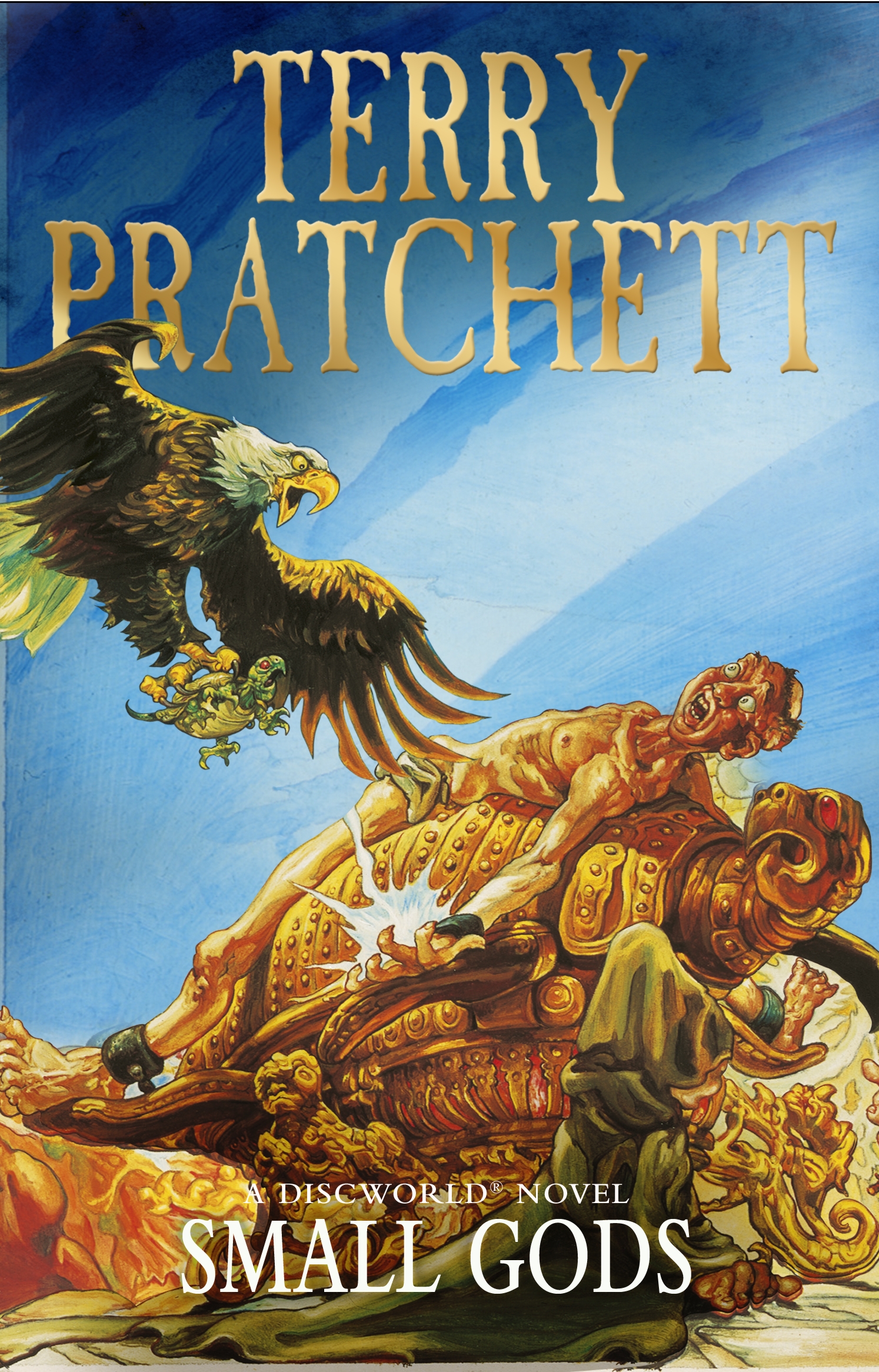
Small Gods by Terry Pratchett

Publisher: Gollancz/Penguin Audio (Audiobook – 1993)

Series: Discworld – Book 13

Length: 9 hours and 55 minutes (Planer version)/11 hours and 38 minutes (Serkis version)

My Rating: 5 out of 5 stars

Amazon

Thanks to an excellent road trip, I managed to revisit several awesome entries from the iconic Discworld series by the legendary Terry Pratchett, and it is time to highlight one of the very best books that Pratchett wrote, Small Gods.

I have never made any secret of the fact that I love all things Terry Pratchett, as the Discworld books were the formative series of my youth.  A massively popular collection of loosely connected novels set on a flat world carried through space on the back of four elephants atop a giant turtle, the Discworld books present a range of unique fantasy adventures backed with exceptional comedy and satire.  This series is so much fun, and I honestly love every single Discworld book, having read them all multiple times, usually while laughing myself silly.  Indeed, I am such a big fan of this series that I named my blog after a location in the universe.  Despite my overwhelming love for all things Discworld, I haven’t reviewed too many of the books on this blog, with Moving Pictures and The Last Continent previously being the only exception.  However, thanks to some great road trips giving me opportunities for revisiting some classics, I have recently published reviews for Guards! Guards! and an additional review for Moving Pictures.  I also recently re-listened to the impressive and thoughtful 13th entry in the series, Small Gods. An outstanding standalone novel that seeks to blend religious commentary with Pratchett’s strong humour and complex satire, Small Gods is one of the more thoughtful and moving Discworld books and is a must read for all fans of the franchise.

Floating through space on the back of a giant turtle, the Discworld is a place of magic, wonders, strange creatures and, unfortunately for the mortals just trying to live their lives, gods.  Instead of the wise and beatific beings we hope them to be, the gods of the Disc are a capricious and vain lot, empowered by the belief of their human worshippers.  But what happens when a mighty god loses his believers?

The militant nation of Omnia is an empire dedicated to the fervent worship of the Great God Om, an all-powerful being who knows all, sees all and is the only true god in the world.  The problem is none of that is true.  Instead, Om is a self-obsessed god among many, who barely pays attention to the people fighting in his name.  More importantly, he is currently residing in the body of a tortoise, stripped of nearly all his divine power, and the only person who can hear him is a simple novice, Brutha, who isn’t fully convinced that the talking tortoise smiting him with tiny thunderbolts is his god.

Determined to get back on top and find out why he lost his power, Om recruits Brutha as his unlikely prophet.  However, Brutha has his own problems as the sinister head of Omnia’s Quisition, Vorbis, has taken an interest in him.  Forced to accompany Vorbis on a diplomatic mission, Brutha soon begins to understand that the world is a far bigger place than he realised, and that there is something very wrong at the heart of his nation.

As the tides of history take Brutha and Om into strange new places, the two find themselves encountering unexpected dangers, including dangerous ideas, sinister eagles, rebels determined to prove that the world isn’t round, deranged philosophers and the small gods that lurk in the dark places.  To survive, Brutha will need to have faith in his god, but more importantly, Om will need to have faith in Brutha, especially when his own religion is turned against them.

After yet another re-read, Small Gods remains one of my favourite Discworld novels, and this is one of the very best examples of Terry Pratchett’s unique style and imagination.  A hilarious, yet thought-provoking read that cleverly dissects religion, divinity and people’s beliefs, Small Gods quickly grabs your full attention and refuses to let go until it’s powerful, terminal end.

I have so much love for the outstanding narrative that Pratchett pulled together for Small Gods, which tells one of the more unique standalone tales in the Discworld series.  I must admit, even after many reads, I am still very impressed that Pratchett decided to examine the nature of religion and belief through the lens of a hilarious odd-couple story that evolves into a road trip narrative.  Starting off on a very entertaining note with the unsuspecting new prophet of Om, Brutha, encountering his god in the form of a small, battered tortoise, Pratchett does a good job of introducing the nation of Omnia and its place in the wider setting.  This proves to be an effective start to the book, and a lot of the early themes and wider issues surrounding the nation of Omnia are well set-up.  You also get a great examination of the book’s three main characters, and their compelling early interactions in Omnia sets up a lot of the book’s character-driven narratives.  After this excellent introduction, Small Gods’ plot then moves to the bordering nation of Ephebe, which proves to be an intriguing centre of the novel, not only because it has some of the more entertaining sequences, but also because it begins to expand on some of the ideas from the front of Small Gods and you are given a good understanding of both Om’s situation and Brutha’s growth as a character.

The plot of Small Gods takes a powerful turn around halfway through, when Brutha helps further Vorbis’s schemes, only to then attempt to flee and do the right thing.  However, thanks to the influence of a rival god and unexpected technology, Brutha and Om are inadvertently stranded in the desert with a helpless Vorbis.  The following extensive scenes in the desert are probably the best parts of Small Gods, especially as Brutha begins to think for himself, and the philosophical clashes he has with Om set him up as the protagonist both the reader and the Omnians need.  Pratchett really dives into what it is to be human and divine in this section of the book, and I deeply appreciate the rich character development featured within these sections of the plot.  These desert scenes become even more impactful when Pratchett throws in a major obstacle for Brutha that threatens to push him over the edge into despair.  You really feel for Brutha as he has his crisis of faith, only to maintain his humanity in the last confrontation with Vorbis.  The subsequent scene on the metal turtle was very tense, and while I know some people dislike the end of Vorbis, I thought it was a very clever sequence, especially as Pratchett set up the hunting eagle perfectly.  Pratchett continues to wrap up the rest of the narrative in a very satisfying way, and while the war sequence might have been a little unnecessary, it allowed some great character arcs to come together and showed how much Om had grown as a god.  The final scene with Brutha once again showing his humanity no matter what, ended the book on satisfying and heart-felt note, I appreciated the hopeful tone Pratchett concluded his brilliant story on.  An overall impactful and moving narrative that brought together a lot of complex plotlines and character moments and ensured you were hooked the entire way through.

I have always believed that Small Gods was one of Pratchett’s better written books, as he effortlessly blended a complex fantasy narrative that examined religion with his typically brilliant humour and some outstanding characters.  Featuring one of his most complex and thought-provoking plots, Pratchett achieves so much with his intriguing inclusions, all without slowing down the speed of the book and keeping the tension and emotional charge of the book on high.  Introducing a cool new setting, Small Gods works well as a standalone entry in the larger series that cleverly expands on some previously introduced features, such as the selfish and somewhat stupid gods of the Disc, as well as cool locations like Ephebe (which was previously featured in Pyramids).  Due to its lack of major connections to the other entries in the Discworld series, Small Gods is a rather excellent introduction to Pratchett’s style and ability to dive into heavy topics with comedic content.  Like all of Pratchett’s books, Small Gods is hilarious, and I love the many different levels of humour contained with the book, that range from obvious jokes at over-the-top situations, subtle witticisms often contain within well-placed footnotes, to clever word or name gags.  Some of this humour is so subtle that it often goes over the reader’s head the first time, and you honestly need multiple readings to full appreciate every single joke or gag that Pratchett thought up (I still discover new jokes I previously missed every time I read a Pratchett novel).

However, the thing that ensures Small Gods stands out amongst the other brilliant Discworld novels is the author’s clever and insightful breakdown of religion and godhood on the Disc, which is both fascinating and entertaining.  A lot of the book’s powerful messaging, complex themes and some of the best humour, comes out of the exploration of the divine and how it relates to both this crazy fantasy setting and the real world.  While Pratchett does provide a lot of jokes about religion throughout the ages, he does it in a very intelligent and delicate way that makes the reader think.  Rather than simply dunking on religions and focussing on the negatives, Pratchett instead subtly satirises the institutions, manipulative leaders and unthinking traditions that can often complicate or weaponise religion.  A large amount of the plot revolves around Vorbis and the Omnian church violently trying the repress the idea that the world is flat and on the back of a giant turtle.  While this is primarily a fun parody of the Catholic church’s suppression of Galileo’s claims about the Earth orbiting the sun (and which is now both funnier and sadder, thanks to flat earthers), it also examines how some people utilise religion as an excuse for violent action and manipulate faith for their own ends, which is a powerful recurring them throughout the book.

At the same time, Pratchett also focuses on a compelling central character with true faith who explores the meaning of religion and how it impacts his people.  Seeing a likable character like Brutha recognise the problems in his nation allows readers to reflect and see the flaws in the organised religions Pratchett is parodying, while also appreciating the messages that these religions should strive for.  The various complex discussions, personal revelations and jokes within Small Gods allow for a very insightful read that reportedly resonates with both atheists and pro-religious figures (Pratchett apparently received a lot of fan mail from both groups who thought Small Gods was written for them).  I personally think that Pratchett’s thoughts and messages were extremely perceptive and layered with a great understand of humanity, and indeed many his compelling criticism or organised religion and how it is weaponised are more relevant now than when Small Gods was written, especially as it could also apply to other traditional institutions that are being abused.

Pratchett perfectly rounds out this incredible writing by featuring some of his very best characters, including several very complex figures who mature and evolve throughout the course of the book’s plot.  This includes the main protagonist, Brutha, a simple novice who finds himself the only person left who can hear Om due to his genuine belief in the god rather than in the institutions that surround the religious practices.  While initially portrayed as a somewhat dull and unthinking novice, you soon begin to realise that there is much greater complexity within Brutha, as well as the fact that he is a genuinely nice person held back by his simple ideas of life and faith.  Thanks to his interactions with Om, who provides greater clarity to his religious beliefs, as well as his experiences outside his insular nation, Brutha begins to evolve quickly as a person, gaining a greater appreciation for the wider world, as well as beginning the understand that the world isn’t quite as black and white as he believed.  It was fascinating to see Brutha develop as the book continues, especially as he begins to doubt his faith and rebel against the church and the god that had been his entire life.  His interactions with Om were quite entertaining, as the two eventually become a fun duo of equals, although Brutha does get the upper hand over his god in quite an entertaining and refreshing manner.  Brutha was also well defined by his relationship with the book’s antagonist, Vorbis, and their discussions about truth prove to be quite defining for Brutha as an inspiration for his rebellion.  However, unlike the rest of the cast, Brutha resists becoming the monster that Vorbis wants him to be, and his subsequent demonstrations of faith, reason and humanity, really set him up as one of Pratchett’s best and most likeable central protagonists.

Brutha is well matched by his god, Om, who honestly is one of the best deities featured in the Discworld series.  Formerly an all-powerful and arrogant god who didn’t care about his believers, Om finds himself suddenly trapped as a helpless tortoise who must desperately cling to Brutha to survive.  Om proves to be quite a fascinating and entertaining figure in Small Gods, especially as Pratchett perfectly portrays him as formerly powerful being who must now rely on the mercy of others.  His initial arrogance is very entertaining, and his subsequent wheedling manipulation of Brutha was a great follow-up that worked to keep him in the story.  However, it was his eventual co-evolution with Brutha that turned Om into a particularly compelling protagonist.  Despite his resistance, his bond to Brutha shapes him and forces him to see the world through human eyes, and the subsequent discourse on philosophy, life and how religion should be as they wander the dessert impacts Om just as much as Brutha.  This eventually causes them to reach an interesting and heartfelt religious partnership, and it was fascinating to see the previously selfish Om risk it all to save Brutha, especially when he is confronted by other gods who act the same way he used to.  I loved seeing this powerful and positive development in a divine figure, and Om really ended up being a compelling secondary protagonist with some of the best jokes.

While Brutha and Om are the heart and soul of Small Gods, this book would not be as impactful without its brilliant villain, Vorbis.  A cruel and unflinching figure, Vorbis is probably Pratchett’s most ruthless antagonist, who utilises the mechanisms of the church to achieve his goals.  However, rather than being a purely evil figure, Vorbis is shown to be simply someone who understands human nature and uses this knowledge to achieve his self-determined goals, which in some ways is worse than an obvious villain.  Pratchett does an outstanding job showcasing Vorbis’s dark, insular nature, and you come to really appreciate just how sinister he is, especially as his actions inspire other people to do evil things to try and match him.  He becomes even more immoral when compared to the very innocent Brutha, the only person that Vorbis occasionally sees as a real threat to his plans due to his legitimate belief, and their various interactions and discussion about the true nature of the world are quite powerful.  Pratchett features Vorbis perfectly throughout the book, and his final appearances, where he finally understands his own nature, are very satisfying to behold.

The rest of the cast of Small Gods are also quite impactful in their own way.  The blind philosopher, Didactylos, proves to be a fantastic voice of reason in the story, especially compared to the rest of the insane philosophers of Ephebe, and his very simple philosophy and viewpoint on life and truth give the characters, and the readers, much to think about amongst the discussions on religion.  Didactylos’s nephew, Urn, came across perfectly as a machine-obsessed proto engineer, whose storylines go in some interesting philosophical directions, especially when he realises what his inventions will be used for.  I had a very fun chuckle at the inclusion of Cut-Me-Own-Hand-Off Dhblah, a fun Omnian equivalent to the always entertaining Ankh-Morpork native, Cut-Me-Own-Throat Dibbler, while the Sweeper, Lu Tze, gets a great introduction as a secret history monk who occasionally changes events for the better.  Finally, the zealous Sergeant Simony, who leads the internal Omnian revolution against Vorbis, proves to be a very impressive figure who, despite being a fervent misotheist (someone who hates one specific god), has a belief in freedom and the turtle that matches Brutha’s faith in Om.  Simony serves as a very good example of just how far Vorbis can drive someone trying to do the wrong thing to achieve their goals, and I felt that he matched the fervour and faith of the other major characters in some fascinating ways.  This cast of characters was overall superb, and I really appreciated how well they complimented each other’s story arcs, as well as the intelligent themes Pratchett was trying to get across.

As with all the Discworld novels, I have enjoyed Small Gods as both a physical novel and an audiobook, and frankly this epic story comes across extremely well in all formats.  However, I have a very special place in my heart for the Discworld audiobooks, and the outstanding stories, elaborate characters and impressive and clever humour always comes across extremely well in this format.  I have had the great pleasure of listening to Small Gods multiple times over the years, and I want to highlight the two different unabridged version of Small Gods.

The first audiobook version of Small Gods is the original production narrated by Nigel Planer.  Small Gods was a particularly impressive example of Planer’s voice work, as he had to come up with unique voices for a range of unusual characters.  The Planer version of Small Gods is the one that I grew up with, and it is engrained in my mind as a result, especially as the narrator effortlessly moves through Pratchett’s many complex ideas and plots and brings them out in a fantastic and humours manner.  Planer provides all the voices in his version of Small Gods, and he perfectly encapsulated all the key figures of the book with his exceptional narrations.  You really get the full range of these character’s personalities and emotions through Planer’s voice work, and I loved his clever takes on Pratchett’s distinctive cast.  As such, the Planer version of Small Gods is probably the gold standard for all Discworld fans, and it will always have a very special place in my heart.

There is also a recently released version of Small Gods that is narrated by three brilliant British talents, and which was the version I most recently enjoyed.  This new Small Gods audiobook features a runtime of around 12 hours, which is a little longer than the roughly 10-hour long Planer version and provides an interesting new take on the novel.  I really enjoyed the voice cast for this new audiobook, as not only do we once again get Peter Serafinowicz and Bill Nighy in their recurring roles, but it also features the primary narration of actor Andy Serkis.

Serkis, who has also narrated a recent version of The Lord of the Rings books that is worth checking out, does an exceptional job in Small Gods, ensuring a very fun experience for all listeners.  While there are some tonal shifts in this audiobook that fans of the Planer version may find a little surprising or jarring, for the most part I think Serkis matches and even occasionally exceeds Nigel Planer’s performance, and I very much enjoyed his take on the book.  His basic narration of Small Gods matches Pratchett’s style and humour extremely well, and I love how effectively he moves the story along, perfectly capturing the complex tone and energy of the plot.  However, it is Serkis’s entertaining voices that were the highlight of this version of Small Gods, as the characters are each given unique tones that fit their personalities in some fantastic ways.  His voice for Brutha, the central character, was extremely good, and I loved how well Serkis captured Brutha’s transformative journey and complex personality.  Utilising a fitting rural voice for the protagonist, Serkis successfully showcases Brutha’s changing mentality and deep moral roots with his narration, and you can honestly imagine this intriguing figure every time the narrator voices him.

In comparison to Brutha, the voices for Vorbis and the Great God Om were a lot more elaborate by necessity, and I really appreciated the fantastic tones that Serkis choice for these entertaining figures.  My favourite was probably the voice used for Vorbis, as the narrator gifted this antagonist a deep, rich and lingering voice that honestly put me in mind of Tony Jay or Alan Rickman with some added oily sinisterness.  This impactful voice perfectly fit Vorbis’ menacing personality, and whenever the listener hears the voice, you know bad stuff is about to go down for the rest of the cast.  As for Om, Serkis provides him with an unrefined and laddish voice with a Liverpool accent.  This interesting voice choice matched Om’s uncaring and selfish personality extremely well, and I liked how well Serkis’s chosen tone for this divine figure played into the overarching theme that gods on the Discworld aren’t as sophisticated as everyone assumes they are.  Most of the rest of the voices in Small Gods work extremely well, with Sergeant Simony and Cut-Me-Own-Hand-Off Dhblah having memorable voices as a result.  However, I felt that the strong American accents that Serkis assigned to Didactylos and Urn really didn’t work, and failed to match the tone of the rest of the audiobook.  While Serkis was probably trying to distinguish these two from the other Ephebian philosophers, their voices honestly grated on me, and I really wish he’d have tried something else.  Still, the rest of Serkis’ voice work was amazing, and I cannot emphasise how incredible most of his narration of Small Gods turned out to be.

Serkis’s main narration was perfectly enhanced with the inclusion of Peter Serafinowicz and Bill Nighy in their recurring roles from the new Discworld audiobooks.  Serafinowicz provides the voice of Death whenever he appears in this audiobook, which is a lot of fun as Serafinowicz has an extremely entertaining Death voice that captures the anthropomorphic personification in all his skeletal glory.  His multiple appearances in Small Gods, leading key character towards the desert of judgement, were very awesome, and I loved hearing Serafinowicz converse with the other characters as Death.  The audiobook production team does an excellent job sliding the Death voice into Serkis’s main narration seamlessly, and I love it when Serafinowicz’s voice suddenly appears during dangerous scenes, heralding that someone is about to die, and ensuring there is some great tension as you watch the other characters slowly realise something is very wrong.  Nighy, on the other hand, narrates the various footnotes that Pratchett included in his text, providing an extra layer of humour.  While there are relatively few footnotes in Small Gods, it is a key role that Nighy perfectly fulfils, and his calm, consistent tones, echoing Peter Jones’s similar role in The Hitchhiker’s Guide to the Galaxy radio and TV editions really highlighted the subtle comedy of these footnotes. These three exceptional actors come together perfectly and provide an outstanding overall performance that I could not get enough of.  This was a truly exceptional audiobook that I think is on par with the previous Planer version, and I would strongly recommend both audiobooks as an amazing way to enjoy Small Gods, especially if you need to listen to something while travelling.

Well, as I am currently just getting to the end of page seven of my review for Small Gods by Terry Pratchett, I think it is a safe assumption to say that I love this amazing book.  Easily one of my favourite Discworld novels, Small Gods perfectly blends a brilliant story and amazing characters with Pratchett’s amazing wit and his uncanny insights into compelling real-world issues.  An incredible and addictive read from start to finish, Small Gods comes extremely highly recommended and can easily be enjoyed by anyone wanting a clever, funny and heartfelt read, especially on its two audiobook formats.
Amazon

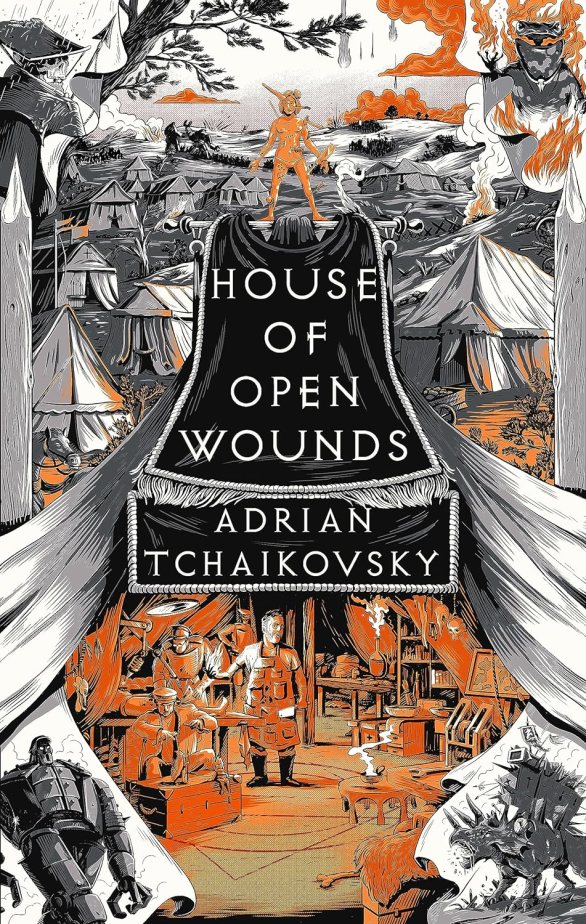
House of Open Wounds by Adrian Tchaikovsky

House of Open Wounds Cover

Publisher: Head of Zeus (Ebook – 7 December 2023)

Series: The Tyrant Philosophers – Book Two

Length: 636 pages

My Rating: 5 out 5 stars

Amazon

The always deeply impressive Adrian Tchaikovsky returns with an exceptional and remarkable piece of fantasy fiction, House of Open Wounds, which presents the reader with a particularly unique and ruthlessly entertaining story, chock full of brilliant characters.

Few fantasy authors have the range and style of Adrian Tchaikovsky, whose distinctive contributions to the science fiction and fantasy fields are quite remarkable.  While Tchaikovsky has written several highly regarded series, I have only just scratched the surface of his works, having read a few of his recent reads.  This includes his first foray into the Warhammer 40,000 universe, with the captivating standalone read, Day of Ascension, as well as the brilliant and elaborate novella, Ogres.  However, my favourite book from Tchaikovsky so far would have to be the outstanding City of Last Chances.

The first book in The Tyrant Philosophers series, City of Last Chances was an outstanding read that I had the pleasure of enjoying earlier this year.  Set around a conquered city with several unique magical inclusions, City of Last Chances introduced the reader to a cool new world and told a range of character driven stories about resistance, religion and sacrifice.  City of Last Chances got a very easy five-star rating from me, and it honestly was one of the best books and audiobooks I enjoyed in the first half of 2023.  I had such a brilliant time with City of Last Chances that when Tchaikovsky announced he was releasing a sequel in the second half of 2023, I was ecstatic.  This sequel, House of Open Wounds, continued some of the complex storylines Tchaikovsky started in City of Last Chances, and it was one of my most anticipated books for the second half of the year.

There are few nations more feared or relentless than the ever-expanding Palleseen.  A rising empire of zealots who are determined to bring Perfection and Correctness to an imperfect world, the Palleseen have advanced out of their homeland in an unstoppable wave, wiping out all religion and superstition as they go.  As cities and kingdoms fall before their military might, their armies leave behind mounds of dead and wounded soldiers who require tending in field hospital tents just behind the frontline.

Into this chaos is thrust the god smuggler Yasnic.  A former priest, miracle healer and occasional rebel, whose previous experiences with the Palleseen saw him hanged, attacked and banished from his city, Yasnic has experienced many upheavals throughout his life.  Saved from another execution by the army bureaucracy, Yasnic and his box of orphan gods arrive at the frontlines, where he has been assigned to work in an unorthodox medical unit.

Made up of a mixture of former priests, gods, magicians, alchemists, artificers, necromancers and led by a gigantic brute known as the Butcher, the experimental medical unit treats the soldiers no one else can save and recycles the rest into the war effort.  Entrusted to save the Palleseen soldiers, but doomed if anyone ever discovers the full extent of their abilities, the surgeons and orderlies of this unit ply their bloody trade as best they can while living as part of an unusual family, but the arrival of Yasnic could change everything.

As Yasnic works to fit into the unit and save lives, his unusual connections to the weakened and hidden gods of the world slowly begin to cause chaos throughout the army.  Not only is he aware of the divine forces that secretly hang around the hospital, but his own illegal and crotchety God is determined to bring miracles to the Palleseen, whether that want them or not.  As an outbreak of impossible healing and sudden pacifism spreads through the regiment, can Yasnic keep himself and his gods alive, or will the full force of the Palleseen zealots come crashing down upon him?

This was another epic and truly remarkable novel from Tchaikovsky that had me hooked the entire way through.  Featuring a dark, bloody and fun story, House of Open Wounds was a particularly distinctive read that told its own captivating story while continuing some of the best elements from City of Last Chances.  Funny, thoughtful and moving in equal measures, House of Open Wounds was an incredible and addictive novel that gets another very easy five-star rating.

I was very impressed with the exceptional and moving narrative that Tchaikovsky pulled together for House of Open Wounds, and I was hooked the second I got into it.  After the events of City of Last Chances, the reader is thrust into a new part of Tchaikovsky’s fantasy world as you find yourself imbedded in a Palleseen battalion following the members of an unusual but effective military hospital.  Like City of Last Chances, House of Open Wounds is strongly character driven, as you follow the personal stories surrounding each of these unusual outsider characters and learn about their complex pasts while watching their lives play out in the present.  Much of the plot revolves around returning protagonist Yasnic and his God, who are drafted into the unit, and you get to see his experiences of the other characters, the wars, and the internal Palleseen bureaucracy.  Most of the first half of House of Open Wounds is dedicated to exploring the new cast of characters and introducing their unique stories, as they find themselves closely following a bloody and dangerous war.  This part of the book is primarily focused on the healing and medical work of the protagonists, as well as diving into their reasons for being there and the unique skills they bring to the surgical table.  Apart from that, there isn’t an amazing amount of major plot progression here, except when Yasnic starts to mix things up around the battalion.  While this pace is a little slow, this first half of the book was really fun and enjoyable, as you find yourself getting really lost in the characters’ lives, unique struggles, desires, and experiences.  It also helps that many of these character details, as well as the mundane events of the hospital, eventually lead to bigger things later in the main plot, and Tchaikovsky does an outstanding amount of set up here.

The plot picks up a lot more in the second half, when the main battalion moves to a different warzone and find themselves involved in a substantial fight that really pushes the medical unit to its limits.  The new battles, as well as the intriguing location they find themselves in, move several of the character arcs in some big directions, and you find out more and more about each of the main characters as a result.  The constant chaos that surrounds Yasnic also starts to take its toll on the main story, as his strangeness and the double-edged miracles he occasionally brings cause him to make enemies and upset the delicate balance of the Palleseen army.  At the same time, the Palleseen war machine starts to alienate the members of the medical unit, who find their talents being stolen to create weapons.  Everything leads up to the big finale, where the protagonists attempt to free themselves with an elaborate and ambitious plan.  This plan makes great use of all their individual skills and histories, and so many little details and elements from the story are used to bring a fun and creative conclusion to the book.  Each of the fascinating character arcs conclude nicely and I loved how Tchaikovsky masterfully brought everything together in a satisfying and entertaining way.

Tchaikovsky utilises his typical excellent and distinctive writing style to convey this elaborate and entertaining narrative to the reader, and I had such a wonderful time seeing it unfold.  As with the previous novel in the series, Tchaikovsky relies very heavily on perspective changes to tell a multilayered, character-driven story.  Like the previous book, many of the major characters are initially showcased in their own chapter at the beginning, which often leads to additional cast introductions.  As the book progresses, the chapters feature perspective changes so you can see more interactions and a wider view of the entire story.  I loved the immediate deep background on several of these characters, and while you still often must wait a while to get their full story, you learn enough to like them in the opening parts of the novel.  Tchaikovsky makes full use of these characters to tell a fantastic story, and I loved how well he showcases some unique events through their eyes.  As with the previous book, House of Open Wounds has a range of tones as Tchaikovsky works hard to produce the right balance of humour, excitement, and moving and powerful character moments.  The multiple detailed and confronting scenes of the bloody battlefield hospitals are well balanced out by the fantastic and subtle humour, which often comes from the outrageous situations that occur throughout the book, as well as the various character’s unique outlooks on life.  This made for a particularly compelling book as you found yourself moving from comedic scene to a more dramatic or tragic moment with frequent regularity, as you find yourself stuck onboard a well-thought-out emotional roller coaster.

House of Open Wounds proves to be an intriguing and clever follow-up to City of Last Chances, especially as the author deepens the lore surrounding this fantasy world and brings back two fantastic protagonists.  Readers of City of Last Chances will have an absolute blast with this book, as you get some interesting follow up to Yasnic’s compelling storyline while also seeing a different side to the antagonistic nation from the first book.  This is a somewhat loose follow-up, and you really don’t need to have read City of Last Chances to enjoy House of Open Wounds.  In many ways this is a good standalone novel, especially as most of the focus is on a whole new group of protagonists, and even Yasnic is given a new name for much of the book.  Tchaikovsky does ensure that some of the key details and plot points from the first book are carried over when needed, although he does leave a bit of context out in places so as not to overwhelm new readers.  As such, House of Open Wounds is a very accessible read, although established fans of Tchaikovsky are going to particularly enjoy this, especially if they loved City of Last Chances.

One thing you can always rely on Tchaikovsky to do is to pull together an elaborate and deeply compelling world to set his stories around.  This is extremely true in this series as Tchaikovsky has come up with a war-torn landscape filled with magic, gods, demons and a new rising empire.  The author did some interesting set up for this world in the previous novel, although the plot there was primarily contained inside a single city.  In House of Open Wounds, the reader gets to see a bigger chunk of this world, even though much of the plot takes place either on the battlefield or in the camp behind the lines.  Despite this, you get a better idea of the politics, wars and conquests that have taken place in recent history, and you particularly learn more about the Palleseen.  The Palleseen are a group of ideological zealots dedicated to bringing their version of perfection to the world, which primarily involves breaking everything down into logic and reason, and doing away with superstitions and beliefs.  As such, their goal is to rid the world of gods, deities and other superstitions, usually by conquering the lands and bringing them under the control of their relentless bureaucracy.  Most of this book is dedicated to exploring the nature of their war machine, and you really get to see just how corrupt and ambitious some of their members are as a result.

I loved the focus on the military hospital and the war camp for most of the book, especially as seeing the various members of Palleseen camp allows the reader to fully understand the many problems, compromises and cruelties the Palleseen experience on their road to perfection.  Tchaikovsky throws in some great critiques of militarisation and empire building throughout the book as you see these perfect Palleseen become racked with pride, ambition and greed to prove themselves and advance up the ranks.  Their determination to win means they turn a blind eye to gods and superstitions when it suits them, and that results in the experimental medical unit that serves as the centre of the book.  However, while they appear to only want the assembled gods, alchemists, and other strange magics for healing, really they are working to corrupt them into terrible weapons to further their war capability.  There are several great storylines that see the Palleseen turning benevolent tools and creatures into highly inventive tools of war, and it serves as a major plot point and motivation for several characters, including a few Palleseen who have enough of their colleague’s lust for power.  Combine that with the returning minor gods, who end up having their own impact on several characters, and the reader comes away with a very cynical look at the Palleseen, and empires in general, which both ridicules them and shows just how malevolent and insidious they can be.

The real key that pulls together House of Open Wounds is the huge array of memorable and complex characters that are introduced throughout the course of the plot.  Tchaikovsky does a remarkable job of introducing and swiftly building up some truly amazing characters in this novel, and their compelling and often traumatic personal stories become so highly ingrained in the plot as a result.  There are so many great protagonists and supporting figures in this novel, and I was personally impressed with how all of them were original characters that were not built up in the prior novel.

The main exception to this rule is Yasnic and his god, both of whom were introduced in City of Last Chances and who are masterfully inserted into this sequel.  Yasnic was honestly one of Tchaikovsky’s best characters in City of Last Chances and I was so glad to see more of him here, especially as the author somehow manages to work in even more development after all the defining character moments that shaped him in the prior novel.  Since we last saw him, Yasnic has moved on from being the last priest of a forgotten god and has instead become a more generalised religious figure, offering shelter and assistance to fallen and orphaned gods who no longer have any power or believers by carrying them around in a box on his back.  After everything he has gone through, including his own crisis of faith, Yasnic now has a different view of the world, although he is still being haunted by his demanding and petty god.  Yasnic has some wonderful moments in this book as he tries to fit into his new role while also hanging onto the trappings of his old life.  Desperate to save everyone he can, Yasnic finds his views and pacifism really badly damaged by the constant war and the relentless and orderly Palleseen, and he is forced to make some haunting compromises.  You really get some very interesting insights into Yasnic’s mind in this book, especially as you see how the aftermath of him abandoning his position as a priest impacted him.  You cannot help but feel for the extremely likeable Yasnic at times, as he is thrust into tragic and heartbreaking positions against his will, and his quiet determination and general positivity pluck at your heartstrings.  Throw in some great new friends, an unusual but surprisingly wholesome love interest and a series of unfortunate misunderstandings that frustrate even this gentle soul, and Yasnic once again stands out as a particularly awesome and likeable protagonist.

The other side of Yasnic’s character resides in the body of his tiny, stumpy, and petty deity, God, a former major healing god who has lost all his worshippers apart from Yasnic, but still maintains his powerful healing abilities.  However, God refuses to heal anyone unless they swear a vow of pacifism, and if they cause harm to someone in any way, it will result in their wounds automatically returning, generally resulting in a sudden death.  Thanks to his stubbornness, pride, and his whiny focus on Yasnic’s soul, God was one of the most entertaining characters in City of Last Chances, and I am really glad that Tchaikovsky brought him back for House of Open Wounds.  While he is still a judgemental, mischievous and ugly angel on Yasnic’s shoulder in this sequel, you get to learn more about God and why he refuses to help save people.  There are some surprisingly emotional scenes where God expresses why he is so bitter and you really get a much better understanding of his angry mind, especially when Yasnic makes the same mistakes, adding to God’s sadness.  I also loved how well God played off Yasnic as he proves to be a surprising and entertaining counterpoint to the humble and nice former priest.  While most of their dialogue is quite contentious, with God trying to control his increasingly independent former priest, you can see deep down that God cares about Yasnic, and they form quite an interesting and fun duo.  Tchaikovsky took God’s character arc in some interesting directions towards the end of House of Open Wounds, and I have a feeling he is going to be a real nuisance to people in the next book.

House of Open Wounds also features quite a fun range of supporting characters, each of whom has their own compelling story to tell.  This primarily includes the crazy and unusual group of associated healers and hospital workers that work in the experimental hospital unit, as well as the competitive and dangerous Palleseen officers controlling their destinies.  I won’t go into too much detail here, as I could honestly go one for a paragraph about each, but I was really impressed with how well Tchaikovsky set each of them up and explored their histories and stories as the booked continued.  There are some brilliant and very well fleshed out character arcs everywhere in House of Open Wounds, and I loved just how compelling a story Tchaikovsky was able to make as a result.

Adrian Tchaikovsky once again shows why he is one of the absolute best authors of complex and intelligent fantasy fiction with this outstanding and epic read.  House of Open Wounds is a deeply clever, compelling and moving read that hooks the reader with its unique scenarios, fantastic humour, and memorable characters.  I loved every single second I spent reading this novel and I really appreciated the amazing way Tchaikovsky chose to continue the great story started in City of Last Chances.  I cannot wait to see what over elaborate fantasy stories Tchaikovsky creates in this universe in the future, and this epic novel is one of the best pieces of fantasy fiction I enjoyed in 2023.

Amazon

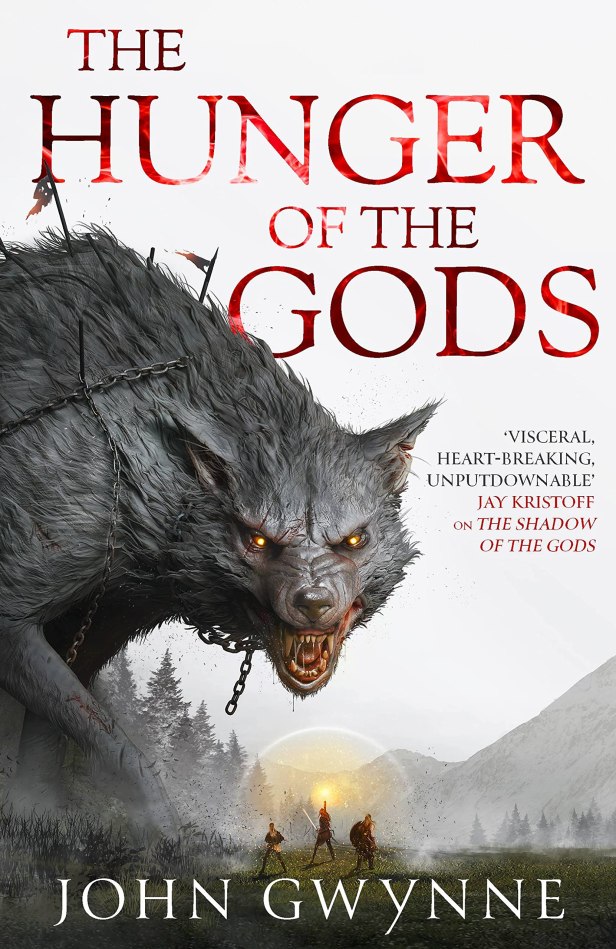
The Hunger of the Gods by John Gwynne

The Hunger of the Gods Cover

Publisher: Orbit (Audiobook – 14 April 2022)

Series: The Bloodsworn Saga – Book Two

Length: 22 hours and 57 minutes

My Rating: 5 out of 5 stars

Amazon     Book Depository

Extremely talented dark fantasy John Gwynne returns with one of my most anticipated fantasy novels of 2022, The Hunger of the Gods, the epic second entry in The Bloodsworn Saga.

Last year, the fantasy world was aflame with discussion about a certain novel from acclaimed author John Gwynne, best known for his The Faithful and the Fallen series and its sequel Of Blood and Bone trilogy.  While I wasn’t initially intending to check this book out, the sheer amount of positive feedback and reviews convinced me that I was clearly missing out, so I grabbed a copy and ended up being deeply impressed by the elaborate fantasy saga it contained.  That novel was The Shadow of the Gods, a Norse inspired dark fantasy tale that saw three intriguing protagonists explore a deadly new fantasy world wrecked by the last battle of the dead gods, and filled with monsters, warbands and powered humans tainted by the divine ancestors.  I had an exceptional time with this great book, which really met all my expectations and ended up being one of my favourite books and audiobooks of 2021 (it also topped my favourite new-to-me authors list and best covers of 2021 list, it was just that damn awesome).  I deeply enjoyed the fantastic and elaborate tale this novel contained, and I could not wait to see how it would be continued.  As such, when I received a copy of the sequel, The Hunger of the Gods, which featured another awesome fantasy cover and plot synopsis, I immediately started reading it and was once again thrust into world of gods and heroes.

The dread dragon god, Lik-Rifa the soul-stealer, has been released from her ancient tomb and now all of Vigrid lies in peril.  Determined to unleash a new era of blood, death and conquest upon the lands, Lik-Rifa immediately begins to gather around her horde of Tainted warriors, including her own descendants, the dragon-born, terrible monsters and a cult of followers, all slaved to her will.  Hope looks bleak, especially as the warring human kingdoms remain unaware that Lik-Rifa is free and about to unleash fresh horrors upon them.

Amongst this chaos, the deadly Orka continues her hunt for her stolen son, taken by Lik-Rifa’s followers.  Now revealed as the legendary and infamous warrior, the Skullsplitter, Orka will not rest until she has her son and her vengeance, no matter the obstacles.  While Orka continues her quest, her former warband of secretly Tainted warriors, the Bloodsworn, head south, determined to rescue one of their members, while their newest initiate, Varg, continues his attempts to find vengeance for his sister.  Meanwhile, Elvar is forced to fulfil the blood oath she took to rescue another child from the dragonborn, and needs to convince her now leaderless warband, the Battle-Grim, to follow her.

As these brave warriors each take their own steps to destiny, they will all face dangerous challenges and horrendous odds.  Orka will need to come to grips with the wolf lying deep in her heart as she attempts the impossible: defying a god.  Varg and the Bloodsworn will travel to a distant land to achieve their goals, only to meet tragedy and loss.  Elvar finally attempts to claim the responsibility of leadership that she has always desired.  However, despite all their bravery and skill in arms, none of these heroes are going to be capable of fighting Lik-Rifa directly.  Instead, Elvar and her company will attempt a desperate plan, using forbidden magic to bring a dead god to life and bind it to their will.

Wow oh wow, what an incredible and awesome read.  Gwynne continues to showcase why he is one of the best current authors of fantasy fiction with The Hunger of the Gods, which perfectly continues the impressive Bloodsworn Saga in a big way.  Featuring tons of bloody action, impressive new fantasy elements, complex characters, and a powerful and elaborate narrative that is the very definition of epic, The Hunger of the Gods was another five-star read from Gwynne that is easily one of the better books I have read so far this year.

The Hunger of the Gods has an outstanding and impressive story that instantly grabs the reader’s attention and ensures that they are unable to put the book down until the very last page.  This sequel kicks off right after the epic conclusion of The Shadow of the Gods and quickly follows up on all the big revelations and events that occurred there, especially the release of the giant dragon god, Lik-Rifa, who serves as a suitably sinister and epic main antagonist for the series.  Just like the first book, The Hunger of the Gods’ narrative is told from a series of split storylines, each one focused on a specific point-of-view character.  All three character-specific storylines from The Shadow of the Gods are continued here, following Orka, Varg and Elva.  These existing storylines go in some exciting and interesting directions in The Hunger of the Gods, and I loved how the author expanded on the character’s growth and individual journeys from the first novel, while also keeping some of the existing dynamics and elements.  Gwynne also adds in two new point-of-view characters, as antagonists Gudvarr and Biorr, who were good secondary characters from The Shadow of the Gods, get their own intriguing storylines here.  These new character arcs are impressively entertaining, providing great alternate perspectives to deepen the story, while also working into the existing storylines extremely well.  All five storylines go in some great directions throughout the course of the novel, and there are some absolutely brilliant moments, twists and revelations that occur throughout, especially as many of these storylines started to come together more.  I had an excellent time seeing where everything went, and Gwynne really did a great job taking all these character stories in some appropriate directions.  Every single storyline end on an amazing note and the conclusions are guaranteed to drag readers back for the third Bloodsworn novel.

This second book in The Bloodsworn Saga is written pretty damn perfectly as Gwynne continues his magic to produce an addictive and distinctive read.  The Hunger of the Gods retains the excellent tone introduced in the first novel, ensuring that everything comes across as a Norse adventure story set within a unique, dark fantasy realm.  Everything about this book is handled extremely well, from the exceptional pacing, which ensures that you fly through this massive novel, to the intense and brutal action that is installed in every section of the book, guaranteeing that readers get that much needed adrenalin rush.  Gwynne utilises an interesting writing style here that really emphasises repetition and unique dialogue to help to make the story feel more and more like an epic Norse saga.  Just like the preceding novel in The Bloodsworn Saga, I think that The Hunger of the Gods had just the right blend of action, humour, character growth, world building and darker elements to create an excellent and enticing read.  I also have to say that I was quite impressed with how Gwynne was able to avoid middle book syndrome here, as in many ways The Hunger of the Gods was even better than The Shadow of the Gods.  While the story does slow down in places to help build up certain settings or plot elements, there is always something interesting or compelling going on, and I can honestly say that I was not bored at any point in the book.  You could almost read The Hunger of the Gods by itself with no knowledge of the preceding book and still have a brilliant time with it, especially with the detailed synopsis of the prior novel at the start.

The best thing about how this story is written is the exceptional use of multiple character perspectives.  The story perfectly flits between the five separate characters arcs throughout the novel, with a different character being focused on with each new chapter.  Thanks to the inclusions of two new characters, readers of this sequel get to enjoy a much deeper story here, especially as the new characters are associated with some of the series’ antagonists, providing some fantastic new elements.  I think the additional characters worked really well, as while the existing three protagonists are great, their storylines needed to be spaced out more in this sequel.  All five separate character storylines play off each other perfectly as the novel continues, telling an immense narrative that, while connected, still contains a fair bit of individuality as you follow their specific adventure.

I liked finally being able to see some interactions between the various protagonists and I loved seeing these outstanding and well-written characters finally come together in some intense scenes, allowing the reader to see these distinctive characters viewed through the eyes of the other protagonists.  The author had a great sense of which perspectives needed to featured at certain times, and there were some amazing contrasts as certain exciting storylines were played off each other, especially when you were able to see two sides to certain major battles or events.  In addition, this is one of those rare multi-narrative fantasy novels where it is near impossible to choose a favourite storyline or character to follow.  Each of the five storylines offers the reader something different, from a bloody revenge story, to an intriguing look at the book’s main antagonists, and all of them work extremely well in the context of the wider story.  I will say that Orka’s brilliant quest for her son has some amazing action scenes and powerful character moments, while the camaraderie and excellent larger-scale battles of Varg’s storyline ensured that I was excited to hear from this character.  In addition, Gudvarr provides some great political intrigue from the perspective of a true weasel, which was so very fun to watch.  However, I honestly had a great time with every single character, and there was not a moment that their individual stories did not enhance the overall quality of The Hunger of the Gods.

I really must highlight the incredible dark fantasy setting of The Bloodsworn Saga that is expertly used again in The Hunger of the Gods after Gwynne took the time to set it up in the first novel.  The harsh land of Vigrid, with its warring Jarls, terrifying monsters, long-dead gods, glory-seeking warbands and the feared and exploited Tainted, works so well as a background to this epic story and it really helps to expand the bloody adventures featured within.  I loved how Gwynne uses classic Norse elements like shield walls, longboats, weaponry and mindsets, and I still really love seeing this in a fantasy context, especially when combined or used against the monsters and Tainted characters.  This is further enhanced with the continued use of Norse inspired terms and dialogue throughout the novel, and it helps to give this entire series such a distinctive feel (although I kind of wish that he would stop trying to continually make “thought cage” an alternative to a person’s skull).  While the author spends a bit of time continuing these elements from the first book, The Shadow of the Gods also features some brilliant world building as Gwynne provides intriguing enhancements to the existing gods, land and people, which were already extremely intriguing.  There are also some examinations of the neighbouring nation of Iskidan, which was mentioned a few times in the first book.  Iskidan, which has elements of historical China, the Middle East and the Byzantine Empire in its construction, serves as an intriguing counterpoint to Vigrid, and it was fascinating to learn more about it.  I also loved a couple of cool, if freaky new monsters, that were featured in this book, although the flesh burrowing insect monster and the nightmare inducing tongue eaters, are a bit on the gruesome side (readers who don’t like body modifying monsters are warned to stay away).  All these awesome elements are fitted in the book perfectly, and I loved this continued dive into the dark and gruesome world Gwynne has lovingly created.

While the awesome narrative, clever storytelling and dark fantasy setting are amazing parts of the book, I would be extremely remiss if I didn’t highlight the incredible character work that Gwynne did within The Hunger of the Gods.  Just like the first book in The Bloodsworn Saga, The Hunger of the Gods features an impressive and captivating cast of characters, each of whom are expertly featured and who add some fantastic elements to the overall story.  This is particularly true for the wonderful and memorable characters from whose perspective this epic tale unfolds.  Gwynne did an incredible job introducing these excellent characters in the first book, and it was great to see two previous supporting characters promoted up to the central cast.  All five main characters are exceptional and their unique personalities and goals ensure that every chapter is different from the last which helps to produce an awesome and expansive read.

The first of these characters is Orka, an incredibly dangerous warrior who is hunting for her lost son and vengeance for her murdered husband.  Orka is a brilliant and complex figure who is easily one of the most exciting and enjoyable characters in the entire series.  Due to her single-minded determination and bloodlust, pretty much all Orka’s chapters read like a bloody revenge trip that is essentially a dark fantasy version of Taken.  Gwynne continues this excellent trend with Orka in this second novel and it was great to see this implacable warrior travel across this land, killing everyone who gets in her way as she takes big risks.  However, Gwynne adds in some extra elements to Orka’s tale in The Hunger of the Gods, especially following the revelations made at the end of The Shadow of the Gods that Orka is both Tainted and the former leader of the Bloodsworn, the legendary killer known as the Skullsplitter.  Orka actually comes across as a lot more bestial in this second book, especially after the big massacre she created at the end of The Shadow of the Gods that unleashed her inner monster.  As such, there are more scenes of Orka trying to contain her rage and anger, and there were some fantastic and clever portrayals of her inner beast throughout the book.  We also see some of Orka’s guilt and regret as the novel explores how she left the Bloodsworn and the relationships she sacrificed for the sake of her unborn son.  I also quite enjoyed seeing her as a reluctant leader in this novel as she finds herself in charge of a small team of warriors and monsters.  This enhances her sense of guilt and remembrances of her previous time with the Bloodsworn, and it adds some fun drama and even a mentoring arc as continues her work with her young student, Lif.  Orka’s storyline goes in some great directions throughout The Hunger of the Gods, and you will be enthralled with her tale right up until the last line of this book.

I also had a lot of fun with Varg in this book.  Varg, or as his warband knows him, Varg No-Sense, was probably my favourite character in The Shadow of the Gods and he continues to be an excellent part of this sequel.  While he doesn’t develop as much as some of the other characters in The Hunger of the Gods, Varg still remains an enjoyable figure.  Most of the appeal revolves around his friendship and growing sense of acceptance with his fellow Bloodsworn, and I liked seeing him continue to develop as a warrior and a free person, especially as starts to create some meaningful relationships.  Like Orka, a lot of Varg’s personal storyline deals with his desire for vengeance, as well as his issues controlling his Tainted rage, and I liked seeing how this complemented and contrasted with Orka’s experiences.  This is particularly noticeable when it comes to how he deals with loss, something he is not good at, especially when some good friends fall throughout the story.  As a result, there are some great moments for Varg in this novel, and his chapters are filled with some of the funniest supporting characters and best battle sequences.  I did find it interesting that Varg didn’t have the biggest impact on the overall storyline in this novel, even during his own chapters, but Gwynne is clearly planning some big things for him in the future, which I am really looking forward to.

Elvar, also has a great storyline in The Hunger of the Gods, and I honestly think that out of all the characters, she has the most development in this book.  Due to where her story from The Shadow of the Gods ended up (dragon gods rising and all), I was extremely excited to see more from Elvar in this novel, and it really did not disappoint as she immediately gets into action, resurrecting gods and bending them to her will.  Quite a lot of major plot elements occur through Elvar’s eyes, and she proves to be an excellent focus for all these key storylines.  I liked how Elvar grew up quite a lot in this sequel, especially after the traumatic betrayals of the previous book, and she ends up with a very different mindset throughout this sequel, especially when it comes to leadership and her need for fame.  Watching her grow and take control of the Battle-Grim is a compelling part of this novel, and it was awesome to see her come to terms with her new responsibilities.  It was also great to see how a lot of Elvar’s story comes full circle in this novel, especially when it comes to her personal history and family, and her final chapters in this novel are some of the best in the book.  I am once again extremely keen to see how Elvar’s story continues in the rest of the series, and Gwynne has left her in an incredible spot for the future.

Like I mentioned above, I was really impressed with Gwynne’s decision to start utilising two additional point-of-view characters in The Hunger of the Gods, and it really helped to turn this sequel into a much more detailed and compelling read.  Part of the reason this works so well is that these two additional characters are both complex and excellent characters, and their chapters act as a great continuation of some of the minor storylines from the first book.  The first of these characters is Biorr, former member of the Battle-Grim who was revealed to be a spy planted by Lik-Rifa’s followers and who ended up betraying and killing the Battle-Grim’s leader.  While it would be easy to hate Biorr for his actions, he becomes quite a sympathetic character.  Not only does he spend most of the book feeling intense guilt for his actions, but he also paints a pretty grim picture of his previous life as a slave, showcasing the hardships he and his fellow Tainted have suffered.  As such, you can understand many of his reasons for why he is helping Lik-Rifa, especially as she is promising a new world order for people like him.  Despite this he is still quite conflicted, and he acts as a more moderate antagonist.  This changes towards the end of the book, especially after he meets a certain divine being, and he starts to become a bit colder and more determined to support Lik-Rifa.  Despite being one of the least action-packed storylines in the novel, Biorr’s chapters were an excellent and entertaining part of the novel.  I particularly enjoyed the intriguing alternate views they gave of the main group of antagonists, making them seem more reasonable and complex, and the inclusion of Biorr greatly enhanced the entire narrative for the best.

The other new point-of-view character is Gudvarr, the conceited lordling who hunted Orka in the last book and was a particularly annoying antagonist.  I must admit that I was initially surprised that out of all the great supporting characters, Gudvarr was the one who was upgraded to main cast.  However, it soon became apparent why he was used, as Gwynne had some real fun turning him into one of the entertainingly despicable characters in the entire novel.  Gudvarr is the absolute epitome of arrogance, petty cruelty and cowardice throughout this book, and it is near impossible to have any respect for him, as he lies, brownnoses and attempt anything to gain power and reputation, often with disastrous results.  Gwynne goes out of his way to make him seem as conceited and cowardly as possible throughout the novel, mainly through his inner monologue, where he constantly hides all his insults and most cowardly thoughts to avoid getting into trouble with actual warrior.  He is such a little arseling in this novel, and you can’t help but hate him, especially as he has the devil’s luck and frustratingly manages to wiggle out of every single disaster he finds himself in.  Despite this, or perhaps because of it, I grew to really enjoy Gudvarr’s chapters as everything he did was hilarious in a sneaky and spiteful way, and it is just so damn entertaining to see him get pushed around then overcome more powerful and confident characters.  The Gudvarr chapters also provide some fantastic insight into another group of antagonists, loaded with political intrigue and deceit from one of the main courts of Vigrid.  I had an absolute blast following Gudvarr throughout the novel, and the way that his storyline in this novel comes to an end is just so perfect and really showcases what an absolute cowardly snake he is.  I cannot wait to see him get his eventual just deserts (or maybe he’ll be the only survivor), and he ended up being on of my surprisingly favourites in The Hunger of the Gods.

Aside from these main five characters, The Hunger of the Gods is filled with a massive raft of supporting characters, with a distinctive cast associated with each of the point-of-view storylines.  Gwynne handles these supporting characters beautifully; despite the cast list going on for six pages, you get to know all of them and fully appreciate everything they bring to the story.  Most of these characters support their respective storylines incredibly well and many of the characters either stand on their own as distinctive figures or have some brilliant interactions with the main characters.  Many of my favourites were members of the Bloodsworn band, with the hilarious and witty Svik being the best example of this with his tall tales, love of cheese, and calming attitude towards Varg, while an additional storyline about his connection to Orka adding some intriguing depth to his character.  You really get to enjoy many of the key Bloodsworn members, although this does mean you become way too emotionally strained when they get hurt or killed.  I also really grew to enjoy returning character Lif in this book as he continues to grow as a warrior through Orka’s tutelage.  Watching him develop is a great part of the Orka chapters, and he proves to be an excellent foil to the brutal main character.  I loved the deeper look at many of the series’ main antagonists throughout The Hunger of Gods, especially with the two new character perspectives, and it was great to see a different side to their plans and motivations.  The multiple resurrected or freed god characters proved to be an excellent addition to this second novel, with the main characters brought into their renewed war one way or another.  These gods really changed the entire story, and it was fascinating to see their interactions with the main characters, as well impact they have on everyone’s psyches.  These great characters, and many more, all added a ton to the story, and I loved how their various arcs and storylines came together.  It will be fascinating to see if anybody else becomes a point-of-view protagonists in the future (my money is on Lif), and I can’t wait to see what happens to these brilliant characters in the future.

While I was lucky enough to receive a physical copy of The Hunger of the Gods, I ended up listening to the audiobook version of it instead, which was an extremely awesome experience.  With a runtime of just under 23 hours, this is a pretty lengthy audiobook (the 19th longest audiobook I’ve ever listened to) and requires a substantial investment of time.  However, this is more than worth it as hearing this epic tale read out to you is a brilliant experience.  Not only does it ensure that you become deeply trapped in the elaborate story and are able to absorb all the great detail, but it also fits with the book’s inherit theme of an oral saga.  One of the best features of this audiobook is impressive narrator Colin Mace, a man with a ton experience narrating elaborate fantasy and science fiction audiobooks (such as The Black Hawks by David Wragg).  Mace has a commanding and powerful voice that really fits the theme of this universe and perfectly conveys all the violence, grim settings and powerful elements of the dark fantasy world.  He does a particularly good job with the character voices as well, as every character has a distinctive tone that fits their personality and actions extremely well.  I loved some of the great voices that he comes up with, including deep-voiced warriors, snivelling cowards, strange creatures, ethereal gods and more, and it helped to turn The Hunger of the Gods audiobook into quite an experience.  As such, I would strongly recommend this audiobook format as the way to enjoy The Hunger of the Gods, and I fully intend to check out the rest of this series on audiobook when it comes out.

John Gwynne continues to dominate the fantasy genre with his incredible Bloodsworn Saga.  The amazing second entry, The Hunger of the Gods, is another exceptional read that takes you on a wild and deadly adventure through Gwynne’s impressively put together dark fantasy world.  Containing an epic and powerful story, chock full of action, Norse fantasy elements and impressive characters, The Hunger of the Gods was one of the best reads of 2022 so far and I had an outstanding time reading it.  In some ways The Hunger of the Gods ended up being a better novel than the first entry in the series and is an absolute must read for all fantasy fans.

Amazon     Book Depository

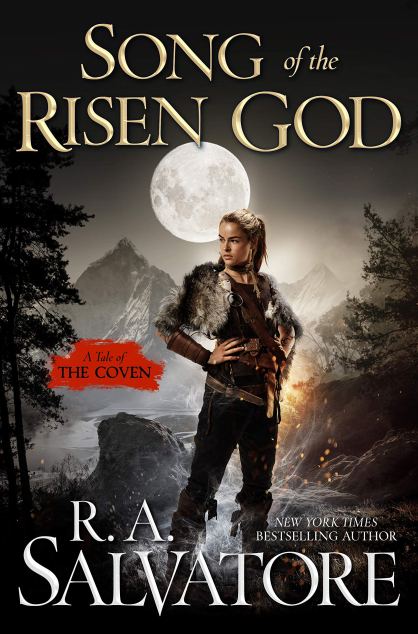
Song of the Risen God by R. A. Salvatore

Song of the Risen God Cover

Publisher: Audible Studios (Audiobook – 28 January 2020)

Series: Coven trilogy – Book Three

Length: 17 hours and 3 minutes

My Rating: 5 out of 5 stars

Amazon     Book Depository

Legendary fantasy author R. A. Salvatore brings his Coven trilogy to an explosive and enthralling end with the third and final novel, Song of the Risen God.

The Coven trilogy is an exciting series that Salvatore has been writing over the last three years, which is set in the world of Corona, the setting of his previous series, The DemonWars Saga. This new trilogy follows the adventures of an interesting group of characters in the lands surrounding Loch Beag, including the imposing mountain, Fireach Speuer. The first two novels in this series, Child of a Mad God and Reckoning of Fallen Gods, have both been extremely good, and I have been enjoying reading some of Salvatore’s non-Forgotten Realms fantasy work. I am a massive fan of Salvatore’s writing and I have been looking forward to finishing this series off for some time now. Salvatore certainly did not disappoint with the final entry in this trilogy, as this final novel is potentially my favourite book in the entire series.

War has once again come to the world of Corona, as a new evil leads its forces on a mission of conquest and destruction. The wild lands surrounding Loch Beag and Fireach Speuer have never been peaceful, but now a massive army of invaders is marching across them, determined to conquer and kill all before them. These mysterious invaders are the Xoconai, a lost race of humanoids from the other side of Fireach Speaur. Now, with their reborn god leading the charge on his mighty dragon, the Xoconai are commanded to expand their empire to the opposing coast.

With no hope of defeating the vast host that has suddenly appeared above them, the few surviving inhabitants of the villages surrounding Loch Beag flee through the wilds to find sanctuary. Led by the powerful witch Aoelyn, the frontiersman Talmadge and the ranger Aydrian Wyndon, the villagers move towards the apparent safety of Honce-the-Bear, the most powerful human kingdom in Corona. There they hope to warn the people of Honce-the-Bear of the approaching danger and gather a force that can push back the Xoconai.

However, the dark ambition of the Xoconai god, Scathmizzane, knows no limit, and his magical powers are as vast as they are terrifying in their origin. Using these powers, Scathmizzane is able to accelerate the Xoconai invasion at a tremendous pace, striking right at the heart of Honce-the-Bear, and managing to overpower both their armies and the magic of the Abellican monks. As the Xoconai horde advances, it falls to Aoelyn, Aydrian and their companions to stop them by any means necessary. But can even the most powerful magic user on the continent and a fallen king be able to throw back the invading armies, or will Scathmizzane’s dark power fall across all the lands?

Song of the Risen God is a really impressive and captivating read that provides the reader with an entertaining adventure in one of Salvatore’s detailed and expansive fantasy universe. This final book in the Coven trilogy is a cool addition to the trilogy that not only acts as a satisfactory conclusion to this new series but which also ties it even more firmly into the wider world of Corona.

This book contains an epic and wide-ranging narrative that showcases the dramatic aftermath of the second novel in the series, Reckoning of the Fallen Gods, which saw a massive army and a dragon-riding god descend on the isolated setting of the first two novels. In this third novel, the protagonists are chased all the way to one of this world’s key settings, the kingdom of Honce-the-Bear, where they must fight to save the world from the invading horde. This turned out to be a rather interesting departure from the previous novels in the Coven trilogy, which were much smaller in their scope, tending to focus on a handful of closely related villages in a single location. I actually liked this change of pace, as it made for a much more impressive conclusion, and I quite enjoyed seeing the characters interact with the wider world. This turned out to be an extremely exciting and fast-paced novel that contained a lot of entertaining action and large-scale battle sequences, although the author does not skimp on the intriguing dialogue, creative world building or compelling character development. Salvatore utilises a host of point-of-view characters to tell this story from a variety of different angles, which leads to a rich and comprehensive overall narrative. I am also glad that the author continues to feature in-world texts at the beginning of each part of the novel, which provides some fascinating insights into some characters, and contains some clues about a big twist towards the end of Song of the Risen God. Overall, this was an extremely captivating story with a great blend of elements, and I had a fantastic time reading it.

One of the more distinctive parts of Song of the Risen God is how it connects with some of the previous books set in the world of Corona. Corona is a unique fantasy world created by Salvatore, which has previously served as the setting for 13 novels, including the previous two Coven books. The first seven of these books are all part of the same series, known as The DemonWars Saga, which established many elements of this world, including the kingdom of Honce-the-Bear, the Abellican order of monks and the world’s gem based magical system. The Coven series has always been set in Corona, but the first novel in this trilogy, Child of a Mad God, had very little to do with these prior books. More of a connection was established in Reckoning of Fallen Gods, especially with the appearance of Aydrian, who was a major figure in the later DemonWars books. However, in Song of the Risen God, Salvatore fully combines this trilogy with his prior series, by bringing the protagonists and antagonists of the previous Coven books into the main location of The DemonWars Saga and having them interact with these established characters and settings.

Immersing this series more fully into the wider fantasy world was an interesting choice from Salvatore, and it one of the major things that distinguishes Song of the Risen God from the previous books in the trilogy. This was not a sudden or random decision from Salvatore, as there have been hints that this was going to happen in the previous two books, especially once Aydrian was introduced as a major character. I rather enjoyed the way that Salvatore so dramatically expanded the setting and started using elements from The DemonWars Saga in this novel, as it made for a much more expansive and fascinating story. I never actually read any of the books in The DemonWars Saga (a regrettable gap in my Salvatore knowledge), and before reading Song of the Risen God, I had no real idea what happened in this series, aside from what was discussed in the second Coven novel. However, I found that you really didn’t need any pre-existing knowledge of these earlier books, as Salvatore spends a good amount of time explaining some of the major story events that occurred during these novels and how they impact the current plot. As a result, at no point while reading Song of the Risen God was I in anyway confused by what was going on, and I always had a good idea how the plot was tied into the wider universe. I really appreciated being able to enjoy the entirety of the plot without having to read The DemonWar Saga first (which admittedly sounds pretty awesome, and I might have to check them out at some point), and I think that Salvatore did a fantastic job recapping the events of this prior series in text. Fans of The DemonWars Saga will no doubt like the fact that Salvatore is once again exploring this world, and many will be interested in seeing how much the universe has changed in the intervening years, as well as the major developments that occur as part of Song of the Risen God.

As I mentioned above, Song of the Risen God is the third and final book in the Coven trilogy, which does mean that this book might be a bit harder to follow for those readers who try to jump into the series at the very end (although that would be true for any trilogy). Salvatore does do a good job of recapping and exploring some of the key events of the first two novels, so most readers should be able to follow it well enough. I think that Song of the Risen God proved to be a great conclusion to the entire trilogy, as all of the major storylines were wrapped up rather well. The ending of the book also suggests that Salvatore is planning an additional Corona based series in the future, and if so, it is likely to focus on some of the major characters from the Coven trilogy. I personally would be extremely interested in a follow up series to these books, especially after all the major events that occurred in this novel, and I look forward to seeing what Salvatore cooks up next.

One of the major highlights of Song of the Risen God was the incredible raft of characters. This book had a massive and diverse group of characters featured within it, including the protagonists of the previous two books, characters from The DemonWars Saga and original characters who appeared for the first time within this book. Salvatore did a fantastic job diving down into several of these protagonists, and there was some rather intriguing character development that occurred throughout Song of the Risen God, most of which has some interesting roots in some of Salvatore’s previous novels.

A good portion of the book focuses on Aoelyn, who has served as the main protagonist for the first two Coven novels. Aoelyn is a witch who has spent the previous books trying to escape the clutches of her vicious tribe, the Usgar. In this novel, Aoelyn finally has her freedom, and finds herself in a brand new world, although she still seems to be dealing with some of the same prejudices and problems that occurred amongst the Usgar. Aoelyn spends a good portion of this book continuing to come to terms with her magical powers, which both define her and frighten her, as she has seen how magic can corrupt individuals, and she also attempts to take responsibility for the Xoconai invasion, which she inadvertently caused by killing a demon in the first Coven novel. I felt that Salvatore covered her character arc rather well, and there were quite a few intriguing moments, including Aoelyn making new friends and finding closure with some of the antagonists from the first two novels. I also liked some of the interesting developments that occurred towards the end of the novel with Aoelyn, which not only impact her outlook on life, but which may have some major impacts on any future Corona novels that feature her.

In addition to Aoelyn, quite a few other characters have some fantastic moments within Song of the Risen God. Bahdlahn, the former Usgar slave and Aoelyn’s childhood friend, probably had the most dramatic character development of all within this novel, as he grew and grew with every new encounter and experience within the plot. You cannot help but get attached to Bahdlahn, especially as he goes from wide-eyed former slave who had barely seen anything of the world, all the way up to an elite knight and resistance fighter in Honce-the-Bear. Bahdlahn is another character who has some interesting developments towards the end of this novel, and it looks like Salvatore has some big plans for him in the future. The former Usgar witch Connebragh also has a rather fascinating, if shorter, storyline within this book, as she befriends two former inhabitants of the lakeside villages, despite the long hostility between her tribe and theirs, and helps them survive the Xoconai invasion. The frontier explorers Talmadge and Khotai are also well utilised towards the front of the book, and there are some great moments with them, especially as Khotai regains her mobility in a rather unique way, although both disappear for the last third of the book. Salvatore also invests time in showing the viewpoint of a couple of key Xoconai characters, which I think really adds a lot to the story. Rather than having the Xoconai solely being mindless followers of Scathmizzane, these character perspectives help show them as being rather similar to humans, and two characters in particular have some very interesting viewpoints that lead them to question the word of their god as they attempt to fight his holy war.

All of these character arcs are great, but my personal favourite has to be the one surrounding Aydrian Wyndon. Aydrian is a major character within The DemonWars Saga, as the son of the original protagonists, who eventually became the main antagonist of the series after being possessed by a demon. Freed from his corruption at the end of the series and banished from Honce-the-Bear, which he ruled for a brief time, Aydrian has taken up the role of a ranger, which led to him meeting and helping the protagonists of the Coven series in the previous novel. In this book, he finds the threat of the Xoconai so great that he is forced to return to Honce-the-Bear, despite his banishment, to warn his former people. This leads to several outstanding scenes where he revisits the hurt and despair that he previously caused as a despotic and murderous king, and it serves as a fantastic defining characteristic as he searches for redemption. Aydrian has an absolutely incredible storyline throughout this novel, and his inclusion really added a whole lot to the overall narrative.

In addition to the fantastic story and amazing characters, I also have to once again highlight some of the enjoyable fantasy elements that Salvatore includes in this novel. At the fore of this is the cool gem-based magic that is one of the defining features of the stories set in Corona. This gem magic is an excellent concept, and it proved to be particularly fascinating in this novel as Aoelyn, a self-taught magical gem user, encounters members of the Abellican Church, who also use this form of magic, although in an apparently lesser way. Salvatore makes full use of all this cool magic throughout Song of the Risen God, and there are some rather impressive and destructive examples of the universe’s various magics, which were a lot of fun to see. I really enjoyed some of the cool and unique fantasy elements contained within this book, and it was a rather exciting addition to the story.

I ended up listening to the audiobook format of Song of the Risen God rather than grabbing a physical copy. This audiobook runs for just over 17 hours and is narrated by Tim Gerald Reynolds, who has provided narration for several of Salvatore’s previous books, including the other Coven books. I really enjoyed the audiobook version, and it proved to be a fantastic way to absorb and experience the cool story and the intriguing settings and characters. This is a bit of a longer audiobook and it took me over a week to fully listen to it, although my audiobook listening schedule has been a bit messed up lately. I felt that Reynolds did a really good job narrating this audiobook, and his fantastic voice really helped me get sucked into this fun story. Reynolds had a great handle on all the characters featured within Song of the Risen God, and I liked all the voices that he came up with for them. I ended up having an amazing time listening to this audiobook, and this is a truly excellent format to enjoy this novel in.

Song of the Risen God is a very impressive and deeply enjoyable fantasy novel that comes highly recommended. R. A. Salvatore once again shows why he is one of my favourite authors as he produces a slick and captivating read which is not only fantastic in its own right but which concludes an epic trilogy and ties it into a wider fantasy universe. This proved to be an absolutely amazing read, and I think I have to award it a full five-star rating based on how much fun I had listening to it. Salvatore has done it once again, and I look forward to checking out his next book in a few months.

Amazon     Book Depository

Loki: Where Mischief Lies by Mackenzi Lee

Loki Where Mischief Lies

Publisher: Penguin Random House Audio (3 September 2019)

Series: Standalone/Book One

Length: 9 hours and 10 minutes

My Rating: 4.25 out of 5 stars

Amazon

From acclaimed young adult fiction author Mackenzi Lee comes a fun and clever young adult tie-in novel to the Marvel comic book universe that follows the early life of one of the genre’s best villains, Loki, the Asgardian God of Mischief.

Loki has long been one of the most infamous and complicated villains in the Marvel Universe, whose manipulations and machinations are a constant threat to Asgard, his brother, Thor, and the Avengers. However, years before he started causing chaos in Midgard, he was a young prince of Asgard and the unfavoured son of Odin. Despised and mistrusted by the people of Asgard for his magical abilities, and feared by his father as a prophesied destroyer, Loki’s only confidant is Amora, a powerful sorceress in training.

When Loki and Amora accidently destroy an ancient and valuable magical artefact, Amora is banished to Midgard (Earth), where her magic will eventually fade, and Loki loses the one person who appreciates who he truly is. Determined to prove his father wrong, Loki dedicates himself to becoming a dutiful son, but he continues to find himself overshadowed by his brother’s bravery. When a failed mission once again disappoints Odin, Loki is sent to Midgard in order to investigate a series of murders that have been caused by Asgardian magic.

Arriving in 19th century London, Loki makes contact with a small group of humans who police interdimensional travel, the Sharp Society. Loki, despite his reluctance to help, soon finds himself trying to find the mysterious killer who is turning humans into living corpses. But when he discovers who is responsible for the deaths, he is once again torn between doing the right thing and acting the villain. As his adventure on Midgard continues, Loki soon realises that he needs to decide who he truly is: the good prince of Asgard his family always wanted, or the villain everyone expects him to be.

Loki: Where Mischief Lies is a rather intriguing read that caught my attention some time ago. I am a huge fan of Marvel comics and I will always be interested in checking out any tie-in novels connected to either the comics or the movies. As a result, I made sure to grab a copy of the audiobook version of this book as soon as I could. This turned out to be a fast-paced and enjoyable read that explores the life and times of a young Loki, placing him into a fascinating setting that helped enhance the story. Lee, who is best known for her young adult novels set in the 19th century, including This Monstrous Thing and the Montague Siblings books, created a great Loki story that does a spectacular job diving into the psyche of the character and shaping a fun adventure around it. This is actually the first book in a series of three historical novels that Lee has been contracted to write that will feature Marvel antiheros, and I am really interested in finding out which characters will be in these books.

Where Mischief Lies contains a compelling central storyline that follows the early days of Loki in Asgard and his first foray down to Midgard. Lee starts the story off by introducing a young Loki on Asgard, establishing his character, examining some of his early motivations, inserting a major life-changing event and inserting a magical premonition that will haunt the character throughout the rest of the book. I really enjoyed this introduction to the characters and the plot, and thought that it set up the rest of the story perfectly. The next few parts of the book, which are set after a time jump of a few years, do a good job showing how the character has evolved after the introductory events of the book, and then they manoeuvre him down to London where he has to discover the cause of a series of deaths done using Asgardian magic. The set up to get him down to London, the initial parts of Loki’s adventures on Midgard, his introduction to the Sharp Society and the first encounter with the mysterious bodies are all pretty interesting, and is a great follow-through from the book’s introductions.

I did however struggle with the middle parts of the book, as they felt a little flat and hard to get through. Those readers hoping for a complex mystery into who is leaving the bodies on the streets of London are going to be disappointed, as Loki solves the case quite quickly, and it is literally the most obvious suspect ever. I also wasn’t the biggest fan of the following periods of Loki’s indecision and angst as he tries to deal with the fallout from this revelation. However, the ending of the book more than makes up for it, as Lee wraps it up with an epic conclusion that showcases the full extent of the character’s nature and his eventual future, while also utilising story elements set up earlier in the book. While there were periods in the middle of the book where I was starting to get a little restless, I think overall the story of Where Mischief Lies is really good and its strong ending made it all worthwhile.

Thanks to his appearances in the MCU, Loki is probably one of the most popular and well-known Marvel antiheroes and characters, so any portrayal of him needed to be spot on. Luckily, Lee did an outstanding job with her characterisation of Loki, and the examination of the younger version of this character is probably one of the best things about this book. Lee’s version of young Loki contains all the hints of the growing arrogance, swagger, fashion sense, penchant for mischief and casual disdain for mortals and Asgardians that make him such a fun character in the comics and movies. However, what really makes this an excellent portrayal is the fact that Lee also shows all of Loki’s inherent vulnerability, frustration and anger, which have resulted from a childhood of being seen not only as the lesser son but as something that is dangerous and untrustworthy. This examination of the character’s inner psyche is a fantastic central point of the book, and it is interesting to see the world from Loki’s point of view, especially as you really start to sympathise with him. The story also shows some key moments in Loki’s life, and you get a sense of his motivations and determination to torment those around him. I also think that Lee did a fantastic job of examining the relationship between Loki and Thor. While a lot of their relationship is antagonistic, Thor is shown at times to be the only character who trusts Loki, and it is interesting to see the relationship that might lead to Loki’s eventual redemption. If I were to complain about any aspect of Lee’s portrayal of Loki, it would be that his powers and abilities were a bit inconsistent at times. For example, it was a little weird to see him being physically inconvenienced by a human in one scene, and then a chapter or two later he has the strength to lift two people up at the same time. While this is a relatively minor issue and I imagine that you could explain this away as some form of deception by Loki, I personally found it to be a little jarring.

One of the most intriguing aspects of Lee’s portrayal of Loki is his gender and sexuality. In the build-up to the release of Where Mischief Lies there was a lot of discussion about how this book was going highlight certain LGTB+ elements from the comic books, especially as Lee’s previous books have all contained LGTB+ components. Throughout his comic book history, Loki has been portrayed as both genderfluid and pansexual, and both of these elements of the character are explored within this new book to various degrees. While an interesting part of the character, the genderfluid aspect of Loki is only really shown to a small degree in this book. While Loki does not actually change his gender within Where Mischief Lies (which has occurred in some Marvel comics), when asked “if he prefers men or women”, he does indicate that he has been both. There are also several examples of Loki using his powers of magic to appear as a female character (with various degrees of success), and there are also scenes where he dresses in women’s clothing, usually stolen from Amora, who is amusedly annoyed that they look better on him. While it was not as fully explored as it could have been (and to be fair, it would have been hard to add it in to a novel of this length), it is really cool to see a genderfluid character being introduced into a novel connected to the Marvel Universe.

In addition to this, the pansexual aspect of Loki’s character is on full display throughout the book, as Loki has romantic connections with both male and female characters. Not only does he fall in love with Amora (there is a reason they call her The Enchantress), but a romantic connection also begins to spark between him and a young Sharp Society member, Theo. I really liked the way that Lee handled both of these romances. While the relationship between Loki and Amora ends in flames (which should come as no surprise to Marvel fans), the slowly growing feelings he shares with Theo are quite sweet and contain some rather interesting social commentary. The relationship with Theo is underscored with feelings of identity; due to the social conventions of the 19th century, Theo is unable to be who he really is. This is mirrored by Loki, who has complete freedom of sexuality and gender, but who finds that he is looked down on because of his magic, which he sees as a being major part of his identity. All of this was intensely fascinating, and I really enjoyed seeing this additional complexity explored within the character.

Another aspect of this book that I enjoyed was the various tie-ins it contained to the Marvel’s comics universe. This was a pretty comprehensive origin story for Loki, and quite honestly it could be used as a prequel to both the comics and the Marvel Cinematic Universe. However, given that there is a lot more focus on magic, runes, elves and artefacts, it should probably be more associated with the comics. Lee does a fantastic job bringing Asgard to life, and there are a number of cool references to the various settings and characters of the Thor comics that will appeal to major comic book fans. In addition to this, the author also peppers the story with other Marvel references, especially when the story goes down to Midgard. For example, there are mentions of an industrialist called Stark, talk of a green-skinned female alien and discussion that the Sharpe Society should be renamed as either SHIELD or SWORD. While all these references are rather amusing, I would say that no real prior knowledge of the comics or the movies are really required to enjoy this book, although Marvel fans will probably get more out of it.

Where Mischief Lies is being marketed as a young adult fiction novel, and I believe that this would be a great book for young teen readers, who will love this intriguing look at one of the best Marvel characters. Younger readers should be prepared for the typical amount of comic book level of violence and sex in this book, but there is really nothing that is too explicit for younger readers. I personally think that many teens will appreciate the various LGTB+ elements included in the story, and they will be interested to see this side of the character that has not been included in the movies. Like many young adult tie-in novels, Where Mischief Lies is very accessible to older readers, and I know that many will really like this take on Loki as well, making this a fantastic novel for all ages.

While I really enjoyed the awesome cover of Where Mischief Lies’ hardcover edition, I ended up listening to it on audiobook rather than grabbing a physical copy. The audiobook format of this book is narrated by Oliver Wyman and runs for just over nine hours in length. I think that was a pretty good way to enjoy Where Mischief Lies, as it proved to be a rather easy book to listen to, and I was able to complete it in only a couple of days. Wyman is an enjoyable narrator, and I really like his take on the book’s protagonist and point-of-view character, Loki. He did a fantastic job capturing various aspects of the character’s personality and speech patterns, from his sneering contempt to his frustrations at the way he is treated. This excellent narration really added a lot to my enjoyment of the novel and I would definitely recommend the audiobook format to anyone who is interested in checking this book out.

Loki: Where Mischief Lies by Mackenzi Lee was a fantastic young adult tie-in novel that does a wonderful job of bringing the character of Loki to life. I had a lot of fun listening to this novel, especially as Lee dives deep into the life and mind of Loki, exploring how he became the villain we all love. I was initially planning to give this book a rating of four out of 5 stars; however, considering how much I ended up writing about it, it must be worthy of 4.25 stars instead. I have to say that I was impressed with Lee’s talent for writing novelizations about Marvel antiheroes, and I look forward to her next book in this young adult series.

Amazon

Absolute Proof by Peter James

Absolute Proof Cover.jpg

Publisher: Macmillan

Publication Date – 25 September 2018

Amazon     Book Depository

From one of the most pre-eminent authors of thrillers and murder mysteries comes this deeply spiritual book that spins a dangerous hunt for secrets around a strong and intriguing story of human belief and the search for religious proof.

Investigative reporter Ross Hunter has covered many world events and news items in his storied career, from warzones to crooked politicians.  But perhaps his most dangerous story might be his most bizarre.  Picking up the phone one day, he is brought into contact with Dr Harry Cook, who has a remarkable tale.  Cook believes that he has received a communication directly from God and has been gifted with three sets of coordinates that will provide the world with absolute proof of God’s existence.  This message has also instructed Cook to contact Ross and utilise his skills to spread Cook’s discoveries to the world.

Ross is naturally sceptical of this story, but certain facts that Cook knows convince him to dig a little deeper into the man’s claims and read the elaborate religious writings that he has created and left with him.  Unconvinced of the validity of Cook’s claims and about to drop his inquiries, Ross is stunned when he finds that the old man has been brutally murdered.  Could there be more to this story than Ross originally thought?

Travelling across the world to follow the coordinates, Ross finds hidden artefacts and relics which could reveal the second coming.  Still not convinced of the validity of these claims but unwilling to let go of this story, Ross investigates further and makes some startling discoveries that could shake the very foundations of the world’s collective faiths.  But Ross isn’t the only person interested in what Cook’s coordinates may uncover.  As various religious and spiritual organisations contact Ross about his findings, a powerful pharmaceutical company and a rich television evangelist have despicable plans for whatever Ross uncovers, and they are willing to kill anyone to get it.

James is one of the United Kingdom’s most experienced and prolific authors of crime fiction, with significant works in both the movie and book worlds.  In his career as a novelist, he has published nearly 35 novels since his 1981 debut.  Of particular note is his Roy Grace series of books, which focuses on the investigations of the titular Brighton based detective.  James has written 14 Roy Grace novels since 2005, including the May 2018 release, Dead if you Don’tAbsolute Proof is an intriguing piece of literature from James, as it combines an exciting and captivating thriller with an in-depth story of religion.  This is a standalone book from James, and is apparently based on a real phone conversation the author had back in 1989.

Absolute Proof contains an amazing and exciting thriller storyline that follows its protagonist, Ross Hunter, as he attempts to uncover one of the greatest mysteries of all time: whether God actually exists.  Following a series of vague clues that are mostly made up of geographical coordinates, Ross must uncover three specific items or locations that could combine into definitive proof of the divine.  The various investigative techniques and problem-solving that the protagonist utilises to uncover the clues left to him and solve the overall mystery are well written, very clever and result in a very unique and thought-provoking conclusion.  The protagonist’s quest for answers is complicated by the various groups and individuals that are attempting to hamper, compromise or misappropriate the results of his investigation and are targeting Ross and the other people associated with this case.  As a result, there is quite a lot action and excitement as these various groups attempt to attack or steal from Ross and he finds ways to get out these situations.  There are several intense and action-packed scenes where Ross must escape from thugs wielding guns from a helicopter, physical attackers and several vans attempting to run him off the road.  In addition to all these direct attacks, Ross is also being constantly tracked through a variety of electronic and physical techniques and must find ways to try and avoid them.  There is an interesting look at some DYI anti-espionage techniques as Ross attempts to outwit these various professionals with some limited success.  All of this comes together into quite the captivating narrative with lots to keep the reader glued to the page.

The overall story of Absolute Proof is mostly focussed around this massive religious mystery and the attempt to undermine it.  James has provided the reader with a lot of backstory and motivations for several of the book’s characters.  Much of these personal histories are intriguing and provide the reader with explanations about why the protagonist and antagonists have an interest or obsession with the results of the central investigation.  It also goes into some detail attempting to explain why the protagonist is so determined to find out the truth and why he refuses to drop the story for any reason.  The deeper examination of the antagonist’s motivations is particularly absorbing.  While both groups come to be involved with the cases by different means, it is curious to see how their main focus becomes profiting from the possible existence of God.  Split perspectives also allow the reader to see the antagonist’s various plans and the myriad ways that they are attempting to control or corrupt Ross’s investigation and the results he is uncovering.  This is useful because for much of the book Ross is unaware of the identity of the groups opposing him, so the use of these multiple perspectives works well with the book’s overall narrative.

Due to the focus on the search for proof of God’s existence, the author has included a substantial look into the world’s religions and beliefs.  This is a significant part of the book, and the various in-text theological discussions are deeply fascinating.  The protagonist has a numerous discussions with various religious individuals and attempts to work out what would constitute definitive and absolute proof of God’s existence in the modern era and how people from a variety of religions would react to someone uncovering this proof.  All of this proves to be a fantastic part of the book and it ensures that both the protagonist and the readers deeply consider the possible consequences of the central investigation of this story.  The author also examines the religious conviction or beliefs of many of the book’s main characters, including the main two antagonists.  This ties in nicely with the background motivations mentioned above, and it is fascinating to see how various people’s upbringings can impact their beliefs and future careers.  Overall, this in-depth and compelling discussion around religion and the focus on belief is an essential part of the story that works well with the book’s thriller storyline and creates an incredibly gripping narrative.

An interesting part of this book is the lack of really sympathetic characters in the story.  Most of the Absolute Proof’s main characters, including the antagonists and the protagonist’s wife, are fairly despicable characters that you can’t help but dislike.  However, the protagonist, Ross, isn’t too much better, as he becomes obsessed with the cases.  He dismisses all the concerns of his friends and families to follow his story no matter what, although he does have the time to get distracted by a cute girl he just met.  This does make it a bit hard to care about what happens to Ross at times, but luckily you tend to dislike the other characters a lot more.  The book’s antagonists’ stories do go in some interesting directions throughout the book, including a very surprising conclusion for one set of antagonists.

Peter James has delivered a deeply captivating and powerful mystery that sets his protagonist on an exhilarating journey around the world for the ultimate answer.  The narrative of people receiving and investigating coordinates that lead to definitive proof of God’s existence is really memorable and results in a very unique and interesting story.  The various religious discussions contained within this book turns into a surprisingly intriguing part of the story, and it is particularly fascinating to see James’s examinations of some of the world’s key religious beliefs.  Absolute Proof is a powerful and exciting book that expertly combines its thriller storyline with its deep and absorbing religious background to create a marvellous read that will leave you thinking about what you believe in.

My Rating:

Four stars

Amazon     Book Depository