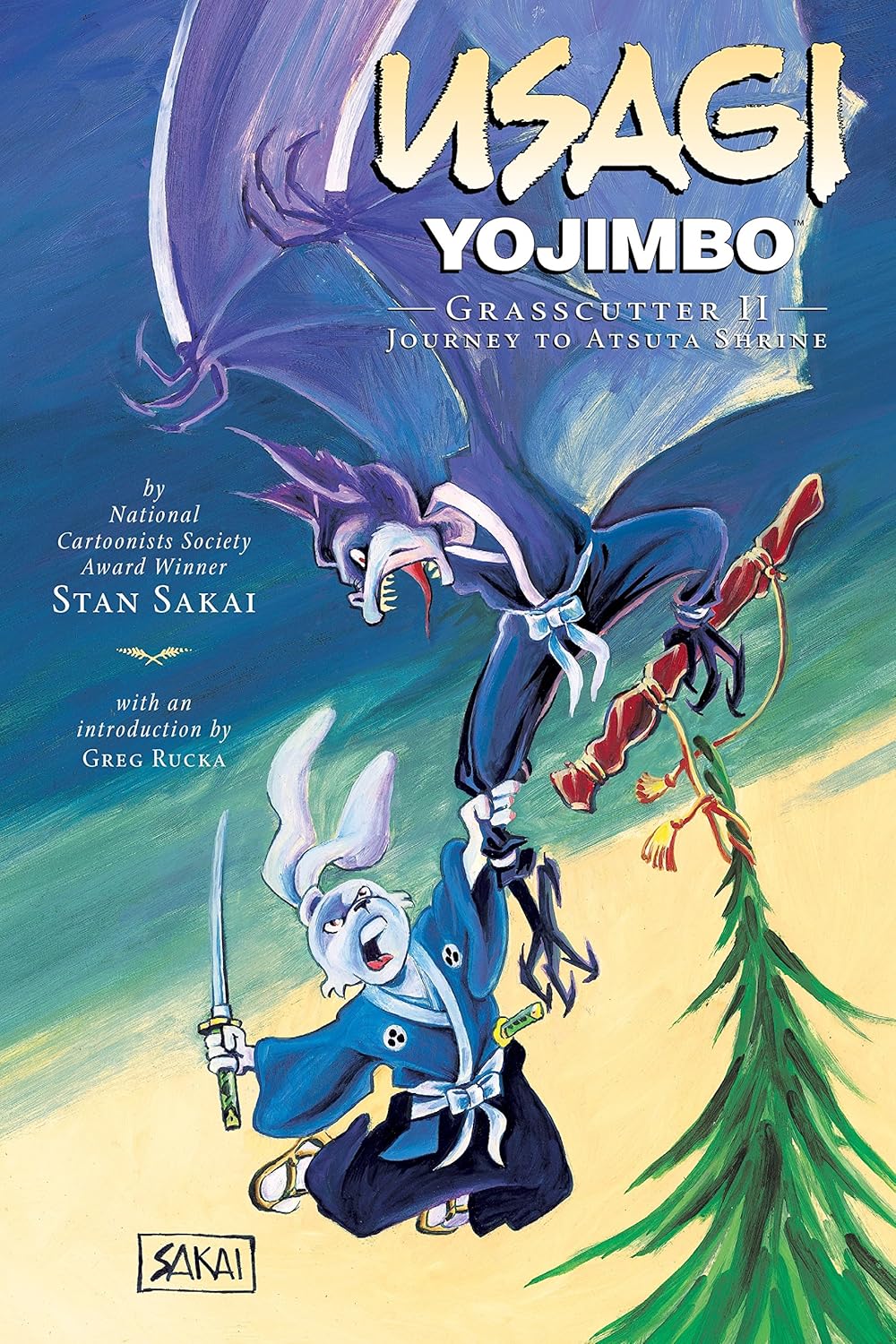
Usagi Yojimbo: Volume 15: Grasscutter II- Journey to Atsuta Shrine by Stan Sakai

Publisher: Dark Horse Comics (Paperback – 1 February 2002)

Series: Usagi Yojimbo – Volume 15

Length: 184 pages

My Rating: 5 out of 5 stars

Amazon

The classic adventures of Usagi Yojimbo continue as I look back at the 15th brilliant volume, Grasscutter II – Journey to Atsuta Shrine, one of Stan Sakai’s more ambitious and powerful comics, which sees the protagonist and his friends caught up in the tides of fate and history.

Ever since I read the recently released 40th volume of Stan Sakai’s iconic Usagi Yojimbo comic series, The Crow, I have been in a major Usagi Yojimbo mood, so I decided to go back and continue reviewing the older volumes of this classic comic, which follows a rabbit ronin in a version of Feudal Japan populated with anthropomorphised animals.  I reviewed the first 14th volumes during COVID lockdown, and had a lot of fun doing so, especially as Usagi Yojimbo is one of my favourite comic series.  I have been meaning to restart reviewing the older comics for a while, and I’m not going to throw away this sudden surge of creative energy, so this is the perfect time to bring out my review for the 15th volume in the series, Grasscutter II.
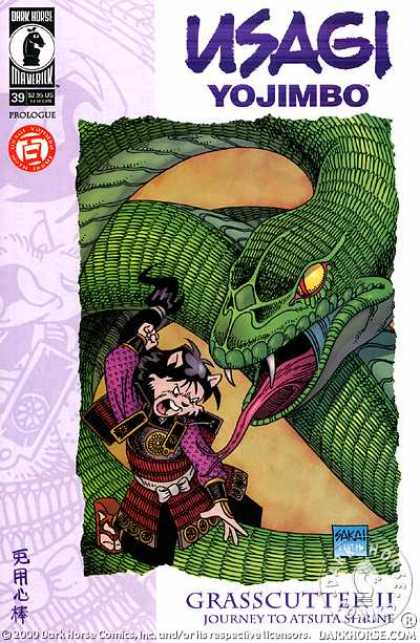
Grasscutter II is one of Sakai’s most impressive comics in the series.  Featuring issues #39-45 of the first Dark Horse Comics run on the Usagi Yojimbo series, Grasscutter II serves as the gripping sequel and conclusion to the intense and pivotal story contained in the 12th volume, Grasscutter.  This previous volume saw Usagi and his friends become embroiled in the recovery of the legendary sword Kusanagi and the foiling of a major plot to rebel against the Shogun.  A dark and compelling entry in the series, Grasscutter featured an amazing story with major implications for the Usagi Yojimbo series.  This was such a key volume, and it is interesting to see how Sakai follows it up here, especially as he needed to make Grasscutter II’s story in just as epic, if not more impressive.

Following dark events of magic and death, few people are aware that the legendary Imperial sword Kusanagi has been recovered from the sea.  Forged by the gods and wielded as a symbol of Imperial authority for generations, Kusanagi, or the Grasscutter sword has the potential to reshape the power structure of Japan, as whoever holds it could rally all the country to their cause, bringing war and destruction to a currently peaceful nation. 
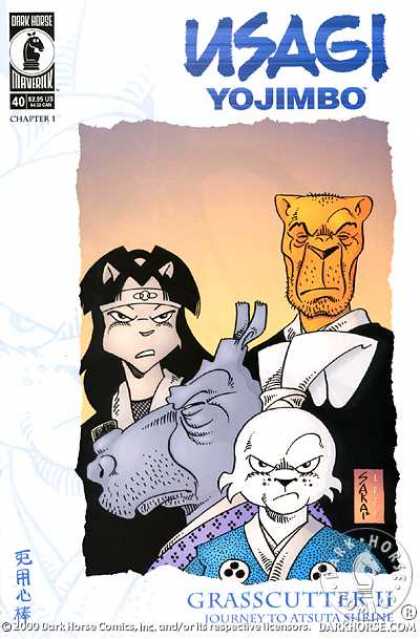
Hidden at a small temple, the sword is currently guarded by the honourable samurai Miyamoto Usagi, the irrepressible bounty hunter Gen, and the head priest Sanshobo.  However, the three know that they cannot keep the sword hidden for long, with dangerous foes seeking to uncover its secrets.  The only place that the sword will be truly safe and out of the hands of those who would use it for political gain is the sacred shrine of Atsuta, where a replica of the sword currently rests.

Embarking on a noble quest, Usagi, Gen and Sanshobo hope to sneak the sword to the shrine before anyone knows they have it.  However, the road to safety is long, and it soon becomes apparent that dangerous foes know exactly what they are carrying.  Pursued by two rival ninja clans who will stop at nothing to possess the sword as fuel for their own dark ambitions, Usagi and his comrades will need to fight tooth and nail to survive and keep the sword out of their hands.  But with old friends and new bitter rivals revealing themselves, can even Usagi and his skilled companions avoid the tragedy that stalks them?
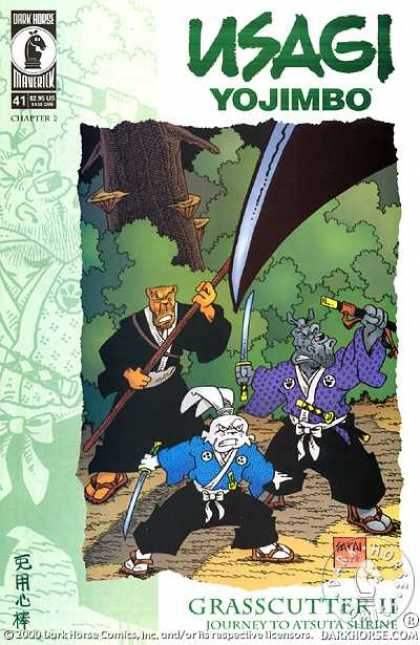
Grasscutter II was an epic and captivating classic entry in one of the best ongoing comic series.  Serving as an effective follow up to the bloody events of Grasscutter, Grasscutter II blended together a ton of outstanding action with some great character moments to create a memorable and beautifully drawn addition to the series that gets a very easy five-star rating from me.

This 15th volume of the Usagi Yojimbo series has a very gripping and intense storyline that seeks to combine Japanese history and mythology with the author’s action-packed style.  Starting with a beautifully drawn prologue that gives some interesting historical and mythological context to the sacred shrine of Atsuta, Sakai quickly moves into the main story, with Usagi, Gen and Sanshobo starting their journey to the shrine after being forced to protect the sword in the previous volume, Demon Mask.  At the same time, two rival bands of ninja, the Komori ninja and Neko ninja, discover that the existence of the sword and move quickly to intercept the companions, hoping to claim it for their own conflicting reasons.  The Neko ninja, led by Chizu, who has a complicated history with Usagi, catch up to the protagonists around the same time as the Komori ninja, leading to a wild three-way brawl.  Forced to work together, Chizu joins Usagi and his friends to recover the sword, which raises some interesting conflicts and issues, especially as Chizu has very different plans for the Kusanagi sword.
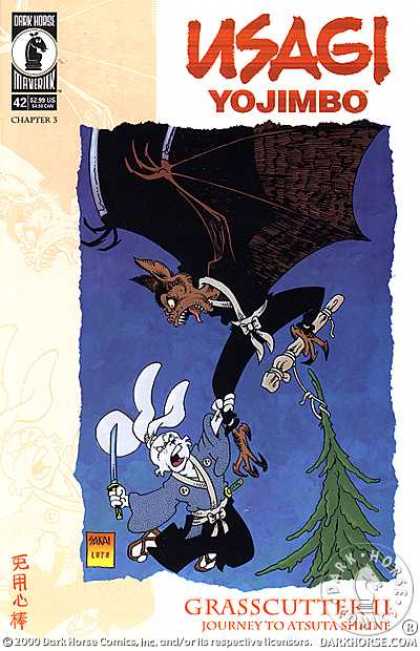
The second half of Grasscutter II is epic the entire way through, as Sakai continues to feature impressive action, while also allowing several character arcs to develop and conclude in tragic ways.  This includes the companions meeting up with the excellent supporting character Ikeda, who had such a great redemption arc in the previous Grasscutter volume.  Following some initial betrayal from Chizu, Usagi, Gen and Sanshobo follow her and enter battle with the Komori ninja, which ends in a dark moment of honour and loyalty from another interesting supporting figure.  While this initially seems to wrap up the main story, a fun twist ensures that Grasscutter II enters a fantastic concluding arc that sees that protagonists enter one last battle before achieving their goal.  This big battle is one of the most brutal and intense in the entire volume, and results in the book’s final tragic moment, which proves to be a fitting end to one amazing figure.  Loaded with powerful emotion, sacrifice and grief, this ending to Grasscutter II wraps up the entire story perfectly and ensures you are hooked all the way to the final blow.

This was another great volume from Sakai that successfully pushes the overall narrative of the series onwards and results in some intriguing changes to the comics, both in this book and the future.  As with all of Sakai’s work, Grasscutter II features a great combination of action, intrigue, character work and beautiful art that comes together perfectly to create an exceptional comic that is impossible not to finish in one sitting.  There are some truly great moments in Grasscutter II that help to make it stand out amongst Sakai’s other outstanding work, including the cool battle sequences.  The various scenes that feature the protagonists caught between two different schools of ninja were the best, and Sakai had fun showcasing the scary fighting ability of the blade-winged Komori ninja, as well as the established tricks of the Neko ninja.  This fantastic clash of styles allowed for some brilliant sequences, which were so damn epic to see unfold.  While I had a lot of fun with Grasscutter II, I must say that it probably isn’t the best volume of Usagi Yojimbo to start the comic on.  While Sakai does a good job revisiting some of the key plotlines and characters, you probably should read the previous Grasscutter volume to fully appreciate the plot, as well as some of the other earlier volumes to understand some of the character arcs.  Still, this is a very impressive Usagi Yojimbo entry, and a key read for established fans of the series who will have an exceptional time with Grasscutter II.
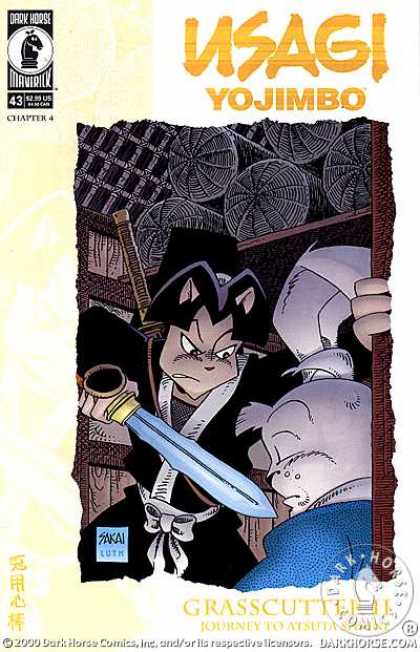
While fans will probably enjoy Grasscutter II’s exceptional action the most, I personally thought that it was some of the great character work in this volume that helped to make it particularly good.  Thanks to the volume featuring one extended storyline, Sakai takes his time to set up some outstanding character moments that work perfectly alongside the complex narrative and cool artwork.  While Usagi and Gen are their usual fun selves (there opposing views on honour, duty and what is right is always fun), I thought it was several returning supporting characters who really stole the show in Grasscutter II, especially as Sakai wove some great storylines around each of them.  This includes the former samurai turned monk Sanshobo, who has been an excellent recurring figure since his introduction in the series’ 10th volume, The Brink of Life and Death.  Not only does he mesh well with Usagi and Gen, acting as a voice of reason between the two strong-willed characters, but Sakai also brings one of his main character arcs full circle when he encounters his former lord.  Sanshobo has some great moments in Grasscutter II, especially his grief at the end, and I liked how Sakai utilised him as part of the main trio.

Another impressive character in Grasscutter II is Ikeda, who Sakai has built up as a wonderful figure.  Introduced in the moving story, The Patience of the Spider (contained in the 11th volume, Seasons) and expanded on in the first Grasscutter story, Ikeda is a former lord and general who learned to enjoy the quiet life of a peasant after his defeat.  Reunited by chance here with his former retainer Sanshobo, Ikeda proves to be an interesting addition to the cast.  Not only do his insights into the Neko ninja, who he greatly distrusts due to his history with them, result in a key plot point, but he is also once again tempted to achieve power, something he decides against in a great continuation of his storyline.  However, it is in the final sequence where Ikeda’s full character is revealed, where he serves as a willing rearguard to the companions to ensure the Neko ninja don’t get the Grasscutter sword.  His big battle sequence is very well portrayed, especially with how Sakai features his old war wound, and his final scene is one of the most badass inclusions in any Usagi Yojimbo comic.  An extremely well-written and complex character who is used to his full potential in this last appearance.
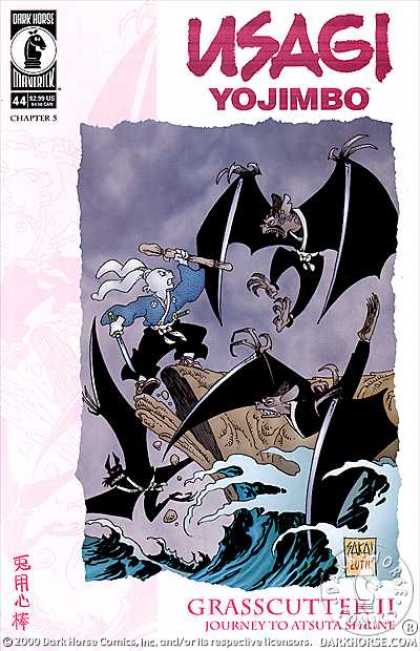
The final characters I want to mention are the various members of the Neko ninja who appear in this volume, primarily as antagonists.  Long-time opponents of Usagi, the Neko ninja represent the more classic ninja styles in the Usagi Yojimbo universe and prove to be great foils to the protagonist’s samurai style.  This includes their leader, Chizu, who has a long and complicated history with Usagi.  Simultaneously serving as both an alternate protagonist, antagonist and potential love interest to Usagi, Chizu has a lot of storylines in Grasscutter II, which Sakai makes full use of.  Forced to hunt for the Grasscutter sword against her better judgement, Chizu desires nothing more than to throw the sword back into the ocean to keep it out of anyone’s hands, and will betray anyone, including Usagi for that goal.  This results in some intriguing personal issues amongst the protagonists, especially as Usagi tries to see the best in her, while Gen forms an instant, mutual dislike of her.  Chizu’s inner conflicts become a key part of the plot, and her appearance here will have major impacts for her storyline going forward, especially when it comes to her ambitious number two, Kagemaru, who has been angling for power for several volumes now.  Kagemaru proves to be a ruthless alternate antagonist in Grasscutter II, and I liked how well Sakai set him up as both a physical and political threat going forward.  The final Neko ninja character I should mention is Saru, a former member of the clan betrayed by Kagemaru in the previous volume.  Seeking revenge on Chizu, who Saru believes was behind the betrayal, Saru stalks Chizu for much of the volume, resulting in some excellent sequences of ninja-on-ninja violence.  A compelling figure, Saru ends up redeeming herself in a particularly moving sequence and makes an impact despite her relatively short appearance.  These great ninja characters, and indeed the entire case of Grasscutter II, deeply enhanced the impact of the comic’s narrative, and I had an outstanding time seeing their arcs unfold.

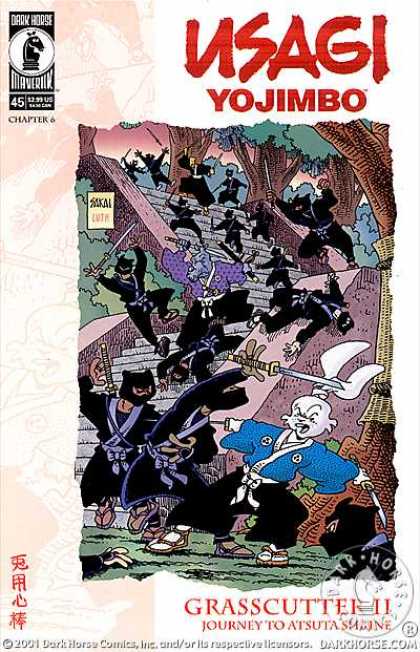
As with all the Usagi Yojimbo comics I review, I must highlight the outstanding artwork that is such a brilliant feature of Grasscutter II.  Featuring Sakai’s classic pre-colour style of drawing, Grasscutter II’s art is very visually impactful, and I loved the fantastic black-and-white panels that cleanly show the complex actions and characters.  Every panel is extremely striking, and I love how effectively Sakai showcases everything in such detail, including the actions of his many characters.  I am always impressed with how well Sakai implies movement and activity with his drawings, and you really get the flow the scene from his panels.  I particularly appreciate how well the intense fight sequences come across in Grasscutter II, especially as there are so many scenes of carnage that occur within this volume.  The various battles, which usually involve a range of ninja, are so well drawn, and I loved the complex array of combat that flitters along the pages.  Some of these scenes are quite elaborate, and I loved seeing all the multiple black-clad figures moving around the established cast, especially in some of the bigger fight sequences.
In addition to great fights, Sakai does a great job capturing the emotive nature of his cast with his fantastic drawings of the major characters.  The intense reactions of many of his characters help to make the scene pop, and I love how well Sakai showcases the emotional range that the story elicits.  Highlights include the final face of one badass warrior while the grief of another usually calm figure really hammers home the seriousness of the moment.  All this amazing action and great character drawings is perfectly supported by Sakai’s trademark drawings of the picturesque Japanese landscapes, towns and temples that serve as an amazing backdrop to the main story.  Sakai has some real talent of showcasing Feudal Japan with his artwork, and you can often feel the world through which the characters are trapsing.  I particularly appreciated Sakai’s portrayals of a wild oceans beneath a ragged cliff, which was a setting for several of the volume’s more visually powerful panels.  The harsh waves striking around the combatants was especially impactful, and you could almost feel the wave’s strength as the characters fight at their edge.  Throw in Sakai’s interesting take on a classic Japanese legend at the very start of the volume in the prologue and Grasscutter II’s art comes together in a truly perfect manner, especially as this volume features some of the artist’s most ambitious fight sequences.

Based on my rambling paragraphs above, I think it is safe to say that I had an amazing time reading the 15th Usagi Yojimbo volume, Grasscutter II.  Featuring the exceptional storytelling and artwork of the legendary Stan Sakai, Grasscutter II achieves so much with its ambitious plot, long-term, character driven storytelling, and amazing sequences of combat and chaos.  A brilliant, classic addition to a truly incredible comic series, Grasscutter II comes highly recommend, and I had such a great time getting through it yet again.

Amazon

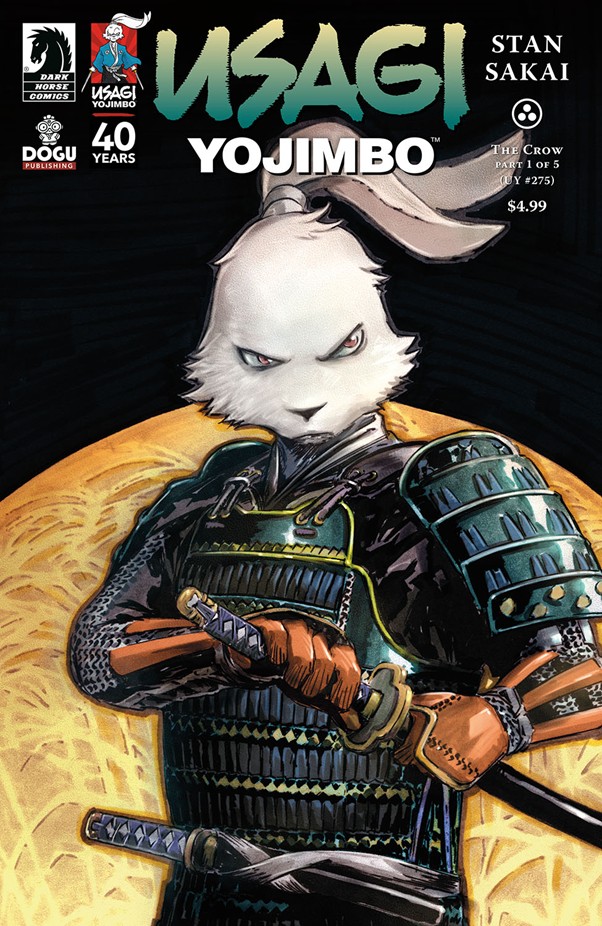
Usagi Yojimbo: Volume 40: The Crow by Stan Sakai

Publisher: Dark Horse Comics (Paperback – 21 January 2025)

Series: Usagi Yojimbo – Volume 40

Length: 152 pages

My Rating: 5 out of 5 stars

Amazon

Stan Sakai’s iconic Usagi Yojimbo comic series powers through to its 40th volume, with the compelling and action-packed collection, The Crow, which proves to be another intense and impressive read.

Readers of this blog will know that I have a lot of love for the amazing Usagi Yojimbo series by Stan Sakai, which has remained one of my favourite comic series for years.  Following a rabbit ronin in an alternate version of Feudal Japan populated by anthropomorphic animals, the Usagi Yojimbo series combines cool art and great characters with a fantastic Japanese samurai aesthetic to create a particularly awesome comic series.  I love the various elaborate stories and scenarios that Sakai comes up with for the Usagi Yojimbo comics, and it is a real highlight of my reading year to check out the new Usagi Yojimbo volume.

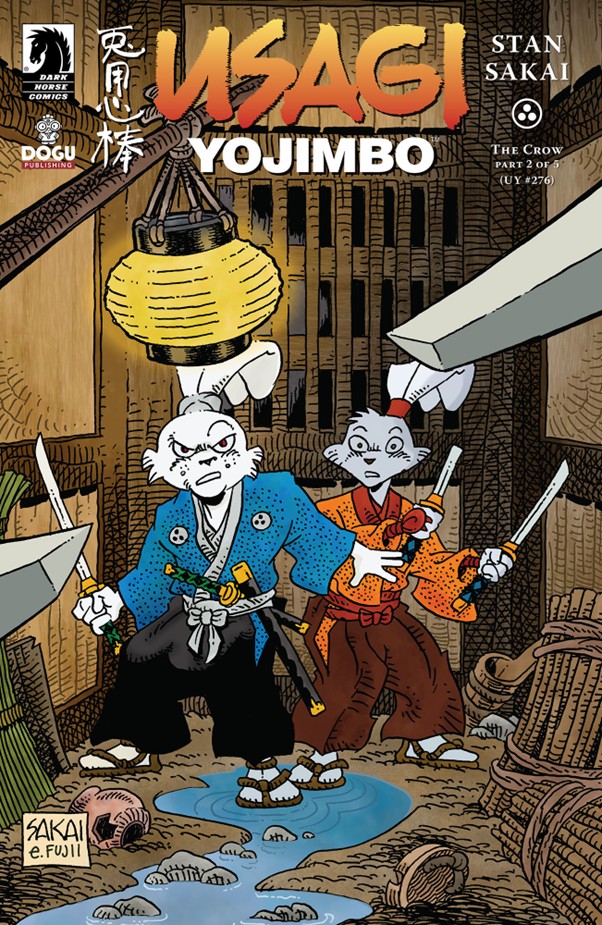
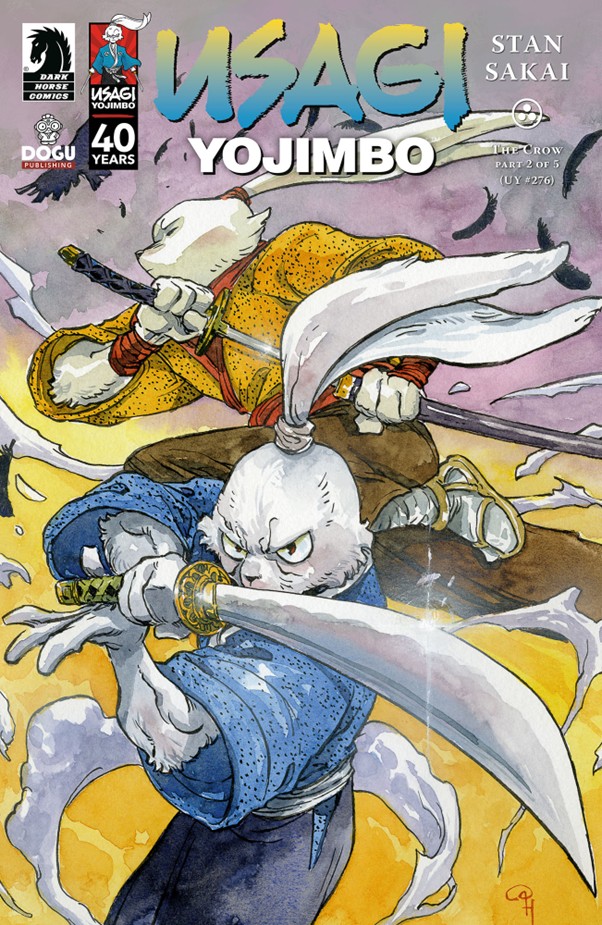
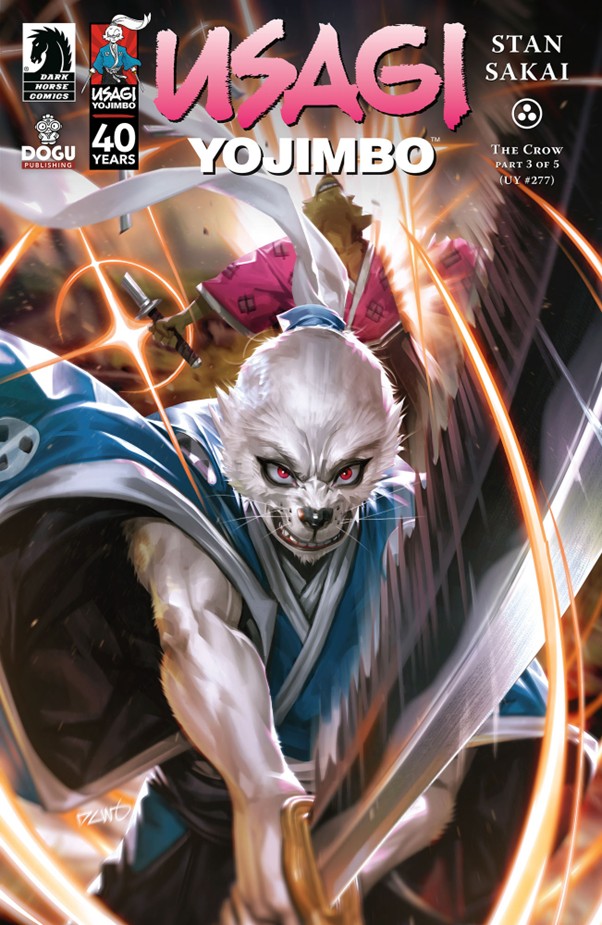
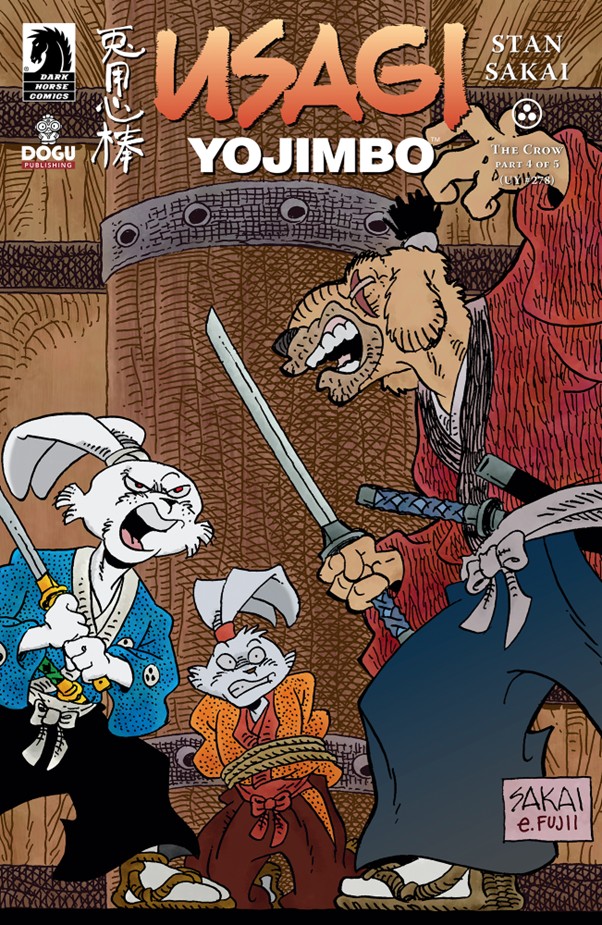
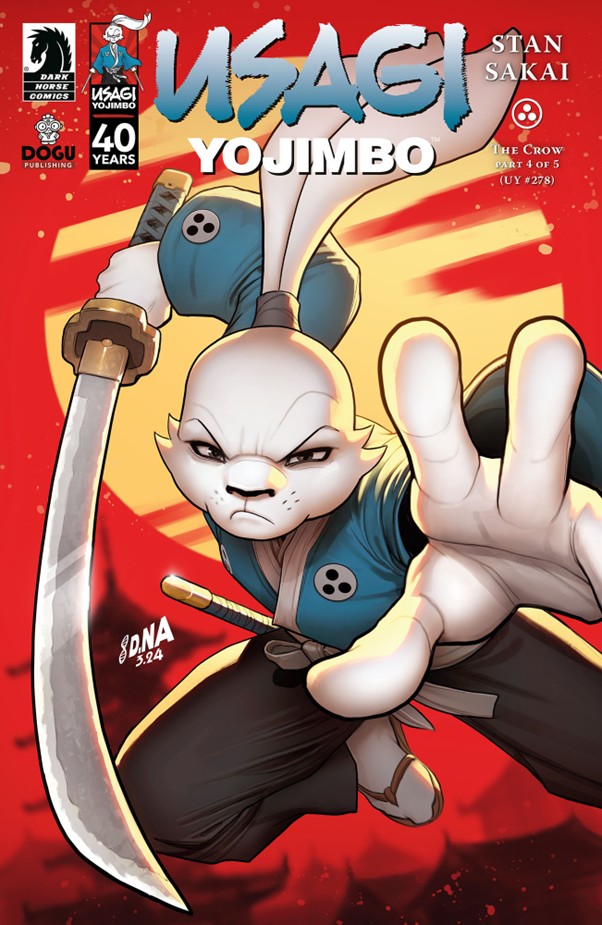
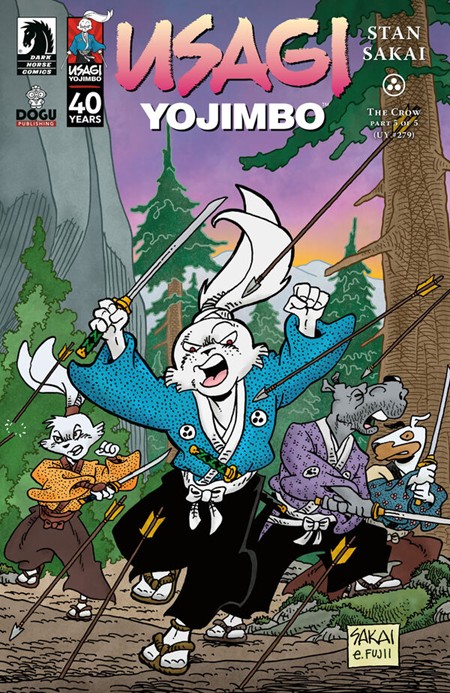
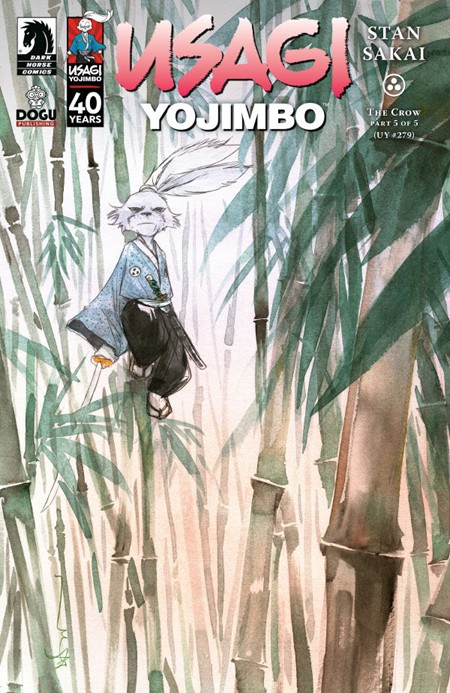
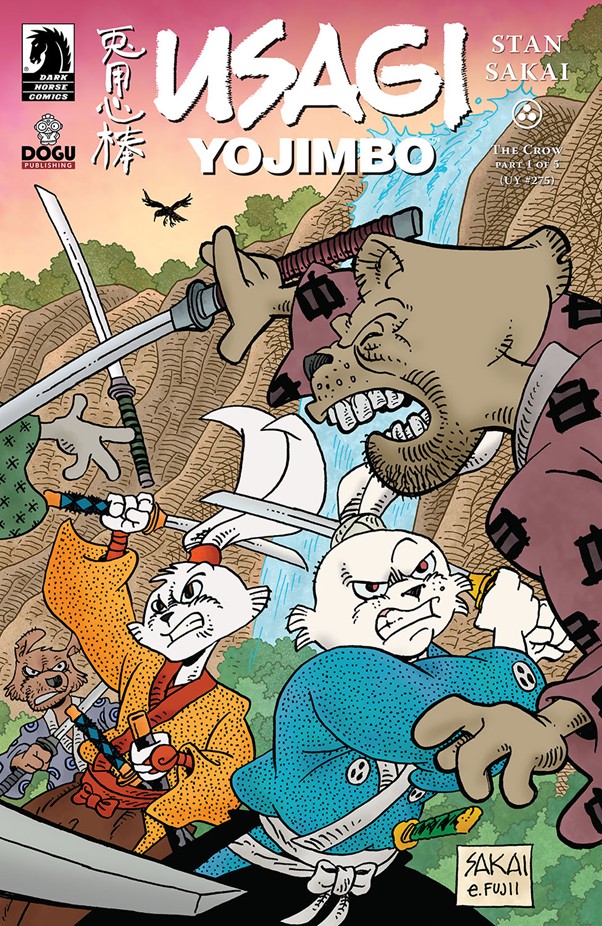
This latest volume, The Crow, is the 40th collected volume of the long-running Usagi Yojimbo comic and contains issues #275 to #279 of the series.  This is the second volume of the current Dark Horse Comics run of Usagi Yojimbo, which started last year with volume 39, Ice and Snow (one of my favourite books of 2024), and continues some of the ongoing storylines from the other recent volumes.  This volume is once again written and drawn by Sakai, with Hi-Fi Colour Design colouring in Sakai’s illustrations.  The Crow was another interesting addition to the series I was really looking forward to, as it follows Usagi and his unlikely companions into deadly danger.

Following their encounter in the mountains with the murderous Jei, Miyamoto Usagi and his cousin, Yamamoto Yukichi, have finally escaped the freezing north of Japan and have journeyed to warmer climes.  However, just because they are out of the ice and snow doesn’t mean they have escaped trouble.

Closing in on the nearest town, Usagi and Yukichi come across a man being attacked by four ruffians.  Interceding in the fight and driving the attackers off, Usagi and Yukichi initially believe that the man they rescued was a merchant being robbed.  However, when they arrive at their destination, they find the place overrun by disreputable bounty hunters on the hunt for a big reward, including Usagi’s old companions Gen and Stray Dog.  Once again conned into paying for lunch, Usagi and Yukichi are shocked to discover that the focus of the bounty hunters’ attention is the person they saved, a dangerous bandit warlord known as Jimmu due to his crow companion.

Despite their intentions to avoid the hunt for Jimmu, the two rabbit ronin find themselves dragged into the fight by the deadly mercenary Inuyoshi, another acquaintance of Usagi who is also seeking Jimmu’s bounty.  Initially forced into conflict with Inuyoshi, Usagi and his friends soon find themselves unlikely allies of Inuyoshi’s bounty hunter band, as they must work together to take down Jimmu and his massive bandit army.  But with skilled warriors on both sides, and no mercy on the horizon, will Usagi and his associates survive unscathed?

The Crow was another exceptional comic from Sakai, who continues his Usagi Yojimbo series with masterful style.  Featuring one major story that pitted the protagonists against an array of deadly warriors, The Crow had me hooked from the very beginning, and I finished the entire volume within an hour of getting my hands on it.  An outstanding comic with great art and some brilliant character arcs, The Crow unsurprisingly gets a full five-star rating from me and was so damn good.

I felt that The Crow had a particularly strong story behind it, as Sakai continues his recent trend of featuring a single multi-issue story in the volume, rather than a series of smaller short stories like in many of his earlier volumes.  This allowed the author to produce a complex, interwoven narrative that features several intriguing character-focused storylines.  Featuring the old classic start, with Usagi and Yukichi rescuing a traveller from assailants, you are drawn into familiar Usagi Yojimbo ground of bandits and bounty hunters, as the rabbit samurai encounter two of Usagi’s oldest companions, the money-focused Gen and Stray Dog.  This allows for some excellent early story tension, as the naïve and highly honourable Yukichi clashes with the morally flexible and cynical bounty hunters, especially when they discover that the traveller Yukichi helped was the notorious bandit chief Jimmu.  Sakai quickly moves the story into its central arc, when Yukichi is kidnapped by returning figure Inuyoshi, who seeks to keep Usagi, Gen and Stray Dog out of his hunt for Jimmu.

This kidnapping arc proved to be quite interesting, especially as the formerly honourable Inuyoshi verbally clashes with Yukichi and is forced to find his honour in the face of betrayals within his own gang of bounty hunters.  I really enjoyed some of the compelling interactions between some of the cast in the central part of the story, and Sakai cleverly works events so that Usagi and his friends can find and rescue Yukichi.  This central part of the story also features some great action sequences, especially a brutal, multi-page ambush by Jimmu who robs a merchant convoy.  The revelation about the true size of Jimmu’s bandit army inevitably results in Usagi’s group teaming up with Inuyoshi to find and defeat Jimmu, which results in a massive battle that takes up most of the final quarter of the volume.  This battle was everything you could hope for, and Sakai is in fine form with his drawings as he portrays the various fights.  The final duels between bounty hunters and Jimmu have some outstanding and memorable moments, and Sakai ensures there is some powerful tragedy that will live with a certain protagonist.  Sakai ensures that all the key character-driven story arcs are well wrapped up, and there are some touching moments that perfectly define some of the major protagonist’s personalities or struggles in this volume, which I felt made The Crow really stand out.  A very impressive overall story from Sakai, that shows just how interesting and intense his writing can be, even when he returns to his well-trodden tales of bandits and bounty hunters.

One of the things that I felt Sakai did particularly well in The Crow was to feature an array of great characters, whose combined arcs come together extremely well in the context of the larger story.  There is an awesome collection of characters in this volume, including old favourites, returning one-shot figures, and some intriguing new characters who proved to be excellent additions to the overall story.  Sakai does an excellent job balancing a number of these character storylines within the course of The Crow’s four issues, and there are some moving and compelling moments as a result.

A lot of the volume focuses on the three longer-term recurring members of the cast, Gen, Stray Dog and Usagi himself, who are the veteran presence in The Crow.  While they are featured quite prominently, Sakai doesn’t provide a massive amount of development for them, as they mostly fall into the same routines as they previously have, with Gen being the money-fixated conman, Stray Dog being the seemingly selfish and unfriendly killer, while Usagi is his usual honourable self.  I did like how Sakai once again painted Usagi more as a mature and world-weary figure, especially when compared to Yukichi, and it was interesting to see how much more realistic he is here than in some of his earlier encounters with Gen and Stray Dog.  Sakai also has fun once again featuring the dichotomy of Stray Dog, whose selfish outer-shell is cleverly balanced by his actual charitable actions, which are used to great effect for a secondary character towards the end of the volume.  Finally, Gen was his usual self, although considering how fun that is, I was happy with the result.

While these three long-running figures were well utilised, I felt that Sakai did his work with two more recent, returning additions to the Usagi Yojimbo universe with Yamamoto Yukichi and the mercenary Inuyoshi.  Yukichi, Usagi’s cousin introduced in volume 36: Tengu War!, has proven to be an interesting traveling companion for the protagonist, especially as he is very similar to a younger Usagi.  His naivety and unbending belief in honour without compromise is on full display in this volume, especially in his first interaction with Gen and Stray Dog, and it is interesting to compare him to the now more flexible Usagi.  Inuyoshi on the other hand is an intriguing figure who was introduced in the story The Sword of Narukami in the series’ 27th volume, A Town Called Hell.  A formerly honourable samurai betrayed by his lord’s heir, Inuyoshi has become a much more deadly and disreputable figure since his last encounter with Usagi.  I really liked how Sakai devolved Inuyoshi since his last appearance, both in his art and personality, as while he still maintains some of his honour, he has become even more ruthless, going so far as to capture Yukichi to keep Usagi and his companions away.  These two characters are in a way antithesis of each other, with one strictly holding onto samurai ideals while the other has abandoned them and is now more interested in money and survival.  The two play off each other extremely well, despite some major fractious moments, and I liked how they both gain something from the experience, with Yukichi getting a lesson in the real world, while Inuyoshi remembers some of his old honour.  Inuyoshi’s appearance here also perfectly wraps up some of the open storylines from The Sword of Narukami, and I appreciated that Sakai finally provided some closure for a one-off tale from several years ago.

Aside from these great major characters, Sakai rounds out the cast of The Crow with some additional fun figures who each add some fantastic elements to the comic.  The volume’s main antagonist, Jimmu, proves to be a ruthless and competent outlaw leader, and I liked how his crow companion gave him a distinctive edge and allowed for some intriguing and well-drawn battle scenes.  The street urchin, Isamu, was a great mischievous figure who reminded me of a young, but brave, version of the recurring Snitch character.  Isamu has some fantastic interactions with some of the main characters, and it wouldn’t surprise me if we see more of him in the future.  Finally, Sakai has fun including a comedic merchant duo who get caught up in one of Jimmu’s raids.  Their entertaining banter during several scenes had me chuckling, especially when their newly discovered brotherhood is ruined by some ill-matched confessions, and they provided an excellent bit of humour amongst the darker story elements.  These great characters all filled their roles perfectly, and I deeply enjoyed how effectively Sakai utilised them in this fantastic narrative.

As with all the Usagi Yojimbo comics, I really need to highlight Sakai’s exceptional artwork featured within The Crow.  Sakai does another remarkable artistic job in this latest volume, and the comics are just gorgeous as he effortlessly brings his elaborate stories and characters to life with his amazing drawings.  All the characters are lovingly drawn, and their resultant actions, especially the cool battle sequences, are so intense and expressive.  I was particularly impressed with Sakai’s portrayal of rival samurai Inuyoshi, who had previously appeared once some years ago.  It was absolutely fascinating to see how Sakai’s drawing style has changed in the intervening years (I had a look at A Town Called Hell after reading The Crow), as Inuyoshi has so much more detail and depth in this appearance.  His scarred and somewhat more deranged appearance perfectly matched his darker personality, and I really think that he looked even more impressive in colour, which has only been a recurring feature since volume 34, Bunraku and Other Stories

These excellent character drawings are only matched by Sakai’s superb landscape drawings, which provide beautiful and powerful pictures of the story’s background setting.  These background drawings, whether they be depictions of historic Japanese towns or of the shaded natural forests, come across extremely well, and you really feel yourself becoming immersed in the setting as a result.  I must once again mention the awesome action scenes scattered throughout The Crow.  Sakai is a master of drawing epic sword clashes in his comic style, and you can feel every thrust and cut that the various samurai characters make.  Highlights for me this time included two massive group battle sequences that each have their own fantastic moments, cool duels against the bandit leader and his bird companion, and a somewhat graphic but very well-drawn decapitation panel which was both epic and gnarly.  This art once again perfectly enhances and compliments Sakai’s outstanding writing, and I love how even after 40 Usagi Yojimbo volumes, Sakai is still producing such masterful and moving pictures.

Stan Sakai continues to impress and wow me with his outstanding Usagi Yojimbo comic series.  This latest volume, The Crow, was another captivating comic, loaded with striking drawings, intense action, and some excellent samurai characters.  I felt that The Crow was a particularly strong entry in this always incredible series, and I am so very glad we were gifted a volume this early in the year.  I am hoping that we will get another volume later in 2025, but until then, do yourself a favour and make sure to check out the first exceptional 40 volumes of one of the best ongoing comic series.

Amazon

Throwback Thursday: Usagi Yojimbo: Volume 14: Demon Mask by Stan Sakai

Usagi Yojimbo - Demon Mask Cover

Publisher: Dark Horse Comics (Paperback – March 2001)

Series: Usagi Yojimbo – Book 14

Length: 224 pages

My Rating: 5 out of 5 stars

Amazon

Welcome back to my Throwback Thursday series, where I republish old reviews, review books I have read before or review older books I have only just had a chance to read.  In this latest Throwback Thursday I once again dive into the awesome and elaborate world of Usagi Yojimbo as I check out the 14th epic volume, Demon Mask.

It feels good to be on a Usagi Yojimbo review streak here at The Unseen Library, and I have been having a lot of fun diving into some of the awesome middle volumes of one of my absolute favourite comic series.  My last two Throwback Thursday reviews of the 12th Usagi Yojimbo volume, Grasscutter, and the 13th volume, Grey Shadows, were really fun to pull together, and I really had no choice but to also have a look at the 14th volume this week with Demon Mask.

Usagi #31

Demon Mask is another excellent addition to the Usagi Yojimbo series that unsurprisingly gets a full five-star rating from me.  Exclusively written and drawn by Stan Sakai, this impressive entry once again follows the rabbit ronin Miyamoto Usagi as he continues his action-packed adventures through the anthropomorphic animal filled version of feudal Japan this series is set in.  Containing issues #31-38 of the Dark Horse Comics run on the series, as well as a few additional issues from associated magazines, Demon Mask continues the trend of featuring several shorter stories, while also leading back towards the next volume, Grasscutter II, which will contain a big crossover story.  I deeply enjoyed all the cool stories in this volume, and there are some real classics here.

The first story contained within Demon Mask is the entertaining and elaborate tale, The Inn on Moon Shadow Hill.  In this story, a travelling Usagi comes across a mysterious inn surrounded by strange sights and an unusual group of patrons.  The land surrounding the inn is apparently haunted, filled with all manner of monsters, demons and obakemono (haunts), which attracts many wealthy individuals to the safe inn to watch.  However, Usagi is soon drawn into a hefty wager with an arrogant merchant and must travel outside the inn to encounter the haunts and the forces behind them.

This is quite an amusing story that perfectly combines Sakai’s fantastic humour with his love of classic Japanese monsters and haunts.  The entire story comes together really well, first introducing the situation, and then forcing Usagi outside to face the ghosts after making a bet.  The subsequent reveal of the various monsters and creatures is pretty spectacular, and Sakai goes out of his way to include as many uniquely Japanese legendary creatures as possible, especially in one breathtaking and elaborate panel.  I really enjoyed the fun twist that occurred here, especially as it allowed Usagi to win his bet with the merchant, and his over-the-top explanation of what he experienced was pretty damn amusing with all the exaggerated facial expressions and reactions from Usagi and his audience.  This ends on a very satisfying and entertaining note, and The Inn on Moon Shadow Hill ended up being a fantastic and light-hearted start to the entire volume.

Usagi #32

Following on from the first fun story is the touching tale, A Life of Mush.  In this story Usagi encounters a brash peasant boy, Eizo, who wishes to become a warrior to avoid the farmer’s simple lifestyle (a life of eating mush).  However, Eizo soon grows tired of Usagi’s honourable warrior philosophy and attempts to befriend a group of bandits, only to discover that there is more to life and battle than brashness and toughness.  This was a great shorter story that presents an interesting outside perspective on the life of a warrior in this setting.  I liked the comparison between a child’s view of a warrior to Usagi’s intense dedication and spiritual thoughts, which in fairness, does seem a little more boring.  The subsequent events provide a fantastic lesson on perception and life choices, as Eizo and the bandits he encounters discover just how tough a true warrior like Usagi can be.  A compelling and thoughtful addition to the volume, A Life of Mush was a powerful and clever read.

The next story is a shorter entry, Deserters, which brings us back to the iconic Neko Ninja and their leader, Chizu.  Deserters examines a tragic tale of two Neko Ninja, Take and Saruko, who attempt to leave the Neko Ninja and start a new life together.  Captured by their fellows, they are taken before Chizu for trial, and must soon face the treachery and manipulation of Chizu’s ambitious second in command, Kagemaru.  This was another excellent shorter entry in Demon Mask, especially as it combines some quick, but efficient, character introductions, with some inherent tragedy and betrayal.  The result of the story, while a little predictable, ends up being very moving, and you can’t help but feel for the star-crossed lovers.  I also really like how this shorter entry turns out to be an interesting bridging story between several of the plot lines in the 11th volume, Seasons, and some of the big storylines in the next few volumes.  A surprisingly important and powerful story, Deserters is a great read that adds a lot to the overall volume.

Usagi #33

Up next, we have the rather entertaining and fun story, A Potter’s Tale, which makes great use of amusing coincidences to create a fantastic and hilarious story.  A Potter’s Tale sees the notorious thief, Samo, steal a precious jewel from a wealthy merchant and have to stash it.  Choosing an unfired pot in a small pottery shop, Samo makes the vessel distinctive before he is brought in for questioning.  Unfortunately, Usagi is staying with the same family of potters and chaos ensues when Usagi and his friends take a liking to Samo’s inadvertent innovation.

This is a great story that always gets a good laugh out of me when I read it.  While a rather quick story, Sakai manages to achieve a lot with it, setting up the base of the humour quickly and ensuring that the reader becomes invested with both the potters and the caddish thief.  The subsequent fantastic use of surprises, reveals and coincidences results in some amusing scenes, especially when the unlucky thief discovers that he must give up all his ill-gotten loot to fix his mistake.  The reveal that all his endeavours are for naught and his loot has returned to its original owner, in a roundabout way, is pretty entertaining, as is the ironic comeuppance he gets for his actions.  Sakai makes sure to enhance this story by featuring a compelling look at traditional Japanese pottery making (I love it when he examines authentic Japanese industries or art forms), and there are some beautiful sequences drawn as a result.  Easily one of the most entertaining stories in this volume, I deeply enjoyed A Potter’s Tale, and it is always guaranteed to crack me up.

Usagi #34

Sakai follows this funny story with another shorter entry, The Missive, which sees Nakamura Koji’s request for a duel reach Usagi’s master, Katsuichi.  Reflecting on the matter of honour brought before him, Katsuichi remembers a moment from Usagi’s childhood and the lessons it contains.  This was another quick but excellent entry from Sakai, which once again highlights how much he can do with only a few short pages.  Not only do we get an excellent bridging storyline between a good entry in the 11th volume, Seasons, and another future volume, but you also get an interesting reveal about a major supporting character.  Throw in an amusing childhood tale about a young Usagi, and you have an entertaining and unique entry that helps to break up the flow of the overall volume.

Now we get to the main event of the volume, with the three-issue story, The Mystery of the Demon Mask.  After receiving a dire warning about his future, Usagi ventures into a new town, only to witness a deadly duel between a fellow ronin and a mysterious opponent wearing a demon mask.  Encountering the police, including the venerable Inspector Kojo, Usagi soon learns that the killer, known as Demon Mask, has been targeting and killing ronin around town.  Helping with the investigation, Usagi encounters all manner of potential suspects as he also finds himself firmly in Demon Mask’s sites.

Usagi #35

The Mystery of the Demon Mask is probably the best story in the entire volume, and Sakai has put a lot of effort into developing a powerful and elaborate murder mystery storyline in this unique Japanese setting.  The entire story has a great flow to it, quickly introducing the villain, the murderous Demon Mask, and then introducing Usagi to the various players involved in the investigation.  From there Usagi is thrust into several dangerous situations as Demon Mask stalks him and other masterless samurai around the town.  There are several complex and intriguing characters introduced during this story, each of whom is a potential suspect.  This story ends on a big finale, with Demon Mask exposed as he faces off against Usagi in a deadly duel.  Sakai does a brilliant job of revealing who the killer is, and I really appreciated the various subtle clues scattered throughout the story to set this up.  This ended up being quite a fantastic murder mystery story that works extremely well despite the limitations of the shorter comic form.  The motivations behind the killer are pretty heartbreaking, and I really appreciated Sakai’s portrayal of their madness and grief.  There is an excellent focus on fighting and duels throughout this story, especially as Demon Mask engages several skilled samurai in personal combat, and I loved seeing all these fights unfold.  An excellent entry that has a brilliant balance of mystery, complex characters, classic Japanese elements and comic book action.

Following on from this awesome murder mystery story, we have another intriguing dive into Japanese mythology and monsters with the spooky story, Kumo.  In this story, Usagi, who is eager to reach his friends, takes a shortcut across the mountains and finds himself in an isolated village, surrounded by an unusual number of spiders and an insane amount of webbing.  When the innkeeper’s daughter is kidnapped in an improbable attack, it becomes apparent that something more is haunting the village, and that Usagi’s only hope might be another traveller in town, Sasuke.

Usagi #36

This was another particularly good entry in Demon Mask; I always love Sakai’s more supernatural narratives.  The story premise is somewhat typical, with Usagi arriving in a troubled town that needs his help, this time in defeating the monsters haunting them.  The subsequent conflict with this threat gets pretty wild, not just because of the cool monster (in this case a Spider Goblin and her giant spider minions), but also because it introduces the intriguing side character of Sasuke.  Sasuke, also known as The Demon Queller, is a mystical monster hunter who travels around Japan taking down supernatural threats (no doubt with Kansas blaring in the background).  Sasuke goes on to become a major recurring character within this series, having most recently appeared in the 34th volume, Bunraku and Other Stories (where he does some cool Demon Slayer-esque sword fighting).  However, he gets a very awesome introduction here in Kumo, with Sakai perfectly setting up the character’s mystique, as well as his powerful magical abilities.  This story literally sees Sasuke summon up a giant frog to fight a Spider Goblin, which has so many levels of awesome to it, and I loved seeing the magic on monster fight that ensures.  Another fantastic story that makes excellent use of Japan’s rich spiritual and mythological past, I always have an outstanding time reading Kumo.

The final major story in this volume is the intriguing tale, Reunion.  Usagi returns to the monastery of his friend, priest Sanshobo, only to discover it under attack by brigands, apparently after a rich merchant sheltering inside.  Working with Sanshobo and a recovered Gen, Usagi must find a way to overcome the brigand horde and save the monastery from attack.  However, the real threat may already be inside the walls, and soon Usagi, Sanshobo and Gen must overcome a dangerous enemy determined to take the most precious treasure, the legendary sword Grasscutter.

Usagi #37

Reunion was another fun entry which ended the main Demon Mask stories on a compelling and interesting note.  While a distinctive story itself, Reunion is primarily focused on setting up the events of the following major volume, Grasscutter II.  This presents a fun scenario where Sanshobo’s temple is attacked (again, it honesty gets attacked a lot), while the real danger remains inside the wall.  There are several fun parts to this story, from Usagi’s attempted infiltration of the gang, the many fight scenes against to the bandits, to the dangerous confrontation against the disguised adversaries within the temple.  This proved to be an excellent story, and it was great to see Sanshobo and Gen again, especially as they prepare for their next epic adventure.

While Reunion concludes the main stories, this volume also has a couple of shorter stories that were contained in other publications, such as Dark Horse Presents (vol. 1) #140, Dark Horse Presents Annual #3, Wizard Magazine #3, Oni Double Feature #11, and Dark Horse Extra #20-23.  These short stories provide a couple of quick, highly amusing tales which leave the reader smiling as they close the volume.  Sakai achieves a lot in these shorter stories, and each has an entertaining or moving story, even if they only last for only a page.  The most detailed of these was the entertaining Death and Taxes, which sees Usagi fighting bandits for a conniving and amusingly clever peasant.  There is also the sweet little story, A Funny Thing Happened on the Way to the Tournament, which shows a young Usagi meeting his future friend (and love interest) Tomoe Ame when they were children.  The short but powerful Netsuke sees Usagi reflect on a former comrade, while The Leaping Ninja has a hilarious one-page tale about an acrobatic infiltrator who leaps before he looks.  The final story was the intense Tsuru, which sees Usagi encounter a member of the Koroshi assassins with a love for paper cranes, who has a contract out on Usagi, resulting in a fantastic duel.  Despite their length, each of these stories features all of Sakai’s usual attention to detail and excellent story writing, and it was great to see these excellent examples of the creators shorter writing style.

Usagi #38

I must once again highlight all the incredible artwork featured in this impressive volume, as Sakai continues to showcase all his amazing artistic talent.  Pretty much every panel in this volume is filled with some excellent and powerful art, as Sakai tells his complex tales.  There is the usual brilliant focus on Japanese landscapes and towns, and Sakai has such a talent for capturing all the elaborate cultural elements of the period, as well as the beautiful locations that dotted Japan.  While all the art is really well drawn in this volume, I definitely have to highlight a few panels in particular.  The first story, The Inn on Moon Shadow Hill, has so many great drawings of creatures and haunts from Japanese folklore, and there is one brilliant panel were all of them are they facing Usagi at once.  The spider goblin and her minions in Kumo are also very cool and spooky, and the various scenes where they fight a samurai like Usagi and the magical Sasuke are pretty extraordinary.  I also loved the awesome character design on the antagonist Demon Mask from the main story.  Not only does it bear an interesting similarity to Usagi’s main foe, Jai (who himself is based on a character with distinctive mask), but it looks so dangerous and intimidating, especially when they silently engage in battle.  I deeply enjoyed the exceptional artwork in Demon Mask, and Sakai has once again shown how much feeling and emotion he can portray with his brush and ink.

Another week, another epic and incredible Usagi Yojimbo volume reviewed on my blog.  The 14th volume of this outstanding series, Demon Mask, was another awesome comic as Stan Sakai provides his usual blend of impressive writing, stunning artwork, and powerful characters.  Featuring several memorable and exciting short stories, Demon Mask serves as an excellent and wonderful entry in this wider series, and it is one that I always look forward to reading.  A highly recommended read, Sakai really can do no wrong with this exceptional series.

Amazon

Throwback Thursday: Usagi Yojimbo: Volume 12: Grasscutter by Stan Sakai

Usagi Yojimbo - Grasscutter Cover

Publisher: Dark Horse Books (Paperback – 1999)

Series: Usagi Yojimbo – Book 12

Length: 255 pages

My Rating: 5 out of 5 stars

Amazon

Welcome back to my Throwback Thursday series, where I republish old reviews, review books I have read before or review older books I have only just had a chance to read.  For my latest Throwback Thursday I return to my very favourite comic book as I look at the 12th volume in the epic Usagi Yojimbo series by Stan Sakai, Grasscutter.

Usagi #13

It has been a little while since I covered one of these Usagi Yojimbo volumes in a Throwback Thursday article.  I had a bit of trouble getting this specific volume, which kind of put everything on pause.  Despite my belief that I had a whole collection of the Usagi Yojimbo comics, it turns out I was missing the 12th volume and I honestly have no idea how I could have misplaced my copy (or did I ever really own it? Who knows?).  To fix this oversight, I recently ordered a second-hand copy from Amazon and managed to get it shipped down here from America.  Now that I finally have a full collection, I can get back to reviewing this entire epic series, which is proving to be so much fun.

A quick refresh about this series before we start: the Usagi Yojimbo comics are the incredible work of legendary comic author and artist Stan Sakai, who has been working on this series for nearly 40 years.  Made up of a ton of amazing volumes, the comic is set in an alternate version of feudal Japan populated by anthropomorphic animals.  The series follows the rabbit ronin Miyamoto Usagi, a wandering bodyguard and adventurer who gets involved in all manner of troubles as he faces off against criminals, bandits, ninja, monsters, psychopaths and ambitious lords.  Combining brilliant stories with complex characters, cool action, elaborate scenarios and outstanding artwork, this series is an absolute masterpiece and it is one that I have adored for years.

Usagi #14

The 12th volume of this series is Grasscutter, which serves as a particularly major entry in the entire Usagi Yojimbo line.  Containing issues #13-22 of the Dark Horse Comics run, this volume unusually contains a single story, rather than the multiple shorter, episodic tales typical of this series.  Bringing together several intriguing story threads from previous comics and reuniting several of the more distinctive supporting characters, Sakai tells his most ambitious tale, and the results is absolute magic.

Following a destructive war centuries ago between two rival houses, the nation of Japan is now firmly controlled by the shogun and his court, while the emperor rules only as a symbolic figure, detached from the politics of the realm.  While many are content to live within the shogun’s peace, there are some who seek power and prestige through the return of the imperial family to true power.  But with the full might of the military and the samurai behind him, only one thing could possibly inspire the people to revolt against the shogun: the legendary heaven-forged sword, Kusanagi the Grasscutter.

Usagi #15

However, this divine sword was lost generations ago in the battle that saw the Imperial family overthrown, and it now rests at the bottom of a watery strait, impossible to recover.  Undeterred by the odds against them, a small contingent of rebellious lords have initiated a conspiracy to overthrow the shogun by any means necessary.  Calling upon the powers of a mysterious witch, the conspirators hope to obtain the sword through sorcerous means.  While they succeed in freeing Grasscutter from its watery tomb, fate ensures that the sword ends up in the mostly unlikely of hands, that of the wandering samurai Miyamoto Usagi.

Unsure what to do with the legendary sword, Usagi soon finds himself pursued by the forces of the conspirators and must fight with everything he has to keep it out of their hands.  But the events of this conflict spread far beyond Usagi, and soon everyone he knows is in danger as the conspirators attempt to kill his friends Tomoe and Lord Noriyuki to stop them bringing Grasscutter to the shogun.  At the same time, the bounty hunter Gen and the rogue swordswoman Inazuma as drawn from their own scuffles into the greater battle for Grasscutter, especially when they encounter the feared demon-spearman Jei.  Can Usagi and his friends survive the overwhelming forces arrayed against them, or will the nation be thrown into war once again with the resurgence of the Grasscutter?

Usagi #16

Wow, just wow!  This is such an impressive comic that is so very epic in scope, storytelling and major character moments.  Sakai has done a brilliant job with this cool volume, and I loved the brilliant narrative he cooked up for Grasscutter, especially as it ties into so many major moments from the previous volumes.  Filled with intense action, brilliant set pieces and some beautiful art, Grasscutter is an incredible volume that, unsurprisingly, gets a full five-star rating from me.

I loved the incredible story that Sakai has featured in Grasscutter, especially as, in a departure from the series’ usual style of short stories, this volume features one massive and complex story.  This change in story length works extremely well and ensures that this volume stands out as a major entity in this epic series.  Sakai sets his narrative up carefully, with the initial issues of the comic dedicated to explaining the importance of the sword Grasscutter and how it was lost during a deadly civil war.  After establishing the significance of this weapon, the main narrative quickly gets into full swing, continuing one of the storylines from the previous volume, Seasons, and showing the members of the Conspiracy of Eight working to summon the sword from the bottom of the strait using possessed crabs (it makes sense in context).  As this is occurring, several other intriguing storylines are set up and you are soon following Usagi as he does his usual wandering routine, as well as other great side characters like Gen, Inazuma, Tomeo and Lord Noriyuki, as well as the deadly villain Jei.  Having all these characters caught up in these events makes for quite an interesting and elaborate tale, with each of them getting their own distinctive storyline that slowly merges with the others.  For example, Usagi finds himself in a desperate battle against the forces of the conspirators, Gen attempts to hunt down Inazuma for the big bounty on her head, only to run afoul of bandits and police, Tomoe attempts to save Lord Noriyuki from a treacherous ambush only to run into a far more dangerous foe, while Jei finds himself drawn towards the power of the divine sword.

Usagi #17

All these storylines come together extremely well as the story proceeds, often in some explosive and action-packed ways.  Usagi, in his pursuit of the sword, finds himself once again teaming up with Gen, only to run right into Jei when he is at his most dangerous.  Meanwhile the intense storyline surrounding Tomeo and Noriyuki has some large set pieces as the two attempt to escape the army chasing after them.  While mostly separate, these two storylines complement each other nicely, especially as the ambush on Tomeo and Noriyuki is due to the conspirators searching for Grasscutter, and it serves as a dramatic side adventure to the main story.  There are some amazing moments here, and I was particularly impressed with the storyline that saw Noriyuki come face to face with his father’s worse enemy in a complicated manner.  The big finale involves the final fight between Usagi and his mortal enemy, Jei, which sees some absolute carnage.  The subsequent damage and the impossible consequences will leave you reeling, and this entire story concludes perfectly, not only bringing the impressive narrative around Grasscutter to a satisfactory end, but also setting up some additional interesting storylines and character arcs.  This entire volume is just so damn epic, and I really appreciate the way in which Sakai journeys back to many of his previous storylines and utilises elements from them here, although it does mean that Grasscutter isn’t a great entry for first-time readers to check out.  The great combination of action, character development and intriguing world-building elements is just exceptional, and this entire comic is brilliant from start to finish.

Usagi #18

One of the main things that I always love about the Usagi Yojimbo comics is Sakai’s use of intriguing elements from Japanese culture and history to compliment his excellent original storytelling.  This is particularly true in Grasscutter as Sakai utilises some of the most iconic parts of Japanese mythology and history as the basis for much of the plot, particularly around the legendary sword Kusanagi-no-Tsurugi (Grasscutter or Grass-Cutting Sword).  Sakai, who has clearly done a ton of research here, produces an amazing interpretation of the origins of the sword, going all the way back to the Japanese creation myth and showcasing the origins of the Kami and their many descendants.  He then goes into the history of the sword, showing its discovery of the sword, the events that resulted in the name change to Grasscutter, before going all the way to the Japanese Civil War (the Genpei War), that saw the rise of the shogunate and the decline of imperial authority.  This ends with a brilliant showcase of the massive and destructive naval battle between the two factions which led to the death of the young emperor and the loss of the sword.  The loss of the sword, as recounted in The Tale of the Heike, becomes a key part of this narrative, and it is so fascinating to see its sudden return be used as a major story element.  Readers unfamiliar with Japanese history or mythology get a brilliant understanding of these cultural elements at the start of the book, and this allows the rest of the story to flow perfectly.  I deeply enjoyed how Sakai brought all these cool moments to life (even if he does simplify it in places for narrative reasons), and it ended up being an exquisite and clever start to the book.  Throw in a very detailed and fascinating notes section at the back from Sakai, explaining his research and how it influenced his story, and you have some exceedingly cool historical elements that are expertly utilised to create an epic Japanese tale.

While I had a lot of fun with the story, action and Japanese cultural elements, one of the main highlights of Grasscutter is the substantial character work that occurs within.  Due to its length and scope, Grasscutter serves as a major part of the Usagi Yojimbo series and as such, it features many of the best supporting characters from the previous volumes.  All these characters get some substantial storylines in this book, either as protagonists or villains, and it was extremely fascinating to see what happened to some of them.  Sakai melds the unique character storylines together into one cohesive and powerful narrative which does an excellent job exploring each of the characters and giving them key moments in their storylines.

Usagi #19

Unsurprisingly, much of the story focuses on the character of Usagi, who serves as the main protagonist of the story.  Thanks to his usual luck, Usagi winds up finding the blade immediately after it emerges from the water and is soon thrust into the midst of the conflict surrounding it.  This immediately puts him in a major dilemma as he is uncertain what to do with the sword, as all the sides who would claim it (the shogun, the emperor, even some of his own friends) would all use it for their own benefit and the nation would likely suffer as a result.  As such he fights incredibly hard to hold onto the blade for everyone’s good, and this forces him into some increasingly desperate battles.  Usagi gets pretty beat up and exhausted throughout this entire ordeal, and his final match with Jei pushes him to the limit and strikes him at his very core.  While he doesn’t get a major amount of development in this story, he still served as a great centre for the plot and it is always fun to follow along on one of his adventures.

You can’t have a major Usagi story without his friend, Murakami Gennosuke (Gen) showing up and trying to get paid.  The rhino bounty hunter has an excellent story which starts when he unsuccessfully tries to claim a bounty on some dead criminals he discovers in the woods.  This almost immediately backfires on him and forces him to deal with all manner of corrupt cops and murderous bandits as he attempts to make a little money.  His misadventures lead him to face off against Inazuma, the deadly swordswomen who Usagi encountered in the 10th volume, The Brink of Life and Death.  Inazuma, a former innocent girl turned sinister killer, is still being pursued by assassins and bounty hunters who want the massive price on her head.  Naturally Gen decides to chase after her, and this results in a pretty brutal fight between the two, which really showcases just how dangerous Inazuma can be.  The subsequent storylines are also fascinating as Gen gets dragged into the fight for Grasscutter by Usagi and Inazuma goes deep into her own soul when she encounters Jei.  This results in some extremely dark moments for both characters, and it was captivating to see what happened to them throughout the volume.  The final reveals about Inazuma and her future are very grim, and it sets up some excellent storylines in the future.

Usagi #20

There are also some brilliant storylines going on around the characters of Tomeo and Lord Noriyuki.  While primarily separate from Usagi and his adventures, Tomeo and Noriyuki find themselves under attack and are pursued throughout the land by murderous assassins and samurai (much like in their first appearance in Volume 1: The Ronin).  Their dangerous journey becomes even more perilous when they run into a familiar face, General Ikeda, the character so perfectly featured in the short story The Patience of the Spider from the previous volume.  Ikeda is a great character in that he is a former general who, after failing to kill Noriyuki’s father in a revolt, has spent the last several years living as a peasant, a simple life he became content with.  However, when he suddenly finds the son of his mortal enemy in his house, he must choose whether to take up the old grudge or forge a new path for himself.  Watching the internal struggle that occurs within Kieda is pretty awesome, and his interactions with the suspicious Tomeo and Noriyuki are just wonderful.  I deeply enjoyed how this story unfolded, and it was some of the best character work in the entire volume, not to mention the most action-packed.

The final major character I really to talk about is the infamous Blade of the Gods, Jei.  First appearing in the third volume, The Wanderer’s Road, the crazed killer Jei has been one of the best villains in this series, constantly following Usagi and trying to kill him (another good story was in the sixth volume, Circles).  Jei and Usagi finally come face to face again in Grasscutter when Jei recovers the sword and attempts to use it for his own dark purposes.  Sakai really goes out of his way to make Jei appear as a deadly badass in this comic, with his first appearance shows him killing an entire detachment of samurai by himself.  His subsequent wanderings see him interact with several other side characters for the first time in the series, and their reactions to his weird aura and power are brilliant.  I loved how the dark Jei is perfectly offset by his companion, the young, innocent girl Keiko, who is the only person Jei cares about and will not hurt.  They have some great moments in this comic, and it is fascinating and troubling to see the interactions between them.  However, Jei’s big moment in Grasscutter is his rematch with Usagi, which has been brewing for ages.  Watching these bitter enemies face each other again is pretty fantastic, and you get some amazing moments during their duel.  The conclusion of their fight is very clever and really alters your opinion about both Jei and Usagi, while also seeming to confirm Jei’s supernatural background.  Watching the pure fear and shock on the usually unflappable Usagi when he encounters the many mysteries of Jei is so awesome, and Jei continues to shine as a brilliant antagonist in this volume.  His intriguing final fate will leave you shocked and surprised as a new version of the character emerges.  All this character work and more really helps to turn this outstanding comic into a true masterpiece, and I have so much love for Sakai’s ability to create such amazing and iconic figures.

Usagi #21

The final thing that I want to highlight is the impressive artwork contained within Grasscutter.  As with all the Usagi Yojimbo volumes, all the art of this comic has been drawn exclusively by Sakai, which is exceedingly impressive.  His drawing skills are amazing on multiple levels as he portrays such complex adventures with a simple yet beautiful style which I have so much love for.  As with most Usagi Yojimbo comics, Grasscutter is filled with stunning drawings, from amazing landscape shots that show off the beauty of the Japanese wilderness, to close-up shots of the deadly battle sequences.  There are some amazing scenes throughout this book, although I personally really enjoyed the fantastic and powerful renderings of key moments of Japanese history and mythology that were featured in the volume’s first two issues.  Everything from the formation of the lands to the events that gave Grasscutter its name is very cool, and Sakai expertly imparts his own style into these intriguing spiritual stories.  The massive battle that ended the civil war is shown in some exquisite detail here, and I loved how he showcased this elaborate and deadly naval fight.  Of course, you cannot forget the brilliant final duel between Usagi and Jei, which was such a highlight of the story.  Sakai goes out of his way to make this fight as epic and as brutal as possible, and you get a real sense of both participants skill and determination to win.  The mystical aftermath of their fight looks extremely awesome as well, and I loved all the intriguing and unique detail Sakai featured here, including the spooky alterations that happened to one of the characters.  Another brilliant artistic outing from Sakai that perfectly supported his incredible storytelling and character work and is some must see drawing.

Usagi #22

As you can no doubt tell from the glowing descriptions above, I deeply enjoyed this 12th volume of the Usagi Yojimbo series.  Stan Sakai was in excellent form when he created the powerful and exciting Grasscutter, which features one of the author’s most impressive and extensive stories.  Featuring all his best characters, his great love of Japanese culture, as well as some impressive artwork, Grasscutter shines as an outstanding entry in this brilliant series, and it is one that cannot recommend enough.

Amazon

Throwback Thursday: Usagi Yojimbo: Volume 11: Seasons by Stan Sakai

Usagi Yojimbo Seasons

Publisher: Dark Horse Books (Paperback – 1999)

Series: Usagi Yojimbo – Book 11

Length: 198 pages

My Rating: 5 out of 5 stars

Amazon

Reviewed as part of my Throwback Thursday series, where I republish old reviews, review books I have read before or review older books I have only just had a chance to read.

It has been a while since I have done a Usagi Yojimbo Throwback Thursday, but after doing a Waiting on Wednesday for the next upcoming volume in this epic series, Homecoming, I was in a Usagi mood and decided to write something extra.  As a result, I check out the 11th Usagi Yojimbo volume by the legendary Stan Sakai, Seasons.

Seasons is a fantastic and spectacular entry in the series that presents the reader with a series of great Usagi Yojimbo adventures that follow the rabbit ronin Miyamoto Usagi as he traverses his version of feudal Japan during the various seasons of the year.  This is a key entry in the series as it sets up a number of storylines for the next several volumes while also introducing some great new characters.  Needless to say, I had an incredible time reading this volume of the series and I have a lot of love for a number of the stories contained within it.  Seasons contains issues #7-12 of the Dark Horse Comics run on the Usagi Yojimbo series, as well as stories taken from the Usagi Yojimbo Colour Special.  This results in 11 separate stories throughout the volume, made up of single-issue entries and a couple of shorter tales, all of which contain an impressive and deeply enjoyable story with beautiful artwork.

USagi #7

The first story featured within Seasons is The Withered Field, an epic story of samurai honour and the warrior’s way.  In this story, Usagi is visiting a famed fencing school with the hope of challenging some of its instructors to test his skill.  However, before he can issue his challenge, all of the school’s instructors are beaten by another ronin, Nakamura Koji, a skilled swordsman who demands a fight with the school’s master.  As he waits for his challenge, Usagi befriends him and discovers that he was once a famed sword master himself, who began the warrior’s pilgrimage after suffering a humiliating defeat at the hands of a mysterious and unconventional swordsman.  Now determined to find this swordsman and rechallenge him, Nakamura Koji shows great interest in Usagi, especially when they must content with treachery from the fencing school.

The Withered Field is an outstanding story that serves as a compelling and powerful start to this volume.  I really enjoyed the amazing narrative that examined honour and martial prowess, with Usagi encountering a famed warrior who is even better than he is.  This great story does an excellent job of introducing the character of Nakamura Koji, who becomes a major figure in some of the future volumes in this series and who has an interesting connection to Usagi and his past.  The entire storyline around the two ronin facing off against the fencing school is extremely cool and action packed, and it appears to take a lot of influence from the second entry in the iconic 1950s Samurai film trilogy (which follows the adventures of Miyamoto Musashi, the historical samurai who serves as an inspiration for Usagi), Duel of Ichijoji Temple, with the students attempting to stop the wandering ronin from defeating their master.  There are amazing action sequences throughout this story, with Usagi and Nakamura Koji engaging in several awesome duels.  I particularly loved the opening sequence where Koji goes through the pre-fight forms before facing off in his sparring match against a fencing school instructor.  The eventual reveal that the samurai who defeated Koji when he was younger was Usagi’s mentor, Katsuichi, comes as little surprise, but it sets up an amazing story later in the series which makes this great story a must read for fans of Usagi Yojimbo.

Seasons’ second story is the thrilling but haunting A Promise in the Snow, which sees Usagi travelling through a snowy mountain pass during the height of winter.  As he trudges along, he comes across bandits attacking an innocent merchant and his servants.  Intervening, Usagi is able to slay all the bandits, but not before they severely wound the merchant.  Usagi finds the merchant’s young daughter and promises to save her father, carrying him back to his village.  However, the mountain passes are treacherous, and Usagi must contend with harsh weather, a pack of hungry wild tokage lizards and a dangerous avalanche.  But no matter what the mountain throws at him, nothing will prepare Usagi for the great shock awaiting him at the end of his journey. 

Usagi #8

This is a great entry in this volume that features a desperate struggle for survival in a dangerous location.  Sakai came up with an epic story for A Promise in the Snow, and I really love seeing Usagi power through great trials and tribulations to keep his promise to a young girl.  There are some beautifully drawn scenes throughout this story, and Sakai does a fantastic job bringing the snowy landscape to life in all its wondrous, deadly glory.  I also loved the way in which Sakai’s drawings highlighted Usagi’s struggles to get through the tough terrain; you can see him get more and more weary with each obstacle he encounters.  This story has a fantastic ending that is reminiscent of a lot of classic ghost tales, and looking back you see that Sakai set this twist up brilliantly, with tons of little clues.  Overall, this was an exceptional story which is a true highlight of this volume.

Next up with have the action-packed, intriguing story, The Conspiracy of Eight.  In this entry, Usagi is visiting the temple of his friend, priest Sanshobo, when an injured samurai wearing the crest of the notorious Lord Hikiji arrives at the gate.  The samurai bears a dangerous letter that names eight conspirators who are plotting against the Shogun.  As Usagi and Sanshobo debate what to do with the information, a large force of ronin arrives at the temple, determined to claim the injured samurai and kill all witnesses. 

This is another fantastic entry in Seasons that once again sees Usagi drawn into a major conspiracy impacting the realm.  There are a lot of cool elements to this story, such as Usagi and Sanshobo being forced to mount a defence of the temple from a dangerous siege.  This is a great, fast-paced story, and I really liked the unique battle scenes, especially the monks with staffs facing off against sword-wielding bandits.  Many of the plot elements contained within this tale come into play in several later Usagi Yojimbo stories, including one featured later in this volume, and I think Sakai did an exceptional job introducing them in The Conspiracy of Eight.  I also liked seeing the return of Sanshobo, the wise and noble priest and former samurai general.  Sanshobo serves as a good foil to Usagi’s more impulsive nature, cautioning him about acting in the affairs of great lords and counselling him that his proposed actions could lead to the death of many people.  While mainly a figure of wisdom, Sanshobo also serves as a great leader, utilising his experiences as a general to defend his temple and keep his monks alive.  The Conspiracy of Eight ends up being a very solid and enjoyable entry in this volume and I very much enjoyed seeing Sakai solidify a great new side character.

Usagi #9

Right after The Conspiracy of Eight comes another intriguing story that is primarily set within Sanshobo’s temple, Snakes and Blossoms.  In this entry, Usagi tells two short tales to Sanshobo: one that describes a crazy misadventure he had, and another that describes some important lessons from his past.  This two shorter tales work as sub-stories to Snakes and Blossoms and ensures that it is a distinctive entry in Seasons.  The first of the shorter tales is titled Hebi, which is set shortly after the events of the final story in Volume 7: Gen’s Story and sees Usagi and Gen once again lost following one of Gen’s shortcuts.  As the two ronin wander the unused paths, Gen saves Usagi from a wild snake that attempts to kill him.  However, Gen’s heroic actions has unexpected consequences when the two travellers are confronted by a mysterious nun at an abandoned temple later that night.  This was a rather cool horror story that exemplifies the sort of weird situations that Usagi can find himself in.  I loved the way in which Sakai plays Usagi and Gen off each other, and there are some very humorous interactions between this oddball pairing.  There is also some really insane artwork in this short story, and I loved the fantastic and scary sight of a giant snake emerging from its disguise to try and kill the protagonists. 

The other short story contained within Snakes and Blossoms is the cute tale, The Courage of the PlumThe Courage of the Plum takes place during Usagi’s childhood when he is training with his master, Katsuichi.  As the two walk through the snow, Katsuichi attempts to teach his student the various hidden aspects of nature around them, including the trees, each of which can represent human virtues.  The young Usagi is particularly intrigued by Katsuichi’s description of the humble plum tree as brave, and Katsuichi schools Usagi on how this smaller tree can be braver than the mightiest of oaks.  I always enjoy the depictions of Usagi’s unorthodox training under Katsuichi, as the student and teacher have a very amusing dynamic, and The Courage of the Plum turned out to be a delightful shorter entry with some intriguing philosophical discussion and some lovely drawings of the winter landscape.  Overall, Hebi and The Courage of Plum make for a fantastic combination of tales and I quite enjoyed seeing these two unique, short stories come together.

Up next in Seasons is an amazing shorter entry, Return to Adachi Plain, which sees Usagi journey back to the site of his greatest defeat, Adachi Plain, the battlefield where his lord Mifune (named after actor Toshiro Mifune, who starred in multiple classic samurai films that Sakai references in his works, including as Miyamoto Musashi in the Samurai trilogy), was killed in front of him.  Flashing back to tragic events that started his wandering lifestyle, Usagi remembers the battle in greater detail and the reader sees not only the role he played in saving the head of his lord from mutilation but also the first time he came directly in conflict with the villainous Lord Hikiji. 

Usagi #10

Return to Adachi Plain is a fantastic entry in this series as it is essentially one big war sequence, showing Usagi amid a violent battle from his past.  This story expands on the war sequence that was shown in Volume 2: Samurai, and it was really cool to see more of this battle, especially the combat scene between Usagi and Hikiji, which serves as the origin for Usagi’s distinctive forehead scar.  A fantastic shorter story that provides greater depth to Usagi’s role in this major defeat, this battle sequence was later reused in colour in Volume 34: Bunraku and Other Stories, and the events disclosed within is likely to come up in the upcoming Volume 35: Homecoming.

The next story in this volume is a relatively short entry called The CrossingThe Crossing is set aboard a small passenger ship where a group of rowdy peasants sing and dance to a fun folk song on deck.  However, during the climax of the performance, one of the peasants accidently bumps into an arrogant samurai who takes offence and moves to kill the transgressor, until a fellow passenger intervenes.  Unfortunately for everyone involved, the Good Samaritan isn’t Usagi; instead it is the demon spearman Jei. 

This is a captivating darker story that once again highlights just how dangerous and deranged Jei, one of the best antagonists in the entire Usagi Yojimbo series, is.  Sakai has written an extremely clever tale here that does a wonderful job showcasing Jei’s compelling nature as both a defender of the innocent and a raging psychopath who views nearly everyone as evil in form or another.  It’s fantastic watching the expressions on the peasants’ faces turn from relief to absolute terror as they slowly realise just how crazy Jei is, and you have to love that entertaining ending with the unsuspecting dock worker.  The Crossing serves as an excellent follow-up to several other shorter Jei stories that appeared in recent volumes, including The Nature of the Viper (which appeared in Volume 9: Daisho) and Black Soul (which appeared in Volume 10: The Brink of Life and Death), and this ends up being an impressive and compelling filler story in this volume.

Usagi #11

The shorter entries keep on coming! The Patience of the Spider introduces a new compelling character, General Ikeda.  Ikeda is a famed warrior and general who led a revolt against the Geishu Clan years ago (when the clan was ruled by the father of Usagi’s friend Lord Noriyuki).  When his revolt fails and his army is vanquished, Ikeda and two of his retainers flee to an abandoned farm and determine that their next course of action is to hide and wait.  Using a patient web-building spider as inspiration, Ikeda and his comrades show fortitude and restraint by disguising themselves as peasants and farming the land as they wait for the opportune moment.  However, as the years pass and Ikeda gains a family and faces the many harsh trials and dangers that await a peasant farmer, he begins to see the world differently, until the once notorious general is a completely new person, one with very different desires and dreams.

The Patience of the Spider is an outstanding example of how Sakai can quickly build up an intriguing and powerful character and ensure that the reader is utterly transfixed by their tale.  While this entry is relatively short, it is very impactful and may be one of the best stories in Seasons.  The tale of General Ikeda, as he faces the many different hardships of peasant life, including drought, bandits, floods and great personal loss, while also experiencing great joy and community, is extremely well written.  It proves to be extremely captivating to see this resolute man slowly change his nature as life overcomes him.  This also proves to be an excellent introduction to the character of Ikeda, who will go on to have a substantial role in the two big Grasscutter storylines, and his amazing character arc has an exceptional start here.  A very impressive and powerful tale, The Patience of the Spider is an amazing character-driven narrative from Sakai that is an absolute treat to read.

The next story featured in Seasons is the curious tale, The Lord of the Owls, which sees Usagi encounter a strange fellow traveller.  As Usagi stops at an inn, he witnesses a group of ruffians follow after a mysterious hooded samurai walking the road with the intention of robbing him.  Following them, Usagi witnesses the figure quickly kill the bandits after first startling him with his hypnotic and powerful gaze.  This man is eventually introduced as Oyama Tadanori, the mysterious Lord of the Owls, who reputedly can see the future and who claims that his destiny is intertwined with Usagi. 

Usagi #12

This was an interesting story that presents the reader with a lot of curious and unanswered questions.  While the main story is rather good, especially when it comes to the fate of the greedy bandits, the reader is left extremely mystified by the Lord of the Owls and his powers of prediction.  This entry opens up a rather fascinating storyline that is still not complete; despite an appearance in a later comic, Usagi is still waiting to uncover more about this figure and their combined destiny.  While I am hopeful that this story will pay off somewhere down the line, but in the meantime this particular entry has some great action sequences, a fun new character and some stunning landscape shots, which makes it really worth checking out. 

Up next with have a clever story, The First Tenet, which deals with the machination and inside politics of the Neko Ninja clan.  In this entry, Kagemaru, the second in command of the Neko Ninja, makes a move to betray his commander, Chizu, by reporting some of her recent personal missions to Lord Hebi, Lord Hikiji’s chief advisor.  Hebi, who is enraged by the news that Chizu is moving the Neko Ninja against the interests of Lord Hikiji, considers supporting Kagemura but is reluctant, especially as “deceit is the first tenet of the ninja”.  However, Kagemaru has subtle ways of getting what he wants, and soon Hebi finds himself in a dangerous situation that will change the future of the Neko Ninja forever. 

The First Tenet is a great story that masterfully shows of the duplicitous internal politics of the Neko Ninja and the supporters of Lord Hikiji.  The storyline started here will eventually have some interesting implications for major side character Chizu, and Sakai does a fantastic job setting it up.  I loved all the plotting and subterfuge that appears in this story, and it proves to be a fun and clever read.  I also love the massive battle scene that occurs in the middle of the tale, and it was particularly cool to see Lord Hebi, a massive snake, finally get into a fight.  Hebi is a terrifying figure to behold in combat, and it is worth reading this story just to see that.  An excellent and exciting addition to Seasons, I really enjoyed The First Tenet, especially as it leads to a lot of outstanding ninja storylines down the road.

Usagi Colour Special - Green Persimmon

Seasons’ penultimate story is The Obakeneko of the Geishu Clan, a chilling supernatural tale that sees Usagi and his companions face off against a malignant spirit.  As Usagi draws closer to the lands of his friends in the Geishu Clan, he stops outside a ruined mansion where he suddenly recalls the last time he was there.  Flashing back to shortly after the events of Volume 4: The Dragon Bellow Conspiracy, Usagi, Gen and Tomoe are travelling back to Geishu lands and attempt to seek shelter at a beautiful mansion.  The mansion belongs to the Lady Takagi, a mysterious woman who provides them with rooms and food and seems quite happy for the company.  However, as the night continues, Tomoe grows suspicious with their host and attempts to investigate, eventually revealing that Lady Takagi is a demon who is determined to kill and eat her guests. 

This was a very fast-paced and exciting tale that provides an awesome horror edge to the stories contained with Seasons.  I love it when Sakai features iconic Japanese supernatural monsters in his tale as they always prove to be outstanding and fearsome opponents for the protagonists.  The monster featured within The Obakeneko of the Geishu Clan is no exception, and I loved the freaky tale based around her and the desperate fight for survival that Usagi and his friends are forced to undertake.  While Sakai mostly focuses on the horror aspects of this story, I liked how he included a few humorous moments, such as including a great reference to Sakai’s prior comic, Groo the Wanderer: “did I err?”, as well as the funny concluding moment that sees Usagi fleeing in terror from a couple of woodcutters.  This was a really fantastic supernatural tale and it is always cool to see Sakai’s amazing depictions of these inventive Japanese monsters.

The final story in this excellent volume is the intense and action-packed Green Persimmon.  In this story Usagi, who is on his way to the Geishu lands, comes across a dying Geishu retainer who entrusts Usagi with delivering a mysterious package to his lord.  Opening the package reveals a simple and seemingly unremarkable ceramic green persimmon.  However, moments after receiving the persimmon, Usagi is attacked by a band of armed samurai who are desperate to reclaim it at all costs.  Managing to defeat his attackers, Usagi continues along the rough and windy coast road to the Geishu lands, but he encounters even more men determined to reclaim the persimmon and is soon forced to fight for his life as his attackers employ ruthless means to kill him.

Usagi-Yojimbo-Book-11-Seasons-Print-

Green Persimmon is an awesome and fantastic story that I deeply enjoyed, and which holds a great deal of significance for me.  This was actually the first Usagi Yojimbo story that I ever read, as a colour version of this story appeared in a magazine aimed at younger teens down here in Australia when I was a lot younger.  This story really stuck with me over the years due to the exciting story and cool action sequences, and it was one of the main reasons (along with Usagi’s appearances in the Teenage Mutant Ninja Turtles cartoons) that I decided to check out the Usagi Yojimbo comics in later life.  Needless to say, I am still very impressed with Green Persimmon years later; it is an enjoyable and memorable story to end this 11th volume.  I love the fluid combat sequences in this issue, including Usagi throwing the persimmon into the air and killing all his opponents before deftly catching it, and there are also some great banter scenes between Usagi and his attackers.  I also enjoyed the epic scene where Usagi finds himself trapped within a field of flame thanks to a flurry of fire arrows around him.  Not only is it cool that Usagi successfully survives by utilising the lessons of the legend of Prince Yamato Takeru and the Grass-Cutting Sword (the full events of which are drawn by Sakai in the next volume), but when he emerges from the ground covered in soot and dirt, he looks particularly demonic and enraged as he faces his opponents, making for an epic and amazing scene.  All of this is set to a fantastically drawn background of the rugged coastal landscape, which proves to be a fantastic setting for the various combat scenes.  If I had to offer any criticism about this story, it would be that the conclusion and reveal of the purpose of the ceramic persimmon did not really go anywhere and there were no mentions of this victory over series antagonist, Lord Hikiji, ever again.  However, I still really love this entry as Green Persimmon has so many cool and impressive elements to it and it is a great end note for this volume.

Seasons is another fantastic and incredible comic by Stan Sakai that sees Usagi engage in some captivating and intriguing adventures.  Featuring a cool mixture of different Usagi Yojimbo tales, Seasons is an amazing entry in the series.  I absolutely love a lot of the stories contained within this volume, which are once again anchored by outstanding character and breathtaking artwork.  This volume gets a full five-star rating from me and comes highly recommended.  On a side note, I am very glad that I decided to do another Usagi Yojimbo comic in a Throwback Thursday article as I have a lot of fun reviewing them.  I might have to skip ahead a volume for my next Throwback Thursday, as I cannot find my copy of Volume 12, Grasscutter.  However, I will either find it or get a new copy soon, as Grasscutter is too major a storyline to miss.  I hope you enjoy the review and make sure to check out some of the other reviews I have done of this epic and amazing series.

Amazon

Throwback Thursday: Usagi Yojimbo: Volume 9: Daisho by Stan Sakai

Usagi Yojimbo Daisho Cover

Publisher: Dark Horse Books (Paperback – 1998)

Series: Usagi Yojimbo – Book 9

Length: 215 pages

My Rating: 5 out of 5 stars

Amazon

Reviewed as part of my Throwback Thursday series, where I republish old reviews, review books I have read before or review older books I have only just had a chance to read.

Usagi Yojimbo Mirage - #7

It has been another good week of reading and reviewing for me, so I thought I would reward myself by doing a Throwback Thursday review of Daisho, the ninth volume in the outstanding, long-running Usagi Yojimbo series from one of my favourite authors, Stan Sakai.

Daisho is an impressive and exciting entry in the series, which unsurprisingly gets a five star rating out of me (full disclosure, every volume of this series is going to get five stars from me, it is just that damn good). This volume contains Issues #7-14 of the second run on the Usagi Yojimbo series, which was originally published by Mirage Comics (Issues #7 and #8 are only partially represented in Daisho as some stories from these issues were used in the prior volume, while a story from Issue #13 appears in the tenth volume that I will review next), and which has been collected into this volume by Dark Horse Books. This ninth Usagi Yojimbo volume is filled with several fantastic and creative stories that follow Usagi as he journeys across the land, getting into all manner of trouble and misadventures in this version of feudal Japan populated solely by anthropomorphic animals. Daisho serves as a significant inclusion in the overarching series, due to its connections to previous stories, and its introduction or resurrection of several key characters.

Usagi Yojimbo Mirage - 8

This volume starts off with an inspiring and tragic story, The Music of Heavens, which once again sees Usagi traversing the wilderness. His solitude is broken when he encounters the pack of Tokage lizards who he unwittingly befriended in a previous story, The Lizards’ Tale (which was featured in Volume 8: Shades of Death). While Usagi is less than thrilled to see the Tokages, they end up leading him towards another traveller who is making their camp in the woods. The traveller, Omori Kazan, is a mendicant Buddhist priest and skilled musician, who invites Usagi into his camp and talks to him about the various forms of music he studies. However, someone is stalking their camp, determined to get revenge and unafraid to kill an innocent bystander to get it.

I really liked The Music of Heavens and it proved to be a compelling first entry in this volume. The story is based on Usagi’s encounter with a new character, Omori Kazan. Kazan is an intriguing person due to his position as a komuso monk (the monks of emptiness) of a particular sect of Buddhism, which lends him a very distinctive look thanks to the woven basket hat (tengai) he wears on his head disguising his features. Kazan has an amazing arc that delivers a lot in a short while, as he introduces himself to Usagi and the reader, discusses music and religion, and then simultaneously meets his end while also experiencing the divine for the first time. This entire character arc is both beautiful and tragic at the same time, and it provides both Usagi and the reader with some significant emotional moments, especially when it comes to Usagi’s farewell to the Tokages. I also liked how Sakai utilises an antagonist from a previous story, and the fight between Usagi and this character was swift and well-drawn. This was an excellent introductory entry for this volume, and it is a story that I really enjoyed.

Usagi Yojimbo Mirage - 9

The second story in Daisho is the entertaining and clever entry, The Gambler, the Widow, and the Ronin. This story reintroduces the gambler from the previous story, The Duel (featured in Volume 6: Circles), who is up to his old tricks of organising deadly sword duels and cashing in on the bets of the local townsfolk. After the death of his previous samurai accomplice, Shubo, during a duel with Usagi, the gambler has been forced to find a new partner, the brutish and less skilled swordsman, Kedamono. However, Kedamono’s greed has convinced the gambler that it is time to end their partnership, and he quickly finds the ideal solution when Usagi arrives in town. However, as the gambler plots, he fails to realise that he is being stalked by Shubo’s widow, who is determined to get her revenge for the role he played in her husband’s death.

This was another amazing story that serves as a fantastic follow-up to a great prior Usagi Yojimbo story. I always get a real western vibe out of The Gambler, the Widow, and the Ronin, due to its title and the premise around a duel, it proves to be an excellent entry in this volume. Usagi is once again drawn into the plots of the gambler, and thanks to his humility, honour and good manners, which are mistaken as a weakness, both Kedamono and the local villagers are convinced that Usagi is a poor swordsman. However, the gambler, who has seen Usagi in action before, manipulates the odds so that he wins all the money when Usagi defeats his opponent, in a fun reversal of the events of The Duel. This was an incredibly entertaining scene as Usagi is again forced to deal with a bloodthirsty crowd, while the gambler feigns being saddened by the loss of his companion, despite being secretly delighted. However, the gambler ends up getting his comeuppance, and the widow, whose sad final scene was so memorable in The Duel, finally gets a small measure of justice. This was a very clever and enjoyable story, and I really loved how Sakai dived back to a prior standalone story to provide some closure and a fun continuation.

Usagi Yojimbo Mirage - 10

The next story is called Slavers, and it is a longer entry made up of two separate issues. In Slavers, Usagi encounters a young boy being pursued by bandits. Usagi defeats them and learns that the boy was attempting to get help for his village, which has been taken over by a gang of bandits who have enslaved the villagers as part of a destructive scam to steal their harvest and make a small fortune. Deciding to help the villagers, Usagi infiltrates the gang and attempts to rally the villagers to his cause. However, the gang’s leader, the villainous General Fujii, discovers the deception and captures Usagi, planning to kill all the villagers to make good his escape. Slavers is an amazing story that is not only intriguing in its own right but which also expertly sets up the series of follow-up stories that make up most of this volume. While the standalone narrative of Slavers gets a bit dark at times, due to an extended capture scene surrounding Usagi, it is a rather compelling story filled with action, deception and struggles against adversity.

Slavers is quickly followed up by three separate but distinct stories that can be combined together with Slavers into one large narrative that wraps up all the loose ends from the initial entry. The first one of these stories, Daisho Part One, sees Usagi in hot pursuit of General Fujii, who is in possession of Usagi’s precious swords. Due to the brutal actions of Fujii, Usagi loses his quarry and is forced into an extended hunt for him, eventually coming to a ransacked village. It turns out that the village had recently been raided by Fujii’s new gang, and Usagi must make a hard choice between recovering his soul or helping those in need.

Usagi Yojimbo Mirage - 11

I have a lot of love for Daisho Part One; it is probably one of my favourite entries in this entire volume. The story starts out with a magnificent and beautifully drawn sequence that shows the various elaborate processes by which a samurai’s swords are created. This impressive opening sequence is one of my favourite pieces of Usagi Yojimbo art from the entire series, and its creation highlights not only Sakai’s skill as an artist but his ability to research and portray intriguing parts of Japan’s unique culture and heritage. This sequence also shows the important a samurai’s swords to their wielder, as they are reflections of that warrior’s soul. This key concept is then brought to life in the main story, as it sees a somewhat unhinged Usagi risking everything to reclaim his swords from Fujii. Sakai does an outstanding job showing off how frustrated and enraged Usagi is at having his swords stolen from him, and he comes across as being quite frightening several times through the story. Usagi’s anger comes to a head when he reaches the village and his initial decision is to abandon the villagers and immediately follow Fujii and his men. However, a local village girl is able to shame him into thinking of others, and the old Usagi returns, providing aid to the villagers. This was an extremely compelling story that does a wonderful job combining a powerful, character driven narrative, with some exquisite artwork and some intriguing aspects of history, into an exceptional entry in this volume.

The next story in this volume is Mongrels, a quick story about a recurring Usagi Yojimbo side character, the bounty hunter Gen, which occurs around the same time as Daisho Part One. In this story, Gen enters a village and starts asking questions about his current bounty, General Fujii. However, he is not the only bounty hunter in town, as he soon encounters the notorious hunter Stray Dog, who is also hunting for Fujii. After a tense conversation, the two-part ways; however, both are determined to capture Fujii and outsmart their competition. This was a fun story that not only brings Gen into this multi-issue narrative but also introduces a couple of great recurring characters. Stray Dog is a fantastic character in the Usagi Yojimbo universe, and he often appears as a compelling rival (and sometime partner) to Gen (such as in the latest Usagi Yojimbo volume, Bunraku and Other Stories). This story serves as a swift and clever introduction to the character, and it was fun to see the rivalry between Gen and Stray Dog form so quickly. Mongrels also introduces the extremely entertaining side character, the Snitch (also called Toady), a sneaky, greedy character who provides information to the highest bidder. While the Snitch has only a short appearance in this story, he is going to start appearing in a lot of follow up volumes, and it is always fun to see where a character starts out. Overall, this was a great story that fits a lot of significant introductions and events into a few short pages.

Usagi Yojimbo Mirage - 12

The final story in this arc surrounding General Fujii is Daisho Part Two, in which Usagi and his guide meet up with Gen and Stray Dog right at the end of Mongrels. The three samurai decide to team up to raid General Fujii’s lair, and they engage in an all-out fight for money and honour. However, not everyone on the team is keen to work together, and betrayal is afoot. This was an excellent conclusion to the entire storyline, which I really enjoyed. This is a story chocked full of action, as the entire narrative sets up a massive fight between multiple combatants within an abandoned temple. There is some great character work within this story, not only from the protagonists, who bicker and fight amongst themselves, but also with the major antagonist, General Fujii. There some intriguing scenes that show Fujii’s efforts to lead and control a gang of bandits and cutthroats, and I also liked how Sakai shows him being haunted by thoughts of Usagi, whose swords he is holding onto. Usagi and Fujii finally get their showdown in this story, and it served as a fantastic end to this whole extended narrative. There are also some compelling moments surrounding Stray Dog, as he seeks to cheat the others out of the reward money for Fujii. While this initially paints him in a bad light, the source of his need for money is quickly shown, and it highlights just how complex and multifaceted this new side character is. I really liked how this entire story narrative ends, and Daisho Part Two is an excellent part of this volume.

The next story in this volume is the two-part entry, Runaways. In Runaways, Usagi journeys through a small town, when he finds himself in the path of a procession of the local noble lady. Hearing the lady’s name, Usagi is thrown back into the past as he remembers an adventure that occurred many years prior, when he was in the service of Lord Mifune. After finding out that the love of his life, Mariko, has married another man, Usagi is given a seemingly simple mission as a distraction. His task, to escort the young Princess Kinuko to the lands of her future husband, becomes infinitely more complicated, when their party is ambushed by a horde of Neko Ninja. Escaping with the princess, Usagi disguises Kinuko as a peasant in an attempt to hide her from their pursuers. However, the more time that Usagi and Kinuko spend together, the closer they become, until the lines of duty, honour and station become extremely blurred.

Usagi Yojimbo Mirage - 13

This was another exceptional story within the volume, and I liked how it flashed back to an adventure during his pre-ronin life. Set during the period when Usagi served Lord Mifune (as shown in Volume 2: Samurai), Runaways contains a powerful and emotional narrative that is actually based on Roman Holiday (Sakai is a massive Audrey Hepburn fan), which sees a princess run away with a strong male protagonist and grow close to him, despite her responsibilities and their differences in station. This proves to be a fun, if extremely loose adaption of the movie, and Sakai builds up a complex relationship between Usagi and Kinuko, as the two characters, both tragic victims of circumstances when it comes to love, grow closer to each other. However, despite their feelings, this relationship is fated to never be, and it ends in heartbreak, with the memories of it haunting both Usagi and Kinuko years later. I really liked how this story played out, and it was interesting to see aspects of samurai honour folded into the narrative from Roman Holiday. Other fantastic highlights of this story include the multitude of impressive fight scenes between Usagi and the Neko Ninja, starting with a major battle between two large groups of samurai and ninja. I also liked the exploration of the traditional Tanabata Matsuri festival that the two characters find themselves attending, especially as Kinuko has fun experiencing local customs, foods and activities that someone of her station will never get to enjoy. It was also cool to see an early adventure from Usagi, especially as this entry foreshadows events that have occurred in other volumes, including the return of several now-dead characters, such as Shingen (future leader of the Neko Ninja, who was introduced in Volume 3: The Wanderer’s Road, and died in Volume 4: The Dragon Bellow Conspiracy). An overall exciting and impressive story, Runaways is an amazing highlight of this volume.

The final entry is the short story, The Nature of the Viper. In this tale, a local fisherman finds the badly injured body of Usagi’s recurring foe, Jei, after he was thrown from a cliff during the climatic events of Circles. Bringing him back to his hut, the fisherman tends to Jei and manages to save his life. When Jei awakens, he shows his gratitude to the farmer be recounting a tale of viper and a peasant (a version of the classic fable, The Farmer and the Viper), before killing him and resuming his hunt for Usagi. This is a good, short entry that shows the fate of Jei after his last appearance. Jei comes across just as villainous and creepy as ever, and it was fun seeing the fisherman slowly realise just how much trouble he is in as the story progresses. While having a villain recount The Farmer and the Viper as justification for why they are killing a person is somewhat cliched at this point (although to be fair, this story was written back in the 90s), it was still a fantastic sequence. I think that this was an excellent way to end the volume, especially as the reader is left knowing that Jei has returned and that Usagi will be encountering him once again in the future.

Usagi Yojimbo Mirage - 14

Sakai has once again knocked it out of the park with the ninth volume in his series. Daisho contains several outstanding and memorable stories that are all wildly entertaining and contain some clever links to past and future entries in this series. I had an absolute blast reading this volume, and it is an extremely strong addition to the incredible Usagi Yojimbo series that comes highly recommend.

Amazon

Throwback Thursday: Usagi Yojimbo: Volume 8: Shades of Death by Stan Sakai

Usagi Yojimbo Shades of Death

Publisher: Dark Horse Books (Paperback – 1997)

Series: Usagi Yojimbo – Book 8

Length: 200 pages

My Rating: 5 out of 5 stars

Amazon

Reviewed as part of my Throwback Thursday series, where I republish old reviews, review books I have read before or review older books I have only just had a chance to read.

It’s been a little while since I’ve done a Throwback Thursday article so I thought I would go back to the old faithful that is the incredible Usagi Yojimbo series and review the eighth volume, Shades of Death.

Usagi Vol 2 Issue 1

Shades of Death follows on right after the events of the seventh Usagi Yojimbo volume, Gen’s Story, and continues to follow the adventures of the rabbit samurai, Miyamoto Usagi, in this alternate version of feudal Japan populated by anthropomorphic animals. This eighth volume of the series is particularly significant as it is the first volume to be published by Dark Horse Comics, who printed the series for over 22 years, and who were only recently replaced by IDW for the latest volume, Bunraku and Other Stories.  However, the issues within this volume were originally printed by Mirage Comics, who did the entire second run of the Usagi Yojimbo series.  The Dark Horse Comics/Mirage Comics printing style is similar to the style used by the previous publisher, Fantagraphics Books. The only major difference is that the Dark Horse Comics volumes come with a story notes section at the back, as well as copies of all the covers for the various issues. I’m actually a big fan of the story notes that they started including in these volumes, as they contain some fascinating background information about some of the stories, including details about the various legends or elements of Japanese culture that Sakai focuses on in his story. Shades of Death contains issues #1-6 of the second run of the Usagi Yojimbo series, as well as containing stories from #7-8, and is made up of two major storylines and several shorter entries.

The first story is Shades of Green, and it is probably the most distinctive entry in this entire volume. The story starts with Usagi and his frequent travelling companion, Gen, being ambushed out on the road by a horde of Neko Ninja, forcing them to dive into a river to avoid being killed. Usagi and Gen eventually wash up near a remote village and encounter the mysterious rat mystic, Kakera, who asks Usagi and Gen for his help. Kakera reveals that the Neko Ninja are after him, as they hope to use his abilities to help rebuild their clan’s power after the events of The Dragon Bellow Conspiracy (volume 4). To that end, they have surrounded the village and intend to kill everyone in order to get Kakera, and even the skilled Usagi and Gen will be unable to stand up to their numbers. With no other help on the way, Kakera is forced to use his magic to summon four very special warriors to stand by their sides, the Teenage Mutant Ninja Turtles.

634715

Shades of Green is a fantastic and clever story that also serves as an excellent crossover between two iconic comic book series. Pretty much the big thing about this story is the way that is introduces all four members of the Teenage Mutant Ninja Turtles in the Usagi Yojimbo universe. Fans of either Usagi Yojimbo or the Teenage Mutant Ninja Turtles franchise will be aware that these two comics have had numerous crossovers throughout the years, with Usagi appearing in three of the Teenage Mutant Ninja Turtles animated television shows. The Turtles who appear in Shades of Green are the original Mirage Comics versions of these characters, who were created by Kevin Eastman and Peter Laird, and who had their own long-running series during the time this volume was published. Usagi has actually encountered Leonardo from this version of the Turtles several times before, including back in the third volume of Usagi Yojimbo, The Wanderer’s Road, so the two groups of characters were able to team up rather quickly. I thought that this was an incredible crossover, and I especially loved the dynamic between the Turtles and Usagi and Gen. Not only do you get the mutual respect that Usagi and Leonardo have for each-other but there is a rather fun dynamic between Gen and the other Turtles. I particularly liked one scene where Michelangelo questions the logic of the Usagi Yojimbo universe, including why the horses aren’t sentient but rabbits and rhinos are (something I have always wondered), and even asking Gen if he has a tail, which it turns out is a rather personal question. There are also some really fun battle sequences throughout this book, and it was great to see the two samurai team up with the Turtles to fight a whole bunch of ninjas. I really liked this crossover between them, and I also think that Sakai did an amazing job drawing and portraying these characters.

In addition to the crossover elements, Shades of Green also contains a rather intriguing overall narrative, especially the parts of it that examine the leadership of the Neko Ninja clan. The Neko Ninja clan has been in a bit of decline since the fourth volume, when a large number of their ninjas, including their leader, Shingen, died. Much of the plot of this storyline revolves around two high-ranking members of the Neko Ninja, the ambitious Gunji and Shingen’s sister Chizu, fighting for control of the clan, with their battle centred on the hunt for Kakera. This proved to be really exciting, and it was cool to see the internal ninja feud, while the clan is facing off against the protagonists. This book also contained the first meeting between Usagi and Chizu, who goes on to become a major recurring character in the series as well as a potential love interest for Usagi. I quite enjoyed Shades of Green, and it definitely serves as a memorable entry in the Usagi Yojimbo series that showcases how cool a crossover with this series can be.

559585

The next entry is a short story called Jizo, which only runs for a few pages. Despite its shorter length, this is a rather inventive and surprisingly powerful story that I have a lot of love for. Jizo is set on the side of a road, and features a mother placing a dosojin, a roadside icon, of Jizo-sama, in order to help the soul of her deceased young son who was recently killed by bandits. According to Buddhist beliefs, her son’s soul is attempting to make its way into paradise by piling rocks to cross a river. By leaving the statue to Jizo, the patron and protector of children, by the side of the road, the mother is hoping that passing travellers will place a stone near it, which will help her dead son’s soul in his eternal task. The story than continues without dialogue, as the statue of Jizo watches the road, noting the various travellers who walk across it. This includes Usagi, who runs into the same bandits who killed the child, and his actions seem to provide the statue with a measure of peace. This was a clever and beautifully rendered story, and I loved that Sakai redrew the same stretch of road for every single panel. This was such a fantastic concept, and I loved how he told such a powerful story with a minimum of dialogue, only utilising some exposition from the mother at the start and end of the story. The shots of the same stretch or road were done extremely well, and it was fun to see the various people who walked past the statue during the course of the day. Not only were there some familiar faces but there were several intriguing and distinctive-looking people going about all manner of different activities. It was also cool to learn a little bit about the statues to Jizo-sama, something I saw several times when I went to Japan, and the story notes I mentioned above proved to be really useful and interesting in regards to this. I was really impressed with this entry, and I loved the compelling story that Sakai told with his fantastic drawings.

The third story in this volume is Shi, an action-packed and exciting tale that I really enjoyed. Shi sees a wandering Usagi come to a crossroad, where he lets fate and the gods choose his route (a homage to the start of the film Yojimbo). His chosen path takes him to a market town where he witnesses a peasant being bullied by a group of thugs. Intervening, Usagi chases the thugs off and is invited to the peasant’s village for dinner. However, it soon becomes clear that something strange is happening at the village, as the thugs arrive soon after and appear determined to scare all the villagers away. Investigating, Usagi soon finds himself in the midst of a conspiracy involving the local magistrate and his brother, who are determined to kill Usagi and his new friends. To that end they hire a group of four assassins, who call themselves Shi (a reworking of the Japanese character for Shi turns it into a character for death).

559657

Shi proved to be an compelling entry that serves as one of the main two stories for this volume (indeed, if you combine the names of the first story, Shades of Green, with the title of this story, Shi, which in this case means death, you get the volume’s overall title, Shades of Death). There are some great elements to this action-packed story: the intriguing conspiracy, Usagi’s mixed encounters with the villagers that he is trying to save, and some funny moments as Usagi effortlessly deals with the initial group of thugs. However, the best part of the book has to be the extended fight sequence at the end as Usagi takes on the four members of Shi, each of whom is master of a different type of weapon (sword, spear, bow and the sickle-and-chain). This was a brutal and exhausting fight for Usagi, and it serves as an impressive main set piece for the entire story. It also results in a rather confronting and memorable sequence where, in the aftermath of the fight, Usagi is challenged by a local peasant who is jealous of the attention Usagi is receiving from his betrothed. The peasant gamely steps up to fight Usagi, claiming not to be afraid, only to be faced by an enraged samurai who is worked up into a blood rage after his battle. The look of anger and hate on Usagi’s face is surprisingly terrifying, and I love how demonic Sakai made him look, showing off a darker side to his complex protagonist. I also really enjoyed the entry’s two shady antagonists in the magistrate and his brother. These two duplicitous siblings make for a murderous team, especially when each of them attempts to betray the other in a fantastic conclusion that showcases the consequences of greed. Overall, Shi was an exceptional story that I had an awesome time reading.

The next story in Shades of Death is a fun entry titled The Lizards’ Tale, which focuses on a group of Tokages, the dinosaur-like lizard critters that infest the Usagi Yojimbo universe. In this story, a group of chilly Tokages attempt to warm themselves up one snowy night by snuggling together in the warmest place they can find, around the sleeping body of Usagi. Awakening the next morning, Usagi finds himself surrounded by the potentially vicious creatures, and only manages to flee by throwing them a bag of food and running for it. However, the Tokages are not that easily escaped, and they continue to follow Usagi hoping to get more food out of him. Despite his comical efforts to get rid of them, Usagi soon grows attached the Tokage pack, especially after they help him out of a sticky situation with some bandits. The Lizards’ Tale is a very fun and humorous story that provides some light-hearted moments in this volume after some of the preceding darker stories. I really liked how Sakai told the story without any dialogue whatsoever, relying on only the exaggerated movements and facial expressions of the various characters and the Tokage to tell the story. This was an incredibly entertaining entry, and I had a great laugh as I went through it.

637715

The final three stories are a bunch of shorter entries that focus on a younger Usagi as he trains with his sword master, Katsuichi. These three stories include Usagi’s Garden, Autumn and Battlefield, and feature some character-building moments for the protagonist. Each of these three stories is rather good, and it is always interesting to see a younger Usagi when he is a rash trainee, rather than the wiser, battle-hardened warrior that he is in the rest of the series. These three short stories contain a fun mix of narratives, including one about Usagi learning patience and honesty by attempting to grow plants, another where he frees the spirit of Autumn, Aki-Onna (Autumn Women) from a monster, and a final story where he sees his first battlefield and learns that there is rarely glory or honour in the midst of war. These were a great collection of stories, and I liked the moral based narratives that each of them contained. Reading these three shorter stories proved to be a good way to end the volume and it was nice to have some low-stakes entries to wrap everything up with.

As usual, Sakai’s artwork for this volume was deeply impressive for every story, and I loved every aspect of his drawings throughout Shades of Death. While I have already mentioned his fantastic fight sequences, the cool character designs and amazing use of facial expressions while talking about some of the stories above, I also have to highlight the detailed background sequences and depictions of the beautiful, multi-seasonal Japanese landscapes. Every panel of this book is loaded with incredible detail, and I loved examining all the different backgrounds, especially as I see something new and different in this volume every time I read it. Sakai did some outstanding artwork in this volume, and it was a real treat to see his drawings and characters come to life.

638013

Shades of Death is another incredible volume in the exception Usagi Yojimbo comic book series from the legendary Stan Sakai. Featuring some top-notch narratives, impressive character inclusions and some eye-popping artwork, Shades of Death was an exciting and captivating read. I loved every second that I spend reading this volume, and this eighth volume gets another five-star rating from me.

Amazon

Usagi Yojimbo: Volume 34: Bunraku and Other Stories by Stan Sakai

Usagi Yojimbo Bunraku and Other Stories Cover

Publisher: IDW Publishing (Paperback – 21 April 2020)

Writer, Artist and Letterer: Stan Sakai

Colourist: Tom Luth

Series: Usagi Yojimbo – Book 34

Length: 178 pages

My Rating: 5 out of 5 stars

Amazon

It is once again that wonderful time of the year when the brand-new volume of the ongoing comic series, Usagi Yojimbo, comes out. Legendary comic creator Stan Sakai returns with the 34th volume in this series, Bunraku and Other Stories, which contains four epic and entertaining stories taking place in the unique setting of a version of feudal Japan inhabited by anthropomorphic animals.

Usagi Yojimbo #1

Those who are familiar with my blog will know that I am a massive fan of the Usagi Yojimbo series, having read all of the comics that have been released, and this is easily one of my favourite series at the moment. I have been eagerly reading these comics for years, and since starting this blog I have been enjoying reviewing entries in the series, such as the prior two volumes, Mysteries and The Hidden (Mysteries was actually the first comic I ever reviewed on this blog), as well as some of the older volumes of the comic. As a result, I was extremely keen to get a copy of the new volume, and Bunraku and Other Stories was one of the top books I wanted to check out this autumn.

This latest volume is a rather special one, as it contains the first Usagi Yojimbo issues that Sakai has written for IDW Publishing. This series has been published by Dark Horse Comics since 1997, and their style was similar to that of the publisher before them, Fantagraphics Books. This move to IDW Publishing brings with it some very intriguing stylistic changes, namely that fact that each issue is now completely in colour. This is a massive departure from the previous entries in the series, each of which were originally released in black and white, and it brings the stories to life in a whole new manner. In order to do this, the series now employs a colourist, Tom Luth, who previously worked on Groo the Wanderer with Sakai. In addition, this latest volume is also physically different from all the previous volumes, as Bunraku and Other Stories is noticeably taller, which surprised me a bit when I saw it the first time, and which is seriously going to mess up aesthetics of my bookshelf. However, having the taller volume allows for slightly bigger panels than were typically featured in the previous Usagi Yojimbo stories, which I quite enjoyed.

Usagi Yojimbo #2

However, even with some of these physical changes, this is still the same old Usagi Yojimbo. Sakai has once again produced some outstanding and deeply enjoyable stories, equipped with his trademark art style and his fantastic and loveable characters. Bunraku and Other Stories contains Issues #1-7 of the new, IDW Publishing, run on the series, and is made up of four separate stories.

The first of these stories is titled Bunraku, and it is the main story of this entire volume, made up of the first three issues. In this story, Usagi is enjoying a bunraku, a traditional Japanese puppet play, when he encounters an old acquaintance, Sasuke, the Demon Queller. Sasuke’s endless hunt for demons and monsters has led him to the bunraku theatre, where he senses that a new evil has taken hold. Despite his reluctance to get involved in another one of Sasuke’s dangerous missions, Usagi agrees to help, especially after they find a corpse that has been supernaturally drained of its life energy. Together, Usagi and Sasuke find that a dangerous and malevolent being has infected the bunraku theatre, and they must do everything in their power to end it.

Usagi Yojimbo #3

Bunraku serves as an exciting and compelling first story in this volume, and I quite enjoyed its supernatural storyline. The Usagi Yojimbo series has a rich history of featuring Japan’s various supernatural monsters and demons in its narratives, and this is easily one of the better ones they have done. The antagonists of this story are rather creepy, and they serve as extremely deadly opponents to Usagi, who finds himself dramatically outclassed at several points throughout the story. I also liked the return of Sasuke, who has shown up in several supernatural storylines since his first appearance back in volume 14. Sasuke is a rather distinctive and intriguing character in this series, as he has dedicated his life to hunting and destroying demons and monsters, many of whom are opponents far beyond normal samurai like Usagi. Despite his tremendous magical powers, Sasuke often finds himself severely drained after each fight, but his drive to complete his mission spurs him on, despite how weary or physically weakened he becomes. Usagi and Sasuke have some interesting interactions throughout this story, as Usagi has become more wary of Sasuke after their last several encounters. Sasuke insists that Usagi helps him once again, and even guilts Usagi into working with him, which makes for a very unusual team dynamic. I thought it made sense that Usagi would be reluctant to get involved, as he or someone he loves has nearly died each time Sasuke has appeared so far. There was also a rather interesting moment when their antagonist asks Sasuke if Usagi was being groomed to replace him, a question that Sasuke does not provide an answer to, and which makes me think we will be seeing a lot more of this character in the future.

One of the more intriguing aspects of the story of Bunraku is the fascinating examination and depiction of the bunraku puppet shows. I always love it when Sakai highlights cool aspects of Japanese history, culture or industry in his stories, and this entry was really amazing. The whole concept of a life-size puppet theatre was really intriguing, and Sakai did a great job examining it, showing what sort of stories they produced and how elaborate their performances could be. This unique art form also turned out to be an awesome basis for this horror adventure story, and I really liked how Sakai worked it into the plot. I also really enjoyed the artwork contained within this first story, and Sakai has come up with some rather impressive sequences and scenes that not only do a fantastic job conveying the action that is occurring but which really highlight the horror aspect of the narrative. The various supernatural opponents in this book are shown to be quite scary and threatening, and I loved the way that Usagi’s face looked absolutely terrified as he fought against them. The use of colour in this first story is also extremely cool, and I loved how it helped bring the whole story to life. I particularly liked the way that the colour really enhanced all of Sasuke’s magical abilities and made them look that much more distinctive and mystical. There is one amazing sequence in which Sasuke turns his sword into flames, which looked so damn awesome and it put me in mind of that one iconic scene from the recent Demon Slayer anime. All in all, this was an outstanding and enjoyable first story in this volume, and readers are in for a real treat right of the bat.

Usagi Yojimbo #4

The next story that is featured within this volume is the two-issue tale, The Hero. In this entry, Usagi, still journeying across the countryside, has encountered an interesting fellow traveller, a famed author who is journeying to her father’s house. The author, Lady Mura, has written several novels, including a tragic tale of heroism that she lets Usagi read. As the two travel together, Usagi learns that Mura is the wife of a high-ranking samurai who is jealous of his wife’s writing ability, as the fame she gains from that far exceeds his reputation as a warrior. While Usagi is able to protect Mura from many of the dangers on the road, including bandits, how will he react when he encounters her husband, especially as the strict rules of honour that bind all samurai forbids him from interfering?

This is a rather heavy and clever story that I think is potentially the best entry in the entire volume. Sakai has crafted together an excellently written and well-thought out narrative that cuts deep into the reader’s emotional core before the end. The character of Lady Mura is an extremely tragic figure, as even after all Usagi does to protect her, her story still ends in heartbreak, just like all her novels. Despite how her story ends, she is able to pass on some inspiration to Usagi about the true nature of a hero, which is how she sees Usagi. There are some really intriguing discussions about the code of the samurai that binds all the major characters within this story, and the problems and compromises that occur because of it are in full display throughout The Hero. I also think that Sakai came up with a perfect ending for the entire story, which felt extremely satisfying, considering what had happened throughout the course of the narrative. The artwork in this story is also really cool, as not only do you have some of the most impressive depictions of the varied and beautiful feudal Japanese landscape (which look so impressive in colour) but you also have some amazing scenes that show fragments of Lady Mura’s novels. These scenes place Usagi in the role of the hero of the classic story (Sakai has done something similar in prior stories like My Lord’s Daughter in the sixth volume, Circles) and show him taking on an undead horde and their evil master, and they are some amazing drawn sequences. The Hero is a truly great story, and I think that Sakai has done an outstanding job coming up with this tragic and heartfelt tale.

Usagi Yojimbo #5

The next story, Adachi, is one of the more interesting entries in this volume, and it was one that I was curious to check out. This story was actually written in commemoration of the 35th anniversary of the series and features a fresh take on the very first Usagi Yojimbo story, The Goblin of Adachigahara, which I previously reviewed in the first volume, The Ronin. In this new version of the story, Usagi returns to the scene of one of his greatest personal tragedies, the battle of Adachigahara Plain (or Adachi Plain in later Usagi Yojimbo stories), where his lord, Mifune, died after one of his generals betrayed him. In the course of this battle, Usagi, who served as Lord Mifune’s bodyguard, was able to perform an essential service by fleeing the battlefield with Mifune’s head, keeping it out of the hands of the treacherous general and the evil Lord Hikiji. Usagi has journeyed back to this place to pay respects to the place he buried his late lord’s head, which only he knows the location of. However, he senses that he is being watched and continues his journey, eventually seeking shelter at the hut of an old lady, who warns him of a goblin that haunts the mountain. Later that night, the goblin attacks the house, trying to kill Usagi, but Usagi is able to trick him and engage him in a fair fight. The goblin is revealed to be the general who betrayed Mifune, who was disgraced and banished by Lord Hikiji due to Usagi’s actions in denying Hikiji his lord’s head. Now determined to claim Mifune’s head and claim what is owed to him, the goblin seeks to kill Usagi, who manages to win, thanks to the help of the old lady, revealed to be the general’s wife, who has remained in exile with him.

This is a really interesting updated version of the story, which I quite enjoyed reading. The whole story is actually a combination of three prior Usagi Yojimbo stories, with some new elements thrown in. The first part of the story, which shows Usagi reliving the events of Adachi Plain, utilises parts from two stories, including Samurai (which appeared in the second volume, Samurai) and Return to Adachi Plain (which appeared in the 11th volume, Seasons). This combination provided a much richer examination of the battle, especially Usagi’s role within it, and I think the two separate sequences merged together well, while also looking even more impressive in colour. The story then continues to focus on the events that previously occurred within The Goblin of Adachigahara, although there are some interesting additions. This includes the goblin deliberately targeting Usagi, due to his role in his dishonour, and Usagi finding out the identity of his attacker before killing him. Knowing that this is the general who betrayed his beloved lord adds a whole new emotional element to the story for Usagi, and their fight is a lot more vicious and elaborate. I also liked the way that Sakai spent time enhancing the visuals surrounding the goblin. While he looked rather cool in the original story, in Adachi, Sakai has made him look even more awesome and intimidating, especially in colour. I also found it interesting that Sakai has turned this whole event into a more recent story in Usagi’s timeline, rather than being an event that occurred quite early in his adventures. The change in the chronology is intriguing, especially as there is a rather great scene in the middle where Usagi, upon visiting the grave his former lord, begs to be released from his vow of service, perhaps so that he can pledge fealty to his friend, Lord Noriyuki of the Geishu Clan. Overall, I thought that this was a clever new take on a classic Usagi Yojimbo story, and fans of this series will appreciate this anniversary special.

Usagi Yojimbo #6

The fourth and final story in this volume is The Swords of the Higashi, which serves as a light-hearted and entertaining conclusion to this volume. The Swords of the Higashi sees the always amusing Usagi Yojimbo side character, Gen, involved in a whole new batch of trouble. This time, Gen and his occasional partner Stray Dog are attempting to recover two extremely valuable stolen swords from a group of bandits. Killing the bandits, the two bounty hunters run into Usagi, who decides to accompany them back to the sword’s owners, the Higashi clan. However, the three ronin make the mistake of leaving one of the bandits alive, and they must contend with a continued flurry of attacks as they make their way back to town.

Now this was a fun and enjoyable story that I found to be extremely hilarious. There are several great elements to this story that I really enjoyed, including the fantastic use of the three main characters, Usagi, Gen and Stray Dog, and their banter as they wander the wilderness is rather entertaining. There is also the really funny extended sequence which sees the characters come under constant attack from bandits and bounty hunters as they attempt to return the blades. Each of these attacks is led by the same bandit, who finds the three companions, gets his cohorts to attack them, and then runs away in a panic when the protagonists win, only to return with a new group of bandits and repeat the cycle a short time later. This repeated turn of events is extremely funny, mainly due to the ridiculousness of the situation and because of the way that Usagi and his friends get more and more exhausted and exasperated with each new cycle. Sakai does an amazing job of making all three protagonists look scruffier and more dispirited with each new attack, and their reactions each time are deeply entertaining, from the way that Stray Dog keeps yelling at Gen for it being his fault, Gen’s growing resentment and frustration at the bandit whose life he saved, and the usual stoic Usagi getting more and more exhausted with each fight: “I’ve been through battles less tiring than today!”. Sakai wraps this whole amusing episode up with a rather clever conclusion to the story, which sees another classic Usagi Yojimbo side character get the best of everyone, and which makes all of Usagi, Gen and Stray Dog’s effort be for nought, which is just so mean considering all they went through. This was an outstanding story that had me laughing the entire way through, and I thought it was the perfect way to end this entire volume.

Usagi Yojimbo #7

The latest Usagi Yojimbo volume, Bunraku and Other Stories, is another incredible comic from Stan Sakai that I absolutely loved. Sakai has once again produced several exciting and clever stories, filled with great characters, powerful emotional moments, clever examinations of classic Japanese culture and a number of visually stunning sequences, which are so much fun to read. With the comics now in full and glorious colour, this was an outstanding new entry in the series, and is a must read for all Usagi Yojimbo fans. It gets a full five-star rating from me and comes highly recommended.

Amazon

Throwback Thursday: Usagi Yojimbo: Volume 7: Gen’s Story by Stan Sakai

Usagi Yojimbo Gen's Story

Publisher: Fantagraphics Books (Paperback – 1996)

Series: Usagi Yojimbo – Book Seven

Length: 187 pages

My Rating: 5 out of 5 stars

Amazon     Book Depository

Reviewed as part of my Throwback Thursday series, where I republish old reviews, review books I have read before or review older books I have only just had a chance to read.

For this week’s Throwback Thursday, I once again dive into the wonderful world of Usagi Yojimbo and review the seventh volume of this incredible ongoing comic series, Gen’s Story. I have been really enjoying going back and reviewing the older volumes of this fantastic comic by legendary writer and artist Stan Sakai, and this seventh volume is another excellent addition to the series that I always have a terrific time reading.

Usagi 32

Gen’s Story is an amazing example of a Usagi Yojimbo volume, which contains several short stories, each of which shows a unique tale set within the series’ clever version of feudal Japan populated with anthropomorphised animals. Each of the individual stories in this volume is rather good, and together they form a fantastic volume that not only introduces a recurring side-character but which also explores the backstory of another key character and serves as a perfect end note for one of the series’ best character arcs. This volume is made up of issues #32-38 of the Fantagraphics Books run on Usagi Yojimbo, as well as a story from Critters #38, which makes Gen’s Story a tad longer than a typical volume. All of these issues make for an awesome read, and Gen’s Story is another excellent addition to the Usagi Yojimbo series.

The first story contained within this volume is the fun and enjoyable tale, Kitsune. In this story Usagi encounters a talented street performer, Kitsune, who entertains the crowd with the tricks she can perform with her koma (spinning tops). However, Kitsune is much more than a simple entertainer; she is also an extremely skilled thief and pickpocket who manages to take Usagi’s purse without him realising it. This forces Usagi to stay late at an inn, washing dishes to pay for his meal, which results in him witnessing and intervening in an altercation between a notorious gambler and some local gangsters. Deciding to help the gambler under the mistaken belief that he is an innocent merchant, Usagi attempts to escort him out of town, where the two encounter Kitsune again just before the gangsters attack, leading to a fight in the streets.

Usagi 33

Kitsune is an entertaining story that works well as a suitably light-hearted start to the entire volume (get a fun story in before the feels start). The whole of this story is really amusing from the very start, and it contains some great comedy elements, from Usagi getting taken advantage of by Kitsune and the way he doesn’t initially realise that the person he is helping out is the same gambler who previously led a mob against him in A Kite Story, which was part of the fifth volume, Lone Goat and Kid. This leads to a great scenario where the gambler is forced to rely on Usagi for protection, while silently hoping that he will not remember who he is or what he previously did. Of course, Usagi eventually figures out who he is, thanks to the gambler’s boasting, and this results in a great end to the whole farcical tale. This issue also serves as an excellent introduction to the character of Kitsune, who goes on to become a major recurring figure within the Usagi Yojimbo stories. Sakai does a fantastic job showing off Kitsune’s personality and skills as a thief throughout this story, and I also love all the cool drawings he does of Kitsune’s various tricks with the spinning tops. Kitsune’s entire arc throughout this story is great, and I love how Usagi was able to get even with her at the very end, which is a fun prequel to all their future encounters. The combination of an entertaining plot, a great character introduction and an enjoyable call-back to a previous story helps to make Kitsune an excellent first entry in this volume, and I had an amazing time reading it.

The second story in this volume is the short entry Gaki. Gaki is quick and amusing story that follows a young Usagi back when he was a student under the tutelage of his sword master Katsuichi. After one of Katsuichi’s typical lessons, which sees Usagi receive a smack to the head, Usagi attempts to retaliate, striking a blow that seemingly kills his master and causes his ghost to start haunting Usagi. Of course, it ends up being a whole big misdirection, but it results in a fun sequence in which young Usagi is chased by a vengeful spirit, which all leads to a humorous conclusion. The highlight of this quick tale has to be the amazing drawings of the vengeful spirit and the pure terror that appears on the face of the young Usagi, all of which are way out of proportion to Gaki’s rather innocent story. All of this makes for an entertaining second inclusion in Gen’s Story, and it, together with the first story, provides readers with a fun start to this volume.

Critters 38

The third story is where we start getting to the heavier narratives of this volume, as the reader is treated to the supernatural tale, Broken Ritual. This story sees Usagi walking late at night through a small village filled with an unnatural amount of fear, especially after a loud and terrifying wail breaks the silence. Talking to the townsfolk, Usagi learns that the village, which is located close to the site of the battle of Adachi Plain, is haunted by one of Usagi’s old comrades, General Tadaoka, who died following the battle in the midst of an incomplete seppuku ritual. Now, due to the shame of having a dishonourable death at the hands of an unworthy and unnamed enemy, Tadaoka’s spectre appears in the spot where he died each full moon, letting out a wail of anguish. Upon hearing this tale, Usagi decided to try and help end the suffering of his former comrade and manages to help the spirt pass peacefully by successfully performing the seppuku ritual on the ghost.

Broken Ritual is an impressive and gripping story of honour and duty which is easily one of the best inclusions in this volume. This is one of those stories that really sticks in the reader’s mind, and the whole concept of samurai honour, even from beyond the grave, is a really fascinating central plot aspect. I loved the exploration of the seppuku ritual, and the supernatural elements of this story play into this really well, as it highlights just how important an honourable death is to a samurai like Tadaoka, so much so that he came back from the grave to ensure it was done properly. Sakai’s art is in top form for this volume, and his outstanding depiction of a wartime seppuku ritual is absolutely incredible. The intense facial expressions of Tadaoka during the seppuku scenes are particularly enthralling, and Sakai does a fantastic job of showing the pain and concentration that would have been on such a person’s face. All of this leads to a deeply captivating story, and it is amazing the sort of gripping tale Sakai can spin together in single issue.

Usagi 34

The fourth story in this volume is the shorter story, The Tangled Skein, which is the story that was originally featured in Critters #38. This is a creepy, quick story that follows Usagi in the immediate aftermath of the battle of Adachi Plain. Fleeing from the victorious troops of Lord Hikiji, Usagi attempts to hide in a dark forest known as The Tangled Skein, which is rumoured to be filled with all manner of haunts. Naturally, Usagi runs into one of these haunts, a demon disguised as a helpful old lady, and he must try to escape her clutches with help from the most unlikely of sources. This was an awesome supernatural storyline that I quite enjoyed, especially as the story once again highlights some of the philosophies surrounding samurai honour and what duties a samurai has to his lord, and vice versa. Fast-paced, exciting and with a surprisingly poignant moral to its story, The Tangled Skein is great entry to the volume, and I am glad that Sakai included it.

The next story in this volume is simply call Gen, and it is the major storyline contained within Gen’s Story. Made up of three Usagi Yojimbo issues, this is an excellent story of revenge and obsession that also continues the theme of the last few stories by looking at samurai honour and obligation. This story also reveals the full backstory of the always amusing and enjoyable recurring side character Gen and shows how he came to be a bounty hunter. The story is broken into three separate parts by issue, with the first part called Lady Asano’s Story, the second part called Sins of the Father and the third and final part titled Lady Asano’s Revenge.

Usagi 35

Naturally, Gen revolves around the character Gen, who Usagi once again meets out in the wilds, and helps him claim his latest bounty. Recovering from this fight in a nearby town, Usagi shares a meal with a destitute noblewoman and her retainer. The noblewomen, Lady Asano, is on the hunt for her husband’s murderer, a former advisor who betrayed him for great reward, and her exhaustive 20-year long quest has left her poor and on her own. The story is interrupted by the arrival of Gen, who is revealed to be the son of the great General Murakami, the most revered retainer of the Asano clan, and whose family owes allegiance to Lady Asano. Gen, bitter at the years his hard and disciplined father spent dragging him and his mother around the countryside hunting the murderer, an event that led to the death of Gen’s mother and Gen becoming a bounty hunter, refuses to help Lady Asano. However, once Lady Asano and Usagi are captured by the murderous advisor, revealed to be the town’s magistrate, Gen attempts to help, leading to an emotional and violent confrontation.

This was another excellent story that had a number of fantastic elements to it. It was great to finally get Gen’s backstory revealed, as Gen promised to tell his story all the way back in the second volume, Samurai. This was actually a rather tragic backstory for Gen, and I really liked seeing it, especially as it fits in really well with Gen’s character, not only explaining why he is so eager to fight for money but also why he is so dismissive and distrustful of honourable samurai, who must remind him of his father. Sakai makes sure to wrap up Gen’s personal history rather well within this story, as Gen gets some closure with his father towards the end of the story in one of the few instances that we see a really serious and emotionally wrought Gen. I also liked how Sakai continued to explore the concept of samurai honour within this story, especially the obsession and hurt that it can cause. We got to see the negative impacts that having an extremely loyal and honourable samurai as a father had on Gen, and Sakai also focused on the obsession for revenge and redemption that existed within Lady Asano, which not only drove her into poverty but also gave her the strength to finally get her revenge. The sequence where the dying Lady Asano slowly advanced towards the target of her wrath was pretty intense, and she almost appeared demonic as she slowly moved to get her revenge. Other cool highlights of the story include the huge pitched battle that occurred between the protagonists and their opponents’ retainers in the magistrate’s compound, and the continued fun banter between Usagi and Gen, which adds some much needed humour into this heavier story. Overall, this is an impressive and addictive expanded story, that achieves a lot of fantastic character development and which serves as an excellent focus of this entire volume.

Usagi 36

The next story contained within this volume is another lighter story, The Return of Kitsune. In this story, Usagi, who is accompanied by Gen, once again encounters Kitsune, who is up to her usual tricks of street performances and pickpocketing. This time, however, she accidently steals a valuable letter meant for a corrupt local merchant, and she is subsequently hunted through the streets until she runs into Usagi and Gen. Usagi and Gen was work together to save Kitsune from the merchant, even if they cannot agree on what the best course of action is.

The Return of Kitsune is probably one of the funniest inclusions in this volume. The highlight of this entry has to be the first meeting between the two fun side characters, Kitsune and Gen. These two characters play off each other extremely well, and you cannot help but chuckle at the exasperated expression on Usagi’s face as the Gen and Kitsune begin to flirt with each other. I also enjoyed seeing the opposing philosophies of Usagi and Gen clash throughout this story, as Usagi wants to intervene to save lives, while Gen wants to stay out of the whole thing and claims that Usagi is too nosey. This whole argument proves to be a rather entertaining part of the story, and it results in some excellent scenes towards the end of the story, especially when Usagi takes Gen’s advice about minding his own business and fails to tell his friend that Kitsune stole his purse.

Usagi 37

The final entry in this volume is the outstanding narrative, The Last Ino Story, which serves as the last appearance of one of the best recurring characters to appear in the earlier volumes of this series. In The Last Ino Story, Usagi and Gen are taking one of Gen’s infamous shortcuts late at night and find themselves ambushed by bandits while traversing a narrow path along the side of a cliff. Managing to outsmart their attackers, Usagi and Gen seek shelter in a nearby abandoned hut, where they find themselves confronted by a young woman who is attempting to defend her wounded husband. Able to make their way inside, they find that the woman’s husband is none other than the Zato Ino, who has settled down and abandoned his violent ways after his last encounter with Usagi and Gen. Gravely wounded by the same bandits Usagi and Gen encountered, Ino appears close to death and the two samurai must work quickly if they are to save him and ensure he gets to live the life he rightly deserves.

The Last Ino Story is an outstanding and emotionally rich story which is an amazing way to finish this entire volume off. This last entry in this volume contains a great story in its own right, especially as it serves as a fantastic conclusion to one of the best character arcs in the series, that of Zato Ino. Ino was introduced all the way back in the first volume, The Ronin, as a blind outlaw who was trying to find a quiet place to settle down and rid himself of his life of violence, but whose efforts were constantly disrupted by his large bounty and the hunters chasing him. However, as the series progressed and Usagi kept meeting him, he grew as a character, from him gaining his first true friend in the third volume, The Wanderer’s Road, to him finally finding a home and family after the events of the fourth volume, The Dragon Bellow Conspiracy. This final appearance from him (and it is indeed the last time that you see him), serves as a perfect send off to him, as Usagi and Gen, the only two people who knew his past and gave him a chance, find out that he ended up having a the peaceful life he always wanted and has even more happiness on the way. As a result, this is a perfect story for those readers who got attached to the character of Ino through the first volumes of the series, and it was great to see his story come to a satisfying end.

Usagi 38

I also liked Gen’s character arc throughout this story, especially once he finds out that Ino was the injured man in the barn. Gen and Ino have a complicated past, as Gen was initially trying to hunt Ino down for his bounty during their first encounter, and Ino ended up saving his life. In order to repay him, Gen dragged the injured Ino out of the castle before it exploded and told everyone, including Usagi, that Ino had died, in order to ensure that the blind pig would no longer be hunted and could settle down. In this story, Gen, upon seeing the man he saved once again dying, loses his cool and begins to take his rage out on an owl that has been stalking him throughout the course of the book, which he sees as an omen of death. Watching Gen constantly run out into the rain to chase away an owl is amusing on the surface, but it also reveals his deeper feelings that he usually keeps hidden: “The one decent thing I did was give him his peace, and you won’t take it away!” His determination to keep Ino alive because of this is a real change from his usual behaviour, and it helps underline that deep down Gen is a good character, even if he reverts to his usual gruff self the moment he knows Ino is fine. I also liked how the whole saga with the owl ended up, and it was a fun little turn around on the bird being an omen of death. Other highlights of this story include the cool battle sequence towards the front when Usagi and Gen manage to climb up the cliff and face the bandits trying to kill them. The five panels which show this fight are really cool, from the way that the grim faced Usagi and Gen are framed in the moonlight, the close-up of the bandits faces as they charge, the shot of Usagi’s bloody sword, and the way the fight is only alluded to by the sound effects that have been written in, makes for a great sequence that I really liked. All in all, The Last Ino Story is a first-rate inclusion, and it leaves the reader with a memorable and emotionally substantial ending to this volume.

The seventh Usagi Yojimbo volume, Gen’s Story, is another incredible addition to this awesome and deeply enjoyable series. Each of the entries within this excellent volume are outstanding reads, containing complex characters, fantastic narrative arcs and Sakai’s impressive artwork. Gen’s Story gets another five-star review from me, and Stan Sakai has once again shown why he is one of my favourite creative minds.

Amazon     Book Depository

Throwback Thursday: Usagi Yojimbo: Volume 4: The Dragon Bellow Conspiracy by Stan Sakai

Usagi Yojimbo The Dragon Bellow Conspiracy

Publisher: Fantagraphics Books (Paperback – September 1991)

Series: Usagi Yojimbo – Book Four

Length: 179 pages

My Rating: 5 out of 5 stars

Amazon     Book Depository

Reviewed as part of my Throwback Thursday series, where I republish old reviews, review books I have read before or review older books I have only just had a chance to read.

For this slightly belated Throwback Thursday, I continue my trend of the last couple of weeks by checking out another volume of Stan Sakai’s ground-breaking and utterly addictive Usagi Yojimbo series with the fourth volume, The Dragon Bellow Conspiracy. Reviewing all these Usagi Yojimbo books has proven to be a lot of fun, and I am really glad that I have been able to show off my love for this series (make sure to check out my reviews for volumes One, Two and Three). The Dragon Bellow Conspiracy is another excellent early volume in this long-running series, which features a fantastic full-volume-length story.

Usagi 13

A storm is brewing throughout feudal Japan, as war and revolution against the Shogun lie just beyond the horizon. In his fortress, the ambitious and dastardly Lord Tamakuro has been plotting. Despite appearing to be a loyal supporter of the powerful Lord Hikiji, Tamakuro has his own plans to take control of the country and rule as Shogun, utilising an army of ronin armed with teppo, black powder guns imported from the barbarian lands outside of Japan.

However, despite his best attempts at discretion, Lord Tamakuro’s actions have not gone unnoticed. His neighbour, Lord Noriyuki, has sent his trusted advisor and bodyguard, Tomoe, to investigate Tamakuro’s castle, where she discovers the hidden armaments he is planning to use in his upcoming revolution. At the same time, Lord Hikiji, suspicious of Tamakuro’s true loyalties, has sent the notorious Neko Ninja clan to infiltrate his castle. When both Tomoe and the Neko Ninja are discovered, Tamakuro makes ready for war against all his opponents.

Usagi 14

Into this vast conspiracy walks the wandering ronin Miyamoto Usagi. A friend to Lord Noriyuki and Tomoe, Usagi witnesses Tomoe being captured and rushes to Tamakuro’s castle to save her. Despite his best efforts, Usagi finds himself outmatched by the powerful forces Tamakuro has pulled together. His only chance at saving his friend and averting a civil war is to team up with the Neko Ninja, a group he his fought many times in the past. Can Usagi and his new allies succeed, or will Tamakuro’s greed engulf the entire country? And what role will blind swordspig Zato-Ino and the bounty hunter Gennosuke play in the final battle?

Usagi Yojimbo: Volume 4: The Dragon Bellow Conspiracy is an outstanding and highly enjoyable comic that I have a huge amount of love for. Containing issues #13-18 of the Fantagraphics Books run of the Usagi Yojimbo series, this fourth volume is broken down into seven separate chapters. It is a major early edition in the series, as it contains a massive and wide-reaching story. This is the first storyline that takes up an entire volume (several notable stories do this later, such as the two Grasscutter volumes and the 33rd volume, The Hidden), and it presents the reader with an epic tale of war, friendship, honour, loyalty and uneasy alliances, while featuring a number of the best Usagi Yojimbo characters.

Usagi 15

The entire story contained within this fourth volume is quite spectacular and comes with minimal build-up from the Usagi Yojimbo issues that preceded this volume. Sakai does an amazing job introducing the relevant plot and new key players surrounding this storyline, and then telling a complex and detailed narrative within the confines of this one volume. In addition to the main conspiracy storyline, the story follows several different character-based storylines, all of which come together for one big epic confrontation. I really enjoyed where Sakai took the plot of this volume, and I liked how the story was broken up into several distinctive chunks defined by the respective chapter (the chapter names, which refer to parts of a storm, identify the intensity and importance of each chapter). The entire story is rather self-contained, and I think that the author did a great job wrapping it up and giving it several satisfying conclusions.

Like many of the Usagi Yojimbo issues out there, the true heart of The Dragon Bellow Conspiracy’s story is the outstanding characters, many of whom have appeared in prior issues in the series. Usagi once again accidently finds himself in the midst of a vast conspiracy and must risk everything to save his friend and stop a war. If I am going to be honest, Usagi has one of the weaker arcs in this volume, with several of the side characters getting much more interesting storylines and more development. That being said, parts of Usagi’s story are fairly intriguing, such as when he manages to infiltrate Lord Tamakuro’s castle as a new retainer in order to rescue Tomoe, or his guilt-ridden dream sequence where his regret over his perceived failure manifests itself as a series of ghosts and monsters. Usagi also has the fun job of recruiting reluctant and unusual allies to his cause, such as the Neko Ninja or his old foe Zato-Ino. Indeed, his whole storyline is similar to classic Japanese films such as The Seven Samurai (the inspiration for The Magnificent Seven) or The Hidden Fortress (which served as an inspiration for the first Star Wars movie), as he recruits or forms alliances with various people in order to take down an evil opponent (in a castle, no less, for The Hidden Fortress fans). He also has some rather fantastic interactions with several different characters throughout the volume, and it results in some major developments in his relationships with them.

Usagi 16

While Usagi’s storyline is quite enjoyable, several returning supporting characters also have some substantial and impressive arcs throughout this book, and I really loved the way in which Sakai brings back a number of key characters from earlier issues in the series. The best character in this entire volume is the blind swordspig, Zato-Ino. Both of Ino’s previous storylines have been extremely impressive, so it was great to see him return again for another volume. Ino, who had already found some measure of peace thanks to his new companion, the tokage lizard Spot, finds some major redemption in The Dragon Bellow Conspiracy, and he easily has the most character development. An entire chapter of this volume is dedicated to the eventual fate of Ino, and it was fantastic to see him finally find what he has been desperately searching for, even if he has to lose his only friend along the way. The rhino bounty hunter, Gennosuke, once again proves himself to be a fun and endearing character throughout this volume. Initially involved in a rather humorous hunt for Ino’s bounty, he finds himself working with him to fight Lord Tamakuro’s forces, although he always intends to betray him. However, Ino’s heroic actions end up changing his mind, and he once again reveals his hidden good nature by secretly assisting Ino and selflessly helping him. This is also the volume where Gen loses his horn, with all future versions of him appearing with just a small stump on his nose. His cut-off horn is quite an iconic look for the character, and after seeing him without out for all these years in later volumes, his earlier horned appearance just looks odd.

Recurring female samurai, Tomoe, also has an extremely strong appearance in The Dragon Bellow Conspiracy, as she finds herself captured within Lord Tamakuro’s castle quite early in the volume and is forced to resist his abuses. Tomoe has some great dialogue with Usagi about how her mission and her loyalty to Lord Noriyuki are more important than her own life, and she has to talk Usagi into abandoning her for the greater good. She also has a rather fantastic sequence where she manages to remain hidden in the fortress, right after she rides through various parts of the interior on a horse. I also really liked Shingen, the Neko Ninja chief who Usagi teams up within this volume. Shingen previously appeared in the Volume 3 story, The Shogun’s Gift, where he formed a great rivalry with Usagi. While the two clash in this volume, they eventually reach a level of mutual respect and work together for the greater good. Shingen gains multiple dimensions as a character in this volume, and it was interesting to see his discussion with Usagi about honour, and how even ninja have a code of duty. His story comes to a fantastic close towards the end of the volume, but Sakai really made him one of the standout characters of the volume: “A ninja’s duty in life is death!”

Usagi 17

In addition to the excellent inclusion of several amazing returning characters, The Dragon Bellow Conspiracy also featured a couple of terrific new characters, who really helped bring this story together. The evil Lord Tamakuro was a really good villain for this volume, and Sakai did a fantastic job of showing of his greed, brutality and utter disregard for anything except his own power. Needless to say, he was a rather vile character who the reader cannot help but dislike, making his eventual comeuppance all the sweeter. The best new character in this volume has to be the leader of Tamakuro’s samurai army, Captain Torame. Torame is a loyal and capable warrior, who is forced to serve an evil lord who takes him for granted. He forms a bond with Usagi when the protagonist infiltrates the fortress under the guise of a mercenary ronin, and they have several discussions about bushido, loyalty and the ways in which a samurai must serve his lord. Usagi’s subsequent betrayal in order to rescue Tomoe enrages Torame, who takes it as a personal afront. This leads to a fantastic duel later in the volume, although not before Usagi and Torame have one final discussion, in which Usagi attempts to talk Torame into abandoning Tamakuro. Torame however refuses, as his strict adherence to the samurai code forbids him betraying his lord, even if it is clear he disagrees with Tamakuro’s plans:

“is samurai honour so important?”

“Yes”.

The result of the quick and brutal duel that follows visibly saddens Usagi, who was once again forced to fight a man he respected. This volume also sees the brief introduction of the Neko Ninja Chizu, a major recurring character in later volumes of the series, whose one scene in this book was rather fun.

The Dragon Bellow Conspiracy is an extremely action-packed volume that actually features some of the best action scenes in the entire Usagi Yojimbo series. I absolutely loved all the action sequences in this book, as Sakai did an incredible job illustrating them and bringing the fights to life. The main action set piece of this volume has to be the assault on Lord Tamakuro’s fortress by Usagi, Ino, Gen, Shingen and a force of Neko Ninja armed with explosives, as they attempt to rescue Tomoe and put an end to Tamakuro’s ambitions. This entire extended action sequence is exceedingly impressive, and it was really cool to see all the characters engage in a massive battle throughout a castle complex. I also have to say how incredibly awesome it was to see a force of ninja face off against an army of samurai, predominately armed with European muskets. This made for some incredible fight scenes, all of which I really and truly loved. I also have to highlight a couple of duel sequences that occurred earlier in the volume. The first of this was a great fight between Usagi and Shingen, as the two face off against each other in a quick fight to the death. This duel focuses on the extreme clash of styles between the two, as Usagi had to contend with all manner of traps and ambushes before he got anywhere near this foe. However, this duel pales in comparison to the awesome fight between Ino and Gen that occurred towards the middle of the volume. This two engage in an incredible and beautifully drawn fight that lasted several pages. This fight did a fantastic job showing of their respective skills with the sword, and this fight helps feed into Sakai’s love for classic Japanese films, as this duel was essentially Zatoichi vs Yojimbo. This volume featured some first-rate action, which is really worth checking out.

Usagi 18

In addition to the extremely well-drawn action sequences, Sakai has filled this volume with some truly incredibly examples of his artistic style. This volume features so many impressive and iconic Japanese buildings, landscapes, traditional outfits and other aspects of the country, that the reader can’t help but feel they have been transported back to feudal Japan. I particularly loved the way he included a number of stormy backgrounds throughout this volume. The continued artistic rendering of rain, clouds, mud, wind and storms throughout the entirety of The Dragon Bellow Conspiracy really helped to set the mood of the entire volume, and I loved how the intensity of the storm seemed to match the volume’s story. I really enjoyed how a number of pages were streaked with massive bolts of lightning across cloudy or darkened skies, and several scenes, particularly the duel between Ino and Gen, were majorly enhanced by this artistic inclusion. As usual, this art does an amazing job backing up the volume’s fantastic stories, and I was once again left stunned by Sakai’s obvious and incredible artistic talent.

Usagi Yojimbo: Volume 4: The Dragon Bellow Conspiracy, is another exceptional and captivating comic which I am awarding a full five-star rating. Sakai is a truly incredible writer and artist, and this fourth volume did a fantastic job highlighting his talents for both. Not only does this volume feature some amazing and distinctive drawings, but it also contains an outstanding and enjoyable story backed up by some awesome characters. Sakai did an awesome job bringing together several key recurring characters into a compelling and well-written narrative, which I once again fell in love with. The Dragon Bellow Conspiracy is really worth checking out, and is a must read for fans of the masterpiece that is the Usagi Yojimbo series.

UY_Book_4_HC_cover

Amazon     Book Depository