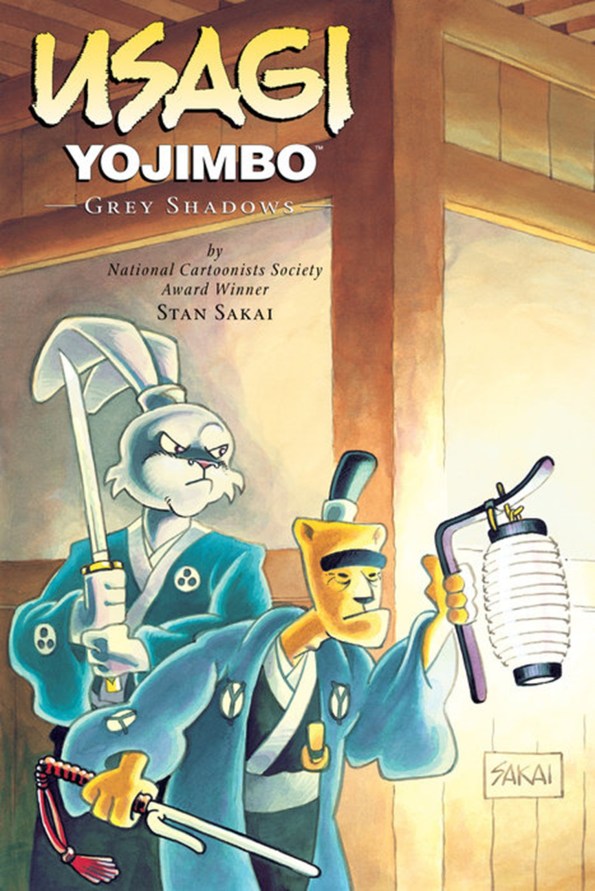
Publisher: Dark Horse Comics (Paperback – March 2000)
Series: Usagi Yojimbo – Book 13
Length: 200 pages
My Rating: 5 out 5 stars
Amazon
Welcome back to my Throwback Thursday series, where I republish old reviews, review books I have read before or review older books I have only just had a chance to read. For this week’s Throwback Thursday I check out another epic entry in the amazing Usagi Yojimbo series by Stan Sakai with the 13th volume, Grey Shadows.
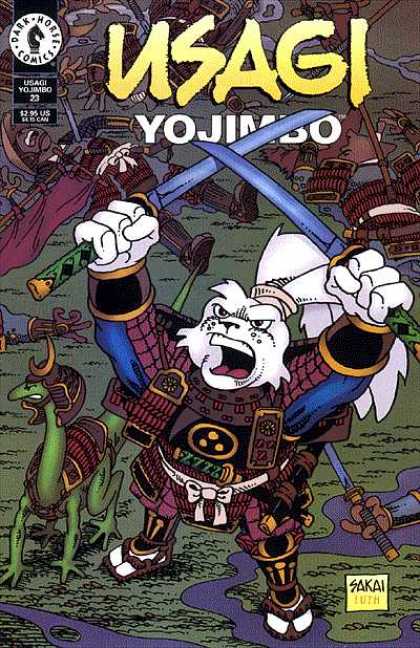
I had a lot of fun reviewing the 12th volume, Grasscutter, last week and it set me down a bit of a reread journey which saw me revisit several other Usagi Yojimbo volumes. As such I thought I would take the time to do another review of one of Stan Sakai’s comics, and luckily the next one on my list, Grey Shadows, is a particularly good one.
Grey Shadows takes place immediately after the massive events of Grasscutter and details several adventures that rabbit ronin protagonist Miyamoto Usagi goes on during this period. Made up of issues #23-30 of the Dark Horse Comics run on the Usagi Yojimbo series, Grey Shadows returns to the series norm of featuring several shorter stories, each of which pit Usagi against a new threat or opponent. Grey Shadows have several excellent stories, including some that focus on fantastic murder mystery elements while simultaneously introducing interesting new characters.
The first story in this volume is the intriguing and touching entry, My Father’s Swords. This single-issue story first sees Usagi at the temple of his friend priest Sanshobo recovering from his deadly duel with the demonic spearman Jei at the end of Grasscutter. Still troubled by the disappearance of Jei’s body and the sudden burden of being responsible for the legendary Grasscutter sword, Usagi journeys out from the temple to scout the surrounding area and determine if it is safe to move the divine blade. His journeys eventually lead him to meet young wandering samurai, Donbori Chiaki, whose father was an old friend of Usagi’s who served with him under Usagi’s former lord. While travelling with Chiaki, a chance encounter reveals secrets that will rock Usagi’s soul as a samurai.

This was an interesting first story for Grey Shadows and it is one that I really appreciated. I liked the excellent start that revisited key events of the previous volume and examined the burden that Usagi, Sanshobo and Gen now bear. Not only does Sakai use this opportunity to inform the protagonists about some of the other events of Grasscutter that they were unaware of, but it also helps set up the future 15th volume, Grasscutter II, which will end this overall storyline. Sakai also takes a little time to showcase Usagi dealing with the dark details of the defeat of his adversary Jei, especially after Jei’s body disappeared upon his defeat. There is a great scene where a clearly shaken Usagi destroys Jei’s fallen black spear to convince himself that his foe is truly dead, although you can tell he doesn’t believe it. I am rather impressed that Sakai manages to do such a comprehensive wrap up of the events of the previous volume in such a short amount of time, while also leaving room for another interesting story.
The main story of My Father’s Swords is pretty moving, as Usagi is immediately brought back to another trauma, his service to Lord Mifune and the Battle of Adachi Plain (see Volume 2: Samurai and Volume 11: Seasons). Travelling with the son of an old comrade lets Usagi briefly relive his glory days, before the past is once again thrust upon him when it is revealed that his friend, Donbori Matsuo, is still alive, following his son anonymously as a cripple. The reasons for Matsuo hiding his existence from his son and the burden he then places on Usagi to keep this secret for him is a little heartbreaking, and it provides more context about the samurai way of life Usagi is bound to. The entirety of this storyline is handled perfectly, from the great introduction to Chiaki, the fun remembrances of Usagi’s past, to the final revelation about Matsuo that ends the story on a poignant note that will leave you very thoughtful and moved. I enjoyed some of the clever artistic tricks in this story, such as the dark shade around Usagi when he deals with Jei’s spear, and the fun way in which Sakai slips in the beggar Matsuo into the background of several scenes, revealing his subtle surveillance of his son. An excellent entry that not only references the events of Grasscutter but also features a powerful story of its own, My Father’s Swords proves to be a great start to this entire volume.

Sakai follows up the moving first story of Grey Shadows with the dark second entry, The Demon’s Flute, a clever and memorable horror story. The Demon’s Flute sees Usagi traversing some remote hills only to be drawn to a small town by the haunting melodies of a flute. Once there, he discovers that the village is under attack by a mystical menace which kills villagers in utter darkness while the sound of a flute plays. Believing it to be a ghostly figure of a flutist who wanders around with a white tokage (the dinosaur lizards that serve as this world’s main animals), the villagers implore Usagi to help save them. However, the true evil attacking them proves to be more complicated and sinister than anyone of them believed.
The Demon’s Flute is a great story that shows just how haunting a Usagi Yojimbo story can be, especially when Sakai utilises some of the creepiest elements of Japanese mythology. While some of the elements of the story are slightly predictable (Usagi has rocked up to save a lot of random villages over the years), the story has a great pace to it that sees Usagi attacked by dark forces he cannot overcome. The various scenes where Usagi runs around the village chasing the darkness and the sound of a playing flute are extremely tense, and the sudden reveal of the story’s monster proves to be very thrilling. I loved the great art that surrounded this part of the story, especially as Sakai makes great use of pure blackness to enhance the tension and threat of a scene, with Usagi often only illuminated by a small hand torch. The final reveal of the monster and the reason for the haunting flute is pretty cool, and I liked the dark sense of honour and duty that drives even the evil and dead of this realm. While parts of the story are wrapped up a little too neatly, this was still a brilliant entry which reaffirms my love for Sakai’s horror stories.
The next entry in Grey Shadows is the wholesome and enjoyable Momo-Usagi-Taro, which sees Usagi arrive at a large town. However, he is almost immediately accosted by a group of orphan children who wrangle him into accompanying them to their orphanage, where he tells them an epic tale to keep them entertained. This is a genuinely nice entry in this volume, which helps to break up the tension and serves as a gentle buffer between the darker stories in the volume. While Sakai does take the time to do a little set up for the upcoming stories, most of Momo-Usagi-Taro is dedicated to Usagi’s story to the children, which is a retelling of the classic Momotarō folk story. I always love it when Sakai tells traditional Japanese stories in his comic, especially as you get to see his artistic take on the legend (which usually results in the protagonist being altered to resemble Usagi), and it was great to see this classic tale brought to life in a new way. Readers are in for a nice story here, and I loved the fun revelation at the end that the orphanage is the same one shown in Daisho, which is supported by the bounty hunter Stray Dog.

Now we are getting to some of the main stories of Grey Shadows with The Hairpin Murders. Set across two issues, The Hairpin Murders sees Usagi get involved in a murder mystery case in town when several prominent merchants are killed using a woman’s hairpin. Teaming up with the brilliant detective, Inspector Ishida, Usagi helps with the investigation and is soon thrust into a long-hidden conspiracy that bind the victims together. However, the closer they get to the truth the more resistance they encounter from Ishida’s superiors, forcing them to decide just how far they want to go to get justice.
This was an excellent and intriguing story that serves as one of the more impressive entries in this entire volume. While still maintaining its comic style and focus, The Hairpin Murders reads just like a classic murder mystery story and sees the protagonist involved in a constricted investigation to find the truth. Sakai sets up this mystery perfectly, and you are soon racing along to find out who is responsible and why. There are a couple of great twists here, as well as some interesting connections to kabuki theatre, with the eventual reveal of the murderer and their motivations is handled really well. The story ends on a pretty satisfying note, and it proves to be quite an intense and intriguing story.
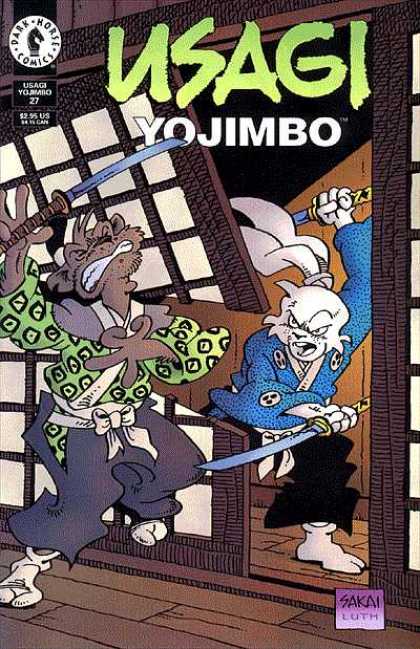
One of the best things about The Hairpin Murders is the introduction of new character Inspector Ishida, who serves as a supporting figure in the rest of Grey Shadow’s stories. Based on real-life policeman Chang Apana (the inspiration for fictional detective Charlie Chan), Ishida is a hard-boiled police inspector who is tasked with investigating various crimes around his town, mostly murders. Despite being restricted by feudal Japanese practices (he can’t do a proper investigation of a body), and the interference of his corrupt superiors, Ishida is a brilliant detective, able to solve complex crimes with the most basic of clues. Ishida gets a great introduction in The Hairpin Murders, as not only do you see him investigating a tough case but you also learn more about his personality, dedication to justice and elements of his tragic past. It is so fun to see him in action in this story, especially as he has that great fight scene that shows of his unconventional fighting style (which is surprising considering his small, hunched stature), as well as his excellent use of the cool jutte weapon (I love the jutte so much). However, the real hint at just how complex and fascinating a character Ishida is occurs at the end of The Hairpin Murders when Ishida is presented with a massive dilemma of justice. It is strongly implied that Ishida, who spends most of the story sticking to the rules, takes justice into his own hands, and I think it fits perfectly into his character arc, while also leaving some ambiguity about how far he went. This really was one of the best character introductions of the entire Usagi Yojimbo series and it was so successful that Ishida would become a major recurring character in future volumes (such as Volume 32: Mysteries and Volume 33: The Hidden).
The other two-issue long story in Grey Shadows is the compelling and moving tale, The Courtesan. In The Courtesan, Usagi runs into the scared young woman he has noticed multiple times in the last few stories and saves her from a group of masked attackers. His actions lead to him gaining the attention of the town’s leading courtesan, the alluring Lady Maple, who begs Usagi to help save the life of her young son, who is the legitimate heir to the local lord. However, dangerous forces within the lord’s court see Lady Maple kidnapped and her son in danger, with only Usagi able to help.

This was another powerful story that really helps to make this volume stand out in terms of story building and character work. The Courtesan is a particularly well-paced story that ties in well with the other entries of the Grey Shadow’s volume. Sakai has come up with a pretty compelling narrative here, and the secret battle for control of the lord’s inheritance is played out with some awesome elements, such as a dive into the world of Japanese courtesans and including several great fight sequences. The character of Lady Maple is particularly strong, as not only does Sakai make a lot of effort to highlight her elaborate beauty with his artwork, but he also shows the mother hidden underneath the fancy makeup and costume, one who is concerned solely for the welfare of her child. This leads up to an epic and tense conclusion, as Usagi faces down all the conspirators, only for his victory to be marred by tragedy. I loved the powerful ending this story contained, which, while sad, also ensures that several worthy characters get what they most wanted in life. Easily one of the strongest tales in the entire volume, I always enjoy reading this impressive story.
The final entry in Grey Shadows is the fast-paced and action-packed single-issue story, Tameshigiri, which serves as an excellent conclusion to the entire volume. Tameshigiri is another mystery story that sees Usagi assist Inspector Ishida to investigate some murders around town. This time the two friends are looking into a series of random killings by mysterious masked samurai. The attacks seem extremely random and lacking in motivation, but the two are soon drawn towards the acolytes of a failing sword testing school who may have a dark reason for dropping bodies around town.

This was a pretty fun and cool final story for the volume, and it leaves an exciting end note for the reader. Sakai pulls together a fantastic and compelling shorter story here that once again combines murder mystery elements with the traditional comic book action. While the culprits of the murder are quite clear from the outset, it is pretty fun to see their plan unfold and the protagonist’s subsequent investigation into it. The reasons behind the antagonists’ actions are pretty fascinating, and the author paints an outstanding picture of desperation and duty that drives them to kill. I also quite liked the intriguing investigation into traditional sword testing, which ties into the story extremely well and proves to be a fascinating addition to Tameshigiri’s plot. The entire story leads up to a massive action sequence that sees multiple participants on both sides engage in a deadly battle to the death. Not only doe we get to see more of Inspector Ishida’s unique fighting style, but Usagi also shines in an awesome duel. Throw in the amusing jokes about the events of the preceding story, where Ishida clearly knows Usagi is behind some of the mayhem, and you have a very entertaining entry that not only wraps up the Ishida-based storylines extremely well, but also ensures that the reader has some fun on the way out.
I must once again highlight Sakai’s brilliant artistic work in this cool volume, as Grey Shadows contains impressive examples of Sakai’s amazing style. There are so many beautiful and intricately detailed drawings throughout this awesome volume, and I love how perfectly it enhances the already great storylines. I particularly love the amount of detail that he throws into the various panel backgrounds, ensuring that the reader sees both the full breadth of Japan’s majestic natural landscape and the traditional feudal style buildings in the towns and villages Usagi visits. Sakai also does incredible justice to the many battle sequences scattered throughout Grey Shadows, perfectly portraying the intricate deadly movements that make up the character’s sword play. You always get an impressive sense of how the characters moved as they battled, and I deeply appreciated all the brilliant and brutal fight scenes. This incredible artwork always pairs so perfectly with the written story, ensuring that this 13th volume was very spectacular and awesome to look at.

As you can see, I had a lot of fun with Grey Shadows, and it proved to be another excellent entry in Stan Sakai’s Usagi Yojimbo series. This 13th volume features several outstanding stories, which really dive into their unique protagonists and antagonists and show the full majesty of this version of feudal Japan. Serving as a key entry in the overall series thanks to the introduction of a cool new character, Grey Shadows is a must read for all Usagi Yojimbo fans and it gets another five-star rating from me.
Amazon


 The Unseen Library