
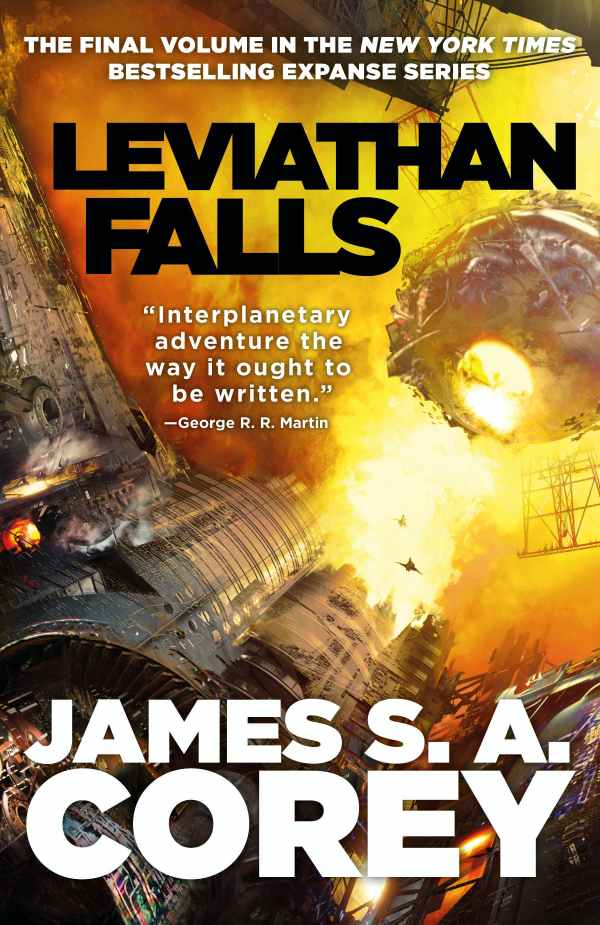
Publisher: Orbit/Recorded Books (Audiobook – 30 November 2021)
Series: The Expanse – Book Nine
Length: 19 hours and 40 minutes
My Rating: 4.5 out of 5 stars
For my last review of 2021 I check out the epic and highly anticipated final book in the iconic The Expanse series by James S. A. Corey, Leviathan Falls.
For the last ten years the science fiction genre has been dominated by the impressive and captivating The Expanse series. Written by James S. A. Corey, the joint pen name of authors Daniel Abraham and Ty Franck, The Expanse series consists of nine awesome novels that navigate the troubles and wars of future humans in both our solar system, and other systems accessed by ancient alien technology. This has been a pretty amazing series which has moved from wars between Earth, Mars and the Belt, to intergalactic travel and battles between galactic empires and interdimensional aliens. I have been really enjoying this series lately, and the last two novels, Persepolis Rising and Tiamat’s Wrath were extremely fun, especially as they utilised the conquering Laconian Empire, which forced the protagonists to form a rebel movement known as the underground.
The plot of Leviathan Falls starts a few months after the events of Tiamat’s Wrath, which saw the underground destroy Laconia’s shipyards and free James Holden, captain of the Rocinante, and Teresa Duarte, the daughter of the Laconian high consul. Now the Rocinante flies throughout the various settled systems attempting to keep the underground alive and bring down the faltering Laconian Empire. At the same time, unnatural and destructive alien forces, disturbed by the intergalactic technology used to traverse space, are reaching into our universe and attempting to exterminate all human life.
The best hope for humanity may lie in the hands of the Laconian high consul, Winston Duarte, whose alien enhancements have given him unnatural insight into the universe. However, Winston Duarte is currently missing, having vanished from his room as he attempts to unleash his ambitious master plan. To find him, the Laconians unleash their ultimate hunter, Colonel Aliana Tanaka, who focuses on the Rocinante, determined to use Teresa as bait. At the same time, Dr Elvi Okoye leads a desperate scientific mission to uncover the secrets of the ancient aliens whose technology has allowed humanity to expand throughout the universe. But her progress is dependent on the lives of the mysterious half-alien children in her care, whose ability to connect with the past could save the future.
As the situation in the universe becomes even more desperate, the crew of Rocinante are once again thrust into the midst of the battle for humanity’s survival. Entering a desperate alliance and faced with near certain extinction, the Rocinante and their allies embark on a final battle for the future. However, not only are they facing the malevolent forces from outside their universe, but also the radical and altered Winston Duarte, whose plan to save the species comes with an impossible price. Can Holden and his crew stop him before it is too late, or is the final chapter in humanity’s story?
Leviathan Falls was another intense and impressive science fiction read from Corey, who brings this epic series to an end in a big way. This ninth and final Expanse novel had a captivating and intense narrative filled with amazing and realistic science fiction elements, complex characters, and a fitting and heartbreaking conclusion that wraps everything up extremely well. This ended up being a fantastic novel and I was glad I had a chance to see how everything finished up.
There is a great narrative for this book that takes the reader on a powerful and compelling ride as the authors seek to wrap everything up. Leviathan Falls continues several of the storylines set up in the previous novels, especially Tiamat’s Wrath, and takes them towards their inevitable conclusion. Told through multiple characters, including several minor figures, this is a slow-burn narrative that methodically sets up the various storylines and explores them to their full extent. The story gets quite complex in places as the protagonists attempt to survive not only the various battles between the Laconians and the underground but also the malevolent entities attempting to take them down from another universe. The first half of the story focuses on a cat-and-mouse battle between the protagonists on the Rocinante and the Laconian Colonel Tanaka, while there are some interesting examinations of Elvi’s attempts to understand the threat facing humanity. These storylines lead up to a big event that sets up the intense and exciting second half of the novel and forces the previously disparate characters to come together and face the major threat. This results in a massive, extended sequence that forces several characters to make some major decisions, and a moving conclusion that is both devastating and a fitting ending to the franchise.
The team behind The Expanse have a really unique writing style that I think fits the epic scope of their series. Using an intense amount of description, as well as some colourful analogies, the authors paint a brilliant picture of the events occurring around them that perfectly encapsulates the insanities and complexities of the situation. The Expanse series is known for its realistic approach to science fiction, and this continues through in Leviathan Falls as the reader gets a real sense of the awesome nature of space flight through the various characters’ eyes. While some of the science fiction elements are obviously invented solely for the narrative, most of the human technology in this book appears to be quite realistic and well thought out. I also love the cool take on space travel, communication and fights, with many of the events in space taking hours or days to complete due to distance and light delays. This is particularly impressive during the battle sequences which rely more on calculations and manoeuvres than fast-paced firepower, and it really added to the intensity of multiple scenes throughout the book.
While I enjoyed the narrative and the way that the authors told the story, Leviathan Falls did drag a little in places. I honestly think they could have streamlined this into a better novel by taking out, say, 50 to 100 pages, and I personally would have cut all the chapters told from the perspective of Kit Kamal, which have no major impact on the overall story. I also think that the authors went a tad overboard in places trying to make some of the elements and experiences seem a little cleverer than they needed to be, such as certain long-winded interludes. While I understand that this is their writing style and it usually works, I felt that it made parts of the book a little unwieldy and unnecessarily complex. Being the grand finale, it was also a very inaccessible novel for new readers, especially as so much of the plot relies on knowledge of some of the preceding books, particularly Persepolis Rising and Tiamat’s Wrath. However, the rest of Leviathan Falls story more than compensates for some of the above issues, and this still ended up being an excellent and compelling read.
Fans of this series will no doubt appreciate some of the excellent world building that took place in Leviathan Falls. The author introduces some interesting and compelling expansions of various elements of lore and technology within this universe, especially when it comes to the two ancient alien races who the protagonists have been encountering throughout the series. It was rather fascinating to see how certain elements were utilised throughout the plot, and they ended up enhancing the narrative extremely well. I loved all the use of alien technology, especially as there are some great call-backs to the previous books and the weird molecules and artefacts the protagonists previously encountered. There was also a good wrap up with the universe that I really appreciated, and it think it ends everything on a compelling and interesting note.
Leviathan Falls features an impressive cast of complex characters, and the multiple perspectives are used to great effect throughout the book to craft a massive and elaborate narrative. I liked the cool range of characters in this book, especially as it primarily focuses on the well-established cast from the previous novels, as well as one great new antagonist. The vast array of perspectives proves to be a lot of fun to explore, although I do question the necessity of one or two overutilised point-of-view characters. I also appreciated some of the development that occurred around the recurring cast of the series. This included a tangible sense of weariness that multiple characters experienced, especially the series’ long-running protagonists, which helped to reflect how they have aged and evolved over the years, especially in the face of so much adversity. There are also a couple of interesting inclusions that I quite enjoyed, including one excellent character whose return will come as a pleasant surprise to fans of The Expanse.
There are several extremely awesome characters that I really must highlight in this book, including protagonist James Holden, the captain of the Rocinante and main character of the series. Holden has gone through a lot throughout The Expanse novels, and it shows in Leviathan Falls. The character is clearly dealing with some PTSD following his extended imprisonment in the prior novel, and there are some compelling and intense trauma storylines around him. Holden has a particularly major moment in this novel, and it ended up being an interesting and moving novel for this great central character. Aside from Holden, you also must love the work put into the surviving crew members of the Rocinante, Naomi Nagata, Amos Burton and Alex Kamal, each of whom have their own interesting storylines and serve as great point-of-view characters. I particularly enjoyed the increased focus on Naomi now that she’s the head of the underground, and it was still fascinating to see her as a confident and capable leader. Amos’s storyline was also rather interesting, especially after he died and was resurrected by alien technology in the previous novel. This gives him some unique perspectives throughout the book, although there were only so many times you can hear about the “unnatural pauses” he now has.
In addition to the Rocinante crew members, several other exceptional characters also really stood out to me. I continued to enjoy the inclusion of Elvi Okoye, the brilliant scientist who was drafted into the Laconian military force as the leading expert on alien technology. Elvi offers most of the scientific insight into the events occurring in the novel, and it was interesting to see her experiences as she attempts to understand the ancient alien technology and discover a solution to the mysterious attacks plaguing the various human systems. I also really appreciated Colonel Aliana Tanaka, a Laconian soldier who is sent to track down the missing Winston Duarte by hounding the Rocinante and trying to take back Teresa Duarte. Despite being a new character, Tanaka has one of the best arcs in the entire novel, as she is forced to contend with not only the boldness of the protagonists but also her own instabilities and issues. While she initially appears to be a mostly rage filled attack-dog, the author soon expands on her character and backstory turning her into a very complex and somewhat sympathetic figure. This is particularly true after a major event results in an unwelcome intrusion in her mind, and her inability to cope makes her even wilder and angrier. These brilliant characters really helped to enhance Leviathan Fall’s plot and it was an absolute pleasure to see all the great character driven story arcs come to an end.
While I did receive a physical copy of Leviathan Falls, I ended up listening to the audiobook version to fit this book into my reading schedule. This was a pretty good audiobook, and I had a fantastic time getting through it. Leviathan Falls has a decent run time of just under 20 hours, which did take me a while to get through, especially in some of the spots where my engagement slipped a little. Despite the length, this was a fantastic audiobook adaptation and I appreciated the impressive narration from Jefferson Mays, who has previously lent his voice to all the previous The Expanse novels. Mays’ voice seems to fit the massive and epic format of the series extremely well and I found myself appreciating and following some of the heavy scientific elements, battle sequences and intriguing analogies a bit better with his work. He also provides some excellent voices to the various characters featured in the series which fit their various personalities and helped to showcase their emotions. I had an awesome time listening to this latest audiobook and it is an impressive way to check this novel out.
After nine epic novels, The Expanse series by James S. A. Corey finally comes to end with the fantastic Leviathan Falls. This final book does an excellent job of tying together the various story threads from the previous novels and giving this impressive series the outstanding conclusion it deserves. Filled with complex characters, a powerful and rich science fiction setting, and an intriguing central storyline, Leviathan Falls was an awesome read. An amazing and cool conclusive episode, Leviathan Falls is really worth checking out and I loved its compelling and exciting story.

 The Unseen Library