
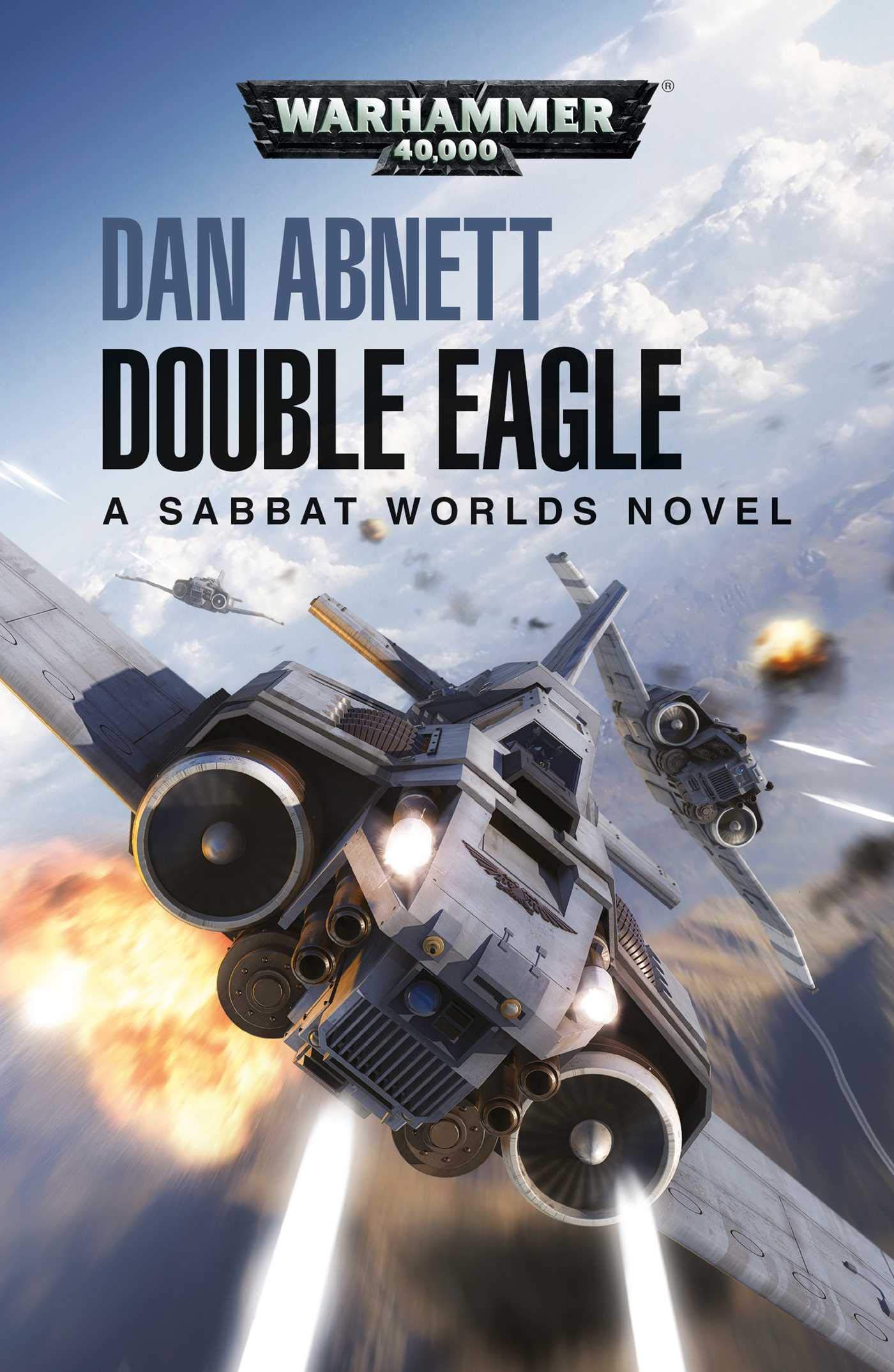
Publisher: Black Library (Audiobook – 1 January 2004)
Series: Warhammer 40,000/Sabbat Worlds
Length: 10 hours and 16 minutes
My Rating: 5 out of 5 stars
The master of Warhammer fiction, Dan Abnett, takes to the skies with the deeply addictive and ultra epic fighter pilot novel Double Eagle.
Readers familiar with this blog will know that I have been extremely damn obsessed with Warhammer fiction the last couple of years, having spent a substantial amount of time reading and reviewing numerous books from the franchise. Of the many Warhammer fiction authors I have read during this period, one of the most impressive is the legendary Dan Abnett, who has written so many exceptional and powerful books around the franchise, including several series considered to be the seminal texts of the extended universe. I have had a ton of fun with many of his books, including his brilliant Eisenhorn trilogy (Xenos, Malleus and Hereticus), and he has multiple entries in my current favourite Warhammer 40,000 books list. However, his best-known series is the iconic Gaunt’s Ghosts books, which I am currently in the middle of reading.
The Gaunt’s Ghosts books are a beloved and key series of Warhammer 40,000 fiction that seeks to give readers a moving look at the lives of the frontline human soldier in this grimdark universe. Set in an extended, multi-planet campaign, known as the Sabbat Worlds Crusade, the Gaunt’s Ghosts books follow a ragged regiment of soldiers as they attempt to survive the dark servants of Chaos coming for them. I am having an exceptional time reading the Gaunt’s Ghosts series, and in 2024 alone I have read two particularly epic entries, Straight Silver and Sabbat Martyr. However, before I dive any further into the series, I decided to read the spin-off novel, Double Eagle, which I have had on my to-read list for a while now. Double Eagle was an interesting and unique novel that follows members of an airmen wing who were introduced in the fifth Gaunt’s Ghosts book, The Guns of Tanith. Set after their mission with the Ghosts, Double Eagle follows these pilots, including a few characters from The Guns of Tanith, in a brutal new campaign.
War has engulfed the Sabbat World system as the forces of the Imperium of Man attempt to reclaim multiple worlds invaded by the forces of Chaos. After years of fighting, the Imperium’s crusade has reached a tipping point, with victory or defeat for the entire campaign hanging on the results of a few key battles. While the fighting is fierce throughout the system, nowhere is it more desperate than the beleaguered world of Enothis.
After failing to conquer the Chaos footholds on Enothis, the infantry and armoured forces of the Imperium are in full retreat, attempting to traverse miles of hostile terrain to return to safe territory, all while being harassed by relentless enemy aircraft. With the fate of the planet in the balance, the commanders of the crusade deploy multiple squadrons of Imperial fighters and bombers to Enothis to turn the entire conflict into an air war. If the Imperial pilots can hold back the advancing tides of Chaos and allow the ground forces to regroup the war for Enothis may be won. But if the airmen fail, then Enothis and the entire Sabbat Worlds campaign is doomed.
Amongst the pilots sent to Enothis are the elite flyers of the Phantine Air Corps. Veterans from the recent war to liberate their home planet of Phantine, the pilots of the Phantine Air Corps are determined to do their bit in this new conflict. But the battle for Enothis will be unlike anything seen before, as thousands of Chaos aircraft descend on the planet, hoping to obliterate the defenders. Severely outnumbered, can even the dogged Phantine pilots hold back the approaching tide of dark air machines before the planet is conquered, especially with an unnaturally skilled Chaos ace stalking the skies, determined to bring every opposing pilot down in flames?
Just when I think that Dan Abnett couldn’t impress me even more, I go and read Double Eagle. A brilliant, intense, and exceptionally well-written novel that focuses on a particularly cool aspect of the Warhammer universe, Double Eagle blew me away with its great characters and elaborate air combat sequences. I had an incredible time with Double Eagle, and it gets an easy five-star rating from me.
I deeply, deeply enjoyed Double Eagle, as Abnett took the brief of a Battle of Britain-inspired Warhammer 40,000 story and applied his usual impressively detailed style and powerful character-driven storytelling to produce an outstanding and addictive read. Perfectly spinning off from the previous Gaunt’s Ghosts books and bringing the reader to another adventure in the expansive Sabbat World Crusades, Double Eagle has a brilliant narrative loaded with action that goes hard and fast for your feels and refuses to let go once it has you firmly in your grasp.
Double Eagle starts off quickly, getting the reader across the brutal new campaign and the importance of the aerial war that emerges, you are soon introduced to multiple characters and shown some initial awesome sequences with some explosive dogfights. From there the story moves at a fast but smart pace, as you follow several distinctive and often overlapping character arcs throughout the length of the brutal campaign on Enothis. You really get dragged into each major protagonist’s story as they attempt to survive the flying war. There are some excellent battle scenes in this first half of the book and Abnett really shows how epic he can make a fighter pilot dogfight very early on. The characters each experience some highs and lows in the first half of the book, and it doesn’t take you long to get attached the protagonists and their complex personal tales within the confines of the main story.
However, it is the second half of the book where everything comes together perfectly. Each of the protagonists experience some version of personal loss or difficulty, and the impact of the war slowly drains them, taking them to some dark places. Abnett sets up a brilliant underdog narrative around the protagonists, as the massive fleet of Chaos airships seek to crush them. You can really see the parallels between this narrative and the Battle for Britain at this point, especially as the tired and severely outnumbered Phantine fighters and their local allies attempt to hold back the overwhelming and often Germanic-inspired forces coming for them. Everything leads up to a massive final confrontation, as the protagonists engage in a series of brutal and drawn-out dogfights and aerial confrontations as we lead up to the finale. While a couple of the character arcs leading up to this are a tad unsurprising, the way that Abnett writes them makes you love every second it. The author brings everything to an epic close with continued and captivating action that honestly is impossible not to react to at times. There are some very powerful moments at the closes, especially when some characters get everything they want, and you come away from Double Eagle wishing Abnett had made this book even longer.
Abnett once again masterfully crafts his compelling narrative together in such an effective way that I honestly just couldn’t stop listening to this book. Making excellent use of multiple complex perspectives, you are swiftly drawn into the lives of several ordinary soldiers drafted into the deadly aerial war against a massive opposing fleet. Featuring a range of complex characters arcs, Abnett expertly balances the character-driven plot between the various perspectives, while also featuring an epic war story that hits in all the right places. Abnett’s use of quick-fire perspective changes works to create an excellent and fast-paced narrative, and it works especially well in some of the novel’s more intense sequences. Speaking of action, you can’t talk about Double Eagle without discussing the amazing and epic aerial fight scenes and dogfights that make the book so damn distinctive. Abnett did a remarkable job of harnessing the energy and feel of classic World War II fighter combat and bringing it into the Warhammer 40,000 universe. Featuring many, many awesome sequences of aerial combat, Double Eagle really feels like you’re in a futuristic Battle for Britain as you witness fights between small groups of fighters fending off mass raids from Chaos forces, as well as sequences from the perspective of Imperial bombers. The resulting dogfights between advanced fighter craft works so damn well in the context of the story, and you are treated to some truly epic sequences. I was constantly enthralled by the brilliant aerial combat and flight sequences, and Abnett did an exceptional job expressing the intensities of flight, the ultra-fast pace nature of the combat, and the craziness of a massed aerial battle. I could have honestly spent many, many more hours listening to Abnett’s descriptions of aerial combat, and there are so many excellent writing elements to this book that drag you in.
Double Eagle also proved to be an interesting and particularly strong Warhammer 40,000 novel that is really going to appeal to a wide range of readers. Spinning off from the Gaunt’s Ghosts books, Double Eagle is tailor made for fans of the original series, although familiarity with the Gaunt’s Ghosts books isn’t necessary to enjoy this epic book. While there are a few references, returning characters, and discussions about the overarching Sabbat Worlds Crusade, for the most part any reader can easily dive into Double Eagle and follow the story with no issues at all. As with most tie-in books in the franchise, Double Eagle is best enjoyed by existing Warhammer fans, who will once again enjoy Abnett’s compelling insights into the canon. I know that I really loved the exploration of Warhammer 40,000 air combat, and I loved how Abnett explored the physics, as well as the reasons why aerial fighters are still utilised in a universe where space travel exists. However, I also felt that Double Eagle would serve as a pretty good entry point to any new readers interested in finding out why the Warhammer 40,000 universe is so damn cool. Indeed, readers who are a fan of aerial focused military fiction or World War II fighter combat fiction can very easily jump into the new world here, as Abnett really presents a tale they would enjoy. I need to read more Warhammer books from Abnett (I have several currently in my queue), and I currently very excited to read the recently announced sequel to Double Eagle, Interceptor City, which is set to be released later this year.
I found that the writing element that really brought Double Eagle together where the excellent characters at the heart and soul of the plot. Focusing on several intriguing pilot characters, Abnett dove into the mindset of these flyers and did an amazing job capturing their love of the air and their desire to be the best. However, as the book continues, you see a darker side to many of these characters, as the toil of war drags them down into their own mental hells. While it did take me a little while to get across every protagonist, I eventually got drawn into the excellent character-focused storylines that Abnett set up in Double Eagle, and it was great to see the return of several characters introduced in The Guns of Tanith. This includes the Phantine flight commander, Bree Jagdea, and the bombardier Oskar Viltry. Jagdea proves to be a great centre for much of the plot, and her steady determination to keep her flight together and survive the various rigors of war, really strike a chord with the reader. Viltry’s narrative is a little more complex, as the veteran pilot is suffering from trauma after being shot down and captured in The Guns of Tanith. Certain about his own impending death, Viltry spends much of the book as a morose and depressed figure, until he finds someone worth living for. Viltry’s storyline proves to be particularly heartfelt, especially as he has a relatively nice romance angle, and I felt that Abnett really captured his trauma and desire for a better life.
Aside from Jagdea and Viltry, Double Eagle also features several other impressive perspective characters who really bring the narrative together. This includes young Phantine pilot, Vander Marquall, who serves as a major protagonist. A rookie pilot fighting in his first campaign, Marquall has a massive desire to prove himself. His obsession with becoming an ace and being respected becomes an overwhelming part of his character, and you find yourself occasionally disliking him, while also simultaneously cheering him on. Thanks to his interactions with the other characters, Marquall gets some much-needed perspective at times (that scene with his mechanic at the end was brilliant), and I felt he had one of the most complex, dark and relatable storylines in the entire book. Abnett rounds out the characters with local pilots August Kaminsky, a wounded veteran no longer allowed to fly, and Enric Darrow, a rookie without a plane after getting shot down in the opening scenes by the novel’s big bad. While parts of Kaminsky and Darrow’s storylines are a little predictable, you really get invested in their various battles, especially as Abnett produces some interesting character moments and interactions for them. I especially loved the hilarious exchanges between Kaminsky and Jagdea during one fun sequence, and Darrow proves to be a very likeable and determined young character to get behind. These main characters, plus an excellent supporting cast, were great to follow in Double Eagle, and it will be awesome to continue at least one survivor’s story in the upcoming sequel.
It should come as no surprise to anyone that I ended up listening to Double Eagle on audiobook, as there is frankly no better way to enjoy an epic Warhammer 40,000 novel. While I always gush about how much I enjoy a Warhammer audiobook, I frankly really need to emphasise just how impressive and exceptional Double Eagle was in this format. The many, many aerial combat sequences come across so damn well when they are read out to you, and I loved how easily it was to visualise the fast-paced and exceptional flight scenes. You really get lost in the battles when you listen to them, and I was frankly buzzing the entire time I was listening to Double Eagle. Part of the reason this audiobook was so damn good was the inclusion of one of my favourite audiobook narrators Toby Longworth. Longworth has lent his voice to most of Abnett’s Warhammer 40,000 novels in recent years, and frankly the two are a match made in heaven. The story comes across so effectively in Longworth’s voice, and he really makes every scene, especially the exciting action sequences, that little more epic. I also really love the fantastic and compelling voices he uses for the various characters. While a couple of character voices sounded the same as those Longworth used in the Gaunt’s Ghosts audiobooks, I felt that they perfectly fit every figure they were assigned to, and you really get drawn into the matching character arcs as a result. Frankly this audiobook was perfect, and I had so much fun listening to it. With a run time of just over 10 hours, the Double Eagle audiobook is very easy to power through, and that is exactly what I did.
With an elaborate, powerful and addictive story about glorious battles in the sky, Double Eagle was a particularly epic Warhammer 40,000 novel that proves impossible not to fall in love with. Another exceptional novel from Dan Abnett, who once again shows why he is one of the best authors of Warhammer fiction, Double Eagle had me hooked from the very first chapter, and I honestly couldn’t stop reading it until the very end. This book comes very highly recommended, and I cannot wait to read the sequel later this year.

 The Unseen Library