
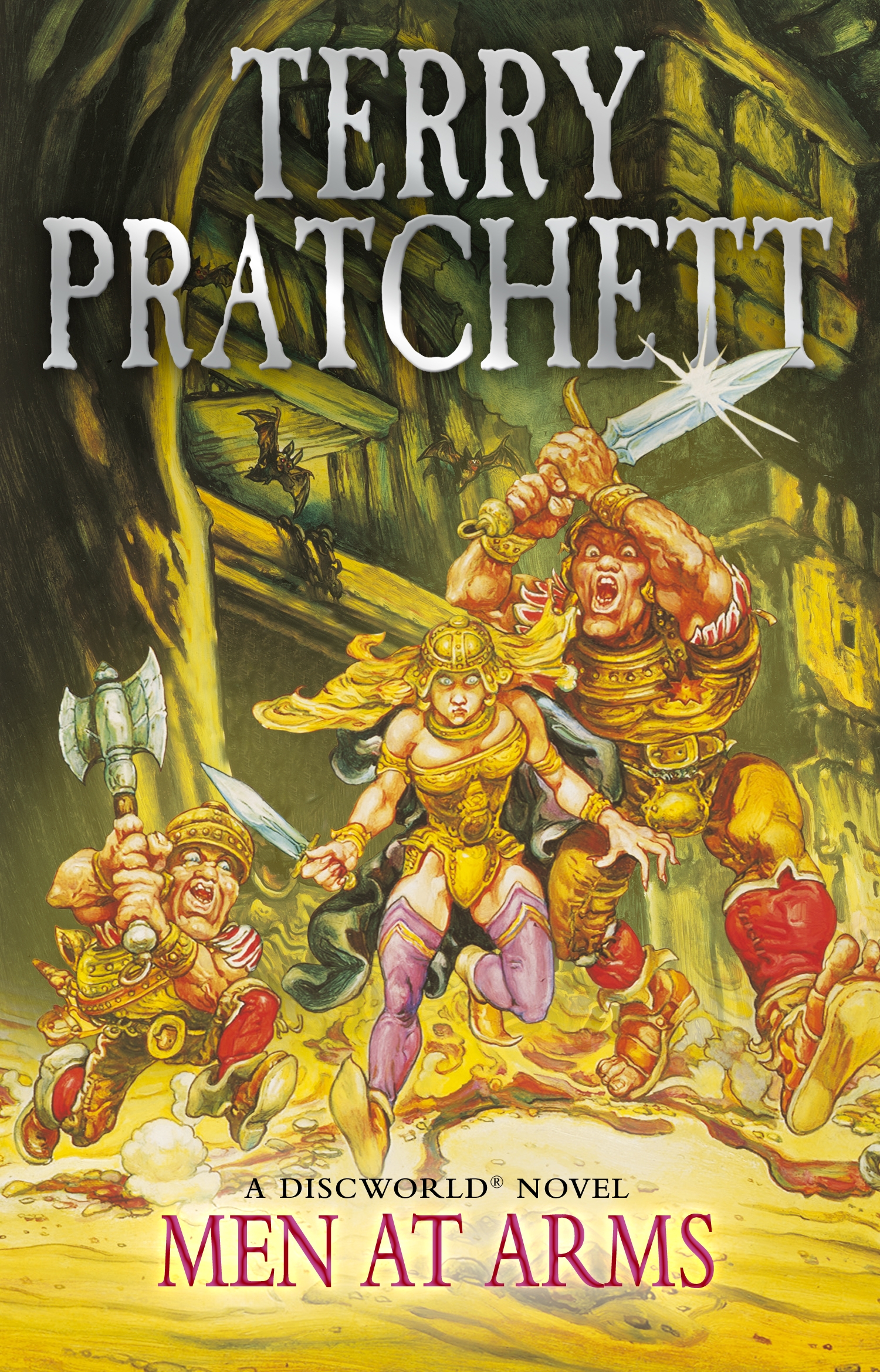
Men at Arms by Terry Pratchett

Publisher: Gollancz/Penguin Random (Audiobook – 1993)

Series: Discworld – Book 15/City Watch – Book Two

Length: 12 hours and 58 minutes

My Rating: 5 out of 5 stars

Amazon

After yet another re-read, the classic fantasy satire novel, Men at Arms remains as one of my favourite Discworld novels by the late, great Terry Pratchett, especially as its new audiobook version breaths fresh life into the always impressive novel.

Readers of this blog will have noticed that I have been on a real Discworld rampage lately, having re-read several books from my absolute favourite fantasy series.  Much of this is due to the recent release of a cool new audiobook version of all the Discworld books, featuring an awesome array of new narrators and vocal talents.  This new format has proven particularly awesome for books like Pyramids, Moving Pictures and Small Gods, and I have been eager to see how some of the books in my favourite Discworld sub-series, the City Watch books, come across with the new narrators.

While I have a lot of love for all the books in Terry Pratchett’s Discworld, my absolute favourites come from the City Watch sub-series.  Following the unlikely members of the Ankh-Morpork City Watch, a rag-tag team of guards generally looked down upon by the entire city, the City Watch books features an exceptional combination of fantasy and crime fiction elements, wrapped up in Pratchett’s usual satirical humour, as the protagonists investigate a series of dastardly crimes in the supernatural Discworld.  The series started perfectly with the awesome novel Guards! Guards!, which I reviewed last year, and Pratchett did an outstanding job following this up with the brilliant sequel, Men at Arms.

After saving the sprawling and eternally crime-ridden city of Ankh-Morpork from a fire-breathing dragon, the men of the Night Watch are still at work protecting the city, even though most of the city wishes they didn’t exist.  Despite their previous escapades, it’s a bad time to be a copper in Ankh-Morpork, with species tension between the dwarfs and the trolls at boiling point, while the powerful guilds disregard the Watch’s non-existent authority.  Worse, the Night Watch has been forced to accept three diversity hires, and must now contend with a mad dwarf, a thick troll and a woman (gasp) amongst their ranks.

Despite this, when an explosion at the Assassin’s Guild literally rocks the city, it falls to Captain Samuel Vimes and his small squad to investigate the heist hidden by the blast, despite the deliberate orders of the city’s tyrannical ruler to stop.  Determined to wrap up the case before his impending marriage and retirement, Vimes is soon forced to contend with a series of unusual, but seemingly linked murders, many of which have been caused by a lethal weapon never seen on the Disc.

With riots on the streets, and assassins and fools dodging their questions, all the members of the watch, including their contentious recruits, will need to work together to solve the murders before the city descends into chaos.  But how will they fare when going up against the most dangerous criminal mind the city has ever seen, one determined to bring back the Ankh-Morpork’s ancient kings, while wielding a dangerous new weapon that could change the entire Disc forever?

Even after many, many re-reads, Men at Arms continues to shine as one of Pratchett’s better books.  Featuring an epic crime fiction narrative, loaded with impressive characters, fantastic humour and great use of Pratchett’s iconic Discworld setting, Men at Arms is a complex, emotionally charged and deeply moving read that I could honestly read 100 times and still not get bored with.  A brilliant novel that unsurprisingly gets an instant five-star rating from me.

Pratchett wrote some exceptional narratives throughout his career, but few stand up to Men at Arms in terms of complexity, cleverness and emotional impact.  Expertly reintroducing the cast of Guards! Guards!, while also bringing in some impressive new support characters, Men at Arms starts off an excellent pace, as Pratchett cleverly examines the changes to the characters, sets up the new case, while also showcasing the motivations of the apparent main antagonist.  From there, it doesn’t take long for a dark series of crimes to take place, with Vimes and his squad investigating despite the apathy of the rest of the city.  Pratchett does a lot of excellent set up in the early part of the book, and the reader soon becomes invested in the investigation, especially as the book begins to follow a series of deaths, some of which were caused by a particularly deadly weapon that modern readers will be all-too familiar with.  Some great character arcs are also introduced here, as the extended cast all hit their own various problems they are forced to overcome, with Vimes dreading his eventual retirement, Carrot feeling the added responsibility, the fun buddy-cop arc between Detritus and Cuddy, and Angua dealing with her own problems.  The author sets up and expands on these arcs throughout the book perfectly, providing additional emotional impact, as well as some interesting side angles on the main storyline.

While the first half of the novel sets everything up perfectly, it is in its second half where Men at Arms truly shines.  Pratchett keeps raising the stakes of the story, with more victims, run-ins with the shadowy antagonist, and the Watch characters attempting to understand the nature of the weapon that has been turned against the city.  The author throws in some interesting wrinkles to the case, which shadow who the true villain is, while other events throw emotional shade across several of the characters.  The various connected character arcs start to come together perfectly as the book continues, and you go into the final stretch with a range of emotions around you.  While ostensibly a comedy, Pratchett chooses to hit the tragedy element of the plot really hard in the lead up to the finale, with some big moments that will leave you speechless.  The big end reveal and confrontation is exceptional, and I loved how well all the storylines and cleverly setup plot points came together.  Everything leads up to a very desperate struggle that helps to define some of the main characters in some very powerful ways.  Pratchett chooses to leave the book on a hopeful note that sets the expanded course for the future City Watch books, while also providing some interesting insights into one of the main characters and his role in the city.  An overall epic narrative that twists, turns and keeps you guessing, while constantly entertaining and emotionally charged.

As with his other books, Pratchett perfectly sets out Men at Arms with impeccable writing, and I loved how this complex novel came about.  Featuring his usual impressive blend of fantasy and humour elements at its base, Men at Arms is both intriguing and quite funny in equal measures, and I love the subtle comedy that runs through it.  Many of these scenarios involve classic fantasy scenarios being seen through the eyes of self-aware characters, allowing the situation to be taken up to an 11, with sarcastic commentary from the witnesses.  This humour is well enhanced by several of its best characters, including a fantastic new buddy cop routine, with members of two separate and historically antagonistic species forced to work together and eventually becoming friends.  Some of the other hilarious moments in the book include unlikely members of the city’s population being conscripted into the Watch, unfunny clowns, unconventional investigation methods, and other subtle humour.  You also have to love the brilliant footnotes that seek to enhance the story and showcase just how ridiculous the Discworld is by providing additional details about the universe and the people within it.  All this results in a brilliant and highly entertaining fantasy read, and that’s before you even get to the great crime fiction elements of the story.

As with Guards! Guards!, Men at Arms stands out from the rest of the Discworld series due to the way that Pratchett provides a complex and compelling crime fiction narrative.  Focused on an explosive heist that eventually results in a series of brutal murders, Men at Arms tries to envision how firearms would disrupt the Discworld.  This allows for quite a captivating crime fiction narrative, which I feel was a much better mystery than Guards! Guards!.  Advancing more into police procedural territory than its predecessor, the mystery of Men at Arms proves to be top rate, with the protagonists going after an already known villain for much of the book.  Much of the early story involves the protagonists trying to unfurl the antagonist’s plan and discover how he committed the crime, which allows for some great scenes as the Watch inexpertly investigate.  Pratchett cleverly twists the fact that think you know who the antagonist is towards the end of the book, and I love how well he switched this key story element, especially as the implied true villain of the story is far more sinister than just evil humans.  I really enjoyed how well Pratchett sets up this mystery in Men at Arms, and even after so many re-reads there are still additional subtle clues and foreshadowing that I’m only just picking up on.  The police procedural elements of the story are also extremely well handled, with a lot of humour focused around three very unlikely recruits joining the already scruffy outsiders who make up the Watch.  All these elements come together extremely perfectly and allow for readers of various genres to come into Men at Arms and have an incredible time.

Due to Pratchett’s excellent writing style, Men at Arms does work quite well as a standalone novel, and new readers can generally enjoy this book without any prior knowledge of the Discworld series, especially once they get caught up in the cool story and amazing humour.  However, I do feel that to get the best experience with Men at Arms, readers really do need to have checked out Guards! Guards! first.  The continuing storylines, history of the city and character arcs all come into play extremely well in Men at Arms, and you get a much more complete experience viewing all City Watch novels in order.  There is also a continuation of some character arcs from the standalone novel, Moving Pictures, especially as a few major characters from there get a recurring role in this new sub-series.  As such, I would say that Men at Arms is a novel more aimed towards Pratchett’s established fans, with those who loved Guards! Guards! guaranteed to enjoy its impressive sequel and the compelling direction Pratchett starts to take the City Watch books in.  It helps that the author continued to explore the crumbling and crime-ridden city that is Ankh-Morpork in this Men at Arms, providing even more details about its governance, mindset and people.  This includes really expanding on the species tension between the dwarfs and trolls and showcasing it as a major plot point while also paralleling real-life racial tensions.  This focus on dwarf and troll conflict becomes a major plot point of the Discworld going forward (especially in the later City Watch books), and its setup here was spectacular.  Combine that with the changes that happen to the Watch at the end of the book, and Men at Arms is an important entry in the wider Discworld context, especially as so many key City Watch storylines start here.

While there are so many amazing writing elements to Men at Arms, few things top the exceptional character work that ensured that this novel was far more than just a funny fantasy novel with crime fiction elements.  Instead, the complex and heartfelt dives into its extensive main cast ensured that Men at Arms was one of the more powerful and emotionally charged entries in the Discworld (a very impressive feat).  The combination of returning protagonists from previous books, as well as a few outstanding new characters, allows for a range of different plot perspectives and personal storylines, and Pratchett effortlessly works to make you invested in all these character arcs before hitting you with intense tragedy and powerful moments.

At the centre of the plot lies main character Captain Samuel Vimes, the cynical veteran leader of the Night Watch, who has finally found happiness and romance in his life.  Now on course to retire and become a man of leisure, Vimes must deal with the horror of becoming the thing he hates most: a rich civilian.  Dealing with it by diving into one last investigation, Vimes finds himself facing everything he hates about his job, including bureaucracy and the whims of powerful people, resulting in some brilliantly chaotic scenes.  While it does seem that Vimes’s role in this story is slightly diminished compared to in other City Watch books, especially in the centre, he is still a major part of the book, and Pratchett writes some excellent storylines around him being the dogged and worn-down investigator pushing against authority and trying to solve one more crime.  The focus on his identity as a copper, the sacrifices he makes for his fellow officers, as well as the horror at having to give up the job are major parts of his character arc, and there are some truly heartbreaking moments when he realises he must give it all up.  This is well balanced with his heartwarming romance with his unlikely partner, Lady Sybil Ramkin, whose well-meaning support and determination help to make Vimes a better person.  However, it is the major sequence when Vimes finally encounters the antagonist which really provides the best look at the character.  Forced to decide between being a good cop or a figure of vengeance (a battle that rears its ugly head for Vimes many times during the series), Vimes truly hits his mental and moral limit as he faces down his adversary, and it is one of the most powerful scenes in the entire Discworld series.

While Vimes is the main character of the City Watch series, the focus of Men at Arms is a little more skewed more towards Corporal Carrot Ironfoundersson, as Pratchett expands on his excellent introduction in Guards! Guards!.  Now firmly a part of Ankh-Morpork society, Carrot has evolved from naïve newcomer to a seasoned police officer who knows literally everyone in the city.  Fully utilising his natural charisma, Carrot proves to be a major force for law and order in the city.  I loved how much Pratchett enhanced Carrot in this sequel, as his personality evolves due to his role and responsibility, and despite still appearing quite naïve and obedient, Carrot showcases some impressive intelligence driving much of the investigation.  I especially appreciated the various scenes where Carrot managed to outfox many of the city’s more dangerous figures who fall for the dumb copper routine.  Despite his new confidence and ability to bring out loyalty in others, Pratchett makes sure to show that Carrot isn’t infallible, and you see some vulnerability at times. Carrot also serves as the moral centre of the book, bringing out the best in the other members of the Watch.  His interactions with Vimes in the final confrontation were very heartfelt, especially as he keeps the man he admires most from doing the wrong thing, while the way he handles the antagonists goes to show that he is truly a good man, who you better pray you never face.  I also think that his talk with Vetinari at the end of the book was one of the best scenes in Men at Arms, especially as he truly surprises the Patrician, while also dancing around the tricky subject of Carrot’s potential position as heir to the throne.  His decision to refuse power and ensure that Vimes will be there instead really helps you keep faith in the good of people, and this was frankly Carrot’s best book.

I also have to highlight the fantastic and fun duo that was the newly instated watchmen, Cuddy and Detritus, the later of whom previously appeared in Moving Pictures.  An unusual dwarf and the thickest of trolls, the two make for a particularly unlikely and chaotic duo, which Pratchett uses to full effect as the book continues.  Thanks to the enmity that exists between their respective species, Cuddy and Detritus spend much of the early part of Men at Arms bickering with each other, including in one scene in the middle of a riot.  However, after being forced to work together, the two form a grudging bond, especially when Cuddy stops seeing Detritus as a dumb troll.  I loved how well Pratchett took the classic odd-couple police partner trope and twisted it around the compelling species-rivalry theme of the book, and the fun dynamic that forms between the new friends is a major highlight of the book.  The various sequences that follow the big scene that defines these two partners are some of the most powerful in the entire Discworld.

Following on the heels of Cuddy and Detritus is Angua, the other new recruit to the Night Watch.  Angua is an interesting figure in the story, mainly because she’s one of the few people able to see how ridiculous the entire Night Watch is.  The subsequent storylines surrounding her potentially doomed romance with Carrot and her desire to keep her status as a werewolf secret from everyone, add some excellent alternate perspectives to the plot, and Pratchett did an outstanding job setting her up as a compelling figure for the rest of the series.  It helped that for this first book she worked as a bit of a double act with the small talking street dog, Gaspode, who also previously appeared in Moving Pictures.  Gaspode proves to be a fantastic wise-cracking counterpoint to Angua, and it was hilarious to watch him mess with the various human characters who refuse to believe he can talk.  Their resulting storylines about investigating the crime as canines, as well as the unlikely dog rebellion brewing within the city, works well with the other character focused arcs, and it was fun to get a little more closure on Gaspode’s story after his previous appearance.

Other great supporting characters in Men at Arms includes the returning members of the City Watch, Sergeant Colon and Corporal Nobbs.  While not as well utilised in this book as the rest of the City Watch series, they still prove to be a fantastic addition to the supporting cast.  Entertaining backers to the various other character-driven storylines, both show interesting depths in this book, whether it’s Colon acting as a put-upon drill sergeant, or Nobby’s use of his quartermaster past to obtain a collection of weapons.  Other members of the city also prove to extremely entertaining, with the tyrannical Lord Vetinari being the highlight.  The way in which Vetinari manipulates Vimes throughout the entire novel, while also understanding the true nature of most of the city’s residents is highly impressive, and I love that he stayed on as a major character after Guards! Guards!.  Throw in a complex arrangement of well-hidden antagonists, including an idea of violence that takes on a familiar form, and the cast of Men at Arms proves quite exceptional.  I really cannot emphasise just how much these carefully written character arcs and complex personal storylines increased the impact and emotional power of this novel, and you will come away loving everything about them.

I doubt anyone will be too surprised that I am about to write several paragraphs about Men at Arms’s epic audiobook formats, which I have long described as the very best way to enjoy Pratchett’s stories.  I honestly love all the Discworld audiobooks and luckily for connoisseurs, there are two outstanding versions of the Men at Arms audiobook that you can check out.

The first of these is the classic edition that was released back in 1996 and which is read by Nigel Planer.  Planer, who is one of my favourite audiobook narrators, lent his voice to most of the early Discworld novels, and is a key reason why I love Discworld books in this audio format.  Planer unsurprisingly does an amazing job with Men at Arms, especially as he perfectly captures Pratchett’s complex humour and intense story arcs with his brilliant narration, with every element of the book coming across in an exceptional and addictive manner.  This includes the brilliant characters, many of whom Planer previously voiced in other Discworld books.  Planner does an amazing job once again diving into these unique characters throughout Men at Arms, and the way he effortlessly portrays each character and shows their full personality and emotional range is just amazing.  He frankly provides the definitive portrayal for all the City Watch characters, and I honestly love the passion he brings to the Men at Arms audiobook. 

While the Nigel Planer audiobook version is always going to be a favourite of mine, I also have come to deeply appreciate the latest Men at Arms audiobook.  Part of a newly released collection of Disworld audiobooks that feature an interesting array of British talents bringing their vocal skills to Pratchett’s classic tales, this new Men at Arms audiobook is very impressive and is just as easy to get lost in at the classic Planer version.  Featuring the amazing cast of Jon Culshaw, Peter Serafinowicz and Bill Nighy, this Men at Arms audiobooks has a runtime just short of 13 hours, which is a few hours longer than Planer version.  However, the excellent array of narrators really makes it worth a listen.

The heart of this new Men at Arms’ audiobook is British radio and television personality Jon Culshaw, who dove into this role in a very impressive manner.  Culshaw really makes the story his own with his take on the novel and the characters, resulting in a very different feel that fans of the original Planer version will really appreciate.  Part of the reason why it was so good was that Culshaw brought back the excellent character voices and tones he previously used in Guards! Guards!, many of which provide great and often gritty new takes on some classic characters.  This includes a much rougher and despair filled Vimes, which fits the darker places Pratchett took the character in Men at Arms, especially when he goes up against the system.  His voice for Carrot captures the same keenness and naiveté that we saw in the previous book, however Culshaw’s vocal work also backed up Carrot’s excellent character development as the protagonist came into his own.  His voices for Lord Vetinari and Nobby Nobbs were also a ton of fun, with the dark and insister tones of Vetinari stealing every scene he is in, while Culshaw’s Nobby voices sounded appropriately similar to David Bradley or Jon Pertwee, which is just hilarious.  Culshaw also did an excellent job with several newly introduced City Watch characters, and I felt he got ever new additional cast members’ voice down perfectly.  My favourite was probably the troll Detritus, as Culshaw worked hard to showcase his massive and rocky troll nature, as well as his serious and slow personality.  This excellent vocal work from Culshaw ensured that the core of this Men at Arms audiobook was extremely impressive, and I really could listen to Culshaw’s take on these epic characters all day long.

As with all books in this new collection of Discworld audiobook’s, Culshaw’s main narration was perfectly backed up by recuring voices of Bill Nighy and Peter Serafinowicz. Both play key parts in this audiobook, with Nighy providing the narration for the footnotes, while Serafinowicz was the voice of Death whenever he appeared. These performances were once again perfect, and I especially loved Nighy’s excellent work with the vital, comedic footnotes.  Nighy really enhances the impact and value of these footnotes with his calm and impressive voices, and I especially loved his take on some of the more entertaining footnotes, including one where he partially sings a bad folk song.  Serafinowicz’s role in Men at Arms is also very fun, as he brings the fan-favourite character of Death to life.  Death has several great appearances in Men at Arms, and hearing Serafinowicz’s excellent voice suddenly appear amongst the general narration really increases the impact of the character.  Both Bill Nighy and Peter Serafinowicz’s inclusions were extremely fun, and I felt that they were combined with Culshaw’s main narration in a very impressive way.  These three brilliant British talents ensured that the new version of Men at Arms was particularly impressive, and while the original audiobook will always remain one of my favourite ways to enjoy Men at Arms, this new version is very much worth a listen and will likely inspire a new generation of Discworld fans.

Well, I think that my above excessive ramblings have probably made the point by now that I deeply enjoyed Men at Arms by Terry Pratchett.  One of the best Discworld and City Watch novels, Men at Arms was a glorious, captivating and moving read that perfectly blended crime fiction, fantasy and satire into one truly addictive and impactful book.  Clever, sharp and loaded with truly exceptional characters, Men at Arms was Pratchett at his very best, and I cannot recommend this book enough, especially on audiobook.  I can think of no higher praise for Men at Arms than to once again state that I will never get bored with this exceptional book, and it inspired me to continue the series and re-listen the next City Watch book, Feet of Clay.
Amazon

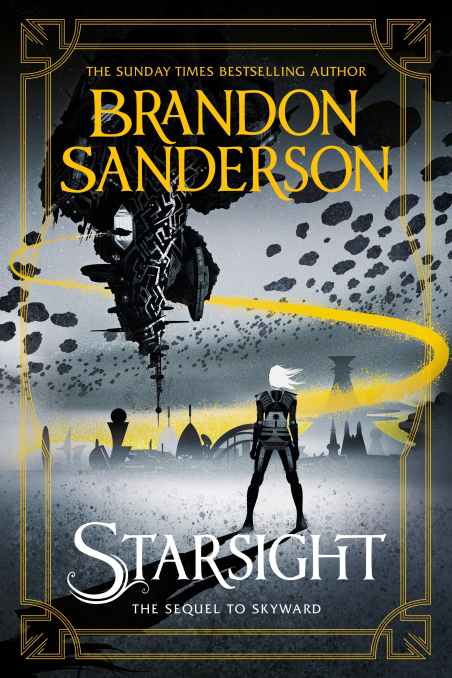
Starsight by Brandon Sanderson

Starsight Cover 2.jpg

Publisher: Gollancz (Trade Paperback – 26 November 2019)

Series: Skyward – Book 2

Length: 461 pages

My Rating: 5 out of 5 stars

Amazon

From one of the best authors of fantasy and science fiction in the world today, Brandon Sanderson, comes Starsight, an outstanding and addictive young adult science fiction read which continues the wildly entertaining adventures of a young starfighter years in the future.

Starsight is the second book in the Skyward series and follows on from the 2018 release of the same name. Skyward was a fantastic young adult science fiction book that told a compelling tale of bravery, determination and camaraderie in humanity’s distant future. Skyward was an amazing read, and it was easily one of my favourite books of 2018. As a result, I have been looking forward to Starsight for a while now, and it was one of my most anticipated releases for the second part of this year.

The Skyward series is set on the planet of Detritus, a desolate world that houses a population of humans in the caverns beneath the surface. The humans on Detritus are the remnants of a once great intergalactic human civilisation that has been destroyed in a war with a superior alien civilisation. Forced into hiding within the planet for hundreds of years, humanity eventually returned to the surface utilising scavenged starfighters to escape and build a military outpost to fight back against the alien ships who continue to harass the planet.

In Skyward, the reader is introduced to Spensa Nightshade, a young woman determined to become a pilot in the Defiant Defence Force (DDF), the military organisation that fights the alien invaders. While talented, Spensa faced opposition to being accepted into the military due to an apparent act of cowardice by her father years before. Despite the odds, Spensa was accepted in the DDF and was trained to become a skilled pilot, fighting in a number of actions against the enemy, while also trying to find out what actually happened to her father. Along the way, Spensa discovered an ancient but advanced human ship that had crash-landed on Detritus. Upon repairing the ship, Spensa discovered it had an AI installed in its computers, which she called M-Bot. After stopping an extremely destructive alien attack with the help of M-Bot, Spensa was compelled to fly through Detritus’s atmosphere, where she made several startling discoveries, the first of which was that Spensa and her family are powerful cytonics, beings with mental powers who are capable of traversing vast distances through space with their ability. The second discovery she made was that the aliens attacking Detritus were not simply mindless aggressors determined to wipe out humanity; instead they are members of an interstellar conglomeration called the Superiority, who are attempting to contain humanity within the planet. The Superiority hold a great fear of humans, who they see as an extremely dangerous and violent species, and Detritus is actually a prison planet/wildlife preserve where humans can live without disrupting the rest of the galaxy. Unfortunately, the actions of the DDF in reclaiming the surface and utilising spaceships have forced the Superiority to reconsider their approach, and they are now working to kill all the humans.

Usually this is the part of the review where I would give a brief plot synopsis of the new book and then go into an analysis of what I liked about it. However, this is going to prove a little hard to do without revealing some spoilers. While I don’t typically avoid talking about plot points that occur around 50-100 pages into book (I don’t particularly consider something happening that early to be a spoiler), I am a little more wary with Starsight. This is mainly because the plot of the book features some immediate substantial changes from the story that appeared in Skyward, none of which are really hinted at in any of the official online plot synopsis or book blurbs. As I am publishing this review a week before Starsight’s official release date, I think it is best that I put up a spoiler alert below, before I start going into the book in any real detail.

For those readers who do not want to risk any spoilers, I will say now that Starsight is an incredible book that I really, really enjoyed. Sanderson tells a wildly entertaining and highly addictive story that features some memorable characters, high-stakes events, some of the best science fiction action I have ever read and a ton of inventive world building. I honestly think that this is one of the best releases of 2019, and it easily gets a full five-star rating from me (if only I could go higher). I would highly recommend this book to anyone interested in an epic science fiction read, and if you loved Skyward, you are going to love this book.

Anyway, if you are not interested in learning any more details about this book’s plot or characters (which I do explore to a substantial degree), I would suggest you stop reading now, as everything below this paragraph has a spoiler alert in effect.

SPOILER ALERT:

Starsight is set a few months after the events of Skyward, and humanity has been busy. Thanks to Spensa and Skyward Flight, as well as the advanced technology contained with M-Bot, the DDF has managed to capture several of the planet’s ancient orbiting defensive platforms, which have allowed them to push the Superiority forces out of Detritus’s obit. However, despite these successes, humanity is still trapped on Detritus, and the eventual Superiority mass retaliation will likely wipe out everyone on the planet. Their only chance at survival is to flee from Detritus and find a new planet to make their home, somewhere the Superiority cannot find them. However, the only way to do this is with some form of hyperdrive, which humanity lacks access to, and Spensa’s cytonic teleportation abilities are too restrictive for mass use.

The crash-landing of an unknown alien spacecraft on Detritus may provide the solution that will ensure humanity’s survival. The pilot of this craft is a member of a non-Superiority species who has been invited for diplomatic reasons to enlist in a new Superiority fighter squadron, and she is able to pass on the cytonic coordinates to the squadron’s base to Spensa. Disguised with M-Bot’s holographic technology, Spensa travels to the Superiority space city, Starsight, in order to infiltrate the Superiority military and find and steal a working hyperdrive.

Joining the new Superiority squadron, Spensa discovers that she and her fellow recruits are being trained to fight the delvers, titanic inter-dimensional beings that dwell in the nowhere, who are capable of devastating planets if they are drawn into our dimension by an over-use of cytonic ability. But as Spensa attempts to complete her mission, she finds herself caught amidst the politics of the various Superiority races, many of whom wish for the complete and utter destruction of her people. Can Spensa navigate the strange new world she finds herself in, or will her actions result in the destruction of all she knows?

As you can see from the above synopsis, Starsight goes in some very interesting and unpredictable directions. I personally loved all of these new story elements, and the idea of Spensa having to infiltrate a mostly unknown alien society was a really clever and intriguing central plot idea that I think worked extremely well. The subsequent narrative is a fantastic blend of different story elements, which includes some great new characters, settings and plot directions, as well as some of the best parts of Skyward. For example, not only do you get to see a whole new take on the excellent space fighter training plot point that made the first book so amazing, but you also get a science fiction spy thriller story filled with all manner of political intrigue. This was a fantastic book to get into, and Sanderson has made sure that the plot is accessible to readers who did not get a chance to check out Skyward last year. However, I would strongly recommend reading Skyward first, not only because it will give you a better idea of the characters and certain plot elements, but because it is such an awesome book in its own right.

One of my favourite things about the first book in the Skyward series was the excellent group of characters that Sanderson focused on, including Spensa, M-Bot and the members of Skyward Flight. Throughout Skyward the reader got to know and care for these characters, and it was actually a little bit distressing when bad things happened to them. Skyward continues to look at several of the characters from the first book, although readers who grew attached to Skyward Flight might be a tad disappointed as Sanderson shifts the focus away from them and introduces the reader to a whole new group of alien characters.

Spensa is still the main point-of-view character for this second book and serves as a fantastic central protagonist. In many ways, Spensa is still the same impatient and reckless pilot that was such to see in the first book. However, it soon becomes obvious that the experiences, relationships and life lessons that she has faced since joining the DDF have tempered her in many ways, especially as she has to deal with the intense responsibility of being her people’s greatest hope for survival. I really enjoyed watching Spensa as she was forced to assimilate into the alien cultures on Starsight, and it was interesting to see how she reacted when she realised not everyone there is as evil as she believed. The opinions and support she gives to her alien friends result in some emotional moments, and it was really heart-warming to see how far she has progressed since the last book.

While Spensa is a great central protagonist, to my mind the best character in the entire book is still her sentient ship, M-Bot. M-Bot is the snarky and hilarious artificial intelligence that Spensa discovered crashed on Detritus, and together they form an efficient and enjoyable team. M-Bot honestly has all the best lines in the book, and nearly every interaction with Spensa results in some excellent jokes or banter. Despite the humour, M-Bot is a pretty complicated character, especially as in this book he is attempting to work out the full limits of his consciousness and code. He is continuously attempting to prove that he is actually alive, and these attempts result in safeguards in his system attempting to shut him down. I really enjoyed the way that Sanderson continues to utilise M-Bot. Even though he is a ship, he is still a fantastic and highly enjoyable character to focus on and we even get a reason for his mushroom obsession in this book.

Spensa’s new flight of Superiority comrades features an eclectic bunch of aliens, each with their own quirks and unique personalities. These include a figment called Vapour, who is essentially a sentient smell that can take control of ships and pilot them. Vapour is the ultimate spy and requires Spensa to be constantly on her toes. There is also the dione draft, Morriumur. Dione are a race of non-violent aliens high up in the Superiority hierarchy, who have a unique breeding system that combines the parents into one new being. This is a process that can take several goes, as the family of the newly bred dione may choose to reform a young dione so that they have an ideal personality. Morriumur is a draft, spending the first few months of their life testing out their personality to see if they are an ideal member of the species. Morriumur, who has slightly more violent tendencies than most of their species, is trying to prove that they belong as a starfighter, but the combined expectations of their family and the inner thoughts that they are not worthy, are a constant hindrance to them as a pilot.

While both of the above characters are pretty cool, and Sanderson spends a good amount of time exploring them, two members of Spensa’s new flight really stood out. The first of these is Brade, a human from another prison world who has been recruited as a cytonic enforcer by one of the book’s central antagonists. Brade, after being taken from her parents as a child, has essentially been brainwashed all her life to consider humans as evil and inferior, and this has a major damaging effect on her psyche. The interactions between her and Spensa throughout the book are quite fascinating, and she proved to be one of the most complex characters in this book. My favourite new character, however, had to be Hesho, who is totally not king of the kitsen. The kitsen are a race of tiny gerbil-like aliens who have recently converted from a monarchy to a democracy in an attempt to become a Superiority race. Hesho leads a group of around 50 kitsen who pilot one heavily armed fighter in Spensa’s squadron like it’s a capital ship. Hesho and the kitsen are really hilarious characters, mainly because Hesho is attempting to convince the Superiority that he is no longer ruling his people as a king, and instead the kitsen have embraced democracy. Unfortunately, despite Hesho insisting he is no longer a monarch in every interaction he has, his people continue to worship him, which kind of undercuts this message. I also found the similarities in the personalities between the kitsen and the Spensa we first encountered in Skyward to be very amusing, as the kitsen attempt to compensate for their size with extreme confidence and boasting like Spensa used to (for example, the first ship we see the kitsen flying is called Big Enough to Kill You).

All of the above characters are great, and I really loved the way that I was once again drawn into their various personalities and histories. It was a bit of a shame not to see too much of the characters I liked so much from the first book (although we do get an idea of what various members of Skyward Flight are up to), but I think the new characters that Sanderson introduced more than made up for it.

In addition to the fantastic character work, one of the other best features of Starsight is the epic and fast-paced action sequences that punctuate much of the book. Just like in Skyward, Sanderson presents a huge number of different scenes where Spensa is fighting or training in a fighter. The sheer amount of detail that goes into these various action sequences is pretty amazing, and I was able to picture all the flying and manoeuvres perfectly. The author comes up with a number of clever new scenarios in this book, including the fancy flying and combat required to fight a delver, or having Spensa fly in the type of craft she has been fighting against for her entire military career. All of the action in this book is first-rate, and I can guarantee that you will get lost in some of the incredible action sequences.

I have always been impressed by the elaborate worlds that Sanderson can create for his stories. Whether it is the vast fantasy world that he came up with for The Stormlight Archive, the supervillain dominated alternate version of Earth that appeared in The Reckoners trilogy, or the fantastic science fiction planet of Detritus that was the main setting for Skyward, Sanderson always delivers complex and intricate settings for his story, complete with huge amounts of backstory. In Starsight, Sanderson once again produces a huge and detailed new setting for his outstanding story. The alien civilisation that is living on Starsight is very impressive, and I love all the different alien races that he has come up with for this story. Many of the aliens have some very complex and fascinating history, a great deal of which featured in the story. I really look forward to seeing how Sanderson expands this universe even further in the final book in the trilogy, and I cannot wait to see what new aliens or civilisations he comes up with.

As you can see from this rather lengthy review, there is a lot to love about this book. Sanderson does an impressive job of combining the intriguing new story direction, the amazing characters, intense action and fascinating new setting into one concise narrative, and the end result is a perfect book. While Starsight is being marketed as a young adult book, and indeed it would prove appropriate for most young readers, it is really a novel that can be enjoyed by any reader of any age. I cannot recommend this book enough, and I am eagerly awaiting the next book in this series (which seems to be 2021 at this point, so far away!).

Amazon

Throwback Thursday – Moving Pictures by Terry Pratchett

Moving Pictures Cover

Publishers: Corgi and ISIS Audiobooks (14 November 1991)

Series: Discworld – Book 10

Length: 332 pages or 10 hours and 8 minutes

My Rating: 5 out of 5 stars

Amazon

Reviewed as part of my Throwback Thursday series, where I republish old reviews, review books I have read before or review older books I have only just had a chance to read.

Because my blog shares the name of a building featured in Terry Pratchett’s Discworld series, some people might have assumed that I am a fan.  You would be right, so very, very right.  I have loved Discworld since I was a small child, and my appreciation and respect for the complex writings of the late, great genius, Sir Terry Pratchett, has grown with me.  The Discworld series represents one of my ultimate comfort series of books.  It’s the series that I go back to at any time when I want something fun and familiar to enjoy.  I have read all of the adult books set in Discworld multiple times (I have yet to read all of the young adult ones), and it is an unusual year when I do not listen or read some of these books in my spare time.  Pretty much every single book in this series deserves five out of five stars or higher (with one or two exceptions that I may mark down to a 4.75 with a heavy, heavy heart), and you are unlikely to find any real criticisms about this book below.  After nearly a year of running this blog, the continued exclusion of a review of any of Pratchett’s Discworld is a travesty, and one that I seek to rectify in this somewhat late Throwback Thursday with a review of the 10th book in the series, Moving Pictures.

Before I review Moving Pictures, here is some quick context of the Discworld series for those people unfamiliar with these books.  Discworld is the main series of Sir Terry Pratchett, set upon the Discworld, world and mirror of worlds.  The Discworld, or the Disc, is a flat world that rests on the backs of four massive elephants, who themselves stand on the back of a gigantic turtle swimming in space, Great A’Tuin.  The Discworld itself features a huge range of different nations and continents that bear striking similarities to real-world locations.  This series is, without a doubt, the best series that utilises a combination of fantasy and satire in the entire world.  The seamless blend of the two elements is just incredible, and both elements do an unbelievable job at enhancing each other.  Before his death, Pratchett wrote 41 books in the Discworld series, six of which are considered young adult books.  While the books can be read in any real order, the series were mostly written in chronological order (with the exception of Small Gods), and events from earlier books in the series are often referenced.  Although most of the Discworld stories are self-contained, a number of the books are linked together by a recurring main character and are subsequently grouped together into subseries.  These include the Rincewind, Witches, City Watch, Death, Tiffany Arching and Moist von Lipwig subseries, in addition to a few standalone books that fall outside of any of the subseries.  Characters often appear in other Discworld books outside of their subseries, and there are a string of side or secondary characters who appear in multiple subseries and standalone books.

The book I am reviewing, Moving Pictures, is a standalone book that does not really fall within any of the main subseries.  It is sometimes considered part of minor subseries, called the Industrial Revolution subseries, with The Truth and Monstrous Regiment, but I am not a big fan of that distinction.  As it is the first Discworld book I am reviewing, you might think that it is my favourite book in the entire series, which is not true; although it does get five out of five stars from me and I have enjoyed it an amazing number of times, it is not my absolute favourite Discworld book, although it is high on the list.  It is, however, an easier one for me to review as there is a lot I can say about it.

Goodreads Synopsis:

‘Holy wood is a different sort of place. People act differently here. Everywhere else the most important things are gods or money or cattle. Here, the most important thing is to be important.’

People might say that reality is a quality that things possess in the same way that they possess weight. Sadly alchemists never really held with such a quaint notion. They think that they can change reality, shape it to their own purpose. Imagine then the damage that could be wrought if they get their hands on the ultimate alchemy: the invention of motion pictures, the greatest making of illusions. It may be a triumph of universe-shaking proportions. It’s either that or they’re about to unlock the dark terrible secret of the Holy Wood hills – by mistake…

The blurb above is a bit vague on the details of what is actually happening in Moving Pictures.  Essentially, the alchemists of Ankh-Morpork, the largest city on the Discworld (and a central location for many of the books), suddenly develop filmmaking, which they call moving pictures, and set up a filming base at the ancient and abandoned Holy Wood.  The moving pictures issue a weird siren call to the inhabitants of the Discworld, dragging all manners of people and creatures from across the lands and infecting them with their magic (not a metaphor).

Among those drawn to Holy Wood are Victor Tugelbend, a former student wizard, and Theda “Ginger” Withel, a small-town girl with big dreams.  Thanks to the magical on-screen chemistry between them, Victor and Ginger quickly become the superstars of the fledgling moving pictures industry, especially when the Discworld’s most infamous salesman, Cut-Me-Own-Throat Dibbler, comes to town and takes over the studios.

However, reality on the Discworld is always a bit thin, and Lovecraftian monsters (a favourite recurring antagonist of Pratchett’s early Discworld novels) are revealed to be the ones who planted the idea of moving pictures and Holy Wood in the alchemists’ heads.  Using the new sort of magic created by Holy Wood, the creatures start to break through.  With the wizards of Unseen University, the people who are supposed to guard against these sorts of incursions, distracted by the arrival of an unconventional new Archchancellor, it is up to Victor, Ginger and a ragtag band of other Holy Wood characters to save the day.

This book has so many moving parts to it that it’s hard to know where to begin when reviewing it.  While the main story is concerned with the introduction of moving pictures into the Discworld, there are a number of other entertaining storylines going on throughout the book, each one complementing the main story and creating an amazing overall narrative.  The major appeal of this book is its sharp and intelligent satire of the movie business, which also examines the nature of a film industry in a world as crazy as the Discworld.  I also quite like all the amazing characters, either introduced or built up in this book, many of whom appear in later books in the series.

This book is absolutely hilarious and filled with a huge number of clever and outrageous jokes and observations about the film industry, all of which lie on top of Pratchett’s usual humour about day-to-day life in the Discworld and his random observations, many of which are perfectly introduced in the book’s footnotes.  The main storyline is an amazing portrayal of the hectic early days of the film industry, placed in a fantasy setting.  The cameras are powered by miniature demons (who paint the pictures really, really fast), the lighting is done by salamanders, actors of all species make up the cast, the audience eat ‘banged grains’ while watching the ‘clicks’ and the film’s monsters and villains are all trolls in crude costumes.  However, literal movie magic is making people do strange things (strange even for Discworld folk), talking animals are showing up looking for work, Dwarfs are singing “Hihohihohiho” as they work, characters routinely burst into song and dance in the rain, and one producer keeps threatening to turn people into stars, all while the book’s few straight-characters look on in bemusement.  All of this is amazing, and the sheer number of fantasy-assisted jokes throughout the book is pretty unbelievable.

At its heart, Moving Pictures is a satire and a critique about the film industry as a whole.  Quite a large amount of the story is dedicated to parodying the real-life the crazy effect that movies can have on audiences and the people who make them, as the book shows some ridiculous events.  The story also reflects the insubstantial nature of fame and the fragility of dreams surrounding the movie industry.  The fast-moving world of the film industry is also shown, although sped up even more for comedic and story value, as they film creators are constantly searching and finding new advancements in their field.  A great example of this is shown when Cut-My-Own-Throat Dibbler invents and then continually advances the art of advertisement, so that, within a few short weeks, the film industry goes from ineffective text advertisements to eye-catching posters and explorations of product placement and subliminal messages.  Pratchett handles these critiques very skilfully, and you cannot help but laugh aloud as he skewers the film industry quite cleverly throughout Moving Pictures.

Pratchett also filled Moving Pictures with a ton of references to iconic films and elements of the film industry.  Many of the characters involved with the films are caricatures of famous movie actors, with Victor playing all the typical romantic or manly male heroes of the day, and Ginger is essentially Marilyn Monroe.  Several films are parodied throughout the book, such as Gone With The Wind, which becomes Blown Away, an epic love story set around a famous Ankh-Morpork Civil War.  There is a rather good King Kong parody, in which a gigantic woman kidnaps a poor defenceless Ape (the Librarian) and drags him to the roof of the tallest tower in Ankh-Morpork, all while two wizards on a broomstick shoot at it with a crossbow, with one shouting “If it bleeds, we can kill it!”  That is only scratching the surface of the references featured within this book.  A golden figure with a name starting with O plays a big part in the story, the various studios are all parodies of real-life studios, and there a huge number of funny and subtle references to various famous films.  Examples of these include Wizard of Oz, Lassie, Lawrence of Arabia, Indiana Jones, Looney Tunes, Blues Brothers, Casablanca, Tarzan and Star Trek just to name a few.  Readers can go through this book multiple times and not pick up every detail, which is a testament to the cleverness of Pratchett and his ability to come up with some hilarious references.

I have always found the way that Pratchett utilises or re-uses his characters to be extremely fascinating; while some characters appear in multiple books, a number of his main characters, especially from his earlier books, are only used once. There are several examples of this, including Mort from Mort, Pteppic from Pyramids and Esk from Equal Rites (who did appear in a later young adult novel, but there was a significant time gap between the writing of these two books).  While Pratchett may have simply had only one story in mind for these characters, I have a feeling that he simply did not like how they turned out and decided not to use them again under any circumstances.  Mort is probably the best example of this.  Despite being the protagonist of the first Death subseries book Mort, he never appears in any of the Death subseries books again (aside from one brief flashback), and is instead replaced by his own daughter, Susan.  It is interesting to note that most of the main characters who were never or rarely used again are somewhat similar to each other, being young heroes without too many obvious flaws to them.  On the other hand, the unique main characters Pratchett creates with notable flaws, such as Rincewind, the wizard who has turned cowardice into an art form, or the overly cynical and dangerous alcoholic Sam Vimes, helm multiple books.

If I have to make one criticism about this book, it is the weak and somewhat inconsistent main characters, Victor and Ginger.  Ginger is a generic female character, and while she is a good parody of Marilyn Monroe and other early screen actresses, she is pretty one-dimensional and unlikeable.  Victor starts out with some very interesting character traits, as he is described as an extremely lazy person, whose unique brand of laziness forces him to become a brilliant student wizard in order for him to succeed in his quest to fail every test he ever takes by a certain point margin to ensure he remains a student.  However, these character traits are pretty much thrown out the window a few chapters in and he becomes a typical male hero for the rest of the book.  While this sort of straight-man character was needed for this wacky adventure, it is surprising that the character never again really shows the slightest hint of some of these earlier established character traits.  It is interesting to note that neither Victor or Ginger appear in any of the subsequent Discworld novels, so I think there is a strong possibility that Pratchett might also have disliked how these characters turned out.

While one or two of his earlier main characters were somewhat unimpressive, Pratchett always managed to make up for this by creating a range of memorable and enjoyable side characters.  It was always interesting to see which of these side characters would appear in various later books, as you knew Pratchett had to like them as well.  For example, Granny Weatherwax was a supporting character in Equal Rites, but Pratchett must have liked writing her, as she became a major character in the Discworld series, even getting her own subseries with several other witch characters.  Moving Pictures is perhaps the best example of Pratchett’s love of side characters; while Victor and Ginger never appear in the Discworld again, many of the side characters introduced or developed in this book have major roles later in the series.

For example, I was always impressed with how this book turned two minor characters from Guards! Guards!, Cut-Me-Own-Throat Dibbler and Detritus the troll, and gave them more expanded roles in Moving Pictures.  Dibbler was an opportunistic merchant who got a couple of good, if minor, scenes in Guards! Guards!, but in Moving Pictures, Pratchett transformed him into a ruthless and extremely savvy salesman who gets in the front door of every major new opportunity inflicted on the Discworld, but is often forced by circumstances back to becoming a sausage-in-a-bun merchant.  Dibbler was absolutely fantastic as the stereotypical sleazy film producer, and it is unsurprising why he suddenly became a major recurring character throughout the Discworld books, not only appearing in nearly every book set in Ankh-Morpork but also having clones of him appear in the other nations and cities, all of whom sell disgusting local delicacies.  Detritus is another great example, as he goes from the simple bouncer introduced in previous books to a troll seeking love and a new way of life.  Pratchett comes up with a great personality for Detritus in this book, and it carries through to the City Watch subseries when he joins the Watch in Men at Arms and becomes a major recurring character in this subseries and other books set around Ankh-Morpork.  Other recurring characters, Death and the Librarian, are as awesome as ever, but Dibbler and Detritus are the real standout stars of this book.

Several new characters introduced in this story also make a number of reappearances throughout the rest of the Discworld series.  A good example of this is the talking dog, Gaspode, who is a fantastic and sarcastic character through the book.  He has some great scenes, with the highlight being his friendship with Laddie, a Lassie parody and idiot who Gaspode takes under his wing.  The idea of a clever, underappreciated and sarcastic talking dog side character apparently worked so well that Pratchett found a way to return his magical intelligence and ability to speak a few books later in Men at Arms (the same book Detritus reappeared in) and he then featured in several additional books.

You also have to love the new wizard characters that Pratchett also created for this book.  Before Moving Pictures, the faculty of Unseen University, with the exception of the Librarian and Rincewind, were replaced each book with a new group of senior wizards, thanks to the competitive nature of succession in the university.  However, this 10th book introduces a brand new and more permanent faculty of Unseen University, led by Archchancellor Mustrum Ridcully.  Ridcully is a fantastic character as he is big, loud and sporty man who is generally the complete opposite to any other wizard previously shown in the Discworld series.  I really enjoyed his storyline and found it to be one of the most entertaining in the entire book.  Pratchett must have agreed, as Ridcully became the only recurring Archchancellor in the Discworld series.  This also allowed for the creation and stabilisation of unique characters to make up the senior faculty of Unseen University, including the Bursar, the Dean, the Chair of Indefinite Studies and the Lecturer in Recent Runes.  While the other wizards have a fun romp breaking out to go see the moving pictures, the Bursar has a great story, as you get to see the first signs of madness that would afflict him throughout every other book he appears in, as he first encounters the stress associated with working under Ridcully.  I also liked the introduction of a young Ponder Stibbons, whose bad day while trying to escape from the university is pretty humorous, but also the complete departure from his later role as the only serious member of the faculty.  Thanks to their entertaining storylines, the wizards would appear in multiple books in the rest of the Discworld series, and while they never had their own specific subseries, they would get major inclusions in several other subseries, including substantial stories in The Last Continent, Soul Music, Lords and Ladies and The Hogfather, as well as their own novel, Unseen Academics.

While I have physically read most of the books in the Discworld series, including Moving Pictures, these days I tend to only listen to the audiobook formats of these books.  The Discworld audiobooks are pretty awesome, and the two narrators for the series, Nigel Planer and Stephen Briggs, both do an incredible job.  I find that the humour in the Discworld novels is massively enhanced by the narration, and I love listening to the stories this way.  At 10 hours and 8 minutes, this is not a long audiobook, and I always tend to power through these books really, really quickly.  Planer is a comedy veteran and has an awesome audiobook voice, and it is quite impressive the sheer range of different and distinctive voices he can come up with.  I also like his incredible consistency when it comes the multiple books in the Discworld series; for example, voices he creates for Moving Pictures are generally the same used for that character in later books he narrated.  The audiobook format of Moving Pictures is my preferred way to enjoy this book, and it is really worth trying out.

As you can see from my extremely long rant above, I absolutely love Moving Pictures and the Discworld series.  Pratchett created an incredibly complex and extremely funny novel that laughs right at the heart of the film industry.  The sheer range of references in this book is amazing, and the creation and enhancing of the various side characters featured in this book has massive ramifications for many of the later Discworld novels.  If you have yet to experience the joy of Terry Pratchett’s Discworld series, get on it as soon as you can.  It is well worth it, and Moving Pictures is a great place to start your Pratchett adventure.  I fully intend to review more books in this series in the future.

Amazon