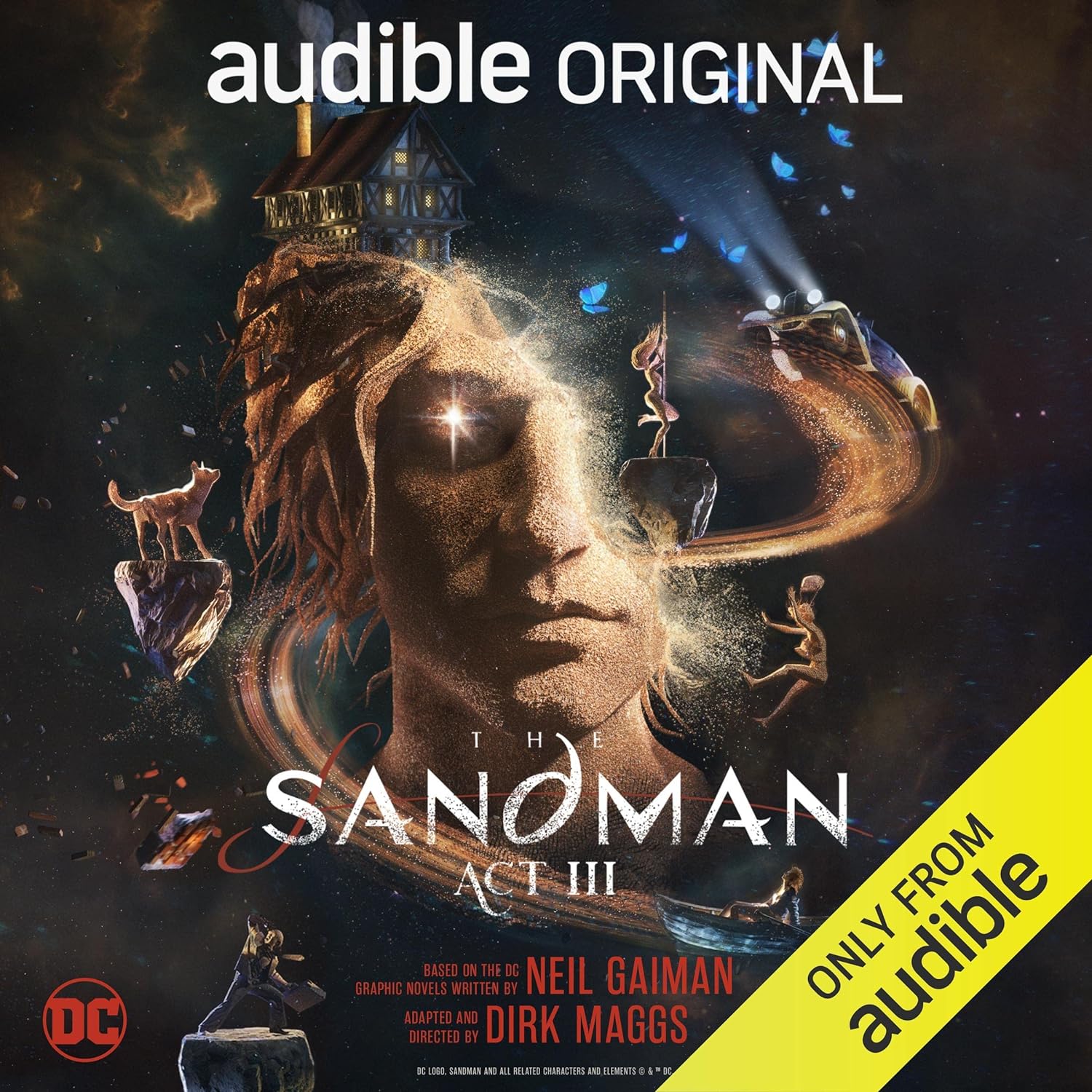
The Sandman – Act III (Audiobook), written by Neil Gaiman and performed by a full cast

Publisher: Audible Original (Audiobook – 28 September 2022)

Series: The Sandman – Volume 3

Script: Neil Gaiman and Dirk Maggs (script adapter)

Director: Dirk Maggs

Length: 11 hours and 31 minutes

My Rating: 5 out of 5 stars

Amazon

After falling in the love with the epic The Sandman comics thanks to their exceptional audiobook adaptations, I finally got to the third audiobook act in this exceptional series by Neil Gaiman, which was another amazing listen.

I have had an outstanding time listening to the first and second volumes of the audiobook adaptations of The Sandman comic.  Set partially in the DC universe, the original series, which started in 1989, is one of the most iconic comics of all time and features a unique adventure that only Neil Gaiman can come up with.  Following Dream, the anthropomorphic personification of dreams and human imagination, The Sandman is a truly amazing comic that blends horror, fantasy and superhero elements together.  Some people might be more familiar with the recent Netflix series that adapted the first couple of comics, and which has a second season on the way.

This series has proven to be extremely exceptional, with Act I perfectly introducing the characters and setting up the initial storyline, while Act II continues some of the key story points and places Dream against various foes, including Lucifer and other dangerous mythical figures.  Not only do these audiobooks feature an incredible story and powerful characters but they are brought to life by a truly awesome cast of celebrity actors and audiobook narrators who really lend their all to this performance.  As such, when going on a couple of fun road trips this year, Act III was a very easy choice to listen to, and I was extremely curious to see how this series would continue.

In a universe of strange and deadly creatures, many beings are considered immortal, but only seven siblings can truly claim to be endless.  The Endless, each a personification of a universal concept, are powerful and mesmerizing in their own way, but the most enchanting and mysterious is Dream.  Known by many names, including Morpheus, this being governs the Dreaming, a vast realm of creation’s collected dreams and stories, protecting the imagination that makes life worth living.  But circumstances outside of his control have set him on a dark path that not even he can escape from.

After being freed from captivity and deciding the future of Hell, Morpheus finds himself troubled by another failed romance, his own complex past, his previous monstrous decisions, and his often contentious relationship with his family.  Visited by his troubled youngest sibling Delirium, Dream embarks on an unusual quest alongside her to find their missing brother, the one member of the Endless to ever give up their role and responsibility, Destruction.  But their prodigal sibling does not wish to be found, and many obstacles lie between an Endless reunification.  To succeed in their quest, Morpheus will need to revisit the most painful chapter from his past.  However, no-one, not even a member of the Endless, comes away from a meeting with Destruction unscathed!

Unsurprisingly, Act III proved to be an exceptional listen, and I once again got wrapped up in the elaborate and compelling web of stories and characters that The Sandman is well known for.  Adapted once again by director Dirk Maggs and featuring all of Gaiman’s impressive storytelling and dark characterisations, The Sandman – Act III, was an outstanding listen, and one that I could not get away from.  Adapting the Brief Lives and Worlds’ End arcs of The Sandman comic, as well as several additional short stories, Act III was an exceptional addition to this series, especially with the truly exceptional voice cast.

Act III continues the same format and style of the previous The Sandman audiobook adaptations, with the comic broken into several distinctive parts to best tell the elaborate story from the comics.  The previously drawn adventures are brought to life here through a combination of excellent narration by Neil Gaiman, who covers many of the characters’ actions and movements, sound effects to represent other unseen elements, and the dialogue of the various characters, with their respective actors often describing the moments going on around them.  This results in an intriguing but complex listening experience, and with a runtime of 11 hours and 31 minutes, it is one that you can get through very quickly if you have the time.

This latest audiobook adaptation starts off in an interesting place with the short story The Song of Orpheus, which originally appeared in the Fables & Reflections collection of stories.  The Song of Orpheus is a fantastic retelling of the classic Greek myth of Orpheus, with the character reimagined as the son of Morphius and the muse Calliope, the latter of whom was featured in the story Calliope in the Dream Country collection (featured in the Act I adaptation).  Gaiman does an excellent job of bringing together the classic Greek mythology of the Orpheus legend with his own characters and the result is a seamless and complex tale.  Orpheus’ ill-fated marriage and journey to save his love is aided and hindered by the various members of the Endless, with Morpheus serving as a complex distant father figure.  The resulting story may seem familiar to those with knowledge of Greek mythology, but there are some added intriguing twists, and the inclusion of Gaiman’s characters ensure that there is even greater tragedy than the original Greek myth envisioned.

When I started this audiobook, I thought that The Song of Orpheus was interesting start to this act, and in hindsight it was quite a clever decision, as it sets up some of the other arcs extremely well.  The story ensures that listeners are well warned about the tragedy and elaborate storylines contained in Act III, while also drawing you in with its inventiveness and complexity.  It is also a brilliant production thanks to the combination of cast and background music effects.  Regé-Jean Page (of Bridgerton fame), proves to be an outstanding Orpheus, who stands as an interesting contrast to the other established voice actors of this story.  There are also some epic musical accompaniment and sound effects that prove vital in showcasing the full impact of this story, and which you honestly need when telling a story about the mythical musician Orpheus.  I felt that the musical elements of this chapter deeply helped to enhance the story, especially as there was some great sadness in the sound effects that mirrored the story.  This was honestly a very strong start to Act III, and I loved how well it led into the first main story, Brief Lives.

Brief Lives is a particularly epic main story arc for this audiobook which serves as both the plot and emotional heart of Act III.  Initially focusing on the incredibly fun character of Delirium, who we only briefly saw in Act II, Brief Lives sees Dream accompany his sister on a road trip to find their lost brother, Destruction.  This results in several intriguing mini story arcs as the mismatched and chaotic siblings travel through the mortal world, encountering their family, friends, and former associates of Destruction.  At the same time, sinister events begin to impact people associated with their search, and Dream must navigate the increased collateral damage his quest is incurring.

I really loved this arc, and I think that Brief Lives might be one of the stronger The Sandman storylines.  The road trip storyline with Dream and Delirium worked to tell this story in a fantastic manner, and I enjoyed how the author took the opportunity to quickly and effectively introduce new intriguing characters whose worlds become impacted by their interactions with the Endless.  The long-anticipated reveal about the missing Endless was great, and Gaiman loads in some intriguing examinations about family, destiny and duty.  Brief Lives is loaded with a great combination of dark mystery, the author’s gothic vibe, a fantastic layer of humour, and an intense amount of tragedy, all wrapped up with the most unique familial interactions you are likely to see in fiction.  The author takes the storylines in some interesting directions, and the resulting emotional richness proves very hard to ignore.  The ending of Brief Lives is particularly moving, with a resolution of family drama followed by additional tragedy millennia in the making.  This also proves to be quite a key story in the wider The Sandman story, with the consequences radiating out from the events of this road trip have chaotic impacts in the future.

I have to say that I was really impressed with how Brief Lives came together.  Not only does the elaborate story come across clearly and interestingly with the chapter split, but you really get drawn into every single supporting character that shows up.  I particularly enjoyed seeing Delirium getting a whole arc to shine in, and actress Kristen Schaal is perfect as the embodiment of personal chaos, bringing an immense childlike glee to the madcap antics of her character.  Schaal perfectly plays off the more serious characters in this story arc, and you can really feel the dancing chaos beneath the surface of her mind as well as how scattered and unconnected she is.  The reveal of Destruction as a character was also quite interesting, and I like the author’s take of him being a warm, thoughtful and entertaining destroyer, whose duty has deeply damaged him.  David Harewood brings some real compassion and charm to the role of Destruction, and I enjoyed how he played off the sarcastic talking dog Barnabas, voiced by veteran voice actor Harry Myers.  The portrayal of Brief Lives also makes excellent use of some musical accompaniment to enhance the emotional impact of the plot, including in some of the story’s heaviest scenes, and this ended up being the most compelling part of Act III to listen to.

The other major storyline in The Sandman – Act III, is the intriguing anthology storyline, Worlds’ End.  Like some of the previous arcs in The Sandman, Worlds’ End is more of an indirect addition to the plot, loaded with short stories that show snippets of Dream, the Endless, and other supporting characters, interacting with new and unique figures.  However, Worlds’ End is also quite distinctive, especially as Neil Gaiman surrenders his narrator duties in this arc, and instead features multiple guest narrators telling their own tales in a similar manner to The Canterbury Tales.  The plot of this arc starts with character Brant Tucker (voiced by Wil Wheaton) and his colleague crashing their car in a freak storm and then finding refuge in the mysterious Worlds’ End inn.  Within the inn, they discover multiple unusual travellers from across time and the realms, who have been scattered due to a reality storm and are seeking shelter.  To pass the time, the various guests tell stories based on their lives, which paint a complex tapestry of their experiences and the long-reaching influence of the Endless.

I have a lot of love for the various short stories that Gaiman fills The Sandman comics with, but I felt that the collection featured with Worlds’ End were some of his strongest.  There are five central stories featured within, and they each provide a complex and wildly different tale of life, loss and adventure, all set in the contexts of different worlds and experiences.  Gaiman manages to tell some complex tales in the short time he has with each entry, and the reader comes away with intriguing visions of these unique worlds and characters.  There are a few times where the narrative devolves into a story within a story, as narrators begin to recount tales that were told to them (and in a couple of cases you have a story within a story within another story).  However, even these prove to be very captivating, and it is a testament to how good a storytelling Gaiman is that readers can moved into multiple interlocking tales and still be intrigued by what is going on.  There is also a great mixture of tales here, from a Lovecraftian inspired dream tale, to a hilarious fantasy adventure told by a rambunctious Faerie, and even a classic nautical adventure tale of a handsome sailor boy, which features the return of fan favourite character Hob Gadling.  However, my favourite story was The Golden Boy, an intriguing retelling of the story of Prez Rickard, the teenage president protagonist of the classic, if short-lived, Prez comics, which proves to be quite entertaining and haunting, while also showing an idealised vision of America.

I felt that these five stories came across in a very organic way with the differing narrators, and it proved to be a lot of fun to experience the talents of several new or underutilised vocal talents in a strong way here.  Wil Wheaton was a great main narrator for the overarching story, and I felt he portrayed a good everyman character experiencing the unnatural for the first time.  Billy Boyd and Colin McFarlane both shine as narrators and central characters for their respective stories, and I quite enjoyed the performances of KJ Apa and Jon Culshaw in The Golden Boy, while Simon Jones was an impactful addition to the funeral-focused story Cerements.  These actors, and many others, helped to turn Worlds’ End into a compelling and distinctive arc, and I liked how effectively it contrasted with the other The Sandman arcs we have enjoyed.  This entire storyline ends on an ominous and prophetic note, as the listener is given a glimpse of major events to come, and Worlds’ End proved to be a great way to conclude Act III.

Overall, these main stories, as well as an additional couple of short stories, proved to be very impressive to read, and I love the complex plots and themes that the author tried to impart.  The continuation of a larger storyline, combined with multiple short stories that expands The Sandman universe, works to create an elaborate experience for the listener, and I deeply appreciate the immense imagination that Gaiman puts into his work.  The flow from larger, cohesive storylines to a series of shorter tales also works extremely well, and I love how the obvious palate cleaner short stories take on a compelling life of their own.  No matter how short, each of the stories in Act III were very well written, and the distinctive blend of dark storytelling, gothic imagination and complex characters makes for some addictive listening.  I especially love the recurring trend of normal humans, as well as other more supernatural beings, encountering the various Endless by chance, only to find their lives altered by the experience, often for the worst.  The often capricious nature of Dream, as well as some of his siblings, really comes through with Gaiman’s writing and the subsequent acting, and you cannot appreciate just how well-written these figures, and indeed the entire character cast of The Sandman, are, until you experience it for yourself.

Before we get to the end of this review, I must once again strongly compliment just how awesome these The Sandman audiobooks are.  Gaiman, Maggs and others do such an incredible job of converting the original comics into this new format, and all the original ideas, actions and compelling figures come across perfectly in the audiobook.  The combination of clever narration and on-point dialogue allows listeners to really appreciate the unfolding actions taking place, and effective sound effects add that extra layer of understanding.  Throw in some outstanding musical moments, which prove to be particularly impactful in Act III, and this entire audiobook hits the reader hard and ensures that are constantly caught up in the elaborate ideas of the original author.  All the storylines come across perfectly, with some slight alterations in the order they appear, and you really come away with an outstanding appreciation for The Sandman, even if you’ve never read the comics.

It goes without saying that Act III once again featured an incredible cast of actors and voice specialists, all of whom perfectly portray the characters they are assigned to.  I love how all the key stars from Act I and Act II, once again returned here, and their outstanding voices, combined with some awesome new figures, ensured that every word of this audiobook delighted its audience.  I have already mentioned a few key actors above, but I really want to once again highlight the outstanding recurring key cast, who do such a great job here.  Series lead James McAvoy is just perfect as Morpheus, and his resonate and powerful voice consistently captures the ethereal, arrogant, and thoughtful qualities of the titular protagonist every time.  It is such a pleasure to listen to McAvoy perform once again in Act III, and his excellent voice plays off every other actor in this audiobook so damn well.

Other key returning stars include Kat Dennings, who perfectly portrays Gaiman’s warmer, caring, female Death, who is frankly one of the best characters in the entire series.  Andy Serkis has a lot of fun as the raven Matthew, and his scenes with Dream and Delirium are hilarious.  Jeffrey Wright, Justin Vivian Bond and Miriam Margolyes each do an amazing job of bringing Destiny, Desire and Despair to life, and you can really feel their ancient power and alternating views of humanity.  Justin Vivian Bond’s portrayal of the feckless and fickle Desire is particularly noteworthy, and I love how well this unique character came across.  Multiple other actors and established audiobook narrators provide a range of compelling and memorable voices throughout Act III, including several of my favourite audiobook narrators like Ray Porter and Toby Longworth, and I loved every one of their voices.  Finally,  Neil Gaiman himself serves as an outstanding central narrator for much of the Act III.  Gaiman’s distinctive voice perfectly fits the gothic and mysterious vibe of The Sandman comics, and there is no-one else who could narrate these complex ideas and experiences, better than the author who originally came up with them.  You will frankly struggle to find a better cast of voice actors in any other audiobook out there, and this outstanding vocal team makes Act III, and indeed all The Sandman audiobooks, something extremely special to enjoy.

Act III of The Sandman audiobook was another exceptional listen and one that proves pretty impossible to stop listening to.  The combination of captivating storylines, outrageous characters, and a huge array of vocal and acting talents make this an easy five-star listen, and I can personally guarantee that The Sandman – Act III makes for an excellent accompaniment to a long road trip.  While I’m sure that recent controversies might impact this, I hope we get the fourth act in this epic series soon, and I cannot wait to see how Morpheus’s tragic and complex tale ends.
Amazon

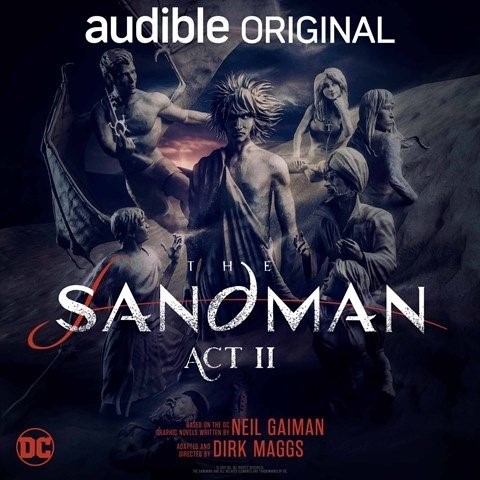
The Sandman – Act II (Audiobook) by Neil Gaiman and performed by a full cast

The Sandman - Act II Cover

Publisher: Audible Original (Audio Drama – 22 September 2021)

Series: The Sandman – Volume 2

Script: Neil Gaiman and Dirk Maggs (script adapter)

Director: Dirk Maggs

Length: 13 hours and 47 minutes

My Rating: 5 out of 5 stars

Amazon

The gloomy and complex fantasy adventures of Neil Gaiman’s The Sandman continues in this epic second audiobook volume that once again brings Gaiman’s unique imagination and characters to life with an outstanding cast of actors.

Back in 2022 I had an outstanding time listening to the first volume of the audiobook adaptation of The Sandman comic.  The original series, which started in 1989, is one of the most iconic comics of all time and features a unique adventure that only someone as twisted and imaginative as Neil Gaiman can come up with.  Following Dream, the anthropomorphic personification of dreams and human imagination, The Sandman is a truly interesting comic that blends horror, fantasy and superhero storylines together.  Some people might be more familiar with the recent Netflix series that adapted the first couple of comics and which has a second season on the way.

While I loved the show, I personally had a much better time with the audiobook version of the comics that was released a couple of years ago.  Featuring a truly exceptional cast of celebrity and established audiobook narrators, the first volume of this series was so damn good, and I loved how well it established the characters and universe of The Sandman while also adapting Gaiman’s unique vibes and dark themes.  This first volume was extremely addictive, and I made sure to listen to the second volume shortly after.  The second volume, or Act II as it will be called in this review, continues the comic storyline and features some amazing stories, fun characters and new cast members.

In a universe of strange and deadly creatures, many beings are considered immortal, but only seven siblings can truly claim to be endless.  The Endless, each a personification of a certain universal or human concept, are powerful and mesmerizing in their own way, but the most enchanting and mysterious is Dream.  Known by many names, including Morpheus, this being governs the Dreaming, a vast realm of creation’s collected dreams and stories, protecting the imagination that makes life worth living.  But circumstances outside of his control have set him on a dark path that not even he can escape from.

Still dealing with the consequences of his forced absence from his realm, Morpheus is working to recover everything he lost while avoiding the enemies he made along the way.  The most powerful of these is Lucifer, the fallen angel and lord of Hell, whom Morpheus insulted when he stormed Hell to take back his stolen helm.  Despite not wishing to cross Lucifer again, Morpheus is convinced to set right the biggest wrong of his life and free his former lover from Hell.  However, he is unprepared for the reception that awaits him as Lucifer chooses to damn him in a far more sinister way: by gifting him control of his dark domain.

Finding himself in possession of the key to Hell’s gates, Lucifer must determine who will become the new ruler of Hell.  Setting up a gala in the Dreaming, Morpheus receives visits from an array of gods, demons, angels, and other immortal beings, each of whom seek to control Hell for their own reason.  Soon, Morpheus finds himself in the middle of a host of scheming beings, many of whom will turn on their host to get what they want.  At the same time, weird things are happening in the Dreaming, as an ancient and unstable realm begins to drag in inhabitants from the real world and influence the waking world.  Can Morpheus ensure his realm stays whole whilst dealing with the most dangerous beings in creation?

This was another outstanding adaptation of The Sandman comics that was so damn epic to listen to.  Adapted by director Dirk Maggs and featuring all Gaiman’s impressive storytelling and dark characterisation, The Sandman – Act II was extremely impressive, and you really get drawn into the unique world of the original comics.  Adapting issues #21-40 and #50 of the original comics, The Sandman – Act II brings together the stories of Season of Mists and A Game of You, and several entries from Fables & Reflections.  All these adaptations are so damn good, and I love the elaborate and epic cast that helps to bring the tale to life.

Due to how the audiobook is set out, there are three distinctive parts to The Sandman – Act II, which provided their own unique stories and characters.  The first of these is titled Season of Mists, and features Morpheus finding himself wrapped up in the fate of Hell.  Starting with an entertaining and dysfunctional family dinner, where Morpheus reunites with all his siblings (bar one), the story then turns to Morpheus’s biggest regret, his relationship with the ancient African queen Nada (whose story was told in the last audiobook), which trapped her soul in Hell.  Travelling to Hell to free her, Morpheus finds that Lucifer has banished all the demons and damned souls from his realm and is abdicating as ruler, leaving the key to Hell’s gates with Morpheus.  Morpheus is soon tasked with deciding the fate of the dimension, which results in a flurry of immortal beings arriving at his home to request the key.  The resulting conference proves to be highly entertaining as Morpheus is forced to deal with all manner of bargains, schemes and betrayals as everyone seeks his favour.  I loved how the entire dramatic conference unfolds, and the interactions between the various over-the-top figures and the implacable Morpheus results in some great drama and hilarious sequences.  The conclusion of this storyline is amazing, as a new irony overtakes the denizens of Hell, Morpheus finds himself meeting various beings who will change him in the future, and the seeds are set for a new story around Lucifer (as seen in his own comic and television series).

Honestly, this is probably the best part of The Sandman – Act II, as not only is Season of Mists particularly gripping, but it makes full use of both the existing voice cast and several new figures to really enhance the content.  The battle of wits between several larger-than-life characters is extremely compelling and clever, and Gaiman does a remarkable job expanding the canon of The Sandman.  There are so many subtle and delightful character interactions scattered throughout this storyline, and listeners will love the impressively devious stakes that are being discussed.  This includes some fantastic and deep soul searching for the protagonist, who is forced to revisit one of his darkest deeds.  Thanks to his own experiences of being locked away, Morpheus understands his harsh past actions a lot better, especially when prompted by members of his family.  I always appreciated how Gaiman shows that Morpheus isn’t really a hero but a force of nature who arrogantly follows his own whims.  However, in this case he is a somewhat better person, even if he is still selfish in his actions, and it takes some real prompting for him to do the right thing.

Gaiman also makes sure to feature some additional amazing character arcs, the most intriguing being Lucifer’s when he decides to perform the ultimate rebellion against his father by abandoning Hell.  Lucifer’s portrayal by a returning Michael Sheen is exceptional, especially during his interactions with Morpheus, and his take on the events that led him to rule Hell are very powerful.  In addition to Sheen, Season of Mists also features the inclusion of several amazing new actors, each of whom are used to their full potential.  Jeffery Wright and Kristen Schaal are perfect additions to the Endless, voicing the taciturn Destiny and the bubbly Delirium respectfully.  However, it is the one-two punch of Bill Nighy as Odin and David Tennant as Loki that really sold this chapter to me.  Bill Nighy and David Tennant are two of my absolute favourite actors, and their takes on these two Norse gods are just amazing.  While Nighy brings gravitas and cruelty to Odin, Tennant’s wheedling, manipulative Loki was so damn fun, and both were the highlight of every scene there were in.  The rest of the cast in this chapter were epic as well, and this entire section was such a highlight of The Sandman – Act II, with its placement at the top of the book successfully drawing listeners in and ensuring they don’t go anywhere.

The other main storyline in The Sandman – Act II was titled A Game of You, and is an adaptation of one of the less popular comic arcs.  This story is an intriguing female-led additional to the series, which primarily follows Barbie, a minor figure from the previous The Doll’s House arc, who has uprooted her life and moved to New York to live with an eclectic mixture of residents in an apartment building.  When figures from Barbie’s long-lost dreams arrive in the waking world, Barbie is dragged back into a fantasy adventure, while her friends in New York deal with minions of the mysterious Cuckoo, a dream parasite preying on Barbie’s mind.  The resulting attempts to help Barbie result in chaos and tragedy as they trespass into the Dreaming and come face to face with Morpheus as a he fulfills an old bargain.

Now I must admit that A Game of You was a little weaker than I was hoping, especially when compared to the preceding Season of Mists.  The decision to focus on Barbie, who honestly didn’t stand out too much in her previous appearance, was an interesting choice by Gaiman, and this arc doesn’t have the most engrossing story.  However, I did still have a great time listening to this part of the audiobook, especially as it focuses on showcasing both the magic and danger of dreams, as well as the impacts that interactions with Morpheus can have on mortals.  The more distinctive fantasy focus of this story makes for a nice change of pace, and I liked how well Gaiman simultaneously showed events occurring inside and outside of the protagonist’s dreams.

One side effect of listening to A Game of You immediately after Season of Mists is that the less substantial cast is a lot more noticeable.  That’s not to say that A Game of You doesn’t have great characters.  There are some amazing figures featured here, including several unique protagonists who have compelling connections to previous story arcs from the series.  There are also some nicely progressive LGBT+ elements for a comic released in 1991-92, especially when it comes to the trans woman character, Wanda, who is handled with tact and who has a particularly impactful story arc.  There are also fewer celebrity voice appearances in this arc, although I did rather enjoy the inclusion of actress Emma Corrin of The Crown fame as the ancient witch Thessaly, as her intense and distinctive voice added a lot to this fantastic character.  While it is easy to nitpick A Game of You, especially after some of the previous arcs, this is s till a particularly impressive storyline, which is masterfully brought to life with this production, producing something that is very fun to listen to.

These two main storylines are impressively augmented by a series of short stories scattered throughout the course of the audiobook.  Most of these short stories fall between Season of Mists and A Game of You, with several more wrapping events up.  There is also a short story in the middle of Season of Mists that showcases the impacts the closure of Hell has, which leads to the Dead Boy Detectives series.  Gaiman comes up with some truly interesting and unique shorter stories to add to the main plot of the book.  Most of these stories involve various mortals or other supernatural creatures encountering either the Endless or some of Morpheus’s creations, and they usually serve as some form of cautionary tale.  I loved the intriguing underlying themes that Gaiman loaded into each story, including about the impermanence of power and examinations of the human condition, and the author also has fun in launching his distinctive characters into various historical periods.

While all the shorter stories contained in The Sandman – Act II are awesome in their own way, a couple do stand out due to their excellent stories and fantastic performances.  For example, the complex story Three Septembers and a January, retells the tale of Joshua Abraham Norton, self-declared Emperor of the United States, with Dream and his siblings shown to be responsible for his strange actions.  This story is both fascinating and dark, as you witness a man torn apart by the whims of the ethereal siblings.  Listeners grow particularly attached to this tale due to the performance of John Lithgow as Joshua Norton, who adds some excellent humour and no small amount of tragedy with his moving voice work.  Other great stories include Thermido, which sees the return of Lady Johanna Constantine from the first audiobook.  Voiced by the absolutely fabulous Joanna Lumley, this story follows Constantine as she steals into France during the height of the revolution to steal something from Robespierre.  This story was fast-paced, clever, and substantially dark, all of which helped it to stand out, especially with the compelling twists and ironic historical fates.  It was also amazing to get a whole story told by Joanna Lumley, who was somewhat underutilised in the first audiobook.  Finally, the tale August, which follows Augustus Caesar as he disguises himself as a beggar and tells his life story to a dwarf, proves to be quite impressive, especially with Brian Cox playing the titular character.  Each of these shorter stories are masterfully presented, and I loved how complex and powerful their stories were, even with the shorter length the author had to work with.

Overall, I really appreciated the entire story of this volume.  The blending of two fantastic main storylines, as well as the scattering of intriguing and unique short stories, makes for quite an epic continuous listen.  The short stories were well utilised as the director spread them out amongst the audiobook providing a good break between the two extended plotlines, as well as some fun listens in the epilogue.  Not only were all the entries in The Sandman – Act II fantastic and compelling, but each of them had such a distinctive feel that really highlights the author’s style and ability to blend various genres together into one powerful story.  The interesting array of over-the-top characters makes for quite a fantastic listen, especially as Gaiman attempts to capture the many burdens of having cosmic responsibility, while other stories look at how characters are affected by dreams and imagination.  The mixture of fantastic tales and dark moments is always cleverly undercut with moral lessons or complex observations about the human experience.  You honestly come away from The Sandman in deep thought while still being traumatised or wildly entertained by how events unfolded.  There is honestly nothing else quite like The Sandman in fiction, and I always have great admiration for the elaborate and multifaceted tales that Gaiman comes up with.

Just with the first volume of this epic audiobook collection, the production really captures the epic nature of the comic, which makes it a real joy to listen to.  Even with its runtime of nearly 14 hours, this is such an easy and addictive audiobook to listen to, and it proves hard to ever stop listening to the elaborate story that emerges.  A lot of this is down to the impressive nature of the production surrounding this audiobook, as the director goes out of his way to enhance the audio experience for the listener.  Everything about this audiobook, from the emotionally charged music, the elaborate sound effects, and the brilliant cast of actors and narrators, is designed to remind you what an imaginative and unique story you are listening to.  Heck, even the way that the various chapter titles are announced is epic, and I always get a kick out of the impressive way they are read out.  Honestly, the entire audiobook production is just perfect, and anyone who listens to it is in for an exceptional time they will not forget.

As part of my hyping up of the audiobook production, I have to highlight the sheer range of talent lending their voices to this audiobook production, without whom The Sandman – Act II would be nowhere near as exceptional as it was.  I have mentioned several of the newer voice actors in the review already, but The Sandman – Act II also featured the exceptional returning cast from the first audiobook, each of whom provided fantastic new performances that really stuck in the mind.  For example, Andy Serkis is so much fun as Matthew the Raven, while Justin Vivian Bond and Miriam Margolyes serve as fantastic and fitting versions of Desire and Despair respectively.  Kat Dennings proves to be an outstandingly effective incarnation of Death, especially as her positive portrayal captures the more compassionate and likeable version of Death that Gaiman envisioned for his comic.  Even Neil Gaiman has a key vocal role in the production, serving as the narrator who highlights events and details not captured by the dialogue.  Gaiman proves to be an impressive narrator for this story, and his distinctive and wise voice matches the feel of The Sandman perfectly.  However, most of these are overshadowed by James McAvoy, who plays the titular Sandman, Morpheus, in this production.  McAvoy is honestly perfect in this role, and the gravitas, sense of unknowing, and great sadness of this character is so perfectly portrayed by the actor’s voice.  McAvoy does such a good job portraying the imperialistic and arrogant tone and personality of Morpheus and the reader can really envision his actions and thoughts.  McAvoy honestly does the best presentation of this character it is possible to do (television series included), and you will fall in love with his take on this sinister and mysterious figure.

The Sandman – Act II is an outstanding and incredible audiobook production that does such a remarkable job of bringing more of Neil Gaiman’s iconic comic to life.  Perfectly adapting the distinctive and dark comics into a new format, listeners get the benefit of both an excellent narrative and some amazing audiobook production with a remarkable cast.  An absolute joy to listen to from start to finish, The Sandman – Act II was a brilliant follow-up to the first production, and I cannot recommend it enough.

Amazon

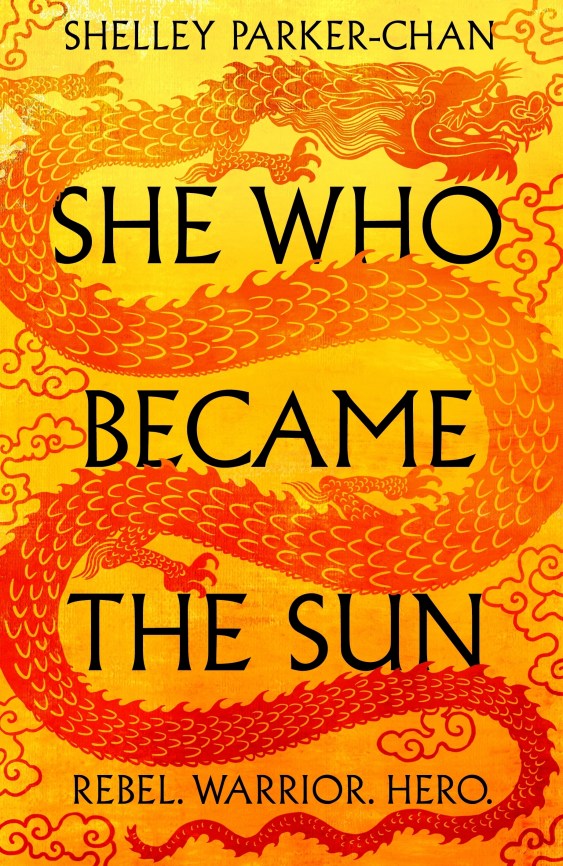
She Who Became the Sun by Shelley Parker-Chan

She Who Became the Sun Cover

Publisher: Mantle (Trade Paperback – 27 July 2021)

Series: The Radiant Emperor – Book One

Length: 414 pages

My Rating: 4.5 out of 5 stars

Amazon

Intriguing new Australian author Shelley Parker-Chan presents one of the most unique debuts of 2021 with the awesome She Who Became the Sun, a powerful historical read with a compelling twist.

In 1345 AD China languishes under the rule of the Yuan dynasty, descendants of the Mongolian invaders who have taken control and punished the southern Chinese citizens.  As famine and banditry stalk the land, the fate of the country will be decided by the most unlikely of people.  In a small village in the south, a seer predicts the future for two siblings.  For the favoured son, the seer sees greatness and unlimited potential, while for the daughter he sees nothing in her future at all.

When a bandit raid wipes out the village, only the daughter is left alive as her brother succumbs to his grief and despair.  Determined not to die an insignificant death and prove the seer right, the daughter plans the impossible.  Stealing the identity of her dead brother, she attempts to cheat fate and take her brother’s destiny for herself.  But how far can the newly named Zhu Chongba truly go, even with a fake identity and a stolen fate?

Travelling to a nearby monastery, Zhu impresses the Abbot and is soon accepted as a novice.  Growing up amongst the monks, Zhu finds a purpose for the first time.  But when a rampaging general destroys the monastery, Zhu is forced to find a new path that sets her against the emperor and the entire Yuan dynasty.  Joining with the Red Turban rebellion, Zhu manages to prove herself and soon leads her forces to several crucial victories.  But the eye of an old rival is upon Zhu, and not even this brilliant monk will be able to emerge unscathed.  The path to China’s future begins here, and soon the fate of the entire country will fall on the poor second daughter, destined to become the nation’s first female emperor.

This was a really compelling debut from Shelley Parker-Chan, who produced an epic and unique historical tale of war, destiny, identity and fate.  Serving as the first book in Parker-Chan’s The Radiant Emperor series, She Who Became the Sun was one of the most anticipated new releases for 2021, and I had an incredible time reading it, especially once I got caught up in its fantastic story.

She Who Became the Sun has an awesome and powerful narrative that proves to be extremely addictive.  The book first shows the protagonist as an unnamed daughter, destined for nothing until she adopts the identity of her brother, Zhu, and grows into a confident and capable young adult at a nearby monastery.  The first quarter of the book is primarily told from the perspective of Zhu and serves as a rather good introduction to the character and the overarching setting.  However, the story shifts dramatically after the eunuch General Ouyang, who serves under a noble family of the Yuan dynasty, burns down the monastery and leaves Zhu a medicant monk.  Determined to gain the destiny her brother was promised, Zhu joins with the rebel movement known as the Red Turbans.  The story then focuses on several interesting storylines, including Zhu’s ascent to commander in the Red Turbans, the volatile internal politics of the rebels, as well as troubles facing the wider Yuan dynasty.  The story adds in two additional point-of-view characters a quarter of the way through, with a particular focus on General Ouyang.  Ouygang is engaging in his own plot against the Yuan, and his fate soon becomes intertwined with that of Zhu.  This results in a pretty epic tale, especially as the various story threads tie together perfectly and produce an interesting and addictive overall narrative.  This leads up to an intense and fantastic conclusion that shows how much the protagonist has changed and how determined they are to see their destiny.  It also does an excellent job setting up the future novels in this series, and I have to say that I am pretty excited to see where Parker-Chan takes this tale next.

I was deeply impressed by the cool setting of She Who Became the Sun, especially as Parker-Chan worked in some excellent and compelling historical elements.  The novel is set in 14th century China during the Yuan dynasty and features an interesting retelling of the life of famed emperor Zhu Yuanzhang, founder of the Ming dynasty.  While there are a few major changes, like Zhu being a woman in disguise, She Who Became the Sun captures several key aspects of this figure’s early life, such as their peasant upbringing, their training as a monk, and their rise to power through the Red Turbans.  I really enjoyed the great examination of China during this period, and Parker-Chan does an excellent job of capturing the tyrannical rule of the Mongol invaders, the famines and crisis their ineffective rule caused, as well as the rebellion that rose to oppose them.  The author also makes sure to include several key historical figures, such as Zhu’s major supporters, and it proved to be a fun re-imagining of their relationship with the future emperor.  While this is primarily a historical fiction novel, Parker-Chan includes a lot of other interesting elements that alter the feel of She Who Became the Sun.  For example, there are several mystical features, such as some key individuals who can summon an aurora of visible light to show they have the divine right to rule.  Zhu also has the ability to see ghosts and finds herself haunted and at times damaged by malevolent spirits, angry at her decision to steal another person’s destiny.  These supernatural elements give She Who Became the Sun an intriguing and unique feel, and I really love it when authors subtly work in some subtle alternate genre inclusions into their work.

I also must mention the excellent inclusion of major LGBT+ elements into this book, especially around central character Zhu Chongba.  Zhu spends the entirety of the novel in the role of her late brother, pretending to be a man so she can rule and lead.  This was a really fascinating and distinctive choice by Parker-Chan, and one that makes She Who Became the Sun really stand out.  While there are some understandable comparisons to Disney’s Mulan, Parker-Chan instead frames it as a choice made from a desire to survive and to be more than what her sex would usually allow her to be in this period, especially under Yuan control.  Zhu spends most of the novel trying to hide her birth gender from everyone around her, allowing her to continue to achieve her.  While a few characters find out, Zhu is able to ensure their secrecy, which leads to some fascinating scenes.  I particularly love the interactions between Zhu and female characters who discover her secret, and the understanding that flows through these scenes is extremely powerful.  Other LGBT+ elements are later added to the story, especially around Zhu’s marriage to her wife Ma, and I really appreciated the clever and compelling way that it was worked into the plot.

Another impressive aspect of this outstanding book I want to highlight is the great use of characters.  This novel featured some amazing point-of-view characters whose journeys become the focus of She Who Became the Sun.  The main character is Zhu, the woman destined to become Emperor, who spends most of the book trying to live up to the legacy she believes she deserves.  I really liked the compelling character growth featured as her personality changes throughout the course of the book.  Initially meek and barely able to keep her secret, Zhu develops her cunning and her skills of manipulation to become a major figure in the monastery and the Red Turbans.  I loved the depiction of her rise to power, including that fun scene where she manages to win a battle with a prayer, and it was really entertaining to see her use the mild-mannered, humble monk routine to fool the people around her.  Having grown up with nothing, Zhu is more resilient against setbacks than some of the other characters and is able to overcome major hardships.  While Zhu spends most of the book as a good person, the desires for power and a great destiny eventually grows within her, encouraging her to do some evil things to win.  I really liked this subtle shift in personality as the novel continued, and the way that her character arc in this novel ends was really surprising and intense.

The other major character I really want to talk about is Ouyang, a general serving the powerful noble Lord Esen-Temur, son of the Prince of Henan.  Ouyang has a complex past, the son of a family declared traitor by the Emperor and the Prince of Henan, his entire family was killed, while Ouyang was made a eunuch.  Eventually able to work his way up from slave to general, Ouyang is initially portrayed as a petty, vicious, and vindictive figure, especially as he destroys the monastery that Zhu was living in.  However, as the novel progresses, you get to see how much Ouyang has suffered throughout his life, even though he is the best friend of Lord Esen-Temur.  Due to his status as a eunuch, there are some really interesting parallels between Ouyang and Zhu, especially as neither of these outsiders is comfortable in their body.  However, despite their similarities, they form a bitter rivalry, although occasionally working towards the same goals.  I really enjoyed Ouyang’s storyline, especially as it provided an intriguing alternative to the scenes focusing on the Red Turbans, providing the reader with a look at the politics of the Yuan dynasty and the fractious family dynamics surrounding Lord Esen-Temur.  It also leads to an excellent storyline where Ouyang slowly gets his long-awaited revenge and makes some moves to obtain even more power and control.  Ouyang served as an excellent antagonist for the novel, and his dark and brooding perspectives of life and the Yuan dynasty really enhanced She Who Became the Sun’s overall narrative.

Overall, I deeply enjoyed the unique and intricate book that was She Who Became the Sun, and it turned out to be an outstanding read.  Australian author Shelley Parker-Chan did an exceptional job with this impressive debut novel, and I loved the brilliant and epic historical tale she wove, especially as it contained some complex and intriguing characters.  This book comes highly recommended by me, and it is easily one of the best debuts I have so far read in 2021.

Amazon

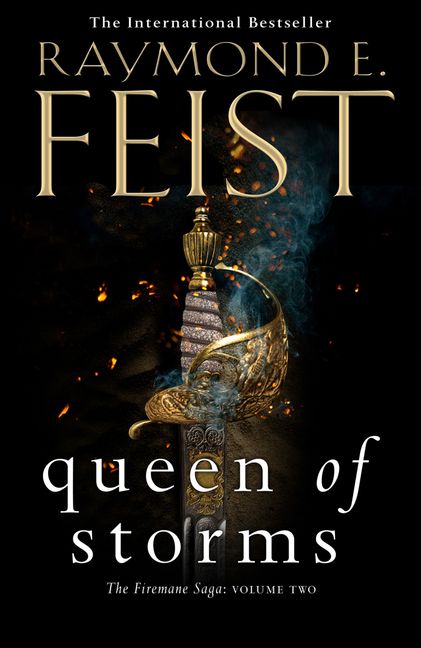
Queen of Storms by Raymond E. Feist

Queen of Storms Cover

Publisher: Harper Voyager (Hardcover – 14 July 2020)

Series: The Firemane Saga – Book Two

Length: 471 pages

My Rating: 4.5 out of 5 stars

Amazon

Legendary fantasy author Raymond E. Feist returns to his new series, The Firemane Saga, with Queen of Storms, an amazing and exciting fantasy novel that takes the reader on some intriguing adventures.

I have long been a fan of Raymond E. Feist and his epic works of fantasy.  His long-running Riftwar Cycle books were amongst some of the first fantasy novels that I ever read and many of them, including the excellent Empire trilogy that he cowrote with Janny Wurts, are still some of my favourite books of all time.  After finalising the Riftwar Cycle back in 2013, Feist released King of Ashes in 2018, which was the first book in The Firemane Saga.  I really enjoyed the fun and compelling new story featured within King of Ashes, and I have been looking forward to seeing how the series continued for a while now.  This second book, Queen of Storms, continues right after the events of King of Ashes and has some intriguing new twists and turns for readers.

In the ancient and magical world of Garn, war is coming to continent of Tembria and its first blow will fall on the trading town of Bernan’s Hill.  Many people call Bernan’s Hill home, but none are more mysterious than the new owners of the town’s inn, Hatushaly and his wife Hava.  Despite their simple outward appearances, Hatu and Hava were born on the secret island of Coaltachin and both serve their continent-spanning criminal and spy network.  A series of mysterious events have been occurring throughout the kingdoms and lands of Tembria, and Hatu and Hava are tasked with observing Bernan’s Hill and reporting anything out of the ordinary.

Having befriended the town’s blacksmith, Declan, Hatu and Hava appear content in their new lives and are they are planning to be officially married during the midsummer festival.  However, even their training and information will not prepare them for the horrors that are about to be visited upon Bernan’s Hill, as a new and mysterious force attacks without warning, plunging the entire continent into war.  Separated from each other, each of these young people embarks on their own adventure.  While Hava attempts to find her lost husband, and Declan sets out to get revenge, Hatu is kidnapped by those who wish him to fulfill his fiery legacy as the secret heir to the kingdom of Ithrace.  His family, the legendary Firemanes, have long been rumoured to contain a spark of magic, and Hatu, as the last remaining Firemane, may hold the key to the survival of magic itself.  As these three young people set out to realise their destinies, they will experience horrors and tragedy as it soon becomes apparent that a whole new threat seeks to destroy all within Tembria.

Queen of Storms was a captivating and fun book which I found myself reading in only a couple of days due to how much I enjoyed it.  Feist has come up with a fantastic and impressive story within this novel, and I liked how it followed a group of excellent characters caught up in the chaos of a mysterious war.  There is all manner of action, adventure, subterfuge, character development and exploration of a new fantasy universe that comes together extremely well into a compelling overall narrative.  Readers should be forewarned that Feist makes some rather bold plot choices throughout this book, with a major event around halfway through the book really altering the course of the story in some interesting and dramatic ways.  I also liked how Queen of Storms served as a great sequel to King of Ashes, and there are a number of amazing reveals and revelations that add to the storylines established in the first book.  For example, the real antagonists of this series are revealed in more detail in this sequel after they were foreshadowed in the previous novel while the reader focused on a different antagonist, who had the potential to be the main villain.  This bait-and-switch came together well in Queen of Storms, and I enjoyed uncovering more about these antagonists and their motives.

Queen of Storms contains a multi-character narrative which follows several key protagonists as they explore this new world from Feist and get involved in the politics and battles of the world.  The majority of the story is told from the perspective of the novel’s three major characters, Hatu, Hava and Declan.  Each of these characters gets some substantial focus throughout the course of this novel, with some interesting storylines.  For the first part of the book their various storylines are very closely intertwined, as all three are based in the town of Bernan’s Hill in various capacities.  However, after the novel’s major event around halfway through, these three characters are separated and each of them embarks on their own exciting and enjoyable adventure.  Hatu’s story is a classic tale of a chosen one finding his destiny, which sees him journey off into the unknown to learn more about his past and his secret abilities.  As Hatu is the most central protagonist, this storyline got a lot of focus, and it was interesting to learn more about his role in the world and about how his life is bonded to the world’s magic.  Declan’s story becomes an interesting one about a young man learning to become a solider to avenge the death of his loved ones.  Declan had some life events occur throughout this book and while it was a little sad to see some of the things he fought for in the first novel go up in smoke, it does serve as a good motivation for his character and it looks like Feist has some interesting plans for him in the future.  Out of the three, I think I ended up enjoying Hava’s storyline the most.  Hava attempts to find out what happened to Hatu and gets captured by slavers.  She ends up using her abilities to free herself and her fellow slaves and becomes a successful ship’s captain, chasing after her husband while also exploring the lands outside the continent of Tembria.  All three of these main character arcs are really enjoyable and together they form a fantastic heart for Queen of Storms, allowing for a rich and powerful narrative.

In addition to these main characters, Feist also utilises several minor point-of-view characters who add in some extra narrative threads to the book.  For example, Donte, Hatu and Hava’s childhood friend who was captured by sea witches in King of Ashes, returns and a small part of the book is dedicated to his attempts to find Hatu and kill him.  You also get several parts of the book told from some of the key players in fight for the continent, such as Baron of Marquensas Daylon Dumarch, the sinister adviser Bernardo Delnocio, as well as a handful of other characters.  Each of these minor point-of-view characters provide their own insights and priorities to the mix and their various storylines and actions add a lot to the narrative and provide some interesting support to the main storylines.  I also liked some of the supporting characters who rounded out the cast of Queen of Storms and several of them proved to be quite enjoyable and likable, even if they have a greater chance of getting killed off.  Overall, Feist continues to write some great characters in this novel, and I look forward to seeing where each of these intriguing protagonists end up next.

The author also did a good job of continuing to expand on the amazing new fantasy world that the series is set in.  While a substantial part of the novel is set around Brenan’s Hill, which was introduced in the prior book, the story eventually starts to examine some other parts of the world.  In particular, several storylines are set around the islands and continents on the other side of the planet, none of which have been explored by any of the point-of-view characters.  These new additions to the story proved to be quite intriguing, especially as the character’s various explorations revealed some shocking truths about the world, as well as some troubling revelations about the series’ main antagonists.  It looks like the next book is set to feature some new areas of the world and should provide some more fascinating expansions down the line, which will no doubt provide some interesting backdrops and settings from the narrative.

While I did really enjoy Queen of Storms, I did find that some of the elements within it might be a little hard to follow if you had not read the first novel in the series.  Feist does do a good job of recapping the major events of the first book throughout the course of the story, but there were a few moments in the story when the significance of certain characters, locations and events were not as highlighted as they could have been, and new readers might get a little lost at this point.  There were even a few points at which I lost track of who a new character was, mainly because of the two-year gap between reading King of Ashes and Queen of Storms.  Still, I was usually able to remember who the character was after some prompting, and it worked out fine.  While this lack of certainty might occasionally impact the flow of the story for new readers, I think they can generally follow without too much difficulty.

Queen of Storms was an outstanding and exciting second entry in this fantastic new series from one of my favourite authors of all time, Raymond E. Feist.  This was an amazing and enjoyable novel, filled with adventure, great characters, and a compelling narrative.  I had an awesome time reading this book and I cannot wait to see how Feist continues The Firemane Saga in the next book.  A must-read for fans of fantasy fiction; this one is really worth checking out.

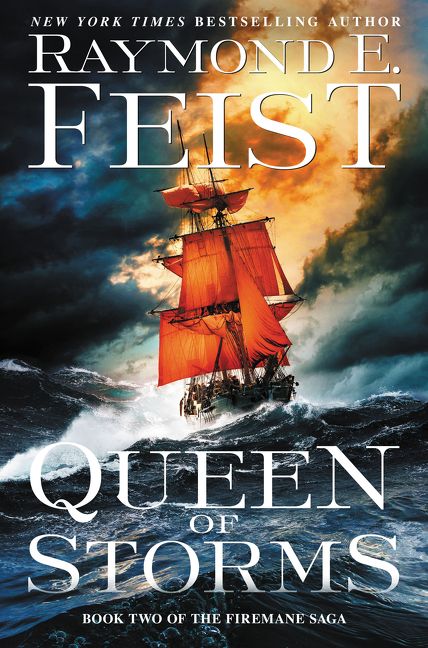
Queen of Storms Cover 2

Amazon

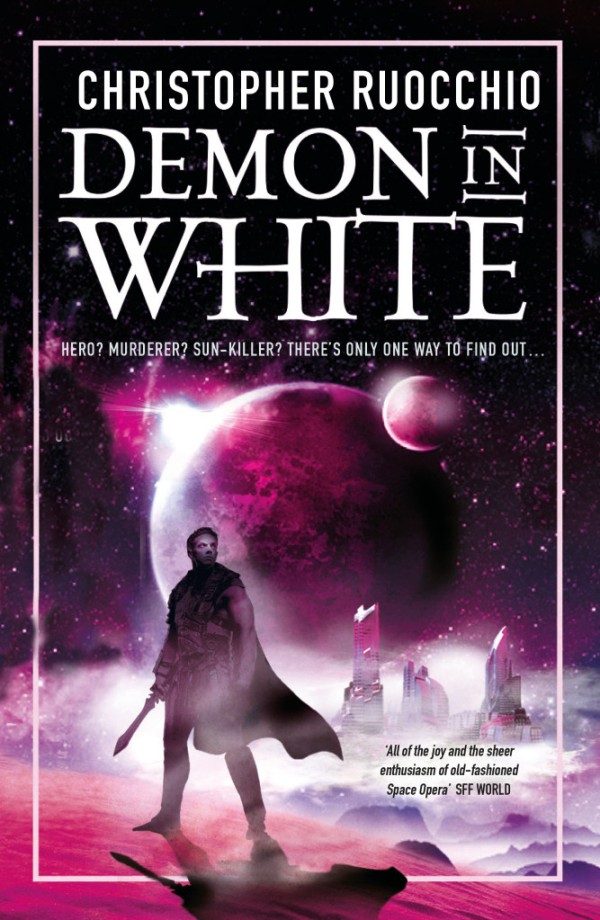
Demon in White by Christopher Ruocchio

Demon in White Cover 1

Publisher: Gollancz (Trade Paperback – 28 July 2020)

Series: Sun Eater Sequence – Book Three

Length: 776 pages

My Rating: 5 out of 5 stars

Amazon     Book Depository

One of the most impressive new science fiction authors on the block, Christopher Ruocchio, returns with the third incredible novel in his epic Sun Eater series, Demon in White.

Far in the future, most of humanity is part of the Sollan Empire, which controls vast systems of space and countless people within them.  The Sollan Empire has long reigned supreme and unopposed in the galaxy, but now it faces its greatest threat, a protracted war against the vicious alien race known as the Cielcin.  While the Cielcins typically engage in random raids and attacks at the leisure of their various chieftains, now a series of coordinated strikes are crippling the borders of the Empire.  The mastermind of these attacks is a powerful new Cielcin ruler, Syriani Dorayaica, who has managed to forge together a mighty alliance with one purpose, the complete destruction of the Empire and every human within it.

As the Empire struggles to combat this threat, all eyes turn to an unlikely hero, the rogue nobleman, adventurer and former gladiator, Hadrian Marlowe.  Following his infamous exploits across the galaxy, Hadrian has been made a knight in service of the Emperor and now finds himself stationed on the Empire’s capital, Forum.  Thanks to a series of successful campaigns against the Cielcin, Hadrian’s popularity and fame has spread across the Empire and many view him as the best hope to defeat the alien menace.  In addition, rumours of his unnatural survival of a lethal wound from a Cielcin prince and his prophetic visions of the future have created a cult-like following around him, heralding him as a divine saviour of humanity.

However, fame and popularity have a price, and Hadrian must now contend with threatened and jealous lords, politicians, and members of the royal family as they plot to undermine and disgrace him.  After several attempts on his life, Hadrian leaves to pursue his true agenda, research into the mysterious celestial being known as the Quiet, who has been manipulating Hadrian’s life while showing him terrifying glimpses of the future.  Hadrian’s mission will take him to some new and dangerous places throughout the universe, until finally he comes face to face with Syriani Dorayaica, who is determined to destroy Hadrian no matter the cost.  Hadrian’s road to the future seems set, but will he truly become the man who commits the greatest act of slaughter in the galaxy, or does a darker fate lie in store for him?

Now that was one heck of an awesome and expansive piece of science fiction.  Ruocchio has been absolutely killing it over the last couple of years ever since he burst onto the scene in 2018 with his debut novel and the first book in his Sun Eater series, Empire of Silence.  I loved this incredible debut and I was especially impressed when he managed to follow it up with an amazing sequel, Howling Dark.  I have had a blast reading Ruocchio’s prior novels, and both of them have been amongst my favourite books of 2018 and 2019 respectfully.  As a result, I have been really looking forward to Demon in White, and Ruocchio certainly did not disappoint as he has produced an outstanding and intensely captivating third entry in this series.

Demon in White is the third act in an expansive and compelling space opera that chronicles the life of Hadrian Marlowe, a man destined to destroy a sun, which will make him both humanity’s greatest hero and its most reviled monster.  The story is told in chronicle form from the perspective of an older Hadrian as he writes the account of his life after the events of this book.  Just like with Howling Dark, the story within Demon in White is set many years after the events of the previous book and details the next major stage of Hadrian’s life.  Ruocchio does an amazing job of reintroducing the readers to his universe and also examining the events that occurred during the gap between the two books (some of which occurred during the 2019 novella, Demons of Arae).  Despite the year-long gap between reading the second and third novels and the substantial amount of detail and information that they contained, I was able to pick up and continue the story without too many issues, quickly remembering who the characters where and what events they had experienced with the protagonist.  I do think that reading the prior two novels in the series first is a must, as I could easily see readers unfamiliar with the Sun Eater books having hard time following the expansive plot of Demon in White at this late stage of the overall story.  Still, this book’s ambitious and exciting narrative might prove enough to keep them going, especially if they make use of the substantial index and character list contained in the rear of the novel.

I really can not speak highly enough of the intense and clever story of Demon in White, as Ruocchio produced an epic and addictive narrative that drew me in and refused to let go.  The author does a fantastic job of bringing together a ton of great elements, including the tale of a doomed protagonist, a galaxy-spanning war, a deep dive into the history of the universe and so much more, into one impressive narrative that I had an absolute blast reading.  One of the things I liked the most about the book was the fact that the first half of the novel is primarily set on the capital planet of the Sollan Empire, essentially a science fiction version of Rome, which results in the protagonist getting involved in all manner of plots and political intrigue.  Due to the protagonist’s popularity with the people, and the rumours that he is unkillable, Hadrian is targeted by politicians, lords, members of the Royal Family, military administrators and the Empires powerful religious organisation, and he has to deal with a number of tricky situations.  I really liked this more intrigue and politics laden part of the story, and it was an interesting change from some of the previous novels.  Ruocchio also dives into some more cosmic and action based inclusions as well and there are some explorations of the universe, examinations of the unknown and a several major and enjoyable battle sequences.  All of this comes together extremely well, and I found myself powering through this 700+ page book to find out how it ended.

Another fantastic part of Demon in White’s story that I really enjoyed was the continued examination of the fascinating and compelling protagonist, Hadrian.  Hadrian is a fantastic and intriguing protagonist for the series, since the reader knows far in advance his story is going to end in fire and death.  The chronicling of his life story that is contained within these novels is always quite enjoyable, especially as the older Hadrian compiling these tales adds in his own spin to the story, ensuring that the novel is filled with his regrets and revelations made in hindsight.  The protagonist also goes through some interesting character development throughout the course of the book.  Not only is he introduced to a number of key figures who will have substantial impacts on his future life but he also starts to come to grips with his eventual destiny.  The younger Hadrian is given some tantalising and terrifying glimpses into the future and he struggles to comprehend his potential fate as a result.

The Hadrian in this book is also a very different character than in the prior novels.  Rather than the idealistic dreamer who hopes to one day make peace with the alien Cielcin, Hadrian is far more mature and battle hardened, especially after the traumatic events at the end of Howling Dark.  This version of Hadrian is convinced that there is no hope of peace with his foe, and he has become more ruthless and determined as a result.  However, despite these revelations, there are still fragments of the old Hadrian scattered throughout the novel, which contrasted well with his newer persona.  The sense of wonder he got at seeing a group of alien auxiliaries was very reminiscent of the Hadrian we saw in the first book, especially as this wonder ended up getting him in trouble.  I also liked the scenes that showed Hadrian trying to come to terms with his own legend, as his deeds and adventures have given rise to a cult-like following, with many people convinced that he is some form of divine champion or immortal being.  This proved to be a fantastic aspect of Hadrian’s character throughout Demon in White, as he does not want this attention or praise, not only because it will result in conflict with the various factions in the Empire but also because he does not want to be anyone’s worshipped hero.  However, many of the events that are focus of this cults worship, such as surviving being beheaded or his visions of the future, are actually true (in a sense), and he ends up having to rely on these abilities to survive the events of this novel, which is going to result in some interesting consequences.

There are also some major and fantastic emotional moments for the protagonist scattered throughout the book, such as when a long-running side character leaves him, or when he encounters a major figure from his past again.  I also enjoyed seeing more of his relationship with his main love interest, Valka, and their unconventional romance has flourished over the centuries that this series has been set.  Valka serves as a fantastic grounding force for Hadrian, and it is quite nice seeing them together, although the reader’s joy at seeing them together is somewhat tempered by the narrator’s hints that something tragic is bound to happen between them.  All of this makes for a very intriguing protagonist, and I have enjoyed seeing him flourish and grow over the course of the first three books, moving towards his eventual destiny.  I look forward to seeing how his story continues in the next novel, especially after the major events that occurred at the end of Demon in White.

I have always been impressed with the detailed and massive science fiction universe in which Ruochhio has set his series, and each of the Sun Eater books have added some new depth and unique features to this overarching setting.  Unlike the prior book, Howling Dark, which was set out in the wilds of space and alien planets, Demon in White returns to the confines of the Sollan Empire, a repressive, technophobic and tradition bound galactic kingdom that is stylistically based on ancient Rome.  I really enjoyed this creative science fiction setting, as it is a very dark and gothic location which clashes well with the mostly good-natured protagonist and narrator.  Demon in White adds a huge amount of detail to this universe, especially as the first two thirds are primarily set on new Imperial worlds, including the capital planet Forum.  As a result, there are a ton of intriguing new details and discussions about the politics, history and administration of the Sollan Empire, as well as the introduction of many significant characters, including the Emperor who Hadrian is destined to kill.  The later part of the book also contains some terrific new detail, and we get a really intriguing view about how this dark Empire was founded, including more details about the war against the machines created by the precursor empire, the Mericannii (Americans).  I really liked some of these dives into the past, especially as Ruocchio does a fantastic job of portraying a historical timeline that has been altered or hidden by war, destruction and political or religious censorship.  As a result, the protagonists believe in a very different version of history, and wildly incorrect discussions about historical events are often quite amusing, especially their ideas about American history.  Ruocchio also provides the clearest view of the origins and nature of the cosmic entity, the Quiet, who has been an overarching influence over the prior two books.  This was a rather intriguing, and at times metaphysical, examination of this being, and some of the revelations in this book, including about the connection the Quiet has with Hadrian, the Sollan Empire and the Cieclin, are rather major, and will have significant impacts in the next few books.  All of this proves to be exceedingly fascinating and I cannot wait to see how the author will expand on this setting in his future novels.

I also really have to highlight some of the incredible action sequences that occurred throughout Demon in White.  While a substantial amount of the plot is dedicated to the political intrigue that the protagonist finds himself involved with, there are some great action sequences in this book, including a major war sequence against the Cieclin in the last quarter of the book.  Ruocchio has done an amazing job building the Cieclin up as a major threat and the various bloody battle sequences against them help to reinforce this.  I particularly enjoyed the great scenes where the protagonist faces off against his foe in tight and confined spaces, such as on a ship or in the depths of a city, and the author ensures that the reader gets to enjoy them in all their claustrophobic glory.  Ruocchio adds to the horror by introducing a new form of antagonists in the form of giant Cieclin warriors who are cyborg hybrids enhanced with Extrasolarian (rogue human scientist) technology.  These terrifying hybrids act as very dangerous opponents for Hadrian and his allies, resulting in some dramatic and high-stakes battles.  Hadrian also gets some new combat abilities in this book, which add some intriguing new elements to the fight scenes and are generally quite fun to check out.  Overall, those readers who are interested in seeing some intense science fiction action will not be disappointed with this book as Demon in White delivers some impressive and memorable fight sequences that really help to get the heart pumping.

In this latest novel, Christopher Ruocchio has delivered another extraordinary and captivating science fiction epic that does a terrific job expanding on his fantastic Sun Eater series.  Demon in White contains an incredible and exciting story that sends its complex protagonist on a series of intriguing adventures throughout this rich and unique science fiction universe.  I had an awesome time reading Demon in White and I cannot recommend it highly enough.  This outstanding book gets a full five-star rating from me and if you are not already reading the Sun Eater series you need to start now!

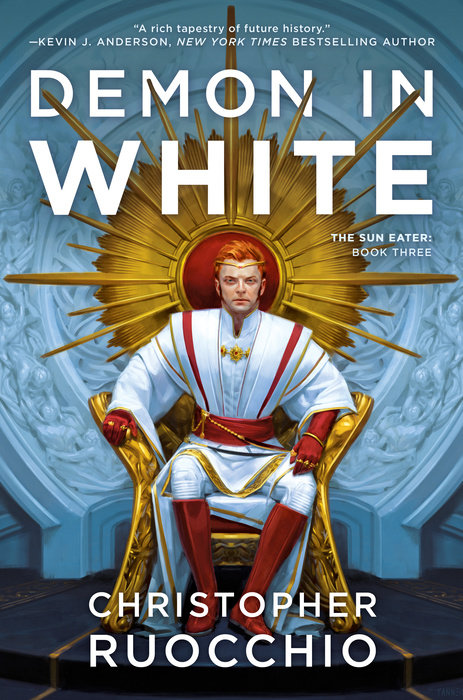
Demon in White Cover 2

Amazon     Book Depository