
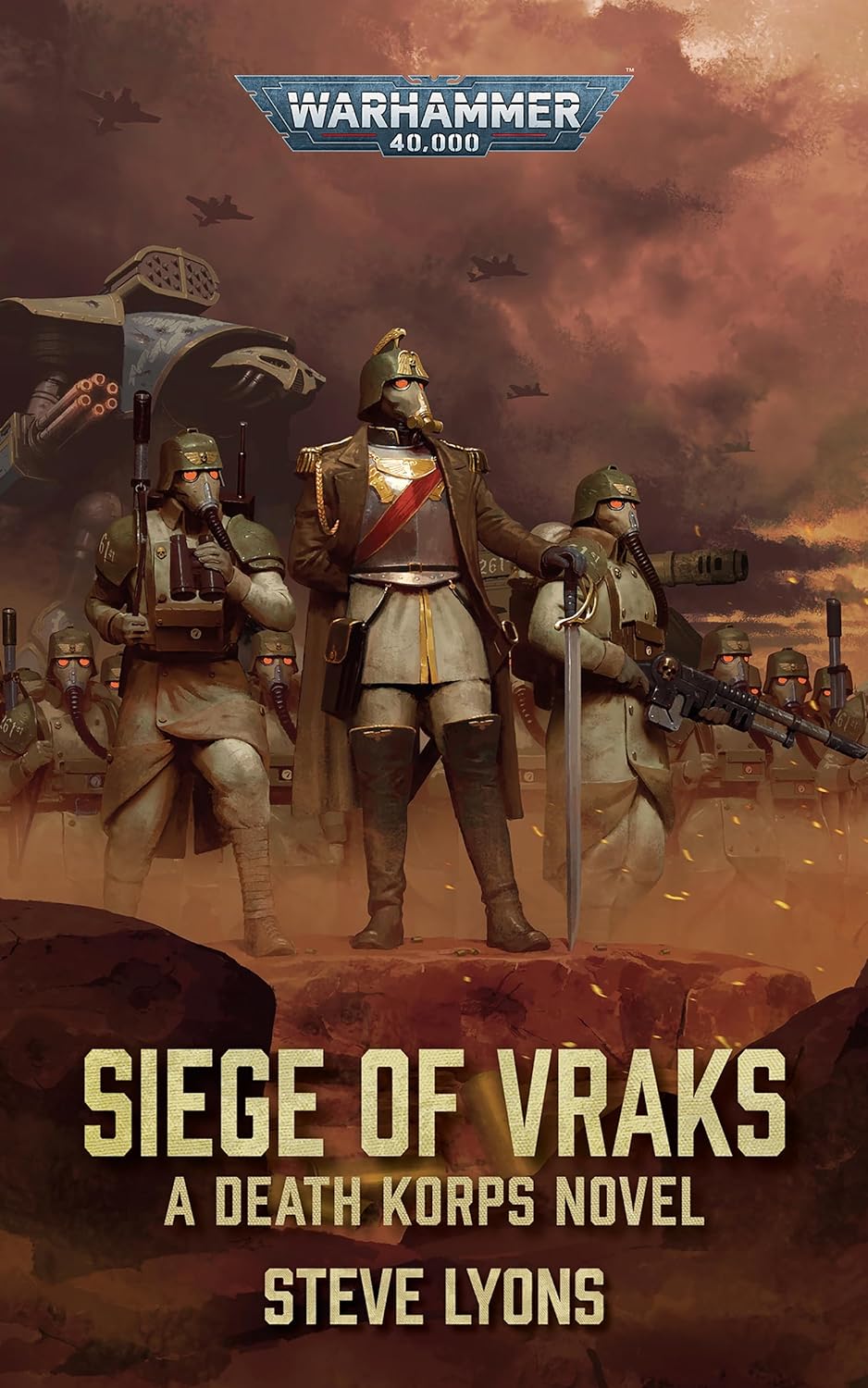
Warhammer 40,000: Siege of Vraks by Steve Lyons

Publisher: Black Library (Audiobook – 22 June 2024)

Series: Warhammer 40,000

Length: 9 hours and 48 minutes

My Rating: 4.5 out of 5 stars

Amazon

The always impressive Steve Lyons once again dives into the wars of the legendary Death Korps of Krieg with this epic new novel that shows just how massive a Warhammer 40,000 campaign can be with the ultra-exciting and intense Siege of Vraks.

I have been having a ton of fun with Warhammer 40,000 fiction this year, as complex books like Da Big Dakka by Mike Brooks, Deathworlder by Victoria Hayward and Lord of Excess by Rich McCormick have greatly impressed me.  However, few have had the scale or pure brutality of the amazing new release, Siege of Vraks by Steve Lyons.  The third standalone book by Lyons that focuses on the Death Korps of Krieg (see my reviews for Dead Men Walking and Krieg), Siege of Vraks brings to life a massive event from the Warhammer 40,000 canon (as featured in several game books), with the long-running siege of the planet of Vraks.

In the far future, humanity has been forced to fight on many brutal battlefields, but none are as infamous as the slaughter that occurred on the planet Vraks.  Once a vital armoury world used to supply regiments throughout the Imperium of Man, Vraks has become tainted by humanity’s greatest enemy.  Thanks to a corrupted cardinal, the entirety of Vraks’s population has fallen under the sway of the Chaos Gods and have risen in rebellion against the rest of the Imperium, believing themselves to be fighting in the god Emperor’s name.

Desperate to reclaim the vital world, the Imperium has no choice but to send in a massive besieging invasion force to purge the traitors.  Only a completely relentless force has a chance of success on the bloody fields of Vraks, and to that end the stoic soldiers of the Death Korps of Krieg have been chosen to lead the attack.  Experts at sieges, fanatically stubborn, and desperate to wipe away the stain of their planet’s historical betrayal, the soldiers of Krieg are prepared to destroy their enemy no matter the cost.

However, even with the implacable Krieg soldiers leading the assault, Vraks is no simple planet to conquer.  Its massive central fortress is impregnable, and the entire population of planet has been mobilised to fight against the Krieg, equipped with the massive arsenal of weapons previously held in Vraks’s armoury.  To defeat their enemy, the Krieg will need to spend years and millions of soldiers to slowly approach and wear down Vraks’s fortresses.  But with the constant battle drawing the attention of other malign Chaos forces to Vraks, can even the massed forces of the Krieg win this impossible siege, or will these fearless soldiers finally face an army even their devotion and dedication to duty is unable to overcome?

Siege of Vraks was another particularly strong Warhammer 40,000 novel from Lyons, who excels at diving into the grimdark core of Warhammer fiction.  Filled with an insane amount of action, Siege of Vraks proves to be an intense and addictive siege novel that cleverly explores a well-established lore event and presents it in an outstanding and moving way to the reader.

The story of Siege of Vraks is one of action, sacrifice and self-discovery, as it recounts the events of the titular siege in its own compelling way.  Starting off with a quick prelude that covers the events that led up to the conflict, the main story starts a few years into the war and then goes all the way to the very conclusion of the siege which occurs after years of brutal fighting.  Rather than having one concise narrative thread, Siege of Vraks is instead made up of a series of connected storylines set around key events of the war.  Each of the initial chapters features a new central character caught up in a different battle and scenario of the war, and often focuses on them fighting in dangerous or impossible situations.  While these initial chapters are often linked by the inclusion of recurring character Confessor Ignea Tenaxus or by showing different sides to the same battle, for the most part they are unconnected and some of their messages and themes remain self-contained within the chapter.  However, as the book continues, a few point-of-view characters return for another chapter, often years removed from their last appearance.  These characters, especially Colonel Tyborc, will then continue their storylines from the previous appearances, which often play into the larger events of the overall siege in some interesting ways.  While I imagine the slightly disjointed way that Lyons tried to capture the siege might not be for everyone, especially those who would prefer seeing every event from one character’s eyes, I thought that it was extremely clever and fit into the unique mindset of the Krieg regiment.

The rest of the book takes places over a series of years as Lyons attempts to capture the entire epic and lengthy sieges.  The author includes multiple time skips here to showcase the dragging length of the battle, often interspersed with useful context inclusions that provide an overview of the carnage.  These time skips move the story along at a sensible pace and the reader is never lost, especially when it comes to the key recurring characters. While Lyons is primarily showing the carnage of war from the perspective of the fighter on the ground, you get a good understanding of just how big the scope of the fighting is, and really get drawn into the over-the-top action.  The loosely connected character arcs continue in the second half of Siege of Vraks, and there are some complex stories being featured here.  I particularly enjoyed the fascinating standalone chapter that followed the interrogation of a local inhabitant of Vraks after he defected and pretended to be a member of a Krieg regiment.  While other chapters featuring recurring character Colonel Tyborc provides some unique insights into the mindset of a Krieg soldier and what being a hero means to them.  All these chapters are loaded with some intense action, intriguing discussions, or shocking occurrences, as the horrors of war, and even darker things, take their toll on the Krieg soldiers.  Everything leads up to the conclusion of the siege, with final battles, deadly confrontations, and despair in the aftermath, leaving plenty for the reader to get drawn into.  This ended up being a particularly epic narrative which I personally really enjoyed.

As I mentioned above, Lyons features a more fractured narrative structure in Siege of Vraks that shows detailed snapshots of key parts of the larger war and the lives of certain protagonists.  Considering that the overall siege lasts many, many years and features a lot of smaller, pointless battles, this is honestly the best way of doing it, and I think that Lyons’s choice provided the best view of this conflict, while also taking the time to explore multiple characters and storylines.  The resulting book has an interesting flow to it, as you are introduced to new dark scenarios and figures in peril, and forced to watch them participate in a pointless, unrelenting conflict.  While some may not connect with the way in which Lyons dived the book between characters and time periods, I really appreciated the way it was told, and other readers’ dislike will be well bridged by the book’s awesome action.  There are so many impressive battle sequences featured throughout Siege of Vraks, and you see the Krieg soldiers and their allies face off against all manner of opposing forces, from corrupted civilians to daemons and traitor Space Marines.  All these scenes are particularly epic, as Lyons succeeds in showcasing the elaborate big battles of the franchise, and you really get drawn into the resulting carnage.  There is a palpable desperation in many of these sequences, as the Krieg soldiers face off against terrible odds, and Lyons also adds in a bit of horror in places, as Warhammer 40,000 zombies, disgusting daemons, and even more terrors enter the fray.

Due to all this cool action, Siege of Vraks is a highly accessible read to those readers unfamiliar to Warhammer fiction, and any general fans of science fiction and military fiction can have fun with the over-the-top battles featured in the book.  Indeed, I personally felt that Siege of Vraks was one of the few of the franchise novels that really captured the epic scope of a Warhammer 40,000 war, as this book captures a literal world-spanning conflict with millions upon millions of casualties.  Lyons really takes the time to explore just how devastating a full-on war in the franchise can be, and I appreciated seeing the extent of this slaughter here, compared to other Warhammer books that focus primarily on one regiment or relatively small-scale conflicts.  As such, long-term Warhammer fans will also get a lot out of Siege of Vraks, especially as Lyons really does a good job of capturing this event, which has been discussed in some of the games books for ages and showing it to the reader from the soldier’s perspective.  However, the thing that will appeal most to established Warhammer 40,000 readers, is Lyons’ portrayal of the awesome Krieg soldiers.

Due to their dour background, German World War I aesthetic, and the utter devotion to death and duty, the Krieg are a particularly popular faction in the Warhammer 40,000 games and extended fiction, and Lyons is the undisputed author of them.  His previous books have all explored different aspects of the faction, with Krieg looking at their history and the events that made them, while Dead Men Walking showed them as near-soulless automaton, especially through the eyes of the desperate civilians they were there to save.  In Siege of Vraks, Lyons goes a slightly different way and presents a more nuanced and complex portrayal  that fans of his previous works will really appreciate.  For the first time, Lyons features several Krieg perspective characters, and you are given some intriguing insights into their mind, which proves to be highly fascinating.  While on the surface they are dedicated and fanatical fighters, you do see some threads of humanity in several of the characters, such as ambition, fear and uncertainty.  I liked how Lyon tries to humanise the Krieg soldiers in places, especially around main character Colonel Tyborc who struggles with the notion of being a hero when all he wants is to fight the war and redeem his planet.  Tyborc’s arc proves to be particularly compelling in places, especially as his experiences cause him to doubt the war they are fighting in, and lead to an infamous showing of fear.  Despite this attempt at showcasing humanity, Lyons is clear that the Krieg have their own unique drive and take on human nature, such as when one Krieg character sends his older Commissar on a suicide mission because he believes its more merciful than letting him retire.  As such, there are some complex depictions of the Krieg here in Siege of Vrak, which serve as an interesting comparison to some of the author’s previous novels, and I felt that Lyons’ dive between different Krieg characters produced a very complex read.

Unsurprisingly to anyone who has read one of my Warhammer 40,000 reviews, I chose to enjoy Siege of Vraks in its audiobook format.  I have waxed poetic many times about how awesome I find Warhammer audiobooks to be, and this proved to be the case again with Siege of Vraks.  The many intense and over-the-top battles really come across in an epic way when read to you, and I personally find that I can envision the action much more effectively this way.  I also find that the complex character interactions and personal developments that Lyons loads up into the story are expertly captured by this format, and I believe that I got a lot more out of the audiobook than reading a physical copy.  It helped that excellent narrator Timothy Watson returned for Siege of Vraks.  Watson has previously really impressed me with Lyons’ previous audiobooks, as well as in The Lion: Son of the Forest by Mike Brooks, and it was great to see him continue to add his own spin these Krieg-focused books.  Watson is very effective at conveying the excessive violence and intensity of the Warhammer universe with his narration, and you really get drawn into the action as a result.  I also really love the Germanic accents that Watson attributes to the various Krieg characters, especially as it fits into their faction aesthetic.  While the various Krieg characters all sound a little similar (which does fit into their potential clone background), the narrator does a good job differentiating between these characters, and you are never in doubt about who is talking.  This excellent narration really helped to drag me into the Siege of Vraks audiobook, and I honestly flew through its near 10 hour long run.  There is honestly no better way to enjoy Siege of Vraks then on audiobook, and you are going to have a great time doing so.

Overall, Steve Lyons’s Siege of Vraks was a particularly epic and intense piece of Warhammer 40,000 fiction, that is going to appeal to a lot of different readers.  Loaded with massive and over-the-top action sequences, Siege of Vraks had me hooked from the very beginning, especially as the author once again expertly showcases the iconic Death Korps of Krieg.  This was such a great read, and all fans of Warhammer fiction and excessively massive science fiction battles, are in for an amazing treat with Siege of Vraks.

Amazon

Warhammer 40,000: Dead Men Walking by Steve Lyons

Dead Men Walking Cover

Publisher: Black Library (Audiobook – 30 November 2010)

Series: Warhammer 40,000

Length: 10 hours and 42 minutes

Rating: 4.75 out of 5 stars

Amazon

Two relentless foes face off in the intense Warhammer 40,000 novel, Dead Men Walking by Steve Lyons.

Dead Men Walking was an epic novel released back in 2010, that featured a brutal and compelling story I really fell in love with.  This novel follows the trend of books that highlight the adventures of specific regiments or units of Imperial Guard, such as Catachan Devil by Justin Woolley, Kasrkin by Edoardo Albert, Steel Tread by Andy Clark, and the Gaunt’s Ghosts books by Dan Abnett, which has been very fun.  Dead Men Walking was the author’s first look at the legendary Death Korps of Krieg, one of the most distinctive and dark regiments of Imperial Guard soldiers, who he covered again back in 2022 with Krieg.  This new novel sets the Death Korps onto a whole new battlefield with deadly results.

Hieronymous Theta is a small and relatively young world in the Imperium of Man.  Populated by nearly nine billion people, it is slowly becoming an important industrial hub, as its cities and massive spires build up.  But as the inhabitants of the capital, Hieronymous City, expand their mining operations deeper they encounter something unexpected and terrifying, the Necrons.  Unfeeling and inhuman ancient xenos encased in living metal, the Necrons are an unrelenting force determined to exterminate the human pests they find inhabiting their world by any means necessary.

As the citizens of Hieronymous City begin to panic, unable to stand against the encroaching Necrons and their deadly technology, their apparent salvation lands on the planet in the most unlikely of forms, the Death Korps of Krieg.  One of the most feared and mysterious regiments of the Astra Millitarum, the Death Korps of Krieg come from a world destroyed by civil war which seeks to redeem itself by producing soldiers solely dedicated to the Emperor and his victory.

As the Death Korps land on Hieronymous, they take the war to the Necrons and begin a determined siege to retake Hieronymous City from the outside.  But as the Krieg regiments push forward, the people of the planet soon begin to realise that the Death Korps might not be the salvation they hoped for.  The soldiers of Krieg’s only goal is to defeat the Emperor’s foes, and they are willing to sacrifice anything to achieve victory, including the citizens of Hieronymous.  With battle joined, the fate of Hieronymous hangs in the balance.  But does anyone truly win when two implacable and unrelenting armies go to war?

This was an extremely interesting, intense and dark novel from Steve Lyons, who follows up his previous Krieg novel in a big way with this outstanding read.  Featuring a moving, action-packed and highly cynical story, Dead Men Walking was probably one of the better Warhammer 40,000 books from last year, and I had an exceptional time getting through it.

I really liked the fantastic story that Lyons came up with for Dead Men Walking, especially as it successfully showcased both opposing armies, the Death Korps and the Necrons, without actually featuring any perspective characters from either side.  Instead, the focus is reserved for the other humans caught in the middle of the conflict, including the Imperial Commissar attached to the Death Korps, the governor of the planet, and several citizens who find themselves caught in the crossfire of the war and are forced to adapt to survive.  I love how Lyons set the early narrative out, with the perspective characters slowly becoming aware of the dangers beneath them.  The slow build introduction of the Necrons, a force the humans don’t know but the reader is very aware of, was handled perfectly, and there is a lot of great anticipation that pays of well when they finally attack.  The scenes of carnage and utter terror that emerge for the characters stuck in the city really hit home with their realism and intensity.  Indeed, there is a bit of a horror vibe to the story at this point, and Hieronymous City turns into an excellent wasteland setting for the characters to subsequently attempt to navigate.

Once the city is in ruins, the book turns towards the landing Death Korps, who begin prosecuting a deadly war against the Necrons.  This moves the story into a fascinating new zone, as you get some fantastic battles while also witnessing several characters soon caught up in the city as everything changes around them.  I loved the various unique, personal stories that emerged, and the focus on characters watching both the Krieg and Necron forces battle it out proves very powerful.  As the story continues, each of the main characters suffer in various ways, especially as they begin to realise that the unrelenting, victory-focused Krieg are just as dangerous as the Necrons, and there are some deeply powerful moments as they lose their humanity in the carnage of war.  All of these mostly independent character narratives go in some dark directions, especially as the background war gets even darker, and not everyone survives the various conflicts to come.  These storylines either end or coalesce together as the book comes to a head, and you really appreciate the impressive narrative that Lyons weaves together.  I loved how grim and cynical the story got at the end, and Lyons provides a particularly memorable conclusion that really highlights just how unfair the Warhammer 40,000 universe can be.

Lyons really came up with a brilliant story for Dead Men Walking, as he balanced the need to highlight two interesting Warhammer 40,000 factions, while also telling his own unique narrative.  Telling the story of the Krieg and Necrons from the perspective of the third-party characters caught in the middle of their war was such as clever move, especially as it provided some fascinating contrast between the two factions.  The author provided such a dark vibe for Dead Men Walking, and the terrified civilians, the crumbling city and the relentless troops waging war without a care for those around them were all handled brilliantly.  I think the narrative split between the various characters caught up in the fray was done well, and you get to see all sides of the conflict, and the darkest actions of both opposing foes.  I also loved how well Lyons showcased the main city setting throughout the book, as the collapse of the once proud city mirrors the loss of humanity for the various protagonists.  Dead Men Walking can easily be read as a standalone novel, and new readers can just fall into its dark and unique story.  Indeed, this might be a pretty good entry point, as the views of the confused and horrified civilians provide some good opening observations about two key factions.  Naturally, established fans of the franchise will get a lot more out of Dead Men Walking, especially as Lyons really showcases both iconic groups in some fantastic ways.

I absolutely loved the portrayal of the Krieg soldiers in Dead Men Walking, and they really are some of the most entertaining figures in the Warhammer 40,000 canon.  Unlike his other novel, Krieg, where Lyons spent a great deal of time focusing on the origins of the Krieg soldiers with flashback sequences, Dead Men Walking showcases them purely through the eyes of other human inhabitants of the Warhammer 40,000 universe.  To the common soldier or citizen of the Imperium of Man, the Death Korp are unnaturally dedicated, unwavering and heartless, focussing on the battle to the exclusion of all others.  Thanks to their harsh training, indoctrination, and history, they have a very black-and-white view of the universe and will stop at nothing to win, even if that means sacrificing their comrades or allies for a strategy.  Lyons really highlights their near-inhuman mentalities throughout the course of Dead Men Walking, and thanks to the perspectives of the non-Krieg soldiers, you see them in a much more sinister light.  There is something very concerning about the simple mathematic they put behind their strategies, and I loved how well Lyons captured how similar they are to the Necrons.  Thanks in great deal to the actions of the Krieg soldiers, this ended up being a particularly bleak book, which really hammered home how there are no good guys in this universe.

In addition to the Krieg soldiers, Dead Men Walking also featured the Necrons as the antagonists, who served as worthy opponents to the Krieg.  As with the Krieg soldiers, you don’t get a Necron perspective in Dead Men Walking, which honestly enhanced the unique story Lyons was going for.  Unlike books like other more recent Necron focussed novels like Ruin, Reign or The Infinite and the Divine, you only see these characters through the eyes of normal humans, who have no idea who or what they are.  This makes for some particularly terrifying scenes as the humans encounter overwhelming attacks from unkillable metal monsters, and Lyons really captures how the unknown is just as bad as the devastation around them.  Even when the Krieg soldiers arrive, there is very little knowledge about the Necrons, due to the secrecy of their origins, and the only intelligence about them comes from rumours of prior encounters (which includes a cheeky reference to the Ciaphas Cain novel, Caves of Ice).  I really appreciated this shrouded look at the Necrons, and it proved to be interesting to see the how a normal person would view them.

I really liked the characters in Dead Men Walking, especially as Lyons focuses the story on several normal humans who suddenly get thrust into hell and find everything they thought they knew completely upturned.  Much of this upheaval is due to the interactions with the Krieg soldiers, whose unreasonable actions cause even the most stoic soldier or commander to falter in different ways.  Watching each of these characters slowly change for the worse makes for some gripping reading, and you end up feeling great sympathy for all the point of view characters.

These great characters include Gunthar Soreson, a mine supervisor who loses everything in a single night and tries to find redemption as a soldier fighting for the Krieg.  It was absolutely fascinating to see Gunthar, who starts the book as a relatively normal and nice character, slowly lose his humanity in a similar manner to the Krieg soldiers, and his story hits particularly hard at times.  I also must highlight the character of Commissar Costellin, one of the commissars attached to the Krieg regiments, and one of the few non-Krieg soldiers featured in the book.  Commissars are fantastic figures in the Warhammer 40,000 canon, mainly because they serve as implacable disciplinarians charged with maintaining order and morale through lethal means and ensuring that the soldiers due their duty.  However, due to the unnatural discipline of the Death Korp soldiers, Costellin finds himself acting more in the role of a liaison between the Krieg and the citizens of Hieronymous.  Lyons writes some intriguing storylines around Costellin, and it was fascinating to see a commissar character who fears the resolve of his own troops, as the Death Korp leaders go too far even for him.  Finally, I really enjoyed the inclusion of the governor of Hieronymous, Hanrik, who finds both his planet under attack and his authority taken away from him when the Death Korp takes over.  I felt the storyline around Hanrik was very clever, and you had to feel for him at times, especially when he finds his loyalties tested.  All these character arcs and more are really well written and hit hard emotionally, especially with their resulting dark ends.

It should come as no surprise whatsoever that I grabbed Dead Men Walking on audiobook, as frankly no other format does Warhammer 40,000 fiction justice.  The resulting audiobook was extremely awesome, as the intensity, action, and darker elements of Dead Men Walking’s story came through in this format.  Coming in with a run time just short of 11 hours, Dead Men Walking was an easy Warhammer 40,000 audiobook to power through quickly, especially once you get stuck into its awesome narrative.  It helped that they brought back talented narrator Timothy Watson for this audiobook adaptation.  Watson, who did a great job narrating Krieg and The Lion: Son of the Forest, was in rare form again in Dead Men Walking, especially as he has the perfect voice for this darker and exciting story.  His voice work really captures the chaos and desperation of the story, and I loved the unique tones he comes up with for the various characters.  The featured Krieg soldiers all have the typical German-esque accent, which matches the regiment’s World War I aesthetic, and I liked how Watson worked to enhance these figures relentless and unwavering nature through his voice work.  The other characters of the plot, who are allowed to have emotions, are also portrayed extremely well, and Watson provides them with excellent and fitting voices that captures their feelings on the situation, especially as their encounters with both the Krieg and the Necron, wear them down.  This audiobook version of Dead Men Walking was so damn good, and it is easily the best way to enjoy this epic novel.

Steve Lyons continues to showcase why the Death Korp of Krieg are some of the most memorable figures in the Warhammer 40,000 canon with the brilliant and dark read Dead Men Walking.  Presenting a grim scenario of war and sacrifice that only gets worse when the ‘good guys’ arrive, Dead Men Walking was a particularly harrowing piece of Warhammer fiction, that I still cannot stop thinking about.  Clever, intense and a little traumatising, Dead Men Walking comes highly recommended, and I cannot wait to see what great tale Lyons comes up with next.

Amazon

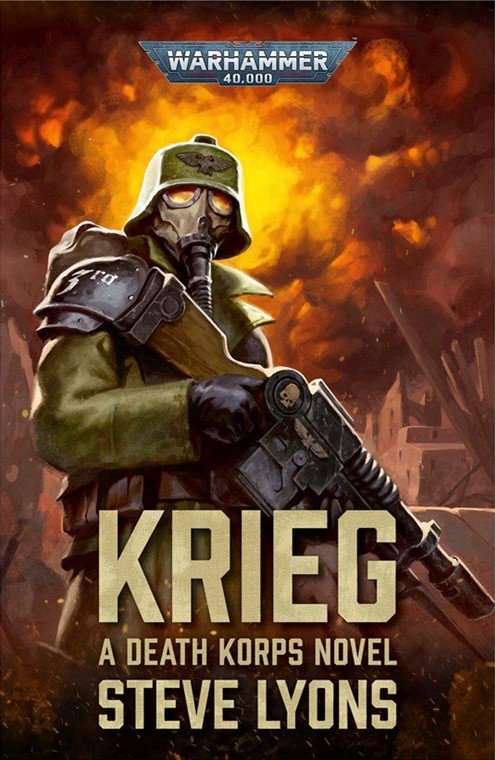
Warhammer 40,000: Krieg by Steve Lyons

Warhammer 40,000 - Krieg Cover

Publisher: Black Library (Audiobook – 29 January 2022)

Series: Warhammer 40,000

Length: 9 hours and 33 minutes

My Rating: 4.5 out of 5 stars

Amazon     Book Depository

Death, dishonour and duty all collide as impressive author Steve Lyons returns to the epic Warhammer 40,000 universe with Krieg, which dives into the origins of one the most iconic regiments of Imperial Guard out there, the Death Korps of Krieg.

Damn this has been a good year for Warhammer fiction so far.  We may only be in March, but 2022 has already produced a great collection of awesome Warhammer novels, including Steel Tread, The Twice-Dead King: Reign and Day of Ascension.  I have deeply enjoyed all these cool books, and when another awesome sounding tie-in novel was released on audiobook, I just had to grab it.

This latest book is Krieg by veteran science fiction author Steve Lyons.  Lyons is a new author to me, but he comes with an impressive pedigree in tie-in fiction, having written several Warhammer novels and short stories, a ton of Doctor Who novels and audio dramas, and several other intriguing novels.  I knew that I was probably going to love Krieg and I turned out to be right, as this fantastic and dark Warhammer 40,000 novel contains an intense and captivating tale of a legendary regiment.

In the grim future of the universe, there is only bloodshed and death, especially near the system-spanning Octarius War, where two brutal alien races battle for supremacy, and Imperial forces fight to stop their conflict spilling out into the greater Imperium.  However, the latest round of fighting sees a massive orc ship break through Imperial lines and crash into the massive city of Hive Arathron.  As the desperate Imperial forces fail to contain the invading orcs, all hope looks lost until a new set of deadly reinforcements arrive: the Death Korps of Krieg.

The Death Korps of Krieg are a legendary unit of peerless soldiers who are utterly fearless in battle, fanatically loyal to the Emperor, and who seem to harbour an unnatural desire to die in battle.  But who are the men of Krieg under their gasmasks and coats, and why do they fight so hard to regain their lost honour?  The answer lies thousands of years ago when Krieg attempted to cede from the Imperium, thrusting the planet into a brutal civil war.  In the end, one man stepped forward to end the fighting, and his decision doomed Krieg to become a blasted wasteland where only soldiers are grown.

As the fighting around Hive Arathron continues, many of their fellow soldiers and inquisitorial observers begin to doubt the loyalty and sanity of the Death Korps, especially when their unusual habits and creeds keep them apart from the other members of the Astra Militarium.  However, a deadly discovery deep inside the Hive will show the Imperium just how invaluable the men of Krieg are, especially when history seeks to repeat itself.  Can the Death Korps succeed against the xenos, or will Hive Arathron and its planet soon share a similar fate to Krieg?

The Warhammer 40,000 hits just keep on coming as Krieg turned out to be a truly awesome read.  Steve Lyons has produced an epic and intense novel here, and I loved the brilliant story that not only showcased a dangerous alien threat but which also examined the past of an iconic and captivating faction.

I thought that Lyons came up with an exceptional and captivating narrative for Krieg, which takes the reader on several parallel journeys throughout the history of the Warhammer 40,000 universe.  I have said multiple times before that I think some of the best Warhammer stories out there focus on the common troops, and I was proved right again as Lyons does a brilliant dive into the mind of the average solider when they experience the very worst of circumstances.  The primary storyline is set in the modern era of the canon and shows a regiment of Krieg Imperial Guard dropped into the battle for Hive Arathron to fight the orcs.  This section, which is told entirely from the perspective of supporting non-Krieg characters, shows the Death Korps in battle, with a specific highlight on their unusual appearance and practices.  At the same time, another storyline dives back into the past and shows the civil war that occurred on Krieg and the events that led up to the destruction of the planet and the formation of the modern Death Korps.  Both these storylines take up about half the book and they present the reader with two unique and interesting tales which work to complement the story from the other timeline while also depicting their own brutal military actions.  The stories start to come together towards the end when the protagonists of the contemporary storyline discover nuclear weapons in Hive Arathron, which they need to recover.  This leads to an interesting conclusion that results in some clever parallels between the historical events and the current storyline.  All this leads to a satisfying, if grim, conclusion that reveals the various fates of the supporting characters and wraps up the remaining story elements.

I was really impressed with how Krieg was written, and I think that Lyon did a really good job here.  The story ended up perfectly toeing the line between examining the lore and history of the universe and providing the reader with all the necessary excitement and adventure.  I think the decision to split the book between the two separate timelines was pretty clever, and I had a brilliant time reading the unique storylines it produced.  Both timelines were really good, and I loved the grim and powerful plot points they contained, especially as the protagonists within both suffered defeats, setbacks and brutal character realisations.  If I had to choose a favourite it would probably be the historical storyline set on Krieg, mainly because it shows the more desperate situation and substantially more character development and tragedy.  The twin storylines also did a wonderful job complementing each other, ensuring that the reader gets two separate sides of the titular regiment.  It also results in a series of different battle sequences, and I loved the interesting comparisons between a protracted civil war and a short and brutal fight against orcs.  Krieg ended up being a good standalone read, with a concise, well-paced and beautifully set-up narrative that is pretty easy to get addicted to, especially once both storylines descend into the hell of battle.  This also proved to be an extremely accessible tie-in to the Warhammer 40,000 universe, with Lyons ensuring that newer readers can easily follow what is happening with a minimal of explanation about the universe.  As such I would strongly recommend this book to a wide range of readers, and both experienced Warhammer fans and general science fiction readers will really appreciate the powerful and action-packed story contained within.

Unsurprisingly for a novel named Krieg, there is an extensive and fascinating examination of the Death Korps of Krieg in this book.  Lyons does a brilliant job of diving into this distinctive Warhammer faction, and this novel ended up being a very detailed and impressive love letter towards the infamous regiment.  Every aspect of the modern regiment is shown in exquisite detail, and you get an extremely powerful look at their design, uniform (which is based on the uniforms of World War I German trench fighters), fighting style, equipment, unique regiments, and more, including the iconic Death Riders (I was so very happy they were included, especially as you get several great fight scenes with them, including against orc bikers).  However, the real focus is on their unusual behaviour, including their determination to die in combat, their complete resolve and the fact that they never remove their masks.  Lyons really hammers home the unusualness of this regiment by only showing the modern Krieg soldiers through the eyes of regular soldiers or member of the Inquisition, all of whom are at a loss about what the Krieg are or why they fight so hard.

However, while these outsider characters are left wondering about many of these events, the readers get multiple insights thanks to the chapters that explore the historical civil war on Krieg.  Lyons does an incredible job of portraying this conflict, and it is fascinating to see the events that led up to it and the lengthy and costly war that followed.  Watching the opposing mentalities on Krieg during this time is really fascinating, and you soon get caught up in the dramatic battle that follows, especially as the situation continues to deteriorate over time.  I loved how the origins of the Krieg’s many idiosyncrasies are featured here, and you soon see what necessitated the use of certain equipment or behaviours.  The real highlight is the eventual destruction of Krieg and the subsequent formation of the modern version of the Death Korps.  The scenes that cover this destruction are pretty damn brutal, and watching the slow transition from typical soldiers to the eventual shrouded figures is extremely compelling and awesome.  I really appreciated the way in which Lyons showed off the various stages of the Krieg regiments, and the use of both the historical version of the regiment and its current formation really helped to highlight just how distinctive and cool they are.  While there are still a few secrets left hidden (what’s under the mask??), the reader leaves this book with an impressive appreciation for this awesome regiment, and it wouldn’t surprise me if it convinces several Warhammer 40,000 players to start using the Death Korps in their games.

A quick shoutout also needs to go to the fantastic characters featured throughout Krieg.  Lyons makes use of a large cast to tell this interesting story, and I liked the excellent mixture that this novel contained.  The characters featured in the contemporary line are primarily made up of non-Krieg fighters who serve as an interesting counterpoint to the nameless, faceless Death Korp soldiers.  This includes Inquisitor Ven Bruin, an older witch hunter who leads the search for the hidden weapons in Hive Arathron.  Ven Bruin is a lot gentler and less cynical that a typical Imperial Inquisitor, and he has some intriguing viewpoints on the situation, with his decisions tempered by experience and weariness.  Ven Bruin ends up holding multiple secrets throughout Krieg, and it is emotional to see him impacted by his multiple hard decisions and the lives they cost.  You also get the compelling viewpoint of Sergeant Renick, a Cadian soldier who fights alongside the Krieg.  Renick, who is a surprisingly good female character for a Warhammer novel, gives the common soldier’s viewpoint of events, and I loved seeing her slow opinion change of the Death Korps after seeing them in action against the orcs.

While there are some great characters in the Hive Arathron storyline, Lyons saves his best character work for the historical storyline on Krieg, which highlights the key people in the deadly civil war that destroyed the planet.  While there are several intriguing figures here, most of the focus is given to Colonel Jurten, the Imperial Guard commander who fights to keep Krieg in the Imperium.  Jurten is a weary veteran character who borders on the fanatical, especially when it comes to saving his home from himself.  Throughout the course of the book, you see Jurten fight a desperate war for his believes that culminates in him making a terrible decision that will impact his people for generations.  Watching Jurten’s substantial resolve slowly chip away throughout the book is very intense, and Lyon really shows the weight his beliefs and determination bear on him, especially after he makes the very worst of choices.  The other characters in this past storyline serve as an excellent support cast, and it was great to see their concerns and opinions about the battles being fought, especially compared to the resilient Jurten.  My favourite is probably the mysterious Adeptus Mechanicus tech-priest, Greel, who acts as the devil on Jurten’s shoulder, convincing him to make the tough decision about the future of Krieg.  I am still a little uncertain whether Greel was a hero or a villain (probably both; it is Warhammer), and I would be curious to find out more about him and his motivations in the future.  An excellent group of characters, I would be interested to see more of some of them in the future.

Unsurprisingly, I made sure to grab the audiobook version of Krieg, which ended up being another excellent and enjoyable experience.  I deeply enjoy Warhammer audiobooks, especially as they tend to enhance the grim and brutal stories, while also highlighting all the cool details about the Warhammer universe.  I had amazing time with the Krieg audiobook, and with a runtime of only 9 hours and 33 minutes, this was a pretty easy audiobook to get through.  The audiobook did an excellent job capturing the grim battles and blasted warzones featured throughout this awesome novel, and I could easily envisage every fight and every brutal decision.  I was also really impressed with the voice work of narrator Timothy Watson, who brought a ton of gravitas and intensity to this book.  Watson’s voice fit perfectly into this grim universe, and he did an outstanding job of capturing the various larger-than-life characters featured within, while also providing great Germanic accents to all the characters who originated from Krieg.  You really get a brilliant range of voices throughout Krieg, and I loved Watson’s ability to showcase the devotion, despair and weariness of all these great figures.  Another brilliant and wonderful Warhammer audiobook, this is easily the best way to enjoy this amazing tie-in book.

Overall, Krieg by Steven Lyons was another awesome Warhammer 40,000 novel that did a wonderful job of examining one of the game’s more unique and enjoyable faction.  Containing an action-packed narrative that highlighted the fantastic Death Korps of Krieg and showcased the events that made the soldiers they are today; Krieg was an addictive and clever read.  I loved the excellent use of a split timeline narrative, especially when it dove back into the civil war on Krieg, and the result was a grim and haunting tale of regret, duty and honour.  Highly recommended to all fans of Warhammer 40,000, you will love this beautiful and moving love letter to the iconic Death Korps and their tragic origins.

Amazon     Book Depository