
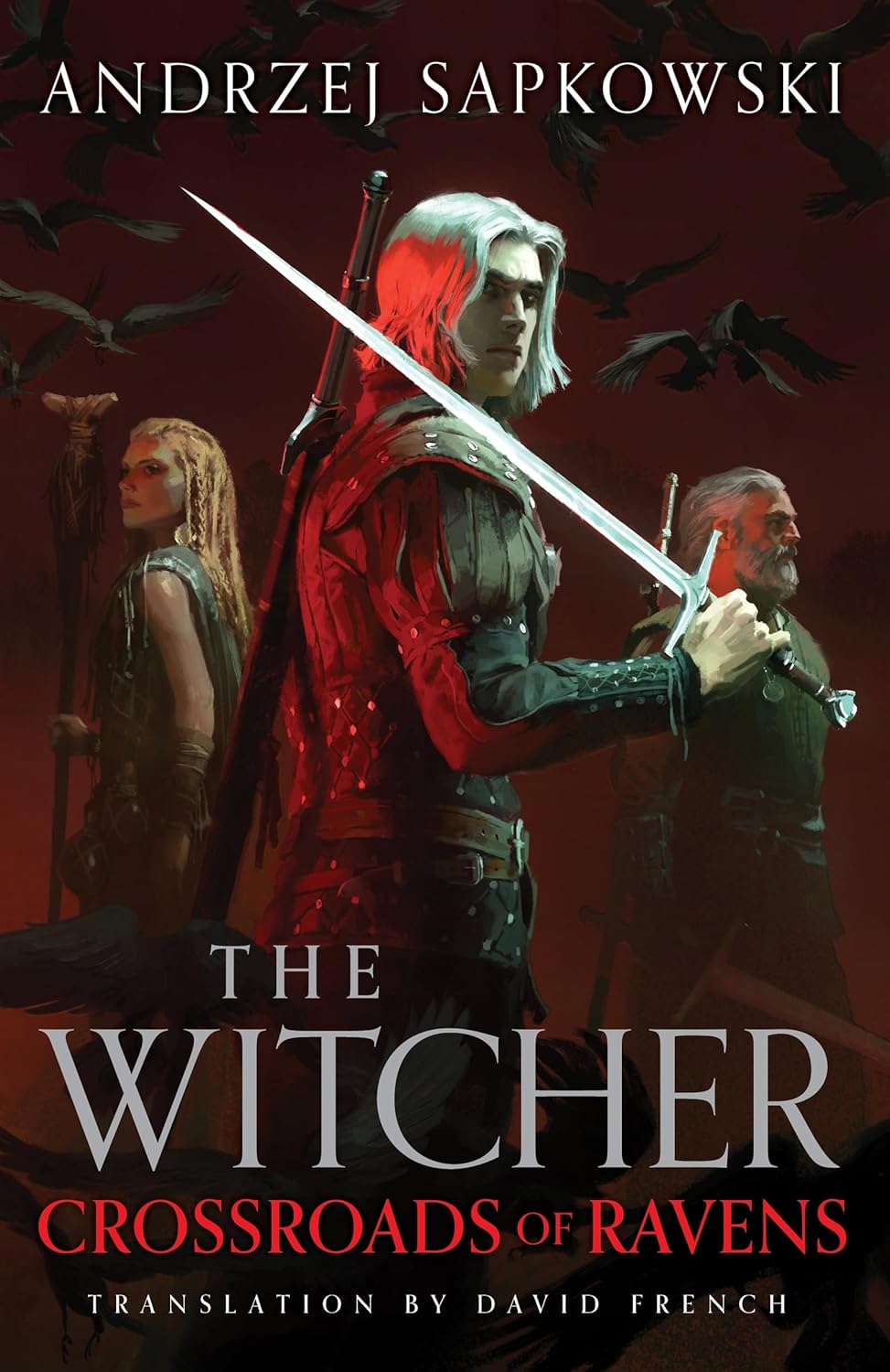
The Witcher: Crossroads of Ravens by Andrzej Sapkowski

Publisher: Gollancz (Trade Paperback – 30 September 2025)

English Translator: David French

Series: The Witcher – 0.1

Length: 310 pages

My Rating: 4.5 out of 5 stars

Amazon

Legendary fantasy author Andrzej Sapkowski returns to the epic world of The Witcher with the outstanding and awesome prequel novel, Crossroads of Ravens.

I doubt anyone familiar with fantasy fiction is unaware of the cultural juggernaut that is The Witcher franchise.  An exciting and intense fantasy series revolving around Geralt of Rivia, a wandering, monster hunting witcher who finds himself drawn into chaotic events that threaten the entire world.  The initial series birthed seven original novels that were released in Poland the 1990s (later released in English), as well as a series of short stories.  However, The Witcher novels would gain prominence around the world after they were used as the inspiration for an incredible video game series, as well as a later Netflix television show.  I personally have enjoyed several excellent pieces of The Witcher fiction over the years, including the previous novel Season of Storms.  As such, I was very happy when I received an early copy of the new prequel novel from the series, Crossroads of Ravens, which proved to be a gripping read.

Long before the events that would make him a legend, grant him the sobriquets of the White Wolf or the Butcher of Blaviken, or even before he claimed to be from Rivia, Geralt was a young, recently graduated witcher.  Descending from the witcher stronghold of Kaer Morhen for the first time, Geralt soon discovers that the world is a harsh place where ideals of heroism only get you into trouble, and that the entire continent holds nothing but disdain for his kind.

Swiftly finding himself on the wrong side of the law and a noose, Geralt is only saved by the intervention of grizzled veteran witcher Preston Holt.  An enigmatic and damaged figure with his own agenda, Holt takes the young Geralt under his wing, teaching him the true reality of being a witcher and honing the important skills that the future White Wolf needs to survive. 

Emboldened by this training, Geralt soon begins to gain fame as a witcher, serving the people previously protected by the ailing Holt.  However, as Geralt wanders the land, he finds many eyes on him, including those who hold a grudge against his order.  As new adversaries and dangerous secrets from the past are uncovered, Geralt will have to decide whether to become the noble hero he always envisioned himself to be, or the monster the world believes all witchers are.

Andrzej Sapkowski continues to expertly expand the lore of The Witcher universe with this exciting and action-packed prequel.  Crossroads of Ravens was an amazing novel that takes the readers on a series of intense adventures, loaded with intrigue, conspiracy and death that all fans of the franchise are going to have an outstanding time with.  I ended up powering through this novel in less than a day, and it proved to be a very impressive read.

Crossroads of Ravens was an outstanding and very exciting novel that piled on the action, intrigue and adventure in its fantastic story.  Starting off with an effective bang that sees a young Geralt in trouble during his first foray out as a witcher, Sapkowski does an excellent job of quickly setting up the scenario and introducing Geralt, and the reader, to a new mentor figure with the entertaining Preston Holt.  What follows is a series of compelling adventures, as Geralt initially learns from Preston, before journeying off into the wilds, facing off against various monsters and the even more troublesome human population of the land.  Sapkowski has fun placing Geralt into a new, mostly self-contained adventure each chapter of Crossroads of Ravens, the events and characters of which may reappear later in the book.  This allowed for a quick-paced and very interesting overall narrative, and it was entertaining to see the young Geralt in action.

While there is a good focus on Geralt’s independent adventures, Crossroads of Ravens has a larger, overarching narrative, that sees Geralt seeking knowledge of a historical attack on Kaer Morhen many years earlier.  Thanks to hints revealed in some of the earlier adventures, a run-in with a complex secondary antagonist, and in-universe notes from intelligence officers keeping watch on Geralt and Preston, readers get the general shape of this matter in the first half of the book, and it lies like a dark shadow over Geralt’s main adventures.  Everything comes to a head perfectly towards the last quarter of the book, as Geralt fully understands the threat towards him and those he cares about, and decides to act.  This leads to a tragic series of events, especially as Geralt faces the consequences of his action and his order’s history, while also trying to determine whether he should stay as a selfless witcher or become something far more vengeful.  Sapkowski makes sure that several open story threads from the protagonist’s previous adventures are also tied together by the end of the book, and it was interesting to see how certain plot elements from these earlier chapters came into play in the conclusion.  The result was an excellent and highly enjoyable story that serves well as both a standalone adventure and a prequel to the rest of The Witcher series.

I rather enjoyed how this great prequel Witcher novel came together, as Sapkowski imbues Crossroads of Ravens with his usual flair and wry humour.  Loaded with action, quick-paced stories and an array of unique monsters, Crossroads of Ravens was very reminiscent of early Witcher novels, especially as containing certain adventures to a specific chapter is very similar to the series’ original short-story format.  Naturally, this novel will be best enjoyed by those established fans of The Witcher franchise, especially readers of Sapkowski original novel series.  Crossroads of Ravens features various references to future events or characters in its pages, which long-running readers of the series will enjoy, and there is some great early characterization of the protagonist as well.  There are also interesting alternate versions of events readers might have seen in other media, including the historical attack on Kaer Morhen, which was featured in the Nightmare of the Wolf anime film.  While older fans will get the most of this book, anyone with any knowledge of the franchise will be able to enjoy Crossroads of Ravens to a great degree, especially as it is the earliest book in the current canon of The Witcher series.  As such, this novel will have a lot of appeal to wide array of readers, who will be in for a great time with the action and adventure.

As with all The Witcher books, Crossroads of Ravens features an excellent array of characters, including a great supporting cast around protagonist Geralt.  I very much enjoyed Geralt in this novel as Sapkowski features a young and inexperienced version of his iconic protagonist.  It was fascinating to see Geralt’s initial forays into both the world of ignorant humans, and monster hunting, especially as his reactions to both are different at a young age.  A great example of this can be seen in one adventure where Geralt attempts to save a girl turned into a striga, which parallels The Witcher short story, which is the first entry in Sapkowski’s original novel/short story collection, The Last Wish.  This adventure in Crossroads of Ravens goes very differently from the author’s original story, and it was fascinating to see how a younger, less confident Geralt dealt with the same situation.  I also quite enjoyed seeing Geralt, upon experiencing loss, go on a mission of vengeance, which threatens his previous attempts to be a respected hero rather than a monster.  I felt that Sapkowski cleverly balanced Geralt’s conflicting emotions in these sequences, and the end scene where he makes a choice about what sort of witcher he is, was a great finish to his story.  Throw in an array of excellent additional characters, including a wise, vengeful mentor, a dedicated investigator, a kind healer and many other fun figures, and Crossroads of Ravens proves to be an awesome book for fans of Sapkowski’s entertaining characters.

With another fun and captivating adventure, Andrzej Sapkowski’s The Witcher series continues in all its monster-hunting glory with Crossroads of Ravens.  An outstanding prequel novel that features an array of fantastic storylines and characters, Crossroads of Ravens serves as a highly entertaining entry in this acclaimed series that will appeal to a wide audience of fantasy fans.  I had a great time reading Crossroads of Ravens, and it’s worth checking out for anyone in the mood for fun action and an interesting narrative from an excellent established series.
Amazon

The Tower of Fools by Andrzej Sapkowski

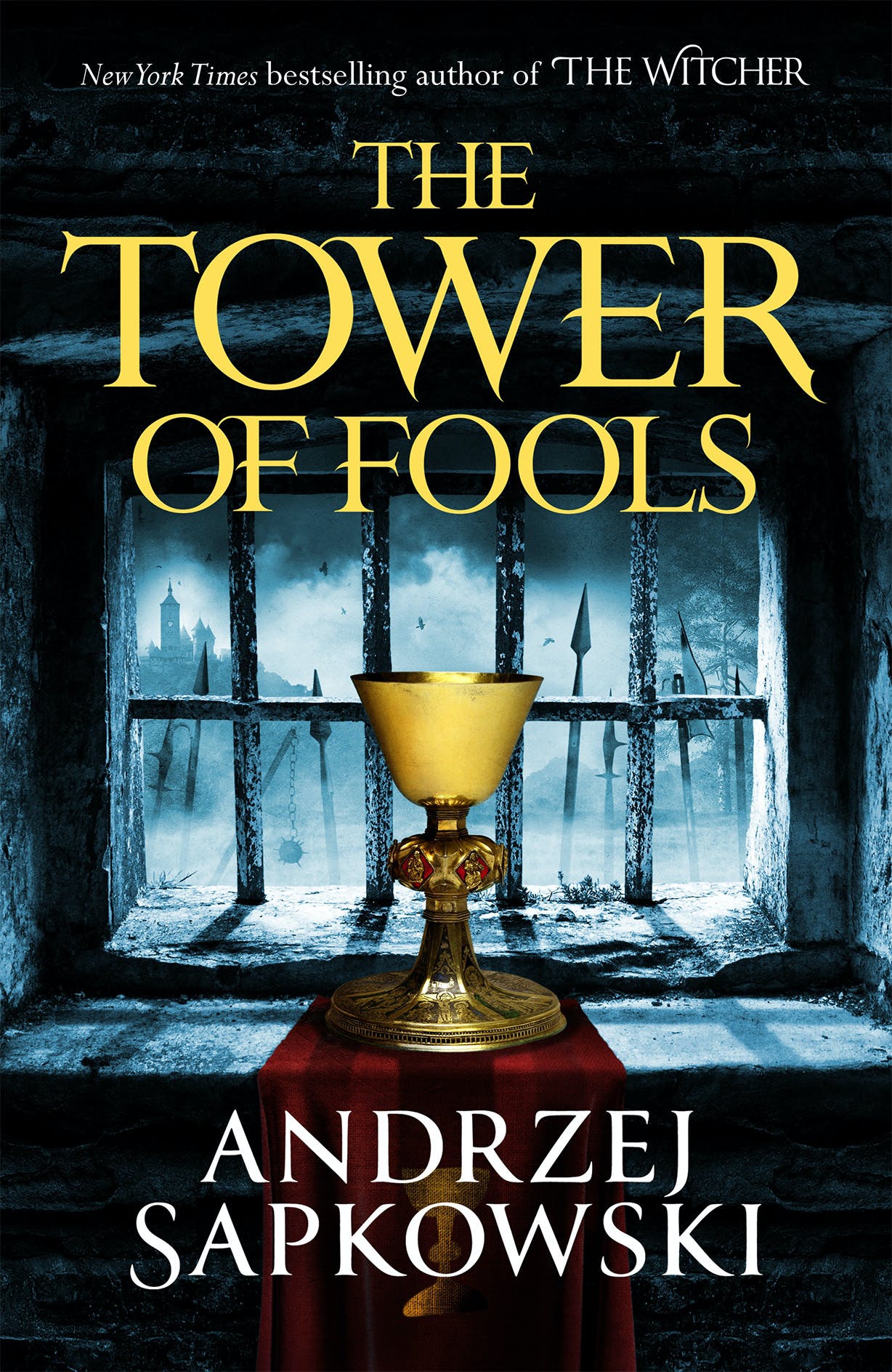
The Tower of Fools Cover

Publisher: Gollancz (Trade Paperback – 27 October 2020)

English Translation by David French

Series: Hussite trilogy – Book One

Length: 549 pages

My Rating: 4.25 out of 5 stars

Amazon     Book Depository

From legendary Polish author Andrzej Sapkowski comes the first English translation of his 2002 release, The Tower of Fools, an intriguing and exciting fantasy/historical fiction hybrid novel that takes the reader on a weird and entertaining adventure.

1425, Silesia (South Western Poland and parts of Czechia).  War is brewing as the Catholic Church fights against the Hussites in a brutal religious struggle.  As the entire region begins to degenerate into conflict and chaos, a young doctor and amateur magician, Reinmar of Bielau, known as Reynevan, finds himself in all manner of trouble when he is caught in bed with the beautiful wife of a knight.

As Reynevan makes his escape, a member of the knight’s family, the powerful Stercza clan, is unintentionally killed, and the rest of the Stercza’s swear vengeance upon him.  Worse, Reynevan’s forays into magic have made him a target of the inquisition, who wish to have an extended and unpleasant chat about his arcane hobbies.  With a massive price on his head, Reynevan is forced to flee into the wilderness to survive as bounty hunters scour the countryside trying to find him.

Calling upon old friends, Reynevan looks for anyway to escape from his pursuers while also attempting to ‘rescue’ the knight’s beautiful wife.  Teaming up with an odd group of comrades, Reynevan makes his way throughout Silesia while attempting to outfox his pursuers.  However, his adventures have inadvertently placed him in the middle of a dangerous conspiracy, one that could change the entire fabric of the region and which threatens everyone he loves.  As Reynevan attempts to work out just what he has become involved with, his path leads him to the infamous Tower of Fools, an asylum for the insane and the heretical.  Can Reynevan escape the danger he finds himself in, or will his adventures cost him his life and his mind?

The Tower of Fools is a compelling and unique novel from veteran author Andrzej Sapkowski, who is best known for his iconic The Witcher novels.  This novel is the first entry in Sapkowski’s Hussite trilogy, which is the main series he has authored outside of The Witcher books.  The Tower of Fools was originally released back in 2002 under the original title Narrenturm, and while it has previously been translated into several other European languages, this version represents the first English translation of the book.  The translation of The Tower of Fools was done by David French, who has previously translated several Witcher novels, and no doubt we can expect the next two novels in the series (previously published in 2004 and 2006) to be translated and released in the coming years.  While I really enjoyed The Witcher television series, I must admit that I am not too familiar with Sapkowski’s writing, having so far only read the 2018 translation of The Witcher standalone novel Season of Storms.  However, due to the inevitable interest that was going to surround The Tower of Fools, I was quite keen to check out this book, and I ended up really enjoying it due to its captivating narrative, outrageous characters and excellent use of some distinctive historical fiction elements.

This novel from Sapkowski contains a fantastic and enjoyable narrative that proves surprisingly hard to put down at times.  The author has done a fantastic job blending together interesting historical fiction and fantasy elements that come together to create a distinctive adventure story.  The Tower of Fools is mostly told from the perspective of its central character, Reynevan, although several other perspectives are occasionally used throughout the novel.  What I liked about this book was the fact that it was a fast-paced, event-laden narrative that showered the reader with all manner of action and intrigue.  Reynevan and his companions essentially run into a different dangerous obstacle, major historical event or dastardly opponent every chapter, which they are forced to overcome or escape from in short order.  This ensures that the reader is constantly on their feet as they are never certain what new trouble or adventure lies on the horizon.  In addition, there is also a subtle line of intrigue that sees a sinister conspiracy begin to unfold around the protagonist as he finds himself in the midst of a series of murders and political manoeuvrings.  While this seems like a lot of elements for one book, it comes together surprisingly well into a cohesive and exhilarating narrative that I quite enjoyed, and which serves as an impressive start to the entire Hussite trilogy.  There are a lot of fun elements to this book, and I particularly want to point out the rather entertaining introductions that occur at the start of each chapter, giving the reader a humorous heads-up of what is to come throughout the series.  I did find it interesting that the titular Tower of Fools, which is referenced strongly throughout the official synopsis for this book, does not show up until really late in the book and is only a setting for a relatively short period.  While this book does contain several great and dark scenes in this location, this novel might have been more interesting if more of the story was featured in this asylum.  Still, I had an awesome time getting through The Tower of Fool’s cool story, and it was an absolute thrill ride from start to finish.

One of the major things that I liked about The Tower of Fools is the way in which Sapkowski complimented his entertaining narrative with a huge selection of distinctive characters.  This includes the main protagonist of the novel, Reynevan, the foolhardy student doctor and magician who serves as the main point-of-view character.  While he is the driving force for most of The Tower of Fools’ narrative, I actually found Reynevan to be a little annoying, especially as his impulsive nature, which is mostly driven by unrealistic ideas of heroism and romance, continues to get him into trouble.  This becomes especially annoying when his stupid decisions endanger his friends, whose determination to point out Reynevan’s mistakes help to make them more likeable.  Despite being a typical foolish young male protagonist, Reynevan does grow on you a bit as the book progresses and it proves hard not to relate to some of his impulses at time.  While his actions did occasionally exasperate me, I really did enjoy him as a character, and his keen insights and fun antics ensure that the reader has a great time following him throughout the course of the novel.

In addition to Reynevan, the main two side characters of The Tower of Fools are the fun duo of Scharley and Samson, two very different men who become Reynevan’s travelling companions.  Both of these characters are extremely entertaining in their own right, and Sapkowski weaves some great narrative threads around them.  Scharley is a crude, belligerent and surprisingly dangerous priest who leaves his imprisonment in a monastery to assist Reynevan.  Scharley serves as the main voice of reason and caution for much of the book and proves to be an interesting counterpoint to the youthful and impulsive Reynevan, whom he often has to threaten with violence in an attempt to get him to do the logical or sane course of action.  Their other companion is Samson, a giant of a man with an intense intelligence, who may or may not be possessed by a demon.  Samson is a really fun addition to the group, and I really enjoyed him as a character thanks to his unique demeanour and characterisation.  These two companions are quite intriguing in their own way and it was a lot of fun to see them interact with Reynevan and the other characters they come across.  This book also contains a multitude of extra characters, many of whom have their own intriguing storyline or character trait.  While many of these characters are entertaining and interesting additions to the plot, I think that Sapkowski might have slightly overdone it with the side characters.  While I did my best, there were honestly way too many supporting cast members to keep track of at times, especially as a lot of characters appeared or reappeared out of nowhere with very little explanation.  Still, this chaotic use of characters fits in very well with The Tower of Fool’s event-laden narrative, and it did not have too severe an impact on my enjoyment of the book.  The more distinctive characters proved to be quite entertaining and I had a good time seeing where some of their arcs ended up.

Sapkowski also makes impressive use of some cool historical fiction elements to tell his unique story.  The Tower of Fools is set in the early 15th century in an area of the world that is experiencing a lot of turmoil, Silesia.  Much of the book’s plot revolves around the major conflict of the period between the Catholic Church and the Hussites, a religious offshoot that was declared heretical and which the Church launched several Crusades against.  This proves to be a fascinating background to the main story, and Sapkowski features a lot of interesting Eastern European historical inclusions throughout his book.  This includes a range of references to key elements of regional history and politics that were quite intriguing, as well as the use of several major historical figures in varying roles, including some cameos from people like Gutenberg and Copernicus.  The author does a pretty good job of explaining these historical elements to the reader, although I did have to do some independent research to answer a few questions and fill in a few gaps.  A lot of this was due to my somewhat lacking knowledge of Eastern European medieval history, and those readers with a little more appreciation for the location will no doubt follow along a little better.  I did think that The Tower of Fools contains a rather excellent depiction of the landscape and the people that would have existed during this bleak period.  The various bits of intrigue, plots and war that occur throughout the book really fit into Sapkowski’s impressive and dark, setting, and it definitely helped to enhance part of the book’s story.  This was also the perfect setting for the various magical elements that occurred throughout the book, as their darker aesthetic matched the location to a tee, especially as there are a number of scenes set out in the dangerous and monster-filled woods.  All of this makes for a great setting, and I had an excellent time seeing this historical setting be put to amazing use throughout The Tower of Fools.

The Tower of Fools by Andrzej Sapkowski is an enjoyable and fun novel that takes the reader on an epic adventure back to a dark version of historical Eastern Europe.  Filled with some great characters, intriguing historical features and a fantastic story, The Tower of Fools turned out to be quite a captivating read.  I look forward to seeing how the rest of the Hussite trilogy unfolds and I imagine I will be in for an exciting ride.  The Tower of Fools comes highly recommended and it should prove to be an excellent read to any fans of Andrzej Sapkowski and The Witcher novels.

Amazon     Book Depository