Warhammer 40,000: Lelith Hesperax: Queen of Knives by Mike Brooks

Publisher: Black Library (Audiobook – 27 July 2024)

Series: Warhammer 40,000

Length: 5 hours and 59 minutes

My Rating: 4.5 out of 5 stars

Amazon

One of the rising stars of Warhammer fiction, Mike Brooks, presents another exciting, character-focused narrative within the grimdark Warhammer 40,000 universe with awesome novel, Lelith Hesperax: Queen of Knives.

Those familiar with the franchise will know that Warhammer 40,000 fiction is on fire at the moment.  There are some very talented authors out there writing exciting and compelling adventures based on the game’s various factions, and readers are finding out just how fun and complex stories written in this universe can be.  Out of all the fantastic authors writing Warhammer fiction in recent years, one of the most impressive is Mike Brooks, who is shaping up to be one of the franchise’s big writers.  A talented fantasy and science fiction author, Brooks has been producing some excellent books in recent years that either focus on unique Warhammer 40,000 characters or one of the game’s non-human factions.  Books like Huron Blackheart: Master of the Maelstrom, The Lion: Son of the Forest (one of my favourite books and audiobooks of 2023), Brutal Kunnin, Warboss and Da Big Dakka (one of my favourite books and audiobooks from the first half of 2024), have been extremely epic, and I am always down for more stuff from Brooks as a result.  As such, I made sure to grab a copy of his other 2024 Warhammer 40,000 novel, Lelith Hesperax: Queen of Knives, which was another interesting and memorable addition to the canon.

In the far future, the fallen and capricious drukhari heal and hold back the grim prospect of death by inflicting pain on others.  The dark streets of their city, Commorragh, run red with blood as millions of prisoners are killed in their gladiatorial arenas to slake their citizens’ bloodlust and need for suffering.  To survive in this brutal city, a drukhari needs to be smart, deceitful or a natural killer, and no killer is more revered in Commorragh than Lelith Hesperax.

A legendary gladiator, Lelith Hesperax has long reigned as the Grand Succubus of the most powerful Wych Cult in Commorragh, her blades having carved through thousands of challengers, potential rivals and alien captives.  But after years of fighting for herself, Lelith has found a new cause to draw blood for.  Abandoning Commorragh, Lelith now fights against daemonic hordes alongside the nomadic cultists of the Ynnead, who seek a different way to survive as a species.  However, while she’s been away, new rivals strike at Lelith’s holdings back at Commorragh.

Warned by the mysterious Harlequins of a rising threat against her, Lelith returns to Commorragh to find that much has changed.  Her Cult of Strife is no longer feared or respected, and many of the city’s inhabitants openly plot against her and her followers.  Shocked at how far her status has fallen in her absence, Lelith knows that the only person capable of causing this much disruption to her empire is the undisputed ruler of Commorragh, Asdrubael Vect.  Forced to contend against the schemes of a master manipulator, Lelith believes that the only way to survive is to remind the city just how dangerous she is.  But with Vect’s web of manipulation surrounding her, can even Lelith cut herself free, especially when her opponent forces her to fight against the only person in Commorragh she doesn’t want to kill?

Mike Brooks continues to showcase just how good he is at bringing the various complex figures of the Warhammer 40,000 universe to life with this exciting new read.  Expertly capturing the legendary drukhari killer, Lelith Hesperax: Queen of Knives was an awesome and captivating read I had a lot of fun getting through.

This latest book from Brooks is a quick but very intense and well-written read that successfully gets into the head of an iconic drukhari character from the games.  Told exclusively from the perspective of the main character, Lelith Hesperax, Queen of Knives moves at an extremely fast pace; after a fast introduction to set up how much Lelith’s life has changed since leaving to work with the cultists of the Ynnead, you are thrust into the action when a bored Lelith is warned about a rising threat back in Commorragh.  This effectively brings the reader back to the main setting, which is for the best, as Commorragh is a particularly awesome location for any Warhammer 40,000 novel.  The protagonist is soon embroiled in a sinister array of intrigue, as it becomes clear that the undisputed leader of the drukhari, Asdrubael Vect, is working against her, and is using a figure from Lelith’s past, Morghana Nathrax, as his catspaw.

Forced on the backfoot in a fight for the first time in her life, Lelith attempts to find a way to counter the moves of her shadowy opponent, while also trying to avoid a fight with Morghana.  This results in some excellent action set pieces and moments of intrigue, as Lelith gets back to her dread drukhari roots.  The fight sequences surrounding the protagonists are sharp, exciting, and necessarily brutal, and I appreciated how well Brooks balanced the action with overlying intrigue and plotting.  The author also spends a good chunk of time diving into the protagonist’s personality and past, and a few well-placed flashbacks help to provide additional emotional attachment and show Lelith’s complicated relationship with Morghana.  Everything leads up to the inevitable confrontation, which goes in some very interesting and emotionally charged directions.  While I felt that Brooks could have added in another layer of intrigue to the protagonist’s final ploy to make the book really stand out, the conclusion of the book was generally pretty satisfying, and Queen of Knives turned out to be an excellent standalone read.

Due to the book being deliberately focused on one iconic protagonist, Queen of Knives does by necessity have a character-driven plot, which revolves around some fantastic figures.  Naturally the most prominent of these is the book’s sole perspective character, Lelith Hesperax, who proved to be quite an awesome protagonist to follow.  Brooks chooses to jump readers right into the midst of Lelith’s current adventure at the start of Queen of Knives rather than immediately focusing on her backstory, which I think worked from a narrative perspective, as it brought readers quickly into the plot.  There is a useful drip feed of information about her past and her nature as the book continues, enough that reader’s unfamiliar with the protagonist can easily enjoy Queen of Knives, while also allowing Brooks to control the audience’s understanding of the protagonist’s motivations and feelings.  Readers soon come to appreciate that Lelith is a complex figure, torn between her love of violence and glory and the new path of redemption she finds herself on with the cult of Ynnead.  As such, Queen of Knives proves to be a key chapter in Lelith’s story, as she returns to her old ways, only to discover a new side to her life and a potential romance.  I loved seeing Brooks’ examination of the protagonist’s various complex layers, and it made for quite a moving book as a result.

The main protagonist is well balanced by several great supporting characters, each of whom have their own unique impact on the narrative.  The two I really want to focus on include new character Morghana Nathrax, a figure from Lelith’s past who develops a real love-hate relationship with the protagonist.  Morghana’s well-balanced admiration and hatred of Lelith ensures that conflict is inevitable between them, even though Lelith wants to keep her alive, and Brooks writes quite a complex relationship between them.  However, my favourite supporting character is the main antagonist of Queen of Knives, the notorious ruler of Commorragh, Asdrubael Vect.  Vect is a particularly awesome figure in the Warhammer 40,000 canon, so it was cool to see him utilised here in Queen of Knives.  Even though Vect only appears in one sequence at the end of the novel, Brooks does an outstanding job building him up as a brilliantly devious figure, effortlessly manipulating all the drukhari in the city, including Lelith and her followers.  You really come to appreciate the fear that all Commorragh has for Vect as the book continues, and his one appearance ensures that you understand why he commands such fear.  I really loved how well Brooks built up these characters, and it made for some awesome reading as a result.

I felt that Queen of Knives was a great Warhammer 40,000 novel, especially as Brooks expertly explores and utilises so many cool lore elements throughout his story.  It proves to be a deeply compelling look at the iconic and always enticing drukhari faction.  The drukhari, or the dark eldar, as older fans may know them, are the Warhammer 40,000 universe’s resident space elf murder pirates, and have a long history in the game.  Despite that, there isn’t a lot of fiction out there about them, with Brooks’s other 2024 novel, Da Big Dakka, being the only recent book to strongly feature their perspective that I can recall, and even then, more focus was given to the ork characters in that book.  As such, it was a real pleasure to have a novel completely dedicated to the drukhari, and Brooks does an outstanding job diving into the faction’s culture, mentality and other vital lore elements.  This includes a fantastic look at the iconic dark city of Commorragh, one of the most dangerous places in the Warhammer 40,000 canon.  A noted seat of deceit, bloodshed and easy death, Commorragh did not disappoint as a background setting from Queen of Knives, and Brooks ensures it plays a key part in the story.  Throw in some other interesting, if relatively brief, looks at the other Aeldari sub-factions (particularly the Ynnari), and there is a lot of interesting lore here for Warhammer 40,000 fans to appreciate.  As such, Queen of Knives is probably best enjoyed by those who already have an established connection to the franchise, although thanks to Brooks’s excellent writing, a new reader could probably come in and enjoy Queen of Knives without too much context.

As with most things Warhammer that I enjoy, I made sure to grab a copy of Queen of Knives on audiobook, which proved to be as epic as always.  The fast-paced plot, intense action and unique characters of Queen of Knives unsurprisingly came across extremely well in the audiobook format, and I really got absorbed into the story as a result, especially when it came to the elaborate depictions of the sinister city of Commorragh.  Coming in with a runtime of six hours, Queen of Knives is a relatively short Warhammer audiobook to get through, and I managed to knock it off quickly once I got stuck into it.  I really enjoyed how Queen of Knives came together, and I particularly enjoyed the narrator Antonia Beamish.  Beamish, whose work I previously enjoyed on the Warhammer Horror audiobook Sepulturum, was really impressive with her narration of Queen of Knives, and I liked her take on the main protagonist.  You really get a sense of the predatory nature of the various drukhari characters that Beamish voices throughout this audiobook, and I felt that these figures were all given fitting and impressive voices.  This great voice work helped ensure that the audiobook was once again the best way to enjoy this excellent book, and you are guaranteed to have a lot of fun listening to Queen of Knives.

Overall, Lelith Hesperax: Queen of Knives was another amazing book from Mike Brooks, who once again showcases his ability to write complex Warhammer 40,000 fiction.  Combining a compelling and intrigue laden narrative with great character work and a particularly distinctive Warhammer 40,000 setting, Queen of Knives was so much fun, and I really powered through it.  A highly recommended read, I look forward to seeing what Brooks will write next.

Amazon

Warhammer 40,000: Da Big Dakka by Mike Brooks

Da Big Dakka Cover

Publisher: Black Library (Audiobook – 24 February 2024)

Series: Warhammer 40,000: Ufthak Blackhawk – Book Two

Length: 9 hours and 25 minutes

My Rating: 4.75 out of 5 stars

Amazon

I have been really punching out the Warhammer reviews this week, and the final one I want to bring up is the exceedingly fun novel Da Big Dakka by Mike Brooks.

Mike Brooks is an outstanding author, who has been killing it with his amazing novels in the Warhammer 40,000 universe with elaborate tales featuring some unique figures.  I really enjoyed his dark novel, Huron Blackheart: Master of the Maelstrom, and The Lion: Son of the Forest was one of my favourite books and audiobooks of 2023.  However, out of all of Brooks’s books, the most entertaining, exciting and outright funny are his novels that focus on the ork faction.  Orks are always a fantastic group in Warhammer fiction, but Brooks has some amazing insights into these rowdy creatures.  His previous ork novels, Brutal Kunnin and Warboss, have both been awesome, but I honestly think his latest book, Da Big Dakka, is his best yet.

Ufthak Blackhawk, big boss of Da Tekwaaagh! is in trouble.  Sent far away into the stars by his Warboss, Da Meklord, to find loot and a good scrap, Ufthak has found barely anything to steal or fight, and now Da Meklord wants his tribute.  Determined to find one big score, Ufthak is awarded a unique opportunity when his new grot servant reveals the webway, mysterious ancient portals which can lead to all sorts of unusual places.  However, he has no way of entering the webway, that is until someone opens it for him.

Dhaemira Thraex is a powerful and ambitious drukhari archon, who seeks to empower her cabal and become leader of her section of the dark city of Commorragh.  To that end, Dhaemira brings Ufthak and his horde into Commorragh, hoping to use the threat they present to unite her rivals behind her.  Confident of a swift victory against the unorganised orks, it quickly becomes apparent that Dhaemira has underestimated the danger she has unleashed.

After years of fighting and getting stronger, Ufthak is no longer the simple ork he once was.  Instead, he is now a monstrous foe who excels at killing, and who has a plan to get everything he wants.  But can even the new and improved Ufthak stand against the worst that the twisted and malevolent drukhari have to throw at him, especially when treachery sprouts within his own ranks in the most unlikely of places?

Mike Brooks presents one of his funniest and most exciting novels yet as Da Big Dakka hits all the right notes for me.  Utterly hilarious, loaded with over-the-top characters, and featuring two extremely awesome factions from the Warhammer 40,000 universe, Da Big Dakka had me hooked from the moment I started listening to it and refused to let go until the very last laugh.

Da Big Dakka had a great story behind it, and I liked how Brooks set it up as a direct sequel to Brutal Kunnin (which I read recently in preparation for the release of this book), while also featuring elements from WarbossDa Big Dakka is more of a dark comedy than a serious Warhammer 40,000 novel, which is to be expected when you have a book focused on the orks.  The premise behind Da Big Dakka is simple: the orks under the command of the evolving Ufthak Blackhawk have found themselves inside the drukhari city of Commorragh and must pit their savage battle skills and crude intellect against the subtle tactics of their drukhari hosts.

The drukhari, whose scenes are primarily told from the perspective of Dhaemira Thraex, initially see the orks as a minor threat, and they are more concerned with their intrigues to take them seriously.  However, underestimating the orks never works out for anyone, and soon Ufthak has launched a series of insane and unpredictable counterattacks that force the drukhari to work together.  As this happens, Ufthak finds himself being secretly undermined by one of his grots, Snaggi Littletoof (who previously appeared in Warboss), who his determined to lead a grot uprising and finds himself in all manner of trouble as a result.  All three of these storylines come together in a big way towards the end of the book, as all the schemes, outrageous plans and badly organised rebellions, are decided in one big brawl.  The final results of Da Big Dakka are pretty damn awesome, as there are some deliciously ironic comeuppances, interesting character development, and entertaining hints about what Brooks plans to do in the future.

While there are notable similarities between Da Big Dakka and the previous novel, Brutal Kunnin, as the book follows a similar thread of orks rampaging across a new world facing off against arrogant enemies, it’s hard not to fall in love with this book.  You can clearly see that Brooks has evolved his style since Brutal Kunnin, and this sequel was a much stronger novel.  A lot of this was down to the inclusion of one of the best characters from Warboss, who added in an extra comedic angle to the plot that vibed wonderfully with the other storylines.  Brooks also amped up the petty political intrigue and plotting with the non-ork parts of the book, with the drukhari serving as an excellent antithesis to the orks.  There was also a great deal more character development when it came to the protagonist, which helped to strengthen a lot of the plot.  This split between these three main point of view characters was pretty damn perfect, and their alternating views of events helped to produce a very strong story.

In addition, there was excellent added complexity to Da Big Dakka’s humour, which I had a brilliant time with.  While most of the comedy is based around the over-the-top antics of the orks, there is also some darker, more subtle comedic elements spread throughout the plot which plays off the other jokes extremely well.  A lot of this based around ironic events, in-universe jokes, and hilarious betrayals, which really added up as the book progressed.  I found myself laughing out loud multiple times while listening to Da Big Dakka, and this was one of the funnier books of 2024.  Throw in a ton of over-the-top fight scenes, most of which serves to enhance the already epic story, and you have an outstanding and captivating book with pure fun at its heart.

One of the things that I always enjoy about Warhammer 40,000 fiction is the shear range of different stories and styles that can be told.  Da Big Dakka for example is a much more light-hearted book that focuses on two alien races that don’t always get a lot of focus in the extended fiction.  As such, this book has a great deal of appeal for those unfamiliar with Warhammer, as Brooks is required to dive into these factions without weighing the reader down with too much heavy plot.  New readers can easily enjoy this book without any real pre-knowledge or conceptions about the Warhammer 40,000 universe and still have an outstanding time with the unique story and characters.  It can also be readily enjoyed by those who haven’t read the preceding two novels, Brutal Kunnin and Warboss, as Brooks makes the story very accessible.  Naturally, established fans and those who have read Brooks’ prior novels will get a lot more out of Da Big Dakka, mainly because there is some interesting progression of character arcs, and because Brooks provides outstanding look at the orks and the drukhari.

As with his previous two novels, I was deeply impressed with how Brooks portrayed the orks in Da Big Dakka.  The orks are always a very entertaining bunch, and their hooligan-esque actions, desire to fight, and unique outlook on life makes for some fun reading.  Pretty much every book that features an ork character is bound to be more on the comedic side, and Brooks delivers this in spades, loading up the story with a ton of funny observations, in-jokes and outrageous behaviours that proved to be exceedingly entertaining.  Brooks really amps up the unpredictable nature of the orks in Da Big Dakka, and there was a good recurring theme about being underestimated.  While Brooks went a little light on describing ork technology and the different clans, mainly because he’s covered that before, there was an interesting look at ork psychology and biology which showcased why they fight and how it benefits them.  The author also featured a great look at the ork sub-race known as the grots, who have an expanded role in this book.  Smaller, weaker and extremely bullied members of the ork race, the grots serve as a snivelling slave caste, and offer some fun comedic relief.  A good part of the plot revolves around the grots and their cowardly nature, and it was really entertaining to see Brooks’s take on their mindset and place in ork society, especially when one of their number tries something different.  Honestly every scene featuring a major ork character was entertaining or interesting in some way or another, and I really love how well Brooks portrays this awesome faction.

While Da Big Dakka is mostly dedicated to the orks, Brooks also spends a ton of time focusing on one of the more intriguing factions in the canon, the drukhari.  Previously known as the dark eldar, the drukhari are one of the more underutilised groups in Warhammer 40,000 fiction, and it was great to see them here.  Essentially evil space elves, the drukhari live in an extra-dimensional city and require the pain of others to survive (think the Cenobites from Hellraiser).  As Da Big Dakka is primarily set in a section of their city and features a drukhari as a main character, Brooks showcases a lot of the drukhari lore in this book, which was really cool.  This book features an in-depth look at the drukhari, with their unique units, weaponry and vehicles strongly featured.  However, Brooks goes even deeper than that, focusing on the politics of the drukhari characters, the various alliances that bind them, and entire basis of their existence.  I loved the fascinating examination of why they require pain to survive, as well as their thoughts on mortality, and this became a key part of the book’s plot.  You get a real clash of styles between the two factions, and the orks are constantly frustrated by the hit-and-run tactics of the drukhari (or the spikiez, as the orks know them).  I also loved how cool the city of Commorragh proved as a background to the plot, and Brooks features several unique drukhari structures and locations that made for some great battlefields.  The entire final sequence takes place in one of their arenas, and it was very fun to see the protagonist face off against some of the drukhari captives.  I honestly really loved that Brooks featured the drukhari here, and I hope we see more Warhammer authors use them in the future as they are so underutilised.

I also must highlight the excellent character work featured within Da Big Dakka, as Brooks featured some amazing figures whose unique insights added so much to the impact of this book.  The primary character is the ork big boss, Ufthak Blackhawk, who previously served as the protagonist of Brutal Kunnin.  Since we last saw him, Ufthak has literally grown into his role as a boss, as his victories have transformed Ufthak into a massive monster.  This physical growth has also resulted in him becoming smarter, and a lot of his storyline revolves around him utilising this new intellect for the first time.  It also makes him more ambitious and insightful, and it was fascinating to see him interact with the other characters in the book, especially the main drukhari figure.  Indeed, the one scene where they have a frank conversation was probably one of my favourites in the entire book, with Ufthak proving to be her intellectual match.  Despite this newfound and somewhat unwanted ability to think, Ufthak is still an ork at heart and he acts accordingly, with lots of destruction and carnage coming from him alone.  Ufthak is also a major source of comedy as his cynical, hilarious, and often surprisingly accurate insights into the drukhari, his fellow orks, and the other races of the galaxy, are so funny.  It will be interesting to see what adventures Brooks has planned for Ufthak in the future, as he is clearly positioning him to be a major recurring figure in his books.

Aside from Ufthak, the other two major characters of the book are the drukhari archon, Dhaemira Thraex and the grot Snaggi Littletoof, both of whom add some great alternate elements to the story.  Dhaemira is a ruthless drukhari strategist, who revels in schemes, plots and ambitious powerplays.  The person ultimately responsible for much of the carnage in Da Big Dakka, Dhaemira proves to be a fantastic figure to follow, especially as the reader gets most of their view of the drukhari from her.  Dhaemira proves to be an excellent alternative protagonist to Ufthak, mainly because the two are so different, and it was fascinating to see their clash of styles and personality, even though they have more common ground then you would expect.  I really loved Dhaemira’s narrative, which goes in some interesting directions, including an unlikely romance, and it really played off the ork perspective chapters so well.

The final key ingredient to this mix was Snaggi Littletoof, the self-proclaimed Grotboss and prophet of Gork and Mork.  Snaggi, who previously appeared in Warboss, is determined to lead a grot rebellion to overthrow the orks and place him in charge.  Unfortunately, Snaggi is held back due to the stupidity of his minions, as well as his own inaccurate sense of self-importance.  His entire storyline of attempted rebellion was a welcome addition to the plot as it served an interesting middle ground between Ufthak’s direct actions and Dhaemira’s more subtle plots.  It also added some excellent additional humour, as Snaggi’s various schemes to take over the ork band, go in some interesting directions that often balance unlikely success with massive failure.  This fantastic combination of characters was so much fun, and I really loved how well Brooks introduced them and balanced them out throughout Da Big Dakka.

I checked out this Warhammer novel in its audiobook format, which is the best way to enjoy the over-the-top action and big personalities of this franchise.  Da Big Dakka is a great example of this, and I love how all the amazing scenes and fun fights really come to life when they are read out to you.  In Da Big Dakka’s case, a lot of this is due to narrator Harry Myers, who is quickly becoming one of my favourite Warhammer audiobook voice actors.  Not only has he really impressed me in Brooks’s previous ork audiobook, Warboss, but Myers was also brilliant narrating two of my all-time favourite Warhammer 40,000 novels, Day of Ascension by Adrian Tchaikovsky and The Wraithbone Phoenix by Alec Worley.  Myers has such an amazing and booming voice and a great British accent that really fits the hooligan-aesthetics of the orks.  He effectively works through a series of voices in Da Big Dakka, that includes the commanding voice of main character Ufthak Blackhawk, and the high-pitched whiny voices of the various grots.  While his voice wasn’t always the most effective for conveying the subtle mannerisms of the ethereal drukhari, Myer still did an excellent job portraying them throughout this book, and I loved how efficiently and entertainingly he moved the plot along.  I honestly don’t think I would have had as much fun with Da Big Dakka without Myers’s narration, and with a run time just short of nine and a half hours, this is a very easy audiobook to get through and enjoy.

Mike Brooks continues to impress me with his outstanding and epic contributions to the Warhammer 40,000 franchise, especially as he so clearly grows as an author with each book he writes.  His latest novel, Da Big Dakka, is a captivating and deeply hilarious piece of Warhammer fiction that tells an awesome story, while also expertly using the franchise’s most unique factions.  Wildly entertaining, incredibly funny, and subtly clever, Da Big Dakka was particularly fun to read and comes highly recommended.  I cannot wait to see what wonderous piece of Warhammer fiction Mike Brooks will write next, as I know I am going to love it.

Amazon

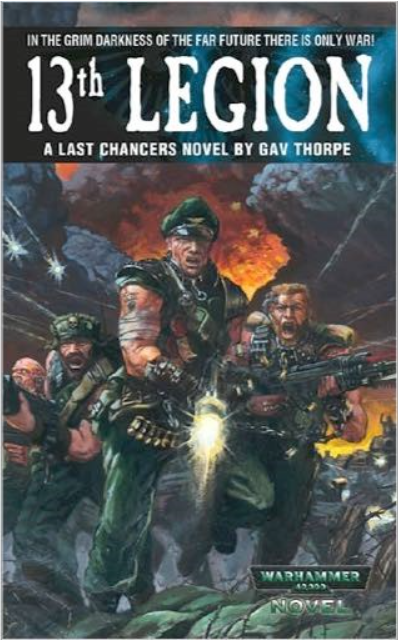
Throwback Thursday – Warhammer 40,000: 13th Legion by Gav Thorpe

13th Legion Cover 2

Publisher: Black Library (Paperback – 1 January 2001)

Series: Last Chancers – Book One

Length: 275 pages

My Rating: 4.5 out of 5 stars

Amazon

Welcome back to my Throwback Thursday series, where I republish old reviews, review books I have read before or review older books I have only just had a chance to read.  For this latest Throwback Thursday, I check out a classic Warhammer 40,000 novel that has been on my to-read list for a while with 13th Legion by Gav Thorpe.

I have been in a very noticeable Warhammer 40,000 reading mood lately which has allowed me to check out a huge and varied range of books from one of my favourite franchises.  This current obsession allowed me to finally get a copy of the outstanding older Warhammer 40,000 novel, 13th Legion, which I have been hoping to get for a while.  The first book in the iconic Last Chancers series, 13th Legion is essentially billed as The Dirty Dozen in the Warhammer 40,000 universe, which is a pretty awesome concept.  It has also been written by Gav Thorpe, one of the most significant authors of Warhammer fiction that I haven’t had a chance to read too much from yet.  Thorpe has contributed a ton of novels to various parts of the larger Warhammer franchise, including Warhammer Fantasy and Warhammer 40,000, but the Last Chancer novels are the series that I have most wanted to read.  13th Legion was one of Thorpe’s first Warhammer novels and I had an awesome time getting through this epic military thriller.

In the far future of the 40th millennium, the Imperium of Man boasts innumerable regiments of loyal and brave Imperial Guard.  However, no Imperial Guard regiment is as despised, desperate and doomed as the infamous 13th Penal Legion, also known as the Last Chancers.  Made up of former Imperial Guard who have committed terrible crimes against their fellow soldiers or the Imperium and under the command of the steely and mysterious Colonel Schaeffer, each member of the 13th Legion is given one last chance to achieve redemption in the eyes of the Emperor by dying in battle.

But, after fighting on some of the harshest battlefields in the Imperium, the 13th Legion is starting to run out of men.  Out of the thousands of convicts originally drafted into the fray, only a few hundred remain, and that number is whittled down with every single conflict.  Worse, Schaeffer continues to lead them into some of the worst scenarios imaginable, and with no reinforcements in sight, it looks like his bloodlust will see every single Last Chancer killed.

However, Schaeffer is playing a far more deadly game than anyone, including convict officer Lieutenant Kage, is aware of.  Soon the remaining Last Chancers are given an opportunity that none of them expected, a full pardon and a return to service in the Imperial Guard.  But to get their pardon they need to complete one last mission: infiltrate an impregnable stronghold in the middle of a deadly battlefield and end a rebellion.  However, with deadly enemies all around, including their own commander, the Last Chancers are about to find out just how expendable they truly are.

13th Legion is a brilliant and extremely fun novel that does an amazing job of not only introducing the series, but also taking the reader of an exciting and action-packed adventure through several interesting parts of the Warhammer 40,000 universe.  Told from the perspective of Lieutenant Kage, 13th Legion  introduces you to the motley collection of characters as they are dragged into dark adventure after dark adventure in search for redemption.  Their journey in 13th Legion takes them to several unique worlds and each of the long chapters feels a bit like its own independent short story, albeit still connected through the overarching characters and the story.  Each adventure is pretty fun in its own way, with dangerous crash landings, ork invasions, Dark Eldar incursions and more, with the Last Chancers losing more and more members in stunningly ways.  All these semi-independent adventures are pretty exciting and well-written in their own way; however, they are also cleverly well-connected, making up an excellent and intense overall adventure.  Kage proves to be an excellent narrator for this, as not only does he show the plight of the common criminal solider, but he is the only person Schaeffer will confide in, which gives him slightly more insight to where the characters are going.

These intriguing, mostly self-contained storylines are also complemented by several very short inclusions and interludes that provide some intriguing context to the larger story.  Everything leads up to the big finale of the book, as the remaining Last Chancers arrive at the planet of Typhos Prime and are offered their pardon with about of the third of the novel left to go.  I must admit that I was a little surprised at how long it took to get to the final battlefield, although the set-up for this last major sequence, as well as the multiple proceeding fights and adventures did make it worth waiting for.  The final sequence is exceedingly intense and captivating as the protagonists slowly make their way into the enemy fortress using stealth, guile and an intense amount of firepower.  You are on the edge of your seat the entire way through this part of the book, and I honestly couldn’t stop reading as I wanted to see how everything unfolded.  There is so much going on in the last 100 pages of 13th Legion, including some big, brutal battles, a bunch of significant deaths, and some major revelations, including a particularly powerful one from the Colonel that makes you rethink every previous event of the book.  Everything comes together in one glorious and intense collaboration of war, betrayal and surprising heroism, and I was very satisfied with how it all unfolded.  I especially need to praise the overall conclusion of the novel, which provided a dark and ironic final twist of the knife for the protagonist Kage, while also hinting at some additional fun in the future.

I enjoyed Thorpe’s excellent writing style, which helped to really bring 13th Legion’s outstanding narrative to life in an exciting and fun way.  The central character focus and the use of larger chapters, each containing one specific adventure, gave this book a pretty epic feel at times and you really appreciate the harsh events that the protagonists go through.  Likewise, the incredible focus on the plight of the common solider, as well as the harshness of their punishment, ensures that you are really on the side of the Last Chancers, no matter how much bad stuff they are responsible for.  The great parallels to The Dirty Dozen and other similar films or series (The Suicide Squad comics, for example) are fun, and I was especially pleased when it looked like Thorpe was going to send in a dozen Last Chancers into battle.  The many, many action sequences are also a true highlight, and every intense and brutal battle really gets the blood pumping as you watch these doomed characters fight all manner of foes in bloody fashion.  My one concern about 13th Legion’s writing was the lack of a good introduction, as well as all the references to events not shown in the book.  Despite being the first Last Chancers novel, a lot of their unit history or key events from the past aren’t shown in 13th Legion.  Instead, I’m pretty sure many of the previous adventures mentioned in this book originally appeared in short story anthologies and other places such as the White Dwarf magazine.  While Thorpe did provide enough details about these events so the reader doesn’t get lost, the constant call-back to them did ruin the flow in places, and I think it might have been useful to include a few flashbacks or include some of these short stories again.  However, this was a minor issue, and I still had an epic time reading this addictive and thrilling read.

I also felt that this was an excellent entry in the wider Warhammer 40,000 canon and one that established fans will have a great time with.  Thorpe takes the reader to several unique locations throughout this wider universe throughout 13th Legion and you get a lot of experiences in the sort of dangers a soldier is likely to face out there.  I loved seeing the reaction from these mostly normal people at the various aliens and traitors they encounter, and it helped to make this novel a bit more grounded and relatable in places.  13th Legion would also make a pretty good entry place into Warhammer 40,000 fiction, especially for those who love some good military fiction/thrillers.  The Dirty Dozen inspired story of normal soldiers/criminals getting thrust into a dangerous mission is a classic plotline, and new readers can use that as a jumping point to appreciate some of the details of this universe.  It helps that Thorpe is a consistent and detailed author who makes sure to explain some of this universe more unique elements, and he is also a great author to continue following if you enjoy 13th Legion.  This book also serves as the start of a pretty interesting series and I know that I am going to keep going with the Last Chancers books in the future, especially as I have a copy of the second book, Kill Team, sitting on my shelf right now.

The final thing that I must highlight about 13th Legion was the amazing and complex characters that Thorpe introduced in this novel.  All the main characters are criminal Imperial Guardsmen who have been forced into the 13th Penal Legion, and this leaves Thorpe a great collection of chaotic and murderous characters to work with.  You get introduced to quite a few unique and fun characters throughout the course of the book, although due to the dangerous nature of the missions and the multiple violent battles, most characters don’t stick around for long.  I was a tad surprised (I really shouldn’t have been) at how brutal Thorpe was with his characters in this novel, and the resulting high death rate really enhanced the stakes of the book and ensured you were constantly on edge during a battle.

The main exception to this are the two main characters, the narrator Lieutenant Cage and Colonel Schaeffer, the mysterious commander of the regiment who handpicked each of its members.  Both are great characters in their own way.  Cage is the everyman, who has barely survived his experiences and is quite traumatised as a result, desperately seeking a way out of the situation while also trying to keep his men alive.  Cage goes through quite a lot in this book, and watching his friends die for a purpose he doesn’t understand really hits him hard and you grow pretty close to him as a result.  Schaeffer on the other hand is an aloof and distant figure who is clearly manipulating the Last Chancers for his own hidden purpose.  Thorpe really paints Schaeffer as a supremely dangerous and harsh figure who manages to keep the entire regiment of criminals inline through will and intimidation.  The reactions of the other characters when Schaeffer appears are pretty hilarious, as none of them, no matter how insane or murderous, is willing to stand up to him.  Thorpe really uses Schaeffer to his full potential throughout 13th Legion and I especially loved the brilliant revelation towards the end of the book that showed just how callous and manipulative Schaeffer was the entire time.  The intense relationship between Cage and Schaeffer is an outstanding part of the book, as Cage simultaneously fears, hates, and respects his Colonel, and each of their conversations reflects this.  Despite the enmity between the two, they do have some great interactions, especially after some of the team’s deadliest missions, and they do respect each other, especially as Cage proves to be the one Last Chancer Schaeffer relies on and would hesitate to execute.  Their final meeting in the closing pages of the book perfectly encapsulates their relationship, and I am very excited to see what happens to both in the next novel.

Overall, I had an amazing time reading 13th Legion and I felt that it was one of the most intense, exciting and fun Warhammer 40,000 novels I have had the great pleasure of reading.  Gav Thorpe made excellent use of his amazing story concept of The Dirty Dozen in the Warhammer 40,000 universe, and the resulting novel was littered with death, battles and awesome character moments.  This honestly lived up to all my expectations and I cannot wait to continue the Last Chancers series in the future.  A very highly recommended novel that any Warhammer fan will have an outstanding time with.

Amazon