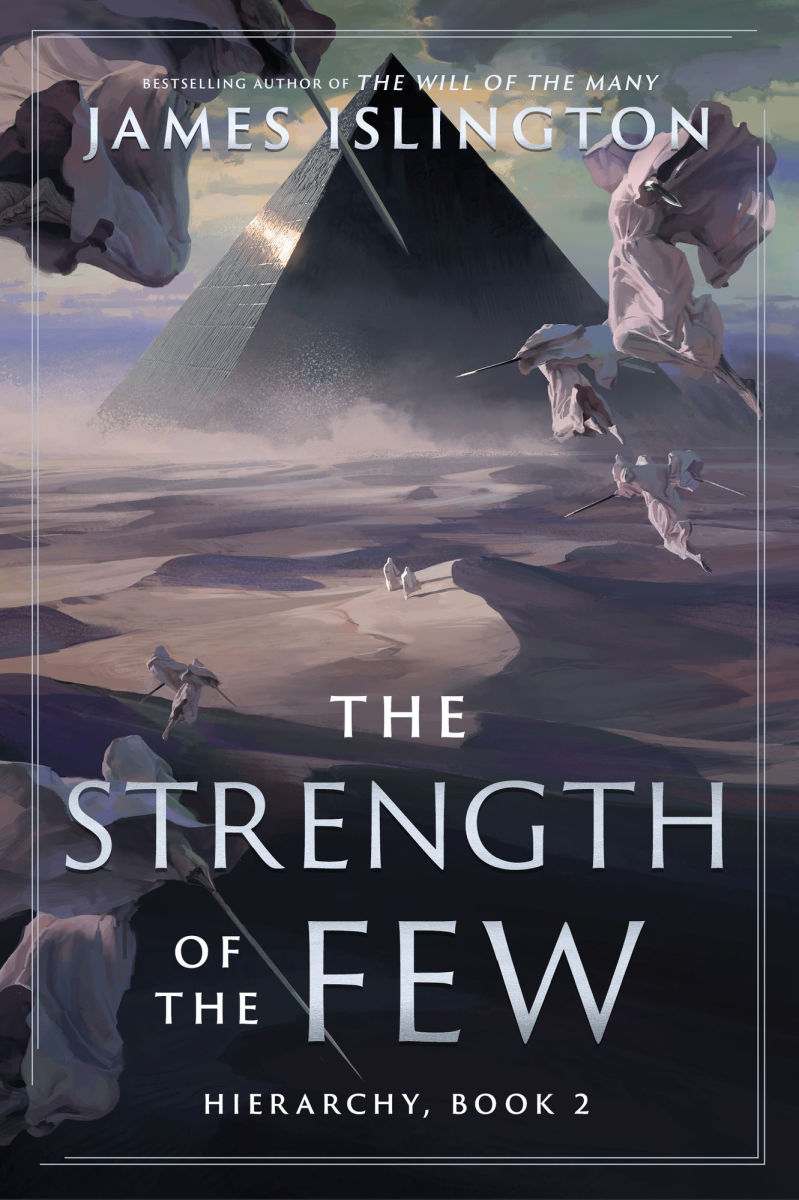
The Strength of the Few by James Islington

Publisher: Text Publishing/Audible Studios (Audiobook – 11 November 2025)

Series: Hierarchy – Book Two

Length: 31 hours 8 minutes

My Rating: 5 out of 5 stars

Amazon

Australian author James Islington continues his Hierarchy series in epic form with the incredible and complex novel, The Strength of the Few, an outstanding and highly addictive fantasy novel that I had an incredible time getting through.

Back in 2023, I had the pleasure of reading the outstanding novel, The Will of the Many from James Islington, which I very quickly fell in love with.  Following a fugitive prince who finds himself enrolled in an academy for the children of the elite members of the nation that conquered his homeland, The Will of the Many had an intricate plot that forced the protagonist to deal with elaborate ancient puzzles, the unique magic of his world, unlikely friendships, deadly rebels, and all his hidden secrets potentially becoming uncovered.  I had such an amazing time reading The Will of the Many that it got a very easy five-star rating from me, and it ended up topping several of my end-of-year lists for 2023, including my favourite book, audiobook, new-to-me author and Australian fiction lists.  Unsurprisingly, I have been keen to see how the series would continue ever since I finished the final page of The Will of the Many, and the long-awaited sequel, The Strength of the Few, was one of my most anticipated novels of 2025.  I started reading The Strength of the Few the second I could, and it turned out to be another captivating read, with a plot that goes in some captivating and intense directions.

After infiltrating the Academy and running the mysterious Labyrinth, the man known to the Catenan Republic as Vis Telimus thought that he would finally understand some of the secrets of the nation that destroyed his people.  However, his encounters within the Labyrinth have instead resulted in the impossible and placed him in the firing line of an ancient evil determined to destroy his world.

While the original Vis continues to live in the Catenan Republic, attempting to avenge the massacre of his Academy classmates and friends at the Iudicium, he is unaware that the ancient devices within the Labyrinth replicated him across three separate words.  Mirrors of each other influenced and altered by different history, the worlds of Obiteum, Luceum and the world Vis already knows as Res, are divergent places, each with their own troubles, rulers and chaos.

Now one of the few beings existing across all three concurrent realities, Vis stands as the only person who can stop the upcoming Cataclysm that will burn away all he loves.  But first he needs to face the different challenges each world has for him, especially as he truly belongs in none of them.  Forced to fight, to learn how to control the unique powers his situation has granted him, and to understand the different worlds they find themselves in, all three versions of Vis will be pushed to their limits as they try to prove themselves and understand the secrets behind their unlikely journey.  If any version of Vis fails, then all their chance to stop the Cataclysm are finished.  But can Vis really survive in three separate realities, each of which is filled with beings who desperately want him dead?

Well damn, now that’s how you do a sequel.  The Strength of the Few was an incredible novel as James Islington expertly continued the elaborate and ambitious narrative of his epic Hierarchy books.  Featuring a layered story loaded with complex world-building, intricate story details and compelling characters, The Strength of the Few was an exceptional novel that gets a very easy five-star rating from me.

Islington came up with an especially complex and powerful story for The Strength of the Few, which served as a very worthy follow-up to the compelling events of the previous Hierarchy book.  Right out the gate readers are treated to an intricate plot, with the protagonist from The Will of the Many split into three different versions of himself in three separate mirror worlds.  Each version has its own very distinct narrative that revolves around that specific Vis trying to overcome the challenges of that specific world.  For example, the version of Vis on Res, the world that The Will of the Many was completely set in, continues to endure the politics of the Hierarchy, while also attempting to uncover those responsible for the massacre of his classmates at the end of the previous book.  The storyline set on Obiteum is a bit of a post-apocalyptic narrative, as Vis is forced to survive a broken world ruled by the enemy responsible for several previous Cataclysms, and must try to find a way into a forbidden city, half staffed by the living dead.  The final storyline set in Luceum offers a much more adventurous narrative, as a version of Vis that is completely unaware that he is in an alternate world, is forced to explore a new culture and attempt to survive amongst people who have no idea of his past or his destiny.

These three separate and very distinctive storylines each go in some interesting directions as the book continues, and the result is a very impressive and compelling overall narrative, especially as Islington expertly sets up necessary details in the early stages of the book and cleverly builds from there.  For most part, each of these storylines stay isolated, although some key details from each bleed into the wider narrative, and you can appreciate the significance of certain events or revelations in one storyline better thanks to the events in one of the other worlds.  Each plot line goes in some very interesting directions, with the dark politics of Res forcing Vis to engage in some complex schemes and deceptions, the struggles of Obiteum slowly getting to an isolated version of the protagonist, while positive character interactions in Luceum turn that Vis into a completely different person.  Islington starts to enhance the tension of all three storylines in the second part of the book, and there are some very amazing scenes that completely change the tone of each of the main storylines.  I felt the political instability of Res allowed for some particularly powerful moments, especially after a shocking scene about two-thirds of the way through book.  A growing war in Luceum also provides some compelling drama for that storyline, as Vis must decide what he wants in life, while the continued threat of discovery in Obiteum proves to be particularly draining.

The final third of the book contains some of the best scenes of The Strength of the Few, as Islington builds on all the novel’s great storytelling and complex worldbuilding to bring forth an epic conclusion.  Thrusting all three versions of Vis into mortal danger, the tension is particularly thick, as the protagonist and much of the supporting cast are in constant risk.  This includes a final desperate attempt to achieve his goal of killing a god in Obiteum, which hits a range of snags amongst the ancient city Vis has spent most of the book infiltrating.  At the same time, the Vis in Leceum finds himself in the middle of a deadly war, where his unique abilities and the unlikely rewards of a deadly ceremony weigh him down.  However, the most intense is the narrative set on Res, where Vis finds himself attempting to save who he can from the chaotic events brought on by those manipulating him.  Islington probably throws the book’s most shocking moments into the Res storyline, which nicely builds on a lot of the drama and intrigue from the first novel, and forces the protagonist to make some dark decisions, out of both vengeance and necessity.  One scene where the title of the book is quoted by an antagonist really sticks in the mind, and I’m not sure I’ll be able to forgive Islington with the dark bait-and-switch there.  All three of these storylines end on an interesting note that hint of destructive events for the future, and it is going to be fascinating to see how Islington continues the Hierarchy series going forward.

Thanks to the elaborate ideas that Islington had for this epic sequel, The Strength of the Few turned out to be an exceptionally written read, which provides an intense and compelling fantasy narrative, filled with some great emotional depth.  The inventive way that the author splits the book to follow three separate versions of the same protagonist worked surprisingly well, and it allowed for quite a unique character-driven story, which really showcases Islington’s writing ability.  I felt that the split between the three distinctive storylines was very well done, and these separate narrative threads each stood on their own merits, provide a distinctive experience in each.  I loved how there was something special in each of the storylines, and you got some interesting interactions, world building and different focuses with each of them.  All three were very well written, and there were honestly no weak links with any of the storylines, which is always a risk when you split the narrative like this.  I will say that the intrigue-laden narrative on Res was a particular favourite of mine, but both other storylines were also quite exceptional, and they balanced each other nicely with their alternating themes and varied character growth.  Throw in some creative expansion of the universe the narrative is set in, with its cool Will-based magic system, and three worlds each inspired by different ancient cultures (Roman, Egyptian and Celtic), and this was a very well written book, and I really appreciate how effectively Islington builds up his different worlds and showcases them to the reader.

The Strength of the Few proved to be an impressive continuation of the Hierarchy series, and I felt that Islington did an outstanding job building on the impressive fantasy elements and storylines of the first book.  However, the complex narrative split and the way that Islington dives immediately into the story does mean that The Strength of the Few is probably best enjoyed by those readers who have already gotten through The Will of the Many.  While Islington does re-examine key elements of the plot from the first book as The Strength of the Few continues, it is a very gradual process, and new readers trying to read the sequel first are likely to get confused if they don’t know some necessary details from the first book.  The Strength of the Few might have benefited from a good summary or recap at the front of the book to remind readers of some key details, especially if they haven’t had a chance to read re-read The Will of the Many since its 2023 release.  Still, for the most part, all readers should be able to follow and appreciate The Strength of the Few, especially once you get drawn into the three compelling storylines, and people who love extremely elaborate fantasy narratives with a lot of intricate detail are going to have an outstanding time.

I was once again impressed with Islington’s great characters in The Strength of the Few, as this book has a massive cast, made up of an interesting combination of figures from The Will of the Many, and new characters from the three separate worlds of the setting.  However, most of this book naturally follows the young protagonist from the first book, who is primarily known as Vis Telimus.  A studious and damaged figure who had already gone through a lot before the events of this novel, Vis has rather a unique experience in this sequel, as unbeknown to him, there are now three separate versions of him concurrently existing in the mirror worlds of this setting.

Islington perfectly sets up and utilises this three-way split of his protagonist, and readers are soon treated to three distinct variations of the protagonist, each of whom are altered by their experiences and losses, especially the two versions of Vis who lose their left arm.  It was fascinating to see how each of the Vises are influenced and changed by their respective traumas, and how their adventures are altered by the different information or people that they meet.  For example, the Vis in Res, who is essentially the same protagonist from The Will of the Many, finds himself longing for vengeance after the events of the Iudicium, and spends much of the book angry and forced to endure politics and lies.  The version of Vis on Luceum, while feeling lessened by the loss of his arm, soon finds peace in his new setting, and his eventual motivations for fighting and living are very different from his other incarnations, especially as he finds friends he can trust completely.  Finally, the Vis on Obiteum is one of the more confident incarnations of the protagonist, having full knowledge of the upcoming Cataclysm and his place in the three worlds explain early in the book.  As such, he soon becomes the most competent at utilising his Will talents and appears the most undamaged of the three due to not losing his arm.  However, in many ways the Obiteum Vis is the worst off out of all versions of the protagonist due to his isolation, the desolate surroundings, and the early expectations of murder and potential death that are thrust upon him.  I really cannot emphasise just how clever the split between these different variations of the protagonist is, especially with the subtle differences and alternate reactions to similar events or situations. It really makes for quite a distinctive and moving read, especially as all three versions of Vis experiences even greater trauma and damage as this sequel continues.

While Vis is the obvious focus of The Strength of the Few, there is a huge supporting cast utilised throughout this book, including various characters only found on each distinctive world.  Indeed, each version of Vis picks up its own supporting cast, which allows for some very different interactions in each of the major storylines.  Highlights include many of the recurring characters from the first book who serve as Vis’ friends and mentors in Res.  There is a particular focus on Eidhin and Aequa, who have an expanded role as Vis’s main confidants in this novel, and I liked some of the powerful storylines that formed around them.  Other major supporting characters from the first novel are showcased to a lesser extent in this sequel, primarily due to the book being split into three separate parts, although many of these characters still got a notable role in this sequel.

The cast supporting Vis on the desolate world of Obiteum is a lot more limited, mainly to emphasise the protagonist’s loneliness, although he does find a compelling mentor in Caeror, his adoptive uncle, who the protagonist was hunting for in the first book.  A couple of other native characters from Obiteum gain prominence later in this storyline as Vis attempts to complete his mission, and it is fascinating to see how their experiences living on a dead-world, impact their interactions with the protagonist.  Finally, the cast of the Luceum plotline represent a compelling counterpart to the supporting characters of the rest of the book.  While Vis has enemies in Luceum, he also finds several true friends who he can trust with all his secrets.  It was interesting to finally see Vis truly open up to other people, and it allowed for some very different interactions to the secrets and lies that define the protagonist in the other two storylines.  Throw in a compelling array of antagonists, as well as an entertaining manipulator who keeps chucking Vis into the deep end on Res, and this was an impressive cast for this great sequel.  It honestly was an extremely intriguing experience to have three separate casts of characters set around different versions of the protagonist.  While this narrative split did result in some restrictions when it came to character depth or a full exploration of relationships, I think the overall extended length of the book overcame this and allowed the reader to grow close to the supporting characters.  I will warn readers not to get too attached to the extended cast though, as Islington does get a little murderous as the book continues, however, all these characters are impressive while they last.

While I was lucky enough to receive a physical copy of The Strength of the Few, I ended up holding out for a little bit to listen to the audiobook version of this book instead.  I’m a big fan of audiobooks when it comes to ultra-elaborate fantasy narratives, as I tend to absorb and retain more of the details that way, and this worked out well with The Strength of the Few.  I felt that Islington’s complex story came across very effectively when read out, and all the elements, including the elaborate worldbuilding and the great character work, were well translated to the reader.  I also appreciated how the switches between the three different versions of the perspective protagonist, was easily discernible, and this was a very easy story to follow on audiobook.  The Strength of the Few audiobook saw the return of Euan Morton for narrator, who previously read out The Will of the Many, and who I quite enjoyed as a narrator of the Star Wars audiobook, Tarkin.  Morton has a very interesting cadence to his voice as a narrator, which provided a very unique edge to this audiobook.  While Morton’s narration style might not appeal to everyone, I felt that he did a good job voicing this compelling story, especially through the eyes of the complex protagonist, and his unique narration on this elaborate story worked extremely well.  I also felt that Morton excelled at pronouncing all the different names and titles that Islington featured in his plot, no matter their Roman, Celtic or Egyptian inspiration, and the characters of all three different worlds had a subtly different cadence and accent that helped to distinguish the separate storylines from each other.  As such, I really got stuck into this audiobook, powering through it quickly, even with its 31-hour runtime.  This was probably one of the more intense and moving fantasy audiobooks I had the pleasure of listening to in 2025, and I cannot recommend this format enough.

James Islington does it again with his incredible second Hierarchy novel, The Strength of the Few.  Brilliantly continuing his elaborate narrative from the first novel in a unique manner, The Strength of the Few was an ultra-addictive read, that really showcased Islington’s writing ability and imagination.  Clever, powerful and easy to get addicted to, The Strength of the Few was one of my favourite books of the year, and I cannot wait to see how Islington continues the series going forward.

Amazon

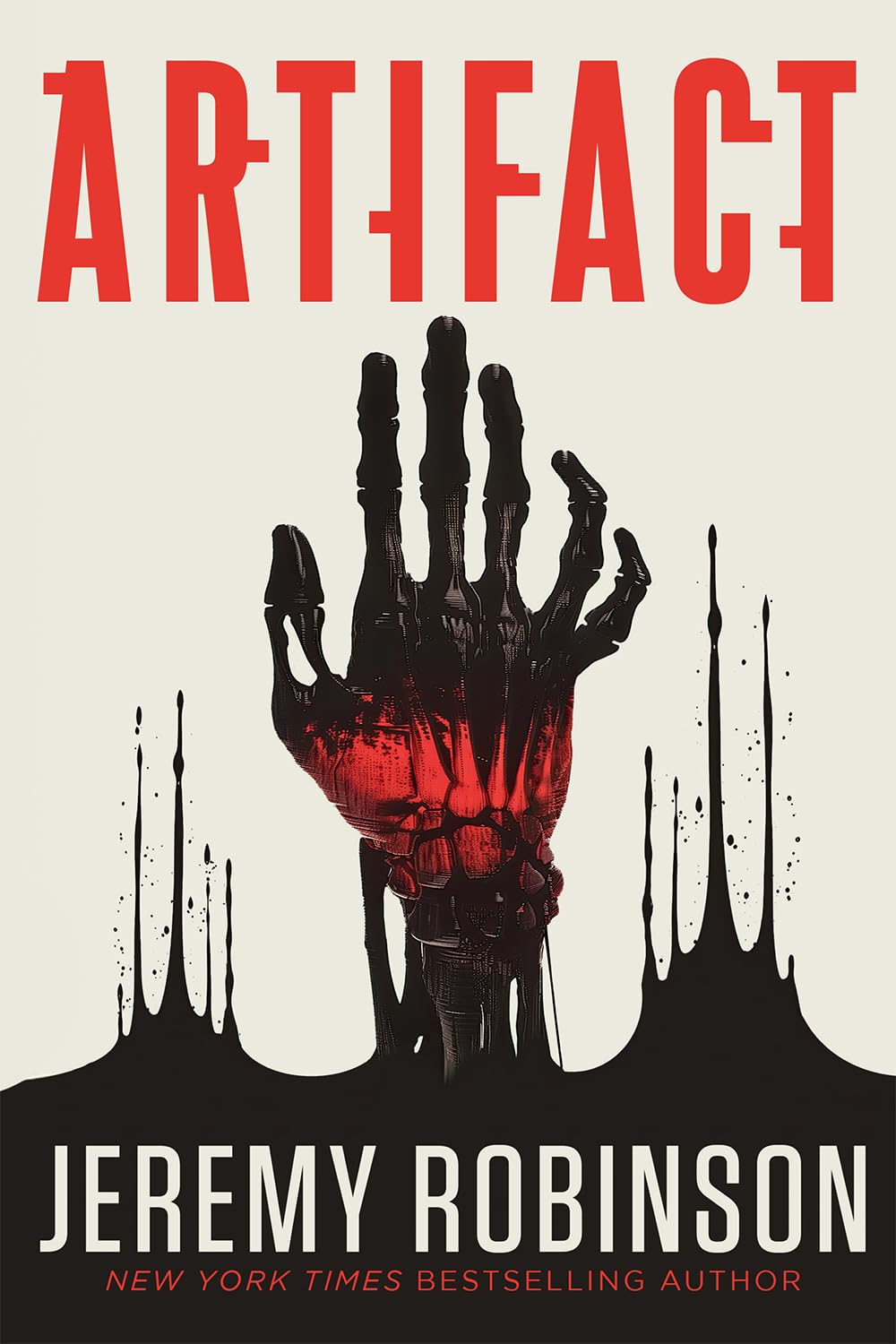
Artifact by Jeremy Robinson

Publisher: Podium Audio (Audiobook – 26 August 2025)

Series: Standalone

Length: 9 hours and 56 minutes

My Rating: 5 out of 5 stars

Amazon

One of my very favourite authors of outrageous fiction, Jeremy Robinson, returns with another intense and horrifying science fiction thriller, Artifact, a captivating and powerful novel I couldn’t get enough of.

Jeremy Robinson is an outstanding author who has a fantastic career writing clever, fun, and occasionally terrifying thrillers, often featuring intriguing science fiction elements.  Best known for his Antarktos Saga, Chess Team and Nemesis Saga series, Robinson has written a staggering amount of fiction over the years, including additional cool series and standalone reads.  I personally got into Robinson’s work a few years ago when I read a few books from his massive, interconnected Infinite Timeline series, including Tribe, The Dark and Mind Bullet (the latter two of which were amongst my favourite books and audiobooks of 2021), all of which were incredibly fun and addictive.  I have also started getting into Robinson’s standalone novels, such as last year’s fantastic novel Point Nemo (one of my favourite audiobooks of 2024), which contain some amazing stories.  As such, I was very excited when I got a copy of Robinson’s awesome new novel, Artifact, on audiobook, which sounded extremely amazing.  I honestly started listening to Artifact the same day I found out about it, and boy was I glad that I did.

Plot Synopsis:

In an isolated Alaskan town, the local sheriff uncovers a secret lab where generative A.I. and bioprinting have unleashed grotesque, living anomalies—and now, something monstrous is loose.

Sheriff Colton Graves prefers the quiet life in Raven’s Rest, Alaska, a remote town accessible only by tunnel and home to a hardy mix of locals and secrets buried in the ice. But when a camel wanders down Main Street—its head grotesquely sprouting a dozen eyes—Colton knows his quiet days are over. The bizarre incident leads him to NovaGen, a nearby research facility constructed inside a Cold War bunker, buried in the mountains above town. There, a trail of blood and eerie silence hints at something far more sinister than an escaped animal experiment.

With his deputies—the sharp-witted Tali and rookie Ethan—Colton recruits a few trusted locals, including the unshakable Marit, Tali’s sister, the intimidating ‘Grizz’ Norval, and Edgar ‘Old Red’ Rydell, an aging man plagued by demons from when he worked at the bunker during its covert cold war days.

Together, they investigate the abandoned lab. What begins as a search for missing scientists soon reveals chilling evidence: pools of blood without bodies, cryptic warnings left behind, a bloody six-fingered handprint, and the revelation of a new technology: a generative A.I. capable of printing living organisms. As they descend deeper into the lab, it becomes clear that the answers they seek may come at a terrifying cost—and that what was made in the dark may not be content to stay there.

Jeremy Robinson once again greatly impresses with his new thriller Artifact.  A complex and deeply clever read loaded with weird science, fantastic humour and incredible action, Artifact was an exceptional read that had me hooked very early on and kept my attention all the way to the end.  A particularly intense novel with so many amazing elements to it, Artifact gets a full five-star rating from me, especially on audiobook, and I ended up powering through it so damn quickly.

I deeply enjoyed the compelling and fast-paced narrative that Robinson featured in Artifact, which amps up the intrigue and excitement quickly and keeps it going all the way to the very end.  Starting with an enticing inciting event of a multi-eyed camel arriving in the middle of a snowed-over Alaskan town, the initial narrative of Artifact is quick and effective, with the protagonists quickly realising that something dark has occurred at the nearby and mysterious NovaGen facility.  Pulling together a band of scrappy locals, the group begin their decent into the facility, only to encounter mysterious creatures and tragic death.

Robinson soon takes the novel into twisted science fiction territory as you are shown the variety of experiments taking place in the facility.  In particular, the staff of NovaGen are bio-printing monsters and other creatures, which has inevitably gone wrong.  Forced to put an end to the experiments and save the town from potential destruction, Colton and his team continue to descend the various levels of the facility, all while being hunted by the worst monsters humans can imagine.  The author does an excellent job of building and maintaining tension throughout Artifact’s story, and you are expertly drawn into the personal struggles of the characters as they try to understand and withstand the horrors of the facility.  There are some outstanding twists and sudden deaths as the story draws towards its conclusion, and I enjoyed the mixture of shocking moments and well-crafted reveals many chapters in the making, which results in an outstanding novel where you never quite know what is happening next.  Robinson ends the book on a mostly hopeful note, along with an amusing cliffhanger, and this proved to be an impressive standalone narrative that is guaranteed to entertain.

I felt that the author pulled Artifact together in a very entertaining manner that allowed for the maximum thrills, tension and character development.  Perfectly utilising the first-person perspective that Robinson is so fond of, Artifact is a great standalone read that requires no prior knowledge of the author’s other works to enjoy (although there are a few fun references established fans will chuckle at).  The author does an excellent job of effectively setting out the key elements of Artifact throughout its run, including with the advanced science elements of the book.  These science elements are both compelling and quite interesting, and you can tell that Robinson did a bit of research into the subject.  This research allowed the author to envision some dark and horrifying creations of potentially realistic science, and I loved how the creatures the protagonist encounter was a combination of weaponised efficiency and dark human imagination.

These fantastic science fiction creations, and the dark conspiracy that birthed them, work well with the author’s Michael Crichton inspired scenario, to create a lot of excellent tension and uncertainty that keeps readers constantly on the edge of their seat.  I loved the constant uncertainty of what traumatising event was about to come out of nowhere next, and there are some great twists and reveals scattered throughout this captivating novel.  Throw in a series of particularly thrilling action sequences as the protagonists face off against printed monstrosities and the other disturbing denizens of NovaGen, and there is a lot to love about how Artifact was written, especially as it perfectly enhances Robinson’s fantastic and captivating narrative.

My favourite elements of Artifact were the complex and compelling characters whom Robinson set his narrative around.  Robinson has always excelled at creating entertaining characters, and I think he did a wonderful job pulling together a layered cast of Alaskan outcasts and rogues to fill the pages of Artifact.

The most prominent of these characters is main protagonist Sheriff Colton Graves, from whose perspective we see the events of this book unfold.  Colton is a widowed lawman who enjoys the simple life at Raven’s Rest, but who quickly rises to the challenge when strangeness invades his town.  Effectively established as a compelling and solid centre to the book’s plot, Colton is an easy character to like thanks to his fun humour, clever insights and leadership skills.  However, Robinson makes Colton even more interesting as the book continues by revealing some fascinating character details that are expertly weaved into the story.  This includes a new romance for Colton that helps him to move forward from his dead wife and serves as his inspiration to continue pushing through the horrors of the NovaGen lab.  In addition to this, the story reveals that Colton has autism and hypersensitivity, and these conditions have strong impacts on the plot and the way the perspective protagonist interacts with the world.  Robinson does an exceptional job really diving into these fascinating aspects of his protagonist, and it was clear that the author was trying to showcase the conditions as accurately as possible based on his own personal experiences.  I think that Robinson really succeeded in showcasing these character elements, and while certain aspects are no doubt enhanced to fit in with the science fiction aspects of the book, it was mostly realistic.  I really enjoyed how Robinson made Colton a particularly likeable and relatable protagonist, and he helps to make Artifact a very distinctive read.

In addition to Colton, Robinson loads up Artifact with a great collection of memorable supporting characters who are perfectly utilised in the narrative and add some entertaining spice on top of the protagonist.  Highlights for me include the troubled and mysterious Old Red, a survivalist with dark connections to facility, who serves as the groups guide and secret badass.  I also had a lot of fun with Grizz, a tough, bear-killing lady with the scars to prove it.  Colton’s deputy, Tali, was the perfect backup for the protagonist, while her sister, Marit, proved to be an excellent love interest to Colton, which resulted in some complicated and emotional sequences.  The rest of the cast, including some unique figures found in the bunker, are also quite entertaining, be they friend, bio-engineered organism, or evil antagonist, and I loved some of the amazing interactions that emerged.  I will warn readers not to get too attached to any characters, as most figures don’t last as long as you’d want, but Robinson makes full use of every character he features, even if they only have a brief life in the book.

As with all the previous Robinson novels I’ve enjoyed, I chose to check out Artifact on audiobook, which was a ton of fun.  I have always found that Robinson’s novels come across particularly well on audiobook, and Artifact was no exception as I powered through its near 10-hour long runtime very quickly.  Part of the reason why I had such a great time with this audiobook is the return of one of my favourite audiobook narrators R. C. Bray.  Bray, who has lent his voice to most of Robinson’s audiobooks, is a truly exceptional narrator, and I just love any story read out in his gravelly and distinctive voice.  This was particularly true for Artifact, where the intense action and the horrifying descriptions of the laboratory’s contents were so much more impactful thanks to Bray’s calm and powerful take on events.  Bray also expertly showcases each of the key characters of the novel, and I felt he developed fitting and personal voices for each of the members of the cast.  While I love Bray’s voice for Old Red and the slacker Jimmy, his best work was saved for main protagonist and point-of-view character Colton.  Bray has long perfected voicing Robinson’s various first-perspective protagonists, and he always manages to cover their complex personalities, dialogue and interactions extremely well.  His take on Colton was very moving in Artifact, and I felt that Bray really enhanced Robinson’s depictions of this character’s quirks and unique viewpoints on life.  Due to this impressive narration, and Robinson’s general cinematic writing style, the Artifact audiobook is exceptional, and it’s easily the best way to enjoy this novel.

With all the chaotic action, crazy science fiction elements, and great character I’ve come to expect from Jeremy Robinson, Artifact was an outstanding novel I had a blast getting through.  Featuring a thrilling plot, laden with shocks and monsters, Artifact grabs the reader’s attention early and refuses to let go.  This book comes very highly recommended from me, especially on audiobook, and anyone keen for a horror-filled and deeply intense thriller is going to have an outstanding time with Artifact.

Amazon

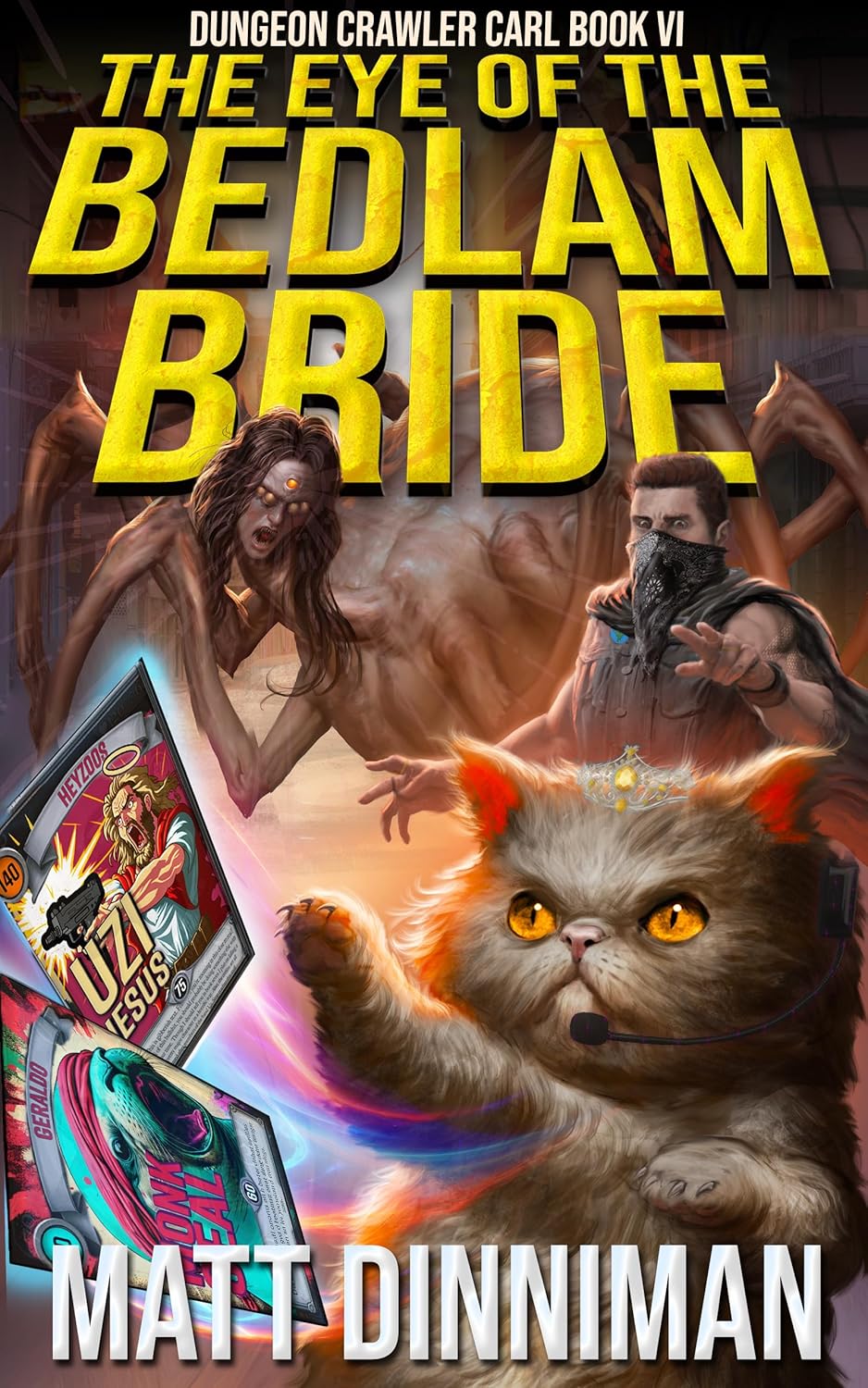
The Eye of the Bedlam Bride by Matt Dinniman

Publisher: Soundbooth Theater (Audiobook – 2 July 2023)

Series: Dungeon Crawler Carl – Book Six

Length: 26 hours and 46 minutes

My Rating: 5 out of 5 stars

Amazon

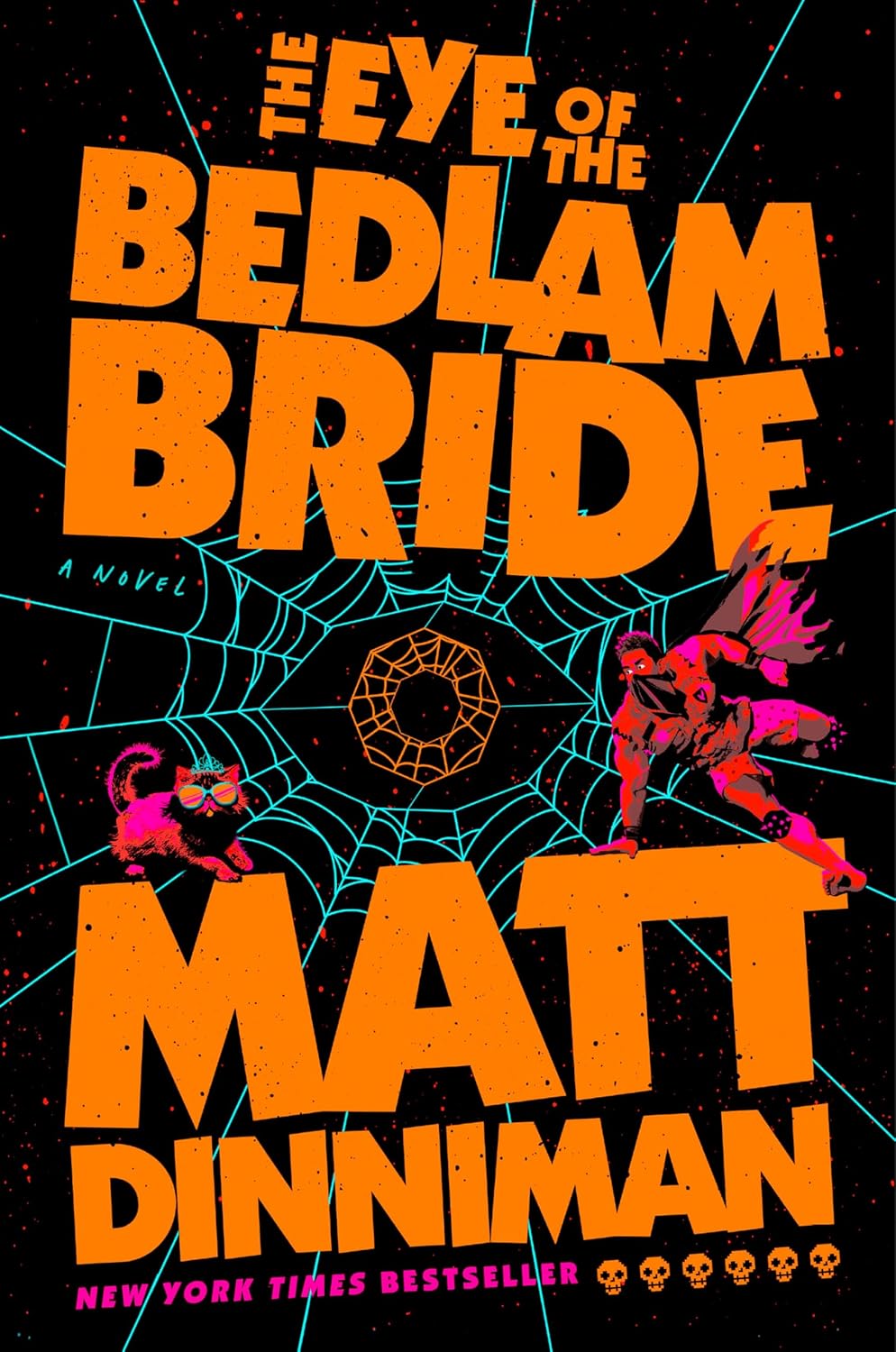
The chaotic fun of Matt Dinniman’s Dungeon Crawler Carl series continues in epic fashion with the ultra-impactful and deeply addictive sixth entry in the series, The Eye of the Bedlam Bride, an exceptional novel designed to strike hard at the reader’s emotional heartstrings.

As you might have guessed from my recent flurry of reviews for this series, I am seriously in love with the Dungeon Crawler Carl books.  An impressive and surprisingly deep LitRPG series, the Dungeon Crawler Carl novels follow a collection of compelling characters as traverse a deadly fantasy dungeon created from the ruins of all of Earth’s buildings by aliens for intergalactic viewing content.  Set around a damaged protagonist and his excitable and now sentient cat, these books are deeply addictive, and once you start the series you really can’t stop.  Indeed, I literally just chain-read the entire series, with awesome books like Dungeon Crawler Carl, Carl’s Doomsday Scenario, The Dungeon Anarchist’s Cookbook, The Gate of the Feral Gods and The Butcher’s Masquerade all proving to be outstanding reads.  I loved these previous books so much, that I instantly started listening to the sixth book in the series, The Eye of the Bedlam Bride, the first chance I got, and boy was I in for an incredible time with it.

After barely surviving the Butcher’s Masquerade and then witnessing the surprising end to the seventh floor, Carl and Princess Donut are exhausted and traumatised by recent losses.  However, they have no time for rest as they find themselves thrust into the dangerous eighth floor of the dungeon.  One of the most ambitious levels so far, the eighth floor is based on a map of Earth’s final days, filled with intangible ghosts of the humans who wandered the world mere weeks before the planet’s death.

However, this is not a perfect replica of Earth; instead these locations have been seeded with monsters and mythological figures based on twisted accounts of Earth legends, with each creature tied to the geographic area their folklore originated.  To complete this level, the crawlers are tasked with finding and capturing six of these monsters and turning them into cards, which can then be summoned to fight alongside their new owners.  Each team will need to find and convert as many powerful creatures as possible to create the best decks, especially as they will be forced to face off against mobs and other crawlers with their own cards.

Unexpectedly starting in Cuba, Carl and Donut navigate an unfamiliar location as they try to learn the new mechanics of the game.  Determined to get to the next floor, Carl and Donut endeavour to find the best monsters they can.  However, the stronger the monster, the less controllable the card, and Carl and Donut will soon have their hands full managing a strange array of summonable creatures, including the legendary demon Shi Maria, who has far more independence than they would like.  Can Carl and Donut survive this new floor of the dungeon, or will they finally be crushed by their dark secrets, troubled pasts and Carl’s slowly eroding sanity, especially once he looks into the eye of Shi Maria, the Bedlam Bride?

Just when you thought this series couldn’t get even better, Matt Dinniman amps up the intensity and complexity of his plot and characters a whole additional notch, with one of the more moving and powerful entries in the entire series.  The Eye of the Bedlam Bride was an absolute masterpiece that featured the author’s trademark LitRPG chaos, while really showcasing his impressive writing ability.  One of the best books in an already incredible series, The Eye of the Bedlam Bride was so damn good, and it gets a very easy five-star rating from me.

Dinniman pulled together another brilliant narrative for his sixth Dungeon Crawler Carl novel, as They Eye of the Bedlam Bride perfectly continued the long-running series storylines while also presenting its own unique adventure.  Thrusting the protagonists into a complex new level, Dinniman quickly showcases all the floor’s new elements, including a fun card-based combat mechanism that fits into the existing dungeon battle system surprisingly well.  While the pacing is initially a tad slower to ensure the readers fully appreciate all the necessary lore and gameplay details of this book’s plot, Dinniman quickly works to show that The Eye of the Bedlam Bride isn’t a filler novel between the pivotal fifth and seventh books.  This becomes especially clear during a major sequence that requires Carl and Donut to make a deadly choice while surrounded by several vengeful gods.  Dinniman also makes sure that a major secret from the previous book is brought into the light early, complicating protagonist relationships and presenting them with dark choices.  Dinniman swiftly follows this up with some very awesome sequences, such as Carl and Donut coming face-to-face with their most problematic card, demonic carnage in a night club, and problems from the wider universe caused by Carl’s ambitious and rebellious plots.

While all these early elements are great, The Eye of the Bedlam Bride hits its storytelling height about halfway through, as Dinniman amps up the emotional stakes of the narrative.  Forced to compete in a gruelling series of battles that test the unique fight mechanics of the floor, the protagonists find nothing but heartbreak as they near the end of the second phase of the level, including a truly horrifying and deeply personal big boss.  All this follows a series of impactful personal revelations for Carl, that hit his already fragile mental state hard and finally provides full context for character background elements that have been hinted at throughout the series.  This central part of the story was so damn heartbreaking, and you really must appreciate how Dinniman can make you laugh before loading up substantial sorrow and regret and producing some beautifully crushing sequences.  While these scenes are emotionally charged, I appreciated how Dinniman often tempered them with more heartwarming moments that show the connections the protagonists have built up during the series, and the author does some amazing character work in the second half of this book.

Everything perfectly leads up to the incredible final third of The Eye of the Bedlam Bride, as Dinniman raises the stakes as only he can.  With the protagonists forced to compete in a brutal third and final phase of the floor, events soon break down into pure chaos with undead hordes, demonic possessions, crazed gods and various rival crawlers all coming into play.  Dinniman keeps the story moving so fast in this last part of the book, as the protagonists dive into key battle after key battle.  I actually ended up listening to the last several hours in one day as I just had to see what happened next.  Following one of the most tragic scenes in the series, which nearly broke me, Carl and Donut race to save as many people as they can from the AI’s inventive endgame, leading to an all-out battle royal in the middle of Cuba.  I loved how so many story elements from the entire book came into play for the conclusion after some clever set up earlier in the plot, resulting in some very epic moments.  The ending was a brilliant mixture of humour, intense action, extra lore, and some particularly dark moments for the protagonists, which came together beautifully and ended the novel on a real high.  Throw in some last-minute reveals that really amp up the excitement for the next book, and this was pretty much a perfect narrative that is guaranteed to keep you hooked all the way the bloody end.

I honestly feel that The Eye of the Bedlam Bride was one of the best-written entries in the entire Dungeon Crawler Carl series, and frankly I am still not over every single amazing moment of this book.  Dinniman achieves so much in this impressive novel by simultaneously changing the rules of his own game while also providing the deepest examination of his complex protagonists yet.  At the same time, he makes a novel that most authors would have turned into a filler entry into one of the series’ most impactful books.  I was really impressed by how the author chose to further amp up his various storylines and character arcs in this book, and Dinniman perfectly carries on the craziness of The Butcher’s Masquerade while building up the oncoming calamity of the seventh book and the long-awaited Faction Wars.  Naturally, this means that The Eye of the Bedlam Bride is best enjoyed by those who have read all the previous Dungeon Crawler Carl books first.  Still, for those who are determined to dive in here, Dinniman provides enough context and flashbacks to ensure you can easily follow what’s happening, and there is even a fun summary at the beginning.

This sixth novel in the series brings back all the impressive humour, intense action, and great LitRPG elements that made the previous Dungeon Crawler Carl books so damn good, while also bringing in some impressive new features, primarily a fun new battle element.  I must admit that I wasn’t too sure that the card system of this level, which on paper sounded like a crazy combination of Pokémon and Yu-Gi-Oh!, was going to work.  However, I should never have doubted Dinniman as it fitted in amongst the usual chaos and over-the-top scenes perfectly.  Dinniman does an excellent job introducing and then exploring this system throughout The Eye of the Bedlam Bride it proved fun to see the characters adapt to the new rules.  There is some great progression in how these cards impact battles, and each fight with them gets increasingly hectic.  I really enjoyed how big and crazy battles with these cards could get, especially towards the end, and you won’t see protagonists facing off in card duels with gods and demons anywhere else.

There are some additional excellent elements to The Eye of the Bedlam Bride that also enhanced the epic story in some interesting ways.  This includes a haunting new setting of the book, the ghost-filled replica of the pre-dungeon Earth, which really amplifies the feeling of despair and loss that many of the characters feel.  Dinniman continues to also feature a compelling array of LitRPG elements in this novel, and you really find yourself getting drawn into the minutiae of stat updates, item benefits, spell effects, and so much more, as the author cleverly works it into the narrative.  A lot of why these RPG features are so fun is due the chaotic humour that infests every single page of this hilarious book.  The book’s comedic elements are so effortlessly funny and feature a great mixture of sudden outrageous moments with realistic reactions, the insertion of the book’s reality television elements into life-and-death struggles, often inappropriate jokes from the massive and fun supporting cast, and an array of reference focused commentary on all matters of the dungeon.  While some of the comedic moments get a little out of hand: “I need a baby seal”, they all work beautifully in the context of the book’s clever plot, and I laughed myself silly so many times during this book, including at how the day was saved thanks to, let’s say, “crab meat”.  I’m also as appalled as a certain velociraptor that some of the funniest, if weirdest, moments of the book occurred in Chapter 69.  However, what makes The Eye of the Bedlam Bride particularly good is the way in which these comedic elements are well matched by darker, tragic moments, which allows for quite on overall powerful read, especially when it comes to the characters.

Dinniman went above and beyond when it came to the character development in this book, with a particular focus on series protagonist Carl.  After several books laden with hints about his past, we finally get Carl’s full backstory, which really goes to show just how damaged he is.  Dinniman does an outstanding job showcasing this background in several powerful scenes in The Eye of the Bedlam Bride, and I really appreciate how it built on the subtle foreshadowing from the previous novels.  This existing trauma was further enhanced in this book, as Carl also finds out multiple new revelations about his family, including several that had been kept from him (which simultaneously shows just how bad a girlfriend Bea really was).  Throw in his anger and guilt from being one of the few survivors of Earth, and the trauma from all carnage he has witnessed in the dungeon, and Carl really isn’t in the best headspace for this book, and that’s even before the titular Bedlam Bride gets hold of his mind.  As such, there is a lot of dark moments for Carl to unpackage throughout this novel, and Dinniman perfectly captures his protagonist’s continued struggle to remain in control.  This deeper dive into Carl’s psyche produced some of the best scenes Dinniman has so far written in the series, and I really appreciated how these darker moments were well matched by the revelation that Carl now has a true family with Donut and his new friends.  These relationships kept him relatively sane in this book, and allowed him to remain the resilient, if explosively inclined, straight man of the book.  Dinniman also works to showcase how despite his issues and reputation, Carl has become a bit of a legendary figure for his fellow crawlers, and the big sequence at the end where he is able to convince them to follow one of his craziest plans, was just amazing.

While most of this book’s focus is on Carl and his history, the rest of the characters in The Eye of the Bedlam Bride also get their moments to shine, and you continue to appreciate just how awesome the ended cast of this series is.  This includes the other main protagonist, Princess Donut, Carl’s now sentient cat who provides much of the humour in the story thanks to her over-dramatic reactions, silliness, and feline superiority complex.  While Donut is the comedic relief of the main duo, she still has a lot of serious moments in The Eye of the Bedlam Bride, especially while serving as the emotional anchor the spiralling Carl.  Donut is also dealing with her own grief and sadness, especially after the tragedies of the previous novel, and there are some heartbreaking moments where you see her trying to push that down.  Despite her issues and immaturity, Donut role in the plot, especially as she controls the cards during most of the battles, and you get to see her tactical genius in full display.  There are some super sweet moments with Donut in this novel, and I really love how well Dinniman continues to feature the bond between her and Carl as the true heart of this series.

In addition to Carl and Donut, The Eye of the Bedlam Bride also features multiple other key members of the Dungeon Crawler Carl cast, and it is very impressive how much you care for so many of these figures.  This includes Katia, who, despite leaving the team in the previous novel, still has a major impact on the plot.  Dinniman perfectly revisits some key revelations from the end of the previous novel, that adds additional complexities to her relationship with Carl and Donut.  The protagonist’s mentor, Mordecai, also has a key role in this book, especially as you finally get the full context for his tragic past.  This background adds some additional drama to the main story, especially when Carl and Katia find themselves caught in the same feud between forces outside the dungeon that he did.  There is also a certain sweetness to Mordecai’s story in this novel, especially when you find out he’s caring for several NPC children, in ways very contrary to his usual gruff disposition.  Dinniman also perfectly brings back the various members of Carl’s guild, who form a surrogate family with each other, and whose appearance in one scene was one of the most heartwarming moments in the plot.

Other characters of note in The Eye of the Bedlam Bride include the possessed sex doll head, Samantha, whose insane declarations, unhinged actions, unsettling abilities and crazy general demeanour make her one of the funniest characters in the series.  There is also an array of over-the-top monsters and creatures that the protagonists encounter and turn into cards.  These include Uzi Jesus, a kung-fu seal, hilarious caricatures of Carl and Donut, and a crab who must overcome his ‘performance issues’ to save the day, just to name a hilarious few.  These comedic monsters were well contrasted by Shi Maria, the titular Bedlam Bride, whose dark actions amp up the intensity of this book in some powerful ways.  I also must mention a couple of recurring crawlers from previous novels who reappear in dramatic fashion in the final third of the novel, allowing for some of the book’s best moments.  One of these character ends up having one of the series’ saddest moments, and I frankly am still not over how brutally raw and tragic that whole sequence was.

While all these above characters are amazing in their own ways, my favourite character in this series remains the dungeon’s System AI.  Despite never physically appearing, the AI has a major impact on the plot, and you are constantly bombarded by its unique humour in the various descriptions and summaries it provides to Carl and the reader, often full of weird and hilarious references.  So many serious or threatening moments are turned into comedic gold by the AI’s inappropriate commentary, and anytime it provides input to the plot, you are guaranteed to laugh.  While the AI has been fun the entire series, it gets even more unhinged in this novel as it gains full sentience and takes full control of the.  Determined to continue the crawl on its own dramatic terms, the AI starts making things even weirder for the characters, throwing in its own twists and changes.  Dinniman does a wonderful job showcasing just how insane the AI is at times, including with some very worrying inclusions in its usually informative descriptions.  There are also some hilarious scenes where the AI interacts directly with the characters, including one brilliant moment when he responds to Carl’s feedback on its descriptions in a particularly petty way.  All this, and more, allows the AI to really standout in this book, and it is a testament to how good Dinniman is as an author, that a disembodied voice is one of the best characters in a series loaded with exceptional and extremely complex figures.

As with all the previous Dungeon Crawler Carl novels, I ended up listening to The Eye of the Bedlam Bride on audiobook, which is honestly the only way to enjoy the author’s fantastic and chaotic narrative.  Coming in at nearly 27 hours in length, The Eye of the Bedlam Bride was one of the longest audiobooks in the series, but you frankly don’t mind as every second you spend listening to a Dungeon Crawler Carl audiobook is so much fun.  I honestly powered through The Eye of the Bedlam Bride in no time at all, especially the concluding several hours, and I still love how audiobook format brings out all the book’s humour, tragedy and excitement.  A lot of this is down to the series’ awesome narration, which in the case of The Eye of the Bedlam Bride, includes an extended voice cast.  While there are a few voice actors for this particular audiobook, Jeff Hays remained the principal narrator, voicing nearly all the characters and the plot descriptions.  Hays is an incredible narrator, and I loved the sheer range of epic voices he brings to bear throughout the audiobook, all of which fit their associated character perfectly, with associated accents and clever tonal changes.  This includes an excellent reuse of voices for previously featured characters, while the various crazy new cast members featured in this book were also extremely cool.  My favourites for The Eye of the Bedlam Bride remain Princess Donut, who gets autotune in this audiobook to help with her singing (the sound effects for this were brilliant), and the AI running the dungeon, as Hays matches the unhinged energy of the cracked computer and conveys this insanity to the listener with amazing enthusiasm.

In addition to Jeff Hays, The Eye of the Bedlam Bride also features three other actors who voice small roles in the larger audiobook to great effect.  The most notable of these is actor Patrick Warburton, who was an awesome addition to the experience.  Initially voicing the flashback voice of Carl’s father in several heavy scenes, Warburton did an outstanding job of breathing life into a harsh figure we’d only had glimpses of in the previous books, and his appearances here had some real menace to them.  Warburton also gets to have some fun when he plays a secondary character later in the audiobook with some brilliant levels of enthusiasm.  Narrator Travis Baldree was also hilarious with his appearance in The Eye of the Bedlam Bride, voicing a giant crab who becomes one of the protagonist’s cards.  Featuring a comedic accent and some very over-the-top lines, Baldree was just amazing, and I loved the interactions he had with Hays and Warburton’s characters.  Finally, Soundbooth Theater regular Annie Ellicott returns to voice an entertaining character in a concluding skit, which was very amusing on a variety of levels.  I really loved how well these outstanding extra voice actors were fitted alongside Hays’s impressive main narration, and it allowed for a great overall listen.  Throw in the excellent sound effects of the series, some of which alter Hays’s voice in clever ways, or places a voice role into the background of a scene for some interesting ambience, and this was an exceptional audiobook that I loved so damn much.  There is honestly nothing better than a Dungeon Crawler Carl audiobook, and I must once again recommend this format with all my heart.

With a particularly impressive and powerful plot, The Eye of the Bedlam Bride was one of the best books in the already incredible Dungeon Crawler Carl series, and author Matt Dinniman outdid himself when it came to diving into his damaged protagonists.  A highly inventive and captivating novel that I just couldn’t stop listening to, The Eye of the Bedlam Bride was Dinniman at his very best and you are guaranteed to have an exceptional time with this novel, and you will, like me, instantly dive into the next novel of the series, This Inevitable Ruin, just to see what happens next.
Amazon

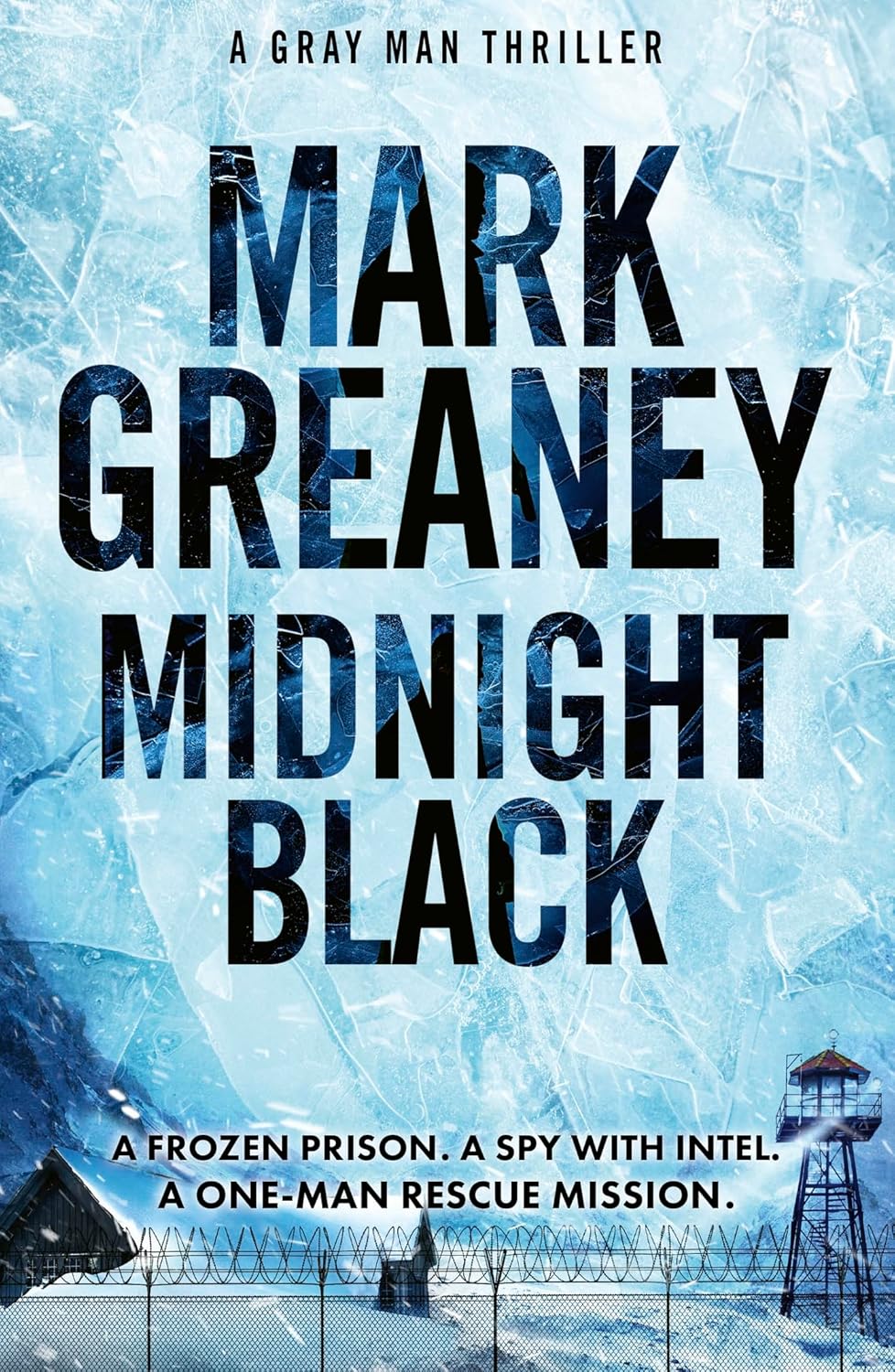
Midnight Black by Mark Greaney

Publisher: Sphere/Audible (Audiobook – 18 February 2025)

Series: Gray Man – Book 14

Length: 15 hours and 51 minutes

My Rating: 5 out of 5 stars

Amazon

The always outstanding Mark Greaney provides another addictive and heart-pounding addition to his iconic Gray Man series with the incredible 2025 spy thriller, Midnight Black.

Ever since I started getting fully into the thriller genre, one of the main authors I check out each year is Mark Greaney, a veteran master of thriller fiction who has produced some incredible reads.  Some of his more entertaining books include his Josh Duffy series (Armored and Sentinel), as well as the fun military thriller Red Metal (cowritten with Hunter Ripley Rawlings IV).  However, his best-known body of work is the long-running Gray Man series, which was adapted into a Netflix movie of the same name.

The Gray Man series is an outstanding collection of spy thriller novels that follows elite assassin and black ops operative Court Gentry, better known by the titular moniker of the Gray Man, as he faces off against an array of deadly enemies while occasionally working for the CIA.  I have become a pretty major fan of the Gray Man series thanks to the author’s complex stories, gritty action sequences and damaged characters, and I have had a blast with books like The Gray Man, Mission CriticalOne Minute Out (one of my favourite books and audiobooks of 2020), Relentless (one of my favourite books and audiobooks of 2021), Sierra Six (one of my favourite books and audiobooks of 2022), Burner (one of my favourite books and audiobooks of 2023) and The Chaos Agent (one of my favourite books of 2024).  Due to how epic all these previous Gray Man entries have been, I couldn’t wait to get my hands on the next entry in the series, Midnight Black.  Providing an intense follow-up to a fantastic cliffhanger from the last book, Midnight Black was one of my most anticipated releases of 2025, and it really did not disappoint.

In the icy wilds of Mordovia, lies the brutal woman’s penal colony IK-2 Yavas.  A harsh work camp for the many political enemies of the current Russian regime, IK-2 Yavas is hell on earth for any women who have defied the state.  However, despite the prison holding many prominent criminals and politicians, their most valuable prisoner is former spy Zoya Zakharova.

Once a prominent Russian foreign intelligence agent, Zoya was forced to flee her position and eventually found herself working covertly for the CIA as a deniable asset.  However, after being captured by the Chinese and traded to the Russians, Zoya’s future is bleak as she is slowly worked to death.  Worse, a ruthless FSB operative is using Zoya as bait for the person most important left in her life, her lover Court Gentry, the Gray Man.  But, unknown to Zoya, the Gray Man is far closer than she realises.

Having spent months prowling the Eastern European countries, Gentry seeks a way to steal across the Russian border and save the woman he loves, no matter the cost.  Embarking on a risky entry plan with only minimal help from his old CIA contacts, Gentry is determined to find Zoya and kill anybody who gets in his way.  But with the entire Russian state security apparatus turned against him, can Gentry once again do the impossible and save Zoya, or will this be the final mission for the legendary Gray Man?

Mark Greaney continues to impress with his epic Gray Man series, as the 14th brilliant entry in the series, Midnight Black, was absolute fire.  Providing an intense and deeply addictive spy thriller narrative, Midnight Black hooked me from the very beginning and refused to let go until the final explosive confrontation.  Slick, emotionally charged and very clever, Midnight Black gets an easy five-star rating from me, and I had such an amazing time listening to it.

This proved to be an outstanding book to get through, as Midnight Black featured a compelling and cinematic narrative that had me hooked the entire way through.  Expertly following on from the emotional cliffhanger from the end of the previous book in the series, The Chaos Agent, Midnight Black starts several months later and sees a desperate Court Gentry doing anything he can to try to enter Russia, only to encounter setbacks he has to take care of in his usual destructive manner.  This works as an excellent introduction to Midnight Black’s plot, especially as it helps you appreciate the emotional stakes of the book, and you quickly become invested in the protagonist’s quest.  Greaney quickly expands the plot through several additional character perspectives, including recuring characters Zack Hightower and Zoya Zakharova, who have their own missions/problems, an intriguing new Russian rebel protagonist, and the perspective of some sinister Russian operatives, including the FSB agent pulling all the strings around Zoya’s imprisonment.  This serves as a great base for the rest of the story, and the author soon starts to feature some of the more complex and action-packed sequences in Midnight Black.

Starting with a well-layered extended shootout sequence in Europe, the second half of Midnight Black hits hard and keeps the reader deeply engaged.  Greaney continues to set out quite an impressive story, as Gentry enters Russia and proceeds to cause all manner of havoc, while his allies in Europe and the US throw together an audacious plan that really amps up the narrative.  Greaney keeps the plot constantly moving, taking the protagonists from one dangerous situation to the next, with compelling character moments and well-featured exposition that keeps everything going forward.  The author also throws in a ton of high-octane and memorable sequences, including a fun extended chase in Moscow involving a stolen train, which was so entertaining to behold.  Everything leads up to the big finale in the last third of the story, where the protagonist makes his play to free Zoya in very cinematic fashion.  There is a lot of intense anticipation involved in the leadup to this final part of Midnight Black, and it proves to be particularly captivating and exciting.  The conflict, high stakes and constant worry you have for the characters ensures you won’t be able to put this part of the book down, and I was so keen to see how everything came together.  Greaney wraps things up perfectly, and I liked the hopeful conclusion to Midnight Black, especially after some of the dark preceding books, and you come away satisfied, as well as excited to see where the series goes next.

I am always greatly impressed with how Greaney sets out his outstanding novels, and Midnight Black is a particularly strong example of this.  A fast-paced book with several interesting layers to it, Midnight Black drags you in with its powerful narrative and keeps you there with the well-set-out action, complex characters, and gritty realism.  Thanks to the blend of character arcs and alternating storylines, there is a lot going on in Midnight Black, and you are given a great mixture of ultra-exciting sequences of action and spy craft, intense personal moments of despair and hope, as well as a cool dive into real-world issues, such as the current war in Ukraine, that enhance the overall plot.  I particularly enjoyed the gritty realism loaded in the story, especially when it comes to looking at the current politics of Russia, and there was a particular dire tone to much of the plot that was well mirrored by several protagonist’s circumstances.

One of the writing techniques I always enjoy with the Gray Man novels is the author’s excellent use of alternating character perspectives, as the reader gets to see the narrative through a variety of different viewpoints.  While primary characters like Gentry, Hightower and Zakharova naturally get most of the focus, you also see events through the eyes of more minor protagonists, such as Gentry’s former CIA handler in the US, or a Russian rebel fighter launching attacks in Moscow, as well as from several of the book’s antagonists.  This provides a much more expansive narrative for readers, especially as you soon understand the compelling motivations of all the significant characters, as well as their often conflict plans and schemes.  I particularly enjoyed how well some of Midnight Black’s many action sequences become even more impressive when you get to see events through the eyes of all the participants in the event.  Seeing all the alternate sides of conflicts really helps to make the fight sequences stand out, and it is captivating to see the various moves and countermoves of all the characters involved.  I felt this worked particularly well in some of the book’s big firefights, such as one sequence out in the woods where Gentry and Hightower’s camp gets raided by a squad of hitters, and you really get drawn into the books brutal action thanks to this.

While Midnight Black can probably be read as a standalone novel, especially as Greaney does a good job recapping key events, I feel that this latest Gray Man novel is probably best enjoyed by those who have read the previous books in the series, especially the preceding entry, The Chaos Agent.  This is mainly because Greaney is following up on a major cliffhanger from the previous book, and a lot of the emotional weight of the plot is based around the protagonist trying to right this wrong and save the woman he loves.  Being invested in the relationship between Gentry and Zakharova, as well as appreciating the protagonist’s other character relationships, really helps to amp up the stakes of Midnight Black, and I know I was personally hooked on seeing how events played out.  While having this background does enhance the experience, I do think that new readers can easily come into the series here and still have an amazing time, especially once they get caught up in the intense plot.

I also need to once again compliment the compelling characters found within Midnight Black, as Greaney really went out of his way to create some intense character moments in this latest Gray Man novel.  A lot of this revolves around the protagonist, Court Gentry, who finds himself in emotional turmoil following the Russians imprisoning the woman he loves.  Unsure about her fate and desperate to enter Russia to rescue her, Gentry is a ghost of his former self, recklessly engaging in deadly actions without his former skill and tradecraft.  This uncharacteristic lack of planning from the main protagonist and the way he lets his emotions overwhelm him adds a compelling edge to the story, especially as it results in more carnage and close calls.

The rest of the cast are also well featured in Midnight Black, especially as Greaney brings back several old favourites in dire circumstances.  For example, Court’s love interest, Zoya Zakharova, ends up having a particularly powerful arc in Midnight Black, as she is imprisoned in a Russian work camp.  Slowly losing hope due to her surroundings, her imminent execution, and her worry for Court, Zoya’s scenes are often hard to read and really help to hammer home the dark stakes of the book.  Greaney also brings back fun recurring character Zack Hightower, who serves as a lighter point of view protagonist compared to Court and Zoya.  A veteran operator with a lot of history with the other protagonists, Zack was a great foil for Court’s moodier persona in Midnight Black, and I loved seeing them work together in this way.  Other characters of note include Court’s former CIA handler, Matthew Hanley, who works to provide outside help despite his own downward career trajectory, and Major Colonel Eriks Baronov, an FSB operative trying to use Zoya as bait for the Gray Man.  I really enjoyed how Hanley and Baronov provided interesting alternating tactical insights into the events of Midnight Black, which gave the novel a great global conflict feel at times.  All these characters and more helped to turn Midnight Black into something special, and I really enjoyed how complex and exciting the various character-driven storylines turned out to be.

As has become my habit with the Gray Man series in recent years, I ended up listening to Midnight Black on audiobook rather than reading a physical copy.  I find that the audiobook version of the Gray Man books, narrated by the always reliable Jay Snyder, are an excellent way to absorb Greaney’s fantastic stories, especially as the various action sequences and compelling showcases of spycraft are highlighted particularly well in this format.  For Midnight Black, I listened to this audiobook while on a holiday with a lot of flying/driving time, which not only kept me from getting bored on the bus/plane but which ensured that I absolutely powered through its near 16-hour run time.  It helped that many of the best sequences in the book, such as the epic firefight at the halfway point and the big chase through Moscow, were particularly impactful in this format, and Snyder did an excellent job voicing all the characters.  I particularly appreciated all the eastern European and Russian accents that Snyder attributed to the various characters, and he also did a good job capturing key parts of the protagonist’s personalities, especially Gentry’s weariness and desperation that were a key part of this book.  Due to this brilliant voice work, as well as my general love for the format, I would strongly recommend Midnight Black on audiobook, and I can guarantee it makes for great entertainment on long road trips.

Overall, Midnight Black was another outstanding and captivating new entry in the always impressive Gray Man series.  Author Mark Greaney did an amazing job continuing one of the very best spy thriller series out there, and I deeply enjoyed Midnight Black’s particularly intense and personal story.  Featuring some fantastic action, complex character arcs and some compelling insights into major contemporary events, Midnight Black was extremely addictive, and I cannot wait to see how Greaney continues the series in the future.

Amazon

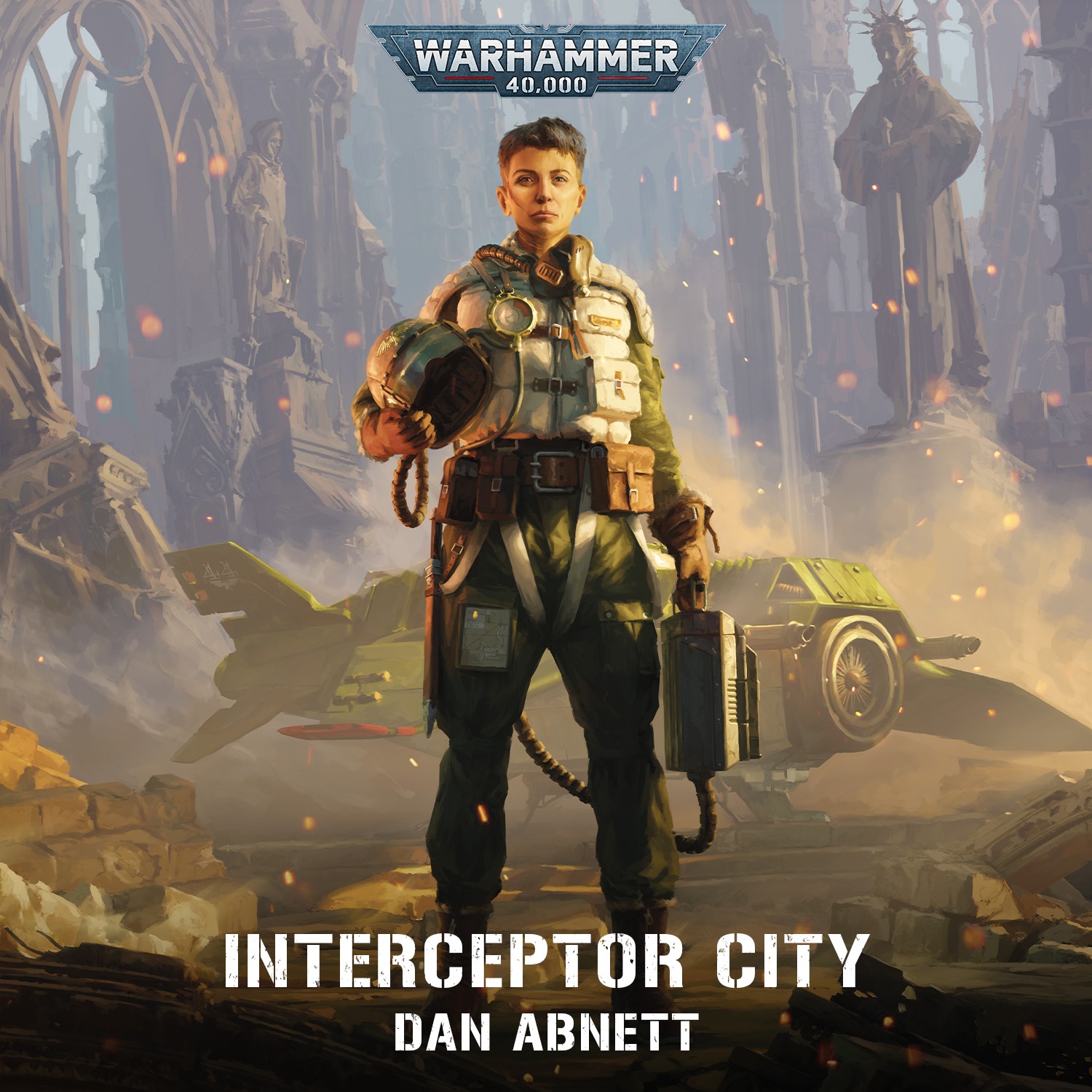
Warhammer 40,000: Interceptor City by Dan Abnett

Publisher: Black Library (Audiobook – 22 February 2025)

Series: Sabbat World Crusades/Warhammer 40,000

Length: 15 hours and 35 minutes

My Rating: 5 out of 5 stars

Amazon

Take to the skies once more as legendary Warhammer 40,000 author Dan Abnett presents another ambitious and rip-roaring novel of dogfights and explosive characters in the incredible novel, Interceptor City.

Dan Abnett is an author who I have mentioned multiple times in this blog, primarily because he is one of the best and most prolific writers of Warhammer fiction.  Abnett’s impressive work is a substantial pillar of the extended Warhammer 40,000 universe, especially with his entries in the Horus Heresy range, as well as his own various unique series, several of which are amongst some of my very favourite pieces of Warhammer 40,000 fiction.  This includes his outstanding Eisenhorn novels (XenosMalleus and Hereticus), his long-running Gaunt’s Ghosts books (First and Only, Ghostmaker, Necropolis, Honour Guard, The Guns of Tanith, Straight Silver and Sabbat Martyr), as well as gripping standalone titles like Titanicus. However, one of his very best books is the exceptional Double Eagle, for which Abnett has just released a sequel.

Double Eagle was an incredible novel first released in 2004 that sought to add a new, unique vantage point to the author’s Sabbat Worlds Crusade, the massive, multi-planet war served as a background the Gaunt’s Ghosts books.  Double Eagle followed members of a regiment of fighter pilots as they sought to control the skies above the Sabbat Worlds.  An intense, beautifully written, character-driven novel, Double Eagle got an easy five-star rating from me thanks to its outstanding and epic dogfights and examples of fighter-on-fighter combat.  Double Eagle was easily one of the best Warhammer books I have ever read, and I was very excited to find out that Abnett was finally releasing a sequel.

The Emperor protects, the Aeronautica remembers!

It has been more than 20 years since the battle to save Enothis and the Sabbat Worlds Crusade continues to rage, with millions of soldiers from the Imperium of Man fighting and dying to claim the planets from the arch-enemies grasp.  For some the crusade seems like a distant event, but for those on the scarred planet of Lysander, war is a daily occurrence, especially as the air forces of Chaos constantly seek to destroy the Imperial defenders with massive bomber flights.  The latest front of this campaign is the ruined hive city of Vesperus, which the enemy is using as cover to launch bombing attacks where the Imperials least expect it.  In response, the fighter pilots of the Aeronautica Imperialis have been ordered to secure the destroyed spires and massive building and turn Vesperus into a city of interceptors.

Into this precarious warzone flies former famed fighter pilot Bree Jagdea.  No longer the heroic ace who led her squadron to victory on Enothis, Jagdea now only pilots cargo haulers, determined to stay out the fighting.  However, an encounter with an old comrade leads her back into danger when she agrees to help the war effort by driving a needed replacement fighter to the Circus 66 squadron, currently serving in the ruins of Vesperus.  Planning to leave immediately after dropping off her precious cargo, Jagdea instead finds herself conscripted to join the ranks of the squadron as they face overwhelming odds against massed opposition from the forces of Chaos.

With no way out of the fight, Jagdea must once again contend against opponents in the sky if she wants survive and escape this new hellish posting.  However, this is not the air combat she is familiar with, instead the fighting in Vesperus is a cramped and deadly affair as their fighter aircraft must fight amongst the devastated and towering buildings of the Hive, where even the slightest error could result in death.  Forced to adapt to the new urban conditions Jagdea attempts to bring out her former skills and talent to survive the enemy all around her.  But with mysterious deaths haunting the squadron and the addictive thrill of danger once again luring her in, can Jagdea once again become a hero, or will she finally face her fate in the sky?

Well damn, now that’s how you do a sequel!  Dan Abnett continues to showcase why he is one of the very best authors of Warhammer fiction with the exceptional Interceptor City.  A particularly intense and captivating read that brings back one of Abnett’s best protagonists, Interceptor City was everything I hoped it would be, and more, as this novel simply blew me away.  One of my new favourite Warhammer 40,000 novels, Interceptor City gets a very easy five-star rating from, and I love the unique direction Abnett took this long-awaited sequel.

I have so much love for the narrative in Interceptor City, especially as Abnett decided to provide something very special for this sequel.  Abnett could have produced another open-skied flying story set right after the events of Double Eagle, and this probably would have been good enough to keep most Warhammer fans happy.  Instead, the author decided to raise the stakes in a big way by producing a deep and intense character-driven novel that brings back and focusses solely on a traumatised and retired version of his previous novel’s protagonist 20 years after the events of the first book, and places them into an impossible combat situation amongst suffocating spires and devastated city blocks to produce some outstanding action.

Told exclusively from the point of view of protagonist Bree Jagdea, Interceptor City went in some very interesting directions that bring the reader quickly into the fray.  Effectively setting up the unique situation on Lysander and Jagdea’s current emotional state, the story soon introduces some of the key supporting characters, before bringing Jagdea to the thick of the fighting in the devastated hive city of Vesperus.  Forced by circumstances to once again fly in combat, Jagdea finds herself in a new craft alongside an insane group of pilots trying to survive against impossible odds.  This results in the powerful main body of the plot as the traumatised Jagdea attempts to survive in an array of lethal fights amongst the massive, destroyed buildings of the Vesperus hive.

Abnett works in some incredible aerial sequences throughout Interceptor City, and you really become absorbed in the elaborate flying duels amongst the ruined buildings.  There is a great character-driven story here as Jagdea remembers her old instincts and slowly adapts to the new flying conditions she is forced to fight in.  At the same time as the brilliant action sequences, Jagdea also gets to know the other eccentric members of her new squadron, and there are some amazing character moments as she tries to understand their desperation, insanity and unique methods, while also trying to improve the survival rate of the less experienced pilots.  The flying scenes get more intense as the plot continues, especially as Jagdea regains her confidence, and you begin to understand more of the squadron’s madnesses.  There are some truly impressive story moments here, including a harrowing survival sequences and multiple complex aerial fights, that are cleverly worked together into one coherent and compelling plot.  Thanks to a great subplot, the later part of the book has a darker edge of mystery that requires to protagonist to try and understand the deeper motivations of the supporting cast.  While the solution of this mystery is somewhat obvious, it proves to be very well set up, and Abnett utilises it to masterfully increase the novel’s tension and stakes.  Interceptor City ends on a dark but fun note, as Abnett bucks against the expected final confrontation and allows the protagonist to end events on her own terms in a very over-the-top fashion.  This proved to be an extremely addictive narrative that really dives into the heart of the protagonist and provides some powerful and action-packed moments.

I loved this amazing Warhammer 40,000 novel, and I felt that Abnett presented it in such an impressive way.  Cleverly settling in as a standalone novel amongst the author’s other Sabbat World Crusade books, Interceptor City features a somewhat different style from Double Eagle, which works to make this sequel stand out on its own.  Rather than the extensive, multiple viewpoints that Double Eagle featured, Interceptor City is told exclusively from the perspective of the damaged protagonist Bree Jagdea.  While this does mean that you don’t get the full-picture war story that made Double Eagle cool, it allowed Abnett to really dive into his impressive protagonist’s story and showcase her personality and emotional state.  This ensured that this sequel was a particularly powerful and complex read, especially as Jagdea is a shadow of her former self after burning out as a pilot and crashing at her peak.  Now back into the cockpit, Jagdea is forced to come to terms with her own fears and doubt, as well as try the legacy of her past actions.  Abnett did an exceptional dive into Jagdea’s mind throughout Interceptor City, and he utilised the sole viewpoint to really explore her fears, hopes and the reasons behind her retirement.  This proved to be quite exceptional, and while readers are advised to read Double Eagle first to see this protagonist at her flying peak, new readers can easily dive into Interceptor City and appreciate its powerful emotional heart.  Throw in an over-the-top cast of eccentric pilots and killers with some additional complex and fascinating stories that the protagonist gets to know and trust, and Interceptor City has an impressive amount of character work that I found really fascinating.  Abnett layers this was a very grimdark tone, which allows the reader to full appreciate the desperate situation the protagonists are, and readers come away with an intense and impressive appreciation for the story.

While the great writing and the impressive focus on the protagonist’s mind ensures Interceptor City had an amazing story, the true highlight of this book is the outstanding depictions of aerial combat.  Abnett somehow managed to exceed his various impressive aerial sequences from Double Eagle in this sequel, and the resulting scenes of fighter-on-fight combat were so damn impressive, especially as the author describes them in exceptional detail.  The change of scenery from open skies to cramped urban flight conditions was extremely smart, and it ensured that Interceptor City’s flight scenes really stood out.  While the protagonist isn’t facing the overwhelming numbers of enemy fighters she encountered in Double Eagle, she is now forced to deal with small groups of skilled pilots amongst the wreckage of Vesperus, flying at impossible speed where even the slightest mistake could lead to death.  This results in some extremely nerve-wracking and claustrophobic sequences, as the protagonist tries to simultaneously fight and survive the dangerous environment she is flying through.  These fight sequences were so damn cool, and I loved how Abnett slowly improved the protagonist’s performance with each flight to reflect her growing confidence and mastery of the new location.  It is honestly impossible to stop reading Interceptor City during any of these sequences, especially the massive high-stakes ones at the end, and I frankly could not believe how Abnett made the dogfights and flying scenes even more epic in this outstanding sequel.

As is my preference with all things Warhammer, I chose to check out Interceptor City on audiobook rather than seeking out a physical copy.  Warhammer audiobooks are so damn good, and I love how well the elaborate and dangerous Warhammer 40,000 setting comes across when it is read out by a skilled narrator.  Abnett’s Warhammer 40,000 novels are a great example of this, as his compelling character and intense, tailored action really comes across on audiobook, especially in the hands of one of my favourite narrators Toby Longworth.  Longworth, who has lent his voice to most of Abnett’s books, really understands the best way to present the author’s fantastic narratives, and I love his cool take on all his Warhammer novels.  This was particularly true with Interceptor City, as Longworth did a masterful job bringing this complex tale to life, moving the main plot along at a quick pace and ensuring the action sequences were as epic as possible.  The passionate way he reads out the complex dogfights is just brilliant, and I found myself getting more and more drawn into these scenes as Longworth effortlessly vocalises every turn of the fighter and every lethal explosion in a tense and powerful manner.  You really got a sense of the protagonist’s desperation and the claustrophobic flying conditions she experienced thanks to this narration, and I was honestly on the edge of my seat for some of these outstanding sequences.  Throw in Longworth’s great array of compelling voices, which perfectly match the character they are assigned to, unique space accents and all, and the full impact of this amazing Warhammer 40,000 novel really comes out in the audiobook format.  Coming in with a run time of 15 and a half hours, Interceptor City is an epic audiobook to get drawn into, and I powered through this format in no time at all.  I actually wished it was a longer audiobook, it was that much fun, and as such I cannot recommend this format enough.

Dan Abnett was once again on fire with this exceptional and impossibly impressive Warhammer 40,000 novel.  A worthy sequel with its own incredible narrative, Interceptor City was a blast from start to finish and I had such a great time getting through this ambitious read.  Powerful, exciting, and loaded with some of the best Warhammer action sequences you are likely to read, Interceptor City comes highly recommended, and this might be one of my new favourite books.  I cannot wait to see what awesome Warhammer 40,000 novel Abnett writes next, and I hope we don’t have to wait another 20 years to see a new aerial adventure from this amazing author.

Amazon

Nemesis by Gregg Hurwitz

Publisher: Michael Joseph (Trade Paperback – 18 February 2025)

Series: Orphan X – Book 10

Length: 493 pages

My Rating: 5 out of 5 stars

Amazon

One of my favourite thriller authors, Gregg Hurwitz, returns with a powerful and particularly addictive new entry in his Orphan X series with the emotionally charged and pulse-pounding read, Nemesis.

Gregg Hurwitz is an author I have had a wonderful time enjoying over the last few years, primarily thanks to his exceptional Orphan X books.  Following former government assassin Evan Smoak, formerly known as Orphan X, this compelling thriller series explores Smoak’s vigilante actions as the Nowhere Man, a source of lethal justice for those who can’t get help anywhere else.  I started reading these books several years ago with the amazing fourth entry, Out of the Dark, which saw the protagonist go to war with a corrupt US President, and I have been hooked ever since, grabbing every subsequent entry in the series.  This includes the outstanding novels Into the FireProdigal SonDark HorseThe Last Orphan and Lone Wolf, each of which did an intriguing job of continuing the series while also exploring Hurwitz’s complex protagonist and his unlikely family.  I really enjoyed all these books, and I have been eagerly awaiting the 10th novel, Nemesis, for a while now, especially as it promised to follow on from the intriguing cliff-hanger at the end of Lone Wolf.

No greater friend.  No worse enemy.

Evan Smoak, the Nowhere Man, has spent years taking on impossible vigilante missions, while also keeping his former government owners at bay.  No matter how hard the mission, Smoak always succeeds, in no small part to the group of loyal friends who have his back.  But Evan is about to discover the sad truth that it’s those closest to you that can cause you the most pain.

After foiling a lethal assassin with a penchant for taking out innocent bystanders, Evan is disturbed to discover that the assassin’s weapons were sourced from his trusted comrade and armourer, Tommy Stojack.  Shocked and determined to get answers, an emotionally compromised Evan finds himself unwilling to forgive Tommy for his lapse in moral code, and the two strong-willed warriors soon find themselves at odds.  When Evan’s next attempt to talk sees him ambushed by a flurry of thugs and shooters, he decides that it’s time to go to war, even if that means killing his best friend.

However, Tommy has his own problems to deal with.  Receiving a call for help from the son of an old war buddy, Tommy travels to a dying American town, filled with anger, corruption and racial tension.  Attempting to honour his debts, Tommy finds himself mentoring a group of neglected and angry young men whose uninformed actions have led to tragedy.  However, Tommy’s seemingly simple mission soon turns deadly when Evan arrives in town and takes issue with the actions of those under Tommy’s protection.  Thrown into opposite moral paths and plagued by assassins, local troubles and their own substantial personal issues, Evan and Tommy find themselves in conflict, with everyone around them caught in the crossfire.

Hurwitz continues to shine as one of the premier authors of thriller fiction with this particularly intense and complex entry in his Orphan X series.  Featuring a compelling plot loaded with action and captivating character moments, Nemesis was an addictive read that hits the reader hard and never gives them a chance to recover.  This was probably one of my favourite Orphan X books so far, and thanks to Hurwitz’s brilliant writing, I have very little choice but to give Nemesis a full five-star rating.

I was really impressed with the plot for Nemesis, which honestly went in some compelling directions that I didn’t expect, but which provides great closure and intense character moments, while also loaded up with the series’ trademark action.  Following on from Lone Wolf, Nemesis sees a preoccupied protagonist, Evan Smoak, distracted and distressed by the revelations that his best friend and armourer Tommy Stojack supplied weapons to a deadly assassin who killed multiple innocent people in the previous book.  Forced by his moral code into a confrontation, Evan finds himself in conflict with a stubborn and unapologetic Tommy.  However, what starts as a major disagreement between friends turns into a full-on war, when the two find themselves on different sides of an ethical fence, while also fending off assassins and killers after Tommy.

Hurwitz paced this narrative out extremely well, with a great intro and an early action set piece that worked to showcase the protagonist’s emotional instability.  The initial confrontation between Evan and Tommy sparks up the intensity of the plot, and the reader becomes engaged in seeing how the conflict between them will continue, especially after the second sequence forces Evan to fight for his life.  The author then takes the book in a very interesting direction, as Tommy journeys to a small town in heartland America to help the son of an old comrade and finds himself mentoring a group of young want-to-be militia members who have gotten into trouble.  Hurwitz spends a lot of time focusing on Tommy’s attempts to guide the group and trying to gently resolve the dark things they have done.

While this journey to middle-America initially seemed an odd choice for plot progression, Hurwitz utilises it perfectly to showcase Tommy’s character and the differences in approach and personality between him and Evan.  Conflict inevitably emerges when Evan arrives and attempts to solve matters in a black-and-white manner, forcing Tommy to intervene.  This provides even greater emotional turmoil, and I loved how well the author set it out.  You find yourself getting really drawn into the nuanced situation that emerges, and I loved seeing the alternating methods and personalities of the two protagonists.  After an impressive action sequence where Evan and Tommy come together one time to face off against a scary group of assassins, Hurwitz sets up the book’s final confrontations, which are loaded with some brilliant moments that pushes both main characters to the edge.  I deeply enjoyed how Hurwitz resolved the entire situation, and you are on the edge of your seat the entire time, which results in a particularly addictive read.  I honestly was very satisfied with this book, right up to the final twist, which was impactful and clever, but for which I may never forgive Hurwitz.  This was easily one of Hurwitz’s best narratives, and I really appreciated the complex, character-driven thriller storyline he envisioned for this latest Orphan X book.

Hurwitz did an exceptional job bringing Nemesis’s complex and captivating narrative together, and I honestly feel that this is some of his best writing.  Featuring a fantastic continuation of the ongoing series, Nemesis had the perfect blend of action, intrigue and character-focused drama, which allowed for quite an addictive read.  The various action sequences scattered throughout the book are intense, brutal and very-well put together, and I loved how they showcase the various moods of the protagonist, as we go from his usual smooth sequences to more frenetic fights when he is emotionally compromised.  While these typical thriller elements are a lot of fun, it is the focus on the characters and the intense emotions between them that makes Nemesis particularly impressive.  Hurwitz sometimes struggles with the balance between action and character development, but I felt that this one was perfect, especially as he featured an array of damaged figures, including two former best friends in deep conflict.  While I do think that Nemesis could have gone without another manufactured conflict between Evan and his ward, Joey, for the most part it was exceptional to see the various character interactions and dives into the protagonist’s psyche that emerged.  This blended extremely well with the overarching thriller narrative and the fantastic action of the plot, and resulted in a particularly powerful read that, while more emotionally charged than most thrillers, worked extremely well in the context of this series.  I really appreciated how carefully Hurwitz set out these elements in Nemesis, and there is really something for everyone here including some thought-provoking discussions, awesome action scenes, and some major emotional moments that will hit you hard and really stick with you.

As with most books in the Orphan X series, Nemesis can be read as a standalone novel, as Hurwitz does an excellent job of recapping key events, elements and characters from the previous novels for new readers.  I personally felt that to get the full emotional impact of Nemesis, readers really need to have read some of the previous books in the series first.  Not only does the cause of the key conflict of Nemesis occur in the previous novel, Lone Wolf, but seeing just how close the emotionally shuttered Evan is with Tommy ensures you understand the emotional stakes of Nemesis and how far apart these two former friends have gotten.  However, if you decide to make Nemesis your first entry in the Orphan X series, you’ll still be in for an amazing treat, and I feel that Hurwitz features enough context and recaps to allow any reader to enjoy Nemesis.  This honestly was a very impressive book in the Orphan X series, and it will be very interesting to see where Hurwitz goes with this next.  The author has set up some big emotional hurdles for the next novel, and I look forward to seeing how his protagonist overcomes them.

As I have mentioned a few times above, I felt that Hurwitz’s character work was the element that made Nemesis particularly exceptional.  Not only does Hurwitz cleverly build on a range of existing character storylines and developments from the previous book but he also introduces several compelling one-off characters whose interactions with the main cast make for some impressively powerful moments.  Naturally a lot of the development is reserved for series protagonist Evan Smoak, the former government assassin turned vigilante.  Evan has always been an exceptionally complex character due to his unusual upbringing, lack of emotional awareness and OCD, and many books have dealt with his inability to deal with other people in his life.  Hurwitz does an excellent job revisiting that here in Nemesis as Evan faces another emotional hurdle when he is forced to come into conflict with his one true friend.  The emotional stress this puts him under turns him into a bit more of a deranged and careless creature.  The fantastic emotional range showed by Evan in Nemesis was fascinating, and Hurwitz writes some great story moments around his anger, poor judgement and strict moral code.  Few Orphan X books have pushed the protagonist in more ways than Nemesis, and I honestly felt every emotional bruise that occurred in this book, including the final one that is going to have some major repercussions for the protagonist.

Aside from Evan, the main character of Nemesis was the protagonist’s former friend turned opposing figure, Tommy Stojack.  Tommy, the gruff and cantankerous old soldier, has always been one of the more entertaining characters in the Orphan X books, and it has always been fun to see the unlikely friendship between him and Evan.  Given a much larger role in Nemesis, Tommy serves as a secondary protagonist and major point of view character, which really suits him.  I deeply enjoyed seeing more of Tommy’s perspective, especially as it is starkly different to Evans.  His interactions with many of the supporting characters of Nemesis really help to showcase his personality and mindset, especially when he takes on a stern mentor role for several younger characters.  However, it is the intense and strained relationship with Evan that is the major highlight of this book, as Hurwitz provides a compelling deep dive into their friendship.  Thanks to both characters pride and belief that they are right, the two face off several times in this book, proving that friends really make the worse enemies.  I really appreciate how well Hurwitz used Tommy in Nemesis, and the emotionally charged circumstances that surround his inclusion help to deeply enhance this book.

Aside from Evan and Tommy, there is a very fun and intriguing supporting cast in Nemesis who add to the story in some compelling ways.  Evan’s ward, Joey Morales, is her usual fun, rebel self, and while I think some of her conflicts with Evan are a little unnecessary, I liked her continued coming-of-age storylines, as well as a fun scene she has with Orphan V.  I felt that the highlight of the supporting characters was a small group of rebellious, angry young men who Tommy chooses to look out for.  Although they’re a hard group of characters to initially like, Hurwitz provides some fascinating context to their actions as the story continues.  I really appreciate the intelligent social commentary that Hurwitz featured around these characters, and you end up feeling a little sorry for them, despite what they have done.  Throw in some great villains, including four related assassins who are honestly quite freaky in their appearances, and this was an outstanding cast of characters, whose complex and captivating personal stories and interactions ensure that Nemesis is a particularly powerful read.

The always impressive Gregg Hurwitz continues his Orphan X series in incredible manner with Nemesis.  An exception and memorable entry in this always fun series, Nemesis had a brilliant and emotionally charged narrative behind it, loaded with amazing character moments.  Guaranteed to hook you with its fun action and complex character dynamics, Nemesis was so damn good, and I am still not over all of Hurwitz’s excellent, and brutal, twists.

Amazon

High Wire by Candice Fox

Publisher: Bantam (Trade Paperback – 24 September 2024)

Series: Standalone

Length: 480 pages

My Rating: 4.5 out of 5 stars

Amazon

One of Australia’s top authors of crime fiction finishes of 2024 with a massive bang as Candice Fox presents the powerful thriller, High Wire.

Few authors had the awesome year that Candice Fox did in 2024, as the author released three impressive crime fiction reads.  The first of these was the fast-paced crime fiction read, The Murder Inn, which Fox cowrote with the legendary James Patterson.  The sequel to their previous book, The Inn, The Murder Inn was a fantastic book that once again highlighted how well Fox and Patterson work together (see my review for their other book 2 Sisters Detective Agency).  Fox also released the intense character-driven thriller, Devil’s Kitchen, that saw two highly damaged characters attempt to uncover the secrets of a seemingly heroic group of firefighters with a true dark side to them.  Both The Murder Inn and Devil’s Kitchen were outstanding reads, and I was very happy I checked them out.  However, Fox decided to provide us with even more fun before the year was over with the standalone novel High Wire.  Taking the author back to her home country, High Wire was a compelling and deeply intense Australian thriller that takes you hostage and refuses to let go.

Out in the outback of Australia lies a notorious unmarked track known as the High Wire.  Cutting across the country from Broome to Sydney, the High Wire is a lawless road full of small towns, unregulated trails and mobile phone blackspots.  A favourite hangout of smugglers, hijackers and criminals, only the desperate, the dangerous and those looking for trouble use the High Wire.

Harvey Buck, former soldier and current recluse, knows all about the dangers of the High Wire, but desperation forces him to travel along it to reach his dying girlfriend.  Despite knowing better, he stops to pick up a hapless traveller, Clare Holland, whose car has broken down on the road.  However, Clare isn’t the person he should be worried about, as the two are soon ambushed by a masked assailants with their own sinister agenda.

Strapped into bomb vests, Harvey and Clare are forced into a twisted game by vengeful figures from Harvey’s past seeking to ruin his life and reputation.  Forced to commit a series of increasingly murderous missions across several small towns, the two prisoners try to work together to escape and stop the insanity going on around them.  Harvey and Clare’s only hope may be Senior Sergeant Edna Norris, one of the few police officers stationed on the Wire, and who soon begins to follow the trail of destruction being left in their wake.  But Edna has her own problems, especially when Clare’s husband arrives on the scene with his own dark plans.

High Wire was another awesome book from Candice Fox that provides readers will some of the best Australian thrills and action that there were likely to get in 2024.  Featuring a bold, compelling and powerful character-driven tale of revenge and escape, High Wire was an outstanding read from one of my favourite Australian authors and one that I cannot recommend enough.

Fox hits the ground running hard with High Wire’s excellent narrative, and I honestly was hooked early on thanks to the compelling and intense story.  Quickly introducing the protagonist, Harvey Buck, as well as the High Wire, the lawless road that serves as an intriguing background setting for the plot.  After a quick introduction to a secondary protagonist, the mysterious Clare Holland, the main plot of High Wire takes off as the two are ambushed by a group of armed attackers, who take them prisoner after a bloody shootout, and strap them into elaborate bomb vests.  Fox keeps the tension running high here, as it becomes clear that the kidnappers know Harvey and are seeking revenge for some past misdeed.  Around the same time, the readers are introduced to the other major point-of-view character, Senior Sergeant Edna Norris, who finds herself on the trail of Harvey, Clare and the kidnappers without knowing who is responsible and with an unlikely teenage sidekick helping and hindering her in equal measure.

The plot soon becomes even more intense on several levels, as Fox works several intriguing storylines and elements simultaneously to tell a complex and exciting narrative.  The main plot around Harvey and Clare proves to be quite intense, as the two are forced to commit a series of brutal crimes while also trying to escape or take out their captors.  Fox carefully doles out intriguing background on both Harvey and Clare to the readers, and you soon discover both have complicated pasts, as Clare is running from her suddenly murderous husband, while Harvey’s past connection to the kidnappers is revealed in a series of dark flashbacks.  These flashbacks help to paint the main storyline in some different shades of grey, as you begin to realise that Harvey isn’t the moral hero you initially believed he would be, and while the antagonists are worse, you begin to doubt that Harvey deserves to survive.

At the same time, the focus on Edna and her intriguing supporting cast goes in some interesting directions, as she follows the carnage left behind by the kidnappers and their unwilling pawns.  Not only is Edna forced to deal with her hard-headed charge Talon, but she finds herself in all manner of trouble when Clare’s husband, Gareth Holland the Northern Territory Police Commissioner, arrives on the scene looking for his wife.  Instantly suspicious of Gareth, Edna is forced off the case due to police politics but continues to try and investigate, determining that she needs to get to Clare first.  Edna’s storyline, which I personally enjoyed the most in High Wire, goes in some fantastic directions, and she soon finds herself forced to survive the murderous attentions of Gareth, while also trying to solve the clues being left behind by Harvey.  Fox does an excellent job running these somewhat separated storylines simultaneously, and they tie into each other just enough to create an amazing overarching narrative.  Fox wrapped these various storylines up in a very effective way, with a satisfying moment in the Edna storyline, while the main narrative goes out on a very dark note, which I felt was a powerful result to some of the character work that Fox had been building up.  This honestly ended up being an epic and compelling standalone thriller, and I really appreciated how Fox held back no punches to create this powerful read.

Fox did another amazing job bringing this intense and complex narrative together, and I felt that High Wire was one of her more hard-hitting and enjoyable novels.  I loved how the author imbued High Wire with a very dark edge, and between the intense action, despicable villains and deadly plot you really come away not wanting to visit central Australia.  The setting of the “High Wire”, a semi-secret road running the length of Australia proved to be an awesome background, and Fox’s strong descriptions of the red-earthed, isolated road combined with its inherent lawlessness and dangerous inhabitants, gave me some major Mad Max vibes as I was reading the book.  I felt that Fox utilised this setting perfectly throughout High Wire, and it helped to give this novel a very distinctive feel.  The author also made great use of splitting the story across several intriguing central characters.  The two main storylines, the one involving Harvey and Clare and the one following Edna and Talon, played off each other extremely well, and having Edna constantly behind the other protagonists and their captors allowed for a great chase narrative, as they tried to interpret all the events going on in front of them.  Information from Harvey and Clare also cleverly increased the tension in the other storyline, especially as you learn in advance just how deadly secondary antagonist Gareth Holland is, which allows you to fully appreciate his manipulations and darker agenda.  The balance between these two storylines was extremely effective, even with the additional flashback chapters, and this ensured that High Wire had a great pace to it that easily keeps the reader’s attention.

High Wire’s intense and compelling story was greatly enhanced by several fantastic and complex characters whose unique, and often dark narratives, provided some nuanced and complicated tales of personal growth and survival.  The main protagonist, Harvey Buck (a great uber-masculine name btw), is a former soldier who spends the book trying to survive the plans of his attackers and save as many people as possible.  While Harvey seems to be a good character, Fox makes excellent use of flashbacks to dive into his history with the antagonists, which provides some added complexity to the plot, as both sides have committed atrocities against the other.  The same can be said for secondary protagonist, Clare Holland, a seemingly helpless figure inadvertently dragged into events.  While Clare is portrayed as a victim for much of the plot, she eventually reveals an intriguing backstory to Harvey that ties into her complicated marriage, which implies she isn’t as innocent as she seems.  The character I most got drawn to was local cop, Senior Sergeant Edna Norris, who comes away as one of the few legitimately decent people in the book.  Thanks to her caring personality and clever insights, Edna is a protagonist you can get behind 100%, and even when elements of her past are brought up, it proves hard not to still see her as the best figure in the book.

Aside from these key characters, Fox features several intriguing supporting figures in High Wire, including some impressive antagonists.  The main supporting character that is featured in the book is Talon, a teenager who is taken under Edna’s wing after she arrests him.  An initially annoying and impulsive figure, Talon grows on you as the book continues, especially with his entertaining imagination and surprisingly accurate insights.  However, it is the villains of the High Wire who I think stole the show here.  The two kidnappers who take control of Harvey and Clare with bomb vests prove to be despicable, if highly damaged figures, and it was fascinating to see how much their current behaviour is due to previous rough treatment from Harvey.  Clare’s husband, Gareth Holland, proves to be an excellent secondary antagonist, especially as he has his own murderous agenda and uses his position as Northern Territory Police Commissioner to get away with his goals.  In some ways Gareth was a better villain than the kidnappers, especially as he is far more soulless figure who ends up being quite smug and controlling.  I really enjoyed the entertaining way that Fox wrapped up Gareth’s storyline in this book, and it was quite satisfying to see him get what he deserved.  These character deeply enhanced Hire Wire’s narrative, and it was awesome to see their various storylines unfold.

High Wire ended up being an incredible and thrilling piece of crime fiction from one of Australia’s best writers Candice Fox.  Dark, brutal and filled with some complex and damaged characters, High Wire quickly gets you hooked, and you are in for an outstanding time with this brilliant read.

Amazon

The Dragon in Winter by Jonathan Maberry

Publisher: Macmillan Audio (Audiobook – 20 August 2024)

Series: Kagen the Damned – Book Three

Length: 20 hours and 57 minutes

My Rating: 5 out of 5 stars

Amazon

The damned rush to their final battle in the epic dark fantasy novel, The Dragon in Winter, which brings an exceptional conclusion to author Jonathan Maberry’s Kagen the Damned series.

As I mentioned in my recent review for the author’s other 2024 release, NecroTek, I am a huge fan of Jonathan Maberry, having really gotten into his elaborate and deliciously gritty thrillers and other pieces of fiction since I started this blog.  While I am most familiar with the author’s long-running Joe Ledger series, one of his more intriguing recent bodies of work has been the Kagen the Damned series.  A dark fantasy fiction series that follows a highly damaged figure who seeks bloody revenge after the dastardly Witch-king uses magic to destroy his kingdom and kill the royal children in his care, the Kagen the Damned books were an incredible pivot into the fantasy fiction genre for Maberry that I deeply enjoyed.  Both of the previous books in the series, Kagen the Damned (one of my favourite books and audiobooks of 2022) and  Son of the Poison Rose (one of my favourite books and audiobooks of 2023) were five-star reads, and I have so much love for this series (which also includes the novella I Say Your Name in the Dark Nights) due to its elaborate storytelling, damaged characters, and intriguing take on the fantasy genre.  Because of how impressive the first two entries in this series are, I have been eagerly awaiting the third and seemingly final book, The Dragon in Winter, for a long time, and it was one of my most anticipated books of 2024.

Nearly a year after the bloody massacre that saw the dread Witch-king of Hakkia conquer the former Silver Empire in a single night, the war to reclaim the throne is finally here.  As the Witch-king continues to plot, planning to ascend to godhood, his enemies have rallied around the unlikely figure of Captain Kagen Vale, better known as Kagen the Damned.

Once the loyal guardian of the Silver Empire’s heirs, Kagen has survived despair, damaging revelations and damnation from his gods to stand against the Witch-king and gain the bloody vengeance he so desperately needs.  Having proven his valour in combat and his ability to face off against the darkest of magic, Kagen has managed to gather a massive army of rebels, outlaws and the soldiers of various allied nations determined to stop the Witch-king for good.  But this army of flesh and blood men will not be enough to stand against the destructive power of the Witch-king alone.

As magic continues to return to the land, Kagen and his allies soon find themselves beset by the Witch-king’s sinister powers and dread allies, as vampires, demons, magic users and other fell creatures emerge, determined to keep the Witch-king on his bloody throne.  To survive, Kagen will need to find magic of his own that will allow him to withstand the Witch-king’s power.  But the more he looks, the darker secrets he unravels, and soon everything he thought he knew about the world will come tumbling down around him.  Worse, an even more dangerous threat is rising in the frozen north, as a tortured dragon calls out in despair and is answered by a being of unimaginable power.  Can Kagen stop the Witch-king before his dark plans come to pass, or will the dread flames of vengeance consume the entire world?

What an outstanding end to one of my favourite new fantasy trilogies!  The Dragon in Winter was another exceptional novel from Jonathan Maberry that serves as a fitting and powerful end to the Kagen the Damned dark fantasy series.  Loaded with insane action, brilliantly damaged characters, and some fantastic storytelling, The Dragon in Winter was an incredible book that perfectly utilises Maberry’s distinctive style.  I had an amazing time listening to this impressive book, and it gets an easy five-star rating from me, especially on audiobook.

Maberry had to achieve a lot with this third Kagen the Damned novel, as not only did readers require a satisfying end to the trilogy, but this book needed a distinctive story much like the previous entries.  I feel that Maberry achieved both these goals, as The Dragon in Winter was a compelling and dark read that provided a great mixture of adventure, war, intrigue and character growth, all while continuing and concluding the storylines from the previous books.  This third novel starts shortly after Son of the Poison Rose and sees Kagen taking on the role of general by leading a small army against the Witch-King’s forces, while the previously established story threads about the various nations building their armies to join the war come to fruition.  Maberry does a great job of resetting the scene in these early chapters, and not only do you get to see the situation from Kagen’s perspective but multiple scenes are shown from the antagonists’ side as they make their preparations to foil the protagonist and his allies.

Much of the middle of the story follows Kagen and his unlikely allies as they prepare for the inevitable final confrontation, attempting to gain additional ways to fight against the Witch-king.  While some of Kagen’s sequences aren’t entirely necessary for the full advancement of the plot (the goblin cave sequence, for example), they are all generally intense and character building, and they all tie in nicely amongst the other storylines about war preparations and the Witch-king unleashing his dark minions upon the world.  A secondary major storyline focuses on the characters of Jheklan and Faulker, Kagen’s brothers, who journey up to the frozen Winterwilds in search of the last dragon.  This storyline proves to be quite an interesting addition to the story, as while the characters are disconnected from the rest of the plot due to distance, their actions have big impacts on the overarching narrative.  This middle part of the story ends with a major confrontation between a memorable supporting character and a dark set of antagonists, which was not only very awesome but helped to set the scene for the rest of the book.

The final third of The Dragon in Winter is all action and excitement as the final battle of the war is unleashed on multiple fronts.  Maberry expertly brings all the various ongoing storylines to the boil, as the protagonists find themselves in mortal peril.  There is a little bit of everything here, including massive war sequences, smaller battles with huge sacrifice and big revelations finally coming to the surface.  The author keeps the tension extremely high during this third act, and you are constantly on the edge of your seat, especially as your favourite characters face doom and destruction at every turn.  I loved the way many of these storylines came together, and while a couple of big moments were easy to see coming (although for me that just increased the anticipation), there were also some reveals I couldn’t have predicted.  This includes the book’s massive twist that turns around much of what you thought you knew for the last two entries in the series.  I felt that this twist was very clever, especially when you consider the subtle hints leading up to it, and I appreciated how it changed the emotional impact of some previous scenes.  Everything leads up to the big final confrontation, which was as bloody and hard-hitting as you would expect.  This confrontation was chaos, carnage and catastrophe, and I felt that it was a fitting end to a dark trilogy that revelled in bloodshed.  While I do feel that the final boss takedown was a tad anticlimactic due to who got the kill, and Maberry reigned in the tragedy far more than I expected, this conclusion was extremely awesome, and I hung on every word right to the very end.  Everything was very nicely wrapped up, although there is potential for Maberry to revisit this series in the future, which could result in some more gripping adventures.

I always love the way that Maberry manages to apply his distinctive writing style to all his novels, no matter the genre, and it always works to create a powerful and exciting read, especially in The Dragon in Winter.  The large number of short chapters allows for a quick pace, and you are constantly jumping from sequence to sequence, eager to see what will happen next.  Maberry also excels at featuring a huge range of alternating perspectives as the book continues, with the point of view jumping around various interesting characters chapter to chapter.  While much of this focuses on the main protagonist, you are often following many of the fascinating and fun supporting characters as they go about their own adventures.  There are also multiple chapters shown from the perspective of the villain or his minions, and I love how the reader are constantly let into the antagonist’s plans, which helps to raise tension as you worry that they are one step ahead.  Throw in several additional perspective chapters from one-off characters, which often help to highlight some of the darker events going on in the wider setting, and this great jump in perspectives allows for a particularly complex and layered narrative that is so fun to navigate.  Of course, the real highlight of any Maberry book is the exceptional action sequences that pump some massive excitement into the plot.  Maberry is extremely talented at envisioning fight scenes of any size or shape, and I found myself constantly enthralled by the many, many battles that were contained in The Dragon in Winter.  This includes deep personal battles, running skirmishing or even a truly massive full-on war sequence with unique participants, all of which come across extremely well thanks to the author’s powerful and descriptive writing that captures every sword thrust or slice of the protagonist’s blades.

The Dragon in Winter continues to exhibit many of the dark fantasy elements that made the first two Kagen the Damned books so awesome to read.  Maberry really dove into the genre with a vengeance in this series, and I love how he pulled together a rich and powerful fantasy world loaded with both unique features and classic fantasy creatures and monsters.  Thanks to the author’s detailed writing and tendency to effectively recap key elements of the series, readers can easily absorb all the key elements of this universe, and it proves to be fascinating to take in, especially as Maberry loads it with secrets, deep history, and hints of other lands yet to be visited.  Of course, as this is Maberry, there is also a strong Lovecraftian vibe to this universe, as many of the elder gods and other associated beings have a place in this realm.  The author does a great job of exploring these classic Lovecraftian creatures throughout the course of the series, and the way they are worked into the main plot of The Dragon in Winter is extremely clever, especially if you have seen examples of them in some of Maberry’s other series.  For readers expecting a typical fantasy read, I should warn that The Dragon in Winter, like the rest of the Kagen the Damned series, gets very dark and brutal at times, and there are a lot of strong references to violence, torture, sexual assault and other troubling features that probably won’t appeal to every reader.  I feel that while Maberry occasionally goes a bit overboard with these darker inclusions, for the most part it helps to create a powerfully grim overarching tone that raises the stakes and ensure you are constantly rooting for the protagonist to succeed and bring a bit of justice to the world.  It also works very well alongside the awesome action sequences, and for those fans of some very bloody fights, including those featuring pure evil fantasy and horror creatures, you are in for an amazing time here.

While the action, setting and clever storytelling is an exceptional part of The Dragon in Winter, I also need to highlight the various impressive characters featured throughout this book.  Due to The Dragon in Winter being the last entry in this trilogy, Maberry spends much of this book finalising key character storylines, allowing for a much more personal entry in the series that will really appeal to those readers who have grow attached the protagonists in the first two books.  As such, this final Kagen the Damned novel features an array of great characters who are so well written and who often feature their own powerful and personal character arcs. 

Like with the rest of the series, much of the book’s character work is focussed on the main protagonist, Kagen Vale, who thanks to the dark deeds he has witnessed has been given the title Kagen the Damned.  A moody and deadly figure, Kagen has gone through so much despair and darkness in this series, and it has been a powerful journey following him this far.  Maberry did an outstanding job continuing Kagen’s story in The Dragon in Winter, and it was great to see how far Kagen has come, especially as he now uses his inner darkness, past trauma, and even the damnation of his gods, to fuel his desire to fight.  While he has overcome many of his past traumas, Kagen does experience new ones in The Dragon in Winter, as he finally understands the full scope of the evils unleashed upon the world, including by his own people.  This allows for some more dramatic sequences from the protagonist, and part of the emotional strength of the story is watching Kagen overcome even these revelations, especially with the help of his friends.  I have really appreciated how well Maberry has written Kagen’s pain and deeper heart throughout the series, and it was fantastic to see some of this pain finally come to an end in this final novel.

Aside from Kagen, the rest of the supporting cast proves to be quite exceptional, and there are many fascinating characters you become attached to as a result.  I personally loved seeing more of Kagen’s two friends and comrades, Tuke and Fillia, who form a hilarious put powerful trio as they fight together against the odds.  Essentially Kagen’s conscience and voice of reason, Tuke and Filia are the perfect supporting characters to the protagonist, and I love how they constantly anticipate Kagen’s behaviour and manipulate events to ensure he does what they want.  However, they also have their own compelling adventures outside of Kagen, especially when they lead the final battle, and you care nearly as much for them (if not more) than you do Kagen by the end of things.  Maberry also invests a lot of time in The Dragon in Winter to the amusing characters of Jheklan and Faulker Vale, Kagen’s brothers and mischievous adventurers.  While they have had minor appearances in the previous novels, Maberry only featured them as major, fleshed out characters in this final book, as they lead their own expedition to the frozen Winterwilds.  While they are relatively new figures, the reader quickly becomes intrigued by their storylines, especially as it is loaded with adventure and a certain comedic charm thanks to the brother’s juvenile nature.  However, while they are often unserious, when the chips are down Jheklan and Faulker get serious quick, and Maberry ensured that they encounter some real tragedy that shows the true heart of these figures.

While there are other great supporting characters I could talk about, including a vengeful widow and a scarily powerful vampire elf, I want to finish by mentioning the various villains, who are some of the best characters in The Dragon in Winter.  This includes the sinister Witch-king and his court, who are constantly plotting to destroy the world and kill Kagen.  The Witch-king is particularly malevolent in this book, and Maberry continues to build on the revelations surrounding him in this final book, providing even more fun context and twists.  I also love the continued focus on the Witch-king’s terrified advisors, Lord Nespar and Jakob Ravensmere, who find themselves way over their heads as they try to serve their lord and their own agendas.  However, the devilishly fun character known as the Prince of Games easily steals every scene he is in, and I loved his constant manipulations and chaotic nature, especially as it brings great fun to the Witch-king’s dark court.  The Prince of Games, who has some interesting links to some of Maberry’s other series, perfectly rounded out this cast of villains, and I really appreciate how much depth and complexity these antagonists, and indeed every character in the Kagen the Damned series, brought to the overall story.

As with all Maberry’s previous books, I chose to check out The Dragon in Winter on audiobook, which is the best format to enjoy the author’s captivating narratives in.  Maberry’s short chapters, elaborate world building, intense action and over-the-top characters really come to life when they are read out loud, especially when it is done by the legendary Ray Porter.  Porter has long perfected the tones to get the most out of Maberry’s writings and his infectious and compelling voice expertly captures the inherent dark nature of Maberry’s writing and helps to send the crazy scenes of carnage straight into the listener’s head.  The narrator knows exactly how to portray Maberry’s great, larger-than-life protagonists and villains, and you can easily imagine each of the figures and their actions as Porter reads them out.  I particularly enjoy how well Porter captures the various emotional states of these characters, and you always hear the despair, anger or fear of each of these figures when they speak.  This especially true for the primary protagonist, Kagen, and I always appreciate how well the narrator showcases his many dark emotions as he goes through the wringer time and time again.  Throw in some truly chilling voices for the various villains and evil monsters that the protagonists encounter, and Porter’s performance was once again exceptional, allowing for quite an awesome audiobook.  With a runtime just short of 21 hours, this is a long audiobook to check out, although you really don’t mind as it becomes hard to stop listening to The Dragon in Winter, especially during the various climatic or intense sequences.  I had such a great time listening to The Dragon in Winter, and this such an amazing format to enjoy this latest Maberry novel on.  Indeed, I loved it so much I listed it as one of my favourite audiobooks of 2024, even before I finished it, so do yourself a favour and check out this novel on audiobook right away.

Thanks to its powerful story, intense action and damaged characters, The Dragon in Winter was another incredible read from Jonathan Maberry that I could not get enough of.  One of the best books of 2024, The Dragon in Winter was an outstanding final entry in the Kagen the Damned series, and I loved every single second I spent reading it.  Highly recommended on all formats, especially those read out by Ray Porter, The Dragon in Winter is so damn good, and it will be interesting to see if Maberry decides to return to the fantasy genre again the future.  In the meantime, we’re only a few months off from Maberry’s next book, Burn to Shine, which will probably be one of the best things I read in 2025.

Amazon

How to Become the Dark Lord and Die Trying by Django Wexler

Publisher: Orbit (Trade Paperback – 6 August 2024)

Series: Dark Lord Davi – Book One

Length: 395 pages

My Rating: 4.75 out of 5 stars

Amazon

Hilarious author Django Wexler presents one of the funniest and most memorable fantasy novels of 2024 with the deeply addictive How to Become the Dark Lord and Die Trying.  Serving as the first book in Wexler’s new Dark Lord Davi series, How to Become the Dark Lord and Die Trying was an extremely amusing book that has been on my radar for a while due to its amazing-sounding plot.

It’s a tale as old as time.  An ordinary human becomes trapped in a mythical fantasy realm and is subsequently lauded as the prophesied hero of legend, destined to rule the kingdom and defeat the conquering Dark Lord.  But what happens when the human protagonist gets sick of living and dying as the hero?

That’s the question that falls to Davi, a young woman who has become trapped in a bloody and predictable time loop.  Constantly forced to become the leader of the soon-to-be-destroyed humans of The Kingdom, Davi has tried time and time again to organise an army capable of defeating the oncoming and everchanging Dark Lord, only to fail and die in agony in over 200 inventive ways.  After nearly a thousand years of playing the hero and losing in brutal fashion, Davi has had enough and decides that if you can’t beat them, become them.

Determined to take control of her destiny, Davi sets out to do the direct opposite of every other loop.  If the Dark Lord always wins, then this time Davi will take her place at the top of the winning side and become the new Dark Lord herself.  But first she must pull together a band of followers from the various non-human races of the realm and bring her loyal minions to the Convocation where the new Dark Lord is chosen, far away in lands she’s never even seen.  Standing between Davi and her destiny lie multitudes of deadly landscapes, brutal enemies, and all manner of unique obstacles that a Dark Lord in training needs to overcome.  Armed with her wits, her accumulated knowledge of the world, the ability to use her own death to her advantage, and an insane amount of humorous confidence, Davi may be able to do the impossible and finally win.  But Davi will soon learn that becoming the Dark Lord isn’t everything it’s cracked up to be.

How to Become the Dark Lord and Die Trying was a highly entertaining and insanely captivating read that I honestly could not get enough off.  Featuring a brilliant scenario that Wexler plays to comedic perfection, combined with dark humour and a uniquely insane protagonist, How to Become the Dark Lord and Die Trying is an outstanding novel that I had so much fun reading.

I must admit that I instantly loved the very fun premise of this book which saw the protagonist decide to take on the role of the Dark Lord after hundreds of failed attempts to survive as the hero.  Wexler did an outstanding job setting this idea up in the first couple of chapters of How to Become the Dark Lord and Die Trying, and you are quickly intrigued by the combination of a bloody time loop, a despondent, if hyper, protagonist, and the entire change of plan said protagonist embarks upon.  As such, you are completely onboard as soon as Davi starts to implement her plan, and the resulting carnage proves to be highly entertaining and fun.  After multiple bloody failed attempts to start her new turn to darkness, Davi soon begins to get into her groove as the next Dark Lord, recruiting a small band of minions, and taking the first steps to proving she has what it takes to rule.

Davi’s subsequent quest to become the Dark Lord involves an intense adventure arc, as she leads her army through various fun fantasy locations.  Along the way to her destination, Davi engages in different schemes to recruit new followers, especially when she encounters some chaotic communities whose internal strife she is able to exploit.  The story devolves into an awesome combination of intrigue, humorous encounters, fantasy action and personal character growth, as the protagonist becomes more comfortable with the Dark Lord lifestyle.  After several extended sequences at key locations, the protagonist eventually reaches her goal and begins her trials to become the new Dark Lord.  However, nothing at the trials is what it seems, and Davi is forced to deal with multiple enemies from her various pasts to survive.  There are some great moments in this final part of the book, including tragic betrayals, heart-felt romance, intriguing revelations, and some big fights, all of which leads to an interesting open-ended conclusion that will ensure readers come back for the next book in the series.

I had an exceptional amount of fun with How to Become the Dark Lord and Die Trying, and Wexler had a fantastic style that really appealed to me.  Told exclusively from the slightly crazed first-person perspective of the protagonist, readers are treated to Davi’s highly excitable inner thoughts as she recounts her journey to becoming the Dark Lord.  This proved to be a great medium to explore the more complex elements of the plot, and I appreciated how Wexler was able to succinctly dive into time-loop and Davi’s place in it, while also moving the plot along.  The author also introduces a serviceable and intriguing fantasy world the plot of How to Become the Dark Lord and Die Trying, which proved interesting to explore.  While a little basic in places, Wexler does feature some excellent concepts here, and readers will enjoy watching Davi explore it with her own unique perspective, especially as she forms new ideas about the supposedly evil wilders (non-human creatures) as she works with them.  While some of these concepts are a little complex at times, everything honestly works extremely well for the entertaining plot, and I really appreciated how effectively the author was able to explore and utilise his fantastic ideas.

While all these great concepts help to craft a unique book, what holds everything together and keeps the reader’s attention is the relentless comedy that Wexler injects into nearly every page of How to Become the Dark Lord and Die Trying.  I really connected to Wexler’s humour in this book, and I found myself chuckling away for large chunks of it.  Thanks to the slightly cracked protagonist, the reader is bombarded with a constant array of jokes, hilarious commentary, and over-the-top moments, as Davi combats the horrors both in front and behind her with humour.  A lot of this humour was driven by the protagonist having a modern, nerdish perspective in a crazy fantasy world, and her reactions ranged from sarcastic to goofy.  Wexler also makes great use of an array of continuous footnotes to tell additional jokes outside the flow of the narrative, or to really expand on an interesting or funny point.  I am a big fan of the use of footnotes for comedic purposes (blame my Terry Pratchett upbringing), and Wexler made it work really well here.  The author also relies on quite a lot of highly adult humour throughout the book, which helped to give How to Become the Dark Lord and Die Trying an interesting flair.  While I could see some readers not liking how continuously risqué the book got, or how over-the-top the humour is in general, I personally felt that it worked and allowed for quite an amusing, if slightly randy, experience.

Talking of crazy humour, I must highlight the fantastic central protagonist of How to Become the Dark Lord and Die Trying, Davi.  A modern-day and highly nerdy woman who finds herself trapped in this recurring fantasy adventure without any idea of how she got there, Davi is an interesting figure, and you really connect with her as the plot continues, especially as a lot of hilarity is drawn from her outrageous behaviour and thoughts.  Davi is constantly cracking jokes, making sarcastic inner observations and meta commentary, often driven by her modern experiences, and it’s hard not to be amused by her antics.  She also has some great, often ridiculous interactions with the various fantasy creatures she encounters, and I liked seeing her unusual persona connect with these more serious creatures.

While it is easy to get lost in Davi’s comedic persona, the further you get into the book, the more apparent it is that her cracked behaviour has been brought on by the constant trauma from her hundreds of deaths and the accompanying thousand years of experience that she has lived through as part of her fantasy adventure.  The initial exposure to her early trauma and rage at the start of the book gives you enough of a glimpse of this that you appreciate her turn to the dark side, but you see even more of it as the story continues.  A lot of this is because, even after years of watching everyone die, she still cares about the people around her, and the impacts of her decisions start to wear on her.  While she maintains her zany persona for much of the book, a new romance and a dark change in her circumstances towards the end of the book nearly break her, and I felt that Wexler did an outstanding job of trying to humanise her there, especially as she sometimes gives off uncaring, immortal vibes.  Thanks to these deeper personality traits, as well as her comedic nature, I really grew to appreciate to Davi as main character, especially as she is a lot more capable and competent thanks to her experiences, although she still makes some interesting mistakes (never sleep with your minions, everyone knows that).  As such, I look forward to seeing how her story continues, especially as things are likely to get even more out of control for her.

Overall, How to Become the Dark Lord and Die Trying by Django Wexler was an awesome book that I honestly found to be quite addictive.  The fantastic central scenario is greatly enhanced by the author’s outrageous humour and clever storytelling, and it allows for quite an outstanding read.  Slick, unique and very, very funny, How to Become the Dark Lord and Die Trying was one of the more unique fantasy novels of 2024, and if you are in the mood for a great laugh, then this is the book for you.  I personally am very excited to see how the Dark Lord Davi series continues in the future, and the second novel, Everybody Wants to Rule the World Except Me, is set for release in May 2025.

Amazon

The Last Shield by Cameron Johnston

Publisher: Angry Robot (Ebook – 13 August 2024)

Series: Standalone

Length: 376 pages

My Rating: 5 out of 5 stars

Amazon

One of the rising stars of dark fantasy fiction, Cameron Johnston, returns with an intense, gritty and addictive novel of revenge, desperation and brutal murder, with the brilliant novel, The Last Shield.

One of the more intriguing authors of fantasy fiction I have enjoyed reviewing in recent years is the outstanding Cameron Johnston, who has deeply impressed me with his small but excellent collection of works.  Since his debut book in 2018, The Traitor God, I have grown to enjoy Johnston’s novels, especially as his first book was a brilliant story of dark magical revenge.  Following up with the awesome sequel, God of Broken Things, Johnston cemented himself as an author to watch, and I have yet to be disappointed by him since.  His third novel, The Maleficent Seven, was a fantastically bonkers read that saw a small town become the unwilling recipients of a band of monstrous defenders when a massive army comes to destroy them.  I had an amazing time with The Maleficent Seven, and indeed all of Johnston’s books, which is why I was so eager for his latest novel, The Last Shield.  One of my most anticipated books of 2024, The Last Shield had an epic and cool plot behind it, and I was so very eager to check it out.

In a world of warring realms and dark magic, the ancient forest realm of Sunweald survives by serving as a buffer country between two far mightier nations on either side of its borders.  A realm of tradition and druidical magic, the heart of the nation lies in Sunweald Palace, where the Lord Regent, and the young heir to the throne reside, guarded by Sunweald’s elite warriors, the Shields.  Rough and old, Sunweald Palace is an impenetrable fortress designed protect the nation’s royal family, as well as safeguarding a massive vault of unspeakably powerful magical artefacts.

Despite its peaceful status, Sunweald finds itself beset by a group of vicious brigands, the Wildwood Reivers, who have made a living stealing away magical artefacts and trading them across the border.  Led by a mysterious witch, the Wildwood Reivers have grown bold, even launching an attack on the royal family.  When word reaches the palace of the location of the brigand’s base, the Shields depart to destroy them once and for all.  However, their mission is a devious decoy, as through treachery, dark magic and deceit, the Wildwood Reivers and their allies manage to take over Sunweald Palace.

With the Shields away and traitors holding the wall, the brigands plan to loot the palace’s ancient vaults and steal every magical artefact hidden within.  However, the Wildwood Reivers face one substantial obstacle to their success, Briar, feared, if hobbled, commander of the Shields.  Despite being outnumbered, wounded and near retirement, Briar is determined to perform her duty and reclaim the palace.  Using her knowledge of the palace’s secret tunnels and ancient corridors, Briar sets about dismantling the invaders in brutal fashion.  But battered, alone and loosing strength, can even a legendary Shield like Briar face the overwhelming odds and lethal magic set against her?

Gosh this was a very impressive and exciting read.  Cameron Johnston has a real flair for fantastically over-the-top narratives, and The Last Shield is some of his best work yet.  A complex and compelling tale of revenge and redemption, The Last Shield was a non-stop thrill ride, and I loved the deeply intense story that emerged.  This was a truly outstanding book that gets a full five-star rating from me thanks to how much sheer fun I had reading it.

The narrative that Johnston pulls together for The Last Shield is extremely awesome, and it can best be described as a gender bent, dark fantasy Die Hard, with some amazing fantasy elements.  An excellent standalone story, The Last Shield was a constantly moving book, which drew me in with its clever plot concept and the promised resulting violence.  Part of the reason the story works so well is the initial setup, which introduces the new intriguing world, but more importantly effectively gets you across the central characters and the main setting of Sunweald Palace.  There are some great early character moments here, especially when it comes to the main protagonist, Briar.  The veteran leader of the Shields, Briar is badly wounded in the opening scenes of the book, which kicks off a great arc for her as she attempts to find her purpose after the injury potentially robs her of her position.  Some other key character arcs and storylines are also introduced here, including around the young heir to the throne, whose brush with death drives him closer to the disapproving Briar as a mentor.  Johnston also takes the time to explore the full extent of the conspiracy to takeover Sunweald Palace, and you grow to appreciate just how dastardly the plot is.  As such, you are well prepared for the chaos and carnage to come, and the anticipation Johnston expertly builds up in first part of the book, really enhanced the overall impact of The Last Shield.

As such, the reader is very much ready to go when the villains initiate their plan around a third of the way into The Last Shield.  The resulting takeover is as dark and brutal as you’d expect, and the reader is well prepared to despise the antagonists and root for any sort of victory from the protagonist.  You don’t have to wait long as the despondent Briar quickly finds herself in the ideal position to fight back and begins her bloody and justified one-woman assault on the invaders.  Johnston initiates a series of intense, powerful and increasingly desperate battles, as Briar encounters greater and great hurdles and opponents as she attempts to save the Lord Regent and stop the looting of the castle’s vaults.  The author expertly ramps up the intensity every confrontation, and you really find yourself more and more off the edge of your seat as the story proceeds and Briar becomes increasingly injured.  There are some brilliantly brutal confrontations all the way to the end, and the author throws in some great twists and major final threats.  I honestly loved every second of the epic second half of The Last Shield, and Johnston wrote an amazing, blood-soaked story.

I felt that Johnston did an outstanding job bringing his cool story to life in The Last Shield, and readers are in for a great time if they check this book out.  The excellent blend of dark action, intriguing fantasy, and powerful characters really worked for me, and I felt that Johnston perfectly blended storytelling elements throughout the entire book.  The writing of The Last Shield is crisp, fast-paced, and well planned out, and it proves impossible not to be drawn into the fantastic scenario and intriguing storytelling.  Cameron does an excellent job exploring the new fantasy world that The Last Shield is set in, and you really get drawn into the bronze-age Celtic setting, and the focus on a small kingdom with some intriguing gender roles.  I particularly enjoyed how Jonston managed to emulate the feel of a classic action thriller like Die Hard or Under Siege and blend it with the dark fantasy setting.  The resulting scenes, which forced a nearly retired badass female palace guard to crawl through the secret tunnels of the castle to save the male reagent while disrupting a magical heist, were so damn fun, and it was a fantastic take on a classic film trope.  It helped that Johnston brought his typical, over-the-top mindset to the action sequences in The Last Shield, presenting the readers with an increasing bloody series of fights as the protagonist unleashed her inner fury.  These scenes of carnage and brutality paired perfectly with the complex narrative and character arcs that Johnston built up, and the resulting book was so much fun.

I need to highlight The Last Shield’s awesome characters which were a fantastic part of the book.  I have mentioned the main protagonist, Briar, a few times already, and frankly she was the heart of The Last Shield due to her intense personality and well-written storyline.  Johnston very cleverly set up Briar’s story at the start of the novel, first showing the warrior in her prime, before hobbling her and forcing her to consider retirement before the main plot kicked off.  As such, the version of Briar we see for much of the novel is a desperate, tired and absolutely pissed-off figure, especially when she realises the many betrayals that led up to both this current assault and her previous injury.  I loved how well Johnston set up this character’s revenge arc, and it was so much fun to see Briar finally get her hands on all the people responsible for her misery.  The author really dives into Briar’s mindset and emotions as the book continues, and it proves very, very hard not to root for her, especially when she is driven to her absolute limit.

While most of the focus of The Last Shield is on Briar, there are several other great characters featured throughout the book who also enhance the story.  The most prominent of these is probably the heir to the Sunweald, Ves, who has excellent parallel character growth to Briar.  Initially portrayed as a young fop, Ves grows due to the sacrifices he witnesses in his name and the brash mentorship of Briar, and he ends up proving himself in his own way.  Aside from that, I really need to highlight the excellent group of villains who Briar finds herself up against.  Featuring a band of traitors, brigands, an assassin and a dark witch, the antagonists of The Last Shield play off the stoic Briar extremely well, especially as each of them enrage her in a different way.  Johnston does a fantastic job showcasing the antagonist’s perspective throughout the course of the story, and their early scenes really work to ensure the reader dislikes them.  I personally loved seeing their point of view once they realised that Briar was loose in the castle with them, and the outrageous sequences of fear, anger and regret that followed are incredibly fun.  These characters proved to be a great boon to The Last Shield’s plot, and I deeply enjoyed the fantastic and powerful storylines that Johnston built around them.

Cameron Johnston continues to greatly impress with his fourth novel, The Last Shield.  An exceptional, addictive and gloriously over-the-top dark fantasy novel that takes inspiration from some classic action films, The Last Shield was pure entertainment and excitement, that I could not turn away from.  With great characters, an awesome setting, and so much damn action, there is something for every dark fantasy fan in The Last Shield, and I cannot recommend it enough.  One of my favourite fantasy books of 2024.

Amazon