
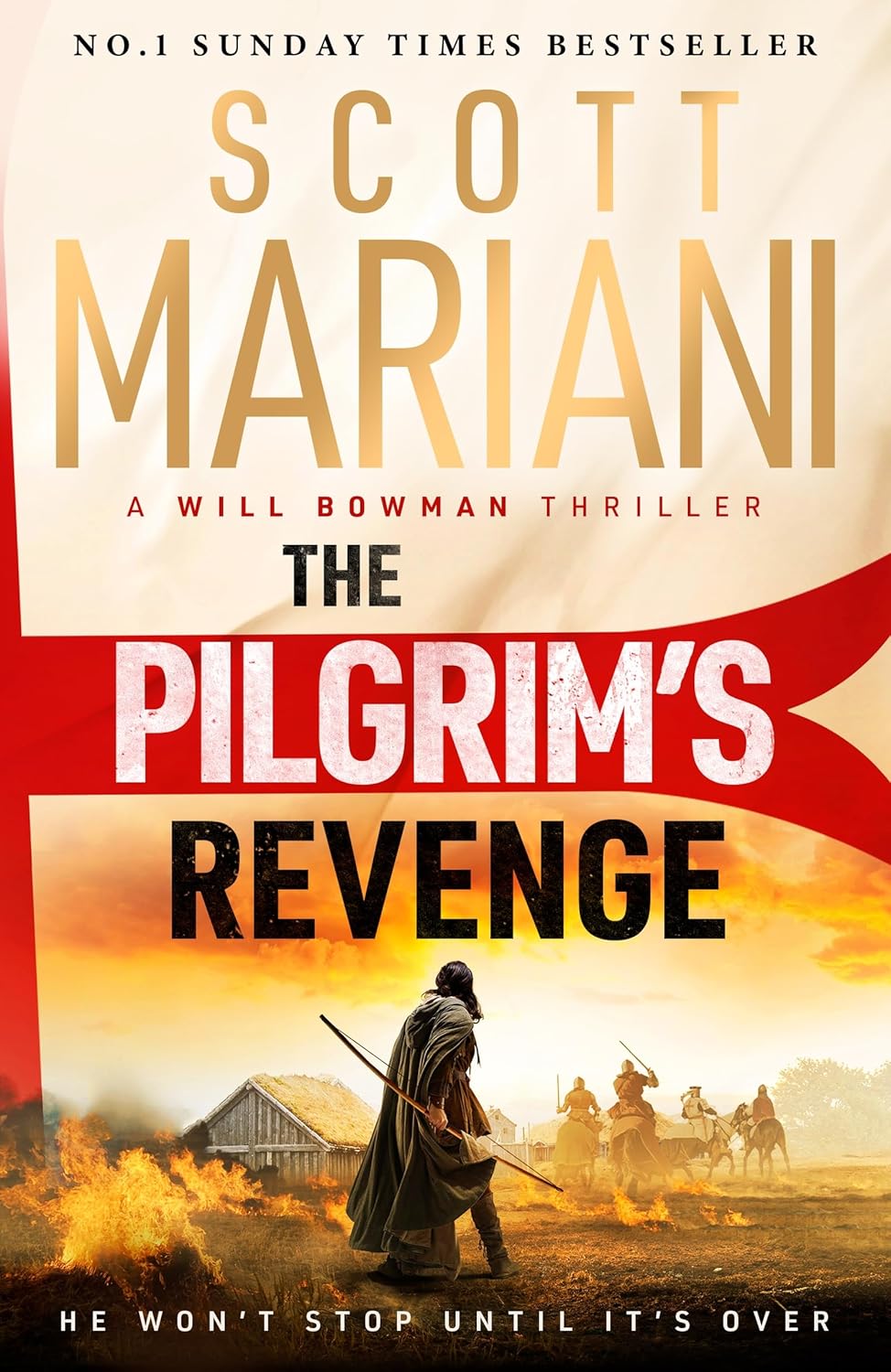
The Pilgrim’s Revenge by Scott Mariani

Publisher: Hodder & Stoughton (Trade Paperback – 26 August 2025)

Series: Will Bowman – Book One

Length: 323 pages

My Rating: 4.5 out of 5 stars

Amazon

Prepare for war in Scott Mariani’s compelling and action-packed historical thriller, The Pilgrim’s Revenge, an awesome read with some real heart to it.

Scott Mariani is a veteran author whose work I have been meaning to check out for a while.  A major thriller author, Mariani is best known for his long-running Ben Hope series which features modern spy fiction narratives with the protagonist unwinding puzzles and conspiracy theories from history.  While I haven’t had the chance to read any of Mariani’s thrillers, his 2025 release, The Pilgrim’s Revenge caught my eye, especially as it is the first time that Mariani has written a full historical fiction novel.  The first book in Mariani’s new Will Bowman series, The Pilgrim’s Revenge was an intense and captivating take on the classic medieval historical fiction adventure, featuring a great revenge twist.

Plot Synopsis:

1190 – Humble layman Will Bowman lives in the countryside with his pregnant wife, when soldiers from Richard Lionheart’s army tear through his home. Will is beaten unconscious, and awakes to find his wife murdered, his farm burnt down, and his life forever changed.

In vengeance, Will infiltrates Richard’s army to find the marauding gang, and finds himself swept along in the march of the Crusades. With the help of new allies and fuelled by his loss, Will crosses Europe with the King’s army.

Can Will avenge his wife? Or will he be swept away by the unstoppable force of Richard’s Crusade?

The Pilgrim’s Revenge was an outstanding and action-packed novel from Mariani, who dives into full historic fiction with great enthusiasm.  Setting the scene quickly, with an introduction to point-of-view protagonist Will Bowman, a minor landowner and skilled hunter, the book soon takes a dark twist when a group of pillaging soldiers kill his pregnant wife, burn his farm and leave Will for dead.  Determined to get revenge, Will takes up his bow and starts following the attackers, determining them to be pilgrims on the way to join Richard the Lionheart’s attack on the Holy Lands.

After a good initial period in England, where Will encounters friendship and additional heartbreak as part of his personal journey, the protagonist soon boards a ship towards the Holy Land.  This middle section of the novel is useful for introducing several great supporting characters and provides some compelling historical context to the events that Will is a part of.  After some exciting sequences at sea, as well as a sudden action-packed siege, the plot takes the protagonist into King Richard’s orbit in Sicily as part of some established historical events.  Mariani also gives Will the first glimpses of his goal, which ends in an exciting and tense series of encounters that add some excellent drama and risk.  Following some surprising developments, Mariani continues to explore the early parts of Richard’s crusade, including his landing in Cyprus, which provides some awesome fight sequences, before setting the protagonist up for the big confrontation of the novel.  While the development of the later part of this story isn’t too surprising, it features some fantastic and exciting moments, and plays into the established historical events really well.  Wrapping up on an excellent, if unexpectedly complete, note, Mariani leaves the story open for more adventures, which we’ll probably see very soon.

I think that the author provided a strong story for The Pilgrim’s Revenge, and this proved to be an excellent piece of historical fiction with a bit of a thriller flair to it.  Loaded with action, intriguing descriptions of the period, as well as some entertaining characters, The Pilgrim’s Revenge was a great historical adventure, which Mariani ensures stands out from the various other novels set in this period thanks to its central character and he’s unique motivations.  I particularly appreciated the author’s use of the third-person perspective through the eyes of protagonist Will Bowman, which really paints a personal and insightful look at the events of the Third Crusade.  Having a simple English farmer, who has relatively little knowledge of the land outside his local community, slowly learn about the lands of the later 12th century as part of his own personal journey, really allowed new readers with less historical knowledge to dive into the events of this book a lot easier.  At the same time, Mariani clearly puts the work in describing the historical elements of the book, whether it’s the details of the crusade, interesting depictions of real-life figures, or even complex depictions of day-to-day life and the social, technological and military element of the time.  Thanks to the exciting, action-packed plot, readers can power through The Pilgrim’s Revenge quickly, but for those who stop to savour the author’s compelling writing, there are some amazing details and compelling character moments to appreciate.

Overall, The Pilgrim’s Revenge was an outstanding and captivating novel, as Scott Mariani sets up an exciting new series.  Featuring an enjoyable, action-laden plot, The Pilgrim’s Revenge was an amazing novel to get through, especially with its compelling depictions of war and life in the 12th century.  A very exciting read, I quickly flew through The Pilgrim’s Revenge and is worth checking out especially if you enjoy intense and detailed historical reads.  I look forward to continuing the Will Bowman series going forward, and I’ve already got a copy of the sequel, The Knight’s Pledge, which I am hoping to read soon.

Amazon

Quick Review – Crusader by Ben Kane

Crusader Cover

Publisher: Orion (Trade Paperback – 27 April 2021)

Series: Lionheart – Book Two

Length: 393 pages

My Rating: 4.5 out of 5 stars

Amazon

Impressive historical fiction author Ben Kane returns with the second entry in his Lionheart series, Crusader, which does an amazing job of continuing the epic story of King Richard the Lionheart.

Synopsis:

KING. POLITICIAN. WARRIOR. CONQUEROR.

1189. Richard the Lionheart’s long-awaited goal comes true as he is crowned King of England. Setting his own kingdom in order, he prepares to embark on a gruelling crusade to reclaim Jerusalem.

With him on every step of the journey is Ferdia, his loyal Irish follower. Together they travel from southern France to Italy, to the kingdom of Sicily and beyond.

Finally poised to sail to the Holy Land, Richard finds a bitter two-year-long siege awaiting him. And with it, the iconic Saracen leader responsible for the loss of Jerusalem, Saladin.

No one can agree who should fill the empty throne of the Kingdom of Jerusalem and Saladin’s huge army shadows Richard’s every move. Conditions are brutal, the temperatures boiling, and on the dusty field of Arsuf, the Lionheart and his soldiers face their ultimate test…

Kane has produced another amazing novel in the Lionheart trilogy.  While Kane is best known for his incredible Roman historical novels, I have been particularly enjoying his compelling foray into medieval fiction with this outstanding series that examines the life of King Richard the Lionheart.  Told through the eyes of fictional character Ferdia, better known as Rufus, the first novel in this series, Lionheart, did a remarkable job of covering some of the most influential younger years of Richard’s life, which cumulated in him seizing the throne.  Crusader continues this epic retelling of Richard’s life by recounting the events that occurred as Richard led his forces on a bloody journey to the Holy Land.

Crusader contains a historically rich narrative that explores one of the most iconic periods of Richard’s life, the crusades.  Kane produces a very detailed story that focuses on the journey to the east as well as the battles in the Holy Land.  This includes the army’s stops in Sicily and Cyprus, where Richard was forced into conflict with other Christian rulers, before eventually arriving in the Holy Land and engaging in his legendary conflict with Saladin.  Kane attempts to cover every major battle of this Crusade, with several sieges, large-scale attacks, skirmishes and the infamous massacre at Acre.  At the same time, Rufus continues his deadly rivalry with the dishonourable knight Robert FitzAldelm, while also secretly engaging in a very risky romance.

This proves to be a very compelling story, and I very much enjoyed seeing this detailed portrayal of this legendary crusade.  Kane does a wonderful job of bringing all the dry historical facts to life throughout Crusader, and I found it fascinating to see his take on the entire journey and eventual battles with Saladin’s forces.  While the story does occasionally get a bit bogged down in medieval politics, royal disputes and petty squabbles, Kane keeps the novel going at decent pace, and the reader is treated to several epic and dangerous fight scenes.  The author can write a deeply impressive and thrilling battle sequence, and the reader is left on the edge of their seats multiple times, especially as the various characters you come to care about find themselves in utter peril.  I also enjoyed the bitter conflict that occurred between the non-fictional Rufus and his rival, FitzAldelm.  While not as prominent as in the first book, this rivalry is still a fantastic part of the book, especially as it adds an intrigue-laden edge to the main story.  While I really enjoyed this great novel, I do think that it suffered a little being the middle novel in the series, primarily because certain overarching conspiracies and plots are put on hold because of the crusade.  I also felt the first half of the novel was a little slow in places, especially when compared to the intense second part of Crusader.  Still, this was a pretty amazing story, and I loved how the author managed to ensure that his tale contained both excitement and fascinating historical fact.

Just like in the first novel in this series, Kane spends considerable time examining the complex historical figure of Richard the Lionheart.  In this book, Richard is portrayed as a multifaceted and intense being with a wide range of emotions and moods.  Most of the story focuses on the classic King Richard, the inspirational and personable figure that the protagonist Rufus eagerly vows to follow.  This includes multiple portrayals of Richard’s prowess in combat, especially in the Holy Land where he leads his troops to many great victories.  The author features several intense battles throughout the book where Richard either lead the charge or proved to be something more than human, such as fighting through a superior forces or chasing off an entire army by himself.  I initially assumed that Kane was taking a bit of artistic licence with some of these outrageous scenes, but it turns out that most were based on real historical accounts.  While I found these epic depictions of Richard to be cool, I also appreciated the way in which Kane tries to show the king’s darker side.  There are multiple scenes that portray Richard in a despondent mood, especially when faced with setbacks or betrayals, and this low mood could often transform into a dangerous anger at a drop of a hat.  This makes for a very complex and contrary portrayal, and I really appreciated the way in which Kane attempted to examine the true mind and thoughts of Richard, as seen by his closest friend.

It was also really interesting to see the continued growth of Rufus throughout Crusader, as he keeps moving away from the helpless Irish hostage he was at the start of the series, and is now a knight and close companion to the King.  Rufus goes through a lot in this novel, and it was fascinating to see how he deals with the horrors and dangers of the war around him.  I found his description and concern about the massacre of Acre to be particularly intense, and it was interesting to see him witness such an event while remaining loyal and dedicated to Richard.  Rufus’s rivalries and loves were a major focus of this novel, and it is clear that Kane is setting up something major with them for the final novel.  It was also intriguing to see the changes occurring with additional fictional character Rhys, Rufus’s squire and close confidant, who has accompanied the protagonist on all his adventures.  Rhys, after killing a vicious knight in the first book, has become a little bloodthirsty, and is constantly seeking to prove himself in combat, much to Rufus’s concern.  I really enjoyed the inclusion of these fictional characters amongst the more historically accurate tale of Richard’s campaigns, and it serves as a great narrative device, while also adding in some additional drama and conflict.  I am very curious about how Rufus and Rhys’s stories will end in the final book, although I am not expecting a happy ending.

Overall, Crusader was a pretty amazing historical novel that presented a detailed and captivating picture of King Richard’s crusades.  Loaded up with some excellent portrayals of historical events and a series of epic battles, Crusader will appeal to a wide range of historical fiction fans, and readers will have an outstanding time digging through Kane’s captivating text.  A clever and intriguing novel, I am very keen to read the final entry in this series next year, especially as we all know how dark the final chapters of King Richard’s story are.

Amazon