
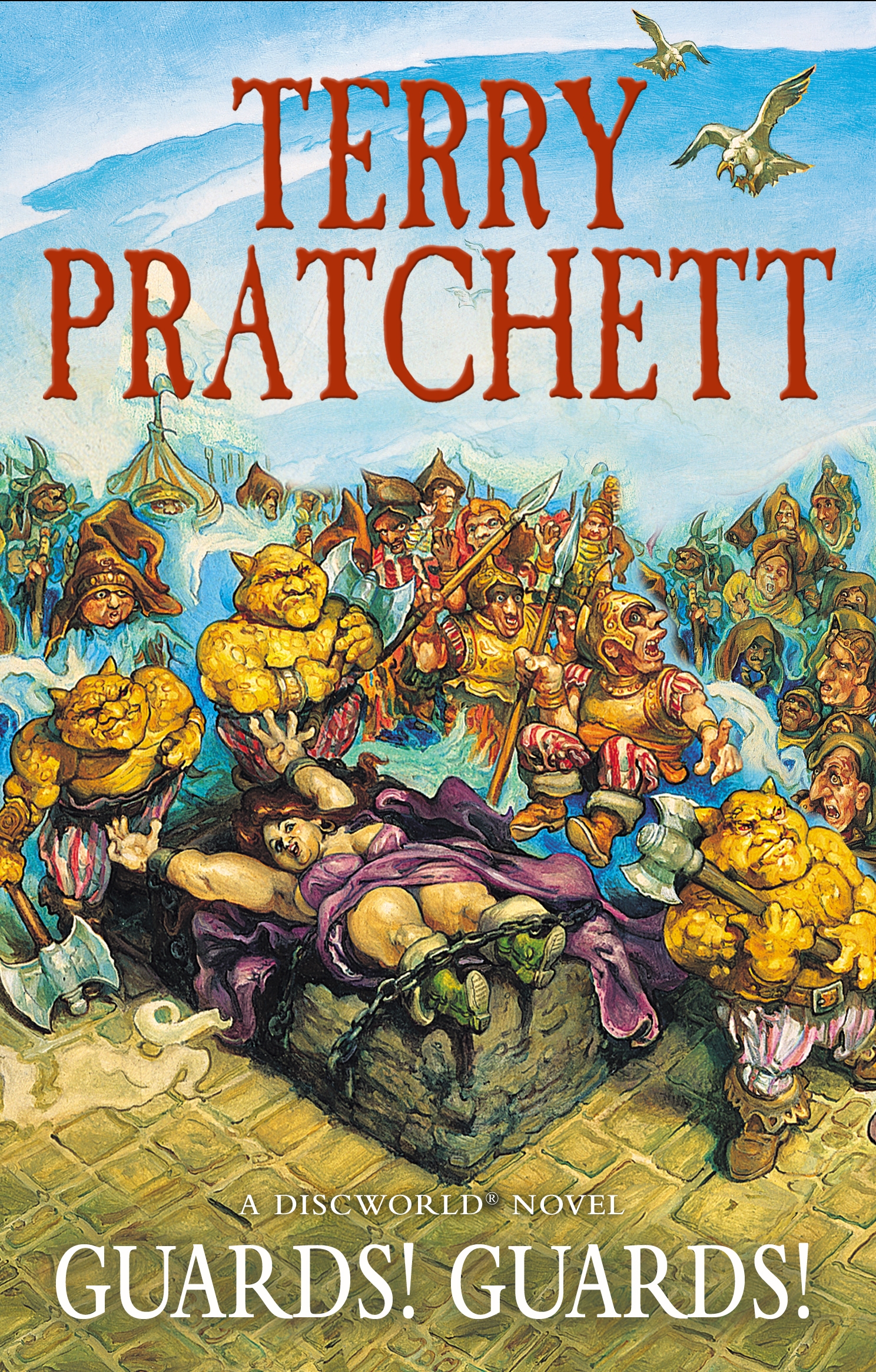
Publisher: Gollancz/Penguin Audio (Audiobook – 1989)
Series: Discworld – Book 8 / City Watch – Book One
Length: 13 hours and 29 minutes
My Rating: 5 out of 5 stars
I recently revisited one of my favourite books in Terry Pratchett’s iconic Discworld series, Guards! Guards!, and I just had to review it to showcase how much fun this series can be.
I have never made any secret of the fact that I love all things Terry Pratchett as the Discworld books were one of the formative series of my youth. A massively popular series set on a flat world carried through space on the back of a giant turtle and four elephants, the Discworld books present a range of unique fantasy adventures, backed with exceptional comedy and satire. This series is so much fun, and I honestly love every single Discworld book, having read them all multiple times, usually while laughing myself silly. Indeed, I am such a big fan of this series that I named my blog after a location in the universe. Despite my overwhelming love for this series, I haven’t reviewed many Discworld books (the exception being Moving Pictures and The Last Continent). That changes with my review of the outrageously funny Guards! Guards! which I recently enjoyed while on a road trip.
Guards! Guards! is a particularly entertaining addition to the Discworld series that I have a lot of love for. Serving as the first book in the City Watch sub-series, Guards! Guards! sees Pratchett blend his typical fantasy and comedy elements with a complex murder mystery. This book follows the ragtag city watch of this world’s main recurring city, Ankh-Morpork, as they try to solve a series of deaths caused by a monstrous murder weapon. Due to its brilliant and hilarious story, as well as the fact that it perfectly sets up the rest of the awesome City Watch books, I generally consider Guards! Guards! to be one of my absolute favourite Discworld novels, and I have featured it in various Top Ten Tuesday lists over the years.
On the fantastical and impossible Discworld no place is more dangerous, corrupt or morally unhealthy as the legendary and stinking city of Ankh-Morpork. The Disc’s largest city, Ankh-Morpork has many terrors haunting its urban depths, where life is cheap and death lurks around every corner. However, not even the hardest criminals, deadliest wizards or most manipulative politicians are prepared for an ancient and malevolent creature that is about to be unleashed upon the city.
A shadowy secret brotherhood has engineered an elaborate plan to seize power in Ankh-Morpork through use of an unlikely weapon, a dragon. Summoning a fully formed fire-breathing dragon to cause terror, the brotherhood hopes to use the resulting carnage to bring in their own puppet to control the city. However, the dragon has its own ideas about what sort of terror it wants to bring down on humanity.
With the rest of the city powerless against the dragon, it falls to the ramshackle Ankh-Morpork Night Watch and its depressed captain, Sam Vimes, to try and stop it. The only problem is the Watch are the biggest joke in the city, incapable of standing up to normal crime, never mind carnage caused by magical dragon. But with an unnaturally keen new recruit guilting them into action, and a terrifying dragon fanatic with a crush on Vimes keeping them in line, the Watch is going to try and save the day, even if no-one wants them to.
Guards! Guards! still reigns supreme as one of my top Discworld novels from the always impressive Terry Pratchett. Featuring a unique plot, loaded with an outstanding mix of mystery, humour and fun fantasy elements, Guards! Guards! brilliantly sets up one of Pratchett’s best sub-series while presenting its own epic and powerful story. An exceptional read from start to finish, this book gets a very easy five-star rating from me, and I love it so damn much.
The plot of Guards! Guards! is so damn clever and is peak Pratchett in its inventiveness and impressive characters. Presenting an entertaining and humourous noir murder investigation in a fantasy series, Guards! Guards! has a lot of moving parts to it, including some impressive character-driven story arcs, all of which come together beautifully for a particularly intense and insane story. Starting off very strong with some great introductions to various key characters, including the young and keen Carrot Ironfoundersson, who journeys to the massive and corrupt city of Ankh-Morpork to join the Night Watch, providing fresh blood, irrepressible honesty and uncontrolled enthusiasm to the small squad of rejects and failures currently staffing it. Carrot’s arrival corresponds with the start of a bold conspiracy, as a secretive mystic brotherhood plots to dethrone the Patrician and take over the city. The initial scenes of this book are extremely good, and I love how Pratchett expertly sets up the entire narrative with some hilarious moments, including the opening sequence with the Elucidated Brethren of the Ebon Night, whose petty ideology shows you just what sort of criminal minds we are truly dealing with.
Things go in a chaotic direction as the Night Watch, led by the drunk and depressed Captain Vimes, witness a direct murder by dragon and begin their own investigation into the matter. Pratchett expertly pivots the story around from its comedic fantasy start into a complex police procedural/noir murder investigation, as the protagonists try to find out why the dragon is terrifying the city and who benefits from the apparent crime. At the same time, several great character arcs emerge, including a truly nice, if unconventional romance, new friendships, and a fun analysis of dragon mythology. There is a great twist about halfway through the book as the down-and-out Night Watch witness an interesting change to the classic dragon fantasy tale that sees a unique king take over the city.
The final third of the book is some of Pratchett’s strongest writing, as Vimes identifies the true culprit and must work to undo the damage they caused. There are some great moments in this last part of the book as Pratchett presents his own unique and hilarious take on classic fantasy tropes, including the famed million-to-one shot, the heroic rescue, and the successful defeat of a dragon. I felt that the identity of the main villain of the story was very clever, and Pratchett sets it up well with subtle clues, although if you know Pratchett’s thoughts on certain government positions it’s not too surprising. Still, the final confrontation between the protagonists and this villain is great, and being literal has never been so deadly. Pratchett leaves Guards! Guards! on a hopeful note, and it’s impossible not to come away with a smile on your face.
Pratchett was really on-point when it came to writing Guards! Guards! and I loved how perfectly it came together. As with all books in the Discworld series, Guards! Guards! features an exceptional mixture of fantasy and humour elements, as the unusual and cynical Discworld produces some unusual situations, layered in with a great plot and some fantastically complex characters. A lot of the humour is derived from classic fantasy scenarios that are taken up to 11 and shown in outrageous manners, accompanied by sarcastic comments from the characters as they witness them. For example, this book serves as an ode to the guards and watchmen from classic fantasy fiction, and there are some funny scenes when these self-aware guards realise how expendable they are in a fantasy story. However, Guards! Guards! also features a brilliant third element as Pratchett also features a compelling crime fiction read, accompanied with an addictive murder mystery.
The blend of fantasy and crime fiction elements works incredibly well, and it is highly entertaining to watch a serious investigation consider magic, suddenly appearing dragons, and the unique background setting of Ankh-Morpork. I also loved how many clever and subtle jokes Pratchett was able to weave in because of these crime fiction inclusions, and he ends up lovingly roasting so many classic tropes from police procedurals and noir detective novels. Despite having read this book many times, I still laugh like crazy at all the humourous moments in Guards! Guards!, especially as you always discover a new joke or pun you previously missed. I honestly don’t have time to list all the funny scenes in Guards! Guards!, but favourites include the various meetings of the petty and mostly incompetent Elucidated Brethren, Carrot’s naïve overreactions upon discovering crime in the city, and various musings on how to achieve a perfect, million-to-one chance. Pratchett once again expertly backs up his humour in Guards! Guards! with a series of entertaining footnotes spread throughout the book, that prove to be nearly as much fun as the main story. These brilliant footnotes contain additional jokes, sarcastic comments, or interesting expansions of the Discworld universe, and they always bounce off the main story perfectly, providing extra laughs and food for thought where necessary. I really cannot emphasise just how well this blend of genres worked with Pratchett’s unique and endearing humour, and it proves impossible not to have an exceptional time while reading this book.
As with most Discworld books, Guards! Guards! works exceedingly well as a standalone novel, and I feel that anyone wanting a laugh could easily jump in and follow the story without any issues. Due to its early position in the shared Discworld universe, you don’t have to know anything about the other entries in the overarching series to jump right in, as Pratchett goes a tad light on some of the more outrageous Discworld elements. As such, I consider Guards! Guards! to be one of the very best entry novels to new Discworld readers. It also proves to be a brilliant first book in one of Pratchett’s best sub-series, and so many key details of the subsequent City Watch books are introduced here. This includes some excellent early looks at the chaotic city of Ankh-Morpork and key recurring characters in the larger universal plot. Ankh-Morpork is a great background setting for Guards! Guards! and it was the first book completely set within the bounds of the city. I loved seeing this crazy city in even more detail, and all the fun elements set up here help to make it an epic setting. As such, this is a great book for any Discworld reader, new or old, and it’s one of my favourites for very good reason.
As with pretty much all of Pratchett’s works, the key things that made Guards! Guards! so impressive were the amazing and unique characters that were featured throughout the plot. Pratchett had a real knack for producing complex, multi-layered figures who can be both comedic and tragic at the same time, and who you couldn’t help but love. Guards! Guards! was a particularly good example of this, as Pratchett featured a range of brilliant and entertaining characters who would go on to be become major recurring figures in the Discworld canon. Indeed, Guards! Guards! is one of the most significant books for new characters, and it is frankly amazing how many exceptional major and iconic figures were introduced here. Each of these characters were so well written, and you have to love both their specific arcs in this book, as well as how they were expanded on in later works.
The most prominent character in Guards! Guards! is Captain Samuel Vimes. A cynical and damaged man whose habit of calling out social inequities has seen him assigned to the joke position as head of the Night Watch, which he deals with by drinking vast amounts of alcohol. A parody of every hard-drinking cop and private eye in classic noir fiction, Vimes starts the book with no prospects and too many dead friends. Given new purpose when the dragon appears in the city, Vimes turns his innate rebellion to a purpose and tries policing and detecting. Pratchett does an exceptional job setting up Vimes here in Guards! Guards!, and it is no wonder he goes on to be one of his top protagonists. Vimes’s depressed investigative method proves quite successful, and it was entertaining to watch Vimes attempt to solve the case while sarcastically calling out his fellow citizens’ base stupidity and selfishness. Pratchett also sets up an impressive redemption arc around Vimes, which comes about through a combination of trusted colleagues, romance, and a renewed determination to uphold the law. While he ends the book still irritated with the world, the road forward to Vimes doing bigger and better things is well established, and you really get drawn into his arc as a result.
Another impressive character is naïve and innocent City Watch recruit, Carrot Ironfoundersson. Due to his complex home situation and a late life revelation that he’s human rather than a dwarf (being six and a half feet tall wasn’t a clue to him), Carrot is sent to Anhk-Morpork with a desire to become a watchman, which he incorrectly believes is a noble calling. Thanks to his literal personality and highly moral upbringing, Carrot proves to be an anathema to the lawless folks of Anhk-Morpork, as he comes to town bringing justice, enforcing obscure laws, and actually arresting thieves: “change your ways”. A brilliant parody of ultra-righteous fantasy kings, Carrot serves as an outstanding comic relief for much of the book, especially when it comes to his wholesome interactions with the exceedingly criminal inhabitants of the city. However, beneath his comedic cover, Carrot is written as a complex figure of change, and his ability to inspire the other characters, either through guilt or determination, leads to some big moments. Pratchett did an amazing job with Carrot in Guards! Guards!, and it was fascinating to see how he evolves from his initial innocent personality, to a more clever, but still determined, character.
Aside from Vimes and Carrot, the other two watch characters are Sergeant Fred Colon and Corporal Nobby Nobbs, both of whom are excellent and solid comedic characters. The stereotypical fat sergeant and dodgy corporal, Pratchett has fun setting them up as unassailable fixtures of the Night Watch as they do the jobs nature intended for them, and I love how they play off each other. While Colon has some hilarious scenes, including his attempt at archery and his various ill-timed run-ins with the dragon, you can tell that Pratchett had a lot more fun writing Nobby. While not all his over-the-top characteristics from the series are shown in Guards! Guards!, Nobby is still a particularly entertaining figure. Between his coarse language, petty criminal mindset, and uncharacteristic foppish behaviours, every scene with Nobby is highly amusing, and I love how Pratchett expanded off clever stereotypes about lifetime corporals to create this wayward figure.
Outside the members of the City Watch, there are a fantastic array of figures who help to make Guards! Guards! a particularly enthralling story. This includes one of the few female characters in the book, Sybil Rankin, a dragon-loving heiress who ends up being Vimes’s unlikely love interest. Deliberately written as the direct opposite of a noir femme-fatale in both personality and appearance, Sybil is a force of nature, using her accumulated nobility to pull the Night Watch, especially Vimes, into her orbit. It proves impossible not to like Sybil as you watch her confidently go after Vimes or try to put the dragon to heel, and she ends up being one of the most complicated female characters that Pratchett wrote (which is saying a lot when you think of some of his other great female characters).
The other major character that I want to separately highlight is the Patrician of Ankh-Morpork, Lord Havelock Vetinari. While he has appeared in previous Discworld novels (notably Sourcery), this is the first book that showcases him as a full character. Generally depicted as a Machiavellian mastermind and one of the few people capable of controlling the chaotic city, Vetinari has some great early scenes. However, it’s not until the second half of the book when you realise just how fantastic a character he is. Deposed by the false king, Vetinari initially appears to be completely powerless in the dungeons, until Vimes is thrown in with him and begins to realise that he is still in control, especially as he’s managed to cultivate a new intelligence network (procured by providing wartime strategy to magical rats), while also getting locked in a dungeon specifically designed to keep him safe. His subsequent scenes tormenting the book’s real antagonist and talking about the nature of humanity with Vimes really cement him as an impressive figure, and the seeds for his many later inclusions as the Disc’s ultimate political mastermind are well sown here.
While I know I’ve been going on a bit about characters (blame Pratchett for being such a good writer), I just need to highlight a few more figures who have a great role in Guards! Guards!. This includes the Librarian, one of Pratchett’s most iconic characters, who proves to be just as much fun outside of a wizard focused book, and it was entertaining seeing him interact with a separate group of friends. You get a great introduction to the character of Cut-My-Own-Throat Dibbler, whose mercantile tendencies are on full display here. The unusual swamp dragon Errol proves to be an unlikely pet, and his arc about finding love and his true form was particularly heartwarming. Finally, I must mention the book’s great antagonist, who fully embraces the mad tendencies that his position demands. While I won’t go into too much detail about who he is, I will say I loved seeing his various internal rants about the world, and the scenes with his incompetent henchmen were so damn funny. All these characters, plus even more hilarious figures, are instrumental to so much of Guards! Guards! brilliant charm and humour, and after being introduced to them here, it’s impossible not to follow them on their full journey.
I have had the pleasure of reading Guards! Guards! in a couple of different formats over the years, but to my mind the best way to enjoy this book, and indeed any Discworld novel, is on audiobook. The Discworld audiobooks are something very special, and I find that the unique stories, excellent humour and elaborate characters really come across when read out by a passionate narrator. With the recent re-release of various Discworld audiobooks, there are now two different unabridged versions of Guards! Guards! fans can enjoy, and I want to highlight them both here.
The first Guards! Guards! audiobook is the original version with the talented Nigel Planer, who narrated 22 of the original 23 Discworld audiobooks. Guards! Guards! is one of his best performances, and it set the scene nicely for many of his subsequent Discworld audiobooks, especially as he settled on a lot of key character voices and tones here. While it has been a little while since I’ve listened to Planer’s version of Guards! Guards!, I have enjoyed it so many times it is permanently engrained in my head (I used to grab the tape cassette version out of my local library all the time). Planer, who does all the voices himself, really captures the essence of Pratchett’s storytelling and excels at expressing the author’s unique humour through his vocal work. I also felt that his portrayal of many of the key characters was second to none, and he really brought to life all the City Watch protagonists, as well as some other long-running figures, in some impressive ways. He would revisit many of these voices in multiple subsequent performances, and it is a testament to his skill that the initial tones he came up with here, worked so well in the later books. I frankly have so much love for Planer’s original take on Guards! Guards!, which definitely still stands the test of time, and his excellent and heartfelt voice work defines many of the City Watch characters for me.
While Nigel Planers original version is perfect, current Discworld fans may be more familiar with the latest audiobook production of Guards! Guards!, which was part of a recent re-recording of all the Discworld books. These new audiobooks each feature a different famous British performer voicing the main plot, while acclaimed actors Peter Serafinowicz and Bill Nighy have key roles in every single production. While these have been out for a little while, I only just listened to my first one . Coming in at a runtime of 13 and a half hours, which is a tad longer than the roughly 10-hour long Planer version, this Guards! Guards! audiobook was extremely fun, and it served as excellent entertainment on a recent road trip.
The new version of the Guards! Guards! audiobook is primarily voiced by British radio and television personality Jon Culshaw. Culshaw is amazing in the role, and I was deeply impressed with his take on the Guards! Guards! characters. Each unique character comes across extremely well in Culshaw’s capable hands, and I enjoyed his take on their unique characteristics and eccentric personalities. He perfectly showcased protagonist Samuel Vimes’s drunken despair and depression, while various other key members of the watch, such as the extremely keen Carrot and the more cautious Colon, are shown extremely well. I also felt that Culshaw did an incredible job with several complicated figures from the story, such as the infamous watchman Nobby Nobbs, who Culshaw gifts a gruff and weaselly voice that sounded a lot like David Bradley or Jon Pertwee. His Lord Vetinari is also amazing, and the deep and threatening tones really capture the character’s dangerous nature. Finally, I felt that his take on the main female character, Sybil Ramkin, was just perfect, and you really got the full blast of her big personality and excessive aristocratic characteristics. Many of the other side characters were also perfectly portrayed to my mind, and I must highlight the excellent way in which he disguised the voice of the main antagonist during some key secret society scenes.
Culshaw’s primary narration is well backed up by Peter Serafinowicz and Bill Nighy in their respective roles. Serafinowicz provides the voice of Death whenever he appears in this audiobook, which works out extremely well even with Death’s relatively minor role in Guards! Guards!. Serafinowicz has an exceptional Death voice, and hearing it suddenly appear throughout Guards! Guards! is so damn epic, especially during one scene where Death is hiding amongst the soon-to-be deceased. Nighy, on the other hand, narrates the various footnotes. Nighy was a perfect choice for this, and his calm, consistent tones, echoing Peter Jones’s similar role in The Hitchhiker’s Guide to the Galaxy radio and TV editions really highlighted the subtle comedy of these footnotes. I felt that all three of these distinctive actors really vibed together in the Guards! Guards! audiobooks, and the switch between them was seamless, allowing for a particularly awesome listen. Throw in an interesting short afterword about fantasy elements by acclaimed author Ben Aaronovitch, and this proved to be a remarkable and compelling audiobook I could not get enough of. While Nigel Planer’s original narration of Guards! Guards! is always going to live in my head rent free, I felt that this new version more than lived up to the hype surrounding it, and I really appreciated the unique and powerful performances these new narrators brought to the table. Frankly both of the audiobook versions comes highly recommended by me, and it is impossible to be dissatisfied by them at all.
Whew, well in case you could guess from this massive review (it got away from me), I love Guards! Guards! and I have some very strong feelings for it. One of Terry Pratchett’s best Discworld novels, Guards! Guards! is the perfect blend of fantasy, crime fiction and humour that you could ever want, and I always get wrapped up in its elaborate story. A wildly entertaining and comedic novel from start to finish, Pratchett added so much heart to this book, and you get drawn into the impressive characters and compelling, crime fiction plot. A brilliant start to the City Watch subseries, Guards! Guards! is so damn good, and I know I will be reading it many more times in my life. I can think of no better way to emphasise just how amazing Guards! Guards! is than to mention that I used it to introduce the Discworld to my wife, who is now powering through the series on her own. So do yourself a favour and check this book out now!
 The Unseen Library