
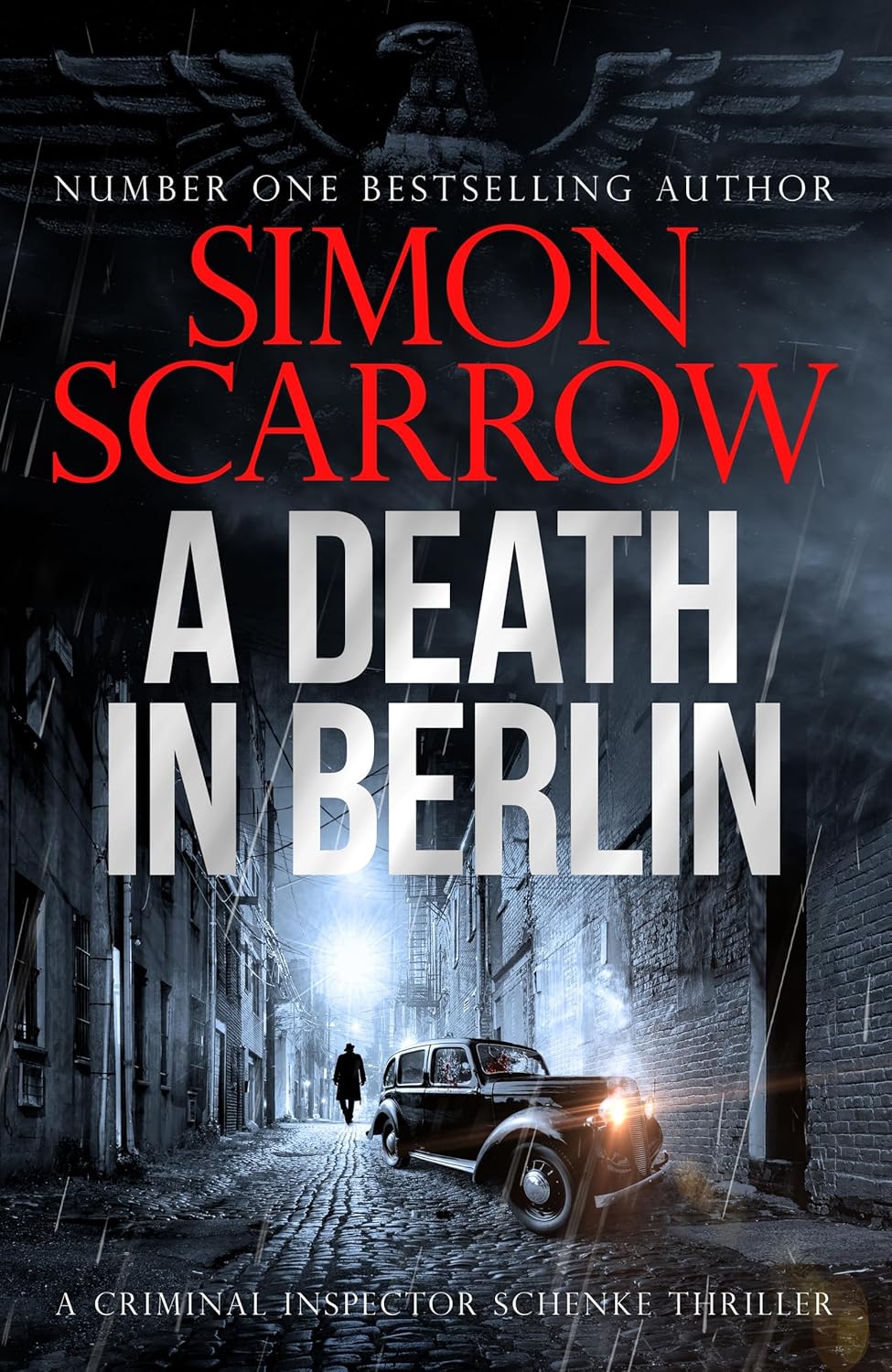
A Death in Berlin by Simon Scarrow

Publisher: Headline (Trade Paperback – 11 March 2025)

Series: Berlin Wartime/Criminal Inspector Schenke Thriller – Book Three

Length: 385 pages

My Rating: 4.5 out of 5 stars

Amazon

One of the world’s leading historical fiction authors returns with another intriguing and captivating historical murder mystery with the outstanding read, A Death in Berlin.

I have made no bones about the fact that I am a major fan of historical fiction author Simon Scarrow, who has been diving into awesome scenarios from history for over 20 years.  While I probably know him best from his outstanding Eagles of the Empire Roman historical fiction series (see my review for the latest entry, Revenge of Rome), Scarrow has also written some other amazing series, including his current ongoing Berlin Wartime Thriller novels.  Set in Berlin towards the start of World War II, the series follows a studious and troubled police detective as he attempts to uphold justice in a city overrun with murderous Nazis.  The first two books in this series, Blackout and Dead of Night, were both very impressive, and I have been eagerly awaiting this third novel in the series, A Death in Berlin, for some time.

Berlin, May 1940.  As the German army prepares for its invasion of France and Western Europe, crime still roams the street of Berlin, and it falls to CI Horst Schenke and his investigative Kripo to keep order and maintain justice, a job made markedly harder by the dark policies of their Nazi overloads.  Despite his own dislike of the Nazi regime, which grows increasingly suspicious of him, Schenke is determined to do his job, especially when it comes to the criminals controlling the streets.

Assigned to find the source of forged ration coupons that are disrupting the war effort, Schenke and his team find themselves investigating a growing gang war when a prominent black-market operator is gunned down in the dead of night.  Convinced that the gangster’s murder is related to the forged coupons, Schenke leads the Kripo into investigating the criminal underworld that lies beneath Berlin.

However, this is no ordinary gang crime.  A dark series of events have led to the death of their victim, and the Kripo investigators soon uncover a dangerous conspiracy to profit from the war.  Worse, the gangster they are chasing are protected by powerful Nazi leaders, and Schenke must continue to walk a fine line in avoiding their attention.  But when his enemies uncover his deepest secret, can Schenke survive with his honour intact, or will he need to make a dark deal to get what he wants?

A Death in Berlin was another excellent novel from Scarrow, who cleverly combines exciting crime fiction elements with a compelling historical setting.  Clever, action-packed, and constantly moving, A Death in Berlin was an outstanding read, and I think this might be his best Berlin Wartime Thriller novel yet.

I really liked the cool story that Scarrow came up with for A Death in Berlin, especially as this latest novel features a complex narrative revolving around Berlin gangsters and crime wars.  Starting off fast and getting into the heart of the case, readers soon become invested in finding out who was behind the killing of the gang leader and what impact it is having on the larger criminal underworld of Berlin in the leadup to the invasion of France.  Thanks to an excellent early shootout, the stakes of the book become even higher, as the protagonist finds himself in the middle of a gang war, which he is forced to navigate to solve the main mystery of the book.  Scarrow also continues to focus on the complex life of protagonist CI Horst Schenke, who constantly finds himself coming to the attention of his Nazi superiors, despite his dislike of the party and his secret romance with Ruth, a Jewish woman hiding out in Berlin.

Following this great initial setup, Scarrow takes the plot of A Death in Berlin in some outstanding directions, especially as there is quite a compelling mystery here, with multiple potential suspects and motivations for the murder, many of which lead to other alternate crimes investing the Nazi controlled city.  Scarrow cleverly reveals the involved parties at key parts of the book, and while there aren’t too many surprises, it was very interesting to see how everything tied together.  The final third of the book is probably the best, as the protagonist finds himself trapped by his own secrets and is forced to make compromises to keep those important to him safe.  This leads to a massive and intense final confrontation, as the protagonist risks everything with some unlikely allies in a brilliant, action-packed set piece.  The final revelations revealed during this climax brought the entire story together nicely, and I really appreciated how the tight and complex mystery was resolved.  This was an overall fun and exciting narrative, and one that is quite easy to power through quickly, especially once you get caught up in the mystery.

Scarrow did an outstanding job pulling together A Death in Berlin, as the novel was a compelling and exciting read with a lot of awesome elements behind it.  The author successfully blends an excellent murder mystery storyline around the intriguing historical elements of his series, showcasing the potential hurdles a police detective needed to face during the Nazi regime.  At the same time, there is a fantastic emotional heart to A Death of Berlin, as the protagonist continues his ill-advised romance with Ruth, while also being forced to once again confront the dark side of the government he is wilfully working for.  I felt that Scarrow perfectly balanced these elements throughout A Death in Berlin, and there is a little something for everyone here, including a ton of amazing action and firefights, as the protagonist attempts to bring down a dangerous collection of emboldened criminal gangs.  As such, this is a very easy book to get into and follow, and while there are some references to the previous Berlin Wartime Thriller novels, for the most part A Death in Berlin acts as an accessible standalone novel, which allows for a wider audience.

For me, one of the more intriguing elements of A Death in Berlin was the author’s excellent examination of life in Berlin during the early days of World War II.  Scarrow has always done an amazing job showcasing the uncertainty, fear and underlying issues of Berlin in the early days of the war in this series, and I enjoyed how he further outlined the tension involved with the pre-invasion of France.  The overarching fear that certain members of the public have with the Nazi regime is still a key part of the plot, and while the protagonist isn’t as directly targeted by the Nazis as he was in previous books, he still has to play by their twisted rules, especially when invited to a party of the Nazi elite, where he meets some very high-level members.  However, it was the focus on the criminal element infesting Berlin during these years that I found to be particularly fascinating, as Scarrow explores the potential scams, nightspots and other enterprises that would have been run in early wartime.  While coupon forgeries have been mentioned in previous novels, it was fascinating to see the entire novel focussed on the control of this valuable wartime currency, and it resulted in some truly compelling scenes.  Despite this being a more crime-fiction novel than a book examining hidden Nazi plots or killers, the influence of the Nazi government still plays a big role in the murder investigation elements of the book, especially as the protagonist and his colleagues must worry about high-level party members protecting the criminals.  These elements proved to be an outstanding part of the book, and I really appreciated how well Scarrow worked it into the main plot of the book.

As with the rest of the series, Scarrow does some excellent character work in A Death in Berlin, bringing together a complex cast of characters to work the case, each of whom are dealing with their own issues associated with Nazi-controlled Germany.  The most prominent of these is the protagonist and main point-of-view character, CI Horst Schenke, a former race car driver turned police investigator.  While generally shown to be a studious and steadfast lawman, Schenke’s life has become even more complicated due to his growing dislike of the Nazis and his refusal to join the party, much to the displeasure of his superiors.  It is fascinating to see the seemingly strait-laced Schenke walking the line between doing the right thing and surviving the Nazis, especially as he has fallen in love with the fiery Ruth, a Jewish woman who has managed to stay hidden in Berlin after the first purges.  Many of Schenke’s more radical actions in this book are driven by his complicated relationship with Ruth, and you really grow attached to both characters, especially when their secret relationship causes great risk for them. 

Other great characters A Death in Berlin include Schenke’s main police backup, Sergeant Hauser and former Gestapo agent Liebwitz.  These two prove to be an excellent double act behind Schenke, as not only do the three form an effective crime fighting force, but they also showcase alternate viewpoints of Germany during this period.  Hauser is a former World War I soldier and family man, who is the classic everyman figure who supports the Nazi regime.  Despite this, he merely wants to support his country and has some doubts about the more extreme actions of Hitler.  Liebwitz is a more unusual figure, who honestly steals the show in some ways.  An exceedingly logical figure who has gravitated away from the Gestapo to be a police investigator, Liebwitz finds his life still bound by his Nazi training, despite the many flaws he sees in it, and he is well used as a compelling alternative point-of-view character.  However, as with the previous book, the influence of Schenke and the investigation of crimes that show the true evils of the Nazis are slowly changing Liebwitz’s way of thinking, and it will be fascinating to see where Scarrow takes his character arc in the future.  Throw in a series of entertaining and over-the-top Berlin criminals and the cast of A Death in Berlin is quite entertaining, and I really enjoyed how their complicated arcs impacted the overall narrative.

Simon Scarrow continues his outstanding Berlin Wartime Thriller series in a massive way with the captivating and impressive novel, A Death in Berlin.  Combining a great crime fiction narrative with a clever historical background setting, A Death of Berlin proved quite addictive, and I had an incredible time getting through it.
Amazon

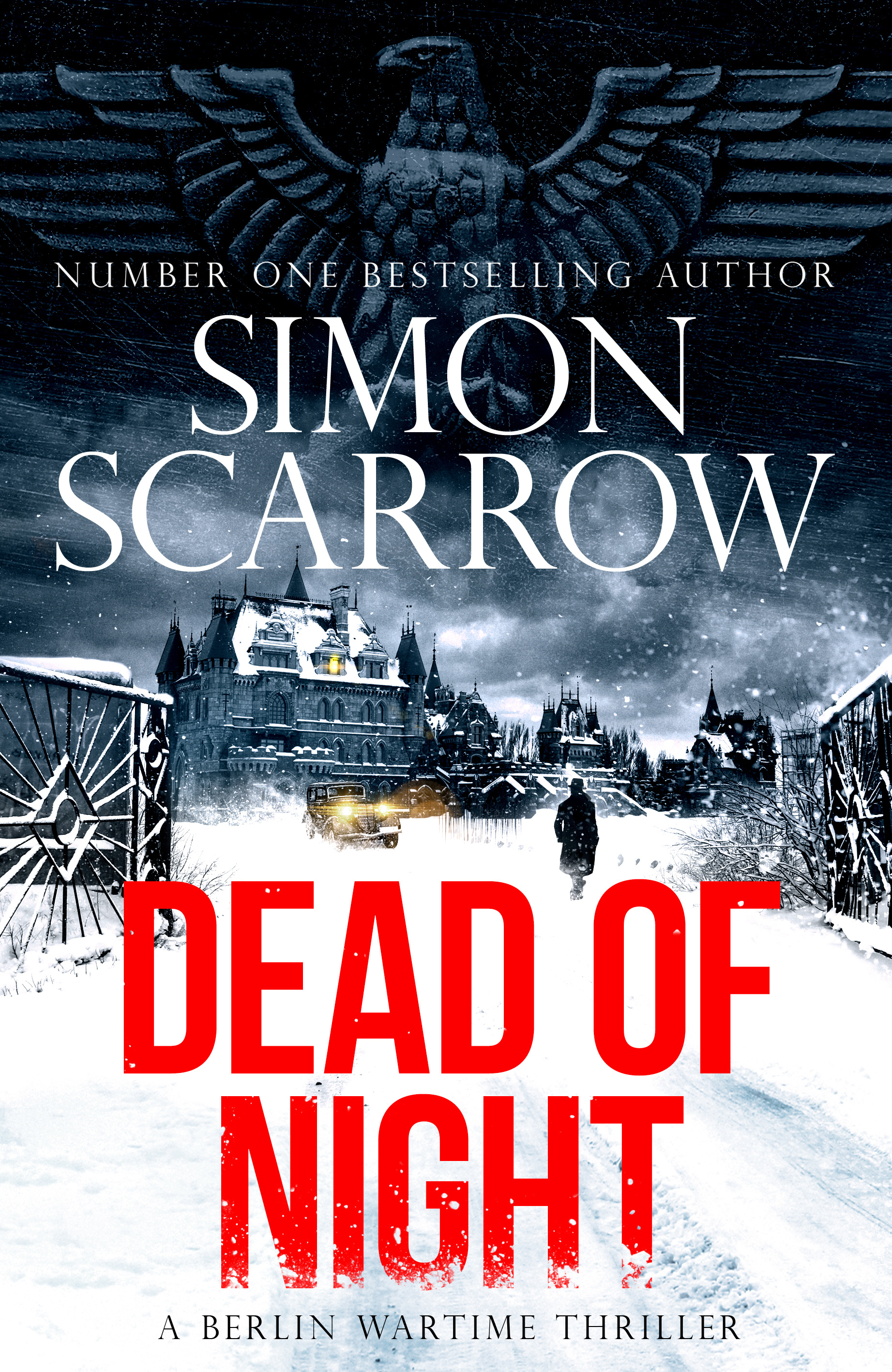
Dead of Night by Simon Scarrow

Dead of Night Cover

Publisher: Headline (Trade Paperback – 14 February 2023)

Series: Berlin Wartime Thriller – Book Two

Length: 422 pages

My Rating: 4.75 out of 5 stars

Amazon

One of my favourite historical fiction authors, the always impressive Simon Scarrow, dives back into turbulent World War II Germany with his latest compelling read, Dead of Night, an excellent and intense historical thriller with a dark twist to it.

Readers of this blog will know that I have long been a fan of Simon Scarrow ever since I read his first exceptional novel many years ago.  I particularly enjoy his long-running Eagles of the Empire series, an outstanding adventure series that follows two Roman officers as they travel throughout the empire.  The Eagles of the Empire books are some of the best historical fiction I have ever read, and I have had the pleasure of reviewing several of them, including The Blood of Rome, Traitors of Rome, The Emperor’s Exile, The Honour of Rome and Death to the Emperor.  Aside from his Roman novels, Scarrow has also written several other series and standalone books set in various periods of history.  This includes his 2021 release, Blackout, a gritty and complex murder mystery set in Nazi-controlled Berlin.  Blackout was an awesome book, and I was very happy to hear that Scarrow was producing a sequel, Dead of Night, which turned out to be another outstanding read.

Berlin, January 1940.  As Germany’s invasion of Poland rolls along, the Nazis continue to take complete control of their own country.  While the people of Berlin wait to see how the Allies will retaliate, a mysterious death is about to occur with massive ramifications.  A prominent SS doctor and his wife return home, having had a seemingly normal night attending a concert with the Nazi elite of the city.  However, by the morning, the doctor will be dead in his study, the result of an apparent suicide.

After his last near-fatal brush with the Nazi state, Criminal Inspector Horst Schenke of the Berlin Kripo is determined to simply do his job and stay off the party’s radar.  However, when Ruth Frankel, the Jewish woman whose life he saved during his previous investigation, reappears, Horst is once again dragged into unwanted trouble.  The dead SS doctor is an old friend of Ruth’s family, and Ruth has promised his widow that she would help find out the truth behind his death, and Horst is her tool to do so.

Reluctantly agreeing to help, Horst looks into the case and quickly realises that the doctor’s death was no suicide.  However, his superiors soon pull him off the investigation and forbid him from digging any further.  But with his curiosity peaked, Horst cannot turn away, especially when he manages to connect the victim to the mysterious deaths of several children throughout Germany.  Determined to find the truth no matter what, Horst soon discovers a terrible secret that places him in the firing line of the entire Nazi party and other volatile factions in the city.  Can Horst survive this new case, or will the regime he despises finally take him off the board?

This was an excellent read from Scarrow, who has been on a real roll lately with his awesome books.  Dead of Night not only served as an incredible sequel to Blackout, but it also features an intense and historically powerful narrative that had me hooked from the very beginning.

Dead of Night follows several of the same characters from the first book, primarily Criminal Inspector Horst Schenke, who serves as the main protagonist and point of view character, in another intriguing and complex case.  Schenke must again work with Ruth Frankel to investigate the apparent suicide of a prominent SS doctor, which produces an intriguing and compelling early investigation storyline that I really enjoyed.  However, Schenke soon runs into political problems, as well as threats of violence, which force him to conduct a subtle investigation.  At the same time, Schenke’s socially crusading love interest, Karin, requests that he look into the mysterious deaths of several children at a remote medical institute.  This second investigation takes up a good chunk of the novel and the protagonists dive into really starts to enhance the intensity of the plot.  This is because Scarrow starts to utilise particularly sinister elements of Nazi history in the plot, which ensures that the novel gets fairly dark in tone and content.  Scarrow is very subtle in how he brings these elements to the character’s attention, and there is a lot of emotion and disgust that emerges in the story as the protagonists realise what is going on.

From there the two divergent investigations start to come together as subtle clues that the author introduced in the first half of the book are brought to light again.  The revelation of how the two cases are connected is pretty captivating, especially as it gives the ‘antagonists’ of the novel a very compelling and relatable motivation.  The protagonist is forced to make some hard decisions as they come to terms with just what is going on and this leads to some great scenes about the differences between duty and what is right.  Everything leads up to an emotionally charged confrontation which cleverly brings the entire story together and wraps up all the remaining mysteries and character arcs.  This final major sequence is pretty damn awesome and it results in some of the most dramatic and powerful moments in the entire novel.  I really liked how the entire novel came together at the end, especially as the protagonist is left in several unenviable positions while he watches his country descend further into darkness.  I felt that the entire novel was very well paced out, and it doesn’t take long for the readers to get hooked on the story, especially with the two quality mysteries that Scarrow came up with.  The blend of mystery, dark historical moments, and intriguing character interactions is pretty perfect, and it works to create a memorable and haunting tale.  Combined with some of the great twists, many of which are based around evil parts of real-life history, and I felt that Dead of Night surpassed is predecessor in some very awesome ways

For me, the best thing about Dead of Night was the fantastic and distinctive wartime setting that surrounded the plot.  Stories set in Nazi controlled Germany are always intense and dark for obvious reasons, but I felt that Scarrow did a particularly outstanding job of capturing it, especially as he pairs the dark mood with a gritty winter backdrop.  Just like with Blackout, there is a focus on the evils of the Nazi regime in Dead of Night, and quite a lot of the plot is devoted to seeing how normal citizens, including non-political police officers, view what their city and country has turned into.  There is a good focus on the fear and control that the Nazis blanket the city with, and the investigation angles of the narrative become even more complex and compelling due to the protagonist being constantly blocked by his Nazi and SS superiors.  However, the best, or worst, historical elements of the book revolve around one of the cases that Inspector Schenke is dragged into, specifically around the death of several children.  This case thrusts the protagonist right into the heart of some of the darkest things the Nazis ever did to their own people, which really gives this entire book a powerfully tragic edge.  Scarrow uses this historical inclusion to his full advantage, as not only does it provide an excellent motivation for some of the crimes being committed, but it also increases the emotional conflict of the protagonist.  Scarrow really does not hold back when it comes to showcasing these historical horrors and the readers get a full idea of what is going on and the sort of people behind it.  This dark historical inclusion really helped to turn Dead of Night’s narrative into something particularly distinctive and captivating, and I felt that Scarrow did a fantastic job of drawing the reader in by giving them knowledge of this terrible moment from history.

I also need to highlight some of the excellent characters featured within Dead of Night, several of whom carry on from the previous novel in the series.  Most of the focus is around Inspector Horst Schenke, one of the few senior police officers left in Berlin without a connection to the Nazi Party.  Dedicated to the law, Schenke, a man already traumatised by his past, keeps finding it harder and harder to do his job in the new regime.  Despite his best efforts, Schenke keeps getting dragged into the middle of the several Nazi plots and hidden schemes, which constantly place him in political danger.  I loved the deep conflict that this builds within him as he is forced to choose between ignoring what he discovers, or trying to get justice and doing something.  Further complicating matters are his relationships with the two women in his life, his girlfriend, Karin, and the Jewish women he previously saved, Ruth Frankel.  Both keep pushing him to do more to oppose the Nazis or get to the truth of crimes they are covering up, and he is forced to balance his desires to help them with his sense of pragmatism while trying to protect them from the Nazis.

Other great characters in this book include Schenke’s police backup, Sergeant Hauser and former Gestapo agent Liebwitz.  These two are great supporting characters and they provide interesting counterviews to German life, with Hauser being a more everyman figure, while Liebwitz is bound up by his Gestapo training.  Despite the apparent differences between Hauser and Liebwitz, the two work together well and serve as good support to Schenke, and I liked the fun odd-couple team that they formed.  They also have some intriguing moments throughout the book, especially when they encounter some of the horrors of the Nazi regime.  While Hauser has some great emotional reactions, especially when it comes to the death of children, Liebwitz has the more intriguing responses, as he balances his loyalty to the state with his own past experiences and conscious.  Watching him come to terms with some of the evils he witnesses makes for some powerful reading and I am glad that Scarrow added in these intriguing alternate characters.  I also really enjoyed the complex main antagonists of the story, as they had quite a powerful motivation for some of the crimes committed in the book.  While they are not as noble as they believe, the antagonist’s goal still serves to trouble the protagonist’s sense of justice, and interesting compromises have to be made as a result.  I deeply appreciated some of the deep characters that Scarrow featured in this novel and I look forward to seeing how they are utilised in any future books in the series.

Simon Scarrow continues to impress me as one of the best historical fiction authors out there with this incredible new read.  Dead of Night has a brilliant and powerful story behind it that takes full advantage of its bleak and historically rich setting.  Featuring an outstanding investigation narrative and some dark insights into the horrors of the Nazi regime, Dead of Night will easily grab your attention and ensure you will not forget it anytime soon.  A highly recommended novel from one of my favourite authors.

Amazon