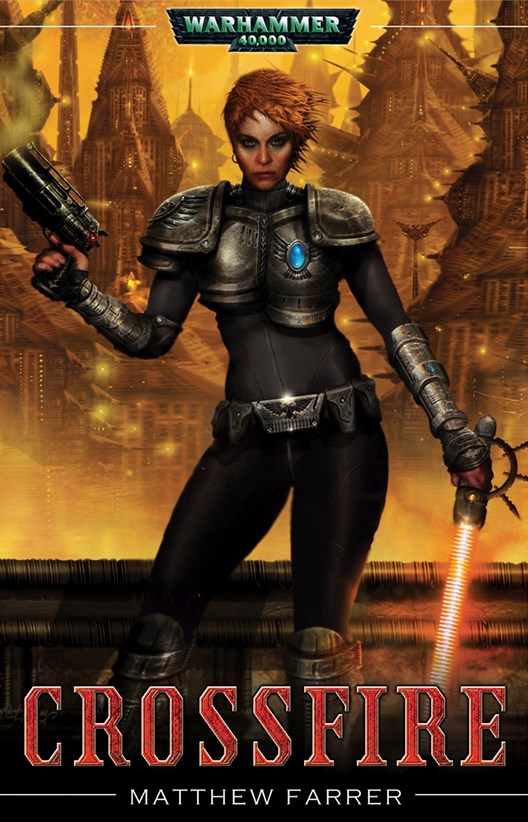
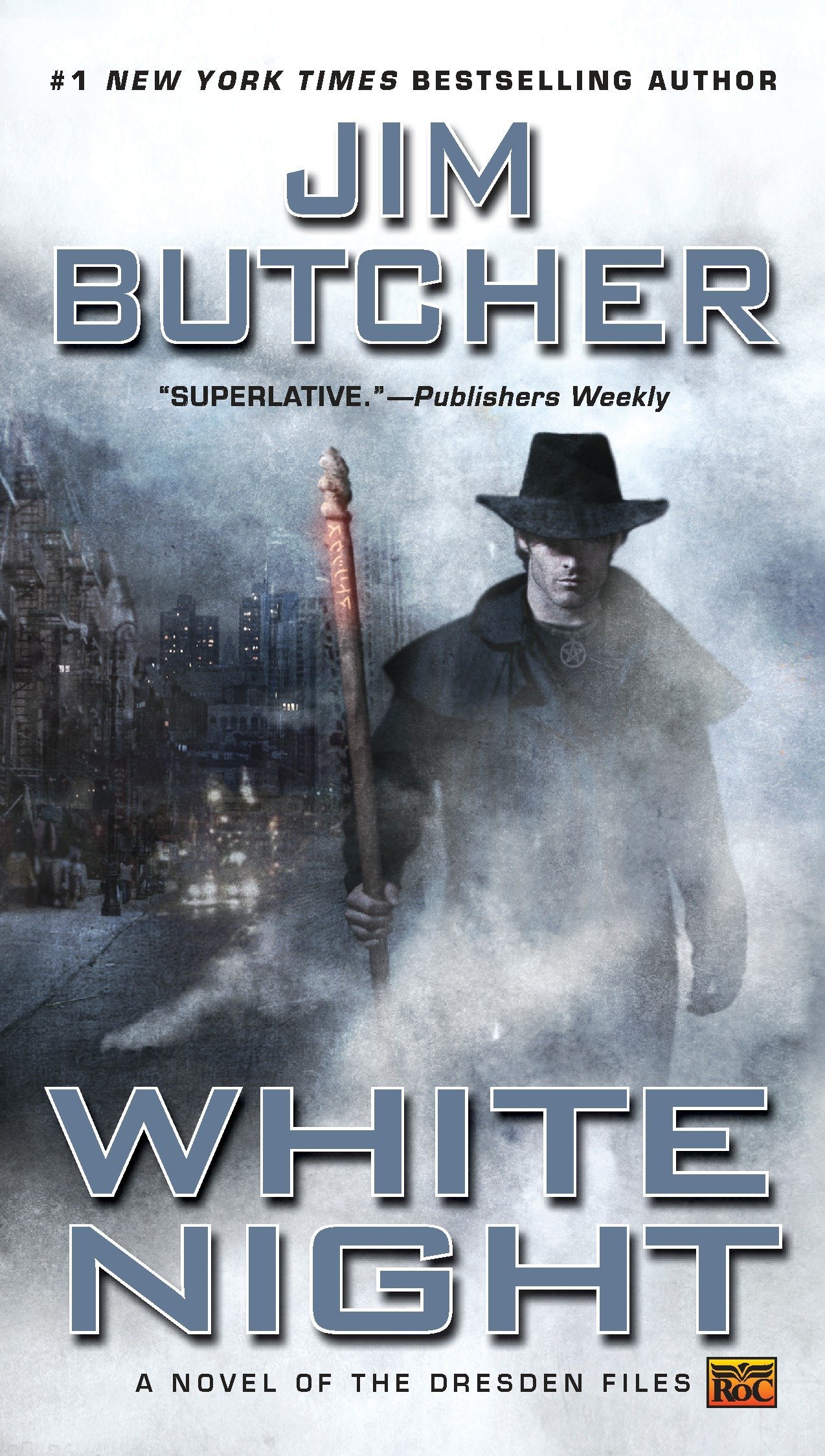
Warhammer 40,000: Crossfire by Matthew Farrer

Publisher: Black Library (Paperback – 1 January 2003)

Series: Warhammer 40,000: Shira Calpurnia – Book One

Length: 320 pages

My Rating: 4.25 out of 5 stars

Amazon

I finally got around to reading the awesome Warhammer 40,000 novel, Crossfire.  A classic entry in the Warhammer 40,000 canon with a cool crime fiction twist, Crossfire was a great novel that serves as an excellent first entry in Farrer’s Shira Calpurnia trilogy.

In the grim future of the 41st millennium, order and control of the massive Imperium of Man is maintained through the strictest interpretation of Imperial law, with no room for variation or leniency.  The ultimate arbitrators of this law are the dedicated members of the Adeptus Arbites, elite law bringers, trained to weed out corruption, dissent and disloyalty wherever they are deployed.

Shira Calpurnia Lucina, recently promoted arbitor senioris of the Adeptus Arbites, has been assigned to the bustling dockyards of the Hydraphur system.  A glistening gem of Imperial rule dedicated to providing material to the navy, Hydraphur is a seemingly unlikely place for dissention.  But this elite planet harbours dark secrets which come to the surface after a deadly assassination attempt is made in public against Calpurnia amid the distraction and celebration of a major religious festival.

Attempting to uncover who would want her killed after only just arriving on world, Calpurnia begins her relentless investigation.  However, this is no simple case, and soon Calpurnia finds herself forced to navigate the many plots and schemes of the Hydraphur elite.  With more attacks striking close to her and the fate of the whole planet seemingly in the balance, Calpurnia must uncover all Hydraphur’s secrets before the assassins stalking her finally succeed.

Crossfire was an excellent and compelling Warhammer 40,000 novel from Farrer that proved very fun to get through.  Featuring a fantastic plot that is one of the earlier examples of a crime fiction narrative melding with the iconic Warhammer 40,000 universe, Crossfire was a great read and one that is worth checking out.

I liked the captivating story that Farrer came up with for Crossfire, which quickly gets the reader’s attention with a powerful introduction to the protagonist, as she quickly finds herself under fire from a lethal assassin.  Serving as a good start to the main investigation arc, the plot follows the protagonist as she attempts to uncover the identity of the assassin, while also learning more about the planet of Hydraphur.  While a very lore-heavy story, Farrer keeps the plot going quickly and effectively, especially as there are soon more apparent attacks against the protagonist, each of which give her more clues to follow to try and find the mastermind of the plot against her.  At the same time the protagonist gets bogged down in dealing with various other interested parties on Hydraphur, including the planet’s local elites, agents of the Imperial church, the Adeptus Mechanicus and the Inquisition, each of whom have their own interests in finding out who is trying to kill Calpurnia.

While Farrer keeps up a good pace for Crossfire as the plot continues, I do think that he might have overloaded the narrative with details about Hydraphur’s society, as well as the various plots that infest it.  While these serve as good red herring motives for the protagonist to follow, it did overcomplicate the plot at times, which slowed things down even amid some great action sequences.  Despite this, the overall narrative for Crossfire was quite strong, and you get hooked into the continued investigation, especially as the author kept raising the stakes of the case.  After some exciting scenes, everything leads up to the big final confrontation, as the protagonist fully unwinds all the conflicting conspiracies they’ve been forced to encounter.  The conclusion was a sufficiently intense and over-the-top fight, which you need in Warhammer 40,000 fiction, and I liked the clever way the protagonist was able to turn the tables on the antagonist, even if the set-up for it was a little heavy handed.  An overall excellent Warhammer 40,000 plot that nicely tells its own story, while also introducing the character for the larger trilogy.

I’ve previously had a lot of fun with previous Warhammer 40,000 novels that utilise strong crime fiction elements in their story telling, such as Bloodlines by Chris Wraight and Grim Repast by Marc Collins, as there are some outstanding crime narratives in this grimdark universe. Crossfire is an interesting early example of this utilisation of crime fiction in Warhammer 40,000 fiction, and I felt that Farrer did a pretty good job of building a compelling investigation around this fantastic setting.  The resulting story is a layered and intense read that sees the protagonist slowly unwind the case amid various battle sequences and other dark distractions.  The relevant clues, hints and misleading details are well scattered throughout the plot, and I felt there was a good amount of foreshadowing to some of the key plot reveals.  While some story elements and conspiracies came a little out of nowhere, for the most part this was a concise and ordered novel, well told through the perspective of the protagonist.  Farrer excelled at fitting a ton of interesting and heavy lore elements in the plot, and I particularly appreciated how well he utilised his setting throughout the story.  The various plots and schemes of planet’s noble families and prominent organisations, as well as the elaborate religious festival the novel is set around (ceremonial details of which are cleverly included at the start of each chapter), are expertly worked into the larger plot, and it was fascinating to see how they impacted the story and drove the investigation.

One of the more entertaining elements of Crossfire I enjoyed was the narrative’s compelling characters.  The focus is primarily around series protagonist Shira Calpurnia Lucina, the arbitor senioris through whose eyes we see the story unfold.  Calpurnia serves as an interesting central figure, especially as she provides an outsider perspective to the complex setting.  While Farrer writes Calpurnia as a somewhat bullish and highly determined figure that is initially hard to appreciate, I felt that this was an intentional choice by the author, which reflects the typical attitudes of the Arbites in the general Warhammer 40,000 setting.  Forcing her to deal with the more subtle techniques needed for the politically delicate Hydraphur brought in some interesting conflict for Calpurnia, as well as producing some interesting character growth.  Despite this, the outsider status of Calpurnia continues to be a compelling plot feature throughout Crossfire, which Farrer utilised extremely well with his writing.  The rest of the cast, while less prominent, adds some complexity to the plot, and I enjoyed the compelling array of fellow Arbites members, the gentry of Hydraphur, and other prominent figures in the planet’s hierarchy.  I particularly enjoyed the motivations of the book’s eventual antagonist, which had a great hint of madness behind it, and this was an overall excellent group of characters.

While I really enjoyed Crossfire’s compelling story, I must admit that this wasn’t the easiest Warhammer 40,000 novel to read.  The plot details of Crossfire are very dense, and it takes a lot of effort to absorb and follow the story.  I felt this was especially noticeable in the small-print paperback version I had, and you really had to focus to take everything in.  As a result, this one probably wouldn’t be a recommended starting point for a new Warhammer reader.  Farrer utilises a lot of intricate details about the Warhammer 40,000 universe that even people casually familiar with the franchise are going to struggle to follow at times.  While most new readers can probably follow along well enough through context, I would suggest it’s best enjoyed by veteran fans who will probably have a lot more fun with it.

Overall, Crossfire by Matthew Farrer was an awesome Warhammer 40,000 novel, and one that I was glad I finally got the opportunity to read.  A compelling crime fiction novel that makes great use of Farrer’s complex setting, Crossfire proved to be an exciting and interesting read.  While not the easiest novel to get through at times, Crossfire proved to be an excellent piece of Warhammer fiction and I’m hoping to get through the rest of the Shira Calpurnia trilogy soon.

Amazon

The Raven Scholar by Antonia Hodgson

Publisher: Hodderscape (Trade Paperback – 29 April 2025)

Series: The Eternal Path – Book One

Length: 646 pages

My Rating: 5 out of 5 stars

Amazon

Intriguing author Antonia Hodgson presents one of the best fantasy debuts of 2025 with The Raven Scholar, a powerful and complex novel that hooks you early and refuses to let go all the way to its shocking end.

Earlier this year I was lucky enough to receive a copy of The Raven Scholar, a massive fantasy novel with a very interesting plot idea behind it that will set up the new Eternal Path trilogy.  I had really enjoyed Hodgson’s debut novel, the historical thriller The Devil in the Marshalsea, many years ago, and I really got caught up in The Raven Scholar’s complex and brilliant story.

In the empire of Orrun, a new emperor is crowned every 24 years, with a replacement chosen from acolytes of the eight animal guardians whose blessings have warded and kept the empire in check for generations.  However, the current emperor, Bersun the Brusque, has not had a peaceful reign, marred by an attempted assassination and the subsequent execution of his attacker’s daughter.  His replacement offers a chance at a new era for Orrun, but the sins of the past continue to haunt all involved.

As the next Trials to determine the next emperor begin, seven skilled and revered young challengers emerge for the crown, and it falls to Neema Kraa, the emperor’s brilliant, if unsocial, High Scholar to organise much of the proceedings.  However, the Trials are thrown into chaos when the Raven contender is brutally murdered, and all the evidence points to Neema as the suspect.

Tasked with proving her innocence, Neema is shocked when emperor Bersun decides to make her the new Raven contender.  Suddenly facing six highly skilled rival contenders who have trained their entire lives to compete in the trials, as well as a proxy chosen by the mystical Dragon temple, Neema finds herself fighting for her life in the deadliest contests imaginable.  If she succeeds, she could take the throne, but to do so she must first survive a dark conspiracy infecting the palace, one that threatens all Orrun and could lead to a new age of darkness for the empire.  Nothing is what it seems, and with the animal guardians returning to the world, chaos is about to engulf the trials, changing its contenders forever.

With an exceptional and powerful story that I could just not put down, The Raven Scholar was a particularly amazing fantasy debut that I absolutely could not stop reading.  Clever, twisty, and continuously exciting, Antonia Hodgson really impressed me with The Raven Scholar, and due to how quickly I absorbed its over 600 pages of content, I have no choice but to give it a full five-star rating.

I must admit, going in I didn’t know what to expect from The Raven Scholar, but I ended up being extremely impressed with the elaborate narrative Hodgson pulled together.  Set around a wonderfully expansive fantasy story about a tournament of skill and brains, Hodgson had to do a lot in this book, and I feel that she ended up creating something very special and particularly addictive.  Starting with an intense introduction that provides some key context for the later events of the story, Hodgson pulls a very interesting move of inflicting a dark fate on the protagonist of this initial part of the book before jumping the plot forward several years and presenting a new main perspective character.  The impacts of this introduction are well felt throughout the rest of the book’s plot, and I love the various secrets, hidden hints and impacts these first couple of chapters had.

Hodgson then moves the narrative of The Raven Scholar into the elaborate period of the tournament to determine the new Emperor of Orrun.  Primarily shown from the perspective of High Scholar Neema Kraa, an isolated figure who suddenly finds herself in the middle of proceedings when the initial Raven contender for the throne, an old rival of Neema, is murdered, and Neema is considered a potential suspect.  Attempting to investigate the crime, Neema finds herself placed as the new Raven contender and must try to survive the intense trials to come.  I love a good tournament arc in fiction, and this proved to be an extremely fun one as each of the participants had to complete several different tasks chosen by each of the participating temples, as well as compete in a series of duels between each task.  This allows for an interesting combination of physical and mental assignments, which proved to be very compelling, as you tried to see who would take the throne.

While the tournament is the narrative highlight of The Raven Scholar, it is only one part of the story, as Hodgson creates some very interesting additional arcs throughout the plot.  Namely, Neema finds herself investigating a dark conspiracy within the palace following the murder of her former contender.  The author uses her past crime fiction experience extremely well here, crafting together a very elaborate and intense mystery narrative that the protagonist is constantly dragged into.  It doesn’t take too long for her to realise the scope of the conspiracy before her, as well as who the participants in it are, although there are a lot of hidden secrets and motivations that come out as the story continues.  I really loved all the impressive twists and turns that resulted in this part of the book, and the massive overarching conspiracy blends extremely well with the tournament part of the story, with the revealed antagonists using elements of it to try and take out the Neema and other problematic contenders.  I also really appreciated how so much of the big moments of the plot flowed on from the complex introduction to the story, and Hodgson does an amazing job hiding hints at what is to come throughout the entire book.  Everything leads to the big finale of The Raven Scholar, where all the secrets come out and you are left shocked by what occurs.  I honestly didn’t see every twist coming, and I loved how Hodgson kept subverting expectations about where the plot would be going.  The book ends on a very interesting note, and you will come away very excited to see where the series goes from here, especially as the story can only get more complex and twisted.

The Raven Scholar was a really well written novel, and I must highlight how well Hodgson combined her elaborate fantasy world and it’s defining tournament, with complex characters and excellent intrigue and mystery.  The range of elements in this novel is very impressive, and I liked how well Hodgson brought them together, allowing for quite a well-layered book.  The author’s ability to insert an array of subtle hints and important details throughout the book was also amazing, with a variety of seemingly inconsequential statements, conversations or observations coming back into play at later parts of the story.  Some of these were particularly clever and I really appreciated seeing all these cool elements coming into play as the story continued.  This powerful narrative is further enhanced by the author’s intricate fantasy universe, which makes good use of its zodiac inspired system of animal guardians to create a very compelling tournament background.  The scenes throughout the tournament are a true highlight and I loved the intense action and the high stakes that accompanied them.  Throw in the machinations of several of the animal guardians, as well as the complex past of some of the characters, and there is so much to absorb and appreciate about this elaborate book.

I also really enjoyed the impressive cast of The Raven Scholar, whose unique stories added some excellent additional detail to the plot.  The main protagonist, Neema Kraa, was a great central figure in the book, especially with her complex past, poor social status, and the fact that her current advancement came as a result of her worst actions.  Neema spends much of The Raven Scholar trying to redeem her past mistakes, and her eventual placement in the tournament allows her the chance to prove herself.  You really get invested in Neema’s struggles as the book continues, and I liked how she kept evolving to meet the challenges before her, becoming a major contestant to the throne.  The rest of the contenders are all interesting in their own way, and I appreciated the compelling storylines and history that the author built around them.  This includes the Fox contender, Cain, whose complicated romantic past with Neema becomes one of the more interesting recurring plotlines in the book, while his bold nature and inappropriate sense of humour made him a firm favourite of the reader.  I personally enjoyed how Neema twisted his past a little as the plot continued, ensuring that his arc went in some surprising and dark directions, and you really feel drawn to him, especially when he annoys all the other more serious figures in the book.

Other key characters include the Tiger contender, Ruko Valit, who was a dark figure in the plot, especially as he deals with the treachery that led him to become a favourite in the tournament.  A determined and arrogant figure, Hodgson works a great potential redemption arc around Ruko, while also cleverly hinting at the destructive role he will have in the future.  Ruko’s sister Yana was a key early figure in the novel, and while you don’t get the chance to know her too well, the consequences of the actions taken around her haunt many of the characters to come.  The rest of the cast are also cool, although I will limit myself by highlighting a really sinister hidden antagonist, as well as certain animal guardians who visit the realm and interfere with some of the contenders in dramatic manners.  I personally felt the various aspects of the Raven for example were fun, not only with how part of them influences Neema, but with the narrator role the main body takes on for part of the book, which includes footnotes.  All these figures, as well as the many other compelling figures featured within the plot, help to make The Raven Scholar something very special, and I look forward to seeing how many of the fantastic character arcs Hodgson started here, continue in the future.

Overall, I found The Raven Scholar to be an extremely cool and outstanding book, especially as author Antonia Hodgson weaved together a particularly intricate and captivating narrative.  Loaded with intriguing details, clever twists, amazing characters, and so much excitement, I quickly fell in love with The Raven Scholar, and I could not stop reading it, powering through hundreds of pages at a time.  I honestly cannot recommend this book enough, and I enjoyed The Raven Scholar so much that I had to include it on my recent list of top books from the first half of 2025.  I cannot wait to see how Hodgson continues this series going forward, but I am already certain it is going to be something really awesome and very memorable.

Amazon

Warhammer 40,000: Lazarus: Enmity’s Edge by Gary Kloster

Publisher: Black Library (Audiobook – 9 March 2024)

Series: Warhammer 40,000

Length: 11 hours and 47 minutes

My Rating: 5 out of 5 stars

Amazon

Secrets, lies and devils from the past converge around the Dark Angels in this exceptional Warhammer 40,000 novel from Gary Kloster, Lazarus: Enmity’s Edge.

I have been on a real roll with Warhammer 40,000 fiction this year, as books like Da Big Dakka by Mike Brooks, Deathworlder by Victoria Hayward, Oaths of Damnation by Robbie MacNiven and Renegades: Lord of Excess by Rich McCormick have all proven to be exceptional additions the Warhammer canon.  But despite how awesome the above books and others have proven to be, I am still keen for more.  That is why I made sure to listen to a copy of the early 2024 novel, Lazarus: Enmity’s Edge by new-to-me author Gary Kloster.  An interesting entry that follows members of the iconic Dark Angels chapter, Lazarus: Enmity’s Edge was a book I nearly didn’t read this year, but I was sure glad that I did.

For over 10,000 years the Space Marines of the Dark Angels chapter have defended the Imperium of Man from all manner of insidious threats, all while keeping their own terrible secrets hidden.  Maintaining watch for fallen members of their order, the Dark Angels are forced to balance their Chapter’s need for secrecy and revenge with their solemn duty to keep humanity safe from the monsters and heretics stalking the stars.  But not every member of the Dark Angel’s inner circle believes that the battles of the past should impact the Chapter’s future.

Lazarus, Master of the Dark Angels Fifth Company, knows the burden that history can have on the soul.  The first Primaris Marine to hold rank within the chapter’s inner circle, Lazarus finds himself haunted by the battle that killed him and forced him to undergo the Rubicon surgery.  Determined to rid the universe of all psykers and the foul forces of Chaos behind them, Lazarus is a dedicated warrior, although one that questions the secrets that impact his ability to fulfill his duty.  That is why, when an ancient beacon located on the planet Reis is activated, the Supreme Grand Master of the Dark Angels, Azrael, summons Lazarus and his Fifth Company to fulfill an old debt of honour.

A thousand years before, the Imperial Knight world of Reis was nearly overwhelmed by a rampaging army of daemons, resulting in the destruction of the planet’s war machine guardians, and only through the intervention of the Dark Angels was Reis saved.  But now, after years of peace, Reis finds itself under attack from a new foe, one that may cause another daemonic incursion.  Determined to ensure the daemons stay in the warp, Lazarus arrives to assess the situation on Reis, but soon discover that not everything is as it seems.  The planet is a hotbed of sinister politics, ancient grudges, and long-buried secrets, all of which conspire to drag Reis closer to destruction.  Forced to navigate the planet’s complex history, Lazarus discovers a terrible enemy hiding deep within the planet’s jungles, one that, like Lazarus, refuses to die.  To save Reis and his brothers, Lazarus must uncover the true hidden past of the planet and understand the origin of the grudge that could turn the Dark Angels against the Imperium they are sworn to protect.

Wow, Warhammer 40,000 fiction is in peak form in 2024 as Gary Kloster deeply impressed me with Lazarus: Enmity’s Edge.  Featuring a particularly complex and captivating narrative that blended awesome action and great characters with a clever and well-written plot, Enmity’s Edge proved to be extremely addictive, and I found myself irreversibly hooked.  Exciting, intense and loaded with all manner of intrigue, Enmity’s Edge is one of the best Warhammer books of 2024 and gets a full five-star rating from me.

I must admit that when I first decided to check out Enmity’s Edge, I didn’t quite know what to expect.  Space Marine focused Warhammer 40,000 novels can sometimes be an overloaded, action slog colloquially known as “Bolter porn”, and I was initially slightly worried that was the direction Enmity’s Edge was going, especially as it started off with an intense war sequence against orks.  However, Kloster instead showcased a remarkably compelling and layered Warhammer 40,00 novel that made excellent use of its Dark Angel protagonists and a unique, secret-laden background setting.  The initial battle serves as a great introduction to the main protagonist, Lazarus, and his command staff, and you get a sense of his tactical skills, as well as his dislike of psykers and the secrets of his order.  This leads nicely to the more complex part of the book, as the reader is introduced to some interesting side characters, as well as the world of Reis, where Lazarus and his company are sent to.

Arriving on Reis, Lazarus discovers a unique world of secrets, lies and hidden history, with the populace attacked by a mysterious fungal infection that has taken over various host bodies.  Quickly diving into the fray to determine the full extent of the threat, the first half of the book sees the Dark Angels essentially taking on the zombies from The Last of Us with an intelligent malevolence behind them, and these unique antagonists prove an interesting alternative to the classic villains of the franchise.  From there the story devolves into an intriguing combination of sequences, as Lazarus attempts to uncover his true opponent, while also dealing with attacks on multiple fronts.  This leads to some compelling and occasionally brutal scenes, including a continued conflict inside an Adeptus Mechanicus base, as well as some other great sequences scattered throughout the planet.  The author spends some substantial time building up some impressive and moving character arcs, as various figures deal with the chaotic events in different ways.

The author does an excellent job building up a great hidden villain who the protagonist must uncover, and the secrets and mysterious surrounding the figure really adds to the intrigue of the story.  While the identity of some of the antagonists are a little predictable, the journey getting there is impressive, and I loved the setup to the answers that Kloster subtly hid through the earlier parts of the book, with the reliance on understanding the past to survive the future being a great recurring theme.  This leads up to a particularly intense and dark final third as the antagonist’s very long-term plot comes to dramatic fruition.  Kloster does a masterful job of building up tension and substantially upping the stakes in the leadup to this, and you find yourself deeply engaged as you wait to see how everything will unfold.  There are some brilliant moments here, including a ton of over-the-top action, some fantastic plot resolutions, and several particularly tragic moments as the protagonists face overwhelming foes.  The overall resolution is very clever and builds on some excellent prior story inclusions and character growth, that Kloster wraps up perfect.  The end result is an awesome, memorable and particularly enthralling standalone story, that really showcases just how cool and complex a Warhammer 40,000 story can be.

I really enjoyed how Enmity’s Edge came together, and I felt Kloster had a great writing style the ensured a powerful and intense story.  His entire complex narrative was a ton of fun from start to finish, and it proved to be well showcased through several compelling protagonist perspectives.  While there is a ton of awesome and intense action in this book, as is required for a Warhammer 40,000 novel (war is in the name for a reason), the focus on a more subtle threat ensured that Enmity’s Edge stood out from the pack.  I particularly appreciated how subtly Kloster set up a lot of key story elements early in the book and they all paid off extremely well, with a great theme on the lessons of the past recurring in an excellent way.  I also must highlight the great new setting of the planet Reis, which Kloster made fantastic use of.  The Warhammer 40,000 universe is home to a multitude of intriguing and unique worlds, but Reis really stood out to me thanks to Kloster’s vibrant descriptions and the clever way the planet’s complex history and disposition played into the narrative.  An Imperial Knight planet (a feudal world governed by mech pilots who take the whole knight thing way too seriously) that has fallen on hard times thanks to the destruction of the ruler’s battle suits, Reis is a hotbed of dark history, lingering secrets, and intense rivalries, covered with useful fungus.  Kloster perfectly introduces and then utilizes this planet throughout the narrative, and you find yourself getting really drawn into the revealed history, especially as it produces a particularly effective and dark antagonist.  These writing elements ensure that Kloster’s captivating narrative pops in the reader’s mind, and I was really impressed with how he presented this excellent Warhammer novel.

In addition to being an outstanding read, I also felt that Enmity’s Edge was an excellent piece of Warhammer 40,000 fiction, and one that really emphasizes how clever and compelling a story in this canon can be.  Focusing on the Space Marine chapter, the Dark Angels, Kloster presents a gripping standalone narrative that makes great use of the franchise’s unique features and history without getting too bloated or lore heavy.  Thanks to how effectively the author covers these franchise inclusions, I felt that readers unfamiliar with Warhammer fiction could easily jump into Enmity’s Edge without too much pre-knowledge and still deeply enjoy the plot, especially as it really showcases how cool the iconic Space Marines can be.  More established Warhammer 40,000 fans will naturally get a lot more out of the story, especially as Kloster explored some particularly awesome aspects of the universe.  I personally loved how well he showcased the various squads featured within a specific Space Marines company, and it was fun to have a mixture of troop specializations and vehicles which reminded me of tabletop gameplay at times.  He also does an outstanding job showcasing the Dark Angels, who are one of the more popular Space Marine chapters for a reason.  This proved to be a very strong book for Dark Angels fans, and I appreciated how he veered away from the typical topics you’d expect for a Dark Angels novel (completely focused on the Fallen), and instead showed them facing a fresh foe with some excellent motivations to hate them.  As such, this is a highly recommend read for all Warhammer fans that might also attract a few new readers to the franchise.

One of Enmity’s Edge’s real strengths was the excellent batch of characters that Kloster set the narrative around.  This includes the titular protagonist, Lazarus, Master of the Dark Angels Fifth Company, who proves to be an intriguing central character.  A well-known tactician, secret holder, and one of the few commanding Primaris marines (an upgraded Space Marines) in the Chapter, Lazarus proves to be a great main figure for the plot.  While some Space Marine characters in fiction can be a little one-dimensional, I felt that Kloster did an excellent job turning Lazarus into a complex figure, haunted by his previous battles, concerned about the future of his chapter, and bitter about those friends he has lost to psykers.  There are some great scenes featuring Lazarus throughout Enmity’s Edge, especially as he showed a lot of humanity to a certain point-of-view character, and it was intriguing to see his tactical mind in action.  He also proves to be an excellent foil to the excellent main antagonist of the plot, and they had some compelling scenes together.

Aside from Lazarus, Enmity’s Edge featured a raft of notable support characters, including several major members of the Dark Angels Fifth Company.  I particularly enjoyed the imposing and unfailingly honorable figure of Ancient Jequn, the Fifth Company’s veteran standard bearer.  Jequn has a particularly tragic arc in this book, and I really grew attached to him and his resolve throughout the run of Enmity’s Edge.  Other enjoyable characters included members of Lazarus’s command squad, an Adeptus Mechanicus tech-priest whose technology reflects their obsession with birds, and the various key rulers of Reis.  The antagonists of Enmity’s Edge are also well set-up and utilized, and while I won’t got into too much detail of them here, they had some brilliant sequences, and really enhanced the overall narrative.

However, I felt that one of the best characters in Enmity’s Edge was Learned Ysentrud, an enhanced human of a type found only on Reis called a Wyrbuk, who finds themselves helping the Dark Angels.  Essentially a living repository of knowledge, Ysentrud becomes a key figure in the plot as she provides the Dark Angels with history and insights into Reis that allow them to uncover the plot’s big mystery.  Probably the book’s main point-of-view protagonist after Lazarus, Ysentrud had one of the more relatable character perspectives in Enmity’s Edge, as she finds herself surrounded by the demi-god figures of the Space Marines as they engage in combat.  Not only does Ysentrud’s perspective help to bring readers a little more into the plot, but I really enjoyed the compelling story arc Kloster wove around her as she attempted to find her courage and prove her worth to the Dark Angels.  Kloster’s entire arc around Ysentrud was really well written, and I felt that her complex personal narrative was a particularly strong part of the book.

Those familiar with this blog will be unsurprised that I chose to enjoy Enmity’s Edge on audiobook, which is how I primarily check out all my Warhammer content.  As with most Warhammer 40,000 books, Enmity’s Edge came across extremely well in this format, and you are in for a really good time listening to it.  Coming in with a runtime just short of 12 hours, listeners can get through Enmity’s Edge’s audiobook in no time at all, especially once you get caught up in its fantastic story.  The intense action, elaborate sequences and deep intrigue of the plot is perfectly enhanced by having it read out to you, and I loved hearing the elaborate descriptions of the setting and the unique characters within it.  I was also very impressed by narrator John Banks, who has lent his voice to several Warhammer audiobooks over the years.  Banks did a remarkable job diving into the various characters featured within Enmity’s Edge, and I also felt that his amazing voice lent a lot of gravitas to these figures.  While all the characters are given excellent and fitting voices, I particularly loved his take on the various Dark Angels characters featured throughout the plot.  He gives these genetically enhanced, ancient warriors the booming and commanding voices you would expect, and their emphatic declarations sound really cool here.  I absolutely powered through this excellent audiobook, and I would strongly recommend it as the very best way to enjoy Enmity’s Edge.

Lazarus: Enmity’s Edge by Gary Kloster was another excellent 2024 Warhammer 40,000 novel that I could not get enough of.  Featuring a complex and intense plot of betrayal, secrets and dark history, Enmity’s Edge grabs your attention early and ensures you can’t put it down as you rush towards the end.  One of the best Warhammer 40,000 novels of the year, Enmity’s Edge is a must read of all fans of the franchise, and I really loved its brilliant story.

Amazon

The Silverblood Promise by James Logan

The Silverblood Promise Cover

Publisher: Arcardia (Trade Paperback – 30 April 2024)

Series: The Last Legacy – Book One

Length: 595 pages

My Rating: 4.75 out of 5 stars

Amazon

Promising new author James Logan presents an epic fantasy debut in the form of The Silverblood Promise, the first entry in his planned The Last Legacy series, and one of my most anticipated books of 2024.

Lukan Gardova, the disgraced heir of a noble family, is a man who has lost everything following a duel that ended tragically.  Forced to drop out of his prestigious academy and abandoned by his family, Lukan travels the wild edges of the world, gambling, drinking, and seeking what adventure he can.  Despite his malaise and despair, Lukan is still shaken when he is informed that his estranged father has been murdered by mysterious assassins.

Armed with fresh purpose and a determination to find out who was responsible for his father’s death, Lukan follows the only clue he has, a note his dying father wrote in his own blood.  The names it contains lead him to Saphrona, an old and prosperous city ruled by merchant princes where everything can be bought.  Filled with rogues, scoundrels, thieves, and miscreants, Saphrona seems an unlikely place to find his reclusive, academic father’s killers.

Engaging in an exhaustive search throughout Saphrona, Lukan discovers that the answers he seeks lie with one of the city’s merchant princes.  Unfortunately, they have been condemned to death for the murder of another merchant prince, and if Lukan wants the information they have, he will first have to prove their innocence.  Working with an unlikely group of criminal acquaintances, Lukan follows the few clues surrounding the merchant prince’s unusual murder.  But the further he digs, the more danger he finds himself in.  There is a deadly conspiracy at work in Saphrona, one that seeks to undermine everything the city stands for.  Forced to contend with desperate nobles, deadly criminals, and dangerous forces beyond his comprehension, Lukan fights to keep his promise and find the truth behind his father’s murder.

Wow, now this was an awesome debut from Logan and one that I was really glad I got the chance to read.  The Silverblood Promise has been on my radar for a while, and Logan did not disappoint with its excellent and exciting story, which is loaded with action, intrigue, cool fantasy elements and some great characters.  Entertaining and fast-paced, The Silverblood Promise was an absolute joy to read, and I had an amazing time getting through it.

The Silverblood Promise has a deeply compelling narrative behind it that kept drawing me in with its intrigue, revelations and exciting adventure.  While this is a lengthy novel, I honestly powered through it as it proved very easy to get caught up in the story.  Logan maintains a very fast pace the entire way through The Silverblood Promise, and I enjoyed the mixture of action, character development and unique fantasy inclusions that the reader is treated to.  Starting off with a strong introduction that effectively showcases the protagonist and his current situation, the reader is quickly thrust into the main background city of Saphrona, which proves to be a fantastic setting.  Able to quickly interpret his one clue, the protagonist works with several connected figures to try and contact the person his father sent him after.  What follows is a series of interlocking quests as Lukan must befriend a master forger, mastermind a break-in to a notorious prison, and then discover who set up one of the city’s leaders for murder.  This results in a constant stream of adventures as Lukan jumps from one hurdle to the next, uncovering dark secrets about the city, and making unlikely friends.

The revelations about the true villain of the story occurs about two-thirds of the way through The Silverblood Promise, and while it isn’t too surprising, their methods and motivations are, especially as they reveal some interesting figures to the story.  Forced to go up against some big fish, Lukan is caught up in their power play, which adds a lot of chaos to the narrative, and must desperately come up with a plan to fight back.  The resulting carnage and confrontations are well handled, and I loved the great combinations of intrigue, battles and clever ploys that brought everything together.  All the action within The Silverblood Promise is sharp and well written, and you get drawn into the many confrontations and battles of wits that emerge.  Logan proved very able at hiding hints about the big bad’s schemes throughout much of the plot, and it was fun to see it all come together.  I had such a great time with this impressive story, and I ended up reading the last 300 pages of the book in less than a day, it was that damn good.  The reader comes away both satisfied and wanting more, which is lucky as it is clear Logan has some big plans for the series, with the adventure set to continue.

I felt that Logan came up with an excellent fantasy setting for The Silverblood Promise, and I really enjoyed how he utilised the new world throughout his plot.  Filled with magic, adventurers, complex cities, mysterious interdimensional beings, and powerful artefacts from long-lost advanced races, there is so much for the reader to enjoy here, especially when hints about far greater hidden powers are also included.  While a couple of the fantasy elements in The Silverblood Promise are a little derivative of other fantasy works, I personally didn’t mind, mainly because Logan makes them his own and they fit nicely into the fast and intense narrative of The Silverblood Promise.

While I loved the new fantasy world as a whole, the setting highlight of this book is the city of Saphrona, where most of the plot is set.  Saphrona proves to be a complex and compelling trade city ruled by merchant princes and filled with dangerous commerce, criminal enterprises, alien structures, unlikely monsters, and all manner of political intricacies and plots.  Readers will really enjoy unwinding the various elements of this city and it proved to be fun watching the protagonist explore Saphrona and attempt to find answers and stop a major disaster unfold.  In a way Saphrona becomes a character in its own right as the book progresses, and I really appreciated how effectively Logan introduced the reader to the setting and inserted the story in its survival and underlying politics.  Logan also ensured that readers got a good deal of information about some of the other locations outside of Saphrona, which are likely to become relevant to the plot in future books of the series.  While a of map of the continent or Saphrona would have been appreciated, readers come away with a great sense of the world and will be interested in seeing more stories within it.  Indeed, it looks like Logan plans to set each of The Last Legacy books in a different city of the world, and I for one am very excited to see what other memorable locations Logan will come up with.

I also really need to highlight the fun and memorable characters who were featured throughout The Silverblood Promise.  Logan did a great job pulling together an intriguing and often outrageous cast for his first book, and I loved some of the awesome storylines that emerged.  Most of the focus revolves around protagonist and primary point-of-view character, Lukan Gardova, a former noble turned roguish adventurer who finds himself way over his head in Saphrona.  Lukan is a great central figure for this book, and he brings a lot of emotion to the story due to his disastrous past and determination to find his father’s killer.  I felt that Logan provided just the right amount tragic history for his protagonist to enhance the dramatic tone of the book, and the character’s frustrations at the dangerous tasks he finds himself involved with, as well as his own stubborn need to move forward, were very relatable.  Lukan also provides a fun scoundrel vibe to the plot at times, and it was interesting to see his cynical perspective on events throughout the book.  I liked how Logan set Lukan up as a newcomer to the main setting of Saphrona, as this allowed the reader to see the city fresh through the eyes of someone unfamiliar with it, which enhanced the majesty, strangeness and cruelty of the setting.  As such, I felt that Lukan was an excellent central protagonist, and I look forward to seeing how his story evolves in the future, especially as there are many more secrets around his family that need to be revealed, and other character elements that need to be expanded upon.

Aside from Lukan, The Silverblood Promise features an interesting array of fun figures, the majority of whom are locals to Saphrona.  I loved all the unique characters that emerged, especially as Lukan is forced to deal with killers, scheming nobles, a mysterious forger, a blind beggar with way too much knowledge, an unlikely crime lord and a notorious band of mercenaries that Lukan is forced to alternatively fight or make deals with.  One of the most distinctive characters is an infamous thief who joins the main cast late in the story, but who proves to be a fantastic addition thanks to her skills, kindness and pragmatism.  However, my favourite character would have to be the young street urchin and pickpocket, Flea, who forms an unlikely partnership with Lukan early in the story.  Hired by Lukan to help him around the city, Flea proves to be an invaluable ally, despite her age, and works to keep her benefactor alive against all manner of dangers.  Bold, curious and utterly unflappable, Flea is a highly entertaining figure, especially as she keeps jumping into danger while also proving to be far wiser than Lukan.  Flea and Lukan serve as fun contrasts to each other, and I liked their entertaining banter and the touching bond they form throughout the course of the book.  This fantastic partnership really helped to make The Silverblood Promise that much more special, and all the characters featured within this book were really well written and cleverly featured.

Overall, The Silverblood Promise is an excellent and exciting fantasy novel that had me hooked the entire way through.  Intense, compelling and wildly entertaining, The Silverblood Promise was very awesome, and James Logan did wonders with his debut novel.  I will definitely be grabbing the eventual sequel to The Silverblood Promise when it comes out, and I cannot wait to see how this adventure continues and how Logan develops as an author.

Amazon

Play of Shadows by Sebastien de Castell

Play of Shadows Cover

Publisher: Jo Fletcher Books (Trade Paperback – 26 March 2024)

Series: Court of Shadows – Book One

Length: 482 pages

My Rating: 5 out of 5 stars

Amazon

Prepare yourself for a riveting good time in the impressive and wildly entertaining fantasy novel, Play of Shadows by the always amazing Sebastien de Castell.

Last year I had the very great pleasure of being introduced to Sebastien de Castell when I received a copy of his book The Malevolent Seven.  Set outside his major series, The Malevolent Seven was a wickedly clever and chaotic book that followed seven dangerous mages who suddenly find themselves as humanity’s last hope.  I had a wonderful time with The Malevolent Seven, and it honestly was one of the most entertaining fantasy books I read in 2023.  As such, I was curious to read more from de Castell and I recently got the chance when I received a copy of his new novel, Play of Shadows.  Serving as the first official book in his new Court of Shadows series, Play of Shadows is set within de Castell’s overarching Greatcoats universe, where most of his novels have been set, including his original Greatcoats books, the Spellsinger series and his Argosi series.  While I haven’t had the pleasure of reading any of de Castell’s Greatcoats books before, I loved the awesome sounding story of Play of Shadows, and I decided to check it out, which proved to be a very wise decision.

Damelas Chademantaigne is one of the most unfortunate people in the entire city of Jereste.  The grandson of two legendary Greatcoats, Damelas has always had a strong sense of justice, but he lacked the skills with a sword needed to back it up.  So when he finds himself forced to accept a duel from the Vixen, the most feared duellist in the entire city, to save his ailing grandfather, his chances of surviving the night seem impossible.  However, a fleeing Damelas finds sanctuary in the most unlikely of places: the Operato Belleza and its resident acting company, the Knights of the Curtain.

Now part of the illustrious company, Damelas finds himself protected by the city’s laws regarding actors and begins to eek a living as a minor player.  However, his temporary haven soon becomes a deadly trap when one night he spontaneously manifests the spirt of the city’s greatest historical villain, Corbier, the Red-Eyed Raven.  Identified as a newly emerged Veristor, an actor who can literally bring the past to life during a play, Damelas begins to constantly hear Corbier’s voice in his head and finds himself exploring the notorious rogue’s life each time he appears on stage.  Forced to continue by the machinations of Jereste’s new duke, Damelas begins to tell the untold true history of Corbier, and it soon becomes apparent that he was far from the unrepentant monster everyone believed him to be.

As the play continues, Damelas gains the attention of the entire city, who become enthralled with finding out the truth.  However, not everyone wants the past to come out, and soon Damelas finds out just how dangerous the theatre can be as he is targeted by the city’s nobles, a militant band of bravos, and the Vixen seeking her pound of flesh.  Diving deeper into Corbier’s mind, Damelas beings to uncover a deadly conspiracy that threatens the entire realm.  But can a mere actor, even one personifying a legendary fighter, survive the onslaught of villains on his tail?  It’s going to take all of Damelas’s courage and skills as an actor, as well as the help of an eccentric collection of fellow players to make it to final curtain.

Wow, now this was an outstanding and epic book that I could just not put down.  I was unprepared for how impressive Play of Shadows would be as de Castell unleashes a brilliant and complex read, loaded with intrigue, adventure, and a ton of theatrical humour.  Entertaining and enthralling in equal measures, this was an incredible read and one that gets a full five-star review from me.

Play of Shadows is an epic book full of big personalities, big stakes, and an elaborate story of intrigue, adventure, and self-discovery.  Set in the Three Musketeer’s inspired realm of the Greatcoats books, Play of Shadows initially seems set to feature the same focus on duels, bravos and rogues, as the rest of the series as the protagonist is forced to flee a fight from the infamous duellist, the Vixen, which sets him on course for his destiny.  However, the first scene of Play of Shadows, in which Damelas escapes his pursuers by tricking his way into becoming an actor, changes expectations and perfectly sets the scene for the rest of the exciting, compelling, and wildly entertaining novel.  I love how de Castell set a fantasy novel around the theatre , and having the protagonist be an actor rather than a master swordfighter is a great touch, especially for a Greatcoats book.  Indeed, much of the book is set out like a play, which proves to be a clever guideline for the plot, while also allowing in the author’s fantastic humour about actors, the theatre, and the protagonist’s unlikely situation.

From there the story evolves into a compelling direction, as Damelas finds himself at the centre of the all the intrigue infecting the city, especially once he starts to manifest the great historical villain Corbier, the Red-Eyed Raven, as part of a legendary magical gift.  This allows him to showcase the true events surrounding the past, which differ very greatly from the established history of the city.  Due to the deep secrets hidden amongst the true history, the protagonist finds himself the target of many interested parties and becomes a tool in the battle between shadowy forces.  The plot of Play of Shadows then begins to revolve around the three separate acts of the resulting play that tells the real story of Corbier.  Each of these different acts reveal new secrets about the past that impact the present, and prove to be excellent centres for the plot, especially as each performance becomes increasingly deadly for Damelas and his fellow players, and there intense, action-packed, tragic moments occurring after each of them.

Between each of these acts of the play, Damelas is forced to interact with a variety of deadly and over-the-top figures, each of whom have a different motive to help or to kill the protagonist.  The author also uses this time to provide new insights into both the historical and present-day conspiracies being uncovered as Damelas and his friends attempt to discover the true secrets of the city.  De Castell does a really good job of building up the stakes in each of these intermissions, and there are some amazing set-pieces loaded here, from high-intensity duels, larger-scale battles between unlikely foes, and a raft of political intrigue and personal issues.  Everything leads up to Play of Shadow’s massive climax, where the final act of the play unfolds, and all the secrets are revealed.  There are some excellent twists and turns here, and while a couple of reveals are a little overly foreshadowed, the overall picture that is exposed is quite interesting and ensures that the rest of the trilogy is going to be very interesting.  The big climax fight is so over-the-top bonkers, as all manner of magic, betrayals, personal vendettas, duels, and even an outrageous monologue, are used to resolve the issue.  The reader comes away intensely satisfied, amused, and very curious about the future of the series.

Play of Shadows was a fast-paced, exciting, and continuously amusing book that was so much fun to get through, while also maintaining a darker edge that struck readers with tragedy and intense moments when they least expected it.  This set-up of the book around the various acts of the play worked extremely well, and I loved how de Castell kept bringing the book back to the importance of the arts, even in the swordcraft-focused nation of the Greatcoats series.  The magic of performance, both literal and figurative, is a major part of the book’s setting, which I thought was a clever choice from de Castell that made Play of Shadows really stand out.  Much of the book’s humour is derived from the outrageous members of the acting troupe and their takes on the dramatic events overtaking their city.  This comedic feature of the book was so much fun, and some of the best scenes involved the actors attempting to pivot the scenes around the protagonist’s unlikely visions.  Other highlights include impromptu moments that made the actors great heroes in real life, or a sudden, extremely risqué monologue that manages to keep an approaching army at bay.  This overarching action and entertaining theatre focus is well-balanced by a high level of intrigue and a dash of mystery, due to the elaborate conspiracies that seem to be infesting the city.  De Castell does an exceptional job of contrasting these intriguing elements throughout Play of Shadows, and I really got drawn into its story as a result.

As I mentioned above, Play of Shadows falls within de Castell’s wider Greatcoats universe, which I personally don’t have any experience with.  I must admit that I was initially a little wary of reading Play of Shadows, not only because I had no pre-knowledge of the other Greatcoats books, but because de Castell also released another Court of Shadows book last year with Crucible of Chaos, which serves as book zero in the series (Play of Shadows is the first official novel).  However, my fears proved to be for naught as Play of Shadows stands on its own and easily welcomes new readers in.  While there are references to the wider Greatcoats universe, having no pre-knowledge of this doesn’t impact a reader’s enjoyment or understanding of this book, and anything that does is naturally explained.  Even the inclusion of a couple of characters from the previous series towards the end of the story was well handled, and the reader can easily follow what is happening while getting a good idea about who the characters are.  The same is true for the apparent prequel, Crucible of Chaos, and people can easily start the Court of Shadows series here, rather than with book zero.  While I am sure that established Greatcoats fans would probably get a little more out of these references than I was, this is a very good book for those readers who want to experience de Castell’s style or wider universe for the first time.  As such, I would recommend Play of Shadows to all fantasy fans, and you really don’t need to do any other reading first.  I am really looking forward to seeing how the Court of Shadows series continues, and I may also go back and read some of the other Greatcoats’ books, mainly because I am really enjoying de Castell’s writing and unique stories.  I must try and read Crucible of Chaos before anything else though, and I will be interested in seeing how it unfolds and connects with this current book.

One of the great highlights of Play of Shadows is the excellent cast of characters featured throughout the book, all of whom add so much to the fantastic plot of the book.  Naturally, most of the focus goes towards central protagonist and point-of-view character Damelas Chademantaigne, whose unexpected exploits in the theatre lead to so much drama.  Damelas is a great entertaining fantasy protagonist, with a complex past, an often-irreverent take on current events that leads to a good chunk of the book’s excellent humour, and a desire to change the world, even if it wants to kill him.  De Castell works in some amazing character development for Damelas, as he attempts to escape his pragmatic past that saw him run from a duel, to become the unlikely hero of his city.  Watching him gain the skills and courage he needs thanks to the murderous spirit in his mind is just great, and de Castell does a wonderful job of highlighting his abilities as a Veristor.  The tight line between controlling his gift and insanity is quite thin, and I loved the various sequences where he tried to showcase the past on stage, only for it to go in unexpected directions.  Damelas goes through a lot in Play of Shadows, especially as he witnesses the many tragic consequences of his search for the truth, and I felt that de Castell perfectly showcases his doubts, fears and anger at how he is being manipulated.  This was some incredible character work and I look forward to seeing how de Castell features Damelas in the future books now that he has found his purpose.

The rest of the cast of Play of Shadows are also quite impressive, and I love the huge array of outrageous and memorable figures that de Castell expertly dropped into the story.  The historical ghost, Corbier the Red-Eyed Raven, was a brilliant ethereal figure in Damelas’s head, and the author has a lot of fun contrasting the instinctive and expert killer that is Corbier, with the inexperienced and pragmatic Damelas.  In addition, Damelas’s acting companions, the Knights of the Curtain, also prove to be exceptional figures, and you really grow to care for this outrageous and eclectic group of actors.  Every Knight brings something fun to the table, although my favourite had to be Damelas’s best friend, Beretto, the gentle giant, who steals every scene he’s in with his jokes, insights, and desire to ship Damelas with dangerous killers.  However, props also need to go to head actor Abastrini and director Shoville, both of whom rise above expectations and show they have heart and the true passion of an actor.  I also had a lot of fun with the Vixen, the ruthless duellist who serves as one of the best villains in the book.  Her vengeful pursuit of Damelas is a major part of the book, and the various encounters they have, especially once Damelas gains the skills and courage to fight back, are very awesome.  Throw in a beautiful assassin, a sarcastic musician who doubles as a secret agent, a duke with a complex past, and Damelas’s grandfather, a legendary retired Greatcoat who has some brilliant scenes, including one amazing sequence that shows why you don’t mess with old fighters, and the cast of Play of Shadows is something truly special.  I had so much fun witnessing the battles and hijinks of this amazing group of characters, and I cannot wait to follow their future adventures in the rest of the series.

Overall, Play of Shadows was a particularly impressive novel from Sebastien de Castell that has made me very keen to read the rest of his books.  Loaded with action, intrigue, humour, and an entertaining ode to the magic of the theatre, Play of Shadows was a remarkable and highly fun fantasy novel that I could not get enough of.  Easily one of the best books I have so far read in 2024, Play of Shadows comes highly recommended, and I cannot wait to see how this outstanding series continues.  You will not be disappointed by this book!

Amazon

Murtagh by Christopher Paolini

Murtagh Cover

Publisher: Penguin (Audiobook – 7 November 2023)

Series: The Inheritance Cycle – Book Five

Length: 24 hours and 32 minutes

My Rating: 4.5 out of 5 stars

Amazon

Bestselling author Christopher Paolini returns to the iconic world of Alagaësia with Murtagh, a powerful novel that continues his original series while focusing on a complex and damaged protagonist.

I am very excited about this review as it offers me the first chance to review a recently released Paolini fantasy novel.  I am a massive fan of Christopher Paolini, having read every single novel he has written in his impressive career, including the science fiction Fractalverse series (To Sleep in a Sea of Stars and Fractal Noise).  However, the series that most readers will associate him with are the Inheritance Cycle novels.

The Inheritance Cycle is an awesome young adult fantasy series that follows a young man who bonds with a dragon to take down an evil tyrant.  A particularly iconic series, the original Inheritance Cycle consists of Eragon, Eldest, Brisingr and Inheritance, and it told a complex, well-established and exciting tale that saw the protagonist, Eragon, rise to great heights and eventually defeat the big bad.  I was gifted the Inheritance Cycle novels when I was growing up and it became a favourite fantasy series that I read multiple times.  While I tend to view it with a more critical eye these days, I still love it and its powerful adventure.  Due to how much I enjoy this series, I have been eagerly awaiting a sequel for years, and I was so damn excited when I found out that Paolini was releasing a follow-up book.  Murtagh was one of my most anticipated reads for 2023, especially when I saw that it was going to follow one of the best characters from the original series.

A year has passed since the war to free Alagaësia ended and the evil king Galbatorix was killed at the hands of the Dragon Rider Eragon and his companions.  Peace now reigns across the land as the people look to rebuild.  But there are two beings in Alagaësia who will never find peace: Eragon’s half-brother, Murtagh, and his dragon, Thorn.  Already reviled for being the son of the traitorous Dragon Rider, Morzan, Murtagh is hated by every race in Alagaësia for the involuntary role he played in Galbatorix’s evils.  Finally freed from Galbatorix’s iron control, Murtagh and Thorn travel the outskirts of the land, trying to find a semblance of harmony that has been lacking their entire lives.

However, the troubles of the world are always lurking, and the pair soon discover that not everything is as peaceful as it seems.  Following warnings and whispers from an ancient dragon spirit, Murtagh and Thorn become aware of a dark conspiracy building in the land, as unusual rumours of brittle ground, the scent of brimstone and mysterious beings reach their ears.

Determined to stop a new evil rising and wreaking havoc, the exiled rider and dragon begin their own investigation and soon uncover the source of this evil: a mysterious cult whose influence stretches across all the races and nations of Alagaësia.  Due to their surprising power and ability to manipulate the world, Murtagh and Thorn might be the only people capable of stopping them, and they set out to investigate.  However, they are unprepared for the dangerous witch at the centre of this cult, as well as the deadly power she represents.  Can Murtagh and Thorn defeat this evil before it is too late, or will they once again find themselves enthralled to a dangerous power beyond their comprehension?

Christopher Paolini returns with another outstanding book that takes the reader on an exciting and emotionally rich adventure which also cleverly expands his already elaborate setting.  While I am sure my review might be partially influenced by nostalgia, I found Murtagh to be an exceptional read that brings back all the things I loved about the original novels while also showcasing Paolini’s increased ability as an author.

For this new book, Paolini goes backs to basics and creates a classic epic fantasy around one of his most damaged and compelling characters.  Starting off a year after the climatic events of Inheritance, Murtagh follows the titular protagonist and his dragon as they try to unwrap a mysterious warning given to them in the last book.  This warning and an obsession with redeeming themselves leads Murtagh and Thorn to investigate troubling rumours and encounter a group of dangerous warriors and infiltrators utilising powerful magic.  This forces Murtagh into a search for knowledge while once again traversing areas of Alagaësia where he is the most wanted.  There are some intriguing moments as Murtagh embarks on a series of side quests that will allow him to achieve his goal, including infiltrating a city, killing a giant fish, encountering old “friends” and uncovering corruption at the heart of a regiment of city guard.  While I will admit that parts of this novel get a little slow in places, Paolini does a great job of reintroducing key elements of lore, building up a new growing threat and showcasing the main character elements of the protagonists, including their trauma, the bond between rider and dragon, and their unfairly given outcast status.

The second half of the book is extremely strong as Murtagh and Thorn come face to face with their new enemy, the witch Bachel and her unusual followers.  Paolini writes this entire half of the book extremely well, as Murtagh attempts to at first subtly uncover what Bachel is plotting and what power she controls.  Naturally things go wrong and this leads to a pretty dark and traumatic part of the story where Murtagh is at his lowest point.  This part of the book is painful to read, especially as you have really grown to care for the protagonist, but it is so damn well-written and emotionally charged.  Everything leads up perfectly to a much needed and exceptionally presented climax, where Murtagh manages to fight back and the resulting carnage is very therapeutic after all the dark scenes the reader has been forced to experience.  The big confrontation was very epic and really tied into the author’s excellent characterisation of the protagonists, allowing for some impressive moments.  The conclusion is both hopeful and worrying as a new big-bad looms on the horizon, and there are still many secrets left to unwrap.

I really liked how Murtagh came together as Paolini presents a powerful, character-driven read that really tries to capture the heart and feel of a classic epic.  Murtagh really had all the best elements of Paolini’s first book, with a lone character and his dragon navigating through a complex world, searching for a big bad on the horizon.  I loved these story elements, including the loosely connected quests, the elaborate and dark interactions in the second half of the book, as well as the general menace implied by the world’s new hidden threat.  This story is so damn good and served as an interesting continuation of the original Inheritance Cycle novels, adding to the overall plot of the series, while also allowing the new protagonist to strike out on his own and encounter the world on his terms.  Paolini really hits the right balance of elements in Murtagh, with a great focus on character work blending nicely with the complex story and great focus on expanding Alagaësia.  While this series is usually marketed as young adult fantasy fiction, I honestly would consider Murtagh to be more of an adult book due to its elaborate story, big world, and complex older characters.  Despite that, younger readers can still really sink their teeth into Murtagh as an early fantasy experience, and Paolini really hits the right balance of violence and other themes that ensures Murtagh is very palatable to a range of readers.

As I have made clear a few times already, Murtagh is a sequel to Paolini’s Inheritance Cycle series, where quite a lot of plot, character histories and elements about the world of Alagaësia were introduced.  Due to it being a direct sequel, a large amount of this detail was essential for Murtagh, which does put newer readers at a disadvantage.  I think Paolini did a good job of reintroducing these relevant story elements where needed, so new readers can dive into this book without too many issues.  However, the re-establishment of these elements does take a little time, so there might be some occasional blind spots for these newer readers, especially towards the beginning of the book.  As such, established Inheritance Cycle fans will get a lot more out of Murtagh than new readers, and there are tons of incidental references and callbacks that will make a lot more sense as a result.  I was just so glad to finally get a new Inheritance Cycle book, especially one with such an elaborate and well-written story that connects to the original books in some creative and meaningful ways.

One thing I have always particularly loved about Paolini’s works is the insane amount of effort and detail he puts into developing his elaborate fantasy world.  He did an outstanding job of this in the Inheritance Cycle, and the resulting world was filled with a fantastic history, some classic fantasy elements, and a complex evil empire ruled over by an all-controlling madman.  I had an outstanding time exploring Alagaësia when I was younger, and so one of the things I was most excited about with Murtagh was seeing how much this fantasy world has changed in the aftermath of the protagonist’s victory.  Paolini delivers this in spades, showcasing some intriguing changes as the nations rebuild, the other races once again integrate with humanity, and the compelling legends of Eragon’s victory over Galbatorix are built up, even if Murtagh’s role in that victory are largely forgotten.  Many of the well-established rules of magic and Dragon Riders are brought back for this sequel, and Paolini makes sure to reintroduce them effectively for new readers.

It was quite interesting to see Murtagh’s less-knowledgeable take on much of this fantasy lore, especially as that cleverly tied it with his more brutal tutoring in magic than Eragon had in the original series.  Indeed, Murtagh’s insights into many elements of this world are very different to those of the previous protagonists, and this helped to make a lot of the novel a lot more grounded and approachable.  While it was great to see these familiar elements again, I also liked the new fantasy features of Alagaësia that Paolini came up with for Murtagh.  While I won’t give too much away here, the new big bad of the series is very intimidating, and I loved how well Paolini set them up.  The author is subtle with this introduction, and its gradual reveal really increases its threat level, as it seems potentially even more dangerous than Galbatorix.  I look forward to seeing how Paolini expands on this, and I was so impressed with how much additional world building was featured in Murtagh.

A major highlight of this book had to be the compelling character arcs that formed the basis of the book.  Murtagh is extremely character driven, perhaps even more so than the other Inheritance Cycle novels, and Paolini writes an exceptional story around his characters.  Naturally most of this focus revolves around the titular character of Murtagh, who is the only point of view character in the novel.  I was happy that Paolini decided to focus an entire novel on Murtagh, as he was such a great character in the original trilogy whose perspective you never got to experience.  The son of a monstrous traitor who served Galbatorix, Murtagh eventually rebelled and tried to escape his fate, only to be captured again after meeting Eragon in the first book.  Forced to serve Galbatorix against his will, thanks to the torture levelled against his newly hatched dragon, Murtagh ended up being the secondary antagonist of the series, especially once it was revealed he was Eragon’s half-brother.  Murtagh was eventually able to free himself from Galbatorix’s control at the climactic battle however, despite the role he played in killing the big-bad, he is still very much reviled by the people due to the atrocities and murders he was forced to commit.

As such, the plot of Murtagh is essentially what happens if a somewhat redeemed Darth Vader (there are a lot of parallels between the two characters), was wondering the land trying to atone for the evils he caused and reflecting on all the mistakes in his life.  I loved that we got to see this unique and compelling character focus, and it proves to be a very intense and powerful central storyline, especially as Murtagh is forced to relive a lot of the pivotal moments of his plot from the original novels, in addition to some previously unseen backstory.  You really get to experience Murtagh’s regrets, despair and self-loathing, and Paolini does a great job of focusing on that, while also introducing some additional growth as Murtagh comes to terms with who he is.  Paolini writes a fantastic redemption arc in this novel, and Murtagh really grows into a character you can care for.  Naturally, Paolini rewards you for caring by showing some extended scenes of Murtagh suffering in some major ways, and some of these sequences, especially in the second half, pull at the heartstrings.  The author expertly ties this suffering into Murtagh’s journey of self-discovery, and the scenes where he overcomes major adversity again proves to be some of the most powerful in the entire book.  I also appreciated how Paolini portrayed him in a very different way to Eragon, as he is more angry, impatient, and less-well trained in many of the arts of magic.  The author portrays these differing character elements in an extremely impressive way, and the character history surrounding the protagonist really explains why Murtagh is so separate from his fellow Dagon Rider and half-brother.  I honestly was so impressed with how Murtagh was showcased in this book and he ended being a pretty exceptional character.

Due to their mental connection, Murtagh’s dragon Thorn is also a major character in the novel, and he proves to be an excellent alternative protagonist as a result.  Thorn proves to be a fun and over-protective companion to Murtagh, especially with their joint history of abuse, and Paolini always does a great job of showcasing the soul bond that exists between a dragon and rider.  In many ways, Thorn is very similar to Saphira from the original Inheritance Cycle novels, being proud, predatory and occasionally playful (very much like a cat).  However, unlike Saphira, Thorn has gone through a substantial amount of trauma thanks to the machinations of Galbatorix, who used magic to age him quickly and tortured him the entire way to make him even more vicious.  It was fascinating to see a psychologically traumatised dragon , especially as certain things set him off, and watching him try to mentally heal alongside his human is a very heartwarming part of the novel.  While he does suffer at times alongside Murtagh, he also gets to cut loose at the end in a particularly cathartic, if destructive, sequence, which was really great.

Murtagh also features an interesting array of new supporting characters, who ensure some interesting interactions with the two protagonists.  There is a noticeable lack of major characters from the original Inheritance Cycle novels, which I thought was a very clever move as it helped this novel to stand on its own.  I did think that one or two good characters from the previous novel, such as Angela, might have fit into this storyline well, but I’ll settle for seeing them later, especially after how successful their absence worked here.  As such, the supporting cast of Murtagh are all new characters, and Paolini did an outstanding job of introducing them and working them into the plot.  While many of these characters did not appear in the story for a long period, namely because of the protagonist’s transitory narrative, several characters did stand out.

I loved the Urgal shaman Uvek Windtalker who Murtagh encounters in the second half of the novel, whose interaction with the protagonist leads to some powerful scenes.  However, the true standout character in Murtagh had to be the main antagonist, Bachel.  A powerful which and apparent profit, Bachel is a mysterious and aloof figure, who proves to be quite sinister.  You end up getting quite a good look at just how malicious, arrogant and dangerous Bachel and her minions can be as the book continues, and Paolini does a remarkable job of building her up as someone to really despise.  This ensures that you are really pumped up for the big confrontations with her at the end of the novel, and I liked just how effective the author was able to make her.  These characters and more really help to push the narrative of Murtagh in some awesome directions, and I liked the more unique figures that were featured in this latest entry in the Inheritance Cycle.

While I did receive a paperback copy of Murtagh, I ended up listening to the audiobook version instead.  This is mainly because the last few times I enjoyed the Inheritance Cycle I chose to listen to the audiobook format, and I wanted some continuity from that since they brought back Gerard Doyle, the narrator from the original Inheritance Cycle, to voice this latest entry.  Doyle does an amazing job of narrating Murtagh, and I felt that he really enhanced the impact and enjoyment I had of the story.  Not only has he got a great basic tone that helps move the plot and lore heavy parts of the book along at a good pace, but he also has some excellent takes on the character voices.  His powerful voice for the titular character really hits all the right notes, and I love the range of emotion he can bring to this figure.  He brings back the classic ‘dragon’ voice for Thorn that featured in the other Inheritance Cycle books, and I loved the somewhat bestial nature to it, as well as the ethereal nature of a mental communication.  The rest of the intriguing cast is also well captured by Doyle, and he especially makes the main antagonist pretty sinister at times.  This outstanding voice work really drew me into the Murtagh, and I easily absorbed a lot more of the intense detail and lore in this format.  Coming in at 24 hours and 32 minutes, this is a pretty long audiobook (it would rank 15th on my current Longest Audiobook I’ve Listened To list), but it really worth a listen, especially if you enjoyed the original Inheritance Cycle novels in this format.

I think the multi-page ramblings above make it clear that I had an excellent time with Murtagh.  Christopher Paolini did an outstanding job of continuing his iconic Inheritance Cycle series, and I loved the compelling direction he is taking this story.  I also love how much Paolini appears to have improved as a writer, especially when it comes to complex character work, and I cannot wait to see what the next stage in Murtagh and Thorn’s journey is.  Murtagh is very-much worth the read, especially if you grew up reading the Inheritance Cycle books like I did.

Amazon

Throwback Thursday – Turn Coat by Jim Butcher

Turn Coat Cover

Publisher: Penguin Audio (Audiobook – 7 April 2009)

Series: Dresden Files – Book 11

Length: 14 hours and 36 minutes

My Rating: 5 out of 5 stars

Amazon

It’s a Dresden Files multi-feature today! In addition to reviewing Small Favour, I also check out the 11th book in the series, Turn Coat.

As I mentioned in my other post tonight, I have been in a real Dresden Files mood recently.  Thanks to how much fun I had with Small Favour, I immediately started listening to the 11th entry in the series, Turn Coat, which was another excellent novel.  I managed to finish off Turn Coat in a couple of days, and it proved to be another amazing entry in the series, tying up several long-running storylines while diving into some of the unique relationships surrounding the protagonist.

Throughout his entire magical career, professional wizard Harry Dresden has been feared and despised by the White Council of Wizard after killing his crazed mentor with magic.  Despite his crime being in self-defence, Dresden was watched and harassed for most of his life by a Warden of the White Council tasked with slicing his head off if he showed any dark magical inclinations.  The man who so relentlessly watched him was the implacable Warden Morgan, who still suspects Dresden of dark magic to this day.  So when Morgan shows up wounded at Dresden’s apartment asking for help, Dresden is reluctant to provide it.

Morgan has been accused of betraying the White Council and murdering one of its most senior members.  Despite the long history of hatred, Dresden agrees to help him, fully aware that Morgan is incapable of committing the acts he is accused of.  But by sheltering Morgan, Dresden has made himself a target of the White Council, and the only way to survive is to identify the real murderer before Morgan is discovered.

Digging into the case, Dresden soon uncovers an insidious conspiracy that threatens the fragile stability of the White Council and the world of magic it governs.  Forced to face off against friends, mercenaries, rogue vampires and one of the most dangerous mystical creatures in existence, a skinwalker, Dresden finds himself walking a razor’s edge.  If he succeeds, he could start a civil war within the White Council, but if he fails, he will be executed alongside Morgan.  With danger all around, can Dresden survive both his enemies and his own complicated feelings for Morgan?

This was a very interesting and compelling entry in the Dresden Files series, and I had quite a bit of fun with it.  Unlike the preceding novel, Small Favour, Turn Coat has a bit of a slower pace to it, and there is more of a focus on conspiracy, mystery and character growth rather than full on action.  The story has a very strong start, especially as Butcher brings back one of the more complex supporting characters: Morgan.  A lot of the story revolves around the contentious history between Dresden and Morgan, and the powerful tension between them makes for some excellent moments in the story.  I liked the central premise of Dresden attempting to uncover a conspiracy at the heart of the White Council and it follows up several key storylines from the rest of the series.  The shadowy plot that emerges is very intriguing, and the mixture of players, as well as a particularly terrifying antagonist, really ensures that the story is highly compelling the entire way through.  Everything leads up to the big fight sequence at the end of the book quite nicely and it was fun to see the unusual array of Dresden’s allies face off against a dangerous and deadly force.  The following big reveal of who the real antagonist of the story is was also very well set up and quite clever, although I was able to figure out the culprit some time in advance.  Still, this really didn’t detract from the impact of the reveal and the subsequent tragic events really hit the reader hard.  Butcher ends Turn Coat on a troubled and tragic note, with more questions than answers, and I quite enjoyed the darker, less hopeful tone that emerged as a result.

Butcher applied his typical writing style to Turn Coat, which I greatly appreciated, especially as it makes jumping from book to book in the series easy when I’m in the mood for something familiar to escape into.  Thanks to Butcher’s great continued use of the first-person perspective, you get a complex and intense story in Turn Coat, especially as much of the narrative focussed on Dresden’s hunt for the traitor and his other personal issues.  The protagonist’s usual glib outlook on life helped to provide much of the book’s humour, which melded well with the compelling fantasy and investigation elements of the book.  Butcher made Turn Coat particularly dark in places, and the haunting depictions of certain creatures and the inherent tragedy of much of the plot helped Turn Coat really stand out.  I personally enjoyed how well Butcher expanded the lore surrounding the White Council and the subsequent magical politics and backstabbing that emerged was a fascinating inclusion.  As with most of the Dresden Files books, Turn Coat can be read as a standalone novel or a starting point to the larger series, although much of the enjoyment of this 11th book relies on the continuation of key storylines and character arcs from the previous novels.  However, Butcher does an outstanding job of rehashing key events and characters were needed, so it is very easy to follow along if you start here.

I once again need to highlight some of the amazing characters featured in Turn Coat, each of whom expertly enhance the overall story.  Obviously, Dresden gets most of focus in Turn Coat and he proves to be as entertaining and enraging as usual.  Dresden has quite a lot of emotional baggage to unpack here, especially when it comes to his past with Morgan, and their hostility and inability to agree on the White Council and the laws of magic makes for some excellent scenes.  That being said, it is clear that Dresden has grown a lot as a person and a mentor by this point in the series, and his ability to plan ahead and outthink his opponents is quite impressive.  Thanks to how the story unfolds, the intriguing and harsh character Morgan got quite a lot of focus and I was really glad to see more of him here in Turn Coat.  Morgan has only had a few appearances in the series and is usually treated as a secondary antagonist thanks to his hostile attitude towards Dresden.  Butcher spends much of Turn Coat unpacking Morgan’s personality, and you finally get to understand why he’s so strict and concerned about dark wizardry.  The scenes featuring both Dresden and Morgan are some of the best in the book, and I deeply appreciated how Butcher was able to both expand upon and wrap up their turbulent relationship here.

Aside from Dresden and Morgan, Turn Coat also features an outstanding and compelling supporting cast, each of whom adds a lot to the overall story.  Recurring characters Molly Carpenter and Thomas Raith each get a great focus in Turn Coat for different reasons, with Molly trying to deal with the inherent prejudice of the White Council against her and Dresden, while Thomas is tortured for a good part of the book and reverts to his baser instincts.  Dresden’s current love interest, Anastasia Luccio, also has a great outing in Turn Coat, and certain elements of her emotional state prove quite vital to the story in some clever and quite tragic ways.  Dresden’s giant dog, Mouse, who is always a scene stealer, has some fantastic moments in Turn Coat, especially when he proves to be the only intelligent adult in the room when it comes to Molly, Morgan and Luccio.  There are also some great scenes featuring small pixie Toot-Toot and wizard elder Listens-to-Wind, who are very entertaining and fun in their own ways.  Finally, I really need to highlight one of the more sinister figures of the book, the skinwalker (also known as a Naagloshii), a Native American spirit who bursts into the scene by driving Dresden insane with fear.  Butcher did an amazing job building them up as a mega shapeshifting threat quite early in the story, and their powerful abilities and dark nature really comes across throughout the entire story.  These characters and more each added so much to the story and I had an amazing time seeing all of them get even further developed by this talented author.

As with Small Favour and the other Dresden Files books I have enjoyed over the years, I chose to grab the audiobook version of Turn Coat, which is just the best way to enjoy this amazing novel.  Thanks to the narration of the always talented James Marsters, Turn Coat was a real joy to listen to, and I love how well Marsters dives into the various characters.  His fun takes on many of the figures, especially protagonist Harry Dresden, are just perfect, and you must appreciate how well he knows all of the cast at this point.  Marsters does a lot of fantastic voices in Turn Coat, although I particularly enjoyed the voice he used for new character Binder, who sounds an awful lot like a certain blonde vampire from Buffy the Vampire Slayer.  I absolutely powered through this outstanding audiobook, and despite its 14 and a half hour run time, I managed to listen to it in an enjoyable two days.  Easily to best way to enjoy a Dresden Files novel, you will not be disappointed by the Turn Coat audiobook.

As you can no doubt tell from the gushy review about, I had a lot of fun with Turn Coat, and it was an outstanding addition to one of the very best fantasy series out there.  Slick, emotionally rich and building on some amazing long-running storylines, Turn Coat had so much going for it that I honestly could not put it down.  Heck, thanks to how awesome both Turn Coat and Small Favour was, I listened to yet another Dresden Files book, Changes, which I am also featuring today.  This is such an epic series, and Turn Coat is another five-star read that I cannot recommend enough.

Amazon

Falling Sky by Harry Sidebottom

Falling Sky Cover

Publisher: Zaffre (Trade Paperback – 17 January 2023)

Series: Warrior of Rome – Book Nine

Length: 375 pages

My Rating: 4.5 out of 5 stars

Amazon

One of the best and most compelling authors of Roman historical fiction, Harry Sidebottom, returns with another outstanding entry in his Warrior of Rome series, Falling Sky.

There are many outstanding authors who specialise in historical fiction set in ancient Rome, however, one of my absolute favourites is the always impressive Harry Sidebottom, who has been dominating the genre for most of my reviewing career.  Sidebottom has written some amazing novels over the years, including his Throne of the Caesars trilogy and some excellent standalone novels, like The Lost Ten and The Return.  However, my favourite series is his Warrior of Rome novels, which follow the Roman general Ballista, a former barbarian hostage turned Roman nobleman.  This series is pretty damn epic and was amongst some of the earlies novels I ever reviewed.  His debut novel, Fire in the East, remains one of the best siege novels I have ever had the pleasure of reading, and the rest of the series is also very impressive and inventive.  I have really loved some of his more recent Warrior of Rome books, such as The Last Hour and The Burning Road, and I was very happy to see that Sidebottom was continuing this series with Falling Sky.

AD 265, Gaul.  The usurper Postumus has been declared Emperor by his soldiers and has taken control of key territories west of Rome, including Gaul, Germania, Hispania and Britannia.  Setting up his capital within Gaul, Postumus hopes to maintain control of his new empire and peacefully coexist with Emperor Gallienus.  However, Gallienus wants vengeance for the death of his son at Postumus’s hands and has assembled a massive army to cross the Alps, take back Gaul, and kill his rival.

Amongst the Roman troops gathered to attack Gaul is Ballista, one of Gallienus’s most loyal supporters.  Determined to fight one more battle and then retire to Sicily with his family, Ballista finds himself at the forefront of the fight as one of Gallienus’s most able commanders.  However, Ballista has a far more troubling problem to deal with than battle.  His recent actions in Rome exposed a massive conspiracy to kill Gallienus and install a new Emperor.  While he was able to foil the assassination, the leader of the conspiracy remains at large, and Ballista is convinced that it was the Praetorian Prefect Volusianus, the man charged with keeping Gallienus safe.

With no evidence to support his suspicions, all Ballista can do is watch Volusianus and wait for him to slip up.  However, Volusianus is aware of Ballista’s suspicions and is determined to kill him before his machinations can be revealed.  When Ballista is sent on a dangerous mission deep into enemy territory with a column of cavalry, it represents the perfect opportunity for Volusianus to strike using spies and traitors.  However, the greatest threat to Ballista may come from the turning tides of war, as he and his men soon find themselves trapped far behind enemy lines.  Pursued by the enemy and surrounded by traitors, can even the legendary Ballista survive both the war and his friends in Rome?

This was another brilliant and captivating historical read from Sidebottom that perfectly continues the Warrior or Rome series with another exciting adventure.  Falling Sky is a very thrilling read, and it was one that I was able to finish off quite quickly, especially once I got caught up in its fantastic and fun narrative.

Falling Sky has a very fast-paced narrative that sees the forces of the Emperor Gallienus, including Ballista, return to Gaul (France) to end Postumus’s rebellion and restore the Empire.  The initial chapters set the scene brilliantly, as you get reacquainted with Ballista and his recent adventures, as well as some insights into his suspicions around Volusianus’s role in the recent assassination of the emperor.  Featuring some great early battle sequences in the Alps, you soon get a great idea of the war to come, especially when you also see some events through the eyes of Postumus and his forces.  The centre of the book is dominated by a pivotal major battle sequence with both armies clashing in a brutal series of chapters that really leaves an impression.  It also sets the rest of the story up extremely well, as the still suspicious Ballista is sent out on a dangerous mission he isn’t supposed to come back from.  This cavalry focused plot dominates the second half of the book and features a great blend of action, historical logistics, and espionage as Ballista tries to keep his troops alive, while a traitor in his ranks works to bring him down by any means necessary.  This leads to an excellent final third of the book, when Ballista and his troops are forced to retreat through half of Gaul, while traitors and problems from the protagonist’s past wait for him.  This turns into a fantastic chase sequence between enemy regiments, and I really loved how epic and intense it got in places.  The entire story wraps up really well, and I had a wonderful time getting through this awesome read.

Falling Sky turned out to be a pretty awesome book, and I loved how Sidebottom set his latest novel out.  There was an interesting change of style in Falling Sky from some of his previous novels, as Sidebottom had recently been experimenting with blending different thriller genres with historical settings.  Falling Sky, however, represents a more classic historical fiction war novel, with a focus on battles, major recorded events, and the continued growth in Ballista’s character as he becomes more and more disenchanted with Rome.  While I had a ton of fun with Sidebottom’s previous unique formats, I also enjoyed him returning to the style from the previous Warrior of Rome novels, with a compelling focus on historical war.  The author still does maintain some interesting thriller elements, including the fun espionage moments as Volusianus and the hidden traitors work to take out Ballista.  In addition, the thrilling and extensive flight of Ballista and his forces really ratchets up the tension for the end of the novel and I enjoyed how complex and powerful it became, easily resulting in it some of the best parts of the book.

The author’s use of perspective was also pretty effective, especially in the first half of the novel, which sees different chapters told from the point of view of several different key characters, including Ballista, Volusianus, Postumus and Volusianus’s spy in Ballista’s regiment.  Alternating point-of-view characters really helped to produce a more extensive and compelling plot, and I loved seeing the countermoves of Ballista and Volusianus, while also getting insights into Postumus’s rebellion.  This use of perspective changes towards the end of the novel as there is a much greater focus on Ballista as the primary narrator as he leads his troops in their escape.  I appreciated Sidebottom’s decision to mix things up this late in the novel, and it really helped to emphasise just how desperate and compelling this final section of plot truly was.  While Falling Sky is part of the larger Warrior of Rome series, it can be read as a standalone novel, especially for any fans of fun historical adventure and military fiction.  Sidebottom does an excellent job of quickly recapping necessary information and events from the previous novels throughout Falling Sky, and readers can grasp key connections and details to follow along with the plot.  The events of Falling Sky actually fall between the two previous books in the series, The Last Hour and The Burning Road, which was apparently caused by a change in the publishing schedule.  That does mean that if you have read The Burning Road in advance of this novel, the stakes of Falling Sky’s plot are slightly reduced.  However, I still had a ton of fun with this outstanding novel, and I really enjoyed how Sidebottom wrote the story.

I was also deeply impressed by the historical aspects of Falling Sky, which was one of the book’s strongest features.  Sidebottom has always excelled at exploring fantastic aspects of Roman culture and history, and Falling Sky is a pretty good example of this, especially has he closely examined Emperor Gallienus’s second invasion of Gaul in the second half of the 3rd century.  This period of Roman history doesn’t get a lot of love from other historical fiction authors, and as a result, Sidebottom’s books always feel quite unique, and I always have a great time learning more about this point of Roman history.  Sidebottom really does a good job exploring the origins of the war with Postumus’s Gallic Empire, and it was fascinating to see how this part of the Roman Empire splintered off and managed to hold out against the main Roman army for so long.  This results in some deeply intriguing scenes where politics, loyalties and personal ambitions are heavily featured, and a Roman civil war novel always contains some brilliant battles as the two armies utilise similar strategies.  Falling Sky also has some outstanding depictions of Gaul and the Alps during this period, especially as the protagonist ends up spending much of the book traversing the landscape at high speed.  Not only was it really cool to see historical depictions of so many different parts of modern-day France (the map up front was very useful), but many of these locations served as fantastic backdrops for the vicious battles that emerged.

In addition to cleverly examining the historical backdrop to the narrative, Sidebottom also ensures that his representations of the Roman soldiers and battles were as detailed as possible.  You can clearly tell that Sidebottom has done a ton of research when it comes to the depictions of the various soldiers, and you can practically see how they would have marched or engaged in battle.  The author’s epic battle scenes are particularly cool to read, and the clashes between the two opposing Roman armies are perfectly showcased, allowing you to fully experience the brutality and carnage.  However, the best historical highlight of Falling Sky revolves around the Roman cavalry, which Ballista commanded for much of the book.  Sidebottom spends much of book diving into and detailing as many aspects and experiences of the classic Roman cavalry as he can, including their practices, strategies, and general experiences.  This comes across extremely well in many scenes of Falling Sky, and it was fascinating to see Ballista get to grips with his new cavalry command and turn them into an effective force.  The sheer detail that accompanies the cavalry into every major fight of Falling Sky is very cool and I loved seeing the author’s depictions of how they would have fought and what strategies a commander like Ballista would have utilised in several different scenarios.  I had such an amazing time seeing these historical details and more get translated across into a thrilling action novel, and Sidebottom clearly has so much love for all things Roman.

Harry Sidebottom remains one of my absolute favourite authors of Roman historical fiction, especially when it comes to his Warrior of Rome novels.  Falling Sky is an outstanding new addition to the series, and I loved its clever war focused plot that saw one of Sidebottom’s best characters leading in compelling circumstances.  Loaded with action, espionage, and impressive historical detail, Falling Sky is an amazing book that I had an incredible time reading.  Highly recommended to all fans of the historical fiction genre.

Amazon

White Night by Jim Butcher

White Night Cover

Publisher: Penguin Audio (Audiobook – 3 April 2007)

Series: Dresden Files – Book Nine

Length: 14 hours and 12 minutes

My Rating: 5 out of 5 stars

Amazon

Welcome back to my Throwback Thursday series, where I republish old reviews, review books I have read before or review older books I have only just had a chance to read.  In my latest Throwback Thursday post, I continue to explore the epic Dresden Files series by Jim Butcher, with the exceptional White Night.

Readers of this blog will have noticed that my last few Throwback Thursday posts have been all about the amazing Dresden Files by Jim Butcher.  One of the most impressive and recognisable urban fantasy series in the world today, the Dresden Files are brilliant novels that follow Harry Dresden, a wizard and magical protector of humanity, as he faces off against all manner of unique supernatural foes and mysteries in modern day Chicago.  This series features so many incredible books, such as Storm Front, Fool Moon, Grave Peril, Summer Knight, Death Masks, Blood Rites and Battle Ground, as well as the novella The Law, all of which are five-star reads.  I have been reading this series on and off since 2020, and I recently got back into it, managing to finish off two more books, Dead Beat and Proven Guilty in recent weeks.  These outstanding novels were also pretty exceptional, and I was in such a Dresden Files mood I ended up also listening to ninth book in the series, White Night, which turned out to be a pretty awesome decision.

Harry Dresden, wizard, private investigator, and now Warden for the White Council, is Chicago’s only defence against a range of supernatural threats lurking around its exterior.  However, due to his growing power, the extended war between the White Council and the Red Court vampires, and his new position as a Warden, a lethal magical law enforcer, the ordinary magical users of Chicago have grown to fear him and no longer consider him one of their own.  As such, Dresden is shocked to discover that several lesser practitioners in the city have either died in apparent suicides or simply disappeared.

Investigating the crimes, he discovers several mysterious messages that hint at a serial killer stalking female magic users in the city, one who seems to be taunting Dresden directly.  Diving into the city’s hidden magical underbelly, Dresden soon finds a group of minor witches living in fear, all of whom are convinced that Dresden has something to do with their comrade’s deaths.  Attempting to gain their trust, Dresden tries to find the truth, only to discover that all the evidence points towards his secret half-brother, the vampire Thomas Raith.

Unwilling to believe that his brother has become a murdering monster, Dresden dives deeper, only to discover a far more sinister plot lying beneath the surface.  The vampires of the White Court are on the hunt, and their malevolent schemes are expanding to capture all of Chicago, including Dresden and his friends, in their web.  Working with a range of allies, including wizards, gangsters and an old flame, can Dresden untangle the web and stop the White Court before every human magic user on the planet becomes the ultimate prey?

Damn, it really is proving impossible for me to have a bad time with one of the Dresden Files books.  The ninth novel in this series by Butcher, White Night, was another incredible addition and one that I absolutely inhaled in only a few short days.  Featuring a brilliant and well-written story loaded with the series’ great characters, White Night is an amazing and captivating read that gets another easy five-star rating from me.

Butcher has come up with a pretty epic story for White Night, and it was one that had me hooked the entire way through.  The narrative starts off in familiar ground for a Dresden Files novel, with Dresden helping the Chicago police with a suspicious death that might have magical implications.  Butcher draws the reader in at first by presenting them with a juicy and compelling case, that of a serial killer stalking minor magical practitioners in Chicago and leaving taunting messages or Dresden to find.  This story gets even more intriguing when it turns out that many witnesses or the victims’ friends consider Dresden to be the main suspect, not only because of circumstantial evidence, but because his damaged reputation.  Despite this, Dresden keeps trying to investigate, only to come across evidence that suggests his half-brother, Thomas, a White Court vampire, might be behind some of the crimes.  He also encounters his first love, Elaine, who has been hired by a local group of witches for protection, and who Dresden teams up with again to solve the case.

I really appreciated the investigative focus for the first third of the book, and it really reminded me of some of the more classic Dresden Files adventures that started the series off.  This initial investigation soon leads the protagonists into a pretty massive confrontation, and I loved how deadly and destructive things got around halfway through.  Butcher also works in a rather good flashback sequence at this point, which lends itself well to explaining the protagonist’s mental state and providing some excellent context to his recent actions.  As the story continues, Butcher starts to layer out and fully explore the major mystery of White Night in some fantastic ways.  Not only is one of the killers exposed after some fun revelations, but a massive, elaborate conspiracy is also revealed that places Dresden and his allies in a major predicament.  This leads up to an extended confrontation sequence in the last third of the book where Butcher really cuts loose and provides the reader with all the action and intense scenes that they can handle.  Not only is their a beautifully written duel sequence that was pretty cool to see, but Butcher than provides a massive battle sequence that had so much going for it.  There are explosions, betrayals, carnage and sacrifices here, and it is an impressive extended sequences that was near impossible to put down, especially as Butcher loads in epic surprise after epic surprise.  The entire sequence comes together perfectly, and I had so much fun with it, especially as it opens up some cool storylines for the future.  It also serves as a great conclusion to the narrative, and I was really impressed at the ongoing storylines that were either wrapped up or strengthen.  Everything comes together really well and it honestly left me wanting even more Dresden Files.

Butcher once again backs up his amazing story with some outstanding writing that always works to drag the reader write into the middle of the plot.  Featuring a great first-person perspective from Dresden that showcases his unique view of events, as well as his own deep personal concerns, Butcher moves White Night along at a swift pace, ensuring that every scene has something deeply interesting or exciting to keep the reader’s attention.  I really appreciated the great blend of elements within White Night, as Butcher cleverly balances action, adventure, humour, character growth and dark moments, which, along with the investigation elements, ensures that there is a little something for everyone in this book.  I particularly enjoyed some of the elaborate and intense major action sequences in White Night, especially that epic one at the end, and it was cool how massive and deadly some of them got.  Just like most of the previous Dresden Files novels, White Night can be read as a standalone urban fantasy adventure, as Butcher makes sure to recap and reference and relevant prior event, character or storyline so new readers can easily follow along and still have fun.  However, as this is a key novel in the series which concludes or continues several long-running storylines and character arcs, White Night is best enjoyed by those who have checked out the earlier Dresden Files books, especially as the emotional elements of some revelations or actions are greatly enhanced by continuous reading.  I always have so much fun with Butcher’s style in this series, and I felt that White Night was particularly well served by the author’s ability to tell an amazing story.

I have a lot of love for the cool fantasy setting that the Dresden Files utilises as the combination of modern-day Chicago and classic fantasy monsters and magic is always makes for an excellent story.  There are so many excellent elements to this fantasy society that Butcher has dreamed up over the years, and at this point in the series the lore and history of magic and its various factions is very well established.  Despite this, Butcher always finds intriguing new elements to dive into each book, which is something I really appreciate.  In White Night, he takes the time to look at the less powerful magic users in this society, the ones that don’t have enough magic to bother the White Council or interact with Dresden.  These somewhat marginalised magic users have created their own societies and communities as a result, and it was really interesting to see Dresden interact with them, especially as, due to his position as a Warden, they all fear what he represents, which is a fun reversal of how Dresden was persecuted at the start of the series.  I really loved seeing magic through the eyes of the little guy, and Butcher works them into the story in a very intriguing way.

The book also features quite a few White Court vampires, who feed on emotion and mental energy rather than blood.  The White Court are always a rather distinctive inclusion in any Dresden Files novel, and of course there is the requisite extremely beautiful women and focus on lust that are a key part of the White Court vampires.  However, several of the other factions of vampires are finally introduced here, those that induce and feed off fear and despair.  This adds a rather darker angle to parts of the book, especially when these abilities are unleashed at full blast, and it was interesting to see how badly it can be weaponised.  The accompanying vampiric schemes and backstabbing plans are also very fun, and Butcher manages to weave several elaborate ruses and plots into the narrative with some effective results.  These fantasy elements, and more, really help to create a distinctive and captivating read, and I cannot get enough of Butcher’s ability to come up with and utilise the inventive elements.

As always, the characters contained within White Night were pretty damn amazing, and I felt that their complex and powerful character arcs added so much value and intensity to the plot.  The focus is once again on protagonist and point-of-view character, Harry Dresden, who finds himself under all manner of immense pressure in White Night, which blows up around him in some big ways.  Not only is he dealing with the dual responsibilities of having an apprentice and being the magical law in Chicago, but he also has some major family issues and a tone of intense mental trauma that has been building up over the last few books.  A lot of this comes to a head in White Night, and Dresden actually comes across as a lot more angry and frustrated than he has in previous novels, especially after experiencing more losses and seeing some dreadful things.  Butcher writes some compelling and complex storylines around Dresden’s many emotional concerns in White Night, and it proves very intriguing and powerful to see him try to work through them, especially as he is in denial about several of the more prominent concerns.  The author does an amazing job exploring Dresden’s inner psyche here, and you come away feeling closer to him as a result.  White Night is actually a pretty significant book for Dresden’s character growth, especially as several long-running storylines about his mental state finish up here, and this ends up being a pretty satisfying read as a result, especially if you like how he was portrayed in the previous few novels.  Despite, or perhaps because of, his many issues, Dresden still brings his typical humour and complete disregard for decorum or his opponents to the table in White Night, and his fun comments and witty observations are responsible for most of the book’s comedy and entertainment.  As such, Dresden remains a pretty impressive and likeable central character, and I cannot wait to see what future adventures and pain he has coming to him in the future.

White Night also features a great supporting cast of friends and antagonists to liven up the plot in some awesome ways.  While most of the focus of the story is on Dresden, you see a lot of these characters and there are some fantastic and complex storylines written around them.  The most prominent of these characters in White Night is probably Dresden’s half-brother Thomas Raith, who has been a major figure for the last few books.  Due to his banishment from his vampire family, Thomas has been somewhat adrift in recent books, and it was clear that he had been keeping secrets from Dresden for various reasons.  Most of his secrets are finally revealed here in White Night and it was interesting to see what resulted.  Some of them are quite intriguing, some are pretty funny, and it was nice to finally get some answers, especially as it helped to strengthen the relationship between the two brothers.  Other great characters in White Night include Dresden’s former lover, Elaine, who has managed to bounce back since her last appearance and is trying to become more like Dresden by helping people; Dresden’s dog, Mouse, who is such a fun supernatural canine character; and the fallen angel in Dresden’s head Lasciel, who has some of the most emotionally powerful scenes in the book.  However, my favourite supporting character in White Night is probably Chicago gangster John Marcone, a mortal crime lord who dips his toes in supernatural affairs and often serves as an antagonist/uneasy ally of Dresden.  Marcone is always very fun in these books, especially as he and Dresden play off each other perfectly, and he is the perfect foil to the hot-headed protagonist.  His appearance in White Night is particularly good, as you get a deeper look at his true character, and realise he isn’t as evil as he appears.  Despite that, he still proves to be rather ruthless and Butcher writes some amazing and compelling scenes around him.  These characters and more add so much to the power and impact of White Night’s story, and I love how captivating and complex Butcher makes them.

I can’t talk about a Dresden Files novel without once again raving about its audiobook format.  I love, love, love the Dresden Files audiobooks, and there is honestly no substitute to listening to these amazing stories, especially when all the audiobooks feature the incredible vocal talents of actor James Marsters.  Marsters, who is one of my favourite audiobook narrators thanks to this series, is so damn talented, and his take on the Dresden Files books is very special.  This proves to be the case again in White Night, as Marsters utilises all his intensity and passion to bring this epic story to life.  His grip on all the major characters in White Night is pretty damn amazing, and I love how he manages to expertly portray all the characters, ensuring that the reader fully understands their personalities, emotions and inner thoughts when Marsters speaks in their voice.  This is particularly true for protagonist Harry Dresden, a character that Marsters has always done an incredible job voicing, and I deeply appreciated how the narrator was able to capture his full emotional turmoil in this fantastic audiobook.  This brilliant narration, as well as the great story it follows, ensures that White Night was another exceptional listen, and I had an outstanding time getting through this audiobook.  Coming in at just over 14 hours, White Night was slightly shorter than some of the other Dresden Files audiobooks out there, but it still takes a little bit to get through it.  However, it is well worth the time investment, and I cannot recommend White Night on audiobook enough.

Just like every Dresden Files novel I have read, White Night is an exceptional and captivating read that I had an absolute blast getting through.  Jim Butcher’s novels always drag me in with their brilliant storytelling, complex scenarios and fantastic characters, and White Night is one of his more intense and exciting inclusions in the series.  A highly recommended read and an outstanding addition to the series.  I will be reading more Dresden Files novels as soon as I can.

Amazon

The Last Kingdom by Steve Berry

The Last Kingdom (Steve Berry) Cover

Publisher: Hachette Audio (Audiobook – 21 February 2023)

Series: Cotton Malone – Book 17

Length: 14 hours and 20 minutes

My Rating: 4.75 out of 5 stars

Amazon

Prepare for a remarkable and captivating mystery from out of history as acclaimed thriller writer Steve Berry presents another outstanding and riveting novel in The Last Kingdom.

Ever since I started reading thrillers a few years ago, one of my favourite authors in the genre, as well the most consistently entertaining, is the fantastic Steve Berry.  A veteran author who has been producing compelling reads since the early 2000s, Berry has over 25 books to his name that blend intense modern thriller narratives with intriguing history elements.  His most iconic body of work is his long-running Cotton Malone series, which follows a US Justice Department agent as he investigates unique historical conspiracies or secrets whose revelation will have major implications in the modern world.  I first fell in love with Berry’s writing back in 2019 when I read The Malta Exchange.  Since then I have gone on to read several more Cotton Malone novels including The Warsaw Protocol and The Kaiser’s Web, as well as the standalone novel The Omega Factor, each of which have contained some addictive stories that I’ve deeply enjoyed.  As such, I made sure to read his 2023 release, The Last Kingdom, as a soon as I could.  The 17th Cotton Malone novel, The Last Kingdom presented the reader with another brilliant conspiracy from history that was pretty awesome to behold.

There are many strange tales scattered throughout the history of Europe, but few are more unusual than that of King Ludwig II of Bavaria.  An unstable and fanciful figure who loved stories, solitude, and magnificent castles, King Ludwig dreamed of a magical kingdom, one far different from the lands he ruled.  Determined to find such a kingdom, he despatched agents throughout the world before his murder in 1886.  History suggests that he never found what he was looking for, but what if he did?

Now, in modern day Bavaria, freelance intelligence agent Cotton Malone has been hired by his old friend and protégé Luke Daniels to help him infiltrate a small group of radical separatists with dreams of securing Bavaria’s independence from Germany.  The focus of Luke’s investigation is the prince of Bavaria who seeks to usurp his older brother, the duke, and restore the ousted Wittelsbach monarchy with himself as king.  But to achieve his dreams, the prince needs the ultimate leverage, the Last Kingdom of King Ludwig II.

Following clues throughout several significant sites in Bavaria, Cotton and the Prince’s men are soon caught in a race to find a mysterious deed, one that Germany, China and the United States would kill for and which could greatly shift the balance of power in the world.  With the White House, Chinese intelligence, a mysterious Bavarian secret society and a rogue group of former CIA agents all vying for the prize, Cotton desperately attempts to solve the puzzle of the Last Kingdom and the terrible legacy it holds.  But can Cotton once again defeat the odds and keep the word safe from another historical mystery, or will the world be irrevocably altered by a secret form another century?

Well damn, now that was a pretty awesome read.  I have so much damn love for Steve Berry’s work, and The Last Kingdom is probably one of my favourites so far.  Perfectly combining an excellent thriller storyline with an elaborate and deeply captivating tale of history, The Last Kingdom was an exceptional read and one that I honestly could not stop listening to.

Berry has produced an amazing and addictive masterpiece of a thriller in The Last Kingdom with a particularly strong story behind it.  Like most of Berry’s books, The Last Kingdom is primarily a modern day thriller that introduces an original conspiracy that took place in history and has remained hidden until Cotton Malone wanders along (that man finds ancient mysteries wherever he goes).  As such, what starts as a simple infiltration at a famous Bavarian palace soon devolves into an elaborate treasure hunt for unique piece of history.  This latest historical mystery revolves around the eccentric and tragic final kings of Bavaria, and their desires to either retain power or find their own place in the world.  Berry expands on this historical detail throughout the entire course of the book, providing a good combination of real facts and some exaggerated fictional elements, which works into the main plot extremely well.  This modern day storyline gets some legs really early on as the protagonist and his companions are dragged into a major shadow war with several different factions attempting to take advantage of the situation and the hunt for the historical mystery.  Cotton soon finds himself working for several old colleagues, including a reckless CIA agent, while other groups, including the Bavarian prince and a rogue group of former CIA agents, start to use deadly force to solve the clues and find the hidden deed.

Berry keeps the pace of The Last Kingdom quick and compelling by raising the various stakes of the book while still showing off the entirety of Bavaria and its historic beauty.  There is a good reveal of why everyone is after the deed about halfway through which sets everyone on the road to a big confrontation.  While the full details of the conspiracy are a little over-the-top, Berry fits it into the story well, and the examination of modern and historical concerns surrounding is quite clever and intriguing.  The final half of the book is an intense thrill ride in several great ways, as Berry loads up the story with fun reveals, clever twists and so many betrayals.  I loved how the mystery of the King’s deed unfolded, and Berry really mixed the various original puzzle pieces of his conspiracy with the overlying historical detail to create a fantastic scavenger hunt.  The modern day thriller elements flitted around this extremely well, and watching the various participants in the hunt betray or outwit each other to try and get the prize was deeply exciting and led to some big moments.  The conclusion to the story is very good, and readers will come away extremely satisfied, both with how the story came together, and with all the extra knowledge Berry leaves you with.

I have a very deep appreciation for how Berry writes his outstanding novels and I think that The Last Kingdom was a particularly impressive example of this.  The blend of a high-intensity modern thriller storyline wrapped around a mystery loaded in historical detail is always entertaining, and I felt it turned out well again in The Last Kingdom.  The way that Berry splits the story out using alternate perspective chapters is particularly useful, as you get to see each of the characters interpreting the historical elements from different perspectives.  At the same time, several of the chapters are set in the 19th century and provide some deeper historical context to the story, which I felt was particularly useful and fun.  Berry really excels in simultaneously showing the different aspects of his story, and readers come away from The Last Kingdom having had fun with the thriller elements, while also learning so much more about some fascinating topics.  I really think that The Last Kingdom had one of the better thriller storylines associated with it thanks to inclusion of spies, disaffected royals, and several warring governments, and the way that story element unfolded had me pretty damn hooked the entire way through.  Like most of the Cotton Malone novels, The Last Kingdom can be read as a mostly standalone book, and readers don’t need to have any real knowledge of the previous entries in the series to enjoy this great novel.  While there are references to previous adventures and mysteries, the relevant details of these are well explained and new readers won’t be thrown by them.  However, long-term fans of the series will appreciate the continuation of several recent storylines, especially around Cotton’s feud with the US President, and I liked how that unfolded.

As I have mentioned a few times already, one of the best things about The Last Kingdom, and indeed all of the Cotton Malone novels, is the way that Berry dives into unique and intriguing parts of history to really give his stories a captivating kick.  In The Last Kingdom, this takes the form of a focus on the unique history of the kingdom of Bavaria, specifically the last 19th and early 20th century and the last three monarchs of the Wittelsbach line.  I have to admit, this was an area of history that I was not familiar with, but that changed after reading The Last Kingdom.  Berry conveys an immense amount of detail about this period and the relevant kings to the reader throughout the course of the book, so by the time you are done, you know so much about them.  However, Berry does it in such a way that ensures that the reader don’t get bored with it, as he showcases the more compelling elements of their reigns and the nation’s history around it, while also hinting at how it ties into the big conspiracy/mystery of the story.  I particularly enjoyed the detailed and fascinating examination of eccentric King Ludwig II.  Berry covers so many parts of his compelling life in this story, including his complex reign, his unusual outlook on the monarch, and his infamous end that saw him deposed and murdered.  The mysteries of Ludwig II and his search for a new kingdom proved to be a deeply compelling centre for the entire plot and I am really glad I got to learn more about them.  Another nation’s history, which I mention for spoiler reasons, is also concisely featured here, and I liked how Berry tied it together with Bavaria, resulting in a cool mixture that perfectly fed into the modern-day thriller.  The author clearly has so much fun researching and utilising all this historical detail in his books, especially if the extensive author’s notes section at the back is anything to go by.  Featuring all this historical detail works to create a great story, and I cannot emphasise how awesome it can be, especially in Berry’s capable hands.

In addition to all the historical elements of the book, I also really need to highlight how well Berry showcased Bavaria as a whole throughout the course of The Last Kingdom.  Many of the Cotton Malone novels act like a tourist brochure as the protagonists travel from one picturesque area of the country to the next, visiting all manner of historical sites.  This is very much the case for The Last Kingdom as the characters are forced to travel to several impressive locations throughout Bavaria, including iconic cityscapes, famous cathedrals, and beautiful landscapes.  Berry really spares no detail when it comes to describing these locations, and you can easily visualise them in all their stunning glory.  Some of the best descriptions are the iconic three castles that King Ludwig II built, which were strongly connected to his life story.  These castles form the basis for much of the plot’s historical scavenger hunt, and Berry really goes into the history and layout of them, even describing the furniture and the decorations.  You really grow to appreciate these locations around Bavaria, and I know that if I ever get the chance to visit, several of them are going to be on the top of my list of places to check out.  However, it is not just these iconic locations that are explored.  Berry also spends substantial time trying to show off the intangible nature of Bavaria, including its politics, its current attitudes, the state of its old monarchy, its place within larger Germany, and various other elements of its culture, including a real secret society dedicated to King Ludwig II.  All these elements are masterfully researched, examined, and showcased throughout The Last Kingdom, and all of them add to the authenticity of the story in immeasurable ways.

Aside from the excellent story and complex historical details, I also need to mention the great characters featured throughout The Last Kingdom.  Berry always writes fantastic figures, and it was awesome to see more of his central protagonist, Cotton Malone, as well as recurring supporting character Luke Daniels.  Both are well utilised throughout The Last Kingdom, and it was always great to see them working, especially as they have some major veteran presence at this point and work well against the various forces coming for them.  I did think that there was not a lot of development between the two, as both are essentially the same people they were in their last appearances, but they still make solid and likeable central focuses for the story.  However, there was some fantastic character development occurring outside of these main characters, especially as Berry introduces an amazing supporting cast of aging spies, angry deposed royalty, intriguing members of Bavarian society and deadly foreign agents.  Several of these characters have key roles in the book and Berry utilises them perfectly as great alternate perspectives for large swathes of the plot, producing a complex and powerful extended plot.  I loved the utilisation of Derrick Koger, a veteran CIA agent who has history with Cotton and has worked with him/against him in the past.  The funny and morally ambiguous Koger plays off the honourable Cotton perfectly as they work together in this book, and it was interesting to see them teaming up.  I liked how several of the antagonists, as well as Koger, shared a compelling character theme of people who believe they were overlooked or betrayed by their peers or people, and it serves as a great driving force for them to do bad things.  This group of characters and their conflicting priorities are an excellent part of The Last Kingdom and I had an outstanding time following them along this powerful quest.

I once again chose to check out this latest Steve Berry novel on audiobook, which is always a pretty epic experience.  Coming in at nearly 14 and a half hours, The Last Kingdom is medium length audiobook, although once you get caught up in the compelling story it flies by extremely quickly.  I personally love the Cotton Malone audiobooks as the narration really enhances all the elaborate detail of the story, especially the historical background, and ensures that they stick in the mind.  Hearing the key historical facts again and again really drives them home and I find that this helped me get even more fixated on the narrative as I was extremely eager to see how everything came together.  It helps that The Last Kingdom once again features narration from Scott Brick, one of the premiere thriller audiobook narrators out there who has lent his voice to all the previous Cotton Malone audiobooks.  Brick has a great voice for thrillers and I find his narration really fits Berry’s cool stories, especially as he gives some gravitas and complexity to both the modern day events and the historical elements.  Brick also has a great array of accents that he employs to full effect throughout The Last Kingdom, which I deeply appreciated.  His various American accents, which includes one from the wilds of Tennessee, are very well done, and I was once again extremely impressed by his dazzling array of German and European tones.  Even his Australian accent, something I am particularly sensitive about, was passable, if slightly stereotypical, and this fantastic choice of voices enhanced the audiobook experience.  Due to this outstanding voice work, as well as the great impact this format has on some of the key parts of the book, I would strongly recommend The Last Kingdom audiobook, and it is always one of my favourite ways to enjoy a good Steve Berry novel.

Steve Berry continues to impress with his latest outstanding Cotton Malone novel, The Last Kingdom.  Featuring his typical blend of exciting and intense thriller storylines and fascinating historical detail, The Last Kingdom is a brilliant read that powerfully showcases Bavaria in all its glory.  Examining key elements of the state’s past, as well as its current beauty, and perfectly working them into an excellent story, this was an exceptional outing from Berry and one that I had such an amazing time reading. Highly recommended!

Amazon