Superman: Dawnbreaker by Matt de la Peña

Dawnbreaker Cover.jpg

Publisher: Penguin Books (Trade Paperback – 5 March 2019)

Series: DC Icons – Book 4

Length: 290 pages

My Rating: 4 out of 5 stars

Amazon     Book Depository

Bestselling young adult fiction author Matt de la Peña attempts to put his own spin on the classic origins of one of DC Comics’ most iconic superheroes, Superman, in the fourth and final instalment of the DC Icons book series.

The DC Icons series is made up of four young adult books that present new and modernised origin stories for four of DC Comics’ most iconic and recognisable characters.  Written by some of the world’s best young adult fiction authors, this series has so far looked at Wonder Woman, Batman and Catwoman, and this final book, Dawnbreaker, takes a look at Superman.  Each of the stories in the DC Icons series stands alone and does not connect to either the main DC comic universe or the other DC Icons books.  I have so far only had the opportunity to read one of the previous books in the DC Icons series, Soulstealer by Sarah J. Maas, which presented an imaginative and captivating new version of Catwoman’s origin story.  I really liked Soulstealer when I read it late last year, and I have been looking forward to Superman: Dawnbreaker for a while.

In Dawnbreaker, the reader is taken to the sleepy Kanas town of Smallville, home to awkward high school student Clark Kent.  Clark has always been different to the other young people around him, as he is gifted with abilities that make him stronger, faster and resistant to injury.  Afraid of these powers and the potential reactions of the people around him if they found out, Clark tries to live a more ordinary life, hiding his abilities and only confiding in his parents.  However, Clark is finding it harder and harder to disguise what he can really do, especially when he has the power to help those around him.

However, Clark is not the only person with secrets in Smallville.  When Clark finds fellow student Gloria Alvarez crying one day after school, he begins to see that there is something dark at the heart of the town he loves.  People are disappearing; men are skulking around the Kent farm attempting to enter a barn that his father always keeps locked, a large corporation is buying up land around town, and several wealthy young people, including the mysterious Lex Luthor, are suddenly taking an interest in both Smallville and Clark.

Teaming up with his best friend, Lana Lang, Clark attempts to uncover what is really happening in his town.  But the further down the rabbit hole they go, the more Clark begins to realise that only his abilities will be able to stop the terrible events occurring around them.  Can Clark become the hero that his town and the world needs?

De la Peña is an award winning young adult author who has written a number of intriguing and thought-provoking books which often look at young people from disadvantaged or ethnic backgrounds.  De la Peña debuted in 2005 with Ball Don’t Lie, which was later developed into a motion picture of the same name.  Some of his other notable works include We Were Here, I Will Save You and the highly acclaimed children’s book, Last Stop on Market Street.  His most famous book is probably his second novel, Mexican WhiteBoy, which was actually banned in Tucson for five years due to its “critical race theory”.  Dawnbreaker is de la Peña’s first foray into comic book fiction.  While he has previously written some science fiction books, such as The Living and his instalment of the Infinity Ring series, Curse of the Ancients, I was interested to see how he went writing in this new genre.

I personally think that de la Peña did a great job with this book, as he was able to craft together a compelling and exciting novel that contains an excellent combination of mystery, superhero origin story and teen drama.  The mystery and young adult storylines are particularly good, and I quite enjoyed seeing where those parts of the story went.  However, I did have some minor issues with the Superman origin story part of the book, namely because I had seen this origin story so many times before.  I honestly found parts of Dawnbreaker to be very similar to some of the previous versions of Superman that I have seen in both comics or screen adaptions like the Smallville television show (which I may mention again a few times, as I was a massive fan of the show).  Of course, readers who have not already been exposed to so many iterations of Superman’s origin story will not have the same problem.

I fully recognise that this was always going to be a problem for any author attempting to write this sort of book.  For the last 81 years, Superman has been one of the most, if not the most, iconic and recognisable comic book superheros in the world.  As a result of the commercial appeal of the character, there have been so many different versions of Superman over the years, nearly all of which at some point have shown him as a younger Clark Kent living in Smallville.  Because of all of these comics, novels, movies, television shows, games and animated features, the character’s origin story has really been done to death.

Still, de la Peña does do a great job portraying the character of Clark Kent and presenting a more modern version of the hero.  In particular, he did an outstanding job of capturing the character’s identity issues.  An important part of Clark Kent/Superman’s character has always been his fear of hurting anyone with his power or exposing his family to danger.  De la Peña’s take on this character aspect is fantastic, as his version of Clark is extremely vary of using his powers anymore after he previously lost control and hurt someone.  As a result, he finds himself somewhat socially isolated in this book, as he attempts to distance himself from others to make sure they do not realise that he is different and subsequently reject or fear him.  However, events keep conspiring against him, as he keeps finding himself drawn into situations where his powers could help or save people and he has to decide what to do.  I felt that de la Peña covered this part extremely well, and the emotional and ethical internal debates that occur within the protagonist during these events were spot on and some of the best writing in the entire book.  The eventual creation of the Superman identity later in the book is a great result of some of these events, and it is shown to be a natural progression for the character.

Another issue I had with this book was how compacted the origin story felt.  While some origin stories would build up to Clark becoming Superman and an alien saviour over an extended period (although perhaps Smallville’s 10 seasons were a bit over the top), Dawnbreaker covers all of this rather quickly.  At the start of the book, Clark is a teenager with powers (mostly strength and invulnerability at that point), but he has no idea where they come from or what their full extent is.  Within a few days, he finds out that his an alien, he learns all his additional abilities (x-ray vision, heat vision, artic breath and the ability to fly) and he takes on the Superman identity for the first time.  While I certainly understand de la Peña’s desire to portray all these iconic Superman elements in this book, it did make Dawnbreaker’s story feel a bit rushed.

There is some great utilisation of characters within this book.  As I mentioned above, the examinations of Clark’s inner self are done perfectly and really cover important aspects of the character.  I also felt that de la Peña made good use of several classic Superman comic characters, specifically Lana Lang and Ma and Pa Kent, and there were a few clever references to other major characters associated with Superman.  I was a tad disappointed in the portrayal of perennial Superman villain, Lex Luthor.  While he is a key character with his own agenda, there are no real signs of the super scientist and utterly ruthless businessman he is in the comics, nor was there the close friendship that devolved into antagonism that features in some comics, as well as the excellent version that appeared in Smallville.  Still the new, original characters that appear in this book are really well done and offer some unique new inspirations for Superman that I quite enjoyed.

I also quite liked the way that de la Peña attempted to introduce relevant and divisive political and social issues into Dawnbreaker, such as racism and immigration.  This can be mainly seen in treatment of Mexican immigrants (both legal and illegal) in Smallville.  Not only have several of these immigrants gone missing without the police caring, but also people in the town are harassing some of the remaining immigrants, and there are attempts to pass a targeted stop-and-search law.  I thought this was an intriguing and thought provoking inclusion for this book, and it was interesting to see such issues discussed in a comic book tie-in novel.  A Superman book is a great place for this sort of storyline to be explored, as the character is probably the most famous illegal alien in fiction, and Clark’s empathy for these immigrants once he finds out the truth of his past is an interesting inclusion.

Like the other books in the DC Icons series, Dawnbreaker is targeted at a young adult audience.  This is quite a good book for younger audiences, as not only does it present an exciting and fun adventure at an American high school, but it would also serve as an excellent introduction of this iconic character’s origins for this younger cohort.  Younger readers will no doubt appreciate the author’s more modern take on this beloved superhero and be intrigued by how his story starts.  There is also quite a lot for older readers in this book, especially fans of comic books and Superman, and an adult audience can easily enjoy Dawnbreaker.

Superman: Dawnbreaker by Matt de la Peña is a compelling and exciting story that attempts to present an updated origin of one of comic’s most iconic superheros.  Featuring some new takes on the character of Clark Kent, as well as bringing some more contemporary issues to bear in the story, this is an fantastic and enjoyable book and one a wide range of readers can appreciate.  Dawnbreaker is an excellent conclusion to the DC Icons series, and I still fully intend to check out the first two instalments in this series in the near future.
Amazon     Book Depository

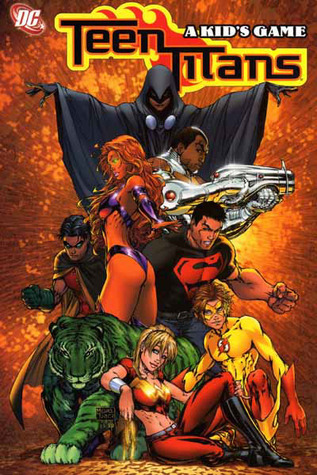
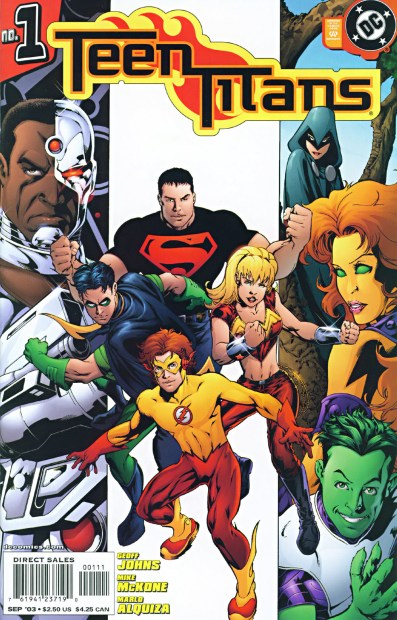
Throwback Thursday – Teen Titans Volume 1: A Kid’s Game

Teen Titans 1 Cover.jpg

Publisher: DC Comics (Paperback Edition – 1 April 2004)

Series: Teen Titans (2003)

My Rating: 5 out of 5 stars

Writer: Geoff Johns

 Artists:  Mike McKone

                Tom Grummett

                Marlo Alquiza

                Nelson

                Jeromy Cox

Amazon

Reviewed as part of my Throwback Thursday series, where I republish old reviews, review books I have read before or review older books I have only just had a chance to read.

Ever since I mentioned Geoff Johns’ 2003 Teen Titans series in one of my Top Ten lists last week, I have wanted to revisit the series.  I have always loved this run of Teen Titans the most.  Something about the combination of storylines, characters and this version of the artwork always spoke to me.  It was also one of the first comic series that I read and subsequently went out of my way to get every collected edition.  Even years later I still love dusting this series off, so I figured this would be a good time to go back and have a try at reviewing parts of this series.  That is why for this Throwback Thursday I will be looking at the first collected volume of the series, Teen Titans: A Kid’s Game.

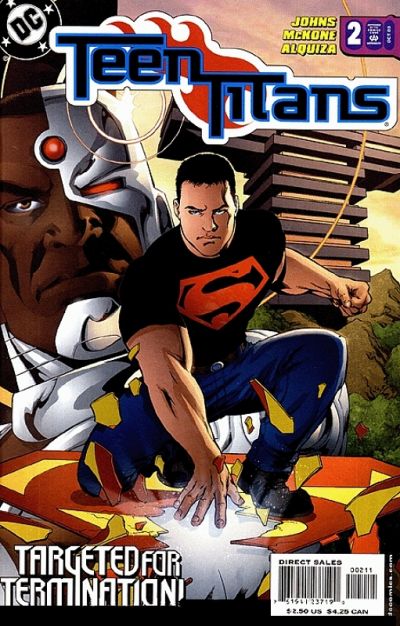
Teen_Titans_v.3_1.jpg

The Teen Titans are a team of teenaged heroes in the DC universe, usually the sidekicks of the universe’s adult heroes, but also featuring several characters without mentors.  The first formation of the Teen Titans occurred in 1964 and featured the original Kid Flash (Wally West), Robin (Dick Grayson) and Aqualad (Garth).  After a short while the original Wonder Girl (Donna Troy) joined their ranks and the team started calling itself the Teen Titans before it was given its own series.  Teen Titans was DC’s attempt to appeal to the younger generation of comic book fans, and it proved to be an extremely successful series, featuring a number of DC’s younger characters, including Green Arrow’s sidekick, the original Speedy (Roy Harper), who is considered a founding member of the team.  Teen Titans went through a number of different relaunches, with probably their most famous one occurring in 1980 with the launch of the New Teen Titans series, which brought back most of the original Titans, revamped Changeling to Beast Boy and introduced a number of iconic characters, including Cyborg, Starfire and Raven.  It also introduced several of the team’s most famous villains, including Deathstroke and Trigon.  The Teen Titans are one of DC’s most iconic superhero teams and have been featured in a number of media platforms, including the amazing Teen Titans animated show, Teen Titans Go (the less said the better), the dark and surprisingly good live action Titans and a number of key story and character elements have been included in the awesome Young Justice animated show.

Teen Titans went through a number of relaunches throughout the 1980s and 1990s, but the one most relevant to the 2003 Teen Titans comic series is the 1999 Titans comic series, which followed the adventures of adult versions of the original Teen Titans, most of whom had new superhero personas.  At the same time, DC launched the Young Justice comic book series (which I have talked about before) incorporating the younger generation of sidekicks (for example a new and younger Robin and Wonder Girl).  Both these series ended after the 2003 crossover limited series, Titans/Young Justice: Graduation DayGraduation Day featured a number of important events, including the sudden death of longstanding Titans member Omen; however, the most significant event was the death of the original Wonder Girl, Donna Troy.  The resultant despair and guilt following the death of this significant character led to both the Titans and Young Justice dissolving in what was to be conclusion of both these series.

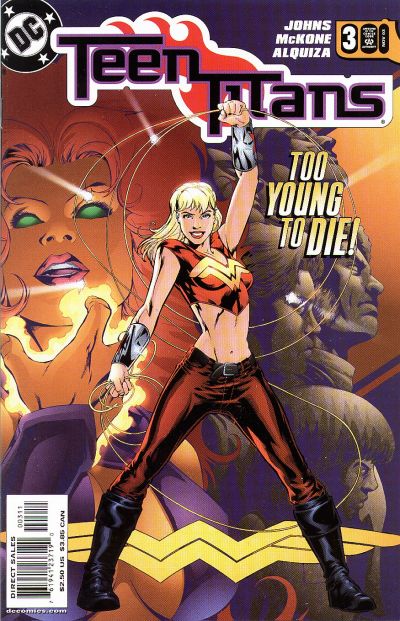
Teen_Titans_v.3_2

However, shortly after this, Geoff Johns started this specific run on Teen Titans, which combined elements of the cancelled Young Justice and Titans series, with the main four characters from Young Justice teaming up with some of the classic Teen Titans.  Another new series of Outsiders started around the same time and was heavily linked to this run of Teen Titans and featured Dick Grayson and Roy Harper.  This specific run of Teen Titans lasted until 2011, when DC initiated their New 52 relaunch (which I may or may not have some issues with).  Geoff Johns was the principle writer of this series until the 2005-06 Infinite Crisis limited series, which was a significant story point for all of DC’s titles at that point.  Due to the fact that Johns was the principle writer of the Infinite Crisis series, several of the younger Teen Titans (Superboy and Wonder Girl in particular) played a key part in this big crossover event, and several storylines from the 2003 Teen Titans turned out to be heavily linked to the crossover event.

Following the tragic events of Graduation Day, the young heroes that made up the superhero team Young Justice are lost.  Tim Drake (Robin), Conner Kent (Superboy) Bart Allen (Impulse) and Cassandra Sandermark (Wonder Girl) dissolved the team in their grief over losing the original Wonder Girl, Donna Troy, and have been avoiding each other since her funeral.  They may be the sidekicks of the greatest heroes in the world, but they are all missing their friends.  Despite their reluctance to team up again, each of them accepts an invitation from Victor Stone (Cyborg) to form a new version of the Teen Titans.  With a new base in San Francisco and other veteran Titans members Starfire and Beast Boy to help as mentors, Cyborg wants to bring these young heroes together again and forge an effective team.

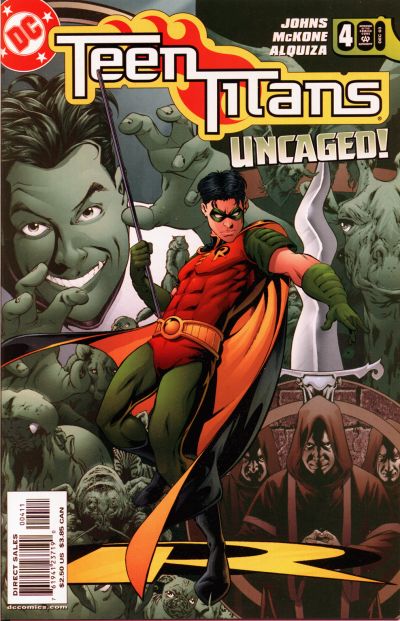
Teen_Titans_v.3_3.jpg

However, before Cyborg can attempt to work with the four new Titans and convince them to stay on the team, a massive explosion rips through Alcatraz, endangering tourist lives.  As the Teen Titans mount a rescue, one of them is ambushed by the team’s oldest and most dangerous adversary, the world’s best assassin, Deathstroke the Terminator.  Deathstroke has long had a complicated relationship with the Teen Titans, but this time it looks like he wants to put the team down for good.  Claiming that kids should not wear costumes, he attempts to take out each member of the team, but what is the real reason behind his attack?  Can this new version of the Teen Titans survive the ruthless assassin?  What role will recently reborn Titan Raven play? Moreover, what will happen when the Justice League arrives to shut them down?

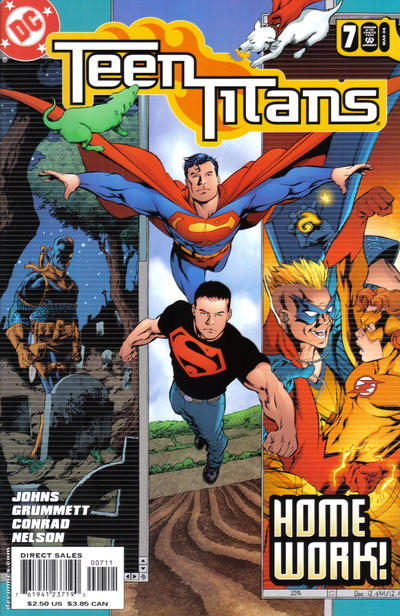
As I mentioned above, I am a huge fan in general of this entire run of Teen Titans, but this has to be one of the best instalments in the entire series.  Geoff Johns and his creative team came out of the gate swinging with this one and started the series off with a bang.  Not only does A Kid’s Game feature a fantastic storyline and contain some excellent character work, but it also serves as an outstanding first instalment of what turned out to be one of DC’s most consistent and captivating comic book series between 2003 and 2011.  The A Kids Games collected edition is made up of Teen Titans (2003) #1 – 7 and also features parts from Teen Titans/Outsiders Secret Files 2003, which can be useful for those readers unfamiliar with the characters, or at least that incarnation of them.

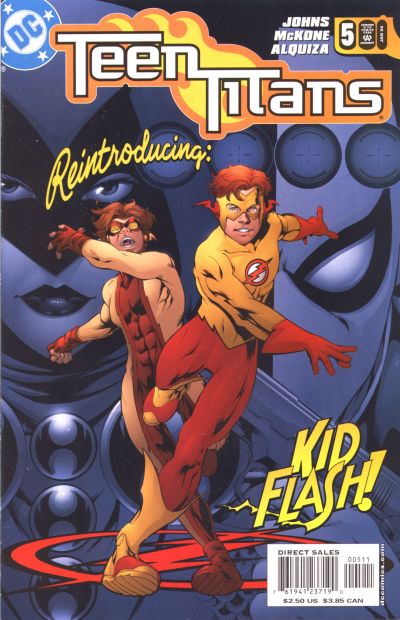
Teen_Titans_v.3_4.jpg

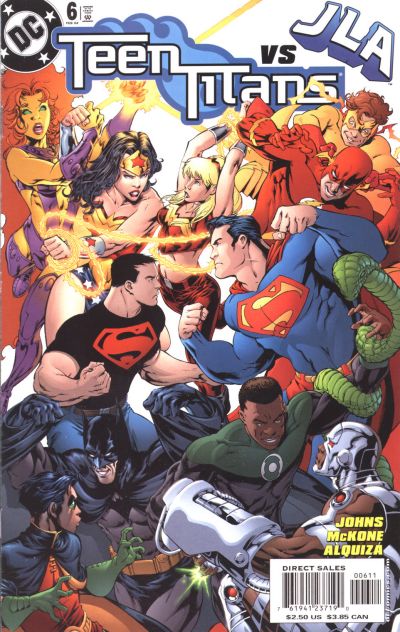
The storyline contained within A Kid’s Game has a lot of fantastic elements to enjoy within it.  The initial formation of the team is handled very well, as each of them is shown to be lonely or unsatisfied with their lives without their friends, and despite their misgivings decide to join up.  The follow-up battle between the team and Deathstroke is really good, and the team learning how to fight together while uncovering their antagonist’s motivations is very exciting.  Deathstroke has a hell of an entrance in this volume when he kneecaps Impulse at the end of the second issue in what is a pretty shocking and memorable moment.  I personally loved the storyline that occurred right after this in Teen Titans 2003 #6, when the Justice League, including the mentors of each of the younger Teen Titans’ members, show up and try to meddle with how the team is run.  This results in some chaotic action and a huge amount of amazing comic book drama, as the sidekicks fight and vent their well-justified frustrations to their mentors while also coming to terms with the guilt they feel over Donna Troy’s death.  I really cannot speak highly enough about this part of the volume, and I think this was what made me initially fall in love with the series.  The final storyline shows each of the characters during the school week, when it really helps to highlight the issues that being a part of the Teen Titans is helping them face.

One of the things that I really like about this volume is that each issue contains a shocking reveal at the end.  I know that some comics overuse this, but I felt that Johns and his team were pretty justified in doing this, as they were trying to up the stakes during these first comics in their new series.  A lot of significant and surprising things are revealed during each of these issues, many of which would have ground-shaking impacts not just for the Teen Titan, but for the DC universe as a whole (Spoilers ahead).  This happens right in the first issue, with the reveal that half of Superboy’s DNA comes from Lex Luthor.  Other big events occurring at the end of each issue are the kneecapping of Impulse, the revelation that Jericho was still alive inside Deathstroke, Bart’s first appearance as Kid Flash, Wonder Woman showing up to start the brawl between the League and the team and the reveal that Lex Luthor is the person leaking information about Superboy’s genetics to Robin.  Even the quiet, final issue of this volume has a big reveal at the end, with the revelation that Rose Wilson is now working with her father Deathstroke.

Teen_Titans_v.3_5.jpg

The creative team behind this original run obviously had a great appreciation for some of the preceding Teen Titans series, as they utilise a number of key characters from these earlier series.  I personally thought that the issues contained with A Kid’s Game did a fantastic job of blending these old school Teen Titans storylines and character together with the former Young Justice characters, creating an excellent new dichotomy for the team.  This blend of the old and new helped create an excellent new series and was one of the best features of John’s run, and I also enjoyed the respect he showed towards the old Young Justice series.  I was also really impressed in hindsight with how well Johns and his team set up or hinted at a number of future storylines or character developments in these initial issues.  Many of these storylines (such as Superboy being a mixture of Superman and Lex Luthor’s DNA, Wonder Girl being related to Ares, Rose Wilson joining with Deathstroke, the resurrection of Raven and Jericho and the new Brother Blood) would have impacts for years to come and some are even utilised in comic series, television shows and animated movies to this day.  The creators of A Kid’s Game did an incredible job including them this early in the series, and they were really good introductions.

One of the best things about the entire 2003 run of Teen Titans is the focus on the characters and their development throughout the series.  While other volumes of this series feature some great character moments, nowhere is this more prevalent than within the issues that make up A Kid’s Game.  Most of the focus within this book is on the four characters, Robin, Superboy, Impulse and Wonder Girl, who are moving over from Young Justice to the Teen Titans.  The creators take a significant look at each of them and really work to develop each of them as substantial characters and develop them deeper than what they were within Young Justice.  With this impressive focus on developing and utilising these characters to their full potential, it is no wonder that they were utilised as such major characters during the Infinite Crisis storyline and beyond.  I also like how the older members of the team had to step up and assume a leadership role that readers had not seen before.  As a result, Cyborg and Starfire attempted to fill these leadership roles, while the slightly younger and less mature Beast Boy acts as the bridge between the two generations.  I thought that these new roles were really clever and added some new dynamics to the team.  I was also really impressed with how the creators focused on the trauma that all of the team members were feeling in the wake of Donna Troy’s death.  Each of them was racked with guilt after they were unable to help stop her death, and the anger and grief that each of them was feeling was extremely evident throughout the volume.

Teen_Titans_v.3_6.jpg

Another incredible part of this initial volume was the strong look at the relationship between the sidekicks and their mentors.  Despite the high regard each of their mentors holds in the superhero world, each of these sidekicks has issues that stem from how they perceive or are treated by their mentor.  The creative team really go out of their way to highlight these issues, and many are quite clever.  For example, Superboy, who is living as Conner Kent, appears to be frustrated at living a quiet life in Smallville, but as the story progresses it becomes clear that he is having trouble living up to the legacy of not only Superman but Clark Kent as well.  Robin is stuck wondering what his future holds and it soon becomes clear that he is reluctant to become like Batman, despite the fact that his is more like him than any of the Robins that came before him.  Wonder Girl is extremely angry and rebellious throughout this volume and is beginning to doubt her mentor Wonder Woman.  This is revealed to be a side effect of her trauma at the death of Donna Troy, and it soon becomes clear that she is one most impacted by the former Wonder Girl’s death.  Finally, Bart is sick of being considered not good enough to be part of the Flash legacy, as his own mentor does not think he is responsible enough to bear the Flash name (which is ironic, considering he is the only one of these young heroes whoever takes up their mentor’s mantle).  As a result, he acts like he does not care, while deep down he craves approval and Flash’s respect.  Bart easily shows the most growth within this volume, as he takes the Kid Flash mantle for himself, dedicates himself to learning all he needs to be a hero and vows to leave the Flash in his shadow.  All of these character issues come to a head perfectly when the Justice League arrives unannounced at Titan’s Tower and they try to meddle with their sidekicks lives and there are some amazing and cathartic moments between the younger heroes and their mentors.  His is comic book character work at its very best.

I have to note the great job the artistic team does throughout these first seven issues.  There are some great new character designs, such as Superboy’s iconic new look of jeans and a superman t-shirt, something that is still utilised within the Young Justice television show.  I also liked the way that Bart looked in the Kid Flash outfit.  The artwork on the action sequences is also pretty awesome, and there are a huge number of eyepopping scenes throughout this volume.  That shot of Kid Flash getting kneecapped is very impressive and really sticks with you.  Overall, there is some fantastic artwork, which works really well with the outstanding story and character work to create an excellent first volume.

Teen_Titans_v.3_7

Teen Titans: A Kid’s Game is an amazing first volume in the 2003 Teen Titans series.  I cannot speak highly enough about the storylines and the way that the creative team handle the complex young heroes.  A spectacular start to an incredible run one of DC’s most iconic series.  I fully intend to review some other volumes in this Teen Titans in the future so stay tuned for them.

Amazon

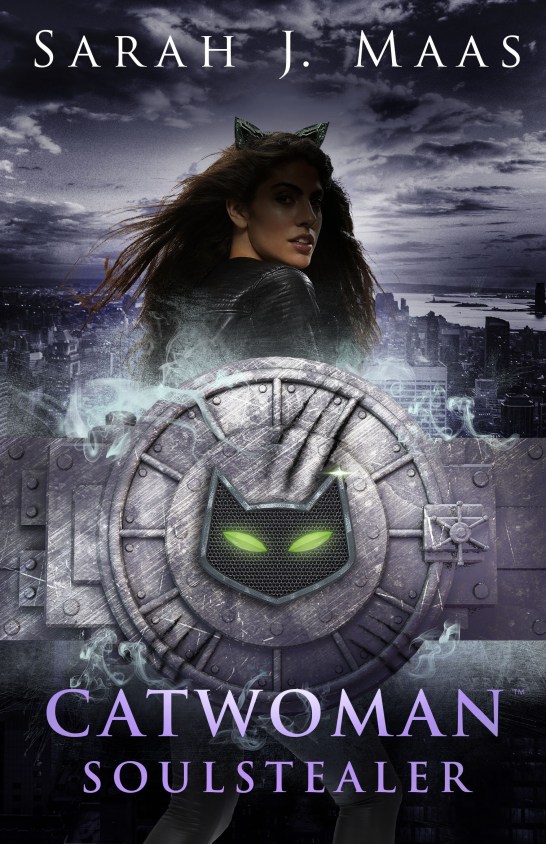
Catwoman: Soulstealer by Sarah J. Maas

Catwoman Soulstealer Cover.jpg

Publishers: Penguin Random House

                        Penguin Random House Audio

Publication Date – 7 August 2018

Amazon

One of DC Comics’ most iconic and badass female antiheroes is re-imagined in this bold new novel from young adult fiction bestseller Sarah J. Maas.

Selina Kyle is a rough street kid growing up in the slums of Gotham City.  She looks after her sister while scraping a living as a gang member and pit fighter.  When her luck finally runs out, her potential is seen by the mysterious Talia al Ghul who saves her and recruited into the League of Assassins.

Two years later, Selina has returned to Gotham City with a plan to turn the city on its head as Catwoman, the master thief and criminal mastermind.  Using the alias of the spoiled socialite Holly Vanderhees, Selina has returned at an ideal time; Batman is not in the city, away on a vital mission, and he has left his protégé Batwing behind to safeguard the city.  Initiating a series of high-profile thefts, Selina soon has the attention of Batwing and GCPD, especially when she starts teaming up with her new BFFs Poison Ivy and Harley Quinn to wreak havoc around the city.

While Batwing searches the city for this mysterious new villain, his alter ego, Luke Fox, encounters his mysterious new neighbour, Holly, and the two find themselves drawn to each other as their alter-egos battle in the night.  While Selina is able to outfox Batwing, a far more destructive force is about to be unleased upon Gotham.  Catwoman stole something from the League of Assassins and now a cadre of their most lethal assassins are descending on the city.  Will Selina be able to survive their deadly attentions, what is Catwoman’s plan, and who will be left standing in the aftermath?

This is the third book in the DC Icons series, a series of young adult books that provide re-imagined origin stories for younger versions of DC’s most iconic characters outside of the other established DC universes.  Featuring a range of different authors, the first book in the series, Wonder Woman: Warbringer, focused on Wonder Woman before she left Themyscira to become a hero, while the second book, Batman: Nightwalker, followed a teenage Bruce Wayne as he attempts to stop a series of murders in Gotham City.  A fourth book in the DC Icons series, Superman: Dawnbreaker, is currently set to be released in March 2019 and will follow a young Clark Kent as he investigates strange happenings in Smallville.

Soulstealer is the first of these DC Icons books that I have read, and I was quite impressed with the new and unique Catwoman story that it contained, as well as the cool new versions of several DC characters, including Poison Ivy, Harley Quinn and Batwing.  I listened to this book in its audiobook format, read by Julia Whelan.  I quite enjoyed having the story narrated to me, especially as it only took around 10 hours to get through.  While I initially had misgivings about whether I would like this series, after reading and loving Soulstealer I will definitely be getting a copy of Dawnbreaker when it is released next year, and Warbringer and Nightwalker will both be appearing future versions of my Throwback Thursdays reviews.

The author of Soulstealer, Sarah J. Maas, is one of the biggest names in modern young adult fiction, having written two best-selling young adult series in the last six years.  Her long-running Throne of Glass series finished earlier this year, and she has also created the A Court of Thorns and Roses series.  Soulstealer is the first Sarah J. Maas book that I have had the pleasure of reading, but after really enjoying the intricate story and fantastic characters within the novel I am keen to see what her fantasy books are like.  As a result, her Throne of Glass series is high on my list of books to check out in the future, especially after seeing just how awesome the artwork is on some of those covers and collected box sets.

Maas has installed a fantastic and clever story into her debut DC novel, and I really enjoyed how she re-imagined the origins of prominent comic book character.  Soulstealer contains a younger version of Catwoman, introducing her as a teenager gang member and focusing on her initial life of crime.  After the introductory paragraph, the story jumps ahead two years to Selina’s return to Gotham and her initial adventures as Catwoman, while also featuring several flashbacks to her training with the League of Assassins.  This main story is then told from two separate point-of-view characters, Selena and Batwing, and shows the characters in both their costumed adventures and as the people behind the masks in their civilian identities.  Soulstealer has a tight and intricate storyline that contains the perfect balance of comic book action, relationships, backstory, references and variations to comic lore, as well as a number of heists and intricate plots.  I loved Catwoman’s overall plan, as she engages in a play to take over Gotham while really nursing an ulterior motive that pits her against the League of Assassins.  I loved the slow reveal of this complex and insane plan, as well as the lengths she goes to bring her plan to pass, including making some dangerous partnerships.

One of the most interesting and significant changes that Maas makes to Catwoman’s origin story in this novel is the fact that she never meets or associates with Batman.  In nearly every previous iteration of Catwoman, her story has always been intertwined with Batman’s, as the two were usually each other’s main love interest, either as Batman and Catwoman or Bruce Wayne and Selina Kyle.  However, in Soulstealer, Catwoman is substantially younger than Batman, who starts his crusade years before she is trained by the League of Assassins.  In addition, Batman is not present in Gotham when she returns to the city and throughout the book the two characters have no interactions at all.  Instead, Catwoman’s main love interest is the Luke Fox version of Batwing, who has been defending Gotham in Batman’s absence.  This results in a similar romance plot to some of the classic Batman and Catwoman storylines, where the two characters meet and start to fall in love with each other in both of their personas, despite their apparently different personalities.  This is a fun little romance that does get serious at times, as the two characters are mirrored by their personal traumas and backstories, such as a Selina’s life on the streets and with the League, versus Luke’s PTSD as a result of his time as a marine.  There are also some great moments when the two characters face off against each other, and some of the book’s best laugh-out-loud moments came when Catwoman messes with either Batwing or Luke, sometimes at the same time.  To my mind, the funniest scene in the book had to be when Batwing, after getting injured and rescued by Catwoman, awakens half-naked in a darkened room, only to find out that he is actually in Commissioner Gordon’s spare bedroom.  The moment Luke walks out to find Gordon and his family staring at them was pretty darn funny, especially when Batwing attempted to play it off nonchalantly while silently cursing Catwoman.

One of the elements of Soulstealer that I really appreciated was the references and re-imagined versions of several DC comics characters that appeared throughout the novel.  A huge range of DC characters, many tied into the Batman comics, appear throughout the book in a number of different capacities.  The characters that appear range from the iconic to the obscure and are enough to delight both hardcore comic fans and those with a more casual knowledge of these comics.  Several major Batman characters appear throughout the story; I will refrain from mentioning the full roster of characters to cut down on spoilers, although there is one appearance that was particularly awesome.  While a number of these characters have key or interesting differences between their mainstream comic book counterparts, it is clear that Maas has a real understanding and appreciation for the lore behind these characters.  It is also incredibly fascinating to see how Maas changes these characters for the purposes of her story, and the subtle tweaks that are made to accommodate this different universe.

Of all these additional characters, two of the best and significant inclusions are fellow supervillains Poison Ivy and Harley Quinn, who team up with Catwoman to bring a little chaos to Gotham.  In the comic universe, these three supervillains occasionally form a team known as the Gotham City Sirens, and it was great to see them together in this book.  Like Catwoman, both Poison Ivy and Harley Quinn are quite young and have slightly altered origin stories which somewhat mirror the new origin story of Catwoman.  However, some of the key elements that made these characters so great in their comic book origins remain alive in these book adaptations of the characters and which work extremely well with Maas’s fantastic Soulstealer storyline.  For example, in this story, Harley is still obsessed with the Joker, no matter how much it impacts her relationship with the others, and there are a lot of discussions between Catwoman and Ivy about the roots of her obsession and insanity.  There is also a very clear and acknowledged romantic connection between Ivy and Harley that adds a really interesting element to the story, especially as Harley’s insanity stands in the way of the more serious relationship Ivy desires.  The inclusion of these characters adds in a defining friendship for a main character who has never had the option of friends before, and it’s also a lot of fun seeing these three characters work together, especially as they have such diverse skill sets and range of attitudes.  Overall, I really loved the fact that Maas included Poison Ivy and Harley Quinn as key characters in her novel, and it was a lot of fun to see her version of these young villains banding together for the first time and forming an outstanding partnership.

Rather than read a physical copy of this book, I grabbed the audiobook copy of Soulstealer and listened to that instead.  The audiobook is narrated by Julia Whelan, who does an amazing job capturing the essence of the book’s main character, Catwoman/Selina Kyle.  When focused on Catwoman’s point of view, the listener gets a real sense of the character’s emotions and attitude, and the voices that Whelan assigns to the other main female characters, Ivy, Harley and Talia, are fairly distinctive and fit well with the character.  I thought that the voice that the narrator used for the book’s other point-of-view character, Batwing/Luke Fox, was very serviceable and conveyed the character well enough.  However, I was a tad disappointed that the narrator did not do too much with several of the other iconic Batman characters in the story, such as Alfred, Batman or Commissioner Gordon, especially as these major characters have all been portrayed by amazing actors or voice actors in the past.  Still, the audiobook version is a great way to enjoy this story and it certainly helped me power through this novel quickly without forcing me to skip over any of its important elements.

Catwoman: Soulstealer is an excellent young adult superhero novel from acclaimed author Sarah J. Maas.  This book is a fantastic standalone novel that re-imagines an iconic DC comic book character.  No great previous insight into Catwoman or the DC universe is required, and those with even a glancing knowledge of the comic book characters will be able to enjoy this novel to its full potential.  This serves as a very good young adult novel that will hopefully draw in a younger generation of readers into this established universe, and I appreciated Maas’s casual inclusions of a number of LGBT+ elements.  Soulstealer comes highly recommended and it has certainly sparked my interest in checking out all the other books in the DC Icons range.

My Rating:

Four and a half stars

Amazon

Young Justice – Book Three by Peter David and Todd Nauck

Young Justice 3.jpg

Publisher: DC Comics

Publication Date – 4 December 2018

Amazon

Before the third season of the Young Justice television show debuts after its long hiatus, go back to the comic book series that inspired it all, with the third volume of DC Comics’ reprint of the 1990s Young Justice comic book series, which includes the full collection of the Sins of Youth crossover event from 2000.

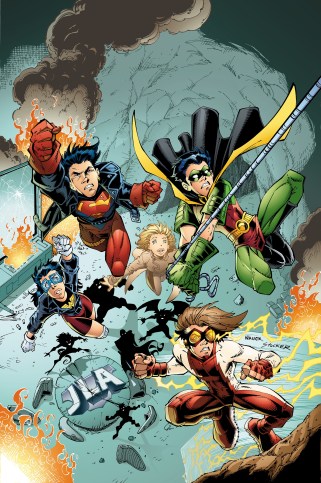
Young Justice is an interesting comic series.  Most people would probably be familiar with the 2010 television series of the same name.  The original comic book series started in the 1990s and was created in a unique period of DC Comics.  Many of the traditional sidekicks had grown up in recent years and taken on different identities to distinguish themselves from their mentors.  For example, the first Robin, Dick Grayson, had has own identity as Nightwing; the original Kid Flash, Wally West, had succeeded his mentor as the Flash; the original Wonder Girl, Donna Troy, had become Troia; while the original Speedy and Aqualad had taken on the identities of Arsenal and Tempest respectfully.  In order to fill the void, DC Comics creators in the 1990s created several new young sidekicks for their key heroes.  At the same time, with most of the former sidekicks in their early 20s, DC needed a new group of young heroes to appeal to their younger readers.  With the former sidekicks already formed up as the Titans, these younger heroes were placed into their own team, Young Justice.

Starting in 1998, this series ran alongside DC’s Titans series before both were cancelled in 2003 following the Graduation Day crossover event.  Young Justice was a successful way to launch several of its featured character outside their mentors’ orbit, much like the original Teen Titans series did for the first round of sidekicks, and many of its key characters are still used in DC Comics to this day.  Despite this, the series is probably best known for having the same name of one DC’s most popular animated shows, the Young Justice television show.  The show, which started in 2010, features a team based more on the Teen Titans comics rather than the Young Justice comics, with only one member of the original comic run of Young Justice, Superboy, appearing in the first season, although other members of the team did appear in the second season.  It did, however, make use of a number of storylines and villains from the original series, many of which were adapted into first-rate episodes.  The show received high ratings, but was cancelled after only two seasons.  However, continued petitioning from its dedicated fanbase has seen a revival of the show, with a third season airing in January 2019.  A new comic book reboot of the Young Justice comic series is also planned for 2019 and will see several of the original characters reunite for the first time in years.  Starting in 2017, DC started reprinting the original Young Justice comic run into a new set of collected editions, and this review is focused on the third volume of this reprinting.

Before this new reprinting of the original series I had not had much of a chance to read Young Justice, but it has always been high on my list of must-read comics.  This is mainly because I am such a big fan of Geoff John’s 2003 run on Teen Titans, which followed several characters from Young Justice after their team was disbanded.  This run on Teen Titans has to be one of my all-time favourite series and I was always very curious to see what happened to the characters during their Young Justice years.  So I was very happy when DC decided to reprint this original run and I have been having fun seeing these younger versions of some of my favourite characters before they got more mature and serious after the events of Graduation Day.

They are the next generation of superheroes, but being the second round of sidekicks to the leading members of the Justice League is tough, and sometimes having your own group of friends is what you need.  So Young Justice was formed: part superhero team, part friendship group.  Originally made up Robin (Tim Drake), Superboy (Kon-El/Conner Kent), Impulse (Bart Allen) and Wonder Girl (Cassandra Sandsmark), the team was later joined by new heroes Arrowette and Secret, while also being monitored by veteran hero Red Tornado.

Recent events have rocked the group and exposed them to negative attention.  The team have continuously been drawn into destructive fights and been forced to partially destroy Mount Rushmore, and Arrowette has been forced to retire after nearly killing a suspect.  At the same time, a new superhero team, Old Justice, made up of the aging sidekicks of the Golden Age of heroism, have been calling out the actions of their younger counterparts.  Railroaded by the press, politicians and even their mentors in the Justice League, the situation keeps going from bad to worse for the young heroes when they lose their base to an attack from a new superpowered group, the Point Men.

Attempting to regain public opinion, Young Justice and a supporting group of heroes attempt to hold a rally in support of young heroes, but a villainous presence wants to stop the young heroes from developing to their full potential.  A mysterious organisation, Agenda, headed by Lex Luthor’s ex-wife Contessa Erica Alexandra Del Portenza, wants to discredit all superheroes and believes that Young Justice is their weakest link.  Agenda uses the magical agent, Klarion the Witch-Boy, to cause havoc at the event, and Klarion’s magic leads to some accidental side effects.

The members of Young Justice have all been aged into adults, while their contemporaries, the members of the Justice League of America and the Justice Society of America, have all been turned into children or teenagers.  Worse, these de-aged heroes now have the emotional maturity of their age, while the members of Young Justice have the patience and wisdom of their mentors.  Forced to switch roles with the world’s greatest heroes, the members of Young Justice must find a way to not only stop the sinister machinations of Agenda but also find a way to reverse the effects of the spell.  Can Young Justice grow up to be the heroes they were always meant to be, or is the future of the DC universe a whole lot darker than anticipated?

This third volume of the reprint is another fantastic collection of a great original storyline.  I have been really enjoying this reprinting of Young Justice, and it was great to see this full collection of one of their most iconic storylines in full.  Not only does this new volume contain issues #18-19 of the original series but it also contains a huge number of tie-in storylines that feature most of the other heroes of that period of the DC universe, following their adventures as they have been de-aged or aged up.  As a result, this volume contains input from a gigantic range of DC creative talent, as the writers and artists of these other connected series do a one-shot version of the series they were working on at the time.

There is quite a lot going on in this volume and it definitely takes a while to get through.  There are a also a lot of technical and obscure comic book characters and teams that become the focus of the various stories within Young Justice Volume 3, so it might become a bit confusing for some people.  The volume is broken up by a couple of Young Justice storylines that introduce and finalise the story, while also providing the explanation for how this event unfolds and the villains responsible for it.  Once this is established, the volume goes into a series of different short stories that focus not only on the members of Young Justice but on some of the other superheros that have been caught up in the events of this crossover.  Each of these storylines show how the various heroes deal with being de-aged or turned into adults, and then follows up with an adventure, often with that particular team or hero working to find a solution to the curse afflicting them.  The four best storylines deal with the aged-up sidekick members of Young Justice (Robin, Wonder Girl, Superboy and Impulse) as they are forced to team up with teenage versions of their mentors.  There are some good jokes in this as the characters reverse roles and the younger heroes are forced to act as the mature anchors for their biggest heroes in the DC Universe.  These jokes range from Bruce Wayne being forced to pretend to be a moody Robin while his sidekick takes on the role of Batman for the first time, to Wonder Girl being forced to reign in a destructive Wonder Woman while making several snide comments about the practicality of her uniform, to a very young Flash attempting to hit on his fully grown wife.  There are also some quite heartfelt moments as the mentors are finally placed in their misunderstood sidekicks’ shoes and find a way to emphasise with them in a way they haven’t managed before.

In addition to these stories around the Young Justice sidekicks and their well-established mentors, there are a number of other interesting stories splashed through this volume.  I particularly enjoyed the short one that featured a teenage Aquaman teaming up with an adult Lagoon Boy to stop a crisis under the water.  This one is not only fun, as the teenage Aquaman is a bit of a bold ladies man, but it also shows how he was a hero even as a teenager, as he sacrifices a potential solution to his problem to restore a devastated city.  There is also a story that focuses on the Titans, which brings its founding members back to their Teen Titans days, with a storyline that reminds the readers of their classic adventures.  I was less of a fan of the storyline that focused completely on a teenage version of the Justice League, and I really disliked the storyline that contained an all-child version of the Justice Society going on an adventure.  Overall though, this huge collection of stories comes together in a fun and cohesive narrative that not only presents a massive, whole DC Universe event, but one that focuses on the core team at the heart of the adventure.
A major feature of this volume is the examination of the negative perceptions that older people have for the world’s youth.  Even 20 years later this is still incredibly relevant, as most older people these days are quite dismissive of today’s youth culture (those darn millennials).  Young Justice goes out of its way to show a group of teenagers who try to do the right thing but are constantly dismissed by adults as nuisances who do not try to see their side of the story.  After being hounded for a good part of this and the previous volume, Wonder Girl gives an impassioned speech to the media that gets the worlds attention, divides some of the older heroes and rallies several other prominent young heroes to their cause.  The creative team follows this up by putting its young heroes in the position of responsibility and showing that they can act in a mature and responsible way when given the chance, while their established mentors act irresponsibly when turned back into teenagers.  All of this is a great examination of how young people are perceived by their elders and how they can surprise you when given a chance.  This is still a great storyline to enjoy to this day and one that will resonate with the modern youth culture.

While I have been having quite a lot of fun with this re-print run of Young Justice, it may prove a little harder to get into for people who are not as familiar with some of the other 1990s DC Comics storylines which were happening at the time.  That being said, it is a series well worth getting into, especially for fans of any of the Teen Titan runs that followed the cancellation of Young Justice, as many of the members of these teams were originally featured in this series.  Fans of the Young Justice television show will probably also get a lot out of this series, as several of the show’s best storylines and villains originated in this original comic series.  Overall, Young Justice is a fantastic series that will appeal to both younger readers and well-established comic book fans.  This third volume features a full and fantastic collection of one of this series’ most iconic story events, which provides an intriguing examination of youth culture perception and a great examination of the additional hazards of being a young hero.  Extremely entertaining and a lot of fun to read, I am really glad that DC decided to do this re-print of Young Justice.
My Rating:

Four and a half stars

Amazon

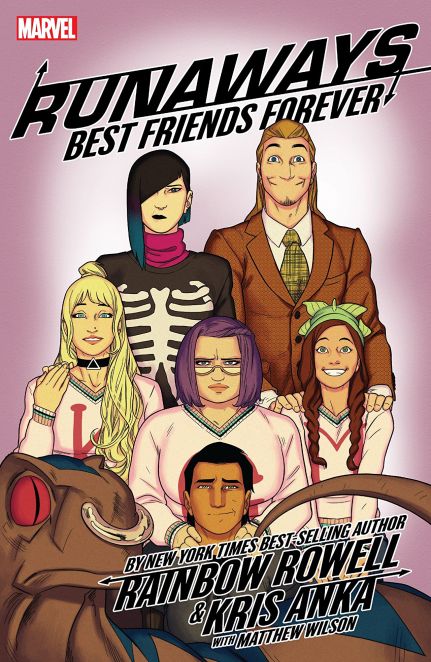
Runaways Volume 2: Best Friends Forever by Rainbow Rowell and Kris Anka

Runaways Volume 2 Cover.jpg

Publisher: Marvel Comics

Publication Date – 30 October 2018

Amazon     Book Depository

Recently reunited and still coming to terms with being a family again, the adventures of Marvel Comics’ favourite group of misfit youths continues in Best Friends Forever, the second volume of young adult author Rainbow Rowell and artist Kris Anika’s run on Runaways.

The Runaways, Chase, Gert, Karolina, Nico, Victor, Molly and Old Lace are finally back together and living in one of their parents’ old hideouts.  While most of the team have grown up since the last time they were all together, this does not mean that they have their lives together.  Each of the Runaways has their issues to deal with, be it Gert’s recent return to life after several years of being dead, Karolina’s relationship problems or Victor’s current existence as a disembodied head.  The only one who appears to have their life even remotely together is the team’s youngest and at times wisest member, Molly, who is enjoying her time in middle school.  But even Molly is having problems, as she is faced with a hard choice and must consider whether she actually wants to grow up.

Runaways_Vol_5_8.jpg

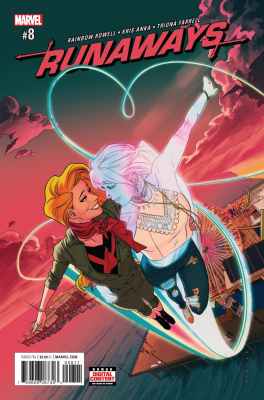
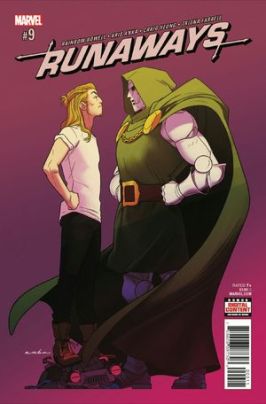
As Molly deliberates over the dilemma presented to her, a barrage of other arrivals impact on the Runaways.  Karolina’s girlfriend, Julie Power of Power Pack fame, is in town, which causes significant drama for Karolina and Nico, while Dr Doom has apparently appeared on their doorstep, determined to find Victor.  Can a team rife with squabbles, drama and internal strife come together to face the problems before them, or will their significant changes be too much to bear?

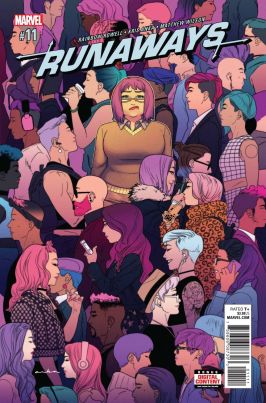
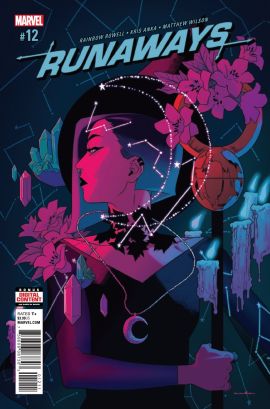
Runaways is still one of my favourite Marvel series.  After the revamp earlier this year, previously reviewed here, these fantastic characters are still going strong.  In this second volume, Rowell, Atkins and their creative team continue to produce some outstanding and emotional stories that are based more on the relationships between the main characters than the traditional crime-fighting storylines contained within other comics.  While they do go up against a couple of superpowered opponents within this story, none of these antagonists is truly evil, and their motivations and history are a lot more morally ambiguous than some of the previous Runaways stories.  The creative team do a fantastic job of blending highly emotional storylines with a bunch of fun and heart-warming sequences, filled with random and funny elements, such as an errant Doombot.  This all comes together into one fantastic overall story that hits all the right buttons.  This second volume contains issues #7 – #12 of this new run on Runaways.

Runaways_Vol_5_9.jpg

One of the main aspects of this second volume of Runaways is the continued focus on the relationships between the series’ main characters.  Most of these characters are still coming to terms with being back together after all of them attempted to live lives outside of their team.  Quite a bit of Volume 2 involves the characters trying to determine what roles they have within this surrogate family, and the fact that they are not as close as they used to be.  What I liked is the way that Chase, usually the most immature member of the team, attempts to become the father of the group, matching up with the traditional female leader of the team, Nico, as the team’s mother.  This new parental role is highlighted in a funny couple of scenes where Chase and Nico use magic to become Molly’s legal guardians, a shortcut way that “seems totally legit and great”.  A lot of this volume is also focused on the romantic relationships between several of the group’s characters, including the relationship between Gert and Victor and the new romantic feelings between Nico and Carolina.  I thought the lead-in to both these relationships worked out very well and sets up some interesting potential in future volumes.  I am also very curious to see how the friendship between Victor and Chase is going to be impacted as a result of this new relationship in future volumes of this series.  I liked the way that the relationships and romantic considerations that featured between Carolina and Julie and Carolina and Nico were handled very well and with great sensitivity, and showed great representations of LGBT+ relationships.

Runaways_Vol_5_10.jpg

I also appreciated the way that Rowell and Anika continued to focus on the emotional and mental damage that the team’s exploits have had on these characters over their entire comic book history.  In this second volume, there is a significant focus on Victor, who was mentally and physically damaged during his previous appearances in Vision.  Chase and Doombot’s attempts to rebuild Victor during this volume prove to be a particularly vivid trigger for Victor, and leads to some significant emotional moments.  There is also a look at Victor’s fear of vibranium because of its addictive and mind-altering impact on him, which drove him to commit terrible acts in a previous series.  The creative team also take a look at the life of old team member Klara, the young powered girl the team rescued from abuse back in 1907 during a time-travel adventure.  It was previously revealed that Klara had been taken away from the team by the state and is now in a loving household.  A brief section of this volume is dedicated to the team finding her and attempting to bring her back into the fold, but Klara refuses to come back, as she is happy in her new life.  You have to appreciate Klara’s sound reasoning for not wanting to come back to the team, due to the death and multiple problems experienced in the previous adventures.
Runaways_Vol_5_11.jpg

One of the most significant issues that the character’s experiences have had on them is based around their negative opinions of adults.  Most of the truly terrible things in their lives have been the result of the plans of the adults they encounter, and their distrust of most adult characters has been a long-running aspect of the series.  It is interesting to see that this carries through to the new series, even though several of the characters are now actually adults.  This viewpoint is most prevalent in Gert, whose death during one of the previous run of this series means she still shares the beliefs these characters had while they were fugitives.  However, the rest of the team also have a hard time trusting other adults, such as when they assume Klara’s new adopted parents have to be evil, as every adult they have previously dealt with in similar circumstances were also evil or abusive.  This viewpoint has significant plot impacts in this second volume, as Molly, given the opportunity to stay young forever, talks to several of the other Runaways in an attempt to subtly work out their thoughts on growing up.  Most of the characters, including non-team member Julie Powers, talk somewhat negatively about their current lives and regret growing up, which tempts Molly to accept the chance to stay young.  The final message of this storyline strongly implies that growing up isn’t so bad, as even the antagonist, a young girl who has stayed 13 for 50 years, does not always want to be young.  It was also interesting to see Klara try to correct the team when they say that no adults can be trusted; having had a loving family relationship, she no longer believes that.

Runaways_Vol_5_12.jpg

The second volume of this run of Runaways continues to make use of some fun artwork throughout the various issues.  The character designs continue to be fun, and it is interesting to see some new looks and some constantly changing character designs, especially for the trendy Nico.  The art is often used for comedic affect.  Victor has a fun use throughout the book, and it is pretty humorous to see the head floating around in a number of scenes, even in a middle of a fight scene.  I also loved how throughout the course of the volume, he was given more and more advanced mobility upgrades in each scene that he appeared in, each more comedic than the last.  For example, at the start of the volume he is mostly transported in other character’s hand, his own momentum or in a backpack.  However, as the volume continues he is variously attached to a Roomba, a small tracked rover, several helium balloons (so he can get the feeling on flight back again) and eventually a new drone.  All of these are slightly ridiculous and fun, but they do not take away from the emotional nature of several scenes, and I must point out some of the awesome drawings that hint at the issues Nico is having with her magic.

The second volume of this new series of Runaways, Best Friends Forever, is another strong and emotional addition to this new version of this young adult superhero comic.  I really appreciated the creative teams continued focus on the character relationships and the emotional aspects of the characters’ lives.  Best Friends Forever is another fantastic addition to this powerful new run of Runaways, and I am excited to see what happens to this great group of characters next.

My Rating:

Four and a half stars

Amazon     Book Depository

Throwback Thursday: Final Crisis: Rogues’ Revenge by Geoff Johns and Scott Kolins

Rogues' Revenge Cover.jpg

Publisher: DC Comics

Publication Date – 28 July 2009

Amazon

Reviewed as part of my Throwback Thursday series, where I republish old reviews, review books I have read before or review older books I have only just had a chance to read.

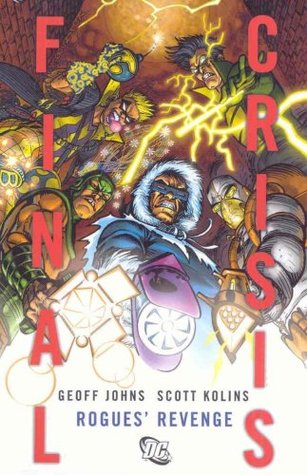
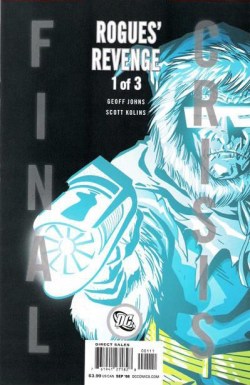
In the midst of the 2008 DC Comic crossover event Final Crisis lies this often overlooked and foolishly underappreciated miniseries, Final Crisis: Rogues’ Revenge, which focuses on the Flash’s most enduring villains, the Rogues.

Final Crisis was the big DC comic event of 2008, and is memorable for a number of key events, such as the apparent death of Batman, the death of the Martian Manhunter and the return of the original Flash, Barry Allen.  In addition to this main series, DC also released a number of miniseries and one-shots that served as tie-ins to the main Final Crisis storyline and which are often forgotten in light of Final Crisis big events.  I have to admit that I have never been a particularly big fan of the Final Crisis series, mainly because of the over-the-top and unnecessarily complicated storyline (you know, typical Grant Morrison writing).  However, I did really enjoy the tie-in miniseries, including the dark comic Revelations, which focuses on the Spectre and contains the horrifying image of Dr Light being turned into a candle, and the massive Legion of 3 Worlds miniseries, which saw the return of two great characters.  However, my favourite of all these miniseries has to be the subject of this review, Rogues’ Revenge, by iconic The Flash contributors Geoff Johns and Scott Kolins.
Final_Crisis_Rogues_Revenge_1B.jpg

The Rogues are a group of iconic dangerous criminals in the twin cities of Central City and Keystone City who have banded together in opposition to the Flash.  Different from the usual supervillains that inhabit the DC Universe, the Rogues have a sense of honour and mostly commit thefts rather than seeking world domination or pointless destruction.  Usually led by Captain Cold, the Rogues have featured most of the Flash’s villains at one point or another, including Heatwave, Mirror Master, Captain Boomerang, the Trickster, Weather Wizard and even Gorilla Grodd.  These characters have been recurring villains of the Flash for over 60 years and continue to be regular features of the various The Flash comics.  The Rogues are also very well represented in other media, appearing in several animated shows and movies.  One member, Captain Boomerang, appeared in the 2016 movie Suicide Squad, while the rest of the characters, especially Captain Cold and Heatwave, are major fixtures of the Arrowverse television series.

In Rogues’ Revenge, the core remaining Rogues, Captain Cold, Heatwave, Weather Wizard and the second Mirror Master, have been having one hell of a year after breaking their number one rule: never kill a speedster.  Tricked by the young psychopathic speedster Inertia, the Rogues attacked the Flash when he lost his powers and actually managed to kill him, which they never wanted to do.  Worst, the Flash that they killed was only a kid, Bart Allen, the former Impulse and Kid Flash, who had been aged up by his time in the Speed Force.  As the most wanted criminals in the world, the Rogues have spent the year being hunted by as fugitives by the collected superheroes.  Briefly imprisoned on an alien planet with the rest of the world’s supervillains, the Rogues escaped and have returned to Keystone City, once again fugitives.

Final_Crisis_-_Rogues_Revenge_2A.jpg

The Rogues are planning to permanently retire after their terrible mistake.  However, when Inertia escapes from his imprisonment, the Rogues decide to go on one last mission and seek revenge for Inertia’s trickery.  Joining forces with the new young and immature Trickster, the Rogues set out to break their number one rule just one more time.

However, their revenge is going to get far more complicated than they anticipated.  The supervillain prophet, Libra, is uniting the other villains for the Final Crisis and wants the Rogues by his side in his new Secret Society.  Their emphatic refusal does not go down well, and Libra sets about recruiting them by any means necessary, even if that means killing every member of the Rogues’ family to get their attention.  The former Rogue, Pied Piper, is also hunting down his former cohorts, determined to repent for the role he played in Bart Allen’s death, while powerful anti-speedster Zoom has taken Inertia under his protection and tutelage.  Against all these forces, this misfit group of killers and thieves seem incredibly outmatched, but never count the Rogues out of the fight.  Can the Rogues get their revenge, and how will they react to the return of their greatest foe, the original Flash, Barry Allen?

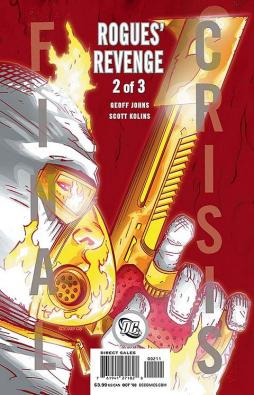
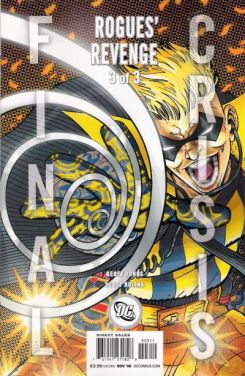
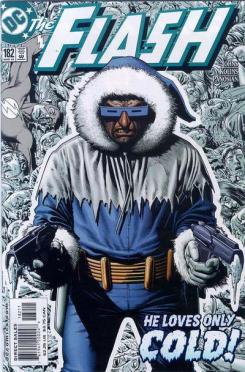
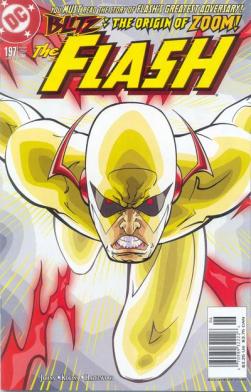
This fantastic miniseries is the brainchild of legendary DC writer Geoff Johns and artist Scott Kolins, who previously did a joint run in The Flash Vol 2Rogues’ Revenge is collected in a single volume and consists of the miniseries’ three issues, as well as two issues from Johns and Kolins’s run on The Flash Vol 2 issues #182 and #197, which focus on the origins of Captain Cold and Zoom respectfully.  Rogues’ Revenge is an excellent series that puts the focus onto an incredibly intriguing and very different group of villains.  Containing a superb story, some amazing artwork and some subtle, but interesting tie-ins to Final Crisis and other parts of the DC Universe, this is a really fun miniseries that is worth checking out.

Final_Crisis_Rogues_Revenge_3.jpg

One of the things that I like the most about this miniseries is the way that Johns and Kolins really dive into their complex main characters and show what set them apart from all the other supervillains.  The reader is given a look into the psyche of each of the Rogues, and shows the deep and dark troubles that hide within their minds.  Alone, they are incredibly damaged individuals with advanced weapons, but together they are a functioning unit able to hang with the most powerful godlike beings in the universe.  Each of the Rogues is a complex and intriguing character, and the creative team do a great job highlighting this succinctly in the miniseries.  Heatwave is a pyromaniac whose life has been consumed by fire, Weather Wizard is still haunted by the fact that he murdered his brother, Mirror Master is fighting his baser instincts and his drug habit, while Trickster is a young punk who is desperately trying to join up with the other Rogues he idolises.

Captain Cold is the most complex of them all, and his life is shown in both the miniseries and in one of the issues of The Flash Vol 2, which I have to give the producers of this volume props for including.  Captain Cold is the team’s leader and the definer of their moral code.  Because of him, the Rogues try to avoid killing where possible, do not touch drugs and have a high standard when it comes to its members, which is why they have yet to fully accept Trickster into their ranks.  Throughout Rogues’ Revenge, Captain Cold is able to control and anticipate the moods and needs of his team.  At the same time, he is able to lean on his team when it comes to his intense personal matters and the history with his family.  Issue #182 of The Flash Vol 2 does an amazing job of humanizing this character further, especially after you see him in action in the three issues of the Rogues’ Revenge miniseries.  Overall, the creative team are able showcase the close relationship the Rogues have with each other, as well as how strong they are together.

Flash_v.2_182.jpg

I also enjoyed how Johnson explores the complex relationship that the Rogues have with the Flash.  Despite him being the main superhero who has been opposing them for years, the Rogues make it quite clear that they never actually wanted to kill him, mainly because they knew how much trouble they would be in if they ever succeeded in finishing him off.  The anger at how they were duped into attacking the Flash without his powers is pretty clear early in the miniseries, and there is a certain sense of regret as they describe how their attacks usually would not have killed a speedster.  They also show some remorse that the Flash that they killed was so young, as they did not realise they were really attacking Kid Flash.  While this initial examination of their relationship with the Flash is fascinating, the discussion that occurs at the end of the third Rogues’ Revenge issue is particularly interesting, as they talk about their relationship with the original Flash, Barry Allen, and how he was different from all the other Flashes.  It is a great tie-in to the other comics focusing on this character’s return, and it also brings the Rogues’ story full circle as they decide to postpone their retirement in light of the relentless pursuit that they know is coming from their original Flash.  You have also got to love the present they send to the returning Flash in order to appease his wrath for their role in Bart Allen’s death.

 Rogues’ Revenge has an impressive and well-written story that is not only a lot of fun to read but ties in nicely with the major Final Crisis crossover event that was occurring at the same time.  The central story of the tired and weary Rogues as they plan to engage in one last mission before their retirement is amazing as it allows for a deeper look at their methods, equipment and skills at defeating speedsters.  The tie-ins with Final Crisis aren’t too over-the-top and mostly relate to the return of Barry Allen and Libra’s attempts at creating a new society of supervillains.  Libra’s scheme to bring the Rogues on board is particularly fun, as he sends the team of knock-off Rogues to face them, utilising stolen copies of their weaponry.  This is a great battle scene which helps show off how the Rogues are so much more than the weapons that they wield, as they utilise their skills and experience to eliminate their opponents in short order.  The devastating and inventive uses of their weapons are very impressive, from Captain Cold’s wide beam cold field, to Weather Wizard growing a tornado inside of one of his opponents.  The Rogues’ extreme violence in this scene is explained as the characters protecting their reputation, as there have been many copycats before, which fits these old veterans perfectly.  I also really liked the reasons the Rogues give to refuse Libra’s request for them to join the Secret Society, having been burned by joining them before, and it was fun to see them predict exactly how the new Secret Society was going to come crashing down.
Flash_v.2_197.jpg

The artwork within this miniseries is very impressive, and it was great to see Kolins back in The Flash saddle.  I was really impressed by the character designs Kolins used during this miniseries, as the four veteran Rogues all have their iconic costumes, but there is a beat-up and ragged look to them.  This perfectly encapsulates the terrible year the characters have been happening, and each of these characters have a tired and weary look to them after so many years of fighting.  I also cannot speak highly enough of the impressive fight sequences throughout the miniseries.  The full and at times gruesome effects of the Rogues’ weapons are in full display throughout Rogues’ Revenge, as the titular characters unleash fire, ice, weather, tricks and mirror insanity on their opponents.  The duelling walls of fire that occur between Heatwave and newcomer Burn are just gorgeous, and Weather Wizard’s various creations, such as lighting and fog, are drawn amazingly well.  I also cannot get past how impressively well Captain Cold’s ice devastation is drawn, especially when it comes to the effect the freeze ray has the human body.  This is an amazing bit of work from Kolins and the rest of the miniseries’ artistic team, and the art really helps to turn Rogues’ Revenge into a first-rate graphic novel.

Overall, Rogues’ Revenge is an outstanding tie-in miniseries that does so much to stand out from its overarching crossover event.  The focus on the Rogues, who make up one of DC’s most complex group of supervillains, is a compelling choice from the creative team, who do an incredible job showcasing these amazing characters.  Featuring an intriguing storyline and some first-rate artwork, this is a fantastic miniseries to check out, and one of my favourite underappreciated gems in the DC Universe.

My Rating:

Five Stars

Amazon

X-Men Red Volume 1: The Hate Machine by Tom Taylor, Mahmud Asrar and Pascal Alixe

X-Men Red Volume 1 Cover.jpg

Publisher: Marvel Comics

Publication Date – 18 September 2018

Amazon     Book Depository

Writer Tom Taylor and his artistic team have created an excellent and thought-provoking new X-Men series that not only follows the reintroduction of one of comics’ most interesting characters to the turbulent Marvel Universe but once again examines the real world problems of hatred and prejudice.

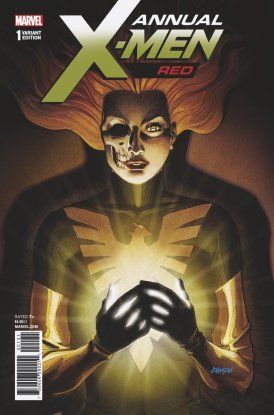
X-Men_Red_Annual_Vol_1_1_Johnson_Variant.jpg

For years, Jean Grey’s fate has always been tied to the universe-ending Phoenix Force, the cosmic entity of rebirth and destruction that is constantly seeking the most powerful host it can find.  However, following her latest resurrection during the events of Phoenix Resurrection: The Return of Jean Grey, Jean has renounced the Phoenix power once and for all and is now determined to live her life on her own terms.  Still one of the most powerful mutants in the entire world, Jean Grey sets out to restore her connections and find her place in a world that has changed dramatically since her last death.

The one thing that hasn’t changed is the fact that mutants are still feared and hated by a world that doesn’t understand them.  Despite all the adventures and endeavours of Charles Xavier and his X-Men, animosity towards mutants has never been higher.  Determined to change the world for the better, the resurrected founding member of the X-Men sets out to achieve her vision for the future and change world opinion about mutants once and for all.  To do that, Jean first attempts to create a mutant nation at the UN.  But when she is framed for the murder of politician, Jean is declared a criminal and mutants are subject to greater hatred from mankind.

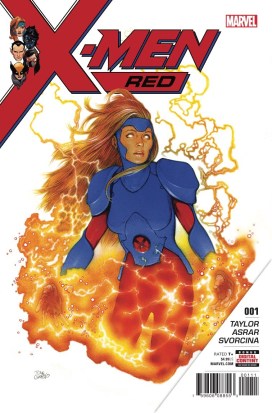
X-Men_Red_Vol_1_1.jpg

Realising that someone must be behind the recent upswing in anti-mutant sentiment and determined to protect those mutants targeted by hatred, Jean forms a new team of X-Men, made up of Nightcrawler, Storm, Namor, Gambit, Gentle, Wolverine (Laura Kinney – X-23), Honey Badger (Wolverine’s adorable clone) and newcomer Trinary.  But even as Jean and her team fight to save those mutants being targeted, more hatred and attacks are occurring around the world.  The sinister Cassandra Nova is determined to wipe mutants out once and for all and views Jean Grey as the greatest threat to this goal.

Following the end of his All-New Wolverine series, Australian author Tom Taylor returns at the head of a brand new X-Men series, X-Men Red, which takes fans back to the basics of the X-Men franchise.  Volume 1 of X-Men Red is made up of issues #1-5 of this new series, as well as Annual #1.  After enjoying Taylor’s work in All-New Wolverine (check out my review here: https://unseenlibrary.com/2018/09/08/all-new-wolverine-volumes-1-6-complete-series-by-tom-taylor/), I was excited to see him continue to work with Marvel, especially as it allows him to expand on characters and story elements he introduced in his previous Marvel series.  Most of the artistic work in this new series has been produced by veteran artist Mahmud Asrar, who has significant work in DC, Image, Marvel and other publishers.  X-Men fans may be familiar with his work on All-New X-Men and Wolverine and the X-Men.  Asrar was the main artist for issues #1-5, while the work on Annual #1, which is placed at the start of the volume, was drawn by Pascal Alixe.

X-Men_Red_Vol_1_2.jpg

It is always fun when starting a new superhero team comic book series made up of established characters to see which heroes the creative team will include in their version of the team.  Taylor has certainly chosen an intriguing and previously unseen mixture of characters for this new X-Men series, and it is interesting to see which characters he focuses on.  The central character of this new team is the newly resurrected Jean Grey, the red in the series title.  This is one of the few times we see Jean step up to lead a team, as she is no longer in the shadow of her mentors or former lovers.  Aside from Jean, the main team members are Nightcrawler, Wolverine and Honey Badger, who are featured in all the issues contained within this first volume.  It was great to see Nightcrawler given such a prominent role in the comic, and it feels like it’s been a while since he’s been such a major character within an X-Men series.  I also liked new character Trinary, who is introduced in this series and is given an interesting set of powers.  Trinary is from India, and has technopathy powers, or the ability to manipulate technology.  Introduced as a new mutant who is attempting to fight the good fight in her own way, Trinary is given a key role in the series understanding the full nature of the technological attacks of the volume’s antagonist, while also taking over a sentinel to use as the team’s new primary source of transportation.  I think this character is given a great introduction, and could have an interesting future in the Marvel universe.  Other characters, Namor, Gentile, Gambit and Storm join the team at various points in the volume, and have a slightly reduced role, appearing for some of the big team ups, with only some short introductory storylines.

I was especially happy to see Taylor transplant the main characters of his previous All-New Wolverine series, Wolverine and Honey Badger, into his next project.  As I mentioned in my previous review, this version of Wolverine, Laura Kinney, also known as X-23, has always been one of my favourite X-Men characters, so I was very happy to see her used again in this series.  She plays a similar role in this team to the original Wolverine, as the silent infiltrator and bodyguard who is loyal to the team’s leader, who in this case is Jean rather than Professor X.  Just like in All-New Wolverine, the heart and soul of this series is definitely Honey Badger, Laura’s clone, who, as well as being a full member of the team, is the series’ comic relief.  Her humorous interactions with all the other characters in the book, especially the stern and serious characters, add a good amount of levity to the book.  Having her refer to Namor as Abs-lantis, or making Gambit hurriedly justify his actions for blowing up Honey Badger by saying it was “for strategic reasons” is particularly amusing and definitely made me smile.  However, the best line in the book has to be given to Wolverine, who casually replies to Jean’s amusement about Laura’s excitement about being in an underwater city with “Being Wolverine doesn’t make me impervious to the wonder of a #$%@%$& mermaid”.

X-Men_Red_Vol_1_3.jpg

One of the most defining things about the start of this new series is how it focused on the evolution of the character of Jean Grey.  Despite being a founding member of the X-Men, Jean’s most significant storylines have usually been about her relationships with Cyclops and Wolverine, or her connection to the Phoenix Force.  Now, after coming back to life, Jean has stepped out of these currently deceased characters’ shadows and starts her own attempt to change the world, as she is no longer content to return to her old life.  Essentially, Taylor is trying to set Jean up as the new Professor X, with her own vision for mutant kind and her determination to change the world for the better and end the current level of hatred and prejudice.  While she has her own unique style and vision, there are a lot of call backs to the original Professor X, including the standard “To me, my X-Men” saying that Professor X and other X-Men leaders utilised throughout X-Men history.  I also enjoyed seeing a Jean Grey that is no longer defined by her relationship with the Phoenix Force, especially as Jean lets it be known that the Phoenix Force was holding her back.

It was also nice to see Jean repair the relationships she previously lost with several prominent X-Men characters, as well as establishing new relationships with characters she’s never had a chance to meet before.  This is particularly prevalent in Annual #1, which starts the volume, as she reunites with her surrogate X-Men family, which is heart-warming, especially as there is a focus on her friendship with Nightcrawler, who spends the volume as her BFF.  I also really enjoyed seeing her think about her relationships with Cyclops and Wolverine.  For the first time in X-Men history, Jean is alive when Cyclops and Wolverine are both dead, and must focus on the world without the two men she’s loved.  As such, she spends time adventuring with the daughters of these two men, Rachel Grey and the new Wolverine, and meeting up with them is one of the first priorities she has returning to the world.  I liked how one of the definitive love triangles of Marvel Comics is acknowledged in this new series, even though two points of the triangle are currently dead, and the focus of Jean’s relationship with the next generation of these characters was a clever idea.  I’ll be very interested to see what relationships are explored in the future, with all sorts of different iterations or offspring of Jean and Cyclops out in the world at the moment.  It will also be very intriguing when the original Wolverine is resurrected to see what role he plays in this series, as the creative team will have to have a look at the relationships that this character has with Jean, the current Wolverine and Honey Badger, a new daughter character he’ll have to interact with.
X-Men_Red_Vol_1_4.jpg

Since its earliest days, X-Men has always been about the fight against prejudice, as the hatred the mutant characters experience has often been seen as an analogy for social issues such as racism, anti-Semitism and homophobia.  Taylor and the creative team behind X-Men Red continue this tradition of using their X-Men series to reflect social issues, in this case focusing on modern issues such as the latest rise of the extreme right-wing, intense nationalism, islamophobia, fear and concern about refugees and migrants, as well as racism.  All of these social issues are reflected in the portrayed hatred of mutants in this volume, with various elements of recent world events shown directed towards the mutant characters.  For example, you have Poland attempting to use their military to round up and detain mutants, similar to how some countries have been using their military to stop or detain refugees.  In another very unconcealed scene, rioters carrying tiki torches start attacking mutants, not considering them people, and even killing one mutant counter protestor, in events that are reminiscent of those of Charlottesville.  There is also a focus on the damage or the impact that social media and the internet can have on these events, as many of the anti-mutant events or rhetoric are contained online.  This will be very familiar to readers, as it is impossible not to see the online hatred that many anonymous people direct towards various groups around the world, and at least the one in the comic may be the result of supervillain plot.  Overall this focus on prejudice is a familiar subject to X-Men readers, and many will appreciate how the creative team have tried to bring in modern issues in this new series.  The creative team do end Volume 1 with a message of hope, with some of these antagonist people given a proper understanding of an opposing viewpoint, momentarily giving up their hatred and prejudice, and is something aspire for in the real world.

The artwork within Volume 1 of X-Men Red is just gorgeous and a real highlight of the book.  As mentioned above, Alixe does the artwork for Annual 1, while Asrar does the artwork for issues #1-5.  Both artists’ works are visually distinctive and give the reader something different when it comes to character design, displays of power and fight sequences.  Asrar in particular does some gorgeous backdrops and landscapes, as the stories he is illustrating see the characters go to all sorts of locations, including India, underwater cities and Wakanda.  There are a lot of well-drawn action scenes throughout this volume, although I found the final pages of issue #1 to be some of the most powerfully drawn in the entire volume.  Not only is there a somewhat graphic scene for a Marvel comic but the final panel shows the look of despair on the main characters as the volume’s antagonist makes her first move.  The artistic team of X-Men Red have outdone themselves in this first volume, creating some superbly drawn artworks that are catch the eye and the imagination.

X-Men_Red_Vol_1_5.jpg

X-Men Red takes this new version of this iconic superhero team back to the sort of storylines that made the X-Men such a smash hit in the first place.  With a resurrected Jean Grey taking the lead, Australian author Tom Taylor and his creative team have cleverly brought current social issues to the forefront of their new series while also doing some superb character work, including redefining one of the original X-Men.  This is a great start to an amazing new comic series and a fantastic read for fans of the X-Men franchise.

My Rating:

Four and a half stars

Amazon     Book Depository

Star Wars: Darth Vader: Dark Lord of the Sith, Volume 3 – The Burning Seas

Darth Vader - The Burning Seas Cover

Publisher: Marvel Comics

Writer: Charles Soule

Artists: Giuseppe Camuncoli

              Daniele Orlandini

              David Curiel

              Java Tartaglia

Publication Date – 11 September 2018

Amazon

I have previously reviewed the second volume of this series here:

Star Wars: Darth Vader: Dark Lord of the Sith, Volume 2 – Legacy’s End

Darth_Vader_Dark_Lord_of_the_Sith_13.jpg

The creative team behind the amazing Darth Vader: Dark Lord of the Sith series return with their third volume, The Burning Seas, which continues to follow the early adventures of one of fiction’s greatest villains, Darth Vader.  This third volume contains issues #13-18 of what has to be one of my favourite current ongoing series.

This new volume is set one year after the formation of the Empire, and the Emperor is determined to show off the full military power he now commands.  To that end, he dispatches Vader to the aquatic planet of Mon Cala, which has been resisting attempts to be completely incorporated into the growing Empire, and whose King appears to be receiving advice from a Jedi.  However, this will not be Vader’s first journey to Mon Cala.  Years ago, during the Clone Wars, Anakin Skywalker and the Jedi saved the planet from a Separatist invasion and supported the young Mon Calamari king’s ascent to the throne.

DarthVader-DLotS-14-no.jpg

Leading a force of his Inquisitors to Mon Cala, Vader attempts to investigate the potential Jedi influencer, but the situation quickly devolves into all-out war.  With Governor Wilhuff Tarkin leading the Imperial invasion, Vader and his forces attempt to locate the Jedi behind the unfolding events.  How will Vader’s return impact the planet of Mon Cala, and what events will the mysterious Jedi’s actions have for the future of the galaxy?

In additional adventures, Governor Tarkin finds himself in the unenviable position of owing Darth Vader a favour.  Vader’s request is a hunt with a twist: the hunter will be Tarkin, while the hunted will be Vader himself.  Bored by a lack of challenges, Vader has tasked Tarkin to provide him with some worthy competition.  Will Tarkin earn Vader’s respect, or will he and his team of mercenaries be the next victims of Vader’s rage?  In addition, Vader has been tasked to investigate sabotage around the construction of the Death Star on Geonosis.  As Vader encounters the creators of the Death Star, Commander Krenik and Galen Erso, he uncovers not only the saboteurs but also the full potential of the Death Star and the impact it could have on Vader’s position.

DarthVader-DLotS-15.jpg

Darth Vader: Dark Lord of the Sith returns with another fantastic and captivating volume that not only furthers the adventures of Darth Vader but also ties the series into the wider Star Wars universe while fleshing out backstories and lore not explored in the movies.  In this volume alone several minor characters’ pasts are shown, the history between Vader and Tarkin is explored and there is a particular focus on the events leading up to the Rogue One movie.  Dedicated Star Wars fans will love that the main story of this volume is set on the planet of Mon Cala and introduces several key Mon Calamari characters.  The readers are gifted with new origin stories for Admiral Raddus, who leads the Rebel fleet in Rogue One, and a young Commander Ackbar, famous for the line ‘It’s a trap’, which highlight their early abilities and show why they were so determined to fight the Empire.  Fans of the Clone Wars television show also get an intriguing conclusion to the three-part Water War arc of the show’s fourth season.  During this television arc, Anakin Skywalker and his allies helped save the planet from an invasion and helped the young Mon Calamari King Lee-Char ascend to the throne.  Now, in a reversal of this arc, Vader returns as an invader and his main target is the Mon Calamari king he once protected with his life.  It is a compelling switch that creates some terrific drama and emotion during this comic book arc.  Surprisingly enough, there is also a focus on the Mon Calamari cruisers, the large imposing ships that become a fixture of Rebel Alliance and the subsequent Resistance.  Several of the plans underway involve the future of these ships, and the twisted priorities of a Jedi regarding them are quite chilling to behold.  In addition to the main story of this volume, one of the issues is heavily involved in the construction of the Death Star.  As a result, Vader interacts with several characters who feature in the Rogue One movie, and the creative team are able to suggest he had a lot more to do with the events of Rogue One than shown in the movie.  This issue also sees Vader return to Geonosis, the main setting for the latter half of the Attack of the Clones movie, and it is very cool to see him return to this important location in his previous life.

On top of the above insertions into the Star Wars universe, the creative team also spend a significant amount of time in this volume exploring the relationship between Darth Vader and Grand Moff Tarkin.  When both characters are introduced in A New Hope, Tarkin always appeared to be in command of Vader and appeared to be someone that Vader respected.  It was an unusual relationship, considering Vader’s personality and his role as the Emperor’s apprentice.  This volume creates a fascinating new narrative that shows when Tarkin was put in charge and why Vader allowed it to happen.  This is first shown during the main story of this volume, when Governor Tarkin, who is leading the invasion of Mon Cala, requests Vader’s assistance to end the war quickly.  Vader is shown in these issues to independent from Tarkin, who still shows the ability to get what he wants from Vader, even if it may cost him down the line.  The creative team spend a good amount of time during the four issues that focus on the invasion of Mon Cala highlighting Tarkin’s tactical ability and ruthlessness, reminding the reader what a great villain Tarkin is in his own right.

DVDLOTS-16

The rivalry between Vader and Tarkin comes to a head in the sixth issue of this volume, when the two of them hunt each other on a wild planet.  This is one of my favourite stories in the whole Darth Vader: Dark Lord of the Sith series so far, as the two Imperial heavyweights go head to head in a true battle of the villains.  This issue does an amazing job of highlighting the attributes of both characters.  Tarkin’s cunning, intelligence and determination to win are in full display, while Vader is shown to be not only a destructive force but also a creative opponent who is able to surprise even Tarkin.  The conclusion of this story is very clever and helps define the relationship these two characters have in the movie.  The final issue of this volume finds Vader officially under Tarkin’s command, but shows that Vader is not as subservient as Tarkin would wish.  The main focus of their rivalry in this volume is the Death Star, especially as Tarkin is convinced that his creation will make Vader obsolete.  Soule laces some suggestions during this final issue that many readers will find extremely intriguing and puts a whole new light on Vader and Tarkin’s relationship, especially in the final exchange between the two, where Vader presents a prediction to Tarkin: ‘If you invest too much of yourself in this battle station – – it may end up your tomb.’  The exploration of the relationship between these two dynamic and iconic Star Wars villains is an exceptional part of this new addition to the fantastic series and a really cool feature for Star Wars fans.

For the first time in this series, the creative team tackle a large-scale Star Wars battle as the forces of the Empire attempt to invade or subdue the entire planet of Mon Cala.  The battle sequences that are produced are breathtaking in their scope and execution, as the reader is treated to land battles, space fights, orbital bombardments, battles above, below and on the planet’s ocean surface and even a weaponised tidal wave which sweeps away masses of Imperial forces.  The artwork of these battle scenes is really exceptional; especially the sequences set underwater, which offers an unique scenery backdrop not typically seen in other Star Wars comics.  The creative team do a fantastic job showcasing the massive military capacities of the Empire and the pure devastation their newly created military machine can do.  I also loved the clever and very entertaining way that the rogue Jedi Ferren Barr manages to use certain Imperial forces against Vader’s Inquisitors, in what has to be one of best examples of karma in the entire history of Star Wars.

DarthVader2017-17.jpg

As they have in the previous volumes, the creative team behind the Darth Vader: Dark Lord of the Sith series go out of their way to showcase how much of a badass their titular character can be.  In addition to the issue in which he powers through all that Tarkin can throw at him, Vader spends the rest of this volume cutting through opponents like they are nothing, including hordes of Mon Calamari and Geonosians.  In addition to these fairly standard actions (standard, that is, for an all-powerful Sith Lord), Vader does some other extraordinary actions, whether it’s surviving explosive rock falls, attempting and nearly succeeding to push back a tidal wave, surviving at the bottom of the ocean and then subsequently taming and eventually killing a massive sea monster he encounters there using only the force, Vader appears like an absolute boss.  He also has a fun reaction when his Inquisitors abandon their mission and attempt to save him from the bottom of an ocean, instead of being grateful, he calls them fools and makes it very clear that ‘I never need…RESCUE’.  It is again captivating to watch how far Vader continues to move further and further away from the Jedi way, as even at the start of this series he had the potential to come back from the dark side.  However, his actions in this book, such as the utter destruction of something significant and good that he previously created, re-imagining his previous battle with Obi-Wan Kenobi with devastating new details, and his slaughter of a whole brood of Geonosians that he compares to animals just like he previously did with the Tusken Raiders in Attack of the Clones, once again show how far he has fallen.  I must also highlight the great artwork in this series when it comes to Vader.  Not only are his exploits shown in full and exquisite detail but the artwork presents him in such a sinister light in every single scene he is in.  This is another masterful portrayal of an exceptional fiction villain.

The third volume of the Darth Vader: Dark Lord of the Sith, The Burning Seas, is another outstanding addition to one of this year’s most consistent and entertaining comic book series.  This specific volume features massive and intense battles, an intense fight for supremacy between Vader and the ruthless Tarkin, and the continued outrageous and destructive adventures of one of the greatest villains of all time.  This entire run of Darth Vader: Dark Lord of the Sith is definitely worth getting into, and The Burning Seas is easily the best volume of this entire series so far.  A must read that comes highly recommended.

Darth_Vader_Dark_Lord_of_the_Sith_18.jpg

My Rating:

Five Stars.PNG

Amazon

If you enjoy Star Wars fiction, check out some of my previous reviews:

https://unseenlibrary.com/2018/08/12/star-wars-thrawn-alliances-by-timothy-zahn/

https://unseenlibrary.com/2018/05/30/star-wars-last-shot-by-daniel-jose-older/

Skyward, Volume 1: My Low G Life by Joe Henderson and Lee Garbett

Skyward Volume 1 Cover.png

Publisher: Image Comics

Publication Date – 25 September 2018

Amazon     Book Depository

Those looking for the next amazing comic book adventure they can get addicted to should look no further than Skyward, one of 2018’s breakout hits, which takes away a fundamental force and replaces it with a sensational story.

One day, around the planet, gravity all but disappeared, and the one thing that was previously holding everything to Earth’s surface all of a sudden became a fraction of what it previously was.  In the resultant chaos, huge swathes of the population simply floated away into the atmosphere.  Those that remained were forced to adjust to a new world with different rules.
Skyworld_01-1.png

Twenty years later, humanity has adapted to its new low-gravity reality.  For some, such as Willa Fowler, it’s the only way of life they have ever known, and Willa excels at navigating the skies above Chicago.  Living with her father, Nathan, a brilliant scientist traumatised by the events that sent his wife tumbling into the skies, Willa scrapes a living as a high-speed delivery girl with a number of risky and dangerous tricks up her sleeve.  But when her father reveals he has a way to bring gravity back, Willa doesn’t believe him and instead plans a meeting with Roger Barrow, her father’s rich former research partner, who has created much of the technology that allows the world to survive its new situation.  Descending to ‘The Streets’ of Chicago, the lowest level, inhabited by its richest citizens, Willa quickly discovers that Barrow is not the saviour she thought he would be.  Instead he is determined to keep gravity from returning, and will go to extreme lengths to stop Willa and her father.

Skyward_02-1.png

This is one of the first comic book works from Henderson, whose main claim to fame is as showrunner for the Lucifer television show.  The artist, Garbett, is probably best known for his work on the comic Loki: Agent of Asgard.  Together, this new team has created an incredible new comic book series that has already been picked up by Sony for a potential feature film, and it will be intriguing to see how this challenging and creative series will be adapted to the screen.  This first volume contains issues #1-5 of this new series.

Skyward contains an excellent story that examines life in a different and catastrophically affected version of Earth while also presenting an action-packed adventure with a wild protagonist.  The central idea of this series, the removal of gravity, is a crazy concept that allows for an exceptional overall package that combines great storytelling with incredible and unique artwork.  Throughout this first volume, there is a great combination of humour, action, character development and powerful emotional moments, all set within a fascinating new world shown in great artistic detail.

Skyward_03-1.png

It was quite intriguing to see the various ways in which a lack of gravity could affect the world that we live in.  Henderson and Garbett have come up with a range of different ways for the characters in this book to navigate around the skyline, and it is interesting to see the range of tools that are shown in the artwork.  The creative team has done an amazing job highlighting the various ways that the lack of gravity has affected the world, from food production to water gathering to human mobility.  One of the more intriguing aspects of the new world is the way in which guns have become obsolete due to the recoil pushing shooters back through the air, making it an ineffective weapon and more dangerous to the user than the target.  That said, the protagonist, Willa, has some more extreme and effective uses for the gun she carries around with her.  Perhaps the most intriguing idea presented in Skyward is the location known as The Streets, the lowest street level of Chicago, where the city’s richest inhabitants live in a state of denial at the changes that have happened and are trying to live like there is still gravity.  This includes wearing grav-boots to keep them stuck to the ground and forcing a man with no legs to sit in a wheelchair rather than floating in the air as he would prefer.  There are also some crazy inventions, like a magnetised hem to keep a dress from rising up.  These inhabitants of The Streets are absolutely terrified of the sky and have a very different lifestyle from the people living in Chicago’s skyline, who have embraced the new world.  One funny scene involves Willa traumatising an obnoxious bouncer by wrecking his grav-boots and making him float up into the sky a little.  Overall, this is a fun new world to set this great story in and has a lot of potential for future volumes of this series, where additional changes to day-to-day life are no doubt going to be revealed.

Skyward_04-1.png

The artwork in Skyward is just gorgeous and is definitely a key highlight of this incredible book.  The creative team have done an outstanding job showing off the low-gravity concept in art form, creating some fantastic scenes and drawings.  Most of the characters are shown floating around and navigating the air, which creates some amazing panoramas of the city from high above for the reader to enjoy.  All the characters, even those rich individuals trying to ignore the lack of gravity, are shown with their hair floating up in the sky, and multiple scenes have various liquids floating in the air around the characters attempting to have drinks.  It also means that fight scenes are constantly surrounded by droplets of blood that float around the characters and add a whole new sense of realism and brutality to the story.  The artistic highlight of this book has to be the incredible and exceptional drawings of the storm in low gravity that becomes such a massive part of the background in the later part of the volume.  Due to the effects of the low gravity, the storm manifests itself as a gigantic ball of water in the sky, surrounding several high-rise buildings.  The first drawing of this is amazing, and the following scenes which show the main characters navigating around this bubble and creating massive pockets of air are just fantastic, and represent some exceptional comic book art.  I was also suitably terrified by several of the drawings in this volume, from the opening scenes which show multiple people being lifted away by the low gravity, to the horrifying shot of the planet Earth and its new artificial ring, made up of planes, cars, ships, other debris and of course multiple dead animals and humans that have not decayed in their 20 years in orbit.  Lee Garbett and the creative team have outdone themselves in Skyward and I cannot speak highly enough of the artwork in this book.

Skyward Picture 1.jpg

The main character, Willa, is an excellent protagonist for this series.  As a character who has never known what it’s like to live in a world with gravity, Willa’s antics through the air are pretty crazy and she does some amazing and unpredictable things throughout the book.  Whether it’s using a gun to gain rapid altitude and to come down again, or blowing out a window underwater in a low-gravity storm of water after creating an air pocket with her oxygen tank.  The constant incredulity of the other characters as she does these things is very amusing and makes it quite clear that these actions are not the social norm in the new world.  My favourite quote of the books is when the antagonist, realising that Willa is about to blow open a window with her gun says ‘She wouldn’t…’ while Willa’s friend who is being held hostage responds with ‘Oh, she would.’ I must again return to the artwork of Skyward when it comes to showing off this main character.  The artists do a fantastic job highlighting the joy on Willa’s face as she flies around in the upper city; she looks like she was born to float.  I also loved the drawings that show off her crazy antics, from the early sequence which shows her using a gun to blast off away from people attacking her, to that fantastic scene where she blows open the underwater window.  The drawings themselves are incredible and really show off the action, while the looks of shock and amazement on the faces of onlookers tell a whole new story.  Henderson and Garbett have created a perfect main character and protagonist in Willa, and I can’t wait to see what she gets up to in future volumes of this series.
Skyward_05-1.png

Skyward is an incredible new series from the fantastic team of Henderson and Garbett.  I really enjoyed the central concept of a lack of gravity, as it allowed the creative team to present a bold and exceptional new setting for this exciting and powerful story.  I really cannot hype up the artwork of this series enough, and I love the various ways that the artists show off what impacts these gravitational changes would have to everyday life on the planet.  An outstanding five-star start to a series with incredible potential, this is the perfect read for current comic book readers and a great starting point for those trying to break into the medium.

My Rating:

Five Stars

Amazon     Book Depository

Hit-Girl, Volume 1: Colombia by Mark Millar and Ricardo Lopez Ortiz

Hit-Girl Colombia Cover.png

Publisher: Image Comics

Publication Date – 26 June 2018

Amazon     Book Depository

The baddest little vigilante in America goes international in this outrageous new series from comic book legend Mark Millar.

Hit-Girl is the moniker of Mindy McCready, a pre-teen vigilante killer who is the Kick-Ass universe’s most effective and terrifying hero.  Introduced early on in the first volume of the Kick-Ass comic, Mindy was a 10-year-old girl who had been indoctrinated by her father, Big Daddy, into becoming an expert killer and crime fighter.  Despite an attempt to live a normal life after the death of her father, Mindy has reverted to her vigilante ways with her trademark extreme violence and sassy attitude.

HitGirl_01-1.png

Following the events of the Kick-Ass 3 comic, Hit-Girl has decided to take her vigilante gig international and bring her version of justice to criminals around the world.  However, with her partner, Dave Lizewski, the original Kick-Ass, retired, and his replacement (a young man Hit-Girl randomly recruited off the street) deciding to quit in the face of armed criminals, Hit-Girl is all on her own.  With a request for help in Colombia looking too big to handle by herself, Hit Girl decides to recruit a partner as deadly and deranged as herself.

HitGirl_02-1.png

Enter Fabio ‘Mano’ Mendoza, the most ruthless and dangerous hitman in Palmira, Colombia.  Freeing him from imprisonment, Hit-Girl ‘convinces’ Mano to help her with her mission, utilising an explosive device to keep him in line.  Armed with an array of advanced and insanely destructive weapons, Mano helps Hit-Girl turn all of the city’s gangsters into corpses.  But what will happen when Hit-Girl forces Mano to target his own gang?

HitGirl-03_cvrB.jpg

Hit-Girl was created by author Mark Millar, one of the most impressive and recognisable names in modern comics.  Millar has worked with a number of different publishers throughout his career, including DC, where left his mark on titles including Swamp Thing, Superman and The Flash, and Marvel, where he wrote the iconic Civil War series and had significant input in Marvel’s Ultimate Universe, which serves as the inspiration for many recent comic book movies.  Millar has also created a number of the best alternate universe stories these two major comic book publishers have ever produced, from the inventive Superman: Red Son to the incredible Old Man Logan, which served as the basis for 2017’s best comic book movie, Logan.  Millar has also created a range of independent series, many of which are quite dark and brutal, such as Kingsman: The Secret Service, Jupiter’s Legacy, Superior and Wanted.  However, one of Millar’s most iconic works is his independent series, Kick-Ass, which was adapted into a fantastic movie in 2010 that helped dramatically increase the author’s general profile.  Kick-Ass ran for three volumes, and the final issue revealed that Kickass and the above independent series all exist in a shared universe, known as the Millarverse.  Readers may recognise several of the above comics from recent movies, with Kingsman and Wanted both having been adapted into big screen movies.  In addition to this current Hit-Girl series, Millar is currently working with Netflix to create a number of intriguing new comics, such as The Magic Order, and a range of movies and television series.

HitGirl_04-1.png

A large amount of the success of Kick-Ass can be attributed to the character of Hit-Girl, a sensational addition to both the comics and the subsequent movie adaption.  Hit-Girl is easily the most popular character in the series due to the sheer craziness of having a 10-year-old girl tearing through groups of dangerous criminals while swearing her head off.  This cool character continued in the movie, where Chloë Grace Moretz brought Hit-Girl to life in all her foul-mouthed, murderous glory, albeit with an altered costume.  Hit-Girl appeared in all three volumes of Kick-Ass, and has already been the star of her own Hit-Girl miniseries comic, much of which was adapted into the Kick-Ass 2 movie.  This current series of Hit-Girl represents the first work that has been done on the Kick-Ass storyline since 2014.  The first volume of this new series is called Colombia and contains issues #1-4.  The second volume of this series will continue Hit-Girl’s international murder spree as she heads to Canada, and will be released in late October.

HitGirl.Issue1.coverC.jpg

This new Hit-Girl series contains pure insanity as the titular character goes on a rampage down in Colombia.  There are some fantastic sequences throughout this book as artist Ricardo Ortiz draws a series of demented murders and deaths as Hit-Girl and Mano attack and kill hundreds of gang members in Palmira.  These gang members suffer an insane amount of different gruesome deaths including being shredded by bullets, sliced by swords, shot with arrows, killed by a train, blown up into tiny pieces, vaporised by flesh-eating gas, and thrown off buildings.  Ortiz’s artwork pulls no punches during these scenes, with the highlight having to be the microwave gun that cooks one gang member from the inside out.  There are also a ton of great action sequences throughout this book, with the artist presenting some excellent battle artwork that really highlights the fast-paced and frenetic action portrayed within.  Some of these scenes are so wonderfully over the top that it is hard not to laugh, such as the sequences where Hit-Girl and Mano are forced to overcome a zoo of coked-up animals standing between them and their target.  This is some brilliant work from the artist and a real highlight of the volume.

HitGirl.Issue1.coverD.jpg

While all the superfluous violence is outstanding, this first volume of Hit-Girl is far more than just about the killing of criminals.  It is actually a complicated revenge plot, and Millar has created a fantastic overarching story for this entire volume.  Watching the full extent of Hit-Girl’s plan unfold is so much fun, especially when you realise just how much she is playing all the other characters in the book.  Hit-Girl revealing that her plan involves saving a kid who served as her patsy from joining a gang is pretty powerful, especially when the kid is left wondering about the origin of the ‘final message’ from his brother.  By the end of these four issues, all the characters get what they deserve, leaving the reader extremely satisfied with the result, while Hit-Girl is left determining where to go for her next rampage against crime.

Hit-Girl is once again a fantastic main character for this book, and Millar and Ortiz’s portrayal of her is absolutely amazing.  Placing murderous attitude and terrifying adult personality inside the body of a little girl is still spectacular to see, and it is quite jarring and very entertaining to see this little kid doing crazy stuff like jumping up and down in excitement while requesting that her associate perform a particularly gruesome murder.  Ortiz presents some incredible changes in facial expression throughout the book that really show off the dual personality of the character.  In some scenes, she looks quite innocent and childlike, while in others, she looks positively demonic, especially when she establishes control of a situation.  While she is mostly portrayed as destructive, adult and emotionless, there are times when she comes across as more human and acting her age.  She spends several scenes getting closer to Mano, and the two work out that they have some interesting similarities, including being manipulated by a controlling father figure for most of their lives.  In hindsight, it is quite horrifying that she spent time getting close to Mano, considering the multiple ways she was playing him and her eventual intentions for him, but it is still great to see her team up with someone who has the same killer instinct, as well as a similar moral compass.  I also love the scene at the end when Hit-Girl allows her ally, Camila to get a chance at revenge, but is not surprised when she does not take the shot, stating “you’re a good person”.  Hit-Girl’s facial expression while she says that is perfect, as it helps portray the fact that our protagonist knows she is not a good person and never will be.  Overall, this is some amazing character work and Hit-Girl is still an amazing protagonist.

Mark Millar is once again in top form as he brings in the first volume of his new Hit-Girl series.  Featuring some outstanding artwork from Ricardo Ortiz, Hit-Girl Volume 1: Colombia contains an insane amount of graphic and entertaining violence and death, while also containing a fun and satisfying story with an awesome main character.  I am already excited for the next volume of this new series, and I cannot wait to see what chaos Hit-Girl causes in Canada.

My Rating:

Five Stars

Amazon     Book Depository