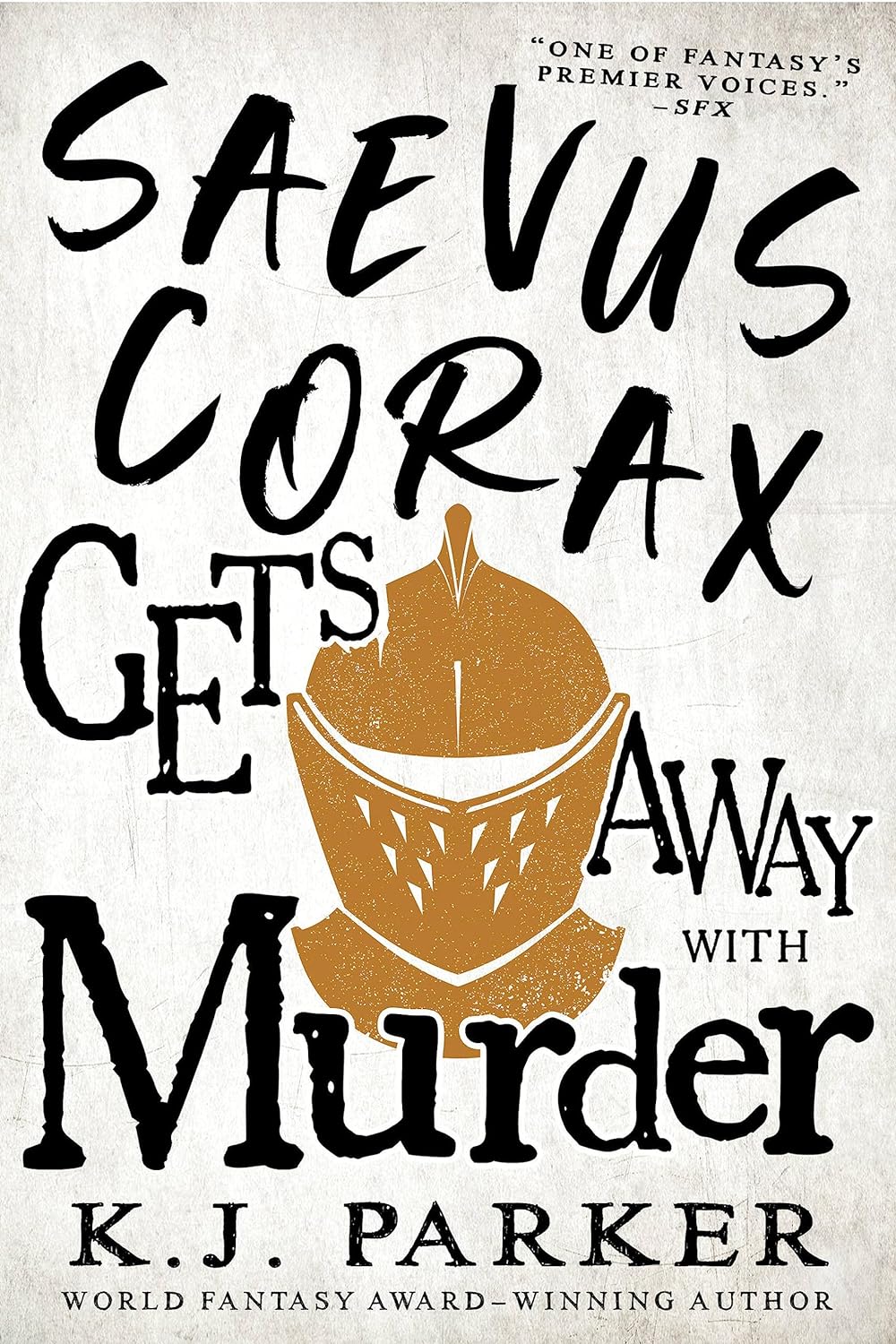
Saevus Corax Gets Away with Murder by K. J. Parker

Publisher: Orbit (Trade Paperback – 5 December 2023)

Series: Corax Trilogy – Book Three

Length: 323 pages

My Rating: 5 out of 5 stars

Amazon

One of the masters of comedic fantasy, K. J. Parker, ends his fantastic Corax trilogy on an outstanding note with Saevus Corax Gets Away with Murder.

As we get to the end of 2024, I’m desperately trying to finalise reviews for books I read earlier in the year.  This includes the third and final entry in the Corax trilogy by K. J. Parker, which I enjoyed a few months ago.  Parker, a pseudonym of author Tom Holt, released his entire Corax trilogy in 2023, which follows a resourceful and ill-fated rogue, Saevus Corax, as he finds himself in all manner of trouble.  Set in the same universe as the author’s The Siege series, which featured Sixteen Ways to Defend a Walled City (one of my favourite books of 2019), How to Rule an Empire and Get Away with It (one of my favourite books of 2020) and A Practical Guide to Conquering the World (one of my favourite books of 2022), this was a trilogy with a lot of potential, and I eagerly grabbed all three books the first chance I could.

While I managed to get all three of the Corax novels last year, I only had the chance to read the first novel, Saevus Corax Deals with the Dead before 2023 ended.  This first entry in the trilogy was pretty damn incredible, and I loved the wonderful and highly entertaining story it contained, especially as it was masterfully layered with Parker’s trademark humour.  Saevus Corax Deals with the Dead got an easy five-star rating from me, and it ended up being one of my favourite books of 2023.  I quickly got onto the second book in the series, Saevus Corax Captures the Castle, earlier this year, and just like the first entry, it proved to be a remarkable read that I had a wonderful time with.  As such, I made sure to read the final book in the trilogy, Saevus Corax Gets Away with Murder, as quickly as I could, and it proved to be great reading whilst away on holiday.  I regret not writing something about Saevus Corax Gets Away with Murder sooner, as it was an outstanding and epic read that I could not put down, but hopefully I can make up for it now.

After years of schemes, daring cons, an unwilling coronation and other unfortunate adventures, Saevus Corax is still stuck doing the only job he’s good at, battlefield salvage.  Unglamourous and often disgusting work, it provides a basic living for his large crew of outcasts and rogues as they tour their world’s many scattered battlefields, rescuing and repurposing everything they can recover from the dead.  However, Corax’s band are about to encounter the only thing that can make their business unprofitable, a massive total war that threatens to burn the entire continent.

Seeing the signs of upcoming mass conflict, Corax and his crew attempt to flee to safer climates where they can still potentially make a living.  However, Corax finds his plan to escape thwarted by the family he has long tried to run away from.  His sister, Phantis, has finally caught up with him, but instead of the vengeance she always promised, she needs his help to survive a coup gone bad.  Despite his reluctance to get involved, Corax attempts to help, only to get dragged into even more danger.

Soon, with war coming closer and various factions seeking to kill him and claim the many bounties on his head, Corax is forced into one final scheme to get enough money to retire and escape from everything.  Reuniting with his old flame, the beautiful con artist Stauracia, Corax attempts to find a long-lost treasure that could solve all his problems.  But with betrayal coming from all sides, can Corax survive the chaos to come, or has he finally encountered a situation that even he cannot think his way out of?

Parker continues to showcase why he is the master of hilarious fantasy fiction, as Saevus Corax Gets Away with Murder was another amazing read with a captivating and unique plot behind it.  Masterfully wrapping up the Corax trilogy with a dark and entertaining story, Saevus Corax Gets Away with Murder had me hooked the entire way through and, just like all the other books in the series, it gets a full five-star rating from me.

This third Corax book proved to be an excellent read, with Parker taking his audience on a final wild ride of schemes, betrayal and family drama, as Saevus Corax comes face to face with all his demons.  While easily enjoyed as a standalone novel, Saevus Corax Gets Away with Murder is best read after the rest of the trilogy, especially as many of the ongoing storylines and character relationships come to an end here.  The plot of this book is epic and entertaining, as war, his ongoing conflict with his family and a desire to finally live a normal life drive Corax towards one final scheme while also trying to wipe away the sins of his past.  However, as this is Corax, nothing goes to plan, and he soon encounters multiple setbacks and conflicts that he is forced to overcome in his typical resourceful way.  However, this time Corax experiences some truly devastating betrayals and dark moments that destroy him in a way never seen before.  Parker really lays in the clever twists for this last book in the trilogy, and you will not be prepared for some of the dark routes he goes.  I felt that the big betrayal halfway through the novel was pretty impactful, although the final twist of the knife from his worst enemy at the end was the most heartbreaking.  Everything comes to an impressive end that, while satisfying, fits within the tragic narrative that is the protagonist’s life, and honestly could the author really have left this series on a true happy ending?

The author continues to utilise the writing style and intriguing setting that made the first two Corax books and the preceding Siege trilogy so successful.  While this similarity in style and substance does deal a certain dose of repetition to this third book, I still have a ton of fun reading them, and Parker makes it work so well in the context of his story.  Utilisng a chronicle format from the perspective of the protagonist, Saevus Corax Gets Away with Murder recounts the events of this final adventure, once again loaded with Corax’s distinctive and often satirical commentary and observations on events.  The author relies heavily on twists, betrayals and deep intrigues throughout the plot, all of which are carefully pulled together, explored and savagely roasted by the protagonist as he experiences them.  The continued cynicism and sarcastic take on the world that Corax witnesses and human nature in general brings in much of the book’s humour, and it is hard not to enjoy Corax’s unique thoughts.  This first-person perspective is such an effective storytelling method for the series, and I love how it enhances the humour of the story while also serving as a good tool for exploring the various aspects of the semi-fantasy/alternate history world that the author is setting so many of his books in.  Parker’s style really fits the complex narratives of deception, lies and betrayal that are the hallmark of the Corax series, and I am so glad that he set out this novel the way that he did.

The final Corax book was just as character focused as the previous entries, and I appreciated how Parker brought his various character arcs to a final close in Saevus Corax Gets Away with Murder.  Most of the focus remains on titular perspective protagonist, Saevus Corax, and it was great to see his unique story come to an end.  A typical Parker protagonist, in that he is clever, funny, unrepentantly cynical and just a little bit tragic, Corax has been a great figure to follow, especially due to the elaborate schemes and complicated history that define his life.  Constantly analysing the world and relying on the predictability of human nature, Corax is a dangerous person, especially when dealing with the various people trying to manipulate him as he tries to do the right thing.  While he is usually able to outsmart everyone, several betrayals in this book really get under his skin, and he ends up being particularly rash and devastated at times.  Despite this, he is still the clever, surprisingly honest, and often thoughtful figure that you have come to love in the previous novels, and I really appreciated seeing how his story concluded in this final Corax novel.

Aside from the protagonist, Saevus Corax Gets Away with Murder features an interesting range of supporting characters, many of whom have a complex relationship with the protagonist.  The most prominent of these is the manipulative force of nature, Stauracia, a con-artist who has a lot of history with Corax.  Corax and Stauracia play off each other perfectly, and I always enjoy seeing their unique form of courting involving cons, lies and deceit.  Saevus Corax Gets Away with Murder is the book that really defines their relationship, and it was awesome to see their chemistry on full display as they try to work together for the ultimate final score.  The rest of the cast is pretty fun as well, with the highlight being Corax’s sister Phantis.  Parker has spent the entire trilogy hyping up Corax’s family as dangerous antagonists, and the author didn’t disappoint when it came to finally featuring one.  Phantis is an incredibly selfish, vindictive and manipulative figure, and it was great to see the fantastic scenes between her and Corax, which amped up the family drama.  While I was slightly disappointed we didn’t get to meet another member of Corax’s family that has been talked about a lot, Phantis was more than enough for this book, especially as she hits Corax where it really hurts in some of the darkest scenes of the book.  Throw in the recurring background characters from the previous novels, including Corax’s band of scavengers, and this proves to be a great cast with a lot of fun features.  However, readers are warned not to get too attached to any of them, as Parker has final book killing fever and deals with several characters in intriguing ways, especially as many are tempted by betrayal and their own sinister schemes.

In the end, Saevus Corax Gets Away with Murder was yet another outstanding and deeply clever novel from K. J. Parker that I honestly cannot rave about enough.  Providing its own addictive and funny narrative, while also bringing the entire Corax trilogy to a fitting end, Saevus Corax Gets Away with Murder was an epic read that proves near impossible to turn away from.  Parker is such an impressive author, and I look forward to seeing what he produces next, especially as he appears to have a new series starting in mid-2025.

Amazon

Guards! Guards! by Terry Pratchett

Publisher: Gollancz/Penguin Audio (Audiobook – 1989)

Series: Discworld – Book 8 / City Watch – Book One

Length: 13 hours and 29 minutes

My Rating: 5 out of 5 stars

Amazon

I recently revisited one of my favourite books in Terry Pratchett’s iconic Discworld series, Guards! Guards!, and I just had to review it to showcase how much fun this series can be.

I have never made any secret of the fact that I love all things Terry Pratchett as the Discworld books were one of the formative series of my youth.  A massively popular series set on a flat world carried through space on the back of a giant turtle and four elephants, the Discworld books present a range of unique fantasy adventures, backed with exceptional comedy and satire.  This series is so much fun, and I honestly love every single Discworld book, having read them all multiple times, usually while laughing myself silly.  Indeed, I am such a big fan of this series that I named my blog after a location in the universe.  Despite my overwhelming love for this series, I haven’t reviewed many Discworld books (the exception being Moving Pictures and The Last Continent).  That changes with my review of the outrageously funny Guards! Guards! which I recently enjoyed while on a road trip.

Guards! Guards! is a particularly entertaining addition to the Discworld series that I have a lot of love for.  Serving as the first book in the City Watch sub-series, Guards! Guards! sees Pratchett blend his typical fantasy and comedy elements with a complex murder mystery.  This book follows the ragtag city watch of this world’s main recurring city, Ankh-Morpork, as they try to solve a series of deaths caused by a monstrous murder weapon.  Due to its brilliant and hilarious story, as well as the fact that it perfectly sets up the rest of the awesome City Watch books, I generally consider Guards! Guards! to be one of my absolute favourite Discworld novels, and I have featured it in various Top Ten Tuesday lists over the years.

On the fantastical and impossible Discworld no place is more dangerous, corrupt or morally unhealthy as the legendary and stinking city of Ankh-Morpork.  The Disc’s largest city, Ankh-Morpork has many terrors haunting its urban depths, where life is cheap and death lurks around every corner.  However, not even the hardest criminals, deadliest wizards or most manipulative politicians are prepared for an ancient and malevolent creature that is about to be unleashed upon the city.

A shadowy secret brotherhood has engineered an elaborate plan to seize power in Ankh-Morpork through use of an unlikely weapon, a dragon.  Summoning a fully formed fire-breathing dragon to cause terror, the brotherhood hopes to use the resulting carnage to bring in their own puppet to control the city.  However, the dragon has its own ideas about what sort of terror it wants to bring down on humanity.

With the rest of the city powerless against the dragon, it falls to the ramshackle Ankh-Morpork Night Watch and its depressed captain, Sam Vimes, to try and stop it.  The only problem is the Watch are the biggest joke in the city, incapable of standing up to normal crime, never mind carnage caused by magical dragon.  But with an unnaturally keen new recruit guilting them into action, and a terrifying dragon fanatic with a crush on Vimes keeping them in line, the Watch is going to try and save the day, even if no-one wants them to.

Guards! Guards! still reigns supreme as one of my top Discworld novels from the always impressive Terry Pratchett.  Featuring a unique plot, loaded with an outstanding mix of mystery, humour and fun fantasy elements, Guards! Guards! brilliantly sets up one of Pratchett’s best sub-series while presenting its own epic and powerful story.  An exceptional read from start to finish, this book gets a very easy five-star rating from me, and I love it so damn much.

The plot of Guards! Guards! is so damn clever and is peak Pratchett in its inventiveness and impressive characters.  Presenting an entertaining and humourous noir murder investigation in a fantasy series, Guards! Guards! has a lot of moving parts to it, including some impressive character-driven story arcs, all of which come together beautifully for a particularly intense and insane story.  Starting off very strong with some great introductions to various key characters, including the young and keen Carrot Ironfoundersson, who journeys to the massive and corrupt city of Ankh-Morpork to join the Night Watch, providing fresh blood, irrepressible honesty and uncontrolled enthusiasm to the small squad of rejects and failures currently staffing it.  Carrot’s arrival corresponds with the start of a bold conspiracy, as a secretive mystic brotherhood plots to dethrone the Patrician and take over the city.  The initial scenes of this book are extremely good, and I love how Pratchett expertly sets up the entire narrative with some hilarious moments, including the opening sequence with the Elucidated Brethren of the Ebon Night, whose petty ideology shows you just what sort of criminal minds we are truly dealing with.

Things go in a chaotic direction as the Night Watch, led by the drunk and depressed Captain Vimes, witness a direct murder by dragon and begin their own investigation into the matter.  Pratchett expertly pivots the story around from its comedic fantasy start into a complex police procedural/noir murder investigation, as the protagonists try to find out why the dragon is terrifying the city and who benefits from the apparent crime.  At the same time, several great character arcs emerge, including a truly nice, if unconventional romance, new friendships, and a fun analysis of dragon mythology.  There is a great twist about halfway through the book as the down-and-out Night Watch witness an interesting change to the classic dragon fantasy tale that sees a unique king take over the city.

The final third of the book is some of Pratchett’s strongest writing, as Vimes identifies the true culprit and must work to undo the damage they caused.  There are some great moments in this last part of the book as Pratchett presents his own unique and hilarious take on classic fantasy tropes, including the famed million-to-one shot, the heroic rescue, and the successful defeat of a dragon.  I felt that the identity of the main villain of the story was very clever, and Pratchett sets it up well with subtle clues, although if you know Pratchett’s thoughts on certain government positions it’s not too surprising.  Still, the final confrontation between the protagonists and this villain is great, and being literal has never been so deadly.  Pratchett leaves Guards! Guards! on a hopeful note, and it’s impossible not to come away with a smile on your face.
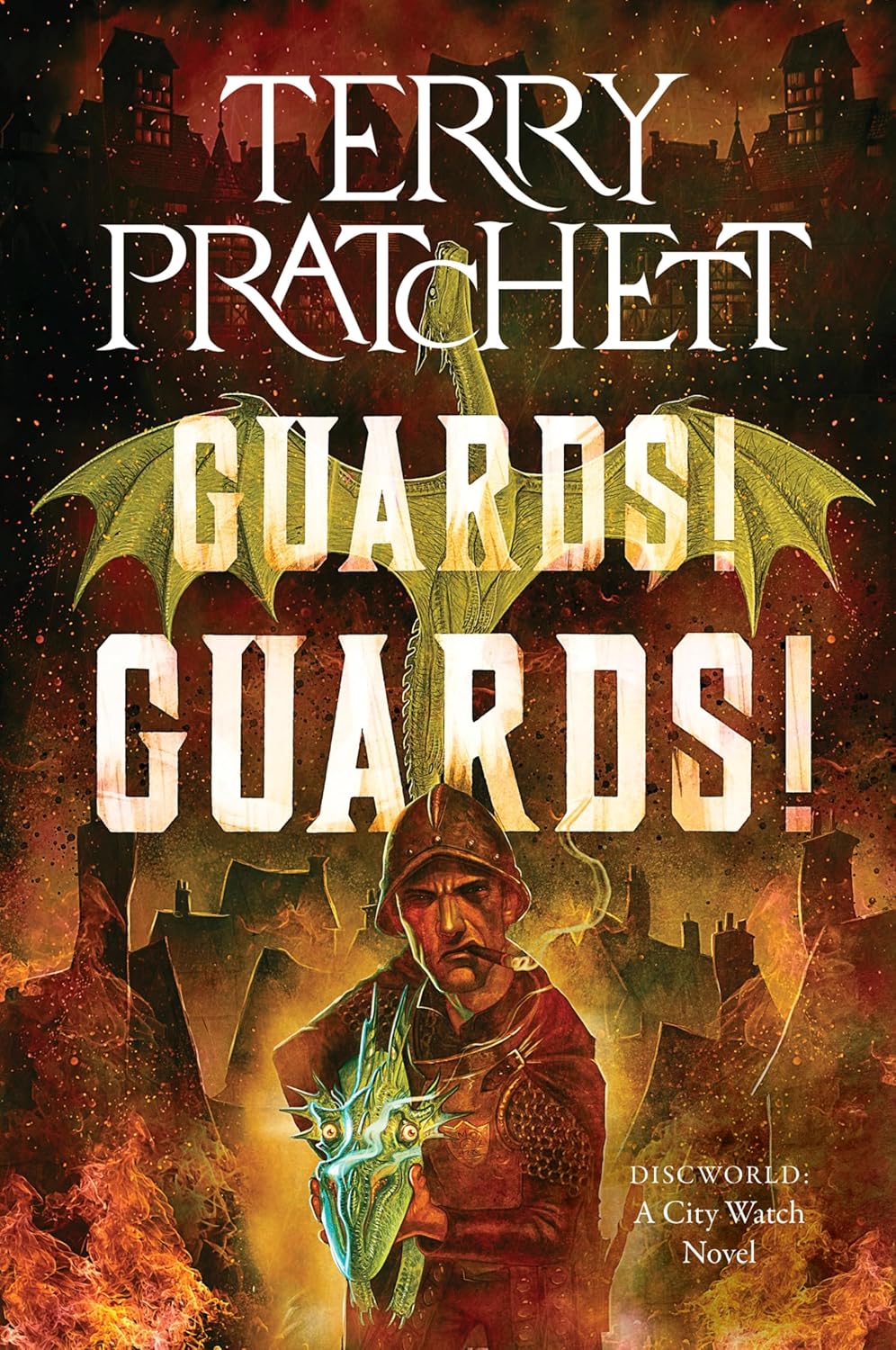
Pratchett was really on-point when it came to writing Guards! Guards! and I loved how perfectly it came together.  As with all books in the Discworld series, Guards! Guards! features an exceptional mixture of fantasy and humour elements, as the unusual and cynical Discworld produces some unusual situations, layered in with a great plot and some fantastically complex characters.  A lot of the humour is derived from classic fantasy scenarios that are taken up to 11 and shown in outrageous manners, accompanied by sarcastic comments from the characters as they witness them.  For example, this book serves as an ode to the guards and watchmen from classic fantasy fiction, and there are some funny scenes when these self-aware guards realise how expendable they are in a fantasy story.  However, Guards! Guards! also features a brilliant third element as Pratchett also features a compelling crime fiction read, accompanied with an addictive murder mystery.

The blend of fantasy and crime fiction elements works incredibly well, and it is highly entertaining to watch a serious investigation consider magic, suddenly appearing dragons, and the unique background setting of Ankh-Morpork.  I also loved how many clever and subtle jokes Pratchett was able to weave in because of these crime fiction inclusions, and he ends up lovingly roasting so many classic tropes from police procedurals and noir detective novels.  Despite having read this book many times, I still laugh like crazy at all the humourous moments in Guards! Guards!, especially as you always discover a new joke or pun you previously missed.  I honestly don’t have time to list all the funny scenes in Guards! Guards!, but favourites include the various meetings of the petty and mostly incompetent Elucidated Brethren, Carrot’s naïve overreactions upon discovering crime in the city, and various musings on how to achieve a perfect, million-to-one chance.  Pratchett once again expertly backs up his humour in Guards! Guards! with a series of entertaining footnotes spread throughout the book, that prove to be nearly as much fun as the main story.  These brilliant footnotes contain additional jokes, sarcastic comments, or interesting expansions of the Discworld universe, and they always bounce off the main story perfectly, providing extra laughs and food for thought where necessary.  I really cannot emphasise just how well this blend of genres worked with Pratchett’s unique and endearing humour, and it proves impossible not to have an exceptional time while reading this book.

As with most Discworld books, Guards! Guards! works exceedingly well as a standalone novel, and I feel that anyone wanting a laugh could easily jump in and follow the story without any issues.  Due to its early position in the shared Discworld universe, you don’t have to know anything about the other entries in the overarching series to jump right in, as Pratchett goes a tad light on some of the more outrageous Discworld elements.  As such, I consider Guards! Guards! to be one of the very best entry novels to new Discworld readers.  It also proves to be a brilliant first book in one of Pratchett’s best sub-series, and so many key details of the subsequent City Watch books are introduced here.  This includes some excellent early looks at the chaotic city of Ankh-Morpork and key recurring characters in the larger universal plot.  Ankh-Morpork is a great background setting for Guards! Guards! and it was the first book completely set within the bounds of the city.  I loved seeing this crazy city in even more detail, and all the fun elements set up here help to make it an epic setting.  As such, this is a great book for any Discworld reader, new or old, and it’s one of my favourites for very good reason.

As with pretty much all of Pratchett’s works, the key things that made Guards! Guards! so impressive were the amazing and unique characters that were featured throughout the plot.  Pratchett had a real knack for producing complex, multi-layered figures who can be both comedic and tragic at the same time, and who you couldn’t help but love.  Guards! Guards! was a particularly good example of this, as Pratchett featured a range of brilliant and entertaining characters who would go on to be become major recurring figures in the Discworld canon.  Indeed, Guards! Guards! is one of the most significant books for new characters, and it is frankly amazing how many exceptional major and iconic figures were introduced here.  Each of these characters were so well written, and you have to love both their specific arcs in this book, as well as how they were expanded on in later works.

The most prominent character in Guards! Guards! is Captain Samuel Vimes.  A cynical and damaged man whose habit of calling out social inequities has seen him assigned to the joke position as head of the Night Watch, which he deals with by drinking vast amounts of alcohol.  A parody of every hard-drinking cop and private eye in classic noir fiction, Vimes starts the book with no prospects and too many dead friends.  Given new purpose when the dragon appears in the city, Vimes turns his innate rebellion to a purpose and tries policing and detecting.  Pratchett does an exceptional job setting up Vimes here in Guards! Guards!, and it is no wonder he goes on to be one of his top protagonists.  Vimes’s depressed investigative method proves quite successful, and it was entertaining to watch Vimes attempt to solve the case while sarcastically calling out his fellow citizens’ base stupidity and selfishness.  Pratchett also sets up an impressive redemption arc around Vimes, which comes about through a combination of trusted colleagues, romance, and a renewed determination to uphold the law.  While he ends the book still irritated with the world, the road forward to Vimes doing bigger and better things is well established, and you really get drawn into his arc as a result.

Another impressive character is naïve and innocent City Watch recruit, Carrot Ironfoundersson.  Due to his complex home situation and a late life revelation that he’s human rather than a dwarf (being six and a half feet tall wasn’t a clue to him), Carrot is sent to Anhk-Morpork with a desire to become a watchman, which he incorrectly believes is a noble calling.  Thanks to his literal personality and highly moral upbringing, Carrot proves to be an anathema to the lawless folks of Anhk-Morpork, as he comes to town bringing justice, enforcing obscure laws, and actually arresting thieves: “change your ways”.  A brilliant parody of ultra-righteous fantasy kings, Carrot serves as an outstanding comic relief for much of the book, especially when it comes to his wholesome interactions with the exceedingly criminal inhabitants of the city.  However, beneath his comedic cover, Carrot is written as a complex figure of change, and his ability to inspire the other characters, either through guilt or determination, leads to some big moments.  Pratchett did an amazing job with Carrot in Guards! Guards!, and it was fascinating to see how he evolves from his initial innocent personality, to a more clever, but still determined, character.

Aside from Vimes and Carrot, the other two watch characters are Sergeant Fred Colon and Corporal Nobby Nobbs, both of whom are excellent and solid comedic characters.  The stereotypical fat sergeant and dodgy corporal, Pratchett has fun setting them up as unassailable fixtures of the Night Watch as they do the jobs nature intended for them, and I love how they play off each other.  While Colon has some hilarious scenes, including his attempt at archery and his various ill-timed run-ins with the dragon, you can tell that Pratchett had a lot more fun writing Nobby.  While not all his over-the-top characteristics from the series are shown in Guards! Guards!, Nobby is still a particularly entertaining figure.  Between his coarse language, petty criminal mindset, and uncharacteristic foppish behaviours, every scene with Nobby is highly amusing, and I love how Pratchett expanded off clever stereotypes about lifetime corporals to create this wayward figure.

Outside the members of the City Watch, there are a fantastic array of figures who help to make Guards! Guards! a particularly enthralling story.  This includes one of the few female characters in the book, Sybil Rankin, a dragon-loving heiress who ends up being Vimes’s unlikely love interest.  Deliberately written as the direct opposite of a noir femme-fatale in both personality and appearance, Sybil is a force of nature, using her accumulated nobility to pull the Night Watch, especially Vimes, into her orbit.  It proves impossible not to like Sybil as you watch her confidently go after Vimes or try to put the dragon to heel, and she ends up being one of the most complicated female characters that Pratchett wrote (which is saying a lot when you think of some of his other great female characters).

The other major character that I want to separately highlight is the Patrician of Ankh-Morpork, Lord Havelock Vetinari.  While he has appeared in previous Discworld novels (notably Sourcery), this is the first book that showcases him as a full character.  Generally depicted as a Machiavellian mastermind and one of the few people capable of controlling the chaotic city, Vetinari has some great early scenes.  However, it’s not until the second half of the book when you realise just how fantastic a character he is.  Deposed by the false king, Vetinari initially appears to be completely powerless in the dungeons, until Vimes is thrown in with him and begins to realise that he is still in control, especially as he’s managed to cultivate a new intelligence network (procured by providing wartime strategy to magical rats), while also getting locked in a dungeon specifically designed to keep him safe.  His subsequent scenes tormenting the book’s real antagonist and talking about the nature of humanity with Vimes really cement him as an impressive figure, and the seeds for his many later inclusions as the Disc’s ultimate political mastermind are well sown here.

While I know I’ve been going on a bit about characters (blame Pratchett for being such a good writer), I just need to highlight a few more figures who have a great role in Guards! Guards!.  This includes the Librarian, one of Pratchett’s most iconic characters, who proves to be just as much fun outside of a wizard focused book, and it was entertaining seeing him interact with a separate group of friends.  You get a great introduction to the character of Cut-My-Own-Throat Dibbler, whose mercantile tendencies are on full display here.  The unusual swamp dragon Errol proves to be an unlikely pet, and his arc about finding love and his true form was particularly heartwarming.  Finally, I must mention the book’s great antagonist, who fully embraces the mad tendencies that his position demands.  While I won’t go into too much detail about who he is, I will say I loved seeing his various internal rants about the world, and the scenes with his incompetent henchmen were so damn funny.  All these characters, plus even more hilarious figures, are instrumental to so much of Guards! Guards! brilliant charm and humour, and after being introduced to them here, it’s impossible not to follow them on their full journey.
I have had the pleasure of reading Guards! Guards! in a couple of different formats over the years, but to my mind the best way to enjoy this book, and indeed any Discworld novel, is on audiobook.  The Discworld audiobooks are something very special, and I find that the unique stories, excellent humour and elaborate characters really come across when read out by a passionate narrator.  With the recent re-release of various Discworld audiobooks, there are now two different unabridged versions of Guards! Guards! fans can enjoy, and I want to highlight them both here.

The first Guards! Guards! audiobook is the original version with the talented Nigel Planer, who narrated 22 of the original 23 Discworld audiobooks.  Guards! Guards! is one of his best performances, and it set the scene nicely for many of his subsequent Discworld audiobooks, especially as he settled on a lot of key character voices and tones here.  While it has been a little while since I’ve listened to Planer’s version of Guards! Guards!, I have enjoyed it so many times it is permanently engrained in my head (I used to grab the tape cassette version out of my local library all the time).  Planer, who does all the voices himself, really captures the essence of Pratchett’s storytelling and excels at expressing the author’s unique humour through his vocal work.  I also felt that his portrayal of many of the key characters was second to none, and he really brought to life all the City Watch protagonists, as well as some other long-running figures, in some impressive ways.  He would revisit many of these voices in multiple subsequent performances, and it is a testament to his skill that the initial tones he came up with here, worked so well in the later books.  I frankly have so much love for Planer’s original take on Guards! Guards!, which definitely still stands the test of time, and his excellent and heartfelt voice work defines many of the City Watch characters for me.

While Nigel Planers original version is perfect, current Discworld fans may be more familiar with the latest audiobook production of Guards! Guards!, which was part of a recent re-recording of all the Discworld books.  These new audiobooks each feature a different famous British performer voicing the main plot, while acclaimed actors Peter Serafinowicz and Bill Nighy have key roles in every single production.  While these have been out for a little while, I only just listened to my first one .  Coming in at a runtime of 13 and a half hours, which is a tad longer than the roughly 10-hour long Planer version, this Guards! Guards! audiobook was extremely fun, and it served as excellent entertainment on a recent road trip.

The new version of the Guards! Guards! audiobook is primarily voiced by British radio and television personality Jon Culshaw.  Culshaw is amazing in the role, and I was deeply impressed with his take on the Guards! Guards! characters.  Each unique character comes across extremely well in Culshaw’s capable hands, and I enjoyed his take on their unique characteristics and eccentric personalities.  He perfectly showcased protagonist Samuel Vimes’s drunken despair and depression, while various other key members of the watch, such as the extremely keen Carrot and the more cautious Colon, are shown extremely well.  I also felt that Culshaw did an incredible job with several complicated figures from the story, such as the infamous watchman Nobby Nobbs, who Culshaw gifts a gruff and weaselly voice that sounded a lot like David Bradley or Jon Pertwee.  His Lord Vetinari is also amazing, and the deep and threatening tones really capture the character’s dangerous nature.  Finally, I felt that his take on the main female character, Sybil Ramkin, was just perfect, and you really got the full blast of her big personality and excessive aristocratic characteristics.  Many of the other side characters were also perfectly portrayed to my mind, and I must highlight the excellent way in which he disguised the voice of the main antagonist during some key secret society scenes.

Culshaw’s primary narration is well backed up by Peter Serafinowicz and Bill Nighy in their respective roles.  Serafinowicz provides the voice of Death whenever he appears in this audiobook, which works out extremely well even with Death’s relatively minor role in Guards! Guards!.  Serafinowicz has an exceptional Death voice, and hearing it suddenly appear throughout Guards! Guards! is so damn epic, especially during one scene where Death is hiding amongst the soon-to-be deceased.  Nighy, on the other hand, narrates the various footnotes.  Nighy was a perfect choice for this, and his calm, consistent tones, echoing Peter Jones’s similar role in The Hitchhiker’s Guide to the Galaxy radio and TV editions really highlighted the subtle comedy of these footnotes.  I felt that all three of these distinctive actors really vibed together in the Guards! Guards! audiobooks, and the switch between them was seamless, allowing for a particularly awesome listen.  Throw in an interesting short afterword about fantasy elements by acclaimed author Ben Aaronovitch, and this proved to be a remarkable and compelling audiobook I could not get enough of.  While Nigel Planer’s original narration of Guards! Guards! is always going to live in my head rent free, I felt that this new version more than lived up to the hype surrounding it, and I really appreciated the unique and powerful performances these new narrators brought to the table.  Frankly both of the audiobook versions comes highly recommended by me, and it is impossible to be dissatisfied by them at all.

Whew, well in case you could guess from this massive review (it got away from me), I love Guards! Guards! and I have some very strong feelings for it.  One of Terry Pratchett’s best Discworld novels, Guards! Guards! is the perfect blend of fantasy, crime fiction and humour that you could ever want, and I always get wrapped up in its elaborate story.  A wildly entertaining and comedic novel from start to finish, Pratchett added so much heart to this book, and you get drawn into the impressive characters and compelling, crime fiction plot.  A brilliant start to the City Watch subseries, Guards! Guards! is so damn good, and I know I will be reading it many more times in my life.  I can think of no better way to emphasise just how amazing Guards! Guards! is than to mention that I used it to introduce the Discworld to my wife, who is now powering through the series on her own.  So do yourself a favour and check this book out now!
Amazon

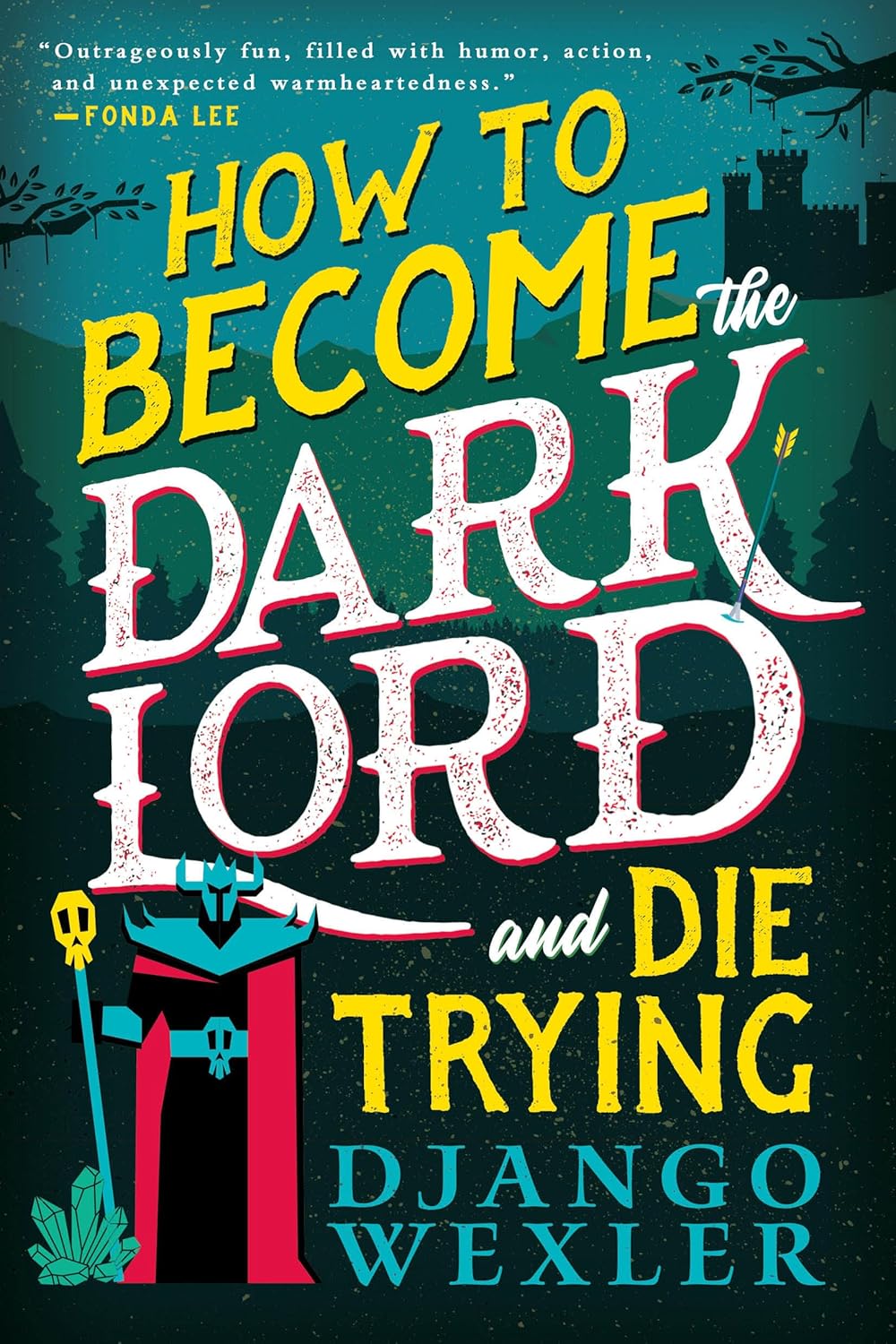
How to Become the Dark Lord and Die Trying by Django Wexler

Publisher: Orbit (Trade Paperback – 6 August 2024)

Series: Dark Lord Davi – Book One

Length: 395 pages

My Rating: 4.75 out of 5 stars

Amazon

Hilarious author Django Wexler presents one of the funniest and most memorable fantasy novels of 2024 with the deeply addictive How to Become the Dark Lord and Die Trying.  Serving as the first book in Wexler’s new Dark Lord Davi series, How to Become the Dark Lord and Die Trying was an extremely amusing book that has been on my radar for a while due to its amazing-sounding plot.

It’s a tale as old as time.  An ordinary human becomes trapped in a mythical fantasy realm and is subsequently lauded as the prophesied hero of legend, destined to rule the kingdom and defeat the conquering Dark Lord.  But what happens when the human protagonist gets sick of living and dying as the hero?

That’s the question that falls to Davi, a young woman who has become trapped in a bloody and predictable time loop.  Constantly forced to become the leader of the soon-to-be-destroyed humans of The Kingdom, Davi has tried time and time again to organise an army capable of defeating the oncoming and everchanging Dark Lord, only to fail and die in agony in over 200 inventive ways.  After nearly a thousand years of playing the hero and losing in brutal fashion, Davi has had enough and decides that if you can’t beat them, become them.

Determined to take control of her destiny, Davi sets out to do the direct opposite of every other loop.  If the Dark Lord always wins, then this time Davi will take her place at the top of the winning side and become the new Dark Lord herself.  But first she must pull together a band of followers from the various non-human races of the realm and bring her loyal minions to the Convocation where the new Dark Lord is chosen, far away in lands she’s never even seen.  Standing between Davi and her destiny lie multitudes of deadly landscapes, brutal enemies, and all manner of unique obstacles that a Dark Lord in training needs to overcome.  Armed with her wits, her accumulated knowledge of the world, the ability to use her own death to her advantage, and an insane amount of humorous confidence, Davi may be able to do the impossible and finally win.  But Davi will soon learn that becoming the Dark Lord isn’t everything it’s cracked up to be.

How to Become the Dark Lord and Die Trying was a highly entertaining and insanely captivating read that I honestly could not get enough off.  Featuring a brilliant scenario that Wexler plays to comedic perfection, combined with dark humour and a uniquely insane protagonist, How to Become the Dark Lord and Die Trying is an outstanding novel that I had so much fun reading.

I must admit that I instantly loved the very fun premise of this book which saw the protagonist decide to take on the role of the Dark Lord after hundreds of failed attempts to survive as the hero.  Wexler did an outstanding job setting this idea up in the first couple of chapters of How to Become the Dark Lord and Die Trying, and you are quickly intrigued by the combination of a bloody time loop, a despondent, if hyper, protagonist, and the entire change of plan said protagonist embarks upon.  As such, you are completely onboard as soon as Davi starts to implement her plan, and the resulting carnage proves to be highly entertaining and fun.  After multiple bloody failed attempts to start her new turn to darkness, Davi soon begins to get into her groove as the next Dark Lord, recruiting a small band of minions, and taking the first steps to proving she has what it takes to rule.

Davi’s subsequent quest to become the Dark Lord involves an intense adventure arc, as she leads her army through various fun fantasy locations.  Along the way to her destination, Davi engages in different schemes to recruit new followers, especially when she encounters some chaotic communities whose internal strife she is able to exploit.  The story devolves into an awesome combination of intrigue, humorous encounters, fantasy action and personal character growth, as the protagonist becomes more comfortable with the Dark Lord lifestyle.  After several extended sequences at key locations, the protagonist eventually reaches her goal and begins her trials to become the new Dark Lord.  However, nothing at the trials is what it seems, and Davi is forced to deal with multiple enemies from her various pasts to survive.  There are some great moments in this final part of the book, including tragic betrayals, heart-felt romance, intriguing revelations, and some big fights, all of which leads to an interesting open-ended conclusion that will ensure readers come back for the next book in the series.

I had an exceptional amount of fun with How to Become the Dark Lord and Die Trying, and Wexler had a fantastic style that really appealed to me.  Told exclusively from the slightly crazed first-person perspective of the protagonist, readers are treated to Davi’s highly excitable inner thoughts as she recounts her journey to becoming the Dark Lord.  This proved to be a great medium to explore the more complex elements of the plot, and I appreciated how Wexler was able to succinctly dive into time-loop and Davi’s place in it, while also moving the plot along.  The author also introduces a serviceable and intriguing fantasy world the plot of How to Become the Dark Lord and Die Trying, which proved interesting to explore.  While a little basic in places, Wexler does feature some excellent concepts here, and readers will enjoy watching Davi explore it with her own unique perspective, especially as she forms new ideas about the supposedly evil wilders (non-human creatures) as she works with them.  While some of these concepts are a little complex at times, everything honestly works extremely well for the entertaining plot, and I really appreciated how effectively the author was able to explore and utilise his fantastic ideas.

While all these great concepts help to craft a unique book, what holds everything together and keeps the reader’s attention is the relentless comedy that Wexler injects into nearly every page of How to Become the Dark Lord and Die Trying.  I really connected to Wexler’s humour in this book, and I found myself chuckling away for large chunks of it.  Thanks to the slightly cracked protagonist, the reader is bombarded with a constant array of jokes, hilarious commentary, and over-the-top moments, as Davi combats the horrors both in front and behind her with humour.  A lot of this humour was driven by the protagonist having a modern, nerdish perspective in a crazy fantasy world, and her reactions ranged from sarcastic to goofy.  Wexler also makes great use of an array of continuous footnotes to tell additional jokes outside the flow of the narrative, or to really expand on an interesting or funny point.  I am a big fan of the use of footnotes for comedic purposes (blame my Terry Pratchett upbringing), and Wexler made it work really well here.  The author also relies on quite a lot of highly adult humour throughout the book, which helped to give How to Become the Dark Lord and Die Trying an interesting flair.  While I could see some readers not liking how continuously risqué the book got, or how over-the-top the humour is in general, I personally felt that it worked and allowed for quite an amusing, if slightly randy, experience.

Talking of crazy humour, I must highlight the fantastic central protagonist of How to Become the Dark Lord and Die Trying, Davi.  A modern-day and highly nerdy woman who finds herself trapped in this recurring fantasy adventure without any idea of how she got there, Davi is an interesting figure, and you really connect with her as the plot continues, especially as a lot of hilarity is drawn from her outrageous behaviour and thoughts.  Davi is constantly cracking jokes, making sarcastic inner observations and meta commentary, often driven by her modern experiences, and it’s hard not to be amused by her antics.  She also has some great, often ridiculous interactions with the various fantasy creatures she encounters, and I liked seeing her unusual persona connect with these more serious creatures.

While it is easy to get lost in Davi’s comedic persona, the further you get into the book, the more apparent it is that her cracked behaviour has been brought on by the constant trauma from her hundreds of deaths and the accompanying thousand years of experience that she has lived through as part of her fantasy adventure.  The initial exposure to her early trauma and rage at the start of the book gives you enough of a glimpse of this that you appreciate her turn to the dark side, but you see even more of it as the story continues.  A lot of this is because, even after years of watching everyone die, she still cares about the people around her, and the impacts of her decisions start to wear on her.  While she maintains her zany persona for much of the book, a new romance and a dark change in her circumstances towards the end of the book nearly break her, and I felt that Wexler did an outstanding job of trying to humanise her there, especially as she sometimes gives off uncaring, immortal vibes.  Thanks to these deeper personality traits, as well as her comedic nature, I really grew to appreciate to Davi as main character, especially as she is a lot more capable and competent thanks to her experiences, although she still makes some interesting mistakes (never sleep with your minions, everyone knows that).  As such, I look forward to seeing how her story continues, especially as things are likely to get even more out of control for her.

Overall, How to Become the Dark Lord and Die Trying by Django Wexler was an awesome book that I honestly found to be quite addictive.  The fantastic central scenario is greatly enhanced by the author’s outrageous humour and clever storytelling, and it allows for quite an outstanding read.  Slick, unique and very, very funny, How to Become the Dark Lord and Die Trying was one of the more unique fantasy novels of 2024, and if you are in the mood for a great laugh, then this is the book for you.  I personally am very excited to see how the Dark Lord Davi series continues in the future, and the second novel, Everybody Wants to Rule the World Except Me, is set for release in May 2025.

Amazon

Warhammer 40,000: Cain’s Last Stand by Sandy Mitchell

Cain's Last Stand Cover

Publisher: Black Library (Audiobook – 1 January 2008)

Series: Ciaphas Cain – Book Six

Length: 10 hours and 30 minutes

My Rating: 4.75 out of 5 stars

Amazon

I’ve been on a real roll with the amazing Ciaphas Cain series by Sandy Mitchell (a pseudonym of Alex Stewart) lately, which is easily one of the funniest Warhammer 40,000 series out there.  Amazing books like For the Emperor, Caves of Ice, The Traitor’s Hand, Death or Glory and Duty Calls have all proved to be highly entertaining, and I like the author’s take on a less heroic figure in the martyr-filled grimdark Warhammer 40,000 universe.  As such, when in need of a particularly fun read, I made the very easy choice to power through another entry in this classic series last week with the sixth book, Cain’s Last Stand.  This was an unsurprisingly awesome book, and I loved the intriguing story that emerged.

Commissar Ciaphas Cain, legendary hero of the Imperium and self-professed fraudulent coward, has done the near impossible and survived decades of brutal service in the Imperial Guard.  Now effectively retired from active duty, Cain has returned to the planet of Perlia, which he helped save from an ork invasion early in his career, and now spends his time teaching Commissar cadets at the planet’s Schola Progenium.  However, the battle is never truly over for Cain, and soon dark forces begin to descend once again.

Half a galaxy away, Abaddon the Despoiler has launched his 13th Black Crusade, determined to invade the Imperium of Man.  While most of the fighting occurs around the fortress world of Cadia, a splinter fleet has broken off and is heading deep into the Imperium, defeating several forces sent to stop it.  When it becomes apparent that this fleet is heading directly for Perlia, Cain is once again forced into action, especially as he knows exactly what they are coming for.

An ancient alien device of devastating power lies hidden on Perlia, one capable of reshaping reality itself, and Cain is one of the few people who knows it’s there.  With no means of escape available and the fate of the galaxy in the balance, Cain is forced to lead the defence of Perlia against the oncoming Chaos tide.  With only a ramshackle army of local soldiers, militia and students from the Schola under his command, the defence of the planet looks grim, especially when faced with a charismatic Chaos lord and his fanatically loyal soldiers.  Worse, a far greater evil has its eyes on Perlia, one that Cain fears above all else.  Can the legendary hero of the Imperium pull out one last impossible victory before he rides off into the sunset, or has Cain finally met his match at the site of his greatest triumph?

Mitchell continues to bring joy to the dark Warhammer 40,000 universe with this epic sixth entry, which I had so much fun with.  Cain’s Last Stand was an excellent read, and I loved the cool and elaborate story that emerged.

I think Cain’s Last Stand might be one of my favourite stories that Mitchell has so far used for the Ciaphas Cain series, especially because it differs from the standard narrative patterns of the series, while also cleverly tying together some intriguing ongoing storylines.  Set further into the future than any of the previous books, you get to see a nearly retired Cain in action, as the series finally ties itself into the events of the 13th Black Crusade (the original version of it, not the darker recent retcon).  I liked how Mitchell takes the reader back to the setting of the fourth book, Death or Glory, and the initial scenes of Cain as a reluctant but capable teacher, were very fun.  The switch from Tyranids to Chaos as the main threat is handled extremely well, and I liked the continued niggle that even worse enemies are lurking around.  The subsequent reveal that the reason behind the invasion is due to the ancient artefact first hinted at in Death or Glory and then expanded on in Duty Calls was great, and Mitchell does an excellent job of tying the various ongoing storylines together.

The second half of Cain’s Last Stand proves to be a very fun planetary invasion arc, especially as Cain works to rally an unusual array of defenders, including untrained militia, under strength garrison forces, and his own students.  The forces of Chaos prove to be excellent foes for this story, and I liked the much more insidious nature of the threat that emerged, especially as there was a slow build to the reveal.  After plenty of action, clever ploys, some touching tragedy, and so much misdirection from the protagonist, the story eventually heads to the inevitable last stand, which cleverly mirrors a similar event from Death or Glory.  Mitchell does a great job of building up anticipation for this event, and it doesn’t disappoint as there are some excellent action sequences and fun revelations that occurred.  I particularly enjoyed the big bluff that leads to the death of a certain enemy, especially as it was a classic Cain antic.  The final reveal about the actual big bad of the story was well handled, and it leaves this storyline open for the future, which I am very excited for.  An overall excellent addition to the series that builds on the prior novels while offering existing fans something new to enjoy.

Mitchell continues to utilise the fantastic writing style that has made the other Ciaphas Cain books so much fun, and I love how it cleverly enhances the narrative of Cain’s Last Stand.  As always, the cool journal format, equipped with entertaining footnotes and in-universe texts from Inquisitor Amberley Vail, ensures that you get a frank and cynical look at events in the Warhammer 40,000 universe, and I love the inherent humour that results.  The various action scenes are exciting and fast-paced, and the constant commentary of complaints and annoyance that emerges from the protagonist are very entertaining.  This action and compelling humour are well offset by some of the darker elements of the plot, including some genuinely tragic moments, and you get thrown around the emotional ringer as a result.  This mixture of elements helped to create a much more impactful and complex read, and I appreciated some occasional seriousness to go with the impressive humour.

As with most books in the Ciaphas Cain series, Cain’s Last Stand can be read as a standalone read, especially as the author does a good job of rehashing relevant events from the prior novels.  However, for the full experience, especially when it comes to some fascinating storylines, reading the last two books would be good, and I really enjoyed how the author kept bringing the story back to these prior adventures.  While there was once again some repetition between books as Mitchell reutilises his favourite lines, I felt that the more original story and important connections to previous books ensured that Cain’s Last Stand stood out and got away from some of these minor issues.  An excellently written book that will appeal to both new readers and established fans of the series.

As always, I must give a callout to the outstanding characters featured in Cain’s Last Stand.  This of course includes Commissar Ciaphas Cain, the main protagonist and narrator, whose harrowing adventures we continue to follow.  I’ve talked a lot about the exciting dichotomy of Cain throughout my previous reviews, especially as he can be considered both a hero and a coward, and I loved seeing that occur again in Cain’s Last Stand.  Cain continues to be both a self-serving cad and a peerless commander, and it always fun to see himself plot to survive while discounting his own accomplishments.  His adventures in this book are particularly fun, and the inclusion of the protagonist as a teacher trying to get his methodology of command to Commissar cadets was a great choice from Mitchell and plays nicely on some of his offhand comments in previous books.  This, as well as the return to a planet important to his mythos, ensures that Cain has a lot to think about in Cain’s Last Stand, and I really enjoyed the way his past adventures keep coming back to haunt him.  This was a powerful adventure for Cain, and I always enjoy seeing the protagonist debate his own legacy whilst doing his trademark daring deeds.

The supporting cast for Cain’s Last Stand was also very good, and it provided an interesting mixed of established characters, returning figures, and raft of great new comrades.  This includes Inquisitor Amberley Vail, whose role as the overarching narrator of the book, as well as the person behind the footnotes, ensures that her fun influence is felt the entire way through.  Cain’s faithful bagman, Jurgen, was also a welcome inclusion, and his loyal service and fun interactions with Cain were as great as always.  Jurgen once again showed why he is the true MVP of the Ciaphas Cain series, and you have to love the entertaining contrast between his Baldrick-esque appearance and his impressive abilities.  Other great characters include a favourite character from Death or Glory, an interesting array of fellow teachers from Cain’s Schola Progenium, and other unique comrades for the protagonist.  I particularly enjoyed the class of Commissar cadets who are being instructed by Cain, and it was fun to see the range of different personalities they had.  Throw in a smarmy Chaos warlord whose charisma and influence outweighed his abilities and stature, and you had a great cast for Cain’s Last Stand, and I had a lot of fun seeing Cain interact with them.

I once again had an outstanding time with the audiobook format of this book, and frankly there is no better way to enjoy a Ciaphas Cain novel.  Thanks to the epic and well-cast multiple narrators, readers get an amazing experience when they listen to Cain’s Last Stand, especially as it helps to really capture the crazy nature of the plot.  The main narrators are Stephen Perring and Penelope Rawlins, who voice Cain’s perspective and Inquisitor Vail’s notes respectfully.  Perring once again does an incredible job voicing the main cast of the story, especially Cain and Jurgen, while Rawlins has a lot of fun including her character’s informative, if often sarcastic, comments throughout the plot.  These two main narrators complement each other extremely well, and I always have an awesome time listening to them.  The audiobook also features the talents of additional narrators Richard Reed, John Banks and Phillipe Bosher, each of whom voice fun in-universe texts and pieces of propaganda to liven up the main plot and provide some amusing context for the main story.  I have so much love for how these narrators bring the story together and this proved to be another impressive audiobook to listen to, especially as its great style really fit the fantastic story Mitchell came up with.  With a run time of 10 hours and 30 minutes, this is a very easy audiobook to get through quickly, and I managed to finish it off in no time at all.

Cain’s Last Stand was another amazing entry in the Ciaphas Cain series by Sandy Mitchell, and I have so much love for this entertaining and fun Warhammer 40,000 series.  This sixth book was a particularly impressive entry in the series, and I loved the complex story that emerged, especially as it brings together several previous adventures from Mitchell’s outstanding protagonist.  A clever, exciting and overall funny book that I could not get enough of, Cain’s Last Stand comes highly recommended and I look forward to continuing this series in the future.

Amazon

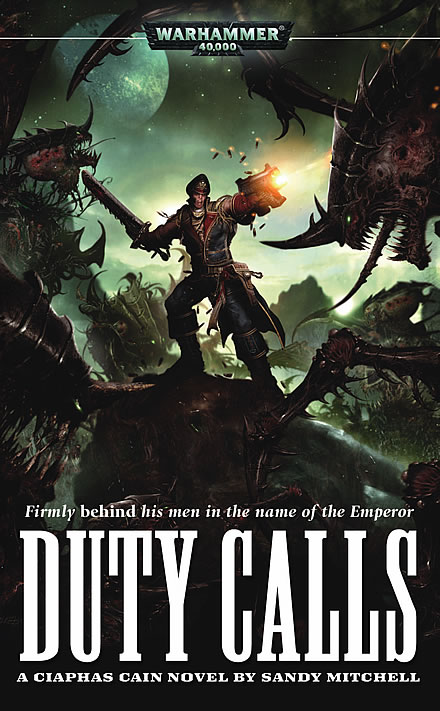
Warhammer 40,000: Duty Calls by Sandy Mitchell

Duty Calls Cover

Publisher: Black Library (Audiobook – 22 May 2007)

Series: Ciaphas Cain – Book Five

Length: 9 hours and 37 minutes

My Rating: 4.5 out of 5 stars

Amazon

One of the most entertaining authors of Warhammer fiction, Sandy Mitchell, continues to shine with the fifth book in his excellent Ciaphas Cain series, Duty Calls.

I doubt anyone is too surprised to hear that I broke a recent lull of reading by resuming the Ciaphas Cain series.  The Ciaphas Cain books, written by Sandy Mitchell (the alternate penname of author Alex Stewart), are an outstanding series that aims to bring a little humour to the crazy and dark battles of the gothic Warhammer 40,000 universe.  I have deeply enjoyed the first four books in this series, For the Emperor, Caves of Ice, The Traitor’s Hand and Death or Glory, and this honestly is one of the very best Warhammer 40,000 series out there.

Commissar Ciaphas Cain, hero of the Imperium and self-confessed self-serving coward, continues his exciting and deadly adventures when a new dark threat rises to destroy humanity.  After his last harrowing adventure with the Valhallan 597th, Cain is keen for a less deadly experience, and his new deployment to help crack down on civil unrest on the planet of Periremunda seems to be the ticket.  However, nothing is ever simple when Cain is involved.

Upon arriving on Periremunda, Cain quickly finds his life in danger as a series of assassination attempts are made against him.  Realising that his assailants are genestealers, the deadly scouts of the Tyranid swarm, Cain begins to understand the true danger Periremunda is in, as the genstealers herald the approach a Hive Fleet.  But unstoppable hordes of alien creatures are the least of Cain’s worries as he is reunited with his old flame, Inquisitor Amberley Vail.

Ostensibly on Periremunda to help the Imperial Guard stave off the Tyranid invasion, it soon becomes apparent that Vail is there for a darker reason.  Something incredibly important has been hidden on the planet that has the potential to change the entire Imperium.  Forced to assist Vail, Cain and his trusty aide, Jurgen, find themselves thrust into the deadly intricacies of a battle between hidden underground factions.  But with hungry Tyranids all around, deadly assassins gunning for Cain and a mysterious Chaos cult causing mischief, can Cain survive his deadliest encounter yet?

Duty Calls was an awesome addition to the Ciaphas Cain series that builds on several of the prior adventures, while also testing the protagonist in some fun new ways.  I loved the interesting story contained with Duty Calls, and this was one of Mitchell’s stronger additions to the series.

This fifth Ciaphas Cain novel had a great story behind it, although I am sure that prior readers will be familiar with the overall thrust of the narrative, with the seemingly cowardly Cain arriving on a new planet to face one threat, only to discover a much more dangerous enemy hiding beneath the surface that he is forced to reluctantly face and defeat, once again accidentally proving that he is a hero.  While Mitchell does try to break this story premise up throughout the series, this is a recurring story format, which can get a little too repetitive.  However, I think that Duty Calls stands on its own feet and Mitchell does a good job distinguishing it from the previous entries in the series.  The initial hidden threat of genestealers transforms into a massive Tyranid invasion, and it proved intriguing to see the protagonist face off against the ravening alien forces.  Tyranids are easily one of the best antagonists in the entire Warhammer 40,000 canon, and while they lose a little of their fighting ability in the face of Cain’s plot armour, they proved to be a great threat in Duty Calls.

While Mitchell could have probably left Duty Calls as simply a military novel, the inclusion of major recurring character Inquisitor Amberley Vail ensures that Cain is thrust into a much more subtle form of danger alongside the Tyranid invasion.  Caught between warring factions of the Inquisition and Adeptus Mechanicus, Cain is used as a pawn in the resulting shadow war, and there are some great scenes as Cain dodges assassination attempts, hidden Chaos cults, and other unseen dangers, all while trying to work out what the elaborate conspiracy is.  Novels that focus on the plots and conspiracies of Inquisitors are always very cool in the Warhammer 40,000 universe (see my reviews for Xenos, Malleus and Hereticus by Dan Abnett), and Mitchell fits Cain into this intrigue laden story arc extremely well.  It helped that there was some excellent set-up for this in the previous novel, and it was good to get a continuation here.  The resulting combination of storylines comes together really well, and Duty Calls has a really impressive and addictive narrative that will appeal to all fans of Warhammer 40,000 fiction.

As with the previous Ciaphas Cain novels, Mitchell does a great job of balancing the various elements of Duty Calls perfectly.  While primarily a military focused science fiction read, Duty Calls also has some great elements of intrigue and espionage, which ensures extra levels of excitement and danger.  However, I feel that the best part of Duty Calls is the inherent humour that Mitchell produces, which is a real rarity in Warhammer fiction.  Most of this is due to the hilarious and cynical narration of the main character, who pulls no punches when it comes to describing how ridiculous events are and the fact that he’s caught in the middle of them.  Extra humour is also built in due to the contained chronicle format that Mitchell has set the series out in, with the protagonist’s journal entries enhanced by extra documentation, descriptions, references and notes from Cain’s associate, Inquisitor Vail.  Vail’s sarcastic take on Cain’s description of events throughout these extra notes is a lot of fun, and the additional in-universe texts and broadcasts seek to showcase just how ridiculous humanity and the Imperium has gotten in the war-torn future, with over-the-top bits of propaganda and biased historical documents.  All this adds to quite a funny book, and this built-in comedy pairs remarkably well with the more serious parts of Duty Call’s narrative to create a truly addictive and fun read.

I felt that Duty Calls was a strong entry in the Ciaphas Cain series, especially as it builds nicely off the events of the preceding novel, Death or Glory.  Due to the series looking at different time periods of Cain’s career, Duty Calls is set between the second and third books, although it makes a lot of references to the first novel, and the events of Death or Glory, which took place many years before.  While the jumps around the timeline are a little confusing, Mitchell makes it work, and I liked seeing the return of several recurring characters, as well as a continuation of some mysterious storylines from the previous book.  Despite these connections, Duty Calls also works quite well as a standalone novel, and new readers can jump into the series here without too many issues.  Indeed, Duty Calls is a good introduction to both the Tyranids and the Warhammer 40,000 universe, and the Ciaphas Cain books are very much engineered for new Warhammer fans.  I will say that after reading several Ciaphas Cain books in a row, Mitchell’s proclivity for repeating elements from his other novels is a bit more obvious, and you do get a little weary of hearing the same phrases, descriptions and character depictions again and again.  Still, Mitchell ensures that Duty Calls is a particularly entertaining read, so its easy to really get stuck into it, and I deeply enjoyed seeing this unique series continue.

As always, I must mention the great characters featured within Duty Calls.  The most prominent of these is series protagonist Ciaphas Cain, who might be one of the more complex and debated figures in the Warhammer 40,000 canon.  Shown by his own admission to be a coward and a false hero, Cain spends most of the book trying to come up with ways to avoid combat and surviving the inevitable battles that his reputation and own bad luck force him to participate in.  His memoirs are filled with cynical allusions to the methods he utilises to survive, and you can see that Mitchell is trying to emulate classic characters like Flashman or Blackadder.  However, despite the character’s constant assurances that he is no hero, you see time and time again that there is far more to Cain, as he routinely defeats the enemy, often thanks to his own caution, survival instincts and ability to inspire his fellow troops.  I love how you are constantly rooting for Cain, despite his attempts to weasel out of trouble, and his self-deprecation about his actions really makes you feel for him, especially as its apparent that he is just one filled with self-doubt after not being an over-the-top martyr like the other heroes in the Warhammer 40,000 universe.  At the same time, Cain also provides a lot of the book’s humour, as you are bombarded with his fun comments and cynical attitude about everyone he encounters.  As such, I really appreciate Cain as a central character in this series, and it is always so much fun to follow him throughout his adventures.

Aside from Cain, there is an interesting array of characters featured in Duty Calls who I had a lot of fun with.  Many of them are recurring from the previous novels, and it was good to see various familiar faces again.  This includes Cain’s faithful aide, Jurgen, who Mitchell portrays in a manner like Baldrick from Blackadder, due to his apparent gormless attitude and poor personal hygiene.  However, in many ways Jurgen is just as much a hero as Cain, often being the one to save the day with his skills and big gun, and he forms a great team with Cain, especially as his Commissar is usually the one drawing the enemy’s attention from his aide’s attacks.  I also really enjoyed seeing the return of Inquisitor Amberley Vail, both as a character in Cain’s adventures and the person publishing his memoirs.  Vail proves to be the perfect foil to Cain for many reasons, and I like how she’s the only person who can effectively manipulate Cain and doesn’t fall for his lies and schemes.  Vail constantly calls out Cain, both in person and through the footnotes she amends to his chronicles, and I love how she has his number, while also clearly caring for Cain as a partner.  Duty Calls really shows just how dangerous Vail can be though, especially as she gets into the fight and makes some tough decisions.  Other interesting characters include several familiar soldiers from the Valhallan 597th, the outrageous members of Vail’s inquisitorial retinue, and a several intriguing antagonists who prove to be great and over-the-top opponents to the sensible Cain.  All these characters added a lot to the impact of the book, and I cannot wait to see how they fit into Cain’s adventures again in the future.

Readers who have seen my previous Ciaphas Cain reviews know that the only way I am going to enjoy this series is through its audiobook format.  All Warhammer novels make awesome audiobooks, but the Ciaphas Cain audiobooks are something particularly special thanks to the use of multiple narrators.  Duty Calls features six separate narrators who add a great deal to the production thanks to their fantastic voices and entertaining takes on the characters and universe.  Most of this narration is done by the superbly talented Stephen Perring, who lends his voice to all the chapters told from Cain’s perspective.  As such, he covers most of the first-person action and adventures of the main character, and his take on the complex Cain and his colleagues is exceptional.  The way he captures the various aspects of Cain’s character through his voice work is impressive, and you really get a sense of the multiple layers surrounding his motivations.  Perring also does a really good job of capturing the other intriguing characters Cain interacts with, including his aid Jurgen, and the eclectic members of the Inquisition that crosses his path.

After Perring, the most prominent narrator is Penelope Rawlins, who provides narrations for the various inclusions written by Inquisitor Vail.  As such, Rawlin’s voice is constantly interjected into the audiobook at various points as she reads out the footnotes, context pages, and personal remarks from Vail, as she attempts to make Cain’s story more readable.  Rawlins has really perfected her Vail voice over the course of the series, and it is always great to have the playful, informative, and often gently exasperated tones of a chronicling Inquisitor come through the plot.  There is also some good contrast between Perring and Rawlins, especially as both voice the character of Vail throughout Duty Calls, and they serve as a winning main team.

The other four narrators, Emma Gregory, Richard Reed, Tara Rawson and Andrew James Spooner are also very fun, even if they are used a little sparingly.  These four narrators’ voice extracts from various in-universe texts, chronicles and new casts that Inquisitor Vail has added to Cain’s manuscripts to give them more context.  These talented narrators go all out in voicing these intriguing and often over-the-top inclusions, and I love the humorous spin their excellent narration adds to them as a result.  Gregory is particularly noteworthy, especially as she once again voices the ridiculously patriotic memoirs of an officer fighting alongside Cain, but all these extra narrators do such a great job.  This excellent and entertaining combination of voice actors and audiobook narrators turns Duty Calls into a real treat to listen to, and I honestly cannot recommend this format enough to anyone interested in checking out the Ciaphas Cain series.

I continue to fall further in love with the Ciaphas Cain series as Sandy Mitchell produces another amazing and fun story in Duty Calls.  Loaded with action, humour, and a particularly complex protagonist, Duty Calls had everything I’ve come to expect from the Ciaphas Cain series, and I deeply enjoyed how Mitchell continues to showcase the Warhammer 40,000 universe in his own distinctive way.  I can think of no better way to highlight just how much of a great time I had with Duty Calls than to reveal that I automatically started listening to the sequel Cain’s Last Stand, the moment I finished it.  Highly recommended to all Warhammer fans and new readers wanting some fun science fiction adventures.

Amazon

Warhammer 40,000: Death or Glory by Sandy Mitchell

Death or Glory Cover 2

Publisher: Black Library (Audiobook – 28 February 2006)

Series: Ciaphas Cain – Book Four

Length: 8 hours and 50 minutes

My Rating: 4.75 out of 5 stars

Amazon

After recently getting through awesome Warhammer 40,000 novels like Straight Silver and Sabbat Martyr, I was in the mood for even more fantastic fiction, so I decided to check out the always reliable Ciaphas Cain series by Sandy Mitchell with Death or Glory.

The Ciaphas Cain books are an outstanding and highly entertaining Warhammer 40,000 series that shows the grimdark universe in a whole new light.  Written by talented author Sandy Mitchell (a pseudonym of Alex Stewart), the Ciaphas Cain books follow an unlikely hero, Commissar Ciaphas Cain.  Despite being a Commissar, officers who are supposed to be embodiments of duty, discipline and bravery, Cain is a highly practical and fearful man who wants to stay alive in the deadly Warhammer 40,000 universe.  However, his attempts to stay out of the fight usually result in him getting thrust into even more danger which he needs to survive using his trademark cunning and manipulation tactics.  His various adventures have also turned him into a legendary hero throughout the Imperium of Man, something that results in even more trouble for unlucky Commissar.

The Ciaphas Cain books are always a lot of fun to read, especially as Mitchell takes a comedic take to the Warhammer universe.  Loaded with unlikely coincidences, clever humour and over-the-top characters, the first three Ciaphas Cain novels, For the Emperor, Caves of Ice and The Traitor’s Hand, have been extremely awesome and this is easily one of my favourite Warhammer 40,000 series.  As such, when I needed something particularly entertaining to listen to, I chose the fourth book in the series, Death or Glory.

Relatively young Commissar Ciaphas Cain is not yet the hero of the Imperium he is fated to become, although he has already started to gain a reputation he doesn’t believe he deserves.  After stopping a genestealer infestation, Cain and the artillery unit he is attached to are ordered to the planet of Perlia, which has fallen under siege by the orks.  Happy to spend the next war far behind the lines with the artillery, Cain is unprepared for the dangers to come.

Upon arriving in the Perlia system, the ship Cain is travelling aboard comes under ork attack and Cain has no choice but to rapidly disembark in an escape pod.  Trapped with his aid, Jurgen, Cain’s pod is shot down before they can be rescued, which results in them crashlanding on Perlia.  Hoping to find sanctuary after a harrowing adventure in space, Cain is horrified to discover that they have crashed into the wrong side of the planet and are currently stuck well behind enemy lines.

Knowing that the only way to survive the ork hordes is to rejoin the main Imperial army, Cain has no choice but to embark on a dangerous road trip across the continent.  However, with thousands of brutish orks in the way, Cain will need help to survive.  Pulling together an unlikely army of scattered troops and desperate civilians, Cain heads off into the desert, hoping to find his salvation.  Their resulting journey will pit them against the full ork army and help turn Cain into a legend known throughout the galaxy.

Death or Glory was another exceedingly fun and deeply captivating entry in the Ciaphas Cain series that once again places Mitchell’s complex protagonist in all manner of trouble.  Action-packed, clever, and filled with excellent humour, Death or Glory was an outstanding read that I could not get enough of.

I really enjoyed the awesome story that Mitchell came up with for Death and Glory, particularly because it was a somewhat fresh take on the usual narrative.  Rather than following Cain as he works with his regiment to stop a hidden threat, Death or Glory shows Cain alone (except for Jurgen) and behind enemy lines on an ork controlled world.  Acting as a prequel to the previous novels in the series, you see the slightly younger Cain attempt to find his way back to safety, only to encounter multiple groups of refugees and scattered soldiers who turn to him for leadership.  The resulting story turns into a hilarious combination of Mad Max, Laurence of Arabia, and Kelly’s Heroes, as Cain leads his band, many of whom are crewing crude ork vehicles, across the ork controlled territories, including a vast desert.  There are several amazing battle scenes that see the humans fight back against the orks in desperate situations, often won thanks in part to Cain’s tactical insight and his unlikely manoeuvres designed to keep him alive.  This is a non-stop story, and you get really drawn into the constant travel, fighting and attempts at survival that emerge.  The orks prove to be great antagonists for the story, especially as Mitchell provides them as a mostly serious enemy.  While they are slightly underpowered in the face of the unbeatable Cain, and you do see the inherently sillier side of them, Mitchell also makes sure to showcase their prowess and brutality, which keeps the stakes high and the story even more captivating.  Ending on a final battle where Cain showcases his unlikely heroism by pure chance, Death or Glory had me hooked with its story the entire way through, and I loved the fantastic scenario that Mitchell came up with.

I have mentioned in previous reviews of the Ciaphas Cain series that Mitchell has an outstanding style that really enhance the story and bring out the innate humour within.  This is once again the case for Death or Glory, as the story is primarily told in the chronicle form from Cain’s perspective.  These unvarnished insights into Cain’s mind paint a vivid and fun picture of the events he was involved in, and you get some interesting insights into his actual motivations.  This fun story is further enhanced by the fact the memoirs have been modified by Cain’s associate, Inquisitor Vail, as she adds in a variety of notes, additional information, in-universe historical texts and footnotes.  Not only are these delightful additions informative and serve as a great way to quickly insert details of the larger war into the plot, but they are also quite funny due to the author’s sarcastic tone.  I love some of the entertaining jokes that emerge in the footnotes, especially as it allows the author to quickly reference certain ridiculous elements of life in the Warhammer universe, many of which are parodies of classic British activities.  These additional notes really change the tone of the entire book, and I love how it allows Mitchell to turn Death and Glory into something far more than a typical war story.

While there is a definite focus on humour in Death or Glory, there is still a ton of action and intense adventure here, as Mitchell draws inspiration from classic desert war movies.  The carnage of the orks is bleak, the battles are hard, and the situation is desperate as Cain and his comrades navigate the desert.  These darker elements play off the humour of Death and Glory extremely well, and I loved the complex narrative that emerged.  I enjoyed how Mitchell kept up the same excellent level of humour and compelling story elements that the previous entries were known for, and there was a strong effort to keep it consistent with the previous books.  You do notice that Mitchell utilises a bit of repetition in his books, with similar lines and descriptions used again and again.  While this is not too noticeable if you take a break in between books, it is very apparent for chain readers.  Still, this is a minor issue that Mitchell does a good job of dispelling in Death or Glory with the more unique storyline.

Like most of the entries in this series, Death or Glory can be read as a standalone novel with no real pre-knowledge of the previous books needed to enjoy it.  Indeed, Death or Glory is set earlier than the other Ciaphas Cain books, so this is a good entry point to the larger series.  There are a few references to the other Ciaphas Cain books, which established fans will enjoy, and Mitchell also provides clever hints at future events Cain will have to encounter.  Death or Glory also serves as a very fun introduction to the ork faction, especially as our protagonist has never encountered them before.  This allows the reader to get a fresh outside perspective on these alien characters, while also including details that hardcore Warhammer fans will appreciate.  As such, Death or Glory proves to be an awesome addition to the series that will appeal to fans of all levels and could easily spark a new reader to fall in love with Warhammer 40,000 fiction.

A recurring highlight of this series is the fantastic characters who populate the narrative, particularly main protagonist Ciaphas Cain.  Cain is a particularly complex Warhammer 40,000 character, mainly because he is both a renowned hero and a self-serving coward who only wants to avoid a fight.  Portrayed as a fun combination of Blackadder and Flashman, Cain is shown to be purely selfish, with his every move calculated to keep himself alive.  However, through accident or something else, his plans often backfire, forcing him into over-the-top dangerous situations that ensure others see him as an amazing hero.  This is on full display in Death or Glory as Cain pulls together a band of survivors that gets far larger and more chaotic the further they get along.  Despite his plan being designed to get himself to safety, many see him as a heroic revolutionary leader, which he is forced to maintain to keep his band of protectors loyal to him.  It is quite fun to see everyone misinterpret his decisions, and several fictional historical texts showcase the process of overexaggerating his deeds in hilarious detail.  However, despite all his protestations to the reader about being a coward, you once again see that there is far more to Cain than he lets on.  Rather than being a terrible person, he is just a sensible and tactically aware figure in a universe where the actions of unachievably brave heroes are constantly lauded.  This has led Cain to completely underestimate his own self-worth, even though he is routinely shown to be an impressive fighter, clever tactician, and caring leader.  I love this complex look at Cain, especially as his self-deprecating account ensures he is even more likeable, despite his selfish habits, and you really get drawn in to his crazy adventures.

Aside from Cain, several other figures were impressive in Death or Glory.  The most prominent, at least from impact on the book, is Cain’s associate Inquisitor Vail.  Despite not actually appearing as a character in the main adventure, Vail’s presence is strongly felt as she is the one editing and presenting Cain’s fictional memoirs.  As such, you are constantly gifted with Vail’s overlying narration and notes, especially as she provides greater context to the story and translates some of Cain’s wilder claims.  Thanks to her sarcasm, as well as her personal insights into Cain’s actual character, Vail provides a fantastic alternate viewpoint of events, and it is always fun to see her call out Cain for his lies and terrible writing style.  The other major character you must talk about is Cain’s aid and reliable bodyguard, Jurgen.  The Baldrick to Cain’s Blackadder, Jurgen is generally shown to be an unhygienic, smelly, and slightly dim companion who is utterly loyal to Cain.  However, despite this appearance, Jurgen proves to be an interesting and likeable figure, and he forms an excellent partnership with Cain.  His skills are well on display in Death or Glory, mainly due to his intimate knowledge about orks, and he once again showed himself to be an unappreciated part of Cain’s ultimate victory.  Throw in a band of intriguing survivors who flock around Cain, including several capable soldiers, a somewhat insane Tech-priest and determined troop of civilians, and Death and Glory had some great characters you can’t help but root for.

I have mentioned multiple times in the past that the best way to enjoy a Warhammer 40,000 novel is in its audiobook format.  Nowhere is that truer than the Ciaphas Cain books, which make excellent use of multiple narrators to expertly adapt the fantastically funny content of the novels.  Death or Glory is an outstanding example of this, as the brilliant production and excellent narrators produced something that I powered through very shortly, even with its nearly nine-hour long runtime.  The intense action, compelling story and outstanding humour is all amazingly highlighted in this format, and I especially loved the four amazing narrators who were brought in to voice the characters.  This includes returning favourites Stephen Perring and Penelope Rawlins, who fulfill their respective roles perfectly.  Perring is probably the most prominent narrator of the bunch as he voices all the chapters told from Cain’s perspective.  Perring is an awesome narrator as he perfectly captures the chaotic characters featured within the book, especially Cain and  Jurgen.  His portrayal of Cain is probably the best, as he expertly showcases the protagonist’s exterior boldness, as well as his interior fear and deep humanity.  Jurgen of course also comes out very well, and I love how Perring captures Jurgen’s unique persona and unquestionable loyalty to Cain.

While Perring voices the main chapters, Penelope Rawlins is just as important as she voices Inquisitor Vail, who writes the prelude, chapter introductions, additional material and footnotes that are scattered throughout the book, providing editorial notes and material to make the story more organised.  Rawlins’ voice is seamlessly worked into the main plot multiple times throughout the course of the audiobook, and I like how well her inclusions work with Perring’s main narration, especially as Rawlins perfectly captures both Vail’s sarcasm and the clear admiration she has for Cain.  This audiobook would not be as entertaining or clever as it is without these clever insertions by Rawlins, and she adds just as much to the production as Perring does.  In addition, Death and Glory brings two new narrators to the series with Joe Jameson and Richard Reed, who voice in-universe historical texts and autobiographies included to provide additional context to Cain’s ramblings.  I was very happy to hear from both familiar narrators, as Jameson lent his voice to the Necromunda novel Fire Made Flesh by Denny Flowers, as well as the Legacy of the Mercenary King series by Nick Martell (The Kingdom of Liars, The Two-Faced Queen and The Voyage of the Forgotten), while Reed narrated The Infinite and the Divine by Robert Rath, The Twice-Dead King series by Nate Crowley (Ruin and Reign) and Grim Repast by Marc Collins.  I really liked Jameson and Reed’s performances as a result, although both were a little underutilised thanks to the constraints of the narrative.  Still, these four narrators provided some exceptional voice work, and I had an amazing time listening to them throughout the course of this audiobook.  As such, Death and Glory comes very highly recommended in its audiobook format, and there is no better way to enjoy this book.

Sandy Mitchell continues to write one of the most entertaining Warhammer 40,000 series out there with this fourth entry in the epic Ciaphas Cain series.  An outstanding and hilarious novel that I absolutely powered through, I cannot recommend Death or Glory enough, and you will fall in love with this brilliant book.

Amazon

Warhammer 40,000: Da Big Dakka by Mike Brooks

Da Big Dakka Cover

Publisher: Black Library (Audiobook – 24 February 2024)

Series: Warhammer 40,000: Ufthak Blackhawk – Book Two

Length: 9 hours and 25 minutes

My Rating: 4.75 out of 5 stars

Amazon

I have been really punching out the Warhammer reviews this week, and the final one I want to bring up is the exceedingly fun novel Da Big Dakka by Mike Brooks.

Mike Brooks is an outstanding author, who has been killing it with his amazing novels in the Warhammer 40,000 universe with elaborate tales featuring some unique figures.  I really enjoyed his dark novel, Huron Blackheart: Master of the Maelstrom, and The Lion: Son of the Forest was one of my favourite books and audiobooks of 2023.  However, out of all of Brooks’s books, the most entertaining, exciting and outright funny are his novels that focus on the ork faction.  Orks are always a fantastic group in Warhammer fiction, but Brooks has some amazing insights into these rowdy creatures.  His previous ork novels, Brutal Kunnin and Warboss, have both been awesome, but I honestly think his latest book, Da Big Dakka, is his best yet.

Ufthak Blackhawk, big boss of Da Tekwaaagh! is in trouble.  Sent far away into the stars by his Warboss, Da Meklord, to find loot and a good scrap, Ufthak has found barely anything to steal or fight, and now Da Meklord wants his tribute.  Determined to find one big score, Ufthak is awarded a unique opportunity when his new grot servant reveals the webway, mysterious ancient portals which can lead to all sorts of unusual places.  However, he has no way of entering the webway, that is until someone opens it for him.

Dhaemira Thraex is a powerful and ambitious drukhari archon, who seeks to empower her cabal and become leader of her section of the dark city of Commorragh.  To that end, Dhaemira brings Ufthak and his horde into Commorragh, hoping to use the threat they present to unite her rivals behind her.  Confident of a swift victory against the unorganised orks, it quickly becomes apparent that Dhaemira has underestimated the danger she has unleashed.

After years of fighting and getting stronger, Ufthak is no longer the simple ork he once was.  Instead, he is now a monstrous foe who excels at killing, and who has a plan to get everything he wants.  But can even the new and improved Ufthak stand against the worst that the twisted and malevolent drukhari have to throw at him, especially when treachery sprouts within his own ranks in the most unlikely of places?

Mike Brooks presents one of his funniest and most exciting novels yet as Da Big Dakka hits all the right notes for me.  Utterly hilarious, loaded with over-the-top characters, and featuring two extremely awesome factions from the Warhammer 40,000 universe, Da Big Dakka had me hooked from the moment I started listening to it and refused to let go until the very last laugh.

Da Big Dakka had a great story behind it, and I liked how Brooks set it up as a direct sequel to Brutal Kunnin (which I read recently in preparation for the release of this book), while also featuring elements from WarbossDa Big Dakka is more of a dark comedy than a serious Warhammer 40,000 novel, which is to be expected when you have a book focused on the orks.  The premise behind Da Big Dakka is simple: the orks under the command of the evolving Ufthak Blackhawk have found themselves inside the drukhari city of Commorragh and must pit their savage battle skills and crude intellect against the subtle tactics of their drukhari hosts.

The drukhari, whose scenes are primarily told from the perspective of Dhaemira Thraex, initially see the orks as a minor threat, and they are more concerned with their intrigues to take them seriously.  However, underestimating the orks never works out for anyone, and soon Ufthak has launched a series of insane and unpredictable counterattacks that force the drukhari to work together.  As this happens, Ufthak finds himself being secretly undermined by one of his grots, Snaggi Littletoof (who previously appeared in Warboss), who his determined to lead a grot uprising and finds himself in all manner of trouble as a result.  All three of these storylines come together in a big way towards the end of the book, as all the schemes, outrageous plans and badly organised rebellions, are decided in one big brawl.  The final results of Da Big Dakka are pretty damn awesome, as there are some deliciously ironic comeuppances, interesting character development, and entertaining hints about what Brooks plans to do in the future.

While there are notable similarities between Da Big Dakka and the previous novel, Brutal Kunnin, as the book follows a similar thread of orks rampaging across a new world facing off against arrogant enemies, it’s hard not to fall in love with this book.  You can clearly see that Brooks has evolved his style since Brutal Kunnin, and this sequel was a much stronger novel.  A lot of this was down to the inclusion of one of the best characters from Warboss, who added in an extra comedic angle to the plot that vibed wonderfully with the other storylines.  Brooks also amped up the petty political intrigue and plotting with the non-ork parts of the book, with the drukhari serving as an excellent antithesis to the orks.  There was also a great deal more character development when it came to the protagonist, which helped to strengthen a lot of the plot.  This split between these three main point of view characters was pretty damn perfect, and their alternating views of events helped to produce a very strong story.

In addition, there was excellent added complexity to Da Big Dakka’s humour, which I had a brilliant time with.  While most of the comedy is based around the over-the-top antics of the orks, there is also some darker, more subtle comedic elements spread throughout the plot which plays off the other jokes extremely well.  A lot of this based around ironic events, in-universe jokes, and hilarious betrayals, which really added up as the book progressed.  I found myself laughing out loud multiple times while listening to Da Big Dakka, and this was one of the funnier books of 2024.  Throw in a ton of over-the-top fight scenes, most of which serves to enhance the already epic story, and you have an outstanding and captivating book with pure fun at its heart.

One of the things that I always enjoy about Warhammer 40,000 fiction is the shear range of different stories and styles that can be told.  Da Big Dakka for example is a much more light-hearted book that focuses on two alien races that don’t always get a lot of focus in the extended fiction.  As such, this book has a great deal of appeal for those unfamiliar with Warhammer, as Brooks is required to dive into these factions without weighing the reader down with too much heavy plot.  New readers can easily enjoy this book without any real pre-knowledge or conceptions about the Warhammer 40,000 universe and still have an outstanding time with the unique story and characters.  It can also be readily enjoyed by those who haven’t read the preceding two novels, Brutal Kunnin and Warboss, as Brooks makes the story very accessible.  Naturally, established fans and those who have read Brooks’ prior novels will get a lot more out of Da Big Dakka, mainly because there is some interesting progression of character arcs, and because Brooks provides outstanding look at the orks and the drukhari.

As with his previous two novels, I was deeply impressed with how Brooks portrayed the orks in Da Big Dakka.  The orks are always a very entertaining bunch, and their hooligan-esque actions, desire to fight, and unique outlook on life makes for some fun reading.  Pretty much every book that features an ork character is bound to be more on the comedic side, and Brooks delivers this in spades, loading up the story with a ton of funny observations, in-jokes and outrageous behaviours that proved to be exceedingly entertaining.  Brooks really amps up the unpredictable nature of the orks in Da Big Dakka, and there was a good recurring theme about being underestimated.  While Brooks went a little light on describing ork technology and the different clans, mainly because he’s covered that before, there was an interesting look at ork psychology and biology which showcased why they fight and how it benefits them.  The author also featured a great look at the ork sub-race known as the grots, who have an expanded role in this book.  Smaller, weaker and extremely bullied members of the ork race, the grots serve as a snivelling slave caste, and offer some fun comedic relief.  A good part of the plot revolves around the grots and their cowardly nature, and it was really entertaining to see Brooks’s take on their mindset and place in ork society, especially when one of their number tries something different.  Honestly every scene featuring a major ork character was entertaining or interesting in some way or another, and I really love how well Brooks portrays this awesome faction.

While Da Big Dakka is mostly dedicated to the orks, Brooks also spends a ton of time focusing on one of the more intriguing factions in the canon, the drukhari.  Previously known as the dark eldar, the drukhari are one of the more underutilised groups in Warhammer 40,000 fiction, and it was great to see them here.  Essentially evil space elves, the drukhari live in an extra-dimensional city and require the pain of others to survive (think the Cenobites from Hellraiser).  As Da Big Dakka is primarily set in a section of their city and features a drukhari as a main character, Brooks showcases a lot of the drukhari lore in this book, which was really cool.  This book features an in-depth look at the drukhari, with their unique units, weaponry and vehicles strongly featured.  However, Brooks goes even deeper than that, focusing on the politics of the drukhari characters, the various alliances that bind them, and entire basis of their existence.  I loved the fascinating examination of why they require pain to survive, as well as their thoughts on mortality, and this became a key part of the book’s plot.  You get a real clash of styles between the two factions, and the orks are constantly frustrated by the hit-and-run tactics of the drukhari (or the spikiez, as the orks know them).  I also loved how cool the city of Commorragh proved as a background to the plot, and Brooks features several unique drukhari structures and locations that made for some great battlefields.  The entire final sequence takes place in one of their arenas, and it was very fun to see the protagonist face off against some of the drukhari captives.  I honestly really loved that Brooks featured the drukhari here, and I hope we see more Warhammer authors use them in the future as they are so underutilised.

I also must highlight the excellent character work featured within Da Big Dakka, as Brooks featured some amazing figures whose unique insights added so much to the impact of this book.  The primary character is the ork big boss, Ufthak Blackhawk, who previously served as the protagonist of Brutal Kunnin.  Since we last saw him, Ufthak has literally grown into his role as a boss, as his victories have transformed Ufthak into a massive monster.  This physical growth has also resulted in him becoming smarter, and a lot of his storyline revolves around him utilising this new intellect for the first time.  It also makes him more ambitious and insightful, and it was fascinating to see him interact with the other characters in the book, especially the main drukhari figure.  Indeed, the one scene where they have a frank conversation was probably one of my favourites in the entire book, with Ufthak proving to be her intellectual match.  Despite this newfound and somewhat unwanted ability to think, Ufthak is still an ork at heart and he acts accordingly, with lots of destruction and carnage coming from him alone.  Ufthak is also a major source of comedy as his cynical, hilarious, and often surprisingly accurate insights into the drukhari, his fellow orks, and the other races of the galaxy, are so funny.  It will be interesting to see what adventures Brooks has planned for Ufthak in the future, as he is clearly positioning him to be a major recurring figure in his books.

Aside from Ufthak, the other two major characters of the book are the drukhari archon, Dhaemira Thraex and the grot Snaggi Littletoof, both of whom add some great alternate elements to the story.  Dhaemira is a ruthless drukhari strategist, who revels in schemes, plots and ambitious powerplays.  The person ultimately responsible for much of the carnage in Da Big Dakka, Dhaemira proves to be a fantastic figure to follow, especially as the reader gets most of their view of the drukhari from her.  Dhaemira proves to be an excellent alternative protagonist to Ufthak, mainly because the two are so different, and it was fascinating to see their clash of styles and personality, even though they have more common ground then you would expect.  I really loved Dhaemira’s narrative, which goes in some interesting directions, including an unlikely romance, and it really played off the ork perspective chapters so well.

The final key ingredient to this mix was Snaggi Littletoof, the self-proclaimed Grotboss and prophet of Gork and Mork.  Snaggi, who previously appeared in Warboss, is determined to lead a grot rebellion to overthrow the orks and place him in charge.  Unfortunately, Snaggi is held back due to the stupidity of his minions, as well as his own inaccurate sense of self-importance.  His entire storyline of attempted rebellion was a welcome addition to the plot as it served an interesting middle ground between Ufthak’s direct actions and Dhaemira’s more subtle plots.  It also added some excellent additional humour, as Snaggi’s various schemes to take over the ork band, go in some interesting directions that often balance unlikely success with massive failure.  This fantastic combination of characters was so much fun, and I really loved how well Brooks introduced them and balanced them out throughout Da Big Dakka.

I checked out this Warhammer novel in its audiobook format, which is the best way to enjoy the over-the-top action and big personalities of this franchise.  Da Big Dakka is a great example of this, and I love how all the amazing scenes and fun fights really come to life when they are read out to you.  In Da Big Dakka’s case, a lot of this is due to narrator Harry Myers, who is quickly becoming one of my favourite Warhammer audiobook voice actors.  Not only has he really impressed me in Brooks’s previous ork audiobook, Warboss, but Myers was also brilliant narrating two of my all-time favourite Warhammer 40,000 novels, Day of Ascension by Adrian Tchaikovsky and The Wraithbone Phoenix by Alec Worley.  Myers has such an amazing and booming voice and a great British accent that really fits the hooligan-aesthetics of the orks.  He effectively works through a series of voices in Da Big Dakka, that includes the commanding voice of main character Ufthak Blackhawk, and the high-pitched whiny voices of the various grots.  While his voice wasn’t always the most effective for conveying the subtle mannerisms of the ethereal drukhari, Myer still did an excellent job portraying them throughout this book, and I loved how efficiently and entertainingly he moved the plot along.  I honestly don’t think I would have had as much fun with Da Big Dakka without Myers’s narration, and with a run time just short of nine and a half hours, this is a very easy audiobook to get through and enjoy.

Mike Brooks continues to impress me with his outstanding and epic contributions to the Warhammer 40,000 franchise, especially as he so clearly grows as an author with each book he writes.  His latest novel, Da Big Dakka, is a captivating and deeply hilarious piece of Warhammer fiction that tells an awesome story, while also expertly using the franchise’s most unique factions.  Wildly entertaining, incredibly funny, and subtly clever, Da Big Dakka was particularly fun to read and comes highly recommended.  I cannot wait to see what wonderous piece of Warhammer fiction Mike Brooks will write next, as I know I am going to love it.

Amazon

Warhammer 40,000 – Brutal Kunnin by Mike Brooks

Brutal Kunnin Cover

Publisher: Black Library (Audiobook – 22 June 2001)

Series: Warhammer 40,000: Ufthak Blackhawk – Book One

Length: 8 hours and 20 minutes

My Rating: 4.5 out of 5 stars

Amazon

Get ready for a scrap as one of the fastest rising authors Warhammer fiction, Mike Brooks, presents a fast-paced and wildly entertaining book that follows the orks as they bring carnage to a new planet with Brutal Kunnin.

One of the most impressive rising stars in Warhammer fiction at the moment is Mike Brooks, who has been on an outstanding roll lately.  An excellent talent with a great understanding of Warhammer lore and factions, Brooks has written several impressive novels in the last few years, all of which have contained clever stories featuring unique figures from the franchise.  I have had a wonderful time with several of these books, with Huron Blackheart: Master of the Maelstrom, Warboss and The Lion: Son of the Forest (one of my favourite books and audiobooks of 2023) being outstanding in their own way.  Because Brooks has some intriguing books coming out this year, I thought I would go back and check out one of his first major contributions to the Warhammer 40,000 canon with the thrilling novel, Brutal Kunnin, which I ended up having an amazing time with.

Out of all the dangerous creatures that infest the known galaxy, few things have more potential for violence and destruction than an ork warband.  Unfortunately for the Adeptus Mechanicus forge world of Hephaesto, they are about to caught in the middle of two rival warbands ready to show each other just who the hardest gits truly are.

Ufthak Blackhawk is a newly minted nob in the fleet of Da Meklord, who eagerly follows his boss to Hephaesto, looking for loot, glory, and the chance to break some skulls.  However, when Da Meklord forces arrive in orbit, they soon discover that another ork force is already there, as the ships of Freebooter Kaptin Badrukk lay siege to the planet.  Rather than fighting each other, Da Meklord and Badrukk form a temporary alliance to kill the human defenders before turning on each other.

Leading his troops to the surface, Ufthak looks ready to prove himself, only to find himself coming face to face with the most advanced weaponry and upgraded troops in the entire Imperium of Man.  However, even the highly specialised and disciplined soldiers of the Adeptus Mechanicus are unprepared for the green tide about to roll down upon them, especially when their troops are bogged down by incompetent leaders and infighting from within.  Worse, a darker threat lies waiting in the bowels of Hephaesto, one that has no qualms about killing both ork and augmented humans to achieve its bloody goals.  Can Ufthak lead his troops to victory against all comers, including an enemy that even he can’t headbutt into submission?

Brutal Kunnin was a particularly fun and thrilling novel from Brooks that takes great looks at two fantastic Warhammer factions, while also presenting an action-packed story.  Funny, brutal and loaded with laughs, this is a particularly awesome novel that makes great use of the ork faction.

I really enjoyed the fantastic story featured within Brutal Kunnin, especially as Brook produced an addictive and exciting read.  The trick with ork focused Warhammer 40,000 novel is that you usually aren’t going to get a serious story out of it; instead the writer needs to lean into the humour surrounding the whole faction.  Brooks did a really good job of this, as he primarily focuses on the volatile orks as they land on Hephaesto and begin fighting against both the Adeptus Mechanicus soldiers and other orks due to the rival fleets in order.  While this is extremely fun, it doesn’t necessarily result in a complete or fully engrossing story, so Brooks cleverly adds in a parallel storyline which helps to turn Brutal Kunnin into something particularly awesome.

This secondary storyline follows members of the Adeptus Mechanicus, particularly Zaefa Varaz, who serves as an alternative protagonist, as they witness the ork invasion unfold.  About half the book is told from the perspective of the various Adeptus Mechanicus characters, which adds a lot of meat to the story.  Not only do you get the entertaining perspective of smart characters being completely unprepared for the unusual and direct actions of the orks, but there is a lot of internal conflict as the planet’s leadership fight amongst themselves.  At the same time, various conspiracies lurking beneath Hephaesto’s surface comes to life which present even greater threats to the defenders.  I really loved how well the intrigue laden human characters contrasted with the straightforward, action-packed ork chapters, and it helped to produce a very effective story.  Brooks loads in some big set pieces as the story rushes by, and you really get drawn into the carnage that unfolds as the orks get closer to their goal and all hell breaks loose within the main city of Hephaesto.  The author sets up a very entertaining ending for Brutal Kunnin, with the right characters coming away on top, while others get their just deserts.  An overall exceedingly amusing, exciting, and cleverly set up story that you can’t put down.

I felt that Brooks did a really good job of setting out Brutal Kunnin’s story, especially with the split between the ork perspective and that of the inhabitants of Hephaesto.  The ork chapters are exclusively shown from Ufthak Blackhawk’s perspective, while the rest of the book is shown from multiple point-of-view characters to tell their side of the narrative.  Having only one ork protagonist was a clever choice from Brooks, as it ensured that side of the story was focused, character driven and didn’t get watered down with a group of similar ork characters.  I loved how well Brooks was able to express the unique perspectives of the various characters throughout the course of Brutal Kunnin, and you really get the sense of how each of these races sees the universe.  The various ork chapters are naturally loaded with humour, mostly brought on by their unique insights into the humans they face, and you have to laugh at some of the outrageous events that occur there.  This humour blends in nicely with the more serious chapters focusing on the Adeptus Mechanicus, and Brook hits the right balance between silly and intense here.  The resulting action is also very well written, and Brook made sure to fill up the story with so many compelling and over-the-top fights, which anyone can appreciate.

Unlike some of the more elaborate Warhammer novels out there, I felt that Brutal Kunnin was particularly accessible to new readers, and indeed could be a good entry point into the Warhammer 40,000 universe.  Brooks really leaned into showing how crazy and dark this universe can be throughout the course of the book, and the unique humour, over-the-top action, and interesting figures will appeal to a wide audience, especially to those interested in seeing what Warhammer 40,000 is all about.  Of course, there is a lot in it for established fans of the franchise, especially as Brooks brings several fantastic factions to life.

Naturally most of this focus revolved around the orks, who are always some of the funniest figures in the canon.  Essentially the Warhammer universe’s answer to football hooligans, the orks are the rude, crude, and always entertaining green horde, who only live for a fight.  You know what you are in for with an ork book.  Brooks did a particularly good job of capturing the orks in Brutal Kunnin, especially as you see them from both interior and exterior perspectives.  Most of what you see comes from the eyes of Ufthak Blackhawk, whose insights into the ork horde, its leaders, and the unique culture of violence, strength and domination, prove quite intriguing and usually entertaining.  Blackhawk’s chapters are loaded with the typical ork humour, as well as the entertaining observations of the humans they face, and I loved how well Brooks captured the ork mind.  This is well complemented by scenes shown from the perspective of the orks opponents, most of whom are completely unable to comprehend the threat coming towards them.  Indeed, much of the ork’s success is due to the other factions underestimating them, and it was quite satisfying to see some of the more arrogant characters lose badly due to their false preconceptions.  Other distinctive characters also have some compelling views about the orks, with one daemon’s insights in the matter being particularly fascinating.  If I had one complaint about the orks in Brutal Kunnin, it would be that Brooks somewhat overpowers them, as they tear through everything in front of them.  While this worked for narrative purposes, and showcased just how advantaged the orks were by their opponent’s arrogance, I could see fans of the other factions getting a little annoyed about how quickly the orks take down some big units.  Still, this is a very minor complaint, and I felt that Brutal Kunnin ended up being a pretty awesome book about the orks, and I loved how much fun Brooks had writing this faction.

Aside from the orks, Brutal Kunnin has a surprisingly in-depth look at the Adeptus Mechanicus, the Tech Priests of Mars.  Essentially humanity’s mechanics, inventors, and mass production specialists, the Adeptus Mechanicus worship technology and live to perfect their devices and expand their knowledge.  About half the book is shown from several Adeptus Mechanicus personalities on the planet as they attempt to fight back against the orks, and there are various scenes that showcase their combat capabilities, weird units, and excessive augmentation.  However, the true highlight of Brook’s use of the Adeptus Mechanicus characters, was how well he captured their ambitious and machine altered mindset.  Every scene featuring an Adeptus Mechanicus character has that figures perception and mind influenced by internal calculations and computer augmentations, which helped to show how most of this faction are more machine than man.  However, no matter how augmented they are, these characters are still human, especially when it comes to their ambitious, desires, and inability to work together.  In many ways, the main antagonist of Brutal Kunnin was these character’s hubris rather than the orks, as these big personalities were often more concerned with each other, and this cost them dearly.  Throw in a mysterious outsider from another faction, and Brutal Kunnin ends up being a pretty interesting piece of Warhammer 40,000 fiction, that fans will have a lot of fun with.

As with most Warhammer novels I have the pleasure of enjoying, I chose to check out Brutal Kunnin on audiobook rather than seeking out a physical copy.  Naturally this proved to be a pretty fun experience as Brutal Kunnin has an outstanding audiobook format that really enhances the amazing and fun story of this book.  With a run time of nearly eight and a half hours, this is a pretty typical sized Warhammer audiobook which I was able to power through quickly thanks to its fast-paced story.  It also helped that Brutal Kunnin had an awesome narrator in Tom Allenby.  Allenby is a narrator who I wasn’t familiar with before this book, but he quickly impressed me with his excellent range of voices.  Allenby proved quite adept at voicing the various inhuman figures in the story, whether it be an ork or a member of the Adeptus Mechanicus.  He did such a good job capturing the essence of these figures throughout the production, and I loved how all the various characters got their own unique voice that proved fitting to their personalities.  Allenby also did a great job of narrating the intense and entertaining action throughout the course of Brutal Kunnin, and the listener really gets a good sense of what is going on.  As such, I would strongly recommend the Brutal Kunnin audiobook format to anyone interested in checking this piece of Warhammer fiction out, as you guaranteed to have an amazing time with it.

Mike Brooks continues to impress me with his outstanding additions to the Warhammer canon.  Brutal Kunnin was a pretty damn amazing read that showcased the author’s ability to showcase some of the more distinctive figures from the game.  This was a wildly entertaining and exciting Warhammer 40,000 novel that comes very highly recommended.

Amazon

Skin Game by Jim Butcher

Skin Game Cover

Publisher: Penguin Audio (Audiobook – 27 May 2014)

Series: Dresden Files – Book 15

Length: 15 hours and 49 minutes

My Rating: 5 out of 5 stars

Amazon

I was once again in the mood for a guaranteed hit, so I looked no further than Jim Butcher’s exceptional Dresden Files series, with the 15th book Skin Game.

As readers of this blog will know, for the last couple of years I have been having a wonderful time getting through Jim Butcher’s iconic Dresden Files series.  One of the most well-known and impressive urban fantasy series, the Dresden Files follow the titular wizard, Harry Dresden, as he investigates magical crimes and protects Chicago from supernatural threats.  This series is so damn cool, and I have loved the unique combination of mystery, great characters, and intensive world building as Butcher pulls together a brilliant, modern fantasy universe.  I honestly have loved every single book in the Dresden Files series, although I feel that the last few additions I have read, including Changes, Ghost Story and Cold Days are Butcher at his finest, especially as he really built in some elaborate and original stories.  As such, I had no reservations about checking out the 15th book in the series, Skin Game, especially as it had a pretty damn awesome plot behind it.

Harry Dresden, Chicago’s sole practicing wizard and the new anointed Winter Knight, is in trouble.  Trapped on his island in the middle of Lake Michigan with a magical parasite in his head, Dresden has only days left to live.  Salvation soon appears when his boss, Queen Mab, arrives on the island, offering to save him.  However, nothing from Mab is ever free, and the conditions for her help might prove even more lethal.

To pay off an old debt, Mab has loaned out Dresden to one of his most hated and dangerous foes, the fallen angel Nicodemus Archleone.  To further his dark goals, Nicodemus is planning to break into the personal vault of the Greek god Hades to loot several valuable artefacts.  However, Nicodemus can’t do it alone and he hires a group of rogues, thieves and specialists, as well as Dresden, to pull off the job.  If they succeed, they will all come away insanely rich, but if they fail, their souls be trapped forever in the underworld.

As the job proceeds, it quickly becomes apparent that Nicodemus has no intention of letting any of his heist crew live, especially Dresden and his allies.  To survive, Dresden needs to work out how to both counter the many obstacles between them and the treasure they seek, while also finding a way to stop Nicodemus without breaking the agreements that bind the two together.  Can Dresden outsmart one of the most treacherous and deceptive beings in all creation while keeping everyone alive?  Let the games begin!

Wow, what an awesome book.  I am constantly impressed with how Butcher continues to produce outstanding and epic reads throughout this series, and nearly every Dresden Files book is better than the last.  Skin Game was a pretty great example of this, as Butcher produces one of his most entertaining stories yet with so many twists, betrayals and fantastic revelations.

I cannot emphasise enough just how cool the plot of Skin Game is, especially as Butcher comes up with a particularly clever and exciting heist storyline that the narrative is centred around.  After effectively following through from the events of the prior novel, the reader is soon thrust into the new scenario, which sees Dresden forced to work for his old enemy Nicodemus.  This leads to a classic heist scenario, with Dresden meeting Nicodemus’s unique crew, gathering up new members, and pulling together the resources need to break into the vault, even if the target is a much more supernatural than usual.  Butcher also adds in the fantastic dynamic between Dresden and Nicodemus as they plot against each other.  Both knows that the other is planning to betray them at some point, however they are forced to play by the rules in public to preserve the magical bargain between Nicodemus and Mab.  This leads to a great series of betrayals, manipulations and confrontations, as Dresden walks a thin line while trying to stop Nicodemus.  At the same time, several great recurring characters are brought back, which results in some powerful and personal character-driven storylines that I really got invested in.

There are so many great story elements ongoing through the bulk of Skin Game’s narrative, that by the time you get to the main event, the heist, you are extremely hooked.  The heist in question is everything you would hope it to be, as Dresden and his erstwhile crew of rogues, engage in some daring exploits to achieve their goals.  They are some brilliant set pieces, intriguing revelations, and several brutal twists, including one heartbreaking moment surrounding the main antagonist.  Everything leads up to the inevitable betrayal which sees Dresden and Nicodemus finally face off after dancing around each other all book.  I loved some of the scenes that followed, especially as there is a particularly great twist shown through a well-placed flashback that changes your entire perspective of the earlier story.  A subsequent sequence also presents some of the most emotionally charged moments of Skin Game, especially when it comes to one of my favourite supporting characters.  Everything gets wrapped up nicely by the end, and I loved some of the final revelations in the book, especially when you finally understand who was running the true game and why.

Butcher applies his usual excellent writing skills to Skin Game, and I love how effectively he tells this latest powerful and entertaining story; since it is once again told solely from the perspective of the protagonist, you are treated to Dresden’s typically amusing take on the events occurring around him.  This proves to be quite funny at times, although Butcher adds in a good level of drama and highly personal character development which I think balances out the book and ensures Skin Game can hit you at multiple emotional levels.  I love how Butcher experimented a bit with elements of Skin Game’s writing, especially with how he worked in some very clever, and well planned out twists and revelations, which I felt was one of the strongest points of the novel.  Butcher also really amps up the unique action, intrigue and adventure of the story, and I was constantly engrossed with how the story was going.  The depictions of the underworld and its defences were very striking, and I loved some of the unique scenarios Dresden found himself in.   This entire story come across extremely well with the writing, and I enjoyed every second I spent listening to it.

One of the things I have enjoyed getting through the Dresden Files series is how accessible Butcher makes each novel, as any entry in the series can be read somewhat independently from the others.  However, the deeper you get into the Dresden Files, the more the new book references elements from previous novels, while also building on existing storylines and character arcs.  Skin Game is a great example of this, as new readers can come in and have a wonderful time reading it, especially as Butcher does a good job explaining all the key plot points new readers might be unfamiliar with.  However, established fans of the series will get a lot more out of this book, as Butcher continues or concludes several amazing storylines here.  In particular, there are a lot of references to the last two books that featured Nicodemus as an antagonist, Death Masks and Small Favour, as Dresden continues his deadly fight against his old foe, while remembering all the previous battles that have occurred.  Several great character arcs also come full circle in Skin Game, which proves to be quite moving, especially to those readers who have laboured through the rest of the series and are already quite attached to the main cast.  As such, I probably would recommend reading the rest of the series before trying out Skin Game, mainly because you are in for a much more impactful time if you do so.  However, for those who want a fun and moving fantasy heist novel, you can easily dive into Skin Game and have an outstanding time witnessing all the betrayal, lies and deceit.

As always, one of the best elements of this Dresden Files novel was the exceptional character work.  Butcher always excels at creating complex and powerful character arcs that showcase the many different layers of each excellent protagonist and villain, and Skin Game is no exception.  Indeed, Skin Game was one of the best character-focused books Butcher has released, as it features an interesting cast and some deep and intense character arcs that showcase just how much many of the protagonists have changed.

Naturally, most of the focus of Skin Game revolves around protagonist and point-of-view character, Harry Dresden.  The wizard defender of Chicago, Dresden has gone through a hell of a lot in the last few books, which starts to catch up to him in Skin Game.  While he is still his usual flippant and disrespectful self, you can really see the cracks forming in Dresden’s psyche, especially as he balances the many responsibilities and traumas afflicting him.  Not only is his personality being altered by his decision to become the Winter Knight, but he is dealing with so much guilt for some of his recent actions.  This has made Dresden start to doubt himself, and he has trouble at times seeing whether he is still the same good guy he was at the start of the series, especially when some of his friends start to lose faith in him.  However, thanks to the help of those closest to him, Dresden regains a bit of himself as Skin Game continues, although the dark battles along the way once again take their toll on him.  Butcher works in some extremely powerful and emotional scenes around Dresden in Skin Game, especially as he finally gets closure with some other characters, including his daughter (the scene where they finally talk nearly had me in tears).  While Butcher really did amp up the heavy emotion around Dresden here, you still get a healthy dose of the protagonist’s distinctive with and humour, especially when it comes to the outrageous events, he finds himself in.  The unique situation where Dresden is forced to work with one his enemies prove a rich ground for the protagonist’s humour to come out.  It also allowed the reader to see how much smarter and more mature Dresden has become after fighting against all comers for over a decade.  I really loved how Dresden was able to anticipate many of the coming betrayals and pull together a particularly effective counter that shook up everything.  Butcher does such a great job writing Dresden, and it has been extremely fun to see this character once again grow.

Aside from Dresden, Skin Game featured an excellent collection of recurring characters from the previous books, each of whom had their own unique and powerful character arc that Butcher expertly continued with.  This includes Karrin Murphy, the former cop, who Dresden recruits as his muscle for the job.  Murphy is always one of the best characters in a Dresden Files novel, and Skin Game was a great example of this, as she once again serves as Dresden’s unwavering backup and conscience.  Skin Game proves to be a major novel for Murphy, especially as they finally resolved the romantic tension between Dresden and Murphy that had been building since the first book, Storm Front.  I really appreciate how well Butcher kept up the will-they/won’t-they atmosphere of these two characters for so long, and it was great to finally get some closure on that, even if I know I’m going to get my heart broken in Battle GroundSkin Game also saw the return of one of Butcher’s best characters, Michael Carpenter, the former Knight of the Cross who has been out of action for several books.  Michael gets back into the fray for this novel, and it was so good to finally see him return to his old ways.  The ultimate good-guy character, Michael is always a reassuring presence in any Dresden Files novel, and the interactions he has with Dresden are some of the most moving in the entire book, especially as he provides Dresden insights and emotional support like no one else can.

While I love Murphy and Michael, probably my favourite supporting character in the book is Waldo Butters.  The nerdy and kind medical examiner has been getting a real glow-up as the series continues, and you finally see how serious he has become by the events of Skin Game, especially after having to hold down the fort during Dresden’s enforced absence.  The events of the last few years have really changed Butters, and some of the interactions he has with Dresden are surprisingly intense, especially as Butters no longer trusts the main character.  Butcher had a lot of fun turning Butters into a magical superhero in Skin Game, and I loved some of the unique magical inventions that Butters uses to face off against forces way outside his weight class.  There is also the major turning point for Butters at the end of the book, where he shows just how noble he truly is, and the universe rewards him in a big way.  In many ways, Butter is the true MVP of Skin Game, and his future storyline looks very bright, especially as Butcher could easily do a whole spinoff series focused solely on him.

Of course, no Dresden Files book would be complete without a great villain, and Skin Game has one of the very best with the return of Nicodemus.  A fallen angel possessing an ancient, evil human, Nicodemus is a particularly suave and dapper figure, who always makes a huge impact when he appears.  Nicodemus falls into the role of heist leader extremely well, and I loved the fun dynamic that emerges between him and Dresden, especially as they both hate each other and known that betrayal is imminent on both fronts.  Some of the confrontations he has with the protagonists are pretty brutal, and you get to see just how dangerous he can be as a villain.  While Nicodemus is mostly his usual calm self for most of the book, certain big events push him over the edge, especially as he makes some big sacrifices.  It was both satisfying and a little heartbreaking to see him so damaged as a result, especially when the truth about the events are fully revealed.  I cannot wait to see Nicodemus return in some future books, especially as he is going to be even more dangerous and desperate.  Throw in a truly entertaining and dangerous group of fellow heisters, old enemies, Dresden’s loveable dog, Mouse, and a fantastic Greek god who proves surprisingly similar to the protagonist, and you have an incredible group of characters who help turn Skin Game into something truly special.

Unsurprisingly, I chose to listen to Skin Game on audiobook, which is frankly the best way to enjoy a Dresden Files book.  Coming in with a runtime of just under 16 hours, Skin Game was a decently long audiobook, although I was able to power through it very quickly, especially after getting caught up in Butcher’s impressive story.  As always, the audiobook format really enhances Skin Game’s presentation, and the novel’s humour, intense action and great characters really come through when read out.  Most of this is due to one of my favourite narrators, actor James Marsters, who has lent his voice to all the books in the series.  Marsters is so damn entertaining as a narrator, and I love how well he inhabits the various characters featured in the book, especially the protagonist.  Each character is given a very fitting voice, whether it be the dapper voice of Nicodemus, the calm tones of Michael Carpenter, or the hilariously British voice of Binder (which always reminds me of Spike).  Not only are these voices entertaining, but Marsters does such a good job of conveying emotion and feeling through his characters, including through the protagonist’s deep narration.  This was such a great way to enjoy Skin Game, and I cannot recommend the audiobook format of this book enough.

Overall, Skin Game proved to be an exceptional and highly addictive addition to Jim Butcher’s always impressive Dresden Files series.  Loaded with an outstanding heist story, amazing characters, and tons of sacrifice and betrayal, Skin Game was a particularly strong Dresden Files book and one I cannot recommend enough.  An incredible read that gets a very easy five-star rating from me.

Amazon

Saevus Corax Captures the Castle by K. J. Parker

Saevus Corax Captures the Castle Cover

Publisher: Orbit (Trade Paperback – 21 November 2023)

Series: Corax – Book Two

Length: 321 pages

My Rating: 5 out of 5 stars

Amazon

One of the funniest fantasy authors in the game presents a fantastic second entry in his closely released Corax trilogy with the hilarious and brutally brilliant Saevus Corax Captures the Castle.

In 2023, fantasy author K. J. Parker (a pseudonym of author Tom Holt), had an incredible blast of creativity as he managed to release an entire trilogy within the space of a month with the outstanding Corax series.  Set to follow an infamous battlefield salvager, the titular Saevus Corax, as he finds himself getting dragged into all manner of unusual scenarios, this series sounded so damn fun.  I was particularly intrigued, especially as these books were set in the same universe as his epic The Siege series, which featured Sixteen Ways to Defend a Walled City (one of my favourite books of 2019), How to Rule an Empire and Get Away with It (one of my favourite books of 2020) and A Practical Guide to Conquering the World (one of my favourite books of 2022).

While I managed to get all three of Parker’s Corax books last year, I only had the chance to read the first novel, Saevus Corax Deals with the Dead before 2023 ended.  This first entry in the trilogy was pretty damn incredible, and I loved the wonderful and highly entertaining story it contained, especially as it was masterfully layered with Parker’s trademark humour.  Saevus Corax Deals with the Dead got an easy five-star rating from me, and it ended up being one of my favourite books of 2023.  As such, I really want to get through the other two Corax books as soon as possible so I quickly powered through the second one, Saevus Corax Captures the Castle, last weekend.  Saeuvs Corax Captures the Castle was another outstanding read that I had such I wonderful time with.

Several years after his last outrageous adventure when he was crowned a king against his will, Saevus Corax is back to what he knows best, battlefield salvage.  While it is not the most glamorous work, it provides a living for his large crew of outcasts and rogues, as they tour their world’s many scattered battlefields, rescuing and repurposing everything they can recover from the dead.  However, a nemesis with a personal grudge will send Corax on a dangerous path he might have no escape from.

When several of his men are kidnapped, Corax’s only apparent chance to save them is to capture a delipidated castle in the middle of nowhere.  Utilising his unconventional tactics and knowledge of warfare, Corax begins his impromptu siege, only to discover that his old flame, the beautiful con artist Stauracia, is in charge of the castle’s defence, and she has no intention of losing to Corax again.

But why is Corax’s new unwelcomed employer so determined to capture the castle, and what are they hoping to achieve by using Corax’s motley crew?  The truth has the potential to plunge the whole world into war if Corax can’t keep it under wraps.  However, Corax soon finds himself distracted by revelations from his past, as he finds hope being dangled before his eyes.  Can Corax survive this latest misadventure and the dastardly rivals it brings, or has he finally met his match?

The second Corax book proved to be just as funny, addictive, and inventive as the first awesome entry, and I had such an outstanding time with Saevus Corax Captures the Castle.  Placing his wonderfully witty and world-weary protagonist on the course for more unusual conflict, Saevus Corax Captures the Castle had me fully hooked from the very first word and I just had to give it another full five-star rating.

Parker came up with a pretty clever and memorable narrative for Saevus Corax Capture the Castle, which proved to be a lot of fun to read.  Starting with another entertaining look at one of the group’s salvage jobs, the book soon places Corax’s entire group in a bad situation when members of the salvage band are kidnapped, and the only way to get them back is by capturing a castle.  So begins a battle of wits as Corax pits his innate knowledge of war and human nature against the manipulation of his old foe Stauracia, as they both try and work out why they have been charged with looking after an isolated castle.  This impromptu siege between two groups of people who do not actually want to be there proves to be quite entertaining, and it serves as a fun focus for the first half of the book.  This first half also features several flashbacks into Corax’s past, especially the events that have occurred since Saevus Corax Deals with the Dead, which provides some interesting motivations and looks at the connections between Corax and the book’s main antagonist.

Thanks to some deeply personal manipulations, there is an interesting and dramatic plot change in the second half of Saevus Corax Captures the Castle, as Corax finds himself motivated to journey alone to a forbidden nation.  This change from a siege to an independent journey actually works really well in the context of the story, and it builds on a lot of cleverly hidden elements and clues from the earlier plot.  You are really on the edge of your seat during this second part of the book, especially as Corax is in the direst of scenarios, and I loved seeing him use his understanding of people to get out of trouble.  The ending of this misguided quest proves to be very clever and a little heartbreaking, as Corax finds what he is looking for, but it’s not what he wants.  It does allow him a few bits of knowledge that let him destroy his opponents back home and get the payday, although nothing is every that simple for Corax.  I liked the intriguing tone that Parker left this second book on, especially as like the first book, the protagonist soon realises that he’s happiest when back doing what he does best.

Saevus Corax Captures the Castle features the exact same writing style as the first book in the series, which you tend to notice when you read these books in quick succession.  I personally liked this continuation of style, especially as it is what made me a fan of Parker in the first place, and it results in quite an entertaining story.  Told in a chronicle format from the perspective of main character Saevus Corax, the book is his account of events, filled with his commentary, observations and memories, to tell an intriguing tale.  Corax proves to be a very fun narrator, and his ultra-cynical take on the world has an entertaining influence on the story which is hard not to enjoy.  The resulting mixture of betrayals, manipulations and unconventional warfare really comes together into quite a comprehensive and fun story thanks to this great narration, and I was chuckling the entire way through.

The series continues to utilise the unique world that Parker came up with for both the Corax books and The Siege novels, and the fun references to some of the prior events are quite amusing.  As I mentioned in my review for Saevus Corax Deals with the Dead, this series is in some ways more of an alternate history novel rather than a fantasy book, as it does not feature any magic or unnatural elements.  Instead, we get a world of war, politics, and domineering nations, which acts as a satirical mirror of our own history.  I would still prefer some form of map up front to keep track of where the characters are going and where some of the nations being discussed are in relation to each other, but you can get by without one.  While there are a few mentions of the previous novel in the series, Saevus Corax Captures the Castle is for the most part a standalone novel, and anyone interested in a particularly fun tale can dive in here no problem.  However, I would personally suggest going from the start of the trilogy, if for no other reason than some of the jokes in this sequel are a little funnier after Saevus Corax Deals with the Dead, and you get the full understanding of the unique relationship between Corax and Stauracia.  It also solves one of the main mysteries from the first book, and it would not surprise me if a couple of story elements from this novel are featured in the third and final novel in the series.

As you would expect from a first-person perspective novel like this, most of the focus is on the titular Saevus Corax, whose unique adventures we are following.  Corax is a very typical Parker protagonist, in that he is an intelligent and cynical being who would rather live a simple life doing what he does best, but instead finds himself thrust into complex and dangerous events.  This proves to be a fun character dynamic, and I loved seeing the often-exasperated Corax forced to deal with people trying to outsmart and manipulate him while he is just trying to do the right thing.  Luckily his strong ability to understand how people think and then use that to outplay them often keeps him out of trouble, and it is quite entertaining to see him casually stop a clever enemy plan, just because they are doing exactly what he would.  His distrustful, intense, and often very honest outlook on life really impacts how the reader sees the world he lives in, and you really grow to appreciate his take on events, especially as he knows everyone is out to get him.  However, readers do get to see another side of Corax in this second book, especially as you get to see how his one previous attempt at romance worked out, and the impacts its tragic ending has on him cause him to act out in some big ways.  As such, this is a very intriguing book for this great character, and I had a wonderful time seeing him develop even further.

Aside from Corax, the cast of Saevus Corax Captures the Castle is pretty fun, as Parker comes up with an interesting group of self-centred, occasionally loyal, but mostly treacherous figures to partner up with our favourite rogue.  The most prominent of these is Stauracia, who was both a secondary antagonist of the first novel and the protagonist’s love interest.  Stauracia is a con-artist who has run afoul of Corax and his group before, and who finds herself forced to work both with and against them in this novel.  Smart, manipulative, and utterly lovely, Stauracia is the perfect foil for the more subdued Corax, and they have some amazing chemistry in this book.  I loved the unique relationship that bloomed between them that is often driven more by dislike or mistrust than anything else, but both of them come away a bit better from knowing the other.  Other major characters include the group of unlikely companions that make up Corax’s battlefield scavengers.  Their constant bickering makes for a fun background to many scenes, and I like how they are usually annoyed with Corax’s antics, although they keep following because no-one else could do the job better.  Throw in a great villain, whose prior connections to Corax result in some brutal plots against him, and the cast of Saevus Corax Capture the Castle are extremely entertaining, and I loved seeing the unique narrative that formed around them.

Overall, Saevus Corax Captures the Castle was a highly fun and utterly amazing novel from K. J. Parker that I cannot recommend enough.  Featuring all the humour, entertaining cynicism and clever characters that made the first Corax book so incredible, Saevus Corax Captures the Castle serves as an outstanding sequel that continues the series in an awesome way.  An outstanding and epic read, this was such a great book and I cannot wait to read the final Corax novel as soon as I can.

Amazon