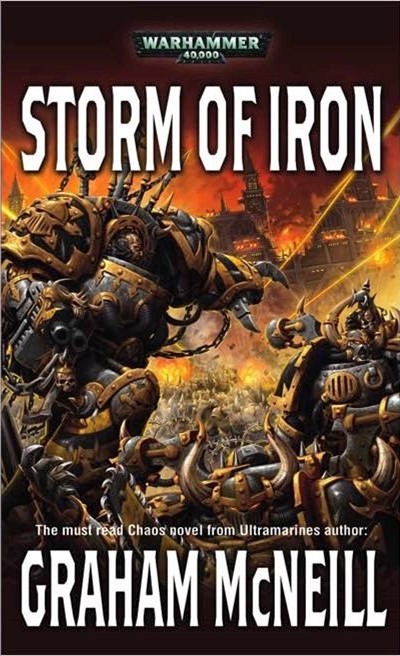
Throwback Thursday – Warhammer 40,000: Storm of Iron by Graham McNeill

Storm of Iron Cover 2

Publisher: Black Library (Audiobook – July 2002)

Series: Warhammer 40,000

Length: 11 hours and 3 minutes

My Rating: 4.5 out of 5 stars

Amazon

Welcome back to my Throwback Thursday series, where I republish old reviews, review books I have read before or review older books I have only just had a chance to read.  For this latest Throwback Thursday, I dive into some old-school Warhammer 40,000 fiction with the exceptional Storm of Iron by one of the most prolific Warhammer authors, Graham McNeill.

Readers of this blog will know that I have been really getting back into Warhammer fiction in the last few years, and I have had an outstanding time reading all the exciting and captivating reads the franchise’s extended universe contains.  I have been particularly impressed by the sheer number of talented authors who contribute to this extended universe, and I already have a few favourites due to how epic and complex their novels have turned out to be.  However, one of the main contributors to the current Warhammer canon I had not really explored yet is the superbly talented Graham McNeill.  McNeill has been writing Warhammer fiction for 20 years now, and he has produced multiple books for both the Warhammer 40,000 and Warhammer Fantasy sub-franchises.  Best known for The Ambassador Chronicles, Legend of Sigma, Ultramarines and Forges of Mars series, as well as his entries in the massive Horus Heresy series, McNeill has produced some outstanding sounding books throughout his career (including several books I really want to read) and had an incalculable impact on Warhammer fiction universe.  I however, have not had too much experience with his works, although I do have several of his novels sitting on my shelf.  I am hoping to read more of his stuff in the future, but I ended up starting with one of his earlier books, the standalone Warhammer 40,000 novel, Storm of Iron.

The Adeptus Mechanicus Forge World of Hydra Cordatus is a barren and desolate place, garrisoned by Imperial Guard of the 383rd Jouran Dragoons and members of Adeptus Mechanicus, who rule from one of the mightiest and seemingly impregnable fortresses in the galaxy.  No-one ever expected that the many wars that plague the universe would ever come to a planet as seemingly inhospitable as Hydra Cordatus, but hell has descended upon the planet in the form of Chaos Space Marines from the feared Iron Warriors legion.

Under the leadership of the dread Warsmith Barban Falk, the Iron Warriors have arrived on Hydra Cordatus in substantial numbers, determined to destroy all the Imperial defenders and take the planet’s main citadel.  After a blistering landing upon the surface of the planet that cuts off all hope of relief, the Iron Warriors deploy their full force of warriors, slaves, labourers and even several corrupt Titans to assault the enemy.  But they have not chosen an easy target, as the citadel of Hydra Cordatus is no ordinary fortress.  It is an ancient and mysterious stronghold, whose walls are designed to stymy any attack, and few foes would have a chance of defeating its defences.

However, the Iron Warriors have long been considered the greatest siege warfare specialists in all the universe.  Having honed their bloody craft for millennia since their betrayal of the Emperor, the corrupt Iron Warriors soon embark on an ambitious and fast campaign that soon threatens to completely destroy the Imperial forces.  Only the arrival of members of the Iron Warrior’s greatest enemies, the Space Marines of the Imperial Fists, gives any hope to the defenders.  But can even the legendary Imperial Fists stand against the ancient fury of the Iron Warriors?  And what secrets truly lay hidden in the depths of Hydra Cordatus’s citadel?

Well, this was a pretty damn awesome Warhammer book.  McNeill did a remarkable job with Storm of Iron, producing an intense and action-packed novel that might be one of the best siege novels I have ever had the pleasure of reading.  Loaded with impressive battle-sequence after impressive battle-sequence, as well as a ton of intriguing and fun characters, Storm of Iron was an outstanding read, and I had so much fun getting through it.

I will admit that one of the things that really drew me to Storm of Iron is that it showcases a massive siege in the gothic future of the Warhammer 40,000 universe.  I have always deeply enjoyed books with sieges in them, and the Warhammer universe is naturally filled with some good examples of this, although these mostly occurred in the fantasy focussed books.  As such, I was quite intrigued to see how a science fiction siege would occur, and McNeill really did not disappoint, painting a powerful and captivating picture and using the Iron Warriors and Imperial Fists, both of whom are known for their siege craft, as central figures in the narrative.

McNeill starts Storm of Iron off with a bang, showing the Iron Warrior’s initial move as they launch a lightning-fast raid and landing upon Hydra Cordatus in the opening chapters.  From there, the siege of the citadel starts in earnest as the Iron Warriors deploy their entire army towards it.  Told from multiple character perspectives of both the attackers and defenders, you swiftly get to know all the key players of the book and see their various personal and military struggles as the siege unfolds.  The author sets everything up perfectly, and you are soon engrossed in the novel-spanning siege, which McNeill explores in intricate detail, examining the various moves and countermoves that the two sides are doing.  You get some awesome scenes throughout Storm of Iron, and it really has everything you could want from a siege book, including artillery barrages, trench warfare, sapping, sallies, reinforcements, counterattacks and desperate fighting in breaches.  The entire story moves pretty quickly, and there are barely any pauses in between battle scenes.  Any delays that do occur serve an essential part of the plot, showing the various personal issues impacting the participants, introducing new characters, or exploring some of the hidden intrigue going on within the besieged citadel.

The story picks up even further around the middle, with the arrival of the Imperial Fists Space Marines who give the defenders more of a fighting chance.  As such, you are never quite certain how the book is going to unfold, and the battle really could go any way.  I liked how McNeill balanced the book between the Chaos and Imperial characters (or the attackers and defenders), and I deeply enjoyed seeing how each side conducted their war, especially as both had to deal with internal dissension and setbacks.  I think that the narrative had a great blend of cool story elements, and the combination of action, intrigue and character work fit the story very well.  Naturally, the best part of the book is the exceptional battle scenes, and thanks to author’s detailed depictions, it is extremely easy to envision all the intense fight sequences that unfold.  There are some outstanding scenes here, and there is a little bit of everything, included destructive ranged warfare, brutal close combat fights, desperate last stands and even some over-the-top battles between the massive Titans (essentially intense mecha warfare).  This entire story comes together pretty well, and I really liked the fantastic and dark notes that McNeill left it on.  While I wasn’t too shocked by one of the book’s main twists, there honestly wasn’t a moment where I wasn’t entertained by Storm of Iron’s story, and I had such a fantastic time seeing this entire epic siege unfold.  I managed to power through this book extremely quickly, and I had so much fun seeing how this protracted battle unfolded.  As such, this is a must-read for all those who love a good siege book, and I really appreciate the awesome story that McNeill featured here.

I love all the cool Warhammer 40,000 elements that McNeill was able to fit into this awesome book, and fans of the franchise will appreciate his attention to detail and fun depictions of the various factions and their iconic regiments/toys.  While the Imperial Guard, Adeptus Mechanicus and Imperial Fists are all featured here, this book is mainly about the Iron Warriors, and it was fascinating to see them in action.  These traitorous and corrupt siege specialists have a rich history of hatred, and while the author doesn’t go completely into their fall from grace, you get a good idea of why they turned and some of the terrors they have inflicted.  Indeed, all the depictions of the Chaos side are extremely powerful, and you get an impressive view of just how twisted and dangerous they and their dark gods are.  That being said, you get a much more nuanced viewpoint of the Chaos side here than most Warhammer books have, and it was utterly fascinating to see their views on the conflict.  That, combined with some of the secrets that the Adeptus Mechanicus are hiding, continues to reinforce one of the key concepts of the Warhammer 40,000 universe: that there really are no good guys here, just winners and dead people.  Thanks to author’s ability to highlight key universe and faction details, this is one of those Warhammer 40,000 books that could serve as a great introduction to Warhammer fiction, and if a massive and bloody siege doesn’t get your attention and make you interested in this franchise, nothing will.  As such, you don’t need to come into Storm of Iron with too much pre-knowledge of the Warhammer 40,000 universe to enjoy this book, although established fans will naturally get a lot more out of it.  I am personally glad that, of all of McNeill’s books, I chose to start with Storm of Iron, especially as it apparently sets up some of his future Warhammer entries.  In particular, it introduces one of the key antagonists of his Ultramarines series, which has long been on my to-read list, and I look forward to enjoying more of McNeill’s epic Warhammer books in the future.

I also deeply appreciated some of the excellent character work that was featured within Storm of Iron.  Due to how McNeill writes the story, the book features a huge range of different point-of-view characters, broken up between the Iron Warriors and the members of the 383rd Jouran Dragoons who are defending the citadel.  While the quick-paced story and multiple character perspectives cuts down on development a little, you do get to know all the key characters very quickly, and McNeill fits in some absolutely fascinating character arcs that I deeply enjoyed.  Three of the most interesting characters are the Iron Warriors captains who are leading the assault on Hydra Cordatus, Honsou, Forrix and Kroeger.  All three are pretty interesting in their own right, with Honsou the true believer ostracised by his comrades due to his heritage, Forrix the disillusioned veteran, and Kroeger the mad berserker who is slowly going insane serving the Blood God Khorne.  Their personal storylines are all amazing, but the real fun is seeing their interactions, especially as they all hate each other and are vying for their master’s favour.  McNeill spends a lot of time with these three villains, and you really get a sense of whole Iron Warrior’s legion through their disparate viewpoints.  I will say that I didn’t think any of the Imperial characters quite measured up to these Chaos characters, especially as McNeill really worked to make them as compelling as possible.  I did deeply enjoy the character of Guardsman Julius Hawke, a slacker who finds himself alone in the wilds and serves an interesting role in the battle.  I was also quite intrigued by Lieutenant Larana Ultorian, a defiant soldier who is captured by the Chaos forces and slowly driven insane by her forced service to them.  These characters, and more, all help to turn Storm of Iron into a much more complex and powerful read, and I had a great time explore all their unique stories and histories here.

I doubt anyone is going to be too surprised that I made sure to grab the recently released audiobook version, which in my opinion is one of the best ways to enjoy a cool Warhammer book.  The Storm of Iron audiobook was a pretty good example of this, as I quickly got drawn into it, especially as the awesome action sequences became even more epic when they are read out.  With a run time of just over 11 hours, this was a decent length Warhammer audiobook, although I managed to power through it in less than a week, mainly because of how much I got caught up in the story.  I was also pretty impressed by the narration from Michael Geary, who really dove into the various roles contained within Storm of Iron’s story.  Geary clearly had a lot of fun telling this dark tale, and I felt his fast-paced narration really added the intensity and excitement of the story.  I also felt that he did a great job bringing the various characters of Storm of Iron to life, and each of the main figures is given a unique voice or accent to help set them apart.  While I liked all the cool voices he did, Geary’s take on the various Chaos Space Marines was very memorable, especially as he really captures the cruelty, hatred and dark demonic influences that affect them.  An overall excellent Warhammer audiobook, I had such an exceptional time listening to this version of Storm of Iron, and this format comes highly recommended.

Overall, I am extremely happy that I chose to read this fantastic Warhammer 40,000 novel, and it was one of the more interesting older entries in the franchise I have so far read.  The extremely talented Graham McNeill did a wonderful job on Storm of Iron, and I had such an amazing time getting through its elaborate and action-packed narrative.  This book featured such an impressive depiction of a siege in the gothic far future, and readers are in for an intense and captivating time as they see this complex battle between besiegers and defenders unfold.  Clever, compelling, and filled with pulse-pounding fun, Siege of Iron was an excellent book and I look forward to reading more of McNeill’s Warhammer books in the future.
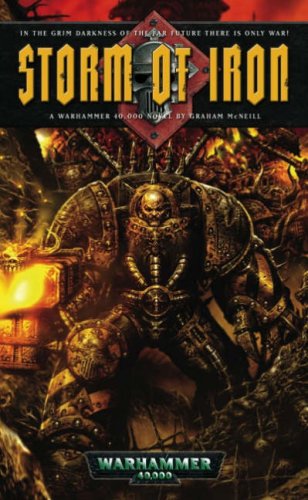
Storm of Iron Cover

Amazon

Mass Effect: Annihilation by Catherynne M. Valente

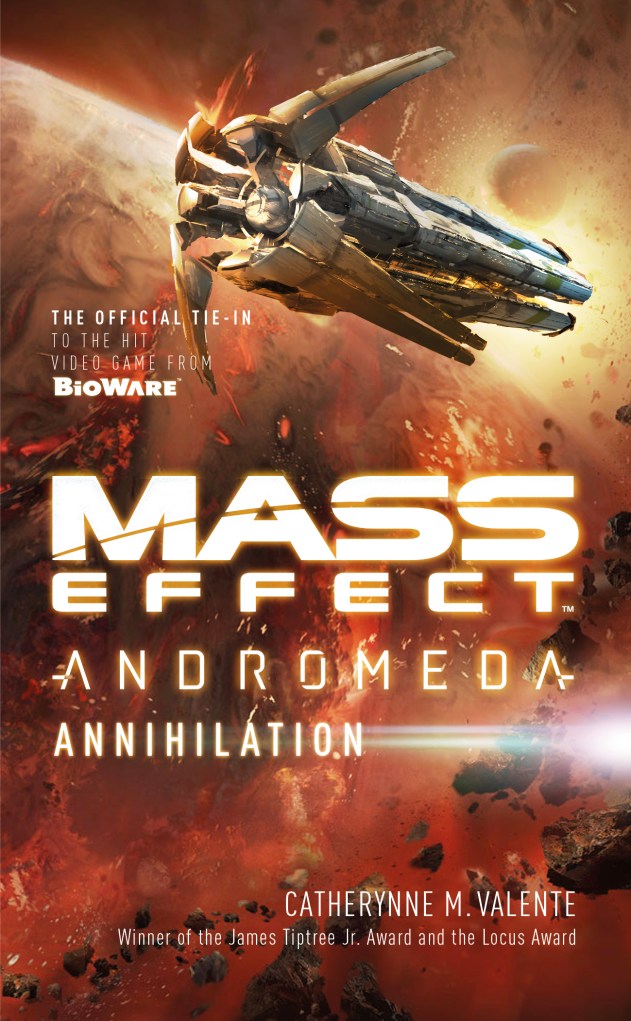
Mass Effect Annihilation Cover

Publishers: Titan Books

                        Blackstone Audio

Publication Date – 6 November 2018

Amazon     Book Depository

A new galaxy, a ship full of disparate alien species, what could possibly go wrong?  Veteran author Catherynne M. Valente brings to life a new adventure in the Mass Effect universe with Mass Effect: Annihilation, the third official tie-in novel to the 2017 video game, Mass Effect: Andromeda.

This was a really good piece of science fiction that expertly built on the intricate extended universe that has been created around the Mass Effect video game franchise.  I should preface this review by mentioning that I am a huge fan of this video game series, and one of the best things about it is the great universe and intriguing storylines that have been produced as a result.  While I know that many people had some valid criticisms about the latest game in the series, Andromeda, I actually really enjoyed the new addition to the series’ story and lore and had a lot of fun playing it and exploring all the additional plot that is hidden outside of the main missions.  One of the many mysteries that I hoped to get an answer about was the fate of Quarian ark, so I was very eager to read this book when I first heard about what it was going to focus on.

For those unfamiliar with the Mass Effect franchise, the first game was released in 2007 and is set in a universe where humanity has gained spaceflight and by 2183 has expanded throughout the Milky Way galaxy.  Once they were outside of our solar systems, humans met with several alien races which governed large portions of the galaxy.  The three main species, the Asari, the Salarians and the Turians, formed a ruling council on the ancient alien space station, the Citadel, which served as a capital city for these races and several other allied species.  The game series followed the human protagonist, Commander Shepard, as he (or she, depending on your settings), investigates the resurgence of the Reapers: ancient, sentient space ships who appear every 50,000 years to destroy all sentient organic life.  While Shepard is able to delay the appearance of the Reapers in the first two games, they launch a full-scale attack in Mass Effect 3, leading to significant, galaxy-changing events.

The game Mass Effect: Annihilation is based on, Mass Effect Andromeda, is the fourth Mass Effect game released and a loose sequel to the original series.  Andromeda is set over 600 years after the events of Mass Effect 3, and follows a group of explorers and colonists from the Milky Way galaxy as they travel to the Andromeda galaxy in an epic one-way trip to find new planets to settle on.  This was a result of the Andromeda Initiative, a joint exercise from a number of Citadel species in order to settle in the new galaxy.  The Initiative launched their ships to Andromeda in the period between Mass Effect 2 and 3.  Each of the main Citadel races, humans, Asari, Salarians and Turians sent an ark ship to Andromeda, each filled with 20,000 cryogenically frozen members of their respective species.  These four arks were launched at the same time, and the plan was for them to dock in the Nexus, a miniature version of the Milky Way Citadel sent in advance of the arks, which was to be used as a staging ground while the Pathfinders found and explored new planets for their races to settle on.  During the events of Mass Effect: Andromeda, mention was made of a fifth ark, built by the Quarians and filled with several other alien races, that was supposed to launch soon after the initial four arks.  However, this fifth ark made no appearance during Andromeda, and was one of the game’s unsolved mysteries, perhaps destined to never be solved, as there is currently no plans to continue the Mass Effect game franchise (although it is too big a franchise for them not to do something else with it in the future).

The Mass Effect games have inspired a number of additional media releases over the years.  Four Mass Effect books were written between 2007 and 2012 to correspond with the original game trilogy, as well as a number of comic book series.  Following the release of Mass Effect: Andromeda in 2017, a new trilogy of books was commissioned which further explored key events or characters mentioned in the fourth game.  Annihilation is the third and final book in the Mass Effect: Andromeda book trilogy.

As the Reaper fleet begins to appear in the Milky Way galaxy, a fifth ark is launched by the Andromeda Initiative to bring another 20,000 settlers to the Andromeda galaxy.  Built by the planetless Quarians, the ark Keelah Si’yah is the only ark to hold colonists from a number of different races, including Quarians, Drell, Elcor, Batarians, Volus and Hanar.  Despite having different outlooks, opinions, biological requirements and reasons to leave the Milky Way, these races are united in their decision to reach the new galaxy and find new planets to settle on.

As the ship reaches the end of its 600-year long journey, problems are soon identified aboard the ship.  One of the ark’s Sleepwalker teams, a small team of individuals tasked with checking on the status of the ark as it flies through space, is suddenly awoken years before the Keelah Si’yah is scheduled to dock with the Nexus.  The ship’s virtual intelligence has identified certain discrepancies in the readings of several Drell cryopods.  Investigating the pods, the Sleepwalker team find that their inhabitants have died from a disease, something that is supposed to be impossible while frozen.  Even worse, the ships systems are all reporting that everything is fine, and that the inhabitants of the pods are still alive.

The Sleepwalker team quickly discover that the dead colonists have all been infected by a virulent disease, one that seems capable of jumping across to the vastly different alien species.  The team are desperate to find out the cause of the disease, but their investigation is severely hampered by a number of system failures across the ark, while the ship’s computers continue to insist that everything is all right.  As the failing systems start to randomly unfreeze more and more colonists, the disease quickly spreads across the ark.  It soon becomes apparent that the disease has been artificially created, and that someone is launching a deliberate attack against the Keelah Si’yah and its crew.  As the various colonists turn on each other in fear and confusion, can the Sleepwalker team find a cure and uncover who is behind the attack, or will everyone on the ark die before reaching Andromeda?

The author of this book, Catherynne M. Valente is not an author I was very familiar with before listening to Annihilation, but she appears to have produced a wide range of different novels, some of which are quite quirky in content.  I do remember seeing and trying to get a copy of her 2018 release, Space Opera, earlier this year, mainly because it sounded like such a fun read, what with it essentially being Eurovision in space.  Luckily, I was able to obtain a copy of Annihilation a week ago and powered through its audiobook format, narrated by Tom Taylorson.

Mass Effect: Annihilation has an exciting and intriguing story that expands on the established lore of the Mass Effect universe while also providing the reader with a compelling science fiction mystery.  The story is broken up into three main parts: the characters attempting to identify and cure the disease, the attempts to fix the ship’s broken system and an investigation into who or what initiated the attack on the ark and its inhabitants.  As a result, there is a good combination of medical, technical and investigative scenes that come together into a rather intriguing overall narrative.  There is not a lot of action, but the focus on the various problems around the ship is very interesting.  The link between the various parts of the book and the final solution to who is behind them was also quite clever and the reasons behind it were quite interesting.  There are some certain dark moments, especially when it comes to the reveal of who was behind it.  Annihilation is obviously going to appeal a lot more to readers who are familiar with the games and who enjoy the backstory of this series, but this is a great story with plenty for other readers to enjoy, and I felt that Valente makes this story accessible for outside readers.

One of the most interesting parts about Annihilation is the fact that the book focuses on the less prominent alien races in the Mass Effect universe.  Aside from one prologue that follows a human, every single character is a member of six less common races in the lore and games, the Quarians, Drell, Volus, Batarians, Hana and Elcor.  This is unique, as the games and the previous novels tend to mostly focus on human characters, or feature a significant number of characters from the games more prominent races, such as the token sexy alien species, the Asari, or the gigantic and war loving Krogan.  The other main council races, the Turians and the Salarians, are also extremely prominent compared to the six races featured within this book, with great Turian and Salarian characters appearing frequently in the games or the books (I am the very model of a scientist Salarian).  In pretty much all of the games, the protagonist can choose members of the above aliens to be a part of the team.  However, Annihilation completely changes this around, as four of the six races that the book focuses on have never had usable characters in any of the games and are mostly minor side characters.  Of the other two races, the Quarians do get a good examination within the games, with one of their members quite a key character.  The Drell are explored to a much lesser degree, although badass Drell assassin Thane Krios as a useable teammate in the second game.

I was pleasantly surprised to read a book where these six less commonly featured races were so prominent.  Valente has a great understanding of these races and spends a significant part of the book exploring each race’s various quirks, important parts of their biology, culture, society or lifestyle, as well as certain parts of their history.  The author does a fantastic job expressing all these racial traits throughout the book, and even new readers to the franchise can quickly gain an understanding of what these species are and what is key to all of them.  For example, Valente is able to expertly capture the various speech characteristics of each of the races featured in Annihilation.  This includes the heavy breathing of the Volus, the lack of personal pronouns in the Hanar’s dialogue, the rolling stream of Drell memories that they say aloud when flashing back to important memories, and even the Elcor habit of prefacing their sentences with their emotional state.  These are all done incredibly consistently throughout the book and really add a lot of authenticity to the story.  These vocal patterns can also be particularly entertaining, especially when it comes to the Elcors, as nothing is more amusing than having an angry Elcor calmly telling everyone how enraged he is.  The various alien species did have the potential to make the investigation into the virus hard to understand, but the author cleverly got around this by having the characters compare the disease, cures and other relevant aspects to common and recognisable human disease.  Overall, these alien inclusions are fantastic, and it was great to see these more obscure fictional species finally get the limelight in a Mass Effect story.

While the alien races as a whole are great inclusions in Annihilation, Valente has also created some amazing characters to make up the Sleepwalker team investigating the issues plaguing the ark.  These characters include the team’s leader, Quarian Senna’Nir vas Keelah Si’yah, Drell detective Anax Therion, Elcor doctor Yorrik, former Batarian crime lord Borbala Ferank, Volus tailor Irit Non and a religiously fanatic Hanar apothecary.  Each of these characters is pretty fun, and all of them have demons in their past that are explored throughout the book.  For example, Senna’Nir is obsessed by computer intelligences, something that is forbidden by the other Quarians following a terrible event in their history.  As a result, Senna’Nir spends large portions of the book coming to terms with his secret obsession, and it is quite an interesting subplot which also allows the introduction of one of the best side characters, a sassy Quarian grandmother virtual intelligence.  Each of the characters’ backstories is fairly compelling and each add a lot to the story.  Borbal Ferank’s crime lord persona is also a lot of fun throughout the book, as she casually mentions her previous crimes and familiar betrayals that are quite common for Batarians.  There are also the mysteries around Anax, as the ultimate infiltrator gives several versions of her past throughout the book to various characters to get the answers and stories she requires.

Easily the best character in Annihilation is Yorrik, the Shakespeare-obsessed Elcor doctor who spends the entire book trying to cure the virus infecting the ark.  He was extremely amusing throughout the entire book, as he spend significant parts of the book dropping jokes in his emotionless tone, or attempting to engage his companions in discussion about his extremely long Elcor adaptions of Hamlet or Macbeth.  Yorrik is a fantastic character throughout the entire book, and he is definitely the person the reader gets the most attached to.  Never have Shakespearian quotes been more appropriate for the fate of an alien.  I also really loved the unique partnership between Anax and Borbala.  The detective and criminal make a great team, and the two have a lot of fun investigating the attack on the ship, and it was great seeing the two of them get closer to each other through the course of the book.  Valente has done an incredible job with the characters in this book, and their histories, relationships and unique viewpoints really make this novel awesome.

I listened to the audiobook version of Annihilation, which I found to be an amazing way to enjoy this book.  At just under nine hours long, this is an easy audiobook to get through, but it is one I had a lot of fun with.  One of the best things about the audiobook version was the fact that they got Tom Taylorson, the voice of the male protagonist in Mass Effect: Andromeda, to narrate this audiobook, which is just awesome for those people who have played the game.  Taylorson does an excellent job portraying each of the characters in this book and I loved all the voices he came up with.  He also managed to get all of the unique voice patterns and vocal particularities of the various alien species down perfectly, and each alien species sounded exactly as they did in the games.  This is an outstanding piece of audiobook narration, which really added a lot to how much I enjoyed this book.

Overall, I am going to give Mass Effect: Annihilation a rating of four and a half stars.  I will admit that one of the main reasons I am giving it such a high rating is because of my love of all things Mass Effect and because of how much I love the franchises lore and expanded fictional history.  I am aware that people who are not as familiar with Mass Effect may not enjoy it as much, but I hope that most readers will appreciate the great characters, interesting story and excellent audiobook adaption.  This is great piece of science fiction and an excellent tie-in novel that is a perfect read for fans of the Mass Effect franchise.

My Rating:

Four and a half stars

Amazon     Book Depository