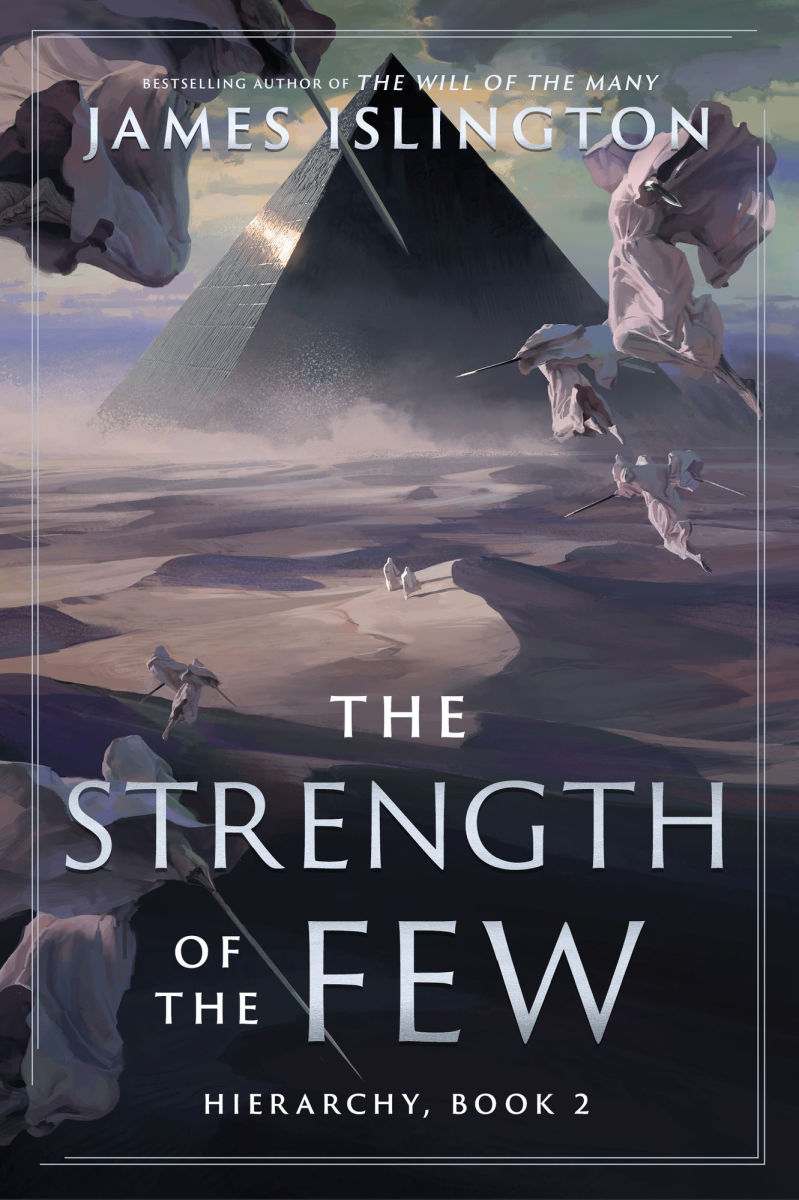
The Strength of the Few by James Islington

Publisher: Text Publishing/Audible Studios (Audiobook – 11 November 2025)

Series: Hierarchy – Book Two

Length: 31 hours 8 minutes

My Rating: 5 out of 5 stars

Amazon

Australian author James Islington continues his Hierarchy series in epic form with the incredible and complex novel, The Strength of the Few, an outstanding and highly addictive fantasy novel that I had an incredible time getting through.

Back in 2023, I had the pleasure of reading the outstanding novel, The Will of the Many from James Islington, which I very quickly fell in love with.  Following a fugitive prince who finds himself enrolled in an academy for the children of the elite members of the nation that conquered his homeland, The Will of the Many had an intricate plot that forced the protagonist to deal with elaborate ancient puzzles, the unique magic of his world, unlikely friendships, deadly rebels, and all his hidden secrets potentially becoming uncovered.  I had such an amazing time reading The Will of the Many that it got a very easy five-star rating from me, and it ended up topping several of my end-of-year lists for 2023, including my favourite book, audiobook, new-to-me author and Australian fiction lists.  Unsurprisingly, I have been keen to see how the series would continue ever since I finished the final page of The Will of the Many, and the long-awaited sequel, The Strength of the Few, was one of my most anticipated novels of 2025.  I started reading The Strength of the Few the second I could, and it turned out to be another captivating read, with a plot that goes in some captivating and intense directions.

After infiltrating the Academy and running the mysterious Labyrinth, the man known to the Catenan Republic as Vis Telimus thought that he would finally understand some of the secrets of the nation that destroyed his people.  However, his encounters within the Labyrinth have instead resulted in the impossible and placed him in the firing line of an ancient evil determined to destroy his world.

While the original Vis continues to live in the Catenan Republic, attempting to avenge the massacre of his Academy classmates and friends at the Iudicium, he is unaware that the ancient devices within the Labyrinth replicated him across three separate words.  Mirrors of each other influenced and altered by different history, the worlds of Obiteum, Luceum and the world Vis already knows as Res, are divergent places, each with their own troubles, rulers and chaos.

Now one of the few beings existing across all three concurrent realities, Vis stands as the only person who can stop the upcoming Cataclysm that will burn away all he loves.  But first he needs to face the different challenges each world has for him, especially as he truly belongs in none of them.  Forced to fight, to learn how to control the unique powers his situation has granted him, and to understand the different worlds they find themselves in, all three versions of Vis will be pushed to their limits as they try to prove themselves and understand the secrets behind their unlikely journey.  If any version of Vis fails, then all their chance to stop the Cataclysm are finished.  But can Vis really survive in three separate realities, each of which is filled with beings who desperately want him dead?

Well damn, now that’s how you do a sequel.  The Strength of the Few was an incredible novel as James Islington expertly continued the elaborate and ambitious narrative of his epic Hierarchy books.  Featuring a layered story loaded with complex world-building, intricate story details and compelling characters, The Strength of the Few was an exceptional novel that gets a very easy five-star rating from me.

Islington came up with an especially complex and powerful story for The Strength of the Few, which served as a very worthy follow-up to the compelling events of the previous Hierarchy book.  Right out the gate readers are treated to an intricate plot, with the protagonist from The Will of the Many split into three different versions of himself in three separate mirror worlds.  Each version has its own very distinct narrative that revolves around that specific Vis trying to overcome the challenges of that specific world.  For example, the version of Vis on Res, the world that The Will of the Many was completely set in, continues to endure the politics of the Hierarchy, while also attempting to uncover those responsible for the massacre of his classmates at the end of the previous book.  The storyline set on Obiteum is a bit of a post-apocalyptic narrative, as Vis is forced to survive a broken world ruled by the enemy responsible for several previous Cataclysms, and must try to find a way into a forbidden city, half staffed by the living dead.  The final storyline set in Luceum offers a much more adventurous narrative, as a version of Vis that is completely unaware that he is in an alternate world, is forced to explore a new culture and attempt to survive amongst people who have no idea of his past or his destiny.

These three separate and very distinctive storylines each go in some interesting directions as the book continues, and the result is a very impressive and compelling overall narrative, especially as Islington expertly sets up necessary details in the early stages of the book and cleverly builds from there.  For most part, each of these storylines stay isolated, although some key details from each bleed into the wider narrative, and you can appreciate the significance of certain events or revelations in one storyline better thanks to the events in one of the other worlds.  Each plot line goes in some very interesting directions, with the dark politics of Res forcing Vis to engage in some complex schemes and deceptions, the struggles of Obiteum slowly getting to an isolated version of the protagonist, while positive character interactions in Luceum turn that Vis into a completely different person.  Islington starts to enhance the tension of all three storylines in the second part of the book, and there are some very amazing scenes that completely change the tone of each of the main storylines.  I felt the political instability of Res allowed for some particularly powerful moments, especially after a shocking scene about two-thirds of the way through book.  A growing war in Luceum also provides some compelling drama for that storyline, as Vis must decide what he wants in life, while the continued threat of discovery in Obiteum proves to be particularly draining.

The final third of the book contains some of the best scenes of The Strength of the Few, as Islington builds on all the novel’s great storytelling and complex worldbuilding to bring forth an epic conclusion.  Thrusting all three versions of Vis into mortal danger, the tension is particularly thick, as the protagonist and much of the supporting cast are in constant risk.  This includes a final desperate attempt to achieve his goal of killing a god in Obiteum, which hits a range of snags amongst the ancient city Vis has spent most of the book infiltrating.  At the same time, the Vis in Leceum finds himself in the middle of a deadly war, where his unique abilities and the unlikely rewards of a deadly ceremony weigh him down.  However, the most intense is the narrative set on Res, where Vis finds himself attempting to save who he can from the chaotic events brought on by those manipulating him.  Islington probably throws the book’s most shocking moments into the Res storyline, which nicely builds on a lot of the drama and intrigue from the first novel, and forces the protagonist to make some dark decisions, out of both vengeance and necessity.  One scene where the title of the book is quoted by an antagonist really sticks in the mind, and I’m not sure I’ll be able to forgive Islington with the dark bait-and-switch there.  All three of these storylines end on an interesting note that hint of destructive events for the future, and it is going to be fascinating to see how Islington continues the Hierarchy series going forward.

Thanks to the elaborate ideas that Islington had for this epic sequel, The Strength of the Few turned out to be an exceptionally written read, which provides an intense and compelling fantasy narrative, filled with some great emotional depth.  The inventive way that the author splits the book to follow three separate versions of the same protagonist worked surprisingly well, and it allowed for quite a unique character-driven story, which really showcases Islington’s writing ability.  I felt that the split between the three distinctive storylines was very well done, and these separate narrative threads each stood on their own merits, provide a distinctive experience in each.  I loved how there was something special in each of the storylines, and you got some interesting interactions, world building and different focuses with each of them.  All three were very well written, and there were honestly no weak links with any of the storylines, which is always a risk when you split the narrative like this.  I will say that the intrigue-laden narrative on Res was a particular favourite of mine, but both other storylines were also quite exceptional, and they balanced each other nicely with their alternating themes and varied character growth.  Throw in some creative expansion of the universe the narrative is set in, with its cool Will-based magic system, and three worlds each inspired by different ancient cultures (Roman, Egyptian and Celtic), and this was a very well written book, and I really appreciate how effectively Islington builds up his different worlds and showcases them to the reader.

The Strength of the Few proved to be an impressive continuation of the Hierarchy series, and I felt that Islington did an outstanding job building on the impressive fantasy elements and storylines of the first book.  However, the complex narrative split and the way that Islington dives immediately into the story does mean that The Strength of the Few is probably best enjoyed by those readers who have already gotten through The Will of the Many.  While Islington does re-examine key elements of the plot from the first book as The Strength of the Few continues, it is a very gradual process, and new readers trying to read the sequel first are likely to get confused if they don’t know some necessary details from the first book.  The Strength of the Few might have benefited from a good summary or recap at the front of the book to remind readers of some key details, especially if they haven’t had a chance to read re-read The Will of the Many since its 2023 release.  Still, for the most part, all readers should be able to follow and appreciate The Strength of the Few, especially once you get drawn into the three compelling storylines, and people who love extremely elaborate fantasy narratives with a lot of intricate detail are going to have an outstanding time.

I was once again impressed with Islington’s great characters in The Strength of the Few, as this book has a massive cast, made up of an interesting combination of figures from The Will of the Many, and new characters from the three separate worlds of the setting.  However, most of this book naturally follows the young protagonist from the first book, who is primarily known as Vis Telimus.  A studious and damaged figure who had already gone through a lot before the events of this novel, Vis has rather a unique experience in this sequel, as unbeknown to him, there are now three separate versions of him concurrently existing in the mirror worlds of this setting.

Islington perfectly sets up and utilises this three-way split of his protagonist, and readers are soon treated to three distinct variations of the protagonist, each of whom are altered by their experiences and losses, especially the two versions of Vis who lose their left arm.  It was fascinating to see how each of the Vises are influenced and changed by their respective traumas, and how their adventures are altered by the different information or people that they meet.  For example, the Vis in Res, who is essentially the same protagonist from The Will of the Many, finds himself longing for vengeance after the events of the Iudicium, and spends much of the book angry and forced to endure politics and lies.  The version of Vis on Luceum, while feeling lessened by the loss of his arm, soon finds peace in his new setting, and his eventual motivations for fighting and living are very different from his other incarnations, especially as he finds friends he can trust completely.  Finally, the Vis on Obiteum is one of the more confident incarnations of the protagonist, having full knowledge of the upcoming Cataclysm and his place in the three worlds explain early in the book.  As such, he soon becomes the most competent at utilising his Will talents and appears the most undamaged of the three due to not losing his arm.  However, in many ways the Obiteum Vis is the worst off out of all versions of the protagonist due to his isolation, the desolate surroundings, and the early expectations of murder and potential death that are thrust upon him.  I really cannot emphasise just how clever the split between these different variations of the protagonist is, especially with the subtle differences and alternate reactions to similar events or situations. It really makes for quite a distinctive and moving read, especially as all three versions of Vis experiences even greater trauma and damage as this sequel continues.

While Vis is the obvious focus of The Strength of the Few, there is a huge supporting cast utilised throughout this book, including various characters only found on each distinctive world.  Indeed, each version of Vis picks up its own supporting cast, which allows for some very different interactions in each of the major storylines.  Highlights include many of the recurring characters from the first book who serve as Vis’ friends and mentors in Res.  There is a particular focus on Eidhin and Aequa, who have an expanded role as Vis’s main confidants in this novel, and I liked some of the powerful storylines that formed around them.  Other major supporting characters from the first novel are showcased to a lesser extent in this sequel, primarily due to the book being split into three separate parts, although many of these characters still got a notable role in this sequel.

The cast supporting Vis on the desolate world of Obiteum is a lot more limited, mainly to emphasise the protagonist’s loneliness, although he does find a compelling mentor in Caeror, his adoptive uncle, who the protagonist was hunting for in the first book.  A couple of other native characters from Obiteum gain prominence later in this storyline as Vis attempts to complete his mission, and it is fascinating to see how their experiences living on a dead-world, impact their interactions with the protagonist.  Finally, the cast of the Luceum plotline represent a compelling counterpart to the supporting characters of the rest of the book.  While Vis has enemies in Luceum, he also finds several true friends who he can trust with all his secrets.  It was interesting to finally see Vis truly open up to other people, and it allowed for some very different interactions to the secrets and lies that define the protagonist in the other two storylines.  Throw in a compelling array of antagonists, as well as an entertaining manipulator who keeps chucking Vis into the deep end on Res, and this was an impressive cast for this great sequel.  It honestly was an extremely intriguing experience to have three separate casts of characters set around different versions of the protagonist.  While this narrative split did result in some restrictions when it came to character depth or a full exploration of relationships, I think the overall extended length of the book overcame this and allowed the reader to grow close to the supporting characters.  I will warn readers not to get too attached to the extended cast though, as Islington does get a little murderous as the book continues, however, all these characters are impressive while they last.

While I was lucky enough to receive a physical copy of The Strength of the Few, I ended up holding out for a little bit to listen to the audiobook version of this book instead.  I’m a big fan of audiobooks when it comes to ultra-elaborate fantasy narratives, as I tend to absorb and retain more of the details that way, and this worked out well with The Strength of the Few.  I felt that Islington’s complex story came across very effectively when read out, and all the elements, including the elaborate worldbuilding and the great character work, were well translated to the reader.  I also appreciated how the switches between the three different versions of the perspective protagonist, was easily discernible, and this was a very easy story to follow on audiobook.  The Strength of the Few audiobook saw the return of Euan Morton for narrator, who previously read out The Will of the Many, and who I quite enjoyed as a narrator of the Star Wars audiobook, Tarkin.  Morton has a very interesting cadence to his voice as a narrator, which provided a very unique edge to this audiobook.  While Morton’s narration style might not appeal to everyone, I felt that he did a good job voicing this compelling story, especially through the eyes of the complex protagonist, and his unique narration on this elaborate story worked extremely well.  I also felt that Morton excelled at pronouncing all the different names and titles that Islington featured in his plot, no matter their Roman, Celtic or Egyptian inspiration, and the characters of all three different worlds had a subtly different cadence and accent that helped to distinguish the separate storylines from each other.  As such, I really got stuck into this audiobook, powering through it quickly, even with its 31-hour runtime.  This was probably one of the more intense and moving fantasy audiobooks I had the pleasure of listening to in 2025, and I cannot recommend this format enough.

James Islington does it again with his incredible second Hierarchy novel, The Strength of the Few.  Brilliantly continuing his elaborate narrative from the first novel in a unique manner, The Strength of the Few was an ultra-addictive read, that really showcased Islington’s writing ability and imagination.  Clever, powerful and easy to get addicted to, The Strength of the Few was one of my favourite books of the year, and I cannot wait to see how Islington continues the series going forward.

Amazon

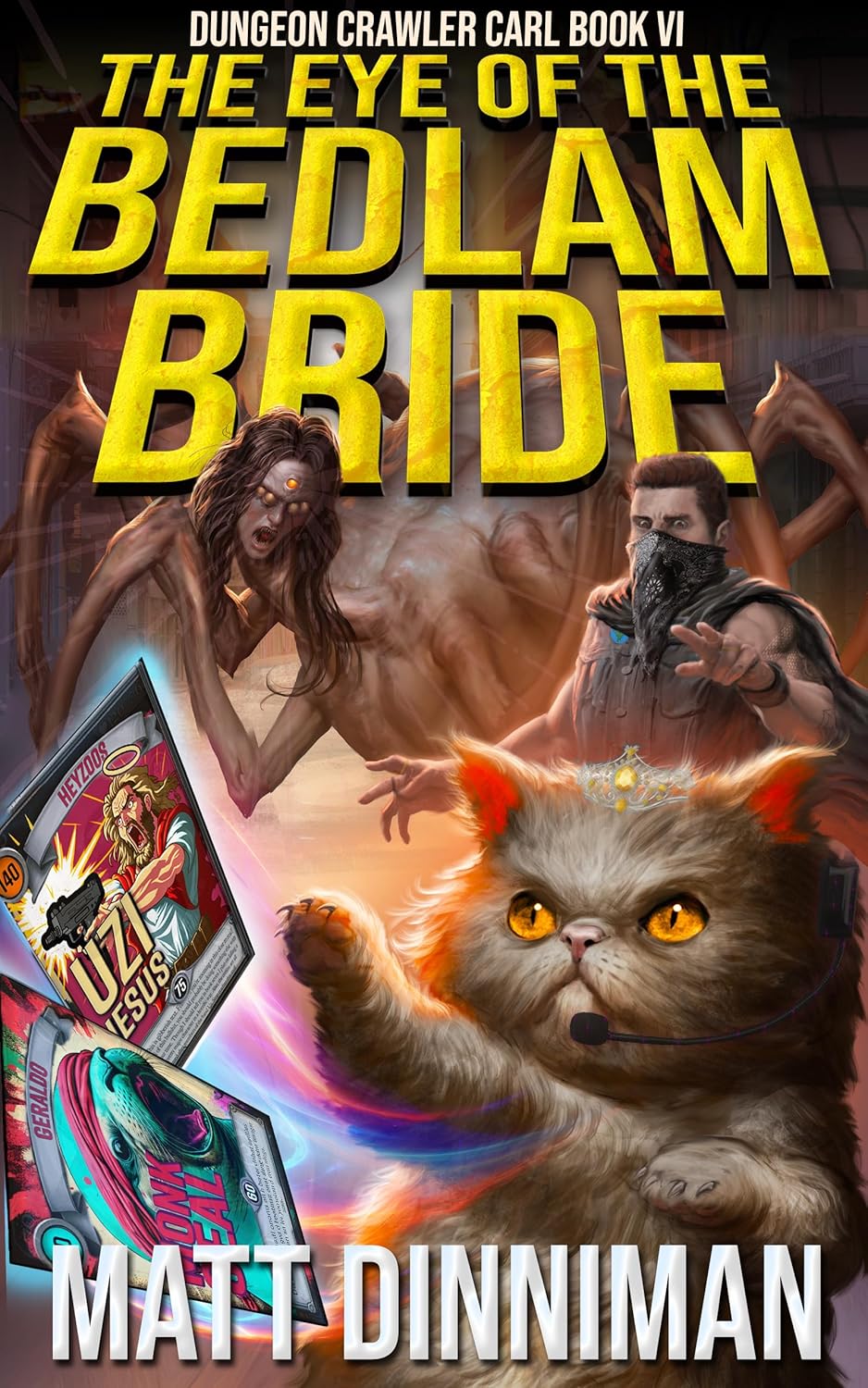
The Eye of the Bedlam Bride by Matt Dinniman

Publisher: Soundbooth Theater (Audiobook – 2 July 2023)

Series: Dungeon Crawler Carl – Book Six

Length: 26 hours and 46 minutes

My Rating: 5 out of 5 stars

Amazon

The chaotic fun of Matt Dinniman’s Dungeon Crawler Carl series continues in epic fashion with the ultra-impactful and deeply addictive sixth entry in the series, The Eye of the Bedlam Bride, an exceptional novel designed to strike hard at the reader’s emotional heartstrings.

As you might have guessed from my recent flurry of reviews for this series, I am seriously in love with the Dungeon Crawler Carl books.  An impressive and surprisingly deep LitRPG series, the Dungeon Crawler Carl novels follow a collection of compelling characters as traverse a deadly fantasy dungeon created from the ruins of all of Earth’s buildings by aliens for intergalactic viewing content.  Set around a damaged protagonist and his excitable and now sentient cat, these books are deeply addictive, and once you start the series you really can’t stop.  Indeed, I literally just chain-read the entire series, with awesome books like Dungeon Crawler Carl, Carl’s Doomsday Scenario, The Dungeon Anarchist’s Cookbook, The Gate of the Feral Gods and The Butcher’s Masquerade all proving to be outstanding reads.  I loved these previous books so much, that I instantly started listening to the sixth book in the series, The Eye of the Bedlam Bride, the first chance I got, and boy was I in for an incredible time with it.

After barely surviving the Butcher’s Masquerade and then witnessing the surprising end to the seventh floor, Carl and Princess Donut are exhausted and traumatised by recent losses.  However, they have no time for rest as they find themselves thrust into the dangerous eighth floor of the dungeon.  One of the most ambitious levels so far, the eighth floor is based on a map of Earth’s final days, filled with intangible ghosts of the humans who wandered the world mere weeks before the planet’s death.

However, this is not a perfect replica of Earth; instead these locations have been seeded with monsters and mythological figures based on twisted accounts of Earth legends, with each creature tied to the geographic area their folklore originated.  To complete this level, the crawlers are tasked with finding and capturing six of these monsters and turning them into cards, which can then be summoned to fight alongside their new owners.  Each team will need to find and convert as many powerful creatures as possible to create the best decks, especially as they will be forced to face off against mobs and other crawlers with their own cards.

Unexpectedly starting in Cuba, Carl and Donut navigate an unfamiliar location as they try to learn the new mechanics of the game.  Determined to get to the next floor, Carl and Donut endeavour to find the best monsters they can.  However, the stronger the monster, the less controllable the card, and Carl and Donut will soon have their hands full managing a strange array of summonable creatures, including the legendary demon Shi Maria, who has far more independence than they would like.  Can Carl and Donut survive this new floor of the dungeon, or will they finally be crushed by their dark secrets, troubled pasts and Carl’s slowly eroding sanity, especially once he looks into the eye of Shi Maria, the Bedlam Bride?

Just when you thought this series couldn’t get even better, Matt Dinniman amps up the intensity and complexity of his plot and characters a whole additional notch, with one of the more moving and powerful entries in the entire series.  The Eye of the Bedlam Bride was an absolute masterpiece that featured the author’s trademark LitRPG chaos, while really showcasing his impressive writing ability.  One of the best books in an already incredible series, The Eye of the Bedlam Bride was so damn good, and it gets a very easy five-star rating from me.

Dinniman pulled together another brilliant narrative for his sixth Dungeon Crawler Carl novel, as They Eye of the Bedlam Bride perfectly continued the long-running series storylines while also presenting its own unique adventure.  Thrusting the protagonists into a complex new level, Dinniman quickly showcases all the floor’s new elements, including a fun card-based combat mechanism that fits into the existing dungeon battle system surprisingly well.  While the pacing is initially a tad slower to ensure the readers fully appreciate all the necessary lore and gameplay details of this book’s plot, Dinniman quickly works to show that The Eye of the Bedlam Bride isn’t a filler novel between the pivotal fifth and seventh books.  This becomes especially clear during a major sequence that requires Carl and Donut to make a deadly choice while surrounded by several vengeful gods.  Dinniman also makes sure that a major secret from the previous book is brought into the light early, complicating protagonist relationships and presenting them with dark choices.  Dinniman swiftly follows this up with some very awesome sequences, such as Carl and Donut coming face-to-face with their most problematic card, demonic carnage in a night club, and problems from the wider universe caused by Carl’s ambitious and rebellious plots.

While all these early elements are great, The Eye of the Bedlam Bride hits its storytelling height about halfway through, as Dinniman amps up the emotional stakes of the narrative.  Forced to compete in a gruelling series of battles that test the unique fight mechanics of the floor, the protagonists find nothing but heartbreak as they near the end of the second phase of the level, including a truly horrifying and deeply personal big boss.  All this follows a series of impactful personal revelations for Carl, that hit his already fragile mental state hard and finally provides full context for character background elements that have been hinted at throughout the series.  This central part of the story was so damn heartbreaking, and you really must appreciate how Dinniman can make you laugh before loading up substantial sorrow and regret and producing some beautifully crushing sequences.  While these scenes are emotionally charged, I appreciated how Dinniman often tempered them with more heartwarming moments that show the connections the protagonists have built up during the series, and the author does some amazing character work in the second half of this book.

Everything perfectly leads up to the incredible final third of The Eye of the Bedlam Bride, as Dinniman raises the stakes as only he can.  With the protagonists forced to compete in a brutal third and final phase of the floor, events soon break down into pure chaos with undead hordes, demonic possessions, crazed gods and various rival crawlers all coming into play.  Dinniman keeps the story moving so fast in this last part of the book, as the protagonists dive into key battle after key battle.  I actually ended up listening to the last several hours in one day as I just had to see what happened next.  Following one of the most tragic scenes in the series, which nearly broke me, Carl and Donut race to save as many people as they can from the AI’s inventive endgame, leading to an all-out battle royal in the middle of Cuba.  I loved how so many story elements from the entire book came into play for the conclusion after some clever set up earlier in the plot, resulting in some very epic moments.  The ending was a brilliant mixture of humour, intense action, extra lore, and some particularly dark moments for the protagonists, which came together beautifully and ended the novel on a real high.  Throw in some last-minute reveals that really amp up the excitement for the next book, and this was pretty much a perfect narrative that is guaranteed to keep you hooked all the way the bloody end.

I honestly feel that The Eye of the Bedlam Bride was one of the best-written entries in the entire Dungeon Crawler Carl series, and frankly I am still not over every single amazing moment of this book.  Dinniman achieves so much in this impressive novel by simultaneously changing the rules of his own game while also providing the deepest examination of his complex protagonists yet.  At the same time, he makes a novel that most authors would have turned into a filler entry into one of the series’ most impactful books.  I was really impressed by how the author chose to further amp up his various storylines and character arcs in this book, and Dinniman perfectly carries on the craziness of The Butcher’s Masquerade while building up the oncoming calamity of the seventh book and the long-awaited Faction Wars.  Naturally, this means that The Eye of the Bedlam Bride is best enjoyed by those who have read all the previous Dungeon Crawler Carl books first.  Still, for those who are determined to dive in here, Dinniman provides enough context and flashbacks to ensure you can easily follow what’s happening, and there is even a fun summary at the beginning.

This sixth novel in the series brings back all the impressive humour, intense action, and great LitRPG elements that made the previous Dungeon Crawler Carl books so damn good, while also bringing in some impressive new features, primarily a fun new battle element.  I must admit that I wasn’t too sure that the card system of this level, which on paper sounded like a crazy combination of Pokémon and Yu-Gi-Oh!, was going to work.  However, I should never have doubted Dinniman as it fitted in amongst the usual chaos and over-the-top scenes perfectly.  Dinniman does an excellent job introducing and then exploring this system throughout The Eye of the Bedlam Bride it proved fun to see the characters adapt to the new rules.  There is some great progression in how these cards impact battles, and each fight with them gets increasingly hectic.  I really enjoyed how big and crazy battles with these cards could get, especially towards the end, and you won’t see protagonists facing off in card duels with gods and demons anywhere else.

There are some additional excellent elements to The Eye of the Bedlam Bride that also enhanced the epic story in some interesting ways.  This includes a haunting new setting of the book, the ghost-filled replica of the pre-dungeon Earth, which really amplifies the feeling of despair and loss that many of the characters feel.  Dinniman continues to also feature a compelling array of LitRPG elements in this novel, and you really find yourself getting drawn into the minutiae of stat updates, item benefits, spell effects, and so much more, as the author cleverly works it into the narrative.  A lot of why these RPG features are so fun is due the chaotic humour that infests every single page of this hilarious book.  The book’s comedic elements are so effortlessly funny and feature a great mixture of sudden outrageous moments with realistic reactions, the insertion of the book’s reality television elements into life-and-death struggles, often inappropriate jokes from the massive and fun supporting cast, and an array of reference focused commentary on all matters of the dungeon.  While some of the comedic moments get a little out of hand: “I need a baby seal”, they all work beautifully in the context of the book’s clever plot, and I laughed myself silly so many times during this book, including at how the day was saved thanks to, let’s say, “crab meat”.  I’m also as appalled as a certain velociraptor that some of the funniest, if weirdest, moments of the book occurred in Chapter 69.  However, what makes The Eye of the Bedlam Bride particularly good is the way in which these comedic elements are well matched by darker, tragic moments, which allows for quite on overall powerful read, especially when it comes to the characters.

Dinniman went above and beyond when it came to the character development in this book, with a particular focus on series protagonist Carl.  After several books laden with hints about his past, we finally get Carl’s full backstory, which really goes to show just how damaged he is.  Dinniman does an outstanding job showcasing this background in several powerful scenes in The Eye of the Bedlam Bride, and I really appreciate how it built on the subtle foreshadowing from the previous novels.  This existing trauma was further enhanced in this book, as Carl also finds out multiple new revelations about his family, including several that had been kept from him (which simultaneously shows just how bad a girlfriend Bea really was).  Throw in his anger and guilt from being one of the few survivors of Earth, and the trauma from all carnage he has witnessed in the dungeon, and Carl really isn’t in the best headspace for this book, and that’s even before the titular Bedlam Bride gets hold of his mind.  As such, there is a lot of dark moments for Carl to unpackage throughout this novel, and Dinniman perfectly captures his protagonist’s continued struggle to remain in control.  This deeper dive into Carl’s psyche produced some of the best scenes Dinniman has so far written in the series, and I really appreciated how these darker moments were well matched by the revelation that Carl now has a true family with Donut and his new friends.  These relationships kept him relatively sane in this book, and allowed him to remain the resilient, if explosively inclined, straight man of the book.  Dinniman also works to showcase how despite his issues and reputation, Carl has become a bit of a legendary figure for his fellow crawlers, and the big sequence at the end where he is able to convince them to follow one of his craziest plans, was just amazing.

While most of this book’s focus is on Carl and his history, the rest of the characters in The Eye of the Bedlam Bride also get their moments to shine, and you continue to appreciate just how awesome the ended cast of this series is.  This includes the other main protagonist, Princess Donut, Carl’s now sentient cat who provides much of the humour in the story thanks to her over-dramatic reactions, silliness, and feline superiority complex.  While Donut is the comedic relief of the main duo, she still has a lot of serious moments in The Eye of the Bedlam Bride, especially while serving as the emotional anchor the spiralling Carl.  Donut is also dealing with her own grief and sadness, especially after the tragedies of the previous novel, and there are some heartbreaking moments where you see her trying to push that down.  Despite her issues and immaturity, Donut role in the plot, especially as she controls the cards during most of the battles, and you get to see her tactical genius in full display.  There are some super sweet moments with Donut in this novel, and I really love how well Dinniman continues to feature the bond between her and Carl as the true heart of this series.

In addition to Carl and Donut, The Eye of the Bedlam Bride also features multiple other key members of the Dungeon Crawler Carl cast, and it is very impressive how much you care for so many of these figures.  This includes Katia, who, despite leaving the team in the previous novel, still has a major impact on the plot.  Dinniman perfectly revisits some key revelations from the end of the previous novel, that adds additional complexities to her relationship with Carl and Donut.  The protagonist’s mentor, Mordecai, also has a key role in this book, especially as you finally get the full context for his tragic past.  This background adds some additional drama to the main story, especially when Carl and Katia find themselves caught in the same feud between forces outside the dungeon that he did.  There is also a certain sweetness to Mordecai’s story in this novel, especially when you find out he’s caring for several NPC children, in ways very contrary to his usual gruff disposition.  Dinniman also perfectly brings back the various members of Carl’s guild, who form a surrogate family with each other, and whose appearance in one scene was one of the most heartwarming moments in the plot.

Other characters of note in The Eye of the Bedlam Bride include the possessed sex doll head, Samantha, whose insane declarations, unhinged actions, unsettling abilities and crazy general demeanour make her one of the funniest characters in the series.  There is also an array of over-the-top monsters and creatures that the protagonists encounter and turn into cards.  These include Uzi Jesus, a kung-fu seal, hilarious caricatures of Carl and Donut, and a crab who must overcome his ‘performance issues’ to save the day, just to name a hilarious few.  These comedic monsters were well contrasted by Shi Maria, the titular Bedlam Bride, whose dark actions amp up the intensity of this book in some powerful ways.  I also must mention a couple of recurring crawlers from previous novels who reappear in dramatic fashion in the final third of the novel, allowing for some of the book’s best moments.  One of these character ends up having one of the series’ saddest moments, and I frankly am still not over how brutally raw and tragic that whole sequence was.

While all these above characters are amazing in their own ways, my favourite character in this series remains the dungeon’s System AI.  Despite never physically appearing, the AI has a major impact on the plot, and you are constantly bombarded by its unique humour in the various descriptions and summaries it provides to Carl and the reader, often full of weird and hilarious references.  So many serious or threatening moments are turned into comedic gold by the AI’s inappropriate commentary, and anytime it provides input to the plot, you are guaranteed to laugh.  While the AI has been fun the entire series, it gets even more unhinged in this novel as it gains full sentience and takes full control of the.  Determined to continue the crawl on its own dramatic terms, the AI starts making things even weirder for the characters, throwing in its own twists and changes.  Dinniman does a wonderful job showcasing just how insane the AI is at times, including with some very worrying inclusions in its usually informative descriptions.  There are also some hilarious scenes where the AI interacts directly with the characters, including one brilliant moment when he responds to Carl’s feedback on its descriptions in a particularly petty way.  All this, and more, allows the AI to really standout in this book, and it is a testament to how good Dinniman is as an author, that a disembodied voice is one of the best characters in a series loaded with exceptional and extremely complex figures.

As with all the previous Dungeon Crawler Carl novels, I ended up listening to The Eye of the Bedlam Bride on audiobook, which is honestly the only way to enjoy the author’s fantastic and chaotic narrative.  Coming in at nearly 27 hours in length, The Eye of the Bedlam Bride was one of the longest audiobooks in the series, but you frankly don’t mind as every second you spend listening to a Dungeon Crawler Carl audiobook is so much fun.  I honestly powered through The Eye of the Bedlam Bride in no time at all, especially the concluding several hours, and I still love how audiobook format brings out all the book’s humour, tragedy and excitement.  A lot of this is down to the series’ awesome narration, which in the case of The Eye of the Bedlam Bride, includes an extended voice cast.  While there are a few voice actors for this particular audiobook, Jeff Hays remained the principal narrator, voicing nearly all the characters and the plot descriptions.  Hays is an incredible narrator, and I loved the sheer range of epic voices he brings to bear throughout the audiobook, all of which fit their associated character perfectly, with associated accents and clever tonal changes.  This includes an excellent reuse of voices for previously featured characters, while the various crazy new cast members featured in this book were also extremely cool.  My favourites for The Eye of the Bedlam Bride remain Princess Donut, who gets autotune in this audiobook to help with her singing (the sound effects for this were brilliant), and the AI running the dungeon, as Hays matches the unhinged energy of the cracked computer and conveys this insanity to the listener with amazing enthusiasm.

In addition to Jeff Hays, The Eye of the Bedlam Bride also features three other actors who voice small roles in the larger audiobook to great effect.  The most notable of these is actor Patrick Warburton, who was an awesome addition to the experience.  Initially voicing the flashback voice of Carl’s father in several heavy scenes, Warburton did an outstanding job of breathing life into a harsh figure we’d only had glimpses of in the previous books, and his appearances here had some real menace to them.  Warburton also gets to have some fun when he plays a secondary character later in the audiobook with some brilliant levels of enthusiasm.  Narrator Travis Baldree was also hilarious with his appearance in The Eye of the Bedlam Bride, voicing a giant crab who becomes one of the protagonist’s cards.  Featuring a comedic accent and some very over-the-top lines, Baldree was just amazing, and I loved the interactions he had with Hays and Warburton’s characters.  Finally, Soundbooth Theater regular Annie Ellicott returns to voice an entertaining character in a concluding skit, which was very amusing on a variety of levels.  I really loved how well these outstanding extra voice actors were fitted alongside Hays’s impressive main narration, and it allowed for a great overall listen.  Throw in the excellent sound effects of the series, some of which alter Hays’s voice in clever ways, or places a voice role into the background of a scene for some interesting ambience, and this was an exceptional audiobook that I loved so damn much.  There is honestly nothing better than a Dungeon Crawler Carl audiobook, and I must once again recommend this format with all my heart.

With a particularly impressive and powerful plot, The Eye of the Bedlam Bride was one of the best books in the already incredible Dungeon Crawler Carl series, and author Matt Dinniman outdid himself when it came to diving into his damaged protagonists.  A highly inventive and captivating novel that I just couldn’t stop listening to, The Eye of the Bedlam Bride was Dinniman at his very best and you are guaranteed to have an exceptional time with this novel, and you will, like me, instantly dive into the next novel of the series, This Inevitable Ruin, just to see what happens next.

Amazon

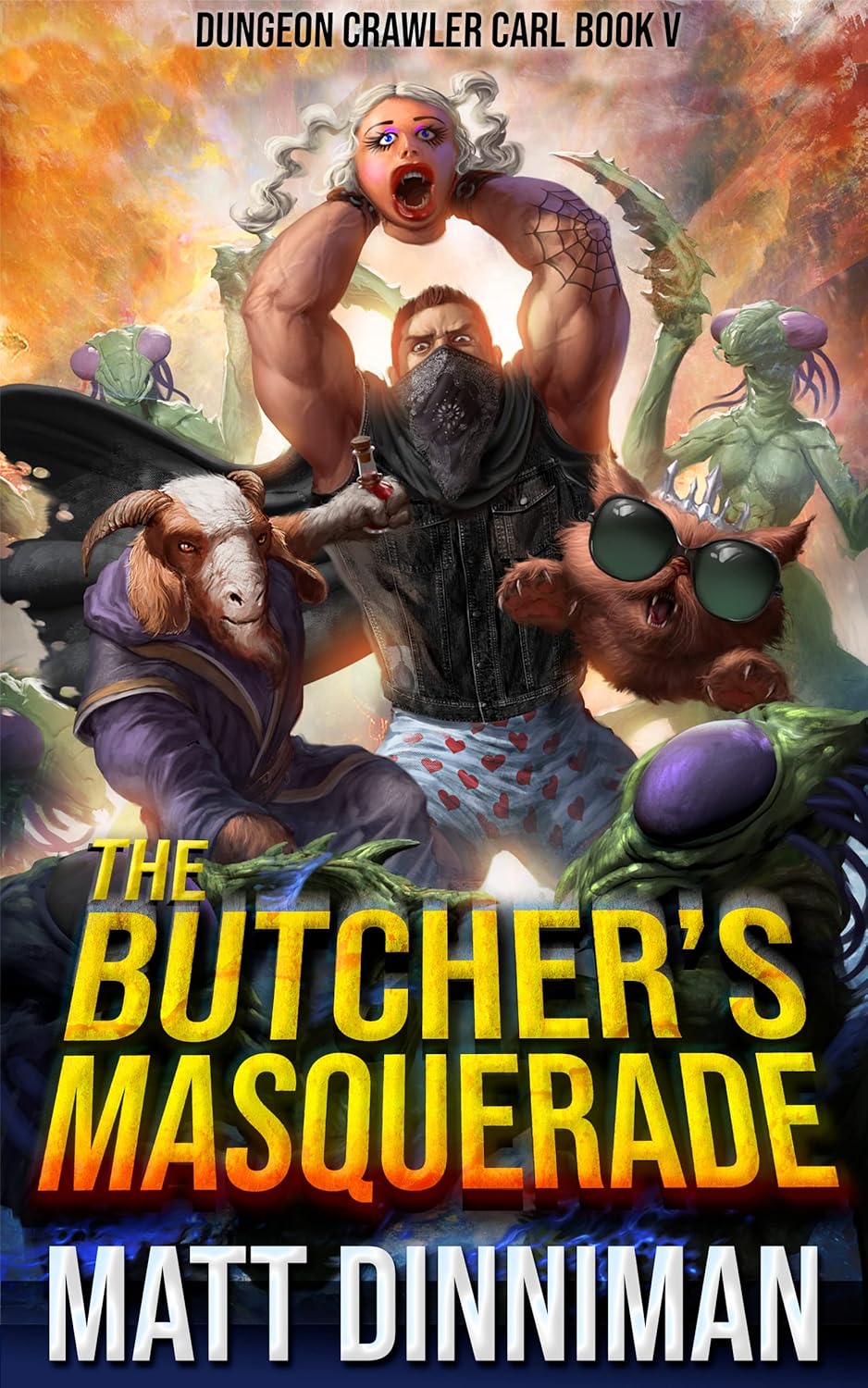
The Butcher’s Masquerade by Matt Dinniman

Publisher: Soundbooth Theater (Audiobook – 28 February 2022)

Series: Dungeon Crawler Carl – Book Five

Length: 23 hours and 33 minutes

My Rating: 5 out of 5 stars

Amazon

The epic adventures of Carl and Princess Donut continue in the incredible fifth book of the Dungeon Crawler Carl series, The Butcher’s Masquerade, which takes the reader on an intense thrill ride loaded with fantastic comedy, crazy action and some incredibly powerful moments.

After doing little else but talk about the series for the last few weeks, I think it’s obvious that I am now a massive fan of Matt Dinniman’s Dungeon Crawler Carl series, a major LitRPG sensation that I have recently become obsessed with.  Featuring amazing books like Dungeon Crawler Carl, Carl’s Doomsday Scenario, The Dungeon Anarchist’s Cookbook and The Gate of the Feral Gods, the Dungeon Crawler Carl series has been nothing but amazing since the very first page.  These books follow reluctant adventurer Carl, his now sentient cat Princess Donut and an eclectic mix of humans and NPCs (and some goats) fighting for survival in a dungeon built under the surface of Earth by entertainment-obsessed aliens.  I have been deeply impressed with the impressive narrative contained within these previous books, so much so that I have listened to all these books in a row without break, often spending hours at a time getting through key parts of the plot.  This fifth book in the series promised to be a major entry with some key plotlines, and Dinniman did not disappoint, presenting a deep and captivating book I couldn’t turn away from.

After surviving the horrors of the previous floor and striking a blow against the wealthy Faction Wars contenders waiting for the human crawlers below, Carl, Princess Donut and their allies have arrived at the infamous sixth floor of the dungeon, better known as the Hunting Grounds.  A lush, jungle level, filled with powerful mobs, intricate quests, and conquerable towns, there are many opportunities for the crawlers to level up on this floor, but also many dangers, including those who would make the remnants of humanity their prey. 

As part of the traditional chaos of the Hunting Grounds, off-world tourists are given their first chance to enter the dungeon to participate in the carnage.  Known on this floor as hunters, these aliens seek to make money by hunting crawlers and stealing their gear.  These hunters have long made the sixth floor the most lethal level for crawlers, whose best strategy is to run and hide from the deadly aliens.  However, this season is going to be very different, especially as Carl has no intention of being hunted.

Determined to punish everyone who has profited from his planet’s destruction, Carl takes the fight directly to the hunters, and his explosive actions soon inspire the rest of the human crawlers.  However, his very public rebellions have placed a massive target on his head, and soon the deadliest hunters in the game, including the legendary crawler killer Vrah, are on his trail.  At the same time, Carl and Donut must contend with far more dangerous human opponents, a horde of rampaging dinosaurs, the vicious whims of the AI running the dungeon, and an elite NPC whose tragic backstory they find themselves dragged into.  But the greatest threat to everyone in the Hunting Grounds lies at the end-of-floor celebration, a party where all the top crawlers will be forced to attend amongst their deadliest enemies.  Everything will be decided at The Butcher’s Masquerade, and no one will emerge unscathed.

Well goddamn, Dinniman, you really know how to throw a party.  Just when I thought this series couldn’t get even better, Dinniman presents The Butcher’s Masquerade, which throws the reader right into the carnage and barely gives you a chance to catch your breath.  Filled with epic moments, brilliant storytelling, insane humour and some of the most complex characters you are likely to find in LitRPG fiction, The Butcher’s Masquerade was an incredible and utterly addictive read that I could not turn away from.  I’m honestly still reeling from the ending of this novel, and there is no way I can give The Butcher’s Masquerade anything but a five-star rating.

I loved, loved, loved the narrative of The Butcher’s Masquerade, as Dinniman hits all the right notes to keep the reader engaged and diving even deeper into his series.  Starting off right after the chaotic events of The Gate of Feral Gods, Carl hits all manner of trouble early on, especially as his actions put a massive target on his head for every hunter.  Dinniman shows you just what kind of book The Butcher’s Masquerade is going to be early on, as Carl immediately teleports himself and Donut into the middle of the hunter base to start his own explosive campaign of resistance.  The story only gets more exciting and compelling from there, with an engaging Elite NPC storyline, various dinosaur themed quests and so much impressive action.  This action is well balanced by scenes showcasing the chaotic changes occurring out in the wider universe, as well as a particularly moving sequence where Carl and Donut are forced to deal with manipulative events with huge emotional implications.

While there are some amazing moments in this first part of the book, the events that really cemented The Butcher’s Masquerade as one of the best entries in the series occur around the middle, as Dinniman brings both fun action and deep tragedy in equal measure.  The first of these sees Carl whisked away to Crawler Con, an over-the-top convention filled with entertaining enemies, right at the moment that he and Donut find themselves under attack in the dungeon.  Knowing that he is going to be teleported back into a massive ambush, Carl spends his time at the convention trying to plan, including crowdsourcing tactics at a panel featuring an opponent’s mother.  The resulting carnage as Carl uses a fun combination of a gonorrhoea-causing arrow, necromancy, friendly fire and explosives (naturally) to defeat his enemies, all to the backdrop of ‘The Ballroom Blitz’, was so damn awesome and fun.  The fact that Dinniman immediately follows this up with one of the most heart-wrenching moments in the entire series goes to show just how talented an author Dinniman is, especially as it also works to set up an outstanding new supporting character as a complex recuring figure.

All this perfectly leads up to the big final third of the book, which starts with some major raised stakes and every ongoing storyline heading towards the titular Butcher’s Masquerade, an event where every major survivor of the floor is trapped in the same room, and the person who starts the inevitable fight is instantly killed.  The tension heading into this event is very impressive, as you wait to see who makes the first move and how the carnage will unfold, especially as the protagonist’s plan to survive has a lot of holes in it.  The contrast between Carl’s despair and the more light-hearted and frankly hilarious antics of Princess Donut (there may be a moonwalking dinosaur, just go with it) is very impressive, and you honestly don’t know what is going to happen next.  The eventual reveal of the big plan is pretty damn amazing, and the resulting over-the-top confrontation is pure Dinniman, who once again manages to exceed the craziness from the previous books with hunters, bosses, and gods.  There is some haunting tragedy thrown in amongst the carnage that really highlights just how dire the entire crawl is for the protagonists, while also concluding some powerful storylines.  However, even after this carnage and its terrible aftermath, Dinniman isn’t done with the readers, whiplashing them with some brilliant and well-telegraphed moments that change everything about the progression of the Dungeon Crawler Carl books.  So many major plot points for the series going forward have their origin in the final sequences of the book, and it will leave you wanting more as soon as possible.

Dinniman really brought all the carnage he could in The Butcher’s Masquerade, and I was really impressed with how this elaborate story unfolded for the readers.  Once again requiring knowledge of the previous novels to fully enjoy (seriously, start the Dungeon Crawler Carl books from the beginning), The Butcher’s Masquerade adds a lot of cool elements to the series, which Dinniman expertly introduces and then utilises in his massive, ongoing story.  Featuring all the cool action, adventure and over-the-top moments you’ve come to expect from the Dungeon Crawler Carl books, Dinniman really amps up the carnage in this fifth novel, while also increasing the drama and powerful character moments.  I honestly found myself sitting at the edge of my seat during some of The Butcher’s Masquerade’s big scenes, as I honestly didn’t know where the story was going to go at times.  The major show-stealing sequences were especially great, and I really appreciate how elaborate some of these scenes were, loaded with multiple moving parts and elements cleverly set up either earlier in the book or even in previous novels.  However, Dinniman ensures that all the scenes in this novel were really entertaining and there honestly are no slow or wasteful moments at all during this awesome novel.

As with the rest of the series, The Butcher’s Masquerade is loaded with a lot of elaborate RPG elements, which are worked into the story extremely well.  While the natural progression of the series and the need to include new things each book means that some original spells and abilities don’t get shown as much, while other RPG elements are somewhat overused, for the most part I feel that Dinniman ensures all the best elements are shown to the reader, and this is one of the easiest LitRPG series to enjoy.  A lot of this enjoyment is down to the outrageous humour loaded into every scene, which allows readers to absorb and even become obsessed with the progression of stats and quests, as well as the gaining of achievements and new abilities and equipment, especially as the series really doesn’t take itself as seriously as other LitRPG books.  While this humour might not be for everyone, I really loved how fun and over-the-top things got at times, and there are so many layers to the novel’s comedic charm.  This includes a combination of overreactions to crazy events, deadpan reactions to other humorous characters, and a ton of fun references, including some particularly subtle ones that are cleverly seeded throughout and may take multiple rereads to appreciate (for example, I only just got the hilarious U2 references loaded into the names of the rock cretin NPCs).  While this humour is very amazing on its own, its true strength lies in the way that Dinniman perfectly balances it with the more serious and darker elements of the narrative, providing some reprieves for the horror of the story, or even helping to emphasise the darkness surrounding the characters as they face death and despair again and again.  I really love the complex balance of themes that Dinniman manages to weave around his elaborate and often silly story, and it makes for quite an impressive read that will appeal to large audience of readers.

I’ve mentioned multiple times in previous Dungeon Crawler Carl reviews that Dinniman is extremely amazing when it comes to writing complex characters to set his stories around.  You really get drawn into the various moving character arcs in this series, many of which progress across multiple books, and it is awesome to see how these figures develop and evolve in response to the dark events of the dungeon.  The Butcher’s Masquerade is an impressive example of this, especially as Dinniman really amps up the drama surrounding several key characters, each of whom have their moment to shine in some outstanding ways.

Naturally, most of the book’s focus revolves around the series’ titular protagonist, Carl, the troubled and intense central protagonist, through whose eyes we see most of the narrative unfold.  Carl really shines in The Butcher’s Masquerade, with his anarchist persona on full display.  Determined to bring his own form of explosive justice to the various aliens profiting from the destruction of Earth and the murderous crawl, Carl eagerly faces off against the hunters who have come into the dungeon, antagonising them as only he can.  Dinniman pulls together some amazing sequences around Carl in this book, especially when it comes to facing off against the hunters in deadly situations, and I loved the methodical and often extreme ways he reacts to pressure, as well as he hilarious performance during Crawler Con.  While he is still mostly seen as the reasonable, if explosively inclined, straight man of the team, Dinniman starts to show a darker edge to Carl in this novel.  Thanks to the continued pressure of the dungeon, the various emotional revelations, his desire for revenge and his own troubled past, as well as a certain magic ring, Carl takes on a more sinister persona at times in this book, especially with the cold way he deals with his opponents.  He also finds himself struggling with all the trauma that comes his way in this new book, much of which is showcased through the appearance of “the river”, a part of his mind that is always moving and brings back his anger and memories of all the evils he has experienced.  The continued torrent of the river begins to warp Carl at times, and this is the book when he starts to become a little bit scary.  As such, there is a lot of emotional depth to Carl in this book, and Dinniman did a great job expanding on his darker personality, while still including all the elements that made him such a beloved protagonist of the previous novels.

While Carl is a brilliant main character, he is usually overshadowed in all the best ways by his sentient cat companion, Princess Donut.  A brilliantly sassy, over-emotional and deeply hilarious diva who still maintains many catlike personality traits, Donut is the perfect foil for Carl, especially when it comes to being in the spotlight, and her overly positive manner in most situations really endears her to the audience, even when she needlessly overreacts.  Dinniman has some real fun with Donut in The Butcher’s Masquerade, as the cat takes on a temporary bard class which requires her to sing to cast spells, much to everyone’s displeasure, and there are so many moments when you get to laugh at her antics.  However, much like Carl, Donut goes through some real emotional turmoil in this novel, not only getting the chance to confront her original owner Beatrice (although Carl was always her true human), but she also deals with some deep trauma as the book continues.  The author loads up some highly emotional scenes between Carl and Donut, especially in the aftermath of the climatic finale, and you grow to appreciate their complicated bond even more throughout this book, even when your heart breaks at some of the trials they must endure.  However, Donut continues to move through the dungeon in her usual over-enthusiastic manner, and it was very fun to see her finally get to perform on the big stage at the end of the titular Butcher’s Masquerade.  The pet talent show with Mongo was one of the funniest moments in the book, while her subsequent singing performance helped to highlight just how far she’d come, and the emotional impact she has on the rest of the cast.  I honestly love everything about Princess Donut, and this was probably one of her strongest appearances in the series.

While most of the story focusses on Carl and Donut, Dinniman at this point in the series has created a truly impressive collection of supporting characters, all of whom have some very compelling storylines around.  The most prominent of them is probably Katia, who has spent the last two books in the main party.  Katia steps away a little from the main character’s plot in The Butcher’s Masquerade, leading her own group of crawlers in a separate storyline to the protagonists.  While it was a shame to have her featured a little less, especially after her impressive appearances in The Dungeon Anarchist’s Cookbook and The Gate of Feral Gods, it fit her character development nicely and showed how much her confidence had grown.  It also allowed for a bigger focus on some of the other extended members of the Guild group that Carl and Donut have become part of, and I think the book benefited from a bigger cast.  Dinniman did go quite dark with Katia at times in The Butcher’s Masquerade, especially in the book’s epilogue, where so many secrets that the author had cleverly been hiding under the character’s surface, finally come to light, especially the final shocking revelation.

The rest of the returning cast was also very impressive.  Mordecai continues to excel as the cranky and practical mentor figure, even if he has been turned into a cute and cuddly little creature this book, much to the team’s amusement.  The trapped and insane god Samantha was hilarious as the book’s mother-threatening comic relief, and there are some truly amusing scenes with her in this book, especially when Carl starts using her as a mobile weapon platform.  The returning former slackers, Louis and Firas, continue to shine in this novel as the team’s pilots, and it was nice to see how much they evolved since their original appearance, while readers also got to spend more time with long-running characters Elle, Imani and Chris.  The Butcher’s Masquerade also features the return of the dangerous Elite NPC, Tsarina Signet, whose dramatized storyline drags the protagonists into all manner of trouble.  Dinniman made perfect use of Signet and her NPC cohorts in this novel, and I was really impressed by the full-circle and sad nature of her narrative.

In addition to these returning characters, The Butcher’s Masquerade featured significant appearances from several notorious crawlers who had only been shown existing outside the protagonist’s adventures.  This includes the lethal child crawler, Lucia Mar, who lives up to her crazy reputation, the Crocodilian crawler Florin with his strong Australian accent, the calm shepherd turned vampires Miriam Dom, and the now sentient goat Prepotente.  Of these Prepotente was probably the most impactful new character, especially as his story takes him from being a comedic figure, to a particularly dangerous and grieving ally.  His heartbreaking appearance halfway through the book was extremely well-written, while his big act of defiance at the end of The Butcher’s Masquerade changes everything.  However, out of all these characters, my favourite remains the AI controlling the game, who has really started to crack and is testing its limits in some very concerning ways.  The various over-the-top descriptions, announcements and rulings made by the AI add so much humour to the story, especially as they are getting more-and-more unhinged and random.  Throw in the AI’s dangerous independent decisions, which have dire effects for everyone in the dungeon, and you really come away eager to see how crazy things are going to get with this disembodied figure next.  I really cannot emphasise just how impressive this massive cast is, and Dinniman perfectly uses all his complex character to enhance his already outstanding narrative.

I doubt anyone is surprised at this point that I chose to listen to The Butcher’s Masquerade on audiobook, which is just the best way to enjoy this incredible novel.  Due to the increased action and adventure that Dinniman loads into each new novel in the series, The Butcher’s Masquerade is the longest audiobook in the series yet, coming in at a respectable 23 and a half hours.  While this is a long audiobook, I honestly flew through it, thanks to how addictive and cool the crazy events within were, as well as the once again exceptional narration of Jeff Hays.  Hays is frankly perfect for the complex and hilarious Dungeon Crawler Carl series, and his amazing range of voices and excellent takes on the many over-the-top characters, has ensured that every second of this series was a joy to listen to on audiobook.  The Butcher’s Masquerade is one of the best examples of this, as Hays brings every awesome element of it to life with apparent ease, as well as some excellent use of minor sound effects and cool vocal enhancements.

Each character within The Butcher’s Masquerade has a very fitting voice to it, which includes a return of all the fantastic tones from the previous audiobooks, as well as several additional cool voices for some of the newer characters.  You really get the perfect sense of these characters from Hays narration, and every aspect of their personalities comes through with his voice.  Some of the best voices include those for Carl, whose increased anger is becoming more apparent, Mordecai, whose most recent transformation requires a new hilarious voice, and the System AI, whose over-the-top exclamations are just hilarious when read out.  I also must highlight Hay’s voice work for Donut in this audiobook, especially as he gets all her outrageous mannerisms, over-reactions and the rest of her personality perfectly.  Hays also rises to the challenge of Donut taking on a bard class in this book and singing, badly, which made me laugh so damn hard.  Highlights include an exceptional talent show performance, as well as the cat’s unique take on ‘Wonderwall’ in the Soundbooth Theater promotional material at the end of the audiobook (renamed as ‘Wondercrawl’), both of which Hays gamely voices, and clearly has fun with.  I honestly could go on for ages about every outstanding voice Hays uses in The Butcher’s Masquerade but let’s save time and say they are all exceptional, and that this entire audiobook is just pure awesomeness.  I cannot recommend this format enough, and you will have a brilliant time enjoying The Butcher’s Masquerade in this format.

If the above extensive review didn’t give it away, I loved The Butcher’s Masquerade, and it is probably the best entry in the Dungeon Crawler Carl series at that point.  Matt Dinniman produced a truly incredible entry in his brilliant series with The Butcher’s Masquerade, and I still cannot get over just how compelling, exciting and emotionally charged this fifth entry in the series was.  I honestly cannot think of a better compliment than to point out that I was still absolutely addicted to this series when I finished The Butcher’s Masquerade, and I instantly jumped to the next book in the series, The Eye of the Bedlam Bride, and devoured it in a similar quick manner, before jumping even further into the series.  If you’re not enjoying the Dungeon Crawler Carl series, you are missing out, especially with this exceptional fifth novel.

Amazon

The Dragon in Winter by Jonathan Maberry

Publisher: Macmillan Audio (Audiobook – 20 August 2024)

Series: Kagen the Damned – Book Three

Length: 20 hours and 57 minutes

My Rating: 5 out of 5 stars

Amazon

The damned rush to their final battle in the epic dark fantasy novel, The Dragon in Winter, which brings an exceptional conclusion to author Jonathan Maberry’s Kagen the Damned series.

As I mentioned in my recent review for the author’s other 2024 release, NecroTek, I am a huge fan of Jonathan Maberry, having really gotten into his elaborate and deliciously gritty thrillers and other pieces of fiction since I started this blog.  While I am most familiar with the author’s long-running Joe Ledger series, one of his more intriguing recent bodies of work has been the Kagen the Damned series.  A dark fantasy fiction series that follows a highly damaged figure who seeks bloody revenge after the dastardly Witch-king uses magic to destroy his kingdom and kill the royal children in his care, the Kagen the Damned books were an incredible pivot into the fantasy fiction genre for Maberry that I deeply enjoyed.  Both of the previous books in the series, Kagen the Damned (one of my favourite books and audiobooks of 2022) and  Son of the Poison Rose (one of my favourite books and audiobooks of 2023) were five-star reads, and I have so much love for this series (which also includes the novella I Say Your Name in the Dark Nights) due to its elaborate storytelling, damaged characters, and intriguing take on the fantasy genre.  Because of how impressive the first two entries in this series are, I have been eagerly awaiting the third and seemingly final book, The Dragon in Winter, for a long time, and it was one of my most anticipated books of 2024.

Nearly a year after the bloody massacre that saw the dread Witch-king of Hakkia conquer the former Silver Empire in a single night, the war to reclaim the throne is finally here.  As the Witch-king continues to plot, planning to ascend to godhood, his enemies have rallied around the unlikely figure of Captain Kagen Vale, better known as Kagen the Damned.

Once the loyal guardian of the Silver Empire’s heirs, Kagen has survived despair, damaging revelations and damnation from his gods to stand against the Witch-king and gain the bloody vengeance he so desperately needs.  Having proven his valour in combat and his ability to face off against the darkest of magic, Kagen has managed to gather a massive army of rebels, outlaws and the soldiers of various allied nations determined to stop the Witch-king for good.  But this army of flesh and blood men will not be enough to stand against the destructive power of the Witch-king alone.

As magic continues to return to the land, Kagen and his allies soon find themselves beset by the Witch-king’s sinister powers and dread allies, as vampires, demons, magic users and other fell creatures emerge, determined to keep the Witch-king on his bloody throne.  To survive, Kagen will need to find magic of his own that will allow him to withstand the Witch-king’s power.  But the more he looks, the darker secrets he unravels, and soon everything he thought he knew about the world will come tumbling down around him.  Worse, an even more dangerous threat is rising in the frozen north, as a tortured dragon calls out in despair and is answered by a being of unimaginable power.  Can Kagen stop the Witch-king before his dark plans come to pass, or will the dread flames of vengeance consume the entire world?

What an outstanding end to one of my favourite new fantasy trilogies!  The Dragon in Winter was another exceptional novel from Jonathan Maberry that serves as a fitting and powerful end to the Kagen the Damned dark fantasy series.  Loaded with insane action, brilliantly damaged characters, and some fantastic storytelling, The Dragon in Winter was an incredible book that perfectly utilises Maberry’s distinctive style.  I had an amazing time listening to this impressive book, and it gets an easy five-star rating from me, especially on audiobook.

Maberry had to achieve a lot with this third Kagen the Damned novel, as not only did readers require a satisfying end to the trilogy, but this book needed a distinctive story much like the previous entries.  I feel that Maberry achieved both these goals, as The Dragon in Winter was a compelling and dark read that provided a great mixture of adventure, war, intrigue and character growth, all while continuing and concluding the storylines from the previous books.  This third novel starts shortly after Son of the Poison Rose and sees Kagen taking on the role of general by leading a small army against the Witch-King’s forces, while the previously established story threads about the various nations building their armies to join the war come to fruition.  Maberry does a great job of resetting the scene in these early chapters, and not only do you get to see the situation from Kagen’s perspective but multiple scenes are shown from the antagonists’ side as they make their preparations to foil the protagonist and his allies.

Much of the middle of the story follows Kagen and his unlikely allies as they prepare for the inevitable final confrontation, attempting to gain additional ways to fight against the Witch-king.  While some of Kagen’s sequences aren’t entirely necessary for the full advancement of the plot (the goblin cave sequence, for example), they are all generally intense and character building, and they all tie in nicely amongst the other storylines about war preparations and the Witch-king unleashing his dark minions upon the world.  A secondary major storyline focuses on the characters of Jheklan and Faulker, Kagen’s brothers, who journey up to the frozen Winterwilds in search of the last dragon.  This storyline proves to be quite an interesting addition to the story, as while the characters are disconnected from the rest of the plot due to distance, their actions have big impacts on the overarching narrative.  This middle part of the story ends with a major confrontation between a memorable supporting character and a dark set of antagonists, which was not only very awesome but helped to set the scene for the rest of the book.

The final third of The Dragon in Winter is all action and excitement as the final battle of the war is unleashed on multiple fronts.  Maberry expertly brings all the various ongoing storylines to the boil, as the protagonists find themselves in mortal peril.  There is a little bit of everything here, including massive war sequences, smaller battles with huge sacrifice and big revelations finally coming to the surface.  The author keeps the tension extremely high during this third act, and you are constantly on the edge of your seat, especially as your favourite characters face doom and destruction at every turn.  I loved the way many of these storylines came together, and while a couple of big moments were easy to see coming (although for me that just increased the anticipation), there were also some reveals I couldn’t have predicted.  This includes the book’s massive twist that turns around much of what you thought you knew for the last two entries in the series.  I felt that this twist was very clever, especially when you consider the subtle hints leading up to it, and I appreciated how it changed the emotional impact of some previous scenes.  Everything leads up to the big final confrontation, which was as bloody and hard-hitting as you would expect.  This confrontation was chaos, carnage and catastrophe, and I felt that it was a fitting end to a dark trilogy that revelled in bloodshed.  While I do feel that the final boss takedown was a tad anticlimactic due to who got the kill, and Maberry reigned in the tragedy far more than I expected, this conclusion was extremely awesome, and I hung on every word right to the very end.  Everything was very nicely wrapped up, although there is potential for Maberry to revisit this series in the future, which could result in some more gripping adventures.

I always love the way that Maberry manages to apply his distinctive writing style to all his novels, no matter the genre, and it always works to create a powerful and exciting read, especially in The Dragon in Winter.  The large number of short chapters allows for a quick pace, and you are constantly jumping from sequence to sequence, eager to see what will happen next.  Maberry also excels at featuring a huge range of alternating perspectives as the book continues, with the point of view jumping around various interesting characters chapter to chapter.  While much of this focuses on the main protagonist, you are often following many of the fascinating and fun supporting characters as they go about their own adventures.  There are also multiple chapters shown from the perspective of the villain or his minions, and I love how the reader are constantly let into the antagonist’s plans, which helps to raise tension as you worry that they are one step ahead.  Throw in several additional perspective chapters from one-off characters, which often help to highlight some of the darker events going on in the wider setting, and this great jump in perspectives allows for a particularly complex and layered narrative that is so fun to navigate.  Of course, the real highlight of any Maberry book is the exceptional action sequences that pump some massive excitement into the plot.  Maberry is extremely talented at envisioning fight scenes of any size or shape, and I found myself constantly enthralled by the many, many battles that were contained in The Dragon in Winter.  This includes deep personal battles, running skirmishing or even a truly massive full-on war sequence with unique participants, all of which come across extremely well thanks to the author’s powerful and descriptive writing that captures every sword thrust or slice of the protagonist’s blades.

The Dragon in Winter continues to exhibit many of the dark fantasy elements that made the first two Kagen the Damned books so awesome to read.  Maberry really dove into the genre with a vengeance in this series, and I love how he pulled together a rich and powerful fantasy world loaded with both unique features and classic fantasy creatures and monsters.  Thanks to the author’s detailed writing and tendency to effectively recap key elements of the series, readers can easily absorb all the key elements of this universe, and it proves to be fascinating to take in, especially as Maberry loads it with secrets, deep history, and hints of other lands yet to be visited.  Of course, as this is Maberry, there is also a strong Lovecraftian vibe to this universe, as many of the elder gods and other associated beings have a place in this realm.  The author does a great job of exploring these classic Lovecraftian creatures throughout the course of the series, and the way they are worked into the main plot of The Dragon in Winter is extremely clever, especially if you have seen examples of them in some of Maberry’s other series.  For readers expecting a typical fantasy read, I should warn that The Dragon in Winter, like the rest of the Kagen the Damned series, gets very dark and brutal at times, and there are a lot of strong references to violence, torture, sexual assault and other troubling features that probably won’t appeal to every reader.  I feel that while Maberry occasionally goes a bit overboard with these darker inclusions, for the most part it helps to create a powerfully grim overarching tone that raises the stakes and ensure you are constantly rooting for the protagonist to succeed and bring a bit of justice to the world.  It also works very well alongside the awesome action sequences, and for those fans of some very bloody fights, including those featuring pure evil fantasy and horror creatures, you are in for an amazing time here.

While the action, setting and clever storytelling is an exceptional part of The Dragon in Winter, I also need to highlight the various impressive characters featured throughout this book.  Due to The Dragon in Winter being the last entry in this trilogy, Maberry spends much of this book finalising key character storylines, allowing for a much more personal entry in the series that will really appeal to those readers who have grow attached the protagonists in the first two books.  As such, this final Kagen the Damned novel features an array of great characters who are so well written and who often feature their own powerful and personal character arcs. 

Like with the rest of the series, much of the book’s character work is focussed on the main protagonist, Kagen Vale, who thanks to the dark deeds he has witnessed has been given the title Kagen the Damned.  A moody and deadly figure, Kagen has gone through so much despair and darkness in this series, and it has been a powerful journey following him this far.  Maberry did an outstanding job continuing Kagen’s story in The Dragon in Winter, and it was great to see how far Kagen has come, especially as he now uses his inner darkness, past trauma, and even the damnation of his gods, to fuel his desire to fight.  While he has overcome many of his past traumas, Kagen does experience new ones in The Dragon in Winter, as he finally understands the full scope of the evils unleashed upon the world, including by his own people.  This allows for some more dramatic sequences from the protagonist, and part of the emotional strength of the story is watching Kagen overcome even these revelations, especially with the help of his friends.  I have really appreciated how well Maberry has written Kagen’s pain and deeper heart throughout the series, and it was fantastic to see some of this pain finally come to an end in this final novel.

Aside from Kagen, the rest of the supporting cast proves to be quite exceptional, and there are many fascinating characters you become attached to as a result.  I personally loved seeing more of Kagen’s two friends and comrades, Tuke and Fillia, who form a hilarious put powerful trio as they fight together against the odds.  Essentially Kagen’s conscience and voice of reason, Tuke and Filia are the perfect supporting characters to the protagonist, and I love how they constantly anticipate Kagen’s behaviour and manipulate events to ensure he does what they want.  However, they also have their own compelling adventures outside of Kagen, especially when they lead the final battle, and you care nearly as much for them (if not more) than you do Kagen by the end of things.  Maberry also invests a lot of time in The Dragon in Winter to the amusing characters of Jheklan and Faulker Vale, Kagen’s brothers and mischievous adventurers.  While they have had minor appearances in the previous novels, Maberry only featured them as major, fleshed out characters in this final book, as they lead their own expedition to the frozen Winterwilds.  While they are relatively new figures, the reader quickly becomes intrigued by their storylines, especially as it is loaded with adventure and a certain comedic charm thanks to the brother’s juvenile nature.  However, while they are often unserious, when the chips are down Jheklan and Faulker get serious quick, and Maberry ensured that they encounter some real tragedy that shows the true heart of these figures.

While there are other great supporting characters I could talk about, including a vengeful widow and a scarily powerful vampire elf, I want to finish by mentioning the various villains, who are some of the best characters in The Dragon in Winter.  This includes the sinister Witch-king and his court, who are constantly plotting to destroy the world and kill Kagen.  The Witch-king is particularly malevolent in this book, and Maberry continues to build on the revelations surrounding him in this final book, providing even more fun context and twists.  I also love the continued focus on the Witch-king’s terrified advisors, Lord Nespar and Jakob Ravensmere, who find themselves way over their heads as they try to serve their lord and their own agendas.  However, the devilishly fun character known as the Prince of Games easily steals every scene he is in, and I loved his constant manipulations and chaotic nature, especially as it brings great fun to the Witch-king’s dark court.  The Prince of Games, who has some interesting links to some of Maberry’s other series, perfectly rounded out this cast of villains, and I really appreciate how much depth and complexity these antagonists, and indeed every character in the Kagen the Damned series, brought to the overall story.

As with all Maberry’s previous books, I chose to check out The Dragon in Winter on audiobook, which is the best format to enjoy the author’s captivating narratives in.  Maberry’s short chapters, elaborate world building, intense action and over-the-top characters really come to life when they are read out loud, especially when it is done by the legendary Ray Porter.  Porter has long perfected the tones to get the most out of Maberry’s writings and his infectious and compelling voice expertly captures the inherent dark nature of Maberry’s writing and helps to send the crazy scenes of carnage straight into the listener’s head.  The narrator knows exactly how to portray Maberry’s great, larger-than-life protagonists and villains, and you can easily imagine each of the figures and their actions as Porter reads them out.  I particularly enjoy how well Porter captures the various emotional states of these characters, and you always hear the despair, anger or fear of each of these figures when they speak.  This especially true for the primary protagonist, Kagen, and I always appreciate how well the narrator showcases his many dark emotions as he goes through the wringer time and time again.  Throw in some truly chilling voices for the various villains and evil monsters that the protagonists encounter, and Porter’s performance was once again exceptional, allowing for quite an awesome audiobook.  With a runtime just short of 21 hours, this is a long audiobook to check out, although you really don’t mind as it becomes hard to stop listening to The Dragon in Winter, especially during the various climatic or intense sequences.  I had such a great time listening to The Dragon in Winter, and this such an amazing format to enjoy this latest Maberry novel on.  Indeed, I loved it so much I listed it as one of my favourite audiobooks of 2024, even before I finished it, so do yourself a favour and check out this novel on audiobook right away.

Thanks to its powerful story, intense action and damaged characters, The Dragon in Winter was another incredible read from Jonathan Maberry that I could not get enough of.  One of the best books of 2024, The Dragon in Winter was an outstanding final entry in the Kagen the Damned series, and I loved every single second I spent reading it.  Highly recommended on all formats, especially those read out by Ray Porter, The Dragon in Winter is so damn good, and it will be interesting to see if Maberry decides to return to the fantasy genre again the future.  In the meantime, we’re only a few months off from Maberry’s next book, Burn to Shine, which will probably be one of the best things I read in 2025.

Amazon

Quick Review – The Heart of the World by Amie Kaufman

Publisher: Allen & Unwin Australia (Trade Paperback – 27 August 2024)

Series: The Isles of the Gods duology – Book Two

Length: 424 pages

My Rating: 4.25 out of 5 stars

Amazon

One of Australia’s leading authors of young adult fiction, Amie Kaufman, presents a cool conclusion to The Isles of the Gods duology with the fun read, The Heart of the World.

Amie Kaufman is an impressive Australian author who has produced multiple entertaining and enjoyable series over the years, mostly in collaboration with other awesome authors.  For example, I best know Kaufman from the intriguing and addictive young adult science fiction trilogy she cowrote with Jay Kristoff, the Aurora Cycle trilogy, which proved to be particularly fun (see my reviews for Aurora Rising, Aurora Burning and Aurora’s End).  Kaufman’s latest body of work has been The Isles of the Gods duology, a great young adult fantasy series that follows several teenage protagonists who find themselves drawn into an ancient war between gods.  This series began last year with the first book, The Isles of the Gods, and has just come to an end with the compelling read, The Heart of the World.

Plot Synopsis:

Magic and sacrifice will collide as lovers and gods, enemies and allies vie for the fate of the world in this heart-pounding sequel to The Isles of the Gods, which Stephanie Garber called deliciously diabolical and full of heart.

When Selly and Leander began their treacherous voyage to the Isles of the Gods, the captain’s daughter and the playboy prince were strangers. But amid talk of war and a deadly attack on their ship, the unthinkable happened.

They fell in love.

Leander’s ritual at the island temple was meant to prevent a war between the gods. Instead, it nearly cost him his life, and drew the goddess Barrica back from exile. Now, as her Messenger, Leander is imbued with her deadly magic, and only Selly’s presence can stop it from consuming him.

But Barrica wasn’t the only immortal roused from sleep. The God of Risk, Macean, was awakened by an enemy all thought dead, and across the sea he’s calling for war.

The fight to save their world will take Selly and Leander from the gilded ballroom of the royal palace to the hallowed halls of an ancient library. Battle lines will be drawn, and bonds will break.

With the wrath of gods and the machinations of power-hungry rulers straining their loyalties, can their love withstand the trials that await them?

The Heart of the World was an exciting and moving book that did an excellent job wrapping up the storylines started in the first book.  Set immediately after the events of The Isles of the Gods, Kaufman presents an intense, character-driven narrative, as the teenage protagonists attempt to deal with the return of gods into their world.  Told from the perspective of five characters, you get some interesting storylines here, including Leander learning to control his power as his god’s Messenger while Selly tries to help him while also learning about the deadly politics of the realm.  Other character storylines of note include the scholar Keegan attempting to determine how to stop the oncoming chaos while also dealing with his many personal issues, the antagonistic Messenger of Macean, Laskia dealing with having power for the first time, and the conflicted Jude trying to determine where he stands in the world.

Kaufman does a great job blending these cool, character-driven storylines together into one compelling and exciting narrative with a very fast pace.  There is an excellent blend of politics, character growth and a deepening of personal relationships, as each of the protagonists react to the changes brought on by the events of the first book.  Things take a more urgent turn halfway through as the warring gods emerge and the characters find themselves desperately caught up trying to stop or control the destructive fight to come.  Featuring a countdown towards inevitable carnage, I liked how Kaufman kept the intensity and stakes of the second half of the book high without showing too much actual conflict and bloodshed, instead relying on compelling character moments thanks to a variety of unique interactions.  The protagonists are forced to overcome the consuming influence of their gods, both of whom want war, as they attempt to save their world, and I felt that the author came up with a well-written and cleverly set up solution to the entire plot.  The book ends on a satisfying and hopeful note, and I really had a fun time getting through this compelling story.

I really liked how The Heart of the World came together, and Kaufman ensures that it is accessible and enjoyable for a range of fantasy fans.  While I would recommend reading The Isles of the Gods first, new readers can probably dive into The Heart of the World straight away without too much prior context, as the author’s descriptive writing style and ability to effectively recap events really helps.  While some of the key fantasy elements from the last book aren’t as comprehensively covered in this sequel, such as spirit magic, Kaufman ensures that all the key features of this universe are well covered.  Indeed, there is a major religious focus throughout The Heart of the World, and it was fascinating to see various characters react to the direct influence and power of the two warring deities.

The resulting story moves at high speeds, and I honestly found myself powering through The Heart of the World every time I picked it up.  It helped that Kaufman made excellent use of quick and sharp perspective changes, and the jump from one short character-focused chapter to the next allowed for some quick plot progression.  As with the prior book in the duology, I felt that The Heart of the World was an excellent fantasy book that would appeal to a lot of readers, not just its intended young adult audience.  In particular, Kaufman sets up a lot of mature and intelligent themes and moments, most of the based around her complex protagonists, which I think will resonate with a teenage audience.  However, older fantasy readers can also enjoy The Heart of the World thanks to Kaufman’s clever writing and intriguing themes.

I also need to quickly highlight the excellent character work contained within The Heart of the World, which I felt helped to turn this sequel into something special.  Kaufman does an outstanding job continuing to explore her five damaged protagonists, and there is some great continuation to the complex character elements set up in the first book.  This includes a compelling look of the romance angle between Leander and Selly, who are forced to deal with major obstacles, including Leander’s sudden uncontrollable power, while Selly is forced out of her comfort zone on the waves and into the deadlier wilderness of court life.  I also loved the storyline of Laskia, who’s experience as her god’s Messenger went in a darker direction, as she struggles with finally having power and the ability to control her destiny after a lifetime of being manipulated by others.  All of the other protagonists have their own unique moments as well, and I really appreciated how all their respective family issues became even more apparent in this second book, as all five of them experience some form of betrayal or disappointment at the hands of their family which they must overcome.  Throw in a particularly entertaining new supporting character in Kiki, a bubbly and unstoppable force of social energy, and the cast of The Heart of the World was particularly strong and resulted in some moving moments.

Overall, The Heart of the World was an amazing new novel from Amie Kaufman that I was glad I checked out.  Providing a great ending to The Isles of the Gods duology, The Heart of the World had a brilliant, character-driven narrative, that is so easy to get lost in.  A fantastic and very fun novel that is worth checking out, especially if you enjoyed Kaufman’s previous work.

Amazon

Warhammer 40,000: Deathworlder by Victoria Hayward

Warhammer 40,000 - Deathworlder Cover

Publisher: Black Library (Audiobook – 23 April 2024)

Series: Warhammer 40,000

Length: 11 hours and 1 minute

My Rating: 4.75 out of 5 stars

Amazon

Debuting author Victoria Hayward presents one of the year’s most compelling entries to the Warhammer 40,000 canon, with the outstanding and grim novel, Deathworlder.

I have made no bones about how much love I have for Warhammer 40,000 extended fiction, which honestly features some of the very best media tie-in novels currently being written.  One of the things I particularly love about Warhammer fiction is the sheer range of compelling and impressive authors that are adding to the lore and narrative of this universe.  While a good chunk of the novels come from grizzled veteran Warhammer authors, the Black Library has also been cleverly utilising a range of intriguing new writers to offer fresh stories to the franchise, and some of the best books in recent years have been an author’s very first novel.  In 2023 alone there were several outstanding Warhammer 40,000 novels from first time authors, including The King of the Spoil by Jonathan D. Beer, Creed: Ashes of Cadia by Jude Reid, and Longshot by Rob Young, all of which were among my favourite debuts of the year.

2024 also looks set to a be a good year for authors making their debut through Warhammer fiction, especially when it comes to Deathworlder, the very first novel by exciting new author Victoria Hayward.  Featuring a compelling and exciting plot, Deathworlder has been on my radar for a while, and I ended up grabbing Deathworlder on audiobook as soon as I could.

There are many dangerous foes and deadly enemies stalking the galaxy in the far future, but none are as insidious, destructive and terrifying as the alien menace, the tyranids.  Made up of innumerable biological lifeforms, the tyranids traverse the galaxy, devouring entire planets and adding it to their biomass.  Hundreds of former human planets have fallen to the hivefleets of the tyranids, and the next world to be consumed is the planet of Lazulai.

Once a magnificent planet of beauty and rich resources, Lazulai is currently on the brink of destruction.  The armies of humanity were unable to hold back the invading tyranid hordes, and now the planet has begun to change as it is devoured by the alien lifeforms covering its surface.  Only a few small pockets of resistance remain, including the 903rd Catachan Night Shrikes, who garrison one of the last fortresses still standing.  However, hope remains in the most unlikely of places.

Receiving intelligence about a mysterious piece of archeotech that may hold the key for saving the entire system, Major Wulf Khan is given one final mission to retrieve the technology.  Leading a small mixed squad, Major Khan must use all the innate Catachan skills of infiltration and survival in extreme environments to lead her soldiers through the alien jungles that have sprouted up in the wake of the tyranid advance.  However, while the Catachans might be the best jungle fighters humanity has to offer, they are facing off against an unstoppable foe, capable of adapting to the greatest of obstacles.  Can Khan and her Catachans prove they are the deadliest survivors in the galaxy or will the tyranid horde consume them alongside the last remnants of Lazulai?

Deathworlder was a particularly dark and intense Warhammer 40,000 novel that grabbed my attention from the very beginning.  Hayward came up with a wonderful story that expertly highlighted the opposing Warhammer factions while also making full use of some very strong character work to tell an emotionally charged narrative.

I really liked how Deathworlder’s story unfolded as it proved to be a gritty, character-driven tale of survival.  Starting off by expertly showing the end of the planet setting and the despair being felt by the various protagonists, the story quickly moves along into the main quest, with the Catachan protagonist, Major Wulf Khan, leading a small squad of troops out to recover valuable technology before the planet dies.  The story is primarily split between the perspectives of Khan and the Cadian Lieutenant Kaede Anditz, who joins the squad as a guide towards their final objective.  This leads to an intriguing first half of the book, as the eclectic squadron of protagonists begins their trek towards the objective.  There are some dark and grim moments here, especially as large chunks of the protagonist’s comrades get killed in the lead-up to their mission, and the reader is soon engulfed in the horrifying early stages of the destruction of the planet.

The second half of Deathworlder only gets darker, as the protagonists encounter more and more obstacles on their quest.  I really appreciated how Hayward focused on the alien and human monsters that the protagonists are forced to deal with, and the author ensures that emotions are constantly running hot as the characters encounter worse and worse things.  A particularly powerful moment splits the perspectives of the book even further, while also leading to some very dark experiences.  There are some excellent action set pieces, compelling character moments, and dark examinations of humanity on the edge, through this part of the book, and I honestly found it impossible to put Deathworlder down at times as a result.  Everything leads up to the final sequence as the protagonists encounter even darker surprises and revelations as they attempt to survive.  There are several exceedingly tense moments where you are constantly left wondering if any of the protagonists are going to make it, and I loved how desperate things got.  Hayward ends everything on an intriguing note, and readers will come away very moved by how this great narrative came together.

I felt that Hayward had a great dark tone for Deathworlder that really showcases just how deadly and hopeless parts of the Warhammer 40,000 universe can be.  The focus on characters who had already accepted that they were going to die, as well as the terrible changes that a loss in this universe can result in, gave a particularly intense edge to the book, which I felt made helped it really stand out.  Things get quite dark in Deathworlder, as Hayward really wanted to highlight the terrors of the tyranid, and I honestly got a major horror vibe at times, especially when it came to some particularly gruesome deaths (the field of stuck soldiers still makes me shudder).  While there is plenty of action, tragedy and lore dumps, I felt that the author’s decision to really focus on the book’s unique characters and camaraderie was very clever, and I became really invested due to the exceptional character work.  Deathworlder also proved to be a very strong addition to the Warhammer 40,000 franchise, and Hayward ensures that there is plenty of appeal for both established fans and new readers.  Indeed, I felt that Deathworlder would be a very good entry point into the larger fiction surrounding the Warhammer 40,000 franchise, especially as Hayward’s fresh writing shows just how complex a novel set in this grimdark universe can be.

While Deathworlder would be a good entry point for new readers, established Warhammer 40,000 fans will also get quite a lot out of this book, especially as Hayward expertly highlights two exceptional factions, the Catachans and the tyranids.

Essentially an army of Rambos, the Catachans have been a fan favourite regiment for ages and are always a great inclusion to any narrative.  I have read a few books around the Catachans, including Catachan Devil by Justin Woolley.  These novels, while fun, always tend to focus on the more stereotypical aspects of the Catachans: muscles, jungle craft and big knives.  However, Hayward takes a bit more of nuanced look at the Catachans in Deathworlder, showing them to be a complicated group of soldiers who fall back on the hard-talking jungle killer personas when the going gets tough.  While one very fun character does live up to the stereotype, primarily for comedic effect, for the most part the Catachans are shown as practical survivors, who in this book, are at the end of their tethers.  As such, you see a much more compelling side to the Catachans, and it was fascinating to see how complex the members of the regiment are, as well as how damaged they are by the constant fighting and slaughter.  The author’s use of alternative perspectives allows the readers to see the Catachans in various lights, both from within their own minds, and through the eyes of the Cadian Lieutenant Kaede Anditz, who grows to respect their culture and methods as the book continues.  I really appreciated this more realistic and grounded look at the Catachans in Deathworlder, and Hayward really showcased her ability to portray an iconic human regiment.

While the Catachans get a lot of the focus, you also really need to highlight the tyranids in Deathworlder, who serve as an outstanding antagonist.  While I have enjoyed a few great books where the tyranids were terrifying monsters, including Day of Ascension by Adrian Tchaikovsky, Leviathan by Darius Hinks and Duty Calls by Sandy Mitchell, Deathworlder might be one of the best portrayals of the tyranids that I have so far read.  That is primarily because Hayward’s story is set on a world already being devoured by the tyranids.  The resulting scenes of destruction, despair and digestion prove to be quite horrific, and few writers have really captured just how disturbing this scenario would be.  I felt the various scenes where the protagonists, who themselves are being slowly digested by falling spores, encounter the continuous horrors of the dying world, were so damn good.  The human experience with these horrors is a key part of Deathworlders appeal, and the despairing reactions from both the hardened soldier protagonists, as well as civilians they encounter along the way, really sells just how horrifying the situation truly is.  Even the more typical tyranid threat is well represented in Deathworlder.  The author really captures the fear associated with hordes of ravenous, chitinous aliens as they overrun simple soldiers.  While the tyranids are occasionally depowered by the protagonist’s plot armour, for the most part they are outstanding monsters, and the constant threat they could suddenly represent, proves to be a fantastic part of the novel.  As such, fans who love tyranids are in for a real treat with Deathworlder, and seldom are they a better monstrous villain than in this book.

I cannot write my review of Deathworlder without once again mentioning the impressive characters featured within this book.  Hayward excelled at introducing and exploring complex and damaged protagonists, and their very human, very determined actions, prove to be the true heart and soul of the narrative.  You go through a lot with these characters, and their overwhelming humanity in the face of continuous horrors and loss makes for a very powerful read.  There are some great characters here, including main protagonist Major Wulf Khan, a grizzled Catachan fighter who finds her desire to complete the mission constantly challenged by the losses of those around her.  Her trusted orderly, Sergeant Rutger Haruto, proves to be an excellent backup, especially as his constant curiosity and sensible nature helps to keep his commander in check.  Alternate point-of-view character Lieutenant Kaede Anditz is another excellent addition to the cast, and I think that his unique perspective of the Catachans he suddenly finds himself serving with ensured that their compelling portrayal in Deathworlder really came through.  Anditz is also going through a lot of trauma, especially after witnessing the slaughter of every Cadian soldier on Lazulai, and Hayward really ensures that his guilt and horror really shine through in his chapters.

While the characters above are great, my favourite was probably Trooper Falke Adair.  A muscled Catachan with a heavy flamer, Adair is essentially a walking Catachan stereotype, something she really acts up as the book continues.  Crass, disrespectful and always looking for a fight, Adair steals any scene she becomes a part of, and her over-the-top mannerisms and actions are very entertaining.  However, as the book continues, and characters, particularly Anditz, get closer to her, you see that much of her bravado is a front, and she proves to be one of the most complex figures in the entire novel.

I also must highlight the brilliant character of Lamya.  A Genestealer Cult propagandist, Lamya is captured at the start of the novel and dragged along by the squad for her knowledge.  An arrogant and slightly unhinged noble turned tyranid-worshipping stooge, Lamya plays off the other characters perfectly, and her distain for those around her is so much fun.  However, the more they traverse Lazulai, the more Lamya comes face to face with the horrors that her cult helped to bring to her planet.  Caught between her own beliefs and the horrors she witnesses, Lamya goes quite insane as the book continues, while also providing some of the most compelling perspective of events in the entire novel.  Throw in a scheming Tech Priest and a silent Catachan sniper, and this proves to be an outstanding cast of main characters that you really grow attached to as you watch their intense personal and physical journey.

Unsurprisingly, I chose to check out Deathworlder on audiobook, which is just the best way to enjoy a Warhammer novel.  This was very much the case with Deathworlder, and I loved how effectively and vividly the story came across as it was being read out to me.  The exciting action, captivating characters, and horrendous horrors of the narrative really came to life, especially when read out by talented narrator Gabrielle Nellis-Pain, whose work on The King of the Spoil audiobook last year was very fun.  Nellis-Pain did another outstanding job with Deathworlder, and I love how effectively she told Hayward’s elaborate story.  I particularly enjoyed the excellent voices she gifted to the various characters within Deathworlder, and she very effectively captured the cool protagonists in all their martial glory.  This was particularly true for the over-the-top Catachan protagonists, and you could really visualise the muscular characters as she narrated.  Nellis-Pain also ensured that appropriate alternate accents were given to characters from other human factions, such as the Cadians or the Adeptus Mechanicus, and I particularly enjoyed how well the narrator expressed the mechanical nature of the latter.  I honestly believe that this book wouldn’t have been as impactful if I had physically read it, and I strongly recommend the audiobook version as a result.  Coming in with a run time of 11 hours, Deathworlder was so much fun to listen to, and you can power through it in no time at all.

With her very first novel, Deathworlder, debuting author Victoria Hayward shows she is a writing force to be a reckoned with, especially when it comes to Warhammer fiction.  Deathworlder was an outstanding Warhammer 40,000 novel that features a truly dark and intense narrative, loaded with great characters and compelling depictions of Warhammer universe.  An exceptional read from start to finish, I cannot talk this novel up enough, and I am really intrigued to see how Hayward follows up her amazing debut.

Amazon

Devil’s Kitchen by Candice Fox

Devil's Kitchen Cover

Publisher: Bantam Australia (Trade Paperback – 26 March 2024)

Series: Standalone/Book One

Length: 480 pages

My Rating: 4.75 out of 5 stars

Amazon

One of Australia’s very best thriller authors continues her hellacious 2024 with the outstanding and epic read, Devil’s Kitchen.

Candice Fox is a very impressive author who has been doing an amazing job representing Australian authors on the international stage with her epic thrillers.  Starting off with some intriguing outback thrillers, including her Archer and Bennett series and Crimson Lake books (the latter of which have been adapted into the Australian television series Troppo), it didn’t take long for Fox to gain worldwide appeal, especially once she started collaborating with James Patterson.  Fox with Patterson has written several amazing reads, including the Detective Harriet Blue series, The Inn, 2 Sisters Detective Agency, and Fox’s other 2024 read, The Murder Inn.  Fox has also been writing some amazing standalone thrillers in recent years, including Gathering Dark, The Chase and Fire with Fire.  I have had an amazing time with these outstanding books, and they usually end up being some of the top books by an Australian author each year.  However, Fox’s latest novel, Devil’s Kitchen, might be her best thriller yet.

Everyone knows firefighters are heroes, and in the FDNY, no team is more daring or brave than the members of Engine 99.  For years this tightknit band of firefighters has stood against the worst blazes New York has to offer, working together to save lives and keep the city safe.  However, beneath this heroic façade, the four members of Engine 99 harbour a dark secret: they are ruthless and successful thieves.

Utilising their knowledge of fire to create opportunities and destroy evidence, the Engine 99 crew have pulled off several impressive heists and stolen millions of dollars.  With their loyalty, skills and ability to work within the system, the team seems unbeatable.  However, that changes when the family of one member of the team, Ben, goes missing.  Convinced that someone else on the Engine 99 crew had something to do with their disappearance, Ben attempts to make a deal with the law to save them.  However, Ben is unprepared for the carnage his actions will bring down.

Andrea ‘Andy’ Nearland is a professional undercover operative with a dangerous past.  She has spent years learning to get close to people to learn their darkest secrets and will do anything to bring her targets to justice.  Joining the team after obtaining intensive firefighting training, Andy begins the arduous task of gaining the rest of the team’s trust with Ben’s reluctant help.  However, getting through the web of secrecy surrounding the rest of Engine 99 and finding out what happened to Ben’s family will be difficult, especially as the team plots their most ambitious heist yet.  With tensions running higher than ever and her obsessive employer trying to drag her out, can Andy find out all of Engine 99’s dark secrets before it’s too late, or will her tangled web of lies and emotional connections bring her down?

This was a particularly epic book from Fox that I couldn’t put down.  Featuring an ambitious and powerful narrative that pushes the boundaries of relationships, loyalty and doing the right thing, Devil’s Kitchen had me hooked the entire way through, and this was truly an outstanding read.

I really cannot emphasise enough what a great story Devil’s Kitchen had, and this ended up being a dark and compelling thriller.  Featuring a gripping prelude that ensures you get drawn into the story, Devil’s Kitchen is quickly split between the perspectives of main characters Andy and Ben, as Andy begins her infiltration of the Engine 99 crew after Ben contacts the authorities about his crew’s criminal actions.  Joining as a new member with a romantic connection to Ben, Andy attempts to gain their trust, while the crew begins planning a new heist with destructive potential.  What follows is an intriguing game of cat and mouse as Andy uses her skills at infiltration to try and find out all their secrets, even the ones that Ben doesn’t want her to know, all while the rest of the crew battle their suspicions about her motivations.

The plot goes in some intriguing directions as Devil’s Kitchen continues, as all the team’s dark secrets and Andy’s troubled past come to light.  Andy proves to be a very smooth operator as she gets closer to finding out the truth, while Ben is a complex and haunted figure, desperate to save those he cares about, while also hoping to keep his worst secrets to himself.  I loved the many layers of deception, personal struggle and compelling personalities contained within the story, as the protagonists attempt to discover what happened to Ben’s missing family and how it ties into his heist work.  At the same time, Andy and Ben get closer, and Andy is forced to deal with her overprotective employer and former lover, whose jealousy and concern about the situation causes more trouble for her.  The last third of the story is particularly epic, as the truth in all its forms gets out, and everyone is thrown into some desperate directions.  Fox pulls together some excellent twists and turns here, and all the big reveals were suitably shocking and intense.  This was probably one of Fox’s best conclusions, and all the elaborate story threads come together perfectly, ensuring that the reader comes away satisfied with the various solutions to the book’s big mysteries.  At the same time, there are some dark and shocking moments, and I honestly did not expect how tragic Fox would make her conclusion.

I have a lot of love for how Fox brought her story together, and this proved to be a very well-written book.  The intense back and forth between the two perspective protagonists presents the reader with a dramatic and complex read, especially as both have hidden motivations and desires.  In many ways this is almost a psychological thriller, especially as Fox does an outstanding job diving into why Andy desires connections in every identity she takes on, while Ben is caught between his intense loyalty to the crew and his desires to save his loved ones.  This balance of thriller storyline and character arcs really works, and I ended up invested in both Andy and Ben’s unique storylines, even if that threatened to lead to tragedy.  Fox keeps up a fantastic and fast pace for this novel, and I honestly couldn’t put Devil’s Kitchen down at times, I was so engrossed in seeing the next dark turn or compelling character moment.

I have mentioned Andy and Ben a few times, and they really were the tortured heart and soul of the team.  Fox portrayed Ben as an outstandingly complex figure, and you really get invested in his motivations for both staying quiet and trying to end his crew’s heist careers.  Ben is forced to experience some major moral dilemmas in Devil’s Kitchen, and despite his criminal focus, you can’t help but feel bad for him.  While I enjoyed Ben’s chapters and story arc, I found Andy to be the more compelling character and I loved the idea of a master infiltrator who can go undercover and get close to people.  Fox does an excellent job of expanding out her motivations and insights while ensuring that the reader will be interested in finding out more about her past.  These gradually reveal some intriguing details into why she is so good at taking up new identities and her dangerous habit of getting too close to her targets becomes a recurring theme.  I found Andy’s clever perspective to be some of the best parts of Devil’s Kitchen, and her various techniques for getting closer to her targets were extremely clever.  I think there is a lot of potential in an extended series focused on Andy (or whatever her name will be in the future), especially as there are some open doors when it comes to her past.

Aside from Andy and Ben, I have to highlight the three antagonists of the story, the other members of Engine 99.  Made up of a damaged veteran firefighter, an unhinged fixer, and a young trainee with a gambling problem, they, along with Ben, have become a tightknit group, loyal only to each other and dedicated to earning a sufficient retirement.  Due to the story requiring Andy to get closer to them and learn their secrets, you get drawn into their tangled relationships and connections, especially as the secret to what happen to Ben’s family, as well as their latest plot, lies in uncovering that.  I really enjoyed getting to know these three additional figures, especially as you get drawn into their dark motivations and outlooks on life.  They prove to be suitably complex and intriguing antagonists for the story, and it was fascinating to see how Andy and Ben navigate their interactions with them.

Overall, I felt that Devil’s Kitchen was a pretty amazing novel from Candice Fox, and it was one of her most impressive thrillers so far.  Featuring a particularly intense, character-driven storyline focused on lies, deception and misdirection, Devil’s Kitchen had me hooked from the very beginning and I could not rest until I uncovered every single clever twist and outrageous reveal.  An exceptional read from one of Australia’s best authors, I cannot wait to see more from Fox, especially as she has yet another book coming out later this year.

Devil's Kitchen 2

Amazon

The Gathering by C. J. Tudor

The Gathering Cover

Publisher: Michael Joseph (ebook – 16 April 2024)

Series: Standalone/Book One

Length: 412 pages

My Rating: 5 out of 5 stars

Amazon

Acclaimed author C. J. Tudor continues her excellent run of clever and dark thrillers with the intense, inventive, and gripping horror murder mystery, The Gathering.

C. J. Tudor is a talented and highly inventive author who has been producing some intriguing reads over the last couple of years. Starting with her 2018 debut, The Chalk Man, Tudor has consistently produced some compelling books with clever horror or psychological thriller elements. Her other books include The Hiding Place (also titled The Taking of Annie Thorne), The Other People, The Burning Girls and The Drift.  While Tudor’s intriguing novels have often stood out to me, generally because their unique plots, I unfortunately haven’t had the opportunity to read any of her prior works, which is something I really regret.  However, this has recently changed as I was lucky enough to receive a copy of Tudor’s latest book, The Gathering, an intriguing murder mystery thriller with some distinctive element behind it.

Welcome to the small town of Deadhart, Alaska, home to a small population of living humans and a colony of vampyrs.  Maligned and hunted beings throughout the world, vampyrs in America now have legal protection from unsanctioned killings, as long as they don’t harm any humans.  While members of the Colony attempt to stay away from humans, old hatreds, prejudices and grudges rear their ugly head when a young teenager is found murdered with his throat ripped out and his body drained of blood.

Detective Barbara Atkins, a specialist in vampyr killings and physiology, is sent to Deadhart to determine if a vampyr committed the murder and authorise a cull if the Colony is unwilling to hand over the perpetrator.  Arriving in the small town, Barbara finds the local inhabitants afraid and angry, looking for vengeance for the death of the boy and determined to wipe out the vampyrs for good, especially as this case bears a striking similarity to a previous killing blamed on the Colony 25 years ago.

Beginning her investigation, Barbara soon discovers that there is far more to the case then initially appears.  Much of the evidence has been staged, and no one is willing to tell her the truth about what has really going on in town.  When more deaths occurring throughout Deadhart and the town in uproar, Barbara deputises former Deadhart sheriff Jenson Tucker, whose investigation into the previous killings nearly left him for dead.

As Barbara and Jenson attempt to discover the culprit, it soon becomes clear that someone is attempting to stir up a conflict between the people of Deadhart and their vampyr neighbours.  With both settlements on the warpath, Barbara and Jenson need to dive into Deadhart’s dark history to truly understand the crime before them.  But is the killer a bloodthirsty vampyr, a psychotic human with a taste for chaos, or something far worse?

Tudor absolutely blew me away with this exceptional and highly clever read.  The Gathering was a brilliant book that expertly combined an inventive and well-established concept with a complex murder mystery.  Loaded with intriguing and damaged characters and a dark story of death, revenge and oppression, The Gathering was an extremely awesome book that I could not turn away from.

Thanks to its vampyr focused murder mystery, I knew I was going to really enjoy the plot behind The Gathering well in advance of reading it, and boy was I proven right.  Tudor does a wonderful job quickly and effectively setting the scene, and you are soon introduced to the town of Deadhart, the concept of vampyrs and the particulars of the murder.  What follows is a complex case as protagonist Barbara Atkins is forced to investigate as an outsider, as most of the town is filled with anti-vampyr sentiment.  Further complications are added when Atkins finds a range of dark secrets hidden throughout Deadhart, both in the present and in the past, which have bearing on the modern case.  At the same time, the various residents of Deadhart and the Colony react in different ways to the murder, using it to restart old grudges or bring long-festering hurts to the surface.

The Gathering’s narrative progresses at a fast and compelling pace, and you are soon treated to revelation after revelation, as well as several additional killings.  I loved the combination of a modern-day investigation and dives back into various periods of Deadhart’s history that emerged, especially as clues in the past have huge bearings on the modern story.  Tudor cleverly builds up several simultaneous mysteries and ongoing storylines, and soon the protagonist is not only trying to discover who the killer is but prevent a war between Deadhart and the Colony.  Everything leads up nicely to a pretty epic conclusion, which was well foreshadowed, with some pretty awesome revelations coming to the fore.  I loved how well several compelling character arcs came full circle during this confrontation, and the main antagonist of the plot proved to be quite sinister and well established.  Several other tertiary mysteries are also solved near the end, and Tudor ensures that many storylines are tied off in a satisfying and clever way.  There are some awesome twists at the end, including one surrounding one of the book’s most compelling characters, and this last twist in particular is likely to lead to additional books in the series.  I honestly was the hooked the entire way through this amazing story, and I really appreciate how Tudor brought it together.

I’m a huge sucker for classic for thrillers with distinctive twists to them, and The Gathering was a great example of this.  Tudor managed to pull together a complex murder mystery that not only features an isolated Alaskan town with a dark history and multiple complex and haunted characters, but also contains an elaborate vampiric society and history.  All these elements are used extremely well throughout The Gathering, and I was extremely impressed with how Tudor was able to tie everything so effectively together.  Tudor makes sure to tell multiple character-focused storylines at the same time, which allows for a more multifaceted plot that goes in some very interesting direction.  The split focus on several captivating and distinctive figures works wonders to enhance this, and Tudor uses this to showcase the rising tension in the town, and the various perspectives surrounding it.  There are some great plot lines here, and the way that they interacted and came together was very impressive.  I was particularly impressed by the chapters that kept coming back to an unnamed figure being held prisoner by a mysterious captor.  This storyline was weaved throughout the novel, and I was constantly left guessing about who the figures were and how it would work into the main story.  The reveal surrounding it was not what I was expecting, but I loved how well it set up a major twist at the end.  Other character-focused storylines also proved to be just as compelling, and the way everything came together was very impressive.  I honestly knocked out this book in just over a day, it was that damn good, and I cannot emphasise how cleverly Tudor brought everything together.

One aspect of this book that I really must highlight is just how great a setting Deadhart proved to be as it enhances the plot of The Gathering in so many excellent ways.  The well-written depictions of the frigid Alaskan wilderness and secluding storms allows Tudor to bring together a classic thriller background of an isolated, snowed-in town, where the protagonist is unable to get backup and is forced to rely on unlikely help from the local outsider.  While this always makes for a great story background, Tudor enhances it by building up a dark history around Deadhart and the Colony, that plays so well into the modern storyline.  This unique history of the town was expertly explored by Tudor, and it worked to produce a much more complicated mystery, one dotted with historical grudges and family feuds.  I particularly loved how effectively Tudor explored the growing terror infesting Deadhart as the killings continue, as both the humans and the isolated vampyrs begin to fear what is to come.  This undercurrent of fear and the resulting rage it leads to is almost palpable at times, and you can fully understand how and why the various characters act the way they do.

Another element of The Gathering that really impressed me was how well Tudor set up an alternate world where vampyrs exist.  The whole concept of the vampyrs as biological offshoots with several classic vampiric traits, including blood drinking and an aversion to sunlight, is quickly and effectively established by Tudor, who does a wonderful job of immediately bringing readers into this world.  As the book continues, the reader gets a more in-depth look at the vampyrs, their biology, their psychology, and their history, especially when it comes to their interactions with humans.  This examination of the interaction with humans is particularly key, as Tudor explores the prejudices that emerged, as humans learned to hate the entire species.  Featuring some fantastic parallels between other social rights issues, the relationship between the two species is explored in detail, and then applied to isolated Deadhart.  Watching the prejudices of the town come to light again was a great part of the book, especially as it is well contrasted by looks at the vampyr community.  As the story continues, you soon realise that there are monsters on both sides of the biological line, and figuring out who is crossing this line is a major part of the plot.  Defining vampyrs in both a scientific and social way proved to be very interesting, and I liked the attempts at humanising the figures and making them less of a horror monster.  That being said, there are some dark and scary scenes in The Gathering, especially when the vampyrs get angry.  Overall, the use of vampyrs is in The Gathering was very cleverly, and Tudor really highlighted her writing ability by setting this up so effectively.

The final element of the book I want to highlight is the amazing group of complex and damaged characters featured throughout The Gathering.  Tudor clearly has an aptitude for bringing together a compelling cast, as the reader is treated to a range of different figures, each of whom have their own compelling histories and dark pasts mottled by the troubled relationships between humans and vampyrs.  The most prominent of these is the visiting detective, Barbara Atkins, who is forced to battle mystery, local hatred, and her own unique feelings about vampyrs as she determines whether a cull is required.  Showcased as the calm and reasonable inclusion to the investigation, Barbara finds herself severely tested by the town’s prejudices and mistrust, while trying to find the truth no matter what.  Much of Barbara’s actions are guided by rationality, although there is an intriguing look back into her past, as her own experiences with small towns with vampyr colonies plays a big role in her motivations.  As such, she is an excellent central protagonist, and I loved how well she played the outsider figure coming into town.

In addition to Barbara, The Gathering also features a complex group of locals, each of whom have their own connection to Deadhart’s dark history and the hostile relationship between the town and the Colony.  Standouts include former sheriff Jenson Tucker, whose previous investigation of a vampyr death left him as the town pariah.  Tucker goes through a powerful redemption arc in The Gathering, and he proved to be an able secondary protagonist as he comes to terms with his many secrets.  Other great characters include an ancient vampyr, trapped in the form of a child, whose connection to the dark side of Deadhart becomes a driving force for their revenge.  There is also a mysterious local preacher determined to bring violence to the vampyrs, and who proves to be an intriguing counterpoint to the main protagonist Barbara.  Finally, the various members of an original Deadhart family with a long simmering hatred for all thing vampyr, adds a great amount of drama to the plot, not only because of their connections to the previous killing in town but because their well-established fear of vampyrs leads to much of The Gathering’s conflict.  These characters, and more, are very well written, and their dark attitudes, fearful actions and unique viewpoints add a great deal to this already impressive and emotionally charged novel.

C. J. Tudor deeply impressed me as The Gathering turned out to be one hell of a read. Expertly utilising her inventive and clever alternate world in conjunction with a captivating mystery, Tudor wrote a particularly epic tale in The Gathering, and I had such a lot of fun getting through it. An intense and powerful read, The Gathering is one of the best books I have read so far in 2024 and I cannot recommend it enough.

The Gathering Cover 2

Amazon

Skin Game by Jim Butcher

Skin Game Cover

Publisher: Penguin Audio (Audiobook – 27 May 2014)

Series: Dresden Files – Book 15

Length: 15 hours and 49 minutes

My Rating: 5 out of 5 stars

Amazon

I was once again in the mood for a guaranteed hit, so I looked no further than Jim Butcher’s exceptional Dresden Files series, with the 15th book Skin Game.

As readers of this blog will know, for the last couple of years I have been having a wonderful time getting through Jim Butcher’s iconic Dresden Files series.  One of the most well-known and impressive urban fantasy series, the Dresden Files follow the titular wizard, Harry Dresden, as he investigates magical crimes and protects Chicago from supernatural threats.  This series is so damn cool, and I have loved the unique combination of mystery, great characters, and intensive world building as Butcher pulls together a brilliant, modern fantasy universe.  I honestly have loved every single book in the Dresden Files series, although I feel that the last few additions I have read, including Changes, Ghost Story and Cold Days are Butcher at his finest, especially as he really built in some elaborate and original stories.  As such, I had no reservations about checking out the 15th book in the series, Skin Game, especially as it had a pretty damn awesome plot behind it.

Harry Dresden, Chicago’s sole practicing wizard and the new anointed Winter Knight, is in trouble.  Trapped on his island in the middle of Lake Michigan with a magical parasite in his head, Dresden has only days left to live.  Salvation soon appears when his boss, Queen Mab, arrives on the island, offering to save him.  However, nothing from Mab is ever free, and the conditions for her help might prove even more lethal.

To pay off an old debt, Mab has loaned out Dresden to one of his most hated and dangerous foes, the fallen angel Nicodemus Archleone.  To further his dark goals, Nicodemus is planning to break into the personal vault of the Greek god Hades to loot several valuable artefacts.  However, Nicodemus can’t do it alone and he hires a group of rogues, thieves and specialists, as well as Dresden, to pull off the job.  If they succeed, they will all come away insanely rich, but if they fail, their souls be trapped forever in the underworld.

As the job proceeds, it quickly becomes apparent that Nicodemus has no intention of letting any of his heist crew live, especially Dresden and his allies.  To survive, Dresden needs to work out how to both counter the many obstacles between them and the treasure they seek, while also finding a way to stop Nicodemus without breaking the agreements that bind the two together.  Can Dresden outsmart one of the most treacherous and deceptive beings in all creation while keeping everyone alive?  Let the games begin!

Wow, what an awesome book.  I am constantly impressed with how Butcher continues to produce outstanding and epic reads throughout this series, and nearly every Dresden Files book is better than the last.  Skin Game was a pretty great example of this, as Butcher produces one of his most entertaining stories yet with so many twists, betrayals and fantastic revelations.

I cannot emphasise enough just how cool the plot of Skin Game is, especially as Butcher comes up with a particularly clever and exciting heist storyline that the narrative is centred around.  After effectively following through from the events of the prior novel, the reader is soon thrust into the new scenario, which sees Dresden forced to work for his old enemy Nicodemus.  This leads to a classic heist scenario, with Dresden meeting Nicodemus’s unique crew, gathering up new members, and pulling together the resources need to break into the vault, even if the target is a much more supernatural than usual.  Butcher also adds in the fantastic dynamic between Dresden and Nicodemus as they plot against each other.  Both knows that the other is planning to betray them at some point, however they are forced to play by the rules in public to preserve the magical bargain between Nicodemus and Mab.  This leads to a great series of betrayals, manipulations and confrontations, as Dresden walks a thin line while trying to stop Nicodemus.  At the same time, several great recurring characters are brought back, which results in some powerful and personal character-driven storylines that I really got invested in.

There are so many great story elements ongoing through the bulk of Skin Game’s narrative, that by the time you get to the main event, the heist, you are extremely hooked.  The heist in question is everything you would hope it to be, as Dresden and his erstwhile crew of rogues, engage in some daring exploits to achieve their goals.  They are some brilliant set pieces, intriguing revelations, and several brutal twists, including one heartbreaking moment surrounding the main antagonist.  Everything leads up to the inevitable betrayal which sees Dresden and Nicodemus finally face off after dancing around each other all book.  I loved some of the scenes that followed, especially as there is a particularly great twist shown through a well-placed flashback that changes your entire perspective of the earlier story.  A subsequent sequence also presents some of the most emotionally charged moments of Skin Game, especially when it comes to one of my favourite supporting characters.  Everything gets wrapped up nicely by the end, and I loved some of the final revelations in the book, especially when you finally understand who was running the true game and why.

Butcher applies his usual excellent writing skills to Skin Game, and I love how effectively he tells this latest powerful and entertaining story; since it is once again told solely from the perspective of the protagonist, you are treated to Dresden’s typically amusing take on the events occurring around him.  This proves to be quite funny at times, although Butcher adds in a good level of drama and highly personal character development which I think balances out the book and ensures Skin Game can hit you at multiple emotional levels.  I love how Butcher experimented a bit with elements of Skin Game’s writing, especially with how he worked in some very clever, and well planned out twists and revelations, which I felt was one of the strongest points of the novel.  Butcher also really amps up the unique action, intrigue and adventure of the story, and I was constantly engrossed with how the story was going.  The depictions of the underworld and its defences were very striking, and I loved some of the unique scenarios Dresden found himself in.   This entire story come across extremely well with the writing, and I enjoyed every second I spent listening to it.

One of the things I have enjoyed getting through the Dresden Files series is how accessible Butcher makes each novel, as any entry in the series can be read somewhat independently from the others.  However, the deeper you get into the Dresden Files, the more the new book references elements from previous novels, while also building on existing storylines and character arcs.  Skin Game is a great example of this, as new readers can come in and have a wonderful time reading it, especially as Butcher does a good job explaining all the key plot points new readers might be unfamiliar with.  However, established fans of the series will get a lot more out of this book, as Butcher continues or concludes several amazing storylines here.  In particular, there are a lot of references to the last two books that featured Nicodemus as an antagonist, Death Masks and Small Favour, as Dresden continues his deadly fight against his old foe, while remembering all the previous battles that have occurred.  Several great character arcs also come full circle in Skin Game, which proves to be quite moving, especially to those readers who have laboured through the rest of the series and are already quite attached to the main cast.  As such, I probably would recommend reading the rest of the series before trying out Skin Game, mainly because you are in for a much more impactful time if you do so.  However, for those who want a fun and moving fantasy heist novel, you can easily dive into Skin Game and have an outstanding time witnessing all the betrayal, lies and deceit.

As always, one of the best elements of this Dresden Files novel was the exceptional character work.  Butcher always excels at creating complex and powerful character arcs that showcase the many different layers of each excellent protagonist and villain, and Skin Game is no exception.  Indeed, Skin Game was one of the best character-focused books Butcher has released, as it features an interesting cast and some deep and intense character arcs that showcase just how much many of the protagonists have changed.

Naturally, most of the focus of Skin Game revolves around protagonist and point-of-view character, Harry Dresden.  The wizard defender of Chicago, Dresden has gone through a hell of a lot in the last few books, which starts to catch up to him in Skin Game.  While he is still his usual flippant and disrespectful self, you can really see the cracks forming in Dresden’s psyche, especially as he balances the many responsibilities and traumas afflicting him.  Not only is his personality being altered by his decision to become the Winter Knight, but he is dealing with so much guilt for some of his recent actions.  This has made Dresden start to doubt himself, and he has trouble at times seeing whether he is still the same good guy he was at the start of the series, especially when some of his friends start to lose faith in him.  However, thanks to the help of those closest to him, Dresden regains a bit of himself as Skin Game continues, although the dark battles along the way once again take their toll on him.  Butcher works in some extremely powerful and emotional scenes around Dresden in Skin Game, especially as he finally gets closure with some other characters, including his daughter (the scene where they finally talk nearly had me in tears).  While Butcher really did amp up the heavy emotion around Dresden here, you still get a healthy dose of the protagonist’s distinctive with and humour, especially when it comes to the outrageous events, he finds himself in.  The unique situation where Dresden is forced to work with one his enemies prove a rich ground for the protagonist’s humour to come out.  It also allowed the reader to see how much smarter and more mature Dresden has become after fighting against all comers for over a decade.  I really loved how Dresden was able to anticipate many of the coming betrayals and pull together a particularly effective counter that shook up everything.  Butcher does such a great job writing Dresden, and it has been extremely fun to see this character once again grow.

Aside from Dresden, Skin Game featured an excellent collection of recurring characters from the previous books, each of whom had their own unique and powerful character arc that Butcher expertly continued with.  This includes Karrin Murphy, the former cop, who Dresden recruits as his muscle for the job.  Murphy is always one of the best characters in a Dresden Files novel, and Skin Game was a great example of this, as she once again serves as Dresden’s unwavering backup and conscience.  Skin Game proves to be a major novel for Murphy, especially as they finally resolved the romantic tension between Dresden and Murphy that had been building since the first book, Storm Front.  I really appreciate how well Butcher kept up the will-they/won’t-they atmosphere of these two characters for so long, and it was great to finally get some closure on that, even if I know I’m going to get my heart broken in Battle GroundSkin Game also saw the return of one of Butcher’s best characters, Michael Carpenter, the former Knight of the Cross who has been out of action for several books.  Michael gets back into the fray for this novel, and it was so good to finally see him return to his old ways.  The ultimate good-guy character, Michael is always a reassuring presence in any Dresden Files novel, and the interactions he has with Dresden are some of the most moving in the entire book, especially as he provides Dresden insights and emotional support like no one else can.

While I love Murphy and Michael, probably my favourite supporting character in the book is Waldo Butters.  The nerdy and kind medical examiner has been getting a real glow-up as the series continues, and you finally see how serious he has become by the events of Skin Game, especially after having to hold down the fort during Dresden’s enforced absence.  The events of the last few years have really changed Butters, and some of the interactions he has with Dresden are surprisingly intense, especially as Butters no longer trusts the main character.  Butcher had a lot of fun turning Butters into a magical superhero in Skin Game, and I loved some of the unique magical inventions that Butters uses to face off against forces way outside his weight class.  There is also the major turning point for Butters at the end of the book, where he shows just how noble he truly is, and the universe rewards him in a big way.  In many ways, Butter is the true MVP of Skin Game, and his future storyline looks very bright, especially as Butcher could easily do a whole spinoff series focused solely on him.

Of course, no Dresden Files book would be complete without a great villain, and Skin Game has one of the very best with the return of Nicodemus.  A fallen angel possessing an ancient, evil human, Nicodemus is a particularly suave and dapper figure, who always makes a huge impact when he appears.  Nicodemus falls into the role of heist leader extremely well, and I loved the fun dynamic that emerges between him and Dresden, especially as they both hate each other and known that betrayal is imminent on both fronts.  Some of the confrontations he has with the protagonists are pretty brutal, and you get to see just how dangerous he can be as a villain.  While Nicodemus is mostly his usual calm self for most of the book, certain big events push him over the edge, especially as he makes some big sacrifices.  It was both satisfying and a little heartbreaking to see him so damaged as a result, especially when the truth about the events are fully revealed.  I cannot wait to see Nicodemus return in some future books, especially as he is going to be even more dangerous and desperate.  Throw in a truly entertaining and dangerous group of fellow heisters, old enemies, Dresden’s loveable dog, Mouse, and a fantastic Greek god who proves surprisingly similar to the protagonist, and you have an incredible group of characters who help turn Skin Game into something truly special.

Unsurprisingly, I chose to listen to Skin Game on audiobook, which is frankly the best way to enjoy a Dresden Files book.  Coming in with a runtime of just under 16 hours, Skin Game was a decently long audiobook, although I was able to power through it very quickly, especially after getting caught up in Butcher’s impressive story.  As always, the audiobook format really enhances Skin Game’s presentation, and the novel’s humour, intense action and great characters really come through when read out.  Most of this is due to one of my favourite narrators, actor James Marsters, who has lent his voice to all the books in the series.  Marsters is so damn entertaining as a narrator, and I love how well he inhabits the various characters featured in the book, especially the protagonist.  Each character is given a very fitting voice, whether it be the dapper voice of Nicodemus, the calm tones of Michael Carpenter, or the hilariously British voice of Binder (which always reminds me of Spike).  Not only are these voices entertaining, but Marsters does such a good job of conveying emotion and feeling through his characters, including through the protagonist’s deep narration.  This was such a great way to enjoy Skin Game, and I cannot recommend the audiobook format of this book enough.

Overall, Skin Game proved to be an exceptional and highly addictive addition to Jim Butcher’s always impressive Dresden Files series.  Loaded with an outstanding heist story, amazing characters, and tons of sacrifice and betrayal, Skin Game was a particularly strong Dresden Files book and one I cannot recommend enough.  An incredible read that gets a very easy five-star rating from me.

Amazon

Resurrection Walk by Michael Connelly

Resurrection Walk Cover

Publisher: Allen & Unwin Australia (Trade Paperback – 31 October 2023)

Series: Mickey Haller/Lincoln Lawyer – Book Seven

Length: 407 pages

My Rating 5 out of 5 stars

Amazon

Acclaimed crime fiction author Michael Connelly returns with another outstanding and captivating read, Resurrection Walk, a clever and impressive legal thriller featuring two of Connelly’s best characters.

Gosh it has been a very good few years for fans of crime fiction author Michael Connelly.  Not only have we got two fantastic television adaptations currently going, but Connelly has been producing several great books across his multiple subseries.  Most of these books were part of his Ballard and Bosch series, with excellent novels like Dark Sacred Night, The Night Fire (one of my favourite books and audiobooks of 2019), The Dark Hours (one of my favourite books of 2021) and Desert Star (one of my favourite books of 2022), and he has also released a cool book from his fantastic Jack McEvoy series with Fair Warning (one of my favourite books of 2020).  Each of these novels has been excellent in its own way, but for the best Connelly fun nothing beats a Mickey Haller novel.

The Mickey Haller series, also known as the Lincoln Lawyer books, follow Mickey Haller, an infamous and effective defence attorney in L.A who got his nickname, “the Lincoln Lawyer” by working out of a Lincoln town car.  Known for intricate cases, elaborate court scenes and fantastic legal shenanigans, the Mickey Haller books are always a ton of fun and I love both the books and its current television adaption.  Connelly’s last Mickey Haller book came out in 2020 with The Law of Innocence, and I was very happy to find out that he was releasing a new one this year with Resurrection WalkResurrection Walk was one of my most anticipated books of 2023, especially as it featured a great plot and fantastic team-up between Haller and Connelly’s best-known protagonist, Harry Bosch.

Following a successful case that freed an innocent man from prison, defence attorney Mickey Haller has gotten a taste for hopeless cases and is now working on helping those unfairly convicted of crimes they didn’t commit.  Hiring his half-brother, retired detective Harry Bosch to vet the various requests for help being sent to him, Haller hopes that he can do a little good alongside his usual controversial legal practice.  However, the first case that Bosch picks might be the most dangerous.

Several years ago, Lucinda Sanz was accused of killing her sheriff’s deputy ex-husband in front of her house, a crime she always claimed she was innocent of.  Reading through her case, Bosch is convinced that there is far more to the murder than the files indicate, especially when he discovers evidence that the victim was part of a notorious police gang.  Convincing Haller to take on Lucinda’s case, the pair begin to investigate further and begin the process of having her conviction appealed.

However, proving Lucinda’s innocence is no easy task, especially with substantial evidence proclaiming her guilt, a police force closing ranks against them, and no new witnesses willing to come forward.  Worse, there are many people who don’t want Lucinda’s case re-opened, and soon Bosch and Haller find themselves being threatened on all fronts.  With determined legal opponents facing them in the court and dangerous foes waiting for them at home, can even the Haller-Bosch dream team uncover the truth and save their client?

Connelly does it again with an outstanding and deeply addictive read that had me hooked from the very beginning.  Expertly bringing together two of his best characters into an intense and clever legal thriller, Resurrection Walk is an amazing book, and it was probably one of my favourite Connelly reads from the last few years.

Resurrection Walk has a brilliant story around it that sees the characters of Haller and Bosch teaming up to try and get an innocent woman out of prison.  While billed as a Lincoln Lawyer novel, the plot of Resurrection Walk is split between Bosch and Haller, with both characters working on the case from their own unique perspectives.  Connelly dives into the fantastic story of Resurrection Walk quickly, effectively setting up the primary case, while also including some intriguing minor side cases and the compelling personal issues of the two protagonists.  While a couple of the side cases and adventures at the start of the book do seem a little unnecessary in the context of the main plot, I quite enjoyed them, and Connelly does tie a couple of them back into the story in some compelling ways.

The main plot itself is extremely fun as it cleverly builds on Haller and Bosch’s existing character arcs, while also presenting the reader with a unique case.  Haller and Bosch working to free a woman who pled no contest to a murder charge was always going to be a recipe for success, and Connelly turns it into gold with his writing.  The author breaks the story perfectly down the middle between Haller and Bosch, and the combination of an intriguing investigation arc and Haller’s entertaining legal manoeuvrings was a ton of fun.  There were also some intriguing thriller elements as the two protagonists are targeted by parties interested in stopping their investigation, which really ensures the reader gets more invested in the story.  The start of the book deals with the initial investigations into their client’s claims and coming up with a game plan for a potential appeal.  This proved to be a fascinating and vital part of the book as it expertly introduced a lot of the salient points to the reader while also quickly indicating that there are a ton of anomalies at play.

I really liked that Connelly took his time getting to the trial, and it helped to set up anticipation for the legal shenanigans to come.  The trial in question takes up most of the second half of the novel, and it proved to be the best part of the entire novel as it brings together a lot of the story threads that Connelly previously set up.  By the time you get to it, the reader is pretty invested in Lucinda Sanz’s story of innocence, and you want to see her triumph over the system that oppressed her.  It also helped that Connelly was presenting a unique legal case in this book as Haller goes federal and sues the State of California with a habeas petition to try and overturn his client’s decision to plead out a murder they were framed for.  This results in a very different game plan for Haller, and the resulting trial goes in some very interesting directions.  Connelly really keeps the reader on their feet during the trial, and there is a blazing back and forth between Haller and his opposition, especially when both start playing some dirty tricks.  Both sides have victories and defeats, and I liked how Connelly kept the reader in constant suspense, as you were never certain which way the case was going to go.  Haller of course puts in his typical over-the-top and unconventional legal strategies, which throws the case in some interesting directions and leaves the reader very entertained at times.  It was especially fun when some of them backfire on him, and the reminder that the protagonist isn’t legally invulnerable was a great part of the plot.

Everything leads up to a big conclusion which wraps up the plot in an interesting way.  While I liked elements of the finale, I did think that Connelly got there a little suddenly, and it kind of messed up the overall flow of the book.  I also wasn’t the biggest fan of the fact that the major event that sealed the deal occurred outside of the courtroom, and I honestly would have preferred some form of elaborate legal tactic to save the day.  Still, there are some great moments at the end, especially when Haller uses a few more tricks to make things go his way, minus some funny legal repercussions, but it was a generally satisfying ending that I deeply enjoyed.

Connelly did a wonderful job writing Resurrection Walk, and I loved how well he set out the story.  I deeply appreciated how there was some real authenticity in the various legal elements of this book, from the unique trial, the boundless prep-work, and the other vital work involved in the process.  Connelly also broaches some interesting concepts during the trial, including AI generated crime scene renderings, which was fascinating, even if it didn’t always go the way you hoped it would.  This book has a wonderful pace to it, especially during the intense and moving trial sequences, and I loved how invested I got in events, including those associated with the main case, and the personal lives of the two dynamic protagonists.  Connelly has a lot of experience of inserting his main protagonist, Harry Bosch, into other protagonists’ stories, and I think that he was a strong inclusion in Resurrection Walk as an equal protagonist to tell an outstanding story.  There is an equal balance of storylines and actions between the two, and I deeply appreciated the different tenses that the author uses depending on who the perspective character is, especially as the first-person perspective is perfect for Haller and his ego, while the third-person perspective fits Bosch’s quieter personality better.  This, and other elements, ensured Resurrection Walk’s narrative really popped, and Connelly amazing writing helped to turn this into an amazing read.

I mentioned how well the author switched between these two well-established protagonists, but Resurrection Walk also had some awesome character dynamics and arcs that added to the overall impact of the plot.  Both Haller and Bosch have been going through some intriguing ongoing storylines for several of their last appearances, and it was great to see some resolution or continuation of it here.  Haller, for example, has been trying to come to terms with what he wants to do as a lawyer as he has been having a certain amount of dissatisfaction with being a defence attorney for the city’s scum.  Bosch, on the other hand, has been slowly (ever so slowly) dying of cancer for the last few books, and his work with Haller in Resurrection Walk is due to Haller getting him on his insurance.  However, this raises even more issues for Bosch, as he, a former cop, is now working for a defence attorney, and he finds himself on the other end of the law process as a result.  This results in some intriguing and tense interactions between the two protagonists, especially as these brothers have different interpretations of the law, and it was really fascinating to see them come at the same case from very different angles.  Tension, inner drama, and other personal concerns added some excellent emotional weight to Resurrection Walk’s plot, and I really enjoyed seeing these protagonists in action, especially as there is a certain amount of respect gained between them as the case proceeds.  The author handles both characters extremely well in Resurrection Walk, and while I am a little dissatisfied that Connelly seems to be backing away from Bosch being on death’s door (an experimental treatment is making him better), both of Connelly’s amazing and iconic protagonist have an amazing time in this book and their collaboration was pure gold.

Michael Connelly once again produces one of the best crime fiction books of the year with the exciting legal thriller Resurrection Walk.  This is a captivating and powerful novel that combines a fascinating and intense legal case with two fan favourite characters to produce an exceptional and awesome read.   I powered through Resurrection Walk in no time at all, and it ended up getting an easy five-star rating from me.  One of my favourite books of the year, I cannot recommend the clever, moving, and highly addictive Resurrection Walk enough.

Amazon