Warhammer 40,000: Daemonbreaker by Jude Reid

Publisher: Black Library (Audiobook – 24 August 2024)

Series: Warhammer 40,000

Length: 7 hours and 27 minutes

My Rating: 4.25 out of 5 stars

Amazon

Gird yourself in faith, fury and fire, as fantastic author Jude Reid presents her latest Warhammer 40,000 novel, Daemonbreaker, which follows a complex figure as she blazes forth into the darkness of the Warhammer 40,000 universe.

After having a wonderful time with Warhammer 40,000 novels like Deathworlder by Victoria Hayward, Lord of Excess by Rich McCormick, Siege of Vraks by Steven Lyons and Oaths of Damnation by Robbie MacNiven, there was no way I was going to stop loving this franchise this year, so I eagerly dove into the cool new audiobook, Daemonbreaker by Jude Reid.  Reid, who really impressed me last year with Creed: Ashes of Cadia (one of my favourite debuts of 2023), presents an intriguing and dark novel that follows members of the Adepta Sororitas, the Warhammer 40,000’s resident nuns-with-guns.

On the battlefields of faith and fury, few warriors in the Imperium of Man can match the battle prowess of Celestian Sacresant Aveline of the Order of the Sacred Rose.  A deadly sister of the Adepta Sororitas, devoted to killing the mutants, witches, heretics and daemons that oppose the Emperor, Aveline is always eager for greater combat, and soon finds the ultimate opportunity she has been waiting for, defending the fortress world of Cadia from the ravening forces of Chaos as they embark on their 13th Black Crusade.

However, before Aveline can join her sisters in the massive battle for Cadia, she has been assigned final sacred duty.  Sent to Orrison VIII, a minor shrine world in the Cadia Gate system, Aveline is tasked with securing the desert world for the Emperor and scouring the forces of Chaos from its surface.

Desperate to find glory on Cadia, Aveline chafes at the slow speed of the mission on Orrison VIII, especially as their primary target, a deranged Chaos sorcerer, is content with playing a slow game of cat-and-mouse with her.  However, when Aveline finally gets her chance to face the enemy, she finds herself confronting a dark foe who knows her name and has a sinister scheme to destroy her and her sisters through her own arrogance.  If Aveline is unable to stop the dark Chaos forces before her, a deadly foe will be unleashed upon Holy Terra that could destroy the heart of humanity as it faces its darkest moment.

Daemonbreaker was a fantastic and compelling Warhammer 40,000 novel that expertly features an iconic faction and looks at the faith and emotions lying beneath their militant surface.  Jude Reid continues to impress with this cool novel and I had an excellent time getting through the intense and exciting story, which seeks to bring to life the figure of Celestian Sacresant Aveline who recently got her own model in the game.

I must admit, before diving too far into this review, that I sometimes found it a little hard to connect with Daemonbreaker at times, primarily because I’ve never been a massive fan of the Adepta Sororitas as a faction.  They’re honestly a little too one-note for me at times, and I never been especially drawn to their fiction as a result.  However, I felt that Reid was able to lift her narrative above some of the inherent limitations of this faction throughout the course of the book.  It helped that Daemonbreaker was a relatively shorter Warhammer 40,000 novel, so Reid sped up the plot, which in turn kept the reader from getting bogged down.  The resulting story is exciting and intriguing, as author quickly sets up the primary plot of the hunt for Chaos on Orrison VIII, while some initial compelling action set pieces help grab the reader’s attention.

The main narrative moves at a quick pace, with the protagonist leading her force into several encounters out in the desert while battling her own emotional turmoil and disappointment.  However, everything in the story changes around the halfway point of Daemonbreaker, when the author decides to throw the entire status-quo of the book on its head.  Thanks to a combination of the protagonist’s mistake and a major Warhammer 40,000 universe event, everything gets substantially more desperate for the protagonists, and Reid goes a little nuclear stacking the odds against them.  While there are a few gaps in the storytelling, the second half of Daemonbreaker is extremely fun and exciting, as the protagonists face impossible odds and encounter the very worst the universe has to offer.  There is a ton of tragedy and some horrifying moments as the reader races towards the end of the book, and it proves harder and harder to put it down as you near the conclusion.  Reid loads up some big final battles that showcase just how grim things can get in this universe, before the expected miracle brings things to a close.  Readers come away from Daemonbreaker feeling pretty satisfied with how things come to an end, although I did feel that part of the plot was a bit thin in places.

Reid has a great handle on writing Warhammer 40,000 fiction, and this is on display again in Daemonbreaker.  There is a notable cutdown in the exposition and Reid brings the reader right into the action and carnage which made it an easier book to get through, especially considering the faction focus.  The various action sequences come across as gritty and powerful, and you can feel the raw emotions of the protagonists as they encounter their dark opponents and the dreadful things they need to overcome.  Reid ensured that this was a concise and well-contained narrative through her use of two point-of-view characters, and I appreciated the excellent alternating perspectives.  Both protagonists were very well written, with the main story around Celestian Sacresant Aveline being the most prominent.  A deadly, if arrogant, sister of the Emperor, Aveline finds her devotion challenged by her own selfish desires and issues, which leads to dark things in the middle of the book.  While I didn’t always connect with Aveline as a character, I felt that Reid wrote a rather good redemption arc around her, and she becomes a lot more likeable and relatable in the second half of the book, especially as she comes to recognise her hubris and flaws.  Recognising these things allows her to fully appreciate her fellow sisters and leads her into the right place for the final arc of the plot to unfold.

Aveline is well balanced by the second perspective character, Novitate Gwineth, a young, keen and determined figure, whose eagerness to become a member of the Adepta Sororitas is drawn from her impending doom.  Reid writes an interesting and unique Warhammer storyline around Gwineth having haemophilia, which ensures that her days on the battlefield and in life are limited.  Wishing to die as a full sister, Gwineth’s keenness becomes a key part of the plot, and I loved seeing her grow into the role she wishes, especially as her innocence and determination are a driver for the rest of the cast.  The rest of the characters within Daemonbreaker are also very fun, if sparingly used.  I do perhaps wish that the author had added in additional perspective, preferably from a villain’s point of view, as I feel that would have enhanced the narrative to a degree, especially to provide some missing plot answers or explain the motivation and plans of the antagonists.  However, for the most part, this was a very well-written story with some intriguing protagonists, and one that I had an excellent time getting through.

The author has really gotten the hang of showcasing the grim and intriguing Warhammer 40,000 universe, and I loved some of the directions and figures that she featured within Daemonbreaker.  I especially felt that Reid does an excellent job examining Adepta Sororitas faction, the Sisters of Battle, within the book.  The various different units and figures of the faction are dropped into the plot fairly seamlessly, and even someone unfamiliar with the Adepta Sororitas unit types can easily appreciate their role in the plot.  I must also once again emphasise that Reid was able to overcome my disinterest in the classic Adepta Sororitas depictions with her clever narrative and compelling writing.  While this was a great Warhammer 40,000 novel, I feel that Daemonbreaker is perhaps a book best left to established Warhammer fans, as Reid does feature some heavy lore elements, and Adepta Sororitas players will probably get the most out of it.  Still, a new reader can easily come along and have a lot of fun with Daemonbreaker, as Reid’s story gets quite intense, personal and brutal.  You may have to ignore the fact that Daemonbreaker mainly written to promote a new model released in the tabletop game, but if you can get past that, this is a book well worth checking out.

Naturally, I ended up grabbing Daemonbreaker on audiobook, as this format is the absolute best way to enjoy a Warhammer book.  I really cannot emphasise how much more epic a Warhammer 40,000 tale comes across when it is read out to you, and I always have so much more fun listening to it.  This is particularly true when it comes to all the epic action, and I felt that the carnage in Daemonbreaker was very strongly enhanced by the audiobook format, with listeners also able to appreciate the compelling characters and intriguing lore while it’s being read out to you.  With a runtime of around seven and a half hours, this is a relatively short audiobook, and one that listeners can really power through, especially when they get caught up in the action and compelling character arcs.

One of the big highlights of this audiobook for me was the fact it was narrated by the appropriately named Faith Alabi, who really dives into the complex Adeptus Sororitas characters with her voice.  Each of the key protagonists is given their own unique voice, and I liked how well Alabi expressed their holy rage, and personal issues.  Alabi’s excellent voice work is cleverly supported by some fun additional audio enhancements, which I thought was a fun way to express some unique elements of the Warhammer 40,000 canon.  For example, the cybernetic figures, such as members of the Adeptus Mechanicus, have a noticeable robotic voice modulation that really tries to capture their machine nature, while communication occurring over vox-casters (radios), are filled with static and sound effects to emulate how the voices would sound in real life.  In addition, certain audio effects give dark and otherworldly voices to the antagonists, such as a particularly booming tone that makes the dialogue of a Chaos sorcerer antagonist that more impactful, or freaky vocal effects that make a major daemon seem even more powerful.  These audio effects work extremely well alongside Alabi’s narration, and I really appreciate the effort the producers made to drag listeners further into the story.  As such, those who decide to check out Daemonbreaker on audiobook are in for a very fun treat and this is such an awesome way to enjoy this fantastic addition to the Warhammer 40,000 canon.

Daemonbreaker was another amazing Warhammer 40,000 outing from Jude Reid, and one I was very glad I checked out.  The author effectively brings the main character to life in this book while also showcasing a compelling and intense Warhammer narrative of sacrifice, tragedy and holy war.  As such, Daemonbreaker is an excellent read for all fans of Warhammer 40,000 fiction, and I cannot wait to see what Reid takes on in the future.
Amazon

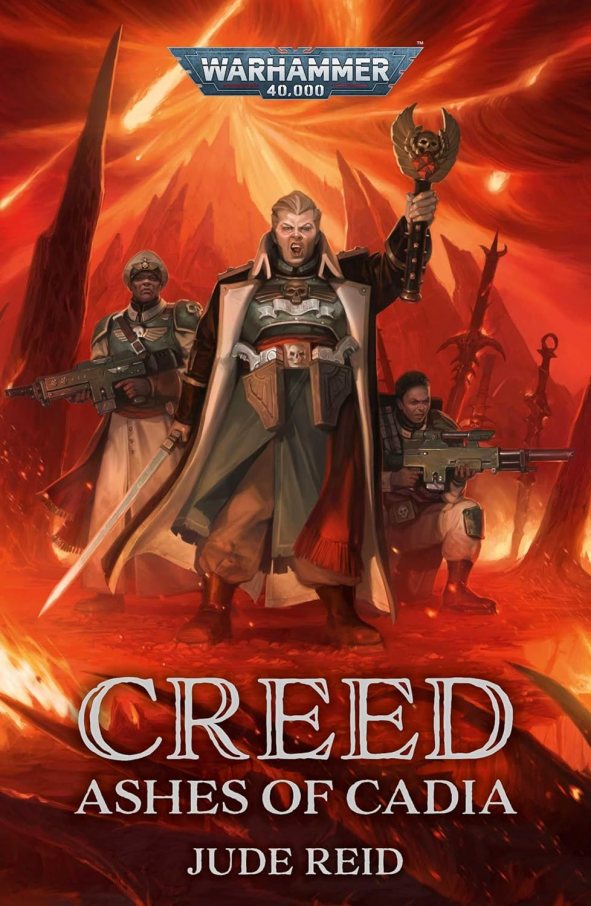
Warhammer 40,000: Creed: Ashes of Cadia by Jude Reid

Creed - Ashes of Cadia Cover 2

Publisher: Black Library (Audiobook – 9 September 2023)

Series: Warhammer 40,000

Length: 14 hours and 36 minutes

My Rating: 4.5 out of 5 stars

Amazon

Exciting new Warhammer 40,000 author Jude Reid presents an action-packed and captivating novel that takes the reader to one of the most desolate places in the franchise’s universe, the ruins of Cadia, with the exciting novel Creed: Ashes of Cadia.

Last year proved to be an outstanding year for new authors producing their first Warhammer 40,000 novel, with several highly talented authors, such as Rob Young (Longshot) and Jonathan D. Beer (The King of the Spoil), producing amazing and intense reads in this fantastic universe.  One of the most interesting of these 2023 Warhammer 40,000 debuts was the impressive and captivating Creed: Ashes of Cadia by new author Jude Reid.  Reid’s first full novel after writing multiple Warhammer 40,000 short stories, Ashes of Cadia takes the reader on an epic journey with a new major protagonist.

Years after the fall of Cadia to the dread forces of Chaos, the Imperium of Man is still reeling from the carnage wrought in its aftermath which saw a massive warp rift cleave their besieged intergalactic realm in two.  Led by the returned Primarch Roboute Guilliman, humanity fights back as best it can in a great crusade, but its victories are never enough.  When word reaches Guilliman of a potential weapon on the most unlikely of locations, desperation requires him to investigate, and there is only one person he can call on for this dangerous mission.

After continually proving herself on the field of battle, Ursula Creed has succeeded her father, Ursarkar E. Creed, in becoming the new lord castellan of Cadia.  Leading the remaining Cadian forces in the Imperium, Ursula hopes to erase the stain of her legendary father’s great defeat, however, she can never seem to leave behind his complicated legacy.  When summoned by Guilliman for a secret mission, Creed is shocked to discover that she is being sent back to one place she never thought to return to, the shattered remains of Cadia.

Accompanied by a select team of Cadians with an unusual mixture of skills and experience, Ursula is sent to the surface to recover her father’s final battle plans and the secret weapons they supposedly lead to.  However, the surface of Cadia is a blasted wasteland, filled with foul energies and unnatural magic that causes even the dead to attack the invaders.  Left without support and hopelessly outnumbered, Ursula must lead her unprepared followers onwards in the hope of securing the prize.  But terrible evils lay claim to the remnants of Cadia, and Ursula will be forced to confront both the forces of Chaos and her own inescapable legacy as the daughter of Creed if she wants to survive.  Can Ursula succeed where her father failed and redeem Cadia, or is she already lost?

Reid had a very ambitious story idea for Ashes of Cadia, in that she needed to provide a human solider focused, character-driven adventure narrative that simultaneously examined the complex legacy of the Cadians in a new way, while also providing the reader with an intense and action-packed read.  Reid more than succeeded, as Ashes of Cadia takes the reader back to Cadia, one of the most significant landscapes in the Warhammer 40,000 universe and puts several intriguing and damaged protagonists through absolute hell.

Starting off a little slow to establish the main cast, remind people about the Cadian legacy, and set up the mission, Ashes of Cadia doesn’t really speed up until the protagonists land on shattered Cadia, and naturally all hell breaks loose.  The protagonists essentially find themselves thrust into a zombie apocalypse scenario, as a sorcerer attacks with a horde of living dead and decimates the protagonist’s team, leaving them trapped on the planet.  The disparate band of damaged and disillusioned survivors are forced to journey across the ravished planet to find either an escape or the rumoured secret weapon, encountering all manner of horrors, tragedy and continuous losses of supporting characters, all the while being hunted.  At the same time, the cast become more and more disheartened and internal conflicts seek to fracture them in a range of emotionally charged scenes.  This harsh adventure takes them to several key places on the ruins of the planet, as they get closer to their various personal goals.  There are some interesting false starts and twists, as well as some heartbreaking scenes, and you are constantly on edge, especially as a new danger of betrayal might emerge just around the corner.  I liked the reveal of Creed’s treasure in the novel, especially as it has some interesting potential consequences for the future of the Cadians, and the use of Creed’s daughter as a protagonist was a smart choice.  While I did see the big twist of the book regarding a certain traitor coming, it was still really well written, and I loved how Reid tried to misdirect with multiple bloody red herrings.  Everything leads up to a big, brutal, and over-the-top final confrontation, the sees the survivors redeemed in various ways, and it ended up being a fantastic and powerful piece of Warhammer 40,000 fiction.

Reid wrote a very intense and personal novel here with Ashes of Cadia, and I really enjoyed her captivating writing style.  Expertly splitting the focus of the book between several complex and unconventional soldiers with their own individual baggage, Ashes of Cadia becomes a much more emotionally charged novel than I was expecting, but the result was an impressive read, especially as you quickly get invested in the various character arcs.  However, Reid is no slouch when it comes to the action, as the many combat sequences are sharp and brutal, keeping you on your toes as any of your favourite figures can quickly fall.  While the pace of Ashes of Cadia does slow a bit at the beginning and in the middle, for the most part Reid keeps her novel moving along, and I had a hard time putting it down as a result.  I especially loved how well Reid portrayed the fallen planet of Cadia throughout this novel, especially as she really laid out the horrors and dangers associated with this planet.  Fans of Warhammer 40,000 fiction who know this planet well will be shocked by how disturbing and different it turns out, and I loved that we finally got an adventure in the ruins.  A brilliant and exceptionally written novel, you will have a lot of fun with this book.

As I have mentioned a few times in this review, Ashes of Cadia is a significant piece of Warhammer 40,000 fiction, mainly because it provides a continuation to a lot of the major story elements that have been a big part of the franchises fiction since the lore changes surrounding the fall of Cadia.  Quite a bit of in-universe time has taken place since that event, and most of the recently released Warhammer fiction focuses on how the loss of the planet effected the Imperium and the many Cadian soldiers fighting throughout it.  If followed through, the events of Ashes of Cadia are going to give these Cadian characters and stories new purpose, and I loved that we also have new Creed character to follow in Ursula.  Reid does an excellent job of building up to these reveals, and there was another interesting look at how traumatised and demoralised the Cadians are, which really fit into the plot of this book.  There are also a lot of references to other novels and events from the lore that fans of the franchise will appreciate, and I personally liked how it had some connections to another Warhammer 40,000 novel from last year, The Fall of Cadia by Robert Rath (one of my favourite books and audiobooks of 2023).  As such, Ashes of Cadia is probably best enjoyed by those established fans of the Warhammer 40,000 universe, especially those who have enjoyed the recent influx in Cadian fiction.  However, there is still a lot for newer readers to the franchise to enjoy, especially as Reid does a wonderful job of explaining the key lore elements that lead up to this story.  General fans of adventure, science fiction and even horror, can have a lot of fun with Ashes of Cadia, and this turned into quite an intense and bloody war narrative.

Easily the most distinctive part of Ashes of Cadia is the complex and damaged cast of characters that make up the main cast.  Reid produced some unique figures for this impressive narrative, and their individual stories, as well as the general despair of the Cadian trooper following the loss of their planet, proves to be a major driving point in the plot, and I really enjoyed seeing the various character arcs unfold.

Ashes of Cadia’s story had three primary point of characters, and Reid did a pretty good job of jumping the story around them, showcasing each of their unique and well-written storylines.  The most prominent of these is the titular Ursula creed, the current lord castellan of the lost planet of Cadia.  The daughter of the beloved Cadian leader who lost the planet before disappearing, Ursula has big boots to fill, especially as she is resentful for her father’s legacy and the fact she barely knew him.  The resulting insecurities, responsibilities and bitterness play a huge part in her character arc, and watching her walk in the steps of her father and attempt to become the leader he was proved to be a great part of the plot.

The next major character, Shael Laskari, adds a more general viewpoint to the story as a recently graduated cadet who is chosen to accompany Creed to the surface for propaganda reasons.  Inexperienced and fearful, Laskari is the everywoman of Ashes of Cadia, and it proved interesting to see her deal with the unknown horrors of the planet while also trying to find her courage in her squad.  Reid also does an exceptional job with the unique character of Mac Ossian.  A former medic and member of a Cadian regiment, Ossian was assigned to a penal legion after killing his former commander, and now finds himself back on Cadia as part an expendable distraction.  Managing to meet up with Creed’s unit, Ossian spends much of the book trying to prove his loyalty and worth, while also wondering if Creed and Cadia still deserves his surface.

These central characters are accompanied by several fantastic supporting cast members, several of which have their own exceptional character arcs.  I personally really enjoyed Colonel Hadrian Aurelius Van Haast, who serves as a guide with local knowledge of the area.  Van Haast is a stupendously arrogant figure, who you can’t help but dislike, and he added a fantastic dynamic to the cast.  However, this arrogance is a cover for a much darker secret, which Reid slowly and expertly reveals as the book continues.  I also must highlight Ossian’s fellow penal legionnaire Liga Yager, another prisoner who tries to survive after being dropped on Cadia to die.  Due to her much more cynical perception of Creed and the Cadians, as well as her compelling backstory, Yager goes on a very different path than Ossian, and proved to be a devil on his shoulder that speaks some much-needed truth.  Finally, I loved the villain of the story, the Death Guard sorcerer, Livor Opilionis, who is mostly called The Huntsman throughout the book.  The Huntsman is a gloriously sinister and dangerous foe, who relentlessly hunts them throughout the ruins of Cadia, heralded by his hunting horn and packs of plague zombies, and the confrontations the protagonists have with him always leads to carnage.  This outstanding cast of characters, and more, really turned Ashes of Cadia into an amazing novel, and I loved the brilliant character arcs that Reid developed around them.

As with most Warhammer 40,000 books I check out, I made sure to grab Ashes of Cadia on audiobook.  The Warhammer 40,000 audiobooks are always pretty damn awesome, and I love how much the action, horror and unique setting came through in this format.  Coming in with a decent runtime of just over 14 and a half hours, Ashes of Cadia was a very easy book to listen to, and I managed to knock it off quickly.  It helped that Ashes of Cadia was narrated by the superbly talented Colleen Prendergast, who is swiftly becoming the go-to narrator of Warhammer 40,000 audiobooks with female Cadian protagonists.  Prendergast has a great and intense voice for Warhammer 40,000 fiction, and I love how well she was able to move the plot along.  She also provides a series of great and fitting voices for the cast of this book, especially the female characters.  I loved how dignified and complex she made some of these characters, as well as how monstrous and threatening the main antagonist sounded in his terrifying scenes.  As such, Ashes of Cadia was an absolute joy to listen to and I would strongly recommend this audiobook version to anyone interested in this fantastic piece of Warhammer 40,000 fiction.

Creed: Ashes of Cadia was a fantastic, dark and captivating novel from Jude Reid, who produce an impressive debut with some intriguing potential for the wider Warhammer 40,000 universe.  Loaded with action, intrigue and several complex characters, Creed: Ashes of Cadia was an excellent read that cleverly ties into the history and existing lore of this complex and highly fun franchise.  Intense, moving, and oh so brutal, Ashes of Cadia comes highly recommended, especially for fans of Warhammer 40,000 fiction.

Amazon

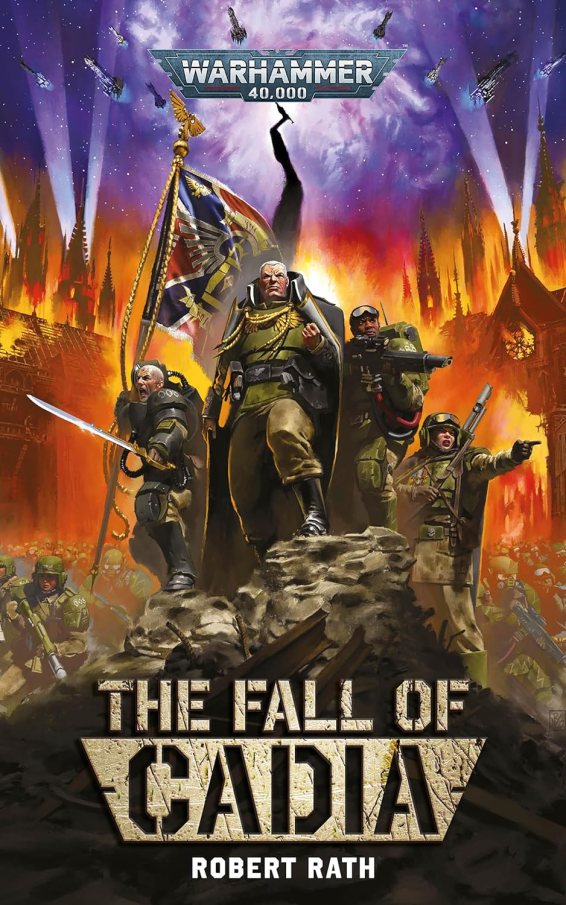
Warhammer 40,000: The Fall of Cadia by Robert Rath

Warhammer 40,000 - The Fall of Cadia Cover

Publisher: Black Library (Audiobook – 5 August 2023)

Series: Warhammer 40,000

Length: 19 hours and 42 minutes

My Rating: 5 out of 5 stars

Amazon

Cadia Stands!  I ended 2023 on a very high note with one of the best Warhammer 40,000 novels of the year that follows one of the biggest events in the franchise’s recent lore, The Fall of Cadia by Robert Rath.

There were several amazing Warhammer 40,000 novels released in 2023, with some of my favourites including The Lion: Son of the Forest and Warboss by Mike Brooks, The King of the Spoil by Jonathan D. Beer and Cypher: Lord of the Fallen by John French, just to name a few.  However, in terms of sheer scale, epic battles, and larger-than-life characters, my favourite will have to be The Fall of Cadia.  As the name suggests, The Fall of Cadia follows the final battle for the planet of Cadia at the end of the 13th Black Crusade, which was a major campaign in the Warhammer 40,000 tabletop game.  The original 13th Black Crusade campaign happened back in 2003, with the official result being something of a draw.  However, in 2017, Games Workshop retconned the campaign to result in a much more substantial Chaos victory, which ended up having substantial impacts on the wider lore of the franchise, effectively reshaping the entire Warhammer 40,000 universe.

This change ended up being a pretty significant event, and Games Workshop provided some major write-ups about it that summarised the events and their explosive aftermath.  Indeed, the lore events initiated in this event have already been featured in several novels, and most of the current Warhammer 40,000 fiction examines the consequences of this campaign.  However, there has yet to be a novel solely dedicated to trying to capture the entirety of the action at the end, until now with The Fall of Cadia by Robert Rath.  Rath was a great choice of author to write this book as he is a truly amazing author of Warhammer 40,000 fiction.  His previous novels, Assassinorum: Kingmaker (one of my favourite books and audiobooks of 2022) and The Infinite and the Divine, have both been exceptional five-star reads, telling elaborate, character-driven stories that cleverly capture complex aspects of Warhammer 40,000 lore and turn them into impressive and addictive reads.  As such, he was the perfect choice to write The Fall of Cadia and he succeeded in creating a deeply moving and epic novel that perfectly brought the chaotic events that ended this infamous war to life.

In the far future of the 41st Millenium, few battlefields are more significant or more soaked in blood than that of Cadia.  A fortress world for the Imperium of Man, Cadia stands in the shadow of the Eye of Terror, a blazing rift that serves as a gateway into the Warp and the realm of the Chaos gods.  For any substantial invasion by the forces of Chaos into the Imperium to be successful, Cadia needs to be taken and destroyed, and for that task the Chaos Gods have chosen the Warmaster of the Black Legion, Abaddon the Despoiler.  Abaddon is a legendary warrior of hatred and spite who alone is capable of welding together the unruly and contentious forces of Chaos.  Over the millennia, Abaddon has launched 12 Black Crusades against Cadia, leading an unholy alliance of monsters, daemons, cultists and traitor Space Marines to battle.  However, each time Cadia has held, at great cost to the desperate Imperial defenders.  But now, as the forces of Chaos appear stronger than ever before, a 13th Black Crusade has been declared, one that looks set to destroy Cadia forever.

The Fall of Cadia starts well into the 13th Black Crusade, as, after weeks of heavy fighting, the forces of Cadia and humanity once again appear victorious, with the armies of Chaos retreating on all fronts.  However, despite the apparent victory over the heretics and the dark gods of Chaos, Lord Castellan Ursarkar Creed is uneasy, believing that the victory was too easy.  As the celebrations continue, Creed is soon proved right, as the Eye of Terror disgorges a new enemy force unmatched in size and deadly potential since the legendary Horus Heresy.

At its head flies a dread Blackstone Fortress, an alien superweapon capable of intense destruction and now crewed personally by Abaddon.  Faced with this threat, Creed attempts to bring together the various elements of humanities defenders, including legendary Space Marines, virtuous Sisters of Battle, the inhuman soldiers of the Adeptus Mechanicus, and the outmatched by steely rank-and-file troops of Cadia, determined to save their home.

As the final invasion of Cadia begins, Creed organises the defence the best he can to hold back the oncoming horde on land, in the sky, in space, and even far behind Cadian lines in their seemingly safe cities.  If Creed has any hope of succeeding, he will need to bring together the scattered armies of the Imperium on Cadia into a single cohesive force, but not all of the defenders are fighting for the same goals.  Even if these armies come together, can the legendary Creed hold off the fury of Abaddon and his dark gods?  Cadia’s last stand has begun, but who will be left alive at its end?

Robert Rath continues to showcase just how varied and impressive his talent for writing Warhammer 40,000 fiction is as he captures the incredible events of the last siege of Cadia.  The Fall of Cadia is epic in every way possible, as it presents the reader with a great coverage of these key lore events and the characters involved.  Elaborate, intense, and featuring so much damn carnage and war, The Fall of Cadia is an incredibly addictive read that got a very easy five-star rating from me.

I think it is important to point out that Robert Rath had a difficult task ahead of him when he was chosen to novelise the events surrounding the end of the 13th Black Crusade.  A lot of detailed lore has been written around this event, not only in the various guides, rulebooks and other material associated with the tabletop game but also in several years worth of novels and extended fiction that focused on the aftermath of the war.  Any novelisation about these events ran the risk of being a stale retelling of events that all Warhammer 40,000 fans already know about.  However, Rath rose to the challenge and presented a powerful, intense and memorable depiction of the events that really drags the readers in while showing just how incredible and epic a piece of Warhammer fiction can be.

To tell the events of The Fall of Cadia, Rath elected to cover everything in a massive, multilayered, character-driven narrative, told from every perspective imaginable.  Starting towards the final days of the battle, when Abaddon unleashes his true invasion of Cadia, the reader is soon engrossed a range of different storylines that cover many different angles of the battle.  Not only do we get to see the overall strategy of both sides but the reader is also thrust into personal wars and fights across the theatre.  So many amazing moments are covered, including a desperate last stand in the mountains, battles in the sky and space, Chaos infiltration in the cities, criminal enterprises, even internal dissension amongst the Chaos command.  These scenes are usually shown through the eyes of a complex characters, whose desperate fight for Cadia helps to define them and presents the reader with some impressive and captivating character arcs.  All these varied conflicts are expertly portrayed by Rath, who does a wonderful job capturing the intensity, brutality and lack of humanity involved in warfare, as his characters suffer on every battlefield imaginable.  The sheer epic and destructive nature of these conflicts really come across in Rath’s writing style, and I honestly visualised many of the scenes being described in cinematic detail in my head.

The first half of the book primarily focuses on these various scattered storylines, and it was a lot of fun to see the different theatres of war, especially as you start to get attached to the major characters.  All the battles featured are pretty awesome and intense in their own way, and I really have to emphasise just how skilled Rath is at bringing all the different elaborate bits of combat to life.  The complex story pieces start to come together in the second half, especially as each of the characters find themselves drawn to the same battlefields.  I really appreciated how the storylines tied together, and there are some brilliant moments featured here.  I also felt that the multiple deus ex machina moments towards the conclusion of a big battle sequence that Rath needed to include because they were part of the lore was handled about as well as they could be.  Rath did some good set-up for the most important of them earlier in the plot, and I liked how in many instances he tried to examine it from the perspective of the common soldier looking for miracles, so it often did not seem too ridiculous.

Everything leads up to the big final battle in the last third of the novel, and despite knowing how it was going to end, I still was extremely invested in the plot and eager to see how everything came about.  A lot of this was because I deeply enjoyed the compelling character arcs of the newer protagonists, but I was also very interested in seeing how Rath envisioned some of the more essential events.  The author really did not disappoint, as these epic and groundbreaking moments were expertly showcased to the reader in a powerful and captivating way.  The big deaths were pretty shocking and hurtful, especially if you did not know they were coming, and the major conflicts were so damn epic in their scope and impact.  The final devastating blows of the war really hit hard, especially as the climatic events featured some deeply personal moments alongside the mass devastation, which made everything that much more powerful.  I really loved how everything came together, and the poetic conclusion that highlighted the final fights of the surviving protagonists is going to stay with me for some time.  I am so damn impressed with how much passion and emotion that Rath was able to stick into this massive war story, and I honestly loved every single second spent reading The Fall of Cadia.

In addition to the amazing story, I really need to highlight the impressive array of characters featured throughout The Fall of Cadia.  Rath did a wonderful job of presenting the massive events of this book through a range of intriguing character perspectives on every side of the conflict, and there is a fantastic combination of new characters and established Warhammer 40,000 figures.  The author really tried to cover The Fall of Cadia’s narrative from every single angle he possibly could, and the resulting combination of generals, common soldiers, legendary warriors, ancient traitors and other interested onlookers, helped to make this Warhammer 40,000 story even more powerful and layered.  This includes several Chaos characters, whose tainted perspectives allow for a compelling view of both sides of the conflict.  The Fall of Cadia’s character arcs are mostly self-contained for the majority of the book, with their focus usually on that particular figure or theatre of the war.  However, there are some clever and moving interactions between the characters as the novel continues, and it is testament to Rath’s writing style and ability to create a massive web of overlaying character storylines that these interactions fit together so well into a cohesive and powerful narrative.  Rath really dove into the complex lives and personalities of every character he featured, even those that died quite quickly, and the resulting character arcs really added to the emotional impact of The Fall of Cadia.  You become heavily invested in these characters as a result, and waiting to see who survives the war is an important part of experiencing this novel.

So many big personalities were expertly featured throughout The Fall of Cadia and every reader is going to come away with their own favourites.  The better character arcs I personally loved included that of Major Marda Hellsker, who is forced to lead a desperate last stand for much of the book and grows into the leadership position thrust upon her.  Captain Hanna Keztral’s exploits in the sky also make for great reading, especially as she desperately tries to gain respect whilst flying an unarmed aircraft.  You also have to love the storylines surrounding Salvar Ghent, Cadia’s premier gangster, as he tries to exploit the war to his advantage before finding himself thrust into a much more prominent role.  I particularly loved how well Ghent interacted with some of the major figures in the book, and his entire storyline was one of the most entertaining.  The insatiable Necron collector Trazyn the Infinite was also a great inclusion in the plot, and Rath clearly had fun bringing back this hilarious character after featuring him so heavily in The Infinite and the Divine, and I got a good laugh at several of his pivotal scenes and petty moments.

However, the best characters in The Fall of Cadia had to be the opposing leaders of the war, Lord Castellan Ursarkar Creed and Abaddon the Despoiler.  Both are major figures in Warhammer 40,000 lore and Rath ensured that they were done justice in this novel.  Creed is shown to be a rough but brilliant commander, capable of inspiring an entire world while also suffering from the stresses of constantly being on the losing side.  I particularly enjoyed the subsequent inclusion of Colour Sergeant Jarran Kell alongside Creed as his long-suffering aide and best friend, and the two make for a very powerful character combination for many of the scenes shown from the defenders’ perspective.  Abaddon on the other hand is presented as the absolute beast that he is, and his obsessive desire to destroy Cadia is palpable.  I deeply appreciated that Rath showcased Abaddon as the ultimate villain in this universe, and his appearances were always exceedingly impactful.  Many of Abaddon’s appearances were cleverly shown through the eyes of his loyal servant, Dravura Morkath, whose rose-tinted opinions of her master barely covered the restrained evil within this figure.  I quite enjoyed Dravura as a character, especially as she has the most intriguing insights into the Chaos ranks, and the resolution of her storyline with Abaddon might be one of the most heartbreaking in the entire book.  These characters, and so much more, were such a brilliant part of The Fall of Cadia, and they helped turn what could have been a simple retelling of the lore into a particularly powerful and moving novel.

As with most Warhammer 40,000 novels, I feel that The Fall of Cadia is going to appeal to those fans of the franchise who already have a grip on the basics of the lore and main characters and can fully appreciate just how massive an event this book was.  Due to the material the book is based on, there were a lot of crazy events and characters featured here, some of which would be obscure even to casual fans of the game.  While Rath does an outstanding job of explaining and exploring the most important of these elements, some readers might occasionally be confused at what is going on or how certain characters came into being.  Still, I feel that most new readers can still have an exceptional time with this book, especially as the epic battles, impressive characters, and heartfelt military focused story, is so damn good.  The Fall of Cadia might even be a great gateway novel for those people trying to get into Warhammer 40,000 fiction, and it sure as hell encouraged me to read more Warhammer fiction.

One of the other things that I really appreciated about The Fall of Cadia was the way that Rath tried to paint a more nuanced picture of the planet of Cadia itself.  Cadia is usually portrayed as a bastion of military prowess and resistance without some of the issues other planets in the Imperium had, so it was quite interesting to see Rath’s different take on the subject, showing Cadia to be a planet with hidden issues and dissent.  In particular, Rath examines the problematic social structure of Cadia, where the active military are notably prioritized and those people who could not fight or be assigned other roles were considered a second-class citizen.  I loved how well Rath examined and focused on the issues surrounding this unique military class system, and it became a surprising key part of the book.  Indeed, the motivations of several characters are highly tied into these issues, with many seeking to prove themselves after being considered lesser for their contributions.  It also serves as an intriguing motivation for several antagonistic figures, and I loved just how well Rath was able to weave the structure of a planet into these intriguing character traits.  This, and more, really showcased Rath’s inventiveness and appreciation for the little details of the Warhammer 40,000 universe, and it is one of the reasons why I really enjoy his novels.

As with most Warhammer 40,000 novels, I chose to enjoy The Fall of Cadia on audiobook, which proved to be a very smart decision on my behalf as it was one of my favourite audiobooks of the year.  Coming in with a runtime of just under 20 hours, The Fall of Cadia is a bit longer than your typical Warhammer 40,000 audiobook, which reflects the massive story Rath came up with for this epic read.  I really loved how well this audiobook format brought the epic nature of this narrative to life and the many battles, wars, and unique characters felt even more impressive when read out.  I enjoyed the narration of Mark Elstob, who has previously lent his voice to other great Warhammer audiobooks, including Kal Jerico: Sinner’s Bounty by Josh Reynolds.  Elstob’s narration of The Fall of Cadia is extremely good, and I loved how passionately he presented every big event and piece of action.  I really enjoyed some of the great voices he came up with for the cast of The Fall of Cadia, and every larger-than-life character was gifted a fitting tone that perfectly captured their personalities and intensity.  His voices for the opposing leaders of the battle, Abaddon the Despoiler and Ursarkar Creed, are amazing examples of this, and you really get awesome impressions of both character’s opposing determination and charisma in some outstanding sequences.  I really cannot emphasise just how incredible this audiobook version of The Fall of Cadia is and it is definitely the best way to enjoy this world-shattering story.

Overall, The Fall of Cadia is a pretty exceptional piece of Warhammer 40,000 fiction that did such an impressive job of capturing this intriguing event from the game’s substantial lore.  Robert Rath is such an impressive author, and I am really glad he had the opportunity to cut loose and present this massive inclusion to the Warhammer 40,000 franchise.  The Fall of Cadia is easily one of my favourite books of 2023, and I loved how Rath told such an epic war tale in such a powerful and memorable way.  I honestly hope they make a movie based around this book in the future, because it would be so damn spectacular.  A highly recommended read that no Warhammer 40,000 fan should be without.

Amazon

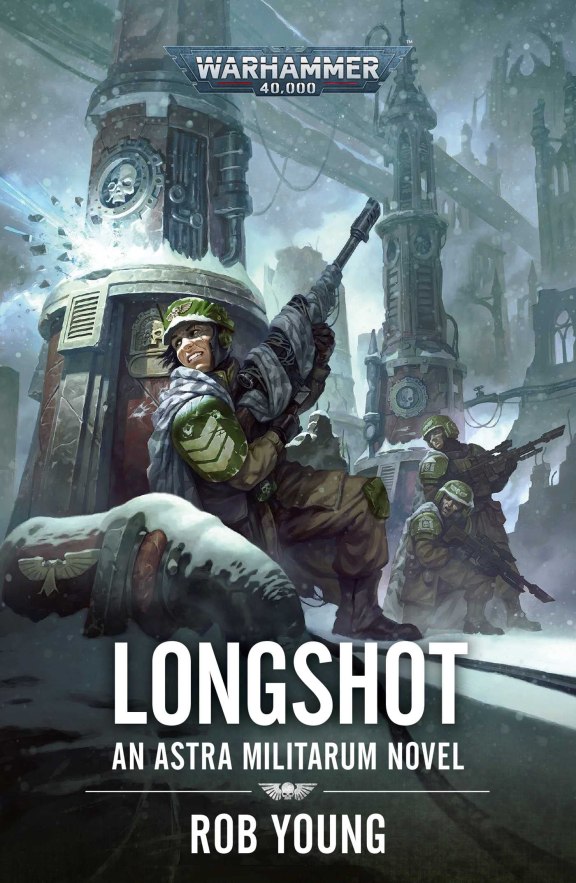
Warhammer 40,000: Longshot by Rob Young

Longshot Cover

Publisher: Black Library (Audiobook – 12 August 2023)

Series: Warhammer 40,000

Length: 10 hours and 28 minutes

My Rating: 4.5 out of 5 stars

Amazon

Prepare to dive into one of the grittiest battles in Warhammer 40,000 fiction with the awesome and captivating novel, Longshot by Rob Young.

2023 has definitely been an outstanding year for Warhammer 40,000 fiction, and I have had a ton of fun reading several pretty amazing entries from this extended universe in recent months.  Examples of this include The Lion: Son of the Forest, Warboss, Shadowsun: The Patient Hunter, Leviathan and The King of the Spoil just to name a few.  However, the year is far from over and there are still several great-sounding Warhammer 40,000 novels coming out that I have my eyes on.  One of the more intriguing was the fantastic Longshot by new author Rob Young, which sounded extremely fun.  Longshot, which follows on from Young’s short stories, Transplants and Memories of Broken Glass, is the author’s debut Warhammer 40,000 novel, and it proved to be a very intense and action-packed novel with a great story.

Several years after the fall of Cadia, which saw the Imperium of Man split in two by a great rift in space, humanity is still attempting to recover as many lost planets and systems as possible.  The latest target of the relentless Indomitus Crusade sees the troops of the Cadian 217th arrive at the former manufactorium world of Attruso, whose people have fallen under the sway of the seeming beatific alien t’au.

As the initial assault begins in the battered city of Miracil, the Cadian forces struggle to make progress against the determined t’au defenders and their human auxiliaries.  As the fighting gets even more desperate, the tides of war soon place the keys to victory into the hands of Sergeant Darya Nevic and her squad of snipers.  Nevic is a legendary figure within the 217th, a transplant from a non-Cadian regiment renown for her abilities of infiltration, assassination and survival, Nevic excels at disrupting the enemy from the top down.  However, when the t’au unleash their own deadly sniper against the Cadians, Nevic is forced into a battle of wits with a killer just as skilled and ruthless as she is.  But has Nevic finally come across a foe even she can’t best, especially as she begins to doubt her mission in the face of her own infamy, the lies of her commanders and the t’au’s insidious promises?

Longshot is an awesome and fast-paced novel that perfectly showcases the horror of war in this grim universe through the lens of a skilled sniper.  Young did an outstanding job with his debut novel and I loved the intriguing and powerful narrative that placed great characters into a deadly setting.  I managed to knock this book off in a couple of days, and it is one of the most exciting and fun Warhammer 40,000 novels of 2023 so far.

I loved the complex and intense story that Young pulled together for Longshot, which perfectly presents a tale of the common soldier in the grim Warhammer 40,000 universe.  I have often said that some of the very best Warhammer 40,000 novels are those that focus on the common human soldier facing off against alien or inhuman forces (for example, Steel Tread, the Gaunt’s Ghosts books or Catachan Devil).  Longshot is a very good example of this as you follow a tired soldier as she faces internal and external threats on the frontline of a desperate conflict.  Thanks to its focus on snipers, city fighting, camaraderie and propaganda, Longshot is honestly the Warhammer 40,000 version of Enemy at the Gates, which I deeply enjoyed.  The reader really gets invested in the protagonist’s journey which follows her through some fantastic missions, battles and character growth in the first half of the novel.  This leads to a great second half, where Nevic becomes a victim of her own success and is forced to go up against a deadly enemy sniper.  Due to everything the protagonist experiences, there is some real tension leading into the final third of Longshot, especially after she experiences some terrible losses.  Thanks to the protagonists’ conflicted state, you honestly don’t know how the story is going to turn, and Young loads up some great twists and swerves.  While the ending was a tad predictable, I really enjoyed it and the author really pulled together a satisfying and exciting read that you can really power through.

This ended up being a pretty addictive standalone book, and it is one that would definitely serve as a great introductory novel to Warhammer 40,000 fiction for those readers unfamiliar with the franchise.  Young does a great job of expanding his previous short stories into his first full-length novel, and you really get to grips quickly with the situation, the characters, and the wider universe.  The sharp and intense character-driven story which primarily focuses on the protagonist, Darya Nevic, with a few chapters shown from other key character perspective, has a lot of great elements to it.  The focus on character motivation, the depravities of war, and the grim realities of the background universe really cut through the main story, and you understand the difficulties that many of the conflicted characters experience.  The subsequent focuses on morale in battle and the impacts of propaganda and manipulation also proves to be very fascinating and adds a great edge to Longshot.  I also deeply appreciated how well Young built up his main protagonist throughout the course of Longshot, diving into Nevic’s complex history and examining how she gained her legend.  You grow quite attached to Nevic as the book continues, especially she is forced to make several difficult decisions, and Young turns her into a relatable and understandable figure, especially when it comes to her conflicted feelings about her fame and leadership.  Nevic is well supported by other great characters, and Young was able to establish and utilise these figures in a short amount of time.

The real highlight of Longshot is the awesome and well-written action sequences that dominate the book and constantly keep the reader on their toes.  Young paints an effective and dark picture of brutal city fighting, and you can tell he was using the battle of Stalingrad as inspiration.  The gritty battles that take place are very exciting and powerful, and you can really feel the desperation and weariness of the combatants.  The author proves particularly adept at writing high-quality sniper scenes, and the focus on shooting, infiltration and calculated strikes makes Longshot stand out from other battle-heavy Warhammer 40,000 novels.  This ended up being a very slick and addictive read and Young proved quite skilled at getting his fantastic story across to the reader in the most effective way.

Well-established fans of Warhammer 40,000 canon will really appreciate Young’s compelling and insightful look into two distinctive factions who provide a very interesting contrast to each other.  This includes the members of the Cadians, one of the most iconic Imperial Guard factions in the game.  While the Cadians are already pretty heavily featured in Warhammer 40,000 fiction, I felt that Young provided a particularly effective dive into their current problems, namely the gradual deaths of the natural-born members of the regiment and their replacement by transplants from other regiments.  Thanks to the focus on Nevic, herself a transplant from another regiment, you see the dire internal conflict this causes as the strongly traditional Cadian regiment begin to lose their identity after the loss of their planet.  Young does a wonderful job of expressing this throughout the course of Longshot and the resultant impacts this has on the characters makes for some interesting story moments.  I also quite enjoyed seeing several outsider perspectives of the Cadians that Young worked into the story, which often contrasts well with what the Cadian protagonists feel, and it makes for some fantastic story moments. The author also examines other fascinating elements of the Imperial war machine, such as the exhausting Indomitus Crusade, the current crumbling state of the Imperium, the way other supporting regiments are treated, and the internal propaganda and planning of the regiment.

While the Cadians do get most of the story focus in Longshot, Young does take the time to also dive into the alien t’au who serve as the main antagonists of the plot.  Most Warhammer 40,000 novels that have the t’au as antagonists often nerf or underutilise them to a degree (for example Kill Team or Deathwatch: Shadowbreaker), which is frustrating for fans of the faction.  However, Young effectively showcases the t’au as skilled and deadly enemies who are able to weather the Imperial forces and overwhelm them in several key theatres.  Young has fun bringing several key t’au units to life throughout the course of Longshot and you really start to appreciate them as effective opponents to the Cadians.  There is also an interesting examination of t’au motivations, philosophies and manipulations, specifically around their recruitment of human auxiliaries.  This compelling dive into the t’au muddies the moral waters around the protagonists and the Cadians, and you soon start to question who has the best interest of the people of Attruso at heart.  This, and other intriguing similarities to the human soldiers, adds an awesome edge of consideration and concern to the story that I quite enjoyed.  I really think that Young had some of the better portrayals of the Cadians and the t’au I have so far seen in Warhammer 40,000 fiction, and fans of the franchise are going to have a wonderful time diving into that in this book.

Unsurprisingly, I chose to check out Longshot on audiobook, which in my opinion the best way to enjoy a Warhammer 40,000 novel.  Longshot is a particularly good example of this, as the audiobook format really helped to move the already exciting novel along at a fast clip, especially when the action scenes are brought to life by the narrator.  Coming in at around 10 and a half hours, this is very easy audiobook to get through quickly, and I made sure to power through it in only a few days.  It helped that this book was narrated by the very talented Colleen Prendergast, who already has a bit of experience narrating Warhammer novels featuring the Cadians.  Prendergast did a wonderful job bringing all the major characters to life, especially the main protagonist of Darya Nevic, and I loved the elaborate and fitting voices that she gifted the cast which really helped to draw you into the story.  However, the real benefit of Prendergast’s narration is the way that she walks the listener through all the elaborate battle sequences, especially those that show the snipers facing off against each other.  I felt that this narration expertly captured all the inherent intensity and danger of these scenes and I got really invested into the book as a result.  Thanks to this amazing narration and story enhancement, I would strongly recommend checking out Longshot on audiobook and I know I had a lot more fun thanks to this amazing format.

Overall, Longshot is an awesome and compelling addition to the Warhammer 40,000 canon and one that I had a ton of fun with.  Young produced a powerful and intriguing character driven war story that will appeal to a wide audience of readers, especially with its fantastic focus on sniping and some of the more fascinating elements of Warhammer lore.  I deeply enjoyed this fantastic novel and Longshot comes highly recommended.

Amazon

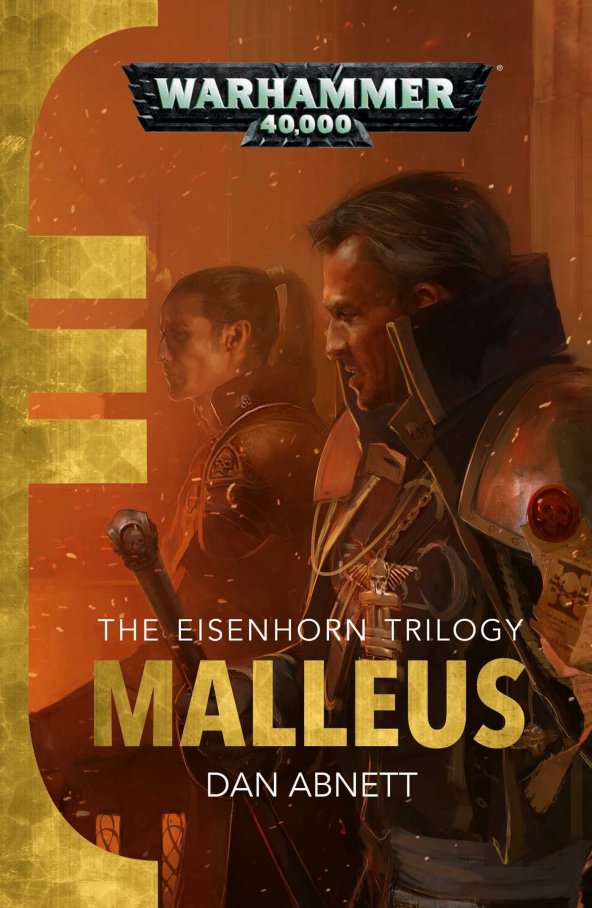
Throwback Thursday – Warhammer 40,000: Malleus by Dan Abnett

Warhammer 40,000 - Malleus Cover

Publisher: Black Library (Trade Paperback – 27 December 2001)

Series: Eisenhorn – Book Two

Length: 10 hours and 13 hours

My Rating: 5 out of 5 stars

Amazon     Book Depository

Welcome back to my Throwback Thursday series, where I republish old reviews, review books I have read before or review older books I have only just had a chance to read.  For this week’s Throwback Thursday, I continue my extensive dive into the Warhammer 40,000 universe with the awesome, galaxy-spanning thriller, Malleus by Dan Abnett.

For one of my latest Throwback Thursday reviews, I took a look at one of Dan Abnett’s iconic Warhammer 40,000 novels, Xenos, the first book in the incredible Eisenhorn trilogy.  This fantastic book, which followed Inquisitor Gregor Eisenhorn, a hunter of dark influences in the Imperium of Man, was a clever and compelling read that saw Eisenhorn face off against a range of terrible foes who seek to destroy humanity from within.  I had an outstanding time with Xenos, which really showcased Abnett’s skill as an author (I have also really enjoyed his Gaunt’s Ghosts novels, including First and Only, Ghostmaker and The Vincula Insurgency).  Indeed, I enjoyed it so much that I quickly decided to continue the Eisenhorn trilogy by listening to the second book in the series, Malleus, another exceptional read that takes its protagonist on another dark and engrossing adventure.

In the 41st Millennium, the dark enemies of mankind, whether they be heretical, daemonic, or alien in nature, continue to try and destroy the Imperium of Man from within.  It falls to dedicated inquisitors, such as Gregor Eisenhorn, to battle their malign influences by whatever means they deem necessary.  But what happens when the very institutions that Eisenhorn has long fought to uphold are turned against him?

Whilst battling against deadly alien influences on an isolated planet, Eisenhorn is made aware of certain allegations against his character which suggest that he has been corrupted by the influence of Chaos.  Initially planning to ignore the rumours and continue his vital work safeguarding humanity, his plans are put on hold when a terrible act of destruction unfolds on the planet of Thracian Primaris.  Investigating its causes, Eisenhorn is thrust into another deadly conspiracy, one tied to a foe he last encountered 100 years before, the daemonhost Cherubael.

Chasing after Cherubael and his minions, Eisenhorn attempts to discover what their latest unholy plan is.  However, his investigation reveals that Cherubael is just a pawn, and that the true mastermind of the plot he has uncovered may be a fellow inquisitor.  However, before Eisenhorn can find and confront them, he himself is declared a heretic and renegade by puritan members of his order, forcing him to flee.  Chased by the members of the Ordo Malleus, as well as other deadly hunters loyal to Imperium, Eisenhorn must work outside the bounds of his usual authority to prove his innocence and find the true culprits.  But to defeat his enemies, Eisenhorn may be forced to cross a dangerous line and become the very thing he has sworn to destroy.

Damn, Abnett was on a major roll when he wrote the Eisenhorn novels, as the second book, Malleus, is getting another five-star rating from me.  Brilliantly combining a taut and intrigue-laden plot with the darkest elements of the Warhammer 40,000 universe, Malleus is an addictive and powerful read that proves near impossible to stop listening to.

Malleus has an incredible story that I found to be pretty damn addictive.  Set 100 years after the events of Xenos, Malleus continues to follow Inquisitor Eisenhorn as he investigates several malign cults and figures throughout his sub-sector of space.  The story soon ties into some of the lingering storylines from Xenos as the daemonhost Cherubael makes another appearance, framing Eisenhorn as a heretic.  After a massive and suitably destructive series of events, Eisenhorn is thrust into a whole new investigation, trying to finally hunt down the figures that vexed him during the events of Xenos.  Traversing the sector in pursuit of Cherubael and other rogue inquisitors, Eisenhorn finds himself thrust into battle after hopeless battle, and his constant losses war with his determination to finish the case.  The protagonist faces several major hurdles towards the middle of the book, including capture and imprisonment by a fellow inquisitor for false crimes.  Eventually escaping, Eisenhorn spends much of the book as a fugitive hunted by loyalist forces, which is an exciting new element that Abnett plays to full effect to enhance the plot.  The overarching mystery/conspiracy plot of the book comes together extremely well, and I loved the outstanding investigation angle that follows as Eisenhorn desperately tries to find the evidence that not only ends the threat but exonerates him.  This hunt for answers is actually set over a substantial period of time, mainly due to the delays associated with space travel, but this only increases the power of the plot as you witness Eisenhorn lose years of his life being hunted.  Everything leads up to a massive confrontation with plenty of bloody battles and dangerous decisions that leave several fantastic characters dead or damaged.  The ultimate conclusion is pretty impressive, especially as Abnett really starts to showcase his protagonist’s inevitable fall from grace here, and he leaves the book on a particularly dark note that was so damn awesome.

Just like with Xenos, Abnett has a fantastic writing style that really helps to enhance Malleus’s narrative and make the book very addictive and exciting.  Perfectly utilising an excellent chronicle style that allows you to see inside Eisenhorn’s head, you are swiftly drawn into the complex plot.  Abnett keeps up a swift and intense pace the entire way through, and you barely have a moment to stop and breathe before the next intriguing event takes over.  The blend of intrigue, Inquisition politics, sector-spanning conspiracies, complex character development, unique Warhammer concerns, and impressive action is a heady mix and you get really get caught up in the hunt for the antagonists and Eisenhorn’s fight to prove his innocence.  I loved how intense and deadly some of the crazy battle scenes got and Abnett has great skill at showcasing his characters in mortal danger.  His attention to detail also results in some breathtaking sequences, and I was really impressed by that epic parade sequence, especially its ultra-chaotic ending.  Abnett also takes the time in Malleus to set up some future storylines and alternate books, with some fun hints at novellas/short stories you should check out, while also quickly introducing his next major protagonist, Ravenor.  All these brilliant writing elements, and more, really help to drag you into this elaborate narrative, and I deeply enjoyed the more intrigue-focused stories that are the hallmark of the Eisenhorn books.  A worthy and powerful sequel to Xenos that really showcases the awesome characters and continues the outstanding and elaborate storylines.

I really loved the elaborate Warhammer 40,000 elements that Abnett featured within Malleus as the author dives right into the heart of the Inquisition and their battles.  Just like with Xenos, you get a great understanding of the various internal threats that the Imperium faces in this universe, as Eisenhorn attempts to combat various conspiracies and threats.  However, there is also a much deeper look at the inner workings of the often hidden Inquisition Ordos, especially as Eisenhorn is forced to work against the factions associated with them, including the Ordo Malleus, who think he has been compromised.  The ensuing hunt for answers leads the protagonist, and by extension the reader, on a mighty chase around various unique planets in the Imperium, including Cadia before the fall, and Abnett has a lot of fun exploring the intriguing elements associated with these locations, as well as the general lore surrounding inquisitors, daemons and more.  I did find it interesting that one of the major McGuffins of the book, the mysterious pylons of Cadia, ended up seeming a little more important in hindsight after the 13th Black Crusade, and you have to wonder if the antagonist’s villainous plan didn’t actually have some merit.  I felt that this was a particularly awesome Warhammer 40,000 book and I deeply appreciated how the universe’s unique elements and lore were able to seamlessly support the elaborate tale that Abnett wrote here.  Due to Abnett’s detailed and compelling writing style, new Warhammer readers could easily start their exploration of the franchise with Malleus and get a rather good idea of the universe.  However, I would really recommend starting with Xenos, as you get a much better introduction to key details and characters there.  An overall exceptional read that makes full use of the massive, extended setting.

A highlight of any Abnett book is always the outstanding and highly complex characters, and Malleus has those in spades.  The focus is once again on series protagonist and narrator, Gregor Eisenhorn, who grows as a character with each passing adventure.  I really liked how Abnett portrayed Eisenhorn in Malleus and his compelling mission for justice and redemption is pretty intense.  The Eisenhorn here is a different creature to that in Xenos, especially as, after 100 additional years in the Inquisition, he is a lot more experienced and skilled in his work.  Now commanding a small army of followers, Eisenhorn has different methods and resources than before, but the same determination, loyalty and kindness (at least compared to other inquisitors) is still there.  However, Malleus sees Eisenhorn go through some major battles, both mentally and physically, as he is forced to confront an enemy within his own order while defending his own methods and character.  Watching him declared a heretic by his fellow inquisitors is pretty brutal, and Abnett throws in a heartbreaking prison scene to keep the readers intrigued.  These events, coupled with some personal losses, and the continued presence of beings far more powerful than him, force Eisenhorn to make deals and cross lines he really shouldn’t.  I love how each of the Eisenhorn books show the protagonist’s slow fall towards radicalism, and Malleus is an interesting starting point for that, as you understand why Eisenhorn is forced to go down this route.  While he ends the book with most of his humanity and integrity intact, that brilliant final scene shows that he is getting awfully comfortable with his feet over a line he previously feared, and I cannot wait to see how far he falls in the next Eisenhorn novel.

On top of Eisenhorn, Abnett features a pretty awesome collection of supporting characters who assist the inquisitor in his investigation and they each add their own distinctive personality to the narrative.  There is a good continuation of character arcs from the first book as several of his followers from Xenos make a return here, including the entertaining Savant Aemos, former Arbites investigator Fischig and his dedicated psychic blank Bequin.  Each of them is a little older, wiser and more familiar with the hardships of being an inquisitor’s acolyte, and I liked the stronger relationships that developed amongst them, particularly Bequin, who really comes into her own in this book as a veteran.  There are several interesting new characters added as well, such as the bounty hunter Nayl or brash pilot Medea Betancore (replacing her father Midas), and I felt that their distinctive personalities added a fun and entertaining edge to the narrative.  I was surprised that new character Gideon Ravenor, who goes on to get his own spinoff series, only had a relatively small appearance in this book, as I figured he would be a pretty major character to get his own story.  Still, he gets a good introduction here and it will be interesting to see how his arc plays out in the future.

Malleus also features several intriguing antagonists, each of whom test Eisenhorn and his colleagues in different ways.  While there are the usual array of cultists, aliens and other creatures, most of the antagonists in this novel prove to be other inquisitors, who are either working on their own radical plots or who believe that Eisenhorn is the true heretic who needs to be stopped.  This adds a very interesting dynamic to the story and it was fascinating to see the varied philosophies and plots amongst the rival orders and factions.  I did find it interesting that the main villain of the story, a mysterious inquisitor acting from the shadows, only had a very minor appearance in the book, and while you feel his presence, a bigger appearance from him might have been in order.  However, this character is more than made up for by his principal minion, the daemonhost Cherubael, who returns after his fantastic appearance in Xenos.  Cherubael is a brilliantly sinister character who steals every single scene they are in thanks to their menacing monologues and intriguing insights.  The outstanding obsession he forms with Eisenhorn is a great deal of fun and I loved seeing this evil figure toy with the inquisitor and force him to go to great lengths to defeat him.  Abnett really knows how to write an outstanding character, even in a limited amount of time, and it will be fascinating to see what happens to these characters in the next Eisenhorn book.

I of course chose to listen to Malleus on audiobook, as it is my preferred way of enjoying great Warhammer books, and I was not disappointed with how it turned out.  This fantastic format once again deeply enhanced the quality of the story and you can practically see the awesome battle scenes and other breath-taking elements of the wider Warhammer 40,000 universe.  Narrator Toby Longworth, who is the go-to narrator for all of Abnett’s Warhammer audiobooks, does another outstanding job with Malleus, and I loved how he was able to keep the pace of the production going.  He also has an outstanding voice that really conveys the dark and dangerous nature of the universe, while also perfectly bringing the characters to life.  I deeply appreciated how Longworth made sure to utilise the same character tones that he previously featured in Xenos here, and it gave the Malleus audiobook a great sense of continuation.  All the new characters are also given excellent voices, and I loved how awesome he made them sound, especially the more supernatural or alien beings that the protagonist comes across.  I was frankly hooked on this audiobook from the very start, and it is an exceptional way to enjoy this epic narrative.  With a run time of just over 10 hours, I managed to power through this audiobook very quickly, and this is definitely the best format for the Eisenhorn series.

Dan Abnett continues to showcase why he is one of the absolute best Warhammer authors out there with the second book in his superb and beloved Eisenhorn trilogy, Malleus.  Featuring a powerful and incredibly captivating narrative of conspiracy, heretics and desperation, Malleus takes Abnett’s compelling protagonist on an even darker journey of despair, compromise and hard choices.  Brutal, intense and impossible to put down, Malleus is easily one of the best Warhammer books I have ever read, and I cannot get over how exceptional it was.  A very highly recommended book, I plan to check out the third and final Eisenhorn book soon as I can to see how this epic series ends.

Amazon     Book Depository

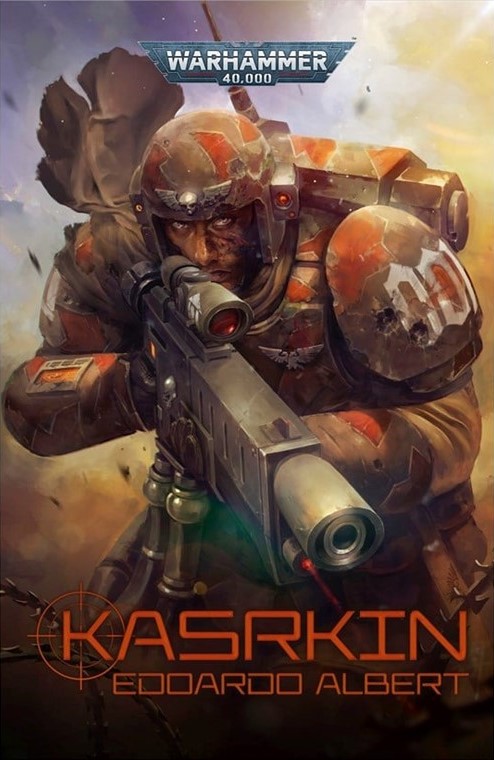
Warhammer 40,000: Kasrkin by Edoardo Albert

Warhammer 40,000 - Kasrkin Cover

Publisher: Black Library (Audiobook – 22 October 2022)

Series: Warhammer 40,000

Length: 11 hours and 3 minutes

My Rating: 4.5 out of 5 stars

Amazon

Get ready for some high-concept action in the latest awesome and exciting Warhammer 40,000 novel by Edoardo Albert, Kasrkin.

While I might be repeating myself a little, I must once again talk about the particularly amazing year I’m having when it comes to Warhammer 40,000 fiction.  There have been some outstanding Warhammer 40,00 books out in 2022, and I have done my best to listen to as many of them as possible.  Some of my personal highlights include The Wraithbone Phoenix, Outgunned, Assassinorum: Kingmaker, Ghazghkull Thraka: Prophet of the Waaagh! and Day of Ascension, just to name a few.  All these have been a ton of fun, and so when I had an open slot in my reading schedule, I naturally chose another recent Warhammer 40,000 book, Kasrkin.  Written by a new-to-me author, Edoardo Albert, who has previously created some interesting pieces of Warhammer fiction, Kasrkin is an action epic that pits a band of elite warriors on a deadly mission into the dark heart of a desert planet.

Welcome to the deadly desert world of Dasht i-Kevar, an Imperial planet currently under siege by the advanced xenos, the T’au, who have turned the usually baren planet into a bloody battlefield.  But the war is about to get even more interesting as the T’au have succeeded in shooting down an Imperial Valkyrie containing an important Astra Militarum general, whose knowledge of the Imperial Guard strategy and disposition could cause the planet to fall.

Only one group of Imperial soldiers have a chance of journeying into the harsh desert of the planet, an elite squad of Cadian Kasrkin.  Led by Captain Bharath Obeysekera, the Kasrkin are tasked to travel deep into the Great Sand Sea behind enemy lines to find the general and either recover him or kill him to keep him out of enemy hands.  The best of the best, the Kasrkin are trained to operate in any terrain and face off against any enemy.  But none of them have every encountered anything as endless, hot, or deadly as the deserts on Dasht i-Kevar.

Cut off by sandstorms and forced to journey over impossible obstacles, the Kasrkin are firmly on their own and can only rely on themselves.  But the deeper they journey in the wastes, the more they begin to realise that they are not as alone as they thought.  Other hunters are searching for the missing general, and the mysterious locals have their own games to play.  However, none of them are prepared for an ancient evil lurking far beneath the desert sands, determined to kill everything it encounters.

Another week, another exceptional Warhammer 40,000 novel that I had so much damn fun listening to.  Kasrkin was an excellent, fast-paced read that follows a compelling group of characters on an epic adventure tale.  Loaded with action, compelling characters, and a story that makes perfect use of its setting and the fantastic lore of the Warhammer 40,000 universe, Kasrkin in an epic read from Edoardo Albert that I absolutely powered through.

The story itself starts off pretty simply, with Albert introducing the reader to the Kasrkin squad and quickly setting them on their mission to find the missing general.  The early parts of the book are really focussed on allowing the reader to get their heads around the book’s premise, the characters, and the impressive desert setting, which honestly takes on a life of its own.  Initially a little slow going to build up tension and camaraderie amongst the Kasrkin, the book starts to get interesting about a third of the way in, when Albert introduces some unique world elements which show how cool and weird the Warhammer 40,000 universe can be.  From there, the story takes the protagonists closer to their objective, and I was initially a little surprised at how soon then managed to get where they were going.  However, this proves to be a bit of a ruse from Albert, as he chooses this moment to really shake everything up.

About halfway through, the entire structure of the book changes with the appearance of a new group of point of view characters, a kindred of Kroot aliens, determined to capture the general for the T’au.  This results in an awesome split in focus between the human and Kroot characters, and I loved the sudden introduction of an excellent rival group who appear equal to the Kasrkin in terms of combat ability.  However, this is not the only surprise that Albert has in store, as both the Kasrkin and the Kroot find themselves facing off against an even more deadly enemy in a fantastic new setting.  While I won’t go into too much detail about what happens next, it was a pretty epic move from Albert and one that I deeply appreciated.  The rest of the story is particularly intense and dark, and there some real horror vibes going for part of it, which fit in perfectly with the powerful narrative and darker setting.  Albert really layers on the action in the second half of the book, and I loved all the shocking and bloody places that he took his story, especially as there are several great twists and some truly engaging scenes featured throughout.  Everything comes to an excellent end, and this proves to be a particularly powerful and gripping Warhammer 40,000 read that really stands on its own.

I felt that Albert’s strong writing style helped to enhance the compelling narrative of Kasrkin and I really appreciated how the author’s style brought everything to life.  Like most Warhammer 40,000 novels, Kasrkin is a great standalone read that is very appealing for established fans of the franchise.  However, this book can also be easily enjoyed by most general science fiction or military fiction fans, especially as the author covers all the relevant lore details that you need to understand the world you are diving into.  Albert blends together some excellent storylines in this novel, and he keeps the pace steady, with a ton of brilliant action and dangerous occurrences.  I liked how the narrative kept morphing as the book progressed as what started as a compelling, if slower, desert adventure eventually turned into a high-octane war novel, before finally transforming into a desperate survival novel in a horror setting.  Albert manages these changes in style really well, and I think the constant alterations helped to keep the reader’s attention glued to all the craziness of the book. 

At the same time, the book remains a soldier’s story at heart, which is something that Warhammer fiction always excels at showing (good recent examples include Steel Tread, The Vincula Insurgency and Catachan Devil).  Watching these elite soldiers face impressive odds makes for an awesome read, especially as Albert also dives into their deeper concerns and features some deeper betrayals and intrigues.  I also cannot highlight enough how outstanding the combat sequences were in Kasrkin as Albert features some pretty hairy action scenarios.  I was particularly impressed with how well these combat scenes were enhanced by the book’s multiple character perspectives, especially once the Kroot were introduced.  Having the perspectives changed between the opponent groups as the firefights was ongoing was just brilliant, and it was amazing to see both sides of the battle, as well as the reactions from the rival teams.  All this, and more, really brought the best out of Kasrkin’s narrative and I deeply enjoyed how it was showcased.

Perhaps one of the most notable features of Kasrkin are the distinctive and memorable locations.  The reader is dragged to several great settings throughout the course of the plot, and the author takes particular pleasure in presenting them in exquisite detail.  The main location is the endless, featureless desert of Dasht i-Kevar, which the characters are forced to traverse for a good part of the book.  I got some great Dune vibes from this setting, and Albert makes this desert out to be a soulless, crushing place of shifting sands, massive unstable dunes, and intense heat, with the ability to strip the resolve and strength from the strongest of men.  Just listening to the characters traverse it made me thirsty, and you could really imagine the harsh journey they are going through.  At the same time, Albert also introduces some very unique aspects to the desert, including impossibly smooth patches of sand that move like water and mysterious water that lives deep under the surface which gives the planet some unusual life.  All these elements are very memorable, and you find yourself really feeling the intense desert surroundings as the characters push through it.  I think that Albert did a remarkable job of introducing and then utilising this harsh setting and it definitely stood out as a landmark part of the book.  A second, darker location becomes the key setting for much of the second half of Kasrkin and while I will again be brief to avoid spoilers, it was pretty damn epic.  Serving as the lair of a notable enemy, this location was a haunting and deadly setting, and one that the characters all struggled to survive in.  There are so many surprises and foes lurking in this location, and the strain of it really showed on the characters who find themselves with very little chance of survival.  I had such a great time with this location, and it, as well as the outside desert, helped to turn Kasrkin into a particularly noteworthy book.

On top of the new setting, I was also really impressed with the outstanding Warhammer 40,000 elements contained within this great book.  As I mentioned before, Kasrkin is a book a range of readers can enjoy, and part of the reason why is that Albert spends a lot of time exploring the unique lore elements of the Warhammer 40,000 universe that come into play during the plot.  Not only does this help to introduce the universe to new readers but established fans will appreciate how deep Albert dives into the subject.  As the name of this book suggests, quite a lot of the focus revolves around the Cadian Kasrkin, the most elite special forces group in the whole Imperial Guard.  Albert showcases them perfectly throughout the book, and it was so damn epic to see them in action, especially as they live up to all the hype and work together as a particularly effective unit.  The author dives into all their particularly quirks, training and operational preferences that sets them apart from the common Astra Militarum units, and you come away with a greater appreciation for who they are and what they can do.  In addition, there is a great underlying look at how the Kasrkin are doing following the destruction of their home world of Cadia, and I loved the deeper grief that they are all suffering after their failure and the hardships they have faced.

On top of the Kasrkin, Albert also spends a substantial amount of time examining and featuring other Warhammer 40,000 factions throughout the story.  The most prominent outside of the Kasrkin are the kindred of Kroot that become the protagonist’s opponents.  During their multiple scenes, Albert dives deep into the biology, beliefs and society of the Kroot, and the reader is soon given a crash course in who they are and what they can do.  There is a particular focus on their biological abilities, with Albert exploring their avian traits, their ability to communicate in different frequencies (giving off high-pitched whistles, which made several hunting scenes particularly cool) and more.  The real focus is on the Kroot’s ability to absorb the genetic traits of anything they consume, which is a big part of their society, as they live to hunt and consume prey that can give them a greater edge in battle.  Albert really examines this hunting and eating part of their culture, and it was fascinating to see how diverse the Kroot are after eating different creatures during their travels.  This ability plays a big role in the plot, with horrific consequences, and I loved having the Kroot featured so heavily in this book, especially as I haven’t seen them in too many other pieces of Warhammer 40,000 fiction.  I also loved how Albert did some fun contrasts between the Kroot and the Kasrkin and showed that they were very similar in their abilities and mentalities (and they both refer to their groups as kin).  Watching the two sides face off against each other is a thing of beauty and it results in some complex and exciting battle scenes.

On top of the Kasrkin and the Kroot, a third major faction from the Warhammer 40,000 universe are also featured, and they become an exceptional part of the books plot in the second half of the book.  Just like with the other groups featured within Kasrkin, Albert examines and features this group extremely well, and you get a good idea of who they are and what motivates them, even if they are a little more unusual then the general examples you see in Warhammer fiction.  I was particularly impressed with how Albert used one distinctive unit from this third faction throughout the course of Kasrkin, and they prove to be brutal and terrifying hunters that haunt the point of view characters in some epic and dark ways.  I cannot emphasise how well Albert featured all these different factions throughout Kasrkin, and fans of the franchise are going to have an outstanding time seeing them all in action and facing off against each other.

I had a lot of fun with the characters featured in Kasrkin as the author features some interesting interactions and character development in a short amount of time.  Most of the book focuses on the members of the Kasrkin team, including their leader, Captain Bharath Obeysekera, a veteran officer with a lot of regrets behind him.  Albert showcases this character a lot and Obeysekera proves to be a bit more of a radical thinker than your typical Imperial soldier, which I felt fit rather well in this unusual tale of survival, and it was heartbreaking to see him try and fail to keep his squad alive.  Other great characters include Sergeant Shaan Malick, the squad’s veteran NCO, who serves as a rock for most of the book, while also playing his own selfish game.  Watching him manipulate the other characters added a great edge to the plot, and I really appreciated his realistic and understandable motivations once they were revealed.  I was also very impressed with the character of Roshant, a newly minted Commissar with family connections who joins the mission and proves to be a bit of a pain for most of it.  Initially despised by the men and seen as a coward, Roshant goes through some real soul searching in this book, and it was fascinating to see this privileged character contrasted against the rough and tough Kasrkins, especially in some dangerous situations.  The rest of Kasrkin’s cast are also pretty impressive, and Albert does a good job of balancing the narrative around a large group of characters.  There is some excellent character work in this book, and I really appreciated seeing such a fun and damaged cast go to war against each other.

Like most Warhammer 40,000 books, I chose to enjoy Kasrkin in its audiobook format, which was an absolute ton of fun.  Coming in at just over 11 hours, the Kasrkin audiobook was an excellent and quick way to experience this fantastic narrative, especially as all the many cool action sequences really seemed to pop in this format.  The real highlight of this audiobook was narrator David Seddon, whose work I previously enjoyed in the short production Dredge Runners.  Seddon did a remarkable job with the narration in Kasrkin, and I loved how he swiftly moved the book along and perfectly controlled the pacing of the audiobook.  I was also deeply impressed with the huge range of voices that he brought to the production, and he effectively captured all the characters featured in this book and gave them all distinctive and fitting voices that showcased their personalities and emotions.  Not only does he capture the various gruff and thoughtful human characters, but he also provides some great alternate voices for some of the alien characters contained within.  The avian-inspired voices of the Kroot characters reminded me a little of the Skeksis from The Dark Crystal, which was really fitting considering the Kroot’s evolutionary origins.  I also loved the deeper and more ancient voice that was used for another character, revealed later in the book, especially when combined with the various voices used for this character’s computer servant.  This outstanding voice work really helped with my enjoyment of this book, and I had a wonderful time listening to the Kasrkin audiobook.  This was easily the best way to enjoy this fantastic book, and I would strongly recommend this format to anyone interested.

The Warhammer 40,000 universe continues to enchant and amaze me with this latest tie-in book Kasrkin.  Edoardo Albert wrote a powerful and deeply intense read that sees an iconic regiment from the game go up against all manner of trouble in some exceptional settings.  Extremely addictive, relentlessly exciting, and very clever, Kasrkin was an outstanding read that I am really glad I decided to check it out.  Highly recommended, especially for fans of Warhammer 40,000 fiction.  You are guaranteed to have a great time with this excellent tie-in book.

Amazon

Top Ten Tuesday – Warhammer 40,000 series/novels I want to read

Top Ten Tuesday is a weekly meme that currently resides at The Artsy Reader Girl and features bloggers sharing lists on various book topics.  The official topic for this week’s Top Ten Tuesday was Books Too Good to Review Properly, which is actually a pretty interesting topic.  However, I honestly couldn’t think of enough good examples to write a full list about so instead I decided to do something a little different and talk about a literary tie-in franchise I am really getting into, Warhammer 40,000 fiction.

Over the last year or so, I have really reinvigorated my childhood love for the Warhammer franchise, an awesome and elaborate universe that revolves around its iconic tabletop games.  While I have not gotten back into the modelling and gaming that I used to have a lot of fun with, I have started diving back into the associated novels and audiobooks set in the universe.  The Warhammer games have an incredibly impressive and complex background universe, containing an elaborate history, outrageous characters, morally grey factions, and some dark and gothic settings.  For years, this has proven to be an exceedingly rich ground for various forms of fiction, and there now a massive catalogue of Warhammer associated novels, with many new ones introduced each year.  I have had a lot of fun recently getting into several of the more interesting novels, including the 2022 releases Steel Tread and The Twice-Dead King: Reign, all of which have proven to be excellent and intense novels.  However, despite my best efforts there are still a ton of other awesome sounding series and novels out there that I really want to get into.  As such, I thought I would take the time to list out some of the Warhammer series/novels I most want to get into as a bit of an inspiration to guide me in my future explorations of this outstanding franchise.

To come up with this list I went through the impressive catalogue of Warhammer novels out there and tried to pick the unfamiliar entries that interested or appealed to me the most.  I limited this list exclusively to the science-fiction based Warhammer 40,000 novels, mainly because I am not as interested in some of the latest Warhammer Fantasy book (I was a bigger fan of the universe pre-Age of Sigmar).  Despite these limitations, I still ended up with a substantial list of awesome sounding books and series, all of which I feel have a ton of incredible potential.  I managed to eventually cut it down to my favourite ten, with a generous honourable mentions section.  I think this list ended up really representing those Warhammer 40,000 series/books I want to read the most, and I am very happy with how it turned out.  So let us see what made the cut.

Honourable Mentions:

Kal Jerico Series by Gordon Rennie and Will McDermott

Kal Jerico Cover

While I read the most recent Kal Jerico book, Sinner’s Bounty, last year (highly recommended), I haven’t had the opportunity to check out the original Kal Jerico trilogy (Blood Royal, Cardinal Crimson and Lasgun Wedding) which I know I will deeply enjoy.


Baneblade by Guy Haley

Baneblade Cover

An awesome tank-based novel set inside the Imperial Guard’s most heavily armoured tank.  I have had a great time with Warhammer 40,000 tank novels recently I would be really excited to check this book at out some point, as well as its sequel Shadowsword.


Double Eagle by Dan Abnett

Double Eagle Cover

One of the things I love about the Warhammer 40,000 universe is the sheer range of cool military stories out there.  An interesting sounding example of this is Double Eagle by Dan Abnett, one of the best Warhammer authors out there.  Double Eagle spins off from Abnett’s Gaunt’s Ghosts series (check out my review for the first book in this series, First and Only), and follows a group of elite fighter pilots as they try to save a world from Chaos invasion.


Flesh and Steel by Guy Haley

Flesh and Steel Cover

An awesome standalone murder mystery novel set in one of the universe’s biggest cities.  I love the idea of a pure murder mystery novel, rather than something focused on war, intrigue and survival, and just for something a little different I think I will make an effort to read Flesh and Steel this year.

List:

Eisenhorn Series by Dan Abnett

Eisenhorn Cover

The first entry on this list is a highly regarded series made up of some incredible Warhammer novels, the Eisenhorn series by Dan Abnett.  Following the titular Inquisitor Eisenhorn as he attempts to stop the spread of Chaos by any means necessary, this series depicts the character’s slow fall from grace, as his methods become more radical.  This series sound intense, and I love the idea of a morally good character whose crusade consumes him and makes him what he hates.  I have heard a lot of praise about the Eisenhorn novels, and it is one that I am going to make a huge effort to read soon.  I also plan to read the spin-off Ravenor and Bequin series, which continue some of the Eisenhorn storylines in interesting ways


Ciaphas Cain Series by Sandy Mitchell

Ciaphas Cain Cover

Out of all the Warhammer series out there, the one that sounds the most entertaining to me are the fantastic Ciaphas Cain books by Sandy Mitchell.  This series revolves around Commissar Ciaphas Cain, a pragmatic, cowardly survivor who is the complete opposite of the traditionally hard-laced and fanatical Imperial Commissars.  Told from the perspective of Cain, an apparently unreliable narrator, these books detail his many unintentional adventures which result from his unsuccessful attempts to avoid combat.  This series is supposed to be extremely hilarious, and I cannot wait to see a somewhat lighter adventure in this typically dark universe.


Ultramarines Series by Graham McNeill

Nightbringer Cover

Th next entry on this list is the Ultramarines series by acclaimed author Graham McNeill, which follows members of the iconic Space Marines chapter, the Ultramarines.  I have heard that the books are very good, as they follow a unique protagonist, Captain Uriel Ventris, whose originality make him a pariah amongst his own chapter, who doggedly follow the set tactics of their founder.  This series contains some extremely awesome sounding books with interesting plots, and I think I will like contrasting these adventure novels with some of the other Warhammer books I am reading.


Last Chancers Series by Gav Thorpe

Last Chancers - Armageddon Saint Cover

I have been meaning to read the next entry on this list for a while as it sounds extremely cool.  The Last Chancers books follow condemned members of an Imperial Guard Penal Legion who are undertake suicide missions to earn reprieves from their harsh sentences.  Essentially the Warhammer 40,000 version of The Dirty Dozen or Suicide Squad, this series takes is convict characters to some dark places and bloody battles.  I love the idea of this awesome sounding series and I know I will have an outstanding time reading them.


Dark Imperium Series by Guy Haley

Dark Imperium Cover

One of the more intriguing recent series that I had to feature on this list was the Dark Imperium books by Guy Haley.  The Dark Imperium series follow the recently resurrected Roboute Guilliman, Primarch of the Ultramarines, as he attempts to save the Imperium from the rampaging forces of Chaos.  However, to succeed he must first clash with his demonic, traitor brother Mortarion, in a brutal conflict known as the Plague War.  I love the sound of this incredible series, especially as it has some of the first conflicts between Primarch’s in this period of Warhammer 40,000 lore.  Apparently very awesome, I look forward to seeing the full deranged action of this series.


Cadia Series by Justin D. Hill

Cadian Honour Cover

In my opinion, some of the best Warhammer 40,000 novels don’t follow genetically enhanced gods or murderous alien creatures, they instead focus on the simple human soldiers thrust into the middle of the wars beyond their comprehension.  While I am currently reading one of these series with the Gaunt’s Ghosts books, another series that caught my eye are the Cadia books by Justin D. Hill.  This series follows a Cadian regiment, made up of dedicated soldiers whose ancestors have served as a bulwark against the forces of Chaos for millennia.  However, these books have a twist to them as they show the Cadians at their lowest point.  The first book, Cadia Stands, follows various soldiers during the final battle for Cadia in the 13th Black Crusade, which eventually sees the planet destroyed and the forces of Chaos reign victorious.  The other books, Cadian Honour and Traitor Rock, follow the remnants of this regiment in the aftermath of the defeat and examine the shame and despair they feel for losing their world.  I love the idea of the complex stories attached to these dispirited troops and I will have to try and read this series soon.


The Space Wolf Series by William King

Space Wolf Cover

Another awesome series that really caught my eye were the classic Space Wolf novels by William King.  While I best know King for his Gotrek and Felix Warhammer Fantasy series (including Trollslayer, Skavenslayer, Daemonslayer, Dragonslayer and Beastslayer), the author has also spent time in the Warhammer 40,000 universe, exploring the awesome Space Wolves chapter.  Essentially a group of Viking inspired Space Marines with werewolf issues, the Space Wolves are a lot of fun and I can’t wait to learn more about them and their epic adventures in this great sounding series.


The Horus Heresy by various

Horus Rising Cover

The next entry on this list is a big one with the massive Horus Heresy series, which is essentially a combined magnum opus of all Warhammer 40,000 authors.  Featuring input from the best authors of this genre, The Horus Heresy series tells the powerful and massive story about the infamous historical betrayal known as the Horus Heresy, where half the Primarchs and their Space Marines fell to the corruption of Chaos and launched a brutal civil war the split the Imperium of Man in two.  Made up of more than 50 separate books, this ambitious series details the origins of the Primarchs, the reasons behind their betrayal, and the subsequent brutal war that followed.  Epic in scope and featuring some compelling and emotional stories, this long-running series has a lot of fans, and I will love to try and read the entire thing if I can find the time.


Dawn of Fire Series by various

Avenging Son Cover

Another modern series that has also caught my attention is the intriguing Dawn of Fire series by several key Warhammer 40,000 authors.  This series will focus on the Indomitus Crusade, a massive crusade to retake Imperial space lost to the forces of Chaos.  Currently made up of Avenging Son by Guy Haley, The Gate of Bones by Andy Clark and The Wolftime by Gav Thorpe, this series sounds like a captivating and gritty war series, and I look forward to learning more about the most recent major battle in Warhammer 40,000 history.


Blood Angels Series by James Swallow

Blood Angels Cover

The final series I want to highlight on this list are the intriguing Blood Angels books by James Swallow.  Like the Ultramarines and Space Wolves series above, the Blood Angels books focus on members of a specific Space Marine chapter, the Blood Angels.  I have a lot of love for this iconic group of Space Marines as the Blood Angels are a particularly troubled Chapter, due to their rage and blood related curse.  While there are some other great Blood Angels books out there, the one that has most caught my eye are the novels by James Swallow that follows a group of Blood Angels caught amid a deadly and insidious conspiracy.  A fantastic and deeply intense sounding series, I cannot wait to see the full details of these books soon.


Well, that is the end of this list.  As you can see, there are some very cool and impressive sounding Warhammer 40,000 series/novels out there that I am very interested in reading.  I am pretty happy with how the list turned out, although they are a little Imperial Guard/Space Marines focused.  Still, all of the above books sound incredibly epic and I really hope I get the chance to read them at some point in the future.  I might try to dive into a couple of these books at some point this year, although I wouldn’t mind finishing off the Gaunt’s Ghosts books first.  In the meantime, let me know which of the above series interests you the most and if you have any suggestions for great Warhammer 40,000 novels to check out, let me know in the comments below.

Warhammer 40,000: Steel Tread by Andy Clark

Steel Tread Cover

Publisher: Black Library (Audiobook – 5 January 2022)

Series: Astra Militarum – Book One

Length: 9 hours and 50 minutes

My Rating: 4.75 out of 5 stars

Amazon     Book Depository

Prepare to dive back into the brutal chaos of the far future of the exceptional Warhammer 40,000 universe with the powerful and intense Steel Tread, a fantastic tank novel by Andy Clark.

At this point in its existence, the Warhammer 40,000 canon has advanced far from just a tabletop game and has turned into quite the complex extended universe that features a range of interesting factions, species and unique narratives.  From fantastic stories about crusading genetic Space Marines (check out my review for Deathwatch: Shadowbreaker), to unique underworld stories about warring gangs (Kal Jerico: Sinner’s Bounty and Fire Made Flesh), and narratives about ancient metal aliens (The Twice-Dead King: Ruin), this franchise has it all.  However, to my mind some of the best Warhammer 40,000 books are compelling war stories that pit ordinary human soldiers against the very worst monsters in this distinctive universe.  Examples of this include the awesome Gaunt’s Ghosts series by Dan Abnett, (check out my review for First and Only), which is pretty damn awesome.  As such I was very excited to check out the new novel from talented Warhammer author Andy Clark, Steel Tread, which looked to follow a group of tank soldiers in the worst of situations.

Following the fall of Cadia, war reigns across the universe as the forces of Chaos push further and further into Imperial space.  There are many battles occurring in this new warzone, but none are more desperate or destructive than those on the world of Croatoas, where the armies of the Astra Militarum, better known as the Imperial Guard, face off against twisted forces serving the Ruinous Powers of Chaos.

Following a devastating campaign, veteran tank gunner Hadeya Etsul is reassigned and consolidated into a Cadian regiment and placed in command of the ancient Leman Russ Demolisher tank, Steel Tread.  Already haunted by the events that destroyed her last tank and crew, Etsul is forced to adapt to her new command whilst immediately getting thrust into the midst of a new offensive.  However, rather than the well-run team she is used to, Etsul finds herself leading a dysfunctional and aggrieved crew who don’t believe she has earned the right to be either their commander or a member of a Cadian regiment.

As the campaign takes a turn for the worst, the crew of Steel Tread will need to find a way to work together if they are to survive.  The enemy has unleashed vast and terrible horrors against the Imperial forces, from dark sorcery to mutated machines, and only the very best crew will have a chance to hold out and fight back.  Can Etsul gain the respect of her crew in time, or will Steel Tread be yet another victim of the unrelenting forces of Chaos?

Wow, that was awesome!  I knew that I was going to have an amazing time reading Steel Tread, especially as it had a great synopsis, but I was unprepared for just how enjoyable it was.  Clark, who has previously written several Warhammer 40,000 novels, including his Imperial Knights books (which he makes certain homages to here), did a fantastic job with this latest novel, producing a grim and powerful tank novel that proves near impossible to stop reading.

Steel Tread has a powerful and action-packed narrative that sees a dysfunctional tank crew thrust into the middle of a hellish warzone (literally hellish) and forced to come together to face their foes.  Clark does a great job of setting the scene for this novel, introducing the conflict, the main characters, and the Chaos based antagonists, in quick succession and ensuring all the key aspects of the book are well established.  The first part of the narrative is mostly dedicated to setting up the crew dynamics and exposing the major personal conflicts that arise when a new commander appears.  This dysfunctional crew mentality continues as the characters are thrust into their first conflicts, before a major battle occurs that separates them from the rest of their command.  Surrounded by all manner of foes, including magical zombies and a terrifying giant war machine (a corrupted Imperial Knight), the crew are forced to come together, especially after overcoming some losses and major personal conflicts.  This all leads up to the big finale, in which the crew are once again thrust into a do-or-die battle and must overcome immense odds with little hopes of success.  This finale really pays off, as the readers are on the edge of their seats during the entire conclusive sequence and beyond as they wait to see what happens to the crew they’ve come to know and love.  This novel is brilliantly paced out and constantly in motion, ensuring that there are no slow spots to stumble across as they move from one excellent sequence to the next.  I loved the great combination of intense action and character moments, which results in a powerful and impressively thrilling read.

I deeply enjoyed the exquisite writing style that Clark utilised for this great novel, especially as it was written in the style of a tank based military thriller.  Clark is an amazingly detailed writer and he perfectly captures the claustrophobia of a classic tank movie.  It was brilliant to watch the six main characters crammed together inside Steel Tread as they face all manner of hell, often by themselves.  You really get a feel for all the stress, rage and fear that the characters are feeling, especially during the amazing action sequences.  All the battle scenes are written extremely well, and the author ensured that you are placed right in the middle of the action.  I really loved all the epic fights, and I really must highlight the scary and insane enemies they faced, including cultists, zombies and that awesome Chaos Knight.  I deeply appreciated the work that Clark put into describing that Chaos Knight into a fearsome and freaky war machine, especially its spider-like walking style, and it easily stole every scene it was in.  This impressive writing style really helped to enhance an already amazing story and I loved how the author was able to tell such a brutal and complex war story.

This proved to be an exceptional entry in the Warhammer 40,000 canon, and I deeply enjoyed the way in which Clark was able to transplant his impressive tank story into this universe.  While there are a few references to events in Warhammer history that set the scene for the plot, this ended up being one of those tie-in novels that can easily be read by people unfamiliar with the franchise.  Anyone who loves a good science fiction war novel can have a lot of fun with Steel Tread, although there is also a lot that Warhammer fans will really appreciate.  I loved all the references to the fall of Cadia featured throughout the book, especially as the characters are part of a Cadian regiment.  Clark spends a lot of time examining the psyche of a typical Cadian soldier, and there is an interesting focus on members of other regiments being consolidated into the usually insular and elite Cadians.  As such, you get some great insights into the different Imperial Guard regiments, including their unique traditions, and it was fascinating to see several characters, including the main protagonists, try and find acceptance with her new Cadian colleagues and subordinates.  This book does feature a ton of awesome Imperial Guard and Chaos troops, and it was great to see Steel Tread caught in the middle of it, especially as Clark does a great job of describing how the various units move and fight.  I also really loved seeing this story unfold from the common soldier’s perspective, and it was very insightful to see the tank crew when confronted by Chaos sorcery, corruption, mutations and other insanities, especially as half the time they don’t really know what they are.  Clark has produced a great tie-in to the Warhammer 40,000 universe, and this is honestly an excellent first novel for any reader interested in exploring this massive franchise.

Another feature of Steel Tread that I enjoyed was the amazing array of characters featured within.  Clark has come up with an interesting and diverse central group of protagonists for the book, with the primary six being the crew members of Steel Tread.  I had a lot of fun with these great characters, and I liked the interesting mix of personalities and backstories.  The author has hit on a few military stereotypes here as you have a new and untrusted officer, a grouchy sergeant, a religious zealot driver, a strong and mostly silent loader with a mysterious past, a young rookie eager to prove himself and a rebellious former street thug turned soldier who constantly tests the new commander.  While some of these character types seem a tad familiar, there is a reason that they work in a military fiction novel such as Steel Tread, as these diverse personalities play off each other extremely well.  There is the requisite hardship and clashes you would typically expect from this sort of crew, but they soon develop into a strong team, especially once their new commander finally gains their trust and respect.  Clark does a great job of setting all six of these main characters up and it was great to see them slowly come together through their joint experiences.  Most of the narration is done by central character Etsul, who is still dealing with the aftermath of her last devastating mission and must overcome her memories and doubts to lead the team.  This intense and compelling narration is perfectly complemented by the second narrator, the young rookie Garret Verro, who offers a slightly more hopeful counterpoint to the rest of the characters in the novel.  I really liked seeing this great group of characters come together and you really come to care for the whole crew by the end of the book.

Aside from the central six characters, there are a few other interesting figures that Clark features throughout the novel.  The main one of these is probably Steel Tread itself, as the author works to give the tank its own personality (which is helped by the fact that machines in the Warhammer 40,000 universe have their own souls, known as machine-spirits).  The old but still deadly tank (an Agamemnor-pattern Leman Russ Demolisher), really feels like a member of the crew, especially with how the other characters interact with it, and you end up feeing just as attached to the tank as you do to its human passengers.  Another great character was Lieutenant Horathio Aswold, a fellow tank commander who is consolidated into the Cadian regiment at the same time as Etsul.  Aswold is a fun and slightly eccentric character who bonds with Etsul over being the newest members of their Cadian regiment.  Aswold proved to be a fun counterpoint to Etsul, and I liked how he was a great soundboard for her concerns and doubts, especially when it comes to their new regiment.  The rest of the Imperial characters in this book are only really featured briefly, and due to most of the action occurring inside the tight confines of Steel Tread, there aren’t a lot of extended interactions between the main cast and supporting characters.  I think this smaller cast worked extremely well in the context of a tank-based novel, and it allowed the readers to get to know the main characters.  The fact that the reader never really sees the main antagonist of the novel was an interesting choice from Clark, but it honestly didn’t detract from how awesome the story was.  While it might have been cool to see a powerful traitor Space Marine attack the tank, I think that keeping him away from the protagonists and letting them face only opposing soldiers, machines and monsters helped to emphasise the fact that the characters were only a small part of a much larger war.  I hope we see more of Steel Tread and its crew in the future.

I ended up listening to the audiobook version of Steel Tread, which came in at just under 10 hours, which I ended up listening to in a few short days once I got caught up in the impressive narrative.  I felt that the audiobook format was an excellent way to enjoy this book, especially as the amazing narration really highlighted all the impressive action scenes.  The intensity, complexity and brutality of the various combat sequences is really emphasised in this format and I was engrossed in all the elaborate firefights.  Thanks to this great translation of Clark’s detailed writing style, I found myself practically seeing every shot as the book was read out, and it really helped bring me into the narrative.  I need to highlight the fantastic narration of Remmie Milner, who moved the book along at a quick and enjoyable pace.  Milner had an excellent voice for this thrilling science fiction novel and I loved the great voices she provided to each of the characters.  Not only did these amazing voices really help the reader to appreciate the emotions and thoughts of the protagonists but they highlighted the cultural differences that existed amongst the multiple Imperial Guard regiments, with the newcomers having different accents to the established Cadians.  This excellent voice work was also enhanced in a few places by some clever sound effects, such as the enhancement given when a radio was being utilised by a character.  This great voice work and design elements of the audiobook really helped to bring me into the story and I had a brilliant time listening to it.  Easily the best way to enjoy Steel Tread, this audiobook format comes highly recommended.

Overall, Steel Tread by Andy Clark was an exceptional and impressive Warhammer 40,000 tie-in novel that takes the reader on a wild and compelling ride with a great group of characters.  I loved the brilliant combination of the Warhammer universe with a brutal and grim tank-based military story.  Filled with all the awesome action any science fiction fan could want, Steel Tread was an extremely thrilling and very fun novel that is really worth checking out.  One of the best and most enjoyable Warhammer novels I have had the pleasure of reading.

Amazon     Book Depository