
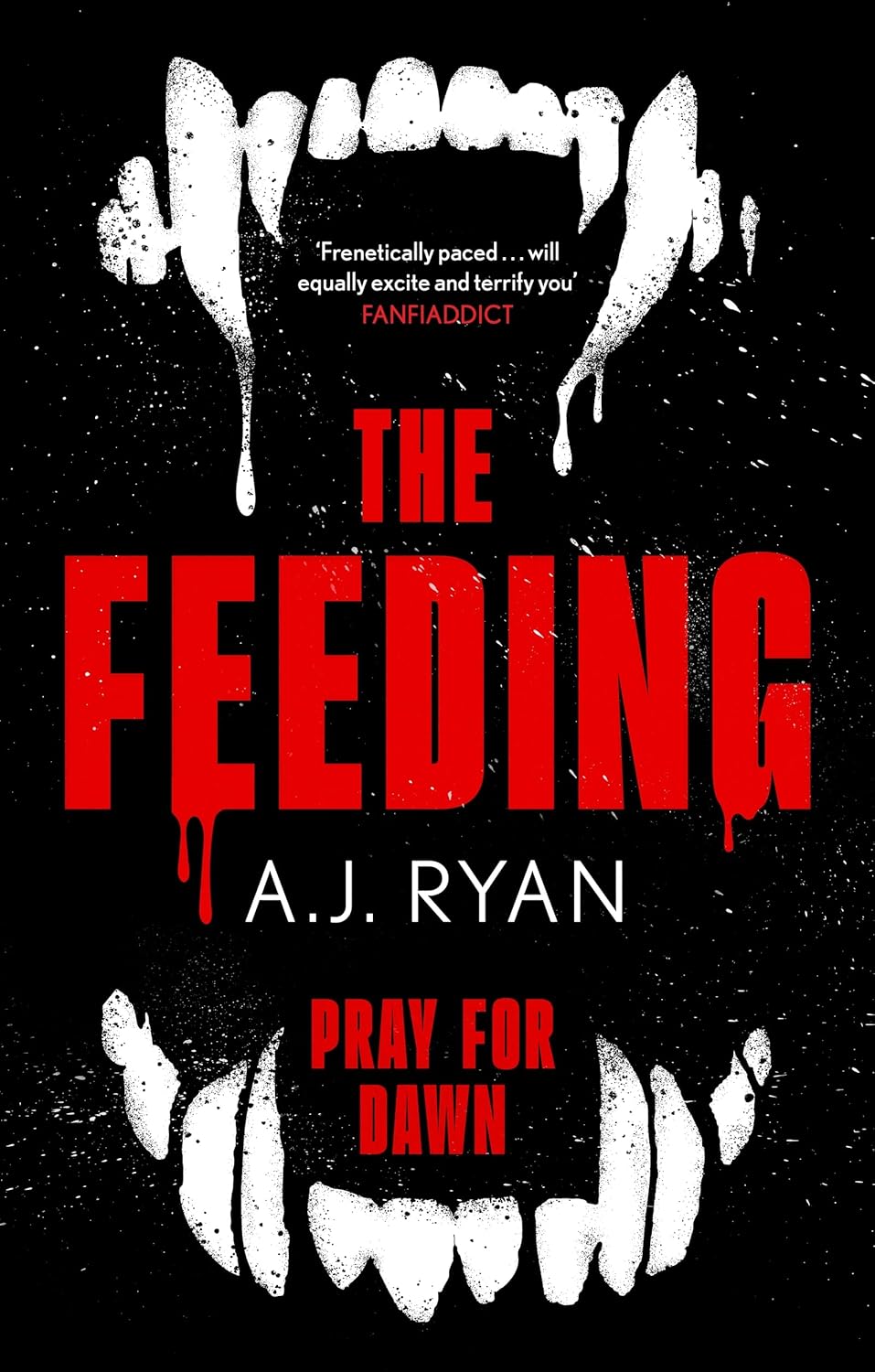
The Feeding by Anthony Ryan

Publisher: Orbit/Blackstone Publishing (Audiobook – 14 October 2025)

Series: Standalone/Book One

Length: 10 hours and 13 minutes

Rating: 5 out of 5 stars

Amazon

Acclaimed fantasy author Anthony Ryan continues to explore the horror genre with the fantastic post-apocalyptic vampire novel, The Feeding, an awesome and deeply addictive read that you won’t be able to read fast enough.

Anthony Ryan is an author I’ve talked a lot about in recent weeks, primarily because his outstanding fantasy novel, Born of an Iron Storm.  The impressive second novel in the author’s Age of Wrath series, Born of an Iron Storm was one of my favourite books, audiobooks and sequels of 2025, and I am currently very excited for the third and final entry in the series, currently titled Upon a Forge of Battle, which is coming out later this year.  However, before we get to that I need to also highlight Ryan’s second book of 2025, the awesome horror novel The Feeding.  Released here in Australia under the pen-name A. J. Ryan, The Feeding is Ryan’s second major horror release after Red River Seven in 2023.  This new horror novel had a great plot behind it, as a desperate protagonist attempts to survive a twisted landscape filled with dangerous monsters.

Plot Synopsis:

Layla has spent her entire life in the Redoubt, one of the last bastions of humanity in a ravaged world. She’s never been beyond the Redoubt’s walls; only Crossers, with their special training and survival skills, are permitted to venture into the shadow-haunted wastelands.

When Layla’s father falls ill, she knows she needs to find a cure. But no such medicine can be found within the Redoubt. Instead, her only chance is to pass a series of gruelling trials to become a Crosser, and then to strike out into the wilderness.

Where the feeders are.

Internationally bestselling fantasy author Anthony Ryan – writing as A. J. Ryan – delivers a nerve-shredding horror novel where humans are no longer top of the food chain.

The Feeding was another extremely awesome novel from Ryan that I ended up powering through in no time at all.  A clever and intense vampire horror novel, The Feeding effortlessly keeps your attention with its impressive worldbuilding and fast-paced story.  I had such an incredible time with this book, and I deeply enjoyed seeing what Ryan could do in the horror space.

The plot of The Feeding was a great, grungy post-apocalyptic read that was a very interesting change of pace from the sprawling fantasy epics I’m used to from Ryan.  Featuring a much more fast-paced story, Ryan quickly and effectively introduces you to The Feeding’s protagonist, Layla, and the dark world she inhabits.  A lowly scavenger in the dying walled city of Redoubt, Layla finds herself desperate enough to become a Crosser, the city’s elite runners who leave Redoubt to trade in the wasteland, to find medicine for her dying father.  This leads to an excellent extended early section of the book where the protagonist needs to go through a compelling Selection process, featuring several trials designed to whittle down the applicants and ensure only true survivors can go over the wall.  This early sequence does an excellent job of hammering home just how dangerous the world outside of Redoubt is, as well as giving some intriguing insights into what the feeders, this universe’s vampire substitute, are capable of.  This first part of the book really sets the tone for the rest of the novel, and I was frankly hooked on The Feeding the second we got to Selection.

I felt that the second half of The Feeding, which takes place primarily beyond the walls, lives up to the expectations Ryan sets up in the first part of the book.  The protagonist and an interesting band of supporting characters enter the desolate wasteland and soon encounter all manner of horrors from wild feeders, even wilder humans, and the general abandonment of the outside world.  Ryan also starts working in an excellent overarching narrative threat that stalks the protagonists from a distance.  While you can easily guess at who or what this threat is, as well as a certain supporting character’s connections to it, the full impact and intensity of this looming danger keep hitting the protagonists hard and fast.  There are some brutal losses as the plot continues, and you are constantly on edge as everything closes in and the stakes keep on rising.

Everything leads up to an intense finale, as after another dark confrontation the protagonist finds herself at her most desperate.  Forced to rely on an unlikely ally, Layla attempts the impossible and soon finds herself stuck in the middle of someone else’s dark tale.  The raw intensity of the plot really grabs your attention at this point, and you are so very eager to see how the book will continue.  Ryan also throws in some interesting additional worldbuilding as the novel heads towards the conclusion, which provides some answers to the questions you’ve built up throughout The Feeding, while also ensuring you’re even more curious about what else is out in the wasteland.  After a gritty final confrontation, as well as some last-minute tragedy, Ryan ends The Feeding on a mostly hopeful and heartfelt note, which includes an excellent family moment bonding over a classic.  This proved to be an excellent end to The Feeding’s standalone narrative, although Ryan does leave the story open for a potential sequel going forward, which I personally would be curious to see.

Ryan pulls together a tight, complex and character-driven narrative in The Feeding that I think worked extremely well.  Grabbing the reader’s attention early, Ryan does an excellent job painting the post-apocalyptic scene, and I loved the complex world of walled cities and vampire-infested wastelands that emerged.  The combined tension of mass human desperation and the dark overwhelming threat of feeders surrounding the city ensures that the reader knows how deadly this version of the world is from the beginning, which ensures you are really invested in the protagonist’s personal journey.  The feeders themselves prove to be outstanding vampiric antagonists for much of the plot, especially with the combination of feral beast gamma feeders and more intelligent betas and alphas, providing some variation in the threat they posed.  Ryan crafts together some outstanding and scary sequences involving the feeders as the novel continues, and your pulse is guaranteed to race every time they appear, especially once the death toll starts to rise.  Combine that with Ryan’s proven ability to write good action scenes, of which there are some fantastic moments, as well as some excellent and compelling supporting characters (try not to get too attached though), and this really was a fantastically written novel.  I was honestly really impressed with how Ryan transitioned from his usual fantasy style to this powerful and moving horror novel, while also retaining his typical imagination and intense storytelling ability.

As has become my habit with all the previous Anthony Ryan novels I’ve enjoyed, I ended up listening to The Feeding on audiobook, which I’ve always found compliments the author’s writing style and worldbuilding extremely well.  This proved to once again be the case for The Feeding, with the format really enhancing the tension and fast-paced sequences loaded into this great horror story.  It helped that they got another very skilled narrator in the form of Devon Sorvari, who took on the role of the one perspective protagonist extremely well.  While it did take me a chapter or two to completely appreciate Sorvari’s narration style, once I got into her groove, I begun to really appreciate her take on the story and the intriguing characters.  Sorvari perfectly captures the damaged and determined spirit of the main character Layla throughout The Feeding, and the alternate accents and voices she brings for the rest of the cast also work really well.  Sorvari also keeps the pace of The Feeding constantly going, and the way she can enhance the tension of the audiobook through her voice work ensures you are constantly on the edge of your seat as you listen to it.  Thanks to this excellent narration, I got through the audiobooks roughly 10-hour runtime extremely quickly, and this proved to be a particularly amazing audiobook to listen to.

Anthony Ryan continues to greatly impress with his captivating and highly entertaining horror novel The Feeding.  Featuring an outstanding vampire-focused narrative in a complex post-apocalyptic world, The Feeding was a very fun and emotionally charged read, that I couldn’t get enough of.  I had such a brilliant time with The Feeding, and it comes very highly recommend as a result.  I will be seeking out more of Ryan’s dives into the horror genre going forward, and I cannot wait to see what other creepy tales he has planned.
Amazon

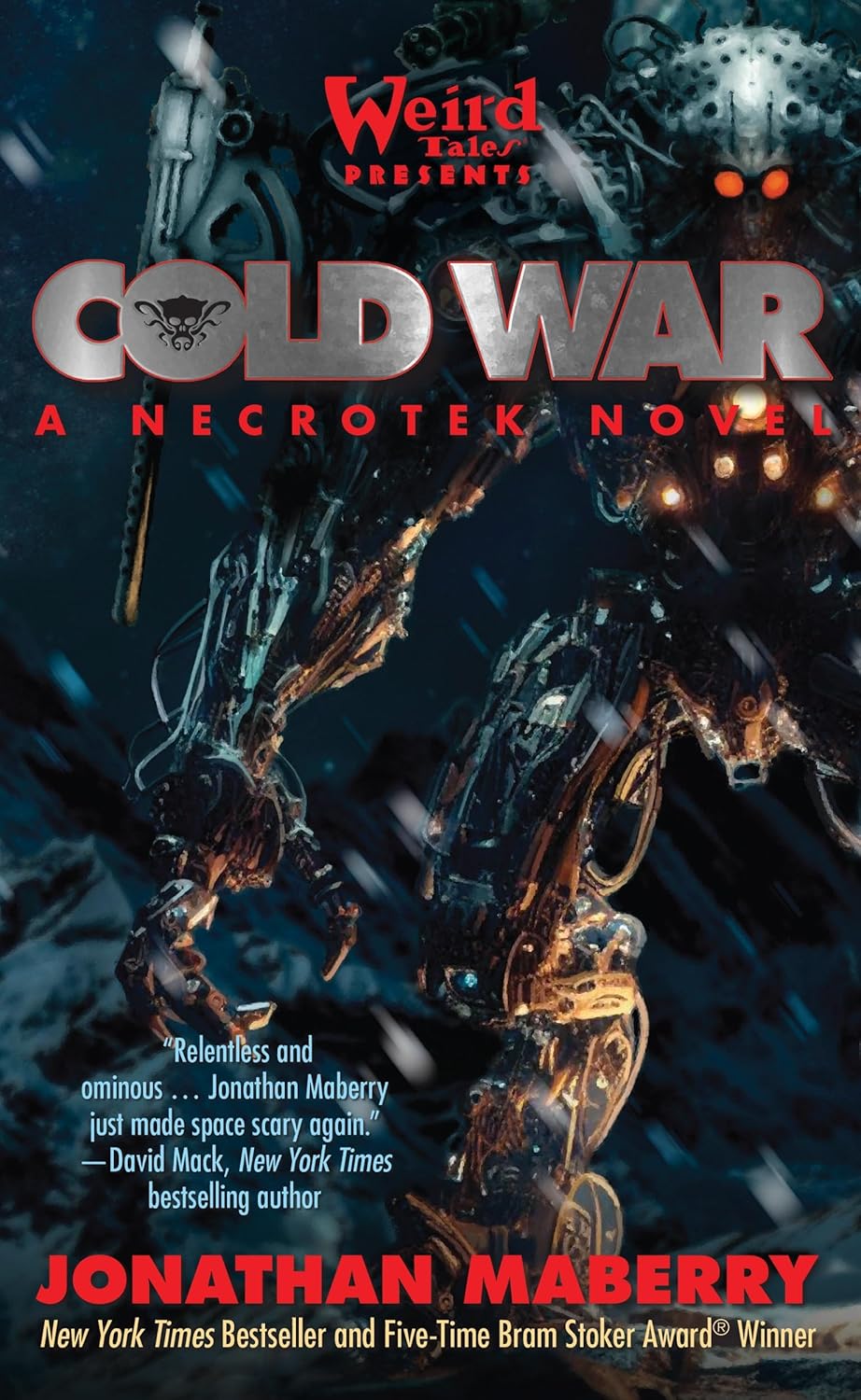
Cold War by Jonathan Maberry

Publisher: Blackstone Audio (Audiobook – 14 October 2025)

Series: NecroTek – Book Two

Length: 19 hours and 33 minutes

My Rating: 5 out of 5 stars

Amazon

The insanity and complex storytelling of Jonathan Maberry’s incredible NecroTek series continues in 2025 with the impressive and deeply intense sequel Cold War.

2025 has been a pretty awesome year for fans of Jonathan Maberry, as we have not only gotten the new Joe Ledger/Rogue Team International novel, Burn to Shine, but Maberry also continued his excellent NecroTek series.  Released in collaboration with the iconic Weird Tales magazine, the series started last year with the amazing novel, NecroTek (one of my favourite books and audiobooks of 2024), this series saw Maberry combine compelling science fiction elements with his love for Lovecraftian horror, when, in the near future, a space station of scientists and soldiers is transported across the galaxy and forced to fight eldritch horrors.  As the book continued, several of the human characters to become the titular NecroTeks, undead pilots of gigantic alien war machines, who are forced to risk the destruction of their souls to fight back against the monsters coming for them.  Due to how powerful, compelling, and occasionally scary this novel got, I have been keen for the sequel, Cold War, for quite some time, and I made sure to check it out the amazing audiobook version of it a few weeks ago.

Plot Synopsis:

In NecroTek, Asphodel space station was accidentally teleported to the far side of the galaxy, where they became embroiled in a never-ending war against ancient cosmic horrors.

But there is much more to the story …

On Earth, scientists uncover an alien spacecraft buried for millions of years beneath Antarctic ice. Inside are terrible secrets and a creature desperate to escape.

Soon the scientists studying the Artifact begin to have terrifying dreams, driving many of them to madness and acts of shocking violence. Dr. Evie Cronin and her team struggle to find answers, fully aware that they may only be found out among the stars. Their investigation brings them to the orbit of Jupiter moments before the WarpLine gun misfires. Destiny is a vicious and devious thing.

On Asphodel Station, the newly created ghost-driven NecroTek fighting machines are engaged in a desperate battle for survival against the deadly shoggoth fleets. But a new and far more dangerous race of creatures is poised to attack, both with their own fleets and with nightmares forced into the minds of the dwindling human defenders.

The group of scientists from Antarctica and the survivors on Asphodel are pitted against an unstoppable enemy. If they fail, Asphodel Station will fall, and the Outer Gods will be free to wage a war of conquest across the galaxy—to Earth itself.

Jonathan Maberry once again delivers an impressive read with his outstanding and complex Cold War.  Featuring an intense, character driven story that takes its protagonists to hell and back, Cold War was a powerful, horror-laden science fiction novel that refuses to let you go.  I loved this book so much, and it gets a very easy five-star rating from me, and I have recently featured it on my recent favourite sequels and audiobooks lists of 2025.

Maberry produced a very exciting and captivating narrative for Cold War that goes in a very different direction than I would have expected after NecroTek, but which works as a very effective and expansive sequel.  Initially showcasing the events in the aftermath of NecroTek and the first big battle for Asphodel Station, the reader is quickly and effectively reintroduced to the key characters from the first book and given an update on how they have continued to adapt to being transferred across the universe.  The early chapters of Cold War also take the reader back in time a few years before the events of the first book, when a group of scientists uncover an ancient alien artifact in the Antarctic snow, keeping it secret from the world and all the protagonists of the first book.

Cold War’s narrative soon develops an interesting and noticeably uneven split in the storylines.  While a good chunk of Cold War continues to showcase the figures on Asphodel and their multiple struggles, including the slow reveal of a new terrifying group of antagonists, much more focus is given to the Antarctic research plot line, with longer chapters dedicated to this part of the book.  While this move away from the established plot is surprising, I personally thought it was very clever, as it allowed Maberry to further expand both the cast and the lore around the threats humanity was facing, while also bringing the story back to Earth.  The cool exploration and first-contact scientific elements of this Antarctic storyline were also deeply compelling, and I got extremely absorbed in this part of Cold War’s narrative as the book continued.  While there was more of a focus on the Earth-based narrative, the story around Asphodel was still very impressive, with some complex character development, multiple ultra-exciting sequences of space combat, and a growing sense of dread as dark forces stalk the protagonists.

The final third of Cold War sees the book’s two separate storylines come together in very direct way, which allows many of the unique characters developed in both NecroTek and Cold War to come together.  While the transition to this part of the book is quite sudden, it allows for a very exciting end run of the book, as Maberry pumps up the action, and takes the protagonists through hell and back.  Maberry brings out all his best horror writing as the now combined cast are forced to contend with a terrifying array of monsters and eldritch creatures, including another zombie substitute (Maberry loves his zombies).  All the storylines from the first half pay off in this final part of Cold War, and while there aren’t too many surprises, you’re constantly on your feet as you wait to see who’s going to survive and which side characters are going to get killed off.  The author leaves Cold War on a very interesting note, and I’m already extremely curious to see where he takes the NecroTek series going forward.

Maberry utilised his distinctive and well-honed thriller writing style in Cold War, which combined nicely with the science fiction story and the overarching horror vibes to create a brilliantly intense and fast-paced read.  Once again breaking the story up into a series of short and sharp alternating perspective subchapters, Maberry constantly jumps Cold War’s story between multiple key protagonists, as well as some antagonists, to produce a wonderfully layered and powerful narrative that constantly has multiple awesome interlocking storylines on the go.  This quick-paced style works well to enhance both the book’s horror and science fiction elements, and the constant jumps also increase the tension of the plot and produce some excellent action sequences, including some truly unique and ultra-impressive space combat sequences.  There were also some new delightfully terrifying horrors determined to kill the protagonists both in their dreams and real life cleverly introduced in this novel, and Maberry did an amazing job building them up as a threat the entire book.  Maberry also effectively splits his book into two separate narratives for much of Cold War’s runtime, with alternating chapters diving between the events in the present at Asphodel Station and the prequel storyline in Antarctica.  This cool split really changed the feel and focus of Cold War compared to NecroTek, and while Maberry allowed both storylines to run mostly independently, they also worked well to support each other.  All these great writing techniques and narrative choices allowed Cold War to really stand out as a sequel, and I liked how much stronger Cold War turned out as a result.

While Cold War does work extremely well as a sequel, with the author’s excellent storytelling choices and alternating timelines really adding a lot to the story from NecroTek, it does mean that this book is probably not as accessible to new readers as some of Maberry’s other works.  Maberry does do his usual excellent job of recapping key events in the text as the book continues, so new readers do get a pretty good idea of what happened and who the key figures are.  However, the full emotional impacts of events, as well as the significance of some of the revelations coming to light in Cold War’s big prequel narrative in Antarctica really aren’t going to hit readers as hard if they haven’t read the first book.  Indeed, Cold War might be best read by established fans of Maberry, who will appreciate the author’s continued utilisation of Lovecraftian elements, as Maberry continues to showcase his love for the classic horrors with some fun science fiction twists.  Experienced Maberry readers will also be more used to the author’s extreme content, as Cold War is as dark and disturbingly over-the-top as many of his books, with some very adult horror moments.  Readers should also be on the lookout for easter eggs to some of Maberry’s works, including a fun reference to the antagonist of the Joe Ledger novel Dogs of War.  As such, this is very much a book for those readers familiar with the author, although I think new fans would be in for an excellent time.

As with most of Maberry’s writing, one of Cold War’s big strengths is its excellent contingent of complex and often highly damaged characters, whose unique interactions and experiences during these terrifying times frame the book’s captivating narrative.  Cold War contains an interesting mixture of returning figures from NecroTek and a new batch of protagonists who end up taking over a good part of the plot.  This includes Professor Evie Cronin, the leader of the expedition who discovers the alien artifact in Antarctica.  Evie serves as a great new major protagonist for the series, and Maberry’s choice to set much of Cold War’s narrative around her, ensures that the NecroTek books continue to have a strong scientific basis to their narratives.  The author really tries to capture the shock, excitement and fear that would accompany the discovery of an alien ship through Evie’s experiences in Cold War, and she serves as a relatable and likeable major focus for much of the book’s plot.  Maberry also works in a nice romance angle between Evie and shooter Jenny Spears, that serves as a big emotional part of Cold War’s plot, and which added to the stakes and impact of some of the high-tension sequences.  Of the remaining new characters introduced in Cold War, my favourite was probably Dr Torquil Brollachan, a government scientist who takes over the investigation of the alien artifact.  A complex and guarded figure, Dr Brollachan serves as an interesting foil to Evie and his secret motivations and dangerous priorities turns him into a bit of a Dr Frankenstein figure at times (an apt comparison that Dr Brollachan would appreciate), resulting in some fantastic reveals in the second part of the book.

While these new characters are impactful and have some very compelling storylines around them, their inclusion does mean that the cast introduced in NecroTek don’t get as much time to shine as they previously did.  Still Maberry keeps many of their storylines going, and all of them serve as a key part of the book’s plot.  This includes the main character from the first book, Dr Lars Soren, whose steady presence continues to be a great part of Cold War, and I enjoyed how Maberry further explored his cosmic philosophy ideas in the interludes.  The continued inclusion of the dead characters brought back as NecroTeks was also very compelling, with their experiences, including that of Bianca Petrescu, providing some complex existential elements to the plot.  I also liked how Maberry choice to focus a lot more on pilot character Lieutenant Commander Veronica Roland, better known as Calisto, who was forced to step up and lead the human pilots defending Asphodel Station.  Calisto’s struggle to become a leader, as well as the distinctive and beautifully written fighter combat sequences, are another amazing highlight, and I appreciated how well her scenes were written in this sequel.  Throw in the entertaining Irish necromancer, Lady Jessica, who spends much of the book recovering from the events of NecroTek, and the cast of Cold War was a very awesome part of this book, and I personally cannot wait to see where all their captivating and haunting personal stories go from here.

Like I have with all the other Maberry novels I have had the pleasure of reading, I ended up enjoying Cold War on audiobook, which I find is the best way to enjoy the author’s thrilling narratives.  I always find that Maberry’s dark tales and intricate and exciting writing style always translate nicely to the audiobook format, and they tend to be some of the best listens each year.  Indeed, as I mentioned above, Cold War was one of my favourite audiobooks of 2025, and I ended up powering through this new audiobook’s 19-and-a-half-hour-long runtime.  Much of Cold War’s epic success on audiobook once again lies in the narration of Maberry’s long-time audiobook collaborator, Ray Porter.  Porter, who is one of my favourite audiobook narrators, always perfectly matches the dark and sinister tones of Maberry’s writing, and I really love the sense of menace and intensity he brings to audiobooks like Cold War, as he conveys the underlying threat and fear Maberry weaves into his tales.  Porter also expertly delivers all the book’s awesome action, great humour, and other deeper emotions, to the listener and there is always a great synchronisation between Porter’s narration and the intent of Maberry’s writing.  Porter also has an outstanding array of distinctive voices for the book’s characters, and I love how he always manages to bring the best out of Cold War’s complex casts.  All these voices, including for the various new characters introduced in this sequel, were extremely fitting for their respective cast member, and I appreciate how effectively Porter portrays each figure’s emotions.  Porter also does an exceptional job voicing the sinister monsters and other eldritch figures haunting the protagonists, and the impressive array of creepy voices really emphasises the dark nature of Cold War’s story to the listener.  All this results in quite an exceptional listen, and it’s one that I cannot recommend enough.  Honestly, I don’t think it’s going to be possible for me to ever not enjoy a Maberry novel on audiobook, especially if Porter is narrating, and there is a reason these epic listens always top my best audiobook lists each year.

Maberry’s outstanding NecroTek series continues in extremely strong fashion with the extremely captivating Cold War.  Cleverly expanding on the story from the first novel, NecroTek, Cold War effortlessly kept up the terrifying tension as multiple compelling characters continue to experience the dark horrors the universe has in store for them.  I had an exceptional time with Cold War, and I have no problem letting you know that this book will be appearing in my favourite novels of 2025 later this week.  I’m also extremely excited as a Maberry fan for 2026, as not only do we have the new Joe Ledger book, Red Empire, coming out in March, but the NecroTek series will also thankfully be continuing, with a third novel, Ghosts of the Void, tentatively set for release towards the end of the year.

Amazon

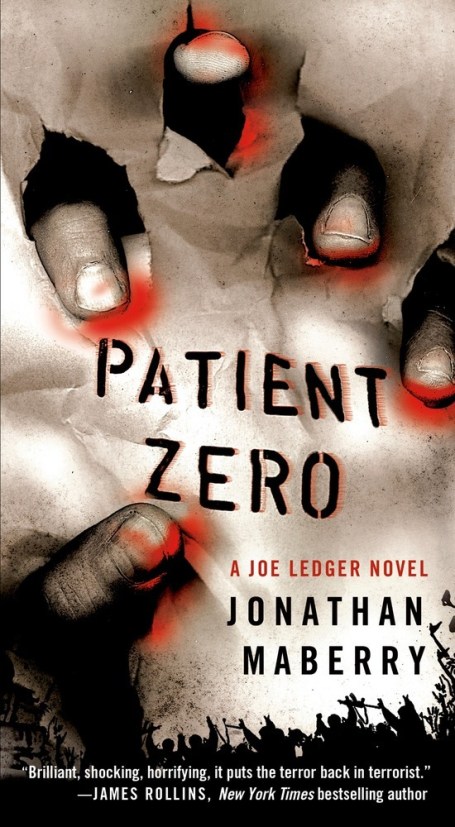
Throwback Thursday: Patient Zero by Jonathan Maberry

Patient Zero Cover.jpg

Publishers: St. Martin’s Griffin

                       Blackstone Audiobooks

Publication Date – 3 March 2009

Amazon     Book Depository

Reviewed as part of my Throwback Thursday series, where I republish old reviews, review books I have read before or review older books I have only just had a chance to read.

A couple of weeks ago I listened to and reviewed the latest book in Jonathan Maberry’s Joe Ledger series, Deep Silence, and found myself hooked on the insane, mad science based thriller adventure.  After enjoying Deep Silence and giving it a five-star review, I started checking out some of the previous books in the Joe Ledger series that I had not had a chance to read before, and found myself enjoying the plot concepts of the other books in the series.  The moment I finished listening to Deep Silence, I immediately jumped back to the first book in the series, Patient Zero, to review as part of my Throwback Thursday series.

When Baltimore detective Joe Ledger is assigned to a joint terrorism taskforce, he thinks it is an opportunity to fight back against the people responsible for 9/11.  What he was not expecting was to have a crazed man try to bite him on his first raid with the taskforce after discovering a warehouse filled with terrorists.  His elation about a job well done is destroyed when he encounters one of the terrorists again later that week.  There is just one problem: Ledger knows that he killed him during the first raid.  Someone has created a terrifying bio-weapon that can turn ordinary people into zombies, and worse, they have supplied this virus to a destructive terrorist organisation that plans to release it within the United States.

As the full extent of the horror being unleashed against them is revealed, Ledger finds himself recruited into a newly created covert organisation that was set up to handle extraordinary threats such as this.  Known as the Department of Military Sciences (DMS), this organisation wields the latest technology and the country’s brightest scientists under the command of the mysterious Mr Church.  As a member of the DMS, Ledger leads an elite team of combat specialists in the field in an attempt to contain any attempts to unleash the virus on the population and to destroy those who have already been infected.  As Ledger’s investigation progresses, he uncovers an elaborate conspiracy that will have devastating impacts for all of humanity.  But with the fate of the world in the balance, it soon becomes clear that there is a traitor within the DMS who has no qualms about unleashing a zombie apocalypse.

I have to admit that after absolutely loving Deep Silence, I had very high expectations when I started reading Patient Zero.  Luckily I was not disappointed and found that Patient Zero had a fantastic action based storyline that makes good use of its mad science elements to create an intense and very enjoyable novel that sets up all the elements for this future series.  I also chose to check out the first book in this series in its audiobook format, which, at just under 15 hours, is a great way to enjoy this high-octane story.

Hands down, the best thing about this novel has to be the zombies and the way that Maberry has created a compelling and intricate thriller story around this classic horror story concept.  The thriller aspect of this is really clever.  Rather than being the central antagonists themselves, the zombies are a tool being utilised in a wide-reaching conspiracy that the protagonists have to unravel in order to figure out the origins and endgames of the book’s true antagonists.  These thriller elements are quite detailed, and Maberry utilises a number of chapters told from the antagonists’ point of view to add some depth to the conspiracy and showcase the extent of their plot, as well the problems these groups have.  The protagonists also have to deal with potential traitors in their ranks, advanced science that they do not understand and a surprisingly organised, devious and well-equipped terrorist organisation.  All of this is an extremely captivating thriller storyline, and I love how Maberry has managed to utilise the book’s zombie element to help flesh this out.

Maberry has also created a unique and intriguing zombie origin for this book that is based on potential real-life science.  The zombies in this book are the result of a disease rather than a supernatural calamity.  They have been created by some advanced science and extreme mutations of existing diseases and viruses, such as prion diseases.  As a result, Maberry and his characters spend a lot of time examining the potential science behind this zombie virus, which pulls the reader in as they consider how close something this crazy could be to a reality.  I was really struck by the way that Maberry tried to show the horror that these creatures would inflict on the people who encounter them, and the sheer terror that they inflect on normal humans.  The point-of-view protagonists spend significant time explaining how terrifying and emotionally damaging it is to have to encounter and fight these infected people, as well as how guilty they feel about having to kill them.  There are quite a few parts of the book where the characters discuss how damaging these events are to them, and it really adds some emotional gravitas to this story.  Maberry is a prominent author of zombie fiction, so it is no surprise that he is able to create quite a number of awesome and terrifying scenes featuring the zombies as they attack and kill all around them.  There are also some interesting zombie deviations that appear and offer some unique elements to the story.  Overall this is an incredible and memorable addition to this story and one that will really appeal to fans of zombies and the horror genre.

Action is a major part of the Joe Ledger series, as the protagonist leads an elite special forces unit against all these elite scientific threats.  As a result, there are a huge number of action sequences throughout this novel and the reader is constantly left with a racing pulse.  There are so many great fast-paced elements throughout Patient Zero for action junkies to enjoy.  Maberry is always great at describing special forces tactics in his stories, and I enjoyed seeing them used against the unique threats in this book.  There are a number of excellent firefights throughout the story, and the author has a great mind to examining the psychology of a gun battle.  Maberry’s love of martial arts and close-combat fighting once again shines through in Patient Zero, as his protagonist is an expert fighter who has innumerable hand-to-hand fights with a number of different opponents.  While the above actions scenes are all extremely awesome, the best scenes have to revolve around the desperate fight between these elite soldiers and the horde of zombies that they encounter.  These scenes are really fantastic and watching the special forces characters fight tooth and nail against a horde of zombies becomes a captivating and powerful part of this book.  There are quite a few crazy action scenes throughout Patient Zero for the reader to look out for and which are defiantly a highlight of the book.  I personally found that listening to these scenes in the audiobook format really brought me into the centre of the action, and it was an excellent way to enjoy this element.

Patient Zero is an excellent introduction to the Joe Ledger series and contains a number of elements that will continue into the rest of the series.  I came to this book having first read the 10th and latest book in the series, Deep Silence.  As a result, I was really intrigued to see what characters were introduced in the first book and which ones do not appear in the final book of the series.  There are some interesting differences between Patient Zero and Deep Silence that I found quite fascinating.  For example, the opponents and technology in this first book are a lot more realistic, as Maberry has yet to start utilising the Lovecraft-inspired aliens which feature in some of the later Joe Ledger novels.  The head of the DMS, the mysterious Mr Church, also comes across as a much colder character in this first book, as well as someone who is more comfortable with civilian deaths and sacrifice if it results in the survival of the rest of the world.  That being said, there are some familiar elements.  Ledger is still an incredibly sarcastic and funny protagonist, and the author tries to highlight a huge range of varied viewpoints to show the whole range of the plot the DMS is trying to unravel.  Patient Zero serves as a great introduction to the DMS, and I really enjoyed seeing the early days of this organisation.  I also love how everyone is quite confused about what this organisation is and the mystery around Mr Church, who appears to have an incredible amount of influence and power in Washington.  For example, at one point he actually tells the president of the United States that he is wasting his time and hangs up on him in, an action an incredulous Ledger describes as “bitch-slapping the president”.

Patient Zero is an incredible first novel in Jonathan Maberry’s incredible Joe Ledger series and one that serves as a fantastic introduction for readers unfamiliar with this series.  Featuring all sorts of mad science, impressive action sequences, a five-star thriller storyline and a ton of amazing zombies, this is an outstanding novel and one that proves very hard to put down.  After loving this book, as well as the latest book in this series, Deep Silence, I am now fully determined to read the rest of the books in the Joe Ledger series.  Fully expect to see a review for The Dragon Factory very soon; I have no doubt that I will really enjoy that book as well.

My Rating:

Five Stars

Amazon     Book Depository