Throwback Thursday: Usagi Yojimbo: Volume 6: Circles by Stan Sakai

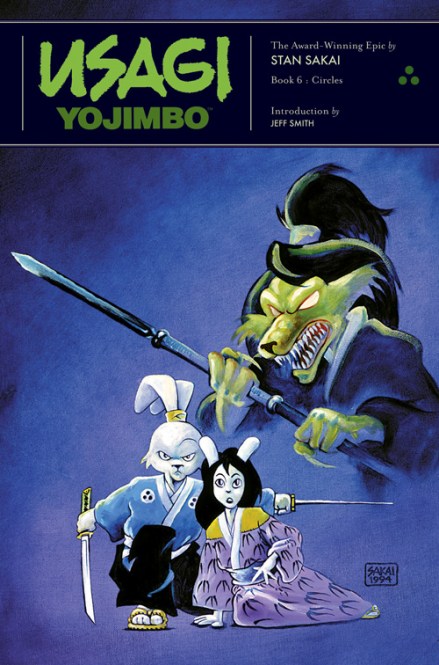
Usagi Yojimbo Circles

Publisher: Fantagraphics Books (Paperback – 1994)

Series: Usagi Yojimbo – Book Six

Length: 164 pages

My Rating: 5 out of 5 stars

Amazon     Book Depository

Reviewed as part of my Throwback Thursday series, where I republish old reviews, review books I have read before or review older books I have only just had a chance to read.

For this latest Throwback Thursday, after reviewing Lone Goat and Kid a couple of weeks ago, I am still in a Usagi Yojimbo mood, so I thought I would check out the sixth volume of this fantastic comic book series, Circles.
Usagi 25

Circles is another fun and exciting addition to this excellent series which I honestly cannot praise enough (although I have been trying very hard in my last several Throwback Thursday articles). This sixth volume once again presents the reader with several outstanding and inventive stories that chronicle the adventures of the rabbit samurai, Miyamoto Usagi, as he journeys around a unique version of historical Japan. This volume contains five separate stories, derived from issues #25 – 31 of the Fantagraphics Books run on the Usagi Yojimbo series, as well as a short story taken from Critters number #50 (a comic magazine that had some early Usagi Yojimbo appearances). There are some rather amazing stories featured within this volume, and I had an incredible time reading them.

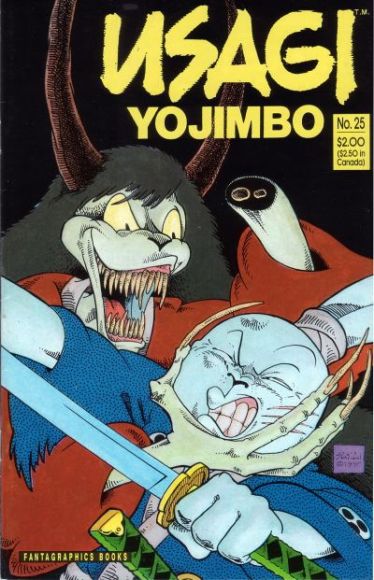
The first story contained within this sixth volume is called The Bridge, which sees Usagi encountering a demon out of Japanese folklore. During a dark a stormy night, Usagi is entering a village from across a bridge when suddenly he lashes out with his sword behind him, convinced something is sneaking up on him. When he finds nothing there, Usagi shrugs it off and enters the nearest inn, only to learn from the villagers that the bridge he just crossed has been possessed by a demon, and Usagi’s back now bears the claw marks of the demon. Awaking next morning, the villagers find a severed monstrous hand on the bridge, which Usagi appeared to have cut off the night before. Taking the hand into the inn, Usagi and villagers wait for a priest to arrive in order to perform an exorcism on the severed limb, but the demon of the bridge has other plans.
Usagi 26

This was a rather good supernatural story that sees Usagi go up against one of Japan’s many demons and monsters. Several significant elements from this story are taken from the story of the demon of Rashomon Gate, including the severing of the arm and the demon disguising itself as an old woman to recover its severed limb (although unlike the samurai in the legend, Usagi doesn’t fall for it). The demonic antagonist of this story is rather sinister in its drawing style and methods of attack, and it proves to be a dangerous opponent for Usagi. I love the extended fight on the bridge, and I especially enjoyed the way that the whole event ended, providing a side-character in the story their moment of vengeance. Overall, this was a tight, well-written story that was a lot of fun to read.

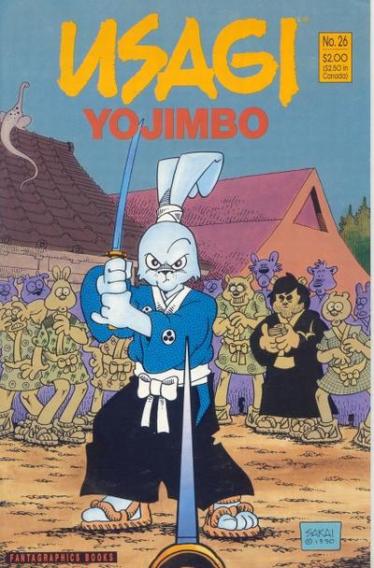
The next story in this volume is titled The Duel, and, as the name suggests, it features some duels between samurai. Usagi arrives in a village and is challenged to a public duel by the local champion while the watching villagers place bets with a travelling bookmaker, a duel that eventually results in Usagi’s opponent’s death. Completing the duel, Usagi meets and has lunch with a fellow unemployed samurai, Shubo, who subtly takes his measure. It is revealed that Shubo, who is a talented swordsman, is in league with the bookmaker who manipulates the odds of Shubo’s duels in order to make money off the betters. Shubo, who needs the money to provide for his wife and child, believes that he can beat Usagi, and the bookmaker inflates the odds in Usagi’s favour so that they can clean up when Shubo wins. Forcing Usagi into a duel, the two engage in a quick fight to death, with tragic results.
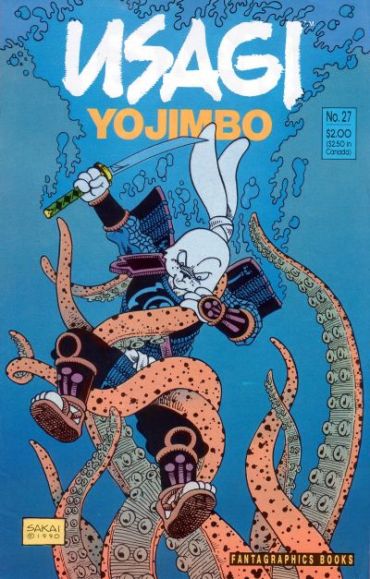
Usagi 27

This was a really clever and captivating single story that Sakai did an incredible job writing. The whole story concept is just brilliant, and Sakai sets it up and executes the plot brilliantly. There are some amazing scenes throughout The Duel, and the story features an excellent mix of comedy and tragedy which work together amazingly to produce a gripping narrative. Usagi, as the reluctant participant of this duel, is pissed at the entire affair, and his outraged reaction to the town people cheering his victory is rather good, especially as the peasants show over-the-top fake remorse in order to get him to go away so they can collect their winnings: “We are lower than the scum at the bottom of a stagnant pool!” While there is some fun and well-deserved karma coming down onto the bookkeeper who overextends himself and tries to escape, nothing quite takes away from the tragedy of Shubo’s wife and young child. The final panel of this story is incredibly heartbreaking, as it shows the wife and child waiting just outside the village for him to return. But as the light in the sky gets darker and darker, you can see the worry start to work its way onto the wife’s face, until she breaks down completely in the final panel, fully realising that her husband is dead. The wife comes across as a massively tragic character in this story, and the major impact that this final page has is a testament to how amazing Sakai’s storytelling and illustrations are.

The third story in the volume is the rather short entry, Yurei, which is the story that appeared in Critters. In this tale, Usagi, who is camping at the edge of a river, awakens to find a Yurei, a ghost, floating before him. The ghost imparts her tragic story to Usagi; she was betrayed and murdered by her husband, and she now seeks justice. Usagi then awakens and finds a woman’s hairpin on the ground next to him. Thinking his encounter with the ghost was just a dream, he travels to a nearby inn and attempts to trade the pin for a meal. What he does not realise is that the innkeeper is the murderous husband from the ghost’s tale, and his discovery of the pin leads to a series of deadly events. This was a good, fast-paced story which tells a compact and intriguing tale. I loved the supernatural elements in this story, and it was interesting to see Usagi portrayed as a tool of fate, who wonders into some ghostly revenge without even realising it. This was a fantastic short entry in this volume and was great to check out.
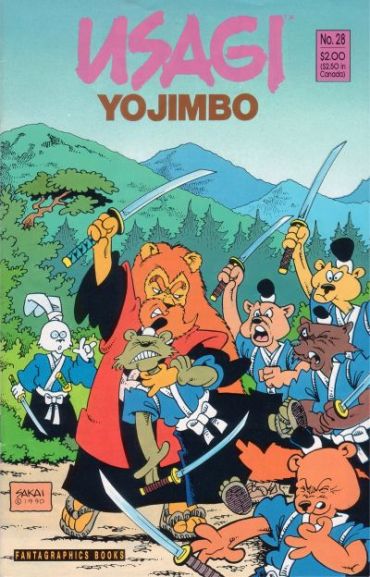
USagi 28

The next entry in Circles is an entertaining and over-the-top tale titled My Lord’s Daughter. In this story, Usagi, who is telling a bedtime tale to children, is shown as the classic hero from Japanese legend, fighting through vast hordes of demons, monsters, and obstacles to rescue a beautiful princess from an Oni. This was a fun take on some of the traditional Japanese heroic legends, and it was cool to see Sakai draw a classic tale with Usagi as the protagonist. Sakai has some obvious fun setting the Usagi hero fearlessly against armies of demons and monsters, and he comes up with some clever fight sequences and scenes in this book, from a brutal duel with an Oni, to an underwater battle between Usagi, a shark and a giant octopus wielding several swords in its tentacles. This is an entertaining and exciting story, and I had a good laugh at the end reference to Sakai’s old comic, Groo the Wanderer.

Now let us get to the fifth story of this book, which is kind of the main event of the entire volume. This is a big story, told across four issues, titled Circles. This story follows Usagi as he returns home for the first time since the events of volume one, The Ronin. There are actually a couple of distinctive parts to this story, especially the first issue, which is somewhat separate from the rest of the story (with the exception of some build-up at the end). For this first part, Usagi, on his way back home, decides to stop at his old master’s house to pay his respects to the grave marker of Katsuichi, the man who taught him how to wield a blade. The story then shows a flashback, which serves as a continuation to part of the origin story Usagi told in the second Usagi Yojimbo volume, Samurai, about Usagi’s past. In the flashback, it is shown that Usagi’s master was ambushed and seemingly killed by members of the Dogora Fencing School after Usagi beat their students in a tournament. However, upon arriving at Katsuichi’s old house, he discovers that his master is still alive, having survived the ambush, and has taken on a new student. I liked this revisit of Usagi’s origin story with Katsuichi, although the whole death scene in the flashback comes a little bit out of nowhere. Still, it was interesting to see how much Usagi has matured since he was learning the way of the sword, and it was nice to see the teacher and student reuniting. The flashback sequence is also top quality, and Sakai illustrates up a storm in this one, showing a fierce battle and some intense emotions from Usagi, who goes from a full-on berserker rage as he gets his revenge on his master’s killer to an intense grief in just a few scenes.
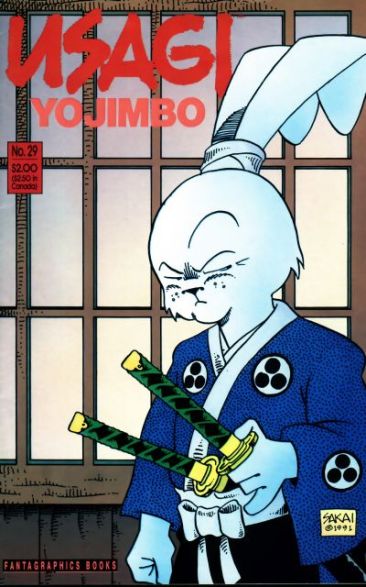
Usagi 29

The story then continues as Usagi journeys back to his village, only to be confronted by his old childhood rival, Kenichi. It turns out that Jotaro, Kenichi’s son with Usagi’s former love, Mariko, has gone missing, and bandits are roaming the area. While Usagi and Kenichi are able to defend their town from a raiding party, the attackers reveal that Jotaro has been kidnapped by the bandits and are holding him hostage. Leading an army of local peasants against the bandit’s hideout, Kenichi and Usagi hope to rescue Jotaro and end the raids that have been plaguing them. However, what they do not realise is that the bandits are being led by the deranged and dangerous former adversary of Usagi, Jei, a mysterious and seemingly unkillable murder with a black blade, who hopes to use Jotaro to get his revenge on Usagi. But even Jei is not the most dangerous thing that lies ahead, as old resentments between Usagi and Kenichi, their shared love for Mariko and certain revelations may tear everything apart.

Wow, I have to say that the final three issues of Circles are just incredible. There is so much to unpack from them, as Sakai brings together a brilliant and powerful story. First of all, it was great to see Jei return as a villain once again. Jei, who was introduced in volume 3, The Wanderer’s Road, is an outstanding antagonist, and his continued feud with Usagi is just brilliant. The two engage in a fantastic and extended duel in this story, and Sakai did a fantastic job showing off each combatant’s skill and martial ability through his drawings. I also love the extensive battle between Kenichi’s peasant army and the bandits, which proved to be rather eye-catching. Not only is there a beautifully drawn sequence in the misty forest before the big battle in which Usagi does a great Jei impersonation to scare a bandit sentry, but Sakai illustrates a massive battle between the two forces. The massive single panel that shows the pitched battle is just impressive, and I love the detailed and entertaining scene that the author produced here.
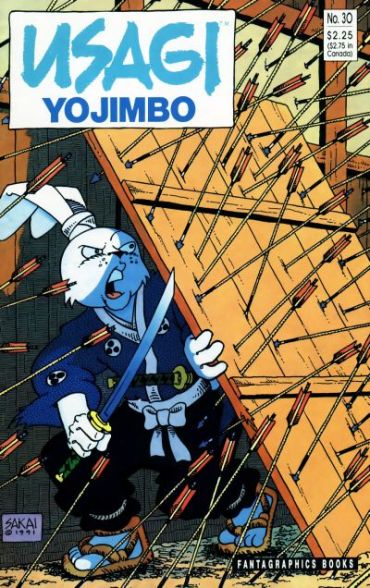
Usagi 30

While all of the above is pretty amazing, what really makes this captivating story is the complex relationship between Usagi, Kenichi and Mariko. There are so many great layers plastered into this relationship. Usagi and Mariko were deeply in love when they were younger, and they still have great feelings for each other. However, Mariko ended up marrying Kenichi, and she is bound by duty, and her child, to him, no matter how she feels about Usagi. Kenichi, on the other hand, has always borne antagonism towards Usagi, which has been compounded over the years by their differences in skill and the fact that Usagi was chosen to serve Lord Mifune and left the village. However, Kenichi’s resentment towards Usagi is even greater, as he knows that Usagi is in love with his wife, and that these feelings are reciprocated by Mariko.

This leads to some outstanding scenes throughout this story, as these three try to come to terms with their complicated emotions. I particularly loved one scene in the middle of the story, where Usagi and Mariko discuss their feelings and reveal that they still both love each other, although Mariko makes it clear that they can never be together. The scene ends when Kenichi interrupts them, and while the look of heartbreak and shame on Mariko’s face is notable, what really gets me is the way that Kenichi’s usual stern/angry look is replaced with one of sad resignation in the last panel once he realises how Mariko still feels about Usagi. Despite this, Kenichi comes across in this story as a surprisingly honourable and well-intentioned character who puts aside his negative feelings for Usagi for the greater good, and it is a fantastic examination of a character who has mostly been antagonistic in the previous volumes. Sakai also drops a massive bombshell at the end of this story, when he reveals that Jotaro is actually Usagi’s son, and that Kenichi has known this and raised him as his own. Because of this, Mariko asks Usagi to leave and not try to settle down in their home village, as she fears it will put a wedge between Jotaro and Kenichi, who she sees as Jotaro’s true father. Usagi regretfully accepts this in another dramatic and captivating scene, although Mariko arranges for Usagi to see Jotaro as he leaves, and Usagi has a heartfelt time with his son, noting the similarities between them, and even suggesting Jotaro seek out Katsuichi as a teacher in later years. All of this is some first-rate storytelling and character development, and cannot praise Sakai enough for this amazing, emotional storyline. This is actually the last book that Kenichi and Mariko appear in (so far), and I think that Sakai did a fantastic job tying their love triangle together. All in all, Circles is easily my favourite story in this entire volume (The Duel comes close), and it is worth grabbing this volume just to check this key story out.

Usagi 31

It should come as no surprise to anyone considering all the praise I elicited above that I am giving this sixth volume of Usagi Yojimbo a full five star rating. This was another incredible comic book that features Sakai’s outstanding blend of powerful stories, memorable characters, intense action, fun references and depictions of traditional Japanese culture and history and some truly impressive artwork. I absolutely loved this volume, and this entire awesome series, comes highly recommended and is an unquestionable must-read.

Amazon     Book Depository

Throwback Thursday – Predator One by Jonathan Maberry

Predator One Cover

Publisher: Macmillan Audio (Audiobook – 7 April 2015)

Series: Joe Ledger series – Book Seven

Length: 16 hours and 55 minutes

My Rating: 5 out of 5 stars

Amazon     Book Depository

Reviewed as part of my Throwback Thursday series, where I republish old reviews, review books I have read before or review older books I have only just had a chance to read.

For this latest Throwback Thursday, I decided to I wanted something fast-paced and action-packed, so I went and checked out another book in Jonathan Maberry’s dark and thrilling Joe Ledger series with the seventh book, Predator One.

Those familiar with my blog will be aware of my recent love affair with the Joe Ledger series. I first encountered this series back in late 2018, and after massively enjoying the tenth book, Deep Silence, I have been slowly reading and reviewing my way through the entire series from start to finish. There are so many different things that I enjoy about these novels, including the outstanding action, gripping stories, fantastic characters and the crazy scenarios each book is set around. When combined, these elements help produce some truly incredible books, and I had an amazing time reading several Joe Ledger novels last year. I also read the first book in Maberry’s Rogue Team International series, Rage, which was one of my top books (and audiobooks) of 2019. I am hoping to finish off all the remaining books in the Joe Ledger series this year, and Predator One is the first one that I have so far checked out in 2020. I have to say that I was once again blown away with Maberry’s writing ability, as Predator One is another epic and remarkable read which gets a full five-star rating from me.

It is the opening day of the new baseball season, and Joe Ledger, point-agent for the high-tech counter terrorist organisation, the Department of Military Sciences (DMS), is enjoying a well-earned day off. Everything seems to be going well, the sun is shining, the beers are flowing, and a decorated military pilot is about to throw out the first ball. Then a model airplane flies out onto the field, a replica of the one flown by the war hero. Everyone assumes it’s a harmless prank, everyone except Ledger, who can only watch in horror as the toy plane explodes. Within seconds, a swarm of bomb-laden drones appears, devastating the crowd and leaving Ledger injured in the wreckage of the stadium.

As Ledger attempts to process what has happened, a series of coordinated attacks are taking place across America. While some of the attacks appear random, several are deliberately targeting the friends and family of key members of the DMS, attempting to distract the agency and take them off the board. It soon becomes clear that an old enemy has risen from the flames, determined to get revenge on those that they believe have wronged them in the past, including Ledger and everyone he loves. Worse, they have teamed up with a force of pure evil whose deepest wish is to torment and destroy the head of the DMS, the mysterious Mr Church.

Diving back into the action, Ledger and his team attempt to find and neutralise the source of this new threat. But at every turn, they find themselves outmatched, outmanoeuvred and severely outgunned, as the enemy has access to advanced technology that allows them to take control of America’s military vehicles, aircraft, ships and drones. As the attacks against America worsen, their opponents even gain control of Air Force One, with the President aboard, and start to fly it towards New York City. Can Ledger save the day one more time or have the DMS finally come up against an enemy even they can’t outsmart?

Wow, just wow. Predator One is another impressive and extremely captivating thriller novel that I had an outstanding time listening to. Maberry has come up with another incredible, action-packed story which utilises his trademark writing style to present a first-rate novel. Readers are treated to a multi-layered story, which cleverly features multiple character viewpoints, flashbacks and deep examinations of a several major characters’ pasts and motives. All of this allows Maberry to tell a complex and intriguing thriller story that never lets up on the excitement. The various storylines flow together perfectly thanks to the short chapters and constant dancing between different character perspectives, and all the storylines lead up to an epic and memorable conclusion. Maberry really knows how to ramp up the tension and the excitement throughout the book, and the final couple of hours are exceedingly thrilling, as several exhilarating scenarios come into effect at the same time. All of this results in a deeply exciting read, which I really loved and is another perfect Joe Ledger story.

Just like so many books in this series, amongst the best things about Predator One are the fantastic antagonists and their over-the-top plot against America, Joe Ledger and the DMS. For the main antagonist, Maberry goes back to some of the earlier books in the series, and brings back the Seven Kings organisation, which is being led by an old, established opponent of the DMS. While a new, complex villain for this book could have been fun, I really loved the author’s use of the historical antagonist, especially as they have been substantially transformed since the last book, and they are now aiming for a destructive end. This older antagonist is paired with the mysterious, evil character, Nicodemus, and together they form quite a partnership. Nicodemus is a character that has been hinted at and featured in the shadows of several previous books, so it was really cool to see him in a more substantial role. The key to Nicodemus is his extremely enigmatic persona and history, as no one quite knows who or, more importantly, what he is. He seems to have some sort of mystical abilities, and it is hinted in this book that he is some form of demon or devil, although it is never fully revealed. This mystery and mystique make for a quite an intriguing addition to the series, and the two main antagonists work together quite well as an evil, villainous pairing. On top of them, Maberry also throws in a good secondary antagonist who acts as a crooked assistant to the leader of the Seven Kings and who serves as a useful narrator, as well as the standard sexually depraved henchmen. Combined, these excellent antagonists make for a fun and exciting opposition for the main characters and they help produce some extremely interesting storylines.

I was also a major fan of the fantastic and complex master plan that Maberry envisioned for the antagonists of this book, which served as a fantastic basis of much of the story. Maberry crafted a sinister and exceedingly destructive campaign of terror and destruction that culminated in the takeover of Air Force One with the President and other key characters on board, sending it on a kamikaze mission. This proved to be a rather fun villainous storyline to follow, and I enjoyed seeing it unfold from both the protagonists’ and antagonists’ points of view, as these different perspectives led to some very intriguing scenes. I also liked the way that that the origins of the plot were explored in a series of interludes, allowing the reader to become familiar with the key players of the scheme, and get hints of the full extent of the planned destruction. It was also rather cool to see these antagonists land some real blows against the DMS. Maberry has never been shy about killing off key side characters (for example, he killed off the main secondary character and primary love interest in the second book, The Dragon Factory), and he ensures that some real damage is done to some DMS characters in Predator One. This helps add a real emotional edge to the story, and I liked the way that it upped the stakes, as well as the obvious emotional and psychological impacts that it had on some of the series’s well established, long-running protagonists.

Maberry makes sure to bring back the full and unique bevy of good-guy characters for this seventh book, most of whom have appeared in multiple books before. At the fore is the series’s titular protagonist, Joe Ledger, who is the sole first-person narrator in the book, with around a third of the story told from his point of view. Ledger is his usual witty and damaged self in this book, infecting his parts of the story with his wicked humour and sarcasm, while also unleashing his barely hidden rage and special brand of hyper-violence. Ledger goes to some dark places in Predator One, especially after his friends and allies are attacked, and the way he ends the villain is particularly gruesome and memorable. In addition to the usual examination of Ledger’s complex psyche, I really liked the way that a number of other side characters got some substantial sequences in this book. Joe Ledger series stand-out character Mr Church gets quite a lot to do in this book, and it was excellent to not only see him calmly lead his people in a severe crisis, but also react to some substantially personal attacks from the shadowy Nicodemus, who he has some obvious history with. The DMS’s psychiatrist, Rudy Sanchez, also gets quite a few scenes in this book, as he and his family come under substantial attack from the antagonists. It was really intriguing to see Rudy, whose usual role is to calm and centre the rest of the protagonists, come apart a bit in this novel, and it was quite stirring to see him pull himself together in a major way. I have to say that I also really enjoyed the inclusion of Toys as well, especially as Maberry has written a rather good redemption arc for him in this book. Thanks to the author’s use of multiple viewpoints, each of these characters, and more, get multiple moments to shine in this novel, and this helped create a full and captivating thriller tale, especially as the reader inevitably becomes invested in these characters’ survival.

I can’t go past a Joe Ledger novel without commenting on the exquisite and ultra-violent action sequences that are heavily featured throughout the book. Maberry is an expert at writing detailed and explosive action scenes, and Predator One is filled with a substantial amount of battles and fights, with all manner of armed and unarmed combat. These scenes are an absolute delight to behold, and it is always cool to see these well-crafted fights come to life. There are a number of large-scale battle sequences throughout this book, and Maberry did an amazing job switching between several fights that were happening simultaneously towards the end of the book, resulting in some extremely action-packed and exciting sections of Predator One. I really enjoy the way that the author breaks down the fight, and it is interesting to hear about the tactical reasons or destructive capabilities for certain moves or weaponry. All of this makes for a really cool book, although readers should be warned that there is a lot of extreme violence in this book that might not be for everyone, especially the graphic torture scenes.

Just like the previous Joe Ledger novels I have been lucky enough to enjoy, I chose to check out Predator One’s audiobook format, which was narrated by the exceedingly talented Ray Porter. Running at 16 hours and 55 minutes, this is one of the longer Joe Ledger audiobooks (not by much), but I found myself able to power through it in only a few days, and the audiobook format remains my favourite way to enjoy a Joe Ledger book. Porter’s outstanding narration is the highlight of this format, and I will never get tired of praising his vocal work in this format. The voices that Porter comes up with for these productions are pretty damn awesome, and he has perfected some amazing voices for the characters featured in this series. I once again have to highlight Porter’s take on Mr Church, as his version of the character has some real presences, authority and gravitas. I also liked some of the voices that he did for the villainous Nicodemus, especially as the script called for a change of accent and voice mid-sentence, something which Porter pulled off perfectly, and which made the character sound pretty sinister in this format. However, nothing can top the amazing work that Porter puts into the series’s titular protagonist, Joe Ledger, as the narrator is scarily in sync with this character, and expertly portrays all his emotion, personality and raw sarcasm. I cannot emphasise enough how impressive the Joe Ledger audiobooks are, and if you are keen to check them out, this is the format to do it in.

Predator One by Jonathan Maberry is an outstanding and captivating tale of revenge, destruction, action and war, as the author’s team of elite warriors go face to face with an army of pure evil. This was an intense and thrilling read, which I once again completely failed to put down multiple times. Filled with amazing characters, including some very well-crafted evil antagonists, a fun story, violent action sequences and some outrageous story elements, this book is relentlessly entertaining and it proved to be an impressive addition to the Joe Ledger series. Predator One comes highly recommended, especially in audiobook format, and I look forward to finishing off the final two books in the series later this year.

Amazon     Book Depository

Throwback Thursday: Usagi Yojimbo: Volume 4: The Dragon Bellow Conspiracy by Stan Sakai

Usagi Yojimbo The Dragon Bellow Conspiracy

Publisher: Fantagraphics Books (Paperback – September 1991)

Series: Usagi Yojimbo – Book Four

Length: 179 pages

My Rating: 5 out of 5 stars

Amazon     Book Depository

Reviewed as part of my Throwback Thursday series, where I republish old reviews, review books I have read before or review older books I have only just had a chance to read.

For this slightly belated Throwback Thursday, I continue my trend of the last couple of weeks by checking out another volume of Stan Sakai’s ground-breaking and utterly addictive Usagi Yojimbo series with the fourth volume, The Dragon Bellow Conspiracy. Reviewing all these Usagi Yojimbo books has proven to be a lot of fun, and I am really glad that I have been able to show off my love for this series (make sure to check out my reviews for volumes One, Two and Three). The Dragon Bellow Conspiracy is another excellent early volume in this long-running series, which features a fantastic full-volume-length story.

Usagi 13

A storm is brewing throughout feudal Japan, as war and revolution against the Shogun lie just beyond the horizon. In his fortress, the ambitious and dastardly Lord Tamakuro has been plotting. Despite appearing to be a loyal supporter of the powerful Lord Hikiji, Tamakuro has his own plans to take control of the country and rule as Shogun, utilising an army of ronin armed with teppo, black powder guns imported from the barbarian lands outside of Japan.

However, despite his best attempts at discretion, Lord Tamakuro’s actions have not gone unnoticed. His neighbour, Lord Noriyuki, has sent his trusted advisor and bodyguard, Tomoe, to investigate Tamakuro’s castle, where she discovers the hidden armaments he is planning to use in his upcoming revolution. At the same time, Lord Hikiji, suspicious of Tamakuro’s true loyalties, has sent the notorious Neko Ninja clan to infiltrate his castle. When both Tomoe and the Neko Ninja are discovered, Tamakuro makes ready for war against all his opponents.

Usagi 14

Into this vast conspiracy walks the wandering ronin Miyamoto Usagi. A friend to Lord Noriyuki and Tomoe, Usagi witnesses Tomoe being captured and rushes to Tamakuro’s castle to save her. Despite his best efforts, Usagi finds himself outmatched by the powerful forces Tamakuro has pulled together. His only chance at saving his friend and averting a civil war is to team up with the Neko Ninja, a group he his fought many times in the past. Can Usagi and his new allies succeed, or will Tamakuro’s greed engulf the entire country? And what role will blind swordspig Zato-Ino and the bounty hunter Gennosuke play in the final battle?

Usagi Yojimbo: Volume 4: The Dragon Bellow Conspiracy is an outstanding and highly enjoyable comic that I have a huge amount of love for. Containing issues #13-18 of the Fantagraphics Books run of the Usagi Yojimbo series, this fourth volume is broken down into seven separate chapters. It is a major early edition in the series, as it contains a massive and wide-reaching story. This is the first storyline that takes up an entire volume (several notable stories do this later, such as the two Grasscutter volumes and the 33rd volume, The Hidden), and it presents the reader with an epic tale of war, friendship, honour, loyalty and uneasy alliances, while featuring a number of the best Usagi Yojimbo characters.

Usagi 15

The entire story contained within this fourth volume is quite spectacular and comes with minimal build-up from the Usagi Yojimbo issues that preceded this volume. Sakai does an amazing job introducing the relevant plot and new key players surrounding this storyline, and then telling a complex and detailed narrative within the confines of this one volume. In addition to the main conspiracy storyline, the story follows several different character-based storylines, all of which come together for one big epic confrontation. I really enjoyed where Sakai took the plot of this volume, and I liked how the story was broken up into several distinctive chunks defined by the respective chapter (the chapter names, which refer to parts of a storm, identify the intensity and importance of each chapter). The entire story is rather self-contained, and I think that the author did a great job wrapping it up and giving it several satisfying conclusions.

Like many of the Usagi Yojimbo issues out there, the true heart of The Dragon Bellow Conspiracy’s story is the outstanding characters, many of whom have appeared in prior issues in the series. Usagi once again accidently finds himself in the midst of a vast conspiracy and must risk everything to save his friend and stop a war. If I am going to be honest, Usagi has one of the weaker arcs in this volume, with several of the side characters getting much more interesting storylines and more development. That being said, parts of Usagi’s story are fairly intriguing, such as when he manages to infiltrate Lord Tamakuro’s castle as a new retainer in order to rescue Tomoe, or his guilt-ridden dream sequence where his regret over his perceived failure manifests itself as a series of ghosts and monsters. Usagi also has the fun job of recruiting reluctant and unusual allies to his cause, such as the Neko Ninja or his old foe Zato-Ino. Indeed, his whole storyline is similar to classic Japanese films such as The Seven Samurai (the inspiration for The Magnificent Seven) or The Hidden Fortress (which served as an inspiration for the first Star Wars movie), as he recruits or forms alliances with various people in order to take down an evil opponent (in a castle, no less, for The Hidden Fortress fans). He also has some rather fantastic interactions with several different characters throughout the volume, and it results in some major developments in his relationships with them.

Usagi 16

While Usagi’s storyline is quite enjoyable, several returning supporting characters also have some substantial and impressive arcs throughout this book, and I really loved the way in which Sakai brings back a number of key characters from earlier issues in the series. The best character in this entire volume is the blind swordspig, Zato-Ino. Both of Ino’s previous storylines have been extremely impressive, so it was great to see him return again for another volume. Ino, who had already found some measure of peace thanks to his new companion, the tokage lizard Spot, finds some major redemption in The Dragon Bellow Conspiracy, and he easily has the most character development. An entire chapter of this volume is dedicated to the eventual fate of Ino, and it was fantastic to see him finally find what he has been desperately searching for, even if he has to lose his only friend along the way. The rhino bounty hunter, Gennosuke, once again proves himself to be a fun and endearing character throughout this volume. Initially involved in a rather humorous hunt for Ino’s bounty, he finds himself working with him to fight Lord Tamakuro’s forces, although he always intends to betray him. However, Ino’s heroic actions end up changing his mind, and he once again reveals his hidden good nature by secretly assisting Ino and selflessly helping him. This is also the volume where Gen loses his horn, with all future versions of him appearing with just a small stump on his nose. His cut-off horn is quite an iconic look for the character, and after seeing him without out for all these years in later volumes, his earlier horned appearance just looks odd.

Recurring female samurai, Tomoe, also has an extremely strong appearance in The Dragon Bellow Conspiracy, as she finds herself captured within Lord Tamakuro’s castle quite early in the volume and is forced to resist his abuses. Tomoe has some great dialogue with Usagi about how her mission and her loyalty to Lord Noriyuki are more important than her own life, and she has to talk Usagi into abandoning her for the greater good. She also has a rather fantastic sequence where she manages to remain hidden in the fortress, right after she rides through various parts of the interior on a horse. I also really liked Shingen, the Neko Ninja chief who Usagi teams up within this volume. Shingen previously appeared in the Volume 3 story, The Shogun’s Gift, where he formed a great rivalry with Usagi. While the two clash in this volume, they eventually reach a level of mutual respect and work together for the greater good. Shingen gains multiple dimensions as a character in this volume, and it was interesting to see his discussion with Usagi about honour, and how even ninja have a code of duty. His story comes to a fantastic close towards the end of the volume, but Sakai really made him one of the standout characters of the volume: “A ninja’s duty in life is death!”

Usagi 17

In addition to the excellent inclusion of several amazing returning characters, The Dragon Bellow Conspiracy also featured a couple of terrific new characters, who really helped bring this story together. The evil Lord Tamakuro was a really good villain for this volume, and Sakai did a fantastic job of showing of his greed, brutality and utter disregard for anything except his own power. Needless to say, he was a rather vile character who the reader cannot help but dislike, making his eventual comeuppance all the sweeter. The best new character in this volume has to be the leader of Tamakuro’s samurai army, Captain Torame. Torame is a loyal and capable warrior, who is forced to serve an evil lord who takes him for granted. He forms a bond with Usagi when the protagonist infiltrates the fortress under the guise of a mercenary ronin, and they have several discussions about bushido, loyalty and the ways in which a samurai must serve his lord. Usagi’s subsequent betrayal in order to rescue Tomoe enrages Torame, who takes it as a personal afront. This leads to a fantastic duel later in the volume, although not before Usagi and Torame have one final discussion, in which Usagi attempts to talk Torame into abandoning Tamakuro. Torame however refuses, as his strict adherence to the samurai code forbids him betraying his lord, even if it is clear he disagrees with Tamakuro’s plans:

“is samurai honour so important?”

“Yes”.

The result of the quick and brutal duel that follows visibly saddens Usagi, who was once again forced to fight a man he respected. This volume also sees the brief introduction of the Neko Ninja Chizu, a major recurring character in later volumes of the series, whose one scene in this book was rather fun.

The Dragon Bellow Conspiracy is an extremely action-packed volume that actually features some of the best action scenes in the entire Usagi Yojimbo series. I absolutely loved all the action sequences in this book, as Sakai did an incredible job illustrating them and bringing the fights to life. The main action set piece of this volume has to be the assault on Lord Tamakuro’s fortress by Usagi, Ino, Gen, Shingen and a force of Neko Ninja armed with explosives, as they attempt to rescue Tomoe and put an end to Tamakuro’s ambitions. This entire extended action sequence is exceedingly impressive, and it was really cool to see all the characters engage in a massive battle throughout a castle complex. I also have to say how incredibly awesome it was to see a force of ninja face off against an army of samurai, predominately armed with European muskets. This made for some incredible fight scenes, all of which I really and truly loved. I also have to highlight a couple of duel sequences that occurred earlier in the volume. The first of this was a great fight between Usagi and Shingen, as the two face off against each other in a quick fight to the death. This duel focuses on the extreme clash of styles between the two, as Usagi had to contend with all manner of traps and ambushes before he got anywhere near this foe. However, this duel pales in comparison to the awesome fight between Ino and Gen that occurred towards the middle of the volume. This two engage in an incredible and beautifully drawn fight that lasted several pages. This fight did a fantastic job showing of their respective skills with the sword, and this fight helps feed into Sakai’s love for classic Japanese films, as this duel was essentially Zatoichi vs Yojimbo. This volume featured some first-rate action, which is really worth checking out.

Usagi 18

In addition to the extremely well-drawn action sequences, Sakai has filled this volume with some truly incredibly examples of his artistic style. This volume features so many impressive and iconic Japanese buildings, landscapes, traditional outfits and other aspects of the country, that the reader can’t help but feel they have been transported back to feudal Japan. I particularly loved the way he included a number of stormy backgrounds throughout this volume. The continued artistic rendering of rain, clouds, mud, wind and storms throughout the entirety of The Dragon Bellow Conspiracy really helped to set the mood of the entire volume, and I loved how the intensity of the storm seemed to match the volume’s story. I really enjoyed how a number of pages were streaked with massive bolts of lightning across cloudy or darkened skies, and several scenes, particularly the duel between Ino and Gen, were majorly enhanced by this artistic inclusion. As usual, this art does an amazing job backing up the volume’s fantastic stories, and I was once again left stunned by Sakai’s obvious and incredible artistic talent.

Usagi Yojimbo: Volume 4: The Dragon Bellow Conspiracy, is another exceptional and captivating comic which I am awarding a full five-star rating. Sakai is a truly incredible writer and artist, and this fourth volume did a fantastic job highlighting his talents for both. Not only does this volume feature some amazing and distinctive drawings, but it also contains an outstanding and enjoyable story backed up by some awesome characters. Sakai did an awesome job bringing together several key recurring characters into a compelling and well-written narrative, which I once again fell in love with. The Dragon Bellow Conspiracy is really worth checking out, and is a must read for fans of the masterpiece that is the Usagi Yojimbo series.

UY_Book_4_HC_cover

Amazon     Book Depository

A Little Hatred by Joe Abercrombie

A Little Hatred Cover

Publisher: Orion (Audiobook – 17 September 2019)

Series: Age of Madness Trilogy – Book One

Length: 20 hours and 20 minutes

My Rating: 5 out of 5 stars

Amazon

One of the very best authors of dark fantasy fiction, Joe Abercrombie, returns to his epic First Law series with A Little Hatred, an outstanding and deeply entertaining read that serves as an excellent start to a whole new trilogy.

28 years after the failed Gurkish invasion of the Union and Jezal dan Luthar’s sudden rise to the throne, the world is much changed. Industry has come to the Union, with vast factories, production lines and businesses now defining the Union’s various cities at the expense of the nation’s farmers, labourers and working classes. In this time of change, a whole new generation is ready to make its mark in the world, but the rivalries, hatreds, manipulations and disappointments of those who have come before are hard things to overcome.

In the North, war once again rocks the lands, as the forces of Stour Nightfall invade the Dogman’s Protectorate, forcing the armies of Angland to come to their aid. Young lord Leo dan Brock is desperate to seek honour and glory on the battlefield; however, his forces are too small to defeat the vast Northern hordes. Requiring help from the Union, Leo is hopeful that a relief force led by Crown Prince Orso may help to turn the tide of battle, but the Crown Prince is a man known to constantly disappoint all who pin their hopes on him. However, the arrival of the mysterious Rikke, daughter of the Dogman, may provide him with a all the help he needs, especially with her ability to see through the Long Eye. Back in the Union, Savine dan Glokta, daughter of the feared Arch Lector Glokta, is making a name for herself as a ruthless businesswoman. Dominating the world of business and industry, Savine believes that she is untouchable, but dissent amongst the working classes are about to show her how wrong she is.

As both the North and the Union find themselves on the dawn of a whole new era, chaos will absorb all before it. While this new generation attempts to find their place, they soon begin to realise what the previous generation found out the hard way that they are not the ones in charge of their destiny, and there is nothing a little hatred cannot ruin.

Joe Abercrombie is a highly acclaimed author who has produced some truly amazing pieces of dark fantasy fiction over the years. While he has written other books, such as the Shattered Sea trilogy, he is probably best known for his First Law series. The First Law series is currently made up of seven books (including A Little Hatred), which detail bloodshed, politics and manipulation in a dark fantasy world. This series started with The First Law trilogy, which debuted in 2006 with The Blade Itself and ended in 2008 with Last Argument of Kings. The First Law trilogy followed the adventures of several complex and amazing characters as they fought to not only stop the Gurkish invasion of The Union but also the end a war in the North. Abercrombie would eventually follow this original trilogy with three standalone novels, which were set after the events of The First Law trilogy. These three books, 2009’s Best Served Cold, 2011’s The Heroes and 2012’s Red Country, each had various degrees of connection to the original trilogy, and in many cases showed what happened to some of the major characters from the first three books. These standalone novels were eventually collected together into the loose Great Leveller trilogy. I absolutely loved the original First Law trilogy, and it remains amongst one of my favourite fantasy series of all times. I do need to check out all of the Great Leveller books at some point, although I have no doubt the will all prove to be first-rate reads.

A Little Hatred is Abercrombie’s first entry in the First Law series since 2012, and it is set 28 years after the events of the original trilogy and 15 years after the events of Red Country. A Little Hatred is also the first book in a new connected trilogy that Abercrombie is producing, The Age of Madness trilogy, with the next two books in this trilogy to be released in September 2020 and September 2021. I have been looking forward to reading A Little Hatred for a while now, mainly because of how much I enjoyed the original The First Law trilogy, and I was very happy to not be disappointed with this new book. A Little Hatred was an incredible and captivating read which I powered through in short order. Not only does this book get a full five stars from me, but I even listed it as one of my favourite novels from 2019 when I was only about halfway through it.

For his latest book, Abercrombie utilises the same writing style that proved to be so successful in the previous First Law books. Readers are once again in for a dark, gruesome and very adult story that follows seven main point-of-view characters as they experience the events unfolding throughout the book. While each of the seven main characters has their own unique arcs, their various stories combine throughout the course of the novel to produce a deeply compelling overall narrative. I really like all the places the story went in this book, and it turned into an excellent blend of war, political intrigue, violent social revolution and intense interaction between a number of amazing characters. Abercrombie does not hold back any punches in this story, and there are a number of intense and excessively violent fight and torture scenes in this book, and there is plenty to keep action fans satisfied. At the same time, the author also installs a fun sense of humour throughout the book, which usually relates to the personalities of the various characters who are telling the story. All of this adds up to an absolutely amazing story and you are guaranteed to get quickly get drawn into A Little Hatred’s plot.

I thought that the author’s use of multiple character perspectives was an extremely effective storytelling method, especially as the seven point-of-view characters followed in this book often find themselves on different sides in the various featured conflicts. This allows the reader to see all the relevant angles to the political, social and military conflicts that are shown in the story, whilst also advancing the book’s various character arcs. These multiple character perspectives also allow the reader to see multiple viewpoints of the same events. This is especially effective during a couple of the larger battle sequences or during a particular duel scene, where you get to see the thoughts, fears and plans of the various participants and spectators, allowing for richer and more elaborate scenes. There are also a bunch of brief scenes which are told from the perspective of several minor characters, which are used, for example, to show off the extreme chaos surrounding the takeover of a city by members of the working class. I also really liked how Abercrombie used these different character viewpoints to imbue the story with some intriguing symmetry, such as by having two separate characters spending time with their respective parents back to back in order to show the differences and similarities in their relationships. All of this produces an excellent flow to the novel, which I really appreciated, and which helped with the overall enjoyment of the book.

A Little Hatred is an excellent continuation of the previous First Law books, and Abercrombie has come up with a bold new direction for the series. This latest novel is strongly connected to the events of the previous entries in this overarching series and continues a bunch of the storylines established in the prior books. It also continues the adventures of several characters who have previously appeared in the series, showing what has happened to them in the intervening years and how their legacy is being continued. Despite this strong connection to the previous six books in the First Law series, I would say that it is not a major necessity to have read any of the prior books, as the author does a great job of rehashing all the relevant major events while also successfully reintroducing some of the main characters, allowing new readers to enjoy this book. That being said, those readers who are familiar with some of the prior books, especially The First Law trilogy, are going to have a much better understanding of the events and characters that are featured within A Little Hatred, which may also result in a change in how readers view certain characters and events. For example, one of the main characters from the original trilogy makes several appearances throughout the book, interacting with some of the point-of-view characters. As these new characters have no prior experiences dealing with him, they believe he is a fairly harmless and friendly old man, which is how he is then presented to new readers. However, those readers who are familiar with him from the original trilogy know just how dangerous he can be, and his harmless routine actually becomes a little sinister. Readers with knowledge of the events of the original trilogy are also in for a lot more cringe throughout this book, as you know all the shocking details of a certain inappropriate relationship well before it is revealed to one of the characters later in the book.

I thought it was interesting that Abercrombie included such a significant time skip between this book and the original trilogy, but I think that it really paid off and created an excellent new setting. While the North and the conflicts that defined it remained very similar to what was featured in the previous books, the main setting of the Union proved to be very different. Since the last time you saw it, the Union has started to evolve from a more medieval society to an industrial society, with factories and production lines, which in many ways were very reminiscent of the Industrial Revolution in places like England. Of course, these changes result in different types of conflicts, as the lack of traditional jobs combined with the rich ruthlessly taking the agricultural industry away from the peasants results in an interesting bout of extreme class warfare, led by the organisation called the Breakers. These Breakers bear a lot of similarities to the organised instigator of real-life industrial revolts that occurred throughout historical Europe, and it was interesting to see Abercrombie’s take on them, especially as he included an anarchist sub-group, the Burners. I really liked this intriguing focus on class revolution, and it looks like this is going to be one of the major story threads of this new trilogy. I am very curious to see how it all unwinds, and I imagine there is more anarchy, chaos and bloody revolution on the horizon.

While the above elements are all pretty outstanding, the true highlight of the First Law books has always been the complex and damaged protagonists through whose eyes the story is told. Abercrombie has a real knack for creating compelling and memorable characters, which he once again showcases within this book. There are some really enjoyable and complex characters here, and I really liked their various interactions and character arcs. These new point-of-view characters include:

  • Crown Prince Orso – son of King Jezal and notorious wastrel who, despite his outward appearance as a lazy, useless and apathetic drunk, is actually a surprisingly capable and deeply caring individual, who hides his abilities and real feelings, especially as his attempts to be a good person usually have disappointing results.
  • Savine dan Glokta – daughter of Arch Lector Glokta, Savine has capitalised on her business sense and the fear of her father to become a successful investor. As a woman in a man’s world, she is forced to be utterly ruthless like her father, and Savine mostly comes across as heartless until a traumatic experience and revelations about her past almost break her.
  • Rikke – a Northern girl who is the daughter of the Dogman. Rikke is a powerful seer with the ability to see both into both the past and the future, although she has limited control of these powers. Rikke starts the book out as quite an innocent woman, until Stour Nightfall’s invasion hardens her and makes her keener for violence and revenge.
  • Leo dan Brock – a Union lord who is the son of two of the protagonists of The Heroes. Leo is a young man’s man, eager to prove himself in combat, whose abilities have made him a popular hero. However, his impatience and desire for glory ensure calamity on the battlefield, which guilts him to try and learn a new way of command. However, once he tastes glory again, he forgets all the lessons he has learned and the friends who got him there.
  • Vick dan Teufel – a Union Inquisitor serving under Arch Lector Glokta. Despite the fact that Glokta framed her father in the original trilogy and sent her and her entire family to a prison camp, Teufel appears loyal to him and the Union, as she likes being on the winning side. Despite her misgivings about the people she works with and her respect for some of the people she is investigating, she continues her missions and tries not to get close to anyone. Teufel is actually very similar to Glokta in personality, especially as she has the familiar storyline of being forced to investigate a conspiracy that no one wants solved.
  • Gunnar Broad – a former Union soldier who returned home after many years of fighting for his country to find that the local lord has stolen his farm. Attempting to find work in the cities, Broad becomes involved in the events of the Breaker’s revolution. Broad is a killer without peer whose temper, bloodlust and the emotional trauma of war drag him into great acts of violence, even when these actions backfire on him and his family.
  • Jonas Clover – a veteran Northern warrior who finds himself serving as an advisor to the young warlord Stour Nightfall. Clover is easily my favourite character in A Little Hatred, as his sense of humour, penchant for mockery and jaded personality really stand out amongst the more serious and blood thirsty characters he interacts with and he has some of the best lines in the whole book. Clover affects an air of laziness and cowardice and is constantly spouting wisdom and council to the younger warriors, who either don’t listen or openly mock him. Despite his apparently amiable nature, Clover is actually a vicious bastard when he needs to be, and he has a couple of memorable kills throughout the book.

In addition to the above seven new point-of-view characters, there is also a bevy of great side characters which really help move the story along. While I could go on about several of them, I might just stick to Isern-i-Phail and Stour Nightfall. Isern is another older Northern character who serves as Rikke’s mentor and protector. While Isern is generally a hard and practical character she is in many ways crafted in a similar vein to Jonas Clover, gently mocking the younger characters she interacts with and producing some of the most entertaining insults and comments throughout the book. Stour Nightfall, on the other hand, is one of the primary antagonists of the book. The cocky son of Black Calder and the grandson of Bethod, one of the major antagonists of the original trilogy, Stour has a real sense of entitlement and viciousness, brought on by his famous relatives and his skill with the blade. In many ways he is a mirror to Leo dan Brock, as both are determined to seek glory in combat, and both seek to emulate the Bloody Nine, Logen Ninefingers, despite their elder’s warnings about what kind of person their hero really was. While at times Stour was a bit two-dimensional as a character, he changes after a significant event at the end of the book, and his future in the series should prove to be very interesting.

Aside from this new group of protagonists, several of the major characters from the original trilogy make a return in this book, allowing readers to get an idea of what has happened to them since their last appearances. This includes returning former point-of-view characters Jezal dan Luthar, Sand dan Glokta (who might just be the best character Abercrombie ever came up with) and the Dogman, as well as several secondary characters. While all of these characters get a few lines and are presented as major figures in the current world order, most of the focus of A Little Hatred is given over to the newer protagonists, which I think fits in well with the book’s overall focus on change. It was great to see these characters again, and there were even some major developments surrounding one of them. It was also cool to see them interact with the younger generations, especially when they see these new characters making the same mistakes they did at their age. A Little Hatred also features the return of the First of the Magi, Bayaz, who is still pulling all the strings in the world. Despite his grandfatherly appearance, Bayaz is probably the main villain of this entire series, and you just know that he is behind all of the events occurring in this book. I look forward to seeing more of the excellent villain in the future, and I cannot wait to see how and why he is manipulating everyone this time.

Rather than read a physical copy of this book, I ended up listening to the audiobook version, which was narrated by Steven Pacey. The A Little Hatred audiobook runs for 20 hours and 20 minutes, making it a fairly substantial audiobook that would actually come in at number 19 on my longest audiobook list. The audiobook format is an excellent way to enjoy A Little Hatred, as you get a real sense of all the gore and violence as it is narrated to you, as well as a better vision of the impressive, changed world that served as the setting of this book. I was really glad that they continued to utilise Steven Pacey as narrator for this new book as Pacey has narrated all the previous First Law audiobooks. It was really good to once again hear the unique voices that Pacey assigned to the characters from the original trilogy, especially as, to me, they were the defining voices of these original characters. The voices that he came up with for the new characters in this book were also good, and I think that he got the character’s personalities down pretty effectively. As a result, I would strongly recommend the audiobook format of A Little Hatred to anyone interested in checking out this book, and I am planning to listen to the rest of The Age of Madness books.

A Little Hatred by Joe Abercrombie is an outstanding and impressive new addition to his brilliant First Law series. Abercrombie has once again produced a captivating, character-based tale of bloody war and politics, while also adding some intriguing new elements to it. This is an exceptional book, which I had an absolute blast listening to. The Age of Madness is off to an extremely strong start, and I cannot wait to see where Abercrombie takes this amazing series to next.

ALH-Final-600x925

Amazon

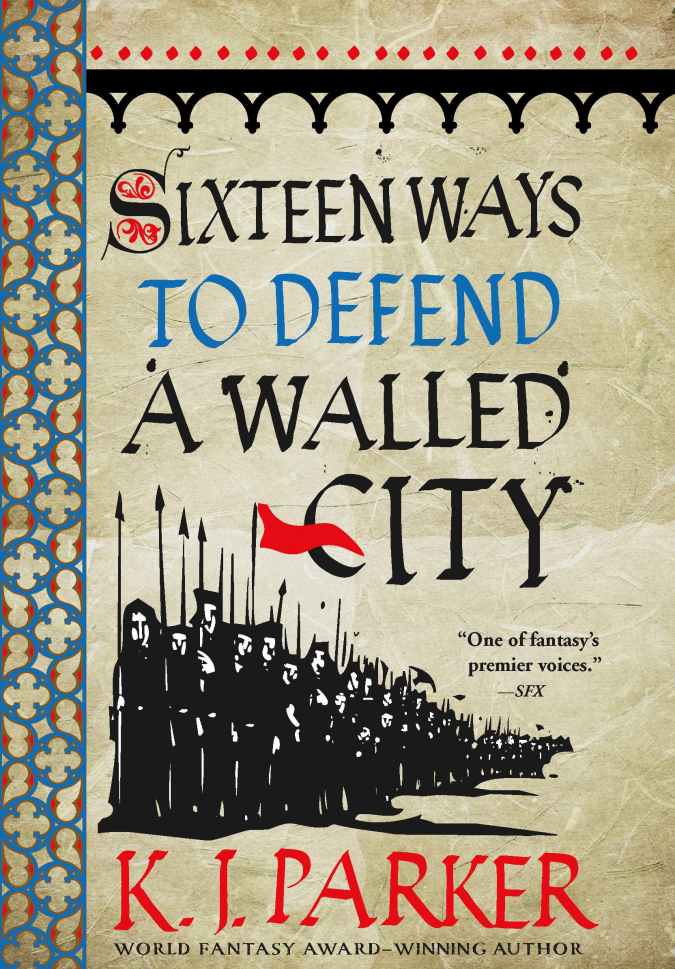
Sixteen Ways to Defend a Walled City by K. J. Parker

Sixteen Ways to Defend a Walled City Cover

Publisher: Orbit (Trade Paperback Format – 9 April 2019)

Series: Standalone

Length: 350 pages

My Rating: 5 out of 5 stars

Amazon

Ok, now this was one hell of a book!!!

K. J. Parker’s Sixteen Ways to Defend a Walled City is an exceptional piece of fantasy fiction that keeps the reader enthralled with its excellent story, fantastic self-aware humour and one of the best depictions of a siege that I have ever had the pleasure of reading. The end result was an excellent read that I just had to give a full five stars to, and it has to be one of my favourite books of 2019 so far.

The Robur Empire is one of the great civilisations in the world, and at its heart lies the City, capital and seat of power of the Emperor, kept safe by its impenetrable walls, powerful armies and unsurpassed navies.  However, that safety is unexpectantly compromised when a massive force of soldiers appears out of nowhere, slaughtering the entire imperial army, crippling the navy and completely surrounded the City.

The only forces left garrisoned in the City are the men of the Empire’s Engineering Corps, led by Colonel-in-Chief Orhan, who suddenly finds himself in charge of the defence of the City.  Orhan is a coward, a glorified bridge builder, a man able to work the complex imperial military system for his own gain and a foreigner despised by most of Robur society, but he is not a great military leader.  He is, however, one of the most devious and underhanded men the army has ever seen, and these might just be the qualities needed to save the City from destruction.  As Orhan works to unite the various factions in the City to his cause and come up with a range of unique defences, he makes a shocking discovery.  A figure from his past is leading the assault against the City, and Orhan quickly realises that he might be on the wrong side of this battle.

I really enjoyed this latest book from Parker, who has created a complex and captivating fantasy tale that proves exceedingly hard to put down.  K. J. Parker is actually a pseudonym of author Tom Holt, who was able to keep the dual identity secret for 17 years before it was revealed in 2015.  Between his two identities, the author has written an amazing number of books since his 1987 debut, mostly focused on the fantasy genre.  This includes over 30 humorous fantasy novels as Tom Holt, five historical fiction novels, the Fencer, Scavenger and Engineer trilogies as Parker, a number of standalone fantasy books and a huge range of short fiction, some poems, songs and even some non-fiction work.  For those who may be concerned, no reading of any of Parker’s prior work is required to enjoy Sixteen Ways to Defend a Walled City as this latest book is a standalone novel.  Still, I will be keeping an eye out for any future books by either Tom Holt or K. J. Parker as I really enjoyed the author’s writing style and fantastic sense of humour.

Sixteen Ways to Defend a Walled City is an intriguing novel that is told from the perspective of its “hero” Orhan, who is narrating the story of his defence of this city within a historical text.  This story is incredibly entertaining, as not only does it feature a first-rate siege within an excellent fantasy location, but it is told by a complex and multi-layered character who paints the entire ordeal of being in charge in a very funny light.

I am a man who loves a good siege storyline, but this has to be one of the best ones that I have ever had the pleasure of reading.  At the start of the siege the situation looks grim, as a vast host surrounds the City, whose defenders have all been slaughtered outside the walls, with the exception of Orhan’s engineers, who lack the basic military supplies and machinery to defend the City.  As the enemy start a conventional long-term siege with advanced weaponry and superior forces, Orhan is forced to come up with something to delay their inevitable defeat in the hopes of reinforcements turning up.  Without the required men, equipment or leadership, they cannot rely on the traditional 15 methods of defending a walled city that the books suggest, so he has to rely on the on his own 16th way, which involves bluffing, chaos and mad-cap innovation.  As a result, much of the book features Orhan’s many unconventional methods to defend the City, whether it involves taking symbolic control of the entire empire, legitimising and attempting to control two rival criminal gangs or creating devastating new siege weapons.  The protagonist and his men’s engineering prowess comes in effect quite a bit throughout the book, and I loved seeing the machines and other unique defence methods that he deploys as a result.  All the various deceptions and tactics used to hold the City against this superior force is widely entertaining and I absolutely loved the siege storyline which serves as an amazing centre to this incredible story.

The setting that the author chooses for this book is pretty interesting and adds a lot of great elements to the story.  The Robur Empire is pretty much the Roman Empire, with the City being this universe’s equivalent of Rome.  I thought that the City was a fantastic setting for the vast majority of the story, and the various factions and problems with such a large city really tied into the great siege storyline.  The City’s criminal organisations, the Greens and the Blues, former charioteer supporters (very Roman) turned rival criminal unions, are the cause of a large amount of strife, and I liked how their own battles and self-importance became such a major part of this book.  I also felt that Parker did an amazing job portraying a city that sits at the heart of a massive empire, and the attitudes of the people within felt pretty accurate.

On top of the great setting, Parker has also created an intriguing, extended world for this story.  The Robur Empire is a great overall setting for most of this book, as its setup, design and attitudes are very similar to the ancient Romans.  Parker’s initially subtle use of racial identity in this empire is quite intriguing, and it becomes a major part of the book.  Essentially the empire is made up of the pure-blooded Robur, who are called blueskins due to their darker skin colouration.  Then there are those people with white skin, who are given the derogatory name of milkfaces, who are treated like second-class citizens within the empire, and who came from lands conquered by the Imperials.  Not only does this become an important plot point with the army attacking the City made up completely of milkfaces, but it is reminiscent of the Roman Empire, when the pure-blooded Roman citizens looked down upon the paler barbarians from Gaul, Britain or Germany.  I also liked how the author tried to replicate the precision military system of the Romans with the Robur, and it was fun to see how the problems of such a system came into play throughout this book, such as having the military resources of the entire empire being kept in supply depo sites rather than in the capital.  I quite enjoyed these fantastic settings, and I thought that they were an excellent place to set these complex stories.

While the siege storylines and settings are extremely amazing, this book would be nothing without its main character and the person narrating this fictional historical text, Orhan.  Orhan is an amazingly complex character, and the personality that Parker creates for his hero is outstanding.  Orhan is a milkface who has risen to high military command within the Robur Empire due to his abilities as an engineer.  As a result of his hard early life and the constant belittlement and discrimination by the blueskins he serves under, he is an incredibly cynical person with a very jaded outlook on life.  The author does an amazing job transcribing these character traits onto the page, often in a sarcastic and very entertaining manner as he describes the events going on around him, and the reader gets a great sense of the character’s frustrations.  While Orhan is attempting to defend the City, his own narrations reveal him to be an extremely self-serving and selfish person who has been forced by circumstances rather than duty to protect the City.  His motivations become even more complex as he begins to wonder if he is on the wrong side of the conflict, as the invading army is completely made up of milkfaces like himself, and even when he is doing the right thing the blueskins in the city that he is defending still treat him badly.  Even with that doubt, he is a surprisingly (especially to himself) effective commander, whose deceitful and inventive nature, as well as his extensive knowledge of history and engineering, allows him to come up with some outstanding defensive strategies.  My favourite has to involve his unique method for dealing with the enemy’s sappers, which sees him use his knowledge of the City, his craft and his ability to manipulate his opponents to create a fantastic response.  The entire sequence involving this anti-sapper technique is one of the best parts of the book, and I love the doubt and regret he experiences as a result of his actions.  Overall, Orhan is an outstanding narrator, and his depiction of the chaotic event and his part in them really made this story for me.

Sixteen Ways to Defend a Walled City is an exceptional piece of fantasy fiction, and I think I already have a contender for my future top ten books of 2019 list.  This book has to be read to fully appreciate its complexity and cleverness, and I found it to be boundlessly entertaining and widely funny.  K. J. Parker’s latest book comes highly recommended, and it is well worth checking out.

Amazon