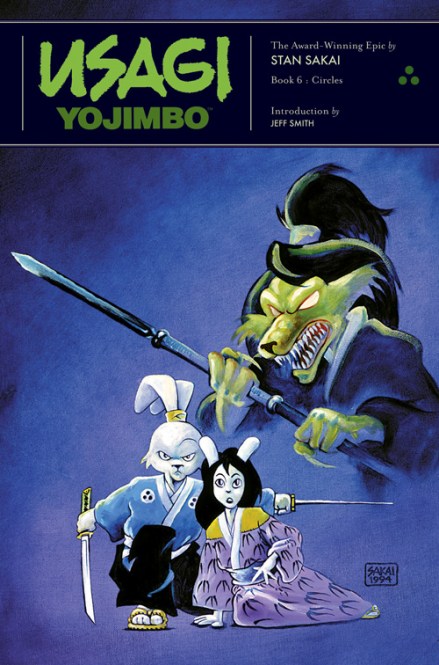
Throwback Thursday: Usagi Yojimbo: Volume 6: Circles by Stan Sakai

Usagi Yojimbo Circles

Publisher: Fantagraphics Books (Paperback – 1994)

Series: Usagi Yojimbo – Book Six

Length: 164 pages

My Rating: 5 out of 5 stars

Amazon     Book Depository

Reviewed as part of my Throwback Thursday series, where I republish old reviews, review books I have read before or review older books I have only just had a chance to read.

For this latest Throwback Thursday, after reviewing Lone Goat and Kid a couple of weeks ago, I am still in a Usagi Yojimbo mood, so I thought I would check out the sixth volume of this fantastic comic book series, Circles.
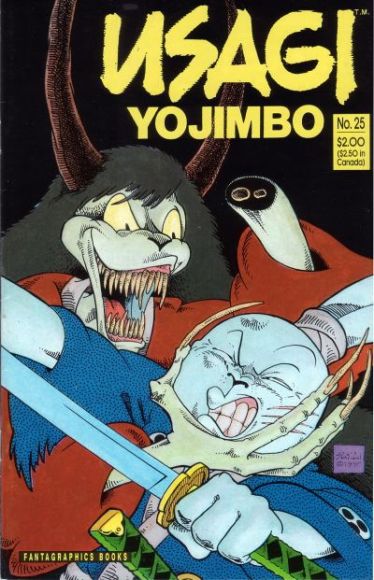
Usagi 25

Circles is another fun and exciting addition to this excellent series which I honestly cannot praise enough (although I have been trying very hard in my last several Throwback Thursday articles). This sixth volume once again presents the reader with several outstanding and inventive stories that chronicle the adventures of the rabbit samurai, Miyamoto Usagi, as he journeys around a unique version of historical Japan. This volume contains five separate stories, derived from issues #25 – 31 of the Fantagraphics Books run on the Usagi Yojimbo series, as well as a short story taken from Critters number #50 (a comic magazine that had some early Usagi Yojimbo appearances). There are some rather amazing stories featured within this volume, and I had an incredible time reading them.

The first story contained within this sixth volume is called The Bridge, which sees Usagi encountering a demon out of Japanese folklore. During a dark a stormy night, Usagi is entering a village from across a bridge when suddenly he lashes out with his sword behind him, convinced something is sneaking up on him. When he finds nothing there, Usagi shrugs it off and enters the nearest inn, only to learn from the villagers that the bridge he just crossed has been possessed by a demon, and Usagi’s back now bears the claw marks of the demon. Awaking next morning, the villagers find a severed monstrous hand on the bridge, which Usagi appeared to have cut off the night before. Taking the hand into the inn, Usagi and villagers wait for a priest to arrive in order to perform an exorcism on the severed limb, but the demon of the bridge has other plans.
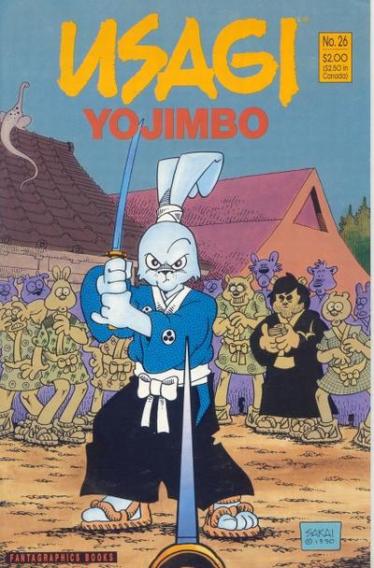
Usagi 26

This was a rather good supernatural story that sees Usagi go up against one of Japan’s many demons and monsters. Several significant elements from this story are taken from the story of the demon of Rashomon Gate, including the severing of the arm and the demon disguising itself as an old woman to recover its severed limb (although unlike the samurai in the legend, Usagi doesn’t fall for it). The demonic antagonist of this story is rather sinister in its drawing style and methods of attack, and it proves to be a dangerous opponent for Usagi. I love the extended fight on the bridge, and I especially enjoyed the way that the whole event ended, providing a side-character in the story their moment of vengeance. Overall, this was a tight, well-written story that was a lot of fun to read.

The next story in this volume is titled The Duel, and, as the name suggests, it features some duels between samurai. Usagi arrives in a village and is challenged to a public duel by the local champion while the watching villagers place bets with a travelling bookmaker, a duel that eventually results in Usagi’s opponent’s death. Completing the duel, Usagi meets and has lunch with a fellow unemployed samurai, Shubo, who subtly takes his measure. It is revealed that Shubo, who is a talented swordsman, is in league with the bookmaker who manipulates the odds of Shubo’s duels in order to make money off the betters. Shubo, who needs the money to provide for his wife and child, believes that he can beat Usagi, and the bookmaker inflates the odds in Usagi’s favour so that they can clean up when Shubo wins. Forcing Usagi into a duel, the two engage in a quick fight to death, with tragic results.
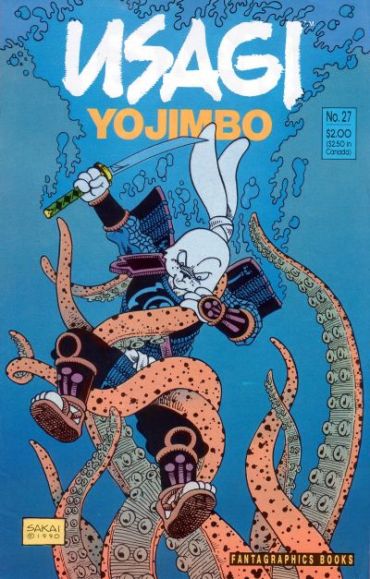
Usagi 27

This was a really clever and captivating single story that Sakai did an incredible job writing. The whole story concept is just brilliant, and Sakai sets it up and executes the plot brilliantly. There are some amazing scenes throughout The Duel, and the story features an excellent mix of comedy and tragedy which work together amazingly to produce a gripping narrative. Usagi, as the reluctant participant of this duel, is pissed at the entire affair, and his outraged reaction to the town people cheering his victory is rather good, especially as the peasants show over-the-top fake remorse in order to get him to go away so they can collect their winnings: “We are lower than the scum at the bottom of a stagnant pool!” While there is some fun and well-deserved karma coming down onto the bookkeeper who overextends himself and tries to escape, nothing quite takes away from the tragedy of Shubo’s wife and young child. The final panel of this story is incredibly heartbreaking, as it shows the wife and child waiting just outside the village for him to return. But as the light in the sky gets darker and darker, you can see the worry start to work its way onto the wife’s face, until she breaks down completely in the final panel, fully realising that her husband is dead. The wife comes across as a massively tragic character in this story, and the major impact that this final page has is a testament to how amazing Sakai’s storytelling and illustrations are.

The third story in the volume is the rather short entry, Yurei, which is the story that appeared in Critters. In this tale, Usagi, who is camping at the edge of a river, awakens to find a Yurei, a ghost, floating before him. The ghost imparts her tragic story to Usagi; she was betrayed and murdered by her husband, and she now seeks justice. Usagi then awakens and finds a woman’s hairpin on the ground next to him. Thinking his encounter with the ghost was just a dream, he travels to a nearby inn and attempts to trade the pin for a meal. What he does not realise is that the innkeeper is the murderous husband from the ghost’s tale, and his discovery of the pin leads to a series of deadly events. This was a good, fast-paced story which tells a compact and intriguing tale. I loved the supernatural elements in this story, and it was interesting to see Usagi portrayed as a tool of fate, who wonders into some ghostly revenge without even realising it. This was a fantastic short entry in this volume and was great to check out.
USagi 28

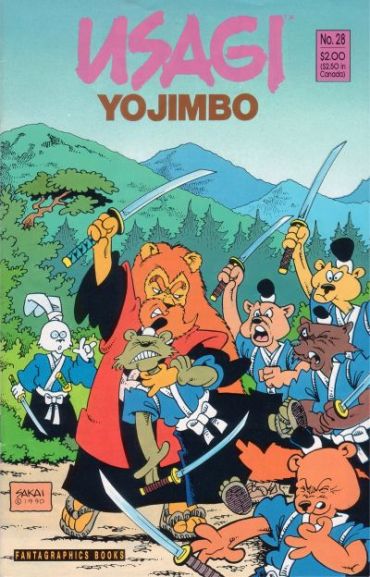
The next entry in Circles is an entertaining and over-the-top tale titled My Lord’s Daughter. In this story, Usagi, who is telling a bedtime tale to children, is shown as the classic hero from Japanese legend, fighting through vast hordes of demons, monsters, and obstacles to rescue a beautiful princess from an Oni. This was a fun take on some of the traditional Japanese heroic legends, and it was cool to see Sakai draw a classic tale with Usagi as the protagonist. Sakai has some obvious fun setting the Usagi hero fearlessly against armies of demons and monsters, and he comes up with some clever fight sequences and scenes in this book, from a brutal duel with an Oni, to an underwater battle between Usagi, a shark and a giant octopus wielding several swords in its tentacles. This is an entertaining and exciting story, and I had a good laugh at the end reference to Sakai’s old comic, Groo the Wanderer.

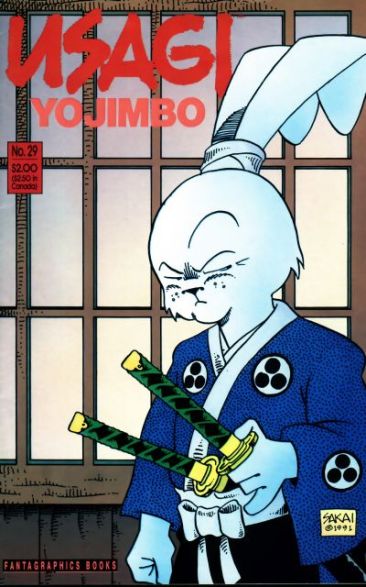
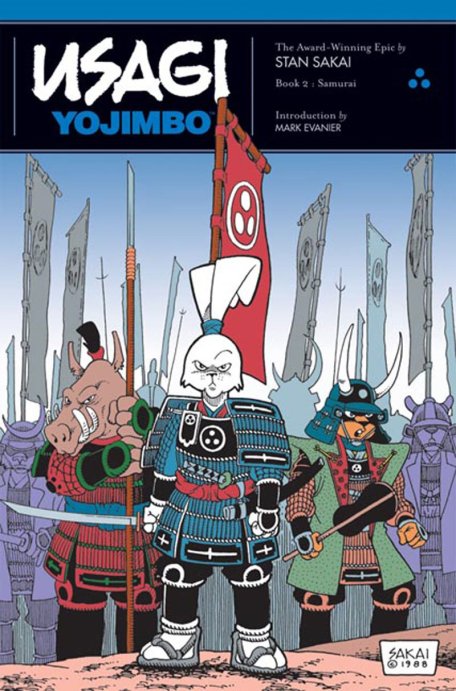
Now let us get to the fifth story of this book, which is kind of the main event of the entire volume. This is a big story, told across four issues, titled Circles. This story follows Usagi as he returns home for the first time since the events of volume one, The Ronin. There are actually a couple of distinctive parts to this story, especially the first issue, which is somewhat separate from the rest of the story (with the exception of some build-up at the end). For this first part, Usagi, on his way back home, decides to stop at his old master’s house to pay his respects to the grave marker of Katsuichi, the man who taught him how to wield a blade. The story then shows a flashback, which serves as a continuation to part of the origin story Usagi told in the second Usagi Yojimbo volume, Samurai, about Usagi’s past. In the flashback, it is shown that Usagi’s master was ambushed and seemingly killed by members of the Dogora Fencing School after Usagi beat their students in a tournament. However, upon arriving at Katsuichi’s old house, he discovers that his master is still alive, having survived the ambush, and has taken on a new student. I liked this revisit of Usagi’s origin story with Katsuichi, although the whole death scene in the flashback comes a little bit out of nowhere. Still, it was interesting to see how much Usagi has matured since he was learning the way of the sword, and it was nice to see the teacher and student reuniting. The flashback sequence is also top quality, and Sakai illustrates up a storm in this one, showing a fierce battle and some intense emotions from Usagi, who goes from a full-on berserker rage as he gets his revenge on his master’s killer to an intense grief in just a few scenes.
Usagi 29

The story then continues as Usagi journeys back to his village, only to be confronted by his old childhood rival, Kenichi. It turns out that Jotaro, Kenichi’s son with Usagi’s former love, Mariko, has gone missing, and bandits are roaming the area. While Usagi and Kenichi are able to defend their town from a raiding party, the attackers reveal that Jotaro has been kidnapped by the bandits and are holding him hostage. Leading an army of local peasants against the bandit’s hideout, Kenichi and Usagi hope to rescue Jotaro and end the raids that have been plaguing them. However, what they do not realise is that the bandits are being led by the deranged and dangerous former adversary of Usagi, Jei, a mysterious and seemingly unkillable murder with a black blade, who hopes to use Jotaro to get his revenge on Usagi. But even Jei is not the most dangerous thing that lies ahead, as old resentments between Usagi and Kenichi, their shared love for Mariko and certain revelations may tear everything apart.

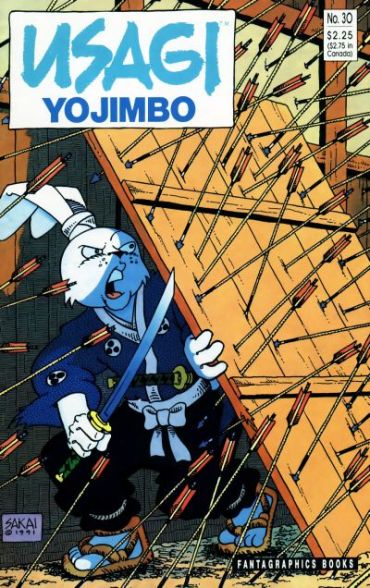
Wow, I have to say that the final three issues of Circles are just incredible. There is so much to unpack from them, as Sakai brings together a brilliant and powerful story. First of all, it was great to see Jei return as a villain once again. Jei, who was introduced in volume 3, The Wanderer’s Road, is an outstanding antagonist, and his continued feud with Usagi is just brilliant. The two engage in a fantastic and extended duel in this story, and Sakai did a fantastic job showing off each combatant’s skill and martial ability through his drawings. I also love the extensive battle between Kenichi’s peasant army and the bandits, which proved to be rather eye-catching. Not only is there a beautifully drawn sequence in the misty forest before the big battle in which Usagi does a great Jei impersonation to scare a bandit sentry, but Sakai illustrates a massive battle between the two forces. The massive single panel that shows the pitched battle is just impressive, and I love the detailed and entertaining scene that the author produced here.
Usagi 30

While all of the above is pretty amazing, what really makes this captivating story is the complex relationship between Usagi, Kenichi and Mariko. There are so many great layers plastered into this relationship. Usagi and Mariko were deeply in love when they were younger, and they still have great feelings for each other. However, Mariko ended up marrying Kenichi, and she is bound by duty, and her child, to him, no matter how she feels about Usagi. Kenichi, on the other hand, has always borne antagonism towards Usagi, which has been compounded over the years by their differences in skill and the fact that Usagi was chosen to serve Lord Mifune and left the village. However, Kenichi’s resentment towards Usagi is even greater, as he knows that Usagi is in love with his wife, and that these feelings are reciprocated by Mariko.

This leads to some outstanding scenes throughout this story, as these three try to come to terms with their complicated emotions. I particularly loved one scene in the middle of the story, where Usagi and Mariko discuss their feelings and reveal that they still both love each other, although Mariko makes it clear that they can never be together. The scene ends when Kenichi interrupts them, and while the look of heartbreak and shame on Mariko’s face is notable, what really gets me is the way that Kenichi’s usual stern/angry look is replaced with one of sad resignation in the last panel once he realises how Mariko still feels about Usagi. Despite this, Kenichi comes across in this story as a surprisingly honourable and well-intentioned character who puts aside his negative feelings for Usagi for the greater good, and it is a fantastic examination of a character who has mostly been antagonistic in the previous volumes. Sakai also drops a massive bombshell at the end of this story, when he reveals that Jotaro is actually Usagi’s son, and that Kenichi has known this and raised him as his own. Because of this, Mariko asks Usagi to leave and not try to settle down in their home village, as she fears it will put a wedge between Jotaro and Kenichi, who she sees as Jotaro’s true father. Usagi regretfully accepts this in another dramatic and captivating scene, although Mariko arranges for Usagi to see Jotaro as he leaves, and Usagi has a heartfelt time with his son, noting the similarities between them, and even suggesting Jotaro seek out Katsuichi as a teacher in later years. All of this is some first-rate storytelling and character development, and cannot praise Sakai enough for this amazing, emotional storyline. This is actually the last book that Kenichi and Mariko appear in (so far), and I think that Sakai did a fantastic job tying their love triangle together. All in all, Circles is easily my favourite story in this entire volume (The Duel comes close), and it is worth grabbing this volume just to check this key story out.

Usagi 31

It should come as no surprise to anyone considering all the praise I elicited above that I am giving this sixth volume of Usagi Yojimbo a full five star rating. This was another incredible comic book that features Sakai’s outstanding blend of powerful stories, memorable characters, intense action, fun references and depictions of traditional Japanese culture and history and some truly impressive artwork. I absolutely loved this volume, and this entire awesome series, comes highly recommended and is an unquestionable must-read.
Amazon     Book Depository

Throwback Thursday: Usagi Yojimbo: Volume 2: Samurai

Usagi Yojimbo Samurai Cover

Publisher: Fantagraphics Books (Paperback – 1989)

Series: Usagi Yojimbo – Book Two

Length: 141 pages

My Rating: 5 out of 5 stars

Amazon     Book Depository

After the fun that I had reviewing the first volume of the Usagi Yojimbo series, The Ronin, last week, I decided to follow it up with a review of the second volume in the series, Samurai. Samurai is an impressive second outing from author and artist Stan Sakai, which does an amazing job continuing his epic series after the introductory stories contained within the first volume.

After his adventures in the first volume, the rabbit ronin Miyamoto Usagi has continued on his wandering ways. However, his latest journey quickly turns to violence when he encounters another ronin on the road. Without a word being spoken, both samurai engage in a swift and brutal duel to the death, in which Usagi is the winner. The only witness to the duel is the bounty hunter Gennosuke, who inquires into the origin of the apparent feud between Usagi and his recently deceased opponent. Usagi reveals that the dead samurai was named Gunichi and Usagi had much cause to kill him.

Usagi 1

Regaling Gen with his tale as they travel together, Usagi reveals that the origins of this feud goes all the way back to his childhood and his tutorage under the unusual and skilled sword master Katsuichi. This tale follows Usagi as he becomes a young samurai in the services of his Lord Mifune, where he was comrade to Gunichi, and leads all the way to the fateful battle of Adachigahara Plain and the day that Usagi became a masterless samurai.

Back in the present, Usagi continues his adventures across the land, encountering many different people and unusual creatures. Watch him fight against a kappa, help defend a village of silk merchants against a roving group of bandits and witness his weird meeting with a mysterious and powerful little monster who is going to be a big somebody one day.

Usagi 2

Usagi Yojimbo: Volume 2: Samurai, is an amazing and fantastic volume of the Usagi Yojimbo series, which does an outstanding job continuing the story after the events portrayed in The Ronin. This second volume contains the first six issues of the actual Usagi Yojimbo series, and I really enjoyed the excellent adventures that are contained within these issues. The volume is broken down into four separate stories, the expanded story Samurai, as well as three stories which are significantly shorter. Each of these stories are really entertaining, and they all come together to create an impressive and incredible total volume of comics which I had a fantastic time reading.

The first story in this volume is also titled Samurai, and it is the major story contained within the Samurai volume. Running for 92 pages, this was one of Sakai’s first expanded Usagi Yojimbo stories, and I think it is one of his better ones. Samurai contains a captivating and exciting narrative that not only continues Usagi’s story in the present but which also goes back and explores much of the character’s past. This is shown through a lengthy flashback about Usagi’s childhood, his tutorage under the skilled samurai Katsuichi, his first meeting with Gunichi, their service under Lord Mifune, the events that led to Mifune’s war with the evil Lord Hikiji and the terrible final battle which cost Usagi his lord.

Usagi 3

Sakai comes up with an excellent background for Usagi in this story, and it was great to see how he expanded on some of the ideas and plot points that were featured within the first volume’s early stories. Even after all these years, the flashback contained with Samurai is still the definitive history of the character’s early days, although it has been expanded on several times in future volumes. This background is really intriguing, and I think that Sakai tells an amazing story, showing of Usagi’s unique training, his early triumphs including obtaining his swords, his service with Lord Mifune and then an expanded version of the battle of Adachigahara Plain, which has been briefly shown in the previous book. Woven into this is the tale of Usagi’s friendship with his fellow Mifune retainer, Gunichi, and the fateful day in their relationship that will cause Usagi to kill him the next time they meet. Sakai paces this entire extended story out well, and it turns into quite a complete and intriguing narrative. I like that it also added a lot more depth to the love triangle between Usagi, Mariko and Kenichi, and the scenes where Usagi and Kenichi put aside their differences for the first time for the sake of Mariko is great, and helps show that Kenichi is not a bad guy, he’s just occasionally blinded by his jealousy of Usagi.

I personally really enjoyed the scenes that featured Usagi and his sensei Katsuichi, the reclusive swords master. Their entire arc is really fun, and I love a good training sequence. Katsuichi is your typical wise and eccentric old hermit master who takes the young and eager student with potential under his wing to make him a superior student. Despite coming off as an aloof and hard man, Katsuichi is actually a kindly master who is impressed by Usagi’s determination and spirit (he gives a sly smile at the start of the training period). Katsuichi has some really interesting training techniques, and it is interesting to see how Usagi developed the skills that have kept him alive in the dangerous world he lives in. I loved the menial tasks montage, which is very reminiscent of The Karate Kid. It was also fun to see Usagi get randomly hit with a bamboo stick until he learns to anticipate surprise attacks, and I liked how it helped explain Usagi’s seemingly supernatural ability to sense when he is being watched or in danger. Overall, this proved to be an excellent inclusion to the story, and Katsuichi was easily the best new character introduced in this volume.

Usagi 4

Another major highlight of this first story is the part set in the present, which sees Usagi once again reunited with Gen. Gen was one of the better characters featured in the first volume, so it was really good to see him reintroduced in Samurai, especially as it helps set him up as a major recurring character in the Usagi Yojimbo series. Throughout the story, Usagi and Gen form quite an amusing partnership, with Usagi acting the honourable Zen warrior, while Gen is the unapologetic and uncultured mercenary. The two play off each other extremely well, with their great repartee and jabs at each other, and it is fun to see Usagi come out his shell a lot more around his companion. Gen also proves to be an entertaining audience for Usagi’s story, and it was fun to see his reactions to Usagi’s life tale. This was especially true when Gen started to get really into the story, despite his feigned indifference, and overreacted to several key moments. This entire story ends on a rather heartfelt moment between the two, with Gen indicating he completely understands how Usagi felt when he lost his lord “the saddest day of a samurai’s life is the day he becomes a ronin. Some day I’ll tell you how I became masterless…” and Usagi hinting that he really does see Gen as a friend. I really enjoyed seeing these two characters back together again, and this story definitely serves as a much better basis for their friendship than their backstabbing adventures in the previous volume. I also have to say, the silent dual at the front of the book between Usagi and Gunichi is the tops, and you could not ask for a better start to a story than an unexplained and sudden fight to the death.

The next story featured in this volume is the short, horror-based story, Kappa. Wandering a desolate, swampy area, Usagi comes across a kappa, a Japanese water demon, who demands a toll to cross the marshes. While Usagi is able to pass, he must go back and try to save another traveller from the kappa, resulting in a desperate conflict. This is quite a good story, especially with the ghostly twist contained at the end. I really love that Sakai chooses to explore pieces of Japanese mythology like the kappa, and it was really interesting to see Usagi face off against one. There is also an extremely brutal and impressive fight sequence against the kappa featured within this comic, which was all manner of impressive.

Usagi 5

The third story in Samurai was called Zylla, and featured Usagi finding and befriending a mysterious creature hidden in the bushes, that he names Zylla, when he visits the hot springs. Zylla repays Usagi by saving him from some bandits using his fiery (one could even say atomic) breath and reveals itself as a large newborn bipedal lizard who Usagi speculates may be a god, “Are you a god, Zylla?”. This is a really fun short story in this volume, and it adds a fascinating new element to the world that Usagi Yojimbo is set in. It was also great to see Sakai continue to show off his love for Japanese culture by featuring baby Zylla, and he makes several humorous references to Zylla’s future work, such as how he should visit the big city at some point. All of this makes for an amusing entry in this volume and it had me smiling as I read it.

The final story was Silk Fair, which sees Usagi come to the aid of a silk worker, defending him from bandits. The worker takes him to his village, where Usagi eventually helps defend the village from a large bandit raid, after he deals with the silk works greedy administrator. This was a nice, short entry that showed a typical Usagi Yojimbo storyline of Usagi helping to defend the helpless again bandits. This was one of the first stories where Sakai explored a Japanese craft or industry, and while it does not go into as much detail as some of the later industry based stories (later volumes feature length depictions of things like sword crafting, seaweed farming, kite making and soy sauce production), it was still interesting to see. Silk Fair contained a good mixture of action and humour, and I especially enjoyed seeing the way Usagi managed to mess with the corrupt administrator and his cowardly bodyguard. There was also a rather unique battle sequence where Usagi and the silk workers are able to defeat the bandits with sewing needles and silk streamers. In the end, Silk Fair proved to be a strong and amazing story, and I felt that it was an extremely entertaining way to conclude this volume.

Usagi 6

Like with every volume of the Usagi Yojimbo series, Stan Sakai’s artwork is once again a major and incredible highlight of Samurai. This second volume contains some fantastic examples of Sakai’s artistic talent, and it is clear that by the time he was working on the stories contained within Sakai had settled on his preferred designs for the various characters and landscapes featured, although further refinements did occur later down the track. This new character work is really impressive, and I liked how various new characters appeared, such as the warthog Gunichi and the lion based Katsuichi. I am also continually impressed with the way that Sakai can convey emotion and expression with his drawings, and you are constantly aware of what the various characters are thinking, just from seeing their faces. The various stories contained within Samurai featured some truly amazing and visually stunning landscape backgrounds, as Sakai continued his practice of showing off the beautiful scenery of Japan. Sakai also drew a number of impressive action sequences throughout the book, and he really got the hang of sketching out and showcasing the fast-paced and skilful fights that occurred between samurai. There are some impressive duel sequences throughout this volume, including the quick and sudden fight between Usagi and Gunichi at the start of the first story or the practice duel between Usagi and Kenichi which showed the ferocious fight between the two, which quickly ended with one strong strike from the obviously more skilled Usagi. Sakai also included several larger-scale battle sequences throughout the volume which really are something to behold. I particularly liked the major war sequence that showed the expanded battle of Adachigahara Plain. Sakai did an amazing job presenting the frenetic chaos of war and the explosive action that occurred with his art, and it was certainly a visual highlight of this volume.

Usagi Yojimbo: Volume 2: Samurai was an outstanding addition to the Usagi Yojimbo series, and it is one of my favourite volumes in this entire franchise. Stan Sakai presents a fantastic blend of character backstory, action, adventure, eye-catching art and clever humour in this volume, and the end result is a five-star comic which is really worth checking out. Thanks to the excellent background based main story, Samurai is a key volume in this series, making this book a must read. Samurai gets another five stars from me, and once again I have to strongly recommend this volume, and indeed the whole Usagi Yojimbo series, to anyone looking for an epic and enjoyable new series.

Amazon     Book Depository

Firefly: The Magnificent Nine by James Lovegrove

Firefly The Magnificent Nine Cover

Publisher: Titan Books (Hardcover Format – 19 March 2019)

Series: Firefly – Book 2

Length: 331 pages

My Rating: 4.5 out of 5 stars

Amazon     Book Depository

Fresh off writing the fantastic first book in this new series of Firefly tie-in novels, author James Lovegrove has crafted another amazing Firefly book that focuses on one of the more entertaining members of the Serenity crew, the hero of Canton, the man they call Jayne.

As I mentioned when I reviewed the first book in this new series of Firefly novels, Big Damn Hero, and in one of my subsequent Waiting on Wednesday entries, I am a massive fan of the Firefly franchise and was particularly eager to read the second book in this new series, The Magnificent Nine, which sounded liked it had an amazing plot.  As a result, I made sure to order this copy online well in advance and was extremely happy when it came last week so close to the worldwide release date.  I managed to read through it in about a day, and once again had the amazing feeling of being transported back into Firefly universe.

Out in the darkness of the verse, the crew of the Firefly class ship Serenity is up to its old tricks, searching for smuggling jobs that will keep them flying, while at the same time staying off the Alliance’s radar.  While Captain Malcolm Reynolds is used to anticipating the needs and wants of the inhabitants of his ship, he is completely thrown when a request for an unpaid mercy mission comes from one of the most unlikely members of his crew.  Serenity’s resident disgruntled mercenary, Jayne Cobb, suddenly asks that the ship be diverted to the backwater world of Thetis.  An old flame of Jayne’s, Temperance McCloud, has reached out requesting aid.  A vicious bandit, Elias Vandal, is threatening her small town of Coogan’s Bluff with a horde of trigger-happy thieves and murderers.  Mal initially does not take the request seriously, but then Jayne does the unthinkable and offers up his most prized possession, his beloved gun, Vera, as payment for the crew’s help.

Arriving at Thetis, the crew find that not only are the inhabitants of Coogan’s Bluff reluctant to get involved in any sort of fight, but a well-armed force of killers is waiting for them and spoiling for a fight.  However, the most shocking discovery is the fact that Temperance is raising a teenage daughter, born less than a year after Temperance and Jayne parted ways and named Jane McCloud.

This was a pretty epic read and one I had a lot of fun with.  Lovegrove once again hits it out of the park with this amazing novel that featured a great story, excellent coverage of the Firefly crew and some new interesting characters and events.  The Magnificent Nine is set between the events of the television series and the film Serenity, before Inara and Shepherd Book leave the ship.  Once again, I liked how this new entry into the Firefly book series felt exactly like a new episode of the television show, although it uses some of the show’s existing episodes, like Jaynestown or Heart of Gold, as inspiration.  I also quite liked how the story emulated some classic westerns such as The Magnificent Seven, which obviously inspired this book’s name, while also utilising science fiction elements.  I actually enjoyed this book a bit more than the preceding Firefly novel, Big Damn Heroes.  I felt that the story was more fast paced, significantly more action packed, and less widely spread out that the first book.  I also quite enjoyed the author’s use of the existing characters from the show as well as the intriguing new side characters that are introduced in this book.  The main story contains some interesting twists and turns, some of which are easy to see coming, but one or two of which come out of nowhere and are quite surprising.  The end result is a thrilling and character driven story which is enhanced by its association with the Firefly television show.

One of my favourite things about this book is the focus on the character of Jayne, especially as we get to see his underutilised noble side come out once again.  Throughout the run of the television show and most of the follow-up movie, Jayne is a selfish mercenary more concerned with his own self-interest and personal gain than the lives of his fellow crewmembers.  Jayne is not above sacrificing or betraying members of his own crew, namely the Tam siblings, if it will benefit him in some way.  His joining the crew of Serenity even involved him betraying and shooting his former captain when Mal offered him a better paying job and his own room on the ship.  That being said, there are a few instances where Jayne will do the right thing and act the hero, resulting in some memorable moments for the character.  The most notable of these occurred in the episode Jaynestown, where Jayne’s core beliefs are rocked by an entire community who venerate them as a great hero of the masses.  In The Magnificent Nine, Jayne’s noble side once again comes out when he receives a request for help from his former lover and her daughter.  As a result, he makes a series of impulsive and foolish actions throughout the book in order to try to do what he sees as the right thing, and these often result in some excellent sequences throughout the book.

Seeing this more noble version of Jayne emerge once again is fantastic and will be greatly appreciated by a huge number of Firefly fans.  Jayne is always a widely entertaining character in the Firefly franchise, and I felt that Lovegrove did a great job of portraying the character in this story.  I really enjoyed seeing another Jayne-centric storyline, and I liked how the author makes sure to utilise a number of classic Jayne elements throughout The Magnificent Nine, including the return of his iconic bobble hat and his favourite gun, Vera.  However, there are some interesting new Jayne moments as well, as Lovegrove goes back and explores some elements from his past, including how he met Temperance, and how she helped turn him into the man he is today.  This is an outstanding novel for those fans who love the character of Jayne, and I had a lot of fun watching him get another personal adventure.

As The Magnificent Nine mostly focuses on Jayne, the rest of the crew do take a bit of a backseat in this book.  That being said, all of them get one or two scenes focused on them, in one way or another.  Lovegrove once again does a great job of capturing the characters from the show, and rehashing their various quirks, relationships and the other minutiae of their personalities, even with these limited scenes.  While some of the characters do not get too much action in this book, I thought that Mal and River in particular were showcased well.  In this book, Mal plays the long-suffering captain who finds himself dragged into all manner of trouble by his crew, which forces him to act as the ship’s annoyed father figure.  River, the psychotic psychic, also gets a pretty good run in this book.  While Lovegrove does not explore her mind to any great degree, she gets some fun scenes, including one where she takes out intruders in Serenity, and another where she steals Vera and uses it in a firefight.

The side characters introduced in this book are pretty memorable, and the storylines revolving around them were very interesting.  Jayne’s former love interest, Temperance McCloud, is a pretty badass woman, and it’s fun to see the sort of woman Jayne would fall in love with.  There are also a number of secrets from Temperance’s past that come into play and add some emotional depth to hers and Jayne’s story.  The villain of this story, Elias Vandal, is a fairly dark antagonist, acting as a sort of Charles Manson-like character, forming a cult of personality that draws in the planets outcasts and loners while also claiming to be a former Reaver.  I quite liked Vandal as the story’s villain.  I thought he was well written out, and the various layers to his past and the way he controls his gang are quite intriguing.  Young Jane McCloud is another great side character, and I liked her interactions with River and Jayne.  She forms a great friendship with River, and the two get up to all sorts of fun antics.  I also liked the unconventional father-daughter relationship that occurred between Jayne and Jane, especially when they were forced to work together.

As mentioned above, The Magnificent Nine contains a large amount of action, with a huge number of firefights and other battles throughout the book.  I liked the way that many of the battles had a western theme, with the skilled gunfighting heroes fighting large swathes of bandits and goons.  However, the utilisation of science fiction elements really helped enhance them and, in some cases, increase the humour value.  I liked the Mad Max-like chase scene that featured not only horses but also dune buggies, motorbikes and Firefly’s mule.  There is also a spaceship assisted lassoing that was quite fun, and I liked seeing a classic trope like a lasso assisted by science fiction elements.

I absolutely loved Firefly: The Magnificent Nine, which turned out to be another ultra-fun romp back into one of my favourite television shows.  Lovegrove has a real skill for bringing these characters to life, and I really enjoyed the thrilling story he wrote for The Magnificent Nine.  The author’s portrayal of Jayne Cobb really shines through in this book, and it was great to see another story based around this awesome and funny character.  This book is best appreciated by fans of the franchise, although I feel there is a lot in this book for new fans to enjoy.  While this book was an amazing amount of fun to read, I now have to wait another six months for my next taste of the Firefly verse; how will I survive?

Amazon     Book Depository