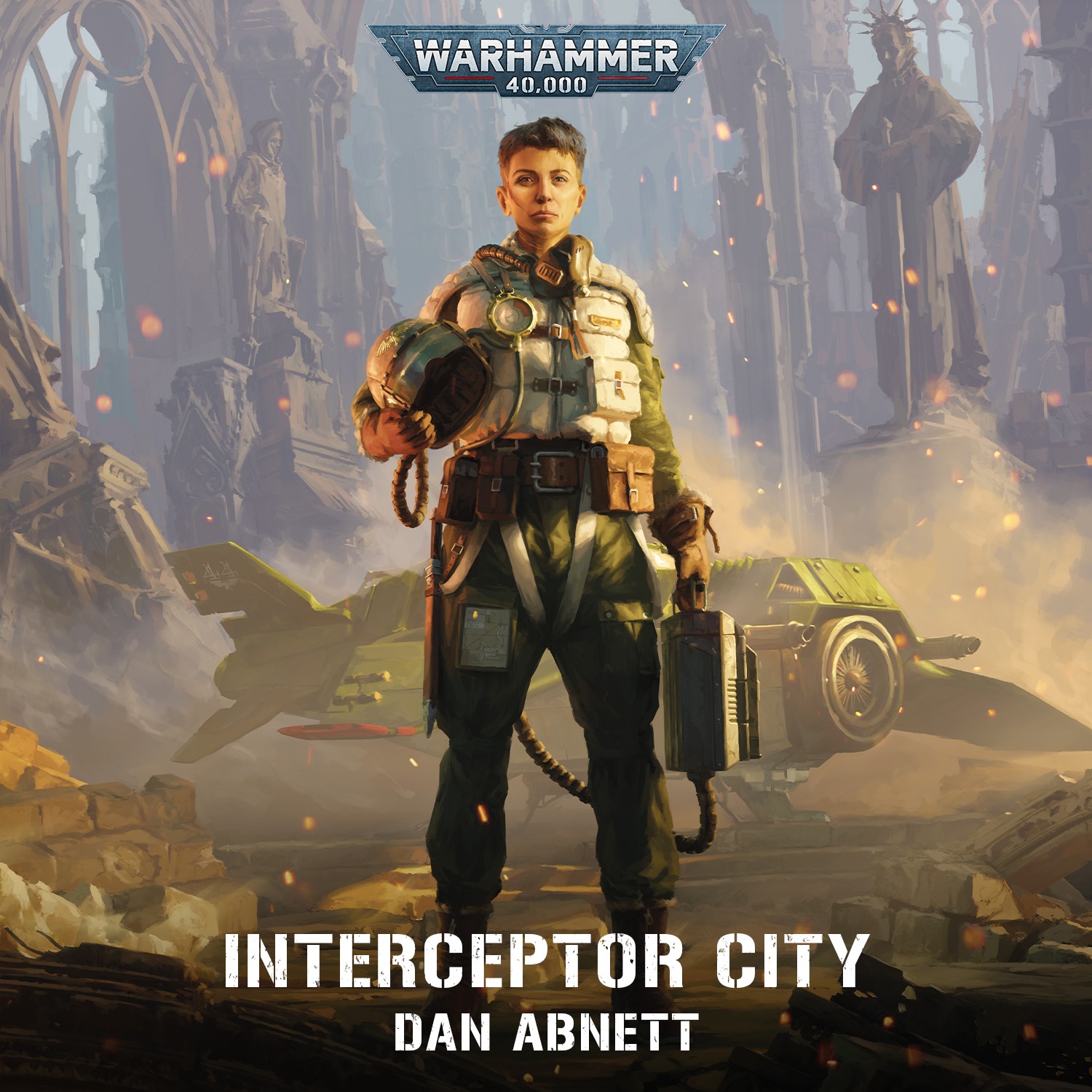
Warhammer 40,000: Interceptor City by Dan Abnett

Publisher: Black Library (Audiobook – 22 February 2025)

Series: Sabbat World Crusades/Warhammer 40,000

Length: 15 hours and 35 minutes

My Rating: 5 out of 5 stars

Amazon

Take to the skies once more as legendary Warhammer 40,000 author Dan Abnett presents another ambitious and rip-roaring novel of dogfights and explosive characters in the incredible novel, Interceptor City.

Dan Abnett is an author who I have mentioned multiple times in this blog, primarily because he is one of the best and most prolific writers of Warhammer fiction.  Abnett’s impressive work is a substantial pillar of the extended Warhammer 40,000 universe, especially with his entries in the Horus Heresy range, as well as his own various unique series, several of which are amongst some of my very favourite pieces of Warhammer 40,000 fiction.  This includes his outstanding Eisenhorn novels (XenosMalleus and Hereticus), his long-running Gaunt’s Ghosts books (First and Only, Ghostmaker, Necropolis, Honour Guard, The Guns of Tanith, Straight Silver and Sabbat Martyr), as well as gripping standalone titles like Titanicus. However, one of his very best books is the exceptional Double Eagle, for which Abnett has just released a sequel.

Double Eagle was an incredible novel first released in 2004 that sought to add a new, unique vantage point to the author’s Sabbat Worlds Crusade, the massive, multi-planet war served as a background the Gaunt’s Ghosts books.  Double Eagle followed members of a regiment of fighter pilots as they sought to control the skies above the Sabbat Worlds.  An intense, beautifully written, character-driven novel, Double Eagle got an easy five-star rating from me thanks to its outstanding and epic dogfights and examples of fighter-on-fighter combat.  Double Eagle was easily one of the best Warhammer books I have ever read, and I was very excited to find out that Abnett was finally releasing a sequel.

The Emperor protects, the Aeronautica remembers!

It has been more than 20 years since the battle to save Enothis and the Sabbat Worlds Crusade continues to rage, with millions of soldiers from the Imperium of Man fighting and dying to claim the planets from the arch-enemies grasp.  For some the crusade seems like a distant event, but for those on the scarred planet of Lysander, war is a daily occurrence, especially as the air forces of Chaos constantly seek to destroy the Imperial defenders with massive bomber flights.  The latest front of this campaign is the ruined hive city of Vesperus, which the enemy is using as cover to launch bombing attacks where the Imperials least expect it.  In response, the fighter pilots of the Aeronautica Imperialis have been ordered to secure the destroyed spires and massive building and turn Vesperus into a city of interceptors.

Into this precarious warzone flies former famed fighter pilot Bree Jagdea.  No longer the heroic ace who led her squadron to victory on Enothis, Jagdea now only pilots cargo haulers, determined to stay out the fighting.  However, an encounter with an old comrade leads her back into danger when she agrees to help the war effort by driving a needed replacement fighter to the Circus 66 squadron, currently serving in the ruins of Vesperus.  Planning to leave immediately after dropping off her precious cargo, Jagdea instead finds herself conscripted to join the ranks of the squadron as they face overwhelming odds against massed opposition from the forces of Chaos.

With no way out of the fight, Jagdea must once again contend against opponents in the sky if she wants survive and escape this new hellish posting.  However, this is not the air combat she is familiar with, instead the fighting in Vesperus is a cramped and deadly affair as their fighter aircraft must fight amongst the devastated and towering buildings of the Hive, where even the slightest error could result in death.  Forced to adapt to the new urban conditions Jagdea attempts to bring out her former skills and talent to survive the enemy all around her.  But with mysterious deaths haunting the squadron and the addictive thrill of danger once again luring her in, can Jagdea once again become a hero, or will she finally face her fate in the sky?

Well damn, now that’s how you do a sequel!  Dan Abnett continues to showcase why he is one of the very best authors of Warhammer fiction with the exceptional Interceptor City.  A particularly intense and captivating read that brings back one of Abnett’s best protagonists, Interceptor City was everything I hoped it would be, and more, as this novel simply blew me away.  One of my new favourite Warhammer 40,000 novels, Interceptor City gets a very easy five-star rating from, and I love the unique direction Abnett took this long-awaited sequel.

I have so much love for the narrative in Interceptor City, especially as Abnett decided to provide something very special for this sequel.  Abnett could have produced another open-skied flying story set right after the events of Double Eagle, and this probably would have been good enough to keep most Warhammer fans happy.  Instead, the author decided to raise the stakes in a big way by producing a deep and intense character-driven novel that brings back and focusses solely on a traumatised and retired version of his previous novel’s protagonist 20 years after the events of the first book, and places them into an impossible combat situation amongst suffocating spires and devastated city blocks to produce some outstanding action.

Told exclusively from the point of view of protagonist Bree Jagdea, Interceptor City went in some very interesting directions that bring the reader quickly into the fray.  Effectively setting up the unique situation on Lysander and Jagdea’s current emotional state, the story soon introduces some of the key supporting characters, before bringing Jagdea to the thick of the fighting in the devastated hive city of Vesperus.  Forced by circumstances to once again fly in combat, Jagdea finds herself in a new craft alongside an insane group of pilots trying to survive against impossible odds.  This results in the powerful main body of the plot as the traumatised Jagdea attempts to survive in an array of lethal fights amongst the massive, destroyed buildings of the Vesperus hive.

Abnett works in some incredible aerial sequences throughout Interceptor City, and you really become absorbed in the elaborate flying duels amongst the ruined buildings.  There is a great character-driven story here as Jagdea remembers her old instincts and slowly adapts to the new flying conditions she is forced to fight in.  At the same time as the brilliant action sequences, Jagdea also gets to know the other eccentric members of her new squadron, and there are some amazing character moments as she tries to understand their desperation, insanity and unique methods, while also trying to improve the survival rate of the less experienced pilots.  The flying scenes get more intense as the plot continues, especially as Jagdea regains her confidence, and you begin to understand more of the squadron’s madnesses.  There are some truly impressive story moments here, including a harrowing survival sequences and multiple complex aerial fights, that are cleverly worked together into one coherent and compelling plot.  Thanks to a great subplot, the later part of the book has a darker edge of mystery that requires to protagonist to try and understand the deeper motivations of the supporting cast.  While the solution of this mystery is somewhat obvious, it proves to be very well set up, and Abnett utilises it to masterfully increase the novel’s tension and stakes.  Interceptor City ends on a dark but fun note, as Abnett bucks against the expected final confrontation and allows the protagonist to end events on her own terms in a very over-the-top fashion.  This proved to be an extremely addictive narrative that really dives into the heart of the protagonist and provides some powerful and action-packed moments.

I loved this amazing Warhammer 40,000 novel, and I felt that Abnett presented it in such an impressive way.  Cleverly settling in as a standalone novel amongst the author’s other Sabbat World Crusade books, Interceptor City features a somewhat different style from Double Eagle, which works to make this sequel stand out on its own.  Rather than the extensive, multiple viewpoints that Double Eagle featured, Interceptor City is told exclusively from the perspective of the damaged protagonist Bree Jagdea.  While this does mean that you don’t get the full-picture war story that made Double Eagle cool, it allowed Abnett to really dive into his impressive protagonist’s story and showcase her personality and emotional state.  This ensured that this sequel was a particularly powerful and complex read, especially as Jagdea is a shadow of her former self after burning out as a pilot and crashing at her peak.  Now back into the cockpit, Jagdea is forced to come to terms with her own fears and doubt, as well as try the legacy of her past actions.  Abnett did an exceptional dive into Jagdea’s mind throughout Interceptor City, and he utilised the sole viewpoint to really explore her fears, hopes and the reasons behind her retirement.  This proved to be quite exceptional, and while readers are advised to read Double Eagle first to see this protagonist at her flying peak, new readers can easily dive into Interceptor City and appreciate its powerful emotional heart.  Throw in an over-the-top cast of eccentric pilots and killers with some additional complex and fascinating stories that the protagonist gets to know and trust, and Interceptor City has an impressive amount of character work that I found really fascinating.  Abnett layers this was a very grimdark tone, which allows the reader to full appreciate the desperate situation the protagonists are, and readers come away with an intense and impressive appreciation for the story.

While the great writing and the impressive focus on the protagonist’s mind ensures Interceptor City had an amazing story, the true highlight of this book is the outstanding depictions of aerial combat.  Abnett somehow managed to exceed his various impressive aerial sequences from Double Eagle in this sequel, and the resulting scenes of fighter-on-fight combat were so damn impressive, especially as the author describes them in exceptional detail.  The change of scenery from open skies to cramped urban flight conditions was extremely smart, and it ensured that Interceptor City’s flight scenes really stood out.  While the protagonist isn’t facing the overwhelming numbers of enemy fighters she encountered in Double Eagle, she is now forced to deal with small groups of skilled pilots amongst the wreckage of Vesperus, flying at impossible speed where even the slightest mistake could lead to death.  This results in some extremely nerve-wracking and claustrophobic sequences, as the protagonist tries to simultaneously fight and survive the dangerous environment she is flying through.  These fight sequences were so damn cool, and I loved how Abnett slowly improved the protagonist’s performance with each flight to reflect her growing confidence and mastery of the new location.  It is honestly impossible to stop reading Interceptor City during any of these sequences, especially the massive high-stakes ones at the end, and I frankly could not believe how Abnett made the dogfights and flying scenes even more epic in this outstanding sequel.

As is my preference with all things Warhammer, I chose to check out Interceptor City on audiobook rather than seeking out a physical copy.  Warhammer audiobooks are so damn good, and I love how well the elaborate and dangerous Warhammer 40,000 setting comes across when it is read out by a skilled narrator.  Abnett’s Warhammer 40,000 novels are a great example of this, as his compelling character and intense, tailored action really comes across on audiobook, especially in the hands of one of my favourite narrators Toby Longworth.  Longworth, who has lent his voice to most of Abnett’s books, really understands the best way to present the author’s fantastic narratives, and I love his cool take on all his Warhammer novels.  This was particularly true with Interceptor City, as Longworth did a masterful job bringing this complex tale to life, moving the main plot along at a quick pace and ensuring the action sequences were as epic as possible.  The passionate way he reads out the complex dogfights is just brilliant, and I found myself getting more and more drawn into these scenes as Longworth effortlessly vocalises every turn of the fighter and every lethal explosion in a tense and powerful manner.  You really got a sense of the protagonist’s desperation and the claustrophobic flying conditions she experienced thanks to this narration, and I was honestly on the edge of my seat for some of these outstanding sequences.  Throw in Longworth’s great array of compelling voices, which perfectly match the character they are assigned to, unique space accents and all, and the full impact of this amazing Warhammer 40,000 novel really comes out in the audiobook format.  Coming in with a run time of 15 and a half hours, Interceptor City is an epic audiobook to get drawn into, and I powered through this format in no time at all.  I actually wished it was a longer audiobook, it was that much fun, and as such I cannot recommend this format enough.

Dan Abnett was once again on fire with this exceptional and impossibly impressive Warhammer 40,000 novel.  A worthy sequel with its own incredible narrative, Interceptor City was a blast from start to finish and I had such a great time getting through this ambitious read.  Powerful, exciting, and loaded with some of the best Warhammer action sequences you are likely to read, Interceptor City comes highly recommended, and this might be one of my new favourite books.  I cannot wait to see what awesome Warhammer 40,000 novel Abnett writes next, and I hope we don’t have to wait another 20 years to see a new aerial adventure from this amazing author.

Amazon

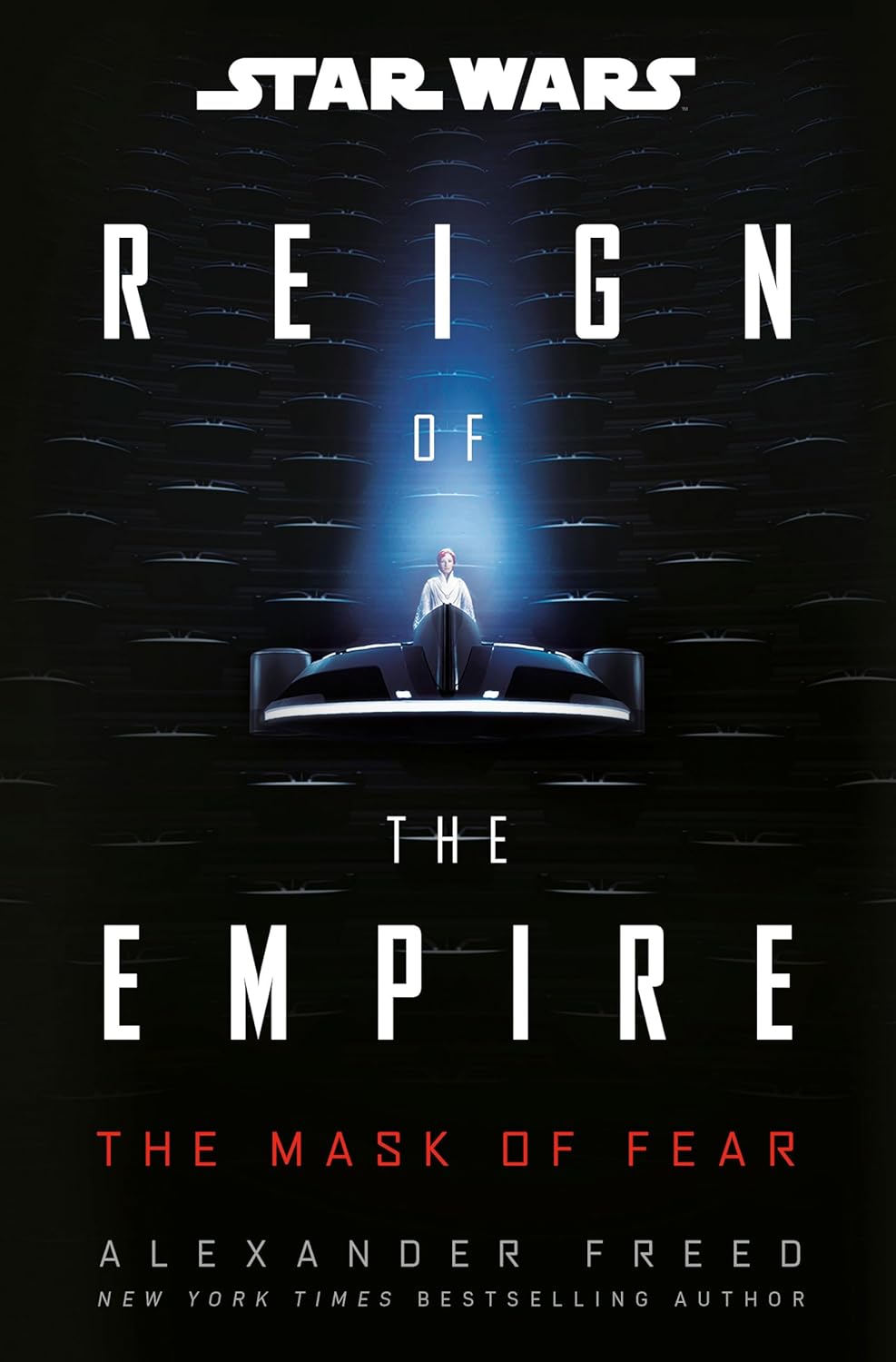
Star Wars: Reign of the Empire: The Mask of Fear by Alexander Freed

Publisher: Penguin Random House Audio (Audiobook – 25 February 2025)

Series: Reign of the Empire – Book One

Length: 16 hours and 51 minutes

My Rating: 4.5 out of 5 stars

Amazon

One of the top authors of Star Wars extended fiction, Alexander Freed, presents a compelling and complex inclusion to the franchise with The Mask of Fear, a powerful Star Wars novel that is a must-read before the upcoming second season of Andor.

There are some impressive authors writing Star Wars fiction at the moment, but one of my favourites is Alexander Freed, primarily because of his Alphabet Squadron trilogy.  An awesome series that followed a group of New Republic pilots in the immediate aftermath of Return of the Jedi, the Alphabet Squadron novels (Alphabet Squadron, Shadow Fall and Victory’s Price), are amongst some of my favourite Star Wars books, and I loved Freed’s dark take on the universe following the happy ending of the original trilogy.  As such, I was very intrigued when I heard that Freed was working on a new Star Wars trilogy set during one of my favourite periods of the franchise’s history, with the cool Reign of the Empire trilogy.

The Reign of the Empire trilogy is an ambitious series that seeks to chronicle the rise of the Empire and provides some cool new history in the current Disney canon.  Set immediately after Revenge of the Sith, the Reign of the Empire follow several key supporting characters from the films, as well as some new figures, as they attempt to navigate the galaxy following the formation of the Empire.  The first book in this series, The Mask of Fear, proved to be extremely fascinating, and I loved the compelling direction that Freed took the story.


Plot Synopsis:

Before the Rebellion, the Empire reigns, in book one of a trilogy told through the eyes of Mon Mothma, Bail Organa, and Saw Gerrera – for fans of Andor.

“In order to ensure the security and continuing stability, the Republic will be reorganized into the first Galactic Empire! For a safe and secure society!”

With one speech, and thunderous applause, Chancellor Palpatine brought the era of the Republic crashing down. In its place rose the Galactic Empire. Across the galaxy, people rejoiced and celebrated the end to war—and the promises of tomorrow. But that tomorrow was a lie. Instead the galaxy became twisted by the cruelty and fear of the Emperor’s rule.

During that terrifying first year of tyranny, Mon Mothma, Saw Gerrera, and Bail Organa face the encroaching darkness. One day, they will be three architects of the Rebel Alliance. But first, each must find purpose and direction in a changing galaxy, while harboring their own secrets, fears, and hopes for a future that may never come, unless they act.


The Mask of Fear
was another impressive and unique Star Wars novel from Freed, who sought to bring together a complex narrative of early rebellion and fear, as various people witness the rise of a tyrannical government.  Clever, intense and cleverly addressing some real-world parallels, The Mask of Fear was extremely good, and it served as a brilliant start to an excellent new Star Wars trilogy.

Freed produced a particularly intricate and complex narrative for The Mask of Fear that really sets the scene for the trilogy in a fantastic character-driven read.  I must warn potential readers that this is a very slow-burn narrative, with a focus on politics, character development, and Star Wars lore, and as such the book doesn’t have a ton of action in it at the start.  Instead, Freed follows the experiences of several different characters as they face the early days of the Empire’s rise and the end of the Clone Wars, with the narrative broken down across several character perspectives, including Mon Mothma, Bail Organa, a former Separatist operative who is forced to team up with Saw Guerra, and a couple of Imperial spies who find out the hard way that their Empire isn’t everything it’s cracked up to be.  This interesting combination of characters allows The Mask of Fear to go in a few compelling directions, including a political narrative around Mon Mothma, an adventure-laden investigation by Bail Organa, who tries to prove that the Jedi was set-up by the Emperor, a dark journey of revenge by the former Separatist, while the two spies find their stories interacting with the other characters as they try to investigate them.

As I mentioned above, the first half of The Mask of Fear is a little dry and slow-paced, but it nicely explores the universe after Revenge of the Sith and provides some dark context to how the Republic was changed into the Empire.  Mon Mothma’s story lies at the heart of the book, as she tries to bring about a legislative end to the Emperor’s reign, and this compelling political tale meshes well with the more action focused or espionage laden chapters of the other protagonists.  Things start to get a lot more interesting and intense once some of the characters start to interact with each other, including with a few action sequences, and Freed ensures that narrative gets realistically dark as you begin to understand the full evil of the Empire.

Everything leads up to the climatic final third of The Mask of Fear, where most of the major storylines of the book start to come together.  Thanks to the complicated story elements Freed set up in the earlier stages of the book, the reader finds themselves quite hooked at this point, especially as the characters find themselves in real peril.  I really enjoyed how Freed wrapped up a couple of the story arcs in The Mask of Fear, especially in one scene were a previously moral character finds the dark side of conflict.  Freed rewards the reader by providing a big moment of hope towards the end of the book, although this is swiftly taken away just to highlight what sort of Star Wars series this is going to be.  I really enjoyed this final section of the book, as the dark result of all the character’s plans galvanises them and leads them into a new direction.  I felt that this story came together extremely well, and while it was initially a little hard to get invested in it, Freed’s excellent establishment of the characters, narrative and overarching setting, ensured that it became a really gripping narrative.

The Mask of Fear was a very well-written novel from Freed, who expertly sets up a cool new Star Wars novel trilogy with some intriguing disparate elements to it.  The blend of politics, intrigue and action made for quite a compelling read, and I felt the author’s excellent use of multiple character perspectives led to a very rich and complex read that hit a lot of great boxes for me.  In addition, Freed does an amazing job placing this into the larger Star Wars canon, especially as he spends a lot of time exploring the very early days of Imperial rule, which is such a fascinating period in the franchise’s history.  The author perfectly blends compelling Star Wars lore about the fallout of the Clone Wars and the start of the Empire with his own story, and the resulting narrative is very fascinating.  While not every reader is going to love the complex political inclusions, I personally really enjoyed them, and this book helped to fill in some interesting gaps in how the Republic from the prequel films becomes the Empire.  As such, The Mask of Fear is a novel geared more towards hardcore Star Wars fans, although anyone who’s seen the original and prequel trilogies, or who wants to get a little more universe history before the second season of Andor comes out will probably have an amazing time with this book.

Speaking of politics, it’s hard not to notice some interesting real-life parallels that The Mask of Fear has with political realities of the world right now.  Freed would have written this book in 2024, and he paints a grim picture of the Empire’s new political and social reality within this book, which includes gross corruption, manipulation of the media, disinformation and other despicable practices, which will probably be quite familiar to readers now.  For example, the portrayal of a legislative body transferring most of its power to a popular-supported executive who then makes radical right-wing changes is jarringly close to how 2025 is turning out in some ways.  I found that these real-world parallels made the story that much more fascinating, and the reader ends up really feeling for the emotional turmoils of the protagonists.  One particular part of Freed’s portrayal of the Empire that I personally appreciated was the decision not to feature any of the franchise’s main villains, but instead focused on the people joining the administration purely for their own goals or benefit, who start revelling in the power they now have, or the lower level supporters who finally believe that they have a worthy leader.  In some ways this makes the Empire seem even eviler, as much like certain real-world governments, it’s obvious that the Empire was corrupt from top to bottom since the beginning.  As such, The Mask of Fear proved to be a masterful examination of how such fascist governments come into being and stay in power, and it was interesting, if a little scary, to see how the ultimate evil empire from fiction is being mirrored in the world today.

While the amazing story elements and intriguing examination of politics is a highlight of this book, for me, the best part of The Mask of Fear was the brilliant and damaged characters that Freed featured, especially his five major protagonists.  Each of these protagonists, which includes a compelling mixture of established characters and new figures written for this novel, has fascinating plot arcs behind them, as each of them tries to find their place in the new book.

Of these, I personally enjoyed the compelling storylines around future Rebel leaders Mon Mothma and Bail Organa the most.  Mon Mothma, who has been so well used in recent shows like Star Wars Rebels and Andor, had a compelling showing here in The Mask of Fear, and it was fascinating to see what happened to her in the immediate aftermath of the Empire’s takeover.  Portrayed as an ambitious politician already under attack by the new administration, Mon’s storyline around her attempts to curtail the Emperor’s power through political means and to keep power in the Senate is interesting, and I really enjoyed seeing the version of Mon who still believed in the institution she was apart of.  Freed weaves together an excellent combination of storylines around Mon, including her political troubles, personal issues, trauma from past arrests and her own growing disillusion with her political colleagues.  Mon’s storyline in The Mask of Fear starts her on the path to becoming the future Rebel leader, as she is forced to take deadly action in protection of her ideals, while also learning just how ruthless the new Emperor and his administration is.

The storyline surrounding Bail Organa on the other hand was a little more action and adventure focused, as he began his own journey towards rebellion.  Portrayed as the only person in the Empire who actually knows that the Emperor is a Sith Lord, Bail spends much of the book desperately trying to fight back by clearing the Jedi’s name.  You can really feel the despair in Bail as he tries to solve the situation in a manner he believes is right, only to hit roadblocks and disinterest from even his potential allies who disregard the Jedi who Bail knows are innocent.  This allows for some very intense scenes, especially as Bail crosses some major boundaries to chase his goals, and you really sympathised with everything Bail is going through.  Bail’s storyline was really well written, and I really enjoyed Freed’s realistic portrayal of what this character would be going through.  His storylines ended up melding nicely with the rest of the cast, especially Mon Mothma’s, and I loved how Freed showed them as having some noticeable political and personal friction.

The rest of the main point-of-view cast of The Mask of Fear includes three original characters, who provide intriguing alternate views about the Empire.  This included Soujen, a cybernetically enhanced Separatist infiltrator who awakens from hibernation to find that the government that made him was defeated, and he has to decide who or what he is going to fight for now.  A complex figure who believed in the Separatist cause, Soujen provides a compelling alternate view of events from the Clone Wars and the formation of the Empire.  Freed works an interesting and intense storyline around Soujen, as he is forced to confront the impact of his actions and the realisation that he might not have achieved anything with his fighting.  I loved how dark some of Soujen’s scenes got, as well as the realistic emotional outbursts as the character refuses to give up the war.  Soujen’s storyline is one of the most impactful in the entire story, as his more destructive approach forces the other characters to act against him.  There were some very complex interactions that occurred as Soujen tried to achieve his objectives, including a certain amount of tragedy which hits the reader hard.  The other key perspective characters are two imperial intelligence operatives, made up of an elderly spy who doesn’t fit in with the new regime and her young apprentice from the slums of Coruscant.  They both go on compelling journeys throughout the book, with the veteran tailing Bail, while the younger journeys into the morass of the extremist groups supporting the Emperor.  I really enjoyed seeing both coming to realise the problems with the Empire they’re solving in their own different ways, and both their perspective character arcs supported the other storylines extremely well.

This main cast is supported by an interesting array of figures, including supporting characters from the main shows, who have a big impact on the story.  The most prominent of these is Saw Gerrera, who, despite having a big role in the plot, doesn’t serve as a major perspective character.  Freed does an excellent job portraying Saw in this book, and it proves fascinating to see the character’s journey to become an extremist fighter begin in this book, as he initiates the first militant rebellion against the Empire.  This mostly rounds out the main cast, and as I mentioned above there is a distinct lack of major antagonists in this book, with neither the Emperor or Darth Vader appearing.  However, there is an array of self-serving middle management administrators and agents, pro-Imperial vigilantes and politicians supporting the new Empire, who prove to be quite dangerous and corrupt in their own way, especially as they oppose and attempt to remove the protagonist when they oppose the Emperor.  An overall excellent collection captivating character arcs in this book which really enhanced The Mask of Fear’s narrative in some impressive ways.

As with most Star Wars novels that I check out, I chose to enjoy The Mask of Fear on audiobook, which proved to be an outstanding way to enjoy this captivating read.  Star Wars audiobooks always do such a great job of capturing the atmosphere and excitement of the franchise’s extended universe, and I love how awesome they can make a story.  The Mask of Fear was a great example of this, and the complex narrative of politics, betrayal and damaged characters, really came to life when read out by the talented January LaVoy.  LaVoy, who specialises in reading female-led fiction, including extended universe books such as Star Trek: Die Standing and Freed’s Alphabet Squadron books, did an outstanding job narrating this awesome novel, and I loved how well she captured the key characters.  Her voice work for Mon Mothma was particularly good, and I liked the fun voices that accompanied some of the other intriguing female characters.  LaVoy also ensured that the story moved at a swift pace, and readers found themselves really drawn in, even with the book’s politically heavy content.  It helped that The Mask of Fear featured the typical array of iconic sound effects and music from the Star Wars films, which are put to great use throughout the production.  The sound effects in particular were cool, giving extra life to some scenes, especially those involving firefights, vehicles and crowds, while the music was used to add some outstanding gravity or excitement to key moments.  The combination of the amazing narration and the cool Star Wars sound inclusions helped to make The Mask of Fear something truly wonderful to listen to, and this is easily the best way to enjoy this fantastic novel.

Alexander Freed kicks off his Reign of the Empire trilogy in a big way with this captivating novel.  An outstanding addition to the Star Wars canon that dives into one of the franchise’s most intriguing periods, The Mask of Fear was an intriguing, character-driven novel that examines the fallout of war, political upheaval and the rise of evil.  Highly recommended, especially on audiobook, The Mask of Fear is a must-read for all Star Wars fans.

Amazon

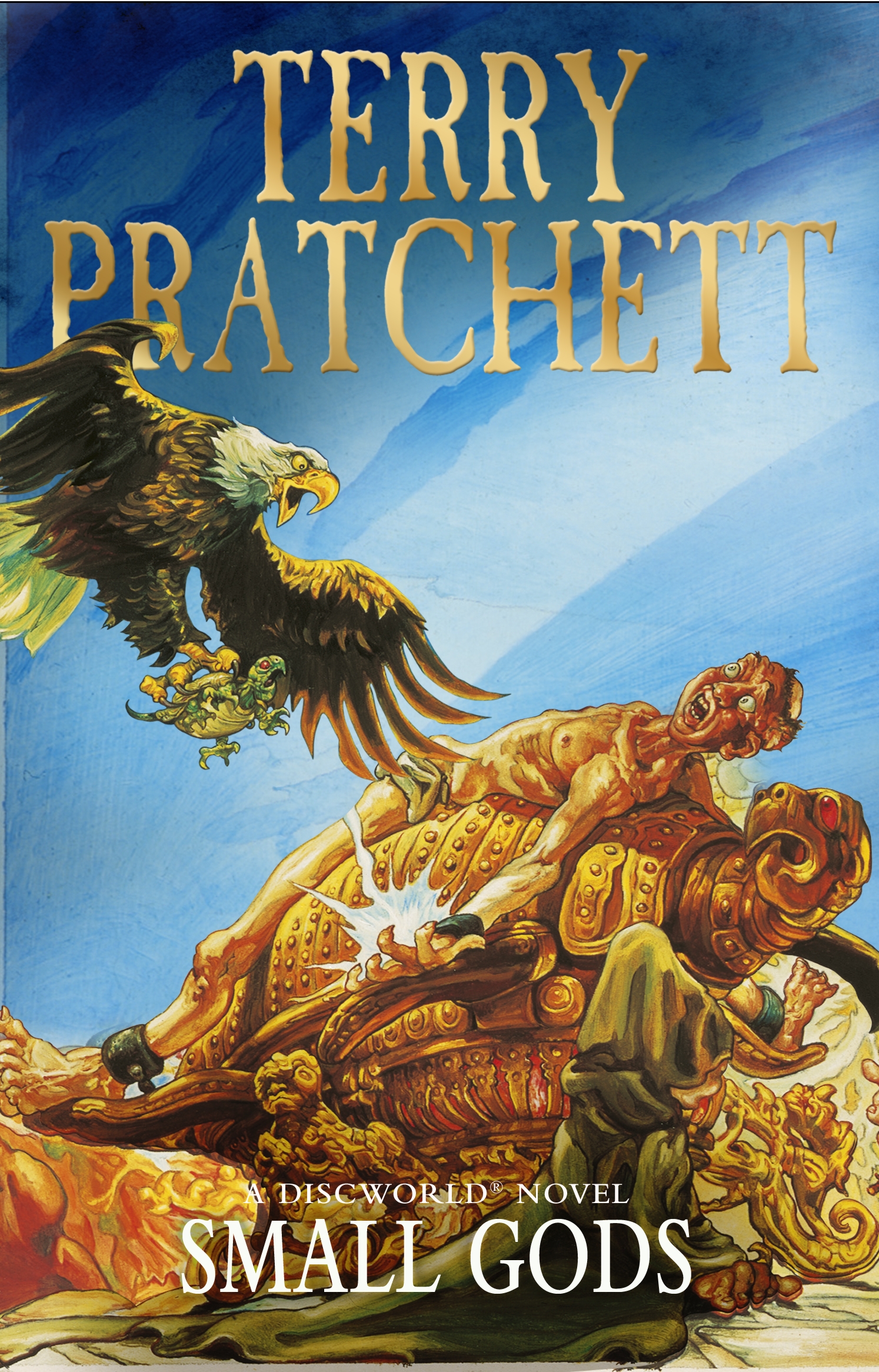
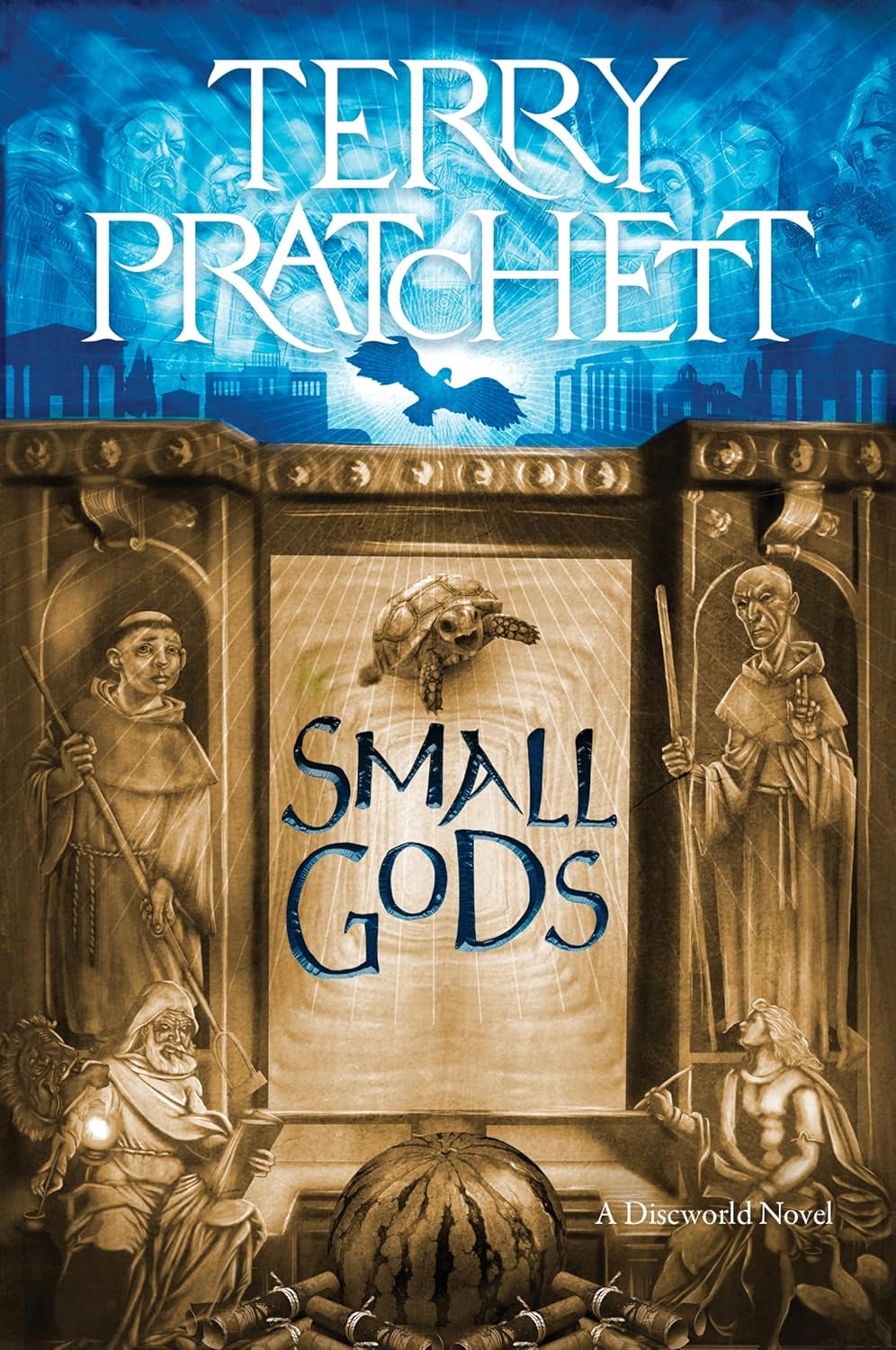
Small Gods by Terry Pratchett

Publisher: Gollancz/Penguin Audio (Audiobook – 1993)

Series: Discworld – Book 13

Length: 9 hours and 55 minutes (Planer version)/11 hours and 38 minutes (Serkis version)

My Rating: 5 out of 5 stars

Amazon

Thanks to an excellent road trip, I managed to revisit several awesome entries from the iconic Discworld series by the legendary Terry Pratchett, and it is time to highlight one of the very best books that Pratchett wrote, Small Gods.

I have never made any secret of the fact that I love all things Terry Pratchett, as the Discworld books were the formative series of my youth.  A massively popular collection of loosely connected novels set on a flat world carried through space on the back of four elephants atop a giant turtle, the Discworld books present a range of unique fantasy adventures backed with exceptional comedy and satire.  This series is so much fun, and I honestly love every single Discworld book, having read them all multiple times, usually while laughing myself silly.  Indeed, I am such a big fan of this series that I named my blog after a location in the universe.  Despite my overwhelming love for all things Discworld, I haven’t reviewed too many of the books on this blog, with Moving Pictures and The Last Continent previously being the only exception.  However, thanks to some great road trips giving me opportunities for revisiting some classics, I have recently published reviews for Guards! Guards! and an additional review for Moving Pictures.  I also recently re-listened to the impressive and thoughtful 13th entry in the series, Small Gods. An outstanding standalone novel that seeks to blend religious commentary with Pratchett’s strong humour and complex satire, Small Gods is one of the more thoughtful and moving Discworld books and is a must read for all fans of the franchise.

Floating through space on the back of a giant turtle, the Discworld is a place of magic, wonders, strange creatures and, unfortunately for the mortals just trying to live their lives, gods.  Instead of the wise and beatific beings we hope them to be, the gods of the Disc are a capricious and vain lot, empowered by the belief of their human worshippers.  But what happens when a mighty god loses his believers?

The militant nation of Omnia is an empire dedicated to the fervent worship of the Great God Om, an all-powerful being who knows all, sees all and is the only true god in the world.  The problem is none of that is true.  Instead, Om is a self-obsessed god among many, who barely pays attention to the people fighting in his name.  More importantly, he is currently residing in the body of a tortoise, stripped of nearly all his divine power, and the only person who can hear him is a simple novice, Brutha, who isn’t fully convinced that the talking tortoise smiting him with tiny thunderbolts is his god.

Determined to get back on top and find out why he lost his power, Om recruits Brutha as his unlikely prophet.  However, Brutha has his own problems as the sinister head of Omnia’s Quisition, Vorbis, has taken an interest in him.  Forced to accompany Vorbis on a diplomatic mission, Brutha soon begins to understand that the world is a far bigger place than he realised, and that there is something very wrong at the heart of his nation.

As the tides of history take Brutha and Om into strange new places, the two find themselves encountering unexpected dangers, including dangerous ideas, sinister eagles, rebels determined to prove that the world isn’t round, deranged philosophers and the small gods that lurk in the dark places.  To survive, Brutha will need to have faith in his god, but more importantly, Om will need to have faith in Brutha, especially when his own religion is turned against them.

After yet another re-read, Small Gods remains one of my favourite Discworld novels, and this is one of the very best examples of Terry Pratchett’s unique style and imagination.  A hilarious, yet thought-provoking read that cleverly dissects religion, divinity and people’s beliefs, Small Gods quickly grabs your full attention and refuses to let go until it’s powerful, terminal end.

I have so much love for the outstanding narrative that Pratchett pulled together for Small Gods, which tells one of the more unique standalone tales in the Discworld series.  I must admit, even after many reads, I am still very impressed that Pratchett decided to examine the nature of religion and belief through the lens of a hilarious odd-couple story that evolves into a road trip narrative.  Starting off on a very entertaining note with the unsuspecting new prophet of Om, Brutha, encountering his god in the form of a small, battered tortoise, Pratchett does a good job of introducing the nation of Omnia and its place in the wider setting.  This proves to be an effective start to the book, and a lot of the early themes and wider issues surrounding the nation of Omnia are well set-up.  You also get a great examination of the book’s three main characters, and their compelling early interactions in Omnia sets up a lot of the book’s character-driven narratives.  After this excellent introduction, Small Gods’ plot then moves to the bordering nation of Ephebe, which proves to be an intriguing centre of the novel, not only because it has some of the more entertaining sequences, but also because it begins to expand on some of the ideas from the front of Small Gods and you are given a good understanding of both Om’s situation and Brutha’s growth as a character.

The plot of Small Gods takes a powerful turn around halfway through, when Brutha helps further Vorbis’s schemes, only to then attempt to flee and do the right thing.  However, thanks to the influence of a rival god and unexpected technology, Brutha and Om are inadvertently stranded in the desert with a helpless Vorbis.  The following extensive scenes in the desert are probably the best parts of Small Gods, especially as Brutha begins to think for himself, and the philosophical clashes he has with Om set him up as the protagonist both the reader and the Omnians need.  Pratchett really dives into what it is to be human and divine in this section of the book, and I deeply appreciate the rich character development featured within these sections of the plot.  These desert scenes become even more impactful when Pratchett throws in a major obstacle for Brutha that threatens to push him over the edge into despair.  You really feel for Brutha as he has his crisis of faith, only to maintain his humanity in the last confrontation with Vorbis.  The subsequent scene on the metal turtle was very tense, and while I know some people dislike the end of Vorbis, I thought it was a very clever sequence, especially as Pratchett set up the hunting eagle perfectly.  Pratchett continues to wrap up the rest of the narrative in a very satisfying way, and while the war sequence might have been a little unnecessary, it allowed some great character arcs to come together and showed how much Om had grown as a god.  The final scene with Brutha once again showing his humanity no matter what, ended the book on satisfying and heart-felt note, I appreciated the hopeful tone Pratchett concluded his brilliant story on.  An overall impactful and moving narrative that brought together a lot of complex plotlines and character moments and ensured you were hooked the entire way through.

I have always believed that Small Gods was one of Pratchett’s better written books, as he effortlessly blended a complex fantasy narrative that examined religion with his typically brilliant humour and some outstanding characters.  Featuring one of his most complex and thought-provoking plots, Pratchett achieves so much with his intriguing inclusions, all without slowing down the speed of the book and keeping the tension and emotional charge of the book on high.  Introducing a cool new setting, Small Gods works well as a standalone entry in the larger series that cleverly expands on some previously introduced features, such as the selfish and somewhat stupid gods of the Disc, as well as cool locations like Ephebe (which was previously featured in Pyramids).  Due to its lack of major connections to the other entries in the Discworld series, Small Gods is a rather excellent introduction to Pratchett’s style and ability to dive into heavy topics with comedic content.  Like all of Pratchett’s books, Small Gods is hilarious, and I love the many different levels of humour contained with the book, that range from obvious jokes at over-the-top situations, subtle witticisms often contain within well-placed footnotes, to clever word or name gags.  Some of this humour is so subtle that it often goes over the reader’s head the first time, and you honestly need multiple readings to full appreciate every single joke or gag that Pratchett thought up (I still discover new jokes I previously missed every time I read a Pratchett novel).

However, the thing that ensures Small Gods stands out amongst the other brilliant Discworld novels is the author’s clever and insightful breakdown of religion and godhood on the Disc, which is both fascinating and entertaining.  A lot of the book’s powerful messaging, complex themes and some of the best humour, comes out of the exploration of the divine and how it relates to both this crazy fantasy setting and the real world.  While Pratchett does provide a lot of jokes about religion throughout the ages, he does it in a very intelligent and delicate way that makes the reader think.  Rather than simply dunking on religions and focussing on the negatives, Pratchett instead subtly satirises the institutions, manipulative leaders and unthinking traditions that can often complicate or weaponise religion.  A large amount of the plot revolves around Vorbis and the Omnian church violently trying the repress the idea that the world is flat and on the back of a giant turtle.  While this is primarily a fun parody of the Catholic church’s suppression of Galileo’s claims about the Earth orbiting the sun (and which is now both funnier and sadder, thanks to flat earthers), it also examines how some people utilise religion as an excuse for violent action and manipulate faith for their own ends, which is a powerful recurring them throughout the book.

At the same time, Pratchett also focuses on a compelling central character with true faith who explores the meaning of religion and how it impacts his people.  Seeing a likable character like Brutha recognise the problems in his nation allows readers to reflect and see the flaws in the organised religions Pratchett is parodying, while also appreciating the messages that these religions should strive for.  The various complex discussions, personal revelations and jokes within Small Gods allow for a very insightful read that reportedly resonates with both atheists and pro-religious figures (Pratchett apparently received a lot of fan mail from both groups who thought Small Gods was written for them).  I personally think that Pratchett’s thoughts and messages were extremely perceptive and layered with a great understand of humanity, and indeed many his compelling criticism or organised religion and how it is weaponised are more relevant now than when Small Gods was written, especially as it could also apply to other traditional institutions that are being abused.

Pratchett perfectly rounds out this incredible writing by featuring some of his very best characters, including several very complex figures who mature and evolve throughout the course of the book’s plot.  This includes the main protagonist, Brutha, a simple novice who finds himself the only person left who can hear Om due to his genuine belief in the god rather than in the institutions that surround the religious practices.  While initially portrayed as a somewhat dull and unthinking novice, you soon begin to realise that there is much greater complexity within Brutha, as well as the fact that he is a genuinely nice person held back by his simple ideas of life and faith.  Thanks to his interactions with Om, who provides greater clarity to his religious beliefs, as well as his experiences outside his insular nation, Brutha begins to evolve quickly as a person, gaining a greater appreciation for the wider world, as well as beginning the understand that the world isn’t quite as black and white as he believed.  It was fascinating to see Brutha develop as the book continues, especially as he begins to doubt his faith and rebel against the church and the god that had been his entire life.  His interactions with Om were quite entertaining, as the two eventually become a fun duo of equals, although Brutha does get the upper hand over his god in quite an entertaining and refreshing manner.  Brutha was also well defined by his relationship with the book’s antagonist, Vorbis, and their discussions about truth prove to be quite defining for Brutha as an inspiration for his rebellion.  However, unlike the rest of the cast, Brutha resists becoming the monster that Vorbis wants him to be, and his subsequent demonstrations of faith, reason and humanity, really set him up as one of Pratchett’s best and most likeable central protagonists.

Brutha is well matched by his god, Om, who honestly is one of the best deities featured in the Discworld series.  Formerly an all-powerful and arrogant god who didn’t care about his believers, Om finds himself suddenly trapped as a helpless tortoise who must desperately cling to Brutha to survive.  Om proves to be quite a fascinating and entertaining figure in Small Gods, especially as Pratchett perfectly portrays him as formerly powerful being who must now rely on the mercy of others.  His initial arrogance is very entertaining, and his subsequent wheedling manipulation of Brutha was a great follow-up that worked to keep him in the story.  However, it was his eventual co-evolution with Brutha that turned Om into a particularly compelling protagonist.  Despite his resistance, his bond to Brutha shapes him and forces him to see the world through human eyes, and the subsequent discourse on philosophy, life and how religion should be as they wander the dessert impacts Om just as much as Brutha.  This eventually causes them to reach an interesting and heartfelt religious partnership, and it was fascinating to see the previously selfish Om risk it all to save Brutha, especially when he is confronted by other gods who act the same way he used to.  I loved seeing this powerful and positive development in a divine figure, and Om really ended up being a compelling secondary protagonist with some of the best jokes.

While Brutha and Om are the heart and soul of Small Gods, this book would not be as impactful without its brilliant villain, Vorbis.  A cruel and unflinching figure, Vorbis is probably Pratchett’s most ruthless antagonist, who utilises the mechanisms of the church to achieve his goals.  However, rather than being a purely evil figure, Vorbis is shown to be simply someone who understands human nature and uses this knowledge to achieve his self-determined goals, which in some ways is worse than an obvious villain.  Pratchett does an outstanding job showcasing Vorbis’s dark, insular nature, and you come to really appreciate just how sinister he is, especially as his actions inspire other people to do evil things to try and match him.  He becomes even more immoral when compared to the very innocent Brutha, the only person that Vorbis occasionally sees as a real threat to his plans due to his legitimate belief, and their various interactions and discussion about the true nature of the world are quite powerful.  Pratchett features Vorbis perfectly throughout the book, and his final appearances, where he finally understands his own nature, are very satisfying to behold.

The rest of the cast of Small Gods are also quite impactful in their own way.  The blind philosopher, Didactylos, proves to be a fantastic voice of reason in the story, especially compared to the rest of the insane philosophers of Ephebe, and his very simple philosophy and viewpoint on life and truth give the characters, and the readers, much to think about amongst the discussions on religion.  Didactylos’s nephew, Urn, came across perfectly as a machine-obsessed proto engineer, whose storylines go in some interesting philosophical directions, especially when he realises what his inventions will be used for.  I had a very fun chuckle at the inclusion of Cut-Me-Own-Hand-Off Dhblah, a fun Omnian equivalent to the always entertaining Ankh-Morpork native, Cut-Me-Own-Throat Dibbler, while the Sweeper, Lu Tze, gets a great introduction as a secret history monk who occasionally changes events for the better.  Finally, the zealous Sergeant Simony, who leads the internal Omnian revolution against Vorbis, proves to be a very impressive figure who, despite being a fervent misotheist (someone who hates one specific god), has a belief in freedom and the turtle that matches Brutha’s faith in Om.  Simony serves as a very good example of just how far Vorbis can drive someone trying to do the wrong thing to achieve their goals, and I felt that he matched the fervour and faith of the other major characters in some fascinating ways.  This cast of characters was overall superb, and I really appreciated how well they complimented each other’s story arcs, as well as the intelligent themes Pratchett was trying to get across.

As with all the Discworld novels, I have enjoyed Small Gods as both a physical novel and an audiobook, and frankly this epic story comes across extremely well in all formats.  However, I have a very special place in my heart for the Discworld audiobooks, and the outstanding stories, elaborate characters and impressive and clever humour always comes across extremely well in this format.  I have had the great pleasure of listening to Small Gods multiple times over the years, and I want to highlight the two different unabridged version of Small Gods.

The first audiobook version of Small Gods is the original production narrated by Nigel Planer.  Small Gods was a particularly impressive example of Planer’s voice work, as he had to come up with unique voices for a range of unusual characters.  The Planer version of Small Gods is the one that I grew up with, and it is engrained in my mind as a result, especially as the narrator effortlessly moves through Pratchett’s many complex ideas and plots and brings them out in a fantastic and humours manner.  Planer provides all the voices in his version of Small Gods, and he perfectly encapsulated all the key figures of the book with his exceptional narrations.  You really get the full range of these character’s personalities and emotions through Planer’s voice work, and I loved his clever takes on Pratchett’s distinctive cast.  As such, the Planer version of Small Gods is probably the gold standard for all Discworld fans, and it will always have a very special place in my heart.

There is also a recently released version of Small Gods that is narrated by three brilliant British talents, and which was the version I most recently enjoyed.  This new Small Gods audiobook features a runtime of around 12 hours, which is a little longer than the roughly 10-hour long Planer version and provides an interesting new take on the novel.  I really enjoyed the voice cast for this new audiobook, as not only do we once again get Peter Serafinowicz and Bill Nighy in their recurring roles, but it also features the primary narration of actor Andy Serkis.

Serkis, who has also narrated a recent version of The Lord of the Rings books that is worth checking out, does an exceptional job in Small Gods, ensuring a very fun experience for all listeners.  While there are some tonal shifts in this audiobook that fans of the Planer version may find a little surprising or jarring, for the most part I think Serkis matches and even occasionally exceeds Nigel Planer’s performance, and I very much enjoyed his take on the book.  His basic narration of Small Gods matches Pratchett’s style and humour extremely well, and I love how effectively he moves the story along, perfectly capturing the complex tone and energy of the plot.  However, it is Serkis’s entertaining voices that were the highlight of this version of Small Gods, as the characters are each given unique tones that fit their personalities in some fantastic ways.  His voice for Brutha, the central character, was extremely good, and I loved how well Serkis captured Brutha’s transformative journey and complex personality.  Utilising a fitting rural voice for the protagonist, Serkis successfully showcases Brutha’s changing mentality and deep moral roots with his narration, and you can honestly imagine this intriguing figure every time the narrator voices him.

In comparison to Brutha, the voices for Vorbis and the Great God Om were a lot more elaborate by necessity, and I really appreciated the fantastic tones that Serkis choice for these entertaining figures.  My favourite was probably the voice used for Vorbis, as the narrator gifted this antagonist a deep, rich and lingering voice that honestly put me in mind of Tony Jay or Alan Rickman with some added oily sinisterness.  This impactful voice perfectly fit Vorbis’ menacing personality, and whenever the listener hears the voice, you know bad stuff is about to go down for the rest of the cast.  As for Om, Serkis provides him with an unrefined and laddish voice with a Liverpool accent.  This interesting voice choice matched Om’s uncaring and selfish personality extremely well, and I liked how well Serkis’s chosen tone for this divine figure played into the overarching theme that gods on the Discworld aren’t as sophisticated as everyone assumes they are.  Most of the rest of the voices in Small Gods work extremely well, with Sergeant Simony and Cut-Me-Own-Hand-Off Dhblah having memorable voices as a result.  However, I felt that the strong American accents that Serkis assigned to Didactylos and Urn really didn’t work, and failed to match the tone of the rest of the audiobook.  While Serkis was probably trying to distinguish these two from the other Ephebian philosophers, their voices honestly grated on me, and I really wish he’d have tried something else.  Still, the rest of Serkis’ voice work was amazing, and I cannot emphasise how incredible most of his narration of Small Gods turned out to be.

Serkis’s main narration was perfectly enhanced with the inclusion of Peter Serafinowicz and Bill Nighy in their recurring roles from the new Discworld audiobooks.  Serafinowicz provides the voice of Death whenever he appears in this audiobook, which is a lot of fun as Serafinowicz has an extremely entertaining Death voice that captures the anthropomorphic personification in all his skeletal glory.  His multiple appearances in Small Gods, leading key character towards the desert of judgement, were very awesome, and I loved hearing Serafinowicz converse with the other characters as Death.  The audiobook production team does an excellent job sliding the Death voice into Serkis’s main narration seamlessly, and I love it when Serafinowicz’s voice suddenly appears during dangerous scenes, heralding that someone is about to die, and ensuring there is some great tension as you watch the other characters slowly realise something is very wrong.  Nighy, on the other hand, narrates the various footnotes that Pratchett included in his text, providing an extra layer of humour.  While there are relatively few footnotes in Small Gods, it is a key role that Nighy perfectly fulfils, and his calm, consistent tones, echoing Peter Jones’s similar role in The Hitchhiker’s Guide to the Galaxy radio and TV editions really highlighted the subtle comedy of these footnotes. These three exceptional actors come together perfectly and provide an outstanding overall performance that I could not get enough of.  This was a truly exceptional audiobook that I think is on par with the previous Planer version, and I would strongly recommend both audiobooks as an amazing way to enjoy Small Gods, especially if you need to listen to something while travelling.

Well, as I am currently just getting to the end of page seven of my review for Small Gods by Terry Pratchett, I think it is a safe assumption to say that I love this amazing book.  Easily one of my favourite Discworld novels, Small Gods perfectly blends a brilliant story and amazing characters with Pratchett’s amazing wit and his uncanny insights into compelling real-world issues.  An incredible and addictive read from start to finish, Small Gods comes extremely highly recommended and can easily be enjoyed by anyone wanting a clever, funny and heartfelt read, especially on its two audiobook formats.

Amazon

Moving Pictures by Terry Pratchett – Supplementary Audiobook Review

Publisher: Gollancz/Penguin Audio (Audiobook – 1991)

Series: Discworld – Book 10

Length: 9 hours and 54 minutes

My Rating: 5 out of 5 stars

Amazon

Thanks to a recent road trip, I have once again reviewed the exceptional Terry Pratchett novel, Moving Pictures, which is one of my favourite books in late Pratchett’s exceptional Discworld series.  The 10th Discworld book, Moving Pictures was a Pratchett classic that provided a satirical look at the golden age of the film industry when it mysteriously emerges on the chaotic and magic-laden Discworld.

Plot Synopsis:

The alchemists of the Discworld have discovered the magic of the silver screen. But what is the dark secret of Holy Wood hill?

It’s up to Victor Tugelbend (”Can’t sing. Can’t dance. Can handle a sword a little”) and Theda Withel (”I come from a little town you’ve probably never heard of”) to find out…

MOVING PICTURES, THE TENTH DISCWORLD NOVEL IS A GLORIOUSLY FUNNY SAGA SET AGAINST THE BACKGROUND OF A WORLD GONE MAD!

Now, I feel this is a good time to point out that I have already reviewed Moving Pictures on this blog a few years ago.  I provided a pretty detailed examination of Moving Pictures in the review HERE, and lauded it’s many good points, including its compelling plot, its fantastic comedic take on the golden age of film, as well as the impressive way that Pratchett introduced or expanded upon an array of key supporting Discworld characters, many of whom went on to have key roles in other novels in the series.  All these previous points still stand, and I still deeply enjoy Moving Pictures after this new re-read, indeed I picked up on another joke or two that I have missed in previous outings.  As such, I am not going to do a whole new review about this book here, although I do want to quickly spend some time talking the new audiobook version of Moving Pictures.

Fans of this blog will know that I am a massive audiobook lover, and I love checking out compelling series in this format.  The Discworld books are one of my favourite audiobook series, and there have been some awesome versions released over the years.  When I last reviewed Moving Pictures, I talked up the original audiobook narrated by Nigel Planer, who provided his voice to over half the Discworld audiobooks.  The Nigel Planer version of Moving Pictures is the one that I grew up with, and I deeply enjoyed his exceptional take on book, especially as he provided a huge array of incredible voices to the production.  In many ways the Planer version of Moving Pictures is still the best audiobook adaptation out there, but with the recent release of all the Discworld audiobooks with a fresh team of high-profile narrators, I thought I’d give the new version of Moving Pictures a try, especially when engaged on a road trip.

The new Moving Pictures audiobook is part of a recent re-recording of all the Discworld novels, each of which features a famous British performer voicing the main plot, while acclaimed actors Peter Serafinowicz and Bill Nighy have key roles in every single production.  While these have been out for a little while, I have only listened to a couple, including Guards! Guards!, and I have so far been really impressed with how they have turned out.  This new recording of Moving Pictures was a fantastic addition to the series, and I really enjoyed the fresh take on the audiobook production.  Featuring a run time of just under 10 hours, which is slightly shorter than the Nigel Planer version, this proved to be an easy audiobook to power through in a couple of lengthy car-contained sessions.

This latest Moving Pictures audiobook production is primarily narrated by major British actor Jason Isaacs, who does an outstanding job bringing this audiobook to life.  Providing a compelling and different take on the basic narration and some of the characters, Isaacs breaths new life into the production, and I really enjoyed how he presented the book’s entertaining narrative.  Issacs’s basic voice works very well in conjunction with the other narrators working on this production, and I appreciated how smoothly and effectively he moved the plot along.  Isaacs also provides a range of excellent voices to the various characters featured within the audiobook, and I liked some of his interesting takes on Pratchett’s outrageous characters, especially as it casts them in a somewhat different light to how Planer featured them.

The main protagonist, Victor, got a pretty satisfying voice that captured both his intelligence and his role as the straight man of the story perfectly, and I felt that it was a very solid choice by Isaacs.  I also quite liked his takes on some of the more outrageous figures in the book, including the various wizards, who get fantastic crazy old men voices, Detritus the troll, whose voice has a layer of more complexity to it, and Cut-Me-Own-Throat Dibbler, who Isaacs gifts a great greasy film producer voice.  I personally thought that his voice for Gaspode the dog was one of his better choices, especially as he perfectly captured the talking dog’s sarcastic personality and occasionally self-pitying manner.  The corresponding voice of Laddie, a dog of normal intelligence, was fantastic in comparison, and it was one that Isaacs had fun matching the dog’s breading and intentions.  Many of the other voices were also extremely well done, and while I think that Planer might have had a better grasp on a few of the characters, such as Ginger, Isaacs proved to be quite exceptional in his own right and masterfully steered this new production along.

As with all the entries in this new run of Discworld audiobooks, Isaacs’s primary narration was backed up by Peter Serafinowicz and Bill Nighy in their respective roles.  Serafinowicz provides the voice of Death whenever he appears in this audiobook, which works out extremely well even with Death’s relatively limited role in Moving Pictures.  Serafinowicz has an awesome Death voice, and I loved when it appears throughout the audiobook as it blends with Issacs’ voices very well.  Nighy continues to voice all the footnotes in the book, which is a perfect role for Nighy, as his calm, consistent tones bring some fantastic class to the story and proves to be an excellent way to highlight Pratchett’s amusing and clever annotations.  While Nighy doesn’t have too much to do in Moving Pictures as there aren’t too many footnotes, some of his takes were pretty fun, especially when he had to translate an exaggerated troll song.  These three distinctive actors did a great job vibing together in this new Moving Pictures audiobook, and they brought some great life and a unique take on this classic Discworld book.

Overall, I felt that this new version of Moving Pictures was a very worthy adaptation, and the team of Jason Isaacs, Peter Serafinowicz and Bill Nighy worked extremely well together.  While Nigel Planer’s original narration is always going to be the gold standard for me when it comes to Moving Pictures (both due to his talent and my own nostalgia), this new version was also extremely good, and will be a great way for a new generation of Discworld audiobook fans to experience this amazing entry.  As such, I would recommend this version to anyone interested in checking out Moving Pictures, and after the outstanding time I had last week, I can guarantee it is an excellent accompaniment for any descent length road trip you might need to take.

Amazon

Warhammer 40,000: Leontus: Lord Solar by Rob Young

Publisher: Black Library (Audiobook – 25 January 2025)

Series: Warhammer 40,000

Length: 5 hours and 44 minutes

My Rating: 4.5 out of 5 stars

Amazon

Warhammer 40,000 fiction in 2025 starts off strong with the compelling, character-focused novel, Leontus: Lord Solar by Rob Young.

Back in 2023 I had the very great pleasure of reading my first book from Rob Young, Longshot.  A cool and intense character-driven Warhammer 40,000 novel that followed a sniper war on a T’au held world, Longshot was a fantastic first book from Young, and it ended up being one of my favourite debuts of 2023.  As such, I have been very intrigued to see how Young would continue his Warhammer fiction career, and his next novel, Leontus: Lord Solar, proved to be an excellent new entry to the Warhammer 40,000 canon.  Focused on a legendary human leader, Leontus: Lord Solar was an impactful read that I shot through very quickly.

On the world of Fortuna Minor, an Astra Militarum taskforce of soldiers from various Imperial Guard regiments encounters grave disaster.  Sent to eliminate an invading ork horde, the Astra Militarum soldiers find themselves overwhelmed on the landing fields of Fortuna Minor and are slaughtered, while their reinforcements are forced to retreat into space thanks to the orks’ fighters and spacecraft.  Surrounded, outnumbered and lacking resources, only a few humans manage to escape the massacre, including legendary hero of the Imperium of Man, Arcadian Leontus, Lord Commander of the Segmentum Solar.

One of humanity’s most dedicated defenders and a master tactician, Leontus has no intention of giving up in the face of the ork invasion, even with his armies lost and devastated.  Determined to not only survive but complete the objective of reclaiming Fortuna Minor, Leontus rallies a small group of survivors and prisoners liberated from the ork camps to his cause and begins a desperate campaign to fight ensure that the armies of the Imperium can triumph on this latest battlefield.

Effectively welding his scattered force of mismatched and poorly armed soldiers into a coherent army, Leontus soon finds success against the orks, bringing hope to his demoralised troops.  But in the face of overwhelming odds, a determined and dangerously intelligent opponent, and his own lack of resources, can even the brilliant Leontus succeed, especially when his own men begin to question his tactics and motivations?

Leontus: Lord Solar was an excellent and fun Warhammer 40,000 novel that allowed Young to bring an iconic figure from the game to life.  A compelling and exciting read, Leontus: Lord Solar was a real blast to check out, especially as Young presents an impressive and direct narrative that you quickly sink your teeth into.

This was a very fast-paced and exciting Warhammer 40,000 novel that quickly throws you into the fray and successfully keeps your attention the entire way through.  Starting off with fire and blood as the Imperial Guard regiments are devastated by orks as they land, the story sets itself around some of the main supporting characters, particularly Belgutei, an Attilan Rough Rider, and Keori Arnetz, a Catachan medic.  Fighting there way out of the killing fields, Belgutei and Arnetz, as well as a handful of other survivors, link up with the titular Leontus, who leads them to safety and initiates a desperate guerrilla campaign against the orks, bringing together scattered troops, rescuing prisoners and ambushing ork convoys.

The resulting narrative is highly compelling and action-packed, as the brilliant yet practical Leontus proves to be a skilled commander, inspiring his disparate and demoralised troops, while also engaging in some risky and intense actions.  Young does an excellent job balancing the narrative amongst the three main protagonists, as well as a couple of interesting supporting figures, and I liked how the author tended to focus more on Belgutei and Arnetz, which allowed for an intriguing outsider perspective of Leontus and his actions.  There are some powerful character interactions, especially between Leontus and Belgutei, as the two clash over strategy and the fate of the survivors, which adds some dramatic spice to the overall exciting dish.  The action scenes flow fast and heavy as the book nears its end, including some dark sacrifices, and everything leads up to a massive and intense final battle, where so many of your favourite characters are in peril.  The book ends on a complex note, as Leontus proves his status as a tactician and hero, although the reader is left to decide on his humanity.  An outstanding overall Warhammer 40,000 narrative that is guaranteed to quickly hook you and keep your attention to the end.

Young once again shows his impressive ability when it comes to writing Warhammer 40,000 fiction, and I loved the short, brutal and captivating way Leontus: Lord Solar was presented.  While I was initially worried that it would be too similar to the Ciaphas Cain book, Death or Glory, which also featured a human hero marooned on an ork-held world, Young ensured that Leontus: Lord Solar stood out on its own feet.  The quick-fire narrative, intense and tactical action sequences, and cool scenario ensured this was a distinctive read, and one guaranteed to keep your attention the entire way through.  Primarily a character-focused story around the iconic in-game figure of Arcadian Leontus, Lord Commander of the Segmentum Solar, Young does an excellent job of highlighting the protagonist and showcasing him in a compelling way.  The author chose to primarily show Leontus through the eyes of his supporting characters, which allowed for a more nuanced take on the titular protagonist, while the occasional scene shown from Leontus’ perspective hinted at plans the character is hiding from his soldiers.  Throw in some excellent supporting characters and a memorable, if somewhat underutilised antagonist (who was simultaneously awesome and freaky), and this proved to be an amazing novel with some excellent character-driven strife and complexity at its core.

As with Young’s previous book, Longshot, Leontus: Lord Solar is an outstanding piece of Warhammer 40,000 fiction, and one that would serve as a good introduction to the wider universe for new readers.  The quickfire storytelling, classic action between humans and orks, and lack of excessive lore makes Leontus: Lord Solar a very accessible read, especially as Young doesn’t excessively dive into the history of his main protagonist.  Established readers of Warhammer fiction will naturally get a little more out of this book, especially as it was very cool to see the titular character in action in all his tactical glory, and I felt that Young did an exceptional job capturing and presenting this figure.  In addition, the book also features some intriguing unit makeups as Leontus bands together an irregular force of surviving Cadians, Catachans, Kreig troopers and Attilan Rough Riders.  The interactions between the groups and Leontus was pretty fun, and I liked the mixtures of styles of battle strategies.  Of them, I felt that the Attilan Rough Riders were shown off the best, and their explosive cavalry charges were awesome to read and reminded me of Warhammer Fantasy fiction at times.  All of this and more ensured that Leontus: Lord Solar was a very cool Warhammer 40,000 novel, and it is one I would recommend to all fans of the franchise.

As I tend to with most Warhammer novels I enjoy, I decided to check out Leontus: Lord Solar on audiobook, which was another fantastic experience.  As I have stated innumerable times, Warhammer fiction really lends itself to the audiobook format, and having talented narrators read out the over-the-top stories allows for all the best bits of the universe and its grim dark themes to come to life.  This was particularly true for Leontus: Lord Solar, whose compelling character focused storylines and intense action sequences proved to be a lot of fun to listen to.  Coming in with a relatively short runtime under six hours long, dedicated listeners can really fly through Leontus: Lord Solar, and I enjoyed how quick the pace turned out to be.  I also really appreciated the choice in narrator as David Seddon is a skilled voice actor who really impressed me in previous Warhammer 40,000 audiobooks Dredge Runners and Kasrkin.  Seddon did an excellent job with Leontus: Lord Solar, as not only did he move the story along at a fantastic and enjoyable pace, but he also provided some excellent voices for the various characters.  His take on the titular Leontus was extremely good, and you get a real sense of the character’s nobility, as well as his determination to win, through the performance.  The rest of the human characters also came across extremely well, and Seddon expertly gifts them accents that cleverly corresponded to their regiment and their real-world military influence.  This great voice work really enhanced the already exciting narrative, and I found myself getting really engrossed in this audiobook version as a result.

With this fantastic second book, Leontus: Lord Solar, Rob Young has nicely set himself up as a rising author of Warhammer fiction, especially as he brings a compelling figure from the game to life.  Featuring some awesome action, compelling characters, and an entertaining narrative, Leontus: Lord Solar was an outstanding Warhammer 40,000 novel to start the year with, and I look forward to seeing what amazing adventures Young brings to the franchise in the future.

Amazon

Mickey7 by Edward Ashton

Publisher: Macmillan Audio (Audiobook – 15 February 2022)

Series: Mickey7 – Book One

Length: nine hours and 15 minutes

My Rating: 5 out of 5 stars

Amazon

I finally got around to reading the awesome and darkly funny science fiction novel, Mickey7 by Edward Ashton, a very cool read that is set to have an intriguing film adaptation later this year.

Mickey7 is a book that has been on my radar for a while, as it was one of the top science fiction books of 2022.  I heard a lot of buzz about Mickey7 when it first came out, and I liked the sound of the entertaining plot that author Edward Ashton came up with.  Thanks to some excellent early praise I saw about this I really meant to read Mickey7 when it first came out but could never quite fit it into my reading schedule.  However, inspired by the upcoming film adaptation, I used a recent road trip to finally check out Mickey7 and I regret not reading it sooner.

Plot Synopsis:

Dying isn’t any fun…but at least it’s a living.

Mickey7 is an Expendable: a disposable employee on a human expedition sent to colonize the ice world Niflheim. Whenever there’s a mission that’s too dangerous—even suicidal—the crew turns to Mickey. After one iteration dies, a new body is regenerated with most of his memories intact. After six deaths, Mickey7 understands the terms of his deal…and why it was the only colonial position unfilled when he took it.

On a fairly routine scouting mission, Mickey7 goes missing and is presumed dead. By the time he returns to the colony base, surprisingly helped back by native life, Mickey7’s fate has been sealed. There’s a new clone, Mickey8, reporting for Expendable duties. The idea of duplicate Expendables is universally loathed, and if caught, they will likely be thrown into the recycler for protein.

Mickey7 must keep his double a secret from the rest of the colony. Meanwhile, life on Niflheim is getting worse. The atmosphere is unsuitable for humans, food is in short supply, and terraforming is going poorly. The native species are growing curious about their new neighbors, and that curiosity has Commander Marshall very afraid. Ultimately, the survival of both lifeforms will come down to Mickey7.

That is, if he can just keep from dying for good.


Mickey7
proved to be an outstanding and highly entertaining book that I had a wonderful time getting through in one extended listen.  Edward Ashton masterfully crafted together a memorable science fiction narrative that is clever, thought-provoking, and particularly hilarious.  As such, I felt that Mickey7 deserved a full five-star rating, and I am very much looking forward to the upcoming film adaption.

I deeply enjoyed the unique, fun and compelling narrative that Ashton pulled together for Mickey7, especially as the author blends interesting science fiction concepts with entertaining characters.  Starting off with the initial event that sees the titular seventh iteration of protagonist Mickey Barnes thrust into a situation that would lead to his death, only to survive and encounter the next iteration of himself in his bed, Mickey7 has an awesome start to it that Ashton expertly introduces and leans into.  What follows is a fantastic, character-driven tale, as Mickey7 attempts to work things out with his clone, Mickey8, while trying to hide the fact that there are duplicate versions of themselves from the rest of the colony.  Forced to also contend with other personal dramas, as well as the emergence of a dangerous alien threat, the protagonist has a lot of balls to juggle at this point, and it proves to be quite captivating to see all the chaos unfold.  There is some great drama as the story continues and the two duplicates are inevitably found out, especially as the reactions that the other characters are quite varied. 

At the same time as all the crazy events of the book are occurring, the protagonist also uses his narration to dive into his own past, including the reasons he became an expendable and all the dark deaths he has already experienced.  This character history proves to be very integral to the protagonist’s journey in the current adventure, and you grow to appreciate his motivations for surviving after learning about his previous deaths.  Mickey7 also uses his narration to examine some intriguing insights into the wider universe the book is set into.  These details of the wider universe are very cleverly worked into the plot of the story, and these expansions in the lore are not only fascinating but also provide some interesting context to the protagonist’s situation and the reasons behind the actions of himself of his fellow colonists.  This includes history of the wider universe, discussion about other colonies, as well as the reason why duplicates of expendables are so reviled.  While this examination of the human expansion and experience in the future does take up a fair bit of the book, I think that Ashton got the right balance between the focus on modern day events and these insights and commentary from the protagonist, and they come together to make quite an entertaining tale.

Everything leads up to the big conclusion of Mickey7, as the protagonists are forced to face off against the aliens with the threat of execution hanging over their heads.  Ashton does a good job of wrapping up some interesting character interactions and development towards the end of the book, especially as the protagonist grows, while also learning to deal some of the toxic personalities in his life.  The author also builds on some interesting foreshadowing that had been present since the start of the book to provide a solution to one of the main issues the protagonist is forced to deal with, and I think that Ashton used it well to help bring his entire plot together.  The final confrontation with one of the book’s main antagonists was very therapeutic for both the protagonist and the reader, and Ashton leaves the plot in a fun place that I felt wrapped up the narrative and the character growth extremely well.

This proved to be a very impressive novel, and the author ensured that Mickey7 had the right blend of character development, harsh science fiction adventure, and comedic charm to be especially captivating.  Ashton makes great use of the first-person perspective for Mickey7, as he presents a very entertaining and personal tale of survival, rebirth and finding oneself in a science fiction setting.  Simultaneously telling his own personal story while also exploring the universe that the book is set in, Mickey7 proves to be a very amusing narrator, and I really liked his take on the events and the history going on around him.  Even with the commentary on both the protagonist’s history and the wider universe, which I maintain is essential for the how great the book turned out to be, Mickey7 is still a sleek and fast-paced read that gets its messages of self-determination, human nature and the continued desire to survive out in an entertaining way.  I honestly was hooked on this book from the very beginning, and the way it was presented allowed the reader to quickly power through it, while also enjoy its message.

One of the main reasons that Mickey7 was so enjoyable was the well-written and complex characters featured within it.  This includes the main protagonist and point-of-view character, the seventh Mickey Barnes, who quickly steals your heart.  A kind but irresponsible figure, Mickey7 is the sum of his original experiences and the dark deaths he encountered as part of this expedition.  Ashton does an excellent job showcasing both his personality and his history, and I liked how well he worked them into the plot of the book.  Mickey’s many foibles and shortcomings are well expressed throughout the book, and at times the protagonist seems a little dumb, especially when you learn his history.  However, thanks to his insightful narration, you really grow to appreciate Mickey’s take on the world, and it proved quite fun to see him interact with the unique situations he encounters, especially his fraught relationship with his own clone, Mickey8.  Thanks to a few weeks’ difference in memories, Mickey8 is a surprisingly different personality to Mickey7, and I loved seeing the impact that experiences and revelations can have on a person.  I really enjoyed seeing Mickey7 come to terms with his own nature, as well as his desire to survive, and he proved a great central protagonist for this ambitious novel.

The rest of the key cast of Mickey7 proved to be intriguing in their own way.  Love interest Nasha proved to be a great companion for Mickey, and I liked the dive into their relationship, especially when it comes to how Mickey’s deaths affect her.  She also helps initiate one of the more memorable scenes in the book when she finds out there are two Mickeys running around, which is honestly very amusing (I know I sniggered a lot).  Mickey’s friend Berto is also a fantastic figure in the book, mainly because his one-sided relationship with Mickey proves to be quite detrimental to the protagonist.  The way that Ashton explores Berto’s personality and actions is quite clever and compelling, and I liked the full explanation for his actions when it comes to Mickey’s previous deaths.  I also really enjoyed the expedition’s commander, Hieronymous Marshall.  A strict, militaristic figure, Marshall serves an antagonistic role in the plot, especially when he lets his prejudice against expendables impact his decisions.  While at times Marshall is a bit of a cliche controlling boss figure, he proves to be a good foil for the rest of the characters, and I loved his outraged reactions when things don’t go his way.  These characters, and a couple more, serve as a great supporting cast to Mickey’s tale of life, and I really loved the compelling edge they gave to the plot.

As I mentioned above, I chose to check out Mickey7 on audiobook, primarily because it made for good road trip entertainment, but I ended up really enjoying this format of Mickey7, which really got the book’s unique tone and narrative across.  Coming in with a runtime just over 9 hours, this proved to be a very easy audiobook to power through quickly, and I really appreciate how much it made Ashton’s compelling and complex narrative easy to experience and enjoy.  This was primarily because of the audiobook’s main narrator, John Pirhalla, who really dove into the key characters for this book and moved the plot along at a quick and exciting pace.  Pirhalla brought some very fun voices to the Mickey7 audiobook, and I loved how effectively he captured the main character, Mickey, with his voicework.  You get the full emotional range with Pirhalla’s take on Mickey, although I loved the continued exasperated tone that seemed to capture a lot of Mickey’s personality, as the protagonist continues to encounter more over-the-top problems and experiences.  This more humorous vocal tone for the main narration certainly lightened the mood, even in some of the more tense scenes, and I personally felt it added a lot to the audiobook’s charm.  Pirhalla also provides some effective alternate voices to capture the rest of the supporting characters, including the female figures, and you really got a great sense of personality and mentality with these fitting voices.  My personal favourite would have to be the voice that Pirhalla gave to Commander Marshall, and the rough, irritated and commanding tones matched so many stereotypical older, military leaders from film and television, that you could easily picture the character every time he talked.  Throw in some effective audio effects to capture the times that the characters were communicating digitally (which also featured a second narrator, Katharine Chin, who voiced the digital communications from female characters), and this proved to be a well performed audiobook that effectively captured Mickey7’s unique plot and tone.  As such, this audiobook comes highly recommended, and I can personally guarantee that the Mickey7 audiobook is an excellent entertainment for a road trip of several hours.

Thanks to its addictive and humours narrative, cool characters and intriguing universe building, Mickey7 lived up to its hype in my estimation, and I am very glad I decided to check out this novel by Edward Ashton.  Clever and continually entertaining, Mickey7 was so much fun, and I am really glad I finally got the chance to check it out.  I am quite excited to see how the film adaptation, Mickey17 turns out, which has some real potential thanks to its top rate cast and director.  I am also planning to read the sequel to Mickey7, Antimatter Blues, very soon, and I cannot wait to see how Ashton continues the story from the first book.

Amazon

Warhammer 40,000: Titanicus by Dan Abnett

Publisher: Black Library (Audiobook – 1 September 2008)

Series: Warhammer 40,000/Sabbat Worlds Crusade

Length: 13 hours and 38 minutes

My Rating: 5 out of 5 stars

Amazon

The Titans walk to war in this brutal and captivating Warhammer 40,000 novel from the legendary Dan Abnett, Titanicus.

Of the many great Warhammer 40,000 authors out there, few are as impressive as Dan Abnett, who has envisioned an incredible number of awesome battlefields and unique character-focused war stories across the Warhammer universe.  Abnett has written a ton of exceptional and powerful books around the franchise, including several series considered to be the seminal texts of the extended universe.  This includes his brilliant Eisenhorn trilogy (XenosMalleus and Hereticus), and he has multiple entries in my favourite Warhammer 40,000 books list.  However, his best-known series is the Gaunt’s Ghosts books, which I am currently in the middle of reading.

The Gaunt’s Ghosts books are a key series of Warhammer 40,000 fiction that follows the frontline human soldier of this grimdark universe.  Set in an extended multi-planet campaign, known as the Sabbat Worlds Crusade, the Gaunt’s Ghosts books follow a ragged regiment of soldiers as they attempt to survive the dark servants of Chaos coming for them.  I am having an exceptional time reading the Gaunt’s Ghosts series, with books like First and Only, Ghostmaker, Necropolis, Honour Guard, The Guns of Tanith, Straight Silver and Sabbat Martyr, really impressing me with the complex stories and intense action.  While I need to read more of the Gaunt’s Ghosts books, I have taken a quick break to read some of the spin-off novels Abnett wrote around his main series.  Also set around the Sabbat Worlds Crusade, these spin-off novels follow other campaigns in this massive sector spanning war and provide Warhammer fans with a more in-depth view of these battles.  These spin-offs include the exceptional Double Eagle, which I had the great pleasure of reading last year, and which featured so many awesome duels between flyers.  Titanicus was another spectacular book shows a new and highly destructive battlefront of the crusade by focusing on the iconic Titan Legions of the Adeptus Mechanicus.

As war rage across the stars, the forces of Chaos constantly seek a way to disrupt the vital Sabbat World Crusade and destroy the human forces fighting to bring new worlds into the Imperium of Man.  To that end, the archenemy launches an ambitious and devastating surprise assault on the vital forge world of Orestes, whose under-strength defenders find themselves under mass attack from Chaos Titan war engines.  With both the citizens of the Imperium of Man and the forges of the Adeptus Mechanicus under threat, the planet appeals for help and soon finds its prayers answered from the stars in dramatic fashion.

Fresh from their own wars and heading out to join the crusade, the Titans of the Legio Invicta arrive on Orestes, determined to help their Mechanicus brethren.  Finding the forces of Orestes severely outwatched, the Invicta Titans stride to war, causing everything to tremble at the god-machines wrath.  Soon the world is engulfed in an engine war, with both sides wielding enough firepower to crack the planet and the entire population of Orestes caught in the conflict.

But as the war continues, a far more insidious threat arises that could impact far more than just the war on Orestes.  Deep secrets from within Orestes Forge soon begin to spill out, risking a schism between the Imperium of Man and the Adeptus Mechanicus.  With the planet trembling under the battling machines and enemy forces growing by the day, can Legio Invicta overcome the peril growing within their brotherhood before Orestes and the entire galaxy is put to the flame?

Dan Abnett presets another brilliant war story that is epic in every definition of the word.  Successfully presenting the awesome power of the Titans, Titanicus is a deeply compelling and impressive Warhammer 40,000 novel that I honestly could not get enough of.  Intense, exciting and so darn cool, Titanicus gets an easy five-star rating from me, as Abnett once again shows just how talented he is.

Titanicus had a particularly awesome and multi-layered standalone war narrative behind it that hooked me thanks to the author’s nuanced take on the destructive conflicts of the Warhammer 40,000 universe.  Starting off with some dark death to hammer home how grim the situation is, you are soon thrust into the main story as the planet of Orestes comes under attack and the defenders are pushed to the limit.  However, hope soon arrives with the landing of Legio Invicta, who back up Orestes’s existing Titans and defenders with their own engines and troops.  Abnett quickly and effectively sets up multiple character specific storylines as the book progresses that show various alternative viewpoints of the war.  The author works hard to showcase multiple levels of the conflict, from the top commanders all the way to the lowliest of soldiers, and I really enjoyed some of the intriguing storylines that emerged.  This includes desperate tales of survival by following human troops caught behind enemy lines and pursued by mechanical monsters, compelling dives into the minds of the Titan pilots, looks at the various political forces on Orestes, and even some fascinating storylines inside the Adeptus Mechanicus forge.  Abnett did an amazing job highlighting the desperate strife and the complex conflicts these figures endured, and you get a fantastic overarching look at the machine war that proves hard to look away from. 

As the plot of Titanicus continues, the various storylines go in some interesting directions, as you follow each of the characters or groups on their own unique journeys.  Abnett did a really good job of ensuring these unique storylines effectively played off each other as the book continues, and the way characters reacted to events from other plotlines was quite clever and helped to produce a cohesive and intense overarching narrative.  The introduction of a compelling storyline around intrigue and dissent amongst the Adeptus Mechanicus characters provides some extra drama and character conflicts, which added some interesting complexity to the plot, especially as it gave you an alternative group of antagonists which worked well alongside the menacing forces of Chaos, whose perspective you don’t see.  I appreciated how well Abnett set this storyline up in advance, and there are some clever hints to this, and other big events, earlier in the plot.

The final third of Titanicus is particularly impressive and intense, as the author brings together his various storylines extremely well.  I especially enjoyed some of the massive action sequences, while the resolution of the Adeptus Mechanicus storyline was powerful and full of drama as big personalities try to overcome mistrust and dissent.  While I would have liked to have seen the final battle in full, I think Abnett’s effective summary worked pretty well, and I understand that spending another few hours in combat would have watered down the author’s main message.  Each major character’s arc is resolved in a very satisfying manner, and there is an excellent blend of dramatic moments and intense action to keep the reader hooked.  I appreciated how a couple of these conclusions were more depressing, rather than being uniformly happy, which fits both the grimdark nature of Warhammer 40,000 as well as Abnett’s overarching themes that war has no true winners.  This story really came together well, and I deeply enjoyed the complex standalone narrative that Abnett came up with.

This was another insanely well written novel from Abnett, who excels at telling dark, deeply personal war stories from multiple perspectives.  The author provides the perfect balance of excitement, deep intrigue and fantastic character growth in Titanicus, all expertly set within the amazing Warhammer 40,000 universe, and it proves to be such an addictive read.  I personally became engrossed in the various character-driven storylines that emerged throughout the plot, especially the long-running storylines that lasted the entire book.  However, even the more minor character arcs, such as the occasional scene from a normal citizen living in the city to an extended look at the crew of a doomed machine, was hard hitting and Abnett really gets you invested in these personal tales.  As I mentioned above, these often-separate storylines worked extremely well in concert with each other, and Abnett did such a good job pulling them together into a brilliant, overarching narrative. 

Of course, you can’t talk about Titanicus’s writing without going into how incredible the action sequences are.  Abnett crafts together so many deeply intense and powerful battle scenes throughout Titanicus that constantly had the blood pumping as you watched your favourite characters brave the dark gauntlet of battle time and time again.  The author had a lot of fun envisioning war on multiple fronts, and I loved how we got to see infantry fights, tank battles and entertaining skirmishes between various augmented foes as the story continued.  However, easily the most awesome thing about Titanicus is the Titans themselves.  Insanely massive and powerful walking war machines, the Titans steal any scene they are in, and there are so many great reactions as the normal human characters see the Titans fight, especially when the despoiled enemy machines advance on them.  However, it is the sequences shown from the perspective of the Titan pilots themselves that are the best, as you become fully immersed into the battles in the scenes as the machines rain down destruction and depth.  You can honestly feel the insane powerful and destructive ability of the Titans as you move throughout Titanicus, and every single battle involving one of these massive walkers is epic on so many levels. 

As with the rest of Abnett’s books, Titanicus proved to be a particularly strong entry in the Warhammer 40,000 canon.  Serving as a companion piece to the Gaunt’s Ghosts books, Titanicus is a must-read to anyone who has enjoyed Abnett’s main series and the overarching campaign it is a part of.  However, as there are no overlapping characters or major storylines, Titanicus can also be easily read as a standalone novel, and indeed would be a great introduction to Abnett’s writing style and his ability to write awesome war stories.  Titanicus would also be the perfect entry novel to anyone interested in exploring Warhammer 40,000 fiction, especially science fiction readers who love the idea of giant piloted war machines.  The cool action, complex character arcs and fantastic standalone narrative ensures that anyone can really dive into Titanicus and have a brilliant time, and I honestly think this book would appeal to a wide range of different readers.

However, as with most books in the franchise, Titanicus will mostly appeal to those established Warhammer 40,000 fans who will love Abnett’s dive into some unique aspects of the universe.  Naturally, this is primarily going to be around the Titans, who are a very awesome part of the Warhammer 40,000 setting that are often underutilised in fiction due to being too overpowered (or getting badly nerfed when they do appear).  I think Abnett did these war machines perfect justice in Titanicus, and you really come away appreciating every aspect of them, including their raw power, their powerful spirit, and the love the crews have for them.  However, Abnett also dives into the dark side of the machine, and some of the sequences that show the pilots losing their humanity were particularly jarring.  Honestly, I thought Abnett’s portray of the Titans was just brilliant, and I have yet to see another Warhammer author do any better.  Abnett also takes a lot of time to dive into the lore surrounding the Adeptus Mechanics.  While these parts of the book might be slightly confusing for newer readers, established fans will love seeing Abnett explore these machine-worshipping figures, especially as a theological schism becomes a major plot issue.  Other cool lore aspects include examining the uneasy relationship between the Imperium and the Mechanicus on planets they share, the dark side of human life on a planet under siege, and even little fun moments, like a toy maker finally finding success as he makes models of the Titans battling across the world.  All these elements make Titanicus a particularly epic read for fans of the franchise, and I personally loved seeing Abnett’s take on all these cool universe inclusions.

While the writing, story and Warhammer 40,000 elements are all exceptional on their own, what really brings them together and makes Titanicus truly awesome are the multiple cool characters scattered throughout the plot.  Abnett introduces a huge range of fantastic and complex characters in Titanicus who you grow quite attached to as the plot continues.  All the characters, from major figures to minor one-scene characters, are fantastically written and cleverly influence the plot in their own cool ways.  Highlights for me included the desperate crew of a destroyed tank who try to escape on foot, only to find more danger in front of them.  A group of inexperienced conscripts who are completely unprepared for the horrors of war also prove to be really entertaining, and you grow invested in their struggles to survive and the tragedies that await them.  Abnett also examines several intriguing Adeptus Mechanicus figures within the Orestes Forge, whose frustrations, ambitions and struggles for power are far more human than they’d like to believe.  However, the best character arc for me was the one that revolved around the crew of a Legio Invicta’s Titan who are forced to accept an Orestes’ Princeps (the pilot plugged into the Titan’s mind) when their own dies without a successor.  The resulting conflicts between the inexperienced and arrogant outsider pilot and the veteran Legio Invicta crew, which includes the Titan’s moderati (second-in-command), who finds himself under a suspended death sentence, sets the scene perfectly, and you become really intrigued in seeing how the Titan will survive.  Watching these figures come together as a crew is a highlight of Titanicus, although Abnett does an excellent job twisting that around later when internal conflict splits the protagonists.  All these characters, and many more, gave Titanicus some real emotional heft, and I became so damn invested in seeing the final fate of so many of these outstanding protagonists.

I think that it’s kind of a given that I listened to Titanicus on audiobook rather than seeking out a physical copy of the book.  Warhammer audiobooks are so damn good, and frankly there is no better way to enjoy the franchise’s awesome narratives and compelling action.  This is particularly true for Titanicus, as the intricate details and impressive combat sequences really shine through even better when read out.  I especially loved how incredibly epic the various Titan-on-Titan battles came across in this audiobook format, and the fantastic voice of narrator Toby Longworth ensured that you were enrapt by every single second of carnage.  Longworth, who is one of my favourite audiobook narrators, always does an exceptional job bringing Abnett’s amazing stories to life, and he was once again exceptional here in Titanicus.  Longworth captures all the characters in Titanicus perfectly, and you get a real sense of their personalities, emotions and their reactions to the insane events of the book.  This includes the various Adeptus Mechanicus figures, which Longworth voices in all their mechanical glory, and you can just imagine these augmented figures, and indeed all the complex characters of Titanicus, as Longworth describes them.  This makes for such an exceptional experience, and I flew through the audiobook’s near 14-hour long runtime extremely quickly.  There is honestly no other way to enjoy Titanicus than on audiobook, and you are guaranteed to have an amazing time.

Dan Abnett continues to showcase why he is such a highly regarded author of Warhammer fiction with the brilliant and captivating Titanicus.  Perfectly showcasing a war between one of the franchise’s most epic components, the massive Titan war engines, Titanicus was an exceptional read from start to finish and one that I cannot recommend enough.  I had such a great time with Titanicus, and I look forward to reading even more Warhammer 40,000 books from Dan Abnett this year.

Amazon

Quick Review – Warhammer: The Horus Heresy: Eidolon: The Auric Hammer by Marc Collins

Publisher: Black Library (Audiobook – 22 October 2024)

Series: Warhammer: The Horus Heresy

Length: 6 hours and 26 minutes

My Rating: 4 out of 5 stars

Amazon

2024 was a great year for Warhammer fiction, especially as the Black Library released a ton of awesome books across the various sub-series and franchises, including The Horus Heresy series, which serves as a major prequel to the Warhammer 40,000 books I usually look at.  One of the last releases of the year was The Horus Heresy character novel, Eidolon: The Auric Hammer.  Written by Marc Collins, who previously impressed me with his Warhammer Crime novel, Grim Repast, Eidolon: The Auric Hammer was a fast-paced and compelling read that dove into the twisted mind of an ambitious traitor as he travels to the final battle of the great war.


Plot Synopsis:

A Horus Heresy Novel

Lord Commander Primus Eidolon has claimed many titles along the annals of his infamy. He is the Exemplar and the Risen, the Soul-Severed, and the Auric Hammer. Now, fallen far from his primarch’s grace, he carves a path to Terra, where the culmination of Horus’ grand heresy awaits.

READ IT BECAUSE

Eidolon has been a key figure of the Emperor’s Children Legion from the beginning. Now, on the eve of the Siege of Terra, he’s fallen far from grace and is facing a long overdue reckoning for his many misdeeds during the Horus Heresy. Can he come to terms with his tainted legacy?

THE STORY

Coaxed and goaded by the wiles of the warp – and an entity whose whispered truths stretch even his credulity – Eidolon finds himself stranded around the world of Tatricala, where the ghosts of his past haunt every fated step. Now he must choose which life he wants to lead… and how much of his soul he is willing to sacrifice for it.

If Eidolon cannot banish his daemons, then they will surely take him for their own.


Eidolon: The Auric Hammer
was an excellent addition to the canon, and one that will really appeal to those readers who dove into the extended Horus Heresy series.  Like many of the Horus Heresy character books, The Auric Hammer focuses on one of the interesting supporting characters in the larger franchise and provides a compelling story around them, while also diving into their past.  In this case, Marc Collins tells a quick and entertaining story around Eidolon, one of the commanders of the now fallen Emperor’s Children legion, who has given in to the hedonism and worship of Slaanesh, the Chaos God of pleasure and obsession.

Collins does a great job effectively introducing the character of Eidolon and thrusting readers into his personal madness.  I must admit that I haven’t read any of the other Horus Heresy novels before, so I wasn’t especially familiar with the character of Eidolon, which did slightly reduce my appreciation for this book.  However, readers with even moderate knowledge of Warhammer 40,000 lore and the Horus Heresy can easily follow along with Collin’s quick story without too much difficulty.  Collins breaks this into a couple of fun parts, with a fight against daemons on the protagonist’s ship leading to an impromptu invasion of an isolated planet alongside “allies”.  However, nothing goes to plan as Eidolon and his comrades find themselves best by the dark plots of a daemonic entity who desires to destroy him.

This last third of the book is probably the best, as Collins envisions a series of daemonic encounters that play in the ravaged psyches of the various Emperor’s Children characters.  While I had a hard time connecting to some of the supporting cast members (Collins might have been better off with a more tightly focused narrative), it was interesting to see their various struggles, especially as it effectively showed how far their legion had fallen.  Eidolon’s personal inner struggle was the strongest part of the book, especially as Collins dove into his many issues, including his ambition, resentments and the anger he has with the various father figures in his life.  The protagonist comes out of this book stronger, and I particularly loved the reveal about who was behind everything at the end of the novel.  The confrontation that Eidolon had with this figure was extremely entertaining, and you come away appreciating just how suicidally stubborn Eidolon can be.

As is my habit with most Warhammer fiction, I chose to check out The Auric Hammer on audiobook, mainly because it was voiced by one of my favourite audiobook narrators, Toby Longworth.  A very effective narrator, Longworth perfectly captures the various elaborately dark characters featured with The Auric Hammer, and I love how he brings readers into the outrageous and grim Warhammer universe.  Longworth’s already impressive voice is enhanced in various sequences by cool sound effects that help to showcase the various daemonic creatures that the protagonist encounters.  These effects and Longworth’s fantastic voicework really make you appreciate the eldritch power and inherent evilness the various figures they represented, and I felt it did wonders on bringing me further into the narrative.  Combine that with the excellent way in which Longworth captures the intense dark emotions of Eidolon, including his frustration and disgust at his Primarch’s actions and abandonment of him, and this proves to be an outstanding and addictive audiobook.  Featuring a relatively short runtime of just under six and a half hours, The Auric Hammer is an easy audiobook to get through quickly, and I had a lot of fun knocking it off in a couple of enjoyable sessions.

Overall, Eidolon: The Auric Hammer was an awesome and exciting Warhammer audiobook from Marc Collins that is worth checking out.  Cleverly focusing on an intriguing figure in the canon while also expanding on the massive Horus Heresy series, The Auric Hammer really grabbed my attention, and I had a great time getting through it.  An excellent Warhammer book to check out, especially if you have been enjoying the other Horus Heresy books.

Amazon

The Dragon in Winter by Jonathan Maberry

Publisher: Macmillan Audio (Audiobook – 20 August 2024)

Series: Kagen the Damned – Book Three

Length: 20 hours and 57 minutes

My Rating: 5 out of 5 stars

Amazon

The damned rush to their final battle in the epic dark fantasy novel, The Dragon in Winter, which brings an exceptional conclusion to author Jonathan Maberry’s Kagen the Damned series.

As I mentioned in my recent review for the author’s other 2024 release, NecroTek, I am a huge fan of Jonathan Maberry, having really gotten into his elaborate and deliciously gritty thrillers and other pieces of fiction since I started this blog.  While I am most familiar with the author’s long-running Joe Ledger series, one of his more intriguing recent bodies of work has been the Kagen the Damned series.  A dark fantasy fiction series that follows a highly damaged figure who seeks bloody revenge after the dastardly Witch-king uses magic to destroy his kingdom and kill the royal children in his care, the Kagen the Damned books were an incredible pivot into the fantasy fiction genre for Maberry that I deeply enjoyed.  Both of the previous books in the series, Kagen the Damned (one of my favourite books and audiobooks of 2022) and  Son of the Poison Rose (one of my favourite books and audiobooks of 2023) were five-star reads, and I have so much love for this series (which also includes the novella I Say Your Name in the Dark Nights) due to its elaborate storytelling, damaged characters, and intriguing take on the fantasy genre.  Because of how impressive the first two entries in this series are, I have been eagerly awaiting the third and seemingly final book, The Dragon in Winter, for a long time, and it was one of my most anticipated books of 2024.

Nearly a year after the bloody massacre that saw the dread Witch-king of Hakkia conquer the former Silver Empire in a single night, the war to reclaim the throne is finally here.  As the Witch-king continues to plot, planning to ascend to godhood, his enemies have rallied around the unlikely figure of Captain Kagen Vale, better known as Kagen the Damned.

Once the loyal guardian of the Silver Empire’s heirs, Kagen has survived despair, damaging revelations and damnation from his gods to stand against the Witch-king and gain the bloody vengeance he so desperately needs.  Having proven his valour in combat and his ability to face off against the darkest of magic, Kagen has managed to gather a massive army of rebels, outlaws and the soldiers of various allied nations determined to stop the Witch-king for good.  But this army of flesh and blood men will not be enough to stand against the destructive power of the Witch-king alone.

As magic continues to return to the land, Kagen and his allies soon find themselves beset by the Witch-king’s sinister powers and dread allies, as vampires, demons, magic users and other fell creatures emerge, determined to keep the Witch-king on his bloody throne.  To survive, Kagen will need to find magic of his own that will allow him to withstand the Witch-king’s power.  But the more he looks, the darker secrets he unravels, and soon everything he thought he knew about the world will come tumbling down around him.  Worse, an even more dangerous threat is rising in the frozen north, as a tortured dragon calls out in despair and is answered by a being of unimaginable power.  Can Kagen stop the Witch-king before his dark plans come to pass, or will the dread flames of vengeance consume the entire world?

What an outstanding end to one of my favourite new fantasy trilogies!  The Dragon in Winter was another exceptional novel from Jonathan Maberry that serves as a fitting and powerful end to the Kagen the Damned dark fantasy series.  Loaded with insane action, brilliantly damaged characters, and some fantastic storytelling, The Dragon in Winter was an incredible book that perfectly utilises Maberry’s distinctive style.  I had an amazing time listening to this impressive book, and it gets an easy five-star rating from me, especially on audiobook.

Maberry had to achieve a lot with this third Kagen the Damned novel, as not only did readers require a satisfying end to the trilogy, but this book needed a distinctive story much like the previous entries.  I feel that Maberry achieved both these goals, as The Dragon in Winter was a compelling and dark read that provided a great mixture of adventure, war, intrigue and character growth, all while continuing and concluding the storylines from the previous books.  This third novel starts shortly after Son of the Poison Rose and sees Kagen taking on the role of general by leading a small army against the Witch-King’s forces, while the previously established story threads about the various nations building their armies to join the war come to fruition.  Maberry does a great job of resetting the scene in these early chapters, and not only do you get to see the situation from Kagen’s perspective but multiple scenes are shown from the antagonists’ side as they make their preparations to foil the protagonist and his allies.

Much of the middle of the story follows Kagen and his unlikely allies as they prepare for the inevitable final confrontation, attempting to gain additional ways to fight against the Witch-king.  While some of Kagen’s sequences aren’t entirely necessary for the full advancement of the plot (the goblin cave sequence, for example), they are all generally intense and character building, and they all tie in nicely amongst the other storylines about war preparations and the Witch-king unleashing his dark minions upon the world.  A secondary major storyline focuses on the characters of Jheklan and Faulker, Kagen’s brothers, who journey up to the frozen Winterwilds in search of the last dragon.  This storyline proves to be quite an interesting addition to the story, as while the characters are disconnected from the rest of the plot due to distance, their actions have big impacts on the overarching narrative.  This middle part of the story ends with a major confrontation between a memorable supporting character and a dark set of antagonists, which was not only very awesome but helped to set the scene for the rest of the book.

The final third of The Dragon in Winter is all action and excitement as the final battle of the war is unleashed on multiple fronts.  Maberry expertly brings all the various ongoing storylines to the boil, as the protagonists find themselves in mortal peril.  There is a little bit of everything here, including massive war sequences, smaller battles with huge sacrifice and big revelations finally coming to the surface.  The author keeps the tension extremely high during this third act, and you are constantly on the edge of your seat, especially as your favourite characters face doom and destruction at every turn.  I loved the way many of these storylines came together, and while a couple of big moments were easy to see coming (although for me that just increased the anticipation), there were also some reveals I couldn’t have predicted.  This includes the book’s massive twist that turns around much of what you thought you knew for the last two entries in the series.  I felt that this twist was very clever, especially when you consider the subtle hints leading up to it, and I appreciated how it changed the emotional impact of some previous scenes.  Everything leads up to the big final confrontation, which was as bloody and hard-hitting as you would expect.  This confrontation was chaos, carnage and catastrophe, and I felt that it was a fitting end to a dark trilogy that revelled in bloodshed.  While I do feel that the final boss takedown was a tad anticlimactic due to who got the kill, and Maberry reigned in the tragedy far more than I expected, this conclusion was extremely awesome, and I hung on every word right to the very end.  Everything was very nicely wrapped up, although there is potential for Maberry to revisit this series in the future, which could result in some more gripping adventures.

I always love the way that Maberry manages to apply his distinctive writing style to all his novels, no matter the genre, and it always works to create a powerful and exciting read, especially in The Dragon in Winter.  The large number of short chapters allows for a quick pace, and you are constantly jumping from sequence to sequence, eager to see what will happen next.  Maberry also excels at featuring a huge range of alternating perspectives as the book continues, with the point of view jumping around various interesting characters chapter to chapter.  While much of this focuses on the main protagonist, you are often following many of the fascinating and fun supporting characters as they go about their own adventures.  There are also multiple chapters shown from the perspective of the villain or his minions, and I love how the reader are constantly let into the antagonist’s plans, which helps to raise tension as you worry that they are one step ahead.  Throw in several additional perspective chapters from one-off characters, which often help to highlight some of the darker events going on in the wider setting, and this great jump in perspectives allows for a particularly complex and layered narrative that is so fun to navigate.  Of course, the real highlight of any Maberry book is the exceptional action sequences that pump some massive excitement into the plot.  Maberry is extremely talented at envisioning fight scenes of any size or shape, and I found myself constantly enthralled by the many, many battles that were contained in The Dragon in Winter.  This includes deep personal battles, running skirmishing or even a truly massive full-on war sequence with unique participants, all of which come across extremely well thanks to the author’s powerful and descriptive writing that captures every sword thrust or slice of the protagonist’s blades.

The Dragon in Winter continues to exhibit many of the dark fantasy elements that made the first two Kagen the Damned books so awesome to read.  Maberry really dove into the genre with a vengeance in this series, and I love how he pulled together a rich and powerful fantasy world loaded with both unique features and classic fantasy creatures and monsters.  Thanks to the author’s detailed writing and tendency to effectively recap key elements of the series, readers can easily absorb all the key elements of this universe, and it proves to be fascinating to take in, especially as Maberry loads it with secrets, deep history, and hints of other lands yet to be visited.  Of course, as this is Maberry, there is also a strong Lovecraftian vibe to this universe, as many of the elder gods and other associated beings have a place in this realm.  The author does a great job of exploring these classic Lovecraftian creatures throughout the course of the series, and the way they are worked into the main plot of The Dragon in Winter is extremely clever, especially if you have seen examples of them in some of Maberry’s other series.  For readers expecting a typical fantasy read, I should warn that The Dragon in Winter, like the rest of the Kagen the Damned series, gets very dark and brutal at times, and there are a lot of strong references to violence, torture, sexual assault and other troubling features that probably won’t appeal to every reader.  I feel that while Maberry occasionally goes a bit overboard with these darker inclusions, for the most part it helps to create a powerfully grim overarching tone that raises the stakes and ensure you are constantly rooting for the protagonist to succeed and bring a bit of justice to the world.  It also works very well alongside the awesome action sequences, and for those fans of some very bloody fights, including those featuring pure evil fantasy and horror creatures, you are in for an amazing time here.

While the action, setting and clever storytelling is an exceptional part of The Dragon in Winter, I also need to highlight the various impressive characters featured throughout this book.  Due to The Dragon in Winter being the last entry in this trilogy, Maberry spends much of this book finalising key character storylines, allowing for a much more personal entry in the series that will really appeal to those readers who have grow attached the protagonists in the first two books.  As such, this final Kagen the Damned novel features an array of great characters who are so well written and who often feature their own powerful and personal character arcs. 

Like with the rest of the series, much of the book’s character work is focussed on the main protagonist, Kagen Vale, who thanks to the dark deeds he has witnessed has been given the title Kagen the Damned.  A moody and deadly figure, Kagen has gone through so much despair and darkness in this series, and it has been a powerful journey following him this far.  Maberry did an outstanding job continuing Kagen’s story in The Dragon in Winter, and it was great to see how far Kagen has come, especially as he now uses his inner darkness, past trauma, and even the damnation of his gods, to fuel his desire to fight.  While he has overcome many of his past traumas, Kagen does experience new ones in The Dragon in Winter, as he finally understands the full scope of the evils unleashed upon the world, including by his own people.  This allows for some more dramatic sequences from the protagonist, and part of the emotional strength of the story is watching Kagen overcome even these revelations, especially with the help of his friends.  I have really appreciated how well Maberry has written Kagen’s pain and deeper heart throughout the series, and it was fantastic to see some of this pain finally come to an end in this final novel.

Aside from Kagen, the rest of the supporting cast proves to be quite exceptional, and there are many fascinating characters you become attached to as a result.  I personally loved seeing more of Kagen’s two friends and comrades, Tuke and Fillia, who form a hilarious put powerful trio as they fight together against the odds.  Essentially Kagen’s conscience and voice of reason, Tuke and Filia are the perfect supporting characters to the protagonist, and I love how they constantly anticipate Kagen’s behaviour and manipulate events to ensure he does what they want.  However, they also have their own compelling adventures outside of Kagen, especially when they lead the final battle, and you care nearly as much for them (if not more) than you do Kagen by the end of things.  Maberry also invests a lot of time in The Dragon in Winter to the amusing characters of Jheklan and Faulker Vale, Kagen’s brothers and mischievous adventurers.  While they have had minor appearances in the previous novels, Maberry only featured them as major, fleshed out characters in this final book, as they lead their own expedition to the frozen Winterwilds.  While they are relatively new figures, the reader quickly becomes intrigued by their storylines, especially as it is loaded with adventure and a certain comedic charm thanks to the brother’s juvenile nature.  However, while they are often unserious, when the chips are down Jheklan and Faulker get serious quick, and Maberry ensured that they encounter some real tragedy that shows the true heart of these figures.

While there are other great supporting characters I could talk about, including a vengeful widow and a scarily powerful vampire elf, I want to finish by mentioning the various villains, who are some of the best characters in The Dragon in Winter.  This includes the sinister Witch-king and his court, who are constantly plotting to destroy the world and kill Kagen.  The Witch-king is particularly malevolent in this book, and Maberry continues to build on the revelations surrounding him in this final book, providing even more fun context and twists.  I also love the continued focus on the Witch-king’s terrified advisors, Lord Nespar and Jakob Ravensmere, who find themselves way over their heads as they try to serve their lord and their own agendas.  However, the devilishly fun character known as the Prince of Games easily steals every scene he is in, and I loved his constant manipulations and chaotic nature, especially as it brings great fun to the Witch-king’s dark court.  The Prince of Games, who has some interesting links to some of Maberry’s other series, perfectly rounded out this cast of villains, and I really appreciate how much depth and complexity these antagonists, and indeed every character in the Kagen the Damned series, brought to the overall story.

As with all Maberry’s previous books, I chose to check out The Dragon in Winter on audiobook, which is the best format to enjoy the author’s captivating narratives in.  Maberry’s short chapters, elaborate world building, intense action and over-the-top characters really come to life when they are read out loud, especially when it is done by the legendary Ray Porter.  Porter has long perfected the tones to get the most out of Maberry’s writings and his infectious and compelling voice expertly captures the inherent dark nature of Maberry’s writing and helps to send the crazy scenes of carnage straight into the listener’s head.  The narrator knows exactly how to portray Maberry’s great, larger-than-life protagonists and villains, and you can easily imagine each of the figures and their actions as Porter reads them out.  I particularly enjoy how well Porter captures the various emotional states of these characters, and you always hear the despair, anger or fear of each of these figures when they speak.  This especially true for the primary protagonist, Kagen, and I always appreciate how well the narrator showcases his many dark emotions as he goes through the wringer time and time again.  Throw in some truly chilling voices for the various villains and evil monsters that the protagonists encounter, and Porter’s performance was once again exceptional, allowing for quite an awesome audiobook.  With a runtime just short of 21 hours, this is a long audiobook to check out, although you really don’t mind as it becomes hard to stop listening to The Dragon in Winter, especially during the various climatic or intense sequences.  I had such a great time listening to The Dragon in Winter, and this such an amazing format to enjoy this latest Maberry novel on.  Indeed, I loved it so much I listed it as one of my favourite audiobooks of 2024, even before I finished it, so do yourself a favour and check out this novel on audiobook right away.

Thanks to its powerful story, intense action and damaged characters, The Dragon in Winter was another incredible read from Jonathan Maberry that I could not get enough of.  One of the best books of 2024, The Dragon in Winter was an outstanding final entry in the Kagen the Damned series, and I loved every single second I spent reading it.  Highly recommended on all formats, especially those read out by Ray Porter, The Dragon in Winter is so damn good, and it will be interesting to see if Maberry decides to return to the fantasy genre again the future.  In the meantime, we’re only a few months off from Maberry’s next book, Burn to Shine, which will probably be one of the best things I read in 2025.

Amazon

Da Red Gobbo Collection by Mike Brooks, Denny Flowers and Rhuairidh James

Publisher: Black Library (Audiobook – 16 November 2024)

Series: Warhammer 40,000

Length: 11 hours and 10 minutes

My Rating: 5 out of 5 stars

Amazon

Prepare for da revolution with this collection of brilliant Warhammer 40,000 stories from three top authors, with Da Red Gobbo Collection.

Gosh this has been a great year for Warhammer 40,000 fiction, and the fun is still continuing as one of the best releases of this year just dropped with Da Red Gobbo Collection, which features five brilliant stories from awesome authors Mike Brooks, Denny Flowers and Rhuairidh James.  Featuring three novellas and two short stories, Da Red Gobbo Collection focuses on the always entertaining ork faction from Warhammer 40,000 fiction, whose brutal, hooligan-inspired mindset always leads to comedic and outrageous reads.

However, rather than your typical ork novel, the stories in this anthology collection are focused on the ork sub-species known as grots, who are the 40K equivalent of the goblins from the Warhammer Fantasy universe.  Small, cunning and cowardly, the grots, also known as gretchin, work as slaves, cannon fodder and scapegoats (scape-grots??) to the bigger orks, generally getting kicked around by their ork masters even if they do the right thing.  However, not all grots are content to live under ork oppression, and some even have the courage to fight back thanks to the legendary figure known as Da Red Gobbo.

Da Red Gobbo is a mysterious figure in the grot mythology, who arises whenever the orks push their smaller cousins too far.  Able to put aside the typical grot amnesty and selfishness, Da Red Gobbo is an icon for revolution and revolt against the orkish oppression.  But who is Da Red Gobbo?  Are they really a legendary figure going from ork warband to ork warband spreading the word of freedom, or can any grot put on the cape, hat and goggles and inspire his fellows?  Whatever the truth may be, Da Red Gobbo is here to bring a crumping, and nobody, be they human, Chaos worshipper or even the mightiest of orks, will underestimate the grots again.

I had a blast with Da Red Gobbo Collection, especially as I was able to enjoy all five stories on audiobook for the first time.  Brooks, Flowers and James have all produced exceptional stories focused on the hilarious figure of the Red Gobbo, and I like their intriguing alternative takes on this unlikely revolutionary and his origin.  Thanks to the inherent humour of the ork faction, this was a particularly entertaining and comedic novel, and I frankly laughed my way through the various stories, especially as the three excellent authors created some particularly inventive reads.

The first story in Da Red Gobbo Collection was Da Gobbo’s Revenge by Mike Brooks, which was one of the longer novellas in the collection.  Brooks is an outstanding author, and I have read quite a few of his Warhammer 40,000 books recently, including The Lion: Son the Forest and Lelith Hesperax: Queen of KnivesDa Gobbo’s Revenge was a particularly entertaining read, which is set parallel to Brook’s previous ork-focused novels, such as Warboss, Brutal Kunnin and Da Big Dakka, which have also featured fun narratives of grot revolution and rebellion.

Da Gobbo’s Revenge is a more compact narrative that follows the unlikely hero, Fingwit.  The leader of small band of grots that follow a crazed ork mek, Fingwit and his comrades find themselves in deep trouble when their boss forces them to participate in a deadly boarding action aboard an Imperial war vessel.  When the mek dies in front of them, Fingwit attempts to lead his fellow grots to complete their boss’s final mission, only to encounter human soldiers, running firefights, and dissent from amongst his fellow grots.  However, it’s the actions of an ork taskmaster that finally drives Fingwit over the edge, and he decides that the only way to survive is to become something legendary.

Da Gobbo’s Revenge is a very entertaining and fast-paced novella that provides an interesting initial look into the grot mindset while throwing them into a frenetic adventure.  Brooks hits this story with the clever and comedic style he has utilised for his other ork-focused books, and you can really appreciate his clear love for this faction, as well as his attention to detail around them.  The only story in this book told exclusively through the eyes of a grot, Da Gobbo’s Revenge fully showcases their sneakiness, their shrewd cunning, and their desire to outdo each other, and the result is hilarious, especially as they manage to outsmart various bigger opponents who completely underestimate them.  This over-the-top adventure, while very fun, takes on a more thoughtful manner towards the end once Fingwit decides to take on the mantle of the Red Gobbo to save his friends.  Seeing the previously self-obsessed Fingwit become more concerned with the fate of his fellow grots helps to hammer home the significance of the Red Gobbo to these lowly creatures, especially as he inspires them to do something truly special and unselfish.  This ending is surprisingly powerful and poignant, especially for an ork/grot focussed Warhammer 40,000 story, and Da Gobbo’s Revenge was a very strong story that serves as the perfect introduction to Da Red Gobbo Collection.

Following hot on the heels of this first excellent entry is the brilliant novella, Da Gobbo’s Demise by Denny Flowers.  Da Gobbo’s Demise was another awesome read that I was particularly keen to check out, mainly because I am a massive fan of Flowers at the moment.  One of the best rising stars of Warhammer 40,000 fiction, Flowers has deeply impressed me with his books Fire Made Flesh, Outgunned, and the outstanding 2024 release Above and BeyondDa Gobbo’s Demise was the first of Flowers’s novellas I have had the pleasure of reading, and I was very excited to check out his take on a non-human character, the result of which was extremely entertaining and fantastically fun.

Da Gobbo’s Demise follows a small herd of grots who find themselves alone and in trouble when their taskmaster, Runtherd Killaskun, is suddenly killed, and they are left without any ork supervision.  This proves particularly problematic for Killaskun’s right-hand grot, Redsnot, as he knows that his fellow grots will be looking to even the score against him for enforcing Killaskun’s orders.  However, the grots soon find themselves in deeper trouble when they are surrounded by a horde of Chaos cultists determined to kill them and take the church they are hiding in.  Determined to survive, Redsnot seeks to take advantage of the situation and be the leader the grots need.  However, his genius plan is ruined by the surprise appearance of Da Red Gobbo, hero of all grot-kind.  But Redsnot isn’t going to be upstaged by anyone, even if the Red Gobbo trying to save his life.  But luckily even legends are susceptible to a knife in the back.

This was another particularly fun and awesome novella that really showcase Flowers’ ability to write a clever, funny and very cynical story that I could not get enough off.  I honestly really enjoyed where Flowers took the story, especially as it ended up being a Home Alone-inspired siege, where the hilariously cruel grots hold off a bunch of incompetent cultists by any means necessary.  The constant bickering and dissent on both sides of the conflict was just great, and there are some very amusing moments as the grots use their natural cunning to outsmart their opponent.  The entire story moves quickly, and I found myself constantly laughing due to the outrageous antics of everyone involved.

Flowers makes Da Gobbo’s Demise’s story even more entertaining and funny through amazing use of multiple character perspectives, as in addition to showing events through Redsnot’s eyes, the author also features the viewpoint of the Chaos cultists besieging them, including a traitor commissar hoping for glory under his new gods.  There are some brilliant contrasts between the bickering grots and the disorganised cultists, especially when it comes to their different leaders.  While the chaos cultists are controlled by fear, and their leader becomes more and more demented the more failure he encounters, the usually contentious grots become surprisingly well organised thanks to the appearance of Da Red Gobbo, who resolves most of their petty arguments and turns them into an effective team.  I especially enjoyed the way in which Da Red Gobbo manages to effectively undermine and outsmart Redsnot at every turn, especially as it leads to yet another compelling bit of character growth for the main protagonist as he learns to fight for something bigger than himself.  The resulting story turns into a wonderfully bloody mess of over-the-top characters and outrageous antics, and I laughed my way through it.  Another outstanding outing from Flowers that perfectly expanded on the opening momentum of Da Gobbo’s Revenge and ensured that readers are firmly enthralled by Da Red Gobbo Collection as this point in the book.

The next entry in Da Red Gobbo Collection is the short story Da Wrong Type of Green, also by Denny Flowers.  A quick and exciting read, Da Wrong Type of Green is a direct prequel to Da Gobbo’s Demise that, shows the events immediately leading up to the novella’s opening scene.  Featuring the exact same style and most of the same characters, Da Wrong Type of Green gives some fun additional context to Da Gobbo’s Demise that I rather enjoyed seeing, especially as I had such a brilliant time with Flower’s longer novella.  I particularly enjoyed seeing the protagonist’s relationship with their former ork leader, Runtherd Killaskun, which really enhanced some of the themes of freedom and revolution that Flowers featured in novella.  While the inclusion of this story does feel a tad unnecessary, especially as you don’t really need to read it to appreciate Da Gobbo’s Demise, it was an interesting story, and one that you can get through very quickly.

Following these two stories by Flowers, readers are then led to the book’s third novella, the amusing and outrageous entry, Da Gobbo Rides Again, by Rhuairidh James.  James, who has previously written several interesting Warhammer 40,000 short stories, honestly produces one of the best entries in Da Red Gobbo Collection, and I was really blown away by his intriguing and original take on the focal character, especially as he examines the revolution and the relationship between orks and grots in a very different manner.

Da Gobbo Rides Again follows the ork painboy Stimma, who arrives back to camp only to discover something strange happening to his warband’s grots.  Rather than being their usual sneaky selves, the grots have all become exceedingly compliant and helpful, completely throwing off the usual anarchic rhythms of the ork encampment.  Ordered by his warboss to fix the problem, Stimma and his grot assistant, Goggulz, try to shake the grots out of their malaise and back to their previous sly and murderous mentality.  They soon determine that the only way to inspire the grots is to give them a Red Gobbo to stir them up.  However, with no Red Gobbo to hand, Stimma decides to create one, but first he needs to understand what the Red Gobbo is and how he comes into being.  But the further he dives into the mysteries of the Red Gobbo, the closer he comes to the truth, and not even an ork as ruthless as Stimma is prepared for what he finds.

This was such a brilliant entry from James, and I loved the elaborate and very memorable story he comes up with.  I love how he decided to tell the story through the eyes of an ork master, rather than another grot, which allows for a unique new perspective in the tale of Da Red Gobbo.  The central story focusing on the dispirited grots was very clever, and James’s concept of compliant grots being more dangerous to the orks than rebellious ones was a fun take.  The resulting story of Stimma’s attempt to create his own Red Gobbo is both hilarious and philosophical in nature, and you must love the ork mentality when it comes to grots and their so-called heroes.  This attempt at science also leads the protagonist to various ork experts, and while this is mostly a novella about grots, the fun and in-depth dive into the oddboyz, those orks with special skills such as meks and weirdboyz, proves to be really amusing and detailed.  I especially loved Jame’s take on the painboyz, the orks’ highly experimental medics, especially as it results in some hilarious discussions about ‘medicine’.

However, the thing that I loved most about Da Gobbo Rides Again is the main twist of the story.  Thanks in part to having read the other novellas first, you can easily see where Stimma’s plan is going to go, even if the orks cannot due to their blind spot when it comes to their smaller cousins.  As such, you get to watch in joy as James openly works to bring this twist to fruition bit by bit, and it is very satisfying when it all comes together.  This fantastic buildup works extremely well amongst the general chaos of the ork camp, while the fun relationship that builds between Stimma and Goggulz makes it even more delicious.  Throw in some very interesting sequences that explore the unusual past of the orks and their relationship to grot-kind, as well as a great scene that brings together Da Gobbo Rides Again with the other novellas in this collection, and this was an impressive entry that I could not get enough of.  I honestly cannot emphasise enough just how amazing Da Gobbo Rides Again was, and I hope we get a full-length novel from James at some point in the future as I know I will deeply enjoy it.

The final entry within Da Red Gobbo Collection is The Instigator.  Also written by James, The Instigator is a prequel to Da Gobbo Rides Again which was originally released in the White Dwarf magazine.  This story tells of the first time a young Stimma encountered a Red Gobbo, when he accompanies an ork raiding party when it attempts to board a spaceship.  However, nothing goes to plan, especially when the orks find an unexpected enemy hidden within the ship, led by an unlikely commander.  This story does a great job of showcasing events that were hinted at within Da Gobbo Rides Again and presenting them in a very different way than Stimma remembers them, especially as events were a little more desperate than he cares to admit.  James amps up the tension in this short but sweet story, which shows just how scary grots can be for orks, while also providing a fantastic opponent for the plot.  The Instigator proves to be a great follow-up for Da Gobbo Rides Again, and I really enjoyed seeing the seeds for Stimma’s later idea around Da Red Gobbo be planted.

This ended up being a very awesome overall collection of Warhammer 40,000 stories, and I love the impressive and relentlessly comedic tales that these excellent authors came up with.  I loved how the three main novellas perfectly complemented each other, building on the work of the preceding stories, while also standing on their own feet.  Brooks, Flowers and James really had fun when it came to these stories, and I love how you get some unique takes on the orks and the grots, although the general ork humour does carry through very well for all of them.  I also deeply enjoyed how each author showcased a different aspect of the Red Gobbo character, and the three separate incarnations of the Red Gobbo you witness paints a fascinating picture of this unique being in the Warhammer canon.  All three authors really outdid themselves in how they brought this figure to life, and their amazing stories were a true joy to read.

Unsurprisingly, I chose to listen to Da Red Gobbo Collection on audiobook, a format which always deeply enhances Warhammer fiction, especially as the crazy characters, unlikely scenarios and dark settings really pop when read out loud.  Warhammer 40,000 audiobooks that feature the orks are always particularly awesome, as the outrageous aliens are so damn entertaining especially when you get a great narrator voicing them.  As such, I was very keen to listen to Da Red Gobbo Collection, especially as it provided the first audiobook adaptations of several existing short stories and novellas, which ensured a whole new way to appreciate these clever tales.  I was also excited because British actor Harry Myers was attached to narrate Da Red Gobbo Collection.  A very talented narrator who has brought some of my favourite Warhammer 40,000 books to life, including The Wraithbone Phoenix and Day of Ascension, Myers has a fantastically entertaining voice that really fits some of the outrageous figures in this universe.  Myers particularly excels at voice ork characters (he previously narrated Warboss and Da Big Dakka by Mike Brooks), and his voice perfectly fits the rough and crude orks in so many entertaining ways.  He also does a great job of capturing the smaller and cowardly grots, and you really get a great sense of their scared, weaselly and backstabbing ways through his narration.  I also loved how each character comes out in this audiobook, and I was very impressed that Myers featured variety with his voice work, providing the various grots different voices, even when he moved on to a new story.  This was such an epic listen, and I really cannot recommend Da Red Gobbo Collection on audiobook enough.  Coming in with a runtime of just over 11 hours, this is a slightly long but very easy audiobook to power through, and there is honestly no better way to enjoy Da Red Gobbo Collection than by listening to it in this format.

Da Red Gobbo Collection was an exceptional Warhammer 40,000 book that I had so much damn fun getting through.  Thanks to the outstanding team of Mike Brooks, Denny Flowers and Rhuairidh James, you are gifted with some very impressive stories that prove to be exceedingly addictive.  Insanely addictive and extremely hilarious, Da Red Gobbo Collection will bring a smile to any Warhammer fan, and even new readers will be able to have an amazing time with it.  As such, I must give this collection a full five-star rating, as each author delivered something very special that came together perfectly.

Amazon