Throwback Thursday – Trollslayer by William King

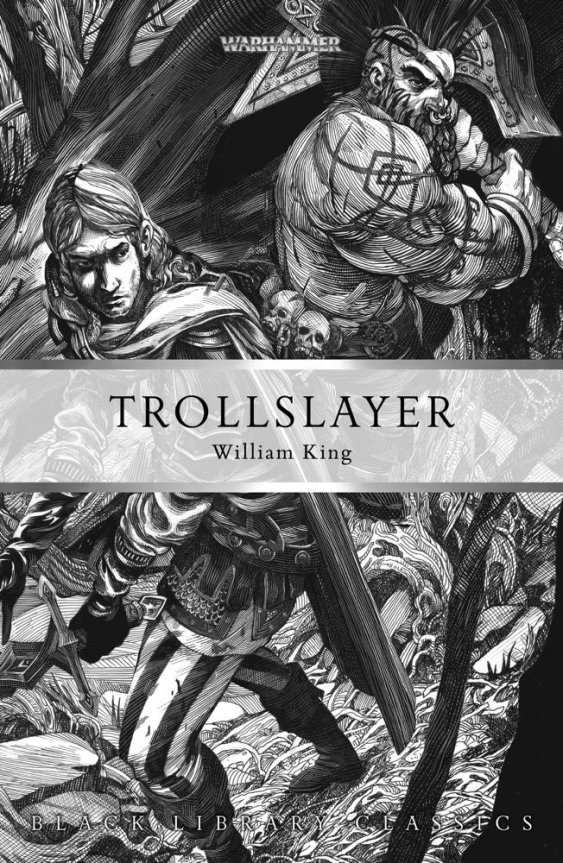
Trollslayer Cover 2

Publisher: Games Workshop (Audiobook – August 1999)

Series: Gotrek and Felix – Book One

Length: 9 hours and 55 minutes

My Rating: 4.5 out of 5

Amazon     Book Depository

Welcome back to my Throwback Thursday series, where I republish old reviews, review books I have read before or review older books I have only just had a chance to read.  In this latest Throwback Thursday article, I review a classic Warhammer Fantasy novel, the iconic Trollslayer by William King.

Over the last year or so, I have started to get back into the exciting and captivating extended universe that surrounds the Warhammer tabletop game franchise.  The Warhammer games are a lot of fun to play, but I have always deeply enjoyed the rich and extensive universe that has formed around it.  This is particularly true when it comes to the extensive literary world that has been created, with a huge collection of unique novels added every year.  I personally have barely scratched the surface of this franchise, having only recently read the exciting Space Marine novel Deathwatch: Shadowbreaker, and the fun crime novel Kal Jerico: Sinner’s Bounty.  For this review, however, I veer away from the science fiction based Warhammer 40,000, and instead look at a book in the Warhammer Fantasy universe.

The Warhammer Fantasy universe is set on a fantasy world where various races and factions fight for power, immortality, dark deities, and a general desire for bloodshed (Blood for the Blood God, Skulls for the Skull Throne!) in both large-scale battles and smaller skirmishes.  I love the fantastic and thrilling world of Warhammer Fantasy, especially as I used to play (my preferred factions were the Empire and the Lizardmen).  While there are many great novels set in this universe, the most recognisable and well-established series are the Gotrek and Felix books.

The Gotrek and Felix novels are some excellent dark fantasy books that follow the titular heroes, Gotrek Gurnisson and Felix Jaeger, as they traverse their world, facing every single monster, demon or villain they can find.  Created by William King, this long-running series has also been authored by fellow writers Nathan Long, Josh Reynolds and David Guymer, the last of whom has just released the latest entry, Gitslayer.  I have always heard good things about this series over the years, and I have previously enjoyed some of the short stories featured online or in the White Dwarf magazine.  As a result, when I had the brainwave to expand my knowledge of the Warhammer canon, this is one of the main series I wanted to check out, and to do so properly, I had to start with the original novel, TrollslayerTrollslayer, which was originally released in 1999, is an interesting novel that features seven original Gotrek and Felix short stories, including Geheimnisnacht, which was originally written as a one-off in 1988.  These seven stories have been bundled together into one continuous narrative, which proves to be an excellent and entertaining fantasy adventure.
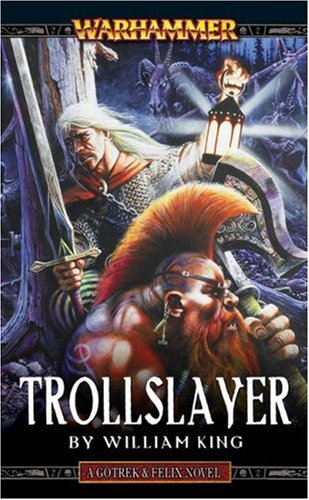
Trollslayer Cover

Felix Jaeger, the son of a wealthy merchant and student in the Imperial capital Altdorf, used to live a blameless and dull life until he met the deranged Gotrek Gurnisson.  The son of a wealthy merchant and student in the Imperial capital Altdorf, Felix’s life was changed forever when Gotrek saved his life.  Gotrek is a Slayer, a dwarf who, after committing a terrible crime, has sworn to seek out a glorious death in battle, and who now wanders the world to find a foe worthy of killing him.  After a particularly damaging night of drinking, Felix drunkenly swears to follow him on his adventures to compose an epic ballad about Gotrek’s glorious death.

Bound by his oath, Felix now reluctantly accompanies Gotrek wherever he goes.  Their latest adventures will take them far and wide, as they venture throughout the Empire and beyond, travelling to the notorious holdings of the Border Princes, the mountainous realms of the dwarves and even under the halls of the conquered dwarf city of Karak Eight Peaks.  While they experience many unique discoveries and locations, one thing remains the same: enemies lurk around every corner, and Gotrek and Felix are forced to battle against some of the most dangerous creatures in existence, including orcs, goblins, trolls, the undead, mutants, beastman and more.

However, the most dangerous foe they face may be something far more insidious and unknowable.  The fell powers of Chaos are gathering throughout the land, and Gotrek and Felix seem to constantly become wrapped up in their plots and vile missions.  With danger and deadly foes all around, will Gotrek find the glorious death he seeks, and will Felix be able to survive whatever might foe eventually manages to kill his companion?

Wow, that was a cool novel I really should have read years ago.  Trollslayer was a fantastic and exciting novel that does a great job exploring some of the more dangerous settings in the Warhammer Fantasy world with two amazing characters.  Featuring seven dark and compelling short stories, Trollslayer is an outstanding book, and I had an incredibly fun and entertaining time getting through its audiobook format.  Banded together by some journal entries which bring the separate stories together, Trollslayer has a fantastic joint narrative that presents the reader with a collection of epic adventures.
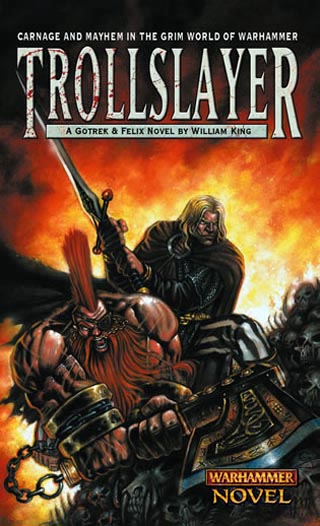
TrollSlayer-john-gravato-Gotrek-and-Felix-1st-edition-cover

The book begins with the original Gotrek and Felix short story, Geheimnisnacht (Night of Secrets).  The two companions are stuck out in the dangerous forests of the Empire during Geheimnisnacht, an auspicious night of the year.  After nearly being run over by a dark carriage on the road, Gotrek and Felix investigate the actions of a dangerous Chaos coven out in the woods, and find more than they bargained for.  This is a rather entertaining and short entry in Trollslayers that serves as a fun introduction to the main protagonists and their quest.  King does a great job setting up both characters and you soon get a fantastic glimpse into their compelling personalities.  The author presents a very dark story within this first tale, as the heroes discover and fight the true horrors of chaos.  An excellent and intense opening story that will get you pumped up for the rest of the book.

The next entry contained within Trollslayer is called Wolf Riders, which sees Gotrek and Felix at the very edge of the Empire with plans to venture to the fallen dwarf stronghold of Karak Eight Peaks.  After encountering a beautiful young woman, Felix convinces Gotrek to join the doomed expedition of a cursed, banished noble family as they journey to the Border Lands to set up their own settlement.  Hired on as guards, the two heroes are forced to protect the caravan against a ravenous Greenskin horde, who are determined to destroy every one of them.  However, the true threat may lie within the convoy, as it soon becomes clear that someone has their own nefarious plans to kill everyone journeying with them.  Wolf Riders is an incredible second entry in the collection of stories, and it is easily one of the best tales in Trollslayer.  Not only does it reinforce the likeability of the two protagonists, but it also contains its own compelling and impressive narrative.  King manages to achieve a lot in Wolf Riders, introducing a cohort of great characters, showing several intense action sequences, and even presenting a clever and malicious mystery.  The entire narrative comes together extremely well, and readers are soon wrapped up in the compelling tale of redemption and bloodshed, which culminates in a tragic and memorable ending that forever changes one protagonist.

The third story is The Dark Beneath the World, which follows on immediately after Wolf RidersThe Dark Beneath the World sees Gotrek, Felix and some new companions journey into the dwarf stronghold of Karak Eight Peaks, which was infamously conquered by greenskins and Skaven in ages past.  Seeking treasure, holy relics and a glorious battle, the adventurers will face untold horrors in the halls beneath the city.  However, nothing will prepare them for the true dangers of Karak Eight Peaks, as the restless dead are stirring in response to a monstrous presence.  This was another great story that really highlights have exciting and action packed one of these stories can be.  I love how King takes his great characters right into the heart of one of the most iconic and dangerous settings in the entire Warhammer canon, and it proves to be an amazing backdrop to this compelling story.  A brutal hack and slash epic with some very intense moments, this is an excellent and fast-paced addition to Trollslayer that was an extremely thrilling read.

From powerful action to great humour, the next entry is the slightly shorter The Mark of Slaanesh.  This story sees Gotrek and Felix return to the Empire, where they encounter some malicious cultists of the Chaos god Slaanesh in a small town.  Unfortunately for Felix, Gotrek is suffering from amnesia after a blow to the head.  Forced to shepherd a docile Slayer through the town’s many dangers, Felix takes drastic action to bring his friend back to his senses.  The Mark of Slaanesh represents a very intriguing change of pace, with more of a focus on humour, as a weary Felix is forced to contend with a pacifist Dwarf Slayer, an eccentric doctor, and comedic mutants.  There are several extremely funny moments in this short story, which helped to turn The Mark of Slaanesh into one of the most entertaining entries in the entire novel.  I particularly appreciate how King was able to craft together such a despicable central antagonist in quite a short period of time, and it was great to see his implied comeuppance towards the end of the story.

King again rapidly switches gears with the next entry in the book, Blood and Darkness, a grim war story set in the darkest forest in the Empire.  This story sees Gotrek and Felix come across a ravished village within the Drakwald Forest, which has been utterly destroyed by beastmen.  Finding a young survivor, Kat, Gotrek and Felix escort her through the woods to the next village.  However, a vengeful and ambitious champion of Chaos is close behind them, with unholy plans for Kat and anyone else she comes across.  Blood and Darkness is another exceptional entry in the series, which is probably my overall favourite Trollslayer story.  Loaded with action, fantastic new characters and a particularly gruesome premise, Blood and Darkness really stands out from some of the other stories in this book, and I was blown away by how dark King made the narrative.  I really loved the story’s complex antagonist, and the entire plot surrounding Kat comes full circle in a great way.  While it is a tad creepy to see just how young Kat is in this story, especially as Felix apparently falls in love with her in a future novel (she gets aged up like 20 years before this happens, but it is still weird), this was an impressive and powerful story that really showed how complex, powerful and mature a Warhammer story can be.

The penultimate story in Trollslayer is The Mutant Master, which again switches pace and has a more humorous tilt to it.  After being attacked on the road by a swarm of mutants, the protagonists arrive at a struggling village and soon discover that the mutants are being controlled by a sorcerer in a nearby tower.  Betrayed by the villagers, Gotrek and Felix find themselves as prisoners and soon must deal with an insidious sorcerer who shares a history with Felix.  This was another great short story that places the protagonists into a uniquely dangerous position.  King includes some excellent humour in this novel, especially in the scene where Felix and the sorcerer have a very entertaining encounter, which proves that everyone, even dark sorcerers, fall to pieces when encountering former classmates.  While much of this story is dedicated to humour, the author fits in a particularly dark moment towards the end of the novel, which pushes one protagonist further than ever.  Another awesome and memorable story, I powered through this one extremely quickly.

The final entry in this book is the intense Ulric’s ChildrenUlric’s Children sees Felix trudging through a snowed-in forest, attempting to escape the cold and the wolves.  When they hear the sounds of a fight up ahead, Felix gets separated from Gotrek, and ends up getting captured by a dangerous group of soldiers.  The soldier’s leaders end up being revealed as cultists of the Chaos god Tzeentch, who are desperate to capture a mysterious family living nearby, who have strange powers and strengths.  Caught up in their conflict, Felix soon finds himself trapped in a manor house with two very different monsters and must try to overcome the powers of Chaos that threaten to consume him.  This was another fantastic story that serves as a great conclusion to the entire novel.  While I think that Ulric’s Children was one of the weaker stories in Trollslayer, it was still a compelling and thrilling tale which readers will enjoy.  I loved the inclusion of werewolves in this novel and it was fun to see Felix attempt to overcome a dangerous foe without Gotrek’s determined backup.  With some intriguing foes and an exciting story, this is a fun and fantastic entry in the book which will leave readers wanting more Gotrek and Felix in the future.

King really has loaded Trollslayer with an amazing range of different stories that highlight the gritty adventures of two memorable and loveable characters.  I had a great time getting through each of the short stories contained within this novel, and I think that the author did a good job combining seven shorter stories together into one cohesive tale.  I love how each of the stories has some impressive action set pieces, and readers are given an in-depth look at the true dangers and darkness that inhabits the Warhammer world.  King has also ensured that each tale contains a compelling blend of humour, dramatic character development and dark fantasy elements, all of which produce an outstanding overall narrative.  It was also very cool to see just how dark and gruesome King could make his narratives, and quite a few elements of this book closely bordered the horror genre.  Since the stories were originally published in instalments, readers are in for some repetition, especially as King rehashes Gotrek and Felix’s origin in every entry, and you also get quick summaries of their prior adventures.  While this and other pieces of repetition (for example, Gotrek runs his finger over his axe blade in every tale) can be a bit annoying at times, I personally thought it was a small price to pay for such an awesome and epic book.

One of the most impressive things about Trollslayer is the complex and distinctive characters.  Naturally, the main characters are series protagonists Gotrek Gurnisson and Felix Jaeger, both of whom prove to be really fantastic and exciting characters.  King has come up with an exceptional pairing in these two characters, and I absolutely love the combination of a doomed dwarf Slayer and a disgraced human with a penchant for poetry.

As the primary narrator of the separate stories in this book, Felix gets a great deal of attention, and you really get to grips with his superb character throughout the book.  I loved the depiction of a former arrogant dandy who finds himself in a situation well over his head, and Felix has a “fun” time facing off against all sorts of monsters in this book.  While most of the novel depicts him as a bit of a coward, Felix does manage to achieve some major heroics and you cannot help but sympathise with the terrible situations he finds himself in.  While the use of multiple short stories does tend to backslide Felix’s character at times (he reverts to a coward at the start of each story), I did enjoy seeing some of the excellent development that occurs around Felix.  Not only does he grow more confident in his own abilities, but he also becomes harder with each adventure, especially as he experiences tragedy and despair around every corner.  It was actually hard to see how some of the more tragic events of the book affected him, but I really appreciated the amazing character work that King worked around him.

The titular Trollslayer, Gotrek Gurnisson, is one of the most beloved figures in Warhammer Fantasy lore, and a magnificent character who I really enjoyed.  Much of Gotrek’s past is shrouded in mystery, and all you really know is that he is a mighty warrior who previously committed some great crime that still haunts him to this day.  Determined to find a glorious death, Gotrek willingly walks into the most dangerous of places, but always survives, much to his displeasure (even doomed dwarves are far too stubborn and proud to simply let an enemy kill them).  King mostly paints Gotrek as a crude, rude and bloodthirsty being, which is a lot of fun to see.  However, there is so much more to Gotrek than killing and fighting, and you see several glimpses of his true inner self in this book, especially when he thinks about the past.  I loved how King keeps Gotrek as a mostly enigmatic figure, mostly by not showing any of the story from his point of view, and the reader is never quite sure what he is thinking or planning.  All of this results in an excellent and memorable protagonist, and I am deeply intrigued to see what sort of adventures he has in the future, as well as any revelations about his past.

Aside from Gotrek and Felix, Trollslayer contains a range of interesting and compelling characters, several of whom act as point-of-view figures at various parts of the book.  King does a really good job of introducing and utilising so many unique figures throughout his various stories, and it is simply amazing how well he can develop and establish his character in such a short amount of time.  Even though you only see some characters for a few pages, you quickly become quite invested in their stories, which is the sign of a really good author.  However, readers are advised not to get too attached to anyone, as most of the side characters will come to a gruesome and tragic end.  Still, these supporting characters are really fun, and I look forward to seeing what unique figures are introduced in future Gotrek and Felix books.

Trollslayer also features the dark and well-established background setting of the Warhammer Fantasy world, with the protagonists adventuring through many iconic locations.  King makes excellent use of this fantastic background throughout his story, and I loved seeing all the cool locations, interesting factions and dangerous monsters contained within the story.  This actually serves as a really good introduction to the Warhammer Fantasy world, and readers unfamiliar with the various aspects of Warhammer will learn a lot here.  King can really craft together some dark and dangerous locations with his writing, and I love how spooking and claustrophobic some of his settings felt, especially the ancient dwarven catacombs and the haunted, monster infested forests.  I also loved the sheer range of different creatures and races featured within Trollslayer, as the author includes as many foes as possible.  It was extremely awesome to see Gotrek and Felix cut their way through various greenskins, monsters, and servants of Chaos, and there is something for all fantasy fans within this book.  I am extremely keen to see what other monsters and races are utilised in the future novels, and I am sure they will be pretty amazing.

I ended up listening to the Trollslayer audiobook format, which was an outstanding way to experience the awesome adventures contained within this book.  With a decent run time of just under 10 hours, I powered through this audiobook in a matter of days, especially once I got caught up in the fantastic depictions of intense action and dark creatures.  I was also really drawn in by the impressive narration of Jonathan Keeble, who has lent his voice to all the Gotrek and Felix audiobooks, as well as several other Warhammer projects and some of my favourite historical fiction novels, such as the Eagle of the Empire series.  Keeble has an epic voice, and the sheer passion that he brings to Trollslayer is immediately obvious, especially during the action scenes, where his excited voice captures the intensity and movement of the fights.  I also felt that Keeble did an exceptional job bringing all of the characters to life in an impressive way.  I particularly loved the gruff voice that he used for Gotrek, which fit the doomed dwarf warrior perfectly, and he also does a really good job voicing the often terrified Felix.  I also found some of the voices that he used for the supporting characters to be really fun and fitting, and I had a lot of love for a couple of the crazed sorcerers/alchemists they encounter, which were quite amusing.  All of this helps to turn the Trollslayer audiobook into an outstanding experience, and I think that this will be the format I check out the future Gotrek and Felix novels out in.  I might also have to consider listening to some historical fiction novels on audiobook in the future, especially as I know that Keeble will do a wonderful job narrating them.

Trollslayer by William King is an exceptional and clever Warhammer Fantasy novel that showcases the exciting and powerful adventures of the iconic Gotrek and Felix.  Serving as the main introduction to these two iconic heroes, Trollslayer contains seven outstanding and wildly entertaining short stories with some fantastic and wacky plots.  Readers who check out Trollslayer are in for a heck of a lot of fun and will swiftly become fans of this great duo and their outrageous adventures.  A highly recommended read, I suddenly have some major plans to check out more Gotrek and Felix novels in the future.
Amazon     Book Depository

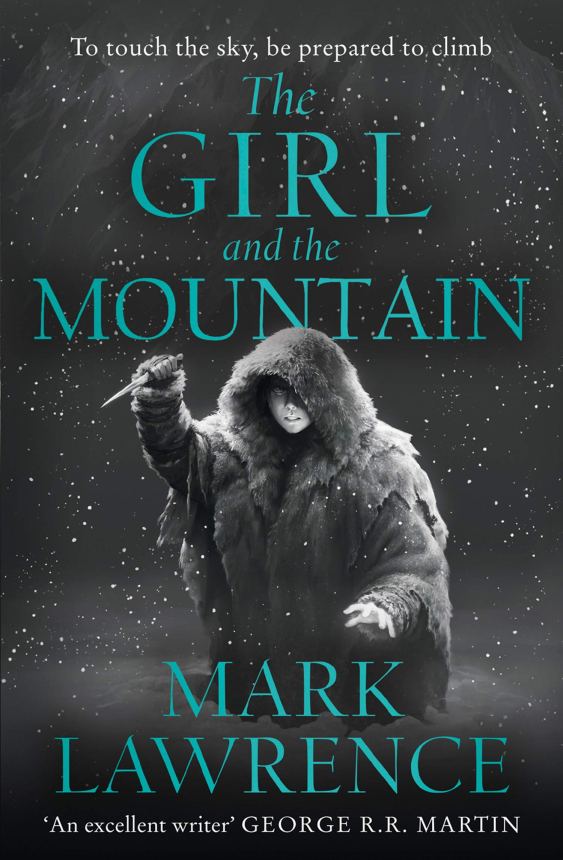
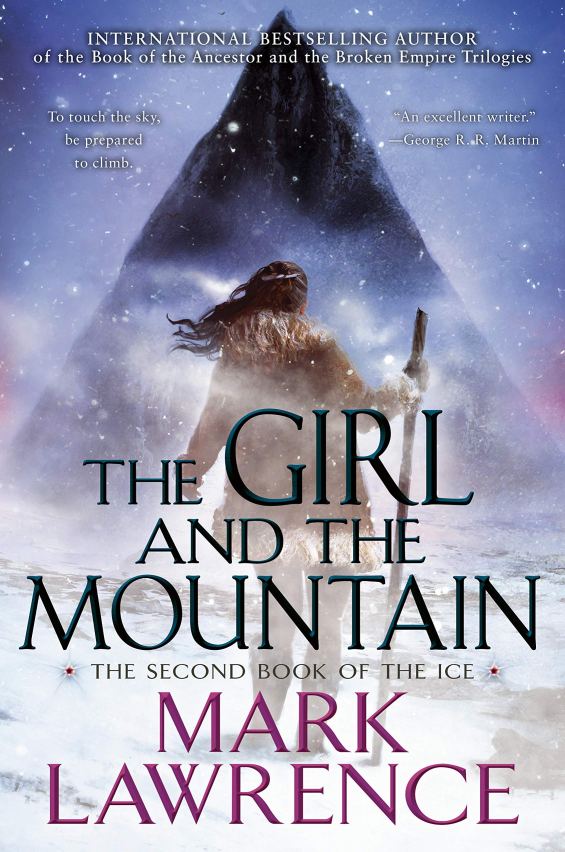
The Girl and the Mountain by Mark Lawrence

71BXoAWASUL

Publisher: Penguin Random House Audio (Audiobook – 29 April 2021)

Series: Book of the Ice – Book Two

Length: 16 hours and 48 minutes

My Rating: 4.75 out of 5 stars

Amazon     Book Depository

One of the most impressive current authors of fantasy and science fiction, Mark Lawrence, returns with the second novel in The Book of the Ice trilogy, The Girl and the Mountain.

Lawrence is a highly regarded and enjoyable writer who burst onto the scene in 2011 with the first novel in The Broken Empire trilogy, the bestselling Prince of Thorns.  Since then, Lawrence has produced a range of exciting and compelling novels, including The Red Queen’s War trilogy, The Book of the Ancestor trilogy, and the Impossible Times trilogy.  I have long been interested in checking out Lawrence’s work; especially after seeing glowing reviews from nearly every fantasy of science fiction reviewer out there.  Because of this, I was rather excited when last year I received a copy of the first entry in Lawrence’s The Book of Ice trilogy, The Girl and the Stars, as I thought it would be a good opportunity to experience the author’s writing style and imagination.

The Girl and the Stars ended up being an extraordinary read which featured an intense and captivating story of powered individuals on the ice-covered planet, Abeth, who are banished to an underground cavern to survive amongst a plethora of threats, while also learning about the various terrors inhabiting their world.  This amazing novel ended up being one of the best books I read last year, and Lawrence was one of the best new-to-me authors I experienced in 2021.  Due to how much I enjoyed his previous book, and because he left The Girl and the Stars on such an intense cliffhanger, I have been keen to check out The Girl and the Mountain for a while.

After her adventures below the ice with the Broken and the discovery of her powerful quantal abilities, former Ice Tribe member Yaz has returned to the surface with her brother and friends.  However, their plan to escape from all dangers of their icy home fails miserably when the insidious and dangerous Priests of the Black Rock, followers of the dangerous Hidden God, capture her and throw her friends back down the hole they escaped from.

Imprisoned within the Black Rock, Yaz begins to discover the true evils of the priests, who wish to use her to conquer the central green corridor of Abeth and help their twisted god bring a devastating change to the planet.  Determined to avoid this horrible fate, Yaz attempts a daring escape before it is too late.  Elsewhere, Yaz’s friends have made their own journeys to the Black Rock, and both Thurin and Quell are determined to save Yaz and the other prisoners they discover.  However, there are many horrors lurking within the Black Rock, and not even Yaz and her new powers may be enough to stand up to them.

As Yaz and her friends battle against the priests and their Hidden God, dark secrets from the ancient past of Abeth will come to the surface and the true dangers of their planet will become clear.  To fully understand her destiny and to save everything she knows, Yaz will be forced on an epic journey to reach the warm central belt of Abeth.  However, this journey will not be easy, and neither Yaz nor her friend may have the strength to survive, especially with the mad city intelligence Seus, who believes himself to be a god, manipulating events from above.  Friends will fall, destinies will be found, and the fate of Abeth will hang in the balance as Yaz’s life-changing journey begins.

This was another impressive and compelling novel from Lawrence which I had an amazing time reading.  The Girl and the Mountain serves as an amazing sequel to The Girl and the Stars, and I really enjoyed the inventive and intriguing science fiction and fantasy story featured within.  The Girl and the Mountains has some fantastic elements to it and readers will quickly find themselves engrossed by the clever story, impressive setting and relatable characters, which results in an outstanding and powerful novel.

Lawrence has come up with a unique and compelling narrative for The Girl and the Mountain, which I found myself becoming extremely drawn to.  This book starts off quickly, following three major characters from the previous novel, Yaz, Thurin and Quell.  All three of these characters initially get an equal share of the book’s plot through their separate point-of-view chapters, resulting in a comprehensive and varied story.  The characters quickly resolve the cliffhanger from the first novel and then find themselves invading the Black Rock, fortress of the antagonistic priests of the Hidden God.  These three point-of-view characters find themselves separated at the start of the novel and end up entering the Black Rock from different directions.  All three protagonists encounter a range of threats, characters and plot devices which not only enhance the stakes of their mission but help to enhance the reader’s knowledge of the setting.  Each storyline is intriguing and exciting in its own right, and the three separate perspectives complement each other extremely well, with the protagonist’s actions impacting that of their unseen colleagues, as they unknowingly encounter similar obstacles and opponents.  Yaz, Thurin and Quell’s storylines all come together about halfway through the book, which results in a major clash with an intriguing antagonist and produces an intense conclusion to this initial storyline.

However, this big confrontation is not the end of the novel; instead it only constitutes roughly half of the plot.  The second half of the narrative starts immediately after this confrontation and sees several characters embark on an epic and lengthy journey across the ice to the planet’s equator.  This results in a rather interesting change of pace in several different ways, as not only does the action become a lot more restrained but the story is told primarily from only one character’s perspective.  There is something a lot more personable and intense about this second half of The Girl and the Mountain, especially as the characters come together and bond during their trek.  While this second half did feel a little slow in places, the reader is kept extremely entertained, especially as there are a lot of dangers and distractions on the ice.  In the intriguing conclusion, Yaz and her friends finally reach a destination filled with danger and exposition.  This last quarter really brings the entire novel together and there are several great sequences and twists that will keep the reader on the edge of their seats.  The narrative eventually concludes with another intense cliffhanger in a memorable and important location, which will stick in the mind and ensure that readers of this second book will come back for the third and final entry in The Book of Ice trilogy next year.

This distinctive story split proved to be an interesting way to write The Girl and the Mountain, and I personally found myself enjoying this fantastic tale.  While it occasionally felt like there were two very different novels within The Girl and the Mountain, the halves came together extremely well, and I rather appreciated that the author tried something a little different.  I did feel that the book suffered a little from being the middle novel in this trilogy, with Lawrence trying to set up a lot of plot, which resulted in some minor but noticeable story drag.  This novel did serve as an excellent sequel to The Girl and the Stars, following up on all the storylines started in the first novel and setting up a fantastic scenario for the final entry in the trilogy.  Due to the complexity of the overarching series narrative, I would strongly suggest that readers read The Girl and the Stars first.  However, Lawrence does provide a very detailed and comprehensive summary of the first novel at the start of The Girl and the Mountains, which does bring new readers up to speed, as well as serving as a fantastic recap of some key details.  Overall, this exceptional narrative will leave readers extremely excited for the next entry in the series, especially as Lawrence has set up some very intriguing storylines for the final book.

I must highlight the amazing and inventive setting that is the ice planet of Abeth.  Abeth is any icy planet located around a dying sun, with only a thin corridor of unfrozen land at the equator.  Abeth is an amazing setting, and I loved the way in which is presents a fantastic blend of science fiction and fantasy elements.  Not only can most characters perform magic, but there are some intriguing alien elements to this world.  Large swathes of the story revolve around the mysterious race known as the Missing and their massive, frost-covered cities which are barely maintained by insane AI who consider themselves to be Greek gods.  This proves to be a really clever and amazing setting for this compelling narrative, and Lawrence does a wonderful job working his inventive locations, history and powers into the wider plot.  The Girl and the Mountain contains some interesting new locations, including the ghastly Black Rock, which is filled with insane creatures, creations, and antagonists.  There is also an intriguing and lengthy focus on the ice sheets that make up much of Abeth, as the characters attempt to track across them.  I deeply enjoyed the amazing detail that Lawrence put into bringing this harsh, icy landscape to life, and you get a real sense of the dangers and hardships that the characters experience while out there.  There are also some truly horrifying and creative monsters, constructs and inhuman antagonists throughout this world, which Lawrence uses to great effect, creating some memorable and powerful threats for his protagonists.  All of this works into the narrative extremely well, and you will have a hard time forgetting the ice planet of Abeth any time soon.

One particular intriguing aspect of this setting is the green corridor around the middle of Abeth.  This location was previously featured in Lawrence’s The Book of the Ancestor trilogy, and is the major setting for all three entries in this major series.  While I have not had the pleasure of reading The Book of the Ancestor novels yet, it is very clear that fans of these books will feel particularly drawn to The Girl and the Mountain, as the characters visit a key location from this earlier series.  As I understand it, The Book of the Ice novels are set well before The Book of the Ancestor trilogy and serve as a bit of a prequel.  Because of this, The Girl and the Mountain contains quite a lot of references that readers of The Book of the Ancestor’s novels will really appreciate, especially as they shed some additional light on some The Book of the Ancestor supporting characters.  While this makes The Girl and the Mountain a must-read for fans of Lawrence’s previous work, readers do not need to have read this previous trilogy, as Lawrence makes this latest series extremely accessible to new readers.  This great setting really enhances The Girl and the Mountain and it is very easy for fans of Lawrence, both new and established, to be drawn into the icy perils of Abeth.

Lawrence has also come up with an amazing and fantastic group of characters for The Girl and the Mountain, most of whom are carry-overs from the first novel in the series.  The main characters of this novel are Yaz, Thurin and Quell, who serve as point-of-view characters.  Each character has an intriguing background and has been bitterly changed by the events under the ice in The Girl and the Stars.  Lawrence focuses much of his character development on these central protagonists, and all three go through some major changes throughout their parts of the book.  Yaz is easily the most noticeable of these, especially as she needs to overcome her past both on the ice and under it, her uneasy destiny, and the unwanted leadership thrust upon her.  I also liked seeing how Thurin and Quell developed as well, especially as Quell became a little less of an ass, although I still disliked several of his thoughts in this novel.  I also must admit that I was not the biggest fan of the love triangle/square/pentagon (depending on how you look at it), that formed around Yaz, as there are hints of romantic feelings between her and all the major male characters.  It got a little ridiculous at times, especially as the male characters each saw each other as rivals, and I felt that the author could have cut back on it a little.

Aside from Yaz, Thurin and Quell, Lawrence also features a fun range of supporting characters, each of whom adds their own interesting edge to the narrative.  Most of these side characters continued the storylines set up in the first novel, and it was interesting to see them continue to develop.  One of the most significant of these supporting characters is Erris, the 5,000 year old boy who, after dying, found his soul stored in the mind of an ancient Missing city.  Erris now inhabits a powerful artificial body and serves as a great addition to the plot, especially as he has a unique connection to the devices and technology of the Missing.  Other characters, like Quina, Maya, Kao, Theus and Taproot all have their moments throughout this novel, and Lawrence is able to produce some fantastic storylines around them.  I also really enjoyed the brand new character Zox, a loyal mechanical dog companion who attaches himself to the group and proves to be a fun member of the team, even if there is something a little sinister about him.  All these characters are really amazing, although I would caution you not to get too attached, as Lawrence has a tendency to snuff out a few characters every novel.  I am very much looking forward to seeing how all the character arcs conclude in the final novel, although I am expecting much heartbreak and despair as Lawrence will probably be a little more lethal in his final entry.

Unlike the first novel in this trilogy where I read a physical copy of the novel, I chose to enjoy The Girl and the Mountain in its audiobook format.  The Girl and the Mountain audiobook has a decent run time just short of 17 hours, which took me a little while to get through.  While it is always interesting to change formats halfway through a series, I ended up having a great time listening to The Girl and the Mountain’s audiobook, especially as I found myself absorbing a bit more of the novel’s lore, awesome setting and intriguing character personalities.  One of the best things about this audiobook is the awesome narration from the talented Helen Duff, who has previously provided her voice to the novels in the Book of the Ancestor series.  Duff does an incredible job bringing all the characters in The Girl and the Mountain to life, especially as she has a plethora of fun and distinctive voices at her disposal.  Each character gets a unique voice of their own which fits their personality perfectly and helps the reader to understand and appreciate who they are.  Duff utilises some great accents for the main protagonists, which really helps to highlight the tribal upbringing of characters like Yaz, and which I found to be extremely fitting.  This amazing voice work really enhances this fantastic audiobook, and I would strongly recommend this format to anyone who wants to experience The Girl and the Mountain’s excellent and inventive narrative.

The Girl and the Mountain is an incredible and distinctive novel from impressive author Mark Lawrence, who once again shows off his inventiveness and ability for complex storytelling.  The Girl and the Mountain serves as an excellent middle novel in The Book of the Ice trilogy, and I really enjoyed seeing how Lawrence continued to develop his unique world, which expertly brings together fantasy and science fiction elements.  This is an amazing novel and readers will swiftly find themselves entranced by the epic and powerful story.  I cannot wait to see how this unique series ends next year, and I will really have to go back and check out some of Lawrence’s other series in the future.

The Girl and the Mountain Cover 2

Amazon     Book Depository

The Two-Faced Queen by Nick Martell

The Two-Faced Queen Cover

Publisher: Gollancz (Audiobook – 25 March 2021)

Series: The Legacy of the Mercenary Kings – Book Two

Length: 20 hours and 6 minutes

My Rating: 5 out of 5 stars

Amazon     Book Depository

Following his epic 2020 debut, one of the fastest rising stars in fantasy fiction, Nick Martell, returns with the second entry in his The Legacy of the Mercenary Kings series, The Two-Faced Queen.

Last year I was lucky enough to listen to a copy of Martell’s incredible first novel, The Kingdom of LiarsThe Kingdom of Liars was a gripping and impressive fantasy read set in Hollow, a crumbling city surrounded by an army of rebels, which followed the misadventures of the infamous Michael Kingman.  Michael is the scion of the legendary Kingman family, a noble clan of heroes and leaders who have guided Hollow for generations, serving as both supporters to the royal family and a check on their power.  However, the legacy of the Kingman family has been severely tarnished in recent years as Michael’s father was executed for the murder of the heir to the throne.  With their family disenfranchised, Michael grew up as an outcast in his own city, acting out against authority.  This changed when a chance encounter allowed him to investigate who was responsible for his family’s downfall and the death of the prince of Hollow.  While he was eventually able to discover the true murderer, his investigation also resulted in the King’s suicide, which subsequently saw him tried for regicide and sentenced to death.  The end of the book saw him manage to escape his execution, while also setting up several of the storylines for future entries in the series.  I deeply enjoyed the cool story of this first entry in The Legacy of the Mercenary Kings, and The Kingdom of Liars ended up being one of my favourite novels, audiobooks and debuts of 2020.  As a result, The Two-Faced Queen was one of my most anticipated reads of 2021.

Michael Kingman is a dead man walking.  Still accused of killing the King of Hollow, Michael is now under the protection of the Orbus mercenary company, serving as an apprentice under the mysterious mercenary Dark.  However, even with Orbus’s protection, everyone in Hollow still wants to either kill him or use him for their own dark ends.  The deadliest of these is the one person Michael is sworn to protect above all others, the heir to the throne, Princess Serena.  After spending years away, a vengeful Serena has returned to claim her throne and end Michael’s life.  Wielding great power, a lethal attitude and holding the keys to Michael’s heart, nothing will stand in the way of her wrath.

To restore his family’s position, save his home and convince Serena of his innocence, Michael needs to unravel the various conspiracies that have encircled Hollow and uncover the true motivations of the various power players in the city.  However, to succeed, Michael is forced to go up against a magnitude of foes, from the Corrupt Prince, the unhinged Rebel Emperor besieging the city, enraged royal guards, conspiring nobles, a scheming immortal, an insane serial killer, dangerous assassins and his former foster father, the man responsible for all his family’s ills.

But the more Michael attempts to understand Hollow’s hidden past and the dangerous plots surrounding his city, the more it becomes apparent that his is a mere pawn in a very dangerous game.  Immortals, monsters and mercenaries are all present in Hollow, and each of them has their own nefarious designs for Michael and his family.  Can he save everyone he loves before it is too late or has the Kingman family finally breathed its last?  Michael’s rise to become a Mercenary King continues, but who will truly wield power when the dust settles?

Now that was one hell of a sequel!  Martell absolutely crushed this second entry in this outstanding and exceptional fantasy series, producing a five-star novel that is extremely compelling, intense and so damn exciting.  I was absolutely enthralled with this book the moment I started listening to it and I loved every second.  The Two-Faced Queen is easily one of the best books I have read in 2021 and I think that any other fantasy novel coming out this year is going to be extremely hard-pressed to outdo it.

Martell has come up with a pretty incredible and intense narrative for The Two-Faced Queen, one that proves to be extremely addictive and insanely good.  Starting shortly after the events of The Kingdom of Liars, this novel starts fast and hard, with Michael following up on a number of storylines and revelations from the previous novel.  There is already so much going on right from the start of the novel, as the protagonist finds himself surrounded by enemies and conspiracies, both old and new.  While several secrets were revealed at the end of the first novel, there is still so much that Michael needs to understand.  However, as he attempts to learn these additional secrets, he must also try to avoid the deadly attentions of his beloved princess, end the rebellion plaguing the city, restore his family, defy a dangerous immortal, and make up with his betrayed friends.  While this is already a substantial amount of story, Martell keeps adding to it, as Michael also soon encounters a deadly assassin with a contract on him, and a deranged and unnatural serial killer.

While this may seem like too many story elements for one novel, it actually works extremely well, and the reader quickly becomes engrossed in Michael’s various adventures throughout the city.  I loved the inclusion of the serial killer storyline, as not only does it add some fantastic mystery elements, but it also proves to be a gateway to some intriguing world building, revealing more of the dark, immortal forces manipulating events from the shadows.  This storyline also results in several epic action scenes that place the protagonist and his friends in mortal danger from some unusual foes.  I had an outstanding time getting through this complex and well-constructed narrative, especially as every single scene has an intriguing revelation, intense character development or subtle clue to the future of the series.  Several key mysteries and secrets from the first novel are answered, partially or wholly, in this novel, although many more are introduced.  This really helps to keep the reader’s attention focused on The Two-Faced Queen’s plot, and I am not exaggerating when I talk about how addictive the secret-ridden narrative proves to be.  Readers are hammered with large amounts of lore and history in places, so I would recommend reading the first novel in the series, The Kingdom of Liars, before reading this book, although binge-reading this series is hardly a chore.  Overall, The Two-Faced Queen’s narrative is epic story writing at its best, and readers will love this terrific tale.

I absolutely must highlight the awesome and well-developed characters featured within The Two-Faced Queen.  The most prominent is series protagonist Michael Kingman.  Michael is an intriguing and distinctive figure through whose eyes most of the plot unfolds.  I have to admit that Michael was not my most favourite character in the first book, mostly because of his impetuous nature and selfish behaviour at times.  However, it was revealed that the reason for some of his annoying behaviour was due to some magic affecting his memories and personality.  As a result, Michael’s behaviour is substantially changed in The Two-Faced Queen and he comes across as a more considerate figure in this book.  He still has quite a few flashes of recklessness and stubbornness, but many of the rougher edges from the first novel are worn away here.  Still, a lot of people call Michael out for his crap in this book, including his friends and family, and it was great to see him finally heed their words.  There was also some additional exploration of how Michael deals with the legacy of being a Kingman; he is forced to live up to some big expectations.  There is a rather good scene where Michael is exploring the crypt of his ancestors with some of his friends, describing why some of them are famous and others are considered failures because they never achieved anything remarkable but just lived a normal life.  Seeing this, Michael’s friends, both of whom have been some of his greatest critics, start to understand just how much pressure he is under.  I really appreciated the way in which Martell continues to develop his protagonist, and it will be very fascinating to see how Michael’s story continues in the future novels.

Aside from Michael, there is an impressive collection of interesting supporting characters, each of whom have some fascinating storylines, as well as secrets or details from their past which helps to move the story along.  They also have their own motivations and plans to shape Hollow and the rest of the world to their advantage, which results in additional plots and conspiracies that the protagonists have to overcome.  The most prominent supporting character is probably Serena, the titular Two-Faced Queen.  Serena is Michael’s childhood friend and the royal he was sworn to, meaning that he was always destined to be her protector, advisor, and conscience.  However, after the death of her brother and Michael’s family were declared traitors, their relationship effectively ended.  Now returned, Serena is determined to destroy Michael for the apparent murder of her father, even if it leads to her own ruin.  The novel starts up with Michael visiting Serena only to find that she has hand-dug a grave for him, showing her resolve for killing him.  This forces Michael to attempt to change her mind, which is no easy prospect, and results in great calamity.  Naturally, these two characters share thorny romantic feelings for each other, which complicates Michael’s plans to stay alive, as Serena is a major blind spot in his defences.  Their entire joint character arc in this novel is extremely good, and I really appreciated the author’s take on their complex relationship.

Another key character is Dark, Michael’s mercenary master, who, aside from having his own mysterious past and motivations, is the son of Michael’s nemesis, Angelo Shade.  Due to Michael and Dark working together closely, the protagonist learns several of Dark’s secrets, especially those related to his troubled childhood and his encounters with the Heartbreaker serial killer.  While you don’t learn everything about Dark’s past in this novel (Martell is the master of dolling out just enough character detail to keep you interested, while also keeping plenty back for future novels), you do find out quite a lot, and what is revealed is extremely memorable.  Dark has a real dark side to him, no pun intended, and while Michael initially believes that Dark is his ally, he is soon faced with the possibility that he might have placed all his trust in a monster.  This results in a very interesting mentor/student relationship between the two, filled with much conflict and mistrust.  I really enjoyed learning more about Dark in The Two-Faced Queen, and it will be fascinating to see how the rest of his story unfolds in the future.

Other intriguing characters in this novel include Michael’s best friend Trey, who is attempting to forge his own path and take down both the nobles and the rebels, even if this leads him into conflict with Michael.  Trey has a fantastic arc as dangerous antihero in this book, taking control of the city’s criminal element in order to protect its citizens.  While a lot of his hostility towards Michael has ended, Trey and the protagonist still have a strained relationship, although Trey does go out of his way to help his friend.  Despite their friendship, it is clear that there is a major schism between the two planned in the future, which no doubt will result in all manner of pain and regret.  The ruthless immortal Charles Domet is still a firm favourite of mine, and it was fun to see his attempts to manipulate Michael, especially as Michael is now well aware of his true nature.  There are some interesting hints to Domet’s past in this novel, and he is clearly working up to something big.  The ambitious social climber Naomi also returns, although now she is suffering from a bad drug addiction which makes her even more entertaining, especially as she decides to torment Michael through embarrassment.  I also quite liked the expanded use of the chronicler, Symon.  Symon, who is determined to record and analyse every secret of Michael and his family, has taken to stalking them by living at the Kingman family home, and it is always entertaining to see his take on the events occurring before him.  He ends up actually narrating several interludes in The Two-Faced Queen, which are laid out as parts of his in-novel chronicles as part of a very clever and amusing supplement to the main story.  Symon really endeared himself to me in this novel, especially after his insulting descriptions of Michael in his proposed history book, and I deeply appreciated his increased presence.

I honestly could go on and on about the various characters featured within this novel; indeed, I have only just scratched the surface of the support cast in the paragraphs above.  However, it is more than clear that Martell does an excellent job in introducing and developing complex characters, and I loved the detailed and intriguing depictions of them throughout the novel.  Nearly every character featured within The Two-Faced Queen gets at least one big moment, and there are plenty of revelations and compelling backstories that are really cool to uncover.  I will say that you should probably not get too attached to the characters; however, I am very much looking forward to seeing what happens to each of the survivors, especially as Martell has set up some deeply captivating and powerful character arcs around them.

In addition to the fantastic story and amazing character work, Martell has also invested a lot of time in expanding his enthralling fantasy world.  The first entry in The Legacy of the Mercenary Kings did a great job setting up the key elements of Hollow, such as the noble families, the people of the city and the various problems they faced.  This unique setting of a besieged city filled with scheming nobles and set on a world where pieces of a shattered moon fall to the ground was so cool, and The Two-Faced Queen continues to expand on these previous elements, while also adding to the history and geography of the city and its surrounding nations.  Not only do you learn of several outside nations and locations but you also get to see how the key characters of this novel, or their ancestors, have impacted them, as well as the various dangers these realms represent.  However, some of the most substantial world-building revolves around some of the unusual creatures residing in this world, including a range of dangerous and destructive immortal creatures.  In the previous novel we only encountered one immortal (that we knew of), whose plots and schemes were a major part of the book’s plot.  This second novel, in contrast, is loaded with many more immortals, each of whom has their own unique abilities and plans for the world.  Martell introduces the lore around these immortals extremely well, and their various traits and schemes are worked into the plot extremely well.  It sounds like we are going to encounter a whole raft of intriguing and monstrous immortals in the future of this series, and I am very much looking forward to seeing what happens there.  The next book also looks like it will be set in a whole new location, and I will be extremely intrigued to see how that impacts the narrative.

One particular bit of world-building that I really enjoyed was the excellent expansions of Martell’s unique magical system.  The main magic of Hollow is known as Fabrication, which allows its users certain control over certain elements or phenomena at the cost of their own memories.  This is a really cool magical system, and Martell uses it to great effect throughout his novels, ensuring that there is all manner of destruction and manipulation throughout the narrative.  The Two-Faced Queen features multiple new Fabrication types, as Martell introduces unique Fabrications throughout the story, including several that even the protagonists have never heard of.  Examples include a particularly dangerous telekinetic Fabrication, which forces everyone to their knees (perfect for its user), while I was also very impressed with the disturbing blood Fabrication that one of the supporting characters pulled out.  In addition, Martell also introduces some different forms of magic from some of the other countries in his fantasy world.  While you only get to see one or two of these new magical abilities, they are still fun to see and they stand as an intriguing counterpoint to the already established magical abilities.  It looks like Martell is setting up some sort of mystery around the origins of all these different powers and it should prove pretty interesting to see how that turns out.

Martell also does an incredible job fitting the downsides of this magical Fabrication into the plot, as several characters experience memory loss, which affects their plans, reactions and relationships.  This is most obvious in Michael; as narrator, he loses several days of his life, resulting in him being unaware of plans he puts into motion or certain secrets that he learnt in these missing days.  Because the reader does not see these missing pieces of time either, this adds an extra amount of mystery and uncertainty into the narrative, as you try to work out both what is being deliberately hidden from Michael and what he has simply forgotten.  These bigger lapses in memory are a fantastic part of The Two-Faced Queen’s narrative, and it helps to make the flow of this book unique and compelling.  However, you also have to appreciate some of the smaller examples of memory loss throughout the book, some of which are quite heartbreaking in nature as the characters forget elements of their friends and families without realising it.  There is one extremely poignant scene in which Michael confesses to forgetting something very important to him, with the reader only then realises that a certain normal-sounding character description was evidence of memory loss all along.  Some of these subtle details are really impressive, and I deeply enjoyed seeing the hurtful side effects of this magical system.

To enjoy this awesome book, I ended up grabbing its audiobook format, mainly because I had such a great time listening to the first novel.  There were actually two audiobook versions of The Two-Faced Queen, and I ended up grabbing the Joe Jameson narrated version.  Jameson is a fantastic audiobook narrator who has previously lent his voice to amazing fantasy novels like King of Assassins by RJ Barker.  I loved his narration for The Kingdom of Liars last year and I was really keen to continue to listen to him in this sequel.  Jameson has a great voice for this complex fantasy read, and you swiftly become enthralled by the way he narrates the events occurring, as well as the fantastic voices he comes up with for his characters.  All the characters are given a unique voice in a variety of different accents, and each of them really helps to capture the character’s emotions and personality perfectly, whether it is the constant confusion and hurt in Michael, the raging anger of Serena, the cold menace of Dark or the calculating and manipulative voice of Charles Domet.  All this voice work is perfect and spot on and I really appreciated the effort that Martell put into this book.  Despite its runtime of 20 hours, I got through this audiobook in no time at all and I honestly wished it was a lot longer by the end.  This was another outstanding audiobook, and this format comes highly recommended to anyone interested in this fantastic novel.

With this epic and captivating second novel, Nick Martell has cemented his position as one of the best new fantasy authors out there.  The Two-Faced Queen was absolutely incredible, and I loved the complex and addictive story, set in a unique fantasy world.  There are just so many cool elements to this awesome novel and it really does not take long for the reader to become hooked on every single mystery, secret and hidden past that Martell features within this great read.  I cannot wait to see what happens next in this series, but it is already perfectly clear that The Legacy of the Mercenary King books are going to be one of the defining fantasy series of the next few years.

The Two-Faced Queen Cover 2

Amazon     Book Depository

Throwback Thursday – Grave Peril by Jim Butcher

Grave Peril Cover

Publisher: Buzzy Multimedia (Audiobook – 1 September 2001)

Series: Dresden Files – Book Three

Length: 11 hours and 55 minutes

My Rating: 5 out of 5 stars

Amazon

Welcome back to my Throwback Thursday series, where I republish old reviews, review books I have read before or review older books I have only just had a chance to read.  In my latest Throwback Thursday article, I continue my dive into the bestselling Dresden Files urban fantasy series by Jim Butcher by looking at the third chilling novel, Grave Peril.

I am really getting into the awesome Dresden Files novels, a major long-running urban fantasy series that follows Harry Dresden, a wizard living in modern-day Chicago, as he investigates supernatural crimes.  Generally considered one of the best urban fantasy series of all time, I started enjoying this series last year when I read the latest novel, Battle Ground.  I absolutely loved Battle Ground (easily one of the best novels and audiobooks of 2020) and I have since decided to go back and check out the earlier entries in the series.  I already enjoyed the very first novel, Storm Front, a couple of months ago, and Fool Moon, which I finished and reviewed last week, was so much fun that I had to immediately go and read another Dresden Files book.  I have just finished off the third entry, Grave Peril, and decided to feature it in this Throwback Thursday article.

Something is stirring in the dark of Chicago and it is bringing all manner of ghosts and spooks with it.  Harry Dresden, professional wizard, is used to facing the supernatural dangers infecting his city, but he has never experienced quite so much chaos as the spirit world has gone crazy.  Powerful ghosts and tortured spirits are popping up all around Chicago, causing the walls between our world and the Nevernever (the spirit world), to weaken and fray.  As Dresden attempts to find out who or what is behind the current upsurge in spiritual activity, he finds himself under attack from a powerful and unseen force that can strike through his nightmares.  Scared, weakened and full of self-doubt, Dresden is near powerless to stop this creature as it begins to target his friends and loved ones.

With a righteous Knight of the Cross at his back and his reporter girlfriend hounding him for a scoop, Dresden looks for the true source of the entity coming after him.  But in order to find the truth, Dresden must place himself in the very heart of Chicago’s supernatural underworld.  With old enemies, bloodthirsty vampires, howling spirits, deadly demons and his twisted fairy godmother coming after him, can Dresden survive this latest attack unscathed, or will his enemies finally succeed in destroying him, mind, body and soul?

Is it even possible for Butcher to write a bad Dresden Files book?  I have yet to see any evidence to suggest this as Grave Peril, the fourth Dresden Files novel I have read and the third book in the series, turned out to be another epic and powerful fantasy read.  Butcher has come up with a fantastic novel in Grave Peril, and I loved the dark and compelling story that sees Dresden face various demons from his past.  Utilising some great new characters and serving as a major entry in the overall series, this was an outstanding read which gets yet another five-star rating from me.

I deeply enjoyed the cool and complex narrative that Butcher came up with for Grave Peril, especially as it takes Dresden and his friends into some sinister and dangerous places.  This book starts quick, with a great extended sequence that sees Dresden and Michael face off against a powerful ghost in the Nevernever.  This amazing opening to the novel is then followed by an intriguing central story which forces Dresden to investigate a new and unusual antagonist, the Nightmare, who is feasting on his dreams and using the power it steals to go after Dresden’s loved ones.  This central story is very intense and compelling, playing to the series’ detective novel inspirations as Butcher sets up a fantastic mystery while also showing a desperate Dresden coming under attack in some unusual ways.  There are some fantastic moments in this part of the book, and I really appreciated the author’s inclusion of multiple supernatural suspects as you try to figure out who is involved and how they are pulling off their plans.  All this leads to the book’s most memorable sequence, a vampire masquerade, which sees Dresden and his closest allies trapped at a ball, surrounded by a dangerous array of enemies and, trying to work out motivations and plans on the fly.  The story is eventually all wrapped up with a dramatic and clever conclusion that is exciting, emotionally rich and a little traumatising to the reader.  I deeply enjoyed Grave Peril’s cool narrative and it honestly did not take me long to get fully engrossed in what was happening.  While this novel is not as action orientated as the previous book, Fool Moon, it has a much darker edge to it with a particular focus on manipulation, emotions and intrigue.  Readers should be warned that some of the scenes can be a bit over-the-top at times (I am pretty sure the protagonist gets raped by a vampire at one point) and are a little hard to read.  However, this is an overall exceptional narrative.

Like most books in the Dresden Files series, Grave Peril can be read as a standalone novel without any knowledge of the previous entries.  Butcher always makes his novels very accessible to new readers, and while there are some references to the character’s previous adventures, most of the relevant details and re-examined and explained throughout this book.  Grave Peril is a fairly major entry in the overall series as Butcher starts to introduce some important storylines, key supporting characters and lasting world-building elements which become quite significant in future novels.  In particular, Butcher introduces lore surrounding vampires, spirits, and fairies, with the protagonist coming into conflict with all three.  Each of these fantasy elements are set up extremely well and have a dark edge that fits into the series’ distinctive tone.  I loved the author’s depiction of the fairy creatures as monstrous and shadowy manipulators, and it was quite cool to see all the lore around vampires.  Grave Peril introduces three major vampire courts, with each court made up a different sub-species of vampire with their own specific powers and weaknesses, from the Dracula-esque Black Court, to the sexually and emotionally powered vampires of the White Court.  Each of these different types of vampires are strongly featured in Grave Peril and are a fantastic part of the story.  The highlight for me was probably the various battles between Dresden and the members of the Red Court, who can be pretty freaky and repulsive, and Butcher sets up an intriguing, long-running storyline with the Red Court here.

It is near impossible to discuss a Dresden Files novel without mentioning the incredible and well-written characters that appear in each book.  Butcher has a real talent for introducing and developing memorable protagonists and antagonists, and Grave Peril is a particularly good example of this.  Not only do several amazing recurring characters reappear in a big way but Butcher also introduces some intriguing new figures who make a big splash.

The key character as always is series protagonist and point of view character, Harry Blackstone Copperfield Dresden, the sarcastic and amusing maverick wizard who is constantly finding himself in trouble.  I always deeply enjoy following Dresden throughout these novels, mainly because he has a wicked sense of humour, an entertaining attitude and an uncanny ability to annoying and enrage everyone he comes across.  Most of Grave Peril’s humour comes from Dresden’s outrageous actions and observations, including his insane decision to arrive at a vampire’s ball dressed in a cheesy Dracula costume (that raised some eyebrows and lengthened some fangs).  Despite this fun and amusing exterior, Dresden is quite a damaged individual, and you really get to see that on full display in Grave Peril.  Dresden goes through some major traumatic events in this novel, several of which nearly break him as he is forced to encounter or do some very dark deeds.  Butcher really takes his protagonist to the edge in this novel, and there are some very intense scenes, including a glimpse of Dresden’s nightmares and deepest fears.  The author also continues to drip-feed hints of his protagonist’s dark past throughout this novel, especially when Dresden comes into conflict with an old enemy/mentor.  All this hurt and trauma is really touching and compelling, and the entire novel features a heartbreaking ending for Dresden, which really hits home, especially after you find yourself connecting with the character.

Aside from Dresden, there is a great collection of supporting and side characters I had a lot of fun seeing in this novel.  The most prominent of them is newly introduced protagonist, Michael Carpenter, Knight of the Cross.  Michael is a modern-day holy crusader, wielding a powerful blessed sword and his own unflappable faith to strike down evil.  Michael is a very intriguing character, and I deeply enjoyed the friendship he forms with Dresden.  Michael is a man of intense faith and goodness, who manages to balance family with his responsibilities as a knight, and this serves as a fantastic counterpart to the more flaky and irresponsible Dresden.  Like Dresden, Michael goes through some major traumas in this novel, several of which shake even his faith and resolve.  However, no matter how dark the situation, Michael manages to pull through and he and Dresden work together well as an enjoyable team with Michael serving as a mentor figure and conscience to Dresden.  I felt that Butcher did a great job introducing Michael in this novel, and I am excited to see how this noble knight develops in future Dresden Files’ entries.

Other great side characters in this novel include Dresden’s girlfriend, feisty reporter Susan Rodriguez.  Susan has not been my favourite character in the past, but she has a great story arc in this novel.  Not only does she attempt to do her own research into the case but she also serves as a major figure of emotional turmoil for Dresden as he struggles to prioritise her over his supernatural work.  While I did get a little annoyed at some of Susan’s decisions in this novel, I enjoyed the compelling story arc Butcher weaves around her, especially as it alters her in a big way.  My favourite haunted skull, Bob, returns once again and has several great scenes throughout Grave Peril.  I love Bob’s funny, if slightly pervy, personality, and all his appearances are very amusing.  There are some great new characters featured in this book as well, including Lea (The Leanansidhe), Michael’s fairy godmother.  Lea, who previously made a dark bargain with a desperate teenage Dresden, spends much of this book manipulating and hunting Dresden, attempting to claim him and his power.  I loved the use of this evil, manipulative and sexy fairy godmother through the novel, and she ended up being a pretty impressive secondary antagonist.  Grave Peril also sees the introduction of Thomas Raith, a White Court vampire who finds himself helping Dresden.  Thomas is a cool addition to the plot, and it was intriguing to see his introduction to the Dresden Files, especially as I know some spoilers about him.  All of these characters were pretty awesome and I had an outstanding time seeing their latest dark adventure unfold.

As I have with the previous entries in this series, I ended up listening to Grave Peril’s awesome audiobook format.  The Dresden Files audiobooks are a thing of beauty and I love how fun and exciting listening to these great books turns out to be.  The Grave Peril audiobook has a decent runtime of just under 12 hours, which is longer than the previous two Dresden Files novels, but readers will be too caught up in the amazing narrative to care.  I managed to power through it in only a few short days, mainly because of the outstanding narration from actor James Marsters.  Marsters, best known for his roles in shows like Buffy the Vampire Slayer, Angel, Smallville and Torchwood, narrates all the Dresden Files books and does an exceptional job bringing each of these novels to life.  I absolutely loved the incredible gravitas and energy he infused in the Grave Peril audiobook.  Marsters really gets into the heart and mind of Dresden, and you get an amazing sense of what the protagonist is thinking and feeling through the narrator’s voice and tone.  I also enjoyed the enthusiasm that Marsters exhibited in several key scenes, as he attempted to highlight certain weird and dangerous story elements.  For example, he does a fantastic enraged and shrieking ghost wail towards the start of the novel that gave me a start, and I loved the dark and dangerous voices he pulls together for some of the more monstrous creatures.  It was also very cool to hear Marsters yell out some of Dresden’s spells in the heat of battle, and it really enhances the excitement of the scene.  All of this and more makes the Grave Peril audiobook the perfect way to enjoy this novel, and I plan to check out the entire Dresden Files in this format.

Grave Peril by Jim Butcher is an exceptional and incredible fantasy novel that serves as an amazing third entry in the bestselling Dresden Files.  Butcher crafted together a dark and compelling character driven narrative for Grave Peril which proved to be extremely addictive and powerful.  I had an outstanding time getting through this novel, and I loved all the clever introductions and memorable sequences the author loaded into the plot.  A highly recommended read, especially as an audiobook, I cannot wait to see what other madness occurs in the rest of this fantastic series.

Amazon

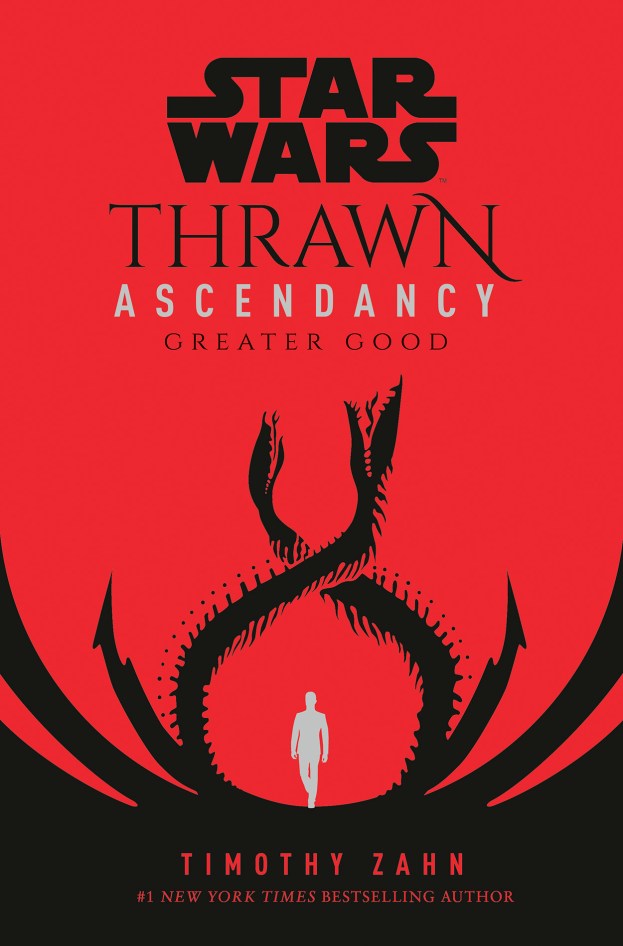
Star Wars: Thrawn Ascendancy: Greater Good by Timothy Zahn

Star Wars - Thrawn Ascendancy - Greater Good Cover

Publisher: Penguin Random House Audio (Audiobook – 27 April 2021)

Series: Thrawn Ascendancy – Book Two

Length: 16 hours and 17 minutes

My Rating: 4.75 out of 5

Amazon

One of the most impressive authors of Star Wars fiction in the world today, the legendary Timothy Zahn, returns with another epic entry in his Thrawn Ascendancy series, Greater Good, which continues to explore the early life of that awesome Star Wars character, Grand Admiral Thrawn.

Zahn is an outstanding author who has been writing Star Wars fiction since 1991, with the highly regarded Heir to the Empire.  Since then, Zahn has written several amazing Star Wars novels in both the current canon and the Star Wars Legends canon.  While I have not read all of Zahn’s Star Wars novels (yet!), the ones I have were all incredible and are some of my all-time favourite Star Wars novels (such as the awesome Star Wars: Scoundrels).  However, his most distinctive works have all surrounded the awesome character of Thrawn.

Grand Admiral Thrawn is an alien officer in the Imperial Navy, renowned for his amazing tactical knowledge, brilliance in battle and ability to discern insights about his opponents by observing their personality or culture, especially art.  Ever since his introduction in Heir to the Empire, Thrawn has been a firm favourite among the fans, so much so that he was one of the few characters from the Legends extended universe reintroduced in the new canon.  This reintroduction was done in the third season of the Star Wars: Rebels animated series, where he served as an impactful antagonist for the third and fourth season.  It also looks like Thrawn will also be getting a live-action appearance at some point in the future after his name was dropped in The Mandalorian, which is pretty damn exciting.

The character has been heavily featured in the current range of Star Wars novels, as Zahn was brought back in to write some exciting new Thrawn-based novels.  This started with a brand new Thrawn trilogy in 2017, made up of Thrawn, Alliances and Treason, which showed how Thrawn joined the Imperial Navy and his early career as an officer.  These novels were all incredible reads (Thrawn got a five-star review from me, and Treason was one of the best books I read in 2019), and I loved the character’s unique adventures.  Thrawn’s story was furthered expanded last year with Chaos Rising; the first novel in Zhan’s Thrawn Ascendancy series, which examines the character’s pre-Empire life.

While the armies of the Republic and the Separatists battle for supremacy in the Clone Wars, another deadly conflict is occurring beyond the bounds of known space.  Deep in the unexplored regions, known as the Chaos, the mighty Chiss Ascendancy have just defeated the forces of General Yiv the Benevolent, shattering his empire, the Nikardun Destiny, and bringing peace back to their territories.  As the Chiss Ascendancy returns to normal, they are unaware that they are still under attack from a malevolent and clever foe that is determined to finish off the Chiss once and for all.

On a Chiss agricultural planet, a group of peaceful and seemingly harmless aliens have arrived, seeking to temporarily make a home.  In addition to their good nature, kind hearts and unique spices, these aliens have also brought something of great value that many people will kill for.  As news of the alien’s resources spread, cracks begin to appear in the very foundation of the Ascendancy, as the various powerful families fight for supremacy.

With civil war on the horizon, the future of the Chiss Ascendancy may lay in the hands of the brilliant and infamous Senior Captain Mitth’raw’nuruodo of the Chiss Expansionary Defence Fleet.  Thrawn, who is personally responsible for the defeat of Yiv and the Nikardun, is currently investigating the origins of their attack on the Ascendancy and, in doing so, comes across a previously unknown planet destroyed by its own deadly civil war.  As Thrawn attempts to explore this new mystery, he soon finds himself in the midst of a dark conspiracy.  An unseen force is attempting to take control of the entire Chaos, and the Chiss are the greatest obstacle to their plot.  Hamstrung by politics, family ties and his own inability to see the deeper motivations of his fellow Chiss, can Thrawn stop the oncoming conflict before it is too late, or will the Chiss Ascendancy burn from the inside out?

Zahn has once again produced an exceptional and outstanding piece of Star Wars fiction that further explores the fantastic early adventures of his greatest creation.  Greater Good is an excellent middle novel in this cool trilogy, and readers will deeply enjoy this book’s blend of intricate storytelling, great characters and impressive universe-building.  All of this results in an exciting and compelling novel that quickly draws readers in and has absolutely no trouble keeping their attention.  I had an outstanding time getting through this great novel and I was able to power through its audiobook format in no time at all.

At the heart of this outstanding novel is a clever and addictive narrative that follows Thrawn and a bevy of supporting characters as the Chiss Ascendancy finds itself in danger from an indirect attack.  Greater Good follows on immediately after Chaos Rising, and examines the next stage of a compelling conspiracy against the Chiss, while also focusing on Thrawn’s battles during this period.  The author utilises a substantial number of alternate perspectives to tell a rich and varied story and, while Thrawn is the centre of much of the book’s plot, Zahn has widened the focus of the novel with several compelling storylines and characters.  These include an investigation into the origins of a Nikardun attack on a remote planet, several jaunts out into different parts of space, internal political conflicts that are a threat to Thrawn, and exciting encounters with other inhabitants of the Chaos.  There is also a substantial focus on a new plot to destroy the Chiss, which includes several compelling flashback sequences that examines the origins and initial planning of the conspiracy.  This use of flashback is pretty impressive, and while certain aspects of the antagonist’s storyline are a tad odd, it was still an interesting tale.  I really enjoyed the vast array of different storylines and character arcs that really highlighted the richness of the setting and the unique plotlines they could inspire.  While some of these storylines might seem rather disconnected at times, Zahn cleverly brings them together at the end of the novel, resulting in a very impressive and intriguing conclusion.

As with most of Zahn’s novels, Greater Good is loaded to the brim with Star Wars lore and intriguing universe-expanding ideas as the author dives deeper into the origins, culture and history of the Chiss Ascendancy.  Zahn really expands on what he introduced in his previous Thrawn and Thrawn Ascendancy novels, especially Chaos Rising, and highlights the proud Chiss warrior culture.  A vast amount of new information of the Ascendancy is featured within this latest book, and the reader gets a fascinating look at the planets, political makeup and social hierarchy of this race, especially at the family level.  Not only is this really intriguing, especially for those readers who have enjoyed Zahn’s previous additions to the Star Wars canon, but the author uses it extremely well within the plot.  Much of the main narrative, including the conspiracy that threatens to destroy the Chiss, is based on their family makeup and the accompanying politics and family mentalities that go along with that.  I felt that Zahn integrated this into the narrative extremely well, forcing the characters to navigate their unusual and insane politics in order to survive.

The author also expands the reader’s knowledge of the previously unexplored area of the Star Wars universe known as the Chaos.  The Chaos, thanks to certain celestial anomalies, is harder to navigate and transverse than regular space; it is a mess of isolated planets, unknown societies and new alien races.  Zahn introduces several new aliens throughout this novel, with each unusual race playing an interesting role in the overall story.  I love the unique Star Wars setting of the Chaos, especially as many of the established Star Wars rules and technology are not as present.  For example, the various warships have some different armaments and shielding, such as acid-filled missiles, resulting in some unique and previously unseen battle tactics.  It was also interesting to see the different takes on the Force that the inhabitants of the Chaos have come up with.  Without any Jedi present, the various races within the Chaos each have their own interpretations or uses for the Force, such as the Chiss Sky-Walkers, young children who can use the Force to help ships navigate the Chaos more effectively, and it was intriguing to encounter different views of this throughout Greater Good.  Hardcore Star Wars fans will enjoy the intriguing additions that Zahn makes to the expanded universe, and the final few pages hint at some major lore introductions occurring in the next Thrawn Ascendancy novel that I am rather curious about.

While this was a great book and piece of Star Wars fiction, I did feel that it required some pre-knowledge of Zahn’s prior works.  The narrative of Greater Good is heavily linked to the events of its preceding novel, Chaos Rising, and while the author does re-explain some of the elements or storylines, a lot of the plot does rather assume you read the first book.  Having greatly enjoyed Chaos Rising, I was able to follow this quite easily, but I could easily see some newer readers getting a little lost or overwhelmed in places.  In addition, parts of the Thrawn Ascendancy series are heavily linked to the events of the previous Thrawn trilogy, and certain references or comments might not make much sense unless you had already read these books.  As a result, I would suggest newer readers check out some of Zahn’s earlier novels first, although it is still possible to enjoy Greater Good without it.  Those readers who have enjoyed these prior books are definitely in for a great treat though and will find the deeper dive into the Chiss and Thrawn’s past to be really enjoyable.

I cannot review one of Zahn’s Thrawn-centric novels without talking about the awesome space battle sequences they contain.  Each of these awesome books features some impressive and detailed space battles as the protagonists encounter a range of ships and fleets that they must fight against.  Greater Good is a particularly good example of this, as Zahn has written several outstanding sequences that are attention-grabbing and fun.  The sheer level of detail and planning that Zahn puts into these action sequences is incredible, and you get an amazing sense of what is occurring during the battle as well as the associated tactics and plans.  The sequences involving Thrawn are easily the best, as Zahn goes out of his way to showcase the character’s tactical brilliance.  This results in some very elaborate sequences, as Thrawn quickly determines the weaknesses of his opponents and uses that knowledge to craft intricate and somewhat insane strategies to utterly defeat them.  Watching these plans come to fruition is always amazing, especially as the reader has no idea in advance what is going on in Thrawn’s mind.  Instead, you only get to see the brilliance and impact of his tactics at the same time as the other characters, and it is always a lot of fun seeing how Thrawn was able to come to his conclusions about his opponents and use them against him.  Zahn comes up with some outstanding sequences for Greater Good that are guaranteed to leave readers on the edge of their seats.

In addition to the awesome narrative, action and universe-building, Greater Good also features an awesome collection of characters, each of whom add so much to the novel.  Naturally, the most impressive character is Thrawn himself.  Even amongst his own people, Thrawn is a strange being who sees the world in a very unique way, and everyone he encounters is impressed by his tactical know-how and unnatural observational skills.  I always enjoy the way in which Zahn depicts Thrawn’s actions in the novel, as Thrawn is one of the few characters whose perspective we do not see.  Instead, Thrawn is only portrayed through the eyes of the major point-of-view characters who observe and react to his actions.  Not only does this remove the inherent difficulties in depicting Thrawn’s mind, but it really enhances the impacts of his deductions and subsequent reactions.  The observing characters view Thrawn making his moves or claiming some impossible bit of knowledge, and then slowly work out how he did it, either through their own observations or thanks to comments by Thrawn.  This is done in a similar manner to the classic Sherlock Holmes novels, with the supporting characters in Greater Good acting in the role of Watson to witness and be impressed by the protagonist’s intelligent leaps.  Like with Sherlock Holmes, the use of the outside narrator in Greater Good deeply enhances the impact of Thrawn’s action, resulting in some awesome scenes.

One of the intriguing aspects of Thrawn’s character in Greater Good that I appreciated was the way in which Zahn continued to highlight his character’s one major weakness: politics.  Thrawn has absolutely no concept of politics, family alliances or some of the inner conflicts impacting the Chiss, and as such is unable to defend himself or others against political ambitions or vindictiveness.  I always really enjoy this trait in the Thrawn novels, especially as it gives Thrawn a noticeable weakness, while also enhancing the impact his fellow supporting characters have, as all of them understand politics better and can help Thrawn in this arena.  This blindness to political realities is particularly important in Greater Good, as not only is Thrawn being attacked by politicians from within his own family but the main threat facing the Chiss is more political than militaristic in nature.  This results in a rather intriguing handicap for Thrawn throughout Greater Good, and it was cool to see the sort of plan that the character came up with to compensate for it, as well as the mistakes he then makes.  Overall, Thrawn is a pretty awesome and fascinating character to follow, and I cannot wait to see what events happen to him in the final book in the trilogy.

Aside from Thrawn, I also really enjoyed some of the supporting characters featured throughout Greater Good.  In addition to being perfect conduits to observing Thrawn’s actions, each of these characters have their own intriguing storylines, many of which are continuing from Chaos Rising.  Examples of this include Thrawn’s old friend, Admiral Ar’alani, Thrawn’s second in command Mid Captain Samakro, the former Sky-Walker Thalias, who has tied her fate with that of Thrawn, and the powerful Mitth family politician, Thurfian, who serves as a secondary antagonist.  Each of these characters is further developed in Greater Good, and I enjoyed some of the cool storylines that Zhan is coming up for them.  Thurfian’s storyline is particularly intriguing going into the next novel, as the final scenes hint that he is going to come into possession of some very interesting knowledge soon.

Zhan also introduces several great new characters throughout Greater Good, many of whose narratives are tied into the malevolent plot to destroy the Chiss.  I found myself quite intrigued by the character of Lakinda, a fellow Senior Captain in the Chiss Expansionary Defence Fleet, who serves alongside Thrawn.  Not only does Lakinda offer an intriguing alternate observation angle on Thrawn, tinged with a bit of jealously and mistrust, but this character provides greater insight into the Chiss family structure.  Lakinda is an extremely loyal member of a mid-tier Chiss family, and she often finds her loyalties conflicted as she attempts to choose between family and the fleet.  This results in some captivating and emotional sequences which really help to highlight the unusual nature of Chiss society.

I also quite liked how Zahn spends time following the main antagonist of Greater Good, the mysterious alien Haplif.  Haplif and his people have been hired by a mysterious third party to orchestrate chaos and dissent within the Chiss Ascendancy to destroy them.  As a result, he masterminds an ingenious plot to promote conflict between various members of the Ascendancy.  I really enjoyed the complex and clever plot that this character came up with, and it was really cool to see him manage to manipulate several people throughout the course of the book, and he was an interesting alternative to the previous antagonist, Yiv.  It was a little odd to see Haplif, a supposedly brilliant planner and master manipulator, find his plans constantly stymied by a spoiled teenager and a backwater rancher, but it was fun to see his arrogance work against him.  All of these characters are amazing, and I really appreciate the time and effort that Zahn put into developing them.

It will not surprise anyone that I ended up listening to this Star Wars novel’s audiobook format rather than seeking out a physical copy of the book.  I absolutely love Star Wars audiobooks, and this was another excellent example that comes highly recommended.  The Greater Good audiobook has a runtime of just over 16 hours, which, while substantial for a Star Wars novel, is extremely easy to get through, especially once you become engrossed in Zahn’s cool story.  Like most modern Star Wars audiobooks, Greater Good makes amazing use of the classic Star Wars sound effects and film score to enhance the story.  I particularly enjoyed its use in Greater Good’s various space combat sequences, and it really amps up how epic those scenes were.

The real standout of this audiobook was the outstanding narration by Marc Thompson.  Thompson is an experienced narrator of Star Wars fiction who, aside from contributing his voice to all the books in the Thrawn and Thrawn Ascendancy novels, has also narrated awesome audiobooks like Light of the Jedi, Doctor Aphra, Dooku: Jedi Lost, Dark Disciple and more.  Thompson does an incredible voice for Thrawn that is filled with the character’s control, intelligence, and gentle menace, and which is very, very close to how the character is portrayed in Star Wars: Rebels.  This amazing voice for Thrawn is easily one of the best parts of the audiobook, and it is fun to listen to the character lay out his elaborate strategies in Thompsons’s awesome tones.  Aside from Thrawn, Thompson also produces a great range of different voices for Greater Good’s supporting characters.  Each character gets their own distinctive voice, which matches their personality and physical qualities, and the listener is never in doubt about who is talking.  I also quite enjoyed how Zahn makes fun accommodations for the various different species featured within the audiobook, tailoring his voices to make them sound more alien at times.  Zahn also gives more rural accents to some of the Chiss characters featured in this novel who are from, or are located on more backwater planets, which I thought was a very nice touch.  All of these amazing features help to turn the Greater Good audiobook in an absolute treat for your ears, and it is an incredible way to enjoy this epic novel.

Thrawn Ascendancy: Greater Good is another exceptional piece of Star Wars fiction from Timothy Zahn.  Featuring his iconic and impressive creation, Grand Admiral Thrawn, Greater Good serves as an outstanding second entry in the Thrawn Ascendancy series, which charts the early life of this great character.  With a clever and exciting story, chock full of universe building, fantastic characters and some unique and memorable battle moments, Greater Good is an excellent novel that comes highly recommended.  I have so much love for Zahn’s Thrawn and Thrawn Ascendancy novels and, after really enjoying Greater Good, I am very excited to see how this series ends.  The final book in the Thrawn Ascendancy trilogy, Lesser Evil, is coming out in November 2021, and I cannot wait to get my hands on it.

Amazon

Throwback Thursday – Fool Moon by Jim Butcher

Fool Moon Cover

Publisher: Buzzy Multimedia (Audiobook – 9 January 2001

Series: Dresden Files – Book Two

Length: 10 hours and 6 minutes

My Rating: 5 out of 5 stars

Amazon

In my Throwback Thursday series I republish old reviews, review books I have read before or review older books I have only just had a chance to read.  For my latest Throwback Thursday, I continue my exploration of one of the most highly regarded urban fantasy series out there, Jim Butcher’s The Dresden Files, with the awesome and deeply captivating second entry in the series, Fool Moon.

The Dresden Files are an outstanding collection of novels that follows professional wizard and private investigator Harry Dresden in modern-day Chicago as he battles magical creatures and practitioners that threaten innocent people.  Generally considered the gold standard of the urban fantasy genre, The Dresden Files have been going for over 20 years and currently consist of 17 novels and a massive collection of short stories and novellas.  While I have been meaning to check this series out for a while, I only started reading them last year when I received a copy of the latest entry in the series, Battle GroundBattle Ground was an epic and extraordinary read that featured a mass-supernatural war in the middle of Chicago.  I absolutely loved Battle Ground and it was easily one of my favourite books and audiobooks of 2020, while Butcher was one of the best new-to-me authors I read last year.  Because of how incredible I found Battle Ground to be I have decided to go back and start reading the series right from the beginning.  I started with Butcher’s first Dresden Files novel a couple of months ago, Storm Front, which proved to be another impressive read, and I am now extremely hooked on this series.  So when I was in the mood for a fun book to break up my reading schedule, I decided to start listening to Fool Moon, and boy am I glad that I did.

Business has been slow for Harry Dresden, Chicago’s only professional wizard, after his last investigation led to all out chaos and destruction.  However, his life is once again about to get very interesting when he is dragged to a murder scene.  One of the bodyguards of a notorious crime lord Dresden has dealt with in the past has been brutally torn to shreds.  With a full moon in the sky and bloody wolf prints surrounding the victim, Dresden comes to the only conclusion he can: there is a killer werewolf stalking the city.

Diving once more into a supernatural case, Dresden attempts to find the killer before the moon rises again.  However, this may prove more difficult than he initially believes, as Chicago is currently rife with wolf-based magic practitioners, enhanced criminal gangs and monsters, each of whom could be more than capable of committing the crime.  Worse, when an associate of his turns up dead, Dresden finds himself under suspicion for the murders by the police and the FBI.

Now on the run with his reporter girlfriend and a mysterious ethereal shifter, Dresden needs to find out who or what is responsible for the murders and why they have involved him.  But with the most bestial elements of Chicago’s criminal elements coming after him and an uncontrollable and seemingly unkillable monster hunting through the night, can Dresden stop the killers before it is too late, or will the next full moon be his last?

Wow, now this was a pretty awesome second entry in the outstanding Dresden Files series.  Butcher has crafted together something really special in Fool Moon, thanks to its compelling and intense story, amazing characters, great humour and impressive fantasy additions.  I had an absolute blast getting through this book in a few short days and it was so good I have no choice but to give it a full five-star rating.

At the centre of this incredible novel is a complex and exciting narrative that sets the protagonist on a deadly journey filled with murder, mystery and monsters.  Starting with an intriguing investigation into an apparent werewolf serial killer, Fool Moon’s story eventually devolves into a survival story for the protagonist as he finds himself on the wrong side of the law, the true killers and several different groups of criminals and werewolves.  This proved to be a really impressive and addictive narrative, and I loved the outstanding blend of a detective story with magic, wizards and wolves.  The mystery angle contained within Fool Moon is particularly good, and while the culprit is revealed about two-thirds the way through for excellent story reasons, it was still a fantastic and twisty case that I enjoyed.  Butcher really invested in several excellent and memorable extended sequences in this novel that were a lot of fun to get through, including a particularly intense brawl between several antagonistic groups with Dresden in the middle, and a fantastic high-stakes final confrontation where no one is safe.  However, my absolute favourite sequence occurred in the middle of the novel and saw Dresden forced to contend with a rampaging monster in the middle of a police station.  The sheer carnage and destruction that occurred in this sequence was really cool, and readers are left on the edge of their seats as the fates of several characters hang in the balance.  I deeply enjoyed this intense scene, and it absolutely cemented Fool Moon’s place in my dark heart.  This was an incredible and powerful story, and readers who check it out are in for a thrilling and captivating treat.

A particular strength of The Dresden Files as a series is the way in which the author makes it very accessible to new readers who can easily slip into any of the books in the series, even some of the later instalments, and easily follow what is going on.  Fool Moon is a great example of this, and I felt that people unfamiliar with the rest of the series should be able to enjoy this book without any problems.  All the recurring characters in the narrative are quickly and effectively reintroduced, often in a similar manner to how they appeared in the first book, and any relevant storylines, magical abilities or prior adventures are also covered in some detail.  As a result, new readers should have no trouble enjoying this great book, and indeed this will probably turn them into a fan of the series and ensure that they check out some of the other books.  However, there are some cool connections to the first novel that dedicated readers will notice, and I liked the underlying story thread of someone plotting and planning behind the scenes to mess with the protagonist.  Overall, this a great book for all fantasy and mystery fans, especially those who like a complex, multi-genre narrative.

I love all the awesome fantasy elements that Butcher slips into his novels, and it is always great to see the weird and magical in the midst of modern-day Chicago.  Fool Moon is no exception, as Butcher has a lot of fun expanding out some of the rules of magic in this book, as well as highlighting a few additional magical denizens and powers.  While this is very cool, the real magical highlight of Fool Moon has to be the werewolves.  Most fantasy authors who feature werewolves in their story would choose just one specific type that they like and leave it at that.  Butcher, however, is not the sort of person to do stuff by half measures (check out the massive fantasy war featured in Battle Ground) and instead features five separate subtypes of werewolves, all of whom are potential suspects for the murders.  I deeply enjoyed this use of multiple werewolves throughout the novel, not only because it really helped to enhance the book’s already fantastic mystery, but because it was awesome and fascinating to see the different creature subtypes.  Each werewolf or wolf-based magic user has their own unique abilities, source of power and personalities which Dresden has to learn about and overcome if he is to survive.  These wolves include shapeshifters, demon talisman powered wolves and humans with wolf-like mentalities that make them act like berserkers.  The standout, however, is the loup-garous, a cursed individual with no control over their actions; essentially a more monstrous version of wolf man from film.  Butcher paints his loup-garous as a particularly dangerous being which is practically invincible to everything and anything it encounters, including the protagonist’s most destructive magic.  This loup-garous causes some real carnage in this book, and watching Dresden attempt to defend himself from it is pretty crazy and makes for some excellent and intense scenes.  I deeply, deeply enjoyed the epic use of werewolves in this novel and Butcher really does the old lore surrounding them justice.

It is impossible to talk about a Dresden Files novel without discussing the incredibly well-developed characters featured within.  The most prominent of these is central protagonist Harry Dresden, Chicago’s resident wizard for hire.  Dresden is an exceptionally entertaining and likeable protagonist who provides pretty much all of the book’s great humour thanks to his outrageous personality, disrespect for authority and witty observations about the events going on around him.  As such, he is a fantastic character to follow, and you really appreciate his knowledge and insights into the supernatural and the people around him.  While much of the book shows Dresden as a confident and amusing being, we do get to see more of the character’s darker side as he deals with dark and dangerous magic.  Thanks to the author’s outstanding writing style, the reader is front and centre for all of the protagonist’s slips towards darkness and despair, especially as he encounters tragedy, loss and insane opposition.  I really appreciated this examination of the protagonist’s fragile psyche, and Butcher makes sure to take him to the edge in Fool Moon.  The author also makes some additional intriguing references to Dresden’s past which hint at some traumatic events and betrayals.  Fool Moon also shows of Dresden’s full magical potential, especially as he launches some incredible attacks here, even if they do leave him very drained.  It also shows the character at his most vulnerable, as he is forced to go it alone with only the bare amount of resources and abilities.  All of this makes for an intriguing and powerful character and I really enjoyed seeing more of this awesome protagonist.

In addition to Dresden, Butcher also makes excellent use of several great supporting characters, each of whom add some fun and compelling elements to the plot.  The most prominent supporting character was probably Karrin Murphy, Dresden’s liaison in the Chicago police.  Murphy, a hardnosed professional who is one of the few police officers to believe in the supernatural, has an intriguing character arc in this novel.  This is mostly because of Dresden’s actions in Storm Front, as well as his somewhat chauvinistic determination to protect Murphy from magic, both of which ruined have Murphy’s trust in him and placed her in some hot water with the police brass.  This fractured relationship becomes a key story point in Fool Moon, especially as it leads to Murphy being quick to jump on Dresden as a potential suspect in the crimes.  This adds some compelling difficulties for the protagonist in the story, and I really appreciated the excellent drama that emerged between the two as Murphy and a repentant Dresden attempt to work out their issues.

Aside from Murphy, you have the return of Susan Rodriquez, Dresden’s love interest and a reporter for a tabloid newspaper.  Susan is an interesting counterpoint to Dresden, being an ambitious reporter determined to find out the truth of the arcane no matter what.  She has a fun and fiery relationship with Dresden in this novel, and it was interesting to see her more involved with the story, especially as she sees Dresden at his darkest and most dangerous point.  I also loved seeing more of Gentleman Johnny Marcone, the sly and powerful gangster who Dresden has previously gone up against.  Macone is a fantastic villainous character, and I love the antagonistic relationship he has with Dresden, even when the two are on the same side.  You also have to have a laugh at Bob, a guiding spirit who resides inside a skull in Dresden’s basement, as he adds some intriguing exposition and laughs in his scenes.  There were also some intriguing new characters added in this book, although I will not go into too much detail about them as it could spoil some parts of the story.  None the less, they were all really fun additions to the plot, and having so many different new magical or shapeshifting beings ensured the reader was constantly trying to work out who was the actual villain.  All in all, a fantastic group of characters, and I felt that they really helped to turn Fool Moon into an excellent and first-rate read.

One of the reasons I have been enjoying The Dresden Files books is because they have some really awesome audiobook formats.  Each of these audiobooks I have listened to have been extremely amazing, and I love the way in which they portray these fun stories in a concise and exciting manner.  The Fool Moon audiobook has a runtime of just over 10 hours, and listeners will power through this in no time at all, especially as it is really easy to become addicted to the fantastic story.  However, the main thing that I love about these audiobooks is the perfect choice of narrator in actor James Marsters (Spike from Buffy and Angel).  Marsters does an outstanding job with his narration, imbuing the various characters with some fantastic and fitting voices that expertly convey their personality, emotions and actions.  I am particularly impressed by the way in which he portrays the story’s narrator and main protagonist, Harry Dresden, and the tone he uses for him perfectly represents the sarcastic and entertaining rogue wizard.  This is one of the best examples of an audiobook narrator matching their protagonist, and it makes for some fantastic listening.  I also appreciated the way in which Marsters started really getting into his narration of certain key events in this second novel.  While he did an excellent job in Storm Front, I felt that Marsters stepped up his game in Fool Moon, and while it was not quite at the level of enthusiasm and volume that featured in Battle Ground (he was really getting caught up in the action there), it was noticeably more exciting.  This enthusiasm added a lot to the enjoyment I felt while listening to Fool Moon and I strongly recommend this format to anyone who wants to check this book out.

Fool Moon by Jim Butcher ended up being another exceptional and spectacular addition to the author’s legendary Dresden Files series.  I had an outstanding time listening to the clever and exciting narrative that Butcher came up with for his second novel and I think that the author actually stepped up his game a little with Fool Moon.  Featuring some great characters and an addictive and thrilling mystery surrounding werewolves, Fool Moon is an incredible read that I powered through in no time at all.  I can think of no higher praise for this book than to say that the moment I finished it I immediately started the next novel in the series, Grave Peril, as I still had not gotten my fill of Dresden Files goodness.  I am already making some amazing progress with Grave Peril and I am planning to review in the next week or so.  Until then, readers are strongly encouraged to check this awesome second entry in the series out, as you will not regret it.

Amazon

The Bone Maker by Sarah Beth Durst

The Bone Maker Cover

Publisher: HarperAudio (Audiobook – 9 March 2021)

Series: Standalone

Length: 16 hours and 35 minutes

My Rating: 5 out of 5 stars

Amazon

One of the leading voices in fantasy fiction, the impressive Sarah Beth Durst, returns with another epic standalone fantasy read, The Bone Maker.

Sarah Beth Durst is an amazingly talented author who has been dominating the fantasy market for the last several years.  Initially debuting with several fun young adult and middle grade novels, such as the 2009 release Ice, Durst made the jump to adult novels in 2014 with The Lost, before writing her bestselling Queens of Renthia fantasy series.  I only recently started reading Durst’s work when I checked out her 2020 novel, Race the SandsRace the Sands was a gripping standalone fantasy read that featured a thrilling tale of adventure and redemption set around monster racing in a desert kingdom.  I absolutely loved Race the Sands, and it ended up being one of my top books and audiobooks of last year, and Durst was easily one of the best new-to-me authors I checked out in 2020.  As a result, I have been really keen to see what Durst would write next, and I was excited when I heard about her new book, The Bone MakerThe Bone Maker was one of my most anticipated novels of 2021, and I ended up having a wonderful time reading it.

25 years ago, the nation of Vos was threatened by a terrible foe, the rogue bone maker Eklor, whose nightmarish creations of animal bone and mechanical components sought to overwhelm everything.  In the end, Vos was saved by five heroes who led an army to Eklor’s door to destroy him.  However, their victory came at a steep cost, as one of the heroes died a tragic death, and only four walked away from Eklor’s tower.

In the years that followed, the leader of the heroes, Kreya, has lived a life of exile, determined to resurrect her husband, Jentt, who died to stop the evil assailing their realm.  Using Eklor’s notes, Kreya has succeeded in cracking the spells needed to complete the resurrection, but bringing the dead back to life has a heavy cost.  Not only does Kreya lose a day of her life for every day that Jentt lives, but Kreya also requires human bones to complete the spell,. The bones of the dead are ritualistically burnt throughout Vos specifically to prevent bone workers using them for dark magic, so Kreya is forced to look elsewhere for her materials.  In her desperation, she decides to return to the one place she swore never to go back to: the plains outside Eklor’s tower, where the bones of those fought against Eklor’s monsters still lie.

Making the arduous and forbidden journey to Eklor’s tower, Kreya makes a terrifying discovery that threatens everything she fought for all those years ago.  With the dangers of the past threatening to overwhelm her, Kreya has no choice but to reunite her comrades 25 years after their famous victory.  But will these damaged heroes be enough to face the evil threatening to overwhelm them, or will an evil long thought destroyed arise again to finish off what it started?

Wow, Durst definitely does not disappoint as she has created another impressive and powerful fantasy novel.  I had an absolute blast reading this fantastic new book and I managed to finish it off relatively quickly, especially once I got wrapped up in the outstanding story, clever setting and the lives of her amazing protagonists.  I really enjoyed this awesome standalone fantasy read and I have to give The Bone Maker a full five-star rating.

For her latest amazing fantasy novel, Durst has come up with a very complex and powerful story that dives deep into the hearts of her fantastic characters while also taking them on an epic journey of redemption.  I have to admit when I read some of the early descriptions of The Bone Maker I assumed it was going to be the central protagonist, Kreya, going up against her old companions as they tried to stop her from resurrecting her husband.  Instead, Durst works in a very different narrative that sees Kreya encounter the enemy from her past, which forces her to bring her friends back together herself.  Durst sets up this narrative really well, and the reader gets a sense of the tragedy of Kreya and the lengths she is planning to go to reunite with Jentt.  You also get a fantastic idea of the trauma from the protagonist’s past battles with Eklor and how this has shaped their lives.  There are some great moments in the opening half of this book, including several amazing and magically charged action sequences as the protagonists go up against a range of different foes, as well as some intense drama as the five are gradually reunited and come to terms with their past failures.  I loved how the narrative gradually morphed into a bit of a political thriller in the second half of the book as the protagonist encounters an old foe in a different setting.  The flow from the various sections of the story works extremely well, and Durst weaves together a really comprehensive and powerful standalone story.  I liked the excellent blend of action, fantasy elements and intense emotion exploration, which helped to produce a very comprehensive narrative, and The Bone Maker turns into quite an epic and exceptional read.

Easily the highlights of this book are the complex and damaged central characters that the story follows.  The five main characters are heroes who previously saved Vos from a great evil, and I loved this exploration of renowned fantasy heroes years after they saved the world, the usual climax of a story.  The central character of the story is Kreya, the group’s leader, who disappeared after ensuring their previous victory, mourning her dead husband.  Kreya performs multiple attempts at resurrection at the cost of her own life, and I really appreciated the author’s interpretation of this character’s grief leading her to risk it all.  Kreya has a rough and powerful journey throughout this book as she comes back to lead her team and is forced to deal with the expectations of all those around her.  Despite the immense amount of guilt, grief and regret that Kreya experiences throughout this story, Kreya proves to be a talented leader, directing them through several unique fights, and is the only person that can hold this ragged group of characters together.  The counterpoint to Kreya’s toughness and leadership is her deceased husband, Jentt, who, after his resurrection, proves to be the heart and light of the group.  Despite his more buoyant personality, Jentt has to deal with the consequences of his resurrection, especially when he finds out the cost of his continued life, and this leads him to several harrowing mental places.

The next member of the heroes of Vos is the bone wizard Zera, who specialises in creating the best magical talismans in the world.  Zera is the only member of the group who cashed in on her fame after their victory and has grown rich off her skills and reputation.  Zera is a fantastically sarcastic and entertaining addition to the cast, as she revels in her wealth and privilege, while also providing some of the best lines in the entire novel.  Despite a sense of intense betrayal at Kreya’s abandoning of her all those years ago, Zera agrees to help her with her mission, but finds herself constantly conflicted by her feelings of resentment, her own well-hidden damage, and her changed vision of what Kreya’s relationship with her was.  As a result, she has quite a journey throughout The Bone Maker and I loved her inclusion in this novel.

The other two major protagonists are the bone reader Marso and the warrior Stran, both of whom survived the battles with Eklor in very different ways.  While Stran is reasonably mentally healthy, having chosen to live a simple life with his wife and children, Marso has been broken by both his powers and the events of the past.  These two are a great contrast to one another, and both add some intriguing elements to the overall narrative.  I quite enjoyed seeing Marso slowly rebuild his sanity throughout the book while also coming to terms with a magical power he no longer trusts.  Stran’s apparent normality and stable family life is so amazingly different from the other characters in the book that it really stands out, and I liked seeing how each character was just a little bit different.  Overall, all five of these awesome protagonist really help to make The Bone Maker a powerful and impressive read and I am extremely glad that Durst took the time to build each of these great characters up.

One of the things I really must discuss is the outstanding setting that Durst created for this great book, especially as the author did such an impressive job coming up with yet another unique world.  The land of Vos is an amazing fantasy realm, loaded up with its own blend of troubles, culture and magic, which is living in the shadows of the tragic bone wars 25 years prior.  Durst sets this new landscape up perfectly in the early stages of the novel, and the reader gets a great sense of the people and mentality of this realm, especially when it comes to the trademark bone magic.  As the novel progresses, Durst visits several fantastic and compelling parts of this land.  This includes the gigantic and wealthy capital city where many terrible events take place, the hilly landscape that makes up the majority of Vos, a mist-shrouded valley loaded up with a collection of dangerous, gigantic monsters, and the plains surrounding Eklor’s tower, where deadly secrets lurk.  These landscapes are a lot of fun to explore, and Durst works them into her narrative perfectly.  I really enjoyed all of the major locations that the protagonists visit, although my favourite has to be the valley of monsters, as some intense and action-packed sequences take place there.

In addition to the amazing setting, I also really appreciate the rich and distinctive bone magic that Durst came up with for The Bone Maker.  This type of magic features three distinctive types of bone workers, including bone readers who can use animal bones to read the future, bone wizards who create powerful bone talismans, and bone makers who inscribe bones to animate a range of constructs.  Each of these magical disciplines is explored in great detail by the author and are all strongly utilised in the plot.  I loved seeing these magical elements at work throughout the action sequences in the book, and Durst uses them to great effect, with the characters gaining flight, stealth, strength and speed in every epic fight sequence.  The various examples of bone making are also pretty cool, and you get some great magical constructs.  I liked how there was a fun contrast between the protagonists’ cuter, yet still effective constructs, and the antagonists monstrous figures, and it makes for some great combat scenes, especially when the protagonist goes big towards the end of the book.  All of these magical elements are really exceptional, and I think it is an absolute testament to Durst’s sheer imagination and creativity that she is so effectively able to come up with a brand new style of magic and a new magical realm for every single one of her standalone fantasy reads.

I ended up enjoying The Bone Maker in its audiobook format, which proved to be a fantastic way to experience Durst’s epic story.  The Bone Maker audiobook has a decent run time of 16 hours and 35 minutes, which I ended up getting through rather quickly and is not too much of challenge for dedicated listeners to finish off.  One of the best things about this great audiobook is the amazing narrator, Soneela Nankani.  Nankani is a veteran audiobook narrator, but despite her prevalence as a narrator of fantasy fiction, I have not previously had the pleasure of experiencing Nankani’s vocal talents before, although she has worked on several other fantasy novels that I am keen to check out.  Nankani was an outstanding narrator whose voice really enhanced this already amazing novel.  Not only did Nankani provide a quick and exciting tone for the entire novel, moving the story along at a brisk and enjoyable pace that continuously kept the reader’s attention; she also provided several fantastic voices for the various protagonists.  All the voices that she used were pretty impressive, and I felt that they fit the damaged and dark personalities of each of the main characters very well.  As a result, I would strongly recommend the audiobook format to anyone interested in checking out The Bone Maker as it is an amazing way to check out this compelling novel.

The Bone Maker by Sarah Beth Durst is an exceptional and captivating standalone fantasy novel that I had an amazing time reading.  Durst has produced an epic and elaborate tale of life, death and magic, which follows five damaged and broken heroes years after their supposed great victory.  There are so many awesome elements to this fantastic book, and readers are going to fall in love with The Bone Maker’s addictive narrative, powerful characters and cool magical elements.  While I did enjoy Durst’s previous novel, Race the Sands, a little more, this was still an outstanding read, which comes highly recommended.

Amazon

Later by Stephen King

Later Cover

Publisher: Simon and Schuster Audio (Audiobook – 2 March 2021)

Series: Standalone

Length: 6 hours and 32 minutes

My Rating: 4.75 out of 5 stars

Amazon

Since I started this blog, one major author that I have neglected is the master of horror fiction, Stephen King.  King needs absolutely no introduction, with a decades-long career of amazing horror novels, thrillers and heartfelt pieces of fiction, most of which have been turned into iconic films and television shows.  Despite this, I haven’t read many of King’s novels before, aside from Cell and the novel he co-wrote with his son, Owen King, Sleeping Beauties.  Honestly, I have only started getting into horror novels in the last couple of years (it is still not my favourite genre TBH) and I have completely failed to make time to check out some of King’s more recent releases.  However, his latest novel, Later, caught my eye and I decided that it would be a good opportunity to expand my Stephen King knowledge.

Jamie Conklin is a young boy with a very unusual problem: he can see and talk to the spirits of the recently deceased.  The son of a struggling single mother, Tia, Jamie just wants to have a normal childhood.  However, as his ability becomes more apparent, his mother cautions him to hide his strange gift, worried that people will abuse his talents, especially as the dead have no choice but to truthfully answer any questions that Jamie asks of them.

Content to keep his secret to himself, Jamie attempts to live like a normal New York City kid during the late 2000s.  However, when his mother pressures him to use his abilities to help save her failing publishing business, it places him in the crosshairs of his mother’s lover, corrupt police detective Liz Dutton.  Liz, desperate for recognition from her bosses, draws Jamie into the hunt for a killer’s final surprise, which only his dead spirit can reveal.  However, not all secrets are easily taken from the dead, and soon Jamie must contend with a terrible force determined to torment him from beyond.  Can Jamie survive what is coming for him, or will it drag him into insanity?

This was an extremely cool novel that makes we really want to go out and read some more Stephen King books.  Later is a fantastic read which combines multiple genres together to create an exciting and fast-paced narrative loaded up with some real heart and memorable characters.  I had an absolute blast reading this clever novel, and thanks to its shorter length and captivating narrative, I powered through it in a very quickly.

I deeply enjoyed the cool and complex story that King came up with for Later, which proved to be a powerful and intriguing character-driven tale that moved across the genres.  Told in a first-person chronicle format by an older version of the main protagonist, Later details the childhood of Jamie Conklin and his early experiences of talking to the dead.  Weaving in anecdotes of his childhood and depictions of his early life with his mother, the story quickly and effectively sets up how Jamie discovered he had his powers, and some of the most significant times that he saw and talked to the spirits of the departed.  This proves to be a fascinating coming-of-age story that showcases how this unique talent twisted and altered the course of Jamie’s life and took him into some dark places.  The author does a fantastic job capturing the style of a young man recounting major events from his childhood, and I very much appreciated the mixture of childlike innocence with cynical reflections.

While this chronicle of a child’s life forms an effective and powerful centre to this entire narrative, this is also a horror story, as Jamie is traumatised by several of the spirits he encounters, especially as King provides some harrowing descriptions of mutilated ghosts and bodies.  These horror elements get even stronger and spookier when Jamie encounters a truly evil spirit who starts to haunt him.  Several of the scenes featuring this being are pretty terrifying, and I liked how King strongly highlights the dark side of Jamie’s power.

The author also works in some intriguing crime fiction elements as well, as the protagonist get wrapped up in a murder investigation and the dangerous schemes of a police officer.  The crime fiction features are pretty thrilling, and l appreciated the consideration of how Jamie’s powers could be abused.  I liked this unique blend of genres, and it ended up creating a very compelling and powerful story, which King sets out at an incredibly fast rate.  King sets the story up perfectly, and I found myself really getting pulled in as the narrative set off, thanks to its unique tone and intriguing selection of supporting characters.  The entire narrative goes in some very interesting directions and I liked how interconnected all the events that the narrator is recounting fit together into a clever and moving tale of discovery and redemption.  All of this comes together into an exciting and scary finale as the narrator comes face-to-face with several of the monsters in his life, and I think that King came up with a very satisfying and clever ending for the book, which has potential for a sequel.  I did think that the final big reveal of the book was extremely unnecessary, but it was a particularly typical Stephen King twist, so I should not have been so surprised.  Overall, this was an exceptional narrative that I cannot hype up enough.

Later is a standalone novel from King which features a whole new group of characters.  As a result, it is very accessible to a wide range of readers, even for those people who have not previously enjoyed any of King’s novels.  I personally found it really easy to get into this cool story, even with my limited knowledge of the author’s prior works, and it honestly does not take long to get hooked on his clever and unique story.  This is also quite a good book for established fans.  Not only does it contain a lot of elements of a classic Stephen King novel, such as a young protagonist on a journey of self-discovery who ends up losing their innocence, but there are also some intriguing connections to some of King’s most iconic works.  One horror inclusion in the novel appeared to be a version of a creature from a previous book, and I think that King readers will really appreciate the clever references he chucks in.  Due to all this, I feel that Later is a perfect book for any curious readers, no matter their experiences with King’s works, and this may end up being the novel that draws new readers into this compelling master author’s web.  I personally will make a bit more of an effort to read more of King’s works in the future, and I already have my eye on his next novel, which is coming out later this year.  I also kind of hope that we see more of the characters at some point, especially as King did such a great job setting them up in this novel, while also leaving their overall story very open-ended.

I quite enjoyed the relatively modern setting that King utilised as a backdrop to his plot.  With the protagonist chronicling his tale in his 20s, presumably in the present day, most of his childhood took place in the late 2000s and early 2010s.  This is a pretty interesting departure from some of King’s more recognisable novels that explore the childhoods of their protagonists, such as It and Stand by Me, all of which make excellent use of their 1950s or 1980s settings (I liked the awesome 1980s nostalgia you got in the latest It film, for example).  Instead, King loads up Later with a ton of references to 2000s culture and movies, and I had a fun time remembering some of the things that the protagonist experienced as a child.  King, through the medium of his protagonist, also cleverly mentions The Sixth Sense right off the bat, ensuring readers that this story is “not like that movie with Bruce Willis”, which I thought was very entertaining, and also quite true.  The Great Recession also becomes a key plot point of the novel, and it was interesting to see how King was able to utilise it as a major motivator for various character actions.  I also liked how the story was set in New York City, rather than the small-town American locations King’s books are known for.  The author uses this city-based location to great effect throughout the novel, painting a fantastic picture of New York life, especially through the eyes of his young protagonist.  Jamie ends up visiting various parts of the city throughout the events of Later, including several communities on the outskirts of New York, and I enjoyed this great use of location.

I also have to highlight the multiple jokes about novelists and publishers that King features throughout Later, mainly due to Jamie being born into a publishing family.  You have to imagine that King had a lot of fun coming up with all the great jokes and comedic insights into Jamie and his mother’s experiences with writers, and it ended up being a really fun addition to the plot.  I had a particularly good laugh about the descriptions of a certain series of trashy historical romance/adventure novels that Tia’s struggling publishing company relies on, and I loved how King explored it throughout this entertaining narrative, as well as cleverly featuring a mock-up cover of one of these fictional novels released as a bonus dust jacket for Later.  This extra dust jacket (see below), was drawn by the same cover artist who did Later’s hardcover, and I enjoyed the similar styles and the excellent tongue-in-cheek testimonial from King, praising this book within a book.  Fun little inclusions like this really helped to push Later up to another level, and I liked how the humour from the publishing jokes contrasted nicely with the dark horror and crime fiction elements.

The Secret of Roanoke Cover

While I probably would have enjoyed reading a physical copy of Later, I instead chose to enjoy this fun novel in its audiobook format, which ended up being a fantastic choice.  This audiobook has an extremely quick run time of just over six and a half hours.  This shorter length was one of the main reasons I decided to listen to Later, and I was able to get through it in a day or two, although a lot of that was down to how awesome the story was.  This was an impressively fast-paced audiobook, and I really felt that this format worked well with the first-person chronicle style the author utilised, as it felt like the protagonist was the one vocalising the story to you.  Later was narrated by actor Seth Numrich, and it is one of the first audiobooks he has lent his voice to.  I really enjoyed Numrich’s work on this audiobook; not only did he do an amazing top capturing Later’s unique tone, but he also provided a range of great voices for the characters featured within the novel.  His main voice, which represented the narrating protagonist, really encapsulated the innocence and pain of the character as he tells the story of his strange childhood, and it helped draw me to the protagonist.  The rest of his voices were pretty good, although I thought the voice he used for female detective Liz Dutton sounded a little like John Leguizamo, which is probably not what he was going for.  Overall, though, this was an exceptional audiobook, and I would strongly recommend it to those who want to check out Later.  I also hope that Numrich considers narrating more audiobooks in the future as he displayed some real talent here and was an absolute treat to listen to.

Later is an outstanding and impressive novel from the legendary Stephen King, who creates a unique and powerful tale of life, death and coming to terms with both.  Featuring an intriguing narrative that blends together clever horror and crime inclusions with a powerful coming of age story, Later is a truly memorable novel that is extremely easy to fall in love with.  I had an exceptional time reading this book and it is a must read for all fans of King’s work and anyone who has ever been curious about his writing.

Later Cover 2

Amazon

Throwback Thursday – Star Wars: Maul: Lockdown by Joe Schreiber

Star Wars - Maul - Lockdown Cover

Publisher: Random House Audio (Audiobook – 28 January 2014)

Series: Star Wars

Length: 12 hours and 20 minutes

My Rating: 4.5 out of 5 stars

Amazon

This is part of my Throwback Thursday series, where I republish old reviews, review books I have read before or review older books I have only just had a chance to read.

2021 has so far been a fantastic year for Star Wars novels with excellent releases such as the two Star Wars: The High Republic novels, Light of the Jedi and Into the Dark, and the final entry in the Alphabet Squadron trilogy, Victory’s Price.  I have been really enjoying these new Star Wars novels but I recently got a hankering for something a little different and decided to go back and check out some of the older Star Wars tie-in novels.  While there were several intriguing options (I was strongly eyeing off A New Dawn by John Jackson Miller, Darth Plagueis by James Luceno and Razor’s Edge by Martha Wells), I eventually settled for the one of the last entries in the Star Wars: Legends range of books, Maul: Lockdown by Joe Schreiber, an intensely exciting and dark novel with an amazing story to it.

Welcome to the space station Cog Hive Seven, the most dangerous prison in the entire galaxy.  Here inmates are forced to fight to the death in matches broadcast to millions of gamblers across the Republic determined to make a profit off the blood of the galaxy’s worst killers and criminals.  No one escapes from Cog Hive Seven, and every one of its deadly and evil inhabitants know that they will eventually die there.  However, not even these deranged inmates are prepared for the new evil that has been thrown into their midst, the lethal dark-side assassin, Darth Maul.

Sent by Darth Sidious to contact a secretive weapons merchant, Iram Radique, Maul has disguised himself as a notorious mercenary and killer.  Determined to complete the mission his master has given him, Maul begins to upend the prison to find the elusive Radique, quickly establishing himself as a destructive force of chaos.  However, his notoriety also sees him forced into progressively more dangerous matches against some of the deadliest creatures in the galaxy.

Bereft of his lightsaber, forbidden from using the force and with bombs injected into both his hearts, Maul must rely on his brutal combat abilities and own inner strength to succeed.  But the closer he gets to finding Radique, the more he realises that not everything is as it seems aboard Cog Hive Seven and that his target will do everything is his power to avoid meeting with Maul.  Worse, dangerous factions have taken notice of the prison and its deranged warden and soon Maul must contend with a death cult, the followers of Jabba the Hutt and a horrifying monster living within the walls of the prison.  Can even Darth Maul overcome the odds in front of him, or will the creatures of Cog Hive Seven swallow him whole?

I think readers of this blog will not be too surprised to hear that the moment I found out that there was a book that followed Darth Maul participating in death matches aboard a space prison, I knew I would have to read it, and boy am I glad I did.  Maul: Lockdown is an impressive and fantastic novel that I found to be instantly captivating and which I powered through in a short amount of time.  Author Joe Schreiber, whose previous novel, Death Troopers, featured an outstanding story about key Star Wars characters encountering a zombie horde (it is as awesome as it sounds) came up with a pretty epic narrative for this Star Wars novel, and I really enjoyed this cool, Darth Maul-centric book.

I have to say that I was really surprised about how complex and impressive Maul: Lockdown’s narrative turned out to be.  Based on the plot description, I would have expected a simple, action-orientated story, but instead Schreiber crafted together a dark and powerful Star Wars tale with some compelling mystery elements.  This book reads a lot like a prison thriller, with Maul thrust into the middle of a dangerous jail which he must navigate to find his target.  While there is a natural focus on the fights between Maul and the other dangerous inmates, which results in some exceptional action sequences, the author also works in some great mystery and crime fiction elements that combine perfectly with the Star Wars backdrop.  The author utilises a bunch of multiple perspectives to show the chaotic nature of the prison, and there are several great storylines based around supporting characters which twist their way around Maul’s central story of surviving and attempting to find the secretive arms dealer.

As the story progresses, more and more dangerous elements and antagonists are thrown into the narrative, including monsters, deranged cultists and even Jabba the Hutt, intensifying the obstacles facing Maul and raising the thrilling stakes of the narrative.  I really enjoyed the main storyline of the hunt for Radique, and there were plenty of false leads and twists around who he was and where he was hiding.  I did think the eventual reveal of the character (spoiler ahead!!!) was a tad weak, mainly as it ended up being a character we hadn’t seen before (spoiler end), but it was still an interesting and exciting centre to the narrative.  Schreiber also weaves some excellent horror elements into the story, especially surrounding one unique creature in the prison.  The author makes this creature particularly horrifying to behold, both because of its appearance and its unsettling abilities, and there are some real terrifying sequences surrounding it.  All these great elements come together perfectly into one fantastic and captivating tale that proves to be extremely addictive and very clever.

This is an exciting Star Wars novel that fans of the franchise are really going to enjoy.  Maul: Lockdown was one of the later entries in the previous Star Wars extended universe which is now known as the Star Wars: Legends range.  Despite no longer being considered canon, the Star Wars: Legends books still have some great stories, such as the impressive heist novel Scoundrels, and this was a pretty cool entry.  Set a year before The Phantom Menace, this book is loaded with a ton of references to other pieces of Star Wars media, including several previous Star Wars: Legends novels and comics, Schreiber’s previous book Death Troopers (featuring a clever cameo), and even an old Star Wars video game, Bounty Hunter.  There are lots of interesting pieces of Star Wars lore in here, and the author features a couple of major figures from the prequel films, as well as a few obscure characters from some of the older Star Wars novels, including a corrupted Padawan of Count Dooku I had not heard of before (she is not in the new canon).  I really enjoyed the author’s inclusion of a battle of intrigue between Darth Sidious and his master Darth Plagueis, and the story in Maul: Lockdown has some great connections to certain events in the Darth Plagueis novel.  While Schreiber has included a lot of high-level lore, I felt that this was quite an accessible Star Wars novel and anyone who saw Darth Maul emerge in The Phantom Menace will definitely enjoy this darker and captivating piece of Star Wars fiction.

One of the most intriguing things about this novel is the way in which the author attempts to dive into the mindset of fan-favourite character Darth Maul.  Ever since he whipped out his dual-bladed lightsaber in The Phantom Menace, Maul has been a much beloved figure in the Star Wars franchise, but you do not often get to see much of his inner thoughts.  While I would probably be happy reading a simple hack-and-slash adventure featuring Maul, I really appreciated the way in which Schreiber takes the time to examine Maul’s inner psyche, and you get an intriguing glimpse into his thoughts about his mission, his purpose in life and his loyalty to his master.  I found it quite fascinating to see the way in which Schreiber portrays Maul’s complex feelings about Sidious, as he is both simultaneous absolutely loyal to him while also being deeply suspicious about his intentions.  Maul spends most of the book believing that everything he is experiencing is a test or deception levelled at him by his Master and he also hints at his suspicions that he will eventually be betrayed.  While this examination of Maul’s more complex thoughts and feelings is quite interesting, it is also perfectly counterbalanced by a huge number of scenes that examine just how much of a badass Maul is.  Schreiber has loaded this book up with awesome and brutal fight sequences pitting Maul up against a range of deadly opponents, which are made even more awesome by the fact that Maul is unable to use either his lightsaber or force abilities.  Instead, Maul shows off his impressive unarmed fighting skills and his natural cunning, as he overwhelms his opponents in some brutal and clever ways.  The author also fits in some compelling hints and depictions of Maul’s training and early life, which I found to be very interesting, particularly as some of these events slightly differ from the current canon.  All of this makes for an exceptionally cool Darth Maul novel, and I loved seeing this great character in all his deadly glory.

I ended up checking out Maul: Lockdown on audiobook, which is easily the best way to enjoy a Star Wars book.  The Maul: Lockdown audiobook has a reasonable run time of 12 hours and 20 minutes, which dedicated listeners can get through in a couple of sittings.  I absolutely powered through this audiobook myself, especially once I got caught up in the cool story, and I had a great time experiencing all the features of this format.  Like most Star Wars audiobooks, Maul: Lockdown makes excellent use of the iconic sound effects and musical scores from the Star Wars films and television series to enhance its story.  The sound effects are particularly impactful in Maul: Lockdown, and I liked the way they made the many fight sequences pop with the sounds of violence and weapons blasting.  They also made one horrifying creature even more terrible to listen to thanks to the slithering and sucking sounds that played when it appeared.  This audiobook also made great use of John Williams’ amazing scores.  I always love hearing the inspirational and moving Star Wars music during these audiobooks, and while it was more restrained in this audiobook than some others I have enjoyed, it still helped to make several emotional or exciting scenes just a little more epic.

In addition to the cool sound effects and awesome music, Maul: Lockdown’s audiobook also made great use of exceptional narrator Jonathan Davies.  Davies is a veteran narrator who has lent his voice to several Star Wars novels in the past, such as Doctor Aphra, Dooku: Jedi Lost, Master and Apprentice and Lords of the Sith.  He does a fantastic job bringing the various characters in Maul: Lockdown to life, and I really enjoyed the unique tones that each character received.  I really liked the voices that he used for established Star Wars characters, which were close, if not spot on, to how they appeared in the films or television series.  This includes the menacing tones he came up with for Maul, which contained all the character’s barely supressed anger and hatred, and he did a rather good Darth Sidious which was reminiscent of Tim Curry’s take on him in The Clone Wars animated series.  Davis also did a perfect Jabba the Hutt (not exactly sure that is a compliment, but please take it as such), and I loved hearing him do Jabba’s iconic laugh.  Overall, his narration was pretty damn awesome and, when combined with the fantastic sound effects and great musical inclusions, helped to really enhance Maul: Lockdown’s narrative and continued the trend of outstanding Star Wars audiobooks.

Star Wars: Maul: Lockdown by Joe Schreiber is an outstanding and awesome novel that sees one of the best characters in the Star Wars canon fighting for his life in a dangerous setting.  Featuring a powerful and addictive narrative, loaded with intrigue, betrayal, and a whole lot of violence, this is a rich, clever, and dark Star Wars novel that comes highly recommended.  I had an incredible time reading this cool and captivating book and I really need to check out some of the other amazing sounding novels in the Star Wars: Legends range.

Amazon

Serpentine by Jonathan Kellerman

Serpentine Cover

Publisher: Random House Audio (Audiobook – 2 February 2021)

Series: Alex Delaware – Book 36

Length: 12 hours and 10 minutes

My Rating: 4.5 out of 5 stars

Amazon     Book Depository

One of the leading stars of the murder mystery genre, Jonathan Kellerman, returns with the latest entry in his long-running Alex Delaware series, Serpentine.

For years LAPD detective Lieutenant Milo Sturgis has tended to do things his own way in the department.  Thanks to his impressive solve rate and his unique and successful partnership with his best friend, psychologist Alex Delaware, Milo has been able to crack some of the toughest murder cases that the department has come up across while managing to avoid the lows of office politics.  However, not even Milo is able to withstand pressure from the very top of the LAPD, so when an extremely wealthy businesswoman wants help from the department’s best, Milo is forced to work an impossible case.

The businesswoman, young entrepreneur Eleanor Barker, wants closure over the death of her mother, a mysterious woman who was found dead decades ago in a torched Cadillac with a bullet in her head.  Despite their reservations over the way the case was assigned to them, Milo is determined to do the best job possible, and with Alex’s help he begins his investigation.  However, with no evidence, no case file, no witnesses and no real idea about their victim’s past or origins, their chances of success seem slim.

Forced to look for answers in some unusual places, Milo and Alex are slowly able to pull together a picture of the events surrounding the death of Eleanor’s mother.  However, the more they dig, the more unusual coincidences begin to arise as what they discover deviates massively from the established facts.  It soon becomes apparent that there is far more to this case than was initially believed and that someone out there is determined to stop any investigation into this brutal murder.  Can Milo and Alex solve their most difficult case yet, or will a cunning killer continue to remain free?

Well, that was a pretty cool murder mystery!  Serpentine is the 36th entry in Jonathan Kellerman’s amazing Alex Delaware series, which has been running since 1985.  I am a relative newcomer to Kellerman’s work, having only stumbled onto series when I read his 34th book, The Wedding Guest, back in 2019.  I had an excellent time reading The Wedding Guest and the loved the authors distinctive writing style and ability to weave together a great mystery.  I enjoyed it so much I ended up checking out Kellerman’s next book, the 2020 release The Museum of Desire, which contained an impressive murder case and ended up being another amazing read.  As a result, I have been very keen to check out Kellerman’s latest book for a while now and I have to say that I was very pleased with how awesome Serpentine turned out to be.

I ended up absolutely powering through this latest Alex Delaware novel, especially once I got hooked on its exceptional and impressive murder mystery narrative.  Kellerman came up with an amazing narrative for this novel that proved to be particularly captivating right off the bat as his two established protagonists become embroiled in a seemingly impossible-to-solve case.  Forced to dig around in the past, the protagonists slowly determine the events surrounding the old murder via odd bits of evidence and a range of interesting witnesses.  While the investigative process is quite fun to see, Kellerman has also thrown a ton of fantastic twists into the story, ensuring that the reader has no idea how the mystery is going to unfold.  I love some of the unique directions that the author took this compelling case and I was impressed with some of the clever reveals that he chucked in, especially as they were set up beautifully and added some fantastic surprises to the plot.  While I did think that the book concluded rather rapidly and some storylines could have been wrapped up a little better, this was still an exceptional narrative which I deeply enjoyed.

Easily my favourite thing about the Alex Delaware novels is the great way that the author portrays the ongoing investigation.  Kellerman always ensures that his investigations extremely realistic and as a result his protagonists always engage in a methodical examination of the sources, slowly gaining the information they need and building up connections and discovering any inconsistencies.  A lot of their evidence is obtained through discussions with potential witnesses, colleagues and experts, and there may be multiple conversations with various persons of interest to find out different nuggets of information.  This then results in the main characters throwing out theories about what potentially happened and basing their future investigative directions on the most promising clues.  This manner of investigation proves to be very different to other crime fiction novels I have read, and I really enjoy this more realistic portrayal of how police could solve a difficult case, especially as the author works in time delays for evidence analysis, unreliable witnesses and colleagues, and lack of resources.  I particularly enjoyed the investigation featured within Serpentine as it forces the protagonists to solve a murder that occurred over 30 years previously.  As a result, the characters lack any sort of evidence, useful witnesses, or previous investigations to help them find the killer, and they are forced to utilise more creative methods to find information or track down anyone who has the slightest idea of who the victim was or what happened to them.  This extremely cold case was a fantastic part of Serpentine’s plot and it proved to be deeply fascinating to see how he envisioned detectives solving this sort of investigation.  I loved this realistic and methodical portrayal of a murder investigation and it really made Serpentine stand out as a fantastic crime fiction novel.

I also must highlight the outstanding two lead characters who form the heart of Serpentine, and indeed the entire series, titular protagonist Alex Delaware and LAPD detective Milo Sturgis.  Alex and Milo are a fantastic pair of crime-fighting protagonists who have taken on some extremely tricky murders during their partnership.  Both characters bring a lot to the novel.  Alex is the more serious of the two.  As a clinical child psychologist with a head for mysteries, Alex can provide some intriguing insights into the minds of the victims, witnesses, and potential suspects, which provide new insight into their cases.  Milo on the other hand is the food-loving, cynical veteran cop who works the hard grind of a LAPD detective.  While I enjoy both characters, Milo is easily my favourite due to his constant wise cracks, the author’s tasteful portrayal of the character as a homosexual LAPD lieutenant, and his somewhat maverick cop persona.  Alex is also quite fun, especially as his psychological insights have a basis in the author’s own training as a psychologist, and I liked his constant clever quips about the situations they encounter.  The real joy of these two characters, however, is the way they work together.  These two make an amazing team, especially as they have become close best friends who are able to work together perfectly in sync.  I loved the way these two were able to work together to solve crimes, and their innate teamwork and friendship is a fantastic centre of the book’s story.  I also enjoyed the way the two characters play off each other throughout the story, as their personalities and unique sense of humour really gel together well and produce a lot of fun jokes and moments.  Overall, I had an amazing time following Alex and Milo through another excellent book, and I cannot wait to see what crazy case they encounter next time.

To check out Serpentine I grabbed a copy of its audiobook format, which was narrated by John Rubinstein.  This audiobook, which has a run time of just over 12 hours, ended up being an amazing way to enjoy this fantastic book and I powered through it in no time at all, especially once I got caught up in the outstanding mystery.  Rubinstein, whose has previously lent his voice to a great collection of crime fiction novels, including previous Alex Delaware audiobooks, did an outstanding job narrating this novel, and I felt that he moved the story along at a fast and enjoyable pace which really captured the audience’s attention.  I also rather enjoyed the various voices that he utilised throughout Serpentine, as each character was given their own unique voice, which I felt fit their respective personality perfectly.  I really loved the voice that Rubinstein uses for Milo in particular, as it just screams veteran cop, and it really helped enhance how much I enjoyed this already awesome character.  As a result, I would strongly recommended Serpentine’s audiobook to anyone interested in checking out this book and listeners are in for a good time with this format.

Serpentine by Jonathan Kellerman is another impressive and clever addition to the great Alex Delaware series.  This latest book features a complex and captivating murder mystery investigation which forces Kellerman’s fantastic and lovable protagonists to dive back into the past and solve an intriguing cold case.  Full of several outstanding twists around Kellerman’s latest compelling case, Serpentine has an incredible story and readers are going to have an amazing time unwinding this great mystery.  I deeply enjoyed this fantastic novel, and this might be the best Alex Delaware novel I have read so far.  Highly recommended.

Amazon     Book Depository