
Warhammer 40,000: Daemonbreaker by Jude Reid

Publisher: Black Library (Audiobook – 24 August 2024)

Series: Warhammer 40,000

Length: 7 hours and 27 minutes

My Rating: 4.25 out of 5 stars

Amazon

Gird yourself in faith, fury and fire, as fantastic author Jude Reid presents her latest Warhammer 40,000 novel, Daemonbreaker, which follows a complex figure as she blazes forth into the darkness of the Warhammer 40,000 universe.

After having a wonderful time with Warhammer 40,000 novels like Deathworlder by Victoria Hayward, Lord of Excess by Rich McCormick, Siege of Vraks by Steven Lyons and Oaths of Damnation by Robbie MacNiven, there was no way I was going to stop loving this franchise this year, so I eagerly dove into the cool new audiobook, Daemonbreaker by Jude Reid.  Reid, who really impressed me last year with Creed: Ashes of Cadia (one of my favourite debuts of 2023), presents an intriguing and dark novel that follows members of the Adepta Sororitas, the Warhammer 40,000’s resident nuns-with-guns.

On the battlefields of faith and fury, few warriors in the Imperium of Man can match the battle prowess of Celestian Sacresant Aveline of the Order of the Sacred Rose.  A deadly sister of the Adepta Sororitas, devoted to killing the mutants, witches, heretics and daemons that oppose the Emperor, Aveline is always eager for greater combat, and soon finds the ultimate opportunity she has been waiting for, defending the fortress world of Cadia from the ravening forces of Chaos as they embark on their 13th Black Crusade.

However, before Aveline can join her sisters in the massive battle for Cadia, she has been assigned final sacred duty.  Sent to Orrison VIII, a minor shrine world in the Cadia Gate system, Aveline is tasked with securing the desert world for the Emperor and scouring the forces of Chaos from its surface.

Desperate to find glory on Cadia, Aveline chafes at the slow speed of the mission on Orrison VIII, especially as their primary target, a deranged Chaos sorcerer, is content with playing a slow game of cat-and-mouse with her.  However, when Aveline finally gets her chance to face the enemy, she finds herself confronting a dark foe who knows her name and has a sinister scheme to destroy her and her sisters through her own arrogance.  If Aveline is unable to stop the dark Chaos forces before her, a deadly foe will be unleashed upon Holy Terra that could destroy the heart of humanity as it faces its darkest moment.

Daemonbreaker was a fantastic and compelling Warhammer 40,000 novel that expertly features an iconic faction and looks at the faith and emotions lying beneath their militant surface.  Jude Reid continues to impress with this cool novel and I had an excellent time getting through the intense and exciting story, which seeks to bring to life the figure of Celestian Sacresant Aveline who recently got her own model in the game.

I must admit, before diving too far into this review, that I sometimes found it a little hard to connect with Daemonbreaker at times, primarily because I’ve never been a massive fan of the Adepta Sororitas as a faction.  They’re honestly a little too one-note for me at times, and I never been especially drawn to their fiction as a result.  However, I felt that Reid was able to lift her narrative above some of the inherent limitations of this faction throughout the course of the book.  It helped that Daemonbreaker was a relatively shorter Warhammer 40,000 novel, so Reid sped up the plot, which in turn kept the reader from getting bogged down.  The resulting story is exciting and intriguing, as author quickly sets up the primary plot of the hunt for Chaos on Orrison VIII, while some initial compelling action set pieces help grab the reader’s attention.

The main narrative moves at a quick pace, with the protagonist leading her force into several encounters out in the desert while battling her own emotional turmoil and disappointment.  However, everything in the story changes around the halfway point of Daemonbreaker, when the author decides to throw the entire status-quo of the book on its head.  Thanks to a combination of the protagonist’s mistake and a major Warhammer 40,000 universe event, everything gets substantially more desperate for the protagonists, and Reid goes a little nuclear stacking the odds against them.  While there are a few gaps in the storytelling, the second half of Daemonbreaker is extremely fun and exciting, as the protagonists face impossible odds and encounter the very worst the universe has to offer.  There is a ton of tragedy and some horrifying moments as the reader races towards the end of the book, and it proves harder and harder to put it down as you near the conclusion.  Reid loads up some big final battles that showcase just how grim things can get in this universe, before the expected miracle brings things to a close.  Readers come away from Daemonbreaker feeling pretty satisfied with how things come to an end, although I did feel that part of the plot was a bit thin in places.

Reid has a great handle on writing Warhammer 40,000 fiction, and this is on display again in Daemonbreaker.  There is a notable cutdown in the exposition and Reid brings the reader right into the action and carnage which made it an easier book to get through, especially considering the faction focus.  The various action sequences come across as gritty and powerful, and you can feel the raw emotions of the protagonists as they encounter their dark opponents and the dreadful things they need to overcome.  Reid ensured that this was a concise and well-contained narrative through her use of two point-of-view characters, and I appreciated the excellent alternating perspectives.  Both protagonists were very well written, with the main story around Celestian Sacresant Aveline being the most prominent.  A deadly, if arrogant, sister of the Emperor, Aveline finds her devotion challenged by her own selfish desires and issues, which leads to dark things in the middle of the book.  While I didn’t always connect with Aveline as a character, I felt that Reid wrote a rather good redemption arc around her, and she becomes a lot more likeable and relatable in the second half of the book, especially as she comes to recognise her hubris and flaws.  Recognising these things allows her to fully appreciate her fellow sisters and leads her into the right place for the final arc of the plot to unfold.

Aveline is well balanced by the second perspective character, Novitate Gwineth, a young, keen and determined figure, whose eagerness to become a member of the Adepta Sororitas is drawn from her impending doom.  Reid writes an interesting and unique Warhammer storyline around Gwineth having haemophilia, which ensures that her days on the battlefield and in life are limited.  Wishing to die as a full sister, Gwineth’s keenness becomes a key part of the plot, and I loved seeing her grow into the role she wishes, especially as her innocence and determination are a driver for the rest of the cast.  The rest of the characters within Daemonbreaker are also very fun, if sparingly used.  I do perhaps wish that the author had added in additional perspective, preferably from a villain’s point of view, as I feel that would have enhanced the narrative to a degree, especially to provide some missing plot answers or explain the motivation and plans of the antagonists.  However, for the most part, this was a very well-written story with some intriguing protagonists, and one that I had an excellent time getting through.

The author has really gotten the hang of showcasing the grim and intriguing Warhammer 40,000 universe, and I loved some of the directions and figures that she featured within Daemonbreaker.  I especially felt that Reid does an excellent job examining Adepta Sororitas faction, the Sisters of Battle, within the book.  The various different units and figures of the faction are dropped into the plot fairly seamlessly, and even someone unfamiliar with the Adepta Sororitas unit types can easily appreciate their role in the plot.  I must also once again emphasise that Reid was able to overcome my disinterest in the classic Adepta Sororitas depictions with her clever narrative and compelling writing.  While this was a great Warhammer 40,000 novel, I feel that Daemonbreaker is perhaps a book best left to established Warhammer fans, as Reid does feature some heavy lore elements, and Adepta Sororitas players will probably get the most out of it.  Still, a new reader can easily come along and have a lot of fun with Daemonbreaker, as Reid’s story gets quite intense, personal and brutal.  You may have to ignore the fact that Daemonbreaker mainly written to promote a new model released in the tabletop game, but if you can get past that, this is a book well worth checking out.

Naturally, I ended up grabbing Daemonbreaker on audiobook, as this format is the absolute best way to enjoy a Warhammer book.  I really cannot emphasise how much more epic a Warhammer 40,000 tale comes across when it is read out to you, and I always have so much more fun listening to it.  This is particularly true when it comes to all the epic action, and I felt that the carnage in Daemonbreaker was very strongly enhanced by the audiobook format, with listeners also able to appreciate the compelling characters and intriguing lore while it’s being read out to you.  With a runtime of around seven and a half hours, this is a relatively short audiobook, and one that listeners can really power through, especially when they get caught up in the action and compelling character arcs.

One of the big highlights of this audiobook for me was the fact it was narrated by the appropriately named Faith Alabi, who really dives into the complex Adeptus Sororitas characters with her voice.  Each of the key protagonists is given their own unique voice, and I liked how well Alabi expressed their holy rage, and personal issues.  Alabi’s excellent voice work is cleverly supported by some fun additional audio enhancements, which I thought was a fun way to express some unique elements of the Warhammer 40,000 canon.  For example, the cybernetic figures, such as members of the Adeptus Mechanicus, have a noticeable robotic voice modulation that really tries to capture their machine nature, while communication occurring over vox-casters (radios), are filled with static and sound effects to emulate how the voices would sound in real life.  In addition, certain audio effects give dark and otherworldly voices to the antagonists, such as a particularly booming tone that makes the dialogue of a Chaos sorcerer antagonist that more impactful, or freaky vocal effects that make a major daemon seem even more powerful.  These audio effects work extremely well alongside Alabi’s narration, and I really appreciate the effort the producers made to drag listeners further into the story.  As such, those who decide to check out Daemonbreaker on audiobook are in for a very fun treat and this is such an awesome way to enjoy this fantastic addition to the Warhammer 40,000 canon.

Daemonbreaker was another amazing Warhammer 40,000 outing from Jude Reid, and one I was very glad I checked out.  The author effectively brings the main character to life in this book while also showcasing a compelling and intense Warhammer narrative of sacrifice, tragedy and holy war.  As such, Daemonbreaker is an excellent read for all fans of Warhammer 40,000 fiction, and I cannot wait to see what Reid takes on in the future.
Amazon

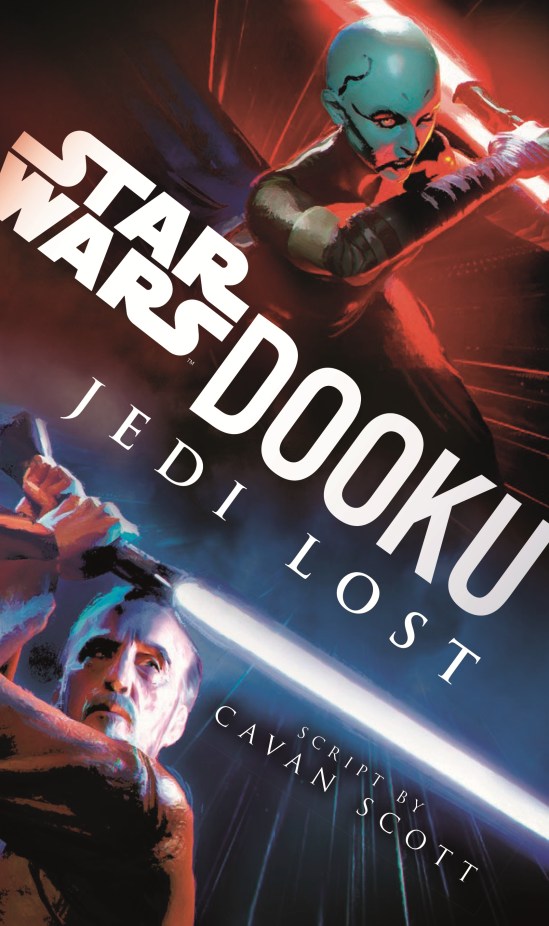
Star Wars: Dooku: Jedi Lost

Dooku - Jedi Lost Cover

Publisher: Penguin Random House Audio (Audio Production – 30 April 2019)

Script: Cavan Scott

Cast: Orlagh Cassidy, Euan Morton, Pete Bradbury, Jonathan Davis, Neil Hellegers, Sean Kenin, January LaVoy, Saskia Maarleveld, Carol Monda, Robert Petkoff, Rebecca Soler and Marc Thompson.

Length: 6 hours and 21 Minutes

My Rating: 4.5 out of 5 stars

Amazon

Prepare for another deep dive into the Star Wars canon with an audio drama that explores the past of one the biggest villains from the prequel movies, Count Dooku, with Dooku: Jedi Lost.

Dooku: Jedi Lost was one of the more interesting pieces of Star Wars fiction that was released last year. Based on a script written by Cavan Scott, an author who has written a multitude of comics, novels and radio drama tie-ins for several different franchises, Jedi Lost was originally released as an audio production featuring several different actors, with the script also released in novel format a few months later. I have been meaning to check out this unique story for some time, as it was one of the few pieces of Star Wars fiction that I did not read in 2019. This is actually one of the first entries I am ticking off my Books I Wish I Read in 2019 list (barring The Russian by Ben Coes, which was an honourable mention), and I am really glad I decided to check this piece of fiction out.

For many in the galaxy, Count Dooku of Serenno is one of the most dangerous and evil villains that ever lived. The leader of the ruthless Separatists during the Clone Wars, apprentice to Darth Sidious and master of several ruthless assassins, Dooku is rightfully feared and hated by many. However, he once was one of the most respected and powerful members of the Jedi Council. A former apprentice to Yoda himself, and the mentor to two exceptional Padawans, Rael Averross and Qui-Gon Jinn, Dooku dedicated decades of his life to the Jedi, before suddenly leaving and taking a different path. But how did such a revered Jedi turn to the dark side of the Force? That is a question that Dooku’s new apprentice, Asajj Ventress, is trying to understand when she is given a mission to find Dooku’s missing sister. Searching for leads through Dooku’s journals and messages, Ventress is given unprecedented access into Dooku’s past.

The son of the ruthless Count of Serenno, Dooku was abandoned as baby by his father the moment his abilities with the Force were identified, only to be rescued by Yoda. Upon learning the truth about his birth years later, Dooku struggles with balancing his duties as a Jedi with his connections to his family and home planet. Conflicted, Dooku finds comfort in his friendship with the troubled young Jedi Sifo-Dyas and the mysterious Jedi Master Lene Kostana, whose mission of locating and studying Sith artefacts fascinates Dooku and leads him to his first experiences with the dark side of the Force. As Dooku rises through the ranks of the Jedi Order, he finds himself stymied by the bureaucracy and corruption of the Republic and the hypocrisy of the Jedi Council. As the first waves of darkness fall across the galaxy, how will the younger Dooku react, and what will Ventress do when she realises what sort of person her new master is?

Dooku: Jedi Lost is an incredible and deeply captivating piece of Star Wars fiction that cleverly dives into the past of one of the franchise’s most iconic villains to present a compelling and intriguing story. I ended up listening to the full cast audio production of Jedi Lost, and I really enjoyed this fantastic and intriguing book. The plot of Jedi Lost is uniquely set across several different time periods, with the details of Dooku’s life being relayed to a younger Ventress at the start of her Sith apprenticeship through journal entries, detailed messages, oral histories and even some visions of the past. Scott did an excellent job of setting his story across multiple time periods, which allowed Jedi Lost to showcase the life of the titular character while also presenting an exciting, fast-paced and at times dramatic narrative that includes several plot threads that jump from timeline to timeline. All of this results in an excellent Star Wars story which features some fascinating inclusions to the franchise’s lore and which is enhanced by the incredible audio production.

At the centre of this book lies an intriguing and captivating exploration of one of the most significant antagonists in the Star Wars canon, Count Dooku. Jedi Lost contains quite a detailed and compelling backstory for this character, and you get to see a number of key events from his life. This includes his complicated childhood, the forbidden communication he had with his sister, the connection he maintained with his home planet, parts of his apprenticeship under Yoda, the tutelage of his own two apprentices, his time on the Jedi council, his first brushes with the dark side of the Force and finally the chaotic events that led him to leave the Jedi order and take up his position as Count of Serenno. Every part of this background proved to be extremely fascinating and it paints Dooku as a much more complex character, with understandable motivations and frustrations. He actually comes across as a much more sympathetic person thanks to this production, and readers are going to have an amazing time finding out what events and betrayals drove him away from the Jedi and towards his new master. The storytelling device of having Ventress read and analyse Dooku’s old messages and journal entries ensures that the story quickly jumps through the events of his life, and no key events really seem to be missing. I personally would have like to see some more detail about Dooku’s training under Yoda or his teaching of his apprentices, although I appreciate that this was already an expansive production and there was a limit on what could be included in the script. I also wonder what sort of story this could have turned into if this was told exclusively from Dooku’s point of view, however, this first-person narration probably wouldn’t be as feasible as a full cast audio production. Overall, those fans who check out Jedi Lost are in for quite an in-depth and fascinating look at the great character that is Count Dooku, and I am sure many will enjoy this exciting examination of his backstory.

In addition to exploring the character of Count Dooku, Jedi Lost also presents those dedicated Star Wars fans with a new canon look at the Star Wars universe before the events of The Phantom Menace. You get an intriguing look at the Republic and the Jedi Order in the years leading up to events of the Skywalker Saga, and it was fascinating to see the similarities and differences between the various eras in the Star Wars lore. In particular, I found in interesting to see that the groundwork for the Clone Wars and the fall of the Jedi order had already begun, with ineffectual leadership, corruption in the Senate and complacency in the Jedi Council all eventually leading the dark events of the future. Jedi Lost also shows the earlier days of several Jedi who were supporting characters in either the movies or the animated shows. In particular, this entry focuses on Sifo-Dyas, the Jedi who foresaw the Clone Wars and was manipulated into creating the Republic’s clone army. The story explores how Dooku and Sifo-Dyas were close friends growing up, while also showing the origin of his prescient powers, and he proved to be a rather compelling side character. Jedi Lost also saw the introduction of Jedi Master Lene Kostana to the canon. Lene Kostana was a rebellious Jedi who scoured the galaxy for Sith artefacts in the belief that the Sith were going to rise again. She proved to be an interesting mentor character for Dooku, and her recklessness and unique way of thinking had some major impacts in Dooku’s character development.

I also liked how this piece of Star Wars fiction focused on the early career of Asajj Ventress, one of the best Star Wars characters introduced outside of the movies. Much of the story is set immediately after Dooku claims Ventress as his apprentice and personal assassin, which allows the reader a compelling view of Ventress’s early brushes with the dark side of the Force and the initial corruption and manipulation she experienced under Dooku. This proved to be quite an interesting part of the novel, especially as the reader got to see Ventress’s thoughts and reactions to several revelations about Dooku’s past. Thanks to the way that the audio production is set out, Scott also included a rather cool element to Ventress’s character in the way that she is hearing the voice of her dead former Jedi Master and mentor, Ky Narec. While Ky Narec’s voice was mainly included to allow Ventress to share her thoughts in this audio production without becoming a full-fledged narrator, this ethereal character gives the reader a deeper insight into Ventress’s character. I also enjoyed the discussion about Ventress’s past with Narec, and it helped produce a much more in-depth look at this fascinating character from the expanded universe.

Like most pieces of expanded universe fiction, Jedi Lost is best enjoyed by fans of the Star Wars franchise, who are most likely to appreciate some of the new pieces of lore and interesting revelations. This production also bears some strong connections with another piece of Star Wars tie-in fiction that was released last year, Master & Apprentice by Claudia Gray. Master & Apprentice was one of the most impressive Star Wars novels released last year, and it featured a story that focussed on Dooku’s apprentices, Rael Averross and Qui-Gon Jinn. Jedi Lost heavily references some of the events that occurred or are represented in Master & Apprentice, and it was interesting to see the intersections between the two separate pieces of fiction. I particularly enjoyed seeing more of the unconventional Jedi, Rael Averross, and it was great to see some additional interactions between the proper and noble Dooku, and this rough former apprentice. Despite all of this, I believe that Jedi Lost can easily be enjoyed by more casual Star Wars fans, although some knowledge about the prequel films is probably necessary.

People familiar with this blog are going to be unsurprised to learn that I chose to listen to the audio production of Jedi Lost rather than read the book that was produced from the script. I have a well-earned appreciation for Star Wars audiobooks, which are in a league of their own when it comes to production value; however, Jedi Lost is on another level to your typical Star Wars audiobook. As I mentioned above, Jedi Lost was released as a full cast audio production, which is essentially an audio recording of a play. This was the first piece of Star Wars fiction I had experienced in this medium, and I really loved how it turned out. The cast did an amazing job with the script, and they acted out a wonderful and highly enjoyable production which I thought was just incredible. The production runs for just over 6 hours and 20 minutes, and they manage to fit a lot of plot into this shorter run-time (in comparison to normal Star Wars audiobooks), as the use of dialogue results in a lot less narration. Due to the way Jedi Lost is structured, with Ventress reading out journal entries or having Dooku’s tale told to her, there is a little more narration of events then a production like this would usually have. I think this was necessary to ensure the reader was clear on what was going on at all times, and it didn’t ruin the overall flow of Jedi Lost in any way.

Jedi Lost features a very impressive and talented group of actors who go above and beyond to make this an awesome audio production. As you can see from the cast list above, this production made use of 12 separate narrators, each of whom voice a major character (with some of the actors also voicing some minor characters as well). Many of these narrators have expansive experience with voicing Star Wars audiobooks, and I have actually had the pleasure of listening to several of these actors before, including Euan Morton (Tarkin by James Luceno), Jonathan Davies (Master & Apprentice), Sean Kenin (Death Troopers by Joe Schreiber), Robert Petkoff (multiple Star Trek novels, most recently Picard: The Last Best Hope by Una McCormack) and Marc Thompson (Dark Disciple by Christie Golden, Loki: Where Mischief Lies by Mackenzi Lee and Scoundrels and Thrawn by Timothy Zahn).

There is some truly outstanding audio work done in this production, with several actors producing near-perfect replication of several iconic characters from the Star Wars franchise. I particularly have to praise Orlagh Cassidy for her exceptional portrayal of Asajji Ventress; her take on the character sounded exactly like the Ventress that appeared in The Clone Wars animated show. I was also deeply impressed by Jonathan Davis’s Qui-Gon Jinn and Marc Thompson’s Yoda, both of which were incredible replications of the characters from the movies. Davis also did a great job once again portraying Rael Averross, a fun character who he first brought to life in Master & Apprentice, and I loved the somewhat laidback voice he provides for Rael, especially as it reminds me of an older cowboy character from a western (I personally always picture Sam Elliott when I hear it). Other standout stars in this production include Euan Morton, who came up with a great take on the titular character Count Dooku. Morton was able to produce an impressive and commanding presence for this character, and he did a great job modulating the character’s voice to represent the various jumps in age that the character experienced. The same can be said for Saskia Maarleveld’s Jenza and Sean Kenin’s Sifo-Dyas, whose characters also aged extremely well throughout the course of the production. I also really loved the voice that Carol Monda provided for new character Lene Kostana, and I felt that it fit the character described in Jedi Lost extremely well. I honestly loved all the rest of the voices that were provided throughout this production, and each of them brought some real magic to Jedi Lost.

Just like with a normal Star Wars audiobook, one of the standout features of the Jedi Lost production was the incredible use of the franchise’s iconic music and sound effects. I really cannot emphasise enough how amazing it is to have one of John Williams’s epic scores playing in the background of a scene. Not only does it really get you into the Star Wars zone, but this music markedly enhances the mood of any part of the book it is playing in. Hearing some of the more dramatic scores during a touching or tragic scene really helps the reader appreciate how impactful the sequence truly is, and nothing gets the blood pumping faster during an action sequence than Duel of the Fates or some other fast-paced piece of Star Wars music. The sound effects utilised throughout this production are not only really cool but they also have added significance for an audio production like Jedi Lost which relies on dialogue rather than narration to establish the scene. Having the various classic Star Wars sound effects reflect what is going on can be really helpful, and often the clash of lightsabers and the pew-pew of blaster bolts give life to a battle sequence. I always appreciate the way that certain sound effects can help paint a picture of what is happening in the room that the dialogue is taking place. Having the susurration of a crowd or the light hum of a starship engine in the background always makes a book seem more impressive, and it makes for a fun overall listen.

Dooku: Jedi Lost was an incredible and wonderful production which I had an extremely hard time turning off. Cavan Scott’s clever and intricate script, combined with the outstanding audio production, is a truly awesome experience which I deeply enjoyed. I loved learning more about the character of Count Dooku, and I think that Scott came up with a fantastic and intriguing background for the character. Jedi Lost is an excellent piece of Star Wars fiction, and I am extremely happy that I listened to it. Highly recommended to all Star Wars fans, and if you decide to check out Jedi Lost, you have to listen to the spectacular audio production, which is just amazing.

Amazon