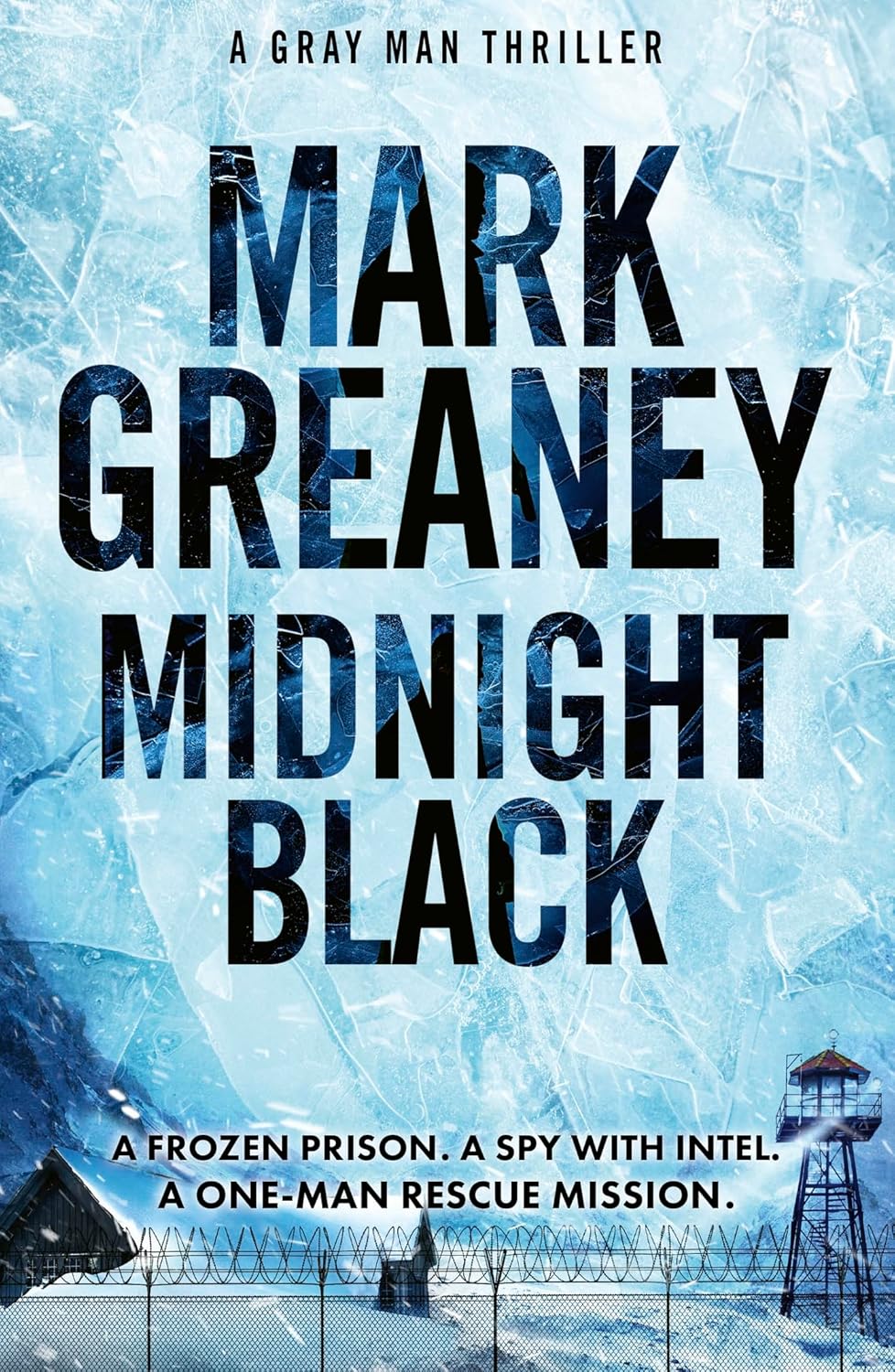
Midnight Black by Mark Greaney

Publisher: Sphere/Audible (Audiobook – 18 February 2025)

Series: Gray Man – Book 14

Length: 15 hours and 51 minutes

My Rating: 5 out of 5 stars

Amazon

The always outstanding Mark Greaney provides another addictive and heart-pounding addition to his iconic Gray Man series with the incredible 2025 spy thriller, Midnight Black.

Ever since I started getting fully into the thriller genre, one of the main authors I check out each year is Mark Greaney, a veteran master of thriller fiction who has produced some incredible reads.  Some of his more entertaining books include his Josh Duffy series (Armored and Sentinel), as well as the fun military thriller Red Metal (cowritten with Hunter Ripley Rawlings IV).  However, his best-known body of work is the long-running Gray Man series, which was adapted into a Netflix movie of the same name.

The Gray Man series is an outstanding collection of spy thriller novels that follows elite assassin and black ops operative Court Gentry, better known by the titular moniker of the Gray Man, as he faces off against an array of deadly enemies while occasionally working for the CIA.  I have become a pretty major fan of the Gray Man series thanks to the author’s complex stories, gritty action sequences and damaged characters, and I have had a blast with books like The Gray Man, Mission CriticalOne Minute Out (one of my favourite books and audiobooks of 2020), Relentless (one of my favourite books and audiobooks of 2021), Sierra Six (one of my favourite books and audiobooks of 2022), Burner (one of my favourite books and audiobooks of 2023) and The Chaos Agent (one of my favourite books of 2024).  Due to how epic all these previous Gray Man entries have been, I couldn’t wait to get my hands on the next entry in the series, Midnight Black.  Providing an intense follow-up to a fantastic cliffhanger from the last book, Midnight Black was one of my most anticipated releases of 2025, and it really did not disappoint.

In the icy wilds of Mordovia, lies the brutal woman’s penal colony IK-2 Yavas.  A harsh work camp for the many political enemies of the current Russian regime, IK-2 Yavas is hell on earth for any women who have defied the state.  However, despite the prison holding many prominent criminals and politicians, their most valuable prisoner is former spy Zoya Zakharova.

Once a prominent Russian foreign intelligence agent, Zoya was forced to flee her position and eventually found herself working covertly for the CIA as a deniable asset.  However, after being captured by the Chinese and traded to the Russians, Zoya’s future is bleak as she is slowly worked to death.  Worse, a ruthless FSB operative is using Zoya as bait for the person most important left in her life, her lover Court Gentry, the Gray Man.  But, unknown to Zoya, the Gray Man is far closer than she realises.

Having spent months prowling the Eastern European countries, Gentry seeks a way to steal across the Russian border and save the woman he loves, no matter the cost.  Embarking on a risky entry plan with only minimal help from his old CIA contacts, Gentry is determined to find Zoya and kill anybody who gets in his way.  But with the entire Russian state security apparatus turned against him, can Gentry once again do the impossible and save Zoya, or will this be the final mission for the legendary Gray Man?

Mark Greaney continues to impress with his epic Gray Man series, as the 14th brilliant entry in the series, Midnight Black, was absolute fire.  Providing an intense and deeply addictive spy thriller narrative, Midnight Black hooked me from the very beginning and refused to let go until the final explosive confrontation.  Slick, emotionally charged and very clever, Midnight Black gets an easy five-star rating from me, and I had such an amazing time listening to it.

This proved to be an outstanding book to get through, as Midnight Black featured a compelling and cinematic narrative that had me hooked the entire way through.  Expertly following on from the emotional cliffhanger from the end of the previous book in the series, The Chaos Agent, Midnight Black starts several months later and sees a desperate Court Gentry doing anything he can to try to enter Russia, only to encounter setbacks he has to take care of in his usual destructive manner.  This works as an excellent introduction to Midnight Black’s plot, especially as it helps you appreciate the emotional stakes of the book, and you quickly become invested in the protagonist’s quest.  Greaney quickly expands the plot through several additional character perspectives, including recuring characters Zack Hightower and Zoya Zakharova, who have their own missions/problems, an intriguing new Russian rebel protagonist, and the perspective of some sinister Russian operatives, including the FSB agent pulling all the strings around Zoya’s imprisonment.  This serves as a great base for the rest of the story, and the author soon starts to feature some of the more complex and action-packed sequences in Midnight Black.

Starting with a well-layered extended shootout sequence in Europe, the second half of Midnight Black hits hard and keeps the reader deeply engaged.  Greaney continues to set out quite an impressive story, as Gentry enters Russia and proceeds to cause all manner of havoc, while his allies in Europe and the US throw together an audacious plan that really amps up the narrative.  Greaney keeps the plot constantly moving, taking the protagonists from one dangerous situation to the next, with compelling character moments and well-featured exposition that keeps everything going forward.  The author also throws in a ton of high-octane and memorable sequences, including a fun extended chase in Moscow involving a stolen train, which was so entertaining to behold.  Everything leads up to the big finale in the last third of the story, where the protagonist makes his play to free Zoya in very cinematic fashion.  There is a lot of intense anticipation involved in the leadup to this final part of Midnight Black, and it proves to be particularly captivating and exciting.  The conflict, high stakes and constant worry you have for the characters ensures you won’t be able to put this part of the book down, and I was so keen to see how everything came together.  Greaney wraps things up perfectly, and I liked the hopeful conclusion to Midnight Black, especially after some of the dark preceding books, and you come away satisfied, as well as excited to see where the series goes next.

I am always greatly impressed with how Greaney sets out his outstanding novels, and Midnight Black is a particularly strong example of this.  A fast-paced book with several interesting layers to it, Midnight Black drags you in with its powerful narrative and keeps you there with the well-set-out action, complex characters, and gritty realism.  Thanks to the blend of character arcs and alternating storylines, there is a lot going on in Midnight Black, and you are given a great mixture of ultra-exciting sequences of action and spy craft, intense personal moments of despair and hope, as well as a cool dive into real-world issues, such as the current war in Ukraine, that enhance the overall plot.  I particularly enjoyed the gritty realism loaded in the story, especially when it comes to looking at the current politics of Russia, and there was a particular dire tone to much of the plot that was well mirrored by several protagonist’s circumstances.

One of the writing techniques I always enjoy with the Gray Man novels is the author’s excellent use of alternating character perspectives, as the reader gets to see the narrative through a variety of different viewpoints.  While primary characters like Gentry, Hightower and Zakharova naturally get most of the focus, you also see events through the eyes of more minor protagonists, such as Gentry’s former CIA handler in the US, or a Russian rebel fighter launching attacks in Moscow, as well as from several of the book’s antagonists.  This provides a much more expansive narrative for readers, especially as you soon understand the compelling motivations of all the significant characters, as well as their often conflict plans and schemes.  I particularly enjoyed how well some of Midnight Black’s many action sequences become even more impressive when you get to see events through the eyes of all the participants in the event.  Seeing all the alternate sides of conflicts really helps to make the fight sequences stand out, and it is captivating to see the various moves and countermoves of all the characters involved.  I felt this worked particularly well in some of the book’s big firefights, such as one sequence out in the woods where Gentry and Hightower’s camp gets raided by a squad of hitters, and you really get drawn into the books brutal action thanks to this.

While Midnight Black can probably be read as a standalone novel, especially as Greaney does a good job recapping key events, I feel that this latest Gray Man novel is probably best enjoyed by those who have read the previous books in the series, especially the preceding entry, The Chaos Agent.  This is mainly because Greaney is following up on a major cliffhanger from the previous book, and a lot of the emotional weight of the plot is based around the protagonist trying to right this wrong and save the woman he loves.  Being invested in the relationship between Gentry and Zakharova, as well as appreciating the protagonist’s other character relationships, really helps to amp up the stakes of Midnight Black, and I know I was personally hooked on seeing how events played out.  While having this background does enhance the experience, I do think that new readers can easily come into the series here and still have an amazing time, especially once they get caught up in the intense plot.

I also need to once again compliment the compelling characters found within Midnight Black, as Greaney really went out of his way to create some intense character moments in this latest Gray Man novel.  A lot of this revolves around the protagonist, Court Gentry, who finds himself in emotional turmoil following the Russians imprisoning the woman he loves.  Unsure about her fate and desperate to enter Russia to rescue her, Gentry is a ghost of his former self, recklessly engaging in deadly actions without his former skill and tradecraft.  This uncharacteristic lack of planning from the main protagonist and the way he lets his emotions overwhelm him adds a compelling edge to the story, especially as it results in more carnage and close calls.

The rest of the cast are also well featured in Midnight Black, especially as Greaney brings back several old favourites in dire circumstances.  For example, Court’s love interest, Zoya Zakharova, ends up having a particularly powerful arc in Midnight Black, as she is imprisoned in a Russian work camp.  Slowly losing hope due to her surroundings, her imminent execution, and her worry for Court, Zoya’s scenes are often hard to read and really help to hammer home the dark stakes of the book.  Greaney also brings back fun recurring character Zack Hightower, who serves as a lighter point of view protagonist compared to Court and Zoya.  A veteran operator with a lot of history with the other protagonists, Zack was a great foil for Court’s moodier persona in Midnight Black, and I loved seeing them work together in this way.  Other characters of note include Court’s former CIA handler, Matthew Hanley, who works to provide outside help despite his own downward career trajectory, and Major Colonel Eriks Baronov, an FSB operative trying to use Zoya as bait for the Gray Man.  I really enjoyed how Hanley and Baronov provided interesting alternating tactical insights into the events of Midnight Black, which gave the novel a great global conflict feel at times.  All these characters and more helped to turn Midnight Black into something special, and I really enjoyed how complex and exciting the various character-driven storylines turned out to be.

As has become my habit with the Gray Man series in recent years, I ended up listening to Midnight Black on audiobook rather than reading a physical copy.  I find that the audiobook version of the Gray Man books, narrated by the always reliable Jay Snyder, are an excellent way to absorb Greaney’s fantastic stories, especially as the various action sequences and compelling showcases of spycraft are highlighted particularly well in this format.  For Midnight Black, I listened to this audiobook while on a holiday with a lot of flying/driving time, which not only kept me from getting bored on the bus/plane but which ensured that I absolutely powered through its near 16-hour run time.  It helped that many of the best sequences in the book, such as the epic firefight at the halfway point and the big chase through Moscow, were particularly impactful in this format, and Snyder did an excellent job voicing all the characters.  I particularly appreciated all the eastern European and Russian accents that Snyder attributed to the various characters, and he also did a good job capturing key parts of the protagonist’s personalities, especially Gentry’s weariness and desperation that were a key part of this book.  Due to this brilliant voice work, as well as my general love for the format, I would strongly recommend Midnight Black on audiobook, and I can guarantee it makes for great entertainment on long road trips.

Overall, Midnight Black was another outstanding and captivating new entry in the always impressive Gray Man series.  Author Mark Greaney did an amazing job continuing one of the very best spy thriller series out there, and I deeply enjoyed Midnight Black’s particularly intense and personal story.  Featuring some fantastic action, complex character arcs and some compelling insights into major contemporary events, Midnight Black was extremely addictive, and I cannot wait to see how Greaney continues the series in the future.

Amazon

The Sandman – Act III (Audiobook), written by Neil Gaiman and performed by a full cast

Publisher: Audible Original (Audiobook – 28 September 2022)

Series: The Sandman – Volume 3

Script: Neil Gaiman and Dirk Maggs (script adapter)

Director: Dirk Maggs

Length: 11 hours and 31 minutes

My Rating: 5 out of 5 stars

Amazon

After falling in the love with the epic The Sandman comics thanks to their exceptional audiobook adaptations, I finally got to the third audiobook act in this exceptional series by Neil Gaiman, which was another amazing listen.

I have had an outstanding time listening to the first and second volumes of the audiobook adaptations of The Sandman comic.  Set partially in the DC universe, the original series, which started in 1989, is one of the most iconic comics of all time and features a unique adventure that only Neil Gaiman can come up with.  Following Dream, the anthropomorphic personification of dreams and human imagination, The Sandman is a truly amazing comic that blends horror, fantasy and superhero elements together.  Some people might be more familiar with the recent Netflix series that adapted the first couple of comics, and which has a second season on the way.

This series has proven to be extremely exceptional, with Act I perfectly introducing the characters and setting up the initial storyline, while Act II continues some of the key story points and places Dream against various foes, including Lucifer and other dangerous mythical figures.  Not only do these audiobooks feature an incredible story and powerful characters but they are brought to life by a truly awesome cast of celebrity actors and audiobook narrators who really lend their all to this performance.  As such, when going on a couple of fun road trips this year, Act III was a very easy choice to listen to, and I was extremely curious to see how this series would continue.

In a universe of strange and deadly creatures, many beings are considered immortal, but only seven siblings can truly claim to be endless.  The Endless, each a personification of a universal concept, are powerful and mesmerizing in their own way, but the most enchanting and mysterious is Dream.  Known by many names, including Morpheus, this being governs the Dreaming, a vast realm of creation’s collected dreams and stories, protecting the imagination that makes life worth living.  But circumstances outside of his control have set him on a dark path that not even he can escape from.

After being freed from captivity and deciding the future of Hell, Morpheus finds himself troubled by another failed romance, his own complex past, his previous monstrous decisions, and his often contentious relationship with his family.  Visited by his troubled youngest sibling Delirium, Dream embarks on an unusual quest alongside her to find their missing brother, the one member of the Endless to ever give up their role and responsibility, Destruction.  But their prodigal sibling does not wish to be found, and many obstacles lie between an Endless reunification.  To succeed in their quest, Morpheus will need to revisit the most painful chapter from his past.  However, no-one, not even a member of the Endless, comes away from a meeting with Destruction unscathed!

Unsurprisingly, Act III proved to be an exceptional listen, and I once again got wrapped up in the elaborate and compelling web of stories and characters that The Sandman is well known for.  Adapted once again by director Dirk Maggs and featuring all of Gaiman’s impressive storytelling and dark characterisations, The Sandman – Act III, was an outstanding listen, and one that I could not get away from.  Adapting the Brief Lives and Worlds’ End arcs of The Sandman comic, as well as several additional short stories, Act III was an exceptional addition to this series, especially with the truly exceptional voice cast.

Act III continues the same format and style of the previous The Sandman audiobook adaptations, with the comic broken into several distinctive parts to best tell the elaborate story from the comics.  The previously drawn adventures are brought to life here through a combination of excellent narration by Neil Gaiman, who covers many of the characters’ actions and movements, sound effects to represent other unseen elements, and the dialogue of the various characters, with their respective actors often describing the moments going on around them.  This results in an intriguing but complex listening experience, and with a runtime of 11 hours and 31 minutes, it is one that you can get through very quickly if you have the time.

This latest audiobook adaptation starts off in an interesting place with the short story The Song of Orpheus, which originally appeared in the Fables & Reflections collection of stories.  The Song of Orpheus is a fantastic retelling of the classic Greek myth of Orpheus, with the character reimagined as the son of Morphius and the muse Calliope, the latter of whom was featured in the story Calliope in the Dream Country collection (featured in the Act I adaptation).  Gaiman does an excellent job of bringing together the classic Greek mythology of the Orpheus legend with his own characters and the result is a seamless and complex tale.  Orpheus’ ill-fated marriage and journey to save his love is aided and hindered by the various members of the Endless, with Morpheus serving as a complex distant father figure.  The resulting story may seem familiar to those with knowledge of Greek mythology, but there are some added intriguing twists, and the inclusion of Gaiman’s characters ensure that there is even greater tragedy than the original Greek myth envisioned.

When I started this audiobook, I thought that The Song of Orpheus was interesting start to this act, and in hindsight it was quite a clever decision, as it sets up some of the other arcs extremely well.  The story ensures that listeners are well warned about the tragedy and elaborate storylines contained in Act III, while also drawing you in with its inventiveness and complexity.  It is also a brilliant production thanks to the combination of cast and background music effects.  Regé-Jean Page (of Bridgerton fame), proves to be an outstanding Orpheus, who stands as an interesting contrast to the other established voice actors of this story.  There are also some epic musical accompaniment and sound effects that prove vital in showcasing the full impact of this story, and which you honestly need when telling a story about the mythical musician Orpheus.  I felt that the musical elements of this chapter deeply helped to enhance the story, especially as there was some great sadness in the sound effects that mirrored the story.  This was honestly a very strong start to Act III, and I loved how well it led into the first main story, Brief Lives.

Brief Lives is a particularly epic main story arc for this audiobook which serves as both the plot and emotional heart of Act III.  Initially focusing on the incredibly fun character of Delirium, who we only briefly saw in Act II, Brief Lives sees Dream accompany his sister on a road trip to find their lost brother, Destruction.  This results in several intriguing mini story arcs as the mismatched and chaotic siblings travel through the mortal world, encountering their family, friends, and former associates of Destruction.  At the same time, sinister events begin to impact people associated with their search, and Dream must navigate the increased collateral damage his quest is incurring.

I really loved this arc, and I think that Brief Lives might be one of the stronger The Sandman storylines.  The road trip storyline with Dream and Delirium worked to tell this story in a fantastic manner, and I enjoyed how the author took the opportunity to quickly and effectively introduce new intriguing characters whose worlds become impacted by their interactions with the Endless.  The long-anticipated reveal about the missing Endless was great, and Gaiman loads in some intriguing examinations about family, destiny and duty.  Brief Lives is loaded with a great combination of dark mystery, the author’s gothic vibe, a fantastic layer of humour, and an intense amount of tragedy, all wrapped up with the most unique familial interactions you are likely to see in fiction.  The author takes the storylines in some interesting directions, and the resulting emotional richness proves very hard to ignore.  The ending of Brief Lives is particularly moving, with a resolution of family drama followed by additional tragedy millennia in the making.  This also proves to be quite a key story in the wider The Sandman story, with the consequences radiating out from the events of this road trip have chaotic impacts in the future.

I have to say that I was really impressed with how Brief Lives came together.  Not only does the elaborate story come across clearly and interestingly with the chapter split, but you really get drawn into every single supporting character that shows up.  I particularly enjoyed seeing Delirium getting a whole arc to shine in, and actress Kristen Schaal is perfect as the embodiment of personal chaos, bringing an immense childlike glee to the madcap antics of her character.  Schaal perfectly plays off the more serious characters in this story arc, and you can really feel the dancing chaos beneath the surface of her mind as well as how scattered and unconnected she is.  The reveal of Destruction as a character was also quite interesting, and I like the author’s take of him being a warm, thoughtful and entertaining destroyer, whose duty has deeply damaged him.  David Harewood brings some real compassion and charm to the role of Destruction, and I enjoyed how he played off the sarcastic talking dog Barnabas, voiced by veteran voice actor Harry Myers.  The portrayal of Brief Lives also makes excellent use of some musical accompaniment to enhance the emotional impact of the plot, including in some of the story’s heaviest scenes, and this ended up being the most compelling part of Act III to listen to.

The other major storyline in The Sandman – Act III, is the intriguing anthology storyline, Worlds’ End.  Like some of the previous arcs in The Sandman, Worlds’ End is more of an indirect addition to the plot, loaded with short stories that show snippets of Dream, the Endless, and other supporting characters, interacting with new and unique figures.  However, Worlds’ End is also quite distinctive, especially as Neil Gaiman surrenders his narrator duties in this arc, and instead features multiple guest narrators telling their own tales in a similar manner to The Canterbury Tales.  The plot of this arc starts with character Brant Tucker (voiced by Wil Wheaton) and his colleague crashing their car in a freak storm and then finding refuge in the mysterious Worlds’ End inn.  Within the inn, they discover multiple unusual travellers from across time and the realms, who have been scattered due to a reality storm and are seeking shelter.  To pass the time, the various guests tell stories based on their lives, which paint a complex tapestry of their experiences and the long-reaching influence of the Endless.

I have a lot of love for the various short stories that Gaiman fills The Sandman comics with, but I felt that the collection featured with Worlds’ End were some of his strongest.  There are five central stories featured within, and they each provide a complex and wildly different tale of life, loss and adventure, all set in the contexts of different worlds and experiences.  Gaiman manages to tell some complex tales in the short time he has with each entry, and the reader comes away with intriguing visions of these unique worlds and characters.  There are a few times where the narrative devolves into a story within a story, as narrators begin to recount tales that were told to them (and in a couple of cases you have a story within a story within another story).  However, even these prove to be very captivating, and it is a testament to how good a storytelling Gaiman is that readers can moved into multiple interlocking tales and still be intrigued by what is going on.  There is also a great mixture of tales here, from a Lovecraftian inspired dream tale, to a hilarious fantasy adventure told by a rambunctious Faerie, and even a classic nautical adventure tale of a handsome sailor boy, which features the return of fan favourite character Hob Gadling.  However, my favourite story was The Golden Boy, an intriguing retelling of the story of Prez Rickard, the teenage president protagonist of the classic, if short-lived, Prez comics, which proves to be quite entertaining and haunting, while also showing an idealised vision of America.

I felt that these five stories came across in a very organic way with the differing narrators, and it proved to be a lot of fun to experience the talents of several new or underutilised vocal talents in a strong way here.  Wil Wheaton was a great main narrator for the overarching story, and I felt he portrayed a good everyman character experiencing the unnatural for the first time.  Billy Boyd and Colin McFarlane both shine as narrators and central characters for their respective stories, and I quite enjoyed the performances of KJ Apa and Jon Culshaw in The Golden Boy, while Simon Jones was an impactful addition to the funeral-focused story Cerements.  These actors, and many others, helped to turn Worlds’ End into a compelling and distinctive arc, and I liked how effectively it contrasted with the other The Sandman arcs we have enjoyed.  This entire storyline ends on an ominous and prophetic note, as the listener is given a glimpse of major events to come, and Worlds’ End proved to be a great way to conclude Act III.

Overall, these main stories, as well as an additional couple of short stories, proved to be very impressive to read, and I love the complex plots and themes that the author tried to impart.  The continuation of a larger storyline, combined with multiple short stories that expands The Sandman universe, works to create an elaborate experience for the listener, and I deeply appreciate the immense imagination that Gaiman puts into his work.  The flow from larger, cohesive storylines to a series of shorter tales also works extremely well, and I love how the obvious palate cleaner short stories take on a compelling life of their own.  No matter how short, each of the stories in Act III were very well written, and the distinctive blend of dark storytelling, gothic imagination and complex characters makes for some addictive listening.  I especially love the recurring trend of normal humans, as well as other more supernatural beings, encountering the various Endless by chance, only to find their lives altered by the experience, often for the worst.  The often capricious nature of Dream, as well as some of his siblings, really comes through with Gaiman’s writing and the subsequent acting, and you cannot appreciate just how well-written these figures, and indeed the entire character cast of The Sandman, are, until you experience it for yourself.

Before we get to the end of this review, I must once again strongly compliment just how awesome these The Sandman audiobooks are.  Gaiman, Maggs and others do such an incredible job of converting the original comics into this new format, and all the original ideas, actions and compelling figures come across perfectly in the audiobook.  The combination of clever narration and on-point dialogue allows listeners to really appreciate the unfolding actions taking place, and effective sound effects add that extra layer of understanding.  Throw in some outstanding musical moments, which prove to be particularly impactful in Act III, and this entire audiobook hits the reader hard and ensures that are constantly caught up in the elaborate ideas of the original author.  All the storylines come across perfectly, with some slight alterations in the order they appear, and you really come away with an outstanding appreciation for The Sandman, even if you’ve never read the comics.

It goes without saying that Act III once again featured an incredible cast of actors and voice specialists, all of whom perfectly portray the characters they are assigned to.  I love how all the key stars from Act I and Act II, once again returned here, and their outstanding voices, combined with some awesome new figures, ensured that every word of this audiobook delighted its audience.  I have already mentioned a few key actors above, but I really want to once again highlight the outstanding recurring key cast, who do such a great job here.  Series lead James McAvoy is just perfect as Morpheus, and his resonate and powerful voice consistently captures the ethereal, arrogant, and thoughtful qualities of the titular protagonist every time.  It is such a pleasure to listen to McAvoy perform once again in Act III, and his excellent voice plays off every other actor in this audiobook so damn well.

Other key returning stars include Kat Dennings, who perfectly portrays Gaiman’s warmer, caring, female Death, who is frankly one of the best characters in the entire series.  Andy Serkis has a lot of fun as the raven Matthew, and his scenes with Dream and Delirium are hilarious.  Jeffrey Wright, Justin Vivian Bond and Miriam Margolyes each do an amazing job of bringing Destiny, Desire and Despair to life, and you can really feel their ancient power and alternating views of humanity.  Justin Vivian Bond’s portrayal of the feckless and fickle Desire is particularly noteworthy, and I love how well this unique character came across.  Multiple other actors and established audiobook narrators provide a range of compelling and memorable voices throughout Act III, including several of my favourite audiobook narrators like Ray Porter and Toby Longworth, and I loved every one of their voices.  Finally,  Neil Gaiman himself serves as an outstanding central narrator for much of the Act III.  Gaiman’s distinctive voice perfectly fits the gothic and mysterious vibe of The Sandman comics, and there is no-one else who could narrate these complex ideas and experiences, better than the author who originally came up with them.  You will frankly struggle to find a better cast of voice actors in any other audiobook out there, and this outstanding vocal team makes Act III, and indeed all The Sandman audiobooks, something extremely special to enjoy.

Act III of The Sandman audiobook was another exceptional listen and one that proves pretty impossible to stop listening to.  The combination of captivating storylines, outrageous characters, and a huge array of vocal and acting talents make this an easy five-star listen, and I can personally guarantee that The Sandman – Act III makes for an excellent accompaniment to a long road trip.  While I’m sure that recent controversies might impact this, I hope we get the fourth act in this epic series soon, and I cannot wait to see how Morpheus’s tragic and complex tale ends.

Amazon

The Chaos Agent by Mark Greaney

The Chaos Agent Cover

Publisher: Sphere/Audible (Audiobook – 20 February 2024)

Series: Gray Man – Book 13

Length: 17 hours and 34 minutes

My Rating: 5 out of 5 stars

Amazon

One of the leading authors of the spy thriller genre, Mark Greaney, returns with another epic entry in his iconic Gray Man series, The Chaos Agent.

Readers of this blog will know that I am a massive fan of thriller author Mark Greaney, who has been wowing the world with his elaborate and exciting stories for years.  Ever since I started reading thrillers, Greaney has been a major figure in my yearly reading schedule, with books like Armored and Red Metal (cowritten with Hunter Ripley Rawlings IV), ensuring that he became a must-read author for me.  However, his most iconic body of work is his Gray Man series, which follows legendary former CIA agent and assassin Court Gentry, known as the Gray Man, as he engages in carnage across the world.  This series, which people may be familiar with thanks to the Netflix adaptation, is so damn good, and I really love the elaborate and intense stories that emerge.  This includes the impressive first novel The Gray Man, as well as later books like Mission CriticalOne Minute Out (one of my favourite books and audiobooks of 2020), Relentless (one of my favourite books and audiobooks of 2021) and Sierra Six (one of my favourite books and audiobooks of 2022) and Burner (one of my favourite books and audiobooks of 2023).  Naturally, I grabbed Greaney’s latest novel, The Chaos Agent, the first chance I could, and it proved to be another amazing read.

Across the world, elite scientists are being murdered in a series of elaborate and well-coordinated assassinations.  The killers are well equipped, well prepared, and seem capable of striking across multiple countries.  The only connection between the killings is the area of expertise the victims are known for, as someone is targeting the world’s leading experts in artificial intelligence and robotics.

As the killings continue, it appears that only two major assassins aren’t involved in the plot, the Gray Man, Court Gentry, and his lover Zoya Zakharova.  Hiding out in Central America after their last mission once again forced them to become fugitives, Court and Zoya are seeking the quiet life together after all their years apart.  But an assassin’s work is never done, and soon an old family friend of Zoya’s seeks them out, hoping that they can help identify the individuals behind the attack.  Initially reluctant to get involved, Court and Zoya soon find themselves targeted by association, and must flee an army of dangerous killers and mysterious advanced combat drones.

Forced to find out who is hunting them, Court and Zoya soon discover that the killings are linked to a deadly proposed artificial intelligence weapon that could change everything about modern warfare.  To discover what’s truly going on, the two former agents and their allies need to investigate the one survivor of the ongoing assassinations.  But with their target now protected by an old friend of theirs, Zack Hightower, in an isolated fortress, Court and Zoya will need to use all their connections and luck to find the truth before it’s too late?

The Chaos Agent was another excellent novel from Greaney, who continues to highlight why he is one of the world’s leading spy thriller writers.  This latest Gray Man novel ended up being a lot of fun, especially as Greaney goes a little overboard with the plot, and I deeply enjoyed the resulting adventure.

Greaney came out of the bag with something very exciting in The Chaos Agent, which is mainly down to how over-the-top and crazy the main narrative ended up being.  This story starts off relatively low-key, with a couple of random killings, and an update on the lives of the protagonist, Court Gentry, and his partner Zoya Zakharova.  Naturally, it doesn’t take long for Gentry and Zakharova to get dragged into the action, and this starts an intense fugitive arc for them, as they find themselves being hunted by various killers across central America.  At the same time, the other supporting characters of the book are investigating the worldwide plot around the assassination of various AI experts.  This results in a compelling investigation angle that continues for a large portion of The Chaos Agent, and it was fun to not completely know the identity of the book’s antagonist until towards the end.  This first half of The Chaos Agent definitely got my attention, and the compelling action, intense mystery, and intriguing characters help to draw the reader in.

The second half of The Chaos Agent is where things start to get particularly interesting, as Greaney amps up the story and throws it into overdrive.  In particular, the antagonists get even more crazy, which is well shown in an intense action sequence involving Gentry and Zakharova in contact’s house in Central America.  These additional opponents give The Chaos Agent a real science fiction edge to them, and it was a gloriously over-the-top inclusion that I really loved.  The various character storylines soon come together after that, as all the characters end up in Cuba investigating who is truly behind everything and why.  There are some cool sequences here, including complex and intricate multi-perspective operations as various players manoeuvre around each other to achieve their goals.  This all leads up nicely to the big extended finale, where all hell breaks loose as Greaney sets up a massive firefight with various sides thrown into the mix.  The action here is intense, with the carnage flying thick and fast, and with so many perils coming for the protagonists.  It all ends on a pretty big cliffhanger that will play nicely into the next book in the series, especially as two major supporting characters find their situation drastically changed due to their decisions.

I deeply enjoyed how this cool novel unfolded, and Greaney utilises his trademark writing style to great effect with this excellent story.  The high-intensity action, fast-paced plot, and intriguing overarching storyline came together wonderfully, and it proves very hard not to get drawn into The Chaos Agent as a result.  I particularly love how Greaney so effortlessly jumps between different character perspectives throughout the course of the book, which allows for a more complex and enhanced story.  These quickfire changes in perspective also work extremely well in some of the book’s more intense sequences, especially as seeing the various participants continuously react to other character’s actions, allows for some outstanding scenes.  Good examples of this include a sequence in the Cuban docks where Gentry and a rival assassin move around each other trying to simultaneously protect or kill their target.  These scenes, and more, are true highlights of this book, and I love how well they were able to incorporate the particularly eccentric inclusions that Greaney featured within The Chaos Agent.

As with most of the books in the Gray Man series, The Chaos Agent can easily be read as a standalone novel.  Greaney does a good job of recapping any the relevant key events from the prior novels where needed so new readers can enjoy this book without knowing anything about the rest of the series.  That being said, established Gray Man readers will probably get a little more out of The Chaos Agent, especially when it comes to seeing how the various character relationships unfold.  It also helps that this proved to be a particularly memorable entry in the series.  Not only does Greaney go all out with his very inventive and exciting story, but there is a great combination of story elements there that everyone can enjoy.  The intense action pairs well with a deep dive into modern technology elements, and Greaney pulls together an intriguing mystery about who is behind everything, rather than showing the antagonist from the get-go.  While some of the twists around the true antagonist are a little predictable, Greaney played them out well, and they worked into the massive status quo changes at the end of the book.  I will admit that I did find some of Greaney’s writing, including the dialogue, to be a little robotic at times in The Chaos Agent, which is kind of ironic when you consider the story focus.  The way some parts of the writing or dialogue came together just didn’t feel right to me at times, and that slightly decreased my enjoyment of the book.  Still, the awesome story more than made up for it, and I felt this was an awesome addition to the overall series, especially as the epic ending has got me extremely excited for the next book.

One of the things that I really enjoyed about The Chaos Agent was Greaney’s intriguing look at the future of AI and how it could be utilised in the military and intelligence fields.  Greaney clearly did some research on the subject, and several characters spend significant time lecturing about the potential advantages and dangers of AI weaponry.  I found this to be utterly fascinating, and this ends up being quite a key part of the book, especially once the protagonists find themselves beset by advanced drones and other distinctive weaponry.  As I mentioned above, Greaney uses this AI concept to make The Chaos Agent a little more science fiction than his previous novels.  While I won’t go into too much detail here, as frankly it is best experienced in the context of the story, some of these elements were very outrageous, and it made the story quite fun with some unique action.  While it was very over-the-top, Greaney did paint everything with a film of realism, and I came away from The Chaos Agent with a healthy respect and fear for the potential future of AI in the military, especially as Greaney is probably right and someone will use it to kill the rest of us.

Aside from the complex writing and cool AI elements, The Chaos Agent’s story is also enhanced by a great cast of characters who are cleverly showcased throughout the plot.  This includes protagonist Court Gentry and his partner Zoya Zakharova, who were reunited in the last book.  Gentry and Zakharova form an effective team as the main protagonists of The Chaos Agent, and it was fun to see them in action again.  However, Greaney also adds in an element of dissention, especially as neither really has the ability to trust other people, and they are both concerned about their potential future.  Their combined storyline goes in some interesting directions, and the final twist of the book ensures that their relationship will be a big part of the next entry in the series.  Greaney also brings back fun recurring character Zack Hightower, who worked with Gentry and Zakharova in the past.  Hightower is always great value for money, and he had an interesting run in The Chaos Agent as he’s hired as security for a tech billionaire being targeted.  Hightower ends up being an integral part of the book, and it was great to see him working with Gentry and Zakharova again, especially as his new job leads to some dark moments for him.  Throw in an excellent supporting cast, which includes some recurring faces and some new intriguing antagonists, and this ended up being an excellent book that makes fantastic use of its characters.

I have always found that the best way to enjoy one of the Gray Man novels is to listen to it in its audiobook format, which really enhances the story.  This is once again true for The Chaos Agent, which turned out to be such an epic listen.  The audiobook format, which has a substantial runtime of 17 and a half hours, proved to be a lot of fun, and I deeply appreciated how well it enhanced Greaney’s already fun story and writing style.  The constant movement between perspective characters, especially in the action sequences, comes across really well, and the intense fights feel so much more real and impactful when they are read out.  It helps that The Chaos Agent was once again narrated by Jay Snyder, who has voiced all the other Gray Man novels.  Snyder has a great vocal range that really lends itself to a spy thriller novel like The Chaos Agent, and all the over-the-top tough characters are captured extremely well in this audiobook, with Snyder expertly bringing back recurring voices from the previous Gray Man audiobooks.  The rest of the extended cast also get appropriate and fitting tones, and you can see Snyder is really trying to get the voices to match the characters.  This includes accents, as Snyder tries to capture many of the ethnicities captured within The Chaos Agent’s story, including a pretty good attempt at the New Zealand accent.  As such, I really found myself getting drawn into The Chaos Agent’s story while listening to it, and while Snyder can also be a tad robotic at times, this audiobook format was a pretty exceptional way to enjoy this amazing book.

Overall, The Chaos Agent was another excellent addition to one of the very best spy thriller series currently running.  Mark Greaney always goes all out with his amazing Gray Man novels, and The Chaos Agent is one of his most intense and gripping reads yet.  Clever, compelling, and featuring some particularly fun story features, The Chaos Agent is an excellent read that gets another five-star rating from me.

Amazon

The Will of the Many by James Islington

The Will of the Many Cover

Publisher: Gallery/Saga Press/Audible Studios (Audiobook – 23 May 2023)

Series: Hierarchy – Book One

Length: 28 hours 14 minutes

My Rating: 5 out of 5 stars

Amazon

Talented Australian author James Islington delivers one of the best fantasy books of 2023 with the compelling and complex novel, The Will of the Many, an exceptional read that I had a brilliant time reading.

I am always on the lookout for epic fantasy novels to sink my teeth into, and one that caught my eye when it was first announced was the intriguing book, The Will of the Many.  Set in a cool new magical school setting, The Will of the Many sounded liked a very fun novel and I instantly wanted to read it.  It helped that it was written by James Islington, an Australian author who had been on my radar for a while thanks to his fantastic Licanius trilogy.  While I have not had a chance to check out the Licanius books, I was very keen to dive into The Will of the Many and I was glad I got the chance a couple of weeks ago.  The Will of the Many is the first book in Islington’s new Hierarchy series, which looks set to be a major addition to the fantasy landscape especially after this incredible first book

The Catenan Republic, known as the Hierarchy, rules the world, conquering and enslaving everything before it using its unique magic of Will, which drains power, strength and mental energy from the lower classes and passes it up to those above.  To gain true power and control in the Hierarchy citizens need to battle their way to the top of the pyramid of power and influence, and only those with drive, ambition, connections or no choice can rise.

Vis is an orphan boy with a hidden past, a quick mind, and an utter disdain for the entire Hierarchy.  Lodged in a Catenan orphanage, Vis bides his time while searching for an escape from a future of ceding his Will to the higher echelons of the Hierarchy.  However, his entire life is turned upside down when a powerful Catenan nobleman offers him a chance he never expected.  Ulciscor Telimus is convinced that there are dark dealings going on at the Hierarchy’s most prestigious school, the Academy, and he needs someone to go undercover and discover what has been hidden there.  If he succeeds, he will be adopted into Ulciscor’s influential family and be given a choice about his future.

Reluctantly agreeing to Ulciscor’s terms, Vis prepares to attend the Academy, only to discover it is a dangerous place of corrupt ambition, deadly secrets and deep rivalries.  To succeed, Vis will have to rise through the Academy’s ranks by any means necessary without losing who he is as a person.  But this will be no easy task, as deadly politics, long-buried power and a murderous rebel group all seek to control him.  Worse, the more he advances, the greater the chance that his secret past will be uncovered and his enemies will put him to death.  Can Vis survive against the terrible burden that is weighing him down or will he be ground down by the unstoppable Hierarchy just like everyone else?

Islington has created a pretty exceptional fantasy novel with The Will of the Many.  Featuring a powerful, intense and character-driven plot, all set within an outstanding new fantasy world, The Will of the Many had me hooked pretty early on and I dedicated a lot of time to reading it.  I really got drawn into Islington’s amazing inventiveness and this book gets an easy five-star rating from me thanks to how damn good it is.

I have lot of love for the epic and captivating narrative that Islington set up in The Will of the Many, especially as he simultaneously tells a brilliant introductory story while also expertly setting up the rest of the series.  There are some awesome scenes in the start of this book, including an intense fight club sequence, which do an excellent job getting the reader across some key aspects of the plot, while also showcasing the emotional range and complexity of the protagonist, through whose eyes the entire story unfolds.  I was honestly already very hooked by this point in the story, but Islington quickly picks up the pace and ensures that this character-driven narrative heads off in some very compelling directions.  The introduction of Ulciscor soon presents the idea of the Academy and the dark conspiracies around it, and Islington starts the gradual process of getting the protagonist to the school environment.  Ulciscor is a great addition to the plot, especially as he plays off Vis very well, and the early sequences with him result in some major world expansion and plot movement.  It also sets up the book’s established formula of adventure, world building, politics, mystery and espionage, that carries through the rest of the story, and which ends up being a very heady combination.

Islington keeps building the story as The Will of the Many progresses, and pretty much every new revelation or intriguing world detail is really fun to behold.  There is some good early action, as well as a couple of twists that I liked at this point, but the story is still very much on track for the promised magical school setting.  However, before we get there, there are a series of cool and fascinating training montages which build up Vis as a character and really highlight the difficult tasks to come.  There is also a deeper dive into the complexities of the tasks and the secrets surrounding them, and Islington does an impressive amount of set-up in this first third.  However, the real highlight of this first part of the book is a very surprising and explosive occurrence that pushes Vis into the limelight, while also ensuring that he is caught between some very dangerous people.  This big scene is extremely memorable, bloody and very well-written, and if you weren’t riveted to The Will of the Many before, you sure as hell were now.

From there the story turns into a more magical school focused narrative, which was something that I was really looking forward to.  This intriguing setting had some great elements to it, and the story set within the Academy was a brilliant and compelling blend of education, entertaining rivalries, compelling personal interactions, and a series of secrets, as Vis attempts climb up the ranks, while also completing some of the objectives the various groups trying to control him have forced him to do.  I honestly had a ton of fun during the scenes set in the Academy, and I liked how Islington built up the setting and the fantasy elements behind it, while also slowly advancing the story and the character development.  The substantial part of the novel set in or around the Academy has some fantastic moments to it, including a few big scenes where Vis is forced to encounter deadly enemies, hard tasks, or the secrets from his past, and each of these major moments expertly expands on some part of the plot or universe you are already enjoying, whether it be secrets of the world, or some political machinations that will come back to bite the protagonist later.

Everything leads up to a major extended concluding sequence as the final test of the Academy brings all manner of trouble to the protagonist in a variety of cool and intriguing ways.  Not only do some big secrets come to life but Vis manages to learn more about the magical secrets of the world and the Hierarchy, while also being forced to deal with deadly attacks and threats from a variety of corners.  There are so many epic moments in this final section of the book, and Islington did an incredible job of tying together his many, many story threads to ensure that a variety of previous hints and revelations are well utilised.  I loved some of the elaborate tests and set-ups featured here, and it was very fun to see the protagonist try to run them while also dealing with major threats from every angle.  This final sequence has some massive moments, including major betrayals, compelling reveals about the wider world, and a very tragic death, all of which served as the perfect cherry to an already outstanding story.  While many secrets and hanging storylines are resolved by the end of the plot, quite a few still remain for the sequels.  Islington has already set up some big moments and unique ideas for the future, and I am very curious to see how they turn out.

As you can no doubt tell from my expansive summary above, I really loved this captivating narrative in The Will of the Many and I think that Islington did a really good job of presenting this complex and impressive story to the reader.  The entire book has an outstanding pace to it, and there is barely a scene that is not filled with something exciting or entertaining, whether it be a moving character moment, some compelling world building, or a thrilling bit of action.  I honestly flew through this lengthy novel, and there was no point of the book where I not highly invested in the plot nor gripped by the events unfolding.  The author’s use of a first-person perspective from the character of Vis was a very good choice of narration that allowed the author to tell a compelling character-driven story that simultaneously explored a cool new setting from the outside, while also cleverly capturing all the key elements of the plot.  The intense balancing act of lies, politics, outside influences and personal relationships that the protagonist has to maintain really shines through as a result of this use of perspective, and it was deeply compelling to see Vis attempt to overcome all the obstacles in front of him.  The intense action scenes were particularly good, and Islington perfectly portrays the desperate violence, the life-and-death confrontations, and even some complex but exciting maze running, in ways that grab the reader’s attention and keep them fully engaged.  I personally loved how Islington included so many different compelling storylines, plot points, and fascinating detail into every single page of the book, and you really cannot help but get addicted as a result.

I always love seeing a cool fantasy setting for a new series, and Islington produced a pretty intriguing and compelling one for The Will of the Many.  Much of the main setting of the book sees Islington expand on an ancient Roman society, by adding in some intriguing new details like magic, powered constructs, a rigidly hierarchical community, and a deep political divide between the military, governance and religion bodies.  This results in a very interesting background for much of the story, and Islington showcases it all through the eyes of Vis, a hostile outsider with an established hatred of the Hierarchy, which works to showcase it in even more detail, especially as Vis focuses on both the negatives and the positives of the political and cultural structures around him.  I really enjoyed the clever balance of political concerns, oppressed citizenry and unique inclusions about status and magical power that were explored as a result, and it was fantastic to see them utilised in the plot, especially as Vis has to balance all of them throughout his many guises and missions.  The most fascinating part of this whole setting has to be the focus Will, the magic of the Hierarchy, which sees people at the bottom of society sacrifice part of their strength, drive and health to those above them.  The higher up in the Hierarchy you are, the more people you have ceding their strength to you, and this gives you greater powers, including better physical attributes, the ability to control and manipulate materials to certain purposes, and other magical abilities.  Islington does a really good job of exploring and expanding on this intriguing magical system throughout The Will of the Many, especially as the narrator is also learning about it as he goes.  The author has clearly put some time and great thought into this magical system, treating it like an established science, and I liked seeing the range of abilities it produces, as well as its related social and cultural impacts.  Islington makes sure to highlight that this is not a perfect society, and the cracks that Vis witnesses throughout The Will of the Many should result in some outstanding and compelling ongoing storylines.

I need to point out that one of the main reasons I chose to grab The Will of the Many is that it had a magical school setting.  I love, love, love magical school settings in fantasy fiction, and it is one of the best backgrounds for an excellent fantasy story (make sure to check out my recent list about my favourite books with magical school settings).  The Academy in The Will of the Many is an amazing example of this, and I enjoyed how Islington utilised it as a primary location for the book’s plot.  Just like the rest of the Hierarchy, the Academy is a rigidly hierarchical place based around a pyramid structure, with the most talented students at the top, and the other students below battling to take their place.  This made for a great background of study, competition and rivalries for much of the plot, and it was fun to see the protagonist try to reach the higher classes in a short time period, especially as he was required to overcome numerous obstacles while also coming to terms with the distinctive social structure of the Academy.  Islington adds a further twist to this education setting by introducing the Labyrinth as a unique educational and testing tool.  Essentially, the Labyrinth sees participants run through an elaborate maze while being chased, manipulating a magical gauntlet to move around walls and doors, all to prove that the participant has the concentration and focus to control vast amounts of Will.  Islington did an outstanding job of showcasing this Labyrinth in multiple scenes of The Will of the Many, and it produces some very exciting and compelling scenes, especially when the stakes around it get very high.  There is also a very complex, and highly enjoyable final test that serves as a great background for much of the final confrontation.  Islington clearly has a highly inventive streak when it comes to these unique fantasy inclusions, and I personally loved every second spent in this highly competitive magical school setting.  I hope that we see more of it in the future, and this was honestly one of the better magical schools that I have personally seen in fantasy fiction.

I also must highlight the captivating and nuanced characters that were featured within The Will of the Many, especially the main protagonist, Vis, through whom we see most of the events occurring.  Vis is an outstanding central protagonist, as he is a highly educated individual who sees all the flaws in the society he is forced to live in, and goes into the story with many secrets around him, including the fact that he is secretly the deposed prince of a realm recently conquered by the Hierarchy.  Due to his many losses, his outsider status, and the sheer resentment he holds towards the Hierarchy and those who use Will, Vis has a great deal of anger, bitterness and lack of social ability that he needs to overcome.  Vis proves to be the perfect character for the complex and morally grey narrative that Islington envisions, as Vis has to put all his learned deceit and ability to keep secrets and survive to good use to infiltrate the Hierarchy and the Academy, while being blackmailed by several different people.  Vis has an interesting analytical mind, and I wonderful time seeing him try to work through the various problems, conflicts, and hostile situations he encounters, especially as nearly everything about him is a lie that he needs to keep straight.  Despite his past and the pressures he is under, he is still a mostly kind and noble figure, trying to stay true to his original ideals while still doing what is right in a very corrupt world, and it was wonderful to see him grow throughout the course of the story and finally learn to trust again.  I grew quite attached to Vis as the story continued, and it really hurts to see him suffer time and time again, especially once he comes to terms with the traumas of his past.  I am very excited to see his story continue in the future, especially as it seems like it is going to get quite complex and multifaceted in the next book.

The rest of the cast of The Will of the Many is also very strong, and I liked the compelling and varied supporting characters that Vis has to interact with, including classmates, his new adopted family, rivals, political opponents, high-ranking members of the Hierarchy, and a dedicated group of rebels with dark plans for the future.  The powerful and intriguing interactions that occurred between Vis, who is often lying about his intentions, and these other fantastic characters results in some amazing scenes, and I loved the unique relationships that Vis was able to form with them.  You grow pretty attached to some of these characters as well, and I had my heart broken with one major fatality towards the end of the novel.

To check out this impressive novel I chose to grab an audiobook copy of The Will of the Many, which proved to be a pretty exceptional way to enjoy this fantastic read.  I have a lot of love for the audiobook format when it comes to massive fantasy novels, especially as I find myself really able to absorb the complex narratives and vast new worlds extremely well when listening to it.  This was definitely the case with The Will of the Many audiobook which really allowed me to get to grips with the powerful story it contained, and I lapped up every second that I listened to.  It definitely helped that The Will of the Many audiobook featured an outstanding narrator in the form of Euan Morton, whose work I have previously enjoyed in several Star Wars audio productions (Tarkin, Dooku: Jedi Lost and Doctor Aphra).  Morton has a unique voice that I felt gave The Will of the Many some real gravitas and impact when read out, especially with the distinctive, accented tone he utilised for both Vis and the main narration of the story.  This specific great voice was pretty impressive, and it really helped to make the protagonist’s speech really stand out throughout the audiobook.  The rest of the accents and tones he utilised for the other characters in the book really worked, and I loved how much range Morton had, covering a range of different characters perfectly and gifting them very fitting voices.  All this really helps to make The Will of the Many an absolute pleasure to listen to, and I cannot recommend this format enough to people interested in this book.  With a run time of just over 28 hours, The Will of the Many audiobook does represent a substantial time challenge for potential listeners (it is the 10th longest audiobook I’ve ever listened to).  However, I would say it is well worth the investment, especially as it does not take long for you to get obsessed with this awesome book and its elaborate story.  An exceptional audiobook that is easily the best way to enjoy this amazing fantasy tale.

Unsurprisingly, I loved The Will of the Many, and it was a pretty great introduction to James Islington’s brilliant writing and inventiveness.  The Will of the Many is a captivating fantasy read that makes excellent use of its dark setting and magical school focus to craft a powerful, character-driven tale.  This is easily one of the best fantasy novels of 2023 so far and I would strongly recommend it to anyone wanting an epic read to really lose themselves in.  An exceptional novel that perfectly sets up a bold new fantasy series!

Amazon

Burner by Mark Greaney

Burner Cover

Publisher: Sphere/Audible (Audiobook – 21 February 2023)

Series: Gray Man – Book 12

Length: 16 hours and 37 minutes

My Rating: 5 out of 5 stars

Amazon

The epic and captivating Gray Man series by legendary thriller author Mark Greaney returns with another exciting spy thriller entry, Burner, which thrusts the protagonists into the middle of some major real-world events.

Nothing starts off the thriller field of 2023 quite like the latest Gray Man novel from leading author Mark Greaney.  Greaney is a very impressive author who has been killing it throughout the genre for years.  Not only has he produced some cool standalone books, such as last year’s exciting action romp Armored, or the cool military thriller he co-wrote with Hunter Rawlings IV, Red Metal (one of my favourite books and audiobooks of 2019), but he has also written the exceptional Gray Man spy thriller books.  Following legendary assassin Court Gentry, better known as the Gray Man, as he gets involved in several deadly situations, the Gray Man books are one of the leading spy thriller series and I have deeply enjoyed the epic and powerful adventures that Greaney has so far released.  I personally have had an exceptional time with several of the Gray Man books, including Greaney’s debut novel, The Gray Man (which got a film adaptation last year), as well as the later entries such as Mission Critical, One Minute Out (one of my favourite books and audiobooks of 2020), Relentless (one of my favourite books and audiobooks of 2021) and Sierra Six (one of my favourite books and audiobooks of 2022).  His latest release is the outstanding Burner, which was one of my most anticipated novels of 2023.  The 12th book in the Gray Man series, Burner was a particularly intense read with a fantastic story behind it.

Alex Velesky is a Ukrainian expat living in Switzerland, whose comfy life as a notorious mover of immoral money has been hollow ever since the death of his family back in Ukraine at the start of the invasion.  Going through the motions, Velesky is suddenly given an opportunity to strike back at Russia when a disenfranchised Russian intelligence agent provides him with a trove of secret financial data.  This data, when combined with information from his own bank, reveals all the Russian bribes paid out to the West, and could damage not only Russia’s foreign intelligence apparatus but also the delicate negotiations to re-open the Russian economy to the wider world.

Immediately targeted by Russians determined to kill him and reclaim the data before it can leak out, Velesky finds himself hunted throughout Switzerland.  His only chance of survival seems to lie in rogue intelligence officer Zoya Zakharova, a woman hunted by her former employers in both Russia and the CIA, who is determined to get him and his information to New York, where it can be deciphered and released.  But Velesky and Zoya soon find themselves being stalked by an elite unit of Russian military operators who have no qualms about killing anyone in their way.

However, the Russians aren’t the only people interested in the data, as the CIA wants to claim it for themselves.  Determined to keep their interest in it quiet, the CIA reach out to Court Gentry, the Gray Man, to capture Velesky before the Russians do.  However, Court is unaware of the full significance of the data he is reclaiming, and that he will have to compete against the love of his life, Zoya.  Soon caught between the competing interests of the CIA and Russian intelligence, Court and Zoya decide to work together to keep Velesky alive.  But with the dangerous data revealing dark dealings in the highest levels of government, can even these two legendary spies survive?

Wow, Greaney really can’t miss when it comes to the Gray Man books.  Burner was another exceptional novel that had me hooked from the very beginning all the way to the final, devastating encounter.  The blend of exceptionally written action scenes, spy thriller elements, complex characters and the utilisation of contemporary issues makes Burner really stand out, even alongside the other epic Gray Man books.  This was another easy five-star rating from me as Greaney once again shows why he is currently leading the spy thriller genre.

Burner’s story is a pretty impressive and intense thrill ride that takes the reader across multiple continents in a blaze of glory and excitement.  The book starts whilst the Russian invasion of Ukraine is ongoing and introduces the reader to interesting new character, Alex Velesky, who receives information about all of Russia’s illegal financial transactions from a disaffected Russian operative.  If he can take this information, as well as data stolen from his bank, to a certain forensic accountant in New York, he will be able to disrupt Russia’s international intelligence efforts while also weakening their position against Ukraine.  However, he soon finds a deadly Russian kill team on his tail, and is only saved by reluctant operative Zoya Zakharova, who eventually believes his story and attempts to get him to New York.  However, the Russians and the CIA both want the data, and this drags in Court Gentry.  On the run from the CIA and unsatisfied with his current job sinking Russian mega-yachts, Court is given a chance to get back into the agency’s good books by helping them recover the data.  This sees him engage in a massive fight in Caribbean, before flying to Europe to find and capture Velesky and begin searching for him and the Russians.  This results in a brilliant collection of scenes as the various sides engage in elaborate tradecraft to try and outsmart the others, resulting in a particularly epic extended sequence on a train.  The resulting carnage and revelations make for some exceedingly gripping content and sets the final third of the book up extremely well.  I protagonists are forced into a series of deadly battles on a tight timeline to achieve their goals.  There are surprises, shocking deaths, elaborate fights and the resolution of several character arcs, all of which wraps up with a particularly epic, split-scene sequence that ends everything on a high note.  I was engrossed in this exceptional narrative the entire way through, and it will be very interesting to see where Greaney takes this series next.

Greaney brings all his impressive writing skills to the table with Burner, and his ability to set a dramatic and powerful scene honestly turns the already outstanding narrative into something truly special.  While I did find a few pieces of dialogue to be a bit weak and robotic, and Greaney did decide to fit in the annoying trope that two women working together must be bitchy to each other, this was mostly a very strongly written spy thriller book.  Like all the previous Gray Man books, Burner has an outstanding pacing to it that quickly draws the readers in and ensures that they stick around for the entire ride.  The action scenes are brutal and have a great veneer of realism that ensures that you can easily imagine every punch, shot or stab.  The focus on tradecraft is a particularly fascinating element to the entire story, and you must love the multiple scenes that show the characters utilising their training to outmanoeuvre their opponents.  Greaney also brings in the perfect blend of intense action focused scenes and story building, real-world issues, and character moments throughout the course of Burner and there honestly wasn’t a single moment that I wasn’t hooked on everything that was going on.  Burner also proves to be a rather interesting and significant entry in the wider Gray Man series, which long-running fans are going to appreciate.  While Burner can easily be read as a standalone novel thanks to the author’s concise and effective description of prior events, this book does continue several interesting storylines from the previous books, including Court’s fugitive status, his relationship with Zoya, and the examination of both main characters’ places in the world.  Several recurring characters from the series also make their return here, including some entertaining antagonists, and I loved how Greaney worked them into the plot.  I had a lot of fun seeing some of these call-backs to previous stories and plotlines, and Greaney leaves this book in an interesting place for the future.

I really need to mention Greaney’s exceptional use of multiple character perspectives throughout Burner.  Greaney casts a very wide net when it comes to the perspectives being followed and while primary characters, such as Court Gentry and Zoya Zakharova, do get a lot more focus, you also see a lot of events occurring through the eyes of other characters, including several antagonists.  This gives the reader a much more expansive narrative that not only lets you understand the motivations of every significant character but also allows you to see how the antagonists are responding to the actions of the protagonists, which adds intensity to the plot.  However, the best advantage is the way that Greaney utilises these perspectives to make some of his biggest sequences really pop.  In these key sequences, the point of view constantly moves around the various characters as the story unfolds and this helps to produce a particularly intricate and powerful viewpoint of how events are going down.  This is particularly evident in the book’s best extended sequence where multiple point-of-view characters, including Court, Zoya, Alex, the antagonistic Russian hit team, a lone CIA agent and more find themselves converging on a train to Switzerland.  As the scene continues, Greaney keeps quickly moving the point-of-view around from one of the characters to the next, including a couple of minor characters who are mostly there as witnesses.  Watching every character’s reactions, moves and countermoves really enhances the power of the scene as Greaney first uses it to build up tension before the inevitable firefight begins, and then switches it up to ensure that the resulting battle is even more epic as you see every shot both sides make.  Greaney uses this excellent balance of perspectives through several of Burner’s key scenes, including the big finale, and each sequence comes off much better as a result.  I cannot emphasise how effectively Greaney utilised this throughout Burner, and it was a major highlight for me.

One of the most distinctive things about Burner was the excellent and memorable use of contemporary events to enhance the already enjoyable spy thriller narrative.  Greaney has never shied away from referring to current conflicts, politics and events, and in Burner he goes for the most infamous current conflict in a big way by strongly featuring the Russian invasion of Ukraine.  Greaney pulls no punches when describing the conflict and he artfully and powerfully paints the entire invasion as the act of barbarism and greed that it is.  While no political leaders are names, multiple Ukrainian and Russian characters are featured throughout the plot and through them Greaney examines multiple sides of the conflict, ensuring that readers are fully aware of what is happening, who is responsible, and just how bad things are.  The Russian government are shown to be extremely corrupt, starting the war and then poorly preparing their own troops, all in the name of obtaining more money for the Russian elites to exploit.  This focus on corrupt money is a major part of the plot as the characters spend the entire book trying to identify funds being syphoned out of Russia to the West, either to escape sanctions or to be used for bribes or operation money by Russian intelligence.  The discussion about bribes to influential westerners is pretty interesting, especially as it seems to be a dig at certain politicians and news reporters, and it ended up being a very fascinating plot focus.  While it might seem a little insensitive to use a current conflict in a thriller novel, I personally felt that this was a master touch by Greaney.  Having the book focused on something that is such a big part of current world events ensured that I was even more invested in the story while rooting for the protagonists to succeed.  I really must compliment Greaney for using his book to shine a light on this conflict, and I feel that his warnings about how the war could end are very important.

I also need to highlight the great characters contained within Burner as Greaney brings back several of his best recurring protagonists, while also introducing some cool new figures.  This includes series protagonist Court Gentry, who has another outstanding adventure in Burner.  Court is his usual fun and effective self in this latest book, and it was great to see him utilise his skills and over-the-top abilities to achieve the mission.  Despite this, there isn’t an awful lot of character development around Court in this one, except for updating his status with the CIA.  Instead, most of the character development in this book was reserved for major recurring character and Court’s love interest, Zoya Zakharova.  Zoya last appeared in the 10th book, Relentless, which saw Court abandon her to keep her alive after he became wanted by the CIA again.  This had a major impact on Zoya’s psyche due to her previous abandonment issues and this, combined with the guilt she feels for being a former Russian spy, sends her into a massive spiral, and at the start of Burner she is an alcoholic, cocaine addicted mess.  A lot of her storyline deals with her attempts to move forward from her guilt, and she takes the mission with Alex Velesky to redeem herself.  Greaney does an outstanding job of showcasing Zoya as a woman in crisis, and I felt that this was an interesting and realistic jump in her character arc, especially after everything she’s been through in the series.  Naturally her life gets even more complicated once she is reunited with Court, which forces her to deal with some major feelings.  Greaney smartly keeps these two characters apart for a substantial part of the book and they are unaware of each other’s presence even while working the same case.  This means that when they finally do meet, the emotional pay-off is even more rewarding, and there are some great sequences with them as the story continues.  This ended up being a very substantial story for both characters and it was great to finally get some closure on the open relationship threads.

Aside from Court and Zoya, most of the other major characters are new additions to the Gray Man series, and Greaney does an outstanding job of building these characters up quickly during their initial appearances in Burner.  The most prominent of these is Alex Velesky, a Ukrainian banker working in Switzerland who ends up with the incriminating Russian data and is motivated to expose it after the death of his family.  Greaney frames an exceptionally good redemption arc around Alex in Burner as the character, who is feeling guilty for the years he’s spent illegally moving Russian money, attempts to finally reveal all the crimes he’s been apart of.  Alex’s entire arc is masterfully written by Greaney, and he proves to be an outstanding part of this book.  The other major new character was Angela Lacey, a rookie CIA operative who is sent to work with Court.  Shown to be a bit naïve, yet highly capable, Angela proves to be an interesting inclusion to Court’s mission, and he ends up become a bit of a mentor to her.  Angela is forced to grow up a lot in this book, especially when manipulated by her superiors, and it looks like Greaney has some interesting plans for her in the future.  Other great characters include a deadly new Russian assassin Luka Rudenko, slippery recurring antagonist Sebastian Drexler, and even Court’s old CIA handler Suzanne Brewer, who is up to her old diabolical tricks.  All these impressive characters add a lot to the plot of Burner, especially as Greaney takes the time to explore all their motivations and deeper secrets, and their inclusion results in some amazing sequences and confrontations.

While I did receive a paperback copy of Burner, I ended up listening to this awesome book on audiobook, mainly because I have had some great experiences with the Gray Man audiobooks in the past.  The Burner audiobook ended up being another excellent production that I managed to knock off quickly, even with a run time of over 16 and a half hours.  In my opinion, this audiobook format greatly enhanced the already epic story contained within Burner in several notable ways.  Not only does the action sequences really pop as you have them read out to you, by the format also works well to enhance the tension of some of the extended sequences involving multiple characters.  Just listening to all the players making their moves at the same time really drags you into the intense and explosive scenes and I was riveted through the scene on the train, or the final massive battle.  It also helped that Burner once again featured the exceptional vocal talents of Jay Snyder, who has lent his voice to all the previous Gray Man audiobooks.  Snyder, who was already one of my favourite audiobook narrators, has an outstanding voice that really fits the spy thriller genre.  His performances always capture the intensity, chaos, and destruction of any scene he narrates, while at the same time he manages to move the book along at a quick pace that really keeps the audience drawn in.  Snyder also has an excellent and fitting range of voices that he deploys throughout the audiobook, and I loved hearing the voices he assigns to some of the returning favourites.  His tone for Court Gentry fits perfectly, and all the other major player get some great voices with well performed accents.  All this ensures that the audiobook is an incredible way to enjoy the latest Gray Man novel and I cannot recommend the Burner audiobook enough.

I could go on more about Burner (trust me, I really could), but I think it is fair to say that I deeply enjoyed this latest Gray Man novel from Mark Greaney.  Greaney has been on a roll with his last few Gray Man books, and I honestly think that Burner is one of the better novels he has released recently.  The impactful story, great characters, compelling content and impressive writing ensured that I was enthralled throughout the entirety of Burner, and I honestly couldn’t put it down at times, especially during some of the big action sequences.  This was such an epic book, and I can already guarantee Burner is going to end up as one of my top books and audiobooks of 2023.  Highly recommended!

Amazon

Throwback Thursday – Redshirts by John Scalzi

Redshirts Cover

Publisher: Audible Frontiers (Audiobook – 5 June 2012)

Series: Standalone

Length: 7 hours and 41 minutes

My Rating: 4.5 out of 5 stars

Amazon     Book Depository

Reviewed as part of my Throwback Thursday series, where I republish old reviews, review books I have read before or review older books I have only just had a chance to read.

Prepare to dive into one of the most meta and entertaining novels you will ever read with Redshirts by John Scalzi, a fun and clever Star Trek parody that explores what it must be like to be a background character in a science fiction series.

John Scalzi is a well-established and highly regarded science fiction author responsible for a number of impressive and expansive series.  Some of his best-known works include his Old Man’s War series, his Lock In novels and his The Interdependency series, the last of which I have been eying off for a couple of years now and have been meaning to check out.  Each of these series sounds really exciting and have received a lot of positive praise from readers and reviewers.  In addition, Scalzi has also written three standalone novels, each of which has a very fun concept behind it, including the focus of this review, Redshirts.  While I am extremely interested in some of Scalzi’s other works, the moment I found out that he had written a Star Trek parody novel told from the perspective of a redshirt, I grabbed myself a copy of its audiobook format and I have been looking for a chance to listen to it.  Last weekend I had a long car trip with my wife/editor Alex, and we decided that listening to Redshirts would be the perfect entertainment for the drive.

Redshirts takes place in humanity’s far future, aboard the flagship of the Universal Union, the starship Intrepid.  The Intrepid is the pinnacle of human ingenuity and exploration, containing only the most talented crew and scientists that humanity has to offer.  In all respects it seems like the perfect posting for newly commissioned Ensign Andrew Dahl, but it does not take long for Dahl to suspect that there is something seriously wrong aboard the Intrepid.  Not only does the lab that Dahl is assigned to have a magical box which solves every major problem that the ship runs into (with only seconds to spare, without fail), but the entire crew is terrified of the captain and his senior officers, actively trying to avoid them and the near constant away missions.  The crew has come to realise that the away missions are guaranteed to be lethal, with any crew member who joins likely to die while the senior officers constantly walk away without a scratch (with the exception of the unlucky Lieutenant Kerensky).  Now a great deal of energy is place into avoiding an away mission at all cost, with new transfers to the ship kept in the dark until it is too late.

As Dahl and his friends begin to realise the full extent of the terror that has engulfed the ship they attempt to find some sort of answers for what is going on.  However, the more deadly adventures that they go on the more obvious it becomes that some mysterious force is controlling their actions and causing their deaths.  With the lives of every crewmember aboard the Intrepid at stake, Dahl and his friends are left with only one crazy plan, to hunt down the beings controlling them and convince them to stop no matter the cost.  However, what happens when these expendable redshirts end up meeting their own creators?

I am going to say right of the bat that both Alex and I absolutely loved this book and we had an incredible time listening to it.  A good indication of how much we enjoyed it can be seen in the fact that we easily and eagerly powered through it during the two halves of our car trip without any breaks, laughing our asses off the entire time.  Redshirts is an extremely funny and clever novel that acts as both a parody of and a love letter to the Star Trek television show.  Scalzi has come up with a truly awesome and enjoyable novel that combines an amazing amount of humour and parody with a clever and heartfelt story.  This results in a memorable and addictive tale which you cannot help but enjoy, especially if you are a major fan of Star Trek.

For this great novel, Scalzi has come up with a very compelling and enjoyable story that acts in many ways like a unique combination of Galaxy Quest, The Cabin in the Woods and The French Mistake episode of Supernatural.  The story focuses on Ensign Dahl and his friends as they begin to work out the issues aboard the Intrepid.  This is a very fast-paced narrative and the reader is soon introduced to all the mysterious events occurring on the ship, from the terrified crew, the weird science, the exceedingly dangerous and improbable away missions and the strange characters who seem to have the answers.  All of this is shown to the reader in a very clever way, and while you are expecting many of these events occur, especially if you are familiar with Star Trek, seeing these characters react to the various odd occurrences with realistic shock and scepticism is a great source of entertainment.  Following the initial introduction, you get several chapters of the protagonists humorously traversing a chaotic ship full of self-aware redshirts desperately trying to avoid their fates.  The various attempts by the characters to understand what is going on and change their fates are amazing, if a little tragic in places, and this is a very comedic part of the book loaded with some of the best jokes at Star Trek’s expense.  The story then takes a very interesting change of direction as the protagonists undertake a desperate plan (inspired by a classic Star Trek film) to save the ship and prevent their upcoming deaths.  This third part of the book is exceedingly meta, and fans of both Star Trek and surreal, self-referential fiction will love where the story goes and various clever character interactions that occur.  These distinctive parts of the book come together extremely well and form an intricate and captivating overall narrative that fits a lot of story elements into a relatively short novel.  I had an amazing time listening to this complex story, as not only did it make me laugh, but it also made me care about the various characters who are introduced throughout the course of the book (something which the author is aware of and sadistically exploits at times, especially with that last joke at the end of the main story).

In addition to the main story, Scalzi also features three substantial codas at the end of the novel.  These codas are essentially short stories that follow side characters the protagonist meets during the course of the main narrative.  While I would normally be a little concerned about some concluding material taking up so much space from an already shortish novel, these codas are extremely well written and contribute a great deal to the book.  Titled Coda 1, 2 and 3, the codas are told in the first, second and third person narrative respectively, and contain some truly impressive and touching character-driven narratives.  These extremely clever codas really dive down into the psyches and emotions of their respective characters, showing their own complex histories and how their encounter with the protagonist had such a major impact on them.  Of the three, my favourite is probably Coda 1, which is easily the funniest, containing a very humorous series of blog posts, although Codas 2 and 3 are both emotionally rich and heart-warming.  While some readers may be tempted to skip these codas after the main story is finished, I would very strongly recommend checking each of these out as you are guaranteed to come away being extremely attached to each of these great side characters and also feeling a lot better after hearing each coda’s happy ending.

While Redshirts also has its own unique and captivating story at its heart it is an extremely funny parody of the iconic Star Trek television show.  Scalzi is clearly a fan of the series as he expertly works all manner of fun jokes and references to the show into the novel.  The Intrepid and its bridge crew are clear parodies of the Enterprise and the main characters of The Original Series, and Scalzi does an amazing job working his narrative around them, emphasising all their iconic character traits and showing just how ridiculous they and their actions are to the eyes of a normal person.  This includes the captain’s dramatic tone and way of over exaggerating events, and the poor junior officer with a Russian accent who gets the crap kicked out of him every single episode and yet is fully recovered by the next adventure without a hint of injury or PTSD.  Redshirts contains all manner of references or parodies to the over-the-top, badly written or ridiculous elements of the show, and Scalzi lovingly features and critiques them in an amazingly funny way; everything from the evolutionarily questionable alien monsters, the repetitive space battles (those poor people on decks six to twelve!) and the high death toll of the normal crew.  The highlight of the book has to be the terrified and disbelieving reactions that each member of the crew has to the events going on around them, and the fun and exaggerated attempts to survive them.  I also really loved the comedic metafiction elements of the book, which allowed Scalzi to take some humorous shots at the writers and creators of shows like Star Trek.  While this humour is obviously geared towards Star Trek fans, you really do not need to have a lot of in-depth knowledge of the series to appreciate the humour.  Anyone who has a passing knowledge of Star Trek and its tropes will find this book deeply amusing and hilarious and you are guaranteed to have a fun time getting through it.

While I absolutely loved Redshirts’ story, I did find that the dialogue was a little clunky in places.  While most of the conversation is quite fun and snappy, the overabundance of dialogue tags and the extreme overuse of the word “said” gets repetitive and distracting, especially in scenes where the conversations fly thick and fast.  In some heavy dialogue scenes, “character 1 said”, “character 2 said”, “character 3 said” repeats about 20 times in a minute, which is really distracting.  If Scalzi had used more variety in indicating which character said what, this book would have been pretty damn perfect.  But the story and the comedy were strong enough to overcome most of these issues, and I chose to focus on them instead.  However, I can easily see other readers getting a little frustrated with this, which would be a real shame as this is a very fun book.

The audiobook format of Redshirts ran for 7 hours and 41 minutes, although it is a closer to six hours if you decide to skip the codas at the end of the book.  This was an extremely easy audiobook to listen to quickly and we absolutely flew through it.  One of the main reasons that we were so interested in this book is because the audiobook is narrated by Wil Wheaton.  Now, there is obviously a lot of appeal to Wil Wheaton, or any cast member of a Star Trek television show, getting involved in a parody like this, but Wheaton did a pretty good job narrating this audiobook.  Wheaton had a great voice for this novel, and he was able to keep the audience’s attention through the entirety of the story.  While he did not really change his voice from character to character, the listener was generally able to tell when someone new was talking (ironically thanks to the author’s overuse of “said”).  Wheaton was, however, extremely adept at expressing the relevant emotions of the characters through his voice, and the fear, anger, frustration and sheer disbelief of the protagonist and the people he encounters really shines through.  I also really enjoyed his portrayal of the Intrepid’s senior crewmembers, each of whom is a parody of the main characters from Star Trek: The Original Series.  I particularly had a lot of love for the Captain’s “dramatic voice” that Wheaton did, which really captured the over-the-top tone Kirk had when he was excited or animated.  Overall, the audiobook format is a fantastic way to enjoy Redshirts and I would definitely recommend it to anyone interested in checking this novel out.

Redshirts by John Scalzi is a masterful and hilarious novel that presents the reader with a wonderful and clever parody to the classic Star Trek television series.  While there are some style issues associated with the dialogue, the story is loaded to the brim with all manner of great jokes, interesting characters, compelling plot elements and a whole lot of meta comedy.  An absolutely fantastic read that will appeal to all manner of Star Trek fans or people in need of a good laugh, Redshirts comes highly recommended and I can guarantee that Wil Wheaton’s audiobook format will serve as a great form of entertainment for a long road trip.

Amazon     Book Depository