
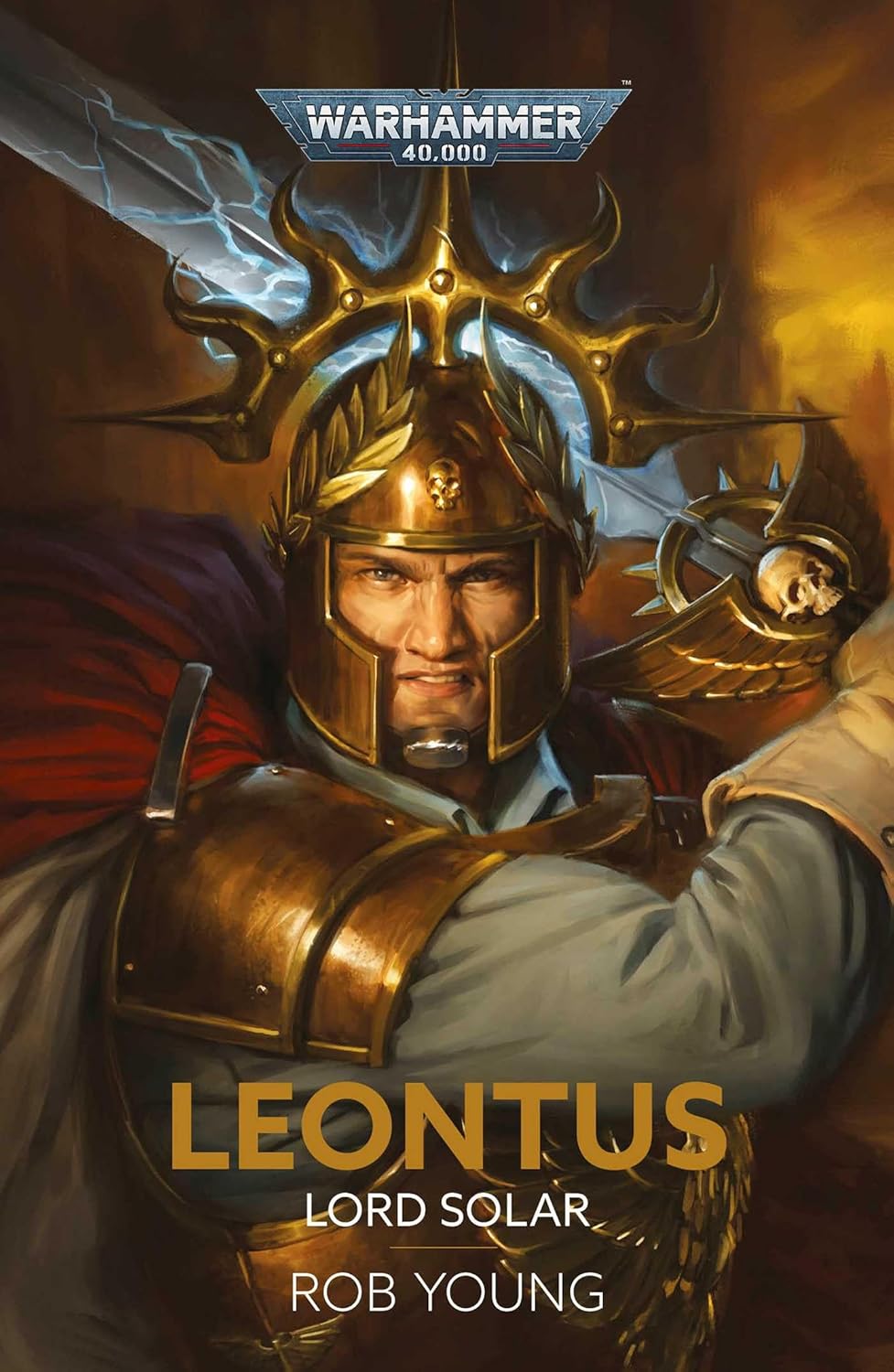
Warhammer 40,000: Leontus: Lord Solar by Rob Young

Publisher: Black Library (Audiobook – 25 January 2025)

Series: Warhammer 40,000

Length: 5 hours and 44 minutes

My Rating: 4.5 out of 5 stars

Amazon

Warhammer 40,000 fiction in 2025 starts off strong with the compelling, character-focused novel, Leontus: Lord Solar by Rob Young.

Back in 2023 I had the very great pleasure of reading my first book from Rob Young, Longshot.  A cool and intense character-driven Warhammer 40,000 novel that followed a sniper war on a T’au held world, Longshot was a fantastic first book from Young, and it ended up being one of my favourite debuts of 2023.  As such, I have been very intrigued to see how Young would continue his Warhammer fiction career, and his next novel, Leontus: Lord Solar, proved to be an excellent new entry to the Warhammer 40,000 canon.  Focused on a legendary human leader, Leontus: Lord Solar was an impactful read that I shot through very quickly.

On the world of Fortuna Minor, an Astra Militarum taskforce of soldiers from various Imperial Guard regiments encounters grave disaster.  Sent to eliminate an invading ork horde, the Astra Militarum soldiers find themselves overwhelmed on the landing fields of Fortuna Minor and are slaughtered, while their reinforcements are forced to retreat into space thanks to the orks’ fighters and spacecraft.  Surrounded, outnumbered and lacking resources, only a few humans manage to escape the massacre, including legendary hero of the Imperium of Man, Arcadian Leontus, Lord Commander of the Segmentum Solar.

One of humanity’s most dedicated defenders and a master tactician, Leontus has no intention of giving up in the face of the ork invasion, even with his armies lost and devastated.  Determined to not only survive but complete the objective of reclaiming Fortuna Minor, Leontus rallies a small group of survivors and prisoners liberated from the ork camps to his cause and begins a desperate campaign to fight ensure that the armies of the Imperium can triumph on this latest battlefield.

Effectively welding his scattered force of mismatched and poorly armed soldiers into a coherent army, Leontus soon finds success against the orks, bringing hope to his demoralised troops.  But in the face of overwhelming odds, a determined and dangerously intelligent opponent, and his own lack of resources, can even the brilliant Leontus succeed, especially when his own men begin to question his tactics and motivations?

Leontus: Lord Solar was an excellent and fun Warhammer 40,000 novel that allowed Young to bring an iconic figure from the game to life.  A compelling and exciting read, Leontus: Lord Solar was a real blast to check out, especially as Young presents an impressive and direct narrative that you quickly sink your teeth into.

This was a very fast-paced and exciting Warhammer 40,000 novel that quickly throws you into the fray and successfully keeps your attention the entire way through.  Starting off with fire and blood as the Imperial Guard regiments are devastated by orks as they land, the story sets itself around some of the main supporting characters, particularly Belgutei, an Attilan Rough Rider, and Keori Arnetz, a Catachan medic.  Fighting there way out of the killing fields, Belgutei and Arnetz, as well as a handful of other survivors, link up with the titular Leontus, who leads them to safety and initiates a desperate guerrilla campaign against the orks, bringing together scattered troops, rescuing prisoners and ambushing ork convoys.

The resulting narrative is highly compelling and action-packed, as the brilliant yet practical Leontus proves to be a skilled commander, inspiring his disparate and demoralised troops, while also engaging in some risky and intense actions.  Young does an excellent job balancing the narrative amongst the three main protagonists, as well as a couple of interesting supporting figures, and I liked how the author tended to focus more on Belgutei and Arnetz, which allowed for an intriguing outsider perspective of Leontus and his actions.  There are some powerful character interactions, especially between Leontus and Belgutei, as the two clash over strategy and the fate of the survivors, which adds some dramatic spice to the overall exciting dish.  The action scenes flow fast and heavy as the book nears its end, including some dark sacrifices, and everything leads up to a massive and intense final battle, where so many of your favourite characters are in peril.  The book ends on a complex note, as Leontus proves his status as a tactician and hero, although the reader is left to decide on his humanity.  An outstanding overall Warhammer 40,000 narrative that is guaranteed to quickly hook you and keep your attention to the end.

Young once again shows his impressive ability when it comes to writing Warhammer 40,000 fiction, and I loved the short, brutal and captivating way Leontus: Lord Solar was presented.  While I was initially worried that it would be too similar to the Ciaphas Cain book, Death or Glory, which also featured a human hero marooned on an ork-held world, Young ensured that Leontus: Lord Solar stood out on its own feet.  The quick-fire narrative, intense and tactical action sequences, and cool scenario ensured this was a distinctive read, and one guaranteed to keep your attention the entire way through.  Primarily a character-focused story around the iconic in-game figure of Arcadian Leontus, Lord Commander of the Segmentum Solar, Young does an excellent job of highlighting the protagonist and showcasing him in a compelling way.  The author chose to primarily show Leontus through the eyes of his supporting characters, which allowed for a more nuanced take on the titular protagonist, while the occasional scene shown from Leontus’ perspective hinted at plans the character is hiding from his soldiers.  Throw in some excellent supporting characters and a memorable, if somewhat underutilised antagonist (who was simultaneously awesome and freaky), and this proved to be an amazing novel with some excellent character-driven strife and complexity at its core.

As with Young’s previous book, Longshot, Leontus: Lord Solar is an outstanding piece of Warhammer 40,000 fiction, and one that would serve as a good introduction to the wider universe for new readers.  The quickfire storytelling, classic action between humans and orks, and lack of excessive lore makes Leontus: Lord Solar a very accessible read, especially as Young doesn’t excessively dive into the history of his main protagonist.  Established readers of Warhammer fiction will naturally get a little more out of this book, especially as it was very cool to see the titular character in action in all his tactical glory, and I felt that Young did an exceptional job capturing and presenting this figure.  In addition, the book also features some intriguing unit makeups as Leontus bands together an irregular force of surviving Cadians, Catachans, Kreig troopers and Attilan Rough Riders.  The interactions between the groups and Leontus was pretty fun, and I liked the mixtures of styles of battle strategies.  Of them, I felt that the Attilan Rough Riders were shown off the best, and their explosive cavalry charges were awesome to read and reminded me of Warhammer Fantasy fiction at times.  All of this and more ensured that Leontus: Lord Solar was a very cool Warhammer 40,000 novel, and it is one I would recommend to all fans of the franchise.

As I tend to with most Warhammer novels I enjoy, I decided to check out Leontus: Lord Solar on audiobook, which was another fantastic experience.  As I have stated innumerable times, Warhammer fiction really lends itself to the audiobook format, and having talented narrators read out the over-the-top stories allows for all the best bits of the universe and its grim dark themes to come to life.  This was particularly true for Leontus: Lord Solar, whose compelling character focused storylines and intense action sequences proved to be a lot of fun to listen to.  Coming in with a relatively short runtime under six hours long, dedicated listeners can really fly through Leontus: Lord Solar, and I enjoyed how quick the pace turned out to be.  I also really appreciated the choice in narrator as David Seddon is a skilled voice actor who really impressed me in previous Warhammer 40,000 audiobooks Dredge Runners and Kasrkin.  Seddon did an excellent job with Leontus: Lord Solar, as not only did he move the story along at a fantastic and enjoyable pace, but he also provided some excellent voices for the various characters.  His take on the titular Leontus was extremely good, and you get a real sense of the character’s nobility, as well as his determination to win, through the performance.  The rest of the human characters also came across extremely well, and Seddon expertly gifts them accents that cleverly corresponded to their regiment and their real-world military influence.  This great voice work really enhanced the already exciting narrative, and I found myself getting really engrossed in this audiobook version as a result.

With this fantastic second book, Leontus: Lord Solar, Rob Young has nicely set himself up as a rising author of Warhammer fiction, especially as he brings a compelling figure from the game to life.  Featuring some awesome action, compelling characters, and an entertaining narrative, Leontus: Lord Solar was an outstanding Warhammer 40,000 novel to start the year with, and I look forward to seeing what amazing adventures Young brings to the franchise in the future.

Amazon

Quick Review – Warhammer 40,000: Witchbringer by Steven B Fischer

Publisher: Black Library (Audiobook – 25 November 2022)

Series: Warhammer 40,000/Astra Militarum

Length: nine hours and 33 minutes

My Rating: 4.25 out of 5 Stars

Amazon

Fresh Warhammer 40,000 fiction author Steven B Fischer presents Witchbringer, a compelling and particularly intense novel that dives into the complex life of an Imperial sanctioned psyker.

I have been having a lot of fun with Warhammer 40,000 fiction this year, and one of the more interesting Warhammer books that I have recently enjoyed is the awesome debut novel from Steven B Fischer, Witchbringer.  I have been meaning to review Witchbringer for a while, especially as it had a fantastic plot synopsis behind it.  As I am currently in the middle of Fischer’s latest book, Broken Crusade, I thought that this was the perfect time to highlight Witchbringer on my blog, especially as it was a clever and memorable addition to the franchise.

Plot Synopsis:

An Astra Militarum Novel

Once a Cadian captain, Glavia Aerand’s psychic talents see her pressed into service in a new role, to fight and die as a sanctioned psyker.

READ IT BECAUSE
This story offers a rare glimpse into the mysterious process of becoming a sanctioned psyker in the service of the Golden Throne, and you’ll learn what that means for those who are found strong enough to serve.

THE STORY
Suffer not the witch to live, unless by their service they might earn redemption. This is the creed of the Scholastica Psykana, a brutal foundry in which those with psychic power might be taught to serve. On the eve of her sanctioning as a primaris psyker within these very halls, Glavia Aerand, former captain of the Cadian 900th Regiment, receives a startling premonition – one concerning her old unit, and a dangerous psychic artefact hidden on the planet where they are deployed.

After a reunion she never expected – or wanted – Aerand finds herself mired in a vicious campaign on the psychically active world of Visage, where the shallow seas and endless fogs are rumoured to swallow the souls of the dead. Haunted by growing suspicions of her new commander and the manifestations of the sinister relic, Aerand must trust in her new-found abilities to keep her former comrades alive, and confront an ancient threat that could consume Visage entirely.


Witchbringer
proved to be an outstanding and particularly powerful Warhammer 40,000 novel that combines compelling insights into a unique class of human soldier with a great plot centred around damaged characters.

This cool Warhammer 40,000 book primarily focuses on Glavia Aerand, former soldier and newly sanctioned primaris psyker.  A trained and authorised witch who uses her unnatural powers to fight for the Imperium of Man, Aerand is an outcast amongst her fellow humans, who view her gifts as tainted and borderline heretical.  Starting off with a dark sequence in the Scholastica Pyskana, a gothic school aimed at training and controlling powerful psykers, the story soon moves on to the main plot when the protagonist receives a vision warning that her old regiment is in danger.  Journeying to Visage, a war-torn swamp world, Aerand finds her regiment in shambles, her former friends no longer trust her, and nobody capable of remembering the previous pysker lord assigned to them.  What follows is an exciting and intense narrative as Aerand simultaneously fights against the rebels and their native witches, while also trying to regain the trust of her comrades.  At the same time, Aerand must unravel both the dark conspiracy engulfing the planet and the secrets her commanders are hiding.

I felt that Fischer produced a compelling and exciting Warhammer 40,000 narrative that really dragged me with its intense storytelling.  The author got the right balance of unique grim Warhammer elements, complex character development, and dark intrigue, all of which melded well with the typical military fiction story fans of the franchise have come to expect.  Fischer does a brilliant job increasing the threat of his story, and the desolate swamp setting of Visage takes on a real life of its own, especially when it comes to grizzly fights against swamp witches and disturbed spirits.  At the same time, the focus on the protagonist’s isolation from her old comrades, who distrust her due to her tainted abilities, adds a great emotional heart to Witchbringer that cleverly works into the larger secrets of the main narrative.  Fischer does a great job bringing the dark plot of Witchbringer together for an exciting conclusion, and readers will appreciate the inevitable carnage that follows.  This is an overall impressive and well-written story that I had an amazing time listening to.

Witchbringer was an interesting addition to the Warhammer 40,000 canon, especially as it was part of the Astra Militarum series that seeks to follow adventures of the various human soldiers fighting in the bleak future.  As such, Fischer expertly explores the sanctioned psykers of the Astra Militarum, including their training, their unique role in combat, and the way that the common trooper views them.  While I do think that Fischer overpowered his protagonist, for the most part this proved to be very fascinating novel about sanctioned psykers, and I enjoyed how the author highlighted the protagonist’s human side.  As such this is a great read for established fans of the franchise, and I am sure most Warhammer 40,000 players and fiction readers will appreciate Fischer’s excellent debut to the genre.  Fischer also ensured that there was enough context and explanation of the more complex universe elements for newer readers to follow along and anyone can probably come in and enjoy Witchbringer, especially if they love a distinctive science fiction thriller.

As with most Warhammer fiction, I chose to enjoy Witchbringer on audiobook, which is easily the best way to appreciate the franchise.  The grim dark setting and intense action of any Warhammer 40,000 novel is deeply enhanced when read out to you and I love the array of talented narrators that work to bring these amazing stories to life.  In Witchbringer’s case, it was narrated by Amy Rockson, who is relatively new to the franchise.  Rockson had a pretty good take on the unique flow of a Warhammer 40,000 audiobook, and I felt she inhabited the various characters extremely well.  The more supernatural elements of Witchbringer’s plot really came to life when read out by Rockson, and I enjoyed how much passion she injected into the various fight scenes.  With a run time of around nine and a half hours, Witchbringer proved to be an easy audiobook to get through quickly, and I had a wonderful time listening to this amazing piece of Warhammer 40,000 fiction.

Overall, Warhammer 40,000: Witchbringer proved to be an amazing book, and I really enjoyed checking out Steven B Fischer’s debut novel.  Featuring a captivating tale of mystery, mayhem and moving character moments, Witchbringer was a great addition to the Warhammer 40,000 canon, and it proved hard not to become addicted to its impressive story.  This is a powerful and excellent read from an author who looks set to be a fantastic feature of the franchise’s fiction going forward.

Amazon

Warhammer 40,000: Longshot by Rob Young

Longshot Cover

Publisher: Black Library (Audiobook – 12 August 2023)

Series: Warhammer 40,000

Length: 10 hours and 28 minutes

My Rating: 4.5 out of 5 stars

Amazon

Prepare to dive into one of the grittiest battles in Warhammer 40,000 fiction with the awesome and captivating novel, Longshot by Rob Young.

2023 has definitely been an outstanding year for Warhammer 40,000 fiction, and I have had a ton of fun reading several pretty amazing entries from this extended universe in recent months.  Examples of this include The Lion: Son of the Forest, Warboss, Shadowsun: The Patient Hunter, Leviathan and The King of the Spoil just to name a few.  However, the year is far from over and there are still several great-sounding Warhammer 40,000 novels coming out that I have my eyes on.  One of the more intriguing was the fantastic Longshot by new author Rob Young, which sounded extremely fun.  Longshot, which follows on from Young’s short stories, Transplants and Memories of Broken Glass, is the author’s debut Warhammer 40,000 novel, and it proved to be a very intense and action-packed novel with a great story.

Several years after the fall of Cadia, which saw the Imperium of Man split in two by a great rift in space, humanity is still attempting to recover as many lost planets and systems as possible.  The latest target of the relentless Indomitus Crusade sees the troops of the Cadian 217th arrive at the former manufactorium world of Attruso, whose people have fallen under the sway of the seeming beatific alien t’au.

As the initial assault begins in the battered city of Miracil, the Cadian forces struggle to make progress against the determined t’au defenders and their human auxiliaries.  As the fighting gets even more desperate, the tides of war soon place the keys to victory into the hands of Sergeant Darya Nevic and her squad of snipers.  Nevic is a legendary figure within the 217th, a transplant from a non-Cadian regiment renown for her abilities of infiltration, assassination and survival, Nevic excels at disrupting the enemy from the top down.  However, when the t’au unleash their own deadly sniper against the Cadians, Nevic is forced into a battle of wits with a killer just as skilled and ruthless as she is.  But has Nevic finally come across a foe even she can’t best, especially as she begins to doubt her mission in the face of her own infamy, the lies of her commanders and the t’au’s insidious promises?

Longshot is an awesome and fast-paced novel that perfectly showcases the horror of war in this grim universe through the lens of a skilled sniper.  Young did an outstanding job with his debut novel and I loved the intriguing and powerful narrative that placed great characters into a deadly setting.  I managed to knock this book off in a couple of days, and it is one of the most exciting and fun Warhammer 40,000 novels of 2023 so far.

I loved the complex and intense story that Young pulled together for Longshot, which perfectly presents a tale of the common soldier in the grim Warhammer 40,000 universe.  I have often said that some of the very best Warhammer 40,000 novels are those that focus on the common human soldier facing off against alien or inhuman forces (for example, Steel Tread, the Gaunt’s Ghosts books or Catachan Devil).  Longshot is a very good example of this as you follow a tired soldier as she faces internal and external threats on the frontline of a desperate conflict.  Thanks to its focus on snipers, city fighting, camaraderie and propaganda, Longshot is honestly the Warhammer 40,000 version of Enemy at the Gates, which I deeply enjoyed.  The reader really gets invested in the protagonist’s journey which follows her through some fantastic missions, battles and character growth in the first half of the novel.  This leads to a great second half, where Nevic becomes a victim of her own success and is forced to go up against a deadly enemy sniper.  Due to everything the protagonist experiences, there is some real tension leading into the final third of Longshot, especially after she experiences some terrible losses.  Thanks to the protagonists’ conflicted state, you honestly don’t know how the story is going to turn, and Young loads up some great twists and swerves.  While the ending was a tad predictable, I really enjoyed it and the author really pulled together a satisfying and exciting read that you can really power through.

This ended up being a pretty addictive standalone book, and it is one that would definitely serve as a great introductory novel to Warhammer 40,000 fiction for those readers unfamiliar with the franchise.  Young does a great job of expanding his previous short stories into his first full-length novel, and you really get to grips quickly with the situation, the characters, and the wider universe.  The sharp and intense character-driven story which primarily focuses on the protagonist, Darya Nevic, with a few chapters shown from other key character perspective, has a lot of great elements to it.  The focus on character motivation, the depravities of war, and the grim realities of the background universe really cut through the main story, and you understand the difficulties that many of the conflicted characters experience.  The subsequent focuses on morale in battle and the impacts of propaganda and manipulation also proves to be very fascinating and adds a great edge to Longshot.  I also deeply appreciated how well Young built up his main protagonist throughout the course of Longshot, diving into Nevic’s complex history and examining how she gained her legend.  You grow quite attached to Nevic as the book continues, especially she is forced to make several difficult decisions, and Young turns her into a relatable and understandable figure, especially when it comes to her conflicted feelings about her fame and leadership.  Nevic is well supported by other great characters, and Young was able to establish and utilise these figures in a short amount of time.

The real highlight of Longshot is the awesome and well-written action sequences that dominate the book and constantly keep the reader on their toes.  Young paints an effective and dark picture of brutal city fighting, and you can tell he was using the battle of Stalingrad as inspiration.  The gritty battles that take place are very exciting and powerful, and you can really feel the desperation and weariness of the combatants.  The author proves particularly adept at writing high-quality sniper scenes, and the focus on shooting, infiltration and calculated strikes makes Longshot stand out from other battle-heavy Warhammer 40,000 novels.  This ended up being a very slick and addictive read and Young proved quite skilled at getting his fantastic story across to the reader in the most effective way.

Well-established fans of Warhammer 40,000 canon will really appreciate Young’s compelling and insightful look into two distinctive factions who provide a very interesting contrast to each other.  This includes the members of the Cadians, one of the most iconic Imperial Guard factions in the game.  While the Cadians are already pretty heavily featured in Warhammer 40,000 fiction, I felt that Young provided a particularly effective dive into their current problems, namely the gradual deaths of the natural-born members of the regiment and their replacement by transplants from other regiments.  Thanks to the focus on Nevic, herself a transplant from another regiment, you see the dire internal conflict this causes as the strongly traditional Cadian regiment begin to lose their identity after the loss of their planet.  Young does a wonderful job of expressing this throughout the course of Longshot and the resultant impacts this has on the characters makes for some interesting story moments.  I also quite enjoyed seeing several outsider perspectives of the Cadians that Young worked into the story, which often contrasts well with what the Cadian protagonists feel, and it makes for some fantastic story moments. The author also examines other fascinating elements of the Imperial war machine, such as the exhausting Indomitus Crusade, the current crumbling state of the Imperium, the way other supporting regiments are treated, and the internal propaganda and planning of the regiment.

While the Cadians do get most of the story focus in Longshot, Young does take the time to also dive into the alien t’au who serve as the main antagonists of the plot.  Most Warhammer 40,000 novels that have the t’au as antagonists often nerf or underutilise them to a degree (for example Kill Team or Deathwatch: Shadowbreaker), which is frustrating for fans of the faction.  However, Young effectively showcases the t’au as skilled and deadly enemies who are able to weather the Imperial forces and overwhelm them in several key theatres.  Young has fun bringing several key t’au units to life throughout the course of Longshot and you really start to appreciate them as effective opponents to the Cadians.  There is also an interesting examination of t’au motivations, philosophies and manipulations, specifically around their recruitment of human auxiliaries.  This compelling dive into the t’au muddies the moral waters around the protagonists and the Cadians, and you soon start to question who has the best interest of the people of Attruso at heart.  This, and other intriguing similarities to the human soldiers, adds an awesome edge of consideration and concern to the story that I quite enjoyed.  I really think that Young had some of the better portrayals of the Cadians and the t’au I have so far seen in Warhammer 40,000 fiction, and fans of the franchise are going to have a wonderful time diving into that in this book.

Unsurprisingly, I chose to check out Longshot on audiobook, which in my opinion the best way to enjoy a Warhammer 40,000 novel.  Longshot is a particularly good example of this, as the audiobook format really helped to move the already exciting novel along at a fast clip, especially when the action scenes are brought to life by the narrator.  Coming in at around 10 and a half hours, this is very easy audiobook to get through quickly, and I made sure to power through it in only a few days.  It helped that this book was narrated by the very talented Colleen Prendergast, who already has a bit of experience narrating Warhammer novels featuring the Cadians.  Prendergast did a wonderful job bringing all the major characters to life, especially the main protagonist of Darya Nevic, and I loved the elaborate and fitting voices that she gifted the cast which really helped to draw you into the story.  However, the real benefit of Prendergast’s narration is the way that she walks the listener through all the elaborate battle sequences, especially those that show the snipers facing off against each other.  I felt that this narration expertly captured all the inherent intensity and danger of these scenes and I got really invested into the book as a result.  Thanks to this amazing narration and story enhancement, I would strongly recommend checking out Longshot on audiobook and I know I had a lot more fun thanks to this amazing format.

Overall, Longshot is an awesome and compelling addition to the Warhammer 40,000 canon and one that I had a ton of fun with.  Young produced a powerful and intriguing character driven war story that will appeal to a wide audience of readers, especially with its fantastic focus on sniping and some of the more fascinating elements of Warhammer lore.  I deeply enjoyed this fantastic novel and Longshot comes highly recommended.

Amazon

Warhammer 40,000: Catachan Devil by Justin Woolley

Catachan Devil Cover

Publisher: Black Library (Audiobook – 29 March 2022)

Series: Warhammer 40,000/Astra Militarum – Book Two

Length: 9 hours and 14 minutes

My Rating: 4.5 out of 5 stars

Amazon     Book Depository

Another iconic regiment of the Astra Militarum is on full display in the new Warhammer 40,000 novel by talented author Justin Woolley, with the intense and action-packed read Catachan Devil.

2022 is shaping up to be a particularly epic year for Warhammer 40,000 fiction, with a ton of brilliant novels coming out that cover a range of factions and sides of the surprisingly massive and highly compelling extended universe surrounding the famous tabletop games.  Some of the best Warhammer books of the year include Ghazghkull Thraka: Prophet of the Waaagh! by Nate Crowley and Assassinorum: Kingmaker by Robert Rath, which both got five-star ratings from me.  However, I have also been really drawn to the impressive novels that examine the basic human troopers of the Imperium of Man.  These soldiers, members of the Astra Militarum, better known as the Imperial Guard, come from many different planets, and are forged into unique fighters by the harsh conditions of their worlds.  I have had a great time reading some of the recent books about them, such as Steel Tread, Krieg and The Vincula Insurgency, especially as the authors dive deep into the psyches of the regiments and their members to unearth their history, mentality, and their opinions of the deadly wars they are fighting.  As such, I was excited when I saw that there was a cool book coming out that followed the legendary Catachan Jungle Fighters, Catachan Devil by Justin Woolley.

Deep in the 41st century, where war and death surrounds the fragile Imperium of Man, many serve the Imperium as soldiers of the Astra Militarum.  However, not all Imperial Guard are created equal, as Trooper Torvin of the newly formed Skadi Second Infantry is about to find out.  Conscripted to fight in the Emperor’s wars, the poorly trained and terrified Torvin suddenly finds himself on the jungle world of Gondwa VI, expected to go up against the brutal and ever-growing greenskin threat.  However, fate is about to place him in the path of a far more dangerous group of fighters.

The lone survivor of his regiment after their vital outpost is overrun and captured by orks, Torvin is accused of cowardice and faces death by firing squad.  However, he is given a chance at redemption by joining up with the men chosen to retake his fallen outpost, the legendary and lethal men of the Catachan 57th Jungle Fighters.  Led by Colonel Haskell ‘Hell Fist’ Aldalon, the Catachans are masters of stealth and jungle fighting, and the 57th Jungle Fighters have a particular grudge to bear against the orks.

Accompanying a small detachment of Catachan Devils to the fallen fortress, Torvin is in awe of the Catachan’s skill and lethality, while they view him with nothing but disdain.  Forced into the fight, Torvin soon discovers that the Catachans are just as likely to turn on him for his incompetence as they are to kill the orks they are hunting.  If he wants to survive, Torvin will need to forget his standard training and fight his hardest to gain the respect of the Catachans.  However, not even the Catachans are fully prepared for the opponents waiting for them; these orks are aware of their strengths and have taken to emulating their tactics and style.  May the best commandos win!

Woolley’s first full Warhammer 40,000 novel was a real hit, and I loved how Catachan Devil provided the reader with a powerful and deeply exciting science fiction tale that also highlights one of the more distinctive factions from the tabletop game.  Catachan Devil has a brilliant and deeply compelling story to it that I found myself powering through in only a few days.  A standalone Warhammer 40,000 book, Catachan Devil takes the reader into heart of the action quickly by introducing two of the main protagonists in the early goings of the book and showing their arrival on Gondwa VI.  These initial chapters primarily focus on the character of Trooper Torvin and show his initial attempts at being an Imperial Guardsman and his unfortunate first encounter with the orks and their fun point-of-view character.  Following this, you are introduced to the Catachans and their leader, Colonel Aldalon, who are brought in to clean up the mess made by Torvin’s regiment.

While it was a tad surprising not to see any Catachan characters until a third of the way in, I think it worked, as all the previous events set up the main narrative extremely well, while also showcasing the dearth in skill of the human soldiers at that point.  The rest of the book follows at a brilliant pace, taking the various characters on an intense and ultra-exciting adventure.  The rest of the story has a great blend of combat, universe building and character development splattered throughout it, as the three central characters all evolve in different ways as they fight against their own issues and their various opponents.  Woolley takes Catachan Devil’s narrative in some interesting directions, and I enjoyed the examination of the Catachan mission and the work done to build up a worthy set of adversaries.  This all leads up to some brilliant and highly exciting final confrontations between the Catachans and their foes, and I loved the fantastic way that Woolley was able to wrap up the main narrative of this book, as well as the three central character storylines.  Everything comes together extremely well, and readers will come away very satisfied, although if they are anything like me, they will be wanting more, even if that is a tad unreasonable.  While Catachan Devil does work as a standalone narrative, Woolley does leave some options for a sequel open in the future, which I personally would be quite interested to see.  An awesome and highly addictive narrative that was really fun to get through.

I enjoyed the way that Catachan Devil was put together as Woolley wrote it in an enjoyable and captivating way.  While this book is primarily designed to highlight a specific regiment of Imperial Guard, something that Woolley does really well, it still contains a brilliant and extremely fun narrative that can be easily enjoyed by anyone familiar with Warhammer 40,000.  However, Catachan Devil would serve as a rather good introductory novel for new readers of the franchise.  Catachan Devil contains an excellent blend of damaged characters, impressive action sequences and entertaining humour that anyone can have an awesome time with this book, and I personally found myself laughing myself silly at times (there is a fun scene where some orks are trying to lure the Catachans out), while also getting drawn into some powerful character arcs.  The entire book is very well paced out, and I particularly enjoyed how Woolley perfectly utilised three central character perspectives to tell a layered and intriguing tale.  Seeing three very different perspectives of the events occurring in Catachan Devil adds to the humour and complexity of the tale, and the three unique main characters play off each other extremely well to create an outstanding book.  I had such a great time getting through Catachan Devil and it was an exceptional addition to the Warhammer 40,000 canon.

Without a doubt the highlight of this book is the focus on the iconic Imperial Guard regiment, the Catachan Jungle Fighters.  The Catachans are a fan-favourite regiment with a distinctive look strongly based on Green Berets in Vietnam (or more likely around Rambo).  Portrayed as tough, disrespectful, and extremely deadly warriors whose fighting ability is a result of their upbringing on a jungle Death World, the Catachans have long captured the imagination of the Warhammer fandom, and they have some of the coolest models in the game.  Due to their popularity, the Catachans have featured in multiple tie-in novels and comics before, but I felt that Woolley did a particularly good job of examining this iconic faction throughout this book.  Indeed, the author really goes out of his way to showcase just how cool and impressive the Catachans are, and the reader gets an intriguing deep dive into their history, mentality and deadly ability in combat.

I felt that the way Woolley set out Catachan Devils really helped to highlight just how skilled and different they are from typical Imperial Guards.  Woolley ensures that there is a very fun and compelling comparison between the Catachans and the other Imperial Guards by first showing a normal regiment of troopers getting slaughtered by the orks while relying on their standard training.  From there, the Catachans are shown from various perspectives: an insider one from their commander, and two outsider perspectives, including from a poorly trained guardsman, which really helps to highlight the differences between the typical soldiers and these badass Jungle Fighters.  Watching the Catachans’ various ambushes, sneak attacks and brutal close combat fights was pretty amazing, and I loved the way that Woolley worked to highlight the practical aspects of their skills and techniques.  You learn a lot about the Catachans throughout this book, as all the point-of-view characters learn or reminisce about the things that drive them and the full applications of their skills and training.  I definitely came away from Catachan Devil with a new appreciation for this faction, and I loved how well Woolley focused the book on them.

To tell Catachan Devil’s fantastic story, Woolley centred the narrative on three point-of-view characters who each have multiple chapters told from their perspective.  These three characters proved to be a winning narrative combination, and you get a powerful and intriguing story as a result.  While each of them has their own distinctive personal narrative, their stories come together throughout the book, and it proves very entertaining to see their different takes on the same events.  This use of three characters was very effective, especially as you get drawn into their personal stories in some powerful ways.

The first character is Trooper Torvin, a rookie Imperial Guard from the ill-fated and newly formed Skadi Second Infantry.  Torvin, who was drafted into the Imperial Guard against his will, is thrust into the deep end on this book and soon finds himself forced to work with the Catachans, even though his inexperience and lack of any jungle training make him a major liability.  Woolley makes good use of Torvin throughout Catachan Devil, and he is the primary example used to show the differences between the common solider and the Catachans.  There are a ton of great examples scattered throughout the book that showcases the difference between a draftee like Torvin and the Catachans, who are raised from babies to be tough soldiers, from the lack of training, the bad information about opponents, and the way he lugs around a ton of unnecessary gear.  I particularly enjoyed the way in which several exerts from The Imperial Infantryman’s Uplifting Primer, an in-universe propaganda document, are quoted throughout Torvin’s chapters, often with ridiculous and untrue information that leads the character astray.

While much of Torvin’s story arc is used to highlight the Catachans, Woolley also inserts a compelling and emotionally rich narrative around Torvin as you witness his experiences as a newly minted Imperial Guard.  I felt that Woolley did an amazing job capturing the fear and uncertainty that a draftee like Torvin would experience.  The hesitation and reluctance that Torvin goes through feels very realistic, and the subsequent reactions from his superiors, most of whom would kill him if they knew what he was feeling, really got me to care for Torvin early on, and it was a great portrayal of a common man in the insane Warhammer 40,000 universe.  Naturally, Torvin develops as the book continues, especially once he is with the Catachans, and there are several great scenes as he slowly works to emulate his new comrades and gain their respect.  While it is slow going, Torvin eventually finds his courage and comes to terms with the fact that he is going to be an Imperial Guardsman for the rest of his life, and he really develops in a realistic manner.  Woolley did some brilliant character work here in Torvin, and I really appreciated how his character arc turned out.

The second major character in Catachan Devil is Colonel Haskell Aldalon, the Catachan commander known as Hell Fist due to the Power Fist he wields.  Aldalon is a lifelong soldier who has spent his entire life surviving and fighting in jungle warfare.  Portrayed as a gruff and unforgiving figure who fits the mould of the tough, impossibly muscled Catachans extremely well, Aldalon is Torvin’s polar opposite and is an interesting character as a result.  While Aldalon doesn’t change much in the book, he is dealing with some deep emotional issues after a big loss in his unit’s last battle.  He spends most of Catachan Devil keeping his emotions in check, and he ends up making several mistakes and fighting in a very un-Catachan way, just so he can kill some orks.  Aldalon is the most damaged figure in the entire novel, and it proves to be quite moving to witness him come to terms with his grief and despair to regain his old mindset.  I really grew attached to this old soldier as the book progressed and his impressive viewpoint added a lot to the quality of the entire narrative.

It is a little ironic that in a book all about the Catachans, one of my favourite characters is an ork.  Readers will be blown away by the incredible figure of Nogrok Sneakyguts.  Nogrok serves as the book’s primary antagonist and third point of view character and is a rather interesting figure that offers a fantastic alternate perspective on events.  Rather than the ultra-violent orks you typically see in Warhammer fiction, Nogrok is something special as he is a Blood Axe Kommando, an ork who has grown enamoured with human ideas of tactics and battle strategy, and who attempts to emulate these ideas in battle.  In particular, Nogrok has spent time observing the Catachans in combat and starts to use their ideas of infiltration, camouflage and sneaky kills, rather than the standard ork strategy of running towards the enemy screaming “WAAAAAAGH!”  Unfortunately for Nogrok, he is currently under the control of a warboss from another clan who doesn’t believe in tactics and is constantly berating Nogrok for his human ideas and suggestions.  I loved how Nogrok spent the entire book idolising the Catachans, and it was impressive to see an antagonistic perspective on them, especially as Nogrok acted more like a demented fanboy than anything else.  The comparisons between Nogrok’s opinions about the Catachans and his fellow orks are very entertaining, and it was so much fun seeing the long-suffering character trying and failing to talk sense into his stronger boss.  Woolley writes some interesting character development into Nogrok throughout Catachan Devil, and he ends up serving as an outstanding foil to Aldalon, especially as there is some major history between them.  Between all of this, and all the hilarious scenes featuring ork society and the hilarious discussions he becomes involved with, Nogrok’s chapters quickly ended up being a favourite of mine, and I loved how Woolley was able to build up the Catachans from this enemy viewpoint in a very funny way.

Like I have with most of the Warhammer 40,000 novels, I listened to Catachan Devil on audiobook, and I felt that this was the superior format to experience it in.  Catachan Devil ended up being a pretty exciting and fun audiobook experience, and the format works really well to enhance the action sequences and ensure that listeners can quickly power through its enjoyable narrative.  With a run time of over nine hours, this is a relatively easy audiobook to get through, and I managed to polish it off in only a few days.  I was particularly impressed with the narration by Joe Shire, who did a remarkable job with Catachan Devil.  Not only does he bring all the action and excitement to life with his excellent tone, but he also provides some fantastic voices to the various characters featured within.  All the key characters are given distinctive and very fitting voices for their dialogue, and you can really feel the emotion, anguish and bloodlust that the various figures felt.  I especially loved the various ork voices that Shire came up with throughout the book, and he captured the hilarious and vicious nature of these extremely fun characters, ensuring that all their jokes are delivered to the listener perfectly.  I had so much fun listening to Catachan Devil on audiobook and this format comes highly recommended as the best way to enjoy this epic read.

Catachan Devil by Justin Woolley was an impressive and highly entertaining Warhammer 40,000 novel that I had an incredible time reading.  Featuring a fantastic central cast, some awesome humour, compelling action and three outstanding central characters, Catachan Devil really grabbed my attention, and I had a wonderful time getting through it.  A guaranteed fun read that will appeal to both established Warhammer fans and general science fiction readers alike.

Amazon     Book Depository

Warhammer 40,000: Steel Tread by Andy Clark

Steel Tread Cover

Publisher: Black Library (Audiobook – 5 January 2022)

Series: Astra Militarum – Book One

Length: 9 hours and 50 minutes

My Rating: 4.75 out of 5 stars

Amazon     Book Depository

Prepare to dive back into the brutal chaos of the far future of the exceptional Warhammer 40,000 universe with the powerful and intense Steel Tread, a fantastic tank novel by Andy Clark.

At this point in its existence, the Warhammer 40,000 canon has advanced far from just a tabletop game and has turned into quite the complex extended universe that features a range of interesting factions, species and unique narratives.  From fantastic stories about crusading genetic Space Marines (check out my review for Deathwatch: Shadowbreaker), to unique underworld stories about warring gangs (Kal Jerico: Sinner’s Bounty and Fire Made Flesh), and narratives about ancient metal aliens (The Twice-Dead King: Ruin), this franchise has it all.  However, to my mind some of the best Warhammer 40,000 books are compelling war stories that pit ordinary human soldiers against the very worst monsters in this distinctive universe.  Examples of this include the awesome Gaunt’s Ghosts series by Dan Abnett, (check out my review for First and Only), which is pretty damn awesome.  As such I was very excited to check out the new novel from talented Warhammer author Andy Clark, Steel Tread, which looked to follow a group of tank soldiers in the worst of situations.

Following the fall of Cadia, war reigns across the universe as the forces of Chaos push further and further into Imperial space.  There are many battles occurring in this new warzone, but none are more desperate or destructive than those on the world of Croatoas, where the armies of the Astra Militarum, better known as the Imperial Guard, face off against twisted forces serving the Ruinous Powers of Chaos.

Following a devastating campaign, veteran tank gunner Hadeya Etsul is reassigned and consolidated into a Cadian regiment and placed in command of the ancient Leman Russ Demolisher tank, Steel Tread.  Already haunted by the events that destroyed her last tank and crew, Etsul is forced to adapt to her new command whilst immediately getting thrust into the midst of a new offensive.  However, rather than the well-run team she is used to, Etsul finds herself leading a dysfunctional and aggrieved crew who don’t believe she has earned the right to be either their commander or a member of a Cadian regiment.

As the campaign takes a turn for the worst, the crew of Steel Tread will need to find a way to work together if they are to survive.  The enemy has unleashed vast and terrible horrors against the Imperial forces, from dark sorcery to mutated machines, and only the very best crew will have a chance to hold out and fight back.  Can Etsul gain the respect of her crew in time, or will Steel Tread be yet another victim of the unrelenting forces of Chaos?

Wow, that was awesome!  I knew that I was going to have an amazing time reading Steel Tread, especially as it had a great synopsis, but I was unprepared for just how enjoyable it was.  Clark, who has previously written several Warhammer 40,000 novels, including his Imperial Knights books (which he makes certain homages to here), did a fantastic job with this latest novel, producing a grim and powerful tank novel that proves near impossible to stop reading.

Steel Tread has a powerful and action-packed narrative that sees a dysfunctional tank crew thrust into the middle of a hellish warzone (literally hellish) and forced to come together to face their foes.  Clark does a great job of setting the scene for this novel, introducing the conflict, the main characters, and the Chaos based antagonists, in quick succession and ensuring all the key aspects of the book are well established.  The first part of the narrative is mostly dedicated to setting up the crew dynamics and exposing the major personal conflicts that arise when a new commander appears.  This dysfunctional crew mentality continues as the characters are thrust into their first conflicts, before a major battle occurs that separates them from the rest of their command.  Surrounded by all manner of foes, including magical zombies and a terrifying giant war machine (a corrupted Imperial Knight), the crew are forced to come together, especially after overcoming some losses and major personal conflicts.  This all leads up to the big finale, in which the crew are once again thrust into a do-or-die battle and must overcome immense odds with little hopes of success.  This finale really pays off, as the readers are on the edge of their seats during the entire conclusive sequence and beyond as they wait to see what happens to the crew they’ve come to know and love.  This novel is brilliantly paced out and constantly in motion, ensuring that there are no slow spots to stumble across as they move from one excellent sequence to the next.  I loved the great combination of intense action and character moments, which results in a powerful and impressively thrilling read.

I deeply enjoyed the exquisite writing style that Clark utilised for this great novel, especially as it was written in the style of a tank based military thriller.  Clark is an amazingly detailed writer and he perfectly captures the claustrophobia of a classic tank movie.  It was brilliant to watch the six main characters crammed together inside Steel Tread as they face all manner of hell, often by themselves.  You really get a feel for all the stress, rage and fear that the characters are feeling, especially during the amazing action sequences.  All the battle scenes are written extremely well, and the author ensured that you are placed right in the middle of the action.  I really loved all the epic fights, and I really must highlight the scary and insane enemies they faced, including cultists, zombies and that awesome Chaos Knight.  I deeply appreciated the work that Clark put into describing that Chaos Knight into a fearsome and freaky war machine, especially its spider-like walking style, and it easily stole every scene it was in.  This impressive writing style really helped to enhance an already amazing story and I loved how the author was able to tell such a brutal and complex war story.

This proved to be an exceptional entry in the Warhammer 40,000 canon, and I deeply enjoyed the way in which Clark was able to transplant his impressive tank story into this universe.  While there are a few references to events in Warhammer history that set the scene for the plot, this ended up being one of those tie-in novels that can easily be read by people unfamiliar with the franchise.  Anyone who loves a good science fiction war novel can have a lot of fun with Steel Tread, although there is also a lot that Warhammer fans will really appreciate.  I loved all the references to the fall of Cadia featured throughout the book, especially as the characters are part of a Cadian regiment.  Clark spends a lot of time examining the psyche of a typical Cadian soldier, and there is an interesting focus on members of other regiments being consolidated into the usually insular and elite Cadians.  As such, you get some great insights into the different Imperial Guard regiments, including their unique traditions, and it was fascinating to see several characters, including the main protagonists, try and find acceptance with her new Cadian colleagues and subordinates.  This book does feature a ton of awesome Imperial Guard and Chaos troops, and it was great to see Steel Tread caught in the middle of it, especially as Clark does a great job of describing how the various units move and fight.  I also really loved seeing this story unfold from the common soldier’s perspective, and it was very insightful to see the tank crew when confronted by Chaos sorcery, corruption, mutations and other insanities, especially as half the time they don’t really know what they are.  Clark has produced a great tie-in to the Warhammer 40,000 universe, and this is honestly an excellent first novel for any reader interested in exploring this massive franchise.

Another feature of Steel Tread that I enjoyed was the amazing array of characters featured within.  Clark has come up with an interesting and diverse central group of protagonists for the book, with the primary six being the crew members of Steel Tread.  I had a lot of fun with these great characters, and I liked the interesting mix of personalities and backstories.  The author has hit on a few military stereotypes here as you have a new and untrusted officer, a grouchy sergeant, a religious zealot driver, a strong and mostly silent loader with a mysterious past, a young rookie eager to prove himself and a rebellious former street thug turned soldier who constantly tests the new commander.  While some of these character types seem a tad familiar, there is a reason that they work in a military fiction novel such as Steel Tread, as these diverse personalities play off each other extremely well.  There is the requisite hardship and clashes you would typically expect from this sort of crew, but they soon develop into a strong team, especially once their new commander finally gains their trust and respect.  Clark does a great job of setting all six of these main characters up and it was great to see them slowly come together through their joint experiences.  Most of the narration is done by central character Etsul, who is still dealing with the aftermath of her last devastating mission and must overcome her memories and doubts to lead the team.  This intense and compelling narration is perfectly complemented by the second narrator, the young rookie Garret Verro, who offers a slightly more hopeful counterpoint to the rest of the characters in the novel.  I really liked seeing this great group of characters come together and you really come to care for the whole crew by the end of the book.

Aside from the central six characters, there are a few other interesting figures that Clark features throughout the novel.  The main one of these is probably Steel Tread itself, as the author works to give the tank its own personality (which is helped by the fact that machines in the Warhammer 40,000 universe have their own souls, known as machine-spirits).  The old but still deadly tank (an Agamemnor-pattern Leman Russ Demolisher), really feels like a member of the crew, especially with how the other characters interact with it, and you end up feeing just as attached to the tank as you do to its human passengers.  Another great character was Lieutenant Horathio Aswold, a fellow tank commander who is consolidated into the Cadian regiment at the same time as Etsul.  Aswold is a fun and slightly eccentric character who bonds with Etsul over being the newest members of their Cadian regiment.  Aswold proved to be a fun counterpoint to Etsul, and I liked how he was a great soundboard for her concerns and doubts, especially when it comes to their new regiment.  The rest of the Imperial characters in this book are only really featured briefly, and due to most of the action occurring inside the tight confines of Steel Tread, there aren’t a lot of extended interactions between the main cast and supporting characters.  I think this smaller cast worked extremely well in the context of a tank-based novel, and it allowed the readers to get to know the main characters.  The fact that the reader never really sees the main antagonist of the novel was an interesting choice from Clark, but it honestly didn’t detract from how awesome the story was.  While it might have been cool to see a powerful traitor Space Marine attack the tank, I think that keeping him away from the protagonists and letting them face only opposing soldiers, machines and monsters helped to emphasise the fact that the characters were only a small part of a much larger war.  I hope we see more of Steel Tread and its crew in the future.

I ended up listening to the audiobook version of Steel Tread, which came in at just under 10 hours, which I ended up listening to in a few short days once I got caught up in the impressive narrative.  I felt that the audiobook format was an excellent way to enjoy this book, especially as the amazing narration really highlighted all the impressive action scenes.  The intensity, complexity and brutality of the various combat sequences is really emphasised in this format and I was engrossed in all the elaborate firefights.  Thanks to this great translation of Clark’s detailed writing style, I found myself practically seeing every shot as the book was read out, and it really helped bring me into the narrative.  I need to highlight the fantastic narration of Remmie Milner, who moved the book along at a quick and enjoyable pace.  Milner had an excellent voice for this thrilling science fiction novel and I loved the great voices she provided to each of the characters.  Not only did these amazing voices really help the reader to appreciate the emotions and thoughts of the protagonists but they highlighted the cultural differences that existed amongst the multiple Imperial Guard regiments, with the newcomers having different accents to the established Cadians.  This excellent voice work was also enhanced in a few places by some clever sound effects, such as the enhancement given when a radio was being utilised by a character.  This great voice work and design elements of the audiobook really helped to bring me into the story and I had a brilliant time listening to it.  Easily the best way to enjoy Steel Tread, this audiobook format comes highly recommended.

Overall, Steel Tread by Andy Clark was an exceptional and impressive Warhammer 40,000 tie-in novel that takes the reader on a wild and compelling ride with a great group of characters.  I loved the brilliant combination of the Warhammer universe with a brutal and grim tank-based military story.  Filled with all the awesome action any science fiction fan could want, Steel Tread was an extremely thrilling and very fun novel that is really worth checking out.  One of the best and most enjoyable Warhammer novels I have had the pleasure of reading.

Amazon     Book Depository