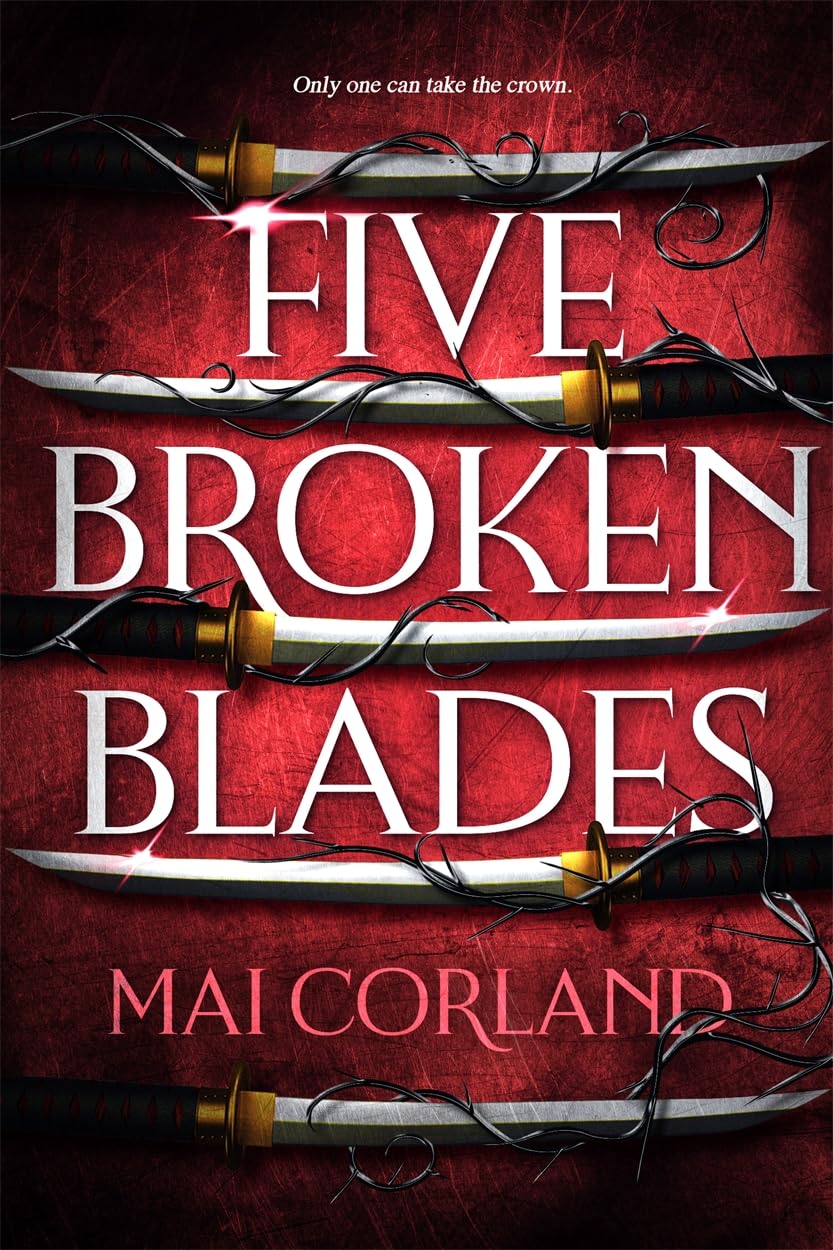
Five Broken Blades by Mai Corland

Publisher: Recorded Books (Audiobook – 7 May 2024)

Series: The Broken Blades – Book One

Length: 15 hours and 1 minute

My Rating: 4.5 out of 5 stars

Amazon

I was in the mood for some awesome fantasy fiction, so I decided to check out something a little different for me, Five Broken Blades by new author Mai Corland.  The debut adult book from Corland, who previously wrote children’s and young adult fiction under the name Meredith Ireland, Five Broken Blades was an addictive and exciting fantasy novel with some tragic romance at its core.

In the kingdom of Yusan, the God King Joon is a tyrannical and despised figure whose rule has seen the lives of the poor and innocent disadvantaged even further.  There are many people who want Joon dead, but to even think about it is high treason, punished by the most painful of deaths.  Worse, killing the king is next to impossible, as he is immortal, granted extended life and invulnerability by his magical crown.  Despite this, a small group of desperate killers are about to try to take him down.

Mysteriously summoned from across the nation, five of the most dangerous killers and rogues in Yusan have been tasked with working together and doing the impossible, stealing Joon’s crown and killing him in public.  Each of the five has their own reason for taking part in this apparent suicide mission, including a hired hitman seeking the money he needs for his redemption, a trapped poison-maiden hoping to gain freedom for herself and her sister, the royal spymaster looking for revenge, a banished prince who wants his life back, and a slippery thief seeking to reconnect with her family.

As the group begin to put their plan into motion, these independent killers will need to learn to work together with the rest of the group if they have any hope of surviving.  However, each of them has their own deeper motivations regarding their planned mission, and none of them truly trusts the other rogues they have been tasked with working with.  As they get closer to their goal, the five experience setbacks, twisted romance and unexpected opportunities.  But can they succeed and kill a God King, especially when they have a traitor in their midst?

Five Broken Blades was an excellent and highly enjoyable novel from Corland, who produced an amazing debut adult fantasy novel.  A clever fantasy novel with some entertaining romance elements, Five Broken Blades has an outstanding story of deceit, betrayal and bloodshed set in a Korean-influenced fantasy realm, which really drew me in with its impressive and fun story.

I had an outstanding time with the elaborate story that Corland came up with for Five Broken Blades, and the author produces an intense and moving, character-driven story.  Despite the name and the discussion about the five killers in the synopsis, there are actually six protagonists in this book, which produces a well-balanced narrative with a variety of intriguing character perspectives, arcs and motivations.  Corland starts the book by initially focusing on three of the protagonists and working the reader into their own unique circumstances and backstory.  The author does a good job of quickly and effectively introducing these figures in the initial chapters of the book, and then pairing them off with an additional protagonist who seeks to bring them into the main assassination plot of the book.  These new characters generally serve as great foils for the initial protagonists, and Corland then works to expand their roles in the book, providing their own backgrounds and motivations for being there.  Once established together, these three pairs of characters, then set off to meet up with the other protagonists as they plan their attempted regicide.

The first half of the book primarily focuses on the three separate pairs as they set up their own storylines both individually and as a couple, which I felt worked to really hammer home the complex character arcs Corland was setting up.  There are some fantastic moments in these early pages, including fights against monstrous birds, pirate warfare, and some intense personal scenes.  While the romantic entanglements that emerge within all three of these initial pairs are very predictable and forced, you generally grow attached to all six protagonists, and it proves interesting to see the various hidden motivations and background, especially as Corland expertly trickles out their respective secrets to the reader.  While I quite enjoyed getting to know the characters separately, I felt that Five Broken Blades’s story really took off once all six characters joined together in one group.  The six protagonists all play off each other nicely, and it was intriguing to see the different opinions they had of the rest of the group.  The mismatched styles and motivations make for some compelling interactions, and Corland also works in a particularly intense fight sequence, that helps to cement the protagonists as a team.

While there is some excellent camaraderie, and more romantic tension, the second half of the narrative is strongly defined by mistrust and secrets.  Corland does an excellent job of showcasing the conflicting motivations and hidden desires of the protagonists to the reader, and it was entertaining seeing the various ways the characters all lied to each other as they progressed.  Everything leads up to an intense final act, where the assassination attempt is made, and everyone’s secrets are brought out into the light.  There are some excellent reveals here, and I loved the big twist that comes out as a result.  While I did feel that the identity of the traitor in the group was slightly predictable, the full extent of their motivations and the reasons why they are there was compelling, and it ties in well with all the other clever reveals.  The last few chapters of Five Broken Blades were so damn good, especially as nearly every big question from the book is answered, and I loved the excellent cliff-hanger that Corland left it on, as it really raises the bar for the sequel’s potential plot.

I really enjoyed how Corland set out Five Broken Blades, and the exciting narrative came across in an excellent way.  The key highlight of this is probably the use of six separate perspective characters to tell the complex story.  While too many narrators can sometimes ruin a story, I felt that Corland had the right balance, as Five Broken Blades’ story never felt too crowded or diluted.  While the author probably could have left out Tiyung’s perspective, for the most part the split and switch between narrators worked extremely well, and I loved how it enhanced the overall story and allowed the author to explore multiple compelling character arcs.  The way in which the specific character-focused chapters started off long at the start of the book, allowing for introductions and initial character development at the front, and then got shorter once all six protagonists were together, was very clever as well, and I appreciated how the sudden shift in perspectives with the shorter chapters helped with some of the books more intense or action-packed scenes.

Corland ensures that there is a great mixture of different story elements featured throughout Five Broken Blades, and I personally appreciated how the focus on the characters was balanced with action and so much intrigue.  All this is well surrounded by an intriguing new fantasy realm, Yusan, with some distinctive Korean influences.  While I did feel that parts of this world were a little basic, for the most part this was an excellent background setting, and I appreciate how well Corland worked her fantasy ideas into the larger narrative.

Another key aspect of Five Broken Blades was the inclusion of multiple romance arcs, due to this book being marketed as a romantasy.  I must admit that I’m not the biggest fan of romantasy fiction, and while a good romance arc can greatly enhance a fantasy story, I don’t go out of my way for books that feature excessive romance added in purely to make it a mixed genre novel.  Still, I gave Five Broken Blades a chance, and I honestly thought that Corland did a great job with the romance elements.  While two of the main three romances are very forced (although Euyn and Mikail’s arc of betrayal and forgiveness was pretty strong), for the most part they were fun or interesting to see unfold.  It helped that they didn’t overwhelm the rest of the story and instead were well balanced against the constant machinations of the characters.  Indeed, the romances added an extra layer of heartbreak to some of the betrayals, which ensured a more intense plot.  As such, Five Broken Blades was a romantasy most fantasy fans can probably enjoy, although people will have issues with the predictable way that all three of the initial pairs of protagonists couple up.

While the excellent and twisty story is a great part of Five Broken Blades, the best part of this book is the well-crafted main characters who the narrative is set around.  Corland came up with six excellent protagonists for this book, all of whom have complex and tragic backstories that come into play throughout the course of the book.  Indeed, the narrative is strongly driven by each of their personal tales and experiences, and you really get drawn into the backgrounds and thoughts of the protagonists, especially as understanding their motivations and interactions with the other protagonists is key to working out the upcoming twists.

Of these characters, I felt that Royo and Sora were probably the best written, and I loved their complex stories filled with tragedy, regret and a loss of freedom.  Royo, the tough street thug with a severe need for redemption proves to be the heart of the story, especially as he has a particularly tragic backstory.  He is well matched by the beautiful Sora, a young woman who was forced into a life of death as a poison-maiden, whose poisonous body brings death to those who try to get close to her.  Required to perform assassinations to keep her sister safe, Sora longs for freedom, and will take any opportunity to get revenge and ensure her sister’s safety.  Royo and Sora and well matched by the entertaining pairing of Euyn and Mikail, whose respective arcs were nearly as complex as theirs.  Euyn, the former crown prince of Yusan, had been forced from his life of luxury due to his murderous predilections, and now seeks to become king after years on the run and a better understanding of the common people.  However, Euyn is constantly bedevilled by his former lover Mikail, the royal spymaster, who blows into his life once again to recruit Euyn for the plot against his brother.  Mikail is probably the most entertaining figure in the book, and I loved his constant manipulation of the others.  Corland did a good job of building up a complex backstory behind Mikail, and you grow to like him even more once you understand the reasons behind his inner rage and the lengths he wishes to go to resolve it.

While these four protagonists are pretty awesome, I did feel that the story was slightly let down by the other two protagonists Aeri and Tiyung.  Tiyung is underused (he’s not one of the titular five broken blades), and his unrequited love with Sora and rebellion against his father had some benefit for the story.  However, I had a hard time liking the character of Aeri.  While she did grow on you a little as Five Broken Blades continued, I honestly felt that Aeri’s bubbly personality really didn’t match the other figures in the book, and it was hard to take her seriously as a protagonist.  Corland makes her way too manic (and horny if we’re being honest), and her chapters are a bit too discordant to the rest of the book.  Still, she had some interesting background elements, and there were some compelling reveals around her that explain her unusual behaviours.  Throw in several great additional characters, including some villainous nobles, and this proved to be an outstanding cast, who really help to turn Five Broken Blades into a distinctive and powerful read.

I ended up grabbing the audiobook version of Five Broken Blades, which I always find to be a great medium to enjoy a fun fantasy book.  This proved particularly true for Five Broken Blades, and I loved how well the audiobook format enhanced its compelling and exciting story in some fun ways.  I particularly enjoyed the inclusion of six separate narrators, Greg Chun, Zion Jang, Roger Yeh, Donald Chang, Jaine Ye and Sophie Oda, each of whom voiced the chapters of a particular point of view character.  I really love audiobooks with multiple narrators, and when done right it can help to produce an epic listen.  I felt that the Five Broken Blades audiobook was a great example of this, as all six narrators did an amazing job voicing their protagonist throughout the novel, and you really saw them dive into the role of their specific character, capturing their essence and personality.  While this mixture of narrators does result in an interesting array of different takes on the main characters when they appear in other protagonist’s chapters (a natural side effect of having multiple narrators), I honestly felt the flow of this audiobook was extremely strong, and narrators came together extremely well to produce an excellent overall performance.

Audiobook highlights include Royo’s narration, which really captured the tortured and tough nature of the figure, as well as his exasperation of Aeri’s antics.  Sora was also perfectly showcased as a reluctant assassin in all her manipulative glory, and you really felt for her tragic story because of the voice work.  I was also a big fan of the audiobook’s main portrayal of Euyn, and I also loved his narrator’s take on Mikail, which I felt was a little better than that character’s own voice actor.  While I wasn’t the biggest fan of Aeri’s chapters, especially towards the beginning, for the most part this was an overall epic production, and I really loved how this elaborate audiobook came together.  With a runtime of 15 hours, this is a lengthy audiobook, but that really gave the six narrators the room they needed for their performance, and I managed to get through this audiobook relatively quickly.  This was an overall fantastic and elaborate audiobook, and I would strongly recommend this format to anyone interested in checking out Five Broken Blades.

I ended up having an outstanding time with Five Broken Blades, especially as Mai Corland came up with an excellent and captivating story of betrayal, intrigue and complex motivations.  An entertaining and addictive read from the very beginning, Five Broken Blades was a great fantasy read that makes excellent use of all its story elements, characters, and romantic inclusion.  An impressive debut adult novel from Corland, Five Broken Blades is really worth the read, and I am really keen for the sequel coming out early next year.
Amazon

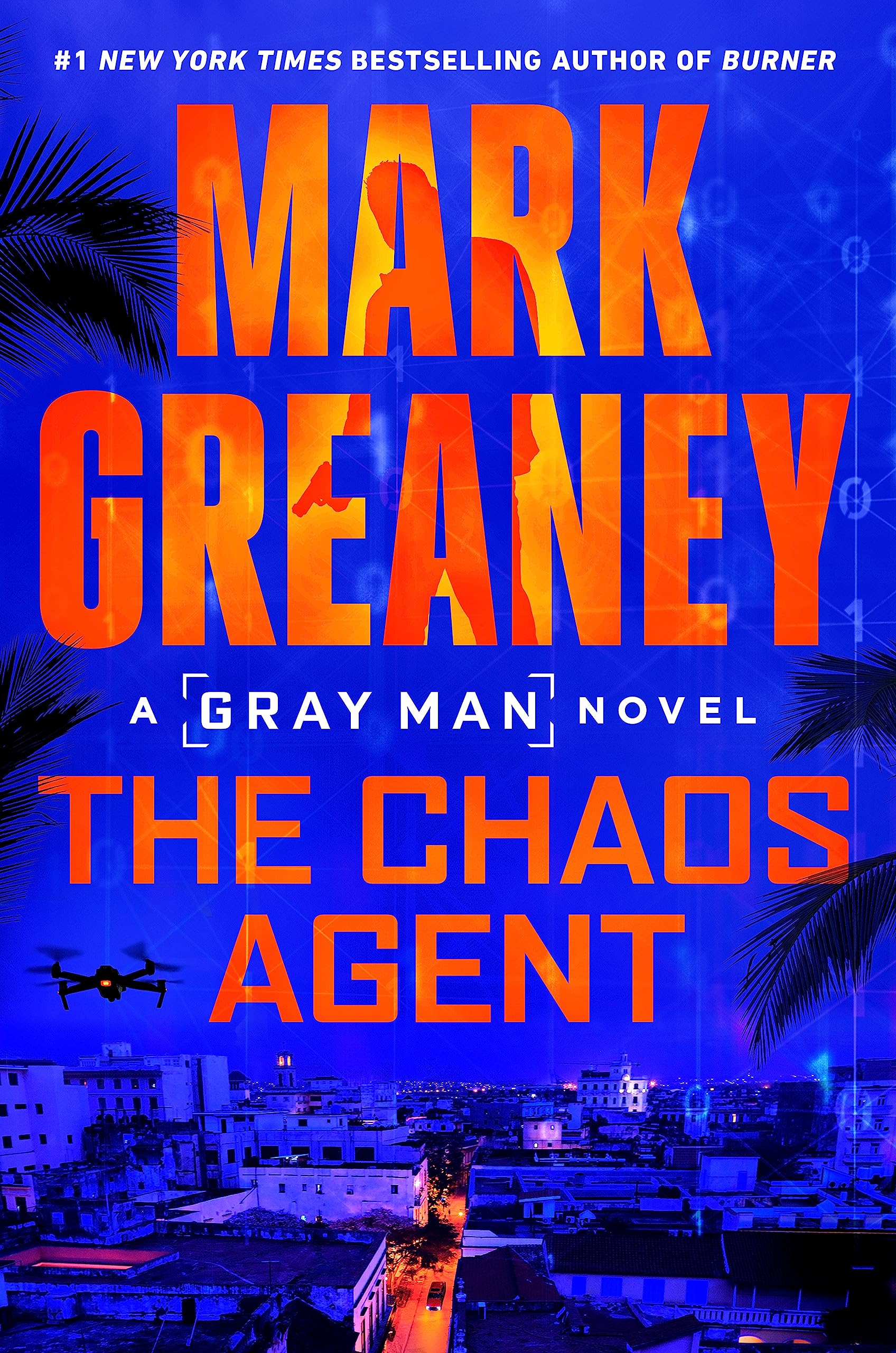
The Chaos Agent by Mark Greaney

The Chaos Agent Cover

Publisher: Sphere/Audible (Audiobook – 20 February 2024)

Series: Gray Man – Book 13

Length: 17 hours and 34 minutes

My Rating: 5 out of 5 stars

Amazon

One of the leading authors of the spy thriller genre, Mark Greaney, returns with another epic entry in his iconic Gray Man series, The Chaos Agent.

Readers of this blog will know that I am a massive fan of thriller author Mark Greaney, who has been wowing the world with his elaborate and exciting stories for years.  Ever since I started reading thrillers, Greaney has been a major figure in my yearly reading schedule, with books like Armored and Red Metal (cowritten with Hunter Ripley Rawlings IV), ensuring that he became a must-read author for me.  However, his most iconic body of work is his Gray Man series, which follows legendary former CIA agent and assassin Court Gentry, known as the Gray Man, as he engages in carnage across the world.  This series, which people may be familiar with thanks to the Netflix adaptation, is so damn good, and I really love the elaborate and intense stories that emerge.  This includes the impressive first novel The Gray Man, as well as later books like Mission CriticalOne Minute Out (one of my favourite books and audiobooks of 2020), Relentless (one of my favourite books and audiobooks of 2021) and Sierra Six (one of my favourite books and audiobooks of 2022) and Burner (one of my favourite books and audiobooks of 2023).  Naturally, I grabbed Greaney’s latest novel, The Chaos Agent, the first chance I could, and it proved to be another amazing read.

Across the world, elite scientists are being murdered in a series of elaborate and well-coordinated assassinations.  The killers are well equipped, well prepared, and seem capable of striking across multiple countries.  The only connection between the killings is the area of expertise the victims are known for, as someone is targeting the world’s leading experts in artificial intelligence and robotics.

As the killings continue, it appears that only two major assassins aren’t involved in the plot, the Gray Man, Court Gentry, and his lover Zoya Zakharova.  Hiding out in Central America after their last mission once again forced them to become fugitives, Court and Zoya are seeking the quiet life together after all their years apart.  But an assassin’s work is never done, and soon an old family friend of Zoya’s seeks them out, hoping that they can help identify the individuals behind the attack.  Initially reluctant to get involved, Court and Zoya soon find themselves targeted by association, and must flee an army of dangerous killers and mysterious advanced combat drones.

Forced to find out who is hunting them, Court and Zoya soon discover that the killings are linked to a deadly proposed artificial intelligence weapon that could change everything about modern warfare.  To discover what’s truly going on, the two former agents and their allies need to investigate the one survivor of the ongoing assassinations.  But with their target now protected by an old friend of theirs, Zack Hightower, in an isolated fortress, Court and Zoya will need to use all their connections and luck to find the truth before it’s too late?

The Chaos Agent was another excellent novel from Greaney, who continues to highlight why he is one of the world’s leading spy thriller writers.  This latest Gray Man novel ended up being a lot of fun, especially as Greaney goes a little overboard with the plot, and I deeply enjoyed the resulting adventure.

Greaney came out of the bag with something very exciting in The Chaos Agent, which is mainly down to how over-the-top and crazy the main narrative ended up being.  This story starts off relatively low-key, with a couple of random killings, and an update on the lives of the protagonist, Court Gentry, and his partner Zoya Zakharova.  Naturally, it doesn’t take long for Gentry and Zakharova to get dragged into the action, and this starts an intense fugitive arc for them, as they find themselves being hunted by various killers across central America.  At the same time, the other supporting characters of the book are investigating the worldwide plot around the assassination of various AI experts.  This results in a compelling investigation angle that continues for a large portion of The Chaos Agent, and it was fun to not completely know the identity of the book’s antagonist until towards the end.  This first half of The Chaos Agent definitely got my attention, and the compelling action, intense mystery, and intriguing characters help to draw the reader in.

The second half of The Chaos Agent is where things start to get particularly interesting, as Greaney amps up the story and throws it into overdrive.  In particular, the antagonists get even more crazy, which is well shown in an intense action sequence involving Gentry and Zakharova in contact’s house in Central America.  These additional opponents give The Chaos Agent a real science fiction edge to them, and it was a gloriously over-the-top inclusion that I really loved.  The various character storylines soon come together after that, as all the characters end up in Cuba investigating who is truly behind everything and why.  There are some cool sequences here, including complex and intricate multi-perspective operations as various players manoeuvre around each other to achieve their goals.  This all leads up nicely to the big extended finale, where all hell breaks loose as Greaney sets up a massive firefight with various sides thrown into the mix.  The action here is intense, with the carnage flying thick and fast, and with so many perils coming for the protagonists.  It all ends on a pretty big cliffhanger that will play nicely into the next book in the series, especially as two major supporting characters find their situation drastically changed due to their decisions.

I deeply enjoyed how this cool novel unfolded, and Greaney utilises his trademark writing style to great effect with this excellent story.  The high-intensity action, fast-paced plot, and intriguing overarching storyline came together wonderfully, and it proves very hard not to get drawn into The Chaos Agent as a result.  I particularly love how Greaney so effortlessly jumps between different character perspectives throughout the course of the book, which allows for a more complex and enhanced story.  These quickfire changes in perspective also work extremely well in some of the book’s more intense sequences, especially as seeing the various participants continuously react to other character’s actions, allows for some outstanding scenes.  Good examples of this include a sequence in the Cuban docks where Gentry and a rival assassin move around each other trying to simultaneously protect or kill their target.  These scenes, and more, are true highlights of this book, and I love how well they were able to incorporate the particularly eccentric inclusions that Greaney featured within The Chaos Agent.

As with most of the books in the Gray Man series, The Chaos Agent can easily be read as a standalone novel.  Greaney does a good job of recapping any the relevant key events from the prior novels where needed so new readers can enjoy this book without knowing anything about the rest of the series.  That being said, established Gray Man readers will probably get a little more out of The Chaos Agent, especially when it comes to seeing how the various character relationships unfold.  It also helps that this proved to be a particularly memorable entry in the series.  Not only does Greaney go all out with his very inventive and exciting story, but there is a great combination of story elements there that everyone can enjoy.  The intense action pairs well with a deep dive into modern technology elements, and Greaney pulls together an intriguing mystery about who is behind everything, rather than showing the antagonist from the get-go.  While some of the twists around the true antagonist are a little predictable, Greaney played them out well, and they worked into the massive status quo changes at the end of the book.  I will admit that I did find some of Greaney’s writing, including the dialogue, to be a little robotic at times in The Chaos Agent, which is kind of ironic when you consider the story focus.  The way some parts of the writing or dialogue came together just didn’t feel right to me at times, and that slightly decreased my enjoyment of the book.  Still, the awesome story more than made up for it, and I felt this was an awesome addition to the overall series, especially as the epic ending has got me extremely excited for the next book.

One of the things that I really enjoyed about The Chaos Agent was Greaney’s intriguing look at the future of AI and how it could be utilised in the military and intelligence fields.  Greaney clearly did some research on the subject, and several characters spend significant time lecturing about the potential advantages and dangers of AI weaponry.  I found this to be utterly fascinating, and this ends up being quite a key part of the book, especially once the protagonists find themselves beset by advanced drones and other distinctive weaponry.  As I mentioned above, Greaney uses this AI concept to make The Chaos Agent a little more science fiction than his previous novels.  While I won’t go into too much detail here, as frankly it is best experienced in the context of the story, some of these elements were very outrageous, and it made the story quite fun with some unique action.  While it was very over-the-top, Greaney did paint everything with a film of realism, and I came away from The Chaos Agent with a healthy respect and fear for the potential future of AI in the military, especially as Greaney is probably right and someone will use it to kill the rest of us.

Aside from the complex writing and cool AI elements, The Chaos Agent’s story is also enhanced by a great cast of characters who are cleverly showcased throughout the plot.  This includes protagonist Court Gentry and his partner Zoya Zakharova, who were reunited in the last book.  Gentry and Zakharova form an effective team as the main protagonists of The Chaos Agent, and it was fun to see them in action again.  However, Greaney also adds in an element of dissention, especially as neither really has the ability to trust other people, and they are both concerned about their potential future.  Their combined storyline goes in some interesting directions, and the final twist of the book ensures that their relationship will be a big part of the next entry in the series.  Greaney also brings back fun recurring character Zack Hightower, who worked with Gentry and Zakharova in the past.  Hightower is always great value for money, and he had an interesting run in The Chaos Agent as he’s hired as security for a tech billionaire being targeted.  Hightower ends up being an integral part of the book, and it was great to see him working with Gentry and Zakharova again, especially as his new job leads to some dark moments for him.  Throw in an excellent supporting cast, which includes some recurring faces and some new intriguing antagonists, and this ended up being an excellent book that makes fantastic use of its characters.

I have always found that the best way to enjoy one of the Gray Man novels is to listen to it in its audiobook format, which really enhances the story.  This is once again true for The Chaos Agent, which turned out to be such an epic listen.  The audiobook format, which has a substantial runtime of 17 and a half hours, proved to be a lot of fun, and I deeply appreciated how well it enhanced Greaney’s already fun story and writing style.  The constant movement between perspective characters, especially in the action sequences, comes across really well, and the intense fights feel so much more real and impactful when they are read out.  It helps that The Chaos Agent was once again narrated by Jay Snyder, who has voiced all the other Gray Man novels.  Snyder has a great vocal range that really lends itself to a spy thriller novel like The Chaos Agent, and all the over-the-top tough characters are captured extremely well in this audiobook, with Snyder expertly bringing back recurring voices from the previous Gray Man audiobooks.  The rest of the extended cast also get appropriate and fitting tones, and you can see Snyder is really trying to get the voices to match the characters.  This includes accents, as Snyder tries to capture many of the ethnicities captured within The Chaos Agent’s story, including a pretty good attempt at the New Zealand accent.  As such, I really found myself getting drawn into The Chaos Agent’s story while listening to it, and while Snyder can also be a tad robotic at times, this audiobook format was a pretty exceptional way to enjoy this amazing book.

Overall, The Chaos Agent was another excellent addition to one of the very best spy thriller series currently running.  Mark Greaney always goes all out with his amazing Gray Man novels, and The Chaos Agent is one of his most intense and gripping reads yet.  Clever, compelling, and featuring some particularly fun story features, The Chaos Agent is an excellent read that gets another five-star rating from me.

Amazon

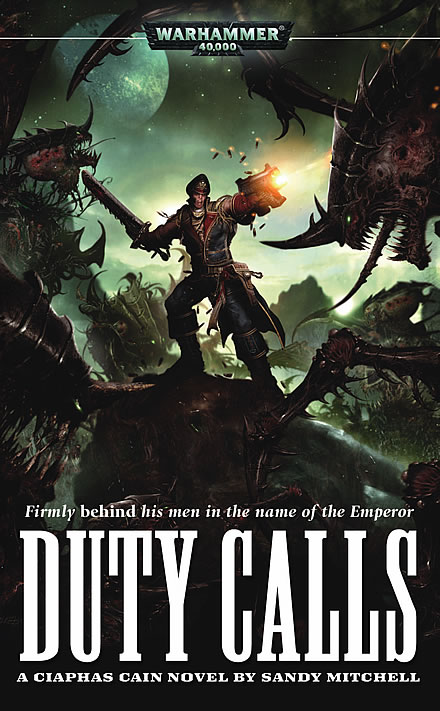
Warhammer 40,000: Duty Calls by Sandy Mitchell

Duty Calls Cover

Publisher: Black Library (Audiobook – 22 May 2007)

Series: Ciaphas Cain – Book Five

Length: 9 hours and 37 minutes

My Rating: 4.5 out of 5 stars

Amazon

One of the most entertaining authors of Warhammer fiction, Sandy Mitchell, continues to shine with the fifth book in his excellent Ciaphas Cain series, Duty Calls.

I doubt anyone is too surprised to hear that I broke a recent lull of reading by resuming the Ciaphas Cain series.  The Ciaphas Cain books, written by Sandy Mitchell (the alternate penname of author Alex Stewart), are an outstanding series that aims to bring a little humour to the crazy and dark battles of the gothic Warhammer 40,000 universe.  I have deeply enjoyed the first four books in this series, For the Emperor, Caves of Ice, The Traitor’s Hand and Death or Glory, and this honestly is one of the very best Warhammer 40,000 series out there.

Commissar Ciaphas Cain, hero of the Imperium and self-confessed self-serving coward, continues his exciting and deadly adventures when a new dark threat rises to destroy humanity.  After his last harrowing adventure with the Valhallan 597th, Cain is keen for a less deadly experience, and his new deployment to help crack down on civil unrest on the planet of Periremunda seems to be the ticket.  However, nothing is ever simple when Cain is involved.

Upon arriving on Periremunda, Cain quickly finds his life in danger as a series of assassination attempts are made against him.  Realising that his assailants are genestealers, the deadly scouts of the Tyranid swarm, Cain begins to understand the true danger Periremunda is in, as the genstealers herald the approach a Hive Fleet.  But unstoppable hordes of alien creatures are the least of Cain’s worries as he is reunited with his old flame, Inquisitor Amberley Vail.

Ostensibly on Periremunda to help the Imperial Guard stave off the Tyranid invasion, it soon becomes apparent that Vail is there for a darker reason.  Something incredibly important has been hidden on the planet that has the potential to change the entire Imperium.  Forced to assist Vail, Cain and his trusty aide, Jurgen, find themselves thrust into the deadly intricacies of a battle between hidden underground factions.  But with hungry Tyranids all around, deadly assassins gunning for Cain and a mysterious Chaos cult causing mischief, can Cain survive his deadliest encounter yet?

Duty Calls was an awesome addition to the Ciaphas Cain series that builds on several of the prior adventures, while also testing the protagonist in some fun new ways.  I loved the interesting story contained with Duty Calls, and this was one of Mitchell’s stronger additions to the series.

This fifth Ciaphas Cain novel had a great story behind it, although I am sure that prior readers will be familiar with the overall thrust of the narrative, with the seemingly cowardly Cain arriving on a new planet to face one threat, only to discover a much more dangerous enemy hiding beneath the surface that he is forced to reluctantly face and defeat, once again accidentally proving that he is a hero.  While Mitchell does try to break this story premise up throughout the series, this is a recurring story format, which can get a little too repetitive.  However, I think that Duty Calls stands on its own feet and Mitchell does a good job distinguishing it from the previous entries in the series.  The initial hidden threat of genestealers transforms into a massive Tyranid invasion, and it proved intriguing to see the protagonist face off against the ravening alien forces.  Tyranids are easily one of the best antagonists in the entire Warhammer 40,000 canon, and while they lose a little of their fighting ability in the face of Cain’s plot armour, they proved to be a great threat in Duty Calls.

While Mitchell could have probably left Duty Calls as simply a military novel, the inclusion of major recurring character Inquisitor Amberley Vail ensures that Cain is thrust into a much more subtle form of danger alongside the Tyranid invasion.  Caught between warring factions of the Inquisition and Adeptus Mechanicus, Cain is used as a pawn in the resulting shadow war, and there are some great scenes as Cain dodges assassination attempts, hidden Chaos cults, and other unseen dangers, all while trying to work out what the elaborate conspiracy is.  Novels that focus on the plots and conspiracies of Inquisitors are always very cool in the Warhammer 40,000 universe (see my reviews for Xenos, Malleus and Hereticus by Dan Abnett), and Mitchell fits Cain into this intrigue laden story arc extremely well.  It helped that there was some excellent set-up for this in the previous novel, and it was good to get a continuation here.  The resulting combination of storylines comes together really well, and Duty Calls has a really impressive and addictive narrative that will appeal to all fans of Warhammer 40,000 fiction.

As with the previous Ciaphas Cain novels, Mitchell does a great job of balancing the various elements of Duty Calls perfectly.  While primarily a military focused science fiction read, Duty Calls also has some great elements of intrigue and espionage, which ensures extra levels of excitement and danger.  However, I feel that the best part of Duty Calls is the inherent humour that Mitchell produces, which is a real rarity in Warhammer fiction.  Most of this is due to the hilarious and cynical narration of the main character, who pulls no punches when it comes to describing how ridiculous events are and the fact that he’s caught in the middle of them.  Extra humour is also built in due to the contained chronicle format that Mitchell has set the series out in, with the protagonist’s journal entries enhanced by extra documentation, descriptions, references and notes from Cain’s associate, Inquisitor Vail.  Vail’s sarcastic take on Cain’s description of events throughout these extra notes is a lot of fun, and the additional in-universe texts and broadcasts seek to showcase just how ridiculous humanity and the Imperium has gotten in the war-torn future, with over-the-top bits of propaganda and biased historical documents.  All this adds to quite a funny book, and this built-in comedy pairs remarkably well with the more serious parts of Duty Call’s narrative to create a truly addictive and fun read.

I felt that Duty Calls was a strong entry in the Ciaphas Cain series, especially as it builds nicely off the events of the preceding novel, Death or Glory.  Due to the series looking at different time periods of Cain’s career, Duty Calls is set between the second and third books, although it makes a lot of references to the first novel, and the events of Death or Glory, which took place many years before.  While the jumps around the timeline are a little confusing, Mitchell makes it work, and I liked seeing the return of several recurring characters, as well as a continuation of some mysterious storylines from the previous book.  Despite these connections, Duty Calls also works quite well as a standalone novel, and new readers can jump into the series here without too many issues.  Indeed, Duty Calls is a good introduction to both the Tyranids and the Warhammer 40,000 universe, and the Ciaphas Cain books are very much engineered for new Warhammer fans.  I will say that after reading several Ciaphas Cain books in a row, Mitchell’s proclivity for repeating elements from his other novels is a bit more obvious, and you do get a little weary of hearing the same phrases, descriptions and character depictions again and again.  Still, Mitchell ensures that Duty Calls is a particularly entertaining read, so its easy to really get stuck into it, and I deeply enjoyed seeing this unique series continue.

As always, I must mention the great characters featured within Duty Calls.  The most prominent of these is series protagonist Ciaphas Cain, who might be one of the more complex and debated figures in the Warhammer 40,000 canon.  Shown by his own admission to be a coward and a false hero, Cain spends most of the book trying to come up with ways to avoid combat and surviving the inevitable battles that his reputation and own bad luck force him to participate in.  His memoirs are filled with cynical allusions to the methods he utilises to survive, and you can see that Mitchell is trying to emulate classic characters like Flashman or Blackadder.  However, despite the character’s constant assurances that he is no hero, you see time and time again that there is far more to Cain, as he routinely defeats the enemy, often thanks to his own caution, survival instincts and ability to inspire his fellow troops.  I love how you are constantly rooting for Cain, despite his attempts to weasel out of trouble, and his self-deprecation about his actions really makes you feel for him, especially as its apparent that he is just one filled with self-doubt after not being an over-the-top martyr like the other heroes in the Warhammer 40,000 universe.  At the same time, Cain also provides a lot of the book’s humour, as you are bombarded with his fun comments and cynical attitude about everyone he encounters.  As such, I really appreciate Cain as a central character in this series, and it is always so much fun to follow him throughout his adventures.

Aside from Cain, there is an interesting array of characters featured in Duty Calls who I had a lot of fun with.  Many of them are recurring from the previous novels, and it was good to see various familiar faces again.  This includes Cain’s faithful aide, Jurgen, who Mitchell portrays in a manner like Baldrick from Blackadder, due to his apparent gormless attitude and poor personal hygiene.  However, in many ways Jurgen is just as much a hero as Cain, often being the one to save the day with his skills and big gun, and he forms a great team with Cain, especially as his Commissar is usually the one drawing the enemy’s attention from his aide’s attacks.  I also really enjoyed seeing the return of Inquisitor Amberley Vail, both as a character in Cain’s adventures and the person publishing his memoirs.  Vail proves to be the perfect foil to Cain for many reasons, and I like how she’s the only person who can effectively manipulate Cain and doesn’t fall for his lies and schemes.  Vail constantly calls out Cain, both in person and through the footnotes she amends to his chronicles, and I love how she has his number, while also clearly caring for Cain as a partner.  Duty Calls really shows just how dangerous Vail can be though, especially as she gets into the fight and makes some tough decisions.  Other interesting characters include several familiar soldiers from the Valhallan 597th, the outrageous members of Vail’s inquisitorial retinue, and a several intriguing antagonists who prove to be great and over-the-top opponents to the sensible Cain.  All these characters added a lot to the impact of the book, and I cannot wait to see how they fit into Cain’s adventures again in the future.

Readers who have seen my previous Ciaphas Cain reviews know that the only way I am going to enjoy this series is through its audiobook format.  All Warhammer novels make awesome audiobooks, but the Ciaphas Cain audiobooks are something particularly special thanks to the use of multiple narrators.  Duty Calls features six separate narrators who add a great deal to the production thanks to their fantastic voices and entertaining takes on the characters and universe.  Most of this narration is done by the superbly talented Stephen Perring, who lends his voice to all the chapters told from Cain’s perspective.  As such, he covers most of the first-person action and adventures of the main character, and his take on the complex Cain and his colleagues is exceptional.  The way he captures the various aspects of Cain’s character through his voice work is impressive, and you really get a sense of the multiple layers surrounding his motivations.  Perring also does a really good job of capturing the other intriguing characters Cain interacts with, including his aid Jurgen, and the eclectic members of the Inquisition that crosses his path.

After Perring, the most prominent narrator is Penelope Rawlins, who provides narrations for the various inclusions written by Inquisitor Vail.  As such, Rawlin’s voice is constantly interjected into the audiobook at various points as she reads out the footnotes, context pages, and personal remarks from Vail, as she attempts to make Cain’s story more readable.  Rawlins has really perfected her Vail voice over the course of the series, and it is always great to have the playful, informative, and often gently exasperated tones of a chronicling Inquisitor come through the plot.  There is also some good contrast between Perring and Rawlins, especially as both voice the character of Vail throughout Duty Calls, and they serve as a winning main team.

The other four narrators, Emma Gregory, Richard Reed, Tara Rawson and Andrew James Spooner are also very fun, even if they are used a little sparingly.  These four narrators’ voice extracts from various in-universe texts, chronicles and new casts that Inquisitor Vail has added to Cain’s manuscripts to give them more context.  These talented narrators go all out in voicing these intriguing and often over-the-top inclusions, and I love the humorous spin their excellent narration adds to them as a result.  Gregory is particularly noteworthy, especially as she once again voices the ridiculously patriotic memoirs of an officer fighting alongside Cain, but all these extra narrators do such a great job.  This excellent and entertaining combination of voice actors and audiobook narrators turns Duty Calls into a real treat to listen to, and I honestly cannot recommend this format enough to anyone interested in checking out the Ciaphas Cain series.

I continue to fall further in love with the Ciaphas Cain series as Sandy Mitchell produces another amazing and fun story in Duty Calls.  Loaded with action, humour, and a particularly complex protagonist, Duty Calls had everything I’ve come to expect from the Ciaphas Cain series, and I deeply enjoyed how Mitchell continues to showcase the Warhammer 40,000 universe in his own distinctive way.  I can think of no better way to highlight just how much of a great time I had with Duty Calls than to reveal that I automatically started listening to the sequel Cain’s Last Stand, the moment I finished it.  Highly recommended to all Warhammer fans and new readers wanting some fun science fiction adventures.

Amazon

The Silverblood Promise by James Logan

The Silverblood Promise Cover

Publisher: Arcardia (Trade Paperback – 30 April 2024)

Series: The Last Legacy – Book One

Length: 595 pages

My Rating: 4.75 out of 5 stars

Amazon

Promising new author James Logan presents an epic fantasy debut in the form of The Silverblood Promise, the first entry in his planned The Last Legacy series, and one of my most anticipated books of 2024.

Lukan Gardova, the disgraced heir of a noble family, is a man who has lost everything following a duel that ended tragically.  Forced to drop out of his prestigious academy and abandoned by his family, Lukan travels the wild edges of the world, gambling, drinking, and seeking what adventure he can.  Despite his malaise and despair, Lukan is still shaken when he is informed that his estranged father has been murdered by mysterious assassins.

Armed with fresh purpose and a determination to find out who was responsible for his father’s death, Lukan follows the only clue he has, a note his dying father wrote in his own blood.  The names it contains lead him to Saphrona, an old and prosperous city ruled by merchant princes where everything can be bought.  Filled with rogues, scoundrels, thieves, and miscreants, Saphrona seems an unlikely place to find his reclusive, academic father’s killers.

Engaging in an exhaustive search throughout Saphrona, Lukan discovers that the answers he seeks lie with one of the city’s merchant princes.  Unfortunately, they have been condemned to death for the murder of another merchant prince, and if Lukan wants the information they have, he will first have to prove their innocence.  Working with an unlikely group of criminal acquaintances, Lukan follows the few clues surrounding the merchant prince’s unusual murder.  But the further he digs, the more danger he finds himself in.  There is a deadly conspiracy at work in Saphrona, one that seeks to undermine everything the city stands for.  Forced to contend with desperate nobles, deadly criminals, and dangerous forces beyond his comprehension, Lukan fights to keep his promise and find the truth behind his father’s murder.

Wow, now this was an awesome debut from Logan and one that I was really glad I got the chance to read.  The Silverblood Promise has been on my radar for a while, and Logan did not disappoint with its excellent and exciting story, which is loaded with action, intrigue, cool fantasy elements and some great characters.  Entertaining and fast-paced, The Silverblood Promise was an absolute joy to read, and I had an amazing time getting through it.

The Silverblood Promise has a deeply compelling narrative behind it that kept drawing me in with its intrigue, revelations and exciting adventure.  While this is a lengthy novel, I honestly powered through it as it proved very easy to get caught up in the story.  Logan maintains a very fast pace the entire way through The Silverblood Promise, and I enjoyed the mixture of action, character development and unique fantasy inclusions that the reader is treated to.  Starting off with a strong introduction that effectively showcases the protagonist and his current situation, the reader is quickly thrust into the main background city of Saphrona, which proves to be a fantastic setting.  Able to quickly interpret his one clue, the protagonist works with several connected figures to try and contact the person his father sent him after.  What follows is a series of interlocking quests as Lukan must befriend a master forger, mastermind a break-in to a notorious prison, and then discover who set up one of the city’s leaders for murder.  This results in a constant stream of adventures as Lukan jumps from one hurdle to the next, uncovering dark secrets about the city, and making unlikely friends.

The revelations about the true villain of the story occurs about two-thirds of the way through The Silverblood Promise, and while it isn’t too surprising, their methods and motivations are, especially as they reveal some interesting figures to the story.  Forced to go up against some big fish, Lukan is caught up in their power play, which adds a lot of chaos to the narrative, and must desperately come up with a plan to fight back.  The resulting carnage and confrontations are well handled, and I loved the great combinations of intrigue, battles and clever ploys that brought everything together.  All the action within The Silverblood Promise is sharp and well written, and you get drawn into the many confrontations and battles of wits that emerge.  Logan proved very able at hiding hints about the big bad’s schemes throughout much of the plot, and it was fun to see it all come together.  I had such a great time with this impressive story, and I ended up reading the last 300 pages of the book in less than a day, it was that damn good.  The reader comes away both satisfied and wanting more, which is lucky as it is clear Logan has some big plans for the series, with the adventure set to continue.

I felt that Logan came up with an excellent fantasy setting for The Silverblood Promise, and I really enjoyed how he utilised the new world throughout his plot.  Filled with magic, adventurers, complex cities, mysterious interdimensional beings, and powerful artefacts from long-lost advanced races, there is so much for the reader to enjoy here, especially when hints about far greater hidden powers are also included.  While a couple of the fantasy elements in The Silverblood Promise are a little derivative of other fantasy works, I personally didn’t mind, mainly because Logan makes them his own and they fit nicely into the fast and intense narrative of The Silverblood Promise.

While I loved the new fantasy world as a whole, the setting highlight of this book is the city of Saphrona, where most of the plot is set.  Saphrona proves to be a complex and compelling trade city ruled by merchant princes and filled with dangerous commerce, criminal enterprises, alien structures, unlikely monsters, and all manner of political intricacies and plots.  Readers will really enjoy unwinding the various elements of this city and it proved to be fun watching the protagonist explore Saphrona and attempt to find answers and stop a major disaster unfold.  In a way Saphrona becomes a character in its own right as the book progresses, and I really appreciated how effectively Logan introduced the reader to the setting and inserted the story in its survival and underlying politics.  Logan also ensured that readers got a good deal of information about some of the other locations outside of Saphrona, which are likely to become relevant to the plot in future books of the series.  While a of map of the continent or Saphrona would have been appreciated, readers come away with a great sense of the world and will be interested in seeing more stories within it.  Indeed, it looks like Logan plans to set each of The Last Legacy books in a different city of the world, and I for one am very excited to see what other memorable locations Logan will come up with.

I also really need to highlight the fun and memorable characters who were featured throughout The Silverblood Promise.  Logan did a great job pulling together an intriguing and often outrageous cast for his first book, and I loved some of the awesome storylines that emerged.  Most of the focus revolves around protagonist and primary point-of-view character, Lukan Gardova, a former noble turned roguish adventurer who finds himself way over his head in Saphrona.  Lukan is a great central figure for this book, and he brings a lot of emotion to the story due to his disastrous past and determination to find his father’s killer.  I felt that Logan provided just the right amount tragic history for his protagonist to enhance the dramatic tone of the book, and the character’s frustrations at the dangerous tasks he finds himself involved with, as well as his own stubborn need to move forward, were very relatable.  Lukan also provides a fun scoundrel vibe to the plot at times, and it was interesting to see his cynical perspective on events throughout the book.  I liked how Logan set Lukan up as a newcomer to the main setting of Saphrona, as this allowed the reader to see the city fresh through the eyes of someone unfamiliar with it, which enhanced the majesty, strangeness and cruelty of the setting.  As such, I felt that Lukan was an excellent central protagonist, and I look forward to seeing how his story evolves in the future, especially as there are many more secrets around his family that need to be revealed, and other character elements that need to be expanded upon.

Aside from Lukan, The Silverblood Promise features an interesting array of fun figures, the majority of whom are locals to Saphrona.  I loved all the unique characters that emerged, especially as Lukan is forced to deal with killers, scheming nobles, a mysterious forger, a blind beggar with way too much knowledge, an unlikely crime lord and a notorious band of mercenaries that Lukan is forced to alternatively fight or make deals with.  One of the most distinctive characters is an infamous thief who joins the main cast late in the story, but who proves to be a fantastic addition thanks to her skills, kindness and pragmatism.  However, my favourite character would have to be the young street urchin and pickpocket, Flea, who forms an unlikely partnership with Lukan early in the story.  Hired by Lukan to help him around the city, Flea proves to be an invaluable ally, despite her age, and works to keep her benefactor alive against all manner of dangers.  Bold, curious and utterly unflappable, Flea is a highly entertaining figure, especially as she keeps jumping into danger while also proving to be far wiser than Lukan.  Flea and Lukan serve as fun contrasts to each other, and I liked their entertaining banter and the touching bond they form throughout the course of the book.  This fantastic partnership really helped to make The Silverblood Promise that much more special, and all the characters featured within this book were really well written and cleverly featured.

Overall, The Silverblood Promise is an excellent and exciting fantasy novel that had me hooked the entire way through.  Intense, compelling and wildly entertaining, The Silverblood Promise was very awesome, and James Logan did wonders with his debut novel.  I will definitely be grabbing the eventual sequel to The Silverblood Promise when it comes out, and I cannot wait to see how this adventure continues and how Logan develops as an author.

Amazon

The Perfect Assassin by James Patterson and Brian Sitts

The Perfect Assassin Cover

Publisher: Century (Trade Paperback – 15 November 2022)

Series: Standalone/Book One

Length: 317 pages

My Rating: 4.25 out of 5 stars

Amazon     Book Depository

The team of James Patterson and Brian Sitts present one of the most unique thrillers of 2022 with The Perfect Assassin, a sharp, exciting read that pays homage to a classic pulp hero.

Readers of this this blog will remember that I only started reading the works of the iconic and exceedingly productive James Patterson a couple of years ago and I have so far enjoyed several of his more interesting books.  This includes Lost (co-written with James O. Born), 2 Sisters Detective Agency (co-written with Candice Fox), Blowback (co-written with Brendan DuBois) and one of my favourite books of 2022, Death of the Black Widow (co-written with J. D. Barker).  I have had a great time with each of these cool reads, and when I heard the plot of one of Patterson’s latest books, The Perfect Assassin, I knew I had to read it.  The Perfect Assassin is fifth collaboration between Patterson and fellow thriller author Brian Sitts and presents the reader with a really fun and intense story that had an intriguing connection to a classic adventure series from the past.

Dr Brandt Savage is an anthropology professor at the University of Chicago, leading a less-than ordinary life and often ignored by his colleagues and students.  His only real plan in life is to disappear to some exotic locale on an upcoming research sabbatical.  However, the sabbatical is going to become far more extreme than anything he imagined when he is kidnapped from the university campus and imprisoned inside an isolated and hidden warehouse.

Savage’s kidnapper is a beautiful and deadly killer, known only as Meed, who informs Savage that his life needs to change.  Forcing him to undertake an intense and extended physical and mental training regimen, Meed begins to mould him into a completely new person, one who is stronger, smarter, and more dangerous than anything Savage could ever imagine.  But even after six months of the most brutal training imaginable, Savage is far from ready for what is to come.

Meed is running from her own past and the dangerous people who turned her into a lethal killer.  To survive, she needs Savage’s help, especially if she can use her training and conditioning to bring out the genetics of his legendary ancestor, the original Doc Savage.  Savage is soon dragged into a new and terrifying world of killers, assassins and secret organisations, all of which are connected to his family’s terrible legacy.  Forced to work with Meed, who has her own link to his family, Savage begins a new adventure worthy of his ancestor.  But is he enough of a Savage to survive the experience?

This was a very fun and exciting novel from the team of Patterson and Sitts, and I am really glad I decided to read it.  The two authors have come up with an awesome story for The Perfect Assassin, which blends a thrilling modern tales with some interesting connections to the classic Doc Savage pulp novels.

The Perfect Assassin’s story starts in a very cool and intense way when Brandt Savage is kidnapped by the mysterious Meed and finds himself being brutally trained to bring out his best self.  The first half of the book sets up the entire novel very well, as it is split between chapters told from Savage’s perspective as he undergoes his training, and chapters from Meed’s perspective that either explore her childhood being raised in deadly assassin school or show her current missions against some of her former classmates.  This results in quite the compelling narrative, especially as you begin to appreciate the contrasts between Meed’s past and her current actions with Savage.  The authors introduce some big revelations about both primary characters and their ancestors that results in a complete change to the narrative format for the second half of the book, especially as there is a big focus on the protagonist’s connection to Doc Savage.  There the narrative is firmly set in the present with the characters working together on a sped up and action-packed chase around the world that ended up with several big confrontations.  Everything ends with a ton of action, and while the plot was wrapped up way too quick, you have so much fun getting there that you do not mind too much.

I felt that Patterson and Sitts’s writing style for The Perfect Assassin helped to enhance this awesome narrative, especially as everything was set up to compliment the fast-paced story.  The author’s use of short, sharp chapters really moves the story along.  At the same time, the blend of multiple perspectives, especially those shown from Meed’s childhood in the first half of the book, allows for them to efficiently tell a more complex tale, especially as it provides greater detail about Meed and her motivations in short and exciting order.  Throw in a ton of action, some quick, but well received character development, and a good selection of sudden twists and revelations and you will be flying through this book in no time at all.  I really appreciated the way that Patterson and Sitts set this book up and their style of writing, as well as the memorable narrative, made it very hard to put down, especially when you could keep seeing the end of the next chapter just around the corner every time you turned the page.

Easily one of the most interesting parts of this book is the fantastic connection that it bears to the classic pulp character of Doc Savage and associated media.  Patterson and Sitts’s unique narrative serves as a multi-generational successor to the original novels, with the plot focussing on multiple aspects of the Doc Savage lore and characters.  Not only are the main characters related to iconic Doc Savage figures, but the entire plot revolves around the consequences of Doc Savages origins, with aspects of it coming into play with the new Savage and his training, but also with the assassin school that Meed was raised in (which was such a cool setting btw).  Now, I have to admit that I am not particularly familiar with the Doc Savage media (it is well before my time), but it was very clear that the authors loaded The Perfect Assassin with a ton of homages to the original books, with references to characters, settings, plot lines and other Doc Savage elements.  At the same time, the authors seek to modernise the story to a degree, giving parts of the characters’ origins a darker and more morally ambiguous edge.  These Doc Savage elements were made pretty accessible to new readers, and even those people who aren’t that familiar with the old-school character should be able to follow what is happening (a quick online search probably wouldn’t hurt though).  Naturally, fans of the original pulp novels are going to have the most fun with this book, especially as they will be able to recognise all the references I missed.  I did think that they might have slightly overdone some of the Doc Savage elements towards the end of the book, with a Doc Savage inspired speech and certain super-human abilities making the story way sillier than it needed to be.  However, I ended up having a ton of fun with all these fantastic Doc Savage references in The Perfect Assassin, and I think quite a few readers will appreciate how Patterson and Sitts endeavoured to bring the one of the first superhuman characters into a whole new age.

Overall, The Perfect Assassin was one of the more unique and awesome thrillers of 2022 and I had an outstanding time getting through it.  The great team of James Patterson and Brian Sitts produced a fantastic and compelling story that quickly draws you in and keeps you interested with its action, amazing developments, and distinctive relationship to a historic piece of action/adventure media.  It will be great if Patterson and Sitts present some sequel to The Perfect Assassin in the future.  If they do, I will be sure to grab a copy, especially if I am in the mood for some easy-to-read excitement.

Amazon     Book Depository

Seventeen: Last Man Standing by John Brownlow

Seventeen Cover

Publisher: Hodder & Stoughton (Trade Paperback – 26 July 2022)

Series: Standalone/Book One

Length: 409 pages

My Rating: 4.5. out of 5 stars

Amazon

Acclaimed screenwriter John Brownlow presents one of the most entertaining and awesome debuts of 2022 with the compelling action thriller, Seventeen: Last Man Standing.

In the shadowy world of contract killers, assassins, and rogue operatives, the man at the top of the totem pole is simply known by a number.  For over 100 years, these elite assassins have kept the world in order by committing kills for every government, no questions asked.  Sixteen individuals have previously held the title as world’s greatest assassin during this time, and the current holder of the title is Seventeen.  Feared by every killer around the world, Seventeen knows that his career can end at any moment, as it only takes one mistake for an ambitious assassin to take his place and become Eighteen.

After completing a mysterious job in Berlin, Seventeen finds himself at a crossroads, concerned about his future and considering his past.  However, everything is put on hold when his handler gives him startling clues that hint that his predecessor, Sixteen, who had vanished without a trace, is still alive.  The only way for Seventeen to keep his position in the assassination hierarchy is to kill the man who held the title before him, and if he refuses every assassin in the world will be on his back. Tracking Sixteen to a location in the middle of nowhere, South Dakota, Seventeen finds his target hidden in a fortress, and must try to find a way to kill the only assassin the world who might be better than him.

As he plans for what might be his greatest kill, Seventeen finds himself caught between all manner of complications.  Not only is his target near perfectly protected, but he soon finds himself falling for a girl in the local town.  Worse, it appears that his latest job may have been a setup, and now Seventeen finds himself one of the most wanted men in the world.  Caught between his deadly predecessor and every assassin and government agency on the planet, can Seventeen once again prove that he’s the best in the world, or is someone about to take his title and become Eighteen?

Brownlow presents an exciting and captivating read with his debut novel, Seventeen (also titled Seventeen: Last Man Standing), which I had an amazing time reading.  Featuring an action-packed and incredibly fast-paced story, I ended up powering through Seventeen in a bit over a day, and I had a fantastic time doing so.

I absolutely loved Seventeen’s outstanding narrative, which pits rival assassins against each other in an entertaining and impressive fight for survival.  The story is primarily told from the perspective of Seventeen, who is recounting his adventures to the reader.  Starting off with a brutal mass assassination, you quickly get a handle on the protagonist, his skills and his quirky style, as he commits several murders, before getting involved in another job.  From there, he finds himself coerced into finally hunting down and killing his missing predecessor, Sixteen, to secure his reputation.  Forced to find a way around Sixteen’s elaborate security, Seventeen starts to grow close to a woman in the local town, while also considering his future and the potential fallout from his last mission.  At the same time, there are a ton of flashbacks to Seventeen’s tragic past, which show how he became a killer and his road to becoming the world’s top assassin.  Seventeen’s eventual attempt on Sixteen leads to a massive confrontation, where nothing goes the way you think it will.  There are some great confrontations in the second half of the book, and the fights between Sixteen and Seventeen are pretty damn epic.  Throw in some dangerous outside interference and a massive conspiracy, and you are left with an excellent and powerful narrative that you really struggle to put down, even if it is very, very late at night.

Brownlow did a wonderful job setting his story out, and it was designed to keep your constant attention.  I have already talked about how much I enjoyed the fast pace of this book, and there are literally no slow spots during this read as the protagonist is constantly recounting action, spycraft, fun interactions, character development or flashbacks to his tragic past, all of which proves to be extremely entertaining.  The author makes excellent use of a substantial number of shorter chapters, which really helps with the pacing, as you are more likely to decide to keep reading for another chapter when it is only a few pages away.  This, combined with the exceptionally written and highly detailed fight sequences, really keeps your eyes attached to the page.  There are a ton of highly cinematic action scenes in this book, including shootouts, car chases, hand-to-hand fights, and even a bad encounter with a bear, which were very fun to read.  I also loved the fantastic depictions of assassination tradecraft contained within this book, and Brownlow provides an intriguing look at the protagonist’s preparations, as well as the unique methods he uses to find his target.  There are some very fun moments featuring the protagonist’s attempts to get close to Sixteen, and Brownlow writes a very entertaining story around death and assassination.  All this action and quick-paced writing melds well with the author’s excellent sense of humour, and there a ton of great jokes, entertaining observations and unusual situations that add a good comedic edge to much of the book.  These elements, as well as an outstanding central protagonist, really increased my enjoyment of the narrative, and I cannot emphasise enough how quickly I was able to fly through this book.

Finally, I rather enjoyed the fantastic characters contained within this book, as Brownlow writes an excellent story around them.  Naturally, the attention is primarily on the titular Seventeen, who tells most of the story.  Seventeen is a very enjoyable character to follow and I grew attached to him very quickly.  As smooth and talented as any movie assassin or action hero you are likely to find, Brownlow adds in some interesting personality traits that worked really well.  Not only does he have a brilliant sense of humour, which really comes across in the first-person writing style, but there is also a notable bit of weariness at the assassination lifestyle deep within him, which starts to drag at him as the book continues.  Despite a successful life as a killer, he is starting to regret some of his more recent actions, and this change of mindset becomes a key part of his character arc, especially when other dangerous individuals start to sense it.  Brownlow also comes up with a suitably tragic and compelling backstory for Seventeen, which is slowly revealed to the reader as the novel continues.  This backstory was pretty deep and traumatic, and it helps you to bond even more with Seventeen, once you see all the terrible things that drove him into his current career, and these elements really help cement him as an amazing and flawed central protagonist.  Additional characters I need to highlight include Sixteen, who serves as a fantastic foil to Seventeen, especially as he has the veteran instincts and a much more defined sense of cynicism, while also being haunted by the ghosts of his past.  I also deeply enjoyed the female leads of Kat and Barb, who serve an interesting role in the book.  While they are primarily used as damsels in distress for most of the book, Brownlow does add in some fantastic backstory and gives them each their own defining moments, which I enjoyed.  Plus, both are the biggest critics of the two main assassins in this book, and their fun takes on their deadly rivalry are pretty entertaining.  These characters, and more, add a great deal to the plot, and I enjoyed getting to know them here.

Overall, Seventeen was a pretty awesome novel that I had an epic time reading.  John Brownlow’s outstanding debut had all the action, adventure and fun characters you could ask for, and I found Seventeen to be quite an addictive read.  I look forward to seeing what this intriguing new author presents in the future, and I have a feeling that Brownlow is going to be an exciting voice in thriller fiction for years to come.

Amazon

Warhammer 40,000: Assassinorum: Kingmaker by Robert Rath

Assassinorum Kingmaker Cover

Publisher: Black Library (Audiobook – 2 April 2022)

Series: Warhammer 40,000

Length: 11 hours and 12 minutes

My Rating: 5 out of 5 hours

Amazon     Book Depository

The most lethal assassins in the Warhammer 40,000 universe go face to face with a gigantic foe in the impressive and deeply thrilling Assassinorum: Kingmaker by amazing author Robert Rath.

I know I’ve said this before, but 2022 is turning out to be a fantastic year for Warhammer fiction.  Thanks to my recent obsession with this franchise, I have been deeply enjoying all the new tie-in novels associated with this table-top game, as a bevy of talented authors seek to expand on the already massive lore.  I have already had a lot of fun with books like Steel Tread, The Bookkeeper’s Skull, Day of Ascension, Kreig, Ghazghkull Thraka: Prophet of the Waagh!, Reign and The Vincula Insurgency, but I may have just finished one of the most purely entertaining and awesome new entries, Assassinorum: Kingmaker.  Written by Robert Rath, who previously wrote the intriguing Necron focused book, The Infinite and The Divine, Assassinorum: Kingmaker had a very appealing story that instantly grabbed my attention and which ended up being an outstanding read.

In the 41st millennium, a new generation of war has engulfed the Imperium of Man, as the forces of Chaos press mankind from all sides and the recently resurrected Roboute Guilliman leads his forces on a new crusade.  Enemies attack the Imperium from all corners, often hidden in the shadows, and all the Emperor’s agents must work to find and eliminate them.  The most deadly, effective and feared of these agents are the members of the Officio Assassinorum, elite modified assassins who kill all of the Emperor’s enemies without mercy or fear, and who many believe are merely myth.

When the mechanical warriors of the Knight World of Dominion fail in their duty, the Imperial overlords task Vindicare assassin, Absolom Raithe, to travel to the planet and kill Dominion’s High Monarch, Lucien Yavarius-Khau, and managed the succession of a suitable replacement.  However, this will be no easy kill as the High Monarch has long ago bonded himself to his massive war machine, remaining permanently within its heavily armoured cockpit.  To kill this near-invulnerable king, Raithe is forced to recruit a kill-team with variable talents, featuring the Callidus assassin Sycorax and the Vanus assassin Avaaris Koln.

Infiltrating the planet using returning Knight, Sir Linoleus Rakkan, who has been co-opted into their plans, the assassins arrive to find a world in turmoil.  The planet’s two rival ruling houses are in constant battle with each other, and in the ensuing chaos, anti-Imperial sentiment is high, and the already invincible High Monarch is under heavy guard.  Seeking to infiltrate the court of Dominion, the kill team begin to manoeuvre themselves into position, while manipulating the feuding knights around them.  However, the assassins soon begin to realise that not everything is as it seems, and a dark secret lies at the heart of this noble planet.  Can Raithe’s team achieve their goals, or are they destined to die at the hands of a dangerous foe with malicious plans for the entire Imperium?

Damn! Damn! Damn! What an over-the-top and extremely cool Warhammer 40,000 novel that I deeply, deeply loved.  Robert Rath really went out of his way to make Kingmaker as awesome as possible, and the result is an extremely thrilling, electrifying and epic read, loaded with so many cool elements.  This was honestly one of the best Warhammer novels I have had the pleasure of reading and I have very little choice but to give it a full-five star read.

I really, really loved the cool story in this book, which essentially boiled down to ultra-elite assassins attempting to kill the king of a planet of mecha, which is such an awesome idea.  Despite this being a heavy concept to achieve, Rath managed to achieve it in spades, providing readers a fantastic and clever narrative that instantly grabs your attention.  This book starts off extremely well, introducing the world of Dominion, the unique mission, and the four central characters of the three assassins, and their Knight patsy, and generally setting up all the key elements of Kingmaker to ensure some outstanding moments later.  From there, the story turns into a bit of an espionage thriller, as the three assassins begin their infiltration of the court, impersonating the knight Rakkan, and coming to grips with the unique world they have arrived at.  Rath provides an excellent balance of story elements in this first half of the novel, and the reader gets a fantastic mixture of character development, massive universe building, political intrigue, spy elements and some early mecha-action, all of which is a ton of fun and ensures that the reader is firmly addicted with this novel.

While I deeply enjoyed the excellent story elements contained with this first half of Kingmaker, it’s the second half that made me a major fan of this book, as Rath amps up the action, excitement and thrills in a massive way.  Following a major, action-packed moment around the halfway mark that sees all the characters in their element, the protagonists soon have a new objective.  This leads to several great sequences of entertaining mayhem and death as the protagonists attempt to manipulate local politics to their advantage.  However, the fun doesn’t last much longer, as the book enters its final phase and big conclusion.  While it initially appears that everything is going to plan, you just know it will end badly as there is still a lot of book left to go.  However, you do not appreciate just how bad things have gotten for the protagonists until they are suddenly hit from every direction and hell reigns down all around them.

The story essentially devolves into all-out war for its last quarter, as the protagonists find themselves facing enemies all around, and all four main characters are forced go in some amazing directions at this point as they attempt to stymie the damage before them, with varying degrees of success.  Rath really pulls out all the stops here, and the reader is dragged into non-stop action on every front, from a mass of deadly mecha fights, close combat against abominations in the bowels of an ancient castle, and an intense gun fight against overwhelming numbers.  At the same time, there are a ton of big revelations occurring here as a lot of the storylines Rath has been patiently setting up throughout the rest of Kingmaker finally come to fruition.  I honestly did not notice some of the clues that Rath set out in the earlier stages of the novel, but once you realise what he has done, it really becomes apparent how much detail and planning the author put into the story.  Everything comes together extremely well at the very end, and Rath wraps up most of the storylines perfectly, leaving the reader very, very satisfied, with all their action needs firmly quenched.  However, he also leaves a couple of storylines opened, which could potentially lead to some form of sequel in the future, which I would be very excited for.  An, epic story with so much going for it!

Rath has a great and exciting writing style which I deeply enjoyed and which I found to really enhance the cool story.  The author was able to successfully blend multiple key elements together into a very cohesive narrative which delivered the right combination of action, intrigue, character moments, world building, a little humour and more.  This was a very fast-paced and exciting story, especially during some of the key moments at the centre and towards the end, and there was honestly not a single slow moment that made me even considering turning this book off.  With the use of multiple character perspectives, particularly of the four main characters, the reader is gifted a massive overarching view of the key events occurring throughout the novel, and they are always right in the centre of the story.  I particularly need to highlight the very impressive action sequences, as Rath had a real talent when it came to displaying violence and death, whether it be by the hands of the assassins, or via the multiple Knights featured throughout the book.  There is a wonderful interchange between perspectives during some of the more impressive action sequences, with the reader is shown multiple angles of key events, which really helped to enhance how epic they were.  I was really drawn to one sequence where you see a group of characters “talking” before it flashes over to another character quickly and efficiently killing everyone nearby.  Elements like this really drew me into Kingmaker’s story and were a lot of fun to see in action.

Kingmaker proves to be a very impressive addition to the Warhammer 40,000 canon, especially as Rath ensures that the reader leaves with a healthy amount of knowledge about the universe, and several major factions within it.  Ostensibly a standalone read (although there is room to expand out into an extended series), this is a book that will appeal to a wide range of Warhammer fans, especially as it focuses on two particularly unique and brilliant Imperial sub-factions, the dual use of which clash together perfectly to create an awesome narrative.  As such, a little bit of pre-knowledge about the Warhammer 40,000 universe, its recent history and the various major groups are useful to help you enjoy this story fully.  However, Rath did a great job of explaining a lot of these key universe elements throughout his story, and general science fiction fans should be able to pick up on the context easily enough.  As such, Kingmaker has a pretty broad appeal, and I loved seeing the great ways he expanded and explored some crazy groups.

The first faction that Rath deeply explored in Kingmaker is the Officio Assassinorum, the Imperium’s elite, hidden network of ruthless trained killers, who most people believe are a myth.  Trained, conditioned and modified to become the deadliest killers in the galaxy, the Officio Assassinorum are a pretty badass part of the Warhammer 40,000 universe, and there are only a few novels currently about them.  However, Rath really goes to town exploring them, and as they come together as a Kill Team to take facilitate the plot’s main mission.  Kingmaker features three different types of Imperial assassins from Officio Assassinorum temples, each of whom has their own unique skills, methods and technology.  As such, you are given a great insight into three additional sub-factions, with the Vindicare, Callidus and Vanus temples all featured here.  Rath really does a great job showcasing these different assassins throughout Kingmaker, and you come away with some major insights into how these assassins operate, what their skills are, and how they work or don’t work together.  There is also a deep and intriguing examination of the inner minds of these assassins, and you get a good idea of their opinions on the events unfolding, as well as their general thoughts on being deadly killers in service to the Emperor.  I really enjoyed the unique and compelling team-up of assassins featured in Kingmaker, and their technologically focussed attacks and elaborate methods worked well in contrast to the other major faction in this book, the Imperial Knights.

Imperial Knights are another great human sub-faction from the Warhammer 40,000 game, and one that I really didn’t know too much about before this novel.  However, that changed really quickly as, despite Kingmaker being labelled as an Assassinorum novel, Rath spent just as much time, if not more, examining members of a Knight World.  Knight Worlds in the Warhammer 40,000 universe are unique planets that have evolved into a feudal system equivalent to Earth’s medieval period, with peasants and other servants serving the noble houses who field Knights for war.  I always love seeing the cool range of different societies, cultures and technology levels throughout the Warhammer universe, and the Knight Worlds are especially fun, as they have gone out of their way to stay as a feudal society, rather than become standard Imperial worlds.  The contrast between the spoiled nobility and the poorer peasants in this futuristic context is just great, and I loved seeing so many Medieval elements being altered to fit into a degree of advanced technology, while still retaining a lot of traditional elements (e.g. footmen with laser rifles).  However, rather than riding to battle on a horse, these knights are mounted in the Imperial Knight war machines, massive mecha that, while not as large as the god-sized Titans, are still impressive walking weapons.  Rath has a lot of fun showcasing these Knights throughout Kingmaker, and you end up getting a good look at the unique machines, which are bounded to their pilot, and which contain the spirts of all their previous riders.  The impressive Knight-on-Knight battles throughout the book are extremely good, no matter their context, and I particularly enjoyed the focused look at the war machines’ apparent sentience, as the riders are bombarded with the thoughts and voices of the previous riders.

Dominion also proves to be a great and complex setting for Kingmaker, and I loved all the unique politics and elaborate back stabbings it created.  Featuring two rival houses, Stryder and Rau, as they battle for supremacy, Rath explores its rather elaborate and distinctive rulership and court as the assassin characters search for a weak spot.  Dominion’s status as a somewhat independent planet in the Imperium was also pretty intriguing, and it was fascinating to see members of the planet arguing over whether they should serve themselves or help the Emperor.  An overall deeply impressive examination of the Imperial Knights and their worlds, I deeply enjoyed how well Rath was able to work this faction into his complex narrative and it really highlighted his attention to detail and his love for the lore.

I also need to highlight the great characters featured within Kingmaker as Rath has created an excellent collection of enticing figures whose unique personal stories deeply enhanced the overall tale.  This was a fantastic group of deep and complex characters, and their statuses within this universe ensured that they all had some unique experiences.  Most of Kingmaker’s narrative is spread amongst the three members of the Assassinorum who represent a different Assassinorum Temple, and as such have very different viewpoints on the universe and the best way to operate as killers.  This provides some compelling initial conflict amongst them as they try to work together, something none of them are really good at.  However, they soon start to come together as a team as the novel continues, and they ended up playing off each other’s strengths and personalities to create an excellent, core group of protagonists.

The Assassinorum characters in Kingmaker are headlined by Absolom Raithe, the Vindicare assassin who has been appointed team leader.  An infamous sniper, tactician, and resolute loner, Raithe struggles the most with working as a team, and his initial attempts at leadership aren’t that successful.  The author adds in some additional issues for Raithe as the story continues, especially as he is forced to deal with an injury and taking on roles that are outside his comfort zone, producing some dangerous risks for the team.  However, Raithe ends up growing a lot as a leader as the book continues, while his multiple sniper scenes contain some of the best action in the entire novels.

Apart from Raithe, there is also a lot of focus on Sycorax, a Callidus assassin who specialises in infiltration and whose enhanced abilities allow her to morph her shape.  Due to her role impersonating Rakkan for most of the novel, Sycorax is one of the most significant characters in the book, and she ends up with some thrilling and intrigue laden sequences.  Watching her take on multiple personalities throughout the novel is really cool, and it was captivating to watch her more elaborate methods strongly clash with Raithe’s more direct attempts throughout the book.  Sycorax also provides the reader with some of the best and most intense insights into being an Imperial Knight pilot, as she is required to bond with Rakkan’s Knight Jester for much of the book.  Seeing an outsider character interact with Jester’s mind, which contains the spirits of its previous riders, was extremely fascinating, and you get a good sense of the difficulties and insanities involved with piloting such a machine.  In addition, the experiences and memories she obtained from the link impacted on Sycorax’s psyche and ensure that she gets some fantastic interactions with Rakkan, while also gaining a better understanding of the people and machines she is trying to manipulate.

The final assassin character in Kingmaker is Koln, a Vanus assassin with a skill in technology, data manipulation and analysis.  Even though Koln tended to get the least focus of the assassin characters, I really grew to like this tech-focused assassin, especially after her awesome introduction at the start of the book.  Koln proved to be an excellent third member of the Assassinorum team, balancing out the impulsive Raith and manipulative Sycorax well.  Her ability to kill just by manipulating some data, providing an elaborate forgery, or by hacking into a device was really fun, and I really appreciated the examination of the lesser utilised Vanus assassins.  Koln had some interesting story moments in Kingmaker, particularly towards the end of the novel, and it sounds like the author has some intriguing plans for her in the future.

I also need to highlight the character of Sir Linoleus Rakkan, a noble of Dominion who is co-opted into the plans to kill the high monarch and becomes a member of the assassin team.  At the start of the book, he is introduced as an ambitious pilot attempting to raise his fortunes.  However, after nearly being killed, he becomes a mercenary Freeblade, fighting against the forces of Chaos, before being kidnapped by the assassins.  Initially a depressed prisoner who relies heavily on drink to mask his emotional pain and the issues surrounding his disabled legs, the assassins manage to convince him to help Sycorax impersonate him on Dominion and use his return to gain access to the court.  Due to being a son of both the rival Stryder and Rau houses, Rakkan provides some great insights into both houses and the royal court, as well providing instruction on how to pilot a Knight.  It was a lot of fun to see Rakkan’s reactions to many of the early events of the book, especially as he is forced to watch himself being impersonated, providing information to help them pull off the charade.  While Rath could have left Rakkan as a useful, one-note character, he instead spent a good portion of the novel evolving Rakkan and ensuring that he ended up being a key part of the plot.  Not only does he mature greatly after witnessing some of the key moments of the mission and Sycorax’s impersonation of him, but Rath also dives into his past and the connection he has to his father, a Dominion hero whose glorious death Rakkan continually witnesses due to his connection to Jester, which his father died in.  This obsession with his family and the past eventually leads him to some big revelations in the present, and he ends up having some major and exciting moments in the last half of the novel.  Rakkan ended up being one of the most complex and entertaining characters in Kingmaker, and I really appreciate the excellent way in which the author developed him.

Aside from these four main characters, Kingmaker is loaded with an excellent group of supporting characters, most of whom are members of the Dominion nobility.  As I mentioned above, I had an amazing time seeing the diverse and contentious Knights of Dominion, especially as most of them are engaged in a brutal blood feud between the two ruling families.  Several of these noble characters have some intriguing storylines throughout Kingmaker, with an interesting focus on the members of the Court, the king’s inner circle who are hiding some major and disturbing secrets.  Of the rest of the noble characters, the best is probably Rakkan’s mother, the leader of the Stryder family, Baroness Hawthorn Astair-Rakkan, a domineering and ambitious woman who spends most of the novel trying to manipulate Rakkan for her own gain.  Baroness Hawthorn had some excellent moments throughout the novel, and I especially loved her collection of hounds, each of whom are humorously named after famous Imperial commanders, just to show off her arrogance and disrespect to the Imperial Guards.  Hawthorn’s story arc really changes towards the end of the book, and it will be interesting to see if we get some extra appearances from her in the future.  The other major supporting character of Kingmaker is Gwynne, Rakkan’s loyal Sacristan (Jester’s mechanic, a low-level Tech Priest with some additional cultural restrictions).  Gwynne serves as another ally to the main characters, and her knowledge of the Knights and their inner workings proves invaluable, as does her inquiring mind.  The author weaves some subtle, but important, storylines around Gwynne in Kingmaker, and she ends up serving a key and impressive role.  Overall, this was an excellent collection of characters, and I deeply enjoyed how well Rath used them throughout Kingmaker’s narrative.

Like many of the newer Warhammer novels I have been lucky enough to enjoy, I chose to check out Kingmaker on audiobook, which I found to be an awesome way to enjoy this book.  Coming in with a run time of just over 11 hours, this was a decently long Warhammer novel, but I honestly flew through it in just a few days, especially once I got fully addicted to its impressive story.  The audiobook format really helped me dive into the highly detailed setting and narrative, and I deeply appreciated how much more epic it made the action sequences.  Having the intense and over-the-top fighting between the various mechanical Knights was an outstanding experience, and you got the full impact of every powerful strike.  I also really enjoyed the excellent narration of veteran audiobook voice actor Gareth Armstrong, who has done a ton of other narration for the Warhammer franchise.  Armstrong’s work in Kingmaker was very good, and I loved the great array of voices he features for the various characters, capturing the ethereal and strange nature of the assassin characters and the more robust, proud and arrogant nobles of Dominion.  There was a great contrast between these two groups, and I loved how Armstrong succeeded in making every single character stand out on their own.  An overall exceptional way to enjoy this wonderful Warhammer book, the Kingmaker audiobook is without a doubt the best way to enjoy this novel, and I deeply enjoyed every single second I spent listening to it.

I think it is fair to say that I deeply enjoyed Assassinorum: Kingmaker.  Robert Rath crafted together a brilliant and exceptionally entertaining Warhammer 40,000 novel that was loaded with action, fun and great characters.  Featuring lethal assassins facing down massive Imperial Knights, Kingmaker has a little bit of everything, including political intrigue, impressive use of Warhammer elements, and some fantastic war sequences towards the end.  Easily one of the most impressive and captivating Warhammer novels of 2022, Kingmaker is a must-read for all fans of the franchise, and you are guaranteed to have an incredible time with this epic book.

Amazon     Book Depository

Three Assassins by Kotaro Isaka

Three Assassins Cover

Publisher: Harvill Secker (Trade Paperback – 14 April 2022)

English Translation: Sam Malissa

Series: Standalone

Length: 254 pages

My Rating: 4.5 out of 5 stars

Amazon     Book Depository

Legendary Japanese author Kotaro Isaka brings us another fast-paced, intriguing and unique thriller with the English release of Three Assassins.

Last year I was lucky enough to receive a copy of the first English translation of Kotaro Isaka’s 2010 novel, Maria Bītoru (Maria Beatle), which was released in the Western world as Bullet Train ahead of a movie adaptation of the same name.  I had a lot of fun with this impressive novel which set several distinctive and crazy assassins against each other aboard a speeding bullet train.  Now, with the Bullet Train film only a couple of months away, an English version of another of Isaka’s novels, the 2004 novel Gurasuhoppā (Grasshopper) has just been released.  This novel, translated by Sam Malissa and released under the title Three Assassins, presents another intense and clever thriller read that was incredibly fun to read.

Suzuki is a former schoolteacher who has joined the notorious Tokyo criminal gang, Fräulein, to get revenge for his dead wife by killing the murderous son of the gang’s leader.  However, his revenge mission goes downhill when, moments before his flimsy cover is blown, his target falls onto the road and is run over by a van.  With the shocked gang watching on, Suzuki is sent to chase after someone he sees fleeing the scene, who the gang believes killed the leader’s son.

Convinced the man responsible is the elusive assassin known as the Pusher, Suzuki’s Fräulein contact demands that he reveal the location of the person he followed.  However, Suzuki is uncertain about whether the man is actually responsible or just a random passer-by, especially when he meets the man’s young family.  But with the gang determined for revenge, Suzuki must decide whether to pass on the information or attempt to flee for his life.  Worse, his actions have attracted the attention of other notorious assassins, each of whom have their own reasons for hunting down the Pusher.

The Whale is deadly and forlorn soul who can convince anyone to kill themselves just by talking to them, while Cicada is a talkative and deadly knife expert.  The Whale wants revenge on the Pusher for his part in a prior death, while Cicada is determined to make his own rep by killing this notorious assassin.  Both are determined to find Suzuki and have him lead them to the Pusher by any means necessary.  Can Suzuki survive the barrage of killers, gangsters and monsters being unleased upon him, or will he be forced to compromise his principles and morals to survive?

This was an awesome and exciting novel from Isaka that proved to be extremely fun to read.  Written in Isaka’s distinctive style, and featuring some unique twists, turns and characters, Three Assassins is an entertaining read that I powered through in a day and which is really worth checking out.

Three Assassins has a brilliant fast-paced story to it that readers will swiftly become addicted to.  Written in a distinctive style that emphasises odd character traits and relies heavily on intriguing anecdotes, you are quickly introduced to three captivating point of view characters: Suzuki, the Whale and Cicada.  All three have unique and compelling storylines: Suzuki is thrust into survival mode as he hunts for the elusive Pusher, the Whale is involved in political assassinations before being forced to turn on his employer, while the wildcard Cicada balances his killing desires with frustrations with his overbearing boss.  These storylines soon start to come together when the Whale and Cicada learn about Suzuki’s situation and his apparent connection with the infamous Pusher, and both try to get their hands on Suzuki before the gang does.  However, nothing is as it seems, and all three must battle with their own demons (literally in the case of the Whale), while also trying to outsmart each other and some of the other unique people populating the streets of this version of Tokyo.

All three separate character-driven storylines come together perfectly as the story progresses, and you will love seeing these amazing characters interact as each reaches their own unique destiny.  There are several fantastic and impressive confrontations towards the later part of the book, as well as some great twists, the best of which will leave you reeling and completely change how you viewed the first three quarters of the novel.  While I saw a couple of twists coming, I was pleasantly surprised by several of the reveals, revelations and story turns that occurred, and there are some fantastic moments scattered throughout this book.  I loved how fast-paced Three Assassins turned out to be and there is honestly not a single slow moment to be found as you get through it.  That, combined with its shorter length, will encourage readers to power through it in a very short amount of time, and you will not be disappointed when you see what happens with this entertaining and amusing story.

Like Bullet Train, Three Assassins is a standalone novel that requires no familiarity with any of Isaka’s previous novels to appreciate the clever story or intense action.  It does however have some interesting connections to Bullet Train that fans will really appreciate.  Three Assassins is noticeably written in a similar style to Bullet Train, with a familiar plot focused on multiple unusual Tokyo assassins, as well as certain unique types of characterisations, interactions and writing flow.  These similarities are intentional as the original Japanese version of Three Assassins, Grasshopper came out several years before Maria Beetle.  This means that Three Assassins is actually a precursor to Bullet Train, hence the stylistic similarities.  As such, Three Assassins features a couple of characters who would end up having minor roles in Bullet Train, such as the Pusher, who has a few short point-of-view chapters as the character Morning Glory in Bullet Train, and the assassin duo known as the Hornet.  I have to admit that when I read Bullet Train, I did wonder about why these characters were featured, as some relevant context appeared to be missing.  However, after reading Three Assassins I see that they were there as a reference to this preceding novel and you actually get to understand their role in Bullet Train a little better after reading this book.  I really liked the cool connections this novel had to Bullet Train, and it is really worthwhile checking Three Assassins out alongside it.  While I do think that I preferred Bullet Train a little more than Three Assassins, as its story was stronger and the characters a little more entertaining, Three Assassins really stands on its own and proves to be an excellent read.

Isaka clearly had a lot of fun with the awesome characters contained within Three Assassins, as this book features an eclectic mix of unusual and entertaining figures who make Tokyo’s underworld seem like a weird and deadly place to explore.  This novel is primarily anchored by its three main point-of-view characters, each of whom is a particularly complex and unique being that will quickly drag the reader in with their intriguing stories or antics.  This includes central character Suzuki, the former teacher turned attempted gangster, who is initially involved with this plot for revenge, and who has done some dark things in order to get there.  However, when the target of his revenge is killed and Suzuki seems to find the life of the Pusher and his family in his hands, he starts to have a real crisis of conscience and must determine what he really wants to do.  Watching him attempt to weigh up the lives of the family he encounters versus some hostages Fräulein potentially has is extremely intense and results in some major examinations of his conscience.  Suzuki also serves the role of the unenlightened character for most of the book as he is mostly ignorant of the various assassins and outrageous characters running around out there.  As such, he serves as a good introductory character for many of these unique world elements, and it was very entertaining to see him interact with some of the other characters for the first time without a clue about who or what they are.

The Whale and Cicada are both complex and weird figures for very different reasons.  The Whale is a highly unusual assassin who specialises in arranging deaths to look like suicides.  A large man with an unnatural aura, the Whale is “blessed” with a near supernatural ability to talk people into killing themselves.  This is a pretty unique and cool character trait which Isaka does a wonderful job portraying throughout Three Assassins.  Watching this character slowly and calmly talk various characters into killing themselves results in some naturally dark scenes, but they are a great part of the book and really add something to the distinctive feel of the book.  At the same time, Isaka tries to humanise the Whale to a degree by showing him to be haunted by the ghosts of everyone he has killed.  These ghosts routinely appear before him, airing their grievances with him while also blotting out his ability to see other people or things.  This serves to be an intriguing handicap for this otherwise unstoppable figure, and it proved fascinating to see this merciless killer face some substantial reservations about his work and slowly start to rethink his life and choices.  The Whale easily has some of the most complicated and intriguing scenes in the entire novel and it proves extremely fascinating to see his entire arc unfold.

Cicada, on the other hand, is a somewhat less complex figure who serves as the book’s comic relief.  A skilled knifeman who lacks empathy, Cicada has earned a reputation as a man who can take on the unpleasant jobs and is often hired to kill women and children.  However, Cicada finds himself in a very hostile working relationship with his boss and handler, Iwanishi, who treats him poorly.  This toxic relationship becomes the imperative for Cicada to engage in the hunt for the Pusher, as a form of finding his own independence, although nothing goes to plan.  Cicada is an excellent and enjoyable character, and you will quickly find yourself getting attached to the quick-talking killer, even when he does some terrible things.  The most physically gifted of all the characters, Cicada is often dragged into some of the book’s best fight scenes, and it was exciting to see his knife skills in action.  Thanks to his unique humour and continual banter, Cicada proves to be a great counterpoint to the book’s darker or more emotionally distressed characters like Suzuki and the Whale, and I think that his inclusion really helped to balance out the tone of the book.  All three characters and their chapters play off each other extremely well, and they help to form a captivating and amusing overall story.

Three Assassins was another awesome read from Kotaro Isaka that takes readers on a wild and exciting journey to Japan’s outrageous underworld of assassins.  Filled with quirky characters, surprising turns and intense action, this is a fantastic novel and you will swiftly get addicted to its entertaining and captivating story.  A must read for fans of this legendary Japanese author, especially in advance of the upcoming Bullet Train film, Three Assassins comes highly recommended and is really worth checking out.

Amazon     Book Depository

Throwback Thursday: Usagi Yojimbo: Volume 12: Grasscutter by Stan Sakai

Usagi Yojimbo - Grasscutter Cover

Publisher: Dark Horse Books (Paperback – 1999)

Series: Usagi Yojimbo – Book 12

Length: 255 pages

My Rating: 5 out of 5 stars

Amazon

Welcome back to my Throwback Thursday series, where I republish old reviews, review books I have read before or review older books I have only just had a chance to read.  For my latest Throwback Thursday I return to my very favourite comic book as I look at the 12th volume in the epic Usagi Yojimbo series by Stan Sakai, Grasscutter.

Usagi #13

It has been a little while since I covered one of these Usagi Yojimbo volumes in a Throwback Thursday article.  I had a bit of trouble getting this specific volume, which kind of put everything on pause.  Despite my belief that I had a whole collection of the Usagi Yojimbo comics, it turns out I was missing the 12th volume and I honestly have no idea how I could have misplaced my copy (or did I ever really own it? Who knows?).  To fix this oversight, I recently ordered a second-hand copy from Amazon and managed to get it shipped down here from America.  Now that I finally have a full collection, I can get back to reviewing this entire epic series, which is proving to be so much fun.

A quick refresh about this series before we start: the Usagi Yojimbo comics are the incredible work of legendary comic author and artist Stan Sakai, who has been working on this series for nearly 40 years.  Made up of a ton of amazing volumes, the comic is set in an alternate version of feudal Japan populated by anthropomorphic animals.  The series follows the rabbit ronin Miyamoto Usagi, a wandering bodyguard and adventurer who gets involved in all manner of troubles as he faces off against criminals, bandits, ninja, monsters, psychopaths and ambitious lords.  Combining brilliant stories with complex characters, cool action, elaborate scenarios and outstanding artwork, this series is an absolute masterpiece and it is one that I have adored for years.

Usagi #14

The 12th volume of this series is Grasscutter, which serves as a particularly major entry in the entire Usagi Yojimbo line.  Containing issues #13-22 of the Dark Horse Comics run, this volume unusually contains a single story, rather than the multiple shorter, episodic tales typical of this series.  Bringing together several intriguing story threads from previous comics and reuniting several of the more distinctive supporting characters, Sakai tells his most ambitious tale, and the results is absolute magic.

Following a destructive war centuries ago between two rival houses, the nation of Japan is now firmly controlled by the shogun and his court, while the emperor rules only as a symbolic figure, detached from the politics of the realm.  While many are content to live within the shogun’s peace, there are some who seek power and prestige through the return of the imperial family to true power.  But with the full might of the military and the samurai behind him, only one thing could possibly inspire the people to revolt against the shogun: the legendary heaven-forged sword, Kusanagi the Grasscutter.

Usagi #15

However, this divine sword was lost generations ago in the battle that saw the Imperial family overthrown, and it now rests at the bottom of a watery strait, impossible to recover.  Undeterred by the odds against them, a small contingent of rebellious lords have initiated a conspiracy to overthrow the shogun by any means necessary.  Calling upon the powers of a mysterious witch, the conspirators hope to obtain the sword through sorcerous means.  While they succeed in freeing Grasscutter from its watery tomb, fate ensures that the sword ends up in the mostly unlikely of hands, that of the wandering samurai Miyamoto Usagi.

Unsure what to do with the legendary sword, Usagi soon finds himself pursued by the forces of the conspirators and must fight with everything he has to keep it out of their hands.  But the events of this conflict spread far beyond Usagi, and soon everyone he knows is in danger as the conspirators attempt to kill his friends Tomoe and Lord Noriyuki to stop them bringing Grasscutter to the shogun.  At the same time, the bounty hunter Gen and the rogue swordswoman Inazuma as drawn from their own scuffles into the greater battle for Grasscutter, especially when they encounter the feared demon-spearman Jei.  Can Usagi and his friends survive the overwhelming forces arrayed against them, or will the nation be thrown into war once again with the resurgence of the Grasscutter?

Usagi #16

Wow, just wow!  This is such an impressive comic that is so very epic in scope, storytelling and major character moments.  Sakai has done a brilliant job with this cool volume, and I loved the brilliant narrative he cooked up for Grasscutter, especially as it ties into so many major moments from the previous volumes.  Filled with intense action, brilliant set pieces and some beautiful art, Grasscutter is an incredible volume that, unsurprisingly, gets a full five-star rating from me.

I loved the incredible story that Sakai has featured in Grasscutter, especially as, in a departure from the series’ usual style of short stories, this volume features one massive and complex story.  This change in story length works extremely well and ensures that this volume stands out as a major entity in this epic series.  Sakai sets his narrative up carefully, with the initial issues of the comic dedicated to explaining the importance of the sword Grasscutter and how it was lost during a deadly civil war.  After establishing the significance of this weapon, the main narrative quickly gets into full swing, continuing one of the storylines from the previous volume, Seasons, and showing the members of the Conspiracy of Eight working to summon the sword from the bottom of the strait using possessed crabs (it makes sense in context).  As this is occurring, several other intriguing storylines are set up and you are soon following Usagi as he does his usual wandering routine, as well as other great side characters like Gen, Inazuma, Tomeo and Lord Noriyuki, as well as the deadly villain Jei.  Having all these characters caught up in these events makes for quite an interesting and elaborate tale, with each of them getting their own distinctive storyline that slowly merges with the others.  For example, Usagi finds himself in a desperate battle against the forces of the conspirators, Gen attempts to hunt down Inazuma for the big bounty on her head, only to run afoul of bandits and police, Tomoe attempts to save Lord Noriyuki from a treacherous ambush only to run into a far more dangerous foe, while Jei finds himself drawn towards the power of the divine sword.

Usagi #17

All these storylines come together extremely well as the story proceeds, often in some explosive and action-packed ways.  Usagi, in his pursuit of the sword, finds himself once again teaming up with Gen, only to run right into Jei when he is at his most dangerous.  Meanwhile the intense storyline surrounding Tomeo and Noriyuki has some large set pieces as the two attempt to escape the army chasing after them.  While mostly separate, these two storylines complement each other nicely, especially as the ambush on Tomeo and Noriyuki is due to the conspirators searching for Grasscutter, and it serves as a dramatic side adventure to the main story.  There are some amazing moments here, and I was particularly impressed with the storyline that saw Noriyuki come face to face with his father’s worse enemy in a complicated manner.  The big finale involves the final fight between Usagi and his mortal enemy, Jei, which sees some absolute carnage.  The subsequent damage and the impossible consequences will leave you reeling, and this entire story concludes perfectly, not only bringing the impressive narrative around Grasscutter to a satisfactory end, but also setting up some additional interesting storylines and character arcs.  This entire volume is just so damn epic, and I really appreciate the way in which Sakai journeys back to many of his previous storylines and utilises elements from them here, although it does mean that Grasscutter isn’t a great entry for first-time readers to check out.  The great combination of action, character development and intriguing world-building elements is just exceptional, and this entire comic is brilliant from start to finish.

Usagi #18

One of the main things that I always love about the Usagi Yojimbo comics is Sakai’s use of intriguing elements from Japanese culture and history to compliment his excellent original storytelling.  This is particularly true in Grasscutter as Sakai utilises some of the most iconic parts of Japanese mythology and history as the basis for much of the plot, particularly around the legendary sword Kusanagi-no-Tsurugi (Grasscutter or Grass-Cutting Sword).  Sakai, who has clearly done a ton of research here, produces an amazing interpretation of the origins of the sword, going all the way back to the Japanese creation myth and showcasing the origins of the Kami and their many descendants.  He then goes into the history of the sword, showing its discovery of the sword, the events that resulted in the name change to Grasscutter, before going all the way to the Japanese Civil War (the Genpei War), that saw the rise of the shogunate and the decline of imperial authority.  This ends with a brilliant showcase of the massive and destructive naval battle between the two factions which led to the death of the young emperor and the loss of the sword.  The loss of the sword, as recounted in The Tale of the Heike, becomes a key part of this narrative, and it is so fascinating to see its sudden return be used as a major story element.  Readers unfamiliar with Japanese history or mythology get a brilliant understanding of these cultural elements at the start of the book, and this allows the rest of the story to flow perfectly.  I deeply enjoyed how Sakai brought all these cool moments to life (even if he does simplify it in places for narrative reasons), and it ended up being an exquisite and clever start to the book.  Throw in a very detailed and fascinating notes section at the back from Sakai, explaining his research and how it influenced his story, and you have some exceedingly cool historical elements that are expertly utilised to create an epic Japanese tale.

While I had a lot of fun with the story, action and Japanese cultural elements, one of the main highlights of Grasscutter is the substantial character work that occurs within.  Due to its length and scope, Grasscutter serves as a major part of the Usagi Yojimbo series and as such, it features many of the best supporting characters from the previous volumes.  All these characters get some substantial storylines in this book, either as protagonists or villains, and it was extremely fascinating to see what happened to some of them.  Sakai melds the unique character storylines together into one cohesive and powerful narrative which does an excellent job exploring each of the characters and giving them key moments in their storylines.

Usagi #19

Unsurprisingly, much of the story focuses on the character of Usagi, who serves as the main protagonist of the story.  Thanks to his usual luck, Usagi winds up finding the blade immediately after it emerges from the water and is soon thrust into the midst of the conflict surrounding it.  This immediately puts him in a major dilemma as he is uncertain what to do with the sword, as all the sides who would claim it (the shogun, the emperor, even some of his own friends) would all use it for their own benefit and the nation would likely suffer as a result.  As such he fights incredibly hard to hold onto the blade for everyone’s good, and this forces him into some increasingly desperate battles.  Usagi gets pretty beat up and exhausted throughout this entire ordeal, and his final match with Jei pushes him to the limit and strikes him at his very core.  While he doesn’t get a major amount of development in this story, he still served as a great centre for the plot and it is always fun to follow along on one of his adventures.

You can’t have a major Usagi story without his friend, Murakami Gennosuke (Gen) showing up and trying to get paid.  The rhino bounty hunter has an excellent story which starts when he unsuccessfully tries to claim a bounty on some dead criminals he discovers in the woods.  This almost immediately backfires on him and forces him to deal with all manner of corrupt cops and murderous bandits as he attempts to make a little money.  His misadventures lead him to face off against Inazuma, the deadly swordswomen who Usagi encountered in the 10th volume, The Brink of Life and Death.  Inazuma, a former innocent girl turned sinister killer, is still being pursued by assassins and bounty hunters who want the massive price on her head.  Naturally Gen decides to chase after her, and this results in a pretty brutal fight between the two, which really showcases just how dangerous Inazuma can be.  The subsequent storylines are also fascinating as Gen gets dragged into the fight for Grasscutter by Usagi and Inazuma goes deep into her own soul when she encounters Jei.  This results in some extremely dark moments for both characters, and it was captivating to see what happened to them throughout the volume.  The final reveals about Inazuma and her future are very grim, and it sets up some excellent storylines in the future.

Usagi #20

There are also some brilliant storylines going on around the characters of Tomeo and Lord Noriyuki.  While primarily separate from Usagi and his adventures, Tomeo and Noriyuki find themselves under attack and are pursued throughout the land by murderous assassins and samurai (much like in their first appearance in Volume 1: The Ronin).  Their dangerous journey becomes even more perilous when they run into a familiar face, General Ikeda, the character so perfectly featured in the short story The Patience of the Spider from the previous volume.  Ikeda is a great character in that he is a former general who, after failing to kill Noriyuki’s father in a revolt, has spent the last several years living as a peasant, a simple life he became content with.  However, when he suddenly finds the son of his mortal enemy in his house, he must choose whether to take up the old grudge or forge a new path for himself.  Watching the internal struggle that occurs within Kieda is pretty awesome, and his interactions with the suspicious Tomeo and Noriyuki are just wonderful.  I deeply enjoyed how this story unfolded, and it was some of the best character work in the entire volume, not to mention the most action-packed.

The final major character I really to talk about is the infamous Blade of the Gods, Jei.  First appearing in the third volume, The Wanderer’s Road, the crazed killer Jei has been one of the best villains in this series, constantly following Usagi and trying to kill him (another good story was in the sixth volume, Circles).  Jei and Usagi finally come face to face again in Grasscutter when Jei recovers the sword and attempts to use it for his own dark purposes.  Sakai really goes out of his way to make Jei appear as a deadly badass in this comic, with his first appearance shows him killing an entire detachment of samurai by himself.  His subsequent wanderings see him interact with several other side characters for the first time in the series, and their reactions to his weird aura and power are brilliant.  I loved how the dark Jei is perfectly offset by his companion, the young, innocent girl Keiko, who is the only person Jei cares about and will not hurt.  They have some great moments in this comic, and it is fascinating and troubling to see the interactions between them.  However, Jei’s big moment in Grasscutter is his rematch with Usagi, which has been brewing for ages.  Watching these bitter enemies face each other again is pretty fantastic, and you get some amazing moments during their duel.  The conclusion of their fight is very clever and really alters your opinion about both Jei and Usagi, while also seeming to confirm Jei’s supernatural background.  Watching the pure fear and shock on the usually unflappable Usagi when he encounters the many mysteries of Jei is so awesome, and Jei continues to shine as a brilliant antagonist in this volume.  His intriguing final fate will leave you shocked and surprised as a new version of the character emerges.  All this character work and more really helps to turn this outstanding comic into a true masterpiece, and I have so much love for Sakai’s ability to create such amazing and iconic figures.

Usagi #21

The final thing that I want to highlight is the impressive artwork contained within Grasscutter.  As with all the Usagi Yojimbo volumes, all the art of this comic has been drawn exclusively by Sakai, which is exceedingly impressive.  His drawing skills are amazing on multiple levels as he portrays such complex adventures with a simple yet beautiful style which I have so much love for.  As with most Usagi Yojimbo comics, Grasscutter is filled with stunning drawings, from amazing landscape shots that show off the beauty of the Japanese wilderness, to close-up shots of the deadly battle sequences.  There are some amazing scenes throughout this book, although I personally really enjoyed the fantastic and powerful renderings of key moments of Japanese history and mythology that were featured in the volume’s first two issues.  Everything from the formation of the lands to the events that gave Grasscutter its name is very cool, and Sakai expertly imparts his own style into these intriguing spiritual stories.  The massive battle that ended the civil war is shown in some exquisite detail here, and I loved how he showcased this elaborate and deadly naval fight.  Of course, you cannot forget the brilliant final duel between Usagi and Jei, which was such a highlight of the story.  Sakai goes out of his way to make this fight as epic and as brutal as possible, and you get a real sense of both participants skill and determination to win.  The mystical aftermath of their fight looks extremely awesome as well, and I loved all the intriguing and unique detail Sakai featured here, including the spooky alterations that happened to one of the characters.  Another brilliant artistic outing from Sakai that perfectly supported his incredible storytelling and character work and is some must see drawing.

Usagi #22

As you can no doubt tell from the glowing descriptions above, I deeply enjoyed this 12th volume of the Usagi Yojimbo series.  Stan Sakai was in excellent form when he created the powerful and exciting Grasscutter, which features one of the author’s most impressive and extensive stories.  Featuring all his best characters, his great love of Japanese culture, as well as some impressive artwork, Grasscutter shines as an outstanding entry in this brilliant series, and it is one that cannot recommend enough.

Amazon

Mind Bullet by Jeremy Robinson

Mind Bullet 2

Publisher: Podium Audio (Audiobook – 23 November 2021)

Series: Standalone/Infinite Timeline

Length: 11 hours and 42 minutes

My Rating: 5 out of 5 stars

Amazon     Book Depository

The deliciously twisted mind of bestselling science fiction thriller author Jeremy Robinson returns with another epic and over-the-top adventure, Mind Bullet, a fantastic and captivating read.

Robinson is an outstanding author whose work I first checked out earlier this year.  Known for his Nemesis Saga and Chess Team series, Robinson is currently working on a collection of partially connected standalone novels, all of which are set within the same extended universe and which are leading up to some massive crossover novels.  I was lucky enough to read one of Robinson’s other 2021 releases earlier this year, The Dark, which was a captivating and deeply entertaining read with a bonkers story to it.  I had a wonderful time with The Dark, which got a full five-star rating from me, and it made me an instant fan of this cool writer.  As such, I was extremely intrigued when I saw that he had another novel coming out this year.  This book, Mind Bullet, was another unique and fascinating read from Robinson with a killer plot to it that I just had to pick up and check out.

In the world of high-level international assassination, Jonas is something of a legend.  Raised by two honourable killers, Jonas had set out on his own, taking on the most dangerous and difficult of jobs and succeeding in some extremely flashy ways.  Despite the ostentatious techniques used in some of his kills, Jonas has managed to stay out of the limelight and out of sight from conventional law enforcement due to fact that none of his targets ever shows any signs of violence.  That is because Jonas has a secret: he has telekinesis and can blow a small hole into people’s brains merely by concentrating on them, an unexplained ability he calls Mind Bullet.

However, despite all his success and the accompanying wealth, Jonas is unhappy and depressed.  Alone except for his sarcastic and possibly psychotic AI, Bubbles, Jonas is still grieving the loss of his dead parents, convinced that someone killed them and got away with it.  As his depression and loneliness results in Jonas taking more and more dangerous jobs, Bubbles decides to intervene for his own good.  Playing matchmaker, Bubbles determines that Madee, a local Thai food delivery woman and part-time thief, would be perfect for him.  After an awkward first meeting where Madee attempts to rob him, the two loners start to hit it off.  However, true love is about to get interrupted by the worst kind of gate crasher, the assassin group known as the Shrieking Ninja.

Angered by one of Madee’s burglaries, the Shrieking Ninjas attempt to break into Jonas’s house and kill them both.  Barely escaping from the Shrieking Ninjas’ mysterious and powerful master, Jonas goes on the run with Madee, hoping to find a way to get them off their trail for good.  However, the disastrous and very public encounter at his house has raised unwelcome attention and Jonas is shocked to find that a $10 million bounty has been placed on his head.  A mysterious organisation is determined to capture Jonas by any means necessary, and every elite assassin and hitman in America is willing to collect.  Pursued by a legion of outrageous killers, Jonas, Madee and Bubbles find themselves thrust into the midst of a dark and deadly conspiracy that lies in the heart of Jonas’s past and the secrets behind his lethal abilities.  Can this unusual group survive the onslaught headed their way, or will they be buried by a legion of lethal killers with their own unique abilities?

Wow, just wow, this novel was the absolute definition of fun.  Robinson did another amazing job with Mind Bullet, producing an intense and exciting novel that is wildly addictive and incredibly entertaining.  Featuring a brilliant, fast-paced story, Mind Bullet had me hooked from the very second I started listening to it, and I ended up powering through it in a few short days.  An outstanding and compelling read, this novel also got a five-star rating from me.

Mind Bullet has an awesome and deeply entertaining narrative that is extremely easy to read and even easier to get addicted to.  Robinson starts off strong with an audacious assassination involving an airborne car, an unethical AI, psychic powers and a parachute, which serves as the perfect introduction to Jonas and his assistant, Bubbles.  From there the story quickly evolves, with Jonas meeting the mysterious Madee while being forced to defend her from the outrageous Shrieking Ninjas (that name says it all).  Following that encounter, Jonas and Madee are forced to contend with continued attacks from even more unusual and deadly assassins, each of whom steal the scene they’re in, either by their unique methods or dangerous powers not unlike Jonas’s.  The protagonists are thrust into deadly situation after deadly situation, picking up new friends as progressively more dangerous foes attack with devastating effect.  This amazing and compelling narrative contains the right blend of forward action and intriguing backstory, as the attacks awaken memories from Jonas’s past, which he also seeks to explore.  After a series of interesting reveals after the halfway point of the book, the protagonists are thrust into their most dangerous situation yet when they encounter the book’s big bads, in an epic and twisty confrontation that brings everything together and ensures everything is out on the table.  All this leads up to an explosive conclusion that wraps up the story and the character arcs exceedingly well, while also leaving the door open for appearances in future Robinson books.

This entire story was extremely intense and addictive from the very beginning, and I had an outstanding time getting through it, and loved every single development, explosive encounter, and fantastically weird new character.  Despite its myriad elements, the entire narrative came together extremely well, and the readers are left feeling extremely satisfied, especially as this is a mostly self-contained story.  I felt that Robinson’s use of single first-person perspective to tell the whole story worked extremely well, especially as the point-of-view character was particularly entertaining and enjoyable.  Like most of Robinson’s stories, Mind Bullet’s narrative contained a great combination of humour, action, character growth and sheer insanity, which helps to produce a deeply entertaining and compelling plot that grabs the reader’s attention and holds on tight.  While substantially less dark in tone and character development than Robinson’s prior book, The Dark, Mind Bullet has serious moments which contrast extremely well with the inherent silliness to produce an overall epic read.  I honestly loved every second of this story, and there are some brilliant scenes featured throughout it, from massive and elaborate fight scenes, brutal psychic brawls both in reality and the mental plain, as well as several simpler scenes that deal with the characters and show their growth as people.

It is interesting to note that this book is part of Robinson’s wider Infinite Timeline, a collection of mostly unconnected novels set in the same overarching universe.  Robinson is currently making a play to combine the plots and characters of these standalone novels, and several upcoming novels will feature multiple characters from across the canon.  As such, Mind Bullet contains multiple references to Robinson’s prior works, mainly Tribe and The Dark, which are part of the same loosely connected storyline (the books of which are are going to have their first crossover in 2022’s Khaos).  There is also a surprising appearance from some of the protagonists of Robinson’s other books, which hints at the bigger crossover later in the series in Singularity (this universe’s version of Avengers: Endgame).  While readers can easily enjoy Mind Bullet without any knowledge of Robinson’s prior books, a couple of scenes and references might be a bit weird without context, especially as a few characters are briefly parachuted (or teleported) in.  Still, readers should be able to follow what is going on without too much difficulty, especially as Robinson does provide some explanation or interesting reaction from the protagonist, and hopefully these appearances will encourage them to check out some of the author’s other books.  I personally really enjoyed these inclusions, and it was fun to see how Robinson is getting more and more blatant with the connections between the various novels.  I am really looking forward to seeing how this entire series comes together, and I really need to go back and read some of Robinson’s other books before this happens.

One of the things that Robinson truly excels at as an author is his ability to produce some complex and relatable characters.  This is particularly true in Mind Bullet, which features a fantastic cast of compelling and relatable protagonists and antagonists with intriguing plot threads that the reader will quickly get invested in.

The most prominent character of this novel is the point-of-view protagonist, Jonas, the dangerous assassin with a heart of gold.  In many ways, Jonas was a pretty typical protagonist for Robinson, a confident and fun-loving figure who cracks a ton of jokes and has their own unique style and a liking for obscure pop culture.  I had a lot of fun following the adventure through Jonas’s eyes, especially as his hilarious view of all the outrageous stuff occurring around him and his constant quips kept me in stiches for most of the novel.  Despite this entertaining outer facade, once you dig deeper Jonas proves to be a lot more complex and emotionally damaged.  The character is chronically depressed and bored, especially after the mysterious car crash that killed his parents, and at the start of the book he has a substantial subconscious death wish.  The character evolves for the better as the novel progresses, especially as he starts to make some connections with the various side-characters.  These friendships and deeper relationships really change him for the better, although they also uncover a range of secrets from the past.  I loved the dive into the character’s psychic abilities, especially as he goes through a trial-by-fire against a range of powerful foes, each of whom is deadlier than the last.  It was also cool and intriguing to explore his hidden, traumatic past, which the author does extremely well through several clever flashback sequences.  The eventual reveal of who or what Jonas really is was done very well, and it will be interesting to see how the author expands on that in some of the future books.

My other favourite character in Mind Bullet was probably the sassy and potentially crazy artificial intelligence, Bubbles.  Bubbles, whose origins and capabilities are also unknown, is Jonas’s assistant and best friend, whose personality is growing based on her interactions with Jonas.  Thanks to the unique experiences she has gained living alongside a quipping assassin, Bubbles has developed quite a sarcastic and entertaining personality, and nearly every interaction with Bubbles results in an inappropriate joke or shocking comment which is pretty hilarious.  Like Jonas, Bubbles also develops a bit throughout the novel, and it was fascinating to see the author’s viewpoint about nature vs nurture when it comes to this character’s personality and emotions.  Despite being an AI, Bubbles is quite a caring being, even if she has developed some homicidal tendencies (especially towards ducks), and I appreciated the unique bond she forms first with Jonas, and then with some of the characters in the book.  Bubble’s meddling in Jonas’s life to keep him alive is particularly sweet, even if she tries to cover it with analytics, and it ended up being one of the major character threads of this book.  An outstanding and brilliant AI character who you will fall in love with!

Aside from Jonas and Bubbles, there are some other amazing characters throughout Mind Bullet.  Madee is another sassy and strong-willed female character (most of Robinson’s characters are sassy and sarcastic), whose break-in to Jonas’s house triggers all the events of the book.  Madee is another fun character, and I really loved the entertaining romance that bloomed between her and Jonas, despite their awkward, computer assisted meeting.  Robinson plays it pretty smart with Madee, and I loved some of the great twists surrounding her, even if by the final reveal it is apparent there is more going on with her.  Jonas also bands together with a group of other complex and entertaining characters, most of whom get pulled into his orbit as the world explodes around him.  While I did think the inclusion of several attractive female characters helping Jonas did appear a little harem-like, each of them proves to be a valuable member of the team, and I liked some of the fun character arcs surrounding them.  I also really need to highlight the fun collection of killers that come after the protagonists throughout Mind Bullet, especially as Robinson went out of his way to produce some wild and truly ridiculous figures here, including incompetent Neo Nazis, stereotypical gun-toting Texans, and foul-mouthed murderous nuns.  There are also a group of dangerous psychic killers, each of whom has their own unique history with Jonas, and whose compelling range of powers results in some dramatic action sequences when they try to fight the protagonists.  I had an outstanding time getting to know all these brilliant characters, and the sheer range of captivating figures really helps to make Mind Bullet stand out.

When Mind Bullet came out I absolutely had to grab this book in audiobook format.  This is because Mind Bullet was narrated by the incredibly talented R. C. Bray, who is one of my all-time favourite audiobook narrators (check out his narration of Michael Mammay’s Planetside, Spaceside and Colonyside).  Bray, who has narrated most of Robinson’s works, did another incredible job here, lending his fantastic and powerful voice to this wild and entertaining book.  Bray really gets Robinson’s fantastic protagonists and writing style, and he was soon moving this brilliant novel along and an ultra-fast pace, ensuring that listeners power through its 11 hour and 42 minute runtime in a very short order.  Bray really dives into the characters of the book, and I loved how he brought Jonas to life, ensuring that the reader gets the full sense of his humour, unique worldview and deeper inner struggles.  The rest of the character are also portrayed perfectly as well, especially Bubbles, and I loved the cool and amusing voices that he provides to each of them.  Bray obviously has a lot of fun here with this book, and the fantastic voices he uses for some of the more unique moments and characters are extremely entertaining and memorable.  I especially loved the ultra-serious and dramatic voice that he used for the formal name-drooping introduction of each major character’s names or codenames (which appear in the printed version in massive bold print).  I really appreciated this fun and entertaining take on the audiobook narration, and you will fall in love with Bray’s brilliant voice and entertaining style if you check out the audiobook version of this novel.

Overall, Mind Bullet is another epic and incredible read from the exceptional Jeremy Robinson.  Robinson’s latest book is crazy in all the right ways, and readers will deeply enjoy the wild and unpredictable ride that the characters go on.  Featuring an amazing group of characters, some fantastic humour, and some massive memorable scenes, Mind Bullet is an outstanding novel that I had an awesome time getting through.  Highly recommended to anyone looking for something fun, especially in its audiobook format, you need to check this book out!

Amazon     Book Depository