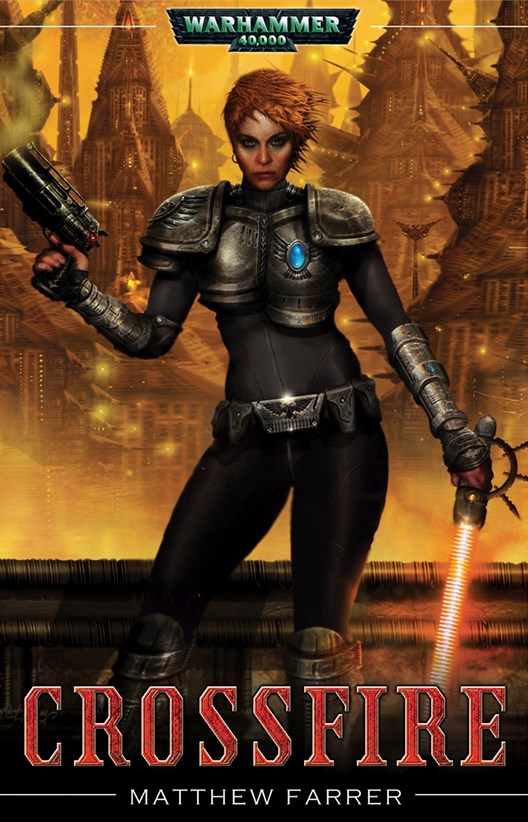
Warhammer 40,000: Crossfire by Matthew Farrer

Publisher: Black Library (Paperback – 1 January 2003)

Series: Warhammer 40,000: Shira Calpurnia – Book One

Length: 320 pages

My Rating: 4.25 out of 5 stars

Amazon

I finally got around to reading the awesome Warhammer 40,000 novel, Crossfire.  A classic entry in the Warhammer 40,000 canon with a cool crime fiction twist, Crossfire was a great novel that serves as an excellent first entry in Farrer’s Shira Calpurnia trilogy.

In the grim future of the 41st millennium, order and control of the massive Imperium of Man is maintained through the strictest interpretation of Imperial law, with no room for variation or leniency.  The ultimate arbitrators of this law are the dedicated members of the Adeptus Arbites, elite law bringers, trained to weed out corruption, dissent and disloyalty wherever they are deployed.

Shira Calpurnia Lucina, recently promoted arbitor senioris of the Adeptus Arbites, has been assigned to the bustling dockyards of the Hydraphur system.  A glistening gem of Imperial rule dedicated to providing material to the navy, Hydraphur is a seemingly unlikely place for dissention.  But this elite planet harbours dark secrets which come to the surface after a deadly assassination attempt is made in public against Calpurnia amid the distraction and celebration of a major religious festival.

Attempting to uncover who would want her killed after only just arriving on world, Calpurnia begins her relentless investigation.  However, this is no simple case, and soon Calpurnia finds herself forced to navigate the many plots and schemes of the Hydraphur elite.  With more attacks striking close to her and the fate of the whole planet seemingly in the balance, Calpurnia must uncover all Hydraphur’s secrets before the assassins stalking her finally succeed.

Crossfire was an excellent and compelling Warhammer 40,000 novel from Farrer that proved very fun to get through.  Featuring a fantastic plot that is one of the earlier examples of a crime fiction narrative melding with the iconic Warhammer 40,000 universe, Crossfire was a great read and one that is worth checking out.

I liked the captivating story that Farrer came up with for Crossfire, which quickly gets the reader’s attention with a powerful introduction to the protagonist, as she quickly finds herself under fire from a lethal assassin.  Serving as a good start to the main investigation arc, the plot follows the protagonist as she attempts to uncover the identity of the assassin, while also learning more about the planet of Hydraphur.  While a very lore-heavy story, Farrer keeps the plot going quickly and effectively, especially as there are soon more apparent attacks against the protagonist, each of which give her more clues to follow to try and find the mastermind of the plot against her.  At the same time the protagonist gets bogged down in dealing with various other interested parties on Hydraphur, including the planet’s local elites, agents of the Imperial church, the Adeptus Mechanicus and the Inquisition, each of whom have their own interests in finding out who is trying to kill Calpurnia.

While Farrer keeps up a good pace for Crossfire as the plot continues, I do think that he might have overloaded the narrative with details about Hydraphur’s society, as well as the various plots that infest it.  While these serve as good red herring motives for the protagonist to follow, it did overcomplicate the plot at times, which slowed things down even amid some great action sequences.  Despite this, the overall narrative for Crossfire was quite strong, and you get hooked into the continued investigation, especially as the author kept raising the stakes of the case.  After some exciting scenes, everything leads up to the big final confrontation, as the protagonist fully unwinds all the conflicting conspiracies they’ve been forced to encounter.  The conclusion was a sufficiently intense and over-the-top fight, which you need in Warhammer 40,000 fiction, and I liked the clever way the protagonist was able to turn the tables on the antagonist, even if the set-up for it was a little heavy handed.  An overall excellent Warhammer 40,000 plot that nicely tells its own story, while also introducing the character for the larger trilogy.

I’ve previously had a lot of fun with previous Warhammer 40,000 novels that utilise strong crime fiction elements in their story telling, such as Bloodlines by Chris Wraight and Grim Repast by Marc Collins, as there are some outstanding crime narratives in this grimdark universe. Crossfire is an interesting early example of this utilisation of crime fiction in Warhammer 40,000 fiction, and I felt that Farrer did a pretty good job of building a compelling investigation around this fantastic setting.  The resulting story is a layered and intense read that sees the protagonist slowly unwind the case amid various battle sequences and other dark distractions.  The relevant clues, hints and misleading details are well scattered throughout the plot, and I felt there was a good amount of foreshadowing to some of the key plot reveals.  While some story elements and conspiracies came a little out of nowhere, for the most part this was a concise and ordered novel, well told through the perspective of the protagonist.  Farrer excelled at fitting a ton of interesting and heavy lore elements in the plot, and I particularly appreciated how well he utilised his setting throughout the story.  The various plots and schemes of planet’s noble families and prominent organisations, as well as the elaborate religious festival the novel is set around (ceremonial details of which are cleverly included at the start of each chapter), are expertly worked into the larger plot, and it was fascinating to see how they impacted the story and drove the investigation.

One of the more entertaining elements of Crossfire I enjoyed was the narrative’s compelling characters.  The focus is primarily around series protagonist Shira Calpurnia Lucina, the arbitor senioris through whose eyes we see the story unfold.  Calpurnia serves as an interesting central figure, especially as she provides an outsider perspective to the complex setting.  While Farrer writes Calpurnia as a somewhat bullish and highly determined figure that is initially hard to appreciate, I felt that this was an intentional choice by the author, which reflects the typical attitudes of the Arbites in the general Warhammer 40,000 setting.  Forcing her to deal with the more subtle techniques needed for the politically delicate Hydraphur brought in some interesting conflict for Calpurnia, as well as producing some interesting character growth.  Despite this, the outsider status of Calpurnia continues to be a compelling plot feature throughout Crossfire, which Farrer utilised extremely well with his writing.  The rest of the cast, while less prominent, adds some complexity to the plot, and I enjoyed the compelling array of fellow Arbites members, the gentry of Hydraphur, and other prominent figures in the planet’s hierarchy.  I particularly enjoyed the motivations of the book’s eventual antagonist, which had a great hint of madness behind it, and this was an overall excellent group of characters.

While I really enjoyed Crossfire’s compelling story, I must admit that this wasn’t the easiest Warhammer 40,000 novel to read.  The plot details of Crossfire are very dense, and it takes a lot of effort to absorb and follow the story.  I felt this was especially noticeable in the small-print paperback version I had, and you really had to focus to take everything in.  As a result, this one probably wouldn’t be a recommended starting point for a new Warhammer reader.  Farrer utilises a lot of intricate details about the Warhammer 40,000 universe that even people casually familiar with the franchise are going to struggle to follow at times.  While most new readers can probably follow along well enough through context, I would suggest it’s best enjoyed by veteran fans who will probably have a lot more fun with it.

Overall, Crossfire by Matthew Farrer was an awesome Warhammer 40,000 novel, and one that I was glad I finally got the opportunity to read.  A compelling crime fiction novel that makes great use of Farrer’s complex setting, Crossfire proved to be an exciting and interesting read.  While not the easiest novel to get through at times, Crossfire proved to be an excellent piece of Warhammer fiction and I’m hoping to get through the rest of the Shira Calpurnia trilogy soon.

Amazon

Quick Review – The Wrong Hands by Mark Billingham

Publisher: Sphere (Trade Paperback – 25 June 2024)

Series: DS Declan Miller – Book Two

Length: 405 pages

My Rating: 4.25 out of 5 stars

Amazon

Bestselling crime fiction author Mark Billingham continues his DS Declan Miller series with the highly entertaining read, The Wrong Hands.

Billingham is an intriguing British crime fiction author who has an impressive catalogue of books to his name.  Best known for his long running DI Tom Thorne series, Billingham has also written an array of compelling standalone novels and audiobook exclusives.  His latest body of work is his DS Declan Miller series, which is a light-hearted crime fiction series focusing on an array of over-the-top characters.  Starting with The Last Dance, the DS Declan Miller books follow an eccentric police detective as he investigates unusual crimes in Blackpool, including the murder of his own wife.  The Wrong Hands is the second book in the series, and it proved to be another cooky investigation with a highly entertaining plot behind it.

Plot Synopsis:

This is one case Detective Miller won’t want to open . . .

The second rip-roaring mystery from multi-award-winning number international bestseller Mark Billingham starring Detective Miller: unique, unconventional, and criminally underestimated…

Unconventional Detective Declan Miller has a problem. Well, two problems. First, there’s his dead wife and her yet-to-be-solved murder. He really should stop talking to her ghosts…

Second, and most pressing, a young man has just appeared on his doorstep with a briefcase . . . containing a pair of severed hands. Miller knows this case is proof of a contract killing commissioned by local ne’er do well Wayne Cutler—a man he suspects might also be responsible for his wife’s death. Now Miller has leverage, but unfortunately, he also has something that both Cutler and a villainous fast-food kingpin are desperate to get hold of.

Sprinkle in a Midsomer Murders-obsessed hitman, a psychotic welder, and a woman driven over the edge by a wayward Crème Egg, and Miller is in a mess that even he might not be able to dance his way out of.


The Wrong Hands
was a highly entertaining and slightly outrageous crime fiction read that sets the author’s distinctive police detective protagonist against an unlikely assortment of criminals in a wacky, fast-paced plot.  Starting off with a very entertaining opening sequence that sees a world-class assassin and a local crime boss severely embarrassed by two local youths who managed to steal vital evidence, the book only gets even more fun from there as DS Declan Miller comes into possession of a pair of hands that could prove the key to locking up his rival and solving the murder of his dead wife.  However, to get there, Miller must first catch a dangerous killer, determine who the hands belong to, and protect anyone associated with the thieves responsible for the whole debacle.

I had an amazing time with this story, as Billingham loaded his plot with a huge array of over-the-top characters, each of whom proved fun to follow.  The plot moves at a very fast pace, and the author loads up some interesting clues and set-ups that result in some fantastic twists.  Much of the plot turns into an unlikely game of cat and mouse as Miller and his colleagues try to find the assassin before he strikes down everyone involved with the case.  I liked the captivating tension and unique story moments that led up to the big confrontation and the eventual solution to the book’s main plot proves to be quite enjoyable, especially as the villains are brought down from an unexpected source.  However, I must admit that I felt the author’s solution to the big crime of the series, the murder of the protagonist’s wife, didn’t get the epic solution it deserves, especially as the culprit kind of comes out of nowhere.  Still, this was an overall fantastic read and you really get wrapped up in the clever story.

Billingham utilises a distinctive stye that combines humour with compelling crime fiction scenarios.  While slightly derivative of the current craze around comedic murder mystery novels, The Wrong Hands still proved to be extremely entertaining, and I found the entire oddball scenario to be very compelling.  The quick change in focus between the various memorable figures involved in the case helped to give the novel some additional depth and comedic power, and I loved seeing the different angles to this entertaining narrative.  In addition, I felt that Billingham did a great job making The Wrong Hands a very accessible and easy to read book.  While The Wrong Hands does serve as a sequel to The Last Dance, new readers can easily dive into this latest book from Billingham without any issue, and the author ensures all the key plot points are expertly rehashed, allowing anyone to come in and have a great time with this fantastic novel.

While I loved the plot of The Wrong Hands and the way it was presented, the real fun lies in the unique characters themselves, as Billingham brings together an amazing and varied cast of niche crooks, crazed killers and troubled cops.  While I did think that Billingham may have tried a little too hard to make his protagonist, the dance-loving, unusual fact-spouting, rat-owning DS Declan Miller seem as quirky as possible, he still proved to be a great character to follow, and I felt that the author perfectly captured his grief, guilt and obsession with finding his wife’s killer.  His partner, DS Sara Xiu, proved to be an excellent foil to Miller, and even with her issues she worked as an enjoyable straight figure to Miller’s eccentric persona.  However, it is Billingham’s villains that really make The Wrong Hands stand out, as the author utilises an excellent collection of outrageous rogues.  This includes two crime bosses with alternate product focuses, whose neglectful family life proves to be their downfall, an elite assassin with a less-than-perfect naming convention and a love for Midsomer Murders, and a psychotic welder with some major issues.  These fantastically dark characters added a lot of impact to The Wrong Hands, and I loved seeing how their entertaining and often ironic storylines came together.

Overall, The Wrong Hands was an awesome and very fun new book from Mark Billingham, who let his ridiculous side loose to produce a fantastic crime fiction read.  Fast, funny, and loaded with outrageously complicated characters, The Wrong Hands is an easy book to get lost in, and I am glad I decided to pick it up.

Amazon

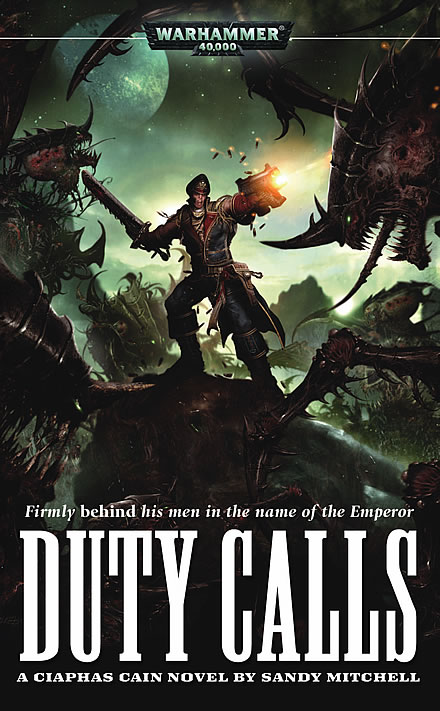
Warhammer 40,000: Duty Calls by Sandy Mitchell

Duty Calls Cover

Publisher: Black Library (Audiobook – 22 May 2007)

Series: Ciaphas Cain – Book Five

Length: 9 hours and 37 minutes

My Rating: 4.5 out of 5 stars

Amazon

One of the most entertaining authors of Warhammer fiction, Sandy Mitchell, continues to shine with the fifth book in his excellent Ciaphas Cain series, Duty Calls.

I doubt anyone is too surprised to hear that I broke a recent lull of reading by resuming the Ciaphas Cain series.  The Ciaphas Cain books, written by Sandy Mitchell (the alternate penname of author Alex Stewart), are an outstanding series that aims to bring a little humour to the crazy and dark battles of the gothic Warhammer 40,000 universe.  I have deeply enjoyed the first four books in this series, For the Emperor, Caves of Ice, The Traitor’s Hand and Death or Glory, and this honestly is one of the very best Warhammer 40,000 series out there.

Commissar Ciaphas Cain, hero of the Imperium and self-confessed self-serving coward, continues his exciting and deadly adventures when a new dark threat rises to destroy humanity.  After his last harrowing adventure with the Valhallan 597th, Cain is keen for a less deadly experience, and his new deployment to help crack down on civil unrest on the planet of Periremunda seems to be the ticket.  However, nothing is ever simple when Cain is involved.

Upon arriving on Periremunda, Cain quickly finds his life in danger as a series of assassination attempts are made against him.  Realising that his assailants are genestealers, the deadly scouts of the Tyranid swarm, Cain begins to understand the true danger Periremunda is in, as the genstealers herald the approach a Hive Fleet.  But unstoppable hordes of alien creatures are the least of Cain’s worries as he is reunited with his old flame, Inquisitor Amberley Vail.

Ostensibly on Periremunda to help the Imperial Guard stave off the Tyranid invasion, it soon becomes apparent that Vail is there for a darker reason.  Something incredibly important has been hidden on the planet that has the potential to change the entire Imperium.  Forced to assist Vail, Cain and his trusty aide, Jurgen, find themselves thrust into the deadly intricacies of a battle between hidden underground factions.  But with hungry Tyranids all around, deadly assassins gunning for Cain and a mysterious Chaos cult causing mischief, can Cain survive his deadliest encounter yet?

Duty Calls was an awesome addition to the Ciaphas Cain series that builds on several of the prior adventures, while also testing the protagonist in some fun new ways.  I loved the interesting story contained with Duty Calls, and this was one of Mitchell’s stronger additions to the series.

This fifth Ciaphas Cain novel had a great story behind it, although I am sure that prior readers will be familiar with the overall thrust of the narrative, with the seemingly cowardly Cain arriving on a new planet to face one threat, only to discover a much more dangerous enemy hiding beneath the surface that he is forced to reluctantly face and defeat, once again accidentally proving that he is a hero.  While Mitchell does try to break this story premise up throughout the series, this is a recurring story format, which can get a little too repetitive.  However, I think that Duty Calls stands on its own feet and Mitchell does a good job distinguishing it from the previous entries in the series.  The initial hidden threat of genestealers transforms into a massive Tyranid invasion, and it proved intriguing to see the protagonist face off against the ravening alien forces.  Tyranids are easily one of the best antagonists in the entire Warhammer 40,000 canon, and while they lose a little of their fighting ability in the face of Cain’s plot armour, they proved to be a great threat in Duty Calls.

While Mitchell could have probably left Duty Calls as simply a military novel, the inclusion of major recurring character Inquisitor Amberley Vail ensures that Cain is thrust into a much more subtle form of danger alongside the Tyranid invasion.  Caught between warring factions of the Inquisition and Adeptus Mechanicus, Cain is used as a pawn in the resulting shadow war, and there are some great scenes as Cain dodges assassination attempts, hidden Chaos cults, and other unseen dangers, all while trying to work out what the elaborate conspiracy is.  Novels that focus on the plots and conspiracies of Inquisitors are always very cool in the Warhammer 40,000 universe (see my reviews for Xenos, Malleus and Hereticus by Dan Abnett), and Mitchell fits Cain into this intrigue laden story arc extremely well.  It helped that there was some excellent set-up for this in the previous novel, and it was good to get a continuation here.  The resulting combination of storylines comes together really well, and Duty Calls has a really impressive and addictive narrative that will appeal to all fans of Warhammer 40,000 fiction.

As with the previous Ciaphas Cain novels, Mitchell does a great job of balancing the various elements of Duty Calls perfectly.  While primarily a military focused science fiction read, Duty Calls also has some great elements of intrigue and espionage, which ensures extra levels of excitement and danger.  However, I feel that the best part of Duty Calls is the inherent humour that Mitchell produces, which is a real rarity in Warhammer fiction.  Most of this is due to the hilarious and cynical narration of the main character, who pulls no punches when it comes to describing how ridiculous events are and the fact that he’s caught in the middle of them.  Extra humour is also built in due to the contained chronicle format that Mitchell has set the series out in, with the protagonist’s journal entries enhanced by extra documentation, descriptions, references and notes from Cain’s associate, Inquisitor Vail.  Vail’s sarcastic take on Cain’s description of events throughout these extra notes is a lot of fun, and the additional in-universe texts and broadcasts seek to showcase just how ridiculous humanity and the Imperium has gotten in the war-torn future, with over-the-top bits of propaganda and biased historical documents.  All this adds to quite a funny book, and this built-in comedy pairs remarkably well with the more serious parts of Duty Call’s narrative to create a truly addictive and fun read.

I felt that Duty Calls was a strong entry in the Ciaphas Cain series, especially as it builds nicely off the events of the preceding novel, Death or Glory.  Due to the series looking at different time periods of Cain’s career, Duty Calls is set between the second and third books, although it makes a lot of references to the first novel, and the events of Death or Glory, which took place many years before.  While the jumps around the timeline are a little confusing, Mitchell makes it work, and I liked seeing the return of several recurring characters, as well as a continuation of some mysterious storylines from the previous book.  Despite these connections, Duty Calls also works quite well as a standalone novel, and new readers can jump into the series here without too many issues.  Indeed, Duty Calls is a good introduction to both the Tyranids and the Warhammer 40,000 universe, and the Ciaphas Cain books are very much engineered for new Warhammer fans.  I will say that after reading several Ciaphas Cain books in a row, Mitchell’s proclivity for repeating elements from his other novels is a bit more obvious, and you do get a little weary of hearing the same phrases, descriptions and character depictions again and again.  Still, Mitchell ensures that Duty Calls is a particularly entertaining read, so its easy to really get stuck into it, and I deeply enjoyed seeing this unique series continue.

As always, I must mention the great characters featured within Duty Calls.  The most prominent of these is series protagonist Ciaphas Cain, who might be one of the more complex and debated figures in the Warhammer 40,000 canon.  Shown by his own admission to be a coward and a false hero, Cain spends most of the book trying to come up with ways to avoid combat and surviving the inevitable battles that his reputation and own bad luck force him to participate in.  His memoirs are filled with cynical allusions to the methods he utilises to survive, and you can see that Mitchell is trying to emulate classic characters like Flashman or Blackadder.  However, despite the character’s constant assurances that he is no hero, you see time and time again that there is far more to Cain, as he routinely defeats the enemy, often thanks to his own caution, survival instincts and ability to inspire his fellow troops.  I love how you are constantly rooting for Cain, despite his attempts to weasel out of trouble, and his self-deprecation about his actions really makes you feel for him, especially as its apparent that he is just one filled with self-doubt after not being an over-the-top martyr like the other heroes in the Warhammer 40,000 universe.  At the same time, Cain also provides a lot of the book’s humour, as you are bombarded with his fun comments and cynical attitude about everyone he encounters.  As such, I really appreciate Cain as a central character in this series, and it is always so much fun to follow him throughout his adventures.

Aside from Cain, there is an interesting array of characters featured in Duty Calls who I had a lot of fun with.  Many of them are recurring from the previous novels, and it was good to see various familiar faces again.  This includes Cain’s faithful aide, Jurgen, who Mitchell portrays in a manner like Baldrick from Blackadder, due to his apparent gormless attitude and poor personal hygiene.  However, in many ways Jurgen is just as much a hero as Cain, often being the one to save the day with his skills and big gun, and he forms a great team with Cain, especially as his Commissar is usually the one drawing the enemy’s attention from his aide’s attacks.  I also really enjoyed seeing the return of Inquisitor Amberley Vail, both as a character in Cain’s adventures and the person publishing his memoirs.  Vail proves to be the perfect foil to Cain for many reasons, and I like how she’s the only person who can effectively manipulate Cain and doesn’t fall for his lies and schemes.  Vail constantly calls out Cain, both in person and through the footnotes she amends to his chronicles, and I love how she has his number, while also clearly caring for Cain as a partner.  Duty Calls really shows just how dangerous Vail can be though, especially as she gets into the fight and makes some tough decisions.  Other interesting characters include several familiar soldiers from the Valhallan 597th, the outrageous members of Vail’s inquisitorial retinue, and a several intriguing antagonists who prove to be great and over-the-top opponents to the sensible Cain.  All these characters added a lot to the impact of the book, and I cannot wait to see how they fit into Cain’s adventures again in the future.

Readers who have seen my previous Ciaphas Cain reviews know that the only way I am going to enjoy this series is through its audiobook format.  All Warhammer novels make awesome audiobooks, but the Ciaphas Cain audiobooks are something particularly special thanks to the use of multiple narrators.  Duty Calls features six separate narrators who add a great deal to the production thanks to their fantastic voices and entertaining takes on the characters and universe.  Most of this narration is done by the superbly talented Stephen Perring, who lends his voice to all the chapters told from Cain’s perspective.  As such, he covers most of the first-person action and adventures of the main character, and his take on the complex Cain and his colleagues is exceptional.  The way he captures the various aspects of Cain’s character through his voice work is impressive, and you really get a sense of the multiple layers surrounding his motivations.  Perring also does a really good job of capturing the other intriguing characters Cain interacts with, including his aid Jurgen, and the eclectic members of the Inquisition that crosses his path.

After Perring, the most prominent narrator is Penelope Rawlins, who provides narrations for the various inclusions written by Inquisitor Vail.  As such, Rawlin’s voice is constantly interjected into the audiobook at various points as she reads out the footnotes, context pages, and personal remarks from Vail, as she attempts to make Cain’s story more readable.  Rawlins has really perfected her Vail voice over the course of the series, and it is always great to have the playful, informative, and often gently exasperated tones of a chronicling Inquisitor come through the plot.  There is also some good contrast between Perring and Rawlins, especially as both voice the character of Vail throughout Duty Calls, and they serve as a winning main team.

The other four narrators, Emma Gregory, Richard Reed, Tara Rawson and Andrew James Spooner are also very fun, even if they are used a little sparingly.  These four narrators’ voice extracts from various in-universe texts, chronicles and new casts that Inquisitor Vail has added to Cain’s manuscripts to give them more context.  These talented narrators go all out in voicing these intriguing and often over-the-top inclusions, and I love the humorous spin their excellent narration adds to them as a result.  Gregory is particularly noteworthy, especially as she once again voices the ridiculously patriotic memoirs of an officer fighting alongside Cain, but all these extra narrators do such a great job.  This excellent and entertaining combination of voice actors and audiobook narrators turns Duty Calls into a real treat to listen to, and I honestly cannot recommend this format enough to anyone interested in checking out the Ciaphas Cain series.

I continue to fall further in love with the Ciaphas Cain series as Sandy Mitchell produces another amazing and fun story in Duty Calls.  Loaded with action, humour, and a particularly complex protagonist, Duty Calls had everything I’ve come to expect from the Ciaphas Cain series, and I deeply enjoyed how Mitchell continues to showcase the Warhammer 40,000 universe in his own distinctive way.  I can think of no better way to highlight just how much of a great time I had with Duty Calls than to reveal that I automatically started listening to the sequel Cain’s Last Stand, the moment I finished it.  Highly recommended to all Warhammer fans and new readers wanting some fun science fiction adventures.

Amazon

Lone Wolf by Gregg Hurwitz

Lone Wolf Cover 2

Publisher: Michael Joseph (Trade Paperback – 20 February 2024)

Series: Orphan X – Book 9

Length: 420 pages

My Rating: 4.5 out of 5 stars

Amazon

Leading thriller author Gregg Hurwitz continues his high-octane Orphan X series in a big way with the epic and compelling novel, Lone Wolf.

The Orphan X books by Gregg Hurwitz is an epic series that follows a former elite government assassin, Evan Smoak, known to the intelligence community as Orphan X.  Upon leaving the program, Smoak decided to make up for his prior misdeeds by becoming an elite vigilante, The Nowhere Man, who helps those with nowhere else to turn.  This series started back in 2016 with Orphan X, although I personally started reading it with the fourth book, Out of the DarkOut of the Dark had a great plot behind it that really drew me in, as Evan went to war with a corrupt US President.  This resulted in an amazing and highly entertaining read that made me a fan of Hurwitz’s writing and ensured I would grab the next book in the series, Into the FireInto the Fire was a particularly epic read, and the Orphan X books quickly entered my yearly must-read books list as a result.  I have since had an outstanding time reading the following releases, with Prodigal Son, Dark Horse and The Last Orphan being awesome in their own way.  As such, when 2024 came around, I had very little choice but to read the latest Orphan X book, Lone Wolf, which took the protagonist in another interesting direction with a deadly adventure.

Evan Smoak, better known as either as Orphan X or the Nowhere Man, is suffering a personal crisis.  Having reached out to his long-lost father, Evan is in a dangerous emotional spiral, and is no longer the calm and confident secret agent he once was.  Looking for an easy mission to get back into his stride, Evan finds himself with an unusual job, helping a young girl find her lost dog.  Initially reluctant, Evan agrees to help, but this unlikely job will lead the infamous vigilant into all manner of trouble.

An elite female hitwoman is in Los Angeles, taking out a range of seemingly unconnected people.  Known only as the Wolf, she excels in targeted strikes and apparent accidental deaths, leaving no trace behind.  However, her final kill leaves behind two witnesses when Evan arrives on the scene looking for the lost dog.  Forced to intervene to save the daughter of the Wolf’s last victim, Evan finds himself a target of an assassin just as deadly as himself.

With the girl he just saved still in danger from a vengeful Wolf, Evan decides to save her and stop this killer terrorising his city.  But first, he needs to work out who hired her and what secrets lie behind their deaths.  His investigation leads him to two rival tech billionaires, both of whom had a motive for hiring the assassin and organising the killings.  To save the day, Evan needs to find out which of them is responsible and destroy them and the psychotic killer they hired.  But is the emotionally compromised Nowhere Man up to the task?

Lone Wolf was another outstanding addition to the Orphan X series that really showcased Hurwitz’s distinctive writing style.  Blending an intense, action-packed story, with some outstanding character development, this was an amazing book that I deeply enjoyed reading.

Hurwitz comes up with a pretty excellent story for Lone Wolf that dragged me in very quickly.  Starting off with some intense and personal character work around Evan Smoak that follows through from the last few books, Hurwitz does a good job setting the scene for much of the story off the bat, especially when it comes to the protagonist’s distracted headspace and his reliance on his unconventional family.  The author also spends this time introducing one of the book’s main villains, the Wolf, who serves as an effective mirror for Orphan X.  This initial setup works very well, as you quickly get drawn into the plot by the Wolf callous nature, while also getting invested in the protagonist’s emotional well-being.  These story aspects quickly collide, as Evan, who finds himself helping his recently discovered niece, accidently intrudes upon one of the Wolf’s kills.  The resulting extended action sequence is glorious, as Evan is forced to contend with the assassin and an army of cops, while trying to keep the daughter of the Wolf’s last victim alive.  This entire action scene is a major highlight of the first half of the book, and Hurwitz wrote a brilliant continuous and frenetic chase sequence that pushes Evan to the limit.

Following this chase sequence, the pace of the book slows down a little, although Evan still finds himself in trouble as he enters a game of cat-and-mouse with the Wolf over the fate of the bystander he just saved.  Forced to determine who hired the Wolf, Evan begins a compelling investigation angle where he probes two rival billionaires with twisted and unique morals.  At the same time, Evan also finds himself in several intriguing personal situations, including trouble with his half-brother, mentoring his adopted daughter, and even a rather entertaining side-story about a battle for control of his building’s HOA.  These work to keep the unique feel of the Orphan X series intact, and I loved how emotionally rich the book got at times.

The final third of Lone Wolf is mostly awesome, starting off with a great sequence that sees Evan interrogate a gang of thugs who have details he needs about the Wolf.  The very entertaining and over-the-top way he goes about getting said information is so damn good, and it was another major highlight off the book.  Unfortunately, the rest of the novel seems a little rushed, and frankly Hurwitz could have benefited from including another 100 pages or so to really wrap everything up perfectly.  While it is still a fun and exciting read, the reveal about who is truly behind everything isn’t too surprising, despite some attempts at misdirection.  In addition, the final confrontation against the main antagonists is somewhat weak, and could have been a little more epic, especially as one character went down way too easily.  Still, the deep character development aspects of the story end up being extremely strong, and I liked the intriguing final twist that is going to cause additional drama in the next book.  As such, I felt this was a really good story and I got so wrapped up in it.

I really enjoyed how Lone Wolf came together, especially as Hurwitz brought his usual blend of intensity and compelling human moments to this latest book.  There is a great balance here between character development and thriller action, which I deeply appreciated.  Indeed, I felt this was one of the better-balanced novels that Hurwitz has written recently.  While the action sequences are always the highlight of this book, I have really appreciated how Hurwitz seeks to offset them with more typical moments, and the focus on character relationships and ordinary occurrences, such as a funny HOA election, adds a certain level of fun to the book.  I really do think this was a great entry in the Orphan X series, and like most of the books in this series, Lone Wolf can mostly be read as a standalone, as Hurwitz is good at revisiting the key plot points from the previous books.  However, those readers going in with a greater understanding of some of the characters, especially the protagonist and his complex relationships, will get a bit more out of this book, and it was fantastic to see the further development.

As I have alluded to a few times above, a lot of Lone Wolf’s strength lies in the excellent character work that Hurwitz layers into the story.  Much of this is done to attempt to humanise the usually deadly protagonists featured within, especially as many of them are trying to adjust to a more civilian focused life after years being government assassins.  The most prominent of these is Evan Smoak, the infamous Orphan X who his trying to redeem himself as the Nowhere Man.  While Evan is usually a calm figure, minus his OECD, in this book he finds himself completely outside of his headspace as a bad encounter with his biological father at the start throws him completely out of whack.  This was a very interesting situation, and it was really moving to see this implacable figure so out of sorts and relying on his family, both adopted and newly discovered, to find himself.  Watching Evan grapple with the many personal battles surrounding him is an amazing part of the book, and you really get drawn into his emotional concerns.  At the same time, Evan continues to struggle with the more mundane elements of a normal existence, and the various awkward encounters he has with certain family members and the residence of his building, show you just how lost and damaged he truly is.  All this results in a great portrait of a complex figure, and Evan Smoak is honestly one of the best and most unique thriller protagonists out there.

While Evan is the focus of the book, he would be nothing without the unique array of side characters that have been drawn to him over the years and who supporting him in various ways.  The most prominent of these is Joey Morales, Evan’s surrogate daughter and former trainee spy who serves as his tech support.  Flippant, immature and only slightly more normal than her mentor, Joey serves as the major humanising force in Evan’s life and is a key ally, despite being a teenager.  Joey is always a fun highlight, especially as she can push the protagonist’s buttons while bringing out his protective side.  However, I liked how Hurwitz showed in Lone Wolf that despite her advanced knowledge of the world of espionage, she is still a teenager girl, and the scenes where Evan talks her through a social crisis, is surprisingly heartwarming and really captures their close relationship.  The other major character is Tommy Stojack, Evan’s armourer and one of the few constant figures in his life.  While cantankerous and unusual, Tommy serves as Evan’s rock for much of the series, and it was great to see him in this role again.  While Tommy isn’t too controversial in Lone Wolf, there were some interesting developments with him that are going to be cool to follow in the next book.

Of course, no thriller would be complete without its villains, and Hurwitz did a great job of this with both the Wolf and the nefarious billionaire who may be behind her.  Both are threatening in their own way, although I think I preferred the Wolf, as her deadly skills, ruthlessness, and enjoyment of the kill, made her an interesting opponent for Evan.  The billionaire figure was also great, and his various monologues about the state of society and how his control of personal information allows him to control people in so many ways, was nearly as menacing as the killing.  Throw in some intriguing new family elements for the protagonist, as well as the eccentric residence of his apartment complex (minus his long-term love interest who has been seemingly cut from the books), and this was an excellent group of characters whose interactions deeply enhanced the narrative.

Gregg Hurwitz continues to impress with his latest addition to the very cool Orphan X series with Lone Wolf.  An emotionally charged thriller with powerful character work, Lone Wolf is an outstanding read that comes highly recommended.  I cannot wait to see how Hurwitz follows up Lone Wolf in the future and I remain a massive fan of this amazing series.

Lone Wolf Cover

Amazon

Quick Review – The Last Orphan by Gregg Hurwitz

The Last Orphan Cover 2

Publisher: Michael Joseph (Trade Paperback – 21 February 2023)

Series: Orphan X – Book 8

Length: 342 pages

My Rating: 4.5 out of 5 stars

Amazon

The always impressive Gregg Hurwitz continues his amazing Orphan X series with the awesome and wonderful new addition, The Last Orphan.

One of my favourite spy thriller series at the moment is easily the exciting and cool Orphan X series by rising thriller author Gregg Hurwitz.  This fantastic series follows a former elite government assassin, Evan Smoak, codenamed Orphan X, who is forced to go rogue and hide himself away from his old employers.  Hoping to redeem himself after all the killing he’s done, Evan takes up a new identity, the Nowhere Man, a vigilante who helps the most desperate people in ways no one else can.  I have been a fan of this series for ages, ever since I read Out of the Dark, which pitted the protagonist against a deranged US President.  Since then, I have had an outstanding time reading the latest books in the series, including Into the Fire, Prodigal Son, and Dark Horse.  I always make it a point to pick up the new Orphan X book each year, and the latest entry, The Last Orphan, was another pretty awesome book that I was quickly able to power through.

Plot Synopsis:

As a child, Evan Smoak was plucked out of a group home, raised and trained as an off-the-books assassin for the government as part of the Orphan program. When he broke with the program and went deep underground, he left with a lot of secrets in his head that the government would do anything to make sure never got out.

When he remade himself as The Nowhere Man, dedicated to helping the most desperate in their times of trouble, Evan found himself slowly back on the government’s radar. Having eliminated most of the Orphans in the program, the government will stop at nothing to eliminate the threat they see in Evan. But Orphan X has always been several steps ahead of his pursuers.

Until he makes one little mistake…

Now the President has him in her control and offers Evan a deal – eliminate a rich, powerful man she says is too dangerous to live and, in turn, she’ll let Evan survive. But when Evan left the Program he swore to only use his skills against those who really deserve it. Now he has to decide what’s more important – his principles or his life.


The Last Orphan
was another outstanding entry in this great series and Hurwitz ensures that it features all his trademark features, including strong characters, a powerful emotional heart, and a ton of action and intrigue.

This latest Orphan X book has a very strong start to it as Evan is ambushed right at the beginning of the novel by a massive Secret Service detail, determined to finally bring him in after he went rogue on the President a few too many times.  Captured and trapped, Evan is forced to make a deal: kill mysterious industrialist Luke Devine or lose his own life.  However, Orphan X makes his own decisions about who he assassinates, and after escaping, he begins his own research into his target, hoping to determine if he deserves to die.  Investigating a mysterious death associated with Devine’s estate and the massive parties that go on there, Evan begins to make his own connections about the case and is forced to go up against Devine’s lethal and morally dangerous security detail.  There are some pretty intense scenes in this part of the book as Evan makes some curious discoveries about Devine and his company, while also being forced to protect potential witnesses from his target’s security.  At the same time, Evan begins to wonder if Devine actually deserves to die and must soon choose between his conscious and his peaceful life of anonymity.

This was a pretty good entry in this series, although possibly not the best that I have so far read (in my mind, that’s Into the Fire).  I really liked the awesome start to The Last Orphan, especially as the over-the-top and intense capture by the Secret Service was so damn cool and it was interesting to finally see Evan taken down by the Government.  However, this doesn’t last long, and once he rather easily escapes, the intensity and pace of the story kind of slows down a bit.  Don’t get me wrong; I did really enjoy the subsequent storyline set around the investigation into the mysterious industrialist and his security crew, but it was a bit of a step down after the initial excitement.  Still, this second half of the novel is a ton of fun, and Hurwitz presents his usual blend of fascinating spy thriller moments, particularly intense and brutal action, as well as the focus on Evan’s strained and unique personal life.

The villains of this story, Devine’s security detail, are some pretty over-the-top but genuinely threatening figures, and Hurwitz comes up with some excellent scenes around them, even presenting them as real threats to the protagonist.  At the same time, Hurwitz works in a very compelling morality edge to the story, as Evan tries to work out whether Devine is actually evil or just a political threat to the President.  The author makes this determination pretty hard, especially as Devine comes across as a very manipulative and unusual figure who manages to make even the legendary Orphan X doubt himself.  The big conclusion of this books is very good and features all the typical action and carnage that you would expect.  However, parts of the story go in some very surprising directions and I liked the unique ideas that Hurwitz presented here.

In addition to all the action and intrigue, quite a lot of The Last Orphan revolved around the compelling and moving emotional and personal concerns of the protagonist and his great supporting cast.  Evan has always been a very complex figure due to his unusual upbringing, his lack of personal skills, and his crippling OCD, and a fantastic recurring theme of the books has been him trying to overcome this and finally make some connections.  This continues extremely well in The Last Orphan, as he once again relies on his friends and his surrogate daughter/little sister to pull him out of the fire and keep his sanity.  There are some pretty emotional interactions between Evan and these figures throughout the course of The Last Orphan, especially as it appears that Evan might not be able to come back from his latest adventure, and I felt that this was another powerful and impressive evolution of some already deep character growth.  There are some other pretty big personal moments for Evan in The Last Orphan, including the seeming end of one relationship due to Evan’s fugitive status, and the potential development of another as Evan finally attempts to dive into his own complex past.  It will be fascinating to see how this develops in the future, and I am sure that Hurwitz has some very intense moments planned for all of us.  I honestly felt that the author got the right balance between action and emotion for The Last Orphan, and this ended up being a stronger book as a result.

Overall, The Last Orphan was a pretty awesome new entry in the great Orphan X series, and I really liked how Gregg Hurwitz continued his fantastic ongoing narrative.  Featuring an excellent blend of spy thriller fun and powerful character work, The Last Orphan was an addictive and clever read, and I am glad I got the chance to check it out.  Highly recommended, especially to established fans of the series, The Last Orphan is really worth the read.

Amazon

Seventeen: Last Man Standing by John Brownlow

Seventeen Cover

Publisher: Hodder & Stoughton (Trade Paperback – 26 July 2022)

Series: Standalone/Book One

Length: 409 pages

My Rating: 4.5. out of 5 stars

Amazon

Acclaimed screenwriter John Brownlow presents one of the most entertaining and awesome debuts of 2022 with the compelling action thriller, Seventeen: Last Man Standing.

In the shadowy world of contract killers, assassins, and rogue operatives, the man at the top of the totem pole is simply known by a number.  For over 100 years, these elite assassins have kept the world in order by committing kills for every government, no questions asked.  Sixteen individuals have previously held the title as world’s greatest assassin during this time, and the current holder of the title is Seventeen.  Feared by every killer around the world, Seventeen knows that his career can end at any moment, as it only takes one mistake for an ambitious assassin to take his place and become Eighteen.

After completing a mysterious job in Berlin, Seventeen finds himself at a crossroads, concerned about his future and considering his past.  However, everything is put on hold when his handler gives him startling clues that hint that his predecessor, Sixteen, who had vanished without a trace, is still alive.  The only way for Seventeen to keep his position in the assassination hierarchy is to kill the man who held the title before him, and if he refuses every assassin in the world will be on his back. Tracking Sixteen to a location in the middle of nowhere, South Dakota, Seventeen finds his target hidden in a fortress, and must try to find a way to kill the only assassin the world who might be better than him.

As he plans for what might be his greatest kill, Seventeen finds himself caught between all manner of complications.  Not only is his target near perfectly protected, but he soon finds himself falling for a girl in the local town.  Worse, it appears that his latest job may have been a setup, and now Seventeen finds himself one of the most wanted men in the world.  Caught between his deadly predecessor and every assassin and government agency on the planet, can Seventeen once again prove that he’s the best in the world, or is someone about to take his title and become Eighteen?

Brownlow presents an exciting and captivating read with his debut novel, Seventeen (also titled Seventeen: Last Man Standing), which I had an amazing time reading.  Featuring an action-packed and incredibly fast-paced story, I ended up powering through Seventeen in a bit over a day, and I had a fantastic time doing so.

I absolutely loved Seventeen’s outstanding narrative, which pits rival assassins against each other in an entertaining and impressive fight for survival.  The story is primarily told from the perspective of Seventeen, who is recounting his adventures to the reader.  Starting off with a brutal mass assassination, you quickly get a handle on the protagonist, his skills and his quirky style, as he commits several murders, before getting involved in another job.  From there, he finds himself coerced into finally hunting down and killing his missing predecessor, Sixteen, to secure his reputation.  Forced to find a way around Sixteen’s elaborate security, Seventeen starts to grow close to a woman in the local town, while also considering his future and the potential fallout from his last mission.  At the same time, there are a ton of flashbacks to Seventeen’s tragic past, which show how he became a killer and his road to becoming the world’s top assassin.  Seventeen’s eventual attempt on Sixteen leads to a massive confrontation, where nothing goes the way you think it will.  There are some great confrontations in the second half of the book, and the fights between Sixteen and Seventeen are pretty damn epic.  Throw in some dangerous outside interference and a massive conspiracy, and you are left with an excellent and powerful narrative that you really struggle to put down, even if it is very, very late at night.

Brownlow did a wonderful job setting his story out, and it was designed to keep your constant attention.  I have already talked about how much I enjoyed the fast pace of this book, and there are literally no slow spots during this read as the protagonist is constantly recounting action, spycraft, fun interactions, character development or flashbacks to his tragic past, all of which proves to be extremely entertaining.  The author makes excellent use of a substantial number of shorter chapters, which really helps with the pacing, as you are more likely to decide to keep reading for another chapter when it is only a few pages away.  This, combined with the exceptionally written and highly detailed fight sequences, really keeps your eyes attached to the page.  There are a ton of highly cinematic action scenes in this book, including shootouts, car chases, hand-to-hand fights, and even a bad encounter with a bear, which were very fun to read.  I also loved the fantastic depictions of assassination tradecraft contained within this book, and Brownlow provides an intriguing look at the protagonist’s preparations, as well as the unique methods he uses to find his target.  There are some very fun moments featuring the protagonist’s attempts to get close to Sixteen, and Brownlow writes a very entertaining story around death and assassination.  All this action and quick-paced writing melds well with the author’s excellent sense of humour, and there a ton of great jokes, entertaining observations and unusual situations that add a good comedic edge to much of the book.  These elements, as well as an outstanding central protagonist, really increased my enjoyment of the narrative, and I cannot emphasise enough how quickly I was able to fly through this book.

Finally, I rather enjoyed the fantastic characters contained within this book, as Brownlow writes an excellent story around them.  Naturally, the attention is primarily on the titular Seventeen, who tells most of the story.  Seventeen is a very enjoyable character to follow and I grew attached to him very quickly.  As smooth and talented as any movie assassin or action hero you are likely to find, Brownlow adds in some interesting personality traits that worked really well.  Not only does he have a brilliant sense of humour, which really comes across in the first-person writing style, but there is also a notable bit of weariness at the assassination lifestyle deep within him, which starts to drag at him as the book continues.  Despite a successful life as a killer, he is starting to regret some of his more recent actions, and this change of mindset becomes a key part of his character arc, especially when other dangerous individuals start to sense it.  Brownlow also comes up with a suitably tragic and compelling backstory for Seventeen, which is slowly revealed to the reader as the novel continues.  This backstory was pretty deep and traumatic, and it helps you to bond even more with Seventeen, once you see all the terrible things that drove him into his current career, and these elements really help cement him as an amazing and flawed central protagonist.  Additional characters I need to highlight include Sixteen, who serves as a fantastic foil to Seventeen, especially as he has the veteran instincts and a much more defined sense of cynicism, while also being haunted by the ghosts of his past.  I also deeply enjoyed the female leads of Kat and Barb, who serve an interesting role in the book.  While they are primarily used as damsels in distress for most of the book, Brownlow does add in some fantastic backstory and gives them each their own defining moments, which I enjoyed.  Plus, both are the biggest critics of the two main assassins in this book, and their fun takes on their deadly rivalry are pretty entertaining.  These characters, and more, add a great deal to the plot, and I enjoyed getting to know them here.

Overall, Seventeen was a pretty awesome novel that I had an epic time reading.  John Brownlow’s outstanding debut had all the action, adventure and fun characters you could ask for, and I found Seventeen to be quite an addictive read.  I look forward to seeing what this intriguing new author presents in the future, and I have a feeling that Brownlow is going to be an exciting voice in thriller fiction for years to come.

Amazon

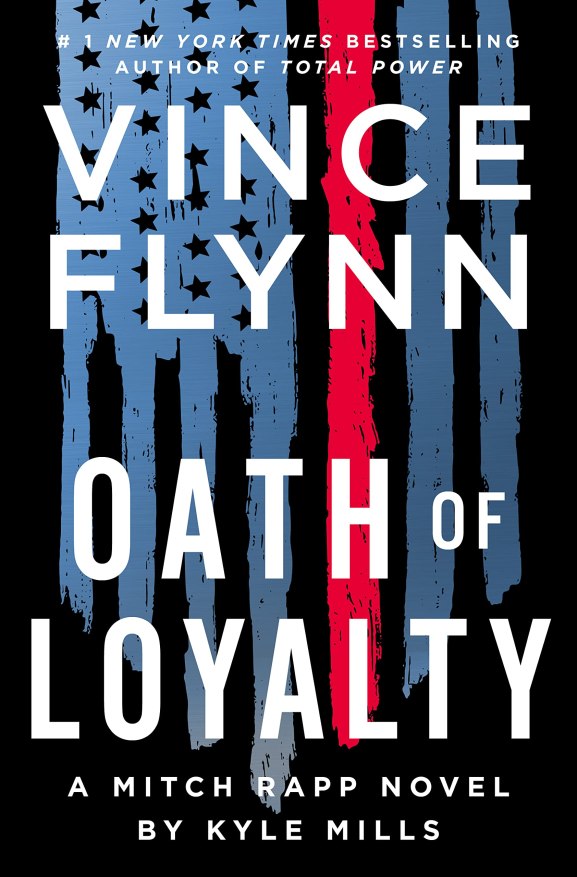
Oath of Loyalty by Kyle Mills (Based on the series by Vince Flynn)

Oath of Loyalty Cover

Publisher: Simon & Schuster Audio (Audiobook – 13 September 2022)

Series: Mitch Rapp – Book 21

Length: 9 hours and 23 minutes

My Rating: 4.5 out of 5 stars

Amazon     Book Depository

Fantastic spy fiction author Kyle Mills continues his excellent stewardship of the late, great Vince Flynn’s Mitch Rapp series, with the new action-packed thriller, Oath of Loyalty.

I have had a lot of fun with some cool spy thriller series over the last few years, but one series that keeps on pulling me back in is the ultra-compelling Mitch Rapp series.  Originally written by Vince Flynn, the Mitch Rapp series follows rugged American spy Mitch Rapp as he wages a brutal war against America’s enemies.  While sometimes a little too nationalistic for my tastes, the Mitch Rapp series nonetheless has some outstanding and inventive scenarios in its arsenal, with the protagonists forced to take on some dangerous enemies and crazy situations.  Since Flynn’s death, the series has been taken over by Kyle Mills, who has continued the tradition of compelling high-concept spy action.  I have had a great time reading Mills’s recent contributions to this series, with awesome reads like Red War, Lethal Agent, Total Power and Enemy at the Gate, all of which were extremely fascinating stories that proved very hard to put down.  As such, I am always very keen to check out the new Mitch Rapp adventure, and I was really drawn into the fascinating plot of the 21st Mitch Rapp novel, Oath of Loyalty.

After a lifetime of protecting the country he loves from terrorists, enemy nations and foreign spies, the shoe is on the other foot as Mitch Rapp finds himself as America’s most wanted man.  The corrupt and paranoid President Anthony Cook is determined to shape America into a personal kingdom that he and his calculating wife can rule for years.  However, after Mitch Rapp foils Cook’s plan to destroy his greatest rival, Rapp is now in the firing line.

Convinced that Rapp will attempt to assassinate him, especially as his actions have resulted in the death of one of Rapp’s oldest friends, Cook attempts to eliminate him, only to have Rapp slip through his fingers.  With neither side wishing to be at war with the other, the President and Rapp manage to negotiate a truce through former-CIA director Irene Kennedy, by which Rapp will remain untouched if he agrees to leave America and stay in plain sight for as long as the Cooks control the White House.  However, the ambitious new head of the CIA is determined to win the President’s influence and manages to convince Cook that Rapp still plans to kill him.  To stop Rapp from coming after them, the new administration decides to attack those closest to him by leaking the identity and location of Rapp’s partner, Claudia Gould, to her many enemies.

Soon, everyone Claudia and her dead assassin husband ever crossed is out to get her.  Despite Rapp’s violent reprisals against her attackers, the threat increases dramatically when one of Claudia’s old enemies hires the infamous Legion.  Legion is a completely anonymous team of assassins who rely on secrecy and never meet their client in person.  No one knows who they are; all they know is that once Legion accepts a contract they don’t stop until their target is dead, no matter how long that may take.  With their country turned against them, can Rapp and his allies save Claudia from this new threat before it is too late, or will he lose another woman he loves?

Kyle Mills continues to showcase just how awesome a Mitch Rapp novel can be with this fantastic new entry.  Perfectly utilising all the typical action, intrigue and political insight that the latest Mitch Rapp books have all been known for, Oath of Loyalty features a fantastic narrative that I really got stuck into.  This was another impressive and fun spy thriller read, and I ended up powering through this book in no time at all.

Oath of Loyalty had another excellent Mills narrative that took the protagonist on a wild adventure of survival, revenge, and political upheaval.  The start of the book contains a detailed prologue that replays the closing scene of the prior novel, Enemy at the Gate, which was a good recap to start off with.  The rest of Oath of Loyalty seamlessly follows on, showing Mitch Rapp in the crosshairs of the new President and his corrupt administration.  After a great escape sequence, Rapp flees to South Africa and arranges a truce, and begins to watch the decline of America from afar.  However, the President is far from done with him, and his fearmongering advisor convinces him to keep Rapp occupied while they prepare for his potential retaliation.  Rapp is forced to defend Claudia and her daughter from several dangerous assassins, which includes one particularly impressive action sequence as Rapp fends off an entire hit squad by himself.  This results in some A-grade vengeance as Rapp goes after Claudia’s enemies in retaliation, which naturally includes some very over-the-top results.

However, the characters find themselves in dire straights when one enemy hires the unstoppable Legion assassin team, who specialise in elaborate kills.  Mills sets up Legion extremely well, and the reader is soon engrossed in watching the cat-and-mouse game that emerges between them and Rapp.  At the same time, Rapp and his allies are forced to contend with a selfish and power hungry president who is determined to destroy them all.  The second half of the book has some great sequences, and I loved seeing Legion’s actions and their attempts to get past Rapp, and the protagonist finds himself in a tough situation, especially as his limited help sometimes proves to be even more dangerous than his opponents are.  Everything leads up to a fantastic and very entertaining conclusion, which I think worked very well.  While I did think that part of the solution was a little silly when it came to just how threatening the protagonist could be, this was a pretty amazing story and I had a wonderful time getting through it.

I felt that Mills did a great job setting out Oath of Loyalty’s narrative, and there are many great elements to it that make it so much fun to read.  The author makes excellent use of multiple character perspectives to showcase the fun narrative, and it was awesome to see the various sides of the story.  I especially liked the parts of the book shown from several antagonists’ standpoints, and it was great to see the simultaneous moves and counter-moves that Rapp and his opponents put into play.  Like the rest of the Mitch Rapp books, Oath of Loyalty has several great action scenes that come together extremely well.  The brutal combat is crisp and flows off the page perfectly, ensuring that every action junkie can imagine just how the protagonist is kicking ass.  This works in concert with the book’s outstanding espionage elements, which Mills features so very well here.  I love the author’s take on spy craft in Oath of Loyalty, and there is a gritty realism to how Rapp and his allies go up against their foes, especially as this time they are going up against the American intelligence apparatus.  Oath of Loyalty is also well paced out and readers are left with barely a second to breathe between the various exciting or compelling sequences of espionage, or political malfeasance.  All this, and more, definitely helped me stayed glued to Oath of Loyalty and I really got stuck into the cool narrative and couldn’t wait to see how it all came together.

While characters are never the strongest part of a Mitch Rapp novel (I always felt that the protagonist was a tad one-dimensional), I did like how some of the recurring figures turned out in Oath of Loyalty.  There was some interesting work on Mitch Rapp himself in this book.  While he is still the same highly feared and insanely talented assassin and general sadist, you can see that the years are really starting to get to him in this book as he starts to think about winding down.  The cynical weariness that infects him in this book as his country turns against him is pretty compelling, and it was interesting to see him as America’s enemy for once.  Throw in some growing family concerns and touching relationship moments, and this was an interesting book for Rapp, and I quite enjoyed seeing his deeper thoughts on several matters here.

Several other characters had some fantastic moments in Oath of Loyalty.  Irene Kennedy and several of Rapp’s allies find themselves on the wrong side of politics here, and it was compelling to see the loyal American soldiers realise they have been betrayed by their country.  Claudia gets quite a lot of focus, especially as her past mistakes are brought into focus, and Mills does a good job of examining how she fits into Rapp’s life and how their relationship has grown.  I liked the fantastic backstory around Legion, and Rapp manages to make them appear dangerous and interesting in a very short amount of time, which I really appreciated.  Without ruining too much, I also was highly entertained by Rapp’s allies in the second half of the book, especially as they result in a really mental minefield for the protagonist, who finds himself stuck with two damaged people he has no idea how to deal with.  Finally, President Cook and his inner circle prove to be entertaining antagonists, and I loved seeing them abuse their power all in an attempt to kill one man.  Their ambition, ruthless political savvy and complete disregard for the people they serve makes them quite unlikeable, and it was fun to see them thrown for a loop by a single man as they live in fear of what Rapp may do to them.  The growing instability of the president as he gets consumed by his paranoia is particularly fun, and Mills comes up with a great crony character who feeds on that for unique reasons, all of which is very amusing to see.  I had an excellent time with all these fantastic characters, and Mills certainly wrapped an awesome story around them.

One of the things I have appreciated with Mills’s last few Mitch Rapp novels is his insights into the current state of American politics and the country’s current divides.  All his major American protagonists, who are old hats at politics and espionage, are disillusioned by the direction the country has taken, and this becomes apparent in their discussions and inner thoughts, as many of them begin to wonder what they were fighting to preserve all these years.  At the same time, several of the villainous political figures in this book are shown to be quite aware of the divides occurring in America, and are very willing to manipulate it to their own ends.  Indeed, many of their discussions about strategy show them actively doing this, and there are several scenes with them attending the sort of rallies and conventions that people familiar with contemporary politics will know and loath.  I really appreciated this frank and intriguing look into American politics and the state of the country in Oath of Loyalty, and I honestly felt that the author and the characters were even more critical than in recent books (although some of that was tied into the plot).  It is honestly a little refreshing to see this sort of introspection from a series that has always been very pro-American, and it is definitely a sign of the times.  However, these political insights aren’t just there for the sake of making the novel stand out, and they play quite a vital role in the plot.  The characters have many discussions about the future of America, and their decisions are very tied into how they want it to proceed.  It proved to be quite a key part of Oath of Loyalty’s narrative, and I think that Mills did a pretty good job of utilising this modern-day elements in his latest book.  It will be quite interesting to see how this is presented going forward, and I really appreciated how Mills is trying to keep the series relevant.

As I have with the last few Mitch Rapp novels, I chose to check out Oath of Loyalty’s audiobook format, which was a great way to enjoy this book.  With a run time of just under nine and a half hours, this a relatively short audiobook and I managed to get through it quite quickly once I got stuck into the story.  I had an excellent time getting through the Oath of Loyalty audiobook, and I felt that it did a great job enhancing the narrative, especially by picking up the pace of the awesome action sequences.  I am however, once again on the fence when it comes to narrator George Guidall, who has lent his voice to most of the Mitch Rapp audiobooks.  I always find that Guidall’s voice sounds a little tired when he reads these audiobooks and there really is not that much variation between the various characters, although I never had any issue working out who was talking.  While this would ordinarily put me off, I have actually gotten quite used to Guidall as narrator for this series, and I honestly could not imagine anyone else voicing these cool books.  I also feel that Guidall’s older, wearier voice perfectly fits the character of Mitch Rapp in these latest books, especially as he is getting sick and tired of all the political games and general BS surrounding him.  I was quite happy to listen to Guidall once again in Oath of Loyalty, and I look forward to hearing him again with the next Mitch Rapp audiobook.

Overall, I was very happy with this great book and Oath of Loyalty proved to be an excellent addition to this brilliant long-running series.  Kyle Mills continues his impressive run of elaborate and clever Mitch Rapp stories here, and Oath of Loyalty served as an outstanding sequel to the author’s previous book while perfectly continuing some amazing storylines.  Exciting, intense and loaded with so much action, Oath of Loyalty is a very easy book to fall in love with, and I had a brilliant time getting through it.

Amazon     Book Depository

Warhammer 40,000: Assassinorum: Kingmaker by Robert Rath

Assassinorum Kingmaker Cover

Publisher: Black Library (Audiobook – 2 April 2022)

Series: Warhammer 40,000

Length: 11 hours and 12 minutes

My Rating: 5 out of 5 hours

Amazon     Book Depository

The most lethal assassins in the Warhammer 40,000 universe go face to face with a gigantic foe in the impressive and deeply thrilling Assassinorum: Kingmaker by amazing author Robert Rath.

I know I’ve said this before, but 2022 is turning out to be a fantastic year for Warhammer fiction.  Thanks to my recent obsession with this franchise, I have been deeply enjoying all the new tie-in novels associated with this table-top game, as a bevy of talented authors seek to expand on the already massive lore.  I have already had a lot of fun with books like Steel Tread, The Bookkeeper’s Skull, Day of Ascension, Kreig, Ghazghkull Thraka: Prophet of the Waagh!, Reign and The Vincula Insurgency, but I may have just finished one of the most purely entertaining and awesome new entries, Assassinorum: Kingmaker.  Written by Robert Rath, who previously wrote the intriguing Necron focused book, The Infinite and The Divine, Assassinorum: Kingmaker had a very appealing story that instantly grabbed my attention and which ended up being an outstanding read.

In the 41st millennium, a new generation of war has engulfed the Imperium of Man, as the forces of Chaos press mankind from all sides and the recently resurrected Roboute Guilliman leads his forces on a new crusade.  Enemies attack the Imperium from all corners, often hidden in the shadows, and all the Emperor’s agents must work to find and eliminate them.  The most deadly, effective and feared of these agents are the members of the Officio Assassinorum, elite modified assassins who kill all of the Emperor’s enemies without mercy or fear, and who many believe are merely myth.

When the mechanical warriors of the Knight World of Dominion fail in their duty, the Imperial overlords task Vindicare assassin, Absolom Raithe, to travel to the planet and kill Dominion’s High Monarch, Lucien Yavarius-Khau, and managed the succession of a suitable replacement.  However, this will be no easy kill as the High Monarch has long ago bonded himself to his massive war machine, remaining permanently within its heavily armoured cockpit.  To kill this near-invulnerable king, Raithe is forced to recruit a kill-team with variable talents, featuring the Callidus assassin Sycorax and the Vanus assassin Avaaris Koln.

Infiltrating the planet using returning Knight, Sir Linoleus Rakkan, who has been co-opted into their plans, the assassins arrive to find a world in turmoil.  The planet’s two rival ruling houses are in constant battle with each other, and in the ensuing chaos, anti-Imperial sentiment is high, and the already invincible High Monarch is under heavy guard.  Seeking to infiltrate the court of Dominion, the kill team begin to manoeuvre themselves into position, while manipulating the feuding knights around them.  However, the assassins soon begin to realise that not everything is as it seems, and a dark secret lies at the heart of this noble planet.  Can Raithe’s team achieve their goals, or are they destined to die at the hands of a dangerous foe with malicious plans for the entire Imperium?

Damn! Damn! Damn! What an over-the-top and extremely cool Warhammer 40,000 novel that I deeply, deeply loved.  Robert Rath really went out of his way to make Kingmaker as awesome as possible, and the result is an extremely thrilling, electrifying and epic read, loaded with so many cool elements.  This was honestly one of the best Warhammer novels I have had the pleasure of reading and I have very little choice but to give it a full-five star read.

I really, really loved the cool story in this book, which essentially boiled down to ultra-elite assassins attempting to kill the king of a planet of mecha, which is such an awesome idea.  Despite this being a heavy concept to achieve, Rath managed to achieve it in spades, providing readers a fantastic and clever narrative that instantly grabs your attention.  This book starts off extremely well, introducing the world of Dominion, the unique mission, and the four central characters of the three assassins, and their Knight patsy, and generally setting up all the key elements of Kingmaker to ensure some outstanding moments later.  From there, the story turns into a bit of an espionage thriller, as the three assassins begin their infiltration of the court, impersonating the knight Rakkan, and coming to grips with the unique world they have arrived at.  Rath provides an excellent balance of story elements in this first half of the novel, and the reader gets a fantastic mixture of character development, massive universe building, political intrigue, spy elements and some early mecha-action, all of which is a ton of fun and ensures that the reader is firmly addicted with this novel.

While I deeply enjoyed the excellent story elements contained with this first half of Kingmaker, it’s the second half that made me a major fan of this book, as Rath amps up the action, excitement and thrills in a massive way.  Following a major, action-packed moment around the halfway mark that sees all the characters in their element, the protagonists soon have a new objective.  This leads to several great sequences of entertaining mayhem and death as the protagonists attempt to manipulate local politics to their advantage.  However, the fun doesn’t last much longer, as the book enters its final phase and big conclusion.  While it initially appears that everything is going to plan, you just know it will end badly as there is still a lot of book left to go.  However, you do not appreciate just how bad things have gotten for the protagonists until they are suddenly hit from every direction and hell reigns down all around them.

The story essentially devolves into all-out war for its last quarter, as the protagonists find themselves facing enemies all around, and all four main characters are forced go in some amazing directions at this point as they attempt to stymie the damage before them, with varying degrees of success.  Rath really pulls out all the stops here, and the reader is dragged into non-stop action on every front, from a mass of deadly mecha fights, close combat against abominations in the bowels of an ancient castle, and an intense gun fight against overwhelming numbers.  At the same time, there are a ton of big revelations occurring here as a lot of the storylines Rath has been patiently setting up throughout the rest of Kingmaker finally come to fruition.  I honestly did not notice some of the clues that Rath set out in the earlier stages of the novel, but once you realise what he has done, it really becomes apparent how much detail and planning the author put into the story.  Everything comes together extremely well at the very end, and Rath wraps up most of the storylines perfectly, leaving the reader very, very satisfied, with all their action needs firmly quenched.  However, he also leaves a couple of storylines opened, which could potentially lead to some form of sequel in the future, which I would be very excited for.  An, epic story with so much going for it!

Rath has a great and exciting writing style which I deeply enjoyed and which I found to really enhance the cool story.  The author was able to successfully blend multiple key elements together into a very cohesive narrative which delivered the right combination of action, intrigue, character moments, world building, a little humour and more.  This was a very fast-paced and exciting story, especially during some of the key moments at the centre and towards the end, and there was honestly not a single slow moment that made me even considering turning this book off.  With the use of multiple character perspectives, particularly of the four main characters, the reader is gifted a massive overarching view of the key events occurring throughout the novel, and they are always right in the centre of the story.  I particularly need to highlight the very impressive action sequences, as Rath had a real talent when it came to displaying violence and death, whether it be by the hands of the assassins, or via the multiple Knights featured throughout the book.  There is a wonderful interchange between perspectives during some of the more impressive action sequences, with the reader is shown multiple angles of key events, which really helped to enhance how epic they were.  I was really drawn to one sequence where you see a group of characters “talking” before it flashes over to another character quickly and efficiently killing everyone nearby.  Elements like this really drew me into Kingmaker’s story and were a lot of fun to see in action.

Kingmaker proves to be a very impressive addition to the Warhammer 40,000 canon, especially as Rath ensures that the reader leaves with a healthy amount of knowledge about the universe, and several major factions within it.  Ostensibly a standalone read (although there is room to expand out into an extended series), this is a book that will appeal to a wide range of Warhammer fans, especially as it focuses on two particularly unique and brilliant Imperial sub-factions, the dual use of which clash together perfectly to create an awesome narrative.  As such, a little bit of pre-knowledge about the Warhammer 40,000 universe, its recent history and the various major groups are useful to help you enjoy this story fully.  However, Rath did a great job of explaining a lot of these key universe elements throughout his story, and general science fiction fans should be able to pick up on the context easily enough.  As such, Kingmaker has a pretty broad appeal, and I loved seeing the great ways he expanded and explored some crazy groups.

The first faction that Rath deeply explored in Kingmaker is the Officio Assassinorum, the Imperium’s elite, hidden network of ruthless trained killers, who most people believe are a myth.  Trained, conditioned and modified to become the deadliest killers in the galaxy, the Officio Assassinorum are a pretty badass part of the Warhammer 40,000 universe, and there are only a few novels currently about them.  However, Rath really goes to town exploring them, and as they come together as a Kill Team to take facilitate the plot’s main mission.  Kingmaker features three different types of Imperial assassins from Officio Assassinorum temples, each of whom has their own unique skills, methods and technology.  As such, you are given a great insight into three additional sub-factions, with the Vindicare, Callidus and Vanus temples all featured here.  Rath really does a great job showcasing these different assassins throughout Kingmaker, and you come away with some major insights into how these assassins operate, what their skills are, and how they work or don’t work together.  There is also a deep and intriguing examination of the inner minds of these assassins, and you get a good idea of their opinions on the events unfolding, as well as their general thoughts on being deadly killers in service to the Emperor.  I really enjoyed the unique and compelling team-up of assassins featured in Kingmaker, and their technologically focussed attacks and elaborate methods worked well in contrast to the other major faction in this book, the Imperial Knights.

Imperial Knights are another great human sub-faction from the Warhammer 40,000 game, and one that I really didn’t know too much about before this novel.  However, that changed really quickly as, despite Kingmaker being labelled as an Assassinorum novel, Rath spent just as much time, if not more, examining members of a Knight World.  Knight Worlds in the Warhammer 40,000 universe are unique planets that have evolved into a feudal system equivalent to Earth’s medieval period, with peasants and other servants serving the noble houses who field Knights for war.  I always love seeing the cool range of different societies, cultures and technology levels throughout the Warhammer universe, and the Knight Worlds are especially fun, as they have gone out of their way to stay as a feudal society, rather than become standard Imperial worlds.  The contrast between the spoiled nobility and the poorer peasants in this futuristic context is just great, and I loved seeing so many Medieval elements being altered to fit into a degree of advanced technology, while still retaining a lot of traditional elements (e.g. footmen with laser rifles).  However, rather than riding to battle on a horse, these knights are mounted in the Imperial Knight war machines, massive mecha that, while not as large as the god-sized Titans, are still impressive walking weapons.  Rath has a lot of fun showcasing these Knights throughout Kingmaker, and you end up getting a good look at the unique machines, which are bounded to their pilot, and which contain the spirts of all their previous riders.  The impressive Knight-on-Knight battles throughout the book are extremely good, no matter their context, and I particularly enjoyed the focused look at the war machines’ apparent sentience, as the riders are bombarded with the thoughts and voices of the previous riders.

Dominion also proves to be a great and complex setting for Kingmaker, and I loved all the unique politics and elaborate back stabbings it created.  Featuring two rival houses, Stryder and Rau, as they battle for supremacy, Rath explores its rather elaborate and distinctive rulership and court as the assassin characters search for a weak spot.  Dominion’s status as a somewhat independent planet in the Imperium was also pretty intriguing, and it was fascinating to see members of the planet arguing over whether they should serve themselves or help the Emperor.  An overall deeply impressive examination of the Imperial Knights and their worlds, I deeply enjoyed how well Rath was able to work this faction into his complex narrative and it really highlighted his attention to detail and his love for the lore.

I also need to highlight the great characters featured within Kingmaker as Rath has created an excellent collection of enticing figures whose unique personal stories deeply enhanced the overall tale.  This was a fantastic group of deep and complex characters, and their statuses within this universe ensured that they all had some unique experiences.  Most of Kingmaker’s narrative is spread amongst the three members of the Assassinorum who represent a different Assassinorum Temple, and as such have very different viewpoints on the universe and the best way to operate as killers.  This provides some compelling initial conflict amongst them as they try to work together, something none of them are really good at.  However, they soon start to come together as a team as the novel continues, and they ended up playing off each other’s strengths and personalities to create an excellent, core group of protagonists.

The Assassinorum characters in Kingmaker are headlined by Absolom Raithe, the Vindicare assassin who has been appointed team leader.  An infamous sniper, tactician, and resolute loner, Raithe struggles the most with working as a team, and his initial attempts at leadership aren’t that successful.  The author adds in some additional issues for Raithe as the story continues, especially as he is forced to deal with an injury and taking on roles that are outside his comfort zone, producing some dangerous risks for the team.  However, Raithe ends up growing a lot as a leader as the book continues, while his multiple sniper scenes contain some of the best action in the entire novels.

Apart from Raithe, there is also a lot of focus on Sycorax, a Callidus assassin who specialises in infiltration and whose enhanced abilities allow her to morph her shape.  Due to her role impersonating Rakkan for most of the novel, Sycorax is one of the most significant characters in the book, and she ends up with some thrilling and intrigue laden sequences.  Watching her take on multiple personalities throughout the novel is really cool, and it was captivating to watch her more elaborate methods strongly clash with Raithe’s more direct attempts throughout the book.  Sycorax also provides the reader with some of the best and most intense insights into being an Imperial Knight pilot, as she is required to bond with Rakkan’s Knight Jester for much of the book.  Seeing an outsider character interact with Jester’s mind, which contains the spirits of its previous riders, was extremely fascinating, and you get a good sense of the difficulties and insanities involved with piloting such a machine.  In addition, the experiences and memories she obtained from the link impacted on Sycorax’s psyche and ensure that she gets some fantastic interactions with Rakkan, while also gaining a better understanding of the people and machines she is trying to manipulate.

The final assassin character in Kingmaker is Koln, a Vanus assassin with a skill in technology, data manipulation and analysis.  Even though Koln tended to get the least focus of the assassin characters, I really grew to like this tech-focused assassin, especially after her awesome introduction at the start of the book.  Koln proved to be an excellent third member of the Assassinorum team, balancing out the impulsive Raith and manipulative Sycorax well.  Her ability to kill just by manipulating some data, providing an elaborate forgery, or by hacking into a device was really fun, and I really appreciated the examination of the lesser utilised Vanus assassins.  Koln had some interesting story moments in Kingmaker, particularly towards the end of the novel, and it sounds like the author has some intriguing plans for her in the future.

I also need to highlight the character of Sir Linoleus Rakkan, a noble of Dominion who is co-opted into the plans to kill the high monarch and becomes a member of the assassin team.  At the start of the book, he is introduced as an ambitious pilot attempting to raise his fortunes.  However, after nearly being killed, he becomes a mercenary Freeblade, fighting against the forces of Chaos, before being kidnapped by the assassins.  Initially a depressed prisoner who relies heavily on drink to mask his emotional pain and the issues surrounding his disabled legs, the assassins manage to convince him to help Sycorax impersonate him on Dominion and use his return to gain access to the court.  Due to being a son of both the rival Stryder and Rau houses, Rakkan provides some great insights into both houses and the royal court, as well providing instruction on how to pilot a Knight.  It was a lot of fun to see Rakkan’s reactions to many of the early events of the book, especially as he is forced to watch himself being impersonated, providing information to help them pull off the charade.  While Rath could have left Rakkan as a useful, one-note character, he instead spent a good portion of the novel evolving Rakkan and ensuring that he ended up being a key part of the plot.  Not only does he mature greatly after witnessing some of the key moments of the mission and Sycorax’s impersonation of him, but Rath also dives into his past and the connection he has to his father, a Dominion hero whose glorious death Rakkan continually witnesses due to his connection to Jester, which his father died in.  This obsession with his family and the past eventually leads him to some big revelations in the present, and he ends up having some major and exciting moments in the last half of the novel.  Rakkan ended up being one of the most complex and entertaining characters in Kingmaker, and I really appreciate the excellent way in which the author developed him.

Aside from these four main characters, Kingmaker is loaded with an excellent group of supporting characters, most of whom are members of the Dominion nobility.  As I mentioned above, I had an amazing time seeing the diverse and contentious Knights of Dominion, especially as most of them are engaged in a brutal blood feud between the two ruling families.  Several of these noble characters have some intriguing storylines throughout Kingmaker, with an interesting focus on the members of the Court, the king’s inner circle who are hiding some major and disturbing secrets.  Of the rest of the noble characters, the best is probably Rakkan’s mother, the leader of the Stryder family, Baroness Hawthorn Astair-Rakkan, a domineering and ambitious woman who spends most of the novel trying to manipulate Rakkan for her own gain.  Baroness Hawthorn had some excellent moments throughout the novel, and I especially loved her collection of hounds, each of whom are humorously named after famous Imperial commanders, just to show off her arrogance and disrespect to the Imperial Guards.  Hawthorn’s story arc really changes towards the end of the book, and it will be interesting to see if we get some extra appearances from her in the future.  The other major supporting character of Kingmaker is Gwynne, Rakkan’s loyal Sacristan (Jester’s mechanic, a low-level Tech Priest with some additional cultural restrictions).  Gwynne serves as another ally to the main characters, and her knowledge of the Knights and their inner workings proves invaluable, as does her inquiring mind.  The author weaves some subtle, but important, storylines around Gwynne in Kingmaker, and she ends up serving a key and impressive role.  Overall, this was an excellent collection of characters, and I deeply enjoyed how well Rath used them throughout Kingmaker’s narrative.

Like many of the newer Warhammer novels I have been lucky enough to enjoy, I chose to check out Kingmaker on audiobook, which I found to be an awesome way to enjoy this book.  Coming in with a run time of just over 11 hours, this was a decently long Warhammer novel, but I honestly flew through it in just a few days, especially once I got fully addicted to its impressive story.  The audiobook format really helped me dive into the highly detailed setting and narrative, and I deeply appreciated how much more epic it made the action sequences.  Having the intense and over-the-top fighting between the various mechanical Knights was an outstanding experience, and you got the full impact of every powerful strike.  I also really enjoyed the excellent narration of veteran audiobook voice actor Gareth Armstrong, who has done a ton of other narration for the Warhammer franchise.  Armstrong’s work in Kingmaker was very good, and I loved the great array of voices he features for the various characters, capturing the ethereal and strange nature of the assassin characters and the more robust, proud and arrogant nobles of Dominion.  There was a great contrast between these two groups, and I loved how Armstrong succeeded in making every single character stand out on their own.  An overall exceptional way to enjoy this wonderful Warhammer book, the Kingmaker audiobook is without a doubt the best way to enjoy this novel, and I deeply enjoyed every single second I spent listening to it.

I think it is fair to say that I deeply enjoyed Assassinorum: Kingmaker.  Robert Rath crafted together a brilliant and exceptionally entertaining Warhammer 40,000 novel that was loaded with action, fun and great characters.  Featuring lethal assassins facing down massive Imperial Knights, Kingmaker has a little bit of everything, including political intrigue, impressive use of Warhammer elements, and some fantastic war sequences towards the end.  Easily one of the most impressive and captivating Warhammer novels of 2022, Kingmaker is a must-read for all fans of the franchise, and you are guaranteed to have an incredible time with this epic book.

Amazon     Book Depository

Three Assassins by Kotaro Isaka

Three Assassins Cover

Publisher: Harvill Secker (Trade Paperback – 14 April 2022)

English Translation: Sam Malissa

Series: Standalone

Length: 254 pages

My Rating: 4.5 out of 5 stars

Amazon     Book Depository

Legendary Japanese author Kotaro Isaka brings us another fast-paced, intriguing and unique thriller with the English release of Three Assassins.

Last year I was lucky enough to receive a copy of the first English translation of Kotaro Isaka’s 2010 novel, Maria Bītoru (Maria Beatle), which was released in the Western world as Bullet Train ahead of a movie adaptation of the same name.  I had a lot of fun with this impressive novel which set several distinctive and crazy assassins against each other aboard a speeding bullet train.  Now, with the Bullet Train film only a couple of months away, an English version of another of Isaka’s novels, the 2004 novel Gurasuhoppā (Grasshopper) has just been released.  This novel, translated by Sam Malissa and released under the title Three Assassins, presents another intense and clever thriller read that was incredibly fun to read.

Suzuki is a former schoolteacher who has joined the notorious Tokyo criminal gang, Fräulein, to get revenge for his dead wife by killing the murderous son of the gang’s leader.  However, his revenge mission goes downhill when, moments before his flimsy cover is blown, his target falls onto the road and is run over by a van.  With the shocked gang watching on, Suzuki is sent to chase after someone he sees fleeing the scene, who the gang believes killed the leader’s son.

Convinced the man responsible is the elusive assassin known as the Pusher, Suzuki’s Fräulein contact demands that he reveal the location of the person he followed.  However, Suzuki is uncertain about whether the man is actually responsible or just a random passer-by, especially when he meets the man’s young family.  But with the gang determined for revenge, Suzuki must decide whether to pass on the information or attempt to flee for his life.  Worse, his actions have attracted the attention of other notorious assassins, each of whom have their own reasons for hunting down the Pusher.

The Whale is deadly and forlorn soul who can convince anyone to kill themselves just by talking to them, while Cicada is a talkative and deadly knife expert.  The Whale wants revenge on the Pusher for his part in a prior death, while Cicada is determined to make his own rep by killing this notorious assassin.  Both are determined to find Suzuki and have him lead them to the Pusher by any means necessary.  Can Suzuki survive the barrage of killers, gangsters and monsters being unleased upon him, or will he be forced to compromise his principles and morals to survive?

This was an awesome and exciting novel from Isaka that proved to be extremely fun to read.  Written in Isaka’s distinctive style, and featuring some unique twists, turns and characters, Three Assassins is an entertaining read that I powered through in a day and which is really worth checking out.

Three Assassins has a brilliant fast-paced story to it that readers will swiftly become addicted to.  Written in a distinctive style that emphasises odd character traits and relies heavily on intriguing anecdotes, you are quickly introduced to three captivating point of view characters: Suzuki, the Whale and Cicada.  All three have unique and compelling storylines: Suzuki is thrust into survival mode as he hunts for the elusive Pusher, the Whale is involved in political assassinations before being forced to turn on his employer, while the wildcard Cicada balances his killing desires with frustrations with his overbearing boss.  These storylines soon start to come together when the Whale and Cicada learn about Suzuki’s situation and his apparent connection with the infamous Pusher, and both try to get their hands on Suzuki before the gang does.  However, nothing is as it seems, and all three must battle with their own demons (literally in the case of the Whale), while also trying to outsmart each other and some of the other unique people populating the streets of this version of Tokyo.

All three separate character-driven storylines come together perfectly as the story progresses, and you will love seeing these amazing characters interact as each reaches their own unique destiny.  There are several fantastic and impressive confrontations towards the later part of the book, as well as some great twists, the best of which will leave you reeling and completely change how you viewed the first three quarters of the novel.  While I saw a couple of twists coming, I was pleasantly surprised by several of the reveals, revelations and story turns that occurred, and there are some fantastic moments scattered throughout this book.  I loved how fast-paced Three Assassins turned out to be and there is honestly not a single slow moment to be found as you get through it.  That, combined with its shorter length, will encourage readers to power through it in a very short amount of time, and you will not be disappointed when you see what happens with this entertaining and amusing story.

Like Bullet Train, Three Assassins is a standalone novel that requires no familiarity with any of Isaka’s previous novels to appreciate the clever story or intense action.  It does however have some interesting connections to Bullet Train that fans will really appreciate.  Three Assassins is noticeably written in a similar style to Bullet Train, with a familiar plot focused on multiple unusual Tokyo assassins, as well as certain unique types of characterisations, interactions and writing flow.  These similarities are intentional as the original Japanese version of Three Assassins, Grasshopper came out several years before Maria Beetle.  This means that Three Assassins is actually a precursor to Bullet Train, hence the stylistic similarities.  As such, Three Assassins features a couple of characters who would end up having minor roles in Bullet Train, such as the Pusher, who has a few short point-of-view chapters as the character Morning Glory in Bullet Train, and the assassin duo known as the Hornet.  I have to admit that when I read Bullet Train, I did wonder about why these characters were featured, as some relevant context appeared to be missing.  However, after reading Three Assassins I see that they were there as a reference to this preceding novel and you actually get to understand their role in Bullet Train a little better after reading this book.  I really liked the cool connections this novel had to Bullet Train, and it is really worthwhile checking Three Assassins out alongside it.  While I do think that I preferred Bullet Train a little more than Three Assassins, as its story was stronger and the characters a little more entertaining, Three Assassins really stands on its own and proves to be an excellent read.

Isaka clearly had a lot of fun with the awesome characters contained within Three Assassins, as this book features an eclectic mix of unusual and entertaining figures who make Tokyo’s underworld seem like a weird and deadly place to explore.  This novel is primarily anchored by its three main point-of-view characters, each of whom is a particularly complex and unique being that will quickly drag the reader in with their intriguing stories or antics.  This includes central character Suzuki, the former teacher turned attempted gangster, who is initially involved with this plot for revenge, and who has done some dark things in order to get there.  However, when the target of his revenge is killed and Suzuki seems to find the life of the Pusher and his family in his hands, he starts to have a real crisis of conscience and must determine what he really wants to do.  Watching him attempt to weigh up the lives of the family he encounters versus some hostages Fräulein potentially has is extremely intense and results in some major examinations of his conscience.  Suzuki also serves the role of the unenlightened character for most of the book as he is mostly ignorant of the various assassins and outrageous characters running around out there.  As such, he serves as a good introductory character for many of these unique world elements, and it was very entertaining to see him interact with some of the other characters for the first time without a clue about who or what they are.

The Whale and Cicada are both complex and weird figures for very different reasons.  The Whale is a highly unusual assassin who specialises in arranging deaths to look like suicides.  A large man with an unnatural aura, the Whale is “blessed” with a near supernatural ability to talk people into killing themselves.  This is a pretty unique and cool character trait which Isaka does a wonderful job portraying throughout Three Assassins.  Watching this character slowly and calmly talk various characters into killing themselves results in some naturally dark scenes, but they are a great part of the book and really add something to the distinctive feel of the book.  At the same time, Isaka tries to humanise the Whale to a degree by showing him to be haunted by the ghosts of everyone he has killed.  These ghosts routinely appear before him, airing their grievances with him while also blotting out his ability to see other people or things.  This serves to be an intriguing handicap for this otherwise unstoppable figure, and it proved fascinating to see this merciless killer face some substantial reservations about his work and slowly start to rethink his life and choices.  The Whale easily has some of the most complicated and intriguing scenes in the entire novel and it proves extremely fascinating to see his entire arc unfold.

Cicada, on the other hand, is a somewhat less complex figure who serves as the book’s comic relief.  A skilled knifeman who lacks empathy, Cicada has earned a reputation as a man who can take on the unpleasant jobs and is often hired to kill women and children.  However, Cicada finds himself in a very hostile working relationship with his boss and handler, Iwanishi, who treats him poorly.  This toxic relationship becomes the imperative for Cicada to engage in the hunt for the Pusher, as a form of finding his own independence, although nothing goes to plan.  Cicada is an excellent and enjoyable character, and you will quickly find yourself getting attached to the quick-talking killer, even when he does some terrible things.  The most physically gifted of all the characters, Cicada is often dragged into some of the book’s best fight scenes, and it was exciting to see his knife skills in action.  Thanks to his unique humour and continual banter, Cicada proves to be a great counterpoint to the book’s darker or more emotionally distressed characters like Suzuki and the Whale, and I think that his inclusion really helped to balance out the tone of the book.  All three characters and their chapters play off each other extremely well, and they help to form a captivating and amusing overall story.

Three Assassins was another awesome read from Kotaro Isaka that takes readers on a wild and exciting journey to Japan’s outrageous underworld of assassins.  Filled with quirky characters, surprising turns and intense action, this is a fantastic novel and you will swiftly get addicted to its entertaining and captivating story.  A must read for fans of this legendary Japanese author, especially in advance of the upcoming Bullet Train film, Three Assassins comes highly recommended and is really worth checking out.

Amazon     Book Depository

Throwback Thursday: Usagi Yojimbo: Volume 14: Demon Mask by Stan Sakai

Usagi Yojimbo - Demon Mask Cover

Publisher: Dark Horse Comics (Paperback – March 2001)

Series: Usagi Yojimbo – Book 14

Length: 224 pages

My Rating: 5 out of 5 stars

Amazon

Welcome back to my Throwback Thursday series, where I republish old reviews, review books I have read before or review older books I have only just had a chance to read.  In this latest Throwback Thursday I once again dive into the awesome and elaborate world of Usagi Yojimbo as I check out the 14th epic volume, Demon Mask.

It feels good to be on a Usagi Yojimbo review streak here at The Unseen Library, and I have been having a lot of fun diving into some of the awesome middle volumes of one of my absolute favourite comic series.  My last two Throwback Thursday reviews of the 12th Usagi Yojimbo volume, Grasscutter, and the 13th volume, Grey Shadows, were really fun to pull together, and I really had no choice but to also have a look at the 14th volume this week with Demon Mask.

Usagi #31

Demon Mask is another excellent addition to the Usagi Yojimbo series that unsurprisingly gets a full five-star rating from me.  Exclusively written and drawn by Stan Sakai, this impressive entry once again follows the rabbit ronin Miyamoto Usagi as he continues his action-packed adventures through the anthropomorphic animal filled version of feudal Japan this series is set in.  Containing issues #31-38 of the Dark Horse Comics run on the series, as well as a few additional issues from associated magazines, Demon Mask continues the trend of featuring several shorter stories, while also leading back towards the next volume, Grasscutter II, which will contain a big crossover story.  I deeply enjoyed all the cool stories in this volume, and there are some real classics here.

The first story contained within Demon Mask is the entertaining and elaborate tale, The Inn on Moon Shadow Hill.  In this story, a travelling Usagi comes across a mysterious inn surrounded by strange sights and an unusual group of patrons.  The land surrounding the inn is apparently haunted, filled with all manner of monsters, demons and obakemono (haunts), which attracts many wealthy individuals to the safe inn to watch.  However, Usagi is soon drawn into a hefty wager with an arrogant merchant and must travel outside the inn to encounter the haunts and the forces behind them.

This is quite an amusing story that perfectly combines Sakai’s fantastic humour with his love of classic Japanese monsters and haunts.  The entire story comes together really well, first introducing the situation, and then forcing Usagi outside to face the ghosts after making a bet.  The subsequent reveal of the various monsters and creatures is pretty spectacular, and Sakai goes out of his way to include as many uniquely Japanese legendary creatures as possible, especially in one breathtaking and elaborate panel.  I really enjoyed the fun twist that occurred here, especially as it allowed Usagi to win his bet with the merchant, and his over-the-top explanation of what he experienced was pretty damn amusing with all the exaggerated facial expressions and reactions from Usagi and his audience.  This ends on a very satisfying and entertaining note, and The Inn on Moon Shadow Hill ended up being a fantastic and light-hearted start to the entire volume.

Usagi #32

Following on from the first fun story is the touching tale, A Life of Mush.  In this story Usagi encounters a brash peasant boy, Eizo, who wishes to become a warrior to avoid the farmer’s simple lifestyle (a life of eating mush).  However, Eizo soon grows tired of Usagi’s honourable warrior philosophy and attempts to befriend a group of bandits, only to discover that there is more to life and battle than brashness and toughness.  This was a great shorter story that presents an interesting outside perspective on the life of a warrior in this setting.  I liked the comparison between a child’s view of a warrior to Usagi’s intense dedication and spiritual thoughts, which in fairness, does seem a little more boring.  The subsequent events provide a fantastic lesson on perception and life choices, as Eizo and the bandits he encounters discover just how tough a true warrior like Usagi can be.  A compelling and thoughtful addition to the volume, A Life of Mush was a powerful and clever read.

The next story is a shorter entry, Deserters, which brings us back to the iconic Neko Ninja and their leader, Chizu.  Deserters examines a tragic tale of two Neko Ninja, Take and Saruko, who attempt to leave the Neko Ninja and start a new life together.  Captured by their fellows, they are taken before Chizu for trial, and must soon face the treachery and manipulation of Chizu’s ambitious second in command, Kagemaru.  This was another excellent shorter entry in Demon Mask, especially as it combines some quick, but efficient, character introductions, with some inherent tragedy and betrayal.  The result of the story, while a little predictable, ends up being very moving, and you can’t help but feel for the star-crossed lovers.  I also really like how this shorter entry turns out to be an interesting bridging story between several of the plot lines in the 11th volume, Seasons, and some of the big storylines in the next few volumes.  A surprisingly important and powerful story, Deserters is a great read that adds a lot to the overall volume.

Usagi #33

Up next, we have the rather entertaining and fun story, A Potter’s Tale, which makes great use of amusing coincidences to create a fantastic and hilarious story.  A Potter’s Tale sees the notorious thief, Samo, steal a precious jewel from a wealthy merchant and have to stash it.  Choosing an unfired pot in a small pottery shop, Samo makes the vessel distinctive before he is brought in for questioning.  Unfortunately, Usagi is staying with the same family of potters and chaos ensues when Usagi and his friends take a liking to Samo’s inadvertent innovation.

This is a great story that always gets a good laugh out of me when I read it.  While a rather quick story, Sakai manages to achieve a lot with it, setting up the base of the humour quickly and ensuring that the reader becomes invested with both the potters and the caddish thief.  The subsequent fantastic use of surprises, reveals and coincidences results in some amusing scenes, especially when the unlucky thief discovers that he must give up all his ill-gotten loot to fix his mistake.  The reveal that all his endeavours are for naught and his loot has returned to its original owner, in a roundabout way, is pretty entertaining, as is the ironic comeuppance he gets for his actions.  Sakai makes sure to enhance this story by featuring a compelling look at traditional Japanese pottery making (I love it when he examines authentic Japanese industries or art forms), and there are some beautiful sequences drawn as a result.  Easily one of the most entertaining stories in this volume, I deeply enjoyed A Potter’s Tale, and it is always guaranteed to crack me up.

Usagi #34

Sakai follows this funny story with another shorter entry, The Missive, which sees Nakamura Koji’s request for a duel reach Usagi’s master, Katsuichi.  Reflecting on the matter of honour brought before him, Katsuichi remembers a moment from Usagi’s childhood and the lessons it contains.  This was another quick but excellent entry from Sakai, which once again highlights how much he can do with only a few short pages.  Not only do we get an excellent bridging storyline between a good entry in the 11th volume, Seasons, and another future volume, but you also get an interesting reveal about a major supporting character.  Throw in an amusing childhood tale about a young Usagi, and you have an entertaining and unique entry that helps to break up the flow of the overall volume.

Now we get to the main event of the volume, with the three-issue story, The Mystery of the Demon Mask.  After receiving a dire warning about his future, Usagi ventures into a new town, only to witness a deadly duel between a fellow ronin and a mysterious opponent wearing a demon mask.  Encountering the police, including the venerable Inspector Kojo, Usagi soon learns that the killer, known as Demon Mask, has been targeting and killing ronin around town.  Helping with the investigation, Usagi encounters all manner of potential suspects as he also finds himself firmly in Demon Mask’s sites.

Usagi #35

The Mystery of the Demon Mask is probably the best story in the entire volume, and Sakai has put a lot of effort into developing a powerful and elaborate murder mystery storyline in this unique Japanese setting.  The entire story has a great flow to it, quickly introducing the villain, the murderous Demon Mask, and then introducing Usagi to the various players involved in the investigation.  From there Usagi is thrust into several dangerous situations as Demon Mask stalks him and other masterless samurai around the town.  There are several complex and intriguing characters introduced during this story, each of whom is a potential suspect.  This story ends on a big finale, with Demon Mask exposed as he faces off against Usagi in a deadly duel.  Sakai does a brilliant job of revealing who the killer is, and I really appreciated the various subtle clues scattered throughout the story to set this up.  This ended up being quite a fantastic murder mystery story that works extremely well despite the limitations of the shorter comic form.  The motivations behind the killer are pretty heartbreaking, and I really appreciated Sakai’s portrayal of their madness and grief.  There is an excellent focus on fighting and duels throughout this story, especially as Demon Mask engages several skilled samurai in personal combat, and I loved seeing all these fights unfold.  An excellent entry that has a brilliant balance of mystery, complex characters, classic Japanese elements and comic book action.

Following on from this awesome murder mystery story, we have another intriguing dive into Japanese mythology and monsters with the spooky story, Kumo.  In this story, Usagi, who is eager to reach his friends, takes a shortcut across the mountains and finds himself in an isolated village, surrounded by an unusual number of spiders and an insane amount of webbing.  When the innkeeper’s daughter is kidnapped in an improbable attack, it becomes apparent that something more is haunting the village, and that Usagi’s only hope might be another traveller in town, Sasuke.

Usagi #36

This was another particularly good entry in Demon Mask; I always love Sakai’s more supernatural narratives.  The story premise is somewhat typical, with Usagi arriving in a troubled town that needs his help, this time in defeating the monsters haunting them.  The subsequent conflict with this threat gets pretty wild, not just because of the cool monster (in this case a Spider Goblin and her giant spider minions), but also because it introduces the intriguing side character of Sasuke.  Sasuke, also known as The Demon Queller, is a mystical monster hunter who travels around Japan taking down supernatural threats (no doubt with Kansas blaring in the background).  Sasuke goes on to become a major recurring character within this series, having most recently appeared in the 34th volume, Bunraku and Other Stories (where he does some cool Demon Slayer-esque sword fighting).  However, he gets a very awesome introduction here in Kumo, with Sakai perfectly setting up the character’s mystique, as well as his powerful magical abilities.  This story literally sees Sasuke summon up a giant frog to fight a Spider Goblin, which has so many levels of awesome to it, and I loved seeing the magic on monster fight that ensures.  Another fantastic story that makes excellent use of Japan’s rich spiritual and mythological past, I always have an outstanding time reading Kumo.

The final major story in this volume is the intriguing tale, Reunion.  Usagi returns to the monastery of his friend, priest Sanshobo, only to discover it under attack by brigands, apparently after a rich merchant sheltering inside.  Working with Sanshobo and a recovered Gen, Usagi must find a way to overcome the brigand horde and save the monastery from attack.  However, the real threat may already be inside the walls, and soon Usagi, Sanshobo and Gen must overcome a dangerous enemy determined to take the most precious treasure, the legendary sword Grasscutter.

Usagi #37

Reunion was another fun entry which ended the main Demon Mask stories on a compelling and interesting note.  While a distinctive story itself, Reunion is primarily focused on setting up the events of the following major volume, Grasscutter II.  This presents a fun scenario where Sanshobo’s temple is attacked (again, it honesty gets attacked a lot), while the real danger remains inside the wall.  There are several fun parts to this story, from Usagi’s attempted infiltration of the gang, the many fight scenes against to the bandits, to the dangerous confrontation against the disguised adversaries within the temple.  This proved to be an excellent story, and it was great to see Sanshobo and Gen again, especially as they prepare for their next epic adventure.

While Reunion concludes the main stories, this volume also has a couple of shorter stories that were contained in other publications, such as Dark Horse Presents (vol. 1) #140, Dark Horse Presents Annual #3, Wizard Magazine #3, Oni Double Feature #11, and Dark Horse Extra #20-23.  These short stories provide a couple of quick, highly amusing tales which leave the reader smiling as they close the volume.  Sakai achieves a lot in these shorter stories, and each has an entertaining or moving story, even if they only last for only a page.  The most detailed of these was the entertaining Death and Taxes, which sees Usagi fighting bandits for a conniving and amusingly clever peasant.  There is also the sweet little story, A Funny Thing Happened on the Way to the Tournament, which shows a young Usagi meeting his future friend (and love interest) Tomoe Ame when they were children.  The short but powerful Netsuke sees Usagi reflect on a former comrade, while The Leaping Ninja has a hilarious one-page tale about an acrobatic infiltrator who leaps before he looks.  The final story was the intense Tsuru, which sees Usagi encounter a member of the Koroshi assassins with a love for paper cranes, who has a contract out on Usagi, resulting in a fantastic duel.  Despite their length, each of these stories features all of Sakai’s usual attention to detail and excellent story writing, and it was great to see these excellent examples of the creators shorter writing style.

Usagi #38

I must once again highlight all the incredible artwork featured in this impressive volume, as Sakai continues to showcase all his amazing artistic talent.  Pretty much every panel in this volume is filled with some excellent and powerful art, as Sakai tells his complex tales.  There is the usual brilliant focus on Japanese landscapes and towns, and Sakai has such a talent for capturing all the elaborate cultural elements of the period, as well as the beautiful locations that dotted Japan.  While all the art is really well drawn in this volume, I definitely have to highlight a few panels in particular.  The first story, The Inn on Moon Shadow Hill, has so many great drawings of creatures and haunts from Japanese folklore, and there is one brilliant panel were all of them are they facing Usagi at once.  The spider goblin and her minions in Kumo are also very cool and spooky, and the various scenes where they fight a samurai like Usagi and the magical Sasuke are pretty extraordinary.  I also loved the awesome character design on the antagonist Demon Mask from the main story.  Not only does it bear an interesting similarity to Usagi’s main foe, Jai (who himself is based on a character with distinctive mask), but it looks so dangerous and intimidating, especially when they silently engage in battle.  I deeply enjoyed the exceptional artwork in Demon Mask, and Sakai has once again shown how much feeling and emotion he can portray with his brush and ink.

Another week, another epic and incredible Usagi Yojimbo volume reviewed on my blog.  The 14th volume of this outstanding series, Demon Mask, was another awesome comic as Stan Sakai provides his usual blend of impressive writing, stunning artwork, and powerful characters.  Featuring several memorable and exciting short stories, Demon Mask serves as an excellent and wonderful entry in this wider series, and it is one that I always look forward to reading.  A highly recommended read, Sakai really can do no wrong with this exceptional series.

Amazon