Fool Me Twice by Jeff Lindsay

Fool Me Twice Cover

Publisher: Orion (Trade Paperback – 8 December 2020)

Series: Riley Wolfe – Book Two

Length: 357 pages

My Rating: 4.25 out of 5 stars

Amazon     Book Depository

Superstar thriller writer Jeff Lindsay presents his second entry in the awesome Riley Wolfe series, Fool Me Twice, which sees a master thief attempt to pull off a truly impossible heist.

Riley Wolfe is the world’s greatest thief and heist artist, able to steal the most heavily guarded artefacts and treasures no matter their security or value.  However, he is about to face a task that may prove to be too difficult even for him to accomplish after he is kidnapped at the end of his latest heist and taken to a desolate remote island.  His kidnapper, the world’s most dangerous and powerful arms dealer, wants Riley to steal one of the world’s greatest artworks, The Liberation of St. Peter by Raphael.  Unfortunately for Riley, The Liberation of St. Peter is a fresco, a massive painting plastered onto a wall in the interior of the Vatican.

Despite how ridiculous the job appears to be, Riley has no choice but to accept it, especially as his refusal would result in a prolonged and painful death.  With his head still spinning over the impossibility of the task in front of him, Riley’s life becomes even more complicated when he is kidnapped a second time by another deadly arms dealer.  His new kidnapper offers Riley the chance to double-cross his first employer in exchange for the life of Monique, Riley’s close associate and love interest.

Caught between two deadly opponents, each of whom would not hesitate to kill everyone Riley knows and cares about, Riley finds himself in the ultimate no win scenario.  Determined to survive no matter the cost, Riley begins to come up with a new plan that could save his and Monique’s lives, even if it does mean attracting the attention of an old rival in the FBI.  But in order for his plan to succeed, Riley and Monique will need to achieve the impossible and steal the fresco from the Vatican.  Can the legendary Riley Wolfe pull of his greatest heist yet, or has he finally met a caper too insane for even him?

Fool Me Twice is an exciting and addictive thriller novel from Jeff Lindsay, the author best known for the murderous Dexter series.  Following the conclusion of his Dexter books, Lindsay has started writing a brand-new series which focuses on a whole new criminal protagonist, Riley Wolfe.  The Riley Wolfe series follows the titular character as he engages in a series of elaborate and high-stakes heists around the world.  The first entry in this series, Just Watch Me, was a fantastic and fun novel which saw the protagonist steal a major treasure that was under the protection of the Iranian Revolutionary Guards.  I absolutely loved Just Watch Me and I have been extremely eager to check out the second entry in this series for some time.  I am very glad that I received a copy of this book and I ended up really enjoying Fool Me Twice due to its entertaining and thrilling story.

Just like the first entry in the Riley Wolfe series, Fool Me Twice was an exciting and enjoyable romp that sees its complex protagonist attempt to pull off an incredible heist.  Lindsay has come up with a pretty epic scenario revolving around an impossible art heist within the Vatican, which by itself would be fun to read.  However, this time Riley also has to contend with the competing interests of two ruthless arms dealers who are using him as a pawn for their deadly game.  This proved to be a fantastic and compelling thriller story that is extremely easy to read and fall in love with.  The author does an excellent job setting up the entire plot, and the protagonist is forced into a high-stakes, no-win scenario pretty early on in the book.  The rest of the story then deals with Riley trying to extricate himself from this situation through a vast range of manipulations, tricks, third-person interference and the impossible heist with a twist.  This all comes together quite well into an enjoyable and intricate narrative, and I love the various places that the author took the story.  There are some great surprises and reveals throughout the novel, and the readers are constantly left on the edge of their seats as they try to figure out what is going to happen next.  I particularly loved the cool heist that formed the centre of this story, and Lindsay did a good job delivering on this amazing premise with a great plan and a clever conclusion.  While I was able to predict how part of the heist would go, I was a little surprised about the full plan, and it was really cool to see the entire thing unfold.  Overall, this proved to be an amazing and exciting narrative, and I really enjoyed seeing the various twists and turns that the author was able to weave into the story.

One of the most distinctive elements about this series is the protagonist, Riley Wolfe, the master thief whose exploits the novels follow.  Riley is an interesting figure who, on the exterior, appears to be a brilliant Robin-Hood-esque figure, stealing from the rich, who he has a pathological hatred of.  However, it does not take long for the reader to work out that Riley is pretty much a pure arsehole with psychopathic tendencies.  Nearly everything Riley did in this novel annoyed me to a certain degree as he manipulates, insults or flat out murders everyone he comes into contact with.  While the author utilises a number of different perspectives throughout Fool Me Twice, Lindsay makes sure to write all of Riley’s chapters from the first-person perspective, ensuring that the reader gets a look into his mind as he works.  While this does help to redeem the character in some ways, especially as you get a hint about how much he cares about his mother or Monique, the unfiltered thoughts running through his head mostly make you dislike the character even more.  Pure arrogance rains off the page every time Riley’s perspective is shown, and you get a real sense of how high an opinion the guy has of himself.  Worse, you also see how much of a psychopath that Riley truly is as he murders several people throughout the novel, often in quite brutal ways.  While perhaps one or two of his victims deserved their fates, most definitely did not, they were merely in Riley’s way, for which he makes no apologies.  Instead he merely offers up some half-arsed rationalisations, most of which are usually along the lines that the victim was rich, so they deserved to suffer.  All of this makes Riley Wolfe a very hard character to root for, and I think this is what the author intended.  The reader becomes addicted to the narrative, not because they want him to succeed (if only to save his friends), but because that are hoping that he fails in some way and gets his long-deserved comeuppance.  I personally think this is a great writing choice from Lindsay, which makes for an excellent read; it is always fun to see a book told from a villain’s perspective, even if said villain is a dick.  I look forward to seeing what the character gets up to in the next book, which will no doubt irritate me to some degree.

Fool Me Twice is filled with a great collection of supporting characters, pretty much all of whom become worse off after meeting the protagonist.  The most notable of these is returning character Monique, Riley’s costumer, art forger and strongly unrequited love interest.  Monique gets a lot more involved in the plot of Fool Me Twice than she did in the first novel, with circumstances forcing her to take an active role in the heist.  You really can’t help but feel sorry for Monique throughout this novel, as she gets into all manner of trouble thanks to Riley and has to constantly deal with his bad behaviour and condescending attitude.  Thanks to the author portraying her as an out-of-her-depth and terrified art genius, she is the main reason you hope that Riley succeeds, although she still ends up going through a lot of bad stuff in this book.  In addition to Monique, Fool Me Twice also sees the return of Special Agent Frank Delgado, the brilliant FBI agent who is obsessed with capturing Riley.  Despite his somewhat odd and dedicated personality, Delgado is another character you find yourself rooting for, mainly because you hope he finally catches up with his white whale and arrests him.  Delgado has another interesting arc in this novel, which sees his obsession with Riley become a useful tool for several other characters in the novel, and I imagine we will be seeing a lot more of him in future entries in the series (although I imagine Riley will eventually end up killing him).

There are several intriguing new characters featured throughout the novel.  These new characters are generally only featured for a few chapters and are mostly used as outside witnesses to Riley’s heist methods, which help to keep the readers guessing at how he is actually pulling it off.  The main antagonists of the novel are an interesting bunch.  I was not the biggest fans of the two competing arms dealers, although their rivalry and manipulation of Riley helped to create a very interesting plot scenario.  I personally quite liked the character of Bernadette, one of the arms dealer’s bodyguards, who was essentially a female Terminator.  Bernadette is a particularly intimidating woman, who manages to consistently put Riley in his place and ensure that he is nowhere near as cocky as he usually is, and she ends up being an extremely dangerous and relentless antagonist.  If I had to complain about any of the characters it would probably be the mysterious Betty/Evelyn, who becomes an ally of Riley.  I felt that this character was severely underdeveloped; despite seeing several scenes from her perspective as she plays a key role in the plot, you end up knowing very little about her or what she does.  While part of this is due to the character constantly changing identities, I do think that the author could have explored her more or explained her role in the heist better, although perhaps this lack of identity will come into play in a future Riley Wolfe novel.

Fool Me Twice by Jeff Lindsay was a fantastic and captivating read that sees the author’s new antihero, Riley Wolfe, engage in a more heist-based shenanigans.  This second Riley Wolfe novel had an excellent and fun story that was really easy to enjoy and which was enhanced by several great characters, including one unlikeable main protagonist.  I had an amazing time getting through this cool book and it is definitely recommended for anyone interested in an exciting and compelling thriller.  I look forward to seeing what unique heist situation Lindsay comes up with in his next book, but I am sure it will be something extremely memorable and really fun.
Amazon     Book Depository

Call of the Bone Ships by RJ Barker

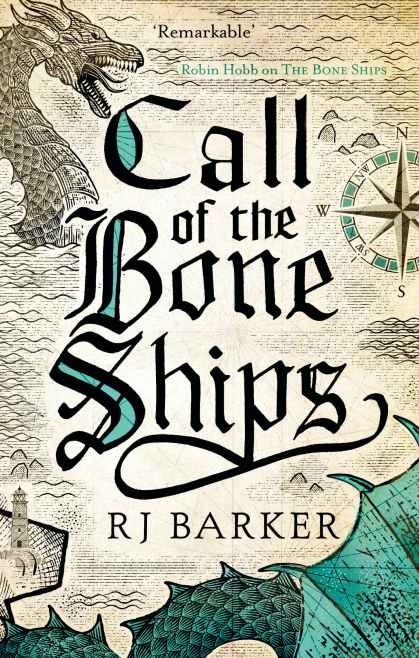
Call of the Bone Ships Cover

Publisher: Orbit (Trade Paperback – 24 November 2020)

Series: The Tide Child – Book Two

Length: 491 pages

My Rating: 5 out of 5 stars

Amazon     Book Depository

One of the biggest rising stars in fantasy fiction, the always impressive RJ Barker, returns with the second novel in The Tide Child trilogy, Call of the Bone Ships, an epic read that was one of the best fantasy releases of 2020.

Welcome back to the boneship known as Tide Child, a black ship of the damned crewed by those condemned to death for various crimes in the Hundred Isles and tasked with fighting in a war against their nation’s rivals, the Gaunt Islanders.  Following their first grand adventure, which saw Tide Child save the last of the vast sea dragons from whose bones the powerful ships are made, much has changed in the world.  The Shipwife of Tide Child, Lucky Meas Gilbryn, seeks to undermine her mother, the ruler of the Hundred Isles, by working with black ships of both nations to create a new settlement outside of their tyrannical controls.  However, their previous decision to save the last dragon has had unexpected consequences, and soon the ocean is alive with the news that more dragons have returned.  With their return comes the battle to kill the creatures and harvest their bones to create more ships, as the nation with the most ships will rule the waves.  However, the crew of Tide Child find themselves drawn into a different conflict when they chance upon a damaged ship with a hold full of dead or dying prisoners.

Attempting to find out more about the mysterious cargo, Meas and Tide Childs’ Deckkeeper, Joron Twiner, try to follow it to its original destination, only to discover that their new island sanctuary has been destroyed and its people carried off for a nefarious purpose.  As they start to fight back against their former comrades in the Hundred Isles, Tide Child finds itself in the midst of a dark conspiracy which will push the entire world into chaos and conflict.  A new war is coming to the oceans, and no-one is safe from its deadly consequences.

Well damn, how does Barker keep on doing it?  Over the last few years, RJ Barker has been one of the most consistent and outstanding fantasy fiction writers out there, producing several incredible and deeply enjoyable novels.  I was a major fan of his debut, The Wounded Kingdom trilogy, as all three novels, Age of Assassins, Blood of Assassins and King of Assassins were amazing reads, with each one being better than the last.  However, Barker’s writing was on a whole other level in 2019 when he published the first entry in The Tide Child trilogy, The Bone Ships, an epic read that detailed the trials and tribulations of a condemned crew aboard a ship made from dragon bones.  I absolutely loved The Bone Ships and it was one of my favourite books and audiobooks of 2019.  Needless to say, I was extremely eager to receive my copy of Call of the Bone Ships, and it was one of my most anticipated reads for the second half of 2020.  Unfortunately, circumstances forced me to hold off reading this novel until the end of the year, which I deeply regret as this was another awesome novel from Barker that got an easy five-star rating from me.

For Call of the Bone Ships, Barker has come up with another exciting and amazing narrative which follows a unique group of protagonists on a deadly adventure through a dark fantasy world.  Told primarily from the point of view of Tide Child’s Deckkeeper (first mate), Jordon Twiner, this is a massive character-driven story filled with action, intrigue, and betrayal.  While the first novel in this series focused on a wild adventure as a ship followed their new captain on a quest to find a sea dragon, this second novel focuses more on the politics of the Hundred Isles, as the Tide Child and their allies attacking as undercover rebels to undermine the cruel ruling hierarchy and determine what their plans are.  After an intriguing introduction, Call of the Bone Ships swiftly devolves into a war novel, as Meas and her crew begin to fight back against the oppressive Hundred Islanders who oppose them.  At the same time, Joron is forced to deal with a number of personal issues aboard the ship as he finds himself thrust into the midst of danger and betrayal as everything in his life goes to hell around him.  The plot of Call of the Bone Ships goes into some dark but captivating directions, and the Tide Child crew are hit with some major curveballs and tragic events.  All of this leads up to an impressive conclusion which is highlighted by a major and dramatic cliff-hanger that is going to require any reader of this book to desperately wait for the final entry in this series to be released.  While this book was a tad slow to start, especially if you were unfamiliar or somewhat forgetful of the events of The Bone Ships, it eventually resulted in a truly epic and outstanding story that proves impossible to put down once you get wrapped in its intense and captivating narrative.  The plot of Call of the Bone Ships has a fantastic flow on from the previous entry in the series and served as an excellent sequel, making great use of several of the story elements introduced in The Bone Ships and more than living up to the hype Barker established with the first The Tide Child novel.

One of the things that I have been most impressed with for this series is the author’s ability to create a gripping and consistently well-written maritime story.  Narratives that are primarily set aboard boats are notoriously hard to write, but Barker has risen to the challenge, writing a novel rich in naval and maritime detail, with a major fantasy fiction edge to it.  Call of the Bone Ships contains an intense amount of intriguing detail about the coming and goings aboard the ship out at sea and Barker does an amazing job highlighting the various day-to-day actions a crew are expected to undertake, as well as all the unique features that makes a ship in this fantasy universe different from real-world ships.  This impressive attention to detail translates extremely well into several naval battles and combat sequences, and it was cool to see the Tide Child engage in battle with other ships in some outstanding and beautifully written sequences.  In addition, Barker ensures that every major character in this novel had a real nautical feel to them.  Everything about these characters, from the way they spoke to how they act or think aboard the ship made you think of old sea-salts who had spent a lifetime on the waves, which helps to bring an interesting ring of realism to the story.  I also really love the intense and encapsulating atmospheres that Barker creates with his excellent writing ability, and you get a real sense of the moods of the entire ship throughout the novel, whether it be despair at something bad that has befallen the ship, or the sense of repetitive boredom that arrives from the ship doing the same action day after day with no break in routine.  All of this helps to produce a truly exceptional narrative, and I cannot emphasise how impressive the author’s various nautical inclusions are.

While the series is nominally about the dangerous events that the Tide Child finds itself involved with, in many ways its plot is driven by the growth and development of the main protagonist and point-of-view character Joron Twiner.  At the start of this series, Joron was a depressed and embittered young man who was unjustly forced aboard the black ship and made its Shipwife due to his lack of courage and determination.  But after meeting Meas and beginning to serve under her, Joron has become a competent officer who has the respect of most of his crew and who is now dedicated to Meas and her mission.  Call of the Bone Ships turns out to be a major novel for Joron as he participates in several adventures and battles, showing his skill as a commander, warrior and leader throughout the novel.  However, participation in these adventures has severe consequences as Joron gets beaten down and broken apart multiple times from injuries, betrayal and personal tragedy.  Watching Joron suffer is quite a hard part of this novel as the reader becomes extremely attached to him due to his likeable personality and sheer determination.  However, it is worth it to see Joron rise again as a stronger and much more developed person, and this ended up being a fantastic part of his personal story arc.  A lot of this book is also dedicated to Joron’s mysterious ability as the caller, someone who is prophesied by the Gullaime (the enslaved avian wind mystics who provide power to the ships) as a great saviour.  Joron, who first experienced these powers while calling a sea dragon to his aid, continues to develop certain abilities which prove to be rather effective and spectacular throughout the novel and opens up a lot of opportunities for the character.  The end of Call of the Bone Ships leaves Joron in an extremely intriguing position, and I am deeply curious about how his story will end in the final novel.

In addition to his complex protagonist, Barker also includes a literal raft of impressive and captivating characters, most of whom serve as members of Tide Child’s crew.  These great characters each have distinctive personalities and add a great deal to the narrative.  The main side character is easily Lucky Meas, the Shipwife of Tide Child who has turned her ship from a bastion of reprobates to a group of heroes with a noble purpose (mostly).  Meas is a truly inspirational character who has served as a close mentor to Joron and who continues to lead her crew with wisdom, experience, and humility.  Meas was a little less utilised in this novel than in the first book, with Joron taking more of a lead now that he has some command experience.  She was still a fantastic and distinctive character within this latest novel, and I really enjoyed where her personal story arc went, even though we still do not have that much information about her backstory.  Another great character was Tide Child’s ultra-powerful Gullaime, who continues to work along the crew, especially Joron, who has a special connection to the creature.  The Gullaime also has a rather intriguing arc in this novel, and it is clear that he will play a rather substantial role in the ending of the overall series.  The mysterious bird creature also develops a lot more as a character in this novel, especially after encountering different members of his species, although he continues to provide his entertaining tirades of broken speech to the crew.  The rest of the crew prove to be extremely compelling, and I liked the fact that Barker spent time expanding out the roles and personalities of a huge number of side characters, including giving several of them brief point-of-view chapters.  However, in some of these cases it did seem that the author only gave these characters more of a role so that he could then brutally kill them off, much to the heartbreak of the reader.  A number of these characters do get some rather substantial and enjoyable story arcs, and it will be interesting to see where the remaining members of the crew end up in the final book.

I have a lot of love for the dark and elaborate fantasy worlds that Barker creates in his novels, and the one featured in The Tide Child series is particularly amazing.  I deeply enjoyed this harsh and cruel world of small islands, deadly seas and warring nations, especially with the cool gender-bent world (for example, captains are known as Shipwives, while boats are referred to as him).  I really enjoyed returning to this amazing and creative world, especially as it proves to be an incredibly rich setting for the novel’s awesome and addictive narrative.  Barker does some excellent world-building in this second entry in the series, and you get some cool features, such as different groups of Gullaimes who lack wind powers but serve as jailers for their powered brethren, some new powers for the characters and some intriguing new locations.  All of this helped to create a more elaborate and impressive narrative and it is always cool to see more of this grim and deadly fantasy universe, especially as Barker’s awesome writing bring so many of the more impressive elements, such as the giant dragons, to life in such epic fashion.

The final thing I wanted to praise about Call of the Bone Ships were all the little details featured within the paperback version of the novel, that I would have previously missed in the first The Tide Child novel due to me checking out The Bone Ships in audiobook format.  I definitely have to highlight the impressive and intricate cover above, which was drawn by talented artist Edward Bettison.  The covers for this series are extremely cool, and I cannot wait to see what amazing design the artist comes up for the final entry in the series.  I also really liked the awesome artwork that was featured within the novel.  Not only is there a fantastic and detailed map at the very front of the book but there is also some sweet artwork at the start of each chapter, which depicts locations, creatures and characters from within the book.  Barker has also featured a short index at the end of the novel which contains some of the crew titles that were created for the series, detailing what each crew member is supposed to do.  All of these details are great and eye-catching inclusions to the novel, and I felt that it made Call of the Bone Ships just a little bit more special.

Call of the Bone Ships by RJ Barker was another epic and outstanding novel that shows why Barker is one of the most impressive new fantasy talents in recent years.  This incredible sequel to 2019’s The Bone Ships contains an exceptional and addictive story at sea, featuring rich and complex characters and all set within a creative and vibrantly dark fantasy world.  The combination of these awesome elements helps to create a captivating and powerful read which turned out to be one of the best books of the year.  I cannot recommend this novel enough.  If you have not found out about RJ Barker yet, you are really missing out!

Amazon     Book Depository

Star Wars: Darth Vader: Volume One: Dark Heart of the Sith

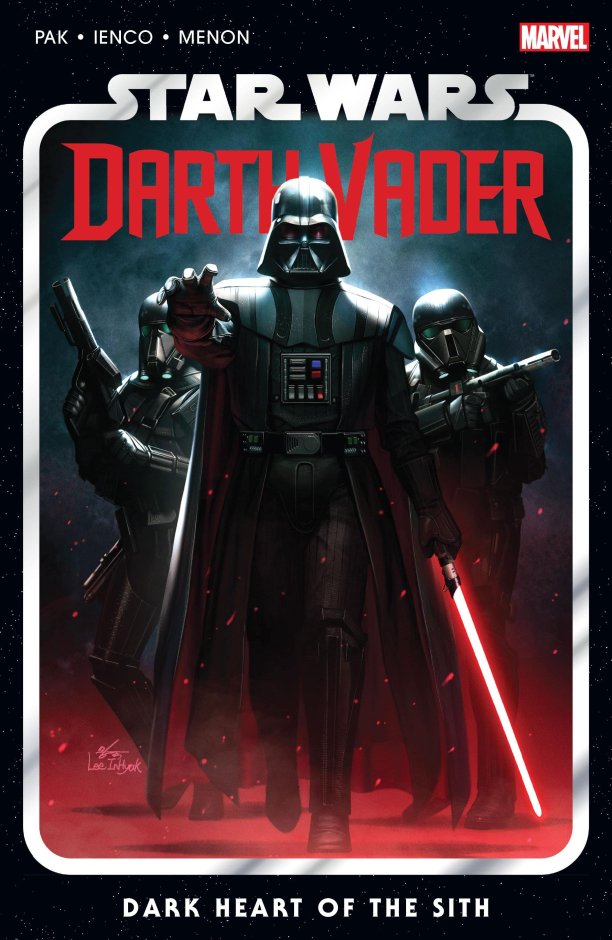
Darth Vader - Dark Heart of the Sith

Publisher: Marvel Comics (Paperback – 24 November 2020)

Series: Darth Vader (2020) – Volume One

Writer: Greg Pak

Artist: Raffaele Ienco

Colour Artist: Neeraj Menon

Letterer: VC’s Joe Caramagna

Length: 136 pages

My Rating: 5 out of 5 stars

Amazon

One of the first entries in a new set of Star Wars comics is here and it is pretty damn awesome, as Greg Pak, Raffaele Ienco and Neeraj Menon present the first volume of the 2020 Darth Vader series, Dark Heart of the Sith.

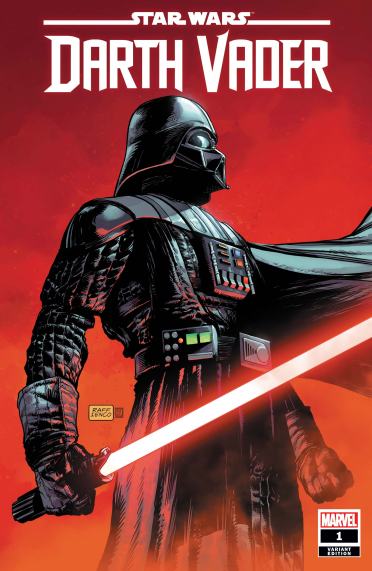
DarthVader2020-1-Ienco

Dark Heart of the Sith contains issues #1-5 of the Darth Vader (2020) comic book series which takes place right after The Empire Strikes Back.  The Darth Vader (2020) series is part of a new range of Star Wars comics which include the Star Wars (2020), Doctor Aphra (2020) and Bounty Hunters series, all of which are set in the year between the events of The Empire Strikes Back and Return of the Jedi.  These comics follow on from earlier series which were set between the events of A New Hope and The Empire Strikes Back.  This latest round of comics attempts to provide details about what occurred between the events of the second and third films, as well as create some new and exciting adventures.  All of the comics in this range sound fantastic, and I have been eagerly anticipating all of them, especially Darth Vader (2020) due to all the potential for action and drama that it has.

To tell this unique tale, Marvel have utilised the fantastic team of author Greg Pak, artist Raffaele Ienco and colour artist Neeraj Menon.  Greg Pak is a film director and author who has written several amazing comics in his career, with a particular focus on the Hulk and Hercules series for Marvel.  I am somewhat familiar with Pak’s work, enjoying his current run of Firefly comics for Boom!.  I am a little less familiar with Ienco and Menon (although Menon did work as a colourist on the Target Vader limited series), but both are experienced artists who have worked on some intriguing-sounding projects in the past.  This is an intriguing team, and they came together to produce an excellent and powerful Darth Vader story.

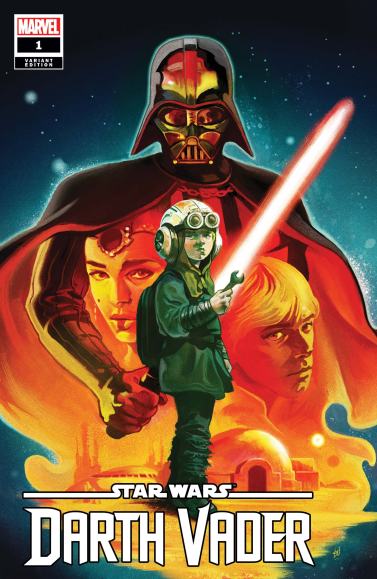
DarthVader2020-1-Daniel

During the climatic events of The Empire Strikes Back, Darth Vader revealed that he was Anakin Skywalker to his son, Luke, and offered him a chance to rule the galaxy by his side.  However, Luke refused to join him out of fear and disgust, choosing instead to plunge to an unknown fate beneath Cloud City.  Now, rejected and betrayed, Vader finds himself full of rage and determined to seek revenge on anyone who kept his son from him and made him weak.

Tracing Luke’s life before the Rebellion, Vader attempts to find anyone he can take his frustrations out on.  But with everyone in Luke’s past dead and beyond his wrath, Vader decides to investigate what happened to his wife, Padmé Amidala, after their final confrontation on Mustafar.  Investigating a listening device left in Padmé’s apartments on Coruscant, Vader travels to a hidden Rebel base where he makes the startling discovery of a woman with a shocking resemblance to an older Padmé.

DarthVader2020-1-delMundo

Despite the initial shock, Vader is soon able to determine that this is not his dead wife returned from the grave but the Queen’s Shadow, Sabé.  Sabé was once Padmé’s most loyal friend, handmaiden, bodyguard and double, and her death has haunted Sabé for years.  Determined to use Sabé to find the answers he is looking for; Vader decides to work with the former handmaiden to find out the truth of Padmé’s last moments.  The information that they need apparently resides on Naboo, and Vader is forced to relive the ghosts of his past life as Anakin Skywalker to find the truth.  However, more treachery awaits Vader on Naboo as a secret organisation waits to kill him.  The Handmaidens of Amidala know who truly killed their mistress, and they are finally ready to take their revenge.

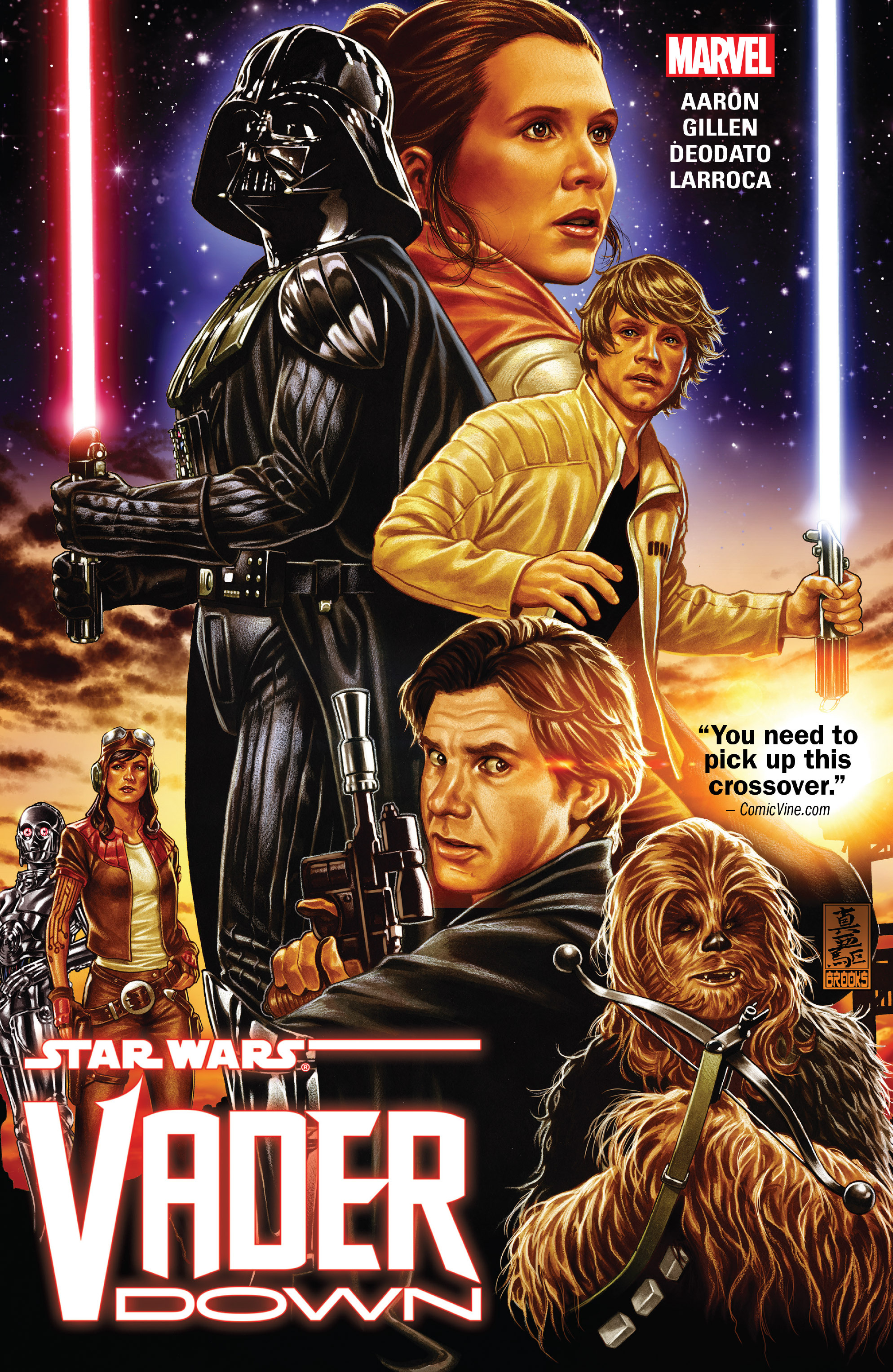
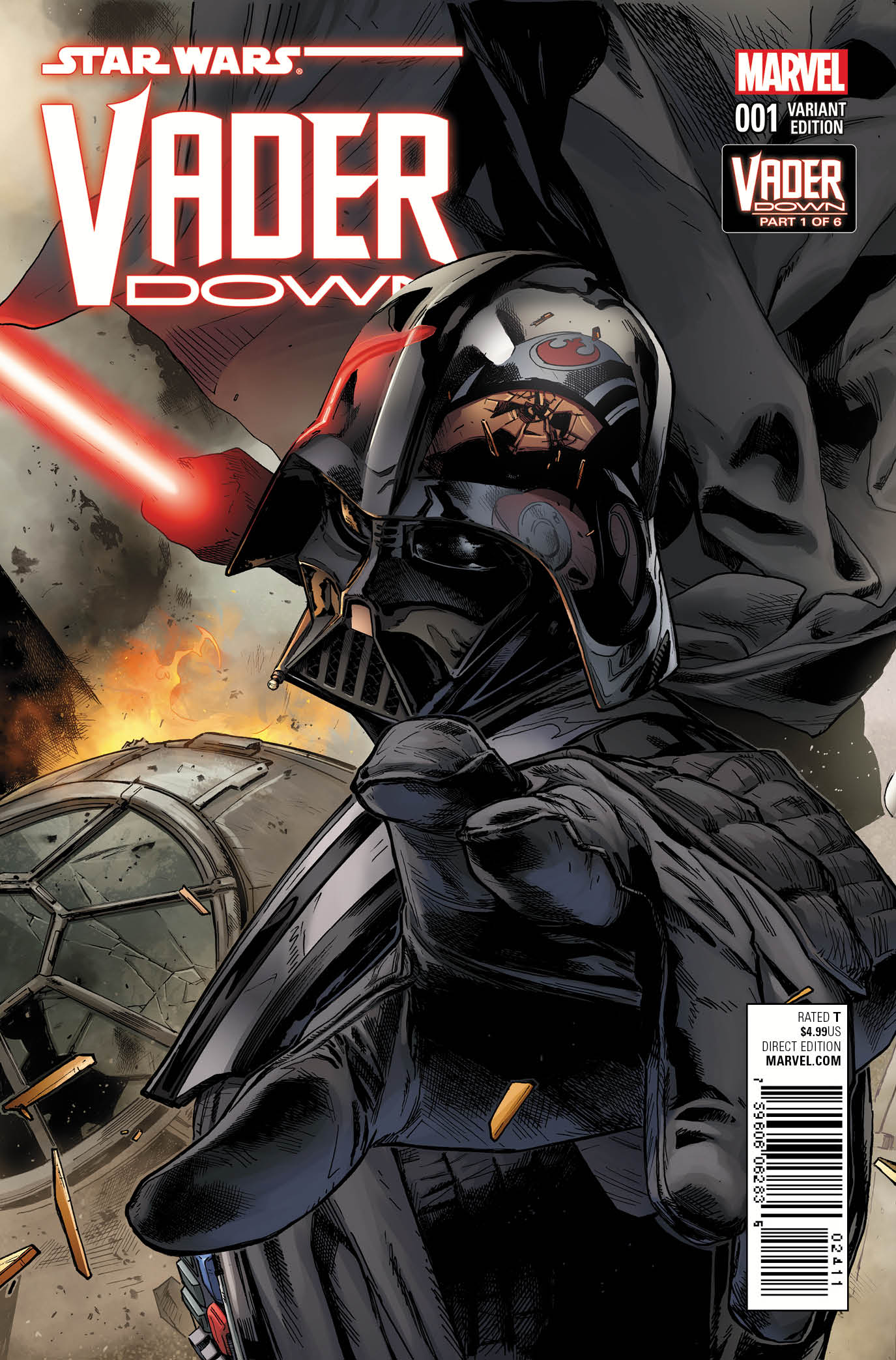
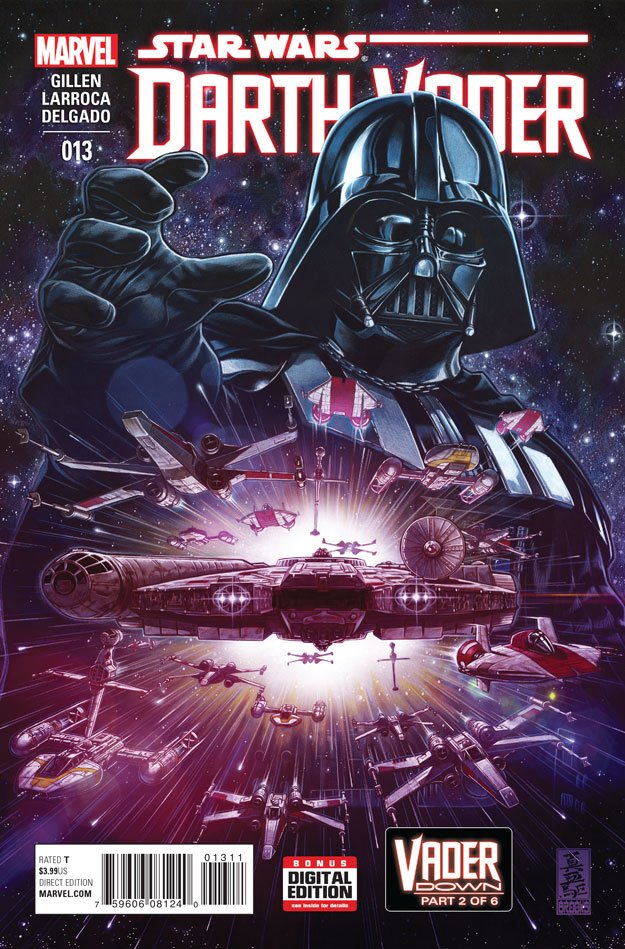
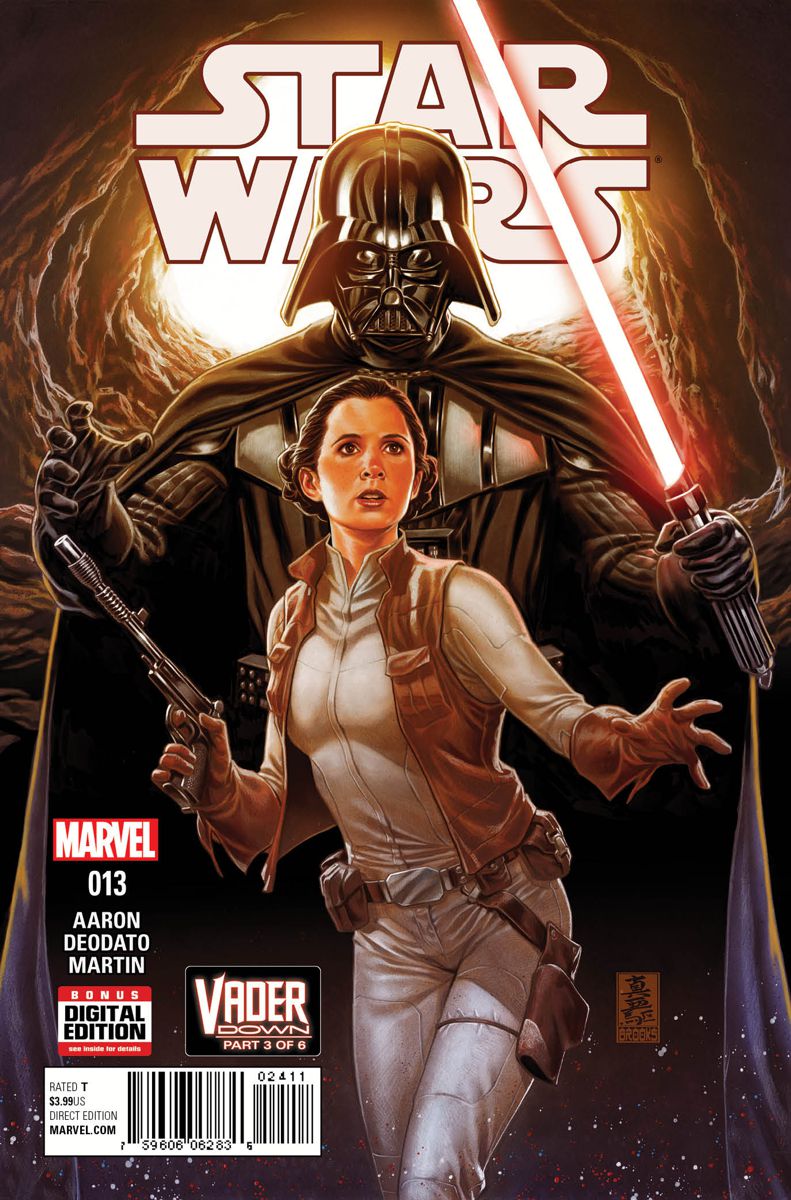
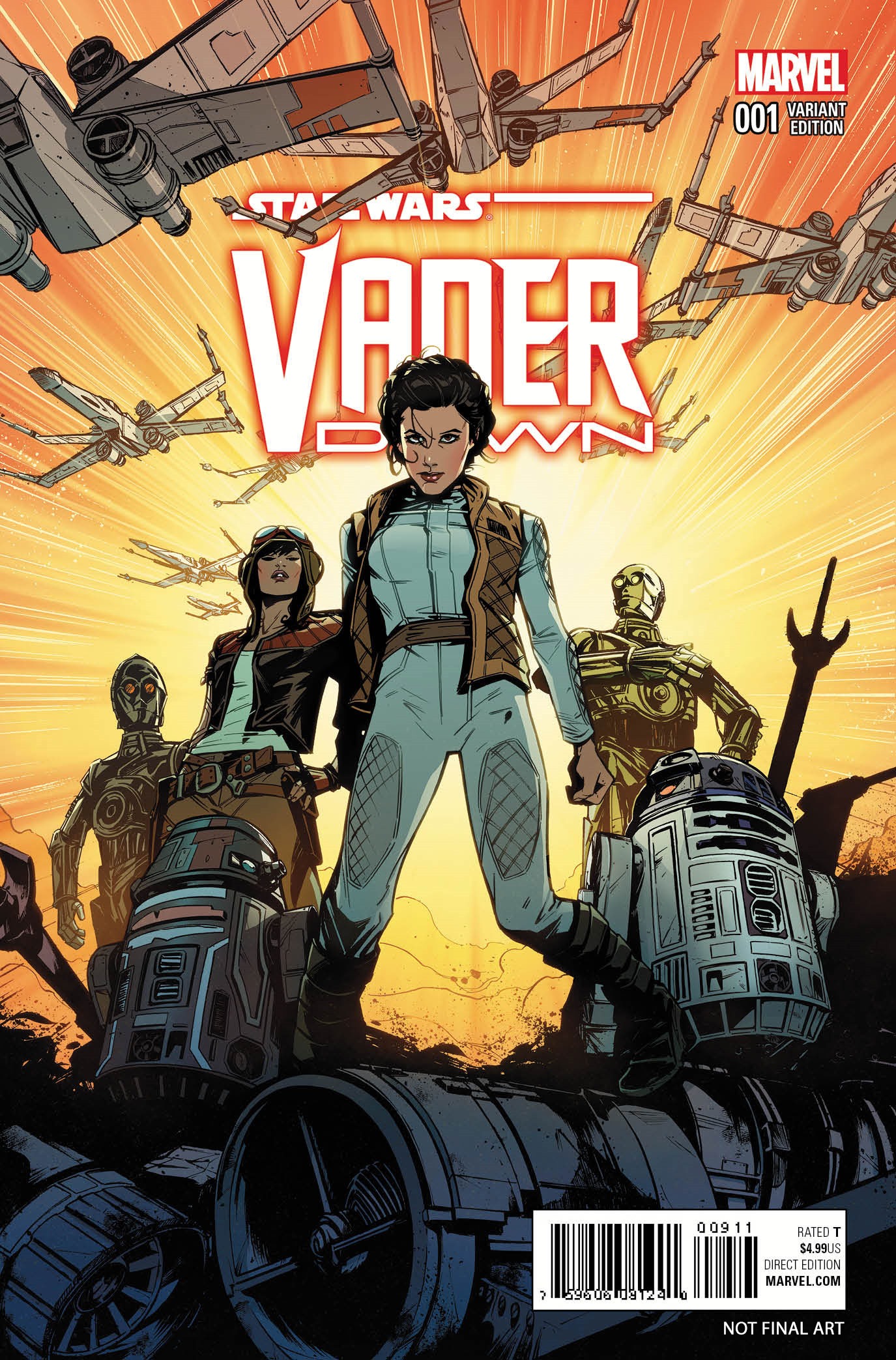
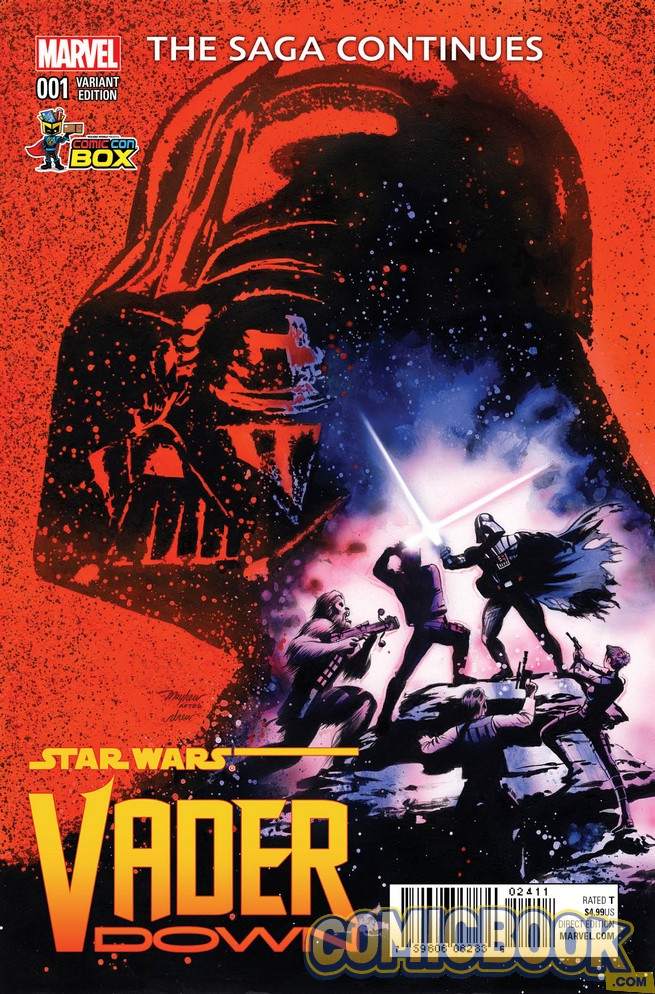
What is it about Darth Vader that makes it impossible for someone to create a bad comic about him?  I mean, seriously, all the previous Darth Vader comics in the current canon have been absolute masterpieces, from the epic 2015 Darth Vader series (check out my reviews for Volume One: Vader, Volume Two: Shadows and Secrets and the crossover comic Vader Down), the impressive prequel series Darth Vader: Dark Lord of the Sith (check out my reviews for Volume Two: Legacy’s End and Volume Three: The Burning Seas), the first volume of the 2015 Star Wars series, Skywalker Strikes, or the fun limited series, Dark Visions.  Each of these comics has been impressive in its own way, and in each of them Darth Vader shines as the ultimate badass.  This first volume of the new Darth Vader series is no exception as it follows Vader through a harrowing journey of discovery that takes him back into his tumultuous past and explores the consequences of his actions at the formation of the Empire.

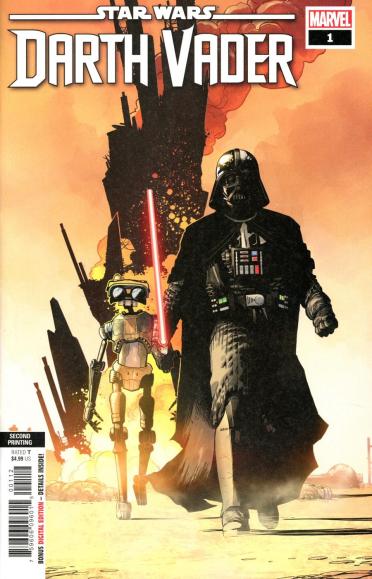
DarthVader2020-1-2nd

Dark Heart of the Sith contains an epic and emotional narrative which follows one of fiction’s greatest villains after he encounters one of the biggest setbacks in his life.  Set mere moments after Vader’s final appearance in The Empire Strikes Back, the Dark Lord of the Sith embarks on a deeply personal mission that is half rampage and half voyage of discovery.  After some initial setbacks, Vader eventually finds Sabé, the Queen’s double, whose appearance in the final panel of Issue #1 was a major selling point for the series.  Sabé’s introduction to the plot leads Vader to revisit some of the most important locations from his life as Anakin Skywalker, before an inevitable run-in with Padmé’s former followers, who hold Vader responsible for her death and the death of Anakin Skywalker.  This entire arc is extremely well written, and I absolutely loved the ambitious and clever story that Pak came up with.  The author does an awesome job of combining an exciting narrative made up of several epic and impressive moments and with a deep dive into Vader’s mind, and this results in a captivating and powerful read that serves as a particularly distinctive chapter in the history of Darth Vader.  I really enjoyed where Pak took Dark Heart of the Sith’s amazing story, and while certain elements lose their impact in the internet age of freely available spoilers, there are some big and impressive moments in here that all Star Wars fans need to see.

One of the things I most enjoyed about this comic was the way that the creative team brought in elements from the Star Wars prequel films and inserted them into a story set right after The Empire Strikes BackDark Heart of the Sith takes the reader back to several key locations from the prequel films and reintroduces several minor characters who appeared in them, including Sabé, one of the pilots from The Phantom Menace and Captain Gregar Typho, Padmé’s security guard in Attack of the Clones and Revenge of the Sith.  This use of these elements from the prior movies works extremely well in the context of this comic’s story, as Vader is forced to revisit his past at a point when he is the most vulnerable in the present.  This makes Dark Heart of the Sith quite an interesting comic for Star Wars fans, who will greatly enjoy the inclusion of elements from two distinctive eras of the franchise.  I felt that Dark Heart of the Sith was a very accessible comic for readers with limited familiarity with Star Wars fiction, and readers only need to check out some of the films to get a good understanding of what is happening.

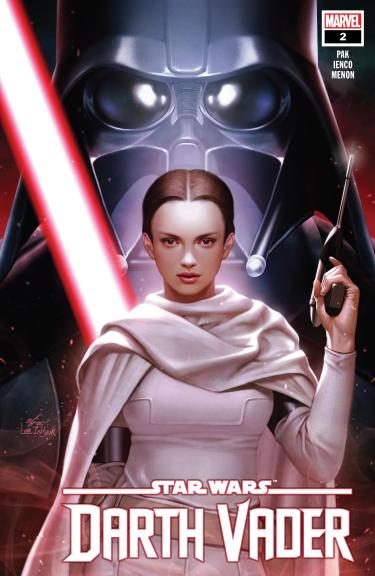
DarthVader2020-2

However, as an established fan of the franchise, I was quite overjoyed to see that this comic had an interesting connection to some interesting pieces of Star Wars extended fiction, namely two recent novels by E. K. Johnston, Star Wars: Queen’s Shadow and Star Wars: Queen’s Peril.  These two novels, which serve as sequel and prequel to The Phantom Menace respectively, are set around the lives of Padmé and her handmaidens and provide added details about how they came into her service and the loyalty that they felt to her.  The narrative contained within this comic serves as a sequel to an arc set up in Queen’s Shadow, where Sabé swears to find justice for the death of Padmé, with several of the unique characters who were either introduced or sufficiently fleshed out in these novels also appearing.  This results in several awesome scenes, including one particularly epic sequence in which Vader is confronted by Padmé’s surviving handmaidens, who engage in an all-out brawl against him.  I found all of this to be immensely cool, and I really enjoyed seeing some of the elements from these books concluded in this comic, especially as Dark Heart of the Sith serves as a definitive conclusion to these character arcs.

Unsurprisingly, the standout character of this comic is Darth Vader himself, who goes through a lot during Dark Heart of the Sith.  Pak really turns this first volume into a deep exploration of Vader’s complex psyche, and there is an interesting examination of how Vader is feeling in the immediate aftermath of Luke rejecting him.  Without his usual determination and dedication to the Dark Side, Vader is lost in this comic, acting out of impulse and searching for someone or something to take his rage out against.  The introduction of Sabé and the return to several key locations from his past only adds to his confusion and emotional instability, and it is blatantly obvious that this is not the same Vader we have come to fear and admire.  Instead, this Vader hesitates to do some of his usual acts of destruction.  Certain memories from his past suddenly spring to the forefront of his mind, turning him away from his desired actions, such as sparing Sabé after revisiting his memory of killing Padmé.  Vader is also continually thrown by the return of several figures from his past, each of whom had a connection to both Padmé and Anakin Skywalker, and it proved to be quite fascinating to see Vader interact with them differently, especially as none of them are aware that Vader is Anakin.

DarthVader2020-3

This comic also contains some key moments of history for Vader; not only does he finally visit Padmé’s tomb but he also admits to her murder, all of which have major emotional implications for him.  I quite enjoyed this dive into Vader’s psyche and I really appreciated the way that the creative team tried to show just how complex and conflicted the character can be.  Based on how Volume One ends, this is probably going to be a recurring theme of the Darth Vader (2020) series and it will be interesting to see the many different changes in the character’s psyche.  I should mention that even though this is a focus on Vader’s mind and his innumerable regrets, the creative team do go out of their way to show just how much of a badass he is and there are several impressive sequences where he doles out death and destruction on an epic level, including killing some of the biggest and most dangerous creatures on Naboo.  All of this results in a deeply impressive Darth Vader comic, and I love the creators’ take on this amazing villain.

Aside from Vader and the returning characters from the prequels, Dark Heart of the Sith also features a fun new posse for Vader in the form of three Death Troopers (the elite Stormtroopers introduced in Rogue One) and the forensics droid Zed Six Seven, who accompany Vader throughout this mission.  While the Death Troopers do have a key role in this comic as Vader’s bodyguards and backup, they are mostly just background characters, without any major defining characteristics or moments.  Zed Six Seven, on the other hand, does a lot of talking, commenting on every event and revelation that occurs within the course of the narrative.  This extra commentary is essential, as Zed Six Seven provides nearly all the necessary exposition within the narrative, as Vader has less dialogue than a typical comic protagonist.  Despite primarily being an exposition machine, Zed Six Seven does prove to be an entertaining character, and I quite enjoyed his reactions to certain revelations or the events, even if his inability to keep his robotic mouth shut does cost him in the end.  Overall, I really liked all the character inclusions and development featured within Dark Heart of the Sith, and it helped to make an epic and powerful story.

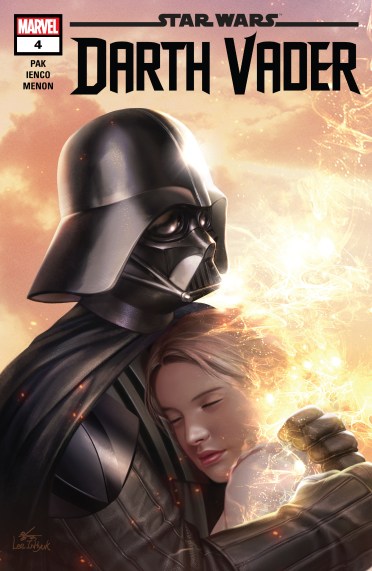
DarthVader4MainCover

I really must highlight the exceptional art featured within this volume as the two artists, Ienco and Menon, do an amazing job bringing this captivating narrative to life.  I absolutely loved all the art contained within this comic and I felt that each of the scenes was drawn very well, with the various featured characters representing their film counterparts in impressive detail.  I particularly enjoyed the excellent way that the artists recreated a ton of key events from the prequel movies and featured them throughout the comic.  The recreated shots from the films were done with a distinctive red filter and were utilised as Vader’s flashbacks to key events from his life.  These flashback scenes help to highlight just how muddled and conflicted Vader’s thoughts are, and they are utilised to great effect throughout this first volume, often shown side-to-side with current events for some amazing contrasts.  I felt that this excellent artwork really helped to enhance Pak’s clever story, especially as the artwork provides the reader with some fantastic visuals of Vader’s emotional range.  It is a real testament to their drawings that you constantly have an idea of how Vader is feeling even with the mask on, and a lot of this is down to the way that the artists portray his body language and reactions.  I also loved several sequences that recreate Luke’s fall to the bottom of Cloud City at the end of their duel in The Empire Strikes Back.  These sequences are featured multiple times throughout the comic, with Luke replaced with several other characters, including various iterations of Vader himself, reflecting just how fractured or lost Vader feels.  This comic is also filled with some action-packed and explosive moments that see Vader attempt to kill everyone and everything in his path.  These action sequences are an exciting treat at several key points throughout the narrative and it is always fun to see Vader kick ass and take names.  Highlights included several sequences where Vader faces off against the megafauna of Naboo, including one massive leviathan (whose introduction is one of my favourite panels in the entire comic).  There is also a particularly brutal fight sequence towards the end of the comic where Vader releases years of anger and frustration in one destructive flurry.  All this awesome art adds so much to the comic and I cannot compliment it enough.

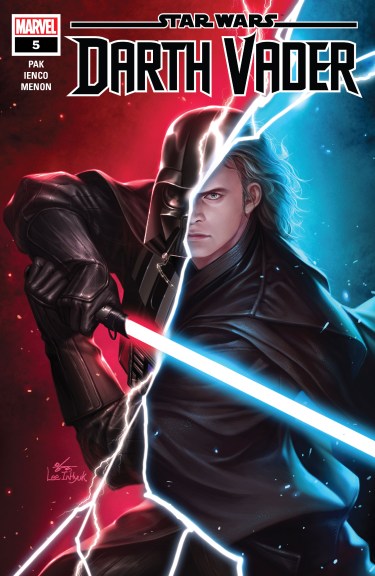
DarthVader5MainCover

Dark Heart of the Sith, the first volume of the Darth Vader (2020) series, is an absolute triumph that may be one of the best pieces of Star Wars fiction this year.  Featuring an outstanding combination of exciting narrative, compelling character development and eye-popping artwork, Dark Heart of the Sith was an absolute treat to read from start to finish.  I loved the way in which the creative team dived into the mind of my favourite Star Wars character, and it proved to be a gripping and powerful read.  This was one of the best things I read all year and it gets an easy five-star rating from me.

Amazon

The Last War series by Mike Shackle Artwork

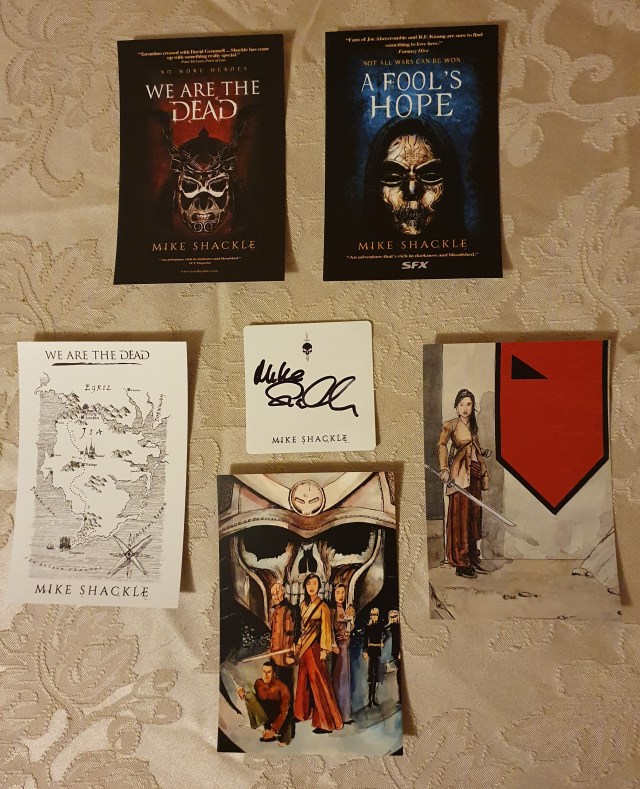
I received a rather interesting letter in the mail earlier this week all the way from Canada that was sent to me by author Mike Shackle.  Shackle has very generously sent me some cool pieces of artwork related to his The Last War series of books, including cover art for his debut novel, We are the Dead, and his upcoming second novel A Fool’s Hope.

Mike Shackle Photo

I loved these cool drawings, maps and cover art and thought I would share them with my followers.  This was a pretty awesome gift from Shackle and I am glad he sent them through.  Those readers interested in an excellent and dark fantasy debut should make sure to check out We are the Dead, while I am really looking forward to reading A Fool’s Hope in a few short months.

Hidden in Plain Sight by Jeffrey Archer

Hidden in Plain Sight Cover

Publisher: Macmillan (Hardcover – 27 October 2020)

Series: William Warwick – Book Two

Length: 304 pages

My Rating: 4.25 out of 5

Amazon

Bestselling author Jeffrey Archer returns with the second book in his William Warwick historical crime fiction series, Hidden in Plain Sight.

London, 1986.  Following the failed attempt to put his nemesis, expert art thief Miles Faulkner, behind bars, William Warwick has been promoted to Detective Sergeant and now has a whole new focus: drugs.  William and his team have been assigned to take down a notorious drug kingpin, one who has all of South London in his pocket and who takes great pains to hide his identity and methods.  However, despite their focus on catching this mysterious drug lord, known only as the Viper, Warwick is still determined to take down Faulkner.

When William coincidently arrests an old acquaintance from his school days, Adrian Heath, it unexpectedly provides him with the opportunity that he has been looking for.  Not only does Adrian have information about the identity of the Viper, but he also has a connection to Faulkner that could be exploited to finally throw his adversary behind bars.  As William attempts to close the net around his targets, he must also counter the moves of his enemies, even when they attempt to ruin his life or his upcoming marriage to Beth.  However, it will take more than personal attacks and clever setbacks to discourage William, and he soon has Faulkner and the Viper exactly where he wants them.  But even in defeat, Miles Faulkner is a dangerous opponent, especially now that he has his vengeful eyes fully set on William and everyone he loves.

Hidden in Plain Sight was another exciting and clever novel from Jeffery Archer featuring a compelling historical crime drama set around the life of a fun fictional character.  The protagonist of this series, William Warwick, actually first came into existence in Archer’s iconic Clifton Chronicles series of historical fiction books, where he was introduced as the in-narrative fictional protagonist of a series of detective books written by the Clifton Chronicle’s main character, Harry Clifton.  After Archer concluded the Clifton Chronicles a couple of years ago, he decided to provide his fans with a more detailed exploration of this fictional detective, and this series is the result.  The William Warwick series looks set to be Archer’s next major long-running series and it will explore the entire career of Warwick, from eager young recruit to hardened and brilliant detective.  This is the second William Warwick novel following last year’s Nothing Ventured, and Archer has come up with an enjoyable new tale that proved really hard to put down.

This second entry in the William Warwick series contains another intriguing and exciting character driven narrative that sees the protagonists engage in a game of wits with some despicable criminals.  This proved to be an excellent historical crime fiction novel that not that not only continues the compelling narrative set up in the previous book in the series but which also sees the protagonist go after an entirely new foe.  Archer presents a great recreation of 1980s London and takes the story in an interesting new direction by having William attempt to combat the city’s crippling drug trade.  However, the story still has a fascinating focus on the world of art and antiquities and its associated criminal underbelly, thanks to the amazing returning antagonist from the first novel.  This story proved to be really exciting and fast-paced, and I enjoyed the variety of different crime fiction elements that Archer included in the plot, as the protagonists attempt to take down their quarry in a number of different manners.  Readers are treated to a range of great sequences, from pulse-pounding police raids, detailed investigations, cunning undercover operations and even a very entertaining courtroom sequence.  Archer has loaded Hidden in Plain Sight’s story with all manner of twists and turns, so much so that the reader is often left surprised at who ends up on top and where the story will go next.  This was a really enjoyable narrative that I found to be extremely addictive, resulting in me powering through the entirety of Hidden in Plain Sight in just over a day.  Fans of the previous entry in the series (as well as the Clifton Chronicles) will have a great time continuing the fun story started in Nothing Ventured, while new readers will also be able to quickly dive into this novel and become engrossed in the story.

Like all of Archer’s books, the narrative of Hidden in Plain Sight is strongly driven by the excellent characters that the plot follows.  Archer utilises a range of different character perspectives to tell his story, presenting a rich and multifaceted narrative that explores the lives of several intriguing protagonists, as well as a couple of great villains.  Most of the story focuses on the series’ titular character, William Warwick, the determined, ambitious and righteous police officer who has dedicated his life to fighting crime.  Warwick continues to grow as a detective throughout Hidden in Plain Sight, losing more of his “choir boy” personality and gradually becoming more addicted to the job and the danger.  Despite that he still maintains his strong moral code and proves to be a very likeable central character, especially as Archer spends a lot of time exploring his personal life and his various relationships.  In addition to Warwick, Archer also dedicates a large amount of the book to several key side characters including Warwick’s police colleagues, the major antagonists and members of Warwick’s family.  These various additional characters and perspectives really added a lot to the story’s flow, and it was a much more effective way to tell this narrative than through the eyes of Warwick alone.  Most of these characters are only featured for a small amount of time throughout the book, but I felt that Archer made the most of their appearances, showcasing their personalities and motivations in an excellent manner and making sure that the reader was concerned for their various story arcs.

While these books are mostly focused on the exploits of William and his crime fighting associates, the character I have the most love for is the villain, Miles Faulkner, who is a constant highlight of each book.  Faulkner is a debonair and brilliant criminal mastermind who specialises in elaborate art thefts and forgeries and who gained the attention of the protagonists in Nothing Ventured.  Faulkner serves as a brilliant foil to William and the other police, continually outsmarting them at every turn and thoroughly acting as the cocky master villain.  Faulkner pretty much steals every scene he appears in, and you cannot help but enjoy his antics, even when you are pulling for the protagonists to knock him off his pedestal.  Archer introduces a number of entertaining and clever twists around Faulkner throughout Hidden in Plain Sight, and it was extremely entertaining to see the various ways in which this antagonist manages to manipulate everyone around him and generally come up on top, even when it appears that he has lost.  I personally liked the more vindictive streak that appeared as part of Faulkner’s character in this book, following his various losing encounters with William and the other protagonists.  Not only does this result in a number of clever and elaborate revenge ploys but it also gives a harder edge to Faulkner as the overall antagonist of the series, and hints that he may have some diabolical plans for William in the future entries of this series.  I had a lot of fun with this excellent antagonist and I cannot wait to see what villainy he unleashes next.

Hidden in Plain Sight is another fun and clever novel from Jeffery Archer that comes highly recommended.  Archer has done an excellent job of continuing his William Warwick series, and readers are in for an exciting and enjoyable time with this book.  I really liked where Archer took the story in Hidden in Plain Sight and I am looking forward to seeing how the series will continue next year.

Amazon

Throwback Thursday: Usagi Yojimbo: Volume 9: Daisho by Stan Sakai

Usagi Yojimbo Daisho Cover

Publisher: Dark Horse Books (Paperback – 1998)

Series: Usagi Yojimbo – Book 9

Length: 215 pages

My Rating: 5 out of 5 stars

Amazon

Reviewed as part of my Throwback Thursday series, where I republish old reviews, review books I have read before or review older books I have only just had a chance to read.

Usagi Yojimbo Mirage - #7

It has been another good week of reading and reviewing for me, so I thought I would reward myself by doing a Throwback Thursday review of Daisho, the ninth volume in the outstanding, long-running Usagi Yojimbo series from one of my favourite authors, Stan Sakai.

Daisho is an impressive and exciting entry in the series, which unsurprisingly gets a five star rating out of me (full disclosure, every volume of this series is going to get five stars from me, it is just that damn good). This volume contains Issues #7-14 of the second run on the Usagi Yojimbo series, which was originally published by Mirage Comics (Issues #7 and #8 are only partially represented in Daisho as some stories from these issues were used in the prior volume, while a story from Issue #13 appears in the tenth volume that I will review next), and which has been collected into this volume by Dark Horse Books. This ninth Usagi Yojimbo volume is filled with several fantastic and creative stories that follow Usagi as he journeys across the land, getting into all manner of trouble and misadventures in this version of feudal Japan populated solely by anthropomorphic animals. Daisho serves as a significant inclusion in the overarching series, due to its connections to previous stories, and its introduction or resurrection of several key characters.

Usagi Yojimbo Mirage - 8

This volume starts off with an inspiring and tragic story, The Music of Heavens, which once again sees Usagi traversing the wilderness. His solitude is broken when he encounters the pack of Tokage lizards who he unwittingly befriended in a previous story, The Lizards’ Tale (which was featured in Volume 8: Shades of Death). While Usagi is less than thrilled to see the Tokages, they end up leading him towards another traveller who is making their camp in the woods. The traveller, Omori Kazan, is a mendicant Buddhist priest and skilled musician, who invites Usagi into his camp and talks to him about the various forms of music he studies. However, someone is stalking their camp, determined to get revenge and unafraid to kill an innocent bystander to get it.

I really liked The Music of Heavens and it proved to be a compelling first entry in this volume. The story is based on Usagi’s encounter with a new character, Omori Kazan. Kazan is an intriguing person due to his position as a komuso monk (the monks of emptiness) of a particular sect of Buddhism, which lends him a very distinctive look thanks to the woven basket hat (tengai) he wears on his head disguising his features. Kazan has an amazing arc that delivers a lot in a short while, as he introduces himself to Usagi and the reader, discusses music and religion, and then simultaneously meets his end while also experiencing the divine for the first time. This entire character arc is both beautiful and tragic at the same time, and it provides both Usagi and the reader with some significant emotional moments, especially when it comes to Usagi’s farewell to the Tokages. I also liked how Sakai utilises an antagonist from a previous story, and the fight between Usagi and this character was swift and well-drawn. This was an excellent introductory entry for this volume, and it is a story that I really enjoyed.

Usagi Yojimbo Mirage - 9

The second story in Daisho is the entertaining and clever entry, The Gambler, the Widow, and the Ronin. This story reintroduces the gambler from the previous story, The Duel (featured in Volume 6: Circles), who is up to his old tricks of organising deadly sword duels and cashing in on the bets of the local townsfolk. After the death of his previous samurai accomplice, Shubo, during a duel with Usagi, the gambler has been forced to find a new partner, the brutish and less skilled swordsman, Kedamono. However, Kedamono’s greed has convinced the gambler that it is time to end their partnership, and he quickly finds the ideal solution when Usagi arrives in town. However, as the gambler plots, he fails to realise that he is being stalked by Shubo’s widow, who is determined to get her revenge for the role he played in her husband’s death.

This was another amazing story that serves as a fantastic follow-up to a great prior Usagi Yojimbo story. I always get a real western vibe out of The Gambler, the Widow, and the Ronin, due to its title and the premise around a duel, it proves to be an excellent entry in this volume. Usagi is once again drawn into the plots of the gambler, and thanks to his humility, honour and good manners, which are mistaken as a weakness, both Kedamono and the local villagers are convinced that Usagi is a poor swordsman. However, the gambler, who has seen Usagi in action before, manipulates the odds so that he wins all the money when Usagi defeats his opponent, in a fun reversal of the events of The Duel. This was an incredibly entertaining scene as Usagi is again forced to deal with a bloodthirsty crowd, while the gambler feigns being saddened by the loss of his companion, despite being secretly delighted. However, the gambler ends up getting his comeuppance, and the widow, whose sad final scene was so memorable in The Duel, finally gets a small measure of justice. This was a very clever and enjoyable story, and I really loved how Sakai dived back to a prior standalone story to provide some closure and a fun continuation.

Usagi Yojimbo Mirage - 10

The next story is called Slavers, and it is a longer entry made up of two separate issues. In Slavers, Usagi encounters a young boy being pursued by bandits. Usagi defeats them and learns that the boy was attempting to get help for his village, which has been taken over by a gang of bandits who have enslaved the villagers as part of a destructive scam to steal their harvest and make a small fortune. Deciding to help the villagers, Usagi infiltrates the gang and attempts to rally the villagers to his cause. However, the gang’s leader, the villainous General Fujii, discovers the deception and captures Usagi, planning to kill all the villagers to make good his escape. Slavers is an amazing story that is not only intriguing in its own right but which also expertly sets up the series of follow-up stories that make up most of this volume. While the standalone narrative of Slavers gets a bit dark at times, due to an extended capture scene surrounding Usagi, it is a rather compelling story filled with action, deception and struggles against adversity.

Slavers is quickly followed up by three separate but distinct stories that can be combined together with Slavers into one large narrative that wraps up all the loose ends from the initial entry. The first one of these stories, Daisho Part One, sees Usagi in hot pursuit of General Fujii, who is in possession of Usagi’s precious swords. Due to the brutal actions of Fujii, Usagi loses his quarry and is forced into an extended hunt for him, eventually coming to a ransacked village. It turns out that the village had recently been raided by Fujii’s new gang, and Usagi must make a hard choice between recovering his soul or helping those in need.

Usagi Yojimbo Mirage - 11

I have a lot of love for Daisho Part One; it is probably one of my favourite entries in this entire volume. The story starts out with a magnificent and beautifully drawn sequence that shows the various elaborate processes by which a samurai’s swords are created. This impressive opening sequence is one of my favourite pieces of Usagi Yojimbo art from the entire series, and its creation highlights not only Sakai’s skill as an artist but his ability to research and portray intriguing parts of Japan’s unique culture and heritage. This sequence also shows the important a samurai’s swords to their wielder, as they are reflections of that warrior’s soul. This key concept is then brought to life in the main story, as it sees a somewhat unhinged Usagi risking everything to reclaim his swords from Fujii. Sakai does an outstanding job showing off how frustrated and enraged Usagi is at having his swords stolen from him, and he comes across as being quite frightening several times through the story. Usagi’s anger comes to a head when he reaches the village and his initial decision is to abandon the villagers and immediately follow Fujii and his men. However, a local village girl is able to shame him into thinking of others, and the old Usagi returns, providing aid to the villagers. This was an extremely compelling story that does a wonderful job combining a powerful, character driven narrative, with some exquisite artwork and some intriguing aspects of history, into an exceptional entry in this volume.

The next story in this volume is Mongrels, a quick story about a recurring Usagi Yojimbo side character, the bounty hunter Gen, which occurs around the same time as Daisho Part One. In this story, Gen enters a village and starts asking questions about his current bounty, General Fujii. However, he is not the only bounty hunter in town, as he soon encounters the notorious hunter Stray Dog, who is also hunting for Fujii. After a tense conversation, the two-part ways; however, both are determined to capture Fujii and outsmart their competition. This was a fun story that not only brings Gen into this multi-issue narrative but also introduces a couple of great recurring characters. Stray Dog is a fantastic character in the Usagi Yojimbo universe, and he often appears as a compelling rival (and sometime partner) to Gen (such as in the latest Usagi Yojimbo volume, Bunraku and Other Stories). This story serves as a swift and clever introduction to the character, and it was fun to see the rivalry between Gen and Stray Dog form so quickly. Mongrels also introduces the extremely entertaining side character, the Snitch (also called Toady), a sneaky, greedy character who provides information to the highest bidder. While the Snitch has only a short appearance in this story, he is going to start appearing in a lot of follow up volumes, and it is always fun to see where a character starts out. Overall, this was a great story that fits a lot of significant introductions and events into a few short pages.

Usagi Yojimbo Mirage - 12

The final story in this arc surrounding General Fujii is Daisho Part Two, in which Usagi and his guide meet up with Gen and Stray Dog right at the end of Mongrels. The three samurai decide to team up to raid General Fujii’s lair, and they engage in an all-out fight for money and honour. However, not everyone on the team is keen to work together, and betrayal is afoot. This was an excellent conclusion to the entire storyline, which I really enjoyed. This is a story chocked full of action, as the entire narrative sets up a massive fight between multiple combatants within an abandoned temple. There is some great character work within this story, not only from the protagonists, who bicker and fight amongst themselves, but also with the major antagonist, General Fujii. There some intriguing scenes that show Fujii’s efforts to lead and control a gang of bandits and cutthroats, and I also liked how Sakai shows him being haunted by thoughts of Usagi, whose swords he is holding onto. Usagi and Fujii finally get their showdown in this story, and it served as a fantastic end to this whole extended narrative. There are also some compelling moments surrounding Stray Dog, as he seeks to cheat the others out of the reward money for Fujii. While this initially paints him in a bad light, the source of his need for money is quickly shown, and it highlights just how complex and multifaceted this new side character is. I really liked how this entire story narrative ends, and Daisho Part Two is an excellent part of this volume.

The next story in this volume is the two-part entry, Runaways. In Runaways, Usagi journeys through a small town, when he finds himself in the path of a procession of the local noble lady. Hearing the lady’s name, Usagi is thrown back into the past as he remembers an adventure that occurred many years prior, when he was in the service of Lord Mifune. After finding out that the love of his life, Mariko, has married another man, Usagi is given a seemingly simple mission as a distraction. His task, to escort the young Princess Kinuko to the lands of her future husband, becomes infinitely more complicated, when their party is ambushed by a horde of Neko Ninja. Escaping with the princess, Usagi disguises Kinuko as a peasant in an attempt to hide her from their pursuers. However, the more time that Usagi and Kinuko spend together, the closer they become, until the lines of duty, honour and station become extremely blurred.

Usagi Yojimbo Mirage - 13

This was another exceptional story within the volume, and I liked how it flashed back to an adventure during his pre-ronin life. Set during the period when Usagi served Lord Mifune (as shown in Volume 2: Samurai), Runaways contains a powerful and emotional narrative that is actually based on Roman Holiday (Sakai is a massive Audrey Hepburn fan), which sees a princess run away with a strong male protagonist and grow close to him, despite her responsibilities and their differences in station. This proves to be a fun, if extremely loose adaption of the movie, and Sakai builds up a complex relationship between Usagi and Kinuko, as the two characters, both tragic victims of circumstances when it comes to love, grow closer to each other. However, despite their feelings, this relationship is fated to never be, and it ends in heartbreak, with the memories of it haunting both Usagi and Kinuko years later. I really liked how this story played out, and it was interesting to see aspects of samurai honour folded into the narrative from Roman Holiday. Other fantastic highlights of this story include the multitude of impressive fight scenes between Usagi and the Neko Ninja, starting with a major battle between two large groups of samurai and ninja. I also liked the exploration of the traditional Tanabata Matsuri festival that the two characters find themselves attending, especially as Kinuko has fun experiencing local customs, foods and activities that someone of her station will never get to enjoy. It was also cool to see an early adventure from Usagi, especially as this entry foreshadows events that have occurred in other volumes, including the return of several now-dead characters, such as Shingen (future leader of the Neko Ninja, who was introduced in Volume 3: The Wanderer’s Road, and died in Volume 4: The Dragon Bellow Conspiracy). An overall exciting and impressive story, Runaways is an amazing highlight of this volume.

The final entry is the short story, The Nature of the Viper. In this tale, a local fisherman finds the badly injured body of Usagi’s recurring foe, Jei, after he was thrown from a cliff during the climatic events of Circles. Bringing him back to his hut, the fisherman tends to Jei and manages to save his life. When Jei awakens, he shows his gratitude to the farmer be recounting a tale of viper and a peasant (a version of the classic fable, The Farmer and the Viper), before killing him and resuming his hunt for Usagi. This is a good, short entry that shows the fate of Jei after his last appearance. Jei comes across just as villainous and creepy as ever, and it was fun seeing the fisherman slowly realise just how much trouble he is in as the story progresses. While having a villain recount The Farmer and the Viper as justification for why they are killing a person is somewhat cliched at this point (although to be fair, this story was written back in the 90s), it was still a fantastic sequence. I think that this was an excellent way to end the volume, especially as the reader is left knowing that Jei has returned and that Usagi will be encountering him once again in the future.

Usagi Yojimbo Mirage - 14

Sakai has once again knocked it out of the park with the ninth volume in his series. Daisho contains several outstanding and memorable stories that are all wildly entertaining and contain some clever links to past and future entries in this series. I had an absolute blast reading this volume, and it is an extremely strong addition to the incredible Usagi Yojimbo series that comes highly recommend.

Amazon

Throwback Thursday: Usagi Yojimbo: Volume 8: Shades of Death by Stan Sakai

Usagi Yojimbo Shades of Death

Publisher: Dark Horse Books (Paperback – 1997)

Series: Usagi Yojimbo – Book 8

Length: 200 pages

My Rating: 5 out of 5 stars

Amazon

Reviewed as part of my Throwback Thursday series, where I republish old reviews, review books I have read before or review older books I have only just had a chance to read.

It’s been a little while since I’ve done a Throwback Thursday article so I thought I would go back to the old faithful that is the incredible Usagi Yojimbo series and review the eighth volume, Shades of Death.

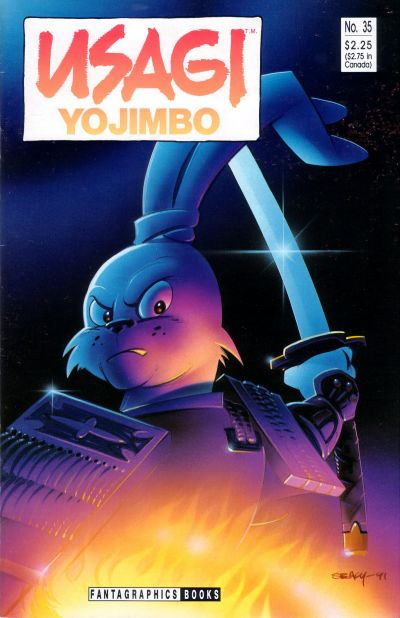
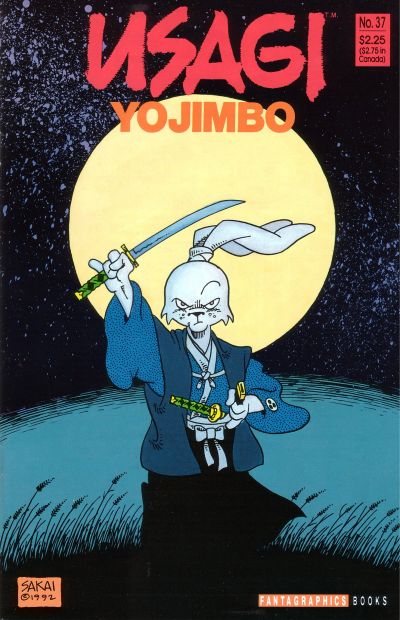
Usagi Vol 2 Issue 1

Shades of Death follows on right after the events of the seventh Usagi Yojimbo volume, Gen’s Story, and continues to follow the adventures of the rabbit samurai, Miyamoto Usagi, in this alternate version of feudal Japan populated by anthropomorphic animals. This eighth volume of the series is particularly significant as it is the first volume to be published by Dark Horse Comics, who printed the series for over 22 years, and who were only recently replaced by IDW for the latest volume, Bunraku and Other Stories.  However, the issues within this volume were originally printed by Mirage Comics, who did the entire second run of the Usagi Yojimbo series.  The Dark Horse Comics/Mirage Comics printing style is similar to the style used by the previous publisher, Fantagraphics Books. The only major difference is that the Dark Horse Comics volumes come with a story notes section at the back, as well as copies of all the covers for the various issues. I’m actually a big fan of the story notes that they started including in these volumes, as they contain some fascinating background information about some of the stories, including details about the various legends or elements of Japanese culture that Sakai focuses on in his story. Shades of Death contains issues #1-6 of the second run of the Usagi Yojimbo series, as well as containing stories from #7-8, and is made up of two major storylines and several shorter entries.

The first story is Shades of Green, and it is probably the most distinctive entry in this entire volume. The story starts with Usagi and his frequent travelling companion, Gen, being ambushed out on the road by a horde of Neko Ninja, forcing them to dive into a river to avoid being killed. Usagi and Gen eventually wash up near a remote village and encounter the mysterious rat mystic, Kakera, who asks Usagi and Gen for his help. Kakera reveals that the Neko Ninja are after him, as they hope to use his abilities to help rebuild their clan’s power after the events of The Dragon Bellow Conspiracy (volume 4). To that end, they have surrounded the village and intend to kill everyone in order to get Kakera, and even the skilled Usagi and Gen will be unable to stand up to their numbers. With no other help on the way, Kakera is forced to use his magic to summon four very special warriors to stand by their sides, the Teenage Mutant Ninja Turtles.

634715

Shades of Green is a fantastic and clever story that also serves as an excellent crossover between two iconic comic book series. Pretty much the big thing about this story is the way that is introduces all four members of the Teenage Mutant Ninja Turtles in the Usagi Yojimbo universe. Fans of either Usagi Yojimbo or the Teenage Mutant Ninja Turtles franchise will be aware that these two comics have had numerous crossovers throughout the years, with Usagi appearing in three of the Teenage Mutant Ninja Turtles animated television shows. The Turtles who appear in Shades of Green are the original Mirage Comics versions of these characters, who were created by Kevin Eastman and Peter Laird, and who had their own long-running series during the time this volume was published. Usagi has actually encountered Leonardo from this version of the Turtles several times before, including back in the third volume of Usagi Yojimbo, The Wanderer’s Road, so the two groups of characters were able to team up rather quickly. I thought that this was an incredible crossover, and I especially loved the dynamic between the Turtles and Usagi and Gen. Not only do you get the mutual respect that Usagi and Leonardo have for each-other but there is a rather fun dynamic between Gen and the other Turtles. I particularly liked one scene where Michelangelo questions the logic of the Usagi Yojimbo universe, including why the horses aren’t sentient but rabbits and rhinos are (something I have always wondered), and even asking Gen if he has a tail, which it turns out is a rather personal question. There are also some really fun battle sequences throughout this book, and it was great to see the two samurai team up with the Turtles to fight a whole bunch of ninjas. I really liked this crossover between them, and I also think that Sakai did an amazing job drawing and portraying these characters.

In addition to the crossover elements, Shades of Green also contains a rather intriguing overall narrative, especially the parts of it that examine the leadership of the Neko Ninja clan. The Neko Ninja clan has been in a bit of decline since the fourth volume, when a large number of their ninjas, including their leader, Shingen, died. Much of the plot of this storyline revolves around two high-ranking members of the Neko Ninja, the ambitious Gunji and Shingen’s sister Chizu, fighting for control of the clan, with their battle centred on the hunt for Kakera. This proved to be really exciting, and it was cool to see the internal ninja feud, while the clan is facing off against the protagonists. This book also contained the first meeting between Usagi and Chizu, who goes on to become a major recurring character in the series as well as a potential love interest for Usagi. I quite enjoyed Shades of Green, and it definitely serves as a memorable entry in the Usagi Yojimbo series that showcases how cool a crossover with this series can be.

559585

The next entry is a short story called Jizo, which only runs for a few pages. Despite its shorter length, this is a rather inventive and surprisingly powerful story that I have a lot of love for. Jizo is set on the side of a road, and features a mother placing a dosojin, a roadside icon, of Jizo-sama, in order to help the soul of her deceased young son who was recently killed by bandits. According to Buddhist beliefs, her son’s soul is attempting to make its way into paradise by piling rocks to cross a river. By leaving the statue to Jizo, the patron and protector of children, by the side of the road, the mother is hoping that passing travellers will place a stone near it, which will help her dead son’s soul in his eternal task. The story than continues without dialogue, as the statue of Jizo watches the road, noting the various travellers who walk across it. This includes Usagi, who runs into the same bandits who killed the child, and his actions seem to provide the statue with a measure of peace. This was a clever and beautifully rendered story, and I loved that Sakai redrew the same stretch of road for every single panel. This was such a fantastic concept, and I loved how he told such a powerful story with a minimum of dialogue, only utilising some exposition from the mother at the start and end of the story. The shots of the same stretch or road were done extremely well, and it was fun to see the various people who walked past the statue during the course of the day. Not only were there some familiar faces but there were several intriguing and distinctive-looking people going about all manner of different activities. It was also cool to learn a little bit about the statues to Jizo-sama, something I saw several times when I went to Japan, and the story notes I mentioned above proved to be really useful and interesting in regards to this. I was really impressed with this entry, and I loved the compelling story that Sakai told with his fantastic drawings.

The third story in this volume is Shi, an action-packed and exciting tale that I really enjoyed. Shi sees a wandering Usagi come to a crossroad, where he lets fate and the gods choose his route (a homage to the start of the film Yojimbo). His chosen path takes him to a market town where he witnesses a peasant being bullied by a group of thugs. Intervening, Usagi chases the thugs off and is invited to the peasant’s village for dinner. However, it soon becomes clear that something strange is happening at the village, as the thugs arrive soon after and appear determined to scare all the villagers away. Investigating, Usagi soon finds himself in the midst of a conspiracy involving the local magistrate and his brother, who are determined to kill Usagi and his new friends. To that end they hire a group of four assassins, who call themselves Shi (a reworking of the Japanese character for Shi turns it into a character for death).

559657

Shi proved to be an compelling entry that serves as one of the main two stories for this volume (indeed, if you combine the names of the first story, Shades of Green, with the title of this story, Shi, which in this case means death, you get the volume’s overall title, Shades of Death). There are some great elements to this action-packed story: the intriguing conspiracy, Usagi’s mixed encounters with the villagers that he is trying to save, and some funny moments as Usagi effortlessly deals with the initial group of thugs. However, the best part of the book has to be the extended fight sequence at the end as Usagi takes on the four members of Shi, each of whom is master of a different type of weapon (sword, spear, bow and the sickle-and-chain). This was a brutal and exhausting fight for Usagi, and it serves as an impressive main set piece for the entire story. It also results in a rather confronting and memorable sequence where, in the aftermath of the fight, Usagi is challenged by a local peasant who is jealous of the attention Usagi is receiving from his betrothed. The peasant gamely steps up to fight Usagi, claiming not to be afraid, only to be faced by an enraged samurai who is worked up into a blood rage after his battle. The look of anger and hate on Usagi’s face is surprisingly terrifying, and I love how demonic Sakai made him look, showing off a darker side to his complex protagonist. I also really enjoyed the entry’s two shady antagonists in the magistrate and his brother. These two duplicitous siblings make for a murderous team, especially when each of them attempts to betray the other in a fantastic conclusion that showcases the consequences of greed. Overall, Shi was an exceptional story that I had an awesome time reading.

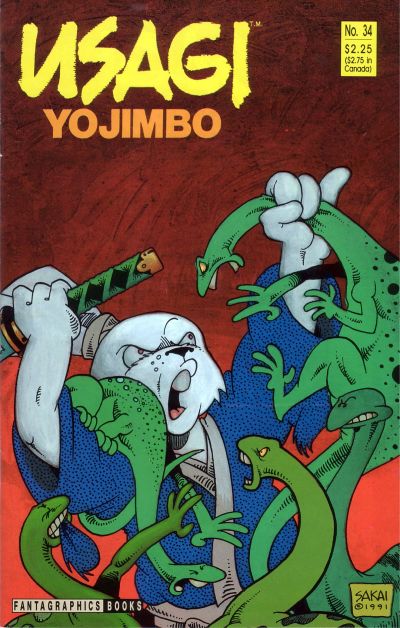
The next story in Shades of Death is a fun entry titled The Lizards’ Tale, which focuses on a group of Tokages, the dinosaur-like lizard critters that infest the Usagi Yojimbo universe. In this story, a group of chilly Tokages attempt to warm themselves up one snowy night by snuggling together in the warmest place they can find, around the sleeping body of Usagi. Awakening the next morning, Usagi finds himself surrounded by the potentially vicious creatures, and only manages to flee by throwing them a bag of food and running for it. However, the Tokages are not that easily escaped, and they continue to follow Usagi hoping to get more food out of him. Despite his comical efforts to get rid of them, Usagi soon grows attached the Tokage pack, especially after they help him out of a sticky situation with some bandits. The Lizards’ Tale is a very fun and humorous story that provides some light-hearted moments in this volume after some of the preceding darker stories. I really liked how Sakai told the story without any dialogue whatsoever, relying on only the exaggerated movements and facial expressions of the various characters and the Tokage to tell the story. This was an incredibly entertaining entry, and I had a great laugh as I went through it.

637715

The final three stories are a bunch of shorter entries that focus on a younger Usagi as he trains with his sword master, Katsuichi. These three stories include Usagi’s Garden, Autumn and Battlefield, and feature some character-building moments for the protagonist. Each of these three stories is rather good, and it is always interesting to see a younger Usagi when he is a rash trainee, rather than the wiser, battle-hardened warrior that he is in the rest of the series. These three short stories contain a fun mix of narratives, including one about Usagi learning patience and honesty by attempting to grow plants, another where he frees the spirit of Autumn, Aki-Onna (Autumn Women) from a monster, and a final story where he sees his first battlefield and learns that there is rarely glory or honour in the midst of war. These were a great collection of stories, and I liked the moral based narratives that each of them contained. Reading these three shorter stories proved to be a good way to end the volume and it was nice to have some low-stakes entries to wrap everything up with.

As usual, Sakai’s artwork for this volume was deeply impressive for every story, and I loved every aspect of his drawings throughout Shades of Death. While I have already mentioned his fantastic fight sequences, the cool character designs and amazing use of facial expressions while talking about some of the stories above, I also have to highlight the detailed background sequences and depictions of the beautiful, multi-seasonal Japanese landscapes. Every panel of this book is loaded with incredible detail, and I loved examining all the different backgrounds, especially as I see something new and different in this volume every time I read it. Sakai did some outstanding artwork in this volume, and it was a real treat to see his drawings and characters come to life.

638013

Shades of Death is another incredible volume in the exception Usagi Yojimbo comic book series from the legendary Stan Sakai. Featuring some top-notch narratives, impressive character inclusions and some eye-popping artwork, Shades of Death was an exciting and captivating read. I loved every second that I spend reading this volume, and this eighth volume gets another five-star rating from me.

Amazon

Usagi Yojimbo: Volume 34: Bunraku and Other Stories by Stan Sakai

Usagi Yojimbo Bunraku and Other Stories Cover

Publisher: IDW Publishing (Paperback – 21 April 2020)

Writer, Artist and Letterer: Stan Sakai

Colourist: Tom Luth

Series: Usagi Yojimbo – Book 34

Length: 178 pages

My Rating: 5 out of 5 stars

Amazon

It is once again that wonderful time of the year when the brand-new volume of the ongoing comic series, Usagi Yojimbo, comes out. Legendary comic creator Stan Sakai returns with the 34th volume in this series, Bunraku and Other Stories, which contains four epic and entertaining stories taking place in the unique setting of a version of feudal Japan inhabited by anthropomorphic animals.

Usagi Yojimbo #1

Those who are familiar with my blog will know that I am a massive fan of the Usagi Yojimbo series, having read all of the comics that have been released, and this is easily one of my favourite series at the moment. I have been eagerly reading these comics for years, and since starting this blog I have been enjoying reviewing entries in the series, such as the prior two volumes, Mysteries and The Hidden (Mysteries was actually the first comic I ever reviewed on this blog), as well as some of the older volumes of the comic. As a result, I was extremely keen to get a copy of the new volume, and Bunraku and Other Stories was one of the top books I wanted to check out this autumn.

This latest volume is a rather special one, as it contains the first Usagi Yojimbo issues that Sakai has written for IDW Publishing. This series has been published by Dark Horse Comics since 1997, and their style was similar to that of the publisher before them, Fantagraphics Books. This move to IDW Publishing brings with it some very intriguing stylistic changes, namely that fact that each issue is now completely in colour. This is a massive departure from the previous entries in the series, each of which were originally released in black and white, and it brings the stories to life in a whole new manner. In order to do this, the series now employs a colourist, Tom Luth, who previously worked on Groo the Wanderer with Sakai. In addition, this latest volume is also physically different from all the previous volumes, as Bunraku and Other Stories is noticeably taller, which surprised me a bit when I saw it the first time, and which is seriously going to mess up aesthetics of my bookshelf. However, having the taller volume allows for slightly bigger panels than were typically featured in the previous Usagi Yojimbo stories, which I quite enjoyed.

Usagi Yojimbo #2

However, even with some of these physical changes, this is still the same old Usagi Yojimbo. Sakai has once again produced some outstanding and deeply enjoyable stories, equipped with his trademark art style and his fantastic and loveable characters. Bunraku and Other Stories contains Issues #1-7 of the new, IDW Publishing, run on the series, and is made up of four separate stories.

The first of these stories is titled Bunraku, and it is the main story of this entire volume, made up of the first three issues. In this story, Usagi is enjoying a bunraku, a traditional Japanese puppet play, when he encounters an old acquaintance, Sasuke, the Demon Queller. Sasuke’s endless hunt for demons and monsters has led him to the bunraku theatre, where he senses that a new evil has taken hold. Despite his reluctance to get involved in another one of Sasuke’s dangerous missions, Usagi agrees to help, especially after they find a corpse that has been supernaturally drained of its life energy. Together, Usagi and Sasuke find that a dangerous and malevolent being has infected the bunraku theatre, and they must do everything in their power to end it.

Usagi Yojimbo #3

Bunraku serves as an exciting and compelling first story in this volume, and I quite enjoyed its supernatural storyline. The Usagi Yojimbo series has a rich history of featuring Japan’s various supernatural monsters and demons in its narratives, and this is easily one of the better ones they have done. The antagonists of this story are rather creepy, and they serve as extremely deadly opponents to Usagi, who finds himself dramatically outclassed at several points throughout the story. I also liked the return of Sasuke, who has shown up in several supernatural storylines since his first appearance back in volume 14. Sasuke is a rather distinctive and intriguing character in this series, as he has dedicated his life to hunting and destroying demons and monsters, many of whom are opponents far beyond normal samurai like Usagi. Despite his tremendous magical powers, Sasuke often finds himself severely drained after each fight, but his drive to complete his mission spurs him on, despite how weary or physically weakened he becomes. Usagi and Sasuke have some interesting interactions throughout this story, as Usagi has become more wary of Sasuke after their last several encounters. Sasuke insists that Usagi helps him once again, and even guilts Usagi into working with him, which makes for a very unusual team dynamic. I thought it made sense that Usagi would be reluctant to get involved, as he or someone he loves has nearly died each time Sasuke has appeared so far. There was also a rather interesting moment when their antagonist asks Sasuke if Usagi was being groomed to replace him, a question that Sasuke does not provide an answer to, and which makes me think we will be seeing a lot more of this character in the future.

One of the more intriguing aspects of the story of Bunraku is the fascinating examination and depiction of the bunraku puppet shows. I always love it when Sakai highlights cool aspects of Japanese history, culture or industry in his stories, and this entry was really amazing. The whole concept of a life-size puppet theatre was really intriguing, and Sakai did a great job examining it, showing what sort of stories they produced and how elaborate their performances could be. This unique art form also turned out to be an awesome basis for this horror adventure story, and I really liked how Sakai worked it into the plot. I also really enjoyed the artwork contained within this first story, and Sakai has come up with some rather impressive sequences and scenes that not only do a fantastic job conveying the action that is occurring but which really highlight the horror aspect of the narrative. The various supernatural opponents in this book are shown to be quite scary and threatening, and I loved the way that Usagi’s face looked absolutely terrified as he fought against them. The use of colour in this first story is also extremely cool, and I loved how it helped bring the whole story to life. I particularly liked the way that the colour really enhanced all of Sasuke’s magical abilities and made them look that much more distinctive and mystical. There is one amazing sequence in which Sasuke turns his sword into flames, which looked so damn awesome and it put me in mind of that one iconic scene from the recent Demon Slayer anime. All in all, this was an outstanding and enjoyable first story in this volume, and readers are in for a real treat right of the bat.

Usagi Yojimbo #4

The next story that is featured within this volume is the two-issue tale, The Hero. In this entry, Usagi, still journeying across the countryside, has encountered an interesting fellow traveller, a famed author who is journeying to her father’s house. The author, Lady Mura, has written several novels, including a tragic tale of heroism that she lets Usagi read. As the two travel together, Usagi learns that Mura is the wife of a high-ranking samurai who is jealous of his wife’s writing ability, as the fame she gains from that far exceeds his reputation as a warrior. While Usagi is able to protect Mura from many of the dangers on the road, including bandits, how will he react when he encounters her husband, especially as the strict rules of honour that bind all samurai forbids him from interfering?

This is a rather heavy and clever story that I think is potentially the best entry in the entire volume. Sakai has crafted together an excellently written and well-thought out narrative that cuts deep into the reader’s emotional core before the end. The character of Lady Mura is an extremely tragic figure, as even after all Usagi does to protect her, her story still ends in heartbreak, just like all her novels. Despite how her story ends, she is able to pass on some inspiration to Usagi about the true nature of a hero, which is how she sees Usagi. There are some really intriguing discussions about the code of the samurai that binds all the major characters within this story, and the problems and compromises that occur because of it are in full display throughout The Hero. I also think that Sakai came up with a perfect ending for the entire story, which felt extremely satisfying, considering what had happened throughout the course of the narrative. The artwork in this story is also really cool, as not only do you have some of the most impressive depictions of the varied and beautiful feudal Japanese landscape (which look so impressive in colour) but you also have some amazing scenes that show fragments of Lady Mura’s novels. These scenes place Usagi in the role of the hero of the classic story (Sakai has done something similar in prior stories like My Lord’s Daughter in the sixth volume, Circles) and show him taking on an undead horde and their evil master, and they are some amazing drawn sequences. The Hero is a truly great story, and I think that Sakai has done an outstanding job coming up with this tragic and heartfelt tale.

Usagi Yojimbo #5

The next story, Adachi, is one of the more interesting entries in this volume, and it was one that I was curious to check out. This story was actually written in commemoration of the 35th anniversary of the series and features a fresh take on the very first Usagi Yojimbo story, The Goblin of Adachigahara, which I previously reviewed in the first volume, The Ronin. In this new version of the story, Usagi returns to the scene of one of his greatest personal tragedies, the battle of Adachigahara Plain (or Adachi Plain in later Usagi Yojimbo stories), where his lord, Mifune, died after one of his generals betrayed him. In the course of this battle, Usagi, who served as Lord Mifune’s bodyguard, was able to perform an essential service by fleeing the battlefield with Mifune’s head, keeping it out of the hands of the treacherous general and the evil Lord Hikiji. Usagi has journeyed back to this place to pay respects to the place he buried his late lord’s head, which only he knows the location of. However, he senses that he is being watched and continues his journey, eventually seeking shelter at the hut of an old lady, who warns him of a goblin that haunts the mountain. Later that night, the goblin attacks the house, trying to kill Usagi, but Usagi is able to trick him and engage him in a fair fight. The goblin is revealed to be the general who betrayed Mifune, who was disgraced and banished by Lord Hikiji due to Usagi’s actions in denying Hikiji his lord’s head. Now determined to claim Mifune’s head and claim what is owed to him, the goblin seeks to kill Usagi, who manages to win, thanks to the help of the old lady, revealed to be the general’s wife, who has remained in exile with him.

This is a really interesting updated version of the story, which I quite enjoyed reading. The whole story is actually a combination of three prior Usagi Yojimbo stories, with some new elements thrown in. The first part of the story, which shows Usagi reliving the events of Adachi Plain, utilises parts from two stories, including Samurai (which appeared in the second volume, Samurai) and Return to Adachi Plain (which appeared in the 11th volume, Seasons). This combination provided a much richer examination of the battle, especially Usagi’s role within it, and I think the two separate sequences merged together well, while also looking even more impressive in colour. The story then continues to focus on the events that previously occurred within The Goblin of Adachigahara, although there are some interesting additions. This includes the goblin deliberately targeting Usagi, due to his role in his dishonour, and Usagi finding out the identity of his attacker before killing him. Knowing that this is the general who betrayed his beloved lord adds a whole new emotional element to the story for Usagi, and their fight is a lot more vicious and elaborate. I also liked the way that Sakai spent time enhancing the visuals surrounding the goblin. While he looked rather cool in the original story, in Adachi, Sakai has made him look even more awesome and intimidating, especially in colour. I also found it interesting that Sakai has turned this whole event into a more recent story in Usagi’s timeline, rather than being an event that occurred quite early in his adventures. The change in the chronology is intriguing, especially as there is a rather great scene in the middle where Usagi, upon visiting the grave his former lord, begs to be released from his vow of service, perhaps so that he can pledge fealty to his friend, Lord Noriyuki of the Geishu Clan. Overall, I thought that this was a clever new take on a classic Usagi Yojimbo story, and fans of this series will appreciate this anniversary special.

Usagi Yojimbo #6

The fourth and final story in this volume is The Swords of the Higashi, which serves as a light-hearted and entertaining conclusion to this volume. The Swords of the Higashi sees the always amusing Usagi Yojimbo side character, Gen, involved in a whole new batch of trouble. This time, Gen and his occasional partner Stray Dog are attempting to recover two extremely valuable stolen swords from a group of bandits. Killing the bandits, the two bounty hunters run into Usagi, who decides to accompany them back to the sword’s owners, the Higashi clan. However, the three ronin make the mistake of leaving one of the bandits alive, and they must contend with a continued flurry of attacks as they make their way back to town.

Now this was a fun and enjoyable story that I found to be extremely hilarious. There are several great elements to this story that I really enjoyed, including the fantastic use of the three main characters, Usagi, Gen and Stray Dog, and their banter as they wander the wilderness is rather entertaining. There is also the really funny extended sequence which sees the characters come under constant attack from bandits and bounty hunters as they attempt to return the blades. Each of these attacks is led by the same bandit, who finds the three companions, gets his cohorts to attack them, and then runs away in a panic when the protagonists win, only to return with a new group of bandits and repeat the cycle a short time later. This repeated turn of events is extremely funny, mainly due to the ridiculousness of the situation and because of the way that Usagi and his friends get more and more exhausted and exasperated with each new cycle. Sakai does an amazing job of making all three protagonists look scruffier and more dispirited with each new attack, and their reactions each time are deeply entertaining, from the way that Stray Dog keeps yelling at Gen for it being his fault, Gen’s growing resentment and frustration at the bandit whose life he saved, and the usual stoic Usagi getting more and more exhausted with each fight: “I’ve been through battles less tiring than today!”. Sakai wraps this whole amusing episode up with a rather clever conclusion to the story, which sees another classic Usagi Yojimbo side character get the best of everyone, and which makes all of Usagi, Gen and Stray Dog’s effort be for nought, which is just so mean considering all they went through. This was an outstanding story that had me laughing the entire way through, and I thought it was the perfect way to end this entire volume.

Usagi Yojimbo #7

The latest Usagi Yojimbo volume, Bunraku and Other Stories, is another incredible comic from Stan Sakai that I absolutely loved. Sakai has once again produced several exciting and clever stories, filled with great characters, powerful emotional moments, clever examinations of classic Japanese culture and a number of visually stunning sequences, which are so much fun to read. With the comics now in full and glorious colour, this was an outstanding new entry in the series, and is a must read for all Usagi Yojimbo fans. It gets a full five-star rating from me and comes highly recommended.

Amazon

Throwback Thursday: Usagi Yojimbo: Volume 7: Gen’s Story by Stan Sakai

Usagi Yojimbo Gen's Story

Publisher: Fantagraphics Books (Paperback – 1996)

Series: Usagi Yojimbo – Book Seven

Length: 187 pages

My Rating: 5 out of 5 stars

Amazon     Book Depository

Reviewed as part of my Throwback Thursday series, where I republish old reviews, review books I have read before or review older books I have only just had a chance to read.

For this week’s Throwback Thursday, I once again dive into the wonderful world of Usagi Yojimbo and review the seventh volume of this incredible ongoing comic series, Gen’s Story. I have been really enjoying going back and reviewing the older volumes of this fantastic comic by legendary writer and artist Stan Sakai, and this seventh volume is another excellent addition to the series that I always have a terrific time reading.

Usagi 32

Gen’s Story is an amazing example of a Usagi Yojimbo volume, which contains several short stories, each of which shows a unique tale set within the series’ clever version of feudal Japan populated with anthropomorphised animals. Each of the individual stories in this volume is rather good, and together they form a fantastic volume that not only introduces a recurring side-character but which also explores the backstory of another key character and serves as a perfect end note for one of the series’ best character arcs. This volume is made up of issues #32-38 of the Fantagraphics Books run on Usagi Yojimbo, as well as a story from Critters #38, which makes Gen’s Story a tad longer than a typical volume. All of these issues make for an awesome read, and Gen’s Story is another excellent addition to the Usagi Yojimbo series.

The first story contained within this volume is the fun and enjoyable tale, Kitsune. In this story Usagi encounters a talented street performer, Kitsune, who entertains the crowd with the tricks she can perform with her koma (spinning tops). However, Kitsune is much more than a simple entertainer; she is also an extremely skilled thief and pickpocket who manages to take Usagi’s purse without him realising it. This forces Usagi to stay late at an inn, washing dishes to pay for his meal, which results in him witnessing and intervening in an altercation between a notorious gambler and some local gangsters. Deciding to help the gambler under the mistaken belief that he is an innocent merchant, Usagi attempts to escort him out of town, where the two encounter Kitsune again just before the gangsters attack, leading to a fight in the streets.

Usagi 33

Kitsune is an entertaining story that works well as a suitably light-hearted start to the entire volume (get a fun story in before the feels start). The whole of this story is really amusing from the very start, and it contains some great comedy elements, from Usagi getting taken advantage of by Kitsune and the way he doesn’t initially realise that the person he is helping out is the same gambler who previously led a mob against him in A Kite Story, which was part of the fifth volume, Lone Goat and Kid. This leads to a great scenario where the gambler is forced to rely on Usagi for protection, while silently hoping that he will not remember who he is or what he previously did. Of course, Usagi eventually figures out who he is, thanks to the gambler’s boasting, and this results in a great end to the whole farcical tale. This issue also serves as an excellent introduction to the character of Kitsune, who goes on to become a major recurring figure within the Usagi Yojimbo stories. Sakai does a fantastic job showing off Kitsune’s personality and skills as a thief throughout this story, and I also love all the cool drawings he does of Kitsune’s various tricks with the spinning tops. Kitsune’s entire arc throughout this story is great, and I love how Usagi was able to get even with her at the very end, which is a fun prequel to all their future encounters. The combination of an entertaining plot, a great character introduction and an enjoyable call-back to a previous story helps to make Kitsune an excellent first entry in this volume, and I had an amazing time reading it.

The second story in this volume is the short entry Gaki. Gaki is quick and amusing story that follows a young Usagi back when he was a student under the tutelage of his sword master Katsuichi. After one of Katsuichi’s typical lessons, which sees Usagi receive a smack to the head, Usagi attempts to retaliate, striking a blow that seemingly kills his master and causes his ghost to start haunting Usagi. Of course, it ends up being a whole big misdirection, but it results in a fun sequence in which young Usagi is chased by a vengeful spirit, which all leads to a humorous conclusion. The highlight of this quick tale has to be the amazing drawings of the vengeful spirit and the pure terror that appears on the face of the young Usagi, all of which are way out of proportion to Gaki’s rather innocent story. All of this makes for an entertaining second inclusion in Gen’s Story, and it, together with the first story, provides readers with a fun start to this volume.

Critters 38

The third story is where we start getting to the heavier narratives of this volume, as the reader is treated to the supernatural tale, Broken Ritual. This story sees Usagi walking late at night through a small village filled with an unnatural amount of fear, especially after a loud and terrifying wail breaks the silence. Talking to the townsfolk, Usagi learns that the village, which is located close to the site of the battle of Adachi Plain, is haunted by one of Usagi’s old comrades, General Tadaoka, who died following the battle in the midst of an incomplete seppuku ritual. Now, due to the shame of having a dishonourable death at the hands of an unworthy and unnamed enemy, Tadaoka’s spectre appears in the spot where he died each full moon, letting out a wail of anguish. Upon hearing this tale, Usagi decided to try and help end the suffering of his former comrade and manages to help the spirt pass peacefully by successfully performing the seppuku ritual on the ghost.

Broken Ritual is an impressive and gripping story of honour and duty which is easily one of the best inclusions in this volume. This is one of those stories that really sticks in the reader’s mind, and the whole concept of samurai honour, even from beyond the grave, is a really fascinating central plot aspect. I loved the exploration of the seppuku ritual, and the supernatural elements of this story play into this really well, as it highlights just how important an honourable death is to a samurai like Tadaoka, so much so that he came back from the grave to ensure it was done properly. Sakai’s art is in top form for this volume, and his outstanding depiction of a wartime seppuku ritual is absolutely incredible. The intense facial expressions of Tadaoka during the seppuku scenes are particularly enthralling, and Sakai does a fantastic job of showing the pain and concentration that would have been on such a person’s face. All of this leads to a deeply captivating story, and it is amazing the sort of gripping tale Sakai can spin together in single issue.

Usagi 34

The fourth story in this volume is the shorter story, The Tangled Skein, which is the story that was originally featured in Critters #38. This is a creepy, quick story that follows Usagi in the immediate aftermath of the battle of Adachi Plain. Fleeing from the victorious troops of Lord Hikiji, Usagi attempts to hide in a dark forest known as The Tangled Skein, which is rumoured to be filled with all manner of haunts. Naturally, Usagi runs into one of these haunts, a demon disguised as a helpful old lady, and he must try to escape her clutches with help from the most unlikely of sources. This was an awesome supernatural storyline that I quite enjoyed, especially as the story once again highlights some of the philosophies surrounding samurai honour and what duties a samurai has to his lord, and vice versa. Fast-paced, exciting and with a surprisingly poignant moral to its story, The Tangled Skein is great entry to the volume, and I am glad that Sakai included it.

The next story in this volume is simply call Gen, and it is the major storyline contained within Gen’s Story. Made up of three Usagi Yojimbo issues, this is an excellent story of revenge and obsession that also continues the theme of the last few stories by looking at samurai honour and obligation. This story also reveals the full backstory of the always amusing and enjoyable recurring side character Gen and shows how he came to be a bounty hunter. The story is broken into three separate parts by issue, with the first part called Lady Asano’s Story, the second part called Sins of the Father and the third and final part titled Lady Asano’s Revenge.

Usagi 35

Naturally, Gen revolves around the character Gen, who Usagi once again meets out in the wilds, and helps him claim his latest bounty. Recovering from this fight in a nearby town, Usagi shares a meal with a destitute noblewoman and her retainer. The noblewomen, Lady Asano, is on the hunt for her husband’s murderer, a former advisor who betrayed him for great reward, and her exhaustive 20-year long quest has left her poor and on her own. The story is interrupted by the arrival of Gen, who is revealed to be the son of the great General Murakami, the most revered retainer of the Asano clan, and whose family owes allegiance to Lady Asano. Gen, bitter at the years his hard and disciplined father spent dragging him and his mother around the countryside hunting the murderer, an event that led to the death of Gen’s mother and Gen becoming a bounty hunter, refuses to help Lady Asano. However, once Lady Asano and Usagi are captured by the murderous advisor, revealed to be the town’s magistrate, Gen attempts to help, leading to an emotional and violent confrontation.

This was another excellent story that had a number of fantastic elements to it. It was great to finally get Gen’s backstory revealed, as Gen promised to tell his story all the way back in the second volume, Samurai. This was actually a rather tragic backstory for Gen, and I really liked seeing it, especially as it fits in really well with Gen’s character, not only explaining why he is so eager to fight for money but also why he is so dismissive and distrustful of honourable samurai, who must remind him of his father. Sakai makes sure to wrap up Gen’s personal history rather well within this story, as Gen gets some closure with his father towards the end of the story in one of the few instances that we see a really serious and emotionally wrought Gen. I also liked how Sakai continued to explore the concept of samurai honour within this story, especially the obsession and hurt that it can cause. We got to see the negative impacts that having an extremely loyal and honourable samurai as a father had on Gen, and Sakai also focused on the obsession for revenge and redemption that existed within Lady Asano, which not only drove her into poverty but also gave her the strength to finally get her revenge. The sequence where the dying Lady Asano slowly advanced towards the target of her wrath was pretty intense, and she almost appeared demonic as she slowly moved to get her revenge. Other cool highlights of the story include the huge pitched battle that occurred between the protagonists and their opponents’ retainers in the magistrate’s compound, and the continued fun banter between Usagi and Gen, which adds some much needed humour into this heavier story. Overall, this is an impressive and addictive expanded story, that achieves a lot of fantastic character development and which serves as an excellent focus of this entire volume.

Usagi 36

The next story contained within this volume is another lighter story, The Return of Kitsune. In this story, Usagi, who is accompanied by Gen, once again encounters Kitsune, who is up to her usual tricks of street performances and pickpocketing. This time, however, she accidently steals a valuable letter meant for a corrupt local merchant, and she is subsequently hunted through the streets until she runs into Usagi and Gen. Usagi and Gen was work together to save Kitsune from the merchant, even if they cannot agree on what the best course of action is.

The Return of Kitsune is probably one of the funniest inclusions in this volume. The highlight of this entry has to be the first meeting between the two fun side characters, Kitsune and Gen. These two characters play off each other extremely well, and you cannot help but chuckle at the exasperated expression on Usagi’s face as the Gen and Kitsune begin to flirt with each other. I also enjoyed seeing the opposing philosophies of Usagi and Gen clash throughout this story, as Usagi wants to intervene to save lives, while Gen wants to stay out of the whole thing and claims that Usagi is too nosey. This whole argument proves to be a rather entertaining part of the story, and it results in some excellent scenes towards the end of the story, especially when Usagi takes Gen’s advice about minding his own business and fails to tell his friend that Kitsune stole his purse.

Usagi 37

The final entry in this volume is the outstanding narrative, The Last Ino Story, which serves as the last appearance of one of the best recurring characters to appear in the earlier volumes of this series. In The Last Ino Story, Usagi and Gen are taking one of Gen’s infamous shortcuts late at night and find themselves ambushed by bandits while traversing a narrow path along the side of a cliff. Managing to outsmart their attackers, Usagi and Gen seek shelter in a nearby abandoned hut, where they find themselves confronted by a young woman who is attempting to defend her wounded husband. Able to make their way inside, they find that the woman’s husband is none other than the Zato Ino, who has settled down and abandoned his violent ways after his last encounter with Usagi and Gen. Gravely wounded by the same bandits Usagi and Gen encountered, Ino appears close to death and the two samurai must work quickly if they are to save him and ensure he gets to live the life he rightly deserves.

The Last Ino Story is an outstanding and emotionally rich story which is an amazing way to finish this entire volume off. This last entry in this volume contains a great story in its own right, especially as it serves as a fantastic conclusion to one of the best character arcs in the series, that of Zato Ino. Ino was introduced all the way back in the first volume, The Ronin, as a blind outlaw who was trying to find a quiet place to settle down and rid himself of his life of violence, but whose efforts were constantly disrupted by his large bounty and the hunters chasing him. However, as the series progressed and Usagi kept meeting him, he grew as a character, from him gaining his first true friend in the third volume, The Wanderer’s Road, to him finally finding a home and family after the events of the fourth volume, The Dragon Bellow Conspiracy. This final appearance from him (and it is indeed the last time that you see him), serves as a perfect send off to him, as Usagi and Gen, the only two people who knew his past and gave him a chance, find out that he ended up having a the peaceful life he always wanted and has even more happiness on the way. As a result, this is a perfect story for those readers who got attached to the character of Ino through the first volumes of the series, and it was great to see his story come to a satisfying end.

Usagi 38

I also liked Gen’s character arc throughout this story, especially once he finds out that Ino was the injured man in the barn. Gen and Ino have a complicated past, as Gen was initially trying to hunt Ino down for his bounty during their first encounter, and Ino ended up saving his life. In order to repay him, Gen dragged the injured Ino out of the castle before it exploded and told everyone, including Usagi, that Ino had died, in order to ensure that the blind pig would no longer be hunted and could settle down. In this story, Gen, upon seeing the man he saved once again dying, loses his cool and begins to take his rage out on an owl that has been stalking him throughout the course of the book, which he sees as an omen of death. Watching Gen constantly run out into the rain to chase away an owl is amusing on the surface, but it also reveals his deeper feelings that he usually keeps hidden: “The one decent thing I did was give him his peace, and you won’t take it away!” His determination to keep Ino alive because of this is a real change from his usual behaviour, and it helps underline that deep down Gen is a good character, even if he reverts to his usual gruff self the moment he knows Ino is fine. I also liked how the whole saga with the owl ended up, and it was a fun little turn around on the bird being an omen of death. Other highlights of this story include the cool battle sequence towards the front when Usagi and Gen manage to climb up the cliff and face the bandits trying to kill them. The five panels which show this fight are really cool, from the way that the grim faced Usagi and Gen are framed in the moonlight, the close-up of the bandits faces as they charge, the shot of Usagi’s bloody sword, and the way the fight is only alluded to by the sound effects that have been written in, makes for a great sequence that I really liked. All in all, The Last Ino Story is a first-rate inclusion, and it leaves the reader with a memorable and emotionally substantial ending to this volume.

The seventh Usagi Yojimbo volume, Gen’s Story, is another incredible addition to this awesome and deeply enjoyable series. Each of the entries within this excellent volume are outstanding reads, containing complex characters, fantastic narrative arcs and Sakai’s impressive artwork. Gen’s Story gets another five-star review from me, and Stan Sakai has once again shown why he is one of my favourite creative minds.

Amazon     Book Depository

Throwback Thursday: Star Wars: Vader Down

Vader Down Cover

Publisher: Marvel Comics (Paperback – 19 April 2016)

Series: Crossover – Featuring Issues from Star Wars (2015) and Darth Vader (2015)

Writers: Jason Aaron (Star Wars: Vader Down #1, Star Wars #13-14) and Kieron Gillen (Darth Vader #13 – 15)

Artists: Mike Deodato (Star Wars: Vader Down #1, Star Wars #13-14) and Salvador Larroca (Darth Vader #13 – 15)

Colourists: Frank Martin Jr (Star Wars: Vader Down #1, Star Wars #13-14) and Edgar Delgado (Darth Vader #13 – 15)

Letterers: VC’s Joe Caramagna (Star Wars: Vader Down #1, Darth Vader #13 – 15) and Chris Eliopoulos (Star Wars #13-14)

Length: 152 pages

My Rating: 5 out of 5 stars

Amazon

Reviewed as part of my Throwback Thursday series, where I republish old reviews, review books I have read before or review older books I have only just had a chance to read.

Star_Wars_Vader_Down_1_Final_Cover
For this latest Throwback Thursday I go back and look at the epic and deeply enjoyable Star Wars comic book crossover extravaganza, Star Wars: Vader Down.

VaderDown1-ClayMannCover

Vader Down was a crossover, published in late 2015 and early 2016, of two of the best Star Wars comic series at the time, Star Wars (2015) and Darth Vader (2015). These two series ran side by side during this period and were set between the events of A New Hope and Empire Strikes Back and expanded the new Disney Star Wars canon. Both of these series were extremely good in their own right, with some very impressive comics during their early run (check out my reviews for some of these earlier volumes, Skywalker Strikes, Vader and Shadows and Secrets, all three of which got five-star reviews from me). These two comics ended up converging during the events of this crossover, with both series’ creative teams pooling their efforts to tell an exciting and action-packed tale. Vader Down is made up of a single introductory issue (Star Wars: Vader Down #1), two issues of Star Wars (2015) (issues #13-14) and three issues of Darth Vader (issues #13-15)

SWVaderDown1Larraz

Darth Vader is a man on a mission. Ever since he discovered that the Rebel Alliance pilot who destroyed the Death Star was Luke Skywalker, the son he never knew he had, Vader has been scouring the galaxy for him, determined to claim Luke and use him to take control of the Empire. It finally appears that his patience has been rewarded, as his sources have revealed that Luke is visiting an abandoned Jedi temple on the planet of Vrogas Vas. However, Vader is unaware that he is falling into a trap set by one of his rivals, the Mon Calamari cyborg Commander Karbin. Instead of finding Luke by himself, he discovers an entire Rebel fleet orbiting a planet housing a secret Rebel facility. Despite being outnumbered, Vader is able to fight off the Rebel pilots trying to kill him, until Luke, in a desperate move, smashes his fighter into Vader’s ship, sending them both crashing down to the planet’s surface.

Star_Wars_Darth_Vader_13_Cover

Now on foot, Vader sets out across the desolate planet to find his wayward son and turn him to the Dark Side of the force. However, the Rebels send a significant force to Vrogas Vas to capture or kill Vader. But even surrounded and outnumbered, Vader is more than a match for anything the Rebels can throw at him, and it seems only a matter of time before he finds his son. Luke’s only hope to survive lies in his friends, as Princess Leia, Han Solo, Chewbacca, C-3PO and R2-D2 all set out to save him. However, Luke is not the only one with friends on the way, as Vader’s reluctant agent, Doctor Aphra, also sets course to Vrogas Vas in order to save herself from being murdered by her employer for this debacle. By her side are three of the most dangerous beings in the galaxy, the murderous droids Triple-Zero and BT-1, and the vicious Wookie bounty hunter Black Krrsantan.

Vader_Down_2_variant

As the two sides engage in all-out war across the planet’s surface, neither is aware of the danger coming for both of them. Imperial forces under the command of Commander Karbin have come to Vrogas Vas in the aftermath of the conflict not only to capture Luke but to also kill Vader so that Karbin can take his place by the Emperor’s side. Can Vader and the Rebels survive the onslaught of Karbin and achieve their desires, or is this the end of all of them?

Star_Wars_13_cover

Wow, wow and wow!! This crossover is just plain incredible as the two talented creative teams of the Star Wars and Darth Vader comic book series come together to create an action-soaked masterpiece. I absolutely loved this fantastic and inventive story, which not only contains a substantial standalone adventure but which advances both series in some rather interesting ways, especially when it comes to separating the character of Dr Aphra and moving her briefly into the Star Wars comic series. The story contained within this volume is really amazing, as it sets a rampaging Darth Vader against a swath of enemies while the great characters from both series face off in a rather entertaining battle of their own. All of this is set to some incredible artwork from the two series’ respective artistic teams, which brings the phenomenal action to life in all its destructive glory. Unsurprisingly, this comic gets a full five-star rating from me, and it is easily one of the best crossover comics that I have ever read.

StarWars13-ClayMannCover

Vader Down features six separate comic book issues, including an introductory issue, three issues from the Darth Vader series and two issues from the Star Wars series. Each of these comics has been written and drawn by the creative team of their respective series, with the Star Wars issues written by Jason Aaron and featuring the art of Mike Deodato, Frank Martin Jr and Chris Eliopoulos, while the entries from the Darth Vader comics are written by Kieron Gillen and contain the art of Salvador Larroca, Edgar Delgado and Joe Caramagna. The introductory issue, Star Wars: Vader Down #1, was also written by Aaron and drawn by the Star Wars artistic team (although with Caramagna doing the lettering rather than Eliopoulos), and this allows both creative teams to contribute three separate issues to this crossover. The story is set out in an alternate fashion, with the narrative beginning in Star Wars: Vader Down #1 and then continuing in Darth Vader #13, than going to Star Wars #13 and so on and so forth all the way till the volume’s end at Darth Vader #15. This proved to be quite an interesting way to set out the volume, and I think that it really speaks to the coordination and discussions that must have occurred between the two separate creative teams.

Star_Wars_Darth_Vader_14_final_cover

Like most pieces of Star Wars tie-in fiction, Vader Down is naturally geared more towards those established fans of the franchise, especially those who have some history and knowledge of the extended universe. However, I would say that this is definitely a comic that can be enjoyed by casual fans of the Star Wars franchise, especially as the story is very easy to enjoy and appreciate. Readers do not need a massive amount of knowledge about the comic series that are crossing over in order to enjoy Vader Down. I myself had not read any of the Star Wars (2015) comics when I first enjoyed this volume, and I experienced no problems whatsoever following the plot. That being said, it might prove useful to read the first two volumes of the Darth Vader series first, as that serves to introduce several supporting characters in the volume, as well as the main antagonist.

DarthVader14-ClayMannVariant

I felt that one of the biggest strengths of this comic is the way that it utilised and portrayed several iconic Star Wars characters, and I particularly loved how Darth Vader is featured in this crossover. I am a massive fan of the character of Darth Vader, and I am really enjoying how all the current pieces of Star Wars extended fiction portray him as a destructive powerhouse, perhaps as a way to rehabilitate him after the prequel films. However, Vader Down really takes this into overdrive as Vader finds himself alone on a planet surrounded by a vast army of enemies who are hunting him. While on paper it would seem that Vader is at a disadvantage, this really does not prove to be the case, as Vader tears through everyone who stands between him and Luke, often in some particularly devastating manners. Vader comes across as a massive badass in this comic, and I loved every second of it. From the way that he nearly takes out an entire fleet of Rebel fighters right at the beginning (only being stopped by a Kamikaze attack from Luke), to the continuous and effortless destruction of every Rebel he comes across (note to self: never wear grenades anywhere near a Force user), nothing seems to stop Vader, and it is pretty darn impressive.

Star_Wars_14_final_cover

I also love how Vader has some of the best lines in this volume as well, from his response to a request from Aphra to run: “I am a lord of the Sith. They are the ones who should be running”, to his fun response to a Rebel leader who tells him that he is surrounded (shown in the midst of a great full double page spread, just to show how surrounded he is): “All I am surrounded by is fear. And dead men.” However, his best line occurs later in the volume when he engages Commander Karbin in a particularly cool looking lightsaber duel. Karbin, whose enhancements make him resemble General Grievous, is gloating about how much better he is than Vader as he can wield four lightsabers to Vader’s one. However Vader, after throwing a massive statue at him simply responds with: “When you wield the power of the Dark Side one lightsaber is all you need”, which I thought was a pretty badass line, which also reveals why you never see Vader bothering with something more fancy like his Inquisitors do. Needless to say, I thought this portrayal of Vader was very epic and awesome, and it definitely is one of my favourite appearances of this character.

StarWars14-ClayMannCover

In addition to the amazing use of Darth Vader in this comic, I thought that the creative teams did a great job including the supporting characters from the Darth Vader series, namely Dr Aphra, Triple-Zero, BT-1, and Black Krrsantan. These four characters are, in manner different ways, all rather fun and evil doppelgangers of some of the key characters from the original trilogy. Black Krrsantan is an ultra-violent Wookie bounty hunter, more concerned with killing and money than saving lives like Chewbacca. Triple-Zero is pretty much a snarkier version of C-3PO who delights in torture and mutilation and has the inbuilt tools to back it up. BT-1 is an astromech like R2-D2, except he is loaded up with all manner of firepower and he has a nasty habit of melting anyone he dislikes, and BT-1 dislikes pretty much everything and everyone. Finally, you have Dr Aphra, who is a notorious rogue and thief like Han Solo, except rather more successful. She is also a fully trained archaeologist who uses that ability to rob tombs for valuable artefacts, essentially making her a cross between Han Solo and Indiana Jones. Vader Down is the first time that the supporting characters from the Darth Vader series actually meet their more iconic counterparts, and the results are extremely entertaining.

DarthVader15-ClayMannCover

There are quite a few great moments throughout this volume where these two groups of characters come together, and they are all pretty fun. Some of my favourites include an extended brawl between the two Wookies, Chewbacca and Black Krrsantan, as they fight to achieve their opposing goals. This turned into quite a brutal matchup and it definitely does not end in the way that most people would expect. There is another cool scene where BT-1 faces off against R2-D2, who is trying to defend Luke from the evil droids. The two get into a vicious argument of beeps (apparently) and R2-D2 pulls out his built-in taser to fight off his opponents. However, BT-1 is rather better armed, and the sudden appearance of a mass of blasters, missiles, a flamethrower and other assorted weapons from BT-1’s chassis is enough to make R2 run off rather quickly, although he gets a measure of revenge later in the volume. Triple-Zero has a fun time imitating C-3PO at one point in the comic (all it takes is a coat of gold paint) and the subsequent meeting between the two protocol droids does not go well for Threepio (let us just say he gets disarmed).

Vader_Down_Clay_Mann

My favourite out of all these interactions between the classic Star Wars characters and the new ones established in the Darth Vader series has to be the fun meeting between Han Solo and Aphra. Aphra is probably one of my favourite new characters in the current Star Wars canon (make sure to check out my recent review for A Rogue’s End, the seventh volume of her spinoff series), and her fun sense of humour really shines through in this encounter. There is a pretty funny scene towards the front of the book, when Aphra, researching the members of the main Star Wars cast, sees Han Solo and responds with an uber sarcastic: “Han Solo. The Han Solo. Oh me, oh my. What are we going to do facing Han Solo?” When they subsequently meet, Aphra continues to be unimpressed by Solo, deflating his ego over his apparently insubstantial reputation and managing to scare him with her own name. They two share some rather good verbal barbs before the shooting starts, and I think that the writers came up with the best resolution to this fight, which can only be described as an unintentional and funny draw. Overall, I really loved seeing all these fantastic characters coming together in this volume, and it is an impressive and entertaining highlight.

SWVaderDown1Maleev

While most of the character arcs in this book lean more toward either humour or pure destruction, the writers also did a rather good emotional storyline around Princess Leia. Leia arrives on Vrogas Vas to lead the hunt for Vader, and eventually ends up coming face to face with him. As this is the first time Leia has seen Vader since he stood by and watched the destruction of Alderaan, this proves to be a rather hostile meeting, and Leia is overcome with a desire for revenge and is willing to sacrifice herself and her friends to see Vader taken out. There are some great moments throughout Leia’s scenes in the book as she presents her righteous indignation towards Vader, whose response is less than repentant: “This is not a war, Princess. Wars are for lesser men than the Emperor and myself. This is a series of executions. And yours is long overdue.” All of this gets pretty intense, and Leia actually tries to commit suicide at one point in an attempt to take Vader with her. She is eventually broken out of her mission for revenge thanks to an urgent plea for help from C-3PO, who is watching the rest of their group getting attacked and captured. All of this proved to be a rather powerful and emotional storyline within this volume, and I think its inclusion helped to enhance and elevate the entirely of the comic’s plot.

Vader_Down_Fried_Pie_variant

I also must highlight how impressive the two separate artistic teams were, as both groups of artists come up with some fantastic sequences in Vader Down. As I mentioned above, the issues alternate throughout the volume, and as a result the artistic style of the comic changes with each new issue. There is a rather distinctive difference in the designs and illustrations of the two separate teams, and it proved interesting to jump between these styles each issue. I liked both unique art designs and colourations (with perhaps a slight preference towards the Darth Vader comics style), and I think that they all did an excellent job of portraying the epic story. It actually proved to be rather intriguing to see the separate teams have a go at drawing some of the characters who usually appeared in their counterparts’ comics, and it was also cool to see sequences that lasted more than one issue (such as the lightsaber duel between Vader and Karbin) go through some stylistic changes with each changing issue. There are a huge number of amazingly drawn scenes throughout this comic, although I think the best highlights had to include the extremely impressive starfighter battle in the first issue, with all the blaster bolts and explosions occurring out in space. Other cool scenes included a sudden spaceship crash in the final issue and a series of explosions and lightsaber work in the front of the volume’s second issue. I also liked how both teams of artists utilised the desert landscape of Vrogas Vas in their drawings; the constantly swirly dust really helped to enhance some of the battle scenes in this book and bring a sense of movement and a planet disturbed by violence and death. As a result, I think that both teams of artists did an outstanding job throughout the comics that made up Vader Down, and it certainly helped to enhance the epic experience I had reading this crossover volume.

SWVaderDown1Mayhew

Vader Down is an immensely cool and exhilarating Star Wars comic that serves as an impressive crossover between two excellent comic book series. This combination of the Star Wars (2015) and the Darth Vader comics proved to be deeply entertaining and it is a clear example of how awesome the Star Wars extended universe can truly be. An absolute blast from start to finish, with non-stop action, eye-catching artwork and some clever character work, Star Wars: Vader Down is a must-read comic for all Star Wars fans and I cannot recommend it highly enough.

Amazon