Warhammer 40,000: The Twice-Dead King: Ruin by Nate Crowley

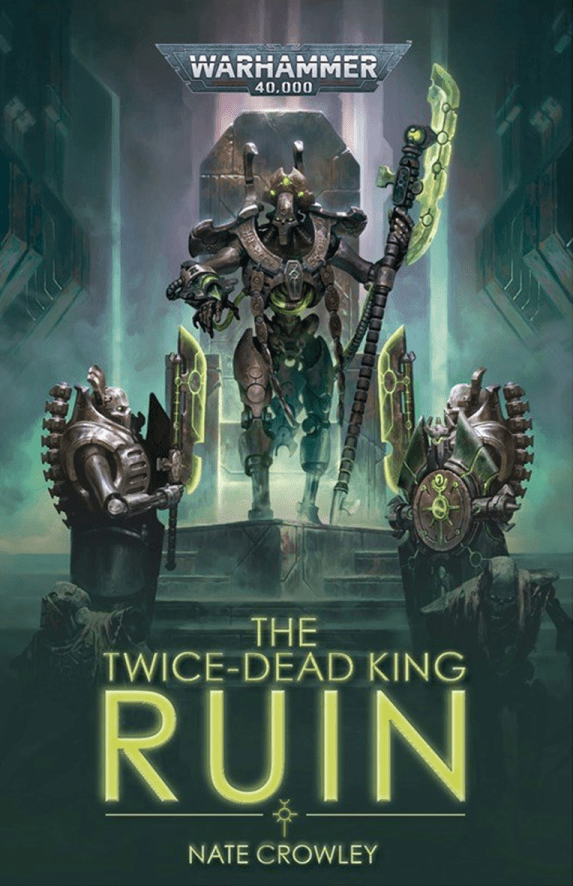
The Twice-Dead King - Ruin Cover

Publisher: Black Library (Audiobook – 9 October 2021)

Series: Twice Dead King – Book One

Length: 11 hours and 22 minutes

My Rating: 4.75 out of 5 stars

Amazon     Book Depository

Intriguing new author Nate Crowley presents one of the most complex and fascinating Warhammer 40,000 novels I had the pleasure of reading, The Twice-Dead King: Ruin, an epic and thrilling novel that explores one of the most intriguing races in the canon, the Necrons.

I have been having a lot of fun listening to a bunch of awesome Warhammer 40,000 (Warhammer 40K) novels over the last year, with some great examples including Deathwatch: Shadowbreaker by Steve Parker, Kal Jerico: Sinner’s Bounty by Joshua Reynolds, Fire Made Flesh by Denny Flowers, and First and Only by Dan Abnett.  While I have deeply enjoyed all these novels, I felt that it was time to go outside of the novels that typically focus on this universe’s human characters and instead read something with a more unique subject matter.  As such, when I saw that The Twice-Dead King: Ruin had recently been released, I instantly grabbed a copy, and I am really glad that I did.

Ruin is the first novel in The Twice-Dead King series, which looks set to explore the Necrons and their place in the current Warhammer 40K universe.  This was the second Warhammer 40K novel from author Nate Crowley, who previously released the intriguing Ork-centric novel, Ghazghkull Thraka: Prophet of the Waaagh!, as well as several short stories/novellas set in the universe.  Crowley makes full use of his talent for getting into the mind of fictional aliens to create an excellent and enjoyable read that I had a wonderful time listening to.

In the chaotic and war-striven future of the 41st millennium, many powerful and dangerous races fight for domination and destruction.  However, no race is more mysterious or feared than the immortal beings known as the Necrons.  The Necrons are an ancient and ruthless race who, thousands of years ago, sacrificed their mortality and humanity to defeat a powerful enemy as well as death itself.  Forced into thousands of years of hibernation after their great victory, the Necrons are now slowly awakening to reclaim their empire by destroying all life in the galaxy.

However, despite their intense belief in themselves, the Necrons are a dying race, gradually being whittled down by time, madness, and the unceasing tide of organic life they are forced to constantly fight against.  None know this better that Oltyx, a bitter and resentful Necron Lord who has been banished to the wretched border world of Sedh.  Once heir to the throne of a mighty and glorious dynasty, he now only has control of a small garrison of degraded warriors who are slowly dwindling under constant attacks from Ork raiders attempting to invade the Necron empire.

As Oltyx dreams about vengeance and reclaiming his birthright, he finds himself facing an immense threat that could spell the doom of his dynasty and the entire Necron race.  The invading Orks are only the precursor of a larger and much more powerful enemy, one his small force has no chance of defeating.  With no other option, Oltyx is forced to return to his dynasty’s crownworld and beg for reinforcements from the court who cast him out.  However, his return uncovers something far more disturbing than he could have ever imagined.  A twisted horror now lies within the heart of Oltyx’s dynasty, bringing only madness and bloodshed with it.  To ensure his people’s survival, Oltyx must face the curse of the Necrons and the pure horror of a twice-dead king.

Ruin is an exceptional and captivating tie-in novel that perfectly combines an intriguing and addictive narrative with large amounts of Warhammer 40K lore and some great character work.  This is a perfectly paced story that does an exceptional job introducing the complex setting and character and placing them into an intense and emotionally rich adventure.  While the initial start of the book is a tad slow due to the necessity of throwing in so much Necron lore, it swiftly picks up speed and excitement within the first few chapters.  I personally became really attached to this novel a couple of chapters in when the protagonist and point-of-view character, Oltyx, attempts to determine the best way to defend his planet against the Ork invaders, while also simultaneously mulling over the failures of his personal history.  There was one amazing extended sequence that saw Oltyx attempting to analyse a vision from his past to come up with a perfect plan, while also watching a massive force of Orks approaching.  This scene perfectly blended a fun Warhammer battle with alien history and a complex character moment, all set to a timer that was counting down to the start of combat.  From there the story gets even more enjoyable, as after getting up close and personal with the real horrors of the Necrons, the protagonist discovers that there is a bigger danger approaching: humans.  From there, Oltxyx is forced to journey back to his home planet to beg for help, but instead finds a secret more terrible and disturbing than he could ever imagine.  After some severe lows, combined with a couple of family reunions of variable enjoyment, the story leads up to an impressive and epic conclusion, loaded with war, destruction and sacrifice.  This satisfying and moving conclusion wraps up this leg of the story extremely well and treats the reader to some outstanding action sequences and some major emotional moments that will define the protagonist for the entire series.  An overall brilliant and deeply memorable narrative, I powered through this cool book and loved every second of it.

Ruin was also a pretty impressive entry in the overall Warhammer 40K canon, especially as it contains an outstanding look at one of the franchises more unique races, the Necrons, who are extremely underrepresented in the extended fiction.  Crowley has done a brilliant job here with Ruin, and I loved the distinctive and compelling Warhammer 40K story it contained.  The author has made sure to load up this book with a ton of detail, information and settings unique to this massive franchise, and fans will no doubt love immersing themselves in this cool lore.  Ruin also contains several massive and well-written battle sequences that will easily remind readers of the table-top games that this franchise is built around and which really increase the epic nature of this novel.  The immense amount of somewhat more obscure lore may turn off readers new to Warhammer 40K fiction.  However, I think that most new readers can probably follow along pretty well here, especially as Crowley has a very descriptive and accessible writing style, and Ruin proves to be an excellent and compelling introduction to the Necrons.

I was deeply impressed by how Crowley featured the Necrons in Ruin, especially as he provides a deep explanation of their history and personalities, while also making this somewhat aloof race extremely sympathetic.  The Necrons are a very interesting race within the Warhammer 40K canon, with a look that can be best summed up as Ancient Egyptian Terminators.  They also have a backstory that is somewhat similar to the Cybermen from Doctor Who, in that they are formally organic beings who were transplanted into metal bodies, with only a few members (mostly the former nobility) maintaining their personalities, memories and emotions.  This makes them a very hard species to get a handle on, and most of their appearances in the expanded fiction feature them as cold antagonists.  However, Crowley really went out of his way to showcase the deep and rich culture, history and personalities contained within this race, and the reader ends up getting an impressive and comprehensive look at them throughout Ruin.

This book contains so many intriguing and compelling details about the Necrons, and the reader gets a real crash-course, including why they gave up their humanity to become metallic monsters.  Crowley attempts to cover every single detail about the Necron way of life in this book, and Ruin is filled with cool discussions about current Necron biology, how their components work, how they communicate, and what the mindset of these immortals truly are.  The readers are left with a vision into the complex and hierarchical minds of this unique race, and you get some compelling insights into who they are and why they do what they do.  In addition, Crowley really attempts to highlight just how tragic the Necrons really are as a race, with a deep and compelling look at what they truly gave up when they become the metal beings we all know.  Crowley paints the Necrons as a dying race, despite the apparent immortality bestowed upon them, as the finite members are slowly being worn down by combat, disrepair, and madness.  There is a particularly fascinating look at how the transition from flesh to metal has deeply impacted the psyche of many of its members, as some have been driven into a deep depression while others are turned into crazed cannibals.  This fascinating and comprehensive examination helps to turn the Necrons into quite a sympathetic race throughout Ruin, and you end up rooting for them as the book progresses, even when they are fighting humans.  While the Necrons have never been my favourite race/faction in the Warhammer 40K canon, I deeply appreciated seeing a novel from their point of view, and Crowley’s excellent writing has helped to alter my opinion about them.  I must admit that it was extremely fun to see their perspective on the events of the Warhammer 40K universe, as well as their opinions about the other races inhabiting it (the protagonist makes a very intriguing comparison between Necrons and Space Marines that really sticks in the mind).  This was a perfect Necron novel, and readers will come away with a whole new appreciate for their backstory and plight.

Another thing that I deeply enjoyed about Ruin was the complicated protagonist, Oltyx, a disgraced Necron noble who has been banished to a desolate and worthless frontier planet for his transgressions.  At the start of Ruin, Oltyx is an angry and arrogant creature, weighed down by his bitterness and resentment, and is not a particularly fun character.  However, as the story progresses, Crowley adds layer upon layer of complexity to him, using a mixture of flashbacks, personal insights, revelations, and alternate perspectives of his memories.  This slowly turns him into a sympathetic and compelling figure, showing him as one of the few nobles to truly care about the future of his people, whole also exploring his concerns about the madness and apathy that could one day claim him.  As the story progresses, and he reencounters the members of his family and has more visions of his past, Oltyx continues to evolve into a much more likable character, especially as he deals with great adversity and tragedy.  This adversity gives him some great appreciation for his race, even the lower tiers, and he soon comes away a well-rounded figure with an interesting future ahead of him.  This was an overall exceptional introduction to this character and Crowley has set up this figure up perfectly for the future entries in this series.

Aside from Oltyx proper, there were a couple of other fun figures I must highlight in this book.  Five of these characters are actually part of Oltyx himself, as the protagonist has installed five subminds into his head in order to help him achieve his mission.  These five subminds each provide different insights to a range of subjects, including doctrine, aliens, combat, strategy, and analytical analysis.  The various subminds each have their own personalities, based on their design, and it is fun to see them interact with Oltyx in his head and with each other.  While some of the subminds are focused on more than others, they prove to be an intriguing inclusion in the story, especially as they also grow and develop alongside Oltyx, especially once he comes to appreciate them more.  The subminds also help compensate for the general lack of other side characters in the novel, which are a result of both isolated planets and the general lack of remaining sentience amongst the Necrons.

The other major side character I want to talk about is Djoseras, Oltyx’s brother, who the protagonist blames for his exile.  Djoseras is an excellent mentor character who was just as deeply impacted by the transition to a metal body as his brother.  Despite Oltyx’s bitter memories about him, nothing about Djoseras is as cut-and-dry and you initially believe.  Once you encounter him in person and see some additional memories for Oltyx, you really grow to appreciate Djoseras more, especially once you see him lead an army in battle.  Oltyx’s multiple encounters with Djoseras add some outstanding emotional elements to the story, and each of his appearances were complex and compelling.  Other side characters are introduced in this book, although most of them were only featured for a short time.  However, they will probably have a bigger role in the future novels in this series, and Ruin serves as a good introduction to them.

I grabbed a copy of Ruin in its audiobook format, which proved to be an outstanding way to enjoy Ruin, especially as it allows listeners to really absorb all the cool and impressive details contained within this compelling read.  This novel has a decent runtime of over 11 hours and features some brilliant voice work from narrator Richard Reed.  Reed is a talented narrator who has been a major fixture of the Warhammer audiobook scene in the last few years, and I really loved the awesome job he did here with Ruin.  Reed has a great voice for this impressive science fiction epic, and he manages to move the story along at a quick and thrilling pace which allowed me to finish off this novel in a few short days.  Each of the major characters are gifted their own distinctive voice throughout Ruin, which fits them perfectly and ensures that the reader always knows who is talking.  I particularly enjoyed the fun voice work set around the protagonist’s five subminds, especially as they are similar, yet slightly different, to that of the protagonist.  I also really appreciated Reed’s voice work during certain big scenes, such as when attempting to emulate a crowd of mad, chanting Necrons, and his great narration really helped to enhance these scenes.  An exceptional and deeply entertaining audiobook outing, I would strongly recommend this format to anyone interested in enjoying this fantastic epic.

With Ruin, the first The Twice-Dead King book, brilliant author Nate Crowley, has provided Warhammer 40K fans with an exceptional and powerful introduction to the mysterious Necron faction.  Featuring a captivating, action-packed narrative, a complex protagonist, and an excellent examination of the complex Necrons, Ruin is a must read for all fans of the franchise.  This is easily one of the best Warhammer 40K tie-in novels I have had the pleasure of reading and I cannot wait to see what Crowley adds to this franchise in the future.  This series is set to continue with the second entry, The Twice-Dead King: Reign, and I cannot wait to see what happens next.

Make sure to also check out my review for the second The Twice-Dead King novel, Reign.

Amazon     Book Depository

Aurora’s End by Amie Kaufman and Jay Kristoff

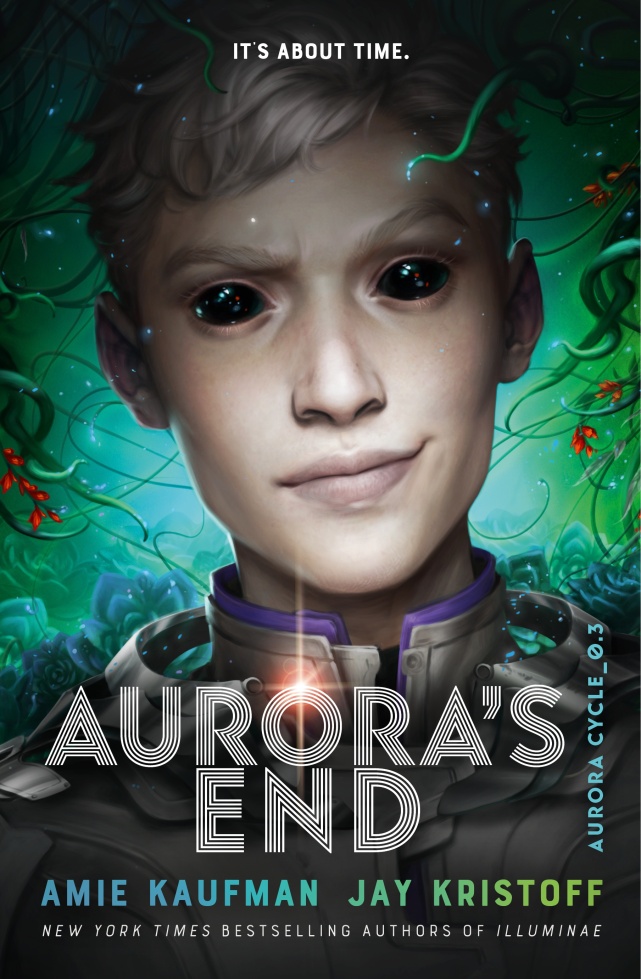
Aurora's End Cover

Publisher: Allen & Unwin Australia (Trade Paperback – 2 November 2021)

Series: Aurora Cycle – Book Three

Length: 493 pages

My Rating: 4.5 out of 5 stars

Amazon

The all-star team of Australian authors Amie Kaufman and Jay Kristoff present the third and final novel in their epic Aurora Cycle series, with the intense and clever young adult science fiction novel, Aurora’s End.

Over the last few years, I have been deeply enjoying the outstanding partnership of Amie Kaufman and Jay Kristoff.  Both Kaufman and Kristoff are accomplished authors, with several independent series to their name, such as Kristoff’s Lifel1k3 series (make sure to check out my review for the second book, Dev1at3).  However, I think that some of their strongest work has been together, as Kaufman and Kristoff have previously co-authored the acclaimed The Illuminae Files trilogy.  Their latest collaboration, The Aurora Cycle, has been a particularly amazing young adult science fiction series, and I have been really enjoying its cool story.

The Aurora Cycle novels are set in a far future when humans have expanded out into space and encountered a range of different alien species.  Peace between these species is kept by the Aurora Legion, an intergalactic collation of peacekeepers, made up of teenagers of various species (a slightly more hormonal Starfleet, slightly).  The series follows Squad 312, a group of misfits brought together thanks to the arrival of the mysterious Aurora O’Malley.  Auri is a girl out of time, who was awoken by the squad after centuries frozen in a colony ship and found herself gifted with dangerous psychic powers.  The first book in this series, Aurora Rising, introduced the squad and saw them thrust into the midst of a galactic conspiracy, as a race of plant-based aliens, the Ra’haam, who are plotting to assimilate all life, frame them as terrorists.  The second novel, Aurora Burning, expanded on the threats, the conspiracies, and the character drama, and ended with a massive cliffhanger, with all the surviving members of Squad 312 in great danger and the fate of the universe on the brink.

Following the terrible battle near Earth between the human and Syldrathi fleets, the planet-destroying superweapon was fired, but nothing turned out as expected.  Now, the various members of the galaxy’s last hope, Squad 312, have been flung throughout time.  Scarlett, Finian and Zila have been blasted back into the early days of Earth’s intergalactic travel, when there is no Aurora Legion, no friends, and a ticking clock of doom as the mysterious station they arrived at keeps blowing up.  Subsequently, Auri and Kal arrive years in the future, where the Ra’haam have won, and all hope seems lost.

Trapped in a time loop, Scarlet, Fin and Zila will initiate a desperate plan (again and again) with a new friend, but their mission may end up having unimaginable consequences.  While in the future, Auri and Kal are trapped with the only weapon that can end the Ra’haam threat, if they can get back to the present.  Forced to team up with the most dangerous being in existence, Kal’s genocidal father, Caersan, Auri and Kal embark on a dangerous mission through the Ra’haam controlled future with some unexpected help.

Back in the present, Squad 312’s leader, Tyler Jones, is also running out of time.  Still branded a fugitive by the entire galaxy, Tyler is the only person who knows that the Ra’haam are making their move to destabilise the various governments of the galaxy to start their invasion.  Forced to work alone and against the odds, Tyler needs to travel back to the one place he considers home, the highly secure Aurora Legion headquarters.  All three of these teams will need to survive impossible odds if they are to complete their missions and get back home.  But even if they succeed, can this ragtag team of teenagers really save the entire galaxy, or is the age of the plant-based parasite about to begin?

This was an outstanding novel from Kaufman and Kristoff that served as an excellent and captivating end to this impressive series.  Kaufman and Kristoff really went all out here with Aurora’s End, producing a complex and entertaining narrative that separates out the various characters and presents them with impossible temporal obstacles.  I deeply appreciate the clever narrative that the authors wove around these compelling characters, and it ended up being an exceptionally fun and enjoyable young adult science fiction book that I powered through in two days.

I absolutely loved the cool story of Aurora’s End, not only because it was really thrilling and fast-paced but because it was so ambitious.  I cannot think of another trilogy where, in the final entry, the authors decide to suddenly embark on massive time-travel adventure, with an intense narrative split across three vastly different time periods.  However, it works incredibly well, as Kaufman and Kristoff produced some epic and exciting storylines that remain mostly separate throughout the entirety of the book.  All three storylines are very distinctive, and all of them are pretty fun in their own unique way.  The storyline set hundreds of years in the past is an extremely entertaining event that sees three point-of-view characters trapped in a slowly devolving time-loop that ends every time one of them dies.  The characters are forced to work through an exploding, high-security station to find a way to travel back in time, with a substantial number of hilarious deaths and mistakes along the way.  The storyline in the present follows the Squad’s leader as he attempts to stop the entire alien invasion by infiltrating the most secure location in the entire galaxy without his squad.  Finally, you have the storyline in the future, which is an emotional and powerful post-apocalyptic narrative that sees Auri and Kal forced to contend not only with a hostile galaxy completely taken over by the Ra’haam but also with Kal’s insane and manipulative father.

I felt that all three of these storylines worked incredibly well, and each of them had their own appeal.  I honestly have a hard time faulting any of these distinct storylines, and it was one of those rare occasions in a split-storyline novel where there wasn’t a single character or timeline that I was a little less excited to read about.  If I had to choose a favourite, it would be the storyline set in the past, mainly because I loved the fun opportunities that only a time-loop story can present.  All three storylines were incredibly rich and compelling, and the authors did a good job of layering drama, excitement, character growth and humour through each of them.  While they were mostly separate from each other, the overlapping elements worked incredibly well, and the storylines ended up coming together perfectly towards the end.  The authors also do a good job wrapping up a lot of the unexplained story elements from the previous novels, with certain mysterious events and McGuffins finally revealed in their entirety.  This results in a big and epic finale where all the remaining characters are reunited to face the final threat of the Ra’haam.  It was extremely cool to see all the unique story threads finally come together.  I did think that the authors got a bit too meta-physical in the finale, especially when it came to dealing with the big-bad, but this didn’t really disrupt my overall enjoyment of the story.  I absolutely loved this wacky, clever, and well-planned out narrative, and I am still deeply impressed with how well the entire time-travel story worked.

I have really appreciated the cool and enjoyable writing style that Kaufman and Kristoff utilised throughout the Aurora Cycle, and it worked incredibly well once again in this final book.  Just like with the previous novels, Aurora’s End is told utilising six split perspectives, with each of the surviving squad members going into the final book getting multiple chapters.  Not only do these multiple perspectives help to present a rich and complex character driven narrative but it also helps the reader to really get into the heads of the main characters.  Each part of the book told by a different character has its own unique feel to it, and you really get the sense of each of the characters’ personalities and experiences.  I also love the way in which Kaufman and Kristoff layer in the action and humour throughout the entire novel, with various fun scenes featured throughout.  The action scenes are very intense, and the authors do a great job of highlighting the crazy battles that each of the characters get involved in, whether it be massive space battles, deadly close-combat fights, or sneaky attempts to move through an exploding space station.  The authors also have a great sense of humour, with many fun jokes and observations that made me laugh multiple times, especially around the fun time-loop storyline.  This made Aurora’s End a very easy novel to get through, as the natural narration and fast-paced scenes ensures that readers can power through it quickly, and with little hassle at all.  Due to this being the final entry in a series, readers are encouraged to check out the first two Aurora Cycle novels first before reading Aurora’s End.  However, those readers tempted to start and finish he series here should still be able to enjoy the story as the authors have a very inclusive writing style, and the book also features a highly detailed “stuff you should know” section at the front (very useful for both new readers and those who need a quick refresher).

Just like the previous novels in this series, Aurora’s End is marketed as a young adult read, and I would strongly recommend it to this audience.  Younger readers will deeply appreciate the use of multiple complex teenage characters kicking ass and saving the world, and I think that the authors did a good job of capturing the teenage mindset in their various protagonists.  This was also quite a mature and positive read, with multiple examples of romantic relationships, complex issues, and great portrayals of LGBT+ relationships that will be appealing to the younger audience, especially as the authors do not try to talk down to their chosen readers.  Due to some of these mature elements, I would suggest that this is a more appropriate read for older teens, and this is a series I would have really enjoyed when I was first getting into fantasy and science fiction.  Despite its marketing towards the young adult audience, this is a series easily enjoyed by older readers, and I think that most science fiction fans will have a great time with this series, if they don’t have any objections to following teenage protagonists.  Overall, I think this book will appeal to a wide range of readers and is a particularly good series for teenagers looking for a fun adventure with relatable heroes.

The last thing I want to highlight abut Aurora’s End is the excellent characters featured throughout, especially protagonists Aurora, Tyler, Kal, Scarlett, Finian and Zila.  Over the course of the Aurora Cycle, the reader has had a wonderful time getting to know all the protagonists, all of whom have grown throughout the series, while also experiencing loss, heartbreak, betrayal, and devastating revelations.  I have deeply appreciated the impressive and realistic character growth featured within, and the authors have continued this throughout Aurora’s End, with some major character moments that helped to define all of them and shown how they have grown.  Unlike the previous novels that have focused on a couple of the characters a little more, there was a much more even spread amongst the characters, with each getting their moment in the light.  Indeed, thanks to the cool time travel elements, you get to see multiple versions of one protagonist, with an older version of this character becoming a supporting figure in one of the other storylines.  I deeply appreciated the various character arcs featured throughout this novel, and Kaufman and Kristoff go out of their way to make you run the full emotional gauntlet here.  These arcs include a more comedic one surrounding the sarcastic Finian and the perhaps oversexualised Scarlett as they explore their new relationship while the world continuously explodes around them.  At the same time, the socially awkward Zila has a more serious experience in the time-loop, even as she embarks on a doomed relationship with someone who lived hundreds of years before she was born.

The other three characters also have some major and moving character arcs, especially Aurora and Kal, who are trapped in a future where the Ra’haam won, and everything has been infected by them.  This is a particularly dark storyline, and these two protagonists go through a lot, especially as they keep witnessing all manner of death and destruction around them.  Their arc is further complicated by Caersan, Kal’s father, who has similar powers to Auri and used them to destroy Kal’s home planet.  This results in some major emotional moments, as Auri and Kal are forced to work with an unrepentant Caersan, while also trying to work out their own complex emotions.  Finally, I must highlight the great development at occurred with Tyler, the team’s leader, who, after spending two novels turning Squad 312 into the ultimate team and family, ends up by himself, forced to face literal ghosts from his past with none of his established support.  Tyler really suffers in this book, and you must feel sorry for everything he goes through, even if he does start a passionate, if exceedingly violent relationship with a warrior alien princess.  All of these character arcs are really impressive, and you will be moved by everything these fantastic heroes go through, especially as not all of them will come out of it in one piece.

With this fantastic final book, the team of Amie Kaufman and Jay Kristoff have brought their amazing Aurora Cycle series to an epic and impressive conclusion.  Aurora’s End was an outstanding novel that perfectly wrapped up this excellent trilogy with fun, flair, and exceptional action.  Featuring some amazing characters and a very clever time-travel based storyline, Aurora’s End was an incredibly fun novel that comes highly recommended.  I deeply enjoyed this epic novel, and I really hope that these two brilliant Australian authors team up again in the future for another compelling series.

Amazon

Artifact Space by Miles Cameron

Artifact Space Cover

Publisher: Gollancz (Ebook – 29 June 2021)

Series: Arcana Imperii – Book One

Length: 568 pages

My Rating: 5 out of 5 stars

Amazon

After already conquering the world of thrillers, historical fiction and fantasy fiction, bestselling author Miles Cameron presents his very first science fiction epic, the outstanding and brilliant Artifact Space.

Far in the future, humanity has spread out amongst the stars, expanding its influence and bringing trade and technology across multiple planets.  The success of humanity’s current expansion can primarily be attributed to xenoglas, a strong and mysterious material that forms the basis for trade, construction, and the economy.  Xenoglas is obtained from a mysterious alien race known as the Starfish, who can be found at the Trade Point, a massive structure at the edge of human space that only the most sophisticated and powerful ships are capable of reaching.  Humanity has created the greatships, kilometre long ships with massive city-sized cargo holds, capable of transporting all manner of human goods the long distance between the greatest human orbital cities to Trade Point and bring back vast hauls of xenoglas.

Marca Nbaro has always dreamed about venturing into space aboard a greatship and escaping her harsh upbringing in the notorious Orphanage.  However, after getting on the wrong side of the corrupt Dominus, Nbaro is forced to flee with few possessions, scandals dogging her step and an incomplete education.  Pawning everything for some forged records, Nbaro boards the greatship Athens as a junior officer as it prepares to depart on the multi-year journey to Trade Point.

Despite being constantly terrified of her sordid past being discovered, Nbaro is soon able to gain friends and standing aboard the greatship, and for the first time ever her future looks bright.  However, Nbaro’s dreams of mercantile success are soon blown out of the water when news of the destruction of two other greatships reaches the Athens.  It soon becomes apparent that the Athens is also at risk of from whatever mysterious forces have suddenly appeared.  Involuntarily brought into the midst of a dangerous conspiracy, Nbaro is recruited by Athens AI and the greatships’ security office to protect the ship.  As Nbaro works to safeguard her new friends and home, she finds herself facing an insidious and dangerous enemy that is determined to stop the Athens and its crew by any means necessary.  Can Nbaro and her friends protect the Athens as it makes a hurried journey towards the Trade Point, or will her first flight end in ruin and destruction?

Genuine question: is there any genre that Miles Cameron cannot write amazing novels in?  Well, after reading Artifact Space, it looks like Cameron really can do it all, as his latest novel is an exceptional and captivating read.  Cameron, who also writes as Christian Cameron and Gordon Kent (a joint pseudonym shared with his father Kenneth Cameron), is an author who I have been a fan of for a while.  I deeply enjoyed some of the great historical fiction reads he released as Christian Cameron, such as Tyrant and Killer of Men, as well as his more recent release The New Achilles.  I am also a major fan of the awesome fantasy novels he released as part of his Master and Mages series, including Cold Iron and Dark Forge.  Both of these awesome novels were exceptional reads that got five-star reviews from me, with Dark Forge being one of the best books and audiobooks I enjoyed in 2019.

Due to how much I enjoyed his great fantasy and historical fiction novels, I was very intrigued when I saw that Cameron was writing Artifact Space, his debut science fiction novel set in his newly created Arcana Imperii universe.  After featuring Artifact Space in a Waiting on Wednesday article, I was lucky enough to receive an advanced proof from Cameron, which I managed to read last week.  I am a little annoyed with myself for taking so long to get to Artifact Space, as it turned out to be an exceptional and deeply compelling epic that takes its reader of an exciting adventure out into the depths of space.  I had an amazing time reading Artifact Space and it is yet another of Cameron’s incredible novels to get a five-star rating from me.

Artifact Space contains a powerful and engrossing science fiction narrative that follows a complex and damaged protagonist as she engages in a dangerous and thrilling adventure out into the stars.  Cameron starts his novel off without much preamble, with the protagonist engaging in a dangerous race to the Athens to escape her past.  Once aboard, Nbaro becomes enfolded in the day-to-day life aboard the Athens, which swiftly teaches her, and by extension the reader, much about Cameron’s new setting.  The first half of the novel is pretty intriguing, as Cameron not only sets up his fantastic protagonist, great supporting characters and fantastic universe, but he also features some compelling adventures in space as the protagonist finds her feet aboard the ship while also dealing with some lethal personal problems.  While I really enjoyed this cool start to Artifact Space, the novel enters a completely new gear towards the second half of the book, especially after it becomes clear that a shadowy conspiracy has plans to destroy the Athens, with the protagonist stuck right in the middle of the key events.  Following a particularly intense and exciting sequence near the middle of the book, the rest of Artifact Space flows across at an extremely brisk pace, as several key storylines are resolved, and the Athens finds itself under increased attack from a variety of places.  All of this leads up to an impressive and captivating conclusion that sets up the following novel perfectly while keep the reader wanting more.

I really enjoyed the clever and powerful story that Cameron came up for Artifact Space.  There is something deeply compelling about seeing a great character getting an in-depth lesson in something new and fantastic, and I loved all the cool sequences of spaceship life, piloting and control that formed a great part of this book.  I am also a massive fan of how exciting and suspenseful the second half of the book turned out to be, as Cameron installs an excellent and thrilling storyline with plenty of threats, revelations and twists, which constantly leaves the reader on the edge of their seat.  Cameron also features several intense and exciting action sequences both aboard the ship and out in space, all of which are fantastically written and deeply enhance the cool and compelling narrative.  I quite liked how Cameron also adapted his writing style to suit the science fiction genre.  While the author maintains his propensity to feature an immense amount of detail in his story, I found that the writing was a lot more fluid and a little less formal than how he writes his historical fiction and fantasy novels.  I think this worked well for Artifact Space, as not only did it fit the futuristic setting a lot better, but it also ensured that the reader could get through the novel a little quicker.  I had an amazing time getting through this incredible narrative and it honestly did not take me long to become completely engrossed in Artifact Space’s story.  I absolutely flew through the second half of the narrative as I could not wait to see what obstacles the protagonist would experience next, as well as how the novel would end.

I was deeply impressed by the fantastic and impressive science fiction setting that was featured in this novel.  Cameron has come up with a compelling and detailed universe for Artifact Space, and it was one that I had a lot of fun exploring.  The story is set hundreds of years in the future and features a period of human exploration and expansion after a historic dark age which forced people to leave Earth.  Much of humanity’s current economy and progress is due to its xenoglas trade with the Starfish, and much of the book’s plot revolves around this trade, featuring the greatships, the alien Trade Point and the various human planets that lie between the Trade Point and the human population centres.  Each of these locations is very cool, and Cameron expertly brings them to life with his detailed and descriptive writing, which produces some excellent backdrops for the narrative.  Cameron also spends a lot of time describing the fantastic setting that is the greatship itself.  The greatship, an immense vessel filled with a unique collection of crew, cargo, rooms, and technology, all of which are needed to take the assembled characters from one end of the galaxy to the next.  Most of the story is set aboard the greatship Athens, and it proves to be a fantastic setting to explore.  Thanks to the author’s use of a new crewmember as the narrative’s point-of-view character, the reader is given an in-depth view of the ship and everything that makes it tick and it really will not take them long to fall in love with the Athens and all its unique features and quirks.  I think that Cameron did an exceptional job introducing all the elements of this universe throughout Artifact Space, and I never found myself getting lost of confused about what was going on.  There are so many exciting, fascinating, and clever universe details featured throughout this novel and I look forward to seeing how Cameron populates this universe in the future.

I also really enjoyed the great selection of characters.  The most prominent of these is central protagonist and point-of-view character, Marca Nbaro, an orphan from a formerly wealthy family who cons her way aboard the Athens.  Due to her hard early life at the Orphanage, a terrible state-run institution, Nbaro is an extremely damaged character.  Forced to spend most of her life looking over her shoulder and expecting betrayal, Nbaro is unfamiliar with the easy camaraderie and friendship she experiences aboard the Athens and is generally suspicious of everyone she encounters.  She is also terrified that the rest of the crew will find out about her forged grades, which would see her chucked off the ship, while also harbouring a low opinion about her own abilities and skills, believing that she did not really earn her place aboard the ship.  This is a fantastic basis for a character, and I really appreciated the way in which Cameron examined the mentality and deeper concerns of his protagonist, especially as it ensures that you really care for Nbaro and want to see her succeed.  I liked the way in which Nbaro grew as a character throughout the course of the novel, especially as she gains a sense of self-worth thanks to her natural abilities and the connections she forges.  The character soon finds herself in a variety of unique and dangerous situations as she puts everything on the line to save her new friends and home, and it was great to see the character enter hero mode and succeed.  I am really looking forward to seeing how Nbaro continues to develop in the next novel, as well as where her personal story ends up.

Cameron has also filled Artifact Space with a wide range of intriguing and likeable supporting characters who the protagonist engages with during her adventures.  There is a fairly large collection of supporting characters in this book, especially as Nbaro makes friends and collections throughout the entire greatship and beyond.  I had a lot of fun getting to know some of the characters throughout this novel, and I was a particular fan of the weird and brilliant Dorcas, Nbaro’s friendly roommate Thea, and the ship’s clever and sarcastic AI, Morosini.  All these characters, and many more, added a lot to Artifact Space’s story, especially as most of them form a unique relationship or friendship with Nbaro.  While a few interesting supporting characters don’t survive to the end of the novel, the remaining swath of fun characters should help to make the next entry in this series very special.  I enjoyed seeing several of these characters develop alongside the protagonist, and they were great additions to this fantastic novel.

With Artifact Space, outstanding author Miles Cameron has shown the world that he is more than capable of writing science fiction, as he produces a compelling, character-driven epic, set deep in the future with aliens, giant spaceships and galaxy spanning conspiracies.  This was an amazing and captivating read which quickly drags the reader in with its intense and exciting story and exceptional science fiction setting.  I had an absolutely incredible time reading this impressive novel, and Artifact Space comes highly recommended to anyone who wants a great science fiction read.  I cannot wait to see how this series continues in Cameron’s next book, but in the meantime I need to make tracks to finish his Master and Mages series, as I cannot get enough of Cameron’s incredible writing.

Amazon

Star Wars: Thrawn Ascendancy: Greater Good by Timothy Zahn

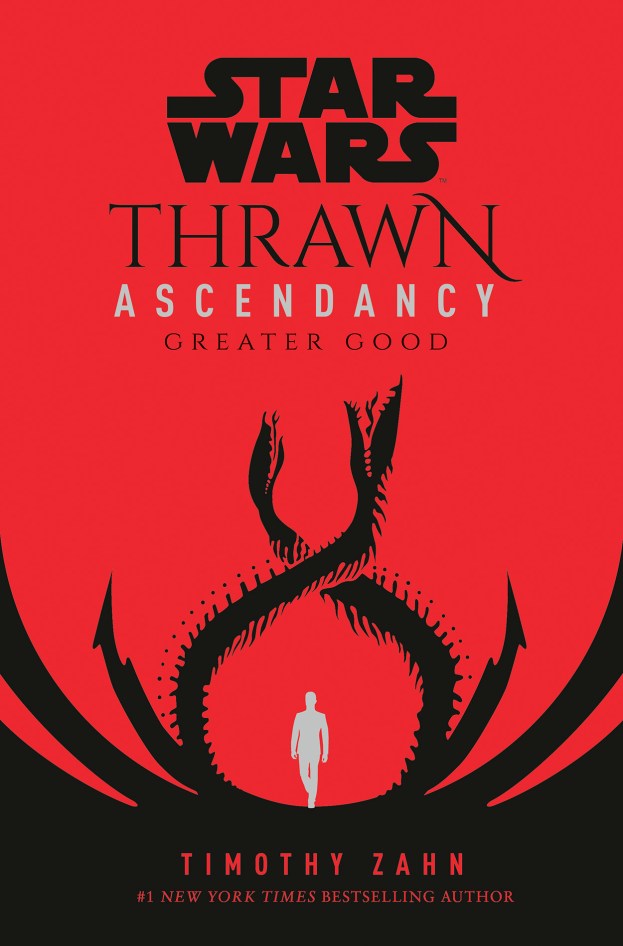
Star Wars - Thrawn Ascendancy - Greater Good Cover

Publisher: Penguin Random House Audio (Audiobook – 27 April 2021)

Series: Thrawn Ascendancy – Book Two

Length: 16 hours and 17 minutes

My Rating: 4.75 out of 5

Amazon

One of the most impressive authors of Star Wars fiction in the world today, the legendary Timothy Zahn, returns with another epic entry in his Thrawn Ascendancy series, Greater Good, which continues to explore the early life of that awesome Star Wars character, Grand Admiral Thrawn.

Zahn is an outstanding author who has been writing Star Wars fiction since 1991, with the highly regarded Heir to the Empire.  Since then, Zahn has written several amazing Star Wars novels in both the current canon and the Star Wars Legends canon.  While I have not read all of Zahn’s Star Wars novels (yet!), the ones I have were all incredible and are some of my all-time favourite Star Wars novels (such as the awesome Star Wars: Scoundrels).  However, his most distinctive works have all surrounded the awesome character of Thrawn.

Grand Admiral Thrawn is an alien officer in the Imperial Navy, renowned for his amazing tactical knowledge, brilliance in battle and ability to discern insights about his opponents by observing their personality or culture, especially art.  Ever since his introduction in Heir to the Empire, Thrawn has been a firm favourite among the fans, so much so that he was one of the few characters from the Legends extended universe reintroduced in the new canon.  This reintroduction was done in the third season of the Star Wars: Rebels animated series, where he served as an impactful antagonist for the third and fourth season.  It also looks like Thrawn will also be getting a live-action appearance at some point in the future after his name was dropped in The Mandalorian, which is pretty damn exciting.

The character has been heavily featured in the current range of Star Wars novels, as Zahn was brought back in to write some exciting new Thrawn-based novels.  This started with a brand new Thrawn trilogy in 2017, made up of Thrawn, Alliances and Treason, which showed how Thrawn joined the Imperial Navy and his early career as an officer.  These novels were all incredible reads (Thrawn got a five-star review from me, and Treason was one of the best books I read in 2019), and I loved the character’s unique adventures.  Thrawn’s story was furthered expanded last year with Chaos Rising; the first novel in Zhan’s Thrawn Ascendancy series, which examines the character’s pre-Empire life.

While the armies of the Republic and the Separatists battle for supremacy in the Clone Wars, another deadly conflict is occurring beyond the bounds of known space.  Deep in the unexplored regions, known as the Chaos, the mighty Chiss Ascendancy have just defeated the forces of General Yiv the Benevolent, shattering his empire, the Nikardun Destiny, and bringing peace back to their territories.  As the Chiss Ascendancy returns to normal, they are unaware that they are still under attack from a malevolent and clever foe that is determined to finish off the Chiss once and for all.

On a Chiss agricultural planet, a group of peaceful and seemingly harmless aliens have arrived, seeking to temporarily make a home.  In addition to their good nature, kind hearts and unique spices, these aliens have also brought something of great value that many people will kill for.  As news of the alien’s resources spread, cracks begin to appear in the very foundation of the Ascendancy, as the various powerful families fight for supremacy.

With civil war on the horizon, the future of the Chiss Ascendancy may lay in the hands of the brilliant and infamous Senior Captain Mitth’raw’nuruodo of the Chiss Expansionary Defence Fleet.  Thrawn, who is personally responsible for the defeat of Yiv and the Nikardun, is currently investigating the origins of their attack on the Ascendancy and, in doing so, comes across a previously unknown planet destroyed by its own deadly civil war.  As Thrawn attempts to explore this new mystery, he soon finds himself in the midst of a dark conspiracy.  An unseen force is attempting to take control of the entire Chaos, and the Chiss are the greatest obstacle to their plot.  Hamstrung by politics, family ties and his own inability to see the deeper motivations of his fellow Chiss, can Thrawn stop the oncoming conflict before it is too late, or will the Chiss Ascendancy burn from the inside out?

Zahn has once again produced an exceptional and outstanding piece of Star Wars fiction that further explores the fantastic early adventures of his greatest creation.  Greater Good is an excellent middle novel in this cool trilogy, and readers will deeply enjoy this book’s blend of intricate storytelling, great characters and impressive universe-building.  All of this results in an exciting and compelling novel that quickly draws readers in and has absolutely no trouble keeping their attention.  I had an outstanding time getting through this great novel and I was able to power through its audiobook format in no time at all.

At the heart of this outstanding novel is a clever and addictive narrative that follows Thrawn and a bevy of supporting characters as the Chiss Ascendancy finds itself in danger from an indirect attack.  Greater Good follows on immediately after Chaos Rising, and examines the next stage of a compelling conspiracy against the Chiss, while also focusing on Thrawn’s battles during this period.  The author utilises a substantial number of alternate perspectives to tell a rich and varied story and, while Thrawn is the centre of much of the book’s plot, Zahn has widened the focus of the novel with several compelling storylines and characters.  These include an investigation into the origins of a Nikardun attack on a remote planet, several jaunts out into different parts of space, internal political conflicts that are a threat to Thrawn, and exciting encounters with other inhabitants of the Chaos.  There is also a substantial focus on a new plot to destroy the Chiss, which includes several compelling flashback sequences that examines the origins and initial planning of the conspiracy.  This use of flashback is pretty impressive, and while certain aspects of the antagonist’s storyline are a tad odd, it was still an interesting tale.  I really enjoyed the vast array of different storylines and character arcs that really highlighted the richness of the setting and the unique plotlines they could inspire.  While some of these storylines might seem rather disconnected at times, Zahn cleverly brings them together at the end of the novel, resulting in a very impressive and intriguing conclusion.

As with most of Zahn’s novels, Greater Good is loaded to the brim with Star Wars lore and intriguing universe-expanding ideas as the author dives deeper into the origins, culture and history of the Chiss Ascendancy.  Zahn really expands on what he introduced in his previous Thrawn and Thrawn Ascendancy novels, especially Chaos Rising, and highlights the proud Chiss warrior culture.  A vast amount of new information of the Ascendancy is featured within this latest book, and the reader gets a fascinating look at the planets, political makeup and social hierarchy of this race, especially at the family level.  Not only is this really intriguing, especially for those readers who have enjoyed Zahn’s previous additions to the Star Wars canon, but the author uses it extremely well within the plot.  Much of the main narrative, including the conspiracy that threatens to destroy the Chiss, is based on their family makeup and the accompanying politics and family mentalities that go along with that.  I felt that Zahn integrated this into the narrative extremely well, forcing the characters to navigate their unusual and insane politics in order to survive.

The author also expands the reader’s knowledge of the previously unexplored area of the Star Wars universe known as the Chaos.  The Chaos, thanks to certain celestial anomalies, is harder to navigate and transverse than regular space; it is a mess of isolated planets, unknown societies and new alien races.  Zahn introduces several new aliens throughout this novel, with each unusual race playing an interesting role in the overall story.  I love the unique Star Wars setting of the Chaos, especially as many of the established Star Wars rules and technology are not as present.  For example, the various warships have some different armaments and shielding, such as acid-filled missiles, resulting in some unique and previously unseen battle tactics.  It was also interesting to see the different takes on the Force that the inhabitants of the Chaos have come up with.  Without any Jedi present, the various races within the Chaos each have their own interpretations or uses for the Force, such as the Chiss Sky-Walkers, young children who can use the Force to help ships navigate the Chaos more effectively, and it was intriguing to encounter different views of this throughout Greater Good.  Hardcore Star Wars fans will enjoy the intriguing additions that Zahn makes to the expanded universe, and the final few pages hint at some major lore introductions occurring in the next Thrawn Ascendancy novel that I am rather curious about.

While this was a great book and piece of Star Wars fiction, I did feel that it required some pre-knowledge of Zahn’s prior works.  The narrative of Greater Good is heavily linked to the events of its preceding novel, Chaos Rising, and while the author does re-explain some of the elements or storylines, a lot of the plot does rather assume you read the first book.  Having greatly enjoyed Chaos Rising, I was able to follow this quite easily, but I could easily see some newer readers getting a little lost or overwhelmed in places.  In addition, parts of the Thrawn Ascendancy series are heavily linked to the events of the previous Thrawn trilogy, and certain references or comments might not make much sense unless you had already read these books.  As a result, I would suggest newer readers check out some of Zahn’s earlier novels first, although it is still possible to enjoy Greater Good without it.  Those readers who have enjoyed these prior books are definitely in for a great treat though and will find the deeper dive into the Chiss and Thrawn’s past to be really enjoyable.

I cannot review one of Zahn’s Thrawn-centric novels without talking about the awesome space battle sequences they contain.  Each of these awesome books features some impressive and detailed space battles as the protagonists encounter a range of ships and fleets that they must fight against.  Greater Good is a particularly good example of this, as Zahn has written several outstanding sequences that are attention-grabbing and fun.  The sheer level of detail and planning that Zahn puts into these action sequences is incredible, and you get an amazing sense of what is occurring during the battle as well as the associated tactics and plans.  The sequences involving Thrawn are easily the best, as Zahn goes out of his way to showcase the character’s tactical brilliance.  This results in some very elaborate sequences, as Thrawn quickly determines the weaknesses of his opponents and uses that knowledge to craft intricate and somewhat insane strategies to utterly defeat them.  Watching these plans come to fruition is always amazing, especially as the reader has no idea in advance what is going on in Thrawn’s mind.  Instead, you only get to see the brilliance and impact of his tactics at the same time as the other characters, and it is always a lot of fun seeing how Thrawn was able to come to his conclusions about his opponents and use them against him.  Zahn comes up with some outstanding sequences for Greater Good that are guaranteed to leave readers on the edge of their seats.

In addition to the awesome narrative, action and universe-building, Greater Good also features an awesome collection of characters, each of whom add so much to the novel.  Naturally, the most impressive character is Thrawn himself.  Even amongst his own people, Thrawn is a strange being who sees the world in a very unique way, and everyone he encounters is impressed by his tactical know-how and unnatural observational skills.  I always enjoy the way in which Zahn depicts Thrawn’s actions in the novel, as Thrawn is one of the few characters whose perspective we do not see.  Instead, Thrawn is only portrayed through the eyes of the major point-of-view characters who observe and react to his actions.  Not only does this remove the inherent difficulties in depicting Thrawn’s mind, but it really enhances the impacts of his deductions and subsequent reactions.  The observing characters view Thrawn making his moves or claiming some impossible bit of knowledge, and then slowly work out how he did it, either through their own observations or thanks to comments by Thrawn.  This is done in a similar manner to the classic Sherlock Holmes novels, with the supporting characters in Greater Good acting in the role of Watson to witness and be impressed by the protagonist’s intelligent leaps.  Like with Sherlock Holmes, the use of the outside narrator in Greater Good deeply enhances the impact of Thrawn’s action, resulting in some awesome scenes.

One of the intriguing aspects of Thrawn’s character in Greater Good that I appreciated was the way in which Zahn continued to highlight his character’s one major weakness: politics.  Thrawn has absolutely no concept of politics, family alliances or some of the inner conflicts impacting the Chiss, and as such is unable to defend himself or others against political ambitions or vindictiveness.  I always really enjoy this trait in the Thrawn novels, especially as it gives Thrawn a noticeable weakness, while also enhancing the impact his fellow supporting characters have, as all of them understand politics better and can help Thrawn in this arena.  This blindness to political realities is particularly important in Greater Good, as not only is Thrawn being attacked by politicians from within his own family but the main threat facing the Chiss is more political than militaristic in nature.  This results in a rather intriguing handicap for Thrawn throughout Greater Good, and it was cool to see the sort of plan that the character came up with to compensate for it, as well as the mistakes he then makes.  Overall, Thrawn is a pretty awesome and fascinating character to follow, and I cannot wait to see what events happen to him in the final book in the trilogy.

Aside from Thrawn, I also really enjoyed some of the supporting characters featured throughout Greater Good.  In addition to being perfect conduits to observing Thrawn’s actions, each of these characters have their own intriguing storylines, many of which are continuing from Chaos Rising.  Examples of this include Thrawn’s old friend, Admiral Ar’alani, Thrawn’s second in command Mid Captain Samakro, the former Sky-Walker Thalias, who has tied her fate with that of Thrawn, and the powerful Mitth family politician, Thurfian, who serves as a secondary antagonist.  Each of these characters is further developed in Greater Good, and I enjoyed some of the cool storylines that Zhan is coming up for them.  Thurfian’s storyline is particularly intriguing going into the next novel, as the final scenes hint that he is going to come into possession of some very interesting knowledge soon.

Zhan also introduces several great new characters throughout Greater Good, many of whose narratives are tied into the malevolent plot to destroy the Chiss.  I found myself quite intrigued by the character of Lakinda, a fellow Senior Captain in the Chiss Expansionary Defence Fleet, who serves alongside Thrawn.  Not only does Lakinda offer an intriguing alternate observation angle on Thrawn, tinged with a bit of jealously and mistrust, but this character provides greater insight into the Chiss family structure.  Lakinda is an extremely loyal member of a mid-tier Chiss family, and she often finds her loyalties conflicted as she attempts to choose between family and the fleet.  This results in some captivating and emotional sequences which really help to highlight the unusual nature of Chiss society.

I also quite liked how Zahn spends time following the main antagonist of Greater Good, the mysterious alien Haplif.  Haplif and his people have been hired by a mysterious third party to orchestrate chaos and dissent within the Chiss Ascendancy to destroy them.  As a result, he masterminds an ingenious plot to promote conflict between various members of the Ascendancy.  I really enjoyed the complex and clever plot that this character came up with, and it was really cool to see him manage to manipulate several people throughout the course of the book, and he was an interesting alternative to the previous antagonist, Yiv.  It was a little odd to see Haplif, a supposedly brilliant planner and master manipulator, find his plans constantly stymied by a spoiled teenager and a backwater rancher, but it was fun to see his arrogance work against him.  All of these characters are amazing, and I really appreciate the time and effort that Zahn put into developing them.

It will not surprise anyone that I ended up listening to this Star Wars novel’s audiobook format rather than seeking out a physical copy of the book.  I absolutely love Star Wars audiobooks, and this was another excellent example that comes highly recommended.  The Greater Good audiobook has a runtime of just over 16 hours, which, while substantial for a Star Wars novel, is extremely easy to get through, especially once you become engrossed in Zahn’s cool story.  Like most modern Star Wars audiobooks, Greater Good makes amazing use of the classic Star Wars sound effects and film score to enhance the story.  I particularly enjoyed its use in Greater Good’s various space combat sequences, and it really amps up how epic those scenes were.

The real standout of this audiobook was the outstanding narration by Marc Thompson.  Thompson is an experienced narrator of Star Wars fiction who, aside from contributing his voice to all the books in the Thrawn and Thrawn Ascendancy novels, has also narrated awesome audiobooks like Light of the Jedi, Doctor Aphra, Dooku: Jedi Lost, Dark Disciple and more.  Thompson does an incredible voice for Thrawn that is filled with the character’s control, intelligence, and gentle menace, and which is very, very close to how the character is portrayed in Star Wars: Rebels.  This amazing voice for Thrawn is easily one of the best parts of the audiobook, and it is fun to listen to the character lay out his elaborate strategies in Thompsons’s awesome tones.  Aside from Thrawn, Thompson also produces a great range of different voices for Greater Good’s supporting characters.  Each character gets their own distinctive voice, which matches their personality and physical qualities, and the listener is never in doubt about who is talking.  I also quite enjoyed how Zahn makes fun accommodations for the various different species featured within the audiobook, tailoring his voices to make them sound more alien at times.  Zahn also gives more rural accents to some of the Chiss characters featured in this novel who are from, or are located on more backwater planets, which I thought was a very nice touch.  All of these amazing features help to turn the Greater Good audiobook in an absolute treat for your ears, and it is an incredible way to enjoy this epic novel.

Thrawn Ascendancy: Greater Good is another exceptional piece of Star Wars fiction from Timothy Zahn.  Featuring his iconic and impressive creation, Grand Admiral Thrawn, Greater Good serves as an outstanding second entry in the Thrawn Ascendancy series, which charts the early life of this great character.  With a clever and exciting story, chock full of universe building, fantastic characters and some unique and memorable battle moments, Greater Good is an excellent novel that comes highly recommended.  I have so much love for Zahn’s Thrawn and Thrawn Ascendancy novels and, after really enjoying Greater Good, I am very excited to see how this series ends.  The final book in the Thrawn Ascendancy trilogy, Lesser Evil, is coming out in November 2021, and I cannot wait to get my hands on it.

Amazon

Star Wars: Thrawn Ascendancy: Chaos Rising by Timothy Zahn

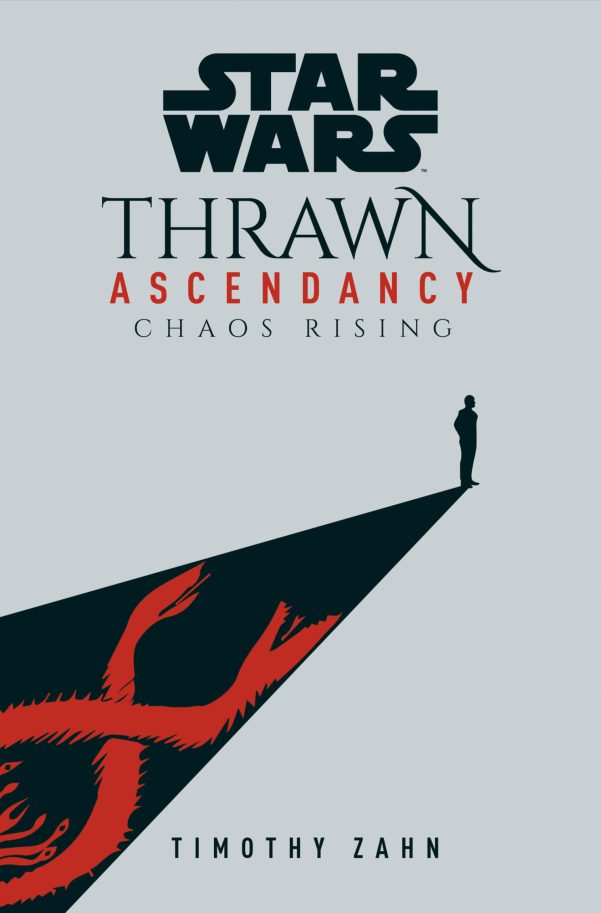
Thrawn Ascendancy - Chaos Rising Cover

Publisher: Random House Audio (Audiobook – 1 September 2020)

Series: Thrawn Ascendancy – Book One

Length: 15 hours and 5 minutes

My Rating: 4.5 out of 5 stars

Amazon

The master of Star Wars fiction, Timothy Zahn, returns with a brand-new series that explores the early days of his most iconic character, Grand Admiral Thrawn, with the first book in the Thrawn Ascendancy trilogy, Chaos Rising.

A long time ago, beyond a galaxy far, far away…

Beyond the edges of the known galaxy, past the borders of the Republic, beyond even the backwater Outer Rim, lies the Unknown Regions.  The Unknown Regions are a chaotic and barely explored section of space, where hyperspace travel is difficult and dangers lurk around every corner.  Despite this, many species flourish in this region, fighting for their survival and forming civilisations hidden from the eyes of the Republic and the Separatists as they fight their bitter civil war.  However, out of all these races, none are more mysterious, secretive and dangerous than the Chiss Ascendancy.

The Chiss have long considered themselves to be one of the most powerful races within the Unknown Regions.  Boasting vast fleets of powerful vessels which can appear anywhere within the Unknown Regions thanks to their great secret weapon, the force-sensitive children who can navigate hyperspace in the Unknown Regions, known as Skywalkers, the Chiss believe themselves safe and secure.  However, a sudden ill-fated attack on their home planet by a mysterious fleet quickly shatters this allusion.  While many, including the Chiss ruling council, are convinced that the attacking ships are a precursor to an invasion and begin preparations to withdraw their outer fleets, Supreme General Ba’kif believes that there is more to this attack then what is apparent.  In order to explore his suspicions, Ba’kif calls upon one of his most talented officers to investigate, the young tactical genius Senior Captain Mitth’raw’nuruodo, better known as Thrawn.

Many years before he became the Emperor’s most effective weapon as a Grand Admiral in the Imperial Navy, Thrawn, served his own people as a member of the Chiss Expansionary Defence Fleet.  Already renowned for his rare tactical ability, as well as his disregard for the politics and rules of the Ascendancy, Thrawn begins his investigation into the attack and swiftly determines that it was merely a feint, designed to draw the Ascendancy’s attention away from a much more dangerous threat.  A new malevolent alien empire is building strength in the Unknown Regions, and its eyes are firmly fixed on the Chiss.  With his hands tied by protocol and with his political enemies within the Ascendancy trying to take him down, Thrawn may be unable to stop the upcoming attack before it is too late.  However, Thrawn always has a plan, and the Unknown Regions are about to understand just how dangerous he truly is.

This was another fantastic outing from Timothy Zahn, who has produced a cool and intriguing prequel novel to his previous series.  Zahn is one of the most experienced and highly regarded authors of Star Wars tie-in fiction in the world today, having written several impressive novels for both the current Disney-owned canon, and the previous Star Wars Legends canon.  While he has written various Star Wars novels, such as the fun standalone novel Scoundrels, Zahn is probably best known for his 1991 release, Heir of the Jedi, which is generally considered to be the start of a whole new era of Star Wars tie-in fiction.  While there are a number of interesting aspects to Heir of the Jedi, one of the most important things about it was that it introduced Zahn’s most distinctive and popular creation, Grand Admiral Thrawn, a rare alien officer in the xenophobic Imperial Navy who was revered as their ultimate tactician.  Thrawn proved to be a very popular character whose backstory and characterisation was later expanded on in a number of Zahn’s other Star Wars Legends novels.

Due to the Disney purchase of the Star Wars franchise and the subsequent removal of everything except the movies and the animated series from canon, Thrawn was temporarily erased as a canon character until the third season of the Star Wars Rebels animated television series, where he was reintroduced with an altered backstory and history.  As part of this reintroduction, Zahn was contracted to write several new Star Wars novels examining this new history of the character, and thus he wrote the Thrawn trilogy, featuring the excellent novels Thrawn, Alliances and Treason, which are among some of the best pieces of Star Wars tie-in fiction I have so far read.  This trilogy ended in 2019, but Zahn is far from done, having started a new trilogy, the Thrawn Ascendancy series, last year.  The Thrawn Ascendancy trilogy, of which Chaos Rising is the first entry, is an intriguing and detailed series that serves as a prequel to the novel Thrawn and which show a younger version of the character as he serves the Chiss during the same time period as the Clone Wars.  Chaos Rising is an excellent and enjoyable novel which I read a few months ago, but which I have only just had a chance to review.  It was fantastic to see this complex and compelling character in action again, as well as more of Zahn’s impressive world-building.

This new novel from Zahn contains an amazing story that looks at the earliest adventures of Thrawn.  This is a very clever and layered tale that explores the main character in more detail while also providing him a new opponent to face in this book as he attempts to engage in battle against a dangerous enemy threatening his people.  Zahn builds a great narrative around the fight against this new antagonist, with Thrawn forced to engage in a number of intricate campaigns in order to obtain information and determine which points of weakness to exploit, whilst also have to contend with the machinations of members of his own race who are concerned with the reckless Thrawn’s actions.  At the same time, the author builds up a number of intriguing side characters who help to tell the tale of Thrawn in greater detail and with some interesting personal arcs.  This main storyline proves to be an extremely enjoyable and captivating read which flows at a great pace for most of the book, broken up with a number of cool and impressive battle sequences.  The main story is also supported by a fantastic collection of flashback sequences that depict an even younger version of Thrawn, showing some of his earlier encounters with many of the characters featured in the novel and highlighting how different the character has always been.  These flashbacks are used to great effect throughout the novel, not only building up the various characters’ pasts and personalities but also creating a great pace for the novel, with several key events from the protagonist’s life introduced where necessary to the main plot.  All of this helps to turn Chaos Rising, and indeed the entire Thrawn Ascendancy series, into an intriguing prequel to the Thrawn trilogy as it begins to set up the various reasons why Thrawn was sent away by his people and recruited by the Empire.  One part of Chaos Rising even directly ties into the events of one of the books from the previous trilogy, Alliances, with the reader seeing an alternate viewpoint to Thrawn meeting with Anakin Skywalker that gives an entertaining context to the events of that previous book.  All of this results in a fantastic and clever story that is easy enjoy and which sets up some more intriguing adventures in the later entries in this series.

One of the things I always try to address while reviewing a Star Wars novel is what level of franchise knowledge a reader needs to have in order to fully enjoy the story.  While most Star Wars novels are generally fairly accessible to new readers or casual fans, I would say that Chaos Rising is one of those books that should primarily be read by major fans of the franchise.  This is because Zahn loads this novel up with a ton of Star Wars references and details, including details of obscure parts of Star Wars lore and characters.  While the author does do a good job of explaining all the relevant aspects of this extended universe through the book, I would say that having some pre-knowledge about some of these elements is important.  At a minimum I would suggest that the readers read Zahn’s original Thrawn trilogy first, especially as Chaos Rising serves as a prequel to them, although fans with some basic knowledge of the character of Thrawn should be able to follow along without too much difficulty.  For new readers who do get through Chaos Rising, you are going to experience a huge amount of new information about the Star Wars universe as Zahn does a substantial amount of universe building throughout this book.  In particular, the author explores the legendary Chiss Ascendancy, a mysterious alien empire existing outside of the main Star Wars galaxy.  This is the first time that the Chiss planets and culture have been explored in any real detail in the current canon, and it proves to be a fascinating experience learning more about them and seeing the culture that produced such a unique character as Thrawn.  This novel contains a lot of detail about this alien race, as well as many other aspects of life outside the main galaxy setting of the Star Wars franchise, and while it is a tad overwhelming at times, I had a great time expanding my Star Wars knowledge and exploring this new, intriguing region.  It seems likely that Zahn will go into even more detail about this part of the Star Wars universe in future novels in the trilogy, and I look forward to seeing what other cool aspects he comes up with.

One of the best things about this book was seeing the return of the amazing and compelling character of Thrawn.  Thrawn is a very unique and enjoyable character, mainly because he has an unfathomable mind and is able to tactically outthink and outmatch any opponent that he comes across.  A highly analytical being who is able to discern fantastic insights about a person or species’ intentions, personalities and general mindsets from viewing some aspects of their creativity, mainly their artwork, Thrawn is easily able to predict actions and provide effective or crazy counters that shock and surprise everyone watching.  This makes him an incredibly fun character to see in action, especially as he makes some amazing and credible leaps of logic off the smallest details that Zahn features in his descriptions.  These analytical leaps then lead into a number of awesome and cool scenes where he outsmarts everyone around them, including in the book’s various battle sequences, which are awesome to read as there are some truly outrageous and clever tactical moves that no one can see coming.  Because of his way of thinking, Thrawn has a very closed off and odd personality that unnerves a lot of the people he deals with and makes many wary of his motivations and actions.

Just like he did in the previous novels, Zahn portrays Thrawn as a little less vicious and dangerous than he appears in Star Wars Rebels, with a little more humanity (or the Chiss version of it) added into his character.  Zahn also continues to explore the character’s lack of political awareness, a major flaw in his thinking that continues to cause him trouble as he constantly battles against the overarching hierarchy to take actions he knows will benefit or save his people.  I felt that Chaos Rising took a very interesting look at the character’s history, personality and backstory, and I quite liked the examination of his earliest trials and battles.  Thanks to the author’s use of flashback sequences, the reader gets a great view at different parts of his history, and you see the various steps that he takes rising up the military ladder and the various aliens and people he crossed or destroyed on the way.  All of this proved to be really cool to see, and Thrawn remains one of my favourite characters in the Star Wars canon, especially after this great outing from his past.

One of the most distinctive parts of any novel that follows Thrawn is the fact that none of the story is shown from his point of view; instead other characters tell his story.  This is mainly done to really highlight just how brilliant Thrawn is and to ensure that his eventual plans and insights come as a major surprise to the reader, much in the same way that a Sherlock Holmes novel is told from Watson’s perspective.  Chaos Rising features several different point-of-view characters, including one or two antagonists, who encounter Thrawn throughout the course of this novel and witness him utilise his tactical acumen.  I love seeing the various characters react to Thrawn’s impressive and clever schemes, and it is always fun when they realise that the impossible is happening right in front of them.  Several of these characters, particularly Thrawn’s allies, also provide a much deeper examination of the main character’s personality and mentality, and you see a different side to the character as a friend and mentor.

While these characters are primarily there to follow Thrawn, Zahn does take the time to explore each of these characters, with a particular focus on Thrawn’s impact on their life.  Many of these characters have some excellent and enjoyable backstories to them, and it was fascinating to see these great characters have their carefully planned out lives completely thrown around when they meet Thrawn.  While I failed to connect to some of these point-of-view side characters (for example, I just could not get invested in the arc surrounding the Skywalker Che-ri), others proved to be quite intriguing to follow.  Examples include Admiral Ar’alani, Thrawn’s former classmate at the academy, who becomes a lifelong friend and constantly finds herself trying to protect the protagonist from himself, or Thalias (Mitth’ali’astov) a former Skywalker whose encounter with a young Thrawn inspired her to join his clan and gave her a new vision for the future.  I also rather enjoyed following Qilori, an Unknown Regions navigator-for-hire, who secretly serves the Nikardun Destiny while also taking jobs for other clients like Thrawn and the Chiss.  It was immensely entertaining seeing Qilori attempting to manipulate Thrawn on the orders of the main antagonist, especially as Thrawn sees through every single one of his tricks.  Each of these great side characters added their own edge to the story, and I really appreciated having so many varied and unique viewpoints of the fantastic main character.

While I did receive a physical copy, I decided to listen to the audiobook format of Chaos Rising, not only because it made my reading schedule easier but because Star Wars audiobooks are always so much fun to listen to.  I think that I made the right decision here, as the Chaos Rising audiobook was a very awesome experience and I had a great time listening to it.  With a run time of just over 15 hours, this is a somewhat longer Star Wars audiobook, although once you get wrapped up in the story you don’t really mind.  Everything about this audiobook is cool, from the classic Star Wars sound effects, which help to drag the listener into the story (it is so much easier to imagine a dangerous fight scene when you can hear the blaster shots), to the outstanding use of John Williams’ iconic musical score, which just makes everything epic.  This audiobook also features the superb narration of the amazing Marc Thompson, who does a wonderful job.  Thompson, who has a vast experience voicing Star Wars audiobooks (for example, all the previous Thrawn novels, Dark Disciple, and roles in the Count Dooku and Doctor Aphra audio dramas), has an exceptional range of different voices which he uses to full effect throughout Chaos Rising.  Each of the characters is given a distinctive and enjoyable voice which allows the listener to easily follow who they are, while also getting an impressive and comprehensive idea of the character’s emotions and passion.  However, his most impressive work is saved for the main character himself.  Thompson has an excellent Thrawn voice, which very closely matches the voice of Lars Mikkelsen, the actor playing Thrawn in the Star Wars Rebels animated show, which helps to bring the character to life in vivid and impressive detail.  Thompson’s take on the character captures the character perfectly, and you get an amazing sense of the character’s deep analytical nature and constantly calm façade.  This was an exceptional bit of voice work from Thompson, and it really added so much to my enjoyment of the story to have this character’s words read out to me.  An overall exceptional and outstanding audiobook, this is the perfect format to check out Chaos Rising.

Thrawn Ascendancy: Chaos Rising is another outstanding novel from amazing Star Wars author Timothy Zahn that provides the reader with a captivating look at the early life of the incredible character of Grand Admiral Thrawn.  Featuring a clever and intriguing tale set deep in an unexplored area of the Star Wars universe, this novel serves as a fantastic and addictive prequel to Zahn’s impressive Thrawn trilogy and adds new layers to the author’s most iconic creation.  The second entry in this series, Greater Good, is set for release in a few months and looks set to be one of the most intriguing Star Wars novels of 2021, especially with renewed interest in the character of Thrawn after the second season of The Mandalorian.  I am extremely keen to see how the next novel turns out, but if it as good as Chaos Rising, then we should be in for a treat.

Amazon

Doctor Who: Time Lord Victorious: The Knight, The Fool and The Dead by Steve Cole

Doctor Who - The Knight, The Fool and The Dead Cover

Publisher: BBC Books (Hardcover – 1 December 2020)

Series: Time Lord Victorious – Book One

Length: 178 pages

My Rating: 4.25 out of 5 stars

Amazon     Book Depository

Prepare to follow the Tenth Doctor into one of his darkest adventures as he faces death itself in the early days of the universe with the first novel in the Time Lord Victorious multimedia series, Doctor Who: The Knight, The Fool and The Dead, by bestselling author Steve Cole.

Shortly after the events of the 2009 television special The Waters of Mars, the Tenth Doctor attempts to outrun his guilt and his prophesised death by fleeing deep into the past to the Dark Times.  Near the birth of the universe, life flourishes and death is barely known.  Only a few rare people die, and most beings live for vast quantities of time.  That is until the Kotturuh arrive and turn the peaceful and bountiful planet that the Doctor is visiting into a dead world within seconds.

The Kotturuh are a vile and terrible race who are spreading throughout the cosmos dispensing death and destruction on an unbelievable scale.  Worshiping a mysterious equation, the Kotturuh view themselves as the arbiters of life and death, travelling to planets and dispensing mortality.  With each new species they encounter, they decree what that species’ lifespan will be, whether centuries or moments, and any who have lived beyond their set time are instantly killed.

Determined to stop the Kotturuh’s reign of terror, the Doctor and a small team of companions begin to work on a defensive strategy that will ensure life forms are immune to the Kotturuh’s power.  After travelling to the Kotturuh’s world and witnessing the equation that they follow, the Doctor begins to formulate a plan that will not only stop the Kotturuh for good but may even put an end to the Doctor’s greatest enemy, death.  Determined to change all of time and space so that life will win for all time, the Doctor will become more than just a Time Lord, he will be The Time Lord Victorious.

Now it will probably surprise no-one who is familiar with my blog that I am quite a fan of Doctor Who (just add it to the massive list of fandoms that I follow).  Despite my love of the televisions shows, I have not gotten into the Doctor Who novels, audio dramas or comics, although that may change in the future.  The Knight, The Fool and The Dead is an intriguing and compelling Doctor Who tie-in novel that takes the reader on a fantastic and exciting ride with the Tenth Doctor.  Written by Steve Cole, who has written a huge number of Doctor Who novels and audio dramas among other intriguing works, this book is a vital entry in the Time Lord Victorious project.  Time Lord Victorious is a connected series of Doctor Who tie-ins told across multiple forms of media, including novels, comics, audio dramas and various other formats, which sees various incarnations of the Doctor encounter similar foes and each-other in a massive adventure.  The Knight, The Fool and The Dead, is a major part of this expanded tie-in series, introducing one of the main antagonistic species and producing some of the major connected moments.

The Knight, The Fool and The Dead had an intriguing and enjoyable narrative which places the Tenth Doctor in an interesting and deadly conflict.  I had an awesome time reading this amazing story and, in many ways, it felt like an episode of Doctor Who, with the Doctor being confronted by danger, recruiting a unique team of individuals, including an immortal, a mad scientist and a time travelling Ood hitman (a hitood??), before finding an inventive solution to the conflict.  This proved to be a fun and enjoyable adventure, although it does get somewhat dark towards the end, mainly due to the Doctor’s vulnerable mental state and the reckless course of action that he undertakes.  While the book mostly follows the Tenth Doctor and his companions, there are also some flashback scenes to some of previous Doctors, each of which show the Doctor telling one of his companions the same story in different ways.  These flashback scenes are very interesting, especially to fans of the franchise, and they have some clever connections to the main story and to the overarching events of the Time Lord Victorious.  Due to how short the novel is (only 178 pages), The Knight, The Fool and The Dead, is extremely fast paced, although Cole does an amazing job setting everything up in a short period and then ensuring that the story that follows is cohesive with a good flow.  I found myself powering through this novel in extremely short order, especially once I got stuck into the excellent story, and I really enjoyed how the entire narrative turned out.  I particularly liked the intriguing and shocking cliff-hanger, which definitely makes me want to check out the next novel in the series.

This latest novel from Cole proved to be quite an enjoyable Doctor Who tie-in novel that really captures the tone and feel of the television show.  Like many pieces of tie-in fiction, The Knight, The Fool and The Dead, is best read by fans of the Doctor Who franchise, especially those who loved the Tenth incarnation of the Doctor.  Due to it being part of the Time Lord Victorious project, The Knight, The Fool and The Dead has some intriguing connections to the wider universe, with several other significant figures and characters making appearances, resulting in a lot of references for eagle-eyed fans.  While some knowledge of the wider Doctor Who canon would be ideal for readers of this novel, I felt that the story contained within The Knight, The Fool and The Dead was accessible to newcomers who should have fun getting through this interesting science fiction adventure.  While this novel is connected to a huge range of other Doctor Who media releases, I felt that readers did not need to have enjoyed any of the other entries in the Time Lord Victorious series before this book to follow the story.  While The Knight, The Fool and The Dead is a major entry in this connected franchise and is necessary reading for people trying to enjoy the Time Lord Victorious as a whole, this book can easily be enjoyed on its own.  I am rather curious about some of the comics and other novels being created as part of this, and I might have to check them out at some point in the future.

One of the things I enjoyed most about this book was the author’s portrayal of the Doctor.  The Knight, The Fool and The Dead features the Tenth Doctor, who was played by David Tennant on television, as the central protagonist of this book, and I felt that Cole did an outstanding job of bringing this iconic character to life.  Cole captures so much of this Doctor’s personality, including the way he speaks and thinks, so much so that while I was reading through this novel my brain automatically read all of the Doctor’s lines to me in Tennant’s voice.  This helped turn The Knight, The Fool and The Dead into such a fun story, especially as Tennant’s Doctor is probably my favourite version of the character.  However, the real highlight of Cole’s portrayal of the Tenth Doctor is how the author brings a much darker and conflicted tone to the character.  This version of the Tenth Doctor is only shortly removed from the climatic events of The Waters of Mars, where the Doctor’s hubris led to the suicide of a woman he was trying to save.  Because of this, and because his own upcoming death has been foretold, the Doctor has fled back in time to try to outrun his problems.  I really enjoyed the way in which the author portrays a much more unpredictable and emotionally ragged Doctor throughout this book, especially one who is still getting flashes about what happened during his last adventure.  This somewhat damaged Doctor ends up making some rather rash and dangerous decisions, especially when an opportunity to end all death comes before him.  The way in which the author works this more damaged version of this fantastic character into the narrative is extremely cool and I really appreciate the way in which he brings the story back to the events of the television series.

Overall, Doctor Who: The Knight, The Fool and The Dead by Steve Cole is an excellent and compelling Doctor Who tie-in novel.  Thanks to its quick narrative and fantastic depiction of the Tenth Doctor, I had an absolute blast getting through this new book, which serves as a key entry in a captivating multi-media series.  This is a great book to check out, especially if you are a major Doctor Who fan, and I will need to get the next novel in this series, All Flesh is Glass, to see how this storyline ends.

Amazon     Book Depository

Star Trek: Discovery: Die Standing by John Jackson Miller

Die Standing Cover

Publisher: Simon & Schuster Audio (Audiobook – 14 July 2020)

Series: Star Trek: Discovery

Length: 12 hours and 15 minutes

My Rating: 4.5 out of 5 stars

Amazon     Book Depository

One of the leading authors of media tie-in fiction, John Jackson Miller, returns with his second Star Trek: Discovery novel, Die Standing, an awesome and captivating read that follows the adventures of an excellent protagonist, the evil version of Michelle Yeoh’s Philippa Georgiou.

After the dramatic conclusion of the first season of Star Trek: Discovery, Emperor Philippa Georgiou, former ruler of the Terran Empire, a power-hungry and xenophobic human interstellar empire from a twisted alternate universe, has been stranded in the main Federation’s universe.  Biding her time while trapped on the Klingon home planet of Qo’noS, Georgiou is finally given a the opportunity she has been waiting for when Starfleet’s covert spy organisation, Section 31, offers her a chance to work as one of their agents.  However, Georgiou is far more interested in gaining her freedom and plotting to use Section 31’s resources to flee beyond Starfleet’s control.

Georgiou’s plans change when she receives news about a mysterious attack on one of Starfleet’s military vessels by a malicious and dangerous cosmic entity, one that her counterpart in this universe may have seen years before.  Intrigued by the description of the attack, Georgiou decides to remain with Section 31, especially as it bears a striking similarity to a powerful superweapon that was kept from her when she was Emperor.

Determined to use this weapon to regain her stolen power and take control of this weaker universe, Georgiou accepts Section 31’s proposal to travel to an isolated section of space where the creature was first witnessed.  Travelling with two mismatched minders who are already well out of their depth, Georgiou attempts to contact an old flame of this universe’s Georgiou, one who has a lot of influence in this quadrant of space.  Forced to conduct a subtle investigation amongst the secretive alien races of the sector, Georgiou and her companions follow the clues that will lead them to the entities they seek.  But what will happen when the former Terran Emperor has ultimate power within her grasp?  Will she ensure the safety of the Federation she despises, or will another universe bow before her might?

This was a fun and impressive new novel from bestselling author John Jackson Miller.  Miller is an interesting author who has a lot of experience writing tie-in stories, having previously written several pieces of Star Wars fiction as well as some notable Star Trek novels.  I have not previously read anything from Miller before, although I think that will have to change due to how much I enjoyed Die Standing.  Miller has written a couple of books that have been on my radar for a bit, including a previous Star Trek: Discovery novel, The Enterprise War, and the Star Wars: A New Dawn novel, which ties into the Star Wars: Rebels animated show.  This latest novel from Miller is an exceptional read, as he has come up with a wildly entertaining and clever novel based around the excellent character of Philippa Georgiou.  Backed up with an extremely compelling story, some interesting side characters and some wonderful universe-building, this is one of the better if not the best Star Trek novels of 2020, and ended up being an awesome read.

At the heart of this fantastic novel is a captivating and intense narrative that sees the protagonist and her companions venture into an unknown area of space in search of a creature with deadly potential.  This was an extremely clever and well-written character-driven story that features an excellent Star Trek narrative, filled with all manner of espionage, betrayal and war.  I really liked the way that the author blended together familiar Star Trek elements with a thrilling espionage narrative, especially one that was centred on a morally ambiguous protagonist who plans to betray everyone she encounters.  This makes for a number of great scenes, and I really liked the fascinating and clever places that the story went.  There are a number of particularly good twists featured throughout the book, and while I was able to predict where some parts of the story were going to go, I found myself pleasantly surprised and intrigued at some of the other reveals.  I also enjoyed the way in which Miller worked in some compelling comparisons between the two mirror universe, one mostly good and the other mostly evil, and it served as a clever and distinctive part of the book, especially as Miller does a lot with only one scene set in the Terran universe.  All of this makes for an exciting and powerful story that readers are going to have a wonderful time reading.  I really enjoyed the dark, thrilling and twist laden narrative and it honestly did not take me long to become hopeless addicted to this incredible Star Trek novel.

Die Standing is one of those tie-in novels that require some prior knowledge of its associated content to fully enjoy.  In this case, readers really do need to have a good understanding of the Star Trek: Discovery television show, as much of the story is derived from key events in the first and second seasons.  In particular, knowing the full tale around the character of Philippa Georgiou (both versions) is quite essential to fully appreciate the book’s story elements and character work.  At the very least, having some general knowledge of the Star Trek universe and the events of some of the shows would be useful, especially as the book is fairly dependent on some established story elements, such as the evil alternate universe.  That being said, Miller does do a really good job making this novel accessible to those readers whose knowledge of the genre might be lacking, and many of the key elements are explained in sufficient detail to follow the story and enjoy it.  However, this is definitely a novel most suitable for established Star Trek fans, especially as the author loads it up with a ton of fun or clever references to Star Trek: Discovery and some of the other television shows.  For example, this novel features the great inclusion of a younger version of the Dax symbiont (see more below), and I personally really liked how a major part of the book’s plot revolved around a key moment from Captain Kirk’s backstory (from The Original Series episode Obsession), not only showing the event from a different perspective, but also adding in some explanation for its origins and the reaction from Starfleet.  Die Standing also serves as a rather good bridge between the first and second seasons of Star Trek: Discovery, and it does an excellent job setting up the main character for her reintroduction to the show.

While this book did have an exceptionally captivating story and some cool Star Trek elements, the absolute highlight of this book has to be its wonderful protagonist (and occasional antagonist), the evil Terran version of Philippa Georgiou.  Die Standing features Georgiou in all her evil glory and she quickly makes an impression of the reader, especially after one particularly brutal and entertaining prison break sequence at the start of the book.  Pretty much every scene that features Georgiou is highly entertaining, and the snarky, arrogant personality she displays to anyone she meets proves to be spot on to how she is portrayed in the television show.  While I really enjoyed this character in Star Trek: Discovery (she is easily one of the best parts of the show) I personally felt that Miller actually helped to make Georgiou an even more compelling character throughout the course of this book.  The author really dives down into her personality and motives, showing just how twisted and self-serving she can be while also reflecting on all the things she has lost and the changes she is forced to deal with.  Georgiou goes through some fascinating self-examinations in Die Standing, especially when she is confronted with the legacy of her dead counterpart in this universe, and this serves as a fantastic emotional centre of the book.  The author’s impressive use of this fantastic character works extremely well, and it certainly helps Die Standing stand out from some of the other Star Trek novels of 2020.

Die Standing also features an excellent cast of side characters who add a lot to the story.  There are two characters who particularly stand out, Emony Dax and Sean Finnigan, who both serve as alternate protagonists, with significant parts of the book told from their perspective.  While Dax and Finnigan are nowhere near as dynamic as Georgiou, they are both distinctive in their own ways, and Miller does a good job at making them both likeable and compelling parts of Die Standing.  Emony is a young Trill gymnast who is the third host of the Dax symbiont.  This makes her an earlier incarnation of the Dax character who appeared in the Star Trek: Deep Space Nine television in two different guises (Jadzia Dax and Ezri Dax).  Thanks to her youth, both as a symbiont and a host, this version of Dax is a little more unsure and scared then her later counterparts, but is determined thanks to the terrible things she witnesses at the start of the book.  While she is initially extremely cowed by Georgiou’s overwhelming personality, Dax grows throughout the book and is eventually able to influence Georgiou.  Deep Space Nine fans will no doubt enjoy seeing this earlier version of Dax, and I rather appreciated the excellent character growth she experienced.  The other main character, Sean Finnigan, is definitely one of the more entertaining characters in this book.  Finnigan is an unashamedly Irish character who serves as the book’s comic relief.  A wild and unruly former Star Fleet officer, Finnigan is drafted into the mission due to an interesting connection he has to Georgiou, as a murderous, brainwashed version of himself served as the Emperor’s assassin in the mirror universe.  While Finnigan is a mostly entertaining character, joking, drinking and socialising with all everyone he meets, there are some deeper elements to his character, especially as he spends a good part of the book trying to balance his real personality with the more insane version of himself that Georgiou tries to bring out.  Dax and Finnigan form a compelling team with Georgiou, and they ended up being an extremely good trio the anchor the story around.

I also quite enjoyed the intriguing Star Trek universe-building that Miller featured throughout Die Standing.  A key part of this book’s story is set within an isolated section of space that is home to three distinctive alien races who are attempting to stay separate from the Federation.  All of these species are quite intriguing and inventive, and include a race of giant living spindles, an intensely warlike species of living tanks and a group of gaseous psychics.  Miller does an exceptional job exploring each of the three new alien species throughout the course of the book and giving them each unique characteristics, histories, and personalities.  Not only are these aliens quite fascinating in their own right but each of their specific traits plays into the overall story extremely well, with some fantastic twists tied into them.  In addition, Miller also spends time exploring some of the differences between the main Star Trek universe and the mirror universe that contained the Terran Empire.  Not only is there an excellent opening sequence set in this mirror universe that showcases the brutal nature of this alternate reality, but there are a number of fantastic discussions that examine how different these universes could be.  Miller ensures that the protagonist Georgiou spends a good amount of time recounting some of the horrifying details of her universe to her companions (mostly to unnerve them), and it proves quite entertaining to hear all of her various stories, especially as most are apparently not exaggerated.  I also loved the fun way that Miller altered famous historical quotes to show how different the universes could be, with a number of classic lines twisted into something far more brutal and cynical, such as “Let them eat field rations” from General Antoinette.  The book itself is also broken up into five separate sections, based upon the Terran stages of grief (for coping with a loss of status): defiance, murder, plundering, destruction and vengeance, with each sections starting up with a quote from the Terran universe that describe its history.  Needless to say that Star Trek fans are going to love the cool additions that Miller works into the expanded universe in this novel, and I personally had a wonderful time seeing all the inventive and entertaining things that the author could come up with.

Like most of the Star Trek books I have had read in the past, I chose to check out Die Standing’s audiobook format.  This was, as always, an excellent way to enjoy this clever Star Trek novel, and I had a wonderful time listening to the story unfold.  Die Standing has a run time of 12 hours and 15 minutes, which is actually the longest Star Trek audiobook that I have so far listened to, but I was still able to breeze through it in relatively short order once I got hooked on the story.  In order to tell this amazing book, Die Standing makes use of the vocal talents of narrator January LaVoy.  This is the first audiobook I have heard narrated by LaVoy, although she did voice a minor character in Star Wars: Dooku: Jedi Lost.  She has also served as narrator for several books I have physically read, such as Star Wars: Galaxy’s Edge: Black Spire, Star Wars: Last Shot and The Night Swim, and she has also narrated a couple of books I am hoping to checking out in the future, including Star Wars: Phasma.  I have to admit that I was initially a little thrown to have LaVoy as narrator, as this was the first Star Trek audiobook I have listened to that was not narrated by Robert Petkoff.  However, it makes a lot more sense to feature LaVoy as narrator due to the female lead, and I really enjoyed listening to her narration of this book.  LaVoy did an incredible job bringing the characters to life throughout Die Standing and she ascribed some very apt and distinctive voices to each of them.  I was particularly impressed with the fantastic voice she utilised for Philippa Georgiou, and I felt it was very similar to how the character was portrayed in the television show.  LaVoy makes sure to channel all of Georgiou’s scorn and sarcasm to the reader, and it was an absolute treat to listen to her villainous rants throughout the book.  I also quite enjoyed the voice that LaVoy utilised for Sean Finnigan, Irish accent included, and it helped to enhance him as a fun and entertaining character.  All of this leads to quite an exceptional Star Trek audiobook and I would strongly recommend this format to anyone interested in checking out Die Standing.

Star Trek: Discovery: Die Standing is an amazing and impressive Star Trek novel from John Jackson Miller that was an absolute joy to read.  Miller has crafted together a captivating and clever narrative for this book that follows several excellent protagonists on a high-stakes adventure through all manner of intrigue and betrayal.  Featuring some compelling story elements, fantastic world-building and an awesome evil protagonist, Die Standing was an exceptional novel and it ended up being one of my favourite Star Trek novels I have so far had the pleasure to read.  A highly recommend piece of tie-in fiction, fans of the Star Trek: Discovery television show really need to check this fantastic book as soon as possible.

Amazon     Book Depository

Throwback Thursday – Redshirts by John Scalzi

Redshirts Cover

Publisher: Audible Frontiers (Audiobook – 5 June 2012)

Series: Standalone

Length: 7 hours and 41 minutes

My Rating: 4.5 out of 5 stars

Amazon     Book Depository

Reviewed as part of my Throwback Thursday series, where I republish old reviews, review books I have read before or review older books I have only just had a chance to read.

Prepare to dive into one of the most meta and entertaining novels you will ever read with Redshirts by John Scalzi, a fun and clever Star Trek parody that explores what it must be like to be a background character in a science fiction series.

John Scalzi is a well-established and highly regarded science fiction author responsible for a number of impressive and expansive series.  Some of his best-known works include his Old Man’s War series, his Lock In novels and his The Interdependency series, the last of which I have been eying off for a couple of years now and have been meaning to check out.  Each of these series sounds really exciting and have received a lot of positive praise from readers and reviewers.  In addition, Scalzi has also written three standalone novels, each of which has a very fun concept behind it, including the focus of this review, Redshirts.  While I am extremely interested in some of Scalzi’s other works, the moment I found out that he had written a Star Trek parody novel told from the perspective of a redshirt, I grabbed myself a copy of its audiobook format and I have been looking for a chance to listen to it.  Last weekend I had a long car trip with my wife/editor Alex, and we decided that listening to Redshirts would be the perfect entertainment for the drive.

Redshirts takes place in humanity’s far future, aboard the flagship of the Universal Union, the starship Intrepid.  The Intrepid is the pinnacle of human ingenuity and exploration, containing only the most talented crew and scientists that humanity has to offer.  In all respects it seems like the perfect posting for newly commissioned Ensign Andrew Dahl, but it does not take long for Dahl to suspect that there is something seriously wrong aboard the Intrepid.  Not only does the lab that Dahl is assigned to have a magical box which solves every major problem that the ship runs into (with only seconds to spare, without fail), but the entire crew is terrified of the captain and his senior officers, actively trying to avoid them and the near constant away missions.  The crew has come to realise that the away missions are guaranteed to be lethal, with any crew member who joins likely to die while the senior officers constantly walk away without a scratch (with the exception of the unlucky Lieutenant Kerensky).  Now a great deal of energy is place into avoiding an away mission at all cost, with new transfers to the ship kept in the dark until it is too late.

As Dahl and his friends begin to realise the full extent of the terror that has engulfed the ship they attempt to find some sort of answers for what is going on.  However, the more deadly adventures that they go on the more obvious it becomes that some mysterious force is controlling their actions and causing their deaths.  With the lives of every crewmember aboard the Intrepid at stake, Dahl and his friends are left with only one crazy plan, to hunt down the beings controlling them and convince them to stop no matter the cost.  However, what happens when these expendable redshirts end up meeting their own creators?

I am going to say right of the bat that both Alex and I absolutely loved this book and we had an incredible time listening to it.  A good indication of how much we enjoyed it can be seen in the fact that we easily and eagerly powered through it during the two halves of our car trip without any breaks, laughing our asses off the entire time.  Redshirts is an extremely funny and clever novel that acts as both a parody of and a love letter to the Star Trek television show.  Scalzi has come up with a truly awesome and enjoyable novel that combines an amazing amount of humour and parody with a clever and heartfelt story.  This results in a memorable and addictive tale which you cannot help but enjoy, especially if you are a major fan of Star Trek.

For this great novel, Scalzi has come up with a very compelling and enjoyable story that acts in many ways like a unique combination of Galaxy Quest, The Cabin in the Woods and The French Mistake episode of Supernatural.  The story focuses on Ensign Dahl and his friends as they begin to work out the issues aboard the Intrepid.  This is a very fast-paced narrative and the reader is soon introduced to all the mysterious events occurring on the ship, from the terrified crew, the weird science, the exceedingly dangerous and improbable away missions and the strange characters who seem to have the answers.  All of this is shown to the reader in a very clever way, and while you are expecting many of these events occur, especially if you are familiar with Star Trek, seeing these characters react to the various odd occurrences with realistic shock and scepticism is a great source of entertainment.  Following the initial introduction, you get several chapters of the protagonists humorously traversing a chaotic ship full of self-aware redshirts desperately trying to avoid their fates.  The various attempts by the characters to understand what is going on and change their fates are amazing, if a little tragic in places, and this is a very comedic part of the book loaded with some of the best jokes at Star Trek’s expense.  The story then takes a very interesting change of direction as the protagonists undertake a desperate plan (inspired by a classic Star Trek film) to save the ship and prevent their upcoming deaths.  This third part of the book is exceedingly meta, and fans of both Star Trek and surreal, self-referential fiction will love where the story goes and various clever character interactions that occur.  These distinctive parts of the book come together extremely well and form an intricate and captivating overall narrative that fits a lot of story elements into a relatively short novel.  I had an amazing time listening to this complex story, as not only did it make me laugh, but it also made me care about the various characters who are introduced throughout the course of the book (something which the author is aware of and sadistically exploits at times, especially with that last joke at the end of the main story).

In addition to the main story, Scalzi also features three substantial codas at the end of the novel.  These codas are essentially short stories that follow side characters the protagonist meets during the course of the main narrative.  While I would normally be a little concerned about some concluding material taking up so much space from an already shortish novel, these codas are extremely well written and contribute a great deal to the book.  Titled Coda 1, 2 and 3, the codas are told in the first, second and third person narrative respectively, and contain some truly impressive and touching character-driven narratives.  These extremely clever codas really dive down into the psyches and emotions of their respective characters, showing their own complex histories and how their encounter with the protagonist had such a major impact on them.  Of the three, my favourite is probably Coda 1, which is easily the funniest, containing a very humorous series of blog posts, although Codas 2 and 3 are both emotionally rich and heart-warming.  While some readers may be tempted to skip these codas after the main story is finished, I would very strongly recommend checking each of these out as you are guaranteed to come away being extremely attached to each of these great side characters and also feeling a lot better after hearing each coda’s happy ending.

While Redshirts also has its own unique and captivating story at its heart it is an extremely funny parody of the iconic Star Trek television show.  Scalzi is clearly a fan of the series as he expertly works all manner of fun jokes and references to the show into the novel.  The Intrepid and its bridge crew are clear parodies of the Enterprise and the main characters of The Original Series, and Scalzi does an amazing job working his narrative around them, emphasising all their iconic character traits and showing just how ridiculous they and their actions are to the eyes of a normal person.  This includes the captain’s dramatic tone and way of over exaggerating events, and the poor junior officer with a Russian accent who gets the crap kicked out of him every single episode and yet is fully recovered by the next adventure without a hint of injury or PTSD.  Redshirts contains all manner of references or parodies to the over-the-top, badly written or ridiculous elements of the show, and Scalzi lovingly features and critiques them in an amazingly funny way; everything from the evolutionarily questionable alien monsters, the repetitive space battles (those poor people on decks six to twelve!) and the high death toll of the normal crew.  The highlight of the book has to be the terrified and disbelieving reactions that each member of the crew has to the events going on around them, and the fun and exaggerated attempts to survive them.  I also really loved the comedic metafiction elements of the book, which allowed Scalzi to take some humorous shots at the writers and creators of shows like Star Trek.  While this humour is obviously geared towards Star Trek fans, you really do not need to have a lot of in-depth knowledge of the series to appreciate the humour.  Anyone who has a passing knowledge of Star Trek and its tropes will find this book deeply amusing and hilarious and you are guaranteed to have a fun time getting through it.

While I absolutely loved Redshirts’ story, I did find that the dialogue was a little clunky in places.  While most of the conversation is quite fun and snappy, the overabundance of dialogue tags and the extreme overuse of the word “said” gets repetitive and distracting, especially in scenes where the conversations fly thick and fast.  In some heavy dialogue scenes, “character 1 said”, “character 2 said”, “character 3 said” repeats about 20 times in a minute, which is really distracting.  If Scalzi had used more variety in indicating which character said what, this book would have been pretty damn perfect.  But the story and the comedy were strong enough to overcome most of these issues, and I chose to focus on them instead.  However, I can easily see other readers getting a little frustrated with this, which would be a real shame as this is a very fun book.

The audiobook format of Redshirts ran for 7 hours and 41 minutes, although it is a closer to six hours if you decide to skip the codas at the end of the book.  This was an extremely easy audiobook to listen to quickly and we absolutely flew through it.  One of the main reasons that we were so interested in this book is because the audiobook is narrated by Wil Wheaton.  Now, there is obviously a lot of appeal to Wil Wheaton, or any cast member of a Star Trek television show, getting involved in a parody like this, but Wheaton did a pretty good job narrating this audiobook.  Wheaton had a great voice for this novel, and he was able to keep the audience’s attention through the entirety of the story.  While he did not really change his voice from character to character, the listener was generally able to tell when someone new was talking (ironically thanks to the author’s overuse of “said”).  Wheaton was, however, extremely adept at expressing the relevant emotions of the characters through his voice, and the fear, anger, frustration and sheer disbelief of the protagonist and the people he encounters really shines through.  I also really enjoyed his portrayal of the Intrepid’s senior crewmembers, each of whom is a parody of the main characters from Star Trek: The Original Series.  I particularly had a lot of love for the Captain’s “dramatic voice” that Wheaton did, which really captured the over-the-top tone Kirk had when he was excited or animated.  Overall, the audiobook format is a fantastic way to enjoy Redshirts and I would definitely recommend it to anyone interested in checking this novel out.

Redshirts by John Scalzi is a masterful and hilarious novel that presents the reader with a wonderful and clever parody to the classic Star Trek television series.  While there are some style issues associated with the dialogue, the story is loaded to the brim with all manner of great jokes, interesting characters, compelling plot elements and a whole lot of meta comedy.  An absolutely fantastic read that will appeal to all manner of Star Trek fans or people in need of a good laugh, Redshirts comes highly recommended and I can guarantee that Wil Wheaton’s audiobook format will serve as a great form of entertainment for a long road trip.

Amazon     Book Depository

Aurora Burning by Amie Kaufman by Jay Kristoff

Aurora Burning Cover

Publisher: Allen & Unwin (Trade Paperback – 5 May 2020)

Series: Aurora Cycle – Book Two

Length: 497 pages

My Rating: 4.5 out of 5 stars

Amazon

The powerhouse writing team of Amie Kaufman and Jay Kristoff, two of Australia’s best authors, return with the second book in their epic young adult science fiction series, the Aurora Cycle, with Aurora Burning.

Far in the future, and the universe has never been in more trouble.  A sinister new threat has emerged in the galaxy, the ancient menace known as the Ra’haam, plant-like parasites that wish to incorporate all life in the universe into their hivemind.  In order to facilitate their goals, the Ra’haam have taken over humanity’s premier intelligence organisation, the GIA, and are using them to manipulate everyone towards war.  Luckily, a squad of the intergalactic peacekeeping organisation, the Aurora Legion, is on the case, desperate to stop the Ra’haam at any cost.  Unfortunately for us, the scrappy and mismatched Squad 312 are a bunch of hormonal teenagers with some serious personal issues.

Following the tragic events that occurred on Octavia III, which saw one of their members fall, Squad 312 needs to regroup and rethink their strategy.  Already disowned by the Aurora Legion and hunted by GIA, their task becomes infinitely harder when they are framed for a terrible crime and become the most wanted beings in the galaxy.  Worse, the squad’s Syldrathi tank Kal’s long lost sister is also on their trail, determined to achieve a fatal family reunion, and she has a small army of genocidal Syldrathi warriors backing her up.

As the Squad flees from those hunting them, they attempt to work out a plan to save everyone.  Their only hope is to get their resident psychic girl out of time, Auri, to the Trigger, a powerful weapon left behind by an ancient enemy of the Ra’haam, which Auri can use to wipe the plant parasites out and save everyone else.  However, they have no idea where it is, and their only clue is the salvaged remains of the colony ship Auri was trapped on for hundreds of years.  Attempting to recover the ship’s black box, the Squad soon find themselves in a whole new world of trouble.  Can they overcome their various problems and opponents before it is too late, or is the whole universe doomed?

I actually read this book a little while ago, and while I did do a short review of it in the Canberra Weekly I have been meaning to do a longer review for a while as I did have a great time reading this book.  Aurora Burning is another fun and fast-paced novel from Kaufman and Kristoff that serves as an amazing follow up to the epic first entry in the Aurora Cycle, 2019’s Aurora Rising.  This was an absolutely fantastic book that features an amazing young adult science fiction story based around several excellent characters.  Readers are guaranteed an awesome read with Aurora Burning, and it was an absolute treat to read.

At the centre of this book is a fast-paced, action-packed, character-driven narrative that follows the adventures of a mismatched and entertaining group of protagonists as they attempt to save the universe.  The story is deeply enjoyable and very addictive, allowing readers to power through this exciting novel in a remarkably short amount of time.  The story starts off extremely strong, and readers are quickly catapulted into all the fun and excitement as the team encounter all manner of problems and obstacles that they need to overcome in their own special and chaotic way.  The plot is also extremely accessible to those people who have not had the chance to read Aurora Rising first, especially with the exceptionally detailed character synopsis and history contained at the start of the book and the succinct plot replays from the various characters.  I loved the excellent science fiction adventure story that Kaufman and Kristoff have come up with for Aurora Burning, especially as it contains a great blend of action, adventure, drama and romance, all wrapped up with the series’ unique of sense humour.  I also really liked where the story went throughout the course of the book.  The authors drop in some big twists and reveals throughout Aurora Burning which have significant impacts on the plot and ensure some rather dramatic moments in the story.  All of this proves to be extremely compelling, especially as the plot leads up to some high stakes and memorable cliff-hangers at the end of the book, with the fate of many of the characters left to chance.  This pretty much ensures that I am going to have to get the next entry in the series when it comes out next year, and if the authors keep up the amazing writing that they did in Aurora Burning, I really do not have a problem with that.

Just like in the first book, Aurora Burning’s story is told from multiple perspectives, as all of the surviving members of Squad 312 serve as point-of-view characters throughout the course of the novel.  There are currently six members of the squad, including Aurora (Auri), the physic girl who the squad rescued in the first book, Tyler the team’s Alpha (leader), Kalis (Kal) the Tank (fighter extraordinaire), Scarlett the Face (team diplomat), Finian the squad’s Gearhead (mechanic) and Zila the Science Officer.  These protagonists are an eclectic and damaged group of characters, and I liked how each of them represented different young adult fiction character archetypes.  For example, Auri is the powerful chosen one, Tyler is the charismatic leader trying to live up to his heroic father’s legacy, Kal is the broody outsider with secrets, Scarlett is the team’s voice of reason and overconfident heartbreaker, Finian is the insecure one who overcompensates with sarcasm, while Zila is the brilliant but socially awkward one.  Each of these protagonists narrates several chapters throughout the book, which allows the authors to dive into their history and feelings, showing their opinions and thoughts on the events that occur throughout the course of the book.

I personally really enjoyed each of these central characters as individuals as each of them have their own unique personalities and idiosyncrasies which the authors highlight in each character’s various point-of-view chapters.  It was interesting to see how each of them has developed since the first books, with the squad coming together as a team and working together and supporting each other, as well as how the revelations and tragedies that occurred at the end of Aurora Rising have impacted them.  Each of these protagonists have their own specific story arc in Aurora Burning, and the story sees several of the characters get separated from the rest of the group and embarking on their own adventures.  There are some really interesting developments that occur throughout the book, with some characters having more of their backstory revealed, while others have major revelations about themselves be made public.  While the focus of the book is generally split rather fairly between the members of Squad 312, Auri and Tyler did rather stand out in the first novel as the main characters.  This continues in Aurora Burning, although Kal also gets a substantial amount of focus, not only due to his romance with Auri, but because his sister is introduced as a determined antagonist, resulting in secrets from his past coming out.  This does mean that Scarlett, Finian and Zila do get a little less focus, although substantial time is spent on exploring them and their personalities, such as Zila’s previously hidden past, or certain hinted relationships or personal revelations.  These entertaining and neurotic point-of-view characters are one of the main reasons this book was such a fantastic read and I really liked where the authors took their various relationships and story arcs.  It will be really interesting to see where they end up in the third book, and I am looking forward to finding out their final fates.

As a result of where the story goes, the authors continue to explore and expand on the fun and compelling universe that Aurora Burning is set in.  There are a number of interesting new elements to this book as a result, including some great new side characters, such as Kal’s murderous family, more alien races, a dive into the history of this universe and an examination of the Ra’haam and their ancient, long-dead enemies the Eshvaren.  I rather enjoyed learning more about this universe, and I particularly liked how the authors use Aurora’s defective uniglass Magellan (think an advanced iPad with an annoying and snarky AI personality), to explore extra details.  Not only does Magellan act as a sort of seventh protagonist for the book, but he also provides in-universe information summaries at the start of several chapters, as well as providing the readers with the detailed character bios at the start of the novel.  These information summaries are rich in historical and social details about several elements of this universe, and they really help to expand on the information provided throughout the story.  Naturally, Magellan provides entries that are a little more personalised and different that a standard history or encyclopedia record would be, and it was often quite amusing to see the humorous and light-hearted changes that are added in.  Overall, the novel features some rather big and dramatic reveals about the universe and what has been happening in it, resulting in some major story moments with significant and captivating consequences.

Aurora Burning is marketed towards the young adult fiction crowd, and in many ways it is a great book for a younger audience, featuring a group of diverse teens rebelling against authority and doing things their own way.  However, due to the mild sexual content, which includes quite a bit of innuendo, this is probably best suited to older teenagers who will no doubt enjoy the exciting narrative and dynamic characters.  Like many young adult fiction novels, Aurora Burning is also quite a good book for older readers who are interested in the story.  Indeed, this is one of the easiest young adult fiction novels for adult readers to get into, as the story is quite well written and exceedingly entertaining.  As result, this second book in the Aurora Cycle is a great read to check and I think that it will appeal to a wide and diverse audience of readers.

I have to say that I had an incredible time reading Aurora Burning and it turned out to be quite an excellent read.  Kaufman and Kristoff do an outstanding job of continuing the fun and action packed narrative that started in Aurora Rising and I loved the blend of fast-paced storytelling, universe building, humour, all told through the eyes of six distinctive and fantastic point-of-view characters.  This book comes highly recommended and I cannot wait to see how these awesome Australian authors finish off this series next year.

Amazon

Demon in White by Christopher Ruocchio

Demon in White Cover 1

Publisher: Gollancz (Trade Paperback – 28 July 2020)

Series: Sun Eater Sequence – Book Three

Length: 776 pages

My Rating: 5 out of 5 stars

Amazon     Book Depository

One of the most impressive new science fiction authors on the block, Christopher Ruocchio, returns with the third incredible novel in his epic Sun Eater series, Demon in White.

Far in the future, most of humanity is part of the Sollan Empire, which controls vast systems of space and countless people within them.  The Sollan Empire has long reigned supreme and unopposed in the galaxy, but now it faces its greatest threat, a protracted war against the vicious alien race known as the Cielcin.  While the Cielcins typically engage in random raids and attacks at the leisure of their various chieftains, now a series of coordinated strikes are crippling the borders of the Empire.  The mastermind of these attacks is a powerful new Cielcin ruler, Syriani Dorayaica, who has managed to forge together a mighty alliance with one purpose, the complete destruction of the Empire and every human within it.

As the Empire struggles to combat this threat, all eyes turn to an unlikely hero, the rogue nobleman, adventurer and former gladiator, Hadrian Marlowe.  Following his infamous exploits across the galaxy, Hadrian has been made a knight in service of the Emperor and now finds himself stationed on the Empire’s capital, Forum.  Thanks to a series of successful campaigns against the Cielcin, Hadrian’s popularity and fame has spread across the Empire and many view him as the best hope to defeat the alien menace.  In addition, rumours of his unnatural survival of a lethal wound from a Cielcin prince and his prophetic visions of the future have created a cult-like following around him, heralding him as a divine saviour of humanity.

However, fame and popularity have a price, and Hadrian must now contend with threatened and jealous lords, politicians, and members of the royal family as they plot to undermine and disgrace him.  After several attempts on his life, Hadrian leaves to pursue his true agenda, research into the mysterious celestial being known as the Quiet, who has been manipulating Hadrian’s life while showing him terrifying glimpses of the future.  Hadrian’s mission will take him to some new and dangerous places throughout the universe, until finally he comes face to face with Syriani Dorayaica, who is determined to destroy Hadrian no matter the cost.  Hadrian’s road to the future seems set, but will he truly become the man who commits the greatest act of slaughter in the galaxy, or does a darker fate lie in store for him?

Now that was one heck of an awesome and expansive piece of science fiction.  Ruocchio has been absolutely killing it over the last couple of years ever since he burst onto the scene in 2018 with his debut novel and the first book in his Sun Eater series, Empire of Silence.  I loved this incredible debut and I was especially impressed when he managed to follow it up with an amazing sequel, Howling Dark.  I have had a blast reading Ruocchio’s prior novels, and both of them have been amongst my favourite books of 2018 and 2019 respectfully.  As a result, I have been really looking forward to Demon in White, and Ruocchio certainly did not disappoint as he has produced an outstanding and intensely captivating third entry in this series.

Demon in White is the third act in an expansive and compelling space opera that chronicles the life of Hadrian Marlowe, a man destined to destroy a sun, which will make him both humanity’s greatest hero and its most reviled monster.  The story is told in chronicle form from the perspective of an older Hadrian as he writes the account of his life after the events of this book.  Just like with Howling Dark, the story within Demon in White is set many years after the events of the previous book and details the next major stage of Hadrian’s life.  Ruocchio does an amazing job of reintroducing the readers to his universe and also examining the events that occurred during the gap between the two books (some of which occurred during the 2019 novella, Demons of Arae).  Despite the year-long gap between reading the second and third novels and the substantial amount of detail and information that they contained, I was able to pick up and continue the story without too many issues, quickly remembering who the characters where and what events they had experienced with the protagonist.  I do think that reading the prior two novels in the series first is a must, as I could easily see readers unfamiliar with the Sun Eater books having hard time following the expansive plot of Demon in White at this late stage of the overall story.  Still, this book’s ambitious and exciting narrative might prove enough to keep them going, especially if they make use of the substantial index and character list contained in the rear of the novel.

I really can not speak highly enough of the intense and clever story of Demon in White, as Ruocchio produced an epic and addictive narrative that drew me in and refused to let go.  The author does a fantastic job of bringing together a ton of great elements, including the tale of a doomed protagonist, a galaxy-spanning war, a deep dive into the history of the universe and so much more, into one impressive narrative that I had an absolute blast reading.  One of the things I liked the most about the book was the fact that the first half of the novel is primarily set on the capital planet of the Sollan Empire, essentially a science fiction version of Rome, which results in the protagonist getting involved in all manner of plots and political intrigue.  Due to the protagonist’s popularity with the people, and the rumours that he is unkillable, Hadrian is targeted by politicians, lords, members of the Royal Family, military administrators and the Empires powerful religious organisation, and he has to deal with a number of tricky situations.  I really liked this more intrigue and politics laden part of the story, and it was an interesting change from some of the previous novels.  Ruocchio also dives into some more cosmic and action based inclusions as well and there are some explorations of the universe, examinations of the unknown and a several major and enjoyable battle sequences.  All of this comes together extremely well, and I found myself powering through this 700+ page book to find out how it ended.

Another fantastic part of Demon in White’s story that I really enjoyed was the continued examination of the fascinating and compelling protagonist, Hadrian.  Hadrian is a fantastic and intriguing protagonist for the series, since the reader knows far in advance his story is going to end in fire and death.  The chronicling of his life story that is contained within these novels is always quite enjoyable, especially as the older Hadrian compiling these tales adds in his own spin to the story, ensuring that the novel is filled with his regrets and revelations made in hindsight.  The protagonist also goes through some interesting character development throughout the course of the book.  Not only is he introduced to a number of key figures who will have substantial impacts on his future life but he also starts to come to grips with his eventual destiny.  The younger Hadrian is given some tantalising and terrifying glimpses into the future and he struggles to comprehend his potential fate as a result.

The Hadrian in this book is also a very different character than in the prior novels.  Rather than the idealistic dreamer who hopes to one day make peace with the alien Cielcin, Hadrian is far more mature and battle hardened, especially after the traumatic events at the end of Howling Dark.  This version of Hadrian is convinced that there is no hope of peace with his foe, and he has become more ruthless and determined as a result.  However, despite these revelations, there are still fragments of the old Hadrian scattered throughout the novel, which contrasted well with his newer persona.  The sense of wonder he got at seeing a group of alien auxiliaries was very reminiscent of the Hadrian we saw in the first book, especially as this wonder ended up getting him in trouble.  I also liked the scenes that showed Hadrian trying to come to terms with his own legend, as his deeds and adventures have given rise to a cult-like following, with many people convinced that he is some form of divine champion or immortal being.  This proved to be a fantastic aspect of Hadrian’s character throughout Demon in White, as he does not want this attention or praise, not only because it will result in conflict with the various factions in the Empire but also because he does not want to be anyone’s worshipped hero.  However, many of the events that are focus of this cults worship, such as surviving being beheaded or his visions of the future, are actually true (in a sense), and he ends up having to rely on these abilities to survive the events of this novel, which is going to result in some interesting consequences.

There are also some major and fantastic emotional moments for the protagonist scattered throughout the book, such as when a long-running side character leaves him, or when he encounters a major figure from his past again.  I also enjoyed seeing more of his relationship with his main love interest, Valka, and their unconventional romance has flourished over the centuries that this series has been set.  Valka serves as a fantastic grounding force for Hadrian, and it is quite nice seeing them together, although the reader’s joy at seeing them together is somewhat tempered by the narrator’s hints that something tragic is bound to happen between them.  All of this makes for a very intriguing protagonist, and I have enjoyed seeing him flourish and grow over the course of the first three books, moving towards his eventual destiny.  I look forward to seeing how his story continues in the next novel, especially after the major events that occurred at the end of Demon in White.

I have always been impressed with the detailed and massive science fiction universe in which Ruochhio has set his series, and each of the Sun Eater books have added some new depth and unique features to this overarching setting.  Unlike the prior book, Howling Dark, which was set out in the wilds of space and alien planets, Demon in White returns to the confines of the Sollan Empire, a repressive, technophobic and tradition bound galactic kingdom that is stylistically based on ancient Rome.  I really enjoyed this creative science fiction setting, as it is a very dark and gothic location which clashes well with the mostly good-natured protagonist and narrator.  Demon in White adds a huge amount of detail to this universe, especially as the first two thirds are primarily set on new Imperial worlds, including the capital planet Forum.  As a result, there are a ton of intriguing new details and discussions about the politics, history and administration of the Sollan Empire, as well as the introduction of many significant characters, including the Emperor who Hadrian is destined to kill.  The later part of the book also contains some terrific new detail, and we get a really intriguing view about how this dark Empire was founded, including more details about the war against the machines created by the precursor empire, the Mericannii (Americans).  I really liked some of these dives into the past, especially as Ruocchio does a fantastic job of portraying a historical timeline that has been altered or hidden by war, destruction and political or religious censorship.  As a result, the protagonists believe in a very different version of history, and wildly incorrect discussions about historical events are often quite amusing, especially their ideas about American history.  Ruocchio also provides the clearest view of the origins and nature of the cosmic entity, the Quiet, who has been an overarching influence over the prior two books.  This was a rather intriguing, and at times metaphysical, examination of this being, and some of the revelations in this book, including about the connection the Quiet has with Hadrian, the Sollan Empire and the Cieclin, are rather major, and will have significant impacts in the next few books.  All of this proves to be exceedingly fascinating and I cannot wait to see how the author will expand on this setting in his future novels.

I also really have to highlight some of the incredible action sequences that occurred throughout Demon in White.  While a substantial amount of the plot is dedicated to the political intrigue that the protagonist finds himself involved with, there are some great action sequences in this book, including a major war sequence against the Cieclin in the last quarter of the book.  Ruocchio has done an amazing job building the Cieclin up as a major threat and the various bloody battle sequences against them help to reinforce this.  I particularly enjoyed the great scenes where the protagonist faces off against his foe in tight and confined spaces, such as on a ship or in the depths of a city, and the author ensures that the reader gets to enjoy them in all their claustrophobic glory.  Ruocchio adds to the horror by introducing a new form of antagonists in the form of giant Cieclin warriors who are cyborg hybrids enhanced with Extrasolarian (rogue human scientist) technology.  These terrifying hybrids act as very dangerous opponents for Hadrian and his allies, resulting in some dramatic and high-stakes battles.  Hadrian also gets some new combat abilities in this book, which add some intriguing new elements to the fight scenes and are generally quite fun to check out.  Overall, those readers who are interested in seeing some intense science fiction action will not be disappointed with this book as Demon in White delivers some impressive and memorable fight sequences that really help to get the heart pumping.

In this latest novel, Christopher Ruocchio has delivered another extraordinary and captivating science fiction epic that does a terrific job expanding on his fantastic Sun Eater series.  Demon in White contains an incredible and exciting story that sends its complex protagonist on a series of intriguing adventures throughout this rich and unique science fiction universe.  I had an awesome time reading Demon in White and I cannot recommend it highly enough.  This outstanding book gets a full five-star rating from me and if you are not already reading the Sun Eater series you need to start now!

Demon in White Cover 2

Amazon     Book Depository