
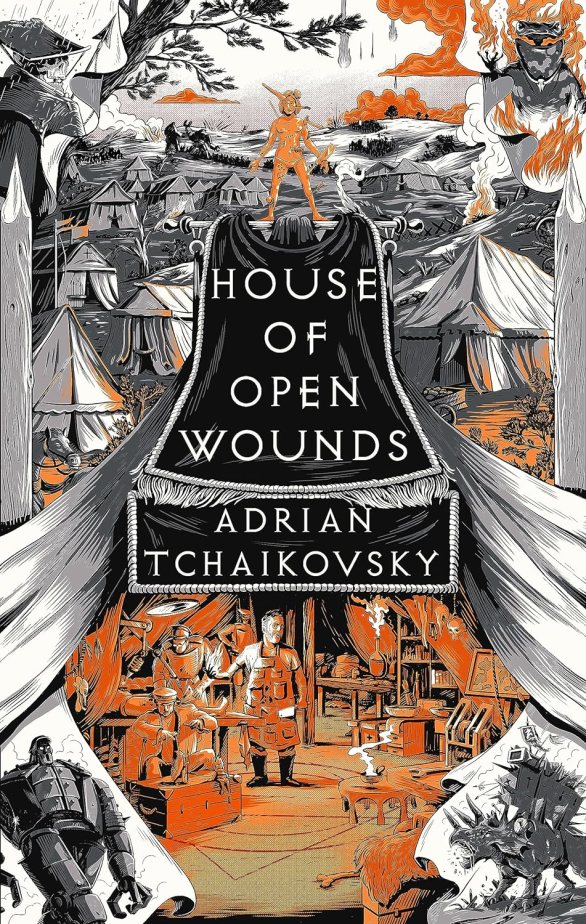
House of Open Wounds by Adrian Tchaikovsky

House of Open Wounds Cover

Publisher: Head of Zeus (Ebook – 7 December 2023)

Series: The Tyrant Philosophers – Book Two

Length: 636 pages

My Rating: 5 out 5 stars

Amazon

The always deeply impressive Adrian Tchaikovsky returns with an exceptional and remarkable piece of fantasy fiction, House of Open Wounds, which presents the reader with a particularly unique and ruthlessly entertaining story, chock full of brilliant characters.

Few fantasy authors have the range and style of Adrian Tchaikovsky, whose distinctive contributions to the science fiction and fantasy fields are quite remarkable.  While Tchaikovsky has written several highly regarded series, I have only just scratched the surface of his works, having read a few of his recent reads.  This includes his first foray into the Warhammer 40,000 universe, with the captivating standalone read, Day of Ascension, as well as the brilliant and elaborate novella, Ogres.  However, my favourite book from Tchaikovsky so far would have to be the outstanding City of Last Chances.

The first book in The Tyrant Philosophers series, City of Last Chances was an outstanding read that I had the pleasure of enjoying earlier this year.  Set around a conquered city with several unique magical inclusions, City of Last Chances introduced the reader to a cool new world and told a range of character driven stories about resistance, religion and sacrifice.  City of Last Chances got a very easy five-star rating from me, and it honestly was one of the best books and audiobooks I enjoyed in the first half of 2023.  I had such a brilliant time with City of Last Chances that when Tchaikovsky announced he was releasing a sequel in the second half of 2023, I was ecstatic.  This sequel, House of Open Wounds, continued some of the complex storylines Tchaikovsky started in City of Last Chances, and it was one of my most anticipated books for the second half of the year.

There are few nations more feared or relentless than the ever-expanding Palleseen.  A rising empire of zealots who are determined to bring Perfection and Correctness to an imperfect world, the Palleseen have advanced out of their homeland in an unstoppable wave, wiping out all religion and superstition as they go.  As cities and kingdoms fall before their military might, their armies leave behind mounds of dead and wounded soldiers who require tending in field hospital tents just behind the frontline.

Into this chaos is thrust the god smuggler Yasnic.  A former priest, miracle healer and occasional rebel, whose previous experiences with the Palleseen saw him hanged, attacked and banished from his city, Yasnic has experienced many upheavals throughout his life.  Saved from another execution by the army bureaucracy, Yasnic and his box of orphan gods arrive at the frontlines, where he has been assigned to work in an unorthodox medical unit.

Made up of a mixture of former priests, gods, magicians, alchemists, artificers, necromancers and led by a gigantic brute known as the Butcher, the experimental medical unit treats the soldiers no one else can save and recycles the rest into the war effort.  Entrusted to save the Palleseen soldiers, but doomed if anyone ever discovers the full extent of their abilities, the surgeons and orderlies of this unit ply their bloody trade as best they can while living as part of an unusual family, but the arrival of Yasnic could change everything.

As Yasnic works to fit into the unit and save lives, his unusual connections to the weakened and hidden gods of the world slowly begin to cause chaos throughout the army.  Not only is he aware of the divine forces that secretly hang around the hospital, but his own illegal and crotchety God is determined to bring miracles to the Palleseen, whether that want them or not.  As an outbreak of impossible healing and sudden pacifism spreads through the regiment, can Yasnic keep himself and his gods alive, or will the full force of the Palleseen zealots come crashing down upon him?

This was another epic and truly remarkable novel from Tchaikovsky that had me hooked the entire way through.  Featuring a dark, bloody and fun story, House of Open Wounds was a particularly distinctive read that told its own captivating story while continuing some of the best elements from City of Last Chances.  Funny, thoughtful and moving in equal measures, House of Open Wounds was an incredible and addictive novel that gets another very easy five-star rating.

I was very impressed with the exceptional and moving narrative that Tchaikovsky pulled together for House of Open Wounds, and I was hooked the second I got into it.  After the events of City of Last Chances, the reader is thrust into a new part of Tchaikovsky’s fantasy world as you find yourself imbedded in a Palleseen battalion following the members of an unusual but effective military hospital.  Like City of Last Chances, House of Open Wounds is strongly character driven, as you follow the personal stories surrounding each of these unusual outsider characters and learn about their complex pasts while watching their lives play out in the present.  Much of the plot revolves around returning protagonist Yasnic and his God, who are drafted into the unit, and you get to see his experiences of the other characters, the wars, and the internal Palleseen bureaucracy.  Most of the first half of House of Open Wounds is dedicated to exploring the new cast of characters and introducing their unique stories, as they find themselves closely following a bloody and dangerous war.  This part of the book is primarily focused on the healing and medical work of the protagonists, as well as diving into their reasons for being there and the unique skills they bring to the surgical table.  Apart from that, there isn’t an amazing amount of major plot progression here, except when Yasnic starts to mix things up around the battalion.  While this pace is a little slow, this first half of the book was really fun and enjoyable, as you find yourself getting really lost in the characters’ lives, unique struggles, desires, and experiences.  It also helps that many of these character details, as well as the mundane events of the hospital, eventually lead to bigger things later in the main plot, and Tchaikovsky does an outstanding amount of set up here.

The plot picks up a lot more in the second half, when the main battalion moves to a different warzone and find themselves involved in a substantial fight that really pushes the medical unit to its limits.  The new battles, as well as the intriguing location they find themselves in, move several of the character arcs in some big directions, and you find out more and more about each of the main characters as a result.  The constant chaos that surrounds Yasnic also starts to take its toll on the main story, as his strangeness and the double-edged miracles he occasionally brings cause him to make enemies and upset the delicate balance of the Palleseen army.  At the same time, the Palleseen war machine starts to alienate the members of the medical unit, who find their talents being stolen to create weapons.  Everything leads up to the big finale, where the protagonists attempt to free themselves with an elaborate and ambitious plan.  This plan makes great use of all their individual skills and histories, and so many little details and elements from the story are used to bring a fun and creative conclusion to the book.  Each of the fascinating character arcs conclude nicely and I loved how Tchaikovsky masterfully brought everything together in a satisfying and entertaining way.

Tchaikovsky utilises his typical excellent and distinctive writing style to convey this elaborate and entertaining narrative to the reader, and I had such a wonderful time seeing it unfold.  As with the previous novel in the series, Tchaikovsky relies very heavily on perspective changes to tell a multilayered, character-driven story.  Like the previous book, many of the major characters are initially showcased in their own chapter at the beginning, which often leads to additional cast introductions.  As the book progresses, the chapters feature perspective changes so you can see more interactions and a wider view of the entire story.  I loved the immediate deep background on several of these characters, and while you still often must wait a while to get their full story, you learn enough to like them in the opening parts of the novel.  Tchaikovsky makes full use of these characters to tell a fantastic story, and I loved how well he showcases some unique events through their eyes.  As with the previous book, House of Open Wounds has a range of tones as Tchaikovsky works hard to produce the right balance of humour, excitement, and moving and powerful character moments.  The multiple detailed and confronting scenes of the bloody battlefield hospitals are well balanced out by the fantastic and subtle humour, which often comes from the outrageous situations that occur throughout the book, as well as the various character’s unique outlooks on life.  This made for a particularly compelling book as you found yourself moving from comedic scene to a more dramatic or tragic moment with frequent regularity, as you find yourself stuck onboard a well-thought-out emotional roller coaster.

House of Open Wounds proves to be an intriguing and clever follow-up to City of Last Chances, especially as the author deepens the lore surrounding this fantasy world and brings back two fantastic protagonists.  Readers of City of Last Chances will have an absolute blast with this book, as you get some interesting follow up to Yasnic’s compelling storyline while also seeing a different side to the antagonistic nation from the first book.  This is a somewhat loose follow-up, and you really don’t need to have read City of Last Chances to enjoy House of Open Wounds.  In many ways this is a good standalone novel, especially as most of the focus is on a whole new group of protagonists, and even Yasnic is given a new name for much of the book.  Tchaikovsky does ensure that some of the key details and plot points from the first book are carried over when needed, although he does leave a bit of context out in places so as not to overwhelm new readers.  As such, House of Open Wounds is a very accessible read, although established fans of Tchaikovsky are going to particularly enjoy this, especially if they loved City of Last Chances.

One thing you can always rely on Tchaikovsky to do is to pull together an elaborate and deeply compelling world to set his stories around.  This is extremely true in this series as Tchaikovsky has come up with a war-torn landscape filled with magic, gods, demons and a new rising empire.  The author did some interesting set up for this world in the previous novel, although the plot there was primarily contained inside a single city.  In House of Open Wounds, the reader gets to see a bigger chunk of this world, even though much of the plot takes place either on the battlefield or in the camp behind the lines.  Despite this, you get a better idea of the politics, wars and conquests that have taken place in recent history, and you particularly learn more about the Palleseen.  The Palleseen are a group of ideological zealots dedicated to bringing their version of perfection to the world, which primarily involves breaking everything down into logic and reason, and doing away with superstitions and beliefs.  As such, their goal is to rid the world of gods, deities and other superstitions, usually by conquering the lands and bringing them under the control of their relentless bureaucracy.  Most of this book is dedicated to exploring the nature of their war machine, and you really get to see just how corrupt and ambitious some of their members are as a result.

I loved the focus on the military hospital and the war camp for most of the book, especially as seeing the various members of Palleseen camp allows the reader to fully understand the many problems, compromises and cruelties the Palleseen experience on their road to perfection.  Tchaikovsky throws in some great critiques of militarisation and empire building throughout the book as you see these perfect Palleseen become racked with pride, ambition and greed to prove themselves and advance up the ranks.  Their determination to win means they turn a blind eye to gods and superstitions when it suits them, and that results in the experimental medical unit that serves as the centre of the book.  However, while they appear to only want the assembled gods, alchemists, and other strange magics for healing, really they are working to corrupt them into terrible weapons to further their war capability.  There are several great storylines that see the Palleseen turning benevolent tools and creatures into highly inventive tools of war, and it serves as a major plot point and motivation for several characters, including a few Palleseen who have enough of their colleague’s lust for power.  Combine that with the returning minor gods, who end up having their own impact on several characters, and the reader comes away with a very cynical look at the Palleseen, and empires in general, which both ridicules them and shows just how malevolent and insidious they can be.

The real key that pulls together House of Open Wounds is the huge array of memorable and complex characters that are introduced throughout the course of the plot.  Tchaikovsky does a remarkable job of introducing and swiftly building up some truly amazing characters in this novel, and their compelling and often traumatic personal stories become so highly ingrained in the plot as a result.  There are so many great protagonists and supporting figures in this novel, and I was personally impressed with how all of them were original characters that were not built up in the prior novel.

The main exception to this rule is Yasnic and his god, both of whom were introduced in City of Last Chances and who are masterfully inserted into this sequel.  Yasnic was honestly one of Tchaikovsky’s best characters in City of Last Chances and I was so glad to see more of him here, especially as the author somehow manages to work in even more development after all the defining character moments that shaped him in the prior novel.  Since we last saw him, Yasnic has moved on from being the last priest of a forgotten god and has instead become a more generalised religious figure, offering shelter and assistance to fallen and orphaned gods who no longer have any power or believers by carrying them around in a box on his back.  After everything he has gone through, including his own crisis of faith, Yasnic now has a different view of the world, although he is still being haunted by his demanding and petty god.  Yasnic has some wonderful moments in this book as he tries to fit into his new role while also hanging onto the trappings of his old life.  Desperate to save everyone he can, Yasnic finds his views and pacifism really badly damaged by the constant war and the relentless and orderly Palleseen, and he is forced to make some haunting compromises.  You really get some very interesting insights into Yasnic’s mind in this book, especially as you see how the aftermath of him abandoning his position as a priest impacted him.  You cannot help but feel for the extremely likeable Yasnic at times, as he is thrust into tragic and heartbreaking positions against his will, and his quiet determination and general positivity pluck at your heartstrings.  Throw in some great new friends, an unusual but surprisingly wholesome love interest and a series of unfortunate misunderstandings that frustrate even this gentle soul, and Yasnic once again stands out as a particularly awesome and likeable protagonist.

The other side of Yasnic’s character resides in the body of his tiny, stumpy, and petty deity, God, a former major healing god who has lost all his worshippers apart from Yasnic, but still maintains his powerful healing abilities.  However, God refuses to heal anyone unless they swear a vow of pacifism, and if they cause harm to someone in any way, it will result in their wounds automatically returning, generally resulting in a sudden death.  Thanks to his stubbornness, pride, and his whiny focus on Yasnic’s soul, God was one of the most entertaining characters in City of Last Chances, and I am really glad that Tchaikovsky brought him back for House of Open Wounds.  While he is still a judgemental, mischievous and ugly angel on Yasnic’s shoulder in this sequel, you get to learn more about God and why he refuses to help save people.  There are some surprisingly emotional scenes where God expresses why he is so bitter and you really get a much better understanding of his angry mind, especially when Yasnic makes the same mistakes, adding to God’s sadness.  I also loved how well God played off Yasnic as he proves to be a surprising and entertaining counterpoint to the humble and nice former priest.  While most of their dialogue is quite contentious, with God trying to control his increasingly independent former priest, you can see deep down that God cares about Yasnic, and they form quite an interesting and fun duo.  Tchaikovsky took God’s character arc in some interesting directions towards the end of House of Open Wounds, and I have a feeling he is going to be a real nuisance to people in the next book.

House of Open Wounds also features quite a fun range of supporting characters, each of whom has their own compelling story to tell.  This primarily includes the crazy and unusual group of associated healers and hospital workers that work in the experimental hospital unit, as well as the competitive and dangerous Palleseen officers controlling their destinies.  I won’t go into too much detail here, as I could honestly go one for a paragraph about each, but I was really impressed with how well Tchaikovsky set each of them up and explored their histories and stories as the booked continued.  There are some brilliant and very well fleshed out character arcs everywhere in House of Open Wounds, and I loved just how compelling a story Tchaikovsky was able to make as a result.

Adrian Tchaikovsky once again shows why he is one of the absolute best authors of complex and intelligent fantasy fiction with this outstanding and epic read.  House of Open Wounds is a deeply clever, compelling and moving read that hooks the reader with its unique scenarios, fantastic humour, and memorable characters.  I loved every single second I spent reading this novel and I really appreciated the amazing way Tchaikovsky chose to continue the great story started in City of Last Chances.  I cannot wait to see what over elaborate fantasy stories Tchaikovsky creates in this universe in the future, and this epic novel is one of the best pieces of fantasy fiction I enjoyed in 2023.
Amazon

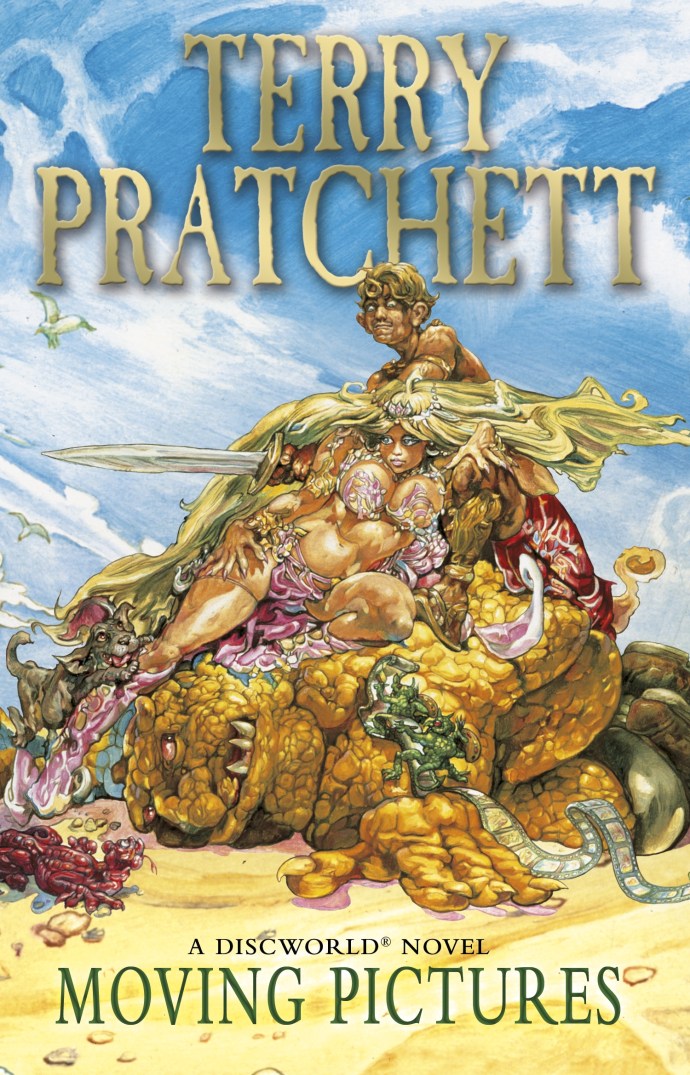
Throwback Thursday – Moving Pictures by Terry Pratchett

Moving Pictures Cover

Publishers: Corgi and ISIS Audiobooks (14 November 1991)

Series: Discworld – Book 10

Length: 332 pages or 10 hours and 8 minutes

My Rating: 5 out of 5 stars

Amazon

Reviewed as part of my Throwback Thursday series, where I republish old reviews, review books I have read before or review older books I have only just had a chance to read.

Because my blog shares the name of a building featured in Terry Pratchett’s Discworld series, some people might have assumed that I am a fan.  You would be right, so very, very right.  I have loved Discworld since I was a small child, and my appreciation and respect for the complex writings of the late, great genius, Sir Terry Pratchett, has grown with me.  The Discworld series represents one of my ultimate comfort series of books.  It’s the series that I go back to at any time when I want something fun and familiar to enjoy.  I have read all of the adult books set in Discworld multiple times (I have yet to read all of the young adult ones), and it is an unusual year when I do not listen or read some of these books in my spare time.  Pretty much every single book in this series deserves five out of five stars or higher (with one or two exceptions that I may mark down to a 4.75 with a heavy, heavy heart), and you are unlikely to find any real criticisms about this book below.  After nearly a year of running this blog, the continued exclusion of a review of any of Pratchett’s Discworld is a travesty, and one that I seek to rectify in this somewhat late Throwback Thursday with a review of the 10th book in the series, Moving Pictures.

Before I review Moving Pictures, here is some quick context of the Discworld series for those people unfamiliar with these books.  Discworld is the main series of Sir Terry Pratchett, set upon the Discworld, world and mirror of worlds.  The Discworld, or the Disc, is a flat world that rests on the backs of four massive elephants, who themselves stand on the back of a gigantic turtle swimming in space, Great A’Tuin.  The Discworld itself features a huge range of different nations and continents that bear striking similarities to real-world locations.  This series is, without a doubt, the best series that utilises a combination of fantasy and satire in the entire world.  The seamless blend of the two elements is just incredible, and both elements do an unbelievable job at enhancing each other.  Before his death, Pratchett wrote 41 books in the Discworld series, six of which are considered young adult books.  While the books can be read in any real order, the series were mostly written in chronological order (with the exception of Small Gods), and events from earlier books in the series are often referenced.  Although most of the Discworld stories are self-contained, a number of the books are linked together by a recurring main character and are subsequently grouped together into subseries.  These include the Rincewind, Witches, City Watch, Death, Tiffany Arching and Moist von Lipwig subseries, in addition to a few standalone books that fall outside of any of the subseries.  Characters often appear in other Discworld books outside of their subseries, and there are a string of side or secondary characters who appear in multiple subseries and standalone books.

The book I am reviewing, Moving Pictures, is a standalone book that does not really fall within any of the main subseries.  It is sometimes considered part of minor subseries, called the Industrial Revolution subseries, with The Truth and Monstrous Regiment, but I am not a big fan of that distinction.  As it is the first Discworld book I am reviewing, you might think that it is my favourite book in the entire series, which is not true; although it does get five out of five stars from me and I have enjoyed it an amazing number of times, it is not my absolute favourite Discworld book, although it is high on the list.  It is, however, an easier one for me to review as there is a lot I can say about it.

Goodreads Synopsis:

‘Holy wood is a different sort of place. People act differently here. Everywhere else the most important things are gods or money or cattle. Here, the most important thing is to be important.’

People might say that reality is a quality that things possess in the same way that they possess weight. Sadly alchemists never really held with such a quaint notion. They think that they can change reality, shape it to their own purpose. Imagine then the damage that could be wrought if they get their hands on the ultimate alchemy: the invention of motion pictures, the greatest making of illusions. It may be a triumph of universe-shaking proportions. It’s either that or they’re about to unlock the dark terrible secret of the Holy Wood hills – by mistake…

The blurb above is a bit vague on the details of what is actually happening in Moving Pictures.  Essentially, the alchemists of Ankh-Morpork, the largest city on the Discworld (and a central location for many of the books), suddenly develop filmmaking, which they call moving pictures, and set up a filming base at the ancient and abandoned Holy Wood.  The moving pictures issue a weird siren call to the inhabitants of the Discworld, dragging all manners of people and creatures from across the lands and infecting them with their magic (not a metaphor).

Among those drawn to Holy Wood are Victor Tugelbend, a former student wizard, and Theda “Ginger” Withel, a small-town girl with big dreams.  Thanks to the magical on-screen chemistry between them, Victor and Ginger quickly become the superstars of the fledgling moving pictures industry, especially when the Discworld’s most infamous salesman, Cut-Me-Own-Throat Dibbler, comes to town and takes over the studios.

However, reality on the Discworld is always a bit thin, and Lovecraftian monsters (a favourite recurring antagonist of Pratchett’s early Discworld novels) are revealed to be the ones who planted the idea of moving pictures and Holy Wood in the alchemists’ heads.  Using the new sort of magic created by Holy Wood, the creatures start to break through.  With the wizards of Unseen University, the people who are supposed to guard against these sorts of incursions, distracted by the arrival of an unconventional new Archchancellor, it is up to Victor, Ginger and a ragtag band of other Holy Wood characters to save the day.

This book has so many moving parts to it that it’s hard to know where to begin when reviewing it.  While the main story is concerned with the introduction of moving pictures into the Discworld, there are a number of other entertaining storylines going on throughout the book, each one complementing the main story and creating an amazing overall narrative.  The major appeal of this book is its sharp and intelligent satire of the movie business, which also examines the nature of a film industry in a world as crazy as the Discworld.  I also quite like all the amazing characters, either introduced or built up in this book, many of whom appear in later books in the series.

This book is absolutely hilarious and filled with a huge number of clever and outrageous jokes and observations about the film industry, all of which lie on top of Pratchett’s usual humour about day-to-day life in the Discworld and his random observations, many of which are perfectly introduced in the book’s footnotes.  The main storyline is an amazing portrayal of the hectic early days of the film industry, placed in a fantasy setting.  The cameras are powered by miniature demons (who paint the pictures really, really fast), the lighting is done by salamanders, actors of all species make up the cast, the audience eat ‘banged grains’ while watching the ‘clicks’ and the film’s monsters and villains are all trolls in crude costumes.  However, literal movie magic is making people do strange things (strange even for Discworld folk), talking animals are showing up looking for work, Dwarfs are singing “Hihohihohiho” as they work, characters routinely burst into song and dance in the rain, and one producer keeps threatening to turn people into stars, all while the book’s few straight-characters look on in bemusement.  All of this is amazing, and the sheer number of fantasy-assisted jokes throughout the book is pretty unbelievable.

At its heart, Moving Pictures is a satire and a critique about the film industry as a whole.  Quite a large amount of the story is dedicated to parodying the real-life the crazy effect that movies can have on audiences and the people who make them, as the book shows some ridiculous events.  The story also reflects the insubstantial nature of fame and the fragility of dreams surrounding the movie industry.  The fast-moving world of the film industry is also shown, although sped up even more for comedic and story value, as they film creators are constantly searching and finding new advancements in their field.  A great example of this is shown when Cut-My-Own-Throat Dibbler invents and then continually advances the art of advertisement, so that, within a few short weeks, the film industry goes from ineffective text advertisements to eye-catching posters and explorations of product placement and subliminal messages.  Pratchett handles these critiques very skilfully, and you cannot help but laugh aloud as he skewers the film industry quite cleverly throughout Moving Pictures.

Pratchett also filled Moving Pictures with a ton of references to iconic films and elements of the film industry.  Many of the characters involved with the films are caricatures of famous movie actors, with Victor playing all the typical romantic or manly male heroes of the day, and Ginger is essentially Marilyn Monroe.  Several films are parodied throughout the book, such as Gone With The Wind, which becomes Blown Away, an epic love story set around a famous Ankh-Morpork Civil War.  There is a rather good King Kong parody, in which a gigantic woman kidnaps a poor defenceless Ape (the Librarian) and drags him to the roof of the tallest tower in Ankh-Morpork, all while two wizards on a broomstick shoot at it with a crossbow, with one shouting “If it bleeds, we can kill it!”  That is only scratching the surface of the references featured within this book.  A golden figure with a name starting with O plays a big part in the story, the various studios are all parodies of real-life studios, and there a huge number of funny and subtle references to various famous films.  Examples of these include Wizard of Oz, Lassie, Lawrence of Arabia, Indiana Jones, Looney Tunes, Blues Brothers, Casablanca, Tarzan and Star Trek just to name a few.  Readers can go through this book multiple times and not pick up every detail, which is a testament to the cleverness of Pratchett and his ability to come up with some hilarious references.

I have always found the way that Pratchett utilises or re-uses his characters to be extremely fascinating; while some characters appear in multiple books, a number of his main characters, especially from his earlier books, are only used once. There are several examples of this, including Mort from Mort, Pteppic from Pyramids and Esk from Equal Rites (who did appear in a later young adult novel, but there was a significant time gap between the writing of these two books).  While Pratchett may have simply had only one story in mind for these characters, I have a feeling that he simply did not like how they turned out and decided not to use them again under any circumstances.  Mort is probably the best example of this.  Despite being the protagonist of the first Death subseries book Mort, he never appears in any of the Death subseries books again (aside from one brief flashback), and is instead replaced by his own daughter, Susan.  It is interesting to note that most of the main characters who were never or rarely used again are somewhat similar to each other, being young heroes without too many obvious flaws to them.  On the other hand, the unique main characters Pratchett creates with notable flaws, such as Rincewind, the wizard who has turned cowardice into an art form, or the overly cynical and dangerous alcoholic Sam Vimes, helm multiple books.

If I have to make one criticism about this book, it is the weak and somewhat inconsistent main characters, Victor and Ginger.  Ginger is a generic female character, and while she is a good parody of Marilyn Monroe and other early screen actresses, she is pretty one-dimensional and unlikeable.  Victor starts out with some very interesting character traits, as he is described as an extremely lazy person, whose unique brand of laziness forces him to become a brilliant student wizard in order for him to succeed in his quest to fail every test he ever takes by a certain point margin to ensure he remains a student.  However, these character traits are pretty much thrown out the window a few chapters in and he becomes a typical male hero for the rest of the book.  While this sort of straight-man character was needed for this wacky adventure, it is surprising that the character never again really shows the slightest hint of some of these earlier established character traits.  It is interesting to note that neither Victor or Ginger appear in any of the subsequent Discworld novels, so I think there is a strong possibility that Pratchett might also have disliked how these characters turned out.

While one or two of his earlier main characters were somewhat unimpressive, Pratchett always managed to make up for this by creating a range of memorable and enjoyable side characters.  It was always interesting to see which of these side characters would appear in various later books, as you knew Pratchett had to like them as well.  For example, Granny Weatherwax was a supporting character in Equal Rites, but Pratchett must have liked writing her, as she became a major character in the Discworld series, even getting her own subseries with several other witch characters.  Moving Pictures is perhaps the best example of Pratchett’s love of side characters; while Victor and Ginger never appear in the Discworld again, many of the side characters introduced or developed in this book have major roles later in the series.

For example, I was always impressed with how this book turned two minor characters from Guards! Guards!, Cut-Me-Own-Throat Dibbler and Detritus the troll, and gave them more expanded roles in Moving Pictures.  Dibbler was an opportunistic merchant who got a couple of good, if minor, scenes in Guards! Guards!, but in Moving Pictures, Pratchett transformed him into a ruthless and extremely savvy salesman who gets in the front door of every major new opportunity inflicted on the Discworld, but is often forced by circumstances back to becoming a sausage-in-a-bun merchant.  Dibbler was absolutely fantastic as the stereotypical sleazy film producer, and it is unsurprising why he suddenly became a major recurring character throughout the Discworld books, not only appearing in nearly every book set in Ankh-Morpork but also having clones of him appear in the other nations and cities, all of whom sell disgusting local delicacies.  Detritus is another great example, as he goes from the simple bouncer introduced in previous books to a troll seeking love and a new way of life.  Pratchett comes up with a great personality for Detritus in this book, and it carries through to the City Watch subseries when he joins the Watch in Men at Arms and becomes a major recurring character in this subseries and other books set around Ankh-Morpork.  Other recurring characters, Death and the Librarian, are as awesome as ever, but Dibbler and Detritus are the real standout stars of this book.

Several new characters introduced in this story also make a number of reappearances throughout the rest of the Discworld series.  A good example of this is the talking dog, Gaspode, who is a fantastic and sarcastic character through the book.  He has some great scenes, with the highlight being his friendship with Laddie, a Lassie parody and idiot who Gaspode takes under his wing.  The idea of a clever, underappreciated and sarcastic talking dog side character apparently worked so well that Pratchett found a way to return his magical intelligence and ability to speak a few books later in Men at Arms (the same book Detritus reappeared in) and he then featured in several additional books.

You also have to love the new wizard characters that Pratchett also created for this book.  Before Moving Pictures, the faculty of Unseen University, with the exception of the Librarian and Rincewind, were replaced each book with a new group of senior wizards, thanks to the competitive nature of succession in the university.  However, this 10th book introduces a brand new and more permanent faculty of Unseen University, led by Archchancellor Mustrum Ridcully.  Ridcully is a fantastic character as he is big, loud and sporty man who is generally the complete opposite to any other wizard previously shown in the Discworld series.  I really enjoyed his storyline and found it to be one of the most entertaining in the entire book.  Pratchett must have agreed, as Ridcully became the only recurring Archchancellor in the Discworld series.  This also allowed for the creation and stabilisation of unique characters to make up the senior faculty of Unseen University, including the Bursar, the Dean, the Chair of Indefinite Studies and the Lecturer in Recent Runes.  While the other wizards have a fun romp breaking out to go see the moving pictures, the Bursar has a great story, as you get to see the first signs of madness that would afflict him throughout every other book he appears in, as he first encounters the stress associated with working under Ridcully.  I also liked the introduction of a young Ponder Stibbons, whose bad day while trying to escape from the university is pretty humorous, but also the complete departure from his later role as the only serious member of the faculty.  Thanks to their entertaining storylines, the wizards would appear in multiple books in the rest of the Discworld series, and while they never had their own specific subseries, they would get major inclusions in several other subseries, including substantial stories in The Last Continent, Soul Music, Lords and Ladies and The Hogfather, as well as their own novel, Unseen Academics.

While I have physically read most of the books in the Discworld series, including Moving Pictures, these days I tend to only listen to the audiobook formats of these books.  The Discworld audiobooks are pretty awesome, and the two narrators for the series, Nigel Planer and Stephen Briggs, both do an incredible job.  I find that the humour in the Discworld novels is massively enhanced by the narration, and I love listening to the stories this way.  At 10 hours and 8 minutes, this is not a long audiobook, and I always tend to power through these books really, really quickly.  Planer is a comedy veteran and has an awesome audiobook voice, and it is quite impressive the sheer range of different and distinctive voices he can come up with.  I also like his incredible consistency when it comes the multiple books in the Discworld series; for example, voices he creates for Moving Pictures are generally the same used for that character in later books he narrated.  The audiobook format of Moving Pictures is my preferred way to enjoy this book, and it is really worth trying out.

As you can see from my extremely long rant above, I absolutely love Moving Pictures and the Discworld series.  Pratchett created an incredibly complex and extremely funny novel that laughs right at the heart of the film industry.  The sheer range of references in this book is amazing, and the creation and enhancing of the various side characters featured in this book has massive ramifications for many of the later Discworld novels.  If you have yet to experience the joy of Terry Pratchett’s Discworld series, get on it as soon as you can.  It is well worth it, and Moving Pictures is a great place to start your Pratchett adventure.  I fully intend to review more books in this series in the future.

Amazon