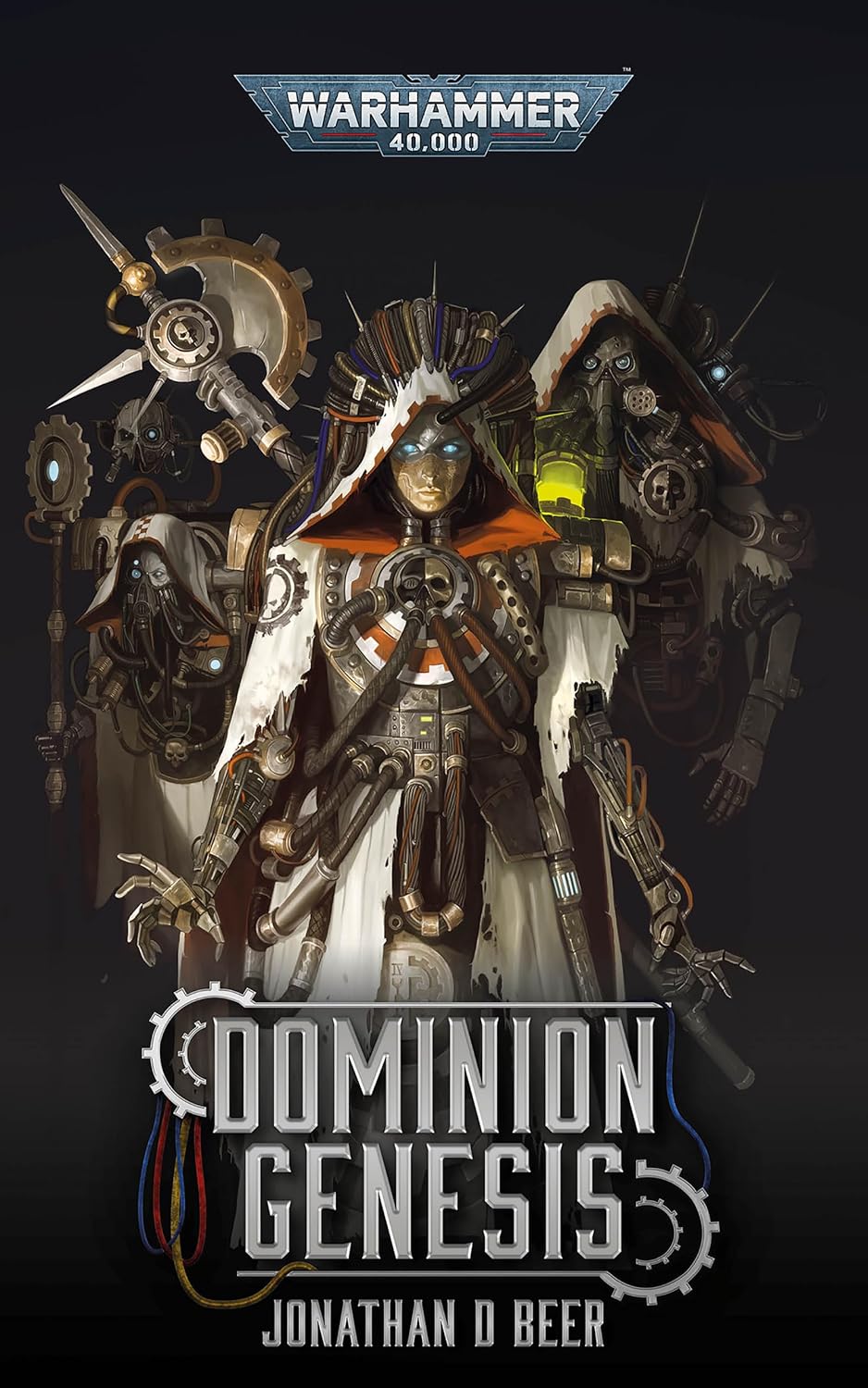
Warhammer 40,000: Dominion Genesis by Jonathan D. Beer

Publisher: Black Library (Audiobook – 21 September 2024)

Series: Warhammer 40,000

Length: 10 hours and 47 minutes

My Rating: 4.5 out of 5 stars

Amazon

Destitute tech-priests of the Adeptus Mechanicus embark on a massive quest for redemption in the excellent 2024 Warhammer 40,000 novel, Dominion Genesis by Jonathan D. Beer.

Beer is a talented rising author in the Warhammer 40,000 fiction space who has so far impressed with two interesting books covering unique spheres of the fandom’s canon.  I deeply enjoyed his first novel, The King of the Spoil, which was a particularly epic entry in the Warhammer Crime sub-series, and which ended up being one of my favourite debuts of 2023.  Beer followed up this debut last year with his second novel, Dominion Genesis, an intriguing read that takes place in a very different Warhammer 40,000 setting.  I had an excellent time with Dominion Genesis, although I spectacularly failed to write a review for it last year.  However, with Beer’s third Warhammer 40,000 novel just released, I felt that this was a good time to finally write something about Dominion Genesis, which honestly was an awesome read.

Plot Synopsis:

Gryphonne IV is dead – one of the mightiest forge worlds in the arsenal of the Adeptus Mechanicus, succumbed to the relentless hunger of Hive Fleet Leviathan. Devoured. Lost.

The few magi that survive drift in idleness, robbed of purpose and direction. But there is one who rejects that fate.

READ IT BECAUSE
It’s the gripping tale of an Explorator desperately seeking ancient technologies from humanity’s past as she races against time to restore one of the mightiest forge worlds in the Imperium.

THE STORY
Explorator Talin Sherax seeks ancient and miraculous technologies from humanity’s distant past. When she learns of a fabled relic that could restore all that has been lost, Sherax embarks on a journey, the outcome of which could change everything. Nothing will stand in her way… even if the quest brings her to the brink of heresy.

Dominion Genesis was a particularly intense and compelling entry in the Warhammer 40,000 canon that proves quite enthralling to read.  I like how Beer managed to achieve quite a few things with this book, as he produced an excellent quest narrative with a focus on obsession, trauma and survival, while also cleverly showcasing several different factions of the Warhammer 40,000 universe.

Beer came up with a very awesome story that hits a lot of highly emotional story notes early on.  The start of Dominion Genesis was one of the more striking sequences of Warhammer fiction I have read, as the protagonist, Explorator Talin Sherax, is forced to witness the destruction of their home world.  Moving quickly into a time skip, you see a very different version of Sherax several years in the future, as she still attempts to make sense of the destruction while searching for valuable lost technology.  After a great sequence aboard a derelict spacehulk, Sherax finds a clue about a potential artifact that could help to restore her planet.  Going against the orders of her superiors, Sherax leads a crew of human soldiers and Adeptus Mechanicus forces on a quest to several deadly and hidden locations in the galaxy.  Along the way, the protagonists examine their humanity in several different forms, while also being stalked by dangerous alien fighters determined to stop them achieving their goal.

There are some great sequences in the middle of this book, as the protagonist desperately follow the clues into a trap, which shakes all the characters to their core.  After a gruelling sequence of events that help to highlight and move along several, well-constructed character development arcs, the adventure moves to its destructive conclusion.  After another disaster, the protagonists are dropped in amongst a war between rival xenos forces and must journey into the fray to achieve their goal, resulting in a brutal series of battles and the intense conclusion to the narrative.  Beer wrote in some great tragic moments as the protagonists are outmatched at nearly every turn, although many of these sequences work well to provide closure to some of the book’s various character arcs.  The conclusion to Dominion Genesis was as bleak as you would hope for a novel in the grimdark Warhammer 40,000 universe, but it provides some great closure for the main character and will keep readers very satisfied.

I felt that Dominion Genesis was a particularly good addition to the Warhammer 40,000 canon, as Beer provides a thoughtful and complex novel loaded with unique action and damaged characters trying to survive the inherent darkness of the war-torn universe.  Beer ended up producing an intense character-driven story for Dominion Genesis, and I loved the great balance between action, exploration and interaction between certain unique Warhammer races, and the focus on character elements.  I personally really enjoyed the deep dive into the Adeptus Mechanicus, with various character perspectives diving into their culture and thought processes, even though certain sections of the plot need to be altered to emulate the machine nature of the tech-priests.  Beer tried to showcase a more emotional side to the Adeptus Mechanicus in this book, especially through his protagonist which, while different from other portrays of this faction, fits the trauma-rich narrative as all these characters struggle with the loss of their home.  The author also has fun fitting in several of the main alien races of the Warhammer 40,000 universe into the story, including orks, Tyranid, Aeldari and Necrons.  While not a lot of focus is given to understanding them, they serve as good foils to the obsessed protagonists, and it was interesting to see the Mechanicus takes on these different enemies.  In the end, Dominion Genesis proved to be a compelling, and impressive standalone novel that makes great use of its Warhammer 40,000 elements.  However, be warned that this novel is probably better read by more established fans of the franchise, rather than newer readers, as Beer covers a lot of complex lore in a short period of time.

One of the key things I liked about Dominion Genesis was the rich array of compelling characters featured throughout the plot.  Beer does an outstanding job introducing and following several very damaged figures, including the protagonist Explorator Talin Sherax, who finds herself in a depressed state following the opening sequence of book.  Cutting herself off from the technological hivemind used by the rest of Adeptus Mechanicus brethren, Sherax proves to be a brilliantly complex figure in Dominion Genesis, and Beer’s take of her as the depressed member of a group known for having no emotions was really fascinating.  The author also features an interesting array of other Adeptus Mechanicus members who provide great alternate viewpoints to that of Sherax.  I really enjoyed how Beer managed to include a lot of intriguing individualism in these machine-like Adeptus Mechanicus characters, and the range of different opinions and feelings around Sherax and her mission added some interesting drama to the story. 

Finally, I must highlight the human members of the Dominion Genesis cast, who provide intriguing alternate viewpoints to cybernetic protagonists. I particularly enjoyed the focus on a depressed former Imperial Knight pilot, who, after losing his ancient war machine, decides to join the crew of Sherax’s ship.  There are some fascinating focuses on his parallel grief to that of the Adeptus Mechanicus characters, as well as his own self-anger, especially while forced to pilot a seemingly lesser machine.  Beer writes some interesting side plots around this more human character, including his relationship with an Imperial Guard regiment also aboard the ship, and he must balance his need for human contact with his own grief and arrogance.  I felt this compelling collection of distinctive characters helped to make Dominion Genesis really stand out, and I enjoyed seeing their unique interactions.

As with most Warhammer 40,000 novels I review, I ended up listening to Dominion Genesis on audiobook, which is pretty much the best way to enjoy this series.  The Dominion Genesis audiobook ended up being a lot of fun to listen to, and I managed to get through it’s near 11-hour runtime quickly.  It helped that Dominion Genesis was narrated by the very talented Colleen Prendergast, who is becoming the go-to narrator for any Warhammer 40,000 audiobook that features a human female protagonist, such as Justin D. Hill’s Cadia series, or standalone books like Creed: Ashes of Cadia by Jude Reid or Longshot by Rob Young.  Prendergast did an outstanding job bringing the various complex cast members of Dominion Genesis to life, and I particularly appreciated the skill need to voice a variety of cybernetic humans with altered or robotic voices.  This great voice work turned Dominion Genesis into a fantastic listen, and it was very easy to enjoy Beer’s outstanding and lore-heavy story when it was being read out.

Overall, Dominion Genesis was an amazing second novel by Jonathan D. Beer, who did an outstanding job pivoting to a different area of Warhammer 40,000 fiction.  I loved the complex character-driven narrative contained within Dominion Genesis, and this was one of the more enjoyable Warhammer 40,000 novels that came out last year.  I cannot wait to see how Beer continues to develop as a writer in the future, and I currently have a copy of his latest book, Tomb World, in my audiobook queue to listen to.

Amazon

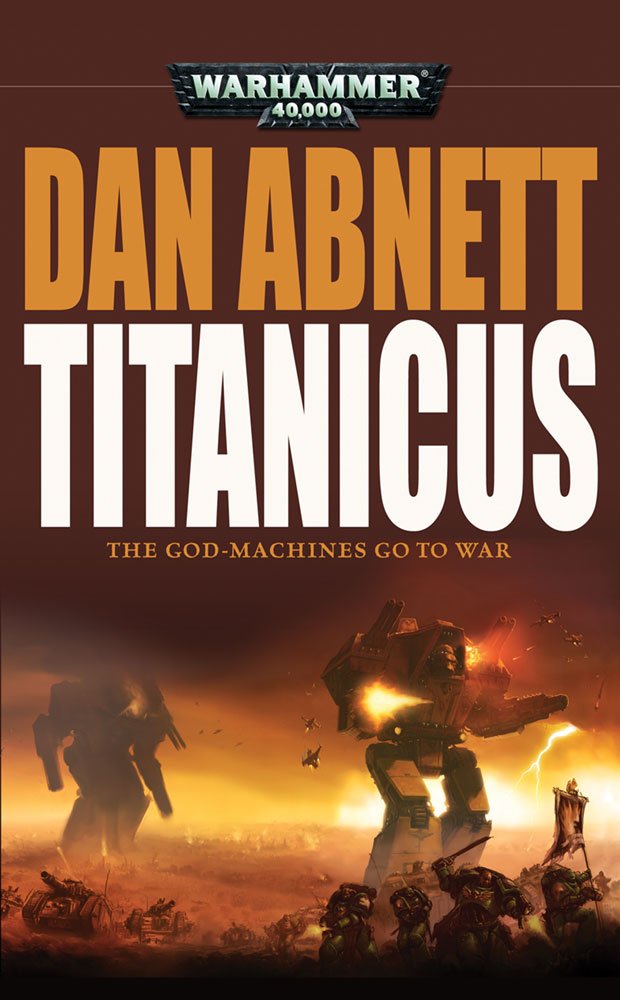
Warhammer 40,000: Titanicus by Dan Abnett

Publisher: Black Library (Audiobook – 1 September 2008)

Series: Warhammer 40,000/Sabbat Worlds Crusade

Length: 13 hours and 38 minutes

My Rating: 5 out of 5 stars

Amazon

The Titans walk to war in this brutal and captivating Warhammer 40,000 novel from the legendary Dan Abnett, Titanicus.

Of the many great Warhammer 40,000 authors out there, few are as impressive as Dan Abnett, who has envisioned an incredible number of awesome battlefields and unique character-focused war stories across the Warhammer universe.  Abnett has written a ton of exceptional and powerful books around the franchise, including several series considered to be the seminal texts of the extended universe.  This includes his brilliant Eisenhorn trilogy (XenosMalleus and Hereticus), and he has multiple entries in my favourite Warhammer 40,000 books list.  However, his best-known series is the Gaunt’s Ghosts books, which I am currently in the middle of reading.

The Gaunt’s Ghosts books are a key series of Warhammer 40,000 fiction that follows the frontline human soldier of this grimdark universe.  Set in an extended multi-planet campaign, known as the Sabbat Worlds Crusade, the Gaunt’s Ghosts books follow a ragged regiment of soldiers as they attempt to survive the dark servants of Chaos coming for them.  I am having an exceptional time reading the Gaunt’s Ghosts series, with books like First and Only, Ghostmaker, Necropolis, Honour Guard, The Guns of Tanith, Straight Silver and Sabbat Martyr, really impressing me with the complex stories and intense action.  While I need to read more of the Gaunt’s Ghosts books, I have taken a quick break to read some of the spin-off novels Abnett wrote around his main series.  Also set around the Sabbat Worlds Crusade, these spin-off novels follow other campaigns in this massive sector spanning war and provide Warhammer fans with a more in-depth view of these battles.  These spin-offs include the exceptional Double Eagle, which I had the great pleasure of reading last year, and which featured so many awesome duels between flyers.  Titanicus was another spectacular book shows a new and highly destructive battlefront of the crusade by focusing on the iconic Titan Legions of the Adeptus Mechanicus.

As war rage across the stars, the forces of Chaos constantly seek a way to disrupt the vital Sabbat World Crusade and destroy the human forces fighting to bring new worlds into the Imperium of Man.  To that end, the archenemy launches an ambitious and devastating surprise assault on the vital forge world of Orestes, whose under-strength defenders find themselves under mass attack from Chaos Titan war engines.  With both the citizens of the Imperium of Man and the forges of the Adeptus Mechanicus under threat, the planet appeals for help and soon finds its prayers answered from the stars in dramatic fashion.

Fresh from their own wars and heading out to join the crusade, the Titans of the Legio Invicta arrive on Orestes, determined to help their Mechanicus brethren.  Finding the forces of Orestes severely outwatched, the Invicta Titans stride to war, causing everything to tremble at the god-machines wrath.  Soon the world is engulfed in an engine war, with both sides wielding enough firepower to crack the planet and the entire population of Orestes caught in the conflict.

But as the war continues, a far more insidious threat arises that could impact far more than just the war on Orestes.  Deep secrets from within Orestes Forge soon begin to spill out, risking a schism between the Imperium of Man and the Adeptus Mechanicus.  With the planet trembling under the battling machines and enemy forces growing by the day, can Legio Invicta overcome the peril growing within their brotherhood before Orestes and the entire galaxy is put to the flame?

Dan Abnett presets another brilliant war story that is epic in every definition of the word.  Successfully presenting the awesome power of the Titans, Titanicus is a deeply compelling and impressive Warhammer 40,000 novel that I honestly could not get enough of.  Intense, exciting and so darn cool, Titanicus gets an easy five-star rating from me, as Abnett once again shows just how talented he is.

Titanicus had a particularly awesome and multi-layered standalone war narrative behind it that hooked me thanks to the author’s nuanced take on the destructive conflicts of the Warhammer 40,000 universe.  Starting off with some dark death to hammer home how grim the situation is, you are soon thrust into the main story as the planet of Orestes comes under attack and the defenders are pushed to the limit.  However, hope soon arrives with the landing of Legio Invicta, who back up Orestes’s existing Titans and defenders with their own engines and troops.  Abnett quickly and effectively sets up multiple character specific storylines as the book progresses that show various alternative viewpoints of the war.  The author works hard to showcase multiple levels of the conflict, from the top commanders all the way to the lowliest of soldiers, and I really enjoyed some of the intriguing storylines that emerged.  This includes desperate tales of survival by following human troops caught behind enemy lines and pursued by mechanical monsters, compelling dives into the minds of the Titan pilots, looks at the various political forces on Orestes, and even some fascinating storylines inside the Adeptus Mechanicus forge.  Abnett did an amazing job highlighting the desperate strife and the complex conflicts these figures endured, and you get a fantastic overarching look at the machine war that proves hard to look away from. 

As the plot of Titanicus continues, the various storylines go in some interesting directions, as you follow each of the characters or groups on their own unique journeys.  Abnett did a really good job of ensuring these unique storylines effectively played off each other as the book continues, and the way characters reacted to events from other plotlines was quite clever and helped to produce a cohesive and intense overarching narrative.  The introduction of a compelling storyline around intrigue and dissent amongst the Adeptus Mechanicus characters provides some extra drama and character conflicts, which added some interesting complexity to the plot, especially as it gave you an alternative group of antagonists which worked well alongside the menacing forces of Chaos, whose perspective you don’t see.  I appreciated how well Abnett set this storyline up in advance, and there are some clever hints to this, and other big events, earlier in the plot.

The final third of Titanicus is particularly impressive and intense, as the author brings together his various storylines extremely well.  I especially enjoyed some of the massive action sequences, while the resolution of the Adeptus Mechanicus storyline was powerful and full of drama as big personalities try to overcome mistrust and dissent.  While I would have liked to have seen the final battle in full, I think Abnett’s effective summary worked pretty well, and I understand that spending another few hours in combat would have watered down the author’s main message.  Each major character’s arc is resolved in a very satisfying manner, and there is an excellent blend of dramatic moments and intense action to keep the reader hooked.  I appreciated how a couple of these conclusions were more depressing, rather than being uniformly happy, which fits both the grimdark nature of Warhammer 40,000 as well as Abnett’s overarching themes that war has no true winners.  This story really came together well, and I deeply enjoyed the complex standalone narrative that Abnett came up with.

This was another insanely well written novel from Abnett, who excels at telling dark, deeply personal war stories from multiple perspectives.  The author provides the perfect balance of excitement, deep intrigue and fantastic character growth in Titanicus, all expertly set within the amazing Warhammer 40,000 universe, and it proves to be such an addictive read.  I personally became engrossed in the various character-driven storylines that emerged throughout the plot, especially the long-running storylines that lasted the entire book.  However, even the more minor character arcs, such as the occasional scene from a normal citizen living in the city to an extended look at the crew of a doomed machine, was hard hitting and Abnett really gets you invested in these personal tales.  As I mentioned above, these often-separate storylines worked extremely well in concert with each other, and Abnett did such a good job pulling them together into a brilliant, overarching narrative. 

Of course, you can’t talk about Titanicus’s writing without going into how incredible the action sequences are.  Abnett crafts together so many deeply intense and powerful battle scenes throughout Titanicus that constantly had the blood pumping as you watched your favourite characters brave the dark gauntlet of battle time and time again.  The author had a lot of fun envisioning war on multiple fronts, and I loved how we got to see infantry fights, tank battles and entertaining skirmishes between various augmented foes as the story continued.  However, easily the most awesome thing about Titanicus is the Titans themselves.  Insanely massive and powerful walking war machines, the Titans steal any scene they are in, and there are so many great reactions as the normal human characters see the Titans fight, especially when the despoiled enemy machines advance on them.  However, it is the sequences shown from the perspective of the Titan pilots themselves that are the best, as you become fully immersed into the battles in the scenes as the machines rain down destruction and depth.  You can honestly feel the insane powerful and destructive ability of the Titans as you move throughout Titanicus, and every single battle involving one of these massive walkers is epic on so many levels. 

As with the rest of Abnett’s books, Titanicus proved to be a particularly strong entry in the Warhammer 40,000 canon.  Serving as a companion piece to the Gaunt’s Ghosts books, Titanicus is a must-read to anyone who has enjoyed Abnett’s main series and the overarching campaign it is a part of.  However, as there are no overlapping characters or major storylines, Titanicus can also be easily read as a standalone novel, and indeed would be a great introduction to Abnett’s writing style and his ability to write awesome war stories.  Titanicus would also be the perfect entry novel to anyone interested in exploring Warhammer 40,000 fiction, especially science fiction readers who love the idea of giant piloted war machines.  The cool action, complex character arcs and fantastic standalone narrative ensures that anyone can really dive into Titanicus and have a brilliant time, and I honestly think this book would appeal to a wide range of different readers.

However, as with most books in the franchise, Titanicus will mostly appeal to those established Warhammer 40,000 fans who will love Abnett’s dive into some unique aspects of the universe.  Naturally, this is primarily going to be around the Titans, who are a very awesome part of the Warhammer 40,000 setting that are often underutilised in fiction due to being too overpowered (or getting badly nerfed when they do appear).  I think Abnett did these war machines perfect justice in Titanicus, and you really come away appreciating every aspect of them, including their raw power, their powerful spirit, and the love the crews have for them.  However, Abnett also dives into the dark side of the machine, and some of the sequences that show the pilots losing their humanity were particularly jarring.  Honestly, I thought Abnett’s portray of the Titans was just brilliant, and I have yet to see another Warhammer author do any better.  Abnett also takes a lot of time to dive into the lore surrounding the Adeptus Mechanics.  While these parts of the book might be slightly confusing for newer readers, established fans will love seeing Abnett explore these machine-worshipping figures, especially as a theological schism becomes a major plot issue.  Other cool lore aspects include examining the uneasy relationship between the Imperium and the Mechanicus on planets they share, the dark side of human life on a planet under siege, and even little fun moments, like a toy maker finally finding success as he makes models of the Titans battling across the world.  All these elements make Titanicus a particularly epic read for fans of the franchise, and I personally loved seeing Abnett’s take on all these cool universe inclusions.

While the writing, story and Warhammer 40,000 elements are all exceptional on their own, what really brings them together and makes Titanicus truly awesome are the multiple cool characters scattered throughout the plot.  Abnett introduces a huge range of fantastic and complex characters in Titanicus who you grow quite attached to as the plot continues.  All the characters, from major figures to minor one-scene characters, are fantastically written and cleverly influence the plot in their own cool ways.  Highlights for me included the desperate crew of a destroyed tank who try to escape on foot, only to find more danger in front of them.  A group of inexperienced conscripts who are completely unprepared for the horrors of war also prove to be really entertaining, and you grow invested in their struggles to survive and the tragedies that await them.  Abnett also examines several intriguing Adeptus Mechanicus figures within the Orestes Forge, whose frustrations, ambitions and struggles for power are far more human than they’d like to believe.  However, the best character arc for me was the one that revolved around the crew of a Legio Invicta’s Titan who are forced to accept an Orestes’ Princeps (the pilot plugged into the Titan’s mind) when their own dies without a successor.  The resulting conflicts between the inexperienced and arrogant outsider pilot and the veteran Legio Invicta crew, which includes the Titan’s moderati (second-in-command), who finds himself under a suspended death sentence, sets the scene perfectly, and you become really intrigued in seeing how the Titan will survive.  Watching these figures come together as a crew is a highlight of Titanicus, although Abnett does an excellent job twisting that around later when internal conflict splits the protagonists.  All these characters, and many more, gave Titanicus some real emotional heft, and I became so damn invested in seeing the final fate of so many of these outstanding protagonists.

I think that it’s kind of a given that I listened to Titanicus on audiobook rather than seeking out a physical copy of the book.  Warhammer audiobooks are so damn good, and frankly there is no better way to enjoy the franchise’s awesome narratives and compelling action.  This is particularly true for Titanicus, as the intricate details and impressive combat sequences really shine through even better when read out.  I especially loved how incredibly epic the various Titan-on-Titan battles came across in this audiobook format, and the fantastic voice of narrator Toby Longworth ensured that you were enrapt by every single second of carnage.  Longworth, who is one of my favourite audiobook narrators, always does an exceptional job bringing Abnett’s amazing stories to life, and he was once again exceptional here in Titanicus.  Longworth captures all the characters in Titanicus perfectly, and you get a real sense of their personalities, emotions and their reactions to the insane events of the book.  This includes the various Adeptus Mechanicus figures, which Longworth voices in all their mechanical glory, and you can just imagine these augmented figures, and indeed all the complex characters of Titanicus, as Longworth describes them.  This makes for such an exceptional experience, and I flew through the audiobook’s near 14-hour long runtime extremely quickly.  There is honestly no other way to enjoy Titanicus than on audiobook, and you are guaranteed to have an amazing time.

Dan Abnett continues to showcase why he is such a highly regarded author of Warhammer fiction with the brilliant and captivating Titanicus.  Perfectly showcasing a war between one of the franchise’s most epic components, the massive Titan war engines, Titanicus was an exceptional read from start to finish and one that I cannot recommend enough.  I had such a great time with Titanicus, and I look forward to reading even more Warhammer 40,000 books from Dan Abnett this year.

Amazon

Warhammer 40,000: Lazarus: Enmity’s Edge by Gary Kloster

Publisher: Black Library (Audiobook – 9 March 2024)

Series: Warhammer 40,000

Length: 11 hours and 47 minutes

My Rating: 5 out of 5 stars

Amazon

Secrets, lies and devils from the past converge around the Dark Angels in this exceptional Warhammer 40,000 novel from Gary Kloster, Lazarus: Enmity’s Edge.

I have been on a real roll with Warhammer 40,000 fiction this year, as books like Da Big Dakka by Mike Brooks, Deathworlder by Victoria Hayward, Oaths of Damnation by Robbie MacNiven and Renegades: Lord of Excess by Rich McCormick have all proven to be exceptional additions the Warhammer canon.  But despite how awesome the above books and others have proven to be, I am still keen for more.  That is why I made sure to listen to a copy of the early 2024 novel, Lazarus: Enmity’s Edge by new-to-me author Gary Kloster.  An interesting entry that follows members of the iconic Dark Angels chapter, Lazarus: Enmity’s Edge was a book I nearly didn’t read this year, but I was sure glad that I did.

For over 10,000 years the Space Marines of the Dark Angels chapter have defended the Imperium of Man from all manner of insidious threats, all while keeping their own terrible secrets hidden.  Maintaining watch for fallen members of their order, the Dark Angels are forced to balance their Chapter’s need for secrecy and revenge with their solemn duty to keep humanity safe from the monsters and heretics stalking the stars.  But not every member of the Dark Angel’s inner circle believes that the battles of the past should impact the Chapter’s future.

Lazarus, Master of the Dark Angels Fifth Company, knows the burden that history can have on the soul.  The first Primaris Marine to hold rank within the chapter’s inner circle, Lazarus finds himself haunted by the battle that killed him and forced him to undergo the Rubicon surgery.  Determined to rid the universe of all psykers and the foul forces of Chaos behind them, Lazarus is a dedicated warrior, although one that questions the secrets that impact his ability to fulfill his duty.  That is why, when an ancient beacon located on the planet Reis is activated, the Supreme Grand Master of the Dark Angels, Azrael, summons Lazarus and his Fifth Company to fulfill an old debt of honour.

A thousand years before, the Imperial Knight world of Reis was nearly overwhelmed by a rampaging army of daemons, resulting in the destruction of the planet’s war machine guardians, and only through the intervention of the Dark Angels was Reis saved.  But now, after years of peace, Reis finds itself under attack from a new foe, one that may cause another daemonic incursion.  Determined to ensure the daemons stay in the warp, Lazarus arrives to assess the situation on Reis, but soon discover that not everything is as it seems.  The planet is a hotbed of sinister politics, ancient grudges, and long-buried secrets, all of which conspire to drag Reis closer to destruction.  Forced to navigate the planet’s complex history, Lazarus discovers a terrible enemy hiding deep within the planet’s jungles, one that, like Lazarus, refuses to die.  To save Reis and his brothers, Lazarus must uncover the true hidden past of the planet and understand the origin of the grudge that could turn the Dark Angels against the Imperium they are sworn to protect.

Wow, Warhammer 40,000 fiction is in peak form in 2024 as Gary Kloster deeply impressed me with Lazarus: Enmity’s Edge.  Featuring a particularly complex and captivating narrative that blended awesome action and great characters with a clever and well-written plot, Enmity’s Edge proved to be extremely addictive, and I found myself irreversibly hooked.  Exciting, intense and loaded with all manner of intrigue, Enmity’s Edge is one of the best Warhammer books of 2024 and gets a full five-star rating from me.

I must admit that when I first decided to check out Enmity’s Edge, I didn’t quite know what to expect.  Space Marine focused Warhammer 40,000 novels can sometimes be an overloaded, action slog colloquially known as “Bolter porn”, and I was initially slightly worried that was the direction Enmity’s Edge was going, especially as it started off with an intense war sequence against orks.  However, Kloster instead showcased a remarkably compelling and layered Warhammer 40,00 novel that made excellent use of its Dark Angel protagonists and a unique, secret-laden background setting.  The initial battle serves as a great introduction to the main protagonist, Lazarus, and his command staff, and you get a sense of his tactical skills, as well as his dislike of psykers and the secrets of his order.  This leads nicely to the more complex part of the book, as the reader is introduced to some interesting side characters, as well as the world of Reis, where Lazarus and his company are sent to.

Arriving on Reis, Lazarus discovers a unique world of secrets, lies and hidden history, with the populace attacked by a mysterious fungal infection that has taken over various host bodies.  Quickly diving into the fray to determine the full extent of the threat, the first half of the book sees the Dark Angels essentially taking on the zombies from The Last of Us with an intelligent malevolence behind them, and these unique antagonists prove an interesting alternative to the classic villains of the franchise.  From there the story devolves into an intriguing combination of sequences, as Lazarus attempts to uncover his true opponent, while also dealing with attacks on multiple fronts.  This leads to some compelling and occasionally brutal scenes, including a continued conflict inside an Adeptus Mechanicus base, as well as some other great sequences scattered throughout the planet.  The author spends some substantial time building up some impressive and moving character arcs, as various figures deal with the chaotic events in different ways.

The author does an excellent job building up a great hidden villain who the protagonist must uncover, and the secrets and mysterious surrounding the figure really adds to the intrigue of the story.  While the identity of some of the antagonists are a little predictable, the journey getting there is impressive, and I loved the setup to the answers that Kloster subtly hid through the earlier parts of the book, with the reliance on understanding the past to survive the future being a great recurring theme.  This leads up to a particularly intense and dark final third as the antagonist’s very long-term plot comes to dramatic fruition.  Kloster does a masterful job of building up tension and substantially upping the stakes in the leadup to this, and you find yourself deeply engaged as you wait to see how everything will unfold.  There are some brilliant moments here, including a ton of over-the-top action, some fantastic plot resolutions, and several particularly tragic moments as the protagonists face overwhelming foes.  The overall resolution is very clever and builds on some excellent prior story inclusions and character growth, that Kloster wraps up perfect.  The end result is an awesome, memorable and particularly enthralling standalone story, that really showcases just how cool and complex a Warhammer 40,000 story can be.

I really enjoyed how Enmity’s Edge came together, and I felt Kloster had a great writing style the ensured a powerful and intense story.  His entire complex narrative was a ton of fun from start to finish, and it proved to be well showcased through several compelling protagonist perspectives.  While there is a ton of awesome and intense action in this book, as is required for a Warhammer 40,000 novel (war is in the name for a reason), the focus on a more subtle threat ensured that Enmity’s Edge stood out from the pack.  I particularly appreciated how subtly Kloster set up a lot of key story elements early in the book and they all paid off extremely well, with a great theme on the lessons of the past recurring in an excellent way.  I also must highlight the great new setting of the planet Reis, which Kloster made fantastic use of.  The Warhammer 40,000 universe is home to a multitude of intriguing and unique worlds, but Reis really stood out to me thanks to Kloster’s vibrant descriptions and the clever way the planet’s complex history and disposition played into the narrative.  An Imperial Knight planet (a feudal world governed by mech pilots who take the whole knight thing way too seriously) that has fallen on hard times thanks to the destruction of the ruler’s battle suits, Reis is a hotbed of dark history, lingering secrets, and intense rivalries, covered with useful fungus.  Kloster perfectly introduces and then utilizes this planet throughout the narrative, and you find yourself getting really drawn into the revealed history, especially as it produces a particularly effective and dark antagonist.  These writing elements ensure that Kloster’s captivating narrative pops in the reader’s mind, and I was really impressed with how he presented this excellent Warhammer novel.

In addition to being an outstanding read, I also felt that Enmity’s Edge was an excellent piece of Warhammer 40,000 fiction, and one that really emphasizes how clever and compelling a story in this canon can be.  Focusing on the Space Marine chapter, the Dark Angels, Kloster presents a gripping standalone narrative that makes great use of the franchise’s unique features and history without getting too bloated or lore heavy.  Thanks to how effectively the author covers these franchise inclusions, I felt that readers unfamiliar with Warhammer fiction could easily jump into Enmity’s Edge without too much pre-knowledge and still deeply enjoy the plot, especially as it really showcases how cool the iconic Space Marines can be.  More established Warhammer 40,000 fans will naturally get a lot more out of the story, especially as Kloster explored some particularly awesome aspects of the universe.  I personally loved how well he showcased the various squads featured within a specific Space Marines company, and it was fun to have a mixture of troop specializations and vehicles which reminded me of tabletop gameplay at times.  He also does an outstanding job showcasing the Dark Angels, who are one of the more popular Space Marine chapters for a reason.  This proved to be a very strong book for Dark Angels fans, and I appreciated how he veered away from the typical topics you’d expect for a Dark Angels novel (completely focused on the Fallen), and instead showed them facing a fresh foe with some excellent motivations to hate them.  As such, this is a highly recommend read for all Warhammer fans that might also attract a few new readers to the franchise.

One of Enmity’s Edge’s real strengths was the excellent batch of characters that Kloster set the narrative around.  This includes the titular protagonist, Lazarus, Master of the Dark Angels Fifth Company, who proves to be an intriguing central character.  A well-known tactician, secret holder, and one of the few commanding Primaris marines (an upgraded Space Marines) in the Chapter, Lazarus proves to be a great main figure for the plot.  While some Space Marine characters in fiction can be a little one-dimensional, I felt that Kloster did an excellent job turning Lazarus into a complex figure, haunted by his previous battles, concerned about the future of his chapter, and bitter about those friends he has lost to psykers.  There are some great scenes featuring Lazarus throughout Enmity’s Edge, especially as he showed a lot of humanity to a certain point-of-view character, and it was intriguing to see his tactical mind in action.  He also proves to be an excellent foil to the excellent main antagonist of the plot, and they had some compelling scenes together.

Aside from Lazarus, Enmity’s Edge featured a raft of notable support characters, including several major members of the Dark Angels Fifth Company.  I particularly enjoyed the imposing and unfailingly honorable figure of Ancient Jequn, the Fifth Company’s veteran standard bearer.  Jequn has a particularly tragic arc in this book, and I really grew attached to him and his resolve throughout the run of Enmity’s Edge.  Other enjoyable characters included members of Lazarus’s command squad, an Adeptus Mechanicus tech-priest whose technology reflects their obsession with birds, and the various key rulers of Reis.  The antagonists of Enmity’s Edge are also well set-up and utilized, and while I won’t got into too much detail of them here, they had some brilliant sequences, and really enhanced the overall narrative.

However, I felt that one of the best characters in Enmity’s Edge was Learned Ysentrud, an enhanced human of a type found only on Reis called a Wyrbuk, who finds themselves helping the Dark Angels.  Essentially a living repository of knowledge, Ysentrud becomes a key figure in the plot as she provides the Dark Angels with history and insights into Reis that allow them to uncover the plot’s big mystery.  Probably the book’s main point-of-view protagonist after Lazarus, Ysentrud had one of the more relatable character perspectives in Enmity’s Edge, as she finds herself surrounded by the demi-god figures of the Space Marines as they engage in combat.  Not only does Ysentrud’s perspective help to bring readers a little more into the plot, but I really enjoyed the compelling story arc Kloster wove around her as she attempted to find her courage and prove her worth to the Dark Angels.  Kloster’s entire arc around Ysentrud was really well written, and I felt that her complex personal narrative was a particularly strong part of the book.

Those familiar with this blog will be unsurprised that I chose to enjoy Enmity’s Edge on audiobook, which is how I primarily check out all my Warhammer content.  As with most Warhammer 40,000 books, Enmity’s Edge came across extremely well in this format, and you are in for a really good time listening to it.  Coming in with a runtime just short of 12 hours, listeners can get through Enmity’s Edge’s audiobook in no time at all, especially once you get caught up in its fantastic story.  The intense action, elaborate sequences and deep intrigue of the plot is perfectly enhanced by having it read out to you, and I loved hearing the elaborate descriptions of the setting and the unique characters within it.  I was also very impressed by narrator John Banks, who has lent his voice to several Warhammer audiobooks over the years.  Banks did a remarkable job diving into the various characters featured within Enmity’s Edge, and I also felt that his amazing voice lent a lot of gravitas to these figures.  While all the characters are given excellent and fitting voices, I particularly loved his take on the various Dark Angels characters featured throughout the plot.  He gives these genetically enhanced, ancient warriors the booming and commanding voices you would expect, and their emphatic declarations sound really cool here.  I absolutely powered through this excellent audiobook, and I would strongly recommend it as the very best way to enjoy Enmity’s Edge.

Lazarus: Enmity’s Edge by Gary Kloster was another excellent 2024 Warhammer 40,000 novel that I could not get enough of.  Featuring a complex and intense plot of betrayal, secrets and dark history, Enmity’s Edge grabs your attention early and ensures you can’t put it down as you rush towards the end.  One of the best Warhammer 40,000 novels of the year, Enmity’s Edge is a must read of all fans of the franchise, and I really loved its brilliant story.

Amazon

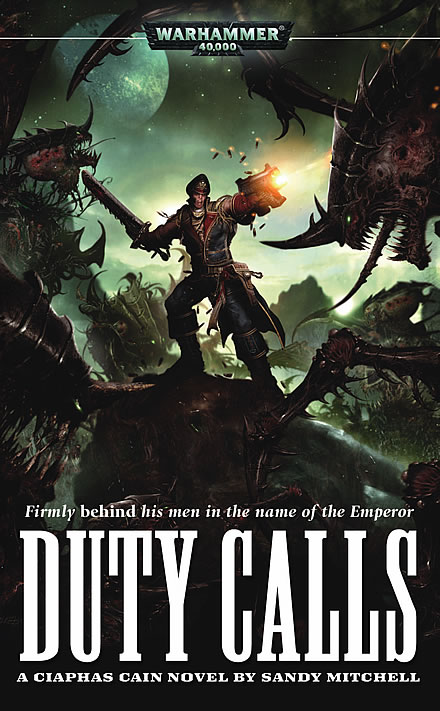
Warhammer 40,000: Duty Calls by Sandy Mitchell

Duty Calls Cover

Publisher: Black Library (Audiobook – 22 May 2007)

Series: Ciaphas Cain – Book Five

Length: 9 hours and 37 minutes

My Rating: 4.5 out of 5 stars

Amazon

One of the most entertaining authors of Warhammer fiction, Sandy Mitchell, continues to shine with the fifth book in his excellent Ciaphas Cain series, Duty Calls.

I doubt anyone is too surprised to hear that I broke a recent lull of reading by resuming the Ciaphas Cain series.  The Ciaphas Cain books, written by Sandy Mitchell (the alternate penname of author Alex Stewart), are an outstanding series that aims to bring a little humour to the crazy and dark battles of the gothic Warhammer 40,000 universe.  I have deeply enjoyed the first four books in this series, For the Emperor, Caves of Ice, The Traitor’s Hand and Death or Glory, and this honestly is one of the very best Warhammer 40,000 series out there.

Commissar Ciaphas Cain, hero of the Imperium and self-confessed self-serving coward, continues his exciting and deadly adventures when a new dark threat rises to destroy humanity.  After his last harrowing adventure with the Valhallan 597th, Cain is keen for a less deadly experience, and his new deployment to help crack down on civil unrest on the planet of Periremunda seems to be the ticket.  However, nothing is ever simple when Cain is involved.

Upon arriving on Periremunda, Cain quickly finds his life in danger as a series of assassination attempts are made against him.  Realising that his assailants are genestealers, the deadly scouts of the Tyranid swarm, Cain begins to understand the true danger Periremunda is in, as the genstealers herald the approach a Hive Fleet.  But unstoppable hordes of alien creatures are the least of Cain’s worries as he is reunited with his old flame, Inquisitor Amberley Vail.

Ostensibly on Periremunda to help the Imperial Guard stave off the Tyranid invasion, it soon becomes apparent that Vail is there for a darker reason.  Something incredibly important has been hidden on the planet that has the potential to change the entire Imperium.  Forced to assist Vail, Cain and his trusty aide, Jurgen, find themselves thrust into the deadly intricacies of a battle between hidden underground factions.  But with hungry Tyranids all around, deadly assassins gunning for Cain and a mysterious Chaos cult causing mischief, can Cain survive his deadliest encounter yet?

Duty Calls was an awesome addition to the Ciaphas Cain series that builds on several of the prior adventures, while also testing the protagonist in some fun new ways.  I loved the interesting story contained with Duty Calls, and this was one of Mitchell’s stronger additions to the series.

This fifth Ciaphas Cain novel had a great story behind it, although I am sure that prior readers will be familiar with the overall thrust of the narrative, with the seemingly cowardly Cain arriving on a new planet to face one threat, only to discover a much more dangerous enemy hiding beneath the surface that he is forced to reluctantly face and defeat, once again accidentally proving that he is a hero.  While Mitchell does try to break this story premise up throughout the series, this is a recurring story format, which can get a little too repetitive.  However, I think that Duty Calls stands on its own feet and Mitchell does a good job distinguishing it from the previous entries in the series.  The initial hidden threat of genestealers transforms into a massive Tyranid invasion, and it proved intriguing to see the protagonist face off against the ravening alien forces.  Tyranids are easily one of the best antagonists in the entire Warhammer 40,000 canon, and while they lose a little of their fighting ability in the face of Cain’s plot armour, they proved to be a great threat in Duty Calls.

While Mitchell could have probably left Duty Calls as simply a military novel, the inclusion of major recurring character Inquisitor Amberley Vail ensures that Cain is thrust into a much more subtle form of danger alongside the Tyranid invasion.  Caught between warring factions of the Inquisition and Adeptus Mechanicus, Cain is used as a pawn in the resulting shadow war, and there are some great scenes as Cain dodges assassination attempts, hidden Chaos cults, and other unseen dangers, all while trying to work out what the elaborate conspiracy is.  Novels that focus on the plots and conspiracies of Inquisitors are always very cool in the Warhammer 40,000 universe (see my reviews for Xenos, Malleus and Hereticus by Dan Abnett), and Mitchell fits Cain into this intrigue laden story arc extremely well.  It helped that there was some excellent set-up for this in the previous novel, and it was good to get a continuation here.  The resulting combination of storylines comes together really well, and Duty Calls has a really impressive and addictive narrative that will appeal to all fans of Warhammer 40,000 fiction.

As with the previous Ciaphas Cain novels, Mitchell does a great job of balancing the various elements of Duty Calls perfectly.  While primarily a military focused science fiction read, Duty Calls also has some great elements of intrigue and espionage, which ensures extra levels of excitement and danger.  However, I feel that the best part of Duty Calls is the inherent humour that Mitchell produces, which is a real rarity in Warhammer fiction.  Most of this is due to the hilarious and cynical narration of the main character, who pulls no punches when it comes to describing how ridiculous events are and the fact that he’s caught in the middle of them.  Extra humour is also built in due to the contained chronicle format that Mitchell has set the series out in, with the protagonist’s journal entries enhanced by extra documentation, descriptions, references and notes from Cain’s associate, Inquisitor Vail.  Vail’s sarcastic take on Cain’s description of events throughout these extra notes is a lot of fun, and the additional in-universe texts and broadcasts seek to showcase just how ridiculous humanity and the Imperium has gotten in the war-torn future, with over-the-top bits of propaganda and biased historical documents.  All this adds to quite a funny book, and this built-in comedy pairs remarkably well with the more serious parts of Duty Call’s narrative to create a truly addictive and fun read.

I felt that Duty Calls was a strong entry in the Ciaphas Cain series, especially as it builds nicely off the events of the preceding novel, Death or Glory.  Due to the series looking at different time periods of Cain’s career, Duty Calls is set between the second and third books, although it makes a lot of references to the first novel, and the events of Death or Glory, which took place many years before.  While the jumps around the timeline are a little confusing, Mitchell makes it work, and I liked seeing the return of several recurring characters, as well as a continuation of some mysterious storylines from the previous book.  Despite these connections, Duty Calls also works quite well as a standalone novel, and new readers can jump into the series here without too many issues.  Indeed, Duty Calls is a good introduction to both the Tyranids and the Warhammer 40,000 universe, and the Ciaphas Cain books are very much engineered for new Warhammer fans.  I will say that after reading several Ciaphas Cain books in a row, Mitchell’s proclivity for repeating elements from his other novels is a bit more obvious, and you do get a little weary of hearing the same phrases, descriptions and character depictions again and again.  Still, Mitchell ensures that Duty Calls is a particularly entertaining read, so its easy to really get stuck into it, and I deeply enjoyed seeing this unique series continue.

As always, I must mention the great characters featured within Duty Calls.  The most prominent of these is series protagonist Ciaphas Cain, who might be one of the more complex and debated figures in the Warhammer 40,000 canon.  Shown by his own admission to be a coward and a false hero, Cain spends most of the book trying to come up with ways to avoid combat and surviving the inevitable battles that his reputation and own bad luck force him to participate in.  His memoirs are filled with cynical allusions to the methods he utilises to survive, and you can see that Mitchell is trying to emulate classic characters like Flashman or Blackadder.  However, despite the character’s constant assurances that he is no hero, you see time and time again that there is far more to Cain, as he routinely defeats the enemy, often thanks to his own caution, survival instincts and ability to inspire his fellow troops.  I love how you are constantly rooting for Cain, despite his attempts to weasel out of trouble, and his self-deprecation about his actions really makes you feel for him, especially as its apparent that he is just one filled with self-doubt after not being an over-the-top martyr like the other heroes in the Warhammer 40,000 universe.  At the same time, Cain also provides a lot of the book’s humour, as you are bombarded with his fun comments and cynical attitude about everyone he encounters.  As such, I really appreciate Cain as a central character in this series, and it is always so much fun to follow him throughout his adventures.

Aside from Cain, there is an interesting array of characters featured in Duty Calls who I had a lot of fun with.  Many of them are recurring from the previous novels, and it was good to see various familiar faces again.  This includes Cain’s faithful aide, Jurgen, who Mitchell portrays in a manner like Baldrick from Blackadder, due to his apparent gormless attitude and poor personal hygiene.  However, in many ways Jurgen is just as much a hero as Cain, often being the one to save the day with his skills and big gun, and he forms a great team with Cain, especially as his Commissar is usually the one drawing the enemy’s attention from his aide’s attacks.  I also really enjoyed seeing the return of Inquisitor Amberley Vail, both as a character in Cain’s adventures and the person publishing his memoirs.  Vail proves to be the perfect foil to Cain for many reasons, and I like how she’s the only person who can effectively manipulate Cain and doesn’t fall for his lies and schemes.  Vail constantly calls out Cain, both in person and through the footnotes she amends to his chronicles, and I love how she has his number, while also clearly caring for Cain as a partner.  Duty Calls really shows just how dangerous Vail can be though, especially as she gets into the fight and makes some tough decisions.  Other interesting characters include several familiar soldiers from the Valhallan 597th, the outrageous members of Vail’s inquisitorial retinue, and a several intriguing antagonists who prove to be great and over-the-top opponents to the sensible Cain.  All these characters added a lot to the impact of the book, and I cannot wait to see how they fit into Cain’s adventures again in the future.

Readers who have seen my previous Ciaphas Cain reviews know that the only way I am going to enjoy this series is through its audiobook format.  All Warhammer novels make awesome audiobooks, but the Ciaphas Cain audiobooks are something particularly special thanks to the use of multiple narrators.  Duty Calls features six separate narrators who add a great deal to the production thanks to their fantastic voices and entertaining takes on the characters and universe.  Most of this narration is done by the superbly talented Stephen Perring, who lends his voice to all the chapters told from Cain’s perspective.  As such, he covers most of the first-person action and adventures of the main character, and his take on the complex Cain and his colleagues is exceptional.  The way he captures the various aspects of Cain’s character through his voice work is impressive, and you really get a sense of the multiple layers surrounding his motivations.  Perring also does a really good job of capturing the other intriguing characters Cain interacts with, including his aid Jurgen, and the eclectic members of the Inquisition that crosses his path.

After Perring, the most prominent narrator is Penelope Rawlins, who provides narrations for the various inclusions written by Inquisitor Vail.  As such, Rawlin’s voice is constantly interjected into the audiobook at various points as she reads out the footnotes, context pages, and personal remarks from Vail, as she attempts to make Cain’s story more readable.  Rawlins has really perfected her Vail voice over the course of the series, and it is always great to have the playful, informative, and often gently exasperated tones of a chronicling Inquisitor come through the plot.  There is also some good contrast between Perring and Rawlins, especially as both voice the character of Vail throughout Duty Calls, and they serve as a winning main team.

The other four narrators, Emma Gregory, Richard Reed, Tara Rawson and Andrew James Spooner are also very fun, even if they are used a little sparingly.  These four narrators’ voice extracts from various in-universe texts, chronicles and new casts that Inquisitor Vail has added to Cain’s manuscripts to give them more context.  These talented narrators go all out in voicing these intriguing and often over-the-top inclusions, and I love the humorous spin their excellent narration adds to them as a result.  Gregory is particularly noteworthy, especially as she once again voices the ridiculously patriotic memoirs of an officer fighting alongside Cain, but all these extra narrators do such a great job.  This excellent and entertaining combination of voice actors and audiobook narrators turns Duty Calls into a real treat to listen to, and I honestly cannot recommend this format enough to anyone interested in checking out the Ciaphas Cain series.

I continue to fall further in love with the Ciaphas Cain series as Sandy Mitchell produces another amazing and fun story in Duty Calls.  Loaded with action, humour, and a particularly complex protagonist, Duty Calls had everything I’ve come to expect from the Ciaphas Cain series, and I deeply enjoyed how Mitchell continues to showcase the Warhammer 40,000 universe in his own distinctive way.  I can think of no better way to highlight just how much of a great time I had with Duty Calls than to reveal that I automatically started listening to the sequel Cain’s Last Stand, the moment I finished it.  Highly recommended to all Warhammer fans and new readers wanting some fun science fiction adventures.

Amazon

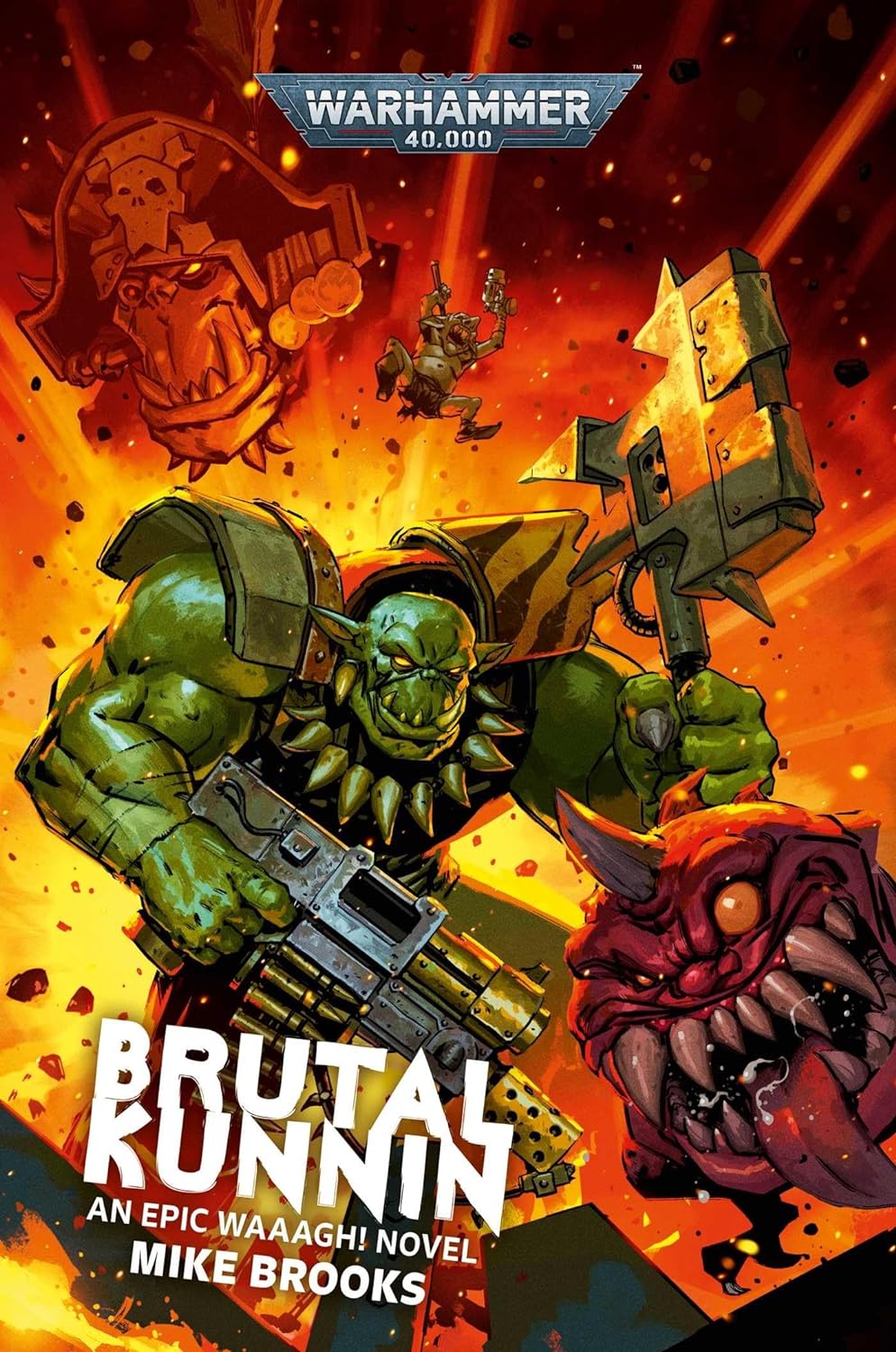
Warhammer 40,000 – Brutal Kunnin by Mike Brooks

Brutal Kunnin Cover

Publisher: Black Library (Audiobook – 22 June 2001)

Series: Warhammer 40,000: Ufthak Blackhawk – Book One

Length: 8 hours and 20 minutes

My Rating: 4.5 out of 5 stars

Amazon

Get ready for a scrap as one of the fastest rising authors Warhammer fiction, Mike Brooks, presents a fast-paced and wildly entertaining book that follows the orks as they bring carnage to a new planet with Brutal Kunnin.

One of the most impressive rising stars in Warhammer fiction at the moment is Mike Brooks, who has been on an outstanding roll lately.  An excellent talent with a great understanding of Warhammer lore and factions, Brooks has written several impressive novels in the last few years, all of which have contained clever stories featuring unique figures from the franchise.  I have had a wonderful time with several of these books, with Huron Blackheart: Master of the Maelstrom, Warboss and The Lion: Son of the Forest (one of my favourite books and audiobooks of 2023) being outstanding in their own way.  Because Brooks has some intriguing books coming out this year, I thought I would go back and check out one of his first major contributions to the Warhammer 40,000 canon with the thrilling novel, Brutal Kunnin, which I ended up having an amazing time with.

Out of all the dangerous creatures that infest the known galaxy, few things have more potential for violence and destruction than an ork warband.  Unfortunately for the Adeptus Mechanicus forge world of Hephaesto, they are about to caught in the middle of two rival warbands ready to show each other just who the hardest gits truly are.

Ufthak Blackhawk is a newly minted nob in the fleet of Da Meklord, who eagerly follows his boss to Hephaesto, looking for loot, glory, and the chance to break some skulls.  However, when Da Meklord forces arrive in orbit, they soon discover that another ork force is already there, as the ships of Freebooter Kaptin Badrukk lay siege to the planet.  Rather than fighting each other, Da Meklord and Badrukk form a temporary alliance to kill the human defenders before turning on each other.

Leading his troops to the surface, Ufthak looks ready to prove himself, only to find himself coming face to face with the most advanced weaponry and upgraded troops in the entire Imperium of Man.  However, even the highly specialised and disciplined soldiers of the Adeptus Mechanicus are unprepared for the green tide about to roll down upon them, especially when their troops are bogged down by incompetent leaders and infighting from within.  Worse, a darker threat lies waiting in the bowels of Hephaesto, one that has no qualms about killing both ork and augmented humans to achieve its bloody goals.  Can Ufthak lead his troops to victory against all comers, including an enemy that even he can’t headbutt into submission?

Brutal Kunnin was a particularly fun and thrilling novel from Brooks that takes great looks at two fantastic Warhammer factions, while also presenting an action-packed story.  Funny, brutal and loaded with laughs, this is a particularly awesome novel that makes great use of the ork faction.

I really enjoyed the fantastic story featured within Brutal Kunnin, especially as Brook produced an addictive and exciting read.  The trick with ork focused Warhammer 40,000 novel is that you usually aren’t going to get a serious story out of it; instead the writer needs to lean into the humour surrounding the whole faction.  Brooks did a really good job of this, as he primarily focuses on the volatile orks as they land on Hephaesto and begin fighting against both the Adeptus Mechanicus soldiers and other orks due to the rival fleets in order.  While this is extremely fun, it doesn’t necessarily result in a complete or fully engrossing story, so Brooks cleverly adds in a parallel storyline which helps to turn Brutal Kunnin into something particularly awesome.

This secondary storyline follows members of the Adeptus Mechanicus, particularly Zaefa Varaz, who serves as an alternative protagonist, as they witness the ork invasion unfold.  About half the book is told from the perspective of the various Adeptus Mechanicus characters, which adds a lot of meat to the story.  Not only do you get the entertaining perspective of smart characters being completely unprepared for the unusual and direct actions of the orks, but there is a lot of internal conflict as the planet’s leadership fight amongst themselves.  At the same time, various conspiracies lurking beneath Hephaesto’s surface comes to life which present even greater threats to the defenders.  I really loved how well the intrigue laden human characters contrasted with the straightforward, action-packed ork chapters, and it helped to produce a very effective story.  Brooks loads in some big set pieces as the story rushes by, and you really get drawn into the carnage that unfolds as the orks get closer to their goal and all hell breaks loose within the main city of Hephaesto.  The author sets up a very entertaining ending for Brutal Kunnin, with the right characters coming away on top, while others get their just deserts.  An overall exceedingly amusing, exciting, and cleverly set up story that you can’t put down.

I felt that Brooks did a really good job of setting out Brutal Kunnin’s story, especially with the split between the ork perspective and that of the inhabitants of Hephaesto.  The ork chapters are exclusively shown from Ufthak Blackhawk’s perspective, while the rest of the book is shown from multiple point-of-view characters to tell their side of the narrative.  Having only one ork protagonist was a clever choice from Brooks, as it ensured that side of the story was focused, character driven and didn’t get watered down with a group of similar ork characters.  I loved how well Brooks was able to express the unique perspectives of the various characters throughout the course of Brutal Kunnin, and you really get the sense of how each of these races sees the universe.  The various ork chapters are naturally loaded with humour, mostly brought on by their unique insights into the humans they face, and you have to laugh at some of the outrageous events that occur there.  This humour blends in nicely with the more serious chapters focusing on the Adeptus Mechanicus, and Brook hits the right balance between silly and intense here.  The resulting action is also very well written, and Brook made sure to fill up the story with so many compelling and over-the-top fights, which anyone can appreciate.

Unlike some of the more elaborate Warhammer novels out there, I felt that Brutal Kunnin was particularly accessible to new readers, and indeed could be a good entry point into the Warhammer 40,000 universe.  Brooks really leaned into showing how crazy and dark this universe can be throughout the course of the book, and the unique humour, over-the-top action, and interesting figures will appeal to a wide audience, especially to those interested in seeing what Warhammer 40,000 is all about.  Of course, there is a lot in it for established fans of the franchise, especially as Brooks brings several fantastic factions to life.

Naturally most of this focus revolved around the orks, who are always some of the funniest figures in the canon.  Essentially the Warhammer universe’s answer to football hooligans, the orks are the rude, crude, and always entertaining green horde, who only live for a fight.  You know what you are in for with an ork book.  Brooks did a particularly good job of capturing the orks in Brutal Kunnin, especially as you see them from both interior and exterior perspectives.  Most of what you see comes from the eyes of Ufthak Blackhawk, whose insights into the ork horde, its leaders, and the unique culture of violence, strength and domination, prove quite intriguing and usually entertaining.  Blackhawk’s chapters are loaded with the typical ork humour, as well as the entertaining observations of the humans they face, and I loved how well Brooks captured the ork mind.  This is well complemented by scenes shown from the perspective of the orks opponents, most of whom are completely unable to comprehend the threat coming towards them.  Indeed, much of the ork’s success is due to the other factions underestimating them, and it was quite satisfying to see some of the more arrogant characters lose badly due to their false preconceptions.  Other distinctive characters also have some compelling views about the orks, with one daemon’s insights in the matter being particularly fascinating.  If I had one complaint about the orks in Brutal Kunnin, it would be that Brooks somewhat overpowers them, as they tear through everything in front of them.  While this worked for narrative purposes, and showcased just how advantaged the orks were by their opponent’s arrogance, I could see fans of the other factions getting a little annoyed about how quickly the orks take down some big units.  Still, this is a very minor complaint, and I felt that Brutal Kunnin ended up being a pretty awesome book about the orks, and I loved how much fun Brooks had writing this faction.

Aside from the orks, Brutal Kunnin has a surprisingly in-depth look at the Adeptus Mechanicus, the Tech Priests of Mars.  Essentially humanity’s mechanics, inventors, and mass production specialists, the Adeptus Mechanicus worship technology and live to perfect their devices and expand their knowledge.  About half the book is shown from several Adeptus Mechanicus personalities on the planet as they attempt to fight back against the orks, and there are various scenes that showcase their combat capabilities, weird units, and excessive augmentation.  However, the true highlight of Brook’s use of the Adeptus Mechanicus characters, was how well he captured their ambitious and machine altered mindset.  Every scene featuring an Adeptus Mechanicus character has that figures perception and mind influenced by internal calculations and computer augmentations, which helped to show how most of this faction are more machine than man.  However, no matter how augmented they are, these characters are still human, especially when it comes to their ambitious, desires, and inability to work together.  In many ways, the main antagonist of Brutal Kunnin was these character’s hubris rather than the orks, as these big personalities were often more concerned with each other, and this cost them dearly.  Throw in a mysterious outsider from another faction, and Brutal Kunnin ends up being a pretty interesting piece of Warhammer 40,000 fiction, that fans will have a lot of fun with.

As with most Warhammer novels I have the pleasure of enjoying, I chose to check out Brutal Kunnin on audiobook rather than seeking out a physical copy.  Naturally this proved to be a pretty fun experience as Brutal Kunnin has an outstanding audiobook format that really enhances the amazing and fun story of this book.  With a run time of nearly eight and a half hours, this is a pretty typical sized Warhammer audiobook which I was able to power through quickly thanks to its fast-paced story.  It also helped that Brutal Kunnin had an awesome narrator in Tom Allenby.  Allenby is a narrator who I wasn’t familiar with before this book, but he quickly impressed me with his excellent range of voices.  Allenby proved quite adept at voicing the various inhuman figures in the story, whether it be an ork or a member of the Adeptus Mechanicus.  He did such a good job capturing the essence of these figures throughout the production, and I loved how all the various characters got their own unique voice that proved fitting to their personalities.  Allenby also did a great job of narrating the intense and entertaining action throughout the course of Brutal Kunnin, and the listener really gets a good sense of what is going on.  As such, I would strongly recommend the Brutal Kunnin audiobook format to anyone interested in checking this piece of Warhammer fiction out, as you guaranteed to have an amazing time with it.

Mike Brooks continues to impress me with his outstanding additions to the Warhammer canon.  Brutal Kunnin was a pretty damn amazing read that showcased the author’s ability to showcase some of the more distinctive figures from the game.  This was a wildly entertaining and exciting Warhammer 40,000 novel that comes very highly recommended.

Amazon

Warhammer 40,000: The Fall of Cadia by Robert Rath

Warhammer 40,000 - The Fall of Cadia Cover

Publisher: Black Library (Audiobook – 5 August 2023)

Series: Warhammer 40,000

Length: 19 hours and 42 minutes

My Rating: 5 out of 5 stars

Amazon

Cadia Stands!  I ended 2023 on a very high note with one of the best Warhammer 40,000 novels of the year that follows one of the biggest events in the franchise’s recent lore, The Fall of Cadia by Robert Rath.

There were several amazing Warhammer 40,000 novels released in 2023, with some of my favourites including The Lion: Son of the Forest and Warboss by Mike Brooks, The King of the Spoil by Jonathan D. Beer and Cypher: Lord of the Fallen by John French, just to name a few.  However, in terms of sheer scale, epic battles, and larger-than-life characters, my favourite will have to be The Fall of Cadia.  As the name suggests, The Fall of Cadia follows the final battle for the planet of Cadia at the end of the 13th Black Crusade, which was a major campaign in the Warhammer 40,000 tabletop game.  The original 13th Black Crusade campaign happened back in 2003, with the official result being something of a draw.  However, in 2017, Games Workshop retconned the campaign to result in a much more substantial Chaos victory, which ended up having substantial impacts on the wider lore of the franchise, effectively reshaping the entire Warhammer 40,000 universe.

This change ended up being a pretty significant event, and Games Workshop provided some major write-ups about it that summarised the events and their explosive aftermath.  Indeed, the lore events initiated in this event have already been featured in several novels, and most of the current Warhammer 40,000 fiction examines the consequences of this campaign.  However, there has yet to be a novel solely dedicated to trying to capture the entirety of the action at the end, until now with The Fall of Cadia by Robert Rath.  Rath was a great choice of author to write this book as he is a truly amazing author of Warhammer 40,000 fiction.  His previous novels, Assassinorum: Kingmaker (one of my favourite books and audiobooks of 2022) and The Infinite and the Divine, have both been exceptional five-star reads, telling elaborate, character-driven stories that cleverly capture complex aspects of Warhammer 40,000 lore and turn them into impressive and addictive reads.  As such, he was the perfect choice to write The Fall of Cadia and he succeeded in creating a deeply moving and epic novel that perfectly brought the chaotic events that ended this infamous war to life.

In the far future of the 41st Millenium, few battlefields are more significant or more soaked in blood than that of Cadia.  A fortress world for the Imperium of Man, Cadia stands in the shadow of the Eye of Terror, a blazing rift that serves as a gateway into the Warp and the realm of the Chaos gods.  For any substantial invasion by the forces of Chaos into the Imperium to be successful, Cadia needs to be taken and destroyed, and for that task the Chaos Gods have chosen the Warmaster of the Black Legion, Abaddon the Despoiler.  Abaddon is a legendary warrior of hatred and spite who alone is capable of welding together the unruly and contentious forces of Chaos.  Over the millennia, Abaddon has launched 12 Black Crusades against Cadia, leading an unholy alliance of monsters, daemons, cultists and traitor Space Marines to battle.  However, each time Cadia has held, at great cost to the desperate Imperial defenders.  But now, as the forces of Chaos appear stronger than ever before, a 13th Black Crusade has been declared, one that looks set to destroy Cadia forever.

The Fall of Cadia starts well into the 13th Black Crusade, as, after weeks of heavy fighting, the forces of Cadia and humanity once again appear victorious, with the armies of Chaos retreating on all fronts.  However, despite the apparent victory over the heretics and the dark gods of Chaos, Lord Castellan Ursarkar Creed is uneasy, believing that the victory was too easy.  As the celebrations continue, Creed is soon proved right, as the Eye of Terror disgorges a new enemy force unmatched in size and deadly potential since the legendary Horus Heresy.

At its head flies a dread Blackstone Fortress, an alien superweapon capable of intense destruction and now crewed personally by Abaddon.  Faced with this threat, Creed attempts to bring together the various elements of humanities defenders, including legendary Space Marines, virtuous Sisters of Battle, the inhuman soldiers of the Adeptus Mechanicus, and the outmatched by steely rank-and-file troops of Cadia, determined to save their home.

As the final invasion of Cadia begins, Creed organises the defence the best he can to hold back the oncoming horde on land, in the sky, in space, and even far behind Cadian lines in their seemingly safe cities.  If Creed has any hope of succeeding, he will need to bring together the scattered armies of the Imperium on Cadia into a single cohesive force, but not all of the defenders are fighting for the same goals.  Even if these armies come together, can the legendary Creed hold off the fury of Abaddon and his dark gods?  Cadia’s last stand has begun, but who will be left alive at its end?

Robert Rath continues to showcase just how varied and impressive his talent for writing Warhammer 40,000 fiction is as he captures the incredible events of the last siege of Cadia.  The Fall of Cadia is epic in every way possible, as it presents the reader with a great coverage of these key lore events and the characters involved.  Elaborate, intense, and featuring so much damn carnage and war, The Fall of Cadia is an incredibly addictive read that got a very easy five-star rating from me.

I think it is important to point out that Robert Rath had a difficult task ahead of him when he was chosen to novelise the events surrounding the end of the 13th Black Crusade.  A lot of detailed lore has been written around this event, not only in the various guides, rulebooks and other material associated with the tabletop game but also in several years worth of novels and extended fiction that focused on the aftermath of the war.  Any novelisation about these events ran the risk of being a stale retelling of events that all Warhammer 40,000 fans already know about.  However, Rath rose to the challenge and presented a powerful, intense and memorable depiction of the events that really drags the readers in while showing just how incredible and epic a piece of Warhammer fiction can be.

To tell the events of The Fall of Cadia, Rath elected to cover everything in a massive, multilayered, character-driven narrative, told from every perspective imaginable.  Starting towards the final days of the battle, when Abaddon unleashes his true invasion of Cadia, the reader is soon engrossed a range of different storylines that cover many different angles of the battle.  Not only do we get to see the overall strategy of both sides but the reader is also thrust into personal wars and fights across the theatre.  So many amazing moments are covered, including a desperate last stand in the mountains, battles in the sky and space, Chaos infiltration in the cities, criminal enterprises, even internal dissension amongst the Chaos command.  These scenes are usually shown through the eyes of a complex characters, whose desperate fight for Cadia helps to define them and presents the reader with some impressive and captivating character arcs.  All these varied conflicts are expertly portrayed by Rath, who does a wonderful job capturing the intensity, brutality and lack of humanity involved in warfare, as his characters suffer on every battlefield imaginable.  The sheer epic and destructive nature of these conflicts really come across in Rath’s writing style, and I honestly visualised many of the scenes being described in cinematic detail in my head.

The first half of the book primarily focuses on these various scattered storylines, and it was a lot of fun to see the different theatres of war, especially as you start to get attached to the major characters.  All the battles featured are pretty awesome and intense in their own way, and I really have to emphasise just how skilled Rath is at bringing all the different elaborate bits of combat to life.  The complex story pieces start to come together in the second half, especially as each of the characters find themselves drawn to the same battlefields.  I really appreciated how the storylines tied together, and there are some brilliant moments featured here.  I also felt that the multiple deus ex machina moments towards the conclusion of a big battle sequence that Rath needed to include because they were part of the lore was handled about as well as they could be.  Rath did some good set-up for the most important of them earlier in the plot, and I liked how in many instances he tried to examine it from the perspective of the common soldier looking for miracles, so it often did not seem too ridiculous.

Everything leads up to the big final battle in the last third of the novel, and despite knowing how it was going to end, I still was extremely invested in the plot and eager to see how everything came about.  A lot of this was because I deeply enjoyed the compelling character arcs of the newer protagonists, but I was also very interested in seeing how Rath envisioned some of the more essential events.  The author really did not disappoint, as these epic and groundbreaking moments were expertly showcased to the reader in a powerful and captivating way.  The big deaths were pretty shocking and hurtful, especially if you did not know they were coming, and the major conflicts were so damn epic in their scope and impact.  The final devastating blows of the war really hit hard, especially as the climatic events featured some deeply personal moments alongside the mass devastation, which made everything that much more powerful.  I really loved how everything came together, and the poetic conclusion that highlighted the final fights of the surviving protagonists is going to stay with me for some time.  I am so damn impressed with how much passion and emotion that Rath was able to stick into this massive war story, and I honestly loved every single second spent reading The Fall of Cadia.

In addition to the amazing story, I really need to highlight the impressive array of characters featured throughout The Fall of Cadia.  Rath did a wonderful job of presenting the massive events of this book through a range of intriguing character perspectives on every side of the conflict, and there is a fantastic combination of new characters and established Warhammer 40,000 figures.  The author really tried to cover The Fall of Cadia’s narrative from every single angle he possibly could, and the resulting combination of generals, common soldiers, legendary warriors, ancient traitors and other interested onlookers, helped to make this Warhammer 40,000 story even more powerful and layered.  This includes several Chaos characters, whose tainted perspectives allow for a compelling view of both sides of the conflict.  The Fall of Cadia’s character arcs are mostly self-contained for the majority of the book, with their focus usually on that particular figure or theatre of the war.  However, there are some clever and moving interactions between the characters as the novel continues, and it is testament to Rath’s writing style and ability to create a massive web of overlaying character storylines that these interactions fit together so well into a cohesive and powerful narrative.  Rath really dove into the complex lives and personalities of every character he featured, even those that died quite quickly, and the resulting character arcs really added to the emotional impact of The Fall of Cadia.  You become heavily invested in these characters as a result, and waiting to see who survives the war is an important part of experiencing this novel.

So many big personalities were expertly featured throughout The Fall of Cadia and every reader is going to come away with their own favourites.  The better character arcs I personally loved included that of Major Marda Hellsker, who is forced to lead a desperate last stand for much of the book and grows into the leadership position thrust upon her.  Captain Hanna Keztral’s exploits in the sky also make for great reading, especially as she desperately tries to gain respect whilst flying an unarmed aircraft.  You also have to love the storylines surrounding Salvar Ghent, Cadia’s premier gangster, as he tries to exploit the war to his advantage before finding himself thrust into a much more prominent role.  I particularly loved how well Ghent interacted with some of the major figures in the book, and his entire storyline was one of the most entertaining.  The insatiable Necron collector Trazyn the Infinite was also a great inclusion in the plot, and Rath clearly had fun bringing back this hilarious character after featuring him so heavily in The Infinite and the Divine, and I got a good laugh at several of his pivotal scenes and petty moments.

However, the best characters in The Fall of Cadia had to be the opposing leaders of the war, Lord Castellan Ursarkar Creed and Abaddon the Despoiler.  Both are major figures in Warhammer 40,000 lore and Rath ensured that they were done justice in this novel.  Creed is shown to be a rough but brilliant commander, capable of inspiring an entire world while also suffering from the stresses of constantly being on the losing side.  I particularly enjoyed the subsequent inclusion of Colour Sergeant Jarran Kell alongside Creed as his long-suffering aide and best friend, and the two make for a very powerful character combination for many of the scenes shown from the defenders’ perspective.  Abaddon on the other hand is presented as the absolute beast that he is, and his obsessive desire to destroy Cadia is palpable.  I deeply appreciated that Rath showcased Abaddon as the ultimate villain in this universe, and his appearances were always exceedingly impactful.  Many of Abaddon’s appearances were cleverly shown through the eyes of his loyal servant, Dravura Morkath, whose rose-tinted opinions of her master barely covered the restrained evil within this figure.  I quite enjoyed Dravura as a character, especially as she has the most intriguing insights into the Chaos ranks, and the resolution of her storyline with Abaddon might be one of the most heartbreaking in the entire book.  These characters, and so much more, were such a brilliant part of The Fall of Cadia, and they helped turn what could have been a simple retelling of the lore into a particularly powerful and moving novel.

As with most Warhammer 40,000 novels, I feel that The Fall of Cadia is going to appeal to those fans of the franchise who already have a grip on the basics of the lore and main characters and can fully appreciate just how massive an event this book was.  Due to the material the book is based on, there were a lot of crazy events and characters featured here, some of which would be obscure even to casual fans of the game.  While Rath does an outstanding job of explaining and exploring the most important of these elements, some readers might occasionally be confused at what is going on or how certain characters came into being.  Still, I feel that most new readers can still have an exceptional time with this book, especially as the epic battles, impressive characters, and heartfelt military focused story, is so damn good.  The Fall of Cadia might even be a great gateway novel for those people trying to get into Warhammer 40,000 fiction, and it sure as hell encouraged me to read more Warhammer fiction.

One of the other things that I really appreciated about The Fall of Cadia was the way that Rath tried to paint a more nuanced picture of the planet of Cadia itself.  Cadia is usually portrayed as a bastion of military prowess and resistance without some of the issues other planets in the Imperium had, so it was quite interesting to see Rath’s different take on the subject, showing Cadia to be a planet with hidden issues and dissent.  In particular, Rath examines the problematic social structure of Cadia, where the active military are notably prioritized and those people who could not fight or be assigned other roles were considered a second-class citizen.  I loved how well Rath examined and focused on the issues surrounding this unique military class system, and it became a surprising key part of the book.  Indeed, the motivations of several characters are highly tied into these issues, with many seeking to prove themselves after being considered lesser for their contributions.  It also serves as an intriguing motivation for several antagonistic figures, and I loved just how well Rath was able to weave the structure of a planet into these intriguing character traits.  This, and more, really showcased Rath’s inventiveness and appreciation for the little details of the Warhammer 40,000 universe, and it is one of the reasons why I really enjoy his novels.

As with most Warhammer 40,000 novels, I chose to enjoy The Fall of Cadia on audiobook, which proved to be a very smart decision on my behalf as it was one of my favourite audiobooks of the year.  Coming in with a runtime of just under 20 hours, The Fall of Cadia is a bit longer than your typical Warhammer 40,000 audiobook, which reflects the massive story Rath came up with for this epic read.  I really loved how well this audiobook format brought the epic nature of this narrative to life and the many battles, wars, and unique characters felt even more impressive when read out.  I enjoyed the narration of Mark Elstob, who has previously lent his voice to other great Warhammer audiobooks, including Kal Jerico: Sinner’s Bounty by Josh Reynolds.  Elstob’s narration of The Fall of Cadia is extremely good, and I loved how passionately he presented every big event and piece of action.  I really enjoyed some of the great voices he came up with for the cast of The Fall of Cadia, and every larger-than-life character was gifted a fitting tone that perfectly captured their personalities and intensity.  His voices for the opposing leaders of the battle, Abaddon the Despoiler and Ursarkar Creed, are amazing examples of this, and you really get awesome impressions of both character’s opposing determination and charisma in some outstanding sequences.  I really cannot emphasise just how incredible this audiobook version of The Fall of Cadia is and it is definitely the best way to enjoy this world-shattering story.

Overall, The Fall of Cadia is a pretty exceptional piece of Warhammer 40,000 fiction that did such an impressive job of capturing this intriguing event from the game’s substantial lore.  Robert Rath is such an impressive author, and I am really glad he had the opportunity to cut loose and present this massive inclusion to the Warhammer 40,000 franchise.  The Fall of Cadia is easily one of my favourite books of 2023, and I loved how Rath told such an epic war tale in such a powerful and memorable way.  I honestly hope they make a movie based around this book in the future, because it would be so damn spectacular.  A highly recommended read that no Warhammer 40,000 fan should be without.

Amazon

Warhammer 40,000: Flesh and Steel by Guy Haley

Flesh and Steel Cover

Publisher: Black Library (Audiobook – 3 October 2020)

Series: Warhammer Crime

Length: 9 hours and 23 minutes

My Rating: 4.75 out of 5 stars

Amazon

I’m on a major Warhammer 40,000 review roll, so after checking out the awesome books Malleus and Hereticus by Dan Abnett, Sepulturum by Nick Kyme, For the Emperor by Sandy Mitchell and Kingsblade by Andy Clark, I’m moving on to the awesome Warhammer Crime book, Flesh and Steel by Guy Haley, which proved to be an exceptional read.

I have said this several times in the past, but one of the true strengths of Warhammer 40,000 fiction is that the franchise can cover so many different types of stories or genres and still result in some epic reads.  A particularly good example of this is the Warhammer Crime subseries that melds intriguing and classic crime fiction concepts with a grim Warhammer 40,000 setting.  I have deeply enjoyed the previous Warhammer Crime books I have read, including the twisty and fast-paced crime thrillers Dredge Runners and The Wraithbone Phoenix by Alec Worley, and the noir inspired psychological thriller Grim Repast by Marc Collins.  As such, I just had to read another fantastic entry from this series with the intriguing Flesh and Steel by Guy Haley which saw a classic odd-couple police story meet a unique thriller from the Warhammer universe in glorious fashion.

The vast continent-sprawling city of Varangantua on the planet of Alecto is home to many vile and heartless crimes, most of which are ignored by the over-taxed enforcers of the Lex Alecto.  However, some murders are so spectacular that they cannot be ignored, especially when they threaten the stability of the city’s entire economy.

Probator Symeon Noctis is a man who knows all about the obscene wealth that Varangantua can produce.  A scion of one of the city’s richest houses, Noctis has fled from his cruel family and his tragic past by joining the enforcers and attempting to help the downtrodden inhabitants of the Nearsteel district.  However, even someone as jaded and cynical as Noctis is unprepared for the strangeness of his next case when a bisected corpse is discovered in a neutral zone between Nearsteel and the Adeptus Mechanicus enclave of Steelmound, the two halves of the body neatly left on either side of the border.

Forced to cooperate with the Adeptus Mechnanicus, Noctis is partnered with Procurator Rho-1 Lux of the Collegiate Extremis to investigate the crime.  But when all evidence suggests that the murder was committed by a mindless servitor, Noctis is dragged into a terrible conspiracy inside the Adeptus Mechanicus.  Faced with tech-heresy, illegal modifications to servitors and even more bodies littering the streets, Noctis and Lux need to work together to solve this insidious crime before both their organisations are dragged down.  But with more and more people gunning for them, can this unlikely duo survive to crack the case?

Now this was an awesome Warhammer Crime book.  Loaded with great, complex characters, a compelling case, and some impressive Warhammer 40,000 elements, Flesh and Steel grabs your attention from the very start and refuses to let go.  A fantastic novel that shows off just how incredible and inventive a tie-in to the Warhammer universe can be.

Flesh and Steel has a brilliant and deeply addictive narrative that I had an amazing time getting through.  Told primarily from the perspective of protagonist Probator Symeon Noctis, the plot of Flesh and Steel revolves around an intriguing murder, where two halves of the same body have been placed on either side of the border between the main city and an Adaptus Mechanicus manufacturing enclave.  With two competing jurisdictions, Noctis is forced to work with the Mechanicus investigator Rho-1 Lux, especially after the murder weapon is determined to be the victim’s servitor and additional victims are discovered.  What follows is an intriguing buddy cop romp of a unique series of murders, as certain figures throughout the city are involved in crimes involving the always terrifying mindless man/machine hybrids, servitors.  Forced to work together despite their differences, Noctis and Lux prove to be a skilled team, investigating both the Mechanicus and the businesses in the city.  At the same time, Noctis is forced to deal with other concerns, such as an impossible missing person’s case, the machinations of his wealthy family, and his own intense personal issues as he tries to reconcile his complex life and the mistakes from his past.  The result is a fantastic and moving tale that has the right blend of crime fiction, Warhammer 40,000 and character elements to it.  While the mystery surrounding the various crimes isn’t too complex, especially as the perpetrators are obvious from the outset, the resulting conspiracy, and the impacts it has on the protagonists more than makes up for it, as you are drawn into a crime story that could only occur in the Warhammer universe.  Haley ends the book on an interesting note that not only highlights the full extent of the protagonist’s personal issues but hints at future adventures and tragedies to come.

I really liked the cool setup-up surrounding this story, as well as the distinctive writing elements that Haley utilised, and I was particularly impressed with how the author was able to utilise some classic crime fiction scenarios in this unique Warhammer setting.  The concept of a bisected body left across a border forcing a joint investigation between two agencies is reminiscent of The Bridge (or The Tunnel), and I liked the intriguing spin that Haley does on this by bringing in the Adeptus Mechanicus, who most humans have a very hard time relating to.  This leads to the unique partnership between Noctis and Lux, which I felt Haley utilised to its full effect, especially as he does a remarkable job diving into each of their intriguing lives.  While I mentioned that the mystery isn’t as complex as you would hope, Haley more than makes up for it by featuring some deeply compelling character elements, as well as perfectly fitting it into the already fantastic setting of Varangantua and the wider Warhammer 40,000 universe.  I also really enjoyed the excellent way Haley told his story through the lens of Noctis’s journals.  Not only does this provide some compelling and tragic hints at what is to come but it also paints the story through Noctis’s cynical viewpoint, which I quite enjoyed, especially as his infectious humour and sarcasm helped to make this one of the more light-hearted Warhammer Crime books at times.  This distinctive and compelling read had me hooked the entire way through, and I felt that Haley came up with something extremely special for Flesh and Steel.

I was really impressed by the excellent Warhammer 40,000 elements featured, especially as some of the more distinctive elements of this universe were used to full effect to create a gripping and powerful read.  Now, as with most of the Warhammer Crime books, I felt that Flesh and Steel stood well on its own and no prior reading is needed to fully understand this book, not even the preceding short story Haley published in the No Good Men anthology.  Indeed, due to the great use of crime fiction elements, the strong focus on characters, and Haley’s attention to detail, readers unfamiliar with the franchise can easily jump into Flesh and Steel and have a good time, and it would serve as a good bridging novel for readers more familiar with crime fiction than anything else.

However, both new and established fans will deeply appreciate Haley’s compelling and all-encompassing examination of some very interesting elements of Warhammer lore that are cleverly and expertly utilised throughout the story.  I was particularly impressed with the deep dive into the Adeptus Mechanicus, the inhuman tech-worshippers of the Imperium, who play a big role in the plot.  This was honestly one of the more intriguing novels I have so far read that deals with the Adeptus Mechanicus, and I loved the author’s depictions of their elaborate and occasionally nightmarish settlement within the wider city of Varangantua.  The protagonist spends quite a bit of time diving into their society, and I loved his cynical, if accurate, descriptions of them, as well as the apparently hypocritical role they serve in the wider Imperium.  One of the most intriguing aspects of the Adeptus Mechanicus featured in Flesh and Steel involve servitors, the cyborgs who act as mindless manual labour machines throughout the Imperium.  The creation and use of servitors, who are a common, if terrifying, background feature of the universe, becomes quite a key part of the plot, as they are end up being the murder weapons.  This helps to shape Flesh and Steel into a particularly unique mystery story, one which could only occur within the Warhammer universe, and I loved the I-Robot homages (book and the movie) that resulted from them.  Haley also treats us to several scenes that depict the creation of servitors, a process which involves lobotomising condemned criminals and turning them into barely human creations.  These scenes honestly turn Flesh and Steel into one of the most horrifying Warhammer 40,000 books out there, and these gruesome inclusions work wonders to shock both the reader and the protagonist, while also deeply enhancing the complex murder case.

In addition, Haley also spends a good amount of time expanding on the already epic setting of Varangantua, which has been such an amazing background for the rest of the Warhammer Crime novels.  There are many distinctive districts and areas to the vast city of Varangantua, and this great book introduces us to even more of them with new district of Nearsteel, which borders the Adeptus Mechanicus enclave and has its own range of issues and features.  In particular, the area is slowly dying thanks to the actions of the Mechanicus, who are killing of the industries contained within, and you get to see the decay and degradation that follows.  Haley keeps up the cool background of neon signs, dark bars, and corrupt police, that are a key feature of the wider Varangantua, and I loved the impressive Blade Runner resemblances that result.  Haley further enhances the effect of these poorer districts by also visiting the high spires and estates of Varangantua uber-wealthy, as the protagonist, a former rich boy himself, makes several visits there.  The elaborate manors, parties, and hang-outs of the gilded make for a fun and compelling comparison to the slums and desolate industrial areas of the rest of the novel, and I deeply appreciated how Haley used this multifaceted city to mirror the complex main protagonist and help show that he doesn’t really fit in anywhere.  I always have a ton of fun exploring these new areas of Varangantua, and Haley really did a great job showcasing the city, and other key Warhammer 40,000 elements throughout Flesh and Steel’s narrative.  I cannot wait to see what other crazy areas that Haley explores in some of his future books and stories, and I know I am going to love it.

While the story, the writing style, the dark setting and the cool Warhammer elements all made this book really stand out, I personally felt that the main strength of Flesh and Steel was the exceptional central characters, Probator Symeon Noctis and tech-priest Rho-1 Lux.  Haley did a remarkable job with both these complex and damaged characters and both of them carry the main story extremely well.  The combination of dramatic and tragic character arcs, combined with a fun overarching theme of them both being outsiders, is an essential part of the book’s narrative and you grow deeply connected to both the characters, and the book, as a result.

Most of the focus is on Noctis, who serves as the primary narrator, due to his personal journal (which is also an extended note to his lost daughter), being read out.  Noctis is a very fun and cocky character, who seems to treat many of the events that he encounters in an inconsequential way.  However, this is a major façade, as deep down Noctis is probably one of the most damaged and guilt-ridden characters you are likely to see in Warhammer fiction.  A member of one of the richest families on the planet, Noctis was already pretty messed up before he became a cop, due to the terrible family dynamics and his controlling father.  Further traumatic events, which are explored later in the novel, nearly break him, and he decides to escape some of his father’s control by joining the enforcers to help others.  However, his family influence and wealth still follow him and he is considered an outsider by most of his colleagues.  Despite this, Noctis doggedly continues and proves to be a very competent and capable investigator, even if he breaks all the rules and pisses off his boss to do so.  His eye for the inequity of the city and the wealthy gives the story a bit of a preachy anti-capitalist vibe, but I felt that this fit his character arc perfectly, especially as he knows better than most just how badly the lower classes are being exploited.  I also quite enjoyed how, despite Noctis’s dislike for his family’s intense wealth and intense hatred for all the nobility, he still uses their money to buy nice things for himself, including a fancy car and secure apartment.  This apparent inconsistency between what he preaches and what he does, is addressed several times by both the protagonist and other characters, and his eventual and simple explanation of, “I never said I was perfect,” is a recurring theme of this character’s existence.  Watching this conflicted and troubled figure attempt to reconcile his past and guilt with the current investigation and the people he meets is a powerful part of Flesh and Steel’s appeal, and the story would not be as strong without it.

The other major character is Procurator Rho-1 Lux, an Adeptus Mechanicus Tech Priest who acts as a detective and law enforcement officer who investigates crimes committed by or against the Mechanicus.  Lux is a great character for a number of reasons, especially as the whole idea of a Adeptus Mechanicus cop is a pretty damn cool one.  Initially shown to be an unflappable and rigid figure, you soon find a deeper layer underneath her augmentation as she proves to be just as emotionally unsure and determined for justice as Noctis.  A member of an obscure order, Lux is a rare individual who converted to the machine cult rather than being born into it.  This also makes her a bit of an outsider as she is not fully accepted by the Adeptus Mechanicus and is no longer fully human.  This forces her to accept one of the few jobs that none of the other tech priests want, and it is interesting to see her views on humanity, the Mechanicus, and the law, which surprisingly often mirror Noctis’ cynical thoughts.  Lux served as an interesting bridge between the human characters and the mysterious cyborgs of the Mechanicus, and it is fascinating to see how she changes her persona depending on who she talks to.  Haley does a wonderful job of portraying Lux’s dual persona throughout the course of Flesh and Steel, and he even shows a couple of chapters from her perspective as extracts from her data core.  These chapters have a more sterile and mechanical feel, and you see her data-laden observations in these compelling scenes.  Probably the best part of her character arc though revolves around her interactions with Noctis, as the two form a very unusual team.  Lux serves as straight person for much of Noctis’s antics, especially when it comes to their interactions with other Mechanicus figures, and usually tries to maintain her mechanical indifference.  However, the two soon form an intriguing relationship, which forces Lux to examine some of her long-hidden emotions.  I felt that the two played off each-other perfectly throughout the course of the book, and the joint explorations of their various pains and dark histories makes for quite a gripping read.  I look forward to seeing more from this distinctive and surprisingly fun duo in the future, even if Noctic’s journals hint at more tragedies to come.

As is my usual practice with Warhammer 40,000 novels, I checked out Flesh and Steel on audiobook, which proved to be an epic and deeply enjoyable experience.  Coming in at just under nine and a half hours, Flesh and Steel was a very easy audiobook to get lost in, and I felt that this amazing format really worked to enhance the exceptional story.  The journal format of Haley’s storytelling, as well as the occasional jumps to other perspectives, is expertly portrayed on audiobook and I loved how some of the darker or grander elements of the book, especially the horrors surrounding the Adeptus Mechanicus workshops, became even more distinctive or sinister when listened to.  It helps that the primary narration of Flesh and Steel was done by impressive voice actor, James Macnaughton, who really throws himself into the production.  Each of his key characters are expertly showcased through his voice work and you really get a sense of their inner selves through his performance, whether it’s Noctis’s cockiness, disdain or self-loathing, or the strangeness of Lux, Macnaughton manages to encapsulate it all with his acting and this combines extremely well with Haley’s strong character-focused writing.  A secondary voice is also utilised for the several chapters written from Lux’s perspective, and I liked how this different voice really helped to differentiate that the events were being shown from Lux’s internal processors.  This performance, combined with the usual enticement of the audiobook format, ensures that this is the best way to enjoy Flesh and Steel, and I would strongly recommend it to anyone who wants to try this epic book out.

Overall, Flesh and Steel is a pretty remarkable novel from Guy Haley that has ensured my continued addiction to all things Warhammer 40,000 and Warhammer Crime.  Featuring a complex and powerful story that simultaneously explores a compelling mystery and some brilliant characters, it is very easy to get hooked on Flesh and Steel and I had a wonderful time powering through it.  I cannot rave about this book enough and I am really hoping that Haley produces a sequel to Flesh and Steel very soon.

Amazon

Throwback Thursday – Warhammer 40,000: Storm of Iron by Graham McNeill

Storm of Iron Cover 2

Publisher: Black Library (Audiobook – July 2002)

Series: Warhammer 40,000

Length: 11 hours and 3 minutes

My Rating: 4.5 out of 5 stars

Amazon

Welcome back to my Throwback Thursday series, where I republish old reviews, review books I have read before or review older books I have only just had a chance to read.  For this latest Throwback Thursday, I dive into some old-school Warhammer 40,000 fiction with the exceptional Storm of Iron by one of the most prolific Warhammer authors, Graham McNeill.

Readers of this blog will know that I have been really getting back into Warhammer fiction in the last few years, and I have had an outstanding time reading all the exciting and captivating reads the franchise’s extended universe contains.  I have been particularly impressed by the sheer number of talented authors who contribute to this extended universe, and I already have a few favourites due to how epic and complex their novels have turned out to be.  However, one of the main contributors to the current Warhammer canon I had not really explored yet is the superbly talented Graham McNeill.  McNeill has been writing Warhammer fiction for 20 years now, and he has produced multiple books for both the Warhammer 40,000 and Warhammer Fantasy sub-franchises.  Best known for The Ambassador Chronicles, Legend of Sigma, Ultramarines and Forges of Mars series, as well as his entries in the massive Horus Heresy series, McNeill has produced some outstanding sounding books throughout his career (including several books I really want to read) and had an incalculable impact on Warhammer fiction universe.  I however, have not had too much experience with his works, although I do have several of his novels sitting on my shelf.  I am hoping to read more of his stuff in the future, but I ended up starting with one of his earlier books, the standalone Warhammer 40,000 novel, Storm of Iron.

The Adeptus Mechanicus Forge World of Hydra Cordatus is a barren and desolate place, garrisoned by Imperial Guard of the 383rd Jouran Dragoons and members of Adeptus Mechanicus, who rule from one of the mightiest and seemingly impregnable fortresses in the galaxy.  No-one ever expected that the many wars that plague the universe would ever come to a planet as seemingly inhospitable as Hydra Cordatus, but hell has descended upon the planet in the form of Chaos Space Marines from the feared Iron Warriors legion.

Under the leadership of the dread Warsmith Barban Falk, the Iron Warriors have arrived on Hydra Cordatus in substantial numbers, determined to destroy all the Imperial defenders and take the planet’s main citadel.  After a blistering landing upon the surface of the planet that cuts off all hope of relief, the Iron Warriors deploy their full force of warriors, slaves, labourers and even several corrupt Titans to assault the enemy.  But they have not chosen an easy target, as the citadel of Hydra Cordatus is no ordinary fortress.  It is an ancient and mysterious stronghold, whose walls are designed to stymy any attack, and few foes would have a chance of defeating its defences.

However, the Iron Warriors have long been considered the greatest siege warfare specialists in all the universe.  Having honed their bloody craft for millennia since their betrayal of the Emperor, the corrupt Iron Warriors soon embark on an ambitious and fast campaign that soon threatens to completely destroy the Imperial forces.  Only the arrival of members of the Iron Warrior’s greatest enemies, the Space Marines of the Imperial Fists, gives any hope to the defenders.  But can even the legendary Imperial Fists stand against the ancient fury of the Iron Warriors?  And what secrets truly lay hidden in the depths of Hydra Cordatus’s citadel?

Well, this was a pretty damn awesome Warhammer book.  McNeill did a remarkable job with Storm of Iron, producing an intense and action-packed novel that might be one of the best siege novels I have ever had the pleasure of reading.  Loaded with impressive battle-sequence after impressive battle-sequence, as well as a ton of intriguing and fun characters, Storm of Iron was an outstanding read, and I had so much fun getting through it.

I will admit that one of the things that really drew me to Storm of Iron is that it showcases a massive siege in the gothic future of the Warhammer 40,000 universe.  I have always deeply enjoyed books with sieges in them, and the Warhammer universe is naturally filled with some good examples of this, although these mostly occurred in the fantasy focussed books.  As such, I was quite intrigued to see how a science fiction siege would occur, and McNeill really did not disappoint, painting a powerful and captivating picture and using the Iron Warriors and Imperial Fists, both of whom are known for their siege craft, as central figures in the narrative.

McNeill starts Storm of Iron off with a bang, showing the Iron Warrior’s initial move as they launch a lightning-fast raid and landing upon Hydra Cordatus in the opening chapters.  From there, the siege of the citadel starts in earnest as the Iron Warriors deploy their entire army towards it.  Told from multiple character perspectives of both the attackers and defenders, you swiftly get to know all the key players of the book and see their various personal and military struggles as the siege unfolds.  The author sets everything up perfectly, and you are soon engrossed in the novel-spanning siege, which McNeill explores in intricate detail, examining the various moves and countermoves that the two sides are doing.  You get some awesome scenes throughout Storm of Iron, and it really has everything you could want from a siege book, including artillery barrages, trench warfare, sapping, sallies, reinforcements, counterattacks and desperate fighting in breaches.  The entire story moves pretty quickly, and there are barely any pauses in between battle scenes.  Any delays that do occur serve an essential part of the plot, showing the various personal issues impacting the participants, introducing new characters, or exploring some of the hidden intrigue going on within the besieged citadel.

The story picks up even further around the middle, with the arrival of the Imperial Fists Space Marines who give the defenders more of a fighting chance.  As such, you are never quite certain how the book is going to unfold, and the battle really could go any way.  I liked how McNeill balanced the book between the Chaos and Imperial characters (or the attackers and defenders), and I deeply enjoyed seeing how each side conducted their war, especially as both had to deal with internal dissension and setbacks.  I think that the narrative had a great blend of cool story elements, and the combination of action, intrigue and character work fit the story very well.  Naturally, the best part of the book is the exceptional battle scenes, and thanks to author’s detailed depictions, it is extremely easy to envision all the intense fight sequences that unfold.  There are some outstanding scenes here, and there is a little bit of everything, included destructive ranged warfare, brutal close combat fights, desperate last stands and even some over-the-top battles between the massive Titans (essentially intense mecha warfare).  This entire story comes together pretty well, and I really liked the fantastic and dark notes that McNeill left it on.  While I wasn’t too shocked by one of the book’s main twists, there honestly wasn’t a moment where I wasn’t entertained by Storm of Iron’s story, and I had such a fantastic time seeing this entire epic siege unfold.  I managed to power through this book extremely quickly, and I had so much fun seeing how this protracted battle unfolded.  As such, this is a must-read for all those who love a good siege book, and I really appreciate the awesome story that McNeill featured here.

I love all the cool Warhammer 40,000 elements that McNeill was able to fit into this awesome book, and fans of the franchise will appreciate his attention to detail and fun depictions of the various factions and their iconic regiments/toys.  While the Imperial Guard, Adeptus Mechanicus and Imperial Fists are all featured here, this book is mainly about the Iron Warriors, and it was fascinating to see them in action.  These traitorous and corrupt siege specialists have a rich history of hatred, and while the author doesn’t go completely into their fall from grace, you get a good idea of why they turned and some of the terrors they have inflicted.  Indeed, all the depictions of the Chaos side are extremely powerful, and you get an impressive view of just how twisted and dangerous they and their dark gods are.  That being said, you get a much more nuanced viewpoint of the Chaos side here than most Warhammer books have, and it was utterly fascinating to see their views on the conflict.  That, combined with some of the secrets that the Adeptus Mechanicus are hiding, continues to reinforce one of the key concepts of the Warhammer 40,000 universe: that there really are no good guys here, just winners and dead people.  Thanks to author’s ability to highlight key universe and faction details, this is one of those Warhammer 40,000 books that could serve as a great introduction to Warhammer fiction, and if a massive and bloody siege doesn’t get your attention and make you interested in this franchise, nothing will.  As such, you don’t need to come into Storm of Iron with too much pre-knowledge of the Warhammer 40,000 universe to enjoy this book, although established fans will naturally get a lot more out of it.  I am personally glad that, of all of McNeill’s books, I chose to start with Storm of Iron, especially as it apparently sets up some of his future Warhammer entries.  In particular, it introduces one of the key antagonists of his Ultramarines series, which has long been on my to-read list, and I look forward to enjoying more of McNeill’s epic Warhammer books in the future.

I also deeply appreciated some of the excellent character work that was featured within Storm of Iron.  Due to how McNeill writes the story, the book features a huge range of different point-of-view characters, broken up between the Iron Warriors and the members of the 383rd Jouran Dragoons who are defending the citadel.  While the quick-paced story and multiple character perspectives cuts down on development a little, you do get to know all the key characters very quickly, and McNeill fits in some absolutely fascinating character arcs that I deeply enjoyed.  Three of the most interesting characters are the Iron Warriors captains who are leading the assault on Hydra Cordatus, Honsou, Forrix and Kroeger.  All three are pretty interesting in their own right, with Honsou the true believer ostracised by his comrades due to his heritage, Forrix the disillusioned veteran, and Kroeger the mad berserker who is slowly going insane serving the Blood God Khorne.  Their personal storylines are all amazing, but the real fun is seeing their interactions, especially as they all hate each other and are vying for their master’s favour.  McNeill spends a lot of time with these three villains, and you really get a sense of whole Iron Warrior’s legion through their disparate viewpoints.  I will say that I didn’t think any of the Imperial characters quite measured up to these Chaos characters, especially as McNeill really worked to make them as compelling as possible.  I did deeply enjoy the character of Guardsman Julius Hawke, a slacker who finds himself alone in the wilds and serves an interesting role in the battle.  I was also quite intrigued by Lieutenant Larana Ultorian, a defiant soldier who is captured by the Chaos forces and slowly driven insane by her forced service to them.  These characters, and more, all help to turn Storm of Iron into a much more complex and powerful read, and I had a great time explore all their unique stories and histories here.

I doubt anyone is going to be too surprised that I made sure to grab the recently released audiobook version, which in my opinion is one of the best ways to enjoy a cool Warhammer book.  The Storm of Iron audiobook was a pretty good example of this, as I quickly got drawn into it, especially as the awesome action sequences became even more epic when they are read out.  With a run time of just over 11 hours, this was a decent length Warhammer audiobook, although I managed to power through it in less than a week, mainly because of how much I got caught up in the story.  I was also pretty impressed by the narration from Michael Geary, who really dove into the various roles contained within Storm of Iron’s story.  Geary clearly had a lot of fun telling this dark tale, and I felt his fast-paced narration really added the intensity and excitement of the story.  I also felt that he did a great job bringing the various characters of Storm of Iron to life, and each of the main figures is given a unique voice or accent to help set them apart.  While I liked all the cool voices he did, Geary’s take on the various Chaos Space Marines was very memorable, especially as he really captures the cruelty, hatred and dark demonic influences that affect them.  An overall excellent Warhammer audiobook, I had such an exceptional time listening to this version of Storm of Iron, and this format comes highly recommended.

Overall, I am extremely happy that I chose to read this fantastic Warhammer 40,000 novel, and it was one of the more interesting older entries in the franchise I have so far read.  The extremely talented Graham McNeill did a wonderful job on Storm of Iron, and I had such an amazing time getting through its elaborate and action-packed narrative.  This book featured such an impressive depiction of a siege in the gothic far future, and readers are in for an intense and captivating time as they see this complex battle between besiegers and defenders unfold.  Clever, compelling, and filled with pulse-pounding fun, Siege of Iron was an excellent book and I look forward to reading more of McNeill’s Warhammer books in the future.

Storm of Iron Cover

Amazon

Warhammer 40,000: Day of Ascension by Adrian Tchaikovsky

Day of Ascension Cover

Publisher: Black Library (Audiobook – 29 January 2022)

Series: Warhammer 40,000

Length: 5 hours and 38 minutes

My Rating: 4.5 out of 5 stars

Amazon     Book Depository

Legendary science fiction and fantasy author Adrian Tchaikovsky has arrived in the Warhammer 40,000 universe with the awesome and clever novel, Day of Ascension, a deadly and wildly entertaining read that sets two brilliant factions against each other.

2022 has so far proven to be an amazing year for Warhammer fiction, with several impressive novels already released, including Steel Tread by Andy Clark and The Twice-Dead King: Reign by Nate Crowley.  However, the Warhammer 40,000 novel I have been most excited for is Day of Ascension, an awesome and unique read written by acclaimed author Adrian Tchaikovsky.  Tchaikovsky has been wowing science fiction and fantasy audiences for years, producing several impressive novels across various genres.  Not only has he written some fantastic standalone novels but he also produced highly regarded series, such as the Shadows of the Apt and Children of Time books.  I have really liked the sound of his cool novels, but I had not had a chance to read any of them yet.  Once I saw that Tchaikovsky was contributing to the extended Warhammer 40,000 universe, I knew that this would be the year I finally read something from him.  Day of Ascension is Tchaikovsky first full novel in the Warhammer universe (he previously wrote the short story Raised in Darkness), and I was deeply impressed by the brilliant and captivating story he came up with.

On the forge world of Morod, the life and soul of every human belongs to the Adeptus Mechanicus, the Imperial machine cult who provide the armies of mankind with their weaponry and war machines.  However, while the tech-priests of the Adeptus Mechanicus live in comfort and prosperity, constantly delving into the secrets of the machine, the common people of Morod have been worn down by millennia of servitude, exploitation and conscription, doomed to either die young in the mines and foundries or be turned into mindless mechanical soldiers.  In their grief and anger, the civilians of Morod have turned to a new faith that offers salvation from the harsh rule of the Mechanicus, although that devotion comes with a dark price.

In the hierarchy of Morod’s Adeptus Mechanicus, Genetor Gammat Triskellian is considered a joke due to his focus on improving the flesh rather than replacing it with machinery.  Constantly overlooked by his superiors and given the most menial of tasks, Triskellian looks to find a way to advance his research and end the corruption he sees holding the order back.  When he uncovers a particularly interesting genetic strain in the populace of Morod, he thinks it could be the answer to all his prayers, one that could enhance his science and revolutionise the advancements of his order.

Digging further, he finds evidence of an unusual and twisted religious congregation operating throughout the planet, preaching rebellion and the destruction of the tech-priests, while awaiting the return of long-gone angels who will turn the planet into a paradise.  Seeking to use this congregation to his own advantage, Triskellian captures young, idealistic infiltrator Davien to find out more about her mutated family.  But as his plans begin to come into effect, Triskellian is about to discover that not everyone is meant to rule, and that the forces he seeks to control are far more dangerous and hungrier than he could possibly know.

What an epic and impressive read!  Tchaikovsky has dived into this franchise with great relish, producing an exceptional and powerful piece of Warhammer 40,000 fiction that is not only exciting and action packed, but also extremely thought provoking as the author examines some of this universe’s most complex and intriguing factions.

I had a lot of fun with the incredible story contained within Day of Ascension, as Tchaikovsky takes the reader on an intense and dark journey.  The main premise of this book is a fun one: what if an ambitious Imperial tech-priest attempts to utilise the deadly power of a Genestealer Cult for his own machinations?  The answer: absolute chaos as an entire world implodes in the fires of revolution, destruction and religious zeal.  This was a great story that Tchaikovsky sets up brilliantly in the early stages, quickly introducing the corrupt world of Morod, the choking hierarchy of the Adeptus Mechanicus, and the malignant underlying Genestealer Cult attempting to manipulate events from the shadows.  After this great introduction, the remaining story happens at a very fast pace, especially as this overall novel is fairly short (193 pages, or just over five and a half hours on audiobook).  The political and scientific intrigue of point-of-view character Triskellian runs straight into the revolutionary aspirations of the Genestealer Cult’s Davien with the expected destructive results.  I loved the brilliant clash of styles that occur between these two groups, and all the betrayal, manipulation and alien influences melds perfectly with the non-stop action and revolution.  This quickly leads up to a destructive and powerful conclusion that I deeply enjoyed and will leave you reeling in multiple ways.  There were some absolutely amazing twists towards the end, and I loved the resultant terrifying consequences to the wider universe which were really cool and deliciously ironic.  Tchaikovsky ends everything on a captivating and dark note which will leave readers extremely satisfied after getting engrossed in the impressive story.  This is an epic narrative that drags you right into the very heart of the worst parts of the Warhammer 40,000 universe.

I really must commend Tchaikovsky’s first dive into the Warhammer 40,000 universe as the author has a noticeable appreciation for this franchise and canon.  I loved how he expertly focused the story on two particularly sinister factions within this universe, while also making excellent use of an Imperial Forge World as the main setting of this book.  The two main factions of this novel are the tech-priest of the Adeptus Mechanicus and an undercover Genestealer Cult, the dangerous human/alien hybrids who act as infiltrators and forerunners of the Tyranids.  Tchaikovsky ensures that the reader gets an exceptional and detailed look at both factions, and you are soon immersed in their lore, politics, and motivations, which is just so fascinating.  There are so many cool things about this, from the unique interactions of the cybernetic tech-priests and the mechanical soldiers to the slow infiltration and incorporation of the Genestealers who spark revolution throughout the planet.  However, the best thing about this is the way in which Tchaikovsky’s expertly showcases one of the most inescapable facts of the Warhammer 40,000 universe: there are no actual good guys here; just self-serving fanatics with their own terrible agendas formed from a universe constantly at war.  This is so brilliantly highlighted in the fact that halfway through the book you find yourself on the side of the alien infiltrators, who are taking advantage of the terrible conditions on Morod to spark a revolution.  However, no matter how beneficial and beatific they may appear, preaching about angels and the better days ahead, there is still an amazing sinister edge to them, especially if you know what horrors they are actually referring to.  I loved how brilliantly these two unique and corrupt Warhammer factions are played off each other, and it proves to be an excellent background to this awesome novel.

Like most Warhammer tie-in novels, Day of Ascension is probably best enjoyed by those fans of the franchise, especially as Tchaikovsky looks at some obscure and unique parts of the canon.  While maybe a little too-lore heavy to serve as the best introduction to the Warhammer 40,000 universe, I felt that this is an easy enough book for new fans to get into, especially if they are established science fiction fans.  Tchaikovsky ensures that the various story elements feature the right amount of detail and I the various factions are introduced extremely well especially to new readers.  I do feel that readers who don’t quite understand what the Genestealers and their Tyranid masters are might not get the true horror of this book and its conclusion, and I personally enjoyed the novel more because I knew what the true nature of the Genestealer’s plans were.  However, new readers probably will get the full benefit of this as it is made pretty clear from the context.  As such, I would probably recommend this to both established Warhammer fans and general science fiction readers, especially if they have enjoyed Tchaikovsky’s writings in the past, and I know a lot of people with have a great deal of fun with this.

I deeply enjoyed the cool and over-the-top characters featured throughout Day of Ascension, especially the main two characters, Triskellian and Davien, who act as the point-of-view characters for the novel.  Both are fantastic figures who are fully enveloped in the massive machines of their organisations, whether they like it or not, and who spend much of the book trying to battle what they see as their oppressors.  As such they form a brilliant tandem of opposing views, which perfectly shapes the morally grey nature of the narrative and makes it very unclear which one of these inherently terrible people you should be rooting for.  I particularly liked the character of Triskellian as the author envisions him as a thoroughly underappreciated middle management figure who is ignored and ridiculed by his superiors who fail to understand his work.  This constant mistreatment causes Triskellian to snap in this novel and he starts doing some darker deeds to gain what he believes is rightfully his.  I loved seeing this brilliantly portrayed figure, who will be clearly understood by anyone whose worked under an idiot boss, slowly slip off the deep end and attempt to use an evil alien cult to fulfil his objectives.  This character has some amazing moments, and it was so much fun seeing him try to manipulate events around him, only to be surprised that nothing goes to plan.  I also found his focus on genetics and biology to be quite fascinating, especially for a tech-priest, and his obsession with alterations on the flesh ended up having some intriguing parallels with the objectives of the Genestealer cult.

Davien, on the other hand, is an oppressed member of Morod’s population who acts as an infiltrator and spy for the Genestealer Cult she is a part of.  Frustrated by the slow pace of the promised revolution and the eventual appearance of their “saviours”, Davien has some outstanding scenes throughout Day of Ascension as she tries to save her loved ones from the machinations of the tech-priests.  Her rise in status and closeness to the powers that guide her family occur at the exact same time that she starts to have doubts about her organisations purpose, and the subsequent internal battle is extremely powerful and captivating, especially if you know just how right she is to be worried about the future.  Davien goes through a lot of growth, and it is fascinating to see what happens during her character arc, especially when it comes to her interactions with Triskellian and the influences of the beings guiding the cult.  Day of Ascension also has several great supporting characters who get their moments to shine throughout the book.  While most of them are a bit over-the-top in their appearance and personality, they prove to be very entertaining and I loved the outrageous and mechanically deformed highly ranked tech-priests who so badly enrage the protagonists.  There is a particularly good twist surrounding one of the minor support characters that I thought was extremely brilliant, especially as there is some subtle set up for it earlier on, and it results in an outstanding ending for the entire book.  An overall excellent cast of characters make this shorter Warhammer novel really shine.

Just like most of the Warhammer novels I have had the pleasure of reading, I chose to check out Day of Ascension in its audiobook format, which was an impressive and enjoyable experience.  As I mentioned above, this audiobook has a very short runtime and you can quickly power through it, especially once you get stuck into the intriguing and clever story.  I deeply enjoyed how this format enhanced this great narrative, and it was a lot of fun to hear all the chaos and destruction being read to you.  I must commend the narrator of Day of Ascension, actor Harry Myers, who did an exceptional job here.  I loved Myers’ great voice, which at times strongly reminded me of Stephen Fry, which is a definite plus.  Myers really dives into the various characters here, and I loved the brilliant edges he gives to them, especially the main character Triskellian.  You can really sense Triskellian’s frustration, ambition and internal outrage as the events of the novel proceeds, and this helps you to get into the mind of this entertaining figure.  An extremely cool way to enjoy Day of Ascension, I would strongly recommend this format to anyone interesting in checking out this great Warhammer 40,000 novel.

With this clever and exciting novel, Adrian Tchaikovsky has a brilliant debut in the Warhammer 40,000 universe.  Day of Ascension is an epic and intriguing novel that takes a fascinating look at two exceptional factions from the Warhammer canon and brings them together in a dark and entertaining battle of wills and manipulation.  Containing a tight, addictive story, some great characters, and a deep examination on some of the best parts of the Warhammer 40,000 universe, Day of Ascension is an outstanding read.  I really hope that Tchaikovsky writes more Warhammer fiction in the future as he absolutely killed it here.

Amazon     Book Depository