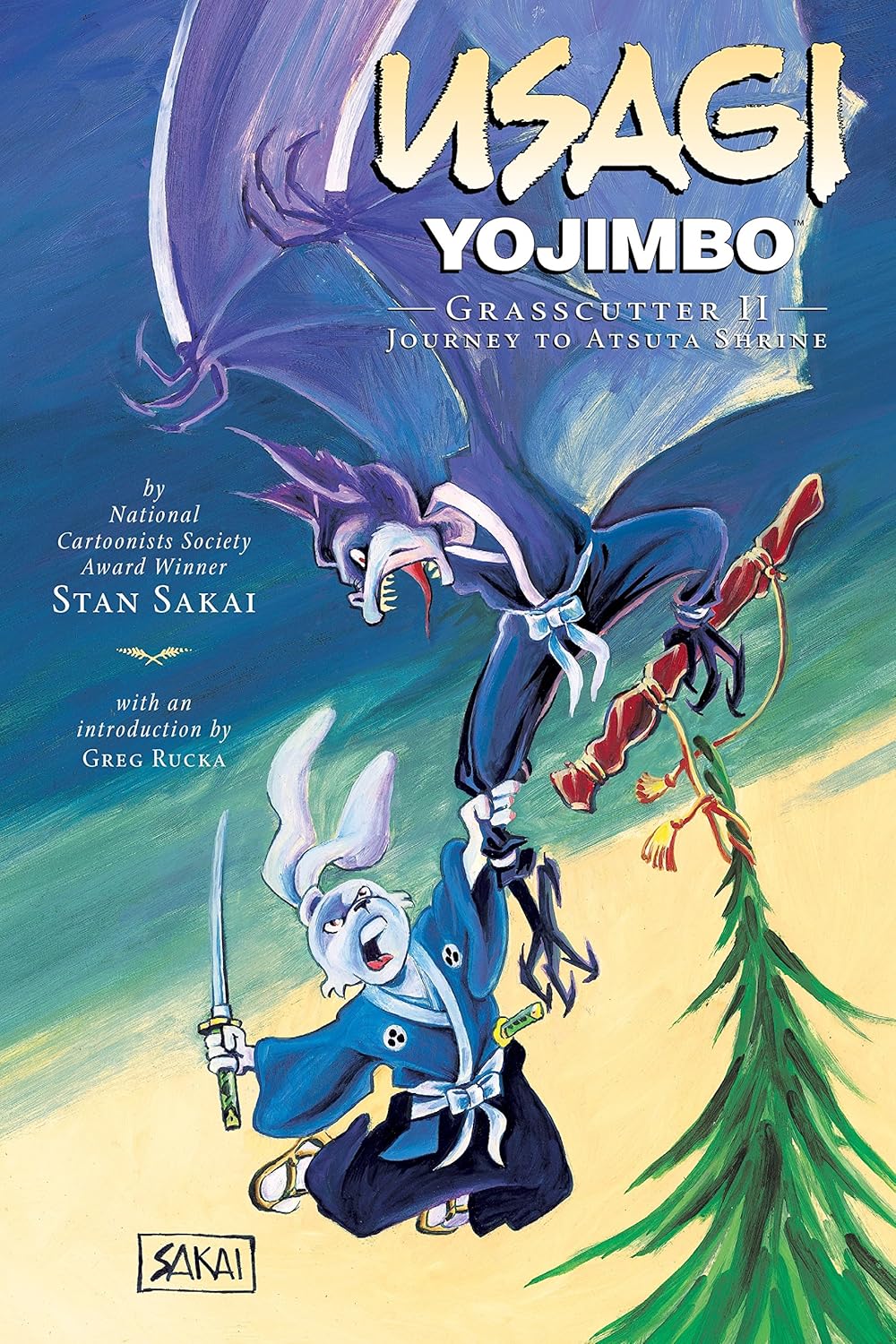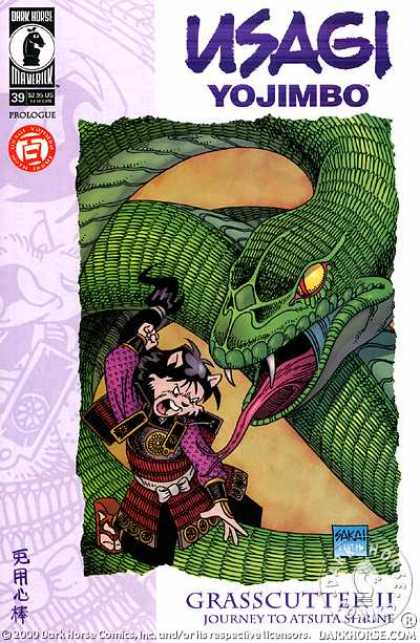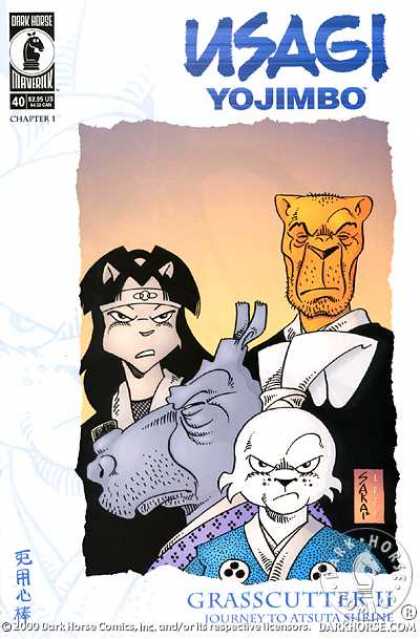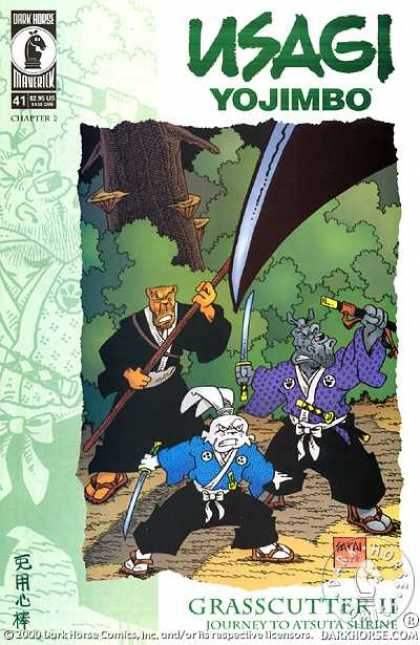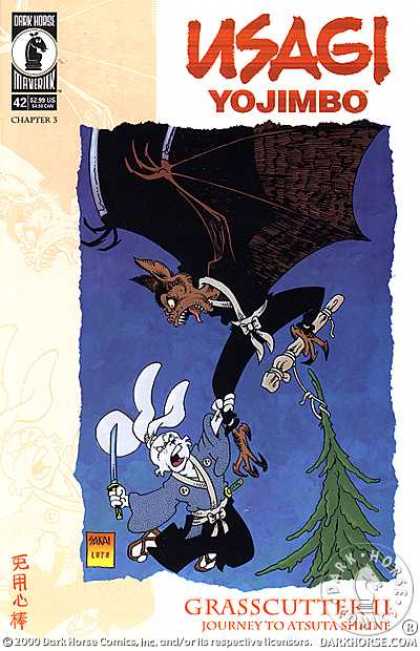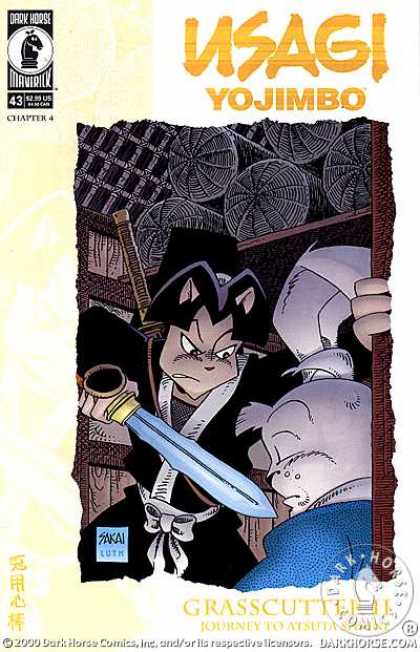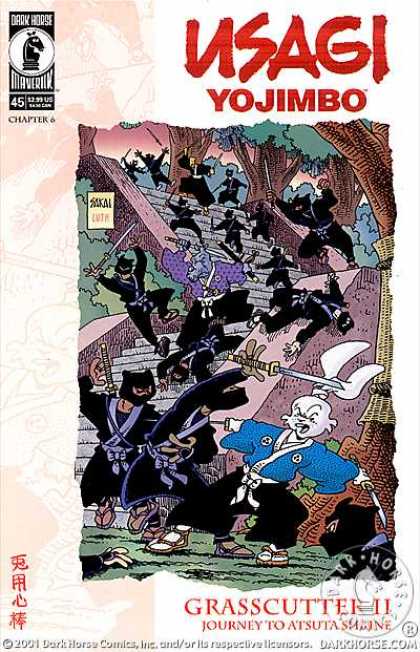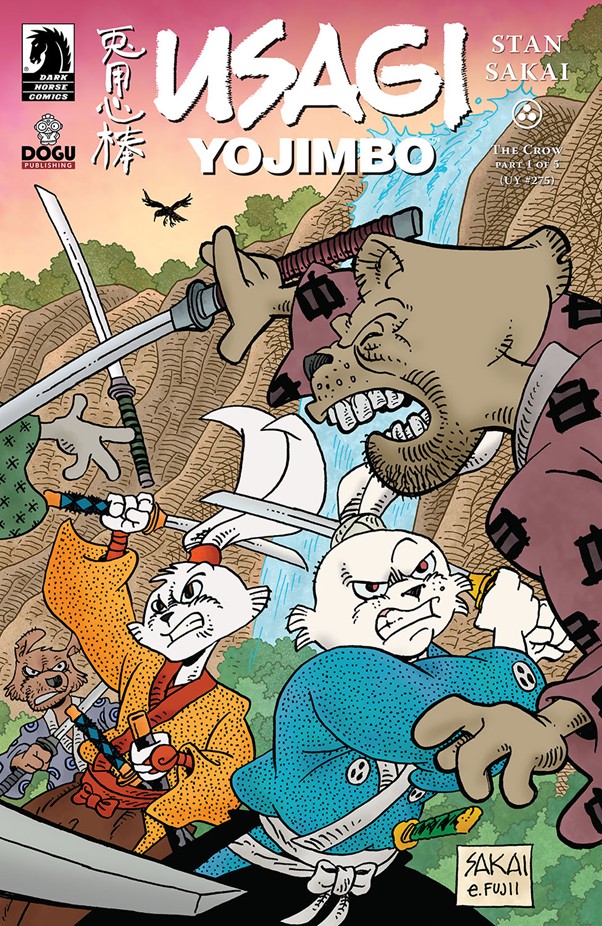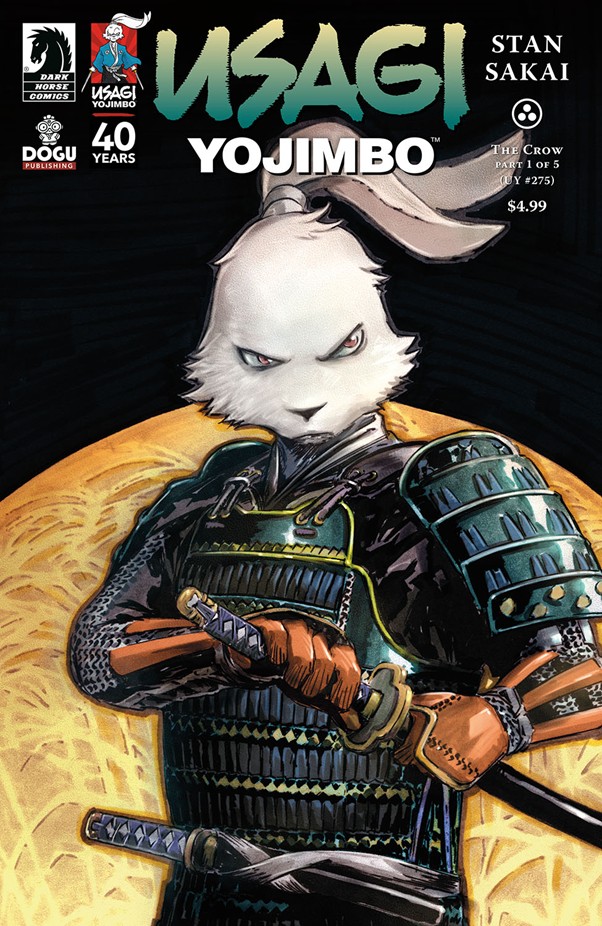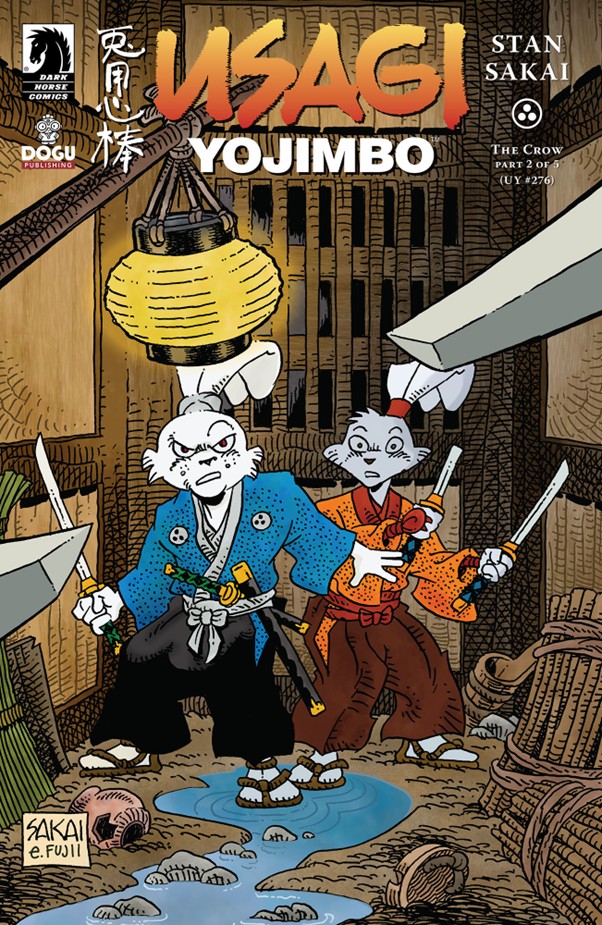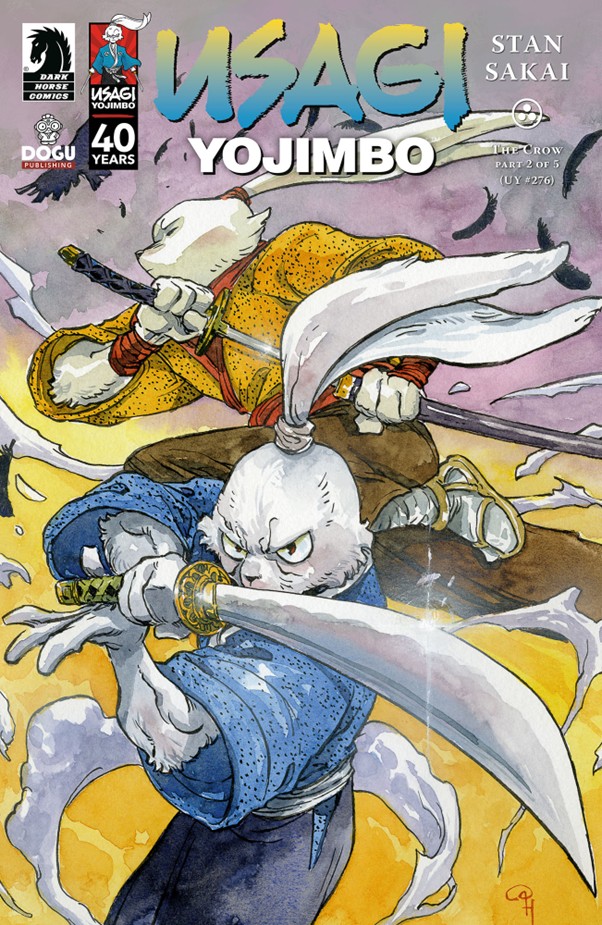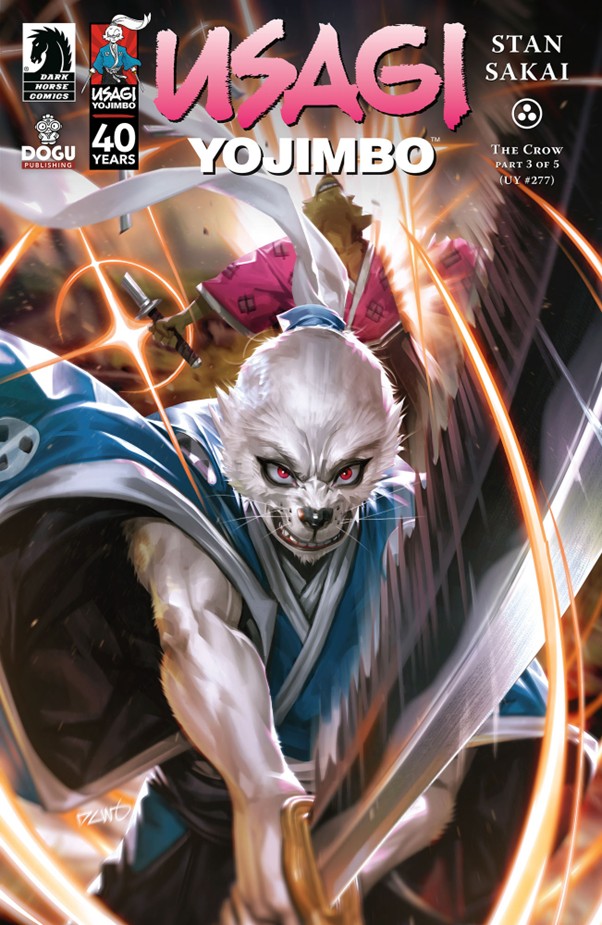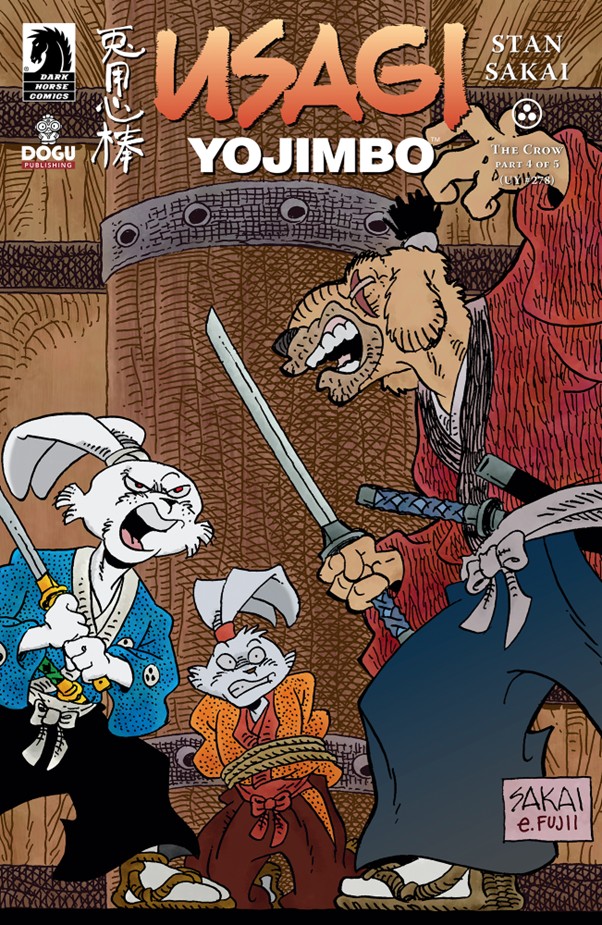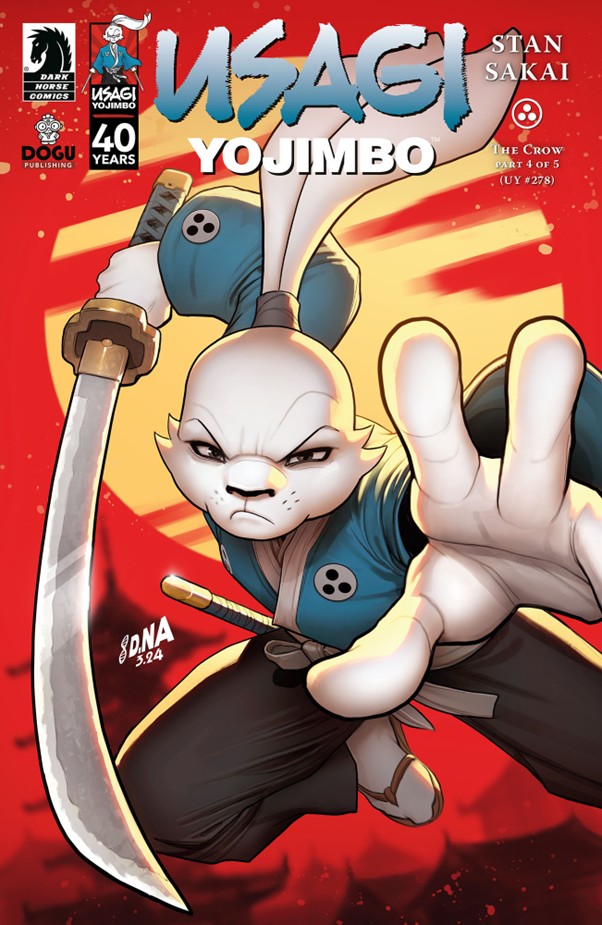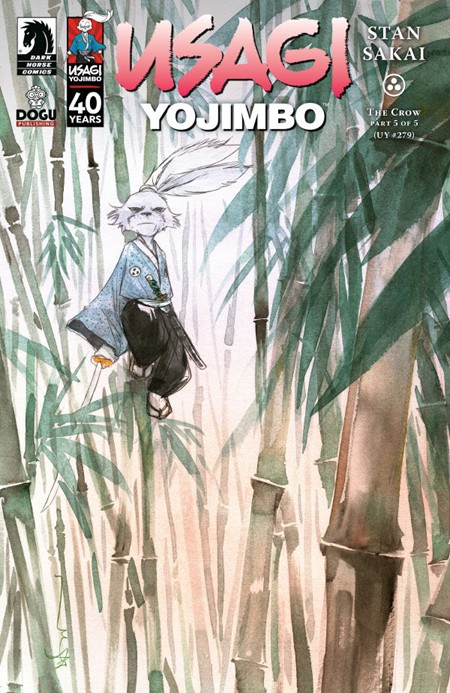
Usagi Yojimbo: Volume 40: The Crow by Stan Sakai

Publisher: Dark Horse Comics (Paperback – 21 January 2025)

Series: Usagi Yojimbo – Volume 40

Length: 152 pages

My Rating: 5 out of 5 stars

Amazon

Stan Sakai’s iconic Usagi Yojimbo comic series powers through to its 40th volume, with the compelling and action-packed collection, The Crow, which proves to be another intense and impressive read.

Readers of this blog will know that I have a lot of love for the amazing Usagi Yojimbo series by Stan Sakai, which has remained one of my favourite comic series for years.  Following a rabbit ronin in an alternate version of Feudal Japan populated by anthropomorphic animals, the Usagi Yojimbo series combines cool art and great characters with a fantastic Japanese samurai aesthetic to create a particularly awesome comic series.  I love the various elaborate stories and scenarios that Sakai comes up with for the Usagi Yojimbo comics, and it is a real highlight of my reading year to check out the new Usagi Yojimbo volume.

This latest volume, The Crow, is the 40th collected volume of the long-running Usagi Yojimbo comic and contains issues #275 to #279 of the series.  This is the second volume of the current Dark Horse Comics run of Usagi Yojimbo, which started last year with volume 39, Ice and Snow (one of my favourite books of 2024), and continues some of the ongoing storylines from the other recent volumes.  This volume is once again written and drawn by Sakai, with Hi-Fi Colour Design colouring in Sakai’s illustrations.  The Crow was another interesting addition to the series I was really looking forward to, as it follows Usagi and his unlikely companions into deadly danger.

Following their encounter in the mountains with the murderous Jei, Miyamoto Usagi and his cousin, Yamamoto Yukichi, have finally escaped the freezing north of Japan and have journeyed to warmer climes.  However, just because they are out of the ice and snow doesn’t mean they have escaped trouble.

Closing in on the nearest town, Usagi and Yukichi come across a man being attacked by four ruffians.  Interceding in the fight and driving the attackers off, Usagi and Yukichi initially believe that the man they rescued was a merchant being robbed.  However, when they arrive at their destination, they find the place overrun by disreputable bounty hunters on the hunt for a big reward, including Usagi’s old companions Gen and Stray Dog.  Once again conned into paying for lunch, Usagi and Yukichi are shocked to discover that the focus of the bounty hunters’ attention is the person they saved, a dangerous bandit warlord known as Jimmu due to his crow companion.

Despite their intentions to avoid the hunt for Jimmu, the two rabbit ronin find themselves dragged into the fight by the deadly mercenary Inuyoshi, another acquaintance of Usagi who is also seeking Jimmu’s bounty.  Initially forced into conflict with Inuyoshi, Usagi and his friends soon find themselves unlikely allies of Inuyoshi’s bounty hunter band, as they must work together to take down Jimmu and his massive bandit army.  But with skilled warriors on both sides, and no mercy on the horizon, will Usagi and his associates survive unscathed?

The Crow was another exceptional comic from Sakai, who continues his Usagi Yojimbo series with masterful style.  Featuring one major story that pitted the protagonists against an array of deadly warriors, The Crow had me hooked from the very beginning, and I finished the entire volume within an hour of getting my hands on it.  An outstanding comic with great art and some brilliant character arcs, The Crow unsurprisingly gets a full five-star rating from me and was so damn good.

I felt that The Crow had a particularly strong story behind it, as Sakai continues his recent trend of featuring a single multi-issue story in the volume, rather than a series of smaller short stories like in many of his earlier volumes.  This allowed the author to produce a complex, interwoven narrative that features several intriguing character-focused storylines.  Featuring the old classic start, with Usagi and Yukichi rescuing a traveller from assailants, you are drawn into familiar Usagi Yojimbo ground of bandits and bounty hunters, as the rabbit samurai encounter two of Usagi’s oldest companions, the money-focused Gen and Stray Dog.  This allows for some excellent early story tension, as the naïve and highly honourable Yukichi clashes with the morally flexible and cynical bounty hunters, especially when they discover that the traveller Yukichi helped was the notorious bandit chief Jimmu.  Sakai quickly moves the story into its central arc, when Yukichi is kidnapped by returning figure Inuyoshi, who seeks to keep Usagi, Gen and Stray Dog out of his hunt for Jimmu.

This kidnapping arc proved to be quite interesting, especially as the formerly honourable Inuyoshi verbally clashes with Yukichi and is forced to find his honour in the face of betrayals within his own gang of bounty hunters.  I really enjoyed some of the compelling interactions between some of the cast in the central part of the story, and Sakai cleverly works events so that Usagi and his friends can find and rescue Yukichi.  This central part of the story also features some great action sequences, especially a brutal, multi-page ambush by Jimmu who robs a merchant convoy.  The revelation about the true size of Jimmu’s bandit army inevitably results in Usagi’s group teaming up with Inuyoshi to find and defeat Jimmu, which results in a massive battle that takes up most of the final quarter of the volume.  This battle was everything you could hope for, and Sakai is in fine form with his drawings as he portrays the various fights.  The final duels between bounty hunters and Jimmu have some outstanding and memorable moments, and Sakai ensures there is some powerful tragedy that will live with a certain protagonist.  Sakai ensures that all the key character-driven story arcs are well wrapped up, and there are some touching moments that perfectly define some of the major protagonist’s personalities or struggles in this volume, which I felt made The Crow really stand out.  A very impressive overall story from Sakai, that shows just how interesting and intense his writing can be, even when he returns to his well-trodden tales of bandits and bounty hunters.

One of the things that I felt Sakai did particularly well in The Crow was to feature an array of great characters, whose combined arcs come together extremely well in the context of the larger story.  There is an awesome collection of characters in this volume, including old favourites, returning one-shot figures, and some intriguing new characters who proved to be excellent additions to the overall story.  Sakai does an excellent job balancing a number of these character storylines within the course of The Crow’s four issues, and there are some moving and compelling moments as a result.

A lot of the volume focuses on the three longer-term recurring members of the cast, Gen, Stray Dog and Usagi himself, who are the veteran presence in The Crow.  While they are featured quite prominently, Sakai doesn’t provide a massive amount of development for them, as they mostly fall into the same routines as they previously have, with Gen being the money-fixated conman, Stray Dog being the seemingly selfish and unfriendly killer, while Usagi is his usual honourable self.  I did like how Sakai once again painted Usagi more as a mature and world-weary figure, especially when compared to Yukichi, and it was interesting to see how much more realistic he is here than in some of his earlier encounters with Gen and Stray Dog.  Sakai also has fun once again featuring the dichotomy of Stray Dog, whose selfish outer-shell is cleverly balanced by his actual charitable actions, which are used to great effect for a secondary character towards the end of the volume.  Finally, Gen was his usual self, although considering how fun that is, I was happy with the result.

While these three long-running figures were well utilised, I felt that Sakai did his work with two more recent, returning additions to the Usagi Yojimbo universe with Yamamoto Yukichi and the mercenary Inuyoshi.  Yukichi, Usagi’s cousin introduced in volume 36: Tengu War!, has proven to be an interesting traveling companion for the protagonist, especially as he is very similar to a younger Usagi.  His naivety and unbending belief in honour without compromise is on full display in this volume, especially in his first interaction with Gen and Stray Dog, and it is interesting to compare him to the now more flexible Usagi.  Inuyoshi on the other hand is an intriguing figure who was introduced in the story The Sword of Narukami in the series’ 27th volume, A Town Called Hell.  A formerly honourable samurai betrayed by his lord’s heir, Inuyoshi has become a much more deadly and disreputable figure since his last encounter with Usagi.  I really liked how Sakai devolved Inuyoshi since his last appearance, both in his art and personality, as while he still maintains some of his honour, he has become even more ruthless, going so far as to capture Yukichi to keep Usagi and his companions away.  These two characters are in a way antithesis of each other, with one strictly holding onto samurai ideals while the other has abandoned them and is now more interested in money and survival.  The two play off each other extremely well, despite some major fractious moments, and I liked how they both gain something from the experience, with Yukichi getting a lesson in the real world, while Inuyoshi remembers some of his old honour.  Inuyoshi’s appearance here also perfectly wraps up some of the open storylines from The Sword of Narukami, and I appreciated that Sakai finally provided some closure for a one-off tale from several years ago.

Aside from these great major characters, Sakai rounds out the cast of The Crow with some additional fun figures who each add some fantastic elements to the comic.  The volume’s main antagonist, Jimmu, proves to be a ruthless and competent outlaw leader, and I liked how his crow companion gave him a distinctive edge and allowed for some intriguing and well-drawn battle scenes.  The street urchin, Isamu, was a great mischievous figure who reminded me of a young, but brave, version of the recurring Snitch character.  Isamu has some fantastic interactions with some of the main characters, and it wouldn’t surprise me if we see more of him in the future.  Finally, Sakai has fun including a comedic merchant duo who get caught up in one of Jimmu’s raids.  Their entertaining banter during several scenes had me chuckling, especially when their newly discovered brotherhood is ruined by some ill-matched confessions, and they provided an excellent bit of humour amongst the darker story elements.  These great characters all filled their roles perfectly, and I deeply enjoyed how effectively Sakai utilised them in this fantastic narrative.

As with all the Usagi Yojimbo comics, I really need to highlight Sakai’s exceptional artwork featured within The Crow.  Sakai does another remarkable artistic job in this latest volume, and the comics are just gorgeous as he effortlessly brings his elaborate stories and characters to life with his amazing drawings.  All the characters are lovingly drawn, and their resultant actions, especially the cool battle sequences, are so intense and expressive.  I was particularly impressed with Sakai’s portrayal of rival samurai Inuyoshi, who had previously appeared once some years ago.  It was absolutely fascinating to see how Sakai’s drawing style has changed in the intervening years (I had a look at A Town Called Hell after reading The Crow), as Inuyoshi has so much more detail and depth in this appearance.  His scarred and somewhat more deranged appearance perfectly matched his darker personality, and I really think that he looked even more impressive in colour, which has only been a recurring feature since volume 34, Bunraku and Other Stories

These excellent character drawings are only matched by Sakai’s superb landscape drawings, which provide beautiful and powerful pictures of the story’s background setting.  These background drawings, whether they be depictions of historic Japanese towns or of the shaded natural forests, come across extremely well, and you really feel yourself becoming immersed in the setting as a result.  I must once again mention the awesome action scenes scattered throughout The Crow.  Sakai is a master of drawing epic sword clashes in his comic style, and you can feel every thrust and cut that the various samurai characters make.  Highlights for me this time included two massive group battle sequences that each have their own fantastic moments, cool duels against the bandit leader and his bird companion, and a somewhat graphic but very well-drawn decapitation panel which was both epic and gnarly.  This art once again perfectly enhances and compliments Sakai’s outstanding writing, and I love how even after 40 Usagi Yojimbo volumes, Sakai is still producing such masterful and moving pictures.

Stan Sakai continues to impress and wow me with his outstanding Usagi Yojimbo comic series.  This latest volume, The Crow, was another captivating comic, loaded with striking drawings, intense action, and some excellent samurai characters.  I felt that The Crow was a particularly strong entry in this always incredible series, and I am so very glad we were gifted a volume this early in the year.  I am hoping that we will get another volume later in 2025, but until then, do yourself a favour and make sure to check out the first exceptional 40 volumes of one of the best ongoing comic series.

Amazon

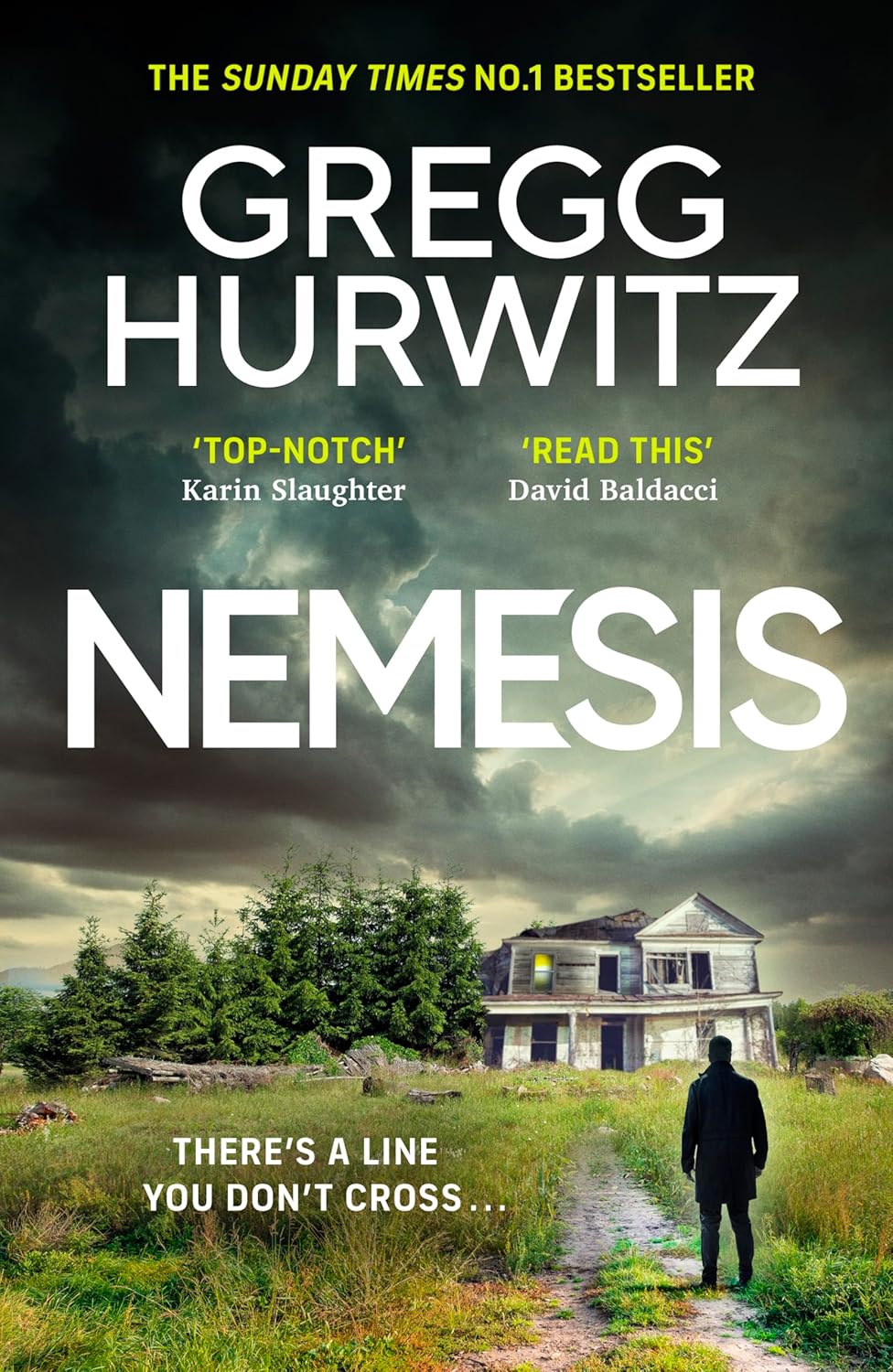
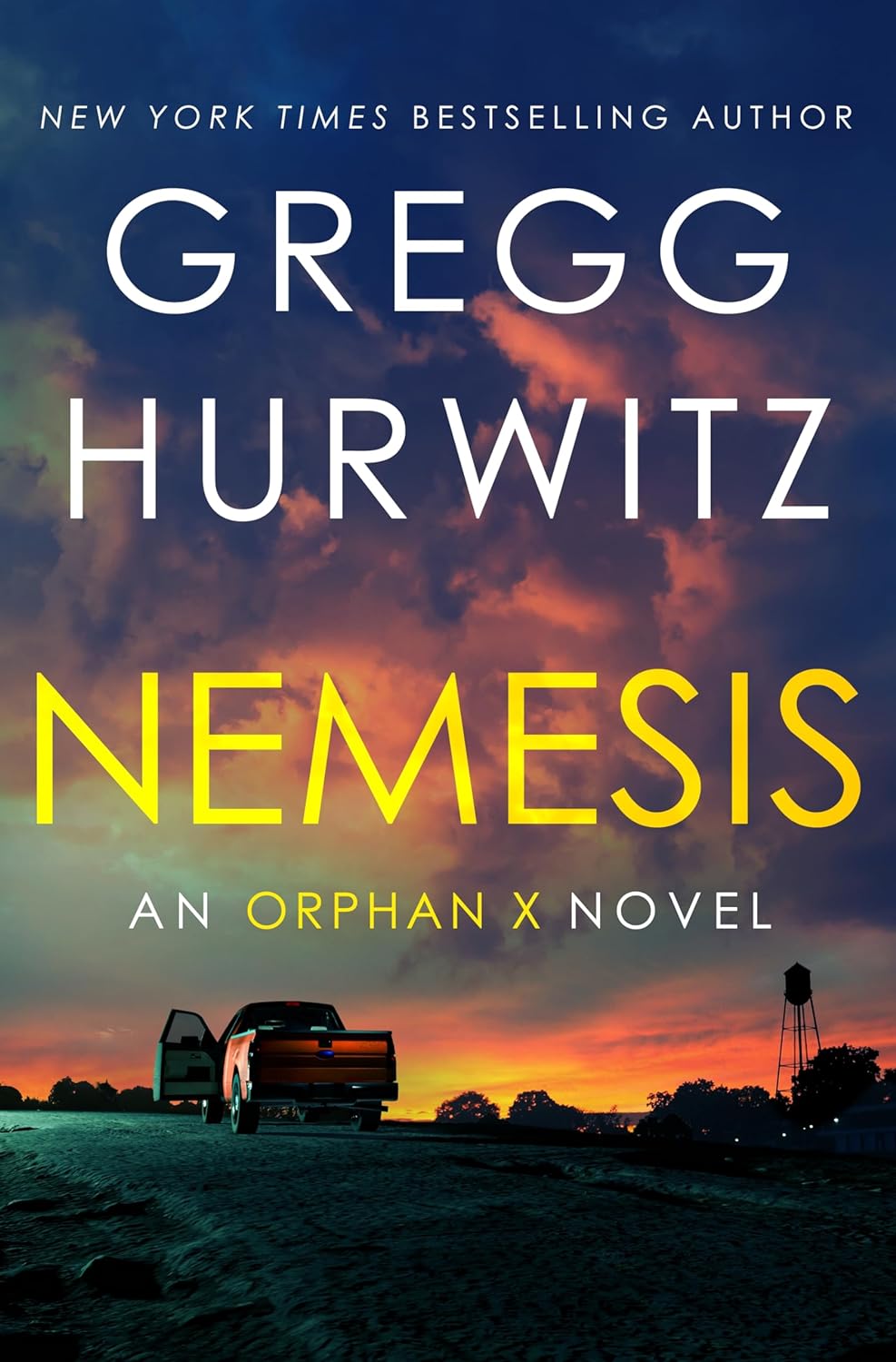
Nemesis by Gregg Hurwitz

Publisher: Michael Joseph (Trade Paperback – 18 February 2025)

Series: Orphan X – Book 10

Length: 493 pages

My Rating: 5 out of 5 stars

Amazon

One of my favourite thriller authors, Gregg Hurwitz, returns with a powerful and particularly addictive new entry in his Orphan X series with the emotionally charged and pulse-pounding read, Nemesis.

Gregg Hurwitz is an author I have had a wonderful time enjoying over the last few years, primarily thanks to his exceptional Orphan X books.  Following former government assassin Evan Smoak, formerly known as Orphan X, this compelling thriller series explores Smoak’s vigilante actions as the Nowhere Man, a source of lethal justice for those who can’t get help anywhere else.  I started reading these books several years ago with the amazing fourth entry, Out of the Dark, which saw the protagonist go to war with a corrupt US President, and I have been hooked ever since, grabbing every subsequent entry in the series.  This includes the outstanding novels Into the FireProdigal SonDark HorseThe Last Orphan and Lone Wolf, each of which did an intriguing job of continuing the series while also exploring Hurwitz’s complex protagonist and his unlikely family.  I really enjoyed all these books, and I have been eagerly awaiting the 10th novel, Nemesis, for a while now, especially as it promised to follow on from the intriguing cliff-hanger at the end of Lone Wolf.

No greater friend.  No worse enemy.

Evan Smoak, the Nowhere Man, has spent years taking on impossible vigilante missions, while also keeping his former government owners at bay.  No matter how hard the mission, Smoak always succeeds, in no small part to the group of loyal friends who have his back.  But Evan is about to discover the sad truth that it’s those closest to you that can cause you the most pain.

After foiling a lethal assassin with a penchant for taking out innocent bystanders, Evan is disturbed to discover that the assassin’s weapons were sourced from his trusted comrade and armourer, Tommy Stojack.  Shocked and determined to get answers, an emotionally compromised Evan finds himself unwilling to forgive Tommy for his lapse in moral code, and the two strong-willed warriors soon find themselves at odds.  When Evan’s next attempt to talk sees him ambushed by a flurry of thugs and shooters, he decides that it’s time to go to war, even if that means killing his best friend.

However, Tommy has his own problems to deal with.  Receiving a call for help from the son of an old war buddy, Tommy travels to a dying American town, filled with anger, corruption and racial tension.  Attempting to honour his debts, Tommy finds himself mentoring a group of neglected and angry young men whose uninformed actions have led to tragedy.  However, Tommy’s seemingly simple mission soon turns deadly when Evan arrives in town and takes issue with the actions of those under Tommy’s protection.  Thrown into opposite moral paths and plagued by assassins, local troubles and their own substantial personal issues, Evan and Tommy find themselves in conflict, with everyone around them caught in the crossfire.

Hurwitz continues to shine as one of the premier authors of thriller fiction with this particularly intense and complex entry in his Orphan X series.  Featuring a compelling plot loaded with action and captivating character moments, Nemesis was an addictive read that hits the reader hard and never gives them a chance to recover.  This was probably one of my favourite Orphan X books so far, and thanks to Hurwitz’s brilliant writing, I have very little choice but to give Nemesis a full five-star rating.

I was really impressed with the plot for Nemesis, which honestly went in some compelling directions that I didn’t expect, but which provides great closure and intense character moments, while also loaded up with the series’ trademark action.  Following on from Lone Wolf, Nemesis sees a preoccupied protagonist, Evan Smoak, distracted and distressed by the revelations that his best friend and armourer Tommy Stojack supplied weapons to a deadly assassin who killed multiple innocent people in the previous book.  Forced by his moral code into a confrontation, Evan finds himself in conflict with a stubborn and unapologetic Tommy.  However, what starts as a major disagreement between friends turns into a full-on war, when the two find themselves on different sides of an ethical fence, while also fending off assassins and killers after Tommy.

Hurwitz paced this narrative out extremely well, with a great intro and an early action set piece that worked to showcase the protagonist’s emotional instability.  The initial confrontation between Evan and Tommy sparks up the intensity of the plot, and the reader becomes engaged in seeing how the conflict between them will continue, especially after the second sequence forces Evan to fight for his life.  The author then takes the book in a very interesting direction, as Tommy journeys to a small town in heartland America to help the son of an old comrade and finds himself mentoring a group of young want-to-be militia members who have gotten into trouble.  Hurwitz spends a lot of time focusing on Tommy’s attempts to guide the group and trying to gently resolve the dark things they have done.

While this journey to middle-America initially seemed an odd choice for plot progression, Hurwitz utilises it perfectly to showcase Tommy’s character and the differences in approach and personality between him and Evan.  Conflict inevitably emerges when Evan arrives and attempts to solve matters in a black-and-white manner, forcing Tommy to intervene.  This provides even greater emotional turmoil, and I loved how well the author set it out.  You find yourself getting really drawn into the nuanced situation that emerges, and I loved seeing the alternating methods and personalities of the two protagonists.  After an impressive action sequence where Evan and Tommy come together one time to face off against a scary group of assassins, Hurwitz sets up the book’s final confrontations, which are loaded with some brilliant moments that pushes both main characters to the edge.  I deeply enjoyed how Hurwitz resolved the entire situation, and you are on the edge of your seat the entire time, which results in a particularly addictive read.  I honestly was very satisfied with this book, right up to the final twist, which was impactful and clever, but for which I may never forgive Hurwitz.  This was easily one of Hurwitz’s best narratives, and I really appreciated the complex, character-driven thriller storyline he envisioned for this latest Orphan X book.

Hurwitz did an exceptional job bringing Nemesis’s complex and captivating narrative together, and I honestly feel that this is some of his best writing.  Featuring a fantastic continuation of the ongoing series, Nemesis had the perfect blend of action, intrigue and character-focused drama, which allowed for quite an addictive read.  The various action sequences scattered throughout the book are intense, brutal and very-well put together, and I loved how they showcase the various moods of the protagonist, as we go from his usual smooth sequences to more frenetic fights when he is emotionally compromised.  While these typical thriller elements are a lot of fun, it is the focus on the characters and the intense emotions between them that makes Nemesis particularly impressive.  Hurwitz sometimes struggles with the balance between action and character development, but I felt that this one was perfect, especially as he featured an array of damaged figures, including two former best friends in deep conflict.  While I do think that Nemesis could have gone without another manufactured conflict between Evan and his ward, Joey, for the most part it was exceptional to see the various character interactions and dives into the protagonist’s psyche that emerged.  This blended extremely well with the overarching thriller narrative and the fantastic action of the plot, and resulted in a particularly powerful read that, while more emotionally charged than most thrillers, worked extremely well in the context of this series.  I really appreciated how carefully Hurwitz set out these elements in Nemesis, and there is really something for everyone here including some thought-provoking discussions, awesome action scenes, and some major emotional moments that will hit you hard and really stick with you.

As with most books in the Orphan X series, Nemesis can be read as a standalone novel, as Hurwitz does an excellent job of recapping key events, elements and characters from the previous novels for new readers.  I personally felt that to get the full emotional impact of Nemesis, readers really need to have read some of the previous books in the series first.  Not only does the cause of the key conflict of Nemesis occur in the previous novel, Lone Wolf, but seeing just how close the emotionally shuttered Evan is with Tommy ensures you understand the emotional stakes of Nemesis and how far apart these two former friends have gotten.  However, if you decide to make Nemesis your first entry in the Orphan X series, you’ll still be in for an amazing treat, and I feel that Hurwitz features enough context and recaps to allow any reader to enjoy Nemesis.  This honestly was a very impressive book in the Orphan X series, and it will be very interesting to see where Hurwitz goes with this next.  The author has set up some big emotional hurdles for the next novel, and I look forward to seeing how his protagonist overcomes them.

As I have mentioned a few times above, I felt that Hurwitz’s character work was the element that made Nemesis particularly exceptional.  Not only does Hurwitz cleverly build on a range of existing character storylines and developments from the previous book but he also introduces several compelling one-off characters whose interactions with the main cast make for some impressively powerful moments.  Naturally a lot of the development is reserved for series protagonist Evan Smoak, the former government assassin turned vigilante.  Evan has always been an exceptionally complex character due to his unusual upbringing, lack of emotional awareness and OCD, and many books have dealt with his inability to deal with other people in his life.  Hurwitz does an excellent job revisiting that here in Nemesis as Evan faces another emotional hurdle when he is forced to come into conflict with his one true friend.  The emotional stress this puts him under turns him into a bit more of a deranged and careless creature.  The fantastic emotional range showed by Evan in Nemesis was fascinating, and Hurwitz writes some great story moments around his anger, poor judgement and strict moral code.  Few Orphan X books have pushed the protagonist in more ways than Nemesis, and I honestly felt every emotional bruise that occurred in this book, including the final one that is going to have some major repercussions for the protagonist.

Aside from Evan, the main character of Nemesis was the protagonist’s former friend turned opposing figure, Tommy Stojack.  Tommy, the gruff and cantankerous old soldier, has always been one of the more entertaining characters in the Orphan X books, and it has always been fun to see the unlikely friendship between him and Evan.  Given a much larger role in Nemesis, Tommy serves as a secondary protagonist and major point of view character, which really suits him.  I deeply enjoyed seeing more of Tommy’s perspective, especially as it is starkly different to Evans.  His interactions with many of the supporting characters of Nemesis really help to showcase his personality and mindset, especially when he takes on a stern mentor role for several younger characters.  However, it is the intense and strained relationship with Evan that is the major highlight of this book, as Hurwitz provides a compelling deep dive into their friendship.  Thanks to both characters pride and belief that they are right, the two face off several times in this book, proving that friends really make the worse enemies.  I really appreciate how well Hurwitz used Tommy in Nemesis, and the emotionally charged circumstances that surround his inclusion help to deeply enhance this book.

Aside from Evan and Tommy, there is a very fun and intriguing supporting cast in Nemesis who add to the story in some compelling ways.  Evan’s ward, Joey Morales, is her usual fun, rebel self, and while I think some of her conflicts with Evan are a little unnecessary, I liked her continued coming-of-age storylines, as well as a fun scene she has with Orphan V.  I felt that the highlight of the supporting characters was a small group of rebellious, angry young men who Tommy chooses to look out for.  Although they’re a hard group of characters to initially like, Hurwitz provides some fascinating context to their actions as the story continues.  I really appreciate the intelligent social commentary that Hurwitz featured around these characters, and you end up feeling a little sorry for them, despite what they have done.  Throw in some great villains, including four related assassins who are honestly quite freaky in their appearances, and this was an outstanding cast of characters, whose complex and captivating personal stories and interactions ensure that Nemesis is a particularly powerful read.

The always impressive Gregg Hurwitz continues his Orphan X series in incredible manner with Nemesis.  An exception and memorable entry in this always fun series, Nemesis had a brilliant and emotionally charged narrative behind it, loaded with amazing character moments.  Guaranteed to hook you with its fun action and complex character dynamics, Nemesis was so damn good, and I am still not over all of Hurwitz’s excellent, and brutal, twists.

Amazon

Quick Review – Crusade by Richard Cullen

Publisher: Boldwood Books (ebook – 10 February 2025)

Series: Chronicles of the Black Lion – Book Two

Length: 369 pages

My Rating: 4.5 out of 5 stars

Amazon

If you’re in the mood for some excellent and exciting historical fiction, look no further than the outstanding read Crusade by fantastic author Richard Cullen.  Cullen, who also writes as fantasy author R. S. Ford (see my review for his book Engines of Empire), provides a fantastic second entry in his Chronicles of the Black Lion historical series with Crusade.  An amazing sequel to his 2024 novel, Rebellion, Crusade continues to follow his protagonist, Estienne Wace, former squire to William Marshal, on another powerful journey, this time into the Fifth Crusade.


Plot Synopsis:

Egypt 1219AD.

Abandoning the safety of England for the perilous shores of the Levant, Estienne Wace is thrust into the turmoil of the Fifth Crusade. Burning with righteous purpose, he is determined to reclaim the Holy Land in the name of Christ.

War rages along the banks of the Nile as a crusading army besieges the Saracen city of Damietta, certain that the price they pay in blood will return the glory and treasures they crave. But as the Black Lion roars, and the siege grinds on, Estienne’s unwavering faith is tested more and more by the grim reality of this brutal conflict.

As the siege turns on a knife edge, Estienne finds himself thrust upon a journey across the merciless desert. Stripped of everything, and forced into a dangerous alliance, he will grapple with the true meaning of faith, honour, and the price of salvation, in a land where nothing is as he once believed.


Crusade
was a captivating and worthy sequel to Rebellion that provided readers with the intriguing next chapter in the life of Cullen’s main character.  Easily read as a standalone historical adventure or a continuation of the author’s previous book, Crusade starts off strong and keeps the action coming quick and fast, as the protagonist is thrown into battle to seize the Saracen city of Damietta.  There are some awesome sequences here, as Cullen produces some high-quality and intense medieval combat scenes that allow the reader to feel every hack and thrust of the protagonist’s sword.  At the same time, the author also provides the reader with some introspection, as the protagonist has his first doubts about the crusade he has sworn to fight for.

Cullen quickly moves the reader into one of the more memorable parts of Crusade, as the protagonist finds himself separated from his crusader brethren and is instead captured and sold into slavery.  Forced to cross the desert, Estienne faces innumerable hardships as he attempts to escape, including slavers, the elements, a surprise band of Mongolian raiders, and a gigantic and vengeful warrior who has sworn to hunt down and kill him.  This proved to be a really fun part of the book, as the author provides innumerable perils, while also introducing or expanding on several interesting supporting characters.  You really get stuck into Crusade’s story here, and it sets up the final third of the book extremely well, as a doubtful Estienne takes part in the final conflicts of the Fifth Crusade.  Cullen features these final battles nicely, especially with some dual perspectives from Estienne’s gigantic rival, and you get some interesting closure as the final battles of the crusade emerge.  Everything ends on a hopeful note, and you are left wondering what adventures will appear next in the series as the protagonist embarks on a new journey.

As with Rebellion before it, one of the things that I personally enjoyed about Crusade was Cullen’s excellent use of historical elements as he dove into the compelling events surrounding the Fifth Crusade.  One of the lesser utilised crusades in historical fiction, the Fifth Crusade saw the armies of Christendom invade Egypt, with a combined force of multiple nations and knightly orders.  This was a clever historical event to set a story in, especially as it fits in right after the First Barons’ War, which was the focus of Rebellion.  Cullen clearly did his research when it came to this conflict, and I liked how he fit his protagonist in amongst the key events of the crusade.  Estienne proves to be a good witness to the major conflicts of the war, and his subsequent wanderings in the desert also provided some interesting historical context, especially with the appearance of the Mongolians and other desert groups.  I deeply appreciated this cool examination of this period, and I love that Cullen is taking the opportunity to feature some less well-known conflicts with his books.  It will be interesting to see what wars or key historical events Cullen will set his next entry in the Chronicles of the Black Lion series around, but I am sure I will find it fascinating.

Richard Cullen continues to impress with his cool historical fiction.  Crusade proved to be a great addition to Chronicles of the Black Lion series, and I enjoyed its excellent action, compelling historical inclusions and intriguing narrative.  I look forward to seeing where Cullen will take his series next, and I am having fun with these awesome books.

Amazon

Warhammer 40,000: Leontus: Lord Solar by Rob Young

Publisher: Black Library (Audiobook – 25 January 2025)

Series: Warhammer 40,000

Length: 5 hours and 44 minutes

My Rating: 4.5 out of 5 stars

Amazon

Warhammer 40,000 fiction in 2025 starts off strong with the compelling, character-focused novel, Leontus: Lord Solar by Rob Young.

Back in 2023 I had the very great pleasure of reading my first book from Rob Young, Longshot.  A cool and intense character-driven Warhammer 40,000 novel that followed a sniper war on a T’au held world, Longshot was a fantastic first book from Young, and it ended up being one of my favourite debuts of 2023.  As such, I have been very intrigued to see how Young would continue his Warhammer fiction career, and his next novel, Leontus: Lord Solar, proved to be an excellent new entry to the Warhammer 40,000 canon.  Focused on a legendary human leader, Leontus: Lord Solar was an impactful read that I shot through very quickly.

On the world of Fortuna Minor, an Astra Militarum taskforce of soldiers from various Imperial Guard regiments encounters grave disaster.  Sent to eliminate an invading ork horde, the Astra Militarum soldiers find themselves overwhelmed on the landing fields of Fortuna Minor and are slaughtered, while their reinforcements are forced to retreat into space thanks to the orks’ fighters and spacecraft.  Surrounded, outnumbered and lacking resources, only a few humans manage to escape the massacre, including legendary hero of the Imperium of Man, Arcadian Leontus, Lord Commander of the Segmentum Solar.

One of humanity’s most dedicated defenders and a master tactician, Leontus has no intention of giving up in the face of the ork invasion, even with his armies lost and devastated.  Determined to not only survive but complete the objective of reclaiming Fortuna Minor, Leontus rallies a small group of survivors and prisoners liberated from the ork camps to his cause and begins a desperate campaign to fight ensure that the armies of the Imperium can triumph on this latest battlefield.

Effectively welding his scattered force of mismatched and poorly armed soldiers into a coherent army, Leontus soon finds success against the orks, bringing hope to his demoralised troops.  But in the face of overwhelming odds, a determined and dangerously intelligent opponent, and his own lack of resources, can even the brilliant Leontus succeed, especially when his own men begin to question his tactics and motivations?

Leontus: Lord Solar was an excellent and fun Warhammer 40,000 novel that allowed Young to bring an iconic figure from the game to life.  A compelling and exciting read, Leontus: Lord Solar was a real blast to check out, especially as Young presents an impressive and direct narrative that you quickly sink your teeth into.

This was a very fast-paced and exciting Warhammer 40,000 novel that quickly throws you into the fray and successfully keeps your attention the entire way through.  Starting off with fire and blood as the Imperial Guard regiments are devastated by orks as they land, the story sets itself around some of the main supporting characters, particularly Belgutei, an Attilan Rough Rider, and Keori Arnetz, a Catachan medic.  Fighting there way out of the killing fields, Belgutei and Arnetz, as well as a handful of other survivors, link up with the titular Leontus, who leads them to safety and initiates a desperate guerrilla campaign against the orks, bringing together scattered troops, rescuing prisoners and ambushing ork convoys.

The resulting narrative is highly compelling and action-packed, as the brilliant yet practical Leontus proves to be a skilled commander, inspiring his disparate and demoralised troops, while also engaging in some risky and intense actions.  Young does an excellent job balancing the narrative amongst the three main protagonists, as well as a couple of interesting supporting figures, and I liked how the author tended to focus more on Belgutei and Arnetz, which allowed for an intriguing outsider perspective of Leontus and his actions.  There are some powerful character interactions, especially between Leontus and Belgutei, as the two clash over strategy and the fate of the survivors, which adds some dramatic spice to the overall exciting dish.  The action scenes flow fast and heavy as the book nears its end, including some dark sacrifices, and everything leads up to a massive and intense final battle, where so many of your favourite characters are in peril.  The book ends on a complex note, as Leontus proves his status as a tactician and hero, although the reader is left to decide on his humanity.  An outstanding overall Warhammer 40,000 narrative that is guaranteed to quickly hook you and keep your attention to the end.

Young once again shows his impressive ability when it comes to writing Warhammer 40,000 fiction, and I loved the short, brutal and captivating way Leontus: Lord Solar was presented.  While I was initially worried that it would be too similar to the Ciaphas Cain book, Death or Glory, which also featured a human hero marooned on an ork-held world, Young ensured that Leontus: Lord Solar stood out on its own feet.  The quick-fire narrative, intense and tactical action sequences, and cool scenario ensured this was a distinctive read, and one guaranteed to keep your attention the entire way through.  Primarily a character-focused story around the iconic in-game figure of Arcadian Leontus, Lord Commander of the Segmentum Solar, Young does an excellent job of highlighting the protagonist and showcasing him in a compelling way.  The author chose to primarily show Leontus through the eyes of his supporting characters, which allowed for a more nuanced take on the titular protagonist, while the occasional scene shown from Leontus’ perspective hinted at plans the character is hiding from his soldiers.  Throw in some excellent supporting characters and a memorable, if somewhat underutilised antagonist (who was simultaneously awesome and freaky), and this proved to be an amazing novel with some excellent character-driven strife and complexity at its core.

As with Young’s previous book, Longshot, Leontus: Lord Solar is an outstanding piece of Warhammer 40,000 fiction, and one that would serve as a good introduction to the wider universe for new readers.  The quickfire storytelling, classic action between humans and orks, and lack of excessive lore makes Leontus: Lord Solar a very accessible read, especially as Young doesn’t excessively dive into the history of his main protagonist.  Established readers of Warhammer fiction will naturally get a little more out of this book, especially as it was very cool to see the titular character in action in all his tactical glory, and I felt that Young did an exceptional job capturing and presenting this figure.  In addition, the book also features some intriguing unit makeups as Leontus bands together an irregular force of surviving Cadians, Catachans, Kreig troopers and Attilan Rough Riders.  The interactions between the groups and Leontus was pretty fun, and I liked the mixtures of styles of battle strategies.  Of them, I felt that the Attilan Rough Riders were shown off the best, and their explosive cavalry charges were awesome to read and reminded me of Warhammer Fantasy fiction at times.  All of this and more ensured that Leontus: Lord Solar was a very cool Warhammer 40,000 novel, and it is one I would recommend to all fans of the franchise.

As I tend to with most Warhammer novels I enjoy, I decided to check out Leontus: Lord Solar on audiobook, which was another fantastic experience.  As I have stated innumerable times, Warhammer fiction really lends itself to the audiobook format, and having talented narrators read out the over-the-top stories allows for all the best bits of the universe and its grim dark themes to come to life.  This was particularly true for Leontus: Lord Solar, whose compelling character focused storylines and intense action sequences proved to be a lot of fun to listen to.  Coming in with a relatively short runtime under six hours long, dedicated listeners can really fly through Leontus: Lord Solar, and I enjoyed how quick the pace turned out to be.  I also really appreciated the choice in narrator as David Seddon is a skilled voice actor who really impressed me in previous Warhammer 40,000 audiobooks Dredge Runners and Kasrkin.  Seddon did an excellent job with Leontus: Lord Solar, as not only did he move the story along at a fantastic and enjoyable pace, but he also provided some excellent voices for the various characters.  His take on the titular Leontus was extremely good, and you get a real sense of the character’s nobility, as well as his determination to win, through the performance.  The rest of the human characters also came across extremely well, and Seddon expertly gifts them accents that cleverly corresponded to their regiment and their real-world military influence.  This great voice work really enhanced the already exciting narrative, and I found myself getting really engrossed in this audiobook version as a result.

With this fantastic second book, Leontus: Lord Solar, Rob Young has nicely set himself up as a rising author of Warhammer fiction, especially as he brings a compelling figure from the game to life.  Featuring some awesome action, compelling characters, and an entertaining narrative, Leontus: Lord Solar was an outstanding Warhammer 40,000 novel to start the year with, and I look forward to seeing what amazing adventures Young brings to the franchise in the future.

Amazon

Warhammer 40,000: Titanicus by Dan Abnett

Publisher: Black Library (Audiobook – 1 September 2008)

Series: Warhammer 40,000/Sabbat Worlds Crusade

Length: 13 hours and 38 minutes

My Rating: 5 out of 5 stars

Amazon

The Titans walk to war in this brutal and captivating Warhammer 40,000 novel from the legendary Dan Abnett, Titanicus.

Of the many great Warhammer 40,000 authors out there, few are as impressive as Dan Abnett, who has envisioned an incredible number of awesome battlefields and unique character-focused war stories across the Warhammer universe.  Abnett has written a ton of exceptional and powerful books around the franchise, including several series considered to be the seminal texts of the extended universe.  This includes his brilliant Eisenhorn trilogy (XenosMalleus and Hereticus), and he has multiple entries in my favourite Warhammer 40,000 books list.  However, his best-known series is the Gaunt’s Ghosts books, which I am currently in the middle of reading.

The Gaunt’s Ghosts books are a key series of Warhammer 40,000 fiction that follows the frontline human soldier of this grimdark universe.  Set in an extended multi-planet campaign, known as the Sabbat Worlds Crusade, the Gaunt’s Ghosts books follow a ragged regiment of soldiers as they attempt to survive the dark servants of Chaos coming for them.  I am having an exceptional time reading the Gaunt’s Ghosts series, with books like First and Only, Ghostmaker, Necropolis, Honour Guard, The Guns of Tanith, Straight Silver and Sabbat Martyr, really impressing me with the complex stories and intense action.  While I need to read more of the Gaunt’s Ghosts books, I have taken a quick break to read some of the spin-off novels Abnett wrote around his main series.  Also set around the Sabbat Worlds Crusade, these spin-off novels follow other campaigns in this massive sector spanning war and provide Warhammer fans with a more in-depth view of these battles.  These spin-offs include the exceptional Double Eagle, which I had the great pleasure of reading last year, and which featured so many awesome duels between flyers.  Titanicus was another spectacular book shows a new and highly destructive battlefront of the crusade by focusing on the iconic Titan Legions of the Adeptus Mechanicus.

As war rage across the stars, the forces of Chaos constantly seek a way to disrupt the vital Sabbat World Crusade and destroy the human forces fighting to bring new worlds into the Imperium of Man.  To that end, the archenemy launches an ambitious and devastating surprise assault on the vital forge world of Orestes, whose under-strength defenders find themselves under mass attack from Chaos Titan war engines.  With both the citizens of the Imperium of Man and the forges of the Adeptus Mechanicus under threat, the planet appeals for help and soon finds its prayers answered from the stars in dramatic fashion.

Fresh from their own wars and heading out to join the crusade, the Titans of the Legio Invicta arrive on Orestes, determined to help their Mechanicus brethren.  Finding the forces of Orestes severely outwatched, the Invicta Titans stride to war, causing everything to tremble at the god-machines wrath.  Soon the world is engulfed in an engine war, with both sides wielding enough firepower to crack the planet and the entire population of Orestes caught in the conflict.

But as the war continues, a far more insidious threat arises that could impact far more than just the war on Orestes.  Deep secrets from within Orestes Forge soon begin to spill out, risking a schism between the Imperium of Man and the Adeptus Mechanicus.  With the planet trembling under the battling machines and enemy forces growing by the day, can Legio Invicta overcome the peril growing within their brotherhood before Orestes and the entire galaxy is put to the flame?

Dan Abnett presets another brilliant war story that is epic in every definition of the word.  Successfully presenting the awesome power of the Titans, Titanicus is a deeply compelling and impressive Warhammer 40,000 novel that I honestly could not get enough of.  Intense, exciting and so darn cool, Titanicus gets an easy five-star rating from me, as Abnett once again shows just how talented he is.

Titanicus had a particularly awesome and multi-layered standalone war narrative behind it that hooked me thanks to the author’s nuanced take on the destructive conflicts of the Warhammer 40,000 universe.  Starting off with some dark death to hammer home how grim the situation is, you are soon thrust into the main story as the planet of Orestes comes under attack and the defenders are pushed to the limit.  However, hope soon arrives with the landing of Legio Invicta, who back up Orestes’s existing Titans and defenders with their own engines and troops.  Abnett quickly and effectively sets up multiple character specific storylines as the book progresses that show various alternative viewpoints of the war.  The author works hard to showcase multiple levels of the conflict, from the top commanders all the way to the lowliest of soldiers, and I really enjoyed some of the intriguing storylines that emerged.  This includes desperate tales of survival by following human troops caught behind enemy lines and pursued by mechanical monsters, compelling dives into the minds of the Titan pilots, looks at the various political forces on Orestes, and even some fascinating storylines inside the Adeptus Mechanicus forge.  Abnett did an amazing job highlighting the desperate strife and the complex conflicts these figures endured, and you get a fantastic overarching look at the machine war that proves hard to look away from. 

As the plot of Titanicus continues, the various storylines go in some interesting directions, as you follow each of the characters or groups on their own unique journeys.  Abnett did a really good job of ensuring these unique storylines effectively played off each other as the book continues, and the way characters reacted to events from other plotlines was quite clever and helped to produce a cohesive and intense overarching narrative.  The introduction of a compelling storyline around intrigue and dissent amongst the Adeptus Mechanicus characters provides some extra drama and character conflicts, which added some interesting complexity to the plot, especially as it gave you an alternative group of antagonists which worked well alongside the menacing forces of Chaos, whose perspective you don’t see.  I appreciated how well Abnett set this storyline up in advance, and there are some clever hints to this, and other big events, earlier in the plot.

The final third of Titanicus is particularly impressive and intense, as the author brings together his various storylines extremely well.  I especially enjoyed some of the massive action sequences, while the resolution of the Adeptus Mechanicus storyline was powerful and full of drama as big personalities try to overcome mistrust and dissent.  While I would have liked to have seen the final battle in full, I think Abnett’s effective summary worked pretty well, and I understand that spending another few hours in combat would have watered down the author’s main message.  Each major character’s arc is resolved in a very satisfying manner, and there is an excellent blend of dramatic moments and intense action to keep the reader hooked.  I appreciated how a couple of these conclusions were more depressing, rather than being uniformly happy, which fits both the grimdark nature of Warhammer 40,000 as well as Abnett’s overarching themes that war has no true winners.  This story really came together well, and I deeply enjoyed the complex standalone narrative that Abnett came up with.

This was another insanely well written novel from Abnett, who excels at telling dark, deeply personal war stories from multiple perspectives.  The author provides the perfect balance of excitement, deep intrigue and fantastic character growth in Titanicus, all expertly set within the amazing Warhammer 40,000 universe, and it proves to be such an addictive read.  I personally became engrossed in the various character-driven storylines that emerged throughout the plot, especially the long-running storylines that lasted the entire book.  However, even the more minor character arcs, such as the occasional scene from a normal citizen living in the city to an extended look at the crew of a doomed machine, was hard hitting and Abnett really gets you invested in these personal tales.  As I mentioned above, these often-separate storylines worked extremely well in concert with each other, and Abnett did such a good job pulling them together into a brilliant, overarching narrative. 

Of course, you can’t talk about Titanicus’s writing without going into how incredible the action sequences are.  Abnett crafts together so many deeply intense and powerful battle scenes throughout Titanicus that constantly had the blood pumping as you watched your favourite characters brave the dark gauntlet of battle time and time again.  The author had a lot of fun envisioning war on multiple fronts, and I loved how we got to see infantry fights, tank battles and entertaining skirmishes between various augmented foes as the story continued.  However, easily the most awesome thing about Titanicus is the Titans themselves.  Insanely massive and powerful walking war machines, the Titans steal any scene they are in, and there are so many great reactions as the normal human characters see the Titans fight, especially when the despoiled enemy machines advance on them.  However, it is the sequences shown from the perspective of the Titan pilots themselves that are the best, as you become fully immersed into the battles in the scenes as the machines rain down destruction and depth.  You can honestly feel the insane powerful and destructive ability of the Titans as you move throughout Titanicus, and every single battle involving one of these massive walkers is epic on so many levels. 

As with the rest of Abnett’s books, Titanicus proved to be a particularly strong entry in the Warhammer 40,000 canon.  Serving as a companion piece to the Gaunt’s Ghosts books, Titanicus is a must-read to anyone who has enjoyed Abnett’s main series and the overarching campaign it is a part of.  However, as there are no overlapping characters or major storylines, Titanicus can also be easily read as a standalone novel, and indeed would be a great introduction to Abnett’s writing style and his ability to write awesome war stories.  Titanicus would also be the perfect entry novel to anyone interested in exploring Warhammer 40,000 fiction, especially science fiction readers who love the idea of giant piloted war machines.  The cool action, complex character arcs and fantastic standalone narrative ensures that anyone can really dive into Titanicus and have a brilliant time, and I honestly think this book would appeal to a wide range of different readers.

However, as with most books in the franchise, Titanicus will mostly appeal to those established Warhammer 40,000 fans who will love Abnett’s dive into some unique aspects of the universe.  Naturally, this is primarily going to be around the Titans, who are a very awesome part of the Warhammer 40,000 setting that are often underutilised in fiction due to being too overpowered (or getting badly nerfed when they do appear).  I think Abnett did these war machines perfect justice in Titanicus, and you really come away appreciating every aspect of them, including their raw power, their powerful spirit, and the love the crews have for them.  However, Abnett also dives into the dark side of the machine, and some of the sequences that show the pilots losing their humanity were particularly jarring.  Honestly, I thought Abnett’s portray of the Titans was just brilliant, and I have yet to see another Warhammer author do any better.  Abnett also takes a lot of time to dive into the lore surrounding the Adeptus Mechanics.  While these parts of the book might be slightly confusing for newer readers, established fans will love seeing Abnett explore these machine-worshipping figures, especially as a theological schism becomes a major plot issue.  Other cool lore aspects include examining the uneasy relationship between the Imperium and the Mechanicus on planets they share, the dark side of human life on a planet under siege, and even little fun moments, like a toy maker finally finding success as he makes models of the Titans battling across the world.  All these elements make Titanicus a particularly epic read for fans of the franchise, and I personally loved seeing Abnett’s take on all these cool universe inclusions.

While the writing, story and Warhammer 40,000 elements are all exceptional on their own, what really brings them together and makes Titanicus truly awesome are the multiple cool characters scattered throughout the plot.  Abnett introduces a huge range of fantastic and complex characters in Titanicus who you grow quite attached to as the plot continues.  All the characters, from major figures to minor one-scene characters, are fantastically written and cleverly influence the plot in their own cool ways.  Highlights for me included the desperate crew of a destroyed tank who try to escape on foot, only to find more danger in front of them.  A group of inexperienced conscripts who are completely unprepared for the horrors of war also prove to be really entertaining, and you grow invested in their struggles to survive and the tragedies that await them.  Abnett also examines several intriguing Adeptus Mechanicus figures within the Orestes Forge, whose frustrations, ambitions and struggles for power are far more human than they’d like to believe.  However, the best character arc for me was the one that revolved around the crew of a Legio Invicta’s Titan who are forced to accept an Orestes’ Princeps (the pilot plugged into the Titan’s mind) when their own dies without a successor.  The resulting conflicts between the inexperienced and arrogant outsider pilot and the veteran Legio Invicta crew, which includes the Titan’s moderati (second-in-command), who finds himself under a suspended death sentence, sets the scene perfectly, and you become really intrigued in seeing how the Titan will survive.  Watching these figures come together as a crew is a highlight of Titanicus, although Abnett does an excellent job twisting that around later when internal conflict splits the protagonists.  All these characters, and many more, gave Titanicus some real emotional heft, and I became so damn invested in seeing the final fate of so many of these outstanding protagonists.

I think that it’s kind of a given that I listened to Titanicus on audiobook rather than seeking out a physical copy of the book.  Warhammer audiobooks are so damn good, and frankly there is no better way to enjoy the franchise’s awesome narratives and compelling action.  This is particularly true for Titanicus, as the intricate details and impressive combat sequences really shine through even better when read out.  I especially loved how incredibly epic the various Titan-on-Titan battles came across in this audiobook format, and the fantastic voice of narrator Toby Longworth ensured that you were enrapt by every single second of carnage.  Longworth, who is one of my favourite audiobook narrators, always does an exceptional job bringing Abnett’s amazing stories to life, and he was once again exceptional here in Titanicus.  Longworth captures all the characters in Titanicus perfectly, and you get a real sense of their personalities, emotions and their reactions to the insane events of the book.  This includes the various Adeptus Mechanicus figures, which Longworth voices in all their mechanical glory, and you can just imagine these augmented figures, and indeed all the complex characters of Titanicus, as Longworth describes them.  This makes for such an exceptional experience, and I flew through the audiobook’s near 14-hour long runtime extremely quickly.  There is honestly no other way to enjoy Titanicus than on audiobook, and you are guaranteed to have an amazing time.

Dan Abnett continues to showcase why he is such a highly regarded author of Warhammer fiction with the brilliant and captivating Titanicus.  Perfectly showcasing a war between one of the franchise’s most epic components, the massive Titan war engines, Titanicus was an exceptional read from start to finish and one that I cannot recommend enough.  I had such a great time with Titanicus, and I look forward to reading even more Warhammer 40,000 books from Dan Abnett this year.

Amazon

High Wire by Candice Fox

Publisher: Bantam (Trade Paperback – 24 September 2024)

Series: Standalone

Length: 480 pages

My Rating: 4.5 out of 5 stars

Amazon

One of Australia’s top authors of crime fiction finishes of 2024 with a massive bang as Candice Fox presents the powerful thriller, High Wire.

Few authors had the awesome year that Candice Fox did in 2024, as the author released three impressive crime fiction reads.  The first of these was the fast-paced crime fiction read, The Murder Inn, which Fox cowrote with the legendary James Patterson.  The sequel to their previous book, The Inn, The Murder Inn was a fantastic book that once again highlighted how well Fox and Patterson work together (see my review for their other book 2 Sisters Detective Agency).  Fox also released the intense character-driven thriller, Devil’s Kitchen, that saw two highly damaged characters attempt to uncover the secrets of a seemingly heroic group of firefighters with a true dark side to them.  Both The Murder Inn and Devil’s Kitchen were outstanding reads, and I was very happy I checked them out.  However, Fox decided to provide us with even more fun before the year was over with the standalone novel High Wire.  Taking the author back to her home country, High Wire was a compelling and deeply intense Australian thriller that takes you hostage and refuses to let go.

Out in the outback of Australia lies a notorious unmarked track known as the High Wire.  Cutting across the country from Broome to Sydney, the High Wire is a lawless road full of small towns, unregulated trails and mobile phone blackspots.  A favourite hangout of smugglers, hijackers and criminals, only the desperate, the dangerous and those looking for trouble use the High Wire.

Harvey Buck, former soldier and current recluse, knows all about the dangers of the High Wire, but desperation forces him to travel along it to reach his dying girlfriend.  Despite knowing better, he stops to pick up a hapless traveller, Clare Holland, whose car has broken down on the road.  However, Clare isn’t the person he should be worried about, as the two are soon ambushed by a masked assailants with their own sinister agenda.

Strapped into bomb vests, Harvey and Clare are forced into a twisted game by vengeful figures from Harvey’s past seeking to ruin his life and reputation.  Forced to commit a series of increasingly murderous missions across several small towns, the two prisoners try to work together to escape and stop the insanity going on around them.  Harvey and Clare’s only hope may be Senior Sergeant Edna Norris, one of the few police officers stationed on the Wire, and who soon begins to follow the trail of destruction being left in their wake.  But Edna has her own problems, especially when Clare’s husband arrives on the scene with his own dark plans.

High Wire was another awesome book from Candice Fox that provides readers will some of the best Australian thrills and action that there were likely to get in 2024.  Featuring a bold, compelling and powerful character-driven tale of revenge and escape, High Wire was an outstanding read from one of my favourite Australian authors and one that I cannot recommend enough.

Fox hits the ground running hard with High Wire’s excellent narrative, and I honestly was hooked early on thanks to the compelling and intense story.  Quickly introducing the protagonist, Harvey Buck, as well as the High Wire, the lawless road that serves as an intriguing background setting for the plot.  After a quick introduction to a secondary protagonist, the mysterious Clare Holland, the main plot of High Wire takes off as the two are ambushed by a group of armed attackers, who take them prisoner after a bloody shootout, and strap them into elaborate bomb vests.  Fox keeps the tension running high here, as it becomes clear that the kidnappers know Harvey and are seeking revenge for some past misdeed.  Around the same time, the readers are introduced to the other major point-of-view character, Senior Sergeant Edna Norris, who finds herself on the trail of Harvey, Clare and the kidnappers without knowing who is responsible and with an unlikely teenage sidekick helping and hindering her in equal measure.

The plot soon becomes even more intense on several levels, as Fox works several intriguing storylines and elements simultaneously to tell a complex and exciting narrative.  The main plot around Harvey and Clare proves to be quite intense, as the two are forced to commit a series of brutal crimes while also trying to escape or take out their captors.  Fox carefully doles out intriguing background on both Harvey and Clare to the readers, and you soon discover both have complicated pasts, as Clare is running from her suddenly murderous husband, while Harvey’s past connection to the kidnappers is revealed in a series of dark flashbacks.  These flashbacks help to paint the main storyline in some different shades of grey, as you begin to realise that Harvey isn’t the moral hero you initially believed he would be, and while the antagonists are worse, you begin to doubt that Harvey deserves to survive.

At the same time, the focus on Edna and her intriguing supporting cast goes in some interesting directions, as she follows the carnage left behind by the kidnappers and their unwilling pawns.  Not only is Edna forced to deal with her hard-headed charge Talon, but she finds herself in all manner of trouble when Clare’s husband, Gareth Holland the Northern Territory Police Commissioner, arrives on the scene looking for his wife.  Instantly suspicious of Gareth, Edna is forced off the case due to police politics but continues to try and investigate, determining that she needs to get to Clare first.  Edna’s storyline, which I personally enjoyed the most in High Wire, goes in some fantastic directions, and she soon finds herself forced to survive the murderous attentions of Gareth, while also trying to solve the clues being left behind by Harvey.  Fox does an excellent job running these somewhat separated storylines simultaneously, and they tie into each other just enough to create an amazing overarching narrative.  Fox wrapped these various storylines up in a very effective way, with a satisfying moment in the Edna storyline, while the main narrative goes out on a very dark note, which I felt was a powerful result to some of the character work that Fox had been building up.  This honestly ended up being an epic and compelling standalone thriller, and I really appreciated how Fox held back no punches to create this powerful read.

Fox did another amazing job bringing this intense and complex narrative together, and I felt that High Wire was one of her more hard-hitting and enjoyable novels.  I loved how the author imbued High Wire with a very dark edge, and between the intense action, despicable villains and deadly plot you really come away not wanting to visit central Australia.  The setting of the “High Wire”, a semi-secret road running the length of Australia proved to be an awesome background, and Fox’s strong descriptions of the red-earthed, isolated road combined with its inherent lawlessness and dangerous inhabitants, gave me some major Mad Max vibes as I was reading the book.  I felt that Fox utilised this setting perfectly throughout High Wire, and it helped to give this novel a very distinctive feel.  The author also made great use of splitting the story across several intriguing central characters.  The two main storylines, the one involving Harvey and Clare and the one following Edna and Talon, played off each other extremely well, and having Edna constantly behind the other protagonists and their captors allowed for a great chase narrative, as they tried to interpret all the events going on in front of them.  Information from Harvey and Clare also cleverly increased the tension in the other storyline, especially as you learn in advance just how deadly secondary antagonist Gareth Holland is, which allows you to fully appreciate his manipulations and darker agenda.  The balance between these two storylines was extremely effective, even with the additional flashback chapters, and this ensured that High Wire had a great pace to it that easily keeps the reader’s attention.

High Wire’s intense and compelling story was greatly enhanced by several fantastic and complex characters whose unique, and often dark narratives, provided some nuanced and complicated tales of personal growth and survival.  The main protagonist, Harvey Buck (a great uber-masculine name btw), is a former soldier who spends the book trying to survive the plans of his attackers and save as many people as possible.  While Harvey seems to be a good character, Fox makes excellent use of flashbacks to dive into his history with the antagonists, which provides some added complexity to the plot, as both sides have committed atrocities against the other.  The same can be said for secondary protagonist, Clare Holland, a seemingly helpless figure inadvertently dragged into events.  While Clare is portrayed as a victim for much of the plot, she eventually reveals an intriguing backstory to Harvey that ties into her complicated marriage, which implies she isn’t as innocent as she seems.  The character I most got drawn to was local cop, Senior Sergeant Edna Norris, who comes away as one of the few legitimately decent people in the book.  Thanks to her caring personality and clever insights, Edna is a protagonist you can get behind 100%, and even when elements of her past are brought up, it proves hard not to still see her as the best figure in the book.

Aside from these key characters, Fox features several intriguing supporting figures in High Wire, including some impressive antagonists.  The main supporting character that is featured in the book is Talon, a teenager who is taken under Edna’s wing after she arrests him.  An initially annoying and impulsive figure, Talon grows on you as the book continues, especially with his entertaining imagination and surprisingly accurate insights.  However, it is the villains of the High Wire who I think stole the show here.  The two kidnappers who take control of Harvey and Clare with bomb vests prove to be despicable, if highly damaged figures, and it was fascinating to see how much their current behaviour is due to previous rough treatment from Harvey.  Clare’s husband, Gareth Holland, proves to be an excellent secondary antagonist, especially as he has his own murderous agenda and uses his position as Northern Territory Police Commissioner to get away with his goals.  In some ways Gareth was a better villain than the kidnappers, especially as he is far more soulless figure who ends up being quite smug and controlling.  I really enjoyed the entertaining way that Fox wrapped up Gareth’s storyline in this book, and it was quite satisfying to see him get what he deserved.  These character deeply enhanced Hire Wire’s narrative, and it was awesome to see their various storylines unfold.

High Wire ended up being an incredible and thrilling piece of crime fiction from one of Australia’s best writers Candice Fox.  Dark, brutal and filled with some complex and damaged characters, High Wire quickly gets you hooked, and you are in for an outstanding time with this brilliant read.

Amazon

Quick Review – The Ascent by Adam Plantinga

Publisher: Grand Central Publishing (Paperback – 12 November 2024)

Series: Kurt Argento – Book One

Length: 343 pages

My Rating: 4.5 out of 5 stars

Amazon

Intriguing new author Adam Plantinga presents one of the most entertaining and exciting debuts of 2024 with the outstanding and brilliantly over-the-top thriller, The Ascent.

Plot Synopsis:

Kurt Argento, an ex-Detroit street cop who can’t let injustice go—and who has the fighting skills to back up his idealism. If he sees a young girl being dragged into an alley, he’s going to rescue her and cause some damage.  When he does just that in a small corrupt Missouri town, he’s brutally beaten and thrown into a maximum-security prison.

Julie Wakefield, a grad student who happens to be the governor’s daughter, is about to take a tour of the prison. But when a malfunction in the security system releases a horde of prisoners, a fierce struggle for survival ensues.  

Argento must help a small band of staff and civilians, including Julie and her two state trooper handlers, make their way from the bottom floor to the roof to safety.  All that stands in their way are six floors of the most dangerous convicts in Missouri.  

The Ascent was a particularly awesome read that I had a fantastic time reading.  The debut novel from Adam Plantinga, a police officer who has previously written some non-fiction books on the experiences of law enforcement officials, The Ascent was a bonkers, balls-to-the-wall novel loaded with fun storytelling, intense action, and all the carnage you would ever want.

As you would imagine from a book with the very cool plot synopsis above, The Ascent was a very fast-paced novel designed to grab a reader’s attention fast and keep them hooked with the appropriate offerings of violence, extreme moments and over-the-top characters.  Plantinga delivers all that in spades as he quickly introduces his main characters for the book, with a particular focus on protagonist Kurt Argento, a damaged former cop with a hero complex who has left his home city to find himself.  Encountering injustice in small town Missouri, Argento is framed by the corrupt sheriff and sent to the Whitehall Correctional Facility, a maximum-security private prison.  Serendipitously, secondary protagonist Julie Wakefield, the governor’s daughter, arrives at Whitehall with her security detail at the same time as Argento for an educational tour.  While coincidental, this proves to be a rather impactful and effective introduction to the main characters, and I honestly found myself getting really drawn into the book at this point, as you have all information you need before things go to hell.

With the prison’s systems failing and convicts being released from their cells, Argento’s aid is reluctantly accepted by a small group of police, prison guards and other staff to help take Julie from the bottom level of the prison to the roof.  Forced to fight up one level of the prison to the next, the plot gets extremely crazy, as the protagonists encounter even worse criminals on each floor of the prison, are hunted by an assassin gunning for Argento and are forced to contend with the demons of several members of the group.  Plantinga keeps the action going hard and fast through this part of the book, and you honestly can’t turn away from the intense scenes that occur as the protagonists keep moving up.  There is a certain gritty realism to the desperation of the protagonists as they try to survive, and you become even more enthralled by the narrative as they constantly battered main characters fight higher and higher up the prison facing worse odds the entire way.  There are some intense betrayals, clever twists, and some truly dark moments as the plot continues, and you will honestly find yourself hooked right up to the brutal finale, with Plantinga featuring a satisfying conclusion that hints at more adventures to come. 

I really loved how The Ascent came together, and Plantinga wrote an impactful, hard-hitting action thriller that proved very hard to put down.  Between its compelling, if exaggerated plot, gritty action and intriguing characters, there is a lot to love about The Ascent, and I honestly got really hooked on this book as it continued, getting through the last 300 pages in one enjoyable chunk of late-night reading.  The wonderfully over-the-top story moved at such a quick-fire pace, while shoving so much cool action into the reader’s face.  Plantinga clearly knows what he’s talking about when it comes to the fights in this book, and the reader is gifted to a truly awesome and outrageous amount of violence and carnage, which only gets crazier the further in you get.  Between warring gangs, brutal ambushes, desperate battles against killers, and encounters with some truly scary and unhinged beings, the protagonists go through hell, and you honestly are left waiting to see if they will survive, especially as Plantinga throws in some dark sacrifices to keep you on your toes.  These intense inclusions work extremely well with the fantastic storytelling, and I had so much fun seeing the characters race from bloody fight to bloody fight.  I will say that this is an excessive book at times, and the descriptions of brutal violence and other darker things might not be for every reader, but for those fans of bloody thrillers or brutal action films, this is the perfect book for you to check out. 

While I have tended to highlight the action a lot in this review, I must point out that Plantinga brought together a well-written tale of survival that proves to be intense, entertaining and powerful at the same time.  The plot about moving up the levels of the prison was cleverly set out, and the actions of the characters always seem quite reasonable and realistic, especially the combination of doubt and determination that resulted from the increased conflict and catastrophe.  You could honestly feel the desperation of the characters as the book continued, and while things got quite crazy the further along you got, there was always a grain of realism to the plot, especially as the protagonists struggled more and more the further along they got.  If I had one complaint about The Ascent, it’s that they never fully explained or explored the reasons behind the issues impacting the prison, which seems like a major oversight in my opinion, although I may forgive that if it becomes a plot point in later books.  I will also say that it is very clear that The Ascent is written by a police officer, although I did think that Plantinga tried to cover the profession with some nuance, which was appreciated.

A key thing about The Ascent that I need to compliment is the excellent character work.  Kurt Argento is an outstandingly damaged protagonist going through some real grief at the loss of his wife.  Plantinga does a great job setting up his current hero complex and death wish as a consequence of this loss, and you really feel his pain as he keeps trying to do the right thing, even if it kills him.  The other main protagonist, Julie, is another well-written character, as this somewhat sheltered character learns to fight back against those coming for her as she comes face to face with the dark side of humanity.  These two characters form a great duo, and I appreciated how Plantinga played them off each other, especially towards the end of the book.  The other supporting characters in The Ascent were also well-written, and Plantinga introduces an interesting array of disparate personality types that conflict against each other in compelling ways, especially when things get particularly bad.  These excellent characters helped to evolve The Ascent above a typical action thriller, and readers will find themselves quite invested in seeing how these figures will survive as a result.

Overall, The Ascent by Adam Plantinga was an epic and highly captivating debut that I had a really, really fun time with.  Plantinga presented a true action classic guaranteed to keep your attention the entire way through, and it honestly proves hard to put The Ascent down at times.  Dark, bloody and intense in all the best ways, The Ascent was one of the most memorable debuts of 2024 and I am so damn glad I decided to check it out.  I cannot wait to read more from Plantinga, and I am already very keen to grab the sequel to The Ascent, Hard Town, which is coming out in a few months’ time.

Amazon

Quick Review – The Recruiter by Gregg Podolski

Publisher: Blackstone Publishing (ebook – 23 July 2024)

Series: Rick Carter – Book One

Length: 327 pages

My Rating: 4.25 out of 5 pages

Amazon

I read a bunch of fun debuts in 2024, but one of my favourites was the awesome and action-packed thriller from Gregg Podolski, The Recruiter.  Following an entertaining protagonist as he faces the mistakes of his past, as well as a crew of ruthless assassins he personally recruited, this was a fantastic first novel from Podolski that I honestly had a ton of fun with.


Plot Synopsis:

When bad guys need good help, they call Rick Carter.

He’s a criminal recruiter, searching for contract killers, cyber hackers, gun smugglers, and any other assorted villains-for-hire a European crime boss might need. But, when the family he left behind in New Jersey is caught up in a client’s plot to monopolize the black market, Rick has to save them from two of his own top candidates: deadly assassins known only as Ghost and The Persian.

Fixing his own mess will require a set of skills he doesn’t have—not a problem, as finding qualified help is where he excels. But stepping into action, becoming the hero his family needs, that’s new territory. For a man who’s spent the last ten years being the best at helping the worst, this may be his last chance to do something right.


I really liked the central plot idea that Podolski came up with for The Recruiter, as his protagonist, rather than being an extreme action-orientated hero, is someone who took their corporate recruiter job to the next level and started working with criminals in the same capacity.  This was an interesting change of pace which I think worked well, especially when combined with a sinister conspiracy and threats close to the protagonist’s home.

Podolski starts The Recruiter off hot and fast as you are quickly introduced to the protagonist, Rick Carter, and the recruitment business he has built up.  The story takes an interesting turn when Rick is kidnapped and forced to work for a shadowy organisation that wants him to pull together a team of killers to take out several law enforcement officers across the world.  Reluctantly agreeing to work with them, Rick is soon forced to turn against his new employers when he discovers that one of their targets is connected to his own family who Rick abandoned years before.  Suddenly finding his two top recruits working against him, Rick is forced to pull together an unlikely last-minute team to accompany him back to America to save his family and work out who is trying to kill them.

The Recruiter’s resulting story is the awesome and captivating action thrill ride you would expect with that sort of set-up.  Podolski keeps things moving fast, and there is always something awesome or interesting on the page as the protagonist attempts to keep his family safe while trying to determine why they are being targeted.  There are some excellent betrayals, compelling twists and big action moments as the plot proceeds, and I had a fun time seeing the protagonist’s unique plans in action.  Podolski does a good job balancing this excitement with some moving character moments as the protagonist reunites with the wife and kids he left behind, and the resulting heartfelt sequences add a fantastic emotional edge to the entire book.  The author ends The Recruiter on an excellent note that keeps the reader strongly engaged right up to the end and finishes with some thrilling confrontations with the protagonist’s former assassins.  There is also a fun reveal that, while not entirely unexpected, was interesting, especially as it indicates Podolski has plans to continue the series in the future.
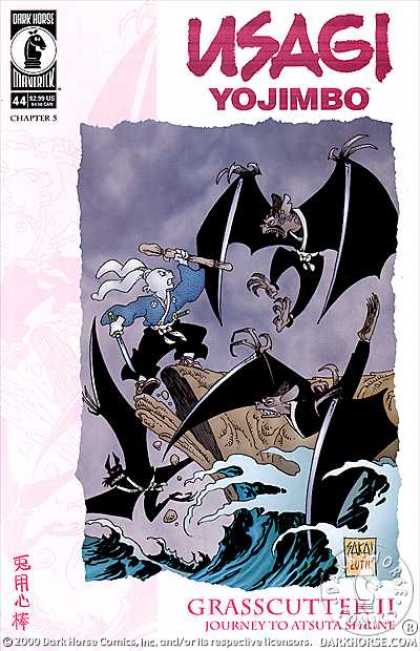
You can tell that Podolski had a great time writing this novel, and I personally loved the awesome story and exciting writing style, which made The Recruiter very easy to read and power through.  I especially enjoyed the fantastic characters, as the author introduced several compelling and memorable figures throughout the plot.  The main one naturally was protagonist and point-of-view character Rick Carter, who serves as an awesome central figure for the story.  While I do think that Podolski occasionally made Rick a little too zany, for the most part he was a great sarcastic protagonist that thriller fans will appreciate.  Thanks to his skillset as a recruiter rather than an operator, Rick stands out compared to your typical thriller protagonist, and there are some entertaining sequences where he uses his talent for networking and other corporate skills to defeat his opponents.  There is also the great emotional element to Rick’s story as he deals with his own guilt at abandoning his family, and it proved captivating to see how he reflects and moves forward through it.  Other great characters include a rookie operative recruit that Rick hires who proves to be both a real badass and a potential love interest, Rick’s former ace assassins who more than live up to their reputation, as well as a great overarching antagonist who steals the early scenes they are in and remain a threatening presence throughout the entire plot.

I had an absolute blast with The Recruiter, and it ended up being an outstanding debut from this first-time author.  An exciting and compelling character-driven read, The Recruiter was a book that was very easy to have fun with, and I am very glad I decided to check it out.  I look forward to seeing if Gregg Podolski will continue this series in the future, and I know that I will be grabbing the sequel when it comes out.

Amazon

Quick Review – Rebellion by Richard Cullen

Publisher: Boldwood Books (ebook – 26 October 2024)

Series: Chronicles of the Black Lion – Book One

Length: 290 pages

My Rating: 4.5 out of 5 stars

Amazon

Prepare for an exciting and compelling historical adventure from excellent author Richard Cullen with the amazing read Rebellion.

Back in 2024 I was lucky to receive a copy of the awesome historical fiction novel Rebellion by Richard Cullen.  Cullen, who entered the historical fiction genre a couple of years ago with his Wolf of Kings series, may be better known to some readers as fantasy author Richard S. Ford, who has written several compelling series over the year, including The Age of Uprising series (check out my review for the first book in that series, Engines of Empire).  His latest release, Rebellion, is the first book in his Chronicles of the Black Lion series, that takes readers back to the early 13th century and deadly rebellions against the crown.

Plot Synopsis:

1213AD.

King Richard the Lionheart is dead, and his brother, John Lackland, sits uneasily upon the throne of England.

Across the sea, Prince Louis, heir to the powerful King Philip Augustus of France, looks to King John’s crown with a covetous eye.

But King John must be wary of rebellion, as well as invasion, for even his own barons would see their king unseated, and the French pretender put in his place.

Thrust amid this tumult is young Estienne Wace, orphan squire to Earl William Marshal – the greatest knight to ever serve the kings of England, and one of the few men who still holds faith in King John’s rule.

Raised by Marshal as his ward, Estienne must prove himself worthy of his adopted father’s name, but acceptance may be the least of his troubles. War is looming, as usurpers emerge from every quarter, determined to steal England’s crown from its most wretched king.

Rebellion was an outstanding novel that successfully wrapped around a character-driven tale of adventure and honour with a compelling historical background to form a fantastic and exciting read.  Told primarily from the perspective of Estienne Wace, new squire to legendary knight, lord, and royal regent Wiliam Marshal, you see the chaotic events that defined the last few years of King John’s reign, including the First Barons’ War, in compelling detail.  For the most part Cullen tells a classic historical coming of age/adventure tale around Estienne, as the young man first learns the ropes of being a squire, and then the reader follows him through several major battles and historical events, either as a fighting participant or a curious observer.  This allows for quite a bit of action and excitement, and the young protagonist soon learns the true horrors of war as he grows closer to the Marshal family.

This proves to be a fascinating and very intense historical narrative, and the author enthrals the reader with a great combination of fascinating historical detail, a ton of cool action, and some compelling character work as he features an intriguing mixture of new characters and many established historical figures.  I found this combination to work extremely well, and it proved interesting to follow the protagonist as he witnessed the turbulent history of the period and the dark conflicts it birthed.  The action flies thick and fast as the story continues, and I loved the awesome array of detailed sequences that emerged, including a lengthy and desperate siege.  The author also makes excellent use of some great alternate points of view as the story continues, including a jealous rival to the protagonist, and you are gifted with a compelling and highly intense look at the battles and politics unfolding.  While for the most part the main storyline around Estienne is typical historical fiction fare, Cullen throws in some interesting, if not entirely unsurprising, reveals at the end which should lead to some interesting developments in the future.  All this helped to produce a very cool story, and its one that I had a hard time putting down at times.
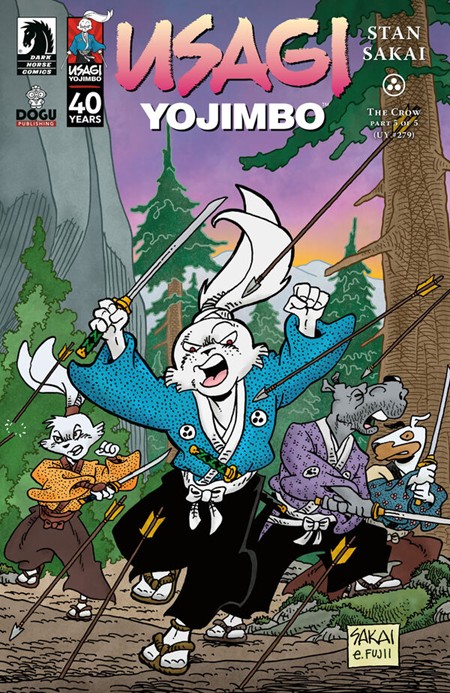
While I love all the above inclusions, my favourite part of Rebellion was the excellent historical details that Cullen worked his cool narrative around, especially as the author has clearly done his research on the subject.  It helped that Cullen chose to set his story around a truly fascinating period of English history that hasn’t been too over-utilised in other pieces of historical fiction.  As such, readers are gifted with deeply compelling look at the later years of King John’s reign as he lost land and refused to abide by the Magna Carter, and the resulting war that emerged as his various lords rebelled and tried to crown Prince Louise of France as King.  Cullen expertly places Estienne in the middle of many of the key events of this period, and through his eyes you get the full picture of the events that led up the war, as well as how it unfolded.  I honestly found this to be extremely fascinating, mainly because this war is often overshadowed by other events in English history, and you don’t see it utilised too often in modern fiction.  It was pretty damn interesting to see just how close England came to being ruled by a French king, and I honestly didn’t know that the French landed an army in England during this period, nor that Dover was besieged, and it was extremely cool to see it all unfold throughout the plot of Rebellion.

I personally also enjoyed how much Cullen focused on the awesome historical figure of William Marshal in this book, including examining the role that he played in stopping the war and saving England.  Marshal, a legendary knight who served several kings, is shown as an older man torn between duty and family, as he tries to save the cruel King John while his son chooses to support the rebelling barons.  I have always loved the history surrounding William Marshal and Cullen does a beautiful job bringing this aging example of knightly duty and honour to life and showcasing the complex roles he tried to balance for the sake of England.  This portrayal of Willaim Marshal, and indeed all the historical detail in the book, helps to make Rebellion a particularly captivating historical read, and I really appreciated how Cullen worked it all into the story.

Overall Rebellion was an awesome, fascinating and deeply addictive historical fiction novel that I could not get enough of.  Richard Cullen did a brilliant job of bringing this historical adventure together, and I had a wonderful time with the cool action and compelling history contained within it.  This is a very fun and exciting read that this very easy to get hooked on, and I ended up having an outstanding time with Rebellion.  Indeed, I enjoyed it so much that I have already grabbed an early copy of the sequel, Crusade, and I am hoping to read it soon.

Amazon

Quick Review – Warhammer: The Horus Heresy: Eidolon: The Auric Hammer by Marc Collins

Publisher: Black Library (Audiobook – 22 October 2024)

Series: Warhammer: The Horus Heresy

Length: 6 hours and 26 minutes

My Rating: 4 out of 5 stars

Amazon

2024 was a great year for Warhammer fiction, especially as the Black Library released a ton of awesome books across the various sub-series and franchises, including The Horus Heresy series, which serves as a major prequel to the Warhammer 40,000 books I usually look at.  One of the last releases of the year was The Horus Heresy character novel, Eidolon: The Auric Hammer.  Written by Marc Collins, who previously impressed me with his Warhammer Crime novel, Grim Repast, Eidolon: The Auric Hammer was a fast-paced and compelling read that dove into the twisted mind of an ambitious traitor as he travels to the final battle of the great war.


Plot Synopsis:

A Horus Heresy Novel

Lord Commander Primus Eidolon has claimed many titles along the annals of his infamy. He is the Exemplar and the Risen, the Soul-Severed, and the Auric Hammer. Now, fallen far from his primarch’s grace, he carves a path to Terra, where the culmination of Horus’ grand heresy awaits.

READ IT BECAUSE

Eidolon has been a key figure of the Emperor’s Children Legion from the beginning. Now, on the eve of the Siege of Terra, he’s fallen far from grace and is facing a long overdue reckoning for his many misdeeds during the Horus Heresy. Can he come to terms with his tainted legacy?

THE STORY

Coaxed and goaded by the wiles of the warp – and an entity whose whispered truths stretch even his credulity – Eidolon finds himself stranded around the world of Tatricala, where the ghosts of his past haunt every fated step. Now he must choose which life he wants to lead… and how much of his soul he is willing to sacrifice for it.

If Eidolon cannot banish his daemons, then they will surely take him for their own.


Eidolon: The Auric Hammer
was an excellent addition to the canon, and one that will really appeal to those readers who dove into the extended Horus Heresy series.  Like many of the Horus Heresy character books, The Auric Hammer focuses on one of the interesting supporting characters in the larger franchise and provides a compelling story around them, while also diving into their past.  In this case, Marc Collins tells a quick and entertaining story around Eidolon, one of the commanders of the now fallen Emperor’s Children legion, who has given in to the hedonism and worship of Slaanesh, the Chaos God of pleasure and obsession.

Collins does a great job effectively introducing the character of Eidolon and thrusting readers into his personal madness.  I must admit that I haven’t read any of the other Horus Heresy novels before, so I wasn’t especially familiar with the character of Eidolon, which did slightly reduce my appreciation for this book.  However, readers with even moderate knowledge of Warhammer 40,000 lore and the Horus Heresy can easily follow along with Collin’s quick story without too much difficulty.  Collins breaks this into a couple of fun parts, with a fight against daemons on the protagonist’s ship leading to an impromptu invasion of an isolated planet alongside “allies”.  However, nothing goes to plan as Eidolon and his comrades find themselves best by the dark plots of a daemonic entity who desires to destroy him.

This last third of the book is probably the best, as Collins envisions a series of daemonic encounters that play in the ravaged psyches of the various Emperor’s Children characters.  While I had a hard time connecting to some of the supporting cast members (Collins might have been better off with a more tightly focused narrative), it was interesting to see their various struggles, especially as it effectively showed how far their legion had fallen.  Eidolon’s personal inner struggle was the strongest part of the book, especially as Collins dove into his many issues, including his ambition, resentments and the anger he has with the various father figures in his life.  The protagonist comes out of this book stronger, and I particularly loved the reveal about who was behind everything at the end of the novel.  The confrontation that Eidolon had with this figure was extremely entertaining, and you come away appreciating just how suicidally stubborn Eidolon can be.

As is my habit with most Warhammer fiction, I chose to check out The Auric Hammer on audiobook, mainly because it was voiced by one of my favourite audiobook narrators, Toby Longworth.  A very effective narrator, Longworth perfectly captures the various elaborately dark characters featured with The Auric Hammer, and I love how he brings readers into the outrageous and grim Warhammer universe.  Longworth’s already impressive voice is enhanced in various sequences by cool sound effects that help to showcase the various daemonic creatures that the protagonist encounters.  These effects and Longworth’s fantastic voicework really make you appreciate the eldritch power and inherent evilness the various figures they represented, and I felt it did wonders on bringing me further into the narrative.  Combine that with the excellent way in which Longworth captures the intense dark emotions of Eidolon, including his frustration and disgust at his Primarch’s actions and abandonment of him, and this proves to be an outstanding and addictive audiobook.  Featuring a relatively short runtime of just under six and a half hours, The Auric Hammer is an easy audiobook to get through quickly, and I had a lot of fun knocking it off in a couple of enjoyable sessions.

Overall, Eidolon: The Auric Hammer was an awesome and exciting Warhammer audiobook from Marc Collins that is worth checking out.  Cleverly focusing on an intriguing figure in the canon while also expanding on the massive Horus Heresy series, The Auric Hammer really grabbed my attention, and I had a great time getting through it.  An excellent Warhammer book to check out, especially if you have been enjoying the other Horus Heresy books.

Amazon