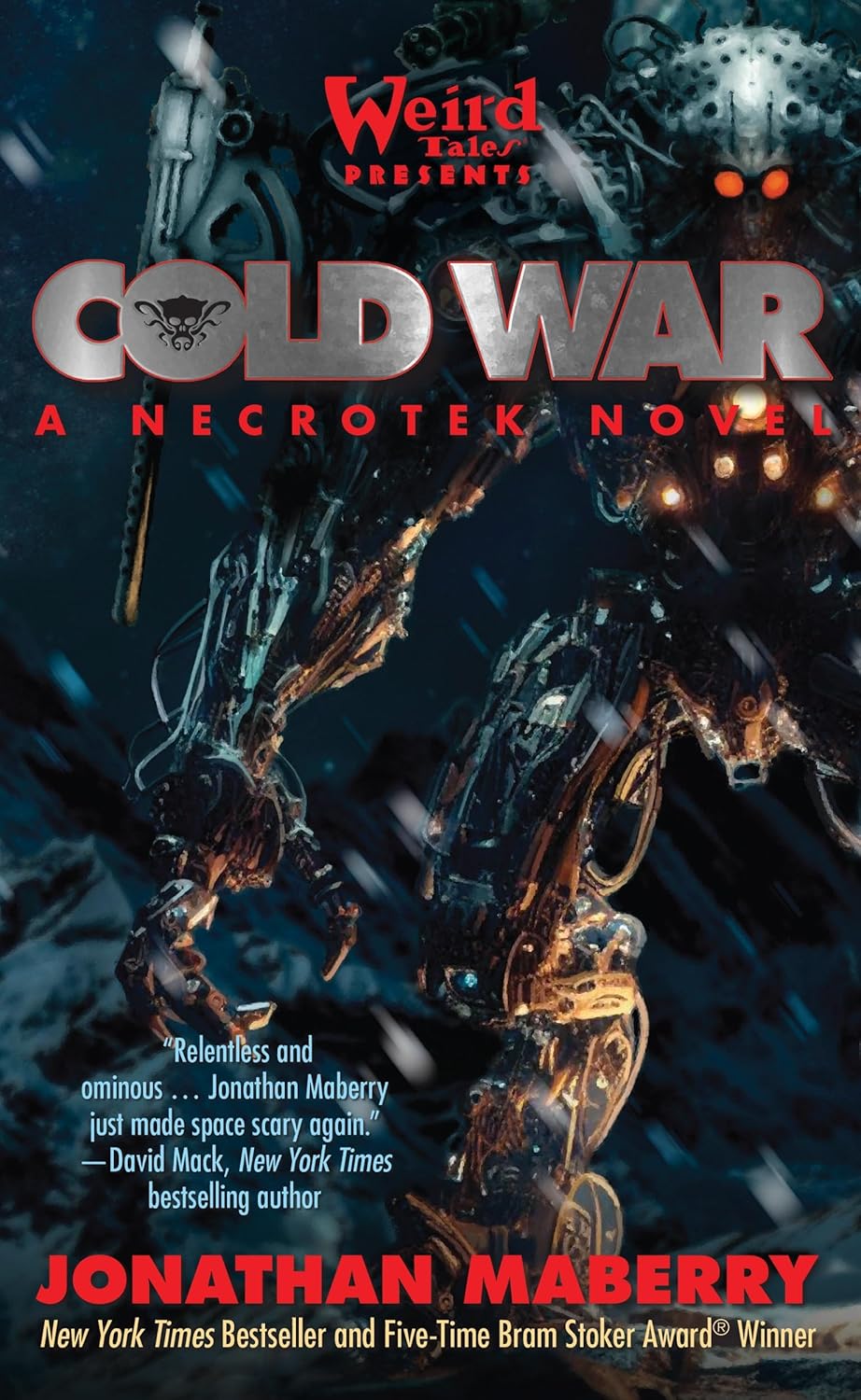
Cold War by Jonathan Maberry

Publisher: Blackstone Audio (Audiobook – 14 October 2025)

Series: NecroTek – Book Two

Length: 19 hours and 33 minutes

My Rating: 5 out of 5 stars

Amazon

The insanity and complex storytelling of Jonathan Maberry’s incredible NecroTek series continues in 2025 with the impressive and deeply intense sequel Cold War.

2025 has been a pretty awesome year for fans of Jonathan Maberry, as we have not only gotten the new Joe Ledger/Rogue Team International novel, Burn to Shine, but Maberry also continued his excellent NecroTek series.  Released in collaboration with the iconic Weird Tales magazine, the series started last year with the amazing novel, NecroTek (one of my favourite books and audiobooks of 2024), this series saw Maberry combine compelling science fiction elements with his love for Lovecraftian horror, when, in the near future, a space station of scientists and soldiers is transported across the galaxy and forced to fight eldritch horrors.  As the book continued, several of the human characters to become the titular NecroTeks, undead pilots of gigantic alien war machines, who are forced to risk the destruction of their souls to fight back against the monsters coming for them.  Due to how powerful, compelling, and occasionally scary this novel got, I have been keen for the sequel, Cold War, for quite some time, and I made sure to check it out the amazing audiobook version of it a few weeks ago.

Plot Synopsis:

In NecroTek, Asphodel space station was accidentally teleported to the far side of the galaxy, where they became embroiled in a never-ending war against ancient cosmic horrors.

But there is much more to the story …

On Earth, scientists uncover an alien spacecraft buried for millions of years beneath Antarctic ice. Inside are terrible secrets and a creature desperate to escape.

Soon the scientists studying the Artifact begin to have terrifying dreams, driving many of them to madness and acts of shocking violence. Dr. Evie Cronin and her team struggle to find answers, fully aware that they may only be found out among the stars. Their investigation brings them to the orbit of Jupiter moments before the WarpLine gun misfires. Destiny is a vicious and devious thing.

On Asphodel Station, the newly created ghost-driven NecroTek fighting machines are engaged in a desperate battle for survival against the deadly shoggoth fleets. But a new and far more dangerous race of creatures is poised to attack, both with their own fleets and with nightmares forced into the minds of the dwindling human defenders.

The group of scientists from Antarctica and the survivors on Asphodel are pitted against an unstoppable enemy. If they fail, Asphodel Station will fall, and the Outer Gods will be free to wage a war of conquest across the galaxy—to Earth itself.

Jonathan Maberry once again delivers an impressive read with his outstanding and complex Cold War.  Featuring an intense, character driven story that takes its protagonists to hell and back, Cold War was a powerful, horror-laden science fiction novel that refuses to let you go.  I loved this book so much, and it gets a very easy five-star rating from me, and I have recently featured it on my recent favourite sequels and audiobooks lists of 2025.

Maberry produced a very exciting and captivating narrative for Cold War that goes in a very different direction than I would have expected after NecroTek, but which works as a very effective and expansive sequel.  Initially showcasing the events in the aftermath of NecroTek and the first big battle for Asphodel Station, the reader is quickly and effectively reintroduced to the key characters from the first book and given an update on how they have continued to adapt to being transferred across the universe.  The early chapters of Cold War also take the reader back in time a few years before the events of the first book, when a group of scientists uncover an ancient alien artifact in the Antarctic snow, keeping it secret from the world and all the protagonists of the first book.

Cold War’s narrative soon develops an interesting and noticeably uneven split in the storylines.  While a good chunk of Cold War continues to showcase the figures on Asphodel and their multiple struggles, including the slow reveal of a new terrifying group of antagonists, much more focus is given to the Antarctic research plot line, with longer chapters dedicated to this part of the book.  While this move away from the established plot is surprising, I personally thought it was very clever, as it allowed Maberry to further expand both the cast and the lore around the threats humanity was facing, while also bringing the story back to Earth.  The cool exploration and first-contact scientific elements of this Antarctic storyline were also deeply compelling, and I got extremely absorbed in this part of Cold War’s narrative as the book continued.  While there was more of a focus on the Earth-based narrative, the story around Asphodel was still very impressive, with some complex character development, multiple ultra-exciting sequences of space combat, and a growing sense of dread as dark forces stalk the protagonists.

The final third of Cold War sees the book’s two separate storylines come together in very direct way, which allows many of the unique characters developed in both NecroTek and Cold War to come together.  While the transition to this part of the book is quite sudden, it allows for a very exciting end run of the book, as Maberry pumps up the action, and takes the protagonists through hell and back.  Maberry brings out all his best horror writing as the now combined cast are forced to contend with a terrifying array of monsters and eldritch creatures, including another zombie substitute (Maberry loves his zombies).  All the storylines from the first half pay off in this final part of Cold War, and while there aren’t too many surprises, you’re constantly on your feet as you wait to see who’s going to survive and which side characters are going to get killed off.  The author leaves Cold War on a very interesting note, and I’m already extremely curious to see where he takes the NecroTek series going forward.

Maberry utilised his distinctive and well-honed thriller writing style in Cold War, which combined nicely with the science fiction story and the overarching horror vibes to create a brilliantly intense and fast-paced read.  Once again breaking the story up into a series of short and sharp alternating perspective subchapters, Maberry constantly jumps Cold War’s story between multiple key protagonists, as well as some antagonists, to produce a wonderfully layered and powerful narrative that constantly has multiple awesome interlocking storylines on the go.  This quick-paced style works well to enhance both the book’s horror and science fiction elements, and the constant jumps also increase the tension of the plot and produce some excellent action sequences, including some truly unique and ultra-impressive space combat sequences.  There were also some new delightfully terrifying horrors determined to kill the protagonists both in their dreams and real life cleverly introduced in this novel, and Maberry did an amazing job building them up as a threat the entire book.  Maberry also effectively splits his book into two separate narratives for much of Cold War’s runtime, with alternating chapters diving between the events in the present at Asphodel Station and the prequel storyline in Antarctica.  This cool split really changed the feel and focus of Cold War compared to NecroTek, and while Maberry allowed both storylines to run mostly independently, they also worked well to support each other.  All these great writing techniques and narrative choices allowed Cold War to really stand out as a sequel, and I liked how much stronger Cold War turned out as a result.

While Cold War does work extremely well as a sequel, with the author’s excellent storytelling choices and alternating timelines really adding a lot to the story from NecroTek, it does mean that this book is probably not as accessible to new readers as some of Maberry’s other works.  Maberry does do his usual excellent job of recapping key events in the text as the book continues, so new readers do get a pretty good idea of what happened and who the key figures are.  However, the full emotional impacts of events, as well as the significance of some of the revelations coming to light in Cold War’s big prequel narrative in Antarctica really aren’t going to hit readers as hard if they haven’t read the first book.  Indeed, Cold War might be best read by established fans of Maberry, who will appreciate the author’s continued utilisation of Lovecraftian elements, as Maberry continues to showcase his love for the classic horrors with some fun science fiction twists.  Experienced Maberry readers will also be more used to the author’s extreme content, as Cold War is as dark and disturbingly over-the-top as many of his books, with some very adult horror moments.  Readers should also be on the lookout for easter eggs to some of Maberry’s works, including a fun reference to the antagonist of the Joe Ledger novel Dogs of War.  As such, this is very much a book for those readers familiar with the author, although I think new fans would be in for an excellent time.

As with most of Maberry’s writing, one of Cold War’s big strengths is its excellent contingent of complex and often highly damaged characters, whose unique interactions and experiences during these terrifying times frame the book’s captivating narrative.  Cold War contains an interesting mixture of returning figures from NecroTek and a new batch of protagonists who end up taking over a good part of the plot.  This includes Professor Evie Cronin, the leader of the expedition who discovers the alien artifact in Antarctica.  Evie serves as a great new major protagonist for the series, and Maberry’s choice to set much of Cold War’s narrative around her, ensures that the NecroTek books continue to have a strong scientific basis to their narratives.  The author really tries to capture the shock, excitement and fear that would accompany the discovery of an alien ship through Evie’s experiences in Cold War, and she serves as a relatable and likeable major focus for much of the book’s plot.  Maberry also works in a nice romance angle between Evie and shooter Jenny Spears, that serves as a big emotional part of Cold War’s plot, and which added to the stakes and impact of some of the high-tension sequences.  Of the remaining new characters introduced in Cold War, my favourite was probably Dr Torquil Brollachan, a government scientist who takes over the investigation of the alien artifact.  A complex and guarded figure, Dr Brollachan serves as an interesting foil to Evie and his secret motivations and dangerous priorities turns him into a bit of a Dr Frankenstein figure at times (an apt comparison that Dr Brollachan would appreciate), resulting in some fantastic reveals in the second part of the book.

While these new characters are impactful and have some very compelling storylines around them, their inclusion does mean that the cast introduced in NecroTek don’t get as much time to shine as they previously did.  Still Maberry keeps many of their storylines going, and all of them serve as a key part of the book’s plot.  This includes the main character from the first book, Dr Lars Soren, whose steady presence continues to be a great part of Cold War, and I enjoyed how Maberry further explored his cosmic philosophy ideas in the interludes.  The continued inclusion of the dead characters brought back as NecroTeks was also very compelling, with their experiences, including that of Bianca Petrescu, providing some complex existential elements to the plot.  I also liked how Maberry choice to focus a lot more on pilot character Lieutenant Commander Veronica Roland, better known as Calisto, who was forced to step up and lead the human pilots defending Asphodel Station.  Calisto’s struggle to become a leader, as well as the distinctive and beautifully written fighter combat sequences, are another amazing highlight, and I appreciated how well her scenes were written in this sequel.  Throw in the entertaining Irish necromancer, Lady Jessica, who spends much of the book recovering from the events of NecroTek, and the cast of Cold War was a very awesome part of this book, and I personally cannot wait to see where all their captivating and haunting personal stories go from here.

Like I have with all the other Maberry novels I have had the pleasure of reading, I ended up enjoying Cold War on audiobook, which I find is the best way to enjoy the author’s thrilling narratives.  I always find that Maberry’s dark tales and intricate and exciting writing style always translate nicely to the audiobook format, and they tend to be some of the best listens each year.  Indeed, as I mentioned above, Cold War was one of my favourite audiobooks of 2025, and I ended up powering through this new audiobook’s 19-and-a-half-hour-long runtime.  Much of Cold War’s epic success on audiobook once again lies in the narration of Maberry’s long-time audiobook collaborator, Ray Porter.  Porter, who is one of my favourite audiobook narrators, always perfectly matches the dark and sinister tones of Maberry’s writing, and I really love the sense of menace and intensity he brings to audiobooks like Cold War, as he conveys the underlying threat and fear Maberry weaves into his tales.  Porter also expertly delivers all the book’s awesome action, great humour, and other deeper emotions, to the listener and there is always a great synchronisation between Porter’s narration and the intent of Maberry’s writing.  Porter also has an outstanding array of distinctive voices for the book’s characters, and I love how he always manages to bring the best out of Cold War’s complex casts.  All these voices, including for the various new characters introduced in this sequel, were extremely fitting for their respective cast member, and I appreciate how effectively Porter portrays each figure’s emotions.  Porter also does an exceptional job voicing the sinister monsters and other eldritch figures haunting the protagonists, and the impressive array of creepy voices really emphasises the dark nature of Cold War’s story to the listener.  All this results in quite an exceptional listen, and it’s one that I cannot recommend enough.  Honestly, I don’t think it’s going to be possible for me to ever not enjoy a Maberry novel on audiobook, especially if Porter is narrating, and there is a reason these epic listens always top my best audiobook lists each year.

Maberry’s outstanding NecroTek series continues in extremely strong fashion with the extremely captivating Cold War.  Cleverly expanding on the story from the first novel, NecroTek, Cold War effortlessly kept up the terrifying tension as multiple compelling characters continue to experience the dark horrors the universe has in store for them.  I had an exceptional time with Cold War, and I have no problem letting you know that this book will be appearing in my favourite novels of 2025 later this week.  I’m also extremely excited as a Maberry fan for 2026, as not only do we have the new Joe Ledger book, Red Empire, coming out in March, but the NecroTek series will also thankfully be continuing, with a third novel, Ghosts of the Void, tentatively set for release towards the end of the year.

Amazon

Star Wars: Master of Evil by Adam Christopher

Publisher: Penguin Random House Audio (Audiobook – 11 November 2025)

Series: Star Wars

Length: 15 hours and 27 minutes

My Rating: 4.75 out of 5 stars

Amazon

Prepare for a dive to the dark side with the captivating and impressive new Star Wars novel, Master of Evil by Adam Christopher.

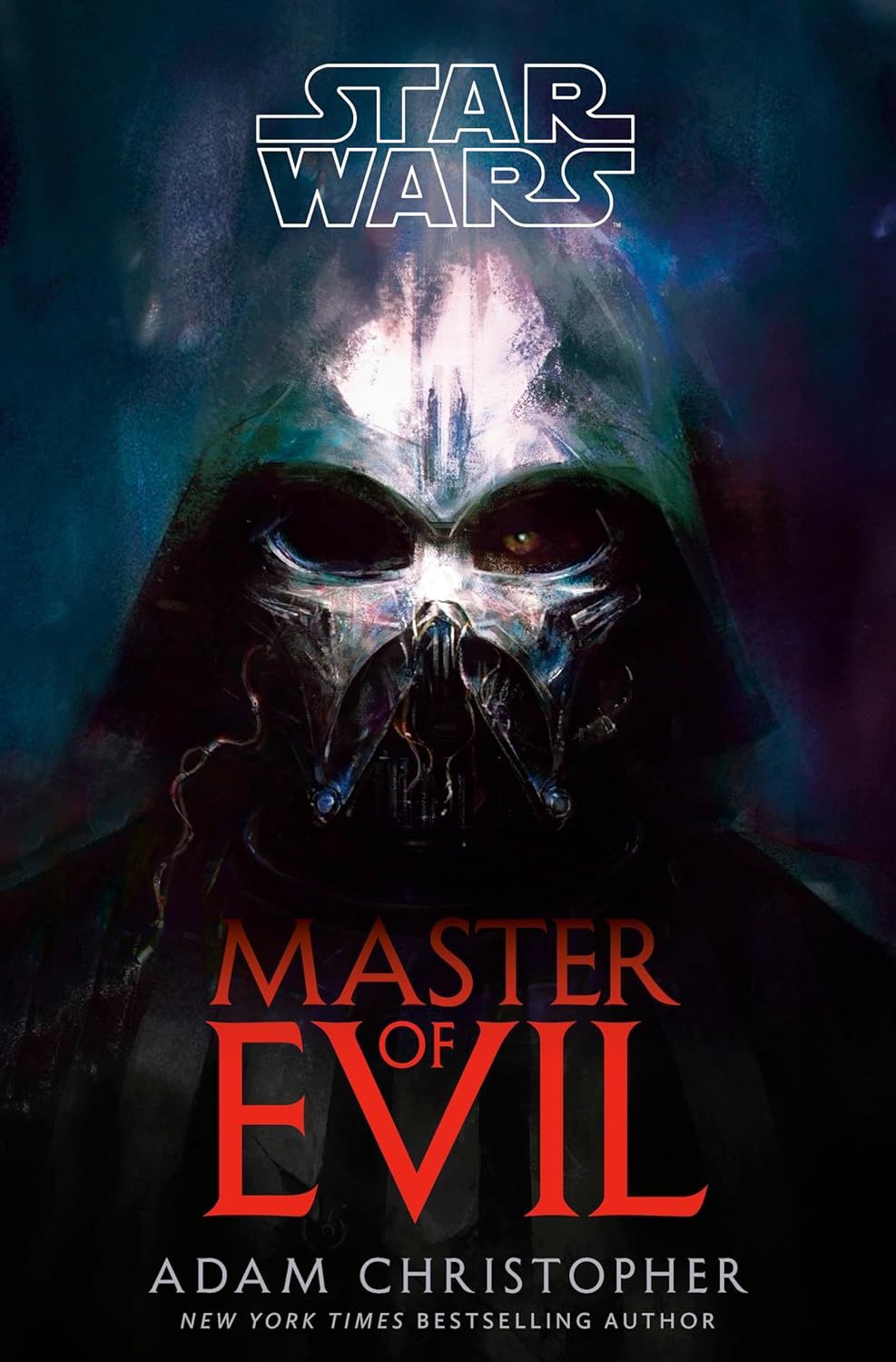
2025 has been a pretty good year for Star Wars fiction, with several awesome new books introduced to the existing canon.  My favourites have so far been The Mask of Fear by Alexander Freed and Sanctuary by Lamar Giles, although I have also just finished the outstanding and deeply compelling new release, Master of Evil.  The second Star Wars book from tie-in fiction author Adam Christopher, whose Stranger Things novel, Darkness on the Edge of Town, I previously had the pleasure of reading, Master of Evil is an exciting and complex book that I have been looking forward to for a while.  A very interesting read set in one of the best periods of Star Wars lore, Master of Evil had a great plot behind it, as well as a particularly epic cover.

Plot Synopsis:

After Revenge of the Sith, a newly forged Darth Vader hunts for the secrets of life and death under the watchful eye of Emperor Palpatine.

In the wake of Emperor Palpatine’s rise to power, the true nature of his most sinister enforcer remains a mystery. Darth Vader is a dominant yet illusive figure: the shadow cast by a malignant Imperial regime, unknowable to even its top officials. But even as his humanity gives way to myth, Vader remains haunted by the promises of the dark side, seeking the ultimate power that his master has hinted at but withheld—the power to conquer death itself.

On the volcanic world of Mustafar, Vader undertakes a dark ritual, bleeding a kyber crystal to forge his lightsaber. This act unleashes a power far greater than he anticipated, giving him a glimpse into the limitless potential of the Force.

Vader is determined to follow this vision, even if it means defying his master’s orders. Yet he finds the Emperor is suspiciously supportive of his mission, even sending Vader to the Diso system to investigate rumors of a Force-wielding shaman able to raise the dead. At his side are a cadre of the Emperor’s scarlet-robed Royal Guard, led by Colonel Halland Goth—a decorated soldier with a very personal interest in Vader’s mission.

Even as the Emperor’s true motivations reveals themselves, Vader falls deeper into obsession. His journey takes him far across the galaxy, chasing rumors and phantoms. But no matter how far he travels, he cannot escape the shadows within his own soul. Haunted by the echoes of his past, Vader circles the true resolution to his quest: only once all weakness is purged can he become a master of evil.

Adam Christopher presents one of the more unique and compelling Star Wars novels of 2025, with the awesome and complex Master of Evil.  Following several highly damaged characters as they move towards a dark collision course, Master of Evil had me hooked very early on, and I had an outstanding time with this novel, especially on its audiobook format.

I really enjoyed the exciting story Christopher came up with for Master of Evil, which drags the reader in with captivating Star Wars lore and some very personal character elements.  Starting off with an interesting prologue set around Count Dooku, the story soon skips to immediately after the events of Revenge of the Sith, focusing on the early days of the Empire.  While some early scenes are shown from the perspective of Vader, much of the novel is primarily shown through the eyes of new character Colonel Halland Goth, a Royal Guard assigned to Vader.  Tasked with reporting back on Vader’s actions, Goth accompanies him on his quest to find a Force-wielding shaman and learn more about the dark side of the Force.  While there is less of a direct focus on Vader and his inner thoughts than you’d expect based on the synopsis, Christopher does an excellent job of setting up Vader as a sinister and conflicted personality in this novel, especially with a cool scene on the planet Diso, where Vader clashes with the shaman. 

Following this first part of the book, the middle of Master of Evil slows down a little, as Christopher continues to develop his new characters and their motivations, as well as set up an interesting investigation arc as Goth tries to find out who or what Vader is.  There is a less direct Vader here, but I really got stuck into this part of the book and enjoyed the author’s compelling examination of his protagonists and their personal growth, as well as the early politics of the Empire and the manipulations of the Sith.  This eventually leads to an extended final third of Master of Evil, where several different groups attempt to find an abandoned Separatist spaceship filled with various secrets.  There is an excellent mixture of storylines here, with Goth chasing Vader and his chance of survival, other interested parties trying to get the treasure of the ship, and Vader accessing dark power hidden within.  While much of Vader’s adventures are told through the eyes of others, including clone troopers assigned to him, there are several fantastic scenes here where we directly see Vader access the dark side of the force hidden in the ship.  These scenes are particularly powerful, as we are given direct access to Vader’s conflicted mind, and the resulting Force visions give some outstanding insights to his psyche.  The other big character-driven storylines of Master of Evil also go in some fascinating directions, and Christopher loads them with action, self-discovery and tragedy, all of which is quite moving and addictive.  The conclusion of Master of Evil is particularly emotionally charged, and the novel ends on some complex notes that dedicated Star Wars fans are going to really appreciate.

I felt that Adam Christopher did an excellent job pulling together a compelling, character-driven Star Wars novel that was part adventure, part intriguing lore dive, that makes full use of its setting and examination of complex figures from the films.  The excellent story moves along at a swift clip throughout the entire book, and you really get dragged into the well-balanced mix of action, intrigue and emotionally charged pieces of Star Wars lore.  While parts of the book are a little slower to build up future story elements, for the most part Master of Evil was a very compelling novel that didn’t have any real wasted space. Despite some reservations I had before I read this book that Master of Evil was going to be way too lore-heavy for casual readers, I felt that Christopher produced a Star Wars novel that was actually pretty accessible.  Anyone with a good basic knowledge of Star Wars (or who has at least watched the original and prequel trilogies) will be able to follow this story along closely and have an excellent time with it. 

While I do think that Master of Evil is accessible to new readers, Christopher does feature some deep cuts into Star Wars lore that will primarily appeal to established fans of the series and its associated tie-in books and comics.  There are a lot of references to various bits of Star Wars fiction set before and after the events of Master of Evil, and Christopher has fun mentioning other books and comics.  For example, there are multiple references to the events of Charles Soule’s Darth Vader: Dark Lord of the Sith comic, the first volume of which mostly takes place just before this novel.  Indeed, Christopher replicates one of the key sequences from this comic in one of Master of Evil’s opening scenes, which honestly made for a gripping read, especially on the audiobook format.  There are also a ton of clever references to the main films either side of this book, Revenge of the Sith and A New Hope, including some re-enactments of a couple of major scenes from another character’s perspective.  I also loved some of the vision sequences associated with Vader’s hunt for the dark side where he envisions alternate versions of established events, many of which come out in darker and more sinister ways.  This combines well with the book’s fascinating look at the early Empire era of Star Wars history, and this was a very awesome novel for those readers who love a lot of lore in their tie-in fiction.

While I had a lot of fun with the story, Christopher’s obvious strength as a writer in Master of Evil was the impressive and complex characters that he was able to utilise in the plot.  This excellent book featured an array of compelling characters throughout the plot, including a mixture of new protagonists and some iconic figures from the films.  I personally really liked the dynamics of characters that emerged, even if there were less appearances from established figures as I would have expected.  These new characters ended up providing a great outsiders perspective for the reader, and it was fascinating to see their associated views about the Empire and Darth Vader, especially when they start digging deeper into the mysteries of the Sith.

Of these characters, the most prominent is Commander Halland Goth, a Royal Guard, who finds himself enmeshed in the chaos of Vader’s quest.  Halland proved to be a compelling and complex character, whose evolution of perspective throughout Master of Evil was a powerful part of the book’s emotional depth.  A loyal soldier who wants to serve the Empire, Halland is slowly dying due to a painful disease, which forces him to make various compromises to achieve his goals.  However, the more he comes to see of Vader and the true nature of the Empire, the more Halland changes, and Christopher wrote a good redemption arc around this protagonist as the book continued.  While Halland is a great character, my favourite was his loyal protocol droid TC-99, also called Nines.  Nines, who has been heavily modified by Halland, has a very distinctive personality, which is a mixture of the established timid protocol droid mentality, and that of a close confidant to Halland ready to help him as he slowly dies.  Nines quickly steals the show with his sassy humour, caring personality and various quirks, as well as his ability to upload other droid minds and skills to help Halland achieve his goals.  Throw some other fun supporting characters including a manipulative ISB agent, a couple of clone troopers uncertain of their place in the new Empire, and two conflicted minor Force users, and this was an exceptional cast of new characters that Christopher wraps a unique narrative around.

While much of this book’s focus is on the new characters, this is still a Darth Vader novel, and he unsurprisingly turns out to be an excellent part of this book.  While there is a lot less direct focus on Vader and his perspective of events as you’d expect, he was still a consistent presence in the novel as he went about his own goals.  While I know some readers will dislike the minimalisation of Vader’s direct appearances in the plot, I personally enjoyed how Christopher set him as a mysterious and intimidating monster whose thoughts you can’t easily guess at.  It was fascinating to see all the other characters have no idea how to deal with him or his role in the Empire, and the constant threat and fear that felt as they talked to him was palpable at times.  While he was mostly shown from other characters’ viewpoints, there were a few chapters that do feature Vader’s direct perspective, which tended to be some of the book’s best sequences.  Many of these direct scenes involved Force visions or explorations of the Vader’s psyche, and it was quite powerful to see him interact with figures from the past in his mindscape.  Christopher tries to show a somewhat conflicted Vader in Master of Evil, one who has embraced his desire for power, but who still has some flashes of good in him, occasionally helping his subordinates.  Despite that, some of the later scenes show Vader making a very final choice about his place in the galaxy, which allowed for some impressively heartrending moments.  As such, I felt that Christopher did an exceptional job of showcase this iconic figure and his unique motivations in Master of Evil, and he served as a great dark centre to the story.

While I did receive a physical copy of this novel, I instead sought out an audiobook copy of Master of EvilMaster of Evil is a particularly good example of how epic a Star Wars audiobook could be, as Christopher’s amazing story is deeply enhanced by the combination of an outstanding narrator and the wonderful use of classic Star Wars sound effects and music.  I always enjoy how well the iconic audio features from the films are utilised in Star Wars audiobooks, and especially impressive in Master of Evil.  The always awesome score from John Williams was perfectly inserted into various chapters of the books, often at climatic and key moments of the plot, and the resulting boost to the emotional impact of these scenes is always quite impressive to behold.  The inclusion of various distinctive Star Wars sound effects was particularly important to the ambience of Master of Evil, with crowd noises, blaster fire, spaceship sounds and the thrum of the lightsaber helping to drag the listener into the plot.  However, the most effective sound effect utilised in Master of Evil are the respirator sounds of Darth Vader.  The iconic breathing sounds add some major impacts to the story, especially in the scenes where the various perspective protagonists are attempting to describe the intimidating nature of this awesome villain, and there is a certain level of dread that invades the audiobook whenever Vader can be heard.  The sudden appearance or lack of this sound in scenes involving Vader is also quite impactful, and I really appreciated how the effect was modulated and altered to back up some key story details.

While the impressive music and sound effects are a major factor in why Master of Evil’s audiobook is so damn good, much of the credit for its success needs to go to narrator Marc Thompson.  Thompson is easily one of the best regular Star Wars audiobook narrators (and one of my favourite overall audiobook narrators) due to his outstanding vocal range and ability to replicate many key characters from the films and television series, and he has previously impressed me with his work on Thrawn, The Rising Storm, Scoundrels and Dark Disciple, just to name a few.  His work in Master of Evil was just as exceptional as always, perfectly voicing the book’s cast, and moving the story along at an exciting and tense pace.  I felt his voice for some key Star Wars characters, such as the Emperor and Count Dooku, was particularly impressive, and he also managed an outstanding Darth Vader, with the help of some vocal enhancements.  His excellent voice work was particularly useful for several sequences where iconic quotes from the films were read out in the context of this story, giving them the emotional weight they had in the original films.  There were even some moments where Thompson needed to have alternative character say these lines (for example, Anakin and Obi-Wan switching dialogue from one of their Revenge of the Sith scenes in a vision), and the narrator’s take on both actors’ dialogue was just perfect.  Even some of the voices that Thompson used for the new members of the cast, such as Holland Goth, were powerful and effective, and I liked how he presented them.  My favourite was the voice he used for Nines, which was entertainingly similar to Alan Tudyk’s K-2SO from Rogue One.  I particularly loved how well Thompson changed Nines’s voice to reflect the different droid personalities he uploaded into himself, and it helped turn Nines into one of the more entertaining, and heartfelt, characters in the book.  This unsurprisingly outstanding performance from Marc Thompson let me effortlessly fly through Master of Evil’s 15-and-a-half-hour runtime, especially with the cool music and sound effects, and I had such a great time listing to this audiobook.  As such, the Master of Evil audiobook comes very highly recommended, and it is a guaranteed hit, especially for those who already know and love the Star Wars audiobooks.

With some outstanding action and cool characters, Master of Evil proved to be an excellent and compelling Star Wars novel, and one I had an amazing time getting through.  Adam Christopher excelled at diving into some interesting bits of Star Wars lore, and I really enjoyed his fantastic take on this compelling period of Star Wars history.  While some readers will probably be disappointed in chapter’s focusing directly on Darth Vader, Christopher still tells an impressive narrative for those who are open to it.  An overall awesome new Star Wars novel that resulted in one of the better audiobooks of 2025.

Amazon

Warhammer 40,000: Grotsnik: Da Mad Dok by Denny Flowers

Publisher: Black Library (Audiobook – 1 July 2025)

Series: Warhammer 40,000

Length: 6 hours and 55 minutes

My Rating: 5 out of 5 stars

Amazon

One of my favourite Warhammer 40,000 authors, Denny Flowers, returns with one of the more entertaining novels of 2025 with Grotsnik: Da Mad Dok.

Denny Flowers is an interesting rising author of Warhammer 40,000 fiction who has so far written several particularly notable books.  Starting with his cool debut, Fire Made Flesh, Flowers went on to write his two exceptional Lucille von Shard novels, Outgunned and Above and Beyond (one of my favourite books and audiobooks of 2024), both of which are among some of my favourite pieces of Warhammer 40,000 fiction.  I also had a great time with Flowers’s inclusions in Da Red Gobbo Collection, Da Gobbo’s Demise and Da Wrong Type of Green, two hilarious entries that focused the always entertaining orks and grotz.  These short stories were quite hilarious, and it made me very excited when I saw that Flowers had a new Warhammer 40,000 novel focusing on the orks coming out this year with Grotsnik: Da Mad Dok.

Plot Synopsis:

“I made Ghazghkull. Not the Gods. Me.”

Grotsnik comes to the aid of Beastboss Bakum on Hive Prome, and it soon becomes apparent that the Mad Dok is feverishly working on something that could change the fate of ork-kind forever.

READ IT BECAUSE
How wild does a painboy have to be to earn the nickname “Mad Dok”? Find out as you follow Grotsnik – with eager scalpel in hand – as he plans his latest galaxy-changing creation. What could it be?

THE STORY
Da Mad Dok Grotsnik, creator of Ghazghkull Thraka, is a painboy beyond legend. What – and who – he harbours in his formidable brain is a mystery to every ork but himself, and an army of orderlies provides him with a constant supply of flesh with which to tinker.

So, when Grotsnik comes to the aid of Beastboss Bakmun, whose rampage on Hive Prome teeters on the brink of going out not with a Waaagh! but with a whimper, Bakmun can’t believe his luck.

Following a series of increasingly unlikely accidents, however, it soon becomes apparent that the Mad Dok is working on something in the depths of his colossal Painwagon. Something big. Something that could change the fate of ork-kind forever, surpassing Grotsnik’s own forging of the Prophet of the Waaagh!…

Denny Flowers continues to showcase why he is one of the fastest-rising authors of Warhammer 40,000 fiction with this highly entertaining and addictive new novel.  Perfectly taking on the always entertaining Warhammer orks, including the over-the-top titular character, Grotsnik: Da Mad Dok was an absolute hoot from the very beginning, and I laughed my way through the entire epic story.  One of the most hilarious novels of 2025, Grotsnik: Da Mad Dok gets a five-star rating from me due to the pure fun it contained.

Flowers comes up with an exceedingly fun narrative for Grotsnik: Da Mad Dok, which I ended up getting through in a very short amount of time.  As the title suggests, this novel follows the machinations of Grotsnik, an ork dok partially responsible for the creation of the legendary Ghazghkull Thraka, the boss of bosses for all ork-kind.  However, on the outs with his creation, Grotsnik joins up with a small band of orks led by Beastboss Bakmun, who is attempting to invade a mysterious human city.  Amongst this new band of orks is the aptly named Valtun the Patient and his clever grot Ikor, both of whom are very suspicious about Grotsnik’s intentions in joining them, especially once various members of the warband start going missing.  What follows is a hilarious series of events as Grotsnik gathers the material for his grand ambitions, while dealing with the strange humans and monsters within the city they are invading, as well as the unique intentions of other ork characters.  Primarily told through the perspective of Valtun and Ikor, who find themselves stuck in Grotsnik’s murderous orbit, these perspective protagonists slowly learn more about the titular character’s intentions, as well as the unique modifications he has made to himself, which turns him into something truly sinister.

Flowers moves this story along at a very quick pace full of funny interactions, crazy battles and the typical brutish humour that all fans of the orks will appreciate.  The action-packed and regularly over-the-top scenes that emerged were so damn fun, and there is honestly not a single slow moment in this book.  At the same time, Flowers installs a clever story throughout Grotsnik: Da Mad Dok, mostly based around the maniacal machinations of the titular character and his attempt to outsmart the suspicious Valtun.  It all leads up to a very entertaining ending that completely changes your perspective of Grotsnik’s intentions, while also leaving some of the remaining characters in ironic situations.  I personally loved where the multiple character arcs ended up at the end of this book, and while Valtun and Ikor were both great central figures, Grotsnik really stole the show with his weird behaviour, insane experiments, and the hilarious interactions he had with his unsuspecting patients/victims.  An overall awesome and well-written story that is guaranteed to suck you in with its exceptionally crazy characters and entertaining storytelling.

As with a lot of Warhammer 40,000 fiction, Flowers’s Da Mad Dok book is probably best read by established fans of the franchise, who will have a lot of fun seeing the titular character come to life.  Grotsnik’s unique mentality and connection to the most iconic ork character, Ghazghkull Thraka, makes him a very interesting figure to follow for those in love with the Warhammer canon, and Flowers clearly had a lot of fun utilising him in his story.  However, Flowers has already proven himself to be a very good at making his previous Warhammer 40,000 novels accessible to all readers, and this book is no exception.  Most people with a general knowledge of Warhammer lore and fiction can easily dive into Da Mad Dok’s narrative, and the inherent humour of the characters and the ork faction will keep them coming back for more.  I personally loved Flowers’s latest dive into the orks, and his takes on this crazy faction and some of their more distinctive members were both entertaining and accurate to the lore.  As such, Da Mad Dok has a ton of appeal, and I think most readers are going to have an exceptional time with it.

As has become my habit with all things Warhammer, I ended up listening to Da Mad Dok on audiobook, which is easily the best way to enjoy this fantastic and fun novel.  Coming in with a run time just under seven hours, Da Mad Dok is a very easy audiobook to power through, especially thanks to the great narration of Harry Myers.  Myers, who has really impressed me with books like Day of Ascension and The Wraithbone Phoenix, has an outstanding voice for Warhammer 40,000 fiction, which really fits the over-the-top nature of the universe.  He is particularly good at doing ork voices, such as in Da Big Dakka, Warboss and Da Red Gobbo Collection audiobooks, so I was very happy that he leant his voices to Da Mad Dok.  Myers uses some very fun and excessively gruff voices to bring the various ork characters to life, and the multiple laddish tones he employs are very fitting and very funny.  I cannot emphasise just how good Myers’s voice for these outrageous figures is, and I especially love how he changes from his deeper voices for the orks, to the more petulant and squeaky voice for the grot characters.  There is even a cool voice he uses for one of the more intimidating and iconic members of the cast towards the end of the book, which sounds particularly epic thanks to some vocal enhancement.  This great combination of voices, as well as Myers’s entertaining overall narration was extremely awesome, and it really enhanced Flowers’s already fantastic story.  I honestly cannot recommend this Warhammer 40,000 audiobook enough, and it ended up being one of my favourite listens of the year.

Thanks to the outstanding humour and overall craziness of its characters, Grotsnik: Da Mad Dok was a truly wonderful Warhammer 40,000 novel that is very easy to fall in love with.  Denny Flowers excelled at showcasing both the orks in general, and the cruelty and insanity of the titular characters, and the resulting intense and exciting story was a true joy to listen to.  An overall exceptional read, I cannot wait to see what epic Warhammer fiction Flowers writes next.

Amazon

The Strength of the Few by James Islington

Publisher: Text Publishing/Audible Studios (Audiobook – 11 November 2025)

Series: Hierarchy – Book Two

Length: 31 hours 8 minutes

My Rating: 5 out of 5 stars

Amazon

Australian author James Islington continues his Hierarchy series in epic form with the incredible and complex novel, The Strength of the Few, an outstanding and highly addictive fantasy novel that I had an incredible time getting through.

Back in 2023, I had the pleasure of reading the outstanding novel, The Will of the Many from James Islington, which I very quickly fell in love with.  Following a fugitive prince who finds himself enrolled in an academy for the children of the elite members of the nation that conquered his homeland, The Will of the Many had an intricate plot that forced the protagonist to deal with elaborate ancient puzzles, the unique magic of his world, unlikely friendships, deadly rebels, and all his hidden secrets potentially becoming uncovered.  I had such an amazing time reading The Will of the Many that it got a very easy five-star rating from me, and it ended up topping several of my end-of-year lists for 2023, including my favourite book, audiobook, new-to-me author and Australian fiction lists.  Unsurprisingly, I have been keen to see how the series would continue ever since I finished the final page of The Will of the Many, and the long-awaited sequel, The Strength of the Few, was one of my most anticipated novels of 2025.  I started reading The Strength of the Few the second I could, and it turned out to be another captivating read, with a plot that goes in some captivating and intense directions.

After infiltrating the Academy and running the mysterious Labyrinth, the man known to the Catenan Republic as Vis Telimus thought that he would finally understand some of the secrets of the nation that destroyed his people.  However, his encounters within the Labyrinth have instead resulted in the impossible and placed him in the firing line of an ancient evil determined to destroy his world.

While the original Vis continues to live in the Catenan Republic, attempting to avenge the massacre of his Academy classmates and friends at the Iudicium, he is unaware that the ancient devices within the Labyrinth replicated him across three separate words.  Mirrors of each other influenced and altered by different history, the worlds of Obiteum, Luceum and the world Vis already knows as Res, are divergent places, each with their own troubles, rulers and chaos.

Now one of the few beings existing across all three concurrent realities, Vis stands as the only person who can stop the upcoming Cataclysm that will burn away all he loves.  But first he needs to face the different challenges each world has for him, especially as he truly belongs in none of them.  Forced to fight, to learn how to control the unique powers his situation has granted him, and to understand the different worlds they find themselves in, all three versions of Vis will be pushed to their limits as they try to prove themselves and understand the secrets behind their unlikely journey.  If any version of Vis fails, then all their chance to stop the Cataclysm are finished.  But can Vis really survive in three separate realities, each of which is filled with beings who desperately want him dead?

Well damn, now that’s how you do a sequel.  The Strength of the Few was an incredible novel as James Islington expertly continued the elaborate and ambitious narrative of his epic Hierarchy books.  Featuring a layered story loaded with complex world-building, intricate story details and compelling characters, The Strength of the Few was an exceptional novel that gets a very easy five-star rating from me.

Islington came up with an especially complex and powerful story for The Strength of the Few, which served as a very worthy follow-up to the compelling events of the previous Hierarchy book.  Right out the gate readers are treated to an intricate plot, with the protagonist from The Will of the Many split into three different versions of himself in three separate mirror worlds.  Each version has its own very distinct narrative that revolves around that specific Vis trying to overcome the challenges of that specific world.  For example, the version of Vis on Res, the world that The Will of the Many was completely set in, continues to endure the politics of the Hierarchy, while also attempting to uncover those responsible for the massacre of his classmates at the end of the previous book.  The storyline set on Obiteum is a bit of a post-apocalyptic narrative, as Vis is forced to survive a broken world ruled by the enemy responsible for several previous Cataclysms, and must try to find a way into a forbidden city, half staffed by the living dead.  The final storyline set in Luceum offers a much more adventurous narrative, as a version of Vis that is completely unaware that he is in an alternate world, is forced to explore a new culture and attempt to survive amongst people who have no idea of his past or his destiny.

These three separate and very distinctive storylines each go in some interesting directions as the book continues, and the result is a very impressive and compelling overall narrative, especially as Islington expertly sets up necessary details in the early stages of the book and cleverly builds from there.  For most part, each of these storylines stay isolated, although some key details from each bleed into the wider narrative, and you can appreciate the significance of certain events or revelations in one storyline better thanks to the events in one of the other worlds.  Each plot line goes in some very interesting directions, with the dark politics of Res forcing Vis to engage in some complex schemes and deceptions, the struggles of Obiteum slowly getting to an isolated version of the protagonist, while positive character interactions in Luceum turn that Vis into a completely different person.  Islington starts to enhance the tension of all three storylines in the second part of the book, and there are some very amazing scenes that completely change the tone of each of the main storylines.  I felt the political instability of Res allowed for some particularly powerful moments, especially after a shocking scene about two-thirds of the way through book.  A growing war in Luceum also provides some compelling drama for that storyline, as Vis must decide what he wants in life, while the continued threat of discovery in Obiteum proves to be particularly draining.

The final third of the book contains some of the best scenes of The Strength of the Few, as Islington builds on all the novel’s great storytelling and complex worldbuilding to bring forth an epic conclusion.  Thrusting all three versions of Vis into mortal danger, the tension is particularly thick, as the protagonist and much of the supporting cast are in constant risk.  This includes a final desperate attempt to achieve his goal of killing a god in Obiteum, which hits a range of snags amongst the ancient city Vis has spent most of the book infiltrating.  At the same time, the Vis in Leceum finds himself in the middle of a deadly war, where his unique abilities and the unlikely rewards of a deadly ceremony weigh him down.  However, the most intense is the narrative set on Res, where Vis finds himself attempting to save who he can from the chaotic events brought on by those manipulating him.  Islington probably throws the book’s most shocking moments into the Res storyline, which nicely builds on a lot of the drama and intrigue from the first novel, and forces the protagonist to make some dark decisions, out of both vengeance and necessity.  One scene where the title of the book is quoted by an antagonist really sticks in the mind, and I’m not sure I’ll be able to forgive Islington with the dark bait-and-switch there.  All three of these storylines end on an interesting note that hint of destructive events for the future, and it is going to be fascinating to see how Islington continues the Hierarchy series going forward.

Thanks to the elaborate ideas that Islington had for this epic sequel, The Strength of the Few turned out to be an exceptionally written read, which provides an intense and compelling fantasy narrative, filled with some great emotional depth.  The inventive way that the author splits the book to follow three separate versions of the same protagonist worked surprisingly well, and it allowed for quite a unique character-driven story, which really showcases Islington’s writing ability.  I felt that the split between the three distinctive storylines was very well done, and these separate narrative threads each stood on their own merits, provide a distinctive experience in each.  I loved how there was something special in each of the storylines, and you got some interesting interactions, world building and different focuses with each of them.  All three were very well written, and there were honestly no weak links with any of the storylines, which is always a risk when you split the narrative like this.  I will say that the intrigue-laden narrative on Res was a particular favourite of mine, but both other storylines were also quite exceptional, and they balanced each other nicely with their alternating themes and varied character growth.  Throw in some creative expansion of the universe the narrative is set in, with its cool Will-based magic system, and three worlds each inspired by different ancient cultures (Roman, Egyptian and Celtic), and this was a very well written book, and I really appreciate how effectively Islington builds up his different worlds and showcases them to the reader.

The Strength of the Few proved to be an impressive continuation of the Hierarchy series, and I felt that Islington did an outstanding job building on the impressive fantasy elements and storylines of the first book.  However, the complex narrative split and the way that Islington dives immediately into the story does mean that The Strength of the Few is probably best enjoyed by those readers who have already gotten through The Will of the Many.  While Islington does re-examine key elements of the plot from the first book as The Strength of the Few continues, it is a very gradual process, and new readers trying to read the sequel first are likely to get confused if they don’t know some necessary details from the first book.  The Strength of the Few might have benefited from a good summary or recap at the front of the book to remind readers of some key details, especially if they haven’t had a chance to read re-read The Will of the Many since its 2023 release.  Still, for the most part, all readers should be able to follow and appreciate The Strength of the Few, especially once you get drawn into the three compelling storylines, and people who love extremely elaborate fantasy narratives with a lot of intricate detail are going to have an outstanding time.

I was once again impressed with Islington’s great characters in The Strength of the Few, as this book has a massive cast, made up of an interesting combination of figures from The Will of the Many, and new characters from the three separate worlds of the setting.  However, most of this book naturally follows the young protagonist from the first book, who is primarily known as Vis Telimus.  A studious and damaged figure who had already gone through a lot before the events of this novel, Vis has rather a unique experience in this sequel, as unbeknown to him, there are now three separate versions of him concurrently existing in the mirror worlds of this setting.

Islington perfectly sets up and utilises this three-way split of his protagonist, and readers are soon treated to three distinct variations of the protagonist, each of whom are altered by their experiences and losses, especially the two versions of Vis who lose their left arm.  It was fascinating to see how each of the Vises are influenced and changed by their respective traumas, and how their adventures are altered by the different information or people that they meet.  For example, the Vis in Res, who is essentially the same protagonist from The Will of the Many, finds himself longing for vengeance after the events of the Iudicium, and spends much of the book angry and forced to endure politics and lies.  The version of Vis on Luceum, while feeling lessened by the loss of his arm, soon finds peace in his new setting, and his eventual motivations for fighting and living are very different from his other incarnations, especially as he finds friends he can trust completely.  Finally, the Vis on Obiteum is one of the more confident incarnations of the protagonist, having full knowledge of the upcoming Cataclysm and his place in the three worlds explain early in the book.  As such, he soon becomes the most competent at utilising his Will talents and appears the most undamaged of the three due to not losing his arm.  However, in many ways the Obiteum Vis is the worst off out of all versions of the protagonist due to his isolation, the desolate surroundings, and the early expectations of murder and potential death that are thrust upon him.  I really cannot emphasise just how clever the split between these different variations of the protagonist is, especially with the subtle differences and alternate reactions to similar events or situations. It really makes for quite a distinctive and moving read, especially as all three versions of Vis experiences even greater trauma and damage as this sequel continues.

While Vis is the obvious focus of The Strength of the Few, there is a huge supporting cast utilised throughout this book, including various characters only found on each distinctive world.  Indeed, each version of Vis picks up its own supporting cast, which allows for some very different interactions in each of the major storylines.  Highlights include many of the recurring characters from the first book who serve as Vis’ friends and mentors in Res.  There is a particular focus on Eidhin and Aequa, who have an expanded role as Vis’s main confidants in this novel, and I liked some of the powerful storylines that formed around them.  Other major supporting characters from the first novel are showcased to a lesser extent in this sequel, primarily due to the book being split into three separate parts, although many of these characters still got a notable role in this sequel.

The cast supporting Vis on the desolate world of Obiteum is a lot more limited, mainly to emphasise the protagonist’s loneliness, although he does find a compelling mentor in Caeror, his adoptive uncle, who the protagonist was hunting for in the first book.  A couple of other native characters from Obiteum gain prominence later in this storyline as Vis attempts to complete his mission, and it is fascinating to see how their experiences living on a dead-world, impact their interactions with the protagonist.  Finally, the cast of the Luceum plotline represent a compelling counterpart to the supporting characters of the rest of the book.  While Vis has enemies in Luceum, he also finds several true friends who he can trust with all his secrets.  It was interesting to finally see Vis truly open up to other people, and it allowed for some very different interactions to the secrets and lies that define the protagonist in the other two storylines.  Throw in a compelling array of antagonists, as well as an entertaining manipulator who keeps chucking Vis into the deep end on Res, and this was an impressive cast for this great sequel.  It honestly was an extremely intriguing experience to have three separate casts of characters set around different versions of the protagonist.  While this narrative split did result in some restrictions when it came to character depth or a full exploration of relationships, I think the overall extended length of the book overcame this and allowed the reader to grow close to the supporting characters.  I will warn readers not to get too attached to the extended cast though, as Islington does get a little murderous as the book continues, however, all these characters are impressive while they last.

While I was lucky enough to receive a physical copy of The Strength of the Few, I ended up holding out for a little bit to listen to the audiobook version of this book instead.  I’m a big fan of audiobooks when it comes to ultra-elaborate fantasy narratives, as I tend to absorb and retain more of the details that way, and this worked out well with The Strength of the Few.  I felt that Islington’s complex story came across very effectively when read out, and all the elements, including the elaborate worldbuilding and the great character work, were well translated to the reader.  I also appreciated how the switches between the three different versions of the perspective protagonist, was easily discernible, and this was a very easy story to follow on audiobook.  The Strength of the Few audiobook saw the return of Euan Morton for narrator, who previously read out The Will of the Many, and who I quite enjoyed as a narrator of the Star Wars audiobook, Tarkin.  Morton has a very interesting cadence to his voice as a narrator, which provided a very unique edge to this audiobook.  While Morton’s narration style might not appeal to everyone, I felt that he did a good job voicing this compelling story, especially through the eyes of the complex protagonist, and his unique narration on this elaborate story worked extremely well.  I also felt that Morton excelled at pronouncing all the different names and titles that Islington featured in his plot, no matter their Roman, Celtic or Egyptian inspiration, and the characters of all three different worlds had a subtly different cadence and accent that helped to distinguish the separate storylines from each other.  As such, I really got stuck into this audiobook, powering through it quickly, even with its 31-hour runtime.  This was probably one of the more intense and moving fantasy audiobooks I had the pleasure of listening to in 2025, and I cannot recommend this format enough.

James Islington does it again with his incredible second Hierarchy novel, The Strength of the Few.  Brilliantly continuing his elaborate narrative from the first novel in a unique manner, The Strength of the Few was an ultra-addictive read, that really showcased Islington’s writing ability and imagination.  Clever, powerful and easy to get addicted to, The Strength of the Few was one of my favourite books of the year, and I cannot wait to see how Islington continues the series going forward.

Amazon

Badlands by Douglas Preston and Lincoln Child

Publisher: Grand Central Publishing (Audiobook – 3 June 2025)

Series: Nora Kelly – Book Five

Length: 10 hours and 45 minutes

My Rating: 4.5 out of 5 stars

Amazon

Prepare for a crazy and highly entertaining crime fiction thriller as the superstar team of Douglas Preston and Lincoln Child continue their amazing work with the fantastic novel Badlands.

Last year I had the great pleasure of reading the awesome thriller Extinction by Douglas Preston. A cool novel that saw strange murders occur within a park filled with cloned prehistoric animals, Extinction proved to be a ton of fun, especially with some of the entertaining and over-the-top twists that Preston threw into it.  As such, I was keen to read more from Preston going forward, and I decided to see what other books he wrote.  Naturally that took me into the orbit of his partnership with fellow thriller author Lincoln Child.  Together, the two have written an insane number of unique crime fiction reads, often featuring an exciting science fiction twist, including big series like their Agent Pendergast novels and Gideon Crew series.  Due to how fun this partnership sounded, I decided to try out one of the pair’s newer works, with their 2025 release, Badlands.  The fifth book in their Nora Kelly series, Badlands had a really interesting plot behind it, which panned out into an exciting and captivating read.

Plot Synopsis:

In the New Mexico badlands, the skeleton of a woman is found—and the case is assigned to FBI Agent Corrie Swanson. The victim walked into the desert, shedding clothes as she went, and then died in agony of heatstroke and thirst. Two rare artifacts are found clutched in her bony hands—lightning stones used by the ancient Chaco people to summon the gods.

Is it suicide or… sacrifice?

Agent Swanson brings in archaeologist Nora Kelly to investigate. When a second body is found—exactly like the other—the two realize the case runs deeper than they imagined. As Corrie and Nora pursue their investigation into remote canyons, haunted ruins, and long-lost rituals, they find themselves confronting a dark power that, disturbed from its long slumber, threatens to exact an unspeakable price.

Badlands proved to be a very entertaining novel from Preston and Child that I had an outstanding time getting through.  Featuring a compelling and twisty mystery that went in some very fun directions, Badlands was an exciting and well-written read that was hard to put down, especially when the authors decided to make things a little crazy and over-the-top.

This new Nora Kelly book starts off strong and fast, bringing the protagonists into the case and setting them onto the course of a strange series of deaths throughout New Mexico desert.  Primarily focused on FBI agent Corrie Swanson, archaeologist Nora Kelly, and Nora’s brother, who goes off on his own side quest with a rich collector, the plot soon takes shape rather nicely, especially with the case clearly tied around the mysterious artefacts the victims were holding.  Preston and Child soon set up quite a compelling mystery that forces the protagonists to dive into ancient Native American myth, unhealthy academic relationships and other dark secrets, all to uncover why several young women are committing suicide out in the desert.

The plot moves along at a mostly smooth pace, minus one or two unnecessary shortcuts, and it proved fun to have Corrie examine the criminal aspect of the case while Nora dove into the myths and history that seemed to dominate the deaths.  It all leads up to an outstanding final third, with the main storylines all coming together in an intense, expanded sequence, where the protagonists are forced to confront the people responsible for the mystery in a dark and violent way.  While certain twists about the main antagonist and the method needed to save the day are well telegraphed, Preston and Child overcome this by making things as crazy as possible, and the sheer tension the authors manage to generate here is very impressive.  I particularly loved the ending of Badlands, which nicely blended the crime fiction and more occult elements of the story together in a cleverly ambiguous way that leaves you wondering about what exactly happened well after you finish the book.

Preston and Child pulled together an outstanding novel in Badlands, and I enjoyed how their combined writing brought this entertaining story together.  The plot of Badlands itself is quite fast-paced and exciting, as the primarily investigative narrative follows much of the classic crime fiction conventions.  However, the authors do an outstanding job of twisting the story around, with a compelling focus on Native American history and archaeology, as well as some very amusing depictions of academic relationships.  Preston and Child’s love of history and archaeology is quite evident throughout the course of Badlands, and I loved how the various myths and sites of the past played into the modern crime fiction narrative.  Combine that with the vivid depictions of the New Mexico badlands as a major setting, which is loaded with hoodoos, rock spires, and other ancient secrets, and Badlands has a very distinctive feel to it that Preston and Child use to enhance the story and give it some entertaining and over-the-top tweaks.

While part of a larger series, Badlands works extremely well as a standalone novel, and new readers can come into this Nora Kelly book really easily thanks to the author’s open style.  Indeed, I personally was able to slip into this series quite easily, and there wasn’t a single second that I felt I was missing out on key plot or character details from not having read the previous books.  Each of the key recurring characters is expertly re-introduced in this new novel, and it honestly doesn’t take you too long to fully appreciate their respective storylines and the role they play in the book.  As such, I feel that Badlands is a book that will appeal equally to new readers looking for an unusual thriller as well as established fans of either author, who are curious to see how their new novel turned out.

I ended up grabbing the audiobook version of Badlands, which I felt was an excellent format that added a lot to the reading experience.  Coming in with a runtime of just under 11 hours, Badlands was a relatively quick audiobook to get through, and I liked how well the entertaining story was read out.  Narrated by Cynthia Farrell, a veteran audiobook narrator with a lot of experience in the thriller space, this format of Badlands moves at a quick pace, and listeners are easily able to absorb the unique narrative and all it’s cool details.  Farrell excels at showcasing all the key parts of the plot, from the intense action scenes, the dramatic investigation sequences, and even a few moments that are supernatural in nature, and I really enjoyed how easily I got drawn into this compelling audiobook.  There are also some great voices for the various characters featured throughout Badlands, and Farrell ensured that each character got their own, unique and fitting voice, that allowed the listener to relate to them.  This ended up being a great audiobook, and I think I will utilise this format going forward with Preston and Child’s work, especially if I decide to read more Nora Kelly novels.

With some unique twists and turns and a truly crazy ending, Badlands was an outstanding novel that I had a brilliant time with.  I ended up being really impressed with the cool team of Douglas Preston and Lincoln Child, and their new Nora Kelly book was a fun novel with some fantastic moments behind it.  A highly recommended read and one of the more distinctive thrillers of 2025.

Amazon

Warhammer 40,000: Crossfire by Matthew Farrer

Publisher: Black Library (Paperback – 1 January 2003)

Series: Warhammer 40,000: Shira Calpurnia – Book One

Length: 320 pages

My Rating: 4.25 out of 5 stars

Amazon

I finally got around to reading the awesome Warhammer 40,000 novel, Crossfire.  A classic entry in the Warhammer 40,000 canon with a cool crime fiction twist, Crossfire was a great novel that serves as an excellent first entry in Farrer’s Shira Calpurnia trilogy.

In the grim future of the 41st millennium, order and control of the massive Imperium of Man is maintained through the strictest interpretation of Imperial law, with no room for variation or leniency.  The ultimate arbitrators of this law are the dedicated members of the Adeptus Arbites, elite law bringers, trained to weed out corruption, dissent and disloyalty wherever they are deployed.

Shira Calpurnia Lucina, recently promoted arbitor senioris of the Adeptus Arbites, has been assigned to the bustling dockyards of the Hydraphur system.  A glistening gem of Imperial rule dedicated to providing material to the navy, Hydraphur is a seemingly unlikely place for dissention.  But this elite planet harbours dark secrets which come to the surface after a deadly assassination attempt is made in public against Calpurnia amid the distraction and celebration of a major religious festival.

Attempting to uncover who would want her killed after only just arriving on world, Calpurnia begins her relentless investigation.  However, this is no simple case, and soon Calpurnia finds herself forced to navigate the many plots and schemes of the Hydraphur elite.  With more attacks striking close to her and the fate of the whole planet seemingly in the balance, Calpurnia must uncover all Hydraphur’s secrets before the assassins stalking her finally succeed.

Crossfire was an excellent and compelling Warhammer 40,000 novel from Farrer that proved very fun to get through.  Featuring a fantastic plot that is one of the earlier examples of a crime fiction narrative melding with the iconic Warhammer 40,000 universe, Crossfire was a great read and one that is worth checking out.

I liked the captivating story that Farrer came up with for Crossfire, which quickly gets the reader’s attention with a powerful introduction to the protagonist, as she quickly finds herself under fire from a lethal assassin.  Serving as a good start to the main investigation arc, the plot follows the protagonist as she attempts to uncover the identity of the assassin, while also learning more about the planet of Hydraphur.  While a very lore-heavy story, Farrer keeps the plot going quickly and effectively, especially as there are soon more apparent attacks against the protagonist, each of which give her more clues to follow to try and find the mastermind of the plot against her.  At the same time the protagonist gets bogged down in dealing with various other interested parties on Hydraphur, including the planet’s local elites, agents of the Imperial church, the Adeptus Mechanicus and the Inquisition, each of whom have their own interests in finding out who is trying to kill Calpurnia.

While Farrer keeps up a good pace for Crossfire as the plot continues, I do think that he might have overloaded the narrative with details about Hydraphur’s society, as well as the various plots that infest it.  While these serve as good red herring motives for the protagonist to follow, it did overcomplicate the plot at times, which slowed things down even amid some great action sequences.  Despite this, the overall narrative for Crossfire was quite strong, and you get hooked into the continued investigation, especially as the author kept raising the stakes of the case.  After some exciting scenes, everything leads up to the big final confrontation, as the protagonist fully unwinds all the conflicting conspiracies they’ve been forced to encounter.  The conclusion was a sufficiently intense and over-the-top fight, which you need in Warhammer 40,000 fiction, and I liked the clever way the protagonist was able to turn the tables on the antagonist, even if the set-up for it was a little heavy handed.  An overall excellent Warhammer 40,000 plot that nicely tells its own story, while also introducing the character for the larger trilogy.

I’ve previously had a lot of fun with previous Warhammer 40,000 novels that utilise strong crime fiction elements in their story telling, such as Bloodlines by Chris Wraight and Grim Repast by Marc Collins, as there are some outstanding crime narratives in this grimdark universe. Crossfire is an interesting early example of this utilisation of crime fiction in Warhammer 40,000 fiction, and I felt that Farrer did a pretty good job of building a compelling investigation around this fantastic setting.  The resulting story is a layered and intense read that sees the protagonist slowly unwind the case amid various battle sequences and other dark distractions.  The relevant clues, hints and misleading details are well scattered throughout the plot, and I felt there was a good amount of foreshadowing to some of the key plot reveals.  While some story elements and conspiracies came a little out of nowhere, for the most part this was a concise and ordered novel, well told through the perspective of the protagonist.  Farrer excelled at fitting a ton of interesting and heavy lore elements in the plot, and I particularly appreciated how well he utilised his setting throughout the story.  The various plots and schemes of planet’s noble families and prominent organisations, as well as the elaborate religious festival the novel is set around (ceremonial details of which are cleverly included at the start of each chapter), are expertly worked into the larger plot, and it was fascinating to see how they impacted the story and drove the investigation.

One of the more entertaining elements of Crossfire I enjoyed was the narrative’s compelling characters.  The focus is primarily around series protagonist Shira Calpurnia Lucina, the arbitor senioris through whose eyes we see the story unfold.  Calpurnia serves as an interesting central figure, especially as she provides an outsider perspective to the complex setting.  While Farrer writes Calpurnia as a somewhat bullish and highly determined figure that is initially hard to appreciate, I felt that this was an intentional choice by the author, which reflects the typical attitudes of the Arbites in the general Warhammer 40,000 setting.  Forcing her to deal with the more subtle techniques needed for the politically delicate Hydraphur brought in some interesting conflict for Calpurnia, as well as producing some interesting character growth.  Despite this, the outsider status of Calpurnia continues to be a compelling plot feature throughout Crossfire, which Farrer utilised extremely well with his writing.  The rest of the cast, while less prominent, adds some complexity to the plot, and I enjoyed the compelling array of fellow Arbites members, the gentry of Hydraphur, and other prominent figures in the planet’s hierarchy.  I particularly enjoyed the motivations of the book’s eventual antagonist, which had a great hint of madness behind it, and this was an overall excellent group of characters.

While I really enjoyed Crossfire’s compelling story, I must admit that this wasn’t the easiest Warhammer 40,000 novel to read.  The plot details of Crossfire are very dense, and it takes a lot of effort to absorb and follow the story.  I felt this was especially noticeable in the small-print paperback version I had, and you really had to focus to take everything in.  As a result, this one probably wouldn’t be a recommended starting point for a new Warhammer reader.  Farrer utilises a lot of intricate details about the Warhammer 40,000 universe that even people casually familiar with the franchise are going to struggle to follow at times.  While most new readers can probably follow along well enough through context, I would suggest it’s best enjoyed by veteran fans who will probably have a lot more fun with it.

Overall, Crossfire by Matthew Farrer was an awesome Warhammer 40,000 novel, and one that I was glad I finally got the opportunity to read.  A compelling crime fiction novel that makes great use of Farrer’s complex setting, Crossfire proved to be an exciting and interesting read.  While not the easiest novel to get through at times, Crossfire proved to be an excellent piece of Warhammer fiction and I’m hoping to get through the rest of the Shira Calpurnia trilogy soon.

Amazon

High Rise by Gabriel Bergmoser

Publisher: Harper Collins (Trade Paperback – 1 August 2025)

Series: Standalone/The Hunted spin-off

Length: 309 pages

My Rating: 4.5 out 5 stars

Amazon

Prepare for carnage as rising Australian author Gabriel Bergmoser presents a high-octane and beautifully brutal thriller, High Rise, an outstanding and deeply entertaining novel with some real intensity behind it.

Gabriel Bergmoser is an intriguing author who has written some compelling and exciting pieces of Australian fiction over the last few years.  Originally known more for his work as a playwright, Bergmoser has been more active as a thriller author in recent years with his Hunted books, as well as the standalone novel The CaretakerHigh Rise serves as continuation of Bergmoser’s previous Hunted books, The Hunted and The Inheritance, as well as some of the author’s separately released Audible Originals, and follows a supporting character from The Inheritance on his own brutal adventure.

Plot Synopsis:

After a year of searching, rogue ex-cop Jack Carlin has finally found his estranged daughter, Morgan, holed up in the top floor of a rundown, grimy high-rise building. The trouble is, Jack’s unconventional policing and information-gathering methods in the past has made him some serious enemies. And what Jack doesn’t know as he heads into the building, intent on saving his daughter, is firstly, that Morgan doesn’t want to be saved – particularly not by him – and secondly, that the entire criminal underworld in the city are on their way too… There’s a bounty on his head, and they’re after his blood – and they don’t mind if Morgan is collateral damage.

As bounty hunters and gang members converge on the building, father and daughter are thrown into a desperate fight for survival through fifteen storeys of deadly enemies – with only each other to rely on. Die Hard meets The Raid, but the funnier, grittier Australian version. Fast, furious and ferocious, this is thriller writing at its nail-biting, unputdownable best.

Now that was a load of fun.  High Rise was a highly entertaining and relentlessly exciting Australian novel, as Bergmoser unleashes one of his dangerous protagonists on a horde of criminals.  Featuring a continuous blast of action, violence and family drama, High Rise was an amazing and addictive novel that I absolutely powered through.

I had a great time reading the ultra-exciting narrative featured within High Rise, especially as Bergmoser eagerly created an Australian thriller in the same vein as some classic over-the-top action films.  Starting off fast with an effective reintroduction to protagonist Jack Carlin, Bergmoser sets up the main points of the narrative extremely well, and you soon get stuck into the main part of the book, with Jack finding himself trapped on the top floor of a high-rise building filled with petty criminals, bikies, thugs and even some professional hitmen.  What follows is an entertaining blitz of outrageous and brutal action as Jack, and his daughter Morgan, attempt to fight their way downstairs.

Unsurprisingly for an action-packed brawl against criminals and killers, the plot of High Rise moves at a very quick pace.  Bergmoser does a good job splitting the narrative between the two main protagonists, Jack and Morgan, which allows the author to dive into their strained relationship, as well as their own complicated pasts.  Thanks to some creative splitting up, both characters have some interesting solo moments in the middle part of the novel, which also features some unlikely allies.  The climax of the story comes on fast, and there are a couple of good twists there, as well as the appearance of a figure fans of Bergmoser will be very familiar with.  While the identity of the main antagonist of the novel isn’t too surprising, some of the supporting villains were quite fun, especially as the author made good use of the character history he introduced in this novel.  Everything leads up to an intense and emotionally charged finale, which features even more over-the-top action for the reader to enjoy, including some very unique weaponry for an urban Australian setting.  The conclusion of the High Rise was quite poignant and served as a good wrap up to the character development Bergmoser had been exploring throughout the book.  This was an overall exciting and intense narrative that has a lot of great moments for action fans.

Bergmoser did a great job of showcasing his action-packed story throughout High Rise, and this proved to be a very entertaining and addictive read as a result.  The many, many fight sequences I have already gushed about are well-written, and readers can easily visualise these brutal battles and over-the-top sequences thanks to Bergmoser’s descriptive style.  The author also successfully kept up his frenetic pace the entire way through, which allowed me to easy power through this book quickly.  There is a certain level of humour to High Rise, especially with a range of clueless goons and other entertaining characters, and things do get a little ridiculous at times.  This bit of comedic charm is well balanced by the deeper personal issues of the two protagonists, whose dysfunction is further showcased by various flashback sequence, which Bergmoser works into the plot without slowing the pace of the book down.  As such, there are no impediments to powering through this book quickly, and I guarantee most readers will knock this off in only a few sessions.

As I mentioned at the start of the novel, High Rise serves as an extension to the author’s Hunted series.  The protagonist has previously appeared in some of Bergmoser’s previous novels and audiobook releases, most prominently The Inheritance, while another of the author’s protagonists is reintroduced later in the novel.  Despite being part of a larger series, any reader interested in checking out High Rise should be able to follow the plot of this novel without any issues.  Indeed, I personally haven’t had the chance to read Bergmoser’s previous books, and I was able to enjoy High Rise quite easily.  While there are references to previous events from the series, and the author is a little cagey at first about the protagonist’s connections to Maggie, the main character of The Hunted and The Inheritance, Bergmoser quickly fills in any necessary gaps with his accessible writing, and new readers should be able to follow along easily.  As such, High Rise is a great book for any thriller reader, and indeed it works quite well as an introduction to Bergmoser and his writing style.

While I did decide to read High Rise mainly because of its fun-sounding plot and the excessive violence it promised, I came away appreciating the great character work that Bergmoser featured.  Most of the book follows main protagonist Jack Carlin and his daughter Morgan, both of whom have a troubled past and a tense relationship with each other.  The author does an excellent job diving into their complex personal history, especially with the novel’s regular split in perspective, and you get some intriguing insights into their pasts, much of which impacts their current motivations and reactions.  This includes Carlin’s regretful history as a corrupt cop, much of which impacted his relationship with Morgan, who herself suffered a dark childhood due to her mother, as well as her own alcohol induced mistakes.  These character elements become cleverly entwined with the main narrative, and the antagonism and mistrust between the two added to the drama of the plot.  I think that Bergmoser handled this troubled relationship very well, and it was a great highlight of High Rise’s plot, especially attempt to address it in their own troubled way.

While High Rise is primarily focused on Jack and Morgan, several other characters do get their moment to shine.  This includes Maggie, the protagonist of several of the author’s previous books, who has a more supporting role in this novel after appearing later in the plot.  Due to her lack of perspective chapters, Maggie does have less of an impact than the author’s previous novels, but her intense personality and unique friendship with Jack ensure she stands out.  Other key figures, including a Swedish assassin and the violent former member of a bikie club that Jack and Maggie previously destroyed, add some interesting flair to the plot, especially when some unlikely alliances form, and both had some memorable histories and appearances here.  Throw in an army of low-level thugs and criminals who also attempt to claim the bounty on Jack, including some who have history with him, and High Rise features a very entertaining cast of characters, and it was very fun to see them try to kill each other.

Gabriel Bergmoser continues to produce extremely thrilling and entertaining Australian crime fiction content with his latest novel High Rise.  A relentlessly brutal novel, loaded with action, bloodshed and some fantastic emotional depth, High Rise was a great read that I had an amazing time getting through.  Highly recommended!

Amazon

Days of Shattered Faith by Adrian Tchaikovsky

Publisher: Head of Zeus (Audiobook – 5 December 2024)

Series: The Tyrant Philosophers – Book Three

Length: 21 hours and 39 minutes

My Rating: 5 out 5 stars

Amazon

One of the current top authors of all things fantasy and science fiction, the improbably imaginative Adrian Tchaikovsky, continues to greatly impress with his outstanding and epic early 2025 novel, Days of Shattered Faith.

I think it is fair to say that few fantasy and science fiction authors are as consistently prolific and entertaining as the relentless Adrian Tchaikovsky, who has been continuously putting out clever books over the last few years.  While he has written many intriguing series and standalone novels throughout his career, I am more familiar with some of his more recent works, including the novella Ogres, the gripping interstellar novel Alien Clay, one of my favourite Warhammer 40,000 novels, Day of Ascension, and the hilarious and insightful robot apocalypse novel, Service Model (one of my favourite books of 2024).

While the above books are all quite exceptional, my favourite body of Tchaikovsky’s work has so far been The Tyrant Philosophers series.  A gripping, brilliant and highly amusing series, the Tyrant Philosophers novels are set in a cool fantasy world filled with magic, gods and demons, all with a fun Tchaikovsky twist to them.  With the first two books, City of Last Chances and House of Open Wounds, both of which were amongst my favourite books of 2023 (with City of Last Chances being one of the best audiobooks of 2023) the series has really grabbed my attention over the last couple of years.  Much of it is down to the author’s clever narratives that work to expand this intriguing fantasy world through some interesting overlapping characters and events.  In particular, the series examines the dark impact of the Palleseen, a conquering army of fanatics who violently supress superstition and belief in the gods in the name of expanding their own worldview of perfection and correctness.  Both the previous books in this series were quite impressive, and I was very eager to read Days of Shattered Faith when it first came out.  While I have been delayed in writing a review for this book, it proved to be an outstanding read, especially with its rich and powerful narrative.

Plot Synopsis:

Welcome to Alkhalend, Jewel of the Waters, capital of Usmai, greatest of the Successor States, inheritor to the necromantic dominion that was the Moeribandi Empire and tomorrow’s frontline in the Palleseen’s relentless march to bring Perfection and Correctness to an imperfect world.

Loret is fresh off the boat, and just in time.

As Cohort-Invigilator of Correct Appreciation, Outreach department, she’s here as aide to the Palleseen Resident, Sage-Invigilator Angilly. And Sage-Invigilator Angilly – Gil to her friends – needs a second in the spectacularly illegal, culturally offensive and diplomatically inadvisable duel she must fight at midnight.

Outreach, that part of the Pal machine that has to work within the imperfection of the rest of the world, has a lot of room for the illegal, the unconventional, the unorthodox. But just how much unorthodoxy can Gil and Loret get away with?

As a succession crisis looms, as a long-forgotten feat of necromantic engineering nears fruition, as pirate kings, lizard armies and demons gather, as old gods wane and new gods wax, sooner or later Gil and Loret will have to settle their ledger.

Just as well they are both very, very good with a blade…

Wow, what an incredible read.  Adrian Tchaikovsky continues to deeply impress with his elaborate and intense narratives, especially as he expertly continues his Tyrant Philosophers series in his distinctive and creative way.  Featuring a complex plot that follows various damaged and self-serving characters as they navigate the attempts to influence and control a mighty city, Days of Shattered Faith was an addictive read from start to finish, and I loved how the entire novel came together.  A very easy five-star read, Days of Shattered Faith was one of my favourite books and audiobooks from the first half of 2025, and I had such an exceptional time getting through it.

I really loved how Days of Shattered Faith’s story turned out, especially as Tchaikovsky managed to turn this into both a powerful standalone novel as well as a moving entry in the larger Tyrant Philosophers series.  This book has quite a complex and layered narrative to it, as it follows multiple intriguing characters through chaotic events that are about to overtake the city of Alkhalend.  Initially focusing on the two Palleseen characters, Sage-Invigilator Angilly and Cohort-Invigilator Loret, Days of Shattered Faith sees them as unlikely ambassadors in a city that mostly hates and fears the Palleseen and their attempts to subvert and control the world.  When the sudden death of Alkhalend’s ruler results in a brutal civil war, Angilly and Loret attempt to help the Palleseen supporting heir to retain the throne following a coup from his brother.  At the same time, various other figures in the city, including a familiar former priest and several unconventional doctors, attempt to survive the chaos engulfing their home.

Tchaikovsky does an excellent job building up a lot of complex storylines, details of the main setting, and character arcs in the first half of Days of Shattered Faith, all of which came into play in fantastic ways as the novel continued.  Following a large collection of complex character-driven storylines throughout the novel, Tchaikovsky moulds these together into a compelling overarching narrative, with these protagonists impacted by various major events.  This includes the brutal civil war at the centre of the novel, which completely changes the course of the narrative and sets several major characters down some compelling and dark spirals.  Due to the appearance of more Palleseen influence in the second half of the book, things in Alkhalend naturally go to hell in a variety of ways, especially when all the unconventional and imperfect methods of Angilly and her unusual Palleseen colleagues in Outreach are questioned and changed by her more by-the-book superiors, who also drop the subtle tactics when it comes to controlling the city.  This results in a darker, more intense second half of the novel, where every protagonist makes mistakes or experiences greater tragedy.  The author perfectly builds up the tension and suspense before leading up to the big revolution sequence where all the separate character arcs converge for the last time, which was as devastating and crazy as you would expect from Tchaikovsky.  Everything ends on a satisfying, heartbreaking note, especially as several characters find themselves in worse positions then when they started.  It will be very interesting to see where the wider narrative of the series goes from here, especially for the series’ recurring protagonist, but it’s clear that the events of Tchaikovsky’s universe can only get sadder from here.

Tchaikovsky has a very distinctive and compelling writing style for the Tyrant Philosophers novels that coveys his elaborate and entertaining narrative in some unique ways.  Once again relying heavily on multiple perspective changes to tell his layered story, Tchaikovsky embarks on providing a deep and personal story, set around a large collection of compelling supporting characters.  The author excels at creating elaborate and complex backgrounds for the various characters, which are worked into the larger plot extremely well, especially as each character has their own unique motivations and damage.  All these varied story elements are well woven together into one complex story, and it was fascinating to see all the different figures react to the continually changing events.  As with the previous books, Days of Shattered Faith has a range of tones within it, as Tchaikovsky works hard to produce the right balance of intrigue, action, world building and dramatic and moving character moments, all of which are done perfectly and work to create an impressive novel.  The elaborate battle sequences pair well with the subtle and often forced betrayals of the various characters, while deeper personal troubles and dark histories lurk just beneath the surface.  All these sequences are well laced with the excellent and often cynical humour of the author, which really ties the entire thing together quite nicely.  I loved how so many complex scenes were made better by the sarcastic and realistic commentary of either the characters or the narrator, which worked to highlight the dark, and often absurd nature, of so many of the fantasy elements of the story.

As with the last two books in the series, Days of Shattered Faith works well as both its own distinctive, standalone narrative and as a continuation of elements and character-focused storylines from the previous books.  Due to how it initially focuses on an original group of central characters navigating an unfamiliar setting in the series’ wider world, new readers can easily come into this series without any real pre-knowledge of the other books.  However, as the story eventually grows to focus on several major characters from the first two novels, I think those readers who know the full story of these figures and the complex events they’ve had to navigate will end up appreciating the plot of Days of Shattered Faith a little more, especially as Tchaikovsky continues to torture a certain former priest with even more tragedy and hardship.  The author also features references to events from the previous books throughout Days of Shattered Faith, and readers will find it fascinating to see how certain decisions or plots from the recurring characters, such as some vengeful religious conversion in House of Open Wounds, had larger, devastating impacts on the wider world.

Tchaikovsky once again pulls together an elaborate setting for his compelling narrative, as while Days of Shattered Faith is set in the same fantasy world as the other Tyrant Philosophers novels, much of the action occurs around the newly introduced complex city of Alkhalend.  Loaded up with cut-throat politics, various conflicting religions, distinctive magic, and various otherworldly beings who have migrated from other realities, Alkhalend is an exceptional focus for much of the plot.  Tchaikovsky excelled at introducing the various unique elements of Alkhalend and its surrounding nations in the early part of the book, and it was fascinating to see how they impacted the plot going forward.  Alkhalend honestly had so many fun and quirky unique fantasy features, and this had to be one of the more memorable settings I have had the pleasure to see in fantasy figure.

Of course, as this book is set within the Tyrant Philosophers universe, Tchaikovsky had to once again include the Palleseen, who serve as the main antagonistic group in the series.  Ideological zealots often bound by their own rules and processes as they slowly and greedily try to take over the world, all the books in this series are dedicated to examining their methods and serves as a humorous critique of militarisation and empire building.  While the previous books have either looked at the Palleseen as an occupying force or at their weaponisation of magical medical practices, Days of Shattered Faith focuses on their diplomats and how they influence conflicts in lands outside their empire.  This ends up showcasing a new side to the Palleseen machine, especially as the empire’s diplomatic department, Outreach, is made up of more fluid personnel, willing to go outside of standard practices to achieve their goals.  It was quite entertaining to see the differing methods of this empire conflict with each other, especially when it brings some conflict between the various Palleseen characters, and it added some great drama to the second half of the book.  I loved once again seeing the dangerous bureaucracy and insatiable desire for more magical material turn the Palleseen from reasonable allies to controlling occupiers as the plot continued, especially as it perfectly influenced various characters to take a new course of action.

As I have mentioned a few times above, Tchaikovsky loaded this novel up with an outstanding array of complex or damaged characters who are the true highlight of the plot thanks to their collective dark histories and layered motivations.  The sheer range of different characters in Days of Shattered Faith is very impressive, featuring a great mixture of locals of Alkhalend, Palleseen visitors, and other memorable figures seeking refuge in the sandy city.  Much of the plot was focused around the two members of Palleseen Outreach in the city, Sage-Invigilator Angilly and Cohort-Invigilator Loret, whose unique take on diplomacy often causes more chaos.  Angilly was a great lead for much of the plot as a pragmatic Palleseen operative, who finds her loyalty compromised by her romantic connection to the city’s crown prince.  This doomed romance leads to all manner of trouble for both characters, and the various betrayals and eventual end resulted in some of the author’s more tragic writing.  Loret, on the other hand, was a great fish out of water in this novel as she attempts to learn the rules of diplomacy and understand the many facets of Alkhalend, all while keeping her troubled past a secret.  I felt that Tchaikovsky used Loret well as a good stand in for the audience to showcase his new city setting in more detail, while her eventual development and tragic past connected to the events of the previous book proved to be a particularly compelling, if bloody, part of the plot.

The rest of the cast are also impressive, including a couple of opportunistic Palleseen operatives who have less issues with exploiting the people of Alkhalend for their own means.  I also personally enjoyed the return of several familiar figures from the previous Tyrant Philosopher novels, including the unusual batch of former military doctors who made their escape in the previous novel.  While given less focus in this novel, Tchaikovsky still makes excellent use of these fugitive doctors, and it was interesting to see how the most junior member of the troupe got upgraded to a major character now he’s a little older.  Accompanying the doctors is character now known as Happy Jack, who readers of the series may recognise as the priest of small gods from the first two novels, Yasnic.  Now bereft of his original petty deity, Jack has now found happiness and contentment in Alkhalend, especially thanks to an unlikely doomed romance.  Of course, that happiness can’t last too long, and Tchaikovsky soon returns to torturing one of his best characters, ensuring he’ll be even more compelling in the next book of the series.  Throw in the many other unusual denizens of Alkhalend, which includes pirates, necromantic priests, scheming nobles, and even a giant frog god, and the cast of Days of Shattered Faith is impressive, especially as the author carefully balances the many alternating character storylines to create an overall outstanding narrative.  I cannot wait to see what awesome characters Tchaikovsky comes up with in the rest of the series, but I’m expecting some truly fascinating figures going forward.

While I did end up buying a physical copy of Days of Shattered Faith, I ended up listening to its audiobook format instead, mainly because I had such a good time with the City of Last Chances audiobook.  Days of Shattered Faith also proved to be an incredible listen, with the audiobook format deeply enhancing the complex plot and showcasing all the excellent fantasy elements in even more detail.  Coming in with a notable runtime of nearly 22 hours, I was able to get through Days of Shattered Faith quickly, especially with the outstanding David Thorpe narrating the story.  A veteran narrator who has lent his voice to many of Tchaikovsky’s audiobooks, Thorpe did an excellent job bringing Days of Shattered Faith to life, especially as his tones and voices matched the style of the author’s writing.  Thorpe really dives into the various unique characters loaded into Days of Shattered Faith, coming up with a range of fun and fitting voices.  I felt that these voices, as well as his excellent narration of the complex fantasy plot details of this novel, turned Days of Shattered Faith into a very enjoyable audiobook, and it was such a good format to enjoy this unique story.  Easily one of the top audiobooks I have so far enjoyed in 2025, Days of Shattered Faith comes highly recommended in this format, and you are guaranteed to have an amazing time listening to it.

With even more crazy characters, distinctive fantasy elements, and a twisty and captivating plot, Days of Shattered Faith was another exceptional novel from Adrian Tchaikovsky.  A perfect continuation of the incredible Tyrant Philosophers series, Days of Shattered Faith had so many awesome elements to it, and I loved its complex story and compelling protagonists.  An outstanding read I loved so much, Days of Shattered Faith is one of the best fantasy novels of 2025, and I cannot wait to see how the rest of the series unfolds.  Indeed, the fourth book in the series, Pretenders to the Throne of God, is out in a few months’ time, and it is already shaping up to be another epic read.

Amazon

The Pilgrim’s Revenge by Scott Mariani

Publisher: Hodder & Stoughton (Trade Paperback – 26 August 2025)

Series: Will Bowman – Book One

Length: 323 pages

My Rating: 4.5 out of 5 stars

Amazon

Prepare for war in Scott Mariani’s compelling and action-packed historical thriller, The Pilgrim’s Revenge, an awesome read with some real heart to it.

Scott Mariani is a veteran author whose work I have been meaning to check out for a while.  A major thriller author, Mariani is best known for his long-running Ben Hope series which features modern spy fiction narratives with the protagonist unwinding puzzles and conspiracy theories from history.  While I haven’t had the chance to read any of Mariani’s thrillers, his 2025 release, The Pilgrim’s Revenge caught my eye, especially as it is the first time that Mariani has written a full historical fiction novel.  The first book in Mariani’s new Will Bowman series, The Pilgrim’s Revenge was an intense and captivating take on the classic medieval historical fiction adventure, featuring a great revenge twist.

Plot Synopsis:

1190 – Humble layman Will Bowman lives in the countryside with his pregnant wife, when soldiers from Richard Lionheart’s army tear through his home. Will is beaten unconscious, and awakes to find his wife murdered, his farm burnt down, and his life forever changed.

In vengeance, Will infiltrates Richard’s army to find the marauding gang, and finds himself swept along in the march of the Crusades. With the help of new allies and fuelled by his loss, Will crosses Europe with the King’s army.

Can Will avenge his wife? Or will he be swept away by the unstoppable force of Richard’s Crusade?

The Pilgrim’s Revenge was an outstanding and action-packed novel from Mariani, who dives into full historic fiction with great enthusiasm.  Setting the scene quickly, with an introduction to point-of-view protagonist Will Bowman, a minor landowner and skilled hunter, the book soon takes a dark twist when a group of pillaging soldiers kill his pregnant wife, burn his farm and leave Will for dead.  Determined to get revenge, Will takes up his bow and starts following the attackers, determining them to be pilgrims on the way to join Richard the Lionheart’s attack on the Holy Lands.

After a good initial period in England, where Will encounters friendship and additional heartbreak as part of his personal journey, the protagonist soon boards a ship towards the Holy Land.  This middle section of the novel is useful for introducing several great supporting characters and provides some compelling historical context to the events that Will is a part of.  After some exciting sequences at sea, as well as a sudden action-packed siege, the plot takes the protagonist into King Richard’s orbit in Sicily as part of some established historical events.  Mariani also gives Will the first glimpses of his goal, which ends in an exciting and tense series of encounters that add some excellent drama and risk.  Following some surprising developments, Mariani continues to explore the early parts of Richard’s crusade, including his landing in Cyprus, which provides some awesome fight sequences, before setting the protagonist up for the big confrontation of the novel.  While the development of the later part of this story isn’t too surprising, it features some fantastic and exciting moments, and plays into the established historical events really well.  Wrapping up on an excellent, if unexpectedly complete, note, Mariani leaves the story open for more adventures, which we’ll probably see very soon.

I think that the author provided a strong story for The Pilgrim’s Revenge, and this proved to be an excellent piece of historical fiction with a bit of a thriller flair to it.  Loaded with action, intriguing descriptions of the period, as well as some entertaining characters, The Pilgrim’s Revenge was a great historical adventure, which Mariani ensures stands out from the various other novels set in this period thanks to its central character and he’s unique motivations.  I particularly appreciated the author’s use of the third-person perspective through the eyes of protagonist Will Bowman, which really paints a personal and insightful look at the events of the Third Crusade.  Having a simple English farmer, who has relatively little knowledge of the land outside his local community, slowly learn about the lands of the later 12th century as part of his own personal journey, really allowed new readers with less historical knowledge to dive into the events of this book a lot easier.  At the same time, Mariani clearly puts the work in describing the historical elements of the book, whether it’s the details of the crusade, interesting depictions of real-life figures, or even complex depictions of day-to-day life and the social, technological and military element of the time.  Thanks to the exciting, action-packed plot, readers can power through The Pilgrim’s Revenge quickly, but for those who stop to savour the author’s compelling writing, there are some amazing details and compelling character moments to appreciate.

Overall, The Pilgrim’s Revenge was an outstanding and captivating novel, as Scott Mariani sets up an exciting new series.  Featuring an enjoyable, action-laden plot, The Pilgrim’s Revenge was an amazing novel to get through, especially with its compelling depictions of war and life in the 12th century.  A very exciting read, I quickly flew through The Pilgrim’s Revenge and is worth checking out especially if you enjoy intense and detailed historical reads.  I look forward to continuing the Will Bowman series going forward, and I’ve already got a copy of the sequel, The Knight’s Pledge, which I am hoping to read soon.

Amazon

Star Wars: Sanctuary by Lamar Giles

Publisher: Random House Audio (Audiobook – 6 August 2025)

Series: Star Wars – The Bad Batch

Length: 11 hours and 46 minutes

My Rating: 4.75 out of 5 stars

Amazon

New Star Wars author Lamar Giles presents an epic and highly entertaining novel that follows everyone’s favourite group of rogue clones, with the Bad Batch focused novel, Sanctuary.

2025 has been an awesome year for Star Wars fiction.  Between the intense political novel, The Mask of Fear by Alexander Freed, and the upcoming Darth Vader-focused novel, Master of Evil by Adam Christopher, there are some interesting and heavy books coming out to further the lore of this iconic franchise.  However, there have also been some highly entertaining entries in this canon, including the fantastic novel Sanctuary.  Written by young adult fiction author Lamar Giles, Sanctuary is the author’s very first Star Wars novel, having previously written a short story in an anthology book.  A tie-in to The Bad Batch animated series, Sanctuary was an intriguing adult Star Wars novel that wasn’t originally on my reading radar.  However, in the mood for an audiobook from a familiar franchise, I decided to check it out, and boy was I glad that I did.

After turning on the Empire and deciding to live their own lives, the members of Experimental Clone Force 99, better known as the Bad Batch, are on the run, taking odd jobs and helping the innocents of the galaxy.  Made up of the grizzled Hunter, brilliant Tech, loveable powerhouse Wrecker and child prodigy Omega, the Bad Batch members have become an unlikely family.  However, after a series of dangerous missions, the members of the squad are tired, especially with their former comrades Echo and Crosshair on their own separate journeys. 

Needing a safe place to rest, the Bad Batch have found sanctuary on the planet of Pabu.  An idyllic settlement hidden from the eyes of the Empire, Pabu appears to be the perfect place for the clones to finally settle down and escape the constant battles.  However, before they can enjoy the peace of their new home, they’ll first have to help rebuild it.  With the settlement desperate for resources after a massive tidal wave, the members of the Bad Batch team up with pirate and self-proclaimed liberator of treasures, Phee Genoa, who promises an easy payday.

Hired to recover a valuable relic from an auction house, the crew’s ploy to steal it is quickly discovered, forcing them to revert to their usual fugitive ways.  However, their escape plan becomes complicated when Phee insists that they take on a second job, ferrying a mysterious couple to safe harbour.  Going against his better judgement, Hunter agrees to take on the passengers, but soon discovers that their new cargo has many secrets.  Forced to contend with an obsessive ISB agent and murderous tycoon with dangerous connections, the Bad Batch will risk it all for their new home.  But have they finally found an enemy too dangerous to defeat?

Sanctuary was an excellent and very entertaining Star Wars novel that proved a lot of fun to read.  Perfectly bringing the characters from The Bad Batch to life for an exciting new adventure, Sanctuary was an outstanding read that featured a compelling and action-packed story of love and life in the Star Wars universe.

Giles pulled together a captivating and very fitting narrative for Sanctuary, the serves as a great addition to The Bad Batch show, while also telling its own unique story.  Set towards the end of second season of the series, right after the events of the 13th episode, Pabu, Sanctuary is a fast-paced, character-driven story that takes the protagonists into the gritty underbelly of the Star Wars universe.  Starting with a very entertaining heist sequence, which goes about as well as any of the team’s plans, the titular Bad Batch and their pirate associate Phee Goena, escape with the loot, planning to sell it to a wealthy buyer.  At the same time, they take on two passengers, pregnant woman Keshiri Sohi and her masked partner Kuuto, who require smuggling across the galaxy.  Giles does a great job setting up all these initial story elements, and he quickly adds in some compelling complications that add some exciting drama to the narrative.  This includes a righteous ISB agent, Supervisor Sendril Crane, who is hunting their passengers, as well as the squad’s potential buyer, Cellia Moten, who would prefer to kill Phee Goena rather than pay her.

After an excellent shootout sequence halfway through the book where the protagonists are forced to simultaneously resist both Crane and Moten, the book slightly slows down as Giles works in some excellent story elements for both the protagonists and antagonists.  This includes growing drama between the Bad Batch and their passengers over their various secrets and lies, which also ties in nicely to internal conflicts amongst the team.  At the same time, Crane finds himself in the sinister orbit of the highly connected Cellia Moten, with the two trying to manipulate the other for their secrets and influence.  After a series of personal scenes for the protagonists that finally get them on the same page, Giles moves the story towards the end game, with the antagonists finding out where they are hiding.  This results in a series of awesome action sequences, with all the protagonists forced to fight to escape.  All the book’s characters, including its two villains, have their moment to shine here, and there are some powerful examinations of the relationship between new characters Crane and Sohi.  After some suitably climatic moments, the book ends on a high note that fans will really enjoy.  Giles also adds in an excellent cameo at the end that serves as a cathartic conclusion to another character’s story, and which I thought was a fitting and fun way to end the book.

I really enjoyed Giles’s writing style for Sanctuary, especially as he managed to achieve a lot in this novel.  Not only do we get a fantastic Bad Batch focused narrative loaded with action, adventure and other exciting Star Wars elements, but Giles also managed to include some powerful, personal moments, as various character dramas from both the show and this specific novel are played out.  The result was a slick and fast-paced novel that quickly draws the reader in with its easy humour and fun focus on The Bad Batch’s entertaining characters.  Thanks to some excellently timed shifts in character perspective, all the key members of Sanctuary’s cast have their moment to shine.  I particularly loved parts of the book that showcased the antagonist’s journey, which served as outstandingly entertaining contrast to some of the more character-driven chapters around the protagonists.  The combination of intrigue and Imperial politics in these scenes, as well as the mind games between to delightfully devious villains, was a true highlight of the book, and it allowed Giles to up the stakes of the plot, especially when it starts diving into some deeper Star Wars elements with some excellent references.

As a fan of The Bad Batch animated series I personally really enjoyed Sanctuary as Giles perfectly captured the tone and humour of the show.  Working as a great tie-in, Sanctuary fills in some interesting gaps between two of the show’s episodes, and the author does an excellent job of examining some of the issues the characters are facing during this period.  While naturally geared towards those familiar with The Bad Batch, Giles ensures that Sanctuary isn’t too show-lore dependent, and most general Star Wars fans will be able to read this book and have a great time.  Indeed, those unfamiliar with the animated series get a good glimpse at the humour and character dynamics in this novel, and it could serve as a good entry point to show.  Even if they don’t, the author also adds in a bunch of references that anyone familiar with Star Wars will be able to appreciate.  I felt that Giles did an excellent job exploring the period the novel is set in, the early days of the Empire a couple of years after the events of Revenge of the Sith, which is one of the more fascinating times in the franchise’s lore, and it was interesting to see how some of the new characters fit into this time.  As such, Sanctuary is going to appeal to a wide range of readers, and it’s a great read for fans of the Star Wars extended universe.

I have already mentioned a few times the excellent character work in Sanctuary as Giles features a great cast for this book.  Naturally for a Bad Batch book, the titular cast get much of the focus in Sanctuary, with excellent portrayals of Hunter, Tech, Wrecker and Omega.  Giles expertly captures their personalities from the show and reproduces them in Sanctuary.  As such, you are given some very interesting insights into the minds of each of these characters at this point in the series, with a particular focus on each clone’s glance towards the future and what they want out of life.  While there are some interesting alternating characters here amongst the cast, including Omega trying to become more independent, Tech’s unlikely romance with Phee, and Wrecker’s simple desire to blow things up, much of the character development for the main cast revolves around Hunter.  Giles spends a large amount of time diving into Hunter’s issues with losing control and no longer being a soldier, as well as some of the resentment he has from Crosshair’s abandonment of the squad.  This results in several fractious family moments, especially as Hunter’s caution tends to put him at odds with the rest of the team’s desires, and his distrust of Phee and their new passengers causes some noticeable friction.  These character dramas are a compelling part of the book’s overall plot, although Giles also does a good job of showcasing the more happy-family version of the Bad Batch, which fans of the show will appreciate, considering we all know what’s coming in a few episodes time.  That being said, I’m not sure I can forgive Giles for his line about Tech’s grapnel gun never failing him.

Aside from the titular Bad Batch, Giles features several additional outstanding characters, including returning show favourite Phee Genoa.  A free-spirited pirate and treasure hunter, Phee was a breath of fresh air amongst the stuffier clone soldier protagonists, and it was entertaining to see the unique interactions she had with the other characters.  Her antagonism of the rigid Hunter was particularly fun, especially as it brought up some much-needed drama, however, it was her relationship with Tech that was a true highlight of the book.  Giles did a good expanding on the feelings hinted at in the show, and they proved to be a very distinctive couple as a result.  I felt this gave some of the upcoming events of the animated series a little bit more of a tragic air, as you try to imagine what could be, and you end up liking them in a very bittersweet way.  The main cast of protagonists were well rounded out by new figures Keshiri Sohi and the masked Kuuto.  Mysterious passengers with secret pasts who cause all manner of trouble for the main cast, Sohi and Kuuto spend much of the book seemingly untrustworthy with their own agendas.  However, thanks to some excellent reveals, as well as a couple of good flashbacks, you grow to understand the complexity around their actions, and they proved to be a compelling addition to the cast as a result.

While I really enjoyed the protagonists, I felt they somewhat got overshadowed by the book’s impressive antagonists.  This includes ISB Supervisor Sendril Crane, a diligent and intense figure on the heels of Sohi and Kuuto.  Crane has a brilliant introduction in this book, which shows off his intelligence and ruthlessness, and he only gets better from there as you come to understand his background as a spy and his obsession with Sohi.  While Crane proves to be a ruthless adversary, he is well matched by Sanctuary’s other main antagonist, Cellia Morten.  An ultra-rich, politically connected tycoon with a penchant for murder, Morten is shown to be an outstandingly deranged figure early on, and she swifty amps up her evilness as the book continues.  Giles does an exceptional job sculpting Morten into the very worst rich villain he could, especially once her motivations for killing are revealed, and it was very fun for to eventual face reality on the real power structure in the galaxy.  While both serve as great antagonists to the main cast, the real beauty of these villainous characters occurs when they interact with each other, which results in a series of manipulative conversations which are thoroughly entertaining.  I particularly enjoyed how Morten continuously got the better of the normally unflappable Crane, especially in their first meeting when she gets out being arrested by asking if he had been sent by her good friend Sheev, with her use of namedropping and connections only getting better from there.  These two antagonists played off each other perfectly, and their battle of wits and cruelty, was even more entertaining than their hunt for the protagonists.  All these great characters added so much to my enjoyment of Sanctuary, and I loved the amazing arcs and interactions that emerged.

Naturally, I ended up listening to Sanctuary on audiobook, rather than seeking out a physical copy, as the audiobook format is the absolute best way to enjoy a Star Wars novel.  I love how incredible a Star Wars novel can sound when read out, and this was particularly true with Sanctuary, as all the awesome action and great characters were so much more impactful and fun in this format.  A lot of this is due to the narration of Marc Thompson, who does an exceptional job voicing all the characters and bringing the entire book to life.  Thompson, who is one of my favourite audiobook narrators, has long been one of the top narrators of Star Wars fiction thanks to his brilliant vocal talents and ability to impersonate various characters from the shows (see my previous reviews of Thrawn and Scoundrels by Timothy Zahn and Dark Disciple by Christie Golden).  His skill was on full display in Sanctuary, especially as he perfectly voiced Hunter, Tech and Wrecker throughout this novel, as well as several other characters from the show.  I was honestly so impressed by how he managed to accurately he was able to voice the three main clones from the show, with each of their distinctive but similar voices, coming across so damn close to their voice actor in the show, Dee Bradley Baker.  At the same time, he also does a good take on Wanda Sykes’s character Phee Genoa, and even does a passible voice for Omega, which includes the New Zealand accent of actress Michelle Ang. 

Thompson’s outstanding narration is further enhanced by the fantastic inclusion of Star Wars sound effects and music, which is an outstanding part of all Star Wars audiobooks.  The entire story really comes to life when you can hear crowd sounds and blaster fire amongst the dialogue, while the iconic Star Wars music makes several scenes just a little more epic, especially when they help remind you of moments from the films.  These extra audio inclusions pair perfectly with Thompson’s narration, and it honestly felt like you were listening to an episode of The Bad Batch with this audiobook.  I really enjoyed this full listening experience, and I ended up powering through Sanctuary’s near 12-hour long runtime in no time at all.  This was such a great listen, and this was honestly one of the better audiobooks I had the pleasure of listening to in 2025.

With a brilliant story, fun characters and a ton of action, Lamar Giles’ Star Wars novel, Sanctuary, was an outstanding hit.  An excellent tie-in novel that follows the entertaining characters from The Bad Batch animated series, Sanctuary was an impressive and exciting novel that had me hooked very early on.  A deeply compelling and addictive read, Sanctuary comes very highly recommended, especially on audiobook, and all Star Wars fans are going to have a great time with this awesome read.

Amazon