
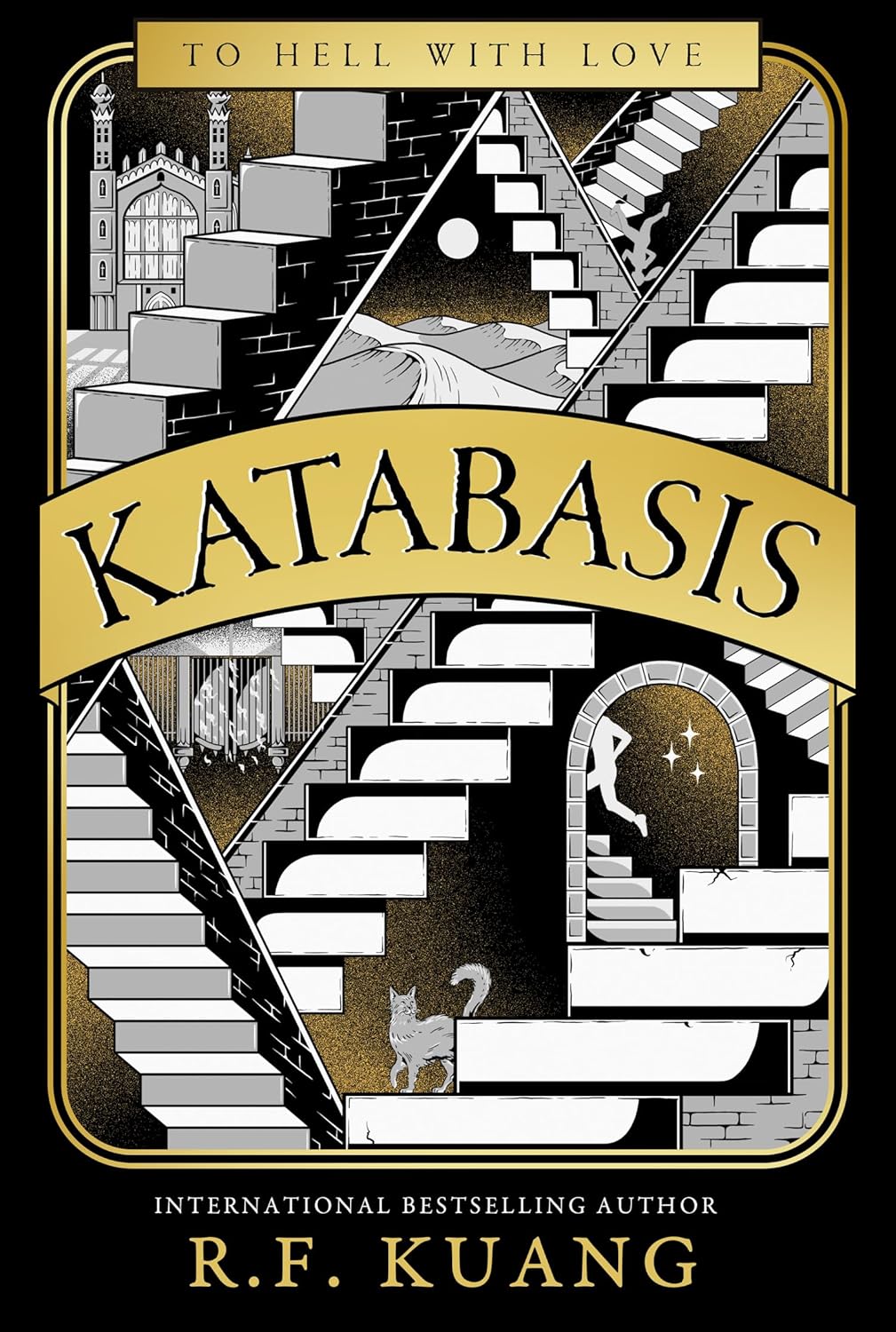
Publisher: Harper Voyager (Trade Paperback – 26 August 2025)
Series: Standalone/Book One
Length: 549 pages
My Rating: 4.5 out of 5 stars
Acclaimed author R. F. Kuang produces one of the more distinctive and intelligent fantasy novels of 2025 with her elaborate and compelling Katabasis.
Rebecca Kuang, who mostly goes by R. F. Kuang, is a very interesting author who has been making a big impact on the fantasy scene in recent years. Known for her elaborate and dark fantasy novels that often feature strong Chinese inspiration, Kuang has written some intriguing novels over the years, including her bestselling Poppy War trilogy, as well as the standalone novels Babel (also released as Babel, or the Necessity of Violence), and her contemporary satirical novel Yellowface. I have been meaning to read something from Kuang for a while, especially after seeing a lot of love for her works online, so I made sure to seek out a copy of her 2025 release, Katabasis. An intricate read with some excellent academic twists, Katabasis was a compelling novel with a very unique plot.
Plot Synopsis:
Dante’s Inferno meets Susanna Clarke’s Piranesi in this all-new dark academia fantasy from R. F. Kuang, the #1 New York Times bestselling author of Babel and Yellowface, in which two graduate students must put aside their rivalry and journey to Hell to save their professor’s soul—perhaps at the cost of their own.
Katabasis, noun, Ancient Greek:
The story of a hero’s descent to the underworld
Alice Law has only ever had one goal: to become one of the brightest minds in the field of Magick. She has sacrificed everything to make that a reality: her pride, her health, her love life, and most definitely her sanity. All to work with Professor Jacob Grimes at Cambridge, the greatest magician in the world.
That is, until he dies in a magical accident that could possibly be her fault.
Grimes is now in Hell, and she’s going in after him. Because his recommendation could hold her very future in his now incorporeal hands and even death is not going to stop the pursuit of her dreams….
Nor will the fact that her rival, Peter Murdoch, has come to the very same conclusion.
With nothing but the tales of Orpheus and Dante to guide them, enough chalk to draw the Pentagrams necessary for their spells, and the burning desire to make all the academic trauma mean anything, they set off across Hell to save a man they don’t even like.
But Hell is not like the storybooks say, Magick isn’t always the answer, and there’s something in Alice and Peter’s past that could forge them into the perfect allies…or lead to their doom.
Katabasis was an outstanding novel from Kuang, who presents a highly academic and moving journey into the underworld. Featuring a very distinctive style, Katabasis was a thoughtful and intricate fantasy read with some outstanding character moments, which really draw you in with its drama and complexity.
Kuang envisions a compelling standalone narrative for Katabasis, which combines an intelligent adventure into the afterlife with some great character-driven story elements. Following protagonists Alice and Peter as they journey together into Hell to recover the soul of their recently deceased professor, Katabasis has a bit of a slow start to it, primarily due to the highly theoretical nature of this world’s magic system and the various ideas of Hell. Kuang is forced to explore a lot of this in the early part of the book, but it serves as an excellent basis for the rest of the novel, especially when combined with hints at the troubled relationship between Alice and Peter, as well as their own dark histories. Once the story gets going in earnest, it proves to be a lot more exciting, especially when exploring the different planes of Hell, and Kuang soon adds in some other dark threats that further imperil the protagonists.
The second half of Katabasis is particularly good, as the protagonists continue their journey down the various levels of Hell, now being hunted by murderous constructs and their sinister masters. Kuang really amps up the risk factor for this part of the book, and there are some great scenes here, including one that completely changes the trajectory of the narrative. At the same time, the author fully reveals the traumatic pasts of both protagonists, which really alters the way you see them and their motivations for undertaking this adventure. Following some dark tragedy and excellent searches for self-discovery amongst the other trapped souls in Hell, the big threat of the story is eventually resolved, and the goal of the protagonists is reached. Kuang does an excellent job wrapping the book up, with the final decision of the main protagonist serving as a great full-circle moment for the entire proceeding plot. I quite liked the hopeful note that the author left her fantastic novel on, which I felt was quite fitting and allowed the reader to come away very satisfied and moved.
I felt that Kuang utilised a very distinctive, and personal style for Katabasis, that really helped her to make the classic journey into Hell story her own. A powerful, character-driven book, Kuang brings together a great adventure narrative that is constantly enhanced by a range of academic elements and the author’s own complex magick system. There is a substantial dive into both the concept of Hell, and the study of the novel’s archaic magick, and Kuang cleverly dives into the deep detail of both as the book continues. Fans of Dante’s Inferno and other classic texts about Hell will love the constant references and comparisons that occur throughout the course of the story, and it was fun to see the differences between what the protagonists expect and what they experience. I felt that this mixture of homages and the author’s own imagination was very impressive, and the author went above and beyond to set up this setting and her magick system, including with several great maps of Hell that appear in the version of the book I got. I also felt that the author’s compelling dive into the torture that is advanced academia and the various pressures, lies and rivalries that formed was particularly gripping. Kuang clearly adds a lot of her own experiences with academia, especially in the elite British universities, into the protagonist’s past, and it gave a gritty bit of academic realism to the plot. It does need to be said that Kuang made her novel a little too complex at times, and there are a few sections which drag as the protagonist’s dive into obscure lore, elaborate equations, or complicated logic. Still, for the most part Katabasis was a well-written and addictive standalone read, that will really appeal to established fans of the author.
I think that another major highlight of Katabasis was the excellent character work that Kuang featured throughout the plot. Focused primarily on the main characters of Alice Law and Peter Mudoch, both protagonists are initially portrayed as brilliant and highly ambitious academics whose journey into Hell only seems to enhance their own rivalry. However, as the book continues, Kuang does a masterful job of diving deeper into their backstories and showcasing more of their pasts to give their current adventure and motivations more meaning. It turns out that both characters are a lot more damaged than you’d initially realised, due to their own experiences in academia, their interactions with their supervisor, and the crippling rivalry that has formed between them. The slow reveal of the full extent of their damage, which also includes both characters reevaluating previous information and conclusions they’ve made, is very impressive, and each revelation adds some greater emotional heft to the plot. Combine that with the gradual evolution and repair of the relationship between Alice and Peter as the book continues, and this was quite a powerful journey for the two protagonists, especially as they experience even more tragedy, betrayal and uncertainty in Hell.
While most of the book is focused on Alice and Peter, I do have to also highlight how well Kuang set up supporting character Professor Jacob Grimes in the Katabasis. Despite being dead and appearing mostly in flashbacks and the memories of the protagonists, Professor Grimes serves as an influential figure in the plot, primarily for the impact he had on his various students. Initially shown as a brilliant and supportive academic, the flashbacks shown throughout the course of Katabasis soon reveal a more malicious side to Grimes, which really changes your view of the protagonists’ journey to save him. Kuang’s slow burn reveal of all of Grimes’s flaws and manipulation was just perfect, and I loved how your perception of this shadowy figure the plot is chasing changes the more honest and open the protagonists become. The full extent of Grimes’s actions, and his students’ complicated feelings for him, is such a compelling part of the Katabasis’s plot, and I liked how well it’s tied into the larger problems with academia. I really do appreciate how well Kuang set up Professor Grimes as a dark supporting figure in this book, whose influence has major implications to the story, even if he only actually appears in the present adventure once. Throw in some other intriguing denizens of Hell, including a twisted family doing their own dark experiments on the dead in brutal fashion, and Kuang really showcased her ability to write complex and damaged characters in Katabasis.
Overall, Katabasis was a highly compelling and deeply intricate fantasy novel that was a distinctive highlight of the 2025 reading year. I certainly got the full experience of Kuang’s intriguing imagination with this elaborate book, and the resulting story was an interesting take on dark academic fantasy. Clever, moving and full of some unique features, Katabasis was an outstanding read that is really worth checking out.

 The Unseen Library