Book Haul – 15 March 2019

It has been a good week for books, I have received several amazing novels that I am very much looking forward to reading.

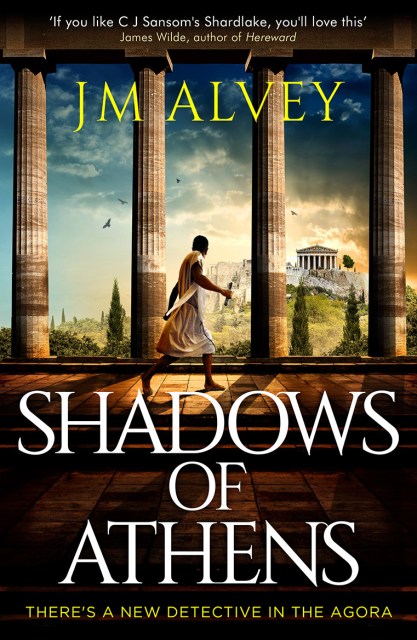
Shadows of Athens by J. M. Alvey

shadows of athens cover

This is one I am really looking forward to and I have previously featured it in one of my Waiting on Wednesday segments.

Hearts of Ice by David Hair

Hearts of Ice Cover.jpg

This book has an dragon fighting an elephant on the cover, what more do I need to know about this.

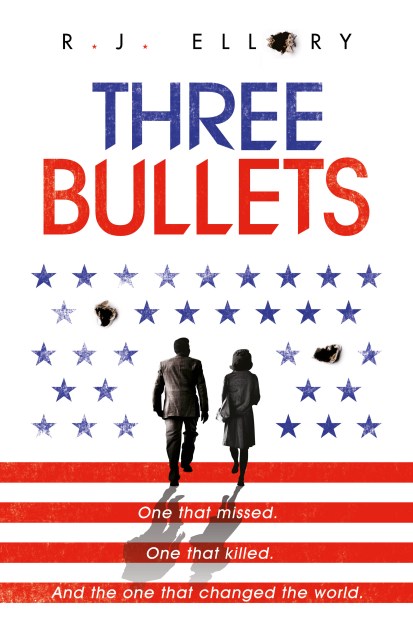
Three Bullets by R. J. Ellory

Three Bullets Cover.jpg

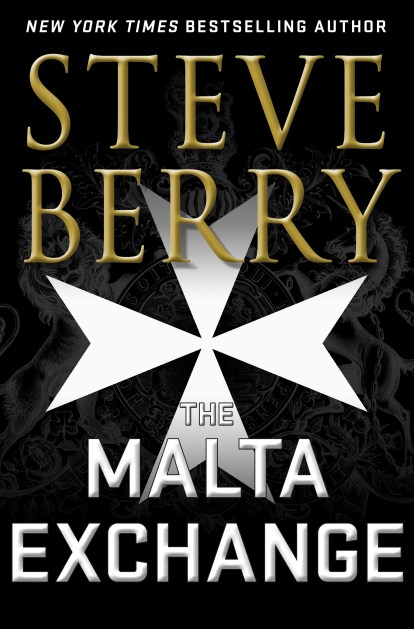
The Malta Exchange by Steve Berry

The Malta Exchange Cover.jpg

The Secret Runners of New York by Matthew Reilly

The Secret Runners of New York Cover.png

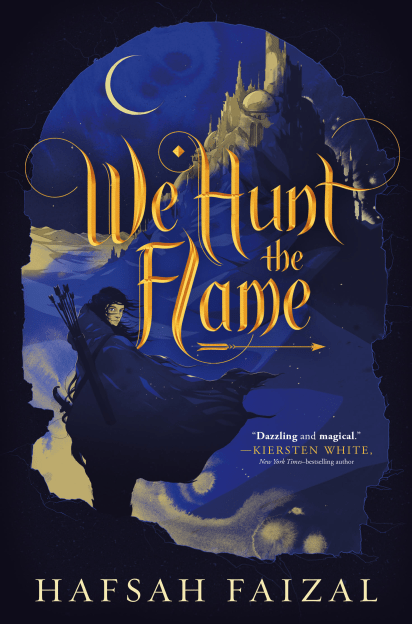
We Hunt The Flame by Hafsah Faizal

We Hunt The Flame Cover.png

Throwback Thursday – The Andromeda Strain by Michael Crichton

The Andromeda Strain Cover.jpg

Publishers: Brilliance Audio (Audiobook Edition – 26 May 2015)

                        Knopf (12 May 1969)

Series: Standalone/Book 1

Length: 8 hours 15 minutes

My Rating: 4.5 out of 5 stars

Amazon     Book Depository

Reviewed as part of my Throwback Thursday series, where I republish old reviews, review books I have read before or review older books I have only just had a chance to read.

For this week’s Throwback Thursday I take a look at a classic techno-thriller from legendary author Michael Crichton, The Andromeda Strain.

The Andromeda Strain was released nearly 50 years ago, in May 1969, and represented a bold new direction from Crichton, who had previously done several pulpy crime novels, such as Odds On and Scratch One, under the name John Lange, as well as the medical crime thriller A Case of Need, which he wrote under the name Jeffrey Hudson.  The Andromeda Strain was considered to be part of the new techno-thriller genre and is still considered to be a major example of this genre.

I have only read three of Crichton’s books before, including Jurassic Park (for obvious reasons), The Lost World and Pirate Latitudes.  While I have always intended to go back and read some more of Crichton’s works, I have never had the time to do so.  However, with the recent announcement that The Andromeda Evolution is being released in November to correspond with the 50-year anniversary of The Andromeda Strain, I thought this would be the perfect opportunity to check out one of Crichton’s earlier books.  For that reason, I listened to the audiobook version of The Andromeda Strain narrated by David Morse.

When a military satellite comes down in the small town of Piedmont, Arizona, nearly all the residents in the town die.  They are victims of a mysterious new pathogen that either instantly clotted all the blood in their body or drove them to suicide.  The military quickly activate the Wildfire protocol, and a small government team of scientists and doctors take command of Piedmont and the satellite.

Believing that the satellite contains an extraterrestrial organism, the team bring it and the two survivors of Piedmont, an old man and a baby, to a secret and secure underground Wildfire laboratory for study.  Deep in the laboratory, the team attempt to identify and categorise the organism which has been given the codename Andromeda.  However, Andromeda is evolving a way no member of the Wildfire team believed possible, and not even the laboratory’s nuclear bomb safeguards may be enough to keep it contained.

After listening to The Andromeda Strain over a couple of days, I found it to be an extremely thrilling and complex novel that I really got into and which I am eager to review.  However, after 50 years and thousands of reviews I am not too sure how much I can really say about this book that has not already been said.  That being said, when looking at this book from a 2019 perspective, I feel that The Andromeda Strain is still an extremely strong techno-thriller, with some expert storytelling and an in-depth scientific base that is still relevant in this modern era.

In this book, Crichton utilised a very dry, detailed and scientific approach to his writing, slowly covering every aspect of the events unfolding before each of the protagonists, while also providing the reader with backstory on the characters and briefings on the various relevant scientific and political components of the book.  Despite this somewhat less exciting writing style, Crichton is still able to create quite a thrilling atmosphere throughout the book as the story gets closer to the inevitable disaster part of the plot.  Crichton really adds to the suspense by mentioning the various mistakes that the protagonist are making and hinting at all the problems going on around them that will eventually lead to the release of the Andromeda microbe.

I did feel that the book ended rather suddenly, and I was surprised that the investigation part of the story was still going with only a short amount of the book left to go.  I found it interesting that the part of the story that dealt with the release of Andromeda and the subsequent race to stop the nuclear explosion about to wipe out the lab was introduced so late in the book and solved so very quickly.  I was expecting a large portion of the story to focus on the main characters getting past all of the impressive contamination protocols in order to stop the nuclear explosion.  Instead, this was all solved within about 10 minutes of audiobook narration, or probably five to 10 pages of a normal book.  While I was surprised about this, I suppose it does make sense in the context of the rest of the story, where the characters and briefing material did mention several times that there was a three-minute delay between the bomb arming and the explosion.  This was all extremely thrilling, and I felt that the book is still capable of keeping authors on the edge of their seats.

One of the things that really surprised me about the book was the advanced level of technology that was featured within a story written and set in 1969.  Perhaps this is simply ignorance as a result of being a child of the 90s, but I feel it is more likely the result of Crichton having a great understanding of technology and potential future advances that might be utilised within a high-level government laboratory.  Certainly, the scientific features of this book are extremely impressive, and I felt that they were still extremely relevant and understandable in a 2019 context.  For example, all the extreme quarantine methods surrounding the Wildfire laboratory sound like perfectly reasonable steps that modern laboratories could use to keep pathogens contained.  All the discussions about viruses and micro-organisms were also incredibly detailed, and I felt that much of the information discussed around those is still relevant today, and modern audiences will still be able to understand and consider it quite easily.

I did find the concept of the Odd-Man Hypothesis to be extremely interesting.  In essence, the Odd-Man Hypothesis states that out of all the humans in the world, unmarried men are the most likely to make the best and most dispassionate decision in the face of an emergency.  This becomes a key part of the story, as one of the characters is designated as the Odd-Man and is the only person with the ability to shut off the laboratory’s nuclear self-destruct device.  Now this is one theory that does not translate to more modern times, although, in fairness, most of The Andromeda Strain’s characters did not take it that seriously either.  That being said, it was an extremely intriguing element to read about, and I enjoyed the discussion around its viability and use within the context of the story.

As I mentioned above, I chose to listen to The Andromeda Strain in its audiobook format.  There are actually a number of different audiobook versions of The Andromeda Strain out there, each with different narrators, such as an earlier version narrated by Chris Noth.  I ended up listening to the most recent audiobook version of this book, although I imagine a new version is sure to follow soon, especially with a sequel about to come out.  The version I listened to was narrated by actor David Morse and was released in 2015.  This version is 8 hours and 15 minutes long, and I found myself powering through it very quickly.

I think that the audiobook was a really great way to listen to The Andromeda Strain, as it allows the reader to absorb the huge amount of scientific detail and discussion a lot easier.  I felt that David Morse was an excellent narrator for this book, and that his basic narration voice perfectly fit the books tone and style.  Morse also comes up with some great voices for this book, and I was particularly impressed by his weary old man voice.  As a result, I would highly recommend the audiobook version of The Andromeda Strain, as it is definitely an outstanding way to the listen to this fantastic story.

Overall, I loved this dive back into the past and I had a lot of fun listening to this classic techno-thriller.  Crichton is an amazing author, especially when it comes to a more science-based story, and I am incredibly impressed that his story still holds up 50 years after it was first published.  I am extremely curious to see where the upcoming sequel, The Andromeda Evolution, takes the story, and how well new author Daniel H. Wilson replicates Crichton’s style.  This book has also encouraged me to check out some more of Crichton’s works, and I am looking forward to reading some more of this author’s excellent techno-thrillers, as well as some of his intriguing historical fiction pieces.

Amazon     Book Depository

Star Trek Discovery: The Way To The Stars by Dr Una McCormack

Star Trek Discovery - The Way To The Stars Cover

Publisher: Gallery Books (Trade Paperback Format – 8 January 2019)

Series: Star Trek Discovery – Book 4

Length: 276 pages

My Rating: 3.75 out of 5 stars

Amazon     Book Depository

Get ready to dive into the extended Star Trek universe with The Way To The Stars, the latest tie-in novel to the franchise’s current show, Star Trek Discovery.

While most people would be familiar with the iconic Star Trek television shows and movies, some may be unaware that there is an extremely rich and extensive Star Trek universe across a variety of different media formats.  This is particularly true when it comes to the vast number of Star Trek novels which utilise the franchise’s massive universe.  Since 1967, during the run of the original Star Trek television series, a bevy of authors have contributed to this extended universe by creating a huge number of novels made up a range of different series and publishers.  There are now over 840 Star Trek novels, not only complementing the various Star Trek movies and television shows but also creating a series of new adventures.

With the announcement of the latest Star Trek television show, Star Trek Discovery, in late 2017, a new series of related novels was commissioned for release around the same time.  This new series focused on several of the characters featured within Star Trek Discovery, providing intriguing character history and a series of new, exciting adventures.  The first book in this series, Desperate Hours, was released in 2017, days after the premier episode of Star Trek Discovery.  These books have so far covered several of the show’s key characters, including Michael Burnham, Saru, Gabriel Lorca and Philippa Georgiou, while a fifth book out later this year will focus on Christopher Pyke and the original crew of the U.S.S. Enterprise.  I actually have a copy of the second book in this series, Drastic Measures, on my bookshelf at home, and I have been intending to read it for some time.  I will hopefully get to that, and the other books in the Star Trek Discovery book range, at some point in the future.

I have to admit that I am more of a casual Star Trek fan and I have more of a preference for Star Wars (and with that, I lose several Trekkies reading this review).  That being said, I have watched a number of the movies and I am really enjoying Star Trek Discovery at the moment.  This book is the first actual Star Trek novel that I have had the pleasure of reading, and there are several cool-sounding upcoming Star Trek novels that I am probably going to try and check out.

The Way To The Stars focuses on the character of Sylvia Tilly, the young, brilliant and awkward Starfleet cadet and essential member of the U.S.S. Discovery’s crew.  However, when she was 16, years before she joined Starfleet, her life was going down a different path.  The daughter of a high-ranking United Federation of Planets (the Federation) diplomat, Tilly finds herself under intense pressure to succeed.  Forced by her domineering mother to abandon her love of science and engineering to pursue a career as a diplomat, Tilly is shipped off to an elite off-world boarding school.

Forced out of her comfort zone, and continuously micromanaged by her mother, Tilly begins to crack under the pressure until, for the first time in her life, she rebels.  Escaping the school and embarking on a dangerous off-world trip, Tilly seeks her own path in life, which will eventually lead her join Starfleet and adventure out into the stars.

The Way To The Stars is the fourth entry in the Star Trek Discovery book series, and it is written by veteran science fiction and tie-in novel author, Dr Una McCormack.  Dr McCormack is an expert when it comes to the novelisation of popular science fiction television shows, having written a number of Doctor Who tie-in novels throughout her career.  Dr McCormack also has a large amount of experience when it comes to the Star Trek extended universe, having authored several novels that continue the adventures of The Next Generation and Deep Space Nine television series.

This book was a little different to what I anticipated it would be.  Rather than featuring an action-packed adventure with Starfleet like the previous books in the Star Trek Discovery series, The Way To The Stars mainly focused on Tilly’s school and family life.  While this was still a very interesting and enjoyable read, I kept expecting pirates, aliens or some sort of antagonist to drop in and take over the school, forcing Tilly to use the engineering skills that her mother and school friends were so dismissive of to save the day.  So it was a tad disappointing to find this book only contained a mostly school-based story, more concerned with Tilly’s studies, her overbearing mother and her problems making friends.  Do not get me wrong; there are a lot of fun and enjoyable elements to these parts of the story, and the later part of the book in which Tilly runs away from school and tries to make her own way in space are very interesting.  It was, however, somewhat lighter than what I was expecting from a Star Trek novel, and its tone and writing style reminded me more of a young adult school novel.

That said, this was still a very enjoyable novel as Dr McCormack does an amazing job of bringing one of Star Trek Discovery’s most entertaining characters to life while placing her in a fun and interesting coming of age story.  The author makes great use of the Star Trek elements to tell her story, and I found it fascinating to see the advanced interplanetary schooling (rich boarding schools are rich boarding schools no matter what planet they are on), as well as Tilly’s adventures on human planets and ships outside of Federation space.  The latter parts of the book set on the Starfleet ship were fun, and it was great to see the adventures of a scientific ship, as well as Tilly’s contributions to their voyage.  The resultant first contact that they make was interesting, and it was cool to see elements from the part of the story set in the school come into play during this bit.  Overall, I did have a lot of fun reading The Way To The Stars, and found it to be a very well-written story with a lot of intriguing elements to it.  I really got into the story and managed to read it in only a couple of days, so many people should have fun reading it.

One of the things that I did like about The Way To The Stars was the way the author brought the book’s main character, Tilly, to life.  Within Star Trek Discovery, Tilly, as portrayed by Mary Wiseman, is a fun, brilliant and neurotic character who serves as the show’s moral centre and heart.  Despite mostly being a kind and thoughtful person, Tilly is regularly able to take control of a situation and act in a command capacity, often with humorous results.  I felt that Dr McCormack’s portrayal of Tilly within this book did an excellent job of either showing that these were already existing qualities/personality traits or else examined the first time that Tilly ever showcased these traits.  It was really good to see where Tilly came from and the sort of influences she had in her life to turn her into the character that is so beloved in the show.  As a result, The Way To The Stars is an excellent coming of age story, and I really enjoyed the way that the author wrote the character within the book.

This book is strongly related to the Star Trek Discovery television show; however, I do not believe that too much pre-existing knowledge or fandom experience is required to enjoy The Way To The Stars.  Dr McCormack has an inclusive writing style and I believe that anyone with even a basic knowledge of Star Trek will be able to pick this book up and enjoy the fun story within.  It should go without saying, though, that those people who are fans of the Star Trek universe will get a lot more out of this story.  This is especially true for fans of Star Trek Discovery, who will appreciate this deeper dive into the protagonist’s backstory and the examination of her early life.  I believe that The Way To The Stars is considered to be a canon story within the Star Trek universe; however, I doubt that the events within will have any impact on the show.  Still, it is quite an interesting inclusion that will really interest those who have come to enjoy the characters of Star Trek Discovery.

Star Trek Discovery: The Way To The Stars is a fun and enjoyable tie-in novel that does an amazing job of examining the past of a key character of the show.  Dr McCormack creates an interesting coming-of-age story that will appeal to hardcore Trekkies and casual science fiction readers alike.  I quite enjoyed my first foray into the Star Trek extended universe, and I am planning to try and get some of other Star Trek books coming out later this year.  Stay tuned to see me go further beyond the final frontier.

Amazon     Book Depository

Waiting on Wednesday – The Andromeda Evolution by Michael Crichton and Daniel H. Wilson

Welcome to my weekly segment, Waiting on Wednesday, where I look at upcoming books that I am planning to order and review in the next few months and which I think I will really enjoy.  Stay tuned to see reviews of these books when I get a copy of them.

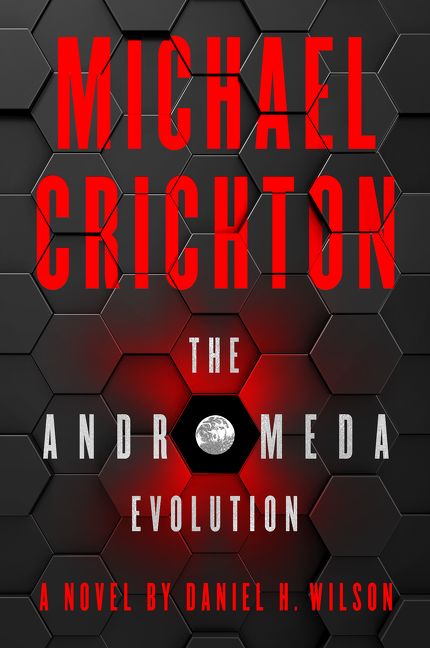
The Andromeda Evolution Cover

In this week’s Waiting on Wednesday, I take a look at The Andromeda Evolution, the recently announced sequel to Michael Crichton’s game-changing novel, The Andromeda Strain.

Michael Crichton is one of the most iconic authors of the last 50 years, having written a series of varied and highly regarded novels, many of which were turned into movies.  It goes without saying that you have heard of his most famous novel, Jurassic Park, which was adapted into the movie of the same name.  Between his debut in 1966 and his death in 2008, Crichton released 28 full-length fiction books, including Congo, Sphere, The Lost World, Rising Sun, Binary and Eaters of the Dead (also known as The 13th Warrior).  These books were mostly released under his own name, but several novels were released under the pseudonym John Lange.

One of Crichton’s most famous books was his 1969 release, The Andromeda Strain, his first foray into the science fiction genre.  It followed a group of scientists as they attempted to contain and study an extraterrestrial microbe, known as Andromeda, within a high-tech government laboratory.  While not his first book, this was the novel that helped launch his career, and was highly regarded by reviewers at the time of its release.  It is also considered to be one of the first books of the techno-thriller genre, and its success no doubt encouraged Crichton to write more science fiction works, such as Jurassic Park.

It was announced only a couple of weeks ago that a sequel to The Andromeda Strain will be released later this year to mark the 50th anniversary of its release.  The Andromeda Evolution will be released worldwide on 12 November 2019 and has been written by bestselling science fiction author Daniel Wilson.

No real plot details for this book have been released yet, and it will be interesting to see where the story goes.  The Andromeda Strain ended with Andromeda evolving and being released into the upper atmosphere, where it was severely impacting the space programs of the United States and the Soviet Union.  From what very little is known, it appears that in the new book the microbe will somehow evolve again to become a much more serious threat.  I am deeply intrigued to see how this new book will continue the story told in The Andromeda Strain, especially as the author could take the story in so many different directions.  I am very curious about what causes the disease to evolve again, and what new impacts this will have on Earth.  I imagine that this book will be set in more modern times, which also offers up a range of possibilities.  In particular, this might create an alternate timeline for Earth, as the lack of a space race might have severely altered history.

I am quite excited for the author chosen to continue this story, Daniel Wilson.  Wilson is one of the most intriguing authors of science fiction at the moment, having written several bestselling techno-thrillers, including his epic Robopocalypse series.  I think that Wilson’s writing style and imagination will mesh quite well Crichton’s original concept, and the resulting collaboration will be something special.

I am a bit uncertain whether The Andromeda Evolution will be based on any notes Crichton left behind, or whether it was only inspired by the original novel.  The three previous Michaels Crichton novels that were released after his death (Pirate Latitudes, Micro and Dragon Teeth) were either completed or partially written by Crichton himself.  However, as Wilson is credited as the author on the cover, I am thinking that the story is mostly based on his ideas.  This new perspective on the story may prove to be extremely interesting, and it could be the first in a new wave of Michael Crichton inspired techno-thrillers.

The Andromeda Evolution should prove to be an extremely interesting release for later in the year, and I am very eager to check it out.  Check back here tomorrow for a throwback review for The Andromeda Strain, and I may update this post later when more plot details about The Andromeda Evolution become available.

Master of Sorrows by Justin Call

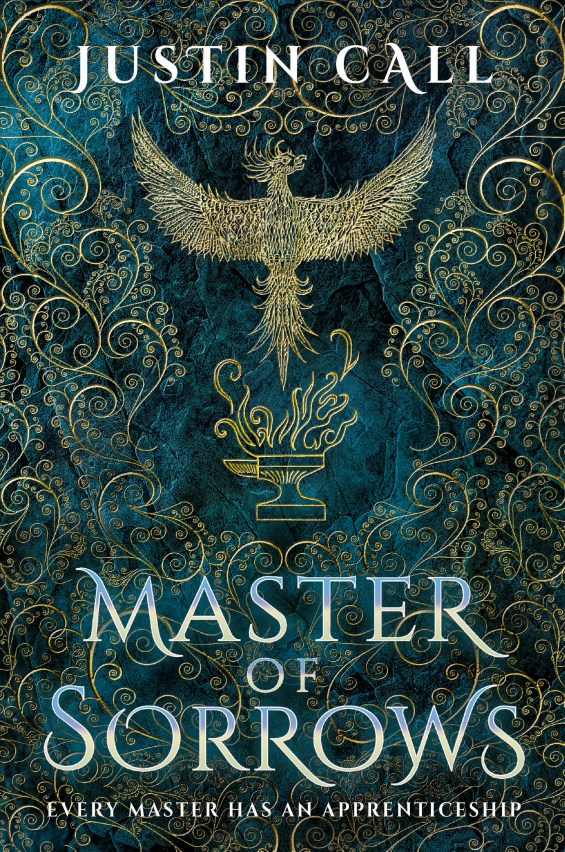
Master of Sorrows Cover

Publisher: Gollancz (Trade Paperback format – 21 February 2019)

Series: The Silent Gods – Book 1

Length: 576 pages

My Rating: 4.5 out of 5 stars

Amazon     Book Depository

I have been looking forward to reading and reviewing Master of Sorrows for a while now.  I previously mentioned this book in one of my Waiting on Wednesday articles, which got a fair amount of attention, which I took as a sign of some interest from the general fantasy fandom.  The intriguing-sounding plot also made me extremely eager to check this book out, so I was very happy when I received a copy of it from Hachette Australia.  In the end I found Master of Sorrows to be a terrific piece of fantasy fiction and an outstanding debut from first-time author Justin Call.

The world of Luquatra has known much chaos and turmoil throughout its long history as three elder gods and their followers have battled for supremacy.  But now with the dark god Keos banished from the land, the greatest concern for many is the presence of magic.  The ancient and hidden Academy of Chaenbalu has long been a bastion against all things magic and will go to extreme lengths to achieve its primary objective of finding and containing the vast number of magical artefacts scattered throughout Luquatra.  No artefact, no matter its strength or intended purpose, can be allowed to remain outside the control of the Academy, as even those artefacts created for good can be used for great evil.

In order to fulfil this sacred work, the Academy trains all the children of Chaenbula in the arts of combat and magical detection.  Only the best students will become Avatars, warrior thieves capable of infiltrating any location and making away with the hidden artefacts.  Most importantly, an Avatar is trained to resist the lure of magic and the corruption of Keos.

Annev de Breth has always dreamed of becoming an Avatar and is determined to pass the Academy’s tests.  However, Annev is different from every other student at the Academy; trained by the town’s mysterious priest, Annev has an affinity for magic and hides a secret disfigurement that would see him immediately put to death.  Caught between the warring ideologies of the man who raised him and the head of the Academy, Annev needs to decide what kind of man he wants to be while navigating the complex politics of Chaenbalu.  But ancient powers are rising from the past, and it soon becomes apparent that Annev might not be the hero of this story; instead, he may be the man destined to unleash Keos once more upon Luquatra.

As I mentioned above, Master of Sorrows is author Justin Call’s debut novel.  It is also the first book in his The Silent Gods series, which is going to be made up of four books.  Call has already announced that each of the three upcoming books will be released in late February of each year for the next three years, with this series set to wrap up in February 2022.  This first book is an ambitious introduction to series that does a fantastic job of setting up the main story, as well as introducing the reader to an intriguing new fantasy universe.

I really enjoyed the story contained within Master of Sorrows, as it is well paced out and contains some fantastic moments.  The first part of the book features Annev attempting to pass the Academy’s tests in order to become an Avatar.  I love a good magical school storyline, and this one is pretty fantastic, featuring some unique, complex and entertaining testing sequences, as well as an introduction to the complex and restrictive life within the Academy.  The rest of the book is extremely exciting and eventful as the protagonist learns more about the threats and complex world outside of Chaenbalu, and even embarks on a dangerous mission where he encounters a series of mysterious threats.  This all leads up to the book’s spectacular conclusion, which not only sets the scene for all manner of adventures in the future but also results in some interesting character development while also setting up several dangerous new antagonists with personal grudges against the main character.

One of my favourite things about the plot is the general intrigue and hypocrisy surrounding the Academy of Chaenbalu.  The Academy is framed as some ultimate bastion of good in the world, opposing the evils of magic and Keos.  However, as the book progresses, the reader, through the protagonist’s eyes, begins to see that everything about the Academy is more complex and morally ambiguous than it first appears, resulting in a number of powerful story developments.  For example, in this universe, any disfigurement or disability is viewed as a mark of the dark god Keos’s favour, and people who bear them, especially those born with some sort of disfigurement, are shunned or killed.  These rules are especially enforced within the Academy, and Annev is forced to hide his disability to stay alive.  Watching a basically good character be vilified for something outside of his control makes the reader lose trust in most of the characters associated with the Academy.  It is also very thrilling to see the lengths the protagonist will go to in order to hide his disfigurement and try to live a normal life within Chaenbalu, knowing that his secret could be discovered at any turn.  The reader is also left questioning the Academy’s many archaic rules, as these rules and blind obedience are particularly frustrating to the protagonist, who chafes at the restrictions and is constantly questioning everything.  There are also a huge number of different plots and schemes occurring within the Academy, with many of the characters having secret allegiances and plans, many of which come to the surface by the end of the book.  All of these elements are fantastic, and they really add a keen edge of intrigue and thoughtfulness to an already captivating story.

Within Master of Sorrows, Call introduces his readers to a deep and enjoyable new fantasy universe that serves as an excellent basis for his story.  While the author does make an effort to set up a much larger world, the vast majority of the story is set in and around the village of Chaenbalu, which houses the Academy.  As I have mentioned before, I loved the Academy as a setting, but some of the other locations are also intriguing, such as the massive magical forest that surrounds the town.  I really loved the overall setting of the gods and magic within this world, especially when it comes to people’s perceptions about them, as they have some fantastic impacts on the story.  Call spends a bit of time expanding on the mythology of this world’s main gods, telling their stories and explaining the impacts that they had on the world.  These are quite interesting, especially as the stories they tell reveal that the conflicts of the gods were just as complex as the issues occurring within the Academy.  The author has also come up with some fun and dangerous new fantasy creatures, mostly as servants of the god Keos.  These creatures have some great scenes, especially towards the end of the book, and I look forward to seeing more of them and this intriguing new world throughout the rest of The Silent Gods series.

I really need to the hype up some of the incredible action sequences featured within Master of Sorrows.  Call has created several exceptional extended action scenes within this book, including two intricate tests within the Academy, where the students must overcome not only each other but also the various obstacles set up against them.  These testing scenes are extremely elaborate and feature some interesting rules and opposition.  I loved reading these scenes, and it was great watching the protagonist try to complete them his way.  In addition to these testing scenes, there is also a great magic based combat sequence featured later in the book, where the protagonist and his companions must overcome all manner of magical traps and attacks in order to complete their objective.  This scene is massive in terms of destruction and brutality featured and was an excellent addition to the book.  As a result, readers who love a good amount of thrilling action in their fantasy stories should definitely check this book out as Call demonstrates a real skill for creating unique and captivating fantasy action sequences.

Master of Sorrows is an amazing debut from new author Justin Call, who has done a wonderful job setting up a fresh and intriguing new fantasy series.  This first book in the planned The Silent Gods series has some awesome and memorable plot points and features a thrilling and captivating action-packed adventure.  Call has certainly set himself up as a fantasy author to watch, and I am extremely eager to see where this story goes next.  I cannot wait to check out the second book in The Silent Gods series.

Amazon     Book Depository

Reckoning of Fallen Gods by R. A. Salvatore

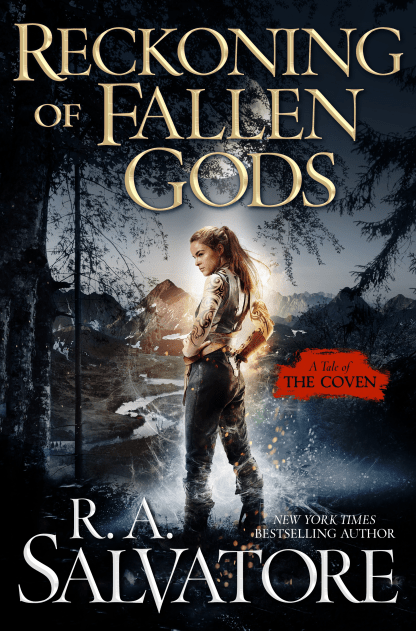
Reckoning of Fallen Gods Cover.png

Publishers: Tor Books and Audible Studios (Audiobook Format – 29 January 2019)

Series: The Coven – Book 2

Length: 14 hours 37 minutes

My Rating: 4.5 out of 5 stars

Amazon     Book Depository

Prepare to return to Corona, the world of The DemonWars Saga, for Reckoning of Fallen Gods, the latest book from master fantasy author R. A. Salvatore and the second book in his outstanding new The Coven series.

In the world of Corona, no lands are as harsh or unforgiving as those surrounding the massive Loch Beag.  All manner of dangerous creatures live in and around the loch, including one massive and unseen lake monster that lurks right below the surface.  But for those who live in the fishing villages that eke out a living around the shore of Loch Beag, the biggest danger is more human in origin.  Living at the top of the massive mountain, Fireach Speur, is a barbaric tribe, the Uscar, who constantly raid the fishing villages below.  Enhanced in battle by the crystal magic of their witches, the Uscar are ferocious warriors who consider themselves vastly superior to the inhabitants of the villages they raid.

This cycle of violence and death existed for hundreds of years until a powerful young Uscar witch, Aoelyn, attempted to change her tribe’s ways by destroying the fossa, a demonic creature that haunted the mountain at night.  However, her decision will have terrible consequences, as ambitious members of her tribe turn against her.  As Aoelyn endures the wrath of her tribe, her friend, the slave Bahdlahn, attempts to escape from the Uscar with help from an unexpected ally.  Down at the shore of Loch Beag, the trader Talmadge, who Aoelyn saved from her tribe’s brutality the night she ended the fossa, attempts to find some sort of peace among the fishing villages who have accepted him as a friend.  However, the appearance of a mysterious stranger will bring significant changes to his life.

But while those living around Loch Beag fight among themselves, they are unaware of a much bigger threat growing in the East.  A lost empire of goblinoids, the Xoconai, are on the march, driven by the return of their fallen god.  The Xoconai are determined to conquer all the lands of man, and the first obstacle they must overcome is the people of Fireach Speur and Loch Beag.

R. A. Salvatore is one of the best and most prolific authors of fantasy fiction in the world today, having a written over 60 fantasy books in his career. He is perhaps best known for his work in the established Forgotten Realms universe and the incredibly popular character of Drizzt Do’Urden. However, Salvatore has also written a series of novel set within his own unique fantasy world of Corona.

Salvatore introduced audiences to this new fantasy world in his 1997 release, The Demon Awakens, the first book in his epic The DemonWars Saga, which spanned seven books between 1997 and 2003.  This universe was expanded out in 2004 with The Highwayman, the first book in his Saga of the First King series.  After the Saga of the First King series ended in 2010, Salvatore left the world of Corona untouched for eight years while primarily focusing on his Forgotten Realms series.  However, he returned to Corona in 2018 with Child of a Mad God, the first book in his new The Coven series.  The Coven series is primarily set in a previously unexplored area of Corona, in the lands around the massive Loch Beag, with the first book focusing on a whole new group of characters.

I am a massive fan of Salvatore’s work, having read nearly all the books featuring Drizzt Do’Urden and his companions (click here for my review of the latest Drizzt Do’Urden book Timeless).  However, before last year’s Child of a Mad God, I had not really gotten into his work set in Corona, having only really read The Highwayman back when it was first released in 2004.  While Child of a Mad God was not my favourite of Salvatore’s books, it did a great job introducing this new area of Corona, while also creating an excellent starting point for the series’ overall plotline.

I found that I enjoyed Reckoning of Fallen Gods a lot more than the first book in the series, possibly because the author was able to dive right in and continue several of the more intriguing plot threads from the first book.  I quite enjoyed how the story progressed; all of the storylines contained within were very well paced and entertaining, coming together extremely well towards the book’s conclusion.  I really liked the over-the-top way that the story ended, as it sets up the next book in the series with some massive stakes and makes full use of the intriguing new fantasy elements that were included within this book.  A bit of a warning about this series: is it substantially darker than some of Salvatore’s other works.  This was particularly true of the first book of The Coven series, Child of a Mad God, which contained a fair amount of torture and sexual violence.  While there is a little less sexual violence in this book, several character development elements are based around these original events and are discussed in some detail.  There is also some fairly dark and gruesome action and torture, which might not be enjoyable for some readers.  Overall, though, this is a great follow-up to Child of a Mad God that once again highlights Salvatore’s skill as a master fantasy storyteller.

Some readers may be wary about checking this book out because it is the second book in The Coven series and the 13th overall book set in the world of Corona.  However, I found that this book to be easily accessible to new readers, with the author ensuring that relevant details from the previous book and series were easy to understand and follow nearly right away.  In addition, there are also a lot of elements for established fans of this universe to enjoy, especially as Salvatore includes a substantial character from one of his previous Corona based series in this book.  The inclusion of this character is an excellent way to tie this new series with the author’s existing works in this fantasy universe, which also highlights the importance of this story to the rest of the world of Corona.  The ending of Reckoning of Fallen Gods also hints that characters and locations from the previous series may come into play in the next book in The Coven series.

I loved all the fantasy elements in this book.  The world of Corona is a fantastic setting for the great story that is taking shape within The Coven series.  The main location for most of this book’s plot, the lands around Loch Beag and Fireach Speur, is a substantially dark and rugged area with a large number of natural and unnatural threats.  In Reckoning of Fallen Gods, there are a number of significant developments around several of these locations and creatures, some of which are pretty insane.  Just like in the first book in this series, Child of a Mad God, Salvatore continues to expand on the intriguing gem-based magic that is a feature of the books set in Corona.  The gem magic that was featured in Child of Mad God was somewhat different from the already established gem magic used in some of previous Corona books, such as The DemonWar Saga, and is based around the magic found atop Fireach Speur.  This expansion of the gem magic continues in Reckoning of Fallen Gods with the main character, Aoelyn, developing additional magical abilities.  Many of these abilities are quite spectacular, and Salvatore’s enthralling writing highlights how impressive these abilities are when Aoelyn utilises them in fights or other magical engagements.  At the same time, another character utilises some of the more traditional gemstone powers they had in one of the previous series, and it is interesting to see the differences and similarities this has with the Uscar magic.

One of the more unique and enjoyable fantasy inclusions within Reckoning of a Fallen God is the new antagonist race, the Xocanai.  The Xocanai are a new race of goblinoid creatures that exist in a realm on the other side of the mountains surrounding Fireach Speur.  The Xocanai are somewhat Aztecan in culture and their empire has been rather cut off from the rest of the world for some time.  However, recent actions have allowed them to come together to invade the human lands, and some of the events of Child of a Mad God may be to blame.  I felt that Salvatore did an excellent job of introducing them in the current book, and he was able to build them up as a substantial antagonist in quite short order.  I liked how the reader is able to get a good view of this new race’s culture and religion in only a few short chapters, while in-universe texts present at the start of each section of the book help to establish a historical past for these creatures.  In the end, they are a fantastic new inclusion to the series and the universe and serve as excellent new antagonists.

Salvatore has created some great new characters for this series, and many of the key characters who were introduced in the first book go through some significant and compelling character development throughout Reckoning of Fallen Gods.  The main character development occurs with Aoelyn, who, after the fallout of the events in the first book, develops a stronger sense of independence and rejects the established male hierarchy imposed upon her and all the female members of her tribe.  Her friend Bahdlahn gains the courage to finally flee the Uscar and is finally able to come to terms with his feelings for Aoelyn.  At the same time, the trader Talmadge comes to terms with the tragedies in his life and is finally able to find some semblance of peace with the people living around Loch Beag.  Even the established character from the previous series (who I am still not mentioning for spoiler reasons) has developed somewhat in this book, as he ruminates on the mistakes from his past that were covered in the previous series.

I have to give credit to Salvatore for creating some truly villainous antagonists for this series, especially among the Uscar characters.  The main antagonists are quite despicable, especially in the way that they deal with Aoelyn and Bahdlahn, and the reader is hoping for all sorts of comeuppance for these characters.  Even the Uscar characters that come across as more compassionate members of the tribe can still be quite dislikeable.  For example, there is one character who appears to change his ways in Reckoning of Fallen Gods.  However, he has a sudden and quite unjustified change of heart back to the Uscar ways towards the end of the book, and his complaining about the event that drove him to betray his friends really does not endear him to the reader.  These great antagonists serve as spectacular foils to the protagonists and really add a lot to the overall story.

I chose to listen to the audiobook version of Reckoning of Fallen Gods, narrated by Tim Gerard Reynolds.  This was an interesting change of pace for me, as I had read the physical copy of the first book in The Coven series, so it was cool to hear these characters come to life in the audiobook format.  At 14 hours and 37 minutes, this was not the longest audiobook I have listened to recently, but it still required a little bit of time to get through.  Reynolds is a spectacular narrator, and I really enjoyed listening to him tell this story.  His base narration voice for this book was really good, and I found I was able to absorb a lot of the story through his great narration.  The character voices he came up with were also excellent, and I loved how the distinctive cultural/species groups within Reckoning of Fallen Gods got their own accents.  For example, he ensured that the Uscar characters had a form of Scottish accent, while the other groups that feature in the book, such as the Xocani have a noticeably different way of speaking.  Because of this excellent voice work, I had a lot of fun listening to this book, and I will make sure to get the audiobook versions of this series in the future.

Fantasy icon R. A. Salvatore is in high form once again with Reckoning of Fallen Gods, the second book in his new The Coven series.  Salvatore does an outstanding job continuing the intriguing story he started in the first book of the series, Child of a Mad God, and effortlessly inserts a number of original and familiar elements to create an exciting and epic read.  With some great characters and some inventive new ideas, this is a spectacular new addition to this darker fantasy adventure series.

Amazon     Book Depository

Waiting on Wednesday – The Kremlin Strike and Red Metal

Welcome to my weekly segment, Waiting on Wednesday, where I look at upcoming books that I am planning to order and review in the next few months and which I think I will really enjoy.  Stay tuned to see reviews of these books when I get a copy of them.

In this week’s instalment of Waiting on Wednesday, get ready to fight the Ruskies in the Third World War with two upcoming novels that sound like they will be action-packed thrill rides which I am very much looking forward to.  Now, usually military thrillers are not within my usual wheel house, unless there is some historical, fantasy or science fiction element to them.  However, in the last year, I have gone out of my way to read a few of these books, such as Red War by Kyle Mills (based on the series by Vince Flynn) and The Moscow Offensive by Dale Brown, both of which had outrageous plots that deeply appealed to me.  These books turned out to be really awesome, and I had a real blast reading and reviewing them.  I loved the extreme action, the intriguing considerations these authors had put into planning out conflict between modern day countries as well as the interesting use of Russia as America’s main antagonist once again.  While they are somewhat over the top, these books were awfully fun, and I am now very keen to check out some more military thrillers as I know I will really enjoy them.

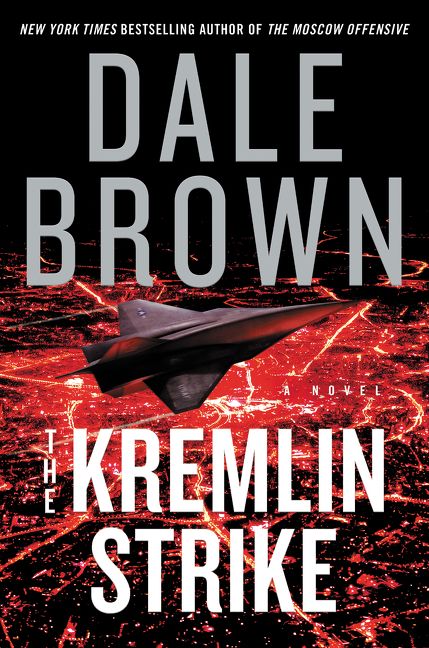
As luck would have it, two extremely entertaining-sounding military thrillers are coming out in the next couple of months, and I am really looking forward to both of them.  The first of these books is The Kremlin Strike by Dale Brown.  It will be the 23rd book in the author’s Patrick McLanahan series and is set to be released in May 2019 (although it will probably have a later release date in Australia).

The Kremlin Strike Cover.jpg

In this exciting, visionary, and all-too-plausible next chapter in the legendary Dale Brown’s New York Times bestselling techno-warfare series, Brad McLanahan and the Iron Wolf Squadron must fight the Russians on a dangerous, untested battlefield: outer space.

The previous administration’s ineffective response to the growing Russian threat has left America vulnerable. Setting a bold course for America’s defense, the decisive and strong new president, John Dalton Farrell, intends to challenge Russian aggression head on. Brad and Patrick McLanahan and the formidable Iron Wolf Squadron—including the recently injured Nadia Roz, rested and back to fighting form thanks to a pair of state-of-the-art prosthetic legs—are ready and eager to join the battle.

But even with their combined forces, the Russian menace may prove too great for the Americans to overcome. Done with provocative skirmishes and playing for small stakes, the Russian president has set his sights on the ultimate prize: controlling the entire world. Expanding beyond earth’s bounds, the Russians have built a new high-tech space station and armed it with weaponry capable of destroying US satellites as well as powerful missiles pointed at strategic targets across earth.

Devising a cunning plan of attack, Brad, Nadia, and the Iron Wolf warriors will take to the skies in their advanced space planes to destroy the space station, check the Russians’ plan for dominance, and save the world. But is it already too late?

As I mentioned above, I had a lot of fun reading the previous book in the Patrick McLanahan series, especially as it featured America and Russia going to war with advanced piloted robots.  Honestly, I found The Moscow Offensive to be one of the most entertaining books of 2018 and I have high hopes for this next book.  I am especially excited as it sounds like The Kremlin Strike will be just as fun, as the author once again takes the battle into space.  A war in space has a lot of entertainment potential and I am curious to see how Brown will utilise this unique environment in his story.

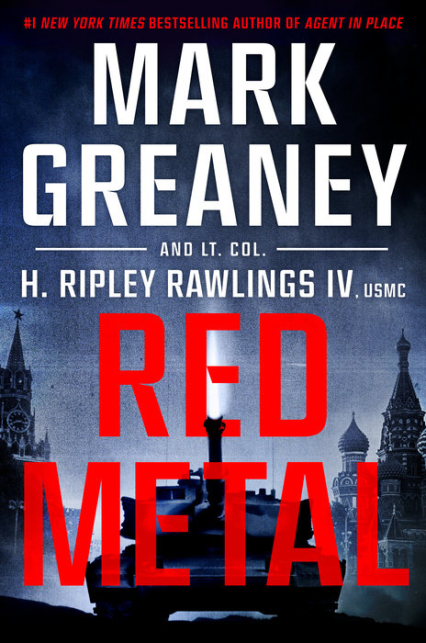
The second book that I am looking forward to in this article is Red Metal by Mark Greaney and Lt. Col Hunter Ripley Rawlings (USMC), set to be released in July 2019.

Red Metal Cover.png

A desperate Kremlin takes advantage of a military crisis in Asia to simultaneously strike into Western Europe and invade east Africa in a bid to occupy three Rare Earth mineral mines that will give Russia unprecedented control for generations over the world’s hi-tech sector.

Pitted against the Russians are a Marine lieutenant colonel pulled out of a cushy job at the Pentagon and thrown into the fray in Africa, a French Special Forces captain and his intelligence operative father, a young Polish female partisan fighter, an A-10 Warthog pilot, and the captain of an American tank platoon who, along with a German sergeant, fight from behind enemy lines in Germany all the way into Russia.

From a daring MiG attack on American satellites, through land and air battles in all theatres, naval battles in the Arabian sea, and small unit fighting down to the hand-to-hand level in the jungle, Russia’s forces battle to either take the mines or detonate a nuclear device to prevent the West from exploiting them.

I only came across Greaney’s thriller work quite recently, when I read and reviewed the latest book in his Gray Man series, Mission Critical.  I quite enjoyed his spy thriller work and I am extremely intrigued to see how he will go with this different thriller subgenre, although his experience writing Tom Clancy novels will no doubt prove invaluable.  I am also very curious to see how Greaney will go writing with his new co-author, especially as Rawlings brings some significant real-life military knowledge and experience to the table.

From the details above, Red Metal appears to be a standalone novel (although I imagine sequels will follow if this one is successful) that will follow the events of a future World War III in a large-scale story that goes for just over 600 pages.  I am really looking forward to reading a novel that completely chronicles a total war occurring around the globe, and I am very eager to see how it will turn out, especially because I am sure all sorts of cool technology or massive battles will come into play.  I am very excited about the range of characters described in the plot summary, as it looks like the authors will split the story between the various theatres of war that occur throughout the book.  I also like that many of the characters are European in origin; it will be very interesting to see how all these different nations come together and fight this war.  The example battles that are listed at the end of the plot synopsis also sound particularly thrilling, and the sheer range of different action sequences that could result out of these have so much potential.

Both of these upcoming military thrillers sound like they will be extremely exciting, and I am already very confident that I will have one hell of a good time reading them.  Onwards to war!

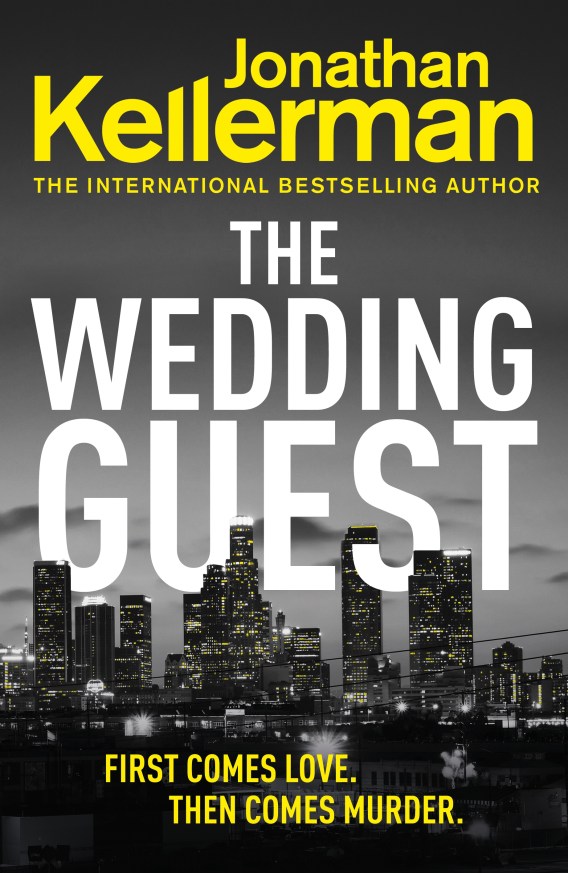
The Wedding Guest by Jonathan Kellerman

The Wedding Guest Cover.jpg

Publisher: Random House Audio (Audiobook Format – 5 February 2019)

Series: Alex Delaware – Book 34

Length: 12 hours 20 minutes

My Rating: 4.5 out of 5 stars

Amazon     Book Depository

Bestselling author Jonathan Kellerman returns with the 34th book in his long-running Alex Delaware crime series, The Wedding Guest, a clever and captivating murder mystery.

It is the couple’s big day, an elaborate wedding ending with a ‘Saints and Sinners’ themed reception in a former Los Angles strip club.  The only thing that could upstage the happy couple is the discovery of a well-dressed murder victim hidden in one of the club’s bathrooms.  None of the guests claim to know who the victim is, and she appears to have crashed the wedding without anyone noticing.

Psychologist Alex Delaware is called onto the case by his friend Detective Milo Sturgis.  With no obvious suspects at the wedding, Alex and Milo not only have to find out who the murderer is but also the identity of the victim.  As they slowly build up a picture of the events that led up to the murder, the investigators soon discover that this not the first time that the murderer has struck, and his is still at large in the city.

Kellerman is an extremely prolific and skilled crime fiction author, who has been writing books for over 30 years.  His first book, When the Bough Breaks, was released in 1985 and was the first book in his main body of work, the Alex Delaware series.  In addition to huge number of books in his main series, Kellerman has also written three shorter series: the Petra Connor series, the Jacob Lev series and the Clay Edison series.  The latter two series he wrote with his son, Jesse Kellerman.  In addition, he has also written several standalone novels, including two with his wife, Faye Kellerman, and several nonfiction books reflecting his career as an actual clinical psychologist.

As mentioned above, this is the 34th book in the Alex Delaware series, and I was a bit uncertain how easy it would be to come into this series this far in, having not previously read any of Kellerman’s books before.  Luckily, I found that The Wedding Guest was extremely accessible to new readers to the series as there were only minimal throwaway references to the previous books or cases that the main characters were involved in.  The author instead dives straight into the mystery and builds up his story from scratch.  The focus is on the main case, with only a brief look at the protagonist’s personal life, and as a result there is very little need to dive back into the series’ previous investigations.  I ended up really enjoying The Wedding Guest and thought it was an excellent piece of crime fiction.

The standout part of this book has to be the central investigation into the murder of the unexpected guest at the wedding.  The overall case is compelling, and I found myself getting pretty hooked on the story and trying to work out who the killer is, especially as the case expands further out.  Kellerman has a very interesting murder mystery writing style.  Rather than creating a fast-paced mystery that has the investigators barrelling from one massive clue to the next, Kellerman keeps the investigation within The Wedding Guest at a much slower and more realistic pace.  The investigators are forced to wait for test results and for technicians and coroners to get back to the office, and most of their investigation involves meeting and questioning people of interest.  The whole process is a lot more methodical that other crime fiction books I have read; it has a much more realistic investigative timeline.  The author has a very detailed orientating writing style, recording a large amount of details about the suspects, their possessions and the locations they are found in, so much so that you expect any of these details to become relevant at a later point in the text.  I loved how realistic the investigation came across, from the timelines and issues that real-life detectives would experience, to the impact of chance or coincidence on solving a case and the use of modern-day technology, such as social media or internet searches, to obtain information on suspects.  The case as a whole was deeply captivating, and my curiosity about who had committed the crime kept me deeply enthralled within The Wedding Guest.

This book is very character based, as the story focuses deeply on the lives of a huge range of secondary characters, most of whom are suspects, witnesses or victims of the crimes being convicted.  Through his protagonists, Kellerman dives into the lives of these characters, finding out surprising details and issues that may or may not have some impact on the case.  As a result, the reader is quite exposed to these secondary characters, in some way more so than some of the protagonists investigating the case.  Many of the characters who are suspects are fairly duplicitous or unlikeable in some way or another, making it rather easy for the readers to dislike them and see them as reasonable suspects for the murder.  In contrast to these interesting but deceitful characters are the main protagonists, Alex and Milo.  I loved the fun friendship between these two characters.  Who would have thought that a psychologist and a homosexual police detective would make for such an entertaining and enjoyable tandem?

In addition to the fantastic mystery and intriguing characters, this book contains a number of other great story elements for the reader to enjoy.  This includes the fantastic and detailed descriptions of the city of Los Angles.  Kellerman, a near life-long resident of the city of Los Angles, does an outstanding job of portraying the various components of city, and there is obvious affection for its many nuances and its inhabitants’ ways of life.  I also liked the psychological inclusions with The Wedding Guest.  The main character, Alex Delaware, is a child psychologist who assists with the police investigations and provides analyses of the suspects and the murderer.  While the psychological elements within The Wedding Guest are somewhat less prominent than in some of the other books in the series, such as the first book, When the Bough Breaks, it is still deeply fascinating, and it was intriguing to see things such as the character’s analysis of what kind of person the killer would be.

While did receive a physical copy of this book, I ended up choosing to listen to the audiobook format of The Wedding Guest, narrated by John Rubinstein.  This was an excellent way to the listen to this book, and at 12 hours and 20 minutes, it did not take me long to get through it.  Rubinstein does an incredible job of narrating this awesome story, and I felt that his fantastic voice really added a lot to this book.  The Wedding Guest is told from the point of view of the main character, Alex Delaware, and Rubinstein does a good base narration for everything the character sees and says.  I also really liked the other voices that Rubinstein does throughout this book, and he is able to impart some real personality into most of the other characters.  I especially loved the narration that he does for Milo, as he gives this character an exceptional cop voice that was really fun to listen to.  Overall, I felt that the audiobook version of this book was a great way to enjoy The Wedding Guest and I would strongly recommend this format.

The Wedding Guest was an excellent piece of crime fiction, containing a deeply compelling mystery that really drags the reader in and holds their attention for the entire book.  I quite enjoyed Kellerman’s use of characters and felt that it enhanced the mystery elements to create a wonderful overall story.  Easily accessible for those who have not read any of the previous books in the Alex Delaware series, The Wedding Guest is well worth checking out in both its paperback and audiobook formats.

Amazon     Book Depository

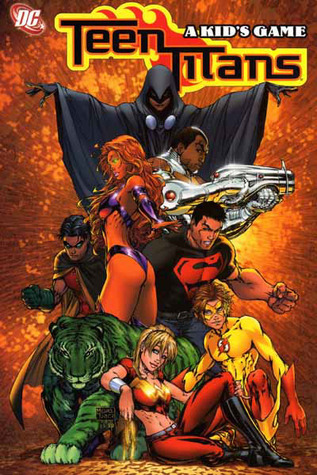
Throwback Thursday – Teen Titans Volume 1: A Kid’s Game

Teen Titans 1 Cover.jpg

Publisher: DC Comics (Paperback Edition – 1 April 2004)

Series: Teen Titans (2003)

My Rating: 5 out of 5 stars

Writer: Geoff Johns

 Artists:  Mike McKone

                Tom Grummett

                Marlo Alquiza

                Nelson

                Jeromy Cox

Amazon

Reviewed as part of my Throwback Thursday series, where I republish old reviews, review books I have read before or review older books I have only just had a chance to read.

Ever since I mentioned Geoff Johns’ 2003 Teen Titans series in one of my Top Ten lists last week, I have wanted to revisit the series.  I have always loved this run of Teen Titans the most.  Something about the combination of storylines, characters and this version of the artwork always spoke to me.  It was also one of the first comic series that I read and subsequently went out of my way to get every collected edition.  Even years later I still love dusting this series off, so I figured this would be a good time to go back and have a try at reviewing parts of this series.  That is why for this Throwback Thursday I will be looking at the first collected volume of the series, Teen Titans: A Kid’s Game.
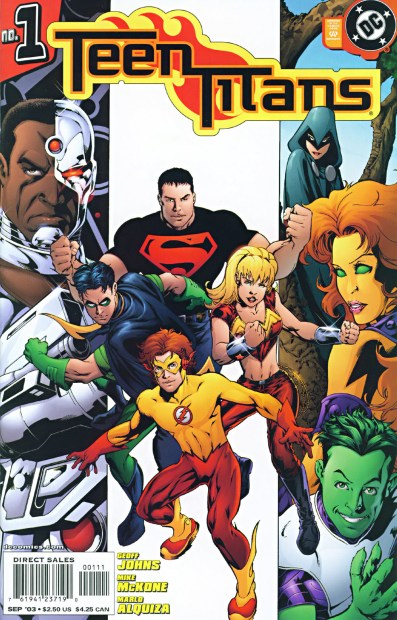
Teen_Titans_v.3_1.jpg

The Teen Titans are a team of teenaged heroes in the DC universe, usually the sidekicks of the universe’s adult heroes, but also featuring several characters without mentors.  The first formation of the Teen Titans occurred in 1964 and featured the original Kid Flash (Wally West), Robin (Dick Grayson) and Aqualad (Garth).  After a short while the original Wonder Girl (Donna Troy) joined their ranks and the team started calling itself the Teen Titans before it was given its own series.  Teen Titans was DC’s attempt to appeal to the younger generation of comic book fans, and it proved to be an extremely successful series, featuring a number of DC’s younger characters, including Green Arrow’s sidekick, the original Speedy (Roy Harper), who is considered a founding member of the team.  Teen Titans went through a number of different relaunches, with probably their most famous one occurring in 1980 with the launch of the New Teen Titans series, which brought back most of the original Titans, revamped Changeling to Beast Boy and introduced a number of iconic characters, including Cyborg, Starfire and Raven.  It also introduced several of the team’s most famous villains, including Deathstroke and Trigon.  The Teen Titans are one of DC’s most iconic superhero teams and have been featured in a number of media platforms, including the amazing Teen Titans animated show, Teen Titans Go (the less said the better), the dark and surprisingly good live action Titans and a number of key story and character elements have been included in the awesome Young Justice animated show.

Teen Titans went through a number of relaunches throughout the 1980s and 1990s, but the one most relevant to the 2003 Teen Titans comic series is the 1999 Titans comic series, which followed the adventures of adult versions of the original Teen Titans, most of whom had new superhero personas.  At the same time, DC launched the Young Justice comic book series (which I have talked about before) incorporating the younger generation of sidekicks (for example a new and younger Robin and Wonder Girl).  Both these series ended after the 2003 crossover limited series, Titans/Young Justice: Graduation DayGraduation Day featured a number of important events, including the sudden death of longstanding Titans member Omen; however, the most significant event was the death of the original Wonder Girl, Donna Troy.  The resultant despair and guilt following the death of this significant character led to both the Titans and Young Justice dissolving in what was to be conclusion of both these series.
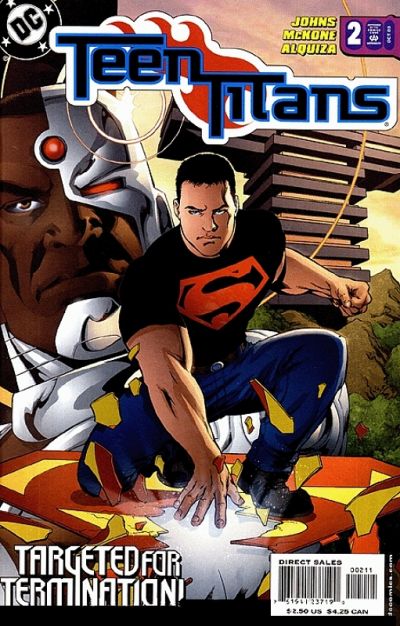
Teen_Titans_v.3_2

However, shortly after this, Geoff Johns started this specific run on Teen Titans, which combined elements of the cancelled Young Justice and Titans series, with the main four characters from Young Justice teaming up with some of the classic Teen Titans.  Another new series of Outsiders started around the same time and was heavily linked to this run of Teen Titans and featured Dick Grayson and Roy Harper.  This specific run of Teen Titans lasted until 2011, when DC initiated their New 52 relaunch (which I may or may not have some issues with).  Geoff Johns was the principle writer of this series until the 2005-06 Infinite Crisis limited series, which was a significant story point for all of DC’s titles at that point.  Due to the fact that Johns was the principle writer of the Infinite Crisis series, several of the younger Teen Titans (Superboy and Wonder Girl in particular) played a key part in this big crossover event, and several storylines from the 2003 Teen Titans turned out to be heavily linked to the crossover event.

Following the tragic events of Graduation Day, the young heroes that made up the superhero team Young Justice are lost.  Tim Drake (Robin), Conner Kent (Superboy) Bart Allen (Impulse) and Cassandra Sandermark (Wonder Girl) dissolved the team in their grief over losing the original Wonder Girl, Donna Troy, and have been avoiding each other since her funeral.  They may be the sidekicks of the greatest heroes in the world, but they are all missing their friends.  Despite their reluctance to team up again, each of them accepts an invitation from Victor Stone (Cyborg) to form a new version of the Teen Titans.  With a new base in San Francisco and other veteran Titans members Starfire and Beast Boy to help as mentors, Cyborg wants to bring these young heroes together again and forge an effective team.
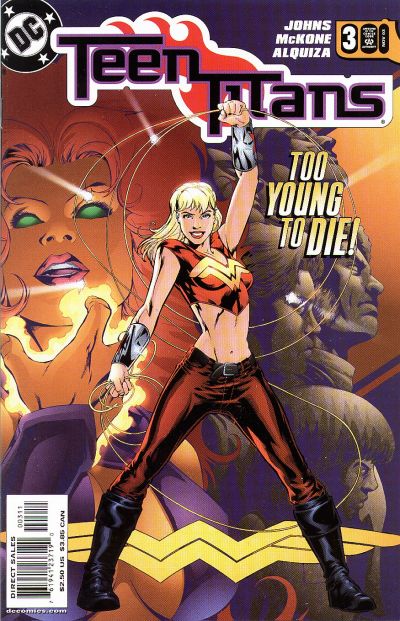
Teen_Titans_v.3_3.jpg

However, before Cyborg can attempt to work with the four new Titans and convince them to stay on the team, a massive explosion rips through Alcatraz, endangering tourist lives.  As the Teen Titans mount a rescue, one of them is ambushed by the team’s oldest and most dangerous adversary, the world’s best assassin, Deathstroke the Terminator.  Deathstroke has long had a complicated relationship with the Teen Titans, but this time it looks like he wants to put the team down for good.  Claiming that kids should not wear costumes, he attempts to take out each member of the team, but what is the real reason behind his attack?  Can this new version of the Teen Titans survive the ruthless assassin?  What role will recently reborn Titan Raven play? Moreover, what will happen when the Justice League arrives to shut them down?

As I mentioned above, I am a huge fan in general of this entire run of Teen Titans, but this has to be one of the best instalments in the entire series.  Geoff Johns and his creative team came out of the gate swinging with this one and started the series off with a bang.  Not only does A Kid’s Game feature a fantastic storyline and contain some excellent character work, but it also serves as an outstanding first instalment of what turned out to be one of DC’s most consistent and captivating comic book series between 2003 and 2011.  The A Kids Games collected edition is made up of Teen Titans (2003) #1 – 7 and also features parts from Teen Titans/Outsiders Secret Files 2003, which can be useful for those readers unfamiliar with the characters, or at least that incarnation of them.
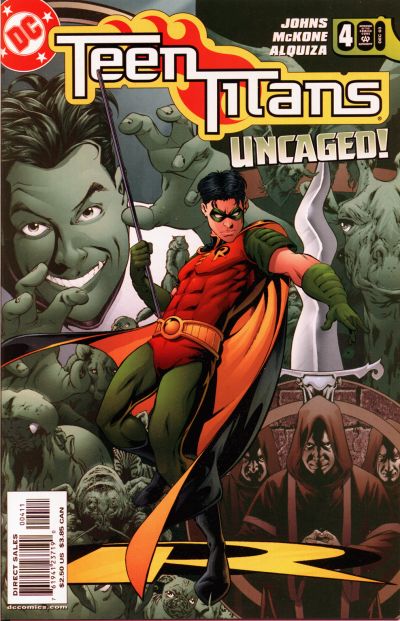
Teen_Titans_v.3_4.jpg

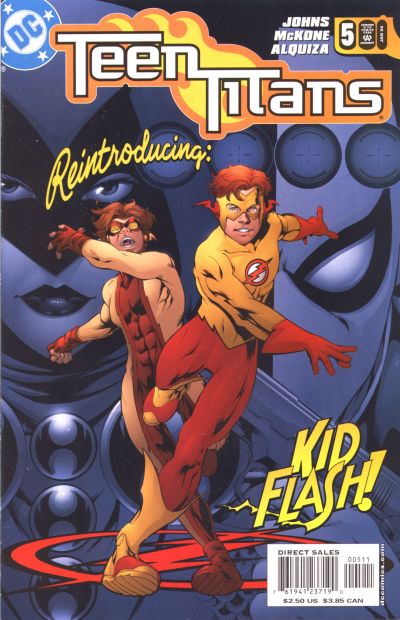
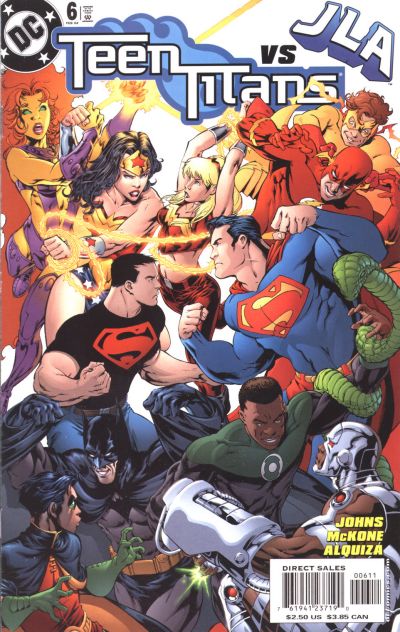
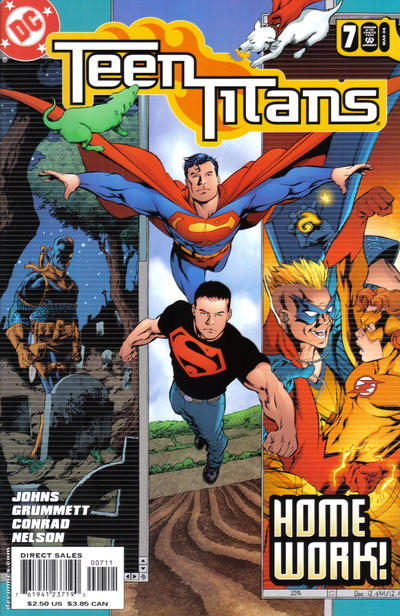
The storyline contained within A Kid’s Game has a lot of fantastic elements to enjoy within it.  The initial formation of the team is handled very well, as each of them is shown to be lonely or unsatisfied with their lives without their friends, and despite their misgivings decide to join up.  The follow-up battle between the team and Deathstroke is really good, and the team learning how to fight together while uncovering their antagonist’s motivations is very exciting.  Deathstroke has a hell of an entrance in this volume when he kneecaps Impulse at the end of the second issue in what is a pretty shocking and memorable moment.  I personally loved the storyline that occurred right after this in Teen Titans 2003 #6, when the Justice League, including the mentors of each of the younger Teen Titans’ members, show up and try to meddle with how the team is run.  This results in some chaotic action and a huge amount of amazing comic book drama, as the sidekicks fight and vent their well-justified frustrations to their mentors while also coming to terms with the guilt they feel over Donna Troy’s death.  I really cannot speak highly enough about this part of the volume, and I think this was what made me initially fall in love with the series.  The final storyline shows each of the characters during the school week, when it really helps to highlight the issues that being a part of the Teen Titans is helping them face.

One of the things that I really like about this volume is that each issue contains a shocking reveal at the end.  I know that some comics overuse this, but I felt that Johns and his team were pretty justified in doing this, as they were trying to up the stakes during these first comics in their new series.  A lot of significant and surprising things are revealed during each of these issues, many of which would have ground-shaking impacts not just for the Teen Titan, but for the DC universe as a whole (Spoilers ahead).  This happens right in the first issue, with the reveal that half of Superboy’s DNA comes from Lex Luthor.  Other big events occurring at the end of each issue are the kneecapping of Impulse, the revelation that Jericho was still alive inside Deathstroke, Bart’s first appearance as Kid Flash, Wonder Woman showing up to start the brawl between the League and the team and the reveal that Lex Luthor is the person leaking information about Superboy’s genetics to Robin.  Even the quiet, final issue of this volume has a big reveal at the end, with the revelation that Rose Wilson is now working with her father Deathstroke.
Teen_Titans_v.3_5.jpg

The creative team behind this original run obviously had a great appreciation for some of the preceding Teen Titans series, as they utilise a number of key characters from these earlier series.  I personally thought that the issues contained with A Kid’s Game did a fantastic job of blending these old school Teen Titans storylines and character together with the former Young Justice characters, creating an excellent new dichotomy for the team.  This blend of the old and new helped create an excellent new series and was one of the best features of John’s run, and I also enjoyed the respect he showed towards the old Young Justice series.  I was also really impressed in hindsight with how well Johns and his team set up or hinted at a number of future storylines or character developments in these initial issues.  Many of these storylines (such as Superboy being a mixture of Superman and Lex Luthor’s DNA, Wonder Girl being related to Ares, Rose Wilson joining with Deathstroke, the resurrection of Raven and Jericho and the new Brother Blood) would have impacts for years to come and some are even utilised in comic series, television shows and animated movies to this day.  The creators of A Kid’s Game did an incredible job including them this early in the series, and they were really good introductions.

One of the best things about the entire 2003 run of Teen Titans is the focus on the characters and their development throughout the series.  While other volumes of this series feature some great character moments, nowhere is this more prevalent than within the issues that make up A Kid’s Game.  Most of the focus within this book is on the four characters, Robin, Superboy, Impulse and Wonder Girl, who are moving over from Young Justice to the Teen Titans.  The creators take a significant look at each of them and really work to develop each of them as substantial characters and develop them deeper than what they were within Young Justice.  With this impressive focus on developing and utilising these characters to their full potential, it is no wonder that they were utilised as such major characters during the Infinite Crisis storyline and beyond.  I also like how the older members of the team had to step up and assume a leadership role that readers had not seen before.  As a result, Cyborg and Starfire attempted to fill these leadership roles, while the slightly younger and less mature Beast Boy acts as the bridge between the two generations.  I thought that these new roles were really clever and added some new dynamics to the team.  I was also really impressed with how the creators focused on the trauma that all of the team members were feeling in the wake of Donna Troy’s death.  Each of them was racked with guilt after they were unable to help stop her death, and the anger and grief that each of them was feeling was extremely evident throughout the volume.
Teen_Titans_v.3_6.jpg

Another incredible part of this initial volume was the strong look at the relationship between the sidekicks and their mentors.  Despite the high regard each of their mentors holds in the superhero world, each of these sidekicks has issues that stem from how they perceive or are treated by their mentor.  The creative team really go out of their way to highlight these issues, and many are quite clever.  For example, Superboy, who is living as Conner Kent, appears to be frustrated at living a quiet life in Smallville, but as the story progresses it becomes clear that he is having trouble living up to the legacy of not only Superman but Clark Kent as well.  Robin is stuck wondering what his future holds and it soon becomes clear that he is reluctant to become like Batman, despite the fact that his is more like him than any of the Robins that came before him.  Wonder Girl is extremely angry and rebellious throughout this volume and is beginning to doubt her mentor Wonder Woman.  This is revealed to be a side effect of her trauma at the death of Donna Troy, and it soon becomes clear that she is one most impacted by the former Wonder Girl’s death.  Finally, Bart is sick of being considered not good enough to be part of the Flash legacy, as his own mentor does not think he is responsible enough to bear the Flash name (which is ironic, considering he is the only one of these young heroes whoever takes up their mentor’s mantle).  As a result, he acts like he does not care, while deep down he craves approval and Flash’s respect.  Bart easily shows the most growth within this volume, as he takes the Kid Flash mantle for himself, dedicates himself to learning all he needs to be a hero and vows to leave the Flash in his shadow.  All of these character issues come to a head perfectly when the Justice League arrives unannounced at Titan’s Tower and they try to meddle with their sidekicks lives and there are some amazing and cathartic moments between the younger heroes and their mentors.  His is comic book character work at its very best.

I have to note the great job the artistic team does throughout these first seven issues.  There are some great new character designs, such as Superboy’s iconic new look of jeans and a superman t-shirt, something that is still utilised within the Young Justice television show.  I also liked the way that Bart looked in the Kid Flash outfit.  The artwork on the action sequences is also pretty awesome, and there are a huge number of eyepopping scenes throughout this volume.  That shot of Kid Flash getting kneecapped is very impressive and really sticks with you.  Overall, there is some fantastic artwork, which works really well with the outstanding story and character work to create an excellent first volume.
Teen_Titans_v.3_7

Teen Titans: A Kid’s Game is an amazing first volume in the 2003 Teen Titans series.  I cannot speak highly enough about the storylines and the way that the creative team handle the complex young heroes.  A spectacular start to an incredible run one of DC’s most iconic series.  I fully intend to review some other volumes in this Teen Titans in the future so stay tuned for them.

Amazon