
Originally published in the Canberra Weekly on 6 June 2019.
Make sure to check out my extended reviews for The Unbound Empire, Stranger Things: Darkness on the Edge of Town and We are Blood and Thunder.
Expert reviews of the latest and the best in Fantasy, Historical Fiction, Science Fiction and Crime Fiction from an Australian reviewer.

Originally published in the Canberra Weekly on 6 June 2019.
Make sure to check out my extended reviews for The Unbound Empire, Stranger Things: Darkness on the Edge of Town and We are Blood and Thunder.
Welcome to my weekly segment, Waiting on Wednesday, where I look at upcoming books that I am planning to order and review in the next few months and which I think I will really enjoy. Stay tuned to see reviews of these books when I get a copy of them.
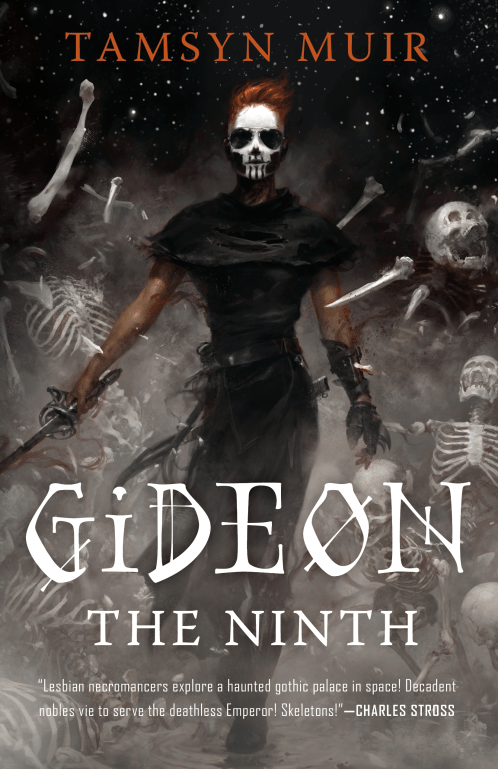
For this Waiting on Wednesday article, I check out a crazy, unique and extremely intriguing debut that is already getting a huge amount of interest: Gideon the Ninth by Tamsyn Muir. Gideon the Ninth is Muir’s debut book and it sounds like it will be a fantasy and science fiction hybrid novel focussing on a group of spacefaring necromancers as they battle for power. Gideon the Ninth is set to be released on 10 September 2019 and will be the first book in The Ninth House series, with two additional books in the series already planned.
Goodreads Synopsis:
The Emperor needs necromancers.
The Ninth Necromancer needs a swordswoman.
Gideon has a sword, some dirty magazines, and no more time for undead bullshit.
Tamsyn Muir’s Gideon the Ninth unveils a solar system of swordplay, cut-throat politics, and lesbian necromancers. Her characters leap off the page, as skillfully animated as necromantic skeletons. The result is a heart-pounding epic science fantasy.
Brought up by unfriendly, ossifying nuns, ancient retainers, and countless skeletons, Gideon is ready to abandon a life of servitude and an afterlife as a reanimated corpse. She packs up her sword, her shoes, and her dirty magazines, and prepares to launch her daring escape. But her childhood nemesis won’t set her free without a service.
Harrowhark Nonagesimus, Reverend Daughter of the Ninth House and bone witch extraordinaire, has been summoned into action. The Emperor has invited the heirs to each of his loyal Houses to a deadly trial of wits and skill. If Harrowhark succeeds she will be become an immortal, all-powerful servant of the Resurrection, but no necromancer can ascend without their cavalier. Without Gideon’s sword, Harrow will fail, and the Ninth House will die.
Of course, some things are better left dead.
I have to admit, this has to be one of the wildest and most interesting plot synopses that I have ever read. “Lesbian necromancers in space” is a pretty darn compelling plot hook for a book, and it definitely got my attention. The idea of the political intrigue and backstabbing of competing space necromancers really appeals to me, and I am sure it will make for a great story. Honestly, this book sounds like it is going to have an incredibly fun and over-the-top story, and I am extremely keen to check it out. I also really love the book’s cool cover, and the dead, gothic theme of it really stands out.
I have been seeing some early reviews of this book, and it sounds like some advanced copies have already been circulated to some other reviewers. These early analyses are very positive, and it sounds like a lot of people are really enjoying them. If you are curious for a sneak peek, the Tor website has the first nine chapters already up. I have checked out one of the chapters on there, and the bits I read were both intriguing and funny. Based on the small amount that I have already read, I know I am really going to like this book and I am looking forward to getting my own copy.
It looks like I am going to be having a lot of fun in September with Gideon the Ninth and I cannot wait to try out this exciting and creative sounding debut.
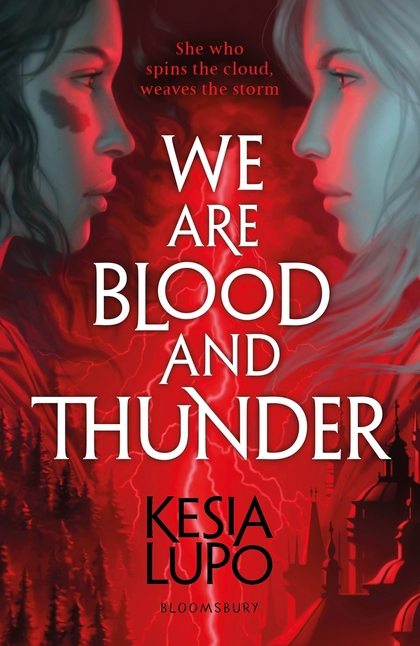
Publisher: Bloomsbury YA (Trade Paperback – 4 April 2019)
Series: Standalone / Book 1
Length: 400 pages
My rating: 4.5 out of 5 stars
From first-time author Kesia Lupo comes We are Blood and Thunder, a clever, inventive and at times dark young adult fantasy novel that represents a brilliant start to a bold new fantasy world.
In the nation of Valorian, a powerful magical curse has been laid upon the city of Duke’s Forest. The curse has wrapped the entire city in a mystical storm cloud filled with death, sickness and despair. Following a series of virulent pestilences brought on by the storm cloud, the city has been placed in quarantine, although passage in or out of the cloud is already extremely difficult. Now, six years after the curse first struck Duke’s Forest, the fate of the city and all who live within will lie upon the shoulders of two young women.
Lena is a cryptling, one of the deformed or marked offspring of Duke’s Forest’s inhabitants who live in the sprawling crypts underneath the city and watch over the Ancestors, the interred dead of the city, who are worshiped as gods. Lena, whose birthmark saw her abandoned as a baby, led a quiet life below the city until strange things started happening all around her. Accused of being a mage by the magic-hating Lord Justice, Lena just barely escapes execution when she encounters Constance in the mists outside the city. Constance is the daughter of Duke’s Forest’s ruler, the Duke, and has returned to the city to reclaim what is hers. Trained as a mage, Constance recognises the magic within Lena and sends her outside the mist while she continues back to Duke’s Forest. However, this fateful meeting will have huge consequences on the lives of both women.
Once outside the mists, Lena encounters the huntsman Emris, a magic user trained to locate untrained mages like Lena, known as Rogues, who has been pursuing Constance for magical crimes she has been accused of. Emris brings Lena back to the City of Kings, the capital of Valorian, where she attempts to learn how to control her magic. However, her unusual magical abilities and status as a Rogue bring her to the attention of some of the city’s worst inhabitants. Back in Duke’s Forest, Constance finds that her city and her father have fallen under the control of the tyrannical Lord Justice. Keeping her status as a mage hidden, Constance attempts to regain control of Duke’s Forest while also searching for the source of the curse surrounding the city. As both Lena and Constance attempt to survive in their respective cities, fate keeps bringing their destinies together. The future of Duke’s Forest rests in the hands of these young women. Can they save the city, or will they be the storm that destroys it?
We are Blood and Thunder is a clever and extremely captivating young adult fantasy novel that I read a little while ago but only just got a chance to review. I wish I had gotten a review of this book up a little earlier as it is a fantastic first book and I have been quite keen to sing the author’s praises for a while. We are Blood and Thunder is the debut novel of exciting new talent Kesia Lupo and presents a powerful story filled with magic, betrayal, personal growth and the hunt for power. At the moment, We are Blood and Thunder is a standalone novel, but the author has indicated on Goodreads that she may set future books within the same universe.
The story of We are Blood and Thunder is told from the perspectives of Lupo’s two main characters, Lena and Constance. Each character narrates about half the book and tells their separate narratives through alternating chapters. This allows Lupo to tell two separate stories that are not only very different in content but which help show a far wider area of the new fantasy world that Lupo has created. I found both of the storylines contained within this book to be extremely fascinating. The first storyline, which is narrated by Lena, follows the character as she journeys to the City of Kings to learn more about magic. While there, she learns more about her mysterious powers and finds herself embroiled in the conflict between the Temples that control magic and an influential mage outside the control of the Temples who has the ear of the King. The second storyline, which is narrated by Constance, is a darker story of political intrigue, murder and dark magic within the walls of Duke’s Forest, as Constance attempts to find the heart of the storm cloud before it is too late, while also attempting to neutralise the tyrannical Lord Justice.
While the magical learning, emotional growth and world building featured within Lena’s storyline are really good, I did prefer the Constance storyline a little more. All the dark political manoeuvring within the unique setting of the cursed Duke’s Forest and the battle between Constance and the Lord Justice were pretty darn compelling, and I had a very hard time putting down the book while I was reading the Constance chapters. While both of these storylines are really good, I was quite impressed by the way that Lupo was able to combine the two separate stories together into one amazing overarching narrative. I felt that the two storylines really complemented each other and helped make each respective storyline better. For example, the explanations of this fantasy universe’s magic in Lena’s chapters help the reader understand some of the magical elements occurring in Constance’s chapters. At the same time, many of the preparations and relationships Constance forged for her desperate return to Duke’s Forest impact Lena as she uncovers dark secrets within the City of Kings. There are also a number of excellent plot twists cleverly hidden throughout the book that are slowly revealed in both storylines. I thought some of these twists, especially a big reveal towards the end of the book, were just amazing and helped turn this into an epic and electrifying story. I felt that the author’s use of the two separate storylines was an incredible way to tell the story, and the overall narrative was quite outstanding.
In addition to her excellent twin storylines, Lupo also came up with two awesome fantasy cities: the City of Kings and Duke’s Forest. The City of Kings is your classic fantasy capital with massive temples and palaces, where everything appears to be perfect and harmonious on the surface. However, there are some dark secrets at the heart of this city, and the magical politics prove to be a major threat to one of the book’s main characters. While this is a great setting, I have to say that the city of Duke’s Forest is the far more impressive setting. Even before the city was cursed, Duke’s Forest would have been an amazing fantasy setting, with its massive crypts staffed by abandoned children and its rabid intolerance of magic. However, by turning it into a city on the brink of death, surrounded by dangerous magical mists and clouds, Duke’s Forest transformed into a much more intriguing and memorable fantasy setting. Lupo does an amazing job bringing this inventive location to life, and I was impressed by the sense of despair and hopelessness that seemed to hang in the air in each chapter set in this city. These two city settings were great, and I felt that they both enhanced the book’s narratives. Duke’s Forest in particular added a sense of urgency to Constance’s hunt for the heart of the storm cloud. I am very curious to see what other locations Lupo will create for the nation of Valorian in the future, and I look forward to exploring more of this clever fantasy world.
I also quite enjoyed the interesting magical elements that the author utilised in We are Blood and Thunder. Lupo has invented some great magical lore in this book, and I had a lot of fun exploring the various aspects of it. Not only is there a city-wide magical curse but there is also a whole new system of magic for the reader to enjoy. I quite liked the intriguing magical systems that Lupo came up with, and there are a number of great elements to them. These include the vision-filled practice of mages binding their magic to a god in order to control their power, which then influences their magical power and abilities, as well as mages who don’t bind their powers and then subsequently lose control and become a Radical, a destructive being controlled by the underlying darkness in magic. These magical elements are mostly explored by Lena. As a member of an ostracised minority who lived beneath a quarantined city where all knowledge of magic was punished, Lena is a perfect character to explore Lupo’s magical elements. Lena has the same lack of knowledge of this world’s mage as the reader, so the readers get a baseline explanation of magic that also makes sense to the plot. I quite enjoyed the various magical elements that the author came up with in this book, and I am sure that she will further expand upon them in later books in this universe.
We are Blood and Thunder is an outstanding debut from Kesia Lupo which combines some amazing and complex character-based storylines with inventive fantasy settings and cool magical fantasy elements to create an awesome overall book. Lupo has some considerable skill when it comes to a compelling young adult fantasy book, and We are Blood and Thunder is an excellent first outing for this talented author. I look forward to reading more of Lupo’s work in the future, especially if she returns to the excellent world she created in We are Blood and Thunder.

Publisher: Corvus (February 2019)
Series: Vespasian – Book 9
Length: 349 pages
My Rating: 4.5 out of 5 stars
After eight years of being one of my favourite yearly highlights of the Roman historical fiction scene, Robert Fabbri brings his bestselling Vespasian series to an end with the ninth and final book, Emperor of Rome.
Rome, 68 AD. Vespasian started his life as the second son of a rich but rural Roman family from the Sabine Hills. Looked down upon by the older Roman families for his family’s humble origins, Vespasian was never expected to obtain any major power in Rome. But after nearly 40 years of political intrigue, unusual adventures and a distinguished military career, Vespasian may actually be in a position to claim the ultimate prize: becoming Emperor of the Roman Empire.
Ever since he first arrived at the city of Rome at the young age of 16, Vespasian has lived under several unhinged or easily manipulated emperors of the Julio-Claudian line, each of whom was worse than the last. The latest of these emperors, the ruthless and insane Nero, has ordered Vespasian to put down a major rebellion in the Roman province of Judaea. However, this appointment is the ultimate no-win situation. If he fails in his task, his family’s prestige and political future are over. But if he succeeds in bringing the rebellion to an end with a successful military campaign, he will incur Nero’s lethal jealousy for obtaining glory that could make him more popular than the Emperor. As Vespasian debates what course of action to take, news from Rome will change everything.
The rebellion of several legions and their noble commanders has forced Nero to commit suicide, and his death results in a massive power vacuum. Vespasian, being in charge of two legions and having allies governing key provinces, is now a major contender for the throne, especially with his brother Sabinus lobbying for him back in Rome. Moreover, for years Vespasian has been gifted with signs and portents of his eventual rise to power, and he wants to claim his destiny. However, Vespasian is not the only person with dreams of imperial power, and several others are marching on Rome. The Year of the Four Emperors has begun, and only one man will be left standing.
Robert Fabbri’s Vespasian series are fun and at times over-the-top novelisations of the life of one of Rome’s most important emperors. The main series is made up of nine books, but there is also a related standalone novel, Arminius: The Limits of Empire, as well as the ebook-only Crossroads series. I have been a huge fan of the series for some time and have read and reviewed several of the books in the series, as well as the Arminius novel, although only my review for the previous Vespasian novel, Rome’s Sacred Flame, is currently featured on my blog. This series really has been a favourite of mine for some time, and I have been looking forward to Emperor of Rome for a few months. Unfortunately, this book does mark the end of the series, as Fabbri brings his epic story to a close and finally brings his chosen Emperor to the throne.
Emperor of Rome is a fantastic new addition to this awesome series. It tackles the chaotic period following the death of Nero, known as the Year of the Four Emperors. I felt that Fabbri did a fantastic job finally showing the ascension of Vespasian to the throne and covering a number of other interesting historical events, many of which would have widespread implications in the future. The overall story is a great blend of action and politics, and it also ends the story of several important characters from the series, as well as the rise of some of the next generation of Roman politicians and rulers.
Emperor of Rome is primarily told from the point of view of its protagonist, Vespasian, as he campaigns in the east of the Roman Empire. This allows for Fabbri to tell a different story to some of the other historical fiction novels that feature the Year of the Four Emperors. Rather than get bogged down in the politics happening in Rome, the focus is instead completely on Vespasian and his companions as they observe the chaotic events occurring in Rome from afar while trying to decide the best time for Vespasian to make his move. I thought that this was a rather clever way to look at the story as it let Fabbri examine the potential political, military and personal implications of each of Vespasian’s actions during this period, especially as early moves on Vespasian’s part might have seen him be overthrown by some other potential candidate for the throne. Emperor of Rome also showcases the early reign of Vespasian to a degree, and it was great to finally see the character gain the throne after nine books.
In addition to the examination of Vespasian’s bid to become emperor, Fabbri also focussed on Vespasian’s campaign in Judea, which is a significant event in Middle Eastern history. For much of the book, the province of Judea (modern Israel/Palestine) and its Jewish population are in revolt against the Romans. Vespasian, and later his son Titus, lead a particularly vicious campaign against the population, killing or enslaving thousands. Fabbri spends quite a lot of time describing the events of this conflict, sometimes known as the First Jewish-Roman War, and mostly relies on the accounts of the Romano-Jewish historian Josephus, who wrote several works on the subject and actually appears as a character in Emperor of Rome, as a basis for this story. Fabbri does an amazing job providing an account of this conflict. A number of key events of this war are covered in this book, including several ridiculous events that apparently actually occurred around the siege of Jotapata. I was greatly intrigued by the author’s novelisation of this conflict, as I had not read too much about it before in other works of historical fiction. The author brings a gritty realism to the conflict and does not hold back on the probable violence, cruelties and dehumanisation of the Jewish people that would have occurred during this war. This was a captivating but essential part of Vespasian’s story, and one that was necessary to explore in order to fully understand the actions required to become Emperor.
Several of the previous books in the Vespasian series have had an enjoyable supernatural edge to them, as the protagonist encountered ancient gods, prophets and sorcerers, as well as some biblical figures from early Christianity. This is continued in Emperor of Rome, mainly in the form of omens and prophecies that Vespasian has received in the previous books that show he is destined to be a great ruler, such as his viewing of a phoenix while on a mission in Africa. In this book, many of these signs come together, encouraging Vespasian to finally make his bid for Emperor. The look at the influence of such omens and prophecies added an intriguing element to the overall story. I also liked how some of the prophecies and predictions of the some of the characters were relevant to larger historical events in the future, such as the spread of Christianity or the current conflict in modern Israel/Palestine. These supernatural elements have always been one of the things that helped distinguish the Vespasian books from other Roman historical fiction series out there, and it was great to see so many of the events from the previous books finally come together here in the final chapter of the book.
Emperor of Rome is an amazing conclusion to this outstanding and entertaining historical fiction series. Fabbri has always had the fantastic ability to turn historical fact into wild and captivating tale filled with action, intrigue and historical excesses, and in this final book he once again takes several intriguing historical events and uses them to craft another excellent story. I will miss reading the Vespasian series each year, but at the same time I am also very excited, as Fabbri’s next series, The Alexander Legacies, is set to be released next year, and it sounds like it will look at some other exciting times in ancient history.
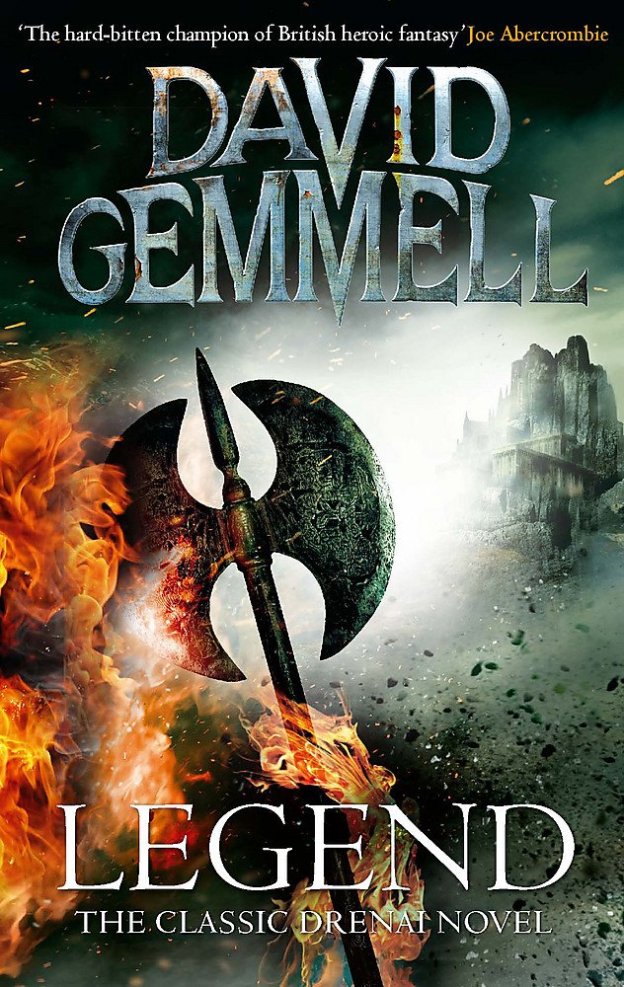
Publisher: Hachette Audio (22 June 2017) – originally published by Century (April 1984)
Series: Drenai – Book 1
Length: 13 hours and 13 minutes
My Rating: 5 out of 5 stars
Reviewed as part of my Throwback Thursday series, where I republish old reviews, review books I have read before or review older books I have only just had a chance to read.
In this week’s Throwback Thursday, I try out a fantasy book that has been on my mind for many years, the 1984 classic fantasy novel, Legend, by the late, great David Gemmell.
Legend was the debut novel from Gemmell, an impressive author who wrote over 30 novels between 1984 and his death in 2006, most of which fell within the fantasy genre. Some of his works included the Rigante, Stones of Power, Jon Shannow and Hawk Queen fantasy series, as well as the Troy and Greek historical fiction series. However, his most famous body of work has to be the Drenai series. Featuring 11 books, the Drenai series were a collection of loosely connected novels set within the same fantasy universe. While the storylines are all linked in some way or another, especially books like the three Waylander novels, the series can pretty much be read in any order, which is kind of what I did.
I actually have a bit of a random history with the Drenai series, as I happened to listen to the 10th book in the series, White Wolf, some years ago. For the life of me I cannot think why I would have grabbed this fantasy book off the shelf. Whatever the reason, the story of White Wolf stuck with me, and I would find myself occasionally remembering details of the plot, while completely forgetting the book’s title or the author’s name. I was eventually able to figure out what book it was thanks to the one clear detail I could remember (the names of the protagonist’s famous swords) and tracked down another audiobook copy of White Wolf to listen to a few years ago. I also really enjoyed White Wolf the second time around and was eager to find out more about the rest of the books in the series.
Out of all of the books in the Drenai series that I looked at, the one that appealed to me the most was the very first one in the series, Legend. Legend tells the story of an epic and desperate siege that sets up the entire Drenai universe and contains the defining story of Gemmell’s most iconic character, Druss the Legend, who also appeared in White Wolf. Many of the story elements of Legend deeply appealed to me, and it also made practical sense to start at the beginning of the series, especially as it serves as a significant point in the series’ chronology. Unfortunately, due to a combination of a lack of time, problems finding a copy of Legend, and a requirement to focus on more recent books, I never got a chance to read Legend or dive deeper into the Drenai series. However, it always remained high on my to-read list, and I am so happy that I finally got a chance to read it.
Legend is the story of the siege of Dros Delnoch, the fortress city that acts as a gateway to the declining Drenai Empire. Dros Delnoch is the greatest fortress in the world. Sitting in the middle of a narrow pass and guarded by six high walls and a great keep, the city should be able to withstand any attack. However, the charismatic Nadir warlord Ulric has forged together a mighty host of 500,000 Nadir tribesmen, which he plans to sweep over the walls of Dros Delnoch.
If the city is able to hold for a few months, a new Drenai army will be able to reinforce the battlements. But with only a small force of 10,000 soldiers within the city, many of them raw recruits, this seems to be an impossible task. However, help soon arrives from the most unlikely of places. Former solider Regnak follows his newfound love to the city, despite his apparent cowardice and dark secrets. A gentleman bandit leads his band of outlaws to man the walls, partly for money and partly to make up for his past sins. The mysterious band of mystical warrior priests, known as The Thirty, also arrives to fulfil their destiny to die in battle. Each group has a role to play in the defence of the city, but only one of the new defenders will give the Nadir pause and raise the defenders’ hopes, the greatest hero of the age, Druss the Legend.
For decades, Druss has fought and defeated every enemy he has come across, but there is one thing even he cannot overcome: time. Now a grizzled veteran of 60 years, Druss has come to the city for one final battle, but first he needs to come to terms with his status as a living legend. Even as an old man Druss is still a dangerous person, and there is a reason that he is known as Deathwalker by the Nadir. As the siege begins, heroes will rise, tragedy will stalk the defenders and a legend will end, but will anything be enough to withstand the Nadir horde?
Well damn, that was a pretty epic book and one that was well worth the wait it took for me to get around to reading this. Legend was an incredible and enthralling read that had me hooked from the very beginning all the way to the very last word. It is a classic piece of fantasy action and adventure. Gemmell loaded his story with some truly compelling and flawed characters to create an outstanding read. Featuring a ton of amazing, pulse pounding action, heartbreaking tragedy and an epic siege, this book was absolutely fantastic, and I am really glad I read it.
Probably the main thing that I liked about the book was Gemmell’s outstanding portrayal of a massive fantasy siege. I have always loved the classic siege storyline, and there is something about a huge army attacking a castle that I cannot turn away from. The siege of Dros Delnoch within Legend is easily one of the best sieges that I have ever read, as Gemmell produces a magnificent battle around the city that lasts nearly the entire book. The whole setup for the siege is pretty insane, with 500,000 Nadir tribesmen (who bear a lot of similarities to the historical Huns) attacking a Drenai (essentially Roman) city with six massive walls. The author does an amazing job properly pacing out this siege throughout the novel, including appropriating enough time to really showcase all the pre-siege activities, including training, preparation of the defences and initial sabotages before the first battle even happens. Once the battle begins, though, it is a non-stop barrage of action as the defenders fight off multiple assaults each day.
Due to the author’s excellent storytelling and character work, the reader becomes extremely invested in the fate of the defenders, and each time a wall falls, or the attackers gain an inch, you are mentally rooting for them to fight back. There are a number of discussions and plans that take place throughout the book, and it is quite fascinating to see the thought and planning that the author put into the defence of his city. I especially liked how the city’s six walls played into the battle, as the defenders’ decisions on how and when to hold these battlements provided some great moments and debates for the reader to appreciate. The siege lasts the entire book and features a huge number of epic fight sequences, all of which will get your adrenaline racing and your heart pounding. I loved every second of the siege that was featured in this book, and I hope to see it brought to life on screen one day (provided they do it right).
In addition to its first-rate siege, Legend also features a large number of complex and well-written characters. The first is Regnak, who turns into one of the book’s main characters. Regnak is a former soldier who is first presented as a coward, looking to flee all personal responsibility, although this is quickly revealed to be a side effect of being a natural ‘baresark’. However, when he meets Virae, the daughter of the Earl of Dros Delnoch, he falls in love and follows her back to the siege. Regnak has a great storyline about finding one’s inner courage and overcoming one’s issues, and while his romance with Virae is a bit weird at times, it does result in some tragic scenes throughout the book. Next you have the members of The Thirty, an order of 30 warrior priests who enter the fight knowing that 29 of their members are going to die. Not only do the priests represent most of the fantasy elements of this book thanks to their physic abilities but their ability to see into the future results in some interesting debates about destiny and fate. Quite a few members of The Thirty are introduced, although most of their story is focused on their youngest member, Serbitar, and his mentor, Abbot Vintar, as Serbitar has the hardest time accepting the future and wants to change it to help the defenders.
Without a doubt, the best character in the entire book is Druss the Legend. Druss is Gemmell’s most iconic character and has appeared in several other books in the Drenai series, all of which occur before the events of Legend. These include The First Chronicles of Druss the Legend, which details the rise of Druss and the events that made him a legend, The Legend of Deathwalker, which features an earlier encounter with Ulric and the Nadir, and White Wolf, where I first encountered the character of Druss. However, Legend is definitely the character’s defining book, as it features the conclusion of his epic life and his final stand.
There is a lot of great character work involved with Druss, and the man is a pretty epic character. He is an older man, many years past his prime, who was faced with a choice: die in glory at Dros Delnoch or decline into obscurity. Choosing to die in battle (mainly to spite Death), Druss arrives in Dros Delnoch ready to fulfil his destiny. Gemmell does an outstanding job portraying Druss as an old and wise warrior who is weakened by age but is still a far more capable warrior than many of the others involved with the siege. While readers will enjoy the action sequences featuring Druss, the main thing about the character is the way that he attempts to come to terms with his status as a living legend whose body can no longer keep up with his myth. Druss knows that his reputation as a man who always wins is one of the main things that keeps the soldiers going, and he is constantly working to inspire the soldiers and show that he is still the super human many of them think he is. However, at the same time he must deal with the tangible impacts of age and must try to overcome them in order to survive and inspire on the battlefield. This examination of a man uncertain about his continuing place in the world and who knows he is going to die very soon is extremely well done, and readers cannot help but fall in love with the character and get very invested in his storyline, even though you know how it is going to end. The Druss that is featured in Legend is probably one of the finest fantasy characters that I have read, and I look forward to reading some additional books featuring him in the future.
The book also features an amazing cast of secondary characters, each of whom adds so much to the story featured within Legend. These characters include:
In addition to all the characters mentioned above, there are also a huge bevy of other minor characters from both sides of the conflict whose point of view and feelings are examined throughout the book. Not only does this allow for a number of short and, in some cases, tragic stories for the reader to enjoy; it also increases the scope of the battle. Overall the character work is pretty impressive, and pretty much every character allowed for a richer and more captivating tale to be told. If I had one criticism of Legend’s characters, it would be that the female characters are mostly portrayed as over-emotional, irrational or downright catty in most of their interactions, which makes the book feel a bit socially dated at times.
I ended up listening to an audiobook version of Legend narrated by Sean Barrett. At only 13 hours and 13 minutes, Legend represents a fairly quick listen, especially when you get stuck into the story. I had a fantastic time listening to the audiobook version of this book, and I felt that it really helped me sink into the story and appreciate all the amazing action and drama going on in the city. Barrett has an excellent voice for an older fantasy like Legend, and I really felt he got to the heart of most of the book’s characters. I strongly recommend the audiobook version of Legend, and I will probably check out the other books in the series on audiobook as well.
Legend really did not disappoint, as it easily met every single one of my high expectations. I enjoyed every minute of this exceptional book and it gets an easy five stars for me. I cannot overstate how epic in scale and writing the siege featured in this book was, and all of the characters within this story are just sensational, especially the Legend himself, Druss. I fully intend to check out some additional books in Gemmell’s Drenai series in the future, although there are so many interesting choices that I’m not too sure where to start. Be sure to check out future instalments of Throwback Thursday to see which other Gemmell books I look at.
Welcome to my weekly segment, Waiting on Wednesday, where I look at upcoming books that I am planning to order and review in the next few months and which I think I will really enjoy. Stay tuned to see reviews of these books when I get a copy of them.
I am a man that loves a good and complex anti-hero story, so for this week’s Waiting on Wednesday I check out an absolutely spectacular-sounding book that is set to be released in September 2019: Loki: Where Mischief Lies.
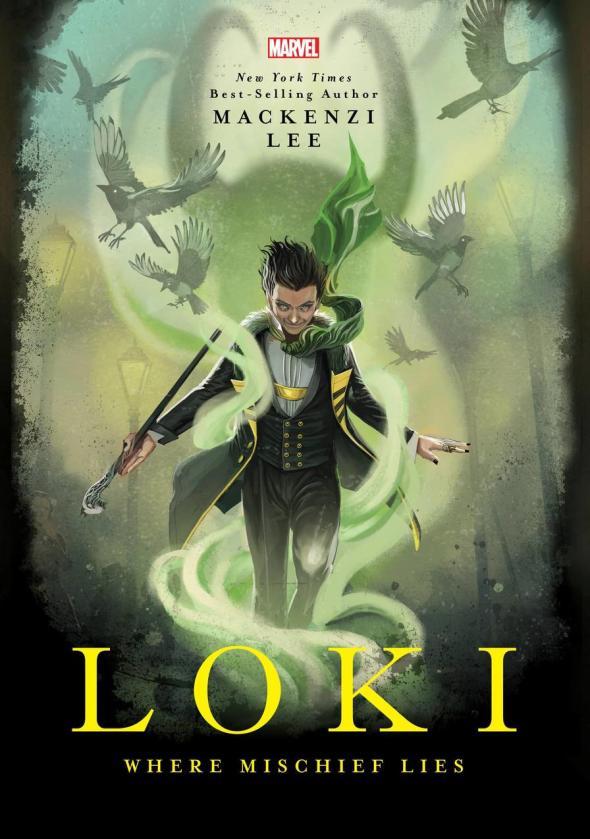
Loki: Where Mischief Lies is the first of three young adult novels that acclaimed author Mackenzi Lee has been contracted to write by Marvel Comics. Each of these books will focus on a different Marvel anti-hero and will feature a historical setting. The first of these anti-heroes is the master of mischief himself, Loki, Prince of Asgard, who, thanks to the Marvel Cinematic Universe, has to be one of the most popular comic book villains at the moment.
Even before Tom Hiddleston brought him to life with some significant swagger in the MCU, the character of Loki has been a major figure in the Marvel Comics universe. A re-imagining of the Norse god of mischief, Loki is portrayed as a powerful magician who battles against his brother, the superhero Thor, out of jealousy or for control of Asgard or the world. He has been a recurring Marvel villain for over 60 years and is the villain responsible for the formation of the Avengers. Over the years, a large amount of complexity has been added to his character, with some significant developments to his motivations and history, and a number of notable shifts in his allegiance and relationship with Thor and the rest of Asgard. As a result, I am quite eager to see any sort of novel written about Loki, especially one that sounds as awesome as this one.
Goodreads Synopsis:
Before the days of going toe-to-toe with the Avengers, a younger Loki is desperate to prove himself heroic and capable, while it seems everyone around him suspects him of inevitable villainy and depravity . . . except for Amora. Asgard’s resident sorceress-in-training feels like a kindred spirit-someone who values magic and knowledge, who might even see the best in him.
But when Loki and Amora cause the destruction of one of Asgard’s most prized possessions, Amora is banished to Earth, where her powers will slowly and excruciatingly fade to nothing. Without the only person who ever looked at his magic as a gift instead of a threat, Loki slips further into anguish and the shadow of his universally adored brother, Thor.
When Asgardian magic is detected in relation to a string of mysterious murders on Earth, Odin sends Loki to investigate. As he descends upon nineteenth-century London, Loki embarks on a journey that leads him to more than just a murder suspect, putting him on a path to discover the source of his power-and who he’s meant to be.
There are so many amazing elements to unwrap in the plot synopsis, but the bottom line is I think I am going to like this. Not only do we have a comic book novelisation focusing on an amazing character, but we have Loki investigating murders in 19th century London. Historical fiction is one of my favourite genres, and a murder mystery in 19th century London is always a great basis for a good story. Combine that with comic book shenanigans and a young Loki investigating the crimes, and you have a book with insane amounts of potential.
I am also quite excited by the choice of author for this trilogy. Mackenzi Lee is a fantastic author known for her unique and powerful novels, most of which are set in 19th century England. I am very much looking forward to seeing her take on the character of Loki, and I cannot wait to see what sort of backstory and conflicted thought processes she attributes to this amazing character.
One of the things about Where Mischief Lies that is getting a lot of attention is the author’s apparent intention to make Loki a genderfluid and pansexual character. This is based on a tweet from December 2017, in which Lee responds to someone’s question about Loki being queer in her upcoming book. Lee correctly points out that Loki “is a canonically pansexual and gender fluid character” and then ends it with “So.”. Based on that, quite a lot of people are assuming she will explore this aspect of the character in her book. Loki’s gender identity and sexuality have been featured in many comics, with the character reincarnating as a female several times, and there are also some examples of Loki romancing members of various genders. I am quite interested in seeing how much of this is explored in Where Mischief Lies, and I am sure it will result in quite an intriguing part of the story.
I am uncertain whether I will grab a physical copy of this book or try to get it on audiobook. While I love the awesome cover for Where Mischief Lies and imagine it would look great on a hardcover book, I do love a good audiobook and I have had excellent experiences with comic book based audiobooks in the past. They have also gotten Marc Thompson, one of the best Star Wars audiobook narrators, to narrate this book. I have recently finished listening to one of his Star Wars audiobooks and would be really intrigued to see what voice he would attribute to Loki and the other iconic Marvel characters.
This has the potential to be an outstanding novel, and I am really looking forward to seeing how Lee tackles the character of Loki. The plot of this book sounds like a huge amount of fun, and I am sure there will be some amazing story and character developments throughout the book. I think this is going to be one of the best tie-in novels of the year and I plan to get it as soon as it comes out.
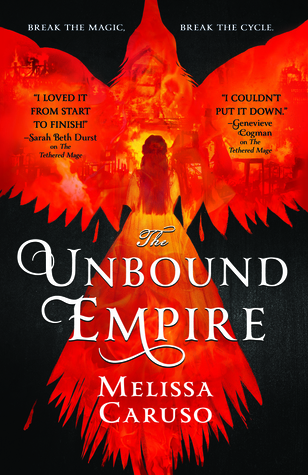
Publisher: Orbit (Trade Paperback – 25 April 2019)
Series: Swords and Fire – Book 3
Length: 508 pages
My Rating: 5 out of 5 stars
One of the fast-rising authors of fantasy fiction, Melissa Caruso, brings her outstanding debut series to an end with the third book in the Swords and Fire trilogy, The Unbound Empire.
It is always a bittersweet moment when a great book series comes to an end. For the last two years, the Swords and Fire trilogy has been one of my favourite new fantasy series due to its excellent combination of characters, story, intrigue, fantasy elements and world building. I absolutely loved the first book in the series, The Tethered Mage, and I felt that Caruso did an excellent job following this up with The Defiant Heir, which made my Top Ten Reads For 2018 list and my Top Ten Books I Loved with Fewer than 2,000 Ratings on Goodreads list. As a result, I have been eagerly waiting for The Unbound Empire for the last year, and it even featured in my very first Waiting on Wednesday post.
The Swords and Fire series is set on the continent of Eruvia, which is made up of two great nations, the Serene Empire of Raverra and the loosely collected states of Vaskandar. The Serene Empire is the home of our protagonists, and is a land where magic is controlled by the government, led by the Doge and the Council of Nine. All mages who are identified as having enough power are conscripted into the army as a Falcon. Each Falcon is bound to a non-magical handler, a Falconer, who is entrusted to control and protect their Falcon. One such Falconer is Lady Amalia Cornaro, heir to one of the most powerful families in Raverra and future member of the Council of Nine. While the nobility is usually forbidden from becoming Falconers, desperate circumstances forced Amalia to be bound to the powerful and rebellious fire warlock Zaira.
Vaskandar, on the other hand, is a far wilder nation, ruled by the Witch Lords, magicians whose powerful vivomancy literally flows through their land, making them part of everyone and everything in their domain. War is always looming between these two nations, and while Vaskandar as a nation has decided to remain out of the most recent conflict, nothing can stop an individual Witch Lord from attacking. The cruel and ambitious Witch Lord Ruven, the Skinwitch, has long wanted to conquer and rule over The Serene Empire. His most recent ambitions have been stymied by the combined actions of Amalia and Zaira, who managed to stop his plan to unleash a destructive volcano, although it came at great cost to Amalia.
However, Ruven is far from done and is determined to gain new land, either in the Serene Empire or in the domains of the other Witch Lords. Launching a series of attacks against the Empire’s capital, Raverra, as well as several outlying holdings, with a range of horrifying strategies, Ruven is able to cause significant damage. But while he launches his attacks, he is also trying to recruit Amalia to his cause by any means necessary, as her unique heritage gives her the ability to usurp the domains of other Witch Lords. As Amalia and Zaira race to counter Ruven’s actions, Amalia finds herself once again torn between love, duty and friendship, as the responsibilities of her office clash with the friendships she has formed. As Amalia struggles to maintain her humanity in the heat of war, Ruven’s greatest cruelty might be the thing that finally breaks her and leads to the fall of the Serene Empire.
Caruso once again knocks it out of the park with The Unbound Empire, creating a satisfying conclusion to her series that still contains her trademark storytelling ability and character work. The final book in the Swords and Fire trilogy does a great job utilising the previous entries of the series and also attempts to tie up all of the existing loose storylines and plot points. The Unbound Empire is filled with some really emotional storylines, a number of powerful magical action sequences and several surprising plot developments. The end result is another five-star book from Caruso that I powered through in quite a short period.
At the heart of this book lies the series’ main two characters, the narrator and point-of-view character, Amalia, and the fire warlock Zaira. The challenging and evolving relationship between the initially sheltered Falconer and the rebellious and infinitely destructive Falcon has always been a major part of this series. While the two characters have been establishing a better relationship with each book, it was great to see the two of them becoming even closer in this book and helping each other deal with some major issues. I also liked how both characters’ stories come full circle in this book, as Amalia becomes more and more like her mother, while Zaira finally confronts a number of her personal demons and for once starts to consider having a future. The author’s depiction of the doubt and guilt that Amalia is feeling after the events of the last book forced her to kill her cousin added some extra emotional depth to the story, and I liked the inclusion of such a realistic emotional reaction. The character arcs for the two main characters were incredible, and it was great to see how much they had evolved over the course of the trilogy.
Caruso has also developed a number of great side characters for this series, and she continues to expertly utilise them in this final book. The main two side characters of The Unbound Empire were Amalia’s love interests: Captain Marcello of the Serene Empire; and the Witch Lord Kathe, known as the Crow Lord. Throughout the course of the book, Amalia is caught between them; while she loves Marcello, her position makes a relationship impossible, and Kathe presents a more suitable match. Marcello’s storyline in this book is pretty significant, and there are some substantial and emotive changes to his character that really helped make The Unbound Empire extra compelling. I also really liked the deeper dive into Kathe’s personality and backstory, as well as the natural strengthening of the relationship between Amalia and Kathe. Thankfully the book’s love triangle aspect wasn’t too over-the-top or filled with insufferable toxic jealousy, as both the men understand the difficult position Amalia is in. The arc of Zaira’s love interest, Terika, is really sweet, and I liked how she continues to have a positive effect of Zaira’s personality. Other side characters, such as the Amelia’s powerful and unflappable mother; the surprisingly lethal Cornaro servant, Ciardha; and Marcello’s eccentric artificer sister, Istrella, all shine through in this book, and all of them add quite a lot to this book’s story.
No great fantasy story would be complete without a despicable antagonist threatening the heroes, and luckily this book has a truly evil and threatening villain. The Witch Lord Ruven is a powerful Skinwitch, a person with the ability to control and alter other creatures just by touching him. Not only is this power by itself pretty horrifying but Ruven uses it in some fairly novel and evil ways, unleashing all manner of horrors upon the protagonists. I thought that Ruven had some of the best magical powers in the entire series, and his abilities were really fun to see in this book. Caruso also tried to humanise the character in places throughout this book, which was a nice touch and added some new depth to the story, although he does mostly come off as utterly irredeemable. Overall, I feel that Ruven was an excellent villain and his antagonism really helped make this book and the series as a whole.
I have always loved the complex fantasy world and elements that the author came up with for this series. The various forms of magic and resulting rules that form the backbone of this book are very imaginative, and I loved how Caruso was able to utilise them in her story. There are some amazing new versions of the magic and fantasy elements from the previous two books included in The Unbound Empire, as well as some new locations to explore. While the world building is not as intense as the first two books in the trilogy, Caruso still offers some great new elements, and I had a lot of fun seeing these extra expansions to the universe. Hopefully Caruso will come back to this world at some point in the future, as I had a lot of fun there over the course of the series.
The Unbound Empire was another incredible piece of fantasy fiction from author Melissa Caruso that expertly wraps up her debut trilogy. This has got to be one of the best debut fantasy trilogies I have had the pleasure of reading, and it has been a lot of fun absorbing the excellent tales of magic, adventure and intrigue that Caruso has woven over the last two years. I have really loved the Swords and Fire trilogy, and while I am sad to see it go, I am excited to see where Caruso goes next as this author has amazing potential for the future. I highly recommend each and every book in the series and encourage you to get wrapped up in the magic and characters of this series if you have not had a chance to read it.
Welcome to my weekly segment, Waiting on Wednesday, where I look at upcoming books that I am planning to order and review in the next few months and which I think I will really enjoy. Stay tuned to see reviews of these books when I get a copy of them.
For this week’s Waiting on Wednesday, I am going to look at an upcoming piece of Australian fiction that I think is going to be a thrilling, realistic and deeply intriguing read, Duplicity by Richard Evans.
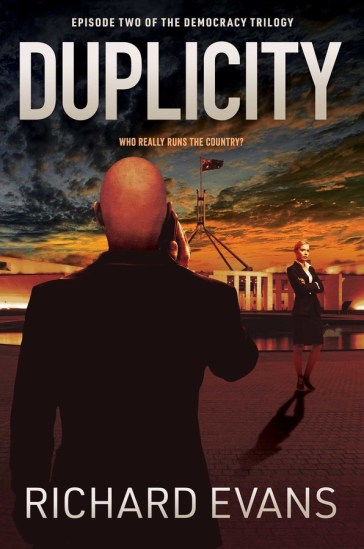
Duplicity is the second book in Evans’s Democracy trilogy and follows on from his 2018 release, Deceit, which presented the reader with a tale of corruption and political intrigue inside the halls of Australia’s Parliament House. Evans himself is former Australian politician whose detailed knowledge of parliamentary procedure and the day-to-day aspects of Australian politics turned this book into an exceedingly realistic read (depressingly so, in some cases). It was so accurate and clever it earned a five-star review from me last year and received an honourable mention in my Top Ten Reads of 2018 list. As a result, I am quite keen to check out Duplicity, especially as it is set to focus on a very topical part of Australia’s political system: the election.
Simon & Schuster Synopsis:
When ruthless political operative Jonathan Wolff is assigned the task of overthrowing corrupt Australian Prime Minister Andrew Gerrard in the federal election campaign, no one is safe from the line of fire.
Wolff’s tactful manipulation and political prowess guide the opposition towards election success, but fearing they will not win, Hawk must initiate his own explosive campaign to defeat the Prime Minister and remain loyal to the Mercantiles – a long-established group of high-taxpaying business owners out to manipulate the halls of Parliament House.
With investigative journalist Anita Devlin hot on his trail, Wolff oversees a storm of violent demonstrations in a strategic ploy to advance the cause of independent candidate Jaya Rukhmani.
Devlin is determined to be the whistle-blower, but does she have what it takes to expose Wolff and the Mercantiles? Or will political power overcome truth in this gripping Australian political thriller?
This sounds like it could be quite the interesting story, and it is definitely a change from the plot of the first book in the series. In Deceit, the story focused on the corrupt Prime Minister attempting to manipulate the parliament and the people to commit an illegal act. In this one, it’s two corrupt politicians attempting to manipulate the system for their own ends, and I expect the machinations and power plays to double in volume as a result.
The timing of this book is quite impeccable. Australia has only just finished up a federal election period that was filled with controversy, surprises and, at times, blatant stupidity. With that fresh in our minds, this book is going to take on a lot of extra potency and meaning, although I imagine quite a few people will be frustrated by any similarities it will share with real life events.
Duplicity is set to be released in September, and I am quite looking forward to seeing how Evans spins this election in his book. I am expecting another fantastic and thrilling read and I am very curious to see what additional aspects of Australian politics the author brings to life this time.
Like many people, I spent last night watching the Game of Thrones finale. While many are currently debating the quality of the final season, and will probably keep debating it for many years to come (I think I’ll keep my own opinion about this final season secret for my own safety), you cannot deny the impact that this show has had on worldwide television.
We are living in a moment of time where there are some incredible television shows out there, and the cultural impact and popularity of Game of Thrones is partially responsible for it. Not only did the show introduce the world to a whole new group of actors, many of whom are going to be major stars for years to come; it also showed world that television can be just as big, if not bigger than movies. Game of Thrones contained a huge amount of CGI, drama, dialogue and action sequences that put many major films to shame, and the quality of the CGI and action improved when the show’s budget ballooned out. I would argue that the popularity of shows such as Game of Thrones has encouraged more actors who gained fame in movies to jump back into television shows, often to great effect. It is also interesting to note that the success of Game of Thrones has allowed for more fantasy shows to be made, as studios were more eager to back fantasy series, such as American Gods, after seeing how many people were interested in Game of Thrones. Now, with Game of Thrones gone, there is a substantial void in the television line-up that many networks are working to fill.
That’s where this article comes in. Ever since the end of the show has been announced, I have been wondering what television show is going to step up and be the next big epic television show. What is going to be the next Game of Thrones? As it happens, there are quite a few big and intriguing television shows on the horizon and this is a Top Ten List that I came up with that talks about which series I think have the most potential to fill the void left by Game of Thrones.
This sort of an article is a bit of a departure from what I usually write about; however, I’m going to justify it by saying that most of the shows I will be talking about are adaptations of books or comic books. I will be excluding shows that have already been airing for a while, although I did consider some of the sequels, prequels of spin-offs that have been announced. I am not saying that future seasons of shows such as Stranger Things, The Handmaid’s Tale, American Gods or The Walking Dead are not epic; it’s just that I am more interested in what new stuff is coming out. I admit, this is also a bit of a list of shows I am probably going to watch in the future, but I think they could all have the potential to emerge from Game of Throne’s significant shadow.
Upcoming The Lord of the Rings Television Show
For the No. 1 position, I put the show that many people think has the most potential to outshine Game of Thrones, the new planned television adaptation of The Lord of the Rings. Without a doubt, The Lord of the Rings has to be the most iconic and popular fantasy book series of all time. The book series have already produced some incredibly epic movies, as well as the somewhat enjoyable The Hobbit movies. Naturally, any television show based on The Lord of the Rings books is going to be massive, and there is so much potential for massive battles and elaborate sequences, especially if the series is done right. Added in to that is the fact that the various production companies (mostly Amazon) are pouring some serious money into the show, and it will apparently be the most expensive television show ever made, taking the spot currently held by Game of Thrones.
There are not too many details about the show at the moment. A press release indicates that the show will look at “previously unexplored stories based on J. R. R. Tolkien’s original writings”, which indicates that they will be looking at stuff set way before the events of The Hobbit. Many people believe that this could mean that the series will cover Sauron’s first attempt to take over Middle Earth in the Second Age, as well as the forging of the One Ring, and you have to admit there are some amazing storylines that could be explored there. There is currently no release date for the show, nor has anyone been officially cast, but I think that no matter what happens, the sheer potential and appeal of The Lord of the Rings, as well the massive production budget, will turn this into a show really worth watching, and one which will prove to be the biggest challenger to Game of Throne’s reign as biggest television show of all time.
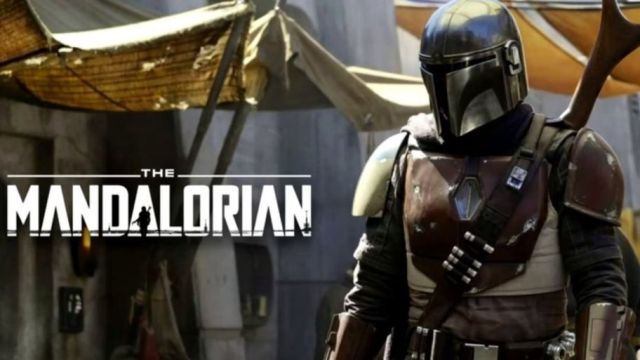
Now, this may be because I am a massive Star Wars fan, but oh boy, oh boy, am I keen for The Mandalorian. The Mandalorian is an upcoming live-action Star Wars television show, set to be released on 12 November 2019 as one of the starring shows of the new Disney+ streaming service. Set five years after the events of Return of the Jedi, the show will be set in the outer reaches of the galaxy and focus on the criminals and bounty hunters living out there. The show will primarily focus on the Mandalorian, a lone gunslinger with the iconic Mandalorian amour and weapons that Bobba Fett made famous.
While some of the latest Star Wars movies have been less than stellar, there have been some outstanding television shows, books and comics set in the Star Wars extended universe (check out my reviews of some of these here). The Mandalorian will be the first Star Wars live-action television show and has a huge amount of potential. Not only is Disney pumping in $100 million for the first 10 episodes but the show is being written and produced by showrunner Jon Favreau, whose previous production credits include Iron Man, The Jungle Book and The Lion King. They are also bringing in some significant talent to act and direct the various episodes. Favreau is directing an episode, but so is Takia Waititi (whom I worship after Thor: Ragnarok), Bryce Dallas Howard, Rick Famuyiwa and Deborah Crow.
Let’s also talk about the cast: you have Game of Thrones and Narcos star Pedro Pascal as the titular Mandalorian, which is going to be pretty awesome, even if he’s wearing a helmet for most of the show. You also have Gina Carano, from Deadpool, as the female lead; Nick Nolte; Breaking Bad’s Giancarlo Esposito; Apollo Creed himself, Carl Weathers; as well as a bunch of other great actors, including Taika Waititi voicing a murderous droid, which should be fun.
All of these add up to one hell of a show, and the recently leaked trailer and footage look pretty damn awesome. Expect movie quality graphics here, as well as some top-level acting and direction. I was extremely tempted to put this as my No. 1 show, and I am so very keen to check this out.
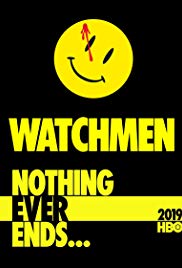
Watchmen, by Alan Moore, Dave Gibbons and John Higgins, is considered by many to be one of the greatest comic book series of all times, and HBO is pinning their post-Game of Thrones future on a television adaptation of the series. Most people would already be familiar with Zack Snyder’s movie adaptation of the series (which is a bit mixed, but I liked it), and this upcoming television adaptation has some real potential as well.
Set to be released in late 2019, the new Watchmen adaptation already has a large and impressive cast put together, including Regina King, Don Johnson, Tim Blake Nelson and Jeremy Irons. Not a lot of plot details have been revealed, although I believe it is going to be set after the events of the comic series and movie, especially as Jeremy Irons is playing an older version of Ozymandias. The first trailer showed a group of people dressed up like Rorschach, and it is possible they want to reveal the truth told in Rorschach’s journal that was sent to the New Frontiersman. I also believe that part of the plot will be pulled from the current series, Doomsday Clock, minus all the DC characters.
If done right, this Watchmen show can easily become one of the top shows of 2019, and the showrunners can take the series pretty much anywhere they want to. With the huge comic book fanbase already interested in this show, expect Watchmen to attract a huge audience.
Quite honestly, nothing is hotter at the moment than the Marvel Cinematic Universe. With Avengers: Endgame only just recently blowing everyone’s mind and getting closer and closer to becoming the highest grossing film of all time, fans are eager to see where the story goes from here. For many of the characters, their story will be continued not in a movie but in a television show on Disney+, which I am jointly making my No. 4 choice. I admit I am cheating a little here, but as it is likely that these series will be somewhat connected (I am sure there will be crossovers and the like) and Marvel are creating a massive television universe, I am going to look at them together.
There are currently four planned live-action shows set to be released in 2020 and 2021, including The Falcon and the Winter Soldier, WandaVision, Loki and a currently untitled Hawkeye series. There is also an animated Marvel’s What If…? series that will air on Disney+ but will not be connected to the other series.
With cast members from the movies leading each of these shows, there is no way that this will not be an amazing bit of television. By themselves, each of these shows has more potential than any other comic book television show currently out there thanks to their connection to the MCU, but when considered together these shows will be incredibly awesome. Expect Disney to spring for all manner of cameos from the MCU for the series, as well as some other impressive casting decisions (what big-name actor isn’t going to want to get involved in this?). I am also looking forward to seeing where all of these characters go after the events of Endgame, and there should be some awesome storylines happening here.
It looks like my Marvel comics/MCU addiction is going to be well taken care of in the next few years, and I am really looking forward to each of these shows, although I have some slight concerns about how much I’ll enjoy WandaVision. I think I am looking forward to Loki the most, mainly because Tom Hiddleston is just outstanding as the character. The Hawkeye series and The Falcon and the Winter Soldier will also be great, and I am especially keen to see how Falcon and Bucky go without Cap holding them together (hoping for a bunch of Chris Evans cameos there).
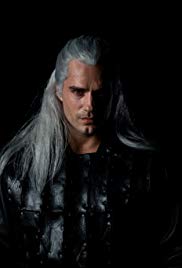
You can bet your bottom dollar that Netflix is more than keen to get in on the fantasy game, especially after losing all their Marvel series. They actually appear to be set to have one of the first series to fill the hole that Game of Thrones leaves in the fantasy genre with their adaptation of The Witcher. Andrzej Sapkowski’s The Witcher books are a well-loved series, especially in Europe, but their adaptation into the outstanding videogame series of the same name has also made them an extremely popular series in America.
The Witcher series follows Geralt of Rivia, a magically empowered monster hunter who wanders the land by himself, shunned by most other people. He encounters all manner of people on his journey, including a mysterious princess and a powerful sorceress, and he is constantly fighting for his own survival. As a result, this is a television series that can take its story practically anywhere and can adapt stuff from the books and games, as well as making new storylines as required.
The series is set to be released later this year, and the lead role has already been filled by Superman himself, Henry Cavill (who rocks the character’s trademark silver hair fairly well). I am a fan of this series (check out my review for the last The Witcher book here), and I have a feeling that this could be a massive series. It’s definitely going to have a huge and varied audience, with casual viewers, fantasy fans and gamers all keen to see this. I have not seen any footage of this show yet, but if the creators can get some good storylines and graphics going with this show, it could easily become one of the best fantasy television series on the market.
OK, before I talk about this, let us just agree that M. Night Shyamalan’s movie adaptation, The Last Airbender, never happened. OK? Good!
In my opinion, Avatar: The Last Airbender is easily one of the best animated shows of the last 20 years. Featuring some first-rate storylines and a style heavily inspired by Japanese anime, Avatar is set in a world where certain people, known as benders, have the ability to control the various elements: earth, fire, air and water. Only one person, the Avatar, has the ability to control all four elements, and they take up a peacekeeper role for the various nations. But when the Avatar, a young airbender called Aang, disappears, the ruler of the Fire Nation engages in a genocidal war against the other nations, wiping out the Air Nomads and all the airbenders. After being trapped for 100 years, the still young Aang emerges and, with the help of his new friends, must train in the remaining three elements in order to become powerful enough to oppose the Fire Nation.
Netflix announced they were doing a live-action remake of this series last year, and fans were excited to finally get the live-action version of the show they deserved. Both of Avatar: The Last Airbender’s creators, Michael DiMartino and Bryan Konietzko, are set to be executive producers and showrunners, and if anyone can produce a great Avatar live action series, it is those two. They have already announced that they will be casting a culturally appropriate, non-whitewashed cast, which is already a huge step ahead of Shyamalan’s movie.
The series is currently set to be released in 2020, and I think it will be one of the best shows of next year. I absolutely loved the animated show and cannot wait to see where DiMartino and Konietzko take this series. This is one that will appeal to a younger audience than the other shows on this list, although all those people who are already fans of the animated series are bound to watch this as well. I think this new Avatar adaptation will be an easy hit, and if the creators can replicate the magic of their animated series, then this could be massive.
I cannot talk about potential successors to Game of Thrones without mentioning the various Game of Thrones spin-off shows that are currently being planned by HBO. I know some people might not be keen on these after the last season of the main show, but there are a huge number of spinoff shows out there that proved to be very successful, and if any series is capable of producing an iconic spin-off series, it is Game of Thrones.
There are currently three Game of Thrones series in early production at the moment. Two are currently being written, although their setting is yet to be confirmed. George R. R. Martin has suggested that some of these new series would be based on stories from his companion book, Fire and Blood, which chronicles various stories about the Targaryen dynasty. Readers can possibly expect stories about their initial conquest of Westeros, their fight to maintain it, the civil war known as the Dance of the Dragons, or perhaps an adaptation of the Tales of Dunk and Egg.
There is also one series that is currently being filmed. This series is going to be a prequel series set around 10,000 years before the events of Game of Thrones, in the Age of Heroes, and is likely to focus on some of the major events that occurred during this time, such as the foundation of some of the great houses and the first time the White Walkers attacked Westeros. This series has already pulled together a massive cast, with Naomi Watts as the lead. A huge range of up-and-coming British talent has also been cast, as well as a few veterans like Miranda Richardson and John Simm (Queen Mab and the Master in Westeros, should be interesting). I’m not sure when this series will be released, but if they are filming at the moment, expect a 2020 release.
I honestly do not see why these series could not be just as awesome as Game of Thrones, and I am sure that many fans will be keen to see different periods of this fantasy world’s history. I think that the writers of this series will really have to up their game in the face of the criticism of Game of Thrones season 8, and it remains to be seen whether there is a certain fatigue from Game of Thrones fans that affects viewer numbers for this show.
For the eighth show on my list, I am looking at the upcoming television adaptation of Snowpiercer. This show might be a tad too niche and out there to fill the Game of Thrones gap, but I think it has the potential to appeal to a certain audience. Snowpiercer is an adaptation of a 1982 French graphic novel, Le Transperceneige, which was previously adapted into the 2013 movie Snowpiercer starring Chris Evans. This show will be a fresh adaptation, unrelated to the movie, aside from the overarching premise of humanity escaping frozen conditions on a giant moving train. There will also be similar themes of class warfare, social injustice and the examination of politics aboard the train, as well as certain secrets coming to the surface.
Snowpiercer has already put together a pretty massive and impressive cast, including Daveed Diggs and Jennifer Connelly, and the various character descriptions that have provided sound like a lot of fun. The show is set to premier in 2020, and I think that Snowpiercer could turn into quite an entertaining and popular series.
There has been a bit of a Star Trek television revival in the last few years, with Star Trek: Discovery coming out in late 2017, and several additional series planned for the horizon. While Discovery has had a pretty solid run, the show that many Star Trek fans have been looking forward to is Star Trek: Picard, which sees the return of Patrick Stewart in his most famous role of Jean-Luc Picard.
Picard is set to be released later this year and will be set 18 years after the events of Star Trek: Nemesis. Plot details about this series are still a bit vague at this point, but it sounds like in the intervening years Picard has left Starfleet, possibly under controversial circumstances. However, events such as the destruction of Romulus (as shown in the 2009 Star Trek film) have forced him back to Star Fleet. Not only will this story focus on Picard’s present but it will also act as a sequel to Star Trek: The Next Generation, showing why Picard is no longer the captain of the Enterprise. It also sounds like this will be a much darker story, with more morally ambiguous supporting characters and a much more different Picard.
Out of all the upcoming Star Trek series, this has to be the most interesting one, and the one most likely to attract a massive following. Having Patrick Stewart return is a real coup for the Star Trek creators, and I am really interested in seeing how much the character has changed. This one promises to be a really good show, and I think it has some real potential to be one of the best Star Trek shows of all time.
I finish my list off with a show that I think could be as popular as Game of Thrones if it gets off the ground. I previously mentioned how much I loved Patrick Rothfuss’s epic book series The Kingkiller Chronicle, which is probably one of the best fantasy book series out there at the moment.
A planned television adaptation has been in the works for some time, with Hamilton creator Lin-Manuel Miranda attached as an executive producer and composer. Unfortunately, like the third book in The Kingkiller Chronicle, an adaptation of this series has yet to appear, and no real details about it are available at the moment. I’m a little uncertain if this one will actually happen, and if there were some more details this would be way higher up on this list. Still, if it does eventuate, I think it could be absolutely amazing and could be exactly what those fantasy fans waiting for the next Game of Thrones are looking for.
Honourable mentions:
Y
Based on the amazing series, Y: The Last Man by comic legend Brian K. Vaughan, Y is set to be released in 2020. I loved the comic, which features a post-apocalyptic world where every male mammal, with the exception of one human and his monkey, suddenly died. The comic it is based on was pretty epic, but a promised adaptation of this series has been in development hell for years. If this one does get released next year, it should prove to be very good and attract a large fanbase.
Good Omens
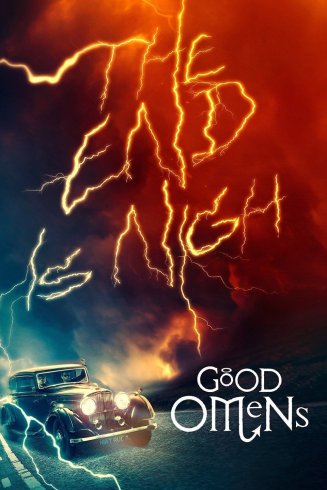
Out in a few days, and featuring David Tennant and Michael Sheen, this one should be really fun, but it might have a much more limited audience than most of the other shows on this list.
Star Wars: Cassian Andor series
Another upcoming Star Wars series, this planned series which will appear next year on Disney+ will act as a prequel to Rogue One and fill focus on the character Cassian Andor, played by Diego Luna. A spy thriller with the complex character of Cassian Andor sounds incredibly awesome, especially as Alan Tudyk is set to return as the voice of K-2SO. I think The Mandalorian will be bigger at this point, but I am sure this will also be incredibly fun and pick up a lot of viewers, provided we are not saturated by Disney live-action series at that point.
I hope you enjoyed my list. What shows do think could be the next Game of Thrones. Let me know if the comments below.

Publisher: Century (Trade Paperback – 4 June 2019)
Series: Stranger Things
Length: 411 pages
My Rating: 4 out of 5 stars
With the third season of the sensational and entertaining television show Stranger Things fast approaching (4 July cannot come fast enough), another tie-in novel, Darkness on the Edge of Town by Adam Christopher, has been released and offers another intriguing look into the wider Stranger Things universe. This story heads back into 1970s and focuses on the life of Hawkins police Chief Jim Hopper, portrayed in the show by David Harbour, and presents a thrilling and curious new adventure.
Stranger Things is one of the hottest televisions shows on at the moment, featuring a captivating plot, some incredible characters, amazing young actors and the fun use of 1980s nostalgia, all of which come together into one hell of a show. With the final season of Game of Thrones just wrapped up, the third season of Stranger Things is the next big release I am looking forward to (with the possible exception of Good Omens), and I fully intend to binge-watch it the weekend it comes out. It is not surprising that some tie-in material has been released to capitalise on the success of the show, and, truth be told, they have actually been a little restrained with it, with only one tie-in novel and one comic book series released so far. While I have not had a chance to the read the comic book series, The Other Side, which looks at Will Beyers’ time in the Upside Down in Season 1, I did previously read and review the first official Stranger Things tie-in novel, Suspicious Minds by Gwenda Bond, a few months ago. Suspicious Minds was set back in 1969 and looked at how Eleven was born and then subsequently stolen by the US Government, and it proved to be quite a thrilling read which explored some fascinating backstory to the television show.
As a result, I was very keen to check out what the next Stranger Things tie-in novel was like and what secrets it might reveal about the show. Darkness on the Edge of Town is set to be released on 4 June 2019, exactly one month before the release of Stranger Things’ third season, which is going to be set around Independence Day in 1985. Another Stranger Things book, which I will also try to get a copy of, Runaway Max, is also due out on 4 June, and this book will be aimed at a young adult audience.
Darkness on the Edge of Town was written by New Zealand-born author Adam Christopher, who has some experience with tie-in novels, having previously written three books that tie in to the Dishonoured video game and two books that tie in to the Elementary television show. Christopher is probably best known for his 2012 debut novel, Empire State, as well his Ray Electromatic Mysteries and Spider Wars series. I have not previously read any of Christopher’s work before, but several of his books, especially Empire State (a noir superhero thriller with parallel words, yes please!), sound like a lot of fun and I may have to check them out in the future.
Darkness on the Edge of Town’s story starts in December 1984, around two months after the end of the second season of Stranger Things. While enjoying a quiet Christmas with his adopted daughter, Eleven, Jim Hopper is suddenly brought back to his past when Eleven pulls out a cardboard box marked “New York”. Despite his reluctance, Hopper begins to tell Eleven the story of the greatest case he solved before tragedy forced him back to Hawkins.
On Independence Day in 1977, after returning from the Vietnam War, Jim Hopper is living in New York City with his wife, Diane, and his daughter, Sara. While the city deals with bankruptcy and a heatwave, Hopper, a rookie NYPD detective, finds himself investigating a series of brutal, ritualistic murders with his new partner, Rosario Delgado. The murderer has already killed three people, leaving a mysterious card at each crime scene. Before Hopper and Delgado can make any progress, their investigation is shut down by shadowy federal agents who order them off the case. Disobeying orders and putting his career on the line, Hopper continues to investigate the murders and is able to connect the deaths to the mysterious leader of the Viper gang, who is reputed to have paranormal powers. Going undercover to infiltrate the Vipers, Hopper makes some startling revelations about the scope and devastation of the gang leader’s sinister plans, and he must do everything he can to protect his city from an upcoming evil.
This was quite an interesting and engaging novel from Christopher, who not only manages to examine some interesting aspects of the Stranger Things television show but also creates his own intriguing story set during an interesting time in American history. The story is split between two separate time periods. Some of the story is set in December 1984 and follows the older Hopper as he tells the story to Eleven, while the majority of the book is set back in 1977 and follows Hopper and his partner as they investigate the brutal murders and the Vipers. Most of the book comes across as a dark murder mystery thriller that also spends significant time examining the psyche of its protagonist. I quite liked the murder mystery angles of the 1977 storyline, and it provides an interesting counterpoint to the more science fiction/horror/young protagonist focus of the television show.
The previous Stranger Things novel, Suspicious Minds, explored in detail events that featured in the show in flashbacks. Darkness on the Edge of Town, however, is a character study that may not have too much relevance to franchise’s overall story. While this might not appeal to some Stranger Things fans, it does allow Christopher a lot more freedom to explore the character of a younger Hopper. The result is a fantastic story that dives deep into the psyche of this great character and really lets the reader see what drives Hopper and what initially convinced him to become a police officer. There are some amazing parts to this examination of the character, but I personally liked the way that Christopher decided to focus on the lasting effects of Hopper’s service in Vietnam. This is explored in some detail, and the reader gets a really good idea of how emotionally vulnerable Hopper was even before his daughter became sick and his wife left him. I also thought that the author did a great job showing Hopper’s relationship with Eleven in the 1984 storylines, and their oddball father-daughter relationship comes across quite well.
In addition to the focus on the character of Hopper, this book also contains a few plot points that tie into the wider Stranger Things universe. The contents of the mysterious box Hopper had hidden in his house, which Eleven uncovered in Season 2, becomes a major part of this book’s story. In addition, there are several things that could potentially become significant in the future, and which the reader can leave to their own imagination. The first thing that comes up is a physic prediction about clouds or tendrils of darkness covering the world, mentioned a few pages in and repeated throughout the book. While events that occur later in the book do fit in with some of these predictions, the imagery of the Mind Flayer from the show comes to mind every time this vision is mentioned, and in some ways, it fits the predictions a little better. In addition, quite early in the book the antagonist is rumoured to have mental abilities as a result of government experiments. For a large part of the book, the reader is left wondering whether he actually has abilities like Eleven and, if he does, how he is connected to the institute that Eleven was being tested in. All of these, plus some other great references, will prove to be deeply appealing to fans of the television show, and I will be really intrigued to see if any of these references might appear in the third season of the show (do these authors have the inside track on the series?).
One of the most interesting parts of Darkness on the Edge of Town was its setting in 1970s New York City. The 1970s, especially 1977, were a pretty chaotic period in the city’s history, which serves as an excellent backdrop to this dark and gritty tale. Not only was the city suffering through a severe economic downturn but there was also a tremendous heatwave, especially in July of 1977, when the vast majority of the storyline is set. The Son of Sam killer was also active during this time, a fact commented on in several parts of the book, which also ties into the darker ‘70s crime nature of this book. I liked the way that Christopher was able to bring the atmosphere of this period to life in his book, as well as the way he was able to tie the story into a certain major event that occurred in New York in July 1977. This great use of setting really added a lot to the story and helped turn Darkness on the Edge of Town into quite a compelling read.
One of the reasons why Stranger Things is such a success is the show’s writers and creators have such an amazing ability to channel its viewers’ nostalgia for the 1980s into each episode. Writers of these tie-in novels also attempt to capitalise on this nostalgia by highlighting aspects of that decade’s culture in their writing. I previously felt that Gwenda Bond did an amazing job of that in Suspicious Minds, and Christopher also did his job exploring parts of that culture, specifically when it relates to New York City. As a result, there are several fun references to relevant movies, television shows, books, sports and music for fans of the 1970s to notice and reminisce about. Whether the characters are having fun thoughts about M*A*S*H or cheeky discussions about whether Princess Leia will end up with Luke or Han in Star Wars, there are some really fun inclusions throughout the book, and Christopher luckily does not go too overboard loading his story up with these references. I personally quite liked the way that the author envisioned the New York City gangs at this point, and the main one that Hopper encounters has a very Warriors vibe around it. An extended sequence later in the book kind of put me in mind of Escape from New York (although that was released in ’81). I really enjoyed the strong nostalgia included in the book, and it added a certain amount of fun to the book that fans of the show will greatly appreciate.
Darkness of the Edge of Town is a fantastic new addition to the burgeoning Stranger Things extended universe, and Adam Christopher does an amazing job of exploring one of the show’s main characters. The author’s examination of Jim Hopper is a deep and emotional dive into the character’s psyche, and it proves to be an effective and compelling centre to this book. Christopher is also able to utilise ’70s nostalgia and fan interest in the franchise quite effectively and turn this into an excellent tie-in novel to this complex and enjoyable show. The end result is an excellent character-driven story that will greatly appeal to fans of Stranger Things. This book is really worth checking out, especially before the third season of the show is released, and I look forward to seeing what other tie-in novels Christopher produces in the future.
 The Unseen Library