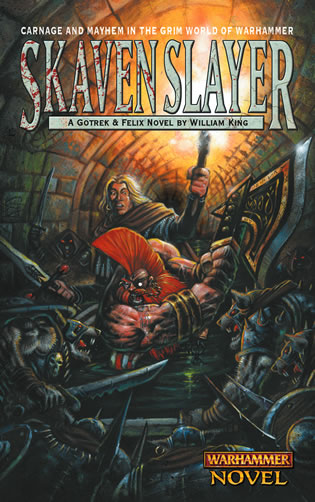
Throwback Thursday – Skavenslayer by William King

Skavenslayer Cover

Publisher: Black Library (Audiobook – December 1999)

Series: Gotrek and Felix – Book Two

Length: 10 hours and 30 minutes

My rating: 4.5 out of 5 stars

Amazon     Book Depository

Welcome back to my Throwback Thursday series, where I republish old reviews, review books I have read before or review older books I have only just had a chance to read.  The adventures of my two favourite Warhammer Fantasy protagonists, Gotrek and Felix, continues, with the second incredible and extremely fun entry in their series, Skavenslayer.

After their previous escapades throughout the Empire and beyond, wandering adventurer, outlaw, and writer Felix Jaeger is still reluctantly following the Dwarf Slayer Gotrek Gurnisson on his quest to find a glorious death.  After travelling to the Imperial city of Nuln, the two heroes attempt to make some money to support their travels.  However, danger is always around the corner, as the heroes find themselves thrust into the middle of a vast conspiracy when they take on a menial job.  The chittering and evil hordes of the Skaven are amassing beneath Nuln, determined to conquer the city by any means necessary.  Led by a dangerous and ambitious leader, the rat-men have several sinister plots to kill all the humans above and appropriate their city and technology for their own glorious purposes.  The only chance the city has to survive this chaos appears to be Gotrek and Felix, who are constantly dragged into the middle of the Skavens’ plots, thanks to fate, Skaven pettiness or terrible bad luck (both Felix’s and the Skaven’s).  Can the two heroes save Nuln from the Skaven hordes, or will Gotrek finally find the death he always seeks?

Wow, this is such a fun and entertaining series.  Skavenslayer is the second entry in the Gotrek and Felix series, which follows the two titular heroes as they journey throughout the Warhammer Fantasy world, battling all manner of monsters, demons and creatures.  After enjoying some of the excellent Warhammer 40,000 fiction out there (Deathwatch: Shadowbreaker and Kal Jerico: Sinner’s Bounty), I recently dove into the first Gotrek and Felix novel, Trollslayer, which contained several exciting and compelling short stories.  I loved the fantastic mixture of action, world-building and fun characters featured within Trollslayer, and within a couple of weeks I had started listening to SkavenslayerSkavenslayer proved to be another excellent novel, and I honestly think it was a slightly stronger novel than Trollslayer, thanks to its much more connected plot.  This was an outstanding read that has many amazing elements to it.

Skavenslayer contains an outstanding and deeply addictive narrative that follows Gotrek and Felix as they attempt to stop the Skaven plot to destroy the city of Nuln.  Skavenslayer is made up of several short stories linked together by Felix’s journal entries.  Unlike the previous novel, all six stories and the epilogue are linked, forming one continuous narrative and resulting in a tighter and more comprehensive read.

Skavenslayer’s first short story is Skaven’s Claw, which sees Gotrek and Felix employed as sewerjacks, guards who patrol the vast catacombs underneath Nuln.  On patrol, they chance upon a clandestine meeting between a Skaven and a human noble, placing Gotrek and Felix in the middle of a conspiracy involving the head of Nuln’s secret police.  Skaven’s Claw is an excellent first story that does a wonderful job establishing most of Skavenslayer’s plot details and introducing several key characters, including recurring antagonist Grey Seer Thanquol.  I loved the combination of action, world building and intrigue that was contained within Skaven’s Claw, and it results in an awesome, fast-paced story.  The Nuln sewers prove to be a claustrophobic and memorable setting for most of the battles.  I also enjoyed the use of secondary antagonist Fritz von Halstadt, a fanatical human who has been manipulated by the Skaven, as his story arc was very well established and quite compelling.  This is an awesome entry that gets Skavenslayer off to an impressive start.

Next up we have Gutter Runners, which sees the Clan Eshin assassin, Chang Squik, lead a group of Skaven Gutter Runners on a mission to kill Gotrek and Felix at the inn where they are working as bouncers.  This was a quick and action-packed story which proved to be a lot of compelling fun.  The action is swift and deadly, as the protagonists are attacked on multiple fronts, and there are several great battle scenes throughout.  This is a fun story that you can easily power through in one short sitting, and I felt that it did a great job keeping the reader’s attention after the fantastic introductory story.

The third entry is the fantastic and funny Night Raid, which focuses on the members of Clan Skyre, the insane Skaven engineers and weapon designers.  The leader of the Clan Skyre contingent, Heskit One-Eye, plans a raid on the Nuln College of Engineering to appropriate the latest human weapons and technology and obtain glory.  However, the jealous Grey Seer Thanquol organises a significant roadblock in the form of Gotrek and Felix.  This is another outstanding entry in the novel, and I consider it to be the most comedic and entertaining of the bunch.  Not only do you get to see amazing examples of Skaven backstabbing and betrayal but you also have an extremely funny and exciting sequence at the college, where all hell breaks loose when a Skaven gets stuck in a Steam Tank.  This story also serves as an excellent introduction to the various Skaven side-characters, and a lot of elements from Night Raid have major impacts on the rest of Skavenslayer’s story.

Up next, we have the disgusting and captivating story, Plague Monks of Pestilens.  In this story, a brewing plague strikes quick with deadly consequences.  However, this is no ordinary plague; it is a deadly concoction dreamt up by the demented plague monks of Clan Pestilens, led by the terrible Vilebroth Null.  Warned again by Thanquol, Gotrek and Felix attempt to stop the plague monks before it is too late.  Plague Monks of Pestilens is an amazing middle story that is pretty memorable.  Rather than the pure hack-and-slash narrative of the previous story, King works in an interesting mystery element, as Felix tries to work out where the plague monks are attacking from.  Once battle is joined, you are in for a dangerous and gruesome fight, especially as the author goes into full horror mode when describing the grotesque plague monks and their malformed, diseased bodies.  This is an extremely intense and disturbing story which really enhances Skavenslayer’s overall narrative and gives it the more serious edge it needed.

The penultimate story of Skavenslayer is Beasts of Moulder, which sees Gotrek and Felix attempt to stop the master mutators of Clan Moulder, led by Izak Grottle, try to unleash their latest creation.  This was a decent addition, although if I am being honest, it was probably the weakest entry in the entire book.  Not only are the stakes a little lower, but it repeats the pattern of the previous two entries.  I did quite enjoy the scene where Felix visits the palace, especially as everyone there assumes he is some sort of master monster hunter, but the rest of the story fell a little flat, especially the Elissa subplot.  Still, it fits into Skavenslayer’s narrative well and does a good job setting up the final story.

The last entry in Skavenslayer is the major concluding storyline, The Battle of Nuln.  In this story, both the citizens of Nuln and the Skaven army hiding beneath the streets have been afflicted by plague and famine.  In order to achieve victory, Thanquol leads a daring raid on the Countess’s palace during a ball, while the rest of the Skaven army attacks the city.  With Gotrek and Felix stuck in the middle of several Skaven plots, can they save the city before it is overwhelmed by rats, disease and vile Skaven magic?  The Battle of Nuln is an incredible and captivating entry that serves as the action-packed conclusion to the entire book.  King brings together all his fantastic storylines, and the readers are rewarded with an intense and extended war sequence, as the full wrath of the Skaven force is unleashed.  I deeply enjoyed this final story, and it did an outstanding job of providing satisfying, if occasionally lethal, conclusions to all the character arcs and storylines.  There is so much action going on in The Battle of Nuln, and I loved seeing the consequences of all the previous short stories finally come to the fore for both sides in the war.  An excellent and exciting conclusion that will put you in the mood for even more Gotrek and Felix.

I had an outstanding time getting through each of the short stories above, and not only are they fantastic reads on their own but together they form an impressive and intense overarching narrative.  King did a wonderful job crafting together all six stories, and I felt that the use of a single location and overarching antagonists worked extremely well, especially once you are introduced to the four iconic Skaven clans.  While some of the middle stories do suffer from plot repetition, this is still a great book which is extremely fun to read.  King ensures each story has a great combination of action, character development and humour, and each of the stories can easily be read on their own without a lot of context from the others.  This is also a very good Warhammer Fantasy novel, and readers only need minimal prior knowledge of the franchise, especially as King provides a great amount of detail and self-contained lore.  I felt that it came together perfectly, and readers are in for an exceptional time when they check this novel out.

One of the more entertaining and fun parts of this novel was King’s use of the Skaven as the villains of the story.  The giant rat-men known as Skaven are chaotic beings who, thanks to their spiteful nature, massive ambitions and weird array of abilities, weapons, magic and fighting techniques, are one of the most entertaining and recognisable races in the Warhammer Fantasy canon.  I think that King did a particularly good job bringing the Skaven to life in Skavenslayer, and they proved to be a very intriguing and memorable group of antagonists.  Not only does the author showcase several unique Skaven clans (each of them is covered in a short story), but he also captures the Skavens’ treacherous nature, speech pattern and insane pettiness.  While the Skaven have an elaborate plan, their own paranoia and self-serving mindset gets in the way of its success, and it is wonderful to see the various backstabbing, betrayals and plots that occur throughout the course of the book.  Despite this, they still prove to be a dangerous group of enemies, and they manage to hit the protagonists and the rest of the humans in Nuln in a big way.  I really enjoyed the way that King utilised the Skaven throughout this novel, especially as their duplicitous or cowardly actions are the catalyst for most of the book’s humour, and Skavenslayer is a fantastic and detailed introduction to this impressive Warhammer Fantasy faction.  That being said, there are only so many times you can hear a scared Skaven getting ready to “squirt the musk of fear”, and some different wording might have been better.

Another highlight of this book is its complex characters.  The most notable and prominent of these are titular protagonists, Gotrek and Felix, and it is still incredibly fun to see the unusual partnership of a doomed Dwarf Slayer and a former wealthy poet turned notorious adventurer.  Due to his position as the book’s main point of view character, much of Skavenslayer’s focus lies on Felix.  While there are still hints at his somewhat cowardly past, especially as he seems apprehensive before every single fight, Felix has become a much more fearless and dangerous being in this book, and he leads the way in several battles throughout Skavenslayer, proving himself a fantastic hero.  There are some interesting character moments for Felix throughout this book, especially as he encounters his brother, Otto, the first member of his family to reach out to him since his banishment.  There are some great comparisons between the wealthy Otto and the more adventurous Felix in Skavenslayer, and it was intriguing to see what Felix might have turned into if he was not bound to Gotrek.  I also liked how Felix developed more into his role as the sane straight man to Gotrek, and his dry humour really adds a lot of comedy to the books.  Overall, Skavenslayer is quite a strong outing for Felix, and he proves to be an outstanding central character.

Aside from Felix, the other main character is Gotrek, the mad, death-hungry Dwarf Slayer, who is constantly denied his desired doom in glorious combat due to his own unnatural skill.  Gotrek is his usual crude and disrespectful self throughout Skavenslayer, and it is an absolute joy to see him in battle, even if his portrayed as way too overpowered.  While he is a great character, Gotrek was underutilised in Skavenslayer, and he was mainly just a supporting player in the Felix-based stories, only appearing when there is a need for fighting.  Still, it was great to see him, and he does get a lot more attention in the next novel.

While Gotrek was a bit overlooked, King does a wonderful compromise by introducing an exceptional primary antagonist in the form of Grey Seer Thanquol, a powerful Skaven sorcerer who goes on to be a major recurring figure within the Gotrek and Felix novels and the wider Warhammer Fantasy universe.  Thanquol is an impressively entertaining character who represents the absolute best (or worst, depending on your point of view) of Skaven society.  He is insanely ambitious, arrogant, power-hungry and dangerous, and rose to power thanks to an unfortunate “accident” involving his predecessor, a loaded crossbow and an exploding donkey.  Due to his ambition and an unwillingness to share any glory, Thanquol spends just as much time plotting against his equally aspiring subordinates as he does attempting to conquer Nuln or kill Gotrek and Felix.  Indeed, several conflicts with the Skaven are due to Thanquol himself informing the protagonists about his rival’s plots, often through some hilarious letters which are clearly written by a Skaven (despite Thanquol’s own belief that they are masterful forgeries).  The sheer overconfidence, deluded self-belief and inability to take responsibility for his failings make Thanquol a particularly nasty antagonist, however, it is just so entertaining to see him strive and then fail, that you end up wanting him to live and succeed against his Skaven opponents.  Thanquol proves to be an excellent antagonist, and I really enjoyed seeing his alternative point-of-view which highlights the Skaven plans.  King really outdid himself coming up with this villainous rat-man, and he is one of the best things about Skavenslayer and the overall Gotrek and Felix series.

King has also filled Skavenslayer with an interesting collection of side characters who add a lot to the plot.  The author does a good job of introducing these major side characters throughout the various stories, and he manages to build them up and flesh out their personalities in a short amount of time.  There are great human supporting characters, such as Heinz and Doctor Drexler, and several fun and amusing Skaven.  The majority of these Skaven characters are leading members of the main clans who not only serve as secondary antagonists for the novel, but who are also cast as rivals to Thanquol’s rise to power.  I had a fantastic time seeing each of these Skaven characters in all their treacherous, self-serving glory, although my favourite had to be the aptly named Lurk Snitchtongue, who is a very fun and cowardly character.

If I had to make one major criticism, it would be about the complete lack of any decent female supporting characters.  While you can forgive some older fantasy books for their lack of gender diversity, it is a painfully obvious problem in Skavenslayer.  There are literally only two female characters of note within the novel, and both are badly written.  The first is Felix’s romantic partner, Elissa, who quickly becomes a major burden to the story by forming conflicts with Felix.  Their romance is thankfully over before the end of the book, and you cannot feel anything but relief as she leaves.  The other character is the ruler of Nuln, Countess Emmanuelle, who gets only a couple of lines at the end of the novel.  While her one scene does shine her in a good light, the rest of the novel hints that she is a vapid, lustful and incompetent ruler.  The underuse of female characters is probably going to be a major feature of Gotrek and Felix series in the future (for example, Daemonslayer only has one female character), however, I really hope that any who feature are written a lot better than the ones featured in Skavenslayer.

Just like I did with Trollslayer before it, I chose to listen to Skavenslayer on audiobook rather than grab a physical copy of the book.  I have a lot of love for the Warhammer Fantasy audiobooks, especially as they always perfectly capture the excitement, grim horror and elaborate fantasy of this franchise.  Skavenslayer was another great example of this, and I had a wonderful and thrilling time listening to this amazing novel in this format.  Much of the reason for this was the excellent narration by Jonathan Keeble, a brilliant narrator who has lent his voice to most of the Gotrek and Felix novels.  Keeble has an outstanding voice for dark fantasy stories such as this, and I loved the grim tone he gives to several of the characters, particularly Gotrek, as well as the sheer excitement that infects his tone whenever there is a fight sequence or dangerous scene.  Keeble also a lot of fun voicing the various Skaven characters, and he expertly mimics their high-pitched, whiney tones, which helps highlight their fickle and cowardly nature.  This excellent voice work helps turn the Skavenslayer audiobook into an absolute treat to listen to, and with a runtime of only 10 and a half hours, listeners will power through this in no time at all.

William King’s second Gotrek and Felix novel, Skavenslayer, was another outstanding and wildly enjoyable novel that I had an incredible time listening to.  Featuring a compelling connected narrative filled with intense action and fun villains, this is an amazing fantasy tale that is perfect for all Warhammer Fantasy fans.  I can think of no higher compliment for this book than to reveal that the moment I finished Skavenslayer, I immediately grabbed the next novel in the series, Daemonslayer, which proved to be just as much fun.
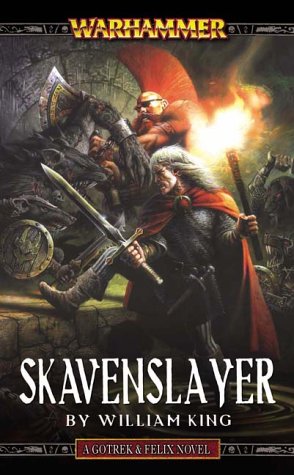
Skavenslayer 2

Amazon     Book Depository

Throwback Thursday – Trollslayer by William King

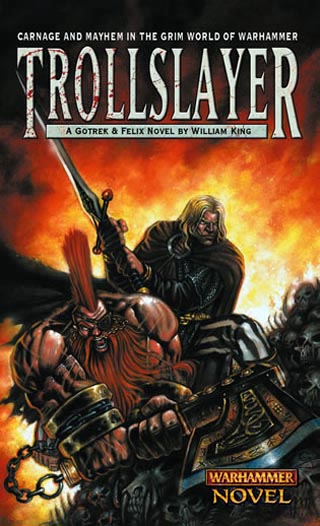
Trollslayer Cover 2

Publisher: Games Workshop (Audiobook – August 1999)

Series: Gotrek and Felix – Book One

Length: 9 hours and 55 minutes

My Rating: 4.5 out of 5

Amazon     Book Depository

Welcome back to my Throwback Thursday series, where I republish old reviews, review books I have read before or review older books I have only just had a chance to read.  In this latest Throwback Thursday article, I review a classic Warhammer Fantasy novel, the iconic Trollslayer by William King.

Over the last year or so, I have started to get back into the exciting and captivating extended universe that surrounds the Warhammer tabletop game franchise.  The Warhammer games are a lot of fun to play, but I have always deeply enjoyed the rich and extensive universe that has formed around it.  This is particularly true when it comes to the extensive literary world that has been created, with a huge collection of unique novels added every year.  I personally have barely scratched the surface of this franchise, having only recently read the exciting Space Marine novel Deathwatch: Shadowbreaker, and the fun crime novel Kal Jerico: Sinner’s Bounty.  For this review, however, I veer away from the science fiction based Warhammer 40,000, and instead look at a book in the Warhammer Fantasy universe.

The Warhammer Fantasy universe is set on a fantasy world where various races and factions fight for power, immortality, dark deities, and a general desire for bloodshed (Blood for the Blood God, Skulls for the Skull Throne!) in both large-scale battles and smaller skirmishes.  I love the fantastic and thrilling world of Warhammer Fantasy, especially as I used to play (my preferred factions were the Empire and the Lizardmen).  While there are many great novels set in this universe, the most recognisable and well-established series are the Gotrek and Felix books.

The Gotrek and Felix novels are some excellent dark fantasy books that follow the titular heroes, Gotrek Gurnisson and Felix Jaeger, as they traverse their world, facing every single monster, demon or villain they can find.  Created by William King, this long-running series has also been authored by fellow writers Nathan Long, Josh Reynolds and David Guymer, the last of whom has just released the latest entry, Gitslayer.  I have always heard good things about this series over the years, and I have previously enjoyed some of the short stories featured online or in the White Dwarf magazine.  As a result, when I had the brainwave to expand my knowledge of the Warhammer canon, this is one of the main series I wanted to check out, and to do so properly, I had to start with the original novel, TrollslayerTrollslayer, which was originally released in 1999, is an interesting novel that features seven original Gotrek and Felix short stories, including Geheimnisnacht, which was originally written as a one-off in 1988.  These seven stories have been bundled together into one continuous narrative, which proves to be an excellent and entertaining fantasy adventure.

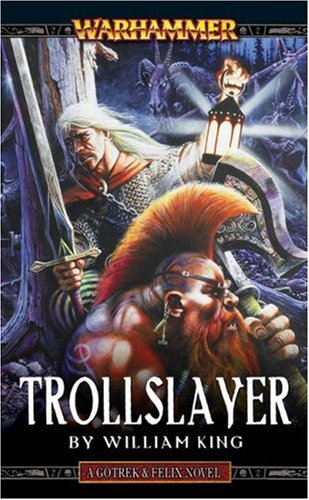
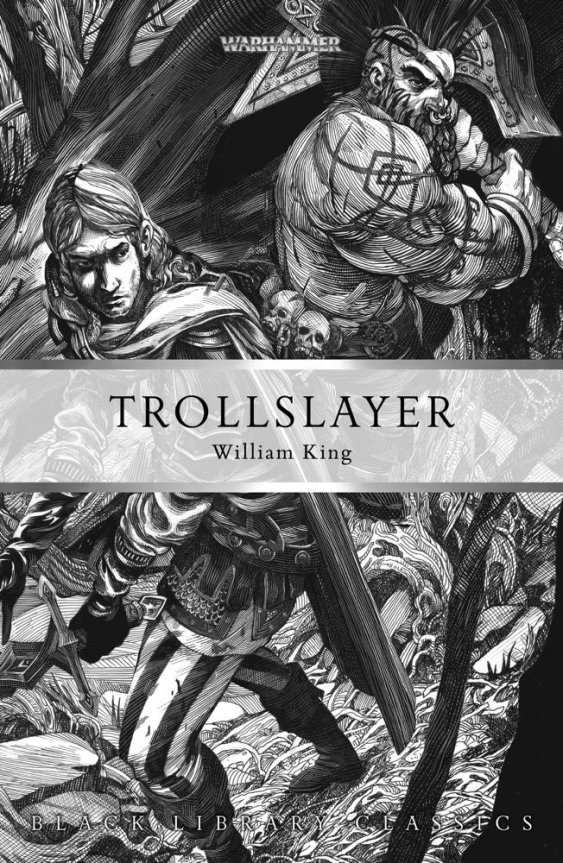
Trollslayer Cover

Felix Jaeger, the son of a wealthy merchant and student in the Imperial capital Altdorf, used to live a blameless and dull life until he met the deranged Gotrek Gurnisson.  The son of a wealthy merchant and student in the Imperial capital Altdorf, Felix’s life was changed forever when Gotrek saved his life.  Gotrek is a Slayer, a dwarf who, after committing a terrible crime, has sworn to seek out a glorious death in battle, and who now wanders the world to find a foe worthy of killing him.  After a particularly damaging night of drinking, Felix drunkenly swears to follow him on his adventures to compose an epic ballad about Gotrek’s glorious death.

Bound by his oath, Felix now reluctantly accompanies Gotrek wherever he goes.  Their latest adventures will take them far and wide, as they venture throughout the Empire and beyond, travelling to the notorious holdings of the Border Princes, the mountainous realms of the dwarves and even under the halls of the conquered dwarf city of Karak Eight Peaks.  While they experience many unique discoveries and locations, one thing remains the same: enemies lurk around every corner, and Gotrek and Felix are forced to battle against some of the most dangerous creatures in existence, including orcs, goblins, trolls, the undead, mutants, beastman and more.

However, the most dangerous foe they face may be something far more insidious and unknowable.  The fell powers of Chaos are gathering throughout the land, and Gotrek and Felix seem to constantly become wrapped up in their plots and vile missions.  With danger and deadly foes all around, will Gotrek find the glorious death he seeks, and will Felix be able to survive whatever might foe eventually manages to kill his companion?

Wow, that was a cool novel I really should have read years ago.  Trollslayer was a fantastic and exciting novel that does a great job exploring some of the more dangerous settings in the Warhammer Fantasy world with two amazing characters.  Featuring seven dark and compelling short stories, Trollslayer is an outstanding book, and I had an incredibly fun and entertaining time getting through its audiobook format.  Banded together by some journal entries which bring the separate stories together, Trollslayer has a fantastic joint narrative that presents the reader with a collection of epic adventures.

TrollSlayer-john-gravato-Gotrek-and-Felix-1st-edition-cover

The book begins with the original Gotrek and Felix short story, Geheimnisnacht (Night of Secrets).  The two companions are stuck out in the dangerous forests of the Empire during Geheimnisnacht, an auspicious night of the year.  After nearly being run over by a dark carriage on the road, Gotrek and Felix investigate the actions of a dangerous Chaos coven out in the woods, and find more than they bargained for.  This is a rather entertaining and short entry in Trollslayers that serves as a fun introduction to the main protagonists and their quest.  King does a great job setting up both characters and you soon get a fantastic glimpse into their compelling personalities.  The author presents a very dark story within this first tale, as the heroes discover and fight the true horrors of chaos.  An excellent and intense opening story that will get you pumped up for the rest of the book.

The next entry contained within Trollslayer is called Wolf Riders, which sees Gotrek and Felix at the very edge of the Empire with plans to venture to the fallen dwarf stronghold of Karak Eight Peaks.  After encountering a beautiful young woman, Felix convinces Gotrek to join the doomed expedition of a cursed, banished noble family as they journey to the Border Lands to set up their own settlement.  Hired on as guards, the two heroes are forced to protect the caravan against a ravenous Greenskin horde, who are determined to destroy every one of them.  However, the true threat may lie within the convoy, as it soon becomes clear that someone has their own nefarious plans to kill everyone journeying with them.  Wolf Riders is an incredible second entry in the collection of stories, and it is easily one of the best tales in Trollslayer.  Not only does it reinforce the likeability of the two protagonists, but it also contains its own compelling and impressive narrative.  King manages to achieve a lot in Wolf Riders, introducing a cohort of great characters, showing several intense action sequences, and even presenting a clever and malicious mystery.  The entire narrative comes together extremely well, and readers are soon wrapped up in the compelling tale of redemption and bloodshed, which culminates in a tragic and memorable ending that forever changes one protagonist.

The third story is The Dark Beneath the World, which follows on immediately after Wolf RidersThe Dark Beneath the World sees Gotrek, Felix and some new companions journey into the dwarf stronghold of Karak Eight Peaks, which was infamously conquered by greenskins and Skaven in ages past.  Seeking treasure, holy relics and a glorious battle, the adventurers will face untold horrors in the halls beneath the city.  However, nothing will prepare them for the true dangers of Karak Eight Peaks, as the restless dead are stirring in response to a monstrous presence.  This was another great story that really highlights have exciting and action packed one of these stories can be.  I love how King takes his great characters right into the heart of one of the most iconic and dangerous settings in the entire Warhammer canon, and it proves to be an amazing backdrop to this compelling story.  A brutal hack and slash epic with some very intense moments, this is an excellent and fast-paced addition to Trollslayer that was an extremely thrilling read.

From powerful action to great humour, the next entry is the slightly shorter The Mark of Slaanesh.  This story sees Gotrek and Felix return to the Empire, where they encounter some malicious cultists of the Chaos god Slaanesh in a small town.  Unfortunately for Felix, Gotrek is suffering from amnesia after a blow to the head.  Forced to shepherd a docile Slayer through the town’s many dangers, Felix takes drastic action to bring his friend back to his senses.  The Mark of Slaanesh represents a very intriguing change of pace, with more of a focus on humour, as a weary Felix is forced to contend with a pacifist Dwarf Slayer, an eccentric doctor, and comedic mutants.  There are several extremely funny moments in this short story, which helped to turn The Mark of Slaanesh into one of the most entertaining entries in the entire novel.  I particularly appreciate how King was able to craft together such a despicable central antagonist in quite a short period of time, and it was great to see his implied comeuppance towards the end of the story.

King again rapidly switches gears with the next entry in the book, Blood and Darkness, a grim war story set in the darkest forest in the Empire.  This story sees Gotrek and Felix come across a ravished village within the Drakwald Forest, which has been utterly destroyed by beastmen.  Finding a young survivor, Kat, Gotrek and Felix escort her through the woods to the next village.  However, a vengeful and ambitious champion of Chaos is close behind them, with unholy plans for Kat and anyone else she comes across.  Blood and Darkness is another exceptional entry in the series, which is probably my overall favourite Trollslayer story.  Loaded with action, fantastic new characters and a particularly gruesome premise, Blood and Darkness really stands out from some of the other stories in this book, and I was blown away by how dark King made the narrative.  I really loved the story’s complex antagonist, and the entire plot surrounding Kat comes full circle in a great way.  While it is a tad creepy to see just how young Kat is in this story, especially as Felix apparently falls in love with her in a future novel (she gets aged up like 20 years before this happens, but it is still weird), this was an impressive and powerful story that really showed how complex, powerful and mature a Warhammer story can be.

The penultimate story in Trollslayer is The Mutant Master, which again switches pace and has a more humorous tilt to it.  After being attacked on the road by a swarm of mutants, the protagonists arrive at a struggling village and soon discover that the mutants are being controlled by a sorcerer in a nearby tower.  Betrayed by the villagers, Gotrek and Felix find themselves as prisoners and soon must deal with an insidious sorcerer who shares a history with Felix.  This was another great short story that places the protagonists into a uniquely dangerous position.  King includes some excellent humour in this novel, especially in the scene where Felix and the sorcerer have a very entertaining encounter, which proves that everyone, even dark sorcerers, fall to pieces when encountering former classmates.  While much of this story is dedicated to humour, the author fits in a particularly dark moment towards the end of the novel, which pushes one protagonist further than ever.  Another awesome and memorable story, I powered through this one extremely quickly.

The final entry in this book is the intense Ulric’s ChildrenUlric’s Children sees Felix trudging through a snowed-in forest, attempting to escape the cold and the wolves.  When they hear the sounds of a fight up ahead, Felix gets separated from Gotrek, and ends up getting captured by a dangerous group of soldiers.  The soldier’s leaders end up being revealed as cultists of the Chaos god Tzeentch, who are desperate to capture a mysterious family living nearby, who have strange powers and strengths.  Caught up in their conflict, Felix soon finds himself trapped in a manor house with two very different monsters and must try to overcome the powers of Chaos that threaten to consume him.  This was another fantastic story that serves as a great conclusion to the entire novel.  While I think that Ulric’s Children was one of the weaker stories in Trollslayer, it was still a compelling and thrilling tale which readers will enjoy.  I loved the inclusion of werewolves in this novel and it was fun to see Felix attempt to overcome a dangerous foe without Gotrek’s determined backup.  With some intriguing foes and an exciting story, this is a fun and fantastic entry in the book which will leave readers wanting more Gotrek and Felix in the future.

King really has loaded Trollslayer with an amazing range of different stories that highlight the gritty adventures of two memorable and loveable characters.  I had a great time getting through each of the short stories contained within this novel, and I think that the author did a good job combining seven shorter stories together into one cohesive tale.  I love how each of the stories has some impressive action set pieces, and readers are given an in-depth look at the true dangers and darkness that inhabits the Warhammer world.  King has also ensured that each tale contains a compelling blend of humour, dramatic character development and dark fantasy elements, all of which produce an outstanding overall narrative.  It was also very cool to see just how dark and gruesome King could make his narratives, and quite a few elements of this book closely bordered the horror genre.  Since the stories were originally published in instalments, readers are in for some repetition, especially as King rehashes Gotrek and Felix’s origin in every entry, and you also get quick summaries of their prior adventures.  While this and other pieces of repetition (for example, Gotrek runs his finger over his axe blade in every tale) can be a bit annoying at times, I personally thought it was a small price to pay for such an awesome and epic book.

One of the most impressive things about Trollslayer is the complex and distinctive characters.  Naturally, the main characters are series protagonists Gotrek Gurnisson and Felix Jaeger, both of whom prove to be really fantastic and exciting characters.  King has come up with an exceptional pairing in these two characters, and I absolutely love the combination of a doomed dwarf Slayer and a disgraced human with a penchant for poetry.

As the primary narrator of the separate stories in this book, Felix gets a great deal of attention, and you really get to grips with his superb character throughout the book.  I loved the depiction of a former arrogant dandy who finds himself in a situation well over his head, and Felix has a “fun” time facing off against all sorts of monsters in this book.  While most of the novel depicts him as a bit of a coward, Felix does manage to achieve some major heroics and you cannot help but sympathise with the terrible situations he finds himself in.  While the use of multiple short stories does tend to backslide Felix’s character at times (he reverts to a coward at the start of each story), I did enjoy seeing some of the excellent development that occurs around Felix.  Not only does he grow more confident in his own abilities, but he also becomes harder with each adventure, especially as he experiences tragedy and despair around every corner.  It was actually hard to see how some of the more tragic events of the book affected him, but I really appreciated the amazing character work that King worked around him.

The titular Trollslayer, Gotrek Gurnisson, is one of the most beloved figures in Warhammer Fantasy lore, and a magnificent character who I really enjoyed.  Much of Gotrek’s past is shrouded in mystery, and all you really know is that he is a mighty warrior who previously committed some great crime that still haunts him to this day.  Determined to find a glorious death, Gotrek willingly walks into the most dangerous of places, but always survives, much to his displeasure (even doomed dwarves are far too stubborn and proud to simply let an enemy kill them).  King mostly paints Gotrek as a crude, rude and bloodthirsty being, which is a lot of fun to see.  However, there is so much more to Gotrek than killing and fighting, and you see several glimpses of his true inner self in this book, especially when he thinks about the past.  I loved how King keeps Gotrek as a mostly enigmatic figure, mostly by not showing any of the story from his point of view, and the reader is never quite sure what he is thinking or planning.  All of this results in an excellent and memorable protagonist, and I am deeply intrigued to see what sort of adventures he has in the future, as well as any revelations about his past.

Aside from Gotrek and Felix, Trollslayer contains a range of interesting and compelling characters, several of whom act as point-of-view figures at various parts of the book.  King does a really good job of introducing and utilising so many unique figures throughout his various stories, and it is simply amazing how well he can develop and establish his character in such a short amount of time.  Even though you only see some characters for a few pages, you quickly become quite invested in their stories, which is the sign of a really good author.  However, readers are advised not to get too attached to anyone, as most of the side characters will come to a gruesome and tragic end.  Still, these supporting characters are really fun, and I look forward to seeing what unique figures are introduced in future Gotrek and Felix books.

Trollslayer also features the dark and well-established background setting of the Warhammer Fantasy world, with the protagonists adventuring through many iconic locations.  King makes excellent use of this fantastic background throughout his story, and I loved seeing all the cool locations, interesting factions and dangerous monsters contained within the story.  This actually serves as a really good introduction to the Warhammer Fantasy world, and readers unfamiliar with the various aspects of Warhammer will learn a lot here.  King can really craft together some dark and dangerous locations with his writing, and I love how spooking and claustrophobic some of his settings felt, especially the ancient dwarven catacombs and the haunted, monster infested forests.  I also loved the sheer range of different creatures and races featured within Trollslayer, as the author includes as many foes as possible.  It was extremely awesome to see Gotrek and Felix cut their way through various greenskins, monsters, and servants of Chaos, and there is something for all fantasy fans within this book.  I am extremely keen to see what other monsters and races are utilised in the future novels, and I am sure they will be pretty amazing.

I ended up listening to the Trollslayer audiobook format, which was an outstanding way to experience the awesome adventures contained within this book.  With a decent run time of just under 10 hours, I powered through this audiobook in a matter of days, especially once I got caught up in the fantastic depictions of intense action and dark creatures.  I was also really drawn in by the impressive narration of Jonathan Keeble, who has lent his voice to all the Gotrek and Felix audiobooks, as well as several other Warhammer projects and some of my favourite historical fiction novels, such as the Eagle of the Empire series.  Keeble has an epic voice, and the sheer passion that he brings to Trollslayer is immediately obvious, especially during the action scenes, where his excited voice captures the intensity and movement of the fights.  I also felt that Keeble did an exceptional job bringing all of the characters to life in an impressive way.  I particularly loved the gruff voice that he used for Gotrek, which fit the doomed dwarf warrior perfectly, and he also does a really good job voicing the often terrified Felix.  I also found some of the voices that he used for the supporting characters to be really fun and fitting, and I had a lot of love for a couple of the crazed sorcerers/alchemists they encounter, which were quite amusing.  All of this helps to turn the Trollslayer audiobook into an outstanding experience, and I think that this will be the format I check out the future Gotrek and Felix novels out in.  I might also have to consider listening to some historical fiction novels on audiobook in the future, especially as I know that Keeble will do a wonderful job narrating them.

Trollslayer by William King is an exceptional and clever Warhammer Fantasy novel that showcases the exciting and powerful adventures of the iconic Gotrek and Felix.  Serving as the main introduction to these two iconic heroes, Trollslayer contains seven outstanding and wildly entertaining short stories with some fantastic and wacky plots.  Readers who check out Trollslayer are in for a heck of a lot of fun and will swiftly become fans of this great duo and their outrageous adventures.  A highly recommended read, I suddenly have some major plans to check out more Gotrek and Felix novels in the future.

Amazon     Book Depository

Throwback Thursday – Heroes in Crisis by Tom King and Clay Mann

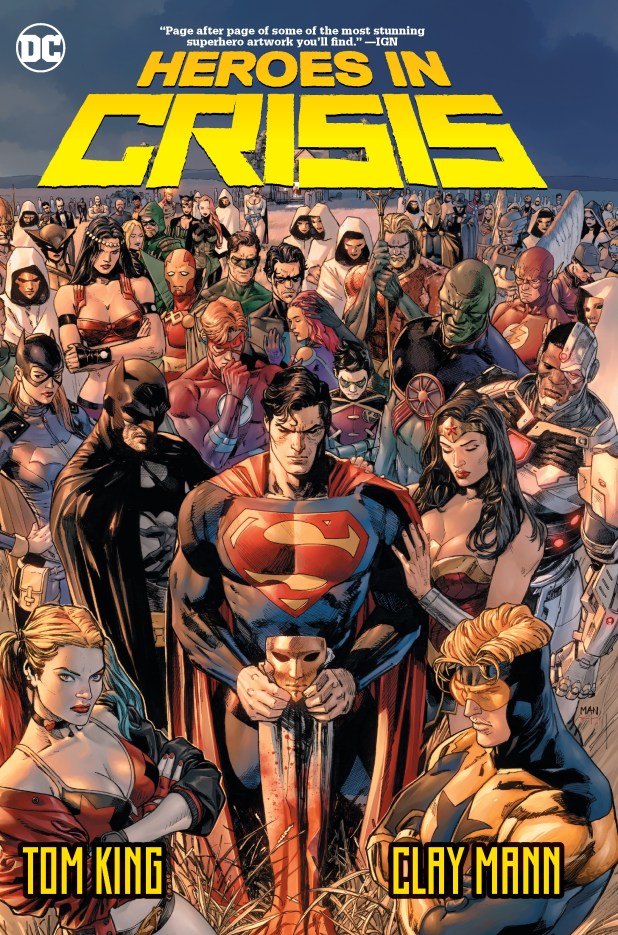
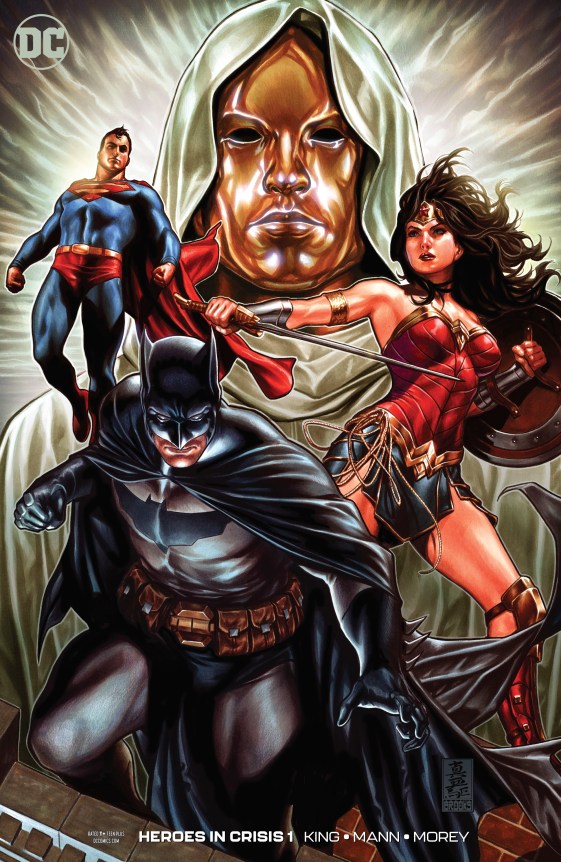
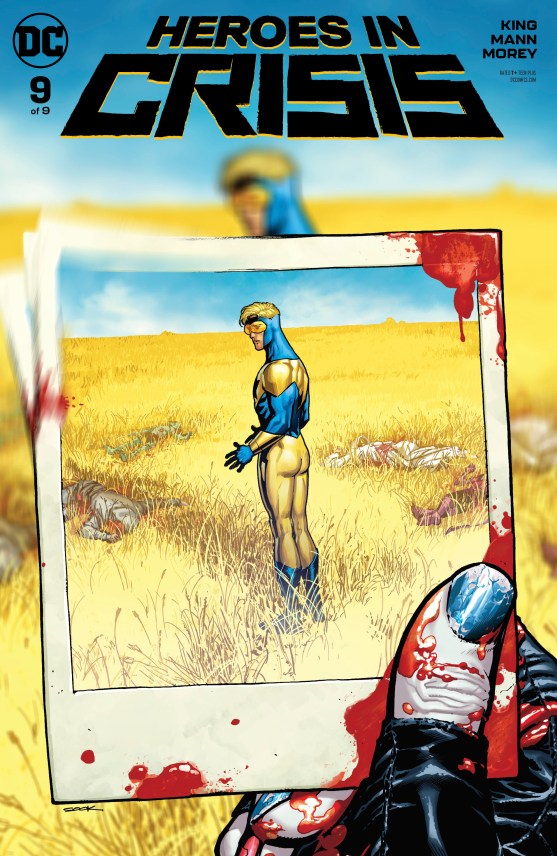
Heroes in Crisis Cover

Publisher: DC Comics (Paperback – 1 October 2019)

Writer: Tom King

Artists: Clay Mann, Travis Moore, Lee Weeks, Mitch Gerads, Jorge Fornes

Colourists: Tomeu Morey, Arif Prianto, Mitch Gerads

Letterer: Clayton Cowles

Length: 234 pages

My Rating: 4 out of 5 stars

Amazon     Book Depository

Welcome back to my Throwback Thursday series, where I republish old reviews, review books I have read before or review older books I have only just had a chance to read.  For this latest Throwback Thursday article, I look at an interesting DC Comics crossover event from a couple of years ago, the deep and compelling Heroes in Crisis.

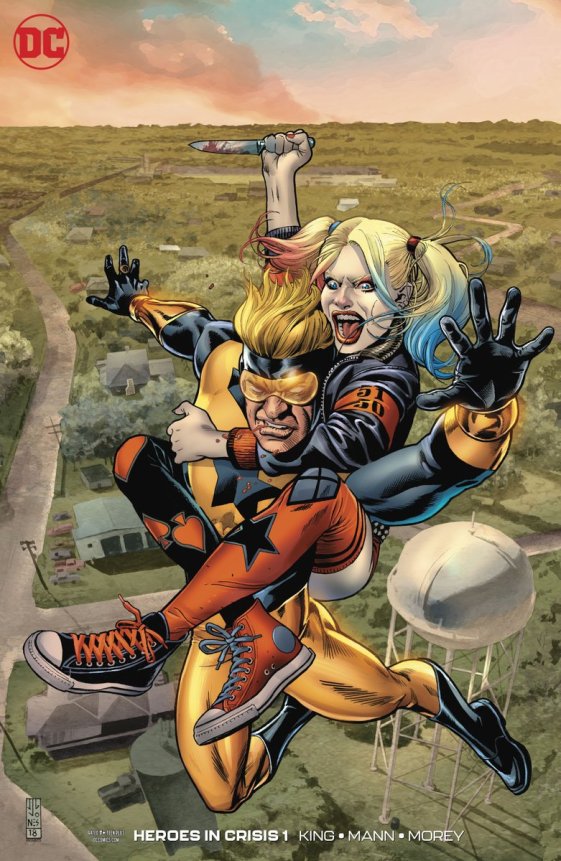
Heroes_in_Crisis_1 (V1)

Now I have to admit that I have been somewhat avoiding a lot of the recent DC crossover events, mainly because I think the universe is getting a bit too complicated, what with the multiple versions of characters and timelines.  However, I recently grabbed the Heroes in Crisis collected edition (containing all nine issues of the limited series), mostly because I had heard some conflicting reports about whether it was any good, and I thought that it would be worth seeing just what sort of comic it really was.  I was also drawn to this comic as I am major fan of Tom King and Clay Mann after the work they recently did on Batman, which featured some really cool and compelling storylines.  Heroes in Crisis turned out to be a rather fun and intriguing comic, especially as King came up with another fascinating narrative.

Heroes_in_Crisis_1 (V2)

After years of fighting and surviving against the very worst evils in the universe, even the greatest heroes will start to crack under the unreal pressures of their chosen lives.  Realising this and determined to help their fellow superheroes, the trinity of Superman, Batman and Wonder Woman designed Sanctuary.  Sanctuary is a hidden facility containing a cutting-edge artificial intelligence programmed to provide advanced therapy, support and counselling to any hero that needs it after harsh battles and traumatic events.  However, no sanctuary lasts forever, and after losing contact with the facility, Superman, Batman and Wonder Woman arrive to find Sanctuary in shambles and several patients brutally killed.  As the world’s superheroes reel from the deaths of friends and colleagues such as Roy Harper, Red Devil, Commander Steel, Poison Ivy and Wally West, their thoughts swiftly turn to justice.  But who is responsible for the killings, and could the culprit be one of their own?

Heroes_in_Crisis_1 (V3)

The answer may lie with the only two survivors of the Sanctuary massacre, the greatest hero you have never heard of, Booster Gold, and the mad clown princess, Harley Quinn.  However, Booster and Harley are both convinced that they saw the other commit the crime, and are now out to stop the other survivor by any means necessary.  As the heroes attempt to uncover the killer lurking amongst them, their world will be further turned upside down when the confessions and therapy sessions recorded at Sanctuary are leaked to the media, casting a new light on them.  Can the killer be caught before they strike again, or will this case irreparably damage the world’s greatest superheroes?  Whatever happens, the DC universe will never be the same again.

This was a very unique and fascinating crossover comic which contains some notable flaws, but is something that I quite enjoyed.  King, Mann, and their artistic team produced a clever comic that really dives into the minds of the collected heroes of the DC universe.  Featuring a great story, some powerful character moments and some impressive artwork, Heroes in Crisis turned out to be a fun and heartfelt comic that I had a wonderful time reading and which has really stuck in my mind.

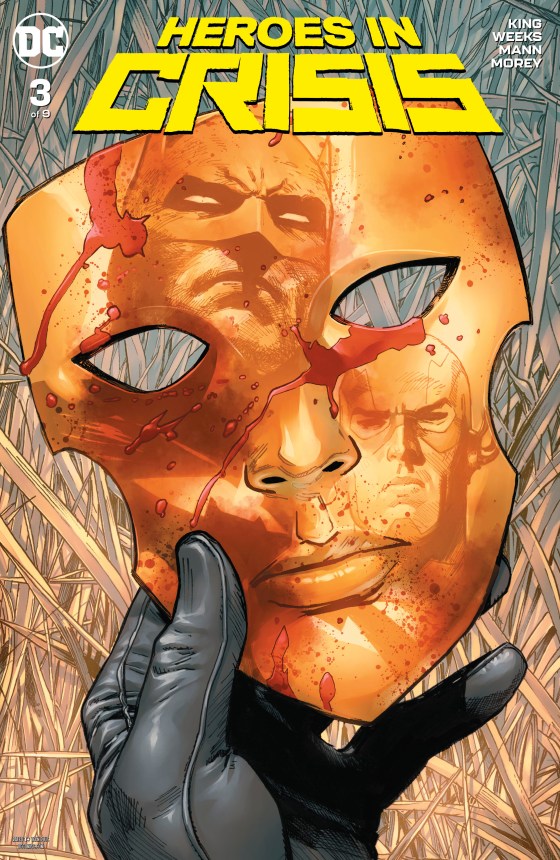
Heroes_in_Crisis_2

Heroes in Crisis has an intense and powerful character driven narrative that presents the reader with an interesting mystery, while also attempting to dive into the minds of some of the most iconic comic book characters out there.  I very much enjoyed the excellent premise that King came up with for this comic, especially as he starts the narrative off by showing several iconic heroes brutally killed around the Sanctuary within the first several pages.  At the same time, two of DC’s most unique and complex characters, Booster Gold and Harley Quinn, are fighting to the death, with both claiming that the other is responsible for the crimes.  This proves to be an excellent start to the comic which really drew me into the book, and which quickly leads into a compelling investigation angle with Booster, Harley and the DC Big Three (Superman, Batman and Wonder Woman) all working towards the same goal while also fighting amongst themselves.  At the same time, a mysterious opponent is manipulating events from the shadows, ensuring that the protagonists are distracted by the public revelations about their mental fragility.  All of this leads up to an interesting and heartfelt conclusion where the killer is finally revealed in an emotional confrontation.

Heroes_in_Crisis_3

This was a rather intense and fast-paced narrative and it was clear that King was drawing a lot of inspiration from the iconic Identity Crisis crossover comic (another controversial comic that split the fan base, although I personally consider it a masterpiece).  However, unlike Identity Crisis, I think that Heroes in Crisis fell a little flat and I can see where a lot of the criticism surrounding it came from.  While this comic has a great start and the author sets up the whole mystery and characters perfectly, I felt that the ending had some major flaws to it.  The reveal of the killer, despite some hints throughout the story, is a bit of a letdown (admittedly, due to internet spoilers, I did know who it was in advance of reading this comic, but this didn’t massively impact my overall reaction).  While I could appreciate some of the motives surrounding the killer’s choices, especially as it ties into the psyche aspects of the comic, it was a bit of a weak choice that undermined an amazing and well-established character.  In addition, many aspects of the conclusion, such as the reveal, the killer’s motivations, and the eventual solution to some established problems, were unnecessarily complicated and required some major logic leaps.  I also did not quite get why King included a certain “bros before heroes” scene, as it proved to be a very odd inclusion for such a serious story.  While I did greatly enjoy the set-up, as well the impressive inclusion of flashbacks and character centric panels throughout the entire comic, this ending was a bit of a letdown that substantially affected how much I enjoyed Heroes in Crisis.

Heroes_in_Crisis_4

While the flaws in the story were a little disappointing, I think that King’s excellent character work more than makes up for it.  As he has previously done with his recent run on Batman, King attempts to really dive into the heart of the characters featured within Heroes in Crisis, highlighting their complex psyches and personalities to help to draw the reader in.  I also quite liked how this comic focuses on a very unique selection of characters, including several of my personal favourites.  While much of the story follows the Big Three, with some additional inclusions from the Barry Allen Flash, the major focus of the comic is on the fun duo of Booster Gold and Harley Quinn.

Booster Gold, unconventional time traveller and the greatest hero you have never heard of, is a character I have a lot of love for, especially as he is usually shown to be a bungling hero trying to do the right thing.  Booster ends up being an excellent character in Heroes in Crisis as he desperately tries to understand who is responsible for the deaths at Sanctuary, especially as he is a suspect himself.  While much of Booster’s appearance is comical, there is a deeper sadness to him, both before the killings and after them.  King does a masterful job showing off Booster’s inner thoughts in some of his therapy sessions while also presenting him as a damaged person potentially capable of committing the murders.  I loved seeing Booster used so prominently in the comic and I hope we see more of him in the future.  The appearance of Booster also ensures that we get to see some of his robot companion, Skeets, who has a fun relationship with Booster, often pointing out the stupidity of several of his plans, such as telling the Flash that he may be responsible for Wally West’s death and not realising it would get him punched in the face.

Heroes_in_Crisis_5

Heroes in Crisis also strongly features Harley Quinn, who DC have been heavily promoting recently.  Harley is her usual fun, chaotic self throughout Heroes in Crisis, although like Booster, deep down she is hurting.  King makes sure to explore the various damages that she still bears from her abusive relationship with the Joker, while also focusing on her current, relatively healthier relationship with Poison Ivy (who has a very lethal idea about therapy).  However, when Ivy is killed, Harley snaps a little and is determined to hunt down the person she thinks is responsible.  King does a great job showing off Harley’s unpredictability, humour and inner turmoil, and I liked how he presents her as a real threat, even to the likes of Superman and Batman.  Harley has a number of great moments throughout this comic, including a dangerous standoff, some great character development and some fantastic lines.  Harley also serves as a great foil to Booster, and when they are not trying to kill each other their conversations highlight their similarities, as both consider themselves failures in one way or another.  I deeply appreciated the use of Booster and Harley as key characters, and they were an outstanding focus of this comic.

Heroes_in_Crisis_6

Heroes in Crisis also features a fantastic array of supporting characters, and the creative team takes full advantage of their story to bring back some great underutilised heroes.  I loved how King spent time exploring all the various characters who were massacred at the start of the novel, especially as he examines why they were there seeking help.  While there is an obvious focus on the more prominent heroes like Wally West and Poison Ivy, I had a lot of fun seeing characters like Lagoon Boy, Commander Steel and Gnarrk the Last Cro-Magnon.  King did a lot with these very minor DC characters, using a few short sequences to build them up as sympathetic and likeable characters, ensuring that the impact of their death was a little more significant to the reader.  The inclusion of Wally West was also mostly well done and I appreciated the exploration of all the trauma and pain he has gone through in the last few years (being written out of existence for a few years is a painful experience).  Batgirl and Blue Beetle (Ted Kord) also show up as supporting characters for Harley and Booster respectfully, and I quite enjoyed the examination of the unique relationships between these friends.  All of these characters really add a lot to the story and I very glad that King took the opportunity to explore and highlight how complex some of these DC heroes can be.

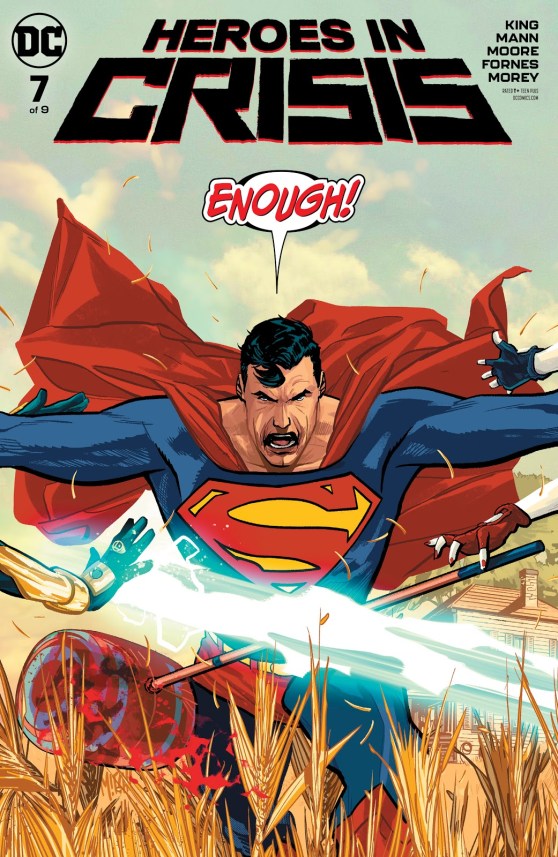
Heroes_in_Crisis_7

While Heroes in Crisis has many good and bad qualities, without a doubt the best thing about it is the examination of traumatised heroes.  A large part of this comic’s narrative revolves around the fact that all the superheros in the DC universe are deeply traumatised or emotionally damaged because of their heroic careers, requiring them to seek treatment at Sanctuary.  While I know that some readers really disliked this portrayal of superheroes being emotionally and psychologically damaged, I personally felt that it was a clever inclusion from King that added a lot of realism to the DC universe.  Of course these heroes are going to be traumatised!  Most of them have been fighting crime or dealing with crazy people for most of their lives, experiencing innumerable tragedies and losses along the way, including dying and coming back to life multiple times.  It is honestly rather refreshing to see this acknowledged within the comics, and I deeply appreciated that King decided to feature it so prominently in Heroes in Crisis.

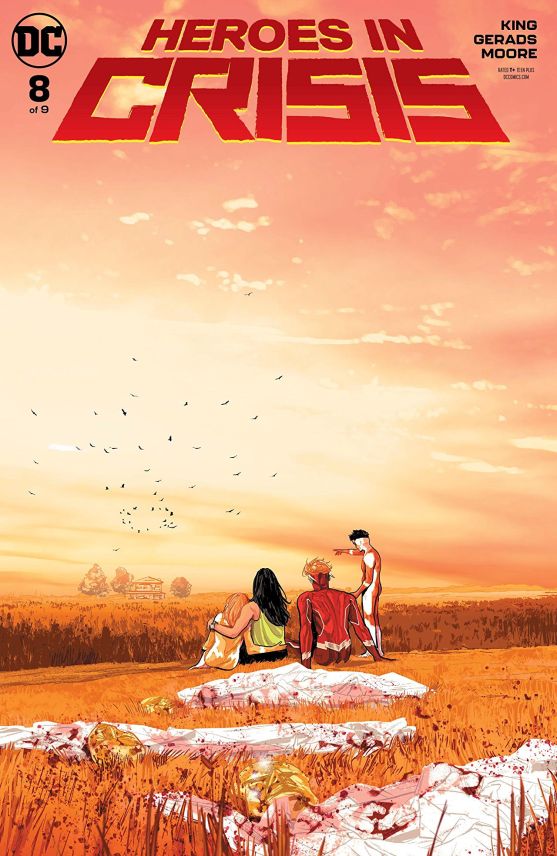
Heroes_in_Crisis_8

One of the reasons that this psychological plotline works so well is because Heroes in Crisis features a ton of panels and scenes highlighting the heroes as they discuss their trauma.  Not only do you get glimpses at several AI assisted therapy sessions, some of which are quite intense (Lagoon Boy’s one hurts to read at times), but there are a ton of “confession” panels, which show the various heroes sitting in a special room discussing their pain to a camera.  These confession scenes are cleverly scattered throughout the comic and are worked into the story extremely well, showing the raw psyche of some of the comic’s major characters or murder suspects and providing possible motivations for their actions.  At the same time, they work to show the reader just how damaged some of your favourite heroes can be.  While there is a focus on characters who were part of the Sanctuary massacre, nearly every DC superhero makes an appearance at some point in Heroes in Crisis, talking about their pain and their sorrow.  King ensures that each of these confessions, even the single-panel ones, are really emotionally rich and moving, and you get some amazing feelings out of all of them.  Highlights for me include a great sequence with Batman lamenting the death of his sidekicks, and another one with Commander Steel, who is pretty damn traumatised by his experiences of dying, being reborn as a zombie, having his corpse mutilated, and then coming back again.  Booster, Harley and Wally West also have some very intense, story driven confessions which both moved the story along and helped to get to the roots of their issues.  I found these scenes of trauma, healing and emotions to be particularly well written and very powerful, and they are one of the main reasons I enjoyed this comic as much as I did.

Heroes_in_Crisis_9

Another major highlight of Heroes in Crisis is the exceptional artwork by a massive collection of artists who banded together to produce some iconic and powerful pieces of art.  All of the scenes within this comic are very well drawn, and there is a real sense of movement, purpose and intensity in every panel.  I loved all the cool action sequences, and the artists really did not pull any punches when it came to highlighting the tragic deaths of so many different heroes.  Some of the best artwork, however, lies around the amazing and wonderful background and landscape shots throughout the comic.  There are so many fantastic shots that superimpose the characters in front of some beautiful settings, whether they be fields, sunsets or other pieces of nature.  These shots are not only visually impressive but they really add to the dramatic feel of the entire comic, especially as they remind you of the hope that so many of the damaged characters want to feel, but cannot, either because of the events of this comic or some pre-existing trauma.  The artistic team also has a lot of fun bringing to life a host of heroes from various periods of DC’s history, including some obscure characters we have not seen for a very long time.  While some of them were brought back only to die a painful death, it was great to see them again and the artwork surrounding them turned out to be superb.  I also deeply appreciated the artists’ ability to portray emotion and sorrow on the faces of each of the characters featured within Heroes in Crisis.  You get a real sense of the darkness and pain lying behind some of the characters’ eyes, especially in some unguarded moments, and it helps to enhance the emotion of the pages.  Overall, this was some impressive and memorable artwork that did a great job enhancing King’s intriguing tale.

Heroes_in_Crisis_9 (V1)

Heroes in Crisis was a very interesting and memorable comic which I had a great time reading.  While it does have some flaws, I think that the creative team behind it managed to create a very touching character driven narrative that succeeded in highlighting the vulnerabilities of several iconic DC superheroes.  I had an amazing time reading this comic and it is definitely worth checking out, especially if you are interested in exploring the damaged minds of some of your favourite heroes.

Amazon     Book Depository

Throwback Thursday – Grave Peril by Jim Butcher

Grave Peril Cover

Publisher: Buzzy Multimedia (Audiobook – 1 September 2001)

Series: Dresden Files – Book Three

Length: 11 hours and 55 minutes

My Rating: 5 out of 5 stars

Amazon

Welcome back to my Throwback Thursday series, where I republish old reviews, review books I have read before or review older books I have only just had a chance to read.  In my latest Throwback Thursday article, I continue my dive into the bestselling Dresden Files urban fantasy series by Jim Butcher by looking at the third chilling novel, Grave Peril.

I am really getting into the awesome Dresden Files novels, a major long-running urban fantasy series that follows Harry Dresden, a wizard living in modern-day Chicago, as he investigates supernatural crimes.  Generally considered one of the best urban fantasy series of all time, I started enjoying this series last year when I read the latest novel, Battle Ground.  I absolutely loved Battle Ground (easily one of the best novels and audiobooks of 2020) and I have since decided to go back and check out the earlier entries in the series.  I already enjoyed the very first novel, Storm Front, a couple of months ago, and Fool Moon, which I finished and reviewed last week, was so much fun that I had to immediately go and read another Dresden Files book.  I have just finished off the third entry, Grave Peril, and decided to feature it in this Throwback Thursday article.

Something is stirring in the dark of Chicago and it is bringing all manner of ghosts and spooks with it.  Harry Dresden, professional wizard, is used to facing the supernatural dangers infecting his city, but he has never experienced quite so much chaos as the spirit world has gone crazy.  Powerful ghosts and tortured spirits are popping up all around Chicago, causing the walls between our world and the Nevernever (the spirit world), to weaken and fray.  As Dresden attempts to find out who or what is behind the current upsurge in spiritual activity, he finds himself under attack from a powerful and unseen force that can strike through his nightmares.  Scared, weakened and full of self-doubt, Dresden is near powerless to stop this creature as it begins to target his friends and loved ones.

With a righteous Knight of the Cross at his back and his reporter girlfriend hounding him for a scoop, Dresden looks for the true source of the entity coming after him.  But in order to find the truth, Dresden must place himself in the very heart of Chicago’s supernatural underworld.  With old enemies, bloodthirsty vampires, howling spirits, deadly demons and his twisted fairy godmother coming after him, can Dresden survive this latest attack unscathed, or will his enemies finally succeed in destroying him, mind, body and soul?

Is it even possible for Butcher to write a bad Dresden Files book?  I have yet to see any evidence to suggest this as Grave Peril, the fourth Dresden Files novel I have read and the third book in the series, turned out to be another epic and powerful fantasy read.  Butcher has come up with a fantastic novel in Grave Peril, and I loved the dark and compelling story that sees Dresden face various demons from his past.  Utilising some great new characters and serving as a major entry in the overall series, this was an outstanding read which gets yet another five-star rating from me.

I deeply enjoyed the cool and complex narrative that Butcher came up with for Grave Peril, especially as it takes Dresden and his friends into some sinister and dangerous places.  This book starts quick, with a great extended sequence that sees Dresden and Michael face off against a powerful ghost in the Nevernever.  This amazing opening to the novel is then followed by an intriguing central story which forces Dresden to investigate a new and unusual antagonist, the Nightmare, who is feasting on his dreams and using the power it steals to go after Dresden’s loved ones.  This central story is very intense and compelling, playing to the series’ detective novel inspirations as Butcher sets up a fantastic mystery while also showing a desperate Dresden coming under attack in some unusual ways.  There are some fantastic moments in this part of the book, and I really appreciated the author’s inclusion of multiple supernatural suspects as you try to figure out who is involved and how they are pulling off their plans.  All this leads to the book’s most memorable sequence, a vampire masquerade, which sees Dresden and his closest allies trapped at a ball, surrounded by a dangerous array of enemies and, trying to work out motivations and plans on the fly.  The story is eventually all wrapped up with a dramatic and clever conclusion that is exciting, emotionally rich and a little traumatising to the reader.  I deeply enjoyed Grave Peril’s cool narrative and it honestly did not take me long to get fully engrossed in what was happening.  While this novel is not as action orientated as the previous book, Fool Moon, it has a much darker edge to it with a particular focus on manipulation, emotions and intrigue.  Readers should be warned that some of the scenes can be a bit over-the-top at times (I am pretty sure the protagonist gets raped by a vampire at one point) and are a little hard to read.  However, this is an overall exceptional narrative.

Like most books in the Dresden Files series, Grave Peril can be read as a standalone novel without any knowledge of the previous entries.  Butcher always makes his novels very accessible to new readers, and while there are some references to the character’s previous adventures, most of the relevant details and re-examined and explained throughout this book.  Grave Peril is a fairly major entry in the overall series as Butcher starts to introduce some important storylines, key supporting characters and lasting world-building elements which become quite significant in future novels.  In particular, Butcher introduces lore surrounding vampires, spirits, and fairies, with the protagonist coming into conflict with all three.  Each of these fantasy elements are set up extremely well and have a dark edge that fits into the series’ distinctive tone.  I loved the author’s depiction of the fairy creatures as monstrous and shadowy manipulators, and it was quite cool to see all the lore around vampires.  Grave Peril introduces three major vampire courts, with each court made up a different sub-species of vampire with their own specific powers and weaknesses, from the Dracula-esque Black Court, to the sexually and emotionally powered vampires of the White Court.  Each of these different types of vampires are strongly featured in Grave Peril and are a fantastic part of the story.  The highlight for me was probably the various battles between Dresden and the members of the Red Court, who can be pretty freaky and repulsive, and Butcher sets up an intriguing, long-running storyline with the Red Court here.

It is near impossible to discuss a Dresden Files novel without mentioning the incredible and well-written characters that appear in each book.  Butcher has a real talent for introducing and developing memorable protagonists and antagonists, and Grave Peril is a particularly good example of this.  Not only do several amazing recurring characters reappear in a big way but Butcher also introduces some intriguing new figures who make a big splash.

The key character as always is series protagonist and point of view character, Harry Blackstone Copperfield Dresden, the sarcastic and amusing maverick wizard who is constantly finding himself in trouble.  I always deeply enjoy following Dresden throughout these novels, mainly because he has a wicked sense of humour, an entertaining attitude and an uncanny ability to annoying and enrage everyone he comes across.  Most of Grave Peril’s humour comes from Dresden’s outrageous actions and observations, including his insane decision to arrive at a vampire’s ball dressed in a cheesy Dracula costume (that raised some eyebrows and lengthened some fangs).  Despite this fun and amusing exterior, Dresden is quite a damaged individual, and you really get to see that on full display in Grave Peril.  Dresden goes through some major traumatic events in this novel, several of which nearly break him as he is forced to encounter or do some very dark deeds.  Butcher really takes his protagonist to the edge in this novel, and there are some very intense scenes, including a glimpse of Dresden’s nightmares and deepest fears.  The author also continues to drip-feed hints of his protagonist’s dark past throughout this novel, especially when Dresden comes into conflict with an old enemy/mentor.  All this hurt and trauma is really touching and compelling, and the entire novel features a heartbreaking ending for Dresden, which really hits home, especially after you find yourself connecting with the character.

Aside from Dresden, there is a great collection of supporting and side characters I had a lot of fun seeing in this novel.  The most prominent of them is newly introduced protagonist, Michael Carpenter, Knight of the Cross.  Michael is a modern-day holy crusader, wielding a powerful blessed sword and his own unflappable faith to strike down evil.  Michael is a very intriguing character, and I deeply enjoyed the friendship he forms with Dresden.  Michael is a man of intense faith and goodness, who manages to balance family with his responsibilities as a knight, and this serves as a fantastic counterpart to the more flaky and irresponsible Dresden.  Like Dresden, Michael goes through some major traumas in this novel, several of which shake even his faith and resolve.  However, no matter how dark the situation, Michael manages to pull through and he and Dresden work together well as an enjoyable team with Michael serving as a mentor figure and conscience to Dresden.  I felt that Butcher did a great job introducing Michael in this novel, and I am excited to see how this noble knight develops in future Dresden Files’ entries.

Other great side characters in this novel include Dresden’s girlfriend, feisty reporter Susan Rodriguez.  Susan has not been my favourite character in the past, but she has a great story arc in this novel.  Not only does she attempt to do her own research into the case but she also serves as a major figure of emotional turmoil for Dresden as he struggles to prioritise her over his supernatural work.  While I did get a little annoyed at some of Susan’s decisions in this novel, I enjoyed the compelling story arc Butcher weaves around her, especially as it alters her in a big way.  My favourite haunted skull, Bob, returns once again and has several great scenes throughout Grave Peril.  I love Bob’s funny, if slightly pervy, personality, and all his appearances are very amusing.  There are some great new characters featured in this book as well, including Lea (The Leanansidhe), Michael’s fairy godmother.  Lea, who previously made a dark bargain with a desperate teenage Dresden, spends much of this book manipulating and hunting Dresden, attempting to claim him and his power.  I loved the use of this evil, manipulative and sexy fairy godmother through the novel, and she ended up being a pretty impressive secondary antagonist.  Grave Peril also sees the introduction of Thomas Raith, a White Court vampire who finds himself helping Dresden.  Thomas is a cool addition to the plot, and it was intriguing to see his introduction to the Dresden Files, especially as I know some spoilers about him.  All of these characters were pretty awesome and I had an outstanding time seeing their latest dark adventure unfold.

As I have with the previous entries in this series, I ended up listening to Grave Peril’s awesome audiobook format.  The Dresden Files audiobooks are a thing of beauty and I love how fun and exciting listening to these great books turns out to be.  The Grave Peril audiobook has a decent runtime of just under 12 hours, which is longer than the previous two Dresden Files novels, but readers will be too caught up in the amazing narrative to care.  I managed to power through it in only a few short days, mainly because of the outstanding narration from actor James Marsters.  Marsters, best known for his roles in shows like Buffy the Vampire Slayer, Angel, Smallville and Torchwood, narrates all the Dresden Files books and does an exceptional job bringing each of these novels to life.  I absolutely loved the incredible gravitas and energy he infused in the Grave Peril audiobook.  Marsters really gets into the heart and mind of Dresden, and you get an amazing sense of what the protagonist is thinking and feeling through the narrator’s voice and tone.  I also enjoyed the enthusiasm that Marsters exhibited in several key scenes, as he attempted to highlight certain weird and dangerous story elements.  For example, he does a fantastic enraged and shrieking ghost wail towards the start of the novel that gave me a start, and I loved the dark and dangerous voices he pulls together for some of the more monstrous creatures.  It was also very cool to hear Marsters yell out some of Dresden’s spells in the heat of battle, and it really enhances the excitement of the scene.  All of this and more makes the Grave Peril audiobook the perfect way to enjoy this novel, and I plan to check out the entire Dresden Files in this format.

Grave Peril by Jim Butcher is an exceptional and incredible fantasy novel that serves as an amazing third entry in the bestselling Dresden Files.  Butcher crafted together a dark and compelling character driven narrative for Grave Peril which proved to be extremely addictive and powerful.  I had an outstanding time getting through this novel, and I loved all the clever introductions and memorable sequences the author loaded into the plot.  A highly recommended read, especially as an audiobook, I cannot wait to see what other madness occurs in the rest of this fantastic series.

Amazon

Throwback Thursday – Fool Moon by Jim Butcher

Fool Moon Cover

Publisher: Buzzy Multimedia (Audiobook – 9 January 2001

Series: Dresden Files – Book Two

Length: 10 hours and 6 minutes

My Rating: 5 out of 5 stars

Amazon

In my Throwback Thursday series I republish old reviews, review books I have read before or review older books I have only just had a chance to read.  For my latest Throwback Thursday, I continue my exploration of one of the most highly regarded urban fantasy series out there, Jim Butcher’s The Dresden Files, with the awesome and deeply captivating second entry in the series, Fool Moon.

The Dresden Files are an outstanding collection of novels that follows professional wizard and private investigator Harry Dresden in modern-day Chicago as he battles magical creatures and practitioners that threaten innocent people.  Generally considered the gold standard of the urban fantasy genre, The Dresden Files have been going for over 20 years and currently consist of 17 novels and a massive collection of short stories and novellas.  While I have been meaning to check this series out for a while, I only started reading them last year when I received a copy of the latest entry in the series, Battle GroundBattle Ground was an epic and extraordinary read that featured a mass-supernatural war in the middle of Chicago.  I absolutely loved Battle Ground and it was easily one of my favourite books and audiobooks of 2020, while Butcher was one of the best new-to-me authors I read last year.  Because of how incredible I found Battle Ground to be I have decided to go back and start reading the series right from the beginning.  I started with Butcher’s first Dresden Files novel a couple of months ago, Storm Front, which proved to be another impressive read, and I am now extremely hooked on this series.  So when I was in the mood for a fun book to break up my reading schedule, I decided to start listening to Fool Moon, and boy am I glad that I did.

Business has been slow for Harry Dresden, Chicago’s only professional wizard, after his last investigation led to all out chaos and destruction.  However, his life is once again about to get very interesting when he is dragged to a murder scene.  One of the bodyguards of a notorious crime lord Dresden has dealt with in the past has been brutally torn to shreds.  With a full moon in the sky and bloody wolf prints surrounding the victim, Dresden comes to the only conclusion he can: there is a killer werewolf stalking the city.

Diving once more into a supernatural case, Dresden attempts to find the killer before the moon rises again.  However, this may prove more difficult than he initially believes, as Chicago is currently rife with wolf-based magic practitioners, enhanced criminal gangs and monsters, each of whom could be more than capable of committing the crime.  Worse, when an associate of his turns up dead, Dresden finds himself under suspicion for the murders by the police and the FBI.

Now on the run with his reporter girlfriend and a mysterious ethereal shifter, Dresden needs to find out who or what is responsible for the murders and why they have involved him.  But with the most bestial elements of Chicago’s criminal elements coming after him and an uncontrollable and seemingly unkillable monster hunting through the night, can Dresden stop the killers before it is too late, or will the next full moon be his last?

Wow, now this was a pretty awesome second entry in the outstanding Dresden Files series.  Butcher has crafted together something really special in Fool Moon, thanks to its compelling and intense story, amazing characters, great humour and impressive fantasy additions.  I had an absolute blast getting through this book in a few short days and it was so good I have no choice but to give it a full five-star rating.

At the centre of this incredible novel is a complex and exciting narrative that sets the protagonist on a deadly journey filled with murder, mystery and monsters.  Starting with an intriguing investigation into an apparent werewolf serial killer, Fool Moon’s story eventually devolves into a survival story for the protagonist as he finds himself on the wrong side of the law, the true killers and several different groups of criminals and werewolves.  This proved to be a really impressive and addictive narrative, and I loved the outstanding blend of a detective story with magic, wizards and wolves.  The mystery angle contained within Fool Moon is particularly good, and while the culprit is revealed about two-thirds the way through for excellent story reasons, it was still a fantastic and twisty case that I enjoyed.  Butcher really invested in several excellent and memorable extended sequences in this novel that were a lot of fun to get through, including a particularly intense brawl between several antagonistic groups with Dresden in the middle, and a fantastic high-stakes final confrontation where no one is safe.  However, my absolute favourite sequence occurred in the middle of the novel and saw Dresden forced to contend with a rampaging monster in the middle of a police station.  The sheer carnage and destruction that occurred in this sequence was really cool, and readers are left on the edge of their seats as the fates of several characters hang in the balance.  I deeply enjoyed this intense scene, and it absolutely cemented Fool Moon’s place in my dark heart.  This was an incredible and powerful story, and readers who check it out are in for a thrilling and captivating treat.

A particular strength of The Dresden Files as a series is the way in which the author makes it very accessible to new readers who can easily slip into any of the books in the series, even some of the later instalments, and easily follow what is going on.  Fool Moon is a great example of this, and I felt that people unfamiliar with the rest of the series should be able to enjoy this book without any problems.  All the recurring characters in the narrative are quickly and effectively reintroduced, often in a similar manner to how they appeared in the first book, and any relevant storylines, magical abilities or prior adventures are also covered in some detail.  As a result, new readers should have no trouble enjoying this great book, and indeed this will probably turn them into a fan of the series and ensure that they check out some of the other books.  However, there are some cool connections to the first novel that dedicated readers will notice, and I liked the underlying story thread of someone plotting and planning behind the scenes to mess with the protagonist.  Overall, this a great book for all fantasy and mystery fans, especially those who like a complex, multi-genre narrative.

I love all the awesome fantasy elements that Butcher slips into his novels, and it is always great to see the weird and magical in the midst of modern-day Chicago.  Fool Moon is no exception, as Butcher has a lot of fun expanding out some of the rules of magic in this book, as well as highlighting a few additional magical denizens and powers.  While this is very cool, the real magical highlight of Fool Moon has to be the werewolves.  Most fantasy authors who feature werewolves in their story would choose just one specific type that they like and leave it at that.  Butcher, however, is not the sort of person to do stuff by half measures (check out the massive fantasy war featured in Battle Ground) and instead features five separate subtypes of werewolves, all of whom are potential suspects for the murders.  I deeply enjoyed this use of multiple werewolves throughout the novel, not only because it really helped to enhance the book’s already fantastic mystery, but because it was awesome and fascinating to see the different creature subtypes.  Each werewolf or wolf-based magic user has their own unique abilities, source of power and personalities which Dresden has to learn about and overcome if he is to survive.  These wolves include shapeshifters, demon talisman powered wolves and humans with wolf-like mentalities that make them act like berserkers.  The standout, however, is the loup-garous, a cursed individual with no control over their actions; essentially a more monstrous version of wolf man from film.  Butcher paints his loup-garous as a particularly dangerous being which is practically invincible to everything and anything it encounters, including the protagonist’s most destructive magic.  This loup-garous causes some real carnage in this book, and watching Dresden attempt to defend himself from it is pretty crazy and makes for some excellent and intense scenes.  I deeply, deeply enjoyed the epic use of werewolves in this novel and Butcher really does the old lore surrounding them justice.

It is impossible to talk about a Dresden Files novel without discussing the incredibly well-developed characters featured within.  The most prominent of these is central protagonist Harry Dresden, Chicago’s resident wizard for hire.  Dresden is an exceptionally entertaining and likeable protagonist who provides pretty much all of the book’s great humour thanks to his outrageous personality, disrespect for authority and witty observations about the events going on around him.  As such, he is a fantastic character to follow, and you really appreciate his knowledge and insights into the supernatural and the people around him.  While much of the book shows Dresden as a confident and amusing being, we do get to see more of the character’s darker side as he deals with dark and dangerous magic.  Thanks to the author’s outstanding writing style, the reader is front and centre for all of the protagonist’s slips towards darkness and despair, especially as he encounters tragedy, loss and insane opposition.  I really appreciated this examination of the protagonist’s fragile psyche, and Butcher makes sure to take him to the edge in Fool Moon.  The author also makes some additional intriguing references to Dresden’s past which hint at some traumatic events and betrayals.  Fool Moon also shows of Dresden’s full magical potential, especially as he launches some incredible attacks here, even if they do leave him very drained.  It also shows the character at his most vulnerable, as he is forced to go it alone with only the bare amount of resources and abilities.  All of this makes for an intriguing and powerful character and I really enjoyed seeing more of this awesome protagonist.

In addition to Dresden, Butcher also makes excellent use of several great supporting characters, each of whom add some fun and compelling elements to the plot.  The most prominent supporting character was probably Karrin Murphy, Dresden’s liaison in the Chicago police.  Murphy, a hardnosed professional who is one of the few police officers to believe in the supernatural, has an intriguing character arc in this novel.  This is mostly because of Dresden’s actions in Storm Front, as well as his somewhat chauvinistic determination to protect Murphy from magic, both of which ruined have Murphy’s trust in him and placed her in some hot water with the police brass.  This fractured relationship becomes a key story point in Fool Moon, especially as it leads to Murphy being quick to jump on Dresden as a potential suspect in the crimes.  This adds some compelling difficulties for the protagonist in the story, and I really appreciated the excellent drama that emerged between the two as Murphy and a repentant Dresden attempt to work out their issues.

Aside from Murphy, you have the return of Susan Rodriquez, Dresden’s love interest and a reporter for a tabloid newspaper.  Susan is an interesting counterpoint to Dresden, being an ambitious reporter determined to find out the truth of the arcane no matter what.  She has a fun and fiery relationship with Dresden in this novel, and it was interesting to see her more involved with the story, especially as she sees Dresden at his darkest and most dangerous point.  I also loved seeing more of Gentleman Johnny Marcone, the sly and powerful gangster who Dresden has previously gone up against.  Macone is a fantastic villainous character, and I love the antagonistic relationship he has with Dresden, even when the two are on the same side.  You also have to have a laugh at Bob, a guiding spirit who resides inside a skull in Dresden’s basement, as he adds some intriguing exposition and laughs in his scenes.  There were also some intriguing new characters added in this book, although I will not go into too much detail about them as it could spoil some parts of the story.  None the less, they were all really fun additions to the plot, and having so many different new magical or shapeshifting beings ensured the reader was constantly trying to work out who was the actual villain.  All in all, a fantastic group of characters, and I felt that they really helped to turn Fool Moon into an excellent and first-rate read.

One of the reasons I have been enjoying The Dresden Files books is because they have some really awesome audiobook formats.  Each of these audiobooks I have listened to have been extremely amazing, and I love the way in which they portray these fun stories in a concise and exciting manner.  The Fool Moon audiobook has a runtime of just over 10 hours, and listeners will power through this in no time at all, especially as it is really easy to become addicted to the fantastic story.  However, the main thing that I love about these audiobooks is the perfect choice of narrator in actor James Marsters (Spike from Buffy and Angel).  Marsters does an outstanding job with his narration, imbuing the various characters with some fantastic and fitting voices that expertly convey their personality, emotions and actions.  I am particularly impressed by the way in which he portrays the story’s narrator and main protagonist, Harry Dresden, and the tone he uses for him perfectly represents the sarcastic and entertaining rogue wizard.  This is one of the best examples of an audiobook narrator matching their protagonist, and it makes for some fantastic listening.  I also appreciated the way in which Marsters started really getting into his narration of certain key events in this second novel.  While he did an excellent job in Storm Front, I felt that Marsters stepped up his game in Fool Moon, and while it was not quite at the level of enthusiasm and volume that featured in Battle Ground (he was really getting caught up in the action there), it was noticeably more exciting.  This enthusiasm added a lot to the enjoyment I felt while listening to Fool Moon and I strongly recommend this format to anyone who wants to check this book out.

Fool Moon by Jim Butcher ended up being another exceptional and spectacular addition to the author’s legendary Dresden Files series.  I had an outstanding time listening to the clever and exciting narrative that Butcher came up with for his second novel and I think that the author actually stepped up his game a little with Fool Moon.  Featuring some great characters and an addictive and thrilling mystery surrounding werewolves, Fool Moon is an incredible read that I powered through in no time at all.  I can think of no higher praise for this book than to say that the moment I finished it I immediately started the next novel in the series, Grave Peril, as I still had not gotten my fill of Dresden Files goodness.  I am already making some amazing progress with Grave Peril and I am planning to review in the next week or so.  Until then, readers are strongly encouraged to check this awesome second entry in the series out, as you will not regret it.

Amazon

Throwback Thursday – Star Wars: Maul: Lockdown by Joe Schreiber

Star Wars - Maul - Lockdown Cover

Publisher: Random House Audio (Audiobook – 28 January 2014)

Series: Star Wars

Length: 12 hours and 20 minutes

My Rating: 4.5 out of 5 stars

Amazon

This is part of my Throwback Thursday series, where I republish old reviews, review books I have read before or review older books I have only just had a chance to read.

2021 has so far been a fantastic year for Star Wars novels with excellent releases such as the two Star Wars: The High Republic novels, Light of the Jedi and Into the Dark, and the final entry in the Alphabet Squadron trilogy, Victory’s Price.  I have been really enjoying these new Star Wars novels but I recently got a hankering for something a little different and decided to go back and check out some of the older Star Wars tie-in novels.  While there were several intriguing options (I was strongly eyeing off A New Dawn by John Jackson Miller, Darth Plagueis by James Luceno and Razor’s Edge by Martha Wells), I eventually settled for the one of the last entries in the Star Wars: Legends range of books, Maul: Lockdown by Joe Schreiber, an intensely exciting and dark novel with an amazing story to it.

Welcome to the space station Cog Hive Seven, the most dangerous prison in the entire galaxy.  Here inmates are forced to fight to the death in matches broadcast to millions of gamblers across the Republic determined to make a profit off the blood of the galaxy’s worst killers and criminals.  No one escapes from Cog Hive Seven, and every one of its deadly and evil inhabitants know that they will eventually die there.  However, not even these deranged inmates are prepared for the new evil that has been thrown into their midst, the lethal dark-side assassin, Darth Maul.

Sent by Darth Sidious to contact a secretive weapons merchant, Iram Radique, Maul has disguised himself as a notorious mercenary and killer.  Determined to complete the mission his master has given him, Maul begins to upend the prison to find the elusive Radique, quickly establishing himself as a destructive force of chaos.  However, his notoriety also sees him forced into progressively more dangerous matches against some of the deadliest creatures in the galaxy.

Bereft of his lightsaber, forbidden from using the force and with bombs injected into both his hearts, Maul must rely on his brutal combat abilities and own inner strength to succeed.  But the closer he gets to finding Radique, the more he realises that not everything is as it seems aboard Cog Hive Seven and that his target will do everything is his power to avoid meeting with Maul.  Worse, dangerous factions have taken notice of the prison and its deranged warden and soon Maul must contend with a death cult, the followers of Jabba the Hutt and a horrifying monster living within the walls of the prison.  Can even Darth Maul overcome the odds in front of him, or will the creatures of Cog Hive Seven swallow him whole?

I think readers of this blog will not be too surprised to hear that the moment I found out that there was a book that followed Darth Maul participating in death matches aboard a space prison, I knew I would have to read it, and boy am I glad I did.  Maul: Lockdown is an impressive and fantastic novel that I found to be instantly captivating and which I powered through in a short amount of time.  Author Joe Schreiber, whose previous novel, Death Troopers, featured an outstanding story about key Star Wars characters encountering a zombie horde (it is as awesome as it sounds) came up with a pretty epic narrative for this Star Wars novel, and I really enjoyed this cool, Darth Maul-centric book.

I have to say that I was really surprised about how complex and impressive Maul: Lockdown’s narrative turned out to be.  Based on the plot description, I would have expected a simple, action-orientated story, but instead Schreiber crafted together a dark and powerful Star Wars tale with some compelling mystery elements.  This book reads a lot like a prison thriller, with Maul thrust into the middle of a dangerous jail which he must navigate to find his target.  While there is a natural focus on the fights between Maul and the other dangerous inmates, which results in some exceptional action sequences, the author also works in some great mystery and crime fiction elements that combine perfectly with the Star Wars backdrop.  The author utilises a bunch of multiple perspectives to show the chaotic nature of the prison, and there are several great storylines based around supporting characters which twist their way around Maul’s central story of surviving and attempting to find the secretive arms dealer.

As the story progresses, more and more dangerous elements and antagonists are thrown into the narrative, including monsters, deranged cultists and even Jabba the Hutt, intensifying the obstacles facing Maul and raising the thrilling stakes of the narrative.  I really enjoyed the main storyline of the hunt for Radique, and there were plenty of false leads and twists around who he was and where he was hiding.  I did think the eventual reveal of the character (spoiler ahead!!!) was a tad weak, mainly as it ended up being a character we hadn’t seen before (spoiler end), but it was still an interesting and exciting centre to the narrative.  Schreiber also weaves some excellent horror elements into the story, especially surrounding one unique creature in the prison.  The author makes this creature particularly horrifying to behold, both because of its appearance and its unsettling abilities, and there are some real terrifying sequences surrounding it.  All these great elements come together perfectly into one fantastic and captivating tale that proves to be extremely addictive and very clever.

This is an exciting Star Wars novel that fans of the franchise are really going to enjoy.  Maul: Lockdown was one of the later entries in the previous Star Wars extended universe which is now known as the Star Wars: Legends range.  Despite no longer being considered canon, the Star Wars: Legends books still have some great stories, such as the impressive heist novel Scoundrels, and this was a pretty cool entry.  Set a year before The Phantom Menace, this book is loaded with a ton of references to other pieces of Star Wars media, including several previous Star Wars: Legends novels and comics, Schreiber’s previous book Death Troopers (featuring a clever cameo), and even an old Star Wars video game, Bounty Hunter.  There are lots of interesting pieces of Star Wars lore in here, and the author features a couple of major figures from the prequel films, as well as a few obscure characters from some of the older Star Wars novels, including a corrupted Padawan of Count Dooku I had not heard of before (she is not in the new canon).  I really enjoyed the author’s inclusion of a battle of intrigue between Darth Sidious and his master Darth Plagueis, and the story in Maul: Lockdown has some great connections to certain events in the Darth Plagueis novel.  While Schreiber has included a lot of high-level lore, I felt that this was quite an accessible Star Wars novel and anyone who saw Darth Maul emerge in The Phantom Menace will definitely enjoy this darker and captivating piece of Star Wars fiction.

One of the most intriguing things about this novel is the way in which the author attempts to dive into the mindset of fan-favourite character Darth Maul.  Ever since he whipped out his dual-bladed lightsaber in The Phantom Menace, Maul has been a much beloved figure in the Star Wars franchise, but you do not often get to see much of his inner thoughts.  While I would probably be happy reading a simple hack-and-slash adventure featuring Maul, I really appreciated the way in which Schreiber takes the time to examine Maul’s inner psyche, and you get an intriguing glimpse into his thoughts about his mission, his purpose in life and his loyalty to his master.  I found it quite fascinating to see the way in which Schreiber portrays Maul’s complex feelings about Sidious, as he is both simultaneous absolutely loyal to him while also being deeply suspicious about his intentions.  Maul spends most of the book believing that everything he is experiencing is a test or deception levelled at him by his Master and he also hints at his suspicions that he will eventually be betrayed.  While this examination of Maul’s more complex thoughts and feelings is quite interesting, it is also perfectly counterbalanced by a huge number of scenes that examine just how much of a badass Maul is.  Schreiber has loaded this book up with awesome and brutal fight sequences pitting Maul up against a range of deadly opponents, which are made even more awesome by the fact that Maul is unable to use either his lightsaber or force abilities.  Instead, Maul shows off his impressive unarmed fighting skills and his natural cunning, as he overwhelms his opponents in some brutal and clever ways.  The author also fits in some compelling hints and depictions of Maul’s training and early life, which I found to be very interesting, particularly as some of these events slightly differ from the current canon.  All of this makes for an exceptionally cool Darth Maul novel, and I loved seeing this great character in all his deadly glory.

I ended up checking out Maul: Lockdown on audiobook, which is easily the best way to enjoy a Star Wars book.  The Maul: Lockdown audiobook has a reasonable run time of 12 hours and 20 minutes, which dedicated listeners can get through in a couple of sittings.  I absolutely powered through this audiobook myself, especially once I got caught up in the cool story, and I had a great time experiencing all the features of this format.  Like most Star Wars audiobooks, Maul: Lockdown makes excellent use of the iconic sound effects and musical scores from the Star Wars films and television series to enhance its story.  The sound effects are particularly impactful in Maul: Lockdown, and I liked the way they made the many fight sequences pop with the sounds of violence and weapons blasting.  They also made one horrifying creature even more terrible to listen to thanks to the slithering and sucking sounds that played when it appeared.  This audiobook also made great use of John Williams’ amazing scores.  I always love hearing the inspirational and moving Star Wars music during these audiobooks, and while it was more restrained in this audiobook than some others I have enjoyed, it still helped to make several emotional or exciting scenes just a little more epic.

In addition to the cool sound effects and awesome music, Maul: Lockdown’s audiobook also made great use of exceptional narrator Jonathan Davies.  Davies is a veteran narrator who has lent his voice to several Star Wars novels in the past, such as Doctor Aphra, Dooku: Jedi Lost, Master and Apprentice and Lords of the Sith.  He does a fantastic job bringing the various characters in Maul: Lockdown to life, and I really enjoyed the unique tones that each character received.  I really liked the voices that he used for established Star Wars characters, which were close, if not spot on, to how they appeared in the films or television series.  This includes the menacing tones he came up with for Maul, which contained all the character’s barely supressed anger and hatred, and he did a rather good Darth Sidious which was reminiscent of Tim Curry’s take on him in The Clone Wars animated series.  Davis also did a perfect Jabba the Hutt (not exactly sure that is a compliment, but please take it as such), and I loved hearing him do Jabba’s iconic laugh.  Overall, his narration was pretty damn awesome and, when combined with the fantastic sound effects and great musical inclusions, helped to really enhance Maul: Lockdown’s narrative and continued the trend of outstanding Star Wars audiobooks.

Star Wars: Maul: Lockdown by Joe Schreiber is an outstanding and awesome novel that sees one of the best characters in the Star Wars canon fighting for his life in a dangerous setting.  Featuring a powerful and addictive narrative, loaded with intrigue, betrayal, and a whole lot of violence, this is a rich, clever, and dark Star Wars novel that comes highly recommended.  I had an incredible time reading this cool and captivating book and I really need to check out some of the other amazing sounding novels in the Star Wars: Legends range.

Amazon

Throwback Thursday – The Last Continent by Terry Pratchett

The Last Continent Cover

Publisher: Doubleday and ISIS Audiobook (1 May 1998)

Series: Discworld – Book 22

Length: 9 hours and 57 minutes

My Rating: 5 out of 5 stars

Amazon

This is part of my Throwback Thursday series, where I republish old reviews, review books I have read before or review older books I have only just had a chance to read.  For this Throwback Thursday I take a look at one of my absolute favourite books of all time, the incredibly funny and always enjoyable The Last Continent, by legendary author Sir Terry Pratchett.

I have never made it a secret that I absolutely love the works of the late, great, Terry Pratchett, who I consider to be one of the best authors of all time.  I love and adore every single one of Pratchett’s hilarious and captivating novels, especially the entries in the wacky and wild Discworld series, a comedy fantasy series set in an absolutely insane world of magic, monsters and outrageous personalities that lies upon a disc shaped world, borne through space on the back of four elephants, who themselves are on the back of a giant turtle.  I have so much love for this outstanding and hilarious series, and I have read each and every entry in multiple times.  Heck, even the name of my blog, The Unseen Library, is taken from a fictional institution in the Discworld series!  However, despite how much I love the series, I have so far only reviewed one Discworld novel on this blog so far (Shame! Shame! Shame!), Moving Pictures, and this is something I have been meaning to rectify for some time.

I recently did a Top Ten Tuesday list where I looked at some of the funniest books I have ever read, which included several Discworld novels, and this inspired me to do a review for another Pratchett read.  I ended up going with one of my favourite Discworld novels of all time, the incredible and wildly entertaining The Last Continent, which places one of the author’s most iconic characters into the most dangerous places imaginable, Australia.  I am reviewing this book slightly out of the order I originally planned, but I figured reviewing this one now may encourage me to get to others in the future.  I should admit that I have not read The Last Continent recently, but this is one of the many Discworld novels that I have read multiple times, either in its paperback (I’ve actually got a signed copy of this book) or its audiobook format, and at this point I have it pretty much memorised.

So the first thing I should cover is:

“This is not a book about Australia.  No, it’s about somewhere entirely different which just happens to be, here and there, a bit…Australian.

Still…no worries, right?”

Welcome to EcksEcksEcksEcks (XXXX), the Discworld’s last continent.  Made by a rogue creator who snuck in after the rest of the Disc was created and kept hidden away from its other civilisations by a series of massive storms, XXXX is a deadly and dangerous place.  Filled with some of the most lethal and confusing creatures on the entire Disc and populated by a friendly, if occasionally murderous, group of people, XXXX is a hell of a place to live.  Unfortunately, everything in it is about to die as the water dries out and even the beer is getting hard to find.

Luckily for the people of XXXX, a hero has been found, one who is battling his way through the wastes and towns of the country, his legend growing all along.  But who is this road warrior, sheep shearer, horse wrangler, beer drinker and ballad-worthy bush ranger, and why is he apparently so determined to run away from his heroic destiny?

That man is Rincewind, the Discworld’s most cowardly and inept wizard, who has been bounced from one end of the Disc to the other and been chased by every sort of monster, maniac and seller of regional delicacies you can imagine.  All Rincewind wants to do is go home, and he is determined to avoid any new adventures as a chosen hero, no matter what the talking kangaroo stalking him tries to tell him.  Despite his best efforts, Rincewind once again finds himself caught up in the special craziness of the locals, and if he wants to survive, he needs to find a way to save everyone.  What’s the worst that could happen???

So, as you may be able to tell from the above synopsis, this is a bit of a crazy novel, but it is one that is always guaranteed to make me laugh, especially with its fantastic Australian-based humour.  The Last Continent is the 22nd overall entry in the Discworld series and the sixth book to focus on the character of Rincewind.  I personally have a lot of love for this particular Terry Pratchett novel, and it is probably one of my all-time favourite Discworld novels.

Pratchett came up with a pretty clever and fantastic story for The Last Continent, which sees several of his established characters get involved in wackiness all around a newly discovered continent.  The main story follows Rincewind as he tracks across the wastelands of XXXX after getting sent there at the end of his previous novel, Interesting Times (there was an accident with a butterfly), and he is now primarily concerned with trying to find a way home.  However, mysterious forces soon work to turn him into the hero who will save XXXX from a thousand-year crippling drought.  Rincewind, who is more concerned with reaching the nearest port, soon gets involved with all manner of road bandits, deadly creatures, drunken locals and an annoying talking kangaroo, all of which lead him to the secrets at the heart of this lost continent.  At the same time, the wizard faculty at Unseen University are faced with a serious problem when their trusty orangutan colleague, the Librarian, falls ill, and they require his real name to work a spell to save him.  However, the only person who knows the Librarian’s real name is Rincewind, and so the faculty blunder their way through a magical portal to find him.  However, in predictable fashion, they find themselves trapped on a weird island thousands of years in the past and forced to deal with an immature and slightly beetle-obsessed god of evolution.

I really enjoyed both story arcs contained within this book, and Pratchett did an amazing job bringing them together.  Both have some fantastic and weird elements to them and they make great use of the particular adventures and attitudes of their relevant characters.  While Rincewind is forced to run away from all manner of deadly situations you typically see here in Australia (let me tell you, the dropbears and road gangs are murder), the wizard faculty blunder their way through all manner of unique situations, mostly by ignoring what is happening to them.  Each storyline is unique and has some fantastic highlights, but the real strength is the way in which Pratchett combines them together into one cohesive narrative.  Not only are both distinctive arcs perfectly spread out and separated throughout the course of the book, but Pratchett does a fantastic job combining them together in a clever way.  This ended up serving as a great near-final adventure for Rincewind (he’s more of a supporting character in his following appearances), and I think it did a wonderful job wrapping up his main arc.  While readers should probably read some of the earlier Discworld novels featuring Rincewind (especially the preceding Interesting Times), The Last Continent can easily be read alone, and readers will have an outstanding time reading this fun and compelling comedic adventure.

In my opinion, The Last Continent is one of Pratchett’s funniest novels, although I might be somewhat biased by my own personal humour and background.  I always have an outstanding time reading this book and there are so many clever jokes and amusing references that I cannot help but laugh, no matter how many times I hear them.  This book has a lot of Pratchett’s classic humour elements to it, such as the unusual quirks of his various characters and the funny little footnotes, filled with great references and punchlines.  The author goes off on some very entertaining segues during this book, and I love some of the great jokes he came up with, especially those that make fun of Australia.

Now, despite what the author says at the front of this book, The Last Continent is clearly a parody of Australia, and Pratchett clearly enjoyed utilising every single Australian reference or cliché he could think of to craft his funny book.  The continent of XXXX is an over-the-top fantasy version of Australia, with many of the outrageous stereotypes that you would expect, as well as some more subtle choices, and it serves as a truly amusing setting for this book, especially as Rincewind perfectly plays the part of clueless tourist.  While you could potentially discount The Last Continent as merely satirising Australia, I have always seen it as something cleverer, as I think that Pratchett was more making fun of the stereotypes that outsiders came up with rather than Australia itself.  That being said, Pratchett, as a Brit, did take a few good shots, although that’s only to be expected.  As an Australian myself, I always enjoy when comedy writers try to encapsulate Australia in their works, as it is quite amusing to see what they reference.  I always thought that Pratchett did this the best with The Last Continent, as he really dived into so many aspects of Australia life, nature and culture, and there are some truly funny jokes contained within.  Australian historical or cultural icons like Mad Max, Priscilla, Queen of the Desert, Skippy, The Man From Snowy River, Crocodile Dundee, and Ned Kelly are utilised in this book to great effect throughout The Last Continent, and there are some truly outrageous and clever references and jokes here.

While The Last Continent is filled with many, many funny Australian jokes, a few really stick out to me.  I personally always laugh so hard when Death, wanting to learn more about the continent his elusive prey Rincewind has landed on, decides to ask his library for a list of all the deadly animals on XXXX.  However, this results in him being buried by a massive pile of reference books, including “Dangerous Mammals, Reptiles, Amphibians, Birds, Fish, Jellyfish, Insects, Spiders, Crustaceans, Grasses, Trees, Mosses and Lichens of Terror Incognita: (Volume 29c, Part Three).  This is followed up by a request for a list of harmless creatures on the continent, and a single card appears bearing the sentence “some of the sheep”.  I love that over-the-top joke about how dangerous Australia’s wildlife is (it is honestly not that bad, although my editor was bitten by a sheep the other day), and that was one of the best ways I have seen it bought up.  I also loved the references to Australian hero worship of notorious criminals such as Ned Kelly or the jolly swagman from Waltzing Matilda.  There are some amazing jokes here, from people attempting to make catchy ballads, to the prison guards providing advice and help on last words and escape possibilities, all of which capture the rebellious Australian spirit.  I particularly liked Pratchett’s version of Waltzing Matilda, which was perfect in its rhyme, its satirical analysis of the original poem, and how it fit into The Last Continent’s narrative:

“Once a moderately jolly wizard camped by a waterhole under the shade of a tree that he was completely unable to identify.  And he swore as he hacked and hacked at a can of beer, saying ‘what kind of idiots put beer in tins?’”

Other great Australian comedic sequences for me include the scene where the Unseen University wizards attempt to design a duck by committee, resulting in the mighty platypus, an impromptu Mad Max road chase with horse-drawn carts and the constant references to a certain line in our national anthem.  All of these jokes, and more, were pretty amazing and I really enjoyed seeing some of the outrageous and over-the-top elements that British culture picks up about Australia.

While I really enjoyed all the fun references to Australia, some of Pratchett’s best jokes in The Last Continent occurred during the secondary storyline that followed the faculty of Unseen University as they go back in time and encounter the god of evolution.  The author uses this part of the book to make comedic observations about time travel, evolution and advanced biology.  Not only does include a particularly hilarious sequence in which someone tries to explain the grandfather paradox to a group of wilfully ignorant wizards, but there are some truly funny jokes about evolution and biology which cleverly reference some advanced concepts and historical basis of the science.  While I read this book years ago, it wasn’t until I took some specific biology classes that I fully grasped just how intelligent some of the jokes in this part of the book are.  I personally love a book which you can come back to time and time again and find some new joke or layer to, and this is the case with The Last Continent, which no doubt still contains elements or references I’ve missed.  All of this results in a comically brilliant read, and The Last Continent remains one of my favourite Disworld reads as a result.

I have always enjoyed the great character choices contained within this book, as Pratchett brings together some old favourites, as well as a few entertaining new ones, to tell the story.  The main character of The Last Continent is Pratchett’s original Discworld protagonist, Rincewind, the cowardly and inept hero who cannot even spell “wizard” properly, but who has served as a world-saving hero on multiple occasions.  Rincewind is always a particularly fun character to follow, not only because he constantly finds himself caught in all manner of unique situations which he heroically tries to run away from (he has become quite the expert at running away), but he has a certain realistic approach to life that allows him to see through the ridiculousness around him and address it in a funny manner.  At this point in the series, Rincewind has been bounced around from adventure to adventure against his will so much that he has developed a bit of knack for knowing when it is going to happen again, including figuring out all the signs someone gives off when they are trying to con him into being a hero.  It proves to be quite entertaining to see Rincewind try to escape from people trying to drag him into the narrative, especially as all his attempts to get out of dangerous situations generally put him in even worse trouble.  It is also really worth seeing Rincewind’s reactions to the various elements of XXXX life, especially as he soon begins to realise that everyone there has some very unusual ideas about how to live and die, most of which he is very opposed to.  I really enjoyed this more mature and somewhat resigned version of Rincewind and I have to say that this is one of my more favourite adventures of his (either this or Interesting Times).  It was definitely great to see the character get a happy ending towards the end of the book for once, which he frankly deserved after his last few adventures.

While Rincewind is tearing it up in not-Australia, Pratchett also dedicates around half of The Last Continent to the characters who form the faculty of the Disc’s premier wizard school, Unseen University.  Many wizard characters have featured in the Discworld books, but this current iteration of the faculty (with the exception of the Librarian) was originally introduced in the 10th book, Moving Pictures, and has remained pretty constant ever since.  This group includes the hunting-obsessed Archchancellor, Mustrum Ridcully; the quite insane Bursar; the incredibly obese Dean; the amusing team of the Senior Wrangler, the Chair of Indefinite Studies and the Lecturer in Recent Runes; the orangutan Librarian (working in a library is dangerous work); and the long-suffering Ponder Stibbons, the youngest member of the faculty and the only one with any common sense.  Pratchett had previously done an amazing job building up all of these characters in prior books, highlighting their unique quirks and issues, including the overwhelmingly stubborn, childish and traditionalist personalities of the older wizards.  This excellent blend of personality types really makes the older wizard characters really amusing and their adventures, especially when encountering strange gods and creators who they generally ignore, are extremely funny.  While an entire book about these characters would potentially be a bit overwhelming, I think that Pratchett got the balance right in The Last Continent, and they ended up serving as a fun counterpoint to Rincewind.  Stibbons was also a particularly good straight-man to his fellow wizards, and the contrast between keen intellectualism and entrenched “wisdom” is a fantastic part of the book.  I rather enjoyed Stibbons arc in this book, especially as you get to appreciate the true depth of his frustration with his fellow wizards, although he does gain a deeper appreciation for them as the book progresses.  Other amusing storylines with the wizards includes the Senior Wrangler’s obsession with housekeeper, Mrs Whitlow, which eventually gets shared with some of the other wizards, and the uncontrollable shapeshifting infecting the Librarian, which makes for some entertaining gags.  I also really enjoyed the fact that much of the book’s plot revolves around the fact that no-one actually knows the Librarian’s name, a fun feature from the previous books, and it was interesting to see the reasons why this was the case.

Aside from this fun collection of wizard characters, Pratchett makes great use of a fine selection of supporting characters, each of whom add some fantastic fun to the overall story.  This includes a very inventive group of new characters, each of whom represent various parts of XXXX life, whether they be depressed operatic chefs, police officers more concerned with getting their charges ballads and famous last stands, bushland drovers, belligerent drinkers, desert-wandering crossdressers in a princess-themed cart and even a crazed road warrior named Mad.  Despite most of them being the result of a punchline or extended joke, Pratchett sets each of these characters up really well and ensures each of them has a fun and satisfying character arc in the book.  I also quite enjoyed the return of fan favourite character, Death, who goes on a bit of a tourist phase through the book.  I really liked Death’s random appearances throughout The Last Continent, especially as he drops some amusing anecdotes about dying in XXXX, and it was also great to see his current viewpoint on Rincewind.  Whereas before he was always determined to catch and kill Rincewind, as he was the one mortal who constantly got away from him, in this book, Death, who no longer has any idea of when Rincewind is actually going to die and is now quite fascinated by him, keeps himself appraised of his progress and is generally friendly to him, even if that freaks Rincewind out.  I also loved the appearance of another member of the extended Dibbler clan, even if the XXXX version was a parody of a certain unpleasant right-wing political figure here in Australia.  The appearance of another ruthlessly mercantile hot-food dispenser with inedible food is a great continuation of a running joke Pratchett has been using for several books, and it is one that really pays dividends in The Last Continent, when Rincewind recounts all the terrible foods he’s eaten over the years from the various Dibblers he has encountered, which then runs into a fantastic diatribe about the dangers of national delicacies, especially XXXX’s meat pie floater (a real meal here in Australia, although there is no way in hell I would ever eat one).  All of these characters add so much to the book’s story, and I love the inventiveness that Pratchett puts into them.

While I have enjoyed all the Discworld novels in their physical paperback format at one point or another, my preferred way to experience a Pratchett novel these days is in its audiobook form.  All of the Discworld novels have been turned into excellent audiobooks over the years, and The Last Continent is no exception.  Narrated by the outstanding Nigel Planer, who ended up narrating over 20 Discworld novels (The Last Continent was the penultimate Discworld book he leant his voice to), and with an easily enjoyable runtime of just under 10 hours, this is a pretty fantastic audiobook that I regularly rush through in not time at all.  I find that all the awesome jokes in this book come across in the audiobook format extremely well, even the jokes traditionally contained within the book’s footnotes, and Planer’s witty voice is always pitched at the best tone to bring out the joke’s potential.  I really appreciate the way in which Planer utilised the same voices for the various recurring characters he has used in all their previous appearances, and each of the voices fit the characters very well.  I also really enjoyed the voices he came up with all the new characters, and it was exceedingly amusing to see him come up with a range of Australian voices and accents and have them belt out a variety of outlandish slang terms.  All in all, this turns out to be an excellent audiobook version of The Last Continent and it is pretty much the only way I enjoy this novel at the moment.

As you can see from the huge review I pulled together above (I have written university essays that were shorter), I really love The Last Continent.  This fantastic Australian parody is easily one of my favourite Discworld novels, and I deeply enjoy the outstanding and entertaining story that Pratchett wove around this outrageous version of my country.  Anyone who is familiar with anything Australian is going to have an incredible time reading this book, and I honestly do not think I could give this anything less than five stars.  A highly recommended read from one of the funniest authors of all time.

Amazon

Throwback Thursday – Storm Front by Jim Butcher

Storm Front Cover

Publisher: Buzzy Multimedia (Audiobook – 1 April 2000)

Series: Dresden Files – Book One

Length: 8 hours and 2 minutes

My Rating: 5 out of 5 stars

Amazon

For my latest Throwback Thursday I finally check out the first novel in the epic and highly acclaimed Dresden Files series, Storm Front, by legendary author Jim Butcher, which is an amazing and impressive read.

Jim Butcher is an outstanding author who has been dominating the fantasy market for nearly 20 years.  While he has written a couple of series, including his Codex Alera books, and some standalone novels, such as the tie-in novel Spider-Man: The Darkest Hours, Butcher is easily best known for his Dresden Files novels.  These books follow the adventures of titular protagonist Harry Dresden, Chicago’s only official wizard, who solves magical crimes and serves as a protector of the innocent against a range of supernatural threats.  This series has been running since 2000 and with 17 current entries (the 18th is on the way) it is generally considered to be the gold-standard of urban fantasy series.  While I have always heard amazing things about these books, I arrived a little late to the party, having only read the 17th book, Battle Ground, last year.  Battle Ground was a pretty epic read, containing an off-the-chain fantasy war in the heart of the city, and it ended up being one of my favourite novels (and audiobooks) of 2020.  Due to how much I enjoyed this latest book, as well as a general desire to explore the rest of the series, I decided to go back and read the first entry in the series, Butcher’s debut novel, Storm Front.

Harry Dresden is a man who leads an interesting life.  As the only openly practicing magic user in Chicago (his name is even in the phonebook under wizard), Harry scrapes a living investigating small and unusual cases, such as finding lost items and performing paranormal investigations while trying to avoid the attentions of the White Council, a governing body of magical practitioners who have placed Harry on a lethal probation.  However, his latest cases are about to make his life very complicated in ways he never expected.

Two people have been murdered in a particularly gruesome manner, with their hearts bursting out of their chests during an act of passion.  Called in by the Chicago P.D., which has him on retainer as a magical consultant, Harry determines that their deaths were caused by the darkest of spells.  Despite being forbidden by the White Council to know anything about the deadly arts, Dresden begins to dive into the case, determined to find out who is responsible and how they did it.  At the same time, Monica Sells, a local housewife, has provided Dresden with a great deal of money to find her missing husband, someone who has apparently had his own recent misadventures with magic.

As Harry investigates both the murder and the disappearance, he finds himself under attack from all sides.  Not only does the most feared gangster in Chicago want him to drop the case, but the White Council views him as the prime suspect in the deaths due to his deadly past.  Worse, a shadowy figure wants him dead and is unleashing dangerous magical creatures upon him.  However, you cannot keep a good wizard down, and Harry plans to use every trick at his disposal to stay alive long enough to find the killer, even if it burns every bridge he has.

Well, that was a pretty awesome read, and one that I wish I had checked out a very long time ago.  Storm Front is an exciting and clever book that combines a compelling story with some great characters, an interesting urban fantasy setting and a fantastic, humour laden tone, all of which come together into an impressive novel.  Storm Front also serves as an excellent first novel in the wider Dresden Files series, and it was extremely interesting to see it after previously reading a more recent entry in the series.  I had an amazing time with this novel and, while it is a tad rough in places, especially compared to Butcher’s later work, I must give Storm Front a full five-star rating.

At the centre of Storm Front lies a particularly good fantasy murder mystery narrative that sees the protagonist take on some challenging cases that result in death and destruction raining down on his life.  The story starts up quickly with Dresden, whose role as a wizard is more like a supernatural PI, being employed to find a missing husband, while also helping the police solve a twisted magical double murder.  This results in a fast-paced narrative that sees Dresden investigate both cases in his own unique way, which results in dangerous complications as people attempt to either discourage him or outright kill him.  I loved how the story read a lot like a hardboiled detective fiction novel, albeit with a lot more quips and amusing jokes, and this style of writing worked extremely well with the magical elements featured throughout the book.  The narrative gets more complex as the book progresses, with additional side characters, greater lore inclusions and more sophisticated dangers, and I felt that the author was able to work all of this into story extremely well, ensuring that the reader becomes enthralled with the intense magical action, entertaining characters, and outlandish threats.  The author also throws in some clever twists, which includes the protagonist becoming the main suspect in the murders, resulting in a lot of tense and dangerous situations as he tries to avoid everyone coming after him.  All of this leads up to an epic and fantastically written conclusion which pulls all the threads of the story together and ensures that the reader is left wanting more.  If I had to make one criticism about the book, it would be that the identity of the main antagonist/murder is extremely obvious right from the outset, and that ruins a lot of the surprises that the author was clearly hoping for.  However, I still really enjoyed Storm Front’s captivating tale, and it is worth hanging around to see the story unfold.  Overall, I felt that this was an exceedingly strong story and it honestly does not take long to get hooked on it.

Easily the top highlight of this book is the outstanding protagonist and narrator, Harry Dresden (full name: Harry Blackstone Copperfield Dresden, named after famous stage magicians), the rogue and public wizard.  Dresden is an amazing and entertaining protagonist who the reader quickly becomes attached to thanks to his antics, morality, unpredictable nature and skills as magic user.  I always enjoy smartass characters, and Dresden is one of the better ones I have read.  A lot of the book’s excellent comedic undertones are thanks to Dresden’s dry and timely sense of humour as he provides some excellent quips and commentary, both out loud and in his head.  Despite being a mostly funny character, Butcher ensures that his protagonist has a hard and dark edge to him that helps to make him even more compelling and intriguing to follow.  Not only does the reader get an in-depth and comprehensive look into his troubled psyche, especially when he is experiencing guilt, trauma or despair, but there are some intriguing hints at his dark past, some of which come into play throughout the book.  I also liked how the author set up and explored Dresden’s magical ability, especially as the protagonist is not the most powerful magical user out there, although he makes up for it through trickery, training and intelligence.  I particularly liked the way in which he was able to defeat an antagonist with substantially more raw magical power with some simple tricks or the use of some psychology, and the author did a great job highlighting his protagonist’s analytical thinking as one of his key strengths.  I also have to say that I really enjoyed the fantastic look that Butcher sets up for his character, with the black duster, the staff and the Blue Beetle car, making him a very distinctive figure.  This ended up being an outstanding introduction to the character, and it will be interesting to see how he develops to the powerful badass that later appears in Battle Ground.

In addition to Dresden, the author also features an interesting collection of characters throughout Storm Front who add some additional, exciting layers to the overall story.  Each of the supporting characters in this novel is very well-written and layered, featuring some intriguing histories (although they all have secrets that will be revealed later).  Many of these characters become major figures in the larger Dresden Files series, and this serves as an excellent introduction to them.  Of all the characters a few really stood out to me, including Bob, an air spirit who inhabits a skull in Harry’s lab.  Bob is a fun, if unusual, character who has a somewhat perverted/voyeuristic streak that causes Harry all manner of trouble and leads to some very entertaining moments throughout the book.  I also quite liked the introduction of Karrin Murphy, the hardnosed Chicago detective who utilises Dresden as her magical consultant.  Karrin is a great no-nonsense character who is one of the few people to call Dresden out on his actions and who has a complex relationship with him in this book.  I really must highlight the introduction of “Gentleman” John Marcone, Chicago’s premier crime boss who is antagonistic towards Dresden for much of the book.  Marcone is portrayed is a stone-cold killer with a hidden past, and there are some great hints at what sort of recurring character he becomes in future entries in this series.  I also thought that the overall antagonist of this novel was pretty good and served as a great counterpoint to Dresden throughout the book.  Despite the identity of the antagonist being rather obvious for much of the novel, I felt that Butcher provided them some complex motivations for their actions in Storm Front, and it was intriguing to see how they slid down into using dark magic.  This antagonist has a couple of fantastic scenes in this novel, and I particularly liked the clever way in which their storyline came to an end.  Each of these side characters added so much to the book’s plot, and I had an amazing time getting to know them.

I also really enjoyed the amazing urban fantasy setting that Butcher came up with for Storm Front.  This series is set in a world where magic is semi-hidden from mortals, although there is substantial dangerous magical activity occurring in the underbelly of cities like Chicago.  The author does a great job of setting up the basics of this fantasy reality throughout the first book, and the reader is given an effective rundown of all the unique features and limitations of magic and magical creatures for these books.  Butcher made the smart choice of starting small with this first book, and while there are mentions of the wider magical world, enough to draw the curiosity of the reader, for the most part the magical elements are limited to what is relevant to the story.  I liked that the reader was not overwhelmed with lore right off the bat, especially as this allowed them to enjoy the cool story, but it is clear a lot of what was mentioned will be explored in far greater detail in the future.  The grimy and dangerous magical cityscape also served as an awesome background to the noir style story contained within Storm Front, and it was great to see the character get involved with both the criminal and magical underbelly of the city.  I had a lot of fun with this setting, and I look forward to learning more about the rules and hidden magical lore in the future.

Considering how outstanding my previous experience with a Dresden Files audiobook was, there was no way that I was not going to check out Storm Front’s audiobook format, especially as it was once again narrated by Spike himself, James Marsters (I also loved him in Torchwood and Smallville, but he was at his best in Buffy and Angel).  Unsurprisingly I had an incredible time listening to Storm Front’s audiobook and I ended up knocking it out in a couple of days, especially as it has a relatively short runtime of 8 hours.  This was an incredible audiobook, not only because the great story translated really well into the format, but also because of Marsters’ fantastic narration.  Marsters did an outstanding job narrating this story at a quick pace, drawing listeners into the story while also utilising a voice that perfectly fits Storm Front’s tone.  I also really appreciated the way in which Marsters dove into the role of the central protagonist, Harry Dresden, and he really brings this maverick character to life throughout the production, especially when it comes to encapsulating Dresden’s dry wit, strange sense of humour and enthusiasm.  Marsters did use similar voices for some of the supporting characters, however listeners are able to easily follow the story without getting confused about who is talking.  Overall, this was a pretty good performance from Marsters (this was actually one of the first audiobooks he narrated), and I know that he gets a lot better in later books, with some varied voices and even greater enthusiasm as a narrator.  As a result, I fully intend to check out the rest of the Dresden Files novels in their audiobook format and I would strongly recommend that anyone interested in this series do the same.

Storm Front by Jim Butcher is an exceptional and captivating debut novel that more than lives up to all the hype that has been generated about it in the last 20 years.  Thanks to the cool story, great characters, and fantastic setting, this was an awesome book to read, and I loved seeing this maverick wizard solving supernatural crimes in Chicago.  Storm Front also served as an incredible introduction to the wider Dresden Files novels, and I was glad to see how this entire epic series started.  I fully intend to go back and check out this entire series over the next couple of years and I am very excited to see what over intense and entertaining adventures Butcher has come up with in.

Amazon

Throwback Thursday: Usagi Yojimbo: Volume 11: Seasons by Stan Sakai

Usagi Yojimbo Seasons

Publisher: Dark Horse Books (Paperback – 1999)

Series: Usagi Yojimbo – Book 11

Length: 198 pages

My Rating: 5 out of 5 stars

Amazon

Reviewed as part of my Throwback Thursday series, where I republish old reviews, review books I have read before or review older books I have only just had a chance to read.

It has been a while since I have done a Usagi Yojimbo Throwback Thursday, but after doing a Waiting on Wednesday for the next upcoming volume in this epic series, Homecoming, I was in a Usagi mood and decided to write something extra.  As a result, I check out the 11th Usagi Yojimbo volume by the legendary Stan Sakai, Seasons.

Seasons is a fantastic and spectacular entry in the series that presents the reader with a series of great Usagi Yojimbo adventures that follow the rabbit ronin Miyamoto Usagi as he traverses his version of feudal Japan during the various seasons of the year.  This is a key entry in the series as it sets up a number of storylines for the next several volumes while also introducing some great new characters.  Needless to say, I had an incredible time reading this volume of the series and I have a lot of love for a number of the stories contained within it.  Seasons contains issues #7-12 of the Dark Horse Comics run on the Usagi Yojimbo series, as well as stories taken from the Usagi Yojimbo Colour Special.  This results in 11 separate stories throughout the volume, made up of single-issue entries and a couple of shorter tales, all of which contain an impressive and deeply enjoyable story with beautiful artwork.

USagi #7

The first story featured within Seasons is The Withered Field, an epic story of samurai honour and the warrior’s way.  In this story, Usagi is visiting a famed fencing school with the hope of challenging some of its instructors to test his skill.  However, before he can issue his challenge, all of the school’s instructors are beaten by another ronin, Nakamura Koji, a skilled swordsman who demands a fight with the school’s master.  As he waits for his challenge, Usagi befriends him and discovers that he was once a famed sword master himself, who began the warrior’s pilgrimage after suffering a humiliating defeat at the hands of a mysterious and unconventional swordsman.  Now determined to find this swordsman and rechallenge him, Nakamura Koji shows great interest in Usagi, especially when they must content with treachery from the fencing school.

The Withered Field is an outstanding story that serves as a compelling and powerful start to this volume.  I really enjoyed the amazing narrative that examined honour and martial prowess, with Usagi encountering a famed warrior who is even better than he is.  This great story does an excellent job of introducing the character of Nakamura Koji, who becomes a major figure in some of the future volumes in this series and who has an interesting connection to Usagi and his past.  The entire storyline around the two ronin facing off against the fencing school is extremely cool and action packed, and it appears to take a lot of influence from the second entry in the iconic 1950s Samurai film trilogy (which follows the adventures of Miyamoto Musashi, the historical samurai who serves as an inspiration for Usagi), Duel of Ichijoji Temple, with the students attempting to stop the wandering ronin from defeating their master.  There are amazing action sequences throughout this story, with Usagi and Nakamura Koji engaging in several awesome duels.  I particularly loved the opening sequence where Koji goes through the pre-fight forms before facing off in his sparring match against a fencing school instructor.  The eventual reveal that the samurai who defeated Koji when he was younger was Usagi’s mentor, Katsuichi, comes as little surprise, but it sets up an amazing story later in the series which makes this great story a must read for fans of Usagi Yojimbo.

Seasons’ second story is the thrilling but haunting A Promise in the Snow, which sees Usagi travelling through a snowy mountain pass during the height of winter.  As he trudges along, he comes across bandits attacking an innocent merchant and his servants.  Intervening, Usagi is able to slay all the bandits, but not before they severely wound the merchant.  Usagi finds the merchant’s young daughter and promises to save her father, carrying him back to his village.  However, the mountain passes are treacherous, and Usagi must contend with harsh weather, a pack of hungry wild tokage lizards and a dangerous avalanche.  But no matter what the mountain throws at him, nothing will prepare Usagi for the great shock awaiting him at the end of his journey. 

Usagi #8

This is a great entry in this volume that features a desperate struggle for survival in a dangerous location.  Sakai came up with an epic story for A Promise in the Snow, and I really love seeing Usagi power through great trials and tribulations to keep his promise to a young girl.  There are some beautifully drawn scenes throughout this story, and Sakai does a fantastic job bringing the snowy landscape to life in all its wondrous, deadly glory.  I also loved the way in which Sakai’s drawings highlighted Usagi’s struggles to get through the tough terrain; you can see him get more and more weary with each obstacle he encounters.  This story has a fantastic ending that is reminiscent of a lot of classic ghost tales, and looking back you see that Sakai set this twist up brilliantly, with tons of little clues.  Overall, this was an exceptional story which is a true highlight of this volume.

Next up with have the action-packed, intriguing story, The Conspiracy of Eight.  In this entry, Usagi is visiting the temple of his friend, priest Sanshobo, when an injured samurai wearing the crest of the notorious Lord Hikiji arrives at the gate.  The samurai bears a dangerous letter that names eight conspirators who are plotting against the Shogun.  As Usagi and Sanshobo debate what to do with the information, a large force of ronin arrives at the temple, determined to claim the injured samurai and kill all witnesses. 

This is another fantastic entry in Seasons that once again sees Usagi drawn into a major conspiracy impacting the realm.  There are a lot of cool elements to this story, such as Usagi and Sanshobo being forced to mount a defence of the temple from a dangerous siege.  This is a great, fast-paced story, and I really liked the unique battle scenes, especially the monks with staffs facing off against sword-wielding bandits.  Many of the plot elements contained within this tale come into play in several later Usagi Yojimbo stories, including one featured later in this volume, and I think Sakai did an exceptional job introducing them in The Conspiracy of Eight.  I also liked seeing the return of Sanshobo, the wise and noble priest and former samurai general.  Sanshobo serves as a good foil to Usagi’s more impulsive nature, cautioning him about acting in the affairs of great lords and counselling him that his proposed actions could lead to the death of many people.  While mainly a figure of wisdom, Sanshobo also serves as a great leader, utilising his experiences as a general to defend his temple and keep his monks alive.  The Conspiracy of Eight ends up being a very solid and enjoyable entry in this volume and I very much enjoyed seeing Sakai solidify a great new side character.

Usagi #9

Right after The Conspiracy of Eight comes another intriguing story that is primarily set within Sanshobo’s temple, Snakes and Blossoms.  In this entry, Usagi tells two short tales to Sanshobo: one that describes a crazy misadventure he had, and another that describes some important lessons from his past.  This two shorter tales work as sub-stories to Snakes and Blossoms and ensures that it is a distinctive entry in Seasons.  The first of the shorter tales is titled Hebi, which is set shortly after the events of the final story in Volume 7: Gen’s Story and sees Usagi and Gen once again lost following one of Gen’s shortcuts.  As the two ronin wander the unused paths, Gen saves Usagi from a wild snake that attempts to kill him.  However, Gen’s heroic actions has unexpected consequences when the two travellers are confronted by a mysterious nun at an abandoned temple later that night.  This was a rather cool horror story that exemplifies the sort of weird situations that Usagi can find himself in.  I loved the way in which Sakai plays Usagi and Gen off each other, and there are some very humorous interactions between this oddball pairing.  There is also some really insane artwork in this short story, and I loved the fantastic and scary sight of a giant snake emerging from its disguise to try and kill the protagonists. 

The other short story contained within Snakes and Blossoms is the cute tale, The Courage of the PlumThe Courage of the Plum takes place during Usagi’s childhood when he is training with his master, Katsuichi.  As the two walk through the snow, Katsuichi attempts to teach his student the various hidden aspects of nature around them, including the trees, each of which can represent human virtues.  The young Usagi is particularly intrigued by Katsuichi’s description of the humble plum tree as brave, and Katsuichi schools Usagi on how this smaller tree can be braver than the mightiest of oaks.  I always enjoy the depictions of Usagi’s unorthodox training under Katsuichi, as the student and teacher have a very amusing dynamic, and The Courage of the Plum turned out to be a delightful shorter entry with some intriguing philosophical discussion and some lovely drawings of the winter landscape.  Overall, Hebi and The Courage of Plum make for a fantastic combination of tales and I quite enjoyed seeing these two unique, short stories come together.

Up next in Seasons is an amazing shorter entry, Return to Adachi Plain, which sees Usagi journey back to the site of his greatest defeat, Adachi Plain, the battlefield where his lord Mifune (named after actor Toshiro Mifune, who starred in multiple classic samurai films that Sakai references in his works, including as Miyamoto Musashi in the Samurai trilogy), was killed in front of him.  Flashing back to tragic events that started his wandering lifestyle, Usagi remembers the battle in greater detail and the reader sees not only the role he played in saving the head of his lord from mutilation but also the first time he came directly in conflict with the villainous Lord Hikiji. 

Usagi #10

Return to Adachi Plain is a fantastic entry in this series as it is essentially one big war sequence, showing Usagi amid a violent battle from his past.  This story expands on the war sequence that was shown in Volume 2: Samurai, and it was really cool to see more of this battle, especially the combat scene between Usagi and Hikiji, which serves as the origin for Usagi’s distinctive forehead scar.  A fantastic shorter story that provides greater depth to Usagi’s role in this major defeat, this battle sequence was later reused in colour in Volume 34: Bunraku and Other Stories, and the events disclosed within is likely to come up in the upcoming Volume 35: Homecoming.

The next story in this volume is a relatively short entry called The CrossingThe Crossing is set aboard a small passenger ship where a group of rowdy peasants sing and dance to a fun folk song on deck.  However, during the climax of the performance, one of the peasants accidently bumps into an arrogant samurai who takes offence and moves to kill the transgressor, until a fellow passenger intervenes.  Unfortunately for everyone involved, the Good Samaritan isn’t Usagi; instead it is the demon spearman Jei. 

This is a captivating darker story that once again highlights just how dangerous and deranged Jei, one of the best antagonists in the entire Usagi Yojimbo series, is.  Sakai has written an extremely clever tale here that does a wonderful job showcasing Jei’s compelling nature as both a defender of the innocent and a raging psychopath who views nearly everyone as evil in form or another.  It’s fantastic watching the expressions on the peasants’ faces turn from relief to absolute terror as they slowly realise just how crazy Jei is, and you have to love that entertaining ending with the unsuspecting dock worker.  The Crossing serves as an excellent follow-up to several other shorter Jei stories that appeared in recent volumes, including The Nature of the Viper (which appeared in Volume 9: Daisho) and Black Soul (which appeared in Volume 10: The Brink of Life and Death), and this ends up being an impressive and compelling filler story in this volume.

Usagi #11

The shorter entries keep on coming! The Patience of the Spider introduces a new compelling character, General Ikeda.  Ikeda is a famed warrior and general who led a revolt against the Geishu Clan years ago (when the clan was ruled by the father of Usagi’s friend Lord Noriyuki).  When his revolt fails and his army is vanquished, Ikeda and two of his retainers flee to an abandoned farm and determine that their next course of action is to hide and wait.  Using a patient web-building spider as inspiration, Ikeda and his comrades show fortitude and restraint by disguising themselves as peasants and farming the land as they wait for the opportune moment.  However, as the years pass and Ikeda gains a family and faces the many harsh trials and dangers that await a peasant farmer, he begins to see the world differently, until the once notorious general is a completely new person, one with very different desires and dreams.

The Patience of the Spider is an outstanding example of how Sakai can quickly build up an intriguing and powerful character and ensure that the reader is utterly transfixed by their tale.  While this entry is relatively short, it is very impactful and may be one of the best stories in Seasons.  The tale of General Ikeda, as he faces the many different hardships of peasant life, including drought, bandits, floods and great personal loss, while also experiencing great joy and community, is extremely well written.  It proves to be extremely captivating to see this resolute man slowly change his nature as life overcomes him.  This also proves to be an excellent introduction to the character of Ikeda, who will go on to have a substantial role in the two big Grasscutter storylines, and his amazing character arc has an exceptional start here.  A very impressive and powerful tale, The Patience of the Spider is an amazing character-driven narrative from Sakai that is an absolute treat to read.

The next story featured in Seasons is the curious tale, The Lord of the Owls, which sees Usagi encounter a strange fellow traveller.  As Usagi stops at an inn, he witnesses a group of ruffians follow after a mysterious hooded samurai walking the road with the intention of robbing him.  Following them, Usagi witnesses the figure quickly kill the bandits after first startling him with his hypnotic and powerful gaze.  This man is eventually introduced as Oyama Tadanori, the mysterious Lord of the Owls, who reputedly can see the future and who claims that his destiny is intertwined with Usagi. 

Usagi #12

This was an interesting story that presents the reader with a lot of curious and unanswered questions.  While the main story is rather good, especially when it comes to the fate of the greedy bandits, the reader is left extremely mystified by the Lord of the Owls and his powers of prediction.  This entry opens up a rather fascinating storyline that is still not complete; despite an appearance in a later comic, Usagi is still waiting to uncover more about this figure and their combined destiny.  While I am hopeful that this story will pay off somewhere down the line, but in the meantime this particular entry has some great action sequences, a fun new character and some stunning landscape shots, which makes it really worth checking out. 

Up next with have a clever story, The First Tenet, which deals with the machination and inside politics of the Neko Ninja clan.  In this entry, Kagemaru, the second in command of the Neko Ninja, makes a move to betray his commander, Chizu, by reporting some of her recent personal missions to Lord Hebi, Lord Hikiji’s chief advisor.  Hebi, who is enraged by the news that Chizu is moving the Neko Ninja against the interests of Lord Hikiji, considers supporting Kagemura but is reluctant, especially as “deceit is the first tenet of the ninja”.  However, Kagemaru has subtle ways of getting what he wants, and soon Hebi finds himself in a dangerous situation that will change the future of the Neko Ninja forever. 

The First Tenet is a great story that masterfully shows of the duplicitous internal politics of the Neko Ninja and the supporters of Lord Hikiji.  The storyline started here will eventually have some interesting implications for major side character Chizu, and Sakai does a fantastic job setting it up.  I loved all the plotting and subterfuge that appears in this story, and it proves to be a fun and clever read.  I also love the massive battle scene that occurs in the middle of the tale, and it was particularly cool to see Lord Hebi, a massive snake, finally get into a fight.  Hebi is a terrifying figure to behold in combat, and it is worth reading this story just to see that.  An excellent and exciting addition to Seasons, I really enjoyed The First Tenet, especially as it leads to a lot of outstanding ninja storylines down the road.

Usagi Colour Special - Green Persimmon

Seasons’ penultimate story is The Obakeneko of the Geishu Clan, a chilling supernatural tale that sees Usagi and his companions face off against a malignant spirit.  As Usagi draws closer to the lands of his friends in the Geishu Clan, he stops outside a ruined mansion where he suddenly recalls the last time he was there.  Flashing back to shortly after the events of Volume 4: The Dragon Bellow Conspiracy, Usagi, Gen and Tomoe are travelling back to Geishu lands and attempt to seek shelter at a beautiful mansion.  The mansion belongs to the Lady Takagi, a mysterious woman who provides them with rooms and food and seems quite happy for the company.  However, as the night continues, Tomoe grows suspicious with their host and attempts to investigate, eventually revealing that Lady Takagi is a demon who is determined to kill and eat her guests. 

This was a very fast-paced and exciting tale that provides an awesome horror edge to the stories contained with Seasons.  I love it when Sakai features iconic Japanese supernatural monsters in his tale as they always prove to be outstanding and fearsome opponents for the protagonists.  The monster featured within The Obakeneko of the Geishu Clan is no exception, and I loved the freaky tale based around her and the desperate fight for survival that Usagi and his friends are forced to undertake.  While Sakai mostly focuses on the horror aspects of this story, I liked how he included a few humorous moments, such as including a great reference to Sakai’s prior comic, Groo the Wanderer: “did I err?”, as well as the funny concluding moment that sees Usagi fleeing in terror from a couple of woodcutters.  This was a really fantastic supernatural tale and it is always cool to see Sakai’s amazing depictions of these inventive Japanese monsters.

The final story in this excellent volume is the intense and action-packed Green Persimmon.  In this story Usagi, who is on his way to the Geishu lands, comes across a dying Geishu retainer who entrusts Usagi with delivering a mysterious package to his lord.  Opening the package reveals a simple and seemingly unremarkable ceramic green persimmon.  However, moments after receiving the persimmon, Usagi is attacked by a band of armed samurai who are desperate to reclaim it at all costs.  Managing to defeat his attackers, Usagi continues along the rough and windy coast road to the Geishu lands, but he encounters even more men determined to reclaim the persimmon and is soon forced to fight for his life as his attackers employ ruthless means to kill him.

Usagi-Yojimbo-Book-11-Seasons-Print-

Green Persimmon is an awesome and fantastic story that I deeply enjoyed, and which holds a great deal of significance for me.  This was actually the first Usagi Yojimbo story that I ever read, as a colour version of this story appeared in a magazine aimed at younger teens down here in Australia when I was a lot younger.  This story really stuck with me over the years due to the exciting story and cool action sequences, and it was one of the main reasons (along with Usagi’s appearances in the Teenage Mutant Ninja Turtles cartoons) that I decided to check out the Usagi Yojimbo comics in later life.  Needless to say, I am still very impressed with Green Persimmon years later; it is an enjoyable and memorable story to end this 11th volume.  I love the fluid combat sequences in this issue, including Usagi throwing the persimmon into the air and killing all his opponents before deftly catching it, and there are also some great banter scenes between Usagi and his attackers.  I also enjoyed the epic scene where Usagi finds himself trapped within a field of flame thanks to a flurry of fire arrows around him.  Not only is it cool that Usagi successfully survives by utilising the lessons of the legend of Prince Yamato Takeru and the Grass-Cutting Sword (the full events of which are drawn by Sakai in the next volume), but when he emerges from the ground covered in soot and dirt, he looks particularly demonic and enraged as he faces his opponents, making for an epic and amazing scene.  All of this is set to a fantastically drawn background of the rugged coastal landscape, which proves to be a fantastic setting for the various combat scenes.  If I had to offer any criticism about this story, it would be that the conclusion and reveal of the purpose of the ceramic persimmon did not really go anywhere and there were no mentions of this victory over series antagonist, Lord Hikiji, ever again.  However, I still really love this entry as Green Persimmon has so many cool and impressive elements to it and it is a great end note for this volume.

Seasons is another fantastic and incredible comic by Stan Sakai that sees Usagi engage in some captivating and intriguing adventures.  Featuring a cool mixture of different Usagi Yojimbo tales, Seasons is an amazing entry in the series.  I absolutely love a lot of the stories contained within this volume, which are once again anchored by outstanding character and breathtaking artwork.  This volume gets a full five-star rating from me and comes highly recommended.  On a side note, I am very glad that I decided to do another Usagi Yojimbo comic in a Throwback Thursday article as I have a lot of fun reviewing them.  I might have to skip ahead a volume for my next Throwback Thursday, as I cannot find my copy of Volume 12, Grasscutter.  However, I will either find it or get a new copy soon, as Grasscutter is too major a storyline to miss.  I hope you enjoy the review and make sure to check out some of the other reviews I have done of this epic and amazing series.

Amazon

Throwback Thursday: Dogs of War by Jonathan Maberry

Dogs of War Cover

Publisher: Macmillan Audio (Audiobook – 25 April 2017)

Series: Joe Ledger – Book Nine

Length: 17 hours and 45 minutes

My Rating: 5 out of 5 stars

Amazon     Book Depository

For this week’s Throwback Thursday, I check out Dogs of War by Jonathan Maberry, the 9th novel in the action-packed, over-the-top Joe Ledger series.

People familiar with my blog will be aware that over the last year or so I have been making my way through Maberry’s Joe Ledger science fiction thriller novels.  I have been a little obsessed with these books ever since I first checked out the 10th novel in the series, Deep Silence, and then went all the way back to book one, Patient Zero, to see how the series started.  Ever since then I have worked my way through the rest of the Joe Ledger novels, each of which has proven to be a pretty top notch read.  I absolutely love the clever writing style, unique stories and distinctive characters that Maberry features in these novels, and I usually power through them in extremely short order.  Dogs of War is no exception, as I was able to get through this in less than a week and it did not take long for me to get addicted to its intriguing and exciting plot.

Following the disastrous events of Kill Switch, the Department of Military Sciences (DMS), a secret American counterterrorist unit that focuses on dangerous and unusual technology and science, is damaged and discredited.  However, they are still determined to do good throughout the world, and their main field agent, the legendary Joe Ledger, is always keen for a new case.  So when his brother calls him out of the blue with an unusual mystery, Ledger does not hesitate to head back to Baltimore in order to investigate.

Arriving in his former hometown, Ledger discovers a curious set of circumstances.  A young street worker went on a rampage, killing several people before dying herself.  The cause of her madness appears to be a new strain of rabies, which was apparently triggered by nanobots in her brain.  Attempting to investigate more into the case, Ledger finds himself and his family targeted by ruthless killers with advanced technology, determined to ward him off the case.  It soon becomes apparent that the death of the young girl in Baltimore is just the tip of the iceberg, as other mysterious events and attacks occur across America, many of them targeting members of the DMS.  A new enemy has risen from the ashes of the DMS’s old foes, and she is determined to bring about a new world order.  Worse, the DMS’s most dangerous enemy has returned, ready to rain chaos and destruction down on the entire world.  Can Ledger and his team defeat this ruthless team of villains before it is too late, or will Ledger face the greatest tragedy of his life?

So, after reading all 10 Joe Ledger novels (as well as the spinoff novel, Rage), I have come to the conclusion that is actually impossible for Maberry to write a bad Joe Ledger novel.  I was once again blown away while reading this ninth book as Dogs of War contained an epic and addictive story that I could not stop listening to.  Maberry continues to utilise his distinctive writing style in this book, setting up a captivating and clever story that is loaded with intense action, likeable characters, memorable antagonists and a devious plot to end the world.  This results in a very captivating read and Dogs of War gets an easy five stars from me.  This is actually one of my favourite novels in the series and is probably the best one I have read this year (by a very small margin; Predator One and Kill Switch are both really good).  Also he briefly mentions my Alma mater, ANU, so yay for that!

Dogs of War contains an absolutely fantastic story that sees the fun and complicated protagonist, Joe Ledger, face off against another world ending threat.  Just like in the rest of the series, Dogs of War’s narrative is cleverly constructed with about half the novel is told from the point of view of Ledger, as he encounters the antagonist’s plot in real time.  However, the rest of the novel features a large array of alternate perspectives and preceding time periods that expands the range of the story and helps to create a complex and captivating narrative which really grabs the reader’s attention and interest.  Maberry backs up this great storytelling with a thrilling and action-packed narrative that is fast-paced and delightfully over-the-top.  I really love the unique science fiction thriller storylines that Maberry features within Dogs of War and I appreciated all the cool connections that it has to previous novels in the series.  This cool story will appeal to a wide range of different readers and it is extremely accessible to people who are unfamiliar with the Joe Ledger series as Maberry goes to great lengths to explain all the various story elements and characters featured within the book.  That being said, I really need to emphasise just how truly over-the-top this story could be, as there are a number of scenes that some readers may find uncomfortable or hard to read.  This includes some very graphic fight sequences and some rather disturbing sexual content, some of which, if I am being honest, is way too excessive (one flashback scene features the underage antagonist getting deflowered by a literal demon right after her mother’s funeral, which happened to coincide with 9/11).  Still I have a lot of love for the way in which Maberry constructs a Joe Ledger story, and Dogs of War is a truly fun and thrilling story as a result.

Just like with the previous novels in this series, Maberry has anchored his amazing story on a fantastic collection of characters who really help to enhance the narrative and turn this into a first-class read.  The main character is the series’ titular protagonist, Joe Ledger.  Ledger is an extremely complex character due to his fractured personalities and intense emotional range, and it is always incredible to see the story through his eyes, whether he is feeling each and every emotional blow that comes as way as a result of the case, or he is dishing out severe and brutal vengeance to those who have wronged him.  Ledger is also the cause of most of the book’s enjoyable humour, as he has an extremely flippant outer personality, including a hilarious and sarcastic inner monologue, which becomes especially funny when he encounters the various strange and over-the-top elements that this series is known for.

In addition to Ledger, Maberry also does an amazing job reintroducing and utilising the various recurring characters who have been featured in the previous entries in the series.  All of the side characters have their own distinctive and enjoyable personalities, and fans of the series will really appreciate seeing many of these characters return and continue their various individual storylines.  This includes the two surviving members of Ledger’s personal strike team, Top and Bunny, who serve as a great backup throughout the novel and get into some dangerous scrapes of their own.  I particularly appreciated the way in which the author examined and showcased the emotional damage that these two characters have been dealing with since the traumatic events of Kill Switch, and it added an amazing sense of realism to the story.  I also absolutely loved seeing more of Ledger’s attack dog, Ghost, the best and most lovable canine killing machine in all of fiction.  It is an absolute testament to Maberry’s writing ability that he is able to install such a fun and memorable personality into a fictional dog, and you can’t help but love it when Ghost is on the page doing his thing.  That being said, one of the best characters in the novel has to be the mysterious head of the DMS, Mr Church.  Church is a calm and measured figure throughout the novel, grounding the various main characters and providing stable leadership to them.  However, the main appeal of Church lies around his enigmatic nature and past.  Maberry has built up such an amazing amount of mystique around this character that anytime a little hint or mention of his past is presented the reader absolutely laps it up as they try to figure out who or what he is (is he an alien, an angel, some form of immortal hero from history? You just don’t know).  Dogs of War features several more tantalising hints and clues about this, and you get some very interesting glances into his past, although there is still so much mystery.  I really loved seeing all these great characters again, and it was fantastic to see how the story unwinds around them.

No Joe Ledger novel would be complete with a sensationally evil villain with a complicated past and an elaborate master plan, and Dogs of War features both in spades.  The main antagonist of this novel, Zephyr Bane, is a rather intriguing character with a unique view on the world and a range of connection to some of the villains previously featured in the series.  Maberry does an outstanding job building up this antagonist throughout the course of Dogs of War, including through a series of interludes that show key moments in Zephyr’s life, such as how she came up with her plans and how she was tutored in the art of villainy.  While Zephyr is a great antagonist, Maberry doubles down on the villainy in the novel by introducing another sinister opponent for the DMS to face.  This second antagonist is someone who has appeared in several of the past Joe Ledger novels, although his identity is hidden for a good part of the book (although fans of the series will work out who they are rather quickly).  This character is another particularly mysterious being, who spends most of the book manipulating events from the shadows, giving the reader hints at who they are and what they are capable of.  A major highlight of this novel is this villain’s long-awaited showdown with a major Joe Ledger character, and this fated interaction does not disappoint, even if it leaves the readers with more questions than answers.  Overall, these are some fantastic antagonists, and I absolutely love seeing the outrageously evil opponents that Maberry comes up with for these books.

I also have to highlight the extremely complex and intricate evil plot that these antagonists came up with for Dogs of War.  This was a great, high-stakes plan that contained a lot of different elements that are slowly revealed to the reader throughout the course of the book.  Not only does Maberry make great use of flashbacks and interludes to show how this plan came to pass and the various planning stages but he also spends time examining how the antagonists attempt to counter the inevitable interference from the DMS.  Both of the main antagonists have had interactions with the DMS before, and they know that any plan they implement will gain the attention of the DMS at some point.  As a result, they come up with a number of counters and tactics designed to directly target key elements of the DMS in order to take them off the board.  This was a really clever part of the story, as not only does it add an extra level of drama to the narrative, especially when Ledger is emotionally targeted, but it also represents a clever bit of continuity with the rest of the series.  A lot of the weaknesses that the antagonists attempt to exploit were previously introduced or discussed in some of the previous Joe Ledger novels.  The antagonists subsequently try to learn from the mistakes of their predecessors when they utilise these weaknesses, resulting in a lot of tension as some of the characters you are invested in are personally targeted.  I think this was one of the more inventive master plots that Maberry has come up with for the Joe Ledger series.

One of the most fascinating parts of Dogs of War was the author’s examination of certain real-world technologies.  Throughout the course of the book, the author examines all manner of technological marvels in great detail, including nanobots, advanced robots, drones, computer technology and artificial intelligence.  This results in a number of intriguing discussions as the various characters consider all the applications and impacts that such technology has on the world, these technologies are then cleverly worked into the plot of the book as the antagonists utilise them for their evil plans.  Not only is this immensely interesting and highlights the research that the author has obviously done, but all this technology adds a certain amount of real-world menace to the book.  As Maberry takes pains to explain at the very front of the book, all of the technologies that he features within Dogs of War is either in development, currently being tested or already exist in the real world.  As a result, the reader gets a little bit of dread at the thought that a lot of the terrible things that Maberry features within Dogs of War could happen in real life.  This of course helps to ratchet up the tension and suspense within the novel, and I really appreciated how the author used this to make the story even better.  Also, you get to see the protagonist go up against a bunch of robotic dogs, which is just awesome on so many levels.

In order to enjoy Dogs of War I checked out the audiobook format of the novel, which has a decent run time just short of 18 hours.  I absolutely love the Joe Ledger audiobooks and they are by far my preferred way to enjoy these fantastic novels.  The main reason for this is the awesome narrator, Ray Porter, who has lent his talent to every novel in the Joe Ledger series, including Dogs of War, and whose voice really enhances these books.  Porter, who is probably my favourite audiobook narrator at the moment, does an amazing job bringing the characters and the story to life, thanks to his memorable voices and the impressive way that he loads each word with so much emotion and personality.  You always get an incredible sense of the character’s emotions, as the anger, rage, fear or grief that they go through always comes through so clearly.  I particularly love the way that Porter brings the series’ main character, Joe Ledger, to life, as he perfectly captures Ledger’s diverse emotive range, including his boundless anger and his outrageous and sarcastic humour.  I also love the incredible voices he utilises for some other characters, such as the mysterious Mr Church, and his depiction of him contains all the necessary gravitas and power to match the character described in the text.  I also liked the way in which Porter loads one of the antagonist’s voices up with such pure menace and hatred, turning them into a very threatening figure in this format.  All of this made listening to Dogs of War an absolute treat, and I cannot recommend the Joe Ledger audiobooks enough.

Dogs of War was another excellent and addictive entry in Jonathan Maberry’s Joe Ledger series, and I had an amazing time listening to it.  Featuring an outstanding story, awesome characters and so many other fantastic elements, this was an incredible read and I am extremely glad that I checked it out.  I have to admit that I am actually a little sad to have finished off Dogs of War, as that was the last Joe Ledger novel that I had to read.  I have really enjoyed going back and checking out all of the wonderful novels in this superb series, and I will have to get my science fiction thriller fix somewhere else in the future.  Luckily, Maberry actually references several other great series in Dogs of War that could be worth checking out, including the Sigma Force, Seal Team 666 and Chess Team thriller novels, all of which apparently exist in a shared universe with the Joe Ledger books.  I will have to have a think about look at some of these in the future, especially as I wait for Maberry to write another entry in his spin-off Rogue Team International series.  In the meantime, Dogs of War is really worth reading and it comes very highly recommended from me.

Amazon     Book Depository